
A English
Atomic models and Planck's quantum theory Questions in English
Class 11 Chemistry · Structure of Atom · Atomic models and Planck's quantum theory
851+
Questions
English
Language
100%
With Solutions
Showing 50 of 851 questions in English
351
MediumMCQ
Based on the equation $\Delta E = - 2.0 \times 10^{-18} \, J \left( \frac{1}{n_2^2} - \frac{1}{n_1^2} \right)$,the wavelength of the light that must be absorbed to excite a hydrogen electron from level $n = 1$ to level $n = 2$ will be: $(h = 6.625 \times 10^{-34} \, J \, s, c = 3 \times 10^8 \, m \, s^{-1})$
A
$1.325 \times 10^{-7} \, m$
B
$1.325 \times 10^{-10} \, m$
C
$2.650 \times 10^{-7} \, m$
D
$5.300 \times 10^{-10} \, m$
Solution
(A) The energy change for the transition from $n_1 = 1$ to $n_2 = 2$ is calculated as:
$\Delta E = - 2.0 \times 10^{-18} \times \left( \frac{1}{2^2} - \frac{1}{1^2} \right)$
$\Delta E = - 2.0 \times 10^{-18} \times \left( \frac{1}{4} - 1 \right) = - 2.0 \times 10^{-18} \times \left( - \frac{3}{4} \right) = 1.5 \times 10^{-18} \, J$
Using the relation $\Delta E = \frac{hc}{\lambda}$,the wavelength $\lambda$ is:
$\lambda = \frac{hc}{\Delta E} = \frac{6.625 \times 10^{-34} \times 3 \times 10^8}{1.5 \times 10^{-18}}$
$\lambda = 1.325 \times 10^{-7} \, m$
$\Delta E = - 2.0 \times 10^{-18} \times \left( \frac{1}{2^2} - \frac{1}{1^2} \right)$
$\Delta E = - 2.0 \times 10^{-18} \times \left( \frac{1}{4} - 1 \right) = - 2.0 \times 10^{-18} \times \left( - \frac{3}{4} \right) = 1.5 \times 10^{-18} \, J$
Using the relation $\Delta E = \frac{hc}{\lambda}$,the wavelength $\lambda$ is:
$\lambda = \frac{hc}{\Delta E} = \frac{6.625 \times 10^{-34} \times 3 \times 10^8}{1.5 \times 10^{-18}}$
$\lambda = 1.325 \times 10^{-7} \, m$
0 likes
View Solution352
DifficultMCQ
If $m$ and $e$ are the mass and charge of the revolving electron in the orbit of radius $r$ for a hydrogen atom,the total energy of the revolving electron will be:
A
$\frac{1}{2} \frac{e^2}{r}$
B
$-\frac{e^2}{r}$
C
$\frac{m e^2}{r}$
D
$-\frac{1}{2} \frac{e^2}{r}$
Solution
(D) The total energy $(E)$ of an electron in a hydrogen atom is the sum of its kinetic energy $(K.E.)$ and potential energy $(P.E.)$.
For an electron in an orbit of radius $r$,the electrostatic potential energy is given by $P.E. = -\frac{e^2}{r}$.
The kinetic energy is given by $K.E. = \frac{1}{2} \frac{e^2}{r}$.
Therefore,the total energy is $E = K.E. + P.E. = \frac{e^2}{2r} - \frac{e^2}{r} = -\frac{e^2}{2r}$.
For an electron in an orbit of radius $r$,the electrostatic potential energy is given by $P.E. = -\frac{e^2}{r}$.
The kinetic energy is given by $K.E. = \frac{1}{2} \frac{e^2}{r}$.
Therefore,the total energy is $E = K.E. + P.E. = \frac{e^2}{2r} - \frac{e^2}{r} = -\frac{e^2}{2r}$.
0 likes
View Solution353
MediumMCQ
An excited hydrogen atom emits light in the ultraviolet region at a frequency of $2.47 \times 10^{15} \ Hz$. Calculate the energy of a single photon. (Given: $h = 6.63 \times 10^{-34} \ J \cdot s$)
A
$8.041 \times 10^{-40} \ J$
B
$2.680 \times 10^{-19} \ J$
C
$1.640 \times 10^{-18} \ J$
D
$6.111 \times 10^{-17} \ J$
Solution
(C) The energy of a photon is given by the equation $E = h \nu$.
Given:
Planck's constant,$h = 6.63 \times 10^{-34} \ J \cdot s$
Frequency,$\nu = 2.47 \times 10^{15} \ Hz$
Substituting the values:
$E = (6.63 \times 10^{-34} \ J \cdot s) \times (2.47 \times 10^{15} \ s^{-1})$
$E = 16.3761 \times 10^{-19} \ J$
$E = 1.63761 \times 10^{-18} \ J \approx 1.640 \times 10^{-18} \ J$.
Given:
Planck's constant,$h = 6.63 \times 10^{-34} \ J \cdot s$
Frequency,$\nu = 2.47 \times 10^{15} \ Hz$
Substituting the values:
$E = (6.63 \times 10^{-34} \ J \cdot s) \times (2.47 \times 10^{15} \ s^{-1})$
$E = 16.3761 \times 10^{-19} \ J$
$E = 1.63761 \times 10^{-18} \ J \approx 1.640 \times 10^{-18} \ J$.
0 likes
View Solution354
MediumMCQ
The wave number of the first emission line in the Balmer series of $H$ atom spectrum is ($R =$ Rydberg constant).
A
$\frac{5}{36} R$
B
$\frac{9}{400} R$
C
$\frac{7}{6} R$
D
$\frac{3}{4} R$
Solution
(A) The wave number $\bar{\nu}$ for a hydrogen-like species is given by the Rydberg formula: $\bar{\nu} = R Z^2 \left( \frac{1}{n_1^2} - \frac{1}{n_2^2} \right)$.
For the Balmer series,$n_1 = 2$.
The first emission line corresponds to the transition from $n_2 = 3$ to $n_1 = 2$.
For the $H$ atom,$Z = 1$.
Substituting these values: $\bar{\nu} = R (1)^2 \left( \frac{1}{2^2} - \frac{1}{3^2} \right)$.
$\bar{\nu} = R \left( \frac{1}{4} - \frac{1}{9} \right) = R \left( \frac{9 - 4}{36} \right) = \frac{5}{36} R$.
For the Balmer series,$n_1 = 2$.
The first emission line corresponds to the transition from $n_2 = 3$ to $n_1 = 2$.
For the $H$ atom,$Z = 1$.
Substituting these values: $\bar{\nu} = R (1)^2 \left( \frac{1}{2^2} - \frac{1}{3^2} \right)$.
$\bar{\nu} = R \left( \frac{1}{4} - \frac{1}{9} \right) = R \left( \frac{9 - 4}{36} \right) = \frac{5}{36} R$.
0 likes
View Solution355
DifficultMCQ
The limiting line in the Balmer series will have a frequency of (Rydberg constant,$R_{\infty} = 3.29 \times 10^{15} \ s^{-1}$)
A
$8.22 \times 10^{14} \ s^{-1}$
B
$3.29 \times 10^{15} \ s^{-1}$
C
$3.65 \times 10^{14} \ s^{-1}$
D
$5.26 \times 10^{13} \ s^{-1}$
Solution
(A) The frequency $\nu$ is given by the formula $\nu = R_{\infty} \left( \frac{1}{n_1^2} - \frac{1}{n_2^2} \right)$.
For the Balmer series,$n_1 = 2$ and $n_2 = 3, 4, 5, \dots, \infty$.
The limiting line corresponds to the transition from $n_2 = \infty$ to $n_1 = 2$.
Substituting the values: $\nu = 3.29 \times 10^{15} \left( \frac{1}{2^2} - \frac{1}{\infty^2} \right)$.
$\nu = 3.29 \times 10^{15} \times \frac{1}{4} = 8.225 \times 10^{14} \ s^{-1}$.
For the Balmer series,$n_1 = 2$ and $n_2 = 3, 4, 5, \dots, \infty$.
The limiting line corresponds to the transition from $n_2 = \infty$ to $n_1 = 2$.
Substituting the values: $\nu = 3.29 \times 10^{15} \left( \frac{1}{2^2} - \frac{1}{\infty^2} \right)$.
$\nu = 3.29 \times 10^{15} \times \frac{1}{4} = 8.225 \times 10^{14} \ s^{-1}$.
0 likes
View Solution356
AdvancedMCQ
For an emission line of atomic hydrogen from $n_i = 8$ to $n_f = n$,the plot of wave number $(\bar{\nu})$ against $(\frac{1}{n^2})$ will be (The Rydberg constant,$R_H$ is in wave number unit).
A
Linear with intercept $-R_H$
B
Non linear
C
Linear with slope $R_H$
D
Linear with slope $-R_H$
Solution
(C) For an emission line,$n_f < n_i$.
The Rydberg formula for the wave number is $\bar{\nu} = R_H Z^2 \left[ \frac{1}{n_f^2} - \frac{1}{n_i^2} \right]$.
For atomic hydrogen,$Z = 1$,$n_i = 8$,and $n_f = n$.
Substituting these values: $\bar{\nu} = R_H \left[ \frac{1}{n^2} - \frac{1}{8^2} \right] = R_H \left( \frac{1}{n^2} \right) - \frac{R_H}{64}$.
Comparing this with the equation of a straight line $y = mx + c$,where $y = \bar{\nu}$ and $x = \frac{1}{n^2}$:
The slope $m = R_H$ and the intercept $c = -\frac{R_H}{64}$.
Thus,the plot is linear with a slope of $R_H$.
The Rydberg formula for the wave number is $\bar{\nu} = R_H Z^2 \left[ \frac{1}{n_f^2} - \frac{1}{n_i^2} \right]$.
For atomic hydrogen,$Z = 1$,$n_i = 8$,and $n_f = n$.
Substituting these values: $\bar{\nu} = R_H \left[ \frac{1}{n^2} - \frac{1}{8^2} \right] = R_H \left( \frac{1}{n^2} \right) - \frac{R_H}{64}$.
Comparing this with the equation of a straight line $y = mx + c$,where $y = \bar{\nu}$ and $x = \frac{1}{n^2}$:
The slope $m = R_H$ and the intercept $c = -\frac{R_H}{64}$.
Thus,the plot is linear with a slope of $R_H$.
0 likes
View Solution357
DifficultMCQ
Which of the graphs shown below does not represent the relationship between incident light and the electron ejected from a metal surface?
A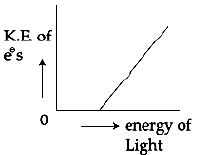
B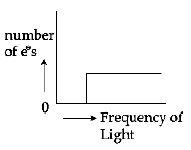
C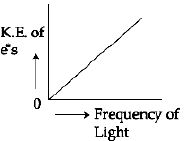
D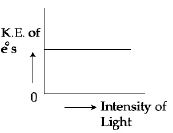
Solution
(C) According to Einstein's photoelectric equation,the kinetic energy $(K.E.)$ of the ejected electron is given by: $K.E. = h\nu - h\nu_0$,where $h\nu$ is the energy of the incident photon and $h\nu_0$ is the work function of the metal.
$1$. The relationship between $K.E.$ and energy of light $(h\nu)$ is a straight line with a positive intercept $(-h\nu_0)$,which matches graph $(A)$.
$2$. The number of ejected electrons depends on the intensity of light,not the frequency (above the threshold),so graph $(B)$ is a valid representation.
$3$. The relationship between $K.E.$ and frequency $(
u)$ is $K.E. = h\nu - h\nu_0$. This is a straight line with a negative intercept on the $K.E.$ axis,not one passing through the origin. Therefore,graph $(C)$ is incorrect.
$4$. $K.E.$ is independent of the intensity of incident light,so graph $(D)$ is a valid representation.
Thus,the graph that does not represent the relationship is $(C)$.
$1$. The relationship between $K.E.$ and energy of light $(h\nu)$ is a straight line with a positive intercept $(-h\nu_0)$,which matches graph $(A)$.
$2$. The number of ejected electrons depends on the intensity of light,not the frequency (above the threshold),so graph $(B)$ is a valid representation.
$3$. The relationship between $K.E.$ and frequency $(
u)$ is $K.E. = h\nu - h\nu_0$. This is a straight line with a negative intercept on the $K.E.$ axis,not one passing through the origin. Therefore,graph $(C)$ is incorrect.
$4$. $K.E.$ is independent of the intensity of incident light,so graph $(D)$ is a valid representation.
Thus,the graph that does not represent the relationship is $(C)$.
0 likes
View Solution358
MediumMCQ
The ground state energy of hydrogen atom is $-13.6 \ eV$. The energy of the second excited state of $He^{+}$ ion in $eV$ is:
A
$-54.4$
B
$-3.4$
C
$-6.04$
D
$-27.2$
Solution
(C) The energy of an electron in a hydrogen-like species is given by the formula: $E_n = -13.6 \times \frac{Z^2}{n^2} \ eV$.
For the $He^{+}$ ion,the atomic number $Z = 2$.
The ground state is $n = 1$,the first excited state is $n = 2$,and the second excited state is $n = 3$.
Substituting $Z = 2$ and $n = 3$ into the formula:
$E_3 = -13.6 \times \frac{2^2}{3^2} \ eV$
$E_3 = -13.6 \times \frac{4}{9} \ eV$
$E_3 = -13.6 \times 0.4444 \ eV = -6.04 \ eV$.
For the $He^{+}$ ion,the atomic number $Z = 2$.
The ground state is $n = 1$,the first excited state is $n = 2$,and the second excited state is $n = 3$.
Substituting $Z = 2$ and $n = 3$ into the formula:
$E_3 = -13.6 \times \frac{2^2}{3^2} \ eV$
$E_3 = -13.6 \times \frac{4}{9} \ eV$
$E_3 = -13.6 \times 0.4444 \ eV = -6.04 \ eV$.
0 likes
View Solution359
MediumMCQ
Heat treatment of muscular pain involves radiation of wavelength of about $900 \ nm$. Which spectral line of $H$ atom is suitable for this purpose?
$[R_H = 1.097 \times 10^7 \ m^{-1}, \ h = 6.626 \times 10^{-34} \ J \cdot s, \ c = 3 \times 10^8 \ m/s]$
$[R_H = 1.097 \times 10^7 \ m^{-1}, \ h = 6.626 \times 10^{-34} \ J \cdot s, \ c = 3 \times 10^8 \ m/s]$
A
Paschen,$\infty \to 3$
B
Paschen,$5 \to 3$
C
Balmer,$\infty \to 2$
D
Lyman,$\infty \to 1$
Solution
(A) The wavelength is given as $\lambda = 900 \ nm = 900 \times 10^{-9} \ m = 9 \times 10^{-7} \ m$.
Using the Rydberg formula for the hydrogen atom: $\frac{1}{\lambda} = R_H \left( \frac{1}{n_1^2} - \frac{1}{n_2^2} \right)$.
For the Paschen series,$n_1 = 3$. Substituting the values: $\frac{1}{9 \times 10^{-7}} = 1.097 \times 10^7 \left( \frac{1}{3^2} - \frac{1}{n_2^2} \right)$.
$0.101 = \frac{1}{9} - \frac{1}{n_2^2} \implies \frac{1}{n_2^2} = 0.111 - 0.101 = 0.01$.
$n_2^2 = 100 \implies n_2 = 10$.
Since $900 \ nm$ falls in the infrared region,it corresponds to the Paschen series $(n_1 = 3)$. Among the given options,the Paschen series is the correct spectral region.
Using the Rydberg formula for the hydrogen atom: $\frac{1}{\lambda} = R_H \left( \frac{1}{n_1^2} - \frac{1}{n_2^2} \right)$.
For the Paschen series,$n_1 = 3$. Substituting the values: $\frac{1}{9 \times 10^{-7}} = 1.097 \times 10^7 \left( \frac{1}{3^2} - \frac{1}{n_2^2} \right)$.
$0.101 = \frac{1}{9} - \frac{1}{n_2^2} \implies \frac{1}{n_2^2} = 0.111 - 0.101 = 0.01$.
$n_2^2 = 100 \implies n_2 = 10$.
Since $900 \ nm$ falls in the infrared region,it corresponds to the Paschen series $(n_1 = 3)$. Among the given options,the Paschen series is the correct spectral region.
0 likes
View Solution360
DifficultMCQ
What is the work function of the metal if the light of wavelength $4000 \, \mathring{A}$ generates photoelectrons of velocity $6 \times 10^5 \, ms^{-1}$ from it? ............. $eV$ (Mass of electron $= 9 \times 10^{-31} \, kg$; Velocity of light $= 3 \times 10^8 \, ms^{-1}$; Planck's constant $= 6.626 \times 10^{-34} \, Js$; Charge of electron $= 1.6 \times 10^{-19} \, C \, eV^{-1}$)
A
$0.9$
B
$3.1$
C
$2.1$
D
$4.0$
Solution
(C) The energy of the incident photon is given by $E = \frac{hc}{\lambda}$.
$E = \frac{6.626 \times 10^{-34} \times 3 \times 10^8}{4000 \times 10^{-10}} = 4.9695 \times 10^{-19} \, J$.
The kinetic energy of the emitted photoelectron is $K.E. = \frac{1}{2}mv^2$.
$K.E. = \frac{1}{2} \times 9 \times 10^{-31} \times (6 \times 10^5)^2 = 1.62 \times 10^{-19} \, J$.
According to Einstein's photoelectric equation,$E = \phi + K.E.$,where $\phi$ is the work function.
$\phi = E - K.E. = 4.9695 \times 10^{-19} - 1.62 \times 10^{-19} = 3.3495 \times 10^{-19} \, J$.
To convert the work function into $eV$,divide by the charge of an electron $(1.6 \times 10^{-19} \, C)$:
$\phi = \frac{3.3495 \times 10^{-19}}{1.6 \times 10^{-19}} \approx 2.093 \, eV \approx 2.1 \, eV$.
$E = \frac{6.626 \times 10^{-34} \times 3 \times 10^8}{4000 \times 10^{-10}} = 4.9695 \times 10^{-19} \, J$.
The kinetic energy of the emitted photoelectron is $K.E. = \frac{1}{2}mv^2$.
$K.E. = \frac{1}{2} \times 9 \times 10^{-31} \times (6 \times 10^5)^2 = 1.62 \times 10^{-19} \, J$.
According to Einstein's photoelectric equation,$E = \phi + K.E.$,where $\phi$ is the work function.
$\phi = E - K.E. = 4.9695 \times 10^{-19} - 1.62 \times 10^{-19} = 3.3495 \times 10^{-19} \, J$.
To convert the work function into $eV$,divide by the charge of an electron $(1.6 \times 10^{-19} \, C)$:
$\phi = \frac{3.3495 \times 10^{-19}}{1.6 \times 10^{-19}} \approx 2.093 \, eV \approx 2.1 \, eV$.
0 likes
View Solution361
MediumMCQ
For any given series of spectral lines of atomic hydrogen,let $\Delta \bar{\nu} = \Delta \bar{\nu}_{\max} - \Delta \bar{\nu}_{\min}$ be the difference in maximum and minimum wavenumbers in $cm^{-1}$. The ratio $\Delta \bar{\nu}_{\text{Lyman}} / \Delta \bar{\nu}_{\text{Balmer}}$ is
A
$5:4$
B
$4:1$
C
$9:4$
D
$27:5$
Solution
(C) The wavenumber is given by $\bar{\nu} = R_H \left[ \frac{1}{n_1^2} - \frac{1}{n_2^2} \right]$.
For any series,$\Delta \bar{\nu} = \bar{\nu}_{\max} - \bar{\nu}_{\min} = R_H \left[ \frac{1}{n_1^2} - \frac{1}{n_1+1^2} \right] - R_H \left[ \frac{1}{n_1^2} - \frac{1}{\infty^2} \right] = R_H \left[ \frac{1}{\infty^2} - \frac{1}{(n_1+1)^2} \right] = \frac{R_H}{(n_1+1)^2}$.
For the Lyman series,$n_1 = 1$,so $\Delta \bar{\nu}_{\text{Lyman}} = \frac{R_H}{(1+1)^2} = \frac{R_H}{4}$.
For the Balmer series,$n_1 = 2$,so $\Delta \bar{\nu}_{\text{Balmer}} = \frac{R_H}{(2+1)^2} = \frac{R_H}{9}$.
Therefore,the ratio is $\frac{\Delta \bar{\nu}_{\text{Lyman}}}{\Delta \bar{\nu}_{\text{Balmer}}} = \frac{R_H/4}{R_H/9} = \frac{9}{4}$.
For any series,$\Delta \bar{\nu} = \bar{\nu}_{\max} - \bar{\nu}_{\min} = R_H \left[ \frac{1}{n_1^2} - \frac{1}{n_1+1^2} \right] - R_H \left[ \frac{1}{n_1^2} - \frac{1}{\infty^2} \right] = R_H \left[ \frac{1}{\infty^2} - \frac{1}{(n_1+1)^2} \right] = \frac{R_H}{(n_1+1)^2}$.
For the Lyman series,$n_1 = 1$,so $\Delta \bar{\nu}_{\text{Lyman}} = \frac{R_H}{(1+1)^2} = \frac{R_H}{4}$.
For the Balmer series,$n_1 = 2$,so $\Delta \bar{\nu}_{\text{Balmer}} = \frac{R_H}{(2+1)^2} = \frac{R_H}{9}$.
Therefore,the ratio is $\frac{\Delta \bar{\nu}_{\text{Lyman}}}{\Delta \bar{\nu}_{\text{Balmer}}} = \frac{R_H/4}{R_H/9} = \frac{9}{4}$.
0 likes
View Solution362
DifficultMCQ
Which one of the following about an electron occupying the $1s$ orbital in a hydrogen atom is incorrect? (The Bohr radius is represented by $a_0$)
A
The electron can be found at a distance $2a_0$ from the nucleus
B
The probability density of finding the electron is maximum at the nucleus
C
The magnitude of potential energy is double that of its kinetic energy on an average
D
The total energy of the electron is maximum when it is at a distance $a_0$ from the nucleus
Solution
(D) For a hydrogen atom,the total energy $(E)$ of an electron in an orbital is constant and depends only on the principal quantum number $(n)$.
$E = -K.E = \frac{P.E}{2}$,which implies $|P.E| = 2 \times |K.E|$. Thus,option $C$ is correct.
The probability density for a $1s$ orbital is given by $\psi^2 = \frac{1}{\pi a_0^3} e^{-2r/a_0}$. This value is maximum at $r = 0$ (the nucleus),so option $B$ is correct.
The electron can be found at any distance $r$ from the nucleus,including $2a_0$,although the probability density decreases exponentially with distance. Thus,option $A$ is correct.
The total energy of the electron in a specific orbital is constant and does not change with its instantaneous distance from the nucleus. Therefore,the statement that the total energy is maximum at $a_0$ is incorrect.
$E = -K.E = \frac{P.E}{2}$,which implies $|P.E| = 2 \times |K.E|$. Thus,option $C$ is correct.
The probability density for a $1s$ orbital is given by $\psi^2 = \frac{1}{\pi a_0^3} e^{-2r/a_0}$. This value is maximum at $r = 0$ (the nucleus),so option $B$ is correct.
The electron can be found at any distance $r$ from the nucleus,including $2a_0$,although the probability density decreases exponentially with distance. Thus,option $A$ is correct.
The total energy of the electron in a specific orbital is constant and does not change with its instantaneous distance from the nucleus. Therefore,the statement that the total energy is maximum at $a_0$ is incorrect.
0 likes
View Solution363
MediumMCQ
The ratio of the shortest wavelength of two spectral series of the hydrogen spectrum is found to be about $9$. The spectral series are
A
Lyman and Paschen
B
Brackett and Pfund
C
Paschen and Pfund
D
Balmer and Brackett
Solution
(A) The shortest wavelength $(\lambda)$ for a spectral series is given by the Rydberg formula: $\frac{1}{\lambda} = R_H \times Z^2 \times (\frac{1}{n_1^2} - \frac{1}{n_2^2})$.
For the shortest wavelength,$n_2 = \infty$,so $\frac{1}{\lambda} = \frac{R_H}{n_1^2}$.
Thus,$\lambda = \frac{n_1^2}{R_H}$.
The ratio of the shortest wavelengths of two series with lower energy levels $n_1$ and $n_2$ is $\frac{\lambda_2}{\lambda_1} = \frac{n_2^2}{n_1^2} = 9$.
This implies $\frac{n_2}{n_1} = 3$.
For the Lyman series,$n_1 = 1$. For the Paschen series,$n_2 = 3$.
Therefore,the ratio is $\frac{3^2}{1^2} = 9$. The series are Lyman and Paschen.
For the shortest wavelength,$n_2 = \infty$,so $\frac{1}{\lambda} = \frac{R_H}{n_1^2}$.
Thus,$\lambda = \frac{n_1^2}{R_H}$.
The ratio of the shortest wavelengths of two series with lower energy levels $n_1$ and $n_2$ is $\frac{\lambda_2}{\lambda_1} = \frac{n_2^2}{n_1^2} = 9$.
This implies $\frac{n_2}{n_1} = 3$.
For the Lyman series,$n_1 = 1$. For the Paschen series,$n_2 = 3$.
Therefore,the ratio is $\frac{3^2}{1^2} = 9$. The series are Lyman and Paschen.
0 likes
View Solution364
MediumMCQ
When electronic transition occurs from a higher energy state to a lower energy state with an energy difference equal to $\Delta E$ electron volts,the wavelength of the emitted line is approximately equal to
A
$\frac{12395}{\Delta E} \times 10^{-10} \ m$
B
$\frac{12395}{\Delta E} \times 10^{10} \ m$
C
$\frac{12395}{\Delta E} \times 10^{-10} \ cm$
D
$\frac{12395}{\Delta E} \times 10^{10} \ cm$
Solution
(A) The energy of a photon is given by $\Delta E = \frac{hc}{\lambda}$.
Rearranging for wavelength,we get $\lambda = \frac{hc}{\Delta E}$.
Given $\Delta E$ is in electron volts $(eV)$,we use $h = 6.626 \times 10^{-34} \ J \ s$,$c = 3 \times 10^{8} \ m/s$,and $1 \ eV = 1.602 \times 10^{-19} \ J$.
$\lambda = \frac{6.626 \times 10^{-34} \times 3 \times 10^{8}}{\Delta E \times 1.602 \times 10^{-19}} \ m$.
$\lambda \approx \frac{12395}{\Delta E} \times 10^{-10} \ m$.
Rearranging for wavelength,we get $\lambda = \frac{hc}{\Delta E}$.
Given $\Delta E$ is in electron volts $(eV)$,we use $h = 6.626 \times 10^{-34} \ J \ s$,$c = 3 \times 10^{8} \ m/s$,and $1 \ eV = 1.602 \times 10^{-19} \ J$.
$\lambda = \frac{6.626 \times 10^{-34} \times 3 \times 10^{8}}{\Delta E \times 1.602 \times 10^{-19}} \ m$.
$\lambda \approx \frac{12395}{\Delta E} \times 10^{-10} \ m$.
0 likes
View Solution365
DifficultMCQ
The frequency of a certain line of the Lyman series of the atomic spectrum of the $H$ atom satisfies the following conditions:
$(i)$ It is the sum of the frequency of another Lyman line and a Balmer line.
$(ii)$ It is the sum of the frequency of a certain line,a Lyman line,and a Paschen line.
$(iii)$ It is the sum of the frequency of a Lyman and a Paschen line but no Brackett line.
To what transition does this frequency correspond?
$(i)$ It is the sum of the frequency of another Lyman line and a Balmer line.
$(ii)$ It is the sum of the frequency of a certain line,a Lyman line,and a Paschen line.
$(iii)$ It is the sum of the frequency of a Lyman and a Paschen line but no Brackett line.
To what transition does this frequency correspond?
A
$n_2 = 3$ to $n_1 = 1$
B
$n_2 = 3$ to $n_1 = 2$
C
$n_2 = 2$ to $n_1 = 1$
D
$n_2 = 4$ to $n_1 = 1$
Solution
(A) The frequency of a spectral line in the $H$ atom is given by $\nu = R_H c (\frac{1}{n_1^2} - \frac{1}{n_2^2})$.
For a Lyman series line,$n_1 = 1$. Let the transition be $n_2 = n$. Then $\nu = R_H c (1 - \frac{1}{n^2})$.
Condition $(i)$ states: $\nu(n \to 1) = \nu(n' \to 1) + \nu(n'' \to 2)$.
Substituting the Rydberg formula: $(1 - \frac{1}{n^2}) = (1 - \frac{1}{n'^2}) + (\frac{1}{4} - \frac{1}{n''^2})$.
For $n=3$,$\nu(3 \to 1) = R_H c (1 - \frac{1}{9}) = \frac{8}{9} R_H c$.
Checking the conditions for $n=3$:
$(i)$ $\nu(3 \to 1) = \nu(2 \to 1) + \nu(3 \to 2) = R_H c (1 - \frac{1}{4}) + R_H c (\frac{1}{4} - \frac{1}{9}) = R_H c (1 - \frac{1}{9}) = \frac{8}{9} R_H c$. This matches.
Thus,the transition corresponds to $n_2 = 3$ to $n_1 = 1$.
For a Lyman series line,$n_1 = 1$. Let the transition be $n_2 = n$. Then $\nu = R_H c (1 - \frac{1}{n^2})$.
Condition $(i)$ states: $\nu(n \to 1) = \nu(n' \to 1) + \nu(n'' \to 2)$.
Substituting the Rydberg formula: $(1 - \frac{1}{n^2}) = (1 - \frac{1}{n'^2}) + (\frac{1}{4} - \frac{1}{n''^2})$.
For $n=3$,$\nu(3 \to 1) = R_H c (1 - \frac{1}{9}) = \frac{8}{9} R_H c$.
Checking the conditions for $n=3$:
$(i)$ $\nu(3 \to 1) = \nu(2 \to 1) + \nu(3 \to 2) = R_H c (1 - \frac{1}{4}) + R_H c (\frac{1}{4} - \frac{1}{9}) = R_H c (1 - \frac{1}{9}) = \frac{8}{9} R_H c$. This matches.
Thus,the transition corresponds to $n_2 = 3$ to $n_1 = 1$.
0 likes
View Solution366
EasyMCQ
When a hydrogen sample in the ground state is bombarded with electrons,what potential is required to accelerate the electrons so that the first Brackett line is emitted? $(eV)$
A
$12.75$
B
$13.06$
C
$12.01$
D
$10.2$
Solution
(B) The Brackett series corresponds to electronic transitions ending at the $n = 4$ energy level.
The first line of the Brackett series occurs for the transition from $n = 5$ to $n = 4$.
To emit this line,the hydrogen atom must first be excited from the ground state $(n = 1)$ to the $n = 5$ state.
The energy required for this excitation is given by $\Delta E = E_5 - E_1$.
Using the formula $E_n = -13.6 / n^2 \ eV$,we have:
$E_1 = -13.6 \ eV$
$E_5 = -13.6 / 5^2 = -13.6 / 25 = -0.544 \ eV$.
Therefore,$\Delta E = -0.544 - (-13.6) = 13.056 \ eV \approx 13.06 \ eV$.
Thus,the potential required to accelerate the electron is $13.06 \ V$,which corresponds to an energy of $13.06 \ eV$.
The first line of the Brackett series occurs for the transition from $n = 5$ to $n = 4$.
To emit this line,the hydrogen atom must first be excited from the ground state $(n = 1)$ to the $n = 5$ state.
The energy required for this excitation is given by $\Delta E = E_5 - E_1$.
Using the formula $E_n = -13.6 / n^2 \ eV$,we have:
$E_1 = -13.6 \ eV$
$E_5 = -13.6 / 5^2 = -13.6 / 25 = -0.544 \ eV$.
Therefore,$\Delta E = -0.544 - (-13.6) = 13.056 \ eV \approx 13.06 \ eV$.
Thus,the potential required to accelerate the electron is $13.06 \ V$,which corresponds to an energy of $13.06 \ eV$.
0 likes
View Solution367
MediumMCQ
What is the maximum wavelength in the Lyman series of $He^{+}$ ion?
A
$3R$
B
$\frac{1}{3R}$
C
$\frac{1}{R}$
D
$2R$
Solution
(B) For the Lyman series,the transition occurs from higher energy levels to $n_1 = 1$.
For maximum wavelength,the energy difference must be minimum,which corresponds to the transition from $n_2 = 2$ to $n_1 = 1$.
The Rydberg formula is $\frac{1}{\lambda} = R \cdot Z^2 \left( \frac{1}{n_1^2} - \frac{1}{n_2^2} \right)$.
For $He^+$ ion,$Z = 2$,so $Z^2 = 4$.
Substituting the values: $\frac{1}{\lambda} = R \times 4 \left( \frac{1}{1^2} - \frac{1}{2^2} \right) = 4R \left( 1 - \frac{1}{4} \right) = 4R \left( \frac{3}{4} \right) = 3R$.
Therefore,$\lambda = \frac{1}{3R}$.
For maximum wavelength,the energy difference must be minimum,which corresponds to the transition from $n_2 = 2$ to $n_1 = 1$.
The Rydberg formula is $\frac{1}{\lambda} = R \cdot Z^2 \left( \frac{1}{n_1^2} - \frac{1}{n_2^2} \right)$.
For $He^+$ ion,$Z = 2$,so $Z^2 = 4$.
Substituting the values: $\frac{1}{\lambda} = R \times 4 \left( \frac{1}{1^2} - \frac{1}{2^2} \right) = 4R \left( 1 - \frac{1}{4} \right) = 4R \left( \frac{3}{4} \right) = 3R$.
Therefore,$\lambda = \frac{1}{3R}$.
0 likes
View Solution368
DifficultMCQ
Arrange the following wavelengths $(\lambda)$ of given emission lines of $H$ atoms in increasing order:
$(a) \ n = 3 \xrightarrow{\lambda_1} n = 1$
$(b) \ n = 12 \xrightarrow{\lambda_3} n = 10$
$(c) \ n = 5 \xrightarrow{\lambda_2} n = 3$
$(d) \ n = 22 \xrightarrow{\lambda_4} n = 20$
Choose the correct option.
$(a) \ n = 3 \xrightarrow{\lambda_1} n = 1$
$(b) \ n = 12 \xrightarrow{\lambda_3} n = 10$
$(c) \ n = 5 \xrightarrow{\lambda_2} n = 3$
$(d) \ n = 22 \xrightarrow{\lambda_4} n = 20$
Choose the correct option.
A
$\lambda_4 < \lambda_3 < \lambda_2 < \lambda_1$
B
$\lambda_4 < \lambda_2 < \lambda_3 < \lambda_1$
C
$\lambda_1 < \lambda_2 < \lambda_3 < \lambda_4$
D
$\lambda_1 < \lambda_3 < \lambda_2 < \lambda_4$
Solution
(C) The energy difference $\Delta E$ for a transition in a hydrogen atom is given by $\Delta E = 13.6 \left( \frac{1}{n_1^2} - \frac{1}{n_2^2} \right) \text{ eV}$.
The wavelength $\lambda$ is inversely proportional to the energy difference: $\lambda = \frac{hc}{\Delta E}$.
Thus,a larger $\Delta E$ corresponds to a smaller $\lambda$.
Calculating relative energy differences:
$(a) \ \Delta E_1 \propto (1/1^2 - 1/3^2) = 1 - 0.111 = 0.889$
$(b) \ \Delta E_3 \propto (1/10^2 - 1/12^2) = 0.01 - 0.0069 = 0.0031$
$(c) \ \Delta E_2 \propto (1/3^2 - 1/5^2) = 0.111 - 0.04 = 0.071$
$(d) \ \Delta E_4 \propto (1/20^2 - 1/22^2) = 0.0025 - 0.00206 = 0.00044$
Comparing energy differences: $\Delta E_1 > \Delta E_2 > \Delta E_3 > \Delta E_4$.
Therefore,the wavelengths follow the order: $\lambda_1 < \lambda_2 < \lambda_3 < \lambda_4$.
The wavelength $\lambda$ is inversely proportional to the energy difference: $\lambda = \frac{hc}{\Delta E}$.
Thus,a larger $\Delta E$ corresponds to a smaller $\lambda$.
Calculating relative energy differences:
$(a) \ \Delta E_1 \propto (1/1^2 - 1/3^2) = 1 - 0.111 = 0.889$
$(b) \ \Delta E_3 \propto (1/10^2 - 1/12^2) = 0.01 - 0.0069 = 0.0031$
$(c) \ \Delta E_2 \propto (1/3^2 - 1/5^2) = 0.111 - 0.04 = 0.071$
$(d) \ \Delta E_4 \propto (1/20^2 - 1/22^2) = 0.0025 - 0.00206 = 0.00044$
Comparing energy differences: $\Delta E_1 > \Delta E_2 > \Delta E_3 > \Delta E_4$.
Therefore,the wavelengths follow the order: $\lambda_1 < \lambda_2 < \lambda_3 < \lambda_4$.
0 likes
View Solution369
MediumMCQ
Which of the following provisions of the Bohr atomic model of hydrogen turned out to be false?
A
The line spectrum of hydrogen is produced when photons are emitted having energies,which are differences between quantum energy levels.
B
The energy of the electron is quantized.
C
An electron moves in a circular orbit around the nucleus.
D
The energy of the electron is inversely proportional to the square of the quantum number $n$.
Solution
(C) The Bohr model of the atom proposed that electrons move in well-defined circular orbits around the nucleus. However,this was later proven to be incorrect by the Heisenberg Uncertainty Principle and the wave-particle duality of matter,which suggest that electrons exist in three-dimensional orbitals rather than fixed circular paths. Therefore,the statement that an electron moves in a circular orbit around the nucleus is considered false in the context of modern quantum mechanics.
0 likes
View Solution370
MediumMCQ
Which of the following statements is correct regarding the properties of hydrogen-like species?
A
Radius of orbit $r_{2H} > r_{1He^{+}} > r_{1H}$
B
Ionisation energy $I.E._{H} > I.E._{He^{+}} > I.E._{Li^{+2}}$
C
Total Energy $E_{1H} < E_{2H} < E_{3H}$
D
Energy difference $E_{2H} - E_{1H} < E_{3H} - E_{2H} < E_{4H} - E_{3H}$
Solution
(C) The radius of an orbit is given by $r_n = 0.529 \times \frac{n^2}{Z} \ \mathring{A}$.
For $r_{2H}$,$n=2, Z=1 \implies r_{2H} = 0.529 \times 4 = 2.116 \ \mathring{A}$.
For $r_{1He^{+}}$,$n=1, Z=2 \implies r_{1He^{+}} = 0.529 \times \frac{1}{2} = 0.2645 \ \mathring{A}$.
For $r_{1H}$,$n=1, Z=1 \implies r_{1H} = 0.529 \ \mathring{A}$.
Thus,$r_{2H} > r_{1H} > r_{1He^{+}}$,so option $A$ is incorrect.
Ionisation energy is given by $I.E. = 13.6 \times \frac{Z^2}{n^2} \ \text{eV}$.
$I.E._{H} (Z=1, n=1) = 13.6 \ \text{eV}$.
$I.E._{He^{+}} (Z=2, n=1) = 13.6 \times 4 = 54.4 \ \text{eV}$.
$I.E._{Li^{+2}} (Z=3, n=1) = 13.6 \times 9 = 122.4 \ \text{eV}$.
Thus,$I.E._{Li^{+2}} > I.E._{He^{+}} > I.E._{H}$,so option $B$ is incorrect.
Total energy is $E_n = -13.6 \times \frac{Z^2}{n^2} \ \text{eV}$.
$E_{1H} = -13.6 \ \text{eV}$,$E_{2H} = -3.4 \ \text{eV}$,$E_{3H} = -1.51 \ \text{eV}$.
Since $-13.6 < -3.4 < -1.51$,$E_{1H} < E_{2H} < E_{3H}$ is correct.
Option $C$ is correct.
For $r_{2H}$,$n=2, Z=1 \implies r_{2H} = 0.529 \times 4 = 2.116 \ \mathring{A}$.
For $r_{1He^{+}}$,$n=1, Z=2 \implies r_{1He^{+}} = 0.529 \times \frac{1}{2} = 0.2645 \ \mathring{A}$.
For $r_{1H}$,$n=1, Z=1 \implies r_{1H} = 0.529 \ \mathring{A}$.
Thus,$r_{2H} > r_{1H} > r_{1He^{+}}$,so option $A$ is incorrect.
Ionisation energy is given by $I.E. = 13.6 \times \frac{Z^2}{n^2} \ \text{eV}$.
$I.E._{H} (Z=1, n=1) = 13.6 \ \text{eV}$.
$I.E._{He^{+}} (Z=2, n=1) = 13.6 \times 4 = 54.4 \ \text{eV}$.
$I.E._{Li^{+2}} (Z=3, n=1) = 13.6 \times 9 = 122.4 \ \text{eV}$.
Thus,$I.E._{Li^{+2}} > I.E._{He^{+}} > I.E._{H}$,so option $B$ is incorrect.
Total energy is $E_n = -13.6 \times \frac{Z^2}{n^2} \ \text{eV}$.
$E_{1H} = -13.6 \ \text{eV}$,$E_{2H} = -3.4 \ \text{eV}$,$E_{3H} = -1.51 \ \text{eV}$.
Since $-13.6 < -3.4 < -1.51$,$E_{1H} < E_{2H} < E_{3H}$ is correct.
Option $C$ is correct.
0 likes
View Solution371
MediumMCQ
An electron initially present in an excited state of $H$ atom is further excited to another energy level by an incident photon. It releases $10$ photons while coming back to the ground state,out of which $7$ have higher energy than the incident photon. The electron was initially present in:
A
$1^{st}$ excited state
B
$2^{nd}$ excited state
C
$3^{rd}$ excited state
D
$4^{th}$ excited state
Solution
(B) Let the electron be excited from state $n_1$ to $n_2$ by absorbing a photon of energy $E = E_{n_2} - E_{n_1}$.
When returning to the ground state $(n=1)$ from $n_2$,the total number of photons emitted is given by $\frac{n_2(n_2-1)}{2} = 10$.
Solving for $n_2$: $n_2^2 - n_2 - 20 = 0 \implies (n_2-5)(n_2+4) = 0$. Since $n_2 > 0$,we have $n_2 = 5$.
The energy of the incident photon is $E_{incident} = E_5 - E_{n_1}$.
There are $7$ transitions that have higher energy than the incident photon. These transitions must be from levels $n > n_1$ to levels $n \le n_1$.
The number of photons emitted with energy less than or equal to the incident photon is $10 - 7 = 3$. These correspond to transitions from levels $n \le n_1$ to $n=1$.
The number of such transitions is $\frac{n_1(n_1-1)}{2} = 3$.
Solving for $n_1$: $n_1^2 - n_1 - 6 = 0 \implies (n_1-3)(n_1+2) = 0$. Thus,$n_1 = 3$.
Since $n_1 = 3$,the electron was initially in the $2^{nd}$ excited state ($n=3$ is the $2^{nd}$ excited state).
When returning to the ground state $(n=1)$ from $n_2$,the total number of photons emitted is given by $\frac{n_2(n_2-1)}{2} = 10$.
Solving for $n_2$: $n_2^2 - n_2 - 20 = 0 \implies (n_2-5)(n_2+4) = 0$. Since $n_2 > 0$,we have $n_2 = 5$.
The energy of the incident photon is $E_{incident} = E_5 - E_{n_1}$.
There are $7$ transitions that have higher energy than the incident photon. These transitions must be from levels $n > n_1$ to levels $n \le n_1$.
The number of photons emitted with energy less than or equal to the incident photon is $10 - 7 = 3$. These correspond to transitions from levels $n \le n_1$ to $n=1$.
The number of such transitions is $\frac{n_1(n_1-1)}{2} = 3$.
Solving for $n_1$: $n_1^2 - n_1 - 6 = 0 \implies (n_1-3)(n_1+2) = 0$. Thus,$n_1 = 3$.
Since $n_1 = 3$,the electron was initially in the $2^{nd}$ excited state ($n=3$ is the $2^{nd}$ excited state).
0 likes
View Solution372
MediumMCQ
Angular momentum of an electron in the second shell of a $Li^{+2}$ ion is:
A
$6.62 \times 10^{-34} \ J \ s$
B
$3.31 \times 10^{-27} \ erg \ s$
C
$1.054 \times 10^{-27} \ erg \ s$
D
$2.108 \times 10^{-27} \ erg \ s$
Solution
(D) According to Bohr's postulate,the angular momentum $(mvr)$ of an electron in the $n^{th}$ shell is given by the formula: $mvr = \frac{nh}{2 \pi}$.
For the second shell,$n = 2$.
The value of Planck's constant $h$ in $CGS$ units is $6.626 \times 10^{-27} \ erg \ s$.
Substituting the values: $mvr = \frac{2 \times 6.626 \times 10^{-27}}{2 \times 3.14159}$.
$mvr = \frac{6.626 \times 10^{-27}}{3.14159} \approx 2.109 \times 10^{-27} \ erg \ s$.
Thus,the correct option is $D$.
For the second shell,$n = 2$.
The value of Planck's constant $h$ in $CGS$ units is $6.626 \times 10^{-27} \ erg \ s$.
Substituting the values: $mvr = \frac{2 \times 6.626 \times 10^{-27}}{2 \times 3.14159}$.
$mvr = \frac{6.626 \times 10^{-27}}{3.14159} \approx 2.109 \times 10^{-27} \ erg \ s$.
Thus,the correct option is $D$.
0 likes
View Solution373
MediumMCQ
The potential energy of an electron in the third excited state of $He^{+}$ ion is ............. $eV$.
A
$-12.08$
B
$-3.4$
C
$-6.8$
D
$-1.7$
Solution
(C) For a hydrogen-like species,the energy of an electron in the $n^{th}$ orbit is given by $E_n = -13.6 \times \frac{Z^2}{n^2} \, eV$.
For $He^{+}$ ion,the atomic number $Z = 2$.
The third excited state corresponds to $n = 4$ (since ground state is $n=1$,first excited is $n=2$,second is $n=3$,and third is $n=4$).
$E_4 = -13.6 \times \frac{2^2}{4^2} = -13.6 \times \frac{4}{16} = -13.6 \times 0.25 = -3.4 \, eV$.
The potential energy $(P.E.)$ is related to total energy $(E)$ by the relation $P.E. = 2 \times E$.
Therefore,$P.E. = 2 \times (-3.4 \, eV) = -6.8 \, eV$.
For $He^{+}$ ion,the atomic number $Z = 2$.
The third excited state corresponds to $n = 4$ (since ground state is $n=1$,first excited is $n=2$,second is $n=3$,and third is $n=4$).
$E_4 = -13.6 \times \frac{2^2}{4^2} = -13.6 \times \frac{4}{16} = -13.6 \times 0.25 = -3.4 \, eV$.
The potential energy $(P.E.)$ is related to total energy $(E)$ by the relation $P.E. = 2 \times E$.
Therefore,$P.E. = 2 \times (-3.4 \, eV) = -6.8 \, eV$.
0 likes
View Solution374
DifficultMCQ
Which of the following energy changes is less than the third Balmer transition in the $He^{\oplus}$ ion?
A
First excitation energy of $He^{\oplus}$ ion
B
Third separation energy of $Li^{2+}$ ion
C
Fourth excitation energy of $H$ atom
D
Ionisation energy of $Be^{3+}$ ion
Solution
(B) The energy of the third Balmer transition in $He^{\oplus}$ $(Z=2)$ corresponds to the transition from $n=5$ to $n=2$.
$\Delta E = 13.6 \times Z^{2} \times (\frac{1}{n_1^{2}} - \frac{1}{n_2^{2}}) = 13.6 \times 4 \times (\frac{1}{2^{2}} - \frac{1}{5^{2}}) = 54.4 \times (0.25 - 0.04) = 54.4 \times 0.21 = 11.424 \, eV$.
$(A)$ First excitation energy of $He^{\oplus}$ ($n=1$ to $n=2$): $\Delta E = 13.6 \times 4 \times (1 - \frac{1}{4}) = 54.4 \times 0.75 = 40.8 \, eV$.
$(B)$ Third separation energy of $Li^{2+}$ $(Z=3)$ corresponds to $n=4$ to $n=\infty$: $\Delta E = 13.6 \times 9 \times (\frac{1}{4^{2}}) = 122.4 \times 0.0625 = 7.65 \, eV$.
$(C)$ Fourth excitation energy of $H$ atom ($n=1$ to $n=5$): $\Delta E = 13.6 \times 1 \times (1 - \frac{1}{25}) = 13.6 \times 0.96 = 13.056 \, eV$.
$(D)$ Ionisation energy of $Be^{3+}$ $(Z=4)$: $\Delta E = 13.6 \times 16 = 217.6 \, eV$.
Comparing the values,$7.65 \, eV < 11.424 \, eV$. Thus,option $B$ is correct.
$\Delta E = 13.6 \times Z^{2} \times (\frac{1}{n_1^{2}} - \frac{1}{n_2^{2}}) = 13.6 \times 4 \times (\frac{1}{2^{2}} - \frac{1}{5^{2}}) = 54.4 \times (0.25 - 0.04) = 54.4 \times 0.21 = 11.424 \, eV$.
$(A)$ First excitation energy of $He^{\oplus}$ ($n=1$ to $n=2$): $\Delta E = 13.6 \times 4 \times (1 - \frac{1}{4}) = 54.4 \times 0.75 = 40.8 \, eV$.
$(B)$ Third separation energy of $Li^{2+}$ $(Z=3)$ corresponds to $n=4$ to $n=\infty$: $\Delta E = 13.6 \times 9 \times (\frac{1}{4^{2}}) = 122.4 \times 0.0625 = 7.65 \, eV$.
$(C)$ Fourth excitation energy of $H$ atom ($n=1$ to $n=5$): $\Delta E = 13.6 \times 1 \times (1 - \frac{1}{25}) = 13.6 \times 0.96 = 13.056 \, eV$.
$(D)$ Ionisation energy of $Be^{3+}$ $(Z=4)$: $\Delta E = 13.6 \times 16 = 217.6 \, eV$.
Comparing the values,$7.65 \, eV < 11.424 \, eV$. Thus,option $B$ is correct.
0 likes
View Solution375
MediumMCQ
The frequency of the first line of the Paschen series in the spectrum of the $Be^{+3}$ ion is:
A
$\frac{7RC}{9}$
B
$\frac{7RC}{144}$
C
$\frac{9RC}{25}$
D
$\frac{20RC}{9}$
Solution
(A) The frequency of a spectral line is given by the formula: $v = RC Z^{2} \left( \frac{1}{n_{1}^{2}} - \frac{1}{n_{2}^{2}} \right)$.
For the Paschen series,the transition is to the $n_{1} = 3$ energy level. The first line corresponds to the transition from $n_{2} = 4$ to $n_{1} = 3$.
For the $Be^{+3}$ ion,the atomic number $Z = 4$. Substituting these values into the formula:
$v = RC \times (4)^{2} \times \left( \frac{1}{3^{2}} - \frac{1}{4^{2}} \right)$
$v = RC \times 16 \times \left( \frac{1}{9} - \frac{1}{16} \right)$
$v = 16 RC \times \left( \frac{16 - 9}{144} \right)$
$v = 16 RC \times \frac{7}{144}$
$v = \frac{7 RC}{9}$
For the Paschen series,the transition is to the $n_{1} = 3$ energy level. The first line corresponds to the transition from $n_{2} = 4$ to $n_{1} = 3$.
For the $Be^{+3}$ ion,the atomic number $Z = 4$. Substituting these values into the formula:
$v = RC \times (4)^{2} \times \left( \frac{1}{3^{2}} - \frac{1}{4^{2}} \right)$
$v = RC \times 16 \times \left( \frac{1}{9} - \frac{1}{16} \right)$
$v = 16 RC \times \left( \frac{16 - 9}{144} \right)$
$v = 16 RC \times \frac{7}{144}$
$v = \frac{7 RC}{9}$
0 likes
View Solution376
DifficultMCQ
What will be the ratio of the wavelength of the third line of the Balmer series in the $He^{+}$ ion spectrum to the first line of the Balmer series in the $Li^{2+}$ ion spectrum?
A
$5 : 3$
B
$125 : 189$
C
$27 : 20$
D
$125 : 84$
Solution
(D) The Rydberg formula is given by $\frac{1}{\lambda} = R Z^2 \left( \frac{1}{n_1^2} - \frac{1}{n_2^2} \right)$.
For the Balmer series,$n_1 = 2$.
For the third line of the Balmer series,$n_2 = 2 + 3 = 5$. For $He^{+}$,$Z = 2$. So,$\frac{1}{\lambda_1} = R \cdot 2^2 \left( \frac{1}{2^2} - \frac{1}{5^2} \right) = 4R \left( \frac{1}{4} - \frac{1}{25} \right) = 4R \left( \frac{21}{100} \right) = \frac{21R}{25}$.
For the first line of the Balmer series,$n_2 = 2 + 1 = 3$. For $Li^{2+}$,$Z = 3$. So,$\frac{1}{\lambda_2} = R \cdot 3^2 \left( \frac{1}{2^2} - \frac{1}{3^2} \right) = 9R \left( \frac{1}{4} - \frac{1}{9} \right) = 9R \left( \frac{5}{36} \right) = \frac{5R}{4}$.
The ratio $\frac{\lambda_1}{\lambda_2} = \frac{\lambda_1}{1} \times \frac{1}{\lambda_2} = \frac{25}{21R} \times \frac{5R}{4} = \frac{125}{84}$.
For the Balmer series,$n_1 = 2$.
For the third line of the Balmer series,$n_2 = 2 + 3 = 5$. For $He^{+}$,$Z = 2$. So,$\frac{1}{\lambda_1} = R \cdot 2^2 \left( \frac{1}{2^2} - \frac{1}{5^2} \right) = 4R \left( \frac{1}{4} - \frac{1}{25} \right) = 4R \left( \frac{21}{100} \right) = \frac{21R}{25}$.
For the first line of the Balmer series,$n_2 = 2 + 1 = 3$. For $Li^{2+}$,$Z = 3$. So,$\frac{1}{\lambda_2} = R \cdot 3^2 \left( \frac{1}{2^2} - \frac{1}{3^2} \right) = 9R \left( \frac{1}{4} - \frac{1}{9} \right) = 9R \left( \frac{5}{36} \right) = \frac{5R}{4}$.
The ratio $\frac{\lambda_1}{\lambda_2} = \frac{\lambda_1}{1} \times \frac{1}{\lambda_2} = \frac{25}{21R} \times \frac{5R}{4} = \frac{125}{84}$.
0 likes
View Solution377
MediumMCQ
How does the energy gap between successive energy levels in an atom vary from low to high $n$ values?
A
All energy gaps are the same
B
The energy gap decreases as $n$ increases
C
The energy gap increases as $n$ increases
D
The energy gap changes unpredictably as $n$ increases
Solution
(B) The energy of an electron in a hydrogen-like atom is given by $E_n = -13.6 \times \frac{Z^2}{n^2} \text{ eV}$.
As the principal quantum number $n$ increases,the energy levels become closer to each other.
The energy difference between two successive levels $n$ and $n+1$ is given by $\Delta E = E_{n+1} - E_n = 13.6 \times Z^2 \times (\frac{1}{n^2} - \frac{1}{(n+1)^2})$.
As $n$ increases,the term $(\frac{1}{n^2} - \frac{1}{(n+1)^2})$ decreases,leading to a decrease in the energy gap.
Therefore,the energy gap decreases as $n$ increases.
As the principal quantum number $n$ increases,the energy levels become closer to each other.
The energy difference between two successive levels $n$ and $n+1$ is given by $\Delta E = E_{n+1} - E_n = 13.6 \times Z^2 \times (\frac{1}{n^2} - \frac{1}{(n+1)^2})$.
As $n$ increases,the term $(\frac{1}{n^2} - \frac{1}{(n+1)^2})$ decreases,leading to a decrease in the energy gap.
Therefore,the energy gap decreases as $n$ increases.
0 likes
View Solution378
EasyMCQ
The spectrum of helium is similar to which of the following?
A
$H$
B
$Li^{+}$
C
$Na$
D
$He^{+}$
Solution
(B) The spectrum of helium $(He)$ is similar to that of $Li^{+}$ because both are $2$-electron systems. Helium has $2$ electrons,and the lithium ion $(Li^{+})$ also has $3 - 1 = 2$ electrons. According to Bohr's theory,spectra are similar for species having the same number of electrons.
0 likes
View Solution379
MediumMCQ
The electron present in an excited state of $He^{+}$ ion shows separation (ionization) on collision with an electron having $2.5 \ eV$ energy. What will be the minimum value of $n$ for this electron of $He^{+}$ ion?
A
$4$
B
$5$
C
$6$
D
$3$
Solution
(B) The energy of an electron in the $n$-th orbit of a hydrogen-like species is given by $E_n = -13.6 \times \frac{Z^2}{n^2} \ eV$. For $He^{+}$,$Z = 2$,so $E_n = -13.6 \times \frac{4}{n^2} = -\frac{54.4}{n^2} \ eV$.
To ionize the electron,the energy supplied must be at least equal to the ionization energy,which is $|E_n| = \frac{54.4}{n^2} \ eV$.
Given that the collision with an electron of $2.5 \ eV$ energy causes ionization,the energy of the electron in the excited state must be greater than or equal to $-2.5 \ eV$.
Thus,$\frac{54.4}{n^2} \leq 2.5$.
$n^2 \geq \frac{54.4}{2.5} = 21.76$.
Since $n$ must be an integer,the minimum value of $n$ is $\sqrt{21.76} \approx 4.66$.
Therefore,the minimum integer value for $n$ is $5$.
To ionize the electron,the energy supplied must be at least equal to the ionization energy,which is $|E_n| = \frac{54.4}{n^2} \ eV$.
Given that the collision with an electron of $2.5 \ eV$ energy causes ionization,the energy of the electron in the excited state must be greater than or equal to $-2.5 \ eV$.
Thus,$\frac{54.4}{n^2} \leq 2.5$.
$n^2 \geq \frac{54.4}{2.5} = 21.76$.
Since $n$ must be an integer,the minimum value of $n$ is $\sqrt{21.76} \approx 4.66$.
Therefore,the minimum integer value for $n$ is $5$.
0 likes
View Solution380
MediumMCQ
The angular momentum of an electron in a given orbit is $J$. Its kinetic energy will be:
A
$\frac{J^2}{2mr^2}$
B
$\frac{JV}{r}$
C
$\frac{J^2}{2m}$
D
$\frac{J^2}{2\pi}$
Solution
(A) The angular momentum $J$ of an electron of mass $m$ moving in an orbit of radius $r$ with velocity $v$ is given by $J = mvr$.
Kinetic energy $(KE)$ is given by $KE = \frac{1}{2} mv^2$.
We can express $KE$ in terms of $J$ by substituting $v = \frac{J}{mr}$ into the $KE$ formula:
$KE = \frac{1}{2} m \left( \frac{J}{mr} \right)^2 = \frac{1}{2} m \left( \frac{J^2}{m^2r^2} \right) = \frac{J^2}{2mr^2}$.
Thus,the correct option is $(A)$.
Kinetic energy $(KE)$ is given by $KE = \frac{1}{2} mv^2$.
We can express $KE$ in terms of $J$ by substituting $v = \frac{J}{mr}$ into the $KE$ formula:
$KE = \frac{1}{2} m \left( \frac{J}{mr} \right)^2 = \frac{1}{2} m \left( \frac{J^2}{m^2r^2} \right) = \frac{J^2}{2mr^2}$.
Thus,the correct option is $(A)$.
0 likes
View Solution381
MediumMCQ
The shortest wavelength of $He^{+}$ ion in Balmer series is $x$. Then,the longest wavelength in the Paschen series of $Li^{2+}$ is:
A
$\frac{36x}{5}$
B
$\frac{16x}{7}$
C
$\frac{9x}{5}$
D
$\frac{5x}{9}$
Solution
(B) The wavelength of $H$-like atoms is given by the Rydberg formula:
$\frac{1}{\lambda} = R Z^2 \left[ \frac{1}{n_1^2} - \frac{1}{n_2^2} \right]$
For the shortest wavelength $x$ of the Balmer series of $He^{+}$ $(Z=2)$: $n_1 = 2$ and $n_2 = \infty$.
$\frac{1}{x} = R(2)^2 \left[ \frac{1}{2^2} - \frac{1}{\infty^2} \right] = 4R \left[ \frac{1}{4} \right] = R$
$\Rightarrow x = \frac{1}{R}$
For the longest wavelength $\lambda$ of the Paschen series of $Li^{2+}$ $(Z=3)$: $n_1 = 3$ and $n_2 = 4$.
$\frac{1}{\lambda} = R(3)^2 \left[ \frac{1}{3^2} - \frac{1}{4^2} \right]$
$\frac{1}{\lambda} = 9R \left[ \frac{1}{9} - \frac{1}{16} \right] = 9R \left[ \frac{16-9}{144} \right] = 9R \left[ \frac{7}{144} \right] = \frac{7R}{16}$
$\Rightarrow \lambda = \frac{16}{7R} = \frac{16x}{7}$
Hence,the correct option is $B$.
$\frac{1}{\lambda} = R Z^2 \left[ \frac{1}{n_1^2} - \frac{1}{n_2^2} \right]$
For the shortest wavelength $x$ of the Balmer series of $He^{+}$ $(Z=2)$: $n_1 = 2$ and $n_2 = \infty$.
$\frac{1}{x} = R(2)^2 \left[ \frac{1}{2^2} - \frac{1}{\infty^2} \right] = 4R \left[ \frac{1}{4} \right] = R$
$\Rightarrow x = \frac{1}{R}$
For the longest wavelength $\lambda$ of the Paschen series of $Li^{2+}$ $(Z=3)$: $n_1 = 3$ and $n_2 = 4$.
$\frac{1}{\lambda} = R(3)^2 \left[ \frac{1}{3^2} - \frac{1}{4^2} \right]$
$\frac{1}{\lambda} = 9R \left[ \frac{1}{9} - \frac{1}{16} \right] = 9R \left[ \frac{16-9}{144} \right] = 9R \left[ \frac{7}{144} \right] = \frac{7R}{16}$
$\Rightarrow \lambda = \frac{16}{7R} = \frac{16x}{7}$
Hence,the correct option is $B$.
0 likes
View Solution382
MediumMCQ
Two electrons are revolving around a nucleus at distances $r$ and $4r$. The ratio of their time periods is
A
$1:4$
B
$4:1$
C
$8:1$
D
$1:8$
Solution
(D) According to Kepler's third law for circular orbits,$T^2 \propto r^3$,which implies $T \propto r^{3/2}$.
Given the distances $r_1 = r$ and $r_2 = 4r$,the ratio of their time periods is calculated as:
$\frac{T_1}{T_2} = (\frac{r_1}{r_2})^{3/2} = (\frac{r}{4r})^{3/2} = (\frac{1}{4})^{3/2} = \frac{1}{8}$.
Therefore,the ratio of their time periods is $1:8$.
Given the distances $r_1 = r$ and $r_2 = 4r$,the ratio of their time periods is calculated as:
$\frac{T_1}{T_2} = (\frac{r_1}{r_2})^{3/2} = (\frac{r}{4r})^{3/2} = (\frac{1}{4})^{3/2} = \frac{1}{8}$.
Therefore,the ratio of their time periods is $1:8$.
0 likes
View Solution383
MediumMCQ
If the ratio of the area of two orbits of an $H$ atom is $4 : 1$,then the ratio of the frequency of the $e^-$ in these two orbits is:
A
$8 : 1$
B
$2\sqrt{2} : 1$
C
$1 : 2\sqrt{2}$
D
$1 : 8$
Solution
(C) The area of an orbit is given by $A = \pi r^2$. Since $r \propto n^2$,we have $A \propto (n^2)^2 = n^4$.
Given $\frac{A_1}{A_2} = \frac{4}{1}$,then $(\frac{n_1}{n_2})^4 = 4$,which implies $\frac{n_1}{n_2} = (4)^{1/4} = (2^2)^{1/4} = 2^{1/2} = \sqrt{2}$.
The frequency of an electron in an orbit is given by $f \propto \frac{1}{n^3}$.
Therefore,$\frac{f_1}{f_2} = (\frac{n_2}{n_1})^3 = (\frac{1}{\sqrt{2}})^3 = \frac{1}{2\sqrt{2}}$.
Thus,the ratio is $1 : 2\sqrt{2}$.
Given $\frac{A_1}{A_2} = \frac{4}{1}$,then $(\frac{n_1}{n_2})^4 = 4$,which implies $\frac{n_1}{n_2} = (4)^{1/4} = (2^2)^{1/4} = 2^{1/2} = \sqrt{2}$.
The frequency of an electron in an orbit is given by $f \propto \frac{1}{n^3}$.
Therefore,$\frac{f_1}{f_2} = (\frac{n_2}{n_1})^3 = (\frac{1}{\sqrt{2}})^3 = \frac{1}{2\sqrt{2}}$.
Thus,the ratio is $1 : 2\sqrt{2}$.
0 likes
View Solution384
EasyMCQ
In the atomic spectrum of hydrogen,the series of lines observed in the visible region is:
A
Balmer series
B
Paschen series
C
Brackett series
D
Lyman series
Solution
(A) The hydrogen emission spectrum consists of several series of lines based on the energy level transitions of the electron.
The series are:
$1$. Lyman series: $n_1 = 1$ (Ultraviolet region)
$2$. Balmer series: $n_1 = 2$ (Visible region)
$3$. Paschen series: $n_1 = 3$ (Infrared region)
$4$. Brackett series: $n_1 = 4$ (Infrared region)
$5$. Pfund series: $n_1 = 5$ (Infrared region)
Therefore,the series observed in the visible region is the Balmer series.
The series are:
$1$. Lyman series: $n_1 = 1$ (Ultraviolet region)
$2$. Balmer series: $n_1 = 2$ (Visible region)
$3$. Paschen series: $n_1 = 3$ (Infrared region)
$4$. Brackett series: $n_1 = 4$ (Infrared region)
$5$. Pfund series: $n_1 = 5$ (Infrared region)
Therefore,the series observed in the visible region is the Balmer series.
0 likes
View Solution385
MediumMCQ
Ratio of velocities of electrons of hydrogen atom in $1^{st}$,$2^{nd}$,$3^{rd}$ orbit is
A
$1 : 2 : 3$
B
$1 : 1 : 1$
C
$1 : 1/2 : 1/3$
D
$3 : 2 : 1$
Solution
(C) The velocity of an electron in the $n^{th}$ orbit of a hydrogen atom is given by the formula $v_n = \frac{v_0}{n}$,where $v_0$ is a constant.
This implies that velocity is inversely proportional to the orbit number $n$,i.e.,$v \propto \frac{1}{n}$.
For the $1^{st}$,$2^{nd}$,and $3^{rd}$ orbits,the ratio of velocities is:
$v_1 : v_2 : v_3 = \frac{1}{1} : \frac{1}{2} : \frac{1}{3}$.
Therefore,the correct option is $C$.
This implies that velocity is inversely proportional to the orbit number $n$,i.e.,$v \propto \frac{1}{n}$.
For the $1^{st}$,$2^{nd}$,and $3^{rd}$ orbits,the ratio of velocities is:
$v_1 : v_2 : v_3 = \frac{1}{1} : \frac{1}{2} : \frac{1}{3}$.
Therefore,the correct option is $C$.
0 likes
View Solution386
MediumMCQ
The wavelength of $H_{\alpha}$ line of Balmer series is $X \ \mathring{A}$. What is the wavelength of $H_{\beta}$ line of Balmer series?
A
$X \ \frac{108}{80} \ \mathring{A}$
B
$X \ \frac{80}{108} \ \mathring{A}$
C
$\frac{1}{X} \ \frac{80}{108} \ \mathring{A}$
D
$\frac{1}{X} \ \frac{108}{80} \ \mathring{A}$
Solution
(B) The Rydberg formula for the Balmer series $(n_1 = 2)$ is given by $\frac{1}{\lambda} = RZ^2 \left( \frac{1}{2^2} - \frac{1}{n_2^2} \right)$.
For the $H_{\alpha}$ line,$n_2 = 3$: $\frac{1}{X} = RZ^2 \left( \frac{1}{4} - \frac{1}{9} \right) = RZ^2 \left( \frac{5}{36} \right) \implies RZ^2 = \frac{36}{5X}$.
For the $H_{\beta}$ line,$n_2 = 4$: $\frac{1}{\lambda_{\beta}} = RZ^2 \left( \frac{1}{4} - \frac{1}{16} \right) = RZ^2 \left( \frac{3}{16} \right)$.
Substituting $RZ^2$: $\frac{1}{\lambda_{\beta}} = \left( \frac{36}{5X} \right) \left( \frac{3}{16} \right) = \frac{108}{80X}$.
Therefore,$\lambda_{\beta} = X \left( \frac{80}{108} \right) \ \mathring{A}$.
For the $H_{\alpha}$ line,$n_2 = 3$: $\frac{1}{X} = RZ^2 \left( \frac{1}{4} - \frac{1}{9} \right) = RZ^2 \left( \frac{5}{36} \right) \implies RZ^2 = \frac{36}{5X}$.
For the $H_{\beta}$ line,$n_2 = 4$: $\frac{1}{\lambda_{\beta}} = RZ^2 \left( \frac{1}{4} - \frac{1}{16} \right) = RZ^2 \left( \frac{3}{16} \right)$.
Substituting $RZ^2$: $\frac{1}{\lambda_{\beta}} = \left( \frac{36}{5X} \right) \left( \frac{3}{16} \right) = \frac{108}{80X}$.
Therefore,$\lambda_{\beta} = X \left( \frac{80}{108} \right) \ \mathring{A}$.
0 likes
View Solution387
DifficultMCQ
The $I.P.$ of a hydrogen-like species is $36 \ eV$. What is the value of the second excitation energy in $eV$?
A
$5$
B
$12$
C
$32$
D
$27$
Solution
(C) The ionization potential $(I.P.)$ of a hydrogen-like species is given by $E_n = -13.6 \times Z^2 / n^2 \ eV$. For the ground state $(n=1)$,$I.P. = 13.6 \times Z^2 = 36 \ eV$.
The energy of any state $n$ is $E_n = -36 / n^2 \ eV$.
The second excitation energy corresponds to the transition from the ground state $(n=1)$ to the third energy level $(n=3)$.
The energy of the third level is $E_3 = -36 / 3^2 = -36 / 9 = -4 \ eV$.
The energy of the ground state is $E_1 = -36 / 1^2 = -36 \ eV$.
The second excitation energy is $\Delta E = E_3 - E_1 = -4 - (-36) = 32 \ eV$.
The energy of any state $n$ is $E_n = -36 / n^2 \ eV$.
The second excitation energy corresponds to the transition from the ground state $(n=1)$ to the third energy level $(n=3)$.
The energy of the third level is $E_3 = -36 / 3^2 = -36 / 9 = -4 \ eV$.
The energy of the ground state is $E_1 = -36 / 1^2 = -36 \ eV$.
The second excitation energy is $\Delta E = E_3 - E_1 = -4 - (-36) = 32 \ eV$.
0 likes
View Solution388
MediumMCQ
Which of the following is correct for any $H^-$-like species?
A
$(E_2 - E_1) > (E_3 - E_2) > (E_4 - E_3)$
B
$(E_2 - E_1) < (E_3 - E_2) < (E_4 - E_3)$
C
$(E_2 - E_1) = (E_3 - E_2) = (E_4 - E_3)$
D
$(E_2 - E_1) = \frac{1}{4} (E_3 - E_2) = \frac{1}{9} (E_4 - E_3)$
Solution
(A) For a hydrogen-like species,the energy of an orbit is given by $E_n = -13.6 \times \frac{Z^2}{n^2} \text{ eV}$.
For $n=1, 2, 3, 4$,the energy values are $E_1 = -13.6 Z^2, E_2 = -3.4 Z^2, E_3 = -1.51 Z^2, E_4 = -0.85 Z^2$.
Calculating the energy differences:
$(E_2 - E_1) = (-3.4 - (-13.6)) Z^2 = 10.2 Z^2$
$(E_3 - E_2) = (-1.51 - (-3.4)) Z^2 = 1.89 Z^2$
$(E_4 - E_3) = (-0.85 - (-1.51)) Z^2 = 0.66 Z^2$
Comparing these values,we find that $(E_2 - E_1) > (E_3 - E_2) > (E_4 - E_3)$.
For $n=1, 2, 3, 4$,the energy values are $E_1 = -13.6 Z^2, E_2 = -3.4 Z^2, E_3 = -1.51 Z^2, E_4 = -0.85 Z^2$.
Calculating the energy differences:
$(E_2 - E_1) = (-3.4 - (-13.6)) Z^2 = 10.2 Z^2$
$(E_3 - E_2) = (-1.51 - (-3.4)) Z^2 = 1.89 Z^2$
$(E_4 - E_3) = (-0.85 - (-1.51)) Z^2 = 0.66 Z^2$
Comparing these values,we find that $(E_2 - E_1) > (E_3 - E_2) > (E_4 - E_3)$.
0 likes
View Solution389
DifficultMCQ
An atom has $x$ energy levels,then the total number of spectral lines in its emission spectrum is given by:
A
$1 + 2 + 3 + \dots + (x + 1)$
B
$1 + 2 + 3 + \dots + x^2$
C
$1 + 2 + 3 + \dots + (x - 1)$
D
$(x + 1)(x + 2)(x + 4)$
Solution
(C) When an electron transitions from an excited state $x$ to lower energy levels,the total number of spectral lines is calculated by summing the possible transitions from each level.
For an atom with $x$ energy levels,the transitions are from level $x$ to $(x-1), (x-2), \dots, 1$.
The number of lines is given by the sum: $(x-1) + (x-2) + (x-3) + \dots + 2 + 1$.
This is equivalent to the sum of the first $(x-1)$ natural numbers,which is $1 + 2 + 3 + \dots + (x - 1)$.
For an atom with $x$ energy levels,the transitions are from level $x$ to $(x-1), (x-2), \dots, 1$.
The number of lines is given by the sum: $(x-1) + (x-2) + (x-3) + \dots + 2 + 1$.
This is equivalent to the sum of the first $(x-1)$ natural numbers,which is $1 + 2 + 3 + \dots + (x - 1)$.
0 likes
View Solution390
EasyMCQ
Four lowest energy levels of $H$-atom are shown in the figure. The number of emission lines could be obtained by transitions from these levels. The total number of possible emission lines is:
A
$3$
B
$4$
C
$5$
D
$6$
Solution
(D) The number of emission lines when an electron transitions from an excited state $n$ to a lower state is given by the formula $\frac{n(n-1)}{2}$,where $n$ is the principal quantum number of the highest energy level involved.
For transitions from $n = 4$ to lower energy levels,the number of possible emission lines is calculated as:
$\text{Number of lines} = \frac{4(4-1)}{2} = \frac{4 \times 3}{2} = 6$.
The possible transitions are:
$4 \to 3, 4 \to 2, 4 \to 1, 3 \to 2, 3 \to 1, 2 \to 1$.
Thus,there are $6$ possible emission lines.
For transitions from $n = 4$ to lower energy levels,the number of possible emission lines is calculated as:
$\text{Number of lines} = \frac{4(4-1)}{2} = \frac{4 \times 3}{2} = 6$.
The possible transitions are:
$4 \to 3, 4 \to 2, 4 \to 1, 3 \to 2, 3 \to 1, 2 \to 1$.
Thus,there are $6$ possible emission lines.
0 likes
View Solution391
EasyMCQ
If the speed of an electron in the Bohr's first orbit of a hydrogen atom is $x$,the speed of the electron in the third Bohr's orbit is:
A
$x/9$
B
$x/3$
C
$3x$
D
$9x$
Solution
(B) The speed of an electron in the $n^{th}$ orbit of a hydrogen-like atom is given by the formula: $v_n = v_1 \times \frac{Z}{n}$.
For a hydrogen atom,$Z = 1$.
In the first orbit $(n = 1)$,the speed is $v_1 = x$.
In the third orbit $(n = 3)$,the speed is $v_3 = v_1 \times \frac{1}{3} = \frac{x}{3}$.
For a hydrogen atom,$Z = 1$.
In the first orbit $(n = 1)$,the speed is $v_1 = x$.
In the third orbit $(n = 3)$,the speed is $v_3 = v_1 \times \frac{1}{3} = \frac{x}{3}$.
0 likes
View Solution392
DifficultMCQ
If in a hydrogen atom,an electron jumps from the $3^{rd}$ Lyman line to the $1^{st}$ Lyman line,then the obtained wavelength is:
A
$\frac{16}{3R}$
B
$\frac{1}{4R}$
C
$\frac{3}{4R}$
D
$\frac{15}{4R}$
Solution
(A) The Lyman series corresponds to transitions ending at $n_1 = 1$. The $1^{st}$ Lyman line is $n_2 = 2 \rightarrow n_1 = 1$. The $3^{rd}$ Lyman line is $n_2 = 4 \rightarrow n_1 = 1$.
Given the transition is from the $3^{rd}$ Lyman line $(n_2 = 4)$ to the $1^{st}$ Lyman line $(n_2 = 2)$:
Using the Rydberg formula: $\frac{1}{\lambda} = R Z^2 \left[ \frac{1}{n_1^2} - \frac{1}{n_2^2} \right]$
For hydrogen,$Z = 1$,$n_1 = 2$,and $n_2 = 4$:
$\frac{1}{\lambda} = R \left[ \frac{1}{2^2} - \frac{1}{4^2} \right]$
$\frac{1}{\lambda} = R \left[ \frac{1}{4} - \frac{1}{16} \right]$
$\frac{1}{\lambda} = R \left[ \frac{4-1}{16} \right] = R \left[ \frac{3}{16} \right]$
$\lambda = \frac{16}{3R}$
Given the transition is from the $3^{rd}$ Lyman line $(n_2 = 4)$ to the $1^{st}$ Lyman line $(n_2 = 2)$:
Using the Rydberg formula: $\frac{1}{\lambda} = R Z^2 \left[ \frac{1}{n_1^2} - \frac{1}{n_2^2} \right]$
For hydrogen,$Z = 1$,$n_1 = 2$,and $n_2 = 4$:
$\frac{1}{\lambda} = R \left[ \frac{1}{2^2} - \frac{1}{4^2} \right]$
$\frac{1}{\lambda} = R \left[ \frac{1}{4} - \frac{1}{16} \right]$
$\frac{1}{\lambda} = R \left[ \frac{4-1}{16} \right] = R \left[ \frac{3}{16} \right]$
$\lambda = \frac{16}{3R}$
0 likes
View Solution393
MediumMCQ
If the first emission in the Lyman series of a hydrogen atom occurs at $121.5 \ nm$,what will be the energy difference between the first and second orbits in $kJ/mol$?
A
$436$
B
$398$
C
$982$
D
$164.2$
Solution
(C) The energy difference $\Delta E$ for one mole of photons is given by $\Delta E = \frac{N_A hc}{\lambda}$.
Given $\lambda = 121.5 \ nm = 121.5 \times 10^{-9} \ m$,$h = 6.626 \times 10^{-34} \ J \cdot s$,$c = 3 \times 10^8 \ m/s$,and $N_A = 6.022 \times 10^{23} \ mol^{-1}$.
$\Delta E = \frac{6.022 \times 10^{23} \times 6.626 \times 10^{-34} \times 3 \times 10^8}{121.5 \times 10^{-9}} \ J/mol$.
$\Delta E \approx \frac{11.97 \times 10^1}{121.5 \times 10^{-9}} \times 10^{-11} \approx 984,000 \ J/mol$.
Rounding to the nearest provided option,$\Delta E \approx 982 \ kJ/mol$.
Given $\lambda = 121.5 \ nm = 121.5 \times 10^{-9} \ m$,$h = 6.626 \times 10^{-34} \ J \cdot s$,$c = 3 \times 10^8 \ m/s$,and $N_A = 6.022 \times 10^{23} \ mol^{-1}$.
$\Delta E = \frac{6.022 \times 10^{23} \times 6.626 \times 10^{-34} \times 3 \times 10^8}{121.5 \times 10^{-9}} \ J/mol$.
$\Delta E \approx \frac{11.97 \times 10^1}{121.5 \times 10^{-9}} \times 10^{-11} \approx 984,000 \ J/mol$.
Rounding to the nearest provided option,$\Delta E \approx 982 \ kJ/mol$.
0 likes
View Solution394
DifficultMCQ
The ratio of kinetic energies of photoelectrons emitted from a metal by light of frequencies $v_1$ and $v_2$ is $1 : 2$. The threshold frequency of the metal will be:
A
$v_1 - v_2$
B
$v_2 - 2v_1$
C
$2v_1 - v_2$
D
$v_2 - v_1$
Solution
(C) According to Einstein's photoelectric equation: $h v = h v_0 + K.E.$
Therefore,$K.E. = h v - h v_0$.
Given the ratio of kinetic energies for frequencies $v_1$ and $v_2$ is $1:2$:
$\frac{K.E._1}{K.E._2} = \frac{h v_1 - h v_0}{h v_2 - h v_0} = \frac{1}{2}$
Cross-multiplying gives:
$2(h v_1 - h v_0) = 1(h v_2 - h v_0)$
$2h v_1 - 2h v_0 = h v_2 - h v_0$
Rearranging for the threshold frequency $v_0$:
$2h v_1 - h v_2 = 2h v_0 - h v_0$
$v_0 = 2v_1 - v_2$
Therefore,$K.E. = h v - h v_0$.
Given the ratio of kinetic energies for frequencies $v_1$ and $v_2$ is $1:2$:
$\frac{K.E._1}{K.E._2} = \frac{h v_1 - h v_0}{h v_2 - h v_0} = \frac{1}{2}$
Cross-multiplying gives:
$2(h v_1 - h v_0) = 1(h v_2 - h v_0)$
$2h v_1 - 2h v_0 = h v_2 - h v_0$
Rearranging for the threshold frequency $v_0$:
$2h v_1 - h v_2 = 2h v_0 - h v_0$
$v_0 = 2v_1 - v_2$
0 likes
View Solution395
DifficultMCQ
If the threshold wavelength for a metal is $\lambda_0$ and the wavelength of incident light is $\lambda$,what will be the maximum velocity of the emitted electrons?
A
$[\frac{hc}{m} \{ \frac{\lambda_0 - \lambda}{\lambda \lambda_0} \}]^{1/2}$
B
$[\frac{2hc}{m} \{ \frac{\lambda_0 - \lambda}{\lambda \lambda_0} \}]^{1/2}$
C
$[\frac{h}{m} (\lambda_0 - \lambda)]^{1/2}$
D
$[\frac{2h}{m} (\lambda - \lambda_0)]^{1/2}$
0 likes
View Solution396
DifficultMCQ
$A$ bulb emits light of wavelength $4500 \ \mathring{A}$. The bulb is rated at $150 \ W$ and $8 \ \%$ of the energy is emitted as light. What is the number of photons emitted by the bulb in $1 \ s$?
A
$6.40 \times 10^{24}$
B
$2.72 \times 10^{19}$
C
$8.6 \times 10^{17}$
D
$4.20 \times 10^{15}$
Solution
(B) Given: Wavelength $\lambda = 4500 \ \mathring{A} = 4500 \times 10^{-10} \ m = 4.5 \times 10^{-7} \ m$.
Power of bulb $P = 150 \ W = 150 \ J/s$.
Efficiency of light emission = $8 \ \%$.
Energy emitted as light per second $E = 150 \times \frac{8}{100} = 12 \ J/s$.
Let $n$ be the number of photons emitted per second.
The energy of one photon is $E_{photon} = \frac{hc}{\lambda}$.
Total energy $E = n \times \frac{hc}{\lambda} \implies n = \frac{E \lambda}{hc}$.
Substituting the values: $n = \frac{12 \times 4.5 \times 10^{-7}}{6.626 \times 10^{-34} \times 3 \times 10^8} \approx \frac{54 \times 10^{-7}}{19.878 \times 10^{-26}} \approx 2.716 \times 10^{19}$.
Thus,the number of photons is approximately $2.72 \times 10^{19}$.
Power of bulb $P = 150 \ W = 150 \ J/s$.
Efficiency of light emission = $8 \ \%$.
Energy emitted as light per second $E = 150 \times \frac{8}{100} = 12 \ J/s$.
Let $n$ be the number of photons emitted per second.
The energy of one photon is $E_{photon} = \frac{hc}{\lambda}$.
Total energy $E = n \times \frac{hc}{\lambda} \implies n = \frac{E \lambda}{hc}$.
Substituting the values: $n = \frac{12 \times 4.5 \times 10^{-7}}{6.626 \times 10^{-34} \times 3 \times 10^8} \approx \frac{54 \times 10^{-7}}{19.878 \times 10^{-26}} \approx 2.716 \times 10^{19}$.
Thus,the number of photons is approximately $2.72 \times 10^{19}$.
0 likes
View Solution397
DifficultMCQ
$A$ $200 \ W$ bulb emits monochromatic light of wavelength $200 \ nm$. Calculate the number of photons emitted per second by the bulb.
A
$9.939 \times 10^{-19}$
B
$2.012 \times 10^{-20}$
C
$2.012 \times 10^{20}$
D
$1.987 \times 10^{16}$
Solution
(C) The power of the bulb is $P = 200 \ W = 200 \ J \ s^{-1}$.
The wavelength of the light is $\lambda = 200 \ nm = 200 \times 10^{-9} \ m = 2 \times 10^{-7} \ m$.
The energy of one photon is $E = \frac{hc}{\lambda}$.
Let $n$ be the number of photons emitted per second.
The total energy emitted per second is $P = n \times E = n \times \frac{hc}{\lambda}$.
Rearranging for $n$: $n = \frac{P \times \lambda}{h \times c}$.
Substituting the values: $n = \frac{200 \times 2 \times 10^{-7}}{6.626 \times 10^{-34} \times 3 \times 10^8}$.
$n = \frac{400 \times 10^{-7}}{19.878 \times 10^{-26}} \approx 2.012 \times 10^{20}$ photons per second.
The wavelength of the light is $\lambda = 200 \ nm = 200 \times 10^{-9} \ m = 2 \times 10^{-7} \ m$.
The energy of one photon is $E = \frac{hc}{\lambda}$.
Let $n$ be the number of photons emitted per second.
The total energy emitted per second is $P = n \times E = n \times \frac{hc}{\lambda}$.
Rearranging for $n$: $n = \frac{P \times \lambda}{h \times c}$.
Substituting the values: $n = \frac{200 \times 2 \times 10^{-7}}{6.626 \times 10^{-34} \times 3 \times 10^8}$.
$n = \frac{400 \times 10^{-7}}{19.878 \times 10^{-26}} \approx 2.012 \times 10^{20}$ photons per second.
0 likes
View Solution398
MediumMCQ
The wavelength of a particle having an Einstein energy of $1.995 \times 10^{12} \ erg \ mol^{-1} \ photon^{-1}$ is .......... $\mathring{A}$.
A
$2000$
B
$4000$
C
$5000$
D
$6000$
Solution
(D) The Einstein energy $E$ is given by the formula: $E = \frac{N_A hc}{\lambda}$.
Given: $E = 1.995 \times 10^{12} \ erg \ mol^{-1} = 1.995 \times 10^5 \ J \ mol^{-1}$ (since $1 \ J = 10^7 \ erg$).
Using $N_A = 6.022 \times 10^{23} \ mol^{-1}$,$h = 6.626 \times 10^{-34} \ J \ s$,and $c = 3 \times 10^8 \ m \ s^{-1}$:
$\lambda = \frac{N_A hc}{E} = \frac{6.022 \times 10^{23} \times 6.626 \times 10^{-34} \times 3 \times 10^8}{1.995 \times 10^5}$.
$\lambda \approx \frac{1.197 \times 10^{-1}}{1.995 \times 10^5} \approx 6 \times 10^{-7} \ m$.
Converting to $\mathring{A}: 6 \times 10^{-7} \ m = 6000 \ \mathring{A}$.
Given: $E = 1.995 \times 10^{12} \ erg \ mol^{-1} = 1.995 \times 10^5 \ J \ mol^{-1}$ (since $1 \ J = 10^7 \ erg$).
Using $N_A = 6.022 \times 10^{23} \ mol^{-1}$,$h = 6.626 \times 10^{-34} \ J \ s$,and $c = 3 \times 10^8 \ m \ s^{-1}$:
$\lambda = \frac{N_A hc}{E} = \frac{6.022 \times 10^{23} \times 6.626 \times 10^{-34} \times 3 \times 10^8}{1.995 \times 10^5}$.
$\lambda \approx \frac{1.197 \times 10^{-1}}{1.995 \times 10^5} \approx 6 \times 10^{-7} \ m$.
Converting to $\mathring{A}: 6 \times 10^{-7} \ m = 6000 \ \mathring{A}$.
0 likes
View Solution399
EasyMCQ
If the energy of a photon with a frequency of $2 \times 10^{12} \ Hz$ is $E$,then the energy of a photon with a frequency of $4 \times 10^{12} \ Hz$ will be ....
A
$2E$
B
$E/2$
C
$E/4$
D
$E$
Solution
(A) The energy of a photon is given by the equation $E = h \nu$,where $h$ is Planck's constant and $\nu$ is the frequency.
Given $E_1 = h \times (2 \times 10^{12}) = E$.
For the second photon,$E_2 = h \times (4 \times 10^{12})$.
Taking the ratio: $\frac{E_2}{E_1} = \frac{h \times 4 \times 10^{12}}{h \times 2 \times 10^{12}} = 2$.
Therefore,$E_2 = 2E$.
Given $E_1 = h \times (2 \times 10^{12}) = E$.
For the second photon,$E_2 = h \times (4 \times 10^{12})$.
Taking the ratio: $\frac{E_2}{E_1} = \frac{h \times 4 \times 10^{12}}{h \times 2 \times 10^{12}} = 2$.
Therefore,$E_2 = 2E$.
0 likes
View Solution400
EasyMCQ
Thomson's atomic model is also known as .....
A
Plum pudding
B
Raisin pudding
C
Watermelon model
D
All of the above
Solution
(D) Thomson's atomic model proposed that the atom consists of a positively charged sphere with electrons embedded in it like seeds in a watermelon or plums in a pudding. Due to these analogies,it is commonly referred to as the $Plum \ pudding$ model,$Raisin \ pudding$ model,or $Watermelon$ model. Therefore,all the given options are correct.
0 likes
View SolutionStructure of Atom — Atomic models and Planck's quantum theory · Frequently Asked Questions
1Are these Structure of Atom questions useful for JEE and NEET?
Yes. All questions in this section are mapped to JEE Main and NEET exam patterns. Previous year questions from JEE Main, NEET, GUJCET and state-level exams are included with full solutions.
2Can I switch to Hindi or Gujarati for these questions?
Yes. Use the language tabs in the hero section or the sidebar to view the same questions and solutions in English, Hindi or Gujarati.
3How do I generate a question paper from this subtopic?
Use the Vedclass Exam Paper Generator — select the chapter and subtopic, set difficulty, and generate Sets A, B, C, D automatically. First 3 chapters of every subject are free.
Vedclass Products
For Students
Vedclass Test Series
Mock tests in real JEE/NEET style with performance analysis. 5-day free trial.
Start Free TrialFor Teachers
Exam Paper Generator
Generate Set A/B/C/D papers from this chapter in 2 minutes. 3 chapters free.
Try FreeFor Institutes
Online Exam Module
Live online exams with unlimited students, 360° analytics & white-label branding.
See DemoFor Teachers & Institutes
Generate a Structure of Atom Exam Paper in 2 Minutes
Select subtopic & difficulty — Sets A, B, C, D auto-generated with No Repeat logic.
First 3 chapters of every subject are free — no payment required.