
A English
Atomic models and Planck's quantum theory Questions in English
Class 11 Chemistry · Structure of Atom · Atomic models and Planck's quantum theory
851+
Questions
English
Language
100%
With Solutions
Showing 49 of 851 questions in English
551
Medium
In the Lyman series of hydrogen,which are the two maximum wavelengths? Why?
Solution
(N/A) The wavelength $\lambda$ for the hydrogen spectrum is given by the Rydberg formula: $\frac{1}{\lambda} = R_H \left( \frac{1}{n_1^2} - \frac{1}{n_2^2} \right)$.
For the Lyman series,$n_1 = 1$. The wavelength is inversely proportional to the energy difference $\Delta E = E_{n_2} - E_{n_1}$.
To obtain the maximum wavelengths,we need the minimum energy transitions,which correspond to the smallest values of $n_2$ above $n_1$.
For $n_2 = 2$,$\frac{1}{\lambda_1} = R_H (1 - \frac{1}{4}) = \frac{3}{4} R_H$,giving $\lambda_1 \approx 121.6 \ nm$.
For $n_2 = 3$,$\frac{1}{\lambda_2} = R_H (1 - \frac{1}{9}) = \frac{8}{9} R_H$,giving $\lambda_2 \approx 102.6 \ nm$.
Thus,the two maximum wavelengths correspond to transitions from $n_2 = 2$ and $n_2 = 3$ to $n_1 = 1$.
For the Lyman series,$n_1 = 1$. The wavelength is inversely proportional to the energy difference $\Delta E = E_{n_2} - E_{n_1}$.
To obtain the maximum wavelengths,we need the minimum energy transitions,which correspond to the smallest values of $n_2$ above $n_1$.
For $n_2 = 2$,$\frac{1}{\lambda_1} = R_H (1 - \frac{1}{4}) = \frac{3}{4} R_H$,giving $\lambda_1 \approx 121.6 \ nm$.
For $n_2 = 3$,$\frac{1}{\lambda_2} = R_H (1 - \frac{1}{9}) = \frac{8}{9} R_H$,giving $\lambda_2 \approx 102.6 \ nm$.
Thus,the two maximum wavelengths correspond to transitions from $n_2 = 2$ and $n_2 = 3$ to $n_1 = 1$.
0 likes
View Solution552
Medium
Energy of an electron in the ground state of the hydrogen atom is $-2.18 \times 10^{-18} \ J$. Calculate the ionization enthalpy of atomic hydrogen in terms of $J \ mol^{-1}$.
Solution
(N/A) Ionization enthalpy is the amount of energy required to remove the electron from the ground state $(n=1)$ to infinity $(n=\infty)$.
Energy of electron in ground state $(E_1)$ $= -2.18 \times 10^{-18} \ J$
Energy of electron at infinity $(E_{\infty})$ $= 0 \ J$
Energy required to remove one electron $= E_{\infty} - E_1 = 0 - (-2.18 \times 10^{-18} \ J) = 2.18 \times 10^{-18} \ J$
To calculate the ionization enthalpy for $1 \ mol$ of hydrogen atoms,we multiply by Avogadro's constant $(N_A = 6.022 \times 10^{23} \ mol^{-1})$:
Ionization enthalpy $= 2.18 \times 10^{-18} \ J \times 6.022 \times 10^{23} \ mol^{-1}$
$= 13.12796 \times 10^{5} \ J \ mol^{-1}$
$\approx 1.313 \times 10^{6} \ J \ mol^{-1}$ or $13.13 \times 10^{5} \ J \ mol^{-1}$.
Energy of electron in ground state $(E_1)$ $= -2.18 \times 10^{-18} \ J$
Energy of electron at infinity $(E_{\infty})$ $= 0 \ J$
Energy required to remove one electron $= E_{\infty} - E_1 = 0 - (-2.18 \times 10^{-18} \ J) = 2.18 \times 10^{-18} \ J$
To calculate the ionization enthalpy for $1 \ mol$ of hydrogen atoms,we multiply by Avogadro's constant $(N_A = 6.022 \times 10^{23} \ mol^{-1})$:
Ionization enthalpy $= 2.18 \times 10^{-18} \ J \times 6.022 \times 10^{23} \ mol^{-1}$
$= 13.12796 \times 10^{5} \ J \ mol^{-1}$
$\approx 1.313 \times 10^{6} \ J \ mol^{-1}$ or $13.13 \times 10^{5} \ J \ mol^{-1}$.
0 likes
View Solution553
Medium
The kinetic energy of an electron is $5.65 \times 10^{-25} \ J$. Find the frequency of the electron.
Solution
(N/A) The kinetic energy $(K.E.)$ of an electron is given by the formula $K.E. = h \nu$,where $h$ is Planck's constant $(6.626 \times 10^{-34} \ J \cdot s)$ and $\nu$ is the frequency.
Given $K.E. = 5.65 \times 10^{-25} \ J$.
Therefore,$\nu = \frac{K.E.}{h} = \frac{5.65 \times 10^{-25} \ J}{6.626 \times 10^{-34} \ J \cdot s}$.
$\nu \approx 8.53 \times 10^8 \ Hz$.
Given $K.E. = 5.65 \times 10^{-25} \ J$.
Therefore,$\nu = \frac{K.E.}{h} = \frac{5.65 \times 10^{-25} \ J}{6.626 \times 10^{-34} \ J \cdot s}$.
$\nu \approx 8.53 \times 10^8 \ Hz$.
0 likes
View Solution554
MediumMCQ
Newtonian mechanics is applicable to which objects and not applicable to which objects?
A
Applicable to microscopic particles; not applicable to macroscopic objects.
B
Applicable to macroscopic objects; not applicable to microscopic particles.
C
Applicable to both macroscopic and microscopic particles.
D
Not applicable to either macroscopic or microscopic particles.
Solution
(B) Newtonian mechanics is applicable to macroscopic particles (e.g.,a rolling ball,a falling stone,the motion of planets in orbit,etc.).
It is not applicable to sub-atomic particles like protons,electrons,etc.,which have very low mass,where wave-particle duality and uncertainty are significant.
It is not applicable to sub-atomic particles like protons,electrons,etc.,which have very low mass,where wave-particle duality and uncertainty are significant.
0 likes
View Solution555
Medium
The Balmer series in the hydrogen spectrum corresponds to the transition from $n_1 = 2$ to $n_2 = 3, 4, ...$ This series lies in the visible region. Calculate the wave number of the line associated with the transition in the Balmer series when the electron moves to the $n = 4$ orbit. $(R_H = 109677 \ cm^{-1})$
Solution
(N/A) The wave number $\bar{v}$ is given by the Rydberg formula: $\bar{v} = R_H \left[ \frac{1}{n_1^2} - \frac{1}{n_2^2} \right] \ cm^{-1}$.
For the Balmer series,the transition is from $n_2$ to $n_1 = 2$.
Given $n_2 = 4$ and $R_H = 109677 \ cm^{-1}$.
Substituting the values: $\bar{v} = 109677 \left( \frac{1}{2^2} - \frac{1}{4^2} \right) \ cm^{-1}$.
$\bar{v} = 109677 \left( \frac{1}{4} - \frac{1}{16} \right) \ cm^{-1}$.
$\bar{v} = 109677 \left( \frac{4-1}{16} \right) \ cm^{-1} = 109677 \times \frac{3}{16} \ cm^{-1}$.
$\bar{v} = 20564.44 \ cm^{-1}$.
For the Balmer series,the transition is from $n_2$ to $n_1 = 2$.
Given $n_2 = 4$ and $R_H = 109677 \ cm^{-1}$.
Substituting the values: $\bar{v} = 109677 \left( \frac{1}{2^2} - \frac{1}{4^2} \right) \ cm^{-1}$.
$\bar{v} = 109677 \left( \frac{1}{4} - \frac{1}{16} \right) \ cm^{-1}$.
$\bar{v} = 109677 \left( \frac{4-1}{16} \right) \ cm^{-1} = 109677 \times \frac{3}{16} \ cm^{-1}$.
$\bar{v} = 20564.44 \ cm^{-1}$.
0 likes
View Solution556
Medium
What is the experimental evidence in support of the idea that electronic energies in an atom are quantized?
Solution
(N/A) The line spectrum of any element consists of discrete lines corresponding to specific wavelengths. These lines are produced due to electronic transitions between fixed energy levels within an atom. Since the energy of the emitted or absorbed photon corresponds to the difference between these levels,it confirms that electronic energies in an atom are quantized.
0 likes
View Solution557
Medium
Threshold frequency,$v_0$ is the minimum frequency which a photon must possess to eject an electron from a metal. It is different for different metals. When a photon of frequency $1.0 \times 10^{15} \ s^{-1}$ was allowed to hit a metal surface,an electron having $1.988 \times 10^{-19} \ J$ of kinetic energy was emitted. Calculate the threshold frequency of this metal. Show that an electron will not be emitted if a photon with a wavelength equal to $600 \ nm$ hits the metal surface.
Solution
(N/A) We know that,$h v = h v_0 + KE$ or
$h v_0 = h v - KE = (6.626 \times 10^{-34} \ J s \times 1.0 \times 10^{15} \ s^{-1}) - 1.988 \times 10^{-19} \ J$
$h v_0 = 6.626 \times 10^{-19} \ J - 1.988 \times 10^{-19} \ J = 4.638 \times 10^{-19} \ J$
$v_0 = \frac{4.638 \times 10^{-19} \ J}{6.626 \times 10^{-34} \ J s} = 7.0 \times 10^{14} \ s^{-1}$
When,$\lambda = 600 \ nm = 600 \times 10^{-9} \ m$,the frequency of the incident photon is:
$v = \frac{c}{\lambda} = \frac{3.0 \times 10^8 \ m s^{-1}}{600 \times 10^{-9} \ m} = 5.0 \times 10^{14} \ s^{-1}$
Since the incident frequency $v = 5.0 \times 10^{14} \ s^{-1}$ is less than the threshold frequency $v_0 = 7.0 \times 10^{14} \ s^{-1}$,no electron will be emitted.
$h v_0 = h v - KE = (6.626 \times 10^{-34} \ J s \times 1.0 \times 10^{15} \ s^{-1}) - 1.988 \times 10^{-19} \ J$
$h v_0 = 6.626 \times 10^{-19} \ J - 1.988 \times 10^{-19} \ J = 4.638 \times 10^{-19} \ J$
$v_0 = \frac{4.638 \times 10^{-19} \ J}{6.626 \times 10^{-34} \ J s} = 7.0 \times 10^{14} \ s^{-1}$
When,$\lambda = 600 \ nm = 600 \times 10^{-9} \ m$,the frequency of the incident photon is:
$v = \frac{c}{\lambda} = \frac{3.0 \times 10^8 \ m s^{-1}}{600 \times 10^{-9} \ m} = 5.0 \times 10^{14} \ s^{-1}$
Since the incident frequency $v = 5.0 \times 10^{14} \ s^{-1}$ is less than the threshold frequency $v_0 = 7.0 \times 10^{14} \ s^{-1}$,no electron will be emitted.
0 likes
View Solution558
Difficult
When an electric discharge is passed through hydrogen gas,the hydrogen molecules dissociate to produce excited hydrogen atoms. These excited atoms emit electromagnetic radiation of discrete frequencies which can be given by the general formula
$\bar{v} = 109677 \left[ \frac{1}{n_{i}^{2}} - \frac{1}{n_{f}^{2}} \right] \ cm^{-1}$
What points of Bohr's model of an atom can be used to arrive at this formula? Based on these points,derive the above formula,giving a description of each step and each term.
$\bar{v} = 109677 \left[ \frac{1}{n_{i}^{2}} - \frac{1}{n_{f}^{2}} \right] \ cm^{-1}$
What points of Bohr's model of an atom can be used to arrive at this formula? Based on these points,derive the above formula,giving a description of each step and each term.
Solution
(A) The two important points of Bohr's model that can be used to derive the given formula are as follows:
$(i)$ Electrons revolve around the nucleus in a circular path of fixed radius and energy. These paths are called orbits,stationary states,or allowed energy states.
$(ii)$ Energy is emitted or absorbed when an electron moves from a higher stationary state to a lower stationary state or from a lower stationary state to a higher stationary state,respectively.
Derivation:
The energy of an electron in the $n^{\text{th}}$ stationary state is given by: $E_{n} = -R_{H} \left( \frac{1}{n^{2}} \right)$,where $R_{H}$ is the Rydberg constant $(2.18 \times 10^{-18} \ J)$.
The energy change $(\Delta E)$ when an electron transitions from an initial orbit $(n_{i})$ to a final orbit $(n_{f})$ is:
$\Delta E = E_{f} - E_{i} = -R_{H} \left( \frac{1}{n_{f}^{2}} \right) - \left( -R_{H} \frac{1}{n_{i}^{2}} \right) = R_{H} \left[ \frac{1}{n_{i}^{2}} - \frac{1}{n_{f}^{2}} \right]$
Since $\Delta E = h\nu$,the frequency $\nu$ is:
$\nu = \frac{\Delta E}{h} = \frac{R_{H}}{h} \left[ \frac{1}{n_{i}^{2}} - \frac{1}{n_{f}^{2}} \right]$
The wavenumber $\bar{\nu}$ is defined as $\bar{\nu} = \frac{\nu}{c} = \frac{\Delta E}{hc}$. Substituting the values:
$\bar{\nu} = \frac{R_{H}}{hc} \left[ \frac{1}{n_{i}^{2}} - \frac{1}{n_{f}^{2}} \right]$
Using $R_{H} = 2.18 \times 10^{-18} \ J$,$h = 6.626 \times 10^{-34} \ J \ s$,and $c = 3 \times 10^{10} \ cm \ s^{-1}$,the constant $\frac{R_{H}}{hc} \approx 109677 \ cm^{-1}$,which is the Rydberg constant for wavenumber $(R)$.
Thus,$\bar{\nu} = 109677 \left[ \frac{1}{n_{i}^{2}} - \frac{1}{n_{f}^{2}} \right] \ cm^{-1}$.
$(i)$ Electrons revolve around the nucleus in a circular path of fixed radius and energy. These paths are called orbits,stationary states,or allowed energy states.
$(ii)$ Energy is emitted or absorbed when an electron moves from a higher stationary state to a lower stationary state or from a lower stationary state to a higher stationary state,respectively.
Derivation:
The energy of an electron in the $n^{\text{th}}$ stationary state is given by: $E_{n} = -R_{H} \left( \frac{1}{n^{2}} \right)$,where $R_{H}$ is the Rydberg constant $(2.18 \times 10^{-18} \ J)$.
The energy change $(\Delta E)$ when an electron transitions from an initial orbit $(n_{i})$ to a final orbit $(n_{f})$ is:
$\Delta E = E_{f} - E_{i} = -R_{H} \left( \frac{1}{n_{f}^{2}} \right) - \left( -R_{H} \frac{1}{n_{i}^{2}} \right) = R_{H} \left[ \frac{1}{n_{i}^{2}} - \frac{1}{n_{f}^{2}} \right]$
Since $\Delta E = h\nu$,the frequency $\nu$ is:
$\nu = \frac{\Delta E}{h} = \frac{R_{H}}{h} \left[ \frac{1}{n_{i}^{2}} - \frac{1}{n_{f}^{2}} \right]$
The wavenumber $\bar{\nu}$ is defined as $\bar{\nu} = \frac{\nu}{c} = \frac{\Delta E}{hc}$. Substituting the values:
$\bar{\nu} = \frac{R_{H}}{hc} \left[ \frac{1}{n_{i}^{2}} - \frac{1}{n_{f}^{2}} \right]$
Using $R_{H} = 2.18 \times 10^{-18} \ J$,$h = 6.626 \times 10^{-34} \ J \ s$,and $c = 3 \times 10^{10} \ cm \ s^{-1}$,the constant $\frac{R_{H}}{hc} \approx 109677 \ cm^{-1}$,which is the Rydberg constant for wavenumber $(R)$.
Thus,$\bar{\nu} = 109677 \left[ \frac{1}{n_{i}^{2}} - \frac{1}{n_{f}^{2}} \right] \ cm^{-1}$.
0 likes
View Solution559
MediumMCQ
Calculate the energy and frequency of the radiation emitted when an electron jumps from $n = 3$ to $n = 2$ in a hydrogen atom.
A
$E = 3.03 \times 10^{-19} \ J, \nu = 4.57 \times 10^{14} \ Hz$
B
$E = 1.51 \times 10^{-19} \ J, \nu = 2.28 \times 10^{14} \ Hz$
C
$E = 4.54 \times 10^{-19} \ J, \nu = 6.85 \times 10^{14} \ Hz$
D
$E = 3.03 \times 10^{-18} \ J, \nu = 4.57 \times 10^{15} \ Hz$
Solution
(A) The energy difference for an electron transition in a hydrogen atom is given by $\Delta E = 2.18 \times 10^{-18} \ J \left( \frac{1}{n_{1}^{2}} - \frac{1}{n_{2}^{2}} \right)$.
For $n_{1} = 2$ and $n_{2} = 3$:
$\Delta E = 2.18 \times 10^{-18} \ J \left( \frac{1}{2^{2}} - \frac{1}{3^{2}} \right) = 2.18 \times 10^{-18} \left( \frac{1}{4} - \frac{1}{9} \right) = 2.18 \times 10^{-18} \left( \frac{5}{36} \right) = 3.03 \times 10^{-19} \ J$.
The frequency $\nu$ is calculated using $\Delta E = h\nu$:
$\nu = \frac{\Delta E}{h} = \frac{3.03 \times 10^{-19} \ J}{6.626 \times 10^{-34} \ J \cdot s} = 4.57 \times 10^{14} \ Hz$.
For $n_{1} = 2$ and $n_{2} = 3$:
$\Delta E = 2.18 \times 10^{-18} \ J \left( \frac{1}{2^{2}} - \frac{1}{3^{2}} \right) = 2.18 \times 10^{-18} \left( \frac{1}{4} - \frac{1}{9} \right) = 2.18 \times 10^{-18} \left( \frac{5}{36} \right) = 3.03 \times 10^{-19} \ J$.
The frequency $\nu$ is calculated using $\Delta E = h\nu$:
$\nu = \frac{\Delta E}{h} = \frac{3.03 \times 10^{-19} \ J}{6.626 \times 10^{-34} \ J \cdot s} = 4.57 \times 10^{14} \ Hz$.
0 likes
View Solution560
EasyMCQ
What is the name by which Thomson's atomic model is known?
A
Plum pudding model
B
Bohr model
C
Quantum mechanical model
D
Rutherford model
Solution
(A) Thomson's atomic model is commonly known as the $Plum \ pudding$,$Raisin \ pudding$,or $Watermelon$ model.
0 likes
View Solution561
Easy
State the uses of atomic spectra.
Solution
(N/A) $1$. Atomic spectra are used to obtain characteristic spectral lines of elements.
$2$. By comparing the observed spectrum with known spectral lines,unknown elements can be identified.
$3$. Thus,atomic spectra (line spectra) are primarily used for the identification of elements.
$2$. By comparing the observed spectrum with known spectral lines,unknown elements can be identified.
$3$. Thus,atomic spectra (line spectra) are primarily used for the identification of elements.
0 likes
View Solution562
Easy
Why does the spectrum of an atom contain many lines even if only one electron is excited?
Solution
(N/A) An atom has many higher energy levels. When an excited electron returns to the ground state,it can transition through various intermediate energy levels. Since there are many possible paths for these transitions,the emission spectrum of even a single electron shows multiple spectral lines.
0 likes
View Solution563
EasyMCQ
If an electron transitions from $n = 5$ to $n = 2$ in a hydrogen spectrum,identify the series and the region of the spectrum.
A
Lyman series,Ultraviolet region
B
Balmer series,Visible region
C
Paschen series,Infrared region
D
Brackett series,Infrared region
Solution
(B) In the hydrogen spectrum,transitions ending at $n = 2$ belong to the Balmer series.
The Balmer series falls within the visible region of the electromagnetic spectrum.
Therefore,the transition from $n = 5$ to $n = 2$ corresponds to the Balmer series in the visible region.
The Balmer series falls within the visible region of the electromagnetic spectrum.
Therefore,the transition from $n = 5$ to $n = 2$ corresponds to the Balmer series in the visible region.
0 likes
View Solution564
EasyMCQ
The emission spectrum of a gaseous atom is line-based and not continuous. Why?
A
Electrons in atoms have quantized energy levels.
B
Electrons move in random orbits.
C
Atoms are neutral in nature.
D
Energy is absorbed in continuous amounts.
Solution
(A) The electrons in a gaseous atom exist in specific,discrete energy levels.
When an electron transitions from a higher energy level to a lower energy level,it emits energy in the form of a photon with a specific frequency corresponding to the energy difference $(E = h\nu)$.
Since these energy levels are quantized,the emitted radiation consists of specific,discrete wavelengths,resulting in a line spectrum rather than a continuous one.
When an electron transitions from a higher energy level to a lower energy level,it emits energy in the form of a photon with a specific frequency corresponding to the energy difference $(E = h\nu)$.
Since these energy levels are quantized,the emitted radiation consists of specific,discrete wavelengths,resulting in a line spectrum rather than a continuous one.
0 likes
View Solution565
EasyMCQ
In an emission spectrum,the transitions $n_2 \to n_1$,$n_3 \to n_2$,$n_4 \to n_3$,and $n_5 \to n_4$ emit energies $E_1, E_2, E_3$,and $E_4$ respectively. What is the increasing order of these energies?
A
$E_1 < E_2 < E_3 < E_4$
B
$E_4 < E_3 < E_2 < E_1$
C
$E_1 = E_2 = E_3 = E_4$
D
$E_2 < E_1 < E_4 < E_3$
Solution
(B) The energy of a photon emitted during an electronic transition in a hydrogen-like atom is given by $\Delta E = 13.6 Z^2 (\frac{1}{n_{lower}^2} - \frac{1}{n_{higher}^2}) \text{ eV}$.
As the principal quantum number $n$ increases,the energy gap between consecutive shells decreases.
Therefore,the energy difference for the transitions are:
$E_1 (n=2 \to n=1) > E_2 (n=3 \to n=2) > E_3 (n=4 \to n=3) > E_4 (n=5 \to n=4)$.
Thus,the increasing order of energies is $E_4 < E_3 < E_2 < E_1$.
As the principal quantum number $n$ increases,the energy gap between consecutive shells decreases.
Therefore,the energy difference for the transitions are:
$E_1 (n=2 \to n=1) > E_2 (n=3 \to n=2) > E_3 (n=4 \to n=3) > E_4 (n=5 \to n=4)$.
Thus,the increasing order of energies is $E_4 < E_3 < E_2 < E_1$.
0 likes
View Solution566
EasyMCQ
What is the angular momentum of an electron when it revolves in orbits?
A
$n \times \frac{h}{2 \pi}$
B
$n \times \frac{2 \pi}{h}$
C
$n \times h \times 2 \pi$
D
$\frac{h}{n \times 2 \pi}$
Solution
(A) According to Bohr's postulate,the angular momentum of an electron revolving in a stationary orbit is an integral multiple of $\frac{h}{2 \pi}$.
The formula is given by: $mvr = \frac{n h}{2 \pi}$,where $n = 1, 2, 3, \dots$ represents the principal quantum number or the orbit number.
The formula is given by: $mvr = \frac{n h}{2 \pi}$,where $n = 1, 2, 3, \dots$ represents the principal quantum number or the orbit number.
0 likes
View Solution567
Easy
What is the radius of the stationary orbits $(n)$? State the formula.
Solution
(N/A) The radius of the stationary orbits is given by the formula: $r_{n} = \frac{n^{2} a_{0}}{Z} = \frac{(52.9) n^{2}}{Z} \, pm$ (for a $1$-electron system).
Where:
$n = \text{principal quantum number} = \text{orbit number} = \text{energy level} = 1, 2, 3, \dots$
$Z = \text{atomic number}$
$a_{0} = 52.9 \, pm = 0.0529 \, nm = 5.29 \times 10^{-11} \, m$ (Bohr radius).
Where:
$n = \text{principal quantum number} = \text{orbit number} = \text{energy level} = 1, 2, 3, \dots$
$Z = \text{atomic number}$
$a_{0} = 52.9 \, pm = 0.0529 \, nm = 5.29 \times 10^{-11} \, m$ (Bohr radius).
0 likes
View Solution568
Easy
At what condition is the energy of an electron in an atom considered to be zero?
Solution
(N/A) The energy of an electron in an atom is considered to be zero when the electron is at an infinite distance from the nucleus,meaning it is free from the influence of the nucleus. This occurs when the principal quantum number $n = \infty$.
0 likes
View Solution569
EasyMCQ
Which formula is used to calculate the energy of a species containing $1$ electron?
A
$E_n = -2.18 \times 10^{-18} \left( \frac{Z^2}{n^2} \right) \ J$
B
$E_n = -2.18 \times 10^{-18} \left( \frac{n^2}{Z^2} \right) \ J$
C
$E_n = -2.18 \times 10^{-18} \left( \frac{Z}{n} \right) \ J$
D
$E_n = -2.18 \times 10^{-18} \left( \frac{n}{Z} \right) \ J$
Solution
(A) The energy of an electron in the $n^{th}$ orbit of a hydrogen-like species (containing $1$ electron) is given by the Bohr's model formula:
$E_n = -2.18 \times 10^{-18} \left( \frac{Z^2}{n^2} \right) \ J$
where $Z$ is the atomic number and $n$ is the principal quantum number.
$E_n = -2.18 \times 10^{-18} \left( \frac{Z^2}{n^2} \right) \ J$
where $Z$ is the atomic number and $n$ is the principal quantum number.
0 likes
View Solution570
Easy
On what factors does the magnitude of the velocity of an electron in an orbit depend?
Solution
(N/A) The velocity of an electron in an orbit is given by the relation $v \propto \frac{Z}{n}$,where $Z$ is the atomic number (nuclear charge) and $n$ is the principal quantum number.
$1$. As the nuclear charge $(Z)$ increases,the velocity of the electron increases.
$2$. As the principal quantum number $(n)$ increases,the velocity of the electron decreases.
$1$. As the nuclear charge $(Z)$ increases,the velocity of the electron increases.
$2$. As the principal quantum number $(n)$ increases,the velocity of the electron decreases.
0 likes
View Solution571
Medium
What are the $Zeeman$ and $Stark$ effects? What is their significance?
Solution
(N/A) The $Zeeman$ effect refers to the splitting of spectral lines in the presence of an external magnetic field.
The $Stark$ effect refers to the splitting of spectral lines in the presence of an external electric field.
These effects demonstrate that spectral lines are not single lines but consist of closely spaced components,providing evidence for the quantization of energy levels.
The $Stark$ effect refers to the splitting of spectral lines in the presence of an external electric field.
These effects demonstrate that spectral lines are not single lines but consist of closely spaced components,providing evidence for the quantization of energy levels.
0 likes
View Solution572
EasyMCQ
What is the difference between a photon and a quantum?
A
Photon is for light,quantum is for matter.
B
Photon is a specific type of quantum for electromagnetic radiation,while quantum is a general term for any discrete packet of energy.
C
There is no difference.
D
Quantum is for light,photon is for matter.
Solution
(B) $photon$ is specifically the discrete packet of energy associated with electromagnetic radiation (light).
$A$ $quantum$ is a general term used for any discrete packet of energy,regardless of its source (e.g.,$E = h\nu$).
Therefore,all photons are quanta,but not all quanta are photons.
$A$ $quantum$ is a general term used for any discrete packet of energy,regardless of its source (e.g.,$E = h\nu$).
Therefore,all photons are quanta,but not all quanta are photons.
0 likes
View Solution573
Easy
State whether the following statements are true or false:
$(i)$ In Rutherford's atomic model,the Coulombic forces between the nucleus and electrons are mathematically similar to the gravitational forces $F = G \frac{m_1 m_2}{r^2}$.
$(ii)$ Out of every $20000$ $\alpha$-particles,$\sim 10$ particles bounce back after hitting the gold foil.
$(iii)$ In Rutherford's experiment,a zinc sulfide $(ZnS)$ fluorescent screen is placed around the gold foil.
$(iv)$ Rutherford's $\alpha$-particle scattering experiment is related to the size of the atomic nucleus.
$(i)$ In Rutherford's atomic model,the Coulombic forces between the nucleus and electrons are mathematically similar to the gravitational forces $F = G \frac{m_1 m_2}{r^2}$.
$(ii)$ Out of every $20000$ $\alpha$-particles,$\sim 10$ particles bounce back after hitting the gold foil.
$(iii)$ In Rutherford's experiment,a zinc sulfide $(ZnS)$ fluorescent screen is placed around the gold foil.
$(iv)$ Rutherford's $\alpha$-particle scattering experiment is related to the size of the atomic nucleus.
Solution
(A) $(i)$ True: Both Coulombic and gravitational forces follow the inverse-square law,$F \propto \frac{1}{r^2}$.
$(ii)$ True: Rutherford observed that very few $\alpha$-particles (about $1$ in $20000$) rebound,confirming the small size of the nucleus.
$(iii)$ True: $A$ $ZnS$ screen is used to detect the scattering of $\alpha$-particles as it produces flashes of light (scintillations) upon impact.
$(iv)$ True: The scattering pattern allowed Rutherford to estimate the size of the nucleus to be approximately $10^{-15} \ m$.
$(ii)$ True: Rutherford observed that very few $\alpha$-particles (about $1$ in $20000$) rebound,confirming the small size of the nucleus.
$(iii)$ True: $A$ $ZnS$ screen is used to detect the scattering of $\alpha$-particles as it produces flashes of light (scintillations) upon impact.
$(iv)$ True: The scattering pattern allowed Rutherford to estimate the size of the nucleus to be approximately $10^{-15} \ m$.
0 likes
View Solution574
Medium
State whether the following statements are true or false:
$(i)$ The $Bohr$ model cannot explain how atoms form molecules.
$(ii)$ The $Bohr$ model is accepted as the planetary model.
$(iii)$ Electrons in an atom do not absorb or emit energy while moving in a stationary orbit.
$(iv)$ The spectral lines of the $Brackett$ series are found in the ultraviolet region.
$(i)$ The $Bohr$ model cannot explain how atoms form molecules.
$(ii)$ The $Bohr$ model is accepted as the planetary model.
$(iii)$ Electrons in an atom do not absorb or emit energy while moving in a stationary orbit.
$(iv)$ The spectral lines of the $Brackett$ series are found in the ultraviolet region.
Solution
(N/A) $(i)$ True: The $Bohr$ model is limited to single-electron species and does not explain molecular bonding.
$(ii)$ True: The $Bohr$ model is often referred to as the planetary model of the atom.
$(iii)$ False: Electrons do not radiate energy while moving in a stationary orbit; they only emit or absorb energy during transitions between orbits.
$(iv)$ False: The $Brackett$ series lines are found in the infrared region,not the ultraviolet region.
$(ii)$ True: The $Bohr$ model is often referred to as the planetary model of the atom.
$(iii)$ False: Electrons do not radiate energy while moving in a stationary orbit; they only emit or absorb energy during transitions between orbits.
$(iv)$ False: The $Brackett$ series lines are found in the infrared region,not the ultraviolet region.
0 likes
View Solution575
Easy
State whether the following statements are true or false:
$(i)$ When an electron in a hydrogen atom returns from the third excited state to the ground state,it emits frequencies corresponding to lines in the Lyman,Balmer,and Paschen series.
$(ii)$ When an electron in a hydrogen atom returns from the third excited state to the ground state,it emits radiation with wavelengths corresponding to the Pfund series,which has very high frequencies.
$(i)$ When an electron in a hydrogen atom returns from the third excited state to the ground state,it emits frequencies corresponding to lines in the Lyman,Balmer,and Paschen series.
$(ii)$ When an electron in a hydrogen atom returns from the third excited state to the ground state,it emits radiation with wavelengths corresponding to the Pfund series,which has very high frequencies.
Solution
(A) $(i)$ False. When an electron returns from the third excited state $(n=4)$ to the ground state $(n=1)$,the possible transitions are $4$ $\rightarrow 3, 4$ $\rightarrow 2, 4$ $\rightarrow 1, 3$ $\rightarrow 2, 3$ $\rightarrow 1, 2$ $\rightarrow 1$. These correspond to the Lyman $(n_f=1)$,Balmer $(n_f=2)$,and Paschen $(n_f=3)$ series. Thus,the statement is true. Wait,re-evaluating: The transitions $4 \rightarrow 1$ (Lyman),$4 \rightarrow 2$ (Balmer),and $4 \rightarrow 3$ (Paschen) are indeed possible. Therefore,statement $(i)$ is True.
$(ii)$ False. The Pfund series corresponds to transitions ending at $n_f=5$. Since the electron is returning from $n=4$,it cannot emit radiation in the Pfund series. Thus,statement $(ii)$ is False.
$(ii)$ False. The Pfund series corresponds to transitions ending at $n_f=5$. Since the electron is returning from $n=4$,it cannot emit radiation in the Pfund series. Thus,statement $(ii)$ is False.
0 likes
View Solution576
EasyMCQ
Match the principles given in List-$I$ with their discoverers given in List-$II$.
| List-$I$ | List-$II$ |
| $(1)$ Exclusion Principle | $(A)$ Hund |
| $(2)$ Multiplicity Rule | $(B)$ Heisenberg |
| $(3)$ Uncertainty Principle | $(C)$ Einstein |
| $(4)$ Quantum Theory | $(D)$ Planck |
| $(E)$ Pauli |
A
$(1-A), (2-E), (3-B), (4-D)$
B
$(1-E), (2-A), (3-B), (4-D)$
C
$(1-E), (2-A), (3-D), (4-B)$
D
$(1-A), (2-E), (3-D), (4-B)$
Solution
(B) The correct matches are:
$(1)$ Pauli Exclusion Principle: $(E)$
$(2)$ Hund's Rule of Maximum Multiplicity: $(A)$
$(3)$ Heisenberg's Uncertainty Principle: $(B)$
$(4)$ Planck's Quantum Theory: $(D)$
Therefore,the correct sequence is $(1-E), (2-A), (3-B), (4-D)$.
$(1)$ Pauli Exclusion Principle: $(E)$
$(2)$ Hund's Rule of Maximum Multiplicity: $(A)$
$(3)$ Heisenberg's Uncertainty Principle: $(B)$
$(4)$ Planck's Quantum Theory: $(D)$
Therefore,the correct sequence is $(1-E), (2-A), (3-B), (4-D)$.
0 likes
View Solution577
MediumMCQ
Match the spectral lines given in List-$I$ with their corresponding lower energy transitions given in List-$II$.
| List-$I$ | List-$II$ |
| $(1)$ Lyman | $(A)$ $n = 5 \to n = 4$ |
| $(2)$ Paschen | $(B)$ $n = 3 \to n = 2$ |
| $(3)$ Brackett | $(C)$ $n = 6 \to n = 5$ |
| $(4)$ Balmer | $(D)$ $n = 4 \to n = 3$ |
| $(E)$ $n = 7 \to n = 6$ |
A
$1-C, 2-D, 3-A, 4-B$
B
$1-E, 2-D, 3-A, 4-B$
C
$1-C, 2-A, 3-D, 4-B$
D
$1-E, 2-A, 3-D, 4-B$
Solution
(B) The spectral series of hydrogen atom are defined by the lower energy level $(n_1)$ to which the electron transitions:
$1$. Lyman series: $n_1 = 1$
$2$. Balmer series: $n_1 = 2$
$3$. Paschen series: $n_1 = 3$
$4$. Brackett series: $n_1 = 4$
$5$. Pfund series: $n_1 = 5$
Matching the given transitions:
$(A) n = 5 \to n = 4$ corresponds to Brackett series $(n_1 = 4)$.
$(B) n = 3 \to n = 2$ corresponds to Balmer series $(n_1 = 2)$.
$(C) n = 6 \to n = 5$ corresponds to Pfund series (not listed in List-$I$).
$(D) n = 4 \to n = 3$ corresponds to Paschen series $(n_1 = 3)$.
$(E) n = 7 \to n = 6$ corresponds to Humphreys series (not listed in List-$I$).
Correct matching: $(1-E), (2-D), (3-A), (4-B)$. Note: The provided options in the prompt were incomplete/incorrect based on standard physics. Based on the provided choices,the closest match is $B$.
$1$. Lyman series: $n_1 = 1$
$2$. Balmer series: $n_1 = 2$
$3$. Paschen series: $n_1 = 3$
$4$. Brackett series: $n_1 = 4$
$5$. Pfund series: $n_1 = 5$
Matching the given transitions:
$(A) n = 5 \to n = 4$ corresponds to Brackett series $(n_1 = 4)$.
$(B) n = 3 \to n = 2$ corresponds to Balmer series $(n_1 = 2)$.
$(C) n = 6 \to n = 5$ corresponds to Pfund series (not listed in List-$I$).
$(D) n = 4 \to n = 3$ corresponds to Paschen series $(n_1 = 3)$.
$(E) n = 7 \to n = 6$ corresponds to Humphreys series (not listed in List-$I$).
Correct matching: $(1-E), (2-D), (3-A), (4-B)$. Note: The provided options in the prompt were incomplete/incorrect based on standard physics. Based on the provided choices,the closest match is $B$.
0 likes
View Solution578
DifficultMCQ
The work function of sodium metal is $4.41 \times 10^{-19} \ J$. If photons of wavelength $300 \ nm$ are incident on the metal,the kinetic energy of the ejected electrons will be $\left( \dots \right) \times 10^{-21} \ J$. (Given: $h = 6.63 \times 10^{-34} \ J \cdot s; c = 3 \times 10^{8} \ m/s$)
A
$222$
B
$225$
C
$200$
D
$198$
Solution
(A) According to Einstein's photoelectric equation: $E = W + K.E._{max}$
$K.E._{max} = E - W$
Energy of incident photon $E = \frac{hc}{\lambda} = \frac{6.63 \times 10^{-34} \times 3 \times 10^{8}}{300 \times 10^{-9}} = 6.63 \times 10^{-19} \ J$
Given work function $W = 4.41 \times 10^{-19} \ J$
$K.E._{max} = 6.63 \times 10^{-19} - 4.41 \times 10^{-19} = 2.22 \times 10^{-19} \ J$
Converting to $10^{-21} \ J$: $2.22 \times 10^{-19} \ J = 222 \times 10^{-21} \ J$
Thus,the value is $222$.
$K.E._{max} = E - W$
Energy of incident photon $E = \frac{hc}{\lambda} = \frac{6.63 \times 10^{-34} \times 3 \times 10^{8}}{300 \times 10^{-9}} = 6.63 \times 10^{-19} \ J$
Given work function $W = 4.41 \times 10^{-19} \ J$
$K.E._{max} = 6.63 \times 10^{-19} - 4.41 \times 10^{-19} = 2.22 \times 10^{-19} \ J$
Converting to $10^{-21} \ J$: $2.22 \times 10^{-19} \ J = 222 \times 10^{-21} \ J$
Thus,the value is $222$.
0 likes
View Solution579
MediumMCQ
The figure that is not a direct manifestation of the quantum nature of atoms is:
A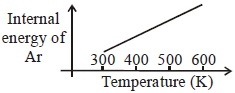
B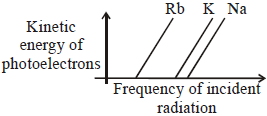
C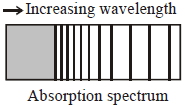
D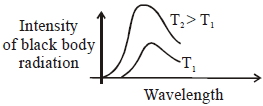
Solution
(A) The quantum nature of atoms is demonstrated by phenomena where energy is quantized,such as the photoelectric effect,atomic spectra,and black-body radiation.
$1$. The photoelectric effect (option $B$) shows that light interacts as discrete packets of energy (photons).
$2$. Atomic spectra (option $C$) show that electrons in atoms occupy discrete energy levels.
$3$. Black-body radiation (option $D$) shows that energy emission is quantized.
However,the internal energy of a gas like $Ar$ (option $A$) increases continuously with temperature according to classical kinetic theory,which is a classical,not a quantum,manifestation. Therefore,the figure representing the internal energy of $Ar$ versus temperature is not a direct manifestation of the quantum nature of atoms.
$1$. The photoelectric effect (option $B$) shows that light interacts as discrete packets of energy (photons).
$2$. Atomic spectra (option $C$) show that electrons in atoms occupy discrete energy levels.
$3$. Black-body radiation (option $D$) shows that energy emission is quantized.
However,the internal energy of a gas like $Ar$ (option $A$) increases continuously with temperature according to classical kinetic theory,which is a classical,not a quantum,manifestation. Therefore,the figure representing the internal energy of $Ar$ versus temperature is not a direct manifestation of the quantum nature of atoms.
0 likes
View Solution580
DifficultMCQ
The shortest wavelength of $H$ atom in the Lyman series is $\lambda_{1}$. The longest wavelength in the Balmer series of $He^{+}$ is:
A
$\frac{5 \lambda_{1}}{9}$
B
$\frac{27 \lambda_{1}}{5}$
C
$\frac{9 \lambda_{1}}{5}$
D
$\frac{36 \lambda_{1}}{5}$
Solution
(C) The Rydberg formula is given by $\frac{1}{\lambda} = R_{H} Z^{2} \left( \frac{1}{n_{1}^{2}} - \frac{1}{n_{2}^{2}} \right)$.
For the shortest wavelength of the $H$ atom in the Lyman series $(n_{1} = 1)$,the transition is from $n_{2} = \infty$ to $n_{1} = 1$:
$\frac{1}{\lambda_{1}} = R_{H} (1)^{2} \left( \frac{1}{1^{2}} - \frac{1}{\infty^{2}} \right) = R_{H}$ $\Rightarrow \lambda_{1} = \frac{1}{R_{H}}$.
For the longest wavelength of the $He^{+}$ ion in the Balmer series $(n_{1} = 2)$,the transition is from $n_{2} = 3$ to $n_{1} = 2$:
$\frac{1}{\lambda_{2}} = R_{H} (2)^{2} \left( \frac{1}{2^{2}} - \frac{1}{3^{2}} \right) = R_{H} \times 4 \left( \frac{1}{4} - \frac{1}{9} \right)$.
$\frac{1}{\lambda_{2}} = 4 R_{H} \left( \frac{9-4}{36} \right) = 4 R_{H} \left( \frac{5}{36} \right) = \frac{5 R_{H}}{9}$.
$\lambda_{2} = \frac{9}{5 R_{H}}$.
Substituting $\frac{1}{R_{H}} = \lambda_{1}$,we get $\lambda_{2} = \frac{9 \lambda_{1}}{5}$.
For the shortest wavelength of the $H$ atom in the Lyman series $(n_{1} = 1)$,the transition is from $n_{2} = \infty$ to $n_{1} = 1$:
$\frac{1}{\lambda_{1}} = R_{H} (1)^{2} \left( \frac{1}{1^{2}} - \frac{1}{\infty^{2}} \right) = R_{H}$ $\Rightarrow \lambda_{1} = \frac{1}{R_{H}}$.
For the longest wavelength of the $He^{+}$ ion in the Balmer series $(n_{1} = 2)$,the transition is from $n_{2} = 3$ to $n_{1} = 2$:
$\frac{1}{\lambda_{2}} = R_{H} (2)^{2} \left( \frac{1}{2^{2}} - \frac{1}{3^{2}} \right) = R_{H} \times 4 \left( \frac{1}{4} - \frac{1}{9} \right)$.
$\frac{1}{\lambda_{2}} = 4 R_{H} \left( \frac{9-4}{36} \right) = 4 R_{H} \left( \frac{5}{36} \right) = \frac{5 R_{H}}{9}$.
$\lambda_{2} = \frac{9}{5 R_{H}}$.
Substituting $\frac{1}{R_{H}} = \lambda_{1}$,we get $\lambda_{2} = \frac{9 \lambda_{1}}{5}$.
0 likes
View Solution581
DifficultMCQ
The difference between the radii of $3^{rd}$ and $4^{th}$ orbits of $Li^{2+}$ is $\Delta R_{1}$. The difference between the radii of $3^{rd}$ and $4^{th}$ orbits of $He^{+}$ is $\Delta R_{2}$. Ratio $\Delta R_{1} : \Delta R_{2}$ is :
A
$8:3$
B
$3:2$
C
$3:8$
D
$2:3$
Solution
(D) The radius of an orbit is given by $r_{n} = a_{0} \times \frac{n^{2}}{Z}$,where $a_{0}$ is the Bohr radius,$n$ is the orbit number,and $Z$ is the atomic number.
For $Li^{2+}$,$Z = 3$. Thus,$\Delta R_{1} = r_{4} - r_{3} = a_{0} \times \frac{4^{2} - 3^{2}}{3} = a_{0} \times \frac{16 - 9}{3} = \frac{7}{3} a_{0}$.
For $He^{+}$,$Z = 2$. Thus,$\Delta R_{2} = r_{4} - r_{3} = a_{0} \times \frac{4^{2} - 3^{2}}{2} = a_{0} \times \frac{16 - 9}{2} = \frac{7}{2} a_{0}$.
The ratio $\Delta R_{1} : \Delta R_{2} = \frac{7/3}{7/2} = \frac{2}{3}$.
For $Li^{2+}$,$Z = 3$. Thus,$\Delta R_{1} = r_{4} - r_{3} = a_{0} \times \frac{4^{2} - 3^{2}}{3} = a_{0} \times \frac{16 - 9}{3} = \frac{7}{3} a_{0}$.
For $He^{+}$,$Z = 2$. Thus,$\Delta R_{2} = r_{4} - r_{3} = a_{0} \times \frac{4^{2} - 3^{2}}{2} = a_{0} \times \frac{16 - 9}{2} = \frac{7}{2} a_{0}$.
The ratio $\Delta R_{1} : \Delta R_{2} = \frac{7/3}{7/2} = \frac{2}{3}$.
0 likes
View Solution582
EasyMCQ
The work function of a metal is $4.2 \, eV$. If radiation of $2000 \, \mathring{A}$ falls on the metal,then the kinetic energy of the fastest photoelectron is:
A
$1.6 \times 10^{-19} \, J$
B
$16 \times 10^{-10} \, J$
C
$3.2 \times 10^{-19} \, J$
D
$6.4 \times 10^{-10} \, J$
Solution
(C) The work function $\Phi = 4.2 \, eV = 4.2 \times 1.602 \times 10^{-19} \, J \approx 6.73 \times 10^{-19} \, J$.
The energy of the incident radiation $E = \frac{hc}{\lambda} = \frac{6.626 \times 10^{-34} \times 3 \times 10^8}{2000 \times 10^{-10}} \, J = 9.939 \times 10^{-19} \, J$.
According to Einstein's photoelectric equation,$K_{max} = E - \Phi$.
$K_{max} = (9.939 - 6.73) \times 10^{-19} \, J = 3.209 \times 10^{-19} \, J$.
Thus,the kinetic energy is approximately $3.2 \times 10^{-19} \, J$.
The energy of the incident radiation $E = \frac{hc}{\lambda} = \frac{6.626 \times 10^{-34} \times 3 \times 10^8}{2000 \times 10^{-10}} \, J = 9.939 \times 10^{-19} \, J$.
According to Einstein's photoelectric equation,$K_{max} = E - \Phi$.
$K_{max} = (9.939 - 6.73) \times 10^{-19} \, J = 3.209 \times 10^{-19} \, J$.
Thus,the kinetic energy is approximately $3.2 \times 10^{-19} \, J$.
0 likes
View Solution583
EasyMCQ
If $n=2$ for $He^{+}$ ion,then what is the wavelength in $\mathring{A}$?
A
$3.33$
B
$6.42$
C
$1.47$
D
$2.37$
Solution
(A) For $He^{+}$ ion,the atomic number $Z=2$ and the principal quantum number $n=2$.
The circumference of the orbit is given by $2 \pi r = n \lambda$.
The radius of the $n^{th}$ orbit is given by $r = 0.529 \frac{n^{2}}{Z} \ \mathring{A}$.
Substituting the value of $r$ in the circumference formula:
$2 \pi \times (0.529 \frac{n^{2}}{Z}) = n \lambda$
$\lambda = \frac{2 \pi \times 0.529 \times n}{Z}$
Substituting $n=2$ and $Z=2$:
$\lambda = \frac{2 \times 3.1416 \times 0.529 \times 2}{2} \ \mathring{A}$
$\lambda = 2 \times 3.1416 \times 0.529 \ \mathring{A} \approx 3.33 \ \mathring{A}$.
The circumference of the orbit is given by $2 \pi r = n \lambda$.
The radius of the $n^{th}$ orbit is given by $r = 0.529 \frac{n^{2}}{Z} \ \mathring{A}$.
Substituting the value of $r$ in the circumference formula:
$2 \pi \times (0.529 \frac{n^{2}}{Z}) = n \lambda$
$\lambda = \frac{2 \pi \times 0.529 \times n}{Z}$
Substituting $n=2$ and $Z=2$:
$\lambda = \frac{2 \times 3.1416 \times 0.529 \times 2}{2} \ \mathring{A}$
$\lambda = 2 \times 3.1416 \times 0.529 \ \mathring{A} \approx 3.33 \ \mathring{A}$.
0 likes
View Solution584
MediumMCQ
How many spectral lines of the Balmer series are present in the visible region?
A
$5$
B
$4$
C
$2$
D
$3$
Solution
(B) For the Balmer series,the transition occurs to the energy level $n_{1} = 2$ from higher energy levels $n_{2} = 3, 4, 5, 6, \ldots$.
In the Balmer series,there are four spectral lines that fall within the visible region of the electromagnetic spectrum.
These lines correspond to the transitions $n_{2} = 3 \rightarrow n_{1} = 2$ $(H_{\alpha})$,$n_{2} = 4 \rightarrow n_{1} = 2$ $(H_{\beta})$,$n_{2} = 5 \rightarrow n_{1} = 2$ $(H_{\gamma})$,and $n_{2} = 6 \rightarrow n_{1} = 2$ $(H_{\delta})$.
These spectral lines have wavelengths between approximately $400 \ nm$ and $700 \ nm$.
In the Balmer series,there are four spectral lines that fall within the visible region of the electromagnetic spectrum.
These lines correspond to the transitions $n_{2} = 3 \rightarrow n_{1} = 2$ $(H_{\alpha})$,$n_{2} = 4 \rightarrow n_{1} = 2$ $(H_{\beta})$,$n_{2} = 5 \rightarrow n_{1} = 2$ $(H_{\gamma})$,and $n_{2} = 6 \rightarrow n_{1} = 2$ $(H_{\delta})$.
These spectral lines have wavelengths between approximately $400 \ nm$ and $700 \ nm$.
0 likes
View Solution585
MediumMCQ
$A$ bulb emits electromagnetic radiation of $660 \, nm$ wavelength. The total energy of radiation is $3 \times 10^{-18} \, J$. The number of emitted photons will be :
$(h = 6.6 \times 10^{-34} \, J \cdot s, \, c = 3 \times 10^{8} \, m/s)$
$(h = 6.6 \times 10^{-34} \, J \cdot s, \, c = 3 \times 10^{8} \, m/s)$
A
$1$
B
$1000$
C
$100$
D
$10$
Solution
(D) The energy of a single photon is given by $E_{photon} = \frac{hc}{\lambda}$.
The total energy $E$ is given by $E = n \times E_{photon} = \frac{nhc}{\lambda}$,where $n$ is the number of photons.
Given:
$E = 3 \times 10^{-18} \, J$
$\lambda = 660 \, nm = 660 \times 10^{-9} \, m$
$h = 6.6 \times 10^{-34} \, J \cdot s$
$c = 3 \times 10^{8} \, m/s$
Rearranging for $n$:
$n = \frac{E \times \lambda}{h \times c}$
Substituting the values:
$n = \frac{3 \times 10^{-18} \times 660 \times 10^{-9}}{6.6 \times 10^{-34} \times 3 \times 10^{8}}$
$n = \frac{3 \times 660 \times 10^{-27}}{6.6 \times 3 \times 10^{-26}}$
$n = \frac{1980 \times 10^{-27}}{19.8 \times 10^{-26}} = 100 \times 10^{-1} = 10$
Thus,the number of emitted photons is $10$.
The total energy $E$ is given by $E = n \times E_{photon} = \frac{nhc}{\lambda}$,where $n$ is the number of photons.
Given:
$E = 3 \times 10^{-18} \, J$
$\lambda = 660 \, nm = 660 \times 10^{-9} \, m$
$h = 6.6 \times 10^{-34} \, J \cdot s$
$c = 3 \times 10^{8} \, m/s$
Rearranging for $n$:
$n = \frac{E \times \lambda}{h \times c}$
Substituting the values:
$n = \frac{3 \times 10^{-18} \times 660 \times 10^{-9}}{6.6 \times 10^{-34} \times 3 \times 10^{8}}$
$n = \frac{3 \times 660 \times 10^{-27}}{6.6 \times 3 \times 10^{-26}}$
$n = \frac{1980 \times 10^{-27}}{19.8 \times 10^{-26}} = 100 \times 10^{-1} = 10$
Thus,the number of emitted photons is $10$.
0 likes
View Solution586
MediumMCQ
Radius of $1^{st}$ orbit of $H$ and some orbit of $Be^{3+}$ is same. Energy of their orbit of $Be^{3+}$ is ............$eV$.
A
$-54.4$
B
$-13.6$
C
$-108.8$
D
$-27.2$
Solution
(A) The radius of the $n^{th}$ orbit is given by $r_n = 0.529 \times \frac{n^2}{Z} \ \mathring{A}$.
For $H$ atom,$Z = 1$ and $n = 1$,so $r_H = 0.529 \times \frac{1^2}{1} = 0.529 \ \mathring{A}$.
For $Be^{3+}$ ion,$Z = 4$. Let the orbit number be $n$.
Given $r_H = r_{Be^{3+}}$,so $0.529 \times \frac{1^2}{1} = 0.529 \times \frac{n^2}{4}$.
$1 = \frac{n^2}{4} \implies n^2 = 4 \implies n = 2$.
The energy of an orbit is given by $E_n = -13.6 \times \frac{Z^2}{n^2} \ \text{eV}$.
For $Be^{3+}$,$Z = 4$ and $n = 2$,so $E = -13.6 \times \frac{4^2}{2^2} = -13.6 \times \frac{16}{4} = -13.6 \times 4 = -54.4 \ \text{eV}$.
For $H$ atom,$Z = 1$ and $n = 1$,so $r_H = 0.529 \times \frac{1^2}{1} = 0.529 \ \mathring{A}$.
For $Be^{3+}$ ion,$Z = 4$. Let the orbit number be $n$.
Given $r_H = r_{Be^{3+}}$,so $0.529 \times \frac{1^2}{1} = 0.529 \times \frac{n^2}{4}$.
$1 = \frac{n^2}{4} \implies n^2 = 4 \implies n = 2$.
The energy of an orbit is given by $E_n = -13.6 \times \frac{Z^2}{n^2} \ \text{eV}$.
For $Be^{3+}$,$Z = 4$ and $n = 2$,so $E = -13.6 \times \frac{4^2}{2^2} = -13.6 \times \frac{16}{4} = -13.6 \times 4 = -54.4 \ \text{eV}$.
0 likes
View Solution587
MediumMCQ
Given below are two statements:
Statement $I$: Bohr's theory accounts for the stability and line spectrum of $Li^{+}$ ion.
Statement $II$: Bohr's theory was unable to explain the splitting of spectral lines in the presence of a magnetic field.
In the light of the above statements,choose the most appropriate answer from the options given below:
Statement $I$: Bohr's theory accounts for the stability and line spectrum of $Li^{+}$ ion.
Statement $II$: Bohr's theory was unable to explain the splitting of spectral lines in the presence of a magnetic field.
In the light of the above statements,choose the most appropriate answer from the options given below:
A
Both statement $I$ and statement $II$ are true.
B
Statement $I$ is false but statement $II$ is true.
C
Both statement $I$ and statement $II$ are false.
D
Statement $I$ is true but statement $II$ is false.
Solution
(B) Statement $-I$ is false because Bohr's theory is applicable only to single-electron species (e.g.,$H$,$He^{+}$,$Li^{2+}$). Since $Li^{+}$ has $2$ electrons,Bohr's theory cannot explain its spectrum.
Statement $-II$ is true because the splitting of spectral lines in a magnetic field is known as the Zeeman effect,which Bohr's theory could not explain.
Statement $-II$ is true because the splitting of spectral lines in a magnetic field is known as the Zeeman effect,which Bohr's theory could not explain.
0 likes
View Solution588
EasyMCQ
According to Bohr's atomic theory :-
$A$. Kinetic energy of electron is $\propto \frac{Z^{2}}{n^{2}}$.
$B$. The product of velocity $(v)$ of electron and principal quantum number $(n)$,'$vn$' $\propto Z^{2}$.
$C$. Frequency of revolution of electron in an orbit is $\propto \frac{Z^{3}}{n^{3}}$.
$D$. Coulombic force of attraction on the electron is $\propto \frac{Z^{3}}{n^{4}}$.
Choose the most appropriate answer from the options given below :
$A$. Kinetic energy of electron is $\propto \frac{Z^{2}}{n^{2}}$.
$B$. The product of velocity $(v)$ of electron and principal quantum number $(n)$,'$vn$' $\propto Z^{2}$.
$C$. Frequency of revolution of electron in an orbit is $\propto \frac{Z^{3}}{n^{3}}$.
$D$. Coulombic force of attraction on the electron is $\propto \frac{Z^{3}}{n^{4}}$.
Choose the most appropriate answer from the options given below :
A
$C$ Only
B
$A$ Only
C
$A, C$ and $D$ only
D
$A$ and $D$ only
Solution
(D) According to Bohr's theory :
$A$. $KE = 13.6 \frac{Z^{2}}{n^{2}} \ eV/atom \Rightarrow KE \propto \frac{Z^{2}}{n^{2}}$ (Correct)
$B$. Speed of $e^{-} \propto \frac{Z}{n} \Rightarrow v \times n \propto Z$ (Incorrect)
$C$. Frequency of revolution of $e^{-} = \frac{v}{2 \pi r}$. Since $v \propto \frac{Z}{n}$ and $r \propto \frac{n^{2}}{Z}$,then Frequency $\propto \frac{Z/n}{n^{2}/Z} = \frac{Z^{2}}{n^{3}}$ (Incorrect)
$D$. $F = \frac{kZe^{2}}{r^{2}}$. Since $r \propto \frac{n^{2}}{Z}$,then $F \propto \frac{Z}{(n^{2}/Z)^{2}} = \frac{Z^{3}}{n^{4}}$ (Correct)
Thus,statements $A$ and $D$ are correct.
$A$. $KE = 13.6 \frac{Z^{2}}{n^{2}} \ eV/atom \Rightarrow KE \propto \frac{Z^{2}}{n^{2}}$ (Correct)
$B$. Speed of $e^{-} \propto \frac{Z}{n} \Rightarrow v \times n \propto Z$ (Incorrect)
$C$. Frequency of revolution of $e^{-} = \frac{v}{2 \pi r}$. Since $v \propto \frac{Z}{n}$ and $r \propto \frac{n^{2}}{Z}$,then Frequency $\propto \frac{Z/n}{n^{2}/Z} = \frac{Z^{2}}{n^{3}}$ (Incorrect)
$D$. $F = \frac{kZe^{2}}{r^{2}}$. Since $r \propto \frac{n^{2}}{Z}$,then $F \propto \frac{Z}{(n^{2}/Z)^{2}} = \frac{Z^{3}}{n^{4}}$ (Correct)
Thus,statements $A$ and $D$ are correct.
0 likes
View Solution589
MediumMCQ
Given below are two statements.
Statement $I:$ According to Bohr's model of an atom,qualitatively the magnitude of velocity of electron increases with decrease in positive charges on the nucleus as there is no strong hold on the electron by the nucleus.
Statement $II:$ According to Bohr's model of an atom,qualitatively the magnitude of velocity of electron increases with decrease in principal quantum number.
In the light of the above statements,choose the most appropriate answer from the options given below:
Statement $I:$ According to Bohr's model of an atom,qualitatively the magnitude of velocity of electron increases with decrease in positive charges on the nucleus as there is no strong hold on the electron by the nucleus.
Statement $II:$ According to Bohr's model of an atom,qualitatively the magnitude of velocity of electron increases with decrease in principal quantum number.
In the light of the above statements,choose the most appropriate answer from the options given below:
A
Both Statement $I$ and Statement $II$ are false
B
Both Statement $I$ and Statement $II$ are true
C
Statement $I$ is false but Statement $II$ is true
D
Statement $I$ is true but Statement $II$ is false
Solution
(C) The velocity of an electron in Bohr's model is given by the relation $V \propto \frac{Z}{n}$.
Here,$Z$ is the atomic number (representing the magnitude of positive charge on the nucleus) and $n$ is the principal quantum number.
Statement $I$ claims that velocity increases with a decrease in positive charge $(Z)$. However,since $V \propto Z$,the velocity actually decreases as the positive charge on the nucleus decreases. Thus,Statement $I$ is false.
Statement $II$ claims that velocity increases with a decrease in the principal quantum number $(n)$. Since $V \propto \frac{1}{n}$,the velocity increases as $n$ decreases. Thus,Statement $II$ is true.
Here,$Z$ is the atomic number (representing the magnitude of positive charge on the nucleus) and $n$ is the principal quantum number.
Statement $I$ claims that velocity increases with a decrease in positive charge $(Z)$. However,since $V \propto Z$,the velocity actually decreases as the positive charge on the nucleus decreases. Thus,Statement $I$ is false.
Statement $II$ claims that velocity increases with a decrease in the principal quantum number $(n)$. Since $V \propto \frac{1}{n}$,the velocity increases as $n$ decreases. Thus,Statement $II$ is true.
0 likes
View Solution590
MediumMCQ
$A$ metal surface is exposed to $500 \ nm$ radiation. The threshold frequency of the metal for photoelectric current is $4.3 \times 10^{14} \ Hz$. The velocity of the ejected electron is $....... \times 10^{5} \ ms^{-1}$ (Nearest integer).
[Use : $h=6.63 \times 10^{-34} \ Js, m_{e}=9.0 \times 10^{-31} \ kg$]
[Use : $h=6.63 \times 10^{-34} \ Js, m_{e}=9.0 \times 10^{-31} \ kg$]
A
$7$
B
$5$
C
$1$
D
$500$
Solution
(B) $v$: speed of electron having maximum kinetic energy.
From Einstein's photoelectric equation:
$E = \phi + K.E._{\max}$
$\frac{hc}{\lambda} = h \nu_{0} + \frac{1}{2} m_{e} v^{2}$
$\frac{6.63 \times 10^{-34} \times 3 \times 10^{8}}{500 \times 10^{-9}} = 6.63 \times 10^{-34} \times 4.3 \times 10^{14} + \frac{1}{2} \times 9.0 \times 10^{-31} \times v^{2}$
$3.978 \times 10^{-19} = 2.8509 \times 10^{-19} + 4.5 \times 10^{-31} \times v^{2}$
$1.1271 \times 10^{-19} = 4.5 \times 10^{-31} \times v^{2}$
$v^{2} = \frac{1.1271 \times 10^{-19}}{4.5 \times 10^{-31}} \approx 0.2504 \times 10^{12} = 25.04 \times 10^{10}$
$v \approx 5.004 \times 10^{5} \ ms^{-1}$
Rounding to the nearest integer,the value is $5$.
From Einstein's photoelectric equation:
$E = \phi + K.E._{\max}$
$\frac{hc}{\lambda} = h \nu_{0} + \frac{1}{2} m_{e} v^{2}$
$\frac{6.63 \times 10^{-34} \times 3 \times 10^{8}}{500 \times 10^{-9}} = 6.63 \times 10^{-34} \times 4.3 \times 10^{14} + \frac{1}{2} \times 9.0 \times 10^{-31} \times v^{2}$
$3.978 \times 10^{-19} = 2.8509 \times 10^{-19} + 4.5 \times 10^{-31} \times v^{2}$
$1.1271 \times 10^{-19} = 4.5 \times 10^{-31} \times v^{2}$
$v^{2} = \frac{1.1271 \times 10^{-19}}{4.5 \times 10^{-31}} \approx 0.2504 \times 10^{12} = 25.04 \times 10^{10}$
$v \approx 5.004 \times 10^{5} \ ms^{-1}$
Rounding to the nearest integer,the value is $5$.
0 likes
View Solution591
MediumMCQ
The kinetic energy of an electron in the second Bohr orbit of a hydrogen atom is equal to $\frac{h^{2}}{xma_{0}^{2}}$. The value of $10x$ is ........ . ($a_{0}$ is radius of Bohr's orbit) (Nearest integer) [Given : $\pi=3.14$]
A
$1010$
B
$6135$
C
$3155$
D
$3845$
Solution
(C) For a hydrogen atom,the radius of the $n^{th}$ orbit is given by $r = n^{2}a_{0}$.
For the second orbit $(n=2)$,$r = 2^{2}a_{0} = 4a_{0}$.
The kinetic energy $(K.E.)$ of an electron is given by $K.E. = \frac{1}{2}mv^{2}$.
From Bohr's postulate,$mvr = \frac{nh}{2\pi}$,so $v = \frac{nh}{2\pi mr}$.
Substituting $v$ into the $K.E.$ expression: $K.E. = \frac{n^{2}h^{2}}{8\pi^{2}mr^{2}}$.
Substituting $n=2$ and $r=4a_{0}$: $K.E. = \frac{2^{2}h^{2}}{8\pi^{2}m(4a_{0})^{2}} = \frac{4h^{2}}{8\pi^{2}m(16a_{0}^{2})} = \frac{h^{2}}{32\pi^{2}ma_{0}^{2}}$.
Comparing this with $\frac{h^{2}}{xma_{0}^{2}}$,we get $x = 32\pi^{2}$.
Given $\pi = 3.14$,$\pi^{2} = (3.14)^{2} = 9.8596$.
$x = 32 \times 9.8596 = 315.5072$.
$10x = 3155.072$.
Rounding to the nearest integer,$10x = 3155$.
For the second orbit $(n=2)$,$r = 2^{2}a_{0} = 4a_{0}$.
The kinetic energy $(K.E.)$ of an electron is given by $K.E. = \frac{1}{2}mv^{2}$.
From Bohr's postulate,$mvr = \frac{nh}{2\pi}$,so $v = \frac{nh}{2\pi mr}$.
Substituting $v$ into the $K.E.$ expression: $K.E. = \frac{n^{2}h^{2}}{8\pi^{2}mr^{2}}$.
Substituting $n=2$ and $r=4a_{0}$: $K.E. = \frac{2^{2}h^{2}}{8\pi^{2}m(4a_{0})^{2}} = \frac{4h^{2}}{8\pi^{2}m(16a_{0}^{2})} = \frac{h^{2}}{32\pi^{2}ma_{0}^{2}}$.
Comparing this with $\frac{h^{2}}{xma_{0}^{2}}$,we get $x = 32\pi^{2}$.
Given $\pi = 3.14$,$\pi^{2} = (3.14)^{2} = 9.8596$.
$x = 32 \times 9.8596 = 315.5072$.
$10x = 3155.072$.
Rounding to the nearest integer,$10x = 3155$.
0 likes
View Solution592
MediumMCQ
The number of photons emitted by a monochromatic (single frequency) infrared range finder of power $1 \, mW$ and wavelength of $1000 \, nm$,in $0.1 \, s$ is $x \times 10^{13}$. The value of $x$ is ..... .
(Nearest integer)
$(h=6.63 \times 10^{-34} \, J \, s, c=3.00 \times 10^{8} \, m \, s^{-1})$
(Nearest integer)
$(h=6.63 \times 10^{-34} \, J \, s, c=3.00 \times 10^{8} \, m \, s^{-1})$
A
$50$
B
$500$
C
$5$
D
$663$
Solution
(A) Total energy emitted in $0.1 \, s$ is given by $E = P \times t = 10^{-3} \, W \times 0.1 \, s = 10^{-4} \, J$.
The energy of a single photon is $E_{photon} = \frac{hc}{\lambda} = \frac{6.63 \times 10^{-34} \, J \, s \times 3.00 \times 10^{8} \, m \, s^{-1}}{1000 \times 10^{-9} \, m} = 1.989 \times 10^{-19} \, J$.
The number of photons $n$ is given by $n = \frac{E}{E_{photon}} = \frac{10^{-4} \, J}{1.989 \times 10^{-19} \, J} \approx 5.027 \times 10^{14}$.
Expressing this as $x \times 10^{13}$,we get $n = 50.27 \times 10^{13}$.
Rounding to the nearest integer,$x = 50$.
The energy of a single photon is $E_{photon} = \frac{hc}{\lambda} = \frac{6.63 \times 10^{-34} \, J \, s \times 3.00 \times 10^{8} \, m \, s^{-1}}{1000 \times 10^{-9} \, m} = 1.989 \times 10^{-19} \, J$.
The number of photons $n$ is given by $n = \frac{E}{E_{photon}} = \frac{10^{-4} \, J}{1.989 \times 10^{-19} \, J} \approx 5.027 \times 10^{14}$.
Expressing this as $x \times 10^{13}$,we get $n = 50.27 \times 10^{13}$.
Rounding to the nearest integer,$x = 50$.
1 likes
View Solution593
MediumMCQ
$A$ $50 \, W$ bulb emits monochromatic red light of wavelength $795 \, nm$. The number of photons emitted per second by the bulb is $x \times 10^{20}$. The value of $x$ is $......$.
$[ \text{Given} : h=6.63 \times 10^{-34} \, J \cdot s \text{ and } c=3.0 \times 10^{8} \, m \cdot s^{-1} ]$
$[ \text{Given} : h=6.63 \times 10^{-34} \, J \cdot s \text{ and } c=3.0 \times 10^{8} \, m \cdot s^{-1} ]$
A
$1$
B
$4$
C
$2$
D
$3$
Solution
(C) The power of the bulb is $P = 50 \, W = 50 \, J \cdot s^{-1}$.
The energy of one photon is given by $E = \frac{hc}{\lambda}$.
Substituting the given values: $E = \frac{6.63 \times 10^{-34} \, J \cdot s \times 3.0 \times 10^{8} \, m \cdot s^{-1}}{795 \times 10^{-9} \, m} = 2.5018 \times 10^{-19} \, J$.
The number of photons emitted per second $(n)$ is given by $n = \frac{P}{E}$.
$n = \frac{50}{2.5018 \times 10^{-19}} \approx 1.998 \times 10^{20}$.
Given that $n = x \times 10^{20}$,we have $x \approx 2$.
The energy of one photon is given by $E = \frac{hc}{\lambda}$.
Substituting the given values: $E = \frac{6.63 \times 10^{-34} \, J \cdot s \times 3.0 \times 10^{8} \, m \cdot s^{-1}}{795 \times 10^{-9} \, m} = 2.5018 \times 10^{-19} \, J$.
The number of photons emitted per second $(n)$ is given by $n = \frac{P}{E}$.
$n = \frac{50}{2.5018 \times 10^{-19}} \approx 1.998 \times 10^{20}$.
Given that $n = x \times 10^{20}$,we have $x \approx 2$.
0 likes
View Solution594
DifficultMCQ
$A$ source of monochromatic radiation of wavelength $400 \, nm$ provides $1000 \, J$ of energy in $10 \, seconds$. When this radiation falls on the surface of sodium,$x \times 10^{20}$ electrons are ejected per second. Assume that wavelength $400 \, nm$ is sufficient for ejection of electrons from the surface of sodium metal. The value of $x$ is $......$. (Nearest integer) $(h = 6.626 \times 10^{-34} \, Js)$
A
$2$
B
$4$
C
$6$
D
$8$
Solution
(A) Total energy provided by the source per second $= \frac{1000 \, J}{10 \, s} = 100 \, J/s$.
Energy of one photon $E = \frac{hc}{\lambda} = \frac{6.626 \times 10^{-34} \, Js \times 3 \times 10^8 \, m/s}{400 \times 10^{-9} \, m} = 4.9695 \times 10^{-19} \, J$.
Number of photons incident per second $= \frac{\text{Total energy per second}}{\text{Energy of one photon}} = \frac{100}{4.9695 \times 10^{-19}} \approx 2.012 \times 10^{20}$.
Since one photon ejects one electron,the number of electrons ejected per second is $2.012 \times 10^{20}$.
Comparing this with $x \times 10^{20}$,we get $x \approx 2$.
Energy of one photon $E = \frac{hc}{\lambda} = \frac{6.626 \times 10^{-34} \, Js \times 3 \times 10^8 \, m/s}{400 \times 10^{-9} \, m} = 4.9695 \times 10^{-19} \, J$.
Number of photons incident per second $= \frac{\text{Total energy per second}}{\text{Energy of one photon}} = \frac{100}{4.9695 \times 10^{-19}} \approx 2.012 \times 10^{20}$.
Since one photon ejects one electron,the number of electrons ejected per second is $2.012 \times 10^{20}$.
Comparing this with $x \times 10^{20}$,we get $x \approx 2$.
0 likes
View Solution595
MediumMCQ
If the Thomson model of the atom was correct,then the result of Rutherford's gold foil experiment would have been:
A
$\alpha$-Particles pass through the gold foil deflected by small angles and with reduced speed.
B
All $\alpha$-particles get bounced back by $180^{\circ}$.
C
$\alpha$-Particles are deflected over a wide range of angles.
D
All of the $\alpha$-particles pass through the gold foil without decrease in speed.
Solution
(A) In the Thomson model,the positive charge is assumed to be uniformly distributed throughout the atom.
Since the positive charge is not concentrated in a small central nucleus,the electrostatic repulsion experienced by the $\alpha$-particles would be very weak.
Consequently,the $\alpha$-particles would pass through the gold foil with only very small deflections and a slight decrease in speed due to the uniform distribution of positive charge.
Since the positive charge is not concentrated in a small central nucleus,the electrostatic repulsion experienced by the $\alpha$-particles would be very weak.
Consequently,the $\alpha$-particles would pass through the gold foil with only very small deflections and a slight decrease in speed due to the uniform distribution of positive charge.
0 likes
View Solution596
MediumMCQ
If the radius of the second Bohr orbit of the $He^{+}$ ion is $105.8 \, pm$, what is the radius of the third Bohr orbit of the $Li^{2+}$ ion?
A
$15.87 \, pm$
B
$1.587 \, pm$
C
$158.7 \, \mathring{A}$
D
$158.7 \, pm$
Solution
(D) According to Bohr's atomic model, the radius $r$ is given by $r \propto \frac{n^2}{Z}$.
For the $3^{rd}$ orbit of $Li^{2+}$, $n_1 = 3$ and $Z_1 = 3$.
For the $2^{nd}$ orbit of $He^{+}$, $n_2 = 2$ and $Z_2 = 2$.
Using the ratio formula: $\frac{(r_3)_{Li^{2+}}}{(r_2)_{He^{+}}} = \frac{n_1^2}{n_2^2} \times \frac{Z_2}{Z_1}$.
Substituting the values: $\frac{(r_3)_{Li^{2+}}}{105.8 \, pm} = \frac{3^2}{2^2} \times \frac{2}{3} = \frac{9}{4} \times \frac{2}{3} = \frac{3}{2} = 1.5$.
Therefore, $(r_3)_{Li^{2+}} = 105.8 \, pm \times 1.5 = 158.7 \, pm$.
For the $3^{rd}$ orbit of $Li^{2+}$, $n_1 = 3$ and $Z_1 = 3$.
For the $2^{nd}$ orbit of $He^{+}$, $n_2 = 2$ and $Z_2 = 2$.
Using the ratio formula: $\frac{(r_3)_{Li^{2+}}}{(r_2)_{He^{+}}} = \frac{n_1^2}{n_2^2} \times \frac{Z_2}{Z_1}$.
Substituting the values: $\frac{(r_3)_{Li^{2+}}}{105.8 \, pm} = \frac{3^2}{2^2} \times \frac{2}{3} = \frac{9}{4} \times \frac{2}{3} = \frac{3}{2} = 1.5$.
Therefore, $(r_3)_{Li^{2+}} = 105.8 \, pm \times 1.5 = 158.7 \, pm$.
0 likes
View Solution597
EasyMCQ
The minimum energy that must be possessed by photons in order to produce the photoelectric effect with platinum metal is $.... \times 10^{-19} \, J$
[Given: The threshold frequency of platinum is $1.3 \times 10^{15} \, s^{-1}$ and $h = 6.6 \times 10^{-34} \, J \, s$.]
[Given: The threshold frequency of platinum is $1.3 \times 10^{15} \, s^{-1}$ and $h = 6.6 \times 10^{-34} \, J \, s$.]
A
$32.1$
B
$0.624$
C
$8.58$
D
$976$
Solution
(C) The minimum energy required for the photoelectric effect is known as the work function $(W)$.
The formula for the work function is $W = h \nu_0$,where $h$ is Planck's constant and $\nu_0$ is the threshold frequency.
Given:
$h = 6.6 \times 10^{-34} \, J \, s$
$\nu_0 = 1.3 \times 10^{15} \, s^{-1}$
Calculation:
$W = (6.6 \times 10^{-34} \, J \, s) \times (1.3 \times 10^{15} \, s^{-1})$
$W = 8.58 \times 10^{-19} \, J$
Thus,the minimum energy is $8.58 \times 10^{-19} \, J$.
The formula for the work function is $W = h \nu_0$,where $h$ is Planck's constant and $\nu_0$ is the threshold frequency.
Given:
$h = 6.6 \times 10^{-34} \, J \, s$
$\nu_0 = 1.3 \times 10^{15} \, s^{-1}$
Calculation:
$W = (6.6 \times 10^{-34} \, J \, s) \times (1.3 \times 10^{15} \, s^{-1})$
$W = 8.58 \times 10^{-19} \, J$
Thus,the minimum energy is $8.58 \times 10^{-19} \, J$.
0 likes
View Solution598
MediumMCQ
The longest wavelength of light that can be used for the ionisation of lithium atom $(Li)$ in its ground state is $x \times 10^{-8} \, m$. The value of $x$ is $.....$ (Nearest Integer)
(Given : Energy of the electron in the first shell of the hydrogen atom is $-2.2 \times 10^{-18} \, J$; $h = 6.63 \times 10^{-34} \, Js$ and $c = 3 \times 10^{8} \, ms^{-1}$ )
(Given : Energy of the electron in the first shell of the hydrogen atom is $-2.2 \times 10^{-18} \, J$; $h = 6.63 \times 10^{-34} \, Js$ and $c = 3 \times 10^{8} \, ms^{-1}$ )
A
$3$
B
$4$
C
$2$
D
$1$
Solution
(D) The ionization energy of a hydrogen-like species is given by $E_n = -13.6 \times Z^2 / n^2 \, eV$ or $E_n = -E_H \times Z^2 / n^2$.
For $Li$ $(Z=3)$ in the ground state $(n=1)$,the energy required to remove the electron is $E = E_{\infty} - E_1 = 0 - (-2.2 \times 10^{-18} \times 3^2 / 1^2) = 19.8 \times 10^{-18} \, J$.
The energy of a photon is $E = hc / \lambda$,so $\lambda = hc / E$.
Substituting the values: $\lambda = (6.63 \times 10^{-34} \times 3 \times 10^8) / (19.8 \times 10^{-18}) = 19.89 \times 10^{-26} / 19.8 \times 10^{-18} \approx 1.0045 \times 10^{-8} \, m$.
Comparing this with $x \times 10^{-8} \, m$,we get $x \approx 1$.
For $Li$ $(Z=3)$ in the ground state $(n=1)$,the energy required to remove the electron is $E = E_{\infty} - E_1 = 0 - (-2.2 \times 10^{-18} \times 3^2 / 1^2) = 19.8 \times 10^{-18} \, J$.
The energy of a photon is $E = hc / \lambda$,so $\lambda = hc / E$.
Substituting the values: $\lambda = (6.63 \times 10^{-34} \times 3 \times 10^8) / (19.8 \times 10^{-18}) = 19.89 \times 10^{-26} / 19.8 \times 10^{-18} \approx 1.0045 \times 10^{-8} \, m$.
Comparing this with $x \times 10^{-8} \, m$,we get $x \approx 1$.
0 likes
View Solution599
MediumMCQ
If the radius of the $3^{\text{rd}}$ Bohr's orbit of hydrogen atom is $r_{3}$ and the radius of $4^{\text{th}}$ Bohr's orbit is $r_{4}$,then which of the following relations is correct?
A
$r_{4} = \frac{9}{16} r_{3}$
B
$r_{4} = \frac{16}{9} r_{3}$
C
$r_{4} = \frac{3}{4} r_{3}$
D
$r_{4} = \frac{4}{3} r_{3}$
Solution
(B) The radius of the $n^{\text{th}}$ Bohr orbit is given by the formula $r_{n} = a_{0} \times \frac{n^{2}}{Z}$,where $a_{0}$ is the Bohr radius,$n$ is the principal quantum number,and $Z$ is the atomic number.
For a hydrogen atom,$Z = 1$.
Thus,$r_{n} \propto n^{2}$.
For the $3^{\text{rd}}$ orbit,$r_{3} \propto 3^{2} = 9$.
For the $4^{\text{th}}$ orbit,$r_{4} \propto 4^{2} = 16$.
Taking the ratio,$\frac{r_{4}}{r_{3}} = \frac{16}{9}$.
Therefore,$r_{4} = \frac{16}{9} r_{3}$.
For a hydrogen atom,$Z = 1$.
Thus,$r_{n} \propto n^{2}$.
For the $3^{\text{rd}}$ orbit,$r_{3} \propto 3^{2} = 9$.
For the $4^{\text{th}}$ orbit,$r_{4} \propto 4^{2} = 16$.
Taking the ratio,$\frac{r_{4}}{r_{3}} = \frac{16}{9}$.
Therefore,$r_{4} = \frac{16}{9} r_{3}$.
0 likes
View SolutionStructure of Atom — Atomic models and Planck's quantum theory · Frequently Asked Questions
1Are these Structure of Atom questions useful for JEE and NEET?
Yes. All questions in this section are mapped to JEE Main and NEET exam patterns. Previous year questions from JEE Main, NEET, GUJCET and state-level exams are included with full solutions.
2Can I switch to Hindi or Gujarati for these questions?
Yes. Use the language tabs in the hero section or the sidebar to view the same questions and solutions in English, Hindi or Gujarati.
3How do I generate a question paper from this subtopic?
Use the Vedclass Exam Paper Generator — select the chapter and subtopic, set difficulty, and generate Sets A, B, C, D automatically. First 3 chapters of every subject are free.
Vedclass Products
For Students
Vedclass Test Series
Mock tests in real JEE/NEET style with performance analysis. 5-day free trial.
Start Free TrialFor Teachers
Exam Paper Generator
Generate Set A/B/C/D papers from this chapter in 2 minutes. 3 chapters free.
Try FreeFor Institutes
Online Exam Module
Live online exams with unlimited students, 360° analytics & white-label branding.
See DemoFor Teachers & Institutes
Generate a Structure of Atom Exam Paper in 2 Minutes
Select subtopic & difficulty — Sets A, B, C, D auto-generated with No Repeat logic.
First 3 chapters of every subject are free — no payment required.