
A English
Atomic models and Planck's quantum theory Questions in English
Class 11 Chemistry · Structure of Atom · Atomic models and Planck's quantum theory
851+
Questions
English
Language
100%
With Solutions
Showing 50 of 851 questions in English
651
EasyMCQ
Which of the following graphs correctly represents the variation of Kinetic Energy $(K.E.)$ of an electron in a Bohr orbit with respect to the principal quantum number $(n)$?
A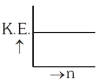
B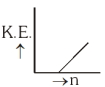
C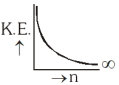
D
Solution
(C) The kinetic energy $(K.E.)$ of an electron in the $n^{th}$ Bohr orbit is given by the formula: $K.E. = \frac{kZe^2}{2r}$.
Since the radius of the $n^{th}$ orbit is $r_n \propto n^2$,we can substitute this into the expression for kinetic energy.
Therefore,$K.E. \propto \frac{1}{n^2}$.
This relationship indicates that as the principal quantum number $(n)$ increases,the kinetic energy decreases following an inverse square curve. Thus,the correct graph is the one showing $K.E.$ decreasing as $n$ increases.
Since the radius of the $n^{th}$ orbit is $r_n \propto n^2$,we can substitute this into the expression for kinetic energy.
Therefore,$K.E. \propto \frac{1}{n^2}$.
This relationship indicates that as the principal quantum number $(n)$ increases,the kinetic energy decreases following an inverse square curve. Thus,the correct graph is the one showing $K.E.$ decreasing as $n$ increases.
0 likes
View Solution652
EasyMCQ
In which transition is one quantum of energy emitted?
A
$n = 4 \rightarrow n = 2$
B
$n = 3 \rightarrow n = 1$
C
$n = 5 \rightarrow n = 3$
D
All of the above
Solution
(D) According to Planck's quantum theory,the emission or absorption of energy occurs in the form of discrete packets called quanta.
When an electron transitions from a higher energy level $(n_{high})$ to a lower energy level $(n_{low})$,it emits energy in the form of a photon (quantum).
Since all the given transitions ($n = 4 \rightarrow n = 2$,$n = 3 \rightarrow n = 1$,and $n = 5 \rightarrow n = 3$) involve an electron moving from a higher energy state to a lower energy state,each transition results in the emission of one quantum of energy.
When an electron transitions from a higher energy level $(n_{high})$ to a lower energy level $(n_{low})$,it emits energy in the form of a photon (quantum).
Since all the given transitions ($n = 4 \rightarrow n = 2$,$n = 3 \rightarrow n = 1$,and $n = 5 \rightarrow n = 3$) involve an electron moving from a higher energy state to a lower energy state,each transition results in the emission of one quantum of energy.
0 likes
View Solution653
EasyMCQ
Maximum frequency of emission is obtained for the transition $:-$
A
$n = 2$ to $n = 1$
B
$n = 6$ to $n = 2$
C
$n = 1$ to $n = 2$
D
$n = 2$ to $n = 6$
Solution
(A) The frequency of emitted radiation is directly proportional to the energy difference between the energy levels involved in the transition.
Emission occurs when an electron jumps from a higher energy level $(n_2)$ to a lower energy level $(n_1)$.
The frequency $\nu$ is given by the Rydberg formula: $\nu = R_{H} c z^2 \left[\frac{1}{n_1^2} - \frac{1}{n_2^2}\right]$.
For option $A$ ($n = 2$ to $n = 1$): $\Delta E \propto \left[\frac{1}{1^2} - \frac{1}{2^2}\right] = 1 - 0.25 = 0.75$.
For option $B$ ($n = 6$ to $n = 2$): $\Delta E \propto \left[\frac{1}{2^2} - \frac{1}{6^2}\right] = 0.25 - 0.027 = 0.223$.
Comparing the values,the transition from $n = 2$ to $n = 1$ results in the largest energy difference and thus the maximum frequency of emission.
Emission occurs when an electron jumps from a higher energy level $(n_2)$ to a lower energy level $(n_1)$.
The frequency $\nu$ is given by the Rydberg formula: $\nu = R_{H} c z^2 \left[\frac{1}{n_1^2} - \frac{1}{n_2^2}\right]$.
For option $A$ ($n = 2$ to $n = 1$): $\Delta E \propto \left[\frac{1}{1^2} - \frac{1}{2^2}\right] = 1 - 0.25 = 0.75$.
For option $B$ ($n = 6$ to $n = 2$): $\Delta E \propto \left[\frac{1}{2^2} - \frac{1}{6^2}\right] = 0.25 - 0.027 = 0.223$.
Comparing the values,the transition from $n = 2$ to $n = 1$ results in the largest energy difference and thus the maximum frequency of emission.
0 likes
View Solution654
MediumMCQ
Find out the distance between the $2^{nd}$ and $3^{rd}$ orbit of the $H$-atom $:-$
A
$2.65 \mathring{A}$
B
$1.2 \mathring{A}$
C
$4 \mathring{A}$
D
$1.5 \mathring{A}$
Solution
(A) The radius of the $n^{th}$ orbit of the $H$-atom is given by the formula $r_n = 0.529 \times n^2 \mathring{A}$.
For the $2^{nd}$ orbit $(n=2)$: $r_2 = 0.529 \times (2)^2 = 0.529 \times 4 = 2.116 \mathring{A}$.
For the $3^{rd}$ orbit $(n=3)$: $r_3 = 0.529 \times (3)^2 = 0.529 \times 9 = 4.761 \mathring{A}$.
The distance between the $2^{nd}$ and $3^{rd}$ orbit is $r_3 - r_2 = 4.761 \mathring{A} - 2.116 \mathring{A} = 2.645 \mathring{A} \approx 2.65 \mathring{A}$.
Thus,the correct option is $A$.
For the $2^{nd}$ orbit $(n=2)$: $r_2 = 0.529 \times (2)^2 = 0.529 \times 4 = 2.116 \mathring{A}$.
For the $3^{rd}$ orbit $(n=3)$: $r_3 = 0.529 \times (3)^2 = 0.529 \times 9 = 4.761 \mathring{A}$.
The distance between the $2^{nd}$ and $3^{rd}$ orbit is $r_3 - r_2 = 4.761 \mathring{A} - 2.116 \mathring{A} = 2.645 \mathring{A} \approx 2.65 \mathring{A}$.
Thus,the correct option is $A$.
0 likes
View Solution655
MediumMCQ
The longest wavelength line in the Lyman series of the $H$ atom spectrum is $:-$
A
$1025.8 \mathring{A}$
B
$1215.8 \mathring{A}$
C
$972.6 \mathring{A}$
D
$949.8 \mathring{A}$
Solution
(B) The longest wavelength corresponds to the minimum energy transition in the Lyman series,which occurs from $n_2 = 2$ to $n_1 = 1$.
Using the Rydberg formula: $\frac{1}{\lambda} = R Z^2 \left( \frac{1}{n_1^2} - \frac{1}{n_2^2} \right)$.
For the $H$ atom,$Z = 1$,$n_1 = 1$,and $n_2 = 2$.
$\frac{1}{\lambda} = R \times 1^2 \left( \frac{1}{1^2} - \frac{1}{2^2} \right) = R \left( 1 - \frac{1}{4} \right) = \frac{3}{4} R$.
$\lambda = \frac{4}{3R}$.
Given $\frac{1}{R} \approx 911.6 \mathring{A}$,we have $\lambda = \frac{4}{3} \times 911.6 \mathring{A} \approx 1215.5 \mathring{A}$.
Using the Rydberg formula: $\frac{1}{\lambda} = R Z^2 \left( \frac{1}{n_1^2} - \frac{1}{n_2^2} \right)$.
For the $H$ atom,$Z = 1$,$n_1 = 1$,and $n_2 = 2$.
$\frac{1}{\lambda} = R \times 1^2 \left( \frac{1}{1^2} - \frac{1}{2^2} \right) = R \left( 1 - \frac{1}{4} \right) = \frac{3}{4} R$.
$\lambda = \frac{4}{3R}$.
Given $\frac{1}{R} \approx 911.6 \mathring{A}$,we have $\lambda = \frac{4}{3} \times 911.6 \mathring{A} \approx 1215.5 \mathring{A}$.
0 likes
View Solution656
MediumMCQ
What will be the number of photons required to obtain $1 \ J$ of energy by radiation having a wavelength of $4000 \ \mathring{A}$?
A
$3 \times 10^{20}$
B
$2 \times 10^{18}$
C
$2 \times 10^{32}$
D
$2 \times 10^{28}$
Solution
(B) The total energy $E$ of $n$ photons is given by $E = \frac{nhc}{\lambda}$.
Given: $E = 1 \ J$,$\lambda = 4000 \ \mathring{A} = 4000 \times 10^{-10} \ m = 4 \times 10^{-7} \ m$,$h = 6.626 \times 10^{-34} \ J \cdot s$,$c = 3 \times 10^8 \ m/s$.
Rearranging for $n$: $n = \frac{E \lambda}{hc}$.
Substituting the values: $n = \frac{1 \times 4 \times 10^{-7}}{6.626 \times 10^{-34} \times 3 \times 10^8}$.
$n = \frac{4 \times 10^{-7}}{19.878 \times 10^{-26}} \approx 0.2012 \times 10^{19} = 2.012 \times 10^{18}$.
Rounding to the nearest option,$n \approx 2 \times 10^{18}$.
Given: $E = 1 \ J$,$\lambda = 4000 \ \mathring{A} = 4000 \times 10^{-10} \ m = 4 \times 10^{-7} \ m$,$h = 6.626 \times 10^{-34} \ J \cdot s$,$c = 3 \times 10^8 \ m/s$.
Rearranging for $n$: $n = \frac{E \lambda}{hc}$.
Substituting the values: $n = \frac{1 \times 4 \times 10^{-7}}{6.626 \times 10^{-34} \times 3 \times 10^8}$.
$n = \frac{4 \times 10^{-7}}{19.878 \times 10^{-26}} \approx 0.2012 \times 10^{19} = 2.012 \times 10^{18}$.
Rounding to the nearest option,$n \approx 2 \times 10^{18}$.
0 likes
View Solution657
EasyMCQ
Assertion $:-$ Emitted radiation will fall in the visible region when an electron jumps from $n=4$ to $n=2$ in a hydrogen atom.
Reason $:-$ The frequency of radiation of the Lyman series belongs to the visible region for a hydrogen atom.
Reason $:-$ The frequency of radiation of the Lyman series belongs to the visible region for a hydrogen atom.
A
Both Assertion $\&$ Reason are True $\&$ the Reason is a correct explanation of the Assertion.
B
Both Assertion $\&$ Reason are True but Reason is not a correct explanation of the Assertion.
C
Assertion is True but Reason is False.
D
Both Assertion $\&$ Reason are False.
Solution
(C) For a hydrogen atom,the electronic transition from $n=4$ to $n=2$ corresponds to the Balmer series,which falls in the visible region. Thus,the Assertion is True.
However,the Lyman series corresponds to transitions ending at $n=1$,which falls in the ultraviolet $(UV)$ region,not the visible region. Thus,the Reason is False.
However,the Lyman series corresponds to transitions ending at $n=1$,which falls in the ultraviolet $(UV)$ region,not the visible region. Thus,the Reason is False.
0 likes
View Solution658
EasyMCQ
The ratio of minimum wavelengths of Lyman and Balmer series will be $:-$
A
$1.25$
B
$0.25$
C
$5$
D
$10$
Solution
(B) The wavelength $\lambda$ is given by the Rydberg formula: $\frac{1}{\lambda} = R_H Z^2 (\frac{1}{n_1^2} - \frac{1}{n_2^2})$.
For the minimum wavelength,the transition occurs from $n_2 = \infty$ to $n_1$.
For the Lyman series,$n_1 = 1$,so $\frac{1}{\lambda_L} = R_H (\frac{1}{1^2} - 0) = R_H$,which means $\lambda_L = \frac{1}{R_H}$.
For the Balmer series,$n_1 = 2$,so $\frac{1}{\lambda_B} = R_H (\frac{1}{2^2} - 0) = \frac{R_H}{4}$,which means $\lambda_B = \frac{4}{R_H}$.
The ratio of minimum wavelengths $\frac{\lambda_L}{\lambda_B} = \frac{1/R_H}{4/R_H} = \frac{1}{4} = 0.25$.
For the minimum wavelength,the transition occurs from $n_2 = \infty$ to $n_1$.
For the Lyman series,$n_1 = 1$,so $\frac{1}{\lambda_L} = R_H (\frac{1}{1^2} - 0) = R_H$,which means $\lambda_L = \frac{1}{R_H}$.
For the Balmer series,$n_1 = 2$,so $\frac{1}{\lambda_B} = R_H (\frac{1}{2^2} - 0) = \frac{R_H}{4}$,which means $\lambda_B = \frac{4}{R_H}$.
The ratio of minimum wavelengths $\frac{\lambda_L}{\lambda_B} = \frac{1/R_H}{4/R_H} = \frac{1}{4} = 0.25$.
0 likes
View Solution659
MediumMCQ
In a hydrogen atom,the energy difference between the states $n = 2$ and $n = 3$ is $E \ eV$. The ionization energy of the $H$-atom is: (in $E$)
A
$3.2$
B
$5.6$
C
$7.2$
D
$13.2$
Solution
(C) The energy of an electron in the $n^{th}$ orbit of a hydrogen atom is given by $E_n = -13.6 \ eV / n^2$.
The energy difference between $n = 3$ and $n = 2$ is $\Delta E = E_3 - E_2 = -13.6 \left( \frac{1}{3^2} - \frac{1}{2^2} \right) = -13.6 \left( \frac{1}{9} - \frac{1}{4} \right) = -13.6 \left( \frac{4 - 9}{36} \right) = -13.6 \left( -\frac{5}{36} \right) = \frac{13.6 \times 5}{36} \ eV$.
Given $\Delta E = E$,so $E = \frac{68}{36} \ eV = \frac{17}{9} \ eV$.
The ionization energy of the $H$-atom is the energy required to move an electron from $n = 1$ to $n = \infty$,which is $E_{\infty} - E_1 = 0 - (-13.6 \ eV) = 13.6 \ eV$.
Substituting $13.6 = E \times \frac{36}{5}$,we get $13.6 = E \times 7.2$.
Therefore,the ionization energy is $7.2 \ E$.
The energy difference between $n = 3$ and $n = 2$ is $\Delta E = E_3 - E_2 = -13.6 \left( \frac{1}{3^2} - \frac{1}{2^2} \right) = -13.6 \left( \frac{1}{9} - \frac{1}{4} \right) = -13.6 \left( \frac{4 - 9}{36} \right) = -13.6 \left( -\frac{5}{36} \right) = \frac{13.6 \times 5}{36} \ eV$.
Given $\Delta E = E$,so $E = \frac{68}{36} \ eV = \frac{17}{9} \ eV$.
The ionization energy of the $H$-atom is the energy required to move an electron from $n = 1$ to $n = \infty$,which is $E_{\infty} - E_1 = 0 - (-13.6 \ eV) = 13.6 \ eV$.
Substituting $13.6 = E \times \frac{36}{5}$,we get $13.6 = E \times 7.2$.
Therefore,the ionization energy is $7.2 \ E$.
0 likes
View Solution660
DifficultMCQ
Calculate the radius of the fourth orbit of the $B^{4+}$ ion. (in $pm$)
A
$169.3$
B
$211.6$
C
$380.8$
D
$413.2$
Solution
(A) The formula for the radius of the $n^{th}$ orbit of a hydrogen-like species is given by $r_n = \frac{52.9 \times n^2}{Z} \ pm$.
For the $B^{4+}$ ion, the atomic number $Z = 5$ and the orbit number $n = 4$.
Substituting these values into the formula:
$r_4 = \frac{52.9 \times (4)^2}{5} \ pm$
$r_4 = \frac{52.9 \times 16}{5} \ pm$
$r_4 = \frac{846.4}{5} \ pm$
$r_4 = 169.28 \ pm \approx 169.3 \ pm$.
For the $B^{4+}$ ion, the atomic number $Z = 5$ and the orbit number $n = 4$.
Substituting these values into the formula:
$r_4 = \frac{52.9 \times (4)^2}{5} \ pm$
$r_4 = \frac{52.9 \times 16}{5} \ pm$
$r_4 = \frac{846.4}{5} \ pm$
$r_4 = 169.28 \ pm \approx 169.3 \ pm$.
0 likes
View Solution661
EasyMCQ
Which of the following statements is $NOT$ true about Rutherford's atomic model?
A
Each atom consists of a massive,$+$vely charged center.
B
The electrons are revolving continuously around the nucleus.
C
This model does not describe the distribution of electrons around the nucleus.
D
This model describes the energies of electrons.
Solution
(D) Rutherford's atomic model proposed that electrons revolve around the nucleus,but it could not explain the stability of the atom or the distribution of electrons. It also failed to describe the energies of electrons. Bohr's atomic model was the one that successfully described the energies of electrons.
0 likes
View Solution662
EasyMCQ
Calculate the energy associated with the third orbit of $He^{+}$.
A
$-4.8 \times 10^{-19} \ J$
B
$-1.45 \times 10^{-19} \ J$
C
$-19.36 \times 10^{-19} \ J$
D
$-9.69 \times 10^{-19} \ J$
Solution
(D) The energy of an electron in the $n^{th}$ orbit of a hydrogen-like species is given by the formula: $E_n = -2.18 \times 10^{-18} \times \frac{Z^2}{n^2} \ J$.
For $He^{+}$,the atomic number $Z = 2$.
The orbit number $n = 3$.
Substituting these values into the formula:
$E_3 = -2.18 \times 10^{-18} \times \frac{2^2}{3^2} \ J$
$E_3 = -2.18 \times 10^{-18} \times \frac{4}{9} \ J$
$E_3 = -2.18 \times 10^{-18} \times 0.4444 \ J$
$E_3 \approx -0.9688 \times 10^{-18} \ J$
$E_3 \approx -9.69 \times 10^{-19} \ J$.
For $He^{+}$,the atomic number $Z = 2$.
The orbit number $n = 3$.
Substituting these values into the formula:
$E_3 = -2.18 \times 10^{-18} \times \frac{2^2}{3^2} \ J$
$E_3 = -2.18 \times 10^{-18} \times \frac{4}{9} \ J$
$E_3 = -2.18 \times 10^{-18} \times 0.4444 \ J$
$E_3 \approx -0.9688 \times 10^{-18} \ J$
$E_3 \approx -9.69 \times 10^{-19} \ J$.
0 likes
View Solution663
MediumMCQ
What is the energy associated with the fourth orbit of a hydrogen atom?
$R_H = 2.18 \times 10^{-18} \ J$
$R_H = 2.18 \times 10^{-18} \ J$
A
$-0.436 \times 10^{-18} \ J$
B
$-0.545 \times 10^{-18} \ J$
C
$-0.242 \times 10^{-18} \ J$
D
$-0.136 \times 10^{-18} \ J$
Solution
(D) The energy of an electron in the $n^{th}$ orbit of a hydrogen-like atom is given by the formula:
$E_n = -R_H \times \frac{Z^2}{n^2} \ J$
For a hydrogen atom,the atomic number $Z = 1$.
For the fourth orbit,$n = 4$.
Substituting the values:
$E_4 = -2.18 \times 10^{-18} \times \frac{1^2}{4^2} \ J$
$E_4 = -2.18 \times 10^{-18} \times \frac{1}{16} \ J$
$E_4 = -0.13625 \times 10^{-18} \ J \approx -0.136 \times 10^{-18} \ J$
$E_n = -R_H \times \frac{Z^2}{n^2} \ J$
For a hydrogen atom,the atomic number $Z = 1$.
For the fourth orbit,$n = 4$.
Substituting the values:
$E_4 = -2.18 \times 10^{-18} \times \frac{1^2}{4^2} \ J$
$E_4 = -2.18 \times 10^{-18} \times \frac{1}{16} \ J$
$E_4 = -0.13625 \times 10^{-18} \ J \approx -0.136 \times 10^{-18} \ J$
0 likes
View Solution664
EasyMCQ
What is the amount of energy associated with the first orbit of a monopositive helium ion? $[R_{H} = 2.18 \times 10^{-18} \ J]$
A
$-1.9 \times 10^{-18} \ J$
B
$-4.36 \times 10^{-18} \ J$
C
$-6.54 \times 10^{-18} \ J$
D
$-8.72 \times 10^{-18} \ J$
Solution
(D) For the first orbit of a monopositive $He^{+}$ ion,the atomic number $Z = 2$ and the orbit number $n = 1$.
The energy of an electron in the $n^{th}$ orbit is given by the formula:
$E_n = -2.18 \times 10^{-18} \left( \frac{Z^2}{n^2} \right) \ J$
Substituting the values $Z = 2$ and $n = 1$:
$E_1 = -2.18 \times 10^{-18} \left( \frac{2^2}{1^2} \right) \ J$
$E_1 = -2.18 \times 10^{-18} \times 4 \ J$
$E_1 = -8.72 \times 10^{-18} \ J$
The energy of an electron in the $n^{th}$ orbit is given by the formula:
$E_n = -2.18 \times 10^{-18} \left( \frac{Z^2}{n^2} \right) \ J$
Substituting the values $Z = 2$ and $n = 1$:
$E_1 = -2.18 \times 10^{-18} \left( \frac{2^2}{1^2} \right) \ J$
$E_1 = -2.18 \times 10^{-18} \times 4 \ J$
$E_1 = -8.72 \times 10^{-18} \ J$
0 likes
View Solution665
EasyMCQ
What is the energy associated with the first orbit of $He^{+}$?
A
$-2.18 \times 10^{-18} \ J$
B
$-4.36 \times 10^{-18} \ J$
C
$-6.54 \times 10^{-18} \ J$
D
$-8.72 \times 10^{-18} \ J$
Solution
(D) For the first orbit of the monopositive $He^{+}$ ion,the atomic number $Z = 2$ and the principal quantum number $n = 1$.
The energy of an orbit is given by the formula: $E_n = -2.18 \times 10^{-18} \left(\frac{Z^2}{n^2}\right) \ J$.
Substituting the values: $E_1 = -2.18 \times 10^{-18} \left(\frac{2^2}{1^2}\right) \ J$.
$E_1 = -2.18 \times 10^{-18} \times 4 \ J = -8.72 \times 10^{-18} \ J$.
The energy of an orbit is given by the formula: $E_n = -2.18 \times 10^{-18} \left(\frac{Z^2}{n^2}\right) \ J$.
Substituting the values: $E_1 = -2.18 \times 10^{-18} \left(\frac{2^2}{1^2}\right) \ J$.
$E_1 = -2.18 \times 10^{-18} \times 4 \ J = -8.72 \times 10^{-18} \ J$.
0 likes
View Solution666
EasyMCQ
Which of the following is the radius of the first orbit of $He^{+}$ (in $pm$)?
A
$52.90$
B
$78.90$
C
$26.45$
D
$13.35$
Solution
(C) The radius of the $n^{\text{th}}$ orbit is given by the formula: $r_n = \frac{52.9 \times n^2}{Z} \ pm$.
For $He^{+}$, the atomic number $Z = 2$ and for the first orbit $n = 1$.
Substituting these values: $r_1 = \frac{52.9 \times (1)^2}{2} \ pm = 26.45 \ pm$.
For $He^{+}$, the atomic number $Z = 2$ and for the first orbit $n = 1$.
Substituting these values: $r_1 = \frac{52.9 \times (1)^2}{2} \ pm = 26.45 \ pm$.
0 likes
View Solution667
EasyMCQ
Which of the following equations gives the angular momentum of an electron in a stationary orbit?
A
$mvr = \frac{2 \pi}{h} \times n$
B
$mvr = \frac{nh}{2 \pi}$
C
$mvh = n \times \frac{r}{2 \pi}$
D
$mv = \left( \frac{h \times r}{2 \pi} \right) n$
Solution
(B) According to Bohr's model of the atom,the angular momentum $(L)$ of an electron in a stationary orbit is quantized and is given by the equation:
$L = mvr = \frac{nh}{2 \pi}$
where $m$ is the mass of the electron,$v$ is the velocity,$r$ is the radius of the orbit,$n$ is the principal quantum number $(n = 1, 2, 3, ...)$,and $h$ is Planck's constant.
$L = mvr = \frac{nh}{2 \pi}$
where $m$ is the mass of the electron,$v$ is the velocity,$r$ is the radius of the orbit,$n$ is the principal quantum number $(n = 1, 2, 3, ...)$,and $h$ is Planck's constant.
0 likes
View Solution668
MediumMCQ
Which of the following statements is $NOT$ correct regarding the Bohr model?
A
It failed to account for finer details of the hydrogen spectrum.
B
It is unable to explain atomic spectra other than hydrogen.
C
It explains the Zeeman effect.
D
It failed to explain the ability of atoms to form molecules by chemical bonds.
Solution
(C) The Bohr model of the atom could not explain the splitting of spectral lines in the presence of a magnetic field,which is known as the Zeeman effect. Therefore,the statement that it explains the Zeeman effect is incorrect.
0 likes
View Solution669
DifficultMCQ
Calculate the radius of the first orbit of $Li^{2+}$. (in $pm$)
A
$70.53$
B
$158.7$
C
$17.63$
D
$282.13$
Solution
(C) The radius of the $n^{th}$ orbit for a hydrogen-like species is given by the formula: $r_n = \frac{52.9 \times n^2}{Z} \ pm$.
For the $Li^{2+}$ ion, the atomic number $Z = 3$.
For the first orbit, the principal quantum number $n = 1$.
Substituting these values into the formula: $r_1 = \frac{52.9 \times (1)^2}{3} \ pm = 17.63 \ pm$.
For the $Li^{2+}$ ion, the atomic number $Z = 3$.
For the first orbit, the principal quantum number $n = 1$.
Substituting these values into the formula: $r_1 = \frac{52.9 \times (1)^2}{3} \ pm = 17.63 \ pm$.
0 likes
View Solution670
EasyMCQ
Calculate the radius of the first orbit of $He^{+}$. (in $pm$)
A
$26.45$
B
$13.23$
C
$48.62$
D
$39.46$
Solution
(A) The radius of the $n^{th}$ orbit of a hydrogen-like species is given by the formula: $r_n = \frac{52.9 \times n^2}{Z} \ pm$.
For $He^{+}$, the atomic number $Z = 2$ and for the first orbit, $n = 1$.
Substituting these values: $r_1 = \frac{52.9 \times (1)^2}{2} \ pm = 26.45 \ pm$.
For $He^{+}$, the atomic number $Z = 2$ and for the first orbit, $n = 1$.
Substituting these values: $r_1 = \frac{52.9 \times (1)^2}{2} \ pm = 26.45 \ pm$.
0 likes
View Solution671
EasyMCQ
What is the radius of the fourth orbit of $Be^{3+}$ (in $pm$)?
A
$211.6$
B
$158.7$
C
$52.9$
D
$13.2$
Solution
(A) The radius of an orbit in a hydrogen-like species is given by the formula: $r_n = 52.9 \times \frac{n^2}{Z} \ pm$.
For $Be^{3+}$, the atomic number $Z = 4$ and the orbit number $n = 4$.
Substituting these values into the formula:
$r_4 = 52.9 \times \frac{4^2}{4} \ pm$
$r_4 = 52.9 \times \frac{16}{4} \ pm$
$r_4 = 52.9 \times 4 \ pm = 211.6 \ pm$.
For $Be^{3+}$, the atomic number $Z = 4$ and the orbit number $n = 4$.
Substituting these values into the formula:
$r_4 = 52.9 \times \frac{4^2}{4} \ pm$
$r_4 = 52.9 \times \frac{16}{4} \ pm$
$r_4 = 52.9 \times 4 \ pm = 211.6 \ pm$.
0 likes
View Solution672
EasyMCQ
Which of the following statements is $NOT$ true about the $Bohr$ atomic model?
A
An electron in a hydrogen atom can move around the nucleus in one of the many possible orbits of fixed radius and energy.
B
The energy of an electron in the orbit does not change with time.
C
An electron can move only in those orbits for which angular momentum is an integral multiple of $\frac{h}{2 \pi}$.
D
This model can explain the ability of atoms to form molecules by chemical bonds.
Solution
(D) The $Bohr$ atomic model is based on the quantization of energy and angular momentum for a single-electron species like the hydrogen atom.
It successfully explains the stability of the atom and the line spectra of hydrogen.
However,it fails to explain the ability of atoms to form molecules by chemical bonds,as it does not account for the interaction between multiple atoms or the nature of chemical bonding.
It successfully explains the stability of the atom and the line spectra of hydrogen.
However,it fails to explain the ability of atoms to form molecules by chemical bonds,as it does not account for the interaction between multiple atoms or the nature of chemical bonding.
0 likes
View Solution673
EasyMCQ
What is the radius of the fourth orbit of a hydrogen atom (in $pm$)?
A
$846.4$
B
$211.6$
C
$476.1$
D
$1322.5$
Solution
(A) The radius of the $n^{th}$ orbit of a hydrogen-like atom is given by the formula: $r_n = 52.9 \times \frac{n^2}{Z} \ pm$.
For a hydrogen atom, the atomic number $Z = 1$.
For the fourth orbit, $n = 4$.
Substituting these values into the formula: $r_4 = 52.9 \times \frac{4^2}{1} \ pm$.
$r_4 = 52.9 \times 16 \ pm = 846.4 \ pm$.
For a hydrogen atom, the atomic number $Z = 1$.
For the fourth orbit, $n = 4$.
Substituting these values into the formula: $r_4 = 52.9 \times \frac{4^2}{1} \ pm$.
$r_4 = 52.9 \times 16 \ pm = 846.4 \ pm$.
0 likes
View Solution674
MediumMCQ
Find the radius of the fourth orbit of a hydrogen atom if its radius of the first orbit is $R \text{ pm}$.
A
$R \text{ pm}$
B
$4 \ R \text{ pm}$
C
$9 \ R \text{ pm}$
D
$16 \ R \text{ pm}$
Solution
(D) The radius of the $n^{th}$ orbit of a hydrogen atom is given by the formula $r_n = n^2 a_0$, where $a_0$ is the radius of the first orbit.
Given that the radius of the first orbit is $R \text{ pm}$, we have $a_0 = R \text{ pm}$.
For the fourth orbit $(n = 4)$, the radius is $r_4 = (4)^2 \times R \text{ pm} = 16 \ R \text{ pm}$.
Given that the radius of the first orbit is $R \text{ pm}$, we have $a_0 = R \text{ pm}$.
For the fourth orbit $(n = 4)$, the radius is $r_4 = (4)^2 \times R \text{ pm} = 16 \ R \text{ pm}$.
0 likes
View Solution675
MediumMCQ
Calculate the radius of the third orbit of $He^{+}$. (in $pm$)
A
$52.9$
B
$105.8$
C
$238.1$
D
$423.2$
Solution
(C) The radius of the $n^{th}$ orbit for a hydrogen-like species is given by the formula: $r_n = \frac{52.9 \times n^2}{Z} \ pm$.
For $He^{+}$, the atomic number $Z = 2$.
For the third orbit, $n = 3$.
Substituting these values into the formula:
$r_3 = \frac{52.9 \times (3)^2}{2} \ pm$
$r_3 = \frac{52.9 \times 9}{2} \ pm$
$r_3 = \frac{476.1}{2} \ pm = 238.05 \ pm \approx 238.1 \ pm$.
For $He^{+}$, the atomic number $Z = 2$.
For the third orbit, $n = 3$.
Substituting these values into the formula:
$r_3 = \frac{52.9 \times (3)^2}{2} \ pm$
$r_3 = \frac{52.9 \times 9}{2} \ pm$
$r_3 = \frac{476.1}{2} \ pm = 238.05 \ pm \approx 238.1 \ pm$.
0 likes
View Solution676
MediumMCQ
Calculate the wave number of a photon emitted during the transition from the orbit $n = 2$ to $n = 1$ in a hydrogen atom $(R_{H} = 109677 \ cm^{-1})$. (in $cm^{-1}$)
A
$72740$
B
$92820$
C
$82258$
D
$83560$
Solution
(C) The wave number $\bar{\nu}$ is calculated using the Rydberg formula: $\bar{\nu} = R_{H} (\frac{1}{n_1^2} - \frac{1}{n_2^2})$
Given $n_1 = 1$,$n_2 = 2$,and $R_{H} = 109677 \ cm^{-1}$.
Substituting the values: $\bar{\nu} = 109677 \times (\frac{1}{1^2} - \frac{1}{2^2})$
$\bar{\nu} = 109677 \times (1 - 0.25) = 109677 \times 0.75$
$\bar{\nu} = 82257.75 \ cm^{-1} \approx 82258 \ cm^{-1}$.
Given $n_1 = 1$,$n_2 = 2$,and $R_{H} = 109677 \ cm^{-1}$.
Substituting the values: $\bar{\nu} = 109677 \times (\frac{1}{1^2} - \frac{1}{2^2})$
$\bar{\nu} = 109677 \times (1 - 0.25) = 109677 \times 0.75$
$\bar{\nu} = 82257.75 \ cm^{-1} \approx 82258 \ cm^{-1}$.
0 likes
View Solution677
EasyMCQ
What is the energy associated with the first orbit of $Li^{2+}$ $(R_{H} = 2.18 \times 10^{-18} \ J)$?
A
$-8.72 \times 10^{-18} \ J$
B
$-34.88 \times 10^{-18} \ J$
C
$-2.18 \times 10^{-18} \ J$
D
$-19.62 \times 10^{-18} \ J$
Solution
(D) The energy of an electron in the $n^{th}$ orbit of a hydrogen-like species is given by the formula: $E_n = -R_H \times \frac{Z^2}{n^2}$.
For $Li^{2+}$,the atomic number $Z = 3$ and for the first orbit,$n = 1$.
Substituting the values: $E_1 = -2.18 \times 10^{-18} \times \frac{3^2}{1^2} \ J$.
$E_1 = -2.18 \times 10^{-18} \times 9 \ J$.
$E_1 = -19.62 \times 10^{-18} \ J$.
For $Li^{2+}$,the atomic number $Z = 3$ and for the first orbit,$n = 1$.
Substituting the values: $E_1 = -2.18 \times 10^{-18} \times \frac{3^2}{1^2} \ J$.
$E_1 = -2.18 \times 10^{-18} \times 9 \ J$.
$E_1 = -19.62 \times 10^{-18} \ J$.
0 likes
View Solution678
EasyMCQ
Calculate the radius of the first orbit of $Be^{3+}$. (in $pm$)
A
$13.23$
B
$52.9$
C
$17.63$
D
$13.25$
Solution
(A) The radius of the $n^{th}$ orbit of a hydrogen-like species is given by the formula: $r_n = 0.529 \times \frac{n^2}{Z} \ \mathring{A}$.
For $Be^{3+}$, the atomic number $Z = 4$ and for the first orbit, $n = 1$.
Substituting these values: $r_1 = 0.529 \times \frac{1^2}{4} \ \mathring{A}$.
$r_1 = 0.529 \times 0.25 \ \mathring{A} = 0.13225 \ \mathring{A}$.
Since $1 \ \mathring{A} = 100 \ pm$, we have $r_1 = 0.13225 \times 100 \ pm = 13.225 \ pm$, which is approximately $13.23 \ pm$.
For $Be^{3+}$, the atomic number $Z = 4$ and for the first orbit, $n = 1$.
Substituting these values: $r_1 = 0.529 \times \frac{1^2}{4} \ \mathring{A}$.
$r_1 = 0.529 \times 0.25 \ \mathring{A} = 0.13225 \ \mathring{A}$.
Since $1 \ \mathring{A} = 100 \ pm$, we have $r_1 = 0.13225 \times 100 \ pm = 13.225 \ pm$, which is approximately $13.23 \ pm$.
0 likes
View Solution679
EasyMCQ
What is the relation between radius, order of orbit, and nuclear charge for hydrogen-like species?
A
$r_n = \frac{a_0 n^2}{z} \text{ pm}$
B
$r_n = \frac{a_0 n^2}{z^2} \text{ pm}$
C
$r_n = \frac{a_0 n}{n^2} \text{ pm}$
D
$r_n = \frac{a_0 z}{n^2} \text{ pm}$
Solution
$(A)$ The radius of the $n^{th}$ orbit for a hydrogen-like species is given by the formula:
$r_n = a_0 \frac{n^2}{z}$
where $a_0$ is the Bohr radius $(0.529 \ \mathring{A})$, $n$ is the principal quantum number (order of orbit), and $z$ is the atomic number (nuclear charge).
$r_n = a_0 \frac{n^2}{z}$
where $a_0$ is the Bohr radius $(0.529 \ \mathring{A})$, $n$ is the principal quantum number (order of orbit), and $z$ is the atomic number (nuclear charge).
0 likes
View Solution680
EasyMCQ
What is the value of the frequency of radiation when a transition occurs between two stationary states that differ in energy by $\Delta E$?
A
$v = \frac{\Delta E}{h}$
B
$v = \frac{h}{\Delta E}$
C
$v = \frac{\Delta E}{h^2}$
D
$v = \frac{h}{2 \pi}$
Solution
(A) According to Bohr's postulate,the frequency $(v)$ of the emitted or absorbed radiation during a transition between two stationary states with energy difference $\Delta E$ is given by the equation:
$h v = \Delta E$
Where $h$ is Planck's constant.
Rearranging for frequency:
$v = \frac{\Delta E}{h}$
$h v = \Delta E$
Where $h$ is Planck's constant.
Rearranging for frequency:
$v = \frac{\Delta E}{h}$
0 likes
View Solution681
EasyMCQ
What is the energy of an electron in the stationary state corresponding to $n=2$?
A
$-1.45 \times 10^{-18} \ J$
B
$-0.545 \times 10^{-18} \ J$
C
$-3.45 \times 10^{-18} \ J$
D
$-2.5 \times 10^{-18} \ J$
Solution
(B) The energy of an electron in a stationary state is given by the formula: $E_n = -R_H \times \frac{1}{n^2}$
Where $R_H$ is the Rydberg constant,which is $2.18 \times 10^{-18} \ J$.
For $n=2$:
$E_2 = -2.18 \times 10^{-18} \times \frac{1}{2^2}$
$E_2 = -2.18 \times 10^{-18} \times \frac{1}{4}$
$E_2 = -0.545 \times 10^{-18} \ J$
Where $R_H$ is the Rydberg constant,which is $2.18 \times 10^{-18} \ J$.
For $n=2$:
$E_2 = -2.18 \times 10^{-18} \times \frac{1}{2^2}$
$E_2 = -2.18 \times 10^{-18} \times \frac{1}{4}$
$E_2 = -0.545 \times 10^{-18} \ J$
0 likes
View Solution682
EasyMCQ
Calculate the longest wavelength in the hydrogen emission spectrum of the Lyman series $\left(R_H = 109677 \ cm^{-1}\right)$.
A
$1.331 \times 10^{-5} \ cm$
B
$1.216 \times 10^{-5} \ cm$
C
$1.445 \times 10^{-5} \ cm$
D
$1.556 \times 10^{-5} \ cm$
Solution
(B) The Rydberg formula for the hydrogen spectrum is given by $\frac{1}{\lambda} = R_H \left( \frac{1}{n_1^2} - \frac{1}{n_2^2} \right)$.
For the Lyman series,$n_1 = 1$.
The longest wavelength corresponds to the smallest energy transition,which occurs from $n_2 = 2$ to $n_1 = 1$.
Substituting the values: $\frac{1}{\lambda} = 109677 \left( \frac{1}{1^2} - \frac{1}{2^2} \right) \ cm^{-1}$.
$\frac{1}{\lambda} = 109677 \left( 1 - \frac{1}{4} \right) = 109677 \times \frac{3}{4} \ cm^{-1}$.
$\frac{1}{\lambda} = 82257.75 \ cm^{-1}$.
$\lambda = \frac{1}{82257.75} \ cm \approx 1.216 \times 10^{-5} \ cm$.
For the Lyman series,$n_1 = 1$.
The longest wavelength corresponds to the smallest energy transition,which occurs from $n_2 = 2$ to $n_1 = 1$.
Substituting the values: $\frac{1}{\lambda} = 109677 \left( \frac{1}{1^2} - \frac{1}{2^2} \right) \ cm^{-1}$.
$\frac{1}{\lambda} = 109677 \left( 1 - \frac{1}{4} \right) = 109677 \times \frac{3}{4} \ cm^{-1}$.
$\frac{1}{\lambda} = 82257.75 \ cm^{-1}$.
$\lambda = \frac{1}{82257.75} \ cm \approx 1.216 \times 10^{-5} \ cm$.
0 likes
View Solution683
EasyMCQ
What is the wavenumber of the photon emitted during transition from the orbit $n=5$ to that of $n=2$ in hydrogen atom (in $cm^{-1}$)?
$\left[R_{H}=109677 \ cm^{-1}\right]$
$\left[R_{H}=109677 \ cm^{-1}\right]$
A
$23032$
B
$46064$
C
$69096$
D
$92128$
Solution
(A) The wavenumber $(\bar{\nu})$ for a transition in a hydrogen atom is given by the Rydberg formula: $\bar{\nu} = R_{H} \times Z^2 \times \left( \frac{1}{n_1^2} - \frac{1}{n_2^2} \right)$.
Here,$R_{H} = 109677 \ cm^{-1}$,$Z = 1$ (for hydrogen atom),$n_1 = 2$,and $n_2 = 5$.
Substituting the values: $\bar{\nu} = 109677 \times 1^2 \times \left( \frac{1}{2^2} - \frac{1}{5^2} \right)$.
$\bar{\nu} = 109677 \times \left( \frac{1}{4} - \frac{1}{25} \right)$.
$\bar{\nu} = 109677 \times \left( \frac{25 - 4}{100} \right) = 109677 \times \frac{21}{100}$.
$\bar{\nu} = 109677 \times 0.21 = 23032.17 \ cm^{-1}$.
Rounding to the nearest integer,we get $23032 \ cm^{-1}$.
Here,$R_{H} = 109677 \ cm^{-1}$,$Z = 1$ (for hydrogen atom),$n_1 = 2$,and $n_2 = 5$.
Substituting the values: $\bar{\nu} = 109677 \times 1^2 \times \left( \frac{1}{2^2} - \frac{1}{5^2} \right)$.
$\bar{\nu} = 109677 \times \left( \frac{1}{4} - \frac{1}{25} \right)$.
$\bar{\nu} = 109677 \times \left( \frac{25 - 4}{100} \right) = 109677 \times \frac{21}{100}$.
$\bar{\nu} = 109677 \times 0.21 = 23032.17 \ cm^{-1}$.
Rounding to the nearest integer,we get $23032 \ cm^{-1}$.
0 likes
View Solution684
MediumMCQ
What is the wave number of the lowest energy transition in the Balmer series?
A
$R_H \left( \frac{36}{5} \right)$
B
$R_H \left( \frac{5}{36} \right)$
C
$R_H \left( \frac{21}{100} \right)$
D
$R_H \left( \frac{100}{21} \right)$
Solution
(B) The lowest energy transition in the Balmer series occurs from $n_2 = 3$ to $n_1 = 2$.
Using the Rydberg formula for wave number: $\overline{v} = R_H \left[ \frac{1}{n_1^2} - \frac{1}{n_2^2} \right]$.
Substituting the values: $\overline{v} = R_H \left[ \frac{1}{2^2} - \frac{1}{3^2} \right]$.
$\overline{v} = R_H \left[ \frac{1}{4} - \frac{1}{9} \right] = R_H \left[ \frac{9-4}{36} \right] = R_H \left( \frac{5}{36} \right)$.
Using the Rydberg formula for wave number: $\overline{v} = R_H \left[ \frac{1}{n_1^2} - \frac{1}{n_2^2} \right]$.
Substituting the values: $\overline{v} = R_H \left[ \frac{1}{2^2} - \frac{1}{3^2} \right]$.
$\overline{v} = R_H \left[ \frac{1}{4} - \frac{1}{9} \right] = R_H \left[ \frac{9-4}{36} \right] = R_H \left( \frac{5}{36} \right)$.
0 likes
View Solution685
MediumMCQ
What is the wave number of the lowest energy transition associated with the Lyman series?
A
$\bar{v}=R_{H}\left(\frac{3}{4}\right)$
B
$\bar{v}=R_{H}\left(\frac{5}{36}\right)$
C
$\bar{v}=R_{H}\left(\frac{4}{3}\right)$
D
$\bar{v}=R_{H}\left(\frac{36}{5}\right)$
Solution
(A) For the Lyman series,the electron transitions to the ground state,so $n_1 = 1$.
The lowest energy transition in the Lyman series corresponds to the transition from the nearest higher energy level,which is $n_2 = 2$.
The Rydberg formula for the wave number $\bar{v}$ is given by $\bar{v} = R_{H} \left( \frac{1}{n_1^2} - \frac{1}{n_2^2} \right)$.
Substituting the values $n_1 = 1$ and $n_2 = 2$:
$\bar{v} = R_{H} \left( \frac{1}{1^2} - \frac{1}{2^2} \right) \ cm^{-1}$
$\bar{v} = R_{H} \left( 1 - \frac{1}{4} \right) \ cm^{-1}$
$\bar{v} = R_{H} \left( \frac{3}{4} \right) \ cm^{-1}$
The lowest energy transition in the Lyman series corresponds to the transition from the nearest higher energy level,which is $n_2 = 2$.
The Rydberg formula for the wave number $\bar{v}$ is given by $\bar{v} = R_{H} \left( \frac{1}{n_1^2} - \frac{1}{n_2^2} \right)$.
Substituting the values $n_1 = 1$ and $n_2 = 2$:
$\bar{v} = R_{H} \left( \frac{1}{1^2} - \frac{1}{2^2} \right) \ cm^{-1}$
$\bar{v} = R_{H} \left( 1 - \frac{1}{4} \right) \ cm^{-1}$
$\bar{v} = R_{H} \left( \frac{3}{4} \right) \ cm^{-1}$
0 likes
View Solution686
MediumMCQ
Calculate the wavenumber of the photon emitted during transition from the orbit of $n=2$ to $n=1$ in a hydrogen atom. $[R_H = 109677 \ cm^{-1}]$ (in $cm^{-1}$)
A
$27419.3$
B
$109677.0$
C
$12064.5$
D
$82257.8$
Solution
(D) For a hydrogen atom,the wavenumber $\bar{\nu}$ is given by the Rydberg formula:
$\bar{\nu} = R_H \left[ \frac{1}{n_f^2} - \frac{1}{n_i^2} \right] \ cm^{-1}$
Given $n_i = 2$ and $n_f = 1$:
$\bar{\nu} = 109677 \left[ \frac{1}{1^2} - \frac{1}{2^2} \right] \ cm^{-1}$
$\bar{\nu} = 109677 \left[ 1 - \frac{1}{4} \right] \ cm^{-1}$
$\bar{\nu} = 109677 \left[ \frac{3}{4} \right] \ cm^{-1}$
$\bar{\nu} = 82257.75 \ cm^{-1} \approx 82257.8 \ cm^{-1}$
$\bar{\nu} = R_H \left[ \frac{1}{n_f^2} - \frac{1}{n_i^2} \right] \ cm^{-1}$
Given $n_i = 2$ and $n_f = 1$:
$\bar{\nu} = 109677 \left[ \frac{1}{1^2} - \frac{1}{2^2} \right] \ cm^{-1}$
$\bar{\nu} = 109677 \left[ 1 - \frac{1}{4} \right] \ cm^{-1}$
$\bar{\nu} = 109677 \left[ \frac{3}{4} \right] \ cm^{-1}$
$\bar{\nu} = 82257.75 \ cm^{-1} \approx 82257.8 \ cm^{-1}$
0 likes
View Solution687
MediumMCQ
What is the wave number of a photon emitted during the transition from orbit $n=4$ to $n=2$ in a hydrogen atom (in $cm^{-1}$)? $[R_{H}=109677 \ cm^{-1}]$
A
$20564.44$
B
$23032.17$
C
$15354.78$
D
$25225.7$
Solution
(A) The wave number $\bar{\nu}$ is given by the Rydberg formula: $\bar{\nu} = R_{H} [\frac{1}{n_1^2} - \frac{1}{n_2^2}]$
Given $n_1 = 2$,$n_2 = 4$,and $R_{H} = 109677 \ cm^{-1}$.
Substituting the values:
$\bar{\nu} = 109677 [\frac{1}{2^2} - \frac{1}{4^2}] \ cm^{-1}$
$= 109677 [\frac{1}{4} - \frac{1}{16}] \ cm^{-1}$
$= 109677 [\frac{4-1}{16}] \ cm^{-1}$
$= 109677 [\frac{3}{16}] \ cm^{-1}$
$= 20564.44 \ cm^{-1}$
Given $n_1 = 2$,$n_2 = 4$,and $R_{H} = 109677 \ cm^{-1}$.
Substituting the values:
$\bar{\nu} = 109677 [\frac{1}{2^2} - \frac{1}{4^2}] \ cm^{-1}$
$= 109677 [\frac{1}{4} - \frac{1}{16}] \ cm^{-1}$
$= 109677 [\frac{4-1}{16}] \ cm^{-1}$
$= 109677 [\frac{3}{16}] \ cm^{-1}$
$= 20564.44 \ cm^{-1}$
0 likes
View Solution688
MediumMCQ
Calculate the wavenumber of a photon emitted during the transition from the orbit of $n=3$ to $n=2$ in a hydrogen atom. $(R_{H} = 109677 \ cm^{-1})$ (in $cm^{-1}$)
A
$15232.9$
B
$82257.8$
C
$30515.4$
D
$41128.5$
Solution
(A) The formula for the wavenumber $(\bar{\nu})$ is given by the Rydberg equation: $\bar{\nu} = R_{H} \left[ \frac{1}{n_f^2} - \frac{1}{n_i^2} \right] \ cm^{-1}$
Given $n_f = 2$,$n_i = 3$,and $R_{H} = 109677 \ cm^{-1}$.
Substituting the values: $\bar{\nu} = 109677 \left[ \frac{1}{2^2} - \frac{1}{3^2} \right] \ cm^{-1}$
$= 109677 \left[ \frac{1}{4} - \frac{1}{9} \right] \ cm^{-1}$
$= 109677 \left[ \frac{9-4}{36} \right] \ cm^{-1}$
$= 109677 \left[ \frac{5}{36} \right] \ cm^{-1}$
$= 15232.9 \ cm^{-1}$
Given $n_f = 2$,$n_i = 3$,and $R_{H} = 109677 \ cm^{-1}$.
Substituting the values: $\bar{\nu} = 109677 \left[ \frac{1}{2^2} - \frac{1}{3^2} \right] \ cm^{-1}$
$= 109677 \left[ \frac{1}{4} - \frac{1}{9} \right] \ cm^{-1}$
$= 109677 \left[ \frac{9-4}{36} \right] \ cm^{-1}$
$= 109677 \left[ \frac{5}{36} \right] \ cm^{-1}$
$= 15232.9 \ cm^{-1}$
0 likes
View Solution689
EasyMCQ
The energy of an electron in the excited hydrogen atom is $-3.4 \ eV$. Then according to Bohr's theory,the angular momentum of the electron in that excited state is ($h=$ Planck's constant).
A
$\frac{2 \pi}{h}$
B
$\frac{n h}{2 \pi}$
C
$\frac{h}{\pi}$
D
$\frac{3 h}{2 \pi}$
Solution
(C) The energy of an electron in the $n^{th}$ orbit of a hydrogen atom is given by $E_n = -13.6 / n^2 \ eV$.
Given $E_n = -3.4 \ eV$,we have $-3.4 = -13.6 / n^2$,which gives $n^2 = 4$,so $n = 2$.
According to Bohr's postulate,the angular momentum $L$ is given by $L = \frac{n h}{2 \pi}$.
Substituting $n = 2$,we get $L = \frac{2 h}{2 \pi} = \frac{h}{\pi}$.
Given $E_n = -3.4 \ eV$,we have $-3.4 = -13.6 / n^2$,which gives $n^2 = 4$,so $n = 2$.
According to Bohr's postulate,the angular momentum $L$ is given by $L = \frac{n h}{2 \pi}$.
Substituting $n = 2$,we get $L = \frac{2 h}{2 \pi} = \frac{h}{\pi}$.
0 likes
View Solution690
EasyMCQ
What is the numerical value of angular momentum for an electron in the first orbit of a hydrogen atom? $(h = 6.626 \times 10^{-34} \ J \ s)$
A
$1.05 \times 10^{-34}$
B
$2.10 \times 10^{-34}$
C
$3.16 \times 10^{-34}$
D
$4.22 \times 10^{-34}$
Solution
(A) According to Bohr's postulate,the angular momentum $(L)$ of an electron in an orbit is given by the formula: $L = \frac{nh}{2\pi}$.
For the first orbit,$n = 1$.
Substituting the values: $L = \frac{1 \times 6.626 \times 10^{-34}}{2 \times 3.14159}$.
$L = \frac{6.626 \times 10^{-34}}{6.28318} \approx 1.0545 \times 10^{-34} \ J \ s$.
Thus,the correct option is $A$.
For the first orbit,$n = 1$.
Substituting the values: $L = \frac{1 \times 6.626 \times 10^{-34}}{2 \times 3.14159}$.
$L = \frac{6.626 \times 10^{-34}}{6.28318} \approx 1.0545 \times 10^{-34} \ J \ s$.
Thus,the correct option is $A$.
0 likes
View Solution691
EasyMCQ
Which of the following equations is used to express the angular momentum of an electron in a stationary state according to Bohr's model?
A
$mvr = \frac{nh}{2 \pi}$
B
$mvr = \frac{2 \pi}{nh}$
C
$r = \frac{mvh}{n 2 \pi}$
D
$mv = \frac{2 \pi r}{nh}$
Solution
(A) According to Bohr's postulate for the hydrogen atom,the electron revolves only in those orbits for which the angular momentum is an integral multiple of $\frac{h}{2 \pi}$.
Mathematically,this is expressed as: $mvr = \frac{nh}{2 \pi}$,where $m$ is the mass of the electron,$v$ is the velocity,$r$ is the radius of the orbit,$n$ is the principal quantum number $(n = 1, 2, 3, ...)$,and $h$ is Planck's constant.
Mathematically,this is expressed as: $mvr = \frac{nh}{2 \pi}$,where $m$ is the mass of the electron,$v$ is the velocity,$r$ is the radius of the orbit,$n$ is the principal quantum number $(n = 1, 2, 3, ...)$,and $h$ is Planck's constant.
0 likes
View Solution692
EasyMCQ
What is the angular momentum of an electron in the fourth orbit of a hydrogen atom?
A
$\frac{h}{2 \pi}$
B
$\frac{h}{\pi}$
C
$\frac{2h}{\pi}$
D
$\frac{3h}{\pi}$
Solution
(C) The angular momentum $(L)$ of an electron in a stationary orbit is given by Bohr's postulate: $L = mvr = \frac{nh}{2 \pi}$.
For the fourth orbit,the principal quantum number $n = 4$.
Substituting the value of $n$ in the formula: $L = \frac{4h}{2 \pi} = \frac{2h}{\pi}$.
For the fourth orbit,the principal quantum number $n = 4$.
Substituting the value of $n$ in the formula: $L = \frac{4h}{2 \pi} = \frac{2h}{\pi}$.
0 likes
View Solution693
MediumMCQ
The energy associated with the first orbit of $He^{+}$ is
A
$0 \ J$
B
$-8.72 \times 10^{-18} \ J$
C
$-4.58 \times 10^{-18} \ J$
D
$-0.545 \times 10^{-18} \ J$
Solution
(B) The energy of an electron in the $n^{th}$ orbit of a hydrogen-like species is given by the formula:
$E_n = -2.18 \times 10^{-18} \times \frac{Z^2}{n^2} \ J$
For $He^{+}$,the atomic number $Z = 2$ and for the first orbit $n = 1$.
Substituting these values into the formula:
$E_1 = -2.18 \times 10^{-18} \times \frac{2^2}{1^2} \ J$
$E_1 = -2.18 \times 10^{-18} \times 4 \ J$
$E_1 = -8.72 \times 10^{-18} \ J$
$E_n = -2.18 \times 10^{-18} \times \frac{Z^2}{n^2} \ J$
For $He^{+}$,the atomic number $Z = 2$ and for the first orbit $n = 1$.
Substituting these values into the formula:
$E_1 = -2.18 \times 10^{-18} \times \frac{2^2}{1^2} \ J$
$E_1 = -2.18 \times 10^{-18} \times 4 \ J$
$E_1 = -8.72 \times 10^{-18} \ J$
0 likes
View Solution694
EasyMCQ
The energy of an electron in the $n^{\text{th}}$ Bohr orbit of an $H$-atom is given by:
A
$\frac{-13.6}{n^2} \text{ eV}$
B
$\frac{-13.6}{n} \text{ eV}$
C
$\frac{-13.6}{n^4} \text{ eV}$
D
$\frac{-13.6}{n^3} \text{ eV}$
Solution
(A) The energy of an electron in the $n^{\text{th}}$ Bohr orbit of a hydrogen atom is given by the formula:
$E_n = -\frac{13.6 \times Z^2}{n^2} \text{ eV}$
For a hydrogen atom,the atomic number $Z = 1$.
Substituting $Z = 1$ into the formula,we get:
$E_n = -\frac{13.6 \times (1)^2}{n^2} \text{ eV} = -\frac{13.6}{n^2} \text{ eV}$.
$E_n = -\frac{13.6 \times Z^2}{n^2} \text{ eV}$
For a hydrogen atom,the atomic number $Z = 1$.
Substituting $Z = 1$ into the formula,we get:
$E_n = -\frac{13.6 \times (1)^2}{n^2} \text{ eV} = -\frac{13.6}{n^2} \text{ eV}$.
0 likes
View Solution695
EasyMCQ
The wave number of the spectral line in the emission spectrum of hydrogen will be equal to $\frac{8}{9}$ times the Rydberg's constant if the electron jumps from
A
$n=3$ to $n=1$
B
$n=10$ to $n=1$
C
$n=9$ to $n=1$
D
$n=2$ to $n=1$
Solution
(A) The wave number $\bar{\nu}$ of a spectral line in the hydrogen emission spectrum is given by the Rydberg formula: $\bar{\nu} = R_H \left( \frac{1}{n_1^2} - \frac{1}{n_2^2} \right)$.
Given that $\bar{\nu} = \frac{8}{9} R_H$,we substitute this into the formula:
$\frac{8}{9} R_H = R_H \left( \frac{1}{n_1^2} - \frac{1}{n_2^2} \right)$.
Dividing both sides by $R_H$,we get $\frac{8}{9} = \frac{1}{n_1^2} - \frac{1}{n_2^2}$.
For the emission spectrum,$n_1 < n_2$. Since the value is $\frac{8}{9}$,we test $n_1 = 1$:
$\frac{8}{9} = 1 - \frac{1}{n_2^2} \implies \frac{1}{n_2^2} = 1 - \frac{8}{9} = \frac{1}{9}$.
Thus,$n_2^2 = 9$,which means $n_2 = 3$.
Therefore,the electron jumps from $n=3$ to $n=1$.
Given that $\bar{\nu} = \frac{8}{9} R_H$,we substitute this into the formula:
$\frac{8}{9} R_H = R_H \left( \frac{1}{n_1^2} - \frac{1}{n_2^2} \right)$.
Dividing both sides by $R_H$,we get $\frac{8}{9} = \frac{1}{n_1^2} - \frac{1}{n_2^2}$.
For the emission spectrum,$n_1 < n_2$. Since the value is $\frac{8}{9}$,we test $n_1 = 1$:
$\frac{8}{9} = 1 - \frac{1}{n_2^2} \implies \frac{1}{n_2^2} = 1 - \frac{8}{9} = \frac{1}{9}$.
Thus,$n_2^2 = 9$,which means $n_2 = 3$.
Therefore,the electron jumps from $n=3$ to $n=1$.
0 likes
View Solution696
EasyMCQ
The ground state energy of $H$ is equal to
A
First excited state energy of $He^{+}$
B
Ground state energy of $Be^{3+}$
C
First excited state energy of $Li^{2+}$
D
Ground state energy of $Li^{2+}$
Solution
(A) The energy of an electron in a hydrogen-like species is given by the formula: $E_n = -13.6 \times \frac{Z^2}{n^2} \text{ eV}$.
For the ground state of $H$ $(Z=1, n=1)$,$E_1 = -13.6 \times \frac{1^2}{1^2} = -13.6 \text{ eV}$.
Now,calculate the energy for the options:
$A$: $He^{+}$ $(Z=2)$,first excited state $(n=2)$: $E_2 = -13.6 \times \frac{2^2}{2^2} = -13.6 \text{ eV}$.
$B$: $Be^{3+}$ $(Z=4)$,ground state $(n=1)$: $E_1 = -13.6 \times \frac{4^2}{1^2} = -217.6 \text{ eV}$.
$C$: $Li^{2+}$ $(Z=3)$,first excited state $(n=2)$: $E_2 = -13.6 \times \frac{3^2}{2^2} = -30.6 \text{ eV}$.
$D$: $Li^{2+}$ $(Z=3)$,ground state $(n=1)$: $E_1 = -13.6 \times \frac{3^2}{1^2} = -122.4 \text{ eV}$.
Thus,the ground state energy of $H$ is equal to the first excited state energy of $He^{+}$.
For the ground state of $H$ $(Z=1, n=1)$,$E_1 = -13.6 \times \frac{1^2}{1^2} = -13.6 \text{ eV}$.
Now,calculate the energy for the options:
$A$: $He^{+}$ $(Z=2)$,first excited state $(n=2)$: $E_2 = -13.6 \times \frac{2^2}{2^2} = -13.6 \text{ eV}$.
$B$: $Be^{3+}$ $(Z=4)$,ground state $(n=1)$: $E_1 = -13.6 \times \frac{4^2}{1^2} = -217.6 \text{ eV}$.
$C$: $Li^{2+}$ $(Z=3)$,first excited state $(n=2)$: $E_2 = -13.6 \times \frac{3^2}{2^2} = -30.6 \text{ eV}$.
$D$: $Li^{2+}$ $(Z=3)$,ground state $(n=1)$: $E_1 = -13.6 \times \frac{3^2}{1^2} = -122.4 \text{ eV}$.
Thus,the ground state energy of $H$ is equal to the first excited state energy of $He^{+}$.
0 likes
View Solution697
EasyMCQ
Which of the following conclusions could not be derived from Rutherford's $\alpha-$particle scattering experiment:
A
Most of the space in the atom is empty.
B
The radius of the atom is about $10^{-10} \ m$,while that of the nucleus is $10^{-15} \ m$.
C
Electrons move in circular paths of fixed energy,called orbits.
D
Electrons and the nucleus are held together by electrostatic forces of attraction.
Solution
(C) Rutherford's $\alpha-$particle scattering experiment provided evidence for the existence of a small,dense,positively charged nucleus at the center of the atom.
It concluded that most of the space in the atom is empty and that the size of the nucleus is very small compared to the size of the atom.
However,the concept that electrons move in circular paths of fixed energy (orbits) was proposed by Niels Bohr,not Rutherford.
Rutherford's model could not explain the stability of the atom,as classical physics predicted that revolving electrons would lose energy and spiral into the nucleus.
It concluded that most of the space in the atom is empty and that the size of the nucleus is very small compared to the size of the atom.
However,the concept that electrons move in circular paths of fixed energy (orbits) was proposed by Niels Bohr,not Rutherford.
Rutherford's model could not explain the stability of the atom,as classical physics predicted that revolving electrons would lose energy and spiral into the nucleus.
0 likes
View Solution698
EasyMCQ
Which of the following models states that "In an atom,the positive charge is uniformly distributed and electrons are embedded into it"?
A
Bohr's atomic model
B
Thomson's atomic model
C
Rutherford's atomic model
D
Sommerfeld's atomic model
Solution
(B) $J.J.$ Thomson's experiments with cathode ray tubes showed that all atoms contain tiny negatively charged subatomic particles or electrons.
Thomson proposed the plum pudding model of the atom,which states that the positive charge is uniformly distributed and electrons are embedded into it.
Hence,the correct option is $(B)$.
Thomson proposed the plum pudding model of the atom,which states that the positive charge is uniformly distributed and electrons are embedded into it.
Hence,the correct option is $(B)$.
0 likes
View Solution699
MediumMCQ
Which of the following statements are correct?
$I$) The energy of hydrogen atom in its ground state is $-13.6 \ eV$
$II$) On the basis of Bohr's model,the radius of the $3^{rd}$ orbit of hydrogen atom is $158.7 \ pm$
$III$) The order of radius of the first orbit of $H, He^{+}, Li^{2+}$ and $Be^{3+}$ is $H > He^{+} > Li^{2+} > Be^{3+}$
$I$) The energy of hydrogen atom in its ground state is $-13.6 \ eV$
$II$) On the basis of Bohr's model,the radius of the $3^{rd}$ orbit of hydrogen atom is $158.7 \ pm$
$III$) The order of radius of the first orbit of $H, He^{+}, Li^{2+}$ and $Be^{3+}$ is $H > He^{+} > Li^{2+} > Be^{3+}$
A
$II$ & $III$ only
B
$I$ & $III$ only
C
$I$ & $II$ only
D
$I, II, III$
Solution
(B) $I$) The energy of the hydrogen atom in its ground state $(n=1)$ is given by $E_n = -13.6 \ eV / n^2$. For $n=1$,$E_1 = -13.6 \ eV$. Thus,statement $I$ is correct.
$II$) The radius of the $n^{th}$ orbit of a hydrogen-like species is given by $r_n = 52.9 \times n^2 / Z \ pm$. For $H$ $(Z=1)$ and $n=3$,$r_3 = 52.9 \times 3^2 / 1 = 476.1 \ pm$. Thus,statement $II$ is incorrect.
$III$) The radius of the first orbit $(n=1)$ is $r_1 = 52.9 \times (1^2 / Z) \ pm$. As $Z$ increases,$r_1$ decreases. The atomic numbers are $H(1), He^{+}(2), Li^{2+}(3), Be^{3+}(4)$. Therefore,the order of radii is $H > He^{+} > Li^{2+} > Be^{3+}$. Thus,statement $III$ is correct.
Conclusion: $I$ and $III$ are correct.
$II$) The radius of the $n^{th}$ orbit of a hydrogen-like species is given by $r_n = 52.9 \times n^2 / Z \ pm$. For $H$ $(Z=1)$ and $n=3$,$r_3 = 52.9 \times 3^2 / 1 = 476.1 \ pm$. Thus,statement $II$ is incorrect.
$III$) The radius of the first orbit $(n=1)$ is $r_1 = 52.9 \times (1^2 / Z) \ pm$. As $Z$ increases,$r_1$ decreases. The atomic numbers are $H(1), He^{+}(2), Li^{2+}(3), Be^{3+}(4)$. Therefore,the order of radii is $H > He^{+} > Li^{2+} > Be^{3+}$. Thus,statement $III$ is correct.
Conclusion: $I$ and $III$ are correct.
0 likes
View Solution700
MediumMCQ
The difference between the radii of $3^{rd}$ and $2^{nd}$ orbit of $H$ atom is $x \text{ pm}$. The difference between the radii of $4^{th}$ and $3^{rd}$ orbit of $Li^{2+}$ ion is $y \text{ pm}$. The ratio $y:x$ is equal to:
A
$15:7$
B
$7:15$
C
$3:1$
D
$1:3$
Solution
(B) The radius of the $n^{th}$ orbit of a hydrogen-like species is given by $r_n = a_0 \times \frac{n^2}{Z}$, where $a_0$ is the Bohr radius $(52.9 \text{ pm})$.
For $H$ atom $(Z=1)$: $x = r_3 - r_2 = a_0 \times (3^2 - 2^2) / 1 = a_0 \times (9 - 4) = 5a_0$.
For $Li^{2+}$ ion $(Z=3)$: $y = r_4 - r_3 = a_0 \times (4^2 - 3^2) / 3 = a_0 \times (16 - 9) / 3 = \frac{7}{3}a_0$.
The ratio $y:x = (\frac{7}{3}a_0) : (5a_0) = \frac{7}{3} : 5 = 7 : 15$.
For $H$ atom $(Z=1)$: $x = r_3 - r_2 = a_0 \times (3^2 - 2^2) / 1 = a_0 \times (9 - 4) = 5a_0$.
For $Li^{2+}$ ion $(Z=3)$: $y = r_4 - r_3 = a_0 \times (4^2 - 3^2) / 3 = a_0 \times (16 - 9) / 3 = \frac{7}{3}a_0$.
The ratio $y:x = (\frac{7}{3}a_0) : (5a_0) = \frac{7}{3} : 5 = 7 : 15$.
0 likes
View SolutionStructure of Atom — Atomic models and Planck's quantum theory · Frequently Asked Questions
1Are these Structure of Atom questions useful for JEE and NEET?
Yes. All questions in this section are mapped to JEE Main and NEET exam patterns. Previous year questions from JEE Main, NEET, GUJCET and state-level exams are included with full solutions.
2Can I switch to Hindi or Gujarati for these questions?
Yes. Use the language tabs in the hero section or the sidebar to view the same questions and solutions in English, Hindi or Gujarati.
3How do I generate a question paper from this subtopic?
Use the Vedclass Exam Paper Generator — select the chapter and subtopic, set difficulty, and generate Sets A, B, C, D automatically. First 3 chapters of every subject are free.
Vedclass Products
For Students
Vedclass Test Series
Mock tests in real JEE/NEET style with performance analysis. 5-day free trial.
Start Free TrialFor Teachers
Exam Paper Generator
Generate Set A/B/C/D papers from this chapter in 2 minutes. 3 chapters free.
Try FreeFor Institutes
Online Exam Module
Live online exams with unlimited students, 360° analytics & white-label branding.
See DemoFor Teachers & Institutes
Generate a Structure of Atom Exam Paper in 2 Minutes
Select subtopic & difficulty — Sets A, B, C, D auto-generated with No Repeat logic.
First 3 chapters of every subject are free — no payment required.