
A English
Atomic models and Planck's quantum theory Questions in English
Class 11 Chemistry · Structure of Atom · Atomic models and Planck's quantum theory
851+
Questions
English
Language
100%
With Solutions
Showing 50 of 851 questions in English
501
Difficult
Give names of atomic models and write about Thomson model.
Solution
(N/A) There are four atomic models:
$(1)$ Thomson model of atom.
$(2)$ Rutherford's nuclear model of atom.
$(3)$ Bohr's model of atom (For hydrogen).
$(4)$ Quantum mechanical model of atom.
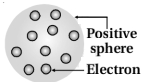
$J. J. Thomson$,in $1898$,proposed that:
- An atom possesses a spherical shape (radius approximately $10^{-10} \ m$) in which the positive charge is uniformly distributed.
- The electrons are embedded into it in such a manner as to give the most stable electrostatic arrangement.
- According to Thomson,the positive charge is distributed throughout the sphere.
Many different names are given to this model,for example: This model can be visualised as a pudding or watermelon of positive charge with plums or seeds (electrons) embedded into it.
An important feature of this model is that the mass of the atom is assumed to be uniformly distributed over the atom.
Although this model was able to explain the overall neutrality of the atom,it was not consistent with the results of later experiments.
According to Rutherford's $\alpha$-particle scattering experiment,most of the space in an atom is empty,which cannot be explained by the Thomson model.
$(1)$ Thomson model of atom.
$(2)$ Rutherford's nuclear model of atom.
$(3)$ Bohr's model of atom (For hydrogen).
$(4)$ Quantum mechanical model of atom.
$J. J. Thomson$,in $1898$,proposed that:
- An atom possesses a spherical shape (radius approximately $10^{-10} \ m$) in which the positive charge is uniformly distributed.
- The electrons are embedded into it in such a manner as to give the most stable electrostatic arrangement.
- According to Thomson,the positive charge is distributed throughout the sphere.
Many different names are given to this model,for example: This model can be visualised as a pudding or watermelon of positive charge with plums or seeds (electrons) embedded into it.
An important feature of this model is that the mass of the atom is assumed to be uniformly distributed over the atom.
Although this model was able to explain the overall neutrality of the atom,it was not consistent with the results of later experiments.
According to Rutherford's $\alpha$-particle scattering experiment,most of the space in an atom is empty,which cannot be explained by the Thomson model.
0 likes
View Solution502
Difficult
Explain Rutherford's nuclear model of the atom.
Solution
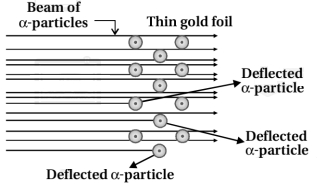
(N/A) Rutherford and his students (Hans Geiger and Ernest Marsden) conducted the $\alpha$-particle scattering experiment.
In this experiment,they bombarded $\alpha$-particles onto a very thin gold foil.
High-energy $\alpha$-particles from a radioactive source were directed at a thin gold foil (thickness $\sim 100 \ nm$).
$A$ fluorescent zinc sulphide screen was kept around the thin gold foil. When $\alpha$-particles struck this screen,they produced a fluorescence effect (flashes of light).
Based on this,Rutherford proposed his nuclear model:
$1$. Most of the space in an atom is empty.
$2$. All the positive charge and most of the mass of the atom are concentrated in a very small region called the nucleus.
$3$. The electrons revolve around the nucleus in circular paths called orbits.
In this experiment,they bombarded $\alpha$-particles onto a very thin gold foil.
High-energy $\alpha$-particles from a radioactive source were directed at a thin gold foil (thickness $\sim 100 \ nm$).
$A$ fluorescent zinc sulphide screen was kept around the thin gold foil. When $\alpha$-particles struck this screen,they produced a fluorescence effect (flashes of light).
Based on this,Rutherford proposed his nuclear model:
$1$. Most of the space in an atom is empty.
$2$. All the positive charge and most of the mass of the atom are concentrated in a very small region called the nucleus.
$3$. The electrons revolve around the nucleus in circular paths called orbits.
0 likes
View Solution503
Difficult
Write down the observations and conclusions of the $\alpha$-particle scattering experiment.
Solution
(N/A) Observations:
$(i)$ Most of the $\alpha$-particles passed through the gold foil undeflected.
$(ii)$ $A$ small fraction of the $\alpha$-particles was deflected by small angles.
$(iii)$ $A$ very few $\alpha$-particles (about $1$ in $20,000$) bounced back,that is,were deflected by nearly $180^{\circ}$.
Conclusions on the basis of the $\alpha$-particle scattering experiment:
$(i)$ Most of the space in the atom is empty as most of the $\alpha$-particles passed through the foil undeflected.
$(ii)$ $A$ few positively charged $\alpha$-particles were deflected. The deflection must be due to an enormous repulsive force,showing that the positive charge of the atom is not spread throughout the atom as $Thomson$ had presumed. The positive charge has to be concentrated in a very small volume that repelled and deflected the positively charged $\alpha$-particles.
$(iii)$ Calculations by $Rutherford$ showed that the volume occupied by the nucleus is negligibly small as compared to the total volume of the atom. The radius of the atom is about $10^{-10} \ m$,while that of the nucleus is $10^{-15} \ m$. One can appreciate this difference in size by realizing that if a cricket ball represents a nucleus,then the radius of the atom would be about $5 \ km$.
$(i)$ Most of the $\alpha$-particles passed through the gold foil undeflected.
$(ii)$ $A$ small fraction of the $\alpha$-particles was deflected by small angles.
$(iii)$ $A$ very few $\alpha$-particles (about $1$ in $20,000$) bounced back,that is,were deflected by nearly $180^{\circ}$.
Conclusions on the basis of the $\alpha$-particle scattering experiment:
$(i)$ Most of the space in the atom is empty as most of the $\alpha$-particles passed through the foil undeflected.
$(ii)$ $A$ few positively charged $\alpha$-particles were deflected. The deflection must be due to an enormous repulsive force,showing that the positive charge of the atom is not spread throughout the atom as $Thomson$ had presumed. The positive charge has to be concentrated in a very small volume that repelled and deflected the positively charged $\alpha$-particles.
$(iii)$ Calculations by $Rutherford$ showed that the volume occupied by the nucleus is negligibly small as compared to the total volume of the atom. The radius of the atom is about $10^{-10} \ m$,while that of the nucleus is $10^{-15} \ m$. One can appreciate this difference in size by realizing that if a cricket ball represents a nucleus,then the radius of the atom would be about $5 \ km$.
0 likes
View Solution504
Medium
Describe Rutherford's atomic model.
Solution
(N/A) On the basis of his observations and conclusions,Rutherford proposed the nuclear model of the atom. According to this model:
$(i)$ The positive charge and most of the mass of the atom are densely concentrated in an extremely small region,which Rutherford called the nucleus.
$(ii)$ The nucleus is surrounded by electrons that move around it at very high speeds in circular paths called orbits.
$(iii)$ Rutherford's model resembles the solar system,where the nucleus acts like the sun and the electrons act like the revolving planets.
$(iv)$ Electrons and the nucleus are held together by electrostatic forces of attraction.
$(i)$ The positive charge and most of the mass of the atom are densely concentrated in an extremely small region,which Rutherford called the nucleus.
$(ii)$ The nucleus is surrounded by electrons that move around it at very high speeds in circular paths called orbits.
$(iii)$ Rutherford's model resembles the solar system,where the nucleus acts like the sun and the electrons act like the revolving planets.
$(iv)$ Electrons and the nucleus are held together by electrostatic forces of attraction.
0 likes
View Solution505
Medium
In Rutherford's experiment,generally the thin foil of heavy atoms,like gold,platinum etc. have been used to be bombarded by the $\alpha$-particles. If the thin foil of light atoms like aluminium etc. is used,what difference would be observed from the above results?
Solution
(N/A) In Rutherford's $\alpha$-particle scattering experiment,the scattering of $\alpha$-particles depends on the nuclear charge and mass of the target atoms.
Heavy atoms like gold $(Au)$ or platinum $(Pt)$ have a high nuclear charge $(Z)$ and a large mass,which results in strong electrostatic repulsion and significant scattering of $\alpha$-particles,including those that bounce back.
If a thin foil of lighter atoms like aluminium $(Al)$ is used,the nucleus has a smaller charge and lower mass. Consequently,the electrostatic repulsion between the $\alpha$-particles and the nucleus is weaker. This leads to a decrease in the number of $\alpha$-particles that are deflected at large angles and a significant reduction in the number of $\alpha$-particles that bounce back.
Heavy atoms like gold $(Au)$ or platinum $(Pt)$ have a high nuclear charge $(Z)$ and a large mass,which results in strong electrostatic repulsion and significant scattering of $\alpha$-particles,including those that bounce back.
If a thin foil of lighter atoms like aluminium $(Al)$ is used,the nucleus has a smaller charge and lower mass. Consequently,the electrostatic repulsion between the $\alpha$-particles and the nucleus is weaker. This leads to a decrease in the number of $\alpha$-particles that are deflected at large angles and a significant reduction in the number of $\alpha$-particles that bounce back.
0 likes
View Solution506
MediumMCQ
In the Rutherford experiment,if light atoms are used instead of heavy elements,what change is observed in the results?
A
The number of deflected $\alpha$-particles increases.
B
The number of deflected $\alpha$-particles decreases.
C
The number of backscattered $\alpha$-particles increases.
D
No change is observed.
Solution
(B) In Rutherford's $\alpha$-particle scattering experiment,the scattering is caused by the electrostatic repulsion between the positively charged nucleus and the $\alpha$-particles.
Since heavy elements have a higher nuclear charge $(Z)$ and higher mass,they exert a stronger repulsive force,leading to more significant scattering and a higher probability of backscattering.
If lighter atoms are used,the nuclear charge and mass are smaller,resulting in a weaker repulsive force.
Consequently,the number of $\alpha$-particles that undergo large-angle deflection or bounce back decreases significantly.
Since heavy elements have a higher nuclear charge $(Z)$ and higher mass,they exert a stronger repulsive force,leading to more significant scattering and a higher probability of backscattering.
If lighter atoms are used,the nuclear charge and mass are smaller,resulting in a weaker repulsive force.
Consequently,the number of $\alpha$-particles that undergo large-angle deflection or bounce back decreases significantly.
0 likes
View Solution507
DifficultMCQ
Which are the drawbacks of Rutherford's atomic model?
A
It could not explain the stability of the atom.
B
It could not explain the electronic distribution.
C
Both $A$ and $B$.
D
It could not explain the existence of the nucleus.
Solution
(C) $(i)$ Rutherford's model could not explain the stability of the atom because according to classical electromagnetic theory,an accelerating electron should lose energy and eventually fall into the nucleus.
$(ii)$ It does not provide any information about the electronic structure of the atom,i.e.,how electrons are distributed around the nucleus and what their energies are.
$(ii)$ It does not provide any information about the electronic structure of the atom,i.e.,how electrons are distributed around the nucleus and what their energies are.
0 likes
View Solution508
Difficult
Explain: "Rutherford's atomic model cannot explain the stability of an atom."
Solution
(N/A) Rutherford's nuclear model of an atom is analogous to a solar system where the nucleus acts as the sun and electrons act as planets.
According to classical electromagnetic theory,any charged particle moving in a circular orbit undergoes acceleration due to the continuous change in the direction of its velocity.
Maxwell's electromagnetic theory states that an accelerated charged particle must emit electromagnetic radiation.
As the electron emits radiation,it loses energy,causing its orbit to shrink continuously.
Calculations suggest that the electron should spiral into the nucleus within approximately $10^{-8} \ s$.
However,atoms are known to be stable,and electrons do not collapse into the nucleus.
Therefore,Rutherford's model fails to explain the stability of an atom.
According to classical electromagnetic theory,any charged particle moving in a circular orbit undergoes acceleration due to the continuous change in the direction of its velocity.
Maxwell's electromagnetic theory states that an accelerated charged particle must emit electromagnetic radiation.
As the electron emits radiation,it loses energy,causing its orbit to shrink continuously.
Calculations suggest that the electron should spiral into the nucleus within approximately $10^{-8} \ s$.
However,atoms are known to be stable,and electrons do not collapse into the nucleus.
Therefore,Rutherford's model fails to explain the stability of an atom.
0 likes
View Solution509
MediumMCQ
Which developments played a role in the formation of Bohr's model of the atom?
A
Dual character of electromagnetic radiation
B
Experimental results regarding atomic spectra
C
Both $(A)$ and $(B)$
D
None of the above
Solution
(C) Two major developments played a crucial role in the formulation of Bohr's model of the atom:
$(i)$ The dual character of electromagnetic radiation,which implies that radiations possess both wave-like and particle-like properties.
$(ii)$ Experimental results regarding atomic spectra,which can only be explained by assuming quantized electronic energy levels in atoms.
Therefore,both developments were essential for Bohr's model.
$(i)$ The dual character of electromagnetic radiation,which implies that radiations possess both wave-like and particle-like properties.
$(ii)$ Experimental results regarding atomic spectra,which can only be explained by assuming quantized electronic energy levels in atoms.
Therefore,both developments were essential for Bohr's model.
0 likes
View Solution510
MediumMCQ
Which observations are not explained by the electromagnetic theory of physics?
A
Black-body radiation
B
Photoelectric effect
C
Line spectra of atoms
D
All of the above
Solution
(D) The electromagnetic theory of radiation could not explain the following phenomena:
$(i)$ The nature of emission of radiation from hot bodies (black-body radiation).
$(ii)$ Photoelectric effect: The ejection of electrons from a metal surface when radiation of appropriate frequency strikes it.
$(iii)$ Variation of heat capacity of solids as a function of temperature.
$(iv)$ Line spectra of atoms with special reference to hydrogen.
Therefore,all of the listed observations are not explained by the classical electromagnetic theory.
$(i)$ The nature of emission of radiation from hot bodies (black-body radiation).
$(ii)$ Photoelectric effect: The ejection of electrons from a metal surface when radiation of appropriate frequency strikes it.
$(iii)$ Variation of heat capacity of solids as a function of temperature.
$(iv)$ Line spectra of atoms with special reference to hydrogen.
Therefore,all of the listed observations are not explained by the classical electromagnetic theory.
0 likes
View Solution511
Medium
Explain the phenomenon of black body radiation.
Solution
(N/A) The first concrete explanation for the phenomenon of black body radiation was given by Max Planck in $1900$.
When solids are heated,they emit radiation over a wide range of wavelengths.
Example: When an iron rod is heated in a furnace,it first turns dull red and then progressively becomes more and more red as the temperature increases; the colour and frequency change.
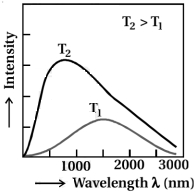
Black body: An ideal body,which emits and absorbs radiations of all frequencies,is called a black body,and the radiation emitted by such a body is called black body radiation.
The exact frequency distribution of the emitted radiation: At a given temperature,the intensity of radiation emitted increases with a decrease in wavelength,reaches a maximum value at a given wavelength,and then starts decreasing with a further decrease in wavelength (see the figure).
Black body radiation cannot be explained by classical electromagnetic radiation theory but is explained by Planck's quantum theory.
When solids are heated,they emit radiation over a wide range of wavelengths.
Example: When an iron rod is heated in a furnace,it first turns dull red and then progressively becomes more and more red as the temperature increases; the colour and frequency change.
Black body: An ideal body,which emits and absorbs radiations of all frequencies,is called a black body,and the radiation emitted by such a body is called black body radiation.
The exact frequency distribution of the emitted radiation: At a given temperature,the intensity of radiation emitted increases with a decrease in wavelength,reaches a maximum value at a given wavelength,and then starts decreasing with a further decrease in wavelength (see the figure).
Black body radiation cannot be explained by classical electromagnetic radiation theory but is explained by Planck's quantum theory.
0 likes
View Solution512
Medium
Explain the importance and the main postulates of Planck's quantum theory.
Solution
(N/A) Planck's quantum theory was proposed to explain phenomena like black body radiation and the photoelectric effect,which could not be explained by the wave theory of light.
Postulates:
$1$. Atoms and molecules emit or absorb energy in discrete quantities called 'quanta' rather than in a continuous manner.
$2$. The energy $(E)$ of a quantum of radiation is directly proportional to its frequency $(v)$,expressed as $E \propto v$ or $E = hv$,where $h$ is Planck's constant $(6.626 \times 10^{-34} \ J \ s)$.
$3$. The total energy emitted or absorbed by a body is an integral multiple of a quantum,given by $E = nhv$,where $n = 1, 2, 3, \dots$.
Importance:
Planck's theory successfully explained the distribution of intensity in the radiation from a black body as a function of frequency or wavelength at different temperatures,which classical physics failed to do.
Postulates:
$1$. Atoms and molecules emit or absorb energy in discrete quantities called 'quanta' rather than in a continuous manner.
$2$. The energy $(E)$ of a quantum of radiation is directly proportional to its frequency $(v)$,expressed as $E \propto v$ or $E = hv$,where $h$ is Planck's constant $(6.626 \times 10^{-34} \ J \ s)$.
$3$. The total energy emitted or absorbed by a body is an integral multiple of a quantum,given by $E = nhv$,where $n = 1, 2, 3, \dots$.
Importance:
Planck's theory successfully explained the distribution of intensity in the radiation from a black body as a function of frequency or wavelength at different temperatures,which classical physics failed to do.
0 likes
View Solution513
Difficult
Explain the photoelectric effect.
Solution
(N/A) Photoelectric effect: When certain metals (e.g.,potassium,rubidium,caesium,etc.) are exposed to a beam of light,electrons (or electric current) are ejected. This phenomenon is called the photoelectric effect.
Light of a particular frequency strikes a clean metal surface inside a vacuum chamber. Electrons are ejected from the metal and are counted by a detector that measures their kinetic energy.
Experimental results and observations:
$(i)$ The electrons are ejected from the metal surface as soon as the beam of light strikes the surface. There is no time lag between the striking of the light beam and the ejection of electrons.
$(ii)$ The number of electrons ejected is proportional to the intensity or brightness of light. (Number of electrons $\propto$ Intensity of light).
$(iii)$ Threshold frequency: There is a characteristic minimum frequency,$v_{0}$,below which the photoelectric effect is not observed. This is known as the threshold frequency.
At a frequency $v > v_{0}$,the ejected electrons come out with a certain kinetic energy. The kinetic energies of these electrons increase with the increase in the frequency of the light used.
All the above results could not be explained by the laws of classical physics,but Einstein $(1905)$ was able to explain the photoelectric effect using Planck's quantum theory.
$(\text{Energy of light used}) \propto (\text{Frequency of light}) \propto (\text{Kinetic energy of emitted electron})$ and $(\text{Number of emitted electrons}) \propto (\text{Intensity of light})$.
Light of a particular frequency strikes a clean metal surface inside a vacuum chamber. Electrons are ejected from the metal and are counted by a detector that measures their kinetic energy.
Experimental results and observations:
$(i)$ The electrons are ejected from the metal surface as soon as the beam of light strikes the surface. There is no time lag between the striking of the light beam and the ejection of electrons.
$(ii)$ The number of electrons ejected is proportional to the intensity or brightness of light. (Number of electrons $\propto$ Intensity of light).
$(iii)$ Threshold frequency: There is a characteristic minimum frequency,$v_{0}$,below which the photoelectric effect is not observed. This is known as the threshold frequency.
At a frequency $v > v_{0}$,the ejected electrons come out with a certain kinetic energy. The kinetic energies of these electrons increase with the increase in the frequency of the light used.
All the above results could not be explained by the laws of classical physics,but Einstein $(1905)$ was able to explain the photoelectric effect using Planck's quantum theory.
$(\text{Energy of light used}) \propto (\text{Frequency of light}) \propto (\text{Kinetic energy of emitted electron})$ and $(\text{Number of emitted electrons}) \propto (\text{Intensity of light})$.
0 likes
View Solution514
Difficult
Explain: Photoelectric effect.
Solution
(N/A) Einstein $(1905)$ explained the photoelectric effect using Planck's quantum theory of electromagnetic radiation.
Shining a beam of light on a metal surface can be viewed as shooting a beam of particles called photons. When a photon of sufficient energy strikes an electron in the metal atom,it transfers its energy instantaneously to the electron,causing it to be ejected without any time lag.
The kinetic energy of the ejected electron is proportional to the frequency of the incident radiation and does not depend on the intensity of light.
Striking photon energy $= h\nu$
The minimum energy required to eject an electron is called the work function $(W = h\nu_{0})$.
According to the conservation of energy principle,the kinetic energy of the ejected photoelectron is given by:
$h\nu = W + \frac{1}{2} m_{e} V^{2}$
Substituting $W = h\nu_{0}$:
$h\nu = h\nu_{0} + \frac{1}{2} m_{e} V^{2}$
$\frac{1}{2} m_{e} V^{2} = h(\nu - \nu_{0})$
where $m_{e}$ is the mass of the electron,$V$ is the velocity of the ejected electron,and $\nu > \nu_{0}$. $A$ more intense beam of light contains a larger number of photons,resulting in a greater number of ejected electrons.
Shining a beam of light on a metal surface can be viewed as shooting a beam of particles called photons. When a photon of sufficient energy strikes an electron in the metal atom,it transfers its energy instantaneously to the electron,causing it to be ejected without any time lag.
The kinetic energy of the ejected electron is proportional to the frequency of the incident radiation and does not depend on the intensity of light.
Striking photon energy $= h\nu$
The minimum energy required to eject an electron is called the work function $(W = h\nu_{0})$.
According to the conservation of energy principle,the kinetic energy of the ejected photoelectron is given by:
$h\nu = W + \frac{1}{2} m_{e} V^{2}$
Substituting $W = h\nu_{0}$:
$h\nu = h\nu_{0} + \frac{1}{2} m_{e} V^{2}$
$\frac{1}{2} m_{e} V^{2} = h(\nu - \nu_{0})$
where $m_{e}$ is the mass of the electron,$V$ is the velocity of the ejected electron,and $\nu > \nu_{0}$. $A$ more intense beam of light contains a larger number of photons,resulting in a greater number of ejected electrons.
0 likes
View Solution515
Difficult
Explain the energy of a photon,the kinetic energy of an ejected electron,and the number of photons in the photoelectric effect.
Solution
(N/A) The photoelectric effect is governed by Einstein's photoelectric equation:
$E_{\text{photon}} = W + K.E._{\text{max}}$
$h\nu = W + \frac{1}{2}m_e v^2$
Where:
$h\nu$ is the energy of the incident photon.
$W = h\nu_0$ is the work function (minimum energy required to eject an electron).
$\frac{1}{2}m_e v^2$ is the maximum kinetic energy of the ejected photoelectron.
Key relationships:
$1$. Energy of photon: $E = h\nu = \frac{hc}{\lambda}$.
$2$. Kinetic energy of electron: $K.E. = h(\nu - \nu_0)$.
$3$. Number of photons: The intensity of the light beam is directly proportional to the number of photons incident per unit time. $A$ more intense beam contains a larger number of photons,which results in a larger number of photoelectrons being ejected.
$E_{\text{photon}} = W + K.E._{\text{max}}$
$h\nu = W + \frac{1}{2}m_e v^2$
Where:
$h\nu$ is the energy of the incident photon.
$W = h\nu_0$ is the work function (minimum energy required to eject an electron).
$\frac{1}{2}m_e v^2$ is the maximum kinetic energy of the ejected photoelectron.
Key relationships:
$1$. Energy of photon: $E = h\nu = \frac{hc}{\lambda}$.
$2$. Kinetic energy of electron: $K.E. = h(\nu - \nu_0)$.
$3$. Number of photons: The intensity of the light beam is directly proportional to the number of photons incident per unit time. $A$ more intense beam contains a larger number of photons,which results in a larger number of photoelectrons being ejected.
0 likes
View Solution516
EasyMCQ
Calculate the energy of $1 \ mol$ of photons having a frequency of $4.0 \times 10^{14} \ Hz$.
A
$159.0 \ kJ \ mol^{-1}$
B
$15.9 \ kJ \ mol^{-1}$
C
$1.59 \ kJ \ mol^{-1}$
D
$1590.0 \ kJ \ mol^{-1}$
Solution
(A) The energy of one photon is given by $E = h \nu$.
For $1 \ mol$ of photons,the energy is $E = N_A \times h \times \nu$.
Given: $N_A = 6.022 \times 10^{23} \ mol^{-1}$,$h = 6.626 \times 10^{-34} \ J \cdot s$,and $\nu = 4.0 \times 10^{14} \ Hz$.
$E = (6.022 \times 10^{23}) \times (6.626 \times 10^{-34}) \times (4.0 \times 10^{14}) \ J \ mol^{-1}$.
$E \approx 159529 \ J \ mol^{-1} \approx 159.5 \ kJ \ mol^{-1}$.
Rounding to the nearest provided option,the answer is $159.0 \ kJ \ mol^{-1}$.
For $1 \ mol$ of photons,the energy is $E = N_A \times h \times \nu$.
Given: $N_A = 6.022 \times 10^{23} \ mol^{-1}$,$h = 6.626 \times 10^{-34} \ J \cdot s$,and $\nu = 4.0 \times 10^{14} \ Hz$.
$E = (6.022 \times 10^{23}) \times (6.626 \times 10^{-34}) \times (4.0 \times 10^{14}) \ J \ mol^{-1}$.
$E \approx 159529 \ J \ mol^{-1} \approx 159.5 \ kJ \ mol^{-1}$.
Rounding to the nearest provided option,the answer is $159.0 \ kJ \ mol^{-1}$.
0 likes
View Solution517
MediumMCQ
Find the energy of a photon having a wavelength of $6000 \ \mathring{A}$. (Given: $h = 6.62 \times 10^{-27} \ erg \cdot s$)
A
$3.31 \times 10^{-12} \ erg$
B
$6.62 \times 10^{-12} \ erg$
C
$1.32 \times 10^{-12} \ erg$
D
$3.31 \times 10^{-10} \ erg$
Solution
(A) The energy of a photon is given by the formula: $E = \frac{hc}{\lambda}$
Given values:
$h = 6.62 \times 10^{-27} \ erg \cdot s$
$c = 3 \times 10^{10} \ cm/s$
$\lambda = 6000 \ \mathring{A} = 6000 \times 10^{-8} \ cm = 6 \times 10^{-5} \ cm$
Substituting the values:
$E = \frac{(6.62 \times 10^{-27} \ erg \cdot s) \times (3 \times 10^{10} \ cm/s)}{6 \times 10^{-5} \ cm}$
$E = \frac{19.86 \times 10^{-17}}{6 \times 10^{-5}} \ erg$
$E = 3.31 \times 10^{-12} \ erg$
Given values:
$h = 6.62 \times 10^{-27} \ erg \cdot s$
$c = 3 \times 10^{10} \ cm/s$
$\lambda = 6000 \ \mathring{A} = 6000 \times 10^{-8} \ cm = 6 \times 10^{-5} \ cm$
Substituting the values:
$E = \frac{(6.62 \times 10^{-27} \ erg \cdot s) \times (3 \times 10^{10} \ cm/s)}{6 \times 10^{-5} \ cm}$
$E = \frac{19.86 \times 10^{-17}}{6 \times 10^{-5}} \ erg$
$E = 3.31 \times 10^{-12} \ erg$
0 likes
View Solution518
EasyMCQ
The photon having $6000 \ \mathring{A}$ wavelength has energy $E$. If the energy of photon is $2E$,find the wavelength of the photon.
A
$3000 \ \mathring{A}$
B
$6000 \ \mathring{A}$
C
$12000 \ \mathring{A}$
D
$1500 \ \mathring{A}$
Solution
(A) The energy of a photon is given by the formula $E = \frac{hc}{\lambda}$,where $h$ is Planck's constant,$c$ is the speed of light,and $\lambda$ is the wavelength.
Since $h$ and $c$ are constants,$E \propto \frac{1}{\lambda}$.
Given $E_1 = E$ and $\lambda_1 = 6000 \ \mathring{A}$.
For $E_2 = 2E$,we have $\frac{E_2}{E_1} = \frac{\lambda_1}{\lambda_2}$.
Substituting the values: $\frac{2E}{E} = \frac{6000 \ \mathring{A}}{\lambda_2}$.
$2 = \frac{6000 \ \mathring{A}}{\lambda_2}$.
$\lambda_2 = \frac{6000 \ \mathring{A}}{2} = 3000 \ \mathring{A}$.
Since $h$ and $c$ are constants,$E \propto \frac{1}{\lambda}$.
Given $E_1 = E$ and $\lambda_1 = 6000 \ \mathring{A}$.
For $E_2 = 2E$,we have $\frac{E_2}{E_1} = \frac{\lambda_1}{\lambda_2}$.
Substituting the values: $\frac{2E}{E} = \frac{6000 \ \mathring{A}}{\lambda_2}$.
$2 = \frac{6000 \ \mathring{A}}{\lambda_2}$.
$\lambda_2 = \frac{6000 \ \mathring{A}}{2} = 3000 \ \mathring{A}$.
0 likes
View Solution519
MediumMCQ
Find the energy of $1$ mole of photons having a frequency of $5 \times 10^{10} \ s^{-1}$. $(h = 6.62 \times 10^{-34} \ J \ s)$
A
$3.98 \times 10^{-23} \ J$
B
$3.98 \times 10^{1} \ J$
C
$3.98 \times 10^{-14} \ J$
D
$3.98 \times 10^{-1} \ J$
Solution
(B) The energy of a single photon is given by $E = h \nu$.
Given: $h = 6.62 \times 10^{-34} \ J \ s$ and $\nu = 5 \times 10^{10} \ s^{-1}$.
Energy of one photon $= (6.62 \times 10^{-34}) \times (5 \times 10^{10}) = 33.1 \times 10^{-24} \ J = 3.31 \times 10^{-23} \ J$.
Energy of $1$ mole of photons $= N_A \times E = (6.022 \times 10^{23}) \times (3.31 \times 10^{-23} \ J) \approx 19.93 \ \text{J}$.
Thus,the energy is approximately $19.9 \ \text{J}$.
Given: $h = 6.62 \times 10^{-34} \ J \ s$ and $\nu = 5 \times 10^{10} \ s^{-1}$.
Energy of one photon $= (6.62 \times 10^{-34}) \times (5 \times 10^{10}) = 33.1 \times 10^{-24} \ J = 3.31 \times 10^{-23} \ J$.
Energy of $1$ mole of photons $= N_A \times E = (6.022 \times 10^{23}) \times (3.31 \times 10^{-23} \ J) \approx 19.93 \ \text{J}$.
Thus,the energy is approximately $19.9 \ \text{J}$.
0 likes
View Solution520
Medium
Find the frequency and wavelength of light required for the ionization of the solution. (Ionization energy of the solution $= 8.2 \times 10^{-19} \ J$)
Solution
The ionization energy $E$ is given by $E = h\nu = \frac{hc}{\lambda}$.
Given $E = 8.2 \times 10^{-19} \ J$,$h = 6.626 \times 10^{-34} \ J \cdot s$,and $c = 3 \times 10^8 \ m/s$.
Frequency $\nu = \frac{E}{h} = \frac{8.2 \times 10^{-19}}{6.626 \times 10^{-34}} \approx 1.238 \times 10^{15} \ Hz$.
Wavelength $\lambda = \frac{hc}{E} = \frac{(6.626 \times 10^{-34}) \times (3 \times 10^8)}{8.2 \times 10^{-19}} \approx 2.42 \times 10^{-7} \ m = 242 \ nm$.
Given $E = 8.2 \times 10^{-19} \ J$,$h = 6.626 \times 10^{-34} \ J \cdot s$,and $c = 3 \times 10^8 \ m/s$.
Frequency $\nu = \frac{E}{h} = \frac{8.2 \times 10^{-19}}{6.626 \times 10^{-34}} \approx 1.238 \times 10^{15} \ Hz$.
Wavelength $\lambda = \frac{hc}{E} = \frac{(6.626 \times 10^{-34}) \times (3 \times 10^8)}{8.2 \times 10^{-19}} \approx 2.42 \times 10^{-7} \ m = 242 \ nm$.
0 likes
View Solution521
Medium
What is the hydrogen spectrum? Give its characteristics.
Solution
(N/A) Hydrogen spectrum: When an electric discharge is passed through gaseous hydrogen,the $H_{2}$ molecules dissociate and the energetically excited hydrogen atoms produced emit electromagnetic radiation,which is known as the hydrogen spectrum.
Characteristics:
$1$. It is a line emission spectrum.
$2$. It is a discontinuous spectrum.
$3$. It consists of a large number of spectral lines appearing in different regions of wavelengths (e.g.,Lyman,Balmer,Paschen,Brackett,and Pfund series).
$4$. Each series is named after its discoverer.
Characteristics:
$1$. It is a line emission spectrum.
$2$. It is a discontinuous spectrum.
$3$. It consists of a large number of spectral lines appearing in different regions of wavelengths (e.g.,Lyman,Balmer,Paschen,Brackett,and Pfund series).
$4$. Each series is named after its discoverer.
0 likes
View Solution522
Medium
Explain the Balmer series and provide its equation.
Solution
(N/A) In $1885$,Johann Balmer demonstrated through experimental observations that the spectral lines of the hydrogen spectrum in the visible region can be expressed using the wave number $(\bar{\nu})$ formula:
$\bar{\nu} = 109677 \left( \frac{1}{2^{2}} - \frac{1}{n^{2}} \right) \text{ cm}^{-1}$
where $n = 3, 4, 5, \dots$
This set of spectral lines is known as the Balmer series. It is the only series in the hydrogen emission spectrum that lies within the visible region of the electromagnetic spectrum.
$\bar{\nu} = 109677 \left( \frac{1}{2^{2}} - \frac{1}{n^{2}} \right) \text{ cm}^{-1}$
where $n = 3, 4, 5, \dots$
This set of spectral lines is known as the Balmer series. It is the only series in the hydrogen emission spectrum that lies within the visible region of the electromagnetic spectrum.
0 likes
View Solution523
Advanced
Describe the hydrogen spectrum.
Solution
The Swedish spectroscopist,Johannes Rydberg,noted that all series of lines in the hydrogen spectrum could be described by the following expression: $\bar{v} = 109677 \left( \frac{1}{n_{1}^{2}} - \frac{1}{n_{2}^{2}} \right) \ cm^{-1}$.
Where,$n_{1} = 1, 2, 3 \ldots$ and $n_{2} = (n_{1} + 1), (n_{1} + 2), (n_{1} + 3) \ldots$.
The Rydberg constant for hydrogen is $R_{H} = 109677 \ cm^{-1}$.
The series of the hydrogen spectrum are classified based on the $n_{1}$ value:
$n_{1} = 1$: Lyman series,$n_{2} = 2, 3, 4 \ldots$ (Ultraviolet region).
$n_{1} = 2$: Balmer series,$n_{2} = 3, 4, 5 \ldots$ (Visible region).
$n_{1} = 3$: Paschen series,$n_{2} = 4, 5, 6 \ldots$ (Infrared region).
$n_{1} = 4$: Brackett series,$n_{2} = 5, 6, 7 \ldots$ (Infrared region).
$n_{1} = 5$: Pfund series,$n_{2} = 6, 7, 8 \ldots$ (Infrared region).
Among all elements,the hydrogen atom has the simplest line spectrum,which is a line emission spectrum.
Where,$n_{1} = 1, 2, 3 \ldots$ and $n_{2} = (n_{1} + 1), (n_{1} + 2), (n_{1} + 3) \ldots$.
The Rydberg constant for hydrogen is $R_{H} = 109677 \ cm^{-1}$.
The series of the hydrogen spectrum are classified based on the $n_{1}$ value:
$n_{1} = 1$: Lyman series,$n_{2} = 2, 3, 4 \ldots$ (Ultraviolet region).
$n_{1} = 2$: Balmer series,$n_{2} = 3, 4, 5 \ldots$ (Visible region).
$n_{1} = 3$: Paschen series,$n_{2} = 4, 5, 6 \ldots$ (Infrared region).
$n_{1} = 4$: Brackett series,$n_{2} = 5, 6, 7 \ldots$ (Infrared region).
$n_{1} = 5$: Pfund series,$n_{2} = 6, 7, 8 \ldots$ (Infrared region).
Among all elements,the hydrogen atom has the simplest line spectrum,which is a line emission spectrum.
0 likes
View Solution524
Advanced
Give the Rydberg equation for all lines in the hydrogen spectrum.
Solution
(N/A) The Swedish spectroscopist,Johannes Rydberg,noted that all series of lines in the hydrogen spectrum could be described by the following expression:
$\bar{v} = R_H \left( \frac{1}{n_{1}^{2}} - \frac{1}{n_{2}^{2}} \right) \ cm^{-1}$
Where:
$\bar{v}$ is the wavenumber.
$R_H$ is the Rydberg constant for hydrogen,which is $109677 \ cm^{-1}$.
$n_1 = 1, 2, 3, \dots$
$n_2 = (n_1 + 1), (n_1 + 2), (n_1 + 3), \dots$
The series of the hydrogen spectrum are identified by the value of $n_1$:
$n_1 = 1$: Lyman series (ultraviolet region)
$n_1 = 2$: Balmer series (visible region)
$n_1 = 3$: Paschen series (infrared region)
$n_1 = 4$: Brackett series (infrared region)
$n_1 = 5$: Pfund series (infrared region)
$\bar{v} = R_H \left( \frac{1}{n_{1}^{2}} - \frac{1}{n_{2}^{2}} \right) \ cm^{-1}$
Where:
$\bar{v}$ is the wavenumber.
$R_H$ is the Rydberg constant for hydrogen,which is $109677 \ cm^{-1}$.
$n_1 = 1, 2, 3, \dots$
$n_2 = (n_1 + 1), (n_1 + 2), (n_1 + 3), \dots$
The series of the hydrogen spectrum are identified by the value of $n_1$:
$n_1 = 1$: Lyman series (ultraviolet region)
$n_1 = 2$: Balmer series (visible region)
$n_1 = 3$: Paschen series (infrared region)
$n_1 = 4$: Brackett series (infrared region)
$n_1 = 5$: Pfund series (infrared region)
0 likes
View Solution525
Medium
What is the difference in the line spectrum of different atoms compared to the hydrogen atom?
Solution
(N/A) In the gaseous state,all atoms exhibit a line spectrum.
For every atom,the line spectrum is unique,meaning it does not resemble that of any other atom.
In all atoms,a specific type of regularity is observed.
The hydrogen spectrum is relatively simple,whereas the spectra of heavy elements or atoms are increasingly complex.
For every atom,the line spectrum is unique,meaning it does not resemble that of any other atom.
In all atoms,a specific type of regularity is observed.
The hydrogen spectrum is relatively simple,whereas the spectra of heavy elements or atoms are increasingly complex.
0 likes
View Solution526
Advanced
Write the postulates of Bohr's model of the hydrogen atom.
Solution
(N/A) Neils Bohr $(1913)$ was the first to explain quantitatively the general features of hydrogen atom structure and its spectrum.
Postulates of the model:
$(i)$ The electron in the hydrogen atom can move around the nucleus in a circular path of fixed radius and energy. These paths are called orbits,stationary states,or allowed energy states. These orbits are arranged concentrically around the nucleus.
$(ii)$ The energy of an electron in the orbit does not change with time. However,the electron will move from a lower stationary state to a higher stationary state when the required amount of energy is absorbed,or energy is emitted when the electron moves from a higher stationary state to a lower one. The energy change does not take place in a continuous manner.
$(iii)$ The frequency of radiation absorbed or emitted when a transition occurs between two stationary states that differ in energy by $\Delta E$ is given by:
$E = h \nu$ and $\Delta E = (E_{2} - E_{1})$
So,$\nu = \frac{\Delta E}{h}$ (Bohr's frequency rule)
Where $E_{1}$ and $E_{2}$ are the energies of the lower and higher allowed energy states,respectively.
$(iv)$ The angular momentum of an electron in a given stationary state can be expressed as:
$m_{e} v r = n \left( \frac{h}{2 \pi} \right)$ where $n = 1, 2, 3, \dots$
Thus,an electron can move only in those orbits for which its angular momentum is an integral multiple of $\frac{h}{2 \pi}$,which is why only certain fixed orbits are allowed.
Postulates of the model:
$(i)$ The electron in the hydrogen atom can move around the nucleus in a circular path of fixed radius and energy. These paths are called orbits,stationary states,or allowed energy states. These orbits are arranged concentrically around the nucleus.
$(ii)$ The energy of an electron in the orbit does not change with time. However,the electron will move from a lower stationary state to a higher stationary state when the required amount of energy is absorbed,or energy is emitted when the electron moves from a higher stationary state to a lower one. The energy change does not take place in a continuous manner.
$(iii)$ The frequency of radiation absorbed or emitted when a transition occurs between two stationary states that differ in energy by $\Delta E$ is given by:
$E = h \nu$ and $\Delta E = (E_{2} - E_{1})$
So,$\nu = \frac{\Delta E}{h}$ (Bohr's frequency rule)
Where $E_{1}$ and $E_{2}$ are the energies of the lower and higher allowed energy states,respectively.
$(iv)$ The angular momentum of an electron in a given stationary state can be expressed as:
$m_{e} v r = n \left( \frac{h}{2 \pi} \right)$ where $n = 1, 2, 3, \dots$
Thus,an electron can move only in those orbits for which its angular momentum is an integral multiple of $\frac{h}{2 \pi}$,which is why only certain fixed orbits are allowed.
0 likes
View Solution527
Advanced
Explain Bohr's atomic model.
Solution
(N/A) Neils Bohr $(1913)$ was the first to explain quantitatively the general features of hydrogen atom structure and its spectrum.
Postulates of the model:
$(i)$ The electron in the hydrogen atom can move around the nucleus in a circular path of fixed radius and energy. These paths are called orbits,stationary states,or allowed energy states. These orbits are arranged concentrically around the nucleus.
$(ii)$ The energy of an electron in the orbit does not change with time. However,the electron will move from a lower stationary state to a higher stationary state when the required amount of energy is absorbed,or energy is emitted when the electron moves from a higher to a lower stationary state. The energy change does not take place in a continuous manner.
$(iii)$ The frequency of radiation absorbed or emitted when a transition occurs between two stationary states that differ in energy by $\Delta E$,is given by:
$E = h \nu$ and $\Delta E = (E_{2} - E_{1})$
So,$\nu = \frac{\Delta E}{h}$ (Bohr's frequency rule)
Where $E_{1}$ and $E_{2}$ are the energies of the lower and higher allowed energy states respectively.
$(iv)$ The angular momentum of an electron in a given stationary state can be expressed as:
$m_{e} v r = n(\frac{h}{2 \pi})$ where $n = 1, 2, 3, \dots$
Thus,an electron can move only in those orbits for which its angular momentum is an integral multiple of $\frac{h}{2 \pi}$,which is why only certain fixed orbits are allowed.
Postulates of the model:
$(i)$ The electron in the hydrogen atom can move around the nucleus in a circular path of fixed radius and energy. These paths are called orbits,stationary states,or allowed energy states. These orbits are arranged concentrically around the nucleus.
$(ii)$ The energy of an electron in the orbit does not change with time. However,the electron will move from a lower stationary state to a higher stationary state when the required amount of energy is absorbed,or energy is emitted when the electron moves from a higher to a lower stationary state. The energy change does not take place in a continuous manner.
$(iii)$ The frequency of radiation absorbed or emitted when a transition occurs between two stationary states that differ in energy by $\Delta E$,is given by:
$E = h \nu$ and $\Delta E = (E_{2} - E_{1})$
So,$\nu = \frac{\Delta E}{h}$ (Bohr's frequency rule)
Where $E_{1}$ and $E_{2}$ are the energies of the lower and higher allowed energy states respectively.
$(iv)$ The angular momentum of an electron in a given stationary state can be expressed as:
$m_{e} v r = n(\frac{h}{2 \pi})$ where $n = 1, 2, 3, \dots$
Thus,an electron can move only in those orbits for which its angular momentum is an integral multiple of $\frac{h}{2 \pi}$,which is why only certain fixed orbits are allowed.
0 likes
View Solution528
Advanced
Write down the postulates of Bohr's model for the hydrogen atom.
Solution
(N/A) $(i)$ Principal quantum number: The stationary states for the electron are numbered $n = 1, 2, 3, \dots$. These integral numbers are known as Principal quantum numbers.
(ii) Stationary orbit radii $(r)$: The radii of the stationary states are expressed as: $r_n = n^2 a_0$, where $a_0 = 52.9 \text{ pm}$.
- The radius of the first stationary $(n = 1)$ state, called the Bohr orbit, is $52.9 \text{ pm}$.
- Normally, the electron in the hydrogen atom is found in this orbit $(n = 1)$.
- As $n$ increases, the value of $r$ increases, meaning the electron is present further away from the nucleus.
(iii) Energy of stationary state: The energy of the stationary state is given by the expression: $E_n = -R_H \left(\frac{1}{n^2}\right)$, where $n = 1, 2, 3, \dots$ and $R_H$ (Rydberg constant) $= 2.18 \times 10^{-18} \text{ J}$.
- The energy of the ground state $(n = 1)$ is $E_1 = -2.18 \times 10^{-18} \text{ J}$.
- The energy of the stationary state for $n = 2$ is $E_2 = -2.18 \times 10^{-18} \text{ J} \times \left(\frac{1}{2^2}\right) = -0.545 \times 10^{-18} \text{ J}$.
- When the electron is free from the influence of the nucleus, the energy is taken as zero $(n = \infty)$, which corresponds to an ionized hydrogen atom $(H^+)$.
(ii) Stationary orbit radii $(r)$: The radii of the stationary states are expressed as: $r_n = n^2 a_0$, where $a_0 = 52.9 \text{ pm}$.
- The radius of the first stationary $(n = 1)$ state, called the Bohr orbit, is $52.9 \text{ pm}$.
- Normally, the electron in the hydrogen atom is found in this orbit $(n = 1)$.
- As $n$ increases, the value of $r$ increases, meaning the electron is present further away from the nucleus.
(iii) Energy of stationary state: The energy of the stationary state is given by the expression: $E_n = -R_H \left(\frac{1}{n^2}\right)$, where $n = 1, 2, 3, \dots$ and $R_H$ (Rydberg constant) $= 2.18 \times 10^{-18} \text{ J}$.
- The energy of the ground state $(n = 1)$ is $E_1 = -2.18 \times 10^{-18} \text{ J}$.
- The energy of the stationary state for $n = 2$ is $E_2 = -2.18 \times 10^{-18} \text{ J} \times \left(\frac{1}{2^2}\right) = -0.545 \times 10^{-18} \text{ J}$.
- When the electron is free from the influence of the nucleus, the energy is taken as zero $(n = \infty)$, which corresponds to an ionized hydrogen atom $(H^+)$.
0 likes
View Solution529
Difficult
Explain the following according to Bohr's model of hydrogen:
$(i)$ Principal quantum number
$(ii)$ Radius of stationary orbit $(r)$
$(iii)$ Energy of stationary state
$(iv)$ Isoelectronic ion of $H$
$(v)$ Velocity of electron
$(i)$ Principal quantum number
$(ii)$ Radius of stationary orbit $(r)$
$(iii)$ Energy of stationary state
$(iv)$ Isoelectronic ion of $H$
$(v)$ Velocity of electron
Solution
(N/A) $(i)$ Principal quantum number: The stationary states for the electron are numbered $n = 1, 2, 3, \dots$. These integral numbers are known as Principal quantum numbers.
$(ii)$ Radius of stationary orbit $(r)$: The radii of the stationary states are expressed as $r_n = n^2 a_0$,where $a_0 = 52.9 \ pm$. The radius of the first stationary state $(n = 1)$,called the Bohr orbit,is $52.9 \ pm$. As $n$ increases,the value of $r$ increases,meaning the electron is further from the nucleus.
$(iii)$ Energy of stationary state: The energy of the stationary state is given by $E_n = -R_H (1/n^2)$,where $R_H = 2.18 \times 10^{-18} \ J$. For the ground state $(n = 1)$,$E_1 = -2.18 \times 10^{-18} \ J$. For $n = 2$,$E_2 = -0.545 \times 10^{-18} \ J$. When the electron is free from the nucleus $(n = \infty)$,the energy is $0 \ J$,representing an ionized hydrogen atom $(H^+)$.
$(iv)$ Isoelectronic ion of $H$: Hydrogen has $1$ electron. An isoelectronic ion must also have $1$ electron,such as $He^+$,$Li^{2+}$,or $Be^{3+}$.
$(v)$ Velocity of electron: The velocity of an electron in a stationary orbit is given by $v_n = v_0 (Z/n)$,where $v_0 = 2.188 \times 10^6 \ m/s$ for hydrogen.
$(ii)$ Radius of stationary orbit $(r)$: The radii of the stationary states are expressed as $r_n = n^2 a_0$,where $a_0 = 52.9 \ pm$. The radius of the first stationary state $(n = 1)$,called the Bohr orbit,is $52.9 \ pm$. As $n$ increases,the value of $r$ increases,meaning the electron is further from the nucleus.
$(iii)$ Energy of stationary state: The energy of the stationary state is given by $E_n = -R_H (1/n^2)$,where $R_H = 2.18 \times 10^{-18} \ J$. For the ground state $(n = 1)$,$E_1 = -2.18 \times 10^{-18} \ J$. For $n = 2$,$E_2 = -0.545 \times 10^{-18} \ J$. When the electron is free from the nucleus $(n = \infty)$,the energy is $0 \ J$,representing an ionized hydrogen atom $(H^+)$.
$(iv)$ Isoelectronic ion of $H$: Hydrogen has $1$ electron. An isoelectronic ion must also have $1$ electron,such as $He^+$,$Li^{2+}$,or $Be^{3+}$.
$(v)$ Velocity of electron: The velocity of an electron in a stationary orbit is given by $v_n = v_0 (Z/n)$,where $v_0 = 2.188 \times 10^6 \ m/s$ for hydrogen.
0 likes
View Solution530
Medium
Explain linear and angular momentum.
Solution
(N/A) Linear momentum: Linear momentum is defined as the product of mass $(m)$ and velocity $(v)$.
Linear momentum $= m \times v$
Angular momentum: Angular momentum is defined as the product of the moment of inertia $(I)$ and angular velocity $(\omega)$.
Angular momentum $= I \times \omega$
For an electron of mass $m_e$ revolving at a distance $r$ from the nucleus:
Since $I = m_e r^2$ and $\omega = \frac{v}{r}$,
Substituting these into the angular momentum equation:
Angular momentum $= (m_e r^2) \times (\frac{v}{r}) = m_e v r$.
Linear momentum $= m \times v$
Angular momentum: Angular momentum is defined as the product of the moment of inertia $(I)$ and angular velocity $(\omega)$.
Angular momentum $= I \times \omega$
For an electron of mass $m_e$ revolving at a distance $r$ from the nucleus:
Since $I = m_e r^2$ and $\omega = \frac{v}{r}$,
Substituting these into the angular momentum equation:
Angular momentum $= (m_e r^2) \times (\frac{v}{r}) = m_e v r$.
0 likes
View Solution531
Advanced
Explain the hydrogen spectrum using Bohr's model.
Solution
The line spectrum observed in the case of a hydrogen atom can be explained quantitatively using Bohr's model.
Emitted Energy in the Spectrum $(\Delta E)$ : According to Bohr's postulate,radiation is emitted or absorbed when an electron moves between orbits.
The energy gap between the two orbits is given by the equation:
$\Delta E = E_{f} - E_{i}$
Since $E_{n} = -R_{H} \left( \frac{1}{n^{2}} \right)$,where $n = 1, 2, 3, \dots$
Substituting the values of $E_{n}$:
$\Delta E = -\left( \frac{R_{H}}{n_{f}^{2}} \right) - \left( -\frac{R_{H}}{n_{i}^{2}} \right)$
$\therefore \Delta E = R_{H} \left( \frac{1}{n_{i}^{2}} - \frac{1}{n_{f}^{2}} \right)$
$\therefore \Delta E = 2.18 \times 10^{-18} \ J \left( \frac{1}{n_{i}^{2}} - \frac{1}{n_{f}^{2}} \right)$
Frequency of the line spectrum $(\nu)$ :
Since $\Delta E = h\nu$,we have $\nu = \frac{\Delta E}{h}$.
Substituting the values:
$\nu = \frac{2.18 \times 10^{-18} \ J}{6.626 \times 10^{-34} \ J \cdot s} \left( \frac{1}{n_{i}^{2}} - \frac{1}{n_{f}^{2}} \right)$
$\therefore \nu = 3.29 \times 10^{15} \left( \frac{1}{n_{i}^{2}} - \frac{1}{n_{f}^{2}} \right) \ Hz$
Using this equation,the frequency of the emitted spectral line can be calculated.
Emitted Energy in the Spectrum $(\Delta E)$ : According to Bohr's postulate,radiation is emitted or absorbed when an electron moves between orbits.
The energy gap between the two orbits is given by the equation:
$\Delta E = E_{f} - E_{i}$
Since $E_{n} = -R_{H} \left( \frac{1}{n^{2}} \right)$,where $n = 1, 2, 3, \dots$
Substituting the values of $E_{n}$:
$\Delta E = -\left( \frac{R_{H}}{n_{f}^{2}} \right) - \left( -\frac{R_{H}}{n_{i}^{2}} \right)$
$\therefore \Delta E = R_{H} \left( \frac{1}{n_{i}^{2}} - \frac{1}{n_{f}^{2}} \right)$
$\therefore \Delta E = 2.18 \times 10^{-18} \ J \left( \frac{1}{n_{i}^{2}} - \frac{1}{n_{f}^{2}} \right)$
Frequency of the line spectrum $(\nu)$ :
Since $\Delta E = h\nu$,we have $\nu = \frac{\Delta E}{h}$.
Substituting the values:
$\nu = \frac{2.18 \times 10^{-18} \ J}{6.626 \times 10^{-34} \ J \cdot s} \left( \frac{1}{n_{i}^{2}} - \frac{1}{n_{f}^{2}} \right)$
$\therefore \nu = 3.29 \times 10^{15} \left( \frac{1}{n_{i}^{2}} - \frac{1}{n_{f}^{2}} \right) \ Hz$
Using this equation,the frequency of the emitted spectral line can be calculated.
0 likes
View Solution532
MediumMCQ
In the spectrum of $Li^{2+}$,the difference between two energy levels is $2$ and their sum is $4$. Find the wavelength of the photon emitted during the transition between these two energy states.
A
$1.14 \times 10^{-6} \ cm$
B
$2.28 \times 10^{-6} \ cm$
C
$3.42 \times 10^{-6} \ cm$
D
$4.56 \times 10^{-6} \ cm$
Solution
(A) Let the energy levels be $n_1$ and $n_2$ where $n_2 > n_1$. Given that $n_1 + n_2 = 4$ and $n_2 - n_1 = 2$.
Solving these equations,we get $n_2 = 3$ and $n_1 = 1$.
For $Li^{2+}$,the atomic number $Z = 3$.
The Rydberg formula for the wavelength $\lambda$ is given by:
$\frac{1}{\lambda} = R_H \times Z^2 \times \left( \frac{1}{n_1^2} - \frac{1}{n_2^2} \right)$.
Substituting the values:
$\frac{1}{\lambda} = 109678 \times 3^2 \times \left( \frac{1}{1^2} - \frac{1}{3^2} \right) = 109678 \times 9 \times \left( 1 - \frac{1}{9} \right) = 109678 \times 9 \times \frac{8}{9} = 109678 \times 8 \ cm^{-1}$.
$\lambda = \frac{1}{109678 \times 8} \approx 1.14 \times 10^{-6} \ cm$.
Solving these equations,we get $n_2 = 3$ and $n_1 = 1$.
For $Li^{2+}$,the atomic number $Z = 3$.
The Rydberg formula for the wavelength $\lambda$ is given by:
$\frac{1}{\lambda} = R_H \times Z^2 \times \left( \frac{1}{n_1^2} - \frac{1}{n_2^2} \right)$.
Substituting the values:
$\frac{1}{\lambda} = 109678 \times 3^2 \times \left( \frac{1}{1^2} - \frac{1}{3^2} \right) = 109678 \times 9 \times \left( 1 - \frac{1}{9} \right) = 109678 \times 9 \times \frac{8}{9} = 109678 \times 8 \ cm^{-1}$.
$\lambda = \frac{1}{109678 \times 8} \approx 1.14 \times 10^{-6} \ cm$.
0 likes
View Solution533
MediumMCQ
In an electron transition from an infinite state to the ground state in an $H$ atom,find the emitted wavelength. (in $nm$)
A
$91$
B
$121$
C
$182$
D
$364$
Solution
(A) The Rydberg formula for the wavelength of emitted radiation is given by: $\frac{1}{\lambda} = R \left[\frac{1}{n_1^2} - \frac{1}{n_2^2}\right]$
For the transition from the infinite state $(n_2 = \infty)$ to the ground state $(n_1 = 1)$ in an $H$ atom:
$R = 1.097 \times 10^7 \ m^{-1}$
Substituting the values: $\frac{1}{\lambda} = 1.097 \times 10^7 \left[\frac{1}{1^2} - \frac{1}{\infty^2}\right] = 1.097 \times 10^7 \ m^{-1}$
Therefore,$\lambda = \frac{1}{1.097 \times 10^7} \approx 9.116 \times 10^{-8} \ m = 91.16 \ nm \approx 91 \ nm$.
For the transition from the infinite state $(n_2 = \infty)$ to the ground state $(n_1 = 1)$ in an $H$ atom:
$R = 1.097 \times 10^7 \ m^{-1}$
Substituting the values: $\frac{1}{\lambda} = 1.097 \times 10^7 \left[\frac{1}{1^2} - \frac{1}{\infty^2}\right] = 1.097 \times 10^7 \ m^{-1}$
Therefore,$\lambda = \frac{1}{1.097 \times 10^7} \approx 9.116 \times 10^{-8} \ m = 91.16 \ nm \approx 91 \ nm$.
0 likes
View Solution534
EasyMCQ
In the hydrogen spectrum,a line corresponds to a transition from the $3^{rd}$ to the $5^{th}$ orbit. Identify the series to which this transition belongs.
A
Lyman series
B
Balmer series
C
Paschen series
D
Brackett series
Solution
(C) The Rydberg formula for the hydrogen spectrum is given by: $\frac{1}{\lambda} = R_H \left( \frac{1}{n_1^2} - \frac{1}{n_2^2} \right)$.
Here,the transition is from $n_1 = 3$ to $n_2 = 5$.
Since the lower energy level is $n_1 = 3$,the transition belongs to the Paschen series.
The Paschen series lies in the infrared $(IR)$ region of the electromagnetic spectrum.
Here,the transition is from $n_1 = 3$ to $n_2 = 5$.
Since the lower energy level is $n_1 = 3$,the transition belongs to the Paschen series.
The Paschen series lies in the infrared $(IR)$ region of the electromagnetic spectrum.
0 likes
View Solution535
MediumMCQ
Find the wave number of the shortest wavelength in the Balmer series.
A
$2.7419 \times 10^{4} \ cm^{-1}$
B
$1.0967 \times 10^{5} \ cm^{-1}$
C
$8.225 \times 10^{4} \ cm^{-1}$
D
$1.523 \times 10^{4} \ cm^{-1}$
Solution
(A) For the Balmer series,the transition occurs to the $n_1 = 2$ energy level.
For the shortest wavelength,the transition must occur from $n_2 = \infty$ to $n_1 = 2$.
The Rydberg formula for wave number $(\bar{\nu})$ is given by: $\bar{\nu} = R_H \times Z^2 \times (\frac{1}{n_1^2} - \frac{1}{n_2^2})$.
For hydrogen,$Z = 1$ and $R_H = 109677 \ cm^{-1}$.
Substituting the values: $\bar{\nu} = 109677 \times (\frac{1}{2^2} - \frac{1}{\infty^2}) = 109677 \times \frac{1}{4} = 27419.25 \ cm^{-1}$.
Thus,$\bar{\nu} \approx 2.7419 \times 10^{4} \ cm^{-1}$.
For the shortest wavelength,the transition must occur from $n_2 = \infty$ to $n_1 = 2$.
The Rydberg formula for wave number $(\bar{\nu})$ is given by: $\bar{\nu} = R_H \times Z^2 \times (\frac{1}{n_1^2} - \frac{1}{n_2^2})$.
For hydrogen,$Z = 1$ and $R_H = 109677 \ cm^{-1}$.
Substituting the values: $\bar{\nu} = 109677 \times (\frac{1}{2^2} - \frac{1}{\infty^2}) = 109677 \times \frac{1}{4} = 27419.25 \ cm^{-1}$.
Thus,$\bar{\nu} \approx 2.7419 \times 10^{4} \ cm^{-1}$.
0 likes
View Solution536
EasyMCQ
Find the wavelength in the Lyman series for $n_2 = 3$ and $n_1 = 1$.
A
$1.026 \times 10^{-7} \ m$
B
$1.216 \times 10^{-7} \ m$
C
$1.026 \times 10^{-8} \ m$
D
$1.216 \times 10^{-8} \ m$
Solution
(A) The Rydberg formula for the hydrogen spectrum is given by: $\frac{1}{\lambda} = R_H \left( \frac{1}{n_1^2} - \frac{1}{n_2^2} \right)$.
Here,$R_H = 1.097 \times 10^7 \ m^{-1}$,$n_1 = 1$,and $n_2 = 3$.
Substituting the values: $\frac{1}{\lambda} = 1.097 \times 10^7 \times \left( \frac{1}{1^2} - \frac{1}{3^2} \right) \ m^{-1}$.
$\frac{1}{\lambda} = 1.097 \times 10^7 \times \left( 1 - \frac{1}{9} \right) \ m^{-1} = 1.097 \times 10^7 \times \frac{8}{9} \ m^{-1}$.
$\frac{1}{\lambda} \approx 0.975 \times 10^7 \ m^{-1}$.
$\lambda \approx 1.026 \times 10^{-7} \ m$.
Here,$R_H = 1.097 \times 10^7 \ m^{-1}$,$n_1 = 1$,and $n_2 = 3$.
Substituting the values: $\frac{1}{\lambda} = 1.097 \times 10^7 \times \left( \frac{1}{1^2} - \frac{1}{3^2} \right) \ m^{-1}$.
$\frac{1}{\lambda} = 1.097 \times 10^7 \times \left( 1 - \frac{1}{9} \right) \ m^{-1} = 1.097 \times 10^7 \times \frac{8}{9} \ m^{-1}$.
$\frac{1}{\lambda} \approx 0.975 \times 10^7 \ m^{-1}$.
$\lambda \approx 1.026 \times 10^{-7} \ m$.
0 likes
View Solution537
Medium
Find the ionization energy and the wavelength of the photon emitted for a hydrogen atom transition from $n_1 = 2$ to $n_2 = \infty$.
Solution
(A) The energy required to remove an electron from the $n = 2$ state to infinity is given by $E = R_H \times h \times c \times (\frac{1}{n_1^2} - \frac{1}{n_2^2})$.
Substituting $n_1 = 2$ and $n_2 = \infty$,we get $E = 2.18 \times 10^{-18} \ J \times (\frac{1}{2^2} - 0) = 5.45 \times 10^{-19} \ J$.
The wavelength $\lambda$ is calculated using $\lambda = \frac{hc}{E}$.
$\lambda = \frac{6.626 \times 10^{-34} \ J \cdot s \times 3 \times 10^8 \ m/s}{5.45 \times 10^{-19} \ J} = 3.64 \times 10^{-7} \ m$.
Substituting $n_1 = 2$ and $n_2 = \infty$,we get $E = 2.18 \times 10^{-18} \ J \times (\frac{1}{2^2} - 0) = 5.45 \times 10^{-19} \ J$.
The wavelength $\lambda$ is calculated using $\lambda = \frac{hc}{E}$.
$\lambda = \frac{6.626 \times 10^{-34} \ J \cdot s \times 3 \times 10^8 \ m/s}{5.45 \times 10^{-19} \ J} = 3.64 \times 10^{-7} \ m$.
0 likes
View Solution538
Medium
Calculate the energy of an electron in the first four orbits of a hydrogen atom in $kJ \, mol^{-1}$ (Given: $N_A = 6.02 \times 10^{23} \, mol^{-1}$,Rydberg constant $R_H = 2.18 \times 10^{-18} \, J$).
Solution
(N/A) The energy of an electron in the $n^{th}$ orbit of a hydrogen atom is given by the formula: $E_n = -\frac{R_H}{n^2} \, J \, \text{atom}^{-1}$.
To convert this to $kJ \, mol^{-1}$,we multiply by Avogadro's number $(N_A)$ and divide by $1000$:
$E_n (kJ \, mol^{-1}) = -\frac{2.18 \times 10^{-18} \times 6.02 \times 10^{23}}{n^2 \times 1000} \approx -\frac{1312}{n^2} \, kJ \, mol^{-1}$.
To convert this to $kJ \, mol^{-1}$,we multiply by Avogadro's number $(N_A)$ and divide by $1000$:
$E_n (kJ \, mol^{-1}) = -\frac{2.18 \times 10^{-18} \times 6.02 \times 10^{23}}{n^2 \times 1000} \approx -\frac{1312}{n^2} \, kJ \, mol^{-1}$.
| Orbit $(n)$ | Energy $(kJ \, mol^{-1})$ |
|---|---|
| $1$ | $-1312$ |
| $2$ | $-328$ |
| $3$ | $-145.8$ |
| $4$ | $-82$ |
0 likes
View Solution539
MediumMCQ
Find the radius of the first,second,and third orbits of the hydrogen atom.
A
$0.0529 \ nm, 0.2116 \ nm, 0.4761 \ nm$
B
$0.0529 \ nm, 0.1058 \ nm, 0.1587 \ nm$
C
$0.0529 \ nm, 0.2116 \ nm, 0.4232 \ nm$
D
$0.0264 \ nm, 0.1058 \ nm, 0.2380 \ nm$
Solution
(A) The radius of the $n^{th}$ orbit of a hydrogen-like atom is given by the formula: $r_n = a_0 \times n^2 / Z$,where $a_0 = 0.0529 \ nm$ and $Z = 1$ for hydrogen.
For the first orbit $(n=1)$: $r_1 = 0.0529 \times (1)^2 / 1 = 0.0529 \ nm$.
For the second orbit $(n=2)$: $r_2 = 0.0529 \times (2)^2 / 1 = 0.0529 \times 4 = 0.2116 \ nm$.
For the third orbit $(n=3)$: $r_3 = 0.0529 \times (3)^2 / 1 = 0.0529 \times 9 = 0.4761 \ nm$.
For the first orbit $(n=1)$: $r_1 = 0.0529 \times (1)^2 / 1 = 0.0529 \ nm$.
For the second orbit $(n=2)$: $r_2 = 0.0529 \times (2)^2 / 1 = 0.0529 \times 4 = 0.2116 \ nm$.
For the third orbit $(n=3)$: $r_3 = 0.0529 \times (3)^2 / 1 = 0.0529 \times 9 = 0.4761 \ nm$.
0 likes
View Solution540
Medium
Calculate the ionization energy of $H$,$He^{+}$,and $Li^{2+}$ in $kJ \, mol^{-1}$.
Solution
The ionization energy $(IE)$ of a hydrogen-like species is given by the formula: $IE = 1312 \times Z^2 \, kJ \, mol^{-1}$.
For $H$ $(Z=1)$: $IE = 1312 \times (1)^2 = 1312 \, kJ \, mol^{-1}$.
For $He^{+}$ $(Z=2)$: $IE = 1312 \times (2)^2 = 1312 \times 4 = 5248 \, kJ \, mol^{-1}$.
For $Li^{2+}$ $(Z=3)$: $IE = 1312 \times (3)^2 = 1312 \times 9 = 11808 \, kJ \, mol^{-1}$.
Thus,the values are $1312 \, kJ \, mol^{-1}$,$5248 \, kJ \, mol^{-1}$,and $11808 \, kJ \, mol^{-1}$ respectively.
For $H$ $(Z=1)$: $IE = 1312 \times (1)^2 = 1312 \, kJ \, mol^{-1}$.
For $He^{+}$ $(Z=2)$: $IE = 1312 \times (2)^2 = 1312 \times 4 = 5248 \, kJ \, mol^{-1}$.
For $Li^{2+}$ $(Z=3)$: $IE = 1312 \times (3)^2 = 1312 \times 9 = 11808 \, kJ \, mol^{-1}$.
Thus,the values are $1312 \, kJ \, mol^{-1}$,$5248 \, kJ \, mol^{-1}$,and $11808 \, kJ \, mol^{-1}$ respectively.
0 likes
View Solution541
MediumMCQ
The energy difference of two stable orbits of Hydrogen is $214.68 \ kJ \ mol^{-1}$. If the transition of an electron takes place,find the emitted frequency. (Note: $v = \Delta E/h$ and $h = 6.626 \times 10^{-34} \ J \ s$)
A
$5.39 \times 10^{14} \ Hz$
B
$3.57 \times 10^{14} \ Hz$
C
$8.21 \times 10^{14} \ Hz$
D
$1.24 \times 10^{14} \ Hz$
Solution
(A) Given: $\Delta E = 214.68 \ kJ \ mol^{-1} = 214.68 \times 10^3 \ J \ mol^{-1}$.
To find the energy per electron,divide by Avogadro's number $(N_A = 6.022 \times 10^{23} \ mol^{-1})$:
$\Delta E_{\text{per electron}} = \frac{214.68 \times 10^3}{6.022 \times 10^{23}} \approx 3.565 \times 10^{-19} \ J$.
Using the relation $\Delta E = hv$,where $h = 6.626 \times 10^{-34} \ J \ s$:
$v = \frac{\Delta E}{h} = \frac{3.565 \times 10^{-19}}{6.626 \times 10^{-34}} \approx 5.38 \times 10^{14} \ Hz$.
To find the energy per electron,divide by Avogadro's number $(N_A = 6.022 \times 10^{23} \ mol^{-1})$:
$\Delta E_{\text{per electron}} = \frac{214.68 \times 10^3}{6.022 \times 10^{23}} \approx 3.565 \times 10^{-19} \ J$.
Using the relation $\Delta E = hv$,where $h = 6.626 \times 10^{-34} \ J \ s$:
$v = \frac{\Delta E}{h} = \frac{3.565 \times 10^{-19}}{6.626 \times 10^{-34}} \approx 5.38 \times 10^{14} \ Hz$.
0 likes
View Solution542
Difficult
According to Bohr's model,the energy of an electron is given by $E = -\frac{2.176 \times 10^{-18}}{n^2} \, J \, atom^{-1}$. Calculate the minimum energy required to remove an electron from the $3^{rd}$ orbit of a $He^{+}$ ion,and also calculate the corresponding wavelength of the photon.
Solution
The energy of an electron in the $n^{th}$ Bohr orbit for a hydrogen-like species is given by $E_n = -\frac{2.176 \times 10^{-18} \times Z^2}{n^2} \, J$.
For $He^{+}$ ion,the atomic number $Z = 2$. For the $3^{rd}$ orbit,$n = 3$.
Energy of the electron in the $3^{rd}$ orbit: $E_3 = -\frac{2.176 \times 10^{-18} \times 2^2}{3^2} = -\frac{2.176 \times 10^{-18} \times 4}{9} \, J \approx -9.67 \times 10^{-19} \, J$.
The energy required to remove the electron (ionization energy) is $\Delta E = E_{\infty} - E_3 = 0 - (-9.67 \times 10^{-19} \, J) = 9.67 \times 10^{-19} \, J$.
The wavelength $\lambda$ is calculated using $\lambda = \frac{hc}{\Delta E}$.
$\lambda = \frac{6.626 \times 10^{-34} \, J \cdot s \times 3 \times 10^8 \, m/s}{9.67 \times 10^{-19} \, J} \approx 2.055 \times 10^{-7} \, m$.
For $He^{+}$ ion,the atomic number $Z = 2$. For the $3^{rd}$ orbit,$n = 3$.
Energy of the electron in the $3^{rd}$ orbit: $E_3 = -\frac{2.176 \times 10^{-18} \times 2^2}{3^2} = -\frac{2.176 \times 10^{-18} \times 4}{9} \, J \approx -9.67 \times 10^{-19} \, J$.
The energy required to remove the electron (ionization energy) is $\Delta E = E_{\infty} - E_3 = 0 - (-9.67 \times 10^{-19} \, J) = 9.67 \times 10^{-19} \, J$.
The wavelength $\lambda$ is calculated using $\lambda = \frac{hc}{\Delta E}$.
$\lambda = \frac{6.626 \times 10^{-34} \, J \cdot s \times 3 \times 10^8 \, m/s}{9.67 \times 10^{-19} \, J} \approx 2.055 \times 10^{-7} \, m$.
0 likes
View Solution543
MediumMCQ
Calculate the ratio of the radius of the $2^{nd}$ and $3^{rd}$ orbit of a hydrogen atom. (Note: $r_n \propto n^2$)
A
$4:9$
B
$9:4$
C
$2:3$
D
$3:2$
Solution
(A) The radius of an orbit in a hydrogen atom is given by the relation $r_n \propto n^2$.
For the $2^{nd}$ orbit,$n_1 = 2$,so $r_2 \propto 2^2 = 4$.
For the $3^{rd}$ orbit,$n_2 = 3$,so $r_3 \propto 3^2 = 9$.
Therefore,the ratio of the radius of the $2^{nd}$ orbit to the $3^{rd}$ orbit is $\frac{r_2}{r_3} = \frac{4}{9}$ or $4:9$.
For the $2^{nd}$ orbit,$n_1 = 2$,so $r_2 \propto 2^2 = 4$.
For the $3^{rd}$ orbit,$n_2 = 3$,so $r_3 \propto 3^2 = 9$.
Therefore,the ratio of the radius of the $2^{nd}$ orbit to the $3^{rd}$ orbit is $\frac{r_2}{r_3} = \frac{4}{9}$ or $4:9$.
0 likes
View Solution544
Advanced
$(i)$ What is the energy of an electron for hydrogen in $J \ atom^{-1}$ and $J \ mol^{-1}$?
$(ii)$ Calculate the energy of this electron per mole for the first transition ($n=1$ to $n=2$).
$(iii)$ Calculate the ionization energy of hydrogen.
$(ii)$ Calculate the energy of this electron per mole for the first transition ($n=1$ to $n=2$).
$(iii)$ Calculate the ionization energy of hydrogen.
Solution
(N/A) $(i)$ The energy of an electron in the ground state $(n=1)$ of hydrogen is given by $E_n = -2.18 \times 10^{-18} \ J \ atom^{-1}$.
In $J \ mol^{-1}$,$E = (-2.18 \times 10^{-18} \ J \ atom^{-1}) \times (6.022 \times 10^{23} \ atom \ mol^{-1}) = -1.312 \times 10^6 \ J \ mol^{-1} = -1312 \ kJ \ mol^{-1}$.
$(ii)$ For the first transition ($n=1$ to $n=2$),$\Delta E = E_2 - E_1 = -2.18 \times 10^{-18} \times (\frac{1}{2^2} - \frac{1}{1^2}) = 1.635 \times 10^{-18} \ J \ atom^{-1}$.
Per mole,$\Delta E = 1.635 \times 10^{-18} \times 6.022 \times 10^{23} = 9.846 \times 10^5 \ J \ mol^{-1} = 984.6 \ kJ \ mol^{-1}$.
$(iii)$ Ionization energy is the energy required to move an electron from $n=1$ to $n=\infty$. $\Delta E = E_{\infty} - E_1 = 0 - (-1312 \ kJ \ mol^{-1}) = 1312 \ kJ \ mol^{-1}$.
In $J \ mol^{-1}$,$E = (-2.18 \times 10^{-18} \ J \ atom^{-1}) \times (6.022 \times 10^{23} \ atom \ mol^{-1}) = -1.312 \times 10^6 \ J \ mol^{-1} = -1312 \ kJ \ mol^{-1}$.
$(ii)$ For the first transition ($n=1$ to $n=2$),$\Delta E = E_2 - E_1 = -2.18 \times 10^{-18} \times (\frac{1}{2^2} - \frac{1}{1^2}) = 1.635 \times 10^{-18} \ J \ atom^{-1}$.
Per mole,$\Delta E = 1.635 \times 10^{-18} \times 6.022 \times 10^{23} = 9.846 \times 10^5 \ J \ mol^{-1} = 984.6 \ kJ \ mol^{-1}$.
$(iii)$ Ionization energy is the energy required to move an electron from $n=1$ to $n=\infty$. $\Delta E = E_{\infty} - E_1 = 0 - (-1312 \ kJ \ mol^{-1}) = 1312 \ kJ \ mol^{-1}$.
0 likes
View Solution545
Medium
Calculate the wavelength of the emitted radiation when an electron transitions from $n = 3$ to $n = 2$ in a hydrogen atom. To which region does this radiation belong?
Solution
(N/A) Using the Rydberg formula for a hydrogen atom: $\frac{1}{\lambda} = R_H \times Z^2 \times (\frac{1}{n_1^2} - \frac{1}{n_2^2})$.
Given $n_1 = 2$,$n_2 = 3$,and $R_H = 1.097 \times 10^7 \ m^{-1}$.
$\frac{1}{\lambda} = 1.097 \times 10^7 \times (\frac{1}{2^2} - \frac{1}{3^2}) = 1.097 \times 10^7 \times (\frac{1}{4} - \frac{1}{9}) = 1.097 \times 10^7 \times \frac{5}{36}$.
$\frac{1}{\lambda} = 1.5236 \times 10^6 \ m^{-1}$.
$\lambda = 6.563 \times 10^{-7} \ m = 656.3 \ nm$.
This wavelength corresponds to the Balmer series,which lies in the visible region.
Given $n_1 = 2$,$n_2 = 3$,and $R_H = 1.097 \times 10^7 \ m^{-1}$.
$\frac{1}{\lambda} = 1.097 \times 10^7 \times (\frac{1}{2^2} - \frac{1}{3^2}) = 1.097 \times 10^7 \times (\frac{1}{4} - \frac{1}{9}) = 1.097 \times 10^7 \times \frac{5}{36}$.
$\frac{1}{\lambda} = 1.5236 \times 10^6 \ m^{-1}$.
$\lambda = 6.563 \times 10^{-7} \ m = 656.3 \ nm$.
This wavelength corresponds to the Balmer series,which lies in the visible region.
0 likes
View Solution546
Medium
The wavelength of the first line of the Balmer series is $656 \ nm$. Calculate the wavelength of the second line of this series. (Note: First line means $n=3 \to n=2$ and second line means $n=4 \to n=2$)
Solution
(N/A) The Rydberg formula for the Balmer series is given by: $\frac{1}{\lambda} = R_H \left( \frac{1}{n_1^2} - \frac{1}{n_2^2} \right)$,where $n_1 = 2$.
For the first line $(n_2 = 3)$: $\frac{1}{656} = R_H \left( \frac{1}{2^2} - \frac{1}{3^2} \right) = R_H \left( \frac{1}{4} - \frac{1}{9} \right) = R_H \left( \frac{5}{36} \right)$.
For the second line $(n_2 = 4)$: $\frac{1}{\lambda_2} = R_H \left( \frac{1}{2^2} - \frac{1}{4^2} \right) = R_H \left( \frac{1}{4} - \frac{1}{16} \right) = R_H \left( \frac{3}{16} \right)$.
Dividing the two equations: $\frac{\lambda_2}{656} = \frac{5/36}{3/16} = \frac{5}{36} \times \frac{16}{3} = \frac{80}{108} = \frac{20}{27}$.
Therefore,$\lambda_2 = 656 \times \frac{20}{27} \approx 486 \ nm$.
For the first line $(n_2 = 3)$: $\frac{1}{656} = R_H \left( \frac{1}{2^2} - \frac{1}{3^2} \right) = R_H \left( \frac{1}{4} - \frac{1}{9} \right) = R_H \left( \frac{5}{36} \right)$.
For the second line $(n_2 = 4)$: $\frac{1}{\lambda_2} = R_H \left( \frac{1}{2^2} - \frac{1}{4^2} \right) = R_H \left( \frac{1}{4} - \frac{1}{16} \right) = R_H \left( \frac{3}{16} \right)$.
Dividing the two equations: $\frac{\lambda_2}{656} = \frac{5/36}{3/16} = \frac{5}{36} \times \frac{16}{3} = \frac{80}{108} = \frac{20}{27}$.
Therefore,$\lambda_2 = 656 \times \frac{20}{27} \approx 486 \ nm$.
0 likes
View Solution547
Medium
The energy of the orbit of hydrogen is $E_n = \frac{1.31 \times 10^6}{n^2} \ J \ mol^{-1}$. If an electron transits from $n = 3$ to $n = 2$,find the frequency of the emitted radiation. (Note: $h = 6.6 \times 10^{-34} \ J \ s$,$N_A = 6.02 \times 10^{23} \ mol^{-1}$)
Solution
(A) The energy change $\Delta E$ for the transition is given by $\Delta E = E_3 - E_2 = 1.31 \times 10^6 \times (\frac{1}{2^2} - \frac{1}{3^2}) \ J \ mol^{-1}$.
$\Delta E = 1.31 \times 10^6 \times (\frac{1}{4} - \frac{1}{9}) = 1.31 \times 10^6 \times \frac{5}{36} \ J \ mol^{-1}$.
$\Delta E = 1.8194 \times 10^5 \ J \ mol^{-1}$.
To find the energy per atom,divide by Avogadro's number: $E_{atom} = \frac{1.8194 \times 10^5}{6.02 \times 10^{23}} \ J \approx 3.022 \times 10^{-19} \ J$.
Using the relation $E = h\nu$,the frequency $\nu = \frac{E}{h} = \frac{3.022 \times 10^{-19}}{6.6 \times 10^{-34}} \ Hz$.
$\nu \approx 4.58 \times 10^{14} \ Hz$.
$\Delta E = 1.31 \times 10^6 \times (\frac{1}{4} - \frac{1}{9}) = 1.31 \times 10^6 \times \frac{5}{36} \ J \ mol^{-1}$.
$\Delta E = 1.8194 \times 10^5 \ J \ mol^{-1}$.
To find the energy per atom,divide by Avogadro's number: $E_{atom} = \frac{1.8194 \times 10^5}{6.02 \times 10^{23}} \ J \approx 3.022 \times 10^{-19} \ J$.
Using the relation $E = h\nu$,the frequency $\nu = \frac{E}{h} = \frac{3.022 \times 10^{-19}}{6.6 \times 10^{-34}} \ Hz$.
$\nu \approx 4.58 \times 10^{14} \ Hz$.
0 likes
View Solution548
Medium
Write down the limitations of Bohr's model.
Solution
(N/A) $(i)$ It fails to account for the finer details (doublet,that is two closely spaced lines) of the hydrogen atom spectrum observed by using sophisticated spectroscopic techniques.
This model is also unable to explain the spectrum of atoms other than hydrogen (e.g.,helium atom or ion which have more than one electron).
- Zeeman effect: Bohr's theory was unable to explain the $H$ spectrum in the presence of a magnetic field.
- Stark effect: Bohr's theory was unable to explain the $H$ spectrum in the presence of an electric field.
- Bohr's theory was unable to explain the splitting of spectral lines.
$(ii)$ It could not explain the ability of atoms to form molecules by chemical bonds.
This model is also unable to explain the spectrum of atoms other than hydrogen (e.g.,helium atom or ion which have more than one electron).
- Zeeman effect: Bohr's theory was unable to explain the $H$ spectrum in the presence of a magnetic field.
- Stark effect: Bohr's theory was unable to explain the $H$ spectrum in the presence of an electric field.
- Bohr's theory was unable to explain the splitting of spectral lines.
$(ii)$ It could not explain the ability of atoms to form molecules by chemical bonds.
0 likes
View Solution549
Medium
Give reasons for the failure of the Bohr Model.
Solution
(N/A) The Bohr model fails for the following reasons:
$1$. It treats the electron as a charged particle and ignores the wave character of the electron.
$2$. It assumes that electrons move in well-defined circular orbits. According to the Heisenberg uncertainty principle,it is impossible to determine both the exact position and the exact velocity of an electron simultaneously.
$3$. The model ignores the dual behavior of matter and contradicts the Heisenberg uncertainty principle. Consequently,it cannot be extended to multi-electron atoms.
$1$. It treats the electron as a charged particle and ignores the wave character of the electron.
$2$. It assumes that electrons move in well-defined circular orbits. According to the Heisenberg uncertainty principle,it is impossible to determine both the exact position and the exact velocity of an electron simultaneously.
$3$. The model ignores the dual behavior of matter and contradicts the Heisenberg uncertainty principle. Consequently,it cannot be extended to multi-electron atoms.
0 likes
View Solution550
MediumMCQ
The energy of an electron in the first Bohr orbit of a hydrogen atom is $-13.12 \times 10^5 \ J \ mol^{-1}$. Calculate the energy required for the transition of an electron from the first orbit to the second orbit.
A
$9.84 \times 10^5 \ J \ mol^{-1}$
B
$6.56 \times 10^5 \ J \ mol^{-1}$
C
$13.12 \times 10^5 \ J \ mol^{-1}$
D
$3.28 \times 10^5 \ J \ mol^{-1}$
Solution
(A) The energy of an electron in the $n^{th}$ orbit is given by $E_n = \frac{E_1}{n^2}$,where $E_1 = -13.12 \times 10^5 \ J \ mol^{-1}$.
For the first orbit $(n_1 = 1)$,$E_1 = -13.12 \times 10^5 \ J \ mol^{-1}$.
For the second orbit $(n_2 = 2)$,$E_2 = \frac{-13.12 \times 10^5}{2^2} = \frac{-13.12 \times 10^5}{4} = -3.28 \times 10^5 \ J \ mol^{-1}$.
The energy required for the transition is $\Delta E = E_2 - E_1$.
$\Delta E = (-3.28 \times 10^5) - (-13.12 \times 10^5) = 9.84 \times 10^5 \ J \ mol^{-1}$.
For the first orbit $(n_1 = 1)$,$E_1 = -13.12 \times 10^5 \ J \ mol^{-1}$.
For the second orbit $(n_2 = 2)$,$E_2 = \frac{-13.12 \times 10^5}{2^2} = \frac{-13.12 \times 10^5}{4} = -3.28 \times 10^5 \ J \ mol^{-1}$.
The energy required for the transition is $\Delta E = E_2 - E_1$.
$\Delta E = (-3.28 \times 10^5) - (-13.12 \times 10^5) = 9.84 \times 10^5 \ J \ mol^{-1}$.
0 likes
View SolutionStructure of Atom — Atomic models and Planck's quantum theory · Frequently Asked Questions
1Are these Structure of Atom questions useful for JEE and NEET?
Yes. All questions in this section are mapped to JEE Main and NEET exam patterns. Previous year questions from JEE Main, NEET, GUJCET and state-level exams are included with full solutions.
2Can I switch to Hindi or Gujarati for these questions?
Yes. Use the language tabs in the hero section or the sidebar to view the same questions and solutions in English, Hindi or Gujarati.
3How do I generate a question paper from this subtopic?
Use the Vedclass Exam Paper Generator — select the chapter and subtopic, set difficulty, and generate Sets A, B, C, D automatically. First 3 chapters of every subject are free.
Vedclass Products
For Students
Vedclass Test Series
Mock tests in real JEE/NEET style with performance analysis. 5-day free trial.
Start Free TrialFor Teachers
Exam Paper Generator
Generate Set A/B/C/D papers from this chapter in 2 minutes. 3 chapters free.
Try FreeFor Institutes
Online Exam Module
Live online exams with unlimited students, 360° analytics & white-label branding.
See DemoFor Teachers & Institutes
Generate a Structure of Atom Exam Paper in 2 Minutes
Select subtopic & difficulty — Sets A, B, C, D auto-generated with No Repeat logic.
First 3 chapters of every subject are free — no payment required.