
A English
Mix Examples- States of Matter Questions in English
Class 11 Chemistry · States of Matter · Mix Examples- States of Matter
154+
Questions
English
Language
100%
With Solutions
Showing 45 of 154 questions in English
101
MediumMCQ
The pressure of a moist gas at $27^{\circ}C$ is $4 \ atm$. The volume of the container is doubled at the same temperature. The new pressure of the moist gas is $x \times 10^{-1} \ atm$. Find the value of $x$. (Nearest integer) (Given: The vapour pressure of water at $27^{\circ}C$ is $0.4 \ atm$)
A
$13$
B
$12$
C
$22$
D
$86$
Solution
(C) The total pressure of a moist gas is the sum of the partial pressure of the dry gas and the vapour pressure of water: $P_{total} = P_{gas} + P_{H_2O}$.
Given $P_{total} = 4 \ atm$ and $P_{H_2O} = 0.4 \ atm$,so $P_{gas} = 4 - 0.4 = 3.6 \ atm$.
According to Boyle's Law,at constant temperature,$P_1V_1 = P_2V_2$. When the volume is doubled $(V_2 = 2V_1)$,the new partial pressure of the dry gas becomes $P_{gas, new} = P_{gas} / 2 = 3.6 / 2 = 1.8 \ atm$.
The vapour pressure of water remains constant at a given temperature,so $P_{H_2O} = 0.4 \ atm$.
The new total pressure is $P_{total, new} = 1.8 + 0.4 = 2.2 \ atm$.
Since $2.2 \ atm = 22 \times 10^{-1} \ atm$,the value of $x$ is $22$.
Given $P_{total} = 4 \ atm$ and $P_{H_2O} = 0.4 \ atm$,so $P_{gas} = 4 - 0.4 = 3.6 \ atm$.
According to Boyle's Law,at constant temperature,$P_1V_1 = P_2V_2$. When the volume is doubled $(V_2 = 2V_1)$,the new partial pressure of the dry gas becomes $P_{gas, new} = P_{gas} / 2 = 3.6 / 2 = 1.8 \ atm$.
The vapour pressure of water remains constant at a given temperature,so $P_{H_2O} = 0.4 \ atm$.
The new total pressure is $P_{total, new} = 1.8 + 0.4 = 2.2 \ atm$.
Since $2.2 \ atm = 22 \times 10^{-1} \ atm$,the value of $x$ is $22$.
0 likes
View Solution102
MediumMCQ
$A$ $10 \ g$ mixture of hydrogen and helium is contained in a vessel of capacity $0.0125 \ m^{3}$ at $6 \ bar$ and $27^{\circ}C$. The mass of helium in the mixture is $g$. (nearest integer) Given : $R = 8.3 \ J \ K^{-1} \ mol^{-1}$ (Atomic masses of $H$ and $He$ are $1 \ u$ and $4 \ u$,respectively)
A
$8$
B
$7$
C
$6$
D
$5$
Solution
(A) Given: $P = 6 \ bar = 6 \times 10^{5} \ Pa$,$V = 0.0125 \ m^{3}$,$T = 27 + 273 = 300 \ K$,$R = 8.3 \ J \ K^{-1} \ mol^{-1}$.
Using the ideal gas equation $PV = n_{mix}RT$:
$n_{mix} = \frac{PV}{RT} = \frac{6 \times 10^{5} \times 0.0125}{8.3 \times 300} = \frac{7500}{2490} \approx 3.012 \ mol \approx 3 \ mol$.
Let the moles of $He$ be $x$ and moles of $H_{2}$ be $(3-x)$.
The total mass is $10 \ g$,so: $4x + 2(3-x) = 10$.
$4x + 6 - 2x = 10 \implies 2x = 4 \implies x = 2 \ mol$.
Mass of $He = n \times M = 2 \ mol \times 4 \ g \ mol^{-1} = 8 \ g$.
Using the ideal gas equation $PV = n_{mix}RT$:
$n_{mix} = \frac{PV}{RT} = \frac{6 \times 10^{5} \times 0.0125}{8.3 \times 300} = \frac{7500}{2490} \approx 3.012 \ mol \approx 3 \ mol$.
Let the moles of $He$ be $x$ and moles of $H_{2}$ be $(3-x)$.
The total mass is $10 \ g$,so: $4x + 2(3-x) = 10$.
$4x + 6 - 2x = 10 \implies 2x = 4 \implies x = 2 \ mol$.
Mass of $He = n \times M = 2 \ mol \times 4 \ g \ mol^{-1} = 8 \ g$.
1 likes
View Solution103
MediumMCQ
Two balloons $A$ and $B$ containing $0.2 \ mol$ and $0.1 \ mol$ of helium at room temperature and $2.0 \ atm$,respectively,are connected. When equilibrium is established,the final pressure of $He$ in the system is $.... \ atm$.
A
$1.0$
B
$1.5$
C
$0.5$
D
$2.0$
Solution
(D) The initial pressure of helium in both balloons $A$ and $B$ is given as $2.0 \ atm$.
Since the temperature is constant and the pressure in both balloons is identical,connecting them will not result in any net flow of gas between the balloons.
Therefore,the final pressure of $He$ in the system remains $2.0 \ atm$.
Since the temperature is constant and the pressure in both balloons is identical,connecting them will not result in any net flow of gas between the balloons.
Therefore,the final pressure of $He$ in the system remains $2.0 \ atm$.
0 likes
View Solution104
DifficultMCQ
Based on the given figure,the number of correct statement/s is/are $........$.
$A.$ Surface tension is the outcome of equal attractive and repulsion forces acting on the liquid molecule in bulk.
$B.$ Surface tension is due to uneven forces acting on the molecules present on the surface.
$C.$ The molecule in the bulk can never come to the liquid surface.
$D.$ The molecules on the surface are responsible for vapour pressure if the system is a closed system.
$A.$ Surface tension is the outcome of equal attractive and repulsion forces acting on the liquid molecule in bulk.
$B.$ Surface tension is due to uneven forces acting on the molecules present on the surface.
$C.$ The molecule in the bulk can never come to the liquid surface.
$D.$ The molecules on the surface are responsible for vapour pressure if the system is a closed system.
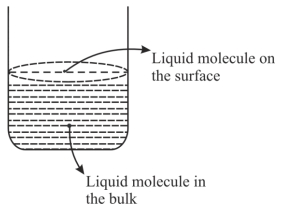
A
$3$
B
$6$
C
$8$
D
$2$
Solution
(D) Statement $A$ is incorrect because surface tension arises from unbalanced attractive forces on the surface,not equal forces in the bulk.
Statement $B$ is correct because molecules on the surface experience a net inward pull,leading to surface tension.
Statement $C$ is incorrect because molecules in the bulk are in constant motion and can reach the surface due to their kinetic energy.
Statement $D$ is correct because molecules on the surface have higher energy and can escape into the gas phase,creating vapour pressure in a closed system.
Therefore,there are $2$ correct statements ($B$ and $D$).
Statement $B$ is correct because molecules on the surface experience a net inward pull,leading to surface tension.
Statement $C$ is incorrect because molecules in the bulk are in constant motion and can reach the surface due to their kinetic energy.
Statement $D$ is correct because molecules on the surface have higher energy and can escape into the gas phase,creating vapour pressure in a closed system.
Therefore,there are $2$ correct statements ($B$ and $D$).
0 likes
View Solution105
AdvancedMCQ
Match gases under specified conditions listed in Column-$I$ with their properties/laws in Column-$II$.
| Column-$I$ | Column-$II$ |
| $A$. Hydrogen gas $(P=200 \ atm, T=273 \ K)$ | $p$. Compressibility factor $Z \neq 1$ |
| $B$. Hydrogen gas $(P \approx 0, T=273 \ K)$ | $q$. Attractive forces are dominant |
| $C$. $CO_2$ $(P=1 \ atm, T=273 \ K)$ | $r$. $PV=nRT$ |
| $D$. Real gas with very large molar volume | $s$. $P(V_m-b)=RT$ |
A
$A$ $\rightarrow p, s; \quad B$ $\rightarrow r; \quad C$ $\rightarrow p, q; \quad D$ $\rightarrow r$
B
$A$ $\rightarrow p, s; \quad B$ $\rightarrow r; \quad C$ $\rightarrow p, q; \quad D$ $\rightarrow p, s$
C
$A$ $\rightarrow s, r; \quad B$ $\rightarrow r; \quad C$ $\rightarrow s, q; \quad D$ $\rightarrow p, s$
D
$A$ $\rightarrow s, r; \quad B$ $\rightarrow r; \quad C$ $\rightarrow p, q; \quad D$ $\rightarrow r$
Solution
(D) . At high pressure $(200 \ atm)$,$H_2$ behaves as a real gas where $Z \neq 1$ and the volume correction term $V_m-b$ becomes significant,leading to $P(V_m-b)=RT$.
$B$. At $P \approx 0$,all real gases approach ideal behavior,so $PV=nRT$.
$C$. $CO_2$ is a polarizable molecule with significant intermolecular attractive forces,so $Z \neq 1$ and attractive forces are dominant.
$D$. At very large molar volume,real gases approach ideal behavior,so $PV=nRT$.
$B$. At $P \approx 0$,all real gases approach ideal behavior,so $PV=nRT$.
$C$. $CO_2$ is a polarizable molecule with significant intermolecular attractive forces,so $Z \neq 1$ and attractive forces are dominant.
$D$. At very large molar volume,real gases approach ideal behavior,so $PV=nRT$.
0 likes
View Solution106
AdvancedMCQ
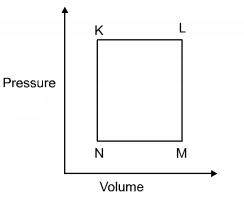
$A$ fixed mass '$m$' of a gas is subjected to a transformation of states from $K$ to $L$ to $M$ to $N$ and back to $K$ as shown in the figure.
$1.$ The succeeding operations that enable this transformation of states are:
$(A)$ Heating,cooling,heating,cooling
$(B)$ Cooling,heating,cooling,heating
$(C)$ Heating,cooling,cooling,heating
$(D)$ Cooling,heating,heating,cooling
$2.$ The pair of isochoric processes among the transformation of states is:
$(A)$ $K$ to $L$ and $L$ to $M$
$(B)$ $L$ to $M$ and $N$ to $K$
$(C)$ $L$ to $M$ and $M$ to $N$
$(D)$ $M$ to $N$ and $N$ to $K$
Give the answer for question $1$ and $2$.
$1.$ The succeeding operations that enable this transformation of states are:
$(A)$ Heating,cooling,heating,cooling
$(B)$ Cooling,heating,cooling,heating
$(C)$ Heating,cooling,cooling,heating
$(D)$ Cooling,heating,heating,cooling
$2.$ The pair of isochoric processes among the transformation of states is:
$(A)$ $K$ to $L$ and $L$ to $M$
$(B)$ $L$ to $M$ and $N$ to $K$
$(C)$ $L$ to $M$ and $M$ to $N$
$(D)$ $M$ to $N$ and $N$ to $K$
Give the answer for question $1$ and $2$.
A
$(B, D)$
B
$(C, B)$
C
$(B, C)$
D
$(A, C)$
Solution
(B) $1.$ In the $P-V$ diagram:
$K \rightarrow L$: Constant pressure $(P)$,volume $(V)$ increases. By Charles's Law $(V \propto T)$,$T$ increases (Heating).
$L \rightarrow M$: Constant volume $(V)$,pressure $(P)$ decreases. By Gay-Lussac's Law $(P \propto T)$,$T$ decreases (Cooling).
$M \rightarrow N$: Constant pressure $(P)$,volume $(V)$ decreases. By Charles's Law,$T$ decreases (Cooling).
$N \rightarrow K$: Constant volume $(V)$,pressure $(P)$ increases. By Gay-Lussac's Law,$T$ increases (Heating).
Thus,the sequence is Heating,Cooling,Cooling,Heating,which corresponds to option $(C)$.
$2.$ An isochoric process is one where volume remains constant. In the diagram,the vertical lines represent constant volume processes.
These are $L \rightarrow M$ and $N \rightarrow K$. This corresponds to option $(B)$.
Therefore,the correct answer is $(C, B)$.
$K \rightarrow L$: Constant pressure $(P)$,volume $(V)$ increases. By Charles's Law $(V \propto T)$,$T$ increases (Heating).
$L \rightarrow M$: Constant volume $(V)$,pressure $(P)$ decreases. By Gay-Lussac's Law $(P \propto T)$,$T$ decreases (Cooling).
$M \rightarrow N$: Constant pressure $(P)$,volume $(V)$ decreases. By Charles's Law,$T$ decreases (Cooling).
$N \rightarrow K$: Constant volume $(V)$,pressure $(P)$ increases. By Gay-Lussac's Law,$T$ increases (Heating).
Thus,the sequence is Heating,Cooling,Cooling,Heating,which corresponds to option $(C)$.
$2.$ An isochoric process is one where volume remains constant. In the diagram,the vertical lines represent constant volume processes.
These are $L \rightarrow M$ and $N \rightarrow K$. This corresponds to option $(B)$.
Therefore,the correct answer is $(C, B)$.
0 likes
View Solution107
DifficultMCQ
Ice and water are placed in a closed container at a pressure of $1 \ atm$ and temperature $273.15 \ K$. If the pressure of the system is increased $2$ times,keeping the temperature constant,then identify the correct observation from the following:
A
Volume of system increases.
B
Liquid phase disappears completely.
C
The amount of ice decreases.
D
The solid phase (ice) disappears completely.
Solution
(D) The phase diagram of $H_2O$ shows that at $273.15 \ K$ and $1 \ atm$,ice and water are in equilibrium.
Since the melting point of ice decreases with an increase in pressure (due to the negative slope of the solid-liquid equilibrium line for $H_2O$),increasing the pressure at a constant temperature of $273.15 \ K$ shifts the system into the liquid region.
Therefore,the solid phase (ice) will melt and disappear completely,converting into the liquid phase (water).
Since the melting point of ice decreases with an increase in pressure (due to the negative slope of the solid-liquid equilibrium line for $H_2O$),increasing the pressure at a constant temperature of $273.15 \ K$ shifts the system into the liquid region.
Therefore,the solid phase (ice) will melt and disappear completely,converting into the liquid phase (water).
0 likes
View Solution108
EasyMCQ
Equal masses of $H_{2(g)}$ and $He_{(g)}$ are enclosed in a container at constant temperature. The ratio of partial pressure of $H_2$ to $He$ is
A
$1: 1$
B
$1: 2$
C
$2: 1$
D
$1: 4$
Solution
(C) Let the mass of each gas be $x \ g$.
$n_{H_2} = \frac{x \ g}{2 \ g \ mol^{-1}} = \frac{x}{2} \ mol$.
$n_{He} = \frac{x \ g}{4 \ g \ mol^{-1}} = \frac{x}{4} \ mol$.
According to Dalton's law of partial pressures,the partial pressure of a gas is directly proportional to its number of moles in a mixture at constant temperature and volume $(P_i = \frac{n_i RT}{V})$.
Therefore,the ratio of partial pressures is equal to the ratio of the number of moles:
$\frac{P_{H_2}}{P_{He}} = \frac{n_{H_2}}{n_{He}} = \frac{x/2}{x/4} = \frac{4}{2} = \frac{2}{1}$.
Thus,the ratio is $2: 1$.
$n_{H_2} = \frac{x \ g}{2 \ g \ mol^{-1}} = \frac{x}{2} \ mol$.
$n_{He} = \frac{x \ g}{4 \ g \ mol^{-1}} = \frac{x}{4} \ mol$.
According to Dalton's law of partial pressures,the partial pressure of a gas is directly proportional to its number of moles in a mixture at constant temperature and volume $(P_i = \frac{n_i RT}{V})$.
Therefore,the ratio of partial pressures is equal to the ratio of the number of moles:
$\frac{P_{H_2}}{P_{He}} = \frac{n_{H_2}}{n_{He}} = \frac{x/2}{x/4} = \frac{4}{2} = \frac{2}{1}$.
Thus,the ratio is $2: 1$.
0 likes
View Solution109
EasyMCQ
In which one of the following,does the given amount of chlorine exert the least pressure in a vessel of capacity $1 \ dm^{3}$ at $273 \ K$?
A
$0.0355 \ g$
B
$0.071 \ g$
C
$6.023 \times 10^{21}$ molecules
D
$0.02 \ mol$
Solution
(A) The ideal gas equation is $pV = nRT$.
Since $V$ and $T$ are constant,$p \propto n$.
Therefore,the substance with the least number of moles $(n)$ will exert the least pressure.
Note: The molar mass of chlorine gas $(Cl_2)$ is $71 \ g/mol$.
$(A)$ $n = \frac{0.0355 \ g}{71 \ g/mol} = 0.0005 \ mol = 5 \times 10^{-4} \ mol$.
$(B)$ $n = \frac{0.071 \ g}{71 \ g/mol} = 0.001 \ mol = 1 \times 10^{-3} \ mol$.
$(C)$ $n = \frac{6.023 \times 10^{21}}{6.023 \times 10^{23}} = 0.01 \ mol$.
$(D)$ $n = 0.02 \ mol$.
Comparing the values,$5 \times 10^{-4} \ mol$ is the smallest.
Thus,$0.0355 \ g$ of chlorine exerts the least pressure.
Since $V$ and $T$ are constant,$p \propto n$.
Therefore,the substance with the least number of moles $(n)$ will exert the least pressure.
Note: The molar mass of chlorine gas $(Cl_2)$ is $71 \ g/mol$.
$(A)$ $n = \frac{0.0355 \ g}{71 \ g/mol} = 0.0005 \ mol = 5 \times 10^{-4} \ mol$.
$(B)$ $n = \frac{0.071 \ g}{71 \ g/mol} = 0.001 \ mol = 1 \times 10^{-3} \ mol$.
$(C)$ $n = \frac{6.023 \times 10^{21}}{6.023 \times 10^{23}} = 0.01 \ mol$.
$(D)$ $n = 0.02 \ mol$.
Comparing the values,$5 \times 10^{-4} \ mol$ is the smallest.
Thus,$0.0355 \ g$ of chlorine exerts the least pressure.
0 likes
View Solution110
MediumMCQ
For one mole of an ideal gas,increasing the temperature from $10^{\circ} C$ to $20^{\circ} C$:
A
increases the average kinetic energy by two times
B
increases the rms velocity by $\sqrt{2}$ times
C
increases the rms velocity by two times
D
increases both the average kinetic energy and rms velocity,but not significantly
Solution
(D) Given,$T_{1} = 273 + 10 = 283 \ K$ and $T_{2} = 273 + 20 = 293 \ K$.
Average kinetic energy $(KE)$ is directly proportional to temperature $(T)$: $KE = \frac{3}{2} RT$.
Ratio $\frac{KE_{2}}{KE_{1}} = \frac{293}{283} \approx 1.035$.
Root mean square velocity $(v_{rms})$ is proportional to $\sqrt{T}$: $v_{rms} = \sqrt{\frac{3RT}{M}}$.
Ratio $\frac{v_{rms,2}}{v_{rms,1}} = \sqrt{\frac{293}{283}} \approx 1.017$.
Since the temperature change is small relative to the absolute temperature,both the average kinetic energy and the rms velocity increase,but not significantly.
Average kinetic energy $(KE)$ is directly proportional to temperature $(T)$: $KE = \frac{3}{2} RT$.
Ratio $\frac{KE_{2}}{KE_{1}} = \frac{293}{283} \approx 1.035$.
Root mean square velocity $(v_{rms})$ is proportional to $\sqrt{T}$: $v_{rms} = \sqrt{\frac{3RT}{M}}$.
Ratio $\frac{v_{rms,2}}{v_{rms,1}} = \sqrt{\frac{293}{283}} \approx 1.017$.
Since the temperature change is small relative to the absolute temperature,both the average kinetic energy and the rms velocity increase,but not significantly.
0 likes
View Solution111
DifficultMCQ
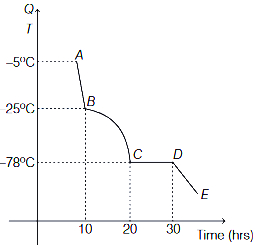
$A$ beaker containing a mixture of liquid $A$ and liquid $B$,in equilibrium with each other,is cooled very slowly. If point '$D$' on the graph is where solidification of both liquids is complete,how many different phases co-exist along line '$C D$' if freezing points of liquid $B$ and liquid $A$ are $-25^{\circ} C$ and $-78^{\circ} C$ respectively?
A
$1$
B
$2$
C
$3$
D
$4$
Solution
(D) The graph represents the cooling curve of a mixture of two liquids $A$ and $B$.
At point $B$ $(-25^{\circ} C)$,liquid $B$ starts to solidify. Along the curve $BC$,liquid $B$ is solidifying,so two phases (liquid $B$ and solid $B$) co-exist along with liquid $A$.
At point $C$ $(-78^{\circ} C)$,liquid $A$ also starts to solidify.
Along the line $CD$,both liquid $A$ and liquid $B$ are undergoing solidification.
Therefore,the phases present are: liquid $A$,solid $A$,liquid $B$,and solid $B$.
Thus,$4$ different phases co-exist along the line $CD$.
At point $B$ $(-25^{\circ} C)$,liquid $B$ starts to solidify. Along the curve $BC$,liquid $B$ is solidifying,so two phases (liquid $B$ and solid $B$) co-exist along with liquid $A$.
At point $C$ $(-78^{\circ} C)$,liquid $A$ also starts to solidify.
Along the line $CD$,both liquid $A$ and liquid $B$ are undergoing solidification.
Therefore,the phases present are: liquid $A$,solid $A$,liquid $B$,and solid $B$.
Thus,$4$ different phases co-exist along the line $CD$.
0 likes
View Solution112
MediumMCQ
At $290 \ K$,a vessel $(I)$ contains equal moles of three liquids $(A, B, C)$. The boiling points of $A, B$ and $C$ are $350 \ K, 373 \ K$ and $308 \ K$ respectively. Vessel $(I)$ is heated to $300 \ K$ and vapours were collected into vessel $(II)$. Identify the correct statements. (Assume vessel $(I)$ contains liquids and vapours and vessel $(II)$ contains only vapours)
$I.$ Vessel $- I$ is rich in liquid $B$
$II.$ Vessel $- II$ is rich in vapour of $C$
$III.$ The vapour pressures of $A, B, C$ in Vessel $(I)$ at $290 \ K$ follows the order $C > A > B$.
$I.$ Vessel $- I$ is rich in liquid $B$
$II.$ Vessel $- II$ is rich in vapour of $C$
$III.$ The vapour pressures of $A, B, C$ in Vessel $(I)$ at $290 \ K$ follows the order $C > A > B$.
A
$I, II, III$
B
$I, II$ only
C
$I, III$ only
D
$II, III$ only
Solution
(A) The boiling point is inversely proportional to the vapour pressure at a given temperature.
Given boiling points: $C (308 \ K) < A (350 \ K) < B (373 \ K)$.
Therefore,the order of vapour pressure at any temperature is $C > A > B$.
$I.$ Since $B$ has the highest boiling point,it has the lowest vapour pressure,meaning it remains primarily in the liquid phase in vessel $(I)$. Thus,vessel $(I)$ is rich in liquid $B$. This statement is correct.
$II.$ Since $C$ has the lowest boiling point,it has the highest vapour pressure,meaning it vaporizes most easily. Thus,vessel $(II)$ will be rich in the vapour of $C$. This statement is correct.
$III.$ As established,the order of vapour pressure is $C > A > B$. This statement is correct.
All statements $I, II,$ and $III$ are correct.
Given boiling points: $C (308 \ K) < A (350 \ K) < B (373 \ K)$.
Therefore,the order of vapour pressure at any temperature is $C > A > B$.
$I.$ Since $B$ has the highest boiling point,it has the lowest vapour pressure,meaning it remains primarily in the liquid phase in vessel $(I)$. Thus,vessel $(I)$ is rich in liquid $B$. This statement is correct.
$II.$ Since $C$ has the lowest boiling point,it has the highest vapour pressure,meaning it vaporizes most easily. Thus,vessel $(II)$ will be rich in the vapour of $C$. This statement is correct.
$III.$ As established,the order of vapour pressure is $C > A > B$. This statement is correct.
All statements $I, II,$ and $III$ are correct.
0 likes
View Solution113
MediumMCQ
$20 \ mL$ of gas $A$ and $10 \ mL$ of gas $B$ diffuse through a porous membrane separately in $1 \ minute$. If the vapour density of $B$ is $x$,what is the vapour density of $A$?
A
$2x$
B
$4x$
C
$\frac{x}{4}$
D
$\frac{x}{2}$
Solution
(C) According to Graham's Law of Diffusion,the rate of diffusion $r$ is inversely proportional to the square root of the vapour density $(VD)$:
$r \propto \frac{1}{\sqrt{VD}}$
Therefore,$\frac{r_A}{r_B} = \sqrt{\frac{VD_B}{VD_A}}$
Given that $r_A = \frac{20 \ mL}{1 \ min} = 20 \ mL/min$ and $r_B = \frac{10 \ mL}{1 \ min} = 10 \ mL/min$.
Substituting the values:
$\frac{20}{10} = \sqrt{\frac{x}{VD_A}}$
$2 = \sqrt{\frac{x}{VD_A}}$
Squaring both sides:
$4 = \frac{x}{VD_A}$
$VD_A = \frac{x}{4}$
$r \propto \frac{1}{\sqrt{VD}}$
Therefore,$\frac{r_A}{r_B} = \sqrt{\frac{VD_B}{VD_A}}$
Given that $r_A = \frac{20 \ mL}{1 \ min} = 20 \ mL/min$ and $r_B = \frac{10 \ mL}{1 \ min} = 10 \ mL/min$.
Substituting the values:
$\frac{20}{10} = \sqrt{\frac{x}{VD_A}}$
$2 = \sqrt{\frac{x}{VD_A}}$
Squaring both sides:
$4 = \frac{x}{VD_A}$
$VD_A = \frac{x}{4}$
0 likes
View Solution114
MediumMCQ
Consider the following statements:
Statement-$I$: If thermal energy is stronger than intermolecular forces,the substance prefers to be in a gaseous state.
Statement-$II$: At constant temperature,the density of an ideal gas is proportional to its pressure.
The correct answer is:
Statement-$I$: If thermal energy is stronger than intermolecular forces,the substance prefers to be in a gaseous state.
Statement-$II$: At constant temperature,the density of an ideal gas is proportional to its pressure.
The correct answer is:
A
Statement-$I$ is correct,but Statement-$II$ is not correct
B
Statement-$I$ is not correct,but Statement-$II$ is correct
C
Both Statement-$I$ and Statement-$II$ are correct
D
Both Statement-$I$ and Statement-$II$ are not correct
Solution
(C) Statement-$I$ is correct: Thermal energy promotes random motion of particles,while intermolecular forces hold them together. If thermal energy dominates,the particles move apart,leading to a gaseous state.
Statement-$II$ is correct: From the ideal gas equation,$PV = nRT$. Since $n = \frac{m}{M}$,we have $PV = \frac{m}{M}RT$. Rearranging gives $P = \frac{m}{V} \times \frac{RT}{M}$,where $\frac{m}{V} = d$ (density). Thus,$P = d \times \frac{RT}{M}$. At constant temperature $(T)$ and molar mass $(M)$,$P \propto d$ or $d \propto P$.
Statement-$II$ is correct: From the ideal gas equation,$PV = nRT$. Since $n = \frac{m}{M}$,we have $PV = \frac{m}{M}RT$. Rearranging gives $P = \frac{m}{V} \times \frac{RT}{M}$,where $\frac{m}{V} = d$ (density). Thus,$P = d \times \frac{RT}{M}$. At constant temperature $(T)$ and molar mass $(M)$,$P \propto d$ or $d \propto P$.
0 likes
View Solution115
EasyMCQ
At $STP$,a closed vessel contains $1 \ mole$ each of $He$ and $CH_4$. Through a small hole,$2 \ L$ of $He$ and $1 \ L$ of $CH_4$ escaped from the vessel in '$t$' minutes. What are the mole fractions of $He$ and $CH_4$ respectively remaining in the vessel? (Assume $He$ and $CH_4$ as ideal gases. At $STP$,one mole of an ideal gas occupies $22.4 \ L$ of volume.)
A
$0.512, 0.488$
B
$0.5, 0.5$
C
$0.329, 0.671$
D
$0.488, 0.512$
Solution
(D) Initial moles of $He \ (n_1) = 1 \ mol$.
Initial moles of $CH_4 \ (n_2) = 1 \ mol$.
Moles of $He$ escaped $(n_1') = \frac{2 \ L}{22.4 \ L/mol} \approx 0.089 \ mol$.
Moles of $CH_4$ escaped $(n_2') = \frac{1 \ L}{22.4 \ L/mol} \approx 0.044 \ mol$.
Remaining moles of $He \ (n_1'') = 1 - 0.089 = 0.911 \ mol$.
Remaining moles of $CH_4 \ (n_2'') = 1 - 0.044 = 0.956 \ mol$.
Total remaining moles $= 0.911 + 0.956 = 1.867 \ mol$.
Mole fraction of $He \ (\chi_{He}) = \frac{0.911}{1.867} \approx 0.488$.
Mole fraction of $CH_4 \ (\chi_{CH_4}) = \frac{0.956}{1.867} \approx 0.512$.
Initial moles of $CH_4 \ (n_2) = 1 \ mol$.
Moles of $He$ escaped $(n_1') = \frac{2 \ L}{22.4 \ L/mol} \approx 0.089 \ mol$.
Moles of $CH_4$ escaped $(n_2') = \frac{1 \ L}{22.4 \ L/mol} \approx 0.044 \ mol$.
Remaining moles of $He \ (n_1'') = 1 - 0.089 = 0.911 \ mol$.
Remaining moles of $CH_4 \ (n_2'') = 1 - 0.044 = 0.956 \ mol$.
Total remaining moles $= 0.911 + 0.956 = 1.867 \ mol$.
Mole fraction of $He \ (\chi_{He}) = \frac{0.911}{1.867} \approx 0.488$.
Mole fraction of $CH_4 \ (\chi_{CH_4}) = \frac{0.956}{1.867} \approx 0.512$.
0 likes
View Solution116
MediumMCQ
$60 \ cm^3$ of $SO_2$ gas diffused through a porous membrane in '$x$' min. Under similar conditions $360 \ cm^3$ of another gas (molar mass $4 \ g \ mol^{-1}$) diffused in '$y$' min. The ratio of $x$ and $y$ is
A
$3: 2$
B
$2: 3$
C
$1: 3$
D
$3: 1$
Solution
(B) According to Graham's Law of diffusion,the rate of diffusion $r$ is given by $r = \frac{V}{t} \propto \frac{1}{\sqrt{M}}$.
Therefore,$\frac{r_1}{r_2} = \frac{V_1/t_1}{V_2/t_2} = \sqrt{\frac{M_2}{M_1}}$.
Given: $V_1 = 60 \ cm^3, M_1 = 64 \ g \ mol^{-1}, t_1 = x$.
$V_2 = 360 \ cm^3, M_2 = 4 \ g \ mol^{-1}, t_2 = y$.
Substituting the values: $\frac{60/x}{360/y} = \sqrt{\frac{4}{64}}$.
$\frac{60}{x} \times \frac{y}{360} = \frac{2}{8} = \frac{1}{4}$.
$\frac{y}{6x} = \frac{1}{4}$.
$\frac{y}{x} = \frac{6}{4} = \frac{3}{2}$.
Therefore,the ratio $\frac{x}{y} = \frac{2}{3}$.
Therefore,$\frac{r_1}{r_2} = \frac{V_1/t_1}{V_2/t_2} = \sqrt{\frac{M_2}{M_1}}$.
Given: $V_1 = 60 \ cm^3, M_1 = 64 \ g \ mol^{-1}, t_1 = x$.
$V_2 = 360 \ cm^3, M_2 = 4 \ g \ mol^{-1}, t_2 = y$.
Substituting the values: $\frac{60/x}{360/y} = \sqrt{\frac{4}{64}}$.
$\frac{60}{x} \times \frac{y}{360} = \frac{2}{8} = \frac{1}{4}$.
$\frac{y}{6x} = \frac{1}{4}$.
$\frac{y}{x} = \frac{6}{4} = \frac{3}{2}$.
Therefore,the ratio $\frac{x}{y} = \frac{2}{3}$.
0 likes
View Solution117
EasyMCQ
What is the ratio of kinetic energies of $3 \ g$ of hydrogen and $4 \ g$ of oxygen at a certain temperature?
A
$3: 4$
B
$6: 1$
C
$12: 1$
D
$1: 12$
Solution
(C) The kinetic energy $(KE)$ of an ideal gas is given by the formula: $KE = \frac{3}{2} nRT$.
Since the temperature $(T)$ is constant,the kinetic energy is directly proportional to the number of moles $(n)$,i.e.,$KE \propto n$.
Therefore,the ratio of kinetic energies is: $\frac{KE_{H_2}}{KE_{O_2}} = \frac{n_{H_2}}{n_{O_2}}$.
Calculate the number of moles for each gas:
$n_{H_2} = \frac{\text{mass}}{\text{molar mass}} = \frac{3 \ g}{2 \ g/mol} = 1.5 \ mol$.
$n_{O_2} = \frac{\text{mass}}{\text{molar mass}} = \frac{4 \ g}{32 \ g/mol} = 0.125 \ mol$.
Now,find the ratio: $\frac{KE_{H_2}}{KE_{O_2}} = \frac{1.5}{0.125} = \frac{12}{1}$.
Thus,the ratio is $12: 1$.
Since the temperature $(T)$ is constant,the kinetic energy is directly proportional to the number of moles $(n)$,i.e.,$KE \propto n$.
Therefore,the ratio of kinetic energies is: $\frac{KE_{H_2}}{KE_{O_2}} = \frac{n_{H_2}}{n_{O_2}}$.
Calculate the number of moles for each gas:
$n_{H_2} = \frac{\text{mass}}{\text{molar mass}} = \frac{3 \ g}{2 \ g/mol} = 1.5 \ mol$.
$n_{O_2} = \frac{\text{mass}}{\text{molar mass}} = \frac{4 \ g}{32 \ g/mol} = 0.125 \ mol$.
Now,find the ratio: $\frac{KE_{H_2}}{KE_{O_2}} = \frac{1.5}{0.125} = \frac{12}{1}$.
Thus,the ratio is $12: 1$.
0 likes
View Solution118
MediumMCQ
Identify the correct statements from the following:
$(A)$ The compressibility factor $(Z)$ for an ideal gas is $1$.
$(B)$ Uranium isotopes (${ }^{235}U$ and ${ }^{238}U$) are separated by converting them into $UF_6$ vapours.
$(C)$ Decrease in temperature increases the kinetic energy of gas molecules.
$(A)$ The compressibility factor $(Z)$ for an ideal gas is $1$.
$(B)$ Uranium isotopes (${ }^{235}U$ and ${ }^{238}U$) are separated by converting them into $UF_6$ vapours.
$(C)$ Decrease in temperature increases the kinetic energy of gas molecules.
A
$A, B, C$
B
$A, C$ only
C
$B, C$ only
D
$A, B$ only
Solution
(D) For an ideal gas,the equation of state is $PV = nRT$. For $1 \ mol$ of gas,$PV = RT$,therefore the compressibility factor $Z = \frac{PV}{RT} = 1$. Thus,statement $(A)$ is correct.
Uranium isotopes (${ }^{235}U$ and ${ }^{238}U$) are separated by converting them into $UF_6$ vapours,which are then separated based on their different rates of diffusion (Graham's Law). Thus,statement $(B)$ is correct.
Kinetic energy $(KE)$ of gas molecules is directly proportional to the absolute temperature $(T)$,given by the relation $KE = \frac{3}{2}RT$. Therefore,a decrease in temperature leads to a decrease in the kinetic energy of gas molecules. Thus,statement $(C)$ is incorrect.
Therefore,statements $(A)$ and $(B)$ are correct.
Uranium isotopes (${ }^{235}U$ and ${ }^{238}U$) are separated by converting them into $UF_6$ vapours,which are then separated based on their different rates of diffusion (Graham's Law). Thus,statement $(B)$ is correct.
Kinetic energy $(KE)$ of gas molecules is directly proportional to the absolute temperature $(T)$,given by the relation $KE = \frac{3}{2}RT$. Therefore,a decrease in temperature leads to a decrease in the kinetic energy of gas molecules. Thus,statement $(C)$ is incorrect.
Therefore,statements $(A)$ and $(B)$ are correct.
0 likes
View Solution119
MediumMCQ
Which one of the following is the kinetic energy of a gaseous mixture containing $3 \ g$ of hydrogen and $80 \ g$ of oxygen at temperature $T(K)$ (in $RT$)?
A
$3$
B
$6$
C
$4$
D
$8$
Solution
(B) The number of moles of hydrogen is calculated as $n_{H_2} = \frac{3 \ g}{2 \ g \ mol^{-1}} = 1.5 \ mol$.
The number of moles of oxygen is calculated as $n_{O_2} = \frac{80 \ g}{32 \ g \ mol^{-1}} = 2.5 \ mol$.
The total number of moles in the gaseous mixture is $n = 1.5 + 2.5 = 4 \ mol$.
The total kinetic energy of an ideal gas mixture is given by the formula $KE = \frac{3}{2} n R T$.
Substituting the values,we get $KE = \frac{3}{2} \times 4 \times R T = 6RT$.
The number of moles of oxygen is calculated as $n_{O_2} = \frac{80 \ g}{32 \ g \ mol^{-1}} = 2.5 \ mol$.
The total number of moles in the gaseous mixture is $n = 1.5 + 2.5 = 4 \ mol$.
The total kinetic energy of an ideal gas mixture is given by the formula $KE = \frac{3}{2} n R T$.
Substituting the values,we get $KE = \frac{3}{2} \times 4 \times R T = 6RT$.
0 likes
View Solution120
EasyMCQ
Consider the following statements:
$Statement-I$ : If the intermolecular forces are stronger than thermal energy,the substance prefers to be in a gaseous state.
$Statement-II$ : Among all elements,the total number of elements available as gases at room temperature is $10$.
$Statement-I$ : If the intermolecular forces are stronger than thermal energy,the substance prefers to be in a gaseous state.
$Statement-II$ : Among all elements,the total number of elements available as gases at room temperature is $10$.
A
Both $Statement-I$ and $Statement-II$ are correct
B
Both $Statement-I$ and $Statement-II$ are not correct
C
$Statement-I$ is correct,but $Statement-II$ is not correct
D
$Statement-I$ is not correct,but $Statement-II$ is correct
Solution
(B) $Statement-I$ is incorrect. If intermolecular forces are stronger than thermal energy,the substance prefers to be in a solid or liquid state,not a gaseous state. Thermal energy promotes random motion,which leads to the gaseous state.
$Statement-II$ is correct. There are $11$ elements that are gases at room temperature $(H_2, He, N_2, O_2, F_2, Ne, Cl_2, Ar, Kr, Xe, Rn)$. Wait,checking the count: $H, He, N, O, F, Ne, Cl, Ar, Kr, Xe, Rn$ equals $11$ elements. Therefore,the statement claiming $10$ is incorrect.
Both statements are incorrect.
$Statement-II$ is correct. There are $11$ elements that are gases at room temperature $(H_2, He, N_2, O_2, F_2, Ne, Cl_2, Ar, Kr, Xe, Rn)$. Wait,checking the count: $H, He, N, O, F, Ne, Cl, Ar, Kr, Xe, Rn$ equals $11$ elements. Therefore,the statement claiming $10$ is incorrect.
Both statements are incorrect.
0 likes
View Solution121
MediumMCQ
Choose the incorrect statement from the following:
A
At Boyle temperature,a real gas obeys the ideal gas law over an appreciable range of pressure.
B
Critical temperature of $CO_2$ is $27.5^{\circ} C$.
C
Above critical temperature,a real gas behaves like an ideal gas.
D
At room temperature and $1 \ atm$ pressure,the compressibility factor $(Z)$ for $H_2$ gas is greater than $1$.
Solution
(B) The critical temperature of $CO_2$ is $31.1^{\circ} C$ $(304.1 \ K)$,not $27.5^{\circ} C$. Therefore,statement $B$ is incorrect.
At Boyle temperature,the effects of attractive and repulsive forces balance out,making the gas behave ideally over a range of pressure.
Above the critical temperature,gases cannot be liquefied by pressure alone,and they exhibit behavior closer to ideal gases as temperature increases.
For $H_2$ and $He$,the compressibility factor $Z$ is always greater than $1$ at room temperature because the repulsive forces dominate due to their small molecular size.
At Boyle temperature,the effects of attractive and repulsive forces balance out,making the gas behave ideally over a range of pressure.
Above the critical temperature,gases cannot be liquefied by pressure alone,and they exhibit behavior closer to ideal gases as temperature increases.
For $H_2$ and $He$,the compressibility factor $Z$ is always greater than $1$ at room temperature because the repulsive forces dominate due to their small molecular size.
0 likes
View Solution122
MediumMCQ
Identify the correct statements from the following:
$I$. For an ideal gas,the compressibility factor is $1.0$.
$II$. The kinetic energy of $NO_{(g)}$ (molar mass $= 30 \ g \ mol^{-1}$) at $T(K)$ is $x \ J \ mol^{-1}$. The kinetic energy of $N_2O_{4(g)}$ (molar mass $= 92 \ g \ mol^{-1}$) at $T(K)$ is $2x \ J \ mol^{-1}$.
$III$. The rate of diffusion of a gas is inversely proportional to the square root of its density.
$I$. For an ideal gas,the compressibility factor is $1.0$.
$II$. The kinetic energy of $NO_{(g)}$ (molar mass $= 30 \ g \ mol^{-1}$) at $T(K)$ is $x \ J \ mol^{-1}$. The kinetic energy of $N_2O_{4(g)}$ (molar mass $= 92 \ g \ mol^{-1}$) at $T(K)$ is $2x \ J \ mol^{-1}$.
$III$. The rate of diffusion of a gas is inversely proportional to the square root of its density.
A
$I, II, III$
B
$II, III$ only
C
$I, III$ only
D
$I, II$ only
Solution
(C) $I$. Compressibility factor $(Z)$ is defined as the ratio of $PV$ to $nRT$. For an ideal gas,$PV = nRT$,therefore $Z = 1$ at all temperatures and pressures. Thus,statement $I$ is correct.
$II$. The average kinetic energy of one mole of an ideal gas is given by $K.E. = \frac{3}{2}RT$. Since it depends only on the temperature $(T)$ and the gas constant $(R)$,it is independent of the molar mass of the gas. Therefore,the kinetic energy of $NO_{(g)}$ and $N_2O_{4(g)}$ at the same temperature $T$ must be equal. Thus,statement $II$ is incorrect.
$III$. According to Graham's law of diffusion,the rate of diffusion $(r)$ of a gas is inversely proportional to the square root of its density $(d)$,i.e.,$r \propto \frac{1}{\sqrt{d}}$. Thus,statement $III$ is correct.
Conclusion: Statements $I$ and $III$ are correct.
$II$. The average kinetic energy of one mole of an ideal gas is given by $K.E. = \frac{3}{2}RT$. Since it depends only on the temperature $(T)$ and the gas constant $(R)$,it is independent of the molar mass of the gas. Therefore,the kinetic energy of $NO_{(g)}$ and $N_2O_{4(g)}$ at the same temperature $T$ must be equal. Thus,statement $II$ is incorrect.
$III$. According to Graham's law of diffusion,the rate of diffusion $(r)$ of a gas is inversely proportional to the square root of its density $(d)$,i.e.,$r \propto \frac{1}{\sqrt{d}}$. Thus,statement $III$ is correct.
Conclusion: Statements $I$ and $III$ are correct.
0 likes
View Solution123
MediumMCQ
Two statements are given below.
Statement-$I$: The ratio of the molar volume of a gas to that of an ideal gas at constant temperature and pressure is called the compressibility factor.
Statement-$II$: The $RMS$ velocity of a gas is directly proportional to the square root of $T(K)$.
The correct answer is
Statement-$I$: The ratio of the molar volume of a gas to that of an ideal gas at constant temperature and pressure is called the compressibility factor.
Statement-$II$: The $RMS$ velocity of a gas is directly proportional to the square root of $T(K)$.
The correct answer is
A
Both statement-$I$ and statement-$II$ are correct
B
Both statement-$I$ and statement-$II$ are not correct
C
Statement-$I$ is correct but statement-$II$ is not correct
D
Statement-$I$ is not correct but statement-$II$ is correct
Solution
(A) Statement-$I$ is correct: The compressibility factor $Z$ is defined as $Z = \frac{V_{m, \text{real}}}{V_{m, \text{ideal}}}$,which represents the ratio of the molar volume of a real gas to that of an ideal gas at the same temperature and pressure.
Statement-$II$ is correct: The root mean square $(RMS)$ velocity of a gas is given by the formula $v_{rms} = \sqrt{\frac{3RT}{M}}$. Since $R$ and $M$ are constants for a given gas,$v_{rms} \propto \sqrt{T}$.
Therefore,both statements are correct.
Statement-$II$ is correct: The root mean square $(RMS)$ velocity of a gas is given by the formula $v_{rms} = \sqrt{\frac{3RT}{M}}$. Since $R$ and $M$ are constants for a given gas,$v_{rms} \propto \sqrt{T}$.
Therefore,both statements are correct.
0 likes
View Solution124
MediumMCQ
Identify the correct statements from the following.
$I$. Glass is an extremely viscous liquid.
$II$. Increase in temperature decreases the surface tension of liquids.
$III$. Compressibility factor for an ideal gas is zero.
$I$. Glass is an extremely viscous liquid.
$II$. Increase in temperature decreases the surface tension of liquids.
$III$. Compressibility factor for an ideal gas is zero.
A
$I, II, III$
B
$I, II$ only
C
$I, III$ only
D
$II, III$ only
Solution
(B) $I$. Glass is considered a supercooled liquid or an extremely viscous liquid,which is a correct statement.
$II$. Surface tension of liquids decreases with an increase in temperature because the kinetic energy of molecules increases,which weakens the intermolecular forces of attraction. This is a correct statement.
$III$. The compressibility factor $(Z)$ for an ideal gas is defined as $Z = \frac{PV}{nRT} = 1$. Therefore,the statement that it is zero is incorrect.
$II$. Surface tension of liquids decreases with an increase in temperature because the kinetic energy of molecules increases,which weakens the intermolecular forces of attraction. This is a correct statement.
$III$. The compressibility factor $(Z)$ for an ideal gas is defined as $Z = \frac{PV}{nRT} = 1$. Therefore,the statement that it is zero is incorrect.
0 likes
View Solution125
EasyMCQ
Two statements are given below.
Statement-$I$: Viscosity of liquid decreases with increase in temperature.
Statement-$II$: The units of viscosity coefficient are Pascal sec.
The correct answer is
Statement-$I$: Viscosity of liquid decreases with increase in temperature.
Statement-$II$: The units of viscosity coefficient are Pascal sec.
The correct answer is
A
Both statement-$I$ and statement-$II$ are correct.
B
Both statement-$I$ and statement-$II$ are not correct.
C
Statement-$I$ is correct but statement-$II$ is not correct.
D
Statement-$I$ is not correct but statement-$II$ is correct.
Solution
(A) Viscosity of a liquid is a measure of its resistance to flow.
In liquids,viscosity decreases as temperature increases because the kinetic energy of the molecules increases,allowing them to overcome the intermolecular attractive forces.
Therefore,Statement-$I$ is correct.
The $SI$ unit of the coefficient of viscosity $(\eta)$ is $N \ s \ m^{-2}$ or $Pa \ s$ (Pascal-second).
Therefore,Statement-$II$ is also correct.
In liquids,viscosity decreases as temperature increases because the kinetic energy of the molecules increases,allowing them to overcome the intermolecular attractive forces.
Therefore,Statement-$I$ is correct.
The $SI$ unit of the coefficient of viscosity $(\eta)$ is $N \ s \ m^{-2}$ or $Pa \ s$ (Pascal-second).
Therefore,Statement-$II$ is also correct.
0 likes
View Solution126
EasyMCQ
Which one of the following statements is not correct?
A
The magnitude of the surface tension of a liquid depends on the attractive forces of the molecules.
B
The surface tension decreases as the temperature is raised.
C
Liquids tend to rise in the capillary because of surface tension.
D
On flat surface,liquid droplets are perfectly spherical.
Solution
(D) The correct answer is $D$.
Surface tension causes liquid droplets to take a spherical shape to minimize their surface area for a given volume.
However,on a flat surface,the gravitational force and the adhesive forces between the liquid and the surface cause the droplet to flatten,making it non-spherical.
Therefore,the statement that liquid droplets are perfectly spherical on a flat surface is incorrect.
Surface tension causes liquid droplets to take a spherical shape to minimize their surface area for a given volume.
However,on a flat surface,the gravitational force and the adhesive forces between the liquid and the surface cause the droplet to flatten,making it non-spherical.
Therefore,the statement that liquid droplets are perfectly spherical on a flat surface is incorrect.
0 likes
View Solution127
EasyMCQ
Which one of the following is the wrong statement about the liquid?
A
It has intermolecular force of attraction
B
Evaporation of liquids increase with the decrease of surface area
C
It resembles a gas near the critical temperature
D
It is an intermediate state between gaseous and solid state
Solution
(B) Evaporation is a surface phenomenon.
When the surface area decreases,fewer molecules are exposed to the surface,leading to a decrease in the rate of evaporation.
Therefore,the statement that evaporation increases with a decrease in surface area is incorrect.
When the surface area decreases,fewer molecules are exposed to the surface,leading to a decrease in the rate of evaporation.
Therefore,the statement that evaporation increases with a decrease in surface area is incorrect.
0 likes
View Solution128
EasyMCQ
Two thin circular discs $A$ and $B$ of radii $2 \ cm$ and $4 \ cm$ are in a liquid at the same depth. $T_A$ is the thrust on $A$ and $T_B$ is the thrust on $B$. Then $T_A : T_B =$
A
$2:1$
B
$1:2$
C
$4:1$
D
$1:4$
Solution
(D) The thrust force $(T_h)$ exerted by a liquid on a submerged object is given by the pressure $(P)$ multiplied by the area $(A)$.
$T_h = P \times A$
Since both discs are at the same depth $(h)$,the pressure $P = h \rho g$ is the same for both.
Therefore,$T_h \propto A$.
$T_A : T_B = A_A : A_B = \pi (r_A)^2 : \pi (r_B)^2$
$T_A : T_B = (2)^2 : (4)^2 = 4 : 16 = 1 : 4$.
$T_h = P \times A$
Since both discs are at the same depth $(h)$,the pressure $P = h \rho g$ is the same for both.
Therefore,$T_h \propto A$.
$T_A : T_B = A_A : A_B = \pi (r_A)^2 : \pi (r_B)^2$
$T_A : T_B = (2)^2 : (4)^2 = 4 : 16 = 1 : 4$.
0 likes
View Solution129
EasyMCQ
The pressure exerted by a mixture of $3.2 \ g$ of methane $(CH_4)$ and $4.4 \ g$ of $CO_2$ contained in a $9 \ dm^3$ flask at $27^{\circ}C$ is: (in $atm$)
A
$0.41$
B
$0.82$
C
$1.64$
D
$3.28$
Solution
(B) First,calculate the number of moles of each gas:
$n_{CH_4} = \frac{3.2 \ g}{16 \ g/mol} = 0.2 \ mol$
$n_{CO_2} = \frac{4.4 \ g}{44 \ g/mol} = 0.1 \ mol$
Total moles $n_{total} = 0.2 + 0.1 = 0.3 \ mol$
Using the ideal gas equation $PV = nRT$:
$P = \frac{n_{total}RT}{V}$
Given $T = 27^{\circ}C = 300 \ K$,$V = 9 \ dm^3 = 9 \ L$,and $R = 0.0821 \ L \ atm \ K^{-1} \ mol^{-1}$:
$P = \frac{0.3 \times 0.0821 \times 300}{9} \ atm$
$P = \frac{7.389}{9} \ atm = 0.821 \ atm$
Thus,the total pressure is approximately $0.82 \ atm$.
$n_{CH_4} = \frac{3.2 \ g}{16 \ g/mol} = 0.2 \ mol$
$n_{CO_2} = \frac{4.4 \ g}{44 \ g/mol} = 0.1 \ mol$
Total moles $n_{total} = 0.2 + 0.1 = 0.3 \ mol$
Using the ideal gas equation $PV = nRT$:
$P = \frac{n_{total}RT}{V}$
Given $T = 27^{\circ}C = 300 \ K$,$V = 9 \ dm^3 = 9 \ L$,and $R = 0.0821 \ L \ atm \ K^{-1} \ mol^{-1}$:
$P = \frac{0.3 \times 0.0821 \times 300}{9} \ atm$
$P = \frac{7.389}{9} \ atm = 0.821 \ atm$
Thus,the total pressure is approximately $0.82 \ atm$.
0 likes
View Solution130
EasyMCQ
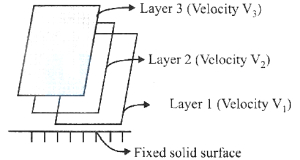
Three layers of liquid are flowing over a fixed solid surface as shown below. The correct order of velocity of the liquid in these layers is:
A
$V_1 > V_2 > V_3$
B
$V_1 = V_2 = V_3$
C
$V_3 > V_2 > V_1$
D
$V_3 > V_1 > V_2$
Solution
(C) In laminar flow over a fixed surface,the layer of liquid in direct contact with the surface has the lowest velocity due to friction and adhesive forces.
As the distance from the fixed surface increases,the velocity of the liquid layers increases.
Layer $1$ is closest to the surface,followed by Layer $2$,and then Layer $3$.
Therefore,the velocity order is $V_3 > V_2 > V_1$.
As the distance from the fixed surface increases,the velocity of the liquid layers increases.
Layer $1$ is closest to the surface,followed by Layer $2$,and then Layer $3$.
Therefore,the velocity order is $V_3 > V_2 > V_1$.
0 likes
View Solution131
EasyMCQ
Which of the following statements is incorrect?
$1$. The property of liquid drops to have minimum surface area is called surface tension.
$2$. Surface tension of liquids decreases with rise in temperature.
$3$. The $SI$ unit of surface tension is $N \ m^{-1}$.
$4$. Magnitude of surface tension is less,when there is strong attractive force between the molecules.
$1$. The property of liquid drops to have minimum surface area is called surface tension.
$2$. Surface tension of liquids decreases with rise in temperature.
$3$. The $SI$ unit of surface tension is $N \ m^{-1}$.
$4$. Magnitude of surface tension is less,when there is strong attractive force between the molecules.
A
$1$
B
$2$
C
$3$
D
$4$
Solution
(D) Statements $1, 2$ and $3$ are correct.
Statement $4$ is incorrect because the magnitude of surface tension is directly proportional to the strength of intermolecular attractive forces. Stronger attractive forces between molecules lead to a higher magnitude of surface tension.
Statement $4$ is incorrect because the magnitude of surface tension is directly proportional to the strength of intermolecular attractive forces. Stronger attractive forces between molecules lead to a higher magnitude of surface tension.
0 likes
View Solution132
EasyMCQ
Two flasks $A$ and $B$ have equal volumes. $A$ is maintained at $300 \ K$ and $B$ at $600 \ K$. Equal masses of $H_2$ and $CO_2$ are taken in flasks $A$ and $B$ respectively. Find the ratio of total $K.E.$ of gases in flask $A$ to that of $B$.
A
$1:2$
B
$11:1$
C
$33:2$
D
$55:7$
Solution
(B) The total kinetic energy $(K.E.)$ of an ideal gas is given by the formula: $K.E. = \frac{3}{2} nRT$.
For flask $A$ containing $H_2$: $n_A = \frac{m}{M_{H_2}} = \frac{m}{2}$ and $T_A = 300 \ K$.
Thus,$(K.E.)_A = \frac{3}{2} \times \frac{m}{2} \times R \times 300$.
For flask $B$ containing $CO_2$: $n_B = \frac{m}{M_{CO_2}} = \frac{m}{44}$ and $T_B = 600 \ K$.
Thus,$(K.E.)_B = \frac{3}{2} \times \frac{m}{44} \times R \times 600$.
Taking the ratio: $\frac{(K.E.)_A}{(K.E.)_B} = \frac{\frac{m}{2} \times 300}{\frac{m}{44} \times 600} = \frac{300/2}{600/44} = \frac{150}{600/44} = \frac{150 \times 44}{600} = \frac{44}{4} = 11:1$.
For flask $A$ containing $H_2$: $n_A = \frac{m}{M_{H_2}} = \frac{m}{2}$ and $T_A = 300 \ K$.
Thus,$(K.E.)_A = \frac{3}{2} \times \frac{m}{2} \times R \times 300$.
For flask $B$ containing $CO_2$: $n_B = \frac{m}{M_{CO_2}} = \frac{m}{44}$ and $T_B = 600 \ K$.
Thus,$(K.E.)_B = \frac{3}{2} \times \frac{m}{44} \times R \times 600$.
Taking the ratio: $\frac{(K.E.)_A}{(K.E.)_B} = \frac{\frac{m}{2} \times 300}{\frac{m}{44} \times 600} = \frac{300/2}{600/44} = \frac{150}{600/44} = \frac{150 \times 44}{600} = \frac{44}{4} = 11:1$.
0 likes
View Solution133
EasyMCQ
When equal volumes of helium and neon at same temperature and pressure are mixed,the ratio $C_p: C_V$ of the mixture equals
A
$3: 5$
B
$1: 2$
C
$5: 3$
D
$2: 1$
Solution
(C) Helium $(He)$ and Neon $(Ne)$ are both monoatomic gases.
For a monoatomic gas,the degree of freedom $(f)$ is $3$.
The ratio of molar specific heat capacities $\gamma = \frac{C_p}{C_V} = 1 + \frac{2}{f}$.
Since both gases are monoatomic,the mixture will also behave as a monoatomic gas with $f = 3$.
Therefore,$\frac{C_p}{C_V} = 1 + \frac{2}{3} = \frac{5}{3}$.
For a monoatomic gas,the degree of freedom $(f)$ is $3$.
The ratio of molar specific heat capacities $\gamma = \frac{C_p}{C_V} = 1 + \frac{2}{f}$.
Since both gases are monoatomic,the mixture will also behave as a monoatomic gas with $f = 3$.
Therefore,$\frac{C_p}{C_V} = 1 + \frac{2}{3} = \frac{5}{3}$.
0 likes
View Solution134
MediumMCQ
Which one of the following equations represents the variation of viscosity coefficient $(\eta)$ with temperature $(T)$?
A
$\eta = A e^{-E / R T}$
B
$\eta = A e^{E / R T}$
C
$\eta = A e^{-E / k T}$
D
$\eta = A e^{-E / T}$
Solution
(B) The variation of the viscosity coefficient $(\eta)$ of liquids with temperature $(T)$ is described by the Andrade equation,which is given by the expression: $\eta = A e^{E / R T}$.
Here,$A$ is a constant,$E$ is the activation energy for viscous flow,$R$ is the universal gas constant,and $T$ is the absolute temperature.
As temperature increases,the viscosity of liquids decreases,which is consistent with the exponential form $\eta = A e^{E / R T}$.
Here,$A$ is a constant,$E$ is the activation energy for viscous flow,$R$ is the universal gas constant,and $T$ is the absolute temperature.
As temperature increases,the viscosity of liquids decreases,which is consistent with the exponential form $\eta = A e^{E / R T}$.
0 likes
View Solution135
MediumMCQ
At $298 \ K$,a flask '$A$' of unknown volume $(V)$ contains oxygen at $5 \ atm$. Another flask '$B$' of volume $2 \ L$ contains helium at $3 \ atm$. Two flasks are connected together by a small tube of zero volume. After the two gases are completely mixed,if the resulting mixture is found to have the mole fraction of oxygen as $0.2$,the volume of flask '$A$' (in $L$) is (Assume oxygen and helium as ideal gases)
A
$0.1$
B
$0.3$
C
$0.2$
D
$0.4$
Solution
(B) Using the ideal gas equation $PV = nRT$,the number of moles of oxygen in flask '$A$' is $n_{O_2} = \frac{P_A V_A}{RT} = \frac{5 \times V}{RT}$.
Similarly,the number of moles of helium in flask '$B$' is $n_{He} = \frac{P_B V_B}{RT} = \frac{3 \times 2}{RT} = \frac{6}{RT}$.
The mole fraction of oxygen in the mixture is given by $x_{O_2} = \frac{n_{O_2}}{n_{O_2} + n_{He}} = 0.2$.
Substituting the values: $\frac{5V/RT}{5V/RT + 6/RT} = 0.2$.
This simplifies to $\frac{5V}{5V + 6} = 0.2$.
$5V = 0.2(5V + 6) \implies 5V = V + 1.2$.
$4V = 1.2 \implies V = 0.3 \ L$.
Similarly,the number of moles of helium in flask '$B$' is $n_{He} = \frac{P_B V_B}{RT} = \frac{3 \times 2}{RT} = \frac{6}{RT}$.
The mole fraction of oxygen in the mixture is given by $x_{O_2} = \frac{n_{O_2}}{n_{O_2} + n_{He}} = 0.2$.
Substituting the values: $\frac{5V/RT}{5V/RT + 6/RT} = 0.2$.
This simplifies to $\frac{5V}{5V + 6} = 0.2$.
$5V = 0.2(5V + 6) \implies 5V = V + 1.2$.
$4V = 1.2 \implies V = 0.3 \ L$.
0 likes
View Solution136
MediumMCQ
At $300 \ K$ and $760 \ torr$ pressure,the density of a mixture of $He$ and $O_2$ gases is $0.543 \ g \ L^{-1}$. The mass percent of oxygen is approximately $(R = 0.0821 \ L \ atm \ K^{-1} \ mol^{-1})$
A
$33$
B
$80$
C
$20$
D
$67$
Solution
(B) Using the ideal gas equation,$PV = nRT$,for $1 \ mol$ of the mixture,the volume $V$ is given by $V = \frac{RT}{P}$.
Given $P = 760 \ torr = 1 \ atm$,$T = 300 \ K$,and $R = 0.0821 \ L \ atm \ K^{-1} \ mol^{-1}$,we have $V = \frac{0.0821 \times 300}{1} = 24.63 \ L$.
The total mass of $24.63 \ L$ of the mixture is $M = V \times d = 24.63 \ L \times 0.543 \ g \ L^{-1} = 13.37 \ g$.
Let $x$ be the mole fraction of $O_2$. Then the mole fraction of $He$ is $(1 - x)$.
The average molar mass of the mixture is $M_{avg} = x(32) + (1 - x)(4) = 13.37$.
Solving for $x$: $32x + 4 - 4x = 13.37$ $\Rightarrow 28x = 9.37$ $\Rightarrow x \approx 0.3346$.
The mass of $O_2$ in $1 \ mol$ of the mixture is $0.3346 \times 32 \approx 10.707 \ g$.
The mass percent of $O_2$ is $\frac{\text{mass of } O_2}{\text{total mass}} \times 100 = \frac{10.707}{13.37} \times 100 \approx 80.08 \% \approx 80 \%$.
Given $P = 760 \ torr = 1 \ atm$,$T = 300 \ K$,and $R = 0.0821 \ L \ atm \ K^{-1} \ mol^{-1}$,we have $V = \frac{0.0821 \times 300}{1} = 24.63 \ L$.
The total mass of $24.63 \ L$ of the mixture is $M = V \times d = 24.63 \ L \times 0.543 \ g \ L^{-1} = 13.37 \ g$.
Let $x$ be the mole fraction of $O_2$. Then the mole fraction of $He$ is $(1 - x)$.
The average molar mass of the mixture is $M_{avg} = x(32) + (1 - x)(4) = 13.37$.
Solving for $x$: $32x + 4 - 4x = 13.37$ $\Rightarrow 28x = 9.37$ $\Rightarrow x \approx 0.3346$.
The mass of $O_2$ in $1 \ mol$ of the mixture is $0.3346 \times 32 \approx 10.707 \ g$.
The mass percent of $O_2$ is $\frac{\text{mass of } O_2}{\text{total mass}} \times 100 = \frac{10.707}{13.37} \times 100 \approx 80.08 \% \approx 80 \%$.
0 likes
View Solution137
MediumMCQ
Match the following items in List-$I$ with the appropriate items in List-$II$:
| List-$I$ | List-$II$ |
|---|---|
| $(A)$ Viscosity | $(I)$ Critical temperature |
| $(B)$ Ideal gas behaviour | $(II)$ Isobars |
| $(C)$ Liquefaction of gases | $(III)$ Compressibility factor |
| $(D)$ Charles' law | $(IV)$ $kg \ s^{-2}$ |
| $(V)$ $kg \ m^{-1} \ s^{-1}$ |
A
$A-IV, B-III, C-I, D-II$
B
$A-V, B-III, C-I, D-II$
C
$A-V, B-III, C-II, D-I$
D
$A-IV, B-III, C-II, D-I$
Solution
(B) The correct matches are as follows:
$(A)$ Viscosity: The $SI$ unit of viscosity is $kg \ m^{-1} \ s^{-1}$ $(V)$.
$(B)$ Ideal gas behaviour: It is described by the compressibility factor $(Z = PV/nRT)$,which is $1$ for ideal gases $(III)$.
$(C)$ Liquefaction of gases: This is related to the critical temperature $(T_c)$ of a gas $(I)$.
$(D)$ Charles' law: It describes the relationship between volume and temperature at constant pressure,represented by isobars on a graph $(II)$.
Therefore,the correct matching is $A-V, B-III, C-I, D-II$.
$(A)$ Viscosity: The $SI$ unit of viscosity is $kg \ m^{-1} \ s^{-1}$ $(V)$.
$(B)$ Ideal gas behaviour: It is described by the compressibility factor $(Z = PV/nRT)$,which is $1$ for ideal gases $(III)$.
$(C)$ Liquefaction of gases: This is related to the critical temperature $(T_c)$ of a gas $(I)$.
$(D)$ Charles' law: It describes the relationship between volume and temperature at constant pressure,represented by isobars on a graph $(II)$.
Therefore,the correct matching is $A-V, B-III, C-I, D-II$.
0 likes
View Solution138
MediumMCQ
The rate of diffusion of methane at $1.0 \ atm$ pressure is twice that of another gas '$X$' kept at $1.45 \ atm$. The molecular weight of the gas '$X$' is
[$T$ kept constant]
[$T$ kept constant]
A
$44$
B
$32$
C
$28$
D
$21$
Solution
(A) According to Graham's law of diffusion,the rate of diffusion $(r)$ is inversely proportional to the square root of the density $(\rho)$ of the gas: $r \propto \frac{1}{\sqrt{\rho}}$.
From the ideal gas equation,$PV = nRT = \frac{m}{MW} RT$,where $m$ is the mass and $MW$ is the molecular weight.
Rearranging gives $\frac{m}{V} = \rho = \frac{P \times MW}{RT}$.
Since $T$ is constant,$\rho \propto P \times MW$.
Therefore,the rate of diffusion is given by $r \propto \frac{1}{\sqrt{P \times MW}}$.
For two gases,$\frac{r_{CH_4}}{r_X} = \sqrt{\frac{P_X \times (MW)_X}{P_{CH_4} \times (MW)_{CH_4}}}$.
Given $r_{CH_4} = 2r_X$,$P_{CH_4} = 1.0 \ atm$,$P_X = 1.45 \ atm$,and $(MW)_{CH_4} = 16 \ g/mol$:
$2 = \sqrt{\frac{1.45 \times (MW)_X}{1.0 \times 16}}$.
Squaring both sides: $4 = \frac{1.45 \times (MW)_X}{16}$.
$(MW)_X = \frac{4 \times 16}{1.45} = \frac{64}{1.45} \approx 44.13 \approx 44$.
From the ideal gas equation,$PV = nRT = \frac{m}{MW} RT$,where $m$ is the mass and $MW$ is the molecular weight.
Rearranging gives $\frac{m}{V} = \rho = \frac{P \times MW}{RT}$.
Since $T$ is constant,$\rho \propto P \times MW$.
Therefore,the rate of diffusion is given by $r \propto \frac{1}{\sqrt{P \times MW}}$.
For two gases,$\frac{r_{CH_4}}{r_X} = \sqrt{\frac{P_X \times (MW)_X}{P_{CH_4} \times (MW)_{CH_4}}}$.
Given $r_{CH_4} = 2r_X$,$P_{CH_4} = 1.0 \ atm$,$P_X = 1.45 \ atm$,and $(MW)_{CH_4} = 16 \ g/mol$:
$2 = \sqrt{\frac{1.45 \times (MW)_X}{1.0 \times 16}}$.
Squaring both sides: $4 = \frac{1.45 \times (MW)_X}{16}$.
$(MW)_X = \frac{4 \times 16}{1.45} = \frac{64}{1.45} \approx 44.13 \approx 44$.
0 likes
View Solution139
DifficultMCQ
$CH_4$ diffuses two times faster than a gas $X$. The number of molecules present in $32 \ g$ of gas $X$ is ($N$ is Avogadro number).
A
$N$
B
$\frac{N}{2}$
C
$\frac{N}{4}$
D
$\frac{N}{16}$
Solution
(B) From Graham's law of diffusion,$\frac{r_{CH_4}}{r_X} = \sqrt{\frac{M_X}{M_{CH_4}}}$.
Given that $r_{CH_4} = 2 \cdot r_X$,we have $2 = \sqrt{\frac{M_X}{16}}$.
Squaring both sides,$4 = \frac{M_X}{16}$,so $M_X = 64 \ g/mol$.
The number of moles of gas $X$ in $32 \ g$ is $n = \frac{32}{64} = 0.5 \ mol$.
The number of molecules is $n \times N = 0.5 \times N = \frac{N}{2}$.
Given that $r_{CH_4} = 2 \cdot r_X$,we have $2 = \sqrt{\frac{M_X}{16}}$.
Squaring both sides,$4 = \frac{M_X}{16}$,so $M_X = 64 \ g/mol$.
The number of moles of gas $X$ in $32 \ g$ is $n = \frac{32}{64} = 0.5 \ mol$.
The number of molecules is $n \times N = 0.5 \times N = \frac{N}{2}$.
0 likes
View Solution140
MediumMCQ
$A$ and $B$ are ideal gases. The molecular weights of $A$ and $B$ are in the ratio of $1: 4$. The pressure of a gas mixture containing equal weights of $A$ and $B$ is $P \text{ atm}$. What is the partial pressure (in $\text{atm}$) of $B$ in the mixture?
A
$\frac{P}{5}$
B
$\frac{P}{2}$
C
$\frac{P}{2.5}$
D
$\frac{3P}{4}$
Solution
(A) Let the weight of both gases $A$ and $B$ be $w \text{ g}$.
Given molecular weight ratio $M_A : M_B = 1 : 4$. Let $M_A = M$ and $M_B = 4M$.
Moles of $A$ $(n_A)$ $= \frac{w}{M}$.
Moles of $B$ $(n_B)$ $= \frac{w}{4M}$.
Mole ratio $n_A : n_B = \frac{w}{M} : \frac{w}{4M} = 4 : 1$.
Partial pressure of $B$ $(p_B)$ $= \text{Mole fraction of } B \times P_{\text{total}}$.
$p_B = \frac{n_B}{n_A + n_B} \times P = \frac{1}{4 + 1} \times P = \frac{P}{5} \text{ atm}$.
Given molecular weight ratio $M_A : M_B = 1 : 4$. Let $M_A = M$ and $M_B = 4M$.
Moles of $A$ $(n_A)$ $= \frac{w}{M}$.
Moles of $B$ $(n_B)$ $= \frac{w}{4M}$.
Mole ratio $n_A : n_B = \frac{w}{M} : \frac{w}{4M} = 4 : 1$.
Partial pressure of $B$ $(p_B)$ $= \text{Mole fraction of } B \times P_{\text{total}}$.
$p_B = \frac{n_B}{n_A + n_B} \times P = \frac{1}{4 + 1} \times P = \frac{P}{5} \text{ atm}$.
0 likes
View Solution141
DifficultMCQ
At $27^{\circ} C$,$500 \ mL$ of helium diffuses in $30 \ minutes$. What is the time (in hours) taken for $1000 \ mL$ of $SO_2$ to diffuse under the same experimental conditions?
A
$240$
B
$3$
C
$2$
D
$4$
Solution
(D) According to Graham's Law of diffusion,the rate of diffusion $r$ is inversely proportional to the square root of the molar mass $M$ and directly proportional to the volume $V$ diffused per unit time $t$: $r = \frac{V}{t} \propto \frac{1}{\sqrt{M}}$.
Given for Helium $(He)$: $V_1 = 500 \ mL$,$t_1 = 30 \ min$,$M_1 = 4 \ g/mol$.
Given for Sulfur dioxide $(SO_2)$: $V_2 = 1000 \ mL$,$t_2 = t$,$M_2 = 64 \ g/mol$.
The ratio is given by: $\frac{r_1}{r_2} = \frac{V_1/t_1}{V_2/t_2} = \sqrt{\frac{M_2}{M_1}}$.
Substituting the values: $\frac{500/30}{1000/t} = \sqrt{\frac{64}{4}}$.
$\frac{500}{30} \times \frac{t}{1000} = \sqrt{16} = 4$.
$\frac{t}{60} = 4$.
$t = 240 \ minutes$.
Converting to hours: $t = \frac{240}{60} = 4 \ hours$.
Given for Helium $(He)$: $V_1 = 500 \ mL$,$t_1 = 30 \ min$,$M_1 = 4 \ g/mol$.
Given for Sulfur dioxide $(SO_2)$: $V_2 = 1000 \ mL$,$t_2 = t$,$M_2 = 64 \ g/mol$.
The ratio is given by: $\frac{r_1}{r_2} = \frac{V_1/t_1}{V_2/t_2} = \sqrt{\frac{M_2}{M_1}}$.
Substituting the values: $\frac{500/30}{1000/t} = \sqrt{\frac{64}{4}}$.
$\frac{500}{30} \times \frac{t}{1000} = \sqrt{16} = 4$.
$\frac{t}{60} = 4$.
$t = 240 \ minutes$.
Converting to hours: $t = \frac{240}{60} = 4 \ hours$.
0 likes
View Solution142
EasyMCQ
The most probable velocity of a gas at $7200 \ K$ is equal to the $RMS$ velocity of $He$ gas at $27^{\circ} C$. The gas is
A
$O_2$
B
$CO$
C
$N_2$
D
$SO_2$
Solution
(D) Temperature of helium $= 27^{\circ} C = 300 \ K$.
The root-mean-square velocity of helium is given by $\mu_{rms} = \sqrt{\frac{3RT}{M_{He}}} = \sqrt{\frac{3R \times 300}{4}}$.
The most probable speed of the unknown gas is $\mu_{mp} = \sqrt{\frac{2RT}{M}} = \sqrt{\frac{2R \times 7200}{M}}$.
Equating $\mu_{rms} = \mu_{mp}$:
$\sqrt{\frac{3R \times 300}{4}} = \sqrt{\frac{2R \times 7200}{M}}$.
Squaring both sides: $\frac{900R}{4} = \frac{14400R}{M}$.
$225 = \frac{14400}{M}$.
$M = \frac{14400}{225} = 64 \ g/mol$.
The molar mass of $SO_2$ is $32 + 2 \times 16 = 64 \ g/mol$.
Therefore,the gas is $SO_2$.
The root-mean-square velocity of helium is given by $\mu_{rms} = \sqrt{\frac{3RT}{M_{He}}} = \sqrt{\frac{3R \times 300}{4}}$.
The most probable speed of the unknown gas is $\mu_{mp} = \sqrt{\frac{2RT}{M}} = \sqrt{\frac{2R \times 7200}{M}}$.
Equating $\mu_{rms} = \mu_{mp}$:
$\sqrt{\frac{3R \times 300}{4}} = \sqrt{\frac{2R \times 7200}{M}}$.
Squaring both sides: $\frac{900R}{4} = \frac{14400R}{M}$.
$225 = \frac{14400}{M}$.
$M = \frac{14400}{225} = 64 \ g/mol$.
The molar mass of $SO_2$ is $32 + 2 \times 16 = 64 \ g/mol$.
Therefore,the gas is $SO_2$.
0 likes
View Solution143
MediumMCQ
$1 \text{ mole}$ of gas $A$ and $1 \text{ mole}$ of gas $B$ at $27^{\circ} C$ were pumped into a $24.6 \ L$ volume pre-evacuated isolated flask. The catalyst coated inside the flask catalyses the following reaction $A_{(g)} + B_{(g)} \longrightarrow 2 D_{(g)}$. The kinetic energy of $D$ is $98.03 \ L \ atm$. Calculate the pressure realized at the end of the reaction. (in $atm$)
A
$1.66$
B
$2.66$
C
$5.33$
D
$4.33$
Solution
(B) The kinetic energy for $n$ moles of an ideal gas is given by $K.E. = \frac{3}{2} pV$.
Given: $K.E. = 98.03 \ L \ atm$ and $V = 24.6 \ L$.
Substituting the values: $98.03 = \frac{3}{2} \times p \times 24.6$.
$p = \frac{98.03 \times 2}{3 \times 24.6} = \frac{196.06}{73.8} \approx 2.66 \ atm$.
Since the reaction $A_{(g)} + B_{(g)} \longrightarrow 2 D_{(g)}$ involves $2 \text{ moles}$ of reactants producing $2 \text{ moles}$ of products,the total number of moles remains constant ($2 \text{ moles}$ total).
Thus,the pressure exerted by the gas $D$ at the end of the reaction is $2.66 \ atm$.
Given: $K.E. = 98.03 \ L \ atm$ and $V = 24.6 \ L$.
Substituting the values: $98.03 = \frac{3}{2} \times p \times 24.6$.
$p = \frac{98.03 \times 2}{3 \times 24.6} = \frac{196.06}{73.8} \approx 2.66 \ atm$.
Since the reaction $A_{(g)} + B_{(g)} \longrightarrow 2 D_{(g)}$ involves $2 \text{ moles}$ of reactants producing $2 \text{ moles}$ of products,the total number of moles remains constant ($2 \text{ moles}$ total).
Thus,the pressure exerted by the gas $D$ at the end of the reaction is $2.66 \ atm$.
0 likes
View Solution144
DifficultMCQ
What is the temperature at which the kinetic energy of $0.3 \text{ moles}$ of helium is equal to the kinetic energy of $0.4 \text{ moles}$ of argon at $400 \text{ K}$ (in $\text{ K}$)?
A
$400$
B
$873$
C
$533$
D
$300$
Solution
(C) The kinetic energy $(KE)$ of an ideal gas is given by the formula $KE = nRT$, where $n$ is the number of moles, $R$ is the gas constant, and $T$ is the temperature in Kelvin.
Given:
For helium: $n_{He} = 0.3 \text{ mol}$
For argon: $n_{Ar} = 0.4 \text{ mol}$, $T_{Ar} = 400 \text{ K}$
According to the problem, $KE_{He} = KE_{Ar}$.
Substituting the values:
$0.3 \times R \times T = 0.4 \times R \times 400$
Dividing both sides by $R$:
$0.3 \times T = 160$
$T = \frac{160}{0.3} = 533.33 \text{ K} \approx 533 \text{ K}$.
Given:
For helium: $n_{He} = 0.3 \text{ mol}$
For argon: $n_{Ar} = 0.4 \text{ mol}$, $T_{Ar} = 400 \text{ K}$
According to the problem, $KE_{He} = KE_{Ar}$.
Substituting the values:
$0.3 \times R \times T = 0.4 \times R \times 400$
Dividing both sides by $R$:
$0.3 \times T = 160$
$T = \frac{160}{0.3} = 533.33 \text{ K} \approx 533 \text{ K}$.
0 likes
View Solution145
DifficultMCQ
If the density of a mixture of nitrogen and oxygen gases at $400 \ K$ and $1 \ atm$ pressure is $0.920 \ g \ L^{-1}$,what is the mole fraction of nitrogen in the mixture? ($R=0.082 \ L \ atm \ mol^{-1} \ K^{-1}$; assume ideal gas behavior for oxygen and nitrogen)
A
$0.456$
B
$0.432$
C
$0.554$
D
$0.568$
Solution
(A) Given: $P = 1 \ atm$,$T = 400 \ K$,$\delta = 0.920 \ g \ L^{-1}$,$R = 0.082 \ L \ atm \ mol^{-1} \ K^{-1}$.
Using the ideal gas equation $PV = nRT$ and $n = \frac{m}{M}$,we get $PM = \delta RT$.
$M = \frac{\delta RT}{P} = \frac{0.920 \times 0.082 \times 400}{1} = 30.176 \ g \ mol^{-1}$.
Let $x$ be the mole fraction of $N_2$. Then the mole fraction of $O_2$ is $(1-x)$.
The average molar mass $M = x M_{N_2} + (1-x) M_{O_2}$.
$30.176 = x(28) + (1-x)(32)$.
$30.176 = 28x + 32 - 32x$.
$4x = 32 - 30.176 = 1.824$.
$x = \frac{1.824}{4} = 0.456$.
Thus,the mole fraction of nitrogen is $0.456$.
Using the ideal gas equation $PV = nRT$ and $n = \frac{m}{M}$,we get $PM = \delta RT$.
$M = \frac{\delta RT}{P} = \frac{0.920 \times 0.082 \times 400}{1} = 30.176 \ g \ mol^{-1}$.
Let $x$ be the mole fraction of $N_2$. Then the mole fraction of $O_2$ is $(1-x)$.
The average molar mass $M = x M_{N_2} + (1-x) M_{O_2}$.
$30.176 = x(28) + (1-x)(32)$.
$30.176 = 28x + 32 - 32x$.
$4x = 32 - 30.176 = 1.824$.
$x = \frac{1.824}{4} = 0.456$.
Thus,the mole fraction of nitrogen is $0.456$.
0 likes
View SolutionStates of Matter — Mix Examples- States of Matter · Frequently Asked Questions
1Are these States of Matter questions useful for JEE and NEET?
Yes. All questions in this section are mapped to JEE Main and NEET exam patterns. Previous year questions from JEE Main, NEET, GUJCET and state-level exams are included with full solutions.
2Can I switch to Hindi or Gujarati for these questions?
Yes. Use the language tabs in the hero section or the sidebar to view the same questions and solutions in English, Hindi or Gujarati.
3How do I generate a question paper from this subtopic?
Use the Vedclass Exam Paper Generator — select the chapter and subtopic, set difficulty, and generate Sets A, B, C, D automatically. First 3 chapters of every subject are free.
Vedclass Products
For Students
Vedclass Test Series
Mock tests in real JEE/NEET style with performance analysis. 5-day free trial.
Start Free TrialFor Teachers
Exam Paper Generator
Generate Set A/B/C/D papers from this chapter in 2 minutes. 3 chapters free.
Try FreeFor Institutes
Online Exam Module
Live online exams with unlimited students, 360° analytics & white-label branding.
See DemoFor Teachers & Institutes
Generate a States of Matter Exam Paper in 2 Minutes
Select subtopic & difficulty — Sets A, B, C, D auto-generated with No Repeat logic.
First 3 chapters of every subject are free — no payment required.