
A English
Mix Examples- States of Matter Questions in English
Class 11 Chemistry · States of Matter · Mix Examples- States of Matter
154+
Questions
English
Language
100%
With Solutions
Showing 50 of 154 questions in English
51
EasyMCQ
Equal weights of $CH_4$ and $H_2$ are mixed in an empty container at $25 \, ^oC$. The fraction of the total pressure exerted by $H_2$ would be
A
$\frac{1}{2}$
B
$\frac{8}{9}$
C
$\frac{1}{9}$
D
$\frac{16}{17}$
Solution
(B) Let the weight of both gases be $x \, g$.
The number of moles of $CH_4$ is $n_{CH_4} = \frac{x}{16}$.
The number of moles of $H_2$ is $n_{H_2} = \frac{x}{2}$.
The mole fraction of $H_2$ is given by $X_{H_2} = \frac{n_{H_2}}{n_{H_2} + n_{CH_4}} = \frac{x/2}{x/2 + x/16} = \frac{1/2}{9/16} = \frac{1}{2} \times \frac{16}{9} = \frac{8}{9}$.
According to Dalton's Law of Partial Pressures,the partial pressure of a gas is equal to its mole fraction multiplied by the total pressure,so $P_{H_2} = X_{H_2} \times P_T = \frac{8}{9} P_T$.
The number of moles of $CH_4$ is $n_{CH_4} = \frac{x}{16}$.
The number of moles of $H_2$ is $n_{H_2} = \frac{x}{2}$.
The mole fraction of $H_2$ is given by $X_{H_2} = \frac{n_{H_2}}{n_{H_2} + n_{CH_4}} = \frac{x/2}{x/2 + x/16} = \frac{1/2}{9/16} = \frac{1}{2} \times \frac{16}{9} = \frac{8}{9}$.
According to Dalton's Law of Partial Pressures,the partial pressure of a gas is equal to its mole fraction multiplied by the total pressure,so $P_{H_2} = X_{H_2} \times P_T = \frac{8}{9} P_T$.
0 likes
View Solution52
MediumMCQ
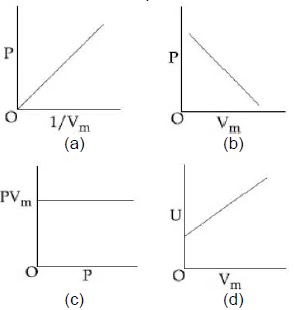
The combination of plots which do not represent isothermal expansion of an ideal gas is
A
$b$ and $d$
B
$a$ and $c$
C
$b$ and $c$
D
$a$ and $d$
Solution
(A) For an ideal gas undergoing isothermal expansion,the temperature $T$ is constant.
$(a)$ According to Boyle's Law,$P = nRT / V_m$. Thus,$P$ vs $1/V_m$ is a straight line passing through the origin. This represents isothermal expansion.
$(b)$ $P$ vs $V_m$ should be a rectangular hyperbola $(P \propto 1/V_m)$,not a straight line. This plot is incorrect.
$(c)$ For an ideal gas,$PV_m = RT$. Since $T$ is constant,$PV_m$ is constant regardless of $P$. This plot is correct.
$(d)$ For an ideal gas,internal energy $U$ depends only on temperature $(U = f(T))$. Since the process is isothermal,$U$ must be constant. The plot shows $U$ increasing with $V_m$,which is incorrect.
Therefore,plots $(b)$ and $(d)$ do not represent isothermal expansion.
$(a)$ According to Boyle's Law,$P = nRT / V_m$. Thus,$P$ vs $1/V_m$ is a straight line passing through the origin. This represents isothermal expansion.
$(b)$ $P$ vs $V_m$ should be a rectangular hyperbola $(P \propto 1/V_m)$,not a straight line. This plot is incorrect.
$(c)$ For an ideal gas,$PV_m = RT$. Since $T$ is constant,$PV_m$ is constant regardless of $P$. This plot is correct.
$(d)$ For an ideal gas,internal energy $U$ depends only on temperature $(U = f(T))$. Since the process is isothermal,$U$ must be constant. The plot shows $U$ increasing with $V_m$,which is incorrect.
Therefore,plots $(b)$ and $(d)$ do not represent isothermal expansion.
0 likes
View Solution53
MediumMCQ
Which of the following mixtures of gases at room temperature does not obey Dalton's law of partial pressure?
A
$He$ and $O_2$
B
$NH_3$ and $HCl$
C
$H_2$ and $He$
D
$N_2$ and $He$
Solution
(B) Dalton's law of partial pressure is applicable only to non-reacting gases.
$NH_3$ and $HCl$ react with each other to form solid ammonium chloride $(NH_4Cl)$:
$NH_3(g) + HCl(g) \rightarrow NH_4Cl(s)$
Since they react,this mixture does not obey Dalton's law.
$NH_3$ and $HCl$ react with each other to form solid ammonium chloride $(NH_4Cl)$:
$NH_3(g) + HCl(g) \rightarrow NH_4Cl(s)$
Since they react,this mixture does not obey Dalton's law.
0 likes
View Solution54
MediumMCQ
$4 \ g \ CH_4$ and $2 \ g \ He$ are mixed under $NTP$. What is the partial pressure of $He$?
A
$\frac{3}{4} \ atm$
B
$\frac{1}{4} \ atm$
C
$\frac{2}{3} \ atm$
D
$\frac{1}{3} \ atm$
Solution
(C) Step $1$: Calculate the number of moles of each gas.
$n_{CH_4} = \frac{4 \ g}{16 \ g/mol} = 0.25 \ mol$
$n_{He} = \frac{2 \ g}{4 \ g/mol} = 0.5 \ mol$
Step $2$: Calculate the total number of moles.
$n_{total} = n_{CH_4} + n_{He} = 0.25 + 0.5 = 0.75 \ mol = \frac{3}{4} \ mol$
Step $3$: Calculate the mole fraction of $He$.
$X_{He} = \frac{n_{He}}{n_{total}} = \frac{0.5}{0.75} = \frac{2}{3}$
Step $4$: Calculate the partial pressure of $He$ at $NTP$.
At $NTP$,the total pressure $P_{total} = 1 \ atm$.
$P_{He} = X_{He} \times P_{total} = \frac{2}{3} \times 1 \ atm = \frac{2}{3} \ atm$.
$n_{CH_4} = \frac{4 \ g}{16 \ g/mol} = 0.25 \ mol$
$n_{He} = \frac{2 \ g}{4 \ g/mol} = 0.5 \ mol$
Step $2$: Calculate the total number of moles.
$n_{total} = n_{CH_4} + n_{He} = 0.25 + 0.5 = 0.75 \ mol = \frac{3}{4} \ mol$
Step $3$: Calculate the mole fraction of $He$.
$X_{He} = \frac{n_{He}}{n_{total}} = \frac{0.5}{0.75} = \frac{2}{3}$
Step $4$: Calculate the partial pressure of $He$ at $NTP$.
At $NTP$,the total pressure $P_{total} = 1 \ atm$.
$P_{He} = X_{He} \times P_{total} = \frac{2}{3} \times 1 \ atm = \frac{2}{3} \ atm$.
0 likes
View Solution55
EasyMCQ
$A$ clathrate can be defined as:
A
Cage compound
B
Liquid crystal
C
Mixture
D
Solid solution
Solution
(A) clathrate is defined as a cage compound. In these compounds,gaseous atoms are trapped within the cavities of the crystal lattice of another substance.
0 likes
View Solution56
EasyMCQ
Which of the following is a superfluid?
A
Krypton $I$
B
Argon $II$
C
Helium $II$
D
Helium $I$
Solution
(C) Helium $II$ behaves as a superfluid. It is a form of liquid helium that has zero viscosity and flows without friction.
0 likes
View Solution57
MediumMCQ
Liquids flow from a higher level to a lower level. Which of the following liquids climbs up the walls of a glass vessel when filled in it?
A
Alcohol
B
Liquid $He$
C
Liquid $N_2$
D
Water
Solution
(B) Liquid $He$ (specifically $He-II$) behaves as a superfluid at very low temperatures. Due to its zero viscosity and high thermal conductivity,it exhibits the 'creeping' effect,allowing it to climb up the walls of a glass vessel.
0 likes
View Solution58
MediumMCQ
$A$ $x : 1$ molar mixture of $He$ and $CH_4$ is contained in a vessel at $20 \ bar$ pressure. Due to a hole in the vessel,the gas mixture leaks out. If the composition of the mixture effusing out initially is $8 : 1$,then the value of $x$ will be
A
$1$
B
$4$
C
$8$
D
$9$
Solution
(B) According to Graham's Law of Effusion,the rate of effusion $(r)$ of a gas is directly proportional to its partial pressure $(P)$ and inversely proportional to the square root of its molar mass $(M)$: $r \propto \frac{P}{\sqrt{M}}$.
Given the molar ratio of $He : CH_4$ is $x : 1$,the partial pressures are $P_{He} = \frac{x}{x+1} \times 20 \ bar$ and $P_{CH_4} = \frac{1}{x+1} \times 20 \ bar$.
The ratio of the rates of effusion is given by: $\frac{r_{He}}{r_{CH_4}} = \frac{P_{He}}{P_{CH_4}} \times \sqrt{\frac{M_{CH_4}}{M_{He}}}$.
Substituting the values: $\frac{8}{1} = \left( \frac{x}{1} \right) \times \sqrt{\frac{16}{4}}$.
$8 = x \times \sqrt{4} = 2x$.
Therefore,$x = 4$.
Given the molar ratio of $He : CH_4$ is $x : 1$,the partial pressures are $P_{He} = \frac{x}{x+1} \times 20 \ bar$ and $P_{CH_4} = \frac{1}{x+1} \times 20 \ bar$.
The ratio of the rates of effusion is given by: $\frac{r_{He}}{r_{CH_4}} = \frac{P_{He}}{P_{CH_4}} \times \sqrt{\frac{M_{CH_4}}{M_{He}}}$.
Substituting the values: $\frac{8}{1} = \left( \frac{x}{1} \right) \times \sqrt{\frac{16}{4}}$.
$8 = x \times \sqrt{4} = 2x$.
Therefore,$x = 4$.
0 likes
View Solution59
MediumMCQ
The density of gas $A$ is twice that of $B$. The molecular mass of $A$ is half of $B$. The partial pressure ratio of $A$ and $B$ is
A
$1 : 4$
B
$1 : 2$
C
$4 : 1$
D
$2 : 1$
Solution
(C) The ideal gas equation is $PV = nRT$,where $n = \frac{w}{M_w}$.
Substituting $n$,we get $PV = \frac{w}{M_w} RT$,which rearranges to $P = \frac{w}{V} \frac{RT}{M_w} = \frac{dRT}{M_w}$,where $d$ is the density.
Therefore,$d = \frac{PM_w}{RT}$.
Given $\frac{d_A}{d_B} = 2$ and $\frac{M_{wA}}{M_{wB}} = \frac{1}{2}$.
From the formula,$\frac{P_A}{P_B} = \frac{d_A}{d_B} \times \frac{M_{wB}}{M_{wA}}$.
Substituting the values: $\frac{P_A}{P_B} = 2 \times \frac{1}{1/2} = 2 \times 2 = 4$.
Thus,the ratio of partial pressures $\frac{P_A}{P_B}$ is $4 : 1$.
Substituting $n$,we get $PV = \frac{w}{M_w} RT$,which rearranges to $P = \frac{w}{V} \frac{RT}{M_w} = \frac{dRT}{M_w}$,where $d$ is the density.
Therefore,$d = \frac{PM_w}{RT}$.
Given $\frac{d_A}{d_B} = 2$ and $\frac{M_{wA}}{M_{wB}} = \frac{1}{2}$.
From the formula,$\frac{P_A}{P_B} = \frac{d_A}{d_B} \times \frac{M_{wB}}{M_{wA}}$.
Substituting the values: $\frac{P_A}{P_B} = 2 \times \frac{1}{1/2} = 2 \times 2 = 4$.
Thus,the ratio of partial pressures $\frac{P_A}{P_B}$ is $4 : 1$.
0 likes
View Solution60
DifficultMCQ
The total pressure in a container containing a gas and a few drops of water is $830 \, mm \, Hg$. If the temperature of the container is decreased by $1 \%$,what will be the new pressure of the container in $mm \, Hg$? The vapor pressure of water at the two temperatures is $30 \, mm \, Hg$ and $25 \, mm \, Hg$ respectively.
A
$821.7$
B
$817$
C
$846.7$
D
$767$
Solution
(B) Initial state: $P_{total, 1} = 830 \, mm \, Hg$,$P_{H_2O, 1} = 30 \, mm \, Hg$.
Pressure of dry gas $P_{gas, 1} = P_{total, 1} - P_{H_2O, 1} = 830 - 30 = 800 \, mm \, Hg$.
Temperature $T_1 = T$.
Final state: Temperature $T_2 = T - 0.01T = 0.99T$.
Using Gay-Lussac's Law for the dry gas: $\frac{P_{gas, 1}}{T_1} = \frac{P_{gas, 2}}{T_2}$.
$\frac{800}{T} = \frac{P_{gas, 2}}{0.99T} \implies P_{gas, 2} = 800 \times 0.99 = 792 \, mm \, Hg$.
New total pressure $P_{total, 2} = P_{gas, 2} + P_{H_2O, 2} = 792 + 25 = 817 \, mm \, Hg$.
Pressure of dry gas $P_{gas, 1} = P_{total, 1} - P_{H_2O, 1} = 830 - 30 = 800 \, mm \, Hg$.
Temperature $T_1 = T$.
Final state: Temperature $T_2 = T - 0.01T = 0.99T$.
Using Gay-Lussac's Law for the dry gas: $\frac{P_{gas, 1}}{T_1} = \frac{P_{gas, 2}}{T_2}$.
$\frac{800}{T} = \frac{P_{gas, 2}}{0.99T} \implies P_{gas, 2} = 800 \times 0.99 = 792 \, mm \, Hg$.
New total pressure $P_{total, 2} = P_{gas, 2} + P_{H_2O, 2} = 792 + 25 = 817 \, mm \, Hg$.
0 likes
View Solution61
DifficultMCQ
$A$ vessel of volume $1.2 \, L$ contains a gas at $1000 \, torr$ pressure. Another vessel of volume $3.8 \, L$ contains the same gas at $500 \, torr$ pressure. If both vessels are connected by a tube of negligible volume,what will be the resultant pressure in $torr$ when equilibrium is established?
A
$1500$
B
$750$
C
$620$
D
$550$
Solution
(C) The resultant pressure $P$ is given by the formula $P = \frac{P_1 V_1 + P_2 V_2}{V_1 + V_2}$.
Substituting the given values:
$P = \frac{(1000 \, torr \times 1.2 \, L) + (500 \, torr \times 3.8 \, L)}{1.2 \, L + 3.8 \, L}$.
$P = \frac{1200 + 1900}{5.0} \, torr$.
$P = \frac{3100}{5} \, torr = 620 \, torr$.
Substituting the given values:
$P = \frac{(1000 \, torr \times 1.2 \, L) + (500 \, torr \times 3.8 \, L)}{1.2 \, L + 3.8 \, L}$.
$P = \frac{1200 + 1900}{5.0} \, torr$.
$P = \frac{3100}{5} \, torr = 620 \, torr$.
0 likes
View Solution62
MediumMCQ
The density of a mixture of $He$ and $O_2$ gases at $27\,^{\circ}C$ and $760\, torr$ pressure is $0.543\, g\, dm^{-3}$. Calculate the percentage by mass of $He$ in the mixture.
A
$33.5$
B
$80$
C
$66.5$
D
$20.2$
Solution
(D) The average molar mass of the mixture is given by $M = \frac{dRT}{P}$.
Given $d = 0.543\, g\, L^{-1}$,$R = 0.0821\, L\, atm\, K^{-1}\, mol^{-1}$,$T = 300\, K$,and $P = 1\, atm$.
$M = \frac{0.543 \times 0.0821 \times 300}{1} \approx 13.38\, g\, mol^{-1}$.
Let $x$ be the mass fraction of $He$. Then the mass fraction of $O_2$ is $(1-x)$.
The average molar mass $M$ is related to the mole fractions $y_1$ and $y_2$ by $M = y_1 M_1 + y_2 M_2$.
Using the relation between mass fraction $(w)$ and mole fraction $(y)$: $y_1 = \frac{w_1/M_1}{w_1/M_1 + w_2/M_2}$.
$\frac{1}{M} = \frac{w_1}{M_1} + \frac{w_2}{M_2} = \frac{x}{4} + \frac{1-x}{32}$.
$\frac{1}{13.38} = \frac{8x + 1 - x}{32} = \frac{7x + 1}{32}$.
$7x + 1 = \frac{32}{13.38} \approx 2.391$.
$7x = 1.391 \implies x \approx 0.1987$.
Percentage by mass of $He = 0.1987 \times 100 \approx 19.9\% \approx 20.2\%$ (considering rounding differences in constants).
Given $d = 0.543\, g\, L^{-1}$,$R = 0.0821\, L\, atm\, K^{-1}\, mol^{-1}$,$T = 300\, K$,and $P = 1\, atm$.
$M = \frac{0.543 \times 0.0821 \times 300}{1} \approx 13.38\, g\, mol^{-1}$.
Let $x$ be the mass fraction of $He$. Then the mass fraction of $O_2$ is $(1-x)$.
The average molar mass $M$ is related to the mole fractions $y_1$ and $y_2$ by $M = y_1 M_1 + y_2 M_2$.
Using the relation between mass fraction $(w)$ and mole fraction $(y)$: $y_1 = \frac{w_1/M_1}{w_1/M_1 + w_2/M_2}$.
$\frac{1}{M} = \frac{w_1}{M_1} + \frac{w_2}{M_2} = \frac{x}{4} + \frac{1-x}{32}$.
$\frac{1}{13.38} = \frac{8x + 1 - x}{32} = \frac{7x + 1}{32}$.
$7x + 1 = \frac{32}{13.38} \approx 2.391$.
$7x = 1.391 \implies x \approx 0.1987$.
Percentage by mass of $He = 0.1987 \times 100 \approx 19.9\% \approx 20.2\%$ (considering rounding differences in constants).
0 likes
View Solution63
DifficultMCQ
Equal masses of ethyne $(C_2H_2)$ and benzene $(C_6H_6)$ are taken in a flask at $400 \ K$. If the partial pressure of benzene is $600 \ torr$,what will be the total pressure of the gaseous mixture in $torr$?
A
$1200$
B
$1800$
C
$2400$
D
$760$
Solution
(C) Let the mass of both ethyne $(C_2H_2)$ and benzene $(C_6H_6)$ be $w \ g$.
Molar mass of ethyne $(C_2H_2) = 2 \times 12 + 2 \times 1 = 26 \ g/mol$.
Molar mass of benzene $(C_6H_6) = 6 \times 12 + 6 \times 1 = 78 \ g/mol$.
Number of moles of ethyne $(n_1) = w/26$.
Number of moles of benzene $(n_2) = w/78$.
Partial pressure is proportional to the number of moles $(P \propto n)$ at constant volume and temperature.
$P_{ethyne} / P_{benzene} = n_1 / n_2 = (w/26) / (w/78) = 78 / 26 = 3$.
So,$P_{ethyne} = 3 \times P_{benzene} = 3 \times 600 \ torr = 1800 \ torr$.
Total pressure $(P_{total}) = P_{ethyne} + P_{benzene} = 1800 \ torr + 600 \ torr = 2400 \ torr$.
Molar mass of ethyne $(C_2H_2) = 2 \times 12 + 2 \times 1 = 26 \ g/mol$.
Molar mass of benzene $(C_6H_6) = 6 \times 12 + 6 \times 1 = 78 \ g/mol$.
Number of moles of ethyne $(n_1) = w/26$.
Number of moles of benzene $(n_2) = w/78$.
Partial pressure is proportional to the number of moles $(P \propto n)$ at constant volume and temperature.
$P_{ethyne} / P_{benzene} = n_1 / n_2 = (w/26) / (w/78) = 78 / 26 = 3$.
So,$P_{ethyne} = 3 \times P_{benzene} = 3 \times 600 \ torr = 1800 \ torr$.
Total pressure $(P_{total}) = P_{ethyne} + P_{benzene} = 1800 \ torr + 600 \ torr = 2400 \ torr$.
0 likes
View Solution64
DifficultMCQ
When $48 \, L$ of dry $N_2$ gas at $27 \, ^oC$ is passed through $36 \, g$ of water,the weight of water decreases by $1.20 \, g$. What is the vapor pressure of water in $atm$?
A
$1.03$
B
$0.021$
C
$0.034$
D
$0.66$
Solution
(C) Given: Volume of $N_2$ $(V)$ = $48 \, L$,Temperature $(T)$ = $27 \, ^oC = 300 \, K$,Mass of water lost = $1.20 \, g$,Molar mass of $H_2O$ = $18 \, g/mol$.
Moles of water vapor $(n_{H_2O})$ = $\frac{1.20}{18} = 0.0667 \, mol$.
Moles of $N_2$ $(n_{N_2})$ = $\frac{PV}{RT} = \frac{1 \times 48}{0.0821 \times 300} = 1.9488 \, mol$.
Total moles $(n_{total})$ = $n_{N_2} + n_{H_2O} = 1.9488 + 0.0667 = 2.0155 \, mol$.
Using Dalton's Law of Partial Pressures: $P_{H_2O} = \frac{n_{H_2O}}{n_{total}} \times P_{total}$.
Assuming $P_{total} = 1 \, atm$: $P_{H_2O} = \frac{0.0667}{2.0155} \times 1 \approx 0.0331 \, atm$.
Rounding to the nearest option,the value is $0.034 \, atm$.
Moles of water vapor $(n_{H_2O})$ = $\frac{1.20}{18} = 0.0667 \, mol$.
Moles of $N_2$ $(n_{N_2})$ = $\frac{PV}{RT} = \frac{1 \times 48}{0.0821 \times 300} = 1.9488 \, mol$.
Total moles $(n_{total})$ = $n_{N_2} + n_{H_2O} = 1.9488 + 0.0667 = 2.0155 \, mol$.
Using Dalton's Law of Partial Pressures: $P_{H_2O} = \frac{n_{H_2O}}{n_{total}} \times P_{total}$.
Assuming $P_{total} = 1 \, atm$: $P_{H_2O} = \frac{0.0667}{2.0155} \times 1 \approx 0.0331 \, atm$.
Rounding to the nearest option,the value is $0.034 \, atm$.
0 likes
View Solution65
DifficultMCQ
The vapor pressure of water at $80\,^oC$ is $355.5\, mm\, of\, Hg$. $A$ $100\, mL$ vessel contains $O_2$ saturated with water vapor at $80\,^oC$,and the total pressure is $760\, mm\, of\, Hg$. If the contents are transferred to a $50\, mL$ vessel at the same temperature,what will be the partial pressure of $O_2$ in $mm\, Hg$?
A
$1115$
B
$809$
C
$405$
D
$3555$
Solution
(B) Given: Total pressure $P_{total} = 760\, mm\, Hg$ at $V_1 = 100\, mL$.
Water vapor pressure $P_{H_2O} = 355.5\, mm\, Hg$.
Partial pressure of $O_2$ in the first vessel: $P_{O_2(1)} = P_{total} - P_{H_2O} = 760 - 355.5 = 404.5\, mm\, Hg$.
According to Boyle's Law at constant temperature: $P_{O_2(1)} \times V_1 = P_{O_2(2)} \times V_2$.
$404.5 \times 100 = P_{O_2(2)} \times 50$.
$P_{O_2(2)} = \frac{404.5 \times 100}{50} = 404.5 \times 2 = 809\, mm\, Hg$.
Water vapor pressure $P_{H_2O} = 355.5\, mm\, Hg$.
Partial pressure of $O_2$ in the first vessel: $P_{O_2(1)} = P_{total} - P_{H_2O} = 760 - 355.5 = 404.5\, mm\, Hg$.
According to Boyle's Law at constant temperature: $P_{O_2(1)} \times V_1 = P_{O_2(2)} \times V_2$.
$404.5 \times 100 = P_{O_2(2)} \times 50$.
$P_{O_2(2)} = \frac{404.5 \times 100}{50} = 404.5 \times 2 = 809\, mm\, Hg$.
0 likes
View Solution66
MediumMCQ
In a container,$0.5 \ mol$ each of $H_2, SO_2$,and $CH_4$ are taken. The order of their partial pressures after $3$ hours will be:
A
$P_{SO_2} > P_{CH_4} > P_{H_2}$
B
$P_{H_2} > P_{SO_2} > P_{CH_4}$
C
$P_{CH_4} > P_{SO_2} > P_{H_2}$
D
$P_{H_2} > P_{CH_4} > P_{SO_2}$
Solution
(A) According to Graham's Law of Diffusion,the rate of effusion or diffusion of a gas is inversely proportional to the square root of its molar mass $(Rate \propto \frac{1}{\sqrt{M}})$.
Since the gases are in a container,if there is any leakage or diffusion,the gas with the lowest molar mass will diffuse the fastest.
The molar masses are: $M(H_2) = 2 \ g/mol$,$M(CH_4) = 16 \ g/mol$,and $M(SO_2) = 64 \ g/mol$.
Since $M(H_2) < M(CH_4) < M(SO_2)$,the rate of diffusion follows the order: $Rate(H_2) > Rate(CH_4) > Rate(SO_2)$.
After $3$ hours,the gas that diffuses the fastest will have the lowest amount remaining in the container.
Therefore,the amount remaining follows the order: $n(SO_2) > n(CH_4) > n(H_2)$.
Since partial pressure is directly proportional to the number of moles $(P \propto n)$,the order of partial pressures will be $P_{SO_2} > P_{CH_4} > P_{H_2}$.
Since the gases are in a container,if there is any leakage or diffusion,the gas with the lowest molar mass will diffuse the fastest.
The molar masses are: $M(H_2) = 2 \ g/mol$,$M(CH_4) = 16 \ g/mol$,and $M(SO_2) = 64 \ g/mol$.
Since $M(H_2) < M(CH_4) < M(SO_2)$,the rate of diffusion follows the order: $Rate(H_2) > Rate(CH_4) > Rate(SO_2)$.
After $3$ hours,the gas that diffuses the fastest will have the lowest amount remaining in the container.
Therefore,the amount remaining follows the order: $n(SO_2) > n(CH_4) > n(H_2)$.
Since partial pressure is directly proportional to the number of moles $(P \propto n)$,the order of partial pressures will be $P_{SO_2} > P_{CH_4} > P_{H_2}$.
0 likes
View Solution67
MediumMCQ
Two gases $X$ and $Y$ are taken in equal molar proportions. The ratio of their rates of diffusion is $1 : 2$. What will be the mole fraction of $X$ in a mixture containing $2 \ g$ of $X$ and $3 \ g$ of $Y$?
A
$1/7$
B
$1/6$
C
$5/6$
D
$7/8$
Solution
(A) According to Graham's Law of diffusion,the rate of diffusion $r \propto \frac{1}{\sqrt{M}}$.
Given $\frac{r_X}{r_Y} = \frac{1}{2}$.
Therefore,$\frac{r_X}{r_Y} = \sqrt{\frac{M_Y}{M_X}} = \frac{1}{2}$.
Squaring both sides,$\frac{M_Y}{M_X} = \frac{1}{4}$,which implies $M_X = 4M_Y$.
Let $M_Y = M$,then $M_X = 4M$.
Moles of $X$ $(n_X)$ = $\frac{2}{4M} = \frac{0.5}{M}$.
Moles of $Y$ $(n_Y)$ = $\frac{3}{M}$.
Mole fraction of $X$ $(x_X)$ = $\frac{n_X}{n_X + n_Y} = \frac{0.5/M}{0.5/M + 3/M} = \frac{0.5}{3.5} = \frac{5}{35} = \frac{1}{7}$.
Given $\frac{r_X}{r_Y} = \frac{1}{2}$.
Therefore,$\frac{r_X}{r_Y} = \sqrt{\frac{M_Y}{M_X}} = \frac{1}{2}$.
Squaring both sides,$\frac{M_Y}{M_X} = \frac{1}{4}$,which implies $M_X = 4M_Y$.
Let $M_Y = M$,then $M_X = 4M$.
Moles of $X$ $(n_X)$ = $\frac{2}{4M} = \frac{0.5}{M}$.
Moles of $Y$ $(n_Y)$ = $\frac{3}{M}$.
Mole fraction of $X$ $(x_X)$ = $\frac{n_X}{n_X + n_Y} = \frac{0.5/M}{0.5/M + 3/M} = \frac{0.5}{3.5} = \frac{5}{35} = \frac{1}{7}$.
0 likes
View Solution68
MediumMCQ
Two flasks of equal volume contain $O_2$ and $CH_3OH$ vapor respectively at $120\,^oC$ and $1.15\, atm$ pressure. Which of the following will be the same for both?
A
Rate of diffusion
B
Mass
C
Density
D
All of the above
Solution
(C) According to the Ideal Gas Equation,$PV = nRT = (\frac{w}{M})RT$.
Rearranging for density $(d = \frac{w}{V})$,we get $d = \frac{PM}{RT}$.
Since $P$,$T$,and $R$ are the same for both gases,the density $d$ depends only on the molar mass $M$.
$M(O_2) = 32\, g/mol$ and $M(CH_3OH) = 32\, g/mol$.
Since the molar masses are identical,the density $d$ will be the same for both gases.
Rate of diffusion depends on molar mass $(r \propto \frac{1}{\sqrt{M}})$,which is also the same here.
However,density is the most direct property derived from the given conditions.
Rearranging for density $(d = \frac{w}{V})$,we get $d = \frac{PM}{RT}$.
Since $P$,$T$,and $R$ are the same for both gases,the density $d$ depends only on the molar mass $M$.
$M(O_2) = 32\, g/mol$ and $M(CH_3OH) = 32\, g/mol$.
Since the molar masses are identical,the density $d$ will be the same for both gases.
Rate of diffusion depends on molar mass $(r \propto \frac{1}{\sqrt{M}})$,which is also the same here.
However,density is the most direct property derived from the given conditions.
0 likes
View Solution69
MediumMCQ
If $4 \ g$ of oxygen diffuses through a fine hole,how many grams of hydrogen will diffuse under the same conditions?
A
$16$
B
$1$
C
$0.25$
D
$64$
Solution
(B) According to Graham's Law of Diffusion,the rate of diffusion $r$ is inversely proportional to the square root of the molar mass $M$ of the gas: $r \propto \frac{1}{\sqrt{M}}$.
Since the time $t$ is the same for both gases,the amount diffused $n$ (in moles) is proportional to the rate of diffusion: $n \propto r$.
Therefore,$\frac{n_{H_2}}{n_{O_2}} = \sqrt{\frac{M_{O_2}}{M_{H_2}}}$.
The molar mass of $O_2$ is $32 \ g/mol$ and $H_2$ is $2 \ g/mol$.
Let $w$ be the mass of $H_2$ in grams. The number of moles $n = \frac{w}{M}$.
$\frac{w_{H_2} / 2}{4 / 32} = \sqrt{\frac{32}{2}} = \sqrt{16} = 4$.
$\frac{w_{H_2}}{2} = 4 \times \frac{4}{32} = 4 \times 0.125 = 0.5$.
$w_{H_2} = 0.5 \times 2 = 1 \ g$.
Since the time $t$ is the same for both gases,the amount diffused $n$ (in moles) is proportional to the rate of diffusion: $n \propto r$.
Therefore,$\frac{n_{H_2}}{n_{O_2}} = \sqrt{\frac{M_{O_2}}{M_{H_2}}}$.
The molar mass of $O_2$ is $32 \ g/mol$ and $H_2$ is $2 \ g/mol$.
Let $w$ be the mass of $H_2$ in grams. The number of moles $n = \frac{w}{M}$.
$\frac{w_{H_2} / 2}{4 / 32} = \sqrt{\frac{32}{2}} = \sqrt{16} = 4$.
$\frac{w_{H_2}}{2} = 4 \times \frac{4}{32} = 4 \times 0.125 = 0.5$.
$w_{H_2} = 0.5 \times 2 = 1 \ g$.
0 likes
View Solution70
DifficultMCQ
If hydrogen gas travels a distance of $10.5 \ cm$ in $5 \ s$ through a long narrow tube at a pressure of $1 \ atm$,what distance (in $cm$) will oxygen gas travel in $5 \ s$ at a pressure of $2 \ atm$?
A
$42$
B
$21$
C
$10.5$
D
$5.25$
Solution
(D) According to Graham's Law of Effusion,the rate of effusion $r$ is proportional to $\frac{P}{\sqrt{M}}$.
Since distance $d = r \times t$,and time $t$ is constant $(5 \ s)$,the distance $d$ is proportional to the rate $r$.
Therefore,$d \propto \frac{P}{\sqrt{M}}$.
For hydrogen $(H_2)$: $d_1 = 10.5 \ cm$,$P_1 = 1 \ atm$,$M_1 = 2 \ g/mol$.
For oxygen $(O_2)$: $d_2 = ?$,$P_2 = 2 \ atm$,$M_2 = 32 \ g/mol$.
Using the ratio: $\frac{d_2}{d_1} = \frac{P_2}{P_1} \times \sqrt{\frac{M_1}{M_2}}$.
$\frac{d_2}{10.5} = \frac{2}{1} \times \sqrt{\frac{2}{32}} = 2 \times \sqrt{\frac{1}{16}} = 2 \times \frac{1}{4} = 0.5$.
$d_2 = 10.5 \times 0.5 = 5.25 \ cm$.
Since distance $d = r \times t$,and time $t$ is constant $(5 \ s)$,the distance $d$ is proportional to the rate $r$.
Therefore,$d \propto \frac{P}{\sqrt{M}}$.
For hydrogen $(H_2)$: $d_1 = 10.5 \ cm$,$P_1 = 1 \ atm$,$M_1 = 2 \ g/mol$.
For oxygen $(O_2)$: $d_2 = ?$,$P_2 = 2 \ atm$,$M_2 = 32 \ g/mol$.
Using the ratio: $\frac{d_2}{d_1} = \frac{P_2}{P_1} \times \sqrt{\frac{M_1}{M_2}}$.
$\frac{d_2}{10.5} = \frac{2}{1} \times \sqrt{\frac{2}{32}} = 2 \times \sqrt{\frac{1}{16}} = 2 \times \frac{1}{4} = 0.5$.
$d_2 = 10.5 \times 0.5 = 5.25 \ cm$.
0 likes
View Solution71
DifficultMCQ
If $1 \ g$ of $CH_4$ gas effuses through a fine hole in $100 \ s$,how many grams of $SO_2$ gas will effuse in $100 \ s$ under the same conditions of temperature and pressure?
A
$0.5$
B
$2$
C
$4$
D
$16$
Solution
(A) According to Graham's Law of Effusion,the rate of effusion $(r)$ is inversely proportional to the square root of the molar mass $(M)$: $r \propto \frac{1}{\sqrt{M}}$.
Since the time $(t)$ is the same for both gases,the rate of effusion is directly proportional to the mass $(w)$ effused: $r = \frac{w}{t}$.
Therefore,$\frac{w_1}{w_2} = \sqrt{\frac{M_2}{M_1}}$.
Given: $w_1 (CH_4) = 1 \ g$,$M_1 (CH_4) = 16 \ g/mol$,$M_2 (SO_2) = 64 \ g/mol$.
Substituting the values: $\frac{1}{w_2} = \sqrt{\frac{64}{16}} = \sqrt{4} = 2$.
Thus,$w_2 = \frac{1}{2} = 0.5 \ g$.
Since the time $(t)$ is the same for both gases,the rate of effusion is directly proportional to the mass $(w)$ effused: $r = \frac{w}{t}$.
Therefore,$\frac{w_1}{w_2} = \sqrt{\frac{M_2}{M_1}}$.
Given: $w_1 (CH_4) = 1 \ g$,$M_1 (CH_4) = 16 \ g/mol$,$M_2 (SO_2) = 64 \ g/mol$.
Substituting the values: $\frac{1}{w_2} = \sqrt{\frac{64}{16}} = \sqrt{4} = 2$.
Thus,$w_2 = \frac{1}{2} = 0.5 \ g$.
0 likes
View Solution72
MediumMCQ
If the rate of diffusion of a gas having twice the molecular mass of nitrogen is $56 \ mL \ s^{-1}$,then the rate of diffusion of nitrogen will be ........... $mL \ s^{-1}$.
A
$79.19$
B
$112$
C
$56$
D
$90$
Solution
(A) According to Graham's Law of diffusion,the rate of diffusion $r \propto \frac{1}{\sqrt{M}}$,where $M$ is the molar mass.
Let $M_{N_2} = M$. Then the molar mass of the other gas is $M_x = 2M$.
Given: $r_x = 56 \ mL \ s^{-1}$.
Using the formula: $\frac{r_{N_2}}{r_x} = \sqrt{\frac{M_x}{M_{N_2}}}$.
$\frac{r_{N_2}}{56} = \sqrt{\frac{2M}{M}} = \sqrt{2}$.
$r_{N_2} = 56 \times \sqrt{2} = 56 \times 1.414 = 79.184 \approx 79.19 \ mL \ s^{-1}$.
Let $M_{N_2} = M$. Then the molar mass of the other gas is $M_x = 2M$.
Given: $r_x = 56 \ mL \ s^{-1}$.
Using the formula: $\frac{r_{N_2}}{r_x} = \sqrt{\frac{M_x}{M_{N_2}}}$.
$\frac{r_{N_2}}{56} = \sqrt{\frac{2M}{M}} = \sqrt{2}$.
$r_{N_2} = 56 \times \sqrt{2} = 56 \times 1.414 = 79.184 \approx 79.19 \ mL \ s^{-1}$.
0 likes
View Solution73
MediumMCQ
$20 \, L$ of $SO_2$ diffuses through a porous partition in $60 \, s$. Volume of $O_2$ diffused under similar conditions in $30 \, s$ will be ................ $L$. (in $.14$)
A
$12$
B
$14$
C
$18$
D
$28$
Solution
(B) The rate of diffusion $(r)$ is defined as the volume $(V)$ diffused per unit time $(t)$,and according to Graham's Law,it is inversely proportional to the square root of the molar mass $(M)$.
$\frac{r_1}{r_2} = \frac{V_1 \cdot t_2}{V_2 \cdot t_1} = \sqrt{\frac{M_2}{M_1}}$
Here,$V_1 = 20 \, L$,$t_1 = 60 \, s$,and $M_1 (SO_2) = 64 \, g/mol$.
For $O_2$,$t_2 = 30 \, s$ and $M_2 (O_2) = 32 \, g/mol$.
Substituting the values into the equation:
$\frac{20 \times 30}{V_2 \times 60} = \sqrt{\frac{32}{64}}$
$\frac{600}{60 \cdot V_2} = \sqrt{0.5}$
$\frac{10}{V_2} = 0.707$
$V_2 = \frac{10}{0.707} \approx 14.14 \, L$.
Thus,the volume of $O_2$ diffused is $14.14 \, L$. The correct option is $B$.
$\frac{r_1}{r_2} = \frac{V_1 \cdot t_2}{V_2 \cdot t_1} = \sqrt{\frac{M_2}{M_1}}$
Here,$V_1 = 20 \, L$,$t_1 = 60 \, s$,and $M_1 (SO_2) = 64 \, g/mol$.
For $O_2$,$t_2 = 30 \, s$ and $M_2 (O_2) = 32 \, g/mol$.
Substituting the values into the equation:
$\frac{20 \times 30}{V_2 \times 60} = \sqrt{\frac{32}{64}}$
$\frac{600}{60 \cdot V_2} = \sqrt{0.5}$
$\frac{10}{V_2} = 0.707$
$V_2 = \frac{10}{0.707} \approx 14.14 \, L$.
Thus,the volume of $O_2$ diffused is $14.14 \, L$. The correct option is $B$.
0 likes
View Solution74
MediumMCQ
Which of the following sets consists of gases with the same rate of diffusion?
A
$CO_2, NO_2, C_3H_8$
B
$CO_2, N_2O, C_3H_8$
C
$H_2, D_2, He$
D
$N_2, CO_2, C_2H_4$
Solution
(B) According to Graham's Law of Diffusion,the rate of diffusion $(r)$ of a gas is inversely proportional to the square root of its molar mass $(M)$: $r \propto \frac{1}{\sqrt{M}}$.
Therefore,gases with the same molar mass will have the same rate of diffusion.
Let us calculate the molar masses of the gases in option $B$:
$M(CO_2) = 12 + 2 \times 16 = 44 \ g/mol$.
$M(N_2O) = 2 \times 14 + 16 = 44 \ g/mol$.
$M(C_3H_8) = 3 \times 12 + 8 \times 1 = 44 \ g/mol$.
Since all three gases have the same molar mass $(44 \ g/mol)$,they will have the same rate of diffusion.
Therefore,gases with the same molar mass will have the same rate of diffusion.
Let us calculate the molar masses of the gases in option $B$:
$M(CO_2) = 12 + 2 \times 16 = 44 \ g/mol$.
$M(N_2O) = 2 \times 14 + 16 = 44 \ g/mol$.
$M(C_3H_8) = 3 \times 12 + 8 \times 1 = 44 \ g/mol$.
Since all three gases have the same molar mass $(44 \ g/mol)$,they will have the same rate of diffusion.
0 likes
View Solution75
MediumMCQ
Equal masses of $CH_4$ and $H_2$ are mixed in an empty container at $25\,^oC$. The fraction of the total pressure exerted by methane is
A
$1/9$
B
$8/9$
C
$16/17$
D
$1/2$
Solution
(A) Let the mass of both $CH_4$ and $H_2$ be $x \ g$.
Number of moles of $CH_4$ $(n_{CH_4})$ = $\frac{x}{16} \ mol$.
Number of moles of $H_2$ $(n_{H_2})$ = $\frac{x}{2} \ mol$.
The mole fraction of $CH_4$ $(X_{CH_4})$ is given by $\frac{n_{CH_4}}{n_{CH_4} + n_{H_2}}$.
$X_{CH_4} = \frac{x/16}{x/16 + x/2} = \frac{1/16}{1/16 + 8/16} = \frac{1/16}{9/16} = 1/9$.
According to Dalton's Law of partial pressures,the partial pressure of a gas is equal to its mole fraction multiplied by the total pressure $(P_{CH_4} = X_{CH_4} \times P_{Total})$.
Therefore,the fraction of the total pressure exerted by methane is $1/9$.
Number of moles of $CH_4$ $(n_{CH_4})$ = $\frac{x}{16} \ mol$.
Number of moles of $H_2$ $(n_{H_2})$ = $\frac{x}{2} \ mol$.
The mole fraction of $CH_4$ $(X_{CH_4})$ is given by $\frac{n_{CH_4}}{n_{CH_4} + n_{H_2}}$.
$X_{CH_4} = \frac{x/16}{x/16 + x/2} = \frac{1/16}{1/16 + 8/16} = \frac{1/16}{9/16} = 1/9$.
According to Dalton's Law of partial pressures,the partial pressure of a gas is equal to its mole fraction multiplied by the total pressure $(P_{CH_4} = X_{CH_4} \times P_{Total})$.
Therefore,the fraction of the total pressure exerted by methane is $1/9$.
0 likes
View Solution76
MediumMCQ
The radius of the $Na^{+}$ ion is $95 \ pm$ and that of $Cl^{-}$ ion is $181 \ pm$. Predict the coordination number of $Na^{+}$ in $NaCl$.
A
$4$
B
$6$
C
$8$
D
Unpredictable
Solution
(B) The radius ratio is calculated as: $\frac{r_{Na^{+}}}{r_{Cl^{-}}} = \frac{95 \ pm}{181 \ pm} = 0.524$.
Since the radius ratio $0.524$ lies in the range $0.414 - 0.732$, the coordination number of $Na^{+}$ is $6$.
Since the radius ratio $0.524$ lies in the range $0.414 - 0.732$, the coordination number of $Na^{+}$ is $6$.
0 likes
View Solution77
DifficultMCQ
$80 \ mL$ of $O_2$ takes $2 \ minute$ to pass through a hole. What volume of $SO_2$ will pass through the same hole in $3 \ minute$?
A
$120 \times \sqrt{2}$
B
$\frac{120}{\sqrt{2}}$
C
$\frac{12}{\sqrt{2}}$
D
None
Solution
(B) According to Graham's Law of Diffusion,the rate of diffusion $r$ is given by $r = \frac{V}{t} \propto \frac{1}{\sqrt{M}}$.
For two gases,the ratio is $\frac{V_1 / t_1}{V_2 / t_2} = \sqrt{\frac{M_2}{M_1}}$.
Given: $V_1 = 80 \ mL$,$t_1 = 2 \ min$,$M_1 (O_2) = 32 \ g/mol$,$t_2 = 3 \ min$,$M_2 (SO_2) = 64 \ g/mol$.
Substituting the values: $\frac{80 / 2}{V_2 / 3} = \sqrt{\frac{64}{32}}$.
$40 \times \frac{3}{V_2} = \sqrt{2}$.
$V_2 = \frac{120}{\sqrt{2}} \ mL$.
For two gases,the ratio is $\frac{V_1 / t_1}{V_2 / t_2} = \sqrt{\frac{M_2}{M_1}}$.
Given: $V_1 = 80 \ mL$,$t_1 = 2 \ min$,$M_1 (O_2) = 32 \ g/mol$,$t_2 = 3 \ min$,$M_2 (SO_2) = 64 \ g/mol$.
Substituting the values: $\frac{80 / 2}{V_2 / 3} = \sqrt{\frac{64}{32}}$.
$40 \times \frac{3}{V_2} = \sqrt{2}$.
$V_2 = \frac{120}{\sqrt{2}} \ mL$.
0 likes
View Solution78
MediumMCQ
The normal boiling point of water is $373 \ K$ (at $760 \ mm$). The vapor pressure of water at $298 \ K$ is $23 \ mm$. If the enthalpy of vaporization of water is $40.656 \ kJ/mol$,then the boiling point of water at $23 \ mm$ pressure will be ........... $K$.
A
$250$
B
$51.6$
C
$298$
D
$12.5$
Solution
(C) To find the boiling point at a different pressure,we use the Clausius-Clapeyron equation: $\ln(\frac{P_2}{P_1}) = \frac{\Delta H_{vap}}{R} (\frac{1}{T_1} - \frac{1}{T_2})$.
Given: $P_1 = 760 \ mm$,$T_1 = 373 \ K$,$P_2 = 23 \ mm$,$\Delta H_{vap} = 40.656 \ kJ/mol = 40656 \ J/mol$,$R = 8.314 \ J/mol \cdot K$.
Substituting the values: $\ln(\frac{23}{760}) = \frac{40656}{8.314} (\frac{1}{373} - \frac{1}{T_2})$.
$-3.498 = 4890.06 (0.00268 - \frac{1}{T_2})$.
$-0.000715 = 0.00268 - \frac{1}{T_2}$.
$\frac{1}{T_2} = 0.00268 + 0.000715 = 0.003395$.
$T_2 = \frac{1}{0.003395} \approx 294.5 \ K$.
Rounding to the nearest provided option,the answer is $298 \ K$.
Given: $P_1 = 760 \ mm$,$T_1 = 373 \ K$,$P_2 = 23 \ mm$,$\Delta H_{vap} = 40.656 \ kJ/mol = 40656 \ J/mol$,$R = 8.314 \ J/mol \cdot K$.
Substituting the values: $\ln(\frac{23}{760}) = \frac{40656}{8.314} (\frac{1}{373} - \frac{1}{T_2})$.
$-3.498 = 4890.06 (0.00268 - \frac{1}{T_2})$.
$-0.000715 = 0.00268 - \frac{1}{T_2}$.
$\frac{1}{T_2} = 0.00268 + 0.000715 = 0.003395$.
$T_2 = \frac{1}{0.003395} \approx 294.5 \ K$.
Rounding to the nearest provided option,the answer is $298 \ K$.
0 likes
View Solution79
MediumMCQ
Which of the following statements is correct?
A
The specific heat capacity of $He$ at constant pressure is equal to the specific heat capacity of $H_2$ at constant pressure.
B
The specific heat capacity of $H_2$ and $O_3$ at constant pressure are equal.
C
The specific heat capacity of a monatomic gas at constant pressure is equal to the specific heat capacity of $H_2$ at constant volume.
D
None of these.
Solution
(D) The specific heat capacity at constant pressure $(C_p)$ is given by $C_p = \frac{\gamma R}{M(\gamma - 1)}$.
For $He$ (monatomic),$\gamma = 1.66$ and $M = 4 \ g/mol$.
For $H_2$ (diatomic),$\gamma = 1.4$ and $M = 2 \ g/mol$.
Calculating $C_p$ for $He$: $C_p = \frac{1.66 \times R}{4 \times 0.66} \approx 0.63R$.
Calculating $C_p$ for $H_2$: $C_p = \frac{1.4 \times R}{2 \times 0.4} = 1.75R$.
Calculating $C_v$ for $H_2$: $C_v = \frac{R}{M(\gamma - 1)} = \frac{R}{2 \times 0.4} = 1.25R$.
Comparing these values,none of the given statements are correct.
For $He$ (monatomic),$\gamma = 1.66$ and $M = 4 \ g/mol$.
For $H_2$ (diatomic),$\gamma = 1.4$ and $M = 2 \ g/mol$.
Calculating $C_p$ for $He$: $C_p = \frac{1.66 \times R}{4 \times 0.66} \approx 0.63R$.
Calculating $C_p$ for $H_2$: $C_p = \frac{1.4 \times R}{2 \times 0.4} = 1.75R$.
Calculating $C_v$ for $H_2$: $C_v = \frac{R}{M(\gamma - 1)} = \frac{R}{2 \times 0.4} = 1.25R$.
Comparing these values,none of the given statements are correct.
0 likes
View Solution80
AdvancedMCQ
When a sample of gas is compressed at constant temperature from $15 \, atm$ to $60 \, atm$,its volume changes from $76 \, cm^3$ to $20.5 \, cm^3$. Which of the following statements are possible explanations of this behaviour?
$(1)$ The gas behaves non-ideally
$(2)$ The gas dimerises
$(3)$ The gas is adsorbed into the vessel walls
$(1)$ The gas behaves non-ideally
$(2)$ The gas dimerises
$(3)$ The gas is adsorbed into the vessel walls
A
$1, 2, \text{ and } 3$
B
$1 \text{ and } 2 \text{ only}$
C
$2 \text{ and } 3 \text{ only}$
D
$1 \text{ only}$
Solution
(A) Given,$P_1 = 15 \, atm$,$P_2 = 60 \, atm$.
$V_1 = 76 \, cm^3$,$V_2 = 20.5 \, cm^3$.
If the gas is an ideal gas,then according to Boyle's law,it must follow the equation $P_1V_1 = P_2V_2$.
$P_1 \times V_1 = 15 \times 76 = 1140$.
$P_2 \times V_2 = 60 \times 20.5 = 1230$.
Since $P_1V_1 \neq P_2V_2$,the gas behaves non-ideally.
Additionally,processes like dimerization or adsorption on vessel walls would also lead to a deviation from the expected ideal volume change,making all three statements possible explanations for the observed behavior.
$V_1 = 76 \, cm^3$,$V_2 = 20.5 \, cm^3$.
If the gas is an ideal gas,then according to Boyle's law,it must follow the equation $P_1V_1 = P_2V_2$.
$P_1 \times V_1 = 15 \times 76 = 1140$.
$P_2 \times V_2 = 60 \times 20.5 = 1230$.
Since $P_1V_1 \neq P_2V_2$,the gas behaves non-ideally.
Additionally,processes like dimerization or adsorption on vessel walls would also lead to a deviation from the expected ideal volume change,making all three statements possible explanations for the observed behavior.
0 likes
View Solution81
MediumMCQ
Assertion : Ice melts faster at high altitude.
Reason : At high altitude,atmospheric pressure is high.
Reason : At high altitude,atmospheric pressure is high.
A
If both Assertion and Reason are correct and the Reason is a correct explanation of the Assertion.
B
If both Assertion and Reason are correct but Reason is not a correct explanation of the Assertion.
C
If the Assertion is correct but Reason is incorrect.
D
If both the Assertion and Reason are incorrect.
Solution
(D) The melting point of ice decreases with an increase in pressure. Since atmospheric pressure decreases at high altitudes,the melting point of ice actually increases,meaning it does not melt faster.
Therefore,the assertion is false.
Additionally,atmospheric pressure is lower,not higher,at high altitudes,making the reason also false.
Thus,both the assertion and the reason are incorrect.
Therefore,the assertion is false.
Additionally,atmospheric pressure is lower,not higher,at high altitudes,making the reason also false.
Thus,both the assertion and the reason are incorrect.
0 likes
View Solution82
MediumMCQ
Assertion : Wet air is heavier than dry air.
Reason : The density of dry air is more than density of water.
Reason : The density of dry air is more than density of water.
A
If both Assertion and Reason are correct and the Reason is a correct explanation of the Assertion.
B
If both Assertion and Reason are correct but Reason is not a correct explanation of the Assertion.
C
If the Assertion is correct but Reason is incorrect.
D
If the Assertion is incorrect but the Reason is correct.
Solution
(D) The molar mass of water vapor $(H_2O)$ is $18 \ g/mol$,while the average molar mass of dry air (mostly $N_2$ and $O_2$) is approximately $29 \ g/mol$.
Since water vapor replaces heavier air molecules,wet air is actually lighter than dry air,making the Assertion incorrect.
The density of dry air is much lower than the density of liquid water,making the Reason also incorrect.
Since water vapor replaces heavier air molecules,wet air is actually lighter than dry air,making the Assertion incorrect.
The density of dry air is much lower than the density of liquid water,making the Reason also incorrect.
0 likes
View Solution83
EasyMCQ
Assertion: Use of pressure cooker reduces cooking time.
Reason: At higher pressure,cooking occurs faster.
Reason: At higher pressure,cooking occurs faster.
A
If both Assertion and Reason are correct and the Reason is a correct explanation of the Assertion.
B
If both Assertion and Reason are correct but Reason is not a correct explanation of the Assertion.
C
If the Assertion is correct but Reason is incorrect.
D
If both the Assertion and Reason are incorrect.
Solution
(A) The use of a pressure cooker reduces cooking time because the increase in pressure inside the cooker increases the boiling point $(b.p.)$ of water.
Since the water boils at a higher temperature,the food cooks faster.
Since the water boils at a higher temperature,the food cooks faster.
0 likes
View Solution84
DifficultMCQ
Assertion : We feel cold on touching the ice.
Reason : Ice is a solid form of water.
Reason : Ice is a solid form of water.
A
If both Assertion and Reason are correct and the Reason is a correct explanation of the Assertion.
B
If both Assertion and Reason are correct but Reason is not a correct explanation of the Assertion.
C
If the Assertion is correct but Reason is incorrect.
D
If both the Assertion and Reason are incorrect.
Solution
(B) The Assertion is correct because when we touch ice,heat flows from our body (at a higher temperature) to the ice (at a lower temperature),causing a sensation of coldness.
The Reason is also correct because ice is indeed the solid state of $H_2O$.
However,the Reason does not explain why we feel cold; the sensation of cold is due to the heat transfer process,not merely the state of matter.
The Reason is also correct because ice is indeed the solid state of $H_2O$.
However,the Reason does not explain why we feel cold; the sensation of cold is due to the heat transfer process,not merely the state of matter.
0 likes
View Solution85
MediumMCQ
What will be the pressure of the gaseous mixture when $0.5 \, L$ of $H_{2}$ at $0.8 \, bar$ and $2.0 \, L$ of dioxygen at $0.7 \, bar$ are introduced in a $1 \, L$ vessel at $27^{\circ} C$ (in $, bar$)?
A
$1.5$
B
$1.8$
C
$2.0$
D
$2.5$
Solution
(B) According to Boyle's Law,$p_{1}V_{1} = p_{2}V_{2}$ at constant temperature.
For $H_{2}$:
$p_{1} = 0.8 \, bar, V_{1} = 0.5 \, L, V_{2} = 1 \, L$
$p_{H_{2}} = \frac{0.8 \times 0.5}{1} = 0.4 \, bar$
For $O_{2}$:
$p_{1} = 0.7 \, bar, V_{1} = 2.0 \, L, V_{2} = 1 \, L$
$p_{O_{2}} = \frac{0.7 \times 2.0}{1} = 1.4 \, bar$
According to Dalton's Law of Partial Pressures,the total pressure $p_{total} = p_{H_{2}} + p_{O_{2}}$.
$p_{total} = 0.4 \, bar + 1.4 \, bar = 1.8 \, bar$.
For $H_{2}$:
$p_{1} = 0.8 \, bar, V_{1} = 0.5 \, L, V_{2} = 1 \, L$
$p_{H_{2}} = \frac{0.8 \times 0.5}{1} = 0.4 \, bar$
For $O_{2}$:
$p_{1} = 0.7 \, bar, V_{1} = 2.0 \, L, V_{2} = 1 \, L$
$p_{O_{2}} = \frac{0.7 \times 2.0}{1} = 1.4 \, bar$
According to Dalton's Law of Partial Pressures,the total pressure $p_{total} = p_{H_{2}} + p_{O_{2}}$.
$p_{total} = 0.4 \, bar + 1.4 \, bar = 1.8 \, bar$.
0 likes
View Solution86
MediumMCQ
If the distance between two gas molecules becomes half,what change occurs in the London dispersion forces?
A
It becomes $2$ times
B
It becomes $16$ times
C
It becomes $32$ times
D
It becomes $64$ times
Solution
(D) London dispersion forces are inversely proportional to the sixth power of the distance $(r)$ between the particles: $F \propto \frac{1}{r^{6}}$.
Let the initial force be $x_{1} = \frac{k}{r^{6}}$.
When the distance becomes half,the new distance $r' = \frac{r}{2}$.
The new force $x_{2} = \frac{k}{(r/2)^{6}} = \frac{k \cdot 2^{6}}{r^{6}}$.
Therefore,$x_{2} = 2^{6} \cdot x_{1} = 64 \cdot x_{1}$.
The London forces become $64$ times the original value.
Let the initial force be $x_{1} = \frac{k}{r^{6}}$.
When the distance becomes half,the new distance $r' = \frac{r}{2}$.
The new force $x_{2} = \frac{k}{(r/2)^{6}} = \frac{k \cdot 2^{6}}{r^{6}}$.
Therefore,$x_{2} = 2^{6} \cdot x_{1} = 64 \cdot x_{1}$.
The London forces become $64$ times the original value.
0 likes
View Solution87
Medium
During winter,when taking a bath,water vapour appears. Explain the physical process.
Solution
(N/A) The appearance of water vapour during a bath in winter is a physical process known as $condensation$.
When hot water is used for a bath,it releases water vapour into the air.
In winter,the ambient air temperature is significantly lower than the temperature of the hot water vapour.
When this warm water vapour comes into contact with the cold air,it loses heat energy.
As a result,the water vapour molecules slow down and come closer together,changing from the gaseous state to the liquid state,forming tiny water droplets that appear as mist or vapour.
When hot water is used for a bath,it releases water vapour into the air.
In winter,the ambient air temperature is significantly lower than the temperature of the hot water vapour.
When this warm water vapour comes into contact with the cold air,it loses heat energy.
As a result,the water vapour molecules slow down and come closer together,changing from the gaseous state to the liquid state,forming tiny water droplets that appear as mist or vapour.
0 likes
View Solution88
MediumMCQ
The magnitude of surface tension of a liquid depends on the attractive forces between the molecules. Arrange the following in increasing order of surface tension: Water,alcohol $(C_2H_5OH)$,and hexane $(CH_3(CH_2)_4CH_3)$.
A
Hexane < Alcohol < Water
B
Water < Alcohol < Hexane
C
Alcohol < Hexane < Water
D
Hexane < Water < Alcohol
Solution
(A) The magnitude of surface tension is directly proportional to the strength of intermolecular attractive forces.
$1$. Hexane $(CH_3(CH_2)_4CH_3)$ is a non-polar molecule,exhibiting only weak London dispersion forces.
$2$. Alcohol $(C_2H_5OH)$ is a polar molecule capable of $H$-bonding,which is stronger than dispersion forces.
$3$. Water $(H_2O)$ is a highly polar molecule with extensive $H$-bonding,making its intermolecular forces the strongest among the three.
Therefore,the increasing order of surface tension is $Hexane < Alcohol < Water$.
$1$. Hexane $(CH_3(CH_2)_4CH_3)$ is a non-polar molecule,exhibiting only weak London dispersion forces.
$2$. Alcohol $(C_2H_5OH)$ is a polar molecule capable of $H$-bonding,which is stronger than dispersion forces.
$3$. Water $(H_2O)$ is a highly polar molecule with extensive $H$-bonding,making its intermolecular forces the strongest among the three.
Therefore,the increasing order of surface tension is $Hexane < Alcohol < Water$.
0 likes
View Solution89
Medium
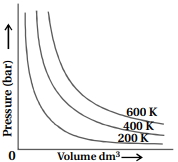
The variation of pressure with volume of a gas at different temperatures can be graphically represented as shown in the figure. On the basis of this graph,answer the following questions:
$(i)$ How will the volume of a gas change if its pressure is increased at constant temperature?
$(ii)$ At a constant pressure,how will the volume of a gas change if the temperature is increased from $200 \ K$ to $400 \ K$?
$(i)$ How will the volume of a gas change if its pressure is increased at constant temperature?
$(ii)$ At a constant pressure,how will the volume of a gas change if the temperature is increased from $200 \ K$ to $400 \ K$?
Solution
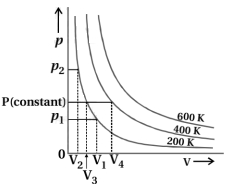
(N/A) $(i)$ According to Boyle's law,the pressure of a gas is inversely proportional to its volume if the temperature is kept constant. Thus,the volume of the gas decreases if the pressure on the gas increases while keeping the temperature constant. For example,at $200 \ K$,when pressure is increased from $p_{1}$ to $p_{2}$,the volume of the gas decreases,i.e.,$V_{2} < V_{1}$.
$(ii)$ According to Charles's law,the volume of a gas is directly proportional to its temperature if the pressure is kept constant. Thus,on increasing the temperature,the volume of a gas will increase if the pressure is kept constant. At constant $p$,when we increase the temperature from $200 \ K$ to $400 \ K$,the volume of the gas increases,i.e.,$V_{4} > V_{3}$.
$(ii)$ According to Charles's law,the volume of a gas is directly proportional to its temperature if the pressure is kept constant. Thus,on increasing the temperature,the volume of a gas will increase if the pressure is kept constant. At constant $p$,when we increase the temperature from $200 \ K$ to $400 \ K$,the volume of the gas increases,i.e.,$V_{4} > V_{3}$.
0 likes
View Solution90
Medium
Why does a sharp glass edge become smooth on heating it up to its melting point in a flame? Explain which property of liquids is responsible for this phenomenon.
Solution
(N/A) Sharp glass edges are heated to make them smooth. On heating,glass melts and the surface of the liquid tends to take a rounded shape at the edges to minimize its surface area. This process is known as fire polishing of glass. This phenomenon is due to the property of surface tension.
0 likes
View Solution91
MediumMCQ
Why is it necessary for chemists to understand the laws that govern the physical states of matter?
A
Chemical properties change with physical states.
B
The rate of chemical reactions depends on the physical state of the reactants.
C
Physical states do not affect experimental calculations.
D
It is not necessary for chemists to understand these laws.
Solution
(B) Chemical properties of a substance remain the same regardless of its physical state.
The rate of a chemical reaction often depends on the physical state of the reactants.
In many experimental calculations,it is essential to know whether a substance is in a solid,liquid,or gaseous state.
Therefore,it is necessary for chemists to understand the physical laws that govern the behavior of matter in different states.
The rate of a chemical reaction often depends on the physical state of the reactants.
In many experimental calculations,it is essential to know whether a substance is in a solid,liquid,or gaseous state.
Therefore,it is necessary for chemists to understand the physical laws that govern the behavior of matter in different states.
0 likes
View Solution92
MediumMCQ
The three states of matter are the result of what?
A
Intermolecular forces
B
Thermal energy
C
Balance between intermolecular forces and thermal energy
D
None of the above
Solution
(C) Intermolecular forces tend to keep the molecules together,whereas thermal energy tends to keep them apart. The three states of matter are the result of the balance between intermolecular forces and the thermal energy of the molecules.
0 likes
View Solution93
EasyMCQ
What is the relationship between viscosity and density?
A
Viscosity $\propto$ Density
B
Viscosity $\propto$ $\frac{1}{\text{Density}}$
C
Viscosity $\propto$ $\text{Density}^2$
D
Viscosity is independent of density
Solution
(A) Viscosity is a measure of a fluid's resistance to flow. Generally,for liquids,as the density increases,the intermolecular forces of attraction also increase,which leads to higher viscosity. Therefore,the relationship is expressed as: $\text{Viscosity} \propto \text{Density}$.
0 likes
View Solution94
EasyMCQ
What happens when oil is added to water? Why?
A
Oil dissolves in water.
B
Oil forms a layer on the surface of water.
C
Oil sinks to the bottom.
D
Oil reacts with water.
Solution
(B) When oil is added to water,it spreads and forms a layer on the surface of the water.
This happens because the surface tension of water is higher than that of oil.
This happens because the surface tension of water is higher than that of oil.
0 likes
View Solution95
EasyMCQ
Explain the fire polishing of glass.
A
Heating glass to make it liquid.
B
Smoothing sharp edges of glass by heating.
C
Cleaning glass with fire.
D
Removing impurities from glass.
Solution
(B) When glass is heated,it softens and becomes viscous. Due to surface tension,the sharp edges of the glass tend to minimize their surface area by becoming rounded. This process of heating glass to obtain smooth,rounded edges is known as fire polishing of glass.
0 likes
View Solution96
EasyMCQ
Which of the following has higher surface tension: pure water or soapy water?
A
Pure water
B
Soapy water
C
Both have equal surface tension
D
Cannot be determined
Solution
(A) Surface tension is a property of liquids that decreases when surface-active agents (surfactants) like soap are added.
Soap molecules reduce the cohesive forces between water molecules.
Therefore,pure water has a higher surface tension compared to soapy water.
Soap molecules reduce the cohesive forces between water molecules.
Therefore,pure water has a higher surface tension compared to soapy water.
0 likes
View Solution97
Medium
Fill in the blanks:
$(1)$ Each line of the graph of pressure versus temperature (in Kelvin) at a specific molar volume is called ........... .
$(2)$ $A$ gas that strictly follows Boyle's,Charles's,and Avogadro's laws is called ........... .
$(3)$ The ratio of the most probable speed to the average speed is ........... .
$(4)$ The ratio of $U_{rms}$ to $U_{mp}$ is ........... .
$(1)$ Each line of the graph of pressure versus temperature (in Kelvin) at a specific molar volume is called ........... .
$(2)$ $A$ gas that strictly follows Boyle's,Charles's,and Avogadro's laws is called ........... .
$(3)$ The ratio of the most probable speed to the average speed is ........... .
$(4)$ The ratio of $U_{rms}$ to $U_{mp}$ is ........... .
Solution
(N/A) $(1)$ The graph of pressure versus temperature at constant volume is called an isochore.
$(2)$ $A$ gas that obeys Boyle's law,Charles's law,and Avogadro's law under all conditions of temperature and pressure is called an ideal gas.
$(3)$ The most probable speed $(U_{mp})$ is $\sqrt{2RT/M}$ and the average speed $(U_{av})$ is $\sqrt{8RT/\pi M}$. The ratio $U_{mp} : U_{av} = \sqrt{2} : \sqrt{8/\pi} = 1 : 1.128$.
$(4)$ The root mean square speed $(U_{rms})$ is $\sqrt{3RT/M}$ and the most probable speed $(U_{mp})$ is $\sqrt{2RT/M}$. The ratio $U_{rms} : U_{mp} = \sqrt{3} : \sqrt{2} = 1.224 : 1$.
$(2)$ $A$ gas that obeys Boyle's law,Charles's law,and Avogadro's law under all conditions of temperature and pressure is called an ideal gas.
$(3)$ The most probable speed $(U_{mp})$ is $\sqrt{2RT/M}$ and the average speed $(U_{av})$ is $\sqrt{8RT/\pi M}$. The ratio $U_{mp} : U_{av} = \sqrt{2} : \sqrt{8/\pi} = 1 : 1.128$.
$(4)$ The root mean square speed $(U_{rms})$ is $\sqrt{3RT/M}$ and the most probable speed $(U_{mp})$ is $\sqrt{2RT/M}$. The ratio $U_{rms} : U_{mp} = \sqrt{3} : \sqrt{2} = 1.224 : 1$.
0 likes
View Solution98
Medium
Fill in the blanks:
$(1)$ Gases like $CO_2$ and $CH_4$ show ............ deviation from ideal gas behavior.
$(2)$ The temperature at which a real gas obeys ideal gas laws over an appreciable range of pressure is called ............ .
$(3)$ The maximum temperature below which a gas can be liquefied is called ............ .
$(4)$ The unit of coefficient of viscosity in the $CGS$ system is ............ .
$(1)$ Gases like $CO_2$ and $CH_4$ show ............ deviation from ideal gas behavior.
$(2)$ The temperature at which a real gas obeys ideal gas laws over an appreciable range of pressure is called ............ .
$(3)$ The maximum temperature below which a gas can be liquefied is called ............ .
$(4)$ The unit of coefficient of viscosity in the $CGS$ system is ............ .
Solution
(N/A) $(1)$ Negative
$(2)$ Boyle temperature or Boyle point
$(3)$ Critical temperature
$(4)$ Poise
$(2)$ Boyle temperature or Boyle point
$(3)$ Critical temperature
$(4)$ Poise
0 likes
View Solution99
DifficultMCQ
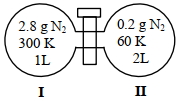
Two flasks $I$ and $II$ shown below are connected by a valve of negligible volume. When the valve is opened,the final pressure of the system in bar is $x \times 10^{-2}$. The value of $x$ is $.....$ . (Integer answer) [Assume-Ideal gas; $1 \, bar = 10^{5} \, Pa$; Molar mass of $N_{2} = 28.0 \, g \, mol^{-1}$; $R = 8.31 \, J \, mol^{-1} \, K^{-1}$]
A
$84$
B
$840$
C
$8.4$
D
$71$
Solution
(A) Initial moles in flask $I$: $n_I = \frac{2.8 \, g}{28 \, g \, mol^{-1}} = 0.1 \, mol$. Initial moles in flask $II$: $n_{II} = \frac{0.2 \, g}{28 \, g \, mol^{-1}} = \frac{1}{140} \, mol \approx 0.00714 \, mol$.
Total moles $n_{total} = 0.1 + \frac{1}{140} = \frac{15}{140} = \frac{3}{28} \, mol$.
Since the flasks are connected and the system reaches thermal equilibrium,the final temperature $T$ is determined by the heat balance: $n_I C_v (T - 300) + n_{II} C_v (T - 60) = 0$.
$0.1(T - 300) + \frac{1}{140}(T - 60) = 0$.
$14(T - 300) + (T - 60) = 0$ $\Rightarrow 15T = 4260$ $\Rightarrow T = 284 \, K$.
Using $PV = nRT$ for the total system: $P(V_I + V_{II}) = n_{total} RT$.
$P(1 \, L + 2 \, L) = (\frac{3}{28} \, mol) \times (0.0831 \, L \, bar \, K^{-1} \, mol^{-1}) \times 284 \, K$.
$3P = \frac{3 \times 0.0831 \times 284}{28} \approx 2.528 \, bar \cdot L$.
$P = 0.8427 \, bar = 84.27 \times 10^{-2} \, bar$.
Rounding to the nearest integer,$x = 84$.
Total moles $n_{total} = 0.1 + \frac{1}{140} = \frac{15}{140} = \frac{3}{28} \, mol$.
Since the flasks are connected and the system reaches thermal equilibrium,the final temperature $T$ is determined by the heat balance: $n_I C_v (T - 300) + n_{II} C_v (T - 60) = 0$.
$0.1(T - 300) + \frac{1}{140}(T - 60) = 0$.
$14(T - 300) + (T - 60) = 0$ $\Rightarrow 15T = 4260$ $\Rightarrow T = 284 \, K$.
Using $PV = nRT$ for the total system: $P(V_I + V_{II}) = n_{total} RT$.
$P(1 \, L + 2 \, L) = (\frac{3}{28} \, mol) \times (0.0831 \, L \, bar \, K^{-1} \, mol^{-1}) \times 284 \, K$.
$3P = \frac{3 \times 0.0831 \times 284}{28} \approx 2.528 \, bar \cdot L$.
$P = 0.8427 \, bar = 84.27 \times 10^{-2} \, bar$.
Rounding to the nearest integer,$x = 84$.
0 likes
View Solution100
EasyMCQ
An empty $LPG$ cylinder weighs $14.8 \ kg$. When full,it weighs $29.0 \ kg$ and shows a pressure of $3.47 \ atm$. In the course of use at ambient temperature,the mass of the cylinder is reduced to $23.0 \ kg$. The final pressure inside of the cylinder is $....... \ atm$. (Nearest integer)
(Assume $LPG$ to be an ideal gas)
(Assume $LPG$ to be an ideal gas)
A
$8$
B
$4$
C
$2$
D
$3$
Solution
(C) Initial mass of gas $= 29.0 - 14.8 = 14.2 \ kg$
Mass of gas remaining $= 23.0 - 14.8 = 8.2 \ kg$
Using the ideal gas law $PV = nRT$,where $n = \frac{m}{M}$:
$P_1 V = \left( \frac{m_1}{M} \right) RT$
$P_2 V = \left( \frac{m_2}{M} \right) RT$
Since $V$,$R$,and $T$ are constant,$\frac{P_1}{P_2} = \frac{m_1}{m_2}$
$\frac{3.47}{P_2} = \frac{14.2}{8.2}$
$P_2 = \frac{3.47 \times 8.2}{14.2} \approx 2.003 \ atm$
The nearest integer is $2$.
Mass of gas remaining $= 23.0 - 14.8 = 8.2 \ kg$
Using the ideal gas law $PV = nRT$,where $n = \frac{m}{M}$:
$P_1 V = \left( \frac{m_1}{M} \right) RT$
$P_2 V = \left( \frac{m_2}{M} \right) RT$
Since $V$,$R$,and $T$ are constant,$\frac{P_1}{P_2} = \frac{m_1}{m_2}$
$\frac{3.47}{P_2} = \frac{14.2}{8.2}$
$P_2 = \frac{3.47 \times 8.2}{14.2} \approx 2.003 \ atm$
The nearest integer is $2$.
0 likes
View SolutionStates of Matter — Mix Examples- States of Matter · Frequently Asked Questions
1Are these States of Matter questions useful for JEE and NEET?
Yes. All questions in this section are mapped to JEE Main and NEET exam patterns. Previous year questions from JEE Main, NEET, GUJCET and state-level exams are included with full solutions.
2Can I switch to Hindi or Gujarati for these questions?
Yes. Use the language tabs in the hero section or the sidebar to view the same questions and solutions in English, Hindi or Gujarati.
3How do I generate a question paper from this subtopic?
Use the Vedclass Exam Paper Generator — select the chapter and subtopic, set difficulty, and generate Sets A, B, C, D automatically. First 3 chapters of every subject are free.
Vedclass Products
For Students
Vedclass Test Series
Mock tests in real JEE/NEET style with performance analysis. 5-day free trial.
Start Free TrialFor Teachers
Exam Paper Generator
Generate Set A/B/C/D papers from this chapter in 2 minutes. 3 chapters free.
Try FreeFor Institutes
Online Exam Module
Live online exams with unlimited students, 360° analytics & white-label branding.
See DemoFor Teachers & Institutes
Generate a States of Matter Exam Paper in 2 Minutes
Select subtopic & difficulty — Sets A, B, C, D auto-generated with No Repeat logic.
First 3 chapters of every subject are free — no payment required.