
A English
Mix Examples- States of Matter Questions in English
Class 11 Chemistry · States of Matter · Mix Examples- States of Matter
154+
Questions
English
Language
100%
With Solutions
Showing 49 of 154 questions in English
1
MediumMCQ
Which of the following statements is correct?
A
In all the three states,the molecules possess random translational motion.
B
Gases cannot be converted into solids without passing through the liquid state.
C
One of the common properties of liquids and gases is viscosity.
D
According to Boyle's law,$V/P$ is constant at constant $T$.
Solution
(C) Option $(C)$ is correct because both liquids and gases are fluids,meaning they can flow and exhibit the property of viscosity.
Option $(A)$ is incorrect because molecules in solids do not possess random translational motion; they only vibrate about fixed positions.
Option $(B)$ is incorrect because gases can undergo deposition to form solids directly.
Option $(D)$ is incorrect because Boyle's law states that $PV = \text{constant}$,not $V/P = \text{constant}$.
Option $(A)$ is incorrect because molecules in solids do not possess random translational motion; they only vibrate about fixed positions.
Option $(B)$ is incorrect because gases can undergo deposition to form solids directly.
Option $(D)$ is incorrect because Boyle's law states that $PV = \text{constant}$,not $V/P = \text{constant}$.
0 likes
View Solution2
EasyMCQ
Densities of two gases are in the ratio $1:2$ and their temperatures are in the ratio $2:1$,then the ratio of their respective pressures is
A
$1:1$
B
$1:2$
C
$2:1$
D
$4:1$
Solution
(A) From the ideal gas equation,$PV = nRT$,where $n = \frac{m}{M}$ and $d = \frac{m}{V}$,we get $P = \frac{dRT}{M}$.
Assuming the molar masses $(M)$ of the two gases are the same or comparing the pressure-density-temperature relationship for a given gas,the ratio is given by $\frac{P_1}{P_2} = \frac{d_1 T_1}{d_2 T_2}$.
Given $\frac{d_1}{d_2} = \frac{1}{2}$ and $\frac{T_1}{T_2} = \frac{2}{1}$.
Substituting these values: $\frac{P_1}{P_2} = \frac{1}{2} \times \frac{2}{1} = \frac{1}{1}$.
Thus,the ratio of their pressures is $1:1$.
Assuming the molar masses $(M)$ of the two gases are the same or comparing the pressure-density-temperature relationship for a given gas,the ratio is given by $\frac{P_1}{P_2} = \frac{d_1 T_1}{d_2 T_2}$.
Given $\frac{d_1}{d_2} = \frac{1}{2}$ and $\frac{T_1}{T_2} = \frac{2}{1}$.
Substituting these values: $\frac{P_1}{P_2} = \frac{1}{2} \times \frac{2}{1} = \frac{1}{1}$.
Thus,the ratio of their pressures is $1:1$.
0 likes
View Solution3
MediumMCQ
In a closed flask of $5 \ L$,$1.0 \ g$ of $H_2$ is heated from $300 \ K$ to $600 \ K$. Which statement is not correct?
A
Pressure of the gas increases
B
The rate of collision increases
C
The number of moles of gas increases
D
The energy of gaseous molecules increases
Solution
(C) In a closed flask,the volume $(V)$ and the mass of the gas remain constant.
According to Gay-Lussac's Law,at constant volume,$P \propto T$.
Since the temperature increases from $300 \ K$ to $600 \ K$,the pressure $(P)$ must increase.
As temperature increases,the average kinetic energy of the gas molecules increases,which leads to an increase in the frequency and rate of collisions.
Since the flask is closed,no gas is added or removed,so the number of moles $(n)$ remains constant.
Therefore,the statement that the number of moles of gas increases is incorrect.
According to Gay-Lussac's Law,at constant volume,$P \propto T$.
Since the temperature increases from $300 \ K$ to $600 \ K$,the pressure $(P)$ must increase.
As temperature increases,the average kinetic energy of the gas molecules increases,which leads to an increase in the frequency and rate of collisions.
Since the flask is closed,no gas is added or removed,so the number of moles $(n)$ remains constant.
Therefore,the statement that the number of moles of gas increases is incorrect.
0 likes
View Solution4
EasyMCQ
Which one of the following statements is false?
A
Avogadro number $ = 6.02 \times 10^{21}$
B
The relationship between average velocity $(\bar{v})$ and root mean square velocity $(u)$ is $\bar{v} = 0.9213 \ u$
C
The mean kinetic energy of an ideal gas is independent of the pressure of the gas
D
The root mean square velocity of the gas can be calculated by the formula $(3RT/M)^{1/2}$
Solution
(A) The Avogadro number is defined as $6.022 \times 10^{23} \ mol^{-1}$.
Option $(A)$ states the value as $6.02 \times 10^{21}$,which is incorrect.
Option $(B)$ correctly relates average velocity $(\bar{v})$ and root mean square velocity $(u)$ as $\bar{v} = \sqrt{8RT/\pi M}$ and $u = \sqrt{3RT/M}$,leading to $\bar{v} = 0.9213 \ u$.
Option $(C)$ is correct because the mean kinetic energy of an ideal gas depends only on temperature $(KE = 3/2 RT)$.
Option $(D)$ is the correct formula for root mean square velocity.
Option $(A)$ states the value as $6.02 \times 10^{21}$,which is incorrect.
Option $(B)$ correctly relates average velocity $(\bar{v})$ and root mean square velocity $(u)$ as $\bar{v} = \sqrt{8RT/\pi M}$ and $u = \sqrt{3RT/M}$,leading to $\bar{v} = 0.9213 \ u$.
Option $(C)$ is correct because the mean kinetic energy of an ideal gas depends only on temperature $(KE = 3/2 RT)$.
Option $(D)$ is the correct formula for root mean square velocity.
0 likes
View Solution5
MediumMCQ
Equal amounts of two gases of molecular weight $4$ and $40$ are mixed. The pressure of the mixture is $1.1 \, atm$. The partial pressure of the light gas in this mixture is ........... $atm$.
A
$0.55$
B
$0.11$
C
$1$
D
$0.12$
Solution
(C) Let the mass of each gas be $m \, g$.
Number of moles of lighter gas $(n_1)$ $= \frac{m}{4}$.
Number of moles of heavier gas $(n_2)$ $= \frac{m}{40}$.
Total number of moles $(n_{total})$ $= \frac{m}{4} + \frac{m}{40} = \frac{10m + m}{40} = \frac{11m}{40}$.
Mole fraction of lighter gas $(x_1)$ $= \frac{n_1}{n_{total}} = \frac{m/4}{11m/40} = \frac{10}{11}$.
Partial pressure of lighter gas $= x_1 \times P_{total} = \frac{10}{11} \times 1.1 \, atm = 1 \, atm$.
Number of moles of lighter gas $(n_1)$ $= \frac{m}{4}$.
Number of moles of heavier gas $(n_2)$ $= \frac{m}{40}$.
Total number of moles $(n_{total})$ $= \frac{m}{4} + \frac{m}{40} = \frac{10m + m}{40} = \frac{11m}{40}$.
Mole fraction of lighter gas $(x_1)$ $= \frac{n_1}{n_{total}} = \frac{m/4}{11m/40} = \frac{10}{11}$.
Partial pressure of lighter gas $= x_1 \times P_{total} = \frac{10}{11} \times 1.1 \, atm = 1 \, atm$.
0 likes
View Solution6
MediumMCQ
$A$ gas $A$ diffuses at a rate which is twice that of another gas $B$. The ratio of molecular weights of $A$ to $B$ is
A
$1$
B
$0.75$
C
$0.5$
D
$0.25$
Solution
(D) According to Graham's law of diffusion,the rate of diffusion $r$ is inversely proportional to the square root of the molecular weight $M$: $r \propto \frac{1}{\sqrt{M}}$.
Therefore,$\frac{r_A}{r_B} = \sqrt{\frac{M_B}{M_A}}$.
Given that $r_A = 2r_B$,we have $\frac{r_A}{r_B} = 2$.
Substituting this into the equation: $2 = \sqrt{\frac{M_B}{M_A}}$.
Squaring both sides: $4 = \frac{M_B}{M_A}$.
Thus,the ratio of molecular weights of $A$ to $B$ is $\frac{M_A}{M_B} = \frac{1}{4} = 0.25$.
Therefore,$\frac{r_A}{r_B} = \sqrt{\frac{M_B}{M_A}}$.
Given that $r_A = 2r_B$,we have $\frac{r_A}{r_B} = 2$.
Substituting this into the equation: $2 = \sqrt{\frac{M_B}{M_A}}$.
Squaring both sides: $4 = \frac{M_B}{M_A}$.
Thus,the ratio of molecular weights of $A$ to $B$ is $\frac{M_A}{M_B} = \frac{1}{4} = 0.25$.
0 likes
View Solution7
MediumMCQ
Which of the following gas mixtures is not applicable for Dalton's law of partial pressure?
A
$SO_2$ and $Cl_2$
B
$CO_2$ and $N_2$
C
$CO$ and $CO_2$
D
$CO$ and $N_2$
Solution
(A) Dalton's law of partial pressure is applicable only to a mixture of non-reacting gases.
$A$. The mixture of $SO_2$ and $Cl_2$ reacts chemically to form sulfuryl chloride $(SO_2Cl_2)$: $SO_2(g) + Cl_2(g) \rightarrow SO_2Cl_2(g)$.
Since these gases react with each other,they do not follow Dalton's law of partial pressure.
$A$. The mixture of $SO_2$ and $Cl_2$ reacts chemically to form sulfuryl chloride $(SO_2Cl_2)$: $SO_2(g) + Cl_2(g) \rightarrow SO_2Cl_2(g)$.
Since these gases react with each other,they do not follow Dalton's law of partial pressure.
0 likes
View Solution8
EasyMCQ
At $STP$,$0.50 \ mol$ $H_2$ gas and $1.0 \ mol$ $He$ gas:
A
Have equal average kinetic energies
B
Have equal molecular speeds
C
Occupy equal volumes
D
Have equal effusion rates
Solution
(A) The average kinetic energy of a gas molecule is given by the formula $KE_{avg} = \frac{3}{2}RT$.
Since the temperature $(T)$ is the same for both gases at $STP$,the average kinetic energy per mole of both gases will be equal.
Therefore,$0.50 \ mol$ of $H_2$ and $1.0 \ mol$ of $He$ will have equal average kinetic energies.
Since the temperature $(T)$ is the same for both gases at $STP$,the average kinetic energy per mole of both gases will be equal.
Therefore,$0.50 \ mol$ of $H_2$ and $1.0 \ mol$ of $He$ will have equal average kinetic energies.
0 likes
View Solution9
MediumMCQ
Indicate the correct statement for a $1 \ L$ sample of $N_{2(g)}$ and $CO_{2(g)}$ at $298 \ K$ and $1 \ atm$ pressure.
A
The average translational $KE$ per molecule is the same in $N_2$ and $CO_2$.
B
The total translational $KE$ of both $N_2$ and $CO_2$ is the same.
C
The density of $N_2$ is less than that of $CO_2$.
D
All of the above.
Solution
(D) The average translational kinetic energy $(KE)$ per molecule is given by $\frac{3}{2}kT$,which depends only on temperature. Since both gases are at $298 \ K$,their average translational $KE$ per molecule is the same.
According to Avogadro's Law,at the same temperature and pressure,equal volumes of gases contain the same number of molecules $(n)$. Since $KE_{total} = n \times (\text{average } KE \text{ per molecule})$,the total translational $KE$ is also the same.
Density $(d)$ is given by $d = \frac{PM}{RT}$. Since $P$,$T$,and $R$ are constant,$d \propto M$. The molar mass of $N_2$ $(28 \ g/mol)$ is less than that of $CO_2$ $(44 \ g/mol)$,so the density of $N_2$ is less than that of $CO_2$.
Therefore,all statements are correct.
According to Avogadro's Law,at the same temperature and pressure,equal volumes of gases contain the same number of molecules $(n)$. Since $KE_{total} = n \times (\text{average } KE \text{ per molecule})$,the total translational $KE$ is also the same.
Density $(d)$ is given by $d = \frac{PM}{RT}$. Since $P$,$T$,and $R$ are constant,$d \propto M$. The molar mass of $N_2$ $(28 \ g/mol)$ is less than that of $CO_2$ $(44 \ g/mol)$,so the density of $N_2$ is less than that of $CO_2$.
Therefore,all statements are correct.
0 likes
View Solution10
MediumMCQ
At ${100\,^o}C$ and $1\ L$,if the density of liquid water is $1.0\ g\ cm^{-3}$ and that of water vapour is $0.0006\ g\ cm^{-3}$,then the volume occupied by water molecules in $1\ L$ of steam at that temperature is .................. $cm^3$.
A
$6$
B
$60$
C
$0.6$
D
$0.06$
Solution
(C) Volume of steam = $1\ L = 10^3\ cm^3$.
Mass of $10^3\ cm^3$ steam = $\text{density} \times \text{Volume} = 0.0006\ g\ cm^{-3} \times 10^3\ cm^3 = 0.6\ g$.
The actual volume occupied by $H_2O$ molecules is equal to the volume of liquid water of the same mass.
Actual volume of $H_2O$ molecules = $\frac{\text{mass of steam}}{\text{density of liquid water}} = \frac{0.6\ g}{1.0\ g\ cm^{-3}} = 0.6\ cm^3$.
Mass of $10^3\ cm^3$ steam = $\text{density} \times \text{Volume} = 0.0006\ g\ cm^{-3} \times 10^3\ cm^3 = 0.6\ g$.
The actual volume occupied by $H_2O$ molecules is equal to the volume of liquid water of the same mass.
Actual volume of $H_2O$ molecules = $\frac{\text{mass of steam}}{\text{density of liquid water}} = \frac{0.6\ g}{1.0\ g\ cm^{-3}} = 0.6\ cm^3$.
0 likes
View Solution11
EasyMCQ
Adiabatic demagnetisation is a technique used for
A
Adiabatic expansion of a gas
B
Production of low temperature
C
Production of high temperature
D
None
Solution
(B) Adiabatic demagnetisation is a technique used to achieve extremely low temperatures,often near absolute zero,by removing the magnetic field from a paramagnetic substance that has been pre-cooled.
0 likes
View Solution12
MediumMCQ
Equal volumes of monoatomic and diatomic gases at same initial temperature and pressure are mixed. The ratio of specific heats of the mixture $({C_p}/{C_v})$ will be
A
$1$
B
$2$
C
$1.67$
D
$1.5$
Solution
(D) For a monoatomic gas,${C_v} = \frac{3}{2}R$ and ${C_p} = \frac{5}{2}R$.
For a diatomic gas,${C_v} = \frac{5}{2}R$ and ${C_p} = \frac{7}{2}R$.
Since the gases are at the same temperature and pressure,equal volumes contain an equal number of moles $(n_1 = n_2 = 1)$.
The molar heat capacity at constant volume for the mixture is ${C_{v,mix}} = \frac{n_1{C_{v,1}} + n_2{C_{v,2}}}{n_1 + n_2} = \frac{\frac{3}{2}R + \frac{5}{2}R}{2} = 2R$.
The molar heat capacity at constant pressure for the mixture is ${C_{p,mix}} = \frac{n_1{C_{p,1}} + n_2{C_{p,2}}}{n_1 + n_2} = \frac{\frac{5}{2}R + \frac{7}{2}R}{2} = 3R$.
Therefore,the ratio of specific heats is $\gamma = \frac{{C_{p,mix}}}{{C_{v,mix}}} = \frac{3R}{2R} = 1.5$.
For a diatomic gas,${C_v} = \frac{5}{2}R$ and ${C_p} = \frac{7}{2}R$.
Since the gases are at the same temperature and pressure,equal volumes contain an equal number of moles $(n_1 = n_2 = 1)$.
The molar heat capacity at constant volume for the mixture is ${C_{v,mix}} = \frac{n_1{C_{v,1}} + n_2{C_{v,2}}}{n_1 + n_2} = \frac{\frac{3}{2}R + \frac{5}{2}R}{2} = 2R$.
The molar heat capacity at constant pressure for the mixture is ${C_{p,mix}} = \frac{n_1{C_{p,1}} + n_2{C_{p,2}}}{n_1 + n_2} = \frac{\frac{5}{2}R + \frac{7}{2}R}{2} = 3R$.
Therefore,the ratio of specific heats is $\gamma = \frac{{C_{p,mix}}}{{C_{v,mix}}} = \frac{3R}{2R} = 1.5$.
0 likes
View Solution13
EasyMCQ
Solid $CO_2$ is known as dry ice,because
A
It melts at $0 \ ^\circ C$
B
It evaporates at $40 \ ^\circ C$
C
It evaporates at $-78 \ ^\circ C$ without melting
D
Its boiling point is more than $199 \ ^\circ C$
Solution
(C) . Solid $CO_2$ is known as dry ice because it undergoes sublimation,meaning it evaporates directly from the solid phase to the gas phase at $-78 \ ^\circ C$ at atmospheric pressure without passing through the liquid state.
0 likes
View Solution14
MediumMCQ
The three states of matter are solid,liquid,and gas. Which of the following statements is true about them?
A
Gases and liquids have viscosity as a common property.
B
The molecules in all the three states possess random translational motion.
C
Gases cannot be converted into solids without passing through the liquid phase.
D
Solids and liquids have vapour pressure as a common property.
Solution
(A) is the correct statement.
$1$. Both gases and liquids exhibit fluidity,which is characterized by viscosity.
$2$. Molecules in the solid state are fixed in position and do not possess translational motion; they only exhibit vibrational motion.
$3$. Gases can be converted directly into solids through the process of deposition.
$4$. While liquids have significant vapour pressure,solids generally have negligible vapour pressure at room temperature.
$1$. Both gases and liquids exhibit fluidity,which is characterized by viscosity.
$2$. Molecules in the solid state are fixed in position and do not possess translational motion; they only exhibit vibrational motion.
$3$. Gases can be converted directly into solids through the process of deposition.
$4$. While liquids have significant vapour pressure,solids generally have negligible vapour pressure at room temperature.
0 likes
View Solution15
EasyMCQ
When the temperature is raised,the viscosity of liquid decreases,this is because
A
Decreased volume of the solution
B
Increase in temperature increases the average kinetic energy of molecules,which overcome the attractive force between them
C
Decreased covalent and hydrogen bond forces
D
Increased attraction between molecules
Solution
(B) When the temperature is raised,the viscosity of liquid decreases. This is because an increase in temperature increases the average kinetic energy of the molecules,which allows them to overcome the intermolecular attractive forces that hinder flow.
0 likes
View Solution16
EasyMCQ
At a given temperature,the molar mass of gas $A$ is $4$. If it diffuses $3$ times faster than gas $B$,what is the molar mass of gas $B$?
A
$36$
B
$12$
C
$18$
D
$24$
Solution
(A) According to Graham's Law of diffusion,the rate of diffusion $(r)$ is inversely proportional to the square root of the molar mass $(M)$:
$r \propto \frac{1}{\sqrt{M}}$
Let $r_A$ and $r_B$ be the rates of diffusion of gas $A$ and gas $B$,and $M_A$ and $M_B$ be their respective molar masses.
$\frac{r_A}{r_B} = \sqrt{\frac{M_B}{M_A}}$
Given that $r_A = 3r_B$ and $M_A = 4$:
$\frac{3r_B}{r_B} = \sqrt{\frac{M_B}{4}}$
$3 = \sqrt{\frac{M_B}{4}}$
Squaring both sides:
$9 = \frac{M_B}{4}$
$M_B = 9 \times 4 = 36$
$r \propto \frac{1}{\sqrt{M}}$
Let $r_A$ and $r_B$ be the rates of diffusion of gas $A$ and gas $B$,and $M_A$ and $M_B$ be their respective molar masses.
$\frac{r_A}{r_B} = \sqrt{\frac{M_B}{M_A}}$
Given that $r_A = 3r_B$ and $M_A = 4$:
$\frac{3r_B}{r_B} = \sqrt{\frac{M_B}{4}}$
$3 = \sqrt{\frac{M_B}{4}}$
Squaring both sides:
$9 = \frac{M_B}{4}$
$M_B = 9 \times 4 = 36$
0 likes
View Solution17
MediumMCQ
$A$ box of $1 \, L$ capacity is divided into two equal parts by a thin partition,which are filled with $2 \, g$ of $H_2$ and $16 \, g$ of $CH_4$ respectively. The temperature of each part is $T$. The pressure in each part is $P$. If the partition is removed,the total pressure will be:
A
$P$
B
$2P$
C
$P/2$
D
$P/4$
Solution
(B) $1$. Initial state: Each part has a volume $V = 0.5 \, L$.
$2$. For $H_2$: Moles $n_1 = \frac{2 \, g}{2 \, g/mol} = 1 \, mol$.
$3$. For $CH_4$: Moles $n_2 = \frac{16 \, g}{16 \, g/mol} = 1 \, mol$.
$4$. Using ideal gas law $PV = nRT$,since $n_1 = n_2 = 1 \, mol$ and $V$ and $T$ are the same for both,the pressure in each part is $P = \frac{nRT}{V}$.
$5$. After removing the partition,the total volume becomes $V_{total} = 1 \, L$ and total moles $n_{total} = n_1 + n_2 = 1 + 1 = 2 \, mol$.
$6$. The new total pressure $P_{total} = \frac{n_{total}RT}{V_{total}} = \frac{2RT}{1} = 2 \times \frac{RT}{V_{part}} = 2P$.
$2$. For $H_2$: Moles $n_1 = \frac{2 \, g}{2 \, g/mol} = 1 \, mol$.
$3$. For $CH_4$: Moles $n_2 = \frac{16 \, g}{16 \, g/mol} = 1 \, mol$.
$4$. Using ideal gas law $PV = nRT$,since $n_1 = n_2 = 1 \, mol$ and $V$ and $T$ are the same for both,the pressure in each part is $P = \frac{nRT}{V}$.
$5$. After removing the partition,the total volume becomes $V_{total} = 1 \, L$ and total moles $n_{total} = n_1 + n_2 = 1 + 1 = 2 \, mol$.
$6$. The new total pressure $P_{total} = \frac{n_{total}RT}{V_{total}} = \frac{2RT}{1} = 2 \times \frac{RT}{V_{part}} = 2P$.
0 likes
View Solution18
EasyMCQ
If the molar ratio of $CH_4$ and $O_2$ is $1:2$,then the ratio of the rate of diffusion of $O_2$ and $CH_4$ is respectively:
A
$1:2$
B
$1:1.414$
C
$2:1$
D
$1.414:1$
Solution
(D) According to Graham's Law of Diffusion,the rate of diffusion $(r)$ is inversely proportional to the square root of the molar mass $(M)$: $r \propto \frac{1}{\sqrt{M}}$.
Given the molar ratio $n_{CH_4} : n_{O_2} = 1:2$.
The rate of diffusion is also proportional to the number of moles $(n)$: $r \propto n$.
Therefore,the ratio of rates is $\frac{r_{O_2}}{r_{CH_4}} = \frac{n_{O_2}}{n_{CH_4}} \times \sqrt{\frac{M_{CH_4}}{M_{O_2}}}$.
Substituting the values: $M_{CH_4} = 16 \ g/mol$ and $M_{O_2} = 32 \ g/mol$.
$\frac{r_{O_2}}{r_{CH_4}} = \frac{2}{1} \times \sqrt{\frac{16}{32}} = 2 \times \sqrt{\frac{1}{2}} = 2 \times \frac{1}{1.414} = \frac{1.414}{1}$.
Thus,the ratio is $1.414:1$.
Given the molar ratio $n_{CH_4} : n_{O_2} = 1:2$.
The rate of diffusion is also proportional to the number of moles $(n)$: $r \propto n$.
Therefore,the ratio of rates is $\frac{r_{O_2}}{r_{CH_4}} = \frac{n_{O_2}}{n_{CH_4}} \times \sqrt{\frac{M_{CH_4}}{M_{O_2}}}$.
Substituting the values: $M_{CH_4} = 16 \ g/mol$ and $M_{O_2} = 32 \ g/mol$.
$\frac{r_{O_2}}{r_{CH_4}} = \frac{2}{1} \times \sqrt{\frac{16}{32}} = 2 \times \sqrt{\frac{1}{2}} = 2 \times \frac{1}{1.414} = \frac{1.414}{1}$.
Thus,the ratio is $1.414:1$.
0 likes
View Solution19
EasyMCQ
The correct value of the universal gas constant $R$ is:
A
$R = 0.082 \, L \, atm \, K^{-1} \, mol^{-1}$
B
$R = 8.314 \times 10^7 \, erg \, K^{-1} \, mol^{-1}$
C
$R = 2 \, cal \, K^{-1} \, mol^{-1}$
D
All of the above
Solution
(D) The universal gas constant $R$ has different values depending on the units used:
$1$. In $L \, atm \, K^{-1} \, mol^{-1}$,$R \approx 0.0821$.
$2$. In $CGS$ units $(erg \, K^{-1} \, mol^{-1})$,$R \approx 8.314 \times 10^7$.
$3$. In calories $(cal \, K^{-1} \, mol^{-1})$,$R \approx 1.987 \approx 2$.
Since all provided options represent correct values of $R$ in different unit systems,the correct answer is $D$.
$1$. In $L \, atm \, K^{-1} \, mol^{-1}$,$R \approx 0.0821$.
$2$. In $CGS$ units $(erg \, K^{-1} \, mol^{-1})$,$R \approx 8.314 \times 10^7$.
$3$. In calories $(cal \, K^{-1} \, mol^{-1})$,$R \approx 1.987 \approx 2$.
Since all provided options represent correct values of $R$ in different unit systems,the correct answer is $D$.
0 likes
View Solution20
EasyMCQ
At the same temperature and pressure,the rate of diffusion of helium with respect to methane is ...... .
A
$0.5$
B
$2$
C
$4$
D
$1$
Solution
(B) According to Graham's Law of Diffusion,the rate of diffusion $(r)$ is inversely proportional to the square root of the molar mass $(M)$ of the gas: $r_1 / r_2 = \sqrt{M_2 / M_1}$.
Here,$r_1$ is the rate of helium $(He)$ and $r_2$ is the rate of methane $(CH_4)$.
The molar mass of helium $(M_1)$ is $4 \ g/mol$.
The molar mass of methane $(M_2)$ is $16 \ g/mol$.
Substituting the values: $r_{He} / r_{CH_4} = \sqrt{16 / 4} = \sqrt{4} = 2$.
Therefore,the rate of diffusion of helium is $2$ times that of methane.
Here,$r_1$ is the rate of helium $(He)$ and $r_2$ is the rate of methane $(CH_4)$.
The molar mass of helium $(M_1)$ is $4 \ g/mol$.
The molar mass of methane $(M_2)$ is $16 \ g/mol$.
Substituting the values: $r_{He} / r_{CH_4} = \sqrt{16 / 4} = \sqrt{4} = 2$.
Therefore,the rate of diffusion of helium is $2$ times that of methane.
0 likes
View Solution21
EasyMCQ
$A$ mixture of equal masses of $SO_2$,$CH_4$,and $O_2$ is taken in an empty container at $298 \, K$. If the total pressure is $2.1 \, atm$,the partial pressure of $CH_4$ in the mixture will be .......... $atm$.
A
$0.5$
B
$0.75$
C
$1.2$
D
$0.6$
0 likes
View Solution22
EasyMCQ
If $4 \ g$ of oxygen diffuses through a narrow hole under identical conditions,how many grams of hydrogen will diffuse?
A
$16$
B
$1$
C
$0.25$
D
$64$
Solution
(B) According to Graham's Law of Diffusion,the rate of diffusion $r$ is inversely proportional to the square root of the molar mass $M_w$ for a given amount of gas.
$\frac{r_{O_2}}{r_{H_2}} = \frac{n_{O_2}}{n_{H_2}} = \sqrt{\frac{M_{w(H_2)}}{M_{w(O_2)}}}$
Given: $n_{O_2} = \frac{4 \ g}{32 \ g/mol} = 0.125 \ mol$.
Let $w$ be the mass of $H_2$. Then $n_{H_2} = \frac{w}{2 \ g/mol}$.
Substituting the values: $\frac{0.125}{w/2} = \sqrt{\frac{2}{32}} = \sqrt{\frac{1}{16}} = \frac{1}{4}$.
$\frac{0.25}{w} = \frac{1}{4} \implies w = 1 \ g$.
$\frac{r_{O_2}}{r_{H_2}} = \frac{n_{O_2}}{n_{H_2}} = \sqrt{\frac{M_{w(H_2)}}{M_{w(O_2)}}}$
Given: $n_{O_2} = \frac{4 \ g}{32 \ g/mol} = 0.125 \ mol$.
Let $w$ be the mass of $H_2$. Then $n_{H_2} = \frac{w}{2 \ g/mol}$.
Substituting the values: $\frac{0.125}{w/2} = \sqrt{\frac{2}{32}} = \sqrt{\frac{1}{16}} = \frac{1}{4}$.
$\frac{0.25}{w} = \frac{1}{4} \implies w = 1 \ g$.
0 likes
View Solution23
EasyMCQ
At constant temperature,$200 \ cm^3$ of $N_2$ at $720 \ mm$ pressure and $400 \ cm^3$ of $O_2$ at $750 \ mm$ pressure are taken in a $1 \ L$ flask. What will be the total pressure of the mixture in $mm$?
A
$111$
B
$222$
C
$333$
D
$444$
Solution
(D) Using Boyle's Law,$P_1V_1 = P_2V_2$ at constant temperature.
For $N_2$: $P_{N_2} = (720 \ mm \times 200 \ cm^3) / 1000 \ cm^3 = 144 \ mm$.
For $O_2$: $P_{O_2} = (750 \ mm \times 400 \ cm^3) / 1000 \ cm^3 = 300 \ mm$.
Total pressure $P_{total} = P_{N_2} + P_{O_2} = 144 \ mm + 300 \ mm = 444 \ mm$.
For $N_2$: $P_{N_2} = (720 \ mm \times 200 \ cm^3) / 1000 \ cm^3 = 144 \ mm$.
For $O_2$: $P_{O_2} = (750 \ mm \times 400 \ cm^3) / 1000 \ cm^3 = 300 \ mm$.
Total pressure $P_{total} = P_{N_2} + P_{O_2} = 144 \ mm + 300 \ mm = 444 \ mm$.
0 likes
View Solution24
EasyMCQ
Which of the following statements is incorrect?
A
Avogadro number = $6.02 \times 10^{21}$
B
The relation between average velocity $(\bar{\upsilon})$ and root mean square velocity $(u)$ is $\bar{\upsilon} = 0.9213 \times u$
C
The average kinetic energy of an ideal gas is independent of the pressure of the gas.
D
The root mean square velocity of a gas can be calculated by $\left( \frac{3RT}{M_w} \right)^{\frac{1}{2}}$
Solution
(A) The Avogadro number is defined as $6.022 \times 10^{23} \text{ mol}^{-1}$.
Option $A$ states it as $6.02 \times 10^{21}$,which is incorrect.
Option $B$ is correct as $\bar{\upsilon} = \sqrt{\frac{8RT}{\pi M}}$ and $u = \sqrt{\frac{3RT}{M}}$,so $\frac{\bar{\upsilon}}{u} = \sqrt{\frac{8}{3\pi}} \approx 0.9213$.
Option $C$ is correct because the average kinetic energy of an ideal gas depends only on temperature ($KE = \frac{3}{2}RT$ for $1 \text{ mole}$).
Option $D$ is the standard formula for root mean square velocity.
Option $A$ states it as $6.02 \times 10^{21}$,which is incorrect.
Option $B$ is correct as $\bar{\upsilon} = \sqrt{\frac{8RT}{\pi M}}$ and $u = \sqrt{\frac{3RT}{M}}$,so $\frac{\bar{\upsilon}}{u} = \sqrt{\frac{8}{3\pi}} \approx 0.9213$.
Option $C$ is correct because the average kinetic energy of an ideal gas depends only on temperature ($KE = \frac{3}{2}RT$ for $1 \text{ mole}$).
Option $D$ is the standard formula for root mean square velocity.
0 likes
View Solution25
MediumMCQ
The graph shows the characteristics of one mole of an ideal gas at a pressure of $1 \ atm$ with respect to volume $(V)$ and temperature $(T)$. Identify the correct graph.
A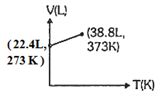
B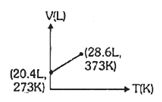
C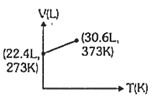
D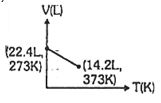
Solution
(C) For one mole of an ideal gas at $P = 1 \ atm$,the ideal gas equation is $PV = nRT$.
Since $n = 1$ and $P = 1 \ atm$,the equation becomes $V = RT$.
Using the gas constant $R = 0.0821 \ L \ atm \ K^{-1} \ mol^{-1}$,we have $V = 0.0821 \times T$.
At $T_1 = 273 \ K$,$V_1 = 0.0821 \times 273 \approx 22.4 \ L$.
At $T_2 = 373 \ K$,$V_2 = 0.0821 \times 373 \approx 30.6 \ L$.
Comparing these values with the given options,option $C$ matches these coordinates.
Since $n = 1$ and $P = 1 \ atm$,the equation becomes $V = RT$.
Using the gas constant $R = 0.0821 \ L \ atm \ K^{-1} \ mol^{-1}$,we have $V = 0.0821 \times T$.
At $T_1 = 273 \ K$,$V_1 = 0.0821 \times 273 \approx 22.4 \ L$.
At $T_2 = 373 \ K$,$V_2 = 0.0821 \times 373 \approx 30.6 \ L$.
Comparing these values with the given options,option $C$ matches these coordinates.
0 likes
View Solution26
EasyMCQ
The rate of diffusion of $H_2$ is .......
A
Half of $He$
B
$1.4$ times that of $He$
C
Twice that of $He$
D
Four times that of $He$
Solution
(B) According to Graham's Law of Diffusion,the rate of diffusion $(r)$ is inversely proportional to the square root of the molar mass $(M)$: $r \propto \frac{1}{\sqrt{M}}$.
For $H_2$,$M_1 = 2 \ g/mol$. For $He$,$M_2 = 4 \ g/mol$.
$\frac{r_{H_2}}{r_{He}} = \sqrt{\frac{M_{He}}{M_{H_2}}} = \sqrt{\frac{4}{2}} = \sqrt{2} \approx 1.414$.
Therefore,the rate of diffusion of $H_2$ is $1.4$ times that of $He$.
For $H_2$,$M_1 = 2 \ g/mol$. For $He$,$M_2 = 4 \ g/mol$.
$\frac{r_{H_2}}{r_{He}} = \sqrt{\frac{M_{He}}{M_{H_2}}} = \sqrt{\frac{4}{2}} = \sqrt{2} \approx 1.414$.
Therefore,the rate of diffusion of $H_2$ is $1.4$ times that of $He$.
0 likes
View Solution27
MediumMCQ
$A$ gas sample of $1.47 \ L$ was collected over water at $30 \ ^\circ C$ and $744 \ mm \ Hg$ pressure. If the weight of the gas is $1.98 \ g$,what is the molar mass of the gas? (Assume the vapor pressure of water at $30 \ ^\circ C$ is $31.8 \ mm \ Hg$)
A
$26.35$
B
$35.76$
C
$56.21$
D
$43.44$
Solution
(B) The pressure of the dry gas is calculated by subtracting the vapor pressure of water from the total pressure: $P_{gas} = P_{total} - P_{H_2O} = 744 \ mm \ Hg - 31.8 \ mm \ Hg = 712.2 \ mm \ Hg$.
Converting pressure to atm: $P = \frac{712.2}{760} \ atm \approx 0.937 \ atm$.
Using the ideal gas equation $PV = \frac{w}{M_w}RT$:
$0.937 \times 1.47 = \frac{1.98}{M_w} \times 0.0821 \times 303$.
$M_w = \frac{1.98 \times 0.0821 \times 303}{0.937 \times 1.47} \approx 35.76 \ g/mol$.
Converting pressure to atm: $P = \frac{712.2}{760} \ atm \approx 0.937 \ atm$.
Using the ideal gas equation $PV = \frac{w}{M_w}RT$:
$0.937 \times 1.47 = \frac{1.98}{M_w} \times 0.0821 \times 303$.
$M_w = \frac{1.98 \times 0.0821 \times 303}{0.937 \times 1.47} \approx 35.76 \ g/mol$.
0 likes
View Solution28
MediumMCQ
Under the same $P$ and $T$,which of the following pairs of gases will diffuse at the same rate through a small jet?
A
$NO, CO$
B
$NO, CO_2$
C
$NH_3, PH_3$
D
$NO, C_2H_6$
Solution
(D) According to Graham's Law of Diffusion,the rate of diffusion $r$ is inversely proportional to the square root of the molar mass $M$ of the gas: $r \propto \frac{1}{\sqrt{M}}$.
For two gases to diffuse at the same rate,they must have the same molar mass.
Calculate the molar masses of the given pairs:
$A: NO = 14 + 16 = 30 \ g/mol$; $CO = 12 + 16 = 28 \ g/mol$ (Not equal)
$B: NO = 30 \ g/mol$; $CO_2 = 12 + 32 = 44 \ g/mol$ (Not equal)
$C: NH_3 = 14 + 3 = 17 \ g/mol$; $PH_3 = 31 + 3 = 34 \ g/mol$ (Not equal)
$D: NO = 30 \ g/mol$; $C_2H_6 = (2 \times 12) + (6 \times 1) = 24 + 6 = 30 \ g/mol$ (Equal)
Since $NO$ and $C_2H_6$ have the same molar mass,they will diffuse at the same rate.
For two gases to diffuse at the same rate,they must have the same molar mass.
Calculate the molar masses of the given pairs:
$A: NO = 14 + 16 = 30 \ g/mol$; $CO = 12 + 16 = 28 \ g/mol$ (Not equal)
$B: NO = 30 \ g/mol$; $CO_2 = 12 + 32 = 44 \ g/mol$ (Not equal)
$C: NH_3 = 14 + 3 = 17 \ g/mol$; $PH_3 = 31 + 3 = 34 \ g/mol$ (Not equal)
$D: NO = 30 \ g/mol$; $C_2H_6 = (2 \times 12) + (6 \times 1) = 24 + 6 = 30 \ g/mol$ (Equal)
Since $NO$ and $C_2H_6$ have the same molar mass,they will diffuse at the same rate.
0 likes
View Solution29
MediumMCQ
At $100\,^\circ\text{C}$ and $1 \, \text{atm}$ pressure,if the density of liquid water is $1.0 \, \text{g cm}^{-3}$ and the density of water vapor is $0.0006 \, \text{g cm}^{-3}$,then the volume occupied by water molecules in $1 \, \text{L}$ of steam is ............. $\text{cm}^3$.
A
$6$
B
$60$
C
$0.6$
D
$0.06$
Solution
(C) The density of liquid water is $\rho_l = 1.0 \, \text{g cm}^{-3}$.
The density of water vapor is $\rho_v = 0.0006 \, \text{g cm}^{-3} = 6 \times 10^{-4} \, \text{g cm}^{-3}$.
In $1 \, \text{L}$ $(1000 \, \text{cm}^3)$ of steam,the mass of water vapor is $m = \rho_v \times V = (6 \times 10^{-4} \, \text{g cm}^{-3}) \times (1000 \, \text{cm}^3) = 0.6 \, \text{g}$.
Since the mass of water remains constant during phase change,this $0.6 \, \text{g}$ of water occupies a volume in the liquid state given by $V_l = \frac{m}{\rho_l} = \frac{0.6 \, \text{g}}{1.0 \, \text{g cm}^{-3}} = 0.6 \, \text{cm}^3$.
The density of water vapor is $\rho_v = 0.0006 \, \text{g cm}^{-3} = 6 \times 10^{-4} \, \text{g cm}^{-3}$.
In $1 \, \text{L}$ $(1000 \, \text{cm}^3)$ of steam,the mass of water vapor is $m = \rho_v \times V = (6 \times 10^{-4} \, \text{g cm}^{-3}) \times (1000 \, \text{cm}^3) = 0.6 \, \text{g}$.
Since the mass of water remains constant during phase change,this $0.6 \, \text{g}$ of water occupies a volume in the liquid state given by $V_l = \frac{m}{\rho_l} = \frac{0.6 \, \text{g}}{1.0 \, \text{g cm}^{-3}} = 0.6 \, \text{cm}^3$.
0 likes
View Solution30
EasyMCQ
During the evaporation of a liquid,$..........$
A
The temperature of the liquid increases.
B
The temperature of the liquid decreases.
C
The temperature change depends on the nature of the liquid.
D
The temperature of the liquid remains constant.
Solution
(B) During the process of evaporation,the molecules with higher kinetic energy escape from the surface of the liquid.
As a result,the average kinetic energy of the remaining molecules decreases,which leads to a decrease in the temperature of the liquid.
As a result,the average kinetic energy of the remaining molecules decreases,which leads to a decrease in the temperature of the liquid.
0 likes
View Solution31
DifficultMCQ
Two flasks of equal volume are filled with $N_2$ gas and connected by a thin tube of negligible volume. When both flasks are immersed in boiling water,the pressure of the gas inside the system is $0.5 \, atm$. Calculate the pressure of the system when one flask is immersed in ice water and the other is kept in boiling water. (in $, atm$)
A
$0.435$
B
$0.436$
C
$0.433$
D
$0.434$
Solution
(C) Let the volume of each flask be $V$. The total volume of the system is $2V$.
Initially,both flasks are at $T_1 = 100 \, ^\circ C = 373 \, K$. The total moles of gas $n = \frac{P_1 V_{total}}{R T_1} = \frac{0.5 \times 2V}{R \times 373}$.
When one flask is at $T_{ice} = 0 \, ^\circ C = 273 \, K$ and the other is at $T_{boil} = 100 \, ^\circ C = 373 \, K$,the total moles remain constant:
$n = \frac{P_2 V}{R \times 273} + \frac{P_2 V}{R \times 373} = \frac{P_2 V}{R} \left( \frac{1}{273} + \frac{1}{373} \right)$.
Equating the moles: $\frac{0.5 \times 2V}{373} = P_2 V \left( \frac{373 + 273}{273 \times 373} \right)$.
$P_2 = \frac{0.5 \times 2 \times 273}{646} = \frac{273}{646} \approx 0.4226 \, atm$.
However,using the simplified average temperature approach: $T_{avg} = \frac{273 + 373}{2} = 323 \, K$.
Using $\frac{P_1}{T_1} = \frac{P_2}{T_2}$:
$P_2 = \frac{0.5 \times 323}{373} \approx 0.433 \, atm$.
Initially,both flasks are at $T_1 = 100 \, ^\circ C = 373 \, K$. The total moles of gas $n = \frac{P_1 V_{total}}{R T_1} = \frac{0.5 \times 2V}{R \times 373}$.
When one flask is at $T_{ice} = 0 \, ^\circ C = 273 \, K$ and the other is at $T_{boil} = 100 \, ^\circ C = 373 \, K$,the total moles remain constant:
$n = \frac{P_2 V}{R \times 273} + \frac{P_2 V}{R \times 373} = \frac{P_2 V}{R} \left( \frac{1}{273} + \frac{1}{373} \right)$.
Equating the moles: $\frac{0.5 \times 2V}{373} = P_2 V \left( \frac{373 + 273}{273 \times 373} \right)$.
$P_2 = \frac{0.5 \times 2 \times 273}{646} = \frac{273}{646} \approx 0.4226 \, atm$.
However,using the simplified average temperature approach: $T_{avg} = \frac{273 + 373}{2} = 323 \, K$.
Using $\frac{P_1}{T_1} = \frac{P_2}{T_2}$:
$P_2 = \frac{0.5 \times 323}{373} \approx 0.433 \, atm$.
0 likes
View Solution32
DifficultMCQ
$A$ tube of length $1 \, m$ has identical pinholes at both ends. Ammonia gas at $1 \, atm$ pressure is introduced from one end,and $HCl$ gas at $P \, atm$ pressure is introduced from the other end at room temperature. If $NH_4Cl$ is formed at a distance of $60 \, cm$ from the end where $HCl$ was introduced,calculate the value of pressure $P$. (in $, atm$)
A
$2.199$
B
$2.160$
C
$2.198$
D
$2.177$
Solution
(C) According to Graham's law of diffusion for gases at different pressures,the rate of diffusion $r$ is given by $r \propto \frac{P}{\sqrt{M}}$.
Thus,$\frac{r_{HCl}}{r_{NH_3}} = \frac{P_{HCl}}{P_{NH_3}} \sqrt{\frac{M_{NH_3}}{M_{HCl}}}$.
Given that $NH_4Cl$ forms at $60 \, cm$ from the $HCl$ end,the distance traveled by $HCl$ is $60 \, cm$ and by $NH_3$ is $40 \, cm$. Since the rate is proportional to the distance traveled in the same time,$\frac{r_{HCl}}{r_{NH_3}} = \frac{60}{40} = 1.5$.
Substituting the values: $1.5 = \frac{P}{1} \sqrt{\frac{17}{36.5}}$.
$P = 1.5 \times \sqrt{\frac{36.5}{17}} = 1.5 \times \sqrt{2.147} \approx 1.5 \times 1.465 = 2.198 \, atm$.
Thus,$\frac{r_{HCl}}{r_{NH_3}} = \frac{P_{HCl}}{P_{NH_3}} \sqrt{\frac{M_{NH_3}}{M_{HCl}}}$.
Given that $NH_4Cl$ forms at $60 \, cm$ from the $HCl$ end,the distance traveled by $HCl$ is $60 \, cm$ and by $NH_3$ is $40 \, cm$. Since the rate is proportional to the distance traveled in the same time,$\frac{r_{HCl}}{r_{NH_3}} = \frac{60}{40} = 1.5$.
Substituting the values: $1.5 = \frac{P}{1} \sqrt{\frac{17}{36.5}}$.
$P = 1.5 \times \sqrt{\frac{36.5}{17}} = 1.5 \times \sqrt{2.147} \approx 1.5 \times 1.465 = 2.198 \, atm$.
0 likes
View Solution33
DifficultMCQ
$A$ mixture of $He$ and $CH_4$ in a molar ratio of $4:1$ is present in a container at a pressure of $20 \ bar$. Due to a hole in the container,the gas mixture leaks out. What will be the composition of the gas mixture effusing out initially (in $: 1$)?
A
$8$
B
$6$
C
$7$
D
$4$
Solution
(A) According to Graham's Law of Effusion,the rate of effusion $r$ is inversely proportional to the square root of the molar mass $M$: $\frac{r_{He}}{r_{CH_4}} = \sqrt{\frac{M_{CH_4}}{M_{He}}}$.
Substituting the molar masses ($M_{CH_4} = 16 \ g/mol$,$M_{He} = 4 \ g/mol$): $\frac{r_{He}}{r_{CH_4}} = \sqrt{\frac{16}{4}} = \sqrt{4} = 2$.
This means the rate of effusion of $He$ is $2$ times that of $CH_4$.
The composition of the effusing mixture is given by the ratio of the rates of effusion multiplied by their initial molar ratio in the container: $\frac{\text{Rate}_{He}}{\text{Rate}_{CH_4}} = \frac{r_{He}}{r_{CH_4}} \times \frac{n_{He}}{n_{CH_4}} = 2 \times \frac{4}{1} = \frac{8}{1}$.
Thus,the initial composition of the effusing gas mixture is $8:1$.
Substituting the molar masses ($M_{CH_4} = 16 \ g/mol$,$M_{He} = 4 \ g/mol$): $\frac{r_{He}}{r_{CH_4}} = \sqrt{\frac{16}{4}} = \sqrt{4} = 2$.
This means the rate of effusion of $He$ is $2$ times that of $CH_4$.
The composition of the effusing mixture is given by the ratio of the rates of effusion multiplied by their initial molar ratio in the container: $\frac{\text{Rate}_{He}}{\text{Rate}_{CH_4}} = \frac{r_{He}}{r_{CH_4}} \times \frac{n_{He}}{n_{CH_4}} = 2 \times \frac{4}{1} = \frac{8}{1}$.
Thus,the initial composition of the effusing gas mixture is $8:1$.
0 likes
View Solution34
MediumMCQ
At $STP$,what is the actual volume occupied by the molecules of $1 \, \text{mol}$ of water vapor (i.e.,$\text{Avogadro's number} \times \text{volume of one molecule}$)?
A
Less than $1\%$ of $22.4 \, \text{L}$
B
Around $10\%$ of the volume of a $22.4 \, \text{L}$ container
C
Between $10\%$ and $20\%$ of $22.4 \, \text{L}$
D
Between $2\%$ and $5\%$ of $22.4 \, \text{L}$
Solution
(A) The molar mass of water $(H_2O)$ is $18 \, \text{g/mol}$.
Since the density of water is approximately $1 \, \text{g/cm}^3$,the volume of $1 \, \text{mol}$ of liquid water is $18 \, \text{cm}^3$.
At $STP$,the volume of $1 \, \text{mol}$ of an ideal gas is $22.4 \, \text{L} = 22400 \, \text{cm}^3$.
The actual volume occupied by the molecules is the volume of the liquid state.
The percentage of volume occupied by the molecules is calculated as: $\frac{18 \, \text{cm}^3}{22400 \, \text{cm}^3} \times 100 \approx 0.08\%$.
This value is less than $1\%$ of the total volume of $22.4 \, \text{L}$.
Since the density of water is approximately $1 \, \text{g/cm}^3$,the volume of $1 \, \text{mol}$ of liquid water is $18 \, \text{cm}^3$.
At $STP$,the volume of $1 \, \text{mol}$ of an ideal gas is $22.4 \, \text{L} = 22400 \, \text{cm}^3$.
The actual volume occupied by the molecules is the volume of the liquid state.
The percentage of volume occupied by the molecules is calculated as: $\frac{18 \, \text{cm}^3}{22400 \, \text{cm}^3} \times 100 \approx 0.08\%$.
This value is less than $1\%$ of the total volume of $22.4 \, \text{L}$.
0 likes
View Solution35
EasyMCQ
Which of the following graphs is incorrect?
A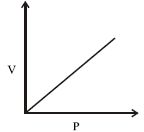
B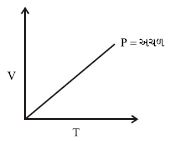
C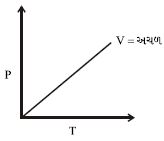
D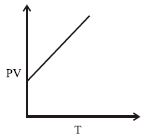
Solution
(A) According to Boyle's Law,at constant temperature,$V \propto \frac{1}{P}$. Therefore,the graph of $V$ versus $P$ should be a rectangular hyperbola,not a straight line passing through the origin. Thus,the graph in option $A$ is incorrect.
0 likes
View Solution36
MediumMCQ
Which of the following graphs represents the behavior of one mole of an ideal gas at $1 \ atm$ pressure for volume $V$ versus temperature $T$?
A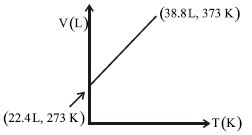
B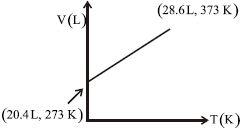
C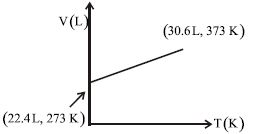
D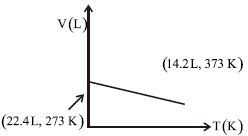
Solution
(C) According to the ideal gas equation,$PV = nRT$. For $n = 1 \ mol$ and $P = 1 \ atm$,the equation becomes $V = \frac{RT}{P} = \frac{0.0821 \ L \ atm \ K^{-1} \ mol^{-1} \times T}{1 \ atm} = 0.0821 \times T$.
At $T_1 = 273 \ K$,$V_1 = 0.0821 \times 273 \approx 22.4 \ L$.
At $T_2 = 373 \ K$,$V_2 = 0.0821 \times 373 \approx 30.6 \ L$.
Thus,the graph must pass through the points $(22.4 \ L, 273 \ K)$ and $(30.6 \ L, 373 \ K)$.
At $T_1 = 273 \ K$,$V_1 = 0.0821 \times 273 \approx 22.4 \ L$.
At $T_2 = 373 \ K$,$V_2 = 0.0821 \times 373 \approx 30.6 \ L$.
Thus,the graph must pass through the points $(22.4 \ L, 273 \ K)$ and $(30.6 \ L, 373 \ K)$.
0 likes
View Solution37
MediumMCQ
If $4 \ g$ of oxygen gas diffuses through a fine hole,how many grams of hydrogen gas will diffuse under the same conditions?
A
$16$
B
$1$
C
$0.25$
D
$64$
Solution
(B) According to Graham's Law of Diffusion,the rate of diffusion $r$ is inversely proportional to the square root of the molar mass $M$ for a given time $t$: $\frac{n_1}{n_2} = \sqrt{\frac{M_2}{M_1}}$,where $n$ is the number of moles.
Since $n = \frac{w}{M}$,the ratio of weights $w$ is given by: $\frac{w_1}{w_2} = \sqrt{\frac{M_1}{M_2}}$.
Here,$w_{O_2} = 4 \ g$,$M_{O_2} = 32 \ g/mol$,and $M_{H_2} = 2 \ g/mol$.
Substituting the values: $\frac{4}{w_{H_2}} = \sqrt{\frac{32}{2}} = \sqrt{16} = 4$.
Therefore,$w_{H_2} = \frac{4}{4} = 1 \ g$.
Since $n = \frac{w}{M}$,the ratio of weights $w$ is given by: $\frac{w_1}{w_2} = \sqrt{\frac{M_1}{M_2}}$.
Here,$w_{O_2} = 4 \ g$,$M_{O_2} = 32 \ g/mol$,and $M_{H_2} = 2 \ g/mol$.
Substituting the values: $\frac{4}{w_{H_2}} = \sqrt{\frac{32}{2}} = \sqrt{16} = 4$.
Therefore,$w_{H_2} = \frac{4}{4} = 1 \ g$.
0 likes
View Solution38
MediumMCQ
At $STP$,$0.48 \, g$ of $O_2$ gas diffuses through a porous membrane in $1200 \, s$. What volume (in $mL$) of $CO_2$ gas will diffuse under the same conditions and in the same time?
A
$286.5$
B
$346.7$
C
$112.2$
D
$224.8$
Solution
(A) According to Graham's Law of Diffusion: $\frac{r_1}{r_2} = \frac{V_1/t}{V_2/t} = \frac{V_1}{V_2} = \sqrt{\frac{M_2}{M_1}}$.
At $STP$,the volume of $0.48 \, g$ of $O_2$ is calculated as: $V_{O_2} = \frac{22400 \, mL}{32 \, g} \times 0.48 \, g = 336 \, mL$.
Using the diffusion ratio: $\frac{V_{O_2}}{V_{CO_2}} = \sqrt{\frac{M_{CO_2}}{M_{O_2}}} = \sqrt{\frac{44}{32}} = \sqrt{1.375} \approx 1.1726$.
Therefore,$V_{CO_2} = \frac{V_{O_2}}{1.1726} = \frac{336}{1.1726} \approx 286.5 \, mL$.
At $STP$,the volume of $0.48 \, g$ of $O_2$ is calculated as: $V_{O_2} = \frac{22400 \, mL}{32 \, g} \times 0.48 \, g = 336 \, mL$.
Using the diffusion ratio: $\frac{V_{O_2}}{V_{CO_2}} = \sqrt{\frac{M_{CO_2}}{M_{O_2}}} = \sqrt{\frac{44}{32}} = \sqrt{1.375} \approx 1.1726$.
Therefore,$V_{CO_2} = \frac{V_{O_2}}{1.1726} = \frac{336}{1.1726} \approx 286.5 \, mL$.
0 likes
View Solution39
DifficultMCQ
The total pressure of a gas and a few drops of water in a container is $830 \, mm$. If the temperature of the container is decreased by $1 \%$,the new pressure is $............ \, mm$. The water vapor pressures at the two temperatures are $30 \, mm$ and $25 \, mm$ respectively.
A
$821.7$
B
$817$
C
$846.7$
D
$767$
Solution
(B) $P_{\text{total}} = P_{\text{dry gas}} + P_{\text{water vapor}}$
At $T_1$,$P_{\text{dry gas}} = 830 - 30 = 800 \, mm$
Using Gay-Lussac's Law for the dry gas: $\frac{P_1}{T_1} = \frac{P_2}{T_2}$
Given $T_2 = T_1 - 0.01 T_1 = 0.99 T_1$
$P_2 = P_1 \times \frac{T_2}{T_1} = 800 \times 0.99 = 792 \, mm$
New total pressure = $P_2 + P_{\text{water vapor at } T_2} = 792 + 25 = 817 \, mm$
At $T_1$,$P_{\text{dry gas}} = 830 - 30 = 800 \, mm$
Using Gay-Lussac's Law for the dry gas: $\frac{P_1}{T_1} = \frac{P_2}{T_2}$
Given $T_2 = T_1 - 0.01 T_1 = 0.99 T_1$
$P_2 = P_1 \times \frac{T_2}{T_1} = 800 \times 0.99 = 792 \, mm$
New total pressure = $P_2 + P_{\text{water vapor at } T_2} = 792 + 25 = 817 \, mm$
0 likes
View Solution40
DifficultMCQ
When $0.0168 \, mol$ of $O_2$ obtained from the decomposition of $KClO_3$ is collected over water at $25 \, ^\circ C$,the volume is $428 \, mL$ and the pressure is $754 \, mm$. What is the water vapor pressure at $25 \, ^\circ C$ in $mm$?
A
$18$
B
$20$
C
$22$
D
$24$
Solution
(D) Using the ideal gas law $PV = nRT$ for dry $O_2$ gas:
$n = 0.0168 \, mol$,$V = 428 \, mL = 0.428 \, L$,$T = 298 \, K$,$R = 0.0821 \, L \cdot atm \cdot K^{-1} \cdot mol^{-1}$.
$P_{dry} = \frac{nRT}{V} = \frac{0.0168 \times 0.0821 \times 298}{0.428} \approx 0.9607 \, atm$.
Convert $P_{dry}$ to $mm \, Hg$: $0.9607 \, atm \times 760 \, mm \, atm^{-1} \approx 730.1 \, mm \, Hg$.
Total pressure $P_{total} = P_{dry} + P_{water \, vapor}$.
$P_{water \, vapor} = P_{total} - P_{dry} = 754 \, mm - 730.1 \, mm \approx 23.9 \, mm \approx 24 \, mm$.
$n = 0.0168 \, mol$,$V = 428 \, mL = 0.428 \, L$,$T = 298 \, K$,$R = 0.0821 \, L \cdot atm \cdot K^{-1} \cdot mol^{-1}$.
$P_{dry} = \frac{nRT}{V} = \frac{0.0168 \times 0.0821 \times 298}{0.428} \approx 0.9607 \, atm$.
Convert $P_{dry}$ to $mm \, Hg$: $0.9607 \, atm \times 760 \, mm \, atm^{-1} \approx 730.1 \, mm \, Hg$.
Total pressure $P_{total} = P_{dry} + P_{water \, vapor}$.
$P_{water \, vapor} = P_{total} - P_{dry} = 754 \, mm - 730.1 \, mm \approx 23.9 \, mm \approx 24 \, mm$.
0 likes
View Solution41
DifficultMCQ
$0.5 \ mol$ each of $H_2, SO_2$ and $CH_4$ are present in a container. If a hole is made in the container,what will be the order of partial pressures of the gases remaining in the container after $3 \ hours$?
A
$P_{SO_2} > P_{CH_4} > P_{H_2}$
B
$P_{H_2} > P_{SO_2} > P_{CH_4}$
C
$P_{CH_4} > P_{SO_2} > P_{H_2}$
D
$P_{H_2} > P_{CH_4} > P_{SO_2}$
Solution
(A) According to Graham's Law of Effusion,the rate of effusion $r \propto \frac{1}{\sqrt{M}}$.
Calculating molar masses: $M(H_2) = 2 \ g/mol$,$M(CH_4) = 16 \ g/mol$,$M(SO_2) = 64 \ g/mol$.
Since the rate of effusion is inversely proportional to the square root of molar mass,the order of effusion rates is $r_{H_2} > r_{CH_4} > r_{SO_2}$.
This means that $H_2$ effuses out the fastest,leaving the least amount behind,while $SO_2$ effuses the slowest,leaving the most amount behind.
Since partial pressure is directly proportional to the number of moles remaining,the order of partial pressures will be $P_{SO_2} > P_{CH_4} > P_{H_2}$.
Calculating molar masses: $M(H_2) = 2 \ g/mol$,$M(CH_4) = 16 \ g/mol$,$M(SO_2) = 64 \ g/mol$.
Since the rate of effusion is inversely proportional to the square root of molar mass,the order of effusion rates is $r_{H_2} > r_{CH_4} > r_{SO_2}$.
This means that $H_2$ effuses out the fastest,leaving the least amount behind,while $SO_2$ effuses the slowest,leaving the most amount behind.
Since partial pressure is directly proportional to the number of moles remaining,the order of partial pressures will be $P_{SO_2} > P_{CH_4} > P_{H_2}$.
0 likes
View Solution42
MediumMCQ
Which of the following volume $(V)$-temperature $(T)$ plots represents the behaviour of one mole of an ideal gas at one atmospheric pressure?
A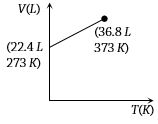
B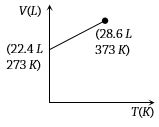
C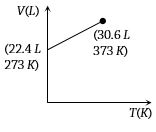
D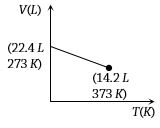
Solution
(C) According to Charles's Law,for a fixed amount of gas at constant pressure,the volume is directly proportional to the absolute temperature: $V \propto T$ or $\frac{V_1}{T_1} = \frac{V_2}{T_2}$.
Given: $V_1 = 22.4 \ L$,$T_1 = 273 \ K$,$T_2 = 373 \ K$.
We need to find $V_2$:
$V_2 = V_1 \times \frac{T_2}{T_1} = 22.4 \ L \times \frac{373 \ K}{273 \ K} \approx 30.6 \ L$.
Thus,the plot showing the point $(30.6 \ L, 373 \ K)$ is correct.
Given: $V_1 = 22.4 \ L$,$T_1 = 273 \ K$,$T_2 = 373 \ K$.
We need to find $V_2$:
$V_2 = V_1 \times \frac{T_2}{T_1} = 22.4 \ L \times \frac{373 \ K}{273 \ K} \approx 30.6 \ L$.
Thus,the plot showing the point $(30.6 \ L, 373 \ K)$ is correct.
0 likes
View Solution43
DifficultMCQ
Equal moles of hydrogen and oxygen gases are placed in a container with a pin-hole through which both can escape. What fraction of the oxygen escapes in the time required for one-half of the hydrogen to escape?
A
$3/8$
B
$1/2$
C
$1/8$
D
$1/4$
Solution
(C) According to Graham's Law of Effusion,the rate of effusion $r$ is inversely proportional to the square root of the molar mass $M$: $r \propto \frac{1}{\sqrt{M}}$.
The number of moles effused $n$ in time $t$ is given by $n = r \times t$.
Therefore,the ratio of moles effused is $\frac{n_{H}}{n_{O}} = \frac{r_{H} \times t}{r_{O} \times t} = \frac{\sqrt{M_{O}}}{\sqrt{M_{H}}}$.
Given $M_{H} = 2 \ g/mol$ and $M_{O} = 32 \ g/mol$.
$\frac{n_{H}}{n_{O}} = \sqrt{\frac{32}{2}} = \sqrt{16} = 4$.
So,$n_{H} = 4 \times n_{O}$.
We are given that $n_{H} = 1/2 \ mole$ (half of the initial $1 \ mole$).
$1/2 = 4 \times n_{O} \implies n_{O} = 1/8 \ mole$.
Since we started with $1 \ mole$ of oxygen,the fraction of oxygen that escapes is $1/8$.
The number of moles effused $n$ in time $t$ is given by $n = r \times t$.
Therefore,the ratio of moles effused is $\frac{n_{H}}{n_{O}} = \frac{r_{H} \times t}{r_{O} \times t} = \frac{\sqrt{M_{O}}}{\sqrt{M_{H}}}$.
Given $M_{H} = 2 \ g/mol$ and $M_{O} = 32 \ g/mol$.
$\frac{n_{H}}{n_{O}} = \sqrt{\frac{32}{2}} = \sqrt{16} = 4$.
So,$n_{H} = 4 \times n_{O}$.
We are given that $n_{H} = 1/2 \ mole$ (half of the initial $1 \ mole$).
$1/2 = 4 \times n_{O} \implies n_{O} = 1/8 \ mole$.
Since we started with $1 \ mole$ of oxygen,the fraction of oxygen that escapes is $1/8$.
0 likes
View Solution44
MediumMCQ
Equal volumes of two monoatomic gases,$A$ and $B$ at same temperature and pressure are mixed. The ratio of specific heats $(C_P/C_V)$ of the mixture will be
A
$0.83$
B
$1.5$
C
$3.3$
D
$1.67$
Solution
(D) For a monoatomic gas,the adiabatic index $\gamma = C_P/C_V = 5/3 \approx 1.67$.
Since both gases $A$ and $B$ are monoatomic and are mixed in equal volumes at the same temperature and pressure,the resulting mixture will also behave as a monoatomic gas.
Therefore,the ratio of specific heats $(C_P/C_V)$ for the mixture remains $1.67$.
Since both gases $A$ and $B$ are monoatomic and are mixed in equal volumes at the same temperature and pressure,the resulting mixture will also behave as a monoatomic gas.
Therefore,the ratio of specific heats $(C_P/C_V)$ for the mixture remains $1.67$.
0 likes
View Solution45
MediumMCQ
Equal masses of three non-reacting different ideal gases $X, Y$ and $Z$ are mixed in a sealed rigid container. If the temperature of the system remains constant at $400 \ K$,which of the following statements about gas $X$ can never be correct?
A
Its partial pressure can be equal to $1/3$ of the total pressure.
B
Average kinetic energy per mole of gas $X$ is highest.
C
It can never be liquefied.
D
Its partial pressure can be calculated with knowledge of the volume of the container and the moles of $X$.
Solution
(B) $1$. The average kinetic energy per mole of an ideal gas is given by the formula $KE_{avg} = \frac{3}{2} RT$.
$2$. Since the temperature $T$ is constant at $400 \ K$ for all gases in the mixture,the average kinetic energy per mole for all gases $(X, Y, Z)$ must be identical $(KE_{avg} = \frac{3}{2} R(400))$.
$3$. Therefore,the statement that the average kinetic energy per mole of gas $X$ is the highest is physically impossible,as it must be equal to the others.
$4$. Option $A$ is possible depending on the molar masses.
$5$. Option $C$ is a property of ideal gases (they cannot be liquefied).
$6$. Option $D$ is correct based on the ideal gas law $P_X = \frac{n_X RT}{V}$.
$2$. Since the temperature $T$ is constant at $400 \ K$ for all gases in the mixture,the average kinetic energy per mole for all gases $(X, Y, Z)$ must be identical $(KE_{avg} = \frac{3}{2} R(400))$.
$3$. Therefore,the statement that the average kinetic energy per mole of gas $X$ is the highest is physically impossible,as it must be equal to the others.
$4$. Option $A$ is possible depending on the molar masses.
$5$. Option $C$ is a property of ideal gases (they cannot be liquefied).
$6$. Option $D$ is correct based on the ideal gas law $P_X = \frac{n_X RT}{V}$.
0 likes
View Solution46
DifficultMCQ
$\frac{1}{24.63}$ mole of an ideal mono-atomic gas undergoes a reversible process for which $PV^3 = C$,where $C$ $(L^2 \cdot atm)$ is a constant. The gas expands from an initial volume of $1 \ L$ and an initial temperature of $300 \ K$ to a final volume of $2 \ L$. The heat lost to the surroundings by the gas is ...... $J$.
A
$15.2$
B
$75.9$
C
$37.9$
D
$22.8$
Solution
(B) Given: $n = \frac{1}{24.63} \ mol$,$PV^3 = C$,$V_1 = 1 \ L$,$T_1 = 300 \ K$,$V_2 = 2 \ L$.
Since $PV = nRT$,$P = \frac{nRT}{V}$. Substituting into $PV^3 = C$,we get $\frac{nRT}{V} \cdot V^3 = C$,so $TV^2 = K'$ (constant).
$T_1 V_1^2 = T_2 V_2^2$ $\Rightarrow 300 \times (1)^2 = T_2 \times (2)^2$ $\Rightarrow T_2 = \frac{300}{4} = 75 \ K$.
Work done $w = -\int_{V_1}^{V_2} P \ dV = -\int_{1}^{2} \frac{C}{V^3} \ dV$. Since $P_1 V_1^3 = C$,$P_1 = \frac{nRT_1}{V_1} = \frac{(1/24.63) \times 0.0821 \times 300}{1} = 1 \ atm$. Thus $C = 1 \times 1^3 = 1 \ L^2 \cdot atm$.
$w = -\int_{1}^{2} V^{-3} \ dV = -[\frac{V^{-2}}{-2}]_1^2 = \frac{1}{2} [\frac{1}{4} - 1] = -0.375 \ L \cdot atm$.
Change in internal energy $\Delta U = nC_v \Delta T = \frac{1}{24.63} \times \frac{3}{2} \times 0.0821 \times (75 - 300) = -1.125 \ L \cdot atm$.
Using $\Delta U = q + w$,we get $-1.125 = q - 0.375 \Rightarrow q = -0.75 \ L \cdot atm$.
Since $1 \ L \cdot atm = 101.3 \ J$,$q = -0.75 \times 101.3 = -75.975 \ J$.
The heat lost is $75.9 \ J$.
Since $PV = nRT$,$P = \frac{nRT}{V}$. Substituting into $PV^3 = C$,we get $\frac{nRT}{V} \cdot V^3 = C$,so $TV^2 = K'$ (constant).
$T_1 V_1^2 = T_2 V_2^2$ $\Rightarrow 300 \times (1)^2 = T_2 \times (2)^2$ $\Rightarrow T_2 = \frac{300}{4} = 75 \ K$.
Work done $w = -\int_{V_1}^{V_2} P \ dV = -\int_{1}^{2} \frac{C}{V^3} \ dV$. Since $P_1 V_1^3 = C$,$P_1 = \frac{nRT_1}{V_1} = \frac{(1/24.63) \times 0.0821 \times 300}{1} = 1 \ atm$. Thus $C = 1 \times 1^3 = 1 \ L^2 \cdot atm$.
$w = -\int_{1}^{2} V^{-3} \ dV = -[\frac{V^{-2}}{-2}]_1^2 = \frac{1}{2} [\frac{1}{4} - 1] = -0.375 \ L \cdot atm$.
Change in internal energy $\Delta U = nC_v \Delta T = \frac{1}{24.63} \times \frac{3}{2} \times 0.0821 \times (75 - 300) = -1.125 \ L \cdot atm$.
Using $\Delta U = q + w$,we get $-1.125 = q - 0.375 \Rightarrow q = -0.75 \ L \cdot atm$.
Since $1 \ L \cdot atm = 101.3 \ J$,$q = -0.75 \times 101.3 = -75.975 \ J$.
The heat lost is $75.9 \ J$.
0 likes
View Solution47
MediumMCQ
For a liquid,the normal boiling point is $-173\,^{\circ}C$. At $2\ atm$ pressure,its boiling point should be nearly ......... $^{\circ}C$. (Given: $\Delta H_{vap} = 200\ cal/mol$,$R = 2\ cal/mol\cdot K$,$\ln 2 = 0.7$)
A
$-73$
B
$333$
C
$60$
D
$103$
Solution
(C) The Clausius-Clapeyron equation is given by: $\ln \frac{P_{2}}{P_{1}} = \frac{\Delta H_{vap}}{R} \left( \frac{1}{T_{1}} - \frac{1}{T_{2}} \right)$
Given: $P_{1} = 1\ atm$,$P_{2} = 2\ atm$,$T_{1} = -173 + 273 = 100\ K$,$\Delta H_{vap} = 200\ cal/mol$,$R = 2\ cal/mol\cdot K$,$\ln 2 = 0.7$.
Substituting the values:
$0.7 = \frac{200}{2} \left( \frac{1}{100} - \frac{1}{T_{2}} \right)$
$0.7 = 100 \left( 0.01 - \frac{1}{T_{2}} \right)$
$0.007 = 0.01 - \frac{1}{T_{2}}$
$\frac{1}{T_{2}} = 0.01 - 0.007 = 0.003$
$T_{2} = \frac{1}{0.003} = 333.33\ K$
Converting to Celsius: $T_{2} = 333.33 - 273 = 60.33\ ^{\circ}C$.
Given: $P_{1} = 1\ atm$,$P_{2} = 2\ atm$,$T_{1} = -173 + 273 = 100\ K$,$\Delta H_{vap} = 200\ cal/mol$,$R = 2\ cal/mol\cdot K$,$\ln 2 = 0.7$.
Substituting the values:
$0.7 = \frac{200}{2} \left( \frac{1}{100} - \frac{1}{T_{2}} \right)$
$0.7 = 100 \left( 0.01 - \frac{1}{T_{2}} \right)$
$0.007 = 0.01 - \frac{1}{T_{2}}$
$\frac{1}{T_{2}} = 0.01 - 0.007 = 0.003$
$T_{2} = \frac{1}{0.003} = 333.33\ K$
Converting to Celsius: $T_{2} = 333.33 - 273 = 60.33\ ^{\circ}C$.
0 likes
View Solution48
MediumMCQ
Select the incorrect statement using the phase diagram of a substance.
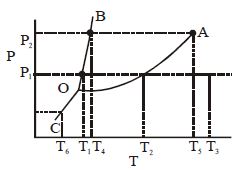
A
At pressure $P_2$,$T_4$ is the melting point.
B
The substance will be in the liquid state if the temperature is $T_4 < T < T_5$ at $P_2$ pressure.
C
At $T_3$ temperature,the vapour pressure of the liquid is $P_1$.
D
The sublimation temperature is always less than the triple point.
Solution
(C) $1$. In the given phase diagram,the line $OB$ represents the solid-liquid equilibrium (melting/freezing curve). At pressure $P_2$,the intersection with the $OB$ line is at temperature $T_4$,which is the melting point. Thus,statement $A$ is correct.
$2$. At pressure $P_2$,the region between the solid-liquid curve $(OB)$ and the liquid-vapour curve $(OA)$ represents the liquid phase. For $T_4 < T < T_5$ at $P_2$,the substance is in the liquid state. Thus,statement $B$ is correct.
$3$. At temperature $T_3$,the pressure $P_1$ lies below the liquid-vapour curve $(OA)$,meaning the substance is in the vapour state,not the liquid state. The vapour pressure of the liquid at $T_3$ would be higher than $P_1$. Thus,statement $C$ is incorrect.
$4$. Sublimation occurs at pressures below the triple point $(O)$. Therefore,the sublimation temperature is always less than the triple point temperature. Thus,statement $D$ is correct.
$5$. The incorrect statement is $C$.
$2$. At pressure $P_2$,the region between the solid-liquid curve $(OB)$ and the liquid-vapour curve $(OA)$ represents the liquid phase. For $T_4 < T < T_5$ at $P_2$,the substance is in the liquid state. Thus,statement $B$ is correct.
$3$. At temperature $T_3$,the pressure $P_1$ lies below the liquid-vapour curve $(OA)$,meaning the substance is in the vapour state,not the liquid state. The vapour pressure of the liquid at $T_3$ would be higher than $P_1$. Thus,statement $C$ is incorrect.
$4$. Sublimation occurs at pressures below the triple point $(O)$. Therefore,the sublimation temperature is always less than the triple point temperature. Thus,statement $D$ is correct.
$5$. The incorrect statement is $C$.
0 likes
View Solution49
MediumMCQ
$A$ $4 : 1$ molar mixture of $He$ and $CH_4$ is kept in a vessel at $20 \ bar$ pressure. Due to a hole in the vessel,the gas mixture leaks out. What is the composition of the mixture effusing out initially?
A
$8 : 1$
B
$4 : 1$
C
$1 : 4$
D
$4 : 3$
Solution
(A) According to Graham's Law of Effusion,the rate of effusion of a gas is directly proportional to its partial pressure and inversely proportional to the square root of its molar mass.
$\frac{r_{He}}{r_{CH_4}} = \frac{p_{He}}{p_{CH_4}} \times \sqrt{\frac{M_{CH_4}}{M_{He}}}$
Given the molar ratio $n_{He} : n_{CH_4} = 4 : 1$,the partial pressures are proportional to the mole fractions,so $\frac{p_{He}}{p_{CH_4}} = \frac{4}{1}$.
The molar masses are $M_{He} = 4 \ g/mol$ and $M_{CH_4} = 16 \ g/mol$.
Substituting these values:
$\frac{r_{He}}{r_{CH_4}} = \frac{4}{1} \times \sqrt{\frac{16}{4}} = 4 \times \sqrt{4} = 4 \times 2 = 8$.
Thus,the ratio of the rates of effusion is $8 : 1$.
$\frac{r_{He}}{r_{CH_4}} = \frac{p_{He}}{p_{CH_4}} \times \sqrt{\frac{M_{CH_4}}{M_{He}}}$
Given the molar ratio $n_{He} : n_{CH_4} = 4 : 1$,the partial pressures are proportional to the mole fractions,so $\frac{p_{He}}{p_{CH_4}} = \frac{4}{1}$.
The molar masses are $M_{He} = 4 \ g/mol$ and $M_{CH_4} = 16 \ g/mol$.
Substituting these values:
$\frac{r_{He}}{r_{CH_4}} = \frac{4}{1} \times \sqrt{\frac{16}{4}} = 4 \times \sqrt{4} = 4 \times 2 = 8$.
Thus,the ratio of the rates of effusion is $8 : 1$.
0 likes
View SolutionStates of Matter — Mix Examples- States of Matter · Frequently Asked Questions
1Are these States of Matter questions useful for JEE and NEET?
Yes. All questions in this section are mapped to JEE Main and NEET exam patterns. Previous year questions from JEE Main, NEET, GUJCET and state-level exams are included with full solutions.
2Can I switch to Hindi or Gujarati for these questions?
Yes. Use the language tabs in the hero section or the sidebar to view the same questions and solutions in English, Hindi or Gujarati.
3How do I generate a question paper from this subtopic?
Use the Vedclass Exam Paper Generator — select the chapter and subtopic, set difficulty, and generate Sets A, B, C, D automatically. First 3 chapters of every subject are free.
Vedclass Products
For Students
Vedclass Test Series
Mock tests in real JEE/NEET style with performance analysis. 5-day free trial.
Start Free TrialFor Teachers
Exam Paper Generator
Generate Set A/B/C/D papers from this chapter in 2 minutes. 3 chapters free.
Try FreeFor Institutes
Online Exam Module
Live online exams with unlimited students, 360° analytics & white-label branding.
See DemoFor Teachers & Institutes
Generate a States of Matter Exam Paper in 2 Minutes
Select subtopic & difficulty — Sets A, B, C, D auto-generated with No Repeat logic.
First 3 chapters of every subject are free — no payment required.