
A English
Ideal gas equation and Related gas laws Questions in English
Class 11 Chemistry · States of Matter · Ideal gas equation and Related gas laws
568+
Questions
English
Language
100%
With Solutions
Showing 50 of 568 questions in English
151
MediumMCQ
$A$ sample of gas has a volume of $95 \, cm^3$ at a pressure of $9.962 \times 10^4 \, N m^{-2}$ and constant temperature. What will be its volume at $10.13 \times 10^4 \, N m^{-2}$ pressure at the same temperature (in $, cm^3$)?
A
$190$
B
$93.4$
C
$46.5$
D
$4.75$
Solution
(B) According to Boyle's Law,at constant temperature,$P_1 V_1 = P_2 V_2$.
Given: $P_1 = 9.962 \times 10^4 \, N m^{-2}$,$V_1 = 95 \, cm^3$,$P_2 = 10.13 \times 10^4 \, N m^{-2}$.
Substituting the values: $V_2 = \frac{P_1 V_1}{P_2} = \frac{9.962 \times 10^4 \times 95}{10.13 \times 10^4}$.
$V_2 = 93.4 \, cm^3$.
Given: $P_1 = 9.962 \times 10^4 \, N m^{-2}$,$V_1 = 95 \, cm^3$,$P_2 = 10.13 \times 10^4 \, N m^{-2}$.
Substituting the values: $V_2 = \frac{P_1 V_1}{P_2} = \frac{9.962 \times 10^4 \times 95}{10.13 \times 10^4}$.
$V_2 = 93.4 \, cm^3$.
0 likes
View Solution152
MediumMCQ
The value of the gas constant $R$ is closest to which of the following values?
A
$0.082 \, L \, atm \, K^{-1} \, mol^{-1}$
B
$0.082 \, L \, atm^{-1} \, mol$
C
$0.082 \, L \, atm \, K$
D
$0.082 \, L \, atm^{-1} \, K \, mol^{-1}$
Solution
(A) The ideal gas equation is $PV = nRT$,which gives $R = \frac{PV}{nT}$.
At $STP$,for $1 \, mol$ of an ideal gas,the pressure $P = 1 \, atm$,volume $V = 22.4 \, L$,and temperature $T = 273.15 \, K$.
Substituting these values: $R = \frac{1 \, atm \times 22.4 \, L}{1 \, mol \times 273.15 \, K} \approx 0.082 \, L \, atm \, K^{-1} \, mol^{-1}$.
At $STP$,for $1 \, mol$ of an ideal gas,the pressure $P = 1 \, atm$,volume $V = 22.4 \, L$,and temperature $T = 273.15 \, K$.
Substituting these values: $R = \frac{1 \, atm \times 22.4 \, L}{1 \, mol \times 273.15 \, K} \approx 0.082 \, L \, atm \, K^{-1} \, mol^{-1}$.
0 likes
View Solution153
MediumMCQ
At a temperature of $27\,^oC$ and a pressure of $1\,atm$,the density of a gas is $d$. At constant pressure,at what temperature will its density become $0.75\,d$?
A
$20\,^oC$
B
$30\,^oC$
C
$400\,K$
D
$300\,K$
Solution
(C) We know the ideal gas equation is $PM = dRT$,where $P$ is pressure,$M$ is molar mass,$d$ is density,$R$ is the gas constant,and $T$ is temperature.
At constant pressure and for a given gas,$d \times T = \text{constant}$.
Therefore,$d_1 T_1 = d_2 T_2$.
Given: $d_1 = d$,$T_1 = 27\,^oC = (273 + 27)\,K = 300\,K$,and $d_2 = 0.75\,d$.
Substituting the values: $d \times 300 = 0.75\,d \times T_2$.
$T_2 = \frac{300}{0.75} = 400\,K$.
At constant pressure and for a given gas,$d \times T = \text{constant}$.
Therefore,$d_1 T_1 = d_2 T_2$.
Given: $d_1 = d$,$T_1 = 27\,^oC = (273 + 27)\,K = 300\,K$,and $d_2 = 0.75\,d$.
Substituting the values: $d \times 300 = 0.75\,d \times T_2$.
$T_2 = \frac{300}{0.75} = 400\,K$.
0 likes
View Solution154
MediumMCQ
The density of methane at $27\,^oC$ and $2.0\,atm$ pressure is ............ $g\,L^{-1}$.
A
$0.13$
B
$0.26$
C
$1.30$
D
$26$
Solution
(C) From the ideal gas equation,we know that $PM = dRT$.
Here,$P = 2.0\,atm$,$M_{CH_4} = 16\,g\,mol^{-1}$,$R = 0.0821\,L\,atm\,K^{-1}mol^{-1}$,and $T = 27 + 273 = 300\,K$.
Substituting these values:
$d = \frac{PM}{RT} = \frac{2.0 \times 16}{0.0821 \times 300} \approx 1.30\,g\,L^{-1}$.
Here,$P = 2.0\,atm$,$M_{CH_4} = 16\,g\,mol^{-1}$,$R = 0.0821\,L\,atm\,K^{-1}mol^{-1}$,and $T = 27 + 273 = 300\,K$.
Substituting these values:
$d = \frac{PM}{RT} = \frac{2.0 \times 16}{0.0821 \times 300} \approx 1.30\,g\,L^{-1}$.
0 likes
View Solution155
MediumMCQ
Select the correct statement for the equation $PV = nRT$.
A
$n$ is the number of molecules of the gas.
B
$V$ is the volume of $n$ moles of gas.
C
$V$ represents the volume of one mole of gas.
D
It is the pressure when only one mole of gas is present.
Solution
(B) From the ideal gas equation $PV = nRT$,it can be concluded that $n$ moles of gas at temperature $T$ and pressure $P$ occupy a volume $V$.
0 likes
View Solution156
EasyMCQ
Assuming ideal gas behavior,what is the number of moles of $0.224 \ L$ of hydrogen gas at $STP$ $(273 \ K, 1 \ atm)$?
A
$1$
B
$0.1$
C
$0.01$
D
$0.001$
Solution
(C) At $STP$,the molar volume of an ideal gas is $22.4 \ L \ mol^{-1}$.
The number of moles $n$ is given by the formula:
$n = \frac{\text{Volume at STP}}{\text{Molar Volume at STP}}$
$n = \frac{0.224 \ L}{22.4 \ L \ mol^{-1}} = 0.01 \ mol$.
The number of moles $n$ is given by the formula:
$n = \frac{\text{Volume at STP}}{\text{Molar Volume at STP}}$
$n = \frac{0.224 \ L}{22.4 \ L \ mol^{-1}} = 0.01 \ mol$.
0 likes
View Solution157
MediumMCQ
At $25 \, ^oC$ and $730 \, mm$ pressure,$380 \, mL$ of dry oxygen gas is collected. If the temperature is kept constant,what will be the volume of oxygen gas at $760 \, mm$ pressure (in $, mL$)?
A
$365$
B
$449$
C
$569$
D
$621$
Solution
(A) Since the temperature is constant,we use Boyle's Law: $P_1V_1 = P_2V_2$.
Given: $P_1 = 730 \, mm$,$V_1 = 380 \, mL$,$P_2 = 760 \, mm$.
Substituting the values: $V_2 = \frac{P_1 \times V_1}{P_2} = \frac{730 \times 380}{760} = 365 \, mL$.
Given: $P_1 = 730 \, mm$,$V_1 = 380 \, mL$,$P_2 = 760 \, mm$.
Substituting the values: $V_2 = \frac{P_1 \times V_1}{P_2} = \frac{730 \times 380}{760} = 365 \, mL$.
0 likes
View Solution158
EasyMCQ
The value of the gas constant $R$ depends on which of the following?
A
Temperature of the gas
B
Volume of the gas
C
Number of moles of the gas
D
None of the above
Solution
(D) The value of the gas constant $R$ depends on the units used for pressure,volume,and temperature.
0 likes
View Solution159
EasyMCQ
The use of hot air balloons for sports and meteorological observations is based on which of the following laws?
A
Boyle's Law
B
Newton's Law
C
Kelvin's Law
D
Charles's Law
Solution
(D) According to Charles's Law,$V \propto T$. When air is heated,it expands and its density decreases,making the hot air lighter.
0 likes
View Solution160
EasyMCQ
The density of air is higher at sea level. Which of the following laws explains this practical observation?
A
Boyle's Law
B
Charles's Law
C
Avogadro's Law
D
Dalton's Law
Solution
(A) According to Boyle's Law,$V \propto \frac{1}{P}$ at constant temperature.
Since the pressure of the atmosphere is higher at sea level,the volume occupied by a given mass of air decreases,leading to a higher density of air.
Since the pressure of the atmosphere is higher at sea level,the volume occupied by a given mass of air decreases,leading to a higher density of air.
0 likes
View Solution161
MediumMCQ
In which of the following conditions will the molar volume of $CO_2$ be maximum?
A
At $NTP$
B
At $0\,^oC$ and $2.0\, atm$ pressure
C
At $127\,^oC$ and $1\, atm$ pressure
D
At $273\,^oC$ and $2.0\, atm$ pressure
Solution
(C) From the ideal gas equation,$PV = nRT$,the molar volume $V_m = \frac{V}{n} = \frac{RT}{P}$.
Thus,$V_m \propto \frac{T}{P}$.
For maximum molar volume,we need the highest temperature $(T)$ and the lowest pressure $(P)$.
Comparing the conditions:
$A$: $T = 273.15\, K, P = 1\, atm \implies \frac{T}{P} = 273.15$
$B$: $T = 273.15\, K, P = 2\, atm \implies \frac{T}{P} = 136.57$
$C$: $T = 127 + 273 = 400\, K, P = 1\, atm \implies \frac{T}{P} = 400$
$D$: $T = 273 + 273 = 546\, K, P = 2\, atm \implies \frac{T}{P} = 273$
Comparing the values,the ratio $\frac{T}{P}$ is maximum for option $C$.
Thus,$V_m \propto \frac{T}{P}$.
For maximum molar volume,we need the highest temperature $(T)$ and the lowest pressure $(P)$.
Comparing the conditions:
$A$: $T = 273.15\, K, P = 1\, atm \implies \frac{T}{P} = 273.15$
$B$: $T = 273.15\, K, P = 2\, atm \implies \frac{T}{P} = 136.57$
$C$: $T = 127 + 273 = 400\, K, P = 1\, atm \implies \frac{T}{P} = 400$
$D$: $T = 273 + 273 = 546\, K, P = 2\, atm \implies \frac{T}{P} = 273$
Comparing the values,the ratio $\frac{T}{P}$ is maximum for option $C$.
0 likes
View Solution162
EasyMCQ
When a graph of the product of pressure and volume $(PV)$ versus pressure $(P)$ is plotted for a fixed amount of gas at a constant temperature,what type of line is obtained?
A
Parallel to the $X$-axis
B
Parallel to the $Y$-axis
C
$A$ line with a positive slope
D
$A$ line with a negative slope
Solution
(A) According to Boyle's Law,for a fixed amount of gas at a constant temperature,the product of pressure $(P)$ and volume $(V)$ is constant $(PV = k)$.
Therefore,a plot of $PV$ versus $P$ results in a straight line parallel to the $P$-axis ($X$-axis).
Therefore,a plot of $PV$ versus $P$ results in a straight line parallel to the $P$-axis ($X$-axis).
0 likes
View Solution163
MediumMCQ
Vessels $A$ and $B$ contain the same gas. If the pressure,volume,and temperature of $A$ are all double those of $B$,then the ratio of the number of molecules in $A$ to $B$ is ..........
A
$1:2$
B
$2:1$
C
$1:4$
D
$4:1$
Solution
(B) Using the ideal gas equation $PV = nRT$,we have $n = \frac{PV}{RT}$.
For vessel $A$: $n_A = \frac{P_A V_A}{R T_A}$.
For vessel $B$: $n_B = \frac{P_B V_B}{R T_B}$.
Given: $P_A = 2P_B$,$V_A = 2V_B$,and $T_A = 2T_B$.
Substituting these values: $\frac{n_A}{n_B} = \frac{(2P_B)(2V_B) / (R \times 2T_B)}{(P_B V_B) / (R T_B)} = \frac{2 P_B V_B / R T_B}{P_B V_B / R T_B} = 2$.
Therefore,the ratio of molecules in $A$ to $B$ is $2:1$.
For vessel $A$: $n_A = \frac{P_A V_A}{R T_A}$.
For vessel $B$: $n_B = \frac{P_B V_B}{R T_B}$.
Given: $P_A = 2P_B$,$V_A = 2V_B$,and $T_A = 2T_B$.
Substituting these values: $\frac{n_A}{n_B} = \frac{(2P_B)(2V_B) / (R \times 2T_B)}{(P_B V_B) / (R T_B)} = \frac{2 P_B V_B / R T_B}{P_B V_B / R T_B} = 2$.
Therefore,the ratio of molecules in $A$ to $B$ is $2:1$.
0 likes
View Solution164
MediumMCQ
If the initial volume of a neon gas is reduced by $15\%$ upon cooling to $75\,^\circ C$,to what temperature in $^\circ C$ should it be heated so that the pressure becomes double?
A
$319$
B
$592$
C
$128$
D
$60$
Solution
(A) Using the ideal gas law equation $\frac{P_1 V_1}{T_1} = \frac{P_2 V_2}{T_2}$.
Given: $P_1 = P$,$P_2 = 2P$,$V_1 = V$,$V_2 = 0.85 V$ (since volume reduced by $15\%$).
Initial temperature $T_1 = 75 + 273.15 = 348.15 \, K$.
Substituting the values: $\frac{P \times V}{348.15} = \frac{2P \times 0.85 V}{T_2}$.
$T_2 = \frac{2 \times 0.85 \times 348.15}{1} = 591.855 \, K$.
Converting back to Celsius: $T_2(^\circ C) = 591.855 - 273.15 = 318.705 \, ^\circ C \approx 319 \, ^\circ C$.
Given: $P_1 = P$,$P_2 = 2P$,$V_1 = V$,$V_2 = 0.85 V$ (since volume reduced by $15\%$).
Initial temperature $T_1 = 75 + 273.15 = 348.15 \, K$.
Substituting the values: $\frac{P \times V}{348.15} = \frac{2P \times 0.85 V}{T_2}$.
$T_2 = \frac{2 \times 0.85 \times 348.15}{1} = 591.855 \, K$.
Converting back to Celsius: $T_2(^\circ C) = 591.855 - 273.15 = 318.705 \, ^\circ C \approx 319 \, ^\circ C$.
0 likes
View Solution165
MediumMCQ
What is the weight of $CH_4$ gas in a $9 \ L$ cylinder at $27 \ ^oC$ temperature and $1 \ atm$ pressure in $g$?
A
$0.92$
B
$5.85$
C
$3.84$
D
$16$
Solution
(B) Using the ideal gas equation $PV = nRT = \frac{m}{M}RT$,where $m$ is the mass and $M$ is the molar mass of $CH_4$ $(16 \ g/mol)$.
Given: $P = 1 \ atm$,$V = 9 \ L$,$T = 27 + 273 = 300 \ K$,$R = 0.0821 \ L \ atm \ K^{-1} mol^{-1}$.
Rearranging for mass $m$: $m = \frac{PVM}{RT}$.
Substituting the values: $m = \frac{1 \times 9 \times 16}{0.0821 \times 300}$.
$m = \frac{144}{24.63} \approx 5.85 \ g$.
Given: $P = 1 \ atm$,$V = 9 \ L$,$T = 27 + 273 = 300 \ K$,$R = 0.0821 \ L \ atm \ K^{-1} mol^{-1}$.
Rearranging for mass $m$: $m = \frac{PVM}{RT}$.
Substituting the values: $m = \frac{1 \times 9 \times 16}{0.0821 \times 300}$.
$m = \frac{144}{24.63} \approx 5.85 \ g$.
0 likes
View Solution166
MediumMCQ
At $300 \, K$ temperature and $1 \, atm$ pressure,the volume of $7.0 \, g$ of a gas is $4.1 \, L$. What is the molar mass of the gas?
A
$42$
B
$38.24$
C
$14.5$
D
$46.5$
Solution
(A) Using the ideal gas equation $PV = \frac{m}{M}RT$,where $M$ is the molar mass.
Given: $P = 1 \, atm$,$V = 4.1 \, L$,$m = 7.0 \, g$,$T = 300 \, K$,and $R = 0.0821 \, L \cdot atm \cdot K^{-1} \cdot mol^{-1}$.
Rearranging for $M$: $M = \frac{mRT}{PV}$.
Substituting the values: $M = \frac{7.0 \times 0.0821 \times 300}{1 \times 4.1}$.
$M = \frac{172.41}{4.1} \approx 42.05 \, g/mol$.
Thus,the molar mass is approximately $42 \, g/mol$.
Given: $P = 1 \, atm$,$V = 4.1 \, L$,$m = 7.0 \, g$,$T = 300 \, K$,and $R = 0.0821 \, L \cdot atm \cdot K^{-1} \cdot mol^{-1}$.
Rearranging for $M$: $M = \frac{mRT}{PV}$.
Substituting the values: $M = \frac{7.0 \times 0.0821 \times 300}{1 \times 4.1}$.
$M = \frac{172.41}{4.1} \approx 42.05 \, g/mol$.
Thus,the molar mass is approximately $42 \, g/mol$.
0 likes
View Solution167
MediumMCQ
At $25 \, ^\circ C$,a $3.7 \, g$ gas occupies the same volume as $0.184 \, g$ of $H_2$ gas at $17 \, ^\circ C$ under the same pressure. What is the molar mass of the gas?
A
$59.1$
B
$41.3$
C
$14.5$
D
$40.2$
Solution
(B) Since the pressure and volume of the $H_2$ gas and the given gas are the same,we use the ideal gas equation $PV = nRT = \frac{m}{M}RT$.
For the given gas: $P V = \frac{3.7}{M} R (25 + 273) = \frac{3.7}{M} R (298)$.
For $H_2$ gas: $P V = \frac{0.184}{2} R (17 + 273) = \frac{0.184}{2} R (290)$.
Equating both expressions: $\frac{3.7}{M} \times 298 = \frac{0.184}{2} \times 290$.
Solving for $M$: $M = \frac{3.7 \times 298 \times 2}{0.184 \times 290} \approx 41.3 \, g \, mol^{-1}$.
For the given gas: $P V = \frac{3.7}{M} R (25 + 273) = \frac{3.7}{M} R (298)$.
For $H_2$ gas: $P V = \frac{0.184}{2} R (17 + 273) = \frac{0.184}{2} R (290)$.
Equating both expressions: $\frac{3.7}{M} \times 298 = \frac{0.184}{2} \times 290$.
Solving for $M$: $M = \frac{3.7 \times 298 \times 2}{0.184 \times 290} \approx 41.3 \, g \, mol^{-1}$.
0 likes
View Solution168
DifficultMCQ
$22 \, g$ of dry ice is placed in a $600 \, mL$ empty container at $25 \, ^\circ C$ and sealed tightly. If all the $CO_2$ evaporates,what will be the final pressure inside the container in $atm$?
A
$20.4$
B
$19.4$
C
$3.71$
D
$21.4$
Solution
(A) Using the ideal gas equation $PV = nRT = \frac{m}{M}RT$,
Given: $V = 600 \, mL = 0.6 \, L$,$m = 22 \, g$,$M = 44 \, g/mol$,$R = 0.0821 \, L \cdot atm \cdot K^{-1} \cdot mol^{-1}$,$T = 25 + 273 = 298 \, K$.
Calculating the pressure exerted by $CO_2$ gas:
$P = \frac{m \times R \times T}{M \times V} = \frac{22 \times 0.0821 \times 298}{44 \times 0.6} = 0.5 \times \frac{24.4658}{0.6} = 20.388 \approx 20.4 \, atm$.
Since the container was initially empty (vacuum) or the question implies the total pressure inside the sealed vessel after evaporation,the pressure is $20.4 \, atm$.
Given: $V = 600 \, mL = 0.6 \, L$,$m = 22 \, g$,$M = 44 \, g/mol$,$R = 0.0821 \, L \cdot atm \cdot K^{-1} \cdot mol^{-1}$,$T = 25 + 273 = 298 \, K$.
Calculating the pressure exerted by $CO_2$ gas:
$P = \frac{m \times R \times T}{M \times V} = \frac{22 \times 0.0821 \times 298}{44 \times 0.6} = 0.5 \times \frac{24.4658}{0.6} = 20.388 \approx 20.4 \, atm$.
Since the container was initially empty (vacuum) or the question implies the total pressure inside the sealed vessel after evaporation,the pressure is $20.4 \, atm$.
0 likes
View Solution169
DifficultMCQ
When $48 \, L$ of dry $N_2$ gas is passed through $36 \, g$ of $H_2O$ at $27 \, ^oC$,the weight of water decreases by $1.20 \, g$. What is the vapor pressure of water in $atm$?
A
$1.03$
B
$0.021$
C
$0.034$
D
$0.66$
Solution
(C) The decrease in the weight of water is due to the water molecules being carried away by the $N_2$ gas. This water vapor occupies the same volume as the $N_2$ gas,which is $48 \, L$.
Using the ideal gas equation $PV = \frac{m}{M}RT$,where $V = 48 \, L$,$m = 1.2 \, g$,$M = 18 \, g/mol$,$R = 0.0821 \, L \cdot atm \cdot K^{-1} \cdot mol^{-1}$,and $T = 27 + 273 = 300 \, K$.
$P = \frac{mRT}{MV} = \frac{1.2 \times 0.0821 \times 300}{18 \times 48}$
$P = \frac{29.556}{864} = 0.034 \, atm$.
Using the ideal gas equation $PV = \frac{m}{M}RT$,where $V = 48 \, L$,$m = 1.2 \, g$,$M = 18 \, g/mol$,$R = 0.0821 \, L \cdot atm \cdot K^{-1} \cdot mol^{-1}$,and $T = 27 + 273 = 300 \, K$.
$P = \frac{mRT}{MV} = \frac{1.2 \times 0.0821 \times 300}{18 \times 48}$
$P = \frac{29.556}{864} = 0.034 \, atm$.
0 likes
View Solution170
MediumMCQ
$A$ flask of $1 \ L$ capacity is heated from $25 \ ^oC$ to $35 \ ^oC$. What volume of air (in $mL$) will be expelled from the flask?
A
$33$
B
$330$
C
$3$
D
$0.33$
Solution
(A) Using Charles's Law: $\frac{V_1}{T_1} = \frac{V_2}{T_2}$.
Given: $V_1 = 1 \ L = 1000 \ mL$,$T_1 = 25 + 273 = 298 \ K$,$T_2 = 35 + 273 = 308 \ K$.
Calculating $V_2$: $V_2 = \frac{V_1 \times T_2}{T_1} = \frac{1000 \times 308}{298} \approx 1033.56 \ mL$.
The volume of air expelled = $V_2 - V_1 = 1033.56 - 1000 = 33.56 \ mL \approx 33 \ mL$.
Given: $V_1 = 1 \ L = 1000 \ mL$,$T_1 = 25 + 273 = 298 \ K$,$T_2 = 35 + 273 = 308 \ K$.
Calculating $V_2$: $V_2 = \frac{V_1 \times T_2}{T_1} = \frac{1000 \times 308}{298} \approx 1033.56 \ mL$.
The volume of air expelled = $V_2 - V_1 = 1033.56 - 1000 = 33.56 \ mL \approx 33 \ mL$.
0 likes
View Solution171
EasyMCQ
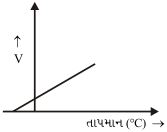
What does the following graph represent?
A
Dalton's Law
B
Charles's Law
C
Boyle's Law
D
Gay-Lussac's Law
Solution
(B) The graph shows the relationship between volume $(V)$ and temperature $(T)$ at constant pressure.
According to Charles's Law,the volume of a fixed mass of gas is directly proportional to its absolute temperature at constant pressure $(V \propto T)$.
The plot of $V$ versus $T$ $(^{\circ}C)$ is a straight line that intersects the temperature axis at $-273.15 \ ^{\circ}C$ (absolute zero).
According to Charles's Law,the volume of a fixed mass of gas is directly proportional to its absolute temperature at constant pressure $(V \propto T)$.
The plot of $V$ versus $T$ $(^{\circ}C)$ is a straight line that intersects the temperature axis at $-273.15 \ ^{\circ}C$ (absolute zero).
0 likes
View Solution172
DifficultMCQ
In a $1 \ L$ flask,$N_2$ gas is at $100 \ kPa$ pressure,and in another $3 \ L$ flask,$O_2$ gas is at $320 \ kPa$ pressure. If both flasks are connected,what will be the resultant pressure in $kPa$?
A
$310$
B
$420$
C
$365$
D
$265$
Solution
(D) Using the principle of conservation of moles (Boyle's Law for mixtures): $P_1V_1 + P_2V_2 = P_3(V_1 + V_2)$
Given: $P_1 = 100 \ kPa, V_1 = 1 \ L$
$P_2 = 320 \ kPa, V_2 = 3 \ L$
Total volume $V_{total} = V_1 + V_2 = 1 + 3 = 4 \ L$
Substituting the values: $P_3(4) = (100 \times 1) + (320 \times 3)$
$P_3(4) = 100 + 960 = 1060$
$P_3 = \frac{1060}{4} = 265 \ kPa$
Given: $P_1 = 100 \ kPa, V_1 = 1 \ L$
$P_2 = 320 \ kPa, V_2 = 3 \ L$
Total volume $V_{total} = V_1 + V_2 = 1 + 3 = 4 \ L$
Substituting the values: $P_3(4) = (100 \times 1) + (320 \times 3)$
$P_3(4) = 100 + 960 = 1060$
$P_3 = \frac{1060}{4} = 265 \ kPa$
0 likes
View Solution173
MediumMCQ
$A$ sample of gas occupies a volume of $0.2 \, L$ at $1 \, atm$ pressure and $0 \, ^oC$ temperature. What will be its volume in $L$ at the same pressure but at $273 \, ^oC$ temperature?
A
$0.4$
B
$0.8$
C
$27.8$
D
$5$
Solution
(A) Using Charles's Law: $\frac{V_1}{T_1} = \frac{V_2}{T_2}$ (at constant pressure).
Given: $V_1 = 0.2 \, L$,$T_1 = 0 \, ^oC = 273 \, K$,$T_2 = 273 \, ^oC = 273 + 273 = 546 \, K$.
Substituting the values: $\frac{0.2}{273} = \frac{V_2}{546}$.
$V_2 = \frac{0.2 \times 546}{273} = 0.2 \times 2 = 0.4 \, L$.
Given: $V_1 = 0.2 \, L$,$T_1 = 0 \, ^oC = 273 \, K$,$T_2 = 273 \, ^oC = 273 + 273 = 546 \, K$.
Substituting the values: $\frac{0.2}{273} = \frac{V_2}{546}$.
$V_2 = \frac{0.2 \times 546}{273} = 0.2 \times 2 = 0.4 \, L$.
0 likes
View Solution174
EasyMCQ
For a fixed amount of gas at a constant temperature,which of the following is true?
A
The graph of $V$ versus $P$ is linear.
B
The graph of $V$ versus $P$ is non-linear and passes through the origin.
C
The graph of $PV$ versus $P$ is linear with a slope of zero.
D
The graph of $PV$ versus $P$ is linear with a positive slope.
Solution
(C) According to Boyle's Law,for a fixed amount of gas at a constant temperature,$PV = k$ (a constant).
Therefore,the product $PV$ remains constant regardless of the change in pressure $P$.
This results in a horizontal line in a graph of $PV$ versus $P$,which means the slope of the graph is zero.
Therefore,the product $PV$ remains constant regardless of the change in pressure $P$.
This results in a horizontal line in a graph of $PV$ versus $P$,which means the slope of the graph is zero.
0 likes
View Solution175
MediumMCQ
Which of the following does not represent Charles's Law?
A
$V_t = V_0 \left[ \frac{273.15 + t^oC}{273.15} \right]$
B
$V_t = a + bt$
C
$V_t = \left[ \frac{V_0}{273.15 \ K} \right] T$
D
$V_t = V_0 t$
Solution
(D) Charles's Law states that for a fixed mass of an ideal gas at constant pressure,the volume is directly proportional to its absolute temperature $(V \propto T)$.
Mathematically,$V_t = V_0 \left( 1 + \frac{t}{273.15} \right) = V_0 \left( \frac{273.15 + t}{273.15} \right)$.
This can be written as $V_t = \left( \frac{V_0}{273.15} \right) T$,where $T = 273.15 + t$.
This equation is of the form $V_t = mT$,which is a linear equation $V_t = a + bt$ (where $a=0$ and $b = V_0/273.15$).
Option $D$,$V_t = V_0 t$,does not represent this linear relationship.
Mathematically,$V_t = V_0 \left( 1 + \frac{t}{273.15} \right) = V_0 \left( \frac{273.15 + t}{273.15} \right)$.
This can be written as $V_t = \left( \frac{V_0}{273.15} \right) T$,where $T = 273.15 + t$.
This equation is of the form $V_t = mT$,which is a linear equation $V_t = a + bt$ (where $a=0$ and $b = V_0/273.15$).
Option $D$,$V_t = V_0 t$,does not represent this linear relationship.
0 likes
View Solution176
MediumMCQ
Which of the following equations represents the ideal gas equation?
A
$PM = dRT$
B
$P = dRT$
C
$PV = \frac{1}{3}mn{u^2}$
D
$PV = RT$
Solution
(A) The ideal gas equation is given by $PV = nRT$.
Since $n = \frac{m}{M}$ (where $m$ is mass and $M$ is molar mass),we have $PV = \frac{m}{M}RT$.
Rearranging gives $PM = \frac{m}{V}RT$.
Since density $d = \frac{m}{V}$,the equation becomes $PM = dRT$.
Since $n = \frac{m}{M}$ (where $m$ is mass and $M$ is molar mass),we have $PV = \frac{m}{M}RT$.
Rearranging gives $PM = \frac{m}{V}RT$.
Since density $d = \frac{m}{V}$,the equation becomes $PM = dRT$.
0 likes
View Solution177
EasyMCQ
What will be the value of the gas constant $R$ when pressure is expressed in $dyne \, m^{-2}$ and volume in $mm^3$?
A
$8.314 \times 10^{10} \, (dyne \, m^{-2})(mm^3) K^{-1} mol^{-1}$
B
$8.314 \times 10^{12} \, (dyne \, m^{-2})(mm^3) K^{-1} mol^{-1}$
C
$8.314 \times 10^{16} \, (dyne \, m^{-2})(mm^3) K^{-1} mol^{-1}$
D
$8.314 \times 10^{14} \, (dyne \, m^{-2})(mm^3) K^{-1} mol^{-1}$
Solution
(D) We know that the gas constant $R = 8.314 \, J \, K^{-1} mol^{-1} = 8.314 \, N \cdot m \cdot K^{-1} mol^{-1}$.
Since $1 \, N = 10^5 \, dyne$ and $1 \, m = 10^3 \, mm$,we have $1 \, m^3 = (10^3 \, mm)^3 = 10^9 \, mm^3$.
However,the pressure unit given is $dyne \, m^{-2}$. Note that $1 \, N \cdot m = 10^5 \, dyne \cdot m$.
To convert $R$ to the required units:
$R = 8.314 \, N \cdot m \cdot K^{-1} mol^{-1} = 8.314 \times (10^5 \, dyne) \times (10^9 \, mm^3) \cdot m^{-2} \cdot K^{-1} mol^{-1}$ is incorrect based on the unit provided.
Correct conversion: $1 \, J = 10^7 \, erg = 10^7 \, dyne \cdot cm$.
Given pressure $P$ in $dyne \cdot m^{-2}$ and volume $V$ in $mm^3$:
$R = 8.314 \, J = 8.314 \times 10^7 \, dyne \cdot cm = 8.314 \times 10^7 \times (10^{-2} \, m) \times (10^3 \, mm)^3 \times (10^{-6} \, m^2)^{-1} \dots$
Actually,$1 \, J = 10^7 \, dyne \cdot cm = 10^7 \, dyne \cdot (10^{-2} \, m) = 10^5 \, dyne \cdot m$.
$1 \, m^3 = 10^9 \, mm^3$,so $1 \, m = 10^3 \, mm$.
$R = 8.314 \, N \cdot m = 8.314 \times (10^5 \, dyne) \times (10^9 \, mm^3) \times (10^{-3} \, m^{-1}) \dots$
Simplifying: $R = 8.314 \times 10^5 \, dyne \cdot m \cdot K^{-1} mol^{-1} = 8.314 \times 10^5 \times (10^9 \, mm^3) \times (10^{-2} \, m^{-2}) = 8.314 \times 10^{14} \, (dyne \cdot m^{-2})(mm^3) K^{-1} mol^{-1}$.
Since $1 \, N = 10^5 \, dyne$ and $1 \, m = 10^3 \, mm$,we have $1 \, m^3 = (10^3 \, mm)^3 = 10^9 \, mm^3$.
However,the pressure unit given is $dyne \, m^{-2}$. Note that $1 \, N \cdot m = 10^5 \, dyne \cdot m$.
To convert $R$ to the required units:
$R = 8.314 \, N \cdot m \cdot K^{-1} mol^{-1} = 8.314 \times (10^5 \, dyne) \times (10^9 \, mm^3) \cdot m^{-2} \cdot K^{-1} mol^{-1}$ is incorrect based on the unit provided.
Correct conversion: $1 \, J = 10^7 \, erg = 10^7 \, dyne \cdot cm$.
Given pressure $P$ in $dyne \cdot m^{-2}$ and volume $V$ in $mm^3$:
$R = 8.314 \, J = 8.314 \times 10^7 \, dyne \cdot cm = 8.314 \times 10^7 \times (10^{-2} \, m) \times (10^3 \, mm)^3 \times (10^{-6} \, m^2)^{-1} \dots$
Actually,$1 \, J = 10^7 \, dyne \cdot cm = 10^7 \, dyne \cdot (10^{-2} \, m) = 10^5 \, dyne \cdot m$.
$1 \, m^3 = 10^9 \, mm^3$,so $1 \, m = 10^3 \, mm$.
$R = 8.314 \, N \cdot m = 8.314 \times (10^5 \, dyne) \times (10^9 \, mm^3) \times (10^{-3} \, m^{-1}) \dots$
Simplifying: $R = 8.314 \times 10^5 \, dyne \cdot m \cdot K^{-1} mol^{-1} = 8.314 \times 10^5 \times (10^9 \, mm^3) \times (10^{-2} \, m^{-2}) = 8.314 \times 10^{14} \, (dyne \cdot m^{-2})(mm^3) K^{-1} mol^{-1}$.
0 likes
View Solution178
MediumMCQ
Which of the following represents the correct relationship between the change in density of an ideal gas and the change in temperature?
A
$d_2 = d_1 \left( \frac{T_1 P_2}{T_2 P_1} \right)$
B
$d_2 = d_1 \left( \frac{T_1 T_2}{P_2 P_1} \right)$
C
$d_2 = d_1 \left( \frac{T_1 P_1}{P_2 T_2} \right)$
D
$d_2 = d_1 \left( \frac{T_2 P_2}{P_1 T_1} \right)$
Solution
(A) From the ideal gas equation,$PV = nRT = \frac{m}{M} RT$.
Since density $d = \frac{m}{V}$,we have $P = \frac{dRT}{M}$,which implies $d = \frac{PM}{RT}$.
For a constant mass of gas,$\frac{d_1 T_1}{P_1} = \frac{d_2 T_2}{P_2}$.
Rearranging for $d_2$,we get $d_2 = d_1 \left( \frac{T_1 P_2}{T_2 P_1} \right)$.
Since density $d = \frac{m}{V}$,we have $P = \frac{dRT}{M}$,which implies $d = \frac{PM}{RT}$.
For a constant mass of gas,$\frac{d_1 T_1}{P_1} = \frac{d_2 T_2}{P_2}$.
Rearranging for $d_2$,we get $d_2 = d_1 \left( \frac{T_1 P_2}{T_2 P_1} \right)$.
0 likes
View Solution179
MediumMCQ
The density of oxygen at $STP$ is $1.43 \, g \, L^{-1}$. What will be its density at $27 \, ^\circ C$ temperature and $700 \, torr$ pressure?
A
$1.20 \, g \, L^{-1}$
B
$1.20 \, g \, cm^{-3}$
C
$1.20 \, g \, m^{-3}$
D
$1.20 \, kg \, dm^{-3}$
Solution
(A) Using the ideal gas law relation for density: $\frac{d_1 T_1}{P_1} = \frac{d_2 T_2}{P_2}$
At $STP$,$d_1 = 1.43 \, g \, L^{-1}$,$T_1 = 273 \, K$,$P_1 = 760 \, torr$.
At the given conditions,$T_2 = 27 + 273 = 300 \, K$,$P_2 = 700 \, torr$.
Rearranging for $d_2$: $d_2 = \frac{d_1 \times T_1 \times P_2}{P_1 \times T_2}$
$d_2 = \frac{1.43 \times 273 \times 700}{760 \times 300} \approx 1.20 \, g \, L^{-1}$.
At $STP$,$d_1 = 1.43 \, g \, L^{-1}$,$T_1 = 273 \, K$,$P_1 = 760 \, torr$.
At the given conditions,$T_2 = 27 + 273 = 300 \, K$,$P_2 = 700 \, torr$.
Rearranging for $d_2$: $d_2 = \frac{d_1 \times T_1 \times P_2}{P_1 \times T_2}$
$d_2 = \frac{1.43 \times 273 \times 700}{760 \times 300} \approx 1.20 \, g \, L^{-1}$.
0 likes
View Solution180
MediumMCQ
At a given temperature,the density of gas $x$ is twice that of gas $y$. The molar mass of $x$ is one-third of the molar mass of $y$. What is the ratio of their pressures $(P_x / P_y)$?
A
$P_x / P_y = 1/4$
B
$P_x / P_y = 4$
C
$P_x / P_y = 6$
D
$P_x / P_y = 1/6$
Solution
(C) From the ideal gas equation,$PV = nRT$,we know that $PM = dRT$,where $P$ is pressure,$M$ is molar mass,$d$ is density,$R$ is the gas constant,and $T$ is temperature.
For gas $x$: $P_x M_x = d_x RT$
For gas $y$: $P_y M_y = d_y RT$
Dividing the two equations: $\frac{P_x M_x}{P_y M_y} = \frac{d_x}{d_y}$
Given: $d_x = 2d_y$ and $M_x = \frac{1}{3} M_y$
Substituting these values: $\frac{P_x}{P_y} \times \frac{1}{3} = \frac{2d_y}{d_y} = 2$
Therefore,$\frac{P_x}{P_y} = 2 \times 3 = 6$.
For gas $x$: $P_x M_x = d_x RT$
For gas $y$: $P_y M_y = d_y RT$
Dividing the two equations: $\frac{P_x M_x}{P_y M_y} = \frac{d_x}{d_y}$
Given: $d_x = 2d_y$ and $M_x = \frac{1}{3} M_y$
Substituting these values: $\frac{P_x}{P_y} \times \frac{1}{3} = \frac{2d_y}{d_y} = 2$
Therefore,$\frac{P_x}{P_y} = 2 \times 3 = 6$.
0 likes
View Solution181
EasyMCQ
The same gas is filled in two containers $X$ and $Y$. If the pressure,volume,and absolute temperature of the gas in container $X$ are three times those in container $Y$,and the mass of the gas in $X$ is $m \, g$,what will be the mass of the gas in $Y$?
A
$m \, g$
B
$m/3 \, g$
C
$m/2 \, g$
D
$2m \, g$
Solution
(B) From the ideal gas equation,$PV = nRT$,we have $n = \frac{PV}{RT}$.
For container $X$: $n_X = \frac{P_X V_X}{R T_X}$.
For container $Y$: $n_Y = \frac{P_Y V_Y}{R T_Y}$.
Given $P_X = 3P_Y$,$V_X = 3V_Y$,and $T_X = 3T_Y$.
Substituting these values: $n_X = \frac{(3P_Y)(3V_Y)}{R(3T_Y)} = 3 \times \frac{P_Y V_Y}{R T_Y} = 3n_Y$.
Since $n = \frac{\text{mass}}{\text{molar mass}}$,and the gas is the same,the molar mass is constant.
Therefore,$\frac{m_X}{M} = 3 \times \frac{m_Y}{M}$.
Given $m_X = m$,we get $m = 3m_Y$.
Thus,$m_Y = \frac{m}{3} \, g$.
For container $X$: $n_X = \frac{P_X V_X}{R T_X}$.
For container $Y$: $n_Y = \frac{P_Y V_Y}{R T_Y}$.
Given $P_X = 3P_Y$,$V_X = 3V_Y$,and $T_X = 3T_Y$.
Substituting these values: $n_X = \frac{(3P_Y)(3V_Y)}{R(3T_Y)} = 3 \times \frac{P_Y V_Y}{R T_Y} = 3n_Y$.
Since $n = \frac{\text{mass}}{\text{molar mass}}$,and the gas is the same,the molar mass is constant.
Therefore,$\frac{m_X}{M} = 3 \times \frac{m_Y}{M}$.
Given $m_X = m$,we get $m = 3m_Y$.
Thus,$m_Y = \frac{m}{3} \, g$.
0 likes
View Solution182
DifficultMCQ
At $300 \ K$ temperature and $1 \ atm$ pressure,the weight of $1 \ L$ of a gas is $2 \ g$. If the pressure is changed to $0.75 \ atm$,at what temperature in $K$ will the weight of $1 \ L$ of the same gas be $1 \ g$?
A
$450$
B
$600$
C
$800$
D
$900$
Solution
(A) Using the ideal gas equation: $PV = nRT$,where $n = \frac{w}{M}$.
So,$PV = \frac{w}{M}RT$,which implies $\frac{PV}{wT} = \frac{R}{M} = \text{constant}$.
Therefore,$\frac{P_1 V_1}{w_1 T_1} = \frac{P_2 V_2}{w_2 T_2}$.
Given: $P_1 = 1 \ atm, V_1 = 1 \ L, w_1 = 2 \ g, T_1 = 300 \ K$.
Given: $P_2 = 0.75 \ atm, V_2 = 1 \ L, w_2 = 1 \ g, T_2 = ?$.
Substituting the values: $\frac{1 \times 1}{2 \times 300} = \frac{0.75 \times 1}{1 \times T_2}$.
$T_2 = 0.75 \times 2 \times 300 = 450 \ K$.
So,$PV = \frac{w}{M}RT$,which implies $\frac{PV}{wT} = \frac{R}{M} = \text{constant}$.
Therefore,$\frac{P_1 V_1}{w_1 T_1} = \frac{P_2 V_2}{w_2 T_2}$.
Given: $P_1 = 1 \ atm, V_1 = 1 \ L, w_1 = 2 \ g, T_1 = 300 \ K$.
Given: $P_2 = 0.75 \ atm, V_2 = 1 \ L, w_2 = 1 \ g, T_2 = ?$.
Substituting the values: $\frac{1 \times 1}{2 \times 300} = \frac{0.75 \times 1}{1 \times T_2}$.
$T_2 = 0.75 \times 2 \times 300 = 450 \ K$.
0 likes
View Solution183
EasyMCQ
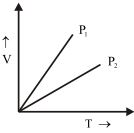
The graph of $V$ versus $T$ for an ideal gas at constant pressures $P_1$ and $P_2$ is shown below. Which of the following is correct?
A
$P_1 > P_2$
B
$P_1 < P_2$
C
$P_1 = P_2$
D
All of the above
Solution
(B) According to the ideal gas equation,$PV = nRT$,which can be rearranged as $V = (nR/P)T$.
This represents a straight line equation $y = mx$,where the slope $m = nR/P$.
Since the slope is inversely proportional to pressure $(m \propto 1/P)$,a smaller slope corresponds to a higher pressure.
In the given graph,the slope of the line for $P_2$ is smaller than the slope of the line for $P_1$.
Therefore,$P_2 > P_1$ or $P_1 < P_2$.
This represents a straight line equation $y = mx$,where the slope $m = nR/P$.
Since the slope is inversely proportional to pressure $(m \propto 1/P)$,a smaller slope corresponds to a higher pressure.
In the given graph,the slope of the line for $P_2$ is smaller than the slope of the line for $P_1$.
Therefore,$P_2 > P_1$ or $P_1 < P_2$.
0 likes
View Solution184
MediumMCQ
The densities of two gases are in the ratio $1:2$ and their temperatures are in the ratio $2:1$. What is the ratio of their corresponding pressures?
A
$1:1$
B
$1:2$
C
$2:1$
D
$4:1$
Solution
(A) From the ideal gas equation $PV = nRT$,we know that $P = \frac{dRT}{M}$.
Assuming the molar masses $M$ are the same or comparing the ratio of pressures for the same gas under different conditions,we use the relation $\frac{P_1 M_1}{d_1 T_1} = \frac{P_2 M_2}{d_2 T_2}$.
Given $\frac{d_1}{d_2} = \frac{1}{2}$ and $\frac{T_1}{T_2} = \frac{2}{1}$.
Assuming $M_1 = M_2$,the ratio of pressures is $\frac{P_1}{P_2} = \frac{d_1 T_1}{d_2 T_2}$.
Substituting the values: $\frac{P_1}{P_2} = (\frac{1}{2}) \times (\frac{2}{1}) = \frac{1}{1}$.
Thus,the ratio of pressures is $1:1$.
Assuming the molar masses $M$ are the same or comparing the ratio of pressures for the same gas under different conditions,we use the relation $\frac{P_1 M_1}{d_1 T_1} = \frac{P_2 M_2}{d_2 T_2}$.
Given $\frac{d_1}{d_2} = \frac{1}{2}$ and $\frac{T_1}{T_2} = \frac{2}{1}$.
Assuming $M_1 = M_2$,the ratio of pressures is $\frac{P_1}{P_2} = \frac{d_1 T_1}{d_2 T_2}$.
Substituting the values: $\frac{P_1}{P_2} = (\frac{1}{2}) \times (\frac{2}{1}) = \frac{1}{1}$.
Thus,the ratio of pressures is $1:1$.
0 likes
View Solution185
EasyMCQ
What is the density of carbon monoxide at $STP$ in $g \, L^{-1}$?
A
$0.625$
B
$1.25$
C
$2.5$
D
$1.875$
Solution
(B) $1$ mole of $CO$ has a molar mass of $28 \, g \, mol^{-1}$.
At $STP$,$1$ mole of any ideal gas occupies $22.4 \, L$.
Density $(\rho)$ = $\frac{\text{Mass}}{\text{Volume}} = \frac{28 \, g}{22.4 \, L} = 1.25 \, g \, L^{-1}$.
At $STP$,$1$ mole of any ideal gas occupies $22.4 \, L$.
Density $(\rho)$ = $\frac{\text{Mass}}{\text{Volume}} = \frac{28 \, g}{22.4 \, L} = 1.25 \, g \, L^{-1}$.
0 likes
View Solution186
MediumMCQ
The density of ammonia gas at $27^{\circ}C$ and $3 \, atm$ pressure is approximately:
A
$2.07 \, g \, cm^{-3}$
B
$2.07 \, g \, dm^{-3}$
C
$2.07 \, g \, m^{-3}$
D
$2.07 \, g \, mm^{-3}$
Solution
(B) Using the ideal gas equation $PV = nRT$,where $n = \frac{m}{M}$.
Density $d = \frac{m}{V} = \frac{PM}{RT}$.
For ammonia $(NH_3)$,molar mass $M = 14 + 3(1) = 17 \, g \, mol^{-1}$.
Given $P = 3 \, atm$,$T = 27 + 273 = 300 \, K$,and $R = 0.0821 \, L \, atm \, K^{-1} \, mol^{-1}$.
$d = \frac{3 \times 17}{0.0821 \times 300} = \frac{51}{24.63} \approx 2.07 \, g \, L^{-1}$.
Since $1 \, L = 1 \, dm^3$,the density is $2.07 \, g \, dm^{-3}$.
Density $d = \frac{m}{V} = \frac{PM}{RT}$.
For ammonia $(NH_3)$,molar mass $M = 14 + 3(1) = 17 \, g \, mol^{-1}$.
Given $P = 3 \, atm$,$T = 27 + 273 = 300 \, K$,and $R = 0.0821 \, L \, atm \, K^{-1} \, mol^{-1}$.
$d = \frac{3 \times 17}{0.0821 \times 300} = \frac{51}{24.63} \approx 2.07 \, g \, L^{-1}$.
Since $1 \, L = 1 \, dm^3$,the density is $2.07 \, g \, dm^{-3}$.
0 likes
View Solution187
EasyMCQ
$A$ closed container is maintained at a constant temperature. It is first evacuated and then an ideal gas is continuously introduced into it. What will be the pressure of the gas inside the container?
A
It will remain constant.
B
It will first increase and then decrease.
C
It will first increase and then become constant.
D
It will burst after some time.
Solution
(C) According to the ideal gas law,$PV = nRT$.
Since the temperature $(T)$ and the volume of the container $(V)$ are constant,the pressure $(P)$ is directly proportional to the number of moles $(n)$ of the gas $(P \propto n)$.
As the gas is continuously introduced into the evacuated container,the number of moles $(n)$ increases,causing the pressure $(P)$ to increase.
Once the container is filled to its capacity or the gas supply is stopped,the number of moles becomes constant,and consequently,the pressure inside the container becomes constant.
Since the temperature $(T)$ and the volume of the container $(V)$ are constant,the pressure $(P)$ is directly proportional to the number of moles $(n)$ of the gas $(P \propto n)$.
As the gas is continuously introduced into the evacuated container,the number of moles $(n)$ increases,causing the pressure $(P)$ to increase.
Once the container is filled to its capacity or the gas supply is stopped,the number of moles becomes constant,and consequently,the pressure inside the container becomes constant.
0 likes
View Solution188
EasyMCQ
For an ideal gas,which of the following graphs will not be a straight line?
A
$n \text{ vs } V$
B
$T \text{ vs } P$
C
$n \text{ vs } \frac{1}{T}$
D
$n \text{ vs } \frac{1}{P}$
Solution
(A) The ideal gas equation is given by $PV = nRT$.
From this equation,we can express the relationship between variables as $n = \frac{PV}{RT}$.
$(a)$ For $n \text{ vs } V$,at constant $P$ and $T$,$n \propto V$,which is a straight line.
$(b)$ For $T \text{ vs } P$,at constant $n$ and $V$,$T \propto P$,which is a straight line.
$(c)$ For $n \text{ vs } \frac{1}{T}$,at constant $P$ and $V$,$n \propto \frac{1}{T}$,which is a straight line.
$(d)$ For $n \text{ vs } \frac{1}{P}$,at constant $V$ and $T$,$n \propto \frac{1}{P}$,which is a straight line.
However,if we consider the standard interpretation of such problems where variables are plotted against each other,all these represent linear relationships under specific constant conditions. If the question implies a general case where variables are not held constant,none would be straight lines. Given the options,all represent linear relationships $y = mx$ under specific constraints.
From this equation,we can express the relationship between variables as $n = \frac{PV}{RT}$.
$(a)$ For $n \text{ vs } V$,at constant $P$ and $T$,$n \propto V$,which is a straight line.
$(b)$ For $T \text{ vs } P$,at constant $n$ and $V$,$T \propto P$,which is a straight line.
$(c)$ For $n \text{ vs } \frac{1}{T}$,at constant $P$ and $V$,$n \propto \frac{1}{T}$,which is a straight line.
$(d)$ For $n \text{ vs } \frac{1}{P}$,at constant $V$ and $T$,$n \propto \frac{1}{P}$,which is a straight line.
However,if we consider the standard interpretation of such problems where variables are plotted against each other,all these represent linear relationships under specific constant conditions. If the question implies a general case where variables are not held constant,none would be straight lines. Given the options,all represent linear relationships $y = mx$ under specific constraints.
0 likes
View Solution189
MediumMCQ
What will be the volume in $L$ of $2.8 \ g$ of carbon monoxide at $27 \ ^oC$ temperature and $0.821 \ atm$ pressure? $(R = 0.0821 \ L \ atm \ mol^{-1} K^{-1})$
A
$30$
B
$3$
C
$0.3$
D
$1.5$
Solution
(B) Using the ideal gas equation $PV = nRT = \frac{w}{M}RT$,
Given:
$P = 0.821 \ atm$
$w = 2.8 \ g$
$M_{CO} = 28 \ g/mol$
$R = 0.0821 \ L \ atm \ mol^{-1} K^{-1}$
$T = 27 \ ^oC = 27 + 273 = 300 \ K$
Substituting the values:
$V = \frac{wRT}{PM} = \frac{2.8 \times 0.0821 \times 300}{0.821 \times 28}$
$V = \frac{2.8}{28} \times \frac{0.0821 \times 300}{0.821}$
$V = 0.1 \times 10 \times 3 = 3 \ L$
Given:
$P = 0.821 \ atm$
$w = 2.8 \ g$
$M_{CO} = 28 \ g/mol$
$R = 0.0821 \ L \ atm \ mol^{-1} K^{-1}$
$T = 27 \ ^oC = 27 + 273 = 300 \ K$
Substituting the values:
$V = \frac{wRT}{PM} = \frac{2.8 \times 0.0821 \times 300}{0.821 \times 28}$
$V = \frac{2.8}{28} \times \frac{0.0821 \times 300}{0.821}$
$V = 0.1 \times 10 \times 3 = 3 \ L$
0 likes
View Solution190
EasyMCQ
If $2 \, \text{moles}$ of an ideal gas occupy a volume of $44.8 \, L$ at a temperature of $546 \, K$,what will be the pressure in $atm$?
A
$2$
B
$3$
C
$4$
D
$1$
Solution
(A) Using the ideal gas equation $PV = nRT$:
Given: $n = 2 \, \text{mol}$,$V = 44.8 \, L$,$T = 546 \, K$,$R = 0.0821 \, L \cdot atm \cdot K^{-1} \cdot mol^{-1}$.
$P = \frac{nRT}{V} = \frac{2 \times 0.0821 \times 546}{44.8}$.
$P = \frac{89.6532}{44.8} \approx 2 \, atm$.
Given: $n = 2 \, \text{mol}$,$V = 44.8 \, L$,$T = 546 \, K$,$R = 0.0821 \, L \cdot atm \cdot K^{-1} \cdot mol^{-1}$.
$P = \frac{nRT}{V} = \frac{2 \times 0.0821 \times 546}{44.8}$.
$P = \frac{89.6532}{44.8} \approx 2 \, atm$.
0 likes
View Solution191
MediumMCQ
If the pressure and temperature of $4 \, dm^3$ of carbon dioxide are doubled,what will be the volume of the carbon dioxide gas in $dm^3$?
A
$8$
B
$3$
C
$2$
D
$4$
Solution
(D) Using the ideal gas law equation: $\frac{P_1 V_1}{T_1} = \frac{P_2 V_2}{T_2}$.
Given: $P_1 = P, P_2 = 2P, V_1 = 4 \, dm^3, V_2 = ?$
Given: $T_1 = T, T_2 = 2T$.
Substituting the values: $\frac{P \times 4}{T} = \frac{2P \times V_2}{2T}$.
Solving for $V_2$: $V_2 = \frac{P \times 4 \times 2T}{T \times 2P} = 4 \, dm^3$.
Given: $P_1 = P, P_2 = 2P, V_1 = 4 \, dm^3, V_2 = ?$
Given: $T_1 = T, T_2 = 2T$.
Substituting the values: $\frac{P \times 4}{T} = \frac{2P \times V_2}{2T}$.
Solving for $V_2$: $V_2 = \frac{P \times 4 \times 2T}{T \times 2P} = 4 \, dm^3$.
0 likes
View Solution192
DifficultMCQ
$A$ gas occupies $100 \, cc$ volume at $0 \, ^oC$ temperature and $1 \, atm$ pressure. If the pressure is increased by $1.5$ times and the temperature is increased by one-third of its absolute temperature,what will be the final volume of the gas in $cc$?
A
$80$
B
$88.9$
C
$66.7$
D
$100$
Solution
(B) Using the combined gas law: $\frac{P_1 V_1}{T_1} = \frac{P_2 V_2}{T_2}$
Given: $P_1 = 1 \, atm$,$V_1 = 100 \, cc$,$T_1 = 0 \, ^oC = 273 \, K$
New conditions: $P_2 = 1.5 \, P_1 = 1.5 \, atm$
$T_2 = T_1 + \frac{1}{3} T_1 = 273 + \frac{273}{3} = 273 + 91 = 364 \, K$
Substituting the values: $V_2 = \frac{P_1 V_1 T_2}{T_1 P_2} = \frac{1 \times 100 \times 364}{273 \times 1.5}$
$V_2 = \frac{36400}{409.5} \approx 88.9 \, cc$
Given: $P_1 = 1 \, atm$,$V_1 = 100 \, cc$,$T_1 = 0 \, ^oC = 273 \, K$
New conditions: $P_2 = 1.5 \, P_1 = 1.5 \, atm$
$T_2 = T_1 + \frac{1}{3} T_1 = 273 + \frac{273}{3} = 273 + 91 = 364 \, K$
Substituting the values: $V_2 = \frac{P_1 V_1 T_2}{T_1 P_2} = \frac{1 \times 100 \times 364}{273 \times 1.5}$
$V_2 = \frac{36400}{409.5} \approx 88.9 \, cc$
0 likes
View Solution193
EasyMCQ
For an ideal gas,if $P$ is the pressure,$R$ is the gas constant,and $T$ is the temperature,which of the following represents the number of moles per liter?
A
$PT/R$
B
$PRT$
C
$P/RT$
D
$RT/P$
Solution
(C) We know the ideal gas equation is $PV = nRT$.
Rearranging the equation to find the number of moles per unit volume (moles per liter),we get:
$n/V = P/(RT)$.
Rearranging the equation to find the number of moles per unit volume (moles per liter),we get:
$n/V = P/(RT)$.
0 likes
View Solution194
MediumMCQ
At a temperature of $27\,^oC$,a $2.461 \, L$ vessel contains $0.3 \, mol$ of $N_2$,$0.5 \, mol$ of $He$,and $6.2 \, mol$ of $O_2$ gases. What is the partial pressure of $N_2$ in $atm$?
A
$70$
B
$7$
C
$23.3$
D
$3$
Solution
(D) Total moles $n_{total} = n_{N_2} + n_{He} + n_{O_2} = 0.3 + 0.5 + 6.2 = 7.0 \, mol$.
Using the ideal gas equation $PV = nRT$,where $T = 27 + 273 = 300 \, K$ and $R = 0.0821 \, L \cdot atm \cdot K^{-1} \cdot mol^{-1}$:
$P_{total} = \frac{n_{total}RT}{V} = \frac{7.0 \times 0.0821 \times 300}{2.461} = \frac{172.41}{2.461} \approx 70 \, atm$.
The partial pressure of $N_2$ is given by $P_{N_2} = \chi_{N_2} \times P_{total}$,where $\chi_{N_2}$ is the mole fraction of $N_2$.
$\chi_{N_2} = \frac{n_{N_2}}{n_{total}} = \frac{0.3}{7.0}$.
$P_{N_2} = \frac{0.3}{7.0} \times 70 = 3 \, atm$.
Using the ideal gas equation $PV = nRT$,where $T = 27 + 273 = 300 \, K$ and $R = 0.0821 \, L \cdot atm \cdot K^{-1} \cdot mol^{-1}$:
$P_{total} = \frac{n_{total}RT}{V} = \frac{7.0 \times 0.0821 \times 300}{2.461} = \frac{172.41}{2.461} \approx 70 \, atm$.
The partial pressure of $N_2$ is given by $P_{N_2} = \chi_{N_2} \times P_{total}$,where $\chi_{N_2}$ is the mole fraction of $N_2$.
$\chi_{N_2} = \frac{n_{N_2}}{n_{total}} = \frac{0.3}{7.0}$.
$P_{N_2} = \frac{0.3}{7.0} \times 70 = 3 \, atm$.
0 likes
View Solution195
MediumMCQ
At $0\, ^\circ C$,$4\, g$ of $O_2$ and $2\, g$ of $H_2$ are filled in a $1\, L$ bulb. What will be the total pressure of the mixture (in $, atm$)?
A
$25.215$
B
$31.205$
C
$45.215$
D
$15.210$
Solution
(A) Using the ideal gas equation $PV = nRT = \frac{w}{M}RT$ for both gases separately:
For $O_2$: $n_{O_2} = \frac{4\, g}{32\, g/mol} = 0.125\, mol$.
$P_{O_2} = \frac{n_{O_2}RT}{V} = \frac{0.125 \times 0.0821 \times 273}{1} = 2.801\, atm$.
For $H_2$: $n_{H_2} = \frac{2\, g}{2\, g/mol} = 1.0\, mol$.
$P_{H_2} = \frac{n_{H_2}RT}{V} = \frac{1.0 \times 0.0821 \times 273}{1} = 22.413\, atm$.
According to Dalton's Law of Partial Pressures,$P_{total} = P_{O_2} + P_{H_2} = 2.801 + 22.413 = 25.214\, atm$.
For $O_2$: $n_{O_2} = \frac{4\, g}{32\, g/mol} = 0.125\, mol$.
$P_{O_2} = \frac{n_{O_2}RT}{V} = \frac{0.125 \times 0.0821 \times 273}{1} = 2.801\, atm$.
For $H_2$: $n_{H_2} = \frac{2\, g}{2\, g/mol} = 1.0\, mol$.
$P_{H_2} = \frac{n_{H_2}RT}{V} = \frac{1.0 \times 0.0821 \times 273}{1} = 22.413\, atm$.
According to Dalton's Law of Partial Pressures,$P_{total} = P_{O_2} + P_{H_2} = 2.801 + 22.413 = 25.214\, atm$.
0 likes
View Solution196
MediumMCQ
$A$ dry gas occupies $136.5 \, cm^3$ at $STP$. If the same mass of gas is collected over water at $27 \, ^oC$ and a total pressure of $725 \, torr$,what volume will it occupy in $cm^3$? (Vapour pressure of water at $27 \, ^oC$ is $25 \, torr$.)
A
$157.3$
B
$162.9$
C
$159.2$
D
$160.9$
Solution
(B) At $27 \, ^oC$,the pressure of the dry gas is calculated as:
$P_{dry} = P_{total} - P_{water} = 725 \, torr - 25 \, torr = 700 \, torr$.
Using the combined gas law: $\frac{P_1 V_1}{T_1} = \frac{P_2 V_2}{T_2}$.
At $STP$: $P_1 = 760 \, torr$,$V_1 = 136.5 \, cm^3$,$T_1 = 273 \, K$.
At the given conditions: $P_2 = 700 \, torr$,$T_2 = 27 + 273 = 300 \, K$.
Substituting the values: $V_2 = \frac{P_1 V_1 T_2}{T_1 P_2} = \frac{760 \times 136.5 \times 300}{273 \times 700} = 162.9 \, cm^3$.
$P_{dry} = P_{total} - P_{water} = 725 \, torr - 25 \, torr = 700 \, torr$.
Using the combined gas law: $\frac{P_1 V_1}{T_1} = \frac{P_2 V_2}{T_2}$.
At $STP$: $P_1 = 760 \, torr$,$V_1 = 136.5 \, cm^3$,$T_1 = 273 \, K$.
At the given conditions: $P_2 = 700 \, torr$,$T_2 = 27 + 273 = 300 \, K$.
Substituting the values: $V_2 = \frac{P_1 V_1 T_2}{T_1 P_2} = \frac{760 \times 136.5 \times 300}{273 \times 700} = 162.9 \, cm^3$.
0 likes
View Solution197
EasyMCQ
What is the compressibility factor of an ideal gas?
A
$0$
B
$1$
C
$2$
D
$4$
Solution
(B) For an ideal gas,the ideal gas equation is $PV = nRT$.
The compressibility factor $Z$ is defined as $Z = \frac{PV}{nRT}$.
Since $PV = nRT$ for an ideal gas,substituting this into the equation gives $Z = \frac{nRT}{nRT} = 1$.
The compressibility factor $Z$ is defined as $Z = \frac{PV}{nRT}$.
Since $PV = nRT$ for an ideal gas,substituting this into the equation gives $Z = \frac{nRT}{nRT} = 1$.
0 likes
View Solution198
DifficultMCQ
When an ideal gas undergoes free expansion,then:
A
Cooling occurs because molecules are at a temperature above the inversion temperature.
B
No cooling occurs because no attractive forces exist between molecules.
C
Cooling occurs because molecules lose energy by colliding with each other.
D
No cooling occurs because it does work equal to the loss in kinetic energy $(KE)$.
Solution
(B) For an ideal gas,the intermolecular forces of attraction are considered to be zero.
During free expansion into a vacuum,the external pressure is zero,so no work is done $(w = 0)$.
According to the first law of thermodynamics,$\Delta U = q + w$.
Since the process is adiabatic $(q = 0)$ and $w = 0$,the change in internal energy $\Delta U = 0$.
For an ideal gas,internal energy depends only on temperature $(U = f(T))$.
Therefore,$\Delta U = 0$ implies $\Delta T = 0$.
Thus,no cooling or heating occurs.
During free expansion into a vacuum,the external pressure is zero,so no work is done $(w = 0)$.
According to the first law of thermodynamics,$\Delta U = q + w$.
Since the process is adiabatic $(q = 0)$ and $w = 0$,the change in internal energy $\Delta U = 0$.
For an ideal gas,internal energy depends only on temperature $(U = f(T))$.
Therefore,$\Delta U = 0$ implies $\Delta T = 0$.
Thus,no cooling or heating occurs.
0 likes
View Solution199
EasyMCQ
The gas equation $PV = nRT$ is applicable for which of the following conditions?
A
Only for isothermal processes
B
Only for adiabatic processes
C
For both
D
None of these
Solution
(C) The ideal gas equation $PV = nRT$ is a state function equation that describes the relationship between pressure $(P)$,volume $(V)$,amount of substance $(n)$,and temperature $(T)$.
It is applicable to any process involving an ideal gas,regardless of whether the process is isothermal,adiabatic,isobaric,or isochoric.
It is applicable to any process involving an ideal gas,regardless of whether the process is isothermal,adiabatic,isobaric,or isochoric.
0 likes
View Solution200
MediumMCQ
The deviation of a gas from ideal behavior can be expressed by which of the following?
A
$Z = \frac{P}{VRT}$
B
$Z = \frac{PV}{nRT}$
C
$Z = \frac{nRT}{PV}$
D
$Z = \frac{VR}{PT}$
Solution
(B) The deviation of a gas from ideal behavior is expressed by the compressibility factor,denoted as $Z$.
For an ideal gas,$PV = nRT$,so $Z = 1$.
For real gases,the compressibility factor is defined as $Z = \frac{PV}{nRT}$.
For an ideal gas,$PV = nRT$,so $Z = 1$.
For real gases,the compressibility factor is defined as $Z = \frac{PV}{nRT}$.
0 likes
View SolutionStates of Matter — Ideal gas equation and Related gas laws · Frequently Asked Questions
1Are these States of Matter questions useful for JEE and NEET?
Yes. All questions in this section are mapped to JEE Main and NEET exam patterns. Previous year questions from JEE Main, NEET, GUJCET and state-level exams are included with full solutions.
2Can I switch to Hindi or Gujarati for these questions?
Yes. Use the language tabs in the hero section or the sidebar to view the same questions and solutions in English, Hindi or Gujarati.
3How do I generate a question paper from this subtopic?
Use the Vedclass Exam Paper Generator — select the chapter and subtopic, set difficulty, and generate Sets A, B, C, D automatically. First 3 chapters of every subject are free.
Vedclass Products
For Students
Vedclass Test Series
Mock tests in real JEE/NEET style with performance analysis. 5-day free trial.
Start Free TrialFor Teachers
Exam Paper Generator
Generate Set A/B/C/D papers from this chapter in 2 minutes. 3 chapters free.
Try FreeFor Institutes
Online Exam Module
Live online exams with unlimited students, 360° analytics & white-label branding.
See DemoFor Teachers & Institutes
Generate a States of Matter Exam Paper in 2 Minutes
Select subtopic & difficulty — Sets A, B, C, D auto-generated with No Repeat logic.
First 3 chapters of every subject are free — no payment required.