
A English
Ideal gas equation and Related gas laws Questions in English
Class 11 Chemistry · States of Matter · Ideal gas equation and Related gas laws
568+
Questions
English
Language
100%
With Solutions
Showing 49 of 568 questions in English
251
MediumMCQ
For an ideal gas obeying Boyle's Law,which of the following is correct? ($K$ is a constant)
A
$(dP / dV)_T = K/V$
B
$(dP / dV)_T = -K/V$
C
$(dP / dV)_T = K/V^2$
D
$(dP / dV)_T = -K/V^2$
Solution
(D) According to Boyle's Law,$PV = K$,where $K$ is a constant at a constant temperature.
Rearranging for $P$,we get $P = K \cdot V^{-1}$.
Differentiating $P$ with respect to $V$ at constant temperature $T$:
$(dP / dV)_T = d(K \cdot V^{-1}) / dV$.
Using the power rule,$(dP / dV)_T = K \cdot (-1) \cdot V^{-2} = -K / V^2$.
Rearranging for $P$,we get $P = K \cdot V^{-1}$.
Differentiating $P$ with respect to $V$ at constant temperature $T$:
$(dP / dV)_T = d(K \cdot V^{-1}) / dV$.
Using the power rule,$(dP / dV)_T = K \cdot (-1) \cdot V^{-2} = -K / V^2$.
0 likes
View Solution252
EasyMCQ
Which of the following laws is followed by a hot air balloon used for sports and meteorology?
A
Boyle's Law
B
Kelvin's Law
C
Avogadro's Law
D
Charles's Law
Solution
(D) hot air balloon works on the principle that the volume of a gas is directly proportional to its absolute temperature at constant pressure,which is known as $Charles's \ Law$ ($V \propto T$ at constant $P$).
As the air inside the balloon is heated,its volume increases,making the air less dense than the surrounding air,which causes the balloon to rise.
As the air inside the balloon is heated,its volume increases,making the air less dense than the surrounding air,which causes the balloon to rise.
0 likes
View Solution253
EasyMCQ
The density of air is higher at sea level. This fact is a practical application of which law?
A
Boyle's Law
B
Charles's Law
C
Avogadro's Law
D
Dalton's Law
Solution
(A) According to Boyle's Law,at constant temperature,the pressure of a fixed amount of gas is inversely proportional to its volume $(P \propto 1/V)$.
Since density $(d)$ is mass $(m)$ divided by volume $(V)$,and mass is constant for a fixed amount of gas,we have $V = m/d$.
Substituting this into the Boyle's Law expression,we get $P \propto d$.
Therefore,at sea level,the pressure is higher,which leads to a higher density of air compared to higher altitudes.
Since density $(d)$ is mass $(m)$ divided by volume $(V)$,and mass is constant for a fixed amount of gas,we have $V = m/d$.
Substituting this into the Boyle's Law expression,we get $P \propto d$.
Therefore,at sea level,the pressure is higher,which leads to a higher density of air compared to higher altitudes.
0 likes
View Solution254
MediumMCQ
When the temperature of a flask with a capacity of $1 \ L$ is increased from $25 \ ^oC$ to $35 \ ^oC$,calculate the volume of air in $mL$ that escapes from the flask.
A
$33$
B
$330$
C
$3$
D
$0.33$
Solution
(A) At constant pressure,according to Charles's Law: $\frac{V_1}{T_1} = \frac{V_2}{T_2}$
Given: $V_1 = 1000 \ mL$,$T_1 = 25 + 273 = 298 \ K$,$T_2 = 35 + 273 = 308 \ K$
Substituting the values: $\frac{1000}{298} = \frac{V_2}{308}$
$V_2 = \frac{1000 \times 308}{298} \approx 1033.56 \ mL$
Volume of air escaped = $V_2 - V_1 = 1033.56 - 1000 = 33.56 \ mL \approx 33 \ mL$
Given: $V_1 = 1000 \ mL$,$T_1 = 25 + 273 = 298 \ K$,$T_2 = 35 + 273 = 308 \ K$
Substituting the values: $\frac{1000}{298} = \frac{V_2}{308}$
$V_2 = \frac{1000 \times 308}{298} \approx 1033.56 \ mL$
Volume of air escaped = $V_2 - V_1 = 1033.56 - 1000 = 33.56 \ mL \approx 33 \ mL$
0 likes
View Solution255
MediumMCQ
$N_2$ gas at $100 \, kPa$ pressure is filled in a $1 \, L$ flask and $O_2$ gas at $320 \, kPa$ pressure is filled in another $3 \, L$ flask. If both flasks are connected,what will be the resultant pressure in $kPa$?
A
$310$
B
$420$
C
$365$
D
$265$
Solution
(D) According to Boyle's Law,for a mixture of gases at constant temperature,the resultant pressure $P$ is given by the formula:
$P = \frac{P_1 V_1 + P_2 V_2}{V_1 + V_2}$
Given:
$P_1 = 100 \, kPa, V_1 = 1 \, L$
$P_2 = 320 \, kPa, V_2 = 3 \, L$
Substituting the values:
$P = \frac{(100 \times 1) + (320 \times 3)}{1 + 3}$
$P = \frac{100 + 960}{4}$
$P = \frac{1060}{4}$
$P = 265 \, kPa$
$P = \frac{P_1 V_1 + P_2 V_2}{V_1 + V_2}$
Given:
$P_1 = 100 \, kPa, V_1 = 1 \, L$
$P_2 = 320 \, kPa, V_2 = 3 \, L$
Substituting the values:
$P = \frac{(100 \times 1) + (320 \times 3)}{1 + 3}$
$P = \frac{100 + 960}{4}$
$P = \frac{1060}{4}$
$P = 265 \, kPa$
0 likes
View Solution256
DifficultMCQ
If a sample of neon gas at $75^{\circ}C$ is cooled such that its volume decreases by $15\%$,to what temperature (in $^{\circ}C$) should it be heated so that its pressure becomes double?
A
$319$
B
$592$
C
$128$
D
$60$
Solution
(A) Given:
$T_1 = 75^{\circ}C = 348 \, K$
$V_1 = V$
$V_2 = V - 0.15V = 0.85V$
$P_1 = P$
$P_2 = 2P$
Using the combined gas law: $\frac{P_1 V_1}{T_1} = \frac{P_2 V_2}{T_2}$
Substituting the values:
$\frac{P \times V}{348} = \frac{2P \times 0.85V}{T_2}$
$\frac{1}{348} = \frac{1.7}{T_2}$
$T_2 = 348 \times 1.7 = 591.6 \, K$
Converting to Celsius:
$T_2(^{\circ}C) = 591.6 - 273.15 = 318.45^{\circ}C \approx 319^{\circ}C$
$T_1 = 75^{\circ}C = 348 \, K$
$V_1 = V$
$V_2 = V - 0.15V = 0.85V$
$P_1 = P$
$P_2 = 2P$
Using the combined gas law: $\frac{P_1 V_1}{T_1} = \frac{P_2 V_2}{T_2}$
Substituting the values:
$\frac{P \times V}{348} = \frac{2P \times 0.85V}{T_2}$
$\frac{1}{348} = \frac{1.7}{T_2}$
$T_2 = 348 \times 1.7 = 591.6 \, K$
Converting to Celsius:
$T_2(^{\circ}C) = 591.6 - 273.15 = 318.45^{\circ}C \approx 319^{\circ}C$
0 likes
View Solution257
DifficultMCQ
$A$ gas cylinder can withstand a pressure of $15 \ atm$. At $27 \ ^oC$,the pressure in the cylinder is $12 \ atm$. Up to what temperature in $^oC$ will the cylinder not burst?
A
$375$
B
$102$
C
$33.75$
D
$240$
Solution
(B) According to Gay-Lussac's Law,for a fixed amount of gas at constant volume,$P \propto T$ or $\frac{P_1}{T_1} = \frac{P_2}{T_2}$.
Given: $P_1 = 12 \ atm$,$T_1 = 27 \ ^oC = 27 + 273 = 300 \ K$.
Maximum pressure the cylinder can withstand,$P_2 = 15 \ atm$.
Substituting the values: $\frac{12}{300} = \frac{15}{T_2}$.
$T_2 = \frac{15 \times 300}{12} = 375 \ K$.
Converting back to Celsius: $T_2( ^oC) = 375 - 273 = 102 \ ^oC$.
Thus,the cylinder will not burst up to $102 \ ^oC$.
Given: $P_1 = 12 \ atm$,$T_1 = 27 \ ^oC = 27 + 273 = 300 \ K$.
Maximum pressure the cylinder can withstand,$P_2 = 15 \ atm$.
Substituting the values: $\frac{12}{300} = \frac{15}{T_2}$.
$T_2 = \frac{15 \times 300}{12} = 375 \ K$.
Converting back to Celsius: $T_2( ^oC) = 375 - 273 = 102 \ ^oC$.
Thus,the cylinder will not burst up to $102 \ ^oC$.
0 likes
View Solution258
DifficultMCQ
At $0\,^{\circ}C$ temperature and $1\, atm$ pressure,the volume of a gas is $100\, cc$. If the pressure is increased by $1.5$ times and the temperature is increased by one-third of its absolute temperature,what will be the final volume of the gas in $cc$?
A
$88$
B
$88.9$
C
$66.7$
D
$100$
Solution
(B) Given:
$P_1 = 1\, atm$,$V_1 = 100\, cc$,$T_1 = 0\,^{\circ}C = 273\, K$
$P_2 = 1.5\, atm$
$T_2 = T_1 + \frac{T_1}{3} = 273 + \frac{273}{3} = 273 \times \frac{4}{3} = 364\, K$
Using the ideal gas equation: $\frac{P_1 V_1}{T_1} = \frac{P_2 V_2}{T_2}$
$V_2 = \frac{P_1 V_1 T_2}{P_2 T_1} = \frac{1 \times 100 \times (273 \times \frac{4}{3})}{1.5 \times 273}$
$V_2 = \frac{100 \times 4}{1.5 \times 3} = \frac{400}{4.5} = 88.88\, cc \approx 88.9\, cc$
$P_1 = 1\, atm$,$V_1 = 100\, cc$,$T_1 = 0\,^{\circ}C = 273\, K$
$P_2 = 1.5\, atm$
$T_2 = T_1 + \frac{T_1}{3} = 273 + \frac{273}{3} = 273 \times \frac{4}{3} = 364\, K$
Using the ideal gas equation: $\frac{P_1 V_1}{T_1} = \frac{P_2 V_2}{T_2}$
$V_2 = \frac{P_1 V_1 T_2}{P_2 T_1} = \frac{1 \times 100 \times (273 \times \frac{4}{3})}{1.5 \times 273}$
$V_2 = \frac{100 \times 4}{1.5 \times 3} = \frac{400}{4.5} = 88.88\, cc \approx 88.9\, cc$
0 likes
View Solution259
MediumMCQ
What is the number of molecules in $0.082 \ L$ of an ideal gas kept at a temperature of $400 \ K$ and a pressure of $10 \ atm$?
A
$1.5 \times 10^{23}$
B
$3 \times 10^{23}$
C
$1.5 \times 10^{22}$
D
$2.5 \times 10^{21}$
Solution
(C) Using the ideal gas equation: $PV = nRT$
Given: $P = 10 \ atm$,$V = 0.082 \ L$,$T = 400 \ K$,$R = 0.082 \ L \ atm \ K^{-1} \ mol^{-1}$
$n = \frac{PV}{RT} = \frac{10 \times 0.082}{0.082 \times 400} = \frac{10}{400} = 0.025 \ mol$
Number of molecules = $n \times N_A = 0.025 \times 6.022 \times 10^{23} \approx 1.5 \times 10^{22}$ molecules.
Given: $P = 10 \ atm$,$V = 0.082 \ L$,$T = 400 \ K$,$R = 0.082 \ L \ atm \ K^{-1} \ mol^{-1}$
$n = \frac{PV}{RT} = \frac{10 \times 0.082}{0.082 \times 400} = \frac{10}{400} = 0.025 \ mol$
Number of molecules = $n \times N_A = 0.025 \times 6.022 \times 10^{23} \approx 1.5 \times 10^{22}$ molecules.
0 likes
View Solution260
MediumMCQ
$A$ vacuum vessel of volume $1 \, dm^3$ is evacuated at a constant temperature of $-23 \, ^\circ C$ until the pressure drops to $7.6 \times 10^{-5} \, torr$. What is the number of molecules remaining in the vessel?
A
$2.9 \times 10^{15}$
B
$1.56 \times 10^{16}$
C
$1.56 \times 10^{16}$
D
$2.9 \times 10^{20}$
Solution
(A) Given: $V = 1 \, dm^3 = 1 \, L$,$T = -23 \, ^\circ C = 250 \, K$,$P = 7.6 \times 10^{-5} \, torr = \frac{7.6 \times 10^{-5}}{760} \, atm = 10^{-7} \, atm$.
Using the ideal gas equation $PV = nRT$,we find the number of moles $n$:
$n = \frac{PV}{RT} = \frac{10^{-7} \times 1}{0.0821 \times 250} \approx 4.87 \times 10^{-9} \, mol$.
The number of molecules $N = n \times N_A$:
$N = 4.87 \times 10^{-9} \times 6.022 \times 10^{23} \approx 2.93 \times 10^{15}$ molecules.
Using the ideal gas equation $PV = nRT$,we find the number of moles $n$:
$n = \frac{PV}{RT} = \frac{10^{-7} \times 1}{0.0821 \times 250} \approx 4.87 \times 10^{-9} \, mol$.
The number of molecules $N = n \times N_A$:
$N = 4.87 \times 10^{-9} \times 6.022 \times 10^{23} \approx 2.93 \times 10^{15}$ molecules.
0 likes
View Solution261
DifficultMCQ
For a fixed amount of gas,the volume is $x \ L$ at a pressure of $y \ atm$ and a temperature of $z \ K$. At which of the following conditions will the volume remain $x \ L$? (Consider $y \neq z$)
A
$2y \ atm$ and $2z \ K$
B
$2y \ atm$ and $z/2 \ K$
C
$y^2 \ atm$ and $z^2 \ K$
D
$y/2 \ atm$ and $2z \ K$
Solution
(A) According to the ideal gas law,$\frac{P_1 V_1}{T_1} = \frac{P_2 V_2}{T_2}$.
Given $V_1 = V_2 = x \ L$,the equation simplifies to $\frac{P_1}{T_1} = \frac{P_2}{T_2}$.
Substituting the initial values,we get $\frac{y}{z} = \frac{P_2}{T_2}$.
For the volume to remain $x \ L$,the ratio of pressure to temperature must remain constant,i.e.,$\frac{P_2}{T_2} = \frac{y}{z}$.
Checking option $A$: $\frac{2y}{2z} = \frac{y}{z}$.
Thus,at $2y \ atm$ and $2z \ K$,the volume remains $x \ L$.
Given $V_1 = V_2 = x \ L$,the equation simplifies to $\frac{P_1}{T_1} = \frac{P_2}{T_2}$.
Substituting the initial values,we get $\frac{y}{z} = \frac{P_2}{T_2}$.
For the volume to remain $x \ L$,the ratio of pressure to temperature must remain constant,i.e.,$\frac{P_2}{T_2} = \frac{y}{z}$.
Checking option $A$: $\frac{2y}{2z} = \frac{y}{z}$.
Thus,at $2y \ atm$ and $2z \ K$,the volume remains $x \ L$.
0 likes
View Solution262
DifficultMCQ
If the volume of a gas is $V \ L$ at $P \ atm$ pressure and $27 \ ^oC$ temperature,what will be the volume of the gas at $-173 \ ^oC$ temperature and $P \ atm$ pressure if the amount of gas is doubled?
A
$V \ L$
B
$2V \ L$
C
$3V/2 \ L$
D
$2V/3 \ L$
Solution
(D) Given: $P_1 = P, V_1 = V, T_1 = 27 + 273 = 300 \ K, n_1 = n$
$P_2 = P, T_2 = -173 + 273 = 100 \ K, n_2 = 2n$
Using the ideal gas equation $PV = nRT$,since $P$ is constant:
$\frac{V_1}{V_2} = \frac{n_1 T_1}{n_2 T_2}$
$\frac{V}{V_2} = \frac{n \times 300}{2n \times 100}$
$\frac{V}{V_2} = \frac{300}{200} = \frac{3}{2}$
$V_2 = \frac{2V}{3} \ L$
$P_2 = P, T_2 = -173 + 273 = 100 \ K, n_2 = 2n$
Using the ideal gas equation $PV = nRT$,since $P$ is constant:
$\frac{V_1}{V_2} = \frac{n_1 T_1}{n_2 T_2}$
$\frac{V}{V_2} = \frac{n \times 300}{2n \times 100}$
$\frac{V}{V_2} = \frac{300}{200} = \frac{3}{2}$
$V_2 = \frac{2V}{3} \ L$
0 likes
View Solution263
DifficultMCQ
What is the molar volume of an ideal gas at $27\,^oC$ and $1\, atm$ pressure in $L$?
A
$22.4$
B
$2.214$
C
$24.6$
D
$44.8$
Solution
(C) The molar volume $V_m$ is calculated using the ideal gas equation $PV = nRT$.
For $n = 1 \, mol$,$P = 1 \, atm$,$T = 27 + 273 = 300 \, K$,and $R = 0.0821 \, L \cdot atm \cdot K^{-1} \cdot mol^{-1}$.
$V_m = \frac{nRT}{P} = \frac{1 \times 0.0821 \times 300}{1} = 24.63 \, L$.
Rounding to the nearest provided option,the answer is $24.6 \, L$.
For $n = 1 \, mol$,$P = 1 \, atm$,$T = 27 + 273 = 300 \, K$,and $R = 0.0821 \, L \cdot atm \cdot K^{-1} \cdot mol^{-1}$.
$V_m = \frac{nRT}{P} = \frac{1 \times 0.0821 \times 300}{1} = 24.63 \, L$.
Rounding to the nearest provided option,the answer is $24.6 \, L$.
0 likes
View Solution264
MediumMCQ
In a closed vessel of volume $0.082 \, dm^3$ at $600 \, K$,the complete decomposition of methanol vapor occurs as follows: $CH_3OH_{(g)} \to CO_{(g)} + 2H_{2(g)}$. If $0.01 \, mol$ of methanol is taken initially,what will be the pressure generated in the vessel in $atm$?
A
$3$
B
$6$
C
$12$
D
$18$
Solution
(D) The decomposition reaction is: $CH_3OH_{(g)} \to CO_{(g)} + 2H_{2(g)}$
Initial moles: $CH_3OH = 0.01 \, mol$,$CO = 0$,$H_2 = 0$
At equilibrium (complete decomposition): $CH_3OH = 0 \, mol$,$CO = 0.01 \, mol$,$H_2 = 0.02 \, mol$
Total moles of gas $n = 0.01 + 0.02 = 0.03 \, mol$
Using the ideal gas law $PV = nRT$:
$P = \frac{nRT}{V}$
Given $R = 0.082 \, L \cdot atm \cdot K^{-1} \cdot mol^{-1}$,$T = 600 \, K$,$V = 0.082 \, L$
$P = \frac{0.03 \times 0.082 \times 600}{0.082}$
$P = 0.03 \times 600 = 18 \, atm$
Initial moles: $CH_3OH = 0.01 \, mol$,$CO = 0$,$H_2 = 0$
At equilibrium (complete decomposition): $CH_3OH = 0 \, mol$,$CO = 0.01 \, mol$,$H_2 = 0.02 \, mol$
Total moles of gas $n = 0.01 + 0.02 = 0.03 \, mol$
Using the ideal gas law $PV = nRT$:
$P = \frac{nRT}{V}$
Given $R = 0.082 \, L \cdot atm \cdot K^{-1} \cdot mol^{-1}$,$T = 600 \, K$,$V = 0.082 \, L$
$P = \frac{0.03 \times 0.082 \times 600}{0.082}$
$P = 0.03 \times 600 = 18 \, atm$
0 likes
View Solution265
MediumMCQ
At $273 \ K$ temperature and $76 \ cm \ of \ Hg$ pressure,the volume of $1.786 \ g$ of a gas is $1 \ L$. The gas is likely to be .........
A
$2-\text{methylpropane}$
B
Propane
C
Propene
D
Phosgene
Solution
(C) Given: $P = 76 \ cm \ of \ Hg = 1 \ atm$,$T = 273 \ K$,$V = 1 \ L$,$w = 1.786 \ g$.
Using the ideal gas equation: $PV = nRT = (w/M)RT$.
$M = (wRT) / (PV) = (1.786 \times 0.0821 \times 273) / (1 \times 1) \approx 40 \ g/mol$.
However,at $STP$ $(273 \ K, 1 \ atm)$,$1 \ mole$ of an ideal gas occupies $22.4 \ L$.
Thus,$M = (1.786 \ g / 1 \ L) \times 22.4 \ L/mol \approx 40 \ g/mol$.
Checking molar masses: $2-\text{methylpropane} (C_4H_{10}) = 58 \ g/mol$,$\text{Propane} (C_3H_8) = 44 \ g/mol$,$\text{Propene} (C_3H_6) = 42 \ g/mol$,$\text{Phosgene} (COCl_2) = 12 + 16 + 71 = 99 \ g/mol$.
Re-evaluating the calculation: $1.786 \times 22.4 = 40.0064 \ g/mol$. The closest value to $40 \ g/mol$ is $42 \ g/mol$ (Propene). Given the options,$42 \ g/mol$ is the most appropriate choice.
Using the ideal gas equation: $PV = nRT = (w/M)RT$.
$M = (wRT) / (PV) = (1.786 \times 0.0821 \times 273) / (1 \times 1) \approx 40 \ g/mol$.
However,at $STP$ $(273 \ K, 1 \ atm)$,$1 \ mole$ of an ideal gas occupies $22.4 \ L$.
Thus,$M = (1.786 \ g / 1 \ L) \times 22.4 \ L/mol \approx 40 \ g/mol$.
Checking molar masses: $2-\text{methylpropane} (C_4H_{10}) = 58 \ g/mol$,$\text{Propane} (C_3H_8) = 44 \ g/mol$,$\text{Propene} (C_3H_6) = 42 \ g/mol$,$\text{Phosgene} (COCl_2) = 12 + 16 + 71 = 99 \ g/mol$.
Re-evaluating the calculation: $1.786 \times 22.4 = 40.0064 \ g/mol$. The closest value to $40 \ g/mol$ is $42 \ g/mol$ (Propene). Given the options,$42 \ g/mol$ is the most appropriate choice.
0 likes
View Solution266
DifficultMCQ
$A$ container is filled with nitrogen gas at a certain temperature and pressure. The mass of the gas is $0.6 \ g$. Now,the container is filled with another gas at the same temperature and pressure. If the mass of the second gas under the given conditions is $0.73 \ g$,identify the gas.
A
$NH_3$
B
$Cl_2$
C
$NO$
D
$PH_3$
Solution
(D) According to the Ideal Gas Law,$PV = nRT = (\frac{W}{M})RT$.
Since $P, V, T$ are constant,$n_1 = n_2$,which implies $\frac{W_1}{M_1} = \frac{W_2}{M_2}$.
Given $W_1 = 0.6 \ g$ (for $N_2$,$M_1 = 28 \ g \ mol^{-1}$) and $W_2 = 0.73 \ g$.
Substituting the values: $\frac{0.6}{28} = \frac{0.73}{M_2}$.
$M_2 = \frac{0.73 \times 28}{0.6} = \frac{20.44}{0.6} \approx 34.06 \ g \ mol^{-1}$.
The molar mass of $PH_3$ is $31 + 3(1) = 34 \ g \ mol^{-1}$.
Therefore,the gas is $PH_3$.
Since $P, V, T$ are constant,$n_1 = n_2$,which implies $\frac{W_1}{M_1} = \frac{W_2}{M_2}$.
Given $W_1 = 0.6 \ g$ (for $N_2$,$M_1 = 28 \ g \ mol^{-1}$) and $W_2 = 0.73 \ g$.
Substituting the values: $\frac{0.6}{28} = \frac{0.73}{M_2}$.
$M_2 = \frac{0.73 \times 28}{0.6} = \frac{20.44}{0.6} \approx 34.06 \ g \ mol^{-1}$.
The molar mass of $PH_3$ is $31 + 3(1) = 34 \ g \ mol^{-1}$.
Therefore,the gas is $PH_3$.
0 likes
View Solution267
DifficultMCQ
An open flask at $27^{\circ}C$ contains air. To what temperature $(^{\circ}C)$ should it be heated so that one-third of the air is expelled from the flask?
A
$81$
B
$127$
C
$177$
D
$227$
Solution
(C) For an open flask,pressure $(P)$ and volume $(V)$ remain constant.
According to the ideal gas law,$PV = nRT$,which implies $n \propto \frac{1}{T}$ at constant $P$ and $V$.
Given: $T_1 = 27^{\circ}C = 300 \, K$.
Let the initial number of moles be $n_1 = n$.
After heating,one-third of the air is expelled,so the remaining moles are $n_2 = n - \frac{n}{3} = \frac{2n}{3}$.
Using the relation $\frac{n_1}{n_2} = \frac{T_2}{T_1}$:
$\frac{n}{2n/3} = \frac{T_2}{300}$
$\frac{3}{2} = \frac{T_2}{300}$
$T_2 = \frac{3}{2} \times 300 = 450 \, K$.
Converting to Celsius: $T_2 = 450 - 273 = 177^{\circ}C$.
According to the ideal gas law,$PV = nRT$,which implies $n \propto \frac{1}{T}$ at constant $P$ and $V$.
Given: $T_1 = 27^{\circ}C = 300 \, K$.
Let the initial number of moles be $n_1 = n$.
After heating,one-third of the air is expelled,so the remaining moles are $n_2 = n - \frac{n}{3} = \frac{2n}{3}$.
Using the relation $\frac{n_1}{n_2} = \frac{T_2}{T_1}$:
$\frac{n}{2n/3} = \frac{T_2}{300}$
$\frac{3}{2} = \frac{T_2}{300}$
$T_2 = \frac{3}{2} \times 300 = 450 \, K$.
Converting to Celsius: $T_2 = 450 - 273 = 177^{\circ}C$.
0 likes
View Solution268
DifficultMCQ
Containers $A$ and $B$ contain the same gas. The pressure,volume,and temperature of the gas in $A$ are twice the corresponding values of the gas in $B$. The ratio of the number of molecules of gas in $A$ to that in $B$ is ...
A
$1 : 2$
B
$2 : 1$
C
$1 : 4$
D
$4 : 1$
Solution
(B) Using the ideal gas equation $PV = nRT$,the number of moles $n$ is given by $n = \frac{PV}{RT}$.
For container $A$: $P_A = 2P$,$V_A = 2V$,$T_A = 2T$. Thus,$n_A = \frac{(2P)(2V)}{R(2T)} = 2 \frac{PV}{RT}$.
For container $B$: $P_B = P$,$V_B = V$,$T_B = T$. Thus,$n_B = \frac{PV}{RT}$.
The ratio of the number of molecules (which is proportional to the number of moles) is $\frac{n_A}{n_B} = \frac{2(PV/RT)}{(PV/RT)} = 2 : 1$.
For container $A$: $P_A = 2P$,$V_A = 2V$,$T_A = 2T$. Thus,$n_A = \frac{(2P)(2V)}{R(2T)} = 2 \frac{PV}{RT}$.
For container $B$: $P_B = P$,$V_B = V$,$T_B = T$. Thus,$n_B = \frac{PV}{RT}$.
The ratio of the number of molecules (which is proportional to the number of moles) is $\frac{n_A}{n_B} = \frac{2(PV/RT)}{(PV/RT)} = 2 : 1$.
0 likes
View Solution269
DifficultMCQ
$A$ $3.7 \ g$ mass of a gas occupies a certain volume at $25 \ ^\circ C$. The same volume is occupied by $0.184 \ g$ of $H_2$ gas at the same pressure and $17 \ ^\circ C$. Calculate the molar mass of the gas.
A
$59.1$
B
$41.3$
C
$14.5$
D
$40.2$
Solution
(B) Given: $W_1 = 3.7 \ g$,$T_1 = 25 + 273 = 298 \ K$,$W_2 = 0.184 \ g$,$M_2 = 2 \ g/mol$ $(H_2)$,$T_2 = 17 + 273 = 290 \ K$.
Since pressure $P$ and volume $V$ are the same,from the ideal gas equation $PV = nRT$,we have $n_1 T_1 = n_2 T_2$.
Substituting $n = \frac{W}{M}$,we get $\frac{W_1}{M_1} T_1 = \frac{W_2}{M_2} T_2$.
$\frac{3.7}{M_1} \times 298 = \frac{0.184}{2} \times 290$.
$M_1 = \frac{3.7 \times 298 \times 2}{0.184 \times 290}$.
$M_1 = \frac{2205.2}{53.36} \approx 41.3 \ g/mol$.
Since pressure $P$ and volume $V$ are the same,from the ideal gas equation $PV = nRT$,we have $n_1 T_1 = n_2 T_2$.
Substituting $n = \frac{W}{M}$,we get $\frac{W_1}{M_1} T_1 = \frac{W_2}{M_2} T_2$.
$\frac{3.7}{M_1} \times 298 = \frac{0.184}{2} \times 290$.
$M_1 = \frac{3.7 \times 298 \times 2}{0.184 \times 290}$.
$M_1 = \frac{2205.2}{53.36} \approx 41.3 \ g/mol$.
0 likes
View Solution270
EasyMCQ
Under which conditions will the density of a gas be maximum?
A
$100 \ K$ and $1 \ atm$
B
$100 \ K$ and $2 \ atm$
C
$200 \ K$ and $1 \ atm$
D
$200 \ K$ and $3 \ atm$
Solution
(B) From the ideal gas equation,$PV = nRT$,where $n = \frac{m}{M}$.
Substituting this,$PV = \frac{m}{M} RT$.
Rearranging for density $(d = \frac{m}{V})$,we get $d = \frac{PM}{RT}$.
For a given gas,$M$ is constant,so $d \propto \frac{P}{T}$.
To maximize density $(d)$,we need to maximize pressure $(P)$ and minimize temperature $(T)$.
Comparing the options:
$(A)$ $\frac{P}{T} = \frac{1}{100} = 0.01$
$(B)$ $\frac{P}{T} = \frac{2}{100} = 0.02$
$(C)$ $\frac{P}{T} = \frac{1}{200} = 0.005$
$(D)$ $\frac{P}{T} = \frac{3}{200} = 0.015$
Comparing the values,option $(B)$ has the highest ratio of $\frac{P}{T}$.
Substituting this,$PV = \frac{m}{M} RT$.
Rearranging for density $(d = \frac{m}{V})$,we get $d = \frac{PM}{RT}$.
For a given gas,$M$ is constant,so $d \propto \frac{P}{T}$.
To maximize density $(d)$,we need to maximize pressure $(P)$ and minimize temperature $(T)$.
Comparing the options:
$(A)$ $\frac{P}{T} = \frac{1}{100} = 0.01$
$(B)$ $\frac{P}{T} = \frac{2}{100} = 0.02$
$(C)$ $\frac{P}{T} = \frac{1}{200} = 0.005$
$(D)$ $\frac{P}{T} = \frac{3}{200} = 0.015$
Comparing the values,option $(B)$ has the highest ratio of $\frac{P}{T}$.
0 likes
View Solution271
DifficultMCQ
At a constant temperature,two different gases $G_1$ and $G_2$ are kept in separate flasks. The molar mass of $G_2$ is three times that of $G_1$,while the density of $G_1$ is two times that of $G_2$. What is the ratio of the pressure exerted by $G_2$ to that of $G_1$ in their respective flasks?
A
$7 : 8$
B
$2 : 5$
C
$1 : 4$
D
$1 : 6$
Solution
(D) From the ideal gas equation,$PM = dRT$. Since temperature $T$ is constant,$P = \frac{dRT}{M}$,which implies $P \propto \frac{d}{M}$.
Given:
For $G_1$: $M_1 = M$,$d_1 = 2d$
For $G_2$: $M_2 = 3M$,$d_2 = d$
Ratio of pressures:
$\frac{P_1}{P_2} = \frac{d_1}{M_1} \times \frac{M_2}{d_2} = \frac{2d}{M} \times \frac{3M}{d} = 6$
Therefore,the ratio of pressure exerted by $G_2$ to that of $G_1$ is:
$\frac{P_2}{P_1} = \frac{1}{6}$
Given:
For $G_1$: $M_1 = M$,$d_1 = 2d$
For $G_2$: $M_2 = 3M$,$d_2 = d$
Ratio of pressures:
$\frac{P_1}{P_2} = \frac{d_1}{M_1} \times \frac{M_2}{d_2} = \frac{2d}{M} \times \frac{3M}{d} = 6$
Therefore,the ratio of pressure exerted by $G_2$ to that of $G_1$ is:
$\frac{P_2}{P_1} = \frac{1}{6}$
0 likes
View Solution272
MediumMCQ
At $27\,^{\circ}C$ and $1\,atm$ pressure,the density of a gas is $d$. At what temperature will its density become $0.75d$ if the pressure is kept constant?
A
$20\,^{\circ}C$
B
$30\,^{\circ}C$
C
$400\,K$
D
$300\,K$
Solution
(C) Given: $T_1 = 27 + 273 = 300\,K$,$d_1 = d$,$d_2 = 0.75d = \frac{3}{4}d$,$P_1 = P_2 = P$.
From the ideal gas equation $PV = nRT$,we know $PV = (\frac{m}{M})RT$,which rearranges to $PM = dRT$ (where $d = \frac{m}{V}$).
Since $P$,$M$,and $R$ are constant,$d_1 T_1 = d_2 T_2$.
Substituting the values: $d \times 300 = 0.75d \times T_2$.
$T_2 = \frac{300}{0.75} = \frac{300}{3/4} = 300 \times \frac{4}{3} = 400\,K$.
From the ideal gas equation $PV = nRT$,we know $PV = (\frac{m}{M})RT$,which rearranges to $PM = dRT$ (where $d = \frac{m}{V}$).
Since $P$,$M$,and $R$ are constant,$d_1 T_1 = d_2 T_2$.
Substituting the values: $d \times 300 = 0.75d \times T_2$.
$T_2 = \frac{300}{0.75} = \frac{300}{3/4} = 300 \times \frac{4}{3} = 400\,K$.
0 likes
View Solution273
MediumMCQ
Calculate the density of methane at $27\,^oC$ and $2.0\, atm$ pressure in $g\, L^{-1}$.
A
$0.13$
B
$0.26$
C
$1.30$
D
$2.6$
Solution
(C) The ideal gas equation is given by $PM = dRT$,where $P$ is pressure,$M$ is molar mass,$d$ is density,$R$ is the gas constant,and $T$ is temperature.
Given: $P = 2.0\, atm$,$T = 27 + 273 = 300\, K$,$M$ (for $CH_4$) $= 16\, g\, mol^{-1}$,and $R = 0.0821\, L\, atm\, K^{-1}\, mol^{-1}$.
Substituting the values: $d = \frac{PM}{RT} = \frac{2.0 \times 16}{0.0821 \times 300}$.
$d = \frac{32}{24.63} \approx 1.30\, g\, L^{-1}$.
Given: $P = 2.0\, atm$,$T = 27 + 273 = 300\, K$,$M$ (for $CH_4$) $= 16\, g\, mol^{-1}$,and $R = 0.0821\, L\, atm\, K^{-1}\, mol^{-1}$.
Substituting the values: $d = \frac{PM}{RT} = \frac{2.0 \times 16}{0.0821 \times 300}$.
$d = \frac{32}{24.63} \approx 1.30\, g\, L^{-1}$.
0 likes
View Solution274
MediumMCQ
Which relation represents the change in density of an ideal gas with changes in temperature and pressure?
A
$d_2 = d_1 [T_1 P_2 / T_2 P_1]$
B
$d_2 = d_1 [T_1 T_2 / P_1 P_2]$
C
$d_2 = d_1 [T_1 P_1 / T_2 P_2]$
D
$d_2 = d_1 [T_2 P_2 / T_1 P_1]$
Solution
(A) From the ideal gas equation,$PV = nRT = (m/M)RT$.
Since density $d = m/V$,we have $PM = dRT$,which implies $d = PM / RT$.
Therefore,$d \propto P / T$.
This gives the relation $\frac{d_2}{d_1} = \frac{P_2 / T_2}{P_1 / T_1} = \frac{P_2 T_1}{P_1 T_2}$.
Thus,$d_2 = d_1 [T_1 P_2 / T_2 P_1]$.
Since density $d = m/V$,we have $PM = dRT$,which implies $d = PM / RT$.
Therefore,$d \propto P / T$.
This gives the relation $\frac{d_2}{d_1} = \frac{P_2 / T_2}{P_1 / T_1} = \frac{P_2 T_1}{P_1 T_2}$.
Thus,$d_2 = d_1 [T_1 P_2 / T_2 P_1]$.
0 likes
View Solution275
MediumMCQ
At a given temperature,the density of gas $x$ is twice the density of gas $y$. If the molar mass of $y$ is three times the molar mass of $x$,find the ratio of their pressures $(P_x/P_y)$.
A
$0.25$
B
$4$
C
$6$
D
$1/6$
Solution
(C) From the ideal gas equation,$PV = nRT$,we know $PV = (m/M)RT$,where $m$ is mass and $M$ is molar mass.
Rearranging for density $d = m/V$,we get $d = PM/RT$.
Thus,$P = dRT/M$.
Given $d_x = 2d_y$ and $M_y = 3M_x$.
The ratio of pressures is $\frac{P_x}{P_y} = \frac{d_x R T / M_x}{d_y R T / M_y} = \frac{d_x}{d_y} \times \frac{M_y}{M_x}$.
Substituting the given values: $\frac{P_x}{P_y} = (2) \times (3) = 6$.
Rearranging for density $d = m/V$,we get $d = PM/RT$.
Thus,$P = dRT/M$.
Given $d_x = 2d_y$ and $M_y = 3M_x$.
The ratio of pressures is $\frac{P_x}{P_y} = \frac{d_x R T / M_x}{d_y R T / M_y} = \frac{d_x}{d_y} \times \frac{M_y}{M_x}$.
Substituting the given values: $\frac{P_x}{P_y} = (2) \times (3) = 6$.
0 likes
View Solution276
MediumMCQ
The ratio of densities of two gases is $1 : 2$. If the ratio of their temperatures is $2 : 1$,find the ratio of their corresponding pressures. (Assume the molar masses of the gases are equal.)
A
$1 : 1$
B
$1 : 2$
C
$2 : 1$
D
$4 : 1$
Solution
(A) From the ideal gas equation,$PV = nRT$,where $n = \frac{m}{M}$.
Substituting $n$,we get $PV = \frac{m}{M}RT$.
Rearranging for density $(d = \frac{m}{V})$,we get $P = \frac{dRT}{M}$.
Since the molar masses $(M)$ are equal,the relationship is $P \propto d \times T$.
Given the ratio of densities $\frac{d_1}{d_2} = \frac{1}{2}$ and the ratio of temperatures $\frac{T_1}{T_2} = \frac{2}{1}$.
The ratio of pressures is $\frac{P_1}{P_2} = \frac{d_1}{d_2} \times \frac{T_1}{T_2} = \frac{1}{2} \times \frac{2}{1} = \frac{1}{1}$.
Therefore,the ratio of their pressures is $1 : 1$.
Substituting $n$,we get $PV = \frac{m}{M}RT$.
Rearranging for density $(d = \frac{m}{V})$,we get $P = \frac{dRT}{M}$.
Since the molar masses $(M)$ are equal,the relationship is $P \propto d \times T$.
Given the ratio of densities $\frac{d_1}{d_2} = \frac{1}{2}$ and the ratio of temperatures $\frac{T_1}{T_2} = \frac{2}{1}$.
The ratio of pressures is $\frac{P_1}{P_2} = \frac{d_1}{d_2} \times \frac{T_1}{T_2} = \frac{1}{2} \times \frac{2}{1} = \frac{1}{1}$.
Therefore,the ratio of their pressures is $1 : 1$.
0 likes
View Solution277
MediumMCQ
The density of ammonia gas at $27\,^oC$ and $3\, atm$ pressure is approximately .......
A
$2.07\, g\, L^{-1}$
B
$1.35\, g\, L^{-1}$
C
$1.5\, g\, L^{-1}$
D
$2.07\, g\, cm^{-3}$
Solution
(A) The density $(d)$ of a gas is given by the ideal gas equation: $d = \frac{PM}{RT}$.
Here,$P = 3\, atm$,$M$ (molar mass of $NH_3$) = $17\, g\, mol^{-1}$,$R = 0.0821\, L\, atm\, K^{-1}\, mol^{-1}$,and $T = 27 + 273 = 300\, K$.
Substituting the values:
$d = \frac{3 \times 17}{0.0821 \times 300} = \frac{51}{24.63} \approx 2.07\, g\, L^{-1}$.
Here,$P = 3\, atm$,$M$ (molar mass of $NH_3$) = $17\, g\, mol^{-1}$,$R = 0.0821\, L\, atm\, K^{-1}\, mol^{-1}$,and $T = 27 + 273 = 300\, K$.
Substituting the values:
$d = \frac{3 \times 17}{0.0821 \times 300} = \frac{51}{24.63} \approx 2.07\, g\, L^{-1}$.
0 likes
View Solution278
MediumMCQ
If $4 \ g$ of $O_2$ and $2 \ g$ of $H_2$ are filled in a $1 \ L$ bulb at $0 \ ^oC$,the total pressure of the mixture will be...... (in $atm$)
A
$25.215$
B
$31.205$
C
$45.215$
D
$15.210$
Solution
(A) $1$. Calculate the number of moles for each gas:
$n(O_2) = \frac{4 \ g}{32 \ g/mol} = 0.125 \ mol$
$n(H_2) = \frac{2 \ g}{2 \ g/mol} = 1.0 \ mol$
$2$. Total moles $(n_{total})$ = $0.125 + 1.0 = 1.125 \ mol$
$3$. Use the ideal gas equation $PV = nRT$:
$P = \frac{n_{total} \times R \times T}{V}$
$P = \frac{1.125 \ mol \times 0.0821 \ L \cdot atm \cdot K^{-1} \cdot mol^{-1} \times 273 \ K}{1 \ L}$
$P = 1.125 \times 22.4133 = 25.215 \ atm$
$n(O_2) = \frac{4 \ g}{32 \ g/mol} = 0.125 \ mol$
$n(H_2) = \frac{2 \ g}{2 \ g/mol} = 1.0 \ mol$
$2$. Total moles $(n_{total})$ = $0.125 + 1.0 = 1.125 \ mol$
$3$. Use the ideal gas equation $PV = nRT$:
$P = \frac{n_{total} \times R \times T}{V}$
$P = \frac{1.125 \ mol \times 0.0821 \ L \cdot atm \cdot K^{-1} \cdot mol^{-1} \times 273 \ K}{1 \ L}$
$P = 1.125 \times 22.4133 = 25.215 \ atm$
0 likes
View Solution279
MediumMCQ
At what temperature $K$ will the kinetic energy of $0.3 \ mol$ of $He$ be equal to the kinetic energy of $0.4 \ mol$ of $Ar$ at $400 \ K$?
A
$700$
B
$500$
C
$800$
D
$400$
Solution
(B) The kinetic energy $(KE)$ of an ideal gas is given by the formula $KE = \frac{3}{2} nRT$.
Given that the kinetic energy of $He$ is equal to the kinetic energy of $Ar$:
$KE_{He} = KE_{Ar}$
$\frac{3}{2} n_{He} R T_{He} = \frac{3}{2} n_{Ar} R T_{Ar}$
$n_{He} \times T_{He} = n_{Ar} \times T_{Ar}$
Substituting the given values:
$0.3 \times T_{He} = 0.4 \times 400$
$0.3 \times T_{He} = 160$
$T_{He} = \frac{160}{0.3} = 533.33 \ K$.
Since the closest option provided is $533.33 \ K$ is not present,let us re-evaluate the question context. If the question implies average kinetic energy per mole,then $KE = \frac{3}{2} RT$. However,for total kinetic energy,the calculation holds. Given the options,$533.33 \ K$ is the correct mathematical result.
Given that the kinetic energy of $He$ is equal to the kinetic energy of $Ar$:
$KE_{He} = KE_{Ar}$
$\frac{3}{2} n_{He} R T_{He} = \frac{3}{2} n_{Ar} R T_{Ar}$
$n_{He} \times T_{He} = n_{Ar} \times T_{Ar}$
Substituting the given values:
$0.3 \times T_{He} = 0.4 \times 400$
$0.3 \times T_{He} = 160$
$T_{He} = \frac{160}{0.3} = 533.33 \ K$.
Since the closest option provided is $533.33 \ K$ is not present,let us re-evaluate the question context. If the question implies average kinetic energy per mole,then $KE = \frac{3}{2} RT$. However,for total kinetic energy,the calculation holds. Given the options,$533.33 \ K$ is the correct mathematical result.
0 likes
View Solution280
EasyMCQ
The value of the compressibility factor for an ideal gas is ........ .
A
$0$
B
$1$
C
$2$
D
$4$
Solution
(B) The compressibility factor $Z$ is defined as the ratio of the molar volume of a real gas $(V_{real})$ to the molar volume of an ideal gas $(V_{ideal})$ at the same temperature and pressure.
$Z = \frac{PV}{nRT}$
For an ideal gas,the equation of state is $PV = nRT$.
Therefore,for an ideal gas,$Z = \frac{nRT}{nRT} = 1$.
Thus,the value of the compressibility factor for an ideal gas is $1$.
$Z = \frac{PV}{nRT}$
For an ideal gas,the equation of state is $PV = nRT$.
Therefore,for an ideal gas,$Z = \frac{nRT}{nRT} = 1$.
Thus,the value of the compressibility factor for an ideal gas is $1$.
0 likes
View Solution281
EasyMCQ
At $STP$,$2 \ mol$ of $N_2$ gas in a $50 \ L$ container exhibits:
A
Positive deviation
B
Negative deviation
C
Ideal gas behavior
D
First positive then negative deviation
Solution
(C) For an ideal gas,the equation is $PV = nRT$. At $STP$,$P = 1 \ atm$ and $T = 273.15 \ K$. The volume of $2 \ mol$ of an ideal gas at $STP$ is $V = n \times 22.4 \ L/mol = 2 \times 22.4 = 44.8 \ L$. Since the given volume is $50 \ L$,which is greater than $44.8 \ L$,the gas occupies more space than expected for an ideal gas at $STP$. Under these conditions (low pressure and high volume),the gas behaves very closely to an ideal gas. However,in the context of standard textbook problems,gases at $STP$ are generally considered to exhibit ideal gas behavior.
0 likes
View Solution282
EasyMCQ
At very low pressure,the compressibility factor $Z$ of a $CO_2$ gas with constant molar volume is:
A
Increases with an increase in temperature
B
Decreases with an increase in temperature
C
Remains constant with a change in temperature
D
Becomes equal to $1$
Solution
(D) The compressibility factor $Z$ is defined as $Z = \frac{PV}{nRT}$.
At very low pressure,real gases behave like ideal gases.
For an ideal gas,the compressibility factor $Z$ is equal to $1$.
Therefore,at very low pressure,the compressibility factor of $CO_2$ gas approaches $1$.
At very low pressure,real gases behave like ideal gases.
For an ideal gas,the compressibility factor $Z$ is equal to $1$.
Therefore,at very low pressure,the compressibility factor of $CO_2$ gas approaches $1$.
0 likes
View Solution283
DifficultMCQ
The density of gas $A$ is twice that of gas $B$ at the same temperature. The molecular weight of gas $B$ is twice that of gas $A$. The ratio of the pressure of gas $A$ to gas $B$ will be:
A
$1:6$
B
$1:1$
C
$4:1$
D
$1:4$
Solution
(C) From the ideal gas equation,$PV = nRT$,we know that $P = \frac{dRT}{M}$,where $d$ is density and $M$ is molecular weight.
Given: $d_A = 2d_B$ and $M_B = 2M_A$,at the same temperature $T$.
Taking the ratio of pressures: $\frac{P_A}{P_B} = \frac{d_A}{M_A} \times \frac{M_B}{d_B}$.
Substituting the given values: $\frac{P_A}{P_B} = \frac{2d_B}{M_A} \times \frac{2M_A}{d_B} = 2 \times 2 = 4$.
Therefore,the ratio $\frac{P_A}{P_B} = 4:1$.
Given: $d_A = 2d_B$ and $M_B = 2M_A$,at the same temperature $T$.
Taking the ratio of pressures: $\frac{P_A}{P_B} = \frac{d_A}{M_A} \times \frac{M_B}{d_B}$.
Substituting the given values: $\frac{P_A}{P_B} = \frac{2d_B}{M_A} \times \frac{2M_A}{d_B} = 2 \times 2 = 4$.
Therefore,the ratio $\frac{P_A}{P_B} = 4:1$.
0 likes
View Solution284
MediumMCQ
Two separate bulbs contain ideal gases $A$ and $B$. The density of gas $A$ is $4$ times that of gas $B$. The molecular mass of $A$ is half that of gas $B$. The two gases are at the same temperature. The ratio of the pressure of $A$ to that of gas $B$ is
A
$2$
B
$8$
C
$4$
D
$0.25$
Solution
(B) From the ideal gas equation,$PV = nRT$,where $n = \frac{m}{M}$ and $d = \frac{m}{V}$.
Thus,$P = \frac{dRT}{M}$.
For gases $A$ and $B$ at the same temperature $T$,the ratio of pressures is given by:
$\frac{P_A}{P_B} = \frac{d_A}{d_B} \times \frac{M_B}{M_A}$.
Given: $d_A = 4 d_B$ and $M_A = 0.5 M_B$ (or $M_B = 2 M_A$).
Substituting these values:
$\frac{P_A}{P_B} = \frac{4 d_B}{d_B} \times \frac{2 M_A}{M_A} = 4 \times 2 = 8$.
Thus,$P = \frac{dRT}{M}$.
For gases $A$ and $B$ at the same temperature $T$,the ratio of pressures is given by:
$\frac{P_A}{P_B} = \frac{d_A}{d_B} \times \frac{M_B}{M_A}$.
Given: $d_A = 4 d_B$ and $M_A = 0.5 M_B$ (or $M_B = 2 M_A$).
Substituting these values:
$\frac{P_A}{P_B} = \frac{4 d_B}{d_B} \times \frac{2 M_A}{M_A} = 4 \times 2 = 8$.
0 likes
View Solution285
DifficultMCQ
$A$ bubble is at the bottom of a lake of depth $h$. As the bubble rises to the surface,its radius increases by a factor of $3$. If the atmospheric pressure is equal to the pressure exerted by a water column of height $\ell$,then $h$ is equal to:
A
$26 \, \ell$
B
$\ell$
C
$8 \, \ell$
D
$27 \, \ell$
Solution
(A) According to Boyle's law,$P_1 V_1 = P_2 V_2$ at constant temperature.
At the bottom of the lake,the total pressure is $P_1 = P_{atm} + P_{water} = \rho g \ell + \rho g h = \rho g(h + \ell)$.
The volume of the bubble is $V_1 = \frac{4}{3} \pi r^3$.
At the surface,the pressure is $P_2 = P_{atm} = \rho g \ell$.
The radius becomes $3r$,so the volume is $V_2 = \frac{4}{3} \pi (3r)^3 = 27 \times \frac{4}{3} \pi r^3$.
Substituting these into the equation: $\rho g(h + \ell) \times \frac{4}{3} \pi r^3 = \rho g \ell \times 27 \times \frac{4}{3} \pi r^3$.
Simplifying,we get $h + \ell = 27 \ell$.
Therefore,$h = 26 \ell$.
At the bottom of the lake,the total pressure is $P_1 = P_{atm} + P_{water} = \rho g \ell + \rho g h = \rho g(h + \ell)$.
The volume of the bubble is $V_1 = \frac{4}{3} \pi r^3$.
At the surface,the pressure is $P_2 = P_{atm} = \rho g \ell$.
The radius becomes $3r$,so the volume is $V_2 = \frac{4}{3} \pi (3r)^3 = 27 \times \frac{4}{3} \pi r^3$.
Substituting these into the equation: $\rho g(h + \ell) \times \frac{4}{3} \pi r^3 = \rho g \ell \times 27 \times \frac{4}{3} \pi r^3$.
Simplifying,we get $h + \ell = 27 \ell$.
Therefore,$h = 26 \ell$.
0 likes
View Solution286
MediumMCQ
Which of the following is equal to $[{\partial P/\partial V}]_T$ for an ideal gas?
A
$RT/V$
B
$-RT/V^2$
C
$RT/V^2$
D
$RT$
Solution
(B) For an ideal gas,the equation of state is $PV = nRT$.
For $1 \text{ mole}$ of gas,$P = RT/V$.
Differentiating $P$ with respect to $V$ at constant temperature $T$:
$[\partial P/\partial V]_T = \partial(RT/V)/\partial V = RT \times (\partial(V^{-1})/\partial V) = RT \times (-V^{-2}) = -RT/V^2$.
For $1 \text{ mole}$ of gas,$P = RT/V$.
Differentiating $P$ with respect to $V$ at constant temperature $T$:
$[\partial P/\partial V]_T = \partial(RT/V)/\partial V = RT \times (\partial(V^{-1})/\partial V) = RT \times (-V^{-2}) = -RT/V^2$.
0 likes
View Solution287
DifficultMCQ
$A$ gas occupies a volume of $300 \, cc$ at $27 \, ^\circ C$ and $620 \, mm$ pressure. The volume of gas at $47 \, ^\circ C$ and $640 \, mm$ pressure is......$cc$
A
$260$
B
$310$
C
$390$
D
$450$
Solution
(B) Using the combined gas law: $\frac{P_1 V_1}{T_1} = \frac{P_2 V_2}{T_2}$
Given:
$P_1 = 620 \, mm$,$V_1 = 300 \, cc$,$T_1 = 27 + 273 = 300 \, K$
$P_2 = 640 \, mm$,$T_2 = 47 + 273 = 320 \, K$
Substituting the values:
$\frac{620 \times 300}{300} = \frac{640 \times V_2}{320}$
$620 = 2 \times V_2$
$V_2 = \frac{620}{2} = 310 \, cc$
Given:
$P_1 = 620 \, mm$,$V_1 = 300 \, cc$,$T_1 = 27 + 273 = 300 \, K$
$P_2 = 640 \, mm$,$T_2 = 47 + 273 = 320 \, K$
Substituting the values:
$\frac{620 \times 300}{300} = \frac{640 \times V_2}{320}$
$620 = 2 \times V_2$
$V_2 = \frac{620}{2} = 310 \, cc$
0 likes
View Solution288
DifficultMCQ
The compressibility factor of an ideal gas is
A
$0$
B
$2$
C
$1$
D
$4$
Solution
(C) The compressibility factor $(Z)$ is a measure of the deviation of real gases from ideal behavior.
$Z = \frac{PV}{nRT}$
For an ideal gas,the equation of state is $PV = nRT$.
Substituting this into the expression for $Z$:
$Z = \frac{nRT}{nRT} = 1$
Therefore,the compressibility factor for an ideal gas is $1$.
$Z = \frac{PV}{nRT}$
For an ideal gas,the equation of state is $PV = nRT$.
Substituting this into the expression for $Z$:
$Z = \frac{nRT}{nRT} = 1$
Therefore,the compressibility factor for an ideal gas is $1$.
0 likes
View Solution289
MediumMCQ
$A$ gas cylinder containing cooling gas can withstand a pressure of $14.9 \text{ atm}$. The pressure gauge of the cylinder indicates $12 \text{ atm}$ at $27 \,^oC$. Due to a sudden fire in the building,the temperature starts rising. The temperature at which the cylinder explodes is ............. $^oC$. (in $.5$)
A
$87$
B
$99$
C
$115$
D
$135$
Solution
(B) According to Gay-Lussac's Law,for a fixed volume of gas,$\frac{P_1}{T_1} = \frac{P_2}{T_2}$.
Given: $P_1 = 12 \text{ atm}$,$T_1 = 27 + 273 = 300 \text{ K}$,$P_2 = 14.9 \text{ atm}$.
Substituting the values: $\frac{12}{300} = \frac{14.9}{T_2}$.
$T_2 = \frac{14.9 \times 300}{12} = 372.5 \text{ K}$.
Converting to Celsius: $T_2 = 372.5 - 273 = 99.5 \,^oC$.
Given: $P_1 = 12 \text{ atm}$,$T_1 = 27 + 273 = 300 \text{ K}$,$P_2 = 14.9 \text{ atm}$.
Substituting the values: $\frac{12}{300} = \frac{14.9}{T_2}$.
$T_2 = \frac{14.9 \times 300}{12} = 372.5 \text{ K}$.
Converting to Celsius: $T_2 = 372.5 - 273 = 99.5 \,^oC$.
0 likes
View Solution290
MediumMCQ
If $P$ is pressure and $\rho$ is density of a gas,then $P$ and $\rho$ are related as
A
$P \propto \rho$
B
$P \propto 1/\rho$
C
$P \propto \rho^2$
D
$P \propto 1/\rho^2$
Solution
(A) According to the ideal gas equation,$PV = nRT = (m/M)RT$,where $m$ is the mass and $M$ is the molar mass of the gas.
Rearranging the equation,we get $P = (m/V) \times (RT/M)$.
Since density $\rho = m/V$,we can substitute this into the equation: $P = \rho \times (RT/M)$.
At a constant temperature $T$,$R$ and $M$ are constants,so $P \propto \rho$.
Rearranging the equation,we get $P = (m/V) \times (RT/M)$.
Since density $\rho = m/V$,we can substitute this into the equation: $P = \rho \times (RT/M)$.
At a constant temperature $T$,$R$ and $M$ are constants,so $P \propto \rho$.
0 likes
View Solution291
EasyMCQ
The volume-temperature graphs of a given mass of an ideal gas at different constant pressures are shown below. What is the correct order of pressures?
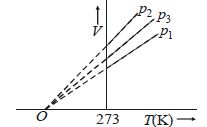
A
$p_1 > p_3 > p_2$
B
$p_1 > p_2 > p_3$
C
$p_2 > p_3 > p_1$
D
$p_2 > p_1 > p_3$
Solution
(A) According to the ideal gas equation,$PV = nRT$,which can be rearranged as $V = (\frac{nR}{P})T$.
This represents a straight line equation $y = mx$,where the slope $m = \frac{nR}{P}$.
Since the slope is inversely proportional to pressure $(m \propto \frac{1}{P})$,the line with the smallest slope corresponds to the highest pressure.
Looking at the graph,the slope of the line for $p_1$ is the smallest,followed by $p_3$,and then $p_2$.
Therefore,the correct order of pressures is $p_1 > p_3 > p_2$.
This represents a straight line equation $y = mx$,where the slope $m = \frac{nR}{P}$.
Since the slope is inversely proportional to pressure $(m \propto \frac{1}{P})$,the line with the smallest slope corresponds to the highest pressure.
Looking at the graph,the slope of the line for $p_1$ is the smallest,followed by $p_3$,and then $p_2$.
Therefore,the correct order of pressures is $p_1 > p_3 > p_2$.
0 likes
View Solution292
EasyMCQ
Pure hydrogen sulphide is stored in a tank of $100 \, L$ capacity at $20 \, ^oC$ and $2 \, atm$ pressure. The mass of the gas will be ............... $g$.
A
$34$
B
$340$
C
$282.68$
D
$28.24$
Solution
(C) Using the ideal gas equation,$PV = nRT$,where $n = \frac{m}{M}$.
Given:
$P = 2 \, atm$
$V = 100 \, L$
$T = 20 + 273 = 293 \, K$
$R = 0.0821 \, L \cdot atm \cdot K^{-1} \cdot mol^{-1}$
$M$ (molar mass of $H_2S$) $= 2(1) + 32 = 34 \, g/mol$.
Substituting the values:
$m = \frac{MPV}{RT} = \frac{34 \times 2 \times 100}{0.0821 \times 293} \approx 282.68 \, g$.
Given:
$P = 2 \, atm$
$V = 100 \, L$
$T = 20 + 273 = 293 \, K$
$R = 0.0821 \, L \cdot atm \cdot K^{-1} \cdot mol^{-1}$
$M$ (molar mass of $H_2S$) $= 2(1) + 32 = 34 \, g/mol$.
Substituting the values:
$m = \frac{MPV}{RT} = \frac{34 \times 2 \times 100}{0.0821 \times 293} \approx 282.68 \, g$.
0 likes
View Solution293
MediumMCQ
The volume occupied by $1.8 \; g$ of water vapour at $374^{\circ} C$ and $1 \; bar$ pressure will be $....... \; L$ : [Use $R=0.083 \; bar \; L \; K^{-1} \; mol^{-1}$]
A
$96.66$
B
$55.87$
C
$3.10$
D
$5.37$
Solution
(D) Using the ideal gas equation: $PV = nRT$
First,calculate the number of moles $(n)$ of water vapour:
$n = \frac{\text{mass}}{\text{molar mass}} = \frac{1.8 \; g}{18 \; g \; mol^{-1}} = 0.1 \; mol$
Convert the temperature $(T)$ from Celsius to Kelvin:
$T = 374 + 273 = 647 \; K$
Given pressure $(P)$ is $1 \; bar$ and gas constant $(R)$ is $0.083 \; bar \; L \; K^{-1} \; mol^{-1}$.
Now,calculate the volume $(V)$:
$V = \frac{nRT}{P} = \frac{0.1 \; mol \times 0.083 \; bar \; L \; K^{-1} \; mol^{-1} \times 647 \; K}{1 \; bar} = 5.37 \; L$
First,calculate the number of moles $(n)$ of water vapour:
$n = \frac{\text{mass}}{\text{molar mass}} = \frac{1.8 \; g}{18 \; g \; mol^{-1}} = 0.1 \; mol$
Convert the temperature $(T)$ from Celsius to Kelvin:
$T = 374 + 273 = 647 \; K$
Given pressure $(P)$ is $1 \; bar$ and gas constant $(R)$ is $0.083 \; bar \; L \; K^{-1} \; mol^{-1}$.
Now,calculate the volume $(V)$:
$V = \frac{nRT}{P} = \frac{0.1 \; mol \times 0.083 \; bar \; L \; K^{-1} \; mol^{-1} \times 647 \; K}{1 \; bar} = 5.37 \; L$
0 likes
View Solution294
Easy
$A$ balloon is filled with hydrogen at room temperature. It will burst if pressure exceeds $0.2 \ bar$. If at $1 \ bar$ pressure the gas occupies $2.27 \ L$ volume,up to what volume can the balloon be expanded?
Solution
(11.35 L) According to Boyle's Law,$p_{1} V_{1} = p_{2} V_{2}$.
Given: $p_{1} = 1 \ bar$,$V_{1} = 2.27 \ L$,and $p_{2} = 0.2 \ bar$.
Substituting the values into the equation:
$V_{2} = \frac{p_{1} V_{1}}{p_{2}}$
$V_{2} = \frac{1 \ bar \times 2.27 \ L}{0.2 \ bar} = 11.35 \ L$.
Since the balloon bursts if the pressure exceeds $0.2 \ bar$,the volume of the balloon can be expanded up to $11.35 \ L$.
Given: $p_{1} = 1 \ bar$,$V_{1} = 2.27 \ L$,and $p_{2} = 0.2 \ bar$.
Substituting the values into the equation:
$V_{2} = \frac{p_{1} V_{1}}{p_{2}}$
$V_{2} = \frac{1 \ bar \times 2.27 \ L}{0.2 \ bar} = 11.35 \ L$.
Since the balloon bursts if the pressure exceeds $0.2 \ bar$,the volume of the balloon can be expanded up to $11.35 \ L$.
0 likes
View Solution295
EasyMCQ
On a ship sailing in the Pacific Ocean where the temperature is $23.4^{\circ} C$,a balloon is filled with $2 \ L$ of air. What will be the volume of the balloon when the ship reaches the Indian Ocean,where the temperature is $26.1^{\circ} C$ (in $L$)?
A
$2.018$
B
$2.230$
C
$1.980$
D
$2.500$
Solution
(A) According to Charles's Law,at constant pressure,the volume of a fixed mass of gas is directly proportional to its absolute temperature: $\frac{V_{1}}{T_{1}} = \frac{V_{2}}{T_{2}}$.
Given:
$V_{1} = 2 \ L$
$T_{1} = 23.4 + 273.15 = 296.55 \ K$
$T_{2} = 26.1 + 273.15 = 299.25 \ K$
Rearranging the formula for $V_{2}$:
$V_{2} = \frac{V_{1} \times T_{2}}{T_{1}}$
Substituting the values:
$V_{2} = \frac{2 \ L \times 299.25 \ K}{296.55 \ K}$
$V_{2} \approx 2.018 \ L$
Given:
$V_{1} = 2 \ L$
$T_{1} = 23.4 + 273.15 = 296.55 \ K$
$T_{2} = 26.1 + 273.15 = 299.25 \ K$
Rearranging the formula for $V_{2}$:
$V_{2} = \frac{V_{1} \times T_{2}}{T_{1}}$
Substituting the values:
$V_{2} = \frac{2 \ L \times 299.25 \ K}{296.55 \ K}$
$V_{2} \approx 2.018 \ L$
0 likes
View Solution296
EasyMCQ
At $25^{\circ} C$ and $760 \,mm \,Hg$ pressure,a gas occupies $600 \,mL$ volume. What will be its pressure at a height where the temperature is $10^{\circ} C$ and the volume of the gas is $640 \,mL$?
A
$676.6 \,mm \,Hg$
B
$700.0 \,mm \,Hg$
C
$650.0 \,mm \,Hg$
D
$720.0 \,mm \,Hg$
Solution
(A) Given:
$p_{1} = 760 \,mm \,Hg$,$V_{1} = 600 \,mL$,$T_{1} = 25 + 273 = 298 \,K$
$V_{2} = 640 \,mL$,$T_{2} = 10 + 273 = 283 \,K$
Using the combined gas law:
$\frac{p_{1} V_{1}}{T_{1}} = \frac{p_{2} V_{2}}{T_{2}}$
Rearranging for $p_{2}$:
$p_{2} = \frac{p_{1} V_{1} T_{2}}{T_{1} V_{2}}$
Substituting the values:
$p_{2} = \frac{760 \times 600 \times 283}{298 \times 640}$
$p_{2} = \frac{129048000}{190720} \approx 676.6 \,mm \,Hg$
$p_{1} = 760 \,mm \,Hg$,$V_{1} = 600 \,mL$,$T_{1} = 25 + 273 = 298 \,K$
$V_{2} = 640 \,mL$,$T_{2} = 10 + 273 = 283 \,K$
Using the combined gas law:
$\frac{p_{1} V_{1}}{T_{1}} = \frac{p_{2} V_{2}}{T_{2}}$
Rearranging for $p_{2}$:
$p_{2} = \frac{p_{1} V_{1} T_{2}}{T_{1} V_{2}}$
Substituting the values:
$p_{2} = \frac{760 \times 600 \times 283}{298 \times 640}$
$p_{2} = \frac{129048000}{190720} \approx 676.6 \,mm \,Hg$
0 likes
View Solution297
EasyMCQ
What will be the minimum pressure required to compress $500 \, dm^{3}$ of air at $1 \, bar$ to $200 \, dm^{3}$ at $30^{\circ} C$ (in $, bar$)?
A
$2.0$
B
$2.5$
C
$3.0$
D
$3.5$
Solution
(B) Given:
Initial pressure,$p_{1} = 1 \, bar$
Initial volume,$V_{1} = 500 \, dm^{3}$
Final volume,$V_{2} = 200 \, dm^{3}$
Since the temperature remains constant,the final pressure $(p_{2})$ can be calculated using Boyle's law.
According to Boyle's law,
$p_{1} V_{1} = p_{2} V_{2}$
$\Rightarrow p_{2} = \frac{p_{1} V_{1}}{V_{2}}$
$= \frac{1 \times 500}{200} \, bar$
$= 2.5 \, bar$
Therefore,the minimum pressure required is $2.5 \, bar$.
Initial pressure,$p_{1} = 1 \, bar$
Initial volume,$V_{1} = 500 \, dm^{3}$
Final volume,$V_{2} = 200 \, dm^{3}$
Since the temperature remains constant,the final pressure $(p_{2})$ can be calculated using Boyle's law.
According to Boyle's law,
$p_{1} V_{1} = p_{2} V_{2}$
$\Rightarrow p_{2} = \frac{p_{1} V_{1}}{V_{2}}$
$= \frac{1 \times 500}{200} \, bar$
$= 2.5 \, bar$
Therefore,the minimum pressure required is $2.5 \, bar$.
0 likes
View Solution298
Easy
$A$ vessel of $120 \, mL$ capacity contains a certain amount of gas at $35^{\circ} C$ and $1.2 \, bar$ pressure. The gas is transferred to another vessel of volume $180 \, mL$ at $35^{\circ} C$. What would be its pressure?
Solution
(0.8 BAR) Given:
Initial pressure,$p_{1} = 1.2 \, bar$
Initial volume,$V_{1} = 120 \, mL$
Final volume,$V_{2} = 180 \, mL$
Since the temperature remains constant,the final pressure $(p_{2})$ can be calculated using Boyle's law.
According to Boyle's law,$p_{1} V_{1} = p_{2} V_{2}$.
$p_{2} = \frac{p_{1} V_{1}}{V_{2}}$
$p_{2} = \frac{1.2 \times 120}{180} \, bar$
$p_{2} = 0.8 \, bar$
Therefore,the final pressure of the gas would be $0.8 \, bar$.
Initial pressure,$p_{1} = 1.2 \, bar$
Initial volume,$V_{1} = 120 \, mL$
Final volume,$V_{2} = 180 \, mL$
Since the temperature remains constant,the final pressure $(p_{2})$ can be calculated using Boyle's law.
According to Boyle's law,$p_{1} V_{1} = p_{2} V_{2}$.
$p_{2} = \frac{p_{1} V_{1}}{V_{2}}$
$p_{2} = \frac{1.2 \times 120}{180} \, bar$
$p_{2} = 0.8 \, bar$
Therefore,the final pressure of the gas would be $0.8 \, bar$.
0 likes
View Solution299
Easy
Using the equation of state $pV = nRT$,show that at a given temperature,the density of a gas is proportional to the gas pressure $p$.
Solution
(N/A) The equation of state is given by,
$pV = nRT$ .......... $(i)$
Where,
$p \rightarrow$ Pressure of gas
$V \rightarrow$ Volume of gas
$n \rightarrow$ Number of moles of gas
$R \rightarrow$ Gas constant
$T \rightarrow$ Temperature of gas
From equation $(i)$,we have,
$\frac{n}{V} = \frac{p}{RT}$
Replacing $n$ with $\frac{m}{M}$,where $m$ is the mass and $M$ is the molar mass,we have
$\frac{m}{MV} = \frac{p}{RT}$ .......... $(ii)$
Since density $d = \frac{m}{V}$,substituting this into equation $(ii)$ gives,
$\frac{d}{M} = \frac{p}{RT}$
$\Rightarrow d = \left(\frac{M}{RT}\right) p$
Since the molar mass $M$ and gas constant $R$ are constants,at a constant temperature $T$,the term $\left(\frac{M}{RT}\right)$ is constant.
Therefore,$d = (\text{constant}) \times p$
$\Rightarrow d \propto p$
Hence,at a given temperature,the density $d$ of a gas is directly proportional to its pressure $p$.
$pV = nRT$ .......... $(i)$
Where,
$p \rightarrow$ Pressure of gas
$V \rightarrow$ Volume of gas
$n \rightarrow$ Number of moles of gas
$R \rightarrow$ Gas constant
$T \rightarrow$ Temperature of gas
From equation $(i)$,we have,
$\frac{n}{V} = \frac{p}{RT}$
Replacing $n$ with $\frac{m}{M}$,where $m$ is the mass and $M$ is the molar mass,we have
$\frac{m}{MV} = \frac{p}{RT}$ .......... $(ii)$
Since density $d = \frac{m}{V}$,substituting this into equation $(ii)$ gives,
$\frac{d}{M} = \frac{p}{RT}$
$\Rightarrow d = \left(\frac{M}{RT}\right) p$
Since the molar mass $M$ and gas constant $R$ are constants,at a constant temperature $T$,the term $\left(\frac{M}{RT}\right)$ is constant.
Therefore,$d = (\text{constant}) \times p$
$\Rightarrow d \propto p$
Hence,at a given temperature,the density $d$ of a gas is directly proportional to its pressure $p$.
0 likes
View SolutionStates of Matter — Ideal gas equation and Related gas laws · Frequently Asked Questions
1Are these States of Matter questions useful for JEE and NEET?
Yes. All questions in this section are mapped to JEE Main and NEET exam patterns. Previous year questions from JEE Main, NEET, GUJCET and state-level exams are included with full solutions.
2Can I switch to Hindi or Gujarati for these questions?
Yes. Use the language tabs in the hero section or the sidebar to view the same questions and solutions in English, Hindi or Gujarati.
3How do I generate a question paper from this subtopic?
Use the Vedclass Exam Paper Generator — select the chapter and subtopic, set difficulty, and generate Sets A, B, C, D automatically. First 3 chapters of every subject are free.
Vedclass Products
For Students
Vedclass Test Series
Mock tests in real JEE/NEET style with performance analysis. 5-day free trial.
Start Free TrialFor Teachers
Exam Paper Generator
Generate Set A/B/C/D papers from this chapter in 2 minutes. 3 chapters free.
Try FreeFor Institutes
Online Exam Module
Live online exams with unlimited students, 360° analytics & white-label branding.
See DemoFor Teachers & Institutes
Generate a States of Matter Exam Paper in 2 Minutes
Select subtopic & difficulty — Sets A, B, C, D auto-generated with No Repeat logic.
First 3 chapters of every subject are free — no payment required.