
A English
Ideal gas equation and Related gas laws Questions in English
Class 11 Chemistry · States of Matter · Ideal gas equation and Related gas laws
568+
Questions
English
Language
100%
With Solutions
Showing 50 of 568 questions in English
201
EasyMCQ
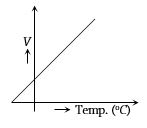
The following graph illustrates:
A
Dalton's law
B
Charles's law
C
Boyle's law
D
Gay-Lussac's law
Solution
(B) The graph shows a linear relationship between volume $(V)$ and temperature in degrees Celsius $(t)$.
According to Charles's Law,the volume of a fixed mass of gas is directly proportional to its absolute temperature ($T$ in Kelvin).
The relationship is given by: $V_t = V_0(1 + \frac{t}{273.15})$
This can be rewritten as: $V_t = V_0 + (\frac{V_0}{273.15})t$
Comparing this with the linear equation $Y = mx + C$,where $Y = V_t$,$x = t$,$m = \frac{V_0}{273.15}$,and $C = V_0$.
This linear plot of $V$ versus $t$ $(^{\circ}C)$ is characteristic of Charles's Law.
Therefore,the correct option is $(B)$.
According to Charles's Law,the volume of a fixed mass of gas is directly proportional to its absolute temperature ($T$ in Kelvin).
The relationship is given by: $V_t = V_0(1 + \frac{t}{273.15})$
This can be rewritten as: $V_t = V_0 + (\frac{V_0}{273.15})t$
Comparing this with the linear equation $Y = mx + C$,where $Y = V_t$,$x = t$,$m = \frac{V_0}{273.15}$,and $C = V_0$.
This linear plot of $V$ versus $t$ $(^{\circ}C)$ is characteristic of Charles's Law.
Therefore,the correct option is $(B)$.
0 likes
View Solution202
MediumMCQ
If the pressure and absolute temperature of $2 \ L$ of $CO_2$ are doubled,the volume of $CO_2$ would become ............... $L$.
A
$2$
B
$4$
C
$5$
D
$7$
Solution
(A) According to the ideal gas law,$\frac{P_1 V_1}{T_1} = \frac{P_2 V_2}{T_2}$.
Given: $V_1 = 2 \ L$,$P_2 = 2P_1$,and $T_2 = 2T_1$.
Substituting the values into the equation:
$\frac{P_1 \times 2 \ L}{T_1} = \frac{(2P_1) \times V_2}{(2T_1)}$.
Solving for $V_2$:
$V_2 = \frac{P_1 \times 2 \ L \times 2T_1}{T_1 \times 2P_1} = 2 \ L$.
Thus,the volume remains $2 \ L$.
Given: $V_1 = 2 \ L$,$P_2 = 2P_1$,and $T_2 = 2T_1$.
Substituting the values into the equation:
$\frac{P_1 \times 2 \ L}{T_1} = \frac{(2P_1) \times V_2}{(2T_1)}$.
Solving for $V_2$:
$V_2 = \frac{P_1 \times 2 \ L \times 2T_1}{T_1 \times 2P_1} = 2 \ L$.
Thus,the volume remains $2 \ L$.
0 likes
View Solution203
DifficultMCQ
Equal volumes of two gases which do not react together are enclosed in separate vessels. Their pressures are $100 \ mm$ and $400 \ mm$ respectively. If the two vessels are joined together,then what will be the pressure of the resulting mixture (temperature remaining constant)?
A
$125$
B
$500$
C
$1000$
D
$250$
Solution
(D) According to Boyle's Law,at constant temperature,$P_1V_1 = P_2V_2$.
Let the volume of each vessel be $V$. The total volume after joining the vessels becomes $2V$.
Using the principle of conservation of moles (or Dalton's Law of partial pressures),the total pressure $P_{mix}$ is given by:
$P_{mix} = \frac{P_1V_1 + P_2V_2}{V_{total}}$
$P_{mix} = \frac{100 \times V + 400 \times V}{V + V} = \frac{500V}{2V} = 250 \ mm$.
Let the volume of each vessel be $V$. The total volume after joining the vessels becomes $2V$.
Using the principle of conservation of moles (or Dalton's Law of partial pressures),the total pressure $P_{mix}$ is given by:
$P_{mix} = \frac{P_1V_1 + P_2V_2}{V_{total}}$
$P_{mix} = \frac{100 \times V + 400 \times V}{V + V} = \frac{500V}{2V} = 250 \ mm$.
0 likes
View Solution204
MediumMCQ
$A$ gas of volume $100 \ cc$ is kept in a vessel at pressure $10^4 \ Pa$ maintained at temperature $24 \ ^oC$. If now the pressure is increased to $10^5 \ Pa$,keeping the temperature constant,then the volume of the gas becomes ............. $cc$.
A
$10$
B
$100$
C
$1$
D
$1000$
Solution
(A) According to Boyle's Law,for a fixed amount of gas at constant temperature,$P_1V_1 = P_2V_2$.
Given: $P_1 = 10^4 \ Pa$,$V_1 = 100 \ cc$,$P_2 = 10^5 \ Pa$.
Substituting the values: $10^4 \times 100 = 10^5 \times V_2$.
$V_2 = \frac{10^4 \times 100}{10^5} = \frac{10^6}{10^5} = 10 \ cc$.
Given: $P_1 = 10^4 \ Pa$,$V_1 = 100 \ cc$,$P_2 = 10^5 \ Pa$.
Substituting the values: $10^4 \times 100 = 10^5 \times V_2$.
$V_2 = \frac{10^4 \times 100}{10^5} = \frac{10^6}{10^5} = 10 \ cc$.
0 likes
View Solution205
MediumMCQ
The density of Neon will be highest at
A
$STP$
B
$0\,^{\circ}C, 2 \ atm$
C
$273\,^{\circ}C, 1 \ atm$
D
$273\,^{\circ}C, 2 \ atm$
Solution
(B) The density $(d)$ of an ideal gas is given by the formula $d = \frac{PM}{RT}$,where $P$ is pressure,$M$ is molar mass,$R$ is the gas constant,and $T$ is temperature in Kelvin.
For a given gas like Neon,$M$ and $R$ are constant,so $d \propto \frac{P}{T}$.
To maximize density,we need the highest pressure $(P)$ and the lowest temperature $(T)$.
Comparing the options:
$A$: $STP$ $(0\,^{\circ}C, 1 \ atm)$ $\rightarrow T = 273 \ K, P = 1 \ atm$ $\rightarrow \frac{P}{T} = \frac{1}{273} \approx 0.00366$
$B$: $0\,^{\circ}C, 2 \ atm$ $\rightarrow T = 273 \ K, P = 2 \ atm$ $\rightarrow \frac{P}{T} = \frac{2}{273} \approx 0.00732$
$C$: $273\,^{\circ}C, 1 \ atm$ $\rightarrow T = 546 \ K, P = 1 \ atm$ $\rightarrow \frac{P}{T} = \frac{1}{546} \approx 0.00183$
$D$: $273\,^{\circ}C, 2 \ atm$ $\rightarrow T = 546 \ K, P = 2 \ atm$ $\rightarrow \frac{P}{T} = \frac{2}{546} \approx 0.00366$
The ratio $\frac{P}{T}$ is highest for option $B$.
For a given gas like Neon,$M$ and $R$ are constant,so $d \propto \frac{P}{T}$.
To maximize density,we need the highest pressure $(P)$ and the lowest temperature $(T)$.
Comparing the options:
$A$: $STP$ $(0\,^{\circ}C, 1 \ atm)$ $\rightarrow T = 273 \ K, P = 1 \ atm$ $\rightarrow \frac{P}{T} = \frac{1}{273} \approx 0.00366$
$B$: $0\,^{\circ}C, 2 \ atm$ $\rightarrow T = 273 \ K, P = 2 \ atm$ $\rightarrow \frac{P}{T} = \frac{2}{273} \approx 0.00732$
$C$: $273\,^{\circ}C, 1 \ atm$ $\rightarrow T = 546 \ K, P = 1 \ atm$ $\rightarrow \frac{P}{T} = \frac{1}{546} \approx 0.00183$
$D$: $273\,^{\circ}C, 2 \ atm$ $\rightarrow T = 546 \ K, P = 2 \ atm$ $\rightarrow \frac{P}{T} = \frac{2}{546} \approx 0.00366$
The ratio $\frac{P}{T}$ is highest for option $B$.
0 likes
View Solution206
MediumMCQ
What is the density of $N_2$ gas at $227\,^\circ C$ and $5.00\ atm$ pressure? (Given: $R = 0.082\ L\ atm\ K^{-1}\ mol^{-1}$)
A
$1.40$
B
$2.81$
C
$3.41$
D
$0.29$
Solution
(C) The ideal gas equation is $PV = nRT$.
Since $n = \frac{W}{M}$,where $W$ is mass and $M$ is molar mass,we have $PV = \frac{W}{M} RT$.
Rearranging for density $d = \frac{W}{V}$,we get $P = \frac{dRT}{M}$,which implies $d = \frac{PM}{RT}$.
Given: $P = 5.00\ atm$,$M(N_2) = 28\ g/mol$,$T = 227 + 273 = 500\ K$,and $R = 0.082\ L\ atm\ K^{-1}\ mol^{-1}$.
Substituting the values: $d = \frac{5.00 \times 28}{0.082 \times 500} = \frac{140}{41} \approx 3.41\ g/L$.
Note: The density is $3.41\ g/L$. Since $1\ L = 1000\ mL$,the density in $g/mL$ is $0.00341\ g/mL$. Given the options,the numerical value $3.41$ is expected.
Since $n = \frac{W}{M}$,where $W$ is mass and $M$ is molar mass,we have $PV = \frac{W}{M} RT$.
Rearranging for density $d = \frac{W}{V}$,we get $P = \frac{dRT}{M}$,which implies $d = \frac{PM}{RT}$.
Given: $P = 5.00\ atm$,$M(N_2) = 28\ g/mol$,$T = 227 + 273 = 500\ K$,and $R = 0.082\ L\ atm\ K^{-1}\ mol^{-1}$.
Substituting the values: $d = \frac{5.00 \times 28}{0.082 \times 500} = \frac{140}{41} \approx 3.41\ g/L$.
Note: The density is $3.41\ g/L$. Since $1\ L = 1000\ mL$,the density in $g/mL$ is $0.00341\ g/mL$. Given the options,the numerical value $3.41$ is expected.
0 likes
View Solution207
DifficultMCQ
$A$ bubble of air is underwater at temperature $15^\circ C$ and the pressure $1.5 \ bar$. If the bubble rises to the surface where the temperature is $25^\circ C$ and the pressure is $1.0 \ bar$,what will happen to the volume of the bubble?
A
Volume will become greater by a factor of $1.6$.
B
Volume will become greater by a factor of $1.1$.
C
Volume will become smaller by a factor of $0.70$.
D
Volume will become greater by a factor of $2.5$.
Solution
(A) Using the combined gas law,$\frac{P_1 V_1}{T_1} = \frac{P_2 V_2}{T_2}$,we can express the ratio of volumes as $\frac{V_2}{V_1} = \frac{P_1 T_2}{P_2 T_1}$.
Given initial conditions: $T_1 = 15 + 273 = 288 \ K$ and $P_1 = 1.5 \ bar$.
Given final conditions: $T_2 = 25 + 273 = 298 \ K$ and $P_2 = 1.0 \ bar$.
Substituting the values: $\frac{V_2}{V_1} = \frac{1.5 \times 298}{1.0 \times 288} = \frac{447}{288} \approx 1.552$.
Rounding to one decimal place,the volume increases by a factor of $1.6$.
Given initial conditions: $T_1 = 15 + 273 = 288 \ K$ and $P_1 = 1.5 \ bar$.
Given final conditions: $T_2 = 25 + 273 = 298 \ K$ and $P_2 = 1.0 \ bar$.
Substituting the values: $\frac{V_2}{V_1} = \frac{1.5 \times 298}{1.0 \times 288} = \frac{447}{288} \approx 1.552$.
Rounding to one decimal place,the volume increases by a factor of $1.6$.
0 likes
View Solution208
DifficultMCQ
The pressure exerted by $6.0 \ g$ of methane gas in a $0.03 \ m^3$ vessel at $129^{\circ} C$ is $........ \ Pa$ (Atomic masses : $C = 12.01, H = 1.01$ and $R = 8.314 \ J K^{-1} mol^{-1}$)
A
$215216$
B
$13409$
C
$41648$
D
$31684$
Solution
(C) Volume,$V = 0.03 \ m^3$
Temperature,$T = 129 + 273 = 402 \ K$
Mass of methane,$w = 6.0 \ g$
Molar mass of methane,$M = 12.01 + 4 \times 1.01 = 16.05 \ g \ mol^{-1}$
Using the ideal gas equation,$pV = nRT$,where $n = \frac{w}{M}$
$p = \frac{wRT}{MV} = \frac{6.0 \times 8.314 \times 402}{16.05 \times 0.03}$
$p = \frac{20065.392}{0.4815} \approx 41672.67 \ Pa$
Rounding to the nearest provided option,the value is $41648 \ Pa$.
Temperature,$T = 129 + 273 = 402 \ K$
Mass of methane,$w = 6.0 \ g$
Molar mass of methane,$M = 12.01 + 4 \times 1.01 = 16.05 \ g \ mol^{-1}$
Using the ideal gas equation,$pV = nRT$,where $n = \frac{w}{M}$
$p = \frac{wRT}{MV} = \frac{6.0 \times 8.314 \times 402}{16.05 \times 0.03}$
$p = \frac{20065.392}{0.4815} \approx 41672.67 \ Pa$
Rounding to the nearest provided option,the value is $41648 \ Pa$.
0 likes
View Solution209
MediumMCQ
If $10^{-4} \ dm^3$ of water is introduced into a $1.0 \ dm^3$ flask at $300 \ K,$ how many moles of water are in the vapour phase when equilibrium is established? (Given: Vapour pressure of $H_2O$ at $300 \ K$ is $3170 \ Pa;$ $R = 8.314 \ J \ K^{-1} \ mol^{-1}$)
A
$5.56 \times 10^{-3} \ mol$
B
$1.53 \times 10^{-2} \ mol$
C
$4.46 \times 10^{-2} \ mol$
D
$1.27 \times 10^{-3} \ mol$
Solution
(D) At equilibrium,the water vapour exerts a pressure equal to its saturated vapour pressure.
Using the ideal gas equation,$PV = nRT$,where $P = 3170 \ Pa$,$V = 1.0 \ dm^3 = 1.0 \times 10^{-3} \ m^3$,$T = 300 \ K$,and $R = 8.314 \ J \ K^{-1} \ mol^{-1}$.
$n = \frac{PV}{RT} = \frac{3170 \times 1.0 \times 10^{-3}}{8.314 \times 300} \ mol$.
$n = \frac{3.17}{2494.2} \ mol \approx 1.27 \times 10^{-3} \ mol$.
Using the ideal gas equation,$PV = nRT$,where $P = 3170 \ Pa$,$V = 1.0 \ dm^3 = 1.0 \times 10^{-3} \ m^3$,$T = 300 \ K$,and $R = 8.314 \ J \ K^{-1} \ mol^{-1}$.
$n = \frac{PV}{RT} = \frac{3170 \times 1.0 \times 10^{-3}}{8.314 \times 300} \ mol$.
$n = \frac{3.17}{2494.2} \ mol \approx 1.27 \times 10^{-3} \ mol$.
0 likes
View Solution210
DifficultMCQ
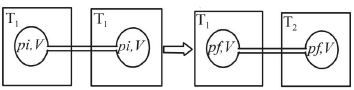
Two closed bulbs of equal volume $V$ containing an ideal gas initially at pressure $P_i$ and temperature $T_1$ are connected through a narrow tube of negligible volume as shown in the figure below. The temperature of one of the bulbs is then raised to $T_2$. The final pressure $P_f$ is:
A
$2 P_i \left( \frac{T_2}{T_1 + T_2} \right)$
B
$2 P_i \left( \frac{T_1 T_2}{T_1 + T_2} \right)$
C
$P_i \left( \frac{T_1 T_2}{T_1 + T_2} \right)$
D
$2 P_i \left( \frac{T_1}{T_1 + T_2} \right)$
Solution
(A) Initially,the number of moles of gas in each bulb is $n_1 = \frac{P_i V}{R T_1}$ and $n_2 = \frac{P_i V}{R T_1}$.
After the temperature of the second bulb is raised to $T_2$,the number of moles of gas in both bulbs are $n_1' = \frac{P_f V}{R T_1}$ and $n_2' = \frac{P_f V}{R T_2}$.
Since the total number of moles of gas in both bulbs remains constant:
$n_1 + n_2 = n_1' + n_2'$
$\frac{P_i V}{R T_1} + \frac{P_i V}{R T_1} = \frac{P_f V}{R T_1} + \frac{P_f V}{R T_2}$
$\frac{2 P_i V}{R T_1} = \frac{P_f V}{R} \left( \frac{1}{T_1} + \frac{1}{T_2} \right)$
$\frac{2 P_i}{T_1} = P_f \left( \frac{T_2 + T_1}{T_1 T_2} \right)$
$P_f = \frac{2 P_i T_2}{T_1 + T_2}$
After the temperature of the second bulb is raised to $T_2$,the number of moles of gas in both bulbs are $n_1' = \frac{P_f V}{R T_1}$ and $n_2' = \frac{P_f V}{R T_2}$.
Since the total number of moles of gas in both bulbs remains constant:
$n_1 + n_2 = n_1' + n_2'$
$\frac{P_i V}{R T_1} + \frac{P_i V}{R T_1} = \frac{P_f V}{R T_1} + \frac{P_f V}{R T_2}$
$\frac{2 P_i V}{R T_1} = \frac{P_f V}{R} \left( \frac{1}{T_1} + \frac{1}{T_2} \right)$
$\frac{2 P_i}{T_1} = P_f \left( \frac{T_2 + T_1}{T_1 T_2} \right)$
$P_f = \frac{2 P_i T_2}{T_1 + T_2}$
0 likes
View Solution211
EasyMCQ
The density of vapours of a particular volatile diatomic species $A_2$ was found to be $10 \ mg/mL$ at $1 \ atm$ and $273 \ K$. Its atomic weight is given by: [Assume ideal gas behaviour].
A
$20$
B
$112$
C
$224$
D
$56$
Solution
(B) Using the ideal gas equation: $PM = dRT$
Given: $P = 1 \ atm$,$T = 273 \ K$,$d = 10 \ mg/mL = 10 \ g/L$,$R = 0.0821 \ L \ atm \ K^{-1} \ mol^{-1}$
Substituting the values: $1 \times M = 10 \times 0.0821 \times 273$
$M = 224.133 \ g/mol \approx 224 \ g/mol$
Since the species is diatomic $(A_2)$,the molar mass $M = 2 \times (\text{atomic weight of } A)$
$2 \times A = 224$
$A = 112 \ g/mol$
Given: $P = 1 \ atm$,$T = 273 \ K$,$d = 10 \ mg/mL = 10 \ g/L$,$R = 0.0821 \ L \ atm \ K^{-1} \ mol^{-1}$
Substituting the values: $1 \times M = 10 \times 0.0821 \times 273$
$M = 224.133 \ g/mol \approx 224 \ g/mol$
Since the species is diatomic $(A_2)$,the molar mass $M = 2 \times (\text{atomic weight of } A)$
$2 \times A = 224$
$A = 112 \ g/mol$
0 likes
View Solution212
EasyMCQ
Which graph is not a straight line for an ideal gas?
A
$P$ vs $\frac{1}{V}$ (at constant $T$ & $n$)
B
$PV$ vs $V^2$ (at constant $T$ & $n$)
C
$P$ vs $T^2$ (at constant $V$ & $n$)
D
$log\ P$ vs $log\ (V^2)$ (at constant $T$ & $n$)
Solution
(C) For an ideal gas,the equation is $PV = nRT$.
$A$. $P$ vs $\frac{1}{V}$ at constant $T$ & $n$: Since $P = (nRT) \times \frac{1}{V}$,this is a linear equation of the form $y = mx$ passing through the origin. It is a straight line.
$B$. $PV$ vs $V^2$ at constant $T$ & $n$: Since $PV = nRT$ (a constant),the graph of $PV$ vs $V^2$ is a horizontal line parallel to the $V^2$ axis. It is a straight line.
$C$. $P$ vs $T^2$ at constant $V$ & $n$: From $P = (\frac{nR}{V})T$,we see that $P \propto T$. Therefore,$P$ vs $T^2$ is a parabolic curve,not a straight line.
$D$. $log\ P$ vs $log\ (V^2)$ at constant $T$ & $n$: Since $PV = k$,$P = k V^{-1}$. Taking log on both sides,$log\ P = log\ k - log\ V$. Since $log\ (V^2) = 2 log\ V$,we have $log\ P = log\ k - \frac{1}{2} log\ (V^2)$. This is a linear equation of the form $y = mx + c$. It is a straight line.
$A$. $P$ vs $\frac{1}{V}$ at constant $T$ & $n$: Since $P = (nRT) \times \frac{1}{V}$,this is a linear equation of the form $y = mx$ passing through the origin. It is a straight line.
$B$. $PV$ vs $V^2$ at constant $T$ & $n$: Since $PV = nRT$ (a constant),the graph of $PV$ vs $V^2$ is a horizontal line parallel to the $V^2$ axis. It is a straight line.
$C$. $P$ vs $T^2$ at constant $V$ & $n$: From $P = (\frac{nR}{V})T$,we see that $P \propto T$. Therefore,$P$ vs $T^2$ is a parabolic curve,not a straight line.
$D$. $log\ P$ vs $log\ (V^2)$ at constant $T$ & $n$: Since $PV = k$,$P = k V^{-1}$. Taking log on both sides,$log\ P = log\ k - log\ V$. Since $log\ (V^2) = 2 log\ V$,we have $log\ P = log\ k - \frac{1}{2} log\ (V^2)$. This is a linear equation of the form $y = mx + c$. It is a straight line.
0 likes
View Solution213
MediumMCQ
$A$ dry gas occupied $127.4 \, mL$ at $STP$. If the same mass of the gas is collected over water at $27 \, ^\circ C$ and at a total pressure of $725 \, torr$,what volume does it occupy? The vapour pressure of water at $27 \, ^\circ C$ is $25 \, torr$. (Note: $1 \, bar = 750 \, torr$)
A
$150$
B
$130$
C
$156$
D
$145$
Solution
(A) At $STP$,$P_1 = 750 \, torr$,$V_1 = 127.4 \, mL$,and $T_1 = 273 \, K$.
When collected over water,the pressure of the dry gas $(P_{dry})$ is the total pressure minus the aqueous tension: $P_2 = P_{total} - P_{H_2O} = 725 \, torr - 25 \, torr = 700 \, torr$.
The temperature is $T_2 = 27 + 273 = 300 \, K$.
Using the combined gas law: $\frac{P_1 V_1}{T_1} = \frac{P_2 V_2}{T_2}$.
Substituting the values: $\frac{750 \times 127.4}{273} = \frac{700 \times V_2}{300}$.
$V_2 = \frac{750 \times 127.4 \times 300}{273 \times 700} \approx 150 \, mL$.
When collected over water,the pressure of the dry gas $(P_{dry})$ is the total pressure minus the aqueous tension: $P_2 = P_{total} - P_{H_2O} = 725 \, torr - 25 \, torr = 700 \, torr$.
The temperature is $T_2 = 27 + 273 = 300 \, K$.
Using the combined gas law: $\frac{P_1 V_1}{T_1} = \frac{P_2 V_2}{T_2}$.
Substituting the values: $\frac{750 \times 127.4}{273} = \frac{700 \times V_2}{300}$.
$V_2 = \frac{750 \times 127.4 \times 300}{273 \times 700} \approx 150 \, mL$.
0 likes
View Solution214
MediumMCQ
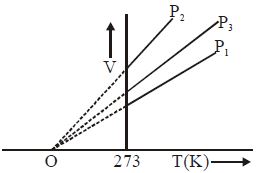
The volume-temperature graph of a given mass of an ideal gas at constant pressure is shown below. What is the correct order of pressures?
A
$P_1 > P_3 > P_2$
B
$P_1 > P_2 > P_3$
C
$P_2 > P_3 > P_1$
D
$P_2 > P_1 > P_3$
Solution
(A) According to the ideal gas equation,$PV = nRT$,which can be rearranged as $V = (\frac{nR}{P})T$.
This represents a straight line equation $y = mx$,where the slope $m = \frac{nR}{P}$.
Since the slope is inversely proportional to pressure $(m \propto \frac{1}{P})$,a smaller slope corresponds to a higher pressure.
From the given graph,the slope of the line for $P_1$ is the smallest,followed by $P_3$,and then $P_2$ (which has the largest slope).
Therefore,the correct order of pressures is $P_1 > P_3 > P_2$.
This represents a straight line equation $y = mx$,where the slope $m = \frac{nR}{P}$.
Since the slope is inversely proportional to pressure $(m \propto \frac{1}{P})$,a smaller slope corresponds to a higher pressure.
From the given graph,the slope of the line for $P_1$ is the smallest,followed by $P_3$,and then $P_2$ (which has the largest slope).
Therefore,the correct order of pressures is $P_1 > P_3 > P_2$.
0 likes
View Solution215
DifficultMCQ
At $0\, ^\circ C$ and $1\, \text{atm}$ pressure,a gas occupies $100\, \text{cc}$. If the pressure is increased to $1.5$ times and the temperature is increased by one-third of its absolute temperature,then the final volume of the gas will be :- $cc$
A
$80$
B
$88.9$
C
$66.7$
D
$100$
Solution
(B) Using the combined gas law: $\frac{P_1 V_1}{T_1} = \frac{P_2 V_2}{T_2}$
Given:
$P_1 = P$
$V_1 = 100\, \text{cc}$
$T_1 = 0\, ^\circ C = 273\, \text{K}$
New conditions:
$P_2 = 1.5 P = \frac{3}{2} P$
$T_2 = T_1 + \frac{1}{3} T_1 = \frac{4}{3} T_1 = \frac{4}{3} \times 273\, \text{K}$
Substituting these values into the formula:
$V_2 = \frac{P_1 V_1 T_2}{P_2 T_1} = \frac{P \times 100 \times (\frac{4}{3} \times 273)}{(\frac{3}{2} P) \times 273}$
$V_2 = 100 \times \frac{4}{3} \times \frac{2}{3} = \frac{800}{9} \approx 88.88\, \text{cc}$
Rounding to one decimal place,$V_2 = 88.9\, \text{cc}$.
Given:
$P_1 = P$
$V_1 = 100\, \text{cc}$
$T_1 = 0\, ^\circ C = 273\, \text{K}$
New conditions:
$P_2 = 1.5 P = \frac{3}{2} P$
$T_2 = T_1 + \frac{1}{3} T_1 = \frac{4}{3} T_1 = \frac{4}{3} \times 273\, \text{K}$
Substituting these values into the formula:
$V_2 = \frac{P_1 V_1 T_2}{P_2 T_1} = \frac{P \times 100 \times (\frac{4}{3} \times 273)}{(\frac{3}{2} P) \times 273}$
$V_2 = 100 \times \frac{4}{3} \times \frac{2}{3} = \frac{800}{9} \approx 88.88\, \text{cc}$
Rounding to one decimal place,$V_2 = 88.9\, \text{cc}$.
0 likes
View Solution216
EasyMCQ
Densities of a gas at different conditions are in the ratio $1:2$ and their temperatures are in the ratio $2:1$,then the ratio of their respective pressure is :-
A
$1:1$
B
$1:2$
C
$2:1$
D
$4:1$
Solution
(A) From the ideal gas equation,$PV = nRT = \frac{w}{M}RT$,we have $P = \frac{dRT}{M}$,where $d$ is the density,$R$ is the gas constant,$T$ is the temperature,and $M$ is the molar mass.
For the same gas,$M$ is constant,so $P \propto dT$.
Therefore,the ratio of pressures is $\frac{P_1}{P_2} = \frac{d_1}{d_2} \times \frac{T_1}{T_2}$.
Given $\frac{d_1}{d_2} = \frac{1}{2}$ and $\frac{T_1}{T_2} = \frac{2}{1}$.
Substituting these values,$\frac{P_1}{P_2} = \frac{1}{2} \times \frac{2}{1} = \frac{1}{1}$.
Thus,the ratio of their respective pressures is $1:1$.
For the same gas,$M$ is constant,so $P \propto dT$.
Therefore,the ratio of pressures is $\frac{P_1}{P_2} = \frac{d_1}{d_2} \times \frac{T_1}{T_2}$.
Given $\frac{d_1}{d_2} = \frac{1}{2}$ and $\frac{T_1}{T_2} = \frac{2}{1}$.
Substituting these values,$\frac{P_1}{P_2} = \frac{1}{2} \times \frac{2}{1} = \frac{1}{1}$.
Thus,the ratio of their respective pressures is $1:1$.
0 likes
View Solution217
MediumMCQ
The pressure exerted by $6.0 \ g$ of methane gas in a $0.03 \ m^3$ vessel at $129 \ ^oC$ is : (Atomic masses of $C = 12.01, H = 1.01$ and $R = 8.314 \ J K^{-1} mol^{-1}$) :- ................ $Pa$
A
$215216$
B
$13409$
C
$41648$
D
$31684$
Solution
(C) The ideal gas equation is given by $PV = nRT$,where $n = \frac{w}{M}$.
Given:
Mass of methane $(w)$ = $6.0 \ g$
Molar mass of methane $(CH_4)$ $(M)$ = $12.01 + 4 \times 1.01 = 16.05 \ g/mol$
Volume $(V)$ = $0.03 \ m^3$
Temperature $(T)$ = $129 + 273.15 = 402.15 \ K$ (approximated to $402 \ K$ for calculation)
Gas constant $(R)$ = $8.314 \ J K^{-1} mol^{-1}$
Substituting the values into the equation:
$P \times 0.03 = \frac{6.0}{16.05} \times 8.314 \times 402.15$
$P \times 0.03 = 0.37383 \times 8.314 \times 402.15$
$P \times 0.03 = 1249.53$
$P = \frac{1249.53}{0.03} \approx 41651 \ Pa$
Rounding to the nearest provided option,the correct answer is $41648 \ Pa$.
Given:
Mass of methane $(w)$ = $6.0 \ g$
Molar mass of methane $(CH_4)$ $(M)$ = $12.01 + 4 \times 1.01 = 16.05 \ g/mol$
Volume $(V)$ = $0.03 \ m^3$
Temperature $(T)$ = $129 + 273.15 = 402.15 \ K$ (approximated to $402 \ K$ for calculation)
Gas constant $(R)$ = $8.314 \ J K^{-1} mol^{-1}$
Substituting the values into the equation:
$P \times 0.03 = \frac{6.0}{16.05} \times 8.314 \times 402.15$
$P \times 0.03 = 0.37383 \times 8.314 \times 402.15$
$P \times 0.03 = 1249.53$
$P = \frac{1249.53}{0.03} \approx 41651 \ Pa$
Rounding to the nearest provided option,the correct answer is $41648 \ Pa$.
0 likes
View Solution218
MediumMCQ
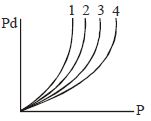
At $273\,K$,$Pd$ vs $P$ is plotted for various gases $1, 2, 3, 4$. Assuming ideal behaviour for four gases $N_2, He, CO_2$ & $H_2$. The correct combination is [$P$ denotes pressure in atmosphere & $d$ denotes density in $g/L$]
A
$2-N_2, 1-He, 3-CO_2, 4-H_2$
B
$4-N_2, 1-He, 2-CO_2, 3-H_2$
C
$4-N_2, 3-He, 2-CO_2, 1-H_2$
D
$2-N_2, 3-He, 1-CO_2, 4-H_2$
Solution
(D) From the ideal gas equation,$PV = nRT = (\frac{m}{M})RT$.
Rearranging this,$P(\frac{m}{V}) = \frac{PRT}{M}$,which gives $Pd = \frac{PM}{RT}$.
For a given temperature $T$,the slope of the $Pd$ vs $P$ graph is $\frac{M}{RT}$,which is directly proportional to the molar mass $M$ of the gas.
The molar masses are: $CO_2 = 44\,g/mol$,$N_2 = 28\,g/mol$,$He = 4\,g/mol$,$H_2 = 2\,g/mol$.
Since the slope increases as molar mass increases,the order of slopes is $CO_2 > N_2 > He > H_2$.
Looking at the graph,the slope follows the order $1 > 2 > 3 > 4$.
Therefore,$1-CO_2, 2-N_2, 3-He, 4-H_2$.
Matching this with the given options,option $D$ is $2-N_2, 3-He, 1-CO_2, 4-H_2$.
Rearranging this,$P(\frac{m}{V}) = \frac{PRT}{M}$,which gives $Pd = \frac{PM}{RT}$.
For a given temperature $T$,the slope of the $Pd$ vs $P$ graph is $\frac{M}{RT}$,which is directly proportional to the molar mass $M$ of the gas.
The molar masses are: $CO_2 = 44\,g/mol$,$N_2 = 28\,g/mol$,$He = 4\,g/mol$,$H_2 = 2\,g/mol$.
Since the slope increases as molar mass increases,the order of slopes is $CO_2 > N_2 > He > H_2$.
Looking at the graph,the slope follows the order $1 > 2 > 3 > 4$.
Therefore,$1-CO_2, 2-N_2, 3-He, 4-H_2$.
Matching this with the given options,option $D$ is $2-N_2, 3-He, 1-CO_2, 4-H_2$.
0 likes
View Solution219
DifficultMCQ
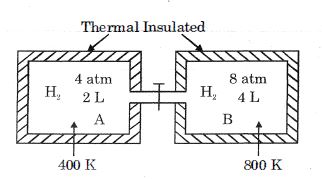
Hydrogen gas is present in compartment $A$ and compartment $B$ as shown in the following figure. If the valve is opened,then the final pressure in the compartments is ............. $atm$. [Assume the temperature of each vessel remains constant at its initial value]
A
$6.67$
B
$6$
C
$4$
D
None of these
Solution
(B) The total number of moles of $H_2$ gas remains constant when the valve is opened.
$n_{total} = n_A + n_B$
Using the ideal gas equation $PV = nRT$,we have $n = \frac{PV}{RT}$.
$n_A = \frac{4 \ atm \times 2 \ L}{R \times 400 \ K} = \frac{8}{400R} = \frac{0.02}{R}$
$n_B = \frac{8 \ atm \times 4 \ L}{R \times 800 \ K} = \frac{32}{800R} = \frac{0.04}{R}$
$n_{total} = \frac{0.02}{R} + \frac{0.04}{R} = \frac{0.06}{R}$
After opening the valve,the gas occupies both compartments. Since the vessels are thermally insulated,the temperature in each compartment remains at its initial value ($400 \ K$ and $800 \ K$ respectively).
$n_{total} = \frac{P_f V_A}{R T_A} + \frac{P_f V_B}{R T_B}$
$\frac{0.06}{R} = P_f \left[ \frac{2}{400R} + \frac{4}{800R} \right]$
$0.06 = P_f \left[ 0.005 + 0.005 \right]$
$0.06 = P_f \times 0.01$
$P_f = 6 \ atm$
$n_{total} = n_A + n_B$
Using the ideal gas equation $PV = nRT$,we have $n = \frac{PV}{RT}$.
$n_A = \frac{4 \ atm \times 2 \ L}{R \times 400 \ K} = \frac{8}{400R} = \frac{0.02}{R}$
$n_B = \frac{8 \ atm \times 4 \ L}{R \times 800 \ K} = \frac{32}{800R} = \frac{0.04}{R}$
$n_{total} = \frac{0.02}{R} + \frac{0.04}{R} = \frac{0.06}{R}$
After opening the valve,the gas occupies both compartments. Since the vessels are thermally insulated,the temperature in each compartment remains at its initial value ($400 \ K$ and $800 \ K$ respectively).
$n_{total} = \frac{P_f V_A}{R T_A} + \frac{P_f V_B}{R T_B}$
$\frac{0.06}{R} = P_f \left[ \frac{2}{400R} + \frac{4}{800R} \right]$
$0.06 = P_f \left[ 0.005 + 0.005 \right]$
$0.06 = P_f \times 0.01$
$P_f = 6 \ atm$
0 likes
View Solution220
MediumMCQ
If two identical containers $X$ and $Y$ containing $O_2$ gas are subjected to expansion from volume $V$ to $2V$ under identical isothermal conditions by applying pressure changes of $\Delta P$ and $0.2 \Delta P$ respectively,then the ratio of the mass of $O_2$ gas in container $X$ to container $Y$ is
A
$5$
B
$3$
C
$2$
D
$4$
Solution
(A) For container $X$,the initial state is $P_1 V = n_1 RT$. After expansion to $2V$ with pressure change $\Delta P$,the final state is $(P_1 - \Delta P) 2V = n_1 RT$.
Equating the two: $P_1 V = 2P_1 V - 2\Delta P V$,which gives $P_1 V = 2\Delta P V$.
Thus,$n_1 = \frac{2\Delta P V}{RT}$.
For container $Y$,the initial state is $P_2 V = n_2 RT$. After expansion to $2V$ with pressure change $0.2 \Delta P$,the final state is $(P_2 - 0.2 \Delta P) 2V = n_2 RT$.
Equating the two: $P_2 V = 2P_2 V - 0.4 \Delta P V$,which gives $P_2 V = 0.4 \Delta P V$.
Thus,$n_2 = \frac{0.4 \Delta P V}{RT}$.
The ratio of masses is equal to the ratio of moles: $\frac{w_X}{w_Y} = \frac{n_1}{n_2} = \frac{2\Delta P V / RT}{0.4 \Delta P V / RT} = \frac{2}{0.4} = 5$.
Equating the two: $P_1 V = 2P_1 V - 2\Delta P V$,which gives $P_1 V = 2\Delta P V$.
Thus,$n_1 = \frac{2\Delta P V}{RT}$.
For container $Y$,the initial state is $P_2 V = n_2 RT$. After expansion to $2V$ with pressure change $0.2 \Delta P$,the final state is $(P_2 - 0.2 \Delta P) 2V = n_2 RT$.
Equating the two: $P_2 V = 2P_2 V - 0.4 \Delta P V$,which gives $P_2 V = 0.4 \Delta P V$.
Thus,$n_2 = \frac{0.4 \Delta P V}{RT}$.
The ratio of masses is equal to the ratio of moles: $\frac{w_X}{w_Y} = \frac{n_1}{n_2} = \frac{2\Delta P V / RT}{0.4 \Delta P V / RT} = \frac{2}{0.4} = 5$.
0 likes
View Solution221
EasyMCQ
The densities of air at $25\,^o C$ and $100\,^o C$ are $1.2\ gL^{-1}$ and $0.9\ gL^{-1}$ respectively. Assuming that the air obeys Charles's law,the value of absolute zero of temperature in degree Celsius is .............. $^o C$.
A
$-273$
B
$-200$
C
$-300$
D
$-400$
Solution
(B) According to Charles's law,$V \propto T$ at constant pressure. Since density $d = \frac{m}{V}$,we have $d \propto \frac{1}{T}$,which implies $d_1 T_1 = d_2 T_2$.
Let the absolute zero be $x\,^o C$. Then $T_1 = (25 - x) \text{ K}$ and $T_2 = (100 - x) \text{ K}$.
Given $d_1 = 1.2\ gL^{-1}$ and $d_2 = 0.9\ gL^{-1}$.
Substituting the values: $1.2 \times (25 - x) = 0.9 \times (100 - x)$.
$1.2(25) - 1.2x = 0.9(100) - 0.9x$.
$30 - 1.2x = 90 - 0.9x$.
$30 - 90 = 1.2x - 0.9x$.
$-60 = 0.3x$.
$x = \frac{-60}{0.3} = -200\,^o C$.
Let the absolute zero be $x\,^o C$. Then $T_1 = (25 - x) \text{ K}$ and $T_2 = (100 - x) \text{ K}$.
Given $d_1 = 1.2\ gL^{-1}$ and $d_2 = 0.9\ gL^{-1}$.
Substituting the values: $1.2 \times (25 - x) = 0.9 \times (100 - x)$.
$1.2(25) - 1.2x = 0.9(100) - 0.9x$.
$30 - 1.2x = 90 - 0.9x$.
$30 - 90 = 1.2x - 0.9x$.
$-60 = 0.3x$.
$x = \frac{-60}{0.3} = -200\,^o C$.
0 likes
View Solution222
MediumMCQ
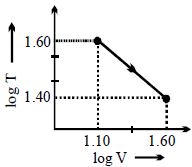
The $log \, T$ vs $log \, V$ curve is plotted for an ideal gas as shown. Which of the following is true for the gas?
A
Monoatomic & undergoing adiabatic change
B
Monoatomic & undergoing an isothermal change
C
Diatomic & undergoing an adiabatic change
D
Triatomic & undergoing an adiabatic change
Solution
(C) For an adiabatic process, $TV^{\gamma-1} = \text{constant}$.
Taking log on both sides: $log \, T + (\gamma-1) log \, V = \text{constant}$.
This is the equation of a straight line $y = mx + c$, where $y = log \, T$, $x = log \, V$, and the slope $m = -(\gamma-1)$.
From the graph, the slope $m = \frac{1.40 - 1.60}{1.60 - 1.10} = \frac{-0.20}{0.50} = -0.4$.
Equating the slopes: $-(\gamma-1) = -0.4$, so $\gamma-1 = 0.4$, which gives $\gamma = 1.4$.
For a diatomic gas, $\gamma = 1.4$ (e.g., $C_p/C_v = 7/5 = 1.4$).
Thus, the gas is diatomic and undergoing an adiabatic change.
Taking log on both sides: $log \, T + (\gamma-1) log \, V = \text{constant}$.
This is the equation of a straight line $y = mx + c$, where $y = log \, T$, $x = log \, V$, and the slope $m = -(\gamma-1)$.
From the graph, the slope $m = \frac{1.40 - 1.60}{1.60 - 1.10} = \frac{-0.20}{0.50} = -0.4$.
Equating the slopes: $-(\gamma-1) = -0.4$, so $\gamma-1 = 0.4$, which gives $\gamma = 1.4$.
For a diatomic gas, $\gamma = 1.4$ (e.g., $C_p/C_v = 7/5 = 1.4$).
Thus, the gas is diatomic and undergoing an adiabatic change.
0 likes
View Solution223
DifficultMCQ
Air entering the lungs ends up in tiny sacs called alveoli. It is from the alveoli that oxygen diffuses into the blood. The average radius of the alveoli is $0.0050 \ cm$ and the air inside contains $14$ per cent oxygen. Assuming that the pressure in the alveoli is $1.0 \ atm$ and the temperature is $37 \ ^oC$,calculate the number of oxygen molecules in one of the alveoli.
A
$6 \times 10^{13}$
B
$10^{24}$
C
$1.7 \times 10^{22}$
D
$1.7 \times 10^{12}$
Solution
(D) $1$. Calculate the volume of the alveolus $(V)$: $V = \frac{4}{3} \pi r^3 = \frac{4}{3} \times 3.14 \times (0.0050 \ cm)^3 = 5.236 \times 10^{-7} \ cm^3 = 5.236 \times 10^{-13} \ m^3 = 5.236 \times 10^{-10} \ L$.
$2$. Use the ideal gas law $(PV = nRT)$ to find the total moles of air $(n_{air})$: $n_{air} = \frac{PV}{RT} = \frac{1.0 \ atm \times 5.236 \times 10^{-10} \ L}{0.0821 \ L \cdot atm \cdot K^{-1} \cdot mol^{-1} \times 310 \ K} = 2.057 \times 10^{-11} \ mol$.
$3$. Calculate the moles of oxygen $(n_{O_2})$: $n_{O_2} = 0.14 \times n_{air} = 0.14 \times 2.057 \times 10^{-11} = 2.88 \times 10^{-12} \ mol$.
$4$. Calculate the number of oxygen molecules $(N)$: $N = n_{O_2} \times N_A = 2.88 \times 10^{-12} \times 6.022 \times 10^{23} \approx 1.73 \times 10^{12}$ molecules.
$2$. Use the ideal gas law $(PV = nRT)$ to find the total moles of air $(n_{air})$: $n_{air} = \frac{PV}{RT} = \frac{1.0 \ atm \times 5.236 \times 10^{-10} \ L}{0.0821 \ L \cdot atm \cdot K^{-1} \cdot mol^{-1} \times 310 \ K} = 2.057 \times 10^{-11} \ mol$.
$3$. Calculate the moles of oxygen $(n_{O_2})$: $n_{O_2} = 0.14 \times n_{air} = 0.14 \times 2.057 \times 10^{-11} = 2.88 \times 10^{-12} \ mol$.
$4$. Calculate the number of oxygen molecules $(N)$: $N = n_{O_2} \times N_A = 2.88 \times 10^{-12} \times 6.022 \times 10^{23} \approx 1.73 \times 10^{12}$ molecules.
0 likes
View Solution224
DifficultMCQ
Starting out on a trip into the mountains,you inflate the tires on your automobile to a recommended pressure of $3.21 \times 10^5 \ Pa$ on a day when the temperature is $-5.0 \ ^\circ C$. You drive to the beach,where the temperature is $28 \ ^\circ C$. Assume that the volume increased by $3 \%$. What is the final pressure in the tires?
A
$350 \ Pa$
B
$3500 \ Pa$
C
$3.5 \times 10^5 \ Pa$
D
None of these
Solution
(C) Since the number of moles of gas remains constant,we use the combined gas law: $\frac{P_i V_i}{T_i} = \frac{P_f V_f}{T_f}$.
Given:
$P_i = 3.21 \times 10^5 \ Pa$
$T_i = -5.0 \ ^\circ C = 268.15 \ K$
$T_f = 28 \ ^\circ C = 301.15 \ K$
$V_f = V_i + 0.03 V_i = 1.03 V_i$
Rearranging for $P_f$:
$P_f = P_i \times \frac{V_i}{V_f} \times \frac{T_f}{T_i}$
Substituting the values:
$P_f = 3.21 \times 10^5 \ Pa \times \frac{1}{1.03} \times \frac{301.15}{268.15}$
$P_f \approx 3.50 \times 10^5 \ Pa$.
Given:
$P_i = 3.21 \times 10^5 \ Pa$
$T_i = -5.0 \ ^\circ C = 268.15 \ K$
$T_f = 28 \ ^\circ C = 301.15 \ K$
$V_f = V_i + 0.03 V_i = 1.03 V_i$
Rearranging for $P_f$:
$P_f = P_i \times \frac{V_i}{V_f} \times \frac{T_f}{T_i}$
Substituting the values:
$P_f = 3.21 \times 10^5 \ Pa \times \frac{1}{1.03} \times \frac{301.15}{268.15}$
$P_f \approx 3.50 \times 10^5 \ Pa$.
0 likes
View Solution225
EasyMCQ
Molecular attraction and size of the molecules in a gas are negligible at :-
A
critical temperature
B
high pressure
C
high temperature and low pressure
D
low temperature and high pressure
Solution
(C) According to the kinetic molecular theory of gases,the assumptions that the volume of gas molecules is negligible compared to the total volume of the gas and that there are no intermolecular forces of attraction are valid for an ideal gas.
These conditions are best approximated by real gases at $high \ temperature$ and $low \ pressure$.
At $high \ temperature$,the kinetic energy of the molecules is high,which overcomes the intermolecular forces of attraction.
At $low \ pressure$,the molecules are far apart,making the volume occupied by the molecules themselves negligible compared to the total volume of the container.
These conditions are best approximated by real gases at $high \ temperature$ and $low \ pressure$.
At $high \ temperature$,the kinetic energy of the molecules is high,which overcomes the intermolecular forces of attraction.
At $low \ pressure$,the molecules are far apart,making the volume occupied by the molecules themselves negligible compared to the total volume of the container.
0 likes
View Solution226
MediumMCQ
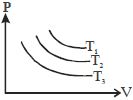
The following $P$ vs $V$ curve is plotted. What is the relation between $T_1$,$T_2$ and $T_3$?
A
$T_1 = T_2 = T_3$
B
$T_1 > T_2 > T_3$
C
$T_1 < T_2 < T_3$
D
None of the above
Solution
(B) According to the ideal gas equation,$PV = nRT$,which can be rearranged as $P = (nRT) \cdot (1/V)$.
For a fixed amount of gas ($n$ is constant),the product $PV$ is directly proportional to the temperature $T$.
In a $P$ versus $V$ graph (isotherm),for a given volume $V$,the pressure $P$ is higher for higher temperatures.
Looking at the graph,at any constant volume $V$,the pressure values follow the order $P_1 > P_2 > P_3$ for the curves corresponding to $T_1, T_2, T_3$ respectively.
Therefore,the relationship between the temperatures is $T_1 > T_2 > T_3$.
For a fixed amount of gas ($n$ is constant),the product $PV$ is directly proportional to the temperature $T$.
In a $P$ versus $V$ graph (isotherm),for a given volume $V$,the pressure $P$ is higher for higher temperatures.
Looking at the graph,at any constant volume $V$,the pressure values follow the order $P_1 > P_2 > P_3$ for the curves corresponding to $T_1, T_2, T_3$ respectively.
Therefore,the relationship between the temperatures is $T_1 > T_2 > T_3$.
0 likes
View Solution227
MediumMCQ
At $1 \text{ atm}$ pressure and $0 \, ^oC$,a certain mass of a gas occupies $0.4 \, L$. Keeping the pressure constant,if the temperature is increased to $273 \, ^oC$,what will be its final volume (in $, L$)?
A
$0.8$
B
$22.4$
C
$54.6$
D
$0.4$
Solution
(A) According to Charles's Law,for a fixed mass of gas at constant pressure,$V \propto T$ (where $T$ is in Kelvin).
Initial conditions: $V_1 = 0.4 \, L$,$T_1 = 0 + 273 = 273 \, K$.
Final conditions: $V_2 = ?$,$T_2 = 273 + 273 = 546 \, K$.
Using the formula $\frac{V_1}{T_1} = \frac{V_2}{T_2}$:
$\frac{0.4}{273} = \frac{V_2}{546}$
$V_2 = 0.4 \times \frac{546}{273} = 0.4 \times 2 = 0.8 \, L$.
Initial conditions: $V_1 = 0.4 \, L$,$T_1 = 0 + 273 = 273 \, K$.
Final conditions: $V_2 = ?$,$T_2 = 273 + 273 = 546 \, K$.
Using the formula $\frac{V_1}{T_1} = \frac{V_2}{T_2}$:
$\frac{0.4}{273} = \frac{V_2}{546}$
$V_2 = 0.4 \times \frac{546}{273} = 0.4 \times 2 = 0.8 \, L$.
0 likes
View Solution228
MediumMCQ
Volume of a given mass of gas at $17 \, ^oC$ is measured as $200 \, cm^3$. The volume of the same mass of that gas at same pressure and at temperature of $47 \, ^oC$ will be .............. $cm^{3}$
A
$77.5$
B
$13.45$
C
$220.6$
D
$320$
Solution
(C) According to Charles's Law,at constant pressure,$V \propto T$.
Thus,$\frac{V_{1}}{T_{1}} = \frac{V_{2}}{T_{2}}$.
Given: $V_{1} = 200 \, cm^{3}$,$T_{1} = 17 + 273 = 290 \, K$,$T_{2} = 47 + 273 = 320 \, K$.
Substituting the values: $\frac{200}{290} = \frac{V_{2}}{320}$.
$V_{2} = \frac{200 \times 320}{290} = 220.68 \, cm^{3} \approx 220.6 \, cm^{3}$.
Thus,$\frac{V_{1}}{T_{1}} = \frac{V_{2}}{T_{2}}$.
Given: $V_{1} = 200 \, cm^{3}$,$T_{1} = 17 + 273 = 290 \, K$,$T_{2} = 47 + 273 = 320 \, K$.
Substituting the values: $\frac{200}{290} = \frac{V_{2}}{320}$.
$V_{2} = \frac{200 \times 320}{290} = 220.68 \, cm^{3} \approx 220.6 \, cm^{3}$.
0 likes
View Solution229
MediumMCQ
At $N.T.P.$,the density of a gas is $0.00356 \ g/mL$. What is the molecular mass of the gas?
A
$40$
B
$80$
C
$160$
D
$50$
Solution
(B) The ideal gas equation is $PV = nRT$,which can be written as $P = \frac{dRT}{M}$,where $d$ is density and $M$ is molecular mass.
Given: $d = 0.00356 \ g/mL = 3.56 \ g/L$,$P = 1 \ atm$,$R = 0.0821 \ L \cdot atm \cdot K^{-1} \cdot mol^{-1}$,and $T = 273 \ K$.
Rearranging for $M$: $M = \frac{dRT}{P}$.
Substituting the values: $M = \frac{3.56 \times 0.0821 \times 273}{1} \approx 79.75 \approx 80 \ g/mol$.
Given: $d = 0.00356 \ g/mL = 3.56 \ g/L$,$P = 1 \ atm$,$R = 0.0821 \ L \cdot atm \cdot K^{-1} \cdot mol^{-1}$,and $T = 273 \ K$.
Rearranging for $M$: $M = \frac{dRT}{P}$.
Substituting the values: $M = \frac{3.56 \times 0.0821 \times 273}{1} \approx 79.75 \approx 80 \ g/mol$.
0 likes
View Solution230
DifficultMCQ
Calculate the density of a gaseous mixture which consists of $3.01 \times 10^{24}$ molecules of $N_2$ and $32 \ g$ of $O_2$ gas at $3 \ atm$ pressure and $860 \ K$ temperature. (Given: $R = 1/12 \ atm \ L \ mol^{-1} \ K^{-1}$) ............. $g/L$
A
$0.6$
B
$1.2$
C
$0.3$
D
$12$
Solution
(B) Step $1$: Calculate the moles of each gas.
Moles of $N_2 = \frac{3.01 \times 10^{24}}{6.02 \times 10^{23}} = 5 \ mol$.
Moles of $O_2 = \frac{32 \ g}{32 \ g/mol} = 1 \ mol$.
Total moles $(n)$ = $5 + 1 = 6 \ mol$.
Step $2$: Calculate the total volume of the mixture using the ideal gas equation $PV = nRT$.
$V = \frac{nRT}{P} = \frac{6 \times (1/12) \times 860}{3}$.
$V = \frac{0.5 \times 860}{3} = \frac{430}{3} \approx 143.33 \ L$.
Step $3$: Calculate the total mass of the mixture.
Mass of $N_2 = 5 \ mol \times 28 \ g/mol = 140 \ g$.
Mass of $O_2 = 32 \ g$.
Total mass = $140 + 32 = 172 \ g$.
Step $4$: Calculate the density $(d = \frac{mass}{volume})$.
$d = \frac{172}{143.33} \approx 1.2 \ g/L$.
Moles of $N_2 = \frac{3.01 \times 10^{24}}{6.02 \times 10^{23}} = 5 \ mol$.
Moles of $O_2 = \frac{32 \ g}{32 \ g/mol} = 1 \ mol$.
Total moles $(n)$ = $5 + 1 = 6 \ mol$.
Step $2$: Calculate the total volume of the mixture using the ideal gas equation $PV = nRT$.
$V = \frac{nRT}{P} = \frac{6 \times (1/12) \times 860}{3}$.
$V = \frac{0.5 \times 860}{3} = \frac{430}{3} \approx 143.33 \ L$.
Step $3$: Calculate the total mass of the mixture.
Mass of $N_2 = 5 \ mol \times 28 \ g/mol = 140 \ g$.
Mass of $O_2 = 32 \ g$.
Total mass = $140 + 32 = 172 \ g$.
Step $4$: Calculate the density $(d = \frac{mass}{volume})$.
$d = \frac{172}{143.33} \approx 1.2 \ g/L$.
0 likes
View Solution231
DifficultMCQ
In $1811$,Avogadro calculated the formula of camphor by measuring the density of its vapour. Avogadro found the density to be $3.84 \ g/L$,when he made the measurement at $210 \ ^oC$ and $1 \ atm$ pressure. Which of the following is the correct formula of camphor?
A
$C_{10}H_{14}O$
B
$C_{10}H_{16}O$
C
$C_{10}H_{16}O_2$
D
$C_{10}H_{18}O$
Solution
(B) Using the ideal gas equation: $PV = nRT = \frac{m}{M}RT$,where $M$ is the molar mass and $d = \frac{m}{V}$ is the density.
The formula for molar mass is $M = \frac{dRT}{P}$.
Given: $d = 3.84 \ g/L$,$R = 0.0821 \ L \ atm \ K^{-1} \ mol^{-1}$,$T = 210 + 273 = 483 \ K$,and $P = 1 \ atm$.
Substituting the values: $M = \frac{3.84 \times 0.0821 \times 483}{1} \approx 152.2 \ g/mol$.
Calculating the molar mass for the options:
$A: C_{10}H_{14}O = (10 \times 12) + (14 \times 1) + 16 = 150 \ g/mol$
$B: C_{10}H_{16}O = (10 \times 12) + (16 \times 1) + 16 = 152 \ g/mol$
$C: C_{10}H_{16}O_2 = (10 \times 12) + (16 \times 1) + 32 = 168 \ g/mol$
$D: C_{10}H_{18}O = (10 \times 12) + (18 \times 1) + 16 = 154 \ g/mol$
Since the calculated molar mass is $152 \ g/mol$,the correct formula is $C_{10}H_{16}O$.
The formula for molar mass is $M = \frac{dRT}{P}$.
Given: $d = 3.84 \ g/L$,$R = 0.0821 \ L \ atm \ K^{-1} \ mol^{-1}$,$T = 210 + 273 = 483 \ K$,and $P = 1 \ atm$.
Substituting the values: $M = \frac{3.84 \times 0.0821 \times 483}{1} \approx 152.2 \ g/mol$.
Calculating the molar mass for the options:
$A: C_{10}H_{14}O = (10 \times 12) + (14 \times 1) + 16 = 150 \ g/mol$
$B: C_{10}H_{16}O = (10 \times 12) + (16 \times 1) + 16 = 152 \ g/mol$
$C: C_{10}H_{16}O_2 = (10 \times 12) + (16 \times 1) + 32 = 168 \ g/mol$
$D: C_{10}H_{18}O = (10 \times 12) + (18 \times 1) + 16 = 154 \ g/mol$
Since the calculated molar mass is $152 \ g/mol$,the correct formula is $C_{10}H_{16}O$.
0 likes
View Solution232
DifficultMCQ
Assuming ideal gas behaviour,the ratio of density of ammonia to that of hydrogen chloride at the same temperature and pressure is: (Atomic wt. of $Cl = 35.5 \ u$)
A
$1.46$
B
$1.64$
C
$0.46$
D
$0.64$
Solution
(C) From the ideal gas equation,$PV = nRT$.
Since $n = \frac{m}{M}$,we have $PV = \frac{mRT}{M}$.
Rearranging for density $(d = \frac{m}{V})$,we get $P = \frac{dRT}{M}$,which implies $d = \frac{PM}{RT}$.
At constant temperature and pressure,$d \propto M$.
Therefore,the ratio of densities is $\frac{d_{NH_3}}{d_{HCl}} = \frac{M_{NH_3}}{M_{HCl}}$.
The molar mass of $NH_3 = 14 + 3(1) = 17 \ g/mol$.
The molar mass of $HCl = 1 + 35.5 = 36.5 \ g/mol$.
Ratio $= \frac{17}{36.5} \approx 0.4657 \approx 0.46$.
Since $n = \frac{m}{M}$,we have $PV = \frac{mRT}{M}$.
Rearranging for density $(d = \frac{m}{V})$,we get $P = \frac{dRT}{M}$,which implies $d = \frac{PM}{RT}$.
At constant temperature and pressure,$d \propto M$.
Therefore,the ratio of densities is $\frac{d_{NH_3}}{d_{HCl}} = \frac{M_{NH_3}}{M_{HCl}}$.
The molar mass of $NH_3 = 14 + 3(1) = 17 \ g/mol$.
The molar mass of $HCl = 1 + 35.5 = 36.5 \ g/mol$.
Ratio $= \frac{17}{36.5} \approx 0.4657 \approx 0.46$.
0 likes
View Solution233
DifficultMCQ
At $300\, K$,the density of a certain gaseous molecule at $2\, bar$ is double that of dinitrogen $(N_2)$ at $4\, bar$. The molar mass of the gaseous molecule is ............... $g\, mol^{-1}$.
A
$28$
B
$56$
C
$112$
D
$224$
Solution
(C) The density $(\rho)$ of a gas is given by the formula $\rho = \frac{PM}{RT}$,where $P$ is pressure,$M$ is molar mass,$R$ is the gas constant,and $T$ is temperature.
Given that the temperature $T$ is constant for both gases.
For $N_2$ gas: $\rho_{N_2} = \frac{P_{N_2} \times M_{N_2}}{RT} = \frac{4 \times 28}{RT}$.
For the unknown gas: $\rho_{gas} = \frac{P_{gas} \times M_{gas}}{RT} = \frac{2 \times M_{gas}}{RT}$.
According to the problem,$\rho_{gas} = 2 \times \rho_{N_2}$.
Substituting the expressions: $\frac{2 \times M_{gas}}{RT} = 2 \times \left( \frac{4 \times 28}{RT} \right)$.
Canceling $RT$ from both sides: $2 \times M_{gas} = 8 \times 28$.
$M_{gas} = 4 \times 28 = 112\, g\, mol^{-1}$.
Given that the temperature $T$ is constant for both gases.
For $N_2$ gas: $\rho_{N_2} = \frac{P_{N_2} \times M_{N_2}}{RT} = \frac{4 \times 28}{RT}$.
For the unknown gas: $\rho_{gas} = \frac{P_{gas} \times M_{gas}}{RT} = \frac{2 \times M_{gas}}{RT}$.
According to the problem,$\rho_{gas} = 2 \times \rho_{N_2}$.
Substituting the expressions: $\frac{2 \times M_{gas}}{RT} = 2 \times \left( \frac{4 \times 28}{RT} \right)$.
Canceling $RT$ from both sides: $2 \times M_{gas} = 8 \times 28$.
$M_{gas} = 4 \times 28 = 112\, g\, mol^{-1}$.
0 likes
View Solution234
DifficultMCQ
The initial volume of a gas cylinder is $750.0 \ mL$. If the pressure of gas inside the cylinder changes from $840.0 \ mm \ Hg$ to $360.0 \ mm \ Hg$,what will be the final volume of the gas (in $L$)?
A
$1.750$
B
$3.60$
C
$4.032$
D
$7.50$
Solution
(A) According to Boyle's law,for a fixed amount of gas at constant temperature,$P_1V_1 = P_2V_2$.
Given: $V_1 = 750.0 \ mL$,$P_1 = 840.0 \ mm \ Hg$,$P_2 = 360.0 \ mm \ Hg$.
Substituting the values: $840.0 \ mm \ Hg \times 750.0 \ mL = 360.0 \ mm \ Hg \times V_2$.
$V_2 = \frac{840.0 \times 750.0}{360.0} \ mL = 1750 \ mL$.
Converting to liters: $1750 \ mL = 1.750 \ L$.
Given: $V_1 = 750.0 \ mL$,$P_1 = 840.0 \ mm \ Hg$,$P_2 = 360.0 \ mm \ Hg$.
Substituting the values: $840.0 \ mm \ Hg \times 750.0 \ mL = 360.0 \ mm \ Hg \times V_2$.
$V_2 = \frac{840.0 \times 750.0}{360.0} \ mL = 1750 \ mL$.
Converting to liters: $1750 \ mL = 1.750 \ L$.
0 likes
View Solution235
MediumMCQ
For $1 \ mol$ of an ideal gas at a constant temperature $T,$ the plot of $(\log \ P)$ against $(\log \ V)$ is a ($P :$ Pressure,$V:$ Volume)
A
Straight line parallel to $x-$ axis.
B
Straight line with a negative slope.
C
Curve starting at origin.
D
Straight line passing through origin.
Solution
(B) According to Boyle's law,$PV = \text{constant}$.
Taking logarithm on both sides:
$\log \ P + \log \ V = \log \ (\text{constant})$
$\log \ P = - \log \ V + \log \ (\text{constant})$
This equation is of the form $y = mx + c$,where $y = \log \ P$,$x = \log \ V$,and the slope $m = -1$.
Hence,the plot of $\log \ P$ vs $\log \ V$ is a straight line with a negative slope.
Taking logarithm on both sides:
$\log \ P + \log \ V = \log \ (\text{constant})$
$\log \ P = - \log \ V + \log \ (\text{constant})$
This equation is of the form $y = mx + c$,where $y = \log \ P$,$x = \log \ V$,and the slope $m = -1$.
Hence,the plot of $\log \ P$ vs $\log \ V$ is a straight line with a negative slope.
0 likes
View Solution236
DifficultMCQ
An open vessel at $300 \ K$ is heated until $2/5$ of the air in it is expelled. Assuming that the volume of the vessel remains constant,the temperature to which the vessel is heated is $..... \ K$.
A
$1500$
B
$400$
C
$500$
D
$750$
Solution
(C) Let the volume of the vessel be $V$. Initially,the volume of air at $T_1 = 300 \ K$ is $V$.
Since $2/5$ of the air is expelled,the remaining volume of air at $300 \ K$ is $V - (2/5)V = (3/5)V$.
When the vessel is heated to a new temperature $T_2$,this remaining air expands to fill the entire volume $V$ of the vessel.
Since the pressure remains constant in an open vessel,we use Charles's Law: $\frac{V_1}{T_1} = \frac{V_2}{T_2}$.
Substituting the values: $\frac{(3/5)V}{300} = \frac{V}{T_2}$.
Solving for $T_2$: $T_2 = 300 \times \frac{5}{3} = 500 \ K$.
Since $2/5$ of the air is expelled,the remaining volume of air at $300 \ K$ is $V - (2/5)V = (3/5)V$.
When the vessel is heated to a new temperature $T_2$,this remaining air expands to fill the entire volume $V$ of the vessel.
Since the pressure remains constant in an open vessel,we use Charles's Law: $\frac{V_1}{T_1} = \frac{V_2}{T_2}$.
Substituting the values: $\frac{(3/5)V}{300} = \frac{V}{T_2}$.
Solving for $T_2$: $T_2 = 300 \times \frac{5}{3} = 500 \ K$.
0 likes
View Solution237
MediumMCQ
$0.5 \, mol$ of gas $A$ and $x \, mol$ of gas $B$ exert a pressure of $200 \, Pa$ in a container of volume $10 \, m^3$ at $1000 \, K$. Given $R$ is the gas constant in $J \, K^{-1} \, mol^{-1}$,$x$ is
A
$\frac{2R}{4 + R}$
B
$\frac{2R}{4 - R}$
C
$\frac{4 + R}{2R}$
D
$\frac{4 - R}{2R}$
Solution
(D) Using the ideal gas equation: $PV = nRT$
Given: $P = 200 \, Pa$,$V = 10 \, m^3$,$T = 1000 \, K$,$n = (0.5 + x) \, mol$.
Substituting the values: $200 \times 10 = (0.5 + x) \times R \times 1000$
$2000 = (0.5 + x) \times 1000R$
$2 = (0.5 + x)R$
$\frac{2}{R} = 0.5 + x$
$x = \frac{2}{R} - 0.5$
$x = \frac{2 - 0.5R}{R} = \frac{4 - R}{2R}$
Given: $P = 200 \, Pa$,$V = 10 \, m^3$,$T = 1000 \, K$,$n = (0.5 + x) \, mol$.
Substituting the values: $200 \times 10 = (0.5 + x) \times R \times 1000$
$2000 = (0.5 + x) \times 1000R$
$2 = (0.5 + x)R$
$\frac{2}{R} = 0.5 + x$
$x = \frac{2}{R} - 0.5$
$x = \frac{2 - 0.5R}{R} = \frac{4 - R}{2R}$
0 likes
View Solution238
MediumMCQ
An open vessel at $27\,^{\circ}C$ is heated until two-fifths of the air (assumed as an ideal gas) in it has escaped from the vessel. Assuming that the volume of the vessel remains constant,the temperature to which the vessel has been heated is:
A
$500\,^{\circ}C$
B
$750\,^{\circ}C$
C
$500\,K$
D
$750\,K$
Solution
(C) For an open vessel,the pressure $P$ and volume $V$ remain constant. According to the ideal gas law,$PV = nRT$,which implies $n_1T_1 = n_2T_2$.
Let the initial number of moles be $n_1 = n$ and the initial temperature $T_1 = 27 + 273 = 300\,K$.
Since two-fifths of the air escapes,the remaining moles are $n_2 = n - \frac{2}{5}n = \frac{3}{5}n$.
Substituting these values into the equation: $n \times 300 = \frac{3}{5}n \times T_2$.
Solving for $T_2$: $T_2 = 300 \times \frac{5}{3} = 500\,K$.
Let the initial number of moles be $n_1 = n$ and the initial temperature $T_1 = 27 + 273 = 300\,K$.
Since two-fifths of the air escapes,the remaining moles are $n_2 = n - \frac{2}{5}n = \frac{3}{5}n$.
Substituting these values into the equation: $n \times 300 = \frac{3}{5}n \times T_2$.
Solving for $T_2$: $T_2 = 300 \times \frac{5}{3} = 500\,K$.
0 likes
View Solution239
MediumMCQ
Calculate the density of $CO_2$ at $100\, ^oC$ and $800\, mm\, Hg$ of pressure in $g/L$.
A
$1.51$
B
$2$
C
$1.1$
D
$0.5$
Solution
(A) The density $d$ of a gas is given by the formula $d = \frac{PM}{RT}$.
Here,$P = \frac{800}{760}\, atm$,$M = 44\, g/mol$ (molar mass of $CO_2$),$R = 0.0821\, L\, atm\, K^{-1} mol^{-1}$,and $T = 100 + 273 = 373\, K$.
Substituting the values: $d = \frac{(\frac{800}{760}) \times 44}{0.0821 \times 373} \approx 1.51\, g/L$.
Here,$P = \frac{800}{760}\, atm$,$M = 44\, g/mol$ (molar mass of $CO_2$),$R = 0.0821\, L\, atm\, K^{-1} mol^{-1}$,and $T = 100 + 273 = 373\, K$.
Substituting the values: $d = \frac{(\frac{800}{760}) \times 44}{0.0821 \times 373} \approx 1.51\, g/L$.
0 likes
View Solution240
MediumMCQ
The temperature of $1 \, mol$ of a gas is increased by $2 \, ^oC$ at constant pressure. The work done will be:
A
$2R$
B
$-2R$
C
$R/2$
D
$-3R$
Solution
(A) For an ideal gas at constant pressure,the work done $W$ is given by the formula $W = P \Delta V$.
According to the ideal gas equation,$PV = nRT$,so at constant pressure,$P \Delta V = nR \Delta T$.
Given:
$n = 1 \, mol$
$\Delta T = 2 \, ^oC = 2 \, K$ (since the change in temperature is the same in Celsius and Kelvin scales).
Substituting the values:
$W = nR \Delta T = 1 \, mol \times R \times 2 \, K = 2R$.
Since the gas expands when heated at constant pressure,the work is done by the system,which is conventionally represented as negative in some sign conventions,but in standard thermodynamic problems,the magnitude $2R$ is the expected answer. Given the options provided,the magnitude is $2R$.
According to the ideal gas equation,$PV = nRT$,so at constant pressure,$P \Delta V = nR \Delta T$.
Given:
$n = 1 \, mol$
$\Delta T = 2 \, ^oC = 2 \, K$ (since the change in temperature is the same in Celsius and Kelvin scales).
Substituting the values:
$W = nR \Delta T = 1 \, mol \times R \times 2 \, K = 2R$.
Since the gas expands when heated at constant pressure,the work is done by the system,which is conventionally represented as negative in some sign conventions,but in standard thermodynamic problems,the magnitude $2R$ is the expected answer. Given the options provided,the magnitude is $2R$.
0 likes
View Solution241
EasyMCQ
The density of $O_{2(g)}$ is maximum at?
A
$S.T.P.$
B
$273 \, K$ and $2 \, atm$
C
$546 \, K$ and $1 \, atm$
D
$546 \, K$ and $2 \, atm$
Solution
(B) The ideal gas equation is $PV = nRT = \frac{w}{M} RT$.
Density,$\rho = \frac{w}{V} = \frac{PM}{RT}$.
Thus,the density of the ideal gas is directly proportional to the pressure $(P)$ and inversely proportional to the temperature $(T)$.
To maximize density,we require the highest pressure and the lowest temperature.
Comparing the given options:
$A$: $1 \, atm, 273 \, K$
$B$: $2 \, atm, 273 \, K$
$C$: $1 \, atm, 546 \, K$
$D$: $2 \, atm, 546 \, K$
Option $B$ provides the highest pressure $(2 \, atm)$ and the lowest temperature $(273 \, K)$,resulting in the maximum density.
Density,$\rho = \frac{w}{V} = \frac{PM}{RT}$.
Thus,the density of the ideal gas is directly proportional to the pressure $(P)$ and inversely proportional to the temperature $(T)$.
To maximize density,we require the highest pressure and the lowest temperature.
Comparing the given options:
$A$: $1 \, atm, 273 \, K$
$B$: $2 \, atm, 273 \, K$
$C$: $1 \, atm, 546 \, K$
$D$: $2 \, atm, 546 \, K$
Option $B$ provides the highest pressure $(2 \, atm)$ and the lowest temperature $(273 \, K)$,resulting in the maximum density.
0 likes
View Solution242
MediumMCQ
The densities of $2$ gases are in the ratio $1:2$ and their temperatures are in the ratio $2:1$. What is the ratio of their respective pressures?
A
$1:1$
B
$1:4$
C
$2:1$
D
$4:1$
Solution
(A) From the ideal gas equation,density $d = \frac{PM_w}{RT}$,where $P$ is pressure,$M_w$ is molar mass,$R$ is the gas constant,and $T$ is temperature.
Assuming the gases have the same molar mass $(M_w)$,the relationship is $d \propto \frac{P}{T}$ or $P \propto d \times T$.
Given the ratio of densities $\frac{d_1}{d_2} = \frac{1}{2}$ and the ratio of temperatures $\frac{T_1}{T_2} = \frac{2}{1}$.
The ratio of pressures is $\frac{P_1}{P_2} = \frac{d_1}{d_2} \times \frac{T_1}{T_2}$.
Substituting the values: $\frac{P_1}{P_2} = \frac{1}{2} \times \frac{2}{1} = \frac{1}{1}$.
Thus,the ratio of their pressures is $1:1$.
Assuming the gases have the same molar mass $(M_w)$,the relationship is $d \propto \frac{P}{T}$ or $P \propto d \times T$.
Given the ratio of densities $\frac{d_1}{d_2} = \frac{1}{2}$ and the ratio of temperatures $\frac{T_1}{T_2} = \frac{2}{1}$.
The ratio of pressures is $\frac{P_1}{P_2} = \frac{d_1}{d_2} \times \frac{T_1}{T_2}$.
Substituting the values: $\frac{P_1}{P_2} = \frac{1}{2} \times \frac{2}{1} = \frac{1}{1}$.
Thus,the ratio of their pressures is $1:1$.
0 likes
View Solution243
MediumMCQ
The density of a gas at $27\,^oC$ and $1\, atm$ is $d$. At constant pressure,which of the following temperatures will result in a gas density of $0.75\, d$?
A
$400\,^oC$
B
$30\,^oC$
C
$300\,^oC$
D
$400\, K$
Solution
(D) From the ideal gas equation,$PV = nRT = \frac{m}{M}RT$,where $m$ is mass and $M$ is molar mass.
Density $d = \frac{m}{V} = \frac{PM}{RT}$.
Since $P$ and $M$ are constant,$d \propto \frac{1}{T}$.
Given $T_1 = 27 + 273 = 300\, K$ and $d_1 = d$.
We need $T_2$ such that $d_2 = 0.75\, d$.
Using the relation $\frac{d_2}{d_1} = \frac{T_1}{T_2}$:
$\frac{0.75\, d}{d} = \frac{300}{T_2}$.
$0.75 = \frac{300}{T_2} \implies T_2 = \frac{300}{0.75} = 400\, K$.
Converting to Celsius: $400 - 273 = 127\,^oC$. Since $400\, K$ is provided as an option,the correct choice is $D$.
Density $d = \frac{m}{V} = \frac{PM}{RT}$.
Since $P$ and $M$ are constant,$d \propto \frac{1}{T}$.
Given $T_1 = 27 + 273 = 300\, K$ and $d_1 = d$.
We need $T_2$ such that $d_2 = 0.75\, d$.
Using the relation $\frac{d_2}{d_1} = \frac{T_1}{T_2}$:
$\frac{0.75\, d}{d} = \frac{300}{T_2}$.
$0.75 = \frac{300}{T_2} \implies T_2 = \frac{300}{0.75} = 400\, K$.
Converting to Celsius: $400 - 273 = 127\,^oC$. Since $400\, K$ is provided as an option,the correct choice is $D$.
0 likes
View Solution244
MediumMCQ
If the density of a gas at $27\,^{\circ}C$ and $2\, atm$ is $5.46\, g/L$,then calculate the density of the gas at $STP$. (in $, g/L$)
A
$2$
B
$5$
C
$4$
D
$3$
Solution
(D) The density of a gas is given by the formula $d = \frac{PM_w}{RT}$.
For the same gas,the ratio of densities at two different conditions is given by $\frac{d_2}{d_1} = \frac{P_2}{P_1} \times \frac{T_1}{T_2}$.
Given: $d_1 = 5.46\, g/L$,$P_1 = 2\, atm$,$T_1 = 27 + 273 = 300\, K$.
At $STP$: $P_2 = 1\, atm$,$T_2 = 273\, K$.
Substituting the values: $\frac{d_2}{5.46} = \frac{1}{2} \times \frac{300}{273}$.
$d_2 = 5.46 \times 0.5 \times 1.0989 \approx 3\, g/L$.
For the same gas,the ratio of densities at two different conditions is given by $\frac{d_2}{d_1} = \frac{P_2}{P_1} \times \frac{T_1}{T_2}$.
Given: $d_1 = 5.46\, g/L$,$P_1 = 2\, atm$,$T_1 = 27 + 273 = 300\, K$.
At $STP$: $P_2 = 1\, atm$,$T_2 = 273\, K$.
Substituting the values: $\frac{d_2}{5.46} = \frac{1}{2} \times \frac{300}{273}$.
$d_2 = 5.46 \times 0.5 \times 1.0989 \approx 3\, g/L$.
0 likes
View Solution245
MediumMCQ
At constant pressure,what should be the percentage increase in temperature if the volume is increased by $10 \%$?
A
$20$
B
$50$
C
$3$
D
$10$
Solution
(D) According to Charles's Law,at constant pressure,$V \propto T$.
Therefore,$\frac{V_2}{V_1} = \frac{T_2}{T_1}$.
Given that the volume increases by $10 \%$,$V_2 = 1.10 V_1$.
Substituting this into the equation: $\frac{T_2}{T_1} = \frac{1.10 V_1}{V_1} = 1.10$.
The percentage increase in temperature is given by $\frac{T_2 - T_1}{T_1} \times 100 = (\frac{T_2}{T_1} - 1) \times 100$.
$= (1.10 - 1) \times 100 = 0.10 \times 100 = 10 \%$.
Therefore,$\frac{V_2}{V_1} = \frac{T_2}{T_1}$.
Given that the volume increases by $10 \%$,$V_2 = 1.10 V_1$.
Substituting this into the equation: $\frac{T_2}{T_1} = \frac{1.10 V_1}{V_1} = 1.10$.
The percentage increase in temperature is given by $\frac{T_2 - T_1}{T_1} \times 100 = (\frac{T_2}{T_1} - 1) \times 100$.
$= (1.10 - 1) \times 100 = 0.10 \times 100 = 10 \%$.
0 likes
View Solution246
EasyMCQ
According to Charles's Law,what is the slope of the graph of volume versus temperature? ($V_0$ is the volume of the gas at $0\,^{\circ}C$ and $V_t$ is the volume of the gas at $t\,^{\circ}C$)
A
$V_0/273$
B
$1/273$
C
$V_t/273$
D
$V_0$
Solution
(A) According to Charles's Law,the volume $V_t$ at temperature $t\,^{\circ}C$ is given by:
$V_t = V_0 + \frac{V_0}{273}t$
This equation is in the form of a straight line $y = mx + c$,where $y = V_t$,$x = t$,$c = V_0$,and the slope $m = \frac{V_0}{273}$.
Therefore,the slope of the graph is $\frac{V_0}{273}$.
$V_t = V_0 + \frac{V_0}{273}t$
This equation is in the form of a straight line $y = mx + c$,where $y = V_t$,$x = t$,$c = V_0$,and the slope $m = \frac{V_0}{273}$.
Therefore,the slope of the graph is $\frac{V_0}{273}$.
0 likes
View Solution247
EasyMCQ
At what temperature in $^\circ C$ will the volume of a gas become double its volume at $0\,^\circ C$?
A
$-173$
B
$27$
C
$273$
D
$546$
Solution
(C) According to Charles's Law,at constant pressure,$V \propto T$ or $\frac{V_1}{T_1} = \frac{V_2}{T_2}$.
Given: $T_1 = 0\,^\circ C = 273\, K$,$V_1 = V$,$V_2 = 2V$.
Substituting the values: $\frac{V}{273} = \frac{2V}{T_2}$.
$T_2 = 273 \times 2 = 546\, K$.
To convert to Celsius: $T(^{\circ}C) = 546 - 273 = 273\,^{\circ}C$.
Given: $T_1 = 0\,^\circ C = 273\, K$,$V_1 = V$,$V_2 = 2V$.
Substituting the values: $\frac{V}{273} = \frac{2V}{T_2}$.
$T_2 = 273 \times 2 = 546\, K$.
To convert to Celsius: $T(^{\circ}C) = 546 - 273 = 273\,^{\circ}C$.
0 likes
View Solution248
EasyMCQ
At constant pressure,the temperature of $20 \ L$ of helium gas is increased from $100 \ K$ to $300 \ K$. What will be the change in volume in $L$?
A
$20$
B
$40$
C
$60$
D
$80$
Solution
(B) According to Charles's Law,at constant pressure,$\frac{V_1}{T_1} = \frac{V_2}{T_2}$.
Given: $V_1 = 20 \ L$,$T_1 = 100 \ K$,$T_2 = 300 \ K$.
Substituting the values: $\frac{20}{100} = \frac{V_2}{300}$.
$V_2 = \frac{20 \times 300}{100} = 60 \ L$.
The change in volume $\Delta V = V_2 - V_1 = 60 \ L - 20 \ L = 40 \ L$.
Given: $V_1 = 20 \ L$,$T_1 = 100 \ K$,$T_2 = 300 \ K$.
Substituting the values: $\frac{20}{100} = \frac{V_2}{300}$.
$V_2 = \frac{20 \times 300}{100} = 60 \ L$.
The change in volume $\Delta V = V_2 - V_1 = 60 \ L - 20 \ L = 40 \ L$.
0 likes
View Solution249
DifficultMCQ
The mass of a gas in a container at $1 \, \text{atm}$ pressure and $200 \, K$ temperature is $3.2 \, g$. What will be the mass of the same gas in the same container at $500 \, K$ temperature and $10 \, \text{atm}$ pressure?
A
$80$
B
$32$
C
$12.8$
D
$1.28$
Solution
(C) Using the ideal gas equation $PV = \frac{W R T}{M}$,where $V, M$,and $R$ are constant for the same container and same gas:
$\frac{P_1}{P_2} = \frac{W_1 T_1}{W_2 T_2}$
Substituting the given values:
$\frac{1}{10} = \frac{3.2 \times 200}{W_2 \times 500}$
$W_2 = \frac{3.2 \times 200 \times 10}{500}$
$W_2 = \frac{3.2 \times 20}{5} = 3.2 \times 4 = 12.8 \, g$
$\frac{P_1}{P_2} = \frac{W_1 T_1}{W_2 T_2}$
Substituting the given values:
$\frac{1}{10} = \frac{3.2 \times 200}{W_2 \times 500}$
$W_2 = \frac{3.2 \times 200 \times 10}{500}$
$W_2 = \frac{3.2 \times 20}{5} = 3.2 \times 4 = 12.8 \, g$
0 likes
View Solution250
EasyMCQ
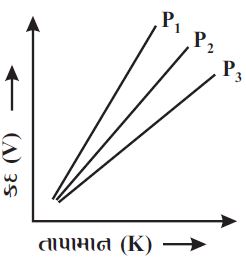
For a fixed mass of an ideal gas,the following graph is given. Determine the correct relationship between $P_1, P_2$ and $P_3$.
A
$P_1 > P_2 > P_3$
B
$P_2 > P_1 > P_3$
C
$P_3 > P_1 > P_2$
D
$P_3 > P_2 > P_1$
Solution
(D) According to Charles's Law,for a fixed mass of gas at constant pressure,$V \propto T$,which can be written as $V = (nR/P)T$.
Comparing this with the equation of a straight line $y = mx$,where $y = V$ and $x = T$,the slope $m = nR/P$.
Since the slope is inversely proportional to pressure $(m \propto 1/P)$,the line with the smallest slope corresponds to the highest pressure.
From the given graph,the slope of the line for $P_3$ is the smallest,followed by $P_2$,and the slope for $P_1$ is the largest.
Therefore,the relationship between the pressures is $P_3 > P_2 > P_1$.
Comparing this with the equation of a straight line $y = mx$,where $y = V$ and $x = T$,the slope $m = nR/P$.
Since the slope is inversely proportional to pressure $(m \propto 1/P)$,the line with the smallest slope corresponds to the highest pressure.
From the given graph,the slope of the line for $P_3$ is the smallest,followed by $P_2$,and the slope for $P_1$ is the largest.
Therefore,the relationship between the pressures is $P_3 > P_2 > P_1$.
0 likes
View SolutionStates of Matter — Ideal gas equation and Related gas laws · Frequently Asked Questions
1Are these States of Matter questions useful for JEE and NEET?
Yes. All questions in this section are mapped to JEE Main and NEET exam patterns. Previous year questions from JEE Main, NEET, GUJCET and state-level exams are included with full solutions.
2Can I switch to Hindi or Gujarati for these questions?
Yes. Use the language tabs in the hero section or the sidebar to view the same questions and solutions in English, Hindi or Gujarati.
3How do I generate a question paper from this subtopic?
Use the Vedclass Exam Paper Generator — select the chapter and subtopic, set difficulty, and generate Sets A, B, C, D automatically. First 3 chapters of every subject are free.
Vedclass Products
For Students
Vedclass Test Series
Mock tests in real JEE/NEET style with performance analysis. 5-day free trial.
Start Free TrialFor Teachers
Exam Paper Generator
Generate Set A/B/C/D papers from this chapter in 2 minutes. 3 chapters free.
Try FreeFor Institutes
Online Exam Module
Live online exams with unlimited students, 360° analytics & white-label branding.
See DemoFor Teachers & Institutes
Generate a States of Matter Exam Paper in 2 Minutes
Select subtopic & difficulty — Sets A, B, C, D auto-generated with No Repeat logic.
First 3 chapters of every subject are free — no payment required.