
A English
Mix Examples-Hydrocarbon Questions in English
Class 11 Chemistry · Hydrocarbons · Mix Examples-Hydrocarbon
317+
Questions
English
Language
100%
With Solutions
Showing 16 of 317 questions in English
301
EasyMCQ
'Natalite' is used as:
A
anaesthetic
B
substitute for petrol
C
insecticide
D
preservative
Solution
(B) Natalite is a mixture of $95\%$ ethanol and $5\%$ ether. It is used as a fuel or a substitute for petrol in internal combustion engines.
0 likes
View Solution302
MediumMCQ
The compound '$A$' decolourises $Br_2 / CCl_4$ and releases $N_2$ gas with $HNO_2$. The compound '$A$' is
A
Cyclopent$-3-$en$-1-$amine
B
$1,2,3,6-$Tetrahydropyridine
C
$1,2,3,6-$Tetrahydropyridine (isomer)
D
$N$-Methylaniline
Solution
(A) The compound '$A$' must contain an alkene group to decolourise $Br_2 / CCl_4$ and a primary amine group $(-NH_2)$ to release $N_2$ gas upon reaction with nitrous acid $(HNO_2)$.
$1$. Reaction with $HNO_2$: Primary aliphatic amines react with $HNO_2$ to form unstable diazonium salts,which decompose to release $N_2$ gas and form alcohols.
$2$. Reaction with $Br_2 / CCl_4$: The presence of a carbon-carbon double bond $(C=C)$ leads to the addition of bromine,which causes the reddish-brown colour of $Br_2$ to disappear.
Among the given options,Cyclopent$-3-$en$-1-$amine contains both a primary amine group and a double bond,satisfying both conditions.
$1$. Reaction with $HNO_2$: Primary aliphatic amines react with $HNO_2$ to form unstable diazonium salts,which decompose to release $N_2$ gas and form alcohols.
$2$. Reaction with $Br_2 / CCl_4$: The presence of a carbon-carbon double bond $(C=C)$ leads to the addition of bromine,which causes the reddish-brown colour of $Br_2$ to disappear.
Among the given options,Cyclopent$-3-$en$-1-$amine contains both a primary amine group and a double bond,satisfying both conditions.
0 likes
View Solution303
EasyMCQ
Arrange the following in the correct order of their acidic strength:
| $I. H_2C=CH_2$ | $II. CH \equiv CH$ | $III. CH_3-C \equiv CH$ | $IV. CH_3-CH_3$ |
A
$I < II < III < IV$
B
$IV < I < III < II$
C
$IV < III < II < I$
D
$II < III < IV < I$
Solution
(B) Acidic strength $\propto \ \% \ s$-character.
The acidity of hydrogen atoms attached to carbon depends on the hybridization of the carbon atom. The order of electronegativity is $sp > sp^2 > sp^3$,which corresponds to $50\% \ s$,$33.3\% \ s$,and $25\% \ s$ character respectively.
$1$. $CH \equiv CH$ $(II)$: $sp$ hybridized carbon ($50\% \ s$-character),most acidic.
$2$. $CH_3-C \equiv CH$ $(III)$: Terminal alkyne,but the $+I$ effect of the $-CH_3$ group decreases the acidity compared to ethyne.
$3$. $H_2C=CH_2$ $(I)$: $sp^2$ hybridized carbon ($33.3\% \ s$-character).
$4$. $CH_3-CH_3$ $(IV)$: $sp^3$ hybridized carbon ($25\% \ s$-character),least acidic.
Thus,the correct order of acidic strength is $IV < I < III < II$.
The acidity of hydrogen atoms attached to carbon depends on the hybridization of the carbon atom. The order of electronegativity is $sp > sp^2 > sp^3$,which corresponds to $50\% \ s$,$33.3\% \ s$,and $25\% \ s$ character respectively.
$1$. $CH \equiv CH$ $(II)$: $sp$ hybridized carbon ($50\% \ s$-character),most acidic.
$2$. $CH_3-C \equiv CH$ $(III)$: Terminal alkyne,but the $+I$ effect of the $-CH_3$ group decreases the acidity compared to ethyne.
$3$. $H_2C=CH_2$ $(I)$: $sp^2$ hybridized carbon ($33.3\% \ s$-character).
$4$. $CH_3-CH_3$ $(IV)$: $sp^3$ hybridized carbon ($25\% \ s$-character),least acidic.
Thus,the correct order of acidic strength is $IV < I < III < II$.
0 likes
View Solution304
MediumMCQ
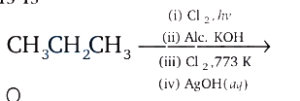
The major product of the following synthetic reactions is
A
$CH_3COCH_3$
B
$CH_3CH_2CHO$
C
$CH_2=CHCH_2OH$
D
$CH_3CH_2CH_2OH$
Solution
(C) The reaction sequence is as follows:
$1$. Chlorination of propane $(CH_3CH_2CH_3)$ with $Cl_2$ in the presence of light $(hv)$ gives $1$-chloropropane as the major product: $CH_3CH_2CH_3 + Cl_2 \xrightarrow{hv} CH_3CH_2CH_2Cl + HCl$.
$2$. Dehydrohalogenation of $1$-chloropropane with alcoholic $KOH$ gives propene: $CH_3CH_2CH_2Cl \xrightarrow{\text{alc. } KOH} CH_3CH=CH_2 + KCl + H_2O$.
$3$. High-temperature chlorination of propene $(773 \ K)$ leads to allylic substitution,forming allyl chloride: $CH_3CH=CH_2 + Cl_2 \xrightarrow{773 \ K} ClCH_2CH=CH_2 + HCl$.
$4$. Nucleophilic substitution of the allylic chloride with aqueous $AgOH$ (or $NaOH$) replaces the $Cl$ atom with an $OH$ group to form allyl alcohol: $ClCH_2CH=CH_2 + AgOH_{(aq)} \longrightarrow HOCH_2CH=CH_2 + AgCl$.
$1$. Chlorination of propane $(CH_3CH_2CH_3)$ with $Cl_2$ in the presence of light $(hv)$ gives $1$-chloropropane as the major product: $CH_3CH_2CH_3 + Cl_2 \xrightarrow{hv} CH_3CH_2CH_2Cl + HCl$.
$2$. Dehydrohalogenation of $1$-chloropropane with alcoholic $KOH$ gives propene: $CH_3CH_2CH_2Cl \xrightarrow{\text{alc. } KOH} CH_3CH=CH_2 + KCl + H_2O$.
$3$. High-temperature chlorination of propene $(773 \ K)$ leads to allylic substitution,forming allyl chloride: $CH_3CH=CH_2 + Cl_2 \xrightarrow{773 \ K} ClCH_2CH=CH_2 + HCl$.
$4$. Nucleophilic substitution of the allylic chloride with aqueous $AgOH$ (or $NaOH$) replaces the $Cl$ atom with an $OH$ group to form allyl alcohol: $ClCH_2CH=CH_2 + AgOH_{(aq)} \longrightarrow HOCH_2CH=CH_2 + AgCl$.
0 likes
View Solution305
DifficultMCQ
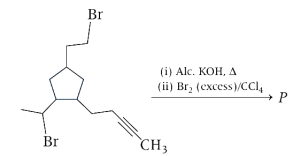
The maximum number of bromine atoms present in the final product $P$ upon complete bromination is
A
$4$
B
$6$
C
$10$
D
$8$
Solution
(D) Step $1$: Dehydrohalogenation using $Alc. KOH/\Delta$ (E2 elimination). The starting material has two $-Br$ groups. Elimination of two moles of $HBr$ results in the formation of two double bonds: one terminal vinyl group $(-CH=CH_2)$ and one exocyclic double bond ($-C(CH_3)=CH_2$ is not formed,rather the double bond forms between the ring and the side chain). Wait,looking at the structure,the elimination creates a vinyl group and an exocyclic double bond. The alkyne remains unaffected.
Step $2$: Electrophilic addition of excess $Br_2/CCl_4$. The molecule now contains one terminal alkene,one exocyclic alkene,and one internal alkyne.
- The terminal alkene adds $1$ mole of $Br_2$ ($2$ $Br$ atoms).
- The exocyclic alkene adds $1$ mole of $Br_2$ ($2$ $Br$ atoms).
- The internal alkyne adds $2$ moles of $Br_2$ ($4$ $Br$ atoms).
Total $Br$ atoms added = $2 + 2 + 4 = 8$ atoms.
Including the $2$ $Br$ atoms already present in the starting material is incorrect as the question asks for the number of bromine atoms in the final product $P$. Counting the structure of $P$ in the solution image: there are $2$ $Br$ on the terminal side chain,$2$ $Br$ on the ring,$4$ $Br$ on the alkyne side chain. Total = $8$ atoms.
Step $2$: Electrophilic addition of excess $Br_2/CCl_4$. The molecule now contains one terminal alkene,one exocyclic alkene,and one internal alkyne.
- The terminal alkene adds $1$ mole of $Br_2$ ($2$ $Br$ atoms).
- The exocyclic alkene adds $1$ mole of $Br_2$ ($2$ $Br$ atoms).
- The internal alkyne adds $2$ moles of $Br_2$ ($4$ $Br$ atoms).
Total $Br$ atoms added = $2 + 2 + 4 = 8$ atoms.
Including the $2$ $Br$ atoms already present in the starting material is incorrect as the question asks for the number of bromine atoms in the final product $P$. Counting the structure of $P$ in the solution image: there are $2$ $Br$ on the terminal side chain,$2$ $Br$ on the ring,$4$ $Br$ on the alkyne side chain. Total = $8$ atoms.
0 likes
View Solution306
Difficult
Match the following reactions in List-$I$ with their products in List-$II$:
| List-$I$ | List-$II$ |
|---|---|
| $A$. The reaction of $1,6$-dibromohexane with $Zn$. | $i$. $H_3C-C \equiv CH$ |
| $B$. Reaction of ethanol with concentrated $H_2SO_4$ at $443 \ K$. | $ii$. $H_2C=CH_2$ |
| $C$. Major product in the reaction of propene with $HBr$ in the presence of benzoyl peroxide. | $iii$. $CH_3-CH_2-CH_2-Br$ |
| $D$. The reaction of $1,1$-dibromopropane with $NaNH_2$ at $433 \ K$. | $iv$. Cyclohexane |
Solution
(A-IV, B-II, C-III, D-I) . $1,6$-dibromohexane reacts with $Zn$ to undergo intramolecular cyclization to form cyclohexane. Thus,$A-iv$.
$B$. Ethanol $(C_2H_5OH)$ reacts with concentrated $H_2SO_4$ at $443 \ K$ to undergo dehydration to form ethene $(H_2C=CH_2)$. Thus,$B-ii$.
$C$. Propene reacts with $HBr$ in the presence of peroxide (anti-Markovnikov addition) to form $1$-bromopropane $(CH_3-CH_2-CH_2-Br)$. Thus,$C-iii$.
$D$. $1,1$-dibromopropane reacts with $NaNH_2$ (a strong base) to undergo dehydrohalogenation to form propyne $(H_3C-C \equiv CH)$. Thus,$D-i$.
Therefore,the correct matching is $A-iv, B-ii, C-iii, D-i$.
$B$. Ethanol $(C_2H_5OH)$ reacts with concentrated $H_2SO_4$ at $443 \ K$ to undergo dehydration to form ethene $(H_2C=CH_2)$. Thus,$B-ii$.
$C$. Propene reacts with $HBr$ in the presence of peroxide (anti-Markovnikov addition) to form $1$-bromopropane $(CH_3-CH_2-CH_2-Br)$. Thus,$C-iii$.
$D$. $1,1$-dibromopropane reacts with $NaNH_2$ (a strong base) to undergo dehydrohalogenation to form propyne $(H_3C-C \equiv CH)$. Thus,$D-i$.
Therefore,the correct matching is $A-iv, B-ii, C-iii, D-i$.
0 likes
View Solution307
MediumMCQ
$A$ hydrocarbon with molecular formula $C_4H_6$ undergoes the following reactions:
$A$. Decolourises molecular bromine.
$B$. Reacts with $HBr$.
$C$. Addition of ozone and then cleavage of the ozonide by $Zn / H_2O$ gives the product $C_4H_6O_2$.
Then,the structure of the hydrocarbon is:
$A$. Decolourises molecular bromine.
$B$. Reacts with $HBr$.
$C$. Addition of ozone and then cleavage of the ozonide by $Zn / H_2O$ gives the product $C_4H_6O_2$.
Then,the structure of the hydrocarbon is:
A
Cyclobutene
B
None of these
C
$CH_3CH_2C \equiv CH$
D
Methylenecyclopropane
Solution
(A) The hydrocarbon has the molecular formula $C_4H_6$.
Cyclobutene $(C_4H_6)$ reacts with $Br_2$ to decolourise it,reacts with $HBr$ to form bromocyclobutane,and undergoes ozonolysis $(O_3 / Zn + H_2O)$ to produce butane$-1,4-$dial $(C_4H_6O_2)$.
Therefore,the correct structure is cyclobutene.
Cyclobutene $(C_4H_6)$ reacts with $Br_2$ to decolourise it,reacts with $HBr$ to form bromocyclobutane,and undergoes ozonolysis $(O_3 / Zn + H_2O)$ to produce butane$-1,4-$dial $(C_4H_6O_2)$.
Therefore,the correct structure is cyclobutene.
0 likes
View Solution308
MediumMCQ
Match the reactions in List-$I$ with their major products in List-$II$:
| List-$I$ (Reaction) | List-$II$ (Major product) |
|---|---|
| $A. CH_3-C \equiv CH \xrightarrow{H_2O, Hg^{2+}/H^+, 333K}$ | $I. CH_3-CH(OH)-CH_3$ |
| $B. CH_3COONa \xrightarrow{H_2O, Pt, \text{electrolysis}}$ | $II. CH_3-CO-CH_3$ |
| $C. CH_3-CH=CH_2 \xrightarrow{H_2O/H^+}$ | $III. CH_3-CH(OH)-CH_2OH$ |
| $D. CH_3-CH=CH_2 \xrightarrow{H_2O, \text{dil. } KMnO_4, 273K}$ | $IV. CH_3-CH_3$ |
| $V. CH_4$ |
A
$A-II, B-IV, C-I, D-III$
B
$A-II, B-V, C-I, D-III$
C
$A-III, B-IV, C-II, D-I$
D
$A-II, B-III, C-IV, D-I$
Solution
(A) . Hydration of propyne $(CH_3-C \equiv CH)$ in the presence of $Hg^{2+}/H^+$ follows Markovnikov's rule to form an enol,which tautomerizes to acetone $(CH_3-CO-CH_3)$,which is $II$.
$B$. Kolbe's electrolysis of sodium acetate $(CH_3COONa)$ yields ethane $(CH_3-CH_3)$,which is $IV$.
$C$. Acid-catalyzed hydration of propene $(CH_3-CH=CH_2)$ follows Markovnikov's rule to form propan$-2-$ol $(CH_3-CH(OH)-CH_3)$,which is $I$.
$D$. Hydroxylation of propene using cold dilute alkaline $KMnO_4$ (Baeyer's reagent) yields propane$-1,2-$diol $(CH_3-CH(OH)-CH_2OH)$,which is $III$.
Therefore,the correct match is $A-II, B-IV, C-I, D-III$.
$B$. Kolbe's electrolysis of sodium acetate $(CH_3COONa)$ yields ethane $(CH_3-CH_3)$,which is $IV$.
$C$. Acid-catalyzed hydration of propene $(CH_3-CH=CH_2)$ follows Markovnikov's rule to form propan$-2-$ol $(CH_3-CH(OH)-CH_3)$,which is $I$.
$D$. Hydroxylation of propene using cold dilute alkaline $KMnO_4$ (Baeyer's reagent) yields propane$-1,2-$diol $(CH_3-CH(OH)-CH_2OH)$,which is $III$.
Therefore,the correct match is $A-II, B-IV, C-I, D-III$.
0 likes
View Solution309
DifficultMCQ
$C_3H_6$ $\xrightarrow{X} Y$ $\xrightarrow[C_6H_6]{AlCl_3} Z \text{ (major product)}$
$X$ and $Z$ respectively in the following reaction sequence are
$X$ and $Z$ respectively in the following reaction sequence are
A
$HBr$,$n$-propylbenzene
B
$HBr$,$p$-isopropylbenzene
C
$HBr/ROOR$,isopropylbenzene
D
$HBr/ROOR$,$n$-propylbenzene
Solution
(C) $1$. The reaction begins with propene $(C_3H_6)$.
$2$. The reagent $X$ is $HBr/ROOR$ (peroxide effect/anti-Markovnikov addition),which converts propene to $1$-bromopropane $(Y = CH_3CH_2CH_2Br)$.
$3$. In the presence of $AlCl_3$,$1$-bromopropane undergoes rearrangement to form a more stable isopropyl carbocation $(CH_3CH^+CH_3)$.
$4$. This isopropyl carbocation then undergoes Friedel-Crafts alkylation with benzene $(C_6H_6)$ to form isopropylbenzene (cumene) as the major product $(Z)$.
$5$. Thus,$X$ is $HBr/ROOR$ and $Z$ is isopropylbenzene.
$2$. The reagent $X$ is $HBr/ROOR$ (peroxide effect/anti-Markovnikov addition),which converts propene to $1$-bromopropane $(Y = CH_3CH_2CH_2Br)$.
$3$. In the presence of $AlCl_3$,$1$-bromopropane undergoes rearrangement to form a more stable isopropyl carbocation $(CH_3CH^+CH_3)$.
$4$. This isopropyl carbocation then undergoes Friedel-Crafts alkylation with benzene $(C_6H_6)$ to form isopropylbenzene (cumene) as the major product $(Z)$.
$5$. Thus,$X$ is $HBr/ROOR$ and $Z$ is isopropylbenzene.
0 likes
View Solution310
DifficultMCQ
The product$(s)$ from the above reaction will be

A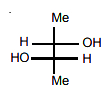
B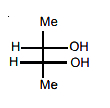
C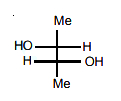
D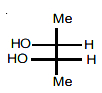
Solution
(A) Step $1$: The reduction of but-$2$-yne with $Na/NH_3(liq)$ in the presence of ethanol is a Birch reduction,which yields $trans$-but-$2$-ene as the intermediate $X$.
Step $2$: The reaction of $trans$-but-$2$-ene with dilute alkaline $KMnO_4$ (Baeyer's reagent) proceeds via $syn$-dihydroxylation.
Step $3$: $Syn$-dihydroxylation of $trans$-alkenes results in the formation of a racemic mixture of enantiomers.
Step $4$: The product is a racemic mixture of $(2R, 3R)$-butane-$2,3$-diol and $(2S, 3S)$-butane-$2,3$-diol,which corresponds to the structures shown in option $A$.
Step $2$: The reaction of $trans$-but-$2$-ene with dilute alkaline $KMnO_4$ (Baeyer's reagent) proceeds via $syn$-dihydroxylation.
Step $3$: $Syn$-dihydroxylation of $trans$-alkenes results in the formation of a racemic mixture of enantiomers.
Step $4$: The product is a racemic mixture of $(2R, 3R)$-butane-$2,3$-diol and $(2S, 3S)$-butane-$2,3$-diol,which corresponds to the structures shown in option $A$.
0 likes
View Solution311
MediumMCQ
Which of the following hydrocarbons reacts easily with $MeMgBr$ to give methane?
A
Cyclopropene
B
Cyclopentadiene
C
Benzene
D
Cycloheptatriene
Solution
(B) The reaction of $MeMgBr$ (a Grignard reagent) with hydrocarbons occurs if the hydrocarbon has an acidic hydrogen atom. $MeMgBr$ acts as a base and abstracts the most acidic proton to form methane $(CH_4)$.
Among the given options,$1,3$-cyclopentadiene contains a methylene group $(-CH_2-)$ between two double bonds. The hydrogen atoms on this carbon are significantly more acidic than those in other hydrocarbons because the resulting cyclopentadienyl anion is aromatic ($6\pi$ electrons,$H$ückel's rule),which provides high stability.
Therefore,$1,3$-cyclopentadiene reacts readily with $MeMgBr$ to form methane and the cyclopentadienyl Grignard reagent.
Among the given options,$1,3$-cyclopentadiene contains a methylene group $(-CH_2-)$ between two double bonds. The hydrogen atoms on this carbon are significantly more acidic than those in other hydrocarbons because the resulting cyclopentadienyl anion is aromatic ($6\pi$ electrons,$H$ückel's rule),which provides high stability.
Therefore,$1,3$-cyclopentadiene reacts readily with $MeMgBr$ to form methane and the cyclopentadienyl Grignard reagent.
0 likes
View Solution312
MediumMCQ
The product of the following hydrogenation reaction is:
$C_6H_6 + H_2 \xrightarrow{\text{Catalyst, High temperature and pressure}} ?$
Given: $1 \text{ eqv. of } C_6H_6$ and $1 \text{ eqv. of } H_2$.
$C_6H_6 + H_2 \xrightarrow{\text{Catalyst, High temperature and pressure}} ?$
Given: $1 \text{ eqv. of } C_6H_6$ and $1 \text{ eqv. of } H_2$.
A
$A$ mixture of $0.33 \text{ eqv. of } C_6H_6$ and $0.66 \text{ eqv. of cyclohexene}$.
B
Cyclohexane $(1 \text{ eqv.})$
C
$A$ mixture of $0.66 \text{ eqv. of } C_6H_6$ and $0.33 \text{ eqv. of cyclohexane}$.
D
Cyclohexene $(1 \text{ eqv.})$
Solution
(C) The hydrogenation of benzene $(C_6H_6)$ requires $3 \text{ equivalents}$ of $H_2$ to fully reduce it to cyclohexane $(C_6H_{12})$.
$C_6H_6 + 3H_2 \rightarrow C_6H_{12}$
In this reaction,we are given $1 \text{ equivalent}$ of benzene and only $1 \text{ equivalent}$ of $H_2$.
Since the stoichiometry requires $3 \text{ equivalents}$ of $H_2$ for $1 \text{ equivalent}$ of benzene,$1 \text{ equivalent}$ of $H_2$ will react with $1/3$ $(0.33)$ of the benzene molecules to fully reduce them to cyclohexane,while $2/3$ $(0.66)$ of the benzene molecules will remain unreacted.
Therefore,the final mixture will contain $0.66 \text{ equivalents}$ of unreacted benzene and $0.33 \text{ equivalents}$ of cyclohexane.
$C_6H_6 + 3H_2 \rightarrow C_6H_{12}$
In this reaction,we are given $1 \text{ equivalent}$ of benzene and only $1 \text{ equivalent}$ of $H_2$.
Since the stoichiometry requires $3 \text{ equivalents}$ of $H_2$ for $1 \text{ equivalent}$ of benzene,$1 \text{ equivalent}$ of $H_2$ will react with $1/3$ $(0.33)$ of the benzene molecules to fully reduce them to cyclohexane,while $2/3$ $(0.66)$ of the benzene molecules will remain unreacted.
Therefore,the final mixture will contain $0.66 \text{ equivalents}$ of unreacted benzene and $0.33 \text{ equivalents}$ of cyclohexane.
0 likes
View Solution313
DifficultMCQ
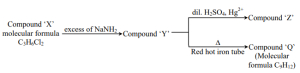
Given below are two statements for the following reaction sequence.
Statement $I$: Compound $'Z'$ will give yellow precipitate with $NaOI$.
Statement $II$: Compound $'Q'$ has two different types of $'H'$ atoms (aromatic : aliphatic) in the ratio $1 : 3$.
In the light of the above statements,choose the correct answer from the option given below:
Statement $I$: Compound $'Z'$ will give yellow precipitate with $NaOI$.
Statement $II$: Compound $'Q'$ has two different types of $'H'$ atoms (aromatic : aliphatic) in the ratio $1 : 3$.
In the light of the above statements,choose the correct answer from the option given below:
A
Statement $I$ is true but Statement $II$ is false
B
Both Statement $I$ and Statement $II$ are true
C
Statement $I$ is false but Statement $II$ is true
D
Both Statement $I$ and Statement $II$ are false
Solution
(B) $1$. Compound $'X'$ $(C_3H_6Cl_2)$ reacts with excess $NaNH_2$ to form propyne $(CH_3-C \equiv CH)$ as compound $'Y'$.
$2$. Hydration of propyne $(Y)$ with $dil. H_2SO_4/Hg^{2+}$ gives acetone $(CH_3-CO-CH_3)$ as compound $'Z'$. Acetone contains a methyl ketone group and gives a yellow precipitate of iodoform $(CHI_3)$ with $NaOI$. Thus,Statement $I$ is true.
$3$. Cyclic trimerization of propyne $(Y)$ using a red hot iron tube gives $1,3,5$-trimethylbenzene (mesitylene) as compound $'Q'$ $(C_9H_{12})$.
$4$. In $1,3,5$-trimethylbenzene,there are $3$ aromatic $H$ atoms (on the ring) and $9$ aliphatic $H$ atoms (in the three methyl groups). The ratio of aromatic to aliphatic $H$ atoms is $3:9 = 1:3$. Thus,Statement $II$ is true.
$2$. Hydration of propyne $(Y)$ with $dil. H_2SO_4/Hg^{2+}$ gives acetone $(CH_3-CO-CH_3)$ as compound $'Z'$. Acetone contains a methyl ketone group and gives a yellow precipitate of iodoform $(CHI_3)$ with $NaOI$. Thus,Statement $I$ is true.
$3$. Cyclic trimerization of propyne $(Y)$ using a red hot iron tube gives $1,3,5$-trimethylbenzene (mesitylene) as compound $'Q'$ $(C_9H_{12})$.
$4$. In $1,3,5$-trimethylbenzene,there are $3$ aromatic $H$ atoms (on the ring) and $9$ aliphatic $H$ atoms (in the three methyl groups). The ratio of aromatic to aliphatic $H$ atoms is $3:9 = 1:3$. Thus,Statement $II$ is true.
0 likes
View Solution314
DifficultMCQ
The dibromo compound $[P]$ (molecular formula : $C_{9}H_{10}Br_{2}$) when heated with excess sodamide followed by treatment with dilute $HCl$ gives $[Q]$. On warming $[Q]$ with mercuric sulphate and dilute sulphuric acid yields $[R]$ which gives positive Iodoform test but negative Tollen's test. The compound $[P]$ is:
A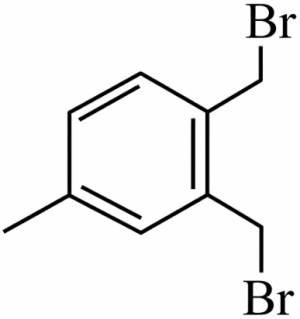
B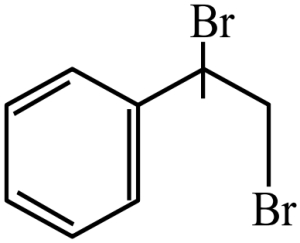
C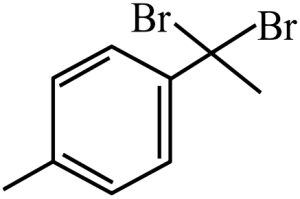
D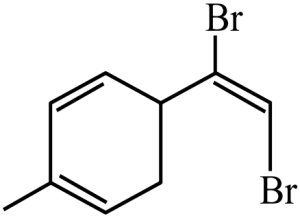
Solution
(C) The reaction sequence is as follows:
$1$. The compound $[P]$ is $1,1-dibromo-1-(4-methylphenyl)methane$ (also known as $4-methylbenzal$ bromide,but with the formula $C_9H_{10}Br_2$,it is $1-(1,1-dibromoethyl)-4-methylbenzene$ or similar gem-dibromide structure).
$2$. Treatment of $[P]$ with excess $NaNH_2$ followed by $HCl$ leads to dehydrohalogenation,forming the terminal alkyne $[Q]$,which is $1-ethynyl-4-methylbenzene$ $(p-methylphenylacetylene)$.
$3$. Hydration of the alkyne $[Q]$ with $HgSO_4$ and $dil. H_2SO_4$ (Kucherov reaction) yields the ketone $[R]$,which is $4-methylacetophenone$.
$4$. $4-methylacetophenone$ contains a $CH_3CO-$ group,thus it gives a positive Iodoform test. It is a ketone,so it gives a negative Tollen's test.
$5$. Therefore,$[P]$ is $1,1-dibromoethyl-4-methylbenzene$ (represented by option $C$).
$1$. The compound $[P]$ is $1,1-dibromo-1-(4-methylphenyl)methane$ (also known as $4-methylbenzal$ bromide,but with the formula $C_9H_{10}Br_2$,it is $1-(1,1-dibromoethyl)-4-methylbenzene$ or similar gem-dibromide structure).
$2$. Treatment of $[P]$ with excess $NaNH_2$ followed by $HCl$ leads to dehydrohalogenation,forming the terminal alkyne $[Q]$,which is $1-ethynyl-4-methylbenzene$ $(p-methylphenylacetylene)$.
$3$. Hydration of the alkyne $[Q]$ with $HgSO_4$ and $dil. H_2SO_4$ (Kucherov reaction) yields the ketone $[R]$,which is $4-methylacetophenone$.
$4$. $4-methylacetophenone$ contains a $CH_3CO-$ group,thus it gives a positive Iodoform test. It is a ketone,so it gives a negative Tollen's test.
$5$. Therefore,$[P]$ is $1,1-dibromoethyl-4-methylbenzene$ (represented by option $C$).
0 likes
View Solution315
DifficultMCQ
The cycloalkane $(X)$ on bromination consumes one mole of bromine per mole of $(X)$ and gives product $(Y)$ in which $C:Br$ ratio is $3:1$. The percentage of bromine in the product $(Y)$ is $ . . . . . . \%$ (Nearest integer).
(Given: Molar mass in $g \ mol^{-1}$,$H:1, C:12, O:16, Br:80$)
(Given: Molar mass in $g \ mol^{-1}$,$H:1, C:12, O:16, Br:80$)
A
$60$
B
$66$
C
$70$
D
$75$
Solution
(B) The bromination of a cycloalkane $(X)$ consuming one mole of $Br_2$ implies an addition reaction across a double bond or ring opening,resulting in a dibromo derivative $(Y)$.
Let the formula of $(Y)$ be $C_n H_m Br_2$.
Given the $C:Br$ ratio is $3:1$,we have $\frac{n}{2} = \frac{3}{1}$,which gives $n = 6$.
The product $(Y)$ is $C_6 H_{10} Br_2$.
The molar mass of $C_6 H_{10} Br_2 = (6 \times 12) + (10 \times 1) + (2 \times 80) = 72 + 10 + 160 = 242 \ g \ mol^{-1}$.
The percentage of bromine in $(Y) = \frac{\text{Mass of } Br}{\text{Molar mass of } Y} \times 100 = \frac{160}{242} \times 100 \approx 66.11 \%$.
Rounding to the nearest integer,we get $66 \%$.
Let the formula of $(Y)$ be $C_n H_m Br_2$.
Given the $C:Br$ ratio is $3:1$,we have $\frac{n}{2} = \frac{3}{1}$,which gives $n = 6$.
The product $(Y)$ is $C_6 H_{10} Br_2$.
The molar mass of $C_6 H_{10} Br_2 = (6 \times 12) + (10 \times 1) + (2 \times 80) = 72 + 10 + 160 = 242 \ g \ mol^{-1}$.
The percentage of bromine in $(Y) = \frac{\text{Mass of } Br}{\text{Molar mass of } Y} \times 100 = \frac{160}{242} \times 100 \approx 66.11 \%$.
Rounding to the nearest integer,we get $66 \%$.
0 likes
View Solution316
DifficultMCQ
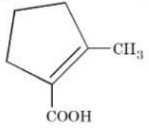
"$P$" is a hydrocarbon with the molecular formula $C_8H_{14}$. On ozonolysis,"$P$" forms "$Q$". "$Q$" on treatment with alkali under reflux conditions produces "$R$",which on treatment with $I_2/NaOH$ gives a yellow precipitate. Acidification of the solution gives "$S$". The structure of "$S$" is given below:
(Structure $S$: $1-$methyl$-2-$oxocyclopentanecarboxylic acid derivative or similar cyclic structure as per common reaction pathways).
The correct structure of "$P$" is:
(Structure $S$: $1-$methyl$-2-$oxocyclopentanecarboxylic acid derivative or similar cyclic structure as per common reaction pathways).
The correct structure of "$P$" is:
A
B
C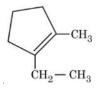
D
Solution
(A) $1$. The formation of a yellow precipitate with $I_2/NaOH$ (iodoform test) indicates the presence of a methyl ketone group $(CH_3CO-)$ or a secondary alcohol that can be oxidized to a methyl ketone.
$2$. "$P$" $(C_8H_{14})$ undergoes ozonolysis to form "$Q$".
$3$. "$Q$" undergoes an intramolecular aldol condensation (alkali under reflux) to form "$R$",which contains a methyl ketone moiety.
$4$. The structure "$S$" is a cyclic carboxylic acid derivative formed after the haloform reaction and acidification.
$5$. Analyzing the degree of unsaturation ($C_8H_{14}$ has $8 - 14/2 + 1 = 2$ degrees of unsaturation),and the reaction sequence,$1$,$2$-dimethylcyclohexene (option $A$) is the most suitable precursor that fits the molecular formula and the described chemical transformations.
$2$. "$P$" $(C_8H_{14})$ undergoes ozonolysis to form "$Q$".
$3$. "$Q$" undergoes an intramolecular aldol condensation (alkali under reflux) to form "$R$",which contains a methyl ketone moiety.
$4$. The structure "$S$" is a cyclic carboxylic acid derivative formed after the haloform reaction and acidification.
$5$. Analyzing the degree of unsaturation ($C_8H_{14}$ has $8 - 14/2 + 1 = 2$ degrees of unsaturation),and the reaction sequence,$1$,$2$-dimethylcyclohexene (option $A$) is the most suitable precursor that fits the molecular formula and the described chemical transformations.
0 likes
View SolutionHydrocarbons — Mix Examples-Hydrocarbon · Frequently Asked Questions
1Are these Hydrocarbons questions useful for JEE and NEET?
Yes. All questions in this section are mapped to JEE Main and NEET exam patterns. Previous year questions from JEE Main, NEET, GUJCET and state-level exams are included with full solutions.
2Can I switch to Hindi or Gujarati for these questions?
Yes. Use the language tabs in the hero section or the sidebar to view the same questions and solutions in English, Hindi or Gujarati.
3How do I generate a question paper from this subtopic?
Use the Vedclass Exam Paper Generator — select the chapter and subtopic, set difficulty, and generate Sets A, B, C, D automatically. First 3 chapters of every subject are free.
Vedclass Products
For Students
Vedclass Test Series
Mock tests in real JEE/NEET style with performance analysis. 5-day free trial.
Start Free TrialFor Teachers
Exam Paper Generator
Generate Set A/B/C/D papers from this chapter in 2 minutes. 3 chapters free.
Try FreeFor Institutes
Online Exam Module
Live online exams with unlimited students, 360° analytics & white-label branding.
See DemoFor Teachers & Institutes
Generate a Hydrocarbons Exam Paper in 2 Minutes
Select subtopic & difficulty — Sets A, B, C, D auto-generated with No Repeat logic.
First 3 chapters of every subject are free — no payment required.