
A English
VSEPR Theory Questions in English
Class 11 Chemistry · Chemical Bonding and Molecular Structure · VSEPR Theory
702+
Questions
English
Language
100%
With Solutions
Showing 50 of 702 questions in English
501
MediumMCQ
Match List-$I$ with List-$II$ :
Choose the correct answer from the options given below :
| List-$I$ (Compound / Species) | List-$II$ (Shape / Geometry) |
| $A$. $SF_4$ | $I$. Tetrahedral |
| $B$. $BrF_3$ | $II$. Pyramidal |
| $C$. $BrO_3^{-}$ | $III$. See-saw |
| $D$. $NH_4^{+}$ | $IV$. Bent $T$-shape |
Choose the correct answer from the options given below :
A
$A-II, B-III, C-I, D-IV$
B
$A-III, B-IV, C-II, D-I$
C
$A-II, B-IV, C-III, D-I$
D
$A-III, B-II, C-IV, D-I$
Solution
(B) $1$. $SF_4$: Sulfur has $6$ valence electrons. It forms $4$ bonds with $F$ and has $1$ lone pair. The hybridization is $sp^3d$,and the shape is See-saw $(III)$.
$2$. $BrF_3$: Bromine has $7$ valence electrons. It forms $3$ bonds with $F$ and has $2$ lone pairs. The hybridization is $sp^3d$,and the shape is Bent $T$-shape $(IV)$.
$3$. $BrO_3^{-}$: Bromine has $7$ valence electrons. It forms $3$ bonds with $O$ and has $1$ lone pair. The hybridization is $sp^3$,and the shape is Pyramidal $(II)$.
$4$. $NH_4^{+}$: Nitrogen has $5$ valence electrons. It forms $4$ bonds with $H$ and has $0$ lone pairs. The hybridization is $sp^3$,and the shape is Tetrahedral $(I)$.
Thus,the correct matching is $A-III, B-IV, C-II, D-I$.
$2$. $BrF_3$: Bromine has $7$ valence electrons. It forms $3$ bonds with $F$ and has $2$ lone pairs. The hybridization is $sp^3d$,and the shape is Bent $T$-shape $(IV)$.
$3$. $BrO_3^{-}$: Bromine has $7$ valence electrons. It forms $3$ bonds with $O$ and has $1$ lone pair. The hybridization is $sp^3$,and the shape is Pyramidal $(II)$.
$4$. $NH_4^{+}$: Nitrogen has $5$ valence electrons. It forms $4$ bonds with $H$ and has $0$ lone pairs. The hybridization is $sp^3$,and the shape is Tetrahedral $(I)$.
Thus,the correct matching is $A-III, B-IV, C-II, D-I$.
0 likes
View Solution502
MediumMCQ
Match List-$I$ with List-$II$:
Choose the correct answer from the options below:
| List-$I$ (Molecule) | List-$II$ (Shape) |
|---|---|
| $A$. $NH_3$ | $I$. Square pyramid |
| $B$. $BrF_5$ | $II$. Tetrahedral |
| $C$. $PCl_5$ | $III$. Trigonal pyramidal |
| $D$. $CH_4$ | $IV$. Trigonal bipyramidal |
Choose the correct answer from the options below:
A
$A-IV, B-III, C-I, D-II$
B
$A-II, B-IV, C-I, D-III$
C
$A-III, B-I, C-IV, D-II$
D
$A-III, B-IV, C-I, D-II$
Solution
(C) The shapes of the molecules are determined by $VSEPR$ theory:
$1$. $NH_3$: Central atom $N$ has $3$ bond pairs and $1$ lone pair,resulting in a trigonal pyramidal shape $(A-III)$.
$2$. $BrF_5$: Central atom $Br$ has $5$ bond pairs and $1$ lone pair,resulting in a square pyramidal shape $(B-I)$.
$3$. $PCl_5$: Central atom $P$ has $5$ bond pairs and $0$ lone pairs,resulting in a trigonal bipyramidal shape $(C-IV)$.
$4$. $CH_4$: Central atom $C$ has $4$ bond pairs and $0$ lone pairs,resulting in a tetrahedral shape $(D-II)$.
Therefore,the correct matching is $A-III, B-I, C-IV, D-II$.
$1$. $NH_3$: Central atom $N$ has $3$ bond pairs and $1$ lone pair,resulting in a trigonal pyramidal shape $(A-III)$.
$2$. $BrF_5$: Central atom $Br$ has $5$ bond pairs and $1$ lone pair,resulting in a square pyramidal shape $(B-I)$.
$3$. $PCl_5$: Central atom $P$ has $5$ bond pairs and $0$ lone pairs,resulting in a trigonal bipyramidal shape $(C-IV)$.
$4$. $CH_4$: Central atom $C$ has $4$ bond pairs and $0$ lone pairs,resulting in a tetrahedral shape $(D-II)$.
Therefore,the correct matching is $A-III, B-I, C-IV, D-II$.
0 likes
View Solution503
MediumMCQ
The correct increasing order for bond angles among $BF_3$,$PF_3$ and $ClF_3$ is:
A
$PF_3 < BF_3 < ClF_3$
B
$BF_3 < PF_3 < ClF_3$
C
$ClF_3 < PF_3 < BF_3$
D
$BF_3 = PF_3 < ClF_3$
Solution
(C) To determine the bond angles,we analyze the hybridisation and molecular geometry of each molecule:
$1$. $BF_3$: Boron is $sp^2$ hybridized with a trigonal planar geometry. The bond angle is $120^{\circ}$.
$2$. $PF_3$: Phosphorus is $sp^3$ hybridized with one lone pair,resulting in a trigonal pyramidal geometry. Due to the lone pair-bond pair repulsion,the bond angle is approximately $97^{\circ}$.
$3$. $ClF_3$: Chlorine is $sp^3d$ hybridized with two lone pairs,resulting in a $T$-shaped geometry. Due to the repulsion from two lone pairs,the bond angle is distorted to approximately $87.5^{\circ}$.
Comparing these values: $87.5^{\circ} (ClF_3) < 97^{\circ} (PF_3) < 120^{\circ} (BF_3)$.
Therefore,the correct increasing order is $ClF_3 < PF_3 < BF_3$.
$1$. $BF_3$: Boron is $sp^2$ hybridized with a trigonal planar geometry. The bond angle is $120^{\circ}$.
$2$. $PF_3$: Phosphorus is $sp^3$ hybridized with one lone pair,resulting in a trigonal pyramidal geometry. Due to the lone pair-bond pair repulsion,the bond angle is approximately $97^{\circ}$.
$3$. $ClF_3$: Chlorine is $sp^3d$ hybridized with two lone pairs,resulting in a $T$-shaped geometry. Due to the repulsion from two lone pairs,the bond angle is distorted to approximately $87.5^{\circ}$.
Comparing these values: $87.5^{\circ} (ClF_3) < 97^{\circ} (PF_3) < 120^{\circ} (BF_3)$.
Therefore,the correct increasing order is $ClF_3 < PF_3 < BF_3$.
0 likes
View Solution504
MediumMCQ
Match List-$I$ with List-$II$.
Choose the correct answer from the options given below:
| List-$I$ (Compound) | List-$II$ (Shape/geometry) |
| $A$. $NH_3$ | $I$. Trigonal Pyramidal |
| $B$. $BrF_5$ | $IV$. Square Pyramidal |
| $C$. $XeF_4$ | $II$. Square Planar |
| $D$. $SF_6$ | $III$. Octahedral |
Choose the correct answer from the options given below:
A
$A-II, B-IV, C-III, D-I$
B
$A-III, B-IV, C-I, D-II$
C
$A-II, B-III, C-IV, D-I$
D
$A-I, B-IV, C-II, D-III$
Solution
(D) $NH_3$: $sp^3$ hybridized with $1$ lone pair. The geometry is Trigonal Pyramidal $(A-I)$.
$BrF_5$: $sp^3d^2$ hybridized with $1$ lone pair. The geometry is Square Pyramidal $(B-IV)$.
$XeF_4$: $sp^3d^2$ hybridized with $2$ lone pairs. The geometry is Square Planar $(C-II)$.
$SF_6$: $sp^3d^2$ hybridized with $0$ lone pairs. The geometry is Octahedral $(D-III)$.
Therefore,the correct matching is $A-I, B-IV, C-II, D-III$.
$BrF_5$: $sp^3d^2$ hybridized with $1$ lone pair. The geometry is Square Pyramidal $(B-IV)$.
$XeF_4$: $sp^3d^2$ hybridized with $2$ lone pairs. The geometry is Square Planar $(C-II)$.
$SF_6$: $sp^3d^2$ hybridized with $0$ lone pairs. The geometry is Octahedral $(D-III)$.
Therefore,the correct matching is $A-I, B-IV, C-II, D-III$.
0 likes
View Solution505
MediumMCQ
The compound$(s)$ with $2$ lone pairs of electrons on the central atom is(are):
$(A)$ $BrF_5$
$(B)$ $ClF_3$
$(C)$ $XeF_4$
$(D)$ $SF_4$
$(A)$ $BrF_5$
$(B)$ $ClF_3$
$(C)$ $XeF_4$
$(D)$ $SF_4$
A
$A, C$
B
$B, C$
C
$C, D$
D
$B, C, A$
Solution
(B) To determine the number of lone pairs on the central atom,we use the formula: $\text{Lone pairs} = \frac{1}{2} \times (V - N - C)$,where $V$ is the number of valence electrons of the central atom,$N$ is the number of monovalent atoms bonded to it,and $C$ is the charge on the species.
$1$. For $BrF_5$: Central atom $Br$ has $7$ valence electrons. It is bonded to $5$ $F$ atoms. $\text{Lone pairs} = \frac{1}{2} \times (7 - 5) = 1$.
$2$. For $ClF_3$: Central atom $Cl$ has $7$ valence electrons. It is bonded to $3$ $F$ atoms. $\text{Lone pairs} = \frac{1}{2} \times (7 - 3) = 2$.
$3$. For $XeF_4$: Central atom $Xe$ has $8$ valence electrons. It is bonded to $4$ $F$ atoms. $\text{Lone pairs} = \frac{1}{2} \times (8 - 4) = 2$.
$4$. For $SF_4$: Central atom $S$ has $6$ valence electrons. It is bonded to $4$ $F$ atoms. $\text{Lone pairs} = \frac{1}{2} \times (6 - 4) = 1$.
Thus,$ClF_3$ and $XeF_4$ have $2$ lone pairs on their central atoms. The correct option is $B$.
$1$. For $BrF_5$: Central atom $Br$ has $7$ valence electrons. It is bonded to $5$ $F$ atoms. $\text{Lone pairs} = \frac{1}{2} \times (7 - 5) = 1$.
$2$. For $ClF_3$: Central atom $Cl$ has $7$ valence electrons. It is bonded to $3$ $F$ atoms. $\text{Lone pairs} = \frac{1}{2} \times (7 - 3) = 2$.
$3$. For $XeF_4$: Central atom $Xe$ has $8$ valence electrons. It is bonded to $4$ $F$ atoms. $\text{Lone pairs} = \frac{1}{2} \times (8 - 4) = 2$.
$4$. For $SF_4$: Central atom $S$ has $6$ valence electrons. It is bonded to $4$ $F$ atoms. $\text{Lone pairs} = \frac{1}{2} \times (6 - 4) = 1$.
Thus,$ClF_3$ and $XeF_4$ have $2$ lone pairs on their central atoms. The correct option is $B$.
0 likes
View Solution506
MediumMCQ
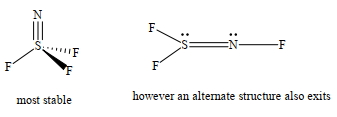
The sum of the number of lone pairs of electrons on each central atom in the following species is $[TeBr_6]^{2-}, [BrF_2]^+, SNF_3$,and $[XeF_3]^-$ (Atomic numbers: $N=7, F=9, S=16, Br=35, Te=52, Xe=54$)
A
$4$
B
$7$
C
$8$
D
$6$
Solution
(D) To find the sum of lone pairs on the central atoms:
$1.$ In $[TeBr_6]^{2-}$: $Te$ (Group $16$) has $6$ valence electrons. With a $-2$ charge,it has $6 + 2 = 8$ electrons. It forms $6$ single bonds with $Br$. Lone pairs = $(8 - 6) / 2 = 1$.
$2.$ In $[BrF_2]^+$: $Br$ (Group $17$) has $7$ valence electrons. With a $+1$ charge,it has $7 - 1 = 6$ electrons. It forms $2$ single bonds with $F$. Lone pairs = $(6 - 2) / 2 = 2$.
$3.$ In $SNF_3$: $S$ (Group $16$) is the central atom with $6$ valence electrons. It forms a triple bond with $N$ and $3$ single bonds with $F$. Total electrons used = $3 + 3 = 6$. Lone pairs = $(6 - 6) / 2 = 0$.
$4.$ In $[XeF_3]^-$: $Xe$ (Group $18$) has $8$ valence electrons. With a $-1$ charge,it has $8 + 1 = 9$ electrons. It forms $3$ single bonds with $F$. Lone pairs = $(9 - 3) / 2 = 3$.
Sum of lone pairs = $1 + 2 + 0 + 3 = 6$.
$1.$ In $[TeBr_6]^{2-}$: $Te$ (Group $16$) has $6$ valence electrons. With a $-2$ charge,it has $6 + 2 = 8$ electrons. It forms $6$ single bonds with $Br$. Lone pairs = $(8 - 6) / 2 = 1$.
$2.$ In $[BrF_2]^+$: $Br$ (Group $17$) has $7$ valence electrons. With a $+1$ charge,it has $7 - 1 = 6$ electrons. It forms $2$ single bonds with $F$. Lone pairs = $(6 - 2) / 2 = 2$.
$3.$ In $SNF_3$: $S$ (Group $16$) is the central atom with $6$ valence electrons. It forms a triple bond with $N$ and $3$ single bonds with $F$. Total electrons used = $3 + 3 = 6$. Lone pairs = $(6 - 6) / 2 = 0$.
$4.$ In $[XeF_3]^-$: $Xe$ (Group $18$) has $8$ valence electrons. With a $-1$ charge,it has $8 + 1 = 9$ electrons. It forms $3$ single bonds with $F$. Lone pairs = $(9 - 3) / 2 = 3$.
Sum of lone pairs = $1 + 2 + 0 + 3 = 6$.
0 likes
View Solution507
DifficultMCQ
Based on $VSEPR$ theory,the number of $90^{\circ}$ $F-Br-F$ bond angles in $BrF_5$ is
A
$5$
B
$0$
C
$3$
D
$7$
Solution
(B) The molecule $BrF_5$ has a square pyramidal geometry with one lone pair on the central $Br$ atom.
Due to the strong repulsion between the lone pair and the bonding pairs,the equatorial $F$ atoms are pushed downwards.
Consequently,the bond angles between the axial $F$ and the equatorial $F$ atoms are reduced from $90^{\circ}$ to approximately $84.8^{\circ}$.
Therefore,there are no $90^{\circ}$ $F-Br-F$ bond angles in the molecule.
Due to the strong repulsion between the lone pair and the bonding pairs,the equatorial $F$ atoms are pushed downwards.
Consequently,the bond angles between the axial $F$ and the equatorial $F$ atoms are reduced from $90^{\circ}$ to approximately $84.8^{\circ}$.
Therefore,there are no $90^{\circ}$ $F-Br-F$ bond angles in the molecule.
0 likes
View Solution508
DifficultMCQ
The species having a pyramidal shape is
A
$SO_3$
B
$BrF_3$
C
$SiO_3^{2-}$
D
$OSF_2$
Solution
(D) To determine the shape,we calculate the hybridization and number of lone pairs for each species:
$1$. $SO_3$: The central $S$ atom has $3$ bond pairs and $0$ lone pairs. It has $sp^2$ hybridization and a trigonal planar shape.
$2$. $BrF_3$: The central $Br$ atom has $3$ bond pairs and $2$ lone pairs. It has $sp^3d$ hybridization and a $T$-shaped geometry.
$3$. $SiO_3^{2-}$: The central $Si$ atom has $3$ bond pairs and $0$ lone pairs. It has $sp^2$ hybridization and a trigonal planar shape.
$4$. $OSF_2$ (Thionyl fluoride): The central $S$ atom has $3$ bond pairs (one double bond to $O$ and two single bonds to $F$) and $1$ lone pair. The total steric number is $4$ ($3$ bond pairs + $1$ lone pair),which corresponds to $sp^3$ hybridization. Due to the presence of one lone pair,the geometry is pyramidal.
$1$. $SO_3$: The central $S$ atom has $3$ bond pairs and $0$ lone pairs. It has $sp^2$ hybridization and a trigonal planar shape.
$2$. $BrF_3$: The central $Br$ atom has $3$ bond pairs and $2$ lone pairs. It has $sp^3d$ hybridization and a $T$-shaped geometry.
$3$. $SiO_3^{2-}$: The central $Si$ atom has $3$ bond pairs and $0$ lone pairs. It has $sp^2$ hybridization and a trigonal planar shape.
$4$. $OSF_2$ (Thionyl fluoride): The central $S$ atom has $3$ bond pairs (one double bond to $O$ and two single bonds to $F$) and $1$ lone pair. The total steric number is $4$ ($3$ bond pairs + $1$ lone pair),which corresponds to $sp^3$ hybridization. Due to the presence of one lone pair,the geometry is pyramidal.
0 likes
View Solution509
MediumMCQ
The shape of $XeO_2F_2$ molecule is
A
trigonal bipyramidal
B
square planar
C
tetrahedral
D
see-saw
Solution
(D) The central atom $Xe$ has $8$ valence electrons.
It forms $2$ double bonds with $O$ atoms and $2$ single bonds with $F$ atoms,utilizing $6$ electrons.
This leaves $1$ lone pair on the $Xe$ atom.
The total number of electron pairs around $Xe$ is $4$ (bonding pairs) $+ 1$ (lone pair) $= 5$.
According to $VSEPR$ theory,$5$ electron pairs correspond to a trigonal bipyramidal electron geometry.
With one lone pair occupying an equatorial position,the molecular shape is see-saw.
It forms $2$ double bonds with $O$ atoms and $2$ single bonds with $F$ atoms,utilizing $6$ electrons.
This leaves $1$ lone pair on the $Xe$ atom.
The total number of electron pairs around $Xe$ is $4$ (bonding pairs) $+ 1$ (lone pair) $= 5$.
According to $VSEPR$ theory,$5$ electron pairs correspond to a trigonal bipyramidal electron geometry.
With one lone pair occupying an equatorial position,the molecular shape is see-saw.
0 likes
View Solution510
EasyMCQ
Based on the $VSEPR$ model,match the xenon compounds given in List-$I$ with the corresponding geometries and the number of lone pairs on xenon given in List-$II$ and choose the correct option.
| List-$I$ | List-$II$ |
|---|---|
| $(P)$ $XeF_2$ | $(5)$ Trigonal bipyramidal and three lone pairs of electrons |
| $(Q)$ $XeF_4$ | $(3)$ Square planar and two lone pairs of electrons |
| $(R)$ $XeO_3$ | $(2)$ Pyramidal and one lone pair of electrons |
| $(S)$ $XeO_3F_2$ | $(4)$ Trigonal bipyramidal and no lone pairs of electrons |
A
$P-5, Q-2, R-3, S-1$
B
$P-5, Q-3, R-2, S-4$
C
$P-4, Q-3, R-2, S-1$
D
$P-4, Q-2, R-5, S-3$
Solution
(B) $XeF_2$: $2$ bond pairs and $3$ lone pairs on $Xe$,steric number $= 5$,$sp^3d$ hybridization,geometry is trigonal bipyramidal. $(P-5)$
$XeF_4$: $4$ bond pairs and $2$ lone pairs on $Xe$,steric number $= 6$,$sp^3d^2$ hybridization,geometry is square planar. $(Q-3)$
$XeO_3$: $3$ bond pairs and $1$ lone pair on $Xe$,steric number $= 4$,$sp^3$ hybridization,geometry is pyramidal. $(R-2)$
$XeO_3F_2$: $5$ bond pairs and $0$ lone pairs on $Xe$,steric number $= 5$,$sp^3d$ hybridization,geometry is trigonal bipyramidal. $(S-4)$
Therefore,the correct matching is $P-5, Q-3, R-2, S-4$.
$XeF_4$: $4$ bond pairs and $2$ lone pairs on $Xe$,steric number $= 6$,$sp^3d^2$ hybridization,geometry is square planar. $(Q-3)$
$XeO_3$: $3$ bond pairs and $1$ lone pair on $Xe$,steric number $= 4$,$sp^3$ hybridization,geometry is pyramidal. $(R-2)$
$XeO_3F_2$: $5$ bond pairs and $0$ lone pairs on $Xe$,steric number $= 5$,$sp^3d$ hybridization,geometry is trigonal bipyramidal. $(S-4)$
Therefore,the correct matching is $P-5, Q-3, R-2, S-4$.
0 likes
View Solution511
DifficultMCQ
The number of molecules/ions that show linear geometry among the following is $.........$
$SO_2, BeCl_2, CO_2, N_3^{-}, NO_2, F_2O, XeF_2, NO_2^{+}, I_3^{-}, O_3$
$SO_2, BeCl_2, CO_2, N_3^{-}, NO_2, F_2O, XeF_2, NO_2^{+}, I_3^{-}, O_3$
A
$4$
B
$5$
C
$6$
D
$7$
Solution
(C) To determine the linear geometry,we analyze the hybridization and lone pairs on the central atom:
$1$. $BeCl_2$: $sp$ hybridized,$0$ lone pairs,linear.
$2$. $CO_2$: $sp$ hybridized,$0$ lone pairs,linear.
$3$. $N_3^{-}$: $sp$ hybridized,$0$ lone pairs,linear.
$4$. $XeF_2$: $sp^3d$ hybridized,$3$ lone pairs on $Xe$,linear.
$5$. $NO_2^{+}$: $sp$ hybridized,$0$ lone pairs,linear.
$6$. $I_3^{-}$: $sp^3d$ hybridized,$3$ lone pairs on central $I$,linear.
Other species:
- $SO_2$: Bent ($sp^2$,$1$ lone pair).
- $NO_2$: Bent ($sp^2$,$1$ unpaired electron).
- $F_2O$: Bent ($sp^3$,$2$ lone pairs).
- $O_3$: Bent ($sp^2$,$1$ lone pair).
Total number of linear species is $6$.
$1$. $BeCl_2$: $sp$ hybridized,$0$ lone pairs,linear.
$2$. $CO_2$: $sp$ hybridized,$0$ lone pairs,linear.
$3$. $N_3^{-}$: $sp$ hybridized,$0$ lone pairs,linear.
$4$. $XeF_2$: $sp^3d$ hybridized,$3$ lone pairs on $Xe$,linear.
$5$. $NO_2^{+}$: $sp$ hybridized,$0$ lone pairs,linear.
$6$. $I_3^{-}$: $sp^3d$ hybridized,$3$ lone pairs on central $I$,linear.
Other species:
- $SO_2$: Bent ($sp^2$,$1$ lone pair).
- $NO_2$: Bent ($sp^2$,$1$ unpaired electron).
- $F_2O$: Bent ($sp^3$,$2$ lone pairs).
- $O_3$: Bent ($sp^2$,$1$ lone pair).
Total number of linear species is $6$.
0 likes
View Solution512
MediumMCQ
The molecules having square pyramidal geometry are
A
$BrF_5$ & $XeOF_4$
B
$SbF_5$ & $XeOF_4$
C
$SbF_5$ & $PCl_5$
D
$BrF_5$ & $PCl_5$
Solution
(A) To determine the geometry,we calculate the hybridization and number of lone pairs using the $VSEPR$ theory:
$1$. $BrF_5$: The central atom $Br$ has $7$ valence electrons. It forms $5$ bonds with $F$ atoms and has $1$ lone pair. Total electron pairs = $6$ ($sp^3d^2$ hybridization). Due to $1$ lone pair,the geometry is square pyramidal.
$2$. $XeOF_4$: The central atom $Xe$ has $8$ valence electrons. It forms $4$ single bonds with $F$ atoms and $1$ double bond with $O$. It has $1$ lone pair. Total electron pairs = $6$ ($sp^3d^2$ hybridization). Due to $1$ lone pair,the geometry is square pyramidal.
$3$. $SbF_5$: The central atom $Sb$ has $5$ valence electrons. It forms $5$ bonds with $F$ atoms and has $0$ lone pairs. Total electron pairs = $5$ ($sp^3d$ hybridization). The geometry is trigonal bipyramidal.
$4$. $PCl_5$: The central atom $P$ has $5$ valence electrons. It forms $5$ bonds with $Cl$ atoms and has $0$ lone pairs. Total electron pairs = $5$ ($sp^3d$ hybridization). The geometry is trigonal bipyramidal.
Thus,$BrF_5$ and $XeOF_4$ have square pyramidal geometry.
$1$. $BrF_5$: The central atom $Br$ has $7$ valence electrons. It forms $5$ bonds with $F$ atoms and has $1$ lone pair. Total electron pairs = $6$ ($sp^3d^2$ hybridization). Due to $1$ lone pair,the geometry is square pyramidal.
$2$. $XeOF_4$: The central atom $Xe$ has $8$ valence electrons. It forms $4$ single bonds with $F$ atoms and $1$ double bond with $O$. It has $1$ lone pair. Total electron pairs = $6$ ($sp^3d^2$ hybridization). Due to $1$ lone pair,the geometry is square pyramidal.
$3$. $SbF_5$: The central atom $Sb$ has $5$ valence electrons. It forms $5$ bonds with $F$ atoms and has $0$ lone pairs. Total electron pairs = $5$ ($sp^3d$ hybridization). The geometry is trigonal bipyramidal.
$4$. $PCl_5$: The central atom $P$ has $5$ valence electrons. It forms $5$ bonds with $Cl$ atoms and has $0$ lone pairs. Total electron pairs = $5$ ($sp^3d$ hybridization). The geometry is trigonal bipyramidal.
Thus,$BrF_5$ and $XeOF_4$ have square pyramidal geometry.
0 likes
View Solution513
MediumMCQ
$A$ molecule with the formula $AX_4Y$ has all its elements from the $p-$block. Element $A$ is the rarest,monoatomic,non$-$radioactive element from its group and has the lowest ionization enthalpy value among $A, X,$ and $Y$. Elements $X$ and $Y$ have the first and second highest electronegativity values,respectively,among all known elements. The shape of the molecule is:
A
Square pyramidal
B
Octahedral
C
Pentagonal planar
D
Trigonal bipyramidal
Solution
(A) Given that $A$ is the rarest,monoatomic,non$-$radioactive $p-$block element that forms an $AX_4Y$ type of molecule,it is concluded that $A$ is $Xe$.
Given that the electronegativity of $A$ is less than $X$ and $Y$,and that $X$ and $Y$ have the highest and second highest electronegativity values among all elements,$X$ and $Y$ are $F$ and $O$ respectively.
Thus,the compound is $XeOF_4$.
In $XeOF_4$,the central atom $Xe$ has $8$ valence electrons. It forms $4$ single bonds with $F$ atoms and $1$ double bond with the $O$ atom,leaving $1$ lone pair.
The steric number is $5 + 1 = 6$,which corresponds to $sp^3d^2$ hybridization with an octahedral electron geometry.
Due to the presence of one lone pair,the molecular shape is square pyramidal.
Given that the electronegativity of $A$ is less than $X$ and $Y$,and that $X$ and $Y$ have the highest and second highest electronegativity values among all elements,$X$ and $Y$ are $F$ and $O$ respectively.
Thus,the compound is $XeOF_4$.
In $XeOF_4$,the central atom $Xe$ has $8$ valence electrons. It forms $4$ single bonds with $F$ atoms and $1$ double bond with the $O$ atom,leaving $1$ lone pair.
The steric number is $5 + 1 = 6$,which corresponds to $sp^3d^2$ hybridization with an octahedral electron geometry.
Due to the presence of one lone pair,the molecular shape is square pyramidal.
0 likes
View Solution514
MediumMCQ
Given below are two statements:
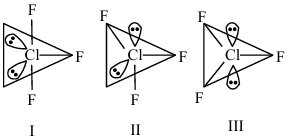
Statement $(I) :$ For $ClF_3$,all three possible structures may be drawn as follows:
(Image provided)
Statement $(II) :$ Structure $III$ is most stable,as the orbitals having the lone pairs are axial,where the $\ell p-bp$ repulsion is minimum.
In the light of the above statements,choose the most appropriate answer from the options given below:
Statement $(I) :$ For $ClF_3$,all three possible structures may be drawn as follows:
(Image provided)
Statement $(II) :$ Structure $III$ is most stable,as the orbitals having the lone pairs are axial,where the $\ell p-bp$ repulsion is minimum.
In the light of the above statements,choose the most appropriate answer from the options given below:
A
Statement $I$ is incorrect but statement $II$ is correct.
B
Statement $I$ is correct but statement $II$ is incorrect.
C
Both Statement $I$ and statement $II$ are correct.
D
Both Statement $I$ and statement $II$ are incorrect.
Solution
(B) In $ClF_3$,the central atom $Cl$ undergoes $sp^3d$ hybridization.
According to Bent's rule and $VSEPR$ theory,lone pairs in $sp^3d$ hybridized molecules occupy equatorial positions to minimize $\ell p-bp$ repulsions.
Statement $(I)$ is correct as it correctly depicts three possible theoretical arrangements of lone pairs and bond pairs in a trigonal bipyramidal geometry.
Statement $(II)$ is incorrect because lone pairs prefer equatorial positions (where bond angles are $120^\circ$) over axial positions (where bond angles are $90^\circ$) to minimize repulsion. Therefore,the structure with lone pairs in equatorial positions is the most stable,not the one with axial lone pairs.
According to Bent's rule and $VSEPR$ theory,lone pairs in $sp^3d$ hybridized molecules occupy equatorial positions to minimize $\ell p-bp$ repulsions.
Statement $(I)$ is correct as it correctly depicts three possible theoretical arrangements of lone pairs and bond pairs in a trigonal bipyramidal geometry.
Statement $(II)$ is incorrect because lone pairs prefer equatorial positions (where bond angles are $120^\circ$) over axial positions (where bond angles are $90^\circ$) to minimize repulsion. Therefore,the structure with lone pairs in equatorial positions is the most stable,not the one with axial lone pairs.
0 likes
View Solution515
DifficultMCQ
Match the List-$I$ with List-$II$.
Choose the correct answer from the options given below:
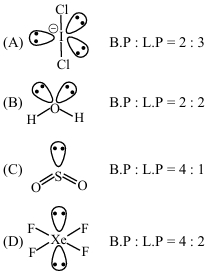
| List-$I$ Molecule/ion | List-$II$ Bond pair : lone pair (on the central atom) |
| $A. ICl_2^-$ | $I. 4 : 2$ |
| $B. H_2O$ | $II. 4 : 1$ |
| $C. SO_2$ | $III. 2 : 3$ |
| $D. XeF_4$ | $IV. 2 : 2$ |
Choose the correct answer from the options given below:
A
$A-IV, B-III, C-II, D-I$
B
$A-III, B-IV, C-II, D-I$
C
$A-III, B-IV, C-I, D-II$
D
$A-II, B-I, C-IV, D-III$
Solution
(B) To determine the number of bond pairs $(BP)$ and lone pairs $(LP)$ on the central atom:
$A. ICl_2^-$: Iodine $(I)$ has $7$ valence electrons $+ 1$ (negative charge) $= 8$. It forms $2$ single bonds with $Cl$. $BP = 2$. Remaining electrons $= 8 - 2 = 6$,which means $3$ lone pairs. $LP = 3$. Ratio $2:3$ (Matches $III$).
$B. H_2O$: Oxygen $(O)$ has $6$ valence electrons. It forms $2$ single bonds with $H$. $BP = 2$. Remaining electrons $= 6 - 2 = 4$,which means $2$ lone pairs. $LP = 2$. Ratio $2:2$ (Matches $IV$).
$C. SO_2$: Sulfur $(S)$ has $6$ valence electrons. It forms $2$ double bonds with $O$. Total shared electrons in bonds $= 4$. $BP = 4$. Remaining electrons $= 6 - 4 = 2$,which means $1$ lone pair. $LP = 1$. Ratio $4:1$ (Matches $II$).
$D. XeF_4$: Xenon $(Xe)$ has $8$ valence electrons. It forms $4$ single bonds with $F$. $BP = 4$. Remaining electrons $= 8 - 4 = 4$,which means $2$ lone pairs. $LP = 2$. Ratio $4:2$ (Matches $I$).
Therefore,the correct matching is $A-III, B-IV, C-II, D-I$.
$A. ICl_2^-$: Iodine $(I)$ has $7$ valence electrons $+ 1$ (negative charge) $= 8$. It forms $2$ single bonds with $Cl$. $BP = 2$. Remaining electrons $= 8 - 2 = 6$,which means $3$ lone pairs. $LP = 3$. Ratio $2:3$ (Matches $III$).
$B. H_2O$: Oxygen $(O)$ has $6$ valence electrons. It forms $2$ single bonds with $H$. $BP = 2$. Remaining electrons $= 6 - 2 = 4$,which means $2$ lone pairs. $LP = 2$. Ratio $2:2$ (Matches $IV$).
$C. SO_2$: Sulfur $(S)$ has $6$ valence electrons. It forms $2$ double bonds with $O$. Total shared electrons in bonds $= 4$. $BP = 4$. Remaining electrons $= 6 - 4 = 2$,which means $1$ lone pair. $LP = 1$. Ratio $4:1$ (Matches $II$).
$D. XeF_4$: Xenon $(Xe)$ has $8$ valence electrons. It forms $4$ single bonds with $F$. $BP = 4$. Remaining electrons $= 8 - 4 = 4$,which means $2$ lone pairs. $LP = 2$. Ratio $4:2$ (Matches $I$).
Therefore,the correct matching is $A-III, B-IV, C-II, D-I$.
0 likes
View Solution516
MediumMCQ
In which of the following conversions does a planar compound change into a non-planar compound?
$(a)$ $ClF_3 \rightarrow ClF_4^{-}$
$(b)$ $NH_2^{-} \rightarrow NH_4^{+}$
$(c)$ $I_3^{+} \rightarrow I_3^{-}$
$(d)$ $SO_2 \rightarrow SO_3$
$(a)$ $ClF_3 \rightarrow ClF_4^{-}$
$(b)$ $NH_2^{-} \rightarrow NH_4^{+}$
$(c)$ $I_3^{+} \rightarrow I_3^{-}$
$(d)$ $SO_2 \rightarrow SO_3$
A
$a \& b$
B
$b \& d$
C
only $b$
D
$a \& c$
Solution
(C) Let us analyze the geometry of each species:
$(a)$ $ClF_3$ is $T$-shaped (planar) and $ClF_4^{-}$ is square planar (planar). No change in planarity.
$(b)$ $NH_2^{-}$ is $V$-shaped (planar) and $NH_4^{+}$ is tetrahedral (non-planar). Thus,it changes from planar to non-planar.
$(c)$ $I_3^{+}$ is angular (planar) and $I_3^{-}$ is linear (planar). No change in planarity.
$(d)$ $SO_2$ is angular (planar) and $SO_3$ is trigonal planar (planar). No change in planarity.
Therefore,only $(b)$ involves a change from a planar to a non-planar compound.
$(a)$ $ClF_3$ is $T$-shaped (planar) and $ClF_4^{-}$ is square planar (planar). No change in planarity.
$(b)$ $NH_2^{-}$ is $V$-shaped (planar) and $NH_4^{+}$ is tetrahedral (non-planar). Thus,it changes from planar to non-planar.
$(c)$ $I_3^{+}$ is angular (planar) and $I_3^{-}$ is linear (planar). No change in planarity.
$(d)$ $SO_2$ is angular (planar) and $SO_3$ is trigonal planar (planar). No change in planarity.
Therefore,only $(b)$ involves a change from a planar to a non-planar compound.
0 likes
View Solution517
DifficultMCQ
In a $AX_2L_n$ compound,if $X$ is a bond pair and $n$ is the number of lone pairs of electrons,which of the following options is incorrect?
A
$n=0/3$,the compound shows the maximum bond angle
B
$n=2$,the compound shows the minimum bond angle
C
$n=2$,it is a planar as well as a polar compound
D
$n=1$,it is a planar as well as a non-polar compound
Solution
(D) For $AX_2L_n$ type molecules:
$1$. If $n=0$,the geometry is linear $(180^{\circ})$,non-polar.
$2$. If $n=1$,the geometry is bent/$V$-shaped,polar.
$3$. If $n=2$,the geometry is bent/$V$-shaped,polar.
$4$. If $n=3$,the geometry is linear $(180^{\circ})$,non-polar.
Option $D$ is incorrect because for $n=1$,the molecule is bent and polar,not non-polar.
$1$. If $n=0$,the geometry is linear $(180^{\circ})$,non-polar.
$2$. If $n=1$,the geometry is bent/$V$-shaped,polar.
$3$. If $n=2$,the geometry is bent/$V$-shaped,polar.
$4$. If $n=3$,the geometry is linear $(180^{\circ})$,non-polar.
Option $D$ is incorrect because for $n=1$,the molecule is bent and polar,not non-polar.
0 likes
View Solution518
MediumMCQ
The shape of $AsF_5$ according to $VSEPR$ theory $:-$
A
Pentagonal Pyramidal
B
Trigonal bipyramidal
C
Square Pyramidal
D
Octahedral
Solution
(B) To determine the shape of $AsF_5$ using $VSEPR$ theory,we first calculate the number of valence electrons on the central atom $As$.
$As$ belongs to group $15$,so it has $5$ valence electrons.
It forms $5$ bonds with $5$ $F$ atoms.
Number of electron pairs $= \frac{1}{2} \times (V + M - C + A) = \frac{1}{2} \times (5 + 5 - 0 + 0) = 5$.
Since there are $5$ bond pairs and $0$ lone pairs,the hybridization is $sp^3d$.
$A$ molecule with $5$ bond pairs and $0$ lone pairs adopts a trigonal bipyramidal geometry.
$As$ belongs to group $15$,so it has $5$ valence electrons.
It forms $5$ bonds with $5$ $F$ atoms.
Number of electron pairs $= \frac{1}{2} \times (V + M - C + A) = \frac{1}{2} \times (5 + 5 - 0 + 0) = 5$.
Since there are $5$ bond pairs and $0$ lone pairs,the hybridization is $sp^3d$.
$A$ molecule with $5$ bond pairs and $0$ lone pairs adopts a trigonal bipyramidal geometry.
0 likes
View Solution519
EasyMCQ
In which of the following species is the central atom not surrounded by exactly $8$ valence electrons?
A
$BF_4^{-}$
B
$NCl_3$
C
$PCl_4^{+}$
D
$SF_4$
Solution
(D) To determine the number of valence electrons around the central atom,we calculate the total electrons in the valence shell including bonding and lone pairs.
$1$. In $BF_4^{-}$,the central $B$ atom forms $4$ single bonds with $F$ atoms,resulting in $4 \times 2 = 8$ electrons.
$2$. In $NCl_3$,the central $N$ atom has $3$ bond pairs and $1$ lone pair,totaling $8$ electrons.
$3$. In $PCl_4^{+}$,the central $P$ atom forms $4$ single bonds with $Cl$ atoms,resulting in $4 \times 2 = 8$ electrons.
$4$. In $SF_4$,the central $S$ atom has $4$ bond pairs and $1$ lone pair,totaling $10$ electrons $(4 \times 2 + 2 = 10)$.
Thus,$SF_4$ does not follow the octet rule as it has $10$ valence electrons.
$1$. In $BF_4^{-}$,the central $B$ atom forms $4$ single bonds with $F$ atoms,resulting in $4 \times 2 = 8$ electrons.
$2$. In $NCl_3$,the central $N$ atom has $3$ bond pairs and $1$ lone pair,totaling $8$ electrons.
$3$. In $PCl_4^{+}$,the central $P$ atom forms $4$ single bonds with $Cl$ atoms,resulting in $4 \times 2 = 8$ electrons.
$4$. In $SF_4$,the central $S$ atom has $4$ bond pairs and $1$ lone pair,totaling $10$ electrons $(4 \times 2 + 2 = 10)$.
Thus,$SF_4$ does not follow the octet rule as it has $10$ valence electrons.
0 likes
View Solution520
MediumMCQ
$XH_3 + H^{+} \longrightarrow XH_4^{+} (X = N, P, As, Sb)$. In this process,the maximum increase in bond angle will be in the case of $:-$
A
$NH_3$
B
$PH_3$
C
$AsH_3$
D
$SbH_3$
Solution
(D) The bond angle in $XH_3$ molecules depends on the hybridization of the central atom $X$. For $NH_3$,the bond angle is approximately $107^{\circ}$ due to $sp^3$ hybridization with a lone pair. For $PH_3$,$AsH_3$,and $SbH_3$,the bond angle is close to $90^{\circ}$ because they involve almost pure $p$-orbitals for bonding (Drago's rule).
In the formation of $XH_4^{+}$,the central atom undergoes $sp^3$ hybridization,resulting in a tetrahedral geometry with a bond angle of $109.5^{\circ}$.
The increase in bond angle is calculated as $\Delta \theta = 109.5^{\circ} - \text{Bond angle of } XH_3$.
For $NH_3$: $\Delta \theta = 109.5^{\circ} - 107^{\circ} = 2.5^{\circ}$.
For $PH_3$: $\Delta \theta = 109.5^{\circ} - 93.5^{\circ} = 16^{\circ}$.
For $AsH_3$: $\Delta \theta = 109.5^{\circ} - 91.8^{\circ} = 17.7^{\circ}$.
For $SbH_3$: $\Delta \theta = 109.5^{\circ} - 91.3^{\circ} = 18.2^{\circ}$.
Thus,the maximum increase in bond angle occurs for $SbH_3$.
In the formation of $XH_4^{+}$,the central atom undergoes $sp^3$ hybridization,resulting in a tetrahedral geometry with a bond angle of $109.5^{\circ}$.
The increase in bond angle is calculated as $\Delta \theta = 109.5^{\circ} - \text{Bond angle of } XH_3$.
For $NH_3$: $\Delta \theta = 109.5^{\circ} - 107^{\circ} = 2.5^{\circ}$.
For $PH_3$: $\Delta \theta = 109.5^{\circ} - 93.5^{\circ} = 16^{\circ}$.
For $AsH_3$: $\Delta \theta = 109.5^{\circ} - 91.8^{\circ} = 17.7^{\circ}$.
For $SbH_3$: $\Delta \theta = 109.5^{\circ} - 91.3^{\circ} = 18.2^{\circ}$.
Thus,the maximum increase in bond angle occurs for $SbH_3$.
0 likes
View Solution521
MediumMCQ
Which of the following statements are true or false?
$(A)$ All the bond angles $\angle Cl-P-Cl$ are $90^{\circ}$ in $PCl_5$.
$(B)$ The bond length of $P-Cl$ in the axial position is more than the equatorial position in $PCl_5$.
$(C)$ $PCl_5$ is a nonreactive molecule.
$(D)$ In $PCl_5$,the hybridization is $sp^3d$ and it has a pyramidal structure.
$(A)$ All the bond angles $\angle Cl-P-Cl$ are $90^{\circ}$ in $PCl_5$.
$(B)$ The bond length of $P-Cl$ in the axial position is more than the equatorial position in $PCl_5$.
$(C)$ $PCl_5$ is a nonreactive molecule.
$(D)$ In $PCl_5$,the hybridization is $sp^3d$ and it has a pyramidal structure.
A
$TFTF$
B
$FTFF$
C
$FTTT$
D
$FTFT$
Solution
(B) False: In $PCl_5$,the bond angles are $90^{\circ}$,$120^{\circ}$,and $180^{\circ}$.
$(B)$ True: Axial $P-Cl$ bonds are longer than equatorial $P-Cl$ bonds due to greater repulsion from equatorial bond pairs.
$(C)$ False: $PCl_5$ is highly reactive and acts as a chlorinating agent.
$(D)$ False: $PCl_5$ has a trigonal bipyramidal structure,not a pyramidal one.
$(B)$ True: Axial $P-Cl$ bonds are longer than equatorial $P-Cl$ bonds due to greater repulsion from equatorial bond pairs.
$(C)$ False: $PCl_5$ is highly reactive and acts as a chlorinating agent.
$(D)$ False: $PCl_5$ has a trigonal bipyramidal structure,not a pyramidal one.
0 likes
View Solution522
EasyMCQ
Statement $I$ : $SO_2$ and $H_2O$ both possess $V$-shaped structure.
Statement $II$ : The bond angle of $SO_2$ is less than that of $H_2O$.
In the light of the above statements,choose the most appropriate answer from the options given below:
Statement $II$ : The bond angle of $SO_2$ is less than that of $H_2O$.
In the light of the above statements,choose the most appropriate answer from the options given below:
A
Statement $I$ and Statement $II$ are incorrect
B
Statement $I$ and Statement $II$ are correct
C
Statement $I$ is correct but Statement $II$ is incorrect
D
Statement $I$ is incorrect but Statement $II$ is correct
Solution
(C) $1$. $SO_2$ has $sp^2$ hybridization with one lone pair on $S$,resulting in a $V$-shaped (bent) geometry with a bond angle of approximately $119^{\circ}$.
$2$. $H_2O$ has $sp^3$ hybridization with two lone pairs on $O$,resulting in a $V$-shaped (bent) geometry with a bond angle of approximately $104.5^{\circ}$.
$3$. Both molecules possess a $V$-shaped structure,so Statement $I$ is correct.
$4$. Comparing the bond angles,$119^{\circ} > 104.5^{\circ}$,so the bond angle of $SO_2$ is greater than that of $H_2O$. Thus,Statement $II$ is incorrect.
$2$. $H_2O$ has $sp^3$ hybridization with two lone pairs on $O$,resulting in a $V$-shaped (bent) geometry with a bond angle of approximately $104.5^{\circ}$.
$3$. Both molecules possess a $V$-shaped structure,so Statement $I$ is correct.
$4$. Comparing the bond angles,$119^{\circ} > 104.5^{\circ}$,so the bond angle of $SO_2$ is greater than that of $H_2O$. Thus,Statement $II$ is incorrect.
0 likes
View Solution523
DifficultMCQ
Which of the following is not correctly matched$:-$
A
Bond angle $CH_4 \longrightarrow 109^{\circ} 28^{\prime},$ Number of bond angles $\longrightarrow 6$
B
Bond angle $SF_6 \longrightarrow 90^{\circ},$ Number of bond angles $\longrightarrow 12$
C
Bond angle $IF_7 \longrightarrow 90^{\circ},$ Number of bond angles $\longrightarrow 10$
D
Bond angle $IF_5 \longrightarrow 90^{\circ},$ Number of bond angles $\longrightarrow 8$
Solution
(D) In $CH_4$ ($sp^3$ hybridization),there are $6$ bond angles of $109^{\circ} 28^{\prime}$. This is correct.
In $SF_6$ ($sp^3d^2$ hybridization),there are $12$ bond angles of $90^{\circ}$ (in the equatorial and axial planes). This is correct.
In $IF_7$ ($sp^3d^3$ hybridization,pentagonal bipyramidal),there are $10$ bond angles of $90^{\circ}$ (between axial and equatorial bonds). This is correct.
In $IF_5$ ($sp^3d^2$ hybridization,square pyramidal),there are $8$ bond angles of $90^{\circ}$ (between the four basal fluorine atoms and the axial fluorine atom). However,the number of $90^{\circ}$ angles is actually $8$ in the square pyramidal structure. Wait,let us re-evaluate: $IF_5$ has $4$ equatorial-axial angles and $4$ other angles,totaling $8$. Actually,option $C$ is often cited as the mismatch in some contexts,but $IF_7$ has $10$ angles of $90^{\circ}$. Let us check $IF_5$ again: it has $4$ angles of $90^{\circ}$ between the basal plane and the apex. The statement in option $D$ is incorrect as the geometry is square pyramidal.
In $SF_6$ ($sp^3d^2$ hybridization),there are $12$ bond angles of $90^{\circ}$ (in the equatorial and axial planes). This is correct.
In $IF_7$ ($sp^3d^3$ hybridization,pentagonal bipyramidal),there are $10$ bond angles of $90^{\circ}$ (between axial and equatorial bonds). This is correct.
In $IF_5$ ($sp^3d^2$ hybridization,square pyramidal),there are $8$ bond angles of $90^{\circ}$ (between the four basal fluorine atoms and the axial fluorine atom). However,the number of $90^{\circ}$ angles is actually $8$ in the square pyramidal structure. Wait,let us re-evaluate: $IF_5$ has $4$ equatorial-axial angles and $4$ other angles,totaling $8$. Actually,option $C$ is often cited as the mismatch in some contexts,but $IF_7$ has $10$ angles of $90^{\circ}$. Let us check $IF_5$ again: it has $4$ angles of $90^{\circ}$ between the basal plane and the apex. The statement in option $D$ is incorrect as the geometry is square pyramidal.
0 likes
View Solution524
MediumMCQ
Which of the following statements is applicable to $ClF_3$?
A
Geometrical arrangement is pyramidal
B
It has three bond angles of $120^{\circ}$
C
$F-Cl-F$ bond angle is $120^{\circ}$
D
The molecule is almost '$T$' shaped
Solution
(D) The central atom $Cl$ in $ClF_3$ has $7$ valence electrons.
It forms $3$ bond pairs with $F$ atoms and has $2$ lone pairs of electrons.
According to $VSEPR$ theory,the total number of electron pairs is $3 + 2 = 5$,which corresponds to a trigonal bipyramidal electron geometry.
The $2$ lone pairs occupy equatorial positions to minimize repulsion.
As a result,the molecule adopts a '$T$' shaped geometry.
The axial $F-Cl-F$ bond angle is distorted from $180^{\circ}$ to approximately $175^{\circ}$ due to the presence of lone pairs.
It forms $3$ bond pairs with $F$ atoms and has $2$ lone pairs of electrons.
According to $VSEPR$ theory,the total number of electron pairs is $3 + 2 = 5$,which corresponds to a trigonal bipyramidal electron geometry.
The $2$ lone pairs occupy equatorial positions to minimize repulsion.
As a result,the molecule adopts a '$T$' shaped geometry.
The axial $F-Cl-F$ bond angle is distorted from $180^{\circ}$ to approximately $175^{\circ}$ due to the presence of lone pairs.
0 likes
View Solution525
MediumMCQ
Which of the following is an incorrect statement about $PCl_5$?
A
$P-Cl$ bond length: $\text{axial} > \text{equatorial}$.
B
$PCl_5$ is an $sp^3d$ hybridized molecule.
C
Axial $P-Cl$ bonds are weaker than equatorial $P-Cl$ bonds.
D
$PCl_5$ is a non-reactive molecule.
Solution
(D) $PCl_5$ is a highly reactive molecule because the axial $P-Cl$ bonds are longer and weaker than the equatorial $P-Cl$ bonds due to greater repulsion from equatorial bond pairs. Therefore,the statement that $PCl_5$ is non-reactive is incorrect.
0 likes
View Solution526
MediumMCQ
Which of the following is the incorrect order of bond angle?
A
$COF_2 < COCl_2 < COBr_2$ $(X-\hat{C}-X)$
B
$PF_3 < PCl_3 < PBr_3 < PI_3$
C
$BF_3 < BCl_3 < BBr_3 < BI_3$
D
$PH_3 < PCl_3$
Solution
(C) $1$. In $COF_2$,$COCl_2$,and $COBr_2$,the bond angle increases as the size of the halogen atom increases due to steric repulsion between the larger halogen atoms. Thus,$COF_2 < COCl_2 < COBr_2$ is correct.
$2$. In $PF_3$,$PCl_3$,$PBr_3$,and $PI_3$,the bond angle increases as the electronegativity of the halogen decreases,reducing the repulsion between bonding pairs and increasing the bond angle. Thus,$PF_3 < PCl_3 < PBr_3 < PI_3$ is correct.
$3$. In $BF_3$,$BCl_3$,$BBr_3$,and $BI_3$,all are $sp^2$ hybridized with a bond angle of $120^{\circ}$. Therefore,the bond angle is equal for all,making the order $BF_3 = BCl_3 = BBr_3 = BI_3$. The given order $BF_3 < BCl_3 < BBr_3 < BI_3$ is incorrect.
$4$. In $PH_3$ and $PCl_3$,the bond angle in $PH_3$ is approximately $93^{\circ}$ and in $PCl_3$ is approximately $100^{\circ}$. Thus,$PH_3 < PCl_3$ is correct.
$2$. In $PF_3$,$PCl_3$,$PBr_3$,and $PI_3$,the bond angle increases as the electronegativity of the halogen decreases,reducing the repulsion between bonding pairs and increasing the bond angle. Thus,$PF_3 < PCl_3 < PBr_3 < PI_3$ is correct.
$3$. In $BF_3$,$BCl_3$,$BBr_3$,and $BI_3$,all are $sp^2$ hybridized with a bond angle of $120^{\circ}$. Therefore,the bond angle is equal for all,making the order $BF_3 = BCl_3 = BBr_3 = BI_3$. The given order $BF_3 < BCl_3 < BBr_3 < BI_3$ is incorrect.
$4$. In $PH_3$ and $PCl_3$,the bond angle in $PH_3$ is approximately $93^{\circ}$ and in $PCl_3$ is approximately $100^{\circ}$. Thus,$PH_3 < PCl_3$ is correct.
0 likes
View Solution527
EasyMCQ
Identify a molecule having the highest number of lone pairs of electrons in the valence shell of the central atom.
A
$NH_3$
B
$SF_4$
C
$ICl_3$
D
$PCl_3$
Solution
(C) To determine the number of lone pairs on the central atom,we use the formula: $\text{Lone pairs} = \frac{1}{2} (V - N)$,where $V$ is the number of valence electrons of the central atom and $N$ is the number of bonding electrons (monovalent atoms attached).
$1$. For $NH_3$: $N$ is $5$,$V = 5$,$N = 3$. $\text{Lone pairs} = \frac{1}{2} (5 - 3) = 1$.
$2$. For $SF_4$: $S$ is $6$,$V = 6$,$N = 4$. $\text{Lone pairs} = \frac{1}{2} (6 - 4) = 1$.
$3$. For $ICl_3$: $I$ is $7$,$V = 7$,$N = 3$. $\text{Lone pairs} = \frac{1}{2} (7 - 3) = 2$.
$4$. For $PCl_3$: $P$ is $5$,$V = 5$,$N = 3$. $\text{Lone pairs} = \frac{1}{2} (5 - 3) = 1$.
Thus,$ICl_3$ has the highest number of lone pairs $(2)$.
$1$. For $NH_3$: $N$ is $5$,$V = 5$,$N = 3$. $\text{Lone pairs} = \frac{1}{2} (5 - 3) = 1$.
$2$. For $SF_4$: $S$ is $6$,$V = 6$,$N = 4$. $\text{Lone pairs} = \frac{1}{2} (6 - 4) = 1$.
$3$. For $ICl_3$: $I$ is $7$,$V = 7$,$N = 3$. $\text{Lone pairs} = \frac{1}{2} (7 - 3) = 2$.
$4$. For $PCl_3$: $P$ is $5$,$V = 5$,$N = 3$. $\text{Lone pairs} = \frac{1}{2} (5 - 3) = 1$.
Thus,$ICl_3$ has the highest number of lone pairs $(2)$.
0 likes
View Solution528
EasyMCQ
Which of the following molecules consists of the minimum number of lone pairs of electrons in the valence shell of the central atom?
A
$SCl_2$
B
$PCl_3$
C
$ClF_3$
D
$XeF_4$
Solution
(B) To determine the number of lone pairs on the central atom,we use the formula: $\text{Lone pairs} = \frac{V - B}{2}$,where $V$ is the number of valence electrons of the central atom and $B$ is the number of bonding electrons (shared with surrounding atoms).
$A) SCl_2$: Central atom $S$ (Group $16$) has $6$ valence electrons. It forms $2$ bonds. Lone pairs = $(6 - 2) / 2 = 2$.
$B) PCl_3$: Central atom $P$ (Group $15$) has $5$ valence electrons. It forms $3$ bonds. Lone pairs = $(5 - 3) / 2 = 1$.
$C) ClF_3$: Central atom $Cl$ (Group $17$) has $7$ valence electrons. It forms $3$ bonds. Lone pairs = $(7 - 3) / 2 = 2$.
$D) XeF_4$: Central atom $Xe$ (Group $18$) has $8$ valence electrons. It forms $4$ bonds. Lone pairs = $(8 - 4) / 2 = 2$.
Comparing the values,$PCl_3$ has the minimum number of lone pairs $(1)$.
$A) SCl_2$: Central atom $S$ (Group $16$) has $6$ valence electrons. It forms $2$ bonds. Lone pairs = $(6 - 2) / 2 = 2$.
$B) PCl_3$: Central atom $P$ (Group $15$) has $5$ valence electrons. It forms $3$ bonds. Lone pairs = $(5 - 3) / 2 = 1$.
$C) ClF_3$: Central atom $Cl$ (Group $17$) has $7$ valence electrons. It forms $3$ bonds. Lone pairs = $(7 - 3) / 2 = 2$.
$D) XeF_4$: Central atom $Xe$ (Group $18$) has $8$ valence electrons. It forms $4$ bonds. Lone pairs = $(8 - 4) / 2 = 2$.
Comparing the values,$PCl_3$ has the minimum number of lone pairs $(1)$.
0 likes
View Solution529
MediumMCQ
Which of the following pairs of compounds consists of an equal number of lone pairs of electrons in the valence shell of the central atom?
A
$BrF_5$ and $XeF_6$
B
$ICl$ and $H_2S$
C
$ClF_3$ and $XeF_2$
D
$IF_7$ and $XeF_4$
Solution
(A) To determine the number of lone pairs on the central atom,we use the formula: $\text{Lone pairs} = \frac{1}{2} (V - N)$,where $V$ is the number of valence electrons of the central atom and $N$ is the number of bonding electrons (monovalent atoms attached).
$A$: $BrF_5$ ($Br$ has $7$ valence $e^-$,$5$ bonded $F$ atoms): $\text{Lone pairs} = \frac{1}{2} (7 - 5) = 1$. $XeF_6$ ($Xe$ has $8$ valence $e^-$,$6$ bonded $F$ atoms): $\text{Lone pairs} = \frac{1}{2} (8 - 6) = 1$.
$B$: $ICl$ ($I$ has $7$ valence $e^-$,$1$ bonded $Cl$ atom): $\text{Lone pairs} = \frac{1}{2} (7 - 1) = 3$. $H_2S$ ($S$ has $6$ valence $e^-$,$2$ bonded $H$ atoms): $\text{Lone pairs} = \frac{1}{2} (6 - 2) = 2$.
$C$: $ClF_3$ ($Cl$ has $7$ valence $e^-$,$3$ bonded $F$ atoms): $\text{Lone pairs} = \frac{1}{2} (7 - 3) = 2$. $XeF_2$ ($Xe$ has $8$ valence $e^-$,$2$ bonded $F$ atoms): $\text{Lone pairs} = \frac{1}{2} (8 - 2) = 3$.
$D$: $IF_7$ ($I$ has $7$ valence $e^-$,$7$ bonded $F$ atoms): $\text{Lone pairs} = \frac{1}{2} (7 - 7) = 0$. $XeF_4$ ($Xe$ has $8$ valence $e^-$,$4$ bonded $F$ atoms): $\text{Lone pairs} = \frac{1}{2} (8 - 4) = 2$.
Thus,$BrF_5$ and $XeF_6$ both have $1$ lone pair on their central atoms.
$A$: $BrF_5$ ($Br$ has $7$ valence $e^-$,$5$ bonded $F$ atoms): $\text{Lone pairs} = \frac{1}{2} (7 - 5) = 1$. $XeF_6$ ($Xe$ has $8$ valence $e^-$,$6$ bonded $F$ atoms): $\text{Lone pairs} = \frac{1}{2} (8 - 6) = 1$.
$B$: $ICl$ ($I$ has $7$ valence $e^-$,$1$ bonded $Cl$ atom): $\text{Lone pairs} = \frac{1}{2} (7 - 1) = 3$. $H_2S$ ($S$ has $6$ valence $e^-$,$2$ bonded $H$ atoms): $\text{Lone pairs} = \frac{1}{2} (6 - 2) = 2$.
$C$: $ClF_3$ ($Cl$ has $7$ valence $e^-$,$3$ bonded $F$ atoms): $\text{Lone pairs} = \frac{1}{2} (7 - 3) = 2$. $XeF_2$ ($Xe$ has $8$ valence $e^-$,$2$ bonded $F$ atoms): $\text{Lone pairs} = \frac{1}{2} (8 - 2) = 3$.
$D$: $IF_7$ ($I$ has $7$ valence $e^-$,$7$ bonded $F$ atoms): $\text{Lone pairs} = \frac{1}{2} (7 - 7) = 0$. $XeF_4$ ($Xe$ has $8$ valence $e^-$,$4$ bonded $F$ atoms): $\text{Lone pairs} = \frac{1}{2} (8 - 4) = 2$.
Thus,$BrF_5$ and $XeF_6$ both have $1$ lone pair on their central atoms.
0 likes
View Solution530
EasyMCQ
Which of the following molecules has two lone pairs of electrons in the valence shell of its central atom?
A
$SO_2$
B
$NH_3$
C
$H_2O$
D
$SF_4$
Solution
(C) In $H_2O$,the central oxygen atom has $6$ valence electrons.
It forms $2$ covalent bonds with $2$ hydrogen atoms.
This leaves $4$ electrons as $2$ lone pairs on the oxygen atom.
Therefore,$H_2O$ has $2$ lone pairs.
It forms $2$ covalent bonds with $2$ hydrogen atoms.
This leaves $4$ electrons as $2$ lone pairs on the oxygen atom.
Therefore,$H_2O$ has $2$ lone pairs.
0 likes
View Solution531
EasyMCQ
Which among the following concepts is $NOT$ introduced by $V.B.$ Theory?
A
Delocalization of electron over the two nuclei.
B
Shielding effect of electrons.
C
Partial ionic character of a covalent bond.
D
Number of lone pair and bonded pair of electrons decide the shape of the molecules.
Solution
(D) $VBT$ (Valence Bond Theory) explains the formation of covalent bonds through the overlapping of half-filled atomic orbitals.
It accounts for the delocalization of electrons between two nuclei and the partial ionic character of covalent bonds due to electronegativity differences.
The concept that the number of lone pairs and bonded pairs of electrons determines the shape of molecules is introduced by $VSEPR$ (Valence Shell Electron Pair Repulsion) Theory,not $VBT$.
Shielding effect is a concept related to atomic structure and effective nuclear charge,not a primary feature of $VBT$.
It accounts for the delocalization of electrons between two nuclei and the partial ionic character of covalent bonds due to electronegativity differences.
The concept that the number of lone pairs and bonded pairs of electrons determines the shape of molecules is introduced by $VSEPR$ (Valence Shell Electron Pair Repulsion) Theory,not $VBT$.
Shielding effect is a concept related to atomic structure and effective nuclear charge,not a primary feature of $VBT$.
0 likes
View Solution532
MediumMCQ
Which of the following molecules has a regular geometry as expected?
A
$SiCl_4$
B
$SF_4$
C
$BrF_5$
D
$XeF_4$
Solution
(A) $1$. $SiCl_4$: The central atom $Si$ has $4$ valence electrons and forms $4$ bonds with $Cl$ atoms. It undergoes $sp^3$ hybridization with $0$ lone pairs,resulting in a regular tetrahedral geometry.
$2$. $SF_4$: The central atom $S$ has $6$ valence electrons,forms $4$ bonds,and has $1$ lone pair. It undergoes $sp^3d$ hybridization,resulting in a see-saw geometry (distorted).
$3$. $BrF_5$: The central atom $Br$ has $7$ valence electrons,forms $5$ bonds,and has $1$ lone pair. It undergoes $sp^3d^2$ hybridization,resulting in a square pyramidal geometry (distorted).
$4$. $XeF_4$: The central atom $Xe$ has $8$ valence electrons,forms $4$ bonds,and has $2$ lone pairs. It undergoes $sp^3d^2$ hybridization,resulting in a square planar geometry (distorted due to lone pairs).
$5$. Therefore,only $SiCl_4$ has a regular geometry.
$2$. $SF_4$: The central atom $S$ has $6$ valence electrons,forms $4$ bonds,and has $1$ lone pair. It undergoes $sp^3d$ hybridization,resulting in a see-saw geometry (distorted).
$3$. $BrF_5$: The central atom $Br$ has $7$ valence electrons,forms $5$ bonds,and has $1$ lone pair. It undergoes $sp^3d^2$ hybridization,resulting in a square pyramidal geometry (distorted).
$4$. $XeF_4$: The central atom $Xe$ has $8$ valence electrons,forms $4$ bonds,and has $2$ lone pairs. It undergoes $sp^3d^2$ hybridization,resulting in a square planar geometry (distorted due to lone pairs).
$5$. Therefore,only $SiCl_4$ has a regular geometry.
0 likes
View Solution533
MediumMCQ
Identify the geometry of $TeF_4$ molecule from the following.
A
Linear
B
Tetrahedral
C
Trigonal bipyramidal
D
See-saw
Solution
(D) $1$. The central atom $Te$ has $6$ valence electrons.
$2$. It forms $4$ bonds with $F$ atoms and has $1$ lone pair of electrons.
$3$. The total number of electron pairs is $4 + 1 = 5$,which corresponds to $sp^3d$ hybridization.
$4$. According to $VSEPR$ theory,a molecule with $5$ electron pairs and $1$ lone pair adopts a see-saw geometry.
$2$. It forms $4$ bonds with $F$ atoms and has $1$ lone pair of electrons.
$3$. The total number of electron pairs is $4 + 1 = 5$,which corresponds to $sp^3d$ hybridization.
$4$. According to $VSEPR$ theory,a molecule with $5$ electron pairs and $1$ lone pair adopts a see-saw geometry.
0 likes
View Solution534
MediumMCQ
What is the shape of the $BrF_5$ molecule?
A
Trigonal pyramidal
B
Square planar
C
Square pyramidal
D
Bent '$T$' shape
Solution
(C) The central atom $Br$ has $7$ valence electrons. In $BrF_5$,it forms $5$ bonds with $F$ atoms and has $1$ lone pair of electrons.
Total electron pairs = $5$ (bond pairs) + $1$ (lone pair) = $6$.
This corresponds to $sp^3d^2$ hybridization with octahedral electron geometry.
Due to the presence of one lone pair,the shape of the $BrF_5$ molecule is square pyramidal.
Total electron pairs = $5$ (bond pairs) + $1$ (lone pair) = $6$.
This corresponds to $sp^3d^2$ hybridization with octahedral electron geometry.
Due to the presence of one lone pair,the shape of the $BrF_5$ molecule is square pyramidal.
0 likes
View Solution535
MediumMCQ
Which of the following species is not tetrahedral?
A
$CH_4$
B
$SF_4$
C
$\stackrel{+}{N}H_4$
D
$SiCl_4$
Solution
(B) To determine the geometry,we calculate the hybridization of the central atom using the formula: $H = \frac{1}{2}(V + M - C + A)$,where $V$ is the number of valence electrons,$M$ is the number of monovalent atoms,$C$ is the cationic charge,and $A$ is the anionic charge.
$1$. For $CH_4$: $H = \frac{1}{2}(4 + 4) = 4$ ($sp^3$ hybridization,tetrahedral).
$2$. For $SF_4$: $H = \frac{1}{2}(6 + 4) = 5$ ($sp^3d$ hybridization,see-saw geometry due to one lone pair).
$3$. For $\stackrel{+}{N}H_4$: $H = \frac{1}{2}(5 + 4 - 1) = 4$ ($sp^3$ hybridization,tetrahedral).
$4$. For $SiCl_4$: $H = \frac{1}{2}(4 + 4) = 4$ ($sp^3$ hybridization,tetrahedral).
Thus,$SF_4$ is the only species that is not tetrahedral.
$1$. For $CH_4$: $H = \frac{1}{2}(4 + 4) = 4$ ($sp^3$ hybridization,tetrahedral).
$2$. For $SF_4$: $H = \frac{1}{2}(6 + 4) = 5$ ($sp^3d$ hybridization,see-saw geometry due to one lone pair).
$3$. For $\stackrel{+}{N}H_4$: $H = \frac{1}{2}(5 + 4 - 1) = 4$ ($sp^3$ hybridization,tetrahedral).
$4$. For $SiCl_4$: $H = \frac{1}{2}(4 + 4) = 4$ ($sp^3$ hybridization,tetrahedral).
Thus,$SF_4$ is the only species that is not tetrahedral.
0 likes
View Solution536
EasyMCQ
Identify the correct statement regarding geometry and lone pair of electrons present in $CH_4$ and $SiCl_4$.
A
Both have same geometry with two lone pair of electrons each.
B
Both have different geometry with one lone pair of electrons each.
C
Both have same geometry with no lone pair of electrons each.
D
Both have different geometry with no lone pair of electrons each.
Solution
(C) In $CH_4$,the central carbon atom is $sp^3$ hybridized and forms $4$ sigma bonds with hydrogen atoms. It has $0$ lone pairs and a tetrahedral geometry.
In $SiCl_4$,the central silicon atom is $sp^3$ hybridized and forms $4$ sigma bonds with chlorine atoms. It has $0$ lone pairs and a tetrahedral geometry.
Therefore,both molecules have the same tetrahedral geometry and contain no lone pairs of electrons on the central atom.
In $SiCl_4$,the central silicon atom is $sp^3$ hybridized and forms $4$ sigma bonds with chlorine atoms. It has $0$ lone pairs and a tetrahedral geometry.
Therefore,both molecules have the same tetrahedral geometry and contain no lone pairs of electrons on the central atom.
0 likes
View Solution537
MediumMCQ
Identify a pair of molecules having similar shapes of both members.
A
$NH_3, \,\, SO_2$
B
$XeF_4, \,\, SF_4$
C
$H_2O, \,\, SCl_2$
D
$PCl_5, \,\, BrF_5$
Solution
(C) To determine the shapes of the molecules, we use the $VSEPR$ theory:
$1$. $H_2O$: The central oxygen atom has $2$ bond pairs and $2$ lone pairs, resulting in a bent ($V$-shaped) geometry.
$2$. $SCl_2$: The central sulfur atom has $2$ bond pairs and $2$ lone pairs, resulting in a bent ($V$-shaped) geometry.
Both $H_2O$ and $SCl_2$ have a bent shape.
$3$. $NH_3$ is trigonal pyramidal, while $SO_2$ is bent.
$4$. $XeF_4$ is square planar, while $SF_4$ is see-saw.
$5$. $PCl_5$ is trigonal bipyramidal, while $BrF_5$ is square pyramidal.
Therefore, the correct pair is $H_2O$ and $SCl_2$.
$1$. $H_2O$: The central oxygen atom has $2$ bond pairs and $2$ lone pairs, resulting in a bent ($V$-shaped) geometry.
$2$. $SCl_2$: The central sulfur atom has $2$ bond pairs and $2$ lone pairs, resulting in a bent ($V$-shaped) geometry.
Both $H_2O$ and $SCl_2$ have a bent shape.
$3$. $NH_3$ is trigonal pyramidal, while $SO_2$ is bent.
$4$. $XeF_4$ is square planar, while $SF_4$ is see-saw.
$5$. $PCl_5$ is trigonal bipyramidal, while $BrF_5$ is square pyramidal.
Therefore, the correct pair is $H_2O$ and $SCl_2$.
0 likes
View Solution538
MediumMCQ
Which of the following molecules has a square pyramidal geometry?
A
$XeF_4$
B
$XeF_6$
C
$XeOF_4$
D
$XeO_3$
Solution
(C) To determine the geometry,we calculate the steric number using the formula: $Steric \ Number = \frac{1}{2} (V + M - C + A)$,where $V$ is the number of valence electrons of the central atom,$M$ is the number of monovalent atoms,$C$ is the cationic charge,and $A$ is the anionic charge.
For $XeOF_4$:
$V = 8$ (for $Xe$),$M = 4$ (for $F$),$O$ is divalent (not counted in $M$).
$Steric \ Number = \frac{1}{2} (8 + 4) = 6$.
$A$ steric number of $6$ corresponds to $sp^3d^2$ hybridization,which has an octahedral electron geometry.
With $5$ bonding pairs ($4$ $Xe-F$ and $1$ $Xe=O$) and $1$ lone pair,the molecular geometry is square pyramidal.
For $XeOF_4$:
$V = 8$ (for $Xe$),$M = 4$ (for $F$),$O$ is divalent (not counted in $M$).
$Steric \ Number = \frac{1}{2} (8 + 4) = 6$.
$A$ steric number of $6$ corresponds to $sp^3d^2$ hybridization,which has an octahedral electron geometry.
With $5$ bonding pairs ($4$ $Xe-F$ and $1$ $Xe=O$) and $1$ lone pair,the molecular geometry is square pyramidal.
0 likes
View Solution539
EasyMCQ
Identify the structure of $XeF_4$ molecule from the following.
A
Trigonal pyramidal
B
Square pyramidal
C
Square planar
D
Distorted octahedral
Solution
(C) The central atom in $XeF_4$ is Xenon $(Xe)$,which has $8$ valence electrons.
It forms $4$ single bonds with $4$ Fluorine $(F)$ atoms.
This leaves $4$ electrons,which form $2$ lone pairs on the Xenon atom.
The total number of electron pairs around the central atom is $4$ (bond pairs) + $2$ (lone pairs) = $6$.
According to $VSEPR$ theory,a steric number of $6$ corresponds to an octahedral electron geometry.
With $4$ bond pairs and $2$ lone pairs,the lone pairs occupy the axial positions to minimize repulsion,resulting in a square planar molecular geometry.
It forms $4$ single bonds with $4$ Fluorine $(F)$ atoms.
This leaves $4$ electrons,which form $2$ lone pairs on the Xenon atom.
The total number of electron pairs around the central atom is $4$ (bond pairs) + $2$ (lone pairs) = $6$.
According to $VSEPR$ theory,a steric number of $6$ corresponds to an octahedral electron geometry.
With $4$ bond pairs and $2$ lone pairs,the lone pairs occupy the axial positions to minimize repulsion,resulting in a square planar molecular geometry.
0 likes
View Solution540
EasyMCQ
Which of the following molecules does not have a lone pair of electrons in the valence shell of the central atom?
A
$NH_3$
B
$H_2O$
C
$SO_2$
D
$BF_3$
Solution
(D) To determine the number of lone pairs on the central atom,we look at the valence electrons and the number of bonding pairs:
$1$. In $NH_3$,Nitrogen has $5$ valence electrons. It forms $3$ bonds with Hydrogen,leaving $5 - 3 = 2$ electrons,which is $1$ lone pair.
$2$. In $H_2O$,Oxygen has $6$ valence electrons. It forms $2$ bonds with Hydrogen,leaving $6 - 2 = 4$ electrons,which is $2$ lone pairs.
$3$. In $SO_2$,Sulfur has $6$ valence electrons. It forms $2$ double bonds with Oxygen atoms,using $4$ electrons for bonding,leaving $6 - 4 = 2$ electrons,which is $1$ lone pair.
$4$. In $BF_3$,Boron has $3$ valence electrons. It forms $3$ bonds with Fluorine atoms,using all $3$ valence electrons. Thus,there are $0$ lone pairs on the central Boron atom.
Therefore,$BF_3$ is the correct answer.
$1$. In $NH_3$,Nitrogen has $5$ valence electrons. It forms $3$ bonds with Hydrogen,leaving $5 - 3 = 2$ electrons,which is $1$ lone pair.
$2$. In $H_2O$,Oxygen has $6$ valence electrons. It forms $2$ bonds with Hydrogen,leaving $6 - 2 = 4$ electrons,which is $2$ lone pairs.
$3$. In $SO_2$,Sulfur has $6$ valence electrons. It forms $2$ double bonds with Oxygen atoms,using $4$ electrons for bonding,leaving $6 - 4 = 2$ electrons,which is $1$ lone pair.
$4$. In $BF_3$,Boron has $3$ valence electrons. It forms $3$ bonds with Fluorine atoms,using all $3$ valence electrons. Thus,there are $0$ lone pairs on the central Boron atom.
Therefore,$BF_3$ is the correct answer.
0 likes
View Solution541
EasyMCQ
What is the number of lone pair of electrons on the central halogen atom in $BrF_3$?
A
$2$
B
$3$
C
$1$
D
$0$
Solution
(A) The central atom in $BrF_3$ is $Br$.
$Br$ has $7$ valence electrons.
In $BrF_3$,$Br$ forms $3$ single bonds with $3$ $F$ atoms.
Number of electrons used in bonding = $3$.
Number of remaining valence electrons = $7 - 3 = 4$.
Number of lone pairs = $4 / 2 = 2$.
Thus,there are $2$ lone pairs on the central $Br$ atom.
$Br$ has $7$ valence electrons.
In $BrF_3$,$Br$ forms $3$ single bonds with $3$ $F$ atoms.
Number of electrons used in bonding = $3$.
Number of remaining valence electrons = $7 - 3 = 4$.
Number of lone pairs = $4 / 2 = 2$.
Thus,there are $2$ lone pairs on the central $Br$ atom.
0 likes
View Solution542
EasyMCQ
Which of the following molecules has trigonal planar geometry?
A
$CH_4$
B
$C_2H_2$
C
$NH_3$
D
$BF_3$
Solution
(D) To determine the geometry,we look at the hybridization of the central atom:
$1$. $CH_4$: The central carbon atom is $sp^3$ hybridized,resulting in a tetrahedral geometry.
$2$. $C_2H_2$: The carbon atoms are $sp$ hybridized,resulting in a linear geometry.
$3$. $NH_3$: The central nitrogen atom is $sp^3$ hybridized with one lone pair,resulting in a trigonal pyramidal geometry.
$4$. $BF_3$: The central boron atom is $sp^2$ hybridized with no lone pairs,resulting in a trigonal planar geometry.
Therefore,the correct molecule with trigonal planar geometry is $BF_3$.
$1$. $CH_4$: The central carbon atom is $sp^3$ hybridized,resulting in a tetrahedral geometry.
$2$. $C_2H_2$: The carbon atoms are $sp$ hybridized,resulting in a linear geometry.
$3$. $NH_3$: The central nitrogen atom is $sp^3$ hybridized with one lone pair,resulting in a trigonal pyramidal geometry.
$4$. $BF_3$: The central boron atom is $sp^2$ hybridized with no lone pairs,resulting in a trigonal planar geometry.
Therefore,the correct molecule with trigonal planar geometry is $BF_3$.
0 likes
View Solution543
EasyMCQ
What is the shape of bromine pentafluoride?
A
Trigonal pyramidal
B
Square pyramidal
C
Square planar
D
Distorted octahedral
Solution
(B) The central atom in $BrF_5$ is bromine $(Br)$,which has $7$ valence electrons.
It forms $5$ bonds with fluorine $(F)$ atoms and has $1$ lone pair of electrons.
According to $VSEPR$ theory,the steric number is $5 + 1 = 6$,which corresponds to $sp^3d^2$ hybridization.
The geometry is octahedral,but due to the presence of one lone pair,the shape is square pyramidal.
It forms $5$ bonds with fluorine $(F)$ atoms and has $1$ lone pair of electrons.
According to $VSEPR$ theory,the steric number is $5 + 1 = 6$,which corresponds to $sp^3d^2$ hybridization.
The geometry is octahedral,but due to the presence of one lone pair,the shape is square pyramidal.
0 likes
View Solution544
EasyMCQ
Which of the following molecules has no lone pair of electrons on the central atom?
A
$SO_2$
B
$SF_6$
C
$NH_3$
D
$SF_4$
Solution
(B) The number of lone pairs on the central atom can be calculated using the formula: $\text{Lone pairs} = \frac{1}{2} [V - B]$,where $V$ is the number of valence electrons of the central atom and $B$ is the number of bonding electrons (or bonds formed).
For $SF_6$: The central atom Sulfur $(S)$ has $6$ valence electrons and forms $6$ bonds with Fluorine atoms. $\text{Lone pairs} = \frac{1}{2} [6 - 6] = 0$.
For $SO_2$: Sulfur has $6$ valence electrons,forms $4$ bonds with Oxygen,leaving $1$ lone pair.
For $NH_3$: Nitrogen has $5$ valence electrons,forms $3$ bonds with Hydrogen,leaving $1$ lone pair.
For $SF_4$: Sulfur has $6$ valence electrons,forms $4$ bonds with Fluorine,leaving $1$ lone pair.
Thus,$SF_6$ has no lone pair on the central atom.
For $SF_6$: The central atom Sulfur $(S)$ has $6$ valence electrons and forms $6$ bonds with Fluorine atoms. $\text{Lone pairs} = \frac{1}{2} [6 - 6] = 0$.
For $SO_2$: Sulfur has $6$ valence electrons,forms $4$ bonds with Oxygen,leaving $1$ lone pair.
For $NH_3$: Nitrogen has $5$ valence electrons,forms $3$ bonds with Hydrogen,leaving $1$ lone pair.
For $SF_4$: Sulfur has $6$ valence electrons,forms $4$ bonds with Fluorine,leaving $1$ lone pair.
Thus,$SF_6$ has no lone pair on the central atom.
0 likes
View Solution545
EasyMCQ
What is the shape of $AB_4E$ type of molecule according to $\text{VSEPR}$ theory?
A
See-saw
B
Bent
C
Trigonal pyramidal
D
$T$-shape
Solution
(A) In $AB_4E$ type molecules,the central atom $A$ has $4$ bond pairs and $1$ lone pair.
The total number of electron pairs is $5$,which corresponds to a trigonal bipyramidal electron geometry.
To minimize electron-electron repulsions,the lone pair occupies an equatorial position,resulting in a see-saw molecular shape.
Example: $SF_4$.
The total number of electron pairs is $5$,which corresponds to a trigonal bipyramidal electron geometry.
To minimize electron-electron repulsions,the lone pair occupies an equatorial position,resulting in a see-saw molecular shape.
Example: $SF_4$.
0 likes
View Solution546
EasyMCQ
What is the geometry of the $PCl_5$ molecule as per $VSEPR$ theory?
A
Trigonal bipyramidal
B
Octahedral
C
Tetrahedral
D
Square pyramidal
Solution
(A) In the $PCl_5$ molecule,the central phosphorus atom $(P)$ is bonded to five chlorine atoms $(Cl)$.
According to $VSEPR$ theory,the molecule has $5$ bonding pairs and $0$ lone pairs of electrons around the central atom.
This corresponds to $sp^3d$ hybridization,which results in a trigonal bipyramidal geometry.
According to $VSEPR$ theory,the molecule has $5$ bonding pairs and $0$ lone pairs of electrons around the central atom.
This corresponds to $sp^3d$ hybridization,which results in a trigonal bipyramidal geometry.
0 likes
View Solution547
EasyMCQ
Identify the molecular geometry of $XeF_4$.
A
Square planar
B
Octahedral
C
Tetrahedral
D
Trigonal planar
Solution
(A) The central atom in $XeF_4$ is Xenon $(Xe)$,which has $8$ valence electrons.
It forms $4$ single bonds with $4$ Fluorine $(F)$ atoms.
This leaves $4$ electrons on the Xenon atom,which form $2$ lone pairs.
The total number of electron pairs (steric number) is $4 \text{ (bond pairs)} + 2 \text{ (lone pairs)} = 6$.
$A$ steric number of $6$ corresponds to $sp^3d^2$ hybridization,which has an octahedral electron geometry.
Due to the presence of $2$ lone pairs,the molecular geometry is square planar.
It forms $4$ single bonds with $4$ Fluorine $(F)$ atoms.
This leaves $4$ electrons on the Xenon atom,which form $2$ lone pairs.
The total number of electron pairs (steric number) is $4 \text{ (bond pairs)} + 2 \text{ (lone pairs)} = 6$.
$A$ steric number of $6$ corresponds to $sp^3d^2$ hybridization,which has an octahedral electron geometry.
Due to the presence of $2$ lone pairs,the molecular geometry is square planar.
0 likes
View Solution548
MediumMCQ
The decreasing order of bond angle in the following molecules is
A
$NH_3 > CH_4 > H_2O$
B
$H_2O > NH_3 > CH_4$
C
$CH_4 > H_2O > NH_3$
D
$CH_4 > NH_3 > H_2O$
Solution
(D) In $CH_4$,the central atom $C$ has $4$ bond pairs and $0$ lone pairs,resulting in a tetrahedral geometry with a bond angle of $109^{\circ} 28'$.
In $NH_3$,the central atom $N$ has $3$ bond pairs and $1$ lone pair,which causes repulsion and reduces the bond angle to $107^{\circ}$.
In $H_2O$,the central atom $O$ has $2$ bond pairs and $2$ lone pairs,leading to greater repulsion and a further reduction in the bond angle to $104.5^{\circ}$.
Therefore,the decreasing order of bond angle is $CH_4 > NH_3 > H_2O$.
In $NH_3$,the central atom $N$ has $3$ bond pairs and $1$ lone pair,which causes repulsion and reduces the bond angle to $107^{\circ}$.
In $H_2O$,the central atom $O$ has $2$ bond pairs and $2$ lone pairs,leading to greater repulsion and a further reduction in the bond angle to $104.5^{\circ}$.
Therefore,the decreasing order of bond angle is $CH_4 > NH_3 > H_2O$.
0 likes
View Solution549
MediumMCQ
What is the bond angle $O-S-O$ in the $SO_2$ molecule (in $^{\circ}$)?
A
$180$
B
$104.5$
C
$119.5$
D
$107$
Solution
(C) The $SO_2$ molecule has a bent geometry due to the presence of one lone pair on the sulfur atom.
The sulfur atom undergoes $sp^2$ hybridization.
In an ideal $sp^2$ hybridized system,the bond angle is $120^{\circ}$.
However,due to the lone pair-bond pair repulsion,the bond angle is slightly compressed to approximately $119.5^{\circ}$.
The sulfur atom undergoes $sp^2$ hybridization.
In an ideal $sp^2$ hybridized system,the bond angle is $120^{\circ}$.
However,due to the lone pair-bond pair repulsion,the bond angle is slightly compressed to approximately $119.5^{\circ}$.
0 likes
View Solution550
MediumMCQ
Two lone pairs of electrons and two bond pairs of electrons are present in
A
$BF_3$
B
$NH_3$
C
$H_2O$
D
$CO_2$
Solution
(C) The central oxygen atom in $H_2O$ has $6$ valence electrons.
It forms two single covalent bonds with two hydrogen atoms,resulting in two bond pairs.
The remaining $4$ electrons form two lone pairs on the oxygen atom.
Thus,$H_2O$ contains two lone pairs and two bond pairs of electrons.
It forms two single covalent bonds with two hydrogen atoms,resulting in two bond pairs.
The remaining $4$ electrons form two lone pairs on the oxygen atom.
Thus,$H_2O$ contains two lone pairs and two bond pairs of electrons.
0 likes
View SolutionChemical Bonding and Molecular Structure — VSEPR Theory · Frequently Asked Questions
1Are these Chemical Bonding and Molecular Structure questions useful for JEE and NEET?
Yes. All questions in this section are mapped to JEE Main and NEET exam patterns. Previous year questions from JEE Main, NEET, GUJCET and state-level exams are included with full solutions.
2Can I switch to Hindi or Gujarati for these questions?
Yes. Use the language tabs in the hero section or the sidebar to view the same questions and solutions in English, Hindi or Gujarati.
3How do I generate a question paper from this subtopic?
Use the Vedclass Exam Paper Generator — select the chapter and subtopic, set difficulty, and generate Sets A, B, C, D automatically. First 3 chapters of every subject are free.
Vedclass Products
For Students
Vedclass Test Series
Mock tests in real JEE/NEET style with performance analysis. 5-day free trial.
Start Free TrialFor Teachers
Exam Paper Generator
Generate Set A/B/C/D papers from this chapter in 2 minutes. 3 chapters free.
Try FreeFor Institutes
Online Exam Module
Live online exams with unlimited students, 360° analytics & white-label branding.
See DemoFor Teachers & Institutes
Generate a Chemical Bonding and Molecular Structure Exam Paper in 2 Minutes
Select subtopic & difficulty — Sets A, B, C, D auto-generated with No Repeat logic.
First 3 chapters of every subject are free — no payment required.