
A English
Solubility product Questions in English
Class 11 Chemistry · 6-2.Equilibrium-II (Ionic Equilibrium) · Solubility product
581+
Questions
English
Language
100%
With Solutions
Showing 48 of 581 questions in English
351
MediumMCQ
$A$ precipitate of $CaF_2$ $(K_{sp} = 1.7 \times 10^{-10})$ will be obtained when equal volumes of the following are mixed:
A
$10^{-4} \ M \ Ca^{2+}$ and $10^{-4} \ M \ F^{-}$
B
$10^{-2} \ M \ Ca^{2+}$ and $10^{-3} \ M \ F^{-}$
C
$10^{-5} \ M \ Ca^{2+}$ and $10^{-3} \ M \ F^{-}$
D
$10^{-3} \ M \ Ca^{2+}$ and $10^{-5} \ M \ F^{-}$
Solution
(B) For precipitation to occur,the ionic product $(Q_{sp})$ must be greater than the solubility product $(K_{sp})$.
When equal volumes are mixed,the concentration of each ion is halved.
$K_{sp} = [Ca^{2+}][F^{-}]^2 = 1.7 \times 10^{-10}$.
For option $A$: $Q_{sp} = (\frac{10^{-4}}{2}) \times (\frac{10^{-4}}{2})^2 = 1.25 \times 10^{-13} < K_{sp}$.
For option $B$: $Q_{sp} = (\frac{10^{-2}}{2}) \times (\frac{10^{-3}}{2})^2 = (0.5 \times 10^{-2}) \times (0.25 \times 10^{-6}) = 1.25 \times 10^{-9} > K_{sp}$.
For option $C$: $Q_{sp} = (\frac{10^{-5}}{2}) \times (\frac{10^{-3}}{2})^2 = 1.25 \times 10^{-12} < K_{sp}$.
For option $D$: $Q_{sp} = (\frac{10^{-3}}{2}) \times (\frac{10^{-5}}{2})^2 = 1.25 \times 10^{-14} < K_{sp}$.
Since $Q_{sp} > K_{sp}$ only in option $B$,a precipitate will form.
When equal volumes are mixed,the concentration of each ion is halved.
$K_{sp} = [Ca^{2+}][F^{-}]^2 = 1.7 \times 10^{-10}$.
For option $A$: $Q_{sp} = (\frac{10^{-4}}{2}) \times (\frac{10^{-4}}{2})^2 = 1.25 \times 10^{-13} < K_{sp}$.
For option $B$: $Q_{sp} = (\frac{10^{-2}}{2}) \times (\frac{10^{-3}}{2})^2 = (0.5 \times 10^{-2}) \times (0.25 \times 10^{-6}) = 1.25 \times 10^{-9} > K_{sp}$.
For option $C$: $Q_{sp} = (\frac{10^{-5}}{2}) \times (\frac{10^{-3}}{2})^2 = 1.25 \times 10^{-12} < K_{sp}$.
For option $D$: $Q_{sp} = (\frac{10^{-3}}{2}) \times (\frac{10^{-5}}{2})^2 = 1.25 \times 10^{-14} < K_{sp}$.
Since $Q_{sp} > K_{sp}$ only in option $B$,a precipitate will form.
0 likes
View Solution352
MediumMCQ
What is the molar solubility of $Mn(OH)_2$ $(K_{sp} = 4.5 \times 10^{-14})$ in a buffer solution containing equal moles of $NH_4^+$ and $NH_3$ $(K_b = 1.8 \times 10^{-5})$?
A
$3.0 \times 10^{-4}$
B
$1.38 \times 10^{-4}$
C
$1.3 \times 10^{-3}$
D
$7.3 \times 10^{-4}$
Solution
(B) For a basic buffer,the Henderson-Hasselbalch equation is: $pOH = pK_b + \log \frac{[NH_4^+]}{[NH_3]}$.
Since the moles of $NH_4^+$ and $NH_3$ are equal,$\frac{[NH_4^+]}{[NH_3]} = 1$,so $pOH = pK_b = -\log(1.8 \times 10^{-5}) \approx 4.74$.
Therefore,$[OH^-] = K_b = 1.8 \times 10^{-5} \ M$.
The solubility product expression for $Mn(OH)_2$ is $K_{sp} = [Mn^{2+}][OH^-]^2 = S \times [OH^-]^2$.
Substituting the values: $4.5 \times 10^{-14} = S \times (1.8 \times 10^{-5})^2$.
$S = \frac{4.5 \times 10^{-14}}{3.24 \times 10^{-10}} = 1.388 \times 10^{-4} \ M \approx 1.38 \times 10^{-4} \ M$.
Since the moles of $NH_4^+$ and $NH_3$ are equal,$\frac{[NH_4^+]}{[NH_3]} = 1$,so $pOH = pK_b = -\log(1.8 \times 10^{-5}) \approx 4.74$.
Therefore,$[OH^-] = K_b = 1.8 \times 10^{-5} \ M$.
The solubility product expression for $Mn(OH)_2$ is $K_{sp} = [Mn^{2+}][OH^-]^2 = S \times [OH^-]^2$.
Substituting the values: $4.5 \times 10^{-14} = S \times (1.8 \times 10^{-5})^2$.
$S = \frac{4.5 \times 10^{-14}}{3.24 \times 10^{-10}} = 1.388 \times 10^{-4} \ M \approx 1.38 \times 10^{-4} \ M$.
0 likes
View Solution353
MediumMCQ
What mass of $AgI$ will dissolve in $1.0 \ L$ of its saturated solution? [Given $: K_{sp}(AgI) = 1.0 \times 10^{-16} ; (At. \ wt. \ Ag = 108; I = 127)$]
A
$2.35 \times 10^{-6} \ g$
B
$0.0056 \ g$
C
$0.035 \ g$
D
$0.011 \ g$
Solution
(A) The solubility product expression for $AgI$ is $K_{sp} = [Ag^+][I^-] = S^2$.
Given $K_{sp} = 1.0 \times 10^{-16}$,the solubility $S = \sqrt{1.0 \times 10^{-16}} = 1.0 \times 10^{-8} \ mol/L$.
The molar mass of $AgI = 108 + 127 = 235 \ g/mol$.
The mass of $AgI$ dissolved in $1.0 \ L$ is $Mass = S \times \text{Molar Mass} = 1.0 \times 10^{-8} \ mol/L \times 235 \ g/mol = 2.35 \times 10^{-6} \ g$.
Given $K_{sp} = 1.0 \times 10^{-16}$,the solubility $S = \sqrt{1.0 \times 10^{-16}} = 1.0 \times 10^{-8} \ mol/L$.
The molar mass of $AgI = 108 + 127 = 235 \ g/mol$.
The mass of $AgI$ dissolved in $1.0 \ L$ is $Mass = S \times \text{Molar Mass} = 1.0 \times 10^{-8} \ mol/L \times 235 \ g/mol = 2.35 \times 10^{-6} \ g$.
0 likes
View Solution354
MediumMCQ
$PbCl_2$ has a maximum concentration of $1.0 \times 10^{-3} \ M$ in its saturated aqueous solution at $25 \ ^oC$. Its solubility in a $0.1 \ M \ NaCl$ solution will be:
A
$4 \times 10^{-7} \ M$
B
$4 \times 10^{-9} \ M$
C
$2 \times 10^{-7} \ M$
D
$2 \times 10^{-9} \ M$
Solution
(A) The dissociation of $PbCl_2$ is given by: $PbCl_{2(s)} \rightleftharpoons Pb^{2+}_{(aq)} + 2Cl^{-}_{(aq)}$
In a saturated solution,the solubility $s = 1.0 \times 10^{-3} \ M$.
The solubility product $K_{sp}$ is calculated as: $K_{sp} = [Pb^{2+}][Cl^{-}]^2 = (s)(2s)^2 = 4s^3$.
$K_{sp} = 4 \times (1.0 \times 10^{-3})^3 = 4 \times 10^{-9}$.
In a $0.1 \ M \ NaCl$ solution,the concentration of $Cl^-$ ions is dominated by $NaCl$ $([Cl^-] \approx 0.1 \ M)$.
Using the $K_{sp}$ expression: $K_{sp} = [Pb^{2+}][Cl^-]^2$.
$4 \times 10^{-9} = s' \times (0.1)^2$,where $s'$ is the new solubility.
$s' = \frac{4 \times 10^{-9}}{0.01} = 4 \times 10^{-7} \ M$.
In a saturated solution,the solubility $s = 1.0 \times 10^{-3} \ M$.
The solubility product $K_{sp}$ is calculated as: $K_{sp} = [Pb^{2+}][Cl^{-}]^2 = (s)(2s)^2 = 4s^3$.
$K_{sp} = 4 \times (1.0 \times 10^{-3})^3 = 4 \times 10^{-9}$.
In a $0.1 \ M \ NaCl$ solution,the concentration of $Cl^-$ ions is dominated by $NaCl$ $([Cl^-] \approx 0.1 \ M)$.
Using the $K_{sp}$ expression: $K_{sp} = [Pb^{2+}][Cl^-]^2$.
$4 \times 10^{-9} = s' \times (0.1)^2$,where $s'$ is the new solubility.
$s' = \frac{4 \times 10^{-9}}{0.01} = 4 \times 10^{-7} \ M$.
0 likes
View Solution355
MediumMCQ
What is the molarity of $F^{-}$ ions in a saturated solution of $BaF_2$? $(K_{sp} = 1.0 \times 10^{-6})$
A
$1.0 \times 10^{-2}$
B
$1.0 \times 10^{-3}$
C
$1.26 \times 10^{-2}$
D
$6.3 \times 10^{-3}$
Solution
(C) The dissociation of $BaF_2$ is given by: $BaF_{2(s)} \rightleftharpoons Ba^{2+}_{(aq)} + 2F^{-}_{(aq)}$
Let the solubility of $BaF_2$ be $S \ mol/L$.
Then,$[Ba^{2+}] = S$ and $[F^{-}] = 2S$.
The solubility product expression is: $K_{sp} = [Ba^{2+}][F^{-}]^2 = (S)(2S)^2 = 4S^3$.
Given $K_{sp} = 1.0 \times 10^{-6}$,we have $4S^3 = 1.0 \times 10^{-6}$.
$S^3 = 0.25 \times 10^{-6} = 250 \times 10^{-9}$.
$S = (250)^{1/3} \times 10^{-3} \approx 6.3 \times 10^{-3} \ mol/L$.
The concentration of $F^{-}$ ions is $[F^{-}] = 2S = 2 \times 6.3 \times 10^{-3} = 1.26 \times 10^{-2} \ M$.
Let the solubility of $BaF_2$ be $S \ mol/L$.
Then,$[Ba^{2+}] = S$ and $[F^{-}] = 2S$.
The solubility product expression is: $K_{sp} = [Ba^{2+}][F^{-}]^2 = (S)(2S)^2 = 4S^3$.
Given $K_{sp} = 1.0 \times 10^{-6}$,we have $4S^3 = 1.0 \times 10^{-6}$.
$S^3 = 0.25 \times 10^{-6} = 250 \times 10^{-9}$.
$S = (250)^{1/3} \times 10^{-3} \approx 6.3 \times 10^{-3} \ mol/L$.
The concentration of $F^{-}$ ions is $[F^{-}] = 2S = 2 \times 6.3 \times 10^{-3} = 1.26 \times 10^{-2} \ M$.
0 likes
View Solution356
MediumMCQ
At $298 \ K$,the solubility product of $PbCl_2$ is $1.0 \times 10^{-6}$. What will be the solubility of $PbCl_2$ in $mol \ L^{-1}$?
A
$6.3 \times 10^{-3}$
B
$1.0 \times 10^{-3}$
C
$3.0 \times 10^{-3}$
D
$4.6 \times 10^{-14}$
Solution
(A) The dissociation of $PbCl_2$ is given by: $PbCl_{2(s)} \rightleftharpoons Pb^{2+}_{(aq)} + 2Cl^{-}_{(aq)}$
Let the solubility be $S \ mol \ L^{-1}$. Then $[Pb^{2+}] = S$ and $[Cl^-] = 2S$.
The solubility product expression is: $K_{sp} = [Pb^{2+}][Cl^-]^2 = (S)(2S)^2 = 4S^3$.
Given $K_{sp} = 1.0 \times 10^{-6}$,we have:
$4S^3 = 1.0 \times 10^{-6}$
$S^3 = 0.25 \times 10^{-6} = 250 \times 10^{-9}$
$S = (250)^{1/3} \times 10^{-3} \approx 6.3 \times 10^{-3} \ mol \ L^{-1}$.
Let the solubility be $S \ mol \ L^{-1}$. Then $[Pb^{2+}] = S$ and $[Cl^-] = 2S$.
The solubility product expression is: $K_{sp} = [Pb^{2+}][Cl^-]^2 = (S)(2S)^2 = 4S^3$.
Given $K_{sp} = 1.0 \times 10^{-6}$,we have:
$4S^3 = 1.0 \times 10^{-6}$
$S^3 = 0.25 \times 10^{-6} = 250 \times 10^{-9}$
$S = (250)^{1/3} \times 10^{-3} \approx 6.3 \times 10^{-3} \ mol \ L^{-1}$.
0 likes
View Solution357
MediumMCQ
What is the concentration of $Ba^{2+}$ when $BaF_2$ $(K_{sp} = 1.0 \times 10^{-6})$ begins to precipitate from a solution that is $0.30 \, M \ F^{-}$?
A
$9.0 \times 10^{-7} \, M$
B
$3.3 \times 10^{-5} \, M$
C
$1.1 \times 10^{-5} \, M$
D
$3.0 \times 10^{-7} \, M$
Solution
(C) The solubility equilibrium for $BaF_2$ is given by:
$BaF_{2(s)} \rightleftharpoons Ba^{2+}_{(aq)} + 2F^{-}_{(aq)}$
The solubility product expression is:
$K_{sp} = [Ba^{2+}] [F^{-}]^2$
Given $K_{sp} = 1.0 \times 10^{-6}$ and $[F^{-}] = 0.30 \, M$.
Substituting the values into the expression:
$1.0 \times 10^{-6} = [Ba^{2+}] \times (0.30)^2$
$[Ba^{2+}] = \frac{1.0 \times 10^{-6}}{0.09}$
$[Ba^{2+}] = 1.11 \times 10^{-5} \, M \approx 1.1 \times 10^{-5} \, M$
$BaF_{2(s)} \rightleftharpoons Ba^{2+}_{(aq)} + 2F^{-}_{(aq)}$
The solubility product expression is:
$K_{sp} = [Ba^{2+}] [F^{-}]^2$
Given $K_{sp} = 1.0 \times 10^{-6}$ and $[F^{-}] = 0.30 \, M$.
Substituting the values into the expression:
$1.0 \times 10^{-6} = [Ba^{2+}] \times (0.30)^2$
$[Ba^{2+}] = \frac{1.0 \times 10^{-6}}{0.09}$
$[Ba^{2+}] = 1.11 \times 10^{-5} \, M \approx 1.1 \times 10^{-5} \, M$
0 likes
View Solution358
MediumMCQ
What will be the solubility of $AlCl_3$ in a solution of $CaCl_2$ with concentration $C$?
A
$\frac{K_{sp}}{2C}$
B
$\frac{K_{sp}}{8C^3}$
C
$\frac{K_{sp}}{3C}$
D
$\frac{K_{sp}}{4C^2}$
Solution
(B) The dissociation of $AlCl_3$ is given by: $AlCl_3(s) \rightleftharpoons Al^{3+}(aq) + 3Cl^-(aq)$.
Let the solubility of $AlCl_3$ be $S$.
Then,$[Al^{3+}] = S$ and $[Cl^-] = 3S$.
In a solution of $CaCl_2$ with concentration $C$,the dissociation is $CaCl_2 \rightarrow Ca^{2+}(aq) + 2Cl^-(aq)$.
Thus,the concentration of $Cl^-$ ions from $CaCl_2$ is $2C$.
The total concentration of $Cl^-$ ions is $[Cl^-] = (3S + 2C)$.
Since $S$ is very small compared to $C$,we can approximate $[Cl^-] \approx 2C$.
The solubility product expression is $K_{sp} = [Al^{3+}][Cl^-]^3$.
Substituting the values: $K_{sp} = (S)(2C)^3$.
$K_{sp} = S \times 8C^3$.
Therefore,$S = \frac{K_{sp}}{8C^3}$.
Let the solubility of $AlCl_3$ be $S$.
Then,$[Al^{3+}] = S$ and $[Cl^-] = 3S$.
In a solution of $CaCl_2$ with concentration $C$,the dissociation is $CaCl_2 \rightarrow Ca^{2+}(aq) + 2Cl^-(aq)$.
Thus,the concentration of $Cl^-$ ions from $CaCl_2$ is $2C$.
The total concentration of $Cl^-$ ions is $[Cl^-] = (3S + 2C)$.
Since $S$ is very small compared to $C$,we can approximate $[Cl^-] \approx 2C$.
The solubility product expression is $K_{sp} = [Al^{3+}][Cl^-]^3$.
Substituting the values: $K_{sp} = (S)(2C)^3$.
$K_{sp} = S \times 8C^3$.
Therefore,$S = \frac{K_{sp}}{8C^3}$.
0 likes
View Solution359
MediumMCQ
The solubility of $AgCN$ increases on adding $KCN$ due to the formation of .......
A
Complex formation
B
Redox change
C
Salt formation
D
None of these
Solution
(A) $AgCN$ is a sparingly soluble salt. When $KCN$ is added,the $CN^-$ ions react with $AgCN$ to form a soluble complex ion,$[Ag(CN)_2]^-$. The reaction is: $AgCN(s) + CN^-(aq) \rightarrow [Ag(CN)_2]^-(aq)$. This complex formation reduces the concentration of free $Ag^+$ ions,shifting the equilibrium to the right and increasing the solubility of $AgCN$.
0 likes
View Solution360
MediumMCQ
What is the molar solubility of $Ag_{2}CO_{3}$ $(K_{sp} = 4 \times 10^{-13})$ in $0.1 \ M \ Na_{2}CO_{3}$ solution?
A
$10^{-6}$
B
$10^{-7}$
C
$2 \times 10^{-6}$
D
$2 \times 10^{-7}$
Solution
(A) The dissociation of $Ag_{2}CO_{3}$ is given by: $Ag_{2}CO_{3(s)} \longleftrightarrow 2Ag^{+}_{(aq)} + C{O_{3}}^{2-}_{(aq)}$
In the presence of $0.1 \ M \ Na_{2}CO_{3}$,the concentration of $CO_{3}^{2-}$ is dominated by the salt,so $[CO_{3}^{2-}] \approx 0.1 \ M$.
Let $s$ be the molar solubility of $Ag_{2}CO_{3}$. Then $[Ag^{+}] = 2s$.
The solubility product expression is $K_{sp} = [Ag^{+}]^{2} [CO_{3}^{2-}]$.
Substituting the values: $4 \times 10^{-13} = (2s)^{2} \times (0.1)$.
$4 \times 10^{-13} = 4s^{2} \times 0.1$.
$10^{-13} = s^{2} \times 10^{-1}$.
$s^{2} = 10^{-12}$.
$s = 10^{-6} \ M$.
In the presence of $0.1 \ M \ Na_{2}CO_{3}$,the concentration of $CO_{3}^{2-}$ is dominated by the salt,so $[CO_{3}^{2-}] \approx 0.1 \ M$.
Let $s$ be the molar solubility of $Ag_{2}CO_{3}$. Then $[Ag^{+}] = 2s$.
The solubility product expression is $K_{sp} = [Ag^{+}]^{2} [CO_{3}^{2-}]$.
Substituting the values: $4 \times 10^{-13} = (2s)^{2} \times (0.1)$.
$4 \times 10^{-13} = 4s^{2} \times 0.1$.
$10^{-13} = s^{2} \times 10^{-1}$.
$s^{2} = 10^{-12}$.
$s = 10^{-6} \ M$.
0 likes
View Solution361
MediumMCQ
$K_{sp}$ for $BaSO_4$ at $25 \, ^oC$ is $1.1 \times 10^{-10}$. To make the new solubility equal to $1.1 \times 10^{-8} \, M$,it is necessary to use a solution of $Na_2SO_4$ of the following concentration $....... \ M$
A
$0.1$
B
$0.01$
C
$1$
D
$0.001$
Solution
(B) The solubility product constant $(K_{sp})$ for $BaSO_4$ is given by: $K_{sp} = [Ba^{2+}][SO_4^{2-}] = 1.1 \times 10^{-10}$.
Let the solubility of $BaSO_4$ in the presence of $Na_2SO_4$ be $S = 1.1 \times 10^{-8} \, M$.
In the solution,$BaSO_4$ dissociates as $BaSO_4 \rightleftharpoons Ba^{2+} + SO_4^{2-}$,so $[Ba^{2+}] = S = 1.1 \times 10^{-8} \, M$.
$Na_2SO_4$ is a strong electrolyte and dissociates completely as $Na_2SO_4 \rightarrow 2Na^+ + SO_4^{2-}$. Let the concentration of $Na_2SO_4$ be $C$.
Then,$[SO_4^{2-}] = S + C \approx C$ (since $S$ is very small compared to $C$).
Substituting these into the $K_{sp}$ expression: $1.1 \times 10^{-10} = (1.1 \times 10^{-8}) \times C$.
Solving for $C$: $C = \frac{1.1 \times 10^{-10}}{1.1 \times 10^{-8}} = 10^{-2} = 0.01 \, M$.
Let the solubility of $BaSO_4$ in the presence of $Na_2SO_4$ be $S = 1.1 \times 10^{-8} \, M$.
In the solution,$BaSO_4$ dissociates as $BaSO_4 \rightleftharpoons Ba^{2+} + SO_4^{2-}$,so $[Ba^{2+}] = S = 1.1 \times 10^{-8} \, M$.
$Na_2SO_4$ is a strong electrolyte and dissociates completely as $Na_2SO_4 \rightarrow 2Na^+ + SO_4^{2-}$. Let the concentration of $Na_2SO_4$ be $C$.
Then,$[SO_4^{2-}] = S + C \approx C$ (since $S$ is very small compared to $C$).
Substituting these into the $K_{sp}$ expression: $1.1 \times 10^{-10} = (1.1 \times 10^{-8}) \times C$.
Solving for $C$: $C = \frac{1.1 \times 10^{-10}}{1.1 \times 10^{-8}} = 10^{-2} = 0.01 \, M$.
0 likes
View Solution362
MediumMCQ
The solubility of $PbCl_2$ is given by:
A
$(K_{sp})^{1/2}$
B
$(K_{sp})^{1/3}$
C
$(K_{sp}/4)^{1/3}$
D
$(8K_{sp})^{1/2}$
Solution
(C) The dissociation of $PbCl_2$ is represented as: $PbCl_2(s) \rightleftharpoons Pb^{2+}(aq) + 2Cl^-(aq)$.
Let the solubility of $PbCl_2$ be $s \ mol/L$.
Then,$[Pb^{2+}] = s$ and $[Cl^-] = 2s$.
The solubility product constant is given by: $K_{sp} = [Pb^{2+}][Cl^-]^2$.
Substituting the values: $K_{sp} = (s)(2s)^2 = (s)(4s^2) = 4s^3$.
Solving for $s$: $s^3 = K_{sp}/4$,which gives $s = (K_{sp}/4)^{1/3}$.
Let the solubility of $PbCl_2$ be $s \ mol/L$.
Then,$[Pb^{2+}] = s$ and $[Cl^-] = 2s$.
The solubility product constant is given by: $K_{sp} = [Pb^{2+}][Cl^-]^2$.
Substituting the values: $K_{sp} = (s)(2s)^2 = (s)(4s^2) = 4s^3$.
Solving for $s$: $s^3 = K_{sp}/4$,which gives $s = (K_{sp}/4)^{1/3}$.
0 likes
View Solution363
MediumMCQ
The solubility of $AgCl$ at $20\,^oC$ is $1.435 \times 10^{-3} \, g/L$. The solubility product of $AgCl$ is .......
A
$1.0 \times 10^{-10}$
B
$2.0 \times 10^{-10}$
C
$1.035 \times 10^{-5}$
D
$108 \times 10^{-3}$
Solution
(A) $1$. Calculate the molar mass of $AgCl$: $M(AgCl) = 108 + 35.5 = 143.5 \, g/mol$.
$2$. Convert solubility from $g/L$ to $mol/L$ (molar solubility,$s$): $s = \frac{1.435 \times 10^{-3} \, g/L}{143.5 \, g/mol} = 1.0 \times 10^{-5} \, mol/L$.
$3$. For $AgCl$,the dissociation is $AgCl(s) \rightleftharpoons Ag^+(aq) + Cl^-(aq)$.
$4$. The solubility product constant $(K_{sp})$ is given by $K_{sp} = [Ag^+][Cl^-] = s \times s = s^2$.
$5$. $K_{sp} = (1.0 \times 10^{-5})^2 = 1.0 \times 10^{-10}$.
$2$. Convert solubility from $g/L$ to $mol/L$ (molar solubility,$s$): $s = \frac{1.435 \times 10^{-3} \, g/L}{143.5 \, g/mol} = 1.0 \times 10^{-5} \, mol/L$.
$3$. For $AgCl$,the dissociation is $AgCl(s) \rightleftharpoons Ag^+(aq) + Cl^-(aq)$.
$4$. The solubility product constant $(K_{sp})$ is given by $K_{sp} = [Ag^+][Cl^-] = s \times s = s^2$.
$5$. $K_{sp} = (1.0 \times 10^{-5})^2 = 1.0 \times 10^{-10}$.
0 likes
View Solution364
DifficultMCQ
The solubility of lithium sodium hexafluoroaluminate $Li_3Na_3(AlF_6)_2$ is $s \ mol \ L^{-1}$. Its solubility product constant $(K_{sp})$ will be:
A
$s^8$
B
$12s^3$
C
$18s^3$
D
$2916s^8$
0 likes
View Solution365
DifficultMCQ
If the solubility product of calcium fluoride $(CaF_2)$ is $3.2 \times 10^{-11}$,then its solubility will be ..........
A
$2.0 \times 10^{-4} \ M$
B
$12.0 \times 10^{-3} \ M$
C
$0.2 \times 10^{-4} \ M$
D
$2.0 \times 10^{-3} \ M$
Solution
(A) The dissociation of calcium fluoride is given by: $CaF_2(s) \rightleftharpoons Ca^{2+}(aq) + 2F^-(aq)$.
Let the solubility of $CaF_2$ be $s \ mol/L$.
Then,$[Ca^{2+}] = s$ and $[F^-] = 2s$.
The solubility product expression is $K_{sp} = [Ca^{2+}][F^-]^2$.
Substituting the values: $K_{sp} = (s)(2s)^2 = 4s^3$.
Given $K_{sp} = 3.2 \times 10^{-11}$.
So,$4s^3 = 3.2 \times 10^{-11}$.
$s^3 = 0.8 \times 10^{-11} = 8 \times 10^{-12}$.
$s = \sqrt[3]{8 \times 10^{-12}} = 2 \times 10^{-4} \ M$.
Let the solubility of $CaF_2$ be $s \ mol/L$.
Then,$[Ca^{2+}] = s$ and $[F^-] = 2s$.
The solubility product expression is $K_{sp} = [Ca^{2+}][F^-]^2$.
Substituting the values: $K_{sp} = (s)(2s)^2 = 4s^3$.
Given $K_{sp} = 3.2 \times 10^{-11}$.
So,$4s^3 = 3.2 \times 10^{-11}$.
$s^3 = 0.8 \times 10^{-11} = 8 \times 10^{-12}$.
$s = \sqrt[3]{8 \times 10^{-12}} = 2 \times 10^{-4} \ M$.
0 likes
View Solution366
DifficultMCQ
Why is only $As^{3+}$ precipitated as $As_2S_3$ when $H_2S$ is passed through an acidic solution containing $As^{3+}$ and $Zn^{2+}$,while $Zn^{2+}$ is not precipitated as $ZnS$?
A
The solubility of $As_2S_3$ is lower than the solubility of $ZnS$.
B
Sufficient $As^{3+}$ is present in the acidic medium.
C
Zinc salts do not ionize in an acidic medium.
D
Solubility changes in the presence of an acid.
Solution
(A) In an acidic medium,the concentration of $S^{2-}$ ions is very low due to the common ion effect of $H^+$ ions from the strong acid,which suppresses the dissociation of $H_2S$ $(H_2S \rightleftharpoons 2H^+ + S^{2-})$.
The solubility product $(K_{sp})$ of $As_2S_3$ is extremely low compared to that of $ZnS$.
Even with the low concentration of $S^{2-}$ ions,the ionic product of $As^{3+}$ and $S^{2-}$ exceeds the $K_{sp}$ of $As_2S_3$,leading to its precipitation.
However,for $ZnS$,the ionic product remains lower than its $K_{sp}$ due to its relatively higher solubility,so $ZnS$ does not precipitate.
The solubility product $(K_{sp})$ of $As_2S_3$ is extremely low compared to that of $ZnS$.
Even with the low concentration of $S^{2-}$ ions,the ionic product of $As^{3+}$ and $S^{2-}$ exceeds the $K_{sp}$ of $As_2S_3$,leading to its precipitation.
However,for $ZnS$,the ionic product remains lower than its $K_{sp}$ due to its relatively higher solubility,so $ZnS$ does not precipitate.
0 likes
View Solution367
DifficultMCQ
At $20\,^oC$,the concentration of $Ag^{+}$ in a saturated solution of $Ag_2CrO_4$ is $1.5 \times 10^{-4}\,mol\,L^{-1}$. The solubility product of $Ag_2CrO_4$ at $20\,^oC$ is .......
A
$3.3750 \times 10^{-12}$
B
$1.6875 \times 10^{-10}$
C
$1.6875 \times 10^{-12}$
D
$1.6875 \times 10^{-11}$
Solution
(C) The dissociation of $Ag_2CrO_4$ is given by: $Ag_2CrO_4(s) \rightleftharpoons 2Ag^{+}(aq) + CrO_4^{2-}(aq)$.
Let the solubility of $Ag_2CrO_4$ be $s$. Then $[Ag^{+}] = 2s$ and $[CrO_4^{2-}] = s$.
Given $[Ag^{+}] = 1.5 \times 10^{-4}\,mol\,L^{-1}$.
Since $[Ag^{+}] = 2s$,we have $s = \frac{1.5 \times 10^{-4}}{2} = 0.75 \times 10^{-4}\,mol\,L^{-1}$.
The solubility product $K_{sp}$ is defined as: $K_{sp} = [Ag^{+}]^2 [CrO_4^{2-}] = (2s)^2 (s) = 4s^3$.
Substituting the values: $K_{sp} = (1.5 \times 10^{-4})^2 \times (0.75 \times 10^{-4})$.
$K_{sp} = (2.25 \times 10^{-8}) \times (0.75 \times 10^{-4}) = 1.6875 \times 10^{-12}$.
Let the solubility of $Ag_2CrO_4$ be $s$. Then $[Ag^{+}] = 2s$ and $[CrO_4^{2-}] = s$.
Given $[Ag^{+}] = 1.5 \times 10^{-4}\,mol\,L^{-1}$.
Since $[Ag^{+}] = 2s$,we have $s = \frac{1.5 \times 10^{-4}}{2} = 0.75 \times 10^{-4}\,mol\,L^{-1}$.
The solubility product $K_{sp}$ is defined as: $K_{sp} = [Ag^{+}]^2 [CrO_4^{2-}] = (2s)^2 (s) = 4s^3$.
Substituting the values: $K_{sp} = (1.5 \times 10^{-4})^2 \times (0.75 \times 10^{-4})$.
$K_{sp} = (2.25 \times 10^{-8}) \times (0.75 \times 10^{-4}) = 1.6875 \times 10^{-12}$.
0 likes
View Solution368
DifficultMCQ
The solubility product of $AgCl$ is $1.8 \times 10^{-10}$. Mixing equal volumes of which of the following solutions will result in the precipitation of $AgCl$?
A
$10^{-4} \ M \ Ag^{+}$ and $10^{-4} \ M \ Cl^{-}$
B
$10^{-7} \ M \ Ag^{+}$ and $10^{-7} \ M \ Cl^{-}$
C
$10^{-6} \ M \ Ag^{+}$ and $10^{-6} \ M \ Cl^{-}$
D
$10^{-10} \ M \ Ag^{+}$ and $10^{-10} \ M \ Cl^{-}$
Solution
(A) Precipitation occurs when the ionic product $(Q_{sp})$ exceeds the solubility product $(K_{sp})$.
Given $K_{sp} = 1.8 \times 10^{-10}$.
When equal volumes are mixed,the concentration of each ion is halved: $[Ag^{+}]_{new} = [Ag^{+}]_{initial} / 2$ and $[Cl^{-}]_{new} = [Cl^{-}]_{initial} / 2$.
For option $A$: $[Ag^{+}] = 10^{-4} / 2 = 5 \times 10^{-5} \ M$ and $[Cl^{-}] = 10^{-4} / 2 = 5 \times 10^{-5} \ M$.
$Q_{sp} = [Ag^{+}][Cl^{-}] = (5 \times 10^{-5}) \times (5 \times 10^{-5}) = 25 \times 10^{-10} = 2.5 \times 10^{-9}$.
Since $2.5 \times 10^{-9} > 1.8 \times 10^{-10}$,precipitation will occur.
Given $K_{sp} = 1.8 \times 10^{-10}$.
When equal volumes are mixed,the concentration of each ion is halved: $[Ag^{+}]_{new} = [Ag^{+}]_{initial} / 2$ and $[Cl^{-}]_{new} = [Cl^{-}]_{initial} / 2$.
For option $A$: $[Ag^{+}] = 10^{-4} / 2 = 5 \times 10^{-5} \ M$ and $[Cl^{-}] = 10^{-4} / 2 = 5 \times 10^{-5} \ M$.
$Q_{sp} = [Ag^{+}][Cl^{-}] = (5 \times 10^{-5}) \times (5 \times 10^{-5}) = 25 \times 10^{-10} = 2.5 \times 10^{-9}$.
Since $2.5 \times 10^{-9} > 1.8 \times 10^{-10}$,precipitation will occur.
0 likes
View Solution369
DifficultMCQ
The $K_{sp}$ of $AgCl$ is $1.8 \times 10^{-10}$. The concentration of $Cl^-$ required to initiate the precipitation of $AgCl$ in a solution containing $4 \times 10^{-3} \ M \ Ag^+$ is:
A
$4.5 \times 10^{-8} \ M$
B
$4 \times 10^{-8} \ M$
C
$1.8 \times 10^{-8} \ M$
D
$1 \times 10^{-8} \ M$
Solution
(A) The precipitation of $AgCl$ occurs when the ionic product exceeds the solubility product constant $(K_{sp})$.
For the reaction $AgCl(s) \rightleftharpoons Ag^+(aq) + Cl^-(aq)$,the solubility product expression is $K_{sp} = [Ag^+][Cl^-]$.
Given $K_{sp} = 1.8 \times 10^{-10}$ and $[Ag^+] = 4 \times 10^{-3} \ M$.
To find the minimum concentration of $Cl^-$ required for precipitation,we set the ionic product equal to $K_{sp}$:
$[Cl^-] = \frac{K_{sp}}{[Ag^+]} = \frac{1.8 \times 10^{-10}}{4 \times 10^{-3}} = 0.45 \times 10^{-7} \ M = 4.5 \times 10^{-8} \ M$.
For the reaction $AgCl(s) \rightleftharpoons Ag^+(aq) + Cl^-(aq)$,the solubility product expression is $K_{sp} = [Ag^+][Cl^-]$.
Given $K_{sp} = 1.8 \times 10^{-10}$ and $[Ag^+] = 4 \times 10^{-3} \ M$.
To find the minimum concentration of $Cl^-$ required for precipitation,we set the ionic product equal to $K_{sp}$:
$[Cl^-] = \frac{K_{sp}}{[Ag^+]} = \frac{1.8 \times 10^{-10}}{4 \times 10^{-3}} = 0.45 \times 10^{-7} \ M = 4.5 \times 10^{-8} \ M$.
0 likes
View Solution370
DifficultMCQ
The solubility product of silver chloride at $298 \ K$ is $1.8 \times 10^{-10}$. The solubility of $AgCl$ in $0.01 \ M \ HCl$ solution will be ............
A
$2.4 \times 10^{-9}$
B
$3.6 \times 10^{-8}$
C
$0.9 \times 10^{-10}$
D
$1.8 \times 10^{-8}$
Solution
(D) The dissociation of $AgCl$ is given by: $AgCl(s) \rightleftharpoons Ag^+(aq) + Cl^-(aq)$.
The solubility product constant is $K_{sp} = [Ag^+][Cl^-] = 1.8 \times 10^{-10}$.
In a $0.01 \ M \ HCl$ solution,$HCl$ dissociates completely as $HCl \rightarrow H^+ + Cl^-$,so $[Cl^-] = 0.01 \ M = 10^{-2} \ M$.
Let the solubility of $AgCl$ be $s$. Then $[Ag^+] = s$ and $[Cl^-] = (s + 0.01) \approx 0.01 \ M$ (since $s$ is very small).
Substituting these values into the $K_{sp}$ expression: $1.8 \times 10^{-10} = s \times (0.01)$.
$s = \frac{1.8 \times 10^{-10}}{10^{-2}} = 1.8 \times 10^{-8} \ M$.
The solubility product constant is $K_{sp} = [Ag^+][Cl^-] = 1.8 \times 10^{-10}$.
In a $0.01 \ M \ HCl$ solution,$HCl$ dissociates completely as $HCl \rightarrow H^+ + Cl^-$,so $[Cl^-] = 0.01 \ M = 10^{-2} \ M$.
Let the solubility of $AgCl$ be $s$. Then $[Ag^+] = s$ and $[Cl^-] = (s + 0.01) \approx 0.01 \ M$ (since $s$ is very small).
Substituting these values into the $K_{sp}$ expression: $1.8 \times 10^{-10} = s \times (0.01)$.
$s = \frac{1.8 \times 10^{-10}}{10^{-2}} = 1.8 \times 10^{-8} \ M$.
0 likes
View Solution371
DifficultMCQ
The solubility product of silver chloride at $298 \ K$ is $1.8 \times 10^{-10}$. The solubility of $AgCl$ in $0.2 \ M \ NaCl$ solution will be ............
A
$1.8 \times 10^{-11}$
B
$9 \times 10^{-10}$
C
$6.5 \times 10^{-12}$
D
$5.6 \times 10^{-11}$
Solution
(B) The dissociation of $AgCl$ is given by: $AgCl(s) \rightleftharpoons Ag^+(aq) + Cl^-(aq)$.
Let the solubility of $AgCl$ in $0.2 \ M \ NaCl$ be $s$.
In the presence of $0.2 \ M \ NaCl$,the concentration of $Cl^-$ ions is $[Cl^-] = (s + 0.2) \ M \approx 0.2 \ M$ (since $s$ is very small).
The solubility product expression is $K_{sp} = [Ag^+][Cl^-]$.
Substituting the values: $1.8 \times 10^{-10} = (s)(0.2)$.
Solving for $s$: $s = \frac{1.8 \times 10^{-10}}{0.2} = 9 \times 10^{-10} \ M$.
Let the solubility of $AgCl$ in $0.2 \ M \ NaCl$ be $s$.
In the presence of $0.2 \ M \ NaCl$,the concentration of $Cl^-$ ions is $[Cl^-] = (s + 0.2) \ M \approx 0.2 \ M$ (since $s$ is very small).
The solubility product expression is $K_{sp} = [Ag^+][Cl^-]$.
Substituting the values: $1.8 \times 10^{-10} = (s)(0.2)$.
Solving for $s$: $s = \frac{1.8 \times 10^{-10}}{0.2} = 9 \times 10^{-10} \ M$.
0 likes
View Solution372
MediumMCQ
Which of the following substances is insoluble in dilute $HCl$?
A
$ZnS$
B
$MnS$
C
$BaCO_3$
D
$BaSO_4$
Solution
(D) $1$. $ZnS$ and $MnS$ are metal sulfides that react with dilute $HCl$ to release $H_2S$ gas,making them soluble.
$2$. $BaCO_3$ is a carbonate that reacts with dilute $HCl$ to form $BaCl_2$,$CO_2$,and $H_2O$,making it soluble.
$3$. $BaSO_4$ (Barium sulfate) is a salt of a strong acid $(H_2SO_4)$ and a strong base $(Ba(OH)_2)$. It is highly insoluble in water and dilute acids like $HCl$ due to its very low solubility product $(K_{sp})$.
$4$. Therefore,$BaSO_4$ is the correct answer.
$2$. $BaCO_3$ is a carbonate that reacts with dilute $HCl$ to form $BaCl_2$,$CO_2$,and $H_2O$,making it soluble.
$3$. $BaSO_4$ (Barium sulfate) is a salt of a strong acid $(H_2SO_4)$ and a strong base $(Ba(OH)_2)$. It is highly insoluble in water and dilute acids like $HCl$ due to its very low solubility product $(K_{sp})$.
$4$. Therefore,$BaSO_4$ is the correct answer.
0 likes
View Solution373
EasyMCQ
Which of the following substances is insoluble in acetic acid $(CH_3COOH)$?
A
Calcium oxide $(CaO)$
B
Calcium carbonate $(CaCO_3)$
C
Calcium oxalate $(CaC_2O_4)$
D
Calcium hydroxide $(Ca(OH)_2)$
Solution
(C) Calcium oxide $(CaO)$,calcium carbonate $(CaCO_3)$,and calcium hydroxide $(Ca(OH)_2)$ are basic in nature and react with acetic acid $(CH_3COOH)$ to form soluble calcium acetate $(Ca(CH_3COO)_2)$.
$CaO + 2CH_3COOH \rightarrow Ca(CH_3COO)_2 + H_2O$
$CaCO_3 + 2CH_3COOH \rightarrow Ca(CH_3COO)_2 + H_2O + CO_2$
$Ca(OH)_2 + 2CH_3COOH \rightarrow Ca(CH_3COO)_2 + 2H_2O$
Calcium oxalate $(CaC_2O_4)$ is a salt of a strong acid (oxalic acid) and is insoluble in weak acids like acetic acid.
$CaO + 2CH_3COOH \rightarrow Ca(CH_3COO)_2 + H_2O$
$CaCO_3 + 2CH_3COOH \rightarrow Ca(CH_3COO)_2 + H_2O + CO_2$
$Ca(OH)_2 + 2CH_3COOH \rightarrow Ca(CH_3COO)_2 + 2H_2O$
Calcium oxalate $(CaC_2O_4)$ is a salt of a strong acid (oxalic acid) and is insoluble in weak acids like acetic acid.
0 likes
View Solution374
MediumMCQ
On adding $0.1 \ M$ solution each of $[Ag^+]$,$[Ba^{2+}]$,and $[Ca^{2+}]$ to a $Na_2SO_4$ solution,which species precipitates first? Given: $K_{sp}(BaSO_4) = 10^{-11}$,$K_{sp}(CaSO_4) = 10^{-6}$,$K_{sp}(Ag_2SO_4) = 10^{-5}$.
A
$Ag_2SO_4$
B
$BaSO_4$
C
$CaSO_4$
D
All of these
Solution
(B) The precipitation of a salt occurs when the ionic product exceeds its solubility product $(K_{sp})$.
For salts with the same stoichiometry (like $BaSO_4$ and $CaSO_4$),the salt with the lowest $K_{sp}$ precipitates first.
Comparing the given values:
$K_{sp}(BaSO_4) = 10^{-11}$
$K_{sp}(CaSO_4) = 10^{-6}$
$K_{sp}(Ag_2SO_4) = 10^{-5}$
Since $BaSO_4$ has the minimum $K_{sp}$ value,it will precipitate first.
For salts with the same stoichiometry (like $BaSO_4$ and $CaSO_4$),the salt with the lowest $K_{sp}$ precipitates first.
Comparing the given values:
$K_{sp}(BaSO_4) = 10^{-11}$
$K_{sp}(CaSO_4) = 10^{-6}$
$K_{sp}(Ag_2SO_4) = 10^{-5}$
Since $BaSO_4$ has the minimum $K_{sp}$ value,it will precipitate first.
0 likes
View Solution375
DifficultMCQ
The solubility of $PbF_2$ in water at $25\,^{\circ}C$ is $\sim 10^{-3}\, M$. What is its solubility in $0.05\, M\, NaF$ solution? Assume the latter to be fully ionised.
A
$1.6 \times 10^{-6}\, M$
B
$1.2 \times 10^{-6}\, M$
C
$1.2 \times 10^{-5}\, M$
D
$1.6 \times 10^{-4}\, M$
Solution
(A) The solubility of $PbF_2$ in water is $S = 10^{-3}\, M$.
The solubility product constant $K_{sp}$ is given by $K_{sp} = [Pb^{2+}][F^-]^2 = (S)(2S)^2 = 4S^3$.
$K_{sp} = 4 \times (10^{-3})^3 = 4 \times 10^{-9}$.
In $0.05\, M\, NaF$ solution,$NaF$ dissociates completely to provide $[F^-] = 0.05\, M$.
Let the solubility of $PbF_2$ in this solution be $S'\, M$. Then $[Pb^{2+}] = S'$ and $[F^-] = (2S' + 0.05)\, M$.
$K_{sp} = S'(2S' + 0.05)^2 = 4 \times 10^{-9}$.
Since $S'$ is very small,we assume $2S' \ll 0.05$,so $(2S' + 0.05) \approx 0.05$.
$S' \times (0.05)^2 = 4 \times 10^{-9}$.
$S' \times 2.5 \times 10^{-3} = 4 \times 10^{-9}$.
$S' = \frac{4 \times 10^{-9}}{2.5 \times 10^{-3}} = 1.6 \times 10^{-6}\, M$.
The solubility product constant $K_{sp}$ is given by $K_{sp} = [Pb^{2+}][F^-]^2 = (S)(2S)^2 = 4S^3$.
$K_{sp} = 4 \times (10^{-3})^3 = 4 \times 10^{-9}$.
In $0.05\, M\, NaF$ solution,$NaF$ dissociates completely to provide $[F^-] = 0.05\, M$.
Let the solubility of $PbF_2$ in this solution be $S'\, M$. Then $[Pb^{2+}] = S'$ and $[F^-] = (2S' + 0.05)\, M$.
$K_{sp} = S'(2S' + 0.05)^2 = 4 \times 10^{-9}$.
Since $S'$ is very small,we assume $2S' \ll 0.05$,so $(2S' + 0.05) \approx 0.05$.
$S' \times (0.05)^2 = 4 \times 10^{-9}$.
$S' \times 2.5 \times 10^{-3} = 4 \times 10^{-9}$.
$S' = \frac{4 \times 10^{-9}}{2.5 \times 10^{-3}} = 1.6 \times 10^{-6}\, M$.
0 likes
View Solution376
MediumMCQ
Solubility product of a salt $AB$ is $1 \times 10^{-8}$ in a solution in which the concentration of $A^{+}$ ions is $10^{-3} \ M$. The salt will precipitate when the concentration of $B^{-}$ ions is kept
A
between $10^{-8} \ M$ to $10^{-7} \ M$
B
between $10^{-7} \ M$ to $10^{-8} \ M$
C
$> 10^{-5} \ M$
D
$< 10^{-8} \ M$
Solution
(C) The dissociation of the salt is given by: $AB \rightleftharpoons A^{+} + B^{-}$
The solubility product expression is: $K_{sp} = [A^{+}][B^{-}]$
Precipitation occurs when the ionic product exceeds the solubility product: $[A^{+}][B^{-}] > K_{sp}$
Given $[A^{+}] = 10^{-3} \ M$ and $K_{sp} = 1 \times 10^{-8}$,we substitute these values:
$(10^{-3})[B^{-}] > 1 \times 10^{-8}$
$[B^{-}] > \frac{1 \times 10^{-8}}{10^{-3}}$
$[B^{-}] > 1 \times 10^{-5} \ M$
The solubility product expression is: $K_{sp} = [A^{+}][B^{-}]$
Precipitation occurs when the ionic product exceeds the solubility product: $[A^{+}][B^{-}] > K_{sp}$
Given $[A^{+}] = 10^{-3} \ M$ and $K_{sp} = 1 \times 10^{-8}$,we substitute these values:
$(10^{-3})[B^{-}] > 1 \times 10^{-8}$
$[B^{-}] > \frac{1 \times 10^{-8}}{10^{-3}}$
$[B^{-}] > 1 \times 10^{-5} \ M$
0 likes
View Solution377
MediumMCQ
Why only $As^{3+}$ gets precipitated as $As_2S_3$ and not $Zn^{2+}$ as $ZnS$ when $H_2S$ is passed through an acidic solution containing $As^{3+}$ and $Zn^{2+}$?
A
Solubility product of $As_2S_3$ is less than that of $ZnS$
B
Enough $As^{3+}$ are present in acidic medium
C
Zinc salt does not ionise in acidic medium
D
Solubility product changes in presence of an acid
Solution
(A) The precipitation of metal sulfides depends on the solubility product $(K_{sp})$ and the concentration of sulfide ions $(S^{2-})$.
In an acidic medium,the dissociation of $H_2S$ is suppressed due to the common ion effect of $H^+$ ions,resulting in a very low concentration of $S^{2-}$ ions.
Since the $K_{sp}$ of $As_2S_3$ is extremely low,even this low concentration of $S^{2-}$ is sufficient to exceed the ionic product of $As_2S_3$,causing it to precipitate.
Conversely,the $K_{sp}$ of $ZnS$ is relatively higher,so the low concentration of $S^{2-}$ in the acidic medium is insufficient to exceed the $K_{sp}$ of $ZnS$,preventing its precipitation.
In an acidic medium,the dissociation of $H_2S$ is suppressed due to the common ion effect of $H^+$ ions,resulting in a very low concentration of $S^{2-}$ ions.
Since the $K_{sp}$ of $As_2S_3$ is extremely low,even this low concentration of $S^{2-}$ is sufficient to exceed the ionic product of $As_2S_3$,causing it to precipitate.
Conversely,the $K_{sp}$ of $ZnS$ is relatively higher,so the low concentration of $S^{2-}$ in the acidic medium is insufficient to exceed the $K_{sp}$ of $ZnS$,preventing its precipitation.
0 likes
View Solution378
MediumMCQ
The $K_{sp}$ of $M(OH)_2$ is $3.2 \times 10^{-11}$. The $pH$ of its saturated solution in water is:
A
$3.40$
B
$10.30$
C
$10.60$
D
$3.70$
Solution
(C) For a salt of the type $M(OH)_2$,the solubility product is given by $K_{sp} = [M^{2+}][OH^-]^2 = (S)(2S)^2 = 4S^3$.
Given $K_{sp} = 3.2 \times 10^{-11}$,we have $4S^3 = 3.2 \times 10^{-11}$,which implies $S^3 = 0.8 \times 10^{-11} = 8 \times 10^{-12}$.
Thus,$S = 2 \times 10^{-4} \ M$.
The concentration of hydroxide ions is $[OH^-] = 2S = 2 \times (2 \times 10^{-4}) = 4 \times 10^{-4} \ M$.
$pOH = -\log[OH^-] = -\log(4 \times 10^{-4}) = 4 - \log 4 = 4 - 0.60 = 3.40$.
Since $pH + pOH = 14$,we have $pH = 14 - 3.40 = 10.60$.
Given $K_{sp} = 3.2 \times 10^{-11}$,we have $4S^3 = 3.2 \times 10^{-11}$,which implies $S^3 = 0.8 \times 10^{-11} = 8 \times 10^{-12}$.
Thus,$S = 2 \times 10^{-4} \ M$.
The concentration of hydroxide ions is $[OH^-] = 2S = 2 \times (2 \times 10^{-4}) = 4 \times 10^{-4} \ M$.
$pOH = -\log[OH^-] = -\log(4 \times 10^{-4}) = 4 - \log 4 = 4 - 0.60 = 3.40$.
Since $pH + pOH = 14$,we have $pH = 14 - 3.40 = 10.60$.
0 likes
View Solution379
MediumMCQ
The solubility product $(K_{sp})$ of the following compounds are given at $25\,\text{°C}$:
The most soluble and least soluble compounds are respectively:
| Compound | $K_{sp}$ |
| $AgCl$ | $1.1 \times 10^{-10}$ |
| $AgI$ | $1.0 \times 10^{-16}$ |
| $PbCrO_4$ | $4.0 \times 10^{-14}$ |
| $Ag_2CO_3$ | $8.0 \times 10^{-12}$ |
The most soluble and least soluble compounds are respectively:
A
$AgCl$ and $PbCrO_4$
B
$AgI$ and $Ag_2CO_3$
C
$AgCl$ and $Ag_2CO_3$
D
$Ag_2CO_3$ and $AgI$
Solution
(D) To determine the most and least soluble compounds,we calculate the molar solubility $(S)$ for each:
$1$. For $AgCl$ ($1:1$ type): $K_{sp} = S^2 \Rightarrow S = \sqrt{1.1 \times 10^{-10}} \approx 1.05 \times 10^{-5} \, M$
$2$. For $AgI$ ($1:1$ type): $K_{sp} = S^2 \Rightarrow S = \sqrt{1.0 \times 10^{-16}} = 1.0 \times 10^{-8} \, M$
$3$. For $PbCrO_4$ ($1:1$ type): $K_{sp} = S^2 \Rightarrow S = \sqrt{4.0 \times 10^{-14}} = 2.0 \times 10^{-7} \, M$
$4$. For $Ag_2CO_3$ ($2:1$ type): $K_{sp} = 4S^3$ $\Rightarrow S = \sqrt[3]{K_{sp}/4} = \sqrt[3]{8.0 \times 10^{-12} / 4} = \sqrt[3]{2.0 \times 10^{-12}} \approx 1.26 \times 10^{-4} \, M$
Comparing the solubilities: $1.26 \times 10^{-4} > 1.05 \times 10^{-5} > 2.0 \times 10^{-7} > 1.0 \times 10^{-8}$.
Thus,$Ag_2CO_3$ is the most soluble and $AgI$ is the least soluble.
$1$. For $AgCl$ ($1:1$ type): $K_{sp} = S^2 \Rightarrow S = \sqrt{1.1 \times 10^{-10}} \approx 1.05 \times 10^{-5} \, M$
$2$. For $AgI$ ($1:1$ type): $K_{sp} = S^2 \Rightarrow S = \sqrt{1.0 \times 10^{-16}} = 1.0 \times 10^{-8} \, M$
$3$. For $PbCrO_4$ ($1:1$ type): $K_{sp} = S^2 \Rightarrow S = \sqrt{4.0 \times 10^{-14}} = 2.0 \times 10^{-7} \, M$
$4$. For $Ag_2CO_3$ ($2:1$ type): $K_{sp} = 4S^3$ $\Rightarrow S = \sqrt[3]{K_{sp}/4} = \sqrt[3]{8.0 \times 10^{-12} / 4} = \sqrt[3]{2.0 \times 10^{-12}} \approx 1.26 \times 10^{-4} \, M$
Comparing the solubilities: $1.26 \times 10^{-4} > 1.05 \times 10^{-5} > 2.0 \times 10^{-7} > 1.0 \times 10^{-8}$.
Thus,$Ag_2CO_3$ is the most soluble and $AgI$ is the least soluble.
0 likes
View Solution380
DifficultMCQ
At $25\,^{\circ}C$,the solubility product of $Mg(OH)_2$ is $1.0 \times 10^{-11}$. At which $pH$ will $Mg^{2+}$ ions start precipitating in the form of $Mg(OH)_2$ from a solution of $0.001\, M\, Mg^{2+}$ ions?
A
$9$
B
$10$
C
$11$
D
$8$
Solution
(B) The dissociation of $Mg(OH)_2$ is given by: $Mg(OH)_2(s) \leftrightarrow Mg^{2+}(aq) + 2OH^{-}(aq)$.
The solubility product expression is $K_{sp} = [Mg^{2+}][OH^{-}]^2$.
Given $K_{sp} = 1.0 \times 10^{-11}$ and $[Mg^{2+}] = 0.001\, M = 10^{-3}\, M$.
Substituting the values: $1.0 \times 10^{-11} = (10^{-3})[OH^{-}]^2$.
$[OH^{-}]^2 = \frac{1.0 \times 10^{-11}}{10^{-3}} = 10^{-8}$.
$[OH^{-}] = \sqrt{10^{-8}} = 10^{-4}\, M$.
Now,$pOH = -\log[OH^{-}] = -\log(10^{-4}) = 4$.
Since $pH + pOH = 14$ at $25\,^{\circ}C$,we have $pH = 14 - 4 = 10$.
The solubility product expression is $K_{sp} = [Mg^{2+}][OH^{-}]^2$.
Given $K_{sp} = 1.0 \times 10^{-11}$ and $[Mg^{2+}] = 0.001\, M = 10^{-3}\, M$.
Substituting the values: $1.0 \times 10^{-11} = (10^{-3})[OH^{-}]^2$.
$[OH^{-}]^2 = \frac{1.0 \times 10^{-11}}{10^{-3}} = 10^{-8}$.
$[OH^{-}] = \sqrt{10^{-8}} = 10^{-4}\, M$.
Now,$pOH = -\log[OH^{-}] = -\log(10^{-4}) = 4$.
Since $pH + pOH = 14$ at $25\,^{\circ}C$,we have $pH = 14 - 4 = 10$.
0 likes
View Solution381
MediumMCQ
Assertion : Addition of silver ions to a mixture of aqueous sodium chloride and sodium bromide solution will first precipitate $AgBr$ rather than $AgCl$.
Reason : $K_{sp}$ of $AgCl < K_{sp}$ of $AgBr$.
Reason : $K_{sp}$ of $AgCl < K_{sp}$ of $AgBr$.
A
If both Assertion and Reason are correct and the Reason is a correct explanation of the Assertion.
B
If both Assertion and Reason are correct but Reason is not a correct explanation of the Assertion.
C
If the Assertion is correct but Reason is incorrect.
D
If both the Assertion and Reason are incorrect.
Solution
(C) The solubility product constant $(K_{sp})$ values at $25^{\circ}C$ are approximately $K_{sp}(AgCl) \approx 1.8 \times 10^{-10}$ and $K_{sp}(AgBr) \approx 5.0 \times 10^{-13}$.
Since $K_{sp}(AgBr) < K_{sp}(AgCl)$,$AgBr$ requires a lower concentration of $Ag^+$ ions to exceed its solubility product compared to $AgCl$.
Therefore,$AgBr$ will precipitate first.
The Assertion is correct,but the Reason is incorrect because it states $K_{sp}(AgCl) < K_{sp}(AgBr)$,which is false.
Since $K_{sp}(AgBr) < K_{sp}(AgCl)$,$AgBr$ requires a lower concentration of $Ag^+$ ions to exceed its solubility product compared to $AgCl$.
Therefore,$AgBr$ will precipitate first.
The Assertion is correct,but the Reason is incorrect because it states $K_{sp}(AgCl) < K_{sp}(AgBr)$,which is false.
0 likes
View Solution382
DifficultMCQ
Assertion : $BaCO_3$ is more soluble in $HNO_3$ than in plain water.
Reason : Carbonate is a weak base and reacts with the $H^+$ from the strong acid,causing the barium salt to dissociate.
Reason : Carbonate is a weak base and reacts with the $H^+$ from the strong acid,causing the barium salt to dissociate.
A
If both Assertion and Reason are correct and the Reason is a correct explanation of the Assertion.
B
If both Assertion and Reason are correct but Reason is not a correct explanation of the Assertion.
C
If the Assertion is correct but Reason is incorrect.
D
If both the Assertion and Reason are incorrect.
Solution
(A) Barium carbonate $(BaCO_3)$ is a salt of a weak acid $(H_2CO_3)$ and a strong base $(Ba(OH)_2)$.
In water,it has very low solubility.
When $HNO_3$ is added,the carbonate ion $(CO_3^{2-})$ acts as a weak base and reacts with $H^+$ ions from the strong acid to form $H_2CO_3$,which further decomposes into $CO_2$ and $H_2O$.
This reaction removes $CO_3^{2-}$ ions from the equilibrium,shifting the dissolution equilibrium of $BaCO_3$ to the right according to Le Chatelier's principle,thereby increasing its solubility.
The reaction is: $BaCO_3(s) + 2H^+(aq) \to Ba^{2+}(aq) + CO_2(g) + H_2O(l)$.
In water,it has very low solubility.
When $HNO_3$ is added,the carbonate ion $(CO_3^{2-})$ acts as a weak base and reacts with $H^+$ ions from the strong acid to form $H_2CO_3$,which further decomposes into $CO_2$ and $H_2O$.
This reaction removes $CO_3^{2-}$ ions from the equilibrium,shifting the dissolution equilibrium of $BaCO_3$ to the right according to Le Chatelier's principle,thereby increasing its solubility.
The reaction is: $BaCO_3(s) + 2H^+(aq) \to Ba^{2+}(aq) + CO_2(g) + H_2O(l)$.
0 likes
View Solution383
MediumMCQ
The $pH$ of a saturated solution of $Ca(OH)_{2}$ is $9$. The solubility product $(K_{sp})$ of $Ca(OH)_{2}$ is:
A
$0.5 \times 10^{-15}$
B
$0.25 \times 10^{-10}$
C
$0.125 \times 10^{-15}$
D
$0.5 \times 10^{-10}$
Solution
(A) The dissociation of $Ca(OH)_{2}$ is given by: $Ca(OH)_{2(s)} \rightleftharpoons Ca^{2+}_{(aq)} + 2OH^{-}_{(aq)}$
Given $pH = 9$,we know $pOH = 14 - pH = 14 - 9 = 5$.
Therefore,$[OH^{-}] = 10^{-pOH} = 10^{-5} \ M$.
From the stoichiometry,$[OH^{-}] = 2S$,where $S$ is the solubility of $Ca(OH)_{2}$.
So,$2S = 10^{-5} \implies S = 0.5 \times 10^{-5} \ M$.
The solubility product expression is $K_{sp} = [Ca^{2+}][OH^{-}]^{2} = (S)(2S)^{2} = 4S^{3}$.
Substituting the value of $S$: $K_{sp} = 4 \times (0.5 \times 10^{-5})^{3} = 4 \times 0.125 \times 10^{-15} = 0.5 \times 10^{-15}$.
Given $pH = 9$,we know $pOH = 14 - pH = 14 - 9 = 5$.
Therefore,$[OH^{-}] = 10^{-pOH} = 10^{-5} \ M$.
From the stoichiometry,$[OH^{-}] = 2S$,where $S$ is the solubility of $Ca(OH)_{2}$.
So,$2S = 10^{-5} \implies S = 0.5 \times 10^{-5} \ M$.
The solubility product expression is $K_{sp} = [Ca^{2+}][OH^{-}]^{2} = (S)(2S)^{2} = 4S^{3}$.
Substituting the value of $S$: $K_{sp} = 4 \times (0.5 \times 10^{-5})^{3} = 4 \times 0.125 \times 10^{-15} = 0.5 \times 10^{-15}$.
0 likes
View Solution384
AdvancedMCQ
The molar solubility of $CaF_2$ $(K_{sp} = 5.3 \times 10^{-11})$ in $0.1 \ M$ solution of $NaF$ will be:
A
$5.3 \times 10^{-11} \ mol \ L^{-1}$
B
$5.3 \times 10^{-8} \ mol \ L^{-1}$
C
$5.3 \times 10^{-9} \ mol \ L^{-1}$
D
$5.3 \times 10^{-10} \ mol \ L^{-1}$
Solution
(C) $CaF_2$ dissociates as: $CaF_{2(s)} \rightleftharpoons Ca^{2+}_{(aq)} + 2F^{-}_{(aq)}$
$NaF$ is a strong electrolyte: $NaF_{(aq)} \rightarrow Na^{+}_{(aq)} + F^{-}_{(aq)}$
Given $[NaF] = 0.1 \ M$,so $[F^-] = 0.1 \ M$ from $NaF$.
Let $s$ be the molar solubility of $CaF_2$. Then $[Ca^{2+}] = s$ and total $[F^-] = (2s + 0.1) \approx 0.1 \ M$ (since $s$ is very small).
$K_{sp} = [Ca^{2+}][F^-]^2$
$5.3 \times 10^{-11} = s \times (0.1)^2$
$s = \frac{5.3 \times 10^{-11}}{0.01} = 5.3 \times 10^{-9} \ mol \ L^{-1}$
$NaF$ is a strong electrolyte: $NaF_{(aq)} \rightarrow Na^{+}_{(aq)} + F^{-}_{(aq)}$
Given $[NaF] = 0.1 \ M$,so $[F^-] = 0.1 \ M$ from $NaF$.
Let $s$ be the molar solubility of $CaF_2$. Then $[Ca^{2+}] = s$ and total $[F^-] = (2s + 0.1) \approx 0.1 \ M$ (since $s$ is very small).
$K_{sp} = [Ca^{2+}][F^-]^2$
$5.3 \times 10^{-11} = s \times (0.1)^2$
$s = \frac{5.3 \times 10^{-11}}{0.01} = 5.3 \times 10^{-9} \ mol \ L^{-1}$
0 likes
View Solution385
MediumMCQ
The solubility of $BaSO_{4}$ in water is $2.42 \times 10^{-3} \ g \ L^{-1}$ at $298 \ K$. The value of solubility product $(K_{sp})$ will be (Given molar mass of $BaSO_{4} = 233 \ g \ mol^{-1}$)
A
$1.08 \times 10^{-10} \ mol^{2} \ L^{-2}$
B
$1.08 \times 10^{-12} \ mol^{2} \ L^{-2}$
C
$1.08 \times 10^{-14} \ mol^{2} \ L^{-2}$
D
$1.08 \times 10^{-8} \ mol^{2} \ L^{-2}$
Solution
(A) The solubility $(s)$ in $mol \ L^{-1}$ is calculated by dividing the solubility in $g \ L^{-1}$ by the molar mass of $BaSO_{4}$.
$s = \frac{2.42 \times 10^{-3} \ g \ L^{-1}}{233 \ g \ mol^{-1}} \approx 1.0386 \times 10^{-5} \ mol \ L^{-1}$.
For a salt like $BaSO_{4}$,the dissociation is $BaSO_{4}(s) \rightleftharpoons Ba^{2+}(aq) + SO_{4}^{2-}(aq)$.
The solubility product $K_{sp} = [Ba^{2+}][SO_{4}^{2-}] = s \times s = s^{2}$.
$K_{sp} = (1.0386 \times 10^{-5})^{2} \approx 1.078 \times 10^{-10} \ mol^{2} \ L^{-2}$.
Rounding to two decimal places,we get $1.08 \times 10^{-10} \ mol^{2} \ L^{-2}$.
$s = \frac{2.42 \times 10^{-3} \ g \ L^{-1}}{233 \ g \ mol^{-1}} \approx 1.0386 \times 10^{-5} \ mol \ L^{-1}$.
For a salt like $BaSO_{4}$,the dissociation is $BaSO_{4}(s) \rightleftharpoons Ba^{2+}(aq) + SO_{4}^{2-}(aq)$.
The solubility product $K_{sp} = [Ba^{2+}][SO_{4}^{2-}] = s \times s = s^{2}$.
$K_{sp} = (1.0386 \times 10^{-5})^{2} \approx 1.078 \times 10^{-10} \ mol^{2} \ L^{-2}$.
Rounding to two decimal places,we get $1.08 \times 10^{-10} \ mol^{2} \ L^{-2}$.
0 likes
View Solution386
DifficultMCQ
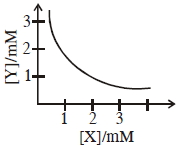
The stoichiometry and solubility product of a salt with the solubility curve given below is,respectively:
A
$X_{2}Y, 2 \times 10^{-9} \ M^{3}$
B
$XY_{2}, 1 \times 10^{-9} \ M^{3}$
C
$XY_{2}, 4 \times 10^{-9} \ M^{3}$
D
$XY, 2 \times 10^{-6} \ M^{3}$
Solution
(C) From the graph,at $[X] = 1 \times 10^{-3} \ M$,the corresponding $[Y] = 2 \times 10^{-3} \ M$.
Since the concentration of $Y$ is twice that of $X$,the stoichiometry of the salt is $XY_{2}$.
The dissociation equilibrium is: $XY_{2(s)} \rightleftharpoons X_{(aq)}^{2+} + 2Y_{(aq)}^{-}$.
The solubility product constant $K_{sp}$ is given by: $K_{sp} = [X^{2+}][Y^{-}]^{2}$.
Substituting the values: $K_{sp} = (1 \times 10^{-3}) \times (2 \times 10^{-3})^{2}$.
$K_{sp} = (10^{-3}) \times (4 \times 10^{-6}) = 4 \times 10^{-9} \ M^{3}$.
Since the concentration of $Y$ is twice that of $X$,the stoichiometry of the salt is $XY_{2}$.
The dissociation equilibrium is: $XY_{2(s)} \rightleftharpoons X_{(aq)}^{2+} + 2Y_{(aq)}^{-}$.
The solubility product constant $K_{sp}$ is given by: $K_{sp} = [X^{2+}][Y^{-}]^{2}$.
Substituting the values: $K_{sp} = (1 \times 10^{-3}) \times (2 \times 10^{-3})^{2}$.
$K_{sp} = (10^{-3}) \times (4 \times 10^{-6}) = 4 \times 10^{-9} \ M^{3}$.
0 likes
View Solution387
DifficultMCQ
The solubility product of $Cr(OH)_3$ at $298 \ K$ is $6.0 \times 10^{-31}$. The concentration of hydroxide ions in a saturated solution of $Cr(OH)_3$ will be
A
$(18 \times 10^{-31})^{1/4}$
B
$(2.22 \times 10^{-31})^{1/4}$
C
$(4.86 \times 10^{-29})^{1/4}$
D
$(18 \times 10^{-31})^{1/2}$
Solution
(A) The dissociation of $Cr(OH)_3$ is given by: $Cr(OH)_{3(s)} \rightleftharpoons Cr^{3+}_{(aq)} + 3OH^-_{(aq)}$.
Let the solubility of $Cr(OH)_3$ be $s \ mol/L$.
Then,$[Cr^{3+}] = s$ and $[OH^-] = 3s$.
The solubility product expression is $K_{sp} = [Cr^{3+}][OH^-]^3$.
Substituting the values: $K_{sp} = (s)(3s)^3 = 27s^4$.
Given $K_{sp} = 6.0 \times 10^{-31}$,we have $27s^4 = 6.0 \times 10^{-31}$.
Thus,$s^4 = \frac{6.0 \times 10^{-31}}{27} = \frac{60 \times 10^{-32}}{27} \approx 2.22 \times 10^{-32}$.
The concentration of hydroxide ions is $[OH^-] = 3s$.
Since $s = (2.22 \times 10^{-32})^{1/4}$,then $[OH^-] = 3 \times (2.22 \times 10^{-32})^{1/4} = (3^4 \times 2.22 \times 10^{-32})^{1/4} = (81 \times 2.22 \times 10^{-32})^{1/4} = (179.82 \times 10^{-32})^{1/4} = (17.982 \times 10^{-31})^{1/4} \approx (18 \times 10^{-31})^{1/4}$.
Let the solubility of $Cr(OH)_3$ be $s \ mol/L$.
Then,$[Cr^{3+}] = s$ and $[OH^-] = 3s$.
The solubility product expression is $K_{sp} = [Cr^{3+}][OH^-]^3$.
Substituting the values: $K_{sp} = (s)(3s)^3 = 27s^4$.
Given $K_{sp} = 6.0 \times 10^{-31}$,we have $27s^4 = 6.0 \times 10^{-31}$.
Thus,$s^4 = \frac{6.0 \times 10^{-31}}{27} = \frac{60 \times 10^{-32}}{27} \approx 2.22 \times 10^{-32}$.
The concentration of hydroxide ions is $[OH^-] = 3s$.
Since $s = (2.22 \times 10^{-32})^{1/4}$,then $[OH^-] = 3 \times (2.22 \times 10^{-32})^{1/4} = (3^4 \times 2.22 \times 10^{-32})^{1/4} = (81 \times 2.22 \times 10^{-32})^{1/4} = (179.82 \times 10^{-32})^{1/4} = (17.982 \times 10^{-31})^{1/4} \approx (18 \times 10^{-31})^{1/4}$.
0 likes
View Solution388
DifficultMCQ
The $K_{sp}$ for the following dissociation is $1.6 \times 10^{-5}$:
$PbCl_{2(s)} \rightleftharpoons Pb^{2+}_{(aq)} + 2Cl^-_{(aq)}$
Which of the following choices is correct for a mixture of $300 \ mL$ of $0.134 \ M \ Pb(NO_3)_2$ and $100 \ mL$ of $0.4 \ M \ NaCl$?
$PbCl_{2(s)} \rightleftharpoons Pb^{2+}_{(aq)} + 2Cl^-_{(aq)}$
Which of the following choices is correct for a mixture of $300 \ mL$ of $0.134 \ M \ Pb(NO_3)_2$ and $100 \ mL$ of $0.4 \ M \ NaCl$?
A
$Q < K_{sp}$
B
$Q > K_{sp}$
C
$Q = K_{sp}$
D
Not enough data provided
Solution
(B) First,calculate the final concentrations of the ions in the mixture (total volume = $300 \ mL + 100 \ mL = 400 \ mL$):
$[Pb^{2+}] = \frac{300 \ mL \times 0.134 \ M}{400 \ mL} = 0.1005 \ M$
$[Cl^-] = \frac{100 \ mL \times 0.4 \ M}{400 \ mL} = 0.1 \ M$
Next,calculate the reaction quotient $Q$ for the dissociation $PbCl_{2(s)} \rightleftharpoons Pb^{2+}_{(aq)} + 2Cl^-_{(aq)}$:
$Q = [Pb^{2+}][Cl^-]^2$
$Q = (0.1005) \times (0.1)^2$
$Q = 0.1005 \times 0.01 = 1.005 \times 10^{-3}$
Comparing $Q$ with $K_{sp}$ $(1.6 \times 10^{-5})$:
$1.005 \times 10^{-3} > 1.6 \times 10^{-5}$
Therefore,$Q > K_{sp}$.
$[Pb^{2+}] = \frac{300 \ mL \times 0.134 \ M}{400 \ mL} = 0.1005 \ M$
$[Cl^-] = \frac{100 \ mL \times 0.4 \ M}{400 \ mL} = 0.1 \ M$
Next,calculate the reaction quotient $Q$ for the dissociation $PbCl_{2(s)} \rightleftharpoons Pb^{2+}_{(aq)} + 2Cl^-_{(aq)}$:
$Q = [Pb^{2+}][Cl^-]^2$
$Q = (0.1005) \times (0.1)^2$
$Q = 0.1005 \times 0.01 = 1.005 \times 10^{-3}$
Comparing $Q$ with $K_{sp}$ $(1.6 \times 10^{-5})$:
$1.005 \times 10^{-3} > 1.6 \times 10^{-5}$
Therefore,$Q > K_{sp}$.
0 likes
View Solution389
MediumMCQ
Calculate the solubility of $A_{2}X_{3}$ in pure water,assuming that neither kind of ion reacts with water. The solubility product of $A_{2}X_{3}$,$K_{sp} = 1.1 \times 10^{-23}$.
A
$1.0 \times 10^{-5} \ mol/L$
B
$1.0 \times 10^{-4} \ mol/L$
C
$2.0 \times 10^{-5} \ mol/L$
D
$1.0 \times 10^{-6} \ mol/L$
Solution
(A) The dissociation of $A_{2}X_{3}$ is given by: $A_{2}X_{3} \rightarrow 2A^{3+} + 3X^{2-}$
The solubility product expression is: $K_{sp} = [A^{3+}]^{2} [X^{2-}]^{3} = 1.1 \times 10^{-23}$
Let $S$ be the solubility of $A_{2}X_{3}$. Then,$[A^{3+}] = 2S$ and $[X^{2-}] = 3S$.
Substituting these into the $K_{sp}$ expression: $K_{sp} = (2S)^{2} (3S)^{3} = 4S^{2} \times 27S^{3} = 108S^{5}$
Equating to the given value: $108S^{5} = 1.1 \times 10^{-23}$
$S^{5} = \frac{1.1 \times 10^{-23}}{108} \approx 1.0185 \times 10^{-25} \approx 1.0 \times 10^{-25}$
Taking the fifth root: $S = (1.0 \times 10^{-25})^{1/5} = 1.0 \times 10^{-5} \ mol/L$.
The solubility product expression is: $K_{sp} = [A^{3+}]^{2} [X^{2-}]^{3} = 1.1 \times 10^{-23}$
Let $S$ be the solubility of $A_{2}X_{3}$. Then,$[A^{3+}] = 2S$ and $[X^{2-}] = 3S$.
Substituting these into the $K_{sp}$ expression: $K_{sp} = (2S)^{2} (3S)^{3} = 4S^{2} \times 27S^{3} = 108S^{5}$
Equating to the given value: $108S^{5} = 1.1 \times 10^{-23}$
$S^{5} = \frac{1.1 \times 10^{-23}}{108} \approx 1.0185 \times 10^{-25} \approx 1.0 \times 10^{-25}$
Taking the fifth root: $S = (1.0 \times 10^{-25})^{1/5} = 1.0 \times 10^{-5} \ mol/L$.
0 likes
View Solution390
Medium
The values of $K_{sp}$ of two sparingly soluble salts $Ni(OH)_2$ and $AgCN$ are $2.0 \times 10^{-15}$ and $6 \times 10^{-17}$ respectively. Which salt is more soluble? Explain.
Solution
(N/A) For $AgCN$: $AgCN \rightleftharpoons Ag^{+} + CN^{-}$. Let solubility be $S_1$. $K_{sp} = S_1^2 = 6 \times 10^{-17}$. Thus,$S_1 = \sqrt{6 \times 10^{-17}} \approx 7.75 \times 10^{-9} \ M$.
For $Ni(OH)_2$: $Ni(OH)_2 \rightleftharpoons Ni^{2+} + 2OH^{-}$. Let solubility be $S_2$. $K_{sp} = (S_2)(2S_2)^2 = 4S_2^3 = 2.0 \times 10^{-15}$.
$S_2^3 = 0.5 \times 10^{-15} = 5 \times 10^{-16}$.
$S_2 = \sqrt[3]{5 \times 10^{-16}} \approx 7.94 \times 10^{-6} \ M$.
Comparing $S_1$ and $S_2$,$S_2 > S_1$,therefore $Ni(OH)_2$ is more soluble.
For $Ni(OH)_2$: $Ni(OH)_2 \rightleftharpoons Ni^{2+} + 2OH^{-}$. Let solubility be $S_2$. $K_{sp} = (S_2)(2S_2)^2 = 4S_2^3 = 2.0 \times 10^{-15}$.
$S_2^3 = 0.5 \times 10^{-15} = 5 \times 10^{-16}$.
$S_2 = \sqrt[3]{5 \times 10^{-16}} \approx 7.94 \times 10^{-6} \ M$.
Comparing $S_1$ and $S_2$,$S_2 > S_1$,therefore $Ni(OH)_2$ is more soluble.
0 likes
View Solution391
MediumMCQ
Calculate the molar solubility of $Ni(OH)_{2}$ in $0.10 \, M$ $NaOH$. The solubility product constant $(K_{sp})$ of $Ni(OH)_{2}$ is $2.0 \times 10^{-15}$.
A
$2.0 \times 10^{-13} \, M$
B
$2.0 \times 10^{-14} \, M$
C
$1.0 \times 10^{-13} \, M$
D
$4.0 \times 10^{-13} \, M$
Solution
(A) Let the molar solubility of $Ni(OH)_{2}$ be $S \, mol/L$.
The dissolution reaction is: $Ni(OH)_{2}(s) \rightleftharpoons Ni^{2+}(aq) + 2OH^{-}(aq)$.
From the reaction,$Ni^{2+}$ concentration is $S$ and $OH^{-}$ concentration from $Ni(OH)_{2}$ is $2S$.
Since $NaOH$ is a strong electrolyte,it provides $0.10 \, M$ $OH^{-}$ ions.
Total $[OH^{-}] = (0.10 + 2S) \, M \approx 0.10 \, M$ (since $S$ is very small).
The solubility product expression is $K_{sp} = [Ni^{2+}][OH^{-}]^{2}$.
Substituting the values: $2.0 \times 10^{-15} = (S)(0.10)^{2}$.
$S = \frac{2.0 \times 10^{-15}}{0.01} = 2.0 \times 10^{-13} \, M$.
The dissolution reaction is: $Ni(OH)_{2}(s) \rightleftharpoons Ni^{2+}(aq) + 2OH^{-}(aq)$.
From the reaction,$Ni^{2+}$ concentration is $S$ and $OH^{-}$ concentration from $Ni(OH)_{2}$ is $2S$.
Since $NaOH$ is a strong electrolyte,it provides $0.10 \, M$ $OH^{-}$ ions.
Total $[OH^{-}] = (0.10 + 2S) \, M \approx 0.10 \, M$ (since $S$ is very small).
The solubility product expression is $K_{sp} = [Ni^{2+}][OH^{-}]^{2}$.
Substituting the values: $2.0 \times 10^{-15} = (S)(0.10)^{2}$.
$S = \frac{2.0 \times 10^{-15}}{0.01} = 2.0 \times 10^{-13} \, M$.
0 likes
View Solution392
EasyMCQ
If the solubility product of $CuS$ is $6 \times 10^{-16}$,calculate the maximum molarity of $CuS$ in aqueous solution.
A
$2.45 \times 10^{-8} \ M$
B
$6.00 \times 10^{-16} \ M$
C
$3.00 \times 10^{-16} \ M$
D
$2.45 \times 10^{-16} \ M$
Solution
(A) The solubility product of $CuS$ is given as $K_{sp} = 6 \times 10^{-16}$.
Let $s$ be the solubility of $CuS$ in $mol \ L^{-1}$.
The dissociation equilibrium is: $CuS(s) \leftrightarrow Cu^{2+}(aq) + S^{2-}(aq)$.
The solubility product expression is $K_{sp} = [Cu^{2+}][S^{2-}] = s \times s = s^2$.
Equating the values: $s^2 = 6 \times 10^{-16}$.
Taking the square root: $s = \sqrt{6 \times 10^{-16}} = 2.45 \times 10^{-8} \ mol \ L^{-1}$.
Thus,the maximum molarity of $CuS$ in an aqueous solution is $2.45 \times 10^{-8} \ M$.
Let $s$ be the solubility of $CuS$ in $mol \ L^{-1}$.
The dissociation equilibrium is: $CuS(s) \leftrightarrow Cu^{2+}(aq) + S^{2-}(aq)$.
The solubility product expression is $K_{sp} = [Cu^{2+}][S^{2-}] = s \times s = s^2$.
Equating the values: $s^2 = 6 \times 10^{-16}$.
Taking the square root: $s = \sqrt{6 \times 10^{-16}} = 2.45 \times 10^{-8} \ mol \ L^{-1}$.
Thus,the maximum molarity of $CuS$ in an aqueous solution is $2.45 \times 10^{-8} \ M$.
0 likes
View Solution393
Difficult
Determine the solubilities of silver chromate,barium chromate,ferric hydroxide,lead chloride,and mercurous iodide at $298 \, K$ from their solubility product constants. Determine also the molarities of individual ions. (Given $K_{sp}$ values: $Ag_{2}CrO_{4} = 1.1 \times 10^{-12}$,$BaCrO_{4} = 1.2 \times 10^{-10}$,$Fe(OH)_{3} = 1.0 \times 10^{-38}$,$PbCl_{2} = 1.6 \times 10^{-5}$,$Hg_{2}I_{2} = 4.5 \times 10^{-29}$)
Solution
$(1)$ Silver chromate $(Ag_{2}CrO_{4})$:
$Ag_{2}CrO_{4} \rightleftharpoons 2Ag^{+} + CrO_{4}^{2-}$
$K_{sp} = [Ag^{+}]^{2} [CrO_{4}^{2-}] = (2s)^{2}(s) = 4s^{3}$
$1.1 \times 10^{-12} = 4s^{3} \Rightarrow s = 0.65 \times 10^{-4} \, M$
$[Ag^{+}] = 1.30 \times 10^{-4} \, M, [CrO_{4}^{2-}] = 0.65 \times 10^{-4} \, M$
$(2)$ Barium chromate $(BaCrO_{4})$:
$BaCrO_{4} \rightleftharpoons Ba^{2+} + CrO_{4}^{2-}$
$K_{sp} = [Ba^{2+}][CrO_{4}^{2-}] = s^{2}$
$1.2 \times 10^{-10} = s^{2} \Rightarrow s = 1.09 \times 10^{-5} \, M$
$[Ba^{2+}] = 1.09 \times 10^{-5} \, M, [CrO_{4}^{2-}] = 1.09 \times 10^{-5} \, M$
$(3)$ Ferric hydroxide $(Fe(OH)_{3})$:
$Fe(OH)_{3} \rightleftharpoons Fe^{3+} + 3OH^{-}$
$K_{sp} = [Fe^{3+}][OH^{-}]^{3} = (s)(3s)^{3} = 27s^{4}$
$1.0 \times 10^{-38} = 27s^{4} \Rightarrow s = 1.39 \times 10^{-10} \, M$
$[Fe^{3+}] = 1.39 \times 10^{-10} \, M, [OH^{-}] = 4.17 \times 10^{-10} \, M$
$(4)$ Lead chloride $(PbCl_{2})$:
$PbCl_{2} \rightleftharpoons Pb^{2+} + 2Cl^{-}$
$K_{sp} = [Pb^{2+}][Cl^{-}]^{2} = (s)(2s)^{2} = 4s^{3}$
$1.6 \times 10^{-5} = 4s^{3} \Rightarrow s = 1.58 \times 10^{-2} \, M$
$[Pb^{2+}] = 1.58 \times 10^{-2} \, M, [Cl^{-}] = 3.16 \times 10^{-2} \, M$
$(5)$ Mercurous iodide $(Hg_{2}I_{2})$:
$Hg_{2}I_{2} \rightleftharpoons Hg_{2}^{2+} + 2I^{-}$
$K_{sp} = [Hg_{2}^{2+}][I^{-}]^{2} = (s)(2s)^{2} = 4s^{3}$
$4.5 \times 10^{-29} = 4s^{3} \Rightarrow s = 2.24 \times 10^{-10} \, M$
$[Hg_{2}^{2+}] = 2.24 \times 10^{-10} \, M, [I^{-}] = 4.48 \times 10^{-10} \, M$
$Ag_{2}CrO_{4} \rightleftharpoons 2Ag^{+} + CrO_{4}^{2-}$
$K_{sp} = [Ag^{+}]^{2} [CrO_{4}^{2-}] = (2s)^{2}(s) = 4s^{3}$
$1.1 \times 10^{-12} = 4s^{3} \Rightarrow s = 0.65 \times 10^{-4} \, M$
$[Ag^{+}] = 1.30 \times 10^{-4} \, M, [CrO_{4}^{2-}] = 0.65 \times 10^{-4} \, M$
$(2)$ Barium chromate $(BaCrO_{4})$:
$BaCrO_{4} \rightleftharpoons Ba^{2+} + CrO_{4}^{2-}$
$K_{sp} = [Ba^{2+}][CrO_{4}^{2-}] = s^{2}$
$1.2 \times 10^{-10} = s^{2} \Rightarrow s = 1.09 \times 10^{-5} \, M$
$[Ba^{2+}] = 1.09 \times 10^{-5} \, M, [CrO_{4}^{2-}] = 1.09 \times 10^{-5} \, M$
$(3)$ Ferric hydroxide $(Fe(OH)_{3})$:
$Fe(OH)_{3} \rightleftharpoons Fe^{3+} + 3OH^{-}$
$K_{sp} = [Fe^{3+}][OH^{-}]^{3} = (s)(3s)^{3} = 27s^{4}$
$1.0 \times 10^{-38} = 27s^{4} \Rightarrow s = 1.39 \times 10^{-10} \, M$
$[Fe^{3+}] = 1.39 \times 10^{-10} \, M, [OH^{-}] = 4.17 \times 10^{-10} \, M$
$(4)$ Lead chloride $(PbCl_{2})$:
$PbCl_{2} \rightleftharpoons Pb^{2+} + 2Cl^{-}$
$K_{sp} = [Pb^{2+}][Cl^{-}]^{2} = (s)(2s)^{2} = 4s^{3}$
$1.6 \times 10^{-5} = 4s^{3} \Rightarrow s = 1.58 \times 10^{-2} \, M$
$[Pb^{2+}] = 1.58 \times 10^{-2} \, M, [Cl^{-}] = 3.16 \times 10^{-2} \, M$
$(5)$ Mercurous iodide $(Hg_{2}I_{2})$:
$Hg_{2}I_{2} \rightleftharpoons Hg_{2}^{2+} + 2I^{-}$
$K_{sp} = [Hg_{2}^{2+}][I^{-}]^{2} = (s)(2s)^{2} = 4s^{3}$
$4.5 \times 10^{-29} = 4s^{3} \Rightarrow s = 2.24 \times 10^{-10} \, M$
$[Hg_{2}^{2+}] = 2.24 \times 10^{-10} \, M, [I^{-}] = 4.48 \times 10^{-10} \, M$
0 likes
View Solution394
Medium
The solubility product constants of $Ag_{2}CrO_{4}$ and $AgBr$ are $1.1 \times 10^{-12}$ and $5.0 \times 10^{-13}$ respectively. Calculate the ratio of the molarities of their saturated solutions.
Solution
For $Ag_{2}CrO_{4}$:
$Ag_{2}CrO_{4} \longleftrightarrow 2Ag^{+} + CrO_{4}^{2-}$
$K_{sp} = (2s)^{2} \cdot s = 4s^{3} = 1.1 \times 10^{-12}$
$s^{3} = 0.275 \times 10^{-12} = 275 \times 10^{-15}$
$s = (275)^{1/3} \times 10^{-5} \approx 6.5 \times 10^{-5} \, M$
For $AgBr$:
$AgBr \longleftrightarrow Ag^{+} + Br^{-}$
$K_{sp} = (s^{\prime})^{2} = 5.0 \times 10^{-13} = 50 \times 10^{-14}$
$s^{\prime} = \sqrt{50} \times 10^{-7} \approx 7.07 \times 10^{-7} \, M$
Ratio of molarities:
$\frac{s}{s^{\prime}} = \frac{6.5 \times 10^{-5}}{7.07 \times 10^{-7}} \approx 91.9$
$Ag_{2}CrO_{4} \longleftrightarrow 2Ag^{+} + CrO_{4}^{2-}$
$K_{sp} = (2s)^{2} \cdot s = 4s^{3} = 1.1 \times 10^{-12}$
$s^{3} = 0.275 \times 10^{-12} = 275 \times 10^{-15}$
$s = (275)^{1/3} \times 10^{-5} \approx 6.5 \times 10^{-5} \, M$
For $AgBr$:
$AgBr \longleftrightarrow Ag^{+} + Br^{-}$
$K_{sp} = (s^{\prime})^{2} = 5.0 \times 10^{-13} = 50 \times 10^{-14}$
$s^{\prime} = \sqrt{50} \times 10^{-7} \approx 7.07 \times 10^{-7} \, M$
Ratio of molarities:
$\frac{s}{s^{\prime}} = \frac{6.5 \times 10^{-5}}{7.07 \times 10^{-7}} \approx 91.9$
0 likes
View Solution395
MediumMCQ
Equal volumes of $0.002 \, M$ solutions of sodium iodate and cupric chlorate are mixed together. Will it lead to precipitation of copper iodate?
(For cupric iodate $K_{sp} = 7.4 \times 10^{-8}$)
(For cupric iodate $K_{sp} = 7.4 \times 10^{-8}$)
A
Yes,precipitation will occur.
B
No,precipitation will not occur.
C
The solution will be saturated.
D
Data is insufficient.
Solution
(B) When equal volumes of sodium iodate and cupric chlorate solutions are mixed,the concentration of each species is halved,becoming $0.001 \, M$.
$NaIO_3 \rightarrow Na^{+} + IO_3^{-}$
$[IO_3^{-}] = 0.001 \, M$
$Cu(ClO_3)_2 \rightarrow Cu^{2+} + 2ClO_3^{-}$
$[Cu^{2+}] = 0.001 \, M$
The ionic product $(Q_{sp})$ for $Cu(IO_3)_2$ is calculated as:
$Q_{sp} = [Cu^{2+}][IO_3^{-}]^2$
$Q_{sp} = (0.001) \times (0.001)^2$
$Q_{sp} = 10^{-3} \times 10^{-6} = 10^{-9}$
Since $Q_{sp} (1 \times 10^{-9}) < K_{sp} (7.4 \times 10^{-8})$,the ionic product is less than the solubility product constant.
Therefore,precipitation will not occur.
$NaIO_3 \rightarrow Na^{+} + IO_3^{-}$
$[IO_3^{-}] = 0.001 \, M$
$Cu(ClO_3)_2 \rightarrow Cu^{2+} + 2ClO_3^{-}$
$[Cu^{2+}] = 0.001 \, M$
The ionic product $(Q_{sp})$ for $Cu(IO_3)_2$ is calculated as:
$Q_{sp} = [Cu^{2+}][IO_3^{-}]^2$
$Q_{sp} = (0.001) \times (0.001)^2$
$Q_{sp} = 10^{-3} \times 10^{-6} = 10^{-9}$
Since $Q_{sp} (1 \times 10^{-9}) < K_{sp} (7.4 \times 10^{-8})$,the ionic product is less than the solubility product constant.
Therefore,precipitation will not occur.
0 likes
View Solution396
Difficult
The ionization constant of benzoic acid is $6.46 \times 10^{-5}$ and $K_{sp}$ for silver benzoate is $2.5 \times 10^{-13}$. How many times is silver benzoate more soluble in a buffer of $pH$ $3.19$ compared to its solubility in pure water?
Solution
(C) Given $pH = 3.19$,then $[H_{3}O^{+}] = 10^{-3.19} \approx 6.46 \times 10^{-4} \, M$.
For the equilibrium: $C_{6}H_{5}COOH + H_{2}O \longleftrightarrow C_{6}H_{5}COO^{-} + H_{3}O^{+}$.
The ratio of concentrations is $\frac{[C_{6}H_{5}COOH]}{[C_{6}H_{5}COO^{-}]} = \frac{[H_{3}O^{+}]}{K_{a}} = \frac{6.46 \times 10^{-4}}{6.46 \times 10^{-5}} = 10$.
Let the solubility of $C_{6}H_{5}COOAg$ in the buffer be $x \, mol/L$.
Then $[Ag^{+}] = x$ and $[C_{6}H_{5}COOH] + [C_{6}H_{5}COO^{-}] = x$.
Substituting the ratio: $10[C_{6}H_{5}COO^{-}] + [C_{6}H_{5}COO^{-}] = x$,so $[C_{6}H_{5}COO^{-}] = \frac{x}{11}$.
Using $K_{sp} = [Ag^{+}][C_{6}H_{5}COO^{-}] = x \times \frac{x}{11} = 2.5 \times 10^{-13}$.
$x^{2} = 27.5 \times 10^{-13} = 2.75 \times 10^{-12}$,so $x \approx 1.66 \times 10^{-6} \, mol/L$.
In pure water,let solubility be $x^{\prime}$. $K_{sp} = (x^{\prime})^{2} = 2.5 \times 10^{-13}$.
$x^{\prime} = \sqrt{2.5 \times 10^{-13}} \approx 5.0 \times 10^{-7} \, mol/L$.
The ratio of solubility is $\frac{x}{x^{\prime}} = \frac{1.66 \times 10^{-6}}{5.0 \times 10^{-7}} = 3.32$.
For the equilibrium: $C_{6}H_{5}COOH + H_{2}O \longleftrightarrow C_{6}H_{5}COO^{-} + H_{3}O^{+}$.
The ratio of concentrations is $\frac{[C_{6}H_{5}COOH]}{[C_{6}H_{5}COO^{-}]} = \frac{[H_{3}O^{+}]}{K_{a}} = \frac{6.46 \times 10^{-4}}{6.46 \times 10^{-5}} = 10$.
Let the solubility of $C_{6}H_{5}COOAg$ in the buffer be $x \, mol/L$.
Then $[Ag^{+}] = x$ and $[C_{6}H_{5}COOH] + [C_{6}H_{5}COO^{-}] = x$.
Substituting the ratio: $10[C_{6}H_{5}COO^{-}] + [C_{6}H_{5}COO^{-}] = x$,so $[C_{6}H_{5}COO^{-}] = \frac{x}{11}$.
Using $K_{sp} = [Ag^{+}][C_{6}H_{5}COO^{-}] = x \times \frac{x}{11} = 2.5 \times 10^{-13}$.
$x^{2} = 27.5 \times 10^{-13} = 2.75 \times 10^{-12}$,so $x \approx 1.66 \times 10^{-6} \, mol/L$.
In pure water,let solubility be $x^{\prime}$. $K_{sp} = (x^{\prime})^{2} = 2.5 \times 10^{-13}$.
$x^{\prime} = \sqrt{2.5 \times 10^{-13}} \approx 5.0 \times 10^{-7} \, mol/L$.
The ratio of solubility is $\frac{x}{x^{\prime}} = \frac{1.66 \times 10^{-6}}{5.0 \times 10^{-7}} = 3.32$.
0 likes
View Solution397
MediumMCQ
What is the maximum concentration of equimolar solutions of ferrous sulphate and sodium sulphide so that when mixed in equal volumes,there is no precipitation of iron sulphide? (For iron sulphide,$K_{sp} = 6.3 \times 10^{-18}$).
A
$5.02 \times 10^{-9} \ M$
B
$2.51 \times 10^{-9} \ M$
C
$1.26 \times 10^{-9} \ M$
D
$1.00 \times 10^{-8} \ M$
Solution
(A) Let the maximum concentration of each solution be $x \ mol/L$. After mixing equal volumes,the concentration of each ion in the mixture becomes half of the initial concentration,i.e.,$x/2 \ M$.
$\therefore [Fe^{2+}] = \frac{x}{2} \ M$ and $[S^{2-}] = \frac{x}{2} \ M$.
For no precipitation,the ionic product must be less than or equal to the solubility product $(K_{sp})$.
$Q_{sp} = [Fe^{2+}][S^{2-}] \leq K_{sp}$
$(\frac{x}{2})(\frac{x}{2}) \leq 6.3 \times 10^{-18}$
$\frac{x^2}{4} \leq 6.3 \times 10^{-18}$
$x^2 \leq 25.2 \times 10^{-18}$
$x \leq \sqrt{25.2} \times 10^{-9}$
$x \leq 5.02 \times 10^{-9} \ M$.
Thus,the maximum concentration is $5.02 \times 10^{-9} \ M$.
$\therefore [Fe^{2+}] = \frac{x}{2} \ M$ and $[S^{2-}] = \frac{x}{2} \ M$.
For no precipitation,the ionic product must be less than or equal to the solubility product $(K_{sp})$.
$Q_{sp} = [Fe^{2+}][S^{2-}] \leq K_{sp}$
$(\frac{x}{2})(\frac{x}{2}) \leq 6.3 \times 10^{-18}$
$\frac{x^2}{4} \leq 6.3 \times 10^{-18}$
$x^2 \leq 25.2 \times 10^{-18}$
$x \leq \sqrt{25.2} \times 10^{-9}$
$x \leq 5.02 \times 10^{-9} \ M$.
Thus,the maximum concentration is $5.02 \times 10^{-9} \ M$.
0 likes
View Solution398
Medium
What is the minimum volume of water required to dissolve $1 \, g$ of calcium sulphate at $298 \, K$? (For calcium sulphate,$K_{sp}$ is $9.1 \times 10^{-6}$).
Solution
(D) $CaSO_{4(s)} \leftrightarrow Ca^{2+}_{(aq)} + S{O_{4}}^{2-}_{(aq)}$
$K_{sp} = [Ca^{2+}][SO_{4}^{2-}] = s^2$
$s = \sqrt{K_{sp}} = \sqrt{9.1 \times 10^{-6}} = 3.0166 \times 10^{-3} \, mol/L$
Molar mass of $CaSO_{4} = 40 + 32 + (4 \times 16) = 136 \, g/mol$
Solubility in $g/L = s \times \text{Molar mass} = 3.0166 \times 10^{-3} \times 136 \approx 0.4103 \, g/L$
Volume required for $1 \, g = \frac{1 \, g}{0.4103 \, g/L} \approx 2.44 \, L$.
$K_{sp} = [Ca^{2+}][SO_{4}^{2-}] = s^2$
$s = \sqrt{K_{sp}} = \sqrt{9.1 \times 10^{-6}} = 3.0166 \times 10^{-3} \, mol/L$
Molar mass of $CaSO_{4} = 40 + 32 + (4 \times 16) = 136 \, g/mol$
Solubility in $g/L = s \times \text{Molar mass} = 3.0166 \times 10^{-3} \times 136 \approx 0.4103 \, g/L$
Volume required for $1 \, g = \frac{1 \, g}{0.4103 \, g/L} \approx 2.44 \, L$.
0 likes
View Solution6-2.Equilibrium-II (Ionic Equilibrium) — Solubility product · Frequently Asked Questions
1Are these 6-2.Equilibrium-II (Ionic Equilibrium) questions useful for JEE and NEET?
Yes. All questions in this section are mapped to JEE Main and NEET exam patterns. Previous year questions from JEE Main, NEET, GUJCET and state-level exams are included with full solutions.
2Can I switch to Hindi or Gujarati for these questions?
Yes. Use the language tabs in the hero section or the sidebar to view the same questions and solutions in English, Hindi or Gujarati.
3How do I generate a question paper from this subtopic?
Use the Vedclass Exam Paper Generator — select the chapter and subtopic, set difficulty, and generate Sets A, B, C, D automatically. First 3 chapters of every subject are free.
Vedclass Products
For Students
Vedclass Test Series
Mock tests in real JEE/NEET style with performance analysis. 5-day free trial.
Start Free TrialFor Teachers
Exam Paper Generator
Generate Set A/B/C/D papers from this chapter in 2 minutes. 3 chapters free.
Try FreeFor Institutes
Online Exam Module
Live online exams with unlimited students, 360° analytics & white-label branding.
See DemoFor Teachers & Institutes
Generate a 6-2.Equilibrium-II (Ionic Equilibrium) Exam Paper in 2 Minutes
Select subtopic & difficulty — Sets A, B, C, D auto-generated with No Repeat logic.
First 3 chapters of every subject are free — no payment required.