
A English
Mix Examples-Ionic Equilibrium Questions in English
Class 11 Chemistry · 6-2.Equilibrium-II (Ionic Equilibrium) · Mix Examples-Ionic Equilibrium
205+
Questions
English
Language
100%
With Solutions
Showing 50 of 205 questions in English
1
EasyMCQ
Which will not affect the degree of ionisation?
A
Temperature
B
Concentration
C
Type of solvent
D
Current
Solution
(D) The degree of ionization $(\alpha)$ depends on factors such as temperature,the nature of the solute,the nature of the solvent,and the concentration of the solution.
$Current$ is the flow of electric charge and does not influence the intrinsic equilibrium state or the degree of ionization of a substance in a solution.
Therefore,the correct option is $(D)$.
$Current$ is the flow of electric charge and does not influence the intrinsic equilibrium state or the degree of ionization of a substance in a solution.
Therefore,the correct option is $(D)$.
0 likes
View Solution2
MediumMCQ
$A$ solution of sodium bicarbonate in water turns:
A
Phenolphthalein pink
B
Methyl orange yellow
C
Methyl orange red
D
Blue litmus red
Solution
(B) solution of $NaHCO_3$ in water is alkaline in nature due to the hydrolysis of the $HCO_3^-$ ion.
The hydrolysis reaction is: $HCO_3^- + H_2O \rightleftharpoons H_2CO_3 + OH^-$.
Due to the presence of $OH^-$ ions,the solution is basic.
Methyl orange is a pH indicator that turns yellow in basic solutions (pH range $4.4 - 6.2$ is the transition range,but it appears yellow in alkaline media).
The hydrolysis reaction is: $HCO_3^- + H_2O \rightleftharpoons H_2CO_3 + OH^-$.
Due to the presence of $OH^-$ ions,the solution is basic.
Methyl orange is a pH indicator that turns yellow in basic solutions (pH range $4.4 - 6.2$ is the transition range,but it appears yellow in alkaline media).
0 likes
View Solution3
MediumMCQ
When $100 \ mL$ of $1 \ M$ $NaOH$ solution is mixed with $10 \ mL$ of $10 \ M$ $H_2SO_4$,the resulting mixture will be
A
Acidic
B
Alkaline
C
Neutral
D
Strongly alkaline
Solution
(A) The normality of $NaOH$ is $N_1 = 1 \times 1 = 1 \ N$.
The normality of $H_2SO_4$ is $N_2 = 2 \times 10 = 20 \ N$ (since $n$-factor is $2$).
Milliequivalents ($M$.eq.) of $NaOH = 1 \times 100 = 100$.
Milliequivalents ($M$.eq.) of $H_2SO_4 = 20 \times 10 = 200$.
Since $M$.eq. of acid $(200)$ > $M$.eq. of base $(100)$,the excess acid remains in the solution.
Therefore,the resulting mixture will be acidic.
The normality of $H_2SO_4$ is $N_2 = 2 \times 10 = 20 \ N$ (since $n$-factor is $2$).
Milliequivalents ($M$.eq.) of $NaOH = 1 \times 100 = 100$.
Milliequivalents ($M$.eq.) of $H_2SO_4 = 20 \times 10 = 200$.
Since $M$.eq. of acid $(200)$ > $M$.eq. of base $(100)$,the excess acid remains in the solution.
Therefore,the resulting mixture will be acidic.
0 likes
View Solution4
EasyMCQ
For the reaction in aqueous solution $Zn^{2+} + X^{-} \rightleftharpoons ZnX^{+}$,the $K_{eq}$ is greatest when $X$ is
A
$F^{-}$
B
$NO_3^-$
C
$ClO_4^-$
D
$I^{-}$
Solution
(A) The stability of the complex $ZnX^{+}$ depends on the hard-soft acid-base $(HSAB)$ theory.
$Zn^{2+}$ is a borderline acid.
$F^{-}$ is a hard base,while $I^{-}$ is a soft base.
According to $HSAB$ theory,hard acids prefer to bind with hard bases.
Among the given options,$F^{-}$ is the hardest base,leading to the strongest electrostatic interaction with the $Zn^{2+}$ ion,resulting in the highest stability constant $(K_{eq})$ for the formation of $ZnF^{+}$.
$Zn^{2+}$ is a borderline acid.
$F^{-}$ is a hard base,while $I^{-}$ is a soft base.
According to $HSAB$ theory,hard acids prefer to bind with hard bases.
Among the given options,$F^{-}$ is the hardest base,leading to the strongest electrostatic interaction with the $Zn^{2+}$ ion,resulting in the highest stability constant $(K_{eq})$ for the formation of $ZnF^{+}$.
0 likes
View Solution5
EasyMCQ
Which one is a mixed salt?
A
$NaHSO_4$
B
$NaKSO_4$
C
$K_4[Fe(CN)_6]$
D
$Mg(OH)Cl$
Solution
(B) mixed salt is a salt that contains more than one type of cation or anion (excluding $H^+$ or $OH^-$ ions).
$NaKSO_4$ is a mixed salt because it contains two different cations,$Na^+$ and $K^+$,and one anion,$SO_4^{2-}$.
$NaHSO_4$ is an acid salt,$K_4[Fe(CN)_6]$ is a complex salt,and $Mg(OH)Cl$ is a basic salt.
$NaKSO_4$ is a mixed salt because it contains two different cations,$Na^+$ and $K^+$,and one anion,$SO_4^{2-}$.
$NaHSO_4$ is an acid salt,$K_4[Fe(CN)_6]$ is a complex salt,and $Mg(OH)Cl$ is a basic salt.
0 likes
View Solution6
MediumMCQ
The hydrogen ion concentration of a $0.1 \ N$ solution of $CH_3COOH$,which is $30 \%$ dissociated,is (in $M$)
A
$0.03$
B
$3$
C
$0.3$
D
$30$
Solution
(A) For a weak acid like $CH_3COOH$,the concentration of hydrogen ions $[H^+]$ is given by the product of the concentration of the acid $(c)$ and its degree of dissociation $(\alpha)$.
Given:
Concentration $c = 0.1 \ N = 0.1 \ M$ (since the valency factor of $CH_3COOH$ is $1$).
Degree of dissociation $\alpha = 30 \% = \frac{30}{100} = 0.3$.
Therefore,$[H^+] = c \times \alpha = 0.1 \times 0.3 = 0.03 \ M$.
Given:
Concentration $c = 0.1 \ N = 0.1 \ M$ (since the valency factor of $CH_3COOH$ is $1$).
Degree of dissociation $\alpha = 30 \% = \frac{30}{100} = 0.3$.
Therefore,$[H^+] = c \times \alpha = 0.1 \times 0.3 = 0.03 \ M$.
0 likes
View Solution7
MediumMCQ
When $10 \, mL$ of $0.1 \, M$ acetic acid $(pK_a = 5.0)$ is titrated against $10 \, mL$ of $0.1 \, M$ ammonia solution $(pK_b = 5.0)$,the equivalence point occurs at $pH$:
A
$5$
B
$6$
C
$7$
D
$9$
Solution
(C) The reaction between a weak acid $(CH_3COOH)$ and a weak base $(NH_4OH)$ forms a salt $(CH_3COONH_4)$.
The $pH$ of a salt of a weak acid and a weak base is given by the formula:
$pH = \frac{1}{2} [pK_w + pK_a - pK_b]$
Given:
$pK_w = 14$
$pK_a = 5.0$
$pK_b = 5.0$
Substituting the values:
$pH = \frac{1}{2} [14 + 5.0 - 5.0]$
$pH = \frac{1}{2} [14] = 7$
The $pH$ of a salt of a weak acid and a weak base is given by the formula:
$pH = \frac{1}{2} [pK_w + pK_a - pK_b]$
Given:
$pK_w = 14$
$pK_a = 5.0$
$pK_b = 5.0$
Substituting the values:
$pH = \frac{1}{2} [14 + 5.0 - 5.0]$
$pH = \frac{1}{2} [14] = 7$
0 likes
View Solution8
DifficultMCQ
$20 \ mL$ of $0.5 \ N \ HCl$ and $35 \ mL$ of $0.1 \ N \ NaOH$ are mixed. The resulting solution will
A
Be neutral
B
Be basic
C
Turn phenolphthalein solution pink
D
Turn methyl orange red
Solution
(D) Step $1$: Calculate the milliequivalents of $HCl$ and $NaOH$.
$mEq \text{ of } HCl = 20 \ mL \times 0.5 \ N = 10 \ mEq$.
$mEq \text{ of } NaOH = 35 \ mL \times 0.1 \ N = 3.5 \ mEq$.
Step $2$: Determine the nature of the resulting solution.
Since $mEq \text{ of } HCl > mEq \text{ of } NaOH$,the solution is acidic.
$mEq \text{ of } H^+ \text{ remaining} = 10 - 3.5 = 6.5 \ mEq$.
Step $3$: Analyze the indicators.
Phenolphthalein is colorless in acidic medium and pink in basic medium. Methyl orange is red in acidic medium $(pH < 3.1)$ and yellow in basic medium $(pH > 4.4)$.
Calculating the final concentration of $H^+$:
$[H^+] = \frac{6.5 \ mEq}{55 \ mL} \approx 0.118 \ N$.
$pH = -\log(0.118) \approx 0.93$.
At $pH \approx 0.93$,methyl orange turns red. Therefore,the correct option is $D$.
$mEq \text{ of } HCl = 20 \ mL \times 0.5 \ N = 10 \ mEq$.
$mEq \text{ of } NaOH = 35 \ mL \times 0.1 \ N = 3.5 \ mEq$.
Step $2$: Determine the nature of the resulting solution.
Since $mEq \text{ of } HCl > mEq \text{ of } NaOH$,the solution is acidic.
$mEq \text{ of } H^+ \text{ remaining} = 10 - 3.5 = 6.5 \ mEq$.
Step $3$: Analyze the indicators.
Phenolphthalein is colorless in acidic medium and pink in basic medium. Methyl orange is red in acidic medium $(pH < 3.1)$ and yellow in basic medium $(pH > 4.4)$.
Calculating the final concentration of $H^+$:
$[H^+] = \frac{6.5 \ mEq}{55 \ mL} \approx 0.118 \ N$.
$pH = -\log(0.118) \approx 0.93$.
At $pH \approx 0.93$,methyl orange turns red. Therefore,the correct option is $D$.
0 likes
View Solution9
EasyMCQ
$A$ sample of $Na_2CO_3 \cdot H_2O$ weighing $0.62 \ g$ is added to $100 \ mL$ of $0.1 \ N \ (NH_4)_2SO_4$ solution. What will be the nature of the resulting solution?
A
Acidic
B
Neutral
C
Basic
D
None of these
Solution
(C) $1$. Calculate the moles of $Na_2CO_3 \cdot H_2O$: The molar mass is $124 \ g/mol$. Moles $= 0.62 \ g / 124 \ g/mol = 0.005 \ mol$.
$2$. Calculate the equivalents of $(NH_4)_2SO_4$: Equivalents $= N \times V(L) = 0.1 \ N \times 0.1 \ L = 0.01 \ eq$.
$3$. The reaction is: $Na_2CO_3 + (NH_4)_2SO_4 \rightarrow (NH_4)_2CO_3 + Na_2SO_4$.
$4$. $1 \ mol$ of $Na_2CO_3$ reacts with $1 \ mol$ of $(NH_4)_2SO_4$. Since $Na_2CO_3$ is a salt of a strong base $(NaOH)$ and a weak acid $(H_2CO_3)$,it provides $2$ equivalents per mole. Thus,$0.005 \ mol$ of $Na_2CO_3$ provides $0.01 \ eq$.
$5$. Since $0.01 \ eq$ of $Na_2CO_3$ reacts with $0.01 \ eq$ of $(NH_4)_2SO_4$,the resulting solution contains $(NH_4)_2CO_3$,which is a salt of a weak acid and a weak base. The pH of such a salt is given by $pH = 7 + 0.5(pK_a - pK_b)$. For $(NH_4)_2CO_3$,$pK_a$ of $HCO_3^-$ is $\approx 10.3$ and $pK_b$ of $NH_4OH$ is $\approx 4.75$,resulting in a slightly basic solution.
$2$. Calculate the equivalents of $(NH_4)_2SO_4$: Equivalents $= N \times V(L) = 0.1 \ N \times 0.1 \ L = 0.01 \ eq$.
$3$. The reaction is: $Na_2CO_3 + (NH_4)_2SO_4 \rightarrow (NH_4)_2CO_3 + Na_2SO_4$.
$4$. $1 \ mol$ of $Na_2CO_3$ reacts with $1 \ mol$ of $(NH_4)_2SO_4$. Since $Na_2CO_3$ is a salt of a strong base $(NaOH)$ and a weak acid $(H_2CO_3)$,it provides $2$ equivalents per mole. Thus,$0.005 \ mol$ of $Na_2CO_3$ provides $0.01 \ eq$.
$5$. Since $0.01 \ eq$ of $Na_2CO_3$ reacts with $0.01 \ eq$ of $(NH_4)_2SO_4$,the resulting solution contains $(NH_4)_2CO_3$,which is a salt of a weak acid and a weak base. The pH of such a salt is given by $pH = 7 + 0.5(pK_a - pK_b)$. For $(NH_4)_2CO_3$,$pK_a$ of $HCO_3^-$ is $\approx 10.3$ and $pK_b$ of $NH_4OH$ is $\approx 4.75$,resulting in a slightly basic solution.
0 likes
View Solution10
DifficultMCQ
When $100 \, mL$ of $M/10 \, NaOH$ solution and $50 \, mL$ of $M/5 \, HCl$ solution are mixed,the $pH$ of the resulting solution would be:
A
$0$
B
$7$
C
Less than $7$
D
More than $7$
Solution
(B) Step $1$: Calculate the millimoles of $NaOH$.
$n(NaOH) = M \times V(mL) = \frac{1}{10} \times 100 = 10 \, mmol$.
Step $2$: Calculate the millimoles of $HCl$.
$n(HCl) = M \times V(mL) = \frac{1}{5} \times 50 = 10 \, mmol$.
Step $3$: Since $NaOH$ and $HCl$ react in a $1:1$ molar ratio $(NaOH + HCl \rightarrow NaCl + H_2O)$,the $10 \, mmol$ of $NaOH$ will exactly neutralize $10 \, mmol$ of $HCl$.
Step $4$: As both reactants are completely consumed,the resulting solution contains only $NaCl$ (a salt of a strong acid and a strong base),which is neutral.
Therefore,the $pH$ of the resulting solution is $7$.
$n(NaOH) = M \times V(mL) = \frac{1}{10} \times 100 = 10 \, mmol$.
Step $2$: Calculate the millimoles of $HCl$.
$n(HCl) = M \times V(mL) = \frac{1}{5} \times 50 = 10 \, mmol$.
Step $3$: Since $NaOH$ and $HCl$ react in a $1:1$ molar ratio $(NaOH + HCl \rightarrow NaCl + H_2O)$,the $10 \, mmol$ of $NaOH$ will exactly neutralize $10 \, mmol$ of $HCl$.
Step $4$: As both reactants are completely consumed,the resulting solution contains only $NaCl$ (a salt of a strong acid and a strong base),which is neutral.
Therefore,the $pH$ of the resulting solution is $7$.
0 likes
View Solution11
MediumMCQ
The $pH$ value of a decinormal solution of $NH_4OH$ which is $20\%$ ionised,is
A
$13.3$
B
$14.7$
C
$12.3$
D
$12.95$
Solution
(C) For $NH_4OH$,the concentration $C = 0.1 \ M$ (decinormal).
Given the degree of ionization $\alpha = 20\% = 0.2$.
The concentration of hydroxide ions is $[OH^-] = C \times \alpha = 0.1 \times 0.2 = 0.02 \ M = 2 \times 10^{-2} \ M$.
Calculate $pOH$ as $pOH = -\log[OH^-] = -\log(2 \times 10^{-2}) = 2 - \log 2 = 2 - 0.301 = 1.699 \approx 1.7$.
Finally,calculate $pH$ using the relation $pH + pOH = 14$.
$pH = 14 - 1.7 = 12.3$.
Given the degree of ionization $\alpha = 20\% = 0.2$.
The concentration of hydroxide ions is $[OH^-] = C \times \alpha = 0.1 \times 0.2 = 0.02 \ M = 2 \times 10^{-2} \ M$.
Calculate $pOH$ as $pOH = -\log[OH^-] = -\log(2 \times 10^{-2}) = 2 - \log 2 = 2 - 0.301 = 1.699 \approx 1.7$.
Finally,calculate $pH$ using the relation $pH + pOH = 14$.
$pH = 14 - 1.7 = 12.3$.
0 likes
View Solution12
EasyMCQ
The $pH$ of the solution containing $10 \ mL$ of $0.1 \ N$ $NaOH$ and $10 \ mL$ of $0.05 \ N$ $H_2SO_4$ would be
A
$0$
B
$1$
C
$> 7$
D
$7$
Solution
(C) $1$. Calculate the milliequivalents of $NaOH$: $n_{NaOH} = 10 \ mL \times 0.1 \ N = 1 \ meq$.
$2$. Calculate the milliequivalents of $H_2SO_4$: $n_{H_2SO_4} = 10 \ mL \times 0.05 \ N = 0.5 \ meq$.
$3$. Since $NaOH$ is a strong base and $H_2SO_4$ is a strong acid,they neutralize each other.
$4$. Remaining $NaOH = 1 \ meq - 0.5 \ meq = 0.5 \ meq$.
$5$. Total volume of the solution = $10 \ mL + 10 \ mL = 20 \ mL$.
$6$. Concentration of $[OH^-] = \frac{0.5 \ meq}{20 \ mL} = 0.025 \ N = 2.5 \times 10^{-2} \ M$.
$7$. $pOH = -\log(2.5 \times 10^{-2}) = 2 - \log(2.5) = 2 - 0.3979 = 1.6021$.
$8$. $pH = 14 - pOH = 14 - 1.6021 = 12.3979$.
$9$. Since $pH > 7$,the correct option is $C$.
$2$. Calculate the milliequivalents of $H_2SO_4$: $n_{H_2SO_4} = 10 \ mL \times 0.05 \ N = 0.5 \ meq$.
$3$. Since $NaOH$ is a strong base and $H_2SO_4$ is a strong acid,they neutralize each other.
$4$. Remaining $NaOH = 1 \ meq - 0.5 \ meq = 0.5 \ meq$.
$5$. Total volume of the solution = $10 \ mL + 10 \ mL = 20 \ mL$.
$6$. Concentration of $[OH^-] = \frac{0.5 \ meq}{20 \ mL} = 0.025 \ N = 2.5 \times 10^{-2} \ M$.
$7$. $pOH = -\log(2.5 \times 10^{-2}) = 2 - \log(2.5) = 2 - 0.3979 = 1.6021$.
$8$. $pH = 14 - pOH = 14 - 1.6021 = 12.3979$.
$9$. Since $pH > 7$,the correct option is $C$.
0 likes
View Solution13
MediumMCQ
Which of the following statement(s) is(are) correct?
A
The $pH$ of $1.0 \times 10^{-8} \ M$ solution of $HCl$ is $8$
B
The conjugate base of $H_2PO_4^-$ is $HPO_4^{2-}$
C
Autoprotolysis constant of water increases with temperature
D
When a solution of a weak monoprotic acid is titrated against a strong base, at half neutralization point $pH = \frac{1}{2}pK_a$
Solution
(B, C) Statement $A$ is incorrect because for a very dilute acid solution, the contribution of $H^+$ ions from water cannot be neglected. The $pH$ of $1.0 \times 10^{-8} \ M$ $HCl$ is approximately $6.98$, not $8$.
Statement $B$ is correct because the conjugate base is formed by the removal of one proton $(H^+)$ from the acid: $H_2PO_4^- \rightarrow H^+ + HPO_4^{2-}$.
Statement $C$ is correct because the autoprotolysis of water is an endothermic process $(\Delta H > 0)$, so the equilibrium constant $K_w$ increases with an increase in temperature.
Statement $D$ is incorrect because at the half-neutralization point of a weak acid, the concentration of the acid equals the concentration of its conjugate base $([HA] = [A^-])$. According to the Henderson-Hasselbalch equation, $pH = pK_a + \log(\frac{[A^-]}{[HA]})$, which simplifies to $pH = pK_a$.
Statement $B$ is correct because the conjugate base is formed by the removal of one proton $(H^+)$ from the acid: $H_2PO_4^- \rightarrow H^+ + HPO_4^{2-}$.
Statement $C$ is correct because the autoprotolysis of water is an endothermic process $(\Delta H > 0)$, so the equilibrium constant $K_w$ increases with an increase in temperature.
Statement $D$ is incorrect because at the half-neutralization point of a weak acid, the concentration of the acid equals the concentration of its conjugate base $([HA] = [A^-])$. According to the Henderson-Hasselbalch equation, $pH = pK_a + \log(\frac{[A^-]}{[HA]})$, which simplifies to $pH = pK_a$.
0 likes
View Solution14
MediumMCQ
Assuming complete dissociation,which of the following aqueous solutions will have the same $pH$ value?
A
$100 \, mL$ of $0.01 \, M \, HCl$
B
$100 \, mL$ of $0.01 \, M \, H_2SO_4$
C
Mixture of $50 \, mL$ of $0.02 \, M \, H_2SO_4$ and $50 \, mL$ of $0.02 \, M \, NaOH$
D
$(a)$ and $(c)$ both
Solution
(D) For $(a)$,$HCl$ is a strong acid. $[H^+] = 0.01 \, M = 10^{-2} \, M$. Thus,$pH = -\log(10^{-2}) = 2$.
For $(b)$,$H_2SO_4$ is a strong acid. $[H^+] = 2 \times 0.01 \, M = 0.02 \, M$. Thus,$pH = -\log(0.02) \approx 1.7$.
For $(c)$,$moles \, of \, H_2SO_4 = 0.02 \, M \times 0.050 \, L = 0.001 \, mol$. $moles \, of \, H^+ = 2 \times 0.001 = 0.002 \, mol$.
$moles \, of \, NaOH = 0.02 \, M \times 0.050 \, L = 0.001 \, mol$. $moles \, of \, OH^- = 0.001 \, mol$.
$Net \, moles \, of \, H^+ = 0.002 - 0.001 = 0.001 \, mol$.
$Total \, volume = 50 \, mL + 50 \, mL = 100 \, mL = 0.1 \, L$.
$[H^+] = \frac{0.001 \, mol}{0.1 \, L} = 0.01 \, M = 10^{-2} \, M$.
Thus,$pH = -\log(10^{-2}) = 2$.
Since $(a)$ and $(c)$ both result in a $pH$ of $2$,the correct option is $(d)$.
For $(b)$,$H_2SO_4$ is a strong acid. $[H^+] = 2 \times 0.01 \, M = 0.02 \, M$. Thus,$pH = -\log(0.02) \approx 1.7$.
For $(c)$,$moles \, of \, H_2SO_4 = 0.02 \, M \times 0.050 \, L = 0.001 \, mol$. $moles \, of \, H^+ = 2 \times 0.001 = 0.002 \, mol$.
$moles \, of \, NaOH = 0.02 \, M \times 0.050 \, L = 0.001 \, mol$. $moles \, of \, OH^- = 0.001 \, mol$.
$Net \, moles \, of \, H^+ = 0.002 - 0.001 = 0.001 \, mol$.
$Total \, volume = 50 \, mL + 50 \, mL = 100 \, mL = 0.1 \, L$.
$[H^+] = \frac{0.001 \, mol}{0.1 \, L} = 0.01 \, M = 10^{-2} \, M$.
Thus,$pH = -\log(10^{-2}) = 2$.
Since $(a)$ and $(c)$ both result in a $pH$ of $2$,the correct option is $(d)$.
0 likes
View Solution15
MediumMCQ
Which one of the following statements is not true?
A
The conjugate base of $H_2PO_4^-$ is $HPO_4^{2-}$
B
$pH + pOH = 14$ for all aqueous solutions at $298 \ K$
C
The $pH$ of $1 \times 10^{-8} \ M \ HCl$ is $8$
D
$96,500 \ C$ of electricity when passed through a $CuSO_4$ solution deposits $1 \ g$ equivalent of copper at the cathode
Solution
(C) Statement $(C)$ is incorrect.
For a very dilute acid solution like $1 \times 10^{-8} \ M \ HCl$,the contribution of $H^+$ ions from water cannot be neglected.
The total $[H^+] = 10^{-8} + 10^{-7} \approx 1.1 \times 10^{-7} \ M$.
Therefore,$pH = -\log(1.1 \times 10^{-7}) \approx 6.96$,which is slightly acidic,not $8$ (which is basic).
For a very dilute acid solution like $1 \times 10^{-8} \ M \ HCl$,the contribution of $H^+$ ions from water cannot be neglected.
The total $[H^+] = 10^{-8} + 10^{-7} \approx 1.1 \times 10^{-7} \ M$.
Therefore,$pH = -\log(1.1 \times 10^{-7}) \approx 6.96$,which is slightly acidic,not $8$ (which is basic).
0 likes
View Solution16
DifficultMCQ
The $pH$ of $0.1 \ M$ solution of the following salts increases in the order:
A
$HCl < NH_4Cl < NaCl < NaCN$
B
$HCl < NaCl < NaCN < NH_4Cl$
C
$NaCN < NH_4Cl < NaCl < HCl$
D
$HCl < NH_4Cl < NaCl < NaCN$
Solution
(A) $HCl$ is a strong acid,so its $pH$ is the lowest $(pH \approx 1)$.
$NH_4Cl$ is a salt of a strong acid $(HCl)$ and a weak base $(NH_4OH)$,so it undergoes cationic hydrolysis,resulting in an acidic solution $(pH < 7)$.
$NaCl$ is a salt of a strong acid $(HCl)$ and a strong base $(NaOH)$,so it is neutral $(pH = 7)$.
$NaCN$ is a salt of a weak acid $(HCN)$ and a strong base $(NaOH)$,so it undergoes anionic hydrolysis,resulting in a basic solution $(pH > 7)$.
Therefore,the order of increasing $pH$ is: $HCl < NH_4Cl < NaCl < NaCN$.
$NH_4Cl$ is a salt of a strong acid $(HCl)$ and a weak base $(NH_4OH)$,so it undergoes cationic hydrolysis,resulting in an acidic solution $(pH < 7)$.
$NaCl$ is a salt of a strong acid $(HCl)$ and a strong base $(NaOH)$,so it is neutral $(pH = 7)$.
$NaCN$ is a salt of a weak acid $(HCN)$ and a strong base $(NaOH)$,so it undergoes anionic hydrolysis,resulting in a basic solution $(pH > 7)$.
Therefore,the order of increasing $pH$ is: $HCl < NH_4Cl < NaCl < NaCN$.
0 likes
View Solution17
MediumMCQ
The dissociation constant of a weak acid is $1 \times 10^{-4}$. The equilibrium constant of its reaction with a strong base is:
A
$1 \times 10^{-4}$
B
$1 \times 10^{10}$
C
$1 \times 10^{-10}$
D
$1 \times 10^{14}$
Solution
(B) The reaction of a weak acid $(HA)$ with a strong base $(OH^-)$ is: $HA + OH^- \rightleftharpoons A^- + H_2O$.
This reaction is the reverse of the hydrolysis of the conjugate base $(A^-)$.
The equilibrium constant for this reaction is $K = \frac{1}{K_h}$,where $K_h$ is the hydrolysis constant of $A^-$.
We know that $K_h = \frac{K_w}{K_a}$.
Therefore,$K = \frac{K_a}{K_w}$.
Given $K_a = 1 \times 10^{-4}$ and $K_w = 1 \times 10^{-14}$.
$K = \frac{10^{-4}}{10^{-14}} = 10^{10}$.
This reaction is the reverse of the hydrolysis of the conjugate base $(A^-)$.
The equilibrium constant for this reaction is $K = \frac{1}{K_h}$,where $K_h$ is the hydrolysis constant of $A^-$.
We know that $K_h = \frac{K_w}{K_a}$.
Therefore,$K = \frac{K_a}{K_w}$.
Given $K_a = 1 \times 10^{-4}$ and $K_w = 1 \times 10^{-14}$.
$K = \frac{10^{-4}}{10^{-14}} = 10^{10}$.
0 likes
View Solution18
MediumMCQ
One litre of water contains $10^{-7} \ mole$ of hydrogen ions. The degree of ionization in water will be:
A
$1.8 \times 10^{-7} \%$
B
$0.8 \times 10^{-9} \%$
C
$3.6 \times 10^{-7} \%$
D
$3.6 \times 10^{-9} \%$
Solution
(A) The density of water is $1 \ g/mL$,so $1 \ litre$ of water weighs $1000 \ g$.
The number of moles of water in $1 \ litre$ is $n = \frac{1000 \ g}{18 \ g/mol} = 55.56 \ mol$.
The concentration of $H^+$ ions is $[H^+] = 10^{-7} \ mol/L$.
The degree of ionization $(\alpha)$ is defined as the ratio of the number of moles ionized to the total number of moles.
$\alpha = \frac{[H^+]}{[H_2O]} = \frac{10^{-7}}{55.56} = 1.8 \times 10^{-9}$.
To express this as a percentage: $\alpha \% = (1.8 \times 10^{-9}) \times 100 = 1.8 \times 10^{-7} \%$.
The number of moles of water in $1 \ litre$ is $n = \frac{1000 \ g}{18 \ g/mol} = 55.56 \ mol$.
The concentration of $H^+$ ions is $[H^+] = 10^{-7} \ mol/L$.
The degree of ionization $(\alpha)$ is defined as the ratio of the number of moles ionized to the total number of moles.
$\alpha = \frac{[H^+]}{[H_2O]} = \frac{10^{-7}}{55.56} = 1.8 \times 10^{-9}$.
To express this as a percentage: $\alpha \% = (1.8 \times 10^{-9}) \times 100 = 1.8 \times 10^{-7} \%$.
0 likes
View Solution19
MediumMCQ
The dissociation of water at $25 \, ^\circ C$ is $1.9 \times 10^{-7} \%$ and the density of water is $1.0 \, g/cm^3$. The ionisation constant of water is
A
$3.42 \times 10^{-6}$
B
$3.42 \times 10^{-8}$
C
$1.00 \times 10^{-14}$
D
$2.00 \times 10^{-16}$
Solution
(D) The degree of dissociation $\alpha = \frac{1.9 \times 10^{-7}}{100} = 1.9 \times 10^{-9}$.
The molar concentration of water $C = \frac{1000 \, g/L}{18 \, g/mol} = 55.55 \, M$.
The ionisation constant $K_i$ is given by $K_i = C \alpha^2$.
$K_i = 55.55 \times (1.9 \times 10^{-9})^2$.
$K_i = 55.55 \times 3.61 \times 10^{-18} \approx 2.0 \times 10^{-16}$.
The molar concentration of water $C = \frac{1000 \, g/L}{18 \, g/mol} = 55.55 \, M$.
The ionisation constant $K_i$ is given by $K_i = C \alpha^2$.
$K_i = 55.55 \times (1.9 \times 10^{-9})^2$.
$K_i = 55.55 \times 3.61 \times 10^{-18} \approx 2.0 \times 10^{-16}$.
0 likes
View Solution20
MediumMCQ
The concentration of $[H^{+}]$ and concentration of $[OH^{-}]$ of a $0.1 \ M$ aqueous solution of $2\%$ ionised weak acid is [Ionic product of water $= 1 \times 10^{-14}$]
A
$2 \times 10^{-3} \ M$ and $5 \times 10^{-12} \ M$
B
$1 \times 10^3 \ M$ and $3 \times 10^{-11} \ M$
C
$0.02 \times 10^{-3} \ M$ and $5 \times 10^{-11} \ M$
D
$3 \times 10^{-2} \ M$ and $4 \times 10^{-13} \ M$
Solution
(A) Given: Concentration of solution $= 0.1 \ M$.
Degree of ionisation $(\alpha) = 2\% = 0.02$.
Ionic product of water $(K_w) = 1 \times 10^{-14}$.
Concentration of $[H^{+}] = C \times \alpha = 0.1 \times 0.02 = 2 \times 10^{-3} \ M$.
Concentration of $[OH^{-}] = \frac{K_w}{[H^{+}]} = \frac{1 \times 10^{-14}}{2 \times 10^{-3}} = 0.5 \times 10^{-11} = 5 \times 10^{-12} \ M$.
Degree of ionisation $(\alpha) = 2\% = 0.02$.
Ionic product of water $(K_w) = 1 \times 10^{-14}$.
Concentration of $[H^{+}] = C \times \alpha = 0.1 \times 0.02 = 2 \times 10^{-3} \ M$.
Concentration of $[OH^{-}] = \frac{K_w}{[H^{+}]} = \frac{1 \times 10^{-14}}{2 \times 10^{-3}} = 0.5 \times 10^{-11} = 5 \times 10^{-12} \ M$.
0 likes
View Solution21
MediumMCQ
At $298 \, K$,a $0.1 \, M$ $CH_3COOH$ solution is $1.34 \%$ ionized. The ionization constant $K_a$ for acetic acid will be:
A
$1.82 \times 10^{-5}$
B
$18.2 \times 10^{-5}$
C
$0.182 \times 10^{-5}$
D
None of these
Solution
(A) The degree of ionization $\alpha$ is given as $1.34 \% = 0.0134$.
Given concentration $c = 0.1 \, M$.
The ionization constant $K_a$ for a weak acid is given by the formula $K_a = c \alpha^2$.
Substituting the values: $K_a = 0.1 \times (0.0134)^2$.
$K_a = 0.1 \times 0.00017956 = 1.7956 \times 10^{-5} \approx 1.8 \times 10^{-5}$.
Comparing this with the given options,the closest value is $1.82 \times 10^{-5}$.
Given concentration $c = 0.1 \, M$.
The ionization constant $K_a$ for a weak acid is given by the formula $K_a = c \alpha^2$.
Substituting the values: $K_a = 0.1 \times (0.0134)^2$.
$K_a = 0.1 \times 0.00017956 = 1.7956 \times 10^{-5} \approx 1.8 \times 10^{-5}$.
Comparing this with the given options,the closest value is $1.82 \times 10^{-5}$.
0 likes
View Solution22
MediumMCQ
Hydrogen ion concentration of an aqueous solution is $1 \times 10^{-4} \ M$. The solution is diluted with an equal volume of water. The hydroxyl ion concentration of the resultant solution in terms of $mol \ dm^{-3}$ is
A
$1 \times 10^{-8}$
B
$1 \times 10^{-6}$
C
$2 \times 10^{-10}$
D
$0.5 \times 10^{-10}$
Solution
(C) Initial concentration of $[H^{+}] = 1 \times 10^{-4} \ M$.
When the solution is diluted with an equal volume of water,the total volume becomes double,so the concentration of $[H^{+}]$ is halved:
$[H^{+}]_{new} = \frac{1 \times 10^{-4}}{2} = 0.5 \times 10^{-4} \ M$.
Using the ionic product of water,$K_w = [H^{+}][OH^{-}] = 1 \times 10^{-14}$.
$[OH^{-}] = \frac{K_w}{[H^{+}]_{new}} = \frac{1 \times 10^{-14}}{0.5 \times 10^{-4}} = 2 \times 10^{-10} \ mol \ dm^{-3}$.
When the solution is diluted with an equal volume of water,the total volume becomes double,so the concentration of $[H^{+}]$ is halved:
$[H^{+}]_{new} = \frac{1 \times 10^{-4}}{2} = 0.5 \times 10^{-4} \ M$.
Using the ionic product of water,$K_w = [H^{+}][OH^{-}] = 1 \times 10^{-14}$.
$[OH^{-}] = \frac{K_w}{[H^{+}]_{new}} = \frac{1 \times 10^{-14}}{0.5 \times 10^{-4}} = 2 \times 10^{-10} \ mol \ dm^{-3}$.
0 likes
View Solution23
MediumMCQ
The number of moles of hydroxide $(OH^{-})$ ion in $0.3 \ L$ of $0.005 \ M$ solution of $Ba(OH)_2$ is
A
$0.0050$
B
$0.0030$
C
$0.0015$
D
$0.0075$
Solution
(B) The dissociation of $Ba(OH)_2$ is given by: $Ba(OH)_2 \rightarrow Ba^{2+} + 2OH^{-}$.
Since $1 \ mol$ of $Ba(OH)_2$ produces $2 \ mol$ of $OH^{-}$ ions,the concentration of $OH^{-}$ ions is $[OH^{-}] = 2 \times [Ba(OH)_2] = 2 \times 0.005 \ M = 0.01 \ M$.
The number of moles of $OH^{-}$ ions is calculated as: $\text{Moles} = \text{Molarity} \times \text{Volume (in L)}$.
$\text{Moles of } OH^{-} = 0.01 \ M \times 0.3 \ L = 0.0030 \ mol$.
Since $1 \ mol$ of $Ba(OH)_2$ produces $2 \ mol$ of $OH^{-}$ ions,the concentration of $OH^{-}$ ions is $[OH^{-}] = 2 \times [Ba(OH)_2] = 2 \times 0.005 \ M = 0.01 \ M$.
The number of moles of $OH^{-}$ ions is calculated as: $\text{Moles} = \text{Molarity} \times \text{Volume (in L)}$.
$\text{Moles of } OH^{-} = 0.01 \ M \times 0.3 \ L = 0.0030 \ mol$.
0 likes
View Solution24
MediumMCQ
$A$ $0.1 \ N$ solution of an acid at room temperature has a degree of ionisation $0.1$. The concentration of $OH^{-}$ would be
A
$10^{-12} \ M$
B
$10^{-11} \ M$
C
$10^{-9} \ M$
D
$10^{-2} \ M$
Solution
(A) The concentration of $H^{+}$ ions is given by $[H^{+}] = C \times \alpha$.
Given $C = 0.1 \ N$ and $\alpha = 0.1$,we have $[H^{+}] = 0.1 \times 0.1 = 10^{-2} \ M$.
At room temperature,the ionic product of water is $K_w = [H^{+}][OH^{-}] = 10^{-14}$.
Therefore,$[OH^{-}] = \frac{10^{-14}}{[H^{+}]} = \frac{10^{-14}}{10^{-2}} = 10^{-12} \ M$.
Given $C = 0.1 \ N$ and $\alpha = 0.1$,we have $[H^{+}] = 0.1 \times 0.1 = 10^{-2} \ M$.
At room temperature,the ionic product of water is $K_w = [H^{+}][OH^{-}] = 10^{-14}$.
Therefore,$[OH^{-}] = \frac{10^{-14}}{[H^{+}]} = \frac{10^{-14}}{10^{-2}} = 10^{-12} \ M$.
0 likes
View Solution25
DifficultMCQ
The correct order of increasing $[H_3O^{+}]$ in the following aqueous solutions is:
A
$0.01 \ M \ H_2S < 0.01 \ M \ H_2SO_4 < 0.01 \ M \ NaCl < 0.01 \ M \ NaNO_2$
B
$0.01 \ M \ NaCl < 0.01 \ M \ NaNO_2 < 0.01 \ M \ H_2S < 0.01 \ M \ H_2SO_4$
C
$0.01 \ M \ NaNO_2 < 0.01 \ M \ NaCl < 0.01 \ M \ H_2S < 0.01 \ M \ H_2SO_4$
D
$0.01 \ M \ H_2S < 0.01 \ M \ NaNO_2 < 0.01 \ M \ NaCl < 0.01 \ M \ H_2SO_4$
Solution
(C) To determine the concentration of $[H_3O^{+}]$,we analyze the nature of the solutes in $0.01 \ M$ aqueous solutions:
$1$. $NaNO_2$ is a salt of a weak acid $(HNO_2)$ and a strong base $(NaOH)$,making it basic ($pH > 7$,low $[H_3O^{+}]$).
$2$. $NaCl$ is a salt of a strong acid $(HCl)$ and a strong base $(NaOH)$,making it neutral ($pH = 7$,$[H_3O^{+}] = 10^{-7} \ M$).
$3$. $H_2S$ is a weak acid,which partially dissociates to produce $[H_3O^{+}]$.
$4$. $H_2SO_4$ is a strong acid,which completely dissociates to produce a high concentration of $[H_3O^{+}]$.
Thus,the increasing order of $[H_3O^{+}]$ is: $NaNO_2 < NaCl < H_2S < H_2SO_4$.
$1$. $NaNO_2$ is a salt of a weak acid $(HNO_2)$ and a strong base $(NaOH)$,making it basic ($pH > 7$,low $[H_3O^{+}]$).
$2$. $NaCl$ is a salt of a strong acid $(HCl)$ and a strong base $(NaOH)$,making it neutral ($pH = 7$,$[H_3O^{+}] = 10^{-7} \ M$).
$3$. $H_2S$ is a weak acid,which partially dissociates to produce $[H_3O^{+}]$.
$4$. $H_2SO_4$ is a strong acid,which completely dissociates to produce a high concentration of $[H_3O^{+}]$.
Thus,the increasing order of $[H_3O^{+}]$ is: $NaNO_2 < NaCl < H_2S < H_2SO_4$.
0 likes
View Solution26
EasyMCQ
When $NaCl$ is dissolved in water,the sodium ion is
A
Oxidised
B
Reduced
C
Hydrolysed
D
Hydrated
Solution
(D) When $NaCl$ is dissolved in water,the sodium ion becomes hydrated.
When sodium chloride dissolves in water,the sodium and chloride ions and the polar water molecules are strongly attracted to one another by ion-dipole interactions.
The solvent molecules (water in this case) surround the ions,removing them from the crystal lattice and forming the solution.
As the dissolving process proceeds,the individual ions are removed from the solid surface,becoming completely separate,hydrated species in the solution.
When sodium chloride dissolves in water,the sodium and chloride ions and the polar water molecules are strongly attracted to one another by ion-dipole interactions.
The solvent molecules (water in this case) surround the ions,removing them from the crystal lattice and forming the solution.
As the dissolving process proceeds,the individual ions are removed from the solid surface,becoming completely separate,hydrated species in the solution.
0 likes
View Solution27
MediumMCQ
What would happen when a solution of potassium chromate is treated with an excess of dilute nitric acid?
A
$Cr^{3+}$ and $Cr_2O_7^{2-}$ are formed
B
$Cr_2O_7^{2-}$ and $H_2O$ are formed
C
$CrO_4^{2-}$ is reduced to $+3$ state of $Cr$
D
$CrO_4^{2-}$ is oxidized to $+7$ state of $Cr$
Solution
(B) The reaction between potassium chromate $(K_2CrO_4)$ and dilute nitric acid $(HNO_3)$ is an acid-base equilibrium reaction where the chromate ion $(CrO_4^{2-})$ is converted into the dichromate ion $(Cr_2O_7^{2-})$.
The balanced chemical equation is:
$2K_2CrO_4 + 2HNO_3 \rightarrow K_2Cr_2O_7 + 2KNO_3 + H_2O$
In ionic form:
$2CrO_4^{2-} + 2H^{+} \rightarrow Cr_2O_7^{2-} + H_2O$
This is not a redox reaction; the oxidation state of chromium remains $+6$ in both $CrO_4^{2-}$ and $Cr_2O_7^{2-}$.
The balanced chemical equation is:
$2K_2CrO_4 + 2HNO_3 \rightarrow K_2Cr_2O_7 + 2KNO_3 + H_2O$
In ionic form:
$2CrO_4^{2-} + 2H^{+} \rightarrow Cr_2O_7^{2-} + H_2O$
This is not a redox reaction; the oxidation state of chromium remains $+6$ in both $CrO_4^{2-}$ and $Cr_2O_7^{2-}$.
0 likes
View Solution28
MediumMCQ
$Fe(OH)_3$ can be separated from $Al(OH)_3$ by addition of
A
Dil. $HCl$
B
$NaCl$ solution
C
$NaOH$ solution
D
$NH_4Cl$ and $NH_4OH$
Solution
(C) $Al(OH)_3$ is an amphoteric hydroxide,which dissolves in excess $NaOH$ to form soluble sodium aluminate $(NaAlO_2)$.
$Fe(OH)_3$ is a basic hydroxide and does not react with $NaOH$.
Therefore,adding $NaOH$ solution allows for the separation of $Fe(OH)_3$ (as a precipitate) from $Al(OH)_3$ (in solution).
$Fe(OH)_3$ is a basic hydroxide and does not react with $NaOH$.
Therefore,adding $NaOH$ solution allows for the separation of $Fe(OH)_3$ (as a precipitate) from $Al(OH)_3$ (in solution).
0 likes
View Solution29
MediumMCQ
If $20 \, mL$ of $0.25 \, N$ strong acid and $30 \, mL$ of $0.2 \, N$ strong base are mixed,then the resulting solution is
A
$0.25 \, N$ basic
B
$0.2 \, N$ acidic
C
$0.25 \, N$ acidic
D
$0.02 \, N$ basic
Solution
(D) The number of equivalents of acid is $N_1 V_1 = 0.25 \times 20 = 5 \, \text{meq}$.
The number of equivalents of base is $N_2 V_2 = 0.2 \times 30 = 6 \, \text{meq}$.
Since the number of equivalents of base is greater than the number of equivalents of acid,the resulting solution will be basic.
The excess equivalents of base = $6 - 5 = 1 \, \text{meq}$.
The total volume of the mixture = $20 + 30 = 50 \, mL$.
The normality of the resulting solution = $\frac{\text{Excess equivalents}}{\text{Total volume}} = \frac{1 \, \text{meq}}{50 \, mL} = 0.02 \, N$.
Therefore,the resulting solution is $0.02 \, N$ basic.
The number of equivalents of base is $N_2 V_2 = 0.2 \times 30 = 6 \, \text{meq}$.
Since the number of equivalents of base is greater than the number of equivalents of acid,the resulting solution will be basic.
The excess equivalents of base = $6 - 5 = 1 \, \text{meq}$.
The total volume of the mixture = $20 + 30 = 50 \, mL$.
The normality of the resulting solution = $\frac{\text{Excess equivalents}}{\text{Total volume}} = \frac{1 \, \text{meq}}{50 \, mL} = 0.02 \, N$.
Therefore,the resulting solution is $0.02 \, N$ basic.
0 likes
View Solution30
DifficultMCQ
Which of the following plots represents the graph of $pH$ against the volume of alkali added in the titration of $NaOH$ and $HCl$?
A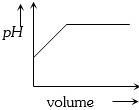
B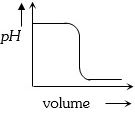
C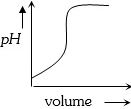
D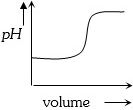
Solution
(D) In the titration of a strong acid $(HCl)$ with a strong base $(NaOH)$,the initial $pH$ is very low due to the presence of $HCl$.
As the base is added,the $pH$ increases slowly at first.
Near the equivalence point,there is a sharp and sudden increase in $pH$ because the concentration of $H^+$ ions decreases rapidly.
After the equivalence point,the $pH$ becomes almost constant as it is determined by the excess of $NaOH$ added.
Graph $D$ correctly represents this characteristic sigmoidal curve for a strong acid-strong base titration.
As the base is added,the $pH$ increases slowly at first.
Near the equivalence point,there is a sharp and sudden increase in $pH$ because the concentration of $H^+$ ions decreases rapidly.
After the equivalence point,the $pH$ becomes almost constant as it is determined by the excess of $NaOH$ added.
Graph $D$ correctly represents this characteristic sigmoidal curve for a strong acid-strong base titration.
0 likes
View Solution31
DifficultMCQ
$100 \ cm^3$ of $0.1 \ N \ HCl$ solution is mixed with $100 \ cm^3$ of $0.2 \ N \ NaOH$ solution. The resulting solution is
A
$0.1 \ N$ and the solution is basic
B
$0.05 \ N$ and the solution is basic
C
$0.1 \ N$ and the solution is acidic
D
$0.05 \ N$ and the solution is acidic
Solution
(B) The number of equivalents of $HCl$ = $N_1 V_1 = 0.1 \times 100 = 10 \ mEq$.
The number of equivalents of $NaOH$ = $N_2 V_2 = 0.2 \times 100 = 20 \ mEq$.
Since $NaOH$ is in excess,the resulting solution will be basic.
Remaining equivalents of $NaOH$ = $20 - 10 = 10 \ mEq$.
Total volume of the mixture = $100 \ cm^3 + 100 \ cm^3 = 200 \ cm^3$.
Resulting normality $(N_{res})$ = $\frac{\text{Remaining equivalents}}{\text{Total volume}} = \frac{10}{200} = 0.05 \ N$.
The number of equivalents of $NaOH$ = $N_2 V_2 = 0.2 \times 100 = 20 \ mEq$.
Since $NaOH$ is in excess,the resulting solution will be basic.
Remaining equivalents of $NaOH$ = $20 - 10 = 10 \ mEq$.
Total volume of the mixture = $100 \ cm^3 + 100 \ cm^3 = 200 \ cm^3$.
Resulting normality $(N_{res})$ = $\frac{\text{Remaining equivalents}}{\text{Total volume}} = \frac{10}{200} = 0.05 \ N$.
0 likes
View Solution32
MediumMCQ
When a standard solution of $NaOH$ is left in the air for a few hours,
A
$A$. $A$ precipitate will form.
B
$B$. Strength will decrease.
C
$C$. The concentration of $Na^{+}$ ions will decrease.
D
$D$. All are wrong.
Solution
(B) $NaOH$ is hygroscopic and deliquescent in nature. It absorbs moisture and $CO_2$ from the atmosphere. The absorption of water increases the total volume of the solution,which leads to a decrease in the molarity (strength) of the $NaOH$ solution.
0 likes
View Solution33
EasyMCQ
The degree of ionization of a solution depends upon:
A
Temperature
B
Nature of the electrolyte
C
Nature of the solvent
D
All of these
Solution
(D) The correct option is $D$. The degree of ionization $(\alpha)$ of an electrolyte depends on several factors:
$1$. Nature of the electrolyte: Strong electrolytes ionize completely,while weak electrolytes ionize partially.
$2$. Nature of the solvent: Solvents with high dielectric constants facilitate greater ionization.
$3$. Temperature: Generally,an increase in temperature increases the degree of ionization.
$4$. Concentration: Dilution increases the degree of ionization.
Therefore,all the given factors influence the degree of ionization.
$1$. Nature of the electrolyte: Strong electrolytes ionize completely,while weak electrolytes ionize partially.
$2$. Nature of the solvent: Solvents with high dielectric constants facilitate greater ionization.
$3$. Temperature: Generally,an increase in temperature increases the degree of ionization.
$4$. Concentration: Dilution increases the degree of ionization.
Therefore,all the given factors influence the degree of ionization.
0 likes
View Solution34
EasyMCQ
From an aqueous solution of $ZnSO_4$,normal zinc carbonate may be precipitated by
A
Boiling with $CaCO_3$
B
Adding $Na_2CO_3$
C
Adding $NaHCO_3$
D
Passing $CO_2$
Solution
(C) The reaction of $ZnSO_4$ with $NaHCO_3$ results in the precipitation of normal zinc carbonate $(ZnCO_3)$.
The chemical equation is: $ZnSO_4 + 2NaHCO_3 \to ZnCO_3 + Na_2SO_4 + H_2O + CO_2$.
Using $Na_2CO_3$ would lead to the formation of basic zinc carbonate,while $NaHCO_3$ is used to obtain the normal carbonate.
The chemical equation is: $ZnSO_4 + 2NaHCO_3 \to ZnCO_3 + Na_2SO_4 + H_2O + CO_2$.
Using $Na_2CO_3$ would lead to the formation of basic zinc carbonate,while $NaHCO_3$ is used to obtain the normal carbonate.
0 likes
View Solution35
MediumMCQ
Which of the following undergoes hydrolysis when dissolved in water?
A
$CH_3COONa$
B
$CH_3CONH_2$
C
Both $(a)$ and $(b)$
D
$C_6H_5CH_3$
Solution
(C) $CH_3COONa$ is a salt of a weak acid and a strong base,which undergoes anionic hydrolysis in water to form $CH_3COOH$ and $OH^-$.
$CH_3CONH_2$ (acetamide) undergoes hydrolysis in the presence of water (often catalyzed by acid or base) to form $CH_3COOH$ and $NH_3$.
Since both compounds undergo hydrolysis,the correct answer is $(c)$.
$CH_3CONH_2$ (acetamide) undergoes hydrolysis in the presence of water (often catalyzed by acid or base) to form $CH_3COOH$ and $NH_3$.
Since both compounds undergo hydrolysis,the correct answer is $(c)$.
0 likes
View Solution36
MediumMCQ
When $20 \, mL$ of $0.25 \, N$ strong acid and $30 \, mL$ of $0.2 \, N$ strong base are mixed,the resulting solution will be.......
A
$0.02 \, N$ basic
B
$0.02 \, N$ acidic
C
$0.25 \, N$ acidic
D
$0.2 \, N$ basic
Solution
(A) The number of equivalents of acid $(N_1V_1)$ = $20 \, mL \times 0.25 \, N = 5 \, meq$.
The number of equivalents of base $(N_2V_2)$ = $30 \, mL \times 0.2 \, N = 6 \, meq$.
Since the number of equivalents of base is greater than the acid,the resulting solution will be basic.
Excess equivalents of base = $6 \, meq - 5 \, meq = 1 \, meq$.
Total volume of the mixture = $20 \, mL + 30 \, mL = 50 \, mL$.
Normality of the resulting solution = $\frac{\text{Excess equivalents}}{\text{Total volume}} = \frac{1 \, meq}{50 \, mL} = 0.02 \, N$.
Therefore,the solution is $0.02 \, N$ basic.
The number of equivalents of base $(N_2V_2)$ = $30 \, mL \times 0.2 \, N = 6 \, meq$.
Since the number of equivalents of base is greater than the acid,the resulting solution will be basic.
Excess equivalents of base = $6 \, meq - 5 \, meq = 1 \, meq$.
Total volume of the mixture = $20 \, mL + 30 \, mL = 50 \, mL$.
Normality of the resulting solution = $\frac{\text{Excess equivalents}}{\text{Total volume}} = \frac{1 \, meq}{50 \, mL} = 0.02 \, N$.
Therefore,the solution is $0.02 \, N$ basic.
0 likes
View Solution37
MediumMCQ
At $25 \, ^oC$,the concentration of $H^{+}$ and $OH^{-}$ ions in pure water is $1 \times 10^{-7} \, M$ each. Which of the following is equal to $2 \times 10^{-7} \, M$?
A
$[H^{+}] + [OH^{-}]$
B
$[H^{+}]^2$
C
$[OH^{-}]^2$
D
$[H^{+}] - [OH^{-}]$
Solution
(A) In pure water,the dissociation equilibrium is $H_2O \rightleftharpoons H^{+} + OH^{-}$.
At $25 \, ^oC$,the concentration of $H^{+}$ ions is $[H^{+}] = 1 \times 10^{-7} \, M$ and the concentration of $OH^{-}$ ions is $[OH^{-}] = 1 \times 10^{-7} \, M$.
Therefore,the sum of the concentrations is $[H^{+}] + [OH^{-}] = 1 \times 10^{-7} + 1 \times 10^{-7} = 2 \times 10^{-7} \, M$.
At $25 \, ^oC$,the concentration of $H^{+}$ ions is $[H^{+}] = 1 \times 10^{-7} \, M$ and the concentration of $OH^{-}$ ions is $[OH^{-}] = 1 \times 10^{-7} \, M$.
Therefore,the sum of the concentrations is $[H^{+}] + [OH^{-}] = 1 \times 10^{-7} + 1 \times 10^{-7} = 2 \times 10^{-7} \, M$.
0 likes
View Solution38
DifficultMCQ
Calculate the ionic product of the solution formed by mixing equal volumes of $0.004 \, M \, CaSO_4$ and $0.002 \, M \, H_2SO_4$.
A
$5 \times 10^{-6}$
B
$8 \times 10^{-12}$
C
$2 \times 10^{-6}$
D
$7 \times 10^{-9}$
Solution
(C) When equal volumes are mixed,the concentration of each species is halved.
$[Ca^{2+}] = \frac{0.004}{2} = 0.002 \, M = 2 \times 10^{-3} \, M$
$[SO_4^{2-}] = [SO_4^{2-}]_{CaSO_4} + [SO_4^{2-}]_{H_2SO_4}$
$[SO_4^{2-}] = \frac{0.004}{2} + \frac{0.002}{2} = 0.002 + 0.001 = 0.003 \, M = 3 \times 10^{-3} \, M$
Ionic product $Q_{sp} = [Ca^{2+}] [SO_4^{2-}] = (2 \times 10^{-3}) \times (3 \times 10^{-3}) = 6 \times 10^{-6}$.
$[Ca^{2+}] = \frac{0.004}{2} = 0.002 \, M = 2 \times 10^{-3} \, M$
$[SO_4^{2-}] = [SO_4^{2-}]_{CaSO_4} + [SO_4^{2-}]_{H_2SO_4}$
$[SO_4^{2-}] = \frac{0.004}{2} + \frac{0.002}{2} = 0.002 + 0.001 = 0.003 \, M = 3 \times 10^{-3} \, M$
Ionic product $Q_{sp} = [Ca^{2+}] [SO_4^{2-}] = (2 \times 10^{-3}) \times (3 \times 10^{-3}) = 6 \times 10^{-6}$.
0 likes
View Solution39
MediumMCQ
For a weak acid $HCN$ at $25 \, ^\circ C$,which of the following statements is correct?
A
$\alpha = \frac{K_a}{[H^+]}$
B
$\alpha = \frac{K_a \times [OH^-]}{K_w}$
C
Both $(A)$ and $(B)$
D
$K_b = C\alpha^2$
Solution
(C) For a weak acid $HCN$,the dissociation equilibrium is $HCN \rightleftharpoons H^+ + CN^-$.
The dissociation constant $K_a$ is given by $K_a = \frac{[H^+][CN^-]}{[HCN]}$.
For a weak acid,$[H^+] = [CN^-] = C\alpha$ and $[HCN] = C(1-\alpha) \approx C$.
Thus,$K_a = C\alpha^2$,which implies $\alpha = \sqrt{\frac{K_a}{C}} = \frac{[H^+]}{C}$.
From $K_w = [H^+][OH^-]$,we have $[H^+] = \frac{K_w}{[OH^-]}$.
Substituting this into the expression for $\alpha$,we get $\alpha = \frac{K_a}{[H^+]} = \frac{K_a \times [OH^-]}{K_w}$.
Therefore,both statements $(A)$ and $(B)$ are correct.
The dissociation constant $K_a$ is given by $K_a = \frac{[H^+][CN^-]}{[HCN]}$.
For a weak acid,$[H^+] = [CN^-] = C\alpha$ and $[HCN] = C(1-\alpha) \approx C$.
Thus,$K_a = C\alpha^2$,which implies $\alpha = \sqrt{\frac{K_a}{C}} = \frac{[H^+]}{C}$.
From $K_w = [H^+][OH^-]$,we have $[H^+] = \frac{K_w}{[OH^-]}$.
Substituting this into the expression for $\alpha$,we get $\alpha = \frac{K_a}{[H^+]} = \frac{K_a \times [OH^-]}{K_w}$.
Therefore,both statements $(A)$ and $(B)$ are correct.
0 likes
View Solution40
EasyMCQ
At $25 \, ^\circ C$,the dissociation constant of pure water is equal to .......
A
$(55.55 \times 10^{14})^{-1}$
B
$1 \times 10^{-14}$
C
$\frac{1 \times 10^{-14}}{18}$
D
None of these
Solution
(A) For the dissociation of water: $H_2O(l) \rightleftharpoons H^+(aq) + OH^-(aq)$.
The equilibrium constant $K_c$ is given by $K_c = \frac{[H^+][OH^-]}{[H_2O]}$.
At $25 \, ^\circ C$,the ionic product of water $K_w = [H^+][OH^-] = 1 \times 10^{-14}$.
The concentration of pure water $[H_2O] = \frac{1000 \, g/L}{18 \, g/mol} = 55.55 \, M$.
Therefore,the dissociation constant $K_a = \frac{K_w}{[H_2O]} = \frac{1 \times 10^{-14}}{55.55} = (55.55 \times 10^{14})^{-1}$.
The equilibrium constant $K_c$ is given by $K_c = \frac{[H^+][OH^-]}{[H_2O]}$.
At $25 \, ^\circ C$,the ionic product of water $K_w = [H^+][OH^-] = 1 \times 10^{-14}$.
The concentration of pure water $[H_2O] = \frac{1000 \, g/L}{18 \, g/mol} = 55.55 \, M$.
Therefore,the dissociation constant $K_a = \frac{K_w}{[H_2O]} = \frac{1 \times 10^{-14}}{55.55} = (55.55 \times 10^{14})^{-1}$.
0 likes
View Solution41
MediumMCQ
The hydrolysis constants of salts $NaA$ and $NaB$ (of weak acids $HA$ and $HB$) are $10^{-8}$ and $10^{-10}$ respectively. If the dissociation constant of weak acid $HC$ is $10^{-5}$,what is the decreasing order of acidic strength?
A
$HB > HC > HA$
B
$HA > HB > HC$
C
$HB > HA > HC$
D
None of these
Solution
(A) The hydrolysis constant $K_h$ for a salt of a weak acid and strong base is given by $K_h = \frac{K_w}{K_a}$.
For $NaA$: $K_h(A^-) = 10^{-8} = \frac{10^{-14}}{K_a(HA)}$,so $K_a(HA) = 10^{-6}$.
For $NaB$: $K_h(B^-) = 10^{-10} = \frac{10^{-14}}{K_a(HB)}$,so $K_a(HB) = 10^{-4}$.
For $HC$: $K_a(HC) = 10^{-5}$.
Comparing the dissociation constants: $K_a(HB) = 10^{-4} > K_a(HC) = 10^{-5} > K_a(HA) = 10^{-6}$.
Since acidic strength is directly proportional to $K_a$,the order is $HB > HC > HA$.
For $NaA$: $K_h(A^-) = 10^{-8} = \frac{10^{-14}}{K_a(HA)}$,so $K_a(HA) = 10^{-6}$.
For $NaB$: $K_h(B^-) = 10^{-10} = \frac{10^{-14}}{K_a(HB)}$,so $K_a(HB) = 10^{-4}$.
For $HC$: $K_a(HC) = 10^{-5}$.
Comparing the dissociation constants: $K_a(HB) = 10^{-4} > K_a(HC) = 10^{-5} > K_a(HA) = 10^{-6}$.
Since acidic strength is directly proportional to $K_a$,the order is $HB > HC > HA$.
0 likes
View Solution42
MediumMCQ
If $10\%$ of a $5 \times 10^{-3} \, M \, H_2CO_3$ solution dissociates,then the concentration of $H^{+}$ ions is equal to $......$.
A
$10^{-3}$
B
$10^{-2}$
C
$10^{-1}$
D
$5 \times 10^{-2}$
Solution
(A) The dissociation reaction for carbonic acid is: $H_2CO_3 \rightleftharpoons 2H^{+} + CO_3^{2-}$.
Given concentration $C = 5 \times 10^{-3} \, M$ and degree of dissociation $\alpha = 10\% = 0.1$.
The concentration of $H^{+}$ ions is given by $[H^{+}] = 2 \times C \times \alpha$.
Substituting the values: $[H^{+}] = 2 \times (5 \times 10^{-3}) \times 0.1$.
$[H^{+}] = 10 \times 10^{-3} \times 0.1 = 10^{-3} \, M$.
Given concentration $C = 5 \times 10^{-3} \, M$ and degree of dissociation $\alpha = 10\% = 0.1$.
The concentration of $H^{+}$ ions is given by $[H^{+}] = 2 \times C \times \alpha$.
Substituting the values: $[H^{+}] = 2 \times (5 \times 10^{-3}) \times 0.1$.
$[H^{+}] = 10 \times 10^{-3} \times 0.1 = 10^{-3} \, M$.
0 likes
View Solution43
MediumMCQ
If the concentration of $OH^{-}$ ions is $10^{-7} \text{ gram ions/litre}$,what is the number of $OH^{-}$ ions in one litre of water?
A
$6.023 \times 10^{16}$
B
$3.023 \times 10^{16}$
C
$6.023 \times 10^{10}$
D
$6.023 \times 10^{11}$
Solution
(A) The number of $OH^{-}$ ions is calculated by multiplying the concentration of $OH^{-}$ ions by Avogadro's number $(N_A)$.
Number of $OH^{-}$ ions = $[OH^{-}] \times N_A$
$= 10^{-7} \times 6.023 \times 10^{23} = 6.023 \times 10^{16}$ ions.
Number of $OH^{-}$ ions = $[OH^{-}] \times N_A$
$= 10^{-7} \times 6.023 \times 10^{23} = 6.023 \times 10^{16}$ ions.
0 likes
View Solution44
MediumMCQ
At $90 \, ^\circ C$,the concentration of $H^+$ and $OH^-$ ions in pure water is $10^{-6} \, M$. What is the value of $[H^+] + [OH^-]$ at this temperature?
A
$10^{-14}$
B
$10^{-12}$
C
$2 \times 10^{-6}$
D
$2 \times 10^{-7}$
Solution
(C) In pure water,the concentration of $H^+$ ions is equal to the concentration of $OH^-$ ions,i.e.,$[H^+] = [OH^-]$.
Given that at $90 \, ^\circ C$,$[H^+] = 10^{-6} \, M$.
Therefore,$[OH^-] = 10^{-6} \, M$.
Calculating the sum: $[H^+] + [OH^-] = 10^{-6} + 10^{-6} = 2 \times 10^{-6} \, M$.
Thus,the correct option is $C$.
Given that at $90 \, ^\circ C$,$[H^+] = 10^{-6} \, M$.
Therefore,$[OH^-] = 10^{-6} \, M$.
Calculating the sum: $[H^+] + [OH^-] = 10^{-6} + 10^{-6} = 2 \times 10^{-6} \, M$.
Thus,the correct option is $C$.
0 likes
View Solution45
MediumMCQ
$0.1 \, M$ acetic acid is $1\%$ ionized. If its ionization increases to $10\%$,what will be its new concentration (in $, M$)?
A
$0.001$
B
$0.01$
C
$0.0001$
D
$0.1$
Solution
(A) For a weak acid,the dissociation constant is given by $K_a = C \alpha^2$.
Initially,$C_1 = 0.1 \, M$ and $\alpha_1 = \frac{1}{100} = 0.01$.
$K_a = 0.1 \times (0.01)^2 = 0.1 \times 10^{-4} = 10^{-5}$.
Now,for the new concentration $C_2$ where $\alpha_2 = \frac{10}{100} = 0.1$:
$K_a = C_2 \times (\alpha_2)^2$
$10^{-5} = C_2 \times (0.1)^2$
$10^{-5} = C_2 \times 10^{-2}$
$C_2 = \frac{10^{-5}}{10^{-2}} = 10^{-3} \, M = 0.001 \, M$.
Initially,$C_1 = 0.1 \, M$ and $\alpha_1 = \frac{1}{100} = 0.01$.
$K_a = 0.1 \times (0.01)^2 = 0.1 \times 10^{-4} = 10^{-5}$.
Now,for the new concentration $C_2$ where $\alpha_2 = \frac{10}{100} = 0.1$:
$K_a = C_2 \times (\alpha_2)^2$
$10^{-5} = C_2 \times (0.1)^2$
$10^{-5} = C_2 \times 10^{-2}$
$C_2 = \frac{10^{-5}}{10^{-2}} = 10^{-3} \, M = 0.001 \, M$.
0 likes
View Solution46
EasyMCQ
In which of the following acid-base titrations is the $pH$ at the equivalence point greater than $8$?
A
Acetic acid vs. Ammonia
B
Acetic acid vs. Sodium hydroxide
C
Hydrochloric acid vs. Ammonia
D
Hydrochloric acid vs. Sodium hydroxide
Solution
(B) The $pH$ at the equivalence point of an acid-base titration depends on the nature of the salt formed.
$1$. For a strong acid and strong base,the salt formed is neutral $(pH \approx 7)$.
$2$. For a strong acid and weak base,the salt undergoes cationic hydrolysis,resulting in an acidic solution $(pH < 7)$.
$3$. For a weak acid and strong base,the salt undergoes anionic hydrolysis,resulting in a basic solution $(pH > 7)$.
In the titration of acetic acid ($CH_3COOH$,a weak acid) against sodium hydroxide ($NaOH$,a strong base),the salt formed is sodium acetate $(CH_3COONa)$.
$CH_3COO^- + H_2O \rightleftharpoons CH_3COOH + OH^-$
The production of $OH^-$ ions makes the solution basic,hence the $pH$ at the equivalence point is greater than $8$.
$1$. For a strong acid and strong base,the salt formed is neutral $(pH \approx 7)$.
$2$. For a strong acid and weak base,the salt undergoes cationic hydrolysis,resulting in an acidic solution $(pH < 7)$.
$3$. For a weak acid and strong base,the salt undergoes anionic hydrolysis,resulting in a basic solution $(pH > 7)$.
In the titration of acetic acid ($CH_3COOH$,a weak acid) against sodium hydroxide ($NaOH$,a strong base),the salt formed is sodium acetate $(CH_3COONa)$.
$CH_3COO^- + H_2O \rightleftharpoons CH_3COOH + OH^-$
The production of $OH^-$ ions makes the solution basic,hence the $pH$ at the equivalence point is greater than $8$.
0 likes
View Solution47
MediumMCQ
For a $0.1 \, M$ aqueous solution of a weak acid undergoing $2\%$ ionization,the concentration of $[H^{+}]$ and $[OH]^{-}$ will be respectively: (Ionic product of water $= 1 \times 10^{-14}$)
A
$2 \times 10^{-3} \, M$ and $5 \times 10^{-12} \, M$
B
$1 \times 10^{-3} \, M$ and $3 \times 10^{-11} \, M$
C
$0.02 \times 10^{-3} \, M$ and $5 \times 10^{-11} \, M$
D
$3 \times 10^{-2} \, M$ and $4 \times 10^{-13} \, M$
Solution
(A) Given: Concentration $C = 0.1 \, M$,Degree of ionization $\alpha = 2\% = 0.02$.
For a weak acid,$[H^{+}] = C \times \alpha$.
$[H^{+}] = 0.1 \times 0.02 = 0.002 \, M = 2 \times 10^{-3} \, M$.
We know that $[H^{+}] \times [OH]^{-} = K_w = 1 \times 10^{-14}$.
$[OH]^{-} = \frac{1 \times 10^{-14}}{2 \times 10^{-3}} = 0.5 \times 10^{-11} = 5 \times 10^{-12} \, M$.
Therefore,$[H^{+}] = 2 \times 10^{-3} \, M$ and $[OH]^{-} = 5 \times 10^{-12} \, M$.
For a weak acid,$[H^{+}] = C \times \alpha$.
$[H^{+}] = 0.1 \times 0.02 = 0.002 \, M = 2 \times 10^{-3} \, M$.
We know that $[H^{+}] \times [OH]^{-} = K_w = 1 \times 10^{-14}$.
$[OH]^{-} = \frac{1 \times 10^{-14}}{2 \times 10^{-3}} = 0.5 \times 10^{-11} = 5 \times 10^{-12} \, M$.
Therefore,$[H^{+}] = 2 \times 10^{-3} \, M$ and $[OH]^{-} = 5 \times 10^{-12} \, M$.
0 likes
View Solution48
MediumMCQ
What is the ratio of the number of $H^{+}$ ions to the number of $H_2O$ molecules in $1 \ L$ of water?
A
$4 : 55.1 \times 10^4$
B
$1 : 55.4 \times 10^7$
C
$1 : 55.1 \times 10^7$
D
$1 : 55.1 \times 10^{10}$
Solution
(B) The concentration of $H^{+}$ ions in pure water is $10^{-7} \ M$.
Number of $H^{+}$ ions in $1 \ L = 10^{-7} \times 6.022 \times 10^{23}$.
The concentration of $H_2O$ in $1 \ L$ is $\frac{1000 \ g}{18 \ g/mol} \approx 55.56 \ M$.
Number of $H_2O$ molecules in $1 \ L = 55.56 \times 6.022 \times 10^{23}$.
Ratio = $\frac{10^{-7} \times 6.022 \times 10^{23}}{55.56 \times 6.022 \times 10^{23}} = \frac{1}{55.56 \times 10^7} \approx 1 : 55.6 \times 10^7$.
Given the options provided,the closest value is $1 : 55.4 \times 10^7$.
Number of $H^{+}$ ions in $1 \ L = 10^{-7} \times 6.022 \times 10^{23}$.
The concentration of $H_2O$ in $1 \ L$ is $\frac{1000 \ g}{18 \ g/mol} \approx 55.56 \ M$.
Number of $H_2O$ molecules in $1 \ L = 55.56 \times 6.022 \times 10^{23}$.
Ratio = $\frac{10^{-7} \times 6.022 \times 10^{23}}{55.56 \times 6.022 \times 10^{23}} = \frac{1}{55.56 \times 10^7} \approx 1 : 55.6 \times 10^7$.
Given the options provided,the closest value is $1 : 55.4 \times 10^7$.
0 likes
View Solution49
MediumMCQ
Arrange the following $0.1 \ M$ salt solutions in increasing order of their $pH$:
A
$NaCl < NH_4Cl < NaCN$
B
$HCl < NH_4Cl < NaCl < NaCN$
C
$NaCN < NH_4Cl < NaCl < HCl$
D
$HCl < NaCl < NaCN < NH_4Cl$
Solution
(B) To determine the $pH$ order,we analyze the nature of the salts:
$1$. $HCl$ is a strong acid,so its $0.1 \ M$ solution has the lowest $pH$ (approx $1$).
$2$. $NH_4Cl$ is a salt of a strong acid $(HCl)$ and a weak base $(NH_4OH)$,making it acidic $(pH < 7)$.
$3$. $NaCl$ is a salt of a strong acid $(HCl)$ and a strong base $(NaOH)$,making it neutral $(pH = 7)$.
$4$. $NaCN$ is a salt of a weak acid $(HCN)$ and a strong base $(NaOH)$,making it basic $(pH > 7)$.
Thus,the increasing order of $pH$ is: $HCl < NH_4Cl < NaCl < NaCN$.
$1$. $HCl$ is a strong acid,so its $0.1 \ M$ solution has the lowest $pH$ (approx $1$).
$2$. $NH_4Cl$ is a salt of a strong acid $(HCl)$ and a weak base $(NH_4OH)$,making it acidic $(pH < 7)$.
$3$. $NaCl$ is a salt of a strong acid $(HCl)$ and a strong base $(NaOH)$,making it neutral $(pH = 7)$.
$4$. $NaCN$ is a salt of a weak acid $(HCN)$ and a strong base $(NaOH)$,making it basic $(pH > 7)$.
Thus,the increasing order of $pH$ is: $HCl < NH_4Cl < NaCl < NaCN$.
0 likes
View Solution50
EasyMCQ
What is the $pH$ of a solution containing $10 \, mL$ of $0.1 \, M \, NaOH$ and $10 \, mL$ of $0.05 \, M \, H_2SO_4$?
A
$0$
B
$1$
C
$> 7$
D
$7$
Solution
(D) The reaction is $2NaOH + H_2SO_4 \rightarrow Na_2SO_4 + 2H_2O$.
Number of millimoles of $NaOH = 10 \, mL \times 0.1 \, M = 1 \, mmol$.
Number of millimoles of $H_2SO_4 = 10 \, mL \times 0.05 \, M = 0.5 \, mmol$.
Since $2 \, mmol$ of $NaOH$ reacts with $1 \, mmol$ of $H_2SO_4$,$1 \, mmol$ of $NaOH$ will react with $0.5 \, mmol$ of $H_2SO_4$.
Both reactants are completely consumed,resulting in a neutral solution.
Therefore,the $pH$ of the solution is $7$.
Number of millimoles of $NaOH = 10 \, mL \times 0.1 \, M = 1 \, mmol$.
Number of millimoles of $H_2SO_4 = 10 \, mL \times 0.05 \, M = 0.5 \, mmol$.
Since $2 \, mmol$ of $NaOH$ reacts with $1 \, mmol$ of $H_2SO_4$,$1 \, mmol$ of $NaOH$ will react with $0.5 \, mmol$ of $H_2SO_4$.
Both reactants are completely consumed,resulting in a neutral solution.
Therefore,the $pH$ of the solution is $7$.
0 likes
View Solution6-2.Equilibrium-II (Ionic Equilibrium) — Mix Examples-Ionic Equilibrium · Frequently Asked Questions
1Are these 6-2.Equilibrium-II (Ionic Equilibrium) questions useful for JEE and NEET?
Yes. All questions in this section are mapped to JEE Main and NEET exam patterns. Previous year questions from JEE Main, NEET, GUJCET and state-level exams are included with full solutions.
2Can I switch to Hindi or Gujarati for these questions?
Yes. Use the language tabs in the hero section or the sidebar to view the same questions and solutions in English, Hindi or Gujarati.
3How do I generate a question paper from this subtopic?
Use the Vedclass Exam Paper Generator — select the chapter and subtopic, set difficulty, and generate Sets A, B, C, D automatically. First 3 chapters of every subject are free.
Vedclass Products
For Students
Vedclass Test Series
Mock tests in real JEE/NEET style with performance analysis. 5-day free trial.
Start Free TrialFor Teachers
Exam Paper Generator
Generate Set A/B/C/D papers from this chapter in 2 minutes. 3 chapters free.
Try FreeFor Institutes
Online Exam Module
Live online exams with unlimited students, 360° analytics & white-label branding.
See DemoFor Teachers & Institutes
Generate a 6-2.Equilibrium-II (Ionic Equilibrium) Exam Paper in 2 Minutes
Select subtopic & difficulty — Sets A, B, C, D auto-generated with No Repeat logic.
First 3 chapters of every subject are free — no payment required.