
A English
Acid and base indicators Questions in English
Class 11 Chemistry · 6-2.Equilibrium-II (Ionic Equilibrium) · Acid and base indicators
52+
Questions
English
Language
100%
With Solutions
Showing 50 of 52 questions in English
1
EasyMCQ
The $pH$ indicators are
A
Salts of strong acids and strong bases
B
Salts of weak acids and weak bases
C
Either weak acids or weak bases
D
Either strong acids or strong bases
Solution
(C) $pH$ indicators are organic substances that are either weak acids or weak bases.
They exhibit different colors in their ionized and unionized forms.
The color change occurs due to the change in the concentration of $H^+$ ions in the solution,which shifts the equilibrium of the indicator.
They exhibit different colors in their ionized and unionized forms.
The color change occurs due to the change in the concentration of $H^+$ ions in the solution,which shifts the equilibrium of the indicator.
0 likes
View Solution2
EasyMCQ
The suitable indicator for the titration of a strong acid and a weak base is:
A
Methyl orange
B
Methyl red
C
Phenol red
D
Phenolphthalein
Solution
(A) In the titration of a strong acid and a weak base,the equivalence point lies in the acidic range (typically $pH < 7$).
Methyl orange is a suitable indicator for this titration because its $pH$ range $(3.1 - 4.4)$ falls within the acidic region where the equivalence point occurs.
Therefore,the correct option is $(A)$.
Methyl orange is a suitable indicator for this titration because its $pH$ range $(3.1 - 4.4)$ falls within the acidic region where the equivalence point occurs.
Therefore,the correct option is $(A)$.
0 likes
View Solution3
MediumMCQ
Phenolphthalein does not act as an indicator for the titration between
A
$NaOH$ and $CH_3COOH$
B
$H_2C_2O_4$ and $KMnO_4$
C
$Ba(OH)_2$ and $HCl$
D
$KOH$ and $H_2SO_4$
Solution
(B) Phenolphthalein is an acid-base indicator that changes color in the $pH$ range of $8.2$ to $10.0$.
It is suitable for titrations involving strong bases and weak acids or strong bases and strong acids.
Option $B$ involves a redox titration between oxalic acid $(H_2C_2O_4)$ and potassium permanganate $(KMnO_4)$,where $KMnO_4$ acts as a self-indicator.
Therefore,phenolphthalein is not used as an indicator for this reaction.
It is suitable for titrations involving strong bases and weak acids or strong bases and strong acids.
Option $B$ involves a redox titration between oxalic acid $(H_2C_2O_4)$ and potassium permanganate $(KMnO_4)$,where $KMnO_4$ acts as a self-indicator.
Therefore,phenolphthalein is not used as an indicator for this reaction.
0 likes
View Solution4
DifficultMCQ
The rapid change of $pH$ near the stoichiometric point of an acid-base titration is the basis of indicator detection. The $pH$ of the solution is related to the ratio of the concentrations of the conjugate acid $(HIn)$ and base $(In^{-})$ forms of the indicator by the expression:
A
$\log \frac{[HIn]}{[In^{-}]} = pH - pK_{In}$
B
$\log \frac{[In^{-}]}{[HIn]} = pH - pK_{In}$
C
$\log \frac{[In^{-}]}{[HIn]} = pK_{In} - pH$
D
$\log \frac{[HIn]}{[In^{-}]} = pK_{In} - pH$
Solution
(B) An indicator $(HIn)$ is a weak acid that dissociates in solution as follows:
$HIn \rightleftharpoons H^{+} + In^{-}$
The equilibrium constant expression is:
$K_{In} = \frac{[H^{+}][In^{-}]}{[HIn]}$
Taking the negative logarithm on both sides:
$-\log K_{In} = -\log [H^{+}] - \log \frac{[In^{-}]}{[HIn]}$
$pK_{In} = pH - \log \frac{[In^{-}]}{[HIn]}$
Rearranging the terms,we get:
$\log \frac{[In^{-}]}{[HIn]} = pH - pK_{In}$
$HIn \rightleftharpoons H^{+} + In^{-}$
The equilibrium constant expression is:
$K_{In} = \frac{[H^{+}][In^{-}]}{[HIn]}$
Taking the negative logarithm on both sides:
$-\log K_{In} = -\log [H^{+}] - \log \frac{[In^{-}]}{[HIn]}$
$pK_{In} = pH - \log \frac{[In^{-}]}{[HIn]}$
Rearranging the terms,we get:
$\log \frac{[In^{-}]}{[HIn]} = pH - pK_{In}$
0 likes
View Solution5
MediumMCQ
The $pH$ range of methyl orange as an indicator is in between:
A
$6-8$
B
$8-9$
C
$3-5$
D
$2-4$
Solution
(C) Methyl orange is a weak base indicator.
Its color change occurs in the acidic range.
The $pH$ range for the color change of methyl orange is approximately $3.1$ to $4.4$.
Therefore,the correct range is $3-5$.
Its color change occurs in the acidic range.
The $pH$ range for the color change of methyl orange is approximately $3.1$ to $4.4$.
Therefore,the correct range is $3-5$.
0 likes
View Solution6
MediumMCQ
Phenolphthalein is not a good indicator for titrating:
A
$NaOH$ against oxalic acid
B
Ferrous sulphate against $KMnO_4$
C
$NaOH$ against $HCl$
D
$NaOH$ against $H_2SO_4$
Solution
(B) The correct answer is $(B)$.
Phenolphthalein is an acid-base indicator used for titrations involving strong bases and weak acids or strong bases and strong acids.
However,in the titration of ferrous sulphate $(FeSO_4)$ against potassium permanganate $(KMnO_4)$,the reaction is a redox titration.
$KMnO_4$ acts as a strong oxidizing agent and it oxidizes the phenolphthalein indicator,causing it to lose its characteristic color-changing property,making it unsuitable for this specific titration.
Phenolphthalein is an acid-base indicator used for titrations involving strong bases and weak acids or strong bases and strong acids.
However,in the titration of ferrous sulphate $(FeSO_4)$ against potassium permanganate $(KMnO_4)$,the reaction is a redox titration.
$KMnO_4$ acts as a strong oxidizing agent and it oxidizes the phenolphthalein indicator,causing it to lose its characteristic color-changing property,making it unsuitable for this specific titration.
0 likes
View Solution7
MediumMCQ
Phenolphthalein is not suitable for the titration of
A
$NaOH$ $vs$ $(COOH)_2$
B
$KOH$ $vs$ $H_2SO_4$
C
$K_2CO_3$ $vs$ $HCl$
D
$None \, of \, these$
Solution
(C) Phenolphthalein is an acid-base indicator with a pH range of approximately $8.2$ to $10.0$.
It is suitable for titrations involving strong bases and weak acids or strong bases and strong acids.
In the case of $K_2CO_3$ $vs$ $HCl$,the titration involves a weak base $(K_2CO_3)$ and a strong acid $(HCl)$.
The equivalence point for this titration occurs in the acidic range (pH $< 7$),where phenolphthalein does not show a sharp color change.
Therefore,methyl orange is preferred for this titration.
It is suitable for titrations involving strong bases and weak acids or strong bases and strong acids.
In the case of $K_2CO_3$ $vs$ $HCl$,the titration involves a weak base $(K_2CO_3)$ and a strong acid $(HCl)$.
The equivalence point for this titration occurs in the acidic range (pH $< 7$),where phenolphthalein does not show a sharp color change.
Therefore,methyl orange is preferred for this titration.
0 likes
View Solution8
MediumMCQ
Phenolphthalein is the most suitable indicator for the titration of:
A
$CH_3COOH$ and $NH_4OH$
B
$CH_3COOH$ and $NaOH$
C
$HCl$ and $NH_4OH$
D
$H_2CO_3$ and $NH_4OH$
Solution
(B) Phenolphthalein is a weak organic acid indicator with a $pH$ range of $8.2$ to $10.0$.
It is most suitable for titrations involving a strong base and a weak acid,as the equivalence point for such a titration lies in the basic range $(pH > 7)$.
Among the given options,$CH_3COOH$ is a weak acid and $NaOH$ is a strong base,making phenolphthalein the ideal indicator for this titration.
It is most suitable for titrations involving a strong base and a weak acid,as the equivalence point for such a titration lies in the basic range $(pH > 7)$.
Among the given options,$CH_3COOH$ is a weak acid and $NaOH$ is a strong base,making phenolphthalein the ideal indicator for this titration.
0 likes
View Solution9
MediumMCQ
Indicator for the titration of $HCl$ and $Na_2CO_3$ would be
A
$K_4[Fe(CN)_6]$
B
$K_3[Fe(CN)_6]$
C
Phenolphthalein
D
Methyl orange
Solution
(D) The titration of $Na_2CO_3$ (a weak base) with $HCl$ (a strong acid) involves the formation of $NaHCO_3$ and then $NaCl$.
Methyl orange is the suitable indicator for this titration because its $pH$ range $(3.1-4.4)$ corresponds to the $pH$ at the equivalence point of the reaction between a strong acid and a weak base.
Methyl orange is the suitable indicator for this titration because its $pH$ range $(3.1-4.4)$ corresponds to the $pH$ at the equivalence point of the reaction between a strong acid and a weak base.
0 likes
View Solution10
MediumMCQ
Which indicator can be used in the titration of a strong acid and a strong base?
A
Only phenolphthalein
B
Only methyl orange
C
Either of the two
D
Red litmus
Solution
(C) In the titration of a strong acid and a strong base,the equivalence point occurs at $pH = 7$ (neutral).
Since both phenolphthalein (range $8.3 - 10.0$) and methyl orange (range $3.1 - 4.4$) show a sharp color change within the steep $pH$ change region of the titration curve (typically $pH \ 4$ to $10$),either indicator can be used.
Since both phenolphthalein (range $8.3 - 10.0$) and methyl orange (range $3.1 - 4.4$) show a sharp color change within the steep $pH$ change region of the titration curve (typically $pH \ 4$ to $10$),either indicator can be used.
0 likes
View Solution11
MediumMCQ
The indicator used in titrating a weak acid (e.g.,oxalic acid) with a strong base (e.g.,caustic soda) solution is
A
Methyl orange
B
Methyl red
C
Fluorescein
D
Phenolphthalein
Solution
(D) Phenolphthalein is the correct indicator for the titration of a weak acid with a strong base.
This is because the equivalence point of such a titration lies in the basic range ($pH$ range $8-10$).
Phenolphthalein changes its color from colourless to pink in this $pH$ range.
This is because the equivalence point of such a titration lies in the basic range ($pH$ range $8-10$).
Phenolphthalein changes its color from colourless to pink in this $pH$ range.
0 likes
View Solution12
MediumMCQ
The pink colour of phenolphthalein in an alkaline medium is:
A
Due to the negative form
B
Due to the positive form
C
Due to $OH^{-}$ ions
D
Due to the neutral form
Solution
(A) Phenolphthalein is a weak organic acid represented as $HIn$. In an acidic medium,it exists in the unionized form which is colourless. In an alkaline medium,it dissociates to form the $In^{-}$ ion (the negative form),which is pink in colour. The $OH^{-}$ ions shift the equilibrium towards the formation of the $In^{-}$ ion.
0 likes
View Solution13
MediumMCQ
If we use phenolphthalein as an indicator in a titration of $Na_2CO_3$ with $HCl$,the usual result is:
A
No visible change will occur
B
The indicator reacts with the acid
C
The indicator reacts with the base
D
Sodium chloride and carbonic acid will be formed
Solution
(A) In the titration of $Na_2CO_3$ with $HCl$ using phenolphthalein,the reaction proceeds as: $Na_2CO_3 + HCl \rightarrow NaHCO_3 + NaCl$.
Phenolphthalein changes color in the $pH$ range of $8.2$ to $10.0$.
At the end point of this reaction,the solution contains $NaHCO_3$,which is weakly basic,but the phenolphthalein indicator becomes colourless as the $pH$ drops below $8.2$.
Therefore,the correct observation is that the solution becomes colourless.
Phenolphthalein changes color in the $pH$ range of $8.2$ to $10.0$.
At the end point of this reaction,the solution contains $NaHCO_3$,which is weakly basic,but the phenolphthalein indicator becomes colourless as the $pH$ drops below $8.2$.
Therefore,the correct observation is that the solution becomes colourless.
0 likes
View Solution14
MediumMCQ
Methyl orange gives red colour in
A
Sodium carbonate solution
B
Sodium chloride solution
C
Hydrochloric acid solution
D
Potassium hydroxide solution
Solution
(C) $Methyl$ $orange$ is an acid-base indicator that shows a red color in acidic solutions (pH range $3.1 - 4.4$).
Among the given options,$Hydrochloric$ $acid$ $(HCl)$ is an acid.
Therefore,$Methyl$ $orange$ will turn red in $Hydrochloric$ $acid$ solution.
Among the given options,$Hydrochloric$ $acid$ $(HCl)$ is an acid.
Therefore,$Methyl$ $orange$ will turn red in $Hydrochloric$ $acid$ solution.
0 likes
View Solution15
MediumMCQ
$A$ $0.1 \ N$ solution of $Na_2CO_3$ is titrated with $0.1 \ N$ $HCl$ solution. The best indicator to be used is
A
Potassium ferricyanide
B
Phenolphthalein
C
Methyl red
D
Litmus paper
Solution
(C) The titration of $Na_2CO_3$ (a weak base) with $HCl$ (a strong acid) results in the formation of $NaCl$,$H_2O$,and $CO_2$.
At the equivalence point,the solution contains dissolved $CO_2$ (carbonic acid),which makes the solution slightly acidic $(pH < 7)$.
Methyl red is an indicator that changes color in the acidic range ($pH$ range $4.2 - 6.3$),making it the most suitable choice for this titration.
At the equivalence point,the solution contains dissolved $CO_2$ (carbonic acid),which makes the solution slightly acidic $(pH < 7)$.
Methyl red is an indicator that changes color in the acidic range ($pH$ range $4.2 - 6.3$),making it the most suitable choice for this titration.
0 likes
View Solution16
MediumMCQ
Starch can be used as an indicator for the detection of traces of
A
Glucose in aqueous solution
B
Protein in blood
C
Iodine in aqueous solution
D
Urea in blood
Solution
(C) Starch solution is colourless,but it forms a deep blue-black complex in the presence of iodine.
Therefore,starch is commonly used as an indicator for the detection of traces of iodine in aqueous solutions.
Reaction: $\text{Starch} + \text{Iodine} \rightarrow \text{Starch-Iodine complex (blue-black colour)}$.
Therefore,starch is commonly used as an indicator for the detection of traces of iodine in aqueous solutions.
Reaction: $\text{Starch} + \text{Iodine} \rightarrow \text{Starch-Iodine complex (blue-black colour)}$.
0 likes
View Solution17
EasyMCQ
Methyl orange is an indicator in acid-alkali titration. It gives
A
Yellow colour in alkaline medium
B
Red colour in acid medium
C
Yellow colour in acid medium
D
Yellow colour in alkaline medium and red colour in acid medium
Solution
(D) $Methyl$ $orange$ is a common acid-base indicator.
In an acidic medium,it exhibits a red colour.
In an alkaline (basic) medium,it exhibits a yellow colour.
Therefore,the correct statement is that it gives a yellow colour in an alkaline medium and a red colour in an acid medium.
In an acidic medium,it exhibits a red colour.
In an alkaline (basic) medium,it exhibits a yellow colour.
Therefore,the correct statement is that it gives a yellow colour in an alkaline medium and a red colour in an acid medium.
0 likes
View Solution18
EasyMCQ
Which indicator is most suitable for the titration of $0.1 \, N \, Na_2CO_3$ solution with $0.1 \, N \, HCl$?
A
Potassium ferricyanide
B
Phenolphthalein
C
Methyl red
D
Litmus paper
Solution
(C) The titration involves a weak base $(Na_2CO_3)$ and a strong acid $(HCl)$.
At the equivalence point,the resulting solution contains $NaCl$,$H_2O$,and $CO_2$ (which forms carbonic acid),making the solution slightly acidic.
Methyl red is an indicator that changes color in the acidic pH range $(4.2 - 6.3)$,making it the most suitable choice for this titration.
At the equivalence point,the resulting solution contains $NaCl$,$H_2O$,and $CO_2$ (which forms carbonic acid),making the solution slightly acidic.
Methyl red is an indicator that changes color in the acidic pH range $(4.2 - 6.3)$,making it the most suitable choice for this titration.
0 likes
View Solution19
EasyMCQ
Phenolphthalein is a suitable indicator for the titration of:
A
$CH_3COOH$ and $NH_4OH$
B
$CH_3COOH$ and $NaOH$
C
$HCl$ and $NH_4OH$
D
$H_2CO_3$ and $NH_4OH$
Solution
(B) Phenolphthalein is a weak organic acid with a $pH$ range of $8.2$ to $10.0$.
It is suitable for titrations involving a strong base because the equivalence point of such titrations falls within its $pH$ range.
In the case of $CH_3COOH$ (weak acid) and $NaOH$ (strong base),the resulting salt undergoes anionic hydrolysis,making the solution basic at the equivalence point $(pH > 7)$.
Therefore,phenolphthalein is the appropriate indicator for this titration.
It is suitable for titrations involving a strong base because the equivalence point of such titrations falls within its $pH$ range.
In the case of $CH_3COOH$ (weak acid) and $NaOH$ (strong base),the resulting salt undergoes anionic hydrolysis,making the solution basic at the equivalence point $(pH > 7)$.
Therefore,phenolphthalein is the appropriate indicator for this titration.
0 likes
View Solution20
EasyMCQ
Which indicator is used for the titration of a weak acid (oxalic acid) and a strong base (caustic soda)?
A
Methyl orange
B
Methyl red
C
Fluorescein
D
Phenolphthalein
Solution
(D) The titration of a weak acid (like oxalic acid) with a strong base (like $NaOH$) results in a salt of a weak acid and a strong base,which undergoes anionic hydrolysis to produce a basic solution at the equivalence point $(pH > 7)$.
Phenolphthalein is a suitable indicator for this titration because its $pH$ range $(8.2 - 10.0)$ coincides with the $pH$ change at the equivalence point of this specific acid-base reaction.
Phenolphthalein is a suitable indicator for this titration because its $pH$ range $(8.2 - 10.0)$ coincides with the $pH$ change at the equivalence point of this specific acid-base reaction.
0 likes
View Solution21
EasyMCQ
For which of the following titrations is phenolphthalein the most suitable indicator?
A
$CH_3COOH$ and $NH_4OH$
B
$CH_3COOH$ and $NaOH$
C
$HCl$ and $NH_4OH$
D
$H_2CO_3$ and $NH_4OH$
Solution
(B) Phenolphthalein is a weak organic acid indicator with a pH range of $8.2$ to $10.0$.
It is most suitable for titrations involving a strong base and a weak acid,as the equivalence point for such titrations lies in the basic range $(pH > 7)$.
In the given options,$CH_3COOH$ is a weak acid and $NaOH$ is a strong base.
Therefore,the titration of $CH_3COOH$ and $NaOH$ is best indicated by phenolphthalein.
It is most suitable for titrations involving a strong base and a weak acid,as the equivalence point for such titrations lies in the basic range $(pH > 7)$.
In the given options,$CH_3COOH$ is a weak acid and $NaOH$ is a strong base.
Therefore,the titration of $CH_3COOH$ and $NaOH$ is best indicated by phenolphthalein.
0 likes
View Solution22
MediumMCQ
At what $pH$ will an indicator with $K_b = 1 \times 10^{-11}$ show a color change in a $1 \times 10^{-4} \ M$ solution?
A
$7$
B
$3$
C
$5.5$
D
$11$
Solution
(B) For a basic indicator,the equilibrium is represented as: $InOH \rightleftharpoons In^+ + OH^-$.
The dissociation constant is $K_b = \frac{[In^+][OH^-]}{[InOH]}$.
The color change occurs when $[In^+] = [InOH]$,which implies $K_b = [OH^-]$.
Given $K_b = 1 \times 10^{-11}$,we have $[OH^-] = 1 \times 10^{-11} \ M$.
Now,$pOH = -\log[OH^-] = -\log(1 \times 10^{-11}) = 11$.
Since $pH + pOH = 14$,we get $pH = 14 - 11 = 3$.
The dissociation constant is $K_b = \frac{[In^+][OH^-]}{[InOH]}$.
The color change occurs when $[In^+] = [InOH]$,which implies $K_b = [OH^-]$.
Given $K_b = 1 \times 10^{-11}$,we have $[OH^-] = 1 \times 10^{-11} \ M$.
Now,$pOH = -\log[OH^-] = -\log(1 \times 10^{-11}) = 11$.
Since $pH + pOH = 14$,we get $pH = 14 - 11 = 3$.
0 likes
View Solution23
EasyMCQ
Phenolphthalein is a.......
A
Strong acid
B
Strong base
C
Weak base
D
Weak acid
Solution
(D) Phenolphthalein is an organic compound with the formula $C_{20}H_{14}O_4$.
It acts as a weak organic acid in aqueous solution.
In its acidic form,it is colorless,while in its basic form,it dissociates to form a pink-colored ion.
Therefore,it is classified as a weak acid indicator.
It acts as a weak organic acid in aqueous solution.
In its acidic form,it is colorless,while in its basic form,it dissociates to form a pink-colored ion.
Therefore,it is classified as a weak acid indicator.
0 likes
View Solution24
EasyMCQ
Which indicator works in the $pH$ range of $8 - 9.8$?
A
Phenolphthalein
B
Methyl orange
C
Methyl red
D
Litmus
Solution
(A) The $pH$ range of an indicator is the range over which it changes color.
Phenolphthalein is a weak acid indicator that changes color in the basic range,specifically between $pH$ $8.0$ and $9.8$.
Methyl orange changes color in the acidic range ($pH$ $3.1 - 4.4$).
Methyl red changes color in the acidic range ($pH$ $4.4 - 6.2$).
Litmus changes color in the near-neutral range ($pH$ $5.0 - 8.0$).
Therefore,the correct indicator for the $pH$ range $8 - 9.8$ is Phenolphthalein.
Phenolphthalein is a weak acid indicator that changes color in the basic range,specifically between $pH$ $8.0$ and $9.8$.
Methyl orange changes color in the acidic range ($pH$ $3.1 - 4.4$).
Methyl red changes color in the acidic range ($pH$ $4.4 - 6.2$).
Litmus changes color in the near-neutral range ($pH$ $5.0 - 8.0$).
Therefore,the correct indicator for the $pH$ range $8 - 9.8$ is Phenolphthalein.
0 likes
View Solution25
MediumMCQ
For an acid indicator with $K_{in} = 1.0 \times 10^{-5}$, the color change occurs when the concentration of the indicator is $1 \times 10^{-3} \ M$. Find the $pH$ at which the color change occurs.
A
$5$
B
$11$
C
$3$
D
$8$
Solution
(A) For an acid-base indicator, the color change occurs when the concentration of the ionized form equals the concentration of the unionized form, i.e., $[In^-] = [HIn]$.
Using the Henderson-Hasselbalch equation for an indicator: $pH = pK_{in} + \log \frac{[In^-]}{[HIn]}$.
Since $[In^-] = [HIn]$, the ratio $\frac{[In^-]}{[HIn]} = 1$.
Therefore, $pH = pK_{in} + \log(1) = pK_{in}$.
Given $K_{in} = 1.0 \times 10^{-5}$, then $pK_{in} = -\log(1.0 \times 10^{-5}) = 5$.
Thus, $pH = 5$.
Using the Henderson-Hasselbalch equation for an indicator: $pH = pK_{in} + \log \frac{[In^-]}{[HIn]}$.
Since $[In^-] = [HIn]$, the ratio $\frac{[In^-]}{[HIn]} = 1$.
Therefore, $pH = pK_{in} + \log(1) = pK_{in}$.
Given $K_{in} = 1.0 \times 10^{-5}$, then $pK_{in} = -\log(1.0 \times 10^{-5}) = 5$.
Thus, $pH = 5$.
0 likes
View Solution26
EasyMCQ
Which indicator is useful for the titration of a weak acid and a strong base?
A
Potassium dichromate
B
Methyl orange
C
Litmus
D
Phenolphthalein
Solution
(D) In the titration of a weak acid (e.g.,$CH_3COOH$) and a strong base (e.g.,$NaOH$),the equivalence point lies in the basic range (pH > $7$).
Phenolphthalein is a suitable indicator for this titration because its pH range $(8.2 - 10.0)$ coincides with the steep rise in pH at the equivalence point of a weak acid-strong base titration.
Phenolphthalein is a suitable indicator for this titration because its pH range $(8.2 - 10.0)$ coincides with the steep rise in pH at the equivalence point of a weak acid-strong base titration.
0 likes
View Solution27
MediumMCQ
For an acid-base indicator,the dissociation constant $K_a = 1.0 \times 10^{-5}$. The indicator is red in acidic form and blue in basic form. What is the $pH$ range required for the color change from $80\%$ red to $80\%$ blue?
A
$4.4$
B
$5.6$
C
$1.2$
D
$3.8$
0 likes
View Solution28
EasyMCQ
The pink color of phenolphthalein in an alkaline medium is due to:
A
Anion
B
Cation
C
$OH^-$ ion
D
Neutral form
Solution
(A) Phenolphthalein is a weak organic acid,represented as $HIn$. In an alkaline medium,the equilibrium $HIn \rightleftharpoons H^+ + In^-$ shifts to the right due to the removal of $H^+$ ions by $OH^-$ ions. The resulting anion $In^-$ is pink in color,which is responsible for the characteristic pink color of phenolphthalein in basic solutions.
0 likes
View Solution29
EasyMCQ
Which indicator is used for the titration of $CH_3COOH$ and $NaOH$?
A
Methyl orange
B
Methyl red
C
Phenolphthalein
D
Litmus
Solution
(C) The titration of a weak acid $(CH_3COOH)$ with a strong base $(NaOH)$ results in a salt of a weak acid and a strong base,which undergoes anionic hydrolysis to form a basic solution at the equivalence point $(pH > 7)$.
Phenolphthalein is a suitable indicator for this titration because its $pH$ range $(8.2 - 10.0)$ coincides with the $pH$ change at the equivalence point of this specific acid-base reaction.
Phenolphthalein is a suitable indicator for this titration because its $pH$ range $(8.2 - 10.0)$ coincides with the $pH$ change at the equivalence point of this specific acid-base reaction.
0 likes
View Solution30
EasyMCQ
Methyl orange gives $.......$ color in an acidic medium.
A
Red
B
Yellow
C
Blue
D
Colorless
Solution
(A) Methyl orange is a pH indicator frequently used in titration. In an acidic medium (pH $< 3.1$),it exhibits a $Red$ color. In a basic medium (pH $> 4.4$),it exhibits a $Yellow$ color.
0 likes
View Solution31
EasyMCQ
Phenolphthalein is not a suitable indicator for the titration between which of the following?
A
$KOH$ and $H_2SO_4$
B
$NaOH$ and $CH_3COOH$
C
Oxalic acid and $KMnO_4$
D
$Ba(OH)_2$ and $HCl$
Solution
(C) Phenolphthalein is an acid-base indicator that changes color in the $pH$ range of $8.2$ to $10.0$.
It is suitable for titrations involving strong bases.
Option $C$ involves $KMnO_4$,which is an oxidizing agent,not a simple acid-base titration.
Furthermore,$KMnO_4$ acts as a self-indicator in redox titrations,making the use of phenolphthalein unnecessary and inappropriate for this specific reaction.
It is suitable for titrations involving strong bases.
Option $C$ involves $KMnO_4$,which is an oxidizing agent,not a simple acid-base titration.
Furthermore,$KMnO_4$ acts as a self-indicator in redox titrations,making the use of phenolphthalein unnecessary and inappropriate for this specific reaction.
0 likes
View Solution32
DifficultMCQ
In an acid-base titration,the rapid change in $pH$ near the equivalence point depends on the indicator used. The $pH$ of the solution is related to the ratio of the concentrations of the conjugate acid $(HIn)$ and base $(In^-)$ forms of the indicator by which equation?
A
$\log \frac{[HIn]}{[In^-]} = pK_{In} - pH$
B
$\log \frac{[HIn]}{[In^-]} = pH - pK_{In}$
C
$\log \frac{[In^-]}{[HIn]} = pH + pK_{In}$
D
$\log \frac{[In^-]}{[HIn]} = pH - pK_{In}$
Solution
(D) The dissociation of an acid-base indicator $(HIn)$ can be represented as: $HIn \rightleftharpoons H^+ + In^-$.
Applying the law of mass action,the dissociation constant $K_{In}$ is given by: $K_{In} = \frac{[H^+][In^-]}{[HIn]}$.
Taking the negative logarithm on both sides: $-\log K_{In} = -\log [H^+] - \log \frac{[In^-]}{[HIn]}$.
This simplifies to: $pK_{In} = pH - \log \frac{[In^-]}{[HIn]}$.
Rearranging the terms gives: $\log \frac{[In^-]}{[HIn]} = pH - pK_{In}$.
Applying the law of mass action,the dissociation constant $K_{In}$ is given by: $K_{In} = \frac{[H^+][In^-]}{[HIn]}$.
Taking the negative logarithm on both sides: $-\log K_{In} = -\log [H^+] - \log \frac{[In^-]}{[HIn]}$.
This simplifies to: $pK_{In} = pH - \log \frac{[In^-]}{[HIn]}$.
Rearranging the terms gives: $\log \frac{[In^-]}{[HIn]} = pH - pK_{In}$.
0 likes
View Solution33
EasyMCQ
Which indicator is suitable for the titration of $NaOH$ and oxalic acid?
A
Methyl orange
B
Methyl red
C
Phenolphthalein
D
None of these
Solution
(C) The titration of a strong base $(NaOH)$ and a weak acid (oxalic acid) results in a salt of a strong base and a weak acid,which undergoes anionic hydrolysis to produce a basic solution at the equivalence point $(pH > 7)$.
Phenolphthalein is a suitable indicator for this titration because its $pH$ range $(8.2 - 10.0)$ covers the equivalence point of this reaction.
Phenolphthalein is a suitable indicator for this titration because its $pH$ range $(8.2 - 10.0)$ covers the equivalence point of this reaction.
0 likes
View Solution34
MediumMCQ
The $pH$ range of methyl red indicator is .......?
A
$4.2 - 6.2$
B
$6.8 - 10.8$
C
$8.0 - 9.6$
D
$6.8 - 8.2$
Solution
(A) Methyl red is a synthetic acid-base indicator.
It changes its color in the $pH$ range of $4.2$ to $6.2$.
Below $pH$ $4.2$,it is red,and above $pH$ $6.2$,it is yellow.
It changes its color in the $pH$ range of $4.2$ to $6.2$.
Below $pH$ $4.2$,it is red,and above $pH$ $6.2$,it is yellow.
0 likes
View Solution35
MediumMCQ
If a very small amount of $HPh$ (phenolphthalein) is added to a $0.1 \ M$ aqueous solution of $CH_3COONa$,the fraction of the indicator that exists in the colourless form is:
$[K_b(CH_3COO^{-}) = 10^{-9}, pK_a(HPh) = 9.6, \log 2 = 0.3]$
$[K_b(CH_3COO^{-}) = 10^{-9}, pK_a(HPh) = 9.6, \log 2 = 0.3]$
A
$0.2$
B
$0.8$
C
$0.5$
D
$0.4$
Solution
(B) For the salt of a weak acid and strong base,the $pH$ is calculated as:
$pH = \frac{1}{2}(pK_w + pK_a(CH_3COOH) + \log C)$
Given $K_b(CH_3COO^-) = 10^{-9}$,so $K_a(CH_3COOH) = \frac{K_w}{K_b} = \frac{10^{-14}}{10^{-9}} = 10^{-5}$,which means $pK_a = 5$.
$pH = \frac{1}{2}(14 + 5 + \log 0.1) = \frac{1}{2}(19 - 1) = 9$.
For the indicator $HPh \rightleftharpoons H^+ + Ph^-$,the Henderson-Hasselbalch equation is:
$pH = pK_a(HPh) + \log \frac{[Ph^-]}{[HPh]}$
$9 = 9.6 + \log \frac{[Ph^-]}{[HPh]}$
$\log \frac{[Ph^-]}{[HPh]} = -0.6 = -2 \times 0.3 = -2 \log 2 = \log(2^{-2}) = \log(0.25)$.
So,$\frac{[Ph^-]}{[HPh]} = 0.25 = \frac{1}{4}$.
Let the total concentration be $[HPh] + [Ph^-] = 1$.
Since $[HPh] = 4[Ph^-]$,we have $4[Ph^-] + [Ph^-] = 1$,so $5[Ph^-] = 1$,$[Ph^-] = 0.2$.
Then $[HPh] = 1 - 0.2 = 0.8$.
The colourless form is $HPh$,so the fraction is $0.8$.
$pH = \frac{1}{2}(pK_w + pK_a(CH_3COOH) + \log C)$
Given $K_b(CH_3COO^-) = 10^{-9}$,so $K_a(CH_3COOH) = \frac{K_w}{K_b} = \frac{10^{-14}}{10^{-9}} = 10^{-5}$,which means $pK_a = 5$.
$pH = \frac{1}{2}(14 + 5 + \log 0.1) = \frac{1}{2}(19 - 1) = 9$.
For the indicator $HPh \rightleftharpoons H^+ + Ph^-$,the Henderson-Hasselbalch equation is:
$pH = pK_a(HPh) + \log \frac{[Ph^-]}{[HPh]}$
$9 = 9.6 + \log \frac{[Ph^-]}{[HPh]}$
$\log \frac{[Ph^-]}{[HPh]} = -0.6 = -2 \times 0.3 = -2 \log 2 = \log(2^{-2}) = \log(0.25)$.
So,$\frac{[Ph^-]}{[HPh]} = 0.25 = \frac{1}{4}$.
Let the total concentration be $[HPh] + [Ph^-] = 1$.
Since $[HPh] = 4[Ph^-]$,we have $4[Ph^-] + [Ph^-] = 1$,so $5[Ph^-] = 1$,$[Ph^-] = 0.2$.
Then $[HPh] = 1 - 0.2 = 0.8$.
The colourless form is $HPh$,so the fraction is $0.8$.
0 likes
View Solution36
MediumMCQ
Phenolphthalein is not a good indicator for titrating :-
A
$NaOH \, vs. \, H_2C_2O_4$
B
$FeSO_4 \, vs. \, KMnO_4$
C
$NaOH \, vs. \, HCl$
D
$NaOH \, vs. \, H_2SO_4$
Solution
(B) Phenolphthalein is an acid-base indicator used to detect the equivalence point in acid-base titrations.
$FeSO_4 \, vs. \, KMnO_4$ is a redox titration,not an acid-base titration.
In a redox titration,the change in potential is monitored,and phenolphthalein does not change color based on the oxidation-reduction state of the reactants.
Therefore,it is not a suitable indicator for this reaction.
$FeSO_4 \, vs. \, KMnO_4$ is a redox titration,not an acid-base titration.
In a redox titration,the change in potential is monitored,and phenolphthalein does not change color based on the oxidation-reduction state of the reactants.
Therefore,it is not a suitable indicator for this reaction.
0 likes
View Solution37
MediumMCQ
The pink colour of phenolphthalein in an alkaline medium is due to -
A
Negative ion
B
Positive ion
C
$OH^{-}$ ions
D
Neutral form
Solution
(A) In an alkaline medium,phenolphthalein undergoes a structural change where it loses a proton to form a dianion.
This dianion is a conjugated system that absorbs light in the visible region,resulting in the characteristic pink colour.
Therefore,the pink colour is due to the formation of the negative ion (dianion) of phenolphthalein.
This dianion is a conjugated system that absorbs light in the visible region,resulting in the characteristic pink colour.
Therefore,the pink colour is due to the formation of the negative ion (dianion) of phenolphthalein.
0 likes
View Solution38
MediumMCQ
$20 \ mL$ of $0.5 \ N \ HCl$ and $35 \ mL$ of $0.1 \ N \ NaOH$ are mixed. The resulting solution will
A
be neutral
B
be basic
C
turn phenolphthalein solution pink
D
turn methyl orange solution orange red.
Solution
(D) Calculate the milliequivalents $(meq)$ of each reactant:
$meq \text{ of } HCl = N \times V \text{ (in } mL) = 0.5 \times 20 = 10 \ meq$.
$meq \text{ of } NaOH = N \times V \text{ (in } mL) = 0.1 \times 35 = 3.5 \ meq$.
Since $meq \text{ of } HCl > meq \text{ of } NaOH$,the acid is in excess.
$meq \text{ of } HCl \text{ remaining} = 10 - 3.5 = 6.5 \ meq$.
Because the resulting solution contains excess acid,it is acidic.
Methyl orange is an indicator that turns orange-red in an acidic medium.
$meq \text{ of } HCl = N \times V \text{ (in } mL) = 0.5 \times 20 = 10 \ meq$.
$meq \text{ of } NaOH = N \times V \text{ (in } mL) = 0.1 \times 35 = 3.5 \ meq$.
Since $meq \text{ of } HCl > meq \text{ of } NaOH$,the acid is in excess.
$meq \text{ of } HCl \text{ remaining} = 10 - 3.5 = 6.5 \ meq$.
Because the resulting solution contains excess acid,it is acidic.
Methyl orange is an indicator that turns orange-red in an acidic medium.
0 likes
View Solution39
MediumMCQ
The best indicator for the detection of the end point in the titration of a weak acid and a strong base is:
A
Methyl orange ($3.1$ to $4.4$)
B
Methyl red ($4.2$ to $6.3$)
C
Bromothymol blue ($6$ to $7.6$)
D
Phenolphthalein ($8.2$ to $10$)
Solution
(D) In the titration of a weak acid and a strong base,the $pH$ at the equivalence point is greater than $7$ (typically between $8$ and $10$).
Phenolphthalein is the most suitable indicator because its $pH$ range ($8.2$ to $10$) coincides with the $pH$ change at the equivalence point of this titration.
Methyl orange and Methyl red are suitable for strong acid-strong base or strong acid-weak base titrations,as their $pH$ ranges are in the acidic region.
Phenolphthalein is the most suitable indicator because its $pH$ range ($8.2$ to $10$) coincides with the $pH$ change at the equivalence point of this titration.
Methyl orange and Methyl red are suitable for strong acid-strong base or strong acid-weak base titrations,as their $pH$ ranges are in the acidic region.
0 likes
View Solution40
MediumMCQ
The best indicator for the detection of the end point in the titration of a strong acid and a weak base is:
A
Methyl orange ($3.1$ to $4.4$)
B
Phenol red ($6.4$ to $8$)
C
Bromothymol blue ($6$ to $7.6$)
D
Phenolphthalein ($8.2$ to $10$)
Solution
(A) In the titration of a strong acid and a weak base,the resulting salt undergoes cationic hydrolysis,making the solution acidic at the equivalence point $(pH < 7)$.
Methyl orange,which operates in the $pH$ range of $3.1$ to $4.4$,is the most suitable indicator for this titration as its color change interval matches the $pH$ at the equivalence point.
Methyl orange,which operates in the $pH$ range of $3.1$ to $4.4$,is the most suitable indicator for this titration as its color change interval matches the $pH$ at the equivalence point.
0 likes
View Solution41
DifficultMCQ
The indicator used in the titration of $Na_2CO_3$ with $HCl$ is..................
A
Phenolphthalein
B
Methyl orange
C
Methyl red
D
Starch
Solution
(B) The titration of $Na_2CO_3$ with $HCl$ involves the reaction of a weak base with a strong acid.
At the first equivalence point,$NaHCO_3$ is formed,and phenolphthalein can be used.
However,for the complete neutralization to $NaCl$,$CO_2$,and $H_2O$,the pH drops into the acidic range (around $3.7$ to $4.5$).
Methyl orange is the suitable indicator for this range,as it changes color in the acidic pH range.
At the first equivalence point,$NaHCO_3$ is formed,and phenolphthalein can be used.
However,for the complete neutralization to $NaCl$,$CO_2$,and $H_2O$,the pH drops into the acidic range (around $3.7$ to $4.5$).
Methyl orange is the suitable indicator for this range,as it changes color in the acidic pH range.
0 likes
View Solution42
DifficultMCQ
Given below are two statements.
Statement $I:$ In the titration between a strong acid and a weak base,methyl orange is a suitable indicator.
Statement $II:$ For the titration of acetic acid with $NaOH$,phenolphthalein is not a suitable indicator.
In the light of the above statements,choose the most appropriate answer from the options given below:
Statement $I:$ In the titration between a strong acid and a weak base,methyl orange is a suitable indicator.
Statement $II:$ For the titration of acetic acid with $NaOH$,phenolphthalein is not a suitable indicator.
In the light of the above statements,choose the most appropriate answer from the options given below:
A
Statement $I$ is false but Statement $II$ is true
B
Statement $I$ is true but Statement $II$ is false
C
Both Statement $I$ and Statement $II$ are true
D
Both Statement $I$ and Statement $II$ are false
Solution
(B) Statement $I$: In the titration of a strong acid with a weak base,the $pH$ at the equivalence point is in the acidic range $(pH < 7)$. Methyl orange has a $pH$ transition range of $3.2$ to $4.4$,which falls within the steep portion of the titration curve. Thus,it is a suitable indicator. Statement $I$ is true.
Statement $II$: In the titration of a weak acid (acetic acid) with a strong base $(NaOH)$,the $pH$ at the equivalence point is in the basic range $(pH > 7)$. Phenolphthalein has a $pH$ transition range of $8.2$ to $10.0$,which covers the steep portion of this titration curve. Thus,it is a suitable indicator. Statement $II$ is false.
Statement $II$: In the titration of a weak acid (acetic acid) with a strong base $(NaOH)$,the $pH$ at the equivalence point is in the basic range $(pH > 7)$. Phenolphthalein has a $pH$ transition range of $8.2$ to $10.0$,which covers the steep portion of this titration curve. Thus,it is a suitable indicator. Statement $II$ is false.
0 likes
View Solution43
MediumMCQ
In base $vs.$ acid titration,at the end point,methyl orange is present as:
A
quinonoid form
B
heterocyclic form
C
phenolic form
D
benzenoid form
Solution
(A) Methyl orange is an acid-base indicator that changes color depending on the $pH$ of the solution.
In an acidic medium (at the end point of a titration involving an acid),methyl orange undergoes protonation.
The structure changes from the benzenoid form (yellow color in basic medium) to the quinonoid form (red/pink color in acidic medium).
As shown in the reaction,the addition of $H^+$ ions leads to the formation of the quinonoid structure,which is responsible for the color change observed at the end point.
In an acidic medium (at the end point of a titration involving an acid),methyl orange undergoes protonation.
The structure changes from the benzenoid form (yellow color in basic medium) to the quinonoid form (red/pink color in acidic medium).
As shown in the reaction,the addition of $H^+$ ions leads to the formation of the quinonoid structure,which is responsible for the color change observed at the end point.
0 likes
View Solution44
MediumMCQ
Given below are two statements: one is labelled as Assertion $A$ and the other is labelled as Reason $R$.
Assertion $A$: Phenolphthalein is a $pH$ dependent indicator,remains colourless in acidic solution and gives pink colour in basic medium.
Reason $R$: Phenolphthalein is a weak acid. It doesn't dissociate in basic medium.
In the light of the above statements,choose the most appropriate answer from the options given below.
Assertion $A$: Phenolphthalein is a $pH$ dependent indicator,remains colourless in acidic solution and gives pink colour in basic medium.
Reason $R$: Phenolphthalein is a weak acid. It doesn't dissociate in basic medium.
In the light of the above statements,choose the most appropriate answer from the options given below.
A
Both $A$ and $R$ are true and $R$ is the correct explanation of $A$.
B
Both $A$ and $R$ are true but $R$ is $NOT$ the correct explanation of $A$.
C
$A$ is false but $R$ is true.
D
$A$ is true but $R$ is false.
Solution
(D) Phenolphthalein $(HPh)$ is a weak organic acid.
In an acidic medium,the equilibrium $HPh \rightleftharpoons H^{+} + Ph^{-}$ shifts to the left due to the common ion effect of $H^{+}$ ions,keeping the concentration of the unionized form $(HPh)$ high,which is colourless.
In a basic medium,the $OH^{-}$ ions react with $H^{+}$ to form water,shifting the equilibrium to the right. This increases the concentration of the ionized form $(Ph^{-})$,which is pink in colour.
Therefore,Assertion $A$ is true,but Reason $R$ is false because phenolphthalein does dissociate in a basic medium.
In an acidic medium,the equilibrium $HPh \rightleftharpoons H^{+} + Ph^{-}$ shifts to the left due to the common ion effect of $H^{+}$ ions,keeping the concentration of the unionized form $(HPh)$ high,which is colourless.
In a basic medium,the $OH^{-}$ ions react with $H^{+}$ to form water,shifting the equilibrium to the right. This increases the concentration of the ionized form $(Ph^{-})$,which is pink in colour.
Therefore,Assertion $A$ is true,but Reason $R$ is false because phenolphthalein does dissociate in a basic medium.
0 likes
View Solution45
MediumMCQ
$A$ compound '$X$' is a weak acid and it exhibits colour change at $pH$ close to the equivalence point during neutralization of $NaOH$ with $CH_3COOH$. Compound '$X$' exists in ionized form in basic medium. The compound '$X$' is.
A
methyl orange
B
methyl red
C
phenolphthalein
D
erichrome Black $T$
Solution
(C) The neutralization of a weak acid $(CH_3COOH)$ with a strong base $(NaOH)$ results in a basic equivalence point $(pH > 7)$.
Phenolphthalein is a weak organic acid $(HIn)$ that is colorless in acidic medium and turns pink in basic medium due to the formation of its ionized form $(In^-)$.
Its $pH$ range is approximately $8.2 - 10.0$,which matches the equivalence point of the titration between a weak acid and a strong base.
Phenolphthalein is a weak organic acid $(HIn)$ that is colorless in acidic medium and turns pink in basic medium due to the formation of its ionized form $(In^-)$.
Its $pH$ range is approximately $8.2 - 10.0$,which matches the equivalence point of the titration between a weak acid and a strong base.
0 likes
View Solution46
DifficultMCQ
$50 \ mL$ of $0.1 \ M$ of a weak acid $HA$ is titrated with $0.1 \ M$ of $NaOH$. The ionization constant of $HA$ $(K_a)$ is $1.8 \times 10^{-5}$. Using the given information and from the options shown below,the best indicator for the titration of $HA$ with $NaOH$ is $....$
A
Methyl orange (changes colour from red to yellow as the $pH$ changes from $3.2$ to $4.4$)
B
Methyl red (changes colour from red to yellow as the $pH$ changes from $4$ to $6.3$)
C
Phenolphthalein (changes from colourless to pink as the $pH$ changes from $8.3$ to $11$)
D
Sodium salt of Alizarin yellow (changes colour from yellow to red as the $pH$ changes from $10$ to $12$)
Solution
(C) The titration involves a weak acid $(HA)$ and a strong base $(NaOH)$.
At the equivalence point,the salt $NaA$ undergoes hydrolysis: $A^- + H_2O \rightleftharpoons HA + OH^-$.
The $pH$ at the equivalence point is greater than $7$ (basic).
For a weak acid-strong base titration,the $pH$ range at the equivalence point typically falls between $8$ and $10$.
Phenolphthalein has a $pH$ range of $8.3$ to $11$,which covers the equivalence point $pH$ of this titration.
Therefore,Phenolphthalein is the most suitable indicator.
At the equivalence point,the salt $NaA$ undergoes hydrolysis: $A^- + H_2O \rightleftharpoons HA + OH^-$.
The $pH$ at the equivalence point is greater than $7$ (basic).
For a weak acid-strong base titration,the $pH$ range at the equivalence point typically falls between $8$ and $10$.
Phenolphthalein has a $pH$ range of $8.3$ to $11$,which covers the equivalence point $pH$ of this titration.
Therefore,Phenolphthalein is the most suitable indicator.
0 likes
View Solution47
DifficultMCQ
Which of the following statements is incorrect regarding the use of indicators in acid-base titration?
A
Methyl orange may be used for a weak acid vs. weak base titration.
B
Methyl orange is a suitable indicator for a strong acid vs. weak base titration.
C
Phenolphthalein is a suitable indicator for a weak acid vs. strong base titration.
D
Phenolphthalein may be used for a strong acid vs. strong base titration.
Solution
(A)
Indicators are chosen based on the $pH$ range of the equivalence point of the titration.
$1$. Methyl orange is suitable for titrations where the equivalence point falls in the acidic range $(pH \approx 3-5)$,such as strong acid vs. weak base.
$2$. Phenolphthalein is suitable for titrations where the equivalence point falls in the basic range $(pH \approx 8-10)$,such as weak acid vs. strong base.
$3$. Both indicators can be used for strong acid vs. strong base titrations because the $pH$ change at the equivalence point is very sharp $(pH \approx 4-10)$.
$4$. For weak acid vs. weak base titrations,there is no sharp change in $pH$ at the equivalence point,so no simple indicator is suitable. Therefore,the statement that Methyl orange may be used for a weak acid vs. weak base titration is incorrect.
| Indicator | $pH$ range |
| Methyl orange | $3.2-4.5$ |
| Phenolphthalein | $8.3-10.5$ |
Indicators are chosen based on the $pH$ range of the equivalence point of the titration.
$1$. Methyl orange is suitable for titrations where the equivalence point falls in the acidic range $(pH \approx 3-5)$,such as strong acid vs. weak base.
$2$. Phenolphthalein is suitable for titrations where the equivalence point falls in the basic range $(pH \approx 8-10)$,such as weak acid vs. strong base.
$3$. Both indicators can be used for strong acid vs. strong base titrations because the $pH$ change at the equivalence point is very sharp $(pH \approx 4-10)$.
$4$. For weak acid vs. weak base titrations,there is no sharp change in $pH$ at the equivalence point,so no simple indicator is suitable. Therefore,the statement that Methyl orange may be used for a weak acid vs. weak base titration is incorrect.
0 likes
View Solution48
DifficultMCQ
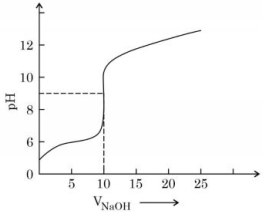
The titration curve of a weak acid vs. a strong base with phenolphthalein as an indicator is shown below. The $K_{In} = 4 \times 10^{-10}$. Given: $\log 2 = 0.3$. The number of the following statements which is/are correct about phenolphthalein is $.....$.
$A$. It can be used as an indicator for the titration of a weak acid with a weak base.
$B$. It begins to change colour at $pH = 8.4$.
$C$. It is a weak organic base.
$D$. It is colourless in an acidic medium.
$A$. It can be used as an indicator for the titration of a weak acid with a weak base.
$B$. It begins to change colour at $pH = 8.4$.
$C$. It is a weak organic base.
$D$. It is colourless in an acidic medium.
A
$1$
B
$2$
C
$3$
D
$4$
Solution
(B) $pK_{In} = -\log(4 \times 10^{-10}) = -(\log 4 + \log 10^{-10}) = -(0.6 - 10) = 9.4$.
The indicator range is given by $pK_{In} \pm 1$,which is $8.4$ to $10.4$.
Statement $A$: Incorrect. Phenolphthalein is not suitable for weak acid-weak base titrations because the pH change is not sharp enough.
Statement $B$: Correct. The colour change range starts at $pH = pK_{In} - 1 = 9.4 - 1 = 8.4$.
Statement $C$: Incorrect. Phenolphthalein is a weak organic acid $(HIn)$.
Statement $D$: Correct. In an acidic medium,the equilibrium $HIn \rightleftharpoons H^+ + In^-$ shifts to the left,keeping it in the unionized $HIn$ form,which is colourless.
Therefore,statements $B$ and $D$ are correct. The total number of correct statements is $2$.
The indicator range is given by $pK_{In} \pm 1$,which is $8.4$ to $10.4$.
Statement $A$: Incorrect. Phenolphthalein is not suitable for weak acid-weak base titrations because the pH change is not sharp enough.
Statement $B$: Correct. The colour change range starts at $pH = pK_{In} - 1 = 9.4 - 1 = 8.4$.
Statement $C$: Incorrect. Phenolphthalein is a weak organic acid $(HIn)$.
Statement $D$: Correct. In an acidic medium,the equilibrium $HIn \rightleftharpoons H^+ + In^-$ shifts to the left,keeping it in the unionized $HIn$ form,which is colourless.
Therefore,statements $B$ and $D$ are correct. The total number of correct statements is $2$.
0 likes
View Solution49
MediumMCQ
Given below are two statements :-
Statement $I$ :- Methyl orange is a weak acid.
Statement $II$ :- The benzenoid form of methyl orange is more intense/deeply coloured than the quinonoid form.
In the light of the above statements,choose the most appropriate answer from the options given below :-
Statement $I$ :- Methyl orange is a weak acid.
Statement $II$ :- The benzenoid form of methyl orange is more intense/deeply coloured than the quinonoid form.
In the light of the above statements,choose the most appropriate answer from the options given below :-
A
Statement $I$ is correct but Statement $II$ is incorrect.
B
Statement $I$ is incorrect but Statement $II$ is correct.
C
Both Statement $I$ and Statement $II$ are incorrect.
D
Both Statement $I$ and Statement $II$ are correct.
Solution
(C) Methyl orange is a weak base,not a weak acid. Therefore,Statement $I$ is $FALSE$.
The quinonoid form of methyl orange is red and is more intensely coloured than the benzenoid form,which is yellow. Therefore,Statement $II$ is $FALSE$.
Thus,both statements are incorrect.
The quinonoid form of methyl orange is red and is more intensely coloured than the benzenoid form,which is yellow. Therefore,Statement $II$ is $FALSE$.
Thus,both statements are incorrect.
0 likes
View Solution50
EasyMCQ
The different colours of litmus in acidic,neutral and basic solutions are,respectively.
A
red,orange and blue
B
blue,violet and red
C
red,colourless and blue
D
red,violet and blue
Solution
(D)
Litmus is a natural indicator extracted from lichens. In an acidic solution,it turns red. In a neutral solution,it retains its original purple/violet colour. In a basic solution,it turns blue.
| Medium | Colour of Litmus |
|---|---|
| Acidic | Red |
| Neutral | Violet |
| Basic | Blue |
Litmus is a natural indicator extracted from lichens. In an acidic solution,it turns red. In a neutral solution,it retains its original purple/violet colour. In a basic solution,it turns blue.
0 likes
View Solution6-2.Equilibrium-II (Ionic Equilibrium) — Acid and base indicators · Frequently Asked Questions
1Are these 6-2.Equilibrium-II (Ionic Equilibrium) questions useful for JEE and NEET?
Yes. All questions in this section are mapped to JEE Main and NEET exam patterns. Previous year questions from JEE Main, NEET, GUJCET and state-level exams are included with full solutions.
2Can I switch to Hindi or Gujarati for these questions?
Yes. Use the language tabs in the hero section or the sidebar to view the same questions and solutions in English, Hindi or Gujarati.
3How do I generate a question paper from this subtopic?
Use the Vedclass Exam Paper Generator — select the chapter and subtopic, set difficulty, and generate Sets A, B, C, D automatically. First 3 chapters of every subject are free.
Vedclass Products
For Students
Vedclass Test Series
Mock tests in real JEE/NEET style with performance analysis. 5-day free trial.
Start Free TrialFor Teachers
Exam Paper Generator
Generate Set A/B/C/D papers from this chapter in 2 minutes. 3 chapters free.
Try FreeFor Institutes
Online Exam Module
Live online exams with unlimited students, 360° analytics & white-label branding.
See DemoFor Teachers & Institutes
Generate a 6-2.Equilibrium-II (Ionic Equilibrium) Exam Paper in 2 Minutes
Select subtopic & difficulty — Sets A, B, C, D auto-generated with No Repeat logic.
First 3 chapters of every subject are free — no payment required.