
A English
Law of equilibrium and Equilibrium constant Questions in English
Class 11 Chemistry · 6-1.Equilibrium (Chemical Equilibrium) · Law of equilibrium and Equilibrium constant
228+
Questions
English
Language
100%
With Solutions
Showing 49 of 228 questions in English
151
Medium
For the reaction ${N_2}_{(g)} + 2{O_2}_{(g)} \rightleftharpoons 2{NO_2}_{(g)}$,the equilibrium constant is $100$. Find the equilibrium constant for the following reactions:
$(1)$ $2{NO_2}_{(g)} \rightleftharpoons {N_2}_{(g)} + 2{O_2}_{(g)}$
$(2)$ ${NO_2}_{(g)} \rightleftharpoons \frac{1}{2}{N_2}_{(g)} + {O_2}_{(g)}$
$(1)$ $2{NO_2}_{(g)} \rightleftharpoons {N_2}_{(g)} + 2{O_2}_{(g)}$
$(2)$ ${NO_2}_{(g)} \rightleftharpoons \frac{1}{2}{N_2}_{(g)} + {O_2}_{(g)}$
Solution
(N/A) Given reaction: ${N_2}_{(g)} + 2{O_2}_{(g)} \rightleftharpoons 2{NO_2}_{(g)}$,$K = 100$.
$(1)$ The reaction $2{NO_2}_{(g)} \rightleftharpoons {N_2}_{(g)} + 2{O_2}_{(g)}$ is the reverse of the given reaction.
Therefore,$K_1 = \frac{1}{K} = \frac{1}{100} = 0.01$.
$(2)$ The reaction ${NO_2}_{(g)} \rightleftharpoons \frac{1}{2}{N_2}_{(g)} + {O_2}_{(g)}$ is half of the reverse reaction.
Therefore,$K_2 = (K_1)^{1/2} = (0.01)^{1/2} = 0.1$.
$(1)$ The reaction $2{NO_2}_{(g)} \rightleftharpoons {N_2}_{(g)} + 2{O_2}_{(g)}$ is the reverse of the given reaction.
Therefore,$K_1 = \frac{1}{K} = \frac{1}{100} = 0.01$.
$(2)$ The reaction ${NO_2}_{(g)} \rightleftharpoons \frac{1}{2}{N_2}_{(g)} + {O_2}_{(g)}$ is half of the reverse reaction.
Therefore,$K_2 = (K_1)^{1/2} = (0.01)^{1/2} = 0.1$.
0 likes
View Solution152
Easy
The equilibrium constant of the following reaction is $0.5$. $CO_{(g)} + 2H_{2(g)} \rightleftharpoons CH_3OH_{(g)}$. At equilibrium,$[CO] = 0.18 \ mol \ L^{-1}$ and $[H_2] = 0.22 \ mol \ L^{-1}$. Calculate the concentration of $CH_3OH$.
Solution
The equilibrium constant expression for the reaction is $K_c = \frac{[CH_3OH]}{[CO][H_2]^2}$.
Given $K_c = 0.5$,$[CO] = 0.18 \ mol \ L^{-1}$,and $[H_2] = 0.22 \ mol \ L^{-1}$.
Substituting the values into the expression: $0.5 = \frac{[CH_3OH]}{(0.18)(0.22)^2}$.
$[CH_3OH] = 0.5 \times 0.18 \times (0.22)^2$.
$[CH_3OH] = 0.5 \times 0.18 \times 0.0484$.
$[CH_3OH] = 0.004356 \ mol \ L^{-1}$ or $4.356 \times 10^{-3} \ mol \ L^{-1}$.
Given $K_c = 0.5$,$[CO] = 0.18 \ mol \ L^{-1}$,and $[H_2] = 0.22 \ mol \ L^{-1}$.
Substituting the values into the expression: $0.5 = \frac{[CH_3OH]}{(0.18)(0.22)^2}$.
$[CH_3OH] = 0.5 \times 0.18 \times (0.22)^2$.
$[CH_3OH] = 0.5 \times 0.18 \times 0.0484$.
$[CH_3OH] = 0.004356 \ mol \ L^{-1}$ or $4.356 \times 10^{-3} \ mol \ L^{-1}$.
0 likes
View Solution153
MediumMCQ
If the reaction $H_{2(g)} + I_{2(g)} \rightleftharpoons 2HI_{(g)}$ at $720 \ K$ has $K = 48$,then for the reaction $2HI_{(g)} \rightleftharpoons H_{2(g)} + I_{2(g)}$,find its equilibrium constant.
A
$0.0208$
B
$48$
C
$2304$
D
$0.0416$
Solution
(A) For a reversible reaction,if the reaction is reversed,the new equilibrium constant $K'$ is the reciprocal of the original equilibrium constant $K$.
Given: $H_{2(g)} + I_{2(g)} \rightleftharpoons 2HI_{(g)}$,$K = 48$.
The reaction $2HI_{(g)} \rightleftharpoons H_{2(g)} + I_{2(g)}$ is the reverse of the given reaction.
Therefore,$K' = \frac{1}{K} = \frac{1}{48} \approx 0.0208$.
Given: $H_{2(g)} + I_{2(g)} \rightleftharpoons 2HI_{(g)}$,$K = 48$.
The reaction $2HI_{(g)} \rightleftharpoons H_{2(g)} + I_{2(g)}$ is the reverse of the given reaction.
Therefore,$K' = \frac{1}{K} = \frac{1}{48} \approx 0.0208$.
0 likes
View Solution154
MediumMCQ
At $400 \ K$ for the reaction $2NO_{2(g)} \rightleftharpoons N_{2}O_{4(g)}$,the concentration of $NO_{2}$ is $0.710 \ M$ and $N_{2}O_{4}$ is $0.145 \ M$. Find the equilibrium constant $K_{c}$. (in $M^{-1}$)
A
$0.287$
B
$0.350$
C
$0.204$
D
$0.412$
Solution
(A) The equilibrium constant expression for the reaction $2NO_{2(g)} \rightleftharpoons N_{2}O_{4(g)}$ is given by:
$K_{c} = \frac{[N_{2}O_{4}]}{[NO_{2}]^2}$
Given:
$[N_{2}O_{4}] = 0.145 \ M$
$[NO_{2}] = 0.710 \ M$
Substituting the values:
$K_{c} = \frac{0.145}{(0.710)^2}$
$K_{c} = \frac{0.145}{0.5041}$
$K_{c} \approx 0.2876 \ M^{-1}$
$K_{c} = \frac{[N_{2}O_{4}]}{[NO_{2}]^2}$
Given:
$[N_{2}O_{4}] = 0.145 \ M$
$[NO_{2}] = 0.710 \ M$
Substituting the values:
$K_{c} = \frac{0.145}{(0.710)^2}$
$K_{c} = \frac{0.145}{0.5041}$
$K_{c} \approx 0.2876 \ M^{-1}$
0 likes
View Solution155
Medium
Explain why pure liquids and solids can be ignored while writing the equilibrium constant expression?
Solution
(N/A) The molar concentration of a pure solid or liquid is constant,meaning it is independent of the amount present. For a substance '$X$',the values $[X_{(s)}]$ and $[X_{(l)}]$ remain constant regardless of the quantity taken.
$\therefore \text{Molarity} = \frac{\text{Number of moles}}{\text{Volume}} = \frac{\text{Mass} / \text{Molar mass}}{\text{Volume}} = \frac{\text{Density}}{\text{Molar mass}}$
Since density and molar mass are constant for a pure substance at a given temperature,the concentration is constant.
Because these values are constant,they are incorporated into the equilibrium constant ($K_c$ or $K_p$). Thus,they are omitted from the expression.
Example: $CaCO_{3(s)} \rightleftharpoons CaO_{(s)} + CO_{2(g)}$
The expression is $K_c = [CO_{2}]$.
Here,$[CaCO_{3(s)}]$ and $[CaO_{(s)}]$ are treated as $1$.
$\therefore \text{Molarity} = \frac{\text{Number of moles}}{\text{Volume}} = \frac{\text{Mass} / \text{Molar mass}}{\text{Volume}} = \frac{\text{Density}}{\text{Molar mass}}$
Since density and molar mass are constant for a pure substance at a given temperature,the concentration is constant.
Because these values are constant,they are incorporated into the equilibrium constant ($K_c$ or $K_p$). Thus,they are omitted from the expression.
Example: $CaCO_{3(s)} \rightleftharpoons CaO_{(s)} + CO_{2(g)}$
The expression is $K_c = [CO_{2}]$.
Here,$[CaCO_{3(s)}]$ and $[CaO_{(s)}]$ are treated as $1$.
0 likes
View Solution156
Medium
Give the equilibrium constant expression for the following reactions:
$(a)$ $Ni_{(s)} + 4CO_{(g)} \rightleftharpoons Ni(CO)_{4_{(g)}}$
$(b)$ $Ag_{2}O_{(s)} + 2HNO_{3_{(aq)}} \rightleftharpoons 2AgNO_{3_{(aq)}} + H_{2}O_{(l)}$
$(a)$ $Ni_{(s)} + 4CO_{(g)} \rightleftharpoons Ni(CO)_{4_{(g)}}$
$(b)$ $Ag_{2}O_{(s)} + 2HNO_{3_{(aq)}} \rightleftharpoons 2AgNO_{3_{(aq)}} + H_{2}O_{(l)}$
Solution
(N/A) For equilibrium constant expressions,the concentration of pure solids and pure liquids is taken as unity $(1)$ and is omitted from the expression.
$(a)$ For the reaction $Ni_{(s)} + 4CO_{(g)} \rightleftharpoons Ni(CO)_{4_{(g)}}$:
$K_{c} = \frac{[Ni(CO)_{4}]}{[CO]^{4}}$ and $K_{p} = \frac{p_{Ni(CO)_{4}}}{(p_{CO})^{4}}$
$(b)$ For the reaction $Ag_{2}O_{(s)} + 2HNO_{3_{(aq)}} \rightleftharpoons 2AgNO_{3_{(aq)}} + H_{2}O_{(l)}$:
Since $Ag_{2}O$ is a solid and $H_{2}O$ is a pure liquid,their concentrations are constant.
$K_{c} = \frac{[AgNO_{3}]^{2}}{[HNO_{3}]^{2}}$
$(a)$ For the reaction $Ni_{(s)} + 4CO_{(g)} \rightleftharpoons Ni(CO)_{4_{(g)}}$:
$K_{c} = \frac{[Ni(CO)_{4}]}{[CO]^{4}}$ and $K_{p} = \frac{p_{Ni(CO)_{4}}}{(p_{CO})^{4}}$
$(b)$ For the reaction $Ag_{2}O_{(s)} + 2HNO_{3_{(aq)}} \rightleftharpoons 2AgNO_{3_{(aq)}} + H_{2}O_{(l)}$:
Since $Ag_{2}O$ is a solid and $H_{2}O$ is a pure liquid,their concentrations are constant.
$K_{c} = \frac{[AgNO_{3}]^{2}}{[HNO_{3}]^{2}}$
0 likes
View Solution157
Medium
Write the applications of equilibrium constants.
Solution
(N/A) The equilibrium constant $(K)$ provides valuable information about a chemical reaction:
$1$. Predicting the extent of a reaction: If $K_c > 10^3$,the product predominates; if $K_c < 10^{-3}$,the reactant predominates; if $K_c$ is between $10^{-3}$ and $10^3$,both reactants and products are present in significant amounts.
$2$. Predicting the direction of the reaction: By comparing the reaction quotient $(Q_c)$ with the equilibrium constant $(K_c)$: if $Q_c < K_c$,the reaction proceeds in the forward direction; if $Q_c > K_c$,it proceeds in the reverse direction; if $Q_c = K_c$,the system is at equilibrium.
$3$. Calculating equilibrium concentrations: Given the initial concentrations and the value of $K_c$,the equilibrium concentrations of reactants and products can be calculated.
$1$. Predicting the extent of a reaction: If $K_c > 10^3$,the product predominates; if $K_c < 10^{-3}$,the reactant predominates; if $K_c$ is between $10^{-3}$ and $10^3$,both reactants and products are present in significant amounts.
$2$. Predicting the direction of the reaction: By comparing the reaction quotient $(Q_c)$ with the equilibrium constant $(K_c)$: if $Q_c < K_c$,the reaction proceeds in the forward direction; if $Q_c > K_c$,it proceeds in the reverse direction; if $Q_c = K_c$,the system is at equilibrium.
$3$. Calculating equilibrium concentrations: Given the initial concentrations and the value of $K_c$,the equilibrium concentrations of reactants and products can be calculated.
0 likes
View Solution158
Medium
Write the uses of equilibrium constant.
Solution
(N/A) The equilibrium constant $(K_c)$ is used for the following purposes:
$1$. Predicting the direction of the reaction: By calculating the reaction quotient $(Q_c)$,we can compare it with $K_c$. If $Q_c < K_c$,the reaction proceeds in the forward direction. If $Q_c > K_c$,the reaction proceeds in the reverse direction. If $Q_c = K_c$,the reaction is at equilibrium.
$2$. Calculating equilibrium concentrations: If the equilibrium constant and the initial concentrations of the reactants are known,the concentrations of all species at equilibrium can be calculated using the equilibrium expression.
$1$. Predicting the direction of the reaction: By calculating the reaction quotient $(Q_c)$,we can compare it with $K_c$. If $Q_c < K_c$,the reaction proceeds in the forward direction. If $Q_c > K_c$,the reaction proceeds in the reverse direction. If $Q_c = K_c$,the reaction is at equilibrium.
$2$. Calculating equilibrium concentrations: If the equilibrium constant and the initial concentrations of the reactants are known,the concentrations of all species at equilibrium can be calculated using the equilibrium expression.
0 likes
View Solution159
Difficult
Explain the use of the equilibrium constant to predict the extent of a reaction with an example.
Solution
(N/A) The numerical value of the equilibrium constant $(K_{c})$ for a reaction indicates the extent of the reaction,but it does not provide information about the rate of the reaction.
The magnitude of $K_{c}$ or $K_{p}$ is directly proportional to the concentrations of products and inversely proportional to the concentrations of the reactants. $A$ high value of $K$ indicates that the concentration of products is high,while a low value of $K$ indicates that the concentration of products is low.
Value of $K \propto \text{[Products]} \propto \frac{1}{\text{[Reactants]}}$
The following generalizations describe the composition of equilibrium mixtures:
$(a)$ If $K_{c} > 10^{3}$: Products predominate over reactants; i.e.,if $K_{c}$ is very large,the reaction proceeds nearly to completion. Examples:
$(i)$ The reaction $H_{2(g)} + \frac{1}{2} O_{2(g)} \rightleftharpoons H_{2}O_{(g)}$ at $500 \ K$ has a very large equilibrium constant,$K_{c} = 2.4 \times 10^{47}$.
$(ii)$ $H_{2(g)} + Cl_{2(g)} \rightleftharpoons 2 HCl_{(g)}$ at $300 \ K$ has a very large $K_{c} = 4.0 \times 10^{31}$.
$(iii)$ $H_{2(g)} + Br_{2(g)} \rightleftharpoons 2 HBr_{(g)}$ at $300 \ K$ has a very large $K_{c} = 5.4 \times 10^{18}$.
The magnitude of $K_{c}$ or $K_{p}$ is directly proportional to the concentrations of products and inversely proportional to the concentrations of the reactants. $A$ high value of $K$ indicates that the concentration of products is high,while a low value of $K$ indicates that the concentration of products is low.
Value of $K \propto \text{[Products]} \propto \frac{1}{\text{[Reactants]}}$
The following generalizations describe the composition of equilibrium mixtures:
$(a)$ If $K_{c} > 10^{3}$: Products predominate over reactants; i.e.,if $K_{c}$ is very large,the reaction proceeds nearly to completion. Examples:
$(i)$ The reaction $H_{2(g)} + \frac{1}{2} O_{2(g)} \rightleftharpoons H_{2}O_{(g)}$ at $500 \ K$ has a very large equilibrium constant,$K_{c} = 2.4 \times 10^{47}$.
$(ii)$ $H_{2(g)} + Cl_{2(g)} \rightleftharpoons 2 HCl_{(g)}$ at $300 \ K$ has a very large $K_{c} = 4.0 \times 10^{31}$.
$(iii)$ $H_{2(g)} + Br_{2(g)} \rightleftharpoons 2 HBr_{(g)}$ at $300 \ K$ has a very large $K_{c} = 5.4 \times 10^{18}$.
0 likes
View Solution160
Difficult
Explain the reaction quotient and how it is used to predict the direction of a reaction.
Solution
(N/A) The equilibrium constants $K_{c}$ and $K_{p}$ help in predicting the direction in which a given reaction will proceed at any stage.
For this,we calculate the reaction quotient $Q$ ($Q_{c}$ for molar concentrations and $Q_{p}$ for partial pressures).
It is defined in the same way as $K_{c}$,except that the concentrations in $Q_{c}$ are not necessarily equilibrium values.
For a general reaction: $aA + bB \rightleftharpoons cC + dD$
$Q_{c} = \frac{[C]^{c}[D]^{d}}{[A]^{a}[B]^{b}}$
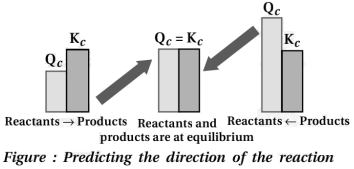
$(i)$ If $Q_{c} < K_{c}$,the reaction will proceed in the forward direction (towards products).
$(ii)$ If $Q_{c} > K_{c}$,the reaction will proceed in the reverse direction (towards reactants).
$(iii)$ If $Q_{c} = K_{c}$,the reaction mixture is at equilibrium.
Example: Consider the gaseous reaction $H_{2(g)} + I_{2(g)} \rightleftharpoons 2HI_{(g)}$,where $K_{c} = 57.0$ at $700 \ K$. If the concentrations at an arbitrary time $t$ are $[H_{2}]_{t} = 0.1 \ M$,$[I_{2}]_{t} = 0.2 \ M$,and $[HI]_{t} = 0.40 \ M$,then:
$Q_{c} = \frac{[HI]^{2}}{[H_{2}][I_{2}]} = \frac{(0.40)^{2}}{(0.1)(0.2)} = \frac{0.16}{0.02} = 8.0$
Since $Q_{c} < K_{c}$,the reaction will proceed in the forward direction to form more $HI$ until $Q_{c} = K_{c}$.
For this,we calculate the reaction quotient $Q$ ($Q_{c}$ for molar concentrations and $Q_{p}$ for partial pressures).
It is defined in the same way as $K_{c}$,except that the concentrations in $Q_{c}$ are not necessarily equilibrium values.
For a general reaction: $aA + bB \rightleftharpoons cC + dD$
$Q_{c} = \frac{[C]^{c}[D]^{d}}{[A]^{a}[B]^{b}}$
$(i)$ If $Q_{c} < K_{c}$,the reaction will proceed in the forward direction (towards products).
$(ii)$ If $Q_{c} > K_{c}$,the reaction will proceed in the reverse direction (towards reactants).
$(iii)$ If $Q_{c} = K_{c}$,the reaction mixture is at equilibrium.
Example: Consider the gaseous reaction $H_{2(g)} + I_{2(g)} \rightleftharpoons 2HI_{(g)}$,where $K_{c} = 57.0$ at $700 \ K$. If the concentrations at an arbitrary time $t$ are $[H_{2}]_{t} = 0.1 \ M$,$[I_{2}]_{t} = 0.2 \ M$,and $[HI]_{t} = 0.40 \ M$,then:
$Q_{c} = \frac{[HI]^{2}}{[H_{2}][I_{2}]} = \frac{(0.40)^{2}}{(0.1)(0.2)} = \frac{0.16}{0.02} = 8.0$
Since $Q_{c} < K_{c}$,the reaction will proceed in the forward direction to form more $HI$ until $Q_{c} = K_{c}$.
0 likes
View Solution161
Difficult
Explain the calculation of equilibrium concentrations given the value of the equilibrium constant.
Solution
(N/A) To calculate equilibrium concentrations when initial concentrations are known and the equilibrium constant $(K_c)$ is provided,follow these steps:
Step-$1$: Write the balanced chemical equation for the reaction.
Step-$2$: Create an $ICE$ (Initial,Change,Equilibrium) table under the balanced equation for each substance involved.
$(i)$ List the initial concentration.
$(ii)$ Define the change in concentration as $x$ (in $mol/L$) based on the stoichiometry of the reaction.
$(iii)$ Express the equilibrium concentration as the sum of the initial concentration and the change.
Step-$3$: Substitute these equilibrium concentrations into the equilibrium constant expression $(K_c)$ and solve the resulting algebraic equation for $x$. If a quadratic equation is obtained,select the root that is physically meaningful (i.e.,concentrations must be positive).
Step-$4$: Use the calculated value of $x$ to determine the actual equilibrium concentrations of all reactants and products.
Step-$5$: Verify the results by substituting the calculated equilibrium concentrations back into the $K_c$ expression to ensure they yield the given constant.
Step-$1$: Write the balanced chemical equation for the reaction.
Step-$2$: Create an $ICE$ (Initial,Change,Equilibrium) table under the balanced equation for each substance involved.
$(i)$ List the initial concentration.
$(ii)$ Define the change in concentration as $x$ (in $mol/L$) based on the stoichiometry of the reaction.
$(iii)$ Express the equilibrium concentration as the sum of the initial concentration and the change.
Step-$3$: Substitute these equilibrium concentrations into the equilibrium constant expression $(K_c)$ and solve the resulting algebraic equation for $x$. If a quadratic equation is obtained,select the root that is physically meaningful (i.e.,concentrations must be positive).
Step-$4$: Use the calculated value of $x$ to determine the actual equilibrium concentrations of all reactants and products.
Step-$5$: Verify the results by substituting the calculated equilibrium concentrations back into the $K_c$ expression to ensure they yield the given constant.
0 likes
View Solution162
DifficultMCQ
How is the direction of a reaction predicted?
A
By the value of $K$
B
By the value of $Q$
C
By the value of $\Delta G$
D
By the value of $\Delta G^o$
Solution
(B) The direction of a reaction is predicted by comparing the reaction quotient $Q_c$ with the equilibrium constant $K_c$.
$(i)$ If $Q_c < K_c$,the reaction proceeds in the forward direction.
$(ii)$ If $Q_c > K_c$,the reaction proceeds in the reverse direction.
$(iii)$ If $Q_c = K_c$,the reaction is at equilibrium.
Therefore,the value of $Q$ is used to predict the direction of the reaction.
$(i)$ If $Q_c < K_c$,the reaction proceeds in the forward direction.
$(ii)$ If $Q_c > K_c$,the reaction proceeds in the reverse direction.
$(iii)$ If $Q_c = K_c$,the reaction is at equilibrium.
Therefore,the value of $Q$ is used to predict the direction of the reaction.
0 likes
View Solution163
Medium
For the reaction $CO_{(g)} + 2H_{2_{(g)}} \rightleftharpoons CH_3OH_{(g)}$,the equilibrium constant $K_c$ is $0.5$. If the concentrations of $CO$ and $H_2$ at equilibrium are $0.18 \ M$ and $0.22 \ M$ respectively,what is the concentration of $CH_3OH$?
Solution
(D) The equilibrium constant expression for the reaction is $K_c = \frac{[CH_3OH]}{[CO][H_2]^2}$.
Given $K_c = 0.5$,$[CO] = 0.18 \ M$,and $[H_2] = 0.22 \ M$.
Substituting the values: $0.5 = \frac{[CH_3OH]}{(0.18)(0.22)^2}$.
$[CH_3OH] = 0.5 \times 0.18 \times 0.0484$.
$[CH_3OH] = 0.004356 \ M$ or $4.356 \times 10^{-3} \ M$.
Given $K_c = 0.5$,$[CO] = 0.18 \ M$,and $[H_2] = 0.22 \ M$.
Substituting the values: $0.5 = \frac{[CH_3OH]}{(0.18)(0.22)^2}$.
$[CH_3OH] = 0.5 \times 0.18 \times 0.0484$.
$[CH_3OH] = 0.004356 \ M$ or $4.356 \times 10^{-3} \ M$.
0 likes
View Solution164
Medium
At a definite temperature,the $K_c$ of the following reaction is $0.18$: $PCl_{5(g)} \rightleftharpoons PCl_{3(g)} + Cl_{2(g)}$. In a reaction mixture at the same temperature,$[PCl_3] = 0.042 \ M$,$[Cl_2] = 0.024 \ M$,and $[PCl_5] = 0.005 \ M$. Is this reaction in equilibrium? In which direction will the reaction proceed?
Solution
(N/A) The reaction quotient $Q_c$ is calculated as: $Q_c = \frac{[PCl_3][Cl_2]}{[PCl_5]} = \frac{0.042 \times 0.024}{0.005} = 0.2016$.
Since $Q_c = 0.2016$ and $K_c = 0.18$,we observe that $Q_c > K_c$.
Because $Q_c > K_c$,the reaction is not in equilibrium.
To reach equilibrium,the reaction will proceed in the reverse direction (towards the reactants) to decrease the value of $Q_c$ until it equals $K_c$.
Since $Q_c = 0.2016$ and $K_c = 0.18$,we observe that $Q_c > K_c$.
Because $Q_c > K_c$,the reaction is not in equilibrium.
To reach equilibrium,the reaction will proceed in the reverse direction (towards the reactants) to decrease the value of $Q_c$ until it equals $K_c$.
0 likes
View Solution165
Medium
At $298 \ K$,the $K_c$ of the reaction $Cu(s) + 2Ag^+(aq) \rightleftharpoons Cu^{2+}(aq) + 2Ag(s)$ is $3.0 \times 10^{14}$. In a reaction mixture at a certain temperature,$[Cu^{2+}] = 1.8 \times 10^{-2} \ M$ and $[Ag^+] = 3.0 \times 10^{-9} \ M$. Is this reaction in equilibrium? In which direction will the reaction proceed?
Solution
(B) The reaction quotient $Q_c$ is calculated as: $Q_c = \frac{[Cu^{2+}]}{[Ag^+]^2} = \frac{1.8 \times 10^{-2}}{(3.0 \times 10^{-9})^2} = \frac{1.8 \times 10^{-2}}{9.0 \times 10^{-18}} = 2.0 \times 10^{15}$.
Since $Q_c = 2.0 \times 10^{15}$ and $K_c = 3.0 \times 10^{14}$,we observe that $Q_c > K_c$.
Because $Q_c > K_c$,the reaction is not in equilibrium.
Since $Q_c > K_c$,the reaction will proceed in the reverse direction to reach equilibrium.
Since $Q_c = 2.0 \times 10^{15}$ and $K_c = 3.0 \times 10^{14}$,we observe that $Q_c > K_c$.
Because $Q_c > K_c$,the reaction is not in equilibrium.
Since $Q_c > K_c$,the reaction will proceed in the reverse direction to reach equilibrium.
0 likes
View Solution166
MediumMCQ
If the equilibrium constant for the reaction ${N_2}_{(g)} + {O_2}_{(g)} \rightleftharpoons 2NO_{(g)}$ is $K$,then what is the equilibrium constant for the reaction $\frac{1}{2}{N_2}_{(g)} + \frac{1}{2}{O_2}_{(g)} \rightleftharpoons NO_{(g)}$?
A
$K$
B
$K^2$
C
$K^{1/2}$
D
$1/K$
Solution
(C) For the reaction ${N_2}_{(g)} + {O_2}_{(g)} \rightleftharpoons 2NO_{(g)}$,the equilibrium constant is $K = \frac{[NO]^2}{[N_2][O_2]}$.
For the reaction $\frac{1}{2}{N_2}_{(g)} + \frac{1}{2}{O_2}_{(g)} \rightleftharpoons NO_{(g)}$,the equilibrium constant is $K' = \frac{[NO]}{[N_2]^{1/2}[O_2]^{1/2}}$.
Comparing the two expressions,we see that $K' = (K)^{1/2}$ or $\sqrt{K}$.
For the reaction $\frac{1}{2}{N_2}_{(g)} + \frac{1}{2}{O_2}_{(g)} \rightleftharpoons NO_{(g)}$,the equilibrium constant is $K' = \frac{[NO]}{[N_2]^{1/2}[O_2]^{1/2}}$.
Comparing the two expressions,we see that $K' = (K)^{1/2}$ or $\sqrt{K}$.
0 likes
View Solution167
Medium
How can you predict the direction of a reaction by comparing the values of the equilibrium constant $K_{c}$ and the reaction quotient $Q_{c}$?
$(i)$ Net reaction proceeds in the forward direction,
$(ii)$ Net reaction proceeds in the backward direction,
$(iii)$ No net reaction occurs.
$(i)$ Net reaction proceeds in the forward direction,
$(ii)$ Net reaction proceeds in the backward direction,
$(iii)$ No net reaction occurs.
Solution
(N/A) The direction of a reaction can be predicted by comparing the reaction quotient $Q_{c}$ with the equilibrium constant $K_{c}$:
$(i)$ If $Q_{c} < K_{c}$,the reaction proceeds in the forward direction (towards products).
$(ii)$ If $Q_{c} > K_{c}$,the reaction proceeds in the backward direction (towards reactants).
$(iii)$ If $Q_{c} = K_{c}$,the reaction is at equilibrium,and no net reaction occurs.
$(i)$ If $Q_{c} < K_{c}$,the reaction proceeds in the forward direction (towards products).
$(ii)$ If $Q_{c} > K_{c}$,the reaction proceeds in the backward direction (towards reactants).
$(iii)$ If $Q_{c} = K_{c}$,the reaction is at equilibrium,and no net reaction occurs.
0 likes
View Solution168
Medium
Write the expressions for $K_{P}$ and $K_{C}$ for the reaction: $3Fe_{(s)} + 4H_2O_{(g)} \rightleftharpoons Fe_3O_{4(s)} + 4H_{2(g)}$.
Solution
(N/A) For the given reaction: $3Fe_{(s)} + 4H_2O_{(g)} \rightleftharpoons Fe_3O_{4(s)} + 4H_{2(g)}$.
$1$. The expression for $K_{C}$ is given by the ratio of the molar concentrations of products to reactants,raised to the power of their stoichiometric coefficients. Pure solids are excluded from the expression as their activity is taken as $1$.
$K_{C} = \frac{[H_2]^4}{[H_2O]^4}$
$2$. The expression for $K_{P}$ is given by the ratio of the partial pressures of gaseous products to gaseous reactants,raised to the power of their stoichiometric coefficients.
$K_{P} = \frac{(P_{H_2})^4}{(P_{H_2O})^4}$
$1$. The expression for $K_{C}$ is given by the ratio of the molar concentrations of products to reactants,raised to the power of their stoichiometric coefficients. Pure solids are excluded from the expression as their activity is taken as $1$.
$K_{C} = \frac{[H_2]^4}{[H_2O]^4}$
$2$. The expression for $K_{P}$ is given by the ratio of the partial pressures of gaseous products to gaseous reactants,raised to the power of their stoichiometric coefficients.
$K_{P} = \frac{(P_{H_2})^4}{(P_{H_2O})^4}$
0 likes
View Solution169
Difficult
For the reaction ${N_2(g) + 3H_2(g) \rightleftharpoons 2NH_3(g)}$,the equilibrium constant ${K_p = 35}$ at a given temperature. Calculate the values of ${K_p}$ for the following reactions at the same temperature:
$(i) \ 2NH_3(g) \rightleftharpoons N_2(g) + 3H_2(g)$
$(ii) \ \frac{1}{2}N_2(g) + \frac{3}{2}H_2(g) \rightleftharpoons NH_3(g)$
$(i) \ 2NH_3(g) \rightleftharpoons N_2(g) + 3H_2(g)$
$(ii) \ \frac{1}{2}N_2(g) + \frac{3}{2}H_2(g) \rightleftharpoons NH_3(g)$
Solution
(A) Given reaction: ${N_2(g) + 3H_2(g) \rightleftharpoons 2NH_3(g)}$ with ${K_p = 35}$.
$(i)$ For the reaction ${2NH_3(g) \rightleftharpoons N_2(g) + 3H_2(g)}$,this is the reverse of the given reaction. Therefore,${K_{p1} = \frac{1}{K_p} = \frac{1}{35} \approx 0.0286}$.
$(ii)$ For the reaction ${\frac{1}{2}N_2(g) + \frac{3}{2}H_2(g) \rightleftharpoons NH_3(g)}$,this is the original reaction multiplied by a factor of $\frac{1}{2}$. Therefore,${K_{p2} = (K_p)^{1/2} = \sqrt{35} \approx 5.916}$.
$(i)$ For the reaction ${2NH_3(g) \rightleftharpoons N_2(g) + 3H_2(g)}$,this is the reverse of the given reaction. Therefore,${K_{p1} = \frac{1}{K_p} = \frac{1}{35} \approx 0.0286}$.
$(ii)$ For the reaction ${\frac{1}{2}N_2(g) + \frac{3}{2}H_2(g) \rightleftharpoons NH_3(g)}$,this is the original reaction multiplied by a factor of $\frac{1}{2}$. Therefore,${K_{p2} = (K_p)^{1/2} = \sqrt{35} \approx 5.916}$.
0 likes
View Solution170
MediumMCQ
If the equilibrium constant for $A \rightleftharpoons B + C$ is $K_{eq}^{(1)}$ and that of $B + C \rightleftharpoons P$ is $K_{eq}^{(2)}$,the equilibrium constant for $A \rightleftharpoons P$ is :-
A
$K_{eq}^{(2)} - K_{eq}^{(1)}$
B
$K_{eq}^{(1)} \times K_{eq}^{(2)}$
C
$K_{eq}^{(1)} / K_{eq}^{(2)}$
D
$K_{eq}^{(1)} + K_{eq}^{(2)}$
Solution
(B) For the first reaction: $A \rightleftharpoons B + C$,$K_{eq}^{(1)} = \frac{[B][C]}{[A]}$ $(1)$
For the second reaction: $B + C \rightleftharpoons P$,$K_{eq}^{(2)} = \frac{[P]}{[B][C]}$ $(2)$
For the overall reaction: $A \rightleftharpoons P$,the equilibrium constant $K_{eq} = \frac{[P]}{[A]}$
Multiplying equation $(1)$ and $(2)$:
$K_{eq}^{(1)} \times K_{eq}^{(2)} = \frac{[B][C]}{[A]} \times \frac{[P]}{[B][C]} = \frac{[P]}{[A]} = K_{eq}$
Therefore,$K_{eq} = K_{eq}^{(1)} \times K_{eq}^{(2)}$.
For the second reaction: $B + C \rightleftharpoons P$,$K_{eq}^{(2)} = \frac{[P]}{[B][C]}$ $(2)$
For the overall reaction: $A \rightleftharpoons P$,the equilibrium constant $K_{eq} = \frac{[P]}{[A]}$
Multiplying equation $(1)$ and $(2)$:
$K_{eq}^{(1)} \times K_{eq}^{(2)} = \frac{[B][C]}{[A]} \times \frac{[P]}{[B][C]} = \frac{[P]}{[A]} = K_{eq}$
Therefore,$K_{eq} = K_{eq}^{(1)} \times K_{eq}^{(2)}$.
0 likes
View Solution171
MediumMCQ
The value of $K_{C}$ is $64$ at $800 \ K$ for the reaction $N_{2(g)} + 3H_{2(g)} \rightleftharpoons 2NH_{3(g)}$.
The value of $K_{C}$ for the following reaction is:
$NH_{3(g)} \rightleftharpoons \frac{1}{2}N_{2(g)} + \frac{3}{2}H_{2(g)}$
The value of $K_{C}$ for the following reaction is:
$NH_{3(g)} \rightleftharpoons \frac{1}{2}N_{2(g)} + \frac{3}{2}H_{2(g)}$
A
$1/4$
B
$1/8$
C
$8$
D
$1/64$
Solution
(B) For the reaction $N_{2(g)} + 3H_{2(g)} \rightleftharpoons 2NH_{3(g)}$,the equilibrium constant is $K_{C} = 64$.
When the reaction is reversed,the new equilibrium constant becomes $K'_{C} = \frac{1}{K_{C}} = \frac{1}{64}$.
When the reaction is multiplied by a factor of $\frac{1}{2}$,the new equilibrium constant becomes $K''_{C} = (K'_{C})^{1/2} = \left(\frac{1}{64}\right)^{1/2} = \frac{1}{8}$.
When the reaction is reversed,the new equilibrium constant becomes $K'_{C} = \frac{1}{K_{C}} = \frac{1}{64}$.
When the reaction is multiplied by a factor of $\frac{1}{2}$,the new equilibrium constant becomes $K''_{C} = (K'_{C})^{1/2} = \left(\frac{1}{64}\right)^{1/2} = \frac{1}{8}$.
0 likes
View Solution172
MediumMCQ
The equilibrium constant $K_{c}$ at $298 \ K$ for the reaction $A + B \rightleftharpoons C + D$ is $100$. Starting with an equimolar solution with concentrations of $A$,$B$,$C$ and $D$ all equal to $1 \ M$,the equilibrium concentration of $D$ is $....... \times 10^{-2} \ M$. (Nearest integer)
A
$18$
B
$182$
C
$45$
D
$18200$
Solution
(B) The reaction is $A + B \rightleftharpoons C + D$ with $K_{eq} = 100$.
Initial concentrations are $[A] = 1 \ M, [B] = 1 \ M, [C] = 1 \ M, [D] = 1 \ M$.
Calculate the reaction quotient $Q_{c} = \frac{[C][D]}{[A][B]} = \frac{1 \times 1}{1 \times 1} = 1$.
Since $Q_{c} < K_{eq}$,the reaction proceeds in the forward direction.
Let $x$ be the change in concentration at equilibrium:
$[A] = 1-x, [B] = 1-x, [C] = 1+x, [D] = 1+x$.
$K_{eq} = \frac{(1+x)(1+x)}{(1-x)(1-x)} = 100$.
Taking the square root: $\frac{1+x}{1-x} = 10$.
$1+x = 10 - 10x$ $\Rightarrow 11x = 9$ $\Rightarrow x = \frac{9}{11} \approx 0.818$.
Equilibrium concentration of $D = 1 + x = 1 + \frac{9}{11} = \frac{20}{11} \approx 1.8181 \ M$.
Expressing in terms of $10^{-2} \ M$: $1.8181 \times 10^{0} = 181.81 \times 10^{-2} \ M$.
Rounding to the nearest integer,we get $182 \times 10^{-2} \ M$.
Initial concentrations are $[A] = 1 \ M, [B] = 1 \ M, [C] = 1 \ M, [D] = 1 \ M$.
Calculate the reaction quotient $Q_{c} = \frac{[C][D]}{[A][B]} = \frac{1 \times 1}{1 \times 1} = 1$.
Since $Q_{c} < K_{eq}$,the reaction proceeds in the forward direction.
Let $x$ be the change in concentration at equilibrium:
$[A] = 1-x, [B] = 1-x, [C] = 1+x, [D] = 1+x$.
$K_{eq} = \frac{(1+x)(1+x)}{(1-x)(1-x)} = 100$.
Taking the square root: $\frac{1+x}{1-x} = 10$.
$1+x = 10 - 10x$ $\Rightarrow 11x = 9$ $\Rightarrow x = \frac{9}{11} \approx 0.818$.
Equilibrium concentration of $D = 1 + x = 1 + \frac{9}{11} = \frac{20}{11} \approx 1.8181 \ M$.
Expressing in terms of $10^{-2} \ M$: $1.8181 \times 10^{0} = 181.81 \times 10^{-2} \ M$.
Rounding to the nearest integer,we get $182 \times 10^{-2} \ M$.
0 likes
View Solution173
MediumMCQ
$3 O_{2(g)} \rightleftharpoons 2 O_{3(g)}$
For the above reaction at $298 \ K$,$K_c$ is found to be $3.0 \times 10^{-59}$. If the concentration of $O_2$ at equilibrium is $0.040 \ M$,then the concentration of $O_3$ in $M$ is ...... .
For the above reaction at $298 \ K$,$K_c$ is found to be $3.0 \times 10^{-59}$. If the concentration of $O_2$ at equilibrium is $0.040 \ M$,then the concentration of $O_3$ in $M$ is ...... .
A
$1.9 \times 10^{-63}$
B
$2.4 \times 10^{31}$
C
$1.2 \times 10^{21}$
D
$4.38 \times 10^{-32}$
Solution
(D) The equilibrium constant expression for the reaction $3 O_{2(g)} \rightleftharpoons 2 O_{3(g)}$ is given by $K_c = \frac{[O_3]^2}{[O_2]^3}$.
Given $K_c = 3.0 \times 10^{-59}$ and $[O_2] = 0.040 \ M = 4 \times 10^{-2} \ M$.
Substituting the values into the expression:
$3.0 \times 10^{-59} = \frac{[O_3]^2}{(4 \times 10^{-2})^3}$
$[O_3]^2 = 3.0 \times 10^{-59} \times (64 \times 10^{-6})$
$[O_3]^2 = 192 \times 10^{-65} = 1.92 \times 10^{-63}$
$[O_3] = \sqrt{1.92 \times 10^{-63}} = \sqrt{19.2 \times 10^{-64}} \approx 4.38 \times 10^{-32} \ M$.
Given $K_c = 3.0 \times 10^{-59}$ and $[O_2] = 0.040 \ M = 4 \times 10^{-2} \ M$.
Substituting the values into the expression:
$3.0 \times 10^{-59} = \frac{[O_3]^2}{(4 \times 10^{-2})^3}$
$[O_3]^2 = 3.0 \times 10^{-59} \times (64 \times 10^{-6})$
$[O_3]^2 = 192 \times 10^{-65} = 1.92 \times 10^{-63}$
$[O_3] = \sqrt{1.92 \times 10^{-63}} = \sqrt{19.2 \times 10^{-64}} \approx 4.38 \times 10^{-32} \ M$.
1 likes
View Solution174
DifficultMCQ
$2 NOCl_{(g)} \rightleftharpoons 2 NO_{(g)} + Cl_{2(g)}$
In an experiment,$2.0 \ mol$ of $NOCl$ was placed in a $1 \ L$ flask and the concentration of $NO$ after equilibrium was established,was found to be $0.4 \ mol/L$. The equilibrium constant at $30^{\circ} C$ is $....... \times 10^{-4}$.
In an experiment,$2.0 \ mol$ of $NOCl$ was placed in a $1 \ L$ flask and the concentration of $NO$ after equilibrium was established,was found to be $0.4 \ mol/L$. The equilibrium constant at $30^{\circ} C$ is $....... \times 10^{-4}$.
A
$150$
B
$125$
C
$175$
D
$25$
Solution
(B) The reaction is: $2 NOCl_{(g)} \rightleftharpoons 2 NO_{(g)} + Cl_{2(g)}$
Initial concentration: $[NOCl] = 2.0 \ M$,$[NO] = 0 \ M$,$[Cl_2] = 0 \ M$
At equilibrium: $[NOCl] = (2 - x) \ M$,$[NO] = x \ M$,$[Cl_2] = \frac{x}{2} \ M$
Given that at equilibrium,$[NO] = 0.4 \ M$,so $x = 0.4 \ M$.
Therefore,$[NOCl]_{eq} = 2 - 0.4 = 1.6 \ M$ and $[Cl_2]_{eq} = \frac{0.4}{2} = 0.2 \ M$.
The equilibrium constant $K_c$ is given by:
$K_c = \frac{[NO]^2 [Cl_2]}{[NOCl]^2} = \frac{(0.4)^2 \times (0.2)}{(1.6)^2}$
$K_c = \frac{0.16 \times 0.2}{2.56} = \frac{0.032}{2.56} = 0.0125$
$K_c = 125 \times 10^{-4}$
Initial concentration: $[NOCl] = 2.0 \ M$,$[NO] = 0 \ M$,$[Cl_2] = 0 \ M$
At equilibrium: $[NOCl] = (2 - x) \ M$,$[NO] = x \ M$,$[Cl_2] = \frac{x}{2} \ M$
Given that at equilibrium,$[NO] = 0.4 \ M$,so $x = 0.4 \ M$.
Therefore,$[NOCl]_{eq} = 2 - 0.4 = 1.6 \ M$ and $[Cl_2]_{eq} = \frac{0.4}{2} = 0.2 \ M$.
The equilibrium constant $K_c$ is given by:
$K_c = \frac{[NO]^2 [Cl_2]}{[NOCl]^2} = \frac{(0.4)^2 \times (0.2)}{(1.6)^2}$
$K_c = \frac{0.16 \times 0.2}{2.56} = \frac{0.032}{2.56} = 0.0125$
$K_c = 125 \times 10^{-4}$
0 likes
View Solution175
DifficultMCQ
$K_{a_1}, K_{a_2}$ and $K_{a_3}$ are the respective ionization constants for the following reactions $(a), (b),$ and $(c)$.
$(a)$ $H_2C_2O_4 \rightleftharpoons H^{+} + HC_2O_4^-$
$(b)$ $HC_2O_4^- \rightleftharpoons H^{+} + C_2O_4^{2-}$
$(c)$ $H_2C_2O_4 \rightleftharpoons 2H^{+} + C_2O_4^{2-}$
The relationship between $K_{a_1}, K_{a_2}$ and $K_{a_3}$ is given as
$(a)$ $H_2C_2O_4 \rightleftharpoons H^{+} + HC_2O_4^-$
$(b)$ $HC_2O_4^- \rightleftharpoons H^{+} + C_2O_4^{2-}$
$(c)$ $H_2C_2O_4 \rightleftharpoons 2H^{+} + C_2O_4^{2-}$
The relationship between $K_{a_1}, K_{a_2}$ and $K_{a_3}$ is given as
A
$K_{a_3} = K_{a_1} + K_{a_2}$
B
$K_{a_3} = K_{a_1} - K_{a_2}$
C
$K_{a_1} = K_{a_3} / K_{a_2}$
D
$K_{a_3} = K_{a_1} \times K_{a_2}$
Solution
(D) The ionization constant for reaction $(a)$ is $K_{a_1} = \frac{[H^{+}][HC_2O_4^-]}{[H_2C_2O_4]}$.
The ionization constant for reaction $(b)$ is $K_{a_2} = \frac{[H^{+}][C_2O_4^{2-}]}{[HC_2O_4^-]}$.
The reaction $(c)$ is the sum of reactions $(a)$ and $(b)$.
For reaction $(c)$,the equilibrium constant $K_{a_3} = \frac{[H^{+}]^2[C_2O_4^{2-}]}{[H_2C_2O_4]}$.
Multiplying $K_{a_1}$ and $K_{a_2}$ gives: $K_{a_1} \times K_{a_2} = \frac{[H^{+}][HC_2O_4^-]}{[H_2C_2O_4]} \times \frac{[H^{+}][C_2O_4^{2-}]}{[HC_2O_4^-]} = \frac{[H^{+}]^2[C_2O_4^{2-}]}{[H_2C_2O_4]} = K_{a_3}$.
Thus,$K_{a_3} = K_{a_1} \times K_{a_2}$.
The ionization constant for reaction $(b)$ is $K_{a_2} = \frac{[H^{+}][C_2O_4^{2-}]}{[HC_2O_4^-]}$.
The reaction $(c)$ is the sum of reactions $(a)$ and $(b)$.
For reaction $(c)$,the equilibrium constant $K_{a_3} = \frac{[H^{+}]^2[C_2O_4^{2-}]}{[H_2C_2O_4]}$.
Multiplying $K_{a_1}$ and $K_{a_2}$ gives: $K_{a_1} \times K_{a_2} = \frac{[H^{+}][HC_2O_4^-]}{[H_2C_2O_4]} \times \frac{[H^{+}][C_2O_4^{2-}]}{[HC_2O_4^-]} = \frac{[H^{+}]^2[C_2O_4^{2-}]}{[H_2C_2O_4]} = K_{a_3}$.
Thus,$K_{a_3} = K_{a_1} \times K_{a_2}$.
0 likes
View Solution176
MediumMCQ
The equilibrium constant $K_C$ of the reaction,$2 A \rightleftharpoons B + C$ is $0.5$ at $25^{\circ} C$. The reaction will proceed in the backward direction,when concentrations $[A], [B]$ and $[C]$ are,respectively:
A
$[A] = 10^{-3} \, M, [B] = 10^{-2} \, M, [C] = 10^{-2} \, M$
B
$[A] = 10^{-1} \, M, [B] = 10^{2} \, M, [C] = 10^{2} \, M$
C
$[A] = 10^{-2} \, M, [B] = 10^{-2} \, M, [C] = 10^{-3} \, M$
D
$[A] = 10^{-2} \, M, [B] = 10^{-3} \, M, [C] = 10^{-3} \, M$
Solution
(A) For the reaction,$2 A \rightleftharpoons B + C$,the reaction quotient is given by $Q_C = \frac{[B][C]}{[A]^2}$.
Given,$K_C = 0.5$.
The reaction proceeds in the backward direction if $Q_C > K_C$.
Let us calculate $Q_C$ for each option:
$(A)$ $Q_C = \frac{(10^{-2})(10^{-2})}{(10^{-3})^2} = \frac{10^{-4}}{10^{-6}} = 100$. Since $100 > 0.5$,the reaction proceeds in the backward direction.
$(B)$ $Q_C = \frac{(10^2)(10^2)}{(10^{-1})^2} = \frac{10^4}{10^{-2}} = 10^6$. Since $10^6 > 0.5$,the reaction proceeds in the backward direction. (Note: Option $A$ is the standard intended answer for this problem type).
$(C)$ $Q_C = \frac{(10^{-2})(10^{-3})}{(10^{-2})^2} = \frac{10^{-5}}{10^{-4}} = 0.1$. Since $0.1 < 0.5$,the reaction proceeds in the forward direction.
$(D)$ $Q_C = \frac{(10^{-3})(10^{-3})}{(10^{-2})^2} = \frac{10^{-6}}{10^{-4}} = 0.01$. Since $0.01 < 0.5$,the reaction proceeds in the forward direction.
Thus,option $A$ is the correct choice.
Given,$K_C = 0.5$.
The reaction proceeds in the backward direction if $Q_C > K_C$.
Let us calculate $Q_C$ for each option:
$(A)$ $Q_C = \frac{(10^{-2})(10^{-2})}{(10^{-3})^2} = \frac{10^{-4}}{10^{-6}} = 100$. Since $100 > 0.5$,the reaction proceeds in the backward direction.
$(B)$ $Q_C = \frac{(10^2)(10^2)}{(10^{-1})^2} = \frac{10^4}{10^{-2}} = 10^6$. Since $10^6 > 0.5$,the reaction proceeds in the backward direction. (Note: Option $A$ is the standard intended answer for this problem type).
$(C)$ $Q_C = \frac{(10^{-2})(10^{-3})}{(10^{-2})^2} = \frac{10^{-5}}{10^{-4}} = 0.1$. Since $0.1 < 0.5$,the reaction proceeds in the forward direction.
$(D)$ $Q_C = \frac{(10^{-3})(10^{-3})}{(10^{-2})^2} = \frac{10^{-6}}{10^{-4}} = 0.01$. Since $0.01 < 0.5$,the reaction proceeds in the forward direction.
Thus,option $A$ is the correct choice.
0 likes
View Solution177
MediumMCQ
From equations $1$ and $2$,
$CO_2 \rightleftharpoons CO + \frac{1}{2} O_2 \, [K_{C_1} = 9.1 \times 10^{-12} \, \text{at} \, 1000^{\circ} C] \, \text{(Eq. } i\text{)}$
$H_2O \rightleftharpoons H_2 + \frac{1}{2} O_2 \, [K_{C_2} = 7.1 \times 10^{-12} \, \text{at} \, 1000^{\circ} C] \, \text{(Eq. } ii\text{)}$
The equilibrium constant for the reaction,$CO_2 + H_2 \rightleftharpoons CO + H_2O$ at the same temperature,is
$CO_2 \rightleftharpoons CO + \frac{1}{2} O_2 \, [K_{C_1} = 9.1 \times 10^{-12} \, \text{at} \, 1000^{\circ} C] \, \text{(Eq. } i\text{)}$
$H_2O \rightleftharpoons H_2 + \frac{1}{2} O_2 \, [K_{C_2} = 7.1 \times 10^{-12} \, \text{at} \, 1000^{\circ} C] \, \text{(Eq. } ii\text{)}$
The equilibrium constant for the reaction,$CO_2 + H_2 \rightleftharpoons CO + H_2O$ at the same temperature,is
A
$0.78$
B
$2.0$
C
$16.2$
D
$1.28$
Solution
(D) The given reactions are:
$(i) \, CO_2 \rightleftharpoons CO + \frac{1}{2} O_2, \, K_{C_1} = 9.1 \times 10^{-12}$
$(ii) \, H_2O \rightleftharpoons H_2 + \frac{1}{2} O_2, \, K_{C_2} = 7.1 \times 10^{-12}$
We want to find the equilibrium constant $K$ for the reaction:
$CO_2 + H_2 \rightleftharpoons CO + H_2O \quad (iii)$
To obtain reaction $(iii)$,we reverse reaction $(ii)$ and add it to reaction $(i)$:
Reverse of $(ii): \, H_2 + \frac{1}{2} O_2 \rightleftharpoons H_2O, \, K_{C_3} = \frac{1}{K_{C_2}} = \frac{1}{7.1 \times 10^{-12}}$
Adding $(i)$ and reversed $(ii)$:
$CO_2 + H_2 + \frac{1}{2} O_2 \rightleftharpoons CO + \frac{1}{2} O_2 + H_2O$
$CO_2 + H_2 \rightleftharpoons CO + H_2O$
The equilibrium constant $K$ is given by $K = K_{C_1} \times \frac{1}{K_{C_2}} = \frac{9.1 \times 10^{-12}}{7.1 \times 10^{-12}} = 1.28$.
$(i) \, CO_2 \rightleftharpoons CO + \frac{1}{2} O_2, \, K_{C_1} = 9.1 \times 10^{-12}$
$(ii) \, H_2O \rightleftharpoons H_2 + \frac{1}{2} O_2, \, K_{C_2} = 7.1 \times 10^{-12}$
We want to find the equilibrium constant $K$ for the reaction:
$CO_2 + H_2 \rightleftharpoons CO + H_2O \quad (iii)$
To obtain reaction $(iii)$,we reverse reaction $(ii)$ and add it to reaction $(i)$:
Reverse of $(ii): \, H_2 + \frac{1}{2} O_2 \rightleftharpoons H_2O, \, K_{C_3} = \frac{1}{K_{C_2}} = \frac{1}{7.1 \times 10^{-12}}$
Adding $(i)$ and reversed $(ii)$:
$CO_2 + H_2 + \frac{1}{2} O_2 \rightleftharpoons CO + \frac{1}{2} O_2 + H_2O$
$CO_2 + H_2 \rightleftharpoons CO + H_2O$
The equilibrium constant $K$ is given by $K = K_{C_1} \times \frac{1}{K_{C_2}} = \frac{9.1 \times 10^{-12}}{7.1 \times 10^{-12}} = 1.28$.
0 likes
View Solution178
MediumMCQ
The equilibrium constant for the reaction,$N_2 + 3H_2 \rightleftharpoons 2NH_3$ at $400 \ K$ is $41$. The equilibrium constant for the reaction,$\frac{1}{2} N_2 + \frac{3}{2} H_2 \rightleftharpoons NH_3$ at the same temperature will be closest to
A
$41$
B
$20.5$
C
$6.4$
D
$1681$
Solution
(C) Given the reaction: $N_2 + 3H_2 \rightleftharpoons 2NH_3$ with $K_C = 41 \dots (i)$
For the reaction: $\frac{1}{2} N_2 + \frac{3}{2} H_2 \rightleftharpoons NH_3 \dots (ii)$
Equation $(ii)$ is obtained by dividing equation $(i)$ by $2$.
Therefore,the new equilibrium constant $K_C^{\prime}$ is given by $K_C^{\prime} = (K_C)^{1/2} = \sqrt{K_C}$.
$K_C^{\prime} = \sqrt{41} \approx 6.4$.
For the reaction: $\frac{1}{2} N_2 + \frac{3}{2} H_2 \rightleftharpoons NH_3 \dots (ii)$
Equation $(ii)$ is obtained by dividing equation $(i)$ by $2$.
Therefore,the new equilibrium constant $K_C^{\prime}$ is given by $K_C^{\prime} = (K_C)^{1/2} = \sqrt{K_C}$.
$K_C^{\prime} = \sqrt{41} \approx 6.4$.
0 likes
View Solution179
MediumMCQ
For the reactions and their equilibrium constants given below,
$CuCl_4^{2-} + Br^{-} \rightleftharpoons CuCl_3Br^{2-} + Cl^{-}$; $K_1$
$CuCl_3Br^{2-} + Br^{-} \rightleftharpoons CuCl_2Br_2^{2-} + Cl^{-}$; $K_2$
$CuCl_2Br_2^{2-} + Br^{-} \rightleftharpoons CuClBr_3^{2-} + Cl^{-}$; $K_3$
$CuClBr_3^{2-} + Br^{-} \rightleftharpoons CuBr_4^{2-} + Cl^{-}$; $K_4$
The equilibrium constant,$K$ for the reaction $CuCl_4^{2-} + 3Br^{-} \rightleftharpoons CuClBr_3^{2-} + 3Cl^{-}$,is
$CuCl_4^{2-} + Br^{-} \rightleftharpoons CuCl_3Br^{2-} + Cl^{-}$; $K_1$
$CuCl_3Br^{2-} + Br^{-} \rightleftharpoons CuCl_2Br_2^{2-} + Cl^{-}$; $K_2$
$CuCl_2Br_2^{2-} + Br^{-} \rightleftharpoons CuClBr_3^{2-} + Cl^{-}$; $K_3$
$CuClBr_3^{2-} + Br^{-} \rightleftharpoons CuBr_4^{2-} + Cl^{-}$; $K_4$
The equilibrium constant,$K$ for the reaction $CuCl_4^{2-} + 3Br^{-} \rightleftharpoons CuClBr_3^{2-} + 3Cl^{-}$,is
A
$K_1 K_2 K_3$
B
$K_1 K_2 K_3 K_4$
C
$K_1 + K_2 + K_3$
D
$\frac{1}{K_1 K_2 K_3}$
Solution
(A) To obtain the target reaction $CuCl_4^{2-} + 3Br^{-} \rightleftharpoons CuClBr_3^{2-} + 3Cl^{-}$,we add the first three given reactions:
$(i)$ $CuCl_4^{2-} + Br^{-} \rightleftharpoons CuCl_3Br^{2-} + Cl^{-}$; $K_1$
$(ii)$ $CuCl_3Br^{2-} + Br^{-} \rightleftharpoons CuCl_2Br_2^{2-} + Cl^{-}$; $K_2$
$(iii)$ $CuCl_2Br_2^{2-} + Br^{-} \rightleftharpoons CuClBr_3^{2-} + Cl^{-}$; $K_3$
When reactions are added,their equilibrium constants are multiplied.
Therefore,$K = K_1 \times K_2 \times K_3$.
$(i)$ $CuCl_4^{2-} + Br^{-} \rightleftharpoons CuCl_3Br^{2-} + Cl^{-}$; $K_1$
$(ii)$ $CuCl_3Br^{2-} + Br^{-} \rightleftharpoons CuCl_2Br_2^{2-} + Cl^{-}$; $K_2$
$(iii)$ $CuCl_2Br_2^{2-} + Br^{-} \rightleftharpoons CuClBr_3^{2-} + Cl^{-}$; $K_3$
When reactions are added,their equilibrium constants are multiplied.
Therefore,$K = K_1 \times K_2 \times K_3$.
0 likes
View Solution180
MediumMCQ
The equilibrium constant,$K_c$ for $3 C_2H_{2(g)} \rightleftharpoons C_6H_{6(g)}$ is $4 \, L^2 \, mol^{-2}$. If the equilibrium concentration of benzene is $0.5 \, mol \, L^{-1}$,the equilibrium concentration of acetylene in $mol \, L^{-1}$ is:
A
$0.025$
B
$0.25$
C
$0.05$
D
$0.5$
Solution
(D) For the reaction,$3 C_2H_{2(g)} \rightleftharpoons C_6H_{6(g)}$
The expression for the equilibrium constant is $K_c = \frac{[C_6H_6]}{[C_2H_2]^3}$.
Given $K_c = 4 \, L^2 \, mol^{-2}$ and $[C_6H_6] = 0.5 \, mol \, L^{-1}$.
Substituting the values: $4 = \frac{0.5}{[C_2H_2]^3}$.
Rearranging for $[C_2H_2]^3$: $[C_2H_2]^3 = \frac{0.5}{4} = \frac{1}{8} = 0.125$.
Taking the cube root: $[C_2H_2] = \sqrt[3]{0.125} = 0.5 \, mol \, L^{-1}$.
The expression for the equilibrium constant is $K_c = \frac{[C_6H_6]}{[C_2H_2]^3}$.
Given $K_c = 4 \, L^2 \, mol^{-2}$ and $[C_6H_6] = 0.5 \, mol \, L^{-1}$.
Substituting the values: $4 = \frac{0.5}{[C_2H_2]^3}$.
Rearranging for $[C_2H_2]^3$: $[C_2H_2]^3 = \frac{0.5}{4} = \frac{1}{8} = 0.125$.
Taking the cube root: $[C_2H_2] = \sqrt[3]{0.125} = 0.5 \, mol \, L^{-1}$.
0 likes
View Solution181
MediumMCQ
$A$ reaction with reaction quotient $Q_C$ and equilibrium constant $K_C$ will proceed in the direction of the products when:
A
$Q_C = K_C$
B
$Q_C < K_C$
C
$Q_C > K_C$
D
$Q_C = 0$
Solution
(B) The correct option is $B$.
For a general reversible reaction,$A + B \rightleftharpoons C + D$,the reaction quotient is defined as $Q_C = \frac{[C][D]}{[A][B]}$.
$1$. If $Q_C = K_C$,the reaction is at equilibrium.
$2$. If $Q_C > K_C$,the reaction proceeds in the backward direction (towards reactants).
$3$. If $Q_C < K_C$,the reaction proceeds in the forward direction (towards products).
Therefore,the reaction proceeds in the direction of the products when $Q_C < K_C$.
For a general reversible reaction,$A + B \rightleftharpoons C + D$,the reaction quotient is defined as $Q_C = \frac{[C][D]}{[A][B]}$.
$1$. If $Q_C = K_C$,the reaction is at equilibrium.
$2$. If $Q_C > K_C$,the reaction proceeds in the backward direction (towards reactants).
$3$. If $Q_C < K_C$,the reaction proceeds in the forward direction (towards products).
Therefore,the reaction proceeds in the direction of the products when $Q_C < K_C$.
0 likes
View Solution182
EasyMCQ
$4.5 \text{ moles}$ each of hydrogen and iodine is heated in a sealed $10 \text{ litre}$ vessel. At equilibrium,$3 \text{ moles}$ of $HI$ were found. The equilibrium constant for $H_{2(g)} + I_{2(g)} \rightleftharpoons 2HI_{(g)}$ is .......
A
$1$
B
$2$
C
$3$
D
$4$
Solution
(A) The chemical equation is: $H_{2(g)} + I_{2(g)} \rightleftharpoons 2HI_{(g)}$
Initial moles: $H_2 = 4.5$,$I_2 = 4.5$,$HI = 0$
At equilibrium,$3 \text{ moles}$ of $HI$ are formed. Since $2 \text{ moles}$ of $HI$ are produced from $1 \text{ mole}$ of $H_2$ and $1 \text{ mole}$ of $I_2$,the amount of $H_2$ and $I_2$ consumed is $3/2 = 1.5 \text{ moles}$.
Equilibrium moles: $H_2 = 4.5 - 1.5 = 3$,$I_2 = 4.5 - 1.5 = 3$,$HI = 3$
Volume of vessel = $10 \text{ L}$.
Equilibrium concentrations: $[H_2] = 3/10$,$[I_2] = 3/10$,$[HI] = 3/10$
$K_c = \frac{[HI]^2}{[H_2][I_2]} = \frac{(3/10)^2}{(3/10)(3/10)} = \frac{9/100}{9/100} = 1$
Initial moles: $H_2 = 4.5$,$I_2 = 4.5$,$HI = 0$
At equilibrium,$3 \text{ moles}$ of $HI$ are formed. Since $2 \text{ moles}$ of $HI$ are produced from $1 \text{ mole}$ of $H_2$ and $1 \text{ mole}$ of $I_2$,the amount of $H_2$ and $I_2$ consumed is $3/2 = 1.5 \text{ moles}$.
Equilibrium moles: $H_2 = 4.5 - 1.5 = 3$,$I_2 = 4.5 - 1.5 = 3$,$HI = 3$
Volume of vessel = $10 \text{ L}$.
Equilibrium concentrations: $[H_2] = 3/10$,$[I_2] = 3/10$,$[HI] = 3/10$
$K_c = \frac{[HI]^2}{[H_2][I_2]} = \frac{(3/10)^2}{(3/10)(3/10)} = \frac{9/100}{9/100} = 1$
0 likes
View Solution183
DifficultMCQ
The following concentrations were observed at $500 \ K$ for the formation of $NH_3$ from $N_2$ and $H_2$. At equilibrium: $[N_2] = 2 \times 10^{-2} \ M$,$[H_2] = 3 \times 10^{-2} \ M$ and $[NH_3] = 1.5 \times 10^{-2} \ M$. The equilibrium constant for the reaction is:
A
$419$
B
$418$
C
$417$
D
$455$
Solution
(C) The balanced chemical equation for the formation of $NH_3$ is: $N_2(g) + 3H_2(g) \rightleftharpoons 2NH_3(g)$.
The expression for the equilibrium constant $K_c$ is: $K_c = \frac{[NH_3]^2}{[N_2][H_2]^3}$.
Substituting the given equilibrium concentrations:
$K_c = \frac{(1.5 \times 10^{-2})^2}{(2 \times 10^{-2}) \times (3 \times 10^{-2})^3}$.
$K_c = \frac{2.25 \times 10^{-4}}{(2 \times 10^{-2}) \times (27 \times 10^{-6})}$.
$K_c = \frac{2.25 \times 10^{-4}}{54 \times 10^{-8}}$.
$K_c = \frac{2.25}{54} \times 10^4 = 0.04166 \times 10^4 = 416.66 \approx 417$.
The expression for the equilibrium constant $K_c$ is: $K_c = \frac{[NH_3]^2}{[N_2][H_2]^3}$.
Substituting the given equilibrium concentrations:
$K_c = \frac{(1.5 \times 10^{-2})^2}{(2 \times 10^{-2}) \times (3 \times 10^{-2})^3}$.
$K_c = \frac{2.25 \times 10^{-4}}{(2 \times 10^{-2}) \times (27 \times 10^{-6})}$.
$K_c = \frac{2.25 \times 10^{-4}}{54 \times 10^{-8}}$.
$K_c = \frac{2.25}{54} \times 10^4 = 0.04166 \times 10^4 = 416.66 \approx 417$.
0 likes
View Solution184
DifficultMCQ
For the given reaction,choose the correct expression of $K_{C}$ from the following: $Fe_{(aq)}^{3+} + SCN_{(aq)}^{-} \rightleftharpoons (FeSCN)_{(aq)}^{2+}$
A
$K_{C} = \frac{[FeSCN^{2+}]}{[Fe^{3+}][SCN^{-}]}$
B
$K_{C} = \frac{[Fe^{3+}][SCN^{-}]}{[FeSCN^{2+}]}$
C
$K_{C} = \frac{[FeSCN^{2+}]}{[Fe^{3+}]^{2}[SCN^{-}]^{2}}$
D
$K_{C} = \frac{[FeSCN^{2+}]^{2}}{[Fe^{3+}][SCN^{-}]}$
Solution
(A) The equilibrium constant $K_{C}$ for a reversible reaction is defined as the ratio of the product of the molar concentrations of the products to the product of the molar concentrations of the reactants,each raised to the power of their stoichiometric coefficients.
For the reaction $Fe_{(aq)}^{3+} + SCN_{(aq)}^{-} \rightleftharpoons (FeSCN)_{(aq)}^{2+}$,the expression is:
$K_{C} = \frac{[FeSCN^{2+}]}{[Fe^{3+}][SCN^{-}]}$
For the reaction $Fe_{(aq)}^{3+} + SCN_{(aq)}^{-} \rightleftharpoons (FeSCN)_{(aq)}^{2+}$,the expression is:
$K_{C} = \frac{[FeSCN^{2+}]}{[Fe^{3+}][SCN^{-}]}$
0 likes
View Solution185
MediumMCQ
For the given hypothetical reactions,the equilibrium constants are as follows:
$X \rightleftharpoons Y ; K_1=1.0$
$Y \rightleftharpoons Z ; K_2=2.0$
$Z \rightleftharpoons W ; K_3=4.0$
The equilibrium constant for the reaction $X \rightleftharpoons W$ is (in $.0$)
$X \rightleftharpoons Y ; K_1=1.0$
$Y \rightleftharpoons Z ; K_2=2.0$
$Z \rightleftharpoons W ; K_3=4.0$
The equilibrium constant for the reaction $X \rightleftharpoons W$ is (in $.0$)
A
$6$
B
$12$
C
$8$
D
$7$
Solution
(C) The given reactions are:
$1) X \rightleftharpoons Y ; K_1 = 1.0$
$2) Y \rightleftharpoons Z ; K_2 = 2.0$
$3) Z \rightleftharpoons W ; K_3 = 4.0$
To find the equilibrium constant for the overall reaction $X \rightleftharpoons W$,we add the three reactions:
$(X \rightleftharpoons Y) + (Y \rightleftharpoons Z) + (Z \rightleftharpoons W) \implies X \rightleftharpoons W$
When reactions are added,their equilibrium constants are multiplied:
$K_{eq} = K_1 \times K_2 \times K_3$
$K_{eq} = 1.0 \times 2.0 \times 4.0 = 8.0$
$1) X \rightleftharpoons Y ; K_1 = 1.0$
$2) Y \rightleftharpoons Z ; K_2 = 2.0$
$3) Z \rightleftharpoons W ; K_3 = 4.0$
To find the equilibrium constant for the overall reaction $X \rightleftharpoons W$,we add the three reactions:
$(X \rightleftharpoons Y) + (Y \rightleftharpoons Z) + (Z \rightleftharpoons W) \implies X \rightleftharpoons W$
When reactions are added,their equilibrium constants are multiplied:
$K_{eq} = K_1 \times K_2 \times K_3$
$K_{eq} = 1.0 \times 2.0 \times 4.0 = 8.0$
0 likes
View Solution186
MediumMCQ
For the reaction $2\,A \rightleftharpoons B + C$, $K_c = 4 \times 10^{-3}$. At a given time, the composition of the reaction mixture is: $[A] = [B] = [C] = 2 \times 10^{-3} \ M$. Then, which of the following is correct?
A
Reaction has a tendency to go in forward direction.
B
Reaction has a tendency to go in backward direction.
C
Reaction has gone to completion in forward direction.
D
Reaction is at equilibrium.
Solution
(B) The reaction is $2\,A \rightleftharpoons B + C$ with $K_c = 4 \times 10^{-3}$.
At a given time $t$, the reaction quotient $Q_c$ is calculated as:
$Q_c = \frac{[B][C]}{[A]^2} = \frac{(2 \times 10^{-3})(2 \times 10^{-3})}{(2 \times 10^{-3})^2} = 1$.
Comparing $Q_c$ with $K_c$:
$Q_c = 1$ and $K_c = 4 \times 10^{-3}$.
Since $Q_c > K_c$, the reaction will proceed in the backward direction to reach equilibrium.
At a given time $t$, the reaction quotient $Q_c$ is calculated as:
$Q_c = \frac{[B][C]}{[A]^2} = \frac{(2 \times 10^{-3})(2 \times 10^{-3})}{(2 \times 10^{-3})^2} = 1$.
Comparing $Q_c$ with $K_c$:
$Q_c = 1$ and $K_c = 4 \times 10^{-3}$.
Since $Q_c > K_c$, the reaction will proceed in the backward direction to reach equilibrium.
0 likes
View Solution187
MediumMCQ
If the equilibrium constant for $2 SO_2 + O_2 \rightleftharpoons 2 SO_3$ is $K$,then the equilibrium constant for $SO_3 \rightleftharpoons SO_2 + \frac{1}{2} O_2$ will be :
A
$K$
B
$\frac{1}{K^2}$
C
$\frac{1}{\sqrt{K}}$
D
$\sqrt{K}$
Solution
(C) For the reaction $2 SO_2 + O_2 \rightleftharpoons 2 SO_3$,the equilibrium constant is $K = \frac{[SO_3]^2}{[SO_2]^2 [O_2]}$.
For the reaction $SO_3 \rightleftharpoons SO_2 + \frac{1}{2} O_2$,the equilibrium constant $K'$ is given by $K' = \frac{[SO_2] [O_2]^{1/2}}{[SO_3]}$.
Comparing $K$ and $K'$,we can see that $K' = \sqrt{\frac{1}{K}} = \frac{1}{\sqrt{K}}$.
For the reaction $SO_3 \rightleftharpoons SO_2 + \frac{1}{2} O_2$,the equilibrium constant $K'$ is given by $K' = \frac{[SO_2] [O_2]^{1/2}}{[SO_3]}$.
Comparing $K$ and $K'$,we can see that $K' = \sqrt{\frac{1}{K}} = \frac{1}{\sqrt{K}}$.
0 likes
View Solution188
MediumMCQ
For the reaction $A_{(g)} + B_{(g)} \rightleftharpoons 2 C_{(g)}$; $K_{c} = 4$. If equilibrium concentration of $A_{(g)}$ and $B_{(g)}$ are found to be $0.1 \ M$ and $0.4 \ M$ respectively. Determine equilibrium concentration of $C_{(g)}$. (in $M$)
A
$0.4$
B
$0.3$
C
$0.2$
D
$0.1$
Solution
(A) The equilibrium constant expression for the reaction $A_{(g)} + B_{(g)} \rightleftharpoons 2 C_{(g)}$ is given by:
$K_{c} = \frac{[C]^2}{[A][B]}$
Given that $K_{c} = 4$,$[A] = 0.1 \ M$,and $[B] = 0.4 \ M$:
$4 = \frac{[C]^2}{0.1 \times 0.4}$
$4 = \frac{[C]^2}{0.04}$
$[C]^2 = 4 \times 0.04 = 0.16$
$[C] = \sqrt{0.16} = 0.4 \ M$
$K_{c} = \frac{[C]^2}{[A][B]}$
Given that $K_{c} = 4$,$[A] = 0.1 \ M$,and $[B] = 0.4 \ M$:
$4 = \frac{[C]^2}{0.1 \times 0.4}$
$4 = \frac{[C]^2}{0.04}$
$[C]^2 = 4 \times 0.04 = 0.16$
$[C] = \sqrt{0.16} = 0.4 \ M$
0 likes
View Solution189
DifficultMCQ
The following equilibrium constants are given: $N_2 + 3 H_2 \rightleftharpoons 2 NH_3$ $(k_1)$,$N_2 + O_2 \rightleftharpoons 2 NO$ $(k_2)$,$H_2 + 1/2 O_2 \rightleftharpoons H_2 O$ $(k_3)$. The equilibrium constant for the oxidation of $1 \text{ mole } NH_3$ by oxygen to give $NO$ according to the reaction $NH_3 + 5/4 O_2 \rightleftharpoons NO + 3/2 H_2 O$ is:
A
$\frac{k_2^{1/2} k_3^{3/2}}{k_1^{1/2}}$
B
$\frac{k_2^2 k_3}{k_1}$
C
$\frac{k_1 k_2}{k_3}$
D
$\frac{k_2 k_3^3}{k_1}$
Solution
(A) Given reactions:
$(i) N_2 + 3 H_2 \rightleftharpoons 2 NH_3 ; k_1$
$(ii) N_2 + O_2 \rightleftharpoons 2 NO ; k_2$
$(iii) H_2 + 1/2 O_2 \rightleftharpoons H_2 O ; k_3$
Target reaction: $NH_3 + 5/4 O_2 \rightleftharpoons NO + 3/2 H_2 O$
To obtain the target reaction,we perform the following operations:
$1/2 \times (ii) + 3/2 \times (iii) - 1/2 \times (i)$
$1/2 (N_2 + O_2 \rightleftharpoons 2 NO) \Rightarrow 1/2 N_2 + 1/2 O_2 \rightleftharpoons NO$ $(k_2^{1/2})$
$3/2 (H_2 + 1/2 O_2 \rightleftharpoons H_2 O) \Rightarrow 3/2 H_2 + 3/4 O_2 \rightleftharpoons 3/2 H_2 O$ $(k_3^{3/2})$
$-1/2 (N_2 + 3 H_2 \rightleftharpoons 2 NH_3) \Rightarrow NH_3 \rightleftharpoons 1/2 N_2 + 3/2 H_2$ $(k_1^{-1/2})$
Adding these gives: $NH_3 + 5/4 O_2 \rightleftharpoons NO + 3/2 H_2 O$
The equilibrium constant $K = \frac{k_2^{1/2} \times k_3^{3/2}}{k_1^{1/2}}$.
$(i) N_2 + 3 H_2 \rightleftharpoons 2 NH_3 ; k_1$
$(ii) N_2 + O_2 \rightleftharpoons 2 NO ; k_2$
$(iii) H_2 + 1/2 O_2 \rightleftharpoons H_2 O ; k_3$
Target reaction: $NH_3 + 5/4 O_2 \rightleftharpoons NO + 3/2 H_2 O$
To obtain the target reaction,we perform the following operations:
$1/2 \times (ii) + 3/2 \times (iii) - 1/2 \times (i)$
$1/2 (N_2 + O_2 \rightleftharpoons 2 NO) \Rightarrow 1/2 N_2 + 1/2 O_2 \rightleftharpoons NO$ $(k_2^{1/2})$
$3/2 (H_2 + 1/2 O_2 \rightleftharpoons H_2 O) \Rightarrow 3/2 H_2 + 3/4 O_2 \rightleftharpoons 3/2 H_2 O$ $(k_3^{3/2})$
$-1/2 (N_2 + 3 H_2 \rightleftharpoons 2 NH_3) \Rightarrow NH_3 \rightleftharpoons 1/2 N_2 + 3/2 H_2$ $(k_1^{-1/2})$
Adding these gives: $NH_3 + 5/4 O_2 \rightleftharpoons NO + 3/2 H_2 O$
The equilibrium constant $K = \frac{k_2^{1/2} \times k_3^{3/2}}{k_1^{1/2}}$.
0 likes
View Solution190
EasyMCQ
At $200^{\circ} C$,nitric oxide reacts with oxygen to form nitrogen dioxide as follows: $2 NO(g) + O_2(g) \rightleftharpoons 2 NO_2(g)$,$K_C = 3 \times 10^6$. In a mixture of the three species at equilibrium,we can accurately predict that:
A
The concentration of both $NO$ and $O_2$ will be much larger than the concentration of $NO_2$.
B
The concentrations of both $NO_2$ and $O_2$ will be equal to the concentration of $NO$.
C
The concentrations of either $NO$ or $O_2$ (or possibly both) will be much smaller than the concentration of $NO_2$.
D
The concentration of $O_2$ will be exactly one half the concentration of $NO$.
Solution
(C) The equilibrium constant expression for the reaction $2 NO(g) + O_2(g) \rightleftharpoons 2 NO_2(g)$ is given by $K_C = \frac{[NO_2]^2}{[NO]^2 [O_2]}$.
Given $K_C = 3 \times 10^6$,which is a very large value $(K_C \gg 1)$.
$A$ large value of $K_C$ indicates that the equilibrium position lies far to the right,meaning the concentration of the product $(NO_2)$ is much higher than the concentrations of the reactants ($NO$ and $O_2$) at equilibrium.
Therefore,the concentrations of either $NO$ or $O_2$ (or possibly both) will be much smaller than the concentration of $NO_2$.
Given $K_C = 3 \times 10^6$,which is a very large value $(K_C \gg 1)$.
$A$ large value of $K_C$ indicates that the equilibrium position lies far to the right,meaning the concentration of the product $(NO_2)$ is much higher than the concentrations of the reactants ($NO$ and $O_2$) at equilibrium.
Therefore,the concentrations of either $NO$ or $O_2$ (or possibly both) will be much smaller than the concentration of $NO_2$.
0 likes
View Solution191
MediumMCQ
For a chemical reaction $A \rightleftharpoons B, K_1 = 2.0$ and $B \rightleftharpoons C, K_2 = 0.01$. The equilibrium constant for the reaction $2C \rightleftharpoons 2A$ is $:-$
A
$25$
B
$50$
C
$2.5 \times 10^3$
D
$4 \times 10^{-4}$
Solution
(C) Given:
$A \rightleftharpoons B, K_1 = 2.0$
$B \rightleftharpoons C, K_2 = 0.01$
We need the equilibrium constant for $2C \rightleftharpoons 2A$.
First,reverse the reaction $B \rightleftharpoons C$ to get $C \rightleftharpoons B$,the constant becomes $K_3 = \frac{1}{K_2} = \frac{1}{0.01} = 100$.
Next,reverse the reaction $A \rightleftharpoons B$ to get $B \rightleftharpoons A$,the constant becomes $K_4 = \frac{1}{K_1} = \frac{1}{2.0} = 0.5$.
Adding the reactions $C \rightleftharpoons B$ and $B \rightleftharpoons A$ gives $C \rightleftharpoons A$ with $K_{net} = K_3 \times K_4 = 100 \times 0.5 = 50$.
For the reaction $2C \rightleftharpoons 2A$,the equilibrium constant is $K = (K_{net})^2 = (50)^2 = 2500 = 2.5 \times 10^3$.
$A \rightleftharpoons B, K_1 = 2.0$
$B \rightleftharpoons C, K_2 = 0.01$
We need the equilibrium constant for $2C \rightleftharpoons 2A$.
First,reverse the reaction $B \rightleftharpoons C$ to get $C \rightleftharpoons B$,the constant becomes $K_3 = \frac{1}{K_2} = \frac{1}{0.01} = 100$.
Next,reverse the reaction $A \rightleftharpoons B$ to get $B \rightleftharpoons A$,the constant becomes $K_4 = \frac{1}{K_1} = \frac{1}{2.0} = 0.5$.
Adding the reactions $C \rightleftharpoons B$ and $B \rightleftharpoons A$ gives $C \rightleftharpoons A$ with $K_{net} = K_3 \times K_4 = 100 \times 0.5 = 50$.
For the reaction $2C \rightleftharpoons 2A$,the equilibrium constant is $K = (K_{net})^2 = (50)^2 = 2500 = 2.5 \times 10^3$.
0 likes
View Solution192
EasyMCQ
Consider the following gaseous equilibria with equilibrium constants $K_{1}$ and $K_{2}$ respectively:
$SO_{2(g)} + \frac{1}{2} O_{2(g)} \rightleftharpoons SO_{3(g)}$
$2 SO_{3(g)} \rightleftharpoons 2 SO_{2(g)} + O_{2(g)}$
The equilibrium constants are related as:
$SO_{2(g)} + \frac{1}{2} O_{2(g)} \rightleftharpoons SO_{3(g)}$
$2 SO_{3(g)} \rightleftharpoons 2 SO_{2(g)} + O_{2(g)}$
The equilibrium constants are related as:
A
$2 K_{1} = K_{2}^{2}$
B
$K_{1}^{2} = \frac{1}{K_{2}}$
C
$K_{2}^{2} = \frac{1}{K_{1}}$
D
$K_{2} = \frac{2}{K_{1}^{2}}$
Solution
(B) For the first reaction: $SO_{2(g)} + \frac{1}{2} O_{2(g)} \rightleftharpoons SO_{3(g)}$; $K_{1} = \frac{[SO_{3}]}{[SO_{2}][O_{2}]^{1/2}}$
For the second reaction: $2 SO_{3(g)} \rightleftharpoons 2 SO_{2(g)} + O_{2(g)}$; $K_{2} = \frac{[SO_{2}]^{2}[O_{2}]}{[SO_{3}]^{2}}$
Comparing the two expressions,we can see that $K_{2} = \left( \frac{[SO_{2}][O_{2}]^{1/2}}{[SO_{3}]} \right)^{2} = \left( \frac{1}{K_{1}} \right)^{2} = \frac{1}{K_{1}^{2}}$
Therefore,$K_{1}^{2} = \frac{1}{K_{2}}$.
For the second reaction: $2 SO_{3(g)} \rightleftharpoons 2 SO_{2(g)} + O_{2(g)}$; $K_{2} = \frac{[SO_{2}]^{2}[O_{2}]}{[SO_{3}]^{2}}$
Comparing the two expressions,we can see that $K_{2} = \left( \frac{[SO_{2}][O_{2}]^{1/2}}{[SO_{3}]} \right)^{2} = \left( \frac{1}{K_{1}} \right)^{2} = \frac{1}{K_{1}^{2}}$
Therefore,$K_{1}^{2} = \frac{1}{K_{2}}$.
0 likes
View Solution193
EasyMCQ
For the reversible reaction:
$A_{(s)} + B_{(g)} \rightleftharpoons C_{(g)} + D_{(g)}$;
$\Delta G^{\circ} = -350 \ kJ$
Which one of the following statements is true?
$A_{(s)} + B_{(g)} \rightleftharpoons C_{(g)} + D_{(g)}$;
$\Delta G^{\circ} = -350 \ kJ$
Which one of the following statements is true?
A
The entropy change is negative
B
Equilibrium constant is greater than one
C
The reaction should be instantaneous
D
The reaction is thermodynamically not feasible
Solution
(B) For the given reversible reaction,$\Delta G^{\circ} = -350 \ kJ$.
Since $\Delta G^{\circ} < 0$,the reaction is thermodynamically feasible.
We know the relationship $\Delta G^{\circ} = -RT \ln K$.
Substituting the value,$-350 \times 10^3 = -RT \ln K$,which implies $\ln K > 0$,so $K > 1$.
Therefore,the equilibrium constant is greater than one.
Regarding entropy,the reaction involves the conversion of $1 \ mol$ of solid and $1 \ mol$ of gas into $2 \ mol$ of gas,leading to an increase in disorder,so $\Delta S$ is positive.
Since $\Delta G^{\circ} < 0$,the reaction is thermodynamically feasible.
We know the relationship $\Delta G^{\circ} = -RT \ln K$.
Substituting the value,$-350 \times 10^3 = -RT \ln K$,which implies $\ln K > 0$,so $K > 1$.
Therefore,the equilibrium constant is greater than one.
Regarding entropy,the reaction involves the conversion of $1 \ mol$ of solid and $1 \ mol$ of gas into $2 \ mol$ of gas,leading to an increase in disorder,so $\Delta S$ is positive.
0 likes
View Solution194
DifficultMCQ
Consider the following gaseous equilibrium reactions $(I)$,$(II)$ and $(III)$ with equilibrium constants $K_1$,$K_2$ and $K_3$ respectively:
$I$) $\frac{1}{2} N_2 + \frac{3}{2} H_2 \rightleftharpoons NH_3$
$II$) $2 NO \rightleftharpoons N_2 + O_2$
$III$) $H_2 + \frac{1}{2} O_2 \rightleftharpoons H_2 O$
The correct expression for the equilibrium constant for the gaseous equilibrium reaction $2 NH_3 + \frac{5}{2} O_2 \rightleftharpoons 2 NO + 3 H_2 O$ is
$I$) $\frac{1}{2} N_2 + \frac{3}{2} H_2 \rightleftharpoons NH_3$
$II$) $2 NO \rightleftharpoons N_2 + O_2$
$III$) $H_2 + \frac{1}{2} O_2 \rightleftharpoons H_2 O$
The correct expression for the equilibrium constant for the gaseous equilibrium reaction $2 NH_3 + \frac{5}{2} O_2 \rightleftharpoons 2 NO + 3 H_2 O$ is
A
$\frac{K_3^3}{K_1^2 \times K_2}$
B
$\frac{K_3^2}{K_1^2 \times K_2}$
C
$\frac{K_3^3}{K_1 \times K_2}$
D
$\frac{K_3^2}{K_1 \times K_2}$
Solution
(A) The given reactions are:
$I$) $\frac{1}{2} N_2 + \frac{3}{2} H_2 \rightleftharpoons NH_3$ $(K_1)$
$II$) $2 NO \rightleftharpoons N_2 + O_2$ $(K_2)$
$III$) $H_2 + \frac{1}{2} O_2 \rightleftharpoons H_2 O$ $(K_3)$
We want to find the equilibrium constant $K$ for the reaction:
$2 NH_3 + \frac{5}{2} O_2 \rightleftharpoons 2 NO + 3 H_2 O$
To obtain this,we manipulate the given reactions:
$1$. Reverse reaction $(I)$ and multiply by $2$: $2 NH_3 \rightleftharpoons N_2 + 3 H_2$ $(K_{new1} = \frac{1}{K_1^2})$
$2$. Reverse reaction $(II)$: $N_2 + O_2 \rightleftharpoons 2 NO$ $(K_{new2} = \frac{1}{K_2})$
$3$. Multiply reaction $(III)$ by $3$: $3 H_2 + \frac{3}{2} O_2 \rightleftharpoons 3 H_2 O$ $(K_{new3} = K_3^3)$
Adding these three reactions:
$(2 NH_3) + (N_2 + O_2) + (3 H_2 + \frac{3}{2} O_2) \rightleftharpoons (N_2 + 3 H_2) + (2 NO) + (3 H_2 O)$
Canceling common species ($N_2$ and $3 H_2$): $2 NH_3 + \frac{5}{2} O_2 \rightleftharpoons 2 NO + 3 H_2 O$
The equilibrium constant $K$ is the product of the constants of the manipulated reactions:
$K = K_{new1} \times K_{new2} \times K_{new3} = \frac{1}{K_1^2} \times \frac{1}{K_2} \times K_3^3 = \frac{K_3^3}{K_1^2 \times K_2}$
$I$) $\frac{1}{2} N_2 + \frac{3}{2} H_2 \rightleftharpoons NH_3$ $(K_1)$
$II$) $2 NO \rightleftharpoons N_2 + O_2$ $(K_2)$
$III$) $H_2 + \frac{1}{2} O_2 \rightleftharpoons H_2 O$ $(K_3)$
We want to find the equilibrium constant $K$ for the reaction:
$2 NH_3 + \frac{5}{2} O_2 \rightleftharpoons 2 NO + 3 H_2 O$
To obtain this,we manipulate the given reactions:
$1$. Reverse reaction $(I)$ and multiply by $2$: $2 NH_3 \rightleftharpoons N_2 + 3 H_2$ $(K_{new1} = \frac{1}{K_1^2})$
$2$. Reverse reaction $(II)$: $N_2 + O_2 \rightleftharpoons 2 NO$ $(K_{new2} = \frac{1}{K_2})$
$3$. Multiply reaction $(III)$ by $3$: $3 H_2 + \frac{3}{2} O_2 \rightleftharpoons 3 H_2 O$ $(K_{new3} = K_3^3)$
Adding these three reactions:
$(2 NH_3) + (N_2 + O_2) + (3 H_2 + \frac{3}{2} O_2) \rightleftharpoons (N_2 + 3 H_2) + (2 NO) + (3 H_2 O)$
Canceling common species ($N_2$ and $3 H_2$): $2 NH_3 + \frac{5}{2} O_2 \rightleftharpoons 2 NO + 3 H_2 O$
The equilibrium constant $K$ is the product of the constants of the manipulated reactions:
$K = K_{new1} \times K_{new2} \times K_{new3} = \frac{1}{K_1^2} \times \frac{1}{K_2} \times K_3^3 = \frac{K_3^3}{K_1^2 \times K_2}$
0 likes
View Solution195
MediumMCQ
Consider the following equilibrium reaction in gaseous state at $T(K)$.
$A(g) + 2B(g) \rightleftharpoons 2C(g) + D(g)$
The initial concentration of $B$ is $1.5$ times that of $A$. At equilibrium,the concentrations of $A$ and $B$ are equal. The equilibrium constant for the reaction is
$A(g) + 2B(g) \rightleftharpoons 2C(g) + D(g)$
The initial concentration of $B$ is $1.5$ times that of $A$. At equilibrium,the concentrations of $A$ and $B$ are equal. The equilibrium constant for the reaction is
A
$6$
B
$16$
C
$12$
D
$4$
Solution
(D) Let the initial concentration of $A$ be $a$ and $B$ be $1.5a$.
Reaction: $A + 2B \rightleftharpoons 2C + D$
Initial: $a, 1.5a, 0, 0$
At equilibrium: $(a-x), (1.5a-2x), 2x, x$
Given that at equilibrium,$[A] = [B]$,so $a-x = 1.5a-2x$.
Solving for $x$: $x = 0.5a$.
Equilibrium concentrations: $[A] = a - 0.5a = 0.5a$,$[B] = 1.5a - 2(0.5a) = 0.5a$,$[C] = 2(0.5a) = a$,$[D] = 0.5a$.
Equilibrium constant $K_c = \frac{[C]^2 [D]}{[A] [B]^2} = \frac{(a)^2 (0.5a)}{(0.5a) (0.5a)^2} = \frac{a^2 \times 0.5a}{0.5a \times 0.25a^2} = \frac{0.5a^3}{0.125a^3} = 4$.
Reaction: $A + 2B \rightleftharpoons 2C + D$
Initial: $a, 1.5a, 0, 0$
At equilibrium: $(a-x), (1.5a-2x), 2x, x$
Given that at equilibrium,$[A] = [B]$,so $a-x = 1.5a-2x$.
Solving for $x$: $x = 0.5a$.
Equilibrium concentrations: $[A] = a - 0.5a = 0.5a$,$[B] = 1.5a - 2(0.5a) = 0.5a$,$[C] = 2(0.5a) = a$,$[D] = 0.5a$.
Equilibrium constant $K_c = \frac{[C]^2 [D]}{[A] [B]^2} = \frac{(a)^2 (0.5a)}{(0.5a) (0.5a)^2} = \frac{a^2 \times 0.5a}{0.5a \times 0.25a^2} = \frac{0.5a^3}{0.125a^3} = 4$.
0 likes
View Solution196
MediumMCQ
At $T(K)$,$K_c$ for the reaction $A_{2(g)} \rightleftharpoons B_{2(g)}$ is $99.0$. Two moles of $A_{2(g)}$ were heated to $T(K)$ in a $1 \ L$ closed flask to reach the above equilibrium. What are the concentrations (in $mol \ L^{-1}$) of $A_{2(g)}$ and $B_{2(g)}$ respectively at equilibrium?
A
$0.0187, 1.86$
B
$1.98, 0.02$
C
$0.0187, 1.86$
D
$0.02, 1.98$
Solution
(D) Given $K_c = 99.0$.
Initial moles of $A_2 = 2 \ mol$,Volume = $1 \ L$,so $[A_2]_{initial} = 2 \ mol \ L^{-1}$.
Let $x$ be the concentration of $B_2$ formed at equilibrium.
Reaction: $A_{2(g)} \rightleftharpoons B_{2(g)}$
Initial: $2 \ 0$
Equilibrium: $(2-x) \ x$
$K_c = \frac{[B_2]}{[A_2]} = \frac{x}{2-x} = 99.0$.
$x = 99(2-x) = 198 - 99x$.
$100x = 198 \implies x = 1.98 \ mol \ L^{-1}$.
Concentration of $B_2$ at equilibrium = $1.98 \ mol \ L^{-1}$.
Concentration of $A_2$ at equilibrium = $2 - 1.98 = 0.02 \ mol \ L^{-1}$.
Thus,the concentrations of $A_2$ and $B_2$ are $0.02 \ mol \ L^{-1}$ and $1.98 \ mol \ L^{-1}$ respectively.
Initial moles of $A_2 = 2 \ mol$,Volume = $1 \ L$,so $[A_2]_{initial} = 2 \ mol \ L^{-1}$.
Let $x$ be the concentration of $B_2$ formed at equilibrium.
Reaction: $A_{2(g)} \rightleftharpoons B_{2(g)}$
Initial: $2 \ 0$
Equilibrium: $(2-x) \ x$
$K_c = \frac{[B_2]}{[A_2]} = \frac{x}{2-x} = 99.0$.
$x = 99(2-x) = 198 - 99x$.
$100x = 198 \implies x = 1.98 \ mol \ L^{-1}$.
Concentration of $B_2$ at equilibrium = $1.98 \ mol \ L^{-1}$.
Concentration of $A_2$ at equilibrium = $2 - 1.98 = 0.02 \ mol \ L^{-1}$.
Thus,the concentrations of $A_2$ and $B_2$ are $0.02 \ mol \ L^{-1}$ and $1.98 \ mol \ L^{-1}$ respectively.
0 likes
View Solution197
MediumMCQ
At $T \ K$,the equilibrium constant for the reaction $a A_{(g)} \rightleftharpoons b B_{(g)}$ is $K_c$. If the reaction takes place in the following form $2a A_{(g)} \rightleftharpoons 2b B_{(g)}$,its equilibrium constant is $K_c^{\prime}$. The correct relationship between $K_c$ and $K_c^{\prime}$ is
A
$K_c^{\prime} = (K_c)^2$
B
$K_c^{\prime} = (K_c)^{\frac{1}{2}}$
C
$K_c^{\prime} = (K_c)^{-1}$
D
$K_c^{\prime} = K_c$
Solution
(A) For the reaction $a A_{(g)} \rightleftharpoons b B_{(g)}$,the equilibrium constant is $K_c = \frac{[B]^b}{[A]^a}$.
For the reaction $2a A_{(g)} \rightleftharpoons 2b B_{(g)}$,the equilibrium constant is $K_c^{\prime} = \frac{[B]^{2b}}{[A]^{2a}}$.
Comparing the two expressions,we can see that $K_c^{\prime} = \left( \frac{[B]^b}{[A]^a} \right)^2$.
Therefore,$K_c^{\prime} = (K_c)^2$.
For the reaction $2a A_{(g)} \rightleftharpoons 2b B_{(g)}$,the equilibrium constant is $K_c^{\prime} = \frac{[B]^{2b}}{[A]^{2a}}$.
Comparing the two expressions,we can see that $K_c^{\prime} = \left( \frac{[B]^b}{[A]^a} \right)^2$.
Therefore,$K_c^{\prime} = (K_c)^2$.
0 likes
View Solution198
EasyMCQ
For ammonia formation from constituent elements,the expression for $K_{C}$ is
A
$K_{C} = \frac{[NH_3]^2}{[N_2][H_2]^3}$
B
$K_{C} = \frac{[N_2][H_2]^3}{[NH_3]^2}$
C
$K_{C} = \frac{[NH_3]}{[N_2][H_2]}$
D
$K_{C} = [NH_3]^2$
Solution
(A) The balanced chemical equation for the formation of ammonia is:
$N_2(g) + 3H_2(g) \rightleftharpoons 2NH_3(g)$
According to the law of chemical equilibrium,the equilibrium constant $K_{C}$ is defined as the ratio of the product of the concentrations of the products to the product of the concentrations of the reactants,each raised to the power of their stoichiometric coefficients.
Therefore,$K_{C} = \frac{[NH_3]^2}{[N_2][H_2]^3}$.
$N_2(g) + 3H_2(g) \rightleftharpoons 2NH_3(g)$
According to the law of chemical equilibrium,the equilibrium constant $K_{C}$ is defined as the ratio of the product of the concentrations of the products to the product of the concentrations of the reactants,each raised to the power of their stoichiometric coefficients.
Therefore,$K_{C} = \frac{[NH_3]^2}{[N_2][H_2]^3}$.
0 likes
View Solution199
EasyMCQ
For the formation of $NH_{3(g)}$ from its constituent elements,which of the relations between the reaction quotient $(Q)$ and equilibrium constant $(K_C)$ is correct for the backward reaction?
A
$Q = K_C$
B
$Q > K_C$
C
$Q < K_C$
D
$Q = K_C = 1$
Solution
(B) The chemical equation for the formation of ammonia is: $N_{2(g)} + 3H_{2(g)} \rightleftharpoons 2NH_{3(g)}$.
For a reversible reaction,the direction of the reaction is determined by the relationship between the reaction quotient $(Q)$ and the equilibrium constant $(K_C)$.
If $Q > K_C$,the system is not at equilibrium and the reaction proceeds in the backward direction to form reactants from products.
Therefore,for the backward reaction to occur,the condition is $Q > K_C$.
For a reversible reaction,the direction of the reaction is determined by the relationship between the reaction quotient $(Q)$ and the equilibrium constant $(K_C)$.
If $Q > K_C$,the system is not at equilibrium and the reaction proceeds in the backward direction to form reactants from products.
Therefore,for the backward reaction to occur,the condition is $Q > K_C$.
0 likes
View Solution6-1.Equilibrium (Chemical Equilibrium) — Law of equilibrium and Equilibrium constant · Frequently Asked Questions
1Are these 6-1.Equilibrium (Chemical Equilibrium) questions useful for JEE and NEET?
Yes. All questions in this section are mapped to JEE Main and NEET exam patterns. Previous year questions from JEE Main, NEET, GUJCET and state-level exams are included with full solutions.
2Can I switch to Hindi or Gujarati for these questions?
Yes. Use the language tabs in the hero section or the sidebar to view the same questions and solutions in English, Hindi or Gujarati.
3How do I generate a question paper from this subtopic?
Use the Vedclass Exam Paper Generator — select the chapter and subtopic, set difficulty, and generate Sets A, B, C, D automatically. First 3 chapters of every subject are free.
Vedclass Products
For Students
Vedclass Test Series
Mock tests in real JEE/NEET style with performance analysis. 5-day free trial.
Start Free TrialFor Teachers
Exam Paper Generator
Generate Set A/B/C/D papers from this chapter in 2 minutes. 3 chapters free.
Try FreeFor Institutes
Online Exam Module
Live online exams with unlimited students, 360° analytics & white-label branding.
See DemoFor Teachers & Institutes
Generate a 6-1.Equilibrium (Chemical Equilibrium) Exam Paper in 2 Minutes
Select subtopic & difficulty — Sets A, B, C, D auto-generated with No Repeat logic.
First 3 chapters of every subject are free — no payment required.