
A English
Kp and Kc Relationship Questions in English
Class 11 Chemistry · 6-1.Equilibrium (Chemical Equilibrium) · Kp and Kc Relationship
367+
Questions
English
Language
100%
With Solutions
Showing 48 of 367 questions in English
1
MediumMCQ
In the reversible reaction $A + B \rightleftharpoons C + D$,the concentration of each $C$ and $D$ at equilibrium was $0.8 \ mol/L$. If the initial concentration of $A$ and $B$ was $1 \ mol/L$ each,then the equilibrium constant $K_c$ will be:
A
$6.4$
B
$0.64$
C
$1.6$
D
$16$
Solution
(D) For the reaction $A + B \rightleftharpoons C + D$,the equilibrium constant expression is $K_c = \frac{[C][D]}{[A][B]}$.
Given that at equilibrium,$[C] = 0.8 \ mol/L$ and $[D] = 0.8 \ mol/L$.
Assuming initial concentrations $[A]_0 = 1 \ mol/L$ and $[B]_0 = 1 \ mol/L$,the concentration of $A$ and $B$ at equilibrium will be $[A] = [A]_0 - [C] = 1 - 0.8 = 0.2 \ mol/L$ and $[B] = [B]_0 - [D] = 1 - 0.8 = 0.2 \ mol/L$.
Substituting these values into the expression: $K_c = \frac{0.8 \times 0.8}{0.2 \times 0.2} = \frac{0.64}{0.04} = 16$.
Given that at equilibrium,$[C] = 0.8 \ mol/L$ and $[D] = 0.8 \ mol/L$.
Assuming initial concentrations $[A]_0 = 1 \ mol/L$ and $[B]_0 = 1 \ mol/L$,the concentration of $A$ and $B$ at equilibrium will be $[A] = [A]_0 - [C] = 1 - 0.8 = 0.2 \ mol/L$ and $[B] = [B]_0 - [D] = 1 - 0.8 = 0.2 \ mol/L$.
Substituting these values into the expression: $K_c = \frac{0.8 \times 0.8}{0.2 \times 0.2} = \frac{0.64}{0.04} = 16$.
0 likes
View Solution2
MediumMCQ
Partial pressures of $A$,$B$,$C$,and $D$ for the gaseous system $A + 2B \rightleftharpoons C + 3D$ are $A = 0.20 \ atm$,$B = 0.10 \ atm$,$C = 0.30 \ atm$,and $D = 0.50 \ atm$. The numerical value of the equilibrium constant $(K_p)$ is:
A
$11.25$
B
$18.75$
C
$5$
D
$3.75$
Solution
(B) For the reaction: $A + 2B \rightleftharpoons C + 3D$
The expression for the equilibrium constant $(K_p)$ is given by:
$K_p = \frac{P_C \times P_D^3}{P_A \times P_B^2}$
Substituting the given partial pressures:
$K_p = \frac{0.30 \times (0.50)^3}{0.20 \times (0.10)^2}$
$K_p = \frac{0.30 \times 0.125}{0.20 \times 0.01}$
$K_p = \frac{0.0375}{0.002} = 18.75$
The expression for the equilibrium constant $(K_p)$ is given by:
$K_p = \frac{P_C \times P_D^3}{P_A \times P_B^2}$
Substituting the given partial pressures:
$K_p = \frac{0.30 \times (0.50)^3}{0.20 \times (0.10)^2}$
$K_p = \frac{0.30 \times 0.125}{0.20 \times 0.01}$
$K_p = \frac{0.0375}{0.002} = 18.75$
0 likes
View Solution3
MediumMCQ
For which of the following reactions does the equilibrium constant depend on the units of concentration?
A
$NO_{(g)} \rightleftharpoons \frac{1}{2}N_{2(g)} + \frac{1}{2}O_{2(g)}$
B
$Zn_{(s)} + Cu^{2+}_{(aq)} \rightleftharpoons Cu_{(s)} + Zn^{2+}_{(aq)}$
C
$C_2H_5OH_{(l)} + CH_3COOH_{(l)} \rightleftharpoons CH_3COOC_2H_{5(l)} + H_2O_{(l)}$ (Reaction carried in an inert solvent)
D
$COCl_{2(g)} \rightleftharpoons CO_{(g)} + Cl_{2(g)}$
Solution
(D) The equilibrium constant $K_c$ depends on the units of concentration if the change in the number of moles of gaseous species,$\Delta n_g$,is non-zero.
For option $A$: $\Delta n_g = (0.5 + 0.5) - 1 = 0$.
For option $B$: $\Delta n_g = 0$ (as only aqueous species are involved in the expression).
For option $C$: $\Delta n_g = 0$ (as liquid species are not included in the $K_c$ expression).
For option $D$: $\Delta n_g = (1 + 1) - 1 = 1$.
Since $\Delta n_g \neq 0$ for reaction $D$,the equilibrium constant $K_c$ depends on the units of concentration.
For option $A$: $\Delta n_g = (0.5 + 0.5) - 1 = 0$.
For option $B$: $\Delta n_g = 0$ (as only aqueous species are involved in the expression).
For option $C$: $\Delta n_g = 0$ (as liquid species are not included in the $K_c$ expression).
For option $D$: $\Delta n_g = (1 + 1) - 1 = 1$.
Since $\Delta n_g \neq 0$ for reaction $D$,the equilibrium constant $K_c$ depends on the units of concentration.
0 likes
View Solution4
EasyMCQ
$A + B \rightleftharpoons C + D$. If the final equilibrium concentrations of $A$ and $B$ are equal,and the equilibrium concentration of $D$ is twice that of $A$,what is the equilibrium constant $(K_c)$ of the reaction?
A
$4/9$
B
$9/4$
C
$1/9$
D
$4$
Solution
(D) For the reaction: $A + B \rightleftharpoons C + D$
Let the equilibrium concentration of $A$ be $[A] = x$.
Since the concentrations of $A$ and $B$ are equal at equilibrium,$[B] = x$.
Given that the equilibrium concentration of $D$ is twice that of $A$,$[D] = 2x$.
According to the stoichiometry of the reaction,if $1 \ mol$ of $A$ and $1 \ mol$ of $B$ react to form $1 \ mol$ of $C$ and $1 \ mol$ of $D$,then $[C] = [D] = 2x$.
The equilibrium constant $K_c$ is given by:
$K_c = \frac{[C][D]}{[A][B]} = \frac{(2x)(2x)}{(x)(x)} = \frac{4x^2}{x^2} = 4$.
Let the equilibrium concentration of $A$ be $[A] = x$.
Since the concentrations of $A$ and $B$ are equal at equilibrium,$[B] = x$.
Given that the equilibrium concentration of $D$ is twice that of $A$,$[D] = 2x$.
According to the stoichiometry of the reaction,if $1 \ mol$ of $A$ and $1 \ mol$ of $B$ react to form $1 \ mol$ of $C$ and $1 \ mol$ of $D$,then $[C] = [D] = 2x$.
The equilibrium constant $K_c$ is given by:
$K_c = \frac{[C][D]}{[A][B]} = \frac{(2x)(2x)}{(x)(x)} = \frac{4x^2}{x^2} = 4$.
0 likes
View Solution5
MediumMCQ
In the gas phase reaction,$C_2H_4 + H_2 \rightleftharpoons C_2H_6$,the equilibrium constant can be expressed in units of
A
$litre^{-1} \, mole^{-1}$
B
$litre \, mole^{-1}$
C
$mole^2 \, litre^{-2}$
D
$mole \, litre^{-1}$
Solution
(B) The equilibrium constant $K_c$ for the reaction $C_2H_4(g) + H_2(g) \rightleftharpoons C_2H_6(g)$ is given by the expression:
$K_c = \frac{[C_2H_6]}{[C_2H_4][H_2]}$
Substituting the units of concentration (molarity,$mole \, litre^{-1}$):
$K_c = \frac{mole \, litre^{-1}}{(mole \, litre^{-1})(mole \, litre^{-1})} = \frac{1}{mole \, litre^{-1}} = litre \, mole^{-1}$
Therefore,the correct unit is $litre \, mole^{-1}$.
$K_c = \frac{[C_2H_6]}{[C_2H_4][H_2]}$
Substituting the units of concentration (molarity,$mole \, litre^{-1}$):
$K_c = \frac{mole \, litre^{-1}}{(mole \, litre^{-1})(mole \, litre^{-1})} = \frac{1}{mole \, litre^{-1}} = litre \, mole^{-1}$
Therefore,the correct unit is $litre \, mole^{-1}$.
0 likes
View Solution6
DifficultMCQ
$A$ mixture of $0.3 \ mol$ of $H_2$ and $0.3 \ mol$ of $I_2$ is allowed to react in a $10 \ L$ evacuated flask at $500 \ ^oC$. The reaction is $H_2 + I_2 \rightleftharpoons 2HI$,and the equilibrium constant $K_c$ is found to be $64$. The amount of unreacted $I_2$ at equilibrium is $...... \ mol$.
A
$0.15$
B
$0.06$
C
$0.03$
D
$0.2$
Solution
(B) The reaction is $H_2(g) + I_2(g) \rightleftharpoons 2HI(g)$.
Initial moles: $H_2 = 0.3$,$I_2 = 0.3$,$HI = 0$.
Let the amount of $H_2$ reacted be $x \ mol$. At equilibrium,moles are: $H_2 = (0.3 - x)$,$I_2 = (0.3 - x)$,$HI = 2x$.
Since the volume is $10 \ L$,the concentrations are $[H_2] = \frac{0.3-x}{10}$,$[I_2] = \frac{0.3-x}{10}$,$[HI] = \frac{2x}{10}$.
$K_c = \frac{[HI]^2}{[H_2][I_2]} = \frac{(\frac{2x}{10})^2}{(\frac{0.3-x}{10})(\frac{0.3-x}{10})} = \frac{4x^2}{(0.3-x)^2} = 64$.
Taking the square root on both sides: $\frac{2x}{0.3-x} = 8$.
$2x = 8(0.3 - x) \implies 2x = 2.4 - 8x \implies 10x = 2.4 \implies x = 0.24 \ mol$.
Amount of unreacted $I_2$ at equilibrium $= 0.3 - x = 0.3 - 0.24 = 0.06 \ mol$.
Initial moles: $H_2 = 0.3$,$I_2 = 0.3$,$HI = 0$.
Let the amount of $H_2$ reacted be $x \ mol$. At equilibrium,moles are: $H_2 = (0.3 - x)$,$I_2 = (0.3 - x)$,$HI = 2x$.
Since the volume is $10 \ L$,the concentrations are $[H_2] = \frac{0.3-x}{10}$,$[I_2] = \frac{0.3-x}{10}$,$[HI] = \frac{2x}{10}$.
$K_c = \frac{[HI]^2}{[H_2][I_2]} = \frac{(\frac{2x}{10})^2}{(\frac{0.3-x}{10})(\frac{0.3-x}{10})} = \frac{4x^2}{(0.3-x)^2} = 64$.
Taking the square root on both sides: $\frac{2x}{0.3-x} = 8$.
$2x = 8(0.3 - x) \implies 2x = 2.4 - 8x \implies 10x = 2.4 \implies x = 0.24 \ mol$.
Amount of unreacted $I_2$ at equilibrium $= 0.3 - x = 0.3 - 0.24 = 0.06 \ mol$.
0 likes
View Solution7
MediumMCQ
In a chemical equilibrium,the rate constant of the backward reaction is $7.5 \times 10^{-4}$ and the equilibrium constant is $1.5$. The rate constant of the forward reaction is:
A
$5 \times 10^{-4}$
B
$2 \times 10^{-3}$
C
$1.125 \times 10^{-3}$
D
$9.0 \times 10^{-4}$
Solution
(C) The relationship between the equilibrium constant $(K_c)$,the forward rate constant $(K_f)$,and the backward rate constant $(K_b)$ is given by:
$K_c = \frac{K_f}{K_b}$
Given:
$K_b = 7.5 \times 10^{-4}$
$K_c = 1.5$
Therefore,the forward rate constant is:
$K_f = K_c \times K_b$
$K_f = 1.5 \times 7.5 \times 10^{-4}$
$K_f = 1.125 \times 10^{-3}$
$K_c = \frac{K_f}{K_b}$
Given:
$K_b = 7.5 \times 10^{-4}$
$K_c = 1.5$
Therefore,the forward rate constant is:
$K_f = K_c \times K_b$
$K_f = 1.5 \times 7.5 \times 10^{-4}$
$K_f = 1.125 \times 10^{-3}$
0 likes
View Solution8
MediumMCQ
The equilibrium concentrations of $X$,$Y$,and $YX_2$ are $4 \ mol/L$,$2 \ mol/L$,and $2 \ mol/L$ respectively for the equilibrium $2X + Y \rightleftharpoons YX_2$. The value of $K_c$ is:
A
$0.625$
B
$0.0625$
C
$6.25$
D
$0.00625$
Solution
(B) For the reaction $2X + Y \rightleftharpoons YX_2$,the equilibrium constant expression is given by:
$K_c = \frac{[YX_2]}{[X]^2 [Y]}$
Substituting the given equilibrium concentrations:
$[X] = 4 \ mol/L$,$[Y] = 2 \ mol/L$,$[YX_2] = 2 \ mol/L$
$K_c = \frac{2}{(4)^2 \times 2} = \frac{2}{16 \times 2} = \frac{2}{32} = \frac{1}{16} = 0.0625$.
$K_c = \frac{[YX_2]}{[X]^2 [Y]}$
Substituting the given equilibrium concentrations:
$[X] = 4 \ mol/L$,$[Y] = 2 \ mol/L$,$[YX_2] = 2 \ mol/L$
$K_c = \frac{2}{(4)^2 \times 2} = \frac{2}{16 \times 2} = \frac{2}{32} = \frac{1}{16} = 0.0625$.
0 likes
View Solution9
MediumMCQ
An amount of solid $NH_4HS$ is placed in a flask already containing ammonia gas at a certain temperature and $0.50 \ atm$ pressure. Ammonium hydrogen sulphide decomposes to yield $NH_3$ and $H_2S$ gases in the flask. When the decomposition reaction reaches equilibrium,the total pressure in the flask rises to $0.84 \ atm$. The equilibrium constant for $NH_4HS$ decomposition at this temperature is
A
$0.3$
B
$0.18$
C
$0.17$
D
$0.11$
Solution
(D) The decomposition reaction is: $NH_4HS_{(s)} \rightleftharpoons NH_{3(g)} + H_2S_{(g)}$
Initial pressure: $P_{NH_3} = 0.50 \ atm$,$P_{H_2S} = 0 \ atm$
At equilibrium,let the increase in pressure due to decomposition be $x \ atm$ for each gas.
$P_{NH_3} = 0.50 + x$
$P_{H_2S} = x$
Total pressure $P_T = P_{NH_3} + P_{H_2S} = (0.50 + x) + x = 0.84 \ atm$
$0.50 + 2x = 0.84$ $\Rightarrow 2x = 0.34$ $\Rightarrow x = 0.17 \ atm$
Equilibrium pressures: $P_{NH_3} = 0.50 + 0.17 = 0.67 \ atm$ and $P_{H_2S} = 0.17 \ atm$
$K_p = P_{NH_3} \times P_{H_2S} = 0.67 \times 0.17 = 0.1139 \approx 0.11$
Initial pressure: $P_{NH_3} = 0.50 \ atm$,$P_{H_2S} = 0 \ atm$
At equilibrium,let the increase in pressure due to decomposition be $x \ atm$ for each gas.
$P_{NH_3} = 0.50 + x$
$P_{H_2S} = x$
Total pressure $P_T = P_{NH_3} + P_{H_2S} = (0.50 + x) + x = 0.84 \ atm$
$0.50 + 2x = 0.84$ $\Rightarrow 2x = 0.34$ $\Rightarrow x = 0.17 \ atm$
Equilibrium pressures: $P_{NH_3} = 0.50 + 0.17 = 0.67 \ atm$ and $P_{H_2S} = 0.17 \ atm$
$K_p = P_{NH_3} \times P_{H_2S} = 0.67 \times 0.17 = 0.1139 \approx 0.11$
0 likes
View Solution10
MediumMCQ
In a $500 \ mL$ capacity vessel,$CO$ and $Cl_2$ are mixed to form $COCl_2$. At equilibrium,it contains $0.2 \ mol$ of $COCl_2$ and $0.1 \ mol$ of each of $CO$ and $Cl_2$. The equilibrium constant $K_c$ for the reaction $CO + Cl_2 \rightleftharpoons COCl_2$ is:
A
$5$
B
$10$
C
$15$
D
$20$
Solution
(B) The chemical equation is: $CO + Cl_2 \rightleftharpoons COCl_2$
First,calculate the molar concentrations at equilibrium:
$[CO] = \frac{0.1 \ mol}{0.5 \ L} = 0.2 \ M$
$[Cl_2] = \frac{0.1 \ mol}{0.5 \ L} = 0.2 \ M$
$[COCl_2] = \frac{0.2 \ mol}{0.5 \ L} = 0.4 \ M$
The expression for the equilibrium constant $K_c$ is:
$K_c = \frac{[COCl_2]}{[CO][Cl_2]}$
Substituting the values:
$K_c = \frac{0.4}{0.2 \times 0.2} = \frac{0.4}{0.04} = 10$
First,calculate the molar concentrations at equilibrium:
$[CO] = \frac{0.1 \ mol}{0.5 \ L} = 0.2 \ M$
$[Cl_2] = \frac{0.1 \ mol}{0.5 \ L} = 0.2 \ M$
$[COCl_2] = \frac{0.2 \ mol}{0.5 \ L} = 0.4 \ M$
The expression for the equilibrium constant $K_c$ is:
$K_c = \frac{[COCl_2]}{[CO][Cl_2]}$
Substituting the values:
$K_c = \frac{0.4}{0.2 \times 0.2} = \frac{0.4}{0.04} = 10$
0 likes
View Solution11
MediumMCQ
At $3000 \ K$ the equilibrium pressures of $CO_2$,$CO$ and $O_2$ are $0.6 \ atm$,$0.4 \ atm$ and $0.2 \ atm$ respectively. $K_p$ for the reaction,$2CO_2 \rightleftharpoons 2CO + O_2$ is
A
$0.089$
B
$0.0533$
C
$0.133$
D
$0.177$
Solution
(A) The equilibrium constant $K_p$ for the reaction $2CO_2 \rightleftharpoons 2CO + O_2$ is given by the expression:
$K_p = \frac{(P_{CO})^2 \cdot (P_{O_2})}{(P_{CO_2})^2}$
Substituting the given equilibrium pressures:
$K_p = \frac{(0.4)^2 \cdot (0.2)}{(0.6)^2}$
$K_p = \frac{0.16 \cdot 0.2}{0.36} = \frac{0.032}{0.36} \approx 0.0888$
Rounding to three decimal places,we get $0.089$.
$K_p = \frac{(P_{CO})^2 \cdot (P_{O_2})}{(P_{CO_2})^2}$
Substituting the given equilibrium pressures:
$K_p = \frac{(0.4)^2 \cdot (0.2)}{(0.6)^2}$
$K_p = \frac{0.16 \cdot 0.2}{0.36} = \frac{0.032}{0.36} \approx 0.0888$
Rounding to three decimal places,we get $0.089$.
0 likes
View Solution12
MediumMCQ
The rate constant for forward and backward reactions of hydrolysis of ester are $1.1 \times 10^{-2} \text{ min}^{-1}$ and $1.5 \times 10^{-3} \text{ min}^{-1}$ respectively. The equilibrium constant for the reaction $CH_3COOC_2H_5 + H_2O \rightleftharpoons CH_3COOH + C_2H_5OH$ is: (in $.33$)
A
$4$
B
$5$
C
$6$
D
$7$
Solution
(D) The equilibrium constant $(K_c)$ is defined as the ratio of the rate constant of the forward reaction $(K_f)$ to the rate constant of the backward reaction $(K_b)$.
Given: $K_f = 1.1 \times 10^{-2} \text{ min}^{-1}$ and $K_b = 1.5 \times 10^{-3} \text{ min}^{-1}$.
$K_c = \frac{K_f}{K_b} = \frac{1.1 \times 10^{-2}}{1.5 \times 10^{-3}} = \frac{11 \times 10^{-3}}{1.5 \times 10^{-3}} = \frac{11}{1.5} = 7.33$.
Therefore,the correct option is $(D)$.
Given: $K_f = 1.1 \times 10^{-2} \text{ min}^{-1}$ and $K_b = 1.5 \times 10^{-3} \text{ min}^{-1}$.
$K_c = \frac{K_f}{K_b} = \frac{1.1 \times 10^{-2}}{1.5 \times 10^{-3}} = \frac{11 \times 10^{-3}}{1.5 \times 10^{-3}} = \frac{11}{1.5} = 7.33$.
Therefore,the correct option is $(D)$.
0 likes
View Solution13
MediumMCQ
When $3 \ mol$ of $A$ and $1 \ mol$ of $B$ are mixed in a $1 \ L$ vessel,the following reaction takes place: $A_{(g)} + B_{(g)} \rightleftharpoons 2C_{(g)}$. If $1.5 \ mol$ of $C$ are formed at equilibrium,the equilibrium constant $(K_c)$ for the reaction is:
A
$0.12$
B
$0.25$
C
$0.5$
D
$4$
Solution
(D) The reaction is $A_{(g)} + B_{(g)} \rightleftharpoons 2C_{(g)}$.
Initial moles: $A = 3$,$B = 1$,$C = 0$.
At equilibrium,$1.5 \ mol$ of $C$ are formed. Since the stoichiometry of $C$ is $2$,the moles of $A$ and $B$ reacted are $1.5 / 2 = 0.75 \ mol$ each.
Equilibrium moles: $A = 3 - 0.75 = 2.25 \ mol$,$B = 1 - 0.75 = 0.25 \ mol$,$C = 1.5 \ mol$.
Since the volume is $1 \ L$,the concentrations are equal to the number of moles.
$K_c = \frac{[C]^2}{[A][B]} = \frac{(1.5)^2}{(2.25)(0.25)} = \frac{2.25}{0.5625} = 4$.
Initial moles: $A = 3$,$B = 1$,$C = 0$.
At equilibrium,$1.5 \ mol$ of $C$ are formed. Since the stoichiometry of $C$ is $2$,the moles of $A$ and $B$ reacted are $1.5 / 2 = 0.75 \ mol$ each.
Equilibrium moles: $A = 3 - 0.75 = 2.25 \ mol$,$B = 1 - 0.75 = 0.25 \ mol$,$C = 1.5 \ mol$.
Since the volume is $1 \ L$,the concentrations are equal to the number of moles.
$K_c = \frac{[C]^2}{[A][B]} = \frac{(1.5)^2}{(2.25)(0.25)} = \frac{2.25}{0.5625} = 4$.
0 likes
View Solution14
MediumMCQ
For the reaction $H_2 + I_2 \rightleftharpoons 2HI$,the equilibrium concentrations of $H_2$,$I_2$,and $HI$ are $8.0 \ mol \ L^{-1}$,$3.0 \ mol \ L^{-1}$,and $28.0 \ mol \ L^{-1}$ respectively. The equilibrium constant $(K_c)$ of the reaction is: (in $.66$)
A
$30$
B
$32$
C
$34$
D
$36$
Solution
(B) The chemical equation for the reaction is $H_2(g) + I_2(g) \rightleftharpoons 2HI(g)$.
The expression for the equilibrium constant $K_c$ is given by $K_c = \frac{[HI]^2}{[H_2][I_2]}$.
Given values are $[H_2] = 8.0 \ mol \ L^{-1}$,$[I_2] = 3.0 \ mol \ L^{-1}$,and $[HI] = 28.0 \ mol \ L^{-1}$.
Substituting these values into the expression:
$K_c = \frac{(28.0)^2}{8.0 \times 3.0} = \frac{784}{24} = 32.66$.
The expression for the equilibrium constant $K_c$ is given by $K_c = \frac{[HI]^2}{[H_2][I_2]}$.
Given values are $[H_2] = 8.0 \ mol \ L^{-1}$,$[I_2] = 3.0 \ mol \ L^{-1}$,and $[HI] = 28.0 \ mol \ L^{-1}$.
Substituting these values into the expression:
$K_c = \frac{(28.0)^2}{8.0 \times 3.0} = \frac{784}{24} = 32.66$.
0 likes
View Solution15
MediumMCQ
The equilibrium constant $K_c$ for the reaction $HA + B \rightleftharpoons BH^{+} + A^{-}$ is $100$. If the rate constant for the forward reaction is $10^5$,then the rate constant for the backward reaction is:
A
$10^7$
B
$10^3$
C
$10^{-3}$
D
$10^{-5}$
Solution
(B) The relationship between the equilibrium constant $(K_c)$,forward rate constant $(K_f)$,and backward rate constant $(K_b)$ is given by the expression: $K_c = \frac{K_f}{K_b}$.
Given that $K_c = 100$ and $K_f = 10^5$,we can rearrange the formula to solve for $K_b$:
$K_b = \frac{K_f}{K_c} = \frac{10^5}{100} = \frac{10^5}{10^2} = 10^3$.
Therefore,the rate constant for the backward reaction is $10^3$.
Given that $K_c = 100$ and $K_f = 10^5$,we can rearrange the formula to solve for $K_b$:
$K_b = \frac{K_f}{K_c} = \frac{10^5}{100} = \frac{10^5}{10^2} = 10^3$.
Therefore,the rate constant for the backward reaction is $10^3$.
0 likes
View Solution16
MediumMCQ
$9.2 \ g$ of $N_2O_{4(g)}$ is taken in a closed $1 \ L$ vessel and heated until the following equilibrium is reached: $N_2O_{4(g)} \rightleftharpoons 2NO_{2(g)}$. At equilibrium,$50\%$ of $N_2O_{4(g)}$ is dissociated. What is the equilibrium constant $K_c$ (in $mol \ L^{-1}$)? (Molecular weight of $N_2O_4 = 92$)
A
$0.1$
B
$0.4$
C
$0.2$
D
$2$
Solution
(C) $1$. Initial moles of $N_2O_4 = \frac{9.2 \ g}{92 \ g \ mol^{-1}} = 0.1 \ mol$.
$2$. Since the volume of the vessel is $1 \ L$,the initial concentration $[N_2O_4]_0 = 0.1 \ mol \ L^{-1}$.
$3$. At equilibrium,$50\%$ of $N_2O_4$ is dissociated,so the amount dissociated is $0.1 \times 0.5 = 0.05 \ mol$.
$4$. The equilibrium concentrations are: $[N_2O_4]_{eq} = 0.1 - 0.05 = 0.05 \ mol \ L^{-1}$ and $[NO_2]_{eq} = 2 \times 0.05 = 0.1 \ mol \ L^{-1}$.
$5$. The equilibrium constant $K_c = \frac{[NO_2]^2}{[N_2O_4]} = \frac{(0.1)^2}{0.05} = \frac{0.01}{0.05} = 0.2 \ mol \ L^{-1}$.
$2$. Since the volume of the vessel is $1 \ L$,the initial concentration $[N_2O_4]_0 = 0.1 \ mol \ L^{-1}$.
$3$. At equilibrium,$50\%$ of $N_2O_4$ is dissociated,so the amount dissociated is $0.1 \times 0.5 = 0.05 \ mol$.
$4$. The equilibrium concentrations are: $[N_2O_4]_{eq} = 0.1 - 0.05 = 0.05 \ mol \ L^{-1}$ and $[NO_2]_{eq} = 2 \times 0.05 = 0.1 \ mol \ L^{-1}$.
$5$. The equilibrium constant $K_c = \frac{[NO_2]^2}{[N_2O_4]} = \frac{(0.1)^2}{0.05} = \frac{0.01}{0.05} = 0.2 \ mol \ L^{-1}$.
0 likes
View Solution17
DifficultMCQ
The equilibrium constant for the reaction $N_{2(g)} + O_{2(g)} \rightleftharpoons 2NO_{(g)}$ at temperature $T$ is $4 \times 10^{-4}$. The value of $K_c$ for the reaction $NO_{(g)} \rightleftharpoons \frac{1}{2}N_{2(g)} + \frac{1}{2}O_{2(g)}$ at the same temperature is
A
$4 \times 10^{-4}$
B
$50$
C
$2.5 \times 10^{2}$
D
$0.02$
Solution
(B) For the reaction $N_{2(g)} + O_{2(g)} \rightleftharpoons 2NO_{(g)}$,the equilibrium constant is $K_c = \frac{[NO]^2}{[N_2][O_2]} = 4 \times 10^{-4}$.
For the reaction $NO_{(g)} \rightleftharpoons \frac{1}{2}N_{2(g)} + \frac{1}{2}O_{2(g)}$,the equilibrium constant $K'_c$ is given by $K'_c = \frac{[N_2]^{1/2}[O_2]^{1/2}}{[NO]}$.
Comparing the two expressions,we see that $K'_c = \frac{1}{\sqrt{K_c}}$.
Substituting the value of $K_c$,we get $K'_c = \frac{1}{\sqrt{4 \times 10^{-4}}} = \frac{1}{2 \times 10^{-2}} = \frac{100}{2} = 50$.
For the reaction $NO_{(g)} \rightleftharpoons \frac{1}{2}N_{2(g)} + \frac{1}{2}O_{2(g)}$,the equilibrium constant $K'_c$ is given by $K'_c = \frac{[N_2]^{1/2}[O_2]^{1/2}}{[NO]}$.
Comparing the two expressions,we see that $K'_c = \frac{1}{\sqrt{K_c}}$.
Substituting the value of $K_c$,we get $K'_c = \frac{1}{\sqrt{4 \times 10^{-4}}} = \frac{1}{2 \times 10^{-2}} = \frac{100}{2} = 50$.
0 likes
View Solution18
MediumMCQ
In the reaction,$H_2 + I_2 \rightleftharpoons 2HI$. In a $2 \ L$ flask,$0.4 \ mol$ of each $H_2$ and $I_2$ are taken. At equilibrium,$0.5 \ mol$ of $HI$ are formed. What will be the value of equilibrium constant,$K_c$?
A
$20.2$
B
$25.4$
C
$0.284$
D
$11.1$
Solution
(D) The reaction is $H_2(g) + I_2(g) \rightleftharpoons 2HI(g)$.
Initial moles: $H_2 = 0.4 \ mol$,$I_2 = 0.4 \ mol$,$HI = 0 \ mol$.
At equilibrium,$0.5 \ mol$ of $HI$ is formed. Since $2 \ mol$ of $HI$ are produced from $1 \ mol$ of $H_2$ and $1 \ mol$ of $I_2$,the moles of $H_2$ and $I_2$ consumed are $0.5/2 = 0.25 \ mol$ each.
Equilibrium moles: $H_2 = 0.4 - 0.25 = 0.15 \ mol$,$I_2 = 0.4 - 0.25 = 0.15 \ mol$,$HI = 0.5 \ mol$.
Equilibrium concentrations in $2 \ L$ volume: $[H_2] = 0.15/2 \ M$,$[I_2] = 0.15/2 \ M$,$[HI] = 0.5/2 \ M$.
$K_c = \frac{[HI]^2}{[H_2][I_2]} = \frac{(0.5/2)^2}{(0.15/2) \times (0.15/2)} = \frac{0.5^2}{0.15 \times 0.15} = \frac{0.25}{0.0225} \approx 11.11$.
Initial moles: $H_2 = 0.4 \ mol$,$I_2 = 0.4 \ mol$,$HI = 0 \ mol$.
At equilibrium,$0.5 \ mol$ of $HI$ is formed. Since $2 \ mol$ of $HI$ are produced from $1 \ mol$ of $H_2$ and $1 \ mol$ of $I_2$,the moles of $H_2$ and $I_2$ consumed are $0.5/2 = 0.25 \ mol$ each.
Equilibrium moles: $H_2 = 0.4 - 0.25 = 0.15 \ mol$,$I_2 = 0.4 - 0.25 = 0.15 \ mol$,$HI = 0.5 \ mol$.
Equilibrium concentrations in $2 \ L$ volume: $[H_2] = 0.15/2 \ M$,$[I_2] = 0.15/2 \ M$,$[HI] = 0.5/2 \ M$.
$K_c = \frac{[HI]^2}{[H_2][I_2]} = \frac{(0.5/2)^2}{(0.15/2) \times (0.15/2)} = \frac{0.5^2}{0.15 \times 0.15} = \frac{0.25}{0.0225} \approx 11.11$.
0 likes
View Solution19
DifficultMCQ
$2 \ mol$ of $N_2$ is mixed with $6 \ mol$ of $H_2$ in a closed vessel of $1 \ L$ capacity. If $50\%$ of $N_2$ is converted into $NH_3$ at equilibrium,the value of $K_c$ for the reaction $N_{2(g)} + 3H_{2(g)} \rightleftharpoons 2NH_{3(g)}$ is
A
$4/27$
B
$27/4$
C
$1/27$
D
$24$
Solution
(A) The balanced chemical equation is: $N_{2(g)} + 3H_{2(g)} \rightleftharpoons 2NH_{3(g)}$
Initial moles: $N_2 = 2 \ mol$,$H_2 = 6 \ mol$,$NH_3 = 0 \ mol$
Given that $50\%$ of $N_2$ reacts,the amount of $N_2$ reacted is $2 \times 0.5 = 1 \ mol$. Thus,$x = 1$.
At equilibrium:
$[N_2] = (2 - 1) = 1 \ mol/L$
$[H_2] = (6 - 3 \times 1) = 3 \ mol/L$
$[NH_3] = (2 \times 1) = 2 \ mol/L$
$K_c = \frac{[NH_3]^2}{[N_2][H_2]^3} = \frac{(2)^2}{(1)(3)^3} = \frac{4}{27}$
Initial moles: $N_2 = 2 \ mol$,$H_2 = 6 \ mol$,$NH_3 = 0 \ mol$
Given that $50\%$ of $N_2$ reacts,the amount of $N_2$ reacted is $2 \times 0.5 = 1 \ mol$. Thus,$x = 1$.
At equilibrium:
$[N_2] = (2 - 1) = 1 \ mol/L$
$[H_2] = (6 - 3 \times 1) = 3 \ mol/L$
$[NH_3] = (2 \times 1) = 2 \ mol/L$
$K_c = \frac{[NH_3]^2}{[N_2][H_2]^3} = \frac{(2)^2}{(1)(3)^3} = \frac{4}{27}$
0 likes
View Solution20
MediumMCQ
For the reaction: $H_{2(g)} + CO_{2(g)} \rightleftharpoons CO_{(g)} + H_2O_{(g)}$,if the initial concentration of $[H_2] = [CO_2] = 1 \ M$ and $x \ mol/L$ of hydrogen is consumed at equilibrium,the correct expression for $K_c$ is:
A
$\frac{x^2}{(1 - x)^2}$
B
$\frac{(1 + x)^2}{(1 - x)^2}$
C
$\frac{x^2}{(2 + x)^2}$
D
$\frac{x^2}{1 - x^2}$
Solution
(A) The balanced chemical equation is: $H_{2(g)} + CO_{2(g)} \rightleftharpoons CO_{(g)} + H_2O_{(g)}$
Initial concentrations: $[H_2] = 1 \ M$,$[CO_2] = 1 \ M$,$[CO] = 0 \ M$,$[H_2O] = 0 \ M$.
At equilibrium,if $x \ mol/L$ of $H_2$ is consumed:
$[H_2] = (1 - x) \ M$
$[CO_2] = (1 - x) \ M$
$[CO] = x \ M$
$[H_2O] = x \ M$
The equilibrium constant $K_c$ is given by:
$K_c = \frac{[CO][H_2O]}{[H_2][CO_2]} = \frac{(x)(x)}{(1 - x)(1 - x)} = \frac{x^2}{(1 - x)^2}$
Initial concentrations: $[H_2] = 1 \ M$,$[CO_2] = 1 \ M$,$[CO] = 0 \ M$,$[H_2O] = 0 \ M$.
At equilibrium,if $x \ mol/L$ of $H_2$ is consumed:
$[H_2] = (1 - x) \ M$
$[CO_2] = (1 - x) \ M$
$[CO] = x \ M$
$[H_2O] = x \ M$
The equilibrium constant $K_c$ is given by:
$K_c = \frac{[CO][H_2O]}{[H_2][CO_2]} = \frac{(x)(x)}{(1 - x)(1 - x)} = \frac{x^2}{(1 - x)^2}$
0 likes
View Solution21
MediumMCQ
In which of the following reactions is the value of $K_p$ equal to $K_c$?
A
$H_2(g) + I_2(g) \rightleftharpoons 2HI(g)$
B
$PCl_5(g) \rightleftharpoons PCl_3(g) + Cl_2(g)$
C
$2NH_3(g) \rightleftharpoons N_2(g) + 3H_2(g)$
D
$2SO_2(g) + O_2(g) \rightleftharpoons 2SO_3(g)$
Solution
(A) The relationship between $K_p$ and $K_c$ is given by the equation: $K_p = K_c(RT)^{\Delta n_g}$.
For $K_p$ to be equal to $K_c$,the term $(RT)^{\Delta n_g}$ must be equal to $1$,which occurs when $\Delta n_g = 0$.
$\Delta n_g$ is defined as the difference between the sum of stoichiometric coefficients of gaseous products and gaseous reactants: $\Delta n_g = \sum n_p - \sum n_r$.
For option $A$: $H_2(g) + I_2(g) \rightleftharpoons 2HI(g)$,$\Delta n_g = 2 - (1 + 1) = 0$.
Since $\Delta n_g = 0$,$K_p = K_c$ for this reaction.
For $K_p$ to be equal to $K_c$,the term $(RT)^{\Delta n_g}$ must be equal to $1$,which occurs when $\Delta n_g = 0$.
$\Delta n_g$ is defined as the difference between the sum of stoichiometric coefficients of gaseous products and gaseous reactants: $\Delta n_g = \sum n_p - \sum n_r$.
For option $A$: $H_2(g) + I_2(g) \rightleftharpoons 2HI(g)$,$\Delta n_g = 2 - (1 + 1) = 0$.
Since $\Delta n_g = 0$,$K_p = K_c$ for this reaction.
0 likes
View Solution22
DifficultMCQ
Equilibrium constants $K_1$ and $K_2$ for the following equilibria are given:
$NO_{(g)} + 1/2 O_{2(g)} \rightleftharpoons NO_{2(g)}$
$2NO_{2(g)} \rightleftharpoons 2NO_{(g)} + O_{2(g)}$
What is the relationship between $K_1$ and $K_2$?
$NO_{(g)} + 1/2 O_{2(g)} \rightleftharpoons NO_{2(g)}$
$2NO_{2(g)} \rightleftharpoons 2NO_{(g)} + O_{2(g)}$
What is the relationship between $K_1$ and $K_2$?
A
$K_2 = 1 / K_1$
B
$K_2 = K_1^2$
C
$K_2 = K_1 / 2$
D
$K_2 = 1 / K_1^2$
Solution
(D) For the first equilibrium: $NO_{(g)} + 1/2 O_{2(g)} \rightleftharpoons NO_{2(g)}$,the equilibrium constant is $K_1 = \frac{[NO_2]}{[NO][O_2]^{1/2}}$.
For the second equilibrium: $2NO_{2(g)} \rightleftharpoons 2NO_{(g)} + O_{2(g)}$,the equilibrium constant is $K_2 = \frac{[NO]^2[O_2]}{[NO_2]^2}$.
Observe that the second reaction is the reverse of the first reaction multiplied by $2$.
If a reaction is reversed,the equilibrium constant becomes $1/K$. If a reaction is multiplied by a factor $n$,the equilibrium constant becomes $K^n$.
Here,the first reaction is reversed and multiplied by $2$,so $K_2 = (1/K_1)^2 = 1/K_1^2$.
For the second equilibrium: $2NO_{2(g)} \rightleftharpoons 2NO_{(g)} + O_{2(g)}$,the equilibrium constant is $K_2 = \frac{[NO]^2[O_2]}{[NO_2]^2}$.
Observe that the second reaction is the reverse of the first reaction multiplied by $2$.
If a reaction is reversed,the equilibrium constant becomes $1/K$. If a reaction is multiplied by a factor $n$,the equilibrium constant becomes $K^n$.
Here,the first reaction is reversed and multiplied by $2$,so $K_2 = (1/K_1)^2 = 1/K_1^2$.
0 likes
View Solution23
MediumMCQ
For the reaction $PCl_{3(g)} + Cl_{2(g)} \rightleftharpoons PCl_{5(g)}$ at $250 \ ^\circ C$,the value of $K_c$ is $26$. The value of $K_p$ at the same temperature will be:
A
$0.61$
B
$0.57$
C
$0.83$
D
$0.46$
Solution
(A) The relationship between $K_p$ and $K_c$ is given by the formula: $K_p = K_c(RT)^{\Delta n_g}$.
For the reaction $PCl_{3(g)} + Cl_{2(g)} \rightleftharpoons PCl_{5(g)}$,the change in the number of gaseous moles is $\Delta n_g = 1 - (1 + 1) = -1$.
The temperature $T = 250 \ ^\circ C = 250 + 273 = 523 \ K$.
Given $K_c = 26$ and $R = 0.0821 \ L \ atm \ K^{-1} \ mol^{-1}$.
Substituting the values: $K_p = 26 \times (0.0821 \times 523)^{-1} = 26 / 42.9383 \approx 0.6055$.
Rounding to two decimal places,we get $K_p = 0.61$.
For the reaction $PCl_{3(g)} + Cl_{2(g)} \rightleftharpoons PCl_{5(g)}$,the change in the number of gaseous moles is $\Delta n_g = 1 - (1 + 1) = -1$.
The temperature $T = 250 \ ^\circ C = 250 + 273 = 523 \ K$.
Given $K_c = 26$ and $R = 0.0821 \ L \ atm \ K^{-1} \ mol^{-1}$.
Substituting the values: $K_p = 26 \times (0.0821 \times 523)^{-1} = 26 / 42.9383 \approx 0.6055$.
Rounding to two decimal places,we get $K_p = 0.61$.
0 likes
View Solution24
MediumMCQ
The relation between equilibrium constant $K_p$ and $K_c$ is
A
$K_c = K_p (RT)^{\Delta n}$
B
$K_p = K_c (RT)^{\Delta n}$
C
$K_p = \left( \frac{K_c}{RT} \right)^{\Delta n}$
D
$K_p - K_c = (RT)^{\Delta n}$
Solution
(B) For a general gaseous reaction at equilibrium: $aA_{(g)} + bB_{(g)} \rightleftharpoons cC_{(g)} + dD_{(g)}$
$K_c$ is defined as the ratio of the product of concentrations of products to that of reactants,each raised to the power of their stoichiometric coefficients: $K_c = \frac{[C]^c [D]^d}{[A]^a [B]^b} \ldots (1)$
$K_p$ is defined using partial pressures: $K_p = \frac{p_C^c p_D^d}{p_A^a p_B^b} \ldots (2)$
From the ideal gas equation,$PV = nRT$,we have $P = \frac{n}{V} RT = [Concentration]RT$.
Substituting $p_i = [i]RT$ into equation $(2)$:
$K_p = \frac{([C]RT)^c ([D]RT)^d}{([A]RT)^a ([B]RT)^b} = \frac{[C]^c [D]^d}{[A]^a [B]^b} (RT)^{(c+d)-(a+b)}$
Since $\Delta n = (c+d) - (a+b)$,we get $K_p = K_c (RT)^{\Delta n}$.
$K_c$ is defined as the ratio of the product of concentrations of products to that of reactants,each raised to the power of their stoichiometric coefficients: $K_c = \frac{[C]^c [D]^d}{[A]^a [B]^b} \ldots (1)$
$K_p$ is defined using partial pressures: $K_p = \frac{p_C^c p_D^d}{p_A^a p_B^b} \ldots (2)$
From the ideal gas equation,$PV = nRT$,we have $P = \frac{n}{V} RT = [Concentration]RT$.
Substituting $p_i = [i]RT$ into equation $(2)$:
$K_p = \frac{([C]RT)^c ([D]RT)^d}{([A]RT)^a ([B]RT)^b} = \frac{[C]^c [D]^d}{[A]^a [B]^b} (RT)^{(c+d)-(a+b)}$
Since $\Delta n = (c+d) - (a+b)$,we get $K_p = K_c (RT)^{\Delta n}$.
0 likes
View Solution25
EasyMCQ
For the reaction $N_2(g) + 3H_2(g) \rightleftharpoons 2NH_3(g) + \text{heat}$,what is the relationship between $K_p$ and $K_c$?
A
$K_p = K_c(RT)$
B
$K_p = K_c(RT)^2$
C
$K_p = K_c(RT)^{-2}$
D
$K_p = K_c(RT)^{-1}$
Solution
(C) The relationship between $K_p$ and $K_c$ is given by the formula $K_p = K_c(RT)^{\Delta n_g}$.
For the reaction $N_2(g) + 3H_2(g) \rightleftharpoons 2NH_3(g)$,the change in the number of moles of gaseous products and reactants is $\Delta n_g = n_p - n_r = 2 - (1 + 3) = -2$.
Substituting this into the formula,we get $K_p = K_c(RT)^{-2}$.
For the reaction $N_2(g) + 3H_2(g) \rightleftharpoons 2NH_3(g)$,the change in the number of moles of gaseous products and reactants is $\Delta n_g = n_p - n_r = 2 - (1 + 3) = -2$.
Substituting this into the formula,we get $K_p = K_c(RT)^{-2}$.
0 likes
View Solution26
DifficultMCQ
For the chemical equilibrium,$CaCO_{3_{(s)}} \rightleftharpoons CaO_{(s)} + CO_{2_{(g)}}$,$\Delta H_{r}^{\circ}$ can be determined from which one of the following plots?
A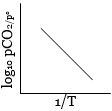
B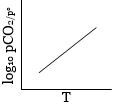
C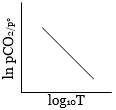
D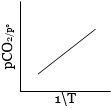
Solution
(A) For the reaction,$CaCO_{3_{(s)}} \rightleftharpoons CaO_{(s)} + CO_{2_{(g)}}$,the equilibrium constant $K_p$ is given by $K_p = pCO_2 / p^{\circ}$.
According to the van't Hoff equation,$\ln K_p = -\frac{\Delta H_r^{\circ}}{RT} + C$.
Converting to base $10$ logarithm,we get $\log_{10} K_p = -\frac{\Delta H_r^{\circ}}{2.303 RT} + \text{constant}$.
Comparing this with the equation of a straight line $y = mx + c$,where $y = \log_{10} (pCO_2 / p^{\circ})$ and $x = 1 / T$,the slope $m = -\frac{\Delta H_r^{\circ}}{2.303 R}$.
Thus,$\Delta H_r^{\circ}$ can be determined from the slope of the plot of $\log_{10} (pCO_2 / p^{\circ})$ versus $1 / T$.
According to the van't Hoff equation,$\ln K_p = -\frac{\Delta H_r^{\circ}}{RT} + C$.
Converting to base $10$ logarithm,we get $\log_{10} K_p = -\frac{\Delta H_r^{\circ}}{2.303 RT} + \text{constant}$.
Comparing this with the equation of a straight line $y = mx + c$,where $y = \log_{10} (pCO_2 / p^{\circ})$ and $x = 1 / T$,the slope $m = -\frac{\Delta H_r^{\circ}}{2.303 R}$.
Thus,$\Delta H_r^{\circ}$ can be determined from the slope of the plot of $\log_{10} (pCO_2 / p^{\circ})$ versus $1 / T$.
0 likes
View Solution27
MediumMCQ
In which of the following equilibria,the value of $K_p$ is less than $K_c$?
A
$H_2(g) + I_2(g) \rightleftharpoons 2HI(g)$
B
$N_2(g) + 3H_2(g) \rightleftharpoons 2NH_3(g)$
C
$N_2(g) + O_2(g) \rightleftharpoons 2NO(g)$
D
$CO(g) + H_2O(g) \rightleftharpoons CO_2(g) + H_2(g)$
Solution
(B) The relationship between $K_p$ and $K_c$ is given by $K_p = K_c(RT)^{\Delta n}$.
For $K_p < K_c$,the value of $\Delta n$ must be negative.
$\Delta n = \text{moles of gaseous products} - \text{moles of gaseous reactants}$.
For option $B$: $N_2(g) + 3H_2(g) \rightleftharpoons 2NH_3(g)$,$\Delta n = 2 - (1 + 3) = -2$.
Since $\Delta n = -2$ is negative,$K_p < K_c$.
For $K_p < K_c$,the value of $\Delta n$ must be negative.
$\Delta n = \text{moles of gaseous products} - \text{moles of gaseous reactants}$.
For option $B$: $N_2(g) + 3H_2(g) \rightleftharpoons 2NH_3(g)$,$\Delta n = 2 - (1 + 3) = -2$.
Since $\Delta n = -2$ is negative,$K_p < K_c$.
0 likes
View Solution28
MediumMCQ
Two gaseous equilibria $SO_{2(g)} + \frac{1}{2}O_{2(g)} \rightleftharpoons SO_{3(g)}$ and $2SO_{3(g)} \rightleftharpoons 2SO_{2(g)} + O_{2(g)}$ have equilibrium constants $K_1$ and $K_2$ respectively at $298 \ K$. Which of the following relationships between $K_1$ and $K_2$ is correct?
A
$K_1 = K_2$
B
$K_2 = K_1^2$
C
$K_2 = \frac{1}{K_1^2}$
D
$K_2 = \frac{1}{K_1}$
Solution
(C) For the first equilibrium: $SO_{2(g)} + \frac{1}{2}O_{2(g)} \rightleftharpoons SO_{3(g)}$,the equilibrium constant is $K_1 = \frac{[SO_3]}{[SO_2][O_2]^{1/2}}$.
For the second equilibrium: $2SO_{3(g)} \rightleftharpoons 2SO_{2(g)} + O_{2(g)}$,the equilibrium constant is $K_2 = \frac{[SO_2]^2 [O_2]}{[SO_3]^2}$.
Comparing the two expressions,we see that $K_2 = \left( \frac{1}{K_1} \right)^2 = \frac{1}{K_1^2}$.
Therefore,the correct relationship is $K_2 = \frac{1}{K_1^2}$.
For the second equilibrium: $2SO_{3(g)} \rightleftharpoons 2SO_{2(g)} + O_{2(g)}$,the equilibrium constant is $K_2 = \frac{[SO_2]^2 [O_2]}{[SO_3]^2}$.
Comparing the two expressions,we see that $K_2 = \left( \frac{1}{K_1} \right)^2 = \frac{1}{K_1^2}$.
Therefore,the correct relationship is $K_2 = \frac{1}{K_1^2}$.
0 likes
View Solution29
MediumMCQ
In which one of the following gaseous equilibria is $K_p$ less than $K_c$?
A
$N_2O_4 \rightleftharpoons 2NO_2$
B
$2HI \rightleftharpoons H_2 + I_2$
C
$2SO_2 + O_2 \rightleftharpoons 2SO_3$
D
$N_2 + O_2 \rightleftharpoons 2NO$
Solution
(C) The relationship between $K_p$ and $K_c$ is given by the equation $K_p = K_c(RT)^{\Delta n}$,where $\Delta n$ is the change in the number of moles of gaseous products and reactants.
For $K_p < K_c$,the value of $\Delta n$ must be negative.
$(A)$ $N_2O_4 \rightleftharpoons 2NO_2$: $\Delta n = 2 - 1 = 1$
$(B)$ $2HI \rightleftharpoons H_2 + I_2$: $\Delta n = (1 + 1) - 2 = 0$
$(C)$ $2SO_2 + O_2 \rightleftharpoons 2SO_3$: $\Delta n = 2 - (2 + 1) = -1$
$(D)$ $N_2 + O_2 \rightleftharpoons 2NO$: $\Delta n = 2 - (1 + 1) = 0$
Since $\Delta n = -1$ for reaction $(C)$,$K_p = K_c(RT)^{-1} = K_c / RT$,which means $K_p < K_c$.
For $K_p < K_c$,the value of $\Delta n$ must be negative.
$(A)$ $N_2O_4 \rightleftharpoons 2NO_2$: $\Delta n = 2 - 1 = 1$
$(B)$ $2HI \rightleftharpoons H_2 + I_2$: $\Delta n = (1 + 1) - 2 = 0$
$(C)$ $2SO_2 + O_2 \rightleftharpoons 2SO_3$: $\Delta n = 2 - (2 + 1) = -1$
$(D)$ $N_2 + O_2 \rightleftharpoons 2NO$: $\Delta n = 2 - (1 + 1) = 0$
Since $\Delta n = -1$ for reaction $(C)$,$K_p = K_c(RT)^{-1} = K_c / RT$,which means $K_p < K_c$.
0 likes
View Solution30
MediumMCQ
For which of the following reactions is $K_p = K_c$?
A
$2NOCl_{(g)} \rightleftharpoons 2NO_{(g)} + Cl_{2_{(g)}}$
B
$N_{2_{(g)}} + 3H_{2_{(g)}} \rightleftharpoons 2NH_{3_{(g)}}$
C
$H_{2_{(g)}} + Cl_{2_{(g)}} \rightleftharpoons 2HCl_{(g)}$
D
$N_2O_{4_{(g)}} \rightleftharpoons 2NO_{2_{(g)}}$
Solution
(C) The relationship between $K_p$ and $K_c$ is given by the equation: $K_p = K_c(RT)^{\Delta n}$.
For $K_p = K_c$,the value of $\Delta n$ must be $0$.
$\Delta n$ is defined as the difference between the sum of the stoichiometric coefficients of gaseous products and gaseous reactants.
For option $(C)$: $H_{2_{(g)}} + Cl_{2_{(g)}} \rightleftharpoons 2HCl_{(g)}$,$\Delta n = 2 - (1 + 1) = 0$.
Therefore,for this reaction,$K_p = K_c$.
For $K_p = K_c$,the value of $\Delta n$ must be $0$.
$\Delta n$ is defined as the difference between the sum of the stoichiometric coefficients of gaseous products and gaseous reactants.
For option $(C)$: $H_{2_{(g)}} + Cl_{2_{(g)}} \rightleftharpoons 2HCl_{(g)}$,$\Delta n = 2 - (1 + 1) = 0$.
Therefore,for this reaction,$K_p = K_c$.
0 likes
View Solution31
MediumMCQ
For the reaction ${H_2}_{(g)} + {I_2}_{(g)} \rightleftharpoons 2HI_{(g)}$ at $721 \ K$,the value of the equilibrium constant $({K_c})$ is $50$. When the equilibrium concentration of both is $0.5 \ M$,the value of ${K_p}$ under the same conditions will be:
A
$0.002$
B
$0.2$
C
$50$
D
$50/RT$
Solution
(C) For the given reaction: ${H_2}_{(g)} + {I_2}_{(g)} \rightleftharpoons 2HI_{(g)}$
The relationship between ${K_p}$ and ${K_c}$ is given by the formula: ${K_p} = {K_c}(RT)^{\Delta n}$
Here,$\Delta n$ is the change in the number of moles of gaseous products and reactants:
$\Delta n = (n_{products}) - (n_{reactants}) = 2 - (1 + 1) = 0$
Since $\Delta n = 0$,the expression becomes: ${K_p} = {K_c}(RT)^0 = {K_c} \times 1 = {K_c}$
Given that ${K_c} = 50$,therefore ${K_p} = 50$.
The relationship between ${K_p}$ and ${K_c}$ is given by the formula: ${K_p} = {K_c}(RT)^{\Delta n}$
Here,$\Delta n$ is the change in the number of moles of gaseous products and reactants:
$\Delta n = (n_{products}) - (n_{reactants}) = 2 - (1 + 1) = 0$
Since $\Delta n = 0$,the expression becomes: ${K_p} = {K_c}(RT)^0 = {K_c} \times 1 = {K_c}$
Given that ${K_c} = 50$,therefore ${K_p} = 50$.
0 likes
View Solution32
MediumMCQ
In which of the following reactions is ${K_p} > {K_c}$?
A
${N_2} + 3{H_2} \rightleftharpoons 2N{H_3}$
B
${H_2} + {I_2} \rightleftharpoons 2HI$
C
$PC{l_3} + C{l_2} \rightleftharpoons PC{l_5}$
D
$2S{O_3} \rightleftharpoons {O_2} + 2S{O_2}$
Solution
(D) The relationship between ${K_p}$ and ${K_c}$ is given by the equation: ${K_p} = {K_c}{(RT)}^{\Delta n}$.
For ${K_p} > {K_c}$,the value of $\Delta n$ must be positive $(\Delta n > 0)$.
$\Delta n$ is calculated as the difference between the number of moles of gaseous products and gaseous reactants.
$(A)$ ${N_2} + 3{H_2} \rightleftharpoons 2N{H_3}$: $\Delta n = 2 - (1 + 3) = -2$
$(B)$ ${H_2} + {I_2} \rightleftharpoons 2HI$: $\Delta n = 2 - (1 + 1) = 0$
$(C)$ $PC{l_3} + C{l_2} \rightleftharpoons PC{l_5}$: $\Delta n = 1 - (1 + 1) = -1$
$(D)$ $2S{O_3} \rightleftharpoons {O_2} + 2S{O_2}$: $\Delta n = (1 + 2) - 2 = +1$
Since $\Delta n = +1$ for reaction $(D)$,${K_p} > {K_c}$ holds true for this reaction.
For ${K_p} > {K_c}$,the value of $\Delta n$ must be positive $(\Delta n > 0)$.
$\Delta n$ is calculated as the difference between the number of moles of gaseous products and gaseous reactants.
$(A)$ ${N_2} + 3{H_2} \rightleftharpoons 2N{H_3}$: $\Delta n = 2 - (1 + 3) = -2$
$(B)$ ${H_2} + {I_2} \rightleftharpoons 2HI$: $\Delta n = 2 - (1 + 1) = 0$
$(C)$ $PC{l_3} + C{l_2} \rightleftharpoons PC{l_5}$: $\Delta n = 1 - (1 + 1) = -1$
$(D)$ $2S{O_3} \rightleftharpoons {O_2} + 2S{O_2}$: $\Delta n = (1 + 2) - 2 = +1$
Since $\Delta n = +1$ for reaction $(D)$,${K_p} > {K_c}$ holds true for this reaction.
0 likes
View Solution33
MediumMCQ
For the reaction $PCl_{5(g)} \rightleftharpoons PCl_{3(g)} + Cl_{2(g)}$,which of the following relations is correct?
A
$K_p = K_c$
B
$K_p = K_c(RT)^{-1}$
C
$K_p = K_c(RT)$
D
$K_p = K_c(RT)^2$
Solution
(C) The relationship between $K_p$ and $K_c$ is given by the formula $K_p = K_c(RT)^{\Delta n}$.
For the reaction $PCl_{5(g)} \rightleftharpoons PCl_{3(g)} + Cl_{2(g)}$,the change in the number of moles of gaseous products and reactants is $\Delta n = (1 + 1) - 1 = 1$.
Substituting $\Delta n = 1$ into the formula,we get $K_p = K_c(RT)^1 = K_c(RT)$.
For the reaction $PCl_{5(g)} \rightleftharpoons PCl_{3(g)} + Cl_{2(g)}$,the change in the number of moles of gaseous products and reactants is $\Delta n = (1 + 1) - 1 = 1$.
Substituting $\Delta n = 1$ into the formula,we get $K_p = K_c(RT)^1 = K_c(RT)$.
0 likes
View Solution34
MediumMCQ
For the following gaseous reaction $H_2(g) + I_2(g) \rightleftharpoons 2HI(g)$,the equilibrium constant relationship is:
A
$K_p > K_c$
B
$K_p < K_c$
C
$K_p = K_c$
D
$K_p = 1/K_c$
Solution
(C) The relationship between $K_p$ and $K_c$ is given by the equation $K_p = K_c(RT)^{\Delta n}$.
For the reaction $H_2(g) + I_2(g) \rightleftharpoons 2HI(g)$,the change in the number of moles of gaseous products and reactants is $\Delta n = n_p - n_r = 2 - (1 + 1) = 0$.
Substituting $\Delta n = 0$ into the equation,we get $K_p = K_c(RT)^0 = K_c \times 1 = K_c$.
Therefore,$K_p = K_c$.
For the reaction $H_2(g) + I_2(g) \rightleftharpoons 2HI(g)$,the change in the number of moles of gaseous products and reactants is $\Delta n = n_p - n_r = 2 - (1 + 1) = 0$.
Substituting $\Delta n = 0$ into the equation,we get $K_p = K_c(RT)^0 = K_c \times 1 = K_c$.
Therefore,$K_p = K_c$.
0 likes
View Solution35
MediumMCQ
For the reaction $2NO_{2(g)} \rightleftharpoons 2NO_{(g)} + O_{2(g)}$,$K_c = 1.8 \times 10^{-6}$ at $184 \, ^\circ C$. Given $R = 0.0831 \, kJ/(mol \cdot K)$,when $K_p$ and $K_c$ are compared at $184 \, ^\circ C$,it is found that:
A
$K_p$ is greater than $K_c$
B
$K_p$ is less than $K_c$
C
$K_p = K_c$
D
Whether $K_p$ is greater than,less than or equal to $K_c$ depends upon the total gas pressure
Solution
(A) The relationship between $K_p$ and $K_c$ is given by the formula: $K_p = K_c(RT)^{\Delta n}$.
For the reaction $2NO_{2(g)} \rightleftharpoons 2NO_{(g)} + O_{2(g)}$,the change in the number of moles of gas is $\Delta n = (2 + 1) - 2 = 1$.
Since $\Delta n = 1$,the equation becomes $K_p = K_c(RT)^1$.
Because $R$ and $T$ are positive values,$(RT)^1 > 1$,which implies $K_p > K_c$.
For the reaction $2NO_{2(g)} \rightleftharpoons 2NO_{(g)} + O_{2(g)}$,the change in the number of moles of gas is $\Delta n = (2 + 1) - 2 = 1$.
Since $\Delta n = 1$,the equation becomes $K_p = K_c(RT)^1$.
Because $R$ and $T$ are positive values,$(RT)^1 > 1$,which implies $K_p > K_c$.
0 likes
View Solution36
MediumMCQ
For the reaction $2NOCl_{(g)} \rightleftharpoons 2NO_{(g)} + Cl_{2(g)}$,$K_C$ at $427\ ^oC$ is $3 \times 10^{-6}\ mol\ L^{-1}$. The value of $K_P$ is nearly $....... \times 10^{-4}$.
A
$0.75$
B
$0.25$
C
$2.50$
D
$1.75$
Solution
(D) The given reaction is $2NOCl_{(g)} \rightleftharpoons 2NO_{(g)} + Cl_{2(g)}$.
The change in the number of moles of gaseous products and reactants is $\Delta n = (2 + 1) - 2 = 1$.
The relationship between $K_P$ and $K_C$ is given by $K_P = K_C(RT)^{\Delta n}$.
Given $K_C = 3 \times 10^{-6}$,$R = 0.0821 \ L\ atm\ K^{-1}\ mol^{-1}$,and $T = 427 + 273 = 700 \ K$.
Substituting the values: $K_P = 3 \times 10^{-6} \times (0.0821 \times 700)^1$.
$K_P = 3 \times 10^{-6} \times 57.47 = 172.41 \times 10^{-6} = 1.7241 \times 10^{-4}$.
Rounding to the nearest value,$K_P \approx 1.75 \times 10^{-4}$.
The change in the number of moles of gaseous products and reactants is $\Delta n = (2 + 1) - 2 = 1$.
The relationship between $K_P$ and $K_C$ is given by $K_P = K_C(RT)^{\Delta n}$.
Given $K_C = 3 \times 10^{-6}$,$R = 0.0821 \ L\ atm\ K^{-1}\ mol^{-1}$,and $T = 427 + 273 = 700 \ K$.
Substituting the values: $K_P = 3 \times 10^{-6} \times (0.0821 \times 700)^1$.
$K_P = 3 \times 10^{-6} \times 57.47 = 172.41 \times 10^{-6} = 1.7241 \times 10^{-4}$.
Rounding to the nearest value,$K_P \approx 1.75 \times 10^{-4}$.
0 likes
View Solution37
MediumMCQ
For which one of the following reactions is $K_p = K_c$?
A
$N_2(g) + 3H_2(g) \rightleftharpoons 2NH_3(g)$
B
$N_2(g) + O_2(g) \rightleftharpoons 2NO(g)$
C
$PCl_5(g) \rightleftharpoons PCl_3(g) + Cl_2(g)$
D
$2SO_3(g) \rightleftharpoons 2SO_2(g) + O_2(g)$
Solution
(B) The relationship between $K_p$ and $K_c$ is given by the equation $K_p = K_c(RT)^{\Delta n_g}$,where $\Delta n_g$ is the change in the number of moles of gaseous products and reactants.
For $K_p = K_c$,the exponent $\Delta n_g$ must be equal to $0$.
Calculating $\Delta n_g$ for each reaction:
$A$: $\Delta n_g = 2 - (1 + 3) = -2$
$B$: $\Delta n_g = 2 - (1 + 1) = 0$
$C$: $\Delta n_g = (1 + 1) - 1 = 1$
$D$: $\Delta n_g = (2 + 1) - 2 = 1$
Since $\Delta n_g = 0$ for reaction $B$,$K_p = K_c$ for this reaction.
For $K_p = K_c$,the exponent $\Delta n_g$ must be equal to $0$.
Calculating $\Delta n_g$ for each reaction:
$A$: $\Delta n_g = 2 - (1 + 3) = -2$
$B$: $\Delta n_g = 2 - (1 + 1) = 0$
$C$: $\Delta n_g = (1 + 1) - 1 = 1$
$D$: $\Delta n_g = (2 + 1) - 2 = 1$
Since $\Delta n_g = 0$ for reaction $B$,$K_p = K_c$ for this reaction.
0 likes
View Solution38
MediumMCQ
The equilibrium constant for the reversible reaction,$N_2 + 3H_2 \rightleftharpoons 2NH_3$ is $K$ and for the reaction $\frac{1}{2}N_2 + \frac{3}{2}H_2 \rightleftharpoons NH_3$ the equilibrium constant is $K'$. $K$ and $K'$ will be related as
A
$K = K'$
B
$K' = \sqrt{K}$
C
$K = \sqrt{K'}$
D
$K \times K' = 1$
Solution
(B) For the reaction $N_2 + 3H_2 \rightleftharpoons 2NH_3$,the equilibrium constant is $K = \frac{[NH_3]^2}{[N_2][H_2]^3}$.
For the reaction $\frac{1}{2}N_2 + \frac{3}{2}H_2 \rightleftharpoons NH_3$,the equilibrium constant is $K' = \frac{[NH_3]}{[N_2]^{1/2}[H_2]^{3/2}}$.
Comparing the two expressions,we see that $K' = \sqrt{\frac{[NH_3]^2}{[N_2][H_2]^3}} = \sqrt{K}$.
Therefore,$K' = \sqrt{K}$.
For the reaction $\frac{1}{2}N_2 + \frac{3}{2}H_2 \rightleftharpoons NH_3$,the equilibrium constant is $K' = \frac{[NH_3]}{[N_2]^{1/2}[H_2]^{3/2}}$.
Comparing the two expressions,we see that $K' = \sqrt{\frac{[NH_3]^2}{[N_2][H_2]^3}} = \sqrt{K}$.
Therefore,$K' = \sqrt{K}$.
0 likes
View Solution39
DifficultMCQ
$2NO_2 \rightleftharpoons 2NO + O_2$; $K = 1.6 \times 10^{-12}$. For $NO + \frac{1}{2}O_2 \rightleftharpoons NO_2$,$K' = $
A
$K' = \frac{1}{K^2}$
B
$K' = \frac{1}{K}$
C
$K' = \frac{1}{\sqrt{K}}$
D
None of these
Solution
(C) Given reaction $(i)$: $2NO_2 \rightleftharpoons 2NO + O_2$ with equilibrium constant $K = \frac{[NO]^2 [O_2]}{[NO_2]^2} = 1.6 \times 10^{-12}$.
Target reaction $(ii)$: $NO + \frac{1}{2}O_2 \rightleftharpoons NO_2$ with equilibrium constant $K' = \frac{[NO_2]}{[NO] [O_2]^{1/2}}$.
Comparing the two reactions,we observe that reaction $(ii)$ is the reverse of reaction $(i)$ multiplied by a factor of $\frac{1}{2}$.
Mathematically,$K' = (\frac{1}{K})^{1/2} = \frac{1}{\sqrt{K}}$.
Therefore,the correct option is $C$.
Target reaction $(ii)$: $NO + \frac{1}{2}O_2 \rightleftharpoons NO_2$ with equilibrium constant $K' = \frac{[NO_2]}{[NO] [O_2]^{1/2}}$.
Comparing the two reactions,we observe that reaction $(ii)$ is the reverse of reaction $(i)$ multiplied by a factor of $\frac{1}{2}$.
Mathematically,$K' = (\frac{1}{K})^{1/2} = \frac{1}{\sqrt{K}}$.
Therefore,the correct option is $C$.
0 likes
View Solution40
EasyMCQ
The value of $K_p$ for the following reaction $2H_2S_{(g)} \rightleftharpoons 2H_{2(g)} + S_{2(g)}$ is $1.2 \times 10^{-2}$ at $106.5 ^oC$. The value of $K_c$ for this reaction is
A
$1.2 \times 10^{-2}$
B
$< 1.2 \times 10^{-2}$
C
$83$
D
$> 1.2 \times 10^{-2}$
Solution
(B) The relationship between $K_p$ and $K_c$ is given by the equation $K_p = K_c(RT)^{\Delta n}$.
For the reaction $2H_2S_{(g)} \rightleftharpoons 2H_{2(g)} + S_{2(g)}$,the change in the number of moles of gaseous products and reactants is $\Delta n = (2 + 1) - 2 = 1$.
Substituting $\Delta n = 1$ into the equation,we get $K_p = K_c(RT)^1$,which implies $K_c = K_p / (RT)$.
Since the temperature $T = 106.5 + 273.15 = 379.65 K$ is greater than $1$,the value of $(RT)$ is much greater than $1$.
Therefore,$K_c = K_p / (RT)$ will be less than $K_p$.
Thus,$K_c < 1.2 \times 10^{-2}$.
For the reaction $2H_2S_{(g)} \rightleftharpoons 2H_{2(g)} + S_{2(g)}$,the change in the number of moles of gaseous products and reactants is $\Delta n = (2 + 1) - 2 = 1$.
Substituting $\Delta n = 1$ into the equation,we get $K_p = K_c(RT)^1$,which implies $K_c = K_p / (RT)$.
Since the temperature $T = 106.5 + 273.15 = 379.65 K$ is greater than $1$,the value of $(RT)$ is much greater than $1$.
Therefore,$K_c = K_p / (RT)$ will be less than $K_p$.
Thus,$K_c < 1.2 \times 10^{-2}$.
0 likes
View Solution41
DifficultMCQ
The equilibrium constant for the reaction $N_2 + 3H_2 \rightleftharpoons 2NH_3$ is $K.$ Then,the equilibrium constant for the equilibrium $NH_3 \rightleftharpoons \frac{1}{2}N_2 + \frac{3}{2}H_2$ is
A
$1/K$
B
$1/K^2$
C
$\sqrt{K}$
D
$1/\sqrt{K}$
Solution
(D) For the reaction $N_2 + 3H_2 \rightleftharpoons 2NH_3$,the equilibrium constant is $K = \frac{[NH_3]^2}{[N_2][H_2]^3}$.
For the reaction $NH_3 \rightleftharpoons \frac{1}{2}N_2 + \frac{3}{2}H_2$,the equilibrium constant $K'$ is given by $K' = \frac{[N_2]^{1/2}[H_2]^{3/2}}{[NH_3]}$.
Comparing the two expressions,we see that $K' = \sqrt{\frac{1}{K}} = \frac{1}{\sqrt{K}}$.
For the reaction $NH_3 \rightleftharpoons \frac{1}{2}N_2 + \frac{3}{2}H_2$,the equilibrium constant $K'$ is given by $K' = \frac{[N_2]^{1/2}[H_2]^{3/2}}{[NH_3]}$.
Comparing the two expressions,we see that $K' = \sqrt{\frac{1}{K}} = \frac{1}{\sqrt{K}}$.
0 likes
View Solution42
MediumMCQ
The reaction between $N_2$ and $H_2$ to form ammonia has $K_c = 6 \times 10^{-2}$ at the temperature $500 \ ^oC$. The numerical value of $K_p$ for this reaction is
A
$1.5 \times 10^{-5}$
B
$1.5 \times 10^{5}$
C
$1.5 \times 10^{-6}$
D
$1.5 \times 10^{6}$
Solution
(A) The balanced chemical equation is: $N_2(g) + 3H_2(g) \rightleftharpoons 2NH_3(g)$.
The change in the number of moles of gaseous products and reactants is $\Delta n = 2 - (1 + 3) = -2$.
The relationship between $K_p$ and $K_c$ is given by $K_p = K_c(RT)^{\Delta n}$.
Given $K_c = 6 \times 10^{-2}$,$R = 0.0821 \ L \ atm \ K^{-1} \ mol^{-1}$,and $T = 500 + 273 = 773 \ K$.
Substituting the values: $K_p = 6 \times 10^{-2} \times (0.0821 \times 773)^{-2}$.
$K_p = \frac{6 \times 10^{-2}}{(63.4633)^2} \approx \frac{0.06}{4027.59} \approx 1.49 \times 10^{-5} \approx 1.5 \times 10^{-5}$.
The change in the number of moles of gaseous products and reactants is $\Delta n = 2 - (1 + 3) = -2$.
The relationship between $K_p$ and $K_c$ is given by $K_p = K_c(RT)^{\Delta n}$.
Given $K_c = 6 \times 10^{-2}$,$R = 0.0821 \ L \ atm \ K^{-1} \ mol^{-1}$,and $T = 500 + 273 = 773 \ K$.
Substituting the values: $K_p = 6 \times 10^{-2} \times (0.0821 \times 773)^{-2}$.
$K_p = \frac{6 \times 10^{-2}}{(63.4633)^2} \approx \frac{0.06}{4027.59} \approx 1.49 \times 10^{-5} \approx 1.5 \times 10^{-5}$.
0 likes
View Solution43
MediumMCQ
For the reversible reaction,$N_{2(g)} + 3H_{2(g)} \rightleftharpoons 2NH_{3(g)}$ at $500 \ ^oC$,the value of $K_P$ is $1.44 \times 10^{-5}$ when partial pressure is measured in atmospheres. The corresponding value of $K_c$ with concentration in $\text{mol L}^{-1}$ is:
A
$1.44 \times 10^{-5} / (0.082 \times 500)^{-2}$
B
$1.44 \times 10^{-5} / (8.314 \times 773)^{-2}$
C
$1.44 \times 10^{-5} / (0.082 \times 773)^2$
D
$1.44 \times 10^{-5} / (0.082 \times 773)^{-2}$
Solution
(D) The given reaction is $N_{2(g)} + 3H_{2(g)} \rightleftharpoons 2NH_{3(g)}$.
The change in the number of moles of gaseous products and reactants is $\Delta n = 2 - (1 + 3) = -2$.
The relationship between $K_p$ and $K_c$ is given by $K_p = K_c(RT)^{\Delta n}$.
Substituting the values,$K_p = K_c(RT)^{-2}$.
Therefore,$K_c = \frac{K_p}{(RT)^{-2}}$.
Given $T = 500 \ ^oC = 500 + 273 = 773 \ K$ and $R = 0.082 \ \text{L atm K}^{-1} \text{mol}^{-1}$.
Thus,$K_c = \frac{1.44 \times 10^{-5}}{(0.082 \times 773)^{-2}}$.
The change in the number of moles of gaseous products and reactants is $\Delta n = 2 - (1 + 3) = -2$.
The relationship between $K_p$ and $K_c$ is given by $K_p = K_c(RT)^{\Delta n}$.
Substituting the values,$K_p = K_c(RT)^{-2}$.
Therefore,$K_c = \frac{K_p}{(RT)^{-2}}$.
Given $T = 500 \ ^oC = 500 + 273 = 773 \ K$ and $R = 0.082 \ \text{L atm K}^{-1} \text{mol}^{-1}$.
Thus,$K_c = \frac{1.44 \times 10^{-5}}{(0.082 \times 773)^{-2}}$.
0 likes
View Solution44
EasyMCQ
In which of the following cases is $K_p$ less than $K_c$?
A
$H_2 + Cl_2 \rightleftharpoons 2HCl$
B
$2SO_2 + O_2 \rightleftharpoons 2SO_3$
C
$N_2 + O_2 \rightleftharpoons 2NO$
D
$PCl_5 \rightleftharpoons PCl_3 + Cl_2$
Solution
(B) The relationship between $K_p$ and $K_c$ is given by the equation: $K_p = K_c(RT)^{\Delta n_g}$.
For $K_p < K_c$,the value of $\Delta n_g$ must be negative $(\Delta n_g < 0)$.
$\Delta n_g$ is calculated as (sum of stoichiometric coefficients of gaseous products) - (sum of stoichiometric coefficients of gaseous reactants).
For option $A$: $\Delta n_g = 2 - (1 + 1) = 0$,so $K_p = K_c$.
For option $B$: $\Delta n_g = 2 - (2 + 1) = -1$,so $K_p = K_c(RT)^{-1} = K_c/RT$,which means $K_p < K_c$.
For option $C$: $\Delta n_g = 2 - (1 + 1) = 0$,so $K_p = K_c$.
For option $D$: $\Delta n_g = (1 + 1) - 1 = 1$,so $K_p = K_c(RT)^1$,which means $K_p > K_c$.
Therefore,the correct option is $B$.
For $K_p < K_c$,the value of $\Delta n_g$ must be negative $(\Delta n_g < 0)$.
$\Delta n_g$ is calculated as (sum of stoichiometric coefficients of gaseous products) - (sum of stoichiometric coefficients of gaseous reactants).
For option $A$: $\Delta n_g = 2 - (1 + 1) = 0$,so $K_p = K_c$.
For option $B$: $\Delta n_g = 2 - (2 + 1) = -1$,so $K_p = K_c(RT)^{-1} = K_c/RT$,which means $K_p < K_c$.
For option $C$: $\Delta n_g = 2 - (1 + 1) = 0$,so $K_p = K_c$.
For option $D$: $\Delta n_g = (1 + 1) - 1 = 1$,so $K_p = K_c(RT)^1$,which means $K_p > K_c$.
Therefore,the correct option is $B$.
0 likes
View Solution45
MediumMCQ
If ${K_c}$ is the equilibrium constant for the formation of $NH_3$,the dissociation constant of ammonia under the same temperature will be
A
${K_c}$
B
$\sqrt{{K_c}}$
C
${K_c}^2$
D
$1/{K_c}$
Solution
(D) The formation reaction of $NH_3$ is: $\frac{1}{2}N_2(g) + \frac{3}{2}H_2(g) \rightleftharpoons NH_3(g)$ with equilibrium constant ${K_c}$.
The dissociation reaction of $NH_3$ is the reverse of the formation reaction: $NH_3(g) \rightleftharpoons \frac{1}{2}N_2(g) + \frac{3}{2}H_2(g)$.
When a chemical reaction is reversed,the new equilibrium constant is the reciprocal of the original equilibrium constant.
Therefore,the dissociation constant is $1/{K_c}$.
The dissociation reaction of $NH_3$ is the reverse of the formation reaction: $NH_3(g) \rightleftharpoons \frac{1}{2}N_2(g) + \frac{3}{2}H_2(g)$.
When a chemical reaction is reversed,the new equilibrium constant is the reciprocal of the original equilibrium constant.
Therefore,the dissociation constant is $1/{K_c}$.
0 likes
View Solution46
MediumMCQ
Some solid $NH_4HS$ is placed in a flask containing $0.5 \ atm$ of $NH_3$. What would be the partial pressures of $NH_3$ and $H_2S$ when equilibrium is reached for the reaction $NH_4HS_{(s)} \rightleftharpoons NH_{3_{(g)}} + H_2S_{(g)}$,given $K_p = 0.11$?
A
$p_{NH_3} = 0.665 \ atm, p_{H_2S} = 0.165 \ atm$
B
$p_{NH_3} = 0.5 \ atm, p_{H_2S} = 0.22 \ atm$
C
$p_{NH_3} = 0.33 \ atm, p_{H_2S} = 0.33 \ atm$
D
$p_{NH_3} = 0.11 \ atm, p_{H_2S} = 0.11 \ atm$
Solution
(A) The equilibrium expression is $K_p = p_{NH_3} \times p_{H_2S}$.
Let $p$ be the partial pressure of $H_2S$ produced at equilibrium.
Then,$p_{H_2S} = p$ and $p_{NH_3} = 0.5 + p$.
Substituting into the $K_p$ expression: $0.11 = (0.5 + p)(p)$.
This simplifies to the quadratic equation: $p^2 + 0.5p - 0.11 = 0$.
Using the quadratic formula $p = \frac{-b + \sqrt{b^2 - 4ac}}{2a}$:
$p = \frac{-0.5 + \sqrt{0.5^2 - 4(1)(-0.11)}}{2(1)} = \frac{-0.5 + \sqrt{0.25 + 0.44}}{2} = \frac{-0.5 + \sqrt{0.69}}{2} \approx \frac{-0.5 + 0.83}{2} = 0.165 \ atm$.
Thus,$p_{H_2S} = 0.165 \ atm$ and $p_{NH_3} = 0.5 + 0.165 = 0.665 \ atm$.
Let $p$ be the partial pressure of $H_2S$ produced at equilibrium.
Then,$p_{H_2S} = p$ and $p_{NH_3} = 0.5 + p$.
Substituting into the $K_p$ expression: $0.11 = (0.5 + p)(p)$.
This simplifies to the quadratic equation: $p^2 + 0.5p - 0.11 = 0$.
Using the quadratic formula $p = \frac{-b + \sqrt{b^2 - 4ac}}{2a}$:
$p = \frac{-0.5 + \sqrt{0.5^2 - 4(1)(-0.11)}}{2(1)} = \frac{-0.5 + \sqrt{0.25 + 0.44}}{2} = \frac{-0.5 + \sqrt{0.69}}{2} \approx \frac{-0.5 + 0.83}{2} = 0.165 \ atm$.
Thus,$p_{H_2S} = 0.165 \ atm$ and $p_{NH_3} = 0.5 + 0.165 = 0.665 \ atm$.
0 likes
View Solution47
EasyMCQ
$\Delta n$,the change in the number of moles for the reaction,$C_{12}H_{22}O_{11(s)} + 12O_{2(g)} \rightleftharpoons 12CO_{2(g)} + 11H_2O_{(l)}$ at $25 \ ^\circ C$ is
A
$0$
B
$2$
C
$4$
D
$-1$
Solution
(A) The change in the number of moles of gaseous species,$\Delta n_g$,is calculated as the difference between the sum of the stoichiometric coefficients of gaseous products and the sum of the stoichiometric coefficients of gaseous reactants.
For the reaction: $C_{12}H_{22}O_{11(s)} + 12O_{2(g)} \rightleftharpoons 12CO_{2(g)} + 11H_2O_{(l)}$
Number of moles of gaseous products = $12$ (from $CO_2$)
Number of moles of gaseous reactants = $12$ (from $O_2$)
$\Delta n_g = (\text{moles of gaseous products}) - (\text{moles of gaseous reactants})$
$\Delta n_g = 12 - 12 = 0$
For the reaction: $C_{12}H_{22}O_{11(s)} + 12O_{2(g)} \rightleftharpoons 12CO_{2(g)} + 11H_2O_{(l)}$
Number of moles of gaseous products = $12$ (from $CO_2$)
Number of moles of gaseous reactants = $12$ (from $O_2$)
$\Delta n_g = (\text{moles of gaseous products}) - (\text{moles of gaseous reactants})$
$\Delta n_g = 12 - 12 = 0$
0 likes
View Solution48
MediumMCQ
Value of $K_p$ in the reaction $MgCO_{3(s)} \rightleftharpoons MgO_{(s)} + CO_{2(g)}$ is
A
$K_p = P_{CO_2}$
B
$K_p = P_{CO_2} \times \frac{P_{CO_2} \times P_{MgO}}{P_{MgCO_3}}$
C
$K_p = \frac{P_{CO_2} \times P_{MgO}}{P_{MgCO_3}}$
D
$K_p = \frac{P_{MgCO_3}}{P_{CO_2} \times P_{MgO}}$
Solution
(A) For the given heterogeneous equilibrium reaction: $MgCO_{3(s)} \rightleftharpoons MgO_{(s)} + CO_{2(g)}$
The equilibrium constant $K_p$ is defined as the product of the partial pressures of the gaseous products divided by the partial pressures of the gaseous reactants,each raised to the power of their stoichiometric coefficients.
Pure solids and liquids are assigned an activity of $1$ and are not included in the expression for $K_p$.
Therefore,$K_p = P_{CO_2}$.
The equilibrium constant $K_p$ is defined as the product of the partial pressures of the gaseous products divided by the partial pressures of the gaseous reactants,each raised to the power of their stoichiometric coefficients.
Pure solids and liquids are assigned an activity of $1$ and are not included in the expression for $K_p$.
Therefore,$K_p = P_{CO_2}$.
0 likes
View Solution6-1.Equilibrium (Chemical Equilibrium) — Kp and Kc Relationship · Frequently Asked Questions
1Are these 6-1.Equilibrium (Chemical Equilibrium) questions useful for JEE and NEET?
Yes. All questions in this section are mapped to JEE Main and NEET exam patterns. Previous year questions from JEE Main, NEET, GUJCET and state-level exams are included with full solutions.
2Can I switch to Hindi or Gujarati for these questions?
Yes. Use the language tabs in the hero section or the sidebar to view the same questions and solutions in English, Hindi or Gujarati.
3How do I generate a question paper from this subtopic?
Use the Vedclass Exam Paper Generator — select the chapter and subtopic, set difficulty, and generate Sets A, B, C, D automatically. First 3 chapters of every subject are free.
Vedclass Products
For Students
Vedclass Test Series
Mock tests in real JEE/NEET style with performance analysis. 5-day free trial.
Start Free TrialFor Teachers
Exam Paper Generator
Generate Set A/B/C/D papers from this chapter in 2 minutes. 3 chapters free.
Try FreeFor Institutes
Online Exam Module
Live online exams with unlimited students, 360° analytics & white-label branding.
See DemoFor Teachers & Institutes
Generate a 6-1.Equilibrium (Chemical Equilibrium) Exam Paper in 2 Minutes
Select subtopic & difficulty — Sets A, B, C, D auto-generated with No Repeat logic.
First 3 chapters of every subject are free — no payment required.