
A English
Law of equilibrium and Equilibrium constant Questions in English
Class 11 Chemistry · 6-1.Equilibrium (Chemical Equilibrium) · Law of equilibrium and Equilibrium constant
228+
Questions
English
Language
100%
With Solutions
Showing 50 of 228 questions in English
101
DifficultMCQ
The equilibrium of formation of phosgene is represented as:
$CO_{(g)} + Cl_{2(g)} \rightleftharpoons COCl_{2(g)}$
The reaction is carried out in a $500 \ mL$ flask. At equilibrium,$0.3 \ mol$ of phosgene,$0.1 \ mol$ of $CO,$ and $0.1 \ mol$ of $Cl_2$ are present. The equilibrium constant $(K_c)$ of the reaction is:
$CO_{(g)} + Cl_{2(g)} \rightleftharpoons COCl_{2(g)}$
The reaction is carried out in a $500 \ mL$ flask. At equilibrium,$0.3 \ mol$ of phosgene,$0.1 \ mol$ of $CO,$ and $0.1 \ mol$ of $Cl_2$ are present. The equilibrium constant $(K_c)$ of the reaction is:
A
$30$
B
$15$
C
$5$
D
$25$
Solution
(B) For the reaction:
$CO_{(g)} + Cl_{2(g)} \rightleftharpoons COCl_{2(g)}$
The equilibrium constant expression is:
$K_c = \frac{[COCl_2]}{[CO][Cl_2]} \dots (I)$
Given volume $V = 500 \ mL = 0.5 \ L$.
Concentrations at equilibrium are:
$[COCl_2] = \frac{0.3 \ mol}{0.5 \ L} = 0.6 \ mol \ L^{-1}$
$[CO] = \frac{0.1 \ mol}{0.5 \ L} = 0.2 \ mol \ L^{-1}$
$[Cl_2] = \frac{0.1 \ mol}{0.5 \ L} = 0.2 \ mol \ L^{-1}$
Substituting these values into expression $(I)$:
$K_c = \frac{0.6}{(0.2)(0.2)} = \frac{0.6}{0.04} = 15$
$CO_{(g)} + Cl_{2(g)} \rightleftharpoons COCl_{2(g)}$
The equilibrium constant expression is:
$K_c = \frac{[COCl_2]}{[CO][Cl_2]} \dots (I)$
Given volume $V = 500 \ mL = 0.5 \ L$.
Concentrations at equilibrium are:
$[COCl_2] = \frac{0.3 \ mol}{0.5 \ L} = 0.6 \ mol \ L^{-1}$
$[CO] = \frac{0.1 \ mol}{0.5 \ L} = 0.2 \ mol \ L^{-1}$
$[Cl_2] = \frac{0.1 \ mol}{0.5 \ L} = 0.2 \ mol \ L^{-1}$
Substituting these values into expression $(I)$:
$K_c = \frac{0.6}{(0.2)(0.2)} = \frac{0.6}{0.04} = 15$
0 likes
View Solution102
MediumMCQ
The equilibrium constant for the reaction $SO_{3(g)} \rightleftharpoons SO_{2(g)} + 1/2 O_{2(g)}$ is $4.9 \times 10^{-2}$. Find the equilibrium constant for the reaction $2SO_{2(g)} + O_{2(g)} \rightleftharpoons 2SO_{3(g)}$.
A
$416$
B
$2.40 \times 10^{-3}$
C
$9.8 \times 10^{-2}$
D
$4.9 \times 10^{-2}$
Solution
(A) Given the reaction: $SO_{3(g)} \rightleftharpoons SO_{2(g)} + 1/2 O_{2(g)}$ with $K_1 = 4.9 \times 10^{-2}$.
The target reaction is: $2SO_{2(g)} + O_{2(g)} \rightleftharpoons 2SO_{3(g)}$.
First,reverse the given reaction: $SO_{2(g)} + 1/2 O_{2(g)} \rightleftharpoons SO_{3(g)}$. The equilibrium constant for this reversed reaction is $K_2 = 1 / K_1 = 1 / (4.9 \times 10^{-2})$.
Next,multiply the stoichiometric coefficients by $2$: $2SO_{2(g)} + O_{2(g)} \rightleftharpoons 2SO_{3(g)}$. The equilibrium constant for this reaction is $K_{eq} = (K_2)^2 = (1 / K_1)^2 = 1 / (K_1)^2$.
$K_{eq} = 1 / (4.9 \times 10^{-2})^2 = 1 / (24.01 \times 10^{-4}) = 1 / 0.002401 \approx 416.49$.
Thus,the value is approximately $416$.
The target reaction is: $2SO_{2(g)} + O_{2(g)} \rightleftharpoons 2SO_{3(g)}$.
First,reverse the given reaction: $SO_{2(g)} + 1/2 O_{2(g)} \rightleftharpoons SO_{3(g)}$. The equilibrium constant for this reversed reaction is $K_2 = 1 / K_1 = 1 / (4.9 \times 10^{-2})$.
Next,multiply the stoichiometric coefficients by $2$: $2SO_{2(g)} + O_{2(g)} \rightleftharpoons 2SO_{3(g)}$. The equilibrium constant for this reaction is $K_{eq} = (K_2)^2 = (1 / K_1)^2 = 1 / (K_1)^2$.
$K_{eq} = 1 / (4.9 \times 10^{-2})^2 = 1 / (24.01 \times 10^{-4}) = 1 / 0.002401 \approx 416.49$.
Thus,the value is approximately $416$.
0 likes
View Solution103
AdvancedMCQ
If $K_1, K_2, K_3$ are equilibrium constants for the formation of $AD, AD_2, AD_3$ respectively as follows: $A + D \rightleftharpoons AD$,$AD + D \rightleftharpoons AD_2$,$AD_2 + D \rightleftharpoons AD_3$. Then the equilibrium constant '$K$' for $A + 3D \rightleftharpoons AD_3$ is related as:
A
$K_1 + K_2 + K_3 = K$
B
$\log K_1 + \log K_2 + \log K_3 = \log K$
C
$K_1 + K_2 = K_3 + K$
D
$\log K_1 + \log K_2 = \log K_3 + \log K$
Solution
(B) Given reactions:
$1) A + D \rightleftharpoons AD, K_1 = \frac{[AD]}{[A][D]}$
$2) AD + D \rightleftharpoons AD_2, K_2 = \frac{[AD_2]}{[AD][D]}$
$3) AD_2 + D \rightleftharpoons AD_3, K_3 = \frac{[AD_3]}{[AD_2][D]}$
Adding these three equations gives the net reaction:
$A + 3D \rightleftharpoons AD_3$
The equilibrium constant $K$ for the net reaction is the product of the individual equilibrium constants:
$K = K_1 \times K_2 \times K_3$
Taking the logarithm on both sides:
$\log K = \log(K_1 \times K_2 \times K_3)$
$\log K = \log K_1 + \log K_2 + \log K_3$
$1) A + D \rightleftharpoons AD, K_1 = \frac{[AD]}{[A][D]}$
$2) AD + D \rightleftharpoons AD_2, K_2 = \frac{[AD_2]}{[AD][D]}$
$3) AD_2 + D \rightleftharpoons AD_3, K_3 = \frac{[AD_3]}{[AD_2][D]}$
Adding these three equations gives the net reaction:
$A + 3D \rightleftharpoons AD_3$
The equilibrium constant $K$ for the net reaction is the product of the individual equilibrium constants:
$K = K_1 \times K_2 \times K_3$
Taking the logarithm on both sides:
$\log K = \log(K_1 \times K_2 \times K_3)$
$\log K = \log K_1 + \log K_2 + \log K_3$
0 likes
View Solution104
MediumMCQ
In the reaction $A + 2B \rightleftharpoons 2C + D$,the initial concentration of $B$ was $1.5$ times that of $[A]$. At equilibrium,the concentrations of $A$ and $B$ became equal. The equilibrium constant for the reaction is:
A
$4$
B
$6$
C
$12$
D
$8$
Solution
(A) The reaction is $A + 2B \rightleftharpoons 2C + D$.
Let the initial concentration of $A$ be $a_0$. Then the initial concentration of $B$ is $1.5a_0$.
At $t=0$: $[A] = a_0$,$[B] = 1.5a_0$,$[C] = 0$,$[D] = 0$.
At equilibrium $(t=t_{eqm})$: $[A] = a_0 - x$,$[B] = 1.5a_0 - 2x$,$[C] = 2x$,$[D] = x$.
Given that at equilibrium $[A] = [B]$:
$a_0 - x = 1.5a_0 - 2x \Rightarrow x = 0.5a_0$.
Substituting $x$ into the equilibrium concentrations:
$[A] = a_0 - 0.5a_0 = 0.5a_0$
$[B] = 1.5a_0 - 2(0.5a_0) = 0.5a_0$
$[C] = 2(0.5a_0) = a_0$
$[D] = x = 0.5a_0$
The equilibrium constant $K_C$ is given by:
$K_C = \frac{[C]^2 [D]}{[A][B]^2} = \frac{(a_0)^2 (0.5a_0)}{(0.5a_0)(0.5a_0)^2} = \frac{a_0^2 \times 0.5a_0}{0.5a_0 \times 0.25a_0^2} = \frac{1}{0.25} = 4$.
Let the initial concentration of $A$ be $a_0$. Then the initial concentration of $B$ is $1.5a_0$.
At $t=0$: $[A] = a_0$,$[B] = 1.5a_0$,$[C] = 0$,$[D] = 0$.
At equilibrium $(t=t_{eqm})$: $[A] = a_0 - x$,$[B] = 1.5a_0 - 2x$,$[C] = 2x$,$[D] = x$.
Given that at equilibrium $[A] = [B]$:
$a_0 - x = 1.5a_0 - 2x \Rightarrow x = 0.5a_0$.
Substituting $x$ into the equilibrium concentrations:
$[A] = a_0 - 0.5a_0 = 0.5a_0$
$[B] = 1.5a_0 - 2(0.5a_0) = 0.5a_0$
$[C] = 2(0.5a_0) = a_0$
$[D] = x = 0.5a_0$
The equilibrium constant $K_C$ is given by:
$K_C = \frac{[C]^2 [D]}{[A][B]^2} = \frac{(a_0)^2 (0.5a_0)}{(0.5a_0)(0.5a_0)^2} = \frac{a_0^2 \times 0.5a_0}{0.5a_0 \times 0.25a_0^2} = \frac{1}{0.25} = 4$.
0 likes
View Solution105
MediumMCQ
Equilibrium constant $(K_c)$ of $2HI_{(g)} \rightleftharpoons H_{2_{(g)}} + I_{2_{(g)}}$ is $5 \times 10^{3}$. What is the equilibrium concentration of $HI$,if equilibrium concentrations of $H_{2_{(g)}}$ and $I_{2_{(g)}}$ respectively are $2.2 \times 10^{-2} \ M$ and $2.2 \times 10^{-4} \ M$?
A
$1.11 \times 10^{-5} \ M$
B
$2.22 \times 10^{-5} \ M$
C
$3.11 \times 10^{-5} \ M$
D
$6.66 \times 10^{-5} \ M$
Solution
(C) The equilibrium constant expression for the reaction $2HI_{(g)} \rightleftharpoons H_{2_{(g)}} + I_{2_{(g)}}$ is given by $K_c = \frac{[H_2][I_2]}{[HI]^2}$.
Given $K_c = 5 \times 10^{3}$,$[H_2] = 2.2 \times 10^{-2} \ M$,and $[I_2] = 2.2 \times 10^{-4} \ M$.
Substituting the values: $5 \times 10^{3} = \frac{(2.2 \times 10^{-2})(2.2 \times 10^{-4})}{[HI]^2}$.
$[HI]^2 = \frac{4.84 \times 10^{-6}}{5 \times 10^{3}} = 0.968 \times 10^{-9} = 9.68 \times 10^{-10}$.
$[HI] = \sqrt{9.68 \times 10^{-10}} \approx 3.11 \times 10^{-5} \ M$.
Given $K_c = 5 \times 10^{3}$,$[H_2] = 2.2 \times 10^{-2} \ M$,and $[I_2] = 2.2 \times 10^{-4} \ M$.
Substituting the values: $5 \times 10^{3} = \frac{(2.2 \times 10^{-2})(2.2 \times 10^{-4})}{[HI]^2}$.
$[HI]^2 = \frac{4.84 \times 10^{-6}}{5 \times 10^{3}} = 0.968 \times 10^{-9} = 9.68 \times 10^{-10}$.
$[HI] = \sqrt{9.68 \times 10^{-10}} \approx 3.11 \times 10^{-5} \ M$.
0 likes
View Solution106
MediumMCQ
For the reactions:
$A \rightleftharpoons B$ $K_C = 2$
$B \rightleftharpoons C$ $K_C = 3$
$C \rightleftharpoons D + E$ $K_C = 5$
$K_C$ for the reaction $A \rightleftharpoons D + E$ is:
$A \rightleftharpoons B$ $K_C = 2$
$B \rightleftharpoons C$ $K_C = 3$
$C \rightleftharpoons D + E$ $K_C = 5$
$K_C$ for the reaction $A \rightleftharpoons D + E$ is:
A
$2 + 3 + 5$
B
$\frac{2 \times 3}{5}$
C
$\frac{5 \times 3}{2}$
D
$2 \times 3 \times 5$
Solution
(D) When multiple chemical reactions are added to obtain a target reaction,the equilibrium constant of the target reaction is the product of the equilibrium constants of the individual reactions.
Given:
$1) A \rightleftharpoons B, K_{C1} = 2$
$2) B \rightleftharpoons C, K_{C2} = 3$
$3) C \rightleftharpoons D + E, K_{C3} = 5$
Adding these reactions:
$A + B + C \rightleftharpoons B + C + D + E$
Canceling common species on both sides gives:
$A \rightleftharpoons D + E$
The equilibrium constant $K_C$ for the target reaction is:
$K_C = K_{C1} \times K_{C2} \times K_{C3}$
$K_C = 2 \times 3 \times 5 = 30$
Therefore,the correct option is $D$.
Given:
$1) A \rightleftharpoons B, K_{C1} = 2$
$2) B \rightleftharpoons C, K_{C2} = 3$
$3) C \rightleftharpoons D + E, K_{C3} = 5$
Adding these reactions:
$A + B + C \rightleftharpoons B + C + D + E$
Canceling common species on both sides gives:
$A \rightleftharpoons D + E$
The equilibrium constant $K_C$ for the target reaction is:
$K_C = K_{C1} \times K_{C2} \times K_{C3}$
$K_C = 2 \times 3 \times 5 = 30$
Therefore,the correct option is $D$.
0 likes
View Solution107
MediumMCQ
In a chemical equilibrium $A + B \rightleftharpoons C + D$,when $1 \, mol$ each of two reactants are mixed,$0.5 \, mol$ each of the products are formed. The equilibrium constant is
A
$5$
B
$1$
C
$1.5$
D
None
Solution
(B) The chemical equation is $A + B \rightleftharpoons C + D$.
Initially,the moles are: $n(A) = 1, n(B) = 1, n(C) = 0, n(D) = 0$.
At equilibrium,$0.5 \, mol$ of each product is formed.
So,the moles at equilibrium are: $n(C) = 0.5, n(D) = 0.5$.
Since $1 \, mol$ of $A$ and $B$ produce $1 \, mol$ of $C$ and $D$,the moles of reactants consumed are $0.5 \, mol$ each.
Thus,at equilibrium: $n(A) = 1 - 0.5 = 0.5$ and $n(B) = 1 - 0.5 = 0.5$.
The equilibrium constant $K_c$ is given by the expression: $K_c = \frac{[C][D]}{[A][B]}$.
Assuming the volume of the container is $V$,the concentrations are: $[C] = \frac{0.5}{V}, [D] = \frac{0.5}{V}, [A] = \frac{0.5}{V}, [B] = \frac{0.5}{V}$.
Substituting these values: $K_c = \frac{(0.5/V)(0.5/V)}{(0.5/V)(0.5/V)} = 1$.
Therefore,the equilibrium constant is $1$.
Initially,the moles are: $n(A) = 1, n(B) = 1, n(C) = 0, n(D) = 0$.
At equilibrium,$0.5 \, mol$ of each product is formed.
So,the moles at equilibrium are: $n(C) = 0.5, n(D) = 0.5$.
Since $1 \, mol$ of $A$ and $B$ produce $1 \, mol$ of $C$ and $D$,the moles of reactants consumed are $0.5 \, mol$ each.
Thus,at equilibrium: $n(A) = 1 - 0.5 = 0.5$ and $n(B) = 1 - 0.5 = 0.5$.
The equilibrium constant $K_c$ is given by the expression: $K_c = \frac{[C][D]}{[A][B]}$.
Assuming the volume of the container is $V$,the concentrations are: $[C] = \frac{0.5}{V}, [D] = \frac{0.5}{V}, [A] = \frac{0.5}{V}, [B] = \frac{0.5}{V}$.
Substituting these values: $K_c = \frac{(0.5/V)(0.5/V)}{(0.5/V)(0.5/V)} = 1$.
Therefore,the equilibrium constant is $1$.
0 likes
View Solution108
MediumMCQ
$N_{2(g)} + 3H_{2(g)} \rightleftharpoons 2NH_{3(g)}; K_1$
$NH_{3(g)} \rightleftharpoons \frac{1}{2} N_{2(g)} + \frac{3}{2} H_{2(g)}; K_2$
$\frac{1}{2} N_{2(g)} + \frac{3}{2} H_{2(g)} \rightleftharpoons NH_{3(g)}; K_3$
$2NH_{3(g)} \rightleftharpoons N_{2(g)} + 3H_{2(g)}; K_4$
If $K_1 = K_2^x = K_3^y = K_4^z$,then the correct values of $x, y,$ and $z$ are respectively:
$NH_{3(g)} \rightleftharpoons \frac{1}{2} N_{2(g)} + \frac{3}{2} H_{2(g)}; K_2$
$\frac{1}{2} N_{2(g)} + \frac{3}{2} H_{2(g)} \rightleftharpoons NH_{3(g)}; K_3$
$2NH_{3(g)} \rightleftharpoons N_{2(g)} + 3H_{2(g)}; K_4$
If $K_1 = K_2^x = K_3^y = K_4^z$,then the correct values of $x, y,$ and $z$ are respectively:
A
$-2, 2, -1$
B
$-1, 2, -2$
C
$-2, 2, 1$
D
$2, 1, -2$
Solution
(A) Given:
$1) N_{2(g)} + 3H_{2(g)} \rightleftharpoons 2NH_{3(g)}; K_1$
$2) NH_{3(g)} \rightleftharpoons \frac{1}{2} N_{2(g)} + \frac{3}{2} H_{2(g)}; K_2$
$3) \frac{1}{2} N_{2(g)} + \frac{3}{2} H_{2(g)} \rightleftharpoons NH_{3(g)}; K_3$
$4) 2NH_{3(g)} \rightleftharpoons N_{2(g)} + 3H_{2(g)}; K_4$
From $(2)$,$K_2 = (K_1)^{1/2} \times (1/K_1)^{1/2}$ is not direct. Let's relate them to $K_1$:
$K_2 = (1/K_1)^{1/2} \Rightarrow K_2^{-2} = K_1$
$K_3 = (K_1)^{1/2} \Rightarrow K_3^2 = K_1$
$K_4 = (1/K_1) \Rightarrow K_4^{-1} = K_1$
Comparing $K_1 = K_2^x = K_3^y = K_4^z$:
$x = -2, y = 2, z = -1$.
$1) N_{2(g)} + 3H_{2(g)} \rightleftharpoons 2NH_{3(g)}; K_1$
$2) NH_{3(g)} \rightleftharpoons \frac{1}{2} N_{2(g)} + \frac{3}{2} H_{2(g)}; K_2$
$3) \frac{1}{2} N_{2(g)} + \frac{3}{2} H_{2(g)} \rightleftharpoons NH_{3(g)}; K_3$
$4) 2NH_{3(g)} \rightleftharpoons N_{2(g)} + 3H_{2(g)}; K_4$
From $(2)$,$K_2 = (K_1)^{1/2} \times (1/K_1)^{1/2}$ is not direct. Let's relate them to $K_1$:
$K_2 = (1/K_1)^{1/2} \Rightarrow K_2^{-2} = K_1$
$K_3 = (K_1)^{1/2} \Rightarrow K_3^2 = K_1$
$K_4 = (1/K_1) \Rightarrow K_4^{-1} = K_1$
Comparing $K_1 = K_2^x = K_3^y = K_4^z$:
$x = -2, y = 2, z = -1$.
0 likes
View Solution109
MediumMCQ
In a reversible reaction $A \underset{k_2}{\overset{k_1}{\longleftrightarrow}} B$,the initial concentrations of $A$ and $B$ are $a$ and $b$ in moles per litre,and the equilibrium concentrations are $(a - x)$ and $(b + x)$ respectively. Express $x$ in terms of $k_1, k_2, a,$ and $b$.
A
$\frac{k_1 a - k_2 b}{k_1 + k_2}$
B
$\frac{k_1 a - k_2 b}{k_1 - k_2}$
C
$\frac{k_1 a - k_2 b}{k_1 k_2}$
D
$\frac{k_1 a + k_2 b}{k_1 + k_2}$
Solution
(A) For the reversible reaction $A \underset{k_2}{\overset{k_1}{\longleftrightarrow}} B$,at equilibrium,the rate of the forward reaction equals the rate of the backward reaction.
$k_1 [A]_{eq} = k_2 [B]_{eq}$
Given $[A]_{eq} = (a - x)$ and $[B]_{eq} = (b + x)$,we have:
$k_1 (a - x) = k_2 (b + x)$
$k_1 a - k_1 x = k_2 b + k_2 x$
$k_1 a - k_2 b = k_1 x + k_2 x$
$k_1 a - k_2 b = x(k_1 + k_2)$
$x = \frac{k_1 a - k_2 b}{k_1 + k_2}$
Thus,the correct option is $A$.
$k_1 [A]_{eq} = k_2 [B]_{eq}$
Given $[A]_{eq} = (a - x)$ and $[B]_{eq} = (b + x)$,we have:
$k_1 (a - x) = k_2 (b + x)$
$k_1 a - k_1 x = k_2 b + k_2 x$
$k_1 a - k_2 b = k_1 x + k_2 x$
$k_1 a - k_2 b = x(k_1 + k_2)$
$x = \frac{k_1 a - k_2 b}{k_1 + k_2}$
Thus,the correct option is $A$.
0 likes
View Solution110
MediumMCQ
The equilibrium constant $(K_c)$ for the reaction,$CaSO_4 \cdot 5H_2O_{(s)} \rightleftharpoons CaSO_4 \cdot 3H_2O_{(s)} + 2H_2O_{(g)}$ is equal to
A
$[H_2O]^2$
B
$\frac{[CaSO_4 \cdot 3H_2O]}{[CaSO_4 \cdot 5H_2O]}$
C
$[H_2O]$
D
$\frac{[CaSO_4 \cdot 3H_2O][H_2O]^2}{[CaSO_4 \cdot 5H_2O]}$
Solution
(A) For the given reaction: $CaSO_4 \cdot 5H_2O_{(s)} \rightleftharpoons CaSO_4 \cdot 3H_2O_{(s)} + 2H_2O_{(g)}$
The equilibrium constant expression is given by the ratio of the concentration of products to reactants,raised to their stoichiometric coefficients.
$K_c = \frac{[CaSO_4 \cdot 3H_2O] \cdot [H_2O]^2}{[CaSO_4 \cdot 5H_2O]}$
Since $CaSO_4 \cdot 5H_2O$ and $CaSO_4 \cdot 3H_2O$ are pure solids,their active masses are taken as unity $(1)$.
Therefore,$K_c = 1 \cdot [H_2O]^2 / 1 = [H_2O]^2$.
The equilibrium constant expression is given by the ratio of the concentration of products to reactants,raised to their stoichiometric coefficients.
$K_c = \frac{[CaSO_4 \cdot 3H_2O] \cdot [H_2O]^2}{[CaSO_4 \cdot 5H_2O]}$
Since $CaSO_4 \cdot 5H_2O$ and $CaSO_4 \cdot 3H_2O$ are pure solids,their active masses are taken as unity $(1)$.
Therefore,$K_c = 1 \cdot [H_2O]^2 / 1 = [H_2O]^2$.
0 likes
View Solution111
EasyMCQ
For the reaction $H_{2(g)} + I_{2(g)} \rightleftharpoons 2HI_{(g)}$,the value of $K_p$ changes with:
A
Catalyst
B
Temperature
C
Amounts of $H_2$ and $I_2$
D
All the above factors
Solution
(B) The equilibrium constant $K_p$ is a function of temperature only for a given reaction. According to the van't Hoff equation,the value of the equilibrium constant changes with a change in temperature $(T)$.
0 likes
View Solution112
MediumMCQ
The equilibrium concentration of $x$,$y$ and $yx_2$ are $4$,$2$ and $2$ respectively for the equilibrium $2x + y \rightleftharpoons yx_2$. The value of equilibrium constant,$K_C$ is
A
$0.625$
B
$6.25$
C
$0.0625$
D
$62.5$
Solution
(C) The equilibrium constant expression for the reaction $2x + y \rightleftharpoons yx_2$ is given by:
$K_c = \frac{[yx_2]}{[x]^2[y]}$
Given equilibrium concentrations are $[x] = 4$,$[y] = 2$,and $[yx_2] = 2$.
Substituting these values into the expression:
$K_c = \frac{2}{4^2 \times 2} = \frac{2}{16 \times 2} = \frac{2}{32} = \frac{1}{16} = 0.0625$
$K_c = \frac{[yx_2]}{[x]^2[y]}$
Given equilibrium concentrations are $[x] = 4$,$[y] = 2$,and $[yx_2] = 2$.
Substituting these values into the expression:
$K_c = \frac{2}{4^2 \times 2} = \frac{2}{16 \times 2} = \frac{2}{32} = \frac{1}{16} = 0.0625$
0 likes
View Solution113
MediumMCQ
For the reaction $A_{(g)} + 2B_{(g)} \rightleftharpoons 2C_{(g)} + D_{(s)}$,$2 \, \text{moles}$ of $A$,$3 \, \text{moles}$ of $B$ and $1 \, \text{mole}$ of $C$ are present in a $10 \, L$ vessel. If $K_c$ for the reaction is $3.6$,the reaction will proceed in:
A
Forward direction
B
Backward direction
C
Neither direction
D
None of these
Solution
(A) The reaction quotient $Q_c$ is given by the expression: $Q_c = \frac{[C]^2}{[A][B]^2}$.
Given concentrations in a $10 \, L$ vessel:
$[A] = \frac{2 \, \text{mol}}{10 \, L} = 0.2 \, M$
$[B] = \frac{3 \, \text{mol}}{10 \, L} = 0.3 \, M$
$[C] = \frac{1 \, \text{mol}}{10 \, L} = 0.1 \, M$
Substituting these values into the expression for $Q_c$:
$Q_c = \frac{(0.1)^2}{(0.2)(0.3)^2} = \frac{0.01}{0.2 \times 0.09} = \frac{0.01}{0.018} = \frac{10}{18} \approx 0.556$.
Since $Q_c (0.556) < K_c (3.6)$,the reaction will proceed in the forward direction.
Given concentrations in a $10 \, L$ vessel:
$[A] = \frac{2 \, \text{mol}}{10 \, L} = 0.2 \, M$
$[B] = \frac{3 \, \text{mol}}{10 \, L} = 0.3 \, M$
$[C] = \frac{1 \, \text{mol}}{10 \, L} = 0.1 \, M$
Substituting these values into the expression for $Q_c$:
$Q_c = \frac{(0.1)^2}{(0.2)(0.3)^2} = \frac{0.01}{0.2 \times 0.09} = \frac{0.01}{0.018} = \frac{10}{18} \approx 0.556$.
Since $Q_c (0.556) < K_c (3.6)$,the reaction will proceed in the forward direction.
0 likes
View Solution114
EasyMCQ
For the reversible reaction $2HI_{(g)} \rightleftharpoons H_{2(g)} + I_{2(g)}$, the unit of the equilibrium constant $K_c$ is:
A
mol$^{-4}$ $L$
B
mol$^{-2}$ $L$
C
mol $L^{-1}$
D
None of these
Solution
(D) The equilibrium constant $K_c$ for the reaction $2HI_{(g)} \rightleftharpoons H_{2(g)} + I_{2(g)}$ is given by the expression:
$K_c = \frac{[H_2][I_2]}{[HI]^2}$
Substituting the units of concentration (mol $L^{-1}$):
$K_c = \frac{(\text{mol L}^{-1}) \times (\text{mol L}^{-1})}{(\text{mol L}^{-1})^2} = \frac{(\text{mol L}^{-1})^2}{(\text{mol L}^{-1})^2} = 1$
Since the units cancel out, the equilibrium constant is dimensionless.
Therefore, the correct option is $D$.
$K_c = \frac{[H_2][I_2]}{[HI]^2}$
Substituting the units of concentration (mol $L^{-1}$):
$K_c = \frac{(\text{mol L}^{-1}) \times (\text{mol L}^{-1})}{(\text{mol L}^{-1})^2} = \frac{(\text{mol L}^{-1})^2}{(\text{mol L}^{-1})^2} = 1$
Since the units cancel out, the equilibrium constant is dimensionless.
Therefore, the correct option is $D$.
0 likes
View Solution115
MediumMCQ
For the reaction $3A + 2B \rightleftharpoons C$,the expression for the equilibrium constant $K_c$ is:
A
$[3A][2B] / [C]$
B
$[A]^3[B] / [C]$
C
$[C] / ([A]^3[B]^2)$
D
$[C] / ([3A][2B])$
Solution
(C) For a general chemical reaction $aA + bB \rightleftharpoons cC + dD$,the equilibrium constant $K_c$ is defined as the ratio of the product of the molar concentrations of the products to the product of the molar concentrations of the reactants,each raised to the power of their respective stoichiometric coefficients.
For the given reaction $3A + 2B \rightleftharpoons C$,the equilibrium constant expression is:
$K_c = \frac{[C]}{[A]^3[B]^2}$
For the given reaction $3A + 2B \rightleftharpoons C$,the equilibrium constant expression is:
$K_c = \frac{[C]}{[A]^3[B]^2}$
0 likes
View Solution116
MediumMCQ
In the reaction $AB_{(g)} + CD_{(g)} \rightleftharpoons AD_{(g)} + CB_{(g)}$,one mole of $AB$ reacts with one mole of $CD$. When equilibrium is established,$3/4$ mole of each $AB$ and $CD$ are converted into $AD$ and $CB$. If the volume remains constant,the equilibrium constant for the reaction will be........
A
$9/16$
B
$1/9$
C
$16/9$
D
$9$
Solution
(D) The balanced chemical equation is: $AB_{(g)} + CD_{(g)} \rightleftharpoons AD_{(g)} + CB_{(g)}$
Initial moles: $1 \quad 1 \quad 0 \quad 0$
Moles at equilibrium: $(1 - 3/4) \quad (1 - 3/4) \quad 3/4 \quad 3/4$
Equilibrium moles: $1/4 \quad 1/4 \quad 3/4 \quad 3/4$
Since the volume is constant,the concentration is proportional to the number of moles. The equilibrium constant $K_c$ is given by:
$K_c = \frac{[AD][CB]}{[AB][CD]} = \frac{(3/4) \times (3/4)}{(1/4) \times (1/4)} = \frac{9/16}{1/16} = 9$
Initial moles: $1 \quad 1 \quad 0 \quad 0$
Moles at equilibrium: $(1 - 3/4) \quad (1 - 3/4) \quad 3/4 \quad 3/4$
Equilibrium moles: $1/4 \quad 1/4 \quad 3/4 \quad 3/4$
Since the volume is constant,the concentration is proportional to the number of moles. The equilibrium constant $K_c$ is given by:
$K_c = \frac{[AD][CB]}{[AB][CD]} = \frac{(3/4) \times (3/4)}{(1/4) \times (1/4)} = \frac{9/16}{1/16} = 9$
0 likes
View Solution117
MediumMCQ
When $2 \ mol$ of $HI$ is heated in a closed vessel at $440 \ ^\circ C$,$22\%$ of $HI$ dissociates until equilibrium is reached. The equilibrium constant $K_c$ for the reaction is ..........
A
$0.282$
B
$0.0796$
C
$0.0199$
D
$1.99$
Solution
(C) The dissociation reaction is: $2 HI(g) \rightleftharpoons H_2(g) + I_2(g)$
Initial moles: $2 \ mol$ of $HI$,$0 \ mol$ of $H_2$,$0 \ mol$ of $I_2$.
At equilibrium,$22\%$ of $HI$ dissociates,so the amount of $HI$ reacted is $2 \times 0.22 = 0.44 \ mol$.
Remaining $HI = 2 - 0.44 = 1.56 \ mol$.
Moles of $H_2$ formed = $0.44 / 2 = 0.22 \ mol$.
Moles of $I_2$ formed = $0.44 / 2 = 0.22 \ mol$.
Assuming volume $V$,the concentrations are $[HI] = 1.56/V$,$[H_2] = 0.22/V$,$[I_2] = 0.22/V$.
$K_c = \frac{[H_2][I_2]}{[HI]^2} = \frac{(0.22/V)(0.22/V)}{(1.56/V)^2} = \frac{0.22 \times 0.22}{1.56 \times 1.56} = \frac{0.0484}{2.4336} \approx 0.0199$.
Initial moles: $2 \ mol$ of $HI$,$0 \ mol$ of $H_2$,$0 \ mol$ of $I_2$.
At equilibrium,$22\%$ of $HI$ dissociates,so the amount of $HI$ reacted is $2 \times 0.22 = 0.44 \ mol$.
Remaining $HI = 2 - 0.44 = 1.56 \ mol$.
Moles of $H_2$ formed = $0.44 / 2 = 0.22 \ mol$.
Moles of $I_2$ formed = $0.44 / 2 = 0.22 \ mol$.
Assuming volume $V$,the concentrations are $[HI] = 1.56/V$,$[H_2] = 0.22/V$,$[I_2] = 0.22/V$.
$K_c = \frac{[H_2][I_2]}{[HI]^2} = \frac{(0.22/V)(0.22/V)}{(1.56/V)^2} = \frac{0.22 \times 0.22}{1.56 \times 1.56} = \frac{0.0484}{2.4336} \approx 0.0199$.
0 likes
View Solution118
MediumMCQ
For the reaction ${N_{2(g)} + 3H_{2(g)} \rightleftharpoons 2NH_{3(g)}}$,the reaction quotient is given by ${Q = [NH_3]^2 / ([N_2][H_2]^3)}$. The reaction will proceed from left to right when ........
A
$Q = 0$
B
$Q = K_c$
C
$Q < K_c$
D
$Q > K_c$
Solution
(C) The reaction quotient $Q$ compares the current state of the reaction to the equilibrium constant $K_c$.
If $Q < K_c$,the ratio of products to reactants is less than the equilibrium ratio,so the reaction proceeds in the forward direction (left to right) to reach equilibrium.
If $Q > K_c$,the reaction proceeds in the reverse direction.
If $Q = K_c$,the system is at equilibrium.
If $Q < K_c$,the ratio of products to reactants is less than the equilibrium ratio,so the reaction proceeds in the forward direction (left to right) to reach equilibrium.
If $Q > K_c$,the reaction proceeds in the reverse direction.
If $Q = K_c$,the system is at equilibrium.
0 likes
View Solution119
MediumMCQ
Before any reaction takes place,the value of the reaction quotient $(Q_c)$ is ......
A
$\infty$
B
$-1$
C
$0$
D
$1$
Solution
(C) The reaction quotient $(Q_c)$ is defined as the ratio of the concentration of products to the concentration of reactants at any given time. Before the reaction starts,the concentration of products is $0$. Therefore,$Q_c = \frac{[Products]}{[Reactants]} = \frac{0}{[Reactants]} = 0$.
0 likes
View Solution120
MediumMCQ
At $273 \, K$,which of the following oxides is the most stable?
A
$2N_2O_5 \rightleftharpoons 2N_2 + 5O_2 \, ; \, K_c = 1 \times 10^{34}$
B
$2N_2O \rightleftharpoons 2N_2 + O_2 \, ; \, K_c = 1 \times 10^{32}$
C
$2NO \rightleftharpoons N_2 + O_2 \, ; \, K_c = 1 \times 10^{30}$
D
$2NO_2 \rightleftharpoons N_2 + 2O_2 \, ; \, K_c = 1 \times 10^{15}$
Solution
(D) The given reactions represent the decomposition of nitrogen oxides into $N_2$ and $O_2$.
Stability is inversely proportional to the equilibrium constant $(K_c)$ of the decomposition reaction.
$A$ higher $K_c$ value indicates a greater extent of decomposition,meaning the oxide is less stable.
$A$ lower $K_c$ value indicates a lesser extent of decomposition,meaning the oxide is more stable.
Comparing the given $K_c$ values: $1 \times 10^{15} < 1 \times 10^{30} < 1 \times 10^{32} < 1 \times 10^{34}$.
Since $2NO_2 \rightleftharpoons N_2 + 2O_2$ has the lowest $K_c$ value,$NO_2$ is the most stable among the given options.
Stability is inversely proportional to the equilibrium constant $(K_c)$ of the decomposition reaction.
$A$ higher $K_c$ value indicates a greater extent of decomposition,meaning the oxide is less stable.
$A$ lower $K_c$ value indicates a lesser extent of decomposition,meaning the oxide is more stable.
Comparing the given $K_c$ values: $1 \times 10^{15} < 1 \times 10^{30} < 1 \times 10^{32} < 1 \times 10^{34}$.
Since $2NO_2 \rightleftharpoons N_2 + 2O_2$ has the lowest $K_c$ value,$NO_2$ is the most stable among the given options.
0 likes
View Solution121
MediumMCQ
For the reaction $cis-C_2H_2Cl_2 \rightleftharpoons trans-C_2H_2Cl_2$,the equilibrium constant at $500 \ K$ is $0.6$. The equilibrium constant for the reaction $trans-C_2H_2Cl_2 \rightleftharpoons cis-C_2H_2Cl_2$ at the same temperature will be ...............
A
$0.60$
B
$1.67$
C
$0.66$
D
$2.6$
Solution
(B) For the reaction: $cis-C_2H_2Cl_2 \rightleftharpoons trans-C_2H_2Cl_2$,the equilibrium constant is $K_c = 0.6$.
When a reaction is reversed,the new equilibrium constant $K'_c$ is the reciprocal of the original equilibrium constant.
Therefore,for the reaction $trans-C_2H_2Cl_2 \rightleftharpoons cis-C_2H_2Cl_2$,the equilibrium constant $K'_c = \frac{1}{K_c} = \frac{1}{0.6} = 1.67$.
When a reaction is reversed,the new equilibrium constant $K'_c$ is the reciprocal of the original equilibrium constant.
Therefore,for the reaction $trans-C_2H_2Cl_2 \rightleftharpoons cis-C_2H_2Cl_2$,the equilibrium constant $K'_c = \frac{1}{K_c} = \frac{1}{0.6} = 1.67$.
0 likes
View Solution122
MediumMCQ
For the reaction ${N_2} + 3{H_2} \rightleftharpoons 2N{H_3}$,the equilibrium constant is $K$. For the reaction $2{N_2} + 6{H_2} \rightleftharpoons 4N{H_3}$,the equilibrium constant is $K'$. Then $K'$ is equal to:
A
$K^2$
B
$K^{1/2}$
C
$1/K^{1/2}$
D
$1/K^2$
Solution
(A) The equilibrium constant $K$ for the reaction ${N_2} + 3{H_2} \rightleftharpoons 2N{H_3}$ is given by $K = \frac{[NH_3]^2}{[N_2][H_2]^3}$.
For the reaction $2{N_2} + 6{H_2} \rightleftharpoons 4N{H_3}$,the equilibrium constant $K'$ is given by $K' = \frac{[NH_3]^4}{[N_2]^2[H_2]^6}$.
Comparing the two expressions,we see that $K' = \left( \frac{[NH_3]^2}{[N_2][H_2]^3} \right)^2 = K^2$.
For the reaction $2{N_2} + 6{H_2} \rightleftharpoons 4N{H_3}$,the equilibrium constant $K'$ is given by $K' = \frac{[NH_3]^4}{[N_2]^2[H_2]^6}$.
Comparing the two expressions,we see that $K' = \left( \frac{[NH_3]^2}{[N_2][H_2]^3} \right)^2 = K^2$.
0 likes
View Solution123
MediumMCQ
For the reaction $2AB \rightleftharpoons A_2 + B_2$,the equilibrium constant is $49$. What will be the equilibrium constant for the reaction $AB \rightleftharpoons 1/2 A_2 + 1/2 B_2$?
A
$49$
B
$7$
C
$2401$
D
$0.02$
Solution
(B) Given reaction $(i)$: $2AB \rightleftharpoons A_2 + B_2$ with $K_1 = 49$.
Target reaction $(ii)$: $AB \rightleftharpoons 1/2 A_2 + 1/2 B_2$ with $K_2 = ?$.
Reaction $(ii)$ is obtained by multiplying reaction $(i)$ by $1/2$.
Therefore,the equilibrium constant $K_2$ is related to $K_1$ as $K_2 = (K_1)^{1/2}$.
$K_2 = (49)^{1/2} = 7$.
Target reaction $(ii)$: $AB \rightleftharpoons 1/2 A_2 + 1/2 B_2$ with $K_2 = ?$.
Reaction $(ii)$ is obtained by multiplying reaction $(i)$ by $1/2$.
Therefore,the equilibrium constant $K_2$ is related to $K_1$ as $K_2 = (K_1)^{1/2}$.
$K_2 = (49)^{1/2} = 7$.
0 likes
View Solution124
DifficultMCQ
The following equilibria are given:
$N_2 + 3H_2 \rightleftharpoons 2NH_3 ; K_1$
$N_2 + O_2 \rightleftharpoons 2NO ; K_2$
$H_2 + \frac{1}{2}O_2 \rightleftharpoons H_2O ; K_3$
The equilibrium constant of the reaction $2NH_3 + \frac{5}{2}O_2 \rightleftharpoons 2NO + 3H_2O$ in terms of $K_1, K_2$ and $K_3$ is:
$N_2 + 3H_2 \rightleftharpoons 2NH_3 ; K_1$
$N_2 + O_2 \rightleftharpoons 2NO ; K_2$
$H_2 + \frac{1}{2}O_2 \rightleftharpoons H_2O ; K_3$
The equilibrium constant of the reaction $2NH_3 + \frac{5}{2}O_2 \rightleftharpoons 2NO + 3H_2O$ in terms of $K_1, K_2$ and $K_3$ is:
A
$\frac{K_1 K_2}{K_3}$
B
$\frac{K_1 K_3^2}{K_2}$
C
$\frac{K_2 K_3^3}{K_1}$
D
$K_1 K_2 K_3$
Solution
(C) Given equilibria:
$(I)$ $N_2 + 3H_2 \rightleftharpoons 2NH_3 ; K_1$
$(II)$ $N_2 + O_2 \rightleftharpoons 2NO ; K_2$
$(III)$ $H_2 + \frac{1}{2}O_2 \rightleftharpoons H_2O ; K_3$
To obtain the target reaction $2NH_3 + \frac{5}{2}O_2 \rightleftharpoons 2NO + 3H_2O$,we perform the following operations:
Reverse reaction $(I)$: $2NH_3 \rightleftharpoons N_2 + 3H_2$ with constant $K' = \frac{1}{K_1}$
Add reaction $(II)$: $N_2 + O_2 \rightleftharpoons 2NO$ with constant $K_2$
Add $3 \times$ reaction $(III)$: $3H_2 + \frac{3}{2}O_2 \rightleftharpoons 3H_2O$ with constant $K_3^3$
Summing these reactions:
$(2NH_3 + N_2 + O_2 + 3H_2 + \frac{3}{2}O_2) \rightleftharpoons (N_2 + 3H_2 + 2NO + 3H_2O)$
Canceling common terms gives: $2NH_3 + \frac{5}{2}O_2 \rightleftharpoons 2NO + 3H_2O$
The equilibrium constant $K_c = \frac{1}{K_1} \times K_2 \times K_3^3 = \frac{K_2 K_3^3}{K_1}$.
$(I)$ $N_2 + 3H_2 \rightleftharpoons 2NH_3 ; K_1$
$(II)$ $N_2 + O_2 \rightleftharpoons 2NO ; K_2$
$(III)$ $H_2 + \frac{1}{2}O_2 \rightleftharpoons H_2O ; K_3$
To obtain the target reaction $2NH_3 + \frac{5}{2}O_2 \rightleftharpoons 2NO + 3H_2O$,we perform the following operations:
Reverse reaction $(I)$: $2NH_3 \rightleftharpoons N_2 + 3H_2$ with constant $K' = \frac{1}{K_1}$
Add reaction $(II)$: $N_2 + O_2 \rightleftharpoons 2NO$ with constant $K_2$
Add $3 \times$ reaction $(III)$: $3H_2 + \frac{3}{2}O_2 \rightleftharpoons 3H_2O$ with constant $K_3^3$
Summing these reactions:
$(2NH_3 + N_2 + O_2 + 3H_2 + \frac{3}{2}O_2) \rightleftharpoons (N_2 + 3H_2 + 2NO + 3H_2O)$
Canceling common terms gives: $2NH_3 + \frac{5}{2}O_2 \rightleftharpoons 2NO + 3H_2O$
The equilibrium constant $K_c = \frac{1}{K_1} \times K_2 \times K_3^3 = \frac{K_2 K_3^3}{K_1}$.
0 likes
View Solution125
MediumMCQ
If $K_1$ and $K_2$ are respective equilibrium constants for the two reactions:
$XeF_{6(g)} + H_2O_{(g)} \rightleftharpoons XeOF_{4(g)} + 2HF_{(g)}$
$XeO_{4(g)} + XeF_{6(g)} \rightleftharpoons XeOF_{4(g)} + XeO_3F_{2(g)}$
The equilibrium constant for the reaction $XeO_{4(g)} + 2HF_{(g)} \rightleftharpoons XeO_3F_{2(g)} + H_2O_{(g)}$ will be:
$XeF_{6(g)} + H_2O_{(g)} \rightleftharpoons XeOF_{4(g)} + 2HF_{(g)}$
$XeO_{4(g)} + XeF_{6(g)} \rightleftharpoons XeOF_{4(g)} + XeO_3F_{2(g)}$
The equilibrium constant for the reaction $XeO_{4(g)} + 2HF_{(g)} \rightleftharpoons XeO_3F_{2(g)} + H_2O_{(g)}$ will be:
A
$\frac{K_1}{K_2^2}$
B
$K_1K_2$
C
$\frac{K_1}{K_2}$
D
$\frac{K_2}{K_1}$
Solution
(D) Let the given reactions be:
$(1) XeF_{6(g)} + H_2O_{(g)} \rightleftharpoons XeOF_{4(g)} + 2HF_{(g)} ; K_1$
$(2) XeO_{4(g)} + XeF_{6(g)} \rightleftharpoons XeOF_{4(g)} + XeO_3F_{2(g)} ; K_2$
To obtain the target reaction $XeO_{4(g)} + 2HF_{(g)} \rightleftharpoons XeO_3F_{2(g)} + H_2O_{(g)}$,we perform the operation: $(2) - (1)$.
This is equivalent to adding reaction $(2)$ and the reverse of reaction $(1)$.
The equilibrium constant for the reverse of reaction $(1)$ is $\frac{1}{K_1}$.
Therefore,the equilibrium constant $K$ for the target reaction is $K = K_2 \times \frac{1}{K_1} = \frac{K_2}{K_1}$.
$(1) XeF_{6(g)} + H_2O_{(g)} \rightleftharpoons XeOF_{4(g)} + 2HF_{(g)} ; K_1$
$(2) XeO_{4(g)} + XeF_{6(g)} \rightleftharpoons XeOF_{4(g)} + XeO_3F_{2(g)} ; K_2$
To obtain the target reaction $XeO_{4(g)} + 2HF_{(g)} \rightleftharpoons XeO_3F_{2(g)} + H_2O_{(g)}$,we perform the operation: $(2) - (1)$.
This is equivalent to adding reaction $(2)$ and the reverse of reaction $(1)$.
The equilibrium constant for the reverse of reaction $(1)$ is $\frac{1}{K_1}$.
Therefore,the equilibrium constant $K$ for the target reaction is $K = K_2 \times \frac{1}{K_1} = \frac{K_2}{K_1}$.
0 likes
View Solution126
MediumMCQ
Steam reacts with iron at high temperature to give hydrogen gas and $Fe_3O_{4(s)}$. The correct expression for the equilibrium constant is
A
$\frac{P_{H_2}^4}{P_{H_2O}^4}$
B
$\frac{(P_{H_2})^4}{(P_{H_2O})^4}$
C
$\frac{(P_{H_2})^4[Fe_3O_4]}{(P_{H_2O})^4[Fe]}$
D
$\frac{[Fe_3O_4]}{[Fe]}$
Solution
(B) The balanced chemical equation for the reaction is: $3Fe_{(s)} + 4H_2O_{(g)} \leftrightarrow Fe_3O_{4(s)} + 4H_{2(g)}$.
In the expression for the equilibrium constant $(K_p)$,only the partial pressures of gaseous species are included.
Solid species like $Fe_{(s)}$ and $Fe_3O_{4(s)}$ are considered to have unit activity and are omitted from the expression.
Therefore,the equilibrium constant expression is $K_p = \frac{(P_{H_2})^4}{(P_{H_2O})^4}$.
In the expression for the equilibrium constant $(K_p)$,only the partial pressures of gaseous species are included.
Solid species like $Fe_{(s)}$ and $Fe_3O_{4(s)}$ are considered to have unit activity and are omitted from the expression.
Therefore,the equilibrium constant expression is $K_p = \frac{(P_{H_2})^4}{(P_{H_2O})^4}$.
0 likes
View Solution127
MediumMCQ
Assertion: Reaction quotient is defined in the same way as equilibrium constant at any stage of the reaction.
Reason: If $Q_c < K_c$,the reaction moves in the direction of reactants.
Reason: If $Q_c < K_c$,the reaction moves in the direction of reactants.
A
If both Assertion and Reason are correct and the Reason is a correct explanation of the Assertion.
B
If both Assertion and Reason are correct but Reason is not a correct explanation of the Assertion.
C
If the Assertion is correct but Reason is incorrect.
D
If both the Assertion and Reason are incorrect.
Solution
(C) The reaction quotient $(Q_c)$ is defined for a general reaction $aA + bB \rightleftharpoons cC + dD$ as $Q_c = \frac{[C]^c [D]^d}{[A]^a [B]^b}$ at any stage of the reaction,which is the same expression as the equilibrium constant $(K_c)$. Thus,the Assertion is correct.
If $Q_c < K_c$,the ratio of products to reactants is less than the equilibrium ratio,so the reaction proceeds in the forward direction (towards products) to reach equilibrium. The Reason states the reaction moves towards reactants,which is incorrect. Therefore,the Assertion is correct but the Reason is incorrect.
If $Q_c < K_c$,the ratio of products to reactants is less than the equilibrium ratio,so the reaction proceeds in the forward direction (towards products) to reach equilibrium. The Reason states the reaction moves towards reactants,which is incorrect. Therefore,the Assertion is correct but the Reason is incorrect.
0 likes
View Solution128
MediumMCQ
For the reaction $2 H_{2(g)} + 2 NO_{(g)} \rightarrow N_{2(g)} + 2 H_2O_{(g)}$,the observed rate expression is $rate = k_f [NO]^2 [H_2]$. The rate expression of the reverse reaction is:
A
$k_b [N_2] [H_2O]^2 / [NO]$
B
$k_b [N_2] [H_2O]$
C
$k_b [N_2] [H_2O]^2$
D
$k_b [N_2] [H_2O]^2 / [H_2]$
Solution
(D) For a reversible reaction at equilibrium,the rate of the forward reaction $(r_f)$ is equal to the rate of the reverse reaction $(r_b)$.
The equilibrium constant expression is $K_{eq} = \frac{k_f}{k_b} = \frac{[N_2] [H_2O]^2}{[H_2]^2 [NO]^2}$.
Given the forward rate law: $r_f = k_f [NO]^2 [H_2]$.
At equilibrium,$r_f = r_b$,so $r_b = k_f [NO]^2 [H_2]$.
From the equilibrium expression,we can write $k_f [NO]^2 = \frac{k_b [N_2] [H_2O]^2}{[H_2]^2}$.
Substituting this into the forward rate expression: $r_b = \left( \frac{k_b [N_2] [H_2O]^2}{[H_2]^2} \right) [H_2] = \frac{k_b [N_2] [H_2O]^2}{[H_2]}$.
The equilibrium constant expression is $K_{eq} = \frac{k_f}{k_b} = \frac{[N_2] [H_2O]^2}{[H_2]^2 [NO]^2}$.
Given the forward rate law: $r_f = k_f [NO]^2 [H_2]$.
At equilibrium,$r_f = r_b$,so $r_b = k_f [NO]^2 [H_2]$.
From the equilibrium expression,we can write $k_f [NO]^2 = \frac{k_b [N_2] [H_2O]^2}{[H_2]^2}$.
Substituting this into the forward rate expression: $r_b = \left( \frac{k_b [N_2] [H_2O]^2}{[H_2]^2} \right) [H_2] = \frac{k_b [N_2] [H_2O]^2}{[H_2]}$.
0 likes
View Solution129
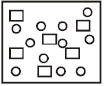
MediumMCQ
In the figure shown below,reactant $A$ (represented by square) is in equilibrium with product $B$ (represented by circle). The equilibrium constant is:
A
$2$
B
$1$
C
$8$
D
$4$
Solution
(A) From the figure,count the number of squares $(A)$ and circles $(B)$:
Number of squares $(A)$ = $4$
Number of circles $(B)$ = $8$
Assuming the reaction $A \rightleftharpoons B$,the equilibrium constant $K$ is given by:
$K = \frac{[B]}{[A]} = \frac{8}{4} = 2$
Therefore,the correct option is $A$.
Number of squares $(A)$ = $4$
Number of circles $(B)$ = $8$
Assuming the reaction $A \rightleftharpoons B$,the equilibrium constant $K$ is given by:
$K = \frac{[B]}{[A]} = \frac{8}{4} = 2$
Therefore,the correct option is $A$.
0 likes
View Solution130
Medium
The following concentrations were obtained for the formation of $NH_{3}$ from $N_{2}$ and $H_{2}$ at equilibrium at $500\, K$: $[N_{2}] = 1.5 \times 10^{-2}\, M$,$[H_{2}] = 3.0 \times 10^{-2}\, M$ and $[NH_{3}] = 1.2 \times 10^{-2}\, M$. Calculate the equilibrium constant.
Solution
(N/A) The balanced chemical equation for the formation of ammonia is: $N_{2(g)} + 3H_{2(g)} \rightleftharpoons 2NH_{3(g)}$
The expression for the equilibrium constant $K_{c}$ is given by: $K_{c} = \frac{[NH_{3}]^{2}}{[N_{2}][H_{2}]^{3}}$
Substituting the given values: $K_{c} = \frac{(1.2 \times 10^{-2})^{2}}{(1.5 \times 10^{-2}) \times (3.0 \times 10^{-2})^{3}}$
$K_{c} = \frac{1.44 \times 10^{-4}}{(1.5 \times 10^{-2}) \times (27 \times 10^{-6})}$
$K_{c} = \frac{1.44 \times 10^{-4}}{40.5 \times 10^{-8}}$
$K_{c} = \frac{1.44}{40.5} \times 10^{4} \approx 0.03555 \times 10^{4} = 3.555 \times 10^{2}$
The expression for the equilibrium constant $K_{c}$ is given by: $K_{c} = \frac{[NH_{3}]^{2}}{[N_{2}][H_{2}]^{3}}$
Substituting the given values: $K_{c} = \frac{(1.2 \times 10^{-2})^{2}}{(1.5 \times 10^{-2}) \times (3.0 \times 10^{-2})^{3}}$
$K_{c} = \frac{1.44 \times 10^{-4}}{(1.5 \times 10^{-2}) \times (27 \times 10^{-6})}$
$K_{c} = \frac{1.44 \times 10^{-4}}{40.5 \times 10^{-8}}$
$K_{c} = \frac{1.44}{40.5} \times 10^{4} \approx 0.03555 \times 10^{4} = 3.555 \times 10^{2}$
0 likes
View Solution131
Medium
At equilibrium,the concentrations of $N_{2} = 3.0 \times 10^{-3} \, M$,$O_{2} = 4.2 \times 10^{-3} \, M$ and $NO = 2.8 \times 10^{-3} \, M$ in a sealed vessel at $800 \, K$. What will be $K_{c}$ for the reaction
$N_{2(g)} + O_{2(g)} \rightleftharpoons 2NO_{(g)}$
$N_{2(g)} + O_{2(g)} \rightleftharpoons 2NO_{(g)}$
Solution
(0.622) The equilibrium constant $K_{c}$ for the reaction $N_{2(g)} + O_{2(g)} \rightleftharpoons 2NO_{(g)}$ is given by the expression:
$K_{c} = \frac{[NO]^{2}}{[N_{2}][O_{2}]}$
Substituting the given equilibrium concentrations:
$K_{c} = \frac{(2.8 \times 10^{-3})^{2}}{(3.0 \times 10^{-3})(4.2 \times 10^{-3})}$
$K_{c} = \frac{7.84 \times 10^{-6}}{12.6 \times 10^{-6}}$
$K_{c} = 0.622$
$K_{c} = \frac{[NO]^{2}}{[N_{2}][O_{2}]}$
Substituting the given equilibrium concentrations:
$K_{c} = \frac{(2.8 \times 10^{-3})^{2}}{(3.0 \times 10^{-3})(4.2 \times 10^{-3})}$
$K_{c} = \frac{7.84 \times 10^{-6}}{12.6 \times 10^{-6}}$
$K_{c} = 0.622$
0 likes
View Solution132
Easy
$PCl_5$,$PCl_3$,and $Cl_2$ are at equilibrium at $500 \ K$ with concentrations $[PCl_3] = 1.59 \ M$,$[Cl_2] = 1.59 \ M$,and $[PCl_5] = 1.41 \ M$. Calculate $K_c$ for the reaction:
$PCl_5 \rightleftharpoons PCl_3 + Cl_2$
$PCl_5 \rightleftharpoons PCl_3 + Cl_2$
Solution
(1.79) The equilibrium constant expression for the reaction $PCl_5 \rightleftharpoons PCl_3 + Cl_2$ is given by:
$K_c = \frac{[PCl_3][Cl_2]}{[PCl_5]}$
Substituting the given equilibrium concentrations into the expression:
$K_c = \frac{(1.59 \ M)(1.59 \ M)}{1.41 \ M}$
$K_c = \frac{2.5281}{1.41} \approx 1.79$
$K_c = \frac{[PCl_3][Cl_2]}{[PCl_5]}$
Substituting the given equilibrium concentrations into the expression:
$K_c = \frac{(1.59 \ M)(1.59 \ M)}{1.41 \ M}$
$K_c = \frac{2.5281}{1.41} \approx 1.79$
0 likes
View Solution133
MediumMCQ
The value of $K_{c}$ for the reaction $2 A \rightleftharpoons B + C$ is $2 \times 10^{-3}$. At a given time,the composition of the reaction mixture is $[ A ] = [ B ] = [ C ] = 3 \times 10^{-4} \ M$. In which direction will the reaction proceed?
A
Forward direction
B
Reverse direction
C
The reaction is at equilibrium
D
No reaction occurs
Solution
(B) For the reaction $2 A \rightleftharpoons B + C$,the reaction quotient $Q_{c}$ is given by:
$Q_{c} = \frac{[ B ][ C ]}{[ A ]^{2}}$
Given $[ A ] = [ B ] = [ C ] = 3 \times 10^{-4} \ M$,we calculate $Q_{c}$:
$Q_{c} = \frac{(3 \times 10^{-4})(3 \times 10^{-4})}{(3 \times 10^{-4})^{2}} = 1$
Since $Q_{c} = 1$ and $K_{c} = 2 \times 10^{-3}$,we observe that $Q_{c} > K_{c}$.
Therefore,the reaction will proceed in the reverse direction to attain equilibrium.
$Q_{c} = \frac{[ B ][ C ]}{[ A ]^{2}}$
Given $[ A ] = [ B ] = [ C ] = 3 \times 10^{-4} \ M$,we calculate $Q_{c}$:
$Q_{c} = \frac{(3 \times 10^{-4})(3 \times 10^{-4})}{(3 \times 10^{-4})^{2}} = 1$
Since $Q_{c} = 1$ and $K_{c} = 2 \times 10^{-3}$,we observe that $Q_{c} > K_{c}$.
Therefore,the reaction will proceed in the reverse direction to attain equilibrium.
0 likes
View Solution134
Easy
What is $K_{c}$ for the following equilibrium when the equilibrium concentration of each substance is: $[SO_{2}] = 0.60 \, M, [O_{2}] = 0.82 \, M$ and $[SO_{3}] = 1.90 \, M?$
$2SO_{2(g)} + O_{2(g)} \longleftrightarrow 2SO_{3(g)}$
$2SO_{2(g)} + O_{2(g)} \longleftrightarrow 2SO_{3(g)}$
Solution
(N/A) The equilibrium constant $(K_{c})$ for the given reaction is defined as:
$K_{c} = \frac{[SO_{3}]^{2}}{[SO_{2}]^{2}[O_{2}]}$
Substituting the given equilibrium concentrations:
$K_{c} = \frac{(1.90)^{2}}{(0.60)^{2} \times (0.82)}$
$K_{c} = \frac{3.61}{0.36 \times 0.82}$
$K_{c} = \frac{3.61}{0.2952} \approx 12.23 \, M^{-1}$
Thus,the equilibrium constant $K_{c}$ is approximately $12.23 \, M^{-1}$.
$K_{c} = \frac{[SO_{3}]^{2}}{[SO_{2}]^{2}[O_{2}]}$
Substituting the given equilibrium concentrations:
$K_{c} = \frac{(1.90)^{2}}{(0.60)^{2} \times (0.82)}$
$K_{c} = \frac{3.61}{0.36 \times 0.82}$
$K_{c} = \frac{3.61}{0.2952} \approx 12.23 \, M^{-1}$
Thus,the equilibrium constant $K_{c}$ is approximately $12.23 \, M^{-1}$.
0 likes
View Solution135
Medium
Write the expression for the equilibrium constant,$K_{c}$ for each of the following reactions:
$(i)$ $2 NOCl_{(g)} \longleftrightarrow 2 NO_{(g)} + Cl_{2(g)}$
$(ii)$ $2 Cu(NO_{3})_{2(s)} \longleftrightarrow 2 CuO_{(s)} + 4 NO_{2(g)} + O_{2(g)}$
$(iii)$ $CH_{3}COOC_{2}H_{5(aq)} + H_{2}O_{(l)} \longleftrightarrow CH_{3}COOH_{(aq)} + C_{2}H_{5}OH_{(aq)}$
$(iv)$ $Fe^{3+}_{(aq)} + 3 OH^{-}_{(aq)} \longleftrightarrow Fe(OH)_{3(s)}$
$(v)$ $I_{2(s)} + 5 F_{2(g)} \longleftrightarrow 2 IF_{5(g)}$
$(i)$ $2 NOCl_{(g)} \longleftrightarrow 2 NO_{(g)} + Cl_{2(g)}$
$(ii)$ $2 Cu(NO_{3})_{2(s)} \longleftrightarrow 2 CuO_{(s)} + 4 NO_{2(g)} + O_{2(g)}$
$(iii)$ $CH_{3}COOC_{2}H_{5(aq)} + H_{2}O_{(l)} \longleftrightarrow CH_{3}COOH_{(aq)} + C_{2}H_{5}OH_{(aq)}$
$(iv)$ $Fe^{3+}_{(aq)} + 3 OH^{-}_{(aq)} \longleftrightarrow Fe(OH)_{3(s)}$
$(v)$ $I_{2(s)} + 5 F_{2(g)} \longleftrightarrow 2 IF_{5(g)}$
Solution
(N/A) The equilibrium constant $K_{c}$ is defined as the ratio of the product of molar concentrations of products to that of reactants,each raised to the power of their stoichiometric coefficients. Pure solids and liquids are taken as unity $(1)$.
$(i)$ $K_{c} = \frac{[NO]^{2} [Cl_{2}]}{[NOCl]^{2}}$
$(ii)$ Since $Cu(NO_{3})_{2(s)}$ and $CuO_{(s)}$ are solids,their concentrations are taken as $1$.
$K_{c} = [NO_{2}]^{4} [O_{2}]$
$(iii)$ Since $H_{2}O_{(l)}$ is a pure liquid,its concentration is taken as $1$.
$K_{c} = \frac{[CH_{3}COOH] [C_{2}H_{5}OH]}{[CH_{3}COOC_{2}H_{5}]}$
$(iv)$ Since $Fe(OH)_{3(s)}$ is a solid,its concentration is taken as $1$.
$K_{c} = \frac{1}{[Fe^{3+}] [OH^{-}]^{3}}$
$(v)$ Since $I_{2(s)}$ is a solid,its concentration is taken as $1$.
$K_{c} = \frac{[IF_{5}]^{2}}{[F_{2}]^{5}}$
$(i)$ $K_{c} = \frac{[NO]^{2} [Cl_{2}]}{[NOCl]^{2}}$
$(ii)$ Since $Cu(NO_{3})_{2(s)}$ and $CuO_{(s)}$ are solids,their concentrations are taken as $1$.
$K_{c} = [NO_{2}]^{4} [O_{2}]$
$(iii)$ Since $H_{2}O_{(l)}$ is a pure liquid,its concentration is taken as $1$.
$K_{c} = \frac{[CH_{3}COOH] [C_{2}H_{5}OH]}{[CH_{3}COOC_{2}H_{5}]}$
$(iv)$ Since $Fe(OH)_{3(s)}$ is a solid,its concentration is taken as $1$.
$K_{c} = \frac{1}{[Fe^{3+}] [OH^{-}]^{3}}$
$(v)$ Since $I_{2(s)}$ is a solid,its concentration is taken as $1$.
$K_{c} = \frac{[IF_{5}]^{2}}{[F_{2}]^{5}}$
0 likes
View Solution136
Medium
For the following equilibrium,$K_{C} = 6.3 \times 10^{14}$ at $1000 \ K$:
$NO_{(g)} + O_{3(g)} \longleftrightarrow NO_{2(g)} + O_{2(g)}$
Both the forward and reverse reactions in the equilibrium are elementary bimolecular reactions. What is $K_{C}$ for the reverse reaction?
$NO_{(g)} + O_{3(g)} \longleftrightarrow NO_{2(g)} + O_{2(g)}$
Both the forward and reverse reactions in the equilibrium are elementary bimolecular reactions. What is $K_{C}$ for the reverse reaction?
Solution
(D) The equilibrium constant for the reverse reaction is the reciprocal of the equilibrium constant for the forward reaction.
Given $K_{C} = 6.3 \times 10^{14}$ for the forward reaction.
The equilibrium constant for the reverse reaction is $K_{C}^{\prime} = \frac{1}{K_{C}}$.
$K_{C}^{\prime} = \frac{1}{6.3 \times 10^{14}} = 1.587 \times 10^{-15} \approx 1.59 \times 10^{-15}$.
Given $K_{C} = 6.3 \times 10^{14}$ for the forward reaction.
The equilibrium constant for the reverse reaction is $K_{C}^{\prime} = \frac{1}{K_{C}}$.
$K_{C}^{\prime} = \frac{1}{6.3 \times 10^{14}} = 1.587 \times 10^{-15} \approx 1.59 \times 10^{-15}$.
0 likes
View Solution137
Easy
Explain why pure liquids and solids can be ignored while writing the equilibrium constant expression?
Solution
(N/A) For a pure substance (both solids and liquids),the concentration is defined as:
$[Pure \text{ } substance] = \frac{\text{Number of moles}}{\text{Volume}}$
$= \frac{\text{Mass} / \text{Molecular mass}}{\text{Volume}}$
$= \frac{\text{Mass}}{\text{Volume} \times \text{Molecular mass}}$
$= \frac{\text{Density}}{\text{Molecular mass}}$
Since the density and molecular mass of a pure substance are constant at a given temperature,the concentration of a pure substance is a constant value.
This constant value is incorporated into the equilibrium constant $(K_c)$,and therefore,pure solids and liquids are omitted from the equilibrium constant expression.
$[Pure \text{ } substance] = \frac{\text{Number of moles}}{\text{Volume}}$
$= \frac{\text{Mass} / \text{Molecular mass}}{\text{Volume}}$
$= \frac{\text{Mass}}{\text{Volume} \times \text{Molecular mass}}$
$= \frac{\text{Density}}{\text{Molecular mass}}$
Since the density and molecular mass of a pure substance are constant at a given temperature,the concentration of a pure substance is a constant value.
This constant value is incorporated into the equilibrium constant $(K_c)$,and therefore,pure solids and liquids are omitted from the equilibrium constant expression.
0 likes
View Solution138
Easy
The equilibrium constant expression for a gas reaction is,
$K_{C} = \frac{[NH_{3}]^{4}[O_{2}]^{5}}{[NO]^{4}[H_{2}O]^{6}}$
Write the balanced chemical equation corresponding to this expression.
$K_{C} = \frac{[NH_{3}]^{4}[O_{2}]^{5}}{[NO]^{4}[H_{2}O]^{6}}$
Write the balanced chemical equation corresponding to this expression.
Solution
(N/A) The equilibrium constant expression $K_{C}$ is defined as the ratio of the product of concentrations of products raised to their stoichiometric coefficients to the product of concentrations of reactants raised to their stoichiometric coefficients.
Given $K_{C} = \frac{[NH_{3}]^{4}[O_{2}]^{5}}{[NO]^{4}[H_{2}O]^{6}}$,the species in the numerator ($NH_{3}$ and $O_{2}$) are the products,and the species in the denominator ($NO$ and $H_{2}O$) are the reactants.
The stoichiometric coefficients correspond to the powers in the expression.
Thus,the balanced chemical equation is:
$4NO_{(g)} + 6H_{2}O_{(g)} \leftrightarrow 4NH_{3_{(g)}} + 5O_{2_{(g)}}$
Given $K_{C} = \frac{[NH_{3}]^{4}[O_{2}]^{5}}{[NO]^{4}[H_{2}O]^{6}}$,the species in the numerator ($NH_{3}$ and $O_{2}$) are the products,and the species in the denominator ($NO$ and $H_{2}O$) are the reactants.
The stoichiometric coefficients correspond to the powers in the expression.
Thus,the balanced chemical equation is:
$4NO_{(g)} + 6H_{2}O_{(g)} \leftrightarrow 4NH_{3_{(g)}} + 5O_{2_{(g)}}$
0 likes
View Solution139
Medium
What is the equilibrium concentration of each of the substances in the equilibrium when the initial concentration of $ICl$ was $0.78 \, M$?
$2ICl_{(g)} \leftrightarrow I_{2(g)} + Cl_{2(g)}; \, K_c = 0.14$
$2ICl_{(g)} \leftrightarrow I_{2(g)} + Cl_{2(g)}; \, K_c = 0.14$
Solution
(N/A) The given reaction is:
$2ICl_{(g)} \leftrightarrow I_{2(g)} + Cl_{2(g)}$
Initial concentration: $[ICl] = 0.78 \, M$,$[I_2] = 0 \, M$,$[Cl_2] = 0 \, M$
At equilibrium: $[ICl] = (0.78 - 2x) \, M$,$[I_2] = x \, M$,$[Cl_2] = x \, M$
The equilibrium constant expression is:
$K_c = \frac{[I_2][Cl_2]}{[ICl]^2} = 0.14$
Substituting the values:
$\frac{x \cdot x}{(0.78 - 2x)^2} = 0.14$
Taking the square root on both sides:
$\frac{x}{0.78 - 2x} = \sqrt{0.14} \approx 0.374$
$x = 0.374(0.78 - 2x)$
$x = 0.2917 - 0.748x$
$1.748x = 0.2917$
$x \approx 0.167 \, M$
Therefore,at equilibrium:
$[I_2] = [Cl_2] = 0.167 \, M$
$[ICl] = 0.78 - 2(0.167) = 0.446 \, M$
$2ICl_{(g)} \leftrightarrow I_{2(g)} + Cl_{2(g)}$
Initial concentration: $[ICl] = 0.78 \, M$,$[I_2] = 0 \, M$,$[Cl_2] = 0 \, M$
At equilibrium: $[ICl] = (0.78 - 2x) \, M$,$[I_2] = x \, M$,$[Cl_2] = x \, M$
The equilibrium constant expression is:
$K_c = \frac{[I_2][Cl_2]}{[ICl]^2} = 0.14$
Substituting the values:
$\frac{x \cdot x}{(0.78 - 2x)^2} = 0.14$
Taking the square root on both sides:
$\frac{x}{0.78 - 2x} = \sqrt{0.14} \approx 0.374$
$x = 0.374(0.78 - 2x)$
$x = 0.2917 - 0.748x$
$1.748x = 0.2917$
$x \approx 0.167 \, M$
Therefore,at equilibrium:
$[I_2] = [Cl_2] = 0.167 \, M$
$[ICl] = 0.78 - 2(0.167) = 0.446 \, M$
0 likes
View Solution140
MediumMCQ
$A$ sample of pure $PCl_{5}$ was introduced into an evacuated vessel at $473 \, K$. After equilibrium was attained,the concentration of $PCl_{5}$ was found to be $0.5 \times 10^{-1} \, mol \, L^{-1}$. If the value of $K_{c}$ is $8.3 \times 10^{-3}$,what are the concentrations of $PCl_{3}$ and $Cl_{2}$ at equilibrium?
$PCl_{5(g)} \longleftrightarrow PCl_{3(g)} + Cl_{2(g)}$
$PCl_{5(g)} \longleftrightarrow PCl_{3(g)} + Cl_{2(g)}$
A
$0.02 \, mol \, L^{-1}$
B
$0.04 \, mol \, L^{-1}$
C
$0.01 \, mol \, L^{-1}$
D
$0.05 \, mol \, L^{-1}$
Solution
(A) Let the concentrations of both $PCl_{3}$ and $Cl_{2}$ at equilibrium be $x \, mol \, L^{-1}$.
The given reaction is:
$PCl_{5(g)} \longleftrightarrow PCl_{3(g)} + Cl_{2(g)}$
At equilibrium,the concentrations are:
$[PCl_{5}] = 0.5 \times 10^{-1} \, mol \, L^{-1}$
$[PCl_{3}] = x \, mol \, L^{-1}$
$[Cl_{2}] = x \, mol \, L^{-1}$
The equilibrium constant expression is:
$K_{c} = \frac{[PCl_{3}][Cl_{2}]}{[PCl_{5}]}$
Substituting the given values:
$8.3 \times 10^{-3} = \frac{x \times x}{0.5 \times 10^{-1}}$
$x^{2} = 8.3 \times 10^{-3} \times 0.5 \times 10^{-1}$
$x^{2} = 4.15 \times 10^{-4}$
$x = \sqrt{4.15 \times 10^{-4}} \approx 2.04 \times 10^{-2} \, mol \, L^{-1}$
Thus,$[PCl_{3}] = [Cl_{2}] \approx 0.02 \, mol \, L^{-1}$.
The given reaction is:
$PCl_{5(g)} \longleftrightarrow PCl_{3(g)} + Cl_{2(g)}$
At equilibrium,the concentrations are:
$[PCl_{5}] = 0.5 \times 10^{-1} \, mol \, L^{-1}$
$[PCl_{3}] = x \, mol \, L^{-1}$
$[Cl_{2}] = x \, mol \, L^{-1}$
The equilibrium constant expression is:
$K_{c} = \frac{[PCl_{3}][Cl_{2}]}{[PCl_{5}]}$
Substituting the given values:
$8.3 \times 10^{-3} = \frac{x \times x}{0.5 \times 10^{-1}}$
$x^{2} = 8.3 \times 10^{-3} \times 0.5 \times 10^{-1}$
$x^{2} = 4.15 \times 10^{-4}$
$x = \sqrt{4.15 \times 10^{-4}} \approx 2.04 \times 10^{-2} \, mol \, L^{-1}$
Thus,$[PCl_{3}] = [Cl_{2}] \approx 0.02 \, mol \, L^{-1}$.
0 likes
View Solution141
Medium
Equilibrium constant,$K_{c}$ for the reaction $N_{2(g)} + 3H_{2(g)} \longleftrightarrow 2NH_{3(g)}$ at $500 \, K$ is $0.061$. At a particular time,the analysis shows that the composition of the reaction mixture is $[N_{2}] = 3.0 \, mol \, L^{-1}$,$[H_{2}] = 2.0 \, mol \, L^{-1}$,and $[NH_{3}] = 0.5 \, mol \, L^{-1}$. Is the reaction at equilibrium? If not,in which direction does the reaction tend to proceed to reach equilibrium?
Solution
(A) The given reaction is: $N_{2(g)} + 3H_{2(g)} \longleftrightarrow 2NH_{3(g)}$
At a particular time,the concentrations are: $[N_{2}] = 3.0 \, mol \, L^{-1}$,$[H_{2}] = 2.0 \, mol \, L^{-1}$,$[NH_{3}] = 0.5 \, mol \, L^{-1}$
The reaction quotient $Q_{c}$ is calculated as:
$Q_{c} = \frac{[NH_{3}]^{2}}{[N_{2}][H_{2}]^{3}}$
Substituting the values:
$Q_{c} = \frac{(0.5)^{2}}{(3.0)(2.0)^{3}} = \frac{0.25}{3.0 \times 8} = \frac{0.25}{24} \approx 0.0104$
Given $K_{c} = 0.061$.
Since $Q_{c} \neq K_{c}$,the reaction is not at equilibrium.
Since $Q_{c} < K_{c}$,the reaction will proceed in the forward direction to reach equilibrium.
At a particular time,the concentrations are: $[N_{2}] = 3.0 \, mol \, L^{-1}$,$[H_{2}] = 2.0 \, mol \, L^{-1}$,$[NH_{3}] = 0.5 \, mol \, L^{-1}$
The reaction quotient $Q_{c}$ is calculated as:
$Q_{c} = \frac{[NH_{3}]^{2}}{[N_{2}][H_{2}]^{3}}$
Substituting the values:
$Q_{c} = \frac{(0.5)^{2}}{(3.0)(2.0)^{3}} = \frac{0.25}{3.0 \times 8} = \frac{0.25}{24} \approx 0.0104$
Given $K_{c} = 0.061$.
Since $Q_{c} \neq K_{c}$,the reaction is not at equilibrium.
Since $Q_{c} < K_{c}$,the reaction will proceed in the forward direction to reach equilibrium.
0 likes
View Solution142
Medium
The value of $K_{c}$ for the reaction $3 O_{2(g)} \longleftrightarrow 2 O_{3(g)}$ is $2.0 \times 10^{-50}$ at $25^{\circ} C$. If the equilibrium concentration of $O_{2}$ in air at $25^{\circ} C$ is $1.6 \times 10^{-2} \, M$,what is the concentration of $O_{3} ?$
Solution
The given reaction is:
$3 O_{2(g)} \longleftrightarrow 2 O_{3(g)}$
The expression for the equilibrium constant is:
$K_{c} = \frac{[O_{3}]^{2}}{[O_{2}]^{3}}$
Given values are:
$K_{c} = 2.0 \times 10^{-50}$
$[O_{2}] = 1.6 \times 10^{-2} \, M$
Substituting the values into the expression:
$2.0 \times 10^{-50} = \frac{[O_{3}]^{2}}{(1.6 \times 10^{-2})^{3}}$
$[O_{3}]^{2} = 2.0 \times 10^{-50} \times (1.6 \times 10^{-2})^{3}$
$[O_{3}]^{2} = 2.0 \times 10^{-50} \times 4.096 \times 10^{-6}$
$[O_{3}]^{2} = 8.192 \times 10^{-56}$
Taking the square root:
$[O_{3}] = \sqrt{8.192 \times 10^{-56}}$
$[O_{3}] \approx 2.86 \times 10^{-28} \, M$
Thus,the concentration of $O_{3}$ is $2.86 \times 10^{-28} \, M$.
$3 O_{2(g)} \longleftrightarrow 2 O_{3(g)}$
The expression for the equilibrium constant is:
$K_{c} = \frac{[O_{3}]^{2}}{[O_{2}]^{3}}$
Given values are:
$K_{c} = 2.0 \times 10^{-50}$
$[O_{2}] = 1.6 \times 10^{-2} \, M$
Substituting the values into the expression:
$2.0 \times 10^{-50} = \frac{[O_{3}]^{2}}{(1.6 \times 10^{-2})^{3}}$
$[O_{3}]^{2} = 2.0 \times 10^{-50} \times (1.6 \times 10^{-2})^{3}$
$[O_{3}]^{2} = 2.0 \times 10^{-50} \times 4.096 \times 10^{-6}$
$[O_{3}]^{2} = 8.192 \times 10^{-56}$
Taking the square root:
$[O_{3}] = \sqrt{8.192 \times 10^{-56}}$
$[O_{3}] \approx 2.86 \times 10^{-28} \, M$
Thus,the concentration of $O_{3}$ is $2.86 \times 10^{-28} \, M$.
0 likes
View Solution143
Medium
The reaction,$CO_{(g)} + 3H_{2(g)} \longleftrightarrow CH_{4(g)} + H_{2}O_{(g)}$ is at equilibrium at $1300 \, K$ in a $1 \, L$ flask. It also contains $0.30 \, mol$ of $CO$,$0.10 \, mol$ of $H_{2}$,and $0.02 \, mol$ of $H_{2}O$ and an unknown amount of $CH_{4}$ in the flask. Determine the concentration of $CH_{4}$ in the mixture. The equilibrium constant,$K_{c}$ for the reaction at the given temperature is $3.90$.
Solution
(D) Let the concentration of methane at equilibrium be $x$.
The equilibrium expression for the reaction $CO_{(g)} + 3H_{2(g)} \longleftrightarrow CH_{4(g)} + H_{2}O_{(g)}$ is:
$K_{c} = \frac{[CH_{4}][H_{2}O]}{[CO][H_{2}]^3}$
Given concentrations at equilibrium in a $1 \, L$ flask:
$[CO] = 0.30 \, M$,$[H_{2}] = 0.10 \, M$,$[H_{2}O] = 0.02 \, M$,$[CH_{4}] = x \, M$
Substituting the values into the $K_{c}$ expression:
$3.90 = \frac{x \times 0.02}{0.30 \times (0.10)^3}$
$3.90 = \frac{0.02x}{0.30 \times 0.001}$
$3.90 = \frac{0.02x}{0.0003}$
$x = \frac{3.90 \times 0.0003}{0.02}$
$x = \frac{0.00117}{0.02} = 0.0585 \, M$
Thus,the concentration of $CH_{4}$ is $5.85 \times 10^{-2} \, M$.
The equilibrium expression for the reaction $CO_{(g)} + 3H_{2(g)} \longleftrightarrow CH_{4(g)} + H_{2}O_{(g)}$ is:
$K_{c} = \frac{[CH_{4}][H_{2}O]}{[CO][H_{2}]^3}$
Given concentrations at equilibrium in a $1 \, L$ flask:
$[CO] = 0.30 \, M$,$[H_{2}] = 0.10 \, M$,$[H_{2}O] = 0.02 \, M$,$[CH_{4}] = x \, M$
Substituting the values into the $K_{c}$ expression:
$3.90 = \frac{x \times 0.02}{0.30 \times (0.10)^3}$
$3.90 = \frac{0.02x}{0.30 \times 0.001}$
$3.90 = \frac{0.02x}{0.0003}$
$x = \frac{3.90 \times 0.0003}{0.02}$
$x = \frac{0.00117}{0.02} = 0.0585 \, M$
Thus,the concentration of $CH_{4}$ is $5.85 \times 10^{-2} \, M$.
0 likes
View Solution144
Difficult
State the law of chemical equilibrium for an equilibrium process.
Solution
(N/A) For a general reversible reaction $aA + bB \rightleftharpoons cC + dD$,where $A$ and $B$ are reactants and $C$ and $D$ are products,the law of chemical equilibrium states that at a given temperature,the product of the concentrations of the products raised to their respective stoichiometric coefficients,divided by the product of the concentrations of the reactants raised to their respective stoichiometric coefficients,is a constant value known as the equilibrium constant $(K_c)$.
The mathematical expression is given by:
$K_c = \frac{[C]^c [D]^d}{[A]^a [B]^b}$
Here,$[A], [B], [C],$ and $[D]$ represent the molar concentrations of the species at equilibrium. This relationship is also referred to as the law of mass action.
The mathematical expression is given by:
$K_c = \frac{[C]^c [D]^d}{[A]^a [B]^b}$
Here,$[A], [B], [C],$ and $[D]$ represent the molar concentrations of the species at equilibrium. This relationship is also referred to as the law of mass action.
0 likes
View Solution145
Medium
Write the equilibrium constant (equilibrium law) for the following reactions:
$(i)$ $4NH_{3(g)} + 5O_{2(g)} \rightleftharpoons 4NO_{(g)} + 6H_{2}O_{(g)}$
$(ii)$ $H_{2(g)} + I_{2(g)} \rightleftharpoons 2HI_{(g)}$
$(iii)$ $N_{2(g)} + 3H_{2(g)} \rightleftharpoons 2NH_{3(g)}$
$(i)$ $4NH_{3(g)} + 5O_{2(g)} \rightleftharpoons 4NO_{(g)} + 6H_{2}O_{(g)}$
$(ii)$ $H_{2(g)} + I_{2(g)} \rightleftharpoons 2HI_{(g)}$
$(iii)$ $N_{2(g)} + 3H_{2(g)} \rightleftharpoons 2NH_{3(g)}$
Solution
(N/A) The equilibrium constant $(K_c)$ is defined as the ratio of the product of the molar concentrations of the products to the product of the molar concentrations of the reactants,each raised to the power of their stoichiometric coefficients.
$(i)$ For $4NH_{3(g)} + 5O_{2(g)} \rightleftharpoons 4NO_{(g)} + 6H_{2}O_{(g)}$,the expression is: $K_c = \frac{[NO]^4 [H_2O]^6}{[NH_3]^4 [O_2]^5}$
$(ii)$ For $H_{2(g)} + I_{2(g)} \rightleftharpoons 2HI_{(g)}$,the expression is: $K_c = \frac{[HI]^2}{[H_2] [I_2]}$
$(iii)$ For $N_{2(g)} + 3H_{2(g)} \rightleftharpoons 2NH_{3(g)}$,the expression is: $K_c = \frac{[NH_3]^2}{[N_2] [H_2]^3}$
$(i)$ For $4NH_{3(g)} + 5O_{2(g)} \rightleftharpoons 4NO_{(g)} + 6H_{2}O_{(g)}$,the expression is: $K_c = \frac{[NO]^4 [H_2O]^6}{[NH_3]^4 [O_2]^5}$
$(ii)$ For $H_{2(g)} + I_{2(g)} \rightleftharpoons 2HI_{(g)}$,the expression is: $K_c = \frac{[HI]^2}{[H_2] [I_2]}$
$(iii)$ For $N_{2(g)} + 3H_{2(g)} \rightleftharpoons 2NH_{3(g)}$,the expression is: $K_c = \frac{[NH_3]^2}{[N_2] [H_2]^3}$
0 likes
View Solution146
Medium
If an equilibrium process equation is multiplied by a factor $n$,how does the equilibrium constant change? Explain with an example.
Solution
(N/A) The equilibrium of $HI$ synthesis at a definite temperature is as follows:
$H_{2(g)} + I_{2(g)} \rightleftharpoons 2HI_{(g)}$ $\quad (Eq.-I)$
The equilibrium constant $K_c$ is:
$K_c = \frac{[HI]^2}{[H_2][I_2]} = X$ $\quad (Eq.-II)$
On multiplying the $HI$ synthesis equation by a factor $n$,we get:
$nH_{2(g)} + nI_{2(g)} \rightleftharpoons 2nHI_{(g)}$ $\quad (Eq.-III)$
For this reaction,the new equilibrium constant $K'_c$ is:
$K'_c = \frac{[HI]^{2n}}{[H_2]^n[I_2]^n} = \left( \frac{[HI]^2}{[H_2][I_2]} \right)^n = X^n$ $\quad (Eq.-IV)$
Thus,$K'_c = (K_c)^n$.
It should be noted that because the equilibrium constants $K_c$ and $K'_c$ have different numerical values,it is important to specify the form of the balanced chemical equation when quoting the value of an equilibrium constant.
$H_{2(g)} + I_{2(g)} \rightleftharpoons 2HI_{(g)}$ $\quad (Eq.-I)$
The equilibrium constant $K_c$ is:
$K_c = \frac{[HI]^2}{[H_2][I_2]} = X$ $\quad (Eq.-II)$
On multiplying the $HI$ synthesis equation by a factor $n$,we get:
$nH_{2(g)} + nI_{2(g)} \rightleftharpoons 2nHI_{(g)}$ $\quad (Eq.-III)$
For this reaction,the new equilibrium constant $K'_c$ is:
$K'_c = \frac{[HI]^{2n}}{[H_2]^n[I_2]^n} = \left( \frac{[HI]^2}{[H_2][I_2]} \right)^n = X^n$ $\quad (Eq.-IV)$
Thus,$K'_c = (K_c)^n$.
It should be noted that because the equilibrium constants $K_c$ and $K'_c$ have different numerical values,it is important to specify the form of the balanced chemical equation when quoting the value of an equilibrium constant.
0 likes
View Solution147
Medium
At $400 \ K$ in a closed vessel,the reaction $H_{2(g)} + I_{2(g)} \rightleftharpoons 2HI_{(g)}$ takes place. At equilibrium,the concentration of $H_2$ is $0.6 \ mol \ L^{-1}$,the concentration of $I_2$ is $0.8 \ mol \ L^{-1}$,and the concentration of $HI$ is $0.14 \ mol \ L^{-1}$. Calculate the equilibrium constant $(K_c)$.
Solution
(N/A) The equilibrium constant expression for the reaction $H_{2(g)} + I_{2(g)} \rightleftharpoons 2HI_{(g)}$ is given by:
$K_c = \frac{[HI]^2}{[H_2][I_2]}$
Substituting the given equilibrium concentrations:
$K_c = \frac{(0.14)^2}{(0.6)(0.8)}$
$K_c = \frac{0.0196}{0.48}$
$K_c \approx 0.04083$ or $4.08 \times 10^{-2}$
$K_c = \frac{[HI]^2}{[H_2][I_2]}$
Substituting the given equilibrium concentrations:
$K_c = \frac{(0.14)^2}{(0.6)(0.8)}$
$K_c = \frac{0.0196}{0.48}$
$K_c \approx 0.04083$ or $4.08 \times 10^{-2}$
0 likes
View Solution148
Medium
In a closed vessel,$PCl_{5(g)}$ is obtained by the chemical reaction between $PCl_{3(g)}$ and $Cl_{2(g)}$. If the equilibrium concentrations in this vessel of $PCl_3$,$Cl_2$,and $PCl_5$ at $500 \ K$ are $1.59 \ M$,$1.59 \ M$,and $1.41 \ M$ respectively,then find the equilibrium constant $K_c$ for the reaction: $PCl_{3(g)} + Cl_{2(g)} \rightleftharpoons PCl_{5(g)}$
Solution
(A) The equilibrium constant $K_c$ for the reaction $PCl_{3(g)} + Cl_{2(g)} \rightleftharpoons PCl_{5(g)}$ is given by the expression:
$K_c = \frac{[PCl_5]}{[PCl_3][Cl_2]}$
Given equilibrium concentrations:
$[PCl_3] = 1.59 \ M$
$[Cl_2] = 1.59 \ M$
$[PCl_5] = 1.41 \ M$
Substituting these values into the expression:
$K_c = \frac{1.41}{1.59 \times 1.59} = \frac{1.41}{2.5281} \approx 0.558 \ M^{-1}$
$K_c = \frac{[PCl_5]}{[PCl_3][Cl_2]}$
Given equilibrium concentrations:
$[PCl_3] = 1.59 \ M$
$[Cl_2] = 1.59 \ M$
$[PCl_5] = 1.41 \ M$
Substituting these values into the expression:
$K_c = \frac{1.41}{1.59 \times 1.59} = \frac{1.41}{2.5281} \approx 0.558 \ M^{-1}$
0 likes
View Solution149
Medium
At a definite temperature,the equilibrium constant $K_{c}$ is given by the following equation: $K_{c} = \frac{[I_{2}][H_{5}IO_{6}]^{5}}{[IO_{3}^{-}]^{7}[H_{2}O]^{9}[H^{+}]^{7}}$. Write the balanced chemical equilibrium equation.
Solution
(N/A) The equilibrium constant expression is defined as the ratio of the product of concentrations of products to the product of concentrations of reactants,each raised to the power of their stoichiometric coefficients.
From the given expression $K_{c} = \frac{[I_{2}][H_{5}IO_{6}]^{5}}{[IO_{3}^{-}]^{7}[H_{2}O]^{9}[H^{+}]^{7}}$,the products are $I_{2}$ and $H_{5}IO_{6}$ with coefficients $1$ and $5$ respectively.
The reactants are $IO_{3}^{-}$,$H_{2}O$,and $H^{+}$ with coefficients $7$,$9$,and $7$ respectively.
Thus,the balanced chemical equilibrium equation is:
$7IO_{3(aq)}^{-} + 9H_{2}O_{(l)} + 7H_{(aq)}^{+} \rightleftharpoons I_{2(aq)} + 5H_{5}IO_{6(aq)}$
From the given expression $K_{c} = \frac{[I_{2}][H_{5}IO_{6}]^{5}}{[IO_{3}^{-}]^{7}[H_{2}O]^{9}[H^{+}]^{7}}$,the products are $I_{2}$ and $H_{5}IO_{6}$ with coefficients $1$ and $5$ respectively.
The reactants are $IO_{3}^{-}$,$H_{2}O$,and $H^{+}$ with coefficients $7$,$9$,and $7$ respectively.
Thus,the balanced chemical equilibrium equation is:
$7IO_{3(aq)}^{-} + 9H_{2}O_{(l)} + 7H_{(aq)}^{+} \rightleftharpoons I_{2(aq)} + 5H_{5}IO_{6(aq)}$
0 likes
View Solution150
Medium
Dihydrogen gas is obtained from water gas by the following equation:
$\underbrace{CO_{(g)} + H_2O_{(g)}}_{water\,gas} \rightleftharpoons_{500^{\circ}C} CO_{2_{(g)}} + H_{2_{(g)}}$
At $733 \ K$,the concentrations of $CO$,$H_2O$,$CO_2$,and $H_2$ in water gas are $0.18$,$0.0412$,$0.15$,and $0.2 \ mol \ L^{-1}$ respectively. Find $K_c$.
$\underbrace{CO_{(g)} + H_2O_{(g)}}_{water\,gas} \rightleftharpoons_{500^{\circ}C} CO_{2_{(g)}} + H_{2_{(g)}}$
At $733 \ K$,the concentrations of $CO$,$H_2O$,$CO_2$,and $H_2$ in water gas are $0.18$,$0.0412$,$0.15$,and $0.2 \ mol \ L^{-1}$ respectively. Find $K_c$.
Solution
(N/A) The equilibrium constant $K_c$ for the reaction $CO_{(g)} + H_2O_{(g)} \rightleftharpoons CO_{2_{(g)}} + H_{2_{(g)}}$ is given by the expression:
$K_c = \frac{[CO_2][H_2]}{[CO][H_2O]}$
Given concentrations are:
$[CO] = 0.18 \ mol \ L^{-1}$
$[H_2O] = 0.0412 \ mol \ L^{-1}$
$[CO_2] = 0.15 \ mol \ L^{-1}$
$[H_2] = 0.2 \ mol \ L^{-1}$
Substituting these values into the expression:
$K_c = \frac{0.15 \times 0.2}{0.18 \times 0.0412}$
$K_c = \frac{0.03}{0.007416}$
$K_c \approx 4.045$
$K_c = \frac{[CO_2][H_2]}{[CO][H_2O]}$
Given concentrations are:
$[CO] = 0.18 \ mol \ L^{-1}$
$[H_2O] = 0.0412 \ mol \ L^{-1}$
$[CO_2] = 0.15 \ mol \ L^{-1}$
$[H_2] = 0.2 \ mol \ L^{-1}$
Substituting these values into the expression:
$K_c = \frac{0.15 \times 0.2}{0.18 \times 0.0412}$
$K_c = \frac{0.03}{0.007416}$
$K_c \approx 4.045$
0 likes
View Solution6-1.Equilibrium (Chemical Equilibrium) — Law of equilibrium and Equilibrium constant · Frequently Asked Questions
1Are these 6-1.Equilibrium (Chemical Equilibrium) questions useful for JEE and NEET?
Yes. All questions in this section are mapped to JEE Main and NEET exam patterns. Previous year questions from JEE Main, NEET, GUJCET and state-level exams are included with full solutions.
2Can I switch to Hindi or Gujarati for these questions?
Yes. Use the language tabs in the hero section or the sidebar to view the same questions and solutions in English, Hindi or Gujarati.
3How do I generate a question paper from this subtopic?
Use the Vedclass Exam Paper Generator — select the chapter and subtopic, set difficulty, and generate Sets A, B, C, D automatically. First 3 chapters of every subject are free.
Vedclass Products
For Students
Vedclass Test Series
Mock tests in real JEE/NEET style with performance analysis. 5-day free trial.
Start Free TrialFor Teachers
Exam Paper Generator
Generate Set A/B/C/D papers from this chapter in 2 minutes. 3 chapters free.
Try FreeFor Institutes
Online Exam Module
Live online exams with unlimited students, 360° analytics & white-label branding.
See DemoFor Teachers & Institutes
Generate a 6-1.Equilibrium (Chemical Equilibrium) Exam Paper in 2 Minutes
Select subtopic & difficulty — Sets A, B, C, D auto-generated with No Repeat logic.
First 3 chapters of every subject are free — no payment required.