
A English
Law of equilibrium and Equilibrium constant Questions in English
Class 11 Chemistry · 6-1.Equilibrium (Chemical Equilibrium) · Law of equilibrium and Equilibrium constant
228+
Questions
English
Language
100%
With Solutions
Showing 49 of 228 questions in English
51
MediumMCQ
The equilibrium constants for the reactions $(i)$,$(ii)$,and $(iii)$ are $K_1$,$K_2$,and $K_3$ respectively. Which of the following is the correct relationship?
$(i)$ $N_2 + 2O_2 \rightleftharpoons 2NO_2$
$(ii)$ $2NO_2 \rightleftharpoons N_2 + 2O_2$
$(iii)$ $NO_2 \rightleftharpoons 1/2 N_2 + O_2$
$(i)$ $N_2 + 2O_2 \rightleftharpoons 2NO_2$
$(ii)$ $2NO_2 \rightleftharpoons N_2 + 2O_2$
$(iii)$ $NO_2 \rightleftharpoons 1/2 N_2 + O_2$
A
$K_1 = \sqrt{K_2} = K_3$
B
$K_1 = 1/K_2 = 1/K_3$
C
$K_1 = K_2^2 = K_3$
D
$K_1 = 1/K_2 = 1/(K_3)^2$
Solution
(D) For reaction $(i)$: $N_2 + 2O_2 \rightleftharpoons 2NO_2$ with equilibrium constant $K_1$.
For reaction $(ii)$: $2NO_2 \rightleftharpoons N_2 + 2O_2$,which is the reverse of $(i)$,so $K_2 = 1/K_1$.
For reaction $(iii)$: $NO_2 \rightleftharpoons 1/2 N_2 + O_2$,which is half of reaction $(ii)$,so $K_3 = (K_2)^{1/2} = \sqrt{K_2}$.
From $K_2 = 1/K_1$,we get $K_1 = 1/K_2$.
From $K_3 = \sqrt{K_2}$,we get $K_3^2 = K_2$,so $K_2 = K_3^2$.
Substituting $K_2$ in $K_1 = 1/K_2$,we get $K_1 = 1/K_3^2$.
For reaction $(ii)$: $2NO_2 \rightleftharpoons N_2 + 2O_2$,which is the reverse of $(i)$,so $K_2 = 1/K_1$.
For reaction $(iii)$: $NO_2 \rightleftharpoons 1/2 N_2 + O_2$,which is half of reaction $(ii)$,so $K_3 = (K_2)^{1/2} = \sqrt{K_2}$.
From $K_2 = 1/K_1$,we get $K_1 = 1/K_2$.
From $K_3 = \sqrt{K_2}$,we get $K_3^2 = K_2$,so $K_2 = K_3^2$.
Substituting $K_2$ in $K_1 = 1/K_2$,we get $K_1 = 1/K_3^2$.
0 likes
View Solution52
MediumMCQ
$8 \, \text{mol}$ of $AB_3$ is added to a $1.0 \, \text{dm}^3$ container. If it dissociates according to the reaction $2AB_{3(g)} \rightleftharpoons A_{2(g)} + 3B_{2(g)}$ and $2 \, \text{mol}$ of $A_2$ are present at equilibrium,what is the equilibrium constant $(K_c)$ for this reaction?
A
$36$
B
$3$
C
$27$
D
$2$
Solution
(C) The reaction is $2AB_{3(g)} \rightleftharpoons A_{2(g)} + 3B_{2(g)}$.
Initial moles: $AB_3 = 8, A_2 = 0, B_2 = 0$.
At equilibrium,$x$ moles of $A_2$ are formed. Given $x = 2 \, \text{mol}$.
Change in moles: $AB_3 = -2x = -4, A_2 = +x = +2, B_2 = +3x = +6$.
Equilibrium moles: $AB_3 = 8 - 4 = 4, A_2 = 2, B_2 = 6$.
Since the volume is $1.0 \, \text{dm}^3$,concentrations are equal to the number of moles.
$K_c = \frac{[A_2][B_2]^3}{[AB_3]^2} = \frac{(2)(6)^3}{(4)^2} = \frac{2 \times 216}{16} = \frac{432}{16} = 27$.
Initial moles: $AB_3 = 8, A_2 = 0, B_2 = 0$.
At equilibrium,$x$ moles of $A_2$ are formed. Given $x = 2 \, \text{mol}$.
Change in moles: $AB_3 = -2x = -4, A_2 = +x = +2, B_2 = +3x = +6$.
Equilibrium moles: $AB_3 = 8 - 4 = 4, A_2 = 2, B_2 = 6$.
Since the volume is $1.0 \, \text{dm}^3$,concentrations are equal to the number of moles.
$K_c = \frac{[A_2][B_2]^3}{[AB_3]^2} = \frac{(2)(6)^3}{(4)^2} = \frac{2 \times 216}{16} = \frac{432}{16} = 27$.
0 likes
View Solution53
MediumMCQ
If the equilibrium constant for the formation of $NH_3$ is $K_c$,then the dissociation constant of $NH_3$ at the same temperature is:
A
$K_c$
B
$\sqrt{K_c}$
C
$K_c^2$
D
$1/K_c$
0 likes
View Solution54
MediumMCQ
$4.5 \ mol$ each of hydrogen and iodine are heated in a $10 \ L$ closed vessel. At equilibrium,$3 \ mol$ of $HI$ is formed. The equilibrium constant for the reaction $H_2(g) + I_2(g) \rightleftharpoons 2HI(g)$ will be:
A
$1$
B
$10$
C
$5$
D
$0.33$
Solution
(A) The reaction is: $H_2(g) + I_2(g) \rightleftharpoons 2HI(g)$
Initial moles: $H_2 = 4.5$,$I_2 = 4.5$,$HI = 0$
At equilibrium,$2x = 3 \ mol$ of $HI$ is formed,so $x = 1.5 \ mol$.
Equilibrium moles: $H_2 = 4.5 - 1.5 = 3 \ mol$,$I_2 = 4.5 - 1.5 = 3 \ mol$,$HI = 3 \ mol$.
Since the volume is $10 \ L$,the concentrations are:
$[H_2] = 3/10 = 0.3 \ M$
$[I_2] = 3/10 = 0.3 \ M$
$[HI] = 3/10 = 0.3 \ M$
The equilibrium constant $K_c$ is given by:
$K_c = \frac{[HI]^2}{[H_2][I_2]} = \frac{(0.3)^2}{(0.3)(0.3)} = \frac{0.09}{0.09} = 1$.
Initial moles: $H_2 = 4.5$,$I_2 = 4.5$,$HI = 0$
At equilibrium,$2x = 3 \ mol$ of $HI$ is formed,so $x = 1.5 \ mol$.
Equilibrium moles: $H_2 = 4.5 - 1.5 = 3 \ mol$,$I_2 = 4.5 - 1.5 = 3 \ mol$,$HI = 3 \ mol$.
Since the volume is $10 \ L$,the concentrations are:
$[H_2] = 3/10 = 0.3 \ M$
$[I_2] = 3/10 = 0.3 \ M$
$[HI] = 3/10 = 0.3 \ M$
The equilibrium constant $K_c$ is given by:
$K_c = \frac{[HI]^2}{[H_2][I_2]} = \frac{(0.3)^2}{(0.3)(0.3)} = \frac{0.09}{0.09} = 1$.
0 likes
View Solution55
EasyMCQ
For the reaction $P_{4(s)} + 5O_{2(g)} \rightleftharpoons P_4O_{10(s)}$,the equilibrium constant expression $K_c$ is:
A
$K_c = \frac{[P_4O_{10}]}{[P_4][O_2]^5}$
B
$K_c = \frac{[P_4O_{10}]}{5[P_4][O_2]}$
C
$K_c = [O_2]^5$
D
$K_c = \frac{1}{[O_2]^5}$
Solution
(D) For a heterogeneous equilibrium,the concentration of pure solids is taken as unity $(1)$.
Given reaction: $P_{4(s)} + 5O_{2(g)} \rightleftharpoons P_4O_{10(s)}$
Applying the law of mass action: $K_c = \frac{[P_4O_{10}]}{[P_4][O_2]^5}$
Since $P_{4(s)}$ and $P_4O_{10(s)}$ are solids,their concentrations are considered as $1$.
Therefore,$K_c = \frac{1}{1 \times [O_2]^5} = \frac{1}{[O_2]^5}$.
Given reaction: $P_{4(s)} + 5O_{2(g)} \rightleftharpoons P_4O_{10(s)}$
Applying the law of mass action: $K_c = \frac{[P_4O_{10}]}{[P_4][O_2]^5}$
Since $P_{4(s)}$ and $P_4O_{10(s)}$ are solids,their concentrations are considered as $1$.
Therefore,$K_c = \frac{1}{1 \times [O_2]^5} = \frac{1}{[O_2]^5}$.
0 likes
View Solution56
EasyMCQ
For the reaction $N_2O_{4(g)} \rightleftharpoons 2NO_{2(g)}$,the concentrations of $N_2O_4$ and $NO_2$ at equilibrium are $4.8 \times 10^{-2} \, mol \, L^{-1}$ and $1.2 \times 10^{-2} \, mol \, L^{-1}$ respectively. Calculate the value of $K_c$.
A
$3 \times 10^{-3} \, mol \, L^{-1}$
B
$3 \times 10^{-4} \, mol \, L^{-1}$
C
$3.3 \times 10^{-2} \, mol \, L^{-1}$
D
$3 \times 10^{-1} \, mol \, L^{-1}$
Solution
(A) The equilibrium reaction is: $N_2O_{4(g)} \rightleftharpoons 2NO_{2(g)}$
The expression for the equilibrium constant $K_c$ is:
$K_c = \frac{[NO_2]^2}{[N_2O_4]}$
Substituting the given equilibrium concentrations:
$K_c = \frac{(1.2 \times 10^{-2})^2}{4.8 \times 10^{-2}}$
$K_c = \frac{1.44 \times 10^{-4}}{4.8 \times 10^{-2}}$
$K_c = 0.3 \times 10^{-2} = 3 \times 10^{-3}$
The expression for the equilibrium constant $K_c$ is:
$K_c = \frac{[NO_2]^2}{[N_2O_4]}$
Substituting the given equilibrium concentrations:
$K_c = \frac{(1.2 \times 10^{-2})^2}{4.8 \times 10^{-2}}$
$K_c = \frac{1.44 \times 10^{-4}}{4.8 \times 10^{-2}}$
$K_c = 0.3 \times 10^{-2} = 3 \times 10^{-3}$
0 likes
View Solution57
EasyMCQ
Which of the following conditions indicates a forward reaction?
A
$Q = K_c$
B
$Q > K_c$
C
$Q < K_c$
D
None of these
Solution
(C) For a reversible reaction,the reaction quotient $Q$ is compared with the equilibrium constant $K_c$ to predict the direction of the reaction.
If $Q < K_c$,the ratio of product concentrations to reactant concentrations is less than the equilibrium value,so the reaction proceeds in the forward direction to reach equilibrium.
If $Q > K_c$,the reaction proceeds in the backward direction.
If $Q = K_c$,the reaction is at equilibrium.
If $Q < K_c$,the ratio of product concentrations to reactant concentrations is less than the equilibrium value,so the reaction proceeds in the forward direction to reach equilibrium.
If $Q > K_c$,the reaction proceeds in the backward direction.
If $Q = K_c$,the reaction is at equilibrium.
0 likes
View Solution58
MediumMCQ
Given the following equilibria:
$K_1 : N_2 + 3H_2 \rightleftharpoons 2NH_3$
$K_2 : N_2 + O_2 \rightleftharpoons 2NO$
$K_3 : H_2 + 1/2 O_2 \rightleftharpoons H_2O$
The equilibrium constant for the reaction $2NH_3 + 5/2 O_2 \rightleftharpoons 2NO + 3H_2O$ in terms of $K_1, K_2$,and $K_3$ is:
$K_1 : N_2 + 3H_2 \rightleftharpoons 2NH_3$
$K_2 : N_2 + O_2 \rightleftharpoons 2NO$
$K_3 : H_2 + 1/2 O_2 \rightleftharpoons H_2O$
The equilibrium constant for the reaction $2NH_3 + 5/2 O_2 \rightleftharpoons 2NO + 3H_2O$ in terms of $K_1, K_2$,and $K_3$ is:
A
$\frac{K_1 K_2}{K_3}$
B
$\frac{K_1 K_3^2}{K_2}$
C
$\frac{K_2 K_3^3}{K_1}$
D
$K_1 K_2 K_3$
Solution
(C) The given reactions are:
$(1) N_2 + 3H_2 \rightleftharpoons 2NH_3$ with constant $K_1$
$(2) N_2 + O_2 \rightleftharpoons 2NO$ with constant $K_2$
$(3) H_2 + 1/2 O_2 \rightleftharpoons H_2O$ with constant $K_3$
We want to obtain the reaction: $2NH_3 + 5/2 O_2 \rightleftharpoons 2NO + 3H_2O$
To get this,we reverse reaction $(1)$,add reaction $(2)$,and add $3$ times reaction $(3)$:
Reverse $(1): 2NH_3 \rightleftharpoons N_2 + 3H_2$ (Constant $= 1/K_1$)
$(2): N_2 + O_2 \rightleftharpoons 2NO$ (Constant $= K_2$)
$3 \times (3): 3H_2 + 3/2 O_2 \rightleftharpoons 3H_2O$ (Constant $= K_3^3$)
Adding these: $(2NH_3 + N_2 + 3H_2 + O_2 + 3/2 O_2) \rightleftharpoons (N_2 + 3H_2 + 2NO + 3H_2O)$
Simplifying: $2NH_3 + 5/2 O_2 \rightleftharpoons 2NO + 3H_2O$
The equilibrium constant $K$ is: $K = (1/K_1) \times K_2 \times K_3^3 = \frac{K_2 K_3^3}{K_1}$.
$(1) N_2 + 3H_2 \rightleftharpoons 2NH_3$ with constant $K_1$
$(2) N_2 + O_2 \rightleftharpoons 2NO$ with constant $K_2$
$(3) H_2 + 1/2 O_2 \rightleftharpoons H_2O$ with constant $K_3$
We want to obtain the reaction: $2NH_3 + 5/2 O_2 \rightleftharpoons 2NO + 3H_2O$
To get this,we reverse reaction $(1)$,add reaction $(2)$,and add $3$ times reaction $(3)$:
Reverse $(1): 2NH_3 \rightleftharpoons N_2 + 3H_2$ (Constant $= 1/K_1$)
$(2): N_2 + O_2 \rightleftharpoons 2NO$ (Constant $= K_2$)
$3 \times (3): 3H_2 + 3/2 O_2 \rightleftharpoons 3H_2O$ (Constant $= K_3^3$)
Adding these: $(2NH_3 + N_2 + 3H_2 + O_2 + 3/2 O_2) \rightleftharpoons (N_2 + 3H_2 + 2NO + 3H_2O)$
Simplifying: $2NH_3 + 5/2 O_2 \rightleftharpoons 2NO + 3H_2O$
The equilibrium constant $K$ is: $K = (1/K_1) \times K_2 \times K_3^3 = \frac{K_2 K_3^3}{K_1}$.
0 likes
View Solution59
EasyMCQ
For the reactions $SO_{2(g)} + \frac{1}{2}O_{2(g)} \rightleftharpoons SO_{3(g)}$ and $2SO_{3(g)} \rightleftharpoons 2SO_{2(g)} + O_{2(g)}$,if the equilibrium constants at $298 \ K$ are $K_1$ and $K_2$ respectively,then the correct relationship between them is .......
A
$K_1 = K_2$
B
$K_2 = K_1^2$
C
$K_2 = \frac{1}{K_1^2}$
D
$K_2 = \frac{1}{K_1}$
Solution
(C) For the first reaction: $K_1 = \frac{[SO_3]}{[SO_2][O_2]^{1/2}}$
For the second reaction: $K_2 = \frac{[SO_2]^2[O_2]}{[SO_3]^2}$
Comparing the two expressions,we can see that $K_2 = \left( \frac{1}{K_1} \right)^2 = \frac{1}{K_1^2}$.
For the second reaction: $K_2 = \frac{[SO_2]^2[O_2]}{[SO_3]^2}$
Comparing the two expressions,we can see that $K_2 = \left( \frac{1}{K_1} \right)^2 = \frac{1}{K_1^2}$.
0 likes
View Solution60
MediumMCQ
For the reaction $2NO_{2(g)} \rightleftharpoons 2NO_{(g)} + O_{2(g)}$,the value of $K_c$ is $1.8 \times 10^{-6}$ at $185 \, ^\circ C$. What is the value of $K_c$ for the reaction $NO_{(g)} + \frac{1}{2}O_{2(g)} \rightleftharpoons NO_{2(g)}$ at the same temperature?
A
$0.9 \times 10^6$
B
$7.5 \times 10^2$
C
$1.95 \times 10^{-3}$
D
$1.95 \times 10^3$
Solution
(B) The given reaction is $2NO_{2(g)} \rightleftharpoons 2NO_{(g)} + O_{2(g)}$ with $K_{c1} = 1.8 \times 10^{-6}$.
For the target reaction $NO_{(g)} + \frac{1}{2}O_{2(g)} \rightleftharpoons NO_{2(g)}$,we observe that the reaction is reversed and the stoichiometric coefficients are halved.
Therefore,the new equilibrium constant $K_{c2} = \sqrt{\frac{1}{K_{c1}}}$.
$K_{c2} = \sqrt{\frac{1}{1.8 \times 10^{-6}}} = \sqrt{0.555 \times 10^6} = 0.745 \times 10^3 \approx 7.5 \times 10^2$.
For the target reaction $NO_{(g)} + \frac{1}{2}O_{2(g)} \rightleftharpoons NO_{2(g)}$,we observe that the reaction is reversed and the stoichiometric coefficients are halved.
Therefore,the new equilibrium constant $K_{c2} = \sqrt{\frac{1}{K_{c1}}}$.
$K_{c2} = \sqrt{\frac{1}{1.8 \times 10^{-6}}} = \sqrt{0.555 \times 10^6} = 0.745 \times 10^3 \approx 7.5 \times 10^2$.
0 likes
View Solution61
MediumMCQ
For the reaction $2HI \rightleftharpoons H_2 + I_2$,the equilibrium constant is $K_1 = 0.25$. What is the value of $K_2$ for the reaction $H_2 + I_2 \rightleftharpoons 2HI$?
A
$1$
B
$2$
C
$3$
D
$4$
Solution
(D) The equilibrium constant for a reverse reaction is the reciprocal of the equilibrium constant for the forward reaction.
Given the reaction $2HI \rightleftharpoons H_2 + I_2$ has $K_1 = 0.25$.
The reaction $H_2 + I_2 \rightleftharpoons 2HI$ is the reverse of the given reaction.
Therefore,$K_2 = \frac{1}{K_1} = \frac{1}{0.25} = 4$.
Given the reaction $2HI \rightleftharpoons H_2 + I_2$ has $K_1 = 0.25$.
The reaction $H_2 + I_2 \rightleftharpoons 2HI$ is the reverse of the given reaction.
Therefore,$K_2 = \frac{1}{K_1} = \frac{1}{0.25} = 4$.
0 likes
View Solution62
MediumMCQ
For the reactions $A \rightleftharpoons B; K_c = 2$,$B \rightleftharpoons C; K_c = 4$,and $C \rightleftharpoons D; K_c = 6$,the value of $K_c$ for the reaction $A \rightleftharpoons D$ is:
A
$12$
B
$4/3$
C
$24$
D
$48$
Solution
(D) Given the equilibrium constants for the individual steps:
$1) A \rightleftharpoons B; K_{c1} = 2$
$2) B \rightleftharpoons C; K_{c2} = 4$
$3) C \rightleftharpoons D; K_{c3} = 6$
When reactions are added,their equilibrium constants are multiplied to obtain the equilibrium constant of the net reaction.
For the net reaction $A \rightleftharpoons D$,which is the sum of the three given reactions:
$K_{c(net)} = K_{c1} \times K_{c2} \times K_{c3}$
$K_{c(net)} = 2 \times 4 \times 6 = 48$
$1) A \rightleftharpoons B; K_{c1} = 2$
$2) B \rightleftharpoons C; K_{c2} = 4$
$3) C \rightleftharpoons D; K_{c3} = 6$
When reactions are added,their equilibrium constants are multiplied to obtain the equilibrium constant of the net reaction.
For the net reaction $A \rightleftharpoons D$,which is the sum of the three given reactions:
$K_{c(net)} = K_{c1} \times K_{c2} \times K_{c3}$
$K_{c(net)} = 2 \times 4 \times 6 = 48$
0 likes
View Solution63
DifficultMCQ
For the reaction $2H_2S_{(g)} \rightleftharpoons 2H_{2(g)} + S_{2(g)}$,the equilibrium mixture is given. If $1 \ mol$ of $H_2S$,$0.2 \ mol$ of $H_2$,and $0.8 \ mol$ of $S_2$ are taken in a $2 \ L$ vessel,find the value of $K_c$.
A
$0.016$
B
$0.02$
C
$0.036$
D
$0.056$
Solution
(A) The equilibrium constant expression is: $K_c = \frac{[H_2]^2 [S_2]}{[H_2S]^2}$
First,calculate the molar concentrations (moles / volume in $L$):
$[H_2S] = \frac{1 \ mol}{2 \ L} = 0.5 \ M$
$[H_2] = \frac{0.2 \ mol}{2 \ L} = 0.1 \ M$
$[S_2] = \frac{0.8 \ mol}{2 \ L} = 0.4 \ M$
Substitute these values into the $K_c$ expression:
$K_c = \frac{(0.1)^2 \times (0.4)}{(0.5)^2}$
$K_c = \frac{0.01 \times 0.4}{0.25} = \frac{0.004}{0.25} = 0.016$
First,calculate the molar concentrations (moles / volume in $L$):
$[H_2S] = \frac{1 \ mol}{2 \ L} = 0.5 \ M$
$[H_2] = \frac{0.2 \ mol}{2 \ L} = 0.1 \ M$
$[S_2] = \frac{0.8 \ mol}{2 \ L} = 0.4 \ M$
Substitute these values into the $K_c$ expression:
$K_c = \frac{(0.1)^2 \times (0.4)}{(0.5)^2}$
$K_c = \frac{0.01 \times 0.4}{0.25} = \frac{0.004}{0.25} = 0.016$
| Species | $2H_2S_{(g)} \rightleftharpoons 2H_{2(g)} + S_{2(g)}$ |
| Equilibrium Moles | $1, 0.2, 0.8$ |
| Concentration $(M)$ | $0.5, 0.1, 0.4$ |
0 likes
View Solution64
DifficultMCQ
If the volume of the container is $1 \ L$ and at equilibrium the amounts are $SO_3 = 48 \ g$,$SO_2 = 12.8 \ g$,and $O_2 = 9.6 \ g$,find the value of $K_c$ for the reaction $2SO_{2(g)} + O_{2(g)} \rightleftharpoons 2SO_{3(g)}$.
A
$64$
B
$30$
C
$42$
D
$8.5$
Solution
(B) Step $1$: Calculate the molar masses of the substances:
$M(SO_2) = 32 + 2 \times 16 = 64 \ g/mol$
$M(O_2) = 2 \times 16 = 32 \ g/mol$
$M(SO_3) = 32 + 3 \times 16 = 80 \ g/mol$
Step $2$: Calculate the number of moles at equilibrium:
$n(SO_2) = \frac{12.8 \ g}{64 \ g/mol} = 0.2 \ mol$
$n(O_2) = \frac{9.6 \ g}{32 \ g/mol} = 0.3 \ mol$
$n(SO_3) = \frac{48 \ g}{80 \ g/mol} = 0.6 \ mol$
Step $3$: Since the volume is $1 \ L$,the concentrations are equal to the number of moles:
$[SO_2] = 0.2 \ M, [O_2] = 0.3 \ M, [SO_3] = 0.6 \ M$
Step $4$: Calculate $K_c$ using the equilibrium expression:
$K_c = \frac{[SO_3]^2}{[SO_2]^2 [O_2]} = \frac{(0.6)^2}{(0.2)^2 \times 0.3} = \frac{0.36}{0.04 \times 0.3} = \frac{0.36}{0.012} = 30$
$M(SO_2) = 32 + 2 \times 16 = 64 \ g/mol$
$M(O_2) = 2 \times 16 = 32 \ g/mol$
$M(SO_3) = 32 + 3 \times 16 = 80 \ g/mol$
Step $2$: Calculate the number of moles at equilibrium:
$n(SO_2) = \frac{12.8 \ g}{64 \ g/mol} = 0.2 \ mol$
$n(O_2) = \frac{9.6 \ g}{32 \ g/mol} = 0.3 \ mol$
$n(SO_3) = \frac{48 \ g}{80 \ g/mol} = 0.6 \ mol$
Step $3$: Since the volume is $1 \ L$,the concentrations are equal to the number of moles:
$[SO_2] = 0.2 \ M, [O_2] = 0.3 \ M, [SO_3] = 0.6 \ M$
Step $4$: Calculate $K_c$ using the equilibrium expression:
$K_c = \frac{[SO_3]^2}{[SO_2]^2 [O_2]} = \frac{(0.6)^2}{(0.2)^2 \times 0.3} = \frac{0.36}{0.04 \times 0.3} = \frac{0.36}{0.012} = 30$
0 likes
View Solution65
MediumMCQ
For the reaction $CH_3COOH + H_2O \rightleftharpoons H_3O^{+} + CH_3COO^{-}$,the equilibrium constant $K$ is given by:
A
$K = \frac{[H_3O^{+}][H_2O]}{[CH_3COO^{-}][CH_3COOH]}$
B
$K = \frac{[H_3O^{+}][CH_3COO^{-}]}{[H_2O][CH_3COOH]}$
C
$K = \frac{[H_3O^{+}][H_2O]}{[CH_3COOH][CH_3COO^{-}]}$
D
$K = \frac{[H_2O][CH_3COO^{-}]}{[H_2O][CH_3COOH]}$
Solution
(B) The equilibrium constant $K$ for a general reversible reaction $aA + bB \rightleftharpoons cC + dD$ is defined as the ratio of the product of the concentrations of the products to the product of the concentrations of the reactants,each raised to the power of their stoichiometric coefficients.
For the reaction $CH_3COOH + H_2O \rightleftharpoons H_3O^{+} + CH_3COO^{-}$,the expression is:
$K = \frac{[H_3O^{+}][CH_3COO^{-}]}{[CH_3COOH][H_2O]}$
Comparing this with the given options,option $B$ matches this expression.
For the reaction $CH_3COOH + H_2O \rightleftharpoons H_3O^{+} + CH_3COO^{-}$,the expression is:
$K = \frac{[H_3O^{+}][CH_3COO^{-}]}{[CH_3COOH][H_2O]}$
Comparing this with the given options,option $B$ matches this expression.
0 likes
View Solution66
EasyMCQ
If the equilibrium constants for the given reactions are $K_1$ and $K_2$ respectively,find the relationship between $K_2$ and $K_1$.
$2SO_{2(g)} + O_{2(g)} \rightleftharpoons 2SO_{3(g)}$
$SO_{2(g)} + \frac{1}{2} O_{2(g)} \rightleftharpoons SO_{3(g)}$
$2SO_{2(g)} + O_{2(g)} \rightleftharpoons 2SO_{3(g)}$
$SO_{2(g)} + \frac{1}{2} O_{2(g)} \rightleftharpoons SO_{3(g)}$
A
$K_2 = K_1$
B
$K_2 = \sqrt{K_1}$
C
$K_2 = K_1^2$
D
$2K_2 = K_1$
Solution
(B) For the first reaction: $2SO_{2(g)} + O_{2(g)} \rightleftharpoons 2SO_{3(g)}$
$K_1 = \frac{[SO_3]^2}{[SO_2]^2 [O_2]}$
For the second reaction: $SO_{2(g)} + \frac{1}{2} O_{2(g)} \rightleftharpoons SO_{3(g)}$
$K_2 = \frac{[SO_3]}{[SO_2] [O_2]^{1/2}}$
Comparing the two expressions,we can see that:
$K_2 = \sqrt{\frac{[SO_3]^2}{[SO_2]^2 [O_2]}} = \sqrt{K_1}$
Therefore,$K_2 = \sqrt{K_1}$.
$K_1 = \frac{[SO_3]^2}{[SO_2]^2 [O_2]}$
For the second reaction: $SO_{2(g)} + \frac{1}{2} O_{2(g)} \rightleftharpoons SO_{3(g)}$
$K_2 = \frac{[SO_3]}{[SO_2] [O_2]^{1/2}}$
Comparing the two expressions,we can see that:
$K_2 = \sqrt{\frac{[SO_3]^2}{[SO_2]^2 [O_2]}} = \sqrt{K_1}$
Therefore,$K_2 = \sqrt{K_1}$.
0 likes
View Solution67
MediumMCQ
At $298 \ K$,for the reaction $Ag^{+} + 2NH_3 \rightleftharpoons Ag(NH_3)_2^{+}$,the concentrations of $Ag^{+}$,$Ag(NH_3)_2^{+}$,and $NH_3$ are $10^{-1} \ M$,$10^{-1} \ M$,and $10^3 \ M$ respectively. The value of $K_c$ at $298 \ K$ for this equilibrium is ...... .
A
$10^{-6}$
B
$10^6$
C
$2 \times 10^{-3}$
D
$1 \times 10^6$
Solution
(A) The equilibrium reaction is: $Ag^{+} + 2NH_3 \rightleftharpoons Ag(NH_3)_2^{+}$
The expression for the equilibrium constant $K_c$ is:
$K_c = \frac{[Ag(NH_3)_2^{+}]}{[Ag^{+}][NH_3]^2}$
Substituting the given values:
$K_c = \frac{10^{-1}}{(10^{-1}) \times (10^3)^2}$
$K_c = \frac{10^{-1}}{10^{-1} \times 10^6}$
$K_c = \frac{1}{10^6} = 10^{-6}$
The expression for the equilibrium constant $K_c$ is:
$K_c = \frac{[Ag(NH_3)_2^{+}]}{[Ag^{+}][NH_3]^2}$
Substituting the given values:
$K_c = \frac{10^{-1}}{(10^{-1}) \times (10^3)^2}$
$K_c = \frac{10^{-1}}{10^{-1} \times 10^6}$
$K_c = \frac{1}{10^6} = 10^{-6}$
0 likes
View Solution68
MediumMCQ
If the equilibrium constant for the reaction $A + 3B \rightleftharpoons 2C$ is $K_1$,then the equilibrium constant $K_2$ for the reaction $2C \rightleftharpoons A + 3B$ should be:
A
$\frac{1}{K_1}$
B
$\sqrt{K_1}$
C
$K_1^2$
D
$\left(\frac{1}{K_1}\right)^2$
Solution
(A) For the reaction $A + 3B \rightleftharpoons 2C$,the equilibrium constant is $K_1 = \frac{[C]^2}{[A][B]^3}$.
For the reverse reaction $2C \rightleftharpoons A + 3B$,the equilibrium constant is $K_2 = \frac{[A][B]^3}{[C]^2}$.
Comparing the two expressions,we see that $K_2 = \frac{1}{K_1}$.
For the reverse reaction $2C \rightleftharpoons A + 3B$,the equilibrium constant is $K_2 = \frac{[A][B]^3}{[C]^2}$.
Comparing the two expressions,we see that $K_2 = \frac{1}{K_1}$.
0 likes
View Solution69
DifficultMCQ
For the reaction $N_2O_2 \rightleftharpoons 2NO$,the value of the concentration equilibrium constant is .......
A
$\frac{x^2}{(a - x)V}$
B
$\frac{x^2P}{a^2 - x^2}$
C
$\frac{4x^2V^2}{(a - x)(b - x)}$
D
$\frac{4x^2}{(a - x)V}$
Solution
(D) For the reaction $N_2O_2 \rightleftharpoons 2NO$:
Concentration at equilibrium:
$[N_2O_2] = \frac{a - x}{V}$
$[NO] = \frac{2x}{V}$
The equilibrium constant $K_c$ is given by:
$K_c = \frac{[NO]^2}{[N_2O_2]}$
$K_c = \frac{(\frac{2x}{V})^2}{(\frac{a - x}{V})}$
$K_c = \frac{4x^2}{V^2} \times \frac{V}{a - x}$
$K_c = \frac{4x^2}{(a - x)V}$
| Condition | Reaction: $N_2O_2 \rightleftharpoons 2NO$ |
| Initial moles | $a$ $\quad$ $0$ |
| Moles at equilibrium | $a - x$ $\quad$ $2x$ |
Concentration at equilibrium:
$[N_2O_2] = \frac{a - x}{V}$
$[NO] = \frac{2x}{V}$
The equilibrium constant $K_c$ is given by:
$K_c = \frac{[NO]^2}{[N_2O_2]}$
$K_c = \frac{(\frac{2x}{V})^2}{(\frac{a - x}{V})}$
$K_c = \frac{4x^2}{V^2} \times \frac{V}{a - x}$
$K_c = \frac{4x^2}{(a - x)V}$
0 likes
View Solution70
EasyMCQ
The equilibrium constants for three reactions are given as:
$(I) \, CO_{(g)} + H_2O_{(g)} \rightleftharpoons CO_{2_{(g)}} + H_{2_{(g)}} ; \, k_1$
$(II) \, CH_{4_{(g)}} + H_2O_{(g)} \rightleftharpoons CO_{(g)} + 3H_{2_{(g)}} ; \, k_2$
$(III) \, CH_{4_{(g)}} + 2H_2O_{(g)} \rightleftharpoons CO_{2_{(g)}} + 4H_{2_{(g)}} ; \, k_3$
The correct relationship between their equilibrium constants is:
$(I) \, CO_{(g)} + H_2O_{(g)} \rightleftharpoons CO_{2_{(g)}} + H_{2_{(g)}} ; \, k_1$
$(II) \, CH_{4_{(g)}} + H_2O_{(g)} \rightleftharpoons CO_{(g)} + 3H_{2_{(g)}} ; \, k_2$
$(III) \, CH_{4_{(g)}} + 2H_2O_{(g)} \rightleftharpoons CO_{2_{(g)}} + 4H_{2_{(g)}} ; \, k_3$
The correct relationship between their equilibrium constants is:
A
$k_2 k_3 = k_1$
B
$k_3 = k_1 k_2$
C
$k_3 \cdot k_2^3 = k_1^2$
D
$k_1 \sqrt{k_2} = k_3$
Solution
(B) The given reactions are:
$(I) \, CO_{(g)} + H_2O_{(g)} \rightleftharpoons CO_{2_{(g)}} + H_{2_{(g)}} ; \, k_1$
$(II) \, CH_{4_{(g)}} + H_2O_{(g)} \rightleftharpoons CO_{(g)} + 3H_{2_{(g)}} ; \, k_2$
$(III) \, CH_{4_{(g)}} + 2H_2O_{(g)} \rightleftharpoons CO_{2_{(g)}} + 4H_{2_{(g)}} ; \, k_3$
Observe that adding reaction $(I)$ and reaction $(II)$ gives reaction $(III)$:
$(CO_{(g)} + H_2O_{(g)}) + (CH_{4_{(g)}} + H_2O_{(g)}) \rightleftharpoons (CO_{2_{(g)}} + H_{2_{(g)}}) + (CO_{(g)} + 3H_{2_{(g)}})$
Canceling common terms $(CO_{(g)})$ on both sides:
$CH_{4_{(g)}} + 2H_2O_{(g)} \rightleftharpoons CO_{2_{(g)}} + 4H_{2_{(g)}}$
Since reaction $(III) = (I) + (II)$,the equilibrium constant $k_3$ is the product of $k_1$ and $k_2$:
$k_3 = k_1 \times k_2$
$(I) \, CO_{(g)} + H_2O_{(g)} \rightleftharpoons CO_{2_{(g)}} + H_{2_{(g)}} ; \, k_1$
$(II) \, CH_{4_{(g)}} + H_2O_{(g)} \rightleftharpoons CO_{(g)} + 3H_{2_{(g)}} ; \, k_2$
$(III) \, CH_{4_{(g)}} + 2H_2O_{(g)} \rightleftharpoons CO_{2_{(g)}} + 4H_{2_{(g)}} ; \, k_3$
Observe that adding reaction $(I)$ and reaction $(II)$ gives reaction $(III)$:
$(CO_{(g)} + H_2O_{(g)}) + (CH_{4_{(g)}} + H_2O_{(g)}) \rightleftharpoons (CO_{2_{(g)}} + H_{2_{(g)}}) + (CO_{(g)} + 3H_{2_{(g)}})$
Canceling common terms $(CO_{(g)})$ on both sides:
$CH_{4_{(g)}} + 2H_2O_{(g)} \rightleftharpoons CO_{2_{(g)}} + 4H_{2_{(g)}}$
Since reaction $(III) = (I) + (II)$,the equilibrium constant $k_3$ is the product of $k_1$ and $k_2$:
$k_3 = k_1 \times k_2$
0 likes
View Solution71
EasyMCQ
When $4 \ mol$ of $A$ is mixed with $4 \ mol$ of $B$,$2 \ mol$ of $C$ is formed at equilibrium. For the reaction $A + B \rightleftharpoons C + D$,the equilibrium constant is:
A
$4$
B
$1$
C
$\sqrt{2}$
D
$\sqrt{4}$
Solution
(B) The reaction is $A + B \rightleftharpoons C + D$.
Initial moles: $A = 4, B = 4, C = 0, D = 0$.
At equilibrium,$2 \ mol$ of $C$ is formed. Since the stoichiometry is $1:1$,$2 \ mol$ of $A$ and $2 \ mol$ of $B$ are consumed,and $2 \ mol$ of $D$ are produced.
Equilibrium moles: $A = 4 - 2 = 2, B = 4 - 2 = 2, C = 2, D = 2$.
Equilibrium constant $K_c = \frac{[C][D]}{[A][B]} = \frac{(2/V) \times (2/V)}{(2/V) \times (2/V)} = 1$.
Initial moles: $A = 4, B = 4, C = 0, D = 0$.
At equilibrium,$2 \ mol$ of $C$ is formed. Since the stoichiometry is $1:1$,$2 \ mol$ of $A$ and $2 \ mol$ of $B$ are consumed,and $2 \ mol$ of $D$ are produced.
Equilibrium moles: $A = 4 - 2 = 2, B = 4 - 2 = 2, C = 2, D = 2$.
Equilibrium constant $K_c = \frac{[C][D]}{[A][B]} = \frac{(2/V) \times (2/V)}{(2/V) \times (2/V)} = 1$.
0 likes
View Solution72
MediumMCQ
For the reaction $PCl_5(g) \rightleftharpoons PCl_3(g) + Cl_2(g)$,the equilibrium constant $K_p$ is $16$. If the volume of the container is reduced to $\frac{1}{2}$ of its original value,what will be the value of $K_p$ at the same temperature?
A
$32$
B
$64$
C
$16$
D
$4$
Solution
(C) The equilibrium constant $K_p$ (or $K_c$) depends only on the temperature of the reaction.
Since the temperature remains constant,the value of the equilibrium constant $K_p$ will remain unchanged regardless of changes in volume,pressure,or concentration.
Therefore,the value of $K_p$ remains $16$.
Since the temperature remains constant,the value of the equilibrium constant $K_p$ will remain unchanged regardless of changes in volume,pressure,or concentration.
Therefore,the value of $K_p$ remains $16$.
0 likes
View Solution73
EasyMCQ
For the balanced reaction $A + B \rightleftharpoons 2C$,if the equilibrium concentrations of both $A$ and $B$ are $0.20 \ mol/L$,and the concentration of $C$ is $0.60 \ mol/L$,then the equilibrium constant for this reaction will be:
A
$2.4$
B
$18$
C
$4.8$
D
$9$
Solution
(D) The balanced chemical equation is $A + B \rightleftharpoons 2C$.
The expression for the equilibrium constant $K_c$ is given by:
$K_c = \frac{[C]^2}{[A][B]}$
Given equilibrium concentrations:
$[A] = 0.20 \ mol/L$
$[B] = 0.20 \ mol/L$
$[C] = 0.60 \ mol/L$
Substituting these values into the expression:
$K_c = \frac{(0.60)^2}{(0.20)(0.20)} = \frac{0.36}{0.04} = 9$
Therefore,the equilibrium constant is $9$.
The expression for the equilibrium constant $K_c$ is given by:
$K_c = \frac{[C]^2}{[A][B]}$
Given equilibrium concentrations:
$[A] = 0.20 \ mol/L$
$[B] = 0.20 \ mol/L$
$[C] = 0.60 \ mol/L$
Substituting these values into the expression:
$K_c = \frac{(0.60)^2}{(0.20)(0.20)} = \frac{0.36}{0.04} = 9$
Therefore,the equilibrium constant is $9$.
0 likes
View Solution74
MediumMCQ
In which of the following reactions will the concentration of the product be greater than the concentration of the reactant at equilibrium? ($k$ = equilibrium constant)
A
$A \rightleftharpoons B;\, k = 0.001$
B
$M \rightleftharpoons N;\, k = 10$
C
$X \rightleftharpoons Y;\, k = 0.005$
D
$R \rightleftharpoons P;\, k = 0.01$
Solution
(B) For a reaction,$K_c = \frac{[\text{Product}]}{[\text{Reactant}]}$.
If $K_c > 1$,then $[\text{Product}] > [\text{Reactant}]$.
Among the given options,only option $B$ has $k = 10$,which is greater than $1$.
If $K_c > 1$,then $[\text{Product}] > [\text{Reactant}]$.
Among the given options,only option $B$ has $k = 10$,which is greater than $1$.
0 likes
View Solution75
MediumMCQ
For the chemical equilibrium $A + B \rightleftharpoons C + D$,when one mole of each reactant is mixed,$0.4 \ mol$ of each product is formed. The equilibrium constant $K_c$ is:
A
$1$
B
$0.36$
C
$2.25$
D
$4/9$
0 likes
View Solution76
MediumMCQ
For the reaction $A + 2B \rightleftharpoons C$,the expression for the equilibrium constant is.........
A
$\frac{[A][B]^2}{[C]}$
B
$\frac{[A][B]}{[C]}$
C
$\frac{[C]}{[A][B]^2}$
D
$\frac{[C]}{2[B][A]}$
Solution
(C) For a general reversible reaction $aA + bB \rightleftharpoons cC + dD$,the equilibrium constant $K_c$ is given by the ratio of the product of concentrations of products to the product of concentrations of reactants,each raised to the power of their stoichiometric coefficients.
For the reaction $A + 2B \rightleftharpoons C$,the equilibrium constant $K_c$ is expressed as:
$K_c = \frac{[C]}{[A][B]^2}$
For the reaction $A + 2B \rightleftharpoons C$,the equilibrium constant $K_c$ is expressed as:
$K_c = \frac{[C]}{[A][B]^2}$
0 likes
View Solution77
MediumMCQ
Consider the imaginary equilibrium $4A + 5B \rightleftharpoons 4X + 6Y$. The equilibrium constant $K_c$ has the unit:
A
$Mole^{2} \ litre^{-2}$
B
$Litre \ mole^{-1}$
C
$Mole \ litre^{-1}$
D
$Litre^{2} \ mole^{-2}$
Solution
(C) The unit of the equilibrium constant $K_c$ is given by the formula: $\text{Unit of } K_c = (\text{unit of concentration})^{\Delta n}$.
Here,$\Delta n$ is the change in the number of moles of gaseous products and reactants: $\Delta n = (4 + 6) - (4 + 5) = 10 - 9 = 1$.
Substituting the value of $\Delta n$ into the formula: $\text{Unit of } K_c = (\text{mol} \cdot \text{L}^{-1})^1 = \text{mol} \cdot \text{L}^{-1}$.
Therefore,the correct unit is $Mole \ litre^{-1}$.
Here,$\Delta n$ is the change in the number of moles of gaseous products and reactants: $\Delta n = (4 + 6) - (4 + 5) = 10 - 9 = 1$.
Substituting the value of $\Delta n$ into the formula: $\text{Unit of } K_c = (\text{mol} \cdot \text{L}^{-1})^1 = \text{mol} \cdot \text{L}^{-1}$.
Therefore,the correct unit is $Mole \ litre^{-1}$.
0 likes
View Solution78
MediumMCQ
The reaction quotient $Q$ for the reaction $N_{2(g)} + 3H_{2(g)} \rightleftharpoons 2NH_{3(g)}$ is given by $Q = \frac{[NH_3]^2}{[N_2][H_2]^3}$. The reaction will proceed from right to left when:
A
$Q = 0$
B
$Q = K_c$
C
$Q < K_c$
D
$Q > K_c$
Solution
(D) The direction of a reaction can be predicted by comparing the reaction quotient $Q$ with the equilibrium constant $K_c$.
If $Q > K_c$,the concentration of products is higher than at equilibrium,so the reaction proceeds in the reverse direction (right to left) to reach equilibrium.
If $Q < K_c$,the reaction proceeds in the forward direction (left to right).
If $Q = K_c$,the reaction is at equilibrium.
Therefore,the correct condition for the reaction to proceed from right to left is $Q > K_c$.
If $Q > K_c$,the concentration of products is higher than at equilibrium,so the reaction proceeds in the reverse direction (right to left) to reach equilibrium.
If $Q < K_c$,the reaction proceeds in the forward direction (left to right).
If $Q = K_c$,the reaction is at equilibrium.
Therefore,the correct condition for the reaction to proceed from right to left is $Q > K_c$.
0 likes
View Solution79
DifficultMCQ
$HI$ was heated in a closed tube at $440\,^{\circ}C$ until equilibrium was obtained. At this temperature,$22\%$ of $HI$ was dissociated. The equilibrium constant for this dissociation will be:
A
$0.282$
B
$0.0796$
C
$0.0199$
D
$1.99$
Solution
(C) The dissociation reaction is: $2HI(g) \rightleftharpoons H_2(g) + I_2(g)$
Let the initial concentration of $HI$ be $2 \, \text{moles}$.
At equilibrium,the amount of $HI$ dissociated is $22\%$ of $2 = 0.44 \, \text{moles}$.
Remaining $HI = 2 - 0.44 = 1.56 \, \text{moles}$.
According to the stoichiometry,$2 \, \text{moles}$ of $HI$ produce $1 \, \text{mole}$ of $H_2$ and $1 \, \text{mole}$ of $I_2$.
Therefore,$0.44 \, \text{moles}$ of $HI$ produce $0.22 \, \text{moles}$ of $H_2$ and $0.22 \, \text{moles}$ of $I_2$.
The equilibrium constant $K_c$ is given by:
$K_c = \frac{[H_2][I_2]}{[HI]^2} = \frac{0.22 \times 0.22}{(1.56)^2} = \frac{0.0484}{2.4336} \approx 0.0199$.
Let the initial concentration of $HI$ be $2 \, \text{moles}$.
At equilibrium,the amount of $HI$ dissociated is $22\%$ of $2 = 0.44 \, \text{moles}$.
Remaining $HI = 2 - 0.44 = 1.56 \, \text{moles}$.
According to the stoichiometry,$2 \, \text{moles}$ of $HI$ produce $1 \, \text{mole}$ of $H_2$ and $1 \, \text{mole}$ of $I_2$.
Therefore,$0.44 \, \text{moles}$ of $HI$ produce $0.22 \, \text{moles}$ of $H_2$ and $0.22 \, \text{moles}$ of $I_2$.
The equilibrium constant $K_c$ is given by:
$K_c = \frac{[H_2][I_2]}{[HI]^2} = \frac{0.22 \times 0.22}{(1.56)^2} = \frac{0.0484}{2.4336} \approx 0.0199$.
0 likes
View Solution80
MediumMCQ
For the system $2A_{(g)} + B_{(g)} \rightleftharpoons 3C_{(g)}$,the expression for equilibrium constant $K$ is
A
$\frac{[A]^2 [B]}{[C]^3}$
B
$\frac{[A]^2 [B]}{[C]^3}$
C
$\frac{[C]^3}{[A]^2 [B]}$
D
$\frac{[C]^3}{[A]^2 [B]}$
Solution
(C) The equilibrium constant $K$ for a general reaction $aA + bB \rightleftharpoons cC + dD$ is given by the expression $K = \frac{[C]^c [D]^d}{[A]^a [B]^b}$.
For the given reaction $2A_{(g)} + B_{(g)} \rightleftharpoons 3C_{(g)}$,the equilibrium constant $K$ is expressed as the ratio of the product of the concentrations of the products raised to their stoichiometric coefficients to the product of the concentrations of the reactants raised to their stoichiometric coefficients.
Thus,$K = \frac{[C]^3}{[A]^2 [B]}$.
For the given reaction $2A_{(g)} + B_{(g)} \rightleftharpoons 3C_{(g)}$,the equilibrium constant $K$ is expressed as the ratio of the product of the concentrations of the products raised to their stoichiometric coefficients to the product of the concentrations of the reactants raised to their stoichiometric coefficients.
Thus,$K = \frac{[C]^3}{[A]^2 [B]}$.
0 likes
View Solution81
MediumMCQ
If the equilibrium constant for $N_{2(g)} + O_{2(g)} \rightleftharpoons 2NO_{(g)}$ is $K,$ the equilibrium constant for $\frac{1}{2} N_{2(g)} + \frac{1}{2} O_{2(g)} \rightleftharpoons NO_{(g)}$ will be
A
$\frac{1}{2} K$
B
$K$
C
$K^2$
D
$K^{1/2}$
Solution
(D) For the reaction $N_{2(g)} + O_{2(g)} \rightleftharpoons 2NO_{(g)},$ the equilibrium constant is $K = \frac{[NO]^2}{[N_2][O_2]}.$
For the reaction $\frac{1}{2} N_{2(g)} + \frac{1}{2} O_{2(g)} \rightleftharpoons NO_{(g)},$ the equilibrium constant $K'$ is given by $K' = \frac{[NO]}{[N_2]^{1/2}[O_2]^{1/2}}.$
Comparing the two expressions,we see that $K' = \sqrt{\frac{[NO]^2}{[N_2][O_2]}} = \sqrt{K} = K^{1/2}.$
For the reaction $\frac{1}{2} N_{2(g)} + \frac{1}{2} O_{2(g)} \rightleftharpoons NO_{(g)},$ the equilibrium constant $K'$ is given by $K' = \frac{[NO]}{[N_2]^{1/2}[O_2]^{1/2}}.$
Comparing the two expressions,we see that $K' = \sqrt{\frac{[NO]^2}{[N_2][O_2]}} = \sqrt{K} = K^{1/2}.$
0 likes
View Solution82
DifficultMCQ
Given that the equilibrium constant for the reaction,$2SO_{2(g)} + O_{2(g)} \rightleftharpoons 2SO_{3(g)}$ has a value of $278$ at a particular temperature. What is the value of the equilibrium constant for the following reaction at the same temperature? $SO_{3(g)} \rightleftharpoons SO_{2(g)} + \frac{1}{2} O_{2(g)}$
A
$1.8 \times 10^{-3}$
B
$3.6 \times 10^{-3}$
C
$6.0 \times 10^{-2}$
D
$1.3 \times 10^{-5}$
Solution
(C) For the reaction $2SO_{2(g)} + O_{2(g)} \rightleftharpoons 2SO_{3(g)}$,the equilibrium constant is $K = 278$.
Reversing the reaction gives $2SO_{3(g)} \rightleftharpoons 2SO_{2(g)} + O_{2(g)}$,for which the equilibrium constant is $K' = \frac{1}{K} = \frac{1}{278}$.
Dividing the stoichiometric coefficients of the reversed reaction by $2$ gives the target reaction: $SO_{3(g)} \rightleftharpoons SO_{2(g)} + \frac{1}{2} O_{2(g)}$.
The equilibrium constant for this reaction is $K'' = \sqrt{K'} = \sqrt{\frac{1}{278}} \approx 0.0599 \approx 6.0 \times 10^{-2}$.
Reversing the reaction gives $2SO_{3(g)} \rightleftharpoons 2SO_{2(g)} + O_{2(g)}$,for which the equilibrium constant is $K' = \frac{1}{K} = \frac{1}{278}$.
Dividing the stoichiometric coefficients of the reversed reaction by $2$ gives the target reaction: $SO_{3(g)} \rightleftharpoons SO_{2(g)} + \frac{1}{2} O_{2(g)}$.
The equilibrium constant for this reaction is $K'' = \sqrt{K'} = \sqrt{\frac{1}{278}} \approx 0.0599 \approx 6.0 \times 10^{-2}$.
0 likes
View Solution83
MediumMCQ
Given the reaction between $2$ gases represented by $A_2$ and $B_2$ to give the compound $AB_{(g)}$:
$A_{2(g)} + B_{2(g)} \rightleftharpoons 2AB_{(g)}$
At equilibrium,the concentrations are $[A_2] = 3.0 \times 10^{-3} \, M$,$[B_2] = 4.2 \times 10^{-3} \, M$,and $[AB] = 2.8 \times 10^{-3} \, M$.
If the reaction takes place in a sealed vessel at $527^{\circ}C$,then the value of $K_c$ will be:
$A_{2(g)} + B_{2(g)} \rightleftharpoons 2AB_{(g)}$
At equilibrium,the concentrations are $[A_2] = 3.0 \times 10^{-3} \, M$,$[B_2] = 4.2 \times 10^{-3} \, M$,and $[AB] = 2.8 \times 10^{-3} \, M$.
If the reaction takes place in a sealed vessel at $527^{\circ}C$,then the value of $K_c$ will be:
A
$2$
B
$1.9$
C
$0.62$
D
$4.5$
Solution
(C) The equilibrium reaction is: $A_{2(g)} + B_{2(g)} \rightleftharpoons 2AB_{(g)}$
The expression for the equilibrium constant $K_c$ is:
$K_c = \frac{[AB]^2}{[A_2][B_2]}$
Substituting the given equilibrium concentrations:
$K_c = \frac{(2.8 \times 10^{-3})^2}{(3.0 \times 10^{-3})(4.2 \times 10^{-3})}$
$K_c = \frac{2.8 \times 2.8}{3.0 \times 4.2} = \frac{7.84}{12.6} \approx 0.622$
Rounding to two decimal places,the value of $K_c$ is $0.62$.
The expression for the equilibrium constant $K_c$ is:
$K_c = \frac{[AB]^2}{[A_2][B_2]}$
Substituting the given equilibrium concentrations:
$K_c = \frac{(2.8 \times 10^{-3})^2}{(3.0 \times 10^{-3})(4.2 \times 10^{-3})}$
$K_c = \frac{2.8 \times 2.8}{3.0 \times 4.2} = \frac{7.84}{12.6} \approx 0.622$
Rounding to two decimal places,the value of $K_c$ is $0.62$.
0 likes
View Solution84
DifficultMCQ
For the reaction,$N_{2(g)} + O_{2(g)} \rightleftharpoons 2NO_{(g)}$,the equilibrium constant is $K_1$. The equilibrium constant is $K_2$ for the reaction,$2NO_{(g)} + O_{2(g)} \rightleftharpoons 2NO_{2(g)}$. What is $K$ for the reaction,$NO_{2(g)} \rightleftharpoons \frac{1}{2} N_{2(g)} + O_{2(g)}$?
A
$\frac{1}{2K_1K_2}$
B
$\frac{1}{4K_1K_2}$
C
$\left[ \frac{1}{K_1K_2} \right]^{1/2}$
D
$\frac{1}{K_1K_2}$
Solution
(C) Given reactions:
$1) N_{2(g)} + O_{2(g)} \rightleftharpoons 2NO_{(g)} ; K_1$
$2) 2NO_{(g)} + O_{2(g)} \rightleftharpoons 2NO_{2(g)} ; K_2$
Adding equations $(1)$ and $(2)$ gives:
$N_{2(g)} + 2O_{2(g)} \rightleftharpoons 2NO_{2(g)}$
The equilibrium constant for this combined reaction is $K_{eq} = K_1 \times K_2$.
Now,to obtain the target reaction $NO_{2(g)} \rightleftharpoons \frac{1}{2} N_{2(g)} + O_{2(g)}$,we reverse the combined reaction and multiply the coefficients by $\frac{1}{2}$.
Reversing the reaction gives $K' = \frac{1}{K_1 K_2}$.
Multiplying coefficients by $\frac{1}{2}$ gives $K = (K')^{1/2} = \left[ \frac{1}{K_1 K_2} \right]^{1/2}$.
$1) N_{2(g)} + O_{2(g)} \rightleftharpoons 2NO_{(g)} ; K_1$
$2) 2NO_{(g)} + O_{2(g)} \rightleftharpoons 2NO_{2(g)} ; K_2$
Adding equations $(1)$ and $(2)$ gives:
$N_{2(g)} + 2O_{2(g)} \rightleftharpoons 2NO_{2(g)}$
The equilibrium constant for this combined reaction is $K_{eq} = K_1 \times K_2$.
Now,to obtain the target reaction $NO_{2(g)} \rightleftharpoons \frac{1}{2} N_{2(g)} + O_{2(g)}$,we reverse the combined reaction and multiply the coefficients by $\frac{1}{2}$.
Reversing the reaction gives $K' = \frac{1}{K_1 K_2}$.
Multiplying coefficients by $\frac{1}{2}$ gives $K = (K')^{1/2} = \left[ \frac{1}{K_1 K_2} \right]^{1/2}$.
0 likes
View Solution85
DifficultMCQ
The reaction,$2A_{(g)} + B_{(g)} \rightleftharpoons 3C_{(g)} + D_{(g)}$ is begun with the concentrations of $A$ and $B$ both at an initial value of $1.00 \ M$. When equilibrium is reached,the concentration of $D$ is measured and found to be $0.25 \ M$. The value for the equilibrium constant for this reaction is given by the expression:
A
$[(0.75)^3(0.25)] \div [(1.00)^2(1.00)]$
B
$[(0.75)^3(0.25)] \div [(0.50)^2(0.75)]$
C
$[(0.75)^3(0.25)] \div [(0.50)^2(0.25)]$
D
$[(0.75)^3(0.25)] \div [(0.75)^2(0.25)]$
Solution
(B) The reaction is $2A_{(g)} + B_{(g)} \rightleftharpoons 3C_{(g)} + D_{(g)}$.
Initial concentrations: $[A] = 1.00 \ M$,$[B] = 1.00 \ M$,$[C] = 0 \ M$,$[D] = 0 \ M$.
At equilibrium,$[D] = 0.25 \ M$. Since the stoichiometry of $D$ is $1$,the change in concentration for $D$ is $+0.25 \ M$.
Using stoichiometry:
$[A]_{eq} = 1.00 - 2(0.25) = 0.50 \ M$
$[B]_{eq} = 1.00 - 0.25 = 0.75 \ M$
$[C]_{eq} = 3(0.25) = 0.75 \ M$
$[D]_{eq} = 0.25 \ M$
The equilibrium constant expression is $K_c = \frac{[C]^3[D]}{[A]^2[B]}$.
Substituting the values: $K_c = \frac{(0.75)^3(0.25)}{(0.50)^2(0.75)}$.
Initial concentrations: $[A] = 1.00 \ M$,$[B] = 1.00 \ M$,$[C] = 0 \ M$,$[D] = 0 \ M$.
At equilibrium,$[D] = 0.25 \ M$. Since the stoichiometry of $D$ is $1$,the change in concentration for $D$ is $+0.25 \ M$.
Using stoichiometry:
$[A]_{eq} = 1.00 - 2(0.25) = 0.50 \ M$
$[B]_{eq} = 1.00 - 0.25 = 0.75 \ M$
$[C]_{eq} = 3(0.25) = 0.75 \ M$
$[D]_{eq} = 0.25 \ M$
The equilibrium constant expression is $K_c = \frac{[C]^3[D]}{[A]^2[B]}$.
Substituting the values: $K_c = \frac{(0.75)^3(0.25)}{(0.50)^2(0.75)}$.
0 likes
View Solution86
MediumMCQ
For the reaction $:$
$CH_{4(g)} + 2O_{2(g)} \rightleftharpoons CO_{2(g)} + 2H_2O_{(l)},$
$\Delta H_r = -170.8 \ kJ \ mol^{-1},$ which of the following statements is not true $?$
$CH_{4(g)} + 2O_{2(g)} \rightleftharpoons CO_{2(g)} + 2H_2O_{(l)},$
$\Delta H_r = -170.8 \ kJ \ mol^{-1},$ which of the following statements is not true $?$
A
The reaction is exothermic.
B
At equilibrium,the concentrations of $CO_{2(g)}$ and $H_2O_{(l)}$ are not equal.
C
The equilibrium constant for the reaction is given by $K_p = \frac{[CO_2]}{[CH_4][O_2]^2}$
D
Addition of $CH_{4(g)}$ or $O_{2(g)}$ at equilibrium will cause a shift to the right.
Solution
(C) The given reaction is $:$
$CH_{4(g)} + 2O_{2(g)} \rightleftharpoons CO_{2(g)} + 2H_2O_{(l)}$
The equilibrium constant expression for this reaction is $K_c = \frac{[CO_2]}{[CH_4][O_2]^2}$ because $H_2O$ is a pure liquid and its activity is taken as $1$.
Option $A$ is true because $\Delta H_r$ is negative,indicating an exothermic reaction.
Option $B$ is true because there is no requirement for the concentrations of products to be equal at equilibrium.
Option $C$ is incorrect because $K_p$ is defined in terms of partial pressures,not concentrations. The expression given is for $K_c$,and it is also missing the pressure terms for the gaseous species.
Option $D$ is true according to Le Chatelier's principle; adding reactants shifts the equilibrium to the right.
$CH_{4(g)} + 2O_{2(g)} \rightleftharpoons CO_{2(g)} + 2H_2O_{(l)}$
The equilibrium constant expression for this reaction is $K_c = \frac{[CO_2]}{[CH_4][O_2]^2}$ because $H_2O$ is a pure liquid and its activity is taken as $1$.
Option $A$ is true because $\Delta H_r$ is negative,indicating an exothermic reaction.
Option $B$ is true because there is no requirement for the concentrations of products to be equal at equilibrium.
Option $C$ is incorrect because $K_p$ is defined in terms of partial pressures,not concentrations. The expression given is for $K_c$,and it is also missing the pressure terms for the gaseous species.
Option $D$ is true according to Le Chatelier's principle; adding reactants shifts the equilibrium to the right.
0 likes
View Solution87
MediumMCQ
For the following three reactions $a, b$ and $c,$ equilibrium constants are given:
$(i)$ $CO_{(g)} + H_2O_{(g)} \rightleftharpoons CO_{2(g)} + H_{2(g)}$ ; $K_1$
$(ii)$ $CH_{4(g)} + H_2O_{(g)} \rightleftharpoons CO_{(g)} + 3H_{2(g)}$ ; $K_2$
$(iii)$ $CH_{4(g)} + 2H_2O_{(g)} \rightleftharpoons CO_{2(g)} + 4H_{2(g)}$ ; $K_3$
Which of the following relations is correct?
$(i)$ $CO_{(g)} + H_2O_{(g)} \rightleftharpoons CO_{2(g)} + H_{2(g)}$ ; $K_1$
$(ii)$ $CH_{4(g)} + H_2O_{(g)} \rightleftharpoons CO_{(g)} + 3H_{2(g)}$ ; $K_2$
$(iii)$ $CH_{4(g)} + 2H_2O_{(g)} \rightleftharpoons CO_{2(g)} + 4H_{2(g)}$ ; $K_3$
Which of the following relations is correct?
A
$K_1 \sqrt{K_2} = K_3$
B
$K_2 K_3 = K_1$
C
$K_3 = K_1 \cdot K_2$
D
$K_3 \cdot K_2^3 = K_1^2$
Solution
(C) Given reactions are:
$(i)$ $CO_{(g)} + H_2O_{(g)} \rightleftharpoons CO_{2(g)} + H_{2(g)}$ ; $K_1$
$(ii)$ $CH_{4(g)} + H_2O_{(g)} \rightleftharpoons CO_{(g)} + 3H_{2(g)}$ ; $K_2$
Adding reaction $(i)$ and $(ii)$:
$(CO_{(g)} + H_2O_{(g)}) + (CH_{4(g)} + H_2O_{(g)}) \rightleftharpoons (CO_{2(g)} + H_{2(g)}) + (CO_{(g)} + 3H_{2(g)})$
Canceling $CO_{(g)}$ from both sides:
$CH_{4(g)} + 2H_2O_{(g)} \rightleftharpoons CO_{2(g)} + 4H_{2(g)}$
This is reaction $(iii)$.
When reactions are added,their equilibrium constants are multiplied.
Therefore,$K_3 = K_1 \cdot K_2$.
$(i)$ $CO_{(g)} + H_2O_{(g)} \rightleftharpoons CO_{2(g)} + H_{2(g)}$ ; $K_1$
$(ii)$ $CH_{4(g)} + H_2O_{(g)} \rightleftharpoons CO_{(g)} + 3H_{2(g)}$ ; $K_2$
Adding reaction $(i)$ and $(ii)$:
$(CO_{(g)} + H_2O_{(g)}) + (CH_{4(g)} + H_2O_{(g)}) \rightleftharpoons (CO_{2(g)} + H_{2(g)}) + (CO_{(g)} + 3H_{2(g)})$
Canceling $CO_{(g)}$ from both sides:
$CH_{4(g)} + 2H_2O_{(g)} \rightleftharpoons CO_{2(g)} + 4H_{2(g)}$
This is reaction $(iii)$.
When reactions are added,their equilibrium constants are multiplied.
Therefore,$K_3 = K_1 \cdot K_2$.
0 likes
View Solution88
MediumMCQ
The equilibrium constant $(K_c)$ for the reaction $N_{2(g)} + O_{2(g)} \rightleftharpoons 2 NO_{(g)}$ at temperature $T$ is $4 \times 10^{-4}$. The value of $K_c$ for the reaction $NO_{(g)} \rightleftharpoons \frac{1}{2} N_{2(g)} + \frac{1}{2} O_{2(g)}$ at the same temperature is:
A
$0.02$
B
$2.5 \times 10^2$
C
$4 \times 10^{-4}$
D
$50$
Solution
(D) For the reaction $N_{2(g)} + O_{2(g)} \rightleftharpoons 2 NO_{(g)}$,the equilibrium constant is $K_c = 4 \times 10^{-4}$.
The given reaction is $NO_{(g)} \rightleftharpoons \frac{1}{2} N_{2(g)} + \frac{1}{2} O_{2(g)}$.
This reaction is the reverse of the original reaction multiplied by a factor of $\frac{1}{2}$.
Therefore,the new equilibrium constant $K_c'$ is given by $K_c' = \frac{1}{\sqrt{K_c}}$.
$K_c' = \frac{1}{\sqrt{4 \times 10^{-4}}} = \frac{1}{2 \times 10^{-2}} = \frac{1}{0.02} = 50$.
The given reaction is $NO_{(g)} \rightleftharpoons \frac{1}{2} N_{2(g)} + \frac{1}{2} O_{2(g)}$.
This reaction is the reverse of the original reaction multiplied by a factor of $\frac{1}{2}$.
Therefore,the new equilibrium constant $K_c'$ is given by $K_c' = \frac{1}{\sqrt{K_c}}$.
$K_c' = \frac{1}{\sqrt{4 \times 10^{-4}}} = \frac{1}{2 \times 10^{-2}} = \frac{1}{0.02} = 50$.
0 likes
View Solution89
MediumMCQ
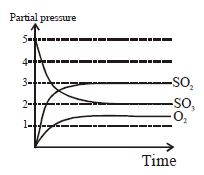
The dissociation of $SO_{3(g)}$ into $SO_{2(g)}$ and $O_{2(g)}$ is carried out in a closed container at a constant temperature $T$. The equilibrium constant for the reaction is $K_P = x \ atm$. The partial pressure variation for the three gases is as shown in the graph. The value of $x$ is
A
$\frac{3^{\frac{3}{2}}}{2^{\frac{3}{2}}}$
B
$2^2$
C
$1$
D
$\frac{3^6}{2^6}$
Solution
(A) The balanced chemical equation for the dissociation of $SO_{3(g)}$ is:
$2SO_{3(g)} \rightleftharpoons 2SO_{2(g)} + O_{2(g)}$
From the graph,at equilibrium:
$P_{SO_3} = 2 \ atm$
$P_{SO_2} = 3 \ atm$
$P_{O_2} = 1.5 \ atm$ (The curve for $O_2$ levels off at $1.5$)
The expression for the equilibrium constant $K_P$ is:
$K_P = \frac{(P_{SO_2})^2 \times (P_{O_2})}{(P_{SO_3})^2}$
Substituting the equilibrium partial pressures:
$K_P = \frac{(3)^2 \times (1.5)}{(2)^2} = \frac{9 \times 1.5}{4} = \frac{13.5}{4} = 3.375$
Checking the options,$3.375 = \frac{27}{8} = (\frac{3}{2})^3 = \frac{3^3}{2^3} = \frac{3^{1.5}}{2^{1.5}}$.
Thus,$x = \frac{3^{1.5}}{2^{1.5}}$.
$2SO_{3(g)} \rightleftharpoons 2SO_{2(g)} + O_{2(g)}$
From the graph,at equilibrium:
$P_{SO_3} = 2 \ atm$
$P_{SO_2} = 3 \ atm$
$P_{O_2} = 1.5 \ atm$ (The curve for $O_2$ levels off at $1.5$)
The expression for the equilibrium constant $K_P$ is:
$K_P = \frac{(P_{SO_2})^2 \times (P_{O_2})}{(P_{SO_3})^2}$
Substituting the equilibrium partial pressures:
$K_P = \frac{(3)^2 \times (1.5)}{(2)^2} = \frac{9 \times 1.5}{4} = \frac{13.5}{4} = 3.375$
Checking the options,$3.375 = \frac{27}{8} = (\frac{3}{2})^3 = \frac{3^3}{2^3} = \frac{3^{1.5}}{2^{1.5}}$.
Thus,$x = \frac{3^{1.5}}{2^{1.5}}$.
0 likes
View Solution90
MediumMCQ
$5 \ moles$ each of $H_2$ and $I_2$ were heated in a sealed $10 \ L$ vessel. At equilibrium,$2 \ moles$ of $HI$ were found. The equilibrium constant for the reaction $H_{2(g)} + I_{2(g)} \rightleftharpoons 2HI_{(g)}$ is:
A
$1$
B
$10$
C
$5$
D
$0.25$
Solution
(D) For the reaction: $H_{2(g)} + I_{2(g)} \rightleftharpoons 2HI_{(g)}$
Given that at equilibrium,$n_{HI} = 2 \ moles$.
Therefore,$2x = 2 \Rightarrow x = 1$.
Equilibrium moles: $n_{H_2} = 5 - 1 = 4 \ moles$,$n_{I_2} = 5 - 1 = 4 \ moles$,$n_{HI} = 2 \ moles$.
Volume $V = 10 \ L$.
Equilibrium concentrations: $[H_2] = 4/10 = 0.4 \ M$,$[I_2] = 4/10 = 0.4 \ M$,$[HI] = 2/10 = 0.2 \ M$.
$K_c = \frac{[HI]^2}{[H_2][I_2]} = \frac{(0.2)^2}{(0.4) \times (0.4)} = \frac{0.04}{0.16} = 0.25$.
| $Reaction$ | $H_{2(g)} + I_{2(g)} \rightleftharpoons 2HI_{(g)}$ |
| $Initial \ moles$ | $5, 5, 0$ |
| $Change \ in \ moles$ | $-x, -x, +2x$ |
| $Equilibrium \ moles$ | $5-x, 5-x, 2x$ |
Given that at equilibrium,$n_{HI} = 2 \ moles$.
Therefore,$2x = 2 \Rightarrow x = 1$.
Equilibrium moles: $n_{H_2} = 5 - 1 = 4 \ moles$,$n_{I_2} = 5 - 1 = 4 \ moles$,$n_{HI} = 2 \ moles$.
Volume $V = 10 \ L$.
Equilibrium concentrations: $[H_2] = 4/10 = 0.4 \ M$,$[I_2] = 4/10 = 0.4 \ M$,$[HI] = 2/10 = 0.2 \ M$.
$K_c = \frac{[HI]^2}{[H_2][I_2]} = \frac{(0.2)^2}{(0.4) \times (0.4)} = \frac{0.04}{0.16} = 0.25$.
0 likes
View Solution91
MediumMCQ
Consider the following reactions in which all the reactants and products are in gaseous state:
$2PQ \rightleftharpoons P_2 + Q_2\,;\,K_1 = 2.5 \times 10^5$
$PQ + \frac{1}{2}R_2 \rightleftharpoons PQR\,;\,K_2 = 5 \times 10^{-3}$
The value of the equilibrium constant for the reaction:
$\frac{1}{2}P_2 + \frac{1}{2}Q_2 + \frac{1}{2}R_2 \rightleftharpoons PQR$ is
$2PQ \rightleftharpoons P_2 + Q_2\,;\,K_1 = 2.5 \times 10^5$
$PQ + \frac{1}{2}R_2 \rightleftharpoons PQR\,;\,K_2 = 5 \times 10^{-3}$
The value of the equilibrium constant for the reaction:
$\frac{1}{2}P_2 + \frac{1}{2}Q_2 + \frac{1}{2}R_2 \rightleftharpoons PQR$ is
A
$2.5 \times 10^{-3}$
B
$2.5 \times 10^{3}$
C
$1 \times 10^{-5}$
D
$5 \times 10^{3}$
Solution
(C) Given reactions:
$(1) \ 2PQ \rightleftharpoons P_2 + Q_2\,;\,K_1 = 2.5 \times 10^5$
$(2) \ PQ + \frac{1}{2}R_2 \rightleftharpoons PQR\,;\,K_2 = 5 \times 10^{-3}$
To obtain the target reaction $\frac{1}{2}P_2 + \frac{1}{2}Q_2 + \frac{1}{2}R_2 \rightleftharpoons PQR$,we manipulate the given reactions:
Reverse reaction $(1)$ and divide by $2$:
$\frac{1}{2}P_2 + \frac{1}{2}Q_2 \rightleftharpoons PQ\,;\,K_3 = \sqrt{\frac{1}{K_1}} = \sqrt{\frac{1}{2.5 \times 10^5}} = \sqrt{4 \times 10^{-6}} = 2 \times 10^{-3}$
Add this new reaction to reaction $(2)$:
$(\frac{1}{2}P_2 + \frac{1}{2}Q_2 \rightleftharpoons PQ) + (PQ + \frac{1}{2}R_2 \rightleftharpoons PQR) \implies \frac{1}{2}P_2 + \frac{1}{2}Q_2 + \frac{1}{2}R_2 \rightleftharpoons PQR$
The equilibrium constant $K_{eq}$ for the target reaction is:
$K_{eq} = K_3 \times K_2 = (2 \times 10^{-3}) \times (5 \times 10^{-3}) = 10 \times 10^{-6} = 1 \times 10^{-5}$
$(1) \ 2PQ \rightleftharpoons P_2 + Q_2\,;\,K_1 = 2.5 \times 10^5$
$(2) \ PQ + \frac{1}{2}R_2 \rightleftharpoons PQR\,;\,K_2 = 5 \times 10^{-3}$
To obtain the target reaction $\frac{1}{2}P_2 + \frac{1}{2}Q_2 + \frac{1}{2}R_2 \rightleftharpoons PQR$,we manipulate the given reactions:
Reverse reaction $(1)$ and divide by $2$:
$\frac{1}{2}P_2 + \frac{1}{2}Q_2 \rightleftharpoons PQ\,;\,K_3 = \sqrt{\frac{1}{K_1}} = \sqrt{\frac{1}{2.5 \times 10^5}} = \sqrt{4 \times 10^{-6}} = 2 \times 10^{-3}$
Add this new reaction to reaction $(2)$:
$(\frac{1}{2}P_2 + \frac{1}{2}Q_2 \rightleftharpoons PQ) + (PQ + \frac{1}{2}R_2 \rightleftharpoons PQR) \implies \frac{1}{2}P_2 + \frac{1}{2}Q_2 + \frac{1}{2}R_2 \rightleftharpoons PQR$
The equilibrium constant $K_{eq}$ for the target reaction is:
$K_{eq} = K_3 \times K_2 = (2 \times 10^{-3}) \times (5 \times 10^{-3}) = 10 \times 10^{-6} = 1 \times 10^{-5}$
0 likes
View Solution92
MediumMCQ
The least stable oxide of nitrogen is:
A
$2NO_{2(g)} \rightleftharpoons N_{2(g)} + 2O_{2(g)}; K_{eq} = 6.7 \times 10^{16} \ mol \ L^{-1}$
B
$2N_2O_{5(g)} \rightleftharpoons 2N_{2(g)} + 5O_{2(g)}; K_{eq} = 1.2 \times 10^{24} \ mol^5 \ L^{-5}$
C
$2NO_{(g)} \rightleftharpoons N_{2(g)} + O_{2(g)}; K_{eq} = 2.2 \times 10^{30}$
D
$2N_2O_{(g)} \rightleftharpoons 2N_{2(g)} + O_{2(g)}; K_{eq} = 3.5 \times 10^{33} \ mol \ L^{-1}$
Solution
(D) The stability of a compound is inversely proportional to its tendency to decompose into its elements.
Greater the value of the equilibrium constant $(K_{eq})$ for the decomposition reaction,the more unstable the compound is.
Comparing the given $K_{eq}$ values:
$6.7 \times 10^{16} < 1.2 \times 10^{24} < 2.2 \times 10^{30} < 3.5 \times 10^{33}$.
Since $2N_2O_{(g)} \rightleftharpoons 2N_{2(g)} + O_{2(g)}$ has the largest $K_{eq}$ value $(3.5 \times 10^{33})$,$N_2O$ is the least stable oxide of nitrogen.
Greater the value of the equilibrium constant $(K_{eq})$ for the decomposition reaction,the more unstable the compound is.
Comparing the given $K_{eq}$ values:
$6.7 \times 10^{16} < 1.2 \times 10^{24} < 2.2 \times 10^{30} < 3.5 \times 10^{33}$.
Since $2N_2O_{(g)} \rightleftharpoons 2N_{2(g)} + O_{2(g)}$ has the largest $K_{eq}$ value $(3.5 \times 10^{33})$,$N_2O$ is the least stable oxide of nitrogen.
0 likes
View Solution93
DifficultMCQ
If $Ag^{+} + NH_3 \rightleftharpoons [Ag(NH_3)]^+$; $K_1 = 1.6 \times 10^3$ and $[Ag(NH_3)]^+ + NH_3 \rightleftharpoons [Ag(NH_3)_2]^+$; $K_2 = 6.8 \times 10^3$. Then the formation constant of $[Ag(NH_3)_2]^+$ is:
A
$6.08 \times 10^{-6}$
B
$6.8 \times 10^{-6}$
C
$1.6 \times 10^{3}$
D
$1.08 \times 10^{7}$
Solution
(D) The overall reaction is the sum of the two given steps:
$Ag^{+} + NH_3 \rightleftharpoons [Ag(NH_3)]^+$,$K_1 = 1.6 \times 10^3$
$[Ag(NH_3)]^+ + NH_3 \rightleftharpoons [Ag(NH_3)_2]^+$,$K_2 = 6.8 \times 10^3$
Adding these reactions gives:
$Ag^{+} + 2NH_3 \rightleftharpoons [Ag(NH_3)_2]^+$
The formation constant $K_f$ (or $K_3$) for the overall reaction is the product of the equilibrium constants of the individual steps:
$K_f = K_1 \times K_2$
$K_f = (1.6 \times 10^3) \times (6.8 \times 10^3)$
$K_f = 10.88 \times 10^6 = 1.088 \times 10^7 \approx 1.08 \times 10^7$
$Ag^{+} + NH_3 \rightleftharpoons [Ag(NH_3)]^+$,$K_1 = 1.6 \times 10^3$
$[Ag(NH_3)]^+ + NH_3 \rightleftharpoons [Ag(NH_3)_2]^+$,$K_2 = 6.8 \times 10^3$
Adding these reactions gives:
$Ag^{+} + 2NH_3 \rightleftharpoons [Ag(NH_3)_2]^+$
The formation constant $K_f$ (or $K_3$) for the overall reaction is the product of the equilibrium constants of the individual steps:
$K_f = K_1 \times K_2$
$K_f = (1.6 \times 10^3) \times (6.8 \times 10^3)$
$K_f = 10.88 \times 10^6 = 1.088 \times 10^7 \approx 1.08 \times 10^7$
0 likes
View Solution94
MediumMCQ
For the gaseous reaction,equilibrium constant is given:
$XeF_6 + H_2O \rightleftharpoons XeOF_4 + 2HF, K_1$
$XeO_4 + XeF_6 \rightleftharpoons XeOF_4 + XeO_3F_2, K_2$
The equilibrium constant for the reaction:
$XeO_4 + 2HF \rightleftharpoons XeO_3F_2 + H_2O$ will be
$XeF_6 + H_2O \rightleftharpoons XeOF_4 + 2HF, K_1$
$XeO_4 + XeF_6 \rightleftharpoons XeOF_4 + XeO_3F_2, K_2$
The equilibrium constant for the reaction:
$XeO_4 + 2HF \rightleftharpoons XeO_3F_2 + H_2O$ will be
A
$\frac{K_1}{K_2}$
B
$\frac{K_1}{K_2^2}$
C
$\frac{K_1^2}{K_2}$
D
$\frac{K_2}{K_1}$
Solution
(D) Given reactions:
$(i) \ XeF_6 + H_2O \rightleftharpoons XeOF_4 + 2HF, K_1$
$(ii) \ XeO_4 + XeF_6 \rightleftharpoons XeOF_4 + XeO_3F_2, K_2$
To obtain the target reaction $XeO_4 + 2HF \rightleftharpoons XeO_3F_2 + H_2O$,we perform the operation $(ii) - (i)$:
$(XeO_4 + XeF_6) - (XeF_6 + H_2O) \rightleftharpoons (XeOF_4 + XeO_3F_2) - (XeOF_4 + 2HF)$
$XeO_4 + XeF_6 - XeF_6 - H_2O \rightleftharpoons XeOF_4 + XeO_3F_2 - XeOF_4 - 2HF$
$XeO_4 - H_2O \rightleftharpoons XeO_3F_2 - 2HF$
Rearranging gives: $XeO_4 + 2HF \rightleftharpoons XeO_3F_2 + H_2O$
Since we subtracted reaction $(i)$ from reaction $(ii)$,the new equilibrium constant $K$ is given by $\frac{K_2}{K_1}$.
$(i) \ XeF_6 + H_2O \rightleftharpoons XeOF_4 + 2HF, K_1$
$(ii) \ XeO_4 + XeF_6 \rightleftharpoons XeOF_4 + XeO_3F_2, K_2$
To obtain the target reaction $XeO_4 + 2HF \rightleftharpoons XeO_3F_2 + H_2O$,we perform the operation $(ii) - (i)$:
$(XeO_4 + XeF_6) - (XeF_6 + H_2O) \rightleftharpoons (XeOF_4 + XeO_3F_2) - (XeOF_4 + 2HF)$
$XeO_4 + XeF_6 - XeF_6 - H_2O \rightleftharpoons XeOF_4 + XeO_3F_2 - XeOF_4 - 2HF$
$XeO_4 - H_2O \rightleftharpoons XeO_3F_2 - 2HF$
Rearranging gives: $XeO_4 + 2HF \rightleftharpoons XeO_3F_2 + H_2O$
Since we subtracted reaction $(i)$ from reaction $(ii)$,the new equilibrium constant $K$ is given by $\frac{K_2}{K_1}$.
0 likes
View Solution95
MediumMCQ
The equilibrium constant for the reaction $H_{2(g)} + I_{2(g)} \rightleftharpoons 2HI_{(g)}$ is $32$ at a given temperature. The equilibrium concentrations of $I_2$ and $HI$ are $0.5 \times 10^{-3} \ M$ and $8 \times 10^{-3} \ M$ respectively. The equilibrium concentration of $H_2$ is:
A
$1 \times 10^{-3} \ M$
B
$0.5 \times 10^{-3} \ M$
C
$2 \times 10^{-3} \ M$
D
$4.0 \times 10^{-3} \ M$
Solution
(D) The equilibrium constant expression for the reaction $H_{2(g)} + I_{2(g)} \rightleftharpoons 2HI_{(g)}$ is given by:
$K_c = \frac{[HI]^2}{[H_2][I_2]}$
Given:
$K_c = 32$
$[HI] = 8 \times 10^{-3} \ M$
$[I_2] = 0.5 \times 10^{-3} \ M$
Substituting the values into the expression:
$32 = \frac{(8 \times 10^{-3})^2}{[H_2] \times (0.5 \times 10^{-3})}$
$32 = \frac{64 \times 10^{-6}}{[H_2] \times 0.5 \times 10^{-3}}$
$[H_2] = \frac{64 \times 10^{-6}}{32 \times 0.5 \times 10^{-3}}$
$[H_2] = \frac{64 \times 10^{-6}}{16 \times 10^{-3}}$
$[H_2] = 4 \times 10^{-3} \ M$
$K_c = \frac{[HI]^2}{[H_2][I_2]}$
Given:
$K_c = 32$
$[HI] = 8 \times 10^{-3} \ M$
$[I_2] = 0.5 \times 10^{-3} \ M$
Substituting the values into the expression:
$32 = \frac{(8 \times 10^{-3})^2}{[H_2] \times (0.5 \times 10^{-3})}$
$32 = \frac{64 \times 10^{-6}}{[H_2] \times 0.5 \times 10^{-3}}$
$[H_2] = \frac{64 \times 10^{-6}}{32 \times 0.5 \times 10^{-3}}$
$[H_2] = \frac{64 \times 10^{-6}}{16 \times 10^{-3}}$
$[H_2] = 4 \times 10^{-3} \ M$
0 likes
View Solution96
MediumMCQ
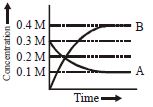
The figure shows the change in concentration of species $A$ and $B$ as a function of time. The equilibrium constant $K_C$ for the reaction $2A_{(g)} \rightleftharpoons B_{(g)}$ is
A
$K_C > 1$
B
$K_C < 1$
C
$K_C = 1$
D
Data insufficient
Solution
(A) From the graph,at equilibrium,the concentration of species $A$ is $[A] = 0.1 \ M$ and the concentration of species $B$ is $[B] = 0.4 \ M$.
For the reaction $2A_{(g)} \rightleftharpoons B_{(g)}$,the equilibrium constant $K_C$ is given by:
$K_C = \frac{[B]}{[A]^2}$
Substituting the equilibrium concentrations:
$K_C = \frac{0.4}{(0.1)^2} = \frac{0.4}{0.01} = 40$
Since $40 > 1$,the correct option is $K_C > 1$.
For the reaction $2A_{(g)} \rightleftharpoons B_{(g)}$,the equilibrium constant $K_C$ is given by:
$K_C = \frac{[B]}{[A]^2}$
Substituting the equilibrium concentrations:
$K_C = \frac{0.4}{(0.1)^2} = \frac{0.4}{0.01} = 40$
Since $40 > 1$,the correct option is $K_C > 1$.
0 likes
View Solution97
MediumMCQ
For the reaction,$A_{(g)} + 2B_{(g)} \rightleftharpoons 2C_{(g)}$ at $25 \, ^oC$,$2 \, moles$ of $A$,$1 \, mole$ of $B$ and $1 \, mole$ of $C$ are present in a $1 \, L$ vessel. If $K_c$ for the reaction is $2$,then the reaction will proceed in:
A
Forward direction
B
Backward direction
C
Neither direction
D
None of these
Solution
(A) The reaction is $A_{(g)} + 2B_{(g)} \rightleftharpoons 2C_{(g)}$.
The reaction quotient $Q_c$ is calculated as $Q_c = \frac{[C]^2}{[A][B]^2}$.
Given concentrations in a $1 \, L$ vessel: $[A] = 2 \, M$,$[B] = 1 \, M$,$[C] = 1 \, M$.
Substituting these values: $Q_c = \frac{1^2}{2 \times 1^2} = \frac{1}{2} = 0.5$.
Since $Q_c < K_c$ $(0.5 < 2)$,the reaction will proceed in the forward direction.
The reaction quotient $Q_c$ is calculated as $Q_c = \frac{[C]^2}{[A][B]^2}$.
Given concentrations in a $1 \, L$ vessel: $[A] = 2 \, M$,$[B] = 1 \, M$,$[C] = 1 \, M$.
Substituting these values: $Q_c = \frac{1^2}{2 \times 1^2} = \frac{1}{2} = 0.5$.
Since $Q_c < K_c$ $(0.5 < 2)$,the reaction will proceed in the forward direction.
0 likes
View Solution98
MediumMCQ
The equilibrium constant for the equilibrium $2HX_{(g)} \rightleftharpoons H_{2(g)} + X_{2(g)}$ is $1 \times 10^{-5}$. What will be the equilibrium concentration of $HX$ if the equilibrium concentrations for $H_2$ and $X_2$ are $1.2 \times 10^{-3} \ M$ and $1.2 \times 10^{-4} \ M$ respectively?
A
$12 \times 10^{-4} \ M$
B
$12 \times 10^{-3} \ M$
C
$12 \times 10^{-2} \ M$
D
$12 \times 10^{-1} \ M$
Solution
(C) The equilibrium reaction is $2HX_{(g)} \rightleftharpoons H_{2(g)} + X_{2(g)}$.
The expression for the equilibrium constant $K$ is $K = \frac{[H_2][X_2]}{[HX]^2}$.
Given $K = 1 \times 10^{-5}$,$[H_2] = 1.2 \times 10^{-3} \ M$,and $[X_2] = 1.2 \times 10^{-4} \ M$.
Substituting the values: $10^{-5} = \frac{(1.2 \times 10^{-3}) \times (1.2 \times 10^{-4})}{[HX]^2}$.
$[HX]^2 = \frac{1.44 \times 10^{-7}}{10^{-5}} = 1.44 \times 10^{-2}$.
$[HX] = \sqrt{1.44 \times 10^{-2}} = 1.2 \times 10^{-1} \ M$.
Converting to the format of the options: $1.2 \times 10^{-1} \ M = 12 \times 10^{-2} \ M$.
The expression for the equilibrium constant $K$ is $K = \frac{[H_2][X_2]}{[HX]^2}$.
Given $K = 1 \times 10^{-5}$,$[H_2] = 1.2 \times 10^{-3} \ M$,and $[X_2] = 1.2 \times 10^{-4} \ M$.
Substituting the values: $10^{-5} = \frac{(1.2 \times 10^{-3}) \times (1.2 \times 10^{-4})}{[HX]^2}$.
$[HX]^2 = \frac{1.44 \times 10^{-7}}{10^{-5}} = 1.44 \times 10^{-2}$.
$[HX] = \sqrt{1.44 \times 10^{-2}} = 1.2 \times 10^{-1} \ M$.
Converting to the format of the options: $1.2 \times 10^{-1} \ M = 12 \times 10^{-2} \ M$.
0 likes
View Solution99
DifficultMCQ
$K_1, K_2$ and $K_3$ are the equilibrium constants of the following reactions $(I), (II)$ and $(III)$ respectively.
$(I) \, N_2 + 2O_2 \rightleftharpoons 2NO_2$
$(II) \, 2NO_2 \rightleftharpoons N_2 + 2O_2$
$(III) \, NO_2 \rightleftharpoons \frac{1}{2} N_2 + O_2$
The correct relation from the following is
$(I) \, N_2 + 2O_2 \rightleftharpoons 2NO_2$
$(II) \, 2NO_2 \rightleftharpoons N_2 + 2O_2$
$(III) \, NO_2 \rightleftharpoons \frac{1}{2} N_2 + O_2$
The correct relation from the following is
A
$K_1 = \frac{1}{K_2} = \frac{1}{K_3}$
B
$K_1 = \frac{1}{K_2} = \frac{1}{(K_3)^2}$
C
$K_1 = \sqrt{K_2} = K_3$
D
$K_1 = \frac{1}{K_2} = K_3$
Solution
(B) For reaction $(I): N_2 + 2O_2 \rightleftharpoons 2NO_2$,the equilibrium constant is $K_1 = \frac{[NO_2]^2}{[N_2][O_2]^2} \dots (i)$
For reaction $(II): 2NO_2 \rightleftharpoons N_2 + 2O_2$,which is the reverse of $(I)$,the equilibrium constant is $K_2 = \frac{[N_2][O_2]^2}{[NO_2]^2} = \frac{1}{K_1} \dots (ii)$
For reaction $(III): NO_2 \rightleftharpoons \frac{1}{2} N_2 + O_2$,the equilibrium constant is $K_3 = \frac{[N_2]^{1/2}[O_2]}{[NO_2]}$
Squaring $K_3$,we get $(K_3)^2 = \frac{[N_2][O_2]^2}{[NO_2]^2} = K_2 = \frac{1}{K_1} \dots (iii)$
Thus,$K_1 = \frac{1}{K_2} = \frac{1}{(K_3)^2}$.
For reaction $(II): 2NO_2 \rightleftharpoons N_2 + 2O_2$,which is the reverse of $(I)$,the equilibrium constant is $K_2 = \frac{[N_2][O_2]^2}{[NO_2]^2} = \frac{1}{K_1} \dots (ii)$
For reaction $(III): NO_2 \rightleftharpoons \frac{1}{2} N_2 + O_2$,the equilibrium constant is $K_3 = \frac{[N_2]^{1/2}[O_2]}{[NO_2]}$
Squaring $K_3$,we get $(K_3)^2 = \frac{[N_2][O_2]^2}{[NO_2]^2} = K_2 = \frac{1}{K_1} \dots (iii)$
Thus,$K_1 = \frac{1}{K_2} = \frac{1}{(K_3)^2}$.
0 likes
View Solution6-1.Equilibrium (Chemical Equilibrium) — Law of equilibrium and Equilibrium constant · Frequently Asked Questions
1Are these 6-1.Equilibrium (Chemical Equilibrium) questions useful for JEE and NEET?
Yes. All questions in this section are mapped to JEE Main and NEET exam patterns. Previous year questions from JEE Main, NEET, GUJCET and state-level exams are included with full solutions.
2Can I switch to Hindi or Gujarati for these questions?
Yes. Use the language tabs in the hero section or the sidebar to view the same questions and solutions in English, Hindi or Gujarati.
3How do I generate a question paper from this subtopic?
Use the Vedclass Exam Paper Generator — select the chapter and subtopic, set difficulty, and generate Sets A, B, C, D automatically. First 3 chapters of every subject are free.
Vedclass Products
For Students
Vedclass Test Series
Mock tests in real JEE/NEET style with performance analysis. 5-day free trial.
Start Free TrialFor Teachers
Exam Paper Generator
Generate Set A/B/C/D papers from this chapter in 2 minutes. 3 chapters free.
Try FreeFor Institutes
Online Exam Module
Live online exams with unlimited students, 360° analytics & white-label branding.
See DemoFor Teachers & Institutes
Generate a 6-1.Equilibrium (Chemical Equilibrium) Exam Paper in 2 Minutes
Select subtopic & difficulty — Sets A, B, C, D auto-generated with No Repeat logic.
First 3 chapters of every subject are free — no payment required.