
A English
fruits Questions in English
Class 11 Biology · Morphology of Flowering Plants · fruits
176+
Questions
English
Language
100%
With Solutions
Showing 26 of 176 questions in English
151
EasyMCQ
The hesperidium of an orange is a modification of which type of fruit?
A
Berry
B
Drupe
C
Pome
D
Aggregate fruit
Solution
(A) hesperidium is a specialized type of fleshy fruit that develops from a superior ovary. It is considered a modified form of a berry,characterized by a leathery rind (exocarp) and internal segments filled with juice-filled hairs (trichomes).
0 likes
View Solution152
MediumMCQ
Which of the following is a wheat fruit?
A
Achene
B
Cypsella
C
Caryopsis
D
Endosperm
Solution
(C) The fruit of wheat is known as a $Caryopsis$.
In a $Caryopsis$ fruit,the pericarp (fruit wall) and the seed coat are completely fused together to form a single unit.
This type of fruit is characteristic of the family $Poaceae$ (formerly known as $Gramineae$).
In a $Caryopsis$ fruit,the pericarp (fruit wall) and the seed coat are completely fused together to form a single unit.
This type of fruit is characteristic of the family $Poaceae$ (formerly known as $Gramineae$).
0 likes
View Solution153
EasyMCQ
$A$ simple one-seeded fruit in which the pericarp is fused with the seed coat is:
A
Achene
B
Caryopsis
C
Cypsela
D
Nut
Solution
(B) Caryopsis is a type of simple,dry,indehiscent fruit that develops from a monocarpellary,superior ovary.
In this fruit,the pericarp (fruit wall) is thin and completely fused with the seed coat (testa),making it impossible to separate them.
Examples include grains of wheat,maize,and rice.
In this fruit,the pericarp (fruit wall) is thin and completely fused with the seed coat (testa),making it impossible to separate them.
Examples include grains of wheat,maize,and rice.
0 likes
View Solution154
MediumMCQ
Maize grain is
A
Seed
B
Embryo
C
Ovule
D
Fruit
Solution
(D) Fruit is defined as a fertilized ovary,which consists of a fruit wall (pericarp) developing from the ovary wall and a seed,which develops from the ovule.
Maize grain is a caryopsis fruit,in which the fruit wall is fused with the seed coat (i.e.,a one-seeded fruit).
Maize grain is a caryopsis fruit,in which the fruit wall is fused with the seed coat (i.e.,a one-seeded fruit).
0 likes
View Solution155
EasyMCQ
Pineapple fruit develops from
A
Unilocular polycarpellary flower
B
Multipistillate syncarpous flower
C
Multilocular monocarpellary flower
D
$A$ cluster of compactly borne flowers on an axis
Solution
$(D)$ Pineapple $(Ananas \text{ } sativus)$ is a multiple fruit (sorosis), which develops from a complete inflorescence, i.e., a cluster of compactly borne flowers on an axis.
0 likes
View Solution156
EasyMCQ
Juicy hair-like structures observed in the lemon fruit develop from:
A
Endocarp
B
Mesocarp and endocarp
C
Exocarp
D
Mesocarp
Solution
(A) In citrus fruits like lemon,the edible part consists of unicellular,juice-filled hairs. These structures are outgrowths of the endocarp,which is the innermost layer of the pericarp. Therefore,the juicy hair-like structures develop from the endocarp.
0 likes
View Solution157
MediumMCQ
Pappus is present in Compositae for
A
Air pollination
B
Insect pollination
C
Water pollination
D
Air dispersal
Solution
(D) In several members of the family Compositae (e.g.,$Taraxacum$,$Tragopogon$),as well as in Dipsacaceae and Valerianaceae,the calyx is modified into a hairy structure known as pappus.
This structure acts like a parachute,allowing the fruit or seed to be easily carried by wind currents,thereby facilitating air dispersal.
This structure acts like a parachute,allowing the fruit or seed to be easily carried by wind currents,thereby facilitating air dispersal.
0 likes
View Solution158
MediumMCQ
The most advanced fruit is
A
Cypsela
B
Caryopsis
C
Pome
D
Etaerio of drupe
Solution
(D) According to the evolutionary classification of fruits,aggregate fruits are considered more advanced than simple fruits. An $Etaerio$ of drupes is a type of aggregate fruit where multiple small drupelets are formed from a single flower with apocarpous ovaries. This complexity in structure compared to simple fruits like $Cypsela$,$Caryopsis$,or $Pome$ makes it more evolutionarily advanced.
0 likes
View Solution159
MediumMCQ
The stony hard part of the mango represents
A
Mesocarp
B
Epicarp
C
Endosperm
D
Endocarp
Solution
(D) In mango,the fruit is a drupe.
It develops from a monocarpellary superior ovary and is one-seeded.
The outer skin is the epicarp,the fleshy edible part is the mesocarp,and the stony hard part surrounding the seed is the endocarp.
It develops from a monocarpellary superior ovary and is one-seeded.
The outer skin is the epicarp,the fleshy edible part is the mesocarp,and the stony hard part surrounding the seed is the endocarp.
0 likes
View Solution160
MediumMCQ
Select the correct statement with respect to Mango and coconut.
A
They develop from monocarpellary superior ovaries.
B
They develop from monocarpellary inferior ovaries.
C
They have fibrous epicarp.
D
They have fleshy edible mesocarp.
Solution
(A) Mango and coconut are examples of drupe fruits. These fruits develop from monocarpellary superior ovaries and are one-seeded. In mango,the pericarp is well-differentiated into an outer thin epicarp,a middle fleshy edible mesocarp,and an inner stony hard endocarp. In coconut,the mesocarp is fibrous.
0 likes
View Solution161
MediumMCQ
Match the following:
| Column-$I$ | Column-$II$ |
| $(a)$. Amphisarca | $(i)$. Aegle |
| $(b)$. Pepo | $(ii)$. Cucumis |
| $(c)$. Drupe | $(iii)$. Ananas |
| $(d)$. Sorosis | $(iv)$. Juglans |
A
$a(i), b(ii), c(iv), d(iii)$
B
$a(i), b(ii), c(iii), d(iv)$
C
$a(iii), b(ii), c(i), d(iv)$
D
$a(ii), b(i), c(iv), d(iii)$
Solution
(A) The correct matches are as follows:
$1$. Amphisarca is a type of berry with a hard rind,found in $Aegle$ (Bael).
$2$. Pepo is a fleshy fruit derived from an inferior ovary,characteristic of the Cucurbitaceae family,such as $Cucumis$ (Cucumber).
$3$. Drupe is a fleshy fruit where the endocarp is stony,found in $Juglans$ (Walnut).
$4$. Sorosis is a multiple fruit derived from a spike or spadix,found in $Ananas$ (Pineapple).
Therefore,the correct sequence is $a(i), b(ii), c(iv), d(iii)$.
$1$. Amphisarca is a type of berry with a hard rind,found in $Aegle$ (Bael).
$2$. Pepo is a fleshy fruit derived from an inferior ovary,characteristic of the Cucurbitaceae family,such as $Cucumis$ (Cucumber).
$3$. Drupe is a fleshy fruit where the endocarp is stony,found in $Juglans$ (Walnut).
$4$. Sorosis is a multiple fruit derived from a spike or spadix,found in $Ananas$ (Pineapple).
Therefore,the correct sequence is $a(i), b(ii), c(iv), d(iii)$.
0 likes
View Solution162
MediumMCQ
Find the incorrect matching.
A
Pome - Fleshy thalamus
B
Schizocarp - Mericarp
C
Balausta - Aril
D
Syconus - Hypanthodium
Solution
(C) The correct matching for the given fruit types is as follows:
$1$. Pome is a false fruit where the thalamus becomes fleshy (e.g.,Apple).
$2$. Schizocarpic fruits split into one-seeded segments called mericarps.
$3$. Balausta is a fruit type (e.g.,Pomegranate) where the edible part is the fleshy testa,not the aril. The aril is the edible part in Litchi,which is a drupe-like nut.
$4$. Syconus is a composite fruit that develops from a hypanthodium inflorescence (e.g.,Fig).
Therefore,the incorrect matching is $C$.
$1$. Pome is a false fruit where the thalamus becomes fleshy (e.g.,Apple).
$2$. Schizocarpic fruits split into one-seeded segments called mericarps.
$3$. Balausta is a fruit type (e.g.,Pomegranate) where the edible part is the fleshy testa,not the aril. The aril is the edible part in Litchi,which is a drupe-like nut.
$4$. Syconus is a composite fruit that develops from a hypanthodium inflorescence (e.g.,Fig).
Therefore,the incorrect matching is $C$.
0 likes
View Solution163
MediumMCQ
Most common fruits of $Fabaceae$ and $Brassicaceae$ are respectively:
A
Lomentum and Siliqua
B
Legume and Samara
C
Lomentum and Silicula
D
Legume and Siliqua
Solution
(D) The family $Fabaceae$ (formerly $Leguminosae$) is characterized by the presence of a $Legume$ (or $Pod$) fruit,which develops from a monocarpellary,unilocular ovary and dehisces along both sutures.
The family $Brassicaceae$ (formerly $Cruciferae$) is characterized by the presence of a $Siliqua$ fruit,which is a long,dry,dehiscent fruit that develops from a bicarpellary,syncarpous,superior ovary with a false septum called a $replum$.
Therefore,the most common fruits are $Legume$ for $Fabaceae$ and $Siliqua$ for $Brassicaceae$.
The family $Brassicaceae$ (formerly $Cruciferae$) is characterized by the presence of a $Siliqua$ fruit,which is a long,dry,dehiscent fruit that develops from a bicarpellary,syncarpous,superior ovary with a false septum called a $replum$.
Therefore,the most common fruits are $Legume$ for $Fabaceae$ and $Siliqua$ for $Brassicaceae$.
0 likes
View Solution164
EasyMCQ
In $Coriandrum$,the prolongation of the thalamus beyond the carpel is called as:
A
Gynophore
B
Gynandrophore
C
Androphore
D
Carpophore
Solution
(D) In the family $Apiaceae$ (to which $Coriandrum$ belongs),the fruit is a cremocarp.
Upon maturation,the fruit splits into two mericarps.
These mericarps remain attached to a central,slender,stalk-like structure which is a prolongation of the thalamus.
This structure is known as the $Carpophore$.
Upon maturation,the fruit splits into two mericarps.
These mericarps remain attached to a central,slender,stalk-like structure which is a prolongation of the thalamus.
This structure is known as the $Carpophore$.
0 likes
View Solution165
MediumMCQ
$A$ dry dehiscent fruit which develops from a multicarpellary,syncarpous superior ovary with axile placentation is:
A
Capsule
B
Siliqua
C
Achene
D
Lomentum
Solution
(A) The correct answer is $A$ (Capsule).
- $A$ $Capsule$ is a type of dry dehiscent fruit that develops from a multicarpellary,syncarpous,superior ovary.
- It typically exhibits axile placentation.
- $Siliqua$ is a dehiscent fruit developing from a bicarpellary,syncarpous,superior ovary with parietal placentation.
- $Achene$ is a dry indehiscent fruit.
- $Lomentum$ is a dry dehiscent fruit that breaks into segments,derived from a monocarpellary ovary.
- $A$ $Capsule$ is a type of dry dehiscent fruit that develops from a multicarpellary,syncarpous,superior ovary.
- It typically exhibits axile placentation.
- $Siliqua$ is a dehiscent fruit developing from a bicarpellary,syncarpous,superior ovary with parietal placentation.
- $Achene$ is a dry indehiscent fruit.
- $Lomentum$ is a dry dehiscent fruit that breaks into segments,derived from a monocarpellary ovary.
0 likes
View Solution166
MediumMCQ
Pericarp is dry in
A
Guava,mango,mustard
B
Mango,groundnut,orange
C
Groundnut,mustard
D
Orange,guava,mango
Solution
(C) The pericarp is the fruit wall that develops from the ovary wall. In fleshy fruits like mango,guava,and orange,the pericarp is differentiated into epicarp,mesocarp,and endocarp,and it remains succulent or fleshy at maturity. In dry fruits,the pericarp becomes dry,hard,and often thin at maturity. Groundnut and mustard are examples of dry fruits where the pericarp is not fleshy.
0 likes
View Solution167
EasyMCQ
From which part of the coconut is coir obtained?
A
Pericarp
B
Mesocarp
C
Epicarp
D
Endocarp
Solution
(B) Commercial coir is obtained from the fibrous husk,which is the $Mesocarp$,of the fruits of the coconut palm,$Cocos$ $nucifera$ (family-$Arecaceae$).
The fiber is very light,elastic,waterproof,soundproof,and has exceedingly high resistance to mechanical wear and dampness,although it is less durable and has a rough surface.
It is widely used for making mats,gunny bags,marine cordage,fishing nets,etc.
The fiber is very light,elastic,waterproof,soundproof,and has exceedingly high resistance to mechanical wear and dampness,although it is less durable and has a rough surface.
It is widely used for making mats,gunny bags,marine cordage,fishing nets,etc.
0 likes
View Solution168
MediumMCQ
Select the correct option for a drupe (mango) fruit.
A
Endocarp - fleshy,Mesocarp - stony,Epicarp - thin
B
Endocarp - thin,Mesocarp - stony,Epicarp - fleshy
C
Endocarp - stony,Mesocarp - thin,Epicarp - fleshy
D
Endocarp - stony,Mesocarp - fleshy,Epicarp - thin
Solution
(D) In a drupe fruit like mango,the fruit develops from a monocarpellary superior ovary and is one-seeded.
$1$. The Epicarp (outer layer) is thin and forms the skin of the fruit.
$2$. The Mesocarp (middle layer) is fleshy and edible.
$3$. The Endocarp (inner layer) is stony and hard,protecting the seed inside.
Therefore,the correct sequence is Epicarp - thin,Mesocarp - fleshy,and Endocarp - stony.
$1$. The Epicarp (outer layer) is thin and forms the skin of the fruit.
$2$. The Mesocarp (middle layer) is fleshy and edible.
$3$. The Endocarp (inner layer) is stony and hard,protecting the seed inside.
Therefore,the correct sequence is Epicarp - thin,Mesocarp - fleshy,and Endocarp - stony.
0 likes
View Solution169
MediumMCQ
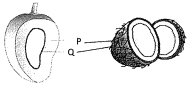
What are $P$ and $Q$ in the given figure?
$P \quad\quad Q$
$P \quad\quad Q$
A
Endocarp $\quad\quad$ Seed
B
Seed $\quad\quad$ Endocarp
C
Mesocarp $\quad\quad$ Endocarp
D
Mesocarp $\quad\quad$ Seed
Solution
(C) The given figure shows the structure of a coconut,which is a drupe fruit.
In a coconut,the fruit wall (pericarp) is differentiated into three layers:
$1$. Epicarp: The outer fibrous layer.
$2$. Mesocarp: The middle fibrous layer (the husk).
$3$. Endocarp: The hard,stony inner layer that protects the seed.
In the provided diagram,$P$ points to the fibrous middle layer,which is the mesocarp.
$Q$ points to the hard inner layer,which is the endocarp.
Therefore,$P$ is the mesocarp and $Q$ is the endocarp.
In a coconut,the fruit wall (pericarp) is differentiated into three layers:
$1$. Epicarp: The outer fibrous layer.
$2$. Mesocarp: The middle fibrous layer (the husk).
$3$. Endocarp: The hard,stony inner layer that protects the seed.
In the provided diagram,$P$ points to the fibrous middle layer,which is the mesocarp.
$Q$ points to the hard inner layer,which is the endocarp.
Therefore,$P$ is the mesocarp and $Q$ is the endocarp.
0 likes
View Solution170
MediumMCQ
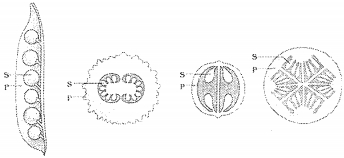
What are $S$ and $P$ in the following structures?
$\quad\quad\quad S\quad\quad\quad P$
$\quad\quad\quad S\quad\quad\quad P$
A
Seed $\quad$ Pericarp
B
Fruit $\quad$ Seed coat
C
Seed coat $\quad$ Fruit
D
Pericarp $\quad$ Seed
Solution
(A) In the provided diagrams,which represent cross-sections of various fruits,the inner structures labeled $S$ represent the seeds,which develop from fertilized ovules.
The outer protective layer labeled $P$ represents the pericarp,which is the wall of the fruit developed from the ovary wall after fertilization.
Therefore,$S$ corresponds to the seed and $P$ corresponds to the pericarp.
The outer protective layer labeled $P$ represents the pericarp,which is the wall of the fruit developed from the ovary wall after fertilization.
Therefore,$S$ corresponds to the seed and $P$ corresponds to the pericarp.
0 likes
View Solution171
MediumMCQ
How many of the following fruits have fleshy pericarp?
Guava,Mustard,Orange,Mango,Groundnut
Guava,Mustard,Orange,Mango,Groundnut
A
$2$
B
$3$
C
$4$
D
$5$
Solution
(B) The pericarp is the part of the fruit formed from the ovary wall. It consists of three layers: epicarp,mesocarp,and endocarp.
In fleshy fruits,the pericarp is thick,succulent,and differentiated into these layers.
$1$. Guava: Fleshy fruit (berry).
$2$. Mustard: Dry fruit (siliqua).
$3$. Orange: Fleshy fruit (hesperidium).
$4$. Mango: Fleshy fruit (drupe).
$5$. Groundnut: Dry fruit (lomentum).
Among the given list,Guava,Orange,and Mango have fleshy pericarps.
Therefore,the total count is $3$.
In fleshy fruits,the pericarp is thick,succulent,and differentiated into these layers.
$1$. Guava: Fleshy fruit (berry).
$2$. Mustard: Dry fruit (siliqua).
$3$. Orange: Fleshy fruit (hesperidium).
$4$. Mango: Fleshy fruit (drupe).
$5$. Groundnut: Dry fruit (lomentum).
Among the given list,Guava,Orange,and Mango have fleshy pericarps.
Therefore,the total count is $3$.
0 likes
View Solution172
EasyMCQ
In mango and coconut,the fruit is known as a
A
Capsule
B
Berry
C
Drupe
D
Dry fruit
Solution
(C) In mango and coconut,the fruit develops from a monocarpellary superior ovary and is one-seeded. Such fruits are known as $Drupe$.
In mango,the pericarp is well differentiated into an outer thin $Epicarp$,a middle fleshy edible $Mesocarp$,and an inner stony hard $Endocarp$.
In coconut,which is also a $Drupe$,the $Mesocarp$ is fibrous.
In mango,the pericarp is well differentiated into an outer thin $Epicarp$,a middle fleshy edible $Mesocarp$,and an inner stony hard $Endocarp$.
In coconut,which is also a $Drupe$,the $Mesocarp$ is fibrous.
0 likes
View Solution173
EasyMCQ
The edible part of the fruit of apple is
A
thalamus
B
pericarp
C
endocarp
D
involucre
Solution
(A) The correct answer is $A$.
In apple,the fruit is a false fruit $(pseudocarp)$.
In false fruits,the thalamus contributes to fruit formation along with the ovary.
The fleshy,edible part of the apple is the modified thalamus.
In apple,the fruit is a false fruit $(pseudocarp)$.
In false fruits,the thalamus contributes to fruit formation along with the ovary.
The fleshy,edible part of the apple is the modified thalamus.
0 likes
View Solution174
EasyMCQ
$A$ fruit that develops from a single flower with a syncarpous pistil is
A
simple fruit
B
aggregate fruit
C
multiple fruit
D
pseudocarp
Solution
(A) The correct answer is $A$.
$A$ simple fruit develops from a single flower with a syncarpous pistil,where the carpels are fused together.
In contrast,an aggregate fruit develops from a single flower with multiple free carpels (apocarpous),and a multiple fruit develops from an entire inflorescence.
Depending on the nature of the pericarp,a simple fruit can be either dry or succulent.
$A$ simple fruit develops from a single flower with a syncarpous pistil,where the carpels are fused together.
In contrast,an aggregate fruit develops from a single flower with multiple free carpels (apocarpous),and a multiple fruit develops from an entire inflorescence.
Depending on the nature of the pericarp,a simple fruit can be either dry or succulent.
0 likes
View Solution175
EasyMCQ
Fleshy fruits with a stony endocarp are called
A
pomes
B
drupes
C
capsules
D
berries
Solution
(B) The correct answer is $B$.
Fleshy fruits with a stony endocarp are known as $drupes$.
In these fruits, the endocarp is hard and stony, which protects the seed inside.
This stony endocarp is surrounded by a fleshy mesocarp and a thin exocarp.
Common examples of $drupes$ include mango $(Mangifera \text{ } indica)$ and coconut $(Cocos \text{ } nucifera)$.
Fleshy fruits with a stony endocarp are known as $drupes$.
In these fruits, the endocarp is hard and stony, which protects the seed inside.
This stony endocarp is surrounded by a fleshy mesocarp and a thin exocarp.
Common examples of $drupes$ include mango $(Mangifera \text{ } indica)$ and coconut $(Cocos \text{ } nucifera)$.
0 likes
View Solution176
EasyMCQ
Identify from the following plant parts,the major contributors to human food.
A
Root
B
Stem
C
Leaves
D
Fruits
Solution
(D) Fruits.
Fruits are the major contributors to human food because they are rich in essential nutrients such as carbohydrates,vitamins,and minerals. They serve as a primary source of energy and dietary fiber for humans across the globe.
Fruits are the major contributors to human food because they are rich in essential nutrients such as carbohydrates,vitamins,and minerals. They serve as a primary source of energy and dietary fiber for humans across the globe.
0 likes
View SolutionMorphology of Flowering Plants — fruits · Frequently Asked Questions
1Are these Morphology of Flowering Plants questions useful for JEE and NEET?
Yes. All questions in this section are mapped to JEE Main and NEET exam patterns. Previous year questions from JEE Main, NEET, GUJCET and state-level exams are included with full solutions.
2Can I switch to Hindi or Gujarati for these questions?
Yes. Use the language tabs in the hero section or the sidebar to view the same questions and solutions in English, Hindi or Gujarati.
3How do I generate a question paper from this subtopic?
Use the Vedclass Exam Paper Generator — select the chapter and subtopic, set difficulty, and generate Sets A, B, C, D automatically. First 3 chapters of every subject are free.
Vedclass Products
For Students
Vedclass Test Series
Mock tests in real JEE/NEET style with performance analysis. 5-day free trial.
Start Free TrialFor Teachers
Exam Paper Generator
Generate Set A/B/C/D papers from this chapter in 2 minutes. 3 chapters free.
Try FreeFor Institutes
Online Exam Module
Live online exams with unlimited students, 360° analytics & white-label branding.
See DemoFor Teachers & Institutes
Generate a Morphology of Flowering Plants Exam Paper in 2 Minutes
Select subtopic & difficulty — Sets A, B, C, D auto-generated with No Repeat logic.
First 3 chapters of every subject are free — no payment required.