
A English
fruits Questions in English
Class 11 Biology · Morphology of Flowering Plants · fruits
176+
Questions
English
Language
100%
With Solutions
Showing 47 of 176 questions in English
101
MediumMCQ
How many plants in the list given below have composite fruits that develop from an inflorescence? Walnut,poppy,radish,fig,pineapple,apple,tomato,mulberry.
A
Four
B
Five
C
Two
D
Three
Solution
(D) composite or multiple fruit is a group of fruitlets that develop from the entire inflorescence rather than a single flower.
Based on the list provided:
$1$. Fig ($Syconus$ type)
$2$. Pineapple ($Sorosis$ type)
$3$. Mulberry ($Sorosis$ type)
Walnut,poppy,radish,apple,and tomato are not composite fruits.
Therefore,there are $3$ plants in the list that have composite fruits.
Based on the list provided:
$1$. Fig ($Syconus$ type)
$2$. Pineapple ($Sorosis$ type)
$3$. Mulberry ($Sorosis$ type)
Walnut,poppy,radish,apple,and tomato are not composite fruits.
Therefore,there are $3$ plants in the list that have composite fruits.
0 likes
View Solution102
MediumMCQ
$A$ drupe develops in
A
mango
B
wheat
C
pea
D
tomato
Solution
(A) : Drupe is a fleshy fruit that develops from either one or several fused carpels and contains one or many seeds. The seeds are enclosed by the hard protective endocarp (pericarp) of the fruit,$e.g.$,mango. In mango,the pericarp is well differentiated into an outer thin epicarp,a middle fleshy edible mesocarp,and an inner stony hard endocarp.
0 likes
View Solution103
EasyMCQ
$A$ fruit developed from hypanthodium inflorescence is called
A
sorosis
B
syconus
C
caryopsis
D
hesperidium
Solution
(B) : Syconus fruit develops from a hypanthodium inflorescence,$e.g.$,$Ficus$.
Hypanthodium is a box-like inflorescence where the box is formed by the fleshy receptacle.
It opens to the exterior by a single pore called ostiole.
The hollow,pear-shaped fleshy receptacle encloses a number of minute male and female flowers; it becomes fleshy and forms the fruit.
Hypanthodium is a box-like inflorescence where the box is formed by the fleshy receptacle.
It opens to the exterior by a single pore called ostiole.
The hollow,pear-shaped fleshy receptacle encloses a number of minute male and female flowers; it becomes fleshy and forms the fruit.
0 likes
View Solution104
MediumMCQ
The fleshy receptacle of $Syconus$ of $Fig$ encloses a number of
A
berries
B
mericarps
C
achenes
D
samaras
Solution
(C) $Syconus$ develops from the $Hypanthodium$ type of inflorescence.
The flask-shaped fleshy receptacle encloses female flowers, which produce small $Achene$-like fruitlets, and it has a small pore protected by scale leaves.
Example: $Syconus$ of $Fig$ $(Ficus \text{ } carica)$.
The flask-shaped fleshy receptacle encloses female flowers, which produce small $Achene$-like fruitlets, and it has a small pore protected by scale leaves.
Example: $Syconus$ of $Fig$ $(Ficus \text{ } carica)$.
0 likes
View Solution105
MediumMCQ
Dry indehiscent single-seeded fruit formed from a bicarpellary syncarpous inferior ovary is:
A
berry
B
cremocarp
C
caryopsis
D
cypsella
Solution
(D) : Cypsella is a dry,one-chambered,one-seeded fruit developing from an inferior,bicarpellary syncarpous ovary,$e.g.$,sunflower,marigold,cosmos,etc.
Caryopsis or grain is a small,dry,one-seeded fruit developing from a superior monocarpellary ovary,where the pericarp is fused with the seed coat,$e.g.$,rice,wheat,maize,etc.
Cremocarp is a bilocular,two-seeded fruit developing from an inferior bicarpellary ovary. It is the characteristic fruit of the family Apiaceae (Umbelliferae),$e.g.$,coriander,cumin,etc.
Berry or bacca develops from a mono- or multicarpellary superior or inferior syncarpous ovary with axile or parietal placentation,$e.g.$,tomato,banana,brinjal,guava,grapes,etc.
Caryopsis or grain is a small,dry,one-seeded fruit developing from a superior monocarpellary ovary,where the pericarp is fused with the seed coat,$e.g.$,rice,wheat,maize,etc.
Cremocarp is a bilocular,two-seeded fruit developing from an inferior bicarpellary ovary. It is the characteristic fruit of the family Apiaceae (Umbelliferae),$e.g.$,coriander,cumin,etc.
Berry or bacca develops from a mono- or multicarpellary superior or inferior syncarpous ovary with axile or parietal placentation,$e.g.$,tomato,banana,brinjal,guava,grapes,etc.
0 likes
View Solution106
MediumMCQ
The fruit is chambered,developed from an inferior ovary,and has seeds with a succulent testa in:
A
guava
B
cucumber
C
pomegranate
D
orange
Solution
(C) : In pomegranate,the fruit is chambered and develops from an inferior,multilocular,syncarpous ovary. The seeds are characterized by a succulent (fleshy) testa,which is the edible part of the seed.
0 likes
View Solution107
MediumMCQ
Pineapple (Ananas) fruit develops from:
A
a multilocular monocarpellary flower
B
a unilocular polycarpellary flower
C
a multipistillate syncarpous flower
D
a cluster of compactly borne flowers on a common axis
Solution
(D) : Pineapple is a $Sorosis$ type of fruit that develops from a spike or spadix inflorescence. In this type of inflorescence,the flowers fuse by their succulent tepals,and the axis bearing the flowers becomes fleshy or woody,thus forming a compact mass. These are known as composite or multiple fruits. In pineapple,the fleshy axis,bracts,fused perianth,and pericarp are edible.
0 likes
View Solution108
EasyMCQ
In which of the following fruits,the edible part is the aril?
A
Litchi
B
Custard apple
C
Pomegranate
D
Orange
Solution
(A) The correct answer is $A$. In $Litchi$,the edible part is the fleshy $aril$.
An $aril$ is a specialized outgrowth that develops from the base of the ovule and covers the seed. It is a fleshy,succulent structure that is sweet and edible.
In $Litchi$,the pericarp (fruit wall) is leathery,while the $aril$ surrounds the seed and serves as the edible portion. Other examples of plants with an $aril$ include $Asphodelus$,$Trianthema$,and $Ulmus$.
An $aril$ is a specialized outgrowth that develops from the base of the ovule and covers the seed. It is a fleshy,succulent structure that is sweet and edible.
In $Litchi$,the pericarp (fruit wall) is leathery,while the $aril$ surrounds the seed and serves as the edible portion. Other examples of plants with an $aril$ include $Asphodelus$,$Trianthema$,and $Ulmus$.
0 likes
View Solution109
MediumMCQ
An aggregate fruit is one which develops from
A
multicarpellary syncarpous gynoecium
B
multicarpellary apocarpous gynoecium
C
complete inflorescence
D
multicarpellary superior ovary
Solution
(B) An aggregate fruit,also known as an etaerio,is a collection of simple fruitlets that develop from the free ovaries (apocarpous condition) of a single flower. In this condition,the gynoecium consists of multiple carpels that are not fused together,allowing each carpel to develop into an individual fruitlet.
0 likes
View Solution110
EasyMCQ
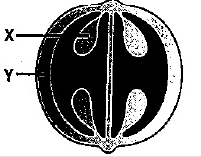
Identify $X$ and $Y$ from the given diagram.
A
$X-$ seed,$Y-$ pericarp
B
$X-$ pericarp,$Y-$ seed
C
$X-$ seed,$Y-$ fruit
D
$X-$ fruit,$Y-$ seed
Solution
(A) The provided diagram represents a cross-section of a fruit (specifically a maize grain or similar monocot fruit).
In such fruits,the inner structure represents the $X-$ seed,which contains the embryo and endosperm.
The outer protective layer surrounding the seed is the $Y-$ pericarp,which is fused with the seed coat in grains.
Therefore,$X$ is the seed and $Y$ is the pericarp.
In such fruits,the inner structure represents the $X-$ seed,which contains the embryo and endosperm.
The outer protective layer surrounding the seed is the $Y-$ pericarp,which is fused with the seed coat in grains.
Therefore,$X$ is the seed and $Y$ is the pericarp.
0 likes
View Solution111
MediumMCQ
Mango is a
A
Dry fruit
B
Drupe fruit
C
Mesocarp is fibrous
D
False fruit
Solution
(B) Mango is scientifically classified as a $Drupe$ fruit.
In a $Drupe$,the fruit develops from a monocarpellary superior ovary and is one-seeded.
It consists of a thin epicarp,a fleshy edible mesocarp,and a hard stony endocarp that encloses the seed.
Therefore,the correct classification for a mango is a $Drupe$.
In a $Drupe$,the fruit develops from a monocarpellary superior ovary and is one-seeded.
It consists of a thin epicarp,a fleshy edible mesocarp,and a hard stony endocarp that encloses the seed.
Therefore,the correct classification for a mango is a $Drupe$.
0 likes
View Solution112
MediumMCQ
Mesocarp in coconut is
A
Skin like
B
Edible
C
Fibrous
D
Stony hard
Solution
(C) In coconut,which is a drupe,the fruit develops from a monocarpellary superior ovary and is one-seeded.
In a drupe,the pericarp is well-differentiated into three layers:
$1$. The outer thin epicarp (skin).
$2$. The middle fibrous mesocarp.
$3$. The inner stony hard endocarp.
Therefore,the mesocarp of a coconut is fibrous.
In a drupe,the pericarp is well-differentiated into three layers:
$1$. The outer thin epicarp (skin).
$2$. The middle fibrous mesocarp.
$3$. The inner stony hard endocarp.
Therefore,the mesocarp of a coconut is fibrous.
0 likes
View Solution113
MediumMCQ
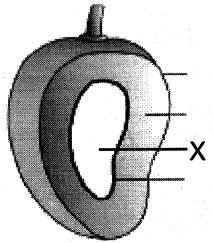
Identify the fruit shown in the figure and the part labeled as $X$.
A
Drupe,seed
B
Berry,endocarp
C
Drupe,endocarp
D
Berry,seed
Solution
(C) The figure shows a mango fruit,which is a type of fruit known as a drupe.
In a drupe,the pericarp is well-differentiated into an outer thin epicarp,a middle fleshy edible mesocarp,and an inner stony hard endocarp.
The label $X$ points to the hard,stony inner layer of the pericarp,which is the endocarp.
In a drupe,the pericarp is well-differentiated into an outer thin epicarp,a middle fleshy edible mesocarp,and an inner stony hard endocarp.
The label $X$ points to the hard,stony inner layer of the pericarp,which is the endocarp.
0 likes
View Solution114
MediumMCQ
How many layers of pericarp are present in a mango fruit?
A
$2$
B
$1$
C
$3$
D
$4$
Solution
(C) In mango,the fruit is a drupe. The pericarp is well-differentiated into three distinct layers:
$1$. Epicarp: The thin,outermost skin.
$2$. Mesocarp: The fleshy,edible middle part.
$3$. Endocarp: The hard,stony inner layer that encloses the seed.
Therefore,there are $3$ layers of pericarp in a mango.
$1$. Epicarp: The thin,outermost skin.
$2$. Mesocarp: The fleshy,edible middle part.
$3$. Endocarp: The hard,stony inner layer that encloses the seed.
Therefore,there are $3$ layers of pericarp in a mango.
0 likes
View Solution115
EasyMCQ
The fruit of groundnut is a ..........
A
Legume
B
Caryopsis
C
Berry
D
Nut
Solution
(A) The fruit of groundnut $(Arachis hypogaea)$ is botanically classified as a $Legume$ (or $Pod$).
Although it develops underground due to geocarpy, it retains the structural characteristics of a legume, which is a dry, dehiscent fruit derived from a single carpel that splits along two sutures.
Although it develops underground due to geocarpy, it retains the structural characteristics of a legume, which is a dry, dehiscent fruit derived from a single carpel that splits along two sutures.
0 likes
View Solution116
MediumMCQ
The edible part of a mango is derived from the .......... .
A
Epicarp
B
Mesocarp
C
Endocarp
D
Pericarp and thalamus
Solution
(B) In mango (Mangifera indica),the fruit is a drupe.
It develops from a superior ovary and is one-seeded.
The fruit wall is differentiated into three layers: the outer thin epicarp,the middle fleshy edible mesocarp,and the inner stony hard endocarp.
Therefore,the edible part of the mango is the mesocarp.
It develops from a superior ovary and is one-seeded.
The fruit wall is differentiated into three layers: the outer thin epicarp,the middle fleshy edible mesocarp,and the inner stony hard endocarp.
Therefore,the edible part of the mango is the mesocarp.
0 likes
View Solution117
MediumMCQ
Which part of the coconut produces coir?
A
Seed coat
B
Mesocarp
C
Epicarp
D
Pericarp
Solution
(B) The coconut fruit is a drupe. In a drupe,the pericarp is well-differentiated into an outer thin epicarp,a middle fleshy or fibrous mesocarp,and an inner stony endocarp. In coconut,the mesocarp is fibrous and is the source of coir.
0 likes
View Solution118
EasyMCQ
The edible part of a banana is . . . . . . .
A
Epicarp
B
Mesocarp and less developed endocarp
C
Endocarp and less developed mesocarp
D
Epicarp and endocarp
Solution
(B) banana is a berry fruit. In a banana,the outer thick skin is the epicarp. The edible portion consists of the fleshy mesocarp and the less developed endocarp,which surrounds the seeds (though seeds are often vestigial in commercial varieties). Therefore,the correct answer is $B$.
0 likes
View Solution119
EasyMCQ
Geocarpic fruit is .......
A
Potato
B
Groundnut
C
Onion
D
Garlic
Solution
(B) geocarpic fruit is a fruit that develops underground.
In the case of groundnut ($Arachis$ $hypogaea$),after fertilization,the flower stalk (gynophore) elongates and grows downwards into the soil,pushing the developing ovary into the ground where the fruit matures.
Therefore,groundnut is known as a geocarpic fruit.
In the case of groundnut ($Arachis$ $hypogaea$),after fertilization,the flower stalk (gynophore) elongates and grows downwards into the soil,pushing the developing ovary into the ground where the fruit matures.
Therefore,groundnut is known as a geocarpic fruit.
0 likes
View Solution120
MediumMCQ
The edible part of the mango is . . . . . . .
A
Mesocarp
B
Epicarp
C
Endocarp
D
Epidermis
Solution
(A) In mango $(Mangifera \text{ } indica)$, the fruit is a drupe.
It develops from a monocarpellary superior ovary and is one-seeded.
The fruit wall is differentiated into three layers:
$1$. The outer thin epicarp (skin).
$2$. The middle fleshy, edible mesocarp.
$3$. The inner stony hard endocarp.
Therefore, the edible part of the mango is the mesocarp.
It develops from a monocarpellary superior ovary and is one-seeded.
The fruit wall is differentiated into three layers:
$1$. The outer thin epicarp (skin).
$2$. The middle fleshy, edible mesocarp.
$3$. The inner stony hard endocarp.
Therefore, the edible part of the mango is the mesocarp.
0 likes
View Solution121
MediumMCQ
The juicy hair-like structures found in lemon fruits develop from the .......... .
A
Mesocarp and endocarp
B
Epicarp
C
Mesocarp
D
Endocarp
Solution
(D) In citrus fruits like lemon,the edible part consists of juicy,hair-like structures known as juice sacs. These juice sacs are unicellular outgrowths that develop from the inner epidermis of the carpel,which corresponds to the endocarp of the fruit. Therefore,the correct answer is the endocarp.
0 likes
View Solution122
MediumMCQ
The fruit of pineapple $(Ananas)$ develops from:
A
$A$ multilocular,syncarpous flower
B
$A$ cluster of flowers borne on a common axis
C
$A$ multilocular,monocarpellary flower
D
$A$ unilocular,polycarpellary flower
Solution
(B) Pineapple $(Ananas)$ is a type of multiple fruit or composite fruit.
Multiple fruits develop from an entire inflorescence rather than a single flower.
In the case of pineapple,the flowers are borne on a common axis (spadix-like inflorescence).
These flowers fuse together along with the floral parts to form the composite fruit known as a sorosis.
Multiple fruits develop from an entire inflorescence rather than a single flower.
In the case of pineapple,the flowers are borne on a common axis (spadix-like inflorescence).
These flowers fuse together along with the floral parts to form the composite fruit known as a sorosis.
0 likes
View Solution123
MediumMCQ
$A$ dry,indehiscent,single-seeded fruit,developing from a monocarpellary,syncarpous,inferior ovary is known as:
A
Caryopsis
B
Cypsela
C
Berry
D
Achene
Solution
(B) The fruit described is a $Cypsela$.
$1$. It is a dry,indehiscent fruit.
$2$. It is single-seeded.
$3$. It develops from a monocarpellary (or bicarpellary),syncarpous,and inferior ovary.
$4$. This type of fruit is characteristic of the family $Asteraceae$ (e.g.,sunflower,$Tridax$).
$1$. It is a dry,indehiscent fruit.
$2$. It is single-seeded.
$3$. It develops from a monocarpellary (or bicarpellary),syncarpous,and inferior ovary.
$4$. This type of fruit is characteristic of the family $Asteraceae$ (e.g.,sunflower,$Tridax$).
0 likes
View Solution124
MediumMCQ
The fleshy receptacle of the fig ($Ficus$ $carica$) encloses a number of:
A
Achenes
B
Samaras
C
Berries
D
Mericarps
Solution
(A) The inflorescence in $Ficus$ is known as a $Hypanthodium$.
In this type of inflorescence,the receptacle becomes fleshy and forms a cup-like structure that encloses the flowers.
The flowers are unisexual and are borne on the inner wall of this receptacle.
After fertilization,the female flowers develop into small,dry,one-seeded fruits known as $Achenes$.
Therefore,the fleshy receptacle of the fig encloses a number of $Achenes$.
In this type of inflorescence,the receptacle becomes fleshy and forms a cup-like structure that encloses the flowers.
The flowers are unisexual and are borne on the inner wall of this receptacle.
After fertilization,the female flowers develop into small,dry,one-seeded fruits known as $Achenes$.
Therefore,the fleshy receptacle of the fig encloses a number of $Achenes$.
0 likes
View Solution125
MediumMCQ
$A$ fruit developed from an inferior ovary,having chambers with seeds on the septa,is known as:
A
Pomegranate
B
Orange
C
Guava
D
Cucumber
Solution
(A) The fruit described is a $Balausta$,which is characteristic of the pomegranate ($Punica$ $granatum$).
$1$. It develops from an inferior ovary.
$2$. The fruit is fleshy and indehiscent with a tough rind.
$3$. The interior is divided into many chambers by septa (partitions),and the seeds are attached to these septa.
$1$. It develops from an inferior ovary.
$2$. The fruit is fleshy and indehiscent with a tough rind.
$3$. The interior is divided into many chambers by septa (partitions),and the seeds are attached to these septa.
0 likes
View Solution126
MediumMCQ
The fruit developed from a $hypanthodium$ inflorescence is called ..........
A
Sorosis
B
Syconus
C
Caryopsis
D
Hesperidium
Solution
(B) $Syconus$ is a type of composite fruit that develops from a $hypanthodium$ inflorescence.
In this type of inflorescence,the receptacle becomes fleshy and forms a cup-like structure,enclosing numerous small flowers.
Examples include $Ficus$ species like the fig $(Ficus \text{ carica})$ and banyan $(Ficus \text{ benghalensis})$.
In this type of inflorescence,the receptacle becomes fleshy and forms a cup-like structure,enclosing numerous small flowers.
Examples include $Ficus$ species like the fig $(Ficus \text{ carica})$ and banyan $(Ficus \text{ benghalensis})$.
0 likes
View Solution127
MediumMCQ
$A$ drupe fruit develops from $.......$.
A
Wheat
B
Pea
C
Tomato
D
Mango
Solution
(D) drupe is a type of fleshy fruit that develops from a monocarpellary superior ovary.
In a drupe, the pericarp is well-differentiated into an outer thin epicarp, a middle fleshy mesocarp, and an inner stony hard endocarp.
Mango $(Mangifera \text{ } indica)$ is a classic example of a drupe fruit.
Therefore, the correct option is $D$.
In a drupe, the pericarp is well-differentiated into an outer thin epicarp, a middle fleshy mesocarp, and an inner stony hard endocarp.
Mango $(Mangifera \text{ } indica)$ is a classic example of a drupe fruit.
Therefore, the correct option is $D$.
0 likes
View Solution128
MediumMCQ
Identify the number of plants that produce composite fruits (multiple fruits) from the following list: Walnut,Poppy,Fig,Radish,Pineapple,Apple,Tomato,Mulberry.
A
Four
B
Five
C
Two
D
Three
Solution
(D) composite fruit (or multiple fruit) is a fruit formed from an entire inflorescence rather than a single flower.
$1$. Walnut: Simple fruit (drupe).
$2$. Poppy: Simple fruit (capsule).
$3$. Fig: Composite fruit (syconus).
$4$. Radish: Simple fruit (siliqua).
$5$. Pineapple: Composite fruit (sorosis).
$6$. Apple: False fruit (pome).
$7$. Tomato: Simple fruit (berry).
$8$. Mulberry: Composite fruit (sorosis).
Therefore,the plants that produce composite fruits are Fig,Pineapple,and Mulberry.
The total count is $3$.
$1$. Walnut: Simple fruit (drupe).
$2$. Poppy: Simple fruit (capsule).
$3$. Fig: Composite fruit (syconus).
$4$. Radish: Simple fruit (siliqua).
$5$. Pineapple: Composite fruit (sorosis).
$6$. Apple: False fruit (pome).
$7$. Tomato: Simple fruit (berry).
$8$. Mulberry: Composite fruit (sorosis).
Therefore,the plants that produce composite fruits are Fig,Pineapple,and Mulberry.
The total count is $3$.
0 likes
View Solution129
MediumMCQ
$A$ fruit developed from $.......$ is called an aggregate fruit.
A
Multicarpellary syncarpous ovary
B
Multicarpellary apocarpous ovary
C
Entire inflorescence
D
Multicarpellary superior ovary
Solution
(B) An aggregate fruit is formed from a single flower that has a multicarpellary apocarpous (free carpels) gynoecium.
Each free carpel develops into a fruitlet,and these fruitlets together form an aggregate fruit.
Examples include strawberry,raspberry,and custard apple.
In contrast,simple fruits develop from a single ovary,and composite fruits develop from an entire inflorescence.
Each free carpel develops into a fruitlet,and these fruitlets together form an aggregate fruit.
Examples include strawberry,raspberry,and custard apple.
In contrast,simple fruits develop from a single ovary,and composite fruits develop from an entire inflorescence.
0 likes
View Solution130
MediumMCQ
In which of the following are the placenta and pericarp the edible parts?
A
Apple
B
Banana
C
Tomato
D
Potato
Solution
(C) In a tomato $(Solanum \text{ } lycopersicum)$, the fruit is a berry. The edible parts of the tomato fruit are the fleshy placenta and the pericarp (fruit wall).
Apple is a false fruit where the thalamus is edible.
Banana is a parthenocarpic berry where the mesocarp and endocarp are edible.
Potato is a stem tuber, not a fruit.
Apple is a false fruit where the thalamus is edible.
Banana is a parthenocarpic berry where the mesocarp and endocarp are edible.
Potato is a stem tuber, not a fruit.
0 likes
View Solution131
EasyMCQ
Which of the following is a geocarpic fruit?
A
Onion
B
Watermelon
C
Groundnut
D
Carrot
Solution
(C) geocarpic fruit is a fruit that develops underground.
In $Arachis hypogaea$ (groundnut),after fertilization,the flower stalk (gynophore) elongates and pushes the ovary into the soil.
The fruit then matures and develops underground.
Therefore,groundnut is known as a geocarpic fruit.
In $Arachis hypogaea$ (groundnut),after fertilization,the flower stalk (gynophore) elongates and pushes the ovary into the soil.
The fruit then matures and develops underground.
Therefore,groundnut is known as a geocarpic fruit.
0 likes
View Solution132
MediumMCQ
Aggregate fruit develops from
A
syncarpous ovary
B
multicarpellary,syncarpous ovary
C
unilocular ovary
D
multicarpellary,apocarpous ovary
Solution
(D) An aggregate fruit is formed from a single flower that has a multicarpellary,apocarpous gynoecium.
In an apocarpous ovary,the carpels are free from each other.
Each individual carpel develops into a small fruitlet,and the entire collection of these fruitlets,which are attached to a common receptacle,is known as an aggregate fruit or $etaerio$.
In an apocarpous ovary,the carpels are free from each other.
Each individual carpel develops into a small fruitlet,and the entire collection of these fruitlets,which are attached to a common receptacle,is known as an aggregate fruit or $etaerio$.
0 likes
View Solution133
EasyMCQ
Parachute type dispersal occurs in
A
tomato
B
mustard
C
pea
D
cotton
Solution
(D) Dispersal is a universal biological need. For non-aquatic,terrestrial plants,the wind is an obvious supplier of energy for movement,and many plant adaptations exist that clearly take advantage of this fact. This type of seed dispersal is not efficient,but very effective. Appendages of some fruits and seeds act as parachutes; for example,seeds of cotton possess hair that help in the dispersal of these seeds by wind. Another well-known example is the dandelion.
0 likes
View Solution134
Easy
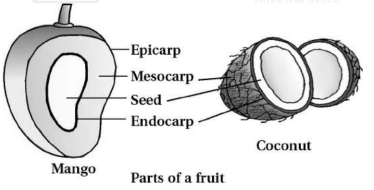
Describe the parts of a fruit with a diagram.
Solution
(N/A) $\rightarrow$ The fruit is a mature or ripened ovary, developed after fertilisation. If a fruit is formed without fertilisation of the ovary, it is called a parthenocarpic fruit.
$\rightarrow$ Generally, the fruit consists of a wall or pericarp and seeds. The seed is enclosed by the pericarp in a fruit.
$\rightarrow$ The pericarp may be dry or fleshy. When the pericarp is thick and fleshy, it is differentiated into the outer epicarp, the middle mesocarp, and the inner endocarp.
$\rightarrow$ Drupe: In mango and coconut, the fruit is known as a drupe. They develop from monocarpellary superior ovaries and are one-seeded.
$\rightarrow$ In mango, the pericarp is well-differentiated into an outer thin epicarp, a middle fleshy edible mesocarp, and an inner stony hard endocarp.
$\rightarrow$ In coconut, which is also a drupe, the mesocarp is fibrous.
$\rightarrow$ Generally, the fruit consists of a wall or pericarp and seeds. The seed is enclosed by the pericarp in a fruit.
$\rightarrow$ The pericarp may be dry or fleshy. When the pericarp is thick and fleshy, it is differentiated into the outer epicarp, the middle mesocarp, and the inner endocarp.
$\rightarrow$ Drupe: In mango and coconut, the fruit is known as a drupe. They develop from monocarpellary superior ovaries and are one-seeded.
$\rightarrow$ In mango, the pericarp is well-differentiated into an outer thin epicarp, a middle fleshy edible mesocarp, and an inner stony hard endocarp.
$\rightarrow$ In coconut, which is also a drupe, the mesocarp is fibrous.
0 likes
View Solution135
Easy
Explain the structure of a drupe fruit with examples.
Solution
(N/A) Drupes are fruits that develop from monocarpellary superior ovaries and are one-seeded.
In these fruits, the pericarp is well-differentiated into three layers:
$1$. Epicarp: The thin, outermost skin.
$2$. Mesocarp: The middle, fleshy, or fibrous part.
$3$. Endocarp: The hard, stony, innermost layer that encloses the seed.
Examples: Mango $(Mangifera \, indica)$ and Coconut $(Cocos \, nucifera)$.
In mango, the epicarp is thin, the mesocarp is fleshy and edible, and the endocarp is stony hard.
In coconut, which is also a drupe, the mesocarp is fibrous.
In these fruits, the pericarp is well-differentiated into three layers:
$1$. Epicarp: The thin, outermost skin.
$2$. Mesocarp: The middle, fleshy, or fibrous part.
$3$. Endocarp: The hard, stony, innermost layer that encloses the seed.
Examples: Mango $(Mangifera \, indica)$ and Coconut $(Cocos \, nucifera)$.
In mango, the epicarp is thin, the mesocarp is fleshy and edible, and the endocarp is stony hard.
In coconut, which is also a drupe, the mesocarp is fibrous.
0 likes
View Solution136
Medium
Provide definitions/explanations for the following terms:
$(i)$ Placentation
$(ii)$ Fruit
$(i)$ Placentation
$(ii)$ Fruit
Solution
(N/A) $(i)$ Placentation: The arrangement of ovules within the ovary is known as placentation.
$(ii)$ Fruit: $A$ mature or ripened ovary,developed after fertilization,is called a fruit.
$(ii)$ Fruit: $A$ mature or ripened ovary,developed after fertilization,is called a fruit.
0 likes
View Solution137
Easy
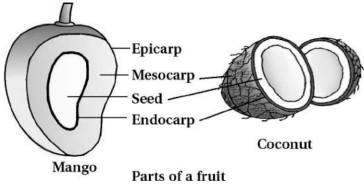
Mango and coconut are 'drupe' type of fruits. In mango,the fleshy mesocarp is edible. What is the edible part of coconut? What does the milk of tender coconut represent?
Solution
(N/A) Mango and coconut are drupe fruits. They develop from monocarpellary,superior ovaries and are one-seeded.
In mango,the fruit is differentiated into an outer thin epicarp,a middle fleshy edible mesocarp,and an inner stony hard endocarp.
In coconut,the edible part is the endosperm.
The milk of tender coconut represents the free-nuclear liquid endosperm,which later becomes cellular as it deposits along the inner wall of the endocarp.
In mango,the fruit is differentiated into an outer thin epicarp,a middle fleshy edible mesocarp,and an inner stony hard endocarp.
In coconut,the edible part is the endosperm.
The milk of tender coconut represents the free-nuclear liquid endosperm,which later becomes cellular as it deposits along the inner wall of the endocarp.
0 likes
View Solution138
Medium
Why is a maize grain usually called a fruit and not a seed?
Solution
(N/A) maize grain is technically a fruit because it develops from a mature ovary.
In maize,the fruit wall (pericarp) is fused with the seed coat to form a single unit.
This specific type of dry,indehiscent fruit is known as a $Caryopsis$.
Since it contains both the seed and the fused fruit wall,it is botanically classified as a fruit rather than just a seed.
In maize,the fruit wall (pericarp) is fused with the seed coat to form a single unit.
This specific type of dry,indehiscent fruit is known as a $Caryopsis$.
Since it contains both the seed and the fused fruit wall,it is botanically classified as a fruit rather than just a seed.
0 likes
View Solution139
Medium
Define/Explain: Drupe.
Solution
(N/A) drupe is a type of fleshy fruit in which the pericarp is differentiated into three distinct layers: the outer epicarp,the middle fleshy mesocarp,and the inner stony,woody endocarp. Examples include mango and coconut.
0 likes
View Solution140
EasyMCQ
What is the primary function of the pericarp?
A
Protection
B
Absorption
C
Secretion
D
Photosynthesis
Solution
(A) The pericarp is the part of a fruit formed from the wall of the ripened ovary. Its primary function is to provide protection to the developing seeds inside the fruit from environmental stress,pathogens,and mechanical injury. It also plays a crucial role in the dispersal of seeds.
0 likes
View Solution141
MediumMCQ
Which of the following is not a fleshy fruit?
A
Orange
B
Mango
C
Groundnut
D
Guava
Solution
(C) Fruits are broadly classified into fleshy fruits and dry fruits based on the nature of the pericarp.
In fleshy fruits,the pericarp is thick,fleshy,and differentiated into epicarp,mesocarp,and endocarp (e.g.,mango,orange,guava).
In dry fruits,the pericarp is thin,dry,and not differentiated into distinct layers.
Groundnut (Arachis hypogaea) is a type of dry fruit (specifically a legume or pod) where the pericarp becomes dry and hard at maturity.
Therefore,groundnut is not a fleshy fruit.
In fleshy fruits,the pericarp is thick,fleshy,and differentiated into epicarp,mesocarp,and endocarp (e.g.,mango,orange,guava).
In dry fruits,the pericarp is thin,dry,and not differentiated into distinct layers.
Groundnut (Arachis hypogaea) is a type of dry fruit (specifically a legume or pod) where the pericarp becomes dry and hard at maturity.
Therefore,groundnut is not a fleshy fruit.
0 likes
View Solution142
MediumMCQ
Match the following columns:
| Column-$I$ | Column-$II$ |
| $(a)$ Fleshy fruit | $(1)$ Mustard |
| $(b)$ Dry fruit | $(2)$ Strawberry |
| $(c)$ False fruit | $(3)$ Orange |
| $(d)$ Parthenocarpic fruit | $(4)$ Banana |
A
$a-3, b-1, c-4, d-2$
B
$a-2, b-4, c-1, d-3$
C
$a-4, b-1, c-2, d-3$
D
$a-3, b-1, c-2, d-4$
Solution
(D) The correct matching is as follows:
$(a)$ Fleshy fruit: Orange $(3)$ - It has a succulent pericarp.
$(b)$ Dry fruit: Mustard $(1)$ - It has a dry, dehiscent pericarp.
$(c)$ False fruit: Strawberry $(2)$ - In this, the thalamus also contributes to fruit formation.
$(d)$ Parthenocarpic fruit: Banana $(4)$ - It develops without fertilization.
Therefore, the correct sequence is $a-3, b-1, c-2, d-4$.
$(a)$ Fleshy fruit: Orange $(3)$ - It has a succulent pericarp.
$(b)$ Dry fruit: Mustard $(1)$ - It has a dry, dehiscent pericarp.
$(c)$ False fruit: Strawberry $(2)$ - In this, the thalamus also contributes to fruit formation.
$(d)$ Parthenocarpic fruit: Banana $(4)$ - It develops without fertilization.
Therefore, the correct sequence is $a-3, b-1, c-2, d-4$.
0 likes
View Solution143
EasyMCQ
Identify the correct features of Mango and Coconut fruits.
$(i)$ In both,the fruit is a drupe.
$(ii)$ Endocarp is edible in both.
$(iii)$ Mesocarp in Coconut is fibrous,and in Mango it is fleshy.
$(iv)$ In both,the fruit develops from a monocarpellary ovary.
Select the correct option from below:
$(i)$ In both,the fruit is a drupe.
$(ii)$ Endocarp is edible in both.
$(iii)$ Mesocarp in Coconut is fibrous,and in Mango it is fleshy.
$(iv)$ In both,the fruit develops from a monocarpellary ovary.
Select the correct option from below:
A
$(i)$ and $(ii)$ only
B
$(i)$,$(iii)$ and $(iv)$ only
C
$(i)$,$(ii)$ and $(iii)$ only
D
$(i)$ and $(iv)$ only
Solution
(B) Both Mango and Coconut fruits are classified as drupes. They develop from a monocarpellary superior ovary.
$(i)$ Correct: Both are drupes.
$(ii)$ Incorrect: In Mango,the mesocarp is edible,while in Coconut,the endosperm is edible. The endocarp is hard and stony in both.
$(iii)$ Correct: In Coconut,the mesocarp is fibrous,whereas in Mango,it is fleshy and edible.
$(iv)$ Correct: Both develop from a monocarpellary ovary.
Therefore,statements $(i)$,$(iii)$,and $(iv)$ are correct.
$(i)$ Correct: Both are drupes.
$(ii)$ Incorrect: In Mango,the mesocarp is edible,while in Coconut,the endosperm is edible. The endocarp is hard and stony in both.
$(iii)$ Correct: In Coconut,the mesocarp is fibrous,whereas in Mango,it is fleshy and edible.
$(iv)$ Correct: Both develop from a monocarpellary ovary.
Therefore,statements $(i)$,$(iii)$,and $(iv)$ are correct.
0 likes
View Solution144
MediumMCQ
Fleshy fruits with stony endocarp are called
A
Capsules
B
Berries
C
Pomes
D
Drupes
Solution
(D) Drupe is a fleshy,single-seeded,indehiscent fruit where the seed is enclosed within a hard,stony endocarp. Examples include mango,coconut,peach,and plum.
0 likes
View Solution145
EasyMCQ
Pome fruit is found in
A
Mango
B
Apple
C
Litchi
D
Peach
Solution
(B) Pome is a fleshy,syncarpous fruit that develops from an inferior ovary and is surrounded by a fleshy thalamus.
Examples of Pome fruits include $Apple$ and $Pear$.
$Mango$ and $Peach$ are examples of $Drupe$ fruits,which are characterized by a succulent mesocarp and a stony endocarp.
$Litchi$ is a nut-like fruit where the edible,fleshy part is an outgrowth from the base of the seed known as an $Aril$.
Examples of Pome fruits include $Apple$ and $Pear$.
$Mango$ and $Peach$ are examples of $Drupe$ fruits,which are characterized by a succulent mesocarp and a stony endocarp.
$Litchi$ is a nut-like fruit where the edible,fleshy part is an outgrowth from the base of the seed known as an $Aril$.
0 likes
View Solution146
EasyMCQ
Drupes are called stony fruits because they have hard
A
Epicarp and mesocarp
B
Mesocarp
C
Mesocarp and endocarp
D
Endocarp
Solution
(D) drupe is a fleshy fruit that develops from a monocarpellary or syncarpous ovary.
In these fruits,the pericarp is differentiated into three layers: the outer epicarp,the fleshy middle mesocarp,and the inner stony,hard endocarp.
Because the endocarp is extremely hard and protects the seed,these fruits are commonly referred to as stone fruits.
Examples include mango,peach,and coconut.
In these fruits,the pericarp is differentiated into three layers: the outer epicarp,the fleshy middle mesocarp,and the inner stony,hard endocarp.
Because the endocarp is extremely hard and protects the seed,these fruits are commonly referred to as stone fruits.
Examples include mango,peach,and coconut.
0 likes
View Solution147
MediumMCQ
Which fruit is bicarpellary,syncarpous,and possesses a pseudoseptum?
A
Siliqua
B
Achene
C
Capsule
D
All of these
Solution
(A) fruit that is bicarpellary (composed of two carpels),syncarpous (carpels fused together),and contains a pseudoseptum (a false septum called a replum) is known as a siliqua.
This type of fruit is characteristic of the family Brassicaceae,for example,$Brassica$ (mustard).
This type of fruit is characteristic of the family Brassicaceae,for example,$Brassica$ (mustard).
0 likes
View SolutionMorphology of Flowering Plants — fruits · Frequently Asked Questions
1Are these Morphology of Flowering Plants questions useful for JEE and NEET?
Yes. All questions in this section are mapped to JEE Main and NEET exam patterns. Previous year questions from JEE Main, NEET, GUJCET and state-level exams are included with full solutions.
2Can I switch to Hindi or Gujarati for these questions?
Yes. Use the language tabs in the hero section or the sidebar to view the same questions and solutions in English, Hindi or Gujarati.
3How do I generate a question paper from this subtopic?
Use the Vedclass Exam Paper Generator — select the chapter and subtopic, set difficulty, and generate Sets A, B, C, D automatically. First 3 chapters of every subject are free.
Vedclass Products
For Students
Vedclass Test Series
Mock tests in real JEE/NEET style with performance analysis. 5-day free trial.
Start Free TrialFor Teachers
Exam Paper Generator
Generate Set A/B/C/D papers from this chapter in 2 minutes. 3 chapters free.
Try FreeFor Institutes
Online Exam Module
Live online exams with unlimited students, 360° analytics & white-label branding.
See DemoFor Teachers & Institutes
Generate a Morphology of Flowering Plants Exam Paper in 2 Minutes
Select subtopic & difficulty — Sets A, B, C, D auto-generated with No Repeat logic.
First 3 chapters of every subject are free — no payment required.