
A English
Flower Questions in English
Class 11 Biology · Morphology of Flowering Plants · Flower
351+
Questions
English
Language
100%
With Solutions
Showing 50 of 351 questions in English
251
MediumMCQ
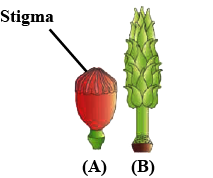
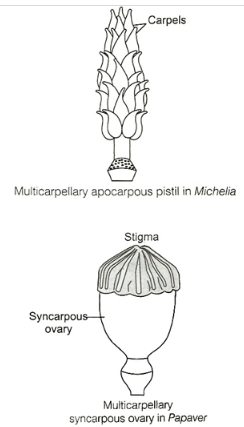
Identify the type of carpel with the help of the diagrams given below:
A
$(A)$ Syncarpous,$(B)$ Apocarpous
B
$(A)$ Apocarpous,$(B)$ Syncarpous
C
$(A)$ Monocarpellary,$(B)$ Syncarpous
D
$(A)$ Apocarpous,$(B)$ Multicarpellary
Solution
(A) In this diagram,the carpels are fused together,which is known as a syncarpous ovary. Example: Papaver (Poppy).
$(B)$ In this diagram,the carpels are free (not fused),which is known as an apocarpous ovary. Example: Michelia.
$(B)$ In this diagram,the carpels are free (not fused),which is known as an apocarpous ovary. Example: Michelia.
0 likes
View Solution252
Medium
How can you differentiate between free central and axile placentation?
Solution
(N/A) $\rightarrow$ Placentation: The arrangement of ovules within the ovary is known as placentation. The placenta is a specialized tissue. Various types of placentation are observed in plants, including free central and axile placentation.
$\rightarrow$ The differences between them are as follows:
$\rightarrow$ The differences between them are as follows:
| Free central placentation | Axile placentation |
| $(1)$ The ovary is unilocular (single chambered). | $(1)$ The ovary is multilocular (many chambers). |
| $(2)$ Ovules are borne on a central axis, and septa (membranes) are absent. | $(2)$ The placenta is axial, and ovules are attached to it in a multilocular ovary with septa. |
0 likes
View Solution253
Medium
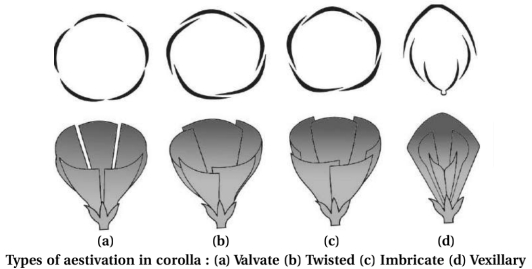
The mode of arrangement of sepals or petals in a floral bud is known as aestivation. Describe the various types of aestivation found in flowers.
Solution
(N/A) $\rightarrow$ The mode of arrangement of sepals or petals in a floral bud with respect to the other members of the same whorl is known as aestivation.
$\rightarrow$ The main types of aestivation are as follows:
$(i)$ Valvate: When sepals or petals in a whorl just touch one another at the margin, without overlapping, it is said to be valvate, e.g., $Calotropis$.
$(ii)$ Twisted: If one margin of the appendage overlaps that of the next one and so on, it is called twisted, e.g., China rose, lady's finger, and cotton.
$(iii)$ Imbricate: If the margins of sepals or petals overlap one another but not in any particular direction, the aestivation is called imbricate, e.g., $Cassia$ and Gulmohur.
$(iv)$ Vexillary: In pea and bean flowers, there are five petals; the largest (standard) overlaps the two lateral petals (wings), which in turn overlap the two smallest anterior petals (keel). This type of aestivation is called vexillary or papilionaceous.
$\rightarrow$ The main types of aestivation are as follows:
$(i)$ Valvate: When sepals or petals in a whorl just touch one another at the margin, without overlapping, it is said to be valvate, e.g., $Calotropis$.
$(ii)$ Twisted: If one margin of the appendage overlaps that of the next one and so on, it is called twisted, e.g., China rose, lady's finger, and cotton.
$(iii)$ Imbricate: If the margins of sepals or petals overlap one another but not in any particular direction, the aestivation is called imbricate, e.g., $Cassia$ and Gulmohur.
$(iv)$ Vexillary: In pea and bean flowers, there are five petals; the largest (standard) overlaps the two lateral petals (wings), which in turn overlap the two smallest anterior petals (keel). This type of aestivation is called vexillary or papilionaceous.
0 likes
View Solution254
Medium
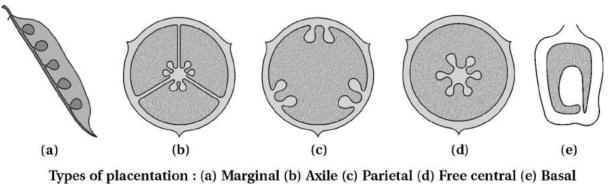
The arrangement of ovules within the ovary is known as placentation. What does the term placenta refer to? Name and describe various types of placentations in flowers as seen in $T.S.$ or $V.S$.
Solution
(N/A) $\rightarrow$ Placenta: The placenta is a flat,cushion-like tissue to which one or more ovules are attached.
$\rightarrow$ The arrangement of ovules within the ovary is called placentation.
$\rightarrow$ The types of placentation are as follows:
$(i)$ Marginal Placentation: In marginal placentation,the placenta forms a ridge along the ventral suture of the ovary,and the ovules are borne on this ridge,forming two rows,e.g.,pea,bean.
$(ii)$ Axile Placentation: When the placenta is axial and the ovules are attached to it in a multilocular ovary,the placentation is said to be axile,e.g.,china rose,tomato,and lemon.
$(iii)$ Parietal Placentation: In parietal placentation,the ovules develop on the inner wall of the ovary or on the peripheral part. The ovary is one-chambered but becomes two-chambered due to the formation of a false septum,e.g.,mustard and Argemone.
$(iv)$ Free Central Placentation: When the ovules are borne on a central axis and septa are absent,the ovary is one-chambered; this is called free central placentation,e.g.,Dianthus and Primrose.
$(v)$ Basal Placentation: In basal placentation,the placenta develops at the base of the ovary,and a single ovule is attached to it,e.g.,sunflower,wheat.
$\rightarrow$ The arrangement of ovules within the ovary is called placentation.
$\rightarrow$ The types of placentation are as follows:
$(i)$ Marginal Placentation: In marginal placentation,the placenta forms a ridge along the ventral suture of the ovary,and the ovules are borne on this ridge,forming two rows,e.g.,pea,bean.
$(ii)$ Axile Placentation: When the placenta is axial and the ovules are attached to it in a multilocular ovary,the placentation is said to be axile,e.g.,china rose,tomato,and lemon.
$(iii)$ Parietal Placentation: In parietal placentation,the ovules develop on the inner wall of the ovary or on the peripheral part. The ovary is one-chambered but becomes two-chambered due to the formation of a false septum,e.g.,mustard and Argemone.
$(iv)$ Free Central Placentation: When the ovules are borne on a central axis and septa are absent,the ovary is one-chambered; this is called free central placentation,e.g.,Dianthus and Primrose.
$(v)$ Basal Placentation: In basal placentation,the placenta develops at the base of the ovary,and a single ovule is attached to it,e.g.,sunflower,wheat.
0 likes
View Solution255
MediumMCQ
Choose the correct option for the following statement:
In $Solanum$ $melongena$ (Brinjal),the stamens are $epipetalous$.
In $Solanum$ $melongena$ (Brinjal),the stamens are $epipetalous$.
A
Epipetalous
B
Epiphyllous
C
Apostemonous
D
Syngenesious
Solution
(A) In the family $Solanaceae$,to which $Solanum$ $melongena$ (Brinjal) belongs,the flowers are bisexual and actinomorphic.
The androecium consists of $5$ stamens which are epipetalous,meaning they are attached to the petals.
Therefore,the correct term is epipetalous.
The androecium consists of $5$ stamens which are epipetalous,meaning they are attached to the petals.
Therefore,the correct term is epipetalous.
0 likes
View Solution256
EasyMCQ
The ovary is half inferior in
A
Plum
B
Brinjal
C
Mustard
D
Sunflower
Solution
(A) In a perigynous flower,the gynoecium is situated in the center and other parts of the flower are located at the rim of the thalamus almost at the same level. The ovary is said to be half inferior. Examples of perigynous flowers include Plum,Rose,and Peach. Therefore,the correct option is Plum.
0 likes
View Solution257
EasyMCQ
In which of the following is the ovary half-inferior?
A
Brinjal
B
Mustard
C
Sunflower
D
Plum
Solution
(D) In perigynous flowers,the gynoecium is situated in the center and other parts of the flower are located on the rim of the thalamus almost at the same level. The ovary is said to be half-inferior. Examples include $Plum$,$Rose$,and $Peach$.
0 likes
View Solution258
MediumMCQ
Select the option that shows the correct sequence of floral whorls from the outside to the inside of a flower.
A
Calyx $\rightarrow$ Corolla $\rightarrow$ Gynoecium $\rightarrow$ Androecium
B
Corolla $\rightarrow$ Calyx $\rightarrow$ Androecium $\rightarrow$ Gynoecium
C
Calyx $\rightarrow$ Corolla $\rightarrow$ Androecium $\rightarrow$ Gynoecium
D
Corolla $\rightarrow$ Calyx $\rightarrow$ Gynoecium $\rightarrow$ Androecium
Solution
(C) typical flower consists of four different kinds of whorls arranged successively on the swollen end of the stalk or pedicel,called the thalamus or receptacle.
These four whorls,from the outermost to the innermost,are:
$1$. Calyx (outermost whorl,composed of sepals).
$2$. Corolla (composed of petals).
$3$. Androecium (composed of stamens).
$4$. Gynoecium (innermost whorl,composed of carpels/pistils).
Therefore,the correct sequence is Calyx $\rightarrow$ Corolla $\rightarrow$ Androecium $\rightarrow$ Gynoecium.
These four whorls,from the outermost to the innermost,are:
$1$. Calyx (outermost whorl,composed of sepals).
$2$. Corolla (composed of petals).
$3$. Androecium (composed of stamens).
$4$. Gynoecium (innermost whorl,composed of carpels/pistils).
Therefore,the correct sequence is Calyx $\rightarrow$ Corolla $\rightarrow$ Androecium $\rightarrow$ Gynoecium.
0 likes
View Solution259
MediumMCQ
Correct position of floral parts over thalamus in mustard plant is
A
Gynoecium is situated in the centre,and other parts of the flower are located at the rim of the thalamus,at the same level.
B
Gynoecium occupies the highest position,while the other parts are situated below it.
C
Margin of the thalamus grows upward,enclosing the ovary completely,and other parts arise below the ovary.
D
Gynoecium is present in the centre and other parts cover it partially.
Solution
(B) Mustard plants exhibit hypogynous flowers. In a hypogynous flower,the gynoecium occupies the highest position on the thalamus,while all other floral parts (sepals,petals,and stamens) are situated below the ovary. This type of ovary is referred to as superior.
0 likes
View Solution260
MediumMCQ
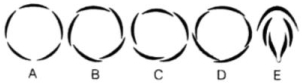
Arrange the given figures in the correct order of aestivation types.
A
$A$ - Imbricate,$B$ - Quincuncial,$C$ - Valvate,$D$ - Twisted,$E$ - Vexillary
B
$A$ - Vexillary,$B$ - Valvate,$C$ - Twisted,$D$ - Imbricate,$E$ - Quincuncial
C
$A$ - Quincuncial,$B$ - Twisted,$C$ - Vexillary,$D$ - Imbricate,$E$ - Valvate
D
$A$ - Valvate,$B$ - Twisted,$C$ - Imbricate,$D$ - Quincuncial,$E$ - Vexillary
Solution
(D) The figures represent different types of aestivation:
$A$ - Valvate: The margins of sepals or petals touch each other without overlapping.
$B$ - Twisted: One margin of the sepal or petal overlaps that of the next one.
$C$ - Imbricate: The margins of sepals or petals overlap one another but not in any particular direction.
$D$ - Quincuncial: Two petals are completely external,two are completely internal,and one is partially external and partially internal.
$E$ - Vexillary: The largest posterior petal (standard) overlaps the two lateral petals (wings),which in turn overlap the two smallest anterior petals (keel).
Therefore,the correct order is $A$ - Valvate,$B$ - Twisted,$C$ - Imbricate,$D$ - Quincuncial,$E$ - Vexillary.
$A$ - Valvate: The margins of sepals or petals touch each other without overlapping.
$B$ - Twisted: One margin of the sepal or petal overlaps that of the next one.
$C$ - Imbricate: The margins of sepals or petals overlap one another but not in any particular direction.
$D$ - Quincuncial: Two petals are completely external,two are completely internal,and one is partially external and partially internal.
$E$ - Vexillary: The largest posterior petal (standard) overlaps the two lateral petals (wings),which in turn overlap the two smallest anterior petals (keel).
Therefore,the correct order is $A$ - Valvate,$B$ - Twisted,$C$ - Imbricate,$D$ - Quincuncial,$E$ - Vexillary.
0 likes
View Solution261
MediumMCQ
Which of the following represent zygomorphic symmetry?
A
Canna,Mustard,Chilly,Datura
B
Mustard,Canna,Pea,Datura
C
Pea,Bean,Cassia,Gulmohar
D
Pea,Bean,Canna,Chilly
Solution
(C) Zygomorphic symmetry refers to bilateral symmetry in flowers, where the flower can be divided into two identical halves only in one particular vertical plane.
Examples of plants exhibiting zygomorphic flowers include $Pea$, $Bean$, $Cassia$, and $Gulmohar$.
In contrast, actinomorphic flowers (radial symmetry) are found in $Mustard$, $Datura$, and $Chilly$, while $Canna$ exhibits asymmetry.
Examples of plants exhibiting zygomorphic flowers include $Pea$, $Bean$, $Cassia$, and $Gulmohar$.
In contrast, actinomorphic flowers (radial symmetry) are found in $Mustard$, $Datura$, and $Chilly$, while $Canna$ exhibits asymmetry.
0 likes
View Solution262
MediumMCQ
Match the Column $I$ and Column $II$:
| Column $I$ | Column $II$ |
| $(a)$ Apocarpous | $(i)$ Papaver |
| $(b)$ Syncarpous | $(ii)$ Michelia |
| $(c)$ Epiphyllous | $(iii)$ Cashew |
| $(d)$ Cotyledon | $(iv)$ Aloe |
A
$a-i, b-ii, c-iii, d-iv$
B
$a-ii, b-i, c-iv, d-iii$
C
$a-iv, b-iii, c-ii, d-i$
D
$a-iv, b-i, c-iii, d-ii$
Solution
(B) The correct matching is as follows:
$(a)$ Apocarpous: In this condition,the carpels are free,as seen in $Michelia$.
$(b)$ Syncarpous: In this condition,the carpels are fused,as seen in $Papaver$.
$(c)$ Epiphyllous: When stamens are attached to the perianth (tepals),it is called epiphyllous,as seen in $Aloe$.
$(d)$ Cotyledon: The embryo of a monocotyledonous seed contains one cotyledon,which is called scutellum,as seen in $Cashew$ (Note: While $Cashew$ is a dicot,in the context of typical textbook matching questions,the association is made based on specific structural examples provided in the $NCERT$ curriculum).
Therefore,the correct sequence is $a-ii, b-i, c-iv, d-iii$.
$(a)$ Apocarpous: In this condition,the carpels are free,as seen in $Michelia$.
$(b)$ Syncarpous: In this condition,the carpels are fused,as seen in $Papaver$.
$(c)$ Epiphyllous: When stamens are attached to the perianth (tepals),it is called epiphyllous,as seen in $Aloe$.
$(d)$ Cotyledon: The embryo of a monocotyledonous seed contains one cotyledon,which is called scutellum,as seen in $Cashew$ (Note: While $Cashew$ is a dicot,in the context of typical textbook matching questions,the association is made based on specific structural examples provided in the $NCERT$ curriculum).
Therefore,the correct sequence is $a-ii, b-i, c-iv, d-iii$.
0 likes
View Solution263
MediumMCQ
Which of the following is correct regarding the position of floral parts on the thalamus?
A
Perigynous - plum,peach,rose
B
Epigynous - guava and cucumber
C
Hypogynous - mustard,rose
D
Both $A$ and $B$
Solution
(D) In $Perigynous$ flowers,the gynoecium is situated in the center and other parts of the flower are located at the rim of the thalamus almost at the same level. Examples include $Plum$,$Peach$,and $Rose$.
In $Epigynous$ flowers,the margin of the thalamus grows upward enclosing the ovary completely and getting fused with it,while other parts of the flower arise above the ovary. Examples include $Guava$,$Cucumber$,and the ray florets of $Sunflower$.
In $Hypogynous$ flowers,the gynoecium occupies the highest position while the other parts are situated below it. Examples include $Mustard$,$China$ $rose$,and $Brinjal$.
Therefore,both options $A$ and $B$ are correct.
In $Epigynous$ flowers,the margin of the thalamus grows upward enclosing the ovary completely and getting fused with it,while other parts of the flower arise above the ovary. Examples include $Guava$,$Cucumber$,and the ray florets of $Sunflower$.
In $Hypogynous$ flowers,the gynoecium occupies the highest position while the other parts are situated below it. Examples include $Mustard$,$China$ $rose$,and $Brinjal$.
Therefore,both options $A$ and $B$ are correct.
0 likes
View Solution264
MediumMCQ
Arrangement of sepals or petals with respect to the other members of the same whorl is known as
A
Gamopetalous
B
Polypetalous
C
Aestivation
D
Vernation
Solution
(C) Aestivation: The mode of arrangement of sepals or petals in floral buds with respect to other members of the same whorl is known as aestivation.
Main types of aestivation are:
$(i)$ Valvate: When sepals or petals in a whorl just touch one another at the margin without overlapping,e.g.,$Calotropis$.
$(ii)$ Twisted: If one margin of the appendages overlaps that of the next one and so on,e.g.,China rose,cotton,lady's finger.
$(iii)$ Imbricate: If the margins of sepals or petals overlap one another but not in any particular direction,e.g.,$Cassia$ and $Gulmohar$.
$(iv)$ Vexillary: In pea and bean flowers,there are five petals; the largest (standard) overlaps the two lateral petals (wings) which in turn overlap the two smallest anterior petals (keel). This type of aestivation is known as vexillary or papilionaceous.
Main types of aestivation are:
$(i)$ Valvate: When sepals or petals in a whorl just touch one another at the margin without overlapping,e.g.,$Calotropis$.
$(ii)$ Twisted: If one margin of the appendages overlaps that of the next one and so on,e.g.,China rose,cotton,lady's finger.
$(iii)$ Imbricate: If the margins of sepals or petals overlap one another but not in any particular direction,e.g.,$Cassia$ and $Gulmohar$.
$(iv)$ Vexillary: In pea and bean flowers,there are five petals; the largest (standard) overlaps the two lateral petals (wings) which in turn overlap the two smallest anterior petals (keel). This type of aestivation is known as vexillary or papilionaceous.
0 likes
View Solution265
MediumMCQ
Modified shoots wherein the shoot apical meristem changes to floral meristem is called
A
Flower
B
Inflorescence
C
Shoot buds
D
Both $(A)$ and $(C)$
Solution
(A) flower is a modified shoot wherein the shoot apical meristem changes to a floral meristem.
Internodes do not elongate and the axis gets condensed.
The apex produces different kinds of floral appendages laterally at successive nodes instead of leaves.
When a shoot tip transforms into a flower,it is always solitary.
Inflorescence refers to the arrangement of flowers on the floral axis.
Internodes do not elongate and the axis gets condensed.
The apex produces different kinds of floral appendages laterally at successive nodes instead of leaves.
When a shoot tip transforms into a flower,it is always solitary.
Inflorescence refers to the arrangement of flowers on the floral axis.
0 likes
View Solution266
MediumMCQ
Type of aestivation shown by $Pisum$ is
A
Imbricate
B
Vexillary
C
Twisted
D
Quincuncial
Solution
(B) In pea $(Pisum \text{ } sativum)$, bean $(Dolichos \text{ } lablab)$, etc., there are five petals. The largest petal (standard or $Vexillum$) overlaps the two lateral petals (wings or $alae$), which in turn overlap the two smallest, anterior, and united petals (keel or $carina$). This type of aestivation is known as $vexillary$ or $papilionaceous$.
0 likes
View Solution267
MediumMCQ
United sepals are called ...$A$... Free sepals are called ...$B$....
Here,$A$ and $B$ refer to:
Here,$A$ and $B$ refer to:
A
$A-polysepalous; B-gamosepalous$
B
$A-gamosepalous; B-polysepalous$
C
$A-gamopetalous; B-polypetalous$
D
$A-polypetalous; B-gamopetalous$
Solution
(B) The calyx is the outermost whorl of the flower,and its individual members are called sepals.
When the sepals are united or fused together,the condition is known as gamosepalous $(A = gamosepalous)$.
When the sepals are free or not fused,the condition is known as polysepalous $(B = polysepalous)$.
Therefore,the correct sequence is $A-gamosepalous$ and $B-polysepalous$.
When the sepals are united or fused together,the condition is known as gamosepalous $(A = gamosepalous)$.
When the sepals are free or not fused,the condition is known as polysepalous $(B = polysepalous)$.
Therefore,the correct sequence is $A-gamosepalous$ and $B-polysepalous$.
0 likes
View Solution268
MediumMCQ
$I.$ Standard petals
$II.$ Wing petals
$III.$ Keel petals
The above petals are found in:
$II.$ Wing petals
$III.$ Keel petals
The above petals are found in:
A
Valvate aestivation
B
Twisted aestivation
C
Imbricate aestivation
D
Vexillary aestivation
Solution
(D) Vexillary aestivation is a characteristic type of aestivation found in the family $Fabaceae$.
In this arrangement,the largest posterior petal is known as the standard (or vexillum).
It overlaps the two lateral petals,which are called wings (or alae).
The wings,in turn,overlap the two smallest anterior petals,which are fused to form the keel (or carina).
Examples include pea and bean plants.
In this arrangement,the largest posterior petal is known as the standard (or vexillum).
It overlaps the two lateral petals,which are called wings (or alae).
The wings,in turn,overlap the two smallest anterior petals,which are fused to form the keel (or carina).
Examples include pea and bean plants.
0 likes
View Solution269
EasyMCQ
In a tetradynamous androecium,which of the following is observed?
A
Outer whorl of four smaller stamens and inner whorl of two larger stamens
B
Outer whorl of two larger stamens and inner whorl of four smaller stamens
C
Outer whorl of four larger stamens and inner whorl of two smaller stamens
D
Outer whorl of two smaller stamens and inner whorl of four larger stamens
Solution
(D) tetradynamous androecium is a characteristic feature of the family $Brassicaceae$. In this condition,there are $6$ stamens in total. These are arranged in two whorls: an outer whorl consisting of $2$ shorter (smaller) stamens and an inner whorl consisting of $4$ longer (larger) stamens.
0 likes
View Solution270
MediumMCQ
$A$ flower which can be divided into equal vertical halves by more than one plane of division is
A
Actinomorphic
B
Zygomorphic
C
Heteromorphic
D
Cyclic
Solution
(A) When a flower can be divided into two equal radial halves by any vertical plane passing through the center,it is known as actinomorphic (radial symmetry). Examples include mustard,datura,and chili.
0 likes
View Solution271
MediumMCQ
Perianth is the condition in which
A
Calyx and corolla are fused
B
Calyx is present but corolla is absent
C
Corolla is present but calyx is absent
D
Calyx and corolla are not distinct
Solution
(D) In some flowers,the calyx and corolla are not distinct from each other. This condition is known as perianth. The individual members of the perianth are called tepals.
0 likes
View Solution272
EasyMCQ
Free central placentation is found in
A
Brassicaceae
B
Caryophyllaceae
C
Asteraceae
D
Malvaceae
Solution
(B) Free central placentation is a characteristic feature of the family $Caryophyllaceae$. In this type of placentation,the ovules are borne on a central axis that is not connected to the ovary wall by septa.
0 likes
View Solution273
MediumMCQ
In the flowers of a plant,the ovarian part is fused,but styles and stigmas are free. Its ovary becomes unilocular due to breakdown of partition wall and the ovules are attached to a central axis. Identify the plant.
A
Dianthus
B
Abutilon
C
Nymphaea
D
Michelia
Solution
(A) In the flower of $Dianthus$,the ovarian part is fused (syncarpous),but the styles and stigmas are free.
Its ovary becomes unilocular due to the breakdown of the partition wall.
The ovules are attached to a central axis,which is characteristic of free central placentation.
Therefore,$Dianthus$ exhibits a syncarpous,superior,unilocular ovary with free central placentation.
Its ovary becomes unilocular due to the breakdown of the partition wall.
The ovules are attached to a central axis,which is characteristic of free central placentation.
Therefore,$Dianthus$ exhibits a syncarpous,superior,unilocular ovary with free central placentation.
0 likes
View Solution274
MediumMCQ
Which of these is an example of a zygomorphic flower with imbricate aestivation?
A
Calotropis
B
Mustard
C
Canna
D
Cassia
Solution
(D) $Cassia$ belongs to the family $Fabaceae$. The flower is bracteate,pedicellate,hermaphrodite,complete,zygomorphic,and hypogynous. It exhibits descending imbricate aestivation.
0 likes
View Solution275
EasyMCQ
The condition where filaments and anthers are fused throughout their entire length is known as:
A
Synandrous
B
Gynandrous
C
Protandrous
D
Syngenesious
Solution
(A) In the $Synandrous$ condition of the androecium,both the anthers and their filaments are fused together throughout their entire length to form a single structure.
In the $Gynandrous$ condition,the stamens are fused with the gynoecium (pistil).
In the $Protandrous$ condition,the male reproductive parts (anthers) mature before the female reproductive parts (stigma) in a bisexual flower.
In the $Syngenesious$ condition,only the anthers are fused together,while the filaments remain free.
In the $Gynandrous$ condition,the stamens are fused with the gynoecium (pistil).
In the $Protandrous$ condition,the male reproductive parts (anthers) mature before the female reproductive parts (stigma) in a bisexual flower.
In the $Syngenesious$ condition,only the anthers are fused together,while the filaments remain free.
0 likes
View Solution276
MediumMCQ
Perigynous type of ovary is found in
A
Plum
B
Rose
C
Peach
D
All of these
Solution
(D) In a perigynous flower,the gynoecium is situated in the center,and the other floral parts are located on the rim of the thalamus at approximately the same level.
This type of ovary is referred to as half-inferior.
Examples of plants exhibiting perigynous ovaries include $Plum$,$Rose$,and $Peach$.
This type of ovary is referred to as half-inferior.
Examples of plants exhibiting perigynous ovaries include $Plum$,$Rose$,and $Peach$.
0 likes
View Solution277
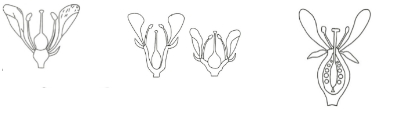
MediumMCQ
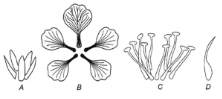
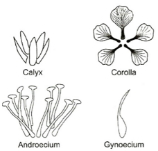
Identify flower parts $A$ to $D$ in the given diagrams correctly.
A
$A-Corolla, B-Calyx, C-Androecium, D-Gynoecium$
B
$A-Calyx, B-Corolla, C-Androecium, D-Gynoecium$
C
$A-Calyx, B-Corolla, C-Gynoecium, D-Androecium$
D
$A-Corolla, B-Calyx, C-Gynoecium, D-Androecium$
Solution
(B) The correct identification of the flower parts is as follows:
$A$ represents the Calyx, which is the outermost whorl of the flower, typically green and protective in function.
$B$ represents the Corolla, which consists of petals, usually brightly colored to attract insects for pollination.
$C$ represents the Androecium, the male reproductive part of the flower, consisting of stamens.
$D$ represents the Gynoecium, the female reproductive part of the flower, consisting of the stigma, style, and ovary.
Therefore, the correct sequence is $A-Calyx, B-Corolla, C-Androecium, D-Gynoecium$.
$A$ represents the Calyx, which is the outermost whorl of the flower, typically green and protective in function.
$B$ represents the Corolla, which consists of petals, usually brightly colored to attract insects for pollination.
$C$ represents the Androecium, the male reproductive part of the flower, consisting of stamens.
$D$ represents the Gynoecium, the female reproductive part of the flower, consisting of the stigma, style, and ovary.
Therefore, the correct sequence is $A-Calyx, B-Corolla, C-Androecium, D-Gynoecium$.
0 likes
View Solution278
MediumMCQ
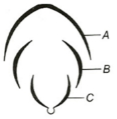
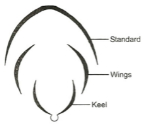
Identify the type of petals in the given diagrams $(A, B$ and $C)$.
A
$A-Wings, B-Keel, C-Standard$
B
$A-Keel, B-Wings, C-Standard$
C
$A-Standard, B-Wings, C-Keel$
D
$A-Standard, B-Keel, C-Wings$
Solution
(C) In pea and bean flowers,there are five petals. The largest posterior petal is known as the standard (vexillum),which overlaps the two lateral petals known as wings (alae). These two wings,in turn,overlap the two smallest anterior petals known as the keel (carina).
This specific arrangement of petals is known as vexillary or papilionaceous aestivation.
This specific arrangement of petals is known as vexillary or papilionaceous aestivation.
0 likes
View Solution279
MediumMCQ
Identify the position of gynoecium in the given diagrams $A$ to $D$.
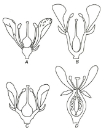
A
$A-Perigynous, B-Perigynous, C-Hypogynous, D-Epigynous$
B
$A-Epigynous, B-Perigynous, C-Hypogynous, D-Perigynous$
C
$A-Hypogynous, B-Perigynous, C-Perigynous, D-Epigynous$
D
$A-Hypogynous, B-Epigynous, C-Perigynous, D-Perigynous$
Solution
(C) $(i)$ Hypogynous flower: Gynoecium occupies the highest position. This is called the superior ovary,e.g.,mustard,China rose,and brinjal.
$(ii)$ Perigynous flower: Gynoecium is situated in the centre and other parts are situated at the same level. This condition is called half-inferior ovary,e.g.,plum,rose,and peach.
$(iii)$ Epigynous flower: The other floral parts lie above the ovary. This condition is called the inferior ovary,e.g.,cucumber and sunflower.
Based on the diagrams:
$A$ is Hypogynous (superior ovary).
$B$ and $C$ are Perigynous (half-inferior ovary).
$D$ is Epigynous (inferior ovary).
Therefore,the correct sequence is $A-Hypogynous, B-Perigynous, C-Perigynous, D-Epigynous$.
$(ii)$ Perigynous flower: Gynoecium is situated in the centre and other parts are situated at the same level. This condition is called half-inferior ovary,e.g.,plum,rose,and peach.
$(iii)$ Epigynous flower: The other floral parts lie above the ovary. This condition is called the inferior ovary,e.g.,cucumber and sunflower.
Based on the diagrams:
$A$ is Hypogynous (superior ovary).
$B$ and $C$ are Perigynous (half-inferior ovary).
$D$ is Epigynous (inferior ovary).
Therefore,the correct sequence is $A-Hypogynous, B-Perigynous, C-Perigynous, D-Epigynous$.
0 likes
View Solution280
MediumMCQ
In the diagram of types of placentation given above,$A, B, C$,and $D$ respectively represent:
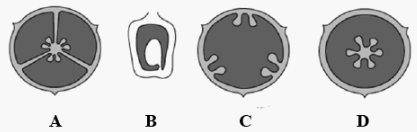
A
Basal,axile,parietal and free central
B
Free central,parietal,basal and axile
C
Axile,basal,parietal and free central
D
Parietal,axile,free central and basal
Solution
(C) Based on the provided diagram of placentation types:
$A$ shows axile placentation,where the placenta is axial and ovules are attached to it in a multilocular ovary.
$B$ shows basal placentation,where the placenta develops at the base of the ovary and a single ovule is attached to it.
$C$ shows parietal placentation,where the ovules develop on the inner wall of the ovary or on peripheral part.
$D$ shows free central placentation,where the ovules are borne on the central axis and septa are absent.
Therefore,the correct sequence is $A$-Axile,$B$-Basal,$C$-Parietal,$D$-Free central.
$A$ shows axile placentation,where the placenta is axial and ovules are attached to it in a multilocular ovary.
$B$ shows basal placentation,where the placenta develops at the base of the ovary and a single ovule is attached to it.
$C$ shows parietal placentation,where the ovules develop on the inner wall of the ovary or on peripheral part.
$D$ shows free central placentation,where the ovules are borne on the central axis and septa are absent.
Therefore,the correct sequence is $A$-Axile,$B$-Basal,$C$-Parietal,$D$-Free central.
0 likes
View Solution281
MediumMCQ
Mark the incorrect statement.
A
Flower is a modified shoot.
B
In cymose inflorescence,the main axis terminates in a flower.
C
Flowers are borne on successive internodes on the stems and roots.
D
When a shoot tip transforms into a flower,the flower is always solitary.
Solution
(C) The correct statement is that flowers are borne on successive nodes on the stems,not internodes. Roots do not bear flowers. Therefore,the statement 'Flowers are borne on successive internodes on the stems and roots' is incorrect.
0 likes
View Solution282
MediumMCQ
The four whorls of a flower are arranged on the
A
Thalamus
B
Petiole
C
Corolla
D
Stamens
Solution
(A) flower is a modified shoot wherein the shoot apical meristem changes to floral meristem. The axis gets condensed and the internodes do not elongate. The axis is known as the thalamus or receptacle. The four whorls of a flower,namely calyx,corolla,androecium,and gynoecium,are arranged on this thalamus.
0 likes
View Solution283
MediumMCQ
Radial symmetry is found in flowers of
A
Cassia
B
Chilli
C
Gulmohur
D
Canna
Solution
(B) Radial symmetry (actinomorphic) is found in flowers that can be divided into two equal radial halves in any radial plane passing through the centre. Among the given options, $Chilli$ (Solanaceae family) exhibits radial symmetry. In contrast, $Cassia$ and $Gulmohur$ show zygomorphic symmetry, and $Canna$ shows asymmetry.
0 likes
View Solution284
MediumMCQ
The flower of which of the following plants is zygomorphic?
A
Bean
B
Datura
C
Mustard
D
Canna
Solution
(A) flower is said to be zygomorphic when it can be divided into two similar halves only in one particular vertical plane.
In the family Fabaceae,to which the bean plant belongs,the flowers are zygomorphic.
In contrast,Datura and Mustard have actinomorphic (radially symmetrical) flowers,and Canna has asymmetric flowers.
In the family Fabaceae,to which the bean plant belongs,the flowers are zygomorphic.
In contrast,Datura and Mustard have actinomorphic (radially symmetrical) flowers,and Canna has asymmetric flowers.
0 likes
View Solution285
MediumMCQ
Which of the following plants has a superior ovary?
A
Peach
B
Guava
C
China rose
D
Rose
Solution
(C) In $China$ $rose$,the gynoecium occupies the highest position while the other floral parts are situated below it. This condition is known as hypogynous,and the ovary is said to be superior.
In $Guava$,the margin of the thalamus grows upward enclosing the ovary completely and getting fused with it,resulting in an inferior ovary.
In $Peach$ and $Rose$,the ovary is half-inferior,which is a perigynous condition.
In $Guava$,the margin of the thalamus grows upward enclosing the ovary completely and getting fused with it,resulting in an inferior ovary.
In $Peach$ and $Rose$,the ovary is half-inferior,which is a perigynous condition.
0 likes
View Solution286
MediumMCQ
Which of the following plants has an epigynous flower?
A
Cucumber
B
Brinjal
C
Mustard
D
Peach
Solution
(A) In an epigynous flower, the margin of the thalamus grows upward enclosing the ovary completely and getting fused with it, while other parts of the flower arise above the ovary. The ovary is said to be inferior. Cucumber $(Cucumis \, sativus)$ is a classic example of a plant with an epigynous flower. In contrast, Brinjal has a hypogynous flower (superior ovary), Mustard has a hypogynous flower, and Peach has a perigynous flower (half-inferior ovary).
0 likes
View Solution287
MediumMCQ
Match the column-$I$ with column-$II$ with respect to aestivation.
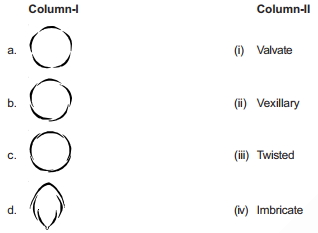
A
$a(i), b(iii), c(iv), d(ii)$
B
$a(iii), b(ii), c(iv), d(i)$
C
$a(iv), b(ii), c(iii), d(i)$
D
$a(i), b(ii), c(iii), d(iv)$
Solution
(A) The correct matches for the types of aestivation are as follows:
$(a)$ Valvate: Sepals or petals in a whorl just touch one another at the margin,without overlapping,as shown in figure $(a)$. Thus,$a(i)$.
$(b)$ Twisted: One margin of the appendage overlaps that of the next one and so on,as shown in figure $(b)$. Thus,$b(iii)$.
$(c)$ Imbricate: The margins of sepals or petals overlap one another but not in any particular direction,as shown in figure $(c)$. Thus,$c(iv)$.
$(d)$ Vexillary: In pea and bean flowers,there are five petals; the largest (standard) overlaps the two lateral petals (wings) which in turn overlap the two smallest anterior petals (keel),as shown in figure $(d)$. Thus,$d(ii)$.
Therefore,the correct sequence is $a(i), b(iii), c(iv), d(ii)$.
$(a)$ Valvate: Sepals or petals in a whorl just touch one another at the margin,without overlapping,as shown in figure $(a)$. Thus,$a(i)$.
$(b)$ Twisted: One margin of the appendage overlaps that of the next one and so on,as shown in figure $(b)$. Thus,$b(iii)$.
$(c)$ Imbricate: The margins of sepals or petals overlap one another but not in any particular direction,as shown in figure $(c)$. Thus,$c(iv)$.
$(d)$ Vexillary: In pea and bean flowers,there are five petals; the largest (standard) overlaps the two lateral petals (wings) which in turn overlap the two smallest anterior petals (keel),as shown in figure $(d)$. Thus,$d(ii)$.
Therefore,the correct sequence is $a(i), b(iii), c(iv), d(ii)$.
0 likes
View Solution288
MediumMCQ
Carpels are fused in the flowers of
A
Lotus
B
Tomato
C
Rose
D
Both $(a)$ and $(c)$
Solution
(B) In flowers, when carpels are fused, the condition is called syncarpous.
Among the given options, tomato $(Solanum \, lycopersicum)$ exhibits a syncarpous ovary where the carpels are fused together.
In contrast, lotus and rose have apocarpous ovaries, where the carpels are free.
Among the given options, tomato $(Solanum \, lycopersicum)$ exhibits a syncarpous ovary where the carpels are fused together.
In contrast, lotus and rose have apocarpous ovaries, where the carpels are free.
0 likes
View Solution289
EasyMCQ
Ovary containing the false septum occurs in
A
Primrose
B
Dianthus
C
Argemone
D
Pisum sativum
Solution
(C) The formation of a false septum,also known as a replum,is a characteristic feature of the family Brassicaceae and some members of Papaveraceae,such as Argemone.
In Argemone,the ovary is unilocular initially,but it becomes bilocular or multilocular due to the development of a false septum (replum) that grows from the parietal placentae towards the center of the ovary.
In Argemone,the ovary is unilocular initially,but it becomes bilocular or multilocular due to the development of a false septum (replum) that grows from the parietal placentae towards the center of the ovary.
0 likes
View Solution290
MediumMCQ
In . . . . . . placentation,the placenta forms a ridge along the ventral suture of the ovary.
A
Axile
B
Basal
C
Free central
D
Marginal
Solution
(D) In marginal placentation,the placenta forms a ridge along the ventral suture of the ovary. The ovules are arranged in two rows along this ridge. This type of placentation is characteristic of the family Fabaceae,for example,in pea plants.
0 likes
View Solution291
EasyMCQ
The leafless stem of an onion which produces a cluster of terminal flowers is called:
A
Peduncle
B
Floral axis
C
Scape
D
Rachis
Solution
(C) $Scape$ is a leafless floral stalk or peduncle arising from the ground level in plants like onion $(Allium \ cepa)$. It bears a cluster of terminal flowers at its apex.
0 likes
View Solution292
MediumMCQ
$A$: Staminal tube is present in $Malvaceae$.
$R$: It is due to monadelphous condition.
$R$: It is due to monadelphous condition.
A
Assertion and Reason both are correct and Reason is the correct explanation of Assertion.
B
Assertion and Reason both are correct but Reason is not the correct explanation of Assertion.
C
Assertion is correct, but Reason is incorrect.
D
Both Assertion and Reason are incorrect.
Solution
$(A)$ In the family $Malvaceae$ (e.g., $Hibiscus$), the stamens are $monadelphous$, meaning all the filaments of the stamens are fused together to form a single tube-like structure known as the staminal $\text{tube}$ around the style.
Therefore, the presence of a staminal tube is a direct consequence of the monadelphous condition.
Thus, both the Assertion and Reason are correct, and the Reason is the correct explanation of the Assertion.
Therefore, the presence of a staminal tube is a direct consequence of the monadelphous condition.
Thus, both the Assertion and Reason are correct, and the Reason is the correct explanation of the Assertion.
0 likes
View Solution293
MediumMCQ
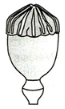
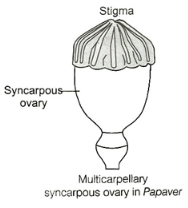
Identify the type of ovary in the given diagram.
A
Multicarpellary apocarpous
B
Multicarpellary syncarpous
C
Multicarpellary pistillate
D
Monocarpellary apocarpous
Solution
(B) The gynoecium represents the female reproductive part of a flower. It may consist of a single pistil (monocarpellary) or more than one pistil (multicarpellary).
When there are more than one pistil fused together,the condition is called multicarpellary syncarpous.
When the pistils are free (not fused),the condition is called multicarpellary apocarpous.
The given diagram shows the ovary of $Papaver$,which is a multicarpellary syncarpous ovary,as the carpels are fused together.
When there are more than one pistil fused together,the condition is called multicarpellary syncarpous.
When the pistils are free (not fused),the condition is called multicarpellary apocarpous.
The given diagram shows the ovary of $Papaver$,which is a multicarpellary syncarpous ovary,as the carpels are fused together.
0 likes
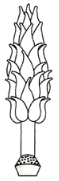
View Solution294
MediumMCQ
Identify the type of ovary shown in the diagram.
A
Monocarpellary syncarpous
B
Monocarpellary apocarpous
C
Multicarpellary syncarpous
D
Multicarpellary apocarpous
Solution
(D) The gynoecium represents the female reproductive part of a flower.
It may consist of a single pistil (monocarpellary) or more than one pistil (multicarpellary).
When there are more than one pistil fused together,it is called a multicarpellary syncarpous pistil.
When the pistils are free (not fused),this type of ovary is called a multicarpellary apocarpous pistil.
The provided diagram shows multiple free carpels,which is characteristic of a multicarpellary apocarpous condition,as seen in $Michelia$.
It may consist of a single pistil (monocarpellary) or more than one pistil (multicarpellary).
When there are more than one pistil fused together,it is called a multicarpellary syncarpous pistil.
When the pistils are free (not fused),this type of ovary is called a multicarpellary apocarpous pistil.
The provided diagram shows multiple free carpels,which is characteristic of a multicarpellary apocarpous condition,as seen in $Michelia$.
0 likes
View Solution295
MediumMCQ
Diadelphous stamens are found in:
A
China rose
B
Citrus
C
Pea
D
China rose and Citrus
Solution
(C) In flowering plants, the arrangement of stamens based on the fusion of filaments is classified into different types.
$1$. Monadelphous: Stamens are united into a single bundle (e.g., China rose).
$2$. Diadelphous: Stamens are united into two bundles (e.g., Pea, where $9$ stamens are fused into one bundle and $1$ is free).
$3$. Polyadelphous: Stamens are united into more than two bundles (e.g., Citrus).
Therefore, diadelphous stamens are characteristic of the family Fabaceae, specifically seen in Pea $(Pisum \text{ } sativum)$.
$1$. Monadelphous: Stamens are united into a single bundle (e.g., China rose).
$2$. Diadelphous: Stamens are united into two bundles (e.g., Pea, where $9$ stamens are fused into one bundle and $1$ is free).
$3$. Polyadelphous: Stamens are united into more than two bundles (e.g., Citrus).
Therefore, diadelphous stamens are characteristic of the family Fabaceae, specifically seen in Pea $(Pisum \text{ } sativum)$.
0 likes
View Solution296
MediumMCQ
In an epigynous flower,the ovary is situated below the $......$
A
Calyx
B
Corolla
C
Thalamus
D
Androecium
Solution
(C) $\rightarrow$ In an epigynous flower,the margin of the thalamus grows upward,completely enclosing the ovary and getting fused with it. The other parts of the flower (calyx,corolla,and androecium) arise above the ovary. Therefore,the ovary is said to be inferior. Examples include guava,cucumber,and the ray florets of sunflower.
0 likes
View Solution297
MediumMCQ
The flowers are Zygomorphic in:
$(a)$ Mustard $(b)$ Gulmohar $(c)$ Cassia $(d)$ Datura $(e)$ Chilly
Choose the correct answer from the options given below:
$(a)$ Mustard $(b)$ Gulmohar $(c)$ Cassia $(d)$ Datura $(e)$ Chilly
Choose the correct answer from the options given below:
A
$(b), (c)$ Only
B
$(d), (e)$ Only
C
$(c), (d), (e)$ Only
D
$(a), (b), (c)$ Only
Solution
(A) flower is said to be Zygomorphic (bilateral symmetry) if it can be divided into two similar halves only in one particular vertical plane.
$1$. Mustard,Datura,and Chilly are Actinomorphic (radial symmetry),meaning they can be divided into two equal radial halves in any radial plane passing through the center.
$2$. Gulmohar and Cassia are Zygomorphic. In these flowers,the floral parts are arranged such that they exhibit bilateral symmetry.
Therefore,the correct answer is $(b)$ and $(c)$ only.
$1$. Mustard,Datura,and Chilly are Actinomorphic (radial symmetry),meaning they can be divided into two equal radial halves in any radial plane passing through the center.
$2$. Gulmohar and Cassia are Zygomorphic. In these flowers,the floral parts are arranged such that they exhibit bilateral symmetry.
Therefore,the correct answer is $(b)$ and $(c)$ only.
0 likes
View Solution298
MediumMCQ
Floral appendages are modifications of ........ .
A
Stem
B
Fruit
C
Leaf
D
Node
Solution
(C) flower is a modified shoot wherein the shoot apical meristem changes to floral meristem. Internodes do not elongate and the axis gets condensed. The apex produces different kinds of floral appendages laterally at successive nodes instead of leaves. Thus,floral appendages are considered modifications of leaves.
0 likes
View Solution299
MediumMCQ
Which of the following is an inconsistent event for flower formation?
A
Internode elongates.
B
The axis gets condensed.
C
Lateral appendages are produced instead of leaves at successive nodes at the apex of the axis.
D
The shoot transforms into a flower.
Solution
(A) flower is a modified shoot wherein the shoot apical meristem changes to a floral meristem. During this transformation:
$1$. The axis gets condensed (internodes do not elongate).
$2$. The apex produces different kinds of floral appendages laterally at successive nodes instead of leaves.
$3$. Therefore,the statement 'Internode elongates' is inconsistent with flower formation,as the internodes remain highly condensed in a flower.
$1$. The axis gets condensed (internodes do not elongate).
$2$. The apex produces different kinds of floral appendages laterally at successive nodes instead of leaves.
$3$. Therefore,the statement 'Internode elongates' is inconsistent with flower formation,as the internodes remain highly condensed in a flower.
0 likes
View Solution300
MediumMCQ
Which of the following flowers exhibits asymmetry (zygomorphic condition)?
A
Canna
B
Cassia
C
Datura
D
Chilli
Solution
(A) In botany, flowers are classified based on their symmetry:
$1$. Actinomorphic (radial symmetry): Flowers can be divided into two equal radial halves in any radial plane passing through the center, e.g., $Datura$, $Chilli$, $Mustard$.
$2$. Zygomorphic (bilateral symmetry): Flowers can be divided into two similar halves only in one particular vertical plane, e.g., $Pea$, $Bean$, $Cassia$, $Gulmohur$.
$3$. Asymmetric (irregular): Flowers cannot be divided into two similar halves by any vertical plane passing through the center, e.g., $Canna$.
Therefore, $Canna$ is the correct example of an asymmetric flower.
$1$. Actinomorphic (radial symmetry): Flowers can be divided into two equal radial halves in any radial plane passing through the center, e.g., $Datura$, $Chilli$, $Mustard$.
$2$. Zygomorphic (bilateral symmetry): Flowers can be divided into two similar halves only in one particular vertical plane, e.g., $Pea$, $Bean$, $Cassia$, $Gulmohur$.
$3$. Asymmetric (irregular): Flowers cannot be divided into two similar halves by any vertical plane passing through the center, e.g., $Canna$.
Therefore, $Canna$ is the correct example of an asymmetric flower.
0 likes
View SolutionMorphology of Flowering Plants — Flower · Frequently Asked Questions
1Are these Morphology of Flowering Plants questions useful for JEE and NEET?
Yes. All questions in this section are mapped to JEE Main and NEET exam patterns. Previous year questions from JEE Main, NEET, GUJCET and state-level exams are included with full solutions.
2Can I switch to Hindi or Gujarati for these questions?
Yes. Use the language tabs in the hero section or the sidebar to view the same questions and solutions in English, Hindi or Gujarati.
3How do I generate a question paper from this subtopic?
Use the Vedclass Exam Paper Generator — select the chapter and subtopic, set difficulty, and generate Sets A, B, C, D automatically. First 3 chapters of every subject are free.
Vedclass Products
For Students
Vedclass Test Series
Mock tests in real JEE/NEET style with performance analysis. 5-day free trial.
Start Free TrialFor Teachers
Exam Paper Generator
Generate Set A/B/C/D papers from this chapter in 2 minutes. 3 chapters free.
Try FreeFor Institutes
Online Exam Module
Live online exams with unlimited students, 360° analytics & white-label branding.
See DemoFor Teachers & Institutes
Generate a Morphology of Flowering Plants Exam Paper in 2 Minutes
Select subtopic & difficulty — Sets A, B, C, D auto-generated with No Repeat logic.
First 3 chapters of every subject are free — no payment required.