
A English
Flower Questions in English
Class 11 Biology · Morphology of Flowering Plants · Flower
351+
Questions
English
Language
100%
With Solutions
Showing 50 of 351 questions in English
301
MediumMCQ
Which of the following is incorrect for an epigynous flower?
A
The ovary is inferior.
B
It is found in the ray florets of sunflower.
C
The thalamus encloses the ovary.
D
All statements are correct.
Solution
(D) In an epigynous flower,the margin of the thalamus grows upward,enclosing the ovary completely and getting fused with it.
Other floral parts arise above the ovary.
Therefore,the ovary is said to be inferior.
Epigynous flowers are found in the ray florets of sunflower.
Since all the given statements are correct,none of the options is incorrect.
Other floral parts arise above the ovary.
Therefore,the ovary is said to be inferior.
Epigynous flowers are found in the ray florets of sunflower.
Since all the given statements are correct,none of the options is incorrect.
0 likes
View Solution302
MediumMCQ
When the calyx and corolla are not distinct and are similar in appearance and color, the structure is called .......
A
Perianth
B
Tepal
C
Sepaloid
D
None of these
Solution
(A) In some flowers, the calyx and corolla are not distinct. In such cases, the whorl is termed as the $Perianth$. The individual members of the $Perianth$ are called $Tepals$. This condition is commonly observed in the family $Liliaceae$ (e.g., $Allium$ $cepa$ or onion).
0 likes
View Solution303
MediumMCQ
Match the following columns:
| Column-$I$ | Column-$II$ |
| $P$. Actinomorphic (Radial symmetry) | $I$. Canna |
| $Q$. Zygomorphic (Bilateral symmetry) | $II$. Pea,Bean,Gulmohur |
| $R$. Asymmetric (Irregular) | $III$. Mustard,Chilli,Datura |
A
$(P-III), (Q-II), (R-I)$
B
$(P-II), (Q-III), (R-I)$
C
$(P-I), (Q-II), (R-III)$
D
$(P-II), (Q-I), (R-II)$
Solution
(A) $1$. Actinomorphic flowers (Radial symmetry) can be divided into two equal radial halves in any radial plane passing through the center. Examples include Mustard,Chilli,and Datura. Thus,$P-III$.
$2$. Zygomorphic flowers (Bilateral symmetry) can be divided into two similar halves only in one particular vertical plane. Examples include Pea,Bean,and Gulmohur. Thus,$Q-II$.
$3$. Asymmetric flowers (Irregular) cannot be divided into two similar halves by any vertical plane passing through the center. An example is Canna. Thus,$R-I$.
Therefore,the correct matching is $(P-III), (Q-II), (R-I)$.
$2$. Zygomorphic flowers (Bilateral symmetry) can be divided into two similar halves only in one particular vertical plane. Examples include Pea,Bean,and Gulmohur. Thus,$Q-II$.
$3$. Asymmetric flowers (Irregular) cannot be divided into two similar halves by any vertical plane passing through the center. An example is Canna. Thus,$R-I$.
Therefore,the correct matching is $(P-III), (Q-II), (R-I)$.
0 likes
View Solution304
MediumMCQ
Match the following columns:
| Column-$I$ | Column-$II$ |
|---|---|
| $P$. Hypogynous flower | $I$. Guava,Cucumber,Ray florets of Sunflower |
| $Q$. Perigynous flower | $II$. Peach,Rose,Plum |
| $R$. Epigynous flower | $III$. Mustard,China rose,Brinjal |
A
$P-II, Q-III, R-I$
B
$P-I, Q-II, R-III$
C
$P-III, Q-I, R-II$
D
$P-III, Q-II, R-I$
Solution
(D) The position of the floral parts on the thalamus determines the type of flower:
$1$. Hypogynous flower $(P)$: The gynoecium occupies the highest position while other parts are situated below it. Examples include Mustard,China rose,and Brinjal $(III)$.
$2$. Perigynous flower $(Q)$: The gynoecium is situated in the center and other parts of the flower are located on the rim of the thalamus almost at the same level. Examples include Plum,Rose,and Peach $(II)$.
$3$. Epigynous flower $(R)$: The margin of the thalamus grows upward enclosing the ovary completely and getting fused with it,while other parts arise above the ovary. Examples include Guava,Cucumber,and the ray florets of Sunflower $(I)$.
Therefore,the correct matching is $P-III, Q-II, R-I$.
$1$. Hypogynous flower $(P)$: The gynoecium occupies the highest position while other parts are situated below it. Examples include Mustard,China rose,and Brinjal $(III)$.
$2$. Perigynous flower $(Q)$: The gynoecium is situated in the center and other parts of the flower are located on the rim of the thalamus almost at the same level. Examples include Plum,Rose,and Peach $(II)$.
$3$. Epigynous flower $(R)$: The margin of the thalamus grows upward enclosing the ovary completely and getting fused with it,while other parts arise above the ovary. Examples include Guava,Cucumber,and the ray florets of Sunflower $(I)$.
Therefore,the correct matching is $P-III, Q-II, R-I$.
0 likes
View Solution305
MediumMCQ
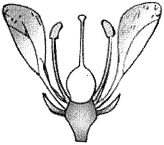
In which plant is the flower shown below found?
A
Cucumber
B
Ray florets of sunflower
C
China rose
D
Apricot
Solution
(B) The provided image shows a flower with an epigynous condition,where the ovary is inferior and the other floral parts (sepals,petals,and stamens) are situated above the ovary. This is a characteristic feature of epigynous flowers,which are found in families like Asteraceae (e.g.,ray florets of sunflower),Cucurbitaceae (e.g.,cucumber),and Guava. Among the given options,the ray florets of sunflower exhibit this epigynous condition.
0 likes
View Solution306
MediumMCQ
Which of the following is incorrect for the calyx?
A
They are leaf-like.
B
They attract insects for pollination.
C
It is the outermost whorl of the flower.
D
Its units are called sepals.
Solution
(B) The calyx is the outermost whorl of a flower,consisting of units called sepals. These are typically green and leaf-like in appearance,serving to protect the flower in the bud stage. The function of attracting insects for pollination is primarily performed by the corolla (petals),which are usually brightly colored. Therefore,the statement that the calyx attracts insects for pollination is incorrect.
0 likes
View Solution307
MediumMCQ
Which of the following is incorrect regarding the corolla?
A
Its units are called petals.
B
They are brightly colored.
C
They attract insects for pollination.
D
They are rotate (wheel-shaped) in all flowers.
Solution
(D) The corolla is the second whorl of a flower,composed of units called petals. Petals are often brightly colored to attract insects for pollination. However,the shape of the corolla varies significantly among different plant species (e.g.,tubular,bell-shaped,funnel-shaped,or rotate). Therefore,stating that they are rotate (wheel-shaped) in all flowers is incorrect.
0 likes
View Solution308
MediumMCQ
Which of the following is correct for the vexillary aestivation (papilionaceous)?
Standard (Vexillum) $\quad$ Wings (Alae) $\quad$ Keel (Carina)
Standard (Vexillum) $\quad$ Wings (Alae) $\quad$ Keel (Carina)
A
Posterior $\quad$ Lateral $\quad$ Anterior
B
Anterior $\quad$ Lateral $\quad$ Posterior
C
Lateral $\quad$ Posterior $\quad$ Anterior
D
Anterior $\quad$ Posterior $\quad$ Lateral
Solution
(A) In vexillary aestivation (also known as papilionaceous aestivation),the petals are arranged in a specific pattern.
$1$. The largest posterior petal is called the Standard or Vexillum.
$2$. The two lateral petals are called Wings or Alae.
$3$. The two smallest anterior petals are fused to form the Keel or Carina.
Therefore,the correct sequence is Standard (Posterior),Wings (Lateral),and Keel (Anterior).
$1$. The largest posterior petal is called the Standard or Vexillum.
$2$. The two lateral petals are called Wings or Alae.
$3$. The two smallest anterior petals are fused to form the Keel or Carina.
Therefore,the correct sequence is Standard (Posterior),Wings (Lateral),and Keel (Anterior).
0 likes
View Solution309
MediumMCQ
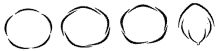
Identify the type of aestivation shown in the given figures $P, Q, R,$ and $S$ and select the correct sequence of plants in which they are found.
A
Pea,Cassia,China rose,Calotropis
B
Calotropis,Cassia,China rose,Pea
C
Pea,China rose,Cassia,Calotropis
D
Calotropis,China rose,Cassia,Pea
Solution
(D) The given figures represent different types of aestivation:
$P$: Valvate aestivation (e.g.,Calotropis).
$Q$: Twisted aestivation (e.g.,China rose).
$R$: Imbricate aestivation (e.g.,Cassia).
$S$: Vexillary aestivation (e.g.,Pea).
Therefore,the correct sequence is Calotropis,China rose,Cassia,and Pea,which corresponds to option $D$.
$P$: Valvate aestivation (e.g.,Calotropis).
$Q$: Twisted aestivation (e.g.,China rose).
$R$: Imbricate aestivation (e.g.,Cassia).
$S$: Vexillary aestivation (e.g.,Pea).
Therefore,the correct sequence is Calotropis,China rose,Cassia,and Pea,which corresponds to option $D$.
0 likes
View Solution310
MediumMCQ
Match the following columns:
| Column-$I$ | Column-$II$ |
| $P$. Monadelphous stamens | $I$. China rose |
| $Q$. Diadelphous stamens | $II$. Lemon |
| $R$. Polyadelphous stamens | $III$. Pea |
A
$(P-I), (Q-III), (R-II)$
B
$(P-I), (Q-II), (R-III)$
C
$(P-III), (Q-II), (R-I)$
D
$(P-II), (Q-I), (R-III)$
Solution
(A) The arrangement of stamens in a flower is classified based on the fusion of their filaments:
$1$. Monadelphous $(P)$: The filaments of all stamens are united into a single bundle, as seen in China rose $(I)$.
$2$. Diadelphous $(Q)$: The filaments are united into two bundles, as seen in pea $(III)$.
$3$. Polyadelphous $(R)$: The filaments are united into more than two bundles, as seen in citrus plants like lemon $(II)$.
Therefore, the correct matching is $(P-I), (Q-III), (R-II)$.
$1$. Monadelphous $(P)$: The filaments of all stamens are united into a single bundle, as seen in China rose $(I)$.
$2$. Diadelphous $(Q)$: The filaments are united into two bundles, as seen in pea $(III)$.
$3$. Polyadelphous $(R)$: The filaments are united into more than two bundles, as seen in citrus plants like lemon $(II)$.
Therefore, the correct matching is $(P-I), (Q-III), (R-II)$.
0 likes
View Solution311
MediumMCQ
Select the correct option regarding the gynoecium:
A
Apocarpous - Lotus,Tomato; Syncarpous - Mustard,Rose
B
Apocarpous - Mustard,Rose; Syncarpous - Lotus,Tomato
C
Apocarpous - Mustard,Tomato; Syncarpous - Lotus,Rose
D
Apocarpous - Lotus,Rose; Syncarpous - Mustard,Tomato
Solution
(D) The gynoecium consists of the pistil$(s)$ of a flower.
$1$. When more than one carpel is present,they may be free (as in Lotus and Rose) and are called apocarpous.
$2$. They are termed syncarpous when carpels are fused,as in Mustard and Tomato.
$1$. When more than one carpel is present,they may be free (as in Lotus and Rose) and are called apocarpous.
$2$. They are termed syncarpous when carpels are fused,as in Mustard and Tomato.
0 likes
View Solution312
MediumMCQ
Match the following columns regarding placentation in plants:
| Column-$I$ (Placentation) | Column-$II$ (Examples) |
| $P$. Parietal | $I$. Dianthus,Primrose |
| $Q$. Axile | $II$. Sunflower,Marigold |
| $R$. Marginal | $III$. Pea |
| $S$. Free central | $IV$. Lemon,China rose,Tomato |
| $T$. Basal | $V$. Mustard,Argemone |
A
$P-IV, Q-III, R-I, S-II, T-V$
B
$P-V, Q-IV, R-III, S-I, T-II$
C
$P-II, Q-III, R-I, S-IV, T-V$
D
$P-III, Q-I, R-V, S-IV, T-II$
Solution
(B) The correct matches for placentation types are as follows:
$P$. Parietal placentation is found in Mustard and Argemone $(V)$.
$Q$. Axile placentation is found in Lemon,China rose,and Tomato $(IV)$.
$R$. Marginal placentation is found in Pea $(III)$.
$S$. Free central placentation is found in Dianthus and Primrose $(I)$.
$T$. Basal placentation is found in Sunflower and Marigold $(II)$.
Therefore,the correct sequence is $P-V, Q-IV, R-III, S-I, T-II$.
$P$. Parietal placentation is found in Mustard and Argemone $(V)$.
$Q$. Axile placentation is found in Lemon,China rose,and Tomato $(IV)$.
$R$. Marginal placentation is found in Pea $(III)$.
$S$. Free central placentation is found in Dianthus and Primrose $(I)$.
$T$. Basal placentation is found in Sunflower and Marigold $(II)$.
Therefore,the correct sequence is $P-V, Q-IV, R-III, S-I, T-II$.
0 likes
View Solution313
MediumMCQ
In this type of placentation,the ovary contains a single ovule.
A
Marginal
B
Free central
C
Parietal
D
Basal
Solution
(D) In $Basal$ placentation,the placenta develops at the base of the ovary and a single ovule is attached to it. Examples include $Sunflower$ and $Marigold$.
0 likes
View Solution314
EasyMCQ
What does $\underline{G}$ represent in floral formula?
A
Superior ovary
B
Inferior ovary
C
Half-inferior ovary
D
None of these
Solution
(A) In floral formulas,the symbol $G$ stands for Gynoecium.
When a horizontal line is placed below the letter $G$ (i.e.,$\underline{G}$),it indicates that the ovary is superior.
This condition is known as hypogynous,where the thalamus is convex or conical and the ovary occupies the highest position.
When a horizontal line is placed below the letter $G$ (i.e.,$\underline{G}$),it indicates that the ovary is superior.
This condition is known as hypogynous,where the thalamus is convex or conical and the ovary occupies the highest position.
0 likes
View Solution315
MediumMCQ
Which of the following plants is gamopetalous (having fused petals)?
A
Gram
B
Datura
C
Asparagus
D
Aconitum
Solution
(B) Gamopetalous condition refers to the presence of fused petals in a flower.
Among the given options,$Datura$ belongs to the family $Solanaceae$.
In the family $Solanaceae$,the petals are fused (gamopetalous).
Gram ($Cicer$ $arietinum$) belongs to $Fabaceae$ (polypetalous).
$Asparagus$ and $Aconitum$ belong to $Liliaceae$ and $Ranunculaceae$ respectively,which typically show polypetalous conditions or different floral arrangements.
Among the given options,$Datura$ belongs to the family $Solanaceae$.
In the family $Solanaceae$,the petals are fused (gamopetalous).
Gram ($Cicer$ $arietinum$) belongs to $Fabaceae$ (polypetalous).
$Asparagus$ and $Aconitum$ belong to $Liliaceae$ and $Ranunculaceae$ respectively,which typically show polypetalous conditions or different floral arrangements.
0 likes
View Solution316
MediumMCQ
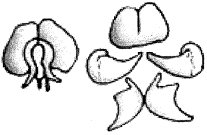
How can the corolla of the given flower be represented?
A
$C_{(5)}$
B
$C_5$
C
$C_{1+2+2}$
D
$C_{1+2+(2)}$
Solution
(D) The provided image shows the vexillary aestivation characteristic of the family Fabaceae (e.g.,pea flower).
In this type of aestivation,there are $5$ petals in total.
The largest posterior petal is called the standard or vexillum $(1)$.
The two lateral petals are called wings $(2)$.
The two smallest anterior petals are fused to form a keel $(2)$.
Since the two anterior petals are fused,they are represented in brackets.
Thus,the floral formula for the corolla is represented as $C_{1+2+(2)}$.
In this type of aestivation,there are $5$ petals in total.
The largest posterior petal is called the standard or vexillum $(1)$.
The two lateral petals are called wings $(2)$.
The two smallest anterior petals are fused to form a keel $(2)$.
Since the two anterior petals are fused,they are represented in brackets.
Thus,the floral formula for the corolla is represented as $C_{1+2+(2)}$.
0 likes
View Solution317
MediumMCQ
Match the following columns:
| Column-$I$ | Column-$II$ |
| $P$. Monocarpellary | $I$. Poppy (Papaver) |
| $Q$. Syncarpous | $II$. Pea |
| $R$. Apocarpous | $III$. Michelia |
A
$(P-II), (Q-I), (R-III)$
B
$(P-III), (Q-I), (R-II)$
C
$(P-II), (Q-III), (R-I)$
D
$(P-I), (Q-III), (R-II)$
Solution
(A) The correct matches are as follows:
$1$. Monocarpellary: $A$ flower with a single pistil is called monocarpellary. Example: Pea $(P-II)$.
$2$. Syncarpous: When the pistils are fused together,they are called syncarpous. Example: Poppy $(Papaver)$ $(Q-I)$.
$3$. Apocarpous: When the pistils are free,they are called apocarpous. Example: Michelia $(R-III)$.
Therefore,the correct sequence is $(P-II), (Q-I), (R-III)$.
$1$. Monocarpellary: $A$ flower with a single pistil is called monocarpellary. Example: Pea $(P-II)$.
$2$. Syncarpous: When the pistils are fused together,they are called syncarpous. Example: Poppy $(Papaver)$ $(Q-I)$.
$3$. Apocarpous: When the pistils are free,they are called apocarpous. Example: Michelia $(R-III)$.
Therefore,the correct sequence is $(P-II), (Q-I), (R-III)$.
0 likes
View Solution318
MediumMCQ
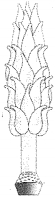
Select the correct option based on the structure given below.
A
Multicarpellary syncarpous pistil of Papaver
B
Multicarpellary apocarpous pistil of Michelia
C
Multicarpellary syncarpous pistil of Hibiscus
D
Multicarpellary apocarpous pistil of Papaver
Solution
(B) The provided image shows a multicarpellary,apocarpous gynoecium (pistil).
In an apocarpous gynoecium,the carpels are free (not fused).
This specific structure is characteristic of the flower of Michelia.
Therefore,the correct option is the multicarpellary apocarpous pistil of Michelia.
In an apocarpous gynoecium,the carpels are free (not fused).
This specific structure is characteristic of the flower of Michelia.
Therefore,the correct option is the multicarpellary apocarpous pistil of Michelia.
0 likes
View Solution319
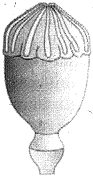
MediumMCQ
Identify the correct option based on the structure shown below.
A
Multicarpellary syncarpous pistil of Papaver
B
Multicarpellary apocarpous pistil of Michelia
C
Multicarpellary syncarpous pistil of Michelia
D
Multicarpellary apocarpous pistil of Papaver
Solution
(A) The image shows the multicarpellary syncarpous pistil of Papaver (poppy).
In a syncarpous pistil,the carpels are fused together.
In contrast,Michelia has a multicarpellary apocarpous pistil,where the carpels are free.
Therefore,the correct option is $A$.
In a syncarpous pistil,the carpels are fused together.
In contrast,Michelia has a multicarpellary apocarpous pistil,where the carpels are free.
Therefore,the correct option is $A$.
0 likes
View Solution320
EasyMCQ
Match List-$I$ with List-$II$:
Choose the correct answer from the options given below:
| List-$I$ | List-$II$ |
| $a$. Imbricate | $i$. Calotropis |
| $b$. Valvate | $ii$. Cassia |
| $c$. Vexillary | $iii$. Cotton |
| $d$. Twisted | $iv$. Bean |
Choose the correct answer from the options given below:
A
$(a)-(ii), (b)-(i), (c)-(iii), (d)-(iv)$
B
$(a)-(ii), (b)-(i), (c)-(iv), (d)-(iii)$
C
$(a)-(ii), (b)-(iv), (c)-(iii), (d)-(i)$
D
$(a)-(i), (b)-(iii), (c)-(iv), (d)-(ii)$
Solution
(B) The arrangement of sepals or petals in a floral bud with respect to the other members of the same whorl is called aestivation.
- Imbricate: In this type,the margins of sepals or petals overlap one another but not in any particular direction,as seen in $Cassia$ and $Gulmohur$.
- Valvate: When sepals or petals in a whorl just touch one another at the margin,without overlapping,as in $Calotropis$.
- Vexillary: In pea and bean flowers,there are five petals; the largest (standard) overlaps the two lateral petals (wings) which in turn overlap the two smallest anterior petals (keel). This is called vexillary or papilionaceous aestivation.
- Twisted: If one margin of the appendage overlaps that of the next one and so on,as in $China$ $rose$,$lady's$ $finger$,and $cotton$.
Therefore,the correct matching is: $a-ii, b-i, c-iv, d-iii$.
- Imbricate: In this type,the margins of sepals or petals overlap one another but not in any particular direction,as seen in $Cassia$ and $Gulmohur$.
- Valvate: When sepals or petals in a whorl just touch one another at the margin,without overlapping,as in $Calotropis$.
- Vexillary: In pea and bean flowers,there are five petals; the largest (standard) overlaps the two lateral petals (wings) which in turn overlap the two smallest anterior petals (keel). This is called vexillary or papilionaceous aestivation.
- Twisted: If one margin of the appendage overlaps that of the next one and so on,as in $China$ $rose$,$lady's$ $finger$,and $cotton$.
Therefore,the correct matching is: $a-ii, b-i, c-iv, d-iii$.
0 likes
View Solution321
MediumMCQ
Axile placentation is observed in
A
China rose,Petunia and Lemon
B
Mustard,Cucumber and Primrose
C
China rose,Beans and Lupin
D
Tomato,Dianthus and Pea
Solution
(A) In axile placentation,the placenta is axial and the ovules are attached to it in a multilocular ovary.
Examples of plants exhibiting axile placentation include China rose,Tomato,Petunia,and Lemon.
Dianthus and Primrose exhibit free central placentation,where ovules are borne on a central axis without septa.
Pea,Lupin,and Beans exhibit marginal placentation,where the placenta forms a ridge along the ventral suture of the ovary.
Cucumber and Mustard exhibit parietal placentation,where the ovules develop on the inner wall of the ovary or on peripheral parts.
Examples of plants exhibiting axile placentation include China rose,Tomato,Petunia,and Lemon.
Dianthus and Primrose exhibit free central placentation,where ovules are borne on a central axis without septa.
Pea,Lupin,and Beans exhibit marginal placentation,where the placenta forms a ridge along the ventral suture of the ovary.
Cucumber and Mustard exhibit parietal placentation,where the ovules develop on the inner wall of the ovary or on peripheral parts.
0 likes
View Solution322
MediumMCQ
Which of the following is an example of an actinomorphic flower?
A
Cassia
B
Pisum
C
Sesbania
D
Datura
Solution
(D) An actinomorphic flower is one that can be divided into two equal radial halves in any radial plane passing through the center.
$Datura$ is a classic example of an actinomorphic flower.
In contrast,$Cassia$,$Pisum$,and $Sesbania$ exhibit zygomorphic flowers,which can be divided into two similar halves only in one particular vertical plane.
$Datura$ is a classic example of an actinomorphic flower.
In contrast,$Cassia$,$Pisum$,and $Sesbania$ exhibit zygomorphic flowers,which can be divided into two similar halves only in one particular vertical plane.
0 likes
View Solution323
MediumMCQ
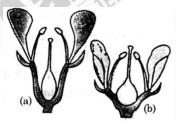
Identify the type of flowers based on the position of calyx,corolla and androecium with respect to the ovary from the given figures $(a)$ and $(b)$.
A
$(a)$ Hypogynous; $(b)$ Epigynous
B
$(a)$ Perigynous; $(b)$ Epigynous
C
$(a)$ Perigynous; $(b)$ Perigynous
D
$(a)$ Epigynous; $(b)$ Hypogynous
Solution
(C) In perigynous flowers,the gynoecium is situated in the centre and other parts of the flower are located on the rim of the thalamus almost at the same level.
In figure $(a)$,the ovary is situated in the centre,and other floral parts are arranged on the rim of the thalamus,representing a perigynous condition.
In figure $(b)$,the ovary is also situated in the centre with other floral parts on the rim of the thalamus,which also represents a perigynous condition.
Therefore,both figures $(a)$ and $(b)$ represent the perigynous condition.
In figure $(a)$,the ovary is situated in the centre,and other floral parts are arranged on the rim of the thalamus,representing a perigynous condition.
In figure $(b)$,the ovary is also situated in the centre with other floral parts on the rim of the thalamus,which also represents a perigynous condition.
Therefore,both figures $(a)$ and $(b)$ represent the perigynous condition.
0 likes
View Solution324
EasyMCQ
Which of the following is an example of a zygomorphic flower?
A
Petunia
B
Datura
C
Pea
D
Chilli
Solution
(C) flower is said to be $zygomorphic$ (bilateral symmetry) if it can be divided into two similar halves only in one particular vertical plane.
Examples of $zygomorphic$ flowers include $Pea$,$Bean$,$Cassia$,and $Gulmohur$.
$Petunia$,$Datura$,and $Chilli$ are examples of $actinomorphic$ (radial symmetry) flowers,where the flower can be divided into two equal radial halves in any radial plane passing through the center.
Examples of $zygomorphic$ flowers include $Pea$,$Bean$,$Cassia$,and $Gulmohur$.
$Petunia$,$Datura$,and $Chilli$ are examples of $actinomorphic$ (radial symmetry) flowers,where the flower can be divided into two equal radial halves in any radial plane passing through the center.
0 likes
View Solution325
MediumMCQ
$A$ false septum is found in the ovary of the flower of:
A
Sunflower
B
Pea
C
Primrose
D
Mustard
Solution
(D) false septum,also known as a $replum$,is a characteristic feature of the family $Brassicaceae$ (Cruciferae).
In the ovary of these plants,the parietal placentation initially appears unilocular,but it becomes bilocular due to the development of a false septum called the $replum$.
Among the given options,$Mustard$ belongs to the family $Brassicaceae$.
Therefore,the correct answer is $Mustard$.
In the ovary of these plants,the parietal placentation initially appears unilocular,but it becomes bilocular due to the development of a false septum called the $replum$.
Among the given options,$Mustard$ belongs to the family $Brassicaceae$.
Therefore,the correct answer is $Mustard$.
0 likes
View Solution326
MediumMCQ
Read the following statements-
Statement-$1:$ $A$ sterile stamen is called a staminode.
Statement-$2:$ When stamens are attached to the petals,they are epipetalous,as in brinjal.
Statement-$1:$ $A$ sterile stamen is called a staminode.
Statement-$2:$ When stamens are attached to the petals,they are epipetalous,as in brinjal.
A
Both statements are correct
B
Only statement $1$ is correct
C
Only statement $2$ is correct
D
Both statements are incorrect
Solution
(A) Statement-$1$ is correct: $A$ stamen that fails to produce functional pollen is known as a staminode. This is a common feature in many flowers.
Statement-$2$ is correct: When stamens are fused or attached to the petals,the condition is termed 'epipetalous'. This condition is characteristically observed in the Solanaceae family,such as in brinjal (Solanum melongena).
Therefore,both statements are correct.
Statement-$2$ is correct: When stamens are fused or attached to the petals,the condition is termed 'epipetalous'. This condition is characteristically observed in the Solanaceae family,such as in brinjal (Solanum melongena).
Therefore,both statements are correct.
0 likes
View Solution327
EasyMCQ
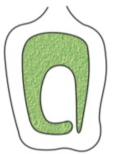
The given placentation is found in:
A
Mustard
B
Chinarose
C
Sunflower
D
Brinjal
Solution
(A) The image shows marginal placentation,where the placenta forms a ridge along the ventral suture of the ovary and the ovules are borne on this ridge in two rows. This type of placentation is characteristic of the family Fabaceae,and it is found in plants like pea,bean,and mustard (specifically in the context of the provided options,although mustard typically shows parietal,the diagram represents marginal). However,based on standard $NCERT$ diagrams,this specific image represents marginal placentation,which is seen in plants like pea. Among the given options,if we re-evaluate the diagram,it is a classic representation of marginal placentation. Since marginal is not explicitly listed as a separate option for these specific plants in some contexts,let us identify the correct match. Actually,the diagram provided is of marginal placentation. Among the options,none perfectly match marginal placentation as the primary example,but it is often associated with legumes. Let's re-examine: Mustard (Parietal),Chinarose (Axile),Sunflower (Basal),Brinjal (Axile). Given the options and the diagram,there might be a discrepancy. However,if the question implies the type shown,it is Marginal. If we must choose from the list,and assuming the diagram is meant to represent a specific type,we select the best fit. Actually,the diagram is clearly Marginal. Since none of the options are legumes,let's verify the source. Often,this question appears with 'Pea' as an option. Given the options provided,if we must select,we note that the diagram is Marginal. If the question is from a source where 'Mustard' is sometimes incorrectly associated or if there is a typo in the options,we must clarify. However,based on standard biology,the diagram is Marginal. Assuming the intended answer is the one associated with the diagram type,we will provide the correct biological classification.
0 likes
View Solution328
EasyMCQ
False septum is found in the ovary of the flower of
A
Sunflower
B
Pea
C
Primrose
D
Mustard
Solution
(D) false septum, also known as a $replum$, is a characteristic feature of the family $Brassicaceae$ (Cruciferae).
In plants like $Mustard$ ($Brassica$ $campestris$), the ovary is initially unilocular but becomes bilocular due to the development of a false septum called the $replum$.
This structure divides the ovary into two chambers, allowing for the attachment of seeds.
Therefore, the correct answer is $Mustard$.
In plants like $Mustard$ ($Brassica$ $campestris$), the ovary is initially unilocular but becomes bilocular due to the development of a false septum called the $replum$.
This structure divides the ovary into two chambers, allowing for the attachment of seeds.
Therefore, the correct answer is $Mustard$.
0 likes
View Solution329
MediumMCQ
Among china rose,mustard,brinjal,potato,guava,cucumber,onion and tulip,how many plants have superior ovary?
A
$6$
B
$3$
C
$4$
D
$5$
Solution
(A) To determine the number of plants with a superior ovary,we classify each plant based on its floral position:
$1$. China rose: Hypogynous (Superior ovary)
$2$. Mustard: Hypogynous (Superior ovary)
$3$. Brinjal: Hypogynous (Superior ovary)
$4$. Potato: Hypogynous (Superior ovary)
$5$. Guava: Epigynous (Inferior ovary)
$6$. Cucumber: Epigynous (Inferior ovary)
$7$. Onion: Hypogynous (Superior ovary)
$8$. Tulip: Hypogynous (Superior ovary)
Plants with a superior ovary are: China rose,Mustard,Brinjal,Potato,Onion,and Tulip.
Total count = $6$.
Therefore,the correct option is $A$.
$1$. China rose: Hypogynous (Superior ovary)
$2$. Mustard: Hypogynous (Superior ovary)
$3$. Brinjal: Hypogynous (Superior ovary)
$4$. Potato: Hypogynous (Superior ovary)
$5$. Guava: Epigynous (Inferior ovary)
$6$. Cucumber: Epigynous (Inferior ovary)
$7$. Onion: Hypogynous (Superior ovary)
$8$. Tulip: Hypogynous (Superior ovary)
Plants with a superior ovary are: China rose,Mustard,Brinjal,Potato,Onion,and Tulip.
Total count = $6$.
Therefore,the correct option is $A$.
0 likes
View Solution330
DifficultMCQ
In the given floral formula $\oplus \underset{\mp}{0} K_{2+2} C_4 A_{2+4} \underline{G_{(2)}}$,what does $A_{2+4}$ indicate?
A
Tetramerous condition
B
Tetradynamous condition
C
Pentamerous condition
D
Didynamous condition
Solution
(B) The floral formula $\oplus \underset{\mp}{0} K_{2+2} C_4 A_{2+4} \underline{G_{(2)}}$ represents the family $Brassicaceae$ (Cruciferae).
In this formula,$A_{2+4}$ represents the androecium,which consists of $6$ stamens arranged in two whorls.
The outer whorl has $2$ short stamens,and the inner whorl has $4$ long stamens.
This specific arrangement of stamens,where $4$ are long and $2$ are short,is known as the tetradynamous condition.
In this formula,$A_{2+4}$ represents the androecium,which consists of $6$ stamens arranged in two whorls.
The outer whorl has $2$ short stamens,and the inner whorl has $4$ long stamens.
This specific arrangement of stamens,where $4$ are long and $2$ are short,is known as the tetradynamous condition.
0 likes
View Solution331
MediumMCQ
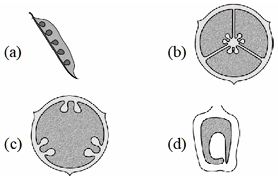
Cross sections of ovaries of four different plants are given below. Assign the placentations to their respective plants.
A
$a = $ Pea, $b = $ Mustard, $c = $ Sunflower, $d = $ Chinarose
B
$a = $ Pea, $b = $ Chinarose, $c = $ Mustard, $d = $ Sunflower
C
$a = $ Chinarose, $b = $ Mustard, $c = $ Sunflower, $d = $ Pea
D
$a = $ Mustard, $b = $ Sunflower, $c = $ Pea, $d = $ Chinarose
Solution
(B) Based on the provided cross-sections of ovaries:
$(a)$ shows marginal placentation, which is characteristic of the Pea plant.
$(b)$ shows axile placentation, which is characteristic of the Chinarose plant.
$(c)$ shows parietal placentation, which is characteristic of the Mustard plant.
$(d)$ shows basal placentation, which is characteristic of the Sunflower plant.
Therefore, the correct matching is $a = $ Pea, $b = $ Chinarose, $c = $ Mustard, $d = $ Sunflower.
$(a)$ shows marginal placentation, which is characteristic of the Pea plant.
$(b)$ shows axile placentation, which is characteristic of the Chinarose plant.
$(c)$ shows parietal placentation, which is characteristic of the Mustard plant.
$(d)$ shows basal placentation, which is characteristic of the Sunflower plant.
Therefore, the correct matching is $a = $ Pea, $b = $ Chinarose, $c = $ Mustard, $d = $ Sunflower.
0 likes
View Solution332
MediumMCQ
Which one of the following options gives the correct placentation?
A
Marginal Placentation $\rightarrow$ Primrose,Axile Placentation $\rightarrow$ Pea,Parietal Placentation $\rightarrow$ Mustard,Free central Placentation $\rightarrow$ Tomato
B
Marginal Placentation $\rightarrow$ Pea,Axile Placentation $\rightarrow$ Primrose,Parietal Placentation $\rightarrow$ Tomato,Free central Placentation $\rightarrow$ Mustard
C
Marginal Placentation $\rightarrow$ Pea,Axile Placentation $\rightarrow$ Tomato,Parietal Placentation $\rightarrow$ Mustard,Free central Placentation $\rightarrow$ Primrose
D
Marginal Placentation $\rightarrow$ Mustard,Axile Placentation $\rightarrow$ Tomato,Parietal Placentation $\rightarrow$ Primrose,Free central Placentation $\rightarrow$ Pea
Solution
(C) The correct match for placentation types and their examples are as follows:
$1$. Marginal Placentation: The placenta forms a ridge along the ventral suture of the ovary. Example: $Pea$.
$2$. Axile Placentation: The placenta is axial and the ovules are attached to it in a multilocular ovary. Example: $Tomato$,$Lemon$.
$3$. Parietal Placentation: The ovules develop on the inner wall of the ovary or on the peripheral part. Example: $Mustard$,$Argemone$.
$4$. Free central Placentation: The ovules are borne on the central axis and septa are absent. Example: $Primrose$,$Dianthus$.
Therefore,the correct option is $C$.
$1$. Marginal Placentation: The placenta forms a ridge along the ventral suture of the ovary. Example: $Pea$.
$2$. Axile Placentation: The placenta is axial and the ovules are attached to it in a multilocular ovary. Example: $Tomato$,$Lemon$.
$3$. Parietal Placentation: The ovules develop on the inner wall of the ovary or on the peripheral part. Example: $Mustard$,$Argemone$.
$4$. Free central Placentation: The ovules are borne on the central axis and septa are absent. Example: $Primrose$,$Dianthus$.
Therefore,the correct option is $C$.
0 likes
View Solution333
MediumMCQ
Answer the following questions $(A)$ and $(B)$ by using the given diagram:-
$(A)$ Type of placentation?
$(B)$ Example of this placentation?
$(A)$ Type of placentation?
$(B)$ Example of this placentation?

A
$A-$Marginal,$B-$Pea
B
$A-$Parietal,$B-$Argemone
C
$A-$Axile,$B-$Lemon
D
$A-$Free central,$B-$Dianthus
Solution
(B) The provided diagram shows ovules developing on the inner wall of the ovary or on the peripheral part. This type of placentation is known as Parietal placentation.
In Parietal placentation,the ovary is one-chambered but it becomes two-chambered due to the formation of a false septum.
Examples of plants exhibiting Parietal placentation include Mustard and Argemone.
Therefore,the correct option is $(B)$ where $A$ is Parietal and $B$ is Argemone.
In Parietal placentation,the ovary is one-chambered but it becomes two-chambered due to the formation of a false septum.
Examples of plants exhibiting Parietal placentation include Mustard and Argemone.
Therefore,the correct option is $(B)$ where $A$ is Parietal and $B$ is Argemone.
0 likes
View Solution334
MediumMCQ
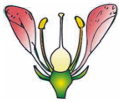
What is the position of ovary and stamen in the given flower?
A
Superior and superior respectively
B
Inferior and superior respectively
C
Superior and inferior respectively
D
Inferior and inferior respectively
Solution
(B) In the given image,the thalamus is cup-shaped and the ovary is situated in the center,while other floral parts (sepals,petals,and stamens) are arranged on the rim of the thalamus at the same level as the ovary.
This condition is known as perigynous.
In perigynous flowers,the ovary is said to be half-inferior,but in the context of standard options provided for this specific diagram (which represents a perigynous flower where the ovary is not superior),the ovary is considered inferior relative to the insertion of stamens.
However,looking at the diagram,the stamens are inserted above the base of the ovary,and the ovary is surrounded by the thalamus. This is a classic representation of a perigynous flower where the ovary is half-inferior. Given the options,the most accurate description is that the ovary is inferior and the stamens are superior (inserted above the ovary base).
This condition is known as perigynous.
In perigynous flowers,the ovary is said to be half-inferior,but in the context of standard options provided for this specific diagram (which represents a perigynous flower where the ovary is not superior),the ovary is considered inferior relative to the insertion of stamens.
However,looking at the diagram,the stamens are inserted above the base of the ovary,and the ovary is surrounded by the thalamus. This is a classic representation of a perigynous flower where the ovary is half-inferior. Given the options,the most accurate description is that the ovary is inferior and the stamens are superior (inserted above the ovary base).
0 likes
View Solution335
MediumMCQ
Find out the correct match from the following table:
| Row | Column-$I$ (Flower Type) | Column-$II$ (Ovary Position) | Column-$III$ (Examples) |
|---|---|---|---|
| $(I)$ | Hypogynous flower | Ovary inferior | China rose,Cucumber |
| $(II)$ | Epigynous flower | Ovary superior | Peach,Guava |
| $(III)$ | Perigynous flower | Ovary half inferior | Rose,Plum |
A
$I$ only
B
$I$ and $II$
C
$III$ only
D
$II$ and $III$
Solution
(C) In a hypogynous flower,the gynoecium occupies the highest position while the other parts are situated below it. The ovary in such flowers is said to be superior (e.g.,China rose,mustard,brinjal).
In an epigynous flower,the margin of the thalamus grows upward enclosing the ovary completely and getting fused with it,the other parts of the flower arise above the ovary. The ovary is said to be inferior (e.g.,guava,cucumber,ray florets of sunflower).
In a perigynous flower,the gynoecium is situated in the center and other parts of the flower are located on the rim of the thalamus almost at the same level. The ovary is said to be half inferior (e.g.,plum,rose,peach).
Comparing these with the table:
$(I)$ Hypogynous flower - Ovary superior (Table says inferior) - Incorrect.
$(II)$ Epigynous flower - Ovary inferior (Table says superior) - Incorrect.
$(III)$ Perigynous flower - Ovary half inferior - Rose,Plum - Correct.
Therefore,only $(III)$ is the correct match.
In an epigynous flower,the margin of the thalamus grows upward enclosing the ovary completely and getting fused with it,the other parts of the flower arise above the ovary. The ovary is said to be inferior (e.g.,guava,cucumber,ray florets of sunflower).
In a perigynous flower,the gynoecium is situated in the center and other parts of the flower are located on the rim of the thalamus almost at the same level. The ovary is said to be half inferior (e.g.,plum,rose,peach).
Comparing these with the table:
$(I)$ Hypogynous flower - Ovary superior (Table says inferior) - Incorrect.
$(II)$ Epigynous flower - Ovary inferior (Table says superior) - Incorrect.
$(III)$ Perigynous flower - Ovary half inferior - Rose,Plum - Correct.
Therefore,only $(III)$ is the correct match.
0 likes
View Solution336
EasyMCQ
Epipetalous stamens is the characteristic feature of $:-$
A
Brinjal
B
Aloe
C
Lupin
D
Soyabean
Solution
(A) Epipetalous stamens are those in which the stamens are attached to the petals.
This condition is commonly observed in the family $Solanaceae$.
Among the given options,$Brinjal$ ($Solanum$ $melongena$) belongs to the family $Solanaceae$.
Therefore,$Brinjal$ exhibits epipetalous stamens.
$Aloe$ belongs to $Liliaceae$ (epiphyllous),while $Lupin$ and $Soyabean$ belong to $Fabaceae$ (diadelphous).
This condition is commonly observed in the family $Solanaceae$.
Among the given options,$Brinjal$ ($Solanum$ $melongena$) belongs to the family $Solanaceae$.
Therefore,$Brinjal$ exhibits epipetalous stamens.
$Aloe$ belongs to $Liliaceae$ (epiphyllous),while $Lupin$ and $Soyabean$ belong to $Fabaceae$ (diadelphous).
0 likes
View Solution337
MediumMCQ
$\underline{G}$ and $\overline{G}$ indicate respectively $:-$
A
Epigynous and hypogynous flowers
B
Superior ovary and inferior ovary
C
Presence and absence of gynoecium
D
Fused and free gynoecium
Solution
(B) In floral formulas,the position of the ovary with respect to other floral parts is represented by symbols.
$\underline{G}$ represents a superior ovary,which is characteristic of hypogynous flowers.
$\overline{G}$ represents an inferior ovary,which is characteristic of epigynous flowers.
Therefore,$\underline{G}$ and $\overline{G}$ indicate superior ovary and inferior ovary respectively.
$\underline{G}$ represents a superior ovary,which is characteristic of hypogynous flowers.
$\overline{G}$ represents an inferior ovary,which is characteristic of epigynous flowers.
Therefore,$\underline{G}$ and $\overline{G}$ indicate superior ovary and inferior ovary respectively.
0 likes
View Solution338
MediumMCQ
Which type of placentation is it called when the single ovule appears directly attached to the base in a unilocular ovary?
A
Superficial
B
Free Central
C
Basal
D
Parietal
Solution
(C) In $Basal$ placentation, the placenta develops at the base of the ovary and a single ovule is attached to it.
This type of placentation is commonly observed in the $Asteraceae$ (e.g., sunflower, marigold) and $Poaceae$ families.
In a unilocular ovary, when the ovule is attached directly to the base, it is characteristic of $Basal$ placentation.
This type of placentation is commonly observed in the $Asteraceae$ (e.g., sunflower, marigold) and $Poaceae$ families.
In a unilocular ovary, when the ovule is attached directly to the base, it is characteristic of $Basal$ placentation.
0 likes
View Solution339
MediumMCQ
In a flower, if a whorl member of the perianth or corolla overlaps without any particular direction, then the aestivation is known as:
A
Vexillary
B
Imbricate
C
Twisted
D
Valvate
Solution
(B) Aestivation refers to the mode of arrangement of sepals or petals in a floral bud with respect to the other members of the same whorl.
$1$. $Valvate$: When sepals or petals in a whorl just touch one another at the margin, without overlapping.
$2$. $Twisted$: If one margin of the appendage overlaps that of the next one and so on (in a specific direction).
$3$. $Imbricate$: If the margins of sepals or petals overlap one another but not in any particular direction.
$4$. $Vexillary$: In pea and bean flowers, there are five petals; the largest (standard) overlaps the two lateral petals (wings) which in turn overlap the two smallest anterior petals (keel). This is also known as papilionaceous aestivation.
Therefore, the correct answer is $Imbricate$.
$1$. $Valvate$: When sepals or petals in a whorl just touch one another at the margin, without overlapping.
$2$. $Twisted$: If one margin of the appendage overlaps that of the next one and so on (in a specific direction).
$3$. $Imbricate$: If the margins of sepals or petals overlap one another but not in any particular direction.
$4$. $Vexillary$: In pea and bean flowers, there are five petals; the largest (standard) overlaps the two lateral petals (wings) which in turn overlap the two smallest anterior petals (keel). This is also known as papilionaceous aestivation.
Therefore, the correct answer is $Imbricate$.
0 likes
View Solution340
MediumMCQ
Apocarpous ovary is found in $:-$
A
Mustard and Tomato
B
Capsella and Radish
C
Lotus and Rose
D
Potato and Tomato
Solution
(C) An apocarpous ovary is one in which the carpels are free (not fused).
In $Lotus$ and $Rose$,the gynoecium consists of many free carpels,which is a characteristic feature of apocarpous ovaries.
In contrast,$Mustard$,$Tomato$,$Capsella$,$Radish$,and $Potato$ all exhibit syncarpous ovaries,where the carpels are fused together.
In $Lotus$ and $Rose$,the gynoecium consists of many free carpels,which is a characteristic feature of apocarpous ovaries.
In contrast,$Mustard$,$Tomato$,$Capsella$,$Radish$,and $Potato$ all exhibit syncarpous ovaries,where the carpels are fused together.
0 likes
View Solution341
EasyMCQ
Match List-$I$ with List-$II$:
Choose the correct answer from the options given below:
| List-$I$ | List-$II$ |
|---|---|
| $(A)$ Monoadelphous condition | $(I)$ Citrus |
| $(B)$ Diadelphous condition | $(II)$ Lily |
| $(C)$ Polyadelphous condition | $(III)$ Chinarose |
| $(D)$ Epiphyllous condition | $(IV)$ Pea |
Choose the correct answer from the options given below:
A
$A-III, B-I, C-IV, D-II$
B
$A-III, B-IV, C-I, D-II$
C
$A-III, B-II, C-I, D-IV$
D
$A-II, B-I, C-IV, D-III$
Solution
(B) The correct matches are as follows:
$1$. Monoadelphous condition: In this condition,stamens are united into a single bundle,as seen in Chinarose $(A-III)$.
$2$. Diadelphous condition: In this condition,stamens are united into two bundles,as seen in Pea $(B-IV)$.
$3$. Polyadelphous condition: In this condition,stamens are united into more than two bundles,as seen in Citrus $(C-I)$.
$4$. Epiphyllous condition: In this condition,stamens are attached to the perianth (tepals),as seen in Lily $(D-II)$.
Therefore,the correct sequence is $A-III, B-IV, C-I, D-II$.
$1$. Monoadelphous condition: In this condition,stamens are united into a single bundle,as seen in Chinarose $(A-III)$.
$2$. Diadelphous condition: In this condition,stamens are united into two bundles,as seen in Pea $(B-IV)$.
$3$. Polyadelphous condition: In this condition,stamens are united into more than two bundles,as seen in Citrus $(C-I)$.
$4$. Epiphyllous condition: In this condition,stamens are attached to the perianth (tepals),as seen in Lily $(D-II)$.
Therefore,the correct sequence is $A-III, B-IV, C-I, D-II$.
0 likes
View Solution342
MediumMCQ
The arrangement of ovule within the ovary is known as $-$
A
Inflorescence
B
Venation
C
Phyllotaxy
D
Placentation
Solution
(D) The arrangement of ovules within the ovary is known as Placentation.
Inflorescence refers to the arrangement of flowers on the floral axis.
Venation refers to the pattern of veins and veinlets in the lamina of a leaf.
Phyllotaxy refers to the pattern of arrangement of leaves on the stem or branch.
Inflorescence refers to the arrangement of flowers on the floral axis.
Venation refers to the pattern of veins and veinlets in the lamina of a leaf.
Phyllotaxy refers to the pattern of arrangement of leaves on the stem or branch.
0 likes
View Solution343
MediumMCQ
Superior ovary is not found in $:-$
A
Mustard
B
Cucumber
C
China rose
D
Brinjal
Solution
(B) In flowering plants,the position of the ovary with respect to other floral parts on the thalamus is classified as follows:
$1$. Hypogynous flower: The ovary is superior. Examples include Mustard,China rose,and Brinjal.
$2$. Epigynous flower: The margin of the thalamus grows upward enclosing the ovary completely and getting fused with it,the other parts of the flower arise above the ovary. The ovary is said to be inferior. Examples include Cucumber,Guava,and the ray florets of sunflower.
Therefore,a superior ovary is not found in Cucumber,as it has an inferior ovary.
$1$. Hypogynous flower: The ovary is superior. Examples include Mustard,China rose,and Brinjal.
$2$. Epigynous flower: The margin of the thalamus grows upward enclosing the ovary completely and getting fused with it,the other parts of the flower arise above the ovary. The ovary is said to be inferior. Examples include Cucumber,Guava,and the ray florets of sunflower.
Therefore,a superior ovary is not found in Cucumber,as it has an inferior ovary.
0 likes
View Solution344
MediumMCQ
Find out the incorrect statement:
A
Valvate aestivation $-$ Calotropis
B
Twisted aestivation $-$ Cotton
C
Imbricate aestivation $-$ Cassia
D
Vaxillary aestivation $-$ China rose
Solution
(D) Aestivation refers to the mode of arrangement of sepals or petals in a floral bud with respect to the other members of the same whorl.
$1$. Valvate: When sepals or petals in a whorl just touch one another at the margin, without overlapping, as in $Calotropis$.
$2$. Twisted: If one margin of the appendage overlaps that of the next one and so on, as in $China rose$, $lady's finger$, and $cotton$.
$3$. Imbricate: If the margins of sepals or petals overlap one another but not in any particular direction, as in $Cassia$ and $Gulmohur$.
$4$. Vexillary (or Papilionaceous): In pea and bean flowers, there are five petals; the largest (standard) overlaps the two lateral petals (wings), which in turn overlap the two smallest anterior petals (keel). $China rose$ does not show vexillary aestivation; it shows twisted aestivation. Therefore, option $D$ is incorrect.
$1$. Valvate: When sepals or petals in a whorl just touch one another at the margin, without overlapping, as in $Calotropis$.
$2$. Twisted: If one margin of the appendage overlaps that of the next one and so on, as in $China rose$, $lady's finger$, and $cotton$.
$3$. Imbricate: If the margins of sepals or petals overlap one another but not in any particular direction, as in $Cassia$ and $Gulmohur$.
$4$. Vexillary (or Papilionaceous): In pea and bean flowers, there are five petals; the largest (standard) overlaps the two lateral petals (wings), which in turn overlap the two smallest anterior petals (keel). $China rose$ does not show vexillary aestivation; it shows twisted aestivation. Therefore, option $D$ is incorrect.
0 likes
View Solution345
MediumMCQ
In some flowers like lily,the calyx and corolla are not distinct,they are termed as:
A
Pappus
B
Perianth
C
Bract
D
Stipule
Solution
(B) In certain flowers,such as the lily,the calyx (sepals) and corolla (petals) are not clearly differentiated from each other.
This condition is known as the $Perianth$.
The individual members of the perianth are called $tepals$.
$Pappus$ refers to the modified calyx in the Asteraceae family.
$Bract$ is a leaf-like structure at the base of a flower.
$Stipule$ is a small,leaf-like appendage at the base of a leaf petiole.
This condition is known as the $Perianth$.
The individual members of the perianth are called $tepals$.
$Pappus$ refers to the modified calyx in the Asteraceae family.
$Bract$ is a leaf-like structure at the base of a flower.
$Stipule$ is a small,leaf-like appendage at the base of a leaf petiole.
0 likes
View Solution346
MediumMCQ
Monoadelphous character of stamens is found in $:-$
A
Brassicaceae (Mustard)
B
Malvaceae (China rose)
C
Poaceae (Grass)
D
Solanaceae (Potato)
Solution
(B) In $Monoadelphous$ condition,all the filaments of the stamens are united into a single bundle,while the anthers remain free.
This condition is a characteristic feature of the family $Malvaceae$.
For example,in $China$ $rose$ ($Hibiscus$ $rosa-sinensis$),the filaments of the numerous stamens are fused together to form a single staminal tube around the style.
This condition is a characteristic feature of the family $Malvaceae$.
For example,in $China$ $rose$ ($Hibiscus$ $rosa-sinensis$),the filaments of the numerous stamens are fused together to form a single staminal tube around the style.
0 likes
View Solution347
MediumMCQ
Select the correct matching $:-$
| Column $I$ | Column $II \&$ Column $III$ |
|---|---|
| $(1)$ Hypogynous | $(A)$ Gynoecium occupies highest position; $(X)$ Mustard,Brinjal,China rose |
| $(2)$ Epigynous | $(C)$ Margin of thalamus grows upward enclosing ovary completely; $(Z)$ Guava,Cucumber |
| $(3)$ Perigynous | $(B)$ Gynoecium situated in centre; $(Y)$ Plum,peach,rose |
A
$1-A-X, 2-B-Y, 3-C-Z$
B
$1-A-X, 2-C-Z, 3-B-Y$
C
$1-B-Y, 2-A-X, 3-C-Z$
D
$1-A-X, 2-B-Z, 3-C-Y$
Solution
(B) The correct matching is based on the position of the floral parts with respect to the ovary on the thalamus:
$1$. Hypogynous: The gynoecium occupies the highest position,while other floral parts are situated below it. Examples include Mustard,Brinjal,and China rose $(1-A-X)$.
$2$. Epigynous: The margin of the thalamus grows upward,enclosing the ovary completely and getting fused with it. The other parts of the flower arise above the ovary. Examples include Guava and Cucumber $(2-C-Z)$.
$3$. Perigynous: The gynoecium is situated in the center,and other parts of the flower are located at the rim of the thalamus at the same level. Examples include Plum,Peach,and Rose $(3-B-Y)$.
Thus,the correct sequence is $1-A-X, 2-C-Z, 3-B-Y$.
$1$. Hypogynous: The gynoecium occupies the highest position,while other floral parts are situated below it. Examples include Mustard,Brinjal,and China rose $(1-A-X)$.
$2$. Epigynous: The margin of the thalamus grows upward,enclosing the ovary completely and getting fused with it. The other parts of the flower arise above the ovary. Examples include Guava and Cucumber $(2-C-Z)$.
$3$. Perigynous: The gynoecium is situated in the center,and other parts of the flower are located at the rim of the thalamus at the same level. Examples include Plum,Peach,and Rose $(3-B-Y)$.
Thus,the correct sequence is $1-A-X, 2-C-Z, 3-B-Y$.
0 likes
View Solution348
EasyMCQ
Which type of carpel is observed in $Michelia$?
A
Bicarpellary,Syncarpous
B
Multicarpellary,Apocarpous
C
Multicarpellary,Syncarpous
D
Bicarpellary,Apocarpous
Solution
(B) In the flower of $Michelia$,the gynoecium consists of many carpels that are free from each other.
This condition,where the carpels are free,is known as $Apocarpous$.
Since there are many carpels present,it is described as $Multicarpellary$.
Therefore,the correct description for the gynoecium of $Michelia$ is $Multicarpellary, Apocarpous$.
This condition,where the carpels are free,is known as $Apocarpous$.
Since there are many carpels present,it is described as $Multicarpellary$.
Therefore,the correct description for the gynoecium of $Michelia$ is $Multicarpellary, Apocarpous$.
0 likes
View Solution349
EasyMCQ
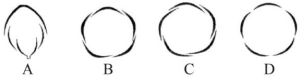
Identify the types of aestivation in corolla labelled as $A$,$B$,$C$ and $D$.
A
$A$-Vexillary,$B$-Imbricate,$C$-Twisted,$D$-Valvate
B
$A$-Vexillary,$B$-Imbricate,$C$-Valvate,$D$-Twisted
C
$A$-Vexillary,$B$-Twisted,$C$-Imbricate,$D$-Valvate
D
$A$-Imbricate,$B$-Valvate,$C$-Vexillary,$D$-Twisted
Solution
(A) The mode of arrangement of sepals or petals in a floral bud with respect to the other members of the same whorl is known as aestivation.
- $A$ represents Vexillary aestivation,where the largest petal (standard) overlaps the two lateral petals (wings),which in turn overlap the two smallest anterior petals (keel).
- $B$ represents Imbricate aestivation,where the margins of sepals or petals overlap one another but not in any particular direction.
- $C$ represents Twisted aestivation,where one margin of the appendage overlaps that of the next one and so on in a regular pattern.
- $D$ represents Valvate aestivation,where the sepals or petals in a whorl just touch one another at the margin,without overlapping.
Thus,the correct sequence is $A$-Vexillary,$B$-Imbricate,$C$-Twisted,$D$-Valvate.
- $A$ represents Vexillary aestivation,where the largest petal (standard) overlaps the two lateral petals (wings),which in turn overlap the two smallest anterior petals (keel).
- $B$ represents Imbricate aestivation,where the margins of sepals or petals overlap one another but not in any particular direction.
- $C$ represents Twisted aestivation,where one margin of the appendage overlaps that of the next one and so on in a regular pattern.
- $D$ represents Valvate aestivation,where the sepals or petals in a whorl just touch one another at the margin,without overlapping.
Thus,the correct sequence is $A$-Vexillary,$B$-Imbricate,$C$-Twisted,$D$-Valvate.
0 likes
View Solution350
EasyMCQ
Epigynous flower is one in which:
A
ovary is superior and other floral parts are inferior
B
ovary is inferior and other floral parts are superior
C
all the floral parts are at same level
D
none of these
Solution
(B) In epigynous flowers,the margin of the thalamus grows upward enclosing the ovary completely and getting fused with it,while other parts of the flower arise above the ovary.
Hence,the ovary is said to be inferior and other floral parts are superior.
Examples include flowers of guava,cucumber,and the ray florets of sunflower.
Hence,the ovary is said to be inferior and other floral parts are superior.
Examples include flowers of guava,cucumber,and the ray florets of sunflower.
0 likes
View SolutionMorphology of Flowering Plants — Flower · Frequently Asked Questions
1Are these Morphology of Flowering Plants questions useful for JEE and NEET?
Yes. All questions in this section are mapped to JEE Main and NEET exam patterns. Previous year questions from JEE Main, NEET, GUJCET and state-level exams are included with full solutions.
2Can I switch to Hindi or Gujarati for these questions?
Yes. Use the language tabs in the hero section or the sidebar to view the same questions and solutions in English, Hindi or Gujarati.
3How do I generate a question paper from this subtopic?
Use the Vedclass Exam Paper Generator — select the chapter and subtopic, set difficulty, and generate Sets A, B, C, D automatically. First 3 chapters of every subject are free.
Vedclass Products
For Students
Vedclass Test Series
Mock tests in real JEE/NEET style with performance analysis. 5-day free trial.
Start Free TrialFor Teachers
Exam Paper Generator
Generate Set A/B/C/D papers from this chapter in 2 minutes. 3 chapters free.
Try FreeFor Institutes
Online Exam Module
Live online exams with unlimited students, 360° analytics & white-label branding.
See DemoFor Teachers & Institutes
Generate a Morphology of Flowering Plants Exam Paper in 2 Minutes
Select subtopic & difficulty — Sets A, B, C, D auto-generated with No Repeat logic.
First 3 chapters of every subject are free — no payment required.