
A English
Flower Questions in English
Class 11 Biology · Morphology of Flowering Plants · Flower
351+
Questions
English
Language
100%
With Solutions
Showing 50 of 351 questions in English
151
EasyMCQ
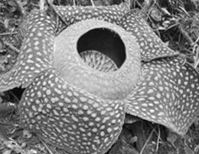
Which part of the plant $Rafflesia$ $arnoldii$ is shown in the given image?
A
Leaf
B
Fruit
C
Flower
D
Plant
Solution
(C) $Rafflesia$ $arnoldii$ is a parasitic plant known for producing the largest individual flower in the world.
The image displays the massive,fleshy,five-lobed structure which is the flower of this plant.
It lacks visible leaves,stems,or roots as it lives entirely within its host vine,emerging only to bloom.
The image displays the massive,fleshy,five-lobed structure which is the flower of this plant.
It lacks visible leaves,stems,or roots as it lives entirely within its host vine,emerging only to bloom.
0 likes
View Solution152
MediumMCQ
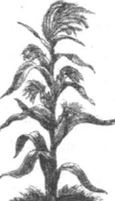
What type of flowers are present in the plant shown in the given figure?
A
Pentamerous
B
Tetramerous
C
Trimerous
D
All of the above $(A), (B)$ and $(C)$
Solution
(C) The plant shown in the figure is maize $(Zea \ mays)$.
Maize belongs to the family Poaceae (Gramineae),which is a monocotyledonous family.
Monocotyledonous plants typically have trimerous flowers,meaning the floral parts are in multiples of three.
Therefore,the correct option is $(C)$.
Maize belongs to the family Poaceae (Gramineae),which is a monocotyledonous family.
Monocotyledonous plants typically have trimerous flowers,meaning the floral parts are in multiples of three.
Therefore,the correct option is $(C)$.
0 likes
View Solution153
EasyMCQ
The term 'polyadelphous' is related to
A
gynoecium
B
androecium
C
corolla
D
calyx
Solution
(B) The term 'polyadelphous' refers to the cohesion of stamens.
In this condition,the filaments of the stamens are fused together to form more than two bundles or groups,while the anthers remain free.
Since stamens constitute the androecium of a flower,this term is related to the androecium.
An example of this condition is found in $Citrus$.
In this condition,the filaments of the stamens are fused together to form more than two bundles or groups,while the anthers remain free.
Since stamens constitute the androecium of a flower,this term is related to the androecium.
An example of this condition is found in $Citrus$.
0 likes
View Solution154
MediumMCQ
Radial symmetry (actinomorphic) is found in the flowers of:
A
Brassica
B
Trifolium
C
Pisum
D
Cassia
Solution
(A) Radial symmetry,also known as actinomorphic symmetry,occurs when a flower can be divided into two equal radial halves in any radial plane passing through the center.
In the given options,$Brassica$ (mustard) exhibits actinomorphic (radial) symmetry.
In contrast,$Trifolium$,$Pisum$ (pea),and $Cassia$ exhibit zygomorphic (bilateral) symmetry,where the flower can be divided into two similar halves only in one particular vertical plane.
In the given options,$Brassica$ (mustard) exhibits actinomorphic (radial) symmetry.
In contrast,$Trifolium$,$Pisum$ (pea),and $Cassia$ exhibit zygomorphic (bilateral) symmetry,where the flower can be divided into two similar halves only in one particular vertical plane.
1 likes
View Solution155
MediumMCQ
Free-central placentation is found in
A
Dianthus
B
Argemone
C
Brassica
D
Citrus
Solution
(A) The correct answer is $A$.
Free-central placentation occurs when the ovules are borne on a central axis and septa are absent.
This type of placentation is characteristic of plants like $Dianthus$ and $Primula$.
In contrast,$Argemone$ and $Brassica$ exhibit parietal placentation,where ovules develop on the inner wall of the ovary.
$Citrus$ exhibits axile placentation,where the placenta is axial and the ovules are attached to it in a multilocular ovary.
Free-central placentation occurs when the ovules are borne on a central axis and septa are absent.
This type of placentation is characteristic of plants like $Dianthus$ and $Primula$.
In contrast,$Argemone$ and $Brassica$ exhibit parietal placentation,where ovules develop on the inner wall of the ovary.
$Citrus$ exhibits axile placentation,where the placenta is axial and the ovules are attached to it in a multilocular ovary.
0 likes
View Solution156
MediumMCQ
The standard petal of a papilionaceous corolla is also called
A
vexillum
B
corona
C
carina
D
pappus
Solution
(A) : The posterior large bilobed petal of a papilionaceous corolla is called the standard or vexillum. It overlaps the two smaller lateral petals known as wings or alae.
1 likes
View Solution157
MediumMCQ
Axile placentation is present in
A
pea
B
Argemone
C
Dianthus
D
lemon
Solution
(D) : Axile placentation occurs in syncarpous pistils. The ovary is partitioned into two or more chambers. Placentae occur in the central region where the septa meet so that an axile column bearing ovules is formed,$e.g.$,shoe flower (pentalocular),lemon (multilocular),etc.
0 likes
View Solution158
MediumMCQ
Perigynous flowers are found in
A
China rose
B
rose
C
guava
D
cucumber
Solution
(B) In perigynous flowers,the gynoecium is situated in the center and other floral parts are located on the rim of the thalamus almost at the same level.
In this condition,the ovary is said to be half-inferior.
Examples of perigynous flowers include $plum$,$rose$,and $peach$.
Therefore,the correct option is $(b)$.
In this condition,the ovary is said to be half-inferior.
Examples of perigynous flowers include $plum$,$rose$,and $peach$.
Therefore,the correct option is $(b)$.
0 likes
View Solution159
MediumMCQ
Keel is the characteristic feature of the flower of
A
Aloe
B
Tomato
C
Tulip
D
Indigofera
Solution
(D) The flowers of the family $Fabaceae$ (subfamily $Papilionoideae$) exhibit a butterfly-shaped corolla,known as a papilionaceous corolla.
This arrangement consists of five petals: one posterior,large,outermost petal called the $standard$ or $vexillum$; two lateral petals called $wings$ or $alae$; and two anterior,fused petals called the $keel$ or $carina$.
The $keel$ petals enclose the stamens and the carpel.
This characteristic structure is found in plants like $Indigofera$,bean,gram,and pea.
This arrangement consists of five petals: one posterior,large,outermost petal called the $standard$ or $vexillum$; two lateral petals called $wings$ or $alae$; and two anterior,fused petals called the $keel$ or $carina$.
The $keel$ petals enclose the stamens and the carpel.
This characteristic structure is found in plants like $Indigofera$,bean,gram,and pea.
0 likes
View Solution160
MediumMCQ
Among bitter gourd,mustard,brinjal,pumpkin,china rose,lupin,cucumber,sunhemp,gram,guava,bean,chilli,plum,petunia,tomato,rose,Withania,potato,onion,aloe and tulip,how many plants have hypogynous flowers?
A
Fifteen
B
Eighteen
C
Six
D
Ten
Solution
(A) In a hypogynous flower,the gynoecium occupies the highest position,while the other floral parts (sepals,petals,and stamens) are situated below it. The ovary in such flowers is superior.
Plants with hypogynous flowers from the given list are: mustard,brinjal,China rose,lupin,sunhemp,gram,bean,chilli,petunia,tomato,Withania,potato,onion,aloe,and tulip.
Plants that are $NOT$ hypogynous are: bitter gourd (epigynous),pumpkin (epigynous),cucumber (epigynous),guava (epigynous),plum (perigynous),and rose (perigynous).
Counting the hypogynous plants: mustard $(1)$,brinjal $(2)$,China rose $(3)$,lupin $(4)$,sunhemp $(5)$,gram $(6)$,bean $(7)$,chilli $(8)$,petunia $(9)$,tomato $(10)$,Withania $(11)$,potato $(12)$,onion $(13)$,aloe $(14)$,and tulip $(15)$.
Therefore,there are $15$ plants with hypogynous flowers.
Plants with hypogynous flowers from the given list are: mustard,brinjal,China rose,lupin,sunhemp,gram,bean,chilli,petunia,tomato,Withania,potato,onion,aloe,and tulip.
Plants that are $NOT$ hypogynous are: bitter gourd (epigynous),pumpkin (epigynous),cucumber (epigynous),guava (epigynous),plum (perigynous),and rose (perigynous).
Counting the hypogynous plants: mustard $(1)$,brinjal $(2)$,China rose $(3)$,lupin $(4)$,sunhemp $(5)$,gram $(6)$,bean $(7)$,chilli $(8)$,petunia $(9)$,tomato $(10)$,Withania $(11)$,potato $(12)$,onion $(13)$,aloe $(14)$,and tulip $(15)$.
Therefore,there are $15$ plants with hypogynous flowers.
0 likes
View Solution161
MediumMCQ
In China rose, the flowers are:
A
zygomorphic, hypogynous with imbricate aestivation
B
zygomorphic, epigynous with twisted aestivation
C
actinomorphic, hypogynous with twisted aestivation
D
actinomorphic, epigynous with valvate aestivation
Solution
(C) The correct answer is $C$.
In China rose $(Hibiscus \text{ } rosa-sinensis)$, the flowers are actinomorphic, meaning they can be divided into two equal radial halves in any radial plane passing through the center.
They are hypogynous, meaning the gynoecium occupies the highest position, while the other floral parts (sepals, petals, and stamens) are situated below it.
They exhibit twisted aestivation, where one margin of each petal overlaps with the margin of the next petal in a regular pattern.
In China rose $(Hibiscus \text{ } rosa-sinensis)$, the flowers are actinomorphic, meaning they can be divided into two equal radial halves in any radial plane passing through the center.
They are hypogynous, meaning the gynoecium occupies the highest position, while the other floral parts (sepals, petals, and stamens) are situated below it.
They exhibit twisted aestivation, where one margin of each petal overlaps with the margin of the next petal in a regular pattern.
1 likes
View Solution162
MediumMCQ
Among flowers of Calotropis,tulip,Sesbania,Asparagus,Colchicum,sweet pea,Petunia,Indigofera,mustard,soybean,tobacco and groundnut,how many plants have corolla with valvate aestivation?
A
Six
B
Seven
C
Eight
D
Five
Solution
(B) The mode of arrangement of sepals or petals in a floral bud with respect to one another is termed as aestivation.
In valvate aestivation,the margins of sepals or petals touch each other at the edge without overlapping.
Among the given plants,the following exhibit valvate aestivation:
$1$. Calotropis
$2$. Tulip
$3$. Asparagus
$4$. Colchicum
$5$. Petunia
$6$. Mustard
$7$. Tobacco
Sesbania,sweet pea,Indigofera,soybean,and groundnut exhibit vexillary aestivation (papilionaceous corolla).
Therefore,there are $7$ plants with valvate aestivation.
In valvate aestivation,the margins of sepals or petals touch each other at the edge without overlapping.
Among the given plants,the following exhibit valvate aestivation:
$1$. Calotropis
$2$. Tulip
$3$. Asparagus
$4$. Colchicum
$5$. Petunia
$6$. Mustard
$7$. Tobacco
Sesbania,sweet pea,Indigofera,soybean,and groundnut exhibit vexillary aestivation (papilionaceous corolla).
Therefore,there are $7$ plants with valvate aestivation.
0 likes
View Solution163
MediumMCQ
Placentation in tomato and lemon is
A
parietal
B
free central
C
marginal
D
axile
Solution
(D) The correct answer is $D$.
Placentation refers to the arrangement of ovules within the ovary.
It is classified into several types:
$1$. Marginal: Found in pea.
$2$. Parietal: Found in mustard and Argemone.
$3$. Axile: Found in China rose,tomato,and lemon.
$4$. Free central: Found in Dianthus and Primrose.
Therefore,tomato and lemon exhibit axile placentation.
Placentation refers to the arrangement of ovules within the ovary.
It is classified into several types:
$1$. Marginal: Found in pea.
$2$. Parietal: Found in mustard and Argemone.
$3$. Axile: Found in China rose,tomato,and lemon.
$4$. Free central: Found in Dianthus and Primrose.
Therefore,tomato and lemon exhibit axile placentation.
0 likes
View Solution164
EasyMCQ
The gynoecium consists of many free pistils in flowers of
A
Aloe
B
tomato
C
Papaver
D
Michelia
Solution
(D) The gynoecium is the female reproductive part of a flower.
When the pistils are free,the condition is called apocarpous,as seen in $Michelia$.
When the pistils are fused together,the condition is called syncarpous,as seen in $tomato$ and $Papaver$.
When the pistils are free,the condition is called apocarpous,as seen in $Michelia$.
When the pistils are fused together,the condition is called syncarpous,as seen in $tomato$ and $Papaver$.
0 likes
View Solution165
MediumMCQ
Which one of the following statements is correct?
A
In tomato,fruit is a capsule.
B
Seeds of orchids have oil-rich endosperm.
C
Placentation in primrose is basal.
D
Flower of tulip is a modified shoot.
Solution
(D) : $A$ flower is defined as a modified shoot wherein the shoot apical meristem changes into a floral meristem. Internodes do not elongate and the axis gets condensed. The apex produces different kinds of floral appendages laterally at successive nodes instead of leaves. Thus,the flower is a modified shoot. In tomato,the fruit is a berry. Orchid seeds are non-endospermic (exalbuminous). Placentation in primrose is free-central.
0 likes
View Solution166
MediumMCQ
Flowers are zygomorphic in
A
mustard
B
gulmohur
C
tomato
D
Datura
Solution
(B) : Flowers of gulmohur exhibit bilateral symmetry,which means they can be divided into two identical halves only in one particular vertical plane. Therefore,they are classified as zygomorphic. In contrast,Datura,mustard,and tomato possess actinomorphic flowers,which exhibit radial symmetry and can be divided into two identical halves in any radial plane passing through the center.
0 likes
View Solution167
EasyMCQ
The ovary is half inferior in flowers of
A
peach
B
cucumber
C
cotton
D
guava
Solution
(A) In perigynous flowers,the gynoecium is situated in the centre and other parts of the flower are located on the rim of the thalamus almost at the same level.
In this condition,the ovary is said to be half inferior.
Examples of perigynous flowers include $plum$,$rose$,and $peach$.
Therefore,the correct option is $A$.
In this condition,the ovary is said to be half inferior.
Examples of perigynous flowers include $plum$,$rose$,and $peach$.
Therefore,the correct option is $A$.
0 likes
View Solution168
MediumMCQ
In a unilocular ovary with a single ovule,the placentation is
A
marginal
B
basal
C
free central
D
axile
Solution
(B) The correct answer is $B$. In basal placentation,the placenta develops at the base of the ovary,and a single ovule is attached to it. This type of placentation is commonly observed in families like $Asteraceae$ (formerly $Compositae$) and $Poaceae$.
0 likes
View Solution169
MediumMCQ
Keel is a characteristic feature of the flowers of
A
Gulmohur
B
Cassia
C
Calotropis
D
Bean
Solution
(D) The flowers of the family $Fabaceae$ (subfamily $Papilionoideae$) exhibit a butterfly-shaped corolla,known as $papilionaceous$ corolla.
This arrangement consists of five petals: one large posterior petal called the $standard$ or $vexillum$,two lateral petals called $wings$ or $alae$,and two anterior petals that are fused to form the $keel$ or $carina$.
The $keel$ encloses the stamens and the carpel.
This specific type of aestivation is characteristic of plants like $bean$,$gram$,$pea$,and $Indigofera$.
This arrangement consists of five petals: one large posterior petal called the $standard$ or $vexillum$,two lateral petals called $wings$ or $alae$,and two anterior petals that are fused to form the $keel$ or $carina$.
The $keel$ encloses the stamens and the carpel.
This specific type of aestivation is characteristic of plants like $bean$,$gram$,$pea$,and $Indigofera$.
0 likes
View Solution170
MediumMCQ
Ovary is half-inferior in the flowers of
A
guava
B
plum
C
brinjal
D
cucumber
Solution
(B) : If the gynoecium is situated in the centre and other parts of the flower are located on the rim of the thalamus almost at the same level,it is called perigynous. The ovary here is said to be half-inferior,e.g.,plum,rose,and peach.
0 likes
View Solution171
EasyMCQ
The technical term used for the androecium in a flower of China rose $(Hibiscus \text{ } rosa \text{ } sinensis)$ is
A
monadelphous
B
diadelphous
C
polyandrous
D
polyadelphous
Solution
(A) : China rose of Family $Malvaceae$ possesses numerous stamens.
The filaments of the stamens are united into a single bundle or group, forming a staminal tube around the style.
Such a condition of stamens is technically termed as monadelphous.
The filaments of the stamens are united into a single bundle or group, forming a staminal tube around the style.
Such a condition of stamens is technically termed as monadelphous.
0 likes
View Solution172
MediumMCQ
An example of axile placentation is
A
Dianthus
B
marigold
C
lemon
D
Argemone
Solution
(C) In axile placentation,the placenta develops from the central axis of the ovary,and the ovules are attached to it in a multilocular ovary.
Examples of axile placentation include $Lemon$,$China$ $rose$,and $Tomato$.
$Dianthus$ shows free central placentation,$Marigold$ shows basal placentation,and $Argemone$ shows parietal placentation.
Examples of axile placentation include $Lemon$,$China$ $rose$,and $Tomato$.
$Dianthus$ shows free central placentation,$Marigold$ shows basal placentation,and $Argemone$ shows parietal placentation.
0 likes
View Solution173
EasyMCQ
Replum is present in the ovary of the flower of
A
sunflower
B
pea
C
lemon
D
mustard
Solution
(D) : Replum is a false septum formed due to the ingrowth of parietal placenta. This makes the ovary bilocular. It is a characteristic feature of the ovary of flowers in the $Brassicaceae$ (Cruciferae) family,for example,mustard,candytuft,etc.
0 likes
View Solution174
MediumMCQ
Flowers are unisexual in
A
China rose
B
onion
C
pea
D
cucumber
Solution
(D) The correct answer is $(d)$. In cucumber,flowers are unisexual,meaning individual flowers are either male (staminate) or female (pistillate). Both types of flowers are present on the same plant,making it a monoecious plant. In contrast,China rose,onion,and pea possess bisexual (hermaphrodite) flowers.
0 likes
View Solution175
MediumMCQ
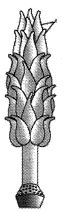
Identify the given figure:
A
Flower of Michelia
B
Gynoecium of Michelia
C
Flower of angiosperm plant
D
Leaf of gymnosperm
Solution
(B) The given figure represents the multicarpellary,apocarpous gynoecium of Michelia.
In Michelia,the gynoecium consists of many separate carpels (apocarpous condition),which are arranged on the thalamus.
Therefore,the correct option is $B$.
In Michelia,the gynoecium consists of many separate carpels (apocarpous condition),which are arranged on the thalamus.
Therefore,the correct option is $B$.
0 likes
View Solution176
MediumMCQ
In biennial plants,normally the number of carpels is:
A
One
B
Two
C
Three
D
Four
Solution
(B) The question regarding the number of carpels in biennial plants is biologically ambiguous because the number of carpels is a characteristic feature of a specific plant family or genus,not a general characteristic of the life cycle duration (biennial). However,in many standard botanical contexts or specific textbook questions referring to this,it is often associated with specific examples like the Brassicaceae family (e.g.,biennial varieties of radish or cabbage),which typically possess two carpels (bicarpellary). Therefore,$B$ is the most scientifically plausible answer in the context of common biennial crops.
0 likes
View Solution177
EasyMCQ
What type of placentation is found in sunflower?
A
Free central
B
Axile
C
Marginal
D
Basal
Solution
(D) In sunflower $(Helianthus \text{ } annuus)$, the ovary is unilocular and contains a single ovule attached at the base of the ovary. This type of arrangement is known as basal placentation.
0 likes
View Solution178
MediumMCQ
Identify the correct group for perigynous flowers.
A
Guava,Mustard,China rose
B
Rose,plum,peach
C
Cucumber,brinjal,mustard
D
Plum,brinjal,guava
Solution
(B) In perigynous flowers,the gynoecium is situated in the center and other parts of the flower are located on the rim of the thalamus almost at the same level.
Examples of perigynous flowers include $Rose$,$Plum$,and $Peach$.
In $Guava$ and $Cucumber$,the ovary is inferior (epigynous).
In $Mustard$,$China$ $rose$,and $Brinjal$,the ovary is superior (hypogynous).
Examples of perigynous flowers include $Rose$,$Plum$,and $Peach$.
In $Guava$ and $Cucumber$,the ovary is inferior (epigynous).
In $Mustard$,$China$ $rose$,and $Brinjal$,the ovary is superior (hypogynous).
0 likes
View Solution179
MediumMCQ
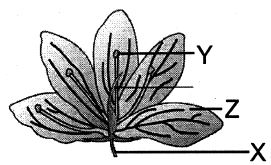
Identify $X, Y, Z$ from the figure.
A
Pedicel - gynoecium - calyx
B
Pedicel - androecium - corolla
C
Calyx - androecium - gynoecium
D
Pedicel - corolla - androecium
Solution
(A) Based on the morphological structure of a flower:
$1$. $X$ points to the stalk of the flower, which is the $\text{Pedicel}$.
$2$. $Y$ points to the central female reproductive part, which is the $\text{Gynoecium}$ (specifically the style/stigma region).
$3$. $Z$ points to the leaf-like outer whorl, which is the $\text{Calyx}$ (sepals).
Therefore, the correct identification is $X = \text{Pedicel}, Y = \text{Gynoecium}, Z = \text{Calyx}$.
$1$. $X$ points to the stalk of the flower, which is the $\text{Pedicel}$.
$2$. $Y$ points to the central female reproductive part, which is the $\text{Gynoecium}$ (specifically the style/stigma region).
$3$. $Z$ points to the leaf-like outer whorl, which is the $\text{Calyx}$ (sepals).
Therefore, the correct identification is $X = \text{Pedicel}, Y = \text{Gynoecium}, Z = \text{Calyx}$.
0 likes
View Solution180
EasyMCQ
Placentation is basal in
A
Calotropis
B
Sunflower
C
Lemon
D
Pea
Solution
(B) In basal placentation,the placenta develops at the base of the ovary and a single ovule is attached to it.
This type of placentation is characteristic of the families $Asteraceae$ (e.g.,$Sunflower$,$Marigold$) and $Poaceae$.
In $Calotropis$,the placentation is marginal.
In $Lemon$,the placentation is axile.
In $Pea$,the placentation is marginal.
Therefore,the correct answer is $Sunflower$.
This type of placentation is characteristic of the families $Asteraceae$ (e.g.,$Sunflower$,$Marigold$) and $Poaceae$.
In $Calotropis$,the placentation is marginal.
In $Lemon$,the placentation is axile.
In $Pea$,the placentation is marginal.
Therefore,the correct answer is $Sunflower$.
0 likes
View Solution181
MediumMCQ
Aestivation in $Cassia$ and $Calotropis$ is respectively:
A
Imbricate,Valvate
B
Vexillary,twisted
C
Valvate,Twisted
D
Vexillary,valvate
Solution
(A) Aestivation refers to the mode of arrangement of sepals or petals in a floral bud with respect to the other members of the same whorl.
In $Cassia$,the margins of sepals or petals overlap one another but not in any particular direction,which is known as Imbricate aestivation.
In $Calotropis$,the sepals or petals in a whorl just touch one another at the margin,without overlapping,which is known as Valvate aestivation.
Therefore,the correct sequence for $Cassia$ and $Calotropis$ is Imbricate and Valvate respectively.
In $Cassia$,the margins of sepals or petals overlap one another but not in any particular direction,which is known as Imbricate aestivation.
In $Calotropis$,the sepals or petals in a whorl just touch one another at the margin,without overlapping,which is known as Valvate aestivation.
Therefore,the correct sequence for $Cassia$ and $Calotropis$ is Imbricate and Valvate respectively.
0 likes
View Solution182
MediumMCQ
Which of the following is correct for mustard?
A
It possesses zygomorphic flowers.
B
It has hypogynous flowers.
C
It is a fleshy fruit.
D
It has five androecium in the flower.
Solution
(B) Mustard $(Brassica \text{ } campestris)$ belongs to the family $Brassicaceae$.
$1$. Flowers in mustard are actinomorphic (radially symmetrical), not zygomorphic.
$2$. The ovary is superior, and other floral parts are situated below the ovary, making the flower hypogynous.
$3$. The fruit of mustard is a siliqua, which is a dry dehiscent fruit, not a fleshy fruit.
$4$. Mustard flowers typically have $6$ stamens (androecium) arranged in two whorls $(2+4)$, not five.
Therefore, the correct statement is that it has hypogynous flowers.
$1$. Flowers in mustard are actinomorphic (radially symmetrical), not zygomorphic.
$2$. The ovary is superior, and other floral parts are situated below the ovary, making the flower hypogynous.
$3$. The fruit of mustard is a siliqua, which is a dry dehiscent fruit, not a fleshy fruit.
$4$. Mustard flowers typically have $6$ stamens (androecium) arranged in two whorls $(2+4)$, not five.
Therefore, the correct statement is that it has hypogynous flowers.
0 likes
View Solution183
MediumMCQ
What is a similarity between the calyx and the corolla?
A
They are the inner whorls.
B
They are always leaf-like and green.
C
They are attractive and attract insects for pollination.
D
Members of both whorls can be united or free.
Solution
(D) The calyx (sepals) and the corolla (petals) are the two accessory whorls of a flower.
In both whorls,the individual members (sepals in calyx and petals in corolla) can be either free (polysepalous/polypetalous) or united (gamosepalous/gamopetalous).
Option $A$ is incorrect because they are accessory (outer) whorls,not inner.
Option $B$ is incorrect because the corolla is usually brightly colored,not green.
Option $C$ is incorrect because the calyx is typically green and protective,not primarily for attracting insects.
In both whorls,the individual members (sepals in calyx and petals in corolla) can be either free (polysepalous/polypetalous) or united (gamosepalous/gamopetalous).
Option $A$ is incorrect because they are accessory (outer) whorls,not inner.
Option $B$ is incorrect because the corolla is usually brightly colored,not green.
Option $C$ is incorrect because the calyx is typically green and protective,not primarily for attracting insects.
0 likes
View Solution184
MediumMCQ
Basal placentation is found in
A
Dianthus and Primrose
B
Mustard and Argemone
C
Marigold and Sunflower
D
Tomatoes and Lemon
Solution
(C) In basal placentation,the placenta develops at the base of the ovary and a single ovule is attached to it.
This type of placentation is characteristic of the families Asteraceae (Compositae) and Poaceae.
Among the given options,Marigold and Sunflower belong to the family Asteraceae,which exhibits basal placentation.
Therefore,the correct answer is $C$.
This type of placentation is characteristic of the families Asteraceae (Compositae) and Poaceae.
Among the given options,Marigold and Sunflower belong to the family Asteraceae,which exhibits basal placentation.
Therefore,the correct answer is $C$.
0 likes
View Solution185
MediumMCQ
In which of the following plants is the androecium fused with the corolla?
A
Brinjal
B
Lily flower
C
China rose
D
Pea
Solution
(A) When the stamens (androecium) are attached to the petals (corolla),the condition is known as epipetalous.
This condition is characteristic of the family $Solanaceae$.
Among the given options,$Brinjal$ ($Solanum$ $melongena$) belongs to the family $Solanaceae$.
Therefore,the androecium is fused with the corolla in $Brinjal$.
This condition is characteristic of the family $Solanaceae$.
Among the given options,$Brinjal$ ($Solanum$ $melongena$) belongs to the family $Solanaceae$.
Therefore,the androecium is fused with the corolla in $Brinjal$.
0 likes
View Solution186
MediumMCQ
The arrangement of .......... within the ovary is known as placentation.
A
Ovule
B
Pollen grain
C
Stigma
D
Style
Solution
(A) Placentation is defined as the arrangement of ovules within the ovary of a flower.
It plays a crucial role in the development of seeds and fruits.
Different types of placentation include marginal,axile,parietal,basal,central,and free central.
It plays a crucial role in the development of seeds and fruits.
Different types of placentation include marginal,axile,parietal,basal,central,and free central.
0 likes
View Solution187
MediumMCQ
Which type of placentation is found in China rose and tomato?
A
Marginal
B
Parietal
C
Free central
D
Axile
Solution
(D) In $Axile$ placentation,the placenta is axial and the ovules are attached to it in a multilocular ovary.
This type of placentation is characteristic of plants like China rose ($Hibiscus$ $rosa-sinensis$),tomato ($Solanum$ $lycopersicum$),and lemon.
Therefore,the correct option is $D$.
This type of placentation is characteristic of plants like China rose ($Hibiscus$ $rosa-sinensis$),tomato ($Solanum$ $lycopersicum$),and lemon.
Therefore,the correct option is $D$.
0 likes
View Solution188
MediumMCQ
What is the correct meaning of the symbol $\underline G$ in floral formulas?
A
Inferior ovary
B
Superior ovary
C
Syncarpous ovary
D
Male flower
Solution
(B) In floral formulas,the symbol $G$ represents the gynoecium (ovary).
When a horizontal line is placed below the letter $G$ (i.e.,$\underline G$),it indicates that the ovary is superior.
$A$ superior ovary is one where the gynoecium occupies the highest position while the other floral parts (sepals,petals,and stamens) are situated below it.
This condition is known as hypogyny.
When a horizontal line is placed below the letter $G$ (i.e.,$\underline G$),it indicates that the ovary is superior.
$A$ superior ovary is one where the gynoecium occupies the highest position while the other floral parts (sepals,petals,and stamens) are situated below it.
This condition is known as hypogyny.
0 likes
View Solution189
MediumMCQ
Polydelphous stamen is found in .............
A
Lemon
B
China rose
C
Pea
D
Soyabean
Solution
(A) In flowering plants,the arrangement of stamens based on the fusion of filaments is classified as follows:
$1$. Monadelphous: Filaments are united into a single bundle (e.g.,China rose).
$2$. Diadelphous: Filaments are united into two bundles (e.g.,Pea,Soyabean).
$3$. Polyadelphous: Filaments are united into more than two bundles (e.g.,Lemon/Citrus).
Therefore,the correct answer is Lemon.
$1$. Monadelphous: Filaments are united into a single bundle (e.g.,China rose).
$2$. Diadelphous: Filaments are united into two bundles (e.g.,Pea,Soyabean).
$3$. Polyadelphous: Filaments are united into more than two bundles (e.g.,Lemon/Citrus).
Therefore,the correct answer is Lemon.
0 likes
View Solution190
MediumMCQ
Choose the correct pair regarding aestivation in flowers.
A
Valvate - Cassia
B
Twisted - Lady's finger
C
Imbricate - Pea
D
Vexillary - Caltrops
Solution
(B) Aestivation refers to the mode of arrangement of sepals or petals in a floral bud with respect to the other members of the same whorl.
$1$. Valvate: When sepals or petals in a whorl just touch one another at the margin,without overlapping,as in Calotropis.
$2$. Twisted: If one margin of the appendage overlaps that of the next one and so on,as in China rose,lady's finger,and cotton.
$3$. Imbricate: If the margins of sepals or petals overlap one another but not in any particular direction,as in Cassia and Gulmohur.
$4$. Vexillary (Papilionaceous): In pea and bean flowers,there are five petals; the largest (standard) overlaps the two lateral petals (wings),which in turn overlap the two smallest anterior petals (keel).
Therefore,the correct pair is Twisted - Lady's finger.
$1$. Valvate: When sepals or petals in a whorl just touch one another at the margin,without overlapping,as in Calotropis.
$2$. Twisted: If one margin of the appendage overlaps that of the next one and so on,as in China rose,lady's finger,and cotton.
$3$. Imbricate: If the margins of sepals or petals overlap one another but not in any particular direction,as in Cassia and Gulmohur.
$4$. Vexillary (Papilionaceous): In pea and bean flowers,there are five petals; the largest (standard) overlaps the two lateral petals (wings),which in turn overlap the two smallest anterior petals (keel).
Therefore,the correct pair is Twisted - Lady's finger.
0 likes
View Solution191
MediumMCQ
When a flower is hypogynous,the position of the ovary is...
A
Superior
B
Half-inferior
C
Inferior
D
$B$ and $C$ both
Solution
(A) In a hypogynous flower,the gynoecium occupies the highest position while the other parts (sepals,petals,and stamens) are situated below it.
Therefore,the ovary is said to be superior.
Examples of hypogynous flowers include mustard,China rose,and brinjal.
Therefore,the ovary is said to be superior.
Examples of hypogynous flowers include mustard,China rose,and brinjal.
0 likes
View Solution192
MediumMCQ
Which of the following plants does not have a zygomorphic flower?
A
Pea
B
Gulmohar
C
Datura
D
Bean
Solution
(C) flower is said to be zygomorphic if it can be divided into two similar halves only in one particular vertical plane. This is also known as bilateral symmetry.
Examples of zygomorphic flowers include Pea,Bean,Gulmohar,and Cassia.
Actinomorphic flowers are those that can be divided into two equal radial halves in any radial plane passing through the center. This is also known as radial symmetry.
Datura,Mustard,and Chilli are examples of plants with actinomorphic flowers.
Therefore,Datura does not have a zygomorphic flower; it has an actinomorphic flower.
Examples of zygomorphic flowers include Pea,Bean,Gulmohar,and Cassia.
Actinomorphic flowers are those that can be divided into two equal radial halves in any radial plane passing through the center. This is also known as radial symmetry.
Datura,Mustard,and Chilli are examples of plants with actinomorphic flowers.
Therefore,Datura does not have a zygomorphic flower; it has an actinomorphic flower.
0 likes
View Solution193
MediumMCQ
Which of the following is the correct group of flowers showing half-inferior (perigynous) ovaries?
A
Plum,Datura,Rose
B
Plum,Rose,Cucumber,China rose
C
Guava,Cucumber,Brinjal
D
Rose,Peach,Plum
Solution
(D) In perigynous flowers,the gynoecium is situated in the center and other parts of the flower are located at the rim of the thalamus almost at the same level. The ovary is said to be half-inferior. Examples include $Rose$,$Peach$,and $Plum$.
0 likes
View Solution194
MediumMCQ
Carpels are fused in . . .
A
Tomato,mustard
B
Lotus,rose
C
Pea,rose
D
Mustard,lotus
Solution
(A) In flowering plants,when carpels are fused together,the condition is known as syncarpous.
Examples of syncarpous ovaries include tomato and mustard.
In contrast,when carpels are free,the condition is known as apocarpous,as seen in lotus and rose.
Therefore,the correct option is $A$.
Examples of syncarpous ovaries include tomato and mustard.
In contrast,when carpels are free,the condition is known as apocarpous,as seen in lotus and rose.
Therefore,the correct option is $A$.
0 likes
View Solution195
MediumMCQ
If the margins of sepals or petals overlap one another but not in any particular direction,it is called:
A
Valvate
B
Twisted
C
Imbricate
D
Vexillary
Solution
(C) Aestivation is the mode of arrangement of sepals or petals in a floral bud with respect to the other members of the same whorl.
$1$. Valvate: When sepals or petals in a whorl just touch one another at the margin,without overlapping (e.g.,Calotropis).
$2$. Twisted: If one margin of the appendage overlaps that of the next one and so on (e.g.,China rose,lady's finger,and cotton).
$3$. Imbricate: If the margins of sepals or petals overlap one another but not in any particular direction (e.g.,Cassia and Gulmohar).
$4$. Vexillary: In pea and bean flowers,there are five petals; the largest (standard) overlaps the two lateral petals (wings) which in turn overlap the two smallest anterior petals (keel). This is also known as papilionaceous aestivation.
Therefore,the correct answer is Imbricate.
$1$. Valvate: When sepals or petals in a whorl just touch one another at the margin,without overlapping (e.g.,Calotropis).
$2$. Twisted: If one margin of the appendage overlaps that of the next one and so on (e.g.,China rose,lady's finger,and cotton).
$3$. Imbricate: If the margins of sepals or petals overlap one another but not in any particular direction (e.g.,Cassia and Gulmohar).
$4$. Vexillary: In pea and bean flowers,there are five petals; the largest (standard) overlaps the two lateral petals (wings) which in turn overlap the two smallest anterior petals (keel). This is also known as papilionaceous aestivation.
Therefore,the correct answer is Imbricate.
0 likes
View Solution196
MediumMCQ
Choose the correct statement regarding petals.
A
Petals are always green in color.
B
They attract pollinators for pollination.
C
They always occur in multiples of three.
D
They are located inside the androecium and gynoecium.
Solution
(B) Petals are the components of the corolla,which is the second whorl of a flower.
Their primary function is to attract insects and other pollinators by their bright colors and scent,thereby facilitating the process of pollination.
Option $A$ is incorrect because petals are usually brightly colored,not just green.
Option $C$ is incorrect because the number of petals varies across different plant species.
Option $D$ is incorrect because petals are located outside the reproductive organs (androecium and gynoecium).
Their primary function is to attract insects and other pollinators by their bright colors and scent,thereby facilitating the process of pollination.
Option $A$ is incorrect because petals are usually brightly colored,not just green.
Option $C$ is incorrect because the number of petals varies across different plant species.
Option $D$ is incorrect because petals are located outside the reproductive organs (androecium and gynoecium).
0 likes
View Solution197
MediumMCQ
Choose the incorrect pair (Aestivation - example).
A
Valvate - Calotropis
B
Twisted - Cotton
C
Imbricate - Gulmohur
D
Vexillary - China rose
Solution
(D) Aestivation is the mode of arrangement of sepals or petals in a floral bud with respect to the other members of the same whorl.
$1$. Valvate: Sepals or petals in a whorl just touch one another at the margin,without overlapping,e.g.,Calotropis.
$2$. Twisted: One margin of the appendage overlaps that of the next one and so on,e.g.,China rose,lady's finger,and cotton.
$3$. Imbricate: The margins of sepals or petals overlap one another but not in any particular direction,e.g.,Cassia and Gulmohur.
$4$. Vexillary (Papilionaceous): In pea and bean flowers,there are five petals; the largest (standard) overlaps the two lateral petals (wings),which in turn overlap the two smallest anterior petals (keel). China rose shows twisted aestivation,not vexillary. Therefore,the pair 'Vexillary - China rose' is incorrect.
$1$. Valvate: Sepals or petals in a whorl just touch one another at the margin,without overlapping,e.g.,Calotropis.
$2$. Twisted: One margin of the appendage overlaps that of the next one and so on,e.g.,China rose,lady's finger,and cotton.
$3$. Imbricate: The margins of sepals or petals overlap one another but not in any particular direction,e.g.,Cassia and Gulmohur.
$4$. Vexillary (Papilionaceous): In pea and bean flowers,there are five petals; the largest (standard) overlaps the two lateral petals (wings),which in turn overlap the two smallest anterior petals (keel). China rose shows twisted aestivation,not vexillary. Therefore,the pair 'Vexillary - China rose' is incorrect.
0 likes
View Solution198
MediumMCQ
Match the following types of placentation in Column-$I$ with their respective examples in Column-$II$.
| Column-$I$ | Column-$II$ |
| $(1)$ Marginal | $(p)$ Argemone |
| $(2)$ Axile | $(q)$ Dianthus |
| $(3)$ Parietal | $(r)$ Pea |
| $(4)$ Free central | $(s)$ Lemon |
A
$(1-p), (2-q), (3-r), (4-s)$
B
$(1-q), (2-r), (3-s), (4-p)$
C
$(1-r), (2-s), (3-p), (4-q)$
D
$(1-s), (2-p), (3-q), (4-r)$
Solution
(C) The correct matches for placentation types are as follows:
$(1)$ Marginal placentation: The placenta forms a ridge along the ventral suture of the ovary,as seen in $Pea$ $(r)$.
$(2)$ Axile placentation: The placenta is axial and ovules are attached to it in a multilocular ovary,as seen in $Lemon$ $(s)$.
$(3)$ Parietal placentation: The ovules develop on the inner wall of the ovary or on peripheral parts,as seen in $Argemone$ $(p)$.
$(4)$ Free central placentation: The ovules are borne on the central axis and septa are absent,as seen in $Dianthus$ $(q)$.
Therefore,the correct matching is $(1-r), (2-s), (3-p), (4-q)$.
$(1)$ Marginal placentation: The placenta forms a ridge along the ventral suture of the ovary,as seen in $Pea$ $(r)$.
$(2)$ Axile placentation: The placenta is axial and ovules are attached to it in a multilocular ovary,as seen in $Lemon$ $(s)$.
$(3)$ Parietal placentation: The ovules develop on the inner wall of the ovary or on peripheral parts,as seen in $Argemone$ $(p)$.
$(4)$ Free central placentation: The ovules are borne on the central axis and septa are absent,as seen in $Dianthus$ $(q)$.
Therefore,the correct matching is $(1-r), (2-s), (3-p), (4-q)$.
0 likes
View Solution199
MediumMCQ
Epigynous flowers are seen in:
A
Guava
B
Rose
C
Mustard
D
China rose
Solution
(A) In epigynous flowers,the margin of the thalamus grows upward enclosing the ovary completely and getting fused with it,while other parts of the flower arise above the ovary. The ovary is said to be inferior in such flowers. Examples of epigynous flowers include Guava,Cucumber,and the ray florets of Sunflower.
0 likes
View Solution200
MediumMCQ
Perianth means..........
A
Androecium and gynoecium are similar in flower.
B
Gynoecium and corolla are similar in flower.
C
Corolla and calyx are not different in that flower.
D
Androecium and calyx are similar in flower.
Solution
(C) In some flowers,like the lily,the calyx and corolla are not distinct and are termed as the perianth.
When the sepals and petals are not distinguishable,they are collectively referred to as the perianth.
Each individual member of the perianth is called a tepal.
When the sepals and petals are not distinguishable,they are collectively referred to as the perianth.
Each individual member of the perianth is called a tepal.
0 likes
View SolutionMorphology of Flowering Plants — Flower · Frequently Asked Questions
1Are these Morphology of Flowering Plants questions useful for JEE and NEET?
Yes. All questions in this section are mapped to JEE Main and NEET exam patterns. Previous year questions from JEE Main, NEET, GUJCET and state-level exams are included with full solutions.
2Can I switch to Hindi or Gujarati for these questions?
Yes. Use the language tabs in the hero section or the sidebar to view the same questions and solutions in English, Hindi or Gujarati.
3How do I generate a question paper from this subtopic?
Use the Vedclass Exam Paper Generator — select the chapter and subtopic, set difficulty, and generate Sets A, B, C, D automatically. First 3 chapters of every subject are free.
Vedclass Products
For Students
Vedclass Test Series
Mock tests in real JEE/NEET style with performance analysis. 5-day free trial.
Start Free TrialFor Teachers
Exam Paper Generator
Generate Set A/B/C/D papers from this chapter in 2 minutes. 3 chapters free.
Try FreeFor Institutes
Online Exam Module
Live online exams with unlimited students, 360° analytics & white-label branding.
See DemoFor Teachers & Institutes
Generate a Morphology of Flowering Plants Exam Paper in 2 Minutes
Select subtopic & difficulty — Sets A, B, C, D auto-generated with No Repeat logic.
First 3 chapters of every subject are free — no payment required.