
A English
Flower Questions in English
Class 11 Biology · Morphology of Flowering Plants · Flower
351+
Questions
English
Language
100%
With Solutions
Showing 50 of 351 questions in English
201
MediumMCQ
What type of placentation is seen in Argemone?
A
Marginal
B
Axile
C
Parietal
D
Basal
Solution
(C) In $Argemone$ (a member of the family $Papaveraceae$),the ovary is unilocular but becomes bilocular due to the formation of a false septum (replum). This type of placentation,where the ovules develop on the inner wall of the ovary or on a peripheral part,is known as parietal placentation.
0 likes
View Solution202
MediumMCQ
Flowers are actinomorphic in
A
Mustard
B
Pea
C
Gulmohur
D
Bean
Solution
(A) Actinomorphic flowers are those that can be divided into two equal radial halves in any radial plane passing through the center.
Examples of actinomorphic flowers include Mustard,Datura,and Chilli.
Pea,Bean,and Gulmohur exhibit zygomorphic symmetry,where the flower can be divided into two similar halves only in one particular vertical plane.
Therefore,the correct answer is Mustard.
Examples of actinomorphic flowers include Mustard,Datura,and Chilli.
Pea,Bean,and Gulmohur exhibit zygomorphic symmetry,where the flower can be divided into two similar halves only in one particular vertical plane.
Therefore,the correct answer is Mustard.
0 likes
View Solution203
MediumMCQ
Epigynous flowers means:
A
Thalamus grows upwards
B
Enclosing the ovary completely
C
Other parts of flower arise above the ovary
D
All of the above
Solution
(D) In epigynous flowers,the margin of the thalamus grows upward,enclosing the ovary completely and getting fused with it. The other parts of the flower (sepals,petals,and stamens) arise above the ovary. Hence,the ovary is said to be inferior. Since all the given statements describe the characteristics of epigynous flowers,the correct answer is $D$.
0 likes
View Solution204
MediumMCQ
Among plum,rose,peach,guava,cucumber,mustard,china rose and brinjal,how many plants have hypogynous flowers?
A
Eight
B
Seven
C
Five
D
Three
Solution
(D) In hypogynous flowers,the gynoecium occupies the highest position while the other parts are situated below it. The ovary in such flowers is said to be superior.
$1$. Mustard: Hypogynous (Superior ovary)
$2$. China rose: Hypogynous (Superior ovary)
$3$. Brinjal: Hypogynous (Superior ovary)
$4$. Plum: Perigynous (Half-inferior ovary)
$5$. Rose: Perigynous (Half-inferior ovary)
$6$. Peach: Perigynous (Half-inferior ovary)
$7$. Guava: Epigynous (Inferior ovary)
$8$. Cucumber: Epigynous (Inferior ovary)
Therefore,the plants with hypogynous flowers are mustard,china rose,and brinjal. The total count is $3$.
$1$. Mustard: Hypogynous (Superior ovary)
$2$. China rose: Hypogynous (Superior ovary)
$3$. Brinjal: Hypogynous (Superior ovary)
$4$. Plum: Perigynous (Half-inferior ovary)
$5$. Rose: Perigynous (Half-inferior ovary)
$6$. Peach: Perigynous (Half-inferior ovary)
$7$. Guava: Epigynous (Inferior ovary)
$8$. Cucumber: Epigynous (Inferior ovary)
Therefore,the plants with hypogynous flowers are mustard,china rose,and brinjal. The total count is $3$.
0 likes
View Solution205
MediumMCQ
When one margin of the appendage overlaps that of the next one,the condition is termed as.
A
Valvate
B
Twisted
C
Imbricate
D
Vexillary
Solution
(B) The arrangement of sepals or petals in a floral bud with respect to the other members of the same whorl is known as aestivation.
In $Twisted$ aestivation,one margin of the appendage (sepal or petal) overlaps that of the next one and so on (e.g.,China rose,lady's finger,and cotton).
In $Valvate$ aestivation,the margins of sepals or petals in a whorl just touch one another at the margin,without overlapping.
In $Imbricate$ aestivation,the margins of sepals or petals overlap one another but not in any particular direction.
In $Vexillary$ (or $Papilionaceous$) aestivation,the largest petal (standard) overlaps the two lateral petals (wings),which in turn overlap the two smallest anterior petals (keel).
In $Twisted$ aestivation,one margin of the appendage (sepal or petal) overlaps that of the next one and so on (e.g.,China rose,lady's finger,and cotton).
In $Valvate$ aestivation,the margins of sepals or petals in a whorl just touch one another at the margin,without overlapping.
In $Imbricate$ aestivation,the margins of sepals or petals overlap one another but not in any particular direction.
In $Vexillary$ (or $Papilionaceous$) aestivation,the largest petal (standard) overlaps the two lateral petals (wings),which in turn overlap the two smallest anterior petals (keel).
0 likes
View Solution206
MediumMCQ
Delete the odd one:
A
Calyx
B
Gynoecium
C
Androecium
D
Stipule
Solution
(D) The flower consists of four main whorls: Calyx,Corolla,Androecium,and Gynoecium.
$Calyx$,$Androecium$,and $Gynoecium$ are parts of the flower.
$Stipule$ is a small,leaf-like appendage found at the base of the leaf petiole,not a part of the flower.
Therefore,$Stipule$ is the odd one out.
$Calyx$,$Androecium$,and $Gynoecium$ are parts of the flower.
$Stipule$ is a small,leaf-like appendage found at the base of the leaf petiole,not a part of the flower.
Therefore,$Stipule$ is the odd one out.
0 likes
View Solution207
EasyMCQ
The replum is present in the ovary of the flower of .......... .
A
Lemon
B
Mustard
C
Sunflower
D
Pea
Solution
(B) The replum is a characteristic feature of the family $Brassicaceae$ (Cruciferae).
It is a false septum that develops in the ovary,dividing it into two locules.
Among the given options,$Mustard$ ($Brassica$ $campestris$) belongs to the family $Brassicaceae$.
Therefore,the replum is present in the ovary of the flower of mustard.
It is a false septum that develops in the ovary,dividing it into two locules.
Among the given options,$Mustard$ ($Brassica$ $campestris$) belongs to the family $Brassicaceae$.
Therefore,the replum is present in the ovary of the flower of mustard.
0 likes
View Solution208
MediumMCQ
Identify the type of placentation where the ovary is multicarpellary,unilocular,and ovules are borne on the periphery.
A
Axile placentation
B
Parietal placentation
C
Marginal placentation
D
Basal placentation
Solution
(B) In $Parietal$ $placentation$,the ovules develop on the inner wall of the ovary or on peripheral parts. The ovary is typically multicarpellary and unilocular (e.g.,in $Mustard$ and $Argemone$).
$1$. $Axile$ $placentation$: Ovules are attached to a central axis in a multilocular ovary.
$2$. $Marginal$ $placentation$: The placenta forms a ridge along the ventral suture of the ovary.
$3$. $Basal$ $placentation$: The placenta develops at the base of the ovary and a single ovule is attached to it.
$1$. $Axile$ $placentation$: Ovules are attached to a central axis in a multilocular ovary.
$2$. $Marginal$ $placentation$: The placenta forms a ridge along the ventral suture of the ovary.
$3$. $Basal$ $placentation$: The placenta develops at the base of the ovary and a single ovule is attached to it.
0 likes
View Solution209
MediumMCQ
Which type of placentation is observed in pea plants?
A
Axile
B
Free central
C
Marginal
D
Basal
Solution
(C) In pea plants,the ovary is monocarpellary and unilocular. The placenta forms a ridge along the ventral suture of the ovary,and the ovules are arranged in two rows along this ridge. This type of placentation is known as $Marginal$ placentation. Therefore,the correct option is $C$.
0 likes
View Solution210
MediumMCQ
Which of the following is an example of axile placentation?
A
Argemone
B
Dianthus
C
Lemon
D
Marigold
Solution
(C) In $axile$ placentation,the placenta is axial and the ovules are attached to it in a multilocular ovary. Examples include $China$ $rose$,$tomato$,and $lemon$.
In $Argemone$,the placentation is $parietal$.
In $Dianthus$,the placentation is $free$ $central$.
In $Marigold$,the placentation is $basal$.
Therefore,the correct option is $C$.
In $Argemone$,the placentation is $parietal$.
In $Dianthus$,the placentation is $free$ $central$.
In $Marigold$,the placentation is $basal$.
Therefore,the correct option is $C$.
0 likes
View Solution211
MediumMCQ
The scientific term used for the stamens of a China rose ($Hibiscus$ $rosa-sinensis$) is:
A
Monadelphous
B
Diadelphous
C
Versatile
D
Polyadelphous
Solution
(A) In China rose ($Hibiscus$ $rosa-sinensis$),the filaments of the stamens are united into a single bundle or tube around the style. This condition is known as $Monadelphous$.
0 likes
View Solution212
MediumMCQ
The keel is a characteristic feature of the flowers of .....
A
Gulmohar
B
Cassia
C
Calotropis
D
Pea
Solution
(D) In the family $Fabaceae$, the corolla consists of five petals. These are arranged in a vexillary aestivation pattern. The arrangement includes one posterior standard petal, two lateral wings, and two anterior petals that are fused to form a boat-shaped structure known as the keel or carina. Therefore, the keel is a characteristic feature of the flowers of the pea plant $(Pisum \text{ } sativum)$.
0 likes
View Solution213
EasyMCQ
In the flowers of $......$,the ovary is half-inferior.
A
Cucumber
B
Cotton
C
Plum
D
Peach
Solution
(C) In perigynous flowers,the gynoecium is situated in the center and other parts of the flower are located on the rim of the thalamus almost at the same level.
Here,the ovary is said to be half-inferior.
Examples of perigynous flowers include $Plum$,$Rose$,and $Peach$.
In contrast,$Cucumber$ has an inferior ovary (epigynous),while $Cotton$ has a superior ovary (hypogynous).
Therefore,among the given options,$Plum$ is the correct answer.
Here,the ovary is said to be half-inferior.
Examples of perigynous flowers include $Plum$,$Rose$,and $Peach$.
In contrast,$Cucumber$ has an inferior ovary (epigynous),while $Cotton$ has a superior ovary (hypogynous).
Therefore,among the given options,$Plum$ is the correct answer.
0 likes
View Solution214
MediumMCQ
An asymmetric (zygomorphic) flower is found in ........... .
A
Gulmohur
B
Tomato
C
Datura
D
Mustard
Solution
(A) flower is called zygomorphic when it can be divided into two similar halves only in one particular vertical plane.
Examples of zygomorphic flowers include pea,bean,Cassia,and Gulmohur.
In contrast,actinomorphic (radial symmetry) flowers can be divided into two equal radial halves in any radial plane passing through the center,such as in mustard,Datura,and tomato.
Examples of zygomorphic flowers include pea,bean,Cassia,and Gulmohur.
In contrast,actinomorphic (radial symmetry) flowers can be divided into two equal radial halves in any radial plane passing through the center,such as in mustard,Datura,and tomato.
0 likes
View Solution215
MediumMCQ
In the flowers of .......,the gynoecium is apocarpous and multicarpellary.
A
Aloe
B
Tomato
C
Papaver
D
Michelia
Solution
(D) The gynoecium consists of the pistil$(s)$.
When there are many carpels,the condition is called multicarpellary.
If the carpels are free,the condition is known as apocarpous.
$Aloe$ and $Tomato$ are syncarpous (fused carpels).
$Papaver$ is also syncarpous.
$Michelia$ is an example of a multicarpellary,apocarpous gynoecium.
When there are many carpels,the condition is called multicarpellary.
If the carpels are free,the condition is known as apocarpous.
$Aloe$ and $Tomato$ are syncarpous (fused carpels).
$Papaver$ is also syncarpous.
$Michelia$ is an example of a multicarpellary,apocarpous gynoecium.
0 likes
View Solution216
MediumMCQ
What type of placentation is found in tomato and lemon?
A
Parietal
B
Free central
C
Marginal
D
Axile
Solution
(D) In $Axile$ placentation,the placenta is axial and the ovules are attached to it in a multilocular ovary.
This type of placentation is characteristic of plants like $Tomato$,$Lemon$,and $China$ $rose$.
This type of placentation is characteristic of plants like $Tomato$,$Lemon$,and $China$ $rose$.
0 likes
View Solution217
MediumMCQ
In $China$ $rose$,the flowers are ..........
A
Actinomorphic,hypogynous and show twisted aestivation.
B
Actinomorphic,epigynous and show valvate aestivation.
C
Zygomorphic,hypogynous and show imbricate aestivation.
D
Zygomorphic,epigynous and show twisted aestivation.
Solution
(A) In $China$ $rose$ ($Hibiscus$ $rosa-sinensis$):
$1$. The flowers are $Actinomorphic$ (radial symmetry),which means they can be divided into two equal radial halves in any radial plane passing through the center.
$2$. The flowers are $Hypogynous$,meaning the ovary is superior and other floral parts (sepals,petals,stamens) are situated below the ovary.
$3$. The aestivation is $Twisted$,where one margin of the sepal or petal overlaps that of the next one and so on.
$1$. The flowers are $Actinomorphic$ (radial symmetry),which means they can be divided into two equal radial halves in any radial plane passing through the center.
$2$. The flowers are $Hypogynous$,meaning the ovary is superior and other floral parts (sepals,petals,stamens) are situated below the ovary.
$3$. The aestivation is $Twisted$,where one margin of the sepal or petal overlaps that of the next one and so on.
0 likes
View Solution218
MediumMCQ
Among bitter gourd,mustard,brinjal,pumpkin,China rose,lupin,cucumber,sunn hemp,gram,guava,bean,chilli,plum,Petunia,tomato,rose,Withania,potato,onion,Aloe,and tulip,how many plants have hypogynous flowers?
A
$18$
B
$6$
C
$10$
D
$15$
Solution
(D) Hypogynous flowers are those in which the gynoecium occupies the highest position while the other parts are situated below it. This is characteristic of superior ovaries.
$1$. Bitter gourd: Epigynous
$2$. Mustard: Hypogynous
$3$. Brinjal: Hypogynous
$4$. Pumpkin: Epigynous
$5$. China rose: Hypogynous
$6$. Lupin: Hypogynous
$7$. Cucumber: Epigynous
$8$. Sunn hemp: Hypogynous
$9$. Gram: Hypogynous
$10$. Guava: Epigynous
$11$. Bean: Hypogynous
$12$. Chilli: Hypogynous
$13$. Plum: Perigynous
$14$. Petunia: Hypogynous
$15$. Tomato: Hypogynous
$16$. Rose: Perigynous
$17$. Withania: Hypogynous
$18$. Potato: Hypogynous
$19$. Onion: Hypogynous
$20$. Aloe: Hypogynous
$21$. Tulip: Hypogynous
Counting the hypogynous ones: Mustard,Brinjal,China rose,Lupin,Sunn hemp,Gram,Bean,Chilli,Petunia,Tomato,Withania,Potato,Onion,Aloe,and Tulip. Total = $15$.
$1$. Bitter gourd: Epigynous
$2$. Mustard: Hypogynous
$3$. Brinjal: Hypogynous
$4$. Pumpkin: Epigynous
$5$. China rose: Hypogynous
$6$. Lupin: Hypogynous
$7$. Cucumber: Epigynous
$8$. Sunn hemp: Hypogynous
$9$. Gram: Hypogynous
$10$. Guava: Epigynous
$11$. Bean: Hypogynous
$12$. Chilli: Hypogynous
$13$. Plum: Perigynous
$14$. Petunia: Hypogynous
$15$. Tomato: Hypogynous
$16$. Rose: Perigynous
$17$. Withania: Hypogynous
$18$. Potato: Hypogynous
$19$. Onion: Hypogynous
$20$. Aloe: Hypogynous
$21$. Tulip: Hypogynous
Counting the hypogynous ones: Mustard,Brinjal,China rose,Lupin,Sunn hemp,Gram,Bean,Chilli,Petunia,Tomato,Withania,Potato,Onion,Aloe,and Tulip. Total = $15$.
0 likes
View Solution219
MediumMCQ
When the margins of sepals or petals overlap one another without any particular direction,the condition is termed as .......
A
Vexillary
B
Imbricate
C
Twisted
D
Valvate
Solution
(B) The arrangement of sepals or petals in a floral bud with respect to the other members of the same whorl is called aestivation.
In $Imbricate$ aestivation,the margins of sepals or petals overlap one another but not in any particular direction.
In $Twisted$ aestivation,one margin of the appendage overlaps that of the next one and so on in a regular direction.
In $Valvate$ aestivation,the members of a whorl just touch one another at the margin,without overlapping.
In $Vexillary$ aestivation,the largest petal (standard) overlaps the two lateral petals (wings),which in turn overlap the two smallest anterior petals (keel).
In $Imbricate$ aestivation,the margins of sepals or petals overlap one another but not in any particular direction.
In $Twisted$ aestivation,one margin of the appendage overlaps that of the next one and so on in a regular direction.
In $Valvate$ aestivation,the members of a whorl just touch one another at the margin,without overlapping.
In $Vexillary$ aestivation,the largest petal (standard) overlaps the two lateral petals (wings),which in turn overlap the two smallest anterior petals (keel).
0 likes
View Solution220
MediumMCQ
How many of the following plants have a superior ovary: Hibiscus,Mustard,Brinjal,Potato,Guava,Cucumber,Onion,and Tulip?
A
Four
B
Five
C
Six
D
Three
Solution
(C) To determine the number of plants with a superior ovary,we classify each plant based on its floral symmetry and ovary position:
$1$. $Hibiscus$ (China rose): Superior ovary (Hypogynous).
$2$. $Mustard$: Superior ovary (Hypogynous).
$3$. $Brinjal$: Superior ovary (Hypogynous).
$4$. $Potato$: Superior ovary (Hypogynous).
$5$. $Guava$: Inferior ovary (Epigynous).
$6$. $Cucumber$: Inferior ovary (Epigynous).
$7$. $Onion$: Superior ovary (Hypogynous).
$8$. $Tulip$: Superior ovary (Hypogynous).
Counting the plants with a superior ovary: $Hibiscus$,$Mustard$,$Brinjal$,$Potato$,$Onion$,and $Tulip$.
Total count = $6$.
Therefore,the correct option is $C$.
$1$. $Hibiscus$ (China rose): Superior ovary (Hypogynous).
$2$. $Mustard$: Superior ovary (Hypogynous).
$3$. $Brinjal$: Superior ovary (Hypogynous).
$4$. $Potato$: Superior ovary (Hypogynous).
$5$. $Guava$: Inferior ovary (Epigynous).
$6$. $Cucumber$: Inferior ovary (Epigynous).
$7$. $Onion$: Superior ovary (Hypogynous).
$8$. $Tulip$: Superior ovary (Hypogynous).
Counting the plants with a superior ovary: $Hibiscus$,$Mustard$,$Brinjal$,$Potato$,$Onion$,and $Tulip$.
Total count = $6$.
Therefore,the correct option is $C$.
0 likes
View Solution221
MediumMCQ
In which of the following is axile placentation found?
A
Argemone
B
Dianthus
C
Lemon
D
Pea
Solution
(C) In axile placentation,the placenta is axial and the ovules are attached to it in a multilocular ovary.
Examples of plants with axile placentation include China rose,tomato,and lemon.
- $Argemone$ (poppy) shows parietal placentation.
- $Dianthus$ shows free central placentation.
- $Pea$ shows marginal placentation.
Therefore,the correct option is $C$ (Lemon).
Examples of plants with axile placentation include China rose,tomato,and lemon.
- $Argemone$ (poppy) shows parietal placentation.
- $Dianthus$ shows free central placentation.
- $Pea$ shows marginal placentation.
Therefore,the correct option is $C$ (Lemon).
0 likes
View Solution222
MediumMCQ
In which of the following are the flowers unisexual?
A
Onion
B
Pea
C
Cucumber
D
China rose
Solution
(C) flower is said to be unisexual if it contains either only stamens (male reproductive part) or only carpels (female reproductive part).
Among the given options, $Cucumber$ (Cucumis sativus) produces unisexual flowers, where individual flowers are either staminate or pistillate.
Onion, Pea, and China rose possess bisexual (hermaphrodite) flowers, which contain both stamens and carpels in the same flower.
Among the given options, $Cucumber$ (Cucumis sativus) produces unisexual flowers, where individual flowers are either staminate or pistillate.
Onion, Pea, and China rose possess bisexual (hermaphrodite) flowers, which contain both stamens and carpels in the same flower.
0 likes
View Solution223
MediumMCQ
The term $polyadelphous$ is applied to which of the following?
A
Corolla
B
Calyx
C
Gynoecium
D
Androecium
Solution
(D) The term $polyadelphous$ refers to the condition where the stamens are united into more than two bundles.
This condition is a characteristic feature of the $Androecium$ (the male reproductive part of a flower).
For example,in the family $Rutaceae$ (e.g.,$Citrus$),the stamens are arranged in many bundles.
Therefore,the term $polyadelphous$ is applied to the $Androecium$.
This condition is a characteristic feature of the $Androecium$ (the male reproductive part of a flower).
For example,in the family $Rutaceae$ (e.g.,$Citrus$),the stamens are arranged in many bundles.
Therefore,the term $polyadelphous$ is applied to the $Androecium$.
0 likes
View Solution224
MediumMCQ
Among Indigofera,Sesbania,Salvia,Allium,Aloe,mustard,groundnut,radish,gram,and turnip,how many plants have stamens of different lengths in their flowers?
A
Five
B
Six
C
Three
D
Four
Solution
(D) To determine the number of plants with stamens of different lengths,we look for conditions like didynamous (two long,two short) or tetradynamous (four long,two short) stamens.
$1$. $Indigofera$: Stamens are of equal length.
$2$. $Sesbania$: Stamens are of equal length.
$3$. $Salvia$: Shows didynamous condition (stamens of different lengths).
$4$. $Allium$: Stamens are of equal length.
$5$. $Aloe$: Stamens are of equal length.
$6$. $Mustard$: Shows tetradynamous condition (stamens of different lengths).
$7$. $Groundnut$: Stamens are of equal length.
$8$. $Radish$: Shows tetradynamous condition (stamens of different lengths).
$9$. $Gram$: Stamens are of equal length.
$10$. $Turnip$: Shows tetradynamous condition (stamens of different lengths).
The plants with stamens of different lengths are $Salvia$,$Mustard$,$Radish$,and $Turnip$. Thus,there are $4$ such plants.
$1$. $Indigofera$: Stamens are of equal length.
$2$. $Sesbania$: Stamens are of equal length.
$3$. $Salvia$: Shows didynamous condition (stamens of different lengths).
$4$. $Allium$: Stamens are of equal length.
$5$. $Aloe$: Stamens are of equal length.
$6$. $Mustard$: Shows tetradynamous condition (stamens of different lengths).
$7$. $Groundnut$: Stamens are of equal length.
$8$. $Radish$: Shows tetradynamous condition (stamens of different lengths).
$9$. $Gram$: Stamens are of equal length.
$10$. $Turnip$: Shows tetradynamous condition (stamens of different lengths).
The plants with stamens of different lengths are $Salvia$,$Mustard$,$Radish$,and $Turnip$. Thus,there are $4$ such plants.
0 likes
View Solution225
MediumMCQ
In which of the following flowers is actinomorphic symmetry observed?
A
Pisum
B
Cassia
C
Brassica
D
Trifolium
Solution
(C) Actinomorphic symmetry (radial symmetry) is observed when a flower can be divided into two equal radial halves in any radial plane passing through the center.
Examples of actinomorphic flowers include $Mustard$ $(Brassica)$,$Datura$,and $Chilli$.
$Pisum$ (pea),$Cassia$,and $Trifolium$ exhibit zygomorphic symmetry (bilateral symmetry),where the flower can be divided into two similar halves only in one particular vertical plane.
Therefore,the correct option is $Brassica$.
Examples of actinomorphic flowers include $Mustard$ $(Brassica)$,$Datura$,and $Chilli$.
$Pisum$ (pea),$Cassia$,and $Trifolium$ exhibit zygomorphic symmetry (bilateral symmetry),where the flower can be divided into two similar halves only in one particular vertical plane.
Therefore,the correct option is $Brassica$.
0 likes
View Solution226
MediumMCQ
In which plant is free central placentation found?
A
Brassica
B
Citrus
C
Dianthus
D
Argemone
Solution
(C) In free central placentation,the ovules are borne on the central axis,and septa are absent. This type of placentation is characteristic of the family Caryophyllaceae and Primulaceae. Among the given options,$Dianthus$ belongs to the family Caryophyllaceae and exhibits free central placentation. $Brassica$ shows parietal placentation,$Citrus$ shows axile placentation,and $Argemone$ shows parietal placentation.
0 likes
View Solution227
MediumMCQ
What is the characteristic posterior petal of the Papilionoideae corolla called?
A
Pappus
B
Vexillum (or Standard)
C
Corona
D
Carina
Solution
(B) In the family Fabaceae (subfamily Papilionoideae),the corolla is papilionaceous,consisting of five petals.
These petals are arranged in a vexillary aestivation pattern.
There is a large posterior petal called the $Vexillum$ (or $Standard$),two lateral petals called $Wings$ $(Alae)$,and two anterior petals fused to form a boat-shaped structure called the $Keel$ $(Carina)$.
Therefore,the characteristic posterior petal is known as the $Vexillum$ or $Standard$.
These petals are arranged in a vexillary aestivation pattern.
There is a large posterior petal called the $Vexillum$ (or $Standard$),two lateral petals called $Wings$ $(Alae)$,and two anterior petals fused to form a boat-shaped structure called the $Keel$ $(Carina)$.
Therefore,the characteristic posterior petal is known as the $Vexillum$ or $Standard$.
0 likes
View Solution228
MediumMCQ
Placentation,in which ovules develop on the inner wall of the ovary or in the peripheral part,is:
A
Basal
B
Axile
C
Parietal
D
Free central
Solution
(C) In parietal placentation,the ovules develop on the inner wall of the ovary or on the peripheral part.
In this type of placentation,the ovary is one-chambered (unilocular) but it may become two-chambered due to the formation of a false septum (replum).
In this type of placentation,the ovary is one-chambered (unilocular) but it may become two-chambered due to the formation of a false septum (replum).
0 likes
View Solution229
DifficultMCQ
Read the following statements.
$(i)$ Gynoecium is situated in the centre and other parts of the flower are located on the rim of the thalamus almost at the same level.
$(ii)$ Ovary is half-inferior.
$(iii)$ Examples are plum,rose and peach.
Which condition of flowers is being described by the above statements?
$(i)$ Gynoecium is situated in the centre and other parts of the flower are located on the rim of the thalamus almost at the same level.
$(ii)$ Ovary is half-inferior.
$(iii)$ Examples are plum,rose and peach.
Which condition of flowers is being described by the above statements?
A
Hypogyny
B
Perigyny
C
Epigyny
D
None of these
Solution
(B) In perigyny,the gynoecium is situated in the centre and other parts of the flower are located on the rim of the thalamus almost at the same level.
In this condition,the ovary is said to be half-inferior.
Examples of perigynous flowers include plum,rose,and peach.
Therefore,the statements describe the condition of perigyny.
In this condition,the ovary is said to be half-inferior.
Examples of perigynous flowers include plum,rose,and peach.
Therefore,the statements describe the condition of perigyny.
0 likes
View Solution230
DifficultMCQ
Match the placental types (Column-$I$) with their examples (Column-$II$)
Choose the correct answer from the following options:
| Column-$I$ | Column-$II$ |
|---|---|
| $(a)$ Basal | $(i)$ Mustard |
| $(b)$ Axile | $(ii)$ China rose |
| $(c)$ Parietal | $(iii)$ Dianthus |
| $(d)$ Free central | $(iv)$ Sunflower |
Choose the correct answer from the following options:
A
$(a)-(ii), (b)-(iii), (c)-(iv), (d)-(i)$
B
$(a)-(i), (b)-(ii), (c)-(iii), (d)-(iv)$
C
$(a)-(iv), (b)-(ii), (c)-(i), (d)-(iii)$
D
$(a)-(iii), (b)-(iv), (c)-(i), (d)-(ii)$
Solution
(C) The correct matching is as follows:
$1$. Basal placentation: In this type,the placenta develops at the base of the ovary and a single ovule is attached to it. Example: Sunflower,Marigold.
$2$. Axile placentation: In this type,the placenta is axial and the ovules are attached to it in a multilocular ovary. Example: China rose,Tomato,Lemon.
$3$. Parietal placentation: In this type,the ovules develop on the inner wall of the ovary or on peripheral part. Example: Mustard,Argemone.
$4$. Free central placentation: In this type,the ovules are borne on the central axis and septa are absent. Example: Dianthus,Primrose.
Therefore,the correct match is: $(a)-(iv), (b)-(ii), (c)-(i), (d)-(iii)$.
$1$. Basal placentation: In this type,the placenta develops at the base of the ovary and a single ovule is attached to it. Example: Sunflower,Marigold.
$2$. Axile placentation: In this type,the placenta is axial and the ovules are attached to it in a multilocular ovary. Example: China rose,Tomato,Lemon.
$3$. Parietal placentation: In this type,the ovules develop on the inner wall of the ovary or on peripheral part. Example: Mustard,Argemone.
$4$. Free central placentation: In this type,the ovules are borne on the central axis and septa are absent. Example: Dianthus,Primrose.
Therefore,the correct match is: $(a)-(iv), (b)-(ii), (c)-(i), (d)-(iii)$.
0 likes
View Solution231
Easy
Define the following term:
Aestivation
Aestivation
Solution
(N/A) Aestivation is defined as the mode of arrangement of sepals or petals in a floral bud with respect to the other members of the same whorl.
The main types of aestivation observed in plants are:
$1$. Valvate: When sepals or petals in a whorl just touch one another at the margin,without overlapping.
$2$. Twisted: If one margin of the appendage overlaps that of the next one and so on.
$3$. Imbricate: If the margins of sepals or petals overlap one another but not in any particular direction.
$4$. Vexillary: In pea and bean flowers,there are five petals; the largest (standard) overlaps the two lateral petals (wings) which in turn overlap the two smallest anterior petals (keel).
The main types of aestivation observed in plants are:
$1$. Valvate: When sepals or petals in a whorl just touch one another at the margin,without overlapping.
$2$. Twisted: If one margin of the appendage overlaps that of the next one and so on.
$3$. Imbricate: If the margins of sepals or petals overlap one another but not in any particular direction.
$4$. Vexillary: In pea and bean flowers,there are five petals; the largest (standard) overlaps the two lateral petals (wings) which in turn overlap the two smallest anterior petals (keel).
0 likes
View Solution232
Difficult
Describe the various types of placentations found in flowering plants.
Solution
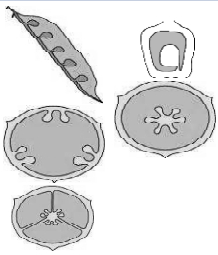
(N/A) Placentation refers to the arrangement of ovules within the ovary. It is of five basic types:
$(A)$ Marginal placentation:
The placenta forms a ridge along the ventral suture of the ovary,and the ovules are borne on this ridge,forming two rows. This is found in peas.
$(B)$ Parietal placentation:
When the ovules develop on the inner wall of the ovary or on the peripheral part,it is called parietal placentation.
$(C)$ Axile placentation:
In axile placentation,the placenta is axial and the ovules are attached to it in a multilocular ovary. Examples include China rose,tomato,and lemon.
$(D)$ Basal placentation:
The placenta develops at the base of the ovary,and a single ovule is attached to it. It is found in sunflower and marigold.
$(E)$ Free central placentation:
In free central placentation,the ovules are borne on the central axis,and septa are absent. This is found in Dianthus and primrose.
$(A)$ Marginal placentation:
The placenta forms a ridge along the ventral suture of the ovary,and the ovules are borne on this ridge,forming two rows. This is found in peas.
$(B)$ Parietal placentation:
When the ovules develop on the inner wall of the ovary or on the peripheral part,it is called parietal placentation.
$(C)$ Axile placentation:
In axile placentation,the placenta is axial and the ovules are attached to it in a multilocular ovary. Examples include China rose,tomato,and lemon.
$(D)$ Basal placentation:
The placenta develops at the base of the ovary,and a single ovule is attached to it. It is found in sunflower and marigold.
$(E)$ Free central placentation:
In free central placentation,the ovules are borne on the central axis,and septa are absent. This is found in Dianthus and primrose.
0 likes
View Solution233
Medium
Describe the arrangement of floral members in relation to their insertion on the thalamus.
Solution
(N/A) Based on the position of the calyx,corolla,and androecium with respect to the ovary on the thalamus,flowers are classified into three types:
$1$. Hypogynous: In these flowers,the gynoecium occupies the highest position while the other floral parts are situated below it. The ovary is said to be superior. Examples: $China$ $rose$,$mustard$,and $brinjal$.
$2$. Perigynous: In these flowers,the gynoecium is situated at the center and other floral parts are arranged on the rim of the thalamus at the same level. The ovary is said to be half-inferior. Examples: $Plum$,$rose$,and $peach$.
$3$. Epigynous: In these flowers,the margin of the thalamus grows upward enclosing the ovary completely and getting fused with it. The other floral parts arise above the ovary. The ovary is said to be inferior. Examples: $Guava$,$cucumber$,and the ray florets of $sunflower$.
$1$. Hypogynous: In these flowers,the gynoecium occupies the highest position while the other floral parts are situated below it. The ovary is said to be superior. Examples: $China$ $rose$,$mustard$,and $brinjal$.
$2$. Perigynous: In these flowers,the gynoecium is situated at the center and other floral parts are arranged on the rim of the thalamus at the same level. The ovary is said to be half-inferior. Examples: $Plum$,$rose$,and $peach$.
$3$. Epigynous: In these flowers,the margin of the thalamus grows upward enclosing the ovary completely and getting fused with it. The other floral parts arise above the ovary. The ovary is said to be inferior. Examples: $Guava$,$cucumber$,and the ray florets of $sunflower$.
0 likes
View Solution234
Easy
Define the following term: Placentation.
Solution
(N/A) Placentation refers to the arrangement of ovules within the ovary of a flower.
It is primarily classified into five types: marginal,basal,parietal,axile,and free central.
It is primarily classified into five types: marginal,basal,parietal,axile,and free central.
0 likes
View Solution235
Easy
Define the following term: Actinomorphic.
Solution
(N/A) Actinomorphic: Actinomorphic flowers are those that can be divided into two equal radial halves by any radial plane passing through the central axis of the flower. This type of symmetry is known as radial symmetry. Examples of actinomorphic flowers include mustard,datura,and chilli.
0 likes
View Solution236
Easy
Define the following term: Zygomorphic.
Solution
(N/A) Zygomorphic flowers are those flowers which can be divided into two similar halves by only a single vertical plane. This type of symmetry is known as bilateral symmetry. Examples of zygomorphic flowers include pea,bean,Cassia,and Gulmohur.
0 likes
View Solution237
Easy
Define the following term: Superior ovary.
Solution
(N/A) $Superior$ $ovary$ is a condition in flowers where the $gynoecium$ occupies the highest position,while the other floral parts (sepals,petals,and stamens) are situated below it. $A$ flower exhibiting this arrangement is termed as $hypogynous$. Examples of plants with a $superior$ $ovary$ include $brinjal$,$mustard$,and $China$ $rose$.
0 likes
View Solution238
Easy
Define the following term: Perigynous flower.
Solution
(N/A) Perigynous flower:
In perigynous flowers,the gynoecium is situated in the centre,and the other floral parts (sepals,petals,and stamens) are arranged at the rim of the thalamus at approximately the same level.
The ovary in such flowers is said to be half-inferior.
Examples include $Plum$,$Rose$,and $Peach$.
In perigynous flowers,the gynoecium is situated in the centre,and the other floral parts (sepals,petals,and stamens) are arranged at the rim of the thalamus at approximately the same level.
The ovary in such flowers is said to be half-inferior.
Examples include $Plum$,$Rose$,and $Peach$.
0 likes
View Solution239
Easy
Define the following term:
$Epipetalous$ $Stamen$
$Epipetalous$ $Stamen$
Solution
(N/A) $Epipetalous$ $Stamen$:
When stamens are attached to the petals,they are called $Epipetalous$ stamens.
This condition is commonly observed in plants like brinjal ($Solanum$ $melongena$).
When stamens are attached to the petals,they are called $Epipetalous$ stamens.
This condition is commonly observed in plants like brinjal ($Solanum$ $melongena$).
0 likes
View Solution240
Medium
Differentiate between apocarpous and syncarpous ovary.
Solution
(N/A)
| Apocarpous ovary | Syncarpous ovary |
|---|---|
| $(1)$ The flowers with an apocarpous ovary have more than one carpel,and these carpels are free. | $(1)$ The flowers with a syncarpous ovary have more than one carpel,but these carpels are fused together. |
| $(2)$ Examples include lotus and rose flowers. | $(2)$ Examples include tomato and mustard flowers. |
1 likes
View Solution241
Easy
Describe the parts of a typical flower.
Solution
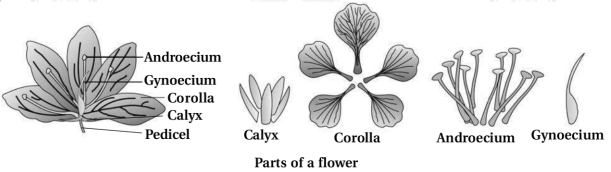
(N/A) Parts of a flower in Angiosperms :
$\rightarrow$ $A$ flower is the reproductive unit in angiosperms,meant for sexual reproduction.
$\rightarrow$ It has a central axis and is attached to the plant by a stalk called the pedicel.
$\rightarrow$ The swollen end of the pedicel is called the thalamus (or receptacle). Four different kinds of whorls are arranged successively on it.
$\rightarrow$ These are calyx,corolla,androecium,and gynoecium.
$\rightarrow$ Calyx and corolla are accessory organs,while androecium and gynoecium are reproductive organs.
$(i)$ Calyx: The outermost whorl of the flower,made up of sepals. Sepals are typically green and leaf-like,protecting the flower in the bud stage. Calyx can be gamosepalous (sepals united) or polysepalous (sepals free).
$(ii)$ Corolla: Located inside the calyx,composed of petals. Petals are often brightly colored and attractive to insects for pollination. Corolla can be polypetalous (petals free) or gamopetalous (petals united).
$\rightarrow$ Corolla exhibits a variety of shapes and colors,such as tube-shaped,bell-shaped,funnel-shaped,or wheel-shaped.
$\rightarrow$ $A$ flower containing both androecium and gynoecium is called a bisexual flower.
$\rightarrow$ $A$ flower having either only stamens or only carpels is called a unisexual flower.
$\rightarrow$ $A$ flower is the reproductive unit in angiosperms,meant for sexual reproduction.
$\rightarrow$ It has a central axis and is attached to the plant by a stalk called the pedicel.
$\rightarrow$ The swollen end of the pedicel is called the thalamus (or receptacle). Four different kinds of whorls are arranged successively on it.
$\rightarrow$ These are calyx,corolla,androecium,and gynoecium.
$\rightarrow$ Calyx and corolla are accessory organs,while androecium and gynoecium are reproductive organs.
$(i)$ Calyx: The outermost whorl of the flower,made up of sepals. Sepals are typically green and leaf-like,protecting the flower in the bud stage. Calyx can be gamosepalous (sepals united) or polysepalous (sepals free).
$(ii)$ Corolla: Located inside the calyx,composed of petals. Petals are often brightly colored and attractive to insects for pollination. Corolla can be polypetalous (petals free) or gamopetalous (petals united).
$\rightarrow$ Corolla exhibits a variety of shapes and colors,such as tube-shaped,bell-shaped,funnel-shaped,or wheel-shaped.
$\rightarrow$ $A$ flower containing both androecium and gynoecium is called a bisexual flower.
$\rightarrow$ $A$ flower having either only stamens or only carpels is called a unisexual flower.
0 likes
View Solution242
Medium
What is called Aestivation? Describe its types.
Solution
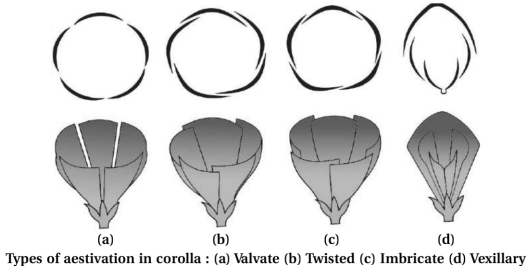
(N/A) The mode of arrangement of sepals or petals in a floral bud with respect to the other members of the same whorl is known as aestivation.
Its types are as follows:
$(i)$ Valvate: When sepals or petals in a whorl just touch one another at the margin,without overlapping,it is said to be valvate,e.g.,$Calotropis$.
$(ii)$ Twisted: If one margin of the appendage overlaps that of the next one and so on,it is called twisted,e.g.,China rose,Lady's finger,and Cotton.
$(iii)$ Imbricate: If the margins of sepals or petals overlap one another but not in any particular direction,the aestivation is called imbricate,e.g.,$Cassia$ and $Gulmohur$.
$(iv)$ Vexillary or Papilionaceous: In pea and bean flowers,there are five petals; the largest (standard) overlaps the two lateral petals (wings),which in turn overlap the two smallest anterior petals (keel). This type of aestivation is called vexillary or papilionaceous.
Its types are as follows:
$(i)$ Valvate: When sepals or petals in a whorl just touch one another at the margin,without overlapping,it is said to be valvate,e.g.,$Calotropis$.
$(ii)$ Twisted: If one margin of the appendage overlaps that of the next one and so on,it is called twisted,e.g.,China rose,Lady's finger,and Cotton.
$(iii)$ Imbricate: If the margins of sepals or petals overlap one another but not in any particular direction,the aestivation is called imbricate,e.g.,$Cassia$ and $Gulmohur$.
$(iv)$ Vexillary or Papilionaceous: In pea and bean flowers,there are five petals; the largest (standard) overlaps the two lateral petals (wings),which in turn overlap the two smallest anterior petals (keel). This type of aestivation is called vexillary or papilionaceous.
0 likes
View Solution243
Easy
On the basis of the number of stamens and their union,classify the types of stamens and provide examples.
Solution
(A-D) $\rightarrow$ The androecium is composed of stamens,which are the male reproductive organs of a flower.
$\rightarrow$ Each stamen consists of a filament and an anther.
$\rightarrow$ Based on the union of stamens,they are classified as follows:
$\rightarrow$ $1$. Polyandrous: When the stamens in a flower remain free,it is called polyandrous.
$\rightarrow$ $2$. Monoadelphous: When stamens are united into one bunch or bundle,it is called monoadelphous,e.g.,China rose.
$\rightarrow$ $3$. Diadelphous: When stamens are united into two bundles,it is called diadelphous,e.g.,pea.
$\rightarrow$ $4$. Polydelphous: When stamens are united into more than two bundles,it is called polydelphous,e.g.,citrus.
$\rightarrow$ Additionally,based on attachment: Epipetalous (attached to petals,e.g.,brinjal) and Epiphyllous (attached to perianth,e.g.,lily).
$\rightarrow$ Each stamen consists of a filament and an anther.
$\rightarrow$ Based on the union of stamens,they are classified as follows:
$\rightarrow$ $1$. Polyandrous: When the stamens in a flower remain free,it is called polyandrous.
$\rightarrow$ $2$. Monoadelphous: When stamens are united into one bunch or bundle,it is called monoadelphous,e.g.,China rose.
$\rightarrow$ $3$. Diadelphous: When stamens are united into two bundles,it is called diadelphous,e.g.,pea.
$\rightarrow$ $4$. Polydelphous: When stamens are united into more than two bundles,it is called polydelphous,e.g.,citrus.
$\rightarrow$ Additionally,based on attachment: Epipetalous (attached to petals,e.g.,brinjal) and Epiphyllous (attached to perianth,e.g.,lily).
0 likes
View Solution244
Medium
Describe the structure and types of Gynoecium.
Solution
(N/A) $\rightarrow$ Gynoecium: It is the female reproductive part of the flower and is made up of one or more carpels.
$\rightarrow$ $A$ carpel consists of three parts: ovary,style,and stigma.
$\rightarrow$ Ovary is the enlarged basal part,on which lies the elongated tube called the style.
$\rightarrow$ The style connects the ovary to the stigma.
$\rightarrow$ The stigma is usually at the tip of the style and serves as the receptive surface for pollen grains.
$\rightarrow$ Each ovary bears one or more ovules attached to a flattened,cushion-like placenta.
$\rightarrow$ Types of Gynoecium:
$\rightarrow$ When there is only one carpel in the Gynoecium,it is called monocarpellary,e.g.,$Peas$.
$\rightarrow$ When more than one carpel is present in the Gynoecium,it is called polycarpellary.
$\rightarrow$ In a polycarpellary Gynoecium,if all carpels are free from each other,it is called $Apocarpous$,e.g.,$Lotus$,$Rose$.
$\rightarrow$ If all carpels are fused,it is termed as $Syncarpous$. In such cases,there is only one ovary,e.g.,$Tomato$,$Mustard$.
$\rightarrow$ After fertilization,the ovules develop into seeds and the ovary matures into a fruit.
$\rightarrow$ $A$ carpel consists of three parts: ovary,style,and stigma.
$\rightarrow$ Ovary is the enlarged basal part,on which lies the elongated tube called the style.
$\rightarrow$ The style connects the ovary to the stigma.
$\rightarrow$ The stigma is usually at the tip of the style and serves as the receptive surface for pollen grains.
$\rightarrow$ Each ovary bears one or more ovules attached to a flattened,cushion-like placenta.
$\rightarrow$ Types of Gynoecium:
$\rightarrow$ When there is only one carpel in the Gynoecium,it is called monocarpellary,e.g.,$Peas$.
$\rightarrow$ When more than one carpel is present in the Gynoecium,it is called polycarpellary.
$\rightarrow$ In a polycarpellary Gynoecium,if all carpels are free from each other,it is called $Apocarpous$,e.g.,$Lotus$,$Rose$.
$\rightarrow$ If all carpels are fused,it is termed as $Syncarpous$. In such cases,there is only one ovary,e.g.,$Tomato$,$Mustard$.
$\rightarrow$ After fertilization,the ovules develop into seeds and the ovary matures into a fruit.
0 likes
View Solution245
Easy
What is placentation? Describe the types of placentation.
Solution
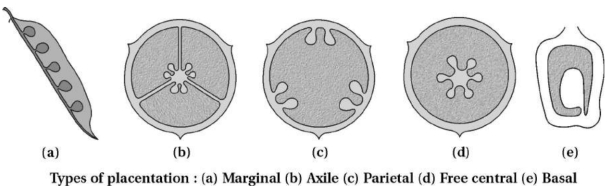
(N/A) $\rightarrow$ The ovary contains one or more ovules attached to a flattened,cushion-like structure called the placenta.
$\rightarrow$ The arrangement of ovules within the ovary is known as placentation.
$\rightarrow$ The types of placentation are as follows:
$(i)$ Marginal Placentation: In this type,the placenta forms a ridge along the ventral suture of the ovary,and the ovules are borne on this ridge in two rows,e.g.,pea,bean.
$(ii)$ Axile Placentation: When the placenta is axial and the ovules are attached to it in a multilocular ovary,it is called axile placentation,e.g.,china rose,tomato,and lemon.
$(iii)$ Parietal Placentation: In this type,the ovules develop on the inner wall of the ovary or on its peripheral part. The ovary is one-chambered but becomes two-chambered due to the formation of a false septum,e.g.,mustard and Argemone.
$(iv)$ Free Central Placentation: When the ovules are borne on a central axis and septa are absent,the ovary is one-chambered; this is called free central placentation,e.g.,Dianthus and primrose.
$(v)$ Basal Placentation: In this type,the placenta develops at the base of the ovary,and a single ovule is attached to it,e.g.,sunflower and wheat.
$\rightarrow$ The arrangement of ovules within the ovary is known as placentation.
$\rightarrow$ The types of placentation are as follows:
$(i)$ Marginal Placentation: In this type,the placenta forms a ridge along the ventral suture of the ovary,and the ovules are borne on this ridge in two rows,e.g.,pea,bean.
$(ii)$ Axile Placentation: When the placenta is axial and the ovules are attached to it in a multilocular ovary,it is called axile placentation,e.g.,china rose,tomato,and lemon.
$(iii)$ Parietal Placentation: In this type,the ovules develop on the inner wall of the ovary or on its peripheral part. The ovary is one-chambered but becomes two-chambered due to the formation of a false septum,e.g.,mustard and Argemone.
$(iv)$ Free Central Placentation: When the ovules are borne on a central axis and septa are absent,the ovary is one-chambered; this is called free central placentation,e.g.,Dianthus and primrose.
$(v)$ Basal Placentation: In this type,the placenta develops at the base of the ovary,and a single ovule is attached to it,e.g.,sunflower and wheat.
0 likes
View Solution246
MediumMCQ
Explain the types of gynoecium based on the number and arrangement of carpels.
A
Monocarpellary
B
Bicarpellary
C
Apocarpous
D
Syncarpous
Solution
(A-D) The gynoecium is the female reproductive part of a flower,consisting of one or more carpels. It is classified based on two criteria:
$1$. Based on the number of carpels:
- $Monocarpellary$: The gynoecium consists of a single carpel (e.g.,pea).
- $Bicarpellary$: The gynoecium consists of two carpels.
- $Tricarpellary$: The gynoecium consists of three carpels.
- $Multicarpellary$ or $Polycarpellary$: The gynoecium consists of many carpels.
$2$. Based on the fusion of carpels:
- $Apocarpous$: When carpels are free (e.g.,rose,lotus).
- $Syncarpous$: When carpels are fused together (e.g.,tomato,mustard).
$1$. Based on the number of carpels:
- $Monocarpellary$: The gynoecium consists of a single carpel (e.g.,pea).
- $Bicarpellary$: The gynoecium consists of two carpels.
- $Tricarpellary$: The gynoecium consists of three carpels.
- $Multicarpellary$ or $Polycarpellary$: The gynoecium consists of many carpels.
$2$. Based on the fusion of carpels:
- $Apocarpous$: When carpels are free (e.g.,rose,lotus).
- $Syncarpous$: When carpels are fused together (e.g.,tomato,mustard).
0 likes
View Solution247
Medium
Definitions / Explanation :
$(i)$ Hypogynous flower / Superior ovary
$(ii)$ Scutellum
$(i)$ Hypogynous flower / Superior ovary
$(ii)$ Scutellum
Solution
(N/A) $(i)$ In a hypogynous flower,the thalamus becomes cone-shaped,so the ovary is placed at the top. Such an ovary is called a superior ovary,and all other floral parts (sepals,petals,and stamens) are produced from below the ovary.
$(ii)$ In monocotyledonous plants,the embryonal region consists of one large and shield-shaped cotyledon,which is known as the scutellum.
$(ii)$ In monocotyledonous plants,the embryonal region consists of one large and shield-shaped cotyledon,which is known as the scutellum.
0 likes
View Solution248
Easy
$A$ typical angiosperm flower consists of four floral parts. Give the names of the floral parts and their arrangements sequentially.
Solution
(N/A) typical angiosperm flower consists of four whorls arranged sequentially from the outermost to the innermost as follows:
$(a)$ Calyx: It is the outermost whorl of the flower. Its individual units are called sepals. They are generally green in color and protect the flower in the bud stage.
$(b)$ Corolla: It is the second whorl,composed of petals. They are often brightly colored to attract insects for pollination.
$(c)$ Androecium: It is the third whorl,composed of stamens. It is the male reproductive organ. Each stamen consists of a filament (stalk) and an anther,which contains pollen sacs and pollen grains.
$(d)$ Gynoecium: It is the innermost whorl,composed of one or more carpels (pistils). It is the female reproductive organ,consisting of the ovary,style,and stigma.
$(a)$ Calyx: It is the outermost whorl of the flower. Its individual units are called sepals. They are generally green in color and protect the flower in the bud stage.
$(b)$ Corolla: It is the second whorl,composed of petals. They are often brightly colored to attract insects for pollination.
$(c)$ Androecium: It is the third whorl,composed of stamens. It is the male reproductive organ. Each stamen consists of a filament (stalk) and an anther,which contains pollen sacs and pollen grains.
$(d)$ Gynoecium: It is the innermost whorl,composed of one or more carpels (pistils). It is the female reproductive organ,consisting of the ovary,style,and stigma.
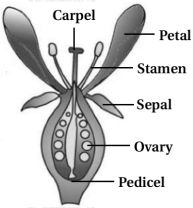
0 likes
View Solution249
Easy
The arrangement of ovules within the ovary is known as placentation. What does the term placenta refer to? Describe the various types of placentation found in flowers.
Solution
(N/A) $\Rightarrow$ The placenta is a soft,cushion-like tissue within the ovary to which the ovules are attached.
$\Rightarrow$ The arrangement of ovules within the ovary is known as placentation. The major types of placentation are marginal,axile,parietal,free central,and basal.
$\Rightarrow$ Marginal Placentation: In this type,the placenta forms a ridge along the ventral suture of the ovary,and the ovules are borne on this ridge in two rows,as seen in pea.
$\Rightarrow$ Axile Placentation: In this type,the placenta is axial and the ovules are attached to it in a multilocular ovary,as seen in China rose,tomato,and lemon.
$\Rightarrow$ Parietal Placentation: In this type,the ovules develop on the inner wall of the ovary or on the peripheral part. The ovary is one-chambered but may become two-chambered due to the formation of a false septum,as seen in mustard and Argemone.
$\Rightarrow$ Free Central Placentation: In this type,the ovules are borne on a central axis,and septa are absent,making the ovary one-chambered,as seen in Dianthus and Primula.
$\Rightarrow$ Basal Placentation: In this type,the placenta develops at the base of the ovary,and a single ovule is attached to it,as seen in sunflower and marigold.
$\Rightarrow$ The arrangement of ovules within the ovary is known as placentation. The major types of placentation are marginal,axile,parietal,free central,and basal.
$\Rightarrow$ Marginal Placentation: In this type,the placenta forms a ridge along the ventral suture of the ovary,and the ovules are borne on this ridge in two rows,as seen in pea.
$\Rightarrow$ Axile Placentation: In this type,the placenta is axial and the ovules are attached to it in a multilocular ovary,as seen in China rose,tomato,and lemon.
$\Rightarrow$ Parietal Placentation: In this type,the ovules develop on the inner wall of the ovary or on the peripheral part. The ovary is one-chambered but may become two-chambered due to the formation of a false septum,as seen in mustard and Argemone.
$\Rightarrow$ Free Central Placentation: In this type,the ovules are borne on a central axis,and septa are absent,making the ovary one-chambered,as seen in Dianthus and Primula.
$\Rightarrow$ Basal Placentation: In this type,the placenta develops at the base of the ovary,and a single ovule is attached to it,as seen in sunflower and marigold.
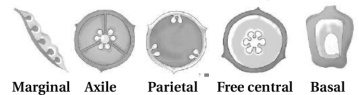
0 likes
View Solution250
Medium
Suggest a possible explanation why the seeds in a pea pod are arranged in a row,whereas those in tomato are scattered in the juicy pulp.
Solution
(N/A) The arrangement of seeds within a fruit is determined by the placentation type in the ovary of the flower.
$1$. In pea plants,the ovary has a single carpel (monocarpellary) with marginal placentation. The ovules are attached to the placenta along the ventral suture,resulting in a linear,row-like arrangement of seeds.
$2$. In tomato plants,the ovary is multicarpellary and syncarpous with axile placentation. The ovules are attached to a central axis in a multilocular ovary. As the fruit matures,the internal partitions may become less distinct,and the seeds appear scattered within the fleshy,juicy pulp of the fruit.
$1$. In pea plants,the ovary has a single carpel (monocarpellary) with marginal placentation. The ovules are attached to the placenta along the ventral suture,resulting in a linear,row-like arrangement of seeds.
$2$. In tomato plants,the ovary is multicarpellary and syncarpous with axile placentation. The ovules are attached to a central axis in a multilocular ovary. As the fruit matures,the internal partitions may become less distinct,and the seeds appear scattered within the fleshy,juicy pulp of the fruit.
0 likes
View SolutionMorphology of Flowering Plants — Flower · Frequently Asked Questions
1Are these Morphology of Flowering Plants questions useful for JEE and NEET?
Yes. All questions in this section are mapped to JEE Main and NEET exam patterns. Previous year questions from JEE Main, NEET, GUJCET and state-level exams are included with full solutions.
2Can I switch to Hindi or Gujarati for these questions?
Yes. Use the language tabs in the hero section or the sidebar to view the same questions and solutions in English, Hindi or Gujarati.
3How do I generate a question paper from this subtopic?
Use the Vedclass Exam Paper Generator — select the chapter and subtopic, set difficulty, and generate Sets A, B, C, D automatically. First 3 chapters of every subject are free.
Vedclass Products
For Students
Vedclass Test Series
Mock tests in real JEE/NEET style with performance analysis. 5-day free trial.
Start Free TrialFor Teachers
Exam Paper Generator
Generate Set A/B/C/D papers from this chapter in 2 minutes. 3 chapters free.
Try FreeFor Institutes
Online Exam Module
Live online exams with unlimited students, 360° analytics & white-label branding.
See DemoFor Teachers & Institutes
Generate a Morphology of Flowering Plants Exam Paper in 2 Minutes
Select subtopic & difficulty — Sets A, B, C, D auto-generated with No Repeat logic.
First 3 chapters of every subject are free — no payment required.