
A English
Double Circulation and Circulatory pathway Questions in English
Class 11 Biology · Body Fluids and Circulations · Double Circulation and Circulatory pathway
116+
Questions
English
Language
100%
With Solutions
Showing 50 of 116 questions in English
51
MediumMCQ
Which one of the following animals has two separate circulatory pathways?
A
Whale
B
Shark
C
Frog
D
Lizard
Solution
(A) Whale is a mammal,and in mammals,two separate circulatory pathways are found: systemic circulation and pulmonary circulation.
Oxygenated and deoxygenated blood received by the left and right atria respectively pass on to the left and right ventricles.
Thus,oxygenated and deoxygenated bloods are not mixed.
This is referred to as double circulation,which is a characteristic feature of mammals,birds,and crocodiles.
Oxygenated and deoxygenated blood received by the left and right atria respectively pass on to the left and right ventricles.
Thus,oxygenated and deoxygenated bloods are not mixed.
This is referred to as double circulation,which is a characteristic feature of mammals,birds,and crocodiles.
0 likes
View Solution52
MediumMCQ
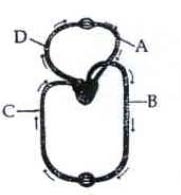
The figure shows blood circulation in humans with labels $A$ to $D$. Select the option which gives correct identification of label and functions of the part.
A
$B$ - Capillary: Thin,without muscle layer and wall is one cell layer thick.
B
$C$ - Vein: Thin-walled and blood flows in jerks/spurts.
C
$D$ - Pulmonary vein: Takes oxygenated blood to heart,$pO_2 = 95 \ mm \ Hg$.
D
$A$ - Artery: Thick-walled and blood flows evenly.
Solution
(C) - Pulmonary Artery: Carries deoxygenated blood from the heart to the lungs. It is thick-walled.
$B$ - Systemic Artery: Carries oxygenated blood from the heart to different body parts. It is thick-walled and elastic. The flow of blood in it is intermittent.
$C$ - Systemic Vein: Brings deoxygenated blood from different body parts to the heart. It is thin-walled and acts as a low-resistance conduit for blood flow.
$D$ - Pulmonary Vein: Transports oxygenated blood from the lungs to the left atrium. The partial pressure of oxygen $(pO_2)$ in the pulmonary vein is approximately $95 \ mm \ Hg$.
$B$ - Systemic Artery: Carries oxygenated blood from the heart to different body parts. It is thick-walled and elastic. The flow of blood in it is intermittent.
$C$ - Systemic Vein: Brings deoxygenated blood from different body parts to the heart. It is thin-walled and acts as a low-resistance conduit for blood flow.
$D$ - Pulmonary Vein: Transports oxygenated blood from the lungs to the left atrium. The partial pressure of oxygen $(pO_2)$ in the pulmonary vein is approximately $95 \ mm \ Hg$.
0 likes
View Solution53
MediumMCQ
Incomplete double circulation is found in
A
Aves
B
Mammals
C
Amphibians
D
Arthropods
Solution
(C) Incomplete double circulation is a characteristic feature of $Amphibians$ and most $Reptiles$ (except crocodiles).
In these organisms, the heart is $3$-chambered, consisting of two atria and one ventricle.
The oxygenated blood from the lungs/skin and deoxygenated blood from the body are mixed in the single ventricle before being pumped out.
This mixing of blood results in an incomplete double circulation.
In these organisms, the heart is $3$-chambered, consisting of two atria and one ventricle.
The oxygenated blood from the lungs/skin and deoxygenated blood from the body are mixed in the single ventricle before being pumped out.
This mixing of blood results in an incomplete double circulation.
0 likes
View Solution54
MediumMCQ
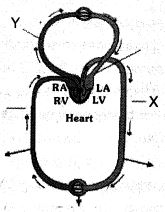
Identify $X$ and $Y$ in the given schematic diagram of blood circulation.
A
$X -$ Pulmonary vein,$Y -$ Artery
B
$X -$ Vena cava,$Y -$ Capillary
C
$X -$ Dorsal aorta,$Y -$ Pulmonary artery
D
$X -$ Vena cava,$Y -$ Dorsal aorta
Solution
(C) In the provided schematic diagram of double circulation:
$X$ represents the Dorsal aorta,which carries oxygenated blood from the left ventricle $(LV)$ to the systemic tissues.
$Y$ represents the Pulmonary artery,which carries deoxygenated blood from the right ventricle $(RV)$ to the lungs for oxygenation.
Therefore,the correct identification is $X -$ Dorsal aorta and $Y -$ Pulmonary artery.
$X$ represents the Dorsal aorta,which carries oxygenated blood from the left ventricle $(LV)$ to the systemic tissues.
$Y$ represents the Pulmonary artery,which carries deoxygenated blood from the right ventricle $(RV)$ to the lungs for oxygenation.
Therefore,the correct identification is $X -$ Dorsal aorta and $Y -$ Pulmonary artery.
0 likes
View Solution55
MediumMCQ
Which circulatory system is absent in humans?
A
Heart-circulatory system
B
Pulmonary circulatory system
C
Renal portal system
D
Hepatic portal system
Solution
(C) portal system is a system of blood vessels in which blood collected from one capillary bed is transported to another capillary bed before returning to the heart.
In humans, the $Hepatic$ $portal$ $system$ is present, which carries blood from the digestive tract to the liver.
The $Renal$ $portal$ $system$ is a system where blood from the hind limbs or tail is transported to the kidneys before returning to the heart.
This system is present in lower vertebrates like amphibians and reptiles but is absent in humans and other mammals.
In humans, the $Hepatic$ $portal$ $system$ is present, which carries blood from the digestive tract to the liver.
The $Renal$ $portal$ $system$ is a system where blood from the hind limbs or tail is transported to the kidneys before returning to the heart.
This system is present in lower vertebrates like amphibians and reptiles but is absent in humans and other mammals.
0 likes
View Solution56
MediumMCQ
In an open circulatory system:
A
There is no distinction between the blood and the tissue fluid.
B
Tissue fluid is absent.
C
There is no need for blood vessels.
D
Open spaces or sinuses are absent.
Solution
(A) In an open circulatory system,the blood is pumped out of the heart into open spaces or body cavities called sinuses.
Because the blood flows directly into these spaces and bathes the tissues,there is no clear distinction between the blood and the tissue fluid (interstitial fluid).
This mixture is often referred to as hemolymph.
Therefore,option $A$ is the correct statement.
Because the blood flows directly into these spaces and bathes the tissues,there is no clear distinction between the blood and the tissue fluid (interstitial fluid).
This mixture is often referred to as hemolymph.
Therefore,option $A$ is the correct statement.
0 likes
View Solution57
MediumMCQ
Which is the correct path for pulmonary circulation?
A
Left atria (oxygenated blood) $\rightarrow$ lungs (deoxygenated blood) $\rightarrow$ Right atria
B
Left atria (deoxygenated blood) $\rightarrow$ lungs (oxygenated blood) $\rightarrow$ right atria
C
Left atria (oxygenated blood) $\rightarrow$ lungs (deoxygenated blood) $\rightarrow$ left atria
D
Right atria (deoxygenated blood) $\rightarrow$ lungs (oxygenated blood) $\rightarrow$ left atria
Solution
(D) Pulmonary circulation is the pathway of blood circulation between the heart and the lungs.
In this process,deoxygenated blood is pumped from the right ventricle (which receives it from the right atrium) to the lungs via the pulmonary artery.
In the lungs,the blood becomes oxygenated through the exchange of gases.
This oxygenated blood then returns to the left atrium of the heart via the pulmonary veins.
Therefore,the correct path is: Right atria (deoxygenated blood) $\rightarrow$ lungs (oxygenated blood) $\rightarrow$ left atria.
In this process,deoxygenated blood is pumped from the right ventricle (which receives it from the right atrium) to the lungs via the pulmonary artery.
In the lungs,the blood becomes oxygenated through the exchange of gases.
This oxygenated blood then returns to the left atrium of the heart via the pulmonary veins.
Therefore,the correct path is: Right atria (deoxygenated blood) $\rightarrow$ lungs (oxygenated blood) $\rightarrow$ left atria.
0 likes
View Solution58
MediumMCQ
The hepatic portal vein carries blood from which organ to the liver?
A
Stomach
B
Duodenum
C
Intestine
D
Oesophagus
Solution
(C) The hepatic portal system is a specialized vascular connection between the digestive tract and the liver.
It collects blood from the gastrointestinal tract (specifically the stomach,intestines,pancreas,and spleen) and transports it directly to the liver via the hepatic portal vein.
This allows the liver to process nutrients,toxins,and other substances absorbed from the digestive system before the blood enters the general systemic circulation.
Among the given options,the intestine is the primary site from which the hepatic portal vein carries nutrient-rich blood to the liver.
It collects blood from the gastrointestinal tract (specifically the stomach,intestines,pancreas,and spleen) and transports it directly to the liver via the hepatic portal vein.
This allows the liver to process nutrients,toxins,and other substances absorbed from the digestive system before the blood enters the general systemic circulation.
Among the given options,the intestine is the primary site from which the hepatic portal vein carries nutrient-rich blood to the liver.
0 likes
View Solution59
MediumMCQ
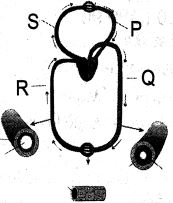
Which alphabet indicates the dorsal aorta in the given diagram?
A
$P$
B
$R$
C
$Q$
D
$S$
Solution
(C) In the provided schematic diagram of human blood circulation:
$P$ and $S$ represent the pulmonary circulation (pulmonary artery and vein).
$Q$ represents the systemic aorta (dorsal aorta),which carries oxygenated blood from the left ventricle to the rest of the body.
$R$ represents the vena cava,which returns deoxygenated blood from the body tissues to the right atrium.
Therefore,the alphabet $Q$ indicates the dorsal aorta.
$P$ and $S$ represent the pulmonary circulation (pulmonary artery and vein).
$Q$ represents the systemic aorta (dorsal aorta),which carries oxygenated blood from the left ventricle to the rest of the body.
$R$ represents the vena cava,which returns deoxygenated blood from the body tissues to the right atrium.
Therefore,the alphabet $Q$ indicates the dorsal aorta.
0 likes
View Solution60
MediumMCQ
Amphibians and reptiles receive blood in the left atrium from......
A
Body parts
B
Gills/lungs/skin
C
Right atrium
D
None of the above
Solution
(B) In amphibians and reptiles (except crocodiles),the heart is $3$-chambered,consisting of two atria and one ventricle.
In these organisms,the left atrium receives oxygenated blood from the respiratory organs,which include the lungs,skin,or gills (depending on the species and environmental conditions).
The right atrium receives deoxygenated blood from the rest of the body.
Therefore,the correct source for the blood entering the left atrium is the respiratory surfaces.
In these organisms,the left atrium receives oxygenated blood from the respiratory organs,which include the lungs,skin,or gills (depending on the species and environmental conditions).
The right atrium receives deoxygenated blood from the rest of the body.
Therefore,the correct source for the blood entering the left atrium is the respiratory surfaces.
0 likes
View Solution61
EasyMCQ
The hepatic portal vein carries blood to the liver from the ..........
A
Heart
B
Kidneys
C
Lungs
D
Intestine
Solution
(D) The hepatic portal system is a unique vascular connection that exists between the digestive tract and the liver.
The hepatic portal vein collects blood from the digestive organs,specifically the stomach,intestines,pancreas,and spleen,and transports it directly to the liver for processing,detoxification,and nutrient regulation before it enters the systemic circulation.
Therefore,the correct option is $D$.
The hepatic portal vein collects blood from the digestive organs,specifically the stomach,intestines,pancreas,and spleen,and transports it directly to the liver for processing,detoxification,and nutrient regulation before it enters the systemic circulation.
Therefore,the correct option is $D$.
0 likes
View Solution62
EasyMCQ
Closed circulatory system is found in $..........$.
A
Cockroach
B
Tadpole/Fish
C
Mosquito
D
Housefly
Solution
(B) In a closed circulatory system,blood is pumped by the heart into vessels that are separate from the interstitial fluid of the body.
Vertebrates,such as fish,amphibians (tadpoles),reptiles,birds,and mammals,possess a closed circulatory system.
In contrast,arthropods like cockroaches,mosquitoes,and houseflies possess an open circulatory system,where blood flows into open spaces called sinuses or hemocoel.
Vertebrates,such as fish,amphibians (tadpoles),reptiles,birds,and mammals,possess a closed circulatory system.
In contrast,arthropods like cockroaches,mosquitoes,and houseflies possess an open circulatory system,where blood flows into open spaces called sinuses or hemocoel.
0 likes
View Solution63
MediumMCQ
Which of the following animals possesses two distinct circulatory pathways?
A
Shark
B
Frog
C
Lizard
D
Whale
Solution
(D) In animals,a double circulatory system involves two distinct pathways: the pulmonary circulation (heart to lungs and back) and the systemic circulation (heart to body tissues and back).
Among the given options,the $Shark$ has a single circulation (blood passes through the heart only once per cycle).
$Frog$ and $Lizard$ have an incomplete double circulation (three-chambered hearts).
$Whale$ is a mammal,which possesses a four-chambered heart and exhibits a complete double circulatory system,ensuring that oxygenated and deoxygenated blood do not mix.
Among the given options,the $Shark$ has a single circulation (blood passes through the heart only once per cycle).
$Frog$ and $Lizard$ have an incomplete double circulation (three-chambered hearts).
$Whale$ is a mammal,which possesses a four-chambered heart and exhibits a complete double circulatory system,ensuring that oxygenated and deoxygenated blood do not mix.
0 likes
View Solution64
Medium
What is meant by double circulation? What is its significance?
Solution
(N/A) Double circulation is a process during which blood passes twice through the heart during one complete cycle. This type of circulation is found in amphibians,reptiles,birds,and mammals. In birds and mammals,the heart is completely divided into four chambers: the right atrium,the right ventricle,the left atrium,and the left ventricle.
The movement of blood is divided into two parts:
$1$. Systemic circulation: It involves the movement of oxygenated blood from the left ventricle to the aorta,which distributes it to the tissues. Deoxygenated blood is then collected by veins and returned to the right atrium.
$2$. Pulmonary circulation: It involves the movement of deoxygenated blood from the right ventricle to the pulmonary artery,which carries it to the lungs for oxygenation. Oxygenated blood is then returned to the left atrium via pulmonary veins.
Significance of double circulation:
The separation of oxygenated and deoxygenated blood allows for a more efficient supply of oxygen to the body cells. It ensures that the tissues receive highly oxygenated blood,which is essential for maintaining high metabolic rates in birds and mammals.
The movement of blood is divided into two parts:
$1$. Systemic circulation: It involves the movement of oxygenated blood from the left ventricle to the aorta,which distributes it to the tissues. Deoxygenated blood is then collected by veins and returned to the right atrium.
$2$. Pulmonary circulation: It involves the movement of deoxygenated blood from the right ventricle to the pulmonary artery,which carries it to the lungs for oxygenation. Oxygenated blood is then returned to the left atrium via pulmonary veins.
Significance of double circulation:
The separation of oxygenated and deoxygenated blood allows for a more efficient supply of oxygen to the body cells. It ensures that the tissues receive highly oxygenated blood,which is essential for maintaining high metabolic rates in birds and mammals.
0 likes
View Solution65
Medium
Write the differences between open and closed systems of circulation.
Solution
(N/A) The differences between open and closed systems of circulation are as follows:
| Open System of Circulation | Closed System of Circulation |
|---|---|
| $(1)$ In this system,blood is pumped by the heart through large vessels into body cavities called sinuses. | $(1)$ In this system,blood is pumped by the heart through a closed network of vessels. |
| $(2)$ The body tissues are in direct contact with blood. | $(2)$ The body tissues are not in direct contact with blood. |
| $(3)$ Blood flows at low pressure; hence,it is a slower and less efficient system. | $(3)$ Blood flows at high pressure; hence,it is a faster and more efficient system. |
| $(4)$ The flow of blood is not regulated through the tissues and organs. | $(4)$ The flow of blood can be regulated by valves and vessel constriction. |
| $(5)$ This system is present in arthropods and molluscs. | $(5)$ This system is present in annelids,echinoderms,and vertebrates. |
0 likes
View Solution66
Easy
Explain in short the mechanism of circulation in living organisms.
Solution
(N/A) All living cells require a constant supply of nutrients,$O_{2}$,and other essential substances to survive. Simultaneously,metabolic waste products must be removed from these cells.
To facilitate this,organisms have evolved various transport mechanisms:
$(i)$ Simple organisms like sponges and coelenterates circulate water from their surroundings through their body cavities,allowing cells to exchange substances directly with the water.
$(ii)$ More complex organisms utilize specialized body fluids to transport materials efficiently throughout the body.
$(iii)$ In higher organisms,including humans,blood and lymph serve as the primary body fluids for the transport of nutrients,gases,and waste products.
To facilitate this,organisms have evolved various transport mechanisms:
$(i)$ Simple organisms like sponges and coelenterates circulate water from their surroundings through their body cavities,allowing cells to exchange substances directly with the water.
$(ii)$ More complex organisms utilize specialized body fluids to transport materials efficiently throughout the body.
$(iii)$ In higher organisms,including humans,blood and lymph serve as the primary body fluids for the transport of nutrients,gases,and waste products.
0 likes
View Solution67
Medium
Give information about open and closed types of circulatory pathways.
Solution
(N/A) There are two types or patterns of circulatory pathways: $(i)$ Open circulatory system,$(ii)$ Closed circulatory system.
$(i)$ Open circulatory system: In this type of circulatory system,blood is transported through partial blood vessels and partial blood spaces. In this circulation,the heart pumps the blood into blood vessels,and from there,blood flows into body cavities called sinuses. This blood eventually returns to the heart. There are no blood capillaries present in this system.
This type of circulatory system is present in Arthropods and Molluscs.
$(ii)$ Closed circulatory system: The blood flows by being pumped through the heart into various blood vessels. Blood vessels form a complex network throughout the body. Valves are located to ensure the one-directional flow of blood.
Annelids and Chordates have a closed circulatory system.
This pattern of circulatory system is considered to be more advantageous as the flow of fluid can be more precisely regulated.
$(i)$ Open circulatory system: In this type of circulatory system,blood is transported through partial blood vessels and partial blood spaces. In this circulation,the heart pumps the blood into blood vessels,and from there,blood flows into body cavities called sinuses. This blood eventually returns to the heart. There are no blood capillaries present in this system.
This type of circulatory system is present in Arthropods and Molluscs.
$(ii)$ Closed circulatory system: The blood flows by being pumped through the heart into various blood vessels. Blood vessels form a complex network throughout the body. Valves are located to ensure the one-directional flow of blood.
Annelids and Chordates have a closed circulatory system.
This pattern of circulatory system is considered to be more advantageous as the flow of fluid can be more precisely regulated.
0 likes
View Solution68
Medium
Discuss the circulatory system in various vertebrates and the gradual development of the heart.
Solution
(N/A) All vertebrates possess a muscular,chambered heart.
$(1)$ Fishes have a $2$-chambered heart with one atrium and one ventricle. In fishes,the heart pumps deoxygenated blood to the gills,where it is oxygenated and then supplied to the body parts. Deoxygenated blood is then returned to the heart. This is known as single circulation.
$(2)$ In amphibians and reptiles (except crocodiles),there is a $3$-chambered heart with two atria and one ventricle.
$(3)$ In these organisms,the left atrium receives oxygenated blood from the gills/lungs/skin,and the right atrium receives deoxygenated blood from other body parts. However,these blood streams mix in the single ventricle,which pumps out mixed blood. This is known as incomplete double circulation.
$(4)$ Crocodiles,birds,and mammals possess a $4$-chambered heart with two atria and two ventricles.
$(5)$ In birds and mammals,oxygenated and deoxygenated blood received by the left and right atria,respectively,pass into the ventricles of the same side. The ventricles pump the blood out without any mixing. Thus,two separate circulatory pathways are present,known as complete double circulation.
$(1)$ Fishes have a $2$-chambered heart with one atrium and one ventricle. In fishes,the heart pumps deoxygenated blood to the gills,where it is oxygenated and then supplied to the body parts. Deoxygenated blood is then returned to the heart. This is known as single circulation.
$(2)$ In amphibians and reptiles (except crocodiles),there is a $3$-chambered heart with two atria and one ventricle.
$(3)$ In these organisms,the left atrium receives oxygenated blood from the gills/lungs/skin,and the right atrium receives deoxygenated blood from other body parts. However,these blood streams mix in the single ventricle,which pumps out mixed blood. This is known as incomplete double circulation.
$(4)$ Crocodiles,birds,and mammals possess a $4$-chambered heart with two atria and two ventricles.
$(5)$ In birds and mammals,oxygenated and deoxygenated blood received by the left and right atria,respectively,pass into the ventricles of the same side. The ventricles pump the blood out without any mixing. Thus,two separate circulatory pathways are present,known as complete double circulation.
0 likes
View Solution69
Easy
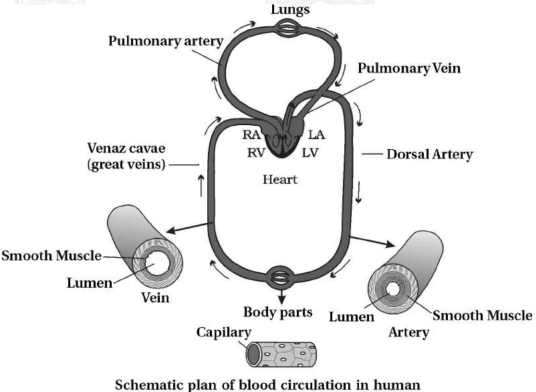
What is called double circulation? Explain the pathway of double circulation with a diagram.
Solution
(N/A) Human circulatory system is made up of a network of the heart,various types of ducts,arteries,veins,and capillaries.
In human circulation,the circulation of oxygenated and deoxygenated blood is carried out separately. Therefore,it is called double circulation.
The blood pumped by the right ventricle enters the pulmonary artery,whereas the left ventricle pumps the blood into the aorta.
The deoxygenated blood pumped into the pulmonary artery is passed on to the lungs,from where the oxygenated blood is carried by the pulmonary veins into the left atrium.
This pathway constitutes the pulmonary circulation.
This oxygenated blood entering the aorta is carried by a network of arteries,arterioles,and capillaries to the tissues,from where the deoxygenated blood is collected by a system of venules,veins,and vena cava and emptied into the right atrium.
This is the systemic circulation.
The systemic circulation provides nutrients,$O_{2}$,and other essential substances to the tissues and takes $CO_{2}$ and other harmful substances away for elimination.
$A$ unique vascular connection exists between the digestive tract and the liver called the hepatic portal system. The hepatic portal vein carries blood from the intestine to the liver before it is delivered to the systemic circulation.
$A$ special coronary system of blood vessels is present in our body exclusively for the circulation of blood to and from the cardiac musculature.
In human circulation,the circulation of oxygenated and deoxygenated blood is carried out separately. Therefore,it is called double circulation.
The blood pumped by the right ventricle enters the pulmonary artery,whereas the left ventricle pumps the blood into the aorta.
The deoxygenated blood pumped into the pulmonary artery is passed on to the lungs,from where the oxygenated blood is carried by the pulmonary veins into the left atrium.
This pathway constitutes the pulmonary circulation.
This oxygenated blood entering the aorta is carried by a network of arteries,arterioles,and capillaries to the tissues,from where the deoxygenated blood is collected by a system of venules,veins,and vena cava and emptied into the right atrium.
This is the systemic circulation.
The systemic circulation provides nutrients,$O_{2}$,and other essential substances to the tissues and takes $CO_{2}$ and other harmful substances away for elimination.
$A$ unique vascular connection exists between the digestive tract and the liver called the hepatic portal system. The hepatic portal vein carries blood from the intestine to the liver before it is delivered to the systemic circulation.
$A$ special coronary system of blood vessels is present in our body exclusively for the circulation of blood to and from the cardiac musculature.
0 likes
View Solution70
Easy
Give scientific reasons:
$(1)$ It is necessary to send blood from the right ventricle to the lungs.
$(2)$ The heart is called a double pump.
$(1)$ It is necessary to send blood from the right ventricle to the lungs.
$(2)$ The heart is called a double pump.
Solution
(N/A) $(1)$ Deoxygenated (impure) blood enters the right ventricle from the right atrium. This blood must be sent to the lungs via the pulmonary arteries for oxygenation. In the lungs,the blood releases $CO_{2}$ and absorbs $O_{2}$,becoming oxygenated (pure) before returning to the left atrium.
$(2)$ The heart is called a double pump because it performs two distinct pumping actions in one complete cardiac cycle. The right side of the heart pumps deoxygenated blood to the lungs for oxygenation (pulmonary circulation),while the left side of the heart pumps oxygenated blood to the rest of the body (systemic circulation). This separation ensures efficient transport of gases.
$(2)$ The heart is called a double pump because it performs two distinct pumping actions in one complete cardiac cycle. The right side of the heart pumps deoxygenated blood to the lungs for oxygenation (pulmonary circulation),while the left side of the heart pumps oxygenated blood to the rest of the body (systemic circulation). This separation ensures efficient transport of gases.
0 likes
View Solution71
Easy
Define/Explain the following terms:
$(i)$ Open circulatory system
$(ii)$ Closed circulatory system
$(i)$ Open circulatory system
$(ii)$ Closed circulatory system
Solution
(N/A) $(i)$ In an open circulatory system,blood is pumped out of the heart into body cavities (sinuses),and the cells and tissues are directly bathed in it.
$(ii)$ In a closed circulatory system,blood is circulated throughout the body exclusively through a network of vessels,including arteries,veins,and capillaries.
$(ii)$ In a closed circulatory system,blood is circulated throughout the body exclusively through a network of vessels,including arteries,veins,and capillaries.
0 likes
View Solution72
Medium
Differentiate between: Open circulatory system and closed circulatory system.
Solution
(N/A)
| Open circulatory system | Closed circulatory system |
|---|---|
| $(1)$ Blood flows in spaces called sinuses,and cells and tissues are directly bathed in blood. | $(1)$ Blood flows through a closed network of vessels (arteries,veins,and capillaries). |
| $(2)$ The flow of blood is slow and under low pressure. | $(2)$ The flow of blood is rapid and under high pressure. |
| $(3)$ Examples include Arthropods and most molluscs. | $(3)$ Examples include Annelids and all vertebrates. |
0 likes
View Solution73
Easy
Explain the advantage of the complete partition of the ventricle in birds and mammals,which leads to double circulation.
Solution
(N/A) In birds and mammals,the heart is four-chambered with a complete partition of the ventricles.
This structural adaptation ensures that deoxygenated blood is received by the right atrium and right ventricle,while oxygenated blood is received by the left atrium and left ventricle.
Because the ventricles are completely separated,there is no mixing of oxygenated and deoxygenated blood within the heart.
This separation allows for the formation of two independent circulatory pathways: the systemic circulation and the pulmonary circulation.
This efficient double circulation ensures that highly oxygenated blood is delivered to the tissues,which is essential for meeting the high energy demands required for maintaining a constant body temperature (endothermy) in these organisms.
This structural adaptation ensures that deoxygenated blood is received by the right atrium and right ventricle,while oxygenated blood is received by the left atrium and left ventricle.
Because the ventricles are completely separated,there is no mixing of oxygenated and deoxygenated blood within the heart.
This separation allows for the formation of two independent circulatory pathways: the systemic circulation and the pulmonary circulation.
This efficient double circulation ensures that highly oxygenated blood is delivered to the tissues,which is essential for meeting the high energy demands required for maintaining a constant body temperature (endothermy) in these organisms.
0 likes
View Solution74
Medium
What is the significance of the hepatic portal system in the circulatory system?
Solution
(N/A) The hepatic portal system is a specialized vascular connection that exists between the digestive tract and the liver.
Its primary significance includes:
$1$. Nutrient Processing: Excess nutrients,such as glucose and amino acids absorbed from the digestive tract,are transported directly to the liver for storage and subsequent release when required by the body.
$2$. Detoxification: The liver processes substances absorbed from the gut,including the conversion of toxic ammonia into urea,which is then transported to the kidneys for excretion.
$3$. Metabolic Regulation: It ensures that the liver acts as a metabolic filter before the blood enters the systemic circulation.
Its primary significance includes:
$1$. Nutrient Processing: Excess nutrients,such as glucose and amino acids absorbed from the digestive tract,are transported directly to the liver for storage and subsequent release when required by the body.
$2$. Detoxification: The liver processes substances absorbed from the gut,including the conversion of toxic ammonia into urea,which is then transported to the kidneys for excretion.
$3$. Metabolic Regulation: It ensures that the liver acts as a metabolic filter before the blood enters the systemic circulation.
0 likes
View Solution75
MediumMCQ
What is the primary feature that distinguishes an open circulatory system from a closed circulatory system?
A
Presence or absence of a heart.
B
Whether the blood flows through vessels or into open body cavities (sinuses).
C
The type of respiratory pigment present in the blood.
D
The presence or absence of blood cells.
Solution
(B) The fundamental difference between open and closed circulatory systems lies in the path of blood flow.
In an $Open$ $circulatory$ $system$,the blood is pumped by the heart into open spaces or body cavities called $sinuses$ or $haemocoel$,where it directly bathes the tissues and organs.
In a $Closed$ $circulatory$ $system$,the blood is always contained within a network of closed vessels (arteries,veins,and capillaries),ensuring a more efficient and regulated transport of nutrients and gases to the tissues.
In an $Open$ $circulatory$ $system$,the blood is pumped by the heart into open spaces or body cavities called $sinuses$ or $haemocoel$,where it directly bathes the tissues and organs.
In a $Closed$ $circulatory$ $system$,the blood is always contained within a network of closed vessels (arteries,veins,and capillaries),ensuring a more efficient and regulated transport of nutrients and gases to the tissues.
0 likes
View Solution76
MediumMCQ
Double circulation is
A
Passage of blood twice in heart through the same way
B
Passage of blood twice in heart through the unique way
C
Passage of blood twice in heart through the separate way
D
None of the above
Solution
(C) Double circulation is the passage of blood twice through the heart to complete one full cycle of circulation.
It consists of two distinct pathways:
$(i)$ Pulmonary circulation: Blood flows from the heart to the lungs and back to the heart.
$(ii)$ Systemic circulation: Blood flows from the heart to the rest of the body and back to the heart.
These two pathways are separate,ensuring that oxygenated and deoxygenated blood do not mix.
It consists of two distinct pathways:
$(i)$ Pulmonary circulation: Blood flows from the heart to the lungs and back to the heart.
$(ii)$ Systemic circulation: Blood flows from the heart to the rest of the body and back to the heart.
These two pathways are separate,ensuring that oxygenated and deoxygenated blood do not mix.
0 likes
View Solution77
MediumMCQ
In reptiles and amphibians,there is no clear-cut separation of oxygenated and deoxygenated blood because they have
A
Atria are not partitioned completely
B
Ventricles are not partitioned completely
C
Both atria and ventricles are completely separated
D
None of these
Solution
(B) In fishes,the heart is $2$-chambered,consisting of one atrium and one ventricle.
In amphibians and most reptiles (except crocodiles),the heart is $3$-chambered,consisting of two atria and one single ventricle.
Because there is only one ventricle,the oxygenated blood received from the lungs/gills and the deoxygenated blood received from the rest of the body mix within the ventricle before being pumped out.
Therefore,there is no clear-cut separation of oxygenated and deoxygenated blood.
In amphibians and most reptiles (except crocodiles),the heart is $3$-chambered,consisting of two atria and one single ventricle.
Because there is only one ventricle,the oxygenated blood received from the lungs/gills and the deoxygenated blood received from the rest of the body mix within the ventricle before being pumped out.
Therefore,there is no clear-cut separation of oxygenated and deoxygenated blood.
0 likes
View Solution78
MediumMCQ
Open circulatory system is present in
A
Arthropods and mammals
B
Mollusca and aves
C
Arthropods and molluscs
D
Mammals and aves
Solution
(C) Open Circulatory Pathways:
These are present in arthropods and molluscs,in which the blood pumped by the heart passes through large vessels into open spaces of the body cavity called sinuses.
Closed Circulatory Pathways:
Annelids and chordates have a closed circulatory system in which the blood pumped by the heart is always circulated through a closed network of blood vessels. This pattern is considered to be more advantageous as the flow of fluid can be more precisely regulated.
These are present in arthropods and molluscs,in which the blood pumped by the heart passes through large vessels into open spaces of the body cavity called sinuses.
Closed Circulatory Pathways:
Annelids and chordates have a closed circulatory system in which the blood pumped by the heart is always circulated through a closed network of blood vessels. This pattern is considered to be more advantageous as the flow of fluid can be more precisely regulated.
0 likes
View Solution79
MediumMCQ
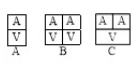
$A =$ Auricle,$V =$ Ventricle. Identify the correct examples of figures $A, B$ and $C$.
A
$A-$ Fishes,$B-$ Reptiles,$C-$ Birds
B
$A-$ Fishes,$B-$ Amphibians,$C-$ Mammals
C
$A-$ Fishes,$B-$ Mammals,$C-$ Reptiles
D
$A-$ Fishes,$B-$ Birds,$C-$ Mammals
Solution
(B) Figure $A$ represents a two-chambered heart (one auricle and one ventricle),which is found in fishes.
Figure $B$ represents a four-chambered heart (two auricles and two ventricles),which is found in birds and mammals.
Figure $C$ represents a three-chambered heart (two auricles and one ventricle),which is found in amphibians and most reptiles (except crocodiles).
Therefore,based on the options provided,the most accurate classification is $A-$ Fishes,$B-$ Amphibians,$C-$ Mammals (noting that $B$ and $C$ in the diagram represent three-chambered and four-chambered hearts respectively).
Figure $B$ represents a four-chambered heart (two auricles and two ventricles),which is found in birds and mammals.
Figure $C$ represents a three-chambered heart (two auricles and one ventricle),which is found in amphibians and most reptiles (except crocodiles).
Therefore,based on the options provided,the most accurate classification is $A-$ Fishes,$B-$ Amphibians,$C-$ Mammals (noting that $B$ and $C$ in the diagram represent three-chambered and four-chambered hearts respectively).
0 likes
View Solution80
MediumMCQ
The systemic circulation provides nutrients, $A$ and other essential substances to the $B$ and takes $C$ and other harmful substances away for elimination. Choose the correct option for $A, B$ and $C$.
A
$A - CO_{2}, B - \text{tissue}, C - O_{2}$
B
$A - O_{2}, B - \text{tissue}, C - CO_{2}$
C
$A - O_{2}, B - \text{tissue}, C - NO_{2}$
D
$A - NO_{2}, B - \text{tissue}, C - CO_{2}$
Solution
(B) Systemic circulation involves the transport of oxygenated blood from the left ventricle to all body tissues.
$1$. It delivers nutrients and $O_{2}$ $(A)$ to the body tissues $(B)$.
$2$. It collects metabolic waste products, primarily $CO_{2}$ $(C)$, from the tissues to be transported to the lungs for elimination.
Therefore, the correct sequence is $A = O_{2}, B = \text{tissues}, C = CO_{2}$.
$1$. It delivers nutrients and $O_{2}$ $(A)$ to the body tissues $(B)$.
$2$. It collects metabolic waste products, primarily $CO_{2}$ $(C)$, from the tissues to be transported to the lungs for elimination.
Therefore, the correct sequence is $A = O_{2}, B = \text{tissues}, C = CO_{2}$.
0 likes
View Solution81
MediumMCQ
Incomplete circulation is found in
$I$. Reptiles
$II$. Amphibians
$III$. Birds
$IV$. Mammals
The correct option is:
$I$. Reptiles
$II$. Amphibians
$III$. Birds
$IV$. Mammals
The correct option is:
A
$I$ and $II$
B
$III$ and $IV$
C
$III$ and $II$
D
$I$ and $IV$
Solution
(A) Complete circulation occurs when there is a complete separation of oxygenated and deoxygenated blood within the heart,which is characteristic of birds and mammals ($III$ and $IV$).
Incomplete circulation occurs when there is mixing of oxygenated and deoxygenated blood within the heart. This happens because the heart does not have completely separate chambers for oxygenated and deoxygenated blood. This is observed in amphibians and most reptiles ($I$ and $II$).
Therefore,incomplete circulation is found in reptiles and amphibians.
Incomplete circulation occurs when there is mixing of oxygenated and deoxygenated blood within the heart. This happens because the heart does not have completely separate chambers for oxygenated and deoxygenated blood. This is observed in amphibians and most reptiles ($I$ and $II$).
Therefore,incomplete circulation is found in reptiles and amphibians.
0 likes
View Solution82
MediumMCQ
Identify whether the given statements are true or false for double circulation.
$I$. It prevents the mixing of oxygenated and deoxygenated blood in the heart.
$II$. It circulates only oxygenated blood through the heart.
Choose the correct option accordingly.
$I$. It prevents the mixing of oxygenated and deoxygenated blood in the heart.
$II$. It circulates only oxygenated blood through the heart.
Choose the correct option accordingly.
A
$I-$False,$II-$False
B
$I-$True,$II-$True
C
$I-$False,$II-$True
D
$I-$True,$II-$False
Solution
(D) $I-$True,$II-$False.
Double circulation is a mechanism where blood passes through the heart twice in one complete cycle.
Statement $I$ is True: Double circulation ensures that oxygenated and deoxygenated blood remain separated within the heart chambers,preventing their mixing.
Statement $II$ is False: The heart receives and pumps both oxygenated blood (from the lungs to the body) and deoxygenated blood (from the body to the lungs). Therefore,it does not circulate only oxygenated blood.
Double circulation is a mechanism where blood passes through the heart twice in one complete cycle.
Statement $I$ is True: Double circulation ensures that oxygenated and deoxygenated blood remain separated within the heart chambers,preventing their mixing.
Statement $II$ is False: The heart receives and pumps both oxygenated blood (from the lungs to the body) and deoxygenated blood (from the body to the lungs). Therefore,it does not circulate only oxygenated blood.
0 likes
View Solution83
MediumMCQ
In amphibians and reptiles,the $A$ atrium receives oxygenated blood from the gills/lungs/skin and $B$ atrium gets the $C$ blood from other body parts. Choose the correct option for $A$,$B$,and $C$.
A
$A-$right,$B-$left,$C-$deoxygenated
B
$A-$right,$B-$left,$C-$oxygenated
C
$A-$left,$B-$right,$C-$deoxygenated
D
$A-$left,$B-$right,$C-$oxygenated
Solution
(C) In amphibians and reptiles,the heart is three-chambered,consisting of two atria and one ventricle.
$1$. The $A$ (left) atrium receives oxygenated blood from the respiratory organs (gills,lungs,or skin).
$2$. The $B$ (right) atrium receives $C$ (deoxygenated) blood from the rest of the body parts.
$3$. Therefore,the correct sequence is $A-$left,$B-$right,$C-$deoxygenated.
$1$. The $A$ (left) atrium receives oxygenated blood from the respiratory organs (gills,lungs,or skin).
$2$. The $B$ (right) atrium receives $C$ (deoxygenated) blood from the rest of the body parts.
$3$. Therefore,the correct sequence is $A-$left,$B-$right,$C-$deoxygenated.
0 likes
View Solution84
MediumMCQ
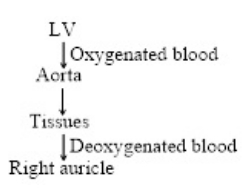
Systemic circulation is:
A
Left ventricle $\rightarrow$ Deoxygenated blood $\rightarrow$ Tissues $\rightarrow$ Oxygenated blood $\rightarrow$ Right ventricle
B
Right ventricle $\rightarrow$ Oxygenated blood $\rightarrow$ Tissues $\rightarrow$ Deoxygenated blood $\rightarrow$ Right auricle
C
Left ventricle $\rightarrow$ Deoxygenated blood $\rightarrow$ Tissues $\rightarrow$ Oxygenated blood $\rightarrow$ Right auricle
D
Left ventricle $\rightarrow$ Oxygenated blood $\rightarrow$ Tissues $\rightarrow$ Deoxygenated blood $\rightarrow$ Right auricle
Solution
(D) Systemic circulation involves the transport of oxygenated blood from the left ventricle to the body tissues and the return of deoxygenated blood from the tissues to the right auricle (atrium).
The pathway is as follows:
Left ventricle $\rightarrow$ Oxygenated blood $\rightarrow$ Aorta $\rightarrow$ Tissues $\rightarrow$ Deoxygenated blood $\rightarrow$ Right auricle.
The pathway is as follows:
Left ventricle $\rightarrow$ Oxygenated blood $\rightarrow$ Aorta $\rightarrow$ Tissues $\rightarrow$ Deoxygenated blood $\rightarrow$ Right auricle.
0 likes
View Solution85
MediumMCQ
How many double circulations are normally completed by the human heart in one minute?
A
Eight
B
Sixteen
C
Thirty-six
D
Seventy-two
Solution
(D) The human heart normally beats $72$ times per minute.
In each cardiac cycle (one heartbeat),the blood passes through the heart twice,completing one double circulation.
Therefore,in one minute,the heart completes $72$ double circulations.
In each cardiac cycle (one heartbeat),the blood passes through the heart twice,completing one double circulation.
Therefore,in one minute,the heart completes $72$ double circulations.
0 likes
View Solution86
MediumMCQ
Which one of the following represents pulmonary circulation?
A
$Left \text{ atrium} \rightarrow \text{Lungs} \rightarrow \text{Right atrium}$
B
$Left \text{ atrium} \rightarrow \text{Lungs} \rightarrow \text{Right ventricle}$
C
$Right \text{ ventricle} \rightarrow \text{Lungs} \rightarrow \text{Left ventricle}$
D
$Right \text{ ventricle} \rightarrow \text{Lungs} \rightarrow \text{Left atrium}$
Solution
(D) Pulmonary circulation is the pathway of blood circulation between the heart and the lungs.
In this process, deoxygenated blood is pumped from the $Right \text{ ventricle}$ into the lungs via the pulmonary artery.
After oxygenation in the lungs, the oxygenated blood returns to the $Left \text{ atrium}$ through the pulmonary veins.
Therefore, the correct pathway is $Right \text{ ventricle} \rightarrow \text{Lungs} \rightarrow \text{Left atrium}$.
In contrast, systemic circulation involves the flow of oxygenated blood from the $Left \text{ ventricle}$ to the body tissues and the return of deoxygenated blood to the $Right \text{ atrium}$.
In this process, deoxygenated blood is pumped from the $Right \text{ ventricle}$ into the lungs via the pulmonary artery.
After oxygenation in the lungs, the oxygenated blood returns to the $Left \text{ atrium}$ through the pulmonary veins.
Therefore, the correct pathway is $Right \text{ ventricle} \rightarrow \text{Lungs} \rightarrow \text{Left atrium}$.
In contrast, systemic circulation involves the flow of oxygenated blood from the $Left \text{ ventricle}$ to the body tissues and the return of deoxygenated blood to the $Right \text{ atrium}$.
0 likes
View Solution87
MediumMCQ
The course of blood from the heart to the lungs and back to the heart is called:
A
Systemic circulation
B
Pulmonary circulation
C
Single circulation
D
Double circulation
Solution
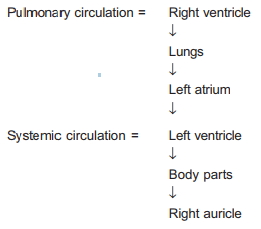
(B) The circulation of blood from the heart to the lungs and back to the heart is known as pulmonary circulation.
Pulmonary circulation involves the following pathway:
Right ventricle $\rightarrow$ Lungs $\rightarrow$ Left atrium.
In contrast,systemic circulation involves the flow of oxygenated blood from the left ventricle to the body parts and the return of deoxygenated blood to the right auricle (atrium).
Double circulation is the combination of both pulmonary and systemic circulation.
Pulmonary circulation involves the following pathway:
Right ventricle $\rightarrow$ Lungs $\rightarrow$ Left atrium.
In contrast,systemic circulation involves the flow of oxygenated blood from the left ventricle to the body parts and the return of deoxygenated blood to the right auricle (atrium).
Double circulation is the combination of both pulmonary and systemic circulation.
0 likes
View Solution88
MediumMCQ
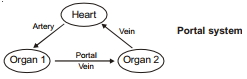
$A$ portal system is one in which
A
$A$ vein starts from an organ and ends up in heart
B
$A$ vein starts from an organ and ends up in another organ
C
$A$ vein starts from heart and ends up in lungs
D
None of these
Solution
(B) portal system is a circulatory arrangement where blood collected from one organ is transported to another organ through a vein before returning to the heart.
In a typical systemic circulation,blood flows from the heart to an organ and then back to the heart.
However,in a portal system,the venous blood from one organ (e.g.,the digestive tract) is carried to another organ (e.g.,the liver in the hepatic portal system) by a portal vein,where it breaks into capillaries again before finally reaching the heart.
Therefore,the correct definition is that a vein starts from an organ and ends up in another organ.
In a typical systemic circulation,blood flows from the heart to an organ and then back to the heart.
However,in a portal system,the venous blood from one organ (e.g.,the digestive tract) is carried to another organ (e.g.,the liver in the hepatic portal system) by a portal vein,where it breaks into capillaries again before finally reaching the heart.
Therefore,the correct definition is that a vein starts from an organ and ends up in another organ.
0 likes
View Solution89
MediumMCQ
Hepatic portal system is present in
A
Fishes,Amphibians and Reptiles
B
Reptiles and Birds
C
All mammals
D
All vertebrates
Solution
(D) The hepatic portal system is a specialized vascular system where blood from the digestive tract is collected into a portal vein and transported to the liver before entering the systemic circulation. This system is a characteristic feature found in all vertebrate groups,including fishes,amphibians,reptiles,birds,and mammals.
0 likes
View Solution90
Easy
What is called double circulation?
Solution
(N/A) Double circulation is a process in which the blood flows through the heart twice during each complete cycle of the body. In humans,the blood passes through the heart in two distinct circuits: the pulmonary circulation (deoxygenated blood to the lungs) and the systemic circulation (oxygenated blood to the body tissues). Because the oxygenated and deoxygenated blood are kept separate and pass through the heart separately,this mechanism is known as double circulation.
0 likes
View Solution91
EasyMCQ
What is called pulmonary circulation?
A
The flow of blood from the heart to the lungs and back to the heart.
B
The flow of blood from the heart to the body tissues and back to the heart.
C
The flow of blood within the heart chambers only.
D
The flow of blood through the coronary arteries.
Solution
(A) The deoxygenated blood pumped into the pulmonary artery is passed on to the lungs.
From the lungs,the oxygenated blood is carried by the pulmonary veins into the left atrium.
This specific pathway of blood flow between the heart and the lungs is known as pulmonary circulation.
From the lungs,the oxygenated blood is carried by the pulmonary veins into the left atrium.
This specific pathway of blood flow between the heart and the lungs is known as pulmonary circulation.
0 likes
View Solution92
EasyMCQ
What is systemic circulation?
A
Circulation of blood between heart and lungs.
B
Circulation of blood between heart and body tissues.
C
Circulation of blood within the heart chambers.
D
Circulation of blood through the liver.
Solution
(B) Systemic circulation involves the flow of oxygenated blood from the left ventricle of the heart into the aorta.
This oxygenated blood is then distributed through a network of arteries,arterioles,and capillaries to all body tissues.
From the tissues,the deoxygenated blood is collected by a system of venules,veins,and the vena cava.
Finally,this deoxygenated blood is emptied into the right atrium of the heart.
This entire pathway of blood circulation from the heart to the body tissues and back to the heart is known as systemic circulation.
This oxygenated blood is then distributed through a network of arteries,arterioles,and capillaries to all body tissues.
From the tissues,the deoxygenated blood is collected by a system of venules,veins,and the vena cava.
Finally,this deoxygenated blood is emptied into the right atrium of the heart.
This entire pathway of blood circulation from the heart to the body tissues and back to the heart is known as systemic circulation.
0 likes
View Solution93
MediumMCQ
What is called incomplete double circulation?
A
$A$ system where blood flows through the heart twice in one cycle but mixes in the ventricle.
B
$A$ system where blood flows through the heart only once.
C
$A$ system where oxygenated and deoxygenated blood never mix.
D
$A$ system found in birds and mammals.
Solution
(A) Incomplete double circulation is a type of circulatory system found in amphibians and most reptiles (except crocodiles).
In these organisms,the heart consists of three chambers: two atria and one ventricle.
The left atrium receives oxygenated blood from the respiratory organs (gills,lungs,or skin),while the right atrium receives deoxygenated blood from the rest of the body.
Since there is only one ventricle,the oxygenated and deoxygenated blood mix within it before being pumped out to the body.
This mixing of blood is why it is termed 'incomplete' double circulation.
In these organisms,the heart consists of three chambers: two atria and one ventricle.
The left atrium receives oxygenated blood from the respiratory organs (gills,lungs,or skin),while the right atrium receives deoxygenated blood from the rest of the body.
Since there is only one ventricle,the oxygenated and deoxygenated blood mix within it before being pumped out to the body.
This mixing of blood is why it is termed 'incomplete' double circulation.
0 likes
View Solution94
MediumMCQ
How is the hepatic portal system formed?
A
By the union of hepatic veins and inferior vena cava.
B
By the connection between the digestive tract and the liver.
C
By the direct supply of blood from the heart to the liver.
D
By the drainage of blood from the liver to the kidneys.
Solution
(B) unique vascular connection exists between the digestive tract and the liver,which is called the hepatic portal system.
This system is formed by the hepatic portal vein,which carries blood from the intestine to the liver before it is delivered to the systemic circulation.
This arrangement allows the liver to process nutrients and detoxify substances absorbed from the digestive tract before they enter the general blood circulation.
This system is formed by the hepatic portal vein,which carries blood from the intestine to the liver before it is delivered to the systemic circulation.
This arrangement allows the liver to process nutrients and detoxify substances absorbed from the digestive tract before they enter the general blood circulation.
0 likes
View Solution95
Easy
Name the vascular connection that exists between the digestive tract and liver.
Solution
(N/A) unique vascular connection between the digestive tract and the liver is known as the $Hepatic \ Portal \ System$. This system carries deoxygenated blood rich in nutrients from the gastrointestinal tract and spleen to the liver for processing before it enters the systemic circulation.
0 likes
View Solution96
MediumMCQ
Select the incorrect option regarding the circulatory system.
A
Open circulatory system is found in arthropods.
B
Closed circulatory system is found in annelids.
C
Open circulatory system is found in cephalopods.
D
In an open circulatory system,tissues and cells are bathed in blood.
Solution
(C) In an open circulatory system,the blood is pumped out of the heart and the cells and tissues are directly bathed in it. This type of system is found in arthropods and molluscs (excluding cephalopods). Cephalopods,such as squids and octopuses,possess a closed circulatory system. Therefore,the statement that an open circulatory system is found in cephalopods is incorrect.
0 likes
View Solution97
MediumMCQ
Which of the following organisms exhibits incomplete double circulation?
A
Toad
B
Turtle
C
Krait
D
All of the above
Solution
(D) Incomplete double circulation is a characteristic feature of amphibians and most reptiles (except crocodiles).
In this type of circulation,the heart has three chambers: two atria and one ventricle.
Oxygenated and deoxygenated blood mix in the single ventricle before being pumped out to the body and lungs.
$A$ (Toad) is an amphibian,while $B$ (Turtle) and $C$ (Krait) are reptiles.
Therefore,all these organisms exhibit incomplete double circulation.
In this type of circulation,the heart has three chambers: two atria and one ventricle.
Oxygenated and deoxygenated blood mix in the single ventricle before being pumped out to the body and lungs.
$A$ (Toad) is an amphibian,while $B$ (Turtle) and $C$ (Krait) are reptiles.
Therefore,all these organisms exhibit incomplete double circulation.
0 likes
View Solution98
MediumMCQ
What type of circulatory system is present in a frog?
A
Single circulation
B
Double circulation
C
Incomplete double circulation
D
All of the above
Solution
(C) The heart of a frog is $3$-chambered,consisting of two atria and one ventricle.
Because the oxygenated and deoxygenated blood mix in the single ventricle before being pumped out to the body,the circulatory system is described as an incomplete double circulation.
Therefore,the correct option is $C$.
Because the oxygenated and deoxygenated blood mix in the single ventricle before being pumped out to the body,the circulatory system is described as an incomplete double circulation.
Therefore,the correct option is $C$.
0 likes
View Solution99
MediumMCQ
In which of the following types of circulatory systems does the transport of mixed blood occur?
A
Single
B
Double
C
Incomplete double
D
All of the above
Solution
(C) In an incomplete double circulatory system,the left atrium receives oxygenated blood from the gills/lungs and the right atrium receives deoxygenated blood from other body parts. However,they get mixed up in the single ventricle which pumps out mixed blood to the body. This is characteristic of amphibians and most reptiles.
0 likes
View Solution100
MediumMCQ
Match the following columns:
| Column-$I$ | Column-$II$ |
| $P$. Single circulation | $I$. Fishes |
| $Q$. Incomplete double circulation | $II$. Amphibians and Reptiles |
| $R$. Complete double circulation | $III$. Crocodiles,Birds,and Mammals |
A
$(P-I), (Q-II), (R-III)$
B
$(P-I), (Q-III), (R-II)$
C
$(P-III), (Q-II), (R-I)$
D
$(P-II), (Q-III), (R-I)$
Solution
(A) The circulatory pathways are classified based on the complexity of the heart and the flow of blood:
$1$. Single circulation $(P)$: In fishes,the heart pumps deoxygenated blood to the gills for oxygenation,which then passes directly to the body tissues. Thus,$P-I$.
$2$. Incomplete double circulation $(Q)$: In amphibians and most reptiles,the left atrium receives oxygenated blood from the gills/lungs/skin and the right atrium receives deoxygenated blood from other body parts. They get mixed in the single ventricle. Thus,$Q-II$.
$3$. Complete double circulation $(R)$: In crocodiles,birds,and mammals,oxygenated and deoxygenated blood received by the left and right atria respectively passes on to the ventricles and is pumped out without any mixing. Thus,$R-III$.
Therefore,the correct matching is $(P-I), (Q-II), (R-III)$.
$1$. Single circulation $(P)$: In fishes,the heart pumps deoxygenated blood to the gills for oxygenation,which then passes directly to the body tissues. Thus,$P-I$.
$2$. Incomplete double circulation $(Q)$: In amphibians and most reptiles,the left atrium receives oxygenated blood from the gills/lungs/skin and the right atrium receives deoxygenated blood from other body parts. They get mixed in the single ventricle. Thus,$Q-II$.
$3$. Complete double circulation $(R)$: In crocodiles,birds,and mammals,oxygenated and deoxygenated blood received by the left and right atria respectively passes on to the ventricles and is pumped out without any mixing. Thus,$R-III$.
Therefore,the correct matching is $(P-I), (Q-II), (R-III)$.
0 likes
View SolutionBody Fluids and Circulations — Double Circulation and Circulatory pathway · Frequently Asked Questions
1Are these Body Fluids and Circulations questions useful for JEE and NEET?
Yes. All questions in this section are mapped to JEE Main and NEET exam patterns. Previous year questions from JEE Main, NEET, GUJCET and state-level exams are included with full solutions.
2Can I switch to Hindi or Gujarati for these questions?
Yes. Use the language tabs in the hero section or the sidebar to view the same questions and solutions in English, Hindi or Gujarati.
3How do I generate a question paper from this subtopic?
Use the Vedclass Exam Paper Generator — select the chapter and subtopic, set difficulty, and generate Sets A, B, C, D automatically. First 3 chapters of every subject are free.
Vedclass Products
For Students
Vedclass Test Series
Mock tests in real JEE/NEET style with performance analysis. 5-day free trial.
Start Free TrialFor Teachers
Exam Paper Generator
Generate Set A/B/C/D papers from this chapter in 2 minutes. 3 chapters free.
Try FreeFor Institutes
Online Exam Module
Live online exams with unlimited students, 360° analytics & white-label branding.
See DemoFor Teachers & Institutes
Generate a Body Fluids and Circulations Exam Paper in 2 Minutes
Select subtopic & difficulty — Sets A, B, C, D auto-generated with No Repeat logic.
First 3 chapters of every subject are free — no payment required.