
A English
Double Circulation and Circulatory pathway Questions in English
Class 11 Biology · Body Fluids and Circulations · Double Circulation and Circulatory pathway
116+
Questions
English
Language
100%
With Solutions
Showing 16 of 116 questions in English
101
MediumMCQ
Which of the following is the correct pathway for pulmonary circulation?
A
Right ventricle $\rightarrow$ Pulmonary artery $\rightarrow$ Alveolar capillaries $\rightarrow$ Pulmonary vein $\rightarrow$ Left atrium
B
Left ventricle $\rightarrow$ Pulmonary artery $\rightarrow$ Alveolar capillaries $\rightarrow$ Pulmonary vein $\rightarrow$ Right atrium
C
Left ventricle $\rightarrow$ Aorta $\rightarrow$ Artery $\rightarrow$ Arteriole $\rightarrow$ Tissue capillaries $\rightarrow$ Venule $\rightarrow$ Vein $\rightarrow$ Vena cava $\rightarrow$ Right atrium
D
Right ventricle $\rightarrow$ Aorta $\rightarrow$ Artery $\rightarrow$ Arteriole $\rightarrow$ Tissue capillaries $\rightarrow$ Venule $\rightarrow$ Vein $\rightarrow$ Vena cava $\rightarrow$ Left atrium
Solution
(A) Pulmonary circulation involves the movement of deoxygenated blood from the heart to the lungs for oxygenation and the return of oxygenated blood back to the heart.
$1$. Deoxygenated blood is pumped from the $Right \ ventricle$ into the $Pulmonary \ artery$.
$2$. The $Pulmonary \ artery$ carries this blood to the $Alveolar \ capillaries$ in the lungs, where gas exchange occurs.
$3$. Oxygenated blood then travels through the $Pulmonary \ vein$ to reach the $Left \ atrium$ of the heart.
Therefore, the correct sequence is: $Right \ ventricle \rightarrow Pulmonary \ artery \rightarrow Alveolar \ capillaries \rightarrow Pulmonary \ vein \rightarrow Left \ atrium$.
$1$. Deoxygenated blood is pumped from the $Right \ ventricle$ into the $Pulmonary \ artery$.
$2$. The $Pulmonary \ artery$ carries this blood to the $Alveolar \ capillaries$ in the lungs, where gas exchange occurs.
$3$. Oxygenated blood then travels through the $Pulmonary \ vein$ to reach the $Left \ atrium$ of the heart.
Therefore, the correct sequence is: $Right \ ventricle \rightarrow Pulmonary \ artery \rightarrow Alveolar \ capillaries \rightarrow Pulmonary \ vein \rightarrow Left \ atrium$.
0 likes
View Solution102
MediumMCQ
Which of the following is the correct pathway for systemic circulation?
A
Right ventricle $\rightarrow$ Pulmonary artery $\rightarrow$ Alveolar capillaries $\rightarrow$ Pulmonary vein $\rightarrow$ Left atrium
B
Left ventricle $\rightarrow$ Pulmonary artery $\rightarrow$ Alveolar capillaries $\rightarrow$ Pulmonary vein $\rightarrow$ Right atrium
C
Left ventricle $\rightarrow$ Aorta $\rightarrow$ Arteries $\rightarrow$ Arterioles $\rightarrow$ Tissue capillaries $\rightarrow$ Venules $\rightarrow$ Veins $\rightarrow$ Vena cava $\rightarrow$ Right atrium
D
Right ventricle $\rightarrow$ Aorta $\rightarrow$ Arteries $\rightarrow$ Arterioles $\rightarrow$ Tissue capillaries $\rightarrow$ Venules $\rightarrow$ Veins $\rightarrow$ Vena cava $\rightarrow$ Left atrium
Solution
(C) Systemic circulation involves the transport of oxygenated blood from the left ventricle to all body tissues and the return of deoxygenated blood to the right atrium.
$1$. The oxygenated blood is pumped out from the left ventricle into the aorta.
$2$. The aorta branches into arteries,then arterioles,and finally into tissue capillaries where gas exchange occurs.
$3$. The deoxygenated blood is collected by venules,which join to form veins.
$4$. These veins eventually drain into the vena cava,which carries the blood back to the right atrium.
Therefore,the correct pathway is: Left ventricle $\rightarrow$ Aorta $\rightarrow$ Arteries $\rightarrow$ Arterioles $\rightarrow$ Tissue capillaries $\rightarrow$ Venules $\rightarrow$ Veins $\rightarrow$ Vena cava $\rightarrow$ Right atrium.
$1$. The oxygenated blood is pumped out from the left ventricle into the aorta.
$2$. The aorta branches into arteries,then arterioles,and finally into tissue capillaries where gas exchange occurs.
$3$. The deoxygenated blood is collected by venules,which join to form veins.
$4$. These veins eventually drain into the vena cava,which carries the blood back to the right atrium.
Therefore,the correct pathway is: Left ventricle $\rightarrow$ Aorta $\rightarrow$ Arteries $\rightarrow$ Arterioles $\rightarrow$ Tissue capillaries $\rightarrow$ Venules $\rightarrow$ Veins $\rightarrow$ Vena cava $\rightarrow$ Right atrium.
0 likes
View Solution103
MediumMCQ
Select the correct option for systemic circulation.
A
It delivers nutrients,oxygen,and other essential substances to the tissues.
B
The systemic circulation pathway does not involve the lungs.
C
It removes carbon dioxide and other harmful substances from the tissues.
D
All of the above.
Solution
(D) Systemic circulation involves the flow of oxygenated blood from the left ventricle to all parts of the body through the aorta and the return of deoxygenated blood to the right atrium through the vena cava.
$1$. It supplies oxygen,nutrients,and essential substances to the tissues for metabolic activities.
$2$. It collects carbon dioxide and metabolic waste products from the tissues to be transported to the lungs and kidneys for excretion.
$3$. Unlike pulmonary circulation,systemic circulation does not involve the lungs directly in its pathway; it serves the systemic tissues of the body.
Therefore,all the given statements are correct.
$1$. It supplies oxygen,nutrients,and essential substances to the tissues for metabolic activities.
$2$. It collects carbon dioxide and metabolic waste products from the tissues to be transported to the lungs and kidneys for excretion.
$3$. Unlike pulmonary circulation,systemic circulation does not involve the lungs directly in its pathway; it serves the systemic tissues of the body.
Therefore,all the given statements are correct.
0 likes
View Solution104
EasyMCQ
State the location of the hepatic portal system.
A
Between the esophagus and the liver
B
Between the liver and the heart
C
Between the small intestine and the liver
D
Between the liver and the lungs
Solution
(C) The hepatic portal system is a specialized vascular connection that carries blood from the digestive tract to the liver before it returns to the systemic circulation.
Specifically,it transports nutrient-rich,deoxygenated blood from the gastrointestinal tract (primarily the small intestine) to the liver via the hepatic portal vein.
This allows the liver to process nutrients,detoxify substances,and regulate blood sugar levels before the blood enters the general circulation.
Therefore,the correct location is between the small intestine and the liver.
Specifically,it transports nutrient-rich,deoxygenated blood from the gastrointestinal tract (primarily the small intestine) to the liver via the hepatic portal vein.
This allows the liver to process nutrients,detoxify substances,and regulate blood sugar levels before the blood enters the general circulation.
Therefore,the correct location is between the small intestine and the liver.
0 likes
View Solution105
MediumMCQ
Which of the following options represents the correct pathway of coronary circulation?
A
Aorta $\rightarrow$ Coronary vein $\rightarrow$ Cardiac muscle $\rightarrow$ Coronary artery $\rightarrow$ Right atrium
B
Aorta $\rightarrow$ Coronary artery $\rightarrow$ Cardiac muscle $\rightarrow$ Coronary vein $\rightarrow$ Right atrium
C
Right atrium $\rightarrow$ Coronary vein $\rightarrow$ Cardiac muscle $\rightarrow$ Coronary artery $\rightarrow$ Aorta
D
Right atrium $\rightarrow$ Coronary artery $\rightarrow$ Cardiac muscle $\rightarrow$ Coronary vein $\rightarrow$ Aorta
Solution
(B) Coronary circulation is the circulation of blood in the blood vessels that supply the heart muscle (myocardium).
$1$. Oxygenated blood leaves the left ventricle through the Aorta.
$2$. $A$ portion of this blood enters the Coronary arteries,which supply the cardiac muscle with oxygen and nutrients.
$3$. After gas exchange,the deoxygenated blood is collected by the Coronary veins.
$4$. The Coronary veins drain this deoxygenated blood directly into the Right atrium of the heart.
Therefore,the correct sequence is: Aorta $\rightarrow$ Coronary artery $\rightarrow$ Cardiac muscle $\rightarrow$ Coronary vein $\rightarrow$ Right atrium.
$1$. Oxygenated blood leaves the left ventricle through the Aorta.
$2$. $A$ portion of this blood enters the Coronary arteries,which supply the cardiac muscle with oxygen and nutrients.
$3$. After gas exchange,the deoxygenated blood is collected by the Coronary veins.
$4$. The Coronary veins drain this deoxygenated blood directly into the Right atrium of the heart.
Therefore,the correct sequence is: Aorta $\rightarrow$ Coronary artery $\rightarrow$ Cardiac muscle $\rightarrow$ Coronary vein $\rightarrow$ Right atrium.
0 likes
View Solution106
DifficultMCQ
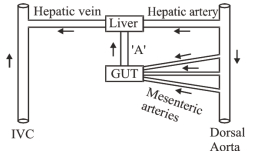
Identify '$A$' in the above figure.
A
Hepatic duct
B
Hepatic portal vein
C
Branch of bile duct
D
Hepatic artery
Solution
(B) The figure represents the hepatic portal system.
The hepatic portal system is a unique vascular connection that exists between the digestive tract and the liver.
Blood from the digestive tract $(GUT)$ carries nutrients and is transported to the liver via the hepatic portal vein before it reaches the systemic circulation.
In the given diagram,'$A$' represents the vessel carrying blood from the gut to the liver,which is the hepatic portal vein.
The hepatic portal system is a unique vascular connection that exists between the digestive tract and the liver.
Blood from the digestive tract $(GUT)$ carries nutrients and is transported to the liver via the hepatic portal vein before it reaches the systemic circulation.
In the given diagram,'$A$' represents the vessel carrying blood from the gut to the liver,which is the hepatic portal vein.
0 likes
View Solution107
MediumMCQ
The circulatory pattern,in which blood pumped by the heart passes through large vessels into open spaces or body cavities called sinuses,is called $.......$ and it is found in $........$
A
Closed,Arthropods
B
Open,Molluscs
C
Closed,Chordates
D
Open,Annelids
Solution
(B) In an open circulatory system,the blood pumped by the heart passes through large vessels into open spaces or body cavities known as sinuses.
This type of circulation is characteristic of arthropods and most molluscs (excluding cephalopods).
Therefore,the correct pattern is $Open$ and it is found in $Molluscs$ (among the given options,$B$ is the most appropriate fit as $Annelids$ possess a closed circulatory system).
This type of circulation is characteristic of arthropods and most molluscs (excluding cephalopods).
Therefore,the correct pattern is $Open$ and it is found in $Molluscs$ (among the given options,$B$ is the most appropriate fit as $Annelids$ possess a closed circulatory system).
0 likes
View Solution108
MediumMCQ
How many double circulations are normally completed by the human heart in one minute?
A
$8$
B
$16$
C
$72$
D
$36$
Solution
(C) The human heart beats approximately $72$ times per minute in a healthy adult.
Each heartbeat represents one complete cardiac cycle,which involves the blood passing through the heart twice (once through the right side and once through the left side).
This process is known as double circulation.
Since one heartbeat corresponds to one complete double circulation,$72$ heartbeats per minute result in $72$ complete double circulations per minute.
Each heartbeat represents one complete cardiac cycle,which involves the blood passing through the heart twice (once through the right side and once through the left side).
This process is known as double circulation.
Since one heartbeat corresponds to one complete double circulation,$72$ heartbeats per minute result in $72$ complete double circulations per minute.
0 likes
View Solution109
MediumMCQ
Assertion $(A)$: In humans,a hepatic portal system is present.
Reason $(R)$: The hepatic vein carries blood from the intestine to the liver.
Reason $(R)$: The hepatic vein carries blood from the intestine to the liver.
A
Both assertion and reason are true but reason is not the correct explanation of assertion
B
Both assertion and reason are true but reason is a correct explanation of assertion
C
Assertion is true but reason is false
D
Both Assertion and reason are false
Solution
(C) The hepatic portal system is a unique vascular connection that exists between the digestive tract and the liver.
In this system,blood from the intestine is carried to the liver via the hepatic portal vein before it reaches the systemic circulation.
Therefore,the assertion $(A)$ is true.
The reason $(R)$ states that the hepatic vein carries blood from the intestine to the liver.
This is incorrect because the hepatic portal vein carries blood from the intestine to the liver,whereas the hepatic vein carries deoxygenated blood from the liver to the inferior vena cava.
Thus,the reason $(R)$ is false.
In this system,blood from the intestine is carried to the liver via the hepatic portal vein before it reaches the systemic circulation.
Therefore,the assertion $(A)$ is true.
The reason $(R)$ states that the hepatic vein carries blood from the intestine to the liver.
This is incorrect because the hepatic portal vein carries blood from the intestine to the liver,whereas the hepatic vein carries deoxygenated blood from the liver to the inferior vena cava.
Thus,the reason $(R)$ is false.
0 likes
View Solution110
MediumMCQ
In a portal system of man:
A
$A$ vein starts from an organ and ends in heart
B
$A$ vein enters into an organ other than heart and breaks into capillaries
C
An artery breaks in an organ and restarts by union of its capillaries
D
Blood from intestine is brought into the kidneys and then in $\text{IVC}$
Solution
(B) portal system is defined as a circulatory pathway where blood,instead of going directly to the heart,passes through an intermediate organ via a portal vein.
In this system,a vein starts from one organ (e.g.,the digestive tract) and enters another organ (e.g.,the liver) where it breaks into capillaries before continuing to the heart.
Therefore,the correct definition is that a vein enters into an organ other than the heart and breaks into capillaries.
In this system,a vein starts from one organ (e.g.,the digestive tract) and enters another organ (e.g.,the liver) where it breaks into capillaries before continuing to the heart.
Therefore,the correct definition is that a vein enters into an organ other than the heart and breaks into capillaries.
0 likes
View Solution111
EasyMCQ
Which of the following is $NOT$ a characteristic feature of open circulation?
A
Presence of haemocoel
B
Blood flows with low pressure
C
Absence of respiratory pigment
D
Blood flows through vessels
Solution
(D) In an open circulatory system,blood is pumped out of the heart into body cavities or sinuses called haemocoel.
Because the blood is not confined to vessels,it flows at a low pressure.
Respiratory pigments may or may not be present in open circulation (e.g.,insects lack respiratory pigments,while molluscs may have haemocyanin).
However,the defining characteristic of a closed circulatory system is that blood flows through a continuous network of blood vessels.
Therefore,the statement that blood flows through vessels is characteristic of a closed circulatory system,not an open one.
Because the blood is not confined to vessels,it flows at a low pressure.
Respiratory pigments may or may not be present in open circulation (e.g.,insects lack respiratory pigments,while molluscs may have haemocyanin).
However,the defining characteristic of a closed circulatory system is that blood flows through a continuous network of blood vessels.
Therefore,the statement that blood flows through vessels is characteristic of a closed circulatory system,not an open one.
0 likes
View Solution112
EasyMCQ
Given below are two statements regarding the circulation of blood in fishes.
Statement $I$: The heart of a fish contains only deoxygenated blood.
Statement $II$: Fishes show single circulation,and blood passes through the heart only once during each cycle.
In light of the above statements,choose the correct answer from the options given below.
Statement $I$: The heart of a fish contains only deoxygenated blood.
Statement $II$: Fishes show single circulation,and blood passes through the heart only once during each cycle.
In light of the above statements,choose the correct answer from the options given below.
A
Both statement $I$ and statement $II$ are correct.
B
Both statement $I$ and statement $II$ are incorrect.
C
Statement $I$ is correct and statement $II$ is incorrect.
D
Statement $I$ is incorrect and statement $II$ is correct.
Solution
(A) Statement $I$ is correct: The fish heart is a two-chambered heart (one atrium and one ventricle). It receives deoxygenated blood from the body tissues and pumps it to the gills for oxygenation. Thus,it only handles deoxygenated blood.
Statement $II$ is correct: In fishes,the blood flows from the heart to the gills,then to the body,and back to the heart. Since the blood passes through the heart only once in one complete circuit,it is called single circulation.
Statement $II$ is correct: In fishes,the blood flows from the heart to the gills,then to the body,and back to the heart. Since the blood passes through the heart only once in one complete circuit,it is called single circulation.
0 likes
View Solution113
EasyMCQ
Cockroach and snails show circulation of blood through haemocoel. It is . . . . . . .
A
Open circulation
B
Closed circulation
C
Double circulation
D
Parenchymal circulation
Solution
(A) In an open circulatory system,the blood is pumped out of the heart into blood vessels that open into body cavities or sinuses,collectively called the haemocoel.
In this system,the visceral organs are bathed in blood,and the exchange of materials occurs directly between the blood and the cells or tissues of the body.
In this system,the visceral organs are bathed in blood,and the exchange of materials occurs directly between the blood and the cells or tissues of the body.
0 likes
View Solution114
EasyMCQ
Double circulation occurs in
A
Fishes and amphibians
B
Molluscs and hemichordates
C
Annelids and Arthropods
D
Birds and mammals
Solution
(D) Double circulation is a process where blood passes through the heart twice in one complete cycle.
It is characteristic of animals with a four-chambered heart,such as birds and mammals.
In this system,oxygenated blood and deoxygenated blood are kept completely separate,which allows for efficient oxygen delivery to tissues.
It is characteristic of animals with a four-chambered heart,such as birds and mammals.
In this system,oxygenated blood and deoxygenated blood are kept completely separate,which allows for efficient oxygen delivery to tissues.
0 likes
View Solution115
EasyMCQ
The course of blood flow in pulmonary circulation is . . . . . . . . . . . . .
A
Right atrium $\rightarrow$ Right ventricle $\rightarrow$ Pulmonary artery $\rightarrow$ Lungs $\rightarrow$ Pulmonary vein $\rightarrow$ Left atrium
B
Left atrium $\rightarrow$ Left ventricle $\rightarrow$ Pulmonary artery $\rightarrow$ Lungs $\rightarrow$ Pulmonary vein $\rightarrow$ Right atrium
C
Left atrium $\rightarrow$ Pulmonary vein $\rightarrow$ Left ventricle $\rightarrow$ Pulmonary artery $\rightarrow$ Right atrium
D
Right atrium $\rightarrow$ Pulmonary artery $\rightarrow$ Right ventricle $\rightarrow$ Pulmonary vein $\rightarrow$ Left atrium
Solution
(A) Pulmonary circulation is the pathway of blood from the heart to the lungs and back to the heart.
$1$. Deoxygenated blood is pumped from the Right ventricle into the Pulmonary artery.
$2$. The Pulmonary artery carries this blood to the lungs for oxygenation.
$3$. After gas exchange in the lungs,oxygenated blood is returned to the Left atrium via the Pulmonary veins.
Therefore,the correct sequence is: Right ventricle $\rightarrow$ Pulmonary artery $\rightarrow$ Lungs $\rightarrow$ Pulmonary vein $\rightarrow$ Left atrium. Since the question asks for the course starting from the Right atrium,the flow is: Right atrium $\rightarrow$ Right ventricle $\rightarrow$ Pulmonary artery $\rightarrow$ Lungs $\rightarrow$ Pulmonary vein $\rightarrow$ Left atrium.
$1$. Deoxygenated blood is pumped from the Right ventricle into the Pulmonary artery.
$2$. The Pulmonary artery carries this blood to the lungs for oxygenation.
$3$. After gas exchange in the lungs,oxygenated blood is returned to the Left atrium via the Pulmonary veins.
Therefore,the correct sequence is: Right ventricle $\rightarrow$ Pulmonary artery $\rightarrow$ Lungs $\rightarrow$ Pulmonary vein $\rightarrow$ Left atrium. Since the question asks for the course starting from the Right atrium,the flow is: Right atrium $\rightarrow$ Right ventricle $\rightarrow$ Pulmonary artery $\rightarrow$ Lungs $\rightarrow$ Pulmonary vein $\rightarrow$ Left atrium.
0 likes
View Solution116
EasyMCQ
How many times will a red blood corpuscle $(RBC)$ have to pass through the heart in its journey from the hepatic artery to the aorta?
A
Only once
B
Two times
C
Four times
D
Several times
Solution
(A) The blood circulation in humans is a double circulation system.
$1$. The blood flows from the hepatic artery to the liver capillaries.
$2$. From the liver,the blood enters the hepatic vein,which drains into the inferior vena cava.
$3$. The inferior vena cava carries deoxygenated blood to the right atrium of the heart.
$4$. From the right atrium,it passes to the right ventricle and then to the lungs via the pulmonary artery for oxygenation.
$5$. After oxygenation,the blood returns to the left atrium via the pulmonary veins,enters the left ventricle,and is finally pumped into the aorta.
$6$. Thus,in this entire journey,the $RBC$ passes through the heart exactly once to complete the circuit from the systemic venous return to the systemic arterial output.
$1$. The blood flows from the hepatic artery to the liver capillaries.
$2$. From the liver,the blood enters the hepatic vein,which drains into the inferior vena cava.
$3$. The inferior vena cava carries deoxygenated blood to the right atrium of the heart.
$4$. From the right atrium,it passes to the right ventricle and then to the lungs via the pulmonary artery for oxygenation.
$5$. After oxygenation,the blood returns to the left atrium via the pulmonary veins,enters the left ventricle,and is finally pumped into the aorta.
$6$. Thus,in this entire journey,the $RBC$ passes through the heart exactly once to complete the circuit from the systemic venous return to the systemic arterial output.
0 likes
View SolutionBody Fluids and Circulations — Double Circulation and Circulatory pathway · Frequently Asked Questions
1Are these Body Fluids and Circulations questions useful for JEE and NEET?
Yes. All questions in this section are mapped to JEE Main and NEET exam patterns. Previous year questions from JEE Main, NEET, GUJCET and state-level exams are included with full solutions.
2Can I switch to Hindi or Gujarati for these questions?
Yes. Use the language tabs in the hero section or the sidebar to view the same questions and solutions in English, Hindi or Gujarati.
3How do I generate a question paper from this subtopic?
Use the Vedclass Exam Paper Generator — select the chapter and subtopic, set difficulty, and generate Sets A, B, C, D automatically. First 3 chapters of every subject are free.
Vedclass Products
For Students
Vedclass Test Series
Mock tests in real JEE/NEET style with performance analysis. 5-day free trial.
Start Free TrialFor Teachers
Exam Paper Generator
Generate Set A/B/C/D papers from this chapter in 2 minutes. 3 chapters free.
Try FreeFor Institutes
Online Exam Module
Live online exams with unlimited students, 360° analytics & white-label branding.
See DemoFor Teachers & Institutes
Generate a Body Fluids and Circulations Exam Paper in 2 Minutes
Select subtopic & difficulty — Sets A, B, C, D auto-generated with No Repeat logic.
First 3 chapters of every subject are free — no payment required.