
A English
Mix Examples- Biomolecules Questions in English
Class 11 Biology · Biomolecules · Mix Examples- Biomolecules
331+
Questions
English
Language
100%
With Solutions
Showing 50 of 331 questions in English
101
EasyMCQ
$A$ deficiency of which of the following causes continuous bleeding from an injured part of the body?
A
Vitamin-$A$
B
Vitamin-$B$
C
Vitamin-$K$
D
Vitamin-$E$
Solution
(C) Vitamin-$K$ is essential for the synthesis of clotting factors in the liver,such as prothrombin and factors $VII$,$IX$,and $X$.
When there is a deficiency of Vitamin-$K$,the blood clotting process is impaired.
Consequently,if an injury occurs,the blood fails to clot efficiently,leading to continuous or prolonged bleeding from the injured site.
When there is a deficiency of Vitamin-$K$,the blood clotting process is impaired.
Consequently,if an injury occurs,the blood fails to clot efficiently,leading to continuous or prolonged bleeding from the injured site.
0 likes
View Solution102
EasyMCQ
Which of the following pairs is correctly matched?
A
Vitamin $E$ - Tocopherol
B
Vitamin $D$ - Riboflavin
C
Vitamin $B$ - Calciferol
D
Vitamin $A$ - Thiamine
Solution
(A) The correct pair is Vitamin $E$ - Tocopherol.
Vitamin $E$ is chemically known as Tocopherol.
Vitamin $D$ is Calciferol,not Riboflavin.
Vitamin $B_2$ is Riboflavin,while Vitamin $B_1$ is Thiamine.
Vitamin $A$ is Retinol,not Thiamine.
Vitamin $E$ is chemically known as Tocopherol.
Vitamin $D$ is Calciferol,not Riboflavin.
Vitamin $B_2$ is Riboflavin,while Vitamin $B_1$ is Thiamine.
Vitamin $A$ is Retinol,not Thiamine.
0 likes
View Solution103
EasyMCQ
...... is known as the anti-sterility vitamin.
A
Vitamin $B_{12}$
B
Vitamin $D$
C
Vitamin $E$
D
Vitamin $A$
Solution
(C) Vitamin $E$ is known as the anti-sterility vitamin (tocopherol).
It plays a crucial role in maintaining the health of the reproductive system and is essential for normal fertility in many animals.
Deficiency of Vitamin $E$ can lead to reproductive failure or sterility.
It plays a crucial role in maintaining the health of the reproductive system and is essential for normal fertility in many animals.
Deficiency of Vitamin $E$ can lead to reproductive failure or sterility.
0 likes
View Solution104
MediumMCQ
$A$ diet rich in butter,red meat,and eggs,when consumed regularly,will lead to:
A
Vitamin $A$ toxicity
B
Kidney stones
C
Hypercholesterolemia
D
Ketonuria
Solution
(C) Butter,red meat,and eggs are rich sources of saturated fats and dietary cholesterol.
Regular consumption of these foods leads to an increase in the levels of cholesterol in the blood,a condition known as Hypercholesterolemia.
High levels of cholesterol are a major risk factor for cardiovascular diseases such as atherosclerosis.
Regular consumption of these foods leads to an increase in the levels of cholesterol in the blood,a condition known as Hypercholesterolemia.
High levels of cholesterol are a major risk factor for cardiovascular diseases such as atherosclerosis.
0 likes
View Solution105
MediumMCQ
Which of the following is the odd one out?
A
Keratin
B
Elastin
C
Dextrin
D
Collagen
Solution
(C) The correct answer is $C$ (Dextrin).
$Keratin$, $Elastin$, and $Collagen$ are all types of structural proteins found in animals.
$Keratin$ is found in hair, nails, and skin.
$Elastin$ provides elasticity to tissues.
$Collagen$ is the most abundant protein in the animal kingdom, providing structural support to connective tissues.
$Dextrin$, on the other hand, is a carbohydrate (a polysaccharide) formed by the hydrolysis of starch, not a protein.
$Keratin$, $Elastin$, and $Collagen$ are all types of structural proteins found in animals.
$Keratin$ is found in hair, nails, and skin.
$Elastin$ provides elasticity to tissues.
$Collagen$ is the most abundant protein in the animal kingdom, providing structural support to connective tissues.
$Dextrin$, on the other hand, is a carbohydrate (a polysaccharide) formed by the hydrolysis of starch, not a protein.
0 likes
View Solution106
EasyMCQ
Nutritionally wild-type organisms,which do not require any additional growth supplements,are called .....
A
Prototrophs
B
Phenotypes
C
Genotypes
D
Autotrophs
Solution
(A) Organisms that can synthesize all their essential nutrients (such as amino acids,vitamins,and nucleotides) from simple inorganic sources are known as $Prototrophs$.
These organisms are considered 'wild-type' because they do not require any specific growth supplements in their culture medium to survive and reproduce.
In contrast,$Auxotrophs$ are mutants that have lost the ability to synthesize one or more essential compounds and thus require specific growth supplements.
These organisms are considered 'wild-type' because they do not require any specific growth supplements in their culture medium to survive and reproduce.
In contrast,$Auxotrophs$ are mutants that have lost the ability to synthesize one or more essential compounds and thus require specific growth supplements.
0 likes
View Solution107
MediumMCQ
$\beta$-carotene is a ...... .
A
Preformed vitamin $A$
B
Precursor of vitamin $A$
C
Synthetic vitamin $A$
D
None of these
Solution
(B) $\beta$-carotene is a carotenoid pigment found in plants. It acts as a provitamin or precursor to vitamin $A$. In the human body,it is converted into retinol (vitamin $A$) through enzymatic processes in the intestinal mucosa and liver. Therefore,it is not vitamin $A$ itself but a substance that the body uses to synthesize vitamin $A$.
0 likes
View Solution108
EasyMCQ
Which of the following vitamins are fat-soluble?
A
$A, B, C, K$
B
$A, B, D, E$
C
$A, D, E, K$
D
$A, D, C, K$
Solution
(C) Vitamins are classified into two categories based on their solubility: water-soluble and fat-soluble.
Water-soluble vitamins include Vitamin $B$ complex and Vitamin $C$.
Fat-soluble vitamins include Vitamin $A$,Vitamin $D$,Vitamin $E$,and Vitamin $K$.
These vitamins are stored in the liver and adipose tissues of the body.
Therefore,the correct group of fat-soluble vitamins is $A, D, E, K$.
Water-soluble vitamins include Vitamin $B$ complex and Vitamin $C$.
Fat-soluble vitamins include Vitamin $A$,Vitamin $D$,Vitamin $E$,and Vitamin $K$.
These vitamins are stored in the liver and adipose tissues of the body.
Therefore,the correct group of fat-soluble vitamins is $A, D, E, K$.
0 likes
View Solution109
EasyMCQ
Vitamins are:
A
Inorganic substances and cannot be synthesized by animals.
B
Inorganic substances and can be synthesized by animals.
C
Organic substances,which are mostly not synthesized by animals.
D
Organic substances,which are mostly synthesized by animals.
Solution
(C) Vitamins are essential organic compounds required in small quantities for normal metabolic functions of the body.
Most vitamins cannot be synthesized by animals and must be obtained through the diet.
Therefore,they are classified as organic substances that are generally not synthesized by animals.
Most vitamins cannot be synthesized by animals and must be obtained through the diet.
Therefore,they are classified as organic substances that are generally not synthesized by animals.
0 likes
View Solution110
MediumMCQ
Which of the following vitamins is essential for $DNA$ synthesis and cell division?
A
Vitamin-$E$
B
Vitamin-$D$
C
Folic acid
D
Vitamin-$K$
Solution
(C) Folic acid (Vitamin-$B_9$) is essential for the synthesis of $DNA$ and $RNA$ within the body.
It plays a crucial role in the production of red blood cells and is vital for cell division and growth.
$A$ deficiency in folic acid can lead to megaloblastic anemia,as it impairs the process of cell division in rapidly dividing cells.
It plays a crucial role in the production of red blood cells and is vital for cell division and growth.
$A$ deficiency in folic acid can lead to megaloblastic anemia,as it impairs the process of cell division in rapidly dividing cells.
0 likes
View Solution111
EasyMCQ
Which vitamins are water-soluble?
A
Vitamin $B$ and $C$
B
Vitamin $A$ and $C$
C
Vitamin $C$ and $D$
D
Vitamin $A$ and $B$
Solution
(A) Vitamins are classified into two categories based on their solubility: fat-soluble and water-soluble.
Fat-soluble vitamins include Vitamin $A$,$D$,$E$,and $K$,which are stored in the liver and adipose tissues.
Water-soluble vitamins include the $B$-complex group and Vitamin $C$.
These vitamins are not stored in the body in large amounts and are excreted through urine,thus requiring regular intake through the diet.
Fat-soluble vitamins include Vitamin $A$,$D$,$E$,and $K$,which are stored in the liver and adipose tissues.
Water-soluble vitamins include the $B$-complex group and Vitamin $C$.
These vitamins are not stored in the body in large amounts and are excreted through urine,thus requiring regular intake through the diet.
0 likes
View Solution112
EasyMCQ
Deficiency of which of the following leads to dermatitis,diarrhea,and dementia?
A
Thiamine
B
Riboflavin
C
Niacin
D
Folic acid
Solution
(C) The deficiency of $Niacin$ (Vitamin $B_3$) causes a condition known as $Pellagra$.
$Pellagra$ is clinically characterized by the '$3D$' symptoms: $Dermatitis$ (skin inflammation),$Diarrhea$ (digestive issues),and $Dementia$ (cognitive decline).
If left untreated,it can eventually lead to death.
$Pellagra$ is clinically characterized by the '$3D$' symptoms: $Dermatitis$ (skin inflammation),$Diarrhea$ (digestive issues),and $Dementia$ (cognitive decline).
If left untreated,it can eventually lead to death.
0 likes
View Solution113
EasyMCQ
Deficiency of $Vitamin \ E$ causes ...... .
A
Scurvy
B
Beriberi
C
Delayed blood clotting
D
Sterility
Solution
(D) The deficiency of $Vitamin \ E$ (tocopherol) is primarily associated with reproductive issues in humans and animals,leading to sterility or infertility.
$Vitamin \ C$ deficiency causes Scurvy.
$Vitamin \ B_1$ (thiamine) deficiency causes Beriberi.
$Vitamin \ K$ deficiency leads to delayed blood clotting.
$Vitamin \ C$ deficiency causes Scurvy.
$Vitamin \ B_1$ (thiamine) deficiency causes Beriberi.
$Vitamin \ K$ deficiency leads to delayed blood clotting.
0 likes
View Solution114
EasyMCQ
Ascorbic acid is $......$.
A
Vit $A$
B
Vit $C$
C
Vit $E$
D
Biotin
Solution
(B) Ascorbic acid is the chemical name for Vitamin $C$.
It is a water-soluble vitamin that acts as an antioxidant and is essential for the synthesis of collagen,neurotransmitters,and carnitine.
Deficiency of Vitamin $C$ leads to a disease known as scurvy.
It is a water-soluble vitamin that acts as an antioxidant and is essential for the synthesis of collagen,neurotransmitters,and carnitine.
Deficiency of Vitamin $C$ leads to a disease known as scurvy.
0 likes
View Solution115
MediumMCQ
Which of the following options correctly matches the vitamin,its property,and the deficiency disease caused by it?
A
Vitamin-$K$,Fat-soluble,Beriberi
B
Vitamin-$A$,Fat-soluble,Beriberi
C
Vitamin-$K$,Water-soluble,Pellagra
D
Vitamin-$A$,Fat-soluble,Night blindness
Solution
(D) $1$. Vitamins are classified into two groups based on their solubility: Fat-soluble (Vitamins $A, D, E, K$) and Water-soluble (Vitamins $B$-complex and $C$).
$2$. Vitamin-$A$ (Retinol) is fat-soluble,and its deficiency leads to Night blindness (Nyctalopia).
$3$. Vitamin-$K$ is fat-soluble,and its deficiency leads to delayed blood clotting.
$4$. Beriberi is caused by the deficiency of Vitamin-$B_1$ (Thiamine),which is water-soluble.
$5$. Pellagra is caused by the deficiency of Vitamin-$B_3$ (Niacin),which is water-soluble.
$6$. Therefore,the correct match is Vitamin-$A$,Fat-soluble,Night blindness.
$2$. Vitamin-$A$ (Retinol) is fat-soluble,and its deficiency leads to Night blindness (Nyctalopia).
$3$. Vitamin-$K$ is fat-soluble,and its deficiency leads to delayed blood clotting.
$4$. Beriberi is caused by the deficiency of Vitamin-$B_1$ (Thiamine),which is water-soluble.
$5$. Pellagra is caused by the deficiency of Vitamin-$B_3$ (Niacin),which is water-soluble.
$6$. Therefore,the correct match is Vitamin-$A$,Fat-soluble,Night blindness.
0 likes
View Solution116
EasyMCQ
Which of the following vitamins acts as a primary antioxidant?
A
Vitamin $A$
B
Vitamin $B_6$
C
Vitamin $D$
D
Vitamin $E$
Solution
(D) Vitamin $E$ (tocopherol) is a fat-soluble vitamin that functions as a primary antioxidant in the human body.
It protects cell membranes from oxidative damage by neutralizing free radicals.
While Vitamin $A$ and Vitamin $C$ also have antioxidant properties,Vitamin $E$ is specifically recognized for its role in protecting lipid-rich cell membranes from lipid peroxidation.
It protects cell membranes from oxidative damage by neutralizing free radicals.
While Vitamin $A$ and Vitamin $C$ also have antioxidant properties,Vitamin $E$ is specifically recognized for its role in protecting lipid-rich cell membranes from lipid peroxidation.
0 likes
View Solution117
MediumMCQ
Which of the following pairs is $NOT$ correctly matched?
A
Vitamin $D$ - Rickets
B
Vitamin $K$ - Sterility
C
Thiamine - Beri-beri
D
Niacin - Pellagra
Solution
(B) Vitamin $D$ deficiency causes Rickets in children and Osteomalacia in adults.
Thiamine (Vitamin $B_1$) deficiency leads to Beri-beri.
Niacin (Vitamin $B_3$) deficiency leads to Pellagra.
Vitamin $K$ is essential for blood clotting. Deficiency of Vitamin $K$ leads to delayed blood clotting or hemorrhage,not sterility. Sterility is typically associated with Vitamin $E$ deficiency.
Therefore,the pair Vitamin $K$ - Sterility is incorrectly matched.
Thiamine (Vitamin $B_1$) deficiency leads to Beri-beri.
Niacin (Vitamin $B_3$) deficiency leads to Pellagra.
Vitamin $K$ is essential for blood clotting. Deficiency of Vitamin $K$ leads to delayed blood clotting or hemorrhage,not sterility. Sterility is typically associated with Vitamin $E$ deficiency.
Therefore,the pair Vitamin $K$ - Sterility is incorrectly matched.
0 likes
View Solution118
MediumMCQ
Vitamin-$C$ is primarily helpful in .......
A
Bone growth
B
Formation of connective tissue
C
Treatment of anemia
D
Formation of visual pigments
Solution
(B) Vitamin-$C$ (ascorbic acid) is essential for the synthesis of collagen,which is the most abundant protein in the body and a key component of connective tissues,including skin,tendons,ligaments,and blood vessels. It acts as a cofactor for enzymes involved in the hydroxylation of proline and lysine residues during collagen synthesis. Therefore,it is primarily helpful in the formation and maintenance of connective tissues.
0 likes
View Solution119
EasyMCQ
In the liver,glucose is converted into glycogen,which is stored in the ....... .
A
Liver
B
Liver and muscles
C
Liver and spleen
D
Spleen and muscles
Solution
(B) The process of converting glucose into glycogen is known as glycogenesis.
This process primarily occurs in the liver and skeletal muscles.
After conversion,the glycogen is stored in these two sites to be utilized by the body when blood glucose levels drop.
This process primarily occurs in the liver and skeletal muscles.
After conversion,the glycogen is stored in these two sites to be utilized by the body when blood glucose levels drop.
0 likes
View Solution120
EasyMCQ
Which of the following minerals is present in Vitamin $B_{12}$?
A
Co
B
Ni
C
Fe
D
None of these
Solution
(A) Vitamin $B_{12}$,also known as cobalamin,is a water-soluble vitamin that plays a crucial role in the normal functioning of the brain and nervous system,as well as the formation of red blood cells.
Its chemical structure is unique because it contains a central cobalt ion $(Co^{3+})$ coordinated within a corrin ring system.
Therefore,the mineral present in Vitamin $B_{12}$ is Cobalt $(Co)$.
Its chemical structure is unique because it contains a central cobalt ion $(Co^{3+})$ coordinated within a corrin ring system.
Therefore,the mineral present in Vitamin $B_{12}$ is Cobalt $(Co)$.
0 likes
View Solution121
EasyMCQ
$99 \%$ of living systems are made up of four elements:
A
$CHOP$
B
$CHOS$
C
$CNOP$
D
$CHON$
Solution
(D) Living systems are primarily composed of four essential elements: Carbon $(C)$,Hydrogen $(H)$,Oxygen $(O)$,and Nitrogen $(N)$.
These four elements together constitute approximately $99 \%$ of the total mass of living systems.
Therefore,the correct option is $CHON$.
These four elements together constitute approximately $99 \%$ of the total mass of living systems.
Therefore,the correct option is $CHON$.
0 likes
View Solution122
MediumMCQ
Water protects life from thermal shocks due to its high.....
A
Thermal conductivity
B
Latent heat
C
Dielectric constant
D
All of the above
Solution
(B) Water has a high specific heat capacity and high latent heat of vaporization. These properties allow water to absorb or release large amounts of heat with minimal changes in its own temperature. This thermal stability protects living organisms from sudden thermal shocks,ensuring a stable internal environment.
0 likes
View Solution123
EasyMCQ
Which of the following is $NOT$ a ketone body?
A
Acetoacetic acid
B
Acetone
C
Succinic acid
D
Beta-hydroxybutyric acid
Solution
(C) Ketone bodies are water-soluble molecules that contain the ketone group produced by the liver from fatty acids during periods of low food intake (fasting),carbohydrate restrictive diets,starvation,or prolonged intense exercise.
There are three primary ketone bodies:
$1$. Acetoacetate (Acetoacetic acid)
$2$. Acetone
$3$. Beta-hydroxybutyric acid
Succinic acid is an intermediate of the Krebs cycle (Citric acid cycle) and is not classified as a ketone body.
Therefore,the correct answer is $C$.
There are three primary ketone bodies:
$1$. Acetoacetate (Acetoacetic acid)
$2$. Acetone
$3$. Beta-hydroxybutyric acid
Succinic acid is an intermediate of the Krebs cycle (Citric acid cycle) and is not classified as a ketone body.
Therefore,the correct answer is $C$.
0 likes
View Solution124
MediumMCQ
What is the main similarity between hormones and enzymes?
A
They both function at a specific $pH$.
B
Both are proteins.
C
Both are required in very small amounts.
D
Both can be used repeatedly.
Solution
(C) Hormones and enzymes are both chemical messengers or regulators that are required by the body in very small (trace) quantities to perform their specific biological functions.
While enzymes are biological catalysts that speed up chemical reactions and are not consumed in the process,hormones are signaling molecules that regulate physiological processes.
Not all hormones are proteins (some are steroids or amino acid derivatives),and not all enzymes are proteins (ribozymes are $RNA$-based).
Therefore,the most fundamental similarity is that both are effective in minute concentrations.
While enzymes are biological catalysts that speed up chemical reactions and are not consumed in the process,hormones are signaling molecules that regulate physiological processes.
Not all hormones are proteins (some are steroids or amino acid derivatives),and not all enzymes are proteins (ribozymes are $RNA$-based).
Therefore,the most fundamental similarity is that both are effective in minute concentrations.
0 likes
View Solution125
MediumMCQ
Which of the following components obtained from mushrooms is $NOT$ considered an organic compound?
A
Lipids
B
Proteins
C
Carbohydrates
D
Water
Solution
(D) Mushrooms are biological organisms (fungi) that primarily consist of organic molecules.
$Lipids$,$Proteins$,and $Carbohydrates$ are all carbon-based compounds,which by definition classifies them as organic compounds.
$Water$ $(H_2O)$ is an inorganic compound because it does not contain carbon-hydrogen bonds.
Therefore,$Water$ is the correct answer as it is the only component listed that is not an organic compound.
$Lipids$,$Proteins$,and $Carbohydrates$ are all carbon-based compounds,which by definition classifies them as organic compounds.
$Water$ $(H_2O)$ is an inorganic compound because it does not contain carbon-hydrogen bonds.
Therefore,$Water$ is the correct answer as it is the only component listed that is not an organic compound.
0 likes
View Solution126
MediumMCQ
Assertion $A$: Living organisms obtain various molecules and elements from their environment.
Reason $R$: Living organisms synthesize components essential for their body.
Which option is correct for Assertion $A$ and Reason $R$?
Reason $R$: Living organisms synthesize components essential for their body.
Which option is correct for Assertion $A$ and Reason $R$?
A
$A$ and $R$ are both true and $R$ is the correct explanation of $A$.
B
$A$ and $R$ are both true but $R$ is not the correct explanation of $A$.
C
$A$ is true and $R$ is false.
D
$A$ is false and $R$ is true.
Solution
(B) Assertion $A$ is true because living organisms constantly exchange matter with their environment to acquire essential nutrients,water,and minerals.
Reason $R$ is also true because organisms possess metabolic pathways to synthesize complex organic molecules (like proteins,lipids,and nucleic acids) from simpler precursors.
However,the fact that organisms synthesize their own components does not explain why they must obtain molecules and elements from the environment. These are two independent biological processes: one involves uptake from the environment (nutrition/absorption),and the other involves internal metabolic synthesis. Thus,$R$ is not the correct explanation for $A$.
Reason $R$ is also true because organisms possess metabolic pathways to synthesize complex organic molecules (like proteins,lipids,and nucleic acids) from simpler precursors.
However,the fact that organisms synthesize their own components does not explain why they must obtain molecules and elements from the environment. These are two independent biological processes: one involves uptake from the environment (nutrition/absorption),and the other involves internal metabolic synthesis. Thus,$R$ is not the correct explanation for $A$.
0 likes
View Solution127
MediumMCQ
Which of the following is $NOT$ included in inorganic compounds?
A
Water
B
Enzymes
C
Mineral salts
D
Mineral elements
Solution
(B) In biological systems,chemical compounds are classified into organic and inorganic compounds.
Water,mineral salts,and mineral elements are examples of inorganic compounds.
Enzymes are biological catalysts that are primarily composed of proteins.
Since proteins are complex organic macromolecules,enzymes are classified as organic compounds.
Therefore,the correct option is $B$.
Water,mineral salts,and mineral elements are examples of inorganic compounds.
Enzymes are biological catalysts that are primarily composed of proteins.
Since proteins are complex organic macromolecules,enzymes are classified as organic compounds.
Therefore,the correct option is $B$.
0 likes
View Solution128
MediumMCQ
Which of the following bonds is $NOT$ formed in an organic compound?
A
$C - C$
B
$C - H$
C
$C - O$
D
$S - H$
Solution
(D) Organic compounds are primarily defined as compounds containing carbon atoms covalently bonded to hydrogen,oxygen,nitrogen,or other elements.
$C - C$,$C - H$,and $C - O$ bonds are fundamental to the structure of organic molecules like hydrocarbons,alcohols,and carbohydrates.
While sulfur can be present in organic compounds (e.g.,in amino acids like cysteine or methionine),the specific bond $S - H$ is a functional group (thiol) found in organic chemistry.
However,in the context of basic organic chemistry definitions regarding the backbone and primary functional groups,all these bonds are technically possible in organic compounds.
If the question implies which bond is $NOT$ a characteristic 'backbone' or 'primary' bond compared to the others,or if there is a specific context of a missing option,we must re-evaluate.
Given the standard options,all these bonds $(C-C, C-H, C-O, S-H)$ are found in organic molecules. If this is a multiple-choice question where one must be selected as 'least characteristic' or if there is a typo in the question,typically $S-H$ is the least common in basic introductory organic chemistry compared to the others. However,chemically,all are valid.
$C - C$,$C - H$,and $C - O$ bonds are fundamental to the structure of organic molecules like hydrocarbons,alcohols,and carbohydrates.
While sulfur can be present in organic compounds (e.g.,in amino acids like cysteine or methionine),the specific bond $S - H$ is a functional group (thiol) found in organic chemistry.
However,in the context of basic organic chemistry definitions regarding the backbone and primary functional groups,all these bonds are technically possible in organic compounds.
If the question implies which bond is $NOT$ a characteristic 'backbone' or 'primary' bond compared to the others,or if there is a specific context of a missing option,we must re-evaluate.
Given the standard options,all these bonds $(C-C, C-H, C-O, S-H)$ are found in organic molecules. If this is a multiple-choice question where one must be selected as 'least characteristic' or if there is a typo in the question,typically $S-H$ is the least common in basic introductory organic chemistry compared to the others. However,chemically,all are valid.
0 likes
View Solution129
EasyMCQ
Which type of bond connects the hydrogen and oxygen atoms within a water molecule?
A
Covalent bond
B
Hydrogen bond
C
Coordinate covalent bond
D
Ionic bond
Solution
(A) In a water molecule $(H_2O)$,the oxygen atom is bonded to two hydrogen atoms.
These bonds are formed by the sharing of electrons between the oxygen and hydrogen atoms.
$A$ bond formed by the sharing of electrons is known as a covalent bond.
Therefore,the atoms within a single water molecule are held together by covalent bonds.
Note: Hydrogen bonds exist between different water molecules,not within a single molecule.
These bonds are formed by the sharing of electrons between the oxygen and hydrogen atoms.
$A$ bond formed by the sharing of electrons is known as a covalent bond.
Therefore,the atoms within a single water molecule are held together by covalent bonds.
Note: Hydrogen bonds exist between different water molecules,not within a single molecule.
0 likes
View Solution130
EasyMCQ
Which of the following are included in organic components?
A
Carbohydrates,proteins,lipids
B
Carbohydrates,nucleic acids,proteins,lipids,enzymes,hormones,etc.
C
Nucleic acids,proteins,lipids
D
Carbohydrates,enzymes,hormones
Solution
(B) Organic components in living organisms are primarily composed of carbon-based compounds. These include macromolecules and micromolecules such as carbohydrates,proteins,lipids,nucleic acids,enzymes,and hormones. These substances are essential for the structure,function,and regulation of the body's cells and tissues. Therefore,option $B$ provides the most comprehensive list of organic components.
0 likes
View Solution131
MediumMCQ
What is the number of covalent bonds and hydrogen bonds in a single molecule of water,respectively?
A
$2, 0$
B
$2, 1$
C
$1, 2$
D
$0, 2$
Solution
(A) single water molecule $(H_2O)$ consists of one oxygen atom covalently bonded to two hydrogen atoms. Therefore,there are $2$ covalent bonds within the molecule.
Hydrogen bonds are intermolecular forces that occur between different water molecules,not within a single molecule. Thus,the number of hydrogen bonds within a single water molecule is $0$.
Hence,the correct answer is $2, 0$.
Hydrogen bonds are intermolecular forces that occur between different water molecules,not within a single molecule. Thus,the number of hydrogen bonds within a single water molecule is $0$.
Hence,the correct answer is $2, 0$.
0 likes
View Solution132
EasyMCQ
What does $pH$ stand for?
A
Potential of Hydrogen ion
B
Potent of Hydrogen ion
C
Patent of Hydrogen ion
D
Potency of Hydrogen ion
Solution
(A) The term $pH$ stands for the 'potential of hydrogen' or 'power of hydrogen'.
It is a scale used to specify the acidity or basicity of an aqueous solution.
It is defined as the negative logarithm of the hydrogen ion concentration,expressed as $pH = -log[H^+]$.
It is a scale used to specify the acidity or basicity of an aqueous solution.
It is defined as the negative logarithm of the hydrogen ion concentration,expressed as $pH = -log[H^+]$.
0 likes
View Solution133
EasyMCQ
In a water molecule,which bond connects the hydrogen and oxygen atoms?
A
Covalent
B
Ionic
C
Peptide
D
Glycosidic
Solution
(A) In a water molecule $(H_2O)$,the oxygen atom shares electrons with two hydrogen atoms to achieve a stable electron configuration.
This sharing of electron pairs between atoms is known as a covalent bond.
Therefore,the hydrogen and oxygen atoms are held together by covalent bonds.
This sharing of electron pairs between atoms is known as a covalent bond.
Therefore,the hydrogen and oxygen atoms are held together by covalent bonds.
0 likes
View Solution134
MediumMCQ
Which property of water allows it to absorb or lose heat from the surrounding environment without undergoing a significant change in its temperature?
A
Polarity
B
Solvent ability
C
Specific heat and latent heat
D
Thermal conductivity
Solution
(C) Water possesses a high $Specific \ Heat$ capacity,which means it requires a large amount of energy to raise its temperature by $1^{\circ}C$. Additionally,it has a high $Latent \ Heat$ of vaporization. These properties allow water to act as a thermal buffer,absorbing or releasing significant amounts of heat from the environment with minimal changes to its own temperature,thereby maintaining homeostasis in living organisms.
0 likes
View Solution135
MediumMCQ
Which pair of vitamins contains sulfur as a structural component?
A
Retinol-Biotin
B
Biotin-Thiamine
C
Thiamine-Folic acid
D
Folic acid-Niacin
Solution
(B) The vitamins that contain sulfur as a structural component are Biotin (Vitamin $B_7$) and Thiamine (Vitamin $B_1$).
Biotin contains a thiophene ring fused to an imidazole ring,where sulfur is a key atom.
Thiamine contains a thiazole ring,which also incorporates a sulfur atom in its structure.
Therefore,the correct pair is Biotin-Thiamine.
Biotin contains a thiophene ring fused to an imidazole ring,where sulfur is a key atom.
Thiamine contains a thiazole ring,which also incorporates a sulfur atom in its structure.
Therefore,the correct pair is Biotin-Thiamine.
0 likes
View Solution136
MediumMCQ
Assertion $A$: Water is an efficient solvent.
Reason $R$: Polar nature is an important property of water.
Which option is correct for Assertion $A$ and Reason $R$?
Reason $R$: Polar nature is an important property of water.
Which option is correct for Assertion $A$ and Reason $R$?
A
$A$ and $R$ are both true and $R$ is the correct explanation of $A$.
B
$A$ and $R$ are both true but $R$ is not the correct explanation of $A$.
C
$A$ is true and $R$ is false.
D
$A$ is false and $R$ is true.
Solution
(A) Water $(H_2O)$ is a polar molecule due to the electronegativity difference between oxygen and hydrogen atoms,which creates a dipole moment.
Because of this polar nature,water can dissolve a wide variety of substances,including ionic compounds and polar covalent molecules,making it an efficient solvent.
Therefore,the polar nature of water is the direct reason why it acts as an efficient solvent.
Thus,both $A$ and $R$ are true,and $R$ is the correct explanation of $A$.
Because of this polar nature,water can dissolve a wide variety of substances,including ionic compounds and polar covalent molecules,making it an efficient solvent.
Therefore,the polar nature of water is the direct reason why it acts as an efficient solvent.
Thus,both $A$ and $R$ are true,and $R$ is the correct explanation of $A$.
0 likes
View Solution137
EasyMCQ
Which of the following plays a significant role in energy exchange?
A
$NADP$
B
$ATP$
C
$FADP$
D
$cAMP$
Solution
(B) $ATP$ (Adenosine Triphosphate) is known as the energy currency of the cell.
It plays a crucial role in energy exchange because it stores and releases energy through the hydrolysis of its high-energy phosphate bonds.
When $ATP$ is converted to $ADP$ (Adenosine Diphosphate) and inorganic phosphate,a significant amount of energy is released,which is utilized for various metabolic activities in the cell.
It plays a crucial role in energy exchange because it stores and releases energy through the hydrolysis of its high-energy phosphate bonds.
When $ATP$ is converted to $ADP$ (Adenosine Diphosphate) and inorganic phosphate,a significant amount of energy is released,which is utilized for various metabolic activities in the cell.
0 likes
View Solution138
EasyMCQ
In a water molecule,at what angle are the $H - O - H$ bonds connected (in $^\circ$)?
A
$105.55$
B
$105.45$
C
$104.45$
D
$104.5$
Solution
(C) In a water molecule $(H_2O)$,the oxygen atom is $sp^3$ hybridized. Due to the presence of two lone pairs of electrons on the oxygen atom,the bond angle is compressed from the ideal tetrahedral angle of $109.5^\circ$ to approximately $104.5^\circ$ (or $104.45^\circ$ in precise measurements) due to lone pair-bond pair repulsion.
0 likes
View Solution139
MediumMCQ
What property of water is demonstrated by this arrangement?
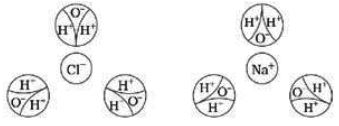
A
Cohesive force
B
Reactant
C
Efficient solvent
D
Conducting medium
Solution
(C) The image shows water molecules $(H_2O)$ surrounding ions ($Cl^-$ and $Na^+$).
Water is a polar molecule with a partial negative charge on the oxygen atom and partial positive charges on the hydrogen atoms.
Because of this polarity,water molecules can surround and hydrate ions,effectively dissolving ionic compounds like $NaCl$.
This ability to dissolve a wide variety of substances makes water an 'efficient solvent' or 'universal solvent' in biological systems.
Water is a polar molecule with a partial negative charge on the oxygen atom and partial positive charges on the hydrogen atoms.
Because of this polarity,water molecules can surround and hydrate ions,effectively dissolving ionic compounds like $NaCl$.
This ability to dissolve a wide variety of substances makes water an 'efficient solvent' or 'universal solvent' in biological systems.
0 likes
View Solution140
EasyMCQ
Which type of bond is present between water molecules?
A
Hydrogen bond
B
Peptide bond
C
Glycosidic bond
D
Ionic bond
Solution
(A) Water molecules $(H_2O)$ are polar in nature due to the electronegativity difference between oxygen and hydrogen atoms.
This polarity leads to the formation of a weak electrostatic attraction between the partially positive hydrogen atom of one water molecule and the partially negative oxygen atom of another water molecule.
This specific type of intermolecular force is known as a $Hydrogen \ bond$.
Peptide bonds are found in proteins,glycosidic bonds in carbohydrates,and ionic bonds in salts.
This polarity leads to the formation of a weak electrostatic attraction between the partially positive hydrogen atom of one water molecule and the partially negative oxygen atom of another water molecule.
This specific type of intermolecular force is known as a $Hydrogen \ bond$.
Peptide bonds are found in proteins,glycosidic bonds in carbohydrates,and ionic bonds in salts.
0 likes
View Solution141
EasyMCQ
$A$ liquid that is colorless,tasteless,and odorless at normal temperature is:
A
Formalin
B
Kerosene
C
Water
D
Ethanol
Solution
(C) Water $(H_2O)$ is a chemical substance that is colorless,tasteless,and odorless at room temperature and normal atmospheric pressure. It is the most essential solvent for all living organisms and is a fundamental component of biological systems.
0 likes
View Solution142
MediumMCQ
Which property of water is responsible for maintaining the homogeneity of the cytoplasm?
A
Polarity
B
Specific heat
C
Cohesion
D
Universal solvent
Solution
(D) Water acts as a $universal \ solvent$ because of its high polarity and ability to form hydrogen bonds with various solutes. This property allows it to dissolve a wide range of substances, including salts, sugars, and proteins, within the cytoplasm. By keeping these diverse molecules in a dissolved or colloidal state, water ensures the $homogeneity$ of the cytoplasm, which is essential for the smooth functioning of metabolic reactions.
0 likes
View Solution143
EasyMCQ
What is the distance '$a$' in the given figure (in $pm$)?
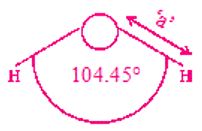
A
$95.84$
B
$104.45$
C
$84.95$
D
$90$
Solution
(A) The figure represents a water $(H_2O)$ molecule.
In a water molecule, the bond angle between the two $O-H$ bonds is $104.5^\circ$.
The bond length of the $O-H$ covalent bond is approximately $95.84 \ pm$.
In the provided figure, '$a$' represents the bond length of the $O-H$ bond.
Therefore, the correct value for '$a$' is $95.84 \ pm$.
In a water molecule, the bond angle between the two $O-H$ bonds is $104.5^\circ$.
The bond length of the $O-H$ covalent bond is approximately $95.84 \ pm$.
In the provided figure, '$a$' represents the bond length of the $O-H$ bond.
Therefore, the correct value for '$a$' is $95.84 \ pm$.
0 likes
View Solution144
EasyMCQ
Which of the following is essential for living systems?
A
Alcohol
B
Water
C
Chloroform
D
Acetone
Solution
(B) Water is the most essential component for all living systems. It acts as a universal solvent, provides a medium for biochemical reactions, helps in the transport of nutrients and waste products, and maintains the structural integrity of cells and tissues. Approximately $70-90\%$ of the mass of a living cell consists of water.
0 likes
View Solution145
EasyMCQ
What is the percentage of water in living cells?
A
$70$ to $90\%$
B
$60$ to $80\%$
C
$50$ to $70\%$
D
$90$ to $95\%$
Solution
(A) Water is the most abundant chemical component in living organisms. In a typical living cell,water accounts for approximately $70\%$ to $90\%$ of the total cellular mass. It acts as a universal solvent and is essential for all metabolic reactions occurring within the cell.
0 likes
View Solution146
EasyMCQ
How many atoms of $H$ and $O$ are present in one molecule of water,respectively?
A
$1, 1$
B
$2, 1$
C
$2, 2$
D
$1, 2$
Solution
(B) The chemical formula of water is $H_2O$.
This formula indicates that one molecule of water consists of $2$ atoms of Hydrogen $(H)$ and $1$ atom of Oxygen $(O)$.
Therefore,the number of $H$ and $O$ atoms are $2$ and $1$ respectively.
This formula indicates that one molecule of water consists of $2$ atoms of Hydrogen $(H)$ and $1$ atom of Oxygen $(O)$.
Therefore,the number of $H$ and $O$ atoms are $2$ and $1$ respectively.
0 likes
View Solution147
EasyMCQ
Which type of bond connects the $H$ and $O$ atoms in a water molecule?
A
Ionic bond
B
Sulphide bond
C
Polar ionic bond
D
Covalent bond
Solution
(D) In a water molecule $(H_2O)$,the oxygen atom shares electrons with two hydrogen atoms.
This sharing of electron pairs between atoms results in the formation of a covalent bond.
Specifically,these are polar covalent bonds because oxygen is more electronegative than hydrogen,leading to an unequal sharing of electrons.
This sharing of electron pairs between atoms results in the formation of a covalent bond.
Specifically,these are polar covalent bonds because oxygen is more electronegative than hydrogen,leading to an unequal sharing of electrons.
0 likes
View Solution148
EasyMCQ
What kind of liquid is water at normal temperature?
A
Inert liquid
B
Colored,flavored,odorous liquid
C
Colorless,tasteless,odorless liquid
D
Reactive liquid
Solution
(C) Water $(H_2O)$ at normal temperature is a colorless,tasteless,and odorless liquid. It is a universal solvent and is essential for all known forms of life.
0 likes
View Solution149
MediumMCQ
What are the charges on $H$ and $O$ atoms in a water molecule, respectively?
A
Negative,Positive
B
Negative,Zero
C
Positive,Negative
D
Zero,Zero
Solution
(C) In a water molecule $(H_2O)$, oxygen is more electronegative than hydrogen.
Due to the difference in electronegativity, the shared pair of electrons is pulled more towards the oxygen atom.
This results in the oxygen atom acquiring a partial negative charge $(\delta^-)$ and the hydrogen atoms acquiring a partial positive charge $(\delta^+)$.
Therefore, $H$ has a positive charge and $O$ has a negative charge.
Due to the difference in electronegativity, the shared pair of electrons is pulled more towards the oxygen atom.
This results in the oxygen atom acquiring a partial negative charge $(\delta^-)$ and the hydrogen atoms acquiring a partial positive charge $(\delta^+)$.
Therefore, $H$ has a positive charge and $O$ has a negative charge.
0 likes
View Solution150
MediumMCQ
Which property of water prevents significant changes in its temperature even when heat is lost or absorbed in the environment?
A
Heat
B
Specific heat
C
High specific heat
D
Specific energy
Solution
(C) Water possesses a property known as $High \ Specific \ Heat$.
This means that water can absorb or release a large amount of heat energy with only a minimal change in its own temperature.
This property is crucial for maintaining stable temperatures in biological systems and the environment,as it acts as a thermal buffer.
This means that water can absorb or release a large amount of heat energy with only a minimal change in its own temperature.
This property is crucial for maintaining stable temperatures in biological systems and the environment,as it acts as a thermal buffer.
0 likes
View SolutionBiomolecules — Mix Examples- Biomolecules · Frequently Asked Questions
1Are these Biomolecules questions useful for JEE and NEET?
Yes. All questions in this section are mapped to JEE Main and NEET exam patterns. Previous year questions from JEE Main, NEET, GUJCET and state-level exams are included with full solutions.
2Can I switch to Hindi or Gujarati for these questions?
Yes. Use the language tabs in the hero section or the sidebar to view the same questions and solutions in English, Hindi or Gujarati.
3How do I generate a question paper from this subtopic?
Use the Vedclass Exam Paper Generator — select the chapter and subtopic, set difficulty, and generate Sets A, B, C, D automatically. First 3 chapters of every subject are free.
Vedclass Products
For Students
Vedclass Test Series
Mock tests in real JEE/NEET style with performance analysis. 5-day free trial.
Start Free TrialFor Teachers
Exam Paper Generator
Generate Set A/B/C/D papers from this chapter in 2 minutes. 3 chapters free.
Try FreeFor Institutes
Online Exam Module
Live online exams with unlimited students, 360° analytics & white-label branding.
See DemoFor Teachers & Institutes
Generate a Biomolecules Exam Paper in 2 Minutes
Select subtopic & difficulty — Sets A, B, C, D auto-generated with No Repeat logic.
First 3 chapters of every subject are free — no payment required.