
A English
Mix Examples - Periodic Classification of Elements Questions in English
Class 10 Science · Periodic Classification of Elements · Mix Examples - Periodic Classification of Elements
168+
Questions
English
Language
100%
With Solutions
Showing 50 of 168 questions in English
1
EasyMCQ
Up to which element was the Law of Octaves found to be applicable?
A
Calcium
B
Oxygen
C
Cobalt
D
Potassium
Solution
(A) John Newlands,an English scientist,arranged the then-known elements in the order of increasing atomic masses and found that every eighth element had properties similar to the first.
This was known as the Law of Octaves.
However,this law was found to be applicable only up to Calcium $(Ca)$,which is the $20^{th}$ element in the periodic table.
After Calcium,every eighth element did not possess properties similar to the first.
This was known as the Law of Octaves.
However,this law was found to be applicable only up to Calcium $(Ca)$,which is the $20^{th}$ element in the periodic table.
After Calcium,every eighth element did not possess properties similar to the first.
0 likes
View Solution2
EasyMCQ
According to Mendeleev's Periodic Law,the elements were arranged in the periodic table in the order of
A
increasing atomic number
B
increasing atomic masses
C
decreasing atomic number
D
decreasing atomic masses
Solution
(B) Mendeleev's Periodic Law states that the properties of elements are a periodic function of their atomic masses.
Therefore,Mendeleev arranged the elements in the periodic table in the order of increasing atomic masses.
Therefore,Mendeleev arranged the elements in the periodic table in the order of increasing atomic masses.
0 likes
View Solution3
EasyMCQ
In Mendeleev's Periodic Table,gaps were left for elements to be discovered later. Which of the following elements found a place in the periodic table later?
A
Oxygen
B
Chlorine
C
Germanium
D
Silicon
Solution
(C) Mendeleev predicted the existence of several elements that had not been discovered at that time.
He named them by prefixing a Sanskrit numeral 'Eka' (one) to the name of the preceding element in the same group.
For example,he named 'Eka-boron' (Scandium),'Eka-aluminium' (Gallium),and 'Eka-silicon' (Germanium).
Therefore,Germanium is the element that was discovered later and placed in the gap left by Mendeleev.
He named them by prefixing a Sanskrit numeral 'Eka' (one) to the name of the preceding element in the same group.
For example,he named 'Eka-boron' (Scandium),'Eka-aluminium' (Gallium),and 'Eka-silicon' (Germanium).
Therefore,Germanium is the element that was discovered later and placed in the gap left by Mendeleev.
0 likes
View Solution4
MediumMCQ
Which of the following statement$(s)$ about the Modern Periodic Table are incorrect?
$(i)$ The elements in the Modern Periodic Table are arranged on the basis of their decreasing atomic number.
$(ii)$ The elements in the Modern Periodic Table are arranged on the basis of their increasing atomic masses.
$(iii)$ Isotopes are placed in adjoining group$(s)$ in the Periodic Table.
$(iv)$ The elements in the Modern Periodic Table are arranged on the basis of their increasing atomic number.
$(i)$ The elements in the Modern Periodic Table are arranged on the basis of their decreasing atomic number.
$(ii)$ The elements in the Modern Periodic Table are arranged on the basis of their increasing atomic masses.
$(iii)$ Isotopes are placed in adjoining group$(s)$ in the Periodic Table.
$(iv)$ The elements in the Modern Periodic Table are arranged on the basis of their increasing atomic number.
A
$(i)$ only
B
$(iv)$ only
C
$(i), (ii)$ and $(iv)$
D
$(i), (ii)$ and $(iii)$
Solution
(D) The Modern Periodic Law states that the properties of elements are a periodic function of their atomic number.
Statement $(i)$ is incorrect because elements are arranged in increasing,not decreasing,order of atomic number.
Statement $(ii)$ is incorrect because the Modern Periodic Table is based on atomic number,not atomic mass (which was the basis for Mendeleev's Periodic Table).
Statement $(iii)$ is incorrect because isotopes have the same atomic number and are placed in the same group,not in adjoining groups.
Statement $(iv)$ is correct as it accurately describes the arrangement of elements in the Modern Periodic Table.
Therefore,statements $(i), (ii),$ and $(iii)$ are incorrect.
Statement $(i)$ is incorrect because elements are arranged in increasing,not decreasing,order of atomic number.
Statement $(ii)$ is incorrect because the Modern Periodic Table is based on atomic number,not atomic mass (which was the basis for Mendeleev's Periodic Table).
Statement $(iii)$ is incorrect because isotopes have the same atomic number and are placed in the same group,not in adjoining groups.
Statement $(iv)$ is correct as it accurately describes the arrangement of elements in the Modern Periodic Table.
Therefore,statements $(i), (ii),$ and $(iii)$ are incorrect.
0 likes
View Solution5
EasyMCQ
Which of the following statements about the Modern Periodic Table is correct?
A
It has $18$ vertical columns known as groups.
B
It has $7$ vertical columns known as periods.
C
It has $18$ horizontal rows known as periods.
D
It has $7$ horizontal rows known as groups.
Solution
(A) The Modern Periodic Table is organized based on the atomic number of elements.
It consists of $18$ vertical columns,which are referred to as groups.
It also consists of $7$ horizontal rows,which are referred to as periods.
Therefore,the statement that it has $18$ vertical columns known as groups is correct.
It consists of $18$ vertical columns,which are referred to as groups.
It also consists of $7$ horizontal rows,which are referred to as periods.
Therefore,the statement that it has $18$ vertical columns known as groups is correct.
0 likes
View Solution6
EasyMCQ
Which of the given elements $A$,$B$,$C$,$D$ and $E$ with atomic numbers $2$,$3$,$7$,$10$ and $30$ respectively belong to the same period?
A
$A, B, C$
B
$B, C, D$
C
$A, D, E$
D
$B, D, E$
Solution
(B) To determine the period of an element,we look at its electronic configuration.
$1$. Element $A$ (Atomic number $2$): Configuration is $2$ (Period $1$).
$2$. Element $B$ (Atomic number $3$): Configuration is $2, 1$ (Period $2$).
$3$. Element $C$ (Atomic number $7$): Configuration is $2, 5$ (Period $2$).
$4$. Element $D$ (Atomic number $10$): Configuration is $2, 8$ (Period $2$).
$5$. Element $E$ (Atomic number $30$): Configuration is $2, 8, 18, 2$ (Period $4$).
Elements $B$,$C$,and $D$ all have electrons in $2$ shells,meaning they belong to the $2$nd period.
$1$. Element $A$ (Atomic number $2$): Configuration is $2$ (Period $1$).
$2$. Element $B$ (Atomic number $3$): Configuration is $2, 1$ (Period $2$).
$3$. Element $C$ (Atomic number $7$): Configuration is $2, 5$ (Period $2$).
$4$. Element $D$ (Atomic number $10$): Configuration is $2, 8$ (Period $2$).
$5$. Element $E$ (Atomic number $30$): Configuration is $2, 8, 18, 2$ (Period $4$).
Elements $B$,$C$,and $D$ all have electrons in $2$ shells,meaning they belong to the $2$nd period.
0 likes
View Solution7
MediumMCQ
The elements $A$,$B$,$C$,$D$,and $E$ have atomic numbers $9$,$11$,$17$,$12$,and $13$ respectively. Which pair of elements belongs to the same group?
A
$A$ and $B$
B
$B$ and $D$
C
$A$ and $C$
D
$D$ and $E$
Solution
(C) To determine the group of an element,we write its electronic configuration:
$A$ (atomic number $9$): $2, 7$ (Group $17$,Halogens)
$B$ (atomic number $11$): $2, 8, 1$ (Group $1$,Alkali metals)
$C$ (atomic number $17$): $2, 8, 7$ (Group $17$,Halogens)
$D$ (atomic number $12$): $2, 8, 2$ (Group $2$,Alkaline earth metals)
$E$ (atomic number $13$): $2, 8, 3$ (Group $13$)
Elements belonging to the same group have the same number of valence electrons.
$A$ and $C$ both have $7$ valence electrons,so they belong to the same group (Group $17$).
$A$ (atomic number $9$): $2, 7$ (Group $17$,Halogens)
$B$ (atomic number $11$): $2, 8, 1$ (Group $1$,Alkali metals)
$C$ (atomic number $17$): $2, 8, 7$ (Group $17$,Halogens)
$D$ (atomic number $12$): $2, 8, 2$ (Group $2$,Alkaline earth metals)
$E$ (atomic number $13$): $2, 8, 3$ (Group $13$)
Elements belonging to the same group have the same number of valence electrons.
$A$ and $C$ both have $7$ valence electrons,so they belong to the same group (Group $17$).
0 likes
View Solution8
EasyMCQ
Where would you locate the element with electronic configuration $2, 8$ in the Modern Periodic Table?
A
Group $8$
B
Group $2$
C
Group $10$
D
Group $18$
Solution
(D) The electronic configuration of the element is $2, 8$.
This means the element has a total of $10$ electrons,which corresponds to the atomic number $10$.
The element with atomic number $10$ is Neon $(Ne)$.
In the Modern Periodic Table,elements with a completely filled outermost shell (octet) are placed in Group $18$,which consists of noble gases.
Since the valence shell of this element is full ($8$ electrons),it belongs to Group $18$.
This means the element has a total of $10$ electrons,which corresponds to the atomic number $10$.
The element with atomic number $10$ is Neon $(Ne)$.
In the Modern Periodic Table,elements with a completely filled outermost shell (octet) are placed in Group $18$,which consists of noble gases.
Since the valence shell of this element is full ($8$ electrons),it belongs to Group $18$.
0 likes
View Solution9
EasyMCQ
An element which is an essential constituent of all organic compounds belongs to
A
Group $14$
B
Group $1$
C
Group $15$
D
Group $16$
Solution
(A) All organic compounds are based on carbon chains or rings.
Carbon is the fundamental element that forms the backbone of every organic molecule.
Carbon has an atomic number of $6$ and its electronic configuration is $2, 4$.
It belongs to Group $14$ of the periodic table,which is the carbon family.
Therefore,the correct option is $A$.
Carbon is the fundamental element that forms the backbone of every organic molecule.
Carbon has an atomic number of $6$ and its electronic configuration is $2, 4$.
It belongs to Group $14$ of the periodic table,which is the carbon family.
Therefore,the correct option is $A$.
0 likes
View Solution10
EasyMCQ
Which of the following is the outermost shell for elements of period $2$?
A
$K$ shell
B
$L$ shell
C
$M$ shell
D
$N$ shell
Solution
(B) The period number of an element in the periodic table corresponds to the number of shells occupied by electrons in its atom.
For elements in period $1$,the outermost shell is the $K$ shell $(n=1)$.
For elements in period $2$,the outermost shell is the $L$ shell $(n=2)$.
For elements in period $3$,the outermost shell is the $M$ shell $(n=3)$,and so on.
Therefore,for elements of period $2$,the outermost shell is the $L$ shell.
For elements in period $1$,the outermost shell is the $K$ shell $(n=1)$.
For elements in period $2$,the outermost shell is the $L$ shell $(n=2)$.
For elements in period $3$,the outermost shell is the $M$ shell $(n=3)$,and so on.
Therefore,for elements of period $2$,the outermost shell is the $L$ shell.
0 likes
View Solution11
MediumMCQ
Which one of the following elements exhibits the maximum number of valence electrons?
A
$Na$
B
$Al$
C
$P$
D
$Si$
Solution
(C) To determine the number of valence electrons,we look at the group number or the electronic configuration of the elements:
$1$. $Na$ (Sodium) has atomic number $11$. Its electronic configuration is $2, 8, 1$. It has $1$ valence electron.
$2$. $Al$ (Aluminium) has atomic number $13$. Its electronic configuration is $2, 8, 3$. It has $3$ valence electrons.
$3$. $Si$ (Silicon) has atomic number $14$. Its electronic configuration is $2, 8, 4$. It has $4$ valence electrons.
$4$. $P$ (Phosphorus) has atomic number $15$. Its electronic configuration is $2, 8, 5$. It has $5$ valence electrons.
Comparing these,$P$ has the maximum number of valence electrons $(5)$.
$1$. $Na$ (Sodium) has atomic number $11$. Its electronic configuration is $2, 8, 1$. It has $1$ valence electron.
$2$. $Al$ (Aluminium) has atomic number $13$. Its electronic configuration is $2, 8, 3$. It has $3$ valence electrons.
$3$. $Si$ (Silicon) has atomic number $14$. Its electronic configuration is $2, 8, 4$. It has $4$ valence electrons.
$4$. $P$ (Phosphorus) has atomic number $15$. Its electronic configuration is $2, 8, 5$. It has $5$ valence electrons.
Comparing these,$P$ has the maximum number of valence electrons $(5)$.
0 likes
View Solution12
MediumMCQ
Which of the following gives the correct increasing order of the atomic radii of $O$,$F$ and $N$?
A
$O < F < N$
B
$N < F < O$
C
$O < N < F$
D
$F < O < N$
Solution
(D) In the periodic table,atomic radius generally decreases as we move from left to right across a period due to an increase in effective nuclear charge.
$N$,$O$,and $F$ all belong to the $2^{nd}$ period of the periodic table.
Their atomic numbers are $N (7)$,$O (8)$,and $F (9)$.
As the atomic number increases from left to right,the number of protons increases,which pulls the electrons closer to the nucleus,resulting in a smaller atomic radius.
Therefore,the order of atomic radii is $F < O < N$.
Thus,the correct increasing order is $F < O < N$.
$N$,$O$,and $F$ all belong to the $2^{nd}$ period of the periodic table.
Their atomic numbers are $N (7)$,$O (8)$,and $F (9)$.
As the atomic number increases from left to right,the number of protons increases,which pulls the electrons closer to the nucleus,resulting in a smaller atomic radius.
Therefore,the order of atomic radii is $F < O < N$.
Thus,the correct increasing order is $F < O < N$.
0 likes
View Solution13
EasyMCQ
Which among the following elements has the largest atomic radii?
A
$K$
B
$Mg$
C
$Na$
D
$Ca$
Solution
(A) Atomic radius increases down a group due to the addition of new electron shells.
Atomic radius decreases across a period from left to right due to an increase in effective nuclear charge.
Comparing the given elements:
$Na$ (Group $1$, Period $3$)
$Mg$ (Group $2$, Period $3$)
$K$ (Group $1$, Period $4$)
$Ca$ (Group $2$, Period $4$)
Elements in Period $4$ have larger radii than those in Period $3$.
Between $K$ and $Ca$, $K$ is on the left side of the periodic table, meaning it has a lower effective nuclear charge than $Ca$, resulting in a larger atomic radius.
Therefore, $K$ has the largest atomic radius among the given options.
Atomic radius decreases across a period from left to right due to an increase in effective nuclear charge.
Comparing the given elements:
$Na$ (Group $1$, Period $3$)
$Mg$ (Group $2$, Period $3$)
$K$ (Group $1$, Period $4$)
$Ca$ (Group $2$, Period $4$)
Elements in Period $4$ have larger radii than those in Period $3$.
Between $K$ and $Ca$, $K$ is on the left side of the periodic table, meaning it has a lower effective nuclear charge than $Ca$, resulting in a larger atomic radius.
Therefore, $K$ has the largest atomic radius among the given options.
0 likes
View Solution14
EasyMCQ
Which of the following elements would lose an electron easily?
A
$Mg$
B
$K$
C
$Na$
D
$Ca$
Solution
(B) The ease with which an element loses an electron is determined by its ionization energy.
Lower ionization energy means the element loses an electron more easily.
Ionization energy generally decreases down a group and increases across a period from left to right.
Comparing the given elements: $Na$ (Group $1$,Period $3$),$Mg$ (Group $2$,Period $3$),$K$ (Group $1$,Period $4$),and $Ca$ (Group $2$,Period $4$).
Among these,$K$ is in the lowest period (Period $4$) and Group $1$,meaning it has the largest atomic size and the weakest nuclear hold on its valence electron.
Therefore,$K$ has the lowest ionization energy and loses an electron most easily.
Lower ionization energy means the element loses an electron more easily.
Ionization energy generally decreases down a group and increases across a period from left to right.
Comparing the given elements: $Na$ (Group $1$,Period $3$),$Mg$ (Group $2$,Period $3$),$K$ (Group $1$,Period $4$),and $Ca$ (Group $2$,Period $4$).
Among these,$K$ is in the lowest period (Period $4$) and Group $1$,meaning it has the largest atomic size and the weakest nuclear hold on its valence electron.
Therefore,$K$ has the lowest ionization energy and loses an electron most easily.
0 likes
View Solution15
EasyMCQ
Which of the following elements does not lose an electron easily?
A
$Na$
B
$Mg$
C
$F$
D
$Al$
Solution
(C) The tendency to lose an electron is related to the ionization energy of an element. Elements with high ionization energy do not lose electrons easily.
Fluorine $(F)$ is a highly electronegative non-metal located in Group $17$ of the periodic table.
It has a very small atomic size and a high effective nuclear charge,which holds its valence electrons very tightly.
In contrast,$Na$,$Mg$,and $Al$ are metals that have lower ionization energies and tend to lose electrons to form positive ions ($Na^+$,$Mg^{2+}$,$Al^{3+}$).
Therefore,$F$ has the highest tendency to gain an electron rather than lose one,making it the correct answer.
Fluorine $(F)$ is a highly electronegative non-metal located in Group $17$ of the periodic table.
It has a very small atomic size and a high effective nuclear charge,which holds its valence electrons very tightly.
In contrast,$Na$,$Mg$,and $Al$ are metals that have lower ionization energies and tend to lose electrons to form positive ions ($Na^+$,$Mg^{2+}$,$Al^{3+}$).
Therefore,$F$ has the highest tendency to gain an electron rather than lose one,making it the correct answer.
0 likes
View Solution16
MediumMCQ
Which of the following are the characteristics of isotopes of an element?
$(i)$ Isotopes of an element have same atomic masses
$(ii)$ Isotopes of an element have same atomic number
$(iii)$ Isotopes of an element show same physical properties
$(iv)$ Isotopes of an element show same chemical properties
$(i)$ Isotopes of an element have same atomic masses
$(ii)$ Isotopes of an element have same atomic number
$(iii)$ Isotopes of an element show same physical properties
$(iv)$ Isotopes of an element show same chemical properties
A
$(i), (iii)$ and $(iv)$
B
$(ii), (iii)$ and $(iv)$
C
$(ii)$ and $(iii)$
D
$(ii)$ and $(iv)$
Solution
(D) Isotopes are atoms of the same element that have the same atomic number but different mass numbers.
$(i)$ Incorrect: Isotopes have different atomic masses due to a different number of neutrons.
$(ii)$ Correct: Isotopes of the same element must have the same atomic number (number of protons).
$(iii)$ Incorrect: Isotopes often show different physical properties (like density or boiling point) because these properties depend on the mass of the atom.
$(iv)$ Correct: Isotopes show the same chemical properties because chemical properties are determined by the electronic configuration,which remains the same for isotopes of the same element.
Therefore,statements $(ii)$ and $(iv)$ are correct.
$(i)$ Incorrect: Isotopes have different atomic masses due to a different number of neutrons.
$(ii)$ Correct: Isotopes of the same element must have the same atomic number (number of protons).
$(iii)$ Incorrect: Isotopes often show different physical properties (like density or boiling point) because these properties depend on the mass of the atom.
$(iv)$ Correct: Isotopes show the same chemical properties because chemical properties are determined by the electronic configuration,which remains the same for isotopes of the same element.
Therefore,statements $(ii)$ and $(iv)$ are correct.
0 likes
View Solution17
MediumMCQ
Arrange the following elements in the order of their decreasing metallic character:
$Na, Si, Cl, Mg, Al$
$Na, Si, Cl, Mg, Al$
A
$Na > Mg > Al > Si > Cl$
B
$Cl > Si > Al > Mg > Na$
C
$Na > Al > Mg > Cl > Si$
D
$Al > Na > Si > Cl > Mg$
Solution
(A) Metallic character refers to the tendency of an element to lose electrons.
In the periodic table,metallic character decreases as we move from left to right across a period because the effective nuclear charge increases,making it harder to lose electrons.
All the given elements $(Na, Mg, Al, Si, Cl)$ belong to the $3^{rd}$ period of the periodic table.
Their order from left to right in the $3^{rd}$ period is: $Na (Group 1), Mg (Group 2), Al (Group 13), Si (Group 14), Cl (Group 17)$.
Therefore,the decreasing order of metallic character is: $Na > Mg > Al > Si > Cl$.
In the periodic table,metallic character decreases as we move from left to right across a period because the effective nuclear charge increases,making it harder to lose electrons.
All the given elements $(Na, Mg, Al, Si, Cl)$ belong to the $3^{rd}$ period of the periodic table.
Their order from left to right in the $3^{rd}$ period is: $Na (Group 1), Mg (Group 2), Al (Group 13), Si (Group 14), Cl (Group 17)$.
Therefore,the decreasing order of metallic character is: $Na > Mg > Al > Si > Cl$.
0 likes
View Solution18
MediumMCQ
Arrange the following elements in the order of their increasing nonmetallic character:
$Li, O, C, Be, F$
$Li, O, C, Be, F$
A
$F < O < C < Be < Li$
B
$Li < Be < C < O < F$
C
$F < O < C < Be < Li$
D
$F < O < Be < C < Li$
Solution
(B) The nonmetallic character of elements increases as we move from left to right across a period in the periodic table.
These elements belong to the $2^{nd}$ period of the periodic table.
The order of these elements in the $2^{nd}$ period from left to right is: $Li, Be, C, O, F$.
Since nonmetallic character increases from left to right,the order of increasing nonmetallic character is $Li < Be < C < O < F$.
Therefore,the correct option is $B$.
These elements belong to the $2^{nd}$ period of the periodic table.
The order of these elements in the $2^{nd}$ period from left to right is: $Li, Be, C, O, F$.
Since nonmetallic character increases from left to right,the order of increasing nonmetallic character is $Li < Be < C < O < F$.
Therefore,the correct option is $B$.
0 likes
View Solution19
MediumMCQ
What type of oxide would Eka-aluminium form?
A
$EO_3$
B
$E_3O_2$
C
$E_2O_3$
D
$EO$
Solution
(C) Eka-aluminium is the name given by Mendeleev to the element Gallium $(Ga)$.
Gallium belongs to Group $13$ of the periodic table.
Elements in Group $13$ have a valency of $3$.
Oxygen has a valency of $2$.
When an element $E$ with valency $3$ reacts with oxygen (valency $2$),the formula of the oxide is formed by crossing the valencies.
Thus,the formula becomes $E_2O_3$.
Gallium belongs to Group $13$ of the periodic table.
Elements in Group $13$ have a valency of $3$.
Oxygen has a valency of $2$.
When an element $E$ with valency $3$ reacts with oxygen (valency $2$),the formula of the oxide is formed by crossing the valencies.
Thus,the formula becomes $E_2O_3$.
0 likes
View Solution20
EasyMCQ
Three elements $B$,$Si$ and $Ge$ are
A
metals
B
non-metals
C
metal,non-metal and metalloid respectively
D
metalloids
Solution
(D) The elements $B$ (Boron),$Si$ (Silicon),and $Ge$ (Germanium) are all classified as metalloids.
Metalloids are elements that exhibit properties intermediate between those of metals and non-metals.
Boron is a metalloid,Silicon is a metalloid,and Germanium is also a metalloid.
Therefore,the correct option is $D$.
Metalloids are elements that exhibit properties intermediate between those of metals and non-metals.
Boron is a metalloid,Silicon is a metalloid,and Germanium is also a metalloid.
Therefore,the correct option is $D$.
0 likes
View Solution21
MediumMCQ
Which of the following elements will form an acidic oxide?
A
An element with atomic number $7$
B
An element with atomic number $3$
C
An element with atomic number $12$
D
An element with atomic number $19$
Solution
(A) Non-metals generally form acidic oxides. Non-metals typically have $4$ to $8$ electrons in their outermost shell.
The electronic configurations of the given elements are:
$(a)$ Atomic number $7$: $2, 5$ (Nitrogen)
$(b)$ Atomic number $3$: $2, 1$ (Lithium)
$(c)$ Atomic number $12$: $2, 8, 2$ (Magnesium)
$(d)$ Atomic number $19$: $2, 8, 8, 1$ (Potassium)
Since the element with atomic number $7$ is a non-metal,it forms an acidic oxide. The other three elements $(Li, Mg, K)$ are metals and form basic oxides.
The electronic configurations of the given elements are:
$(a)$ Atomic number $7$: $2, 5$ (Nitrogen)
$(b)$ Atomic number $3$: $2, 1$ (Lithium)
$(c)$ Atomic number $12$: $2, 8, 2$ (Magnesium)
$(d)$ Atomic number $19$: $2, 8, 8, 1$ (Potassium)
Since the element with atomic number $7$ is a non-metal,it forms an acidic oxide. The other three elements $(Li, Mg, K)$ are metals and form basic oxides.
0 likes
View Solution22
EasyMCQ
The element with atomic number $14$ is hard and forms acidic oxide and a covalent halide. To which of the following categories does the element belong?
A
Metal
B
Metalloid
C
Non-metal
D
Left-hand side element
Solution
(B) The element with atomic number $14$ is Silicon $(Si)$.
Silicon is located in group $14$ and period $3$ of the periodic table.
It exhibits properties intermediate between metals and non-metals,making it a metalloid.
It forms an acidic oxide $(SiO_2)$ and a covalent halide $(SiCl_4)$.
Therefore,it belongs to the category of metalloids.
Silicon is located in group $14$ and period $3$ of the periodic table.
It exhibits properties intermediate between metals and non-metals,making it a metalloid.
It forms an acidic oxide $(SiO_2)$ and a covalent halide $(SiCl_4)$.
Therefore,it belongs to the category of metalloids.
0 likes
View Solution23
DifficultMCQ
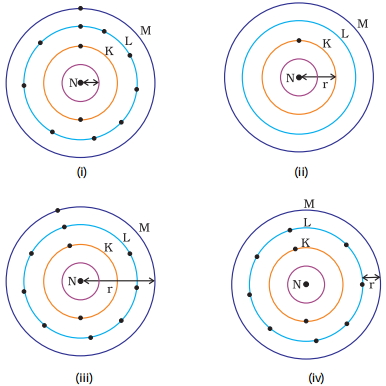
Which one of the following depicts the correct representation of atomic radius $(r)$ of an atom?
A
$(i)$ and $(ii)$
B
$(iii)$ and $(iv)$
C
$(ii)$ and $(iii)$
D
$(i)$ and $(iv)$
Solution
(C) The atomic radius of an atom is defined as the distance from the center of the nucleus to the outermost shell containing electrons.
In the given diagrams:
- Diagram $(ii)$ shows the distance from the nucleus $(N)$ to the first shell $(K)$,which is incorrect for the total atomic radius.
- Diagram $(iii)$ correctly shows the distance from the center of the nucleus $(N)$ to the outermost shell $(M)$,which represents the atomic radius $(r)$.
- Diagram $(iv)$ shows the distance between two shells,which is incorrect.
- Diagram $(i)$ shows the distance from the nucleus to the inner shell,which is incorrect.
However,looking closely at the provided options and the standard definition,diagram $(ii)$ and $(iii)$ are often compared in such problems. Re-evaluating the diagrams: $(ii)$ shows the radius of the $K$ shell,$(iii)$ shows the radius of the $M$ shell. Both are valid representations of the radius of their respective shells. Given the options,$(ii)$ and $(iii)$ represent the distance from the nucleus to a shell,which is the definition of a radius.
In the given diagrams:
- Diagram $(ii)$ shows the distance from the nucleus $(N)$ to the first shell $(K)$,which is incorrect for the total atomic radius.
- Diagram $(iii)$ correctly shows the distance from the center of the nucleus $(N)$ to the outermost shell $(M)$,which represents the atomic radius $(r)$.
- Diagram $(iv)$ shows the distance between two shells,which is incorrect.
- Diagram $(i)$ shows the distance from the nucleus to the inner shell,which is incorrect.
However,looking closely at the provided options and the standard definition,diagram $(ii)$ and $(iii)$ are often compared in such problems. Re-evaluating the diagrams: $(ii)$ shows the radius of the $K$ shell,$(iii)$ shows the radius of the $M$ shell. Both are valid representations of the radius of their respective shells. Given the options,$(ii)$ and $(iii)$ represent the distance from the nucleus to a shell,which is the definition of a radius.
0 likes
View Solution24
EasyMCQ
Which one of the following does not increase while moving down the group of the periodic table?
A
Atomic radius
B
Metallic character
C
Number of shells in an element
D
Valence
Solution
(D) $1$. Atomic radius increases down the group because the number of shells increases.
$2$. Metallic character increases down the group because the tendency to lose electrons increases due to the increase in atomic size.
$3$. The number of shells increases by $1$ for each successive element down a group.
$4$. Valence (valency) remains the same for all elements in the same group because they have the same number of valence electrons. Therefore,it does not increase.
$2$. Metallic character increases down the group because the tendency to lose electrons increases due to the increase in atomic size.
$3$. The number of shells increases by $1$ for each successive element down a group.
$4$. Valence (valency) remains the same for all elements in the same group because they have the same number of valence electrons. Therefore,it does not increase.
0 likes
View Solution25
EasyMCQ
On moving from left to right in a period in the periodic table,the size of the atom.
A
decreases
B
increases
C
does not change appreciably
D
first decreases and then increases
Solution
(A) In the periodic table,as we move from left to right across a period,the atomic number increases,which means the number of protons in the nucleus increases.
This leads to an increase in the nuclear charge,which pulls the electrons more strongly towards the nucleus.
Although the number of electrons also increases,they are added to the same shell.
Consequently,the effective nuclear charge increases,causing the atomic radius to decrease across a period.
This leads to an increase in the nuclear charge,which pulls the electrons more strongly towards the nucleus.
Although the number of electrons also increases,they are added to the same shell.
Consequently,the effective nuclear charge increases,causing the atomic radius to decrease across a period.
0 likes
View Solution26
MediumMCQ
Which of the following sets of elements is written in the order of their increasing metallic character?
A
$Na, Li, K$
B
$Be, Mg, Ca$
C
$Mg, Al, Si$
D
$C, O, N$
Solution
(B) Metallic character refers to the tendency of an element to lose electrons.
In a group,metallic character increases as we move down because the atomic size increases and the valence electrons are held less tightly by the nucleus.
In a period,metallic character decreases from left to right because the atomic size decreases and the effective nuclear charge increases,making it harder to lose electrons.
For option $B$: $Be$ (Group $2$,Period $2$),$Mg$ (Group $2$,Period $3$),and $Ca$ (Group $2$,Period $4$).
As we move down Group $2$ from $Be$ to $Mg$ to $Ca$,the metallic character increases.
Therefore,the order $Be < Mg < Ca$ represents increasing metallic character.
In a group,metallic character increases as we move down because the atomic size increases and the valence electrons are held less tightly by the nucleus.
In a period,metallic character decreases from left to right because the atomic size decreases and the effective nuclear charge increases,making it harder to lose electrons.
For option $B$: $Be$ (Group $2$,Period $2$),$Mg$ (Group $2$,Period $3$),and $Ca$ (Group $2$,Period $4$).
As we move down Group $2$ from $Be$ to $Mg$ to $Ca$,the metallic character increases.
Therefore,the order $Be < Mg < Ca$ represents increasing metallic character.
0 likes
View Solution27
Medium
The three elements $A$,$B$,and $C$ with similar properties have atomic masses $X$,$Y$,and $Z$ respectively. The mass of $Y$ is approximately equal to the average mass of $X$ and $Z$. What is such an arrangement of elements called? Give one example of such a set of elements.
Solution
(N/A) The arrangement of these elements is known as a $Dobereiner$ triad.
According to $Dobereiner's$ law of triads,when elements are arranged in groups of three in the order of increasing atomic masses,the atomic mass of the middle element is approximately the arithmetic mean of the atomic masses of the other two elements.
An example of such a set is the triad of Lithium $(Li)$,Sodium $(Na)$,and Potassium $(K)$.
Atomic mass of $Li = 6.9$,Atomic mass of $K = 39.1$.
Average mass = $(6.9 + 39.1) / 2 = 46 / 2 = 23$,which is the atomic mass of Sodium $(Na)$.
According to $Dobereiner's$ law of triads,when elements are arranged in groups of three in the order of increasing atomic masses,the atomic mass of the middle element is approximately the arithmetic mean of the atomic masses of the other two elements.
An example of such a set is the triad of Lithium $(Li)$,Sodium $(Na)$,and Potassium $(K)$.
Atomic mass of $Li = 6.9$,Atomic mass of $K = 39.1$.
Average mass = $(6.9 + 39.1) / 2 = 46 / 2 = 23$,which is the atomic mass of Sodium $(Na)$.
0 likes
View Solution28
Medium
Elements have been arranged in the following sequence on the basis of their increasing atomic masses.
$F, Na, Mg, Al, Si, P, S, Cl, Ar, K$
$(a)$ Pick two sets of elements which have similar properties.
$(b)$ The given sequence represents which law of classification of elements?
$F, Na, Mg, Al, Si, P, S, Cl, Ar, K$
$(a)$ Pick two sets of elements which have similar properties.
$(b)$ The given sequence represents which law of classification of elements?
Solution
(A) The two sets of elements with similar properties are:
$(i)$ $F$ and $Cl$ (both are halogens).
$(ii)$ $Na$ and $K$ (both are alkali metals).
$(b)$ The given sequence represents Newland's Law of Octaves,which states that when elements are arranged in increasing order of their atomic masses,the properties of every eighth element are a repetition of the properties of the first element.
$(i)$ $F$ and $Cl$ (both are halogens).
$(ii)$ $Na$ and $K$ (both are alkali metals).
$(b)$ The given sequence represents Newland's Law of Octaves,which states that when elements are arranged in increasing order of their atomic masses,the properties of every eighth element are a repetition of the properties of the first element.
0 likes
View Solution29
Medium
Can the following groups of elements be classified as Dobereiner's triad?
$(a)$ $Na, Si, Cl$
$(b)$ $Be, Mg, Ca$
Atomic mass of $Be = 9, Na = 23, Mg = 24, Si = 28, Cl = 35, Ca = 40$. Explain by giving reasons.
$(a)$ $Na, Si, Cl$
$(b)$ $Be, Mg, Ca$
Atomic mass of $Be = 9, Na = 23, Mg = 24, Si = 28, Cl = 35, Ca = 40$. Explain by giving reasons.
Solution
(B) No,because these elements do not possess similar chemical properties,which is a fundamental requirement for Dobereiner's triads,even though the atomic mass of silicon $(28)$ is approximately the average of the atomic masses of sodium $(23)$ and chlorine $(35)$,i.e.,$(23 + 35) / 2 = 29$.
$(b)$ Yes,because these elements belong to the same group (alkaline earth metals) and exhibit similar chemical properties. Furthermore,the atomic mass of magnesium $(24)$ is the average of the atomic masses of beryllium $(9)$ and calcium $(40)$,i.e.,$(9 + 40) / 2 = 24.5$,which is very close to $24$.
$(b)$ Yes,because these elements belong to the same group (alkaline earth metals) and exhibit similar chemical properties. Furthermore,the atomic mass of magnesium $(24)$ is the average of the atomic masses of beryllium $(9)$ and calcium $(40)$,i.e.,$(9 + 40) / 2 = 24.5$,which is very close to $24$.
0 likes
View Solution30
MediumMCQ
In Mendeleev's Periodic Table,the elements were arranged in the increasing order of their atomic masses. However,cobalt with an atomic mass of $58.93 \ amu$ was placed before nickel having an atomic mass of $58.71 \ amu$. Give the reason for the same.
A
Cobalt has higher chemical reactivity.
B
Elements with similar properties were grouped together.
C
Nickel was discovered later.
D
Atomic mass measurements were inaccurate at that time.
Solution
(B) Mendeleev's primary criterion for arranging elements was to group elements with similar chemical properties together in the same column or group.
Even though cobalt $(58.93 \ amu)$ has a higher atomic mass than nickel $(58.71 \ amu)$,Mendeleev placed cobalt before nickel because cobalt shows chemical properties similar to rhodium and iridium,while nickel shows properties similar to palladium and platinum.
Therefore,to maintain the periodicity of properties,he prioritized chemical similarity over the strict increasing order of atomic masses.
Even though cobalt $(58.93 \ amu)$ has a higher atomic mass than nickel $(58.71 \ amu)$,Mendeleev placed cobalt before nickel because cobalt shows chemical properties similar to rhodium and iridium,while nickel shows properties similar to palladium and platinum.
Therefore,to maintain the periodicity of properties,he prioritized chemical similarity over the strict increasing order of atomic masses.
0 likes
View Solution31
Easy
"Hydrogen occupies a unique position in the Modern Periodic Table". Justify the statement.
Solution
(N/A) Hydrogen is placed in Group $1$ at the top of the alkali metals because it shares properties with both alkali metals and halogens.
$1$. Resemblance with alkali metals: Like alkali metals ($Li, Na, K$, etc.), hydrogen has $1$ valence electron in its outermost shell and forms positive ions $(H^+)$ by losing this electron.
$2$. Resemblance with halogens: Like halogens ($F, Cl, Br$, etc.), hydrogen is a non-metal and requires $1$ electron to complete its valence shell, often forming covalent bonds and negative ions $(H^-)$ in specific conditions.
Due to this dual nature, its position remains unique and debated in the periodic table.
$1$. Resemblance with alkali metals: Like alkali metals ($Li, Na, K$, etc.), hydrogen has $1$ valence electron in its outermost shell and forms positive ions $(H^+)$ by losing this electron.
$2$. Resemblance with halogens: Like halogens ($F, Cl, Br$, etc.), hydrogen is a non-metal and requires $1$ electron to complete its valence shell, often forming covalent bonds and negative ions $(H^-)$ in specific conditions.
Due to this dual nature, its position remains unique and debated in the periodic table.
0 likes
View Solution32
Easy
Write the formulae of chlorides of Eka-silicon and Eka-aluminium,the elements predicted by Mendeleev.
Solution
(A) Mendeleev predicted the existence of several elements that were not discovered at that time.
He named the element below silicon as Eka-silicon,which was later identified as Germanium $(Ge)$. Since silicon is in group $14$,its chloride is $SiCl_4$. Therefore,the formula for the chloride of Eka-silicon is $GeCl_4$.
He named the element below aluminium as Eka-aluminium,which was later identified as Gallium $(Ga)$. Since aluminium is in group $13$,its chloride is $AlCl_3$. Therefore,the formula for the chloride of Eka-aluminium is $GaCl_3$.
Thus,the formulae are $GeCl_4$ and $GaCl_3$.
He named the element below silicon as Eka-silicon,which was later identified as Germanium $(Ge)$. Since silicon is in group $14$,its chloride is $SiCl_4$. Therefore,the formula for the chloride of Eka-silicon is $GeCl_4$.
He named the element below aluminium as Eka-aluminium,which was later identified as Gallium $(Ga)$. Since aluminium is in group $13$,its chloride is $AlCl_3$. Therefore,the formula for the chloride of Eka-aluminium is $GaCl_3$.
Thus,the formulae are $GeCl_4$ and $GaCl_3$.
0 likes
View Solution33
Medium
Three elements $A$, $B$, and $C$ have $3$, $4$, and $2$ electrons respectively in their outermost shell. Determine the group number to which they belong in the Modern Periodic Table and state their valencies.
Solution
(N/A) The group number of an element in the Modern Periodic Table can be determined by its valence electrons. For elements with valence electrons greater than $2$, the group number is calculated as $(10 + \text{number of valence electrons})$.
$1$. For element $A$ (valence electrons = $3$): Group number = $10 + 3 = 13$. Valency = $3$.
$2$. For element $B$ (valence electrons = $4$): Group number = $10 + 4 = 14$. Valency = $4$.
$3$. For element $C$ (valence electrons = $2$): Group number = $2$. Valency = $2$.
$1$. For element $A$ (valence electrons = $3$): Group number = $10 + 3 = 13$. Valency = $3$.
$2$. For element $B$ (valence electrons = $4$): Group number = $10 + 4 = 14$. Valency = $4$.
$3$. For element $C$ (valence electrons = $2$): Group number = $2$. Valency = $2$.
| Element | Group Number | Valency |
| $A$ | $13$ | $3$ |
| $B$ | $14$ | $4$ |
| $C$ | $2$ | $2$ |
0 likes
View Solution34
EasyMCQ
If an element $X$ is placed in group $14$,what will be the formula and the nature of bonding of its chloride?
A
$XCl_4$; Covalent bonding
B
$XCl_2$; Ionic bonding
C
$XCl_4$; Ionic bonding
D
$XCl_2$; Covalent bonding
Solution
(A) Elements in group $14$ have $4$ valence electrons in their outermost shell.
To achieve a stable octet,the element $X$ shares its $4$ valence electrons with $4$ chlorine atoms,each contributing one electron.
Therefore,the formula of the chloride formed is $XCl_4$.
Since the bond is formed by the sharing of electrons between the element $X$ and chlorine atoms,the nature of the bonding is covalent.
To achieve a stable octet,the element $X$ shares its $4$ valence electrons with $4$ chlorine atoms,each contributing one electron.
Therefore,the formula of the chloride formed is $XCl_4$.
Since the bond is formed by the sharing of electrons between the element $X$ and chlorine atoms,the nature of the bonding is covalent.
0 likes
View Solution35
Medium
Compare the radii of two species $X$ and $Y$. Give reasons for your answer.
$(a)$ $X$ has $12$ protons and $12$ electrons.
$(b)$ $Y$ has $12$ protons and $10$ electrons.
$(a)$ $X$ has $12$ protons and $12$ electrons.
$(b)$ $Y$ has $12$ protons and $10$ electrons.
Solution
(B) The radius of species $Y$ is smaller than that of species $X$.
Reasoning:
$1$. Species $X$ is a neutral magnesium atom $(Mg)$ with $12$ protons and $12$ electrons.
$2$. Species $Y$ is a magnesium cation $(Mg^{2+})$ formed by the loss of $2$ electrons,resulting in $12$ protons and $10$ electrons.
$3$. In $Y$,the nuclear charge ($12$ protons) acts on fewer electrons ($10$ electrons) compared to $X$. This increases the effective nuclear charge per electron,pulling the remaining electron shells closer to the nucleus.
$4$. Additionally,the loss of electrons may result in the loss of an entire outermost shell,further decreasing the ionic radius compared to the atomic radius.
Reasoning:
$1$. Species $X$ is a neutral magnesium atom $(Mg)$ with $12$ protons and $12$ electrons.
$2$. Species $Y$ is a magnesium cation $(Mg^{2+})$ formed by the loss of $2$ electrons,resulting in $12$ protons and $10$ electrons.
$3$. In $Y$,the nuclear charge ($12$ protons) acts on fewer electrons ($10$ electrons) compared to $X$. This increases the effective nuclear charge per electron,pulling the remaining electron shells closer to the nucleus.
$4$. Additionally,the loss of electrons may result in the loss of an entire outermost shell,further decreasing the ionic radius compared to the atomic radius.
0 likes
View Solution36
MediumMCQ
Arrange the following elements in increasing order of their atomic radii.
$(a)$ $Li, Be, F, N$
$(b)$ $Cl, At, Br, I$
$(a)$ $Li, Be, F, N$
$(b)$ $Cl, At, Br, I$
A
$(a) F < N < Be < Li$
$(b) At < I < Br < Cl$
$(b) At < I < Br < Cl$
B
$(a) N < F < Be < Li$
$(b) At < I < Br < Cl$
$(b) At < I < Br < Cl$
C
$(a) Li < Be < F < N$
$(b) Cl < Br < I < At$
$(b) Cl < Br < I < At$
D
$(a) F < N < Be < Li$
$(b) Cl < Br < I < At$
$(b) Cl < Br < I < At$
Solution
(D) Atomic radius decreases across a period from left to right due to an increase in effective nuclear charge.
$(a)$ $Li, Be, N, F$ belong to the second period. Arranging them in increasing order of atomic radii: $F < N < Be < Li$.
$(b)$ $Cl, Br, I, At$ belong to the halogen group ($17^{th}$ group). Atomic radius increases down a group due to the addition of new shells. Arranging them in increasing order: $Cl < Br < I < At$.
Therefore,the correct sequence is $(a) F < N < Be < Li$ and $(b) Cl < Br < I < At$.
$(a)$ $Li, Be, N, F$ belong to the second period. Arranging them in increasing order of atomic radii: $F < N < Be < Li$.
$(b)$ $Cl, Br, I, At$ belong to the halogen group ($17^{th}$ group). Atomic radius increases down a group due to the addition of new shells. Arranging them in increasing order: $Cl < Br < I < At$.
Therefore,the correct sequence is $(a) F < N < Be < Li$ and $(b) Cl < Br < I < At$.
0 likes
View Solution37
Medium
Identify and name the metals from the following elements whose electronic configurations are given below:
$(a)$ $2, 8, 2$
$(b)$ $2, 8, 1$
$(c)$ $2, 8, 7$
$(d)$ $2, 1$
$(a)$ $2, 8, 2$
$(b)$ $2, 8, 1$
$(c)$ $2, 8, 7$
$(d)$ $2, 1$
Solution
(A, B, D) Metals are elements that typically have $1, 2,$ or $3$ electrons in their outermost shell.
$(a)$ Electronic configuration $2, 8, 2$: The valence shell has $2$ electrons. This is Magnesium $(Mg)$.
$(b)$ Electronic configuration $2, 8, 1$: The valence shell has $1$ electron. This is Sodium $(Na)$.
$(c)$ Electronic configuration $2, 8, 7$: The valence shell has $7$ electrons. This is a non-metal (Chlorine,$Cl$).
$(d)$ Electronic configuration $2, 1$: The valence shell has $1$ electron. This is Lithium $(Li)$.
Therefore,the metals are $(a)$,$(b)$,and $(d)$.
$(a)$ Electronic configuration $2, 8, 2$: The valence shell has $2$ electrons. This is Magnesium $(Mg)$.
$(b)$ Electronic configuration $2, 8, 1$: The valence shell has $1$ electron. This is Sodium $(Na)$.
$(c)$ Electronic configuration $2, 8, 7$: The valence shell has $7$ electrons. This is a non-metal (Chlorine,$Cl$).
$(d)$ Electronic configuration $2, 1$: The valence shell has $1$ electron. This is Lithium $(Li)$.
Therefore,the metals are $(a)$,$(b)$,and $(d)$.
0 likes
View Solution38
Medium
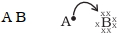
Write the formula of the product formed when the element $A$ (atomic number $19$) combines with the element $B$ (atomic number $17$). Draw its electronic dot structure. What is the nature of the bond formed?
Solution
(N/A) $1$. Identification of elements: Element $A$ has atomic number $19$, which is Potassium $(K)$. Its electronic configuration is $2, 8, 8, 1$. Element $B$ has atomic number $17$, which is Chlorine $(Cl)$. Its electronic configuration is $2, 8, 7$.
$2$. Formation of the product: Element $A$ loses $1$ electron to achieve a stable octet, forming $A^+$ ion. Element $B$ gains $1$ electron to achieve a stable octet, forming $B^-$ ion. The formula of the product is $AB$ (Potassium Chloride, $KCl$).
$3$. Electronic dot structure: $A \cdot + \cdot \dot{B} \cdot \rightarrow [A]^+ [:\ddot{B}:]^-$.
$4$. Nature of the bond: Since the bond is formed by the complete transfer of electrons from a metal to a non-metal, it is an ionic bond.
$2$. Formation of the product: Element $A$ loses $1$ electron to achieve a stable octet, forming $A^+$ ion. Element $B$ gains $1$ electron to achieve a stable octet, forming $B^-$ ion. The formula of the product is $AB$ (Potassium Chloride, $KCl$).
$3$. Electronic dot structure: $A \cdot + \cdot \dot{B} \cdot \rightarrow [A]^+ [:\ddot{B}:]^-$.
$4$. Nature of the bond: Since the bond is formed by the complete transfer of electrons from a metal to a non-metal, it is an ionic bond.
0 likes
View Solution39
MediumMCQ
Arrange the following elements in the increasing order of their metallic character:
$Mg, Ca, K, Ge, Ga$
$Mg, Ca, K, Ge, Ga$
A
$K < Ca < Mg < Ga < Ge$
B
$K < Ca < Mg < Ge < Ga$
C
$Ge < Ga < Mg < Ca < K$
D
$Ga < Ge < Mg < Ca < K$
Solution
(C) Metallic character increases as we move down a group and decreases as we move from left to right across a period.
$1$. $K$ (Potassium) is in Group $1$,Period $4$.
$2$. $Ca$ (Calcium) is in Group $2$,Period $4$.
$3$. $Ga$ (Gallium) is in Group $13$,Period $4$.
$4$. $Ge$ (Germanium) is in Group $14$,Period $4$.
$5$. $Mg$ (Magnesium) is in Group $2$,Period $3$.
Comparing these,$K$ is the most metallic (Group $1$),followed by $Ca$ (Group $2$,Period $4$),then $Mg$ (Group $2$,Period $3$,which is less metallic than $Ca$ due to being in a higher period),then $Ga$ (Group $13$),and finally $Ge$ (Group $14$).
Thus,the increasing order of metallic character is $Ge < Ga < Mg < Ca < K$.
$1$. $K$ (Potassium) is in Group $1$,Period $4$.
$2$. $Ca$ (Calcium) is in Group $2$,Period $4$.
$3$. $Ga$ (Gallium) is in Group $13$,Period $4$.
$4$. $Ge$ (Germanium) is in Group $14$,Period $4$.
$5$. $Mg$ (Magnesium) is in Group $2$,Period $3$.
Comparing these,$K$ is the most metallic (Group $1$),followed by $Ca$ (Group $2$,Period $4$),then $Mg$ (Group $2$,Period $3$,which is less metallic than $Ca$ due to being in a higher period),then $Ga$ (Group $13$),and finally $Ge$ (Group $14$).
Thus,the increasing order of metallic character is $Ge < Ga < Mg < Ca < K$.
0 likes
View Solution40
Difficult
Identify the elements with the following properties and arrange them in increasing order of their reactivity:
$(a)$ An element which is a soft and reactive metal.
$(b)$ The metal which is an important constituent of limestone.
$(c)$ The metal which exists in a liquid state at room temperature.
$(a)$ An element which is a soft and reactive metal.
$(b)$ The metal which is an important constituent of limestone.
$(c)$ The metal which exists in a liquid state at room temperature.
Solution
(A) The soft and reactive metal is Sodium $(Na)$ or Potassium $(K)$.
$(b)$ The metal that is an important constituent of limestone $(CaCO_3)$ is Calcium $(Ca)$.
$(c)$ The metal that exists in a liquid state at room temperature is Mercury $(Hg)$.
Reactivity series order: $Hg < Ca < Na < K$.
$(b)$ The metal that is an important constituent of limestone $(CaCO_3)$ is Calcium $(Ca)$.
$(c)$ The metal that exists in a liquid state at room temperature is Mercury $(Hg)$.
Reactivity series order: $Hg < Ca < Na < K$.
0 likes
View Solution41
Difficult
Properties of the elements are given below. Where would you locate the following elements in the periodic table?
$(a)$ $A$ soft metal stored under kerosene.
$(b)$ An element with variable (more than one) valency stored under water.
$(c)$ An element which is tetravalent and forms the basis of organic chemistry.
$(a)$ $A$ soft metal stored under kerosene.
$(b)$ An element with variable (more than one) valency stored under water.
$(c)$ An element which is tetravalent and forms the basis of organic chemistry.
Solution
(N/A) Sodium $(Na)$ is located in Group $1$ and Period $3$,or Potassium $(K)$ is located in Group $1$ and Period $4$. These are soft alkali metals that react vigorously with air and moisture,hence stored under kerosene.
$(b)$ Phosphorus $(P)$ is located in Group $15$ and Period $3$. White phosphorus exhibits variable valency and is highly reactive,catching fire in air,so it is stored under water.
$(c)$ Carbon $(C)$ is located in Group $14$ and Period $2$. It is tetravalent (valency of $4$) and its unique ability to form long chains (catenation) makes it the fundamental element of organic chemistry.
$(b)$ Phosphorus $(P)$ is located in Group $15$ and Period $3$. White phosphorus exhibits variable valency and is highly reactive,catching fire in air,so it is stored under water.
$(c)$ Carbon $(C)$ is located in Group $14$ and Period $2$. It is tetravalent (valency of $4$) and its unique ability to form long chains (catenation) makes it the fundamental element of organic chemistry.
0 likes
View Solution42
Medium
Properties of the elements are given below. Where would you locate the following elements in the periodic table?
$(a)$ An element which is an inert gas with atomic number $2$.
$(b)$ An element whose thin oxide layer is used to make other elements corrosion resistant by the process of 'anodising'.
$(a)$ An element which is an inert gas with atomic number $2$.
$(b)$ An element whose thin oxide layer is used to make other elements corrosion resistant by the process of 'anodising'.
Solution
(N/A) The element with atomic number $2$ is Helium $(He)$. It belongs to Group $18$ and Period $1$ of the periodic table.
$(b)$ The element whose thin oxide layer is used for 'anodising' to prevent corrosion is Aluminium $(Al)$. It belongs to Group $13$ and Period $3$ of the periodic table.
$(b)$ The element whose thin oxide layer is used for 'anodising' to prevent corrosion is Aluminium $(Al)$. It belongs to Group $13$ and Period $3$ of the periodic table.
0 likes
View Solution43
Medium
An element is placed in $2^{nd}$ Group and $3^{rd}$ Period of the Periodic Table,burns in the presence of oxygen to form a basic oxide.
$(a)$ Identify the element.
$(b)$ Write the electronic configuration.
$(c)$ Write the balanced chemical equation when it burns in the presence of air.
$(a)$ Identify the element.
$(b)$ Write the electronic configuration.
$(c)$ Write the balanced chemical equation when it burns in the presence of air.
Solution
(A) The element is Magnesium $(Mg)$,as it belongs to Group $2$ and Period $3$.
$(b)$ The electronic configuration of Magnesium $(Z=12)$ is $2, 8, 2$ in the $K, L, M$ shells respectively.
$(c)$ The balanced chemical equation for the combustion of Magnesium in air is: $2Mg(s) + O_2(g) \rightarrow 2MgO(s)$.
$(b)$ The electronic configuration of Magnesium $(Z=12)$ is $2, 8, 2$ in the $K, L, M$ shells respectively.
$(c)$ The balanced chemical equation for the combustion of Magnesium in air is: $2Mg(s) + O_2(g) \rightarrow 2MgO(s)$.
0 likes
View Solution44
Medium
An element is placed in $2^{nd}$ Group and $3^{rd}$ Period of the Periodic Table. It burns in the presence of oxygen to form a basic oxide.
$(a)$ Write a balanced chemical equation when this oxide is dissolved in water.
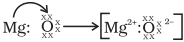
$(b)$ Draw the electron dot structure for the formation of this oxide.
$(a)$ Write a balanced chemical equation when this oxide is dissolved in water.
$(b)$ Draw the electron dot structure for the formation of this oxide.
Solution
(N/A) The element in the $2^{nd}$ Group and $3^{rd}$ Period is Magnesium $(Mg)$.
$(a)$ When magnesium oxide $(MgO)$ is dissolved in water,it forms magnesium hydroxide $(Mg(OH)_2)$:
$MgO(s) + H_2O(l) \rightarrow Mg(OH)_2(aq)$
$(b)$ The electron dot structure for the formation of magnesium oxide involves the transfer of $2$ electrons from the magnesium atom to the oxygen atom:
$Mg: + :\ddot{O}: \rightarrow [Mg]^{2+} [: \ddot{O} :]^{2-}$
$(a)$ When magnesium oxide $(MgO)$ is dissolved in water,it forms magnesium hydroxide $(Mg(OH)_2)$:
$MgO(s) + H_2O(l) \rightarrow Mg(OH)_2(aq)$
$(b)$ The electron dot structure for the formation of magnesium oxide involves the transfer of $2$ electrons from the magnesium atom to the oxygen atom:
$Mg: + :\ddot{O}: \rightarrow [Mg]^{2+} [: \ddot{O} :]^{2-}$
0 likes
View Solution45
Medium
An element $X$ (atomic number $17$) reacts with an element $Y$ (atomic number $20$) to form a divalent halide.
$(a)$ Where in the periodic table are elements $X$ and $Y$ placed?
$(b)$ Classify $X$ and $Y$ as metal$(s)$,non-metal$(s)$,or metalloid$(s)$.
$(a)$ Where in the periodic table are elements $X$ and $Y$ placed?
$(b)$ Classify $X$ and $Y$ as metal$(s)$,non-metal$(s)$,or metalloid$(s)$.
Solution
(A-D) The electronic configuration of element $X$ $(Z=17)$ is $2, 8, 7$. Since it has $7$ valence electrons,it belongs to Group $17$ and the $3^{rd}$ period.
The electronic configuration of element $Y$ $(Z=20)$ is $2, 8, 8, 2$. Since it has $2$ valence electrons,it belongs to Group $2$ and the $4^{th}$ period.
$(b)$ Element $X$ is a non-metal because it gains electrons to complete its octet. Element $Y$ is a metal because it loses $2$ electrons to form a stable cation.
The electronic configuration of element $Y$ $(Z=20)$ is $2, 8, 8, 2$. Since it has $2$ valence electrons,it belongs to Group $2$ and the $4^{th}$ period.
$(b)$ Element $X$ is a non-metal because it gains electrons to complete its octet. Element $Y$ is a metal because it loses $2$ electrons to form a stable cation.
0 likes
View Solution46
Medium
An element $X$ (atomic number $17$) reacts with an element $Y$ (atomic number $20$) to form a divalent halide.
$(a)$ What will be the nature of oxide of element $Y$? Identify the nature of bonding in the compound formed.
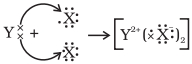
$(b)$ Draw the electron dot structure of the divalent halide.
$(a)$ What will be the nature of oxide of element $Y$? Identify the nature of bonding in the compound formed.
$(b)$ Draw the electron dot structure of the divalent halide.
Solution
(N/A) Element $Y$ has an atomic number of $20$,which corresponds to Calcium $(Ca)$. Its electronic configuration is $2, 8, 8, 2$. Since it is a metal,its oxide ($YO$ or $CaO$) will be basic in nature.
The compound formed is $YX_2$ $(CaCl_2)$. Since $Y$ is a metal and $X$ is a non-metal (Chlorine,atomic number $17$),the bonding between them is ionic.
$(b)$ The electron dot structure involves the transfer of two electrons from the outermost shell of $Y$ to two atoms of $X$:
$Y_{\times}^{\times} + 2[\cdot X : ] \rightarrow [Y^{2+} (\times \cdot X : ^{-})_2]$
The compound formed is $YX_2$ $(CaCl_2)$. Since $Y$ is a metal and $X$ is a non-metal (Chlorine,atomic number $17$),the bonding between them is ionic.
$(b)$ The electron dot structure involves the transfer of two electrons from the outermost shell of $Y$ to two atoms of $X$:
$Y_{\times}^{\times} + 2[\cdot X : ] \rightarrow [Y^{2+} (\times \cdot X : ^{-})_2]$
0 likes
View Solution47
Medium
The atomic numbers of a few elements are given below: $10, 20, 7, 14$.
$(a)$ Identify the elements.
$(b)$ Identify the group number of these elements in the Periodic Table.
$(c)$ Identify the periods of these elements in the Periodic Table.
$(a)$ Identify the elements.
$(b)$ Identify the group number of these elements in the Periodic Table.
$(c)$ Identify the periods of these elements in the Periodic Table.
Solution
(N/A) The elements corresponding to the atomic numbers $10, 20, 7,$ and $14$ are Neon $(Ne)$,Calcium $(Ca)$,Nitrogen $(N)$,and Silicon $(Si)$ respectively.
$(b)$ Group identification:
- Neon $(Z=10)$: Electronic configuration $(2, 8)$,Group $18$ (Noble gas).
- Calcium $(Z=20)$: Electronic configuration $(2, 8, 8, 2)$,Group $2$ (Alkaline earth metal).
- Nitrogen $(Z=7)$: Electronic configuration $(2, 5)$,Group $15$.
- Silicon $(Z=14)$: Electronic configuration $(2, 8, 4)$,Group $14$.
$(c)$ Period identification (based on the number of shells):
- Neon $(Z=10)$: $2$ shells,Period $2$.
- Calcium $(Z=20)$: $4$ shells,Period $4$.
- Nitrogen $(Z=7)$: $2$ shells,Period $2$.
- Silicon $(Z=14)$: $3$ shells,Period $3$.
$(b)$ Group identification:
- Neon $(Z=10)$: Electronic configuration $(2, 8)$,Group $18$ (Noble gas).
- Calcium $(Z=20)$: Electronic configuration $(2, 8, 8, 2)$,Group $2$ (Alkaline earth metal).
- Nitrogen $(Z=7)$: Electronic configuration $(2, 5)$,Group $15$.
- Silicon $(Z=14)$: Electronic configuration $(2, 8, 4)$,Group $14$.
$(c)$ Period identification (based on the number of shells):
- Neon $(Z=10)$: $2$ shells,Period $2$.
- Calcium $(Z=20)$: $4$ shells,Period $4$.
- Nitrogen $(Z=7)$: $2$ shells,Period $2$.
- Silicon $(Z=14)$: $3$ shells,Period $3$.
0 likes
View Solution48
Medium
Atomic numbers of a few elements are given below: $10, 20, 7, 14$.
$(a)$ What would be the electronic configuration for each of these elements?
$(b)$ Determine the valency of these elements.
$(a)$ What would be the electronic configuration for each of these elements?
$(b)$ Determine the valency of these elements.
Solution
(N/A) Electronic configuration:
- For atomic number $10$ (Neon): $(2, 8)$
- For atomic number $20$ (Calcium): $(2, 8, 8, 2)$
- For atomic number $7$ (Nitrogen): $(2, 5)$
- For atomic number $14$ (Silicon): $(2, 8, 4)$
$(b)$ Valency:
- For $10$ (Neon): Valence electrons = $8$,so valency = $8 - 8 = 0$ (Inert gas).
- For $20$ (Calcium): Valence electrons = $2$,so valency = $2$.
- For $7$ (Nitrogen): Valence electrons = $5$,so valency = $8 - 5 = 3$.
- For $14$ (Silicon): Valence electrons = $4$,so valency = $4$.
- For atomic number $10$ (Neon): $(2, 8)$
- For atomic number $20$ (Calcium): $(2, 8, 8, 2)$
- For atomic number $7$ (Nitrogen): $(2, 5)$
- For atomic number $14$ (Silicon): $(2, 8, 4)$
$(b)$ Valency:
- For $10$ (Neon): Valence electrons = $8$,so valency = $8 - 8 = 0$ (Inert gas).
- For $20$ (Calcium): Valence electrons = $2$,so valency = $2$.
- For $7$ (Nitrogen): Valence electrons = $5$,so valency = $8 - 5 = 3$.
- For $14$ (Silicon): Valence electrons = $4$,so valency = $4$.
0 likes
View Solution49
Difficult
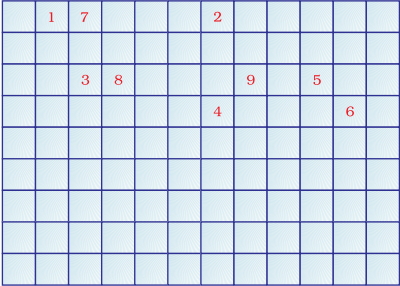
Complete the following crossword puzzle (Figure):
**Across:**
$(1)$ An element with atomic number $12$.
$(3)$ Metal used in making cans and member of Group $14$.
$(4)$ $A$ lustrous non-metal which has $7$ electrons in its outermost shell.
**Down:**
$(2)$ Highly reactive and soft metal which imparts yellow colour when subjected to flame and is kept in kerosene.
$(5)$ The first element of second Period.
$(6)$ An element which is used in making fluorescent bulbs and is second member of Group $18$ in the Modern Periodic Table.
$(7)$ $A$ radioactive element which is the last member of halogen family.
$(8)$ Metal which is an important constituent of steel and forms rust when exposed to moist air.
$(9)$ The first metalloid in Modern Periodic Table whose fibres are used in making bullet-proof vests.
**Across:**
$(1)$ An element with atomic number $12$.
$(3)$ Metal used in making cans and member of Group $14$.
$(4)$ $A$ lustrous non-metal which has $7$ electrons in its outermost shell.
**Down:**
$(2)$ Highly reactive and soft metal which imparts yellow colour when subjected to flame and is kept in kerosene.
$(5)$ The first element of second Period.
$(6)$ An element which is used in making fluorescent bulbs and is second member of Group $18$ in the Modern Periodic Table.
$(7)$ $A$ radioactive element which is the last member of halogen family.
$(8)$ Metal which is an important constituent of steel and forms rust when exposed to moist air.
$(9)$ The first metalloid in Modern Periodic Table whose fibres are used in making bullet-proof vests.
Solution
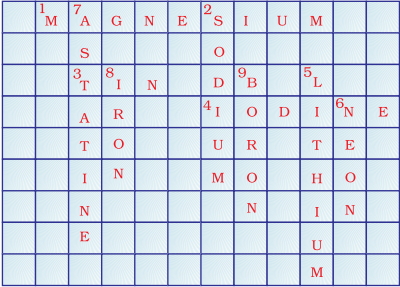
(N/A) The answers to the crossword puzzle are as follows:
**Across:**
$(1)$ Magnesium ($Mg$,atomic number $12$)
$(3)$ Tin ($Sn$,Group $14$)
$(4)$ Iodine ($I$,halogen with $7$ valence electrons)
**Down:**
$(2)$ Sodium ($Na$,highly reactive,yellow flame,stored in kerosene)
$(5)$ Lithium ($Li$,first element of Period $2$)
$(6)$ Neon ($Ne$,used in fluorescent bulbs,second member of Group $18$)
$(7)$ Astatine ($At$,radioactive halogen)
$(8)$ Iron ($Fe$,constituent of steel,forms rust)
$(9)$ Boron ($B$,metalloid,used in bullet-proof vests)
**Across:**
$(1)$ Magnesium ($Mg$,atomic number $12$)
$(3)$ Tin ($Sn$,Group $14$)
$(4)$ Iodine ($I$,halogen with $7$ valence electrons)
**Down:**
$(2)$ Sodium ($Na$,highly reactive,yellow flame,stored in kerosene)
$(5)$ Lithium ($Li$,first element of Period $2$)
$(6)$ Neon ($Ne$,used in fluorescent bulbs,second member of Group $18$)
$(7)$ Astatine ($At$,radioactive halogen)
$(8)$ Iron ($Fe$,constituent of steel,forms rust)
$(9)$ Boron ($B$,metalloid,used in bullet-proof vests)
0 likes
View Solution50
Difficult
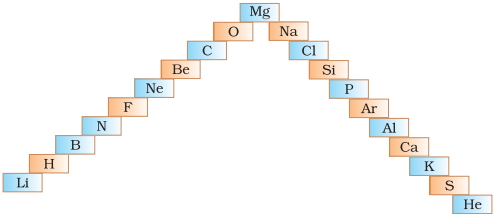
$(a)$ In this ladder (Figure),symbols of elements are jumbled up. Rearrange these symbols of elements in the increasing order of their atomic number in the Periodic Table.
$(b)$ Arrange them in the order of their group also.
$(b)$ Arrange them in the order of their group also.
Solution
(N/A) The elements present in the ladder are: $H, He, Li, Be, B, C, N, O, F, Ne, Na, Mg, Al, Si, P, S, Cl, Ar, K, Ca$.
Arranging them in increasing order of their atomic number $(Z)$:
$H (1), He (2), Li (3), Be (4), B (5), C (6), N (7), O (8), F (9), Ne (10), Na (11), Mg (12), Al (13), Si (14), P (15), S (16), Cl (17), Ar (18), K (19), Ca (20)$.
$(b)$ Arranging them according to their groups:
Group $1: H, Li, Na, K$
Group $2: Be, Mg, Ca$
Group $13: B, Al$
Group $14: C, Si$
Group $15: N, P$
Group $16: O, S$
Group $17: F, Cl$
Group $18: He, Ne, Ar$
Arranging them in increasing order of their atomic number $(Z)$:
$H (1), He (2), Li (3), Be (4), B (5), C (6), N (7), O (8), F (9), Ne (10), Na (11), Mg (12), Al (13), Si (14), P (15), S (16), Cl (17), Ar (18), K (19), Ca (20)$.
$(b)$ Arranging them according to their groups:
Group $1: H, Li, Na, K$
Group $2: Be, Mg, Ca$
Group $13: B, Al$
Group $14: C, Si$
Group $15: N, P$
Group $16: O, S$
Group $17: F, Cl$
Group $18: He, Ne, Ar$
0 likes
View SolutionPeriodic Classification of Elements — Mix Examples - Periodic Classification of Elements · Frequently Asked Questions
1Are these Periodic Classification of Elements questions useful for JEE and NEET?
Yes. All questions in this section are mapped to JEE Main and NEET exam patterns. Previous year questions from JEE Main, NEET, GUJCET and state-level exams are included with full solutions.
2Can I switch to Hindi or Gujarati for these questions?
Yes. Use the language tabs in the hero section or the sidebar to view the same questions and solutions in English, Hindi or Gujarati.
3How do I generate a question paper from this subtopic?
Use the Vedclass Exam Paper Generator — select the chapter and subtopic, set difficulty, and generate Sets A, B, C, D automatically. First 3 chapters of every subject are free.
Vedclass Products
For Students
Vedclass Test Series
Mock tests in real JEE/NEET style with performance analysis. 5-day free trial.
Start Free TrialFor Teachers
Exam Paper Generator
Generate Set A/B/C/D papers from this chapter in 2 minutes. 3 chapters free.
Try FreeFor Institutes
Online Exam Module
Live online exams with unlimited students, 360° analytics & white-label branding.
See DemoFor Teachers & Institutes
Generate a Periodic Classification of Elements Exam Paper in 2 Minutes
Select subtopic & difficulty — Sets A, B, C, D auto-generated with No Repeat logic.
First 3 chapters of every subject are free — no payment required.