
A English
Mix Examples - Periodic Classification of Elements Questions in English
Class 10 Science · Periodic Classification of Elements · Mix Examples - Periodic Classification of Elements
168+
Questions
English
Language
100%
With Solutions
Showing 50 of 168 questions in English
51
Medium
Mendeleev predicted the existence of certain elements not known at that time and named two of them as Eka-silicon and Eka-aluminium.
$(a)$ Name the elements which have taken the place of these elements.
$(b)$ Mention the group and the period of these elements in the Modern Periodic Table.
$(a)$ Name the elements which have taken the place of these elements.
$(b)$ Mention the group and the period of these elements in the Modern Periodic Table.
Solution
(A) The element that replaced Eka-silicon is Germanium $(Ge)$ and the element that replaced Eka-aluminium is Gallium $(Ga)$.
$(b)$ In the Modern Periodic Table,Germanium $(Ge)$ belongs to Group $14$ and Period $4$. Gallium $(Ga)$ belongs to Group $13$ and Period $4$.
$(b)$ In the Modern Periodic Table,Germanium $(Ge)$ belongs to Group $14$ and Period $4$. Gallium $(Ga)$ belongs to Group $13$ and Period $4$.
0 likes
View Solution52
MediumMCQ
Mendeleev predicted the existence of certain elements not known at that time and named two of them as Eka-silicon and Eka-aluminium.
$(a)$ Classify these elements as metals,non-metals,or metalloids.
$(b)$ How many valence electrons are present in each one of them?
$(a)$ Classify these elements as metals,non-metals,or metalloids.
$(b)$ How many valence electrons are present in each one of them?
A
Eka-silicon: Metalloid,Eka-aluminium: Metal
B
Eka-silicon: $4$,Eka-aluminium: $3$
C
Eka-silicon: Metal,Eka-aluminium: Metalloid
D
Eka-silicon: Non-metal,Eka-aluminium: Metal
Solution
(A) Mendeleev's Eka-silicon is known as Germanium $(Ge)$,which is a metalloid. Eka-aluminium is known as Gallium $(Ga)$,which is a metal.
$(b)$ Gallium $(Ga)$ belongs to Group $13$ of the periodic table,so it has $3$ valence electrons. Germanium $(Ge)$ belongs to Group $14$ of the periodic table,so it has $4$ valence electrons.
$(b)$ Gallium $(Ga)$ belongs to Group $13$ of the periodic table,so it has $3$ valence electrons. Germanium $(Ge)$ belongs to Group $14$ of the periodic table,so it has $4$ valence electrons.
0 likes
View Solution53
Difficult
$(a)$ Electropositive nature of the element$(s)$ increases down the group and decreases across the period.
$(b)$ Electronegativity of the element decreases down the group and increases across the period.
$(c)$ Atomic size increases down the group and decreases across a period (left to right).
$(d)$ Metallic character increases down the group and decreases across a period.
On the basis of the above trends of the Periodic Table,answer the following about the elements with atomic numbers $3$ to $9$:
$(a)$ Name the most electropositive element among them.
$(b)$ Name the most electronegative element.
$(c)$ Name the element with the smallest atomic size.
$(d)$ Name the element which is a metalloid.
$(e)$ Name the element which shows maximum valency.
$(b)$ Electronegativity of the element decreases down the group and increases across the period.
$(c)$ Atomic size increases down the group and decreases across a period (left to right).
$(d)$ Metallic character increases down the group and decreases across a period.
On the basis of the above trends of the Periodic Table,answer the following about the elements with atomic numbers $3$ to $9$:
$(a)$ Name the most electropositive element among them.
$(b)$ Name the most electronegative element.
$(c)$ Name the element with the smallest atomic size.
$(d)$ Name the element which is a metalloid.
$(e)$ Name the element which shows maximum valency.
Solution
(A) The elements with atomic numbers $3$ to $9$ are: Lithium ($Li$,$Z=3$),Beryllium ($Be$,$Z=4$),Boron ($B$,$Z=5$),Carbon ($C$,$Z=6$),Nitrogen ($N$,$Z=7$),Oxygen ($O$,$Z=8$),and Fluorine ($F$,$Z=9$). These elements belong to the second period.
$(a)$ Electropositive nature decreases across a period. Thus,the first element,Lithium $(Li)$,is the most electropositive.
$(b)$ Electronegativity increases across a period. Thus,the last element,Fluorine $(F)$,is the most electronegative.
$(c)$ Atomic size decreases across a period from left to right. Thus,Fluorine $(F)$ has the smallest atomic size.
$(d)$ Boron $(B)$ is a metalloid located between metals and non-metals.
$(e)$ Valency increases from $1$ to $4$ and then decreases to $1$. Carbon $(C)$ has a valency of $4$,which is the maximum in this series.
$(a)$ Electropositive nature decreases across a period. Thus,the first element,Lithium $(Li)$,is the most electropositive.
$(b)$ Electronegativity increases across a period. Thus,the last element,Fluorine $(F)$,is the most electronegative.
$(c)$ Atomic size decreases across a period from left to right. Thus,Fluorine $(F)$ has the smallest atomic size.
$(d)$ Boron $(B)$ is a metalloid located between metals and non-metals.
$(e)$ Valency increases from $1$ to $4$ and then decreases to $1$. Carbon $(C)$ has a valency of $4$,which is the maximum in this series.
0 likes
View Solution54
Medium
An element $X$ which is a yellow solid at room temperature shows catenation and allotropy. $X$ forms two oxides which are also formed during the thermal decomposition of ferrous sulphate crystals and are the major air pollutants.
$(a)$ Identify the element $X$
$(b)$ Write the electronic configuration of $X$
$(c)$ Write the balanced chemical equation for the thermal decomposition of ferrous sulphate crystals?
$(a)$ Identify the element $X$
$(b)$ Write the electronic configuration of $X$
$(c)$ Write the balanced chemical equation for the thermal decomposition of ferrous sulphate crystals?
Solution
(N/A) The element $X$ is sulphur $(S)$, which is a yellow solid at room temperature and exhibits catenation and allotropy.
$(b)$ The atomic number of sulphur is $16$. Its electronic configuration is $2, 8, 6$ or $1s^2 2s^2 2p^6 3s^2 3p^4$.
$(c)$ The thermal decomposition of ferrous sulphate crystals $(FeSO_4 \cdot 7H_2O)$ is represented by the following balanced chemical equation:
$2FeSO_4(s) \xrightarrow{\Delta} Fe_2O_3(s) + SO_2(g) + SO_3(g)$
$(b)$ The atomic number of sulphur is $16$. Its electronic configuration is $2, 8, 6$ or $1s^2 2s^2 2p^6 3s^2 3p^4$.
$(c)$ The thermal decomposition of ferrous sulphate crystals $(FeSO_4 \cdot 7H_2O)$ is represented by the following balanced chemical equation:
$2FeSO_4(s) \xrightarrow{\Delta} Fe_2O_3(s) + SO_2(g) + SO_3(g)$
0 likes
View Solution55
Medium
An element $X$,which is a yellow solid at room temperature,shows catenation and allotropy. $X$ forms two oxides which are also formed during the thermal decomposition of ferrous sulphate crystals and are major air pollutants.
$(a)$ What would be the nature (acidic/basic) of the oxides formed?
$(b)$ Locate the position of the element in the Modern Periodic Table.
$(a)$ What would be the nature (acidic/basic) of the oxides formed?
$(b)$ Locate the position of the element in the Modern Periodic Table.
Solution
(A) The element $X$ is Sulphur $(S)$. When Sulphur burns in air,it forms Sulphur dioxide $(SO_2)$ and Sulphur trioxide $(SO_3)$. These oxides are non-metallic oxides,and non-metallic oxides are acidic in nature.
$(b)$ Sulphur has an atomic number of $16$. Its electronic configuration is $2, 8, 6$. Since it has $3$ shells,it belongs to the $3^{rd}$ period. Since it has $6$ valence electrons,it belongs to group $16$.
$(b)$ Sulphur has an atomic number of $16$. Its electronic configuration is $2, 8, 6$. Since it has $3$ shells,it belongs to the $3^{rd}$ period. Since it has $6$ valence electrons,it belongs to group $16$.
0 likes
View Solution56
Medium
An element $X$ of group $15$ exists as a diatomic molecule and combines with hydrogen at $773 \, K$ in the presence of a catalyst to form a compound,ammonia,which has a characteristic pungent smell.
$(a)$ Identify the element $X$. How many valence electrons does it have?
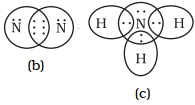
$(b)$ Draw the electron dot structure of the diatomic molecule of $X$. What type of bond is formed in it?
$(c)$ Draw the electron dot structure for ammonia and what type of bond is formed in it?
$(a)$ Identify the element $X$. How many valence electrons does it have?
$(b)$ Draw the electron dot structure of the diatomic molecule of $X$. What type of bond is formed in it?
$(c)$ Draw the electron dot structure for ammonia and what type of bond is formed in it?
Solution
(A) The element $X$ is Nitrogen $(N)$. Its atomic number is $7$,and its electronic configuration is $2, 5$. Therefore,it has $5$ valence electrons.
$(b)$ The diatomic molecule of nitrogen is $N_2$. The electron dot structure shows that each nitrogen atom shares $3$ electrons with the other to complete its octet,resulting in a triple covalent bond.
$(c)$ In ammonia $(NH_3)$,the nitrogen atom shares one electron with each of the $3$ hydrogen atoms. This results in the formation of $3$ single covalent bonds.
$(b)$ The diatomic molecule of nitrogen is $N_2$. The electron dot structure shows that each nitrogen atom shares $3$ electrons with the other to complete its octet,resulting in a triple covalent bond.
$(c)$ In ammonia $(NH_3)$,the nitrogen atom shares one electron with each of the $3$ hydrogen atoms. This results in the formation of $3$ single covalent bonds.
0 likes
View Solution57
Medium
Which group of elements could be placed in Mendeleev's Periodic Table without disturbing the original order? Give reason.
Solution
(A) The group of elements that could be placed in Mendeleev's Periodic Table without disturbing the original order is the Noble gases.
Reason:
$1$. Mendeleev's periodic law states that the properties of elements are a periodic function of their atomic masses.
$2$. Noble gases are chemically inert and possess very low reactivity due to their stable electronic configuration.
$3$. Because they do not react with other elements,they could be placed in a separate group (Group $0$ or $VIII$) without requiring any changes to the positions of the existing elements in the table.
Reason:
$1$. Mendeleev's periodic law states that the properties of elements are a periodic function of their atomic masses.
$2$. Noble gases are chemically inert and possess very low reactivity due to their stable electronic configuration.
$3$. Because they do not react with other elements,they could be placed in a separate group (Group $0$ or $VIII$) without requiring any changes to the positions of the existing elements in the table.
0 likes
View Solution58
Medium
Give an account of the process adopted by Mendeleev for the classification of elements. How did he arrive at Periodic Law?
Solution
(N/A) Mendeleev examined the relationship between the atomic masses of elements and their physical and chemical properties.
Among chemical properties,he concentrated on the compounds formed by elements with oxygen and hydrogen (oxides and hydrides).
He selected these two elements because they are very reactive and formed compounds with most elements.
He wrote down the properties of each element on separate cards and grouped together elements with similar properties.
He observed that most of the elements got arranged in the periodic table in the order of increasing atomic masses.
Based on this,he formulated the Periodic Law,which states that the properties of elements are a periodic function of their atomic masses.
Among chemical properties,he concentrated on the compounds formed by elements with oxygen and hydrogen (oxides and hydrides).
He selected these two elements because they are very reactive and formed compounds with most elements.
He wrote down the properties of each element on separate cards and grouped together elements with similar properties.
He observed that most of the elements got arranged in the periodic table in the order of increasing atomic masses.
Based on this,he formulated the Periodic Law,which states that the properties of elements are a periodic function of their atomic masses.
0 likes
View Solution59
MediumMCQ
An element $A$ has an atomic number of $17$. To which group and period does it belong?
A
Group $17$, Period $3$
B
Group $15$, Period $3$
C
Group $17$, Period $2$
D
Group $16$, Period $3$
Solution
$(A)$ The atomic number of element $A$ is $17$.
The electronic configuration of the element is determined by filling the shells $K, L, M, N$ in order:
$K = 2$
$L = 8$
$M = 7$
$1$. Period: The number of shells occupied by electrons determines the period. Since there are $3$ shells $(K, L, M)$, the element belongs to the $3rd$ period.
$2$. Group: For elements with more than $2$ valence electrons, the group number is calculated as $10 + \text{valence electrons}$. Here, the valence electrons in the outermost shell $(M)$ are $7$. Therefore, the group number is $10 + 7 = 17$.
Thus, element $A$ belongs to Group $17$ and Period $3$.
The electronic configuration of the element is determined by filling the shells $K, L, M, N$ in order:
$K = 2$
$L = 8$
$M = 7$
$1$. Period: The number of shells occupied by electrons determines the period. Since there are $3$ shells $(K, L, M)$, the element belongs to the $3rd$ period.
$2$. Group: For elements with more than $2$ valence electrons, the group number is calculated as $10 + \text{valence electrons}$. Here, the valence electrons in the outermost shell $(M)$ are $7$. Therefore, the group number is $10 + 7 = 17$.
Thus, element $A$ belongs to Group $17$ and Period $3$.
0 likes
View Solution60
Easy
Out of $Li$ and $K$,which will have stronger metallic character and why?
Solution
(B) Potassium $(K)$ has a stronger metallic character than lithium $(Li)$.
This is because metallic character depends on the ease with which an atom can lose its valence electrons.
As we move down a group in the periodic table,the atomic size increases due to the addition of new shells.
Consequently,the valence electrons are further away from the nucleus and are held less tightly by the nuclear charge.
Therefore,$K$ can lose its valence electron more easily than $Li$,making it more metallic.
This is because metallic character depends on the ease with which an atom can lose its valence electrons.
As we move down a group in the periodic table,the atomic size increases due to the addition of new shells.
Consequently,the valence electrons are further away from the nucleus and are held less tightly by the nuclear charge.
Therefore,$K$ can lose its valence electron more easily than $Li$,making it more metallic.
0 likes
View Solution61
EasyMCQ
Find the atomic number of the element whose electronic configuration is $2, 8, 5$.
A
$12$
B
$15$
C
$10$
D
$18$
Solution
(B) The atomic number of an element is equal to the total number of electrons present in its energy shells (orbits).
Given electronic configuration is $2, 8, 5$.
Atomic number $= 2 + 8 + 5 = 15$.
Therefore,the element with this electronic configuration is Phosphorus,which has an atomic number of $15$.
Given electronic configuration is $2, 8, 5$.
Atomic number $= 2 + 8 + 5 = 15$.
Therefore,the element with this electronic configuration is Phosphorus,which has an atomic number of $15$.
0 likes
View Solution62
EasyMCQ
An element $A$ has an atomic number $16$. To which group and period does it belong?
A
Group $16$,Period $3$
B
Group $15$,Period $3$
C
Group $16$,Period $2$
D
Group $14$,Period $4$
Solution
(A) The atomic number of element $A$ is $16$.
To determine its position in the periodic table,we write its electronic configuration:
$A(16) = 2, 8, 6$.
Since there are $3$ shells $(K, L, M)$,the element belongs to the $3rd$ period.
Since there are $6$ valence electrons in the outermost shell,the group number is $10 + 6 = 16$.
Therefore,the element belongs to group $16$ and period $3$.
To determine its position in the periodic table,we write its electronic configuration:
$A(16) = 2, 8, 6$.
Since there are $3$ shells $(K, L, M)$,the element belongs to the $3rd$ period.
Since there are $6$ valence electrons in the outermost shell,the group number is $10 + 6 = 16$.
Therefore,the element belongs to group $16$ and period $3$.
0 likes
View Solution63
Easy
Write two reasons responsible for the late discovery of noble gases.
Solution
(N/A) $(i)$ Noble gases are chemically inert due to their stable electronic configuration.
$(ii)$ They are present in extremely low concentrations in the atmosphere,making them difficult to detect.
$(ii)$ They are present in extremely low concentrations in the atmosphere,making them difficult to detect.
0 likes
View Solution64
EasyMCQ
How many vertical columns are there in the modern periodic table and what are they called?
A
$16$,Periods
B
$18$,Groups
C
$7$,Periods
D
$18$,Periods
Solution
(B) The modern periodic table consists of $18$ vertical columns.
These vertical columns are known as groups.
These vertical columns are known as groups.
0 likes
View Solution65
Easy
List any two properties of the elements belonging to the first group of the modern periodic table.
Solution
(N/A) $(i)$ They have a valency of $1$ (monovalent).
$(ii)$ They are highly reactive metals.
$(iii)$ They are electropositive in nature.
$(iv)$ They form basic oxides when they react with oxygen.
$(ii)$ They are highly reactive metals.
$(iii)$ They are electropositive in nature.
$(iv)$ They form basic oxides when they react with oxygen.
0 likes
View Solution66
EasyMCQ
The atomic numbers of three elements $A, B$,and $C$ are $12, 18$,and $20$ respectively. State,giving reason,which two elements will show similar properties.
A
$A$ and $B$
B
$B$ and $C$
C
$A$ and $C$
D
None of these
Solution
(C) The electronic configuration of the elements is as follows:
Element $A$ (atomic number $12$): $2, 8, 2$. It has $2$ valence electrons.
Element $B$ (atomic number $18$): $2, 8, 8$. It has $8$ valence electrons (stable noble gas configuration).
Element $C$ (atomic number $20$): $2, 8, 8, 2$. It has $2$ valence electrons.
Elements with the same number of valence electrons exhibit similar chemical properties.
Therefore,elements $A$ and $C$ show similar properties because both have $2$ valence electrons and belong to Group $2$ of the periodic table.
Element $A$ (atomic number $12$): $2, 8, 2$. It has $2$ valence electrons.
Element $B$ (atomic number $18$): $2, 8, 8$. It has $8$ valence electrons (stable noble gas configuration).
Element $C$ (atomic number $20$): $2, 8, 8, 2$. It has $2$ valence electrons.
Elements with the same number of valence electrons exhibit similar chemical properties.
Therefore,elements $A$ and $C$ show similar properties because both have $2$ valence electrons and belong to Group $2$ of the periodic table.
0 likes
View Solution67
Easy
Write the atomic numbers of two elements $X$ and $Y$ having electronic configurations $2, 8, 2$ and $2, 8, 6$ respectively.
Solution
(N/A) The atomic number of an element is equal to the total number of electrons present in its neutral atom.
For element $X$,the electronic configuration is $2, 8, 2$. The total number of electrons is $2 + 8 + 2 = 12$. Therefore,the atomic number of $X$ is $12$.
For element $Y$,the electronic configuration is $2, 8, 6$. The total number of electrons is $2 + 8 + 6 = 16$. Therefore,the atomic number of $Y$ is $16$.
For element $X$,the electronic configuration is $2, 8, 2$. The total number of electrons is $2 + 8 + 2 = 12$. Therefore,the atomic number of $X$ is $12$.
For element $Y$,the electronic configuration is $2, 8, 6$. The total number of electrons is $2 + 8 + 6 = 16$. Therefore,the atomic number of $Y$ is $16$.
0 likes
View Solution68
EasyMCQ
What would be the nature of oxides formed by the elements on the right-hand side of the periodic table?
A
Basic
B
Acidic
C
Amphoteric
D
Neutral
Solution
(B) The elements on the right-hand side of the periodic table are primarily non-metals.
Non-metals tend to form acidic oxides when they react with oxygen.
For example,carbon forms carbon dioxide $(CO_2)$ and sulfur forms sulfur dioxide $(SO_2)$,both of which are acidic in nature.
Non-metals tend to form acidic oxides when they react with oxygen.
For example,carbon forms carbon dioxide $(CO_2)$ and sulfur forms sulfur dioxide $(SO_2)$,both of which are acidic in nature.
0 likes
View Solution69
EasyMCQ
Predict the maximum number of valence electrons possible for atoms in the first period of the periodic table.
A
$1$
B
$2$
C
$8$
D
$18$
Solution
(B) The first period of the periodic table consists of only two elements: Hydrogen $(H)$ and Helium $(He)$.
Hydrogen has an atomic number of $1$,with an electronic configuration of $1s^1$,meaning it has $1$ valence electron.
Helium has an atomic number of $2$,with an electronic configuration of $1s^2$,meaning it has $2$ valence electrons.
Since the first shell ($K$-shell) can hold a maximum of $2$ electrons,the maximum number of valence electrons for any atom in the first period is $2$.
Hydrogen has an atomic number of $1$,with an electronic configuration of $1s^1$,meaning it has $1$ valence electron.
Helium has an atomic number of $2$,with an electronic configuration of $1s^2$,meaning it has $2$ valence electrons.
Since the first shell ($K$-shell) can hold a maximum of $2$ electrons,the maximum number of valence electrons for any atom in the first period is $2$.
0 likes
View Solution70
Easy
Name any two pairs of elements which were adjusted by Newlands in the same slot.
Solution
(N/A) According to Newlands' Law of Octaves,certain elements were placed in the same slot to fit the periodic arrangement.
The two pairs of elements placed in the same slot are:
$(i)$ Cobalt $(Co)$ and Nickel $(Ni)$
$(ii)$ Cerium $(Ce)$ and Lanthanum $(La)$
The two pairs of elements placed in the same slot are:
$(i)$ Cobalt $(Co)$ and Nickel $(Ni)$
$(ii)$ Cerium $(Ce)$ and Lanthanum $(La)$
0 likes
View Solution71
Easy
Define Newlands' law of Octaves.
Solution
(N/A) Newlands' law of Octaves states that when elements are arranged in the order of increasing atomic masses,the properties of every eighth element are a repetition of the properties of the first element. This pattern is analogous to the musical notes in an octave (sa,re,ga,ma,pa,dha,ni,sa),where the eighth note is the same as the first.
0 likes
View Solution72
Easy
State Mendeleev's Periodic Law.
Solution
(N/A) Mendeleev's Periodic Law states that the physical and chemical properties of elements are a periodic function of their atomic masses.
0 likes
View Solution73
Easy
State the Modern Periodic Law.
Solution
(N/A) The Modern Periodic Law states that the physical and chemical properties of elements are a periodic function of their atomic numbers.
0 likes
View Solution74
Easy
Name any two elements which were discovered later after Mendeleev's periodic table.
Solution
(N/A) Mendeleev predicted the existence of several elements that had not been discovered at the time he proposed his periodic table. He named them $Eka-boron$,$Eka-aluminium$,and $Eka-silicon$. Later,these elements were discovered and named as follows:
$1$. $Eka-boron$ was discovered as $Scandium$ $(Sc)$.
$2$. $Eka-aluminium$ was discovered as $Gallium$ $(Ga)$.
$3$. $Eka-silicon$ was discovered as $Germanium$ $(Ge)$.
Therefore,any two of these,such as $Gallium$ and $Germanium$,are correct answers.
$1$. $Eka-boron$ was discovered as $Scandium$ $(Sc)$.
$2$. $Eka-aluminium$ was discovered as $Gallium$ $(Ga)$.
$3$. $Eka-silicon$ was discovered as $Germanium$ $(Ge)$.
Therefore,any two of these,such as $Gallium$ and $Germanium$,are correct answers.
0 likes
View Solution75
Easy
What is a metalloid? Name any two of them.
Solution
(N/A) Elements that exhibit properties intermediate between those of metals and non-metals are known as metalloids.
Examples: $Silicon$ $(Si)$ and $Boron$ $(B)$.
Examples: $Silicon$ $(Si)$ and $Boron$ $(B)$.
0 likes
View Solution76
EasyMCQ
Arrange the following metals in decreasing order of their atomic size: $Ca, Mg, Ba, Be$.
A
$Ba > Ca > Mg > Be$
B
$Be > Mg > Ca > Ba$
C
$Ba > Be > Mg > Ca$
D
$Mg > Ca > Be > Ba$
Solution
(A) Atomic size increases down a group in the periodic table because the number of electron shells increases.
All the given elements $(Be, Mg, Ca, Ba)$ belong to Group $2$ (Alkaline Earth Metals).
The order of these elements in Group $2$ from top to bottom is: $Be < Mg < Ca < Ba$.
Therefore,the decreasing order of their atomic size is $Ba > Ca > Mg > Be$.
All the given elements $(Be, Mg, Ca, Ba)$ belong to Group $2$ (Alkaline Earth Metals).
The order of these elements in Group $2$ from top to bottom is: $Be < Mg < Ca < Ba$.
Therefore,the decreasing order of their atomic size is $Ba > Ca > Mg > Be$.
0 likes
View Solution77
EasyMCQ
What is the position of metalloids in the periodic table?
A
On the extreme left
B
On the extreme right
C
Along a zigzag line separating metals and non-metals
D
At the bottom of the table
Solution
(C) In the modern periodic table,metalloids (such as boron,silicon,germanium,arsenic,antimony,tellurium,and polonium) are located along a zigzag line that separates metals from non-metals. Metals are found on the left side of this line,while non-metals are found on the right side.
0 likes
View Solution78
EasyMCQ
Why does atomic size decrease as we move from left to right along a period in the periodic table?
A
Due to an increase in the number of shells.
B
Due to an increase in effective nuclear charge.
C
Due to a decrease in the number of protons.
D
Due to the addition of electrons in the same shell.
Solution
(B) As we move from left to right across a period in the periodic table,the atomic number increases,meaning the number of protons in the nucleus increases.
These additional protons increase the effective nuclear charge,which exerts a stronger pull on the electrons in the same valence shell.
Because the electrons are pulled closer to the nucleus,the atomic radius (or atomic size) decreases.
These additional protons increase the effective nuclear charge,which exerts a stronger pull on the electrons in the same valence shell.
Because the electrons are pulled closer to the nucleus,the atomic radius (or atomic size) decreases.
0 likes
View Solution79
Medium
Why are lithium (atomic number $3$) and potassium (atomic number $19$) placed in group $1$? What will be the atomic numbers of the first two elements in group $2$?
Solution
(N/A) Lithium $(Li)$ and potassium $(K)$ are placed in Group $1$ of the periodic table because both of them have one valence electron in their outermost shell.
$(b)$ The first two elements in Group $2$ are Beryllium $(Be)$ and Magnesium $(Mg)$.
| Name of the element | Atomic number | Electronic configuration $(K, L, M, N)$ |
| Lithium | $3$ | $2, 1$ |
| Potassium | $19$ | $2, 8, 8, 1$ |
$(b)$ The first two elements in Group $2$ are Beryllium $(Be)$ and Magnesium $(Mg)$.
| Name of the element | Atomic number |
| Beryllium $(Be)$ | $4$ |
| Magnesium $(Mg)$ | $12$ |
0 likes
View Solution80
Medium
Calcium is an element with atomic number $20$.
$(i)$ Will it be a metal or a non-metal?
$(ii)$ What will be its valency?
$(iii)$ What would be the formula of its chloride?
$(iv)$ Will it be larger or smaller than $K$ (Potassium)?
$(i)$ Will it be a metal or a non-metal?
$(ii)$ What will be its valency?
$(iii)$ What would be the formula of its chloride?
$(iv)$ Will it be larger or smaller than $K$ (Potassium)?
Solution
(A-D) $(i)$ Calcium $(Ca)$ has an electronic configuration of $2, 8, 8, 2$. Since it has $2$ valence electrons,it tends to lose them to achieve a stable octet,making it a metal.
$(ii)$ The valency of an element is determined by the number of electrons it needs to lose or gain to complete its octet. Since Calcium loses $2$ electrons,its valency is $2$.
$(iii)$ The valency of Calcium $(Ca)$ is $+2$ and the valency of Chlorine $(Cl)$ is $-1$. By criss-crossing the valencies,the formula of its chloride is $CaCl_{2}$.
$(iv)$ Calcium $(Ca)$ is smaller than Potassium $(K)$. As we move from left to right across a period,the atomic radius decreases because the nuclear charge increases,pulling the electrons closer to the nucleus.
$(ii)$ The valency of an element is determined by the number of electrons it needs to lose or gain to complete its octet. Since Calcium loses $2$ electrons,its valency is $2$.
$(iii)$ The valency of Calcium $(Ca)$ is $+2$ and the valency of Chlorine $(Cl)$ is $-1$. By criss-crossing the valencies,the formula of its chloride is $CaCl_{2}$.
$(iv)$ Calcium $(Ca)$ is smaller than Potassium $(K)$. As we move from left to right across a period,the atomic radius decreases because the nuclear charge increases,pulling the electrons closer to the nucleus.
0 likes
View Solution81
Easy
List the anomalies of Mendeleev's periodic table which were resolved by the modern periodic law.
Solution
(N/A) The anomalies of Mendeleev's periodic table that were resolved by the modern periodic law are as follows:
$(i)$ Position of Hydrogen: Mendeleev could not assign a fixed position to hydrogen because it shows properties of both alkali metals and halogens. The modern periodic law places it based on atomic number.
$(ii)$ Position of Isotopes: Isotopes have the same atomic number but different atomic masses. Mendeleev's table was based on atomic mass,leading to confusion. The modern periodic law,based on atomic number,places all isotopes of an element in the same position.
$(iii)$ Anomalous Pairs: In Mendeleev's table,some elements with higher atomic masses were placed before elements with lower atomic masses (e.g.,Cobalt and Nickel). The modern periodic law,based on atomic number,correctly places these elements in increasing order of their atomic numbers.
$(i)$ Position of Hydrogen: Mendeleev could not assign a fixed position to hydrogen because it shows properties of both alkali metals and halogens. The modern periodic law places it based on atomic number.
$(ii)$ Position of Isotopes: Isotopes have the same atomic number but different atomic masses. Mendeleev's table was based on atomic mass,leading to confusion. The modern periodic law,based on atomic number,places all isotopes of an element in the same position.
$(iii)$ Anomalous Pairs: In Mendeleev's table,some elements with higher atomic masses were placed before elements with lower atomic masses (e.g.,Cobalt and Nickel). The modern periodic law,based on atomic number,correctly places these elements in increasing order of their atomic numbers.
0 likes
View Solution82
Medium
Three elements $X$,$Y$,and $Z$ having atomic numbers $11$,$7$,and $6$ respectively react with oxygen to form their oxides.
$(a)$ Arrange these oxides in increasing order of their basic nature.
$(b)$ Give reason for your answer.
$(a)$ Arrange these oxides in increasing order of their basic nature.
$(b)$ Give reason for your answer.
Solution
(A) The electronic configurations are:
${ }_{11}X = 2, 8, 1$ (Metal)
${ }_{7}Y = 2, 5$ (Non-metal)
${ }_{6}Z = 2, 4$ (Non-metal)
$(a)$ The increasing order of basic nature is: $Y_2O_5 < ZO_2 < X_2O$.
$(b)$ $X$ (Sodium) is a metal,so its oxide $(Na_2O)$ is strongly basic. $Y$ (Nitrogen) and $Z$ (Carbon) are non-metals,so their oxides ($N_2O_5$ and $CO_2$) are acidic. Among non-metals,the acidity decreases as we move from right to left in a period. Therefore,the basic character increases from $Y$ to $Z$ to $X$.
${ }_{11}X = 2, 8, 1$ (Metal)
${ }_{7}Y = 2, 5$ (Non-metal)
${ }_{6}Z = 2, 4$ (Non-metal)
$(a)$ The increasing order of basic nature is: $Y_2O_5 < ZO_2 < X_2O$.
$(b)$ $X$ (Sodium) is a metal,so its oxide $(Na_2O)$ is strongly basic. $Y$ (Nitrogen) and $Z$ (Carbon) are non-metals,so their oxides ($N_2O_5$ and $CO_2$) are acidic. Among non-metals,the acidity decreases as we move from right to left in a period. Therefore,the basic character increases from $Y$ to $Z$ to $X$.
0 likes
View Solution83
Medium
$(a)$ Name the element with atomic number $17$.
$(b)$ To which period does it belong?
$(c)$ To which group does it belong?
$(d)$ Write its electronic configuration.
$(b)$ To which period does it belong?
$(c)$ To which group does it belong?
$(d)$ Write its electronic configuration.
Solution
(A) The element with atomic number $17$ is Chlorine $(Cl)$.
$(b)$ It belongs to the $3rd$ period because it has $3$ electron shells $(K, L, M)$.
$(c)$ It belongs to group $17$ (Halogens) because it has $7$ valence electrons.
$(d)$ The electronic configuration is $2, 8, 7$.
$(b)$ It belongs to the $3rd$ period because it has $3$ electron shells $(K, L, M)$.
$(c)$ It belongs to group $17$ (Halogens) because it has $7$ valence electrons.
$(d)$ The electronic configuration is $2, 8, 7$.
0 likes
View Solution84
Medium
$(a)$ Amongst the following elements,identify the ones that would form anions:
$K, O, Na, F, Ca, Cl, Mg$
$(b)$ Write the electronic configuration of the anions identified above.
$K, O, Na, F, Ca, Cl, Mg$
$(b)$ Write the electronic configuration of the anions identified above.
Solution
(A) Elements that form anions are those that gain electrons to complete their valence shell. Among the given elements,$O$ (Oxygen),$F$ (Fluorine),and $Cl$ (Chlorine) are non-metals that gain electrons to form anions.
$(b)$ The electronic configurations of the identified anions are:
$O^{2-}$ (Oxide ion): Atomic number $8$,configuration $2, 6$. By gaining $2$ electrons,it becomes $2, 8$.
$F^{-}$ (Fluoride ion): Atomic number $9$,configuration $2, 7$. By gaining $1$ electron,it becomes $2, 8$.
$Cl^{-}$ (Chloride ion): Atomic number $17$,configuration $2, 8, 7$. By gaining $1$ electron,it becomes $2, 8, 8$.
$(b)$ The electronic configurations of the identified anions are:
$O^{2-}$ (Oxide ion): Atomic number $8$,configuration $2, 6$. By gaining $2$ electrons,it becomes $2, 8$.
$F^{-}$ (Fluoride ion): Atomic number $9$,configuration $2, 7$. By gaining $1$ electron,it becomes $2, 8$.
$Cl^{-}$ (Chloride ion): Atomic number $17$,configuration $2, 8, 7$. By gaining $1$ electron,it becomes $2, 8, 8$.
0 likes
View Solution85
Medium
An element belongs to the third period and second group of the periodic table:
$(a)$ State the number of valence electrons in it.
$(b)$ Is it a metal or a non-metal?
$(c)$ Name the element.
$(d)$ Write the formula of its oxide.
$(a)$ State the number of valence electrons in it.
$(b)$ Is it a metal or a non-metal?
$(c)$ Name the element.
$(d)$ Write the formula of its oxide.
Solution
(N/A) The element belongs to group $2$,so it has $2$ valence electrons.
$(b)$ Elements in group $2$ are alkaline earth metals,so it is a metal.
$(c)$ The element in the third period and second group is Magnesium $(Mg)$.
$(d)$ Magnesium has a valency of $2$ and oxygen has a valency of $2$. The formula of its oxide is $MgO$.
$(b)$ Elements in group $2$ are alkaline earth metals,so it is a metal.
$(c)$ The element in the third period and second group is Magnesium $(Mg)$.
$(d)$ Magnesium has a valency of $2$ and oxygen has a valency of $2$. The formula of its oxide is $MgO$.
0 likes
View Solution86
Medium
Given below are four elements with their atomic numbers:
$(a)$ Identify the elements which belong to the same group of the Modern Periodic Table.
$(b)$ Arrange the given elements in decreasing order of atomic size.
$(c)$ Write the formula of the oxide of $B$.
$(d)$ Which of the above elements is a metalloid?
| Element | Atomic Number |
|---|---|
| $A$ | $16$ |
| $B$ | $11$ |
| $C$ | $3$ |
| $D$ | $14$ |
$(a)$ Identify the elements which belong to the same group of the Modern Periodic Table.
$(b)$ Arrange the given elements in decreasing order of atomic size.
$(c)$ Write the formula of the oxide of $B$.
$(d)$ Which of the above elements is a metalloid?
Solution
(A-D) Elements $B$ $(Z=11)$ and $C$ $(Z=3)$ belong to the same group (Group $1$,Alkali metals) because their electronic configurations are $2, 8, 1$ and $2, 1$ respectively,both having $1$ valence electron.
$(b)$ Atomic size decreases across a period and increases down a group. The elements are: $C$ ($Z=3$,Period $2$),$B$ ($Z=11$,Period $3$),$D$ ($Z=14$,Period $3$),$A$ ($Z=16$,Period $3$). Comparing sizes: $B$ $(Z=11)$ > $D$ $(Z=14)$ > $A$ $(Z=16)$ and $C$ is in Period $2$,so it is smaller than $B$. The decreasing order is $B > D > A > C$.
$(c)$ Element $B$ has atomic number $11$,so its valency is $1$. Oxygen has a valency of $2$. Thus,the formula of the oxide is $B_2O$.
$(d)$ Element $D$ (Silicon,$Z=14$) is a metalloid.
$(b)$ Atomic size decreases across a period and increases down a group. The elements are: $C$ ($Z=3$,Period $2$),$B$ ($Z=11$,Period $3$),$D$ ($Z=14$,Period $3$),$A$ ($Z=16$,Period $3$). Comparing sizes: $B$ $(Z=11)$ > $D$ $(Z=14)$ > $A$ $(Z=16)$ and $C$ is in Period $2$,so it is smaller than $B$. The decreasing order is $B > D > A > C$.
$(c)$ Element $B$ has atomic number $11$,so its valency is $1$. Oxygen has a valency of $2$. Thus,the formula of the oxide is $B_2O$.
$(d)$ Element $D$ (Silicon,$Z=14$) is a metalloid.
0 likes
View Solution87
Medium
Give reasons for the following:
$(a)$ Lithium atom is smaller than Sodium atom.
$(b)$ Chlorine (Atomic Number $17$) is more electronegative than Sulphur (Atomic Number $16$).
$(a)$ Lithium atom is smaller than Sodium atom.
$(b)$ Chlorine (Atomic Number $17$) is more electronegative than Sulphur (Atomic Number $16$).
Solution
(N/A) The electronic configuration of $Li$ $(Z=3)$ is $2, 1$,while that of $Na$ $(Z=11)$ is $2, 8, 1$. Lithium has $2$ shells,whereas Sodium has $3$ shells. As the number of shells increases down the group,the atomic size increases. Therefore,the Lithium atom is smaller than the Sodium atom.
$(b)$ The electronic configuration of $Cl$ $(Z=17)$ is $2, 8, 7$ and that of $S$ $(Z=16)$ is $2, 8, 6$. Electronegativity depends on the effective nuclear charge and atomic size. Chlorine has a smaller atomic size and a higher effective nuclear charge compared to Sulphur. Consequently,Chlorine has a greater tendency to attract shared electrons,making it more electronegative than Sulphur.
$(b)$ The electronic configuration of $Cl$ $(Z=17)$ is $2, 8, 7$ and that of $S$ $(Z=16)$ is $2, 8, 6$. Electronegativity depends on the effective nuclear charge and atomic size. Chlorine has a smaller atomic size and a higher effective nuclear charge compared to Sulphur. Consequently,Chlorine has a greater tendency to attract shared electrons,making it more electronegative than Sulphur.
0 likes
View Solution88
EasyMCQ
State the reason for the following:
$(a)$ The elements of the same group have similar chemical properties.
$(b)$ The elements of the same period have different properties.
$(a)$ The elements of the same group have similar chemical properties.
$(b)$ The elements of the same period have different properties.
A
Elements in the same group have the same number of valence electrons.
B
Elements in the same group have different numbers of valence electrons.
C
Elements in the same period have the same number of valence electrons.
D
Elements in the same period have the same number of shells.
Solution
(N/A) Elements belonging to the same group have the same number of valence electrons in their outermost shell,which determines their chemical reactivity and bonding behavior.
$(b)$ Elements in the same period have a different number of valence electrons as we move from left to right,leading to a gradual change in their chemical properties.
$(b)$ Elements in the same period have a different number of valence electrons as we move from left to right,leading to a gradual change in their chemical properties.
0 likes
View Solution89
Medium
$(a)$ State the main characteristics of elements on which the modern periodic table is based.
$(b)$ No fixed position can be assigned to hydrogen in the periodic table. Why?
$(b)$ No fixed position can be assigned to hydrogen in the periodic table. Why?
Solution
(N/A) The modern periodic table is based on the atomic number of elements and the electronic configuration (number of valence electrons).
$(b)$ Hydrogen shows dual behavior:
$1.$ Like alkali metals,it has one valence electron and forms positive ions $(H^+)$ by losing an electron.
$2.$ Like halogens,it is a non-metal,exists as a diatomic molecule $(H_2)$,and forms covalent compounds by sharing electrons.
Due to these properties resembling both groups,it cannot be assigned a fixed position.
$(b)$ Hydrogen shows dual behavior:
$1.$ Like alkali metals,it has one valence electron and forms positive ions $(H^+)$ by losing an electron.
$2.$ Like halogens,it is a non-metal,exists as a diatomic molecule $(H_2)$,and forms covalent compounds by sharing electrons.
Due to these properties resembling both groups,it cannot be assigned a fixed position.
0 likes
View Solution90
Medium
Two elements $M$ and $N$ belong to group $I$ and $II$ respectively and are in the same period of the periodic table. How do the following properties of $M$ and $N$ vary:
$(a)$ sizes of their atoms?
$(b)$ their metallic characters?
$(c)$ their valencies in forming oxides?
$(d)$ formulae of their chlorides?
$(a)$ sizes of their atoms?
$(b)$ their metallic characters?
$(c)$ their valencies in forming oxides?
$(d)$ formulae of their chlorides?
Solution
(A) The atomic size decreases from left to right across a period. Therefore,the atom of $M$ is larger than the atom of $N$.
$(b)$ Metallic character decreases from left to right across a period. Thus,$M$ is more metallic than $N$.
$(c)$ Elements in group $I$ have a valency of $1$,while elements in group $II$ have a valency of $2$.
$(d)$ Since $M$ has a valency of $1$ and $N$ has a valency of $2$,the formulae of their chlorides are $MCl$ and $NCl_{2}$ respectively.
$(b)$ Metallic character decreases from left to right across a period. Thus,$M$ is more metallic than $N$.
$(c)$ Elements in group $I$ have a valency of $1$,while elements in group $II$ have a valency of $2$.
$(d)$ Since $M$ has a valency of $1$ and $N$ has a valency of $2$,the formulae of their chlorides are $MCl$ and $NCl_{2}$ respectively.
0 likes
View Solution91
Medium
The following table shows elements represented by the letters $A, B, C, D, E, F, G$ and $H$.
$(i)$ Which of the elements has the atomic size:
$(a)$ biggest and $(b)$ smallest?
$(ii)$ Which element has valency:
$(a)$ $3$ and $(b)$ zero?
| Group | $1$ | $2$ | $13$ | $14$ | $15$ | $16$ | $17$ | $18$ |
| Element | $A$ | $B$ | $C$ | $D$ | $E$ | $F$ | $G$ | $H$ |
$(i)$ Which of the elements has the atomic size:
$(a)$ biggest and $(b)$ smallest?
$(ii)$ Which element has valency:
$(a)$ $3$ and $(b)$ zero?
Solution
(A) $(i)$ Atomic size decreases across a period from left to right. Therefore,the element on the extreme left $(A)$ has the biggest atomic size,and the element on the extreme right (excluding noble gases,but here $G$ is in group $17$) has the smallest atomic size.
$(a)$ Biggest: $A$
$(b)$ Smallest: $G$
$(ii)$ Valency is determined by the number of valence electrons. Elements in group $13$ have $3$ valence electrons (valency $3$). Elements in group $18$ are noble gases with a stable octet (valency $0$).
$(a)$ Valency $3$: $C$
$(b)$ Valency $0$: $H$
$(a)$ Biggest: $A$
$(b)$ Smallest: $G$
$(ii)$ Valency is determined by the number of valence electrons. Elements in group $13$ have $3$ valence electrons (valency $3$). Elements in group $18$ are noble gases with a stable octet (valency $0$).
$(a)$ Valency $3$: $C$
$(b)$ Valency $0$: $H$
0 likes
View Solution92
Easy
$(a)$ State Modern Periodic Law.
$(b)$ Elements $A, B, C$ and $D$ have atomic numbers $1, 8, 11$ and $19$ respectively. Choose the odd element and give reason for your answer.
$(b)$ Elements $A, B, C$ and $D$ have atomic numbers $1, 8, 11$ and $19$ respectively. Choose the odd element and give reason for your answer.
Solution
(B) The Modern Periodic Law states that the properties of elements are a periodic function of their atomic numbers.
$(b)$ The odd element is $B$ (atomic number $8$).
Reason: The electronic configuration of $A$ $(Z=1)$ is $1$,$C$ $(Z=11)$ is $2, 8, 1$,and $D$ $(Z=19)$ is $2, 8, 8, 1$. All these elements $(A, C, D)$ have $1$ electron in their valence shell and belong to Group $1$ (alkali metals). However,$B$ $(Z=8)$ has an electronic configuration of $2, 6$,meaning it has $6$ electrons in its valence shell and belongs to Group $16$.
$(b)$ The odd element is $B$ (atomic number $8$).
Reason: The electronic configuration of $A$ $(Z=1)$ is $1$,$C$ $(Z=11)$ is $2, 8, 1$,and $D$ $(Z=19)$ is $2, 8, 8, 1$. All these elements $(A, C, D)$ have $1$ electron in their valence shell and belong to Group $1$ (alkali metals). However,$B$ $(Z=8)$ has an electronic configuration of $2, 6$,meaning it has $6$ electrons in its valence shell and belongs to Group $16$.
0 likes
View Solution93
Medium
Write the trend of atomic size and metallic character along a group and a period in the modern periodic table.
Solution
(N/A) Trend of atomic size:
Along a group: From top to bottom,the atomic size increases because a new shell is added in each subsequent element.
Along a period: From left to right,the atomic size decreases because the nuclear charge increases,which pulls the electrons closer to the nucleus.
Trend of metallic character:
Along a group: Metallic character increases from top to bottom because the tendency to lose electrons increases due to the increase in atomic size.
Along a period: Metallic character decreases from left to right because the tendency to lose electrons decreases as the effective nuclear charge increases.
Along a group: From top to bottom,the atomic size increases because a new shell is added in each subsequent element.
Along a period: From left to right,the atomic size decreases because the nuclear charge increases,which pulls the electrons closer to the nucleus.
Trend of metallic character:
Along a group: Metallic character increases from top to bottom because the tendency to lose electrons increases due to the increase in atomic size.
Along a period: Metallic character decreases from left to right because the tendency to lose electrons decreases as the effective nuclear charge increases.
0 likes
View Solution94
Medium
Mention any two trends exhibited by elements when we go from left to right across the period of the periodic table.
Solution
(N/A) When moving from left to right across a period in the periodic table:
$(a)$ Atomic radius decreases: This occurs because the nuclear charge increases,which pulls the electrons closer to the nucleus.
$(b)$ Metallic character decreases: As we move across a period,the tendency of elements to lose electrons decreases,making them less metallic and more non-metallic in nature.
$(a)$ Atomic radius decreases: This occurs because the nuclear charge increases,which pulls the electrons closer to the nucleus.
$(b)$ Metallic character decreases: As we move across a period,the tendency of elements to lose electrons decreases,making them less metallic and more non-metallic in nature.
0 likes
View Solution95
Easy
''Elements in Periodic Table show periodicity of properties.'' List any four such properties.
Solution
(N/A) $(i)$ Atomic size.
$(ii)$ Valency or combining capacity.
$(iii)$ Metallic character.
$(iv)$ Non-metallic character.
$(ii)$ Valency or combining capacity.
$(iii)$ Metallic character.
$(iv)$ Non-metallic character.
0 likes
View Solution96
Medium
Name the following:
$(a)$ $A$ metal that can be cut with a knife.
$(b)$ $A$ metal that is liquid at room temperature.
$(c)$ $A$ metal that has $3$ valence electrons.
$(a)$ $A$ metal that can be cut with a knife.
$(b)$ $A$ metal that is liquid at room temperature.
$(c)$ $A$ metal that has $3$ valence electrons.
Solution
(N/A) Sodium $(Na)$ or Potassium $(K)$ are soft metals that can be easily cut with a knife.
$(b)$ Mercury $(Hg)$ is the only metal that exists in a liquid state at room temperature.
$(c)$ Aluminum $(Al)$ has an atomic number of $13$. Its electronic configuration is $(2, 8, 3)$,meaning it has $3$ valence electrons. Boron $(B)$ also has $3$ valence electrons with configuration $(2, 3)$.
$(b)$ Mercury $(Hg)$ is the only metal that exists in a liquid state at room temperature.
$(c)$ Aluminum $(Al)$ has an atomic number of $13$. Its electronic configuration is $(2, 8, 3)$,meaning it has $3$ valence electrons. Boron $(B)$ also has $3$ valence electrons with configuration $(2, 3)$.
0 likes
View Solution97
Medium
The atomic number of $Na$ and $Mg$ is $11$ and $12$ respectively and they belong to the same period.
$(a)$ Which one would have smaller atomic size?
$(b)$ Which one would be more electropositive?
$(c)$ To which group would each one belong?
$(a)$ Which one would have smaller atomic size?
$(b)$ Which one would be more electropositive?
$(c)$ To which group would each one belong?
Solution
(A-D) Magnesium $(Mg)$ has a smaller atomic size than Sodium $(Na)$. As we move from left to right across a period,the nuclear charge increases,which pulls the electrons closer to the nucleus,resulting in a decrease in atomic radius.
$(b)$ Sodium $(Na)$ is more electropositive than Magnesium $(Mg)$. Electropositivity is the tendency of an atom to lose electrons. Since $Na$ has a lower nuclear charge and a larger atomic size,it can lose its valence electron more easily than $Mg$.
$(c)$ Sodium $(Na)$ belongs to Group $1$ (Alkali metals),and Magnesium $(Mg)$ belongs to Group $2$ (Alkaline earth metals).
$(b)$ Sodium $(Na)$ is more electropositive than Magnesium $(Mg)$. Electropositivity is the tendency of an atom to lose electrons. Since $Na$ has a lower nuclear charge and a larger atomic size,it can lose its valence electron more easily than $Mg$.
$(c)$ Sodium $(Na)$ belongs to Group $1$ (Alkali metals),and Magnesium $(Mg)$ belongs to Group $2$ (Alkaline earth metals).
0 likes
View Solution98
Medium
Explain the basic character of oxides of elements down the group and across the period.
Solution
(N/A) The basic nature of oxides decreases across a period from left to right. It changes from basic to acidic.
The basic nature of oxides increases down a group from top to bottom.
These variations in the acidic and basic nature of oxides are related to the electronegativity of the element. As the electronegativity of the element increases along a period,the acidic character of the oxide increases. Conversely,as the electronegativity of the element decreases down a group,the basic character of the oxide increases.
The basic nature of oxides increases down a group from top to bottom.
These variations in the acidic and basic nature of oxides are related to the electronegativity of the element. As the electronegativity of the element increases along a period,the acidic character of the oxide increases. Conversely,as the electronegativity of the element decreases down a group,the basic character of the oxide increases.
0 likes
View Solution99
Medium
Describe the basic character of the oxides of third period elements across the period from left to right.
Solution
(N/A) As we move from left to right across the third period,the basic character of the oxides decreases.
$1$. $Na_2O$ and $MgO$ are basic in nature.
$2$. $Al_2O_3$ and $SiO_2$ are amphoteric in nature (they show both acidic and basic properties).
$3$. $P_4O_{10}$,$SO_3$,and $Cl_2O_7$ are acidic in nature.
This trend occurs because the electronegativity of the elements increases from left to right,leading to a decrease in the ionic character and an increase in the covalent character of the oxides.
$1$. $Na_2O$ and $MgO$ are basic in nature.
$2$. $Al_2O_3$ and $SiO_2$ are amphoteric in nature (they show both acidic and basic properties).
$3$. $P_4O_{10}$,$SO_3$,and $Cl_2O_7$ are acidic in nature.
This trend occurs because the electronegativity of the elements increases from left to right,leading to a decrease in the ionic character and an increase in the covalent character of the oxides.
0 likes
View Solution100
Medium
Two elements $P$ and $Q$ belong to the same period of the modern periodic table and are in Group $1$ and Group $2$ respectively. Compare their following characteristics in tabular form:
$(a)$ The number of electrons in their atoms
$(b)$ The sizes of their atoms
$(c)$ Their metallic characters
$(d)$ Their tendencies to lose electrons
$(e)$ The formula of their oxides
$(f)$ The formula of their chlorides
$(a)$ The number of electrons in their atoms
$(b)$ The sizes of their atoms
$(c)$ Their metallic characters
$(d)$ Their tendencies to lose electrons
$(e)$ The formula of their oxides
$(f)$ The formula of their chlorides
Solution
(N/A)
Explanation:
$1$. As we move from left to right in a period,the atomic size decreases due to an increase in effective nuclear charge.
$2$. Metallic character decreases from left to right because the tendency to lose electrons decreases.
$3$. Group $1$ elements have a valency of $1$,forming oxides $P_2O$ and chlorides $PCl$. Group $2$ elements have a valency of $2$,forming oxides $QO$ and chlorides $QCl_2$.
| Property | Element $P$ (Group $1$) | Element $Q$ (Group $2$) |
|---|---|---|
| $(a)$ No. of electrons in the atom | $1$ more than the previous noble gas | $2$ more than the previous noble gas |
| $(b)$ Size of the atom | Larger | Smaller |
| $(c)$ Metallic character | More metallic | Less metallic |
| $(d)$ Tendency to lose electrons | Higher | Lower |
| $(e)$ Formula of oxides | $P_2O$ | $QO$ |
| $(f)$ Formula of chlorides | $PCl$ | $QCl_2$ |
Explanation:
$1$. As we move from left to right in a period,the atomic size decreases due to an increase in effective nuclear charge.
$2$. Metallic character decreases from left to right because the tendency to lose electrons decreases.
$3$. Group $1$ elements have a valency of $1$,forming oxides $P_2O$ and chlorides $PCl$. Group $2$ elements have a valency of $2$,forming oxides $QO$ and chlorides $QCl_2$.
0 likes
View SolutionPeriodic Classification of Elements — Mix Examples - Periodic Classification of Elements · Frequently Asked Questions
1Are these Periodic Classification of Elements questions useful for JEE and NEET?
Yes. All questions in this section are mapped to JEE Main and NEET exam patterns. Previous year questions from JEE Main, NEET, GUJCET and state-level exams are included with full solutions.
2Can I switch to Hindi or Gujarati for these questions?
Yes. Use the language tabs in the hero section or the sidebar to view the same questions and solutions in English, Hindi or Gujarati.
3How do I generate a question paper from this subtopic?
Use the Vedclass Exam Paper Generator — select the chapter and subtopic, set difficulty, and generate Sets A, B, C, D automatically. First 3 chapters of every subject are free.
Vedclass Products
For Students
Vedclass Test Series
Mock tests in real JEE/NEET style with performance analysis. 5-day free trial.
Start Free TrialFor Teachers
Exam Paper Generator
Generate Set A/B/C/D papers from this chapter in 2 minutes. 3 chapters free.
Try FreeFor Institutes
Online Exam Module
Live online exams with unlimited students, 360° analytics & white-label branding.
See DemoFor Teachers & Institutes
Generate a Periodic Classification of Elements Exam Paper in 2 Minutes
Select subtopic & difficulty — Sets A, B, C, D auto-generated with No Repeat logic.
First 3 chapters of every subject are free — no payment required.