
A English
Mix Examples - Periodic Classification of Elements Questions in English
Class 10 Science · Periodic Classification of Elements · Mix Examples - Periodic Classification of Elements
168+
Questions
English
Language
100%
With Solutions
Showing 50 of 168 questions in English
101
Medium
Taking the example of an element of atomic number $16$, explain how the electronic configuration of the atom of an element relates to its position in the modern periodic table and how valency of an element is calculated on the basis of its atomic number.
Solution
(N/A) The electronic configuration of an element with atomic number $16$ is $2, 8, 6$.
$1$. Period Number: The number of shells occupied by electrons determines the period number. Since this element has $3$ shells $(K, L, M)$, it belongs to the $3^{rd}$ period.
$2$. Group Number: For elements with more than $2$ valence electrons, the group number is calculated as $10 + \text{valence electrons}$. Here, the number of valence electrons is $6$, so the group number is $10 + 6 = 16$.
$3$. Valency: Valency is determined by the number of electrons required to complete the outermost shell (octet rule). For elements with $5, 6,$ or $7$ valence electrons, the valency is $8 - \text{valence electrons}$. Thus, the valency is $8 - 6 = 2$.
$1$. Period Number: The number of shells occupied by electrons determines the period number. Since this element has $3$ shells $(K, L, M)$, it belongs to the $3^{rd}$ period.
$2$. Group Number: For elements with more than $2$ valence electrons, the group number is calculated as $10 + \text{valence electrons}$. Here, the number of valence electrons is $6$, so the group number is $10 + 6 = 16$.
$3$. Valency: Valency is determined by the number of electrons required to complete the outermost shell (octet rule). For elements with $5, 6,$ or $7$ valence electrons, the valency is $8 - \text{valence electrons}$. Thus, the valency is $8 - 6 = 2$.
0 likes
View Solution102
Medium
Given below are some elements of the modern periodic table. Atomic numbers of the elements are given in the parentheses: $A(4), B(9), C(14), D(19), E(20)$.
$(a)$ Select the element that has one electron in the outermost shell. Also,write the electronic configuration of this element.
$(b)$ Which two elements amongst these belong to the same group? Give reason for your answer.
$(c)$ Which two elements amongst these belong to the same period? Which one of the two has a bigger atomic radius?
$(a)$ Select the element that has one electron in the outermost shell. Also,write the electronic configuration of this element.
$(b)$ Which two elements amongst these belong to the same group? Give reason for your answer.
$(c)$ Which two elements amongst these belong to the same period? Which one of the two has a bigger atomic radius?
Solution
(D) The element with one electron in the outermost shell is $D$ (atomic number $19$). Its electronic configuration is $2, 8, 8, 1$.
$(b)$ Elements $A$ (atomic number $4$,configuration $2, 2$) and $E$ (atomic number $20$,configuration $2, 8, 8, 2$) belong to the same group because both have $2$ valence electrons in their outermost shell.
$(c)$ Elements $D$ (atomic number $19$,period $4$) and $E$ (atomic number $20$,period $4$) belong to the same period. Between $D$ and $E$,$D$ has a bigger atomic radius because atomic radius decreases across a period from left to right due to an increase in nuclear charge.
$(b)$ Elements $A$ (atomic number $4$,configuration $2, 2$) and $E$ (atomic number $20$,configuration $2, 8, 8, 2$) belong to the same group because both have $2$ valence electrons in their outermost shell.
$(c)$ Elements $D$ (atomic number $19$,period $4$) and $E$ (atomic number $20$,period $4$) belong to the same period. Between $D$ and $E$,$D$ has a bigger atomic radius because atomic radius decreases across a period from left to right due to an increase in nuclear charge.
0 likes
View Solution103
Medium
The elements $Be$,$Mg$,and $Ca$,each having two electrons in their outermost shells,are in periods $2$,$3$,and $4$ respectively of the modern periodic table. Answer the following questions,giving justification in each case:
$(i)$ Write the group to which these elements belong.
$(ii)$ Name the least reactive element.
$(iii)$ Name the element having the largest atomic radius.
$(i)$ Write the group to which these elements belong.
$(ii)$ Name the least reactive element.
$(iii)$ Name the element having the largest atomic radius.
Solution
(A-D) $(i)$ These elements belong to Group $2$ because they all have the same number of valence electrons ($2$ valence electrons).
$(ii)$ $Be$ (Beryllium) is the least reactive element. In a group,the chemical reactivity of metals increases from top to bottom as the tendency to lose electrons increases due to the increase in atomic size.
$(iii)$ $Ca$ (Calcium) has the largest atomic radius. Atomic radius increases down a group because the number of electron shells increases ($Be$ has $2$ shells,$Mg$ has $3$ shells,and $Ca$ has $4$ shells).
$(ii)$ $Be$ (Beryllium) is the least reactive element. In a group,the chemical reactivity of metals increases from top to bottom as the tendency to lose electrons increases due to the increase in atomic size.
$(iii)$ $Ca$ (Calcium) has the largest atomic radius. Atomic radius increases down a group because the number of electron shells increases ($Be$ has $2$ shells,$Mg$ has $3$ shells,and $Ca$ has $4$ shells).
0 likes
View Solution104
Medium
The electrons in the atoms of four elements $A, B, C$ and $D$ are distributed in three shells having $1, 3, 5$ and $7$ electrons in the outermost shell respectively. State the period in which these elements can be placed in the modern periodic table. Write the electronic configuration of the atoms of $A$ and $D$ and the molecular formula of the compound formed when $A$ and $D$ combine.
Solution
(A) $(i)$ Since all four elements have electrons distributed in three shells,they all belong to the $3^{rd}$ period of the modern periodic table.
$(ii)$ The electronic configuration is determined by filling the shells $(K=2, L=8, M=n)$:
For element $A$ (outermost shell has $1$ electron): $2, 8, 1$.
For element $D$ (outermost shell has $7$ electrons): $2, 8, 7$.
$(iii)$ Element $A$ has $1$ valence electron,so it forms a cation $A^+$. Element $D$ has $7$ valence electrons,so it gains $1$ electron to form an anion $D^-$. The compound formed by the combination of $A$ and $D$ is $AD$.
$(ii)$ The electronic configuration is determined by filling the shells $(K=2, L=8, M=n)$:
For element $A$ (outermost shell has $1$ electron): $2, 8, 1$.
For element $D$ (outermost shell has $7$ electrons): $2, 8, 7$.
$(iii)$ Element $A$ has $1$ valence electron,so it forms a cation $A^+$. Element $D$ has $7$ valence electrons,so it gains $1$ electron to form an anion $D^-$. The compound formed by the combination of $A$ and $D$ is $AD$.
0 likes
View Solution105
Difficult
Study the following table in which positions of six elements $A, B, C, D, E$ and $F$ are shown as they are in the modern periodic table:
On the basis of the above table,answer the following questions:
$(i)$ Name the element which forms only covalent compounds.
$(ii)$ Name the element which is a metal with valency three.
$(iii)$ Name the element which is a non-metal with valency three.
$(iv)$ Out of $D$ and $E$,which is bigger in size and why?
$(v)$ Write the common name for the family to which the elements $C$ and $F$ belong.
| Group $\to$ | $1$ | $2$ | $13$ | $14$ | $15$ | $16$ | $17$ | $18$ |
| Period $2$ | $A$ | - | - | - | $B$ | - | - | $C$ |
| Period $3$ | - | - | $D$ | $E$ | - | - | - | $F$ |
On the basis of the above table,answer the following questions:
$(i)$ Name the element which forms only covalent compounds.
$(ii)$ Name the element which is a metal with valency three.
$(iii)$ Name the element which is a non-metal with valency three.
$(iv)$ Out of $D$ and $E$,which is bigger in size and why?
$(v)$ Write the common name for the family to which the elements $C$ and $F$ belong.
Solution
(N/A) $(i)$ Element $E$ (Carbon group,valency $4$) forms only covalent compounds.
$(ii)$ Element $D$ is in Group $13$ (Period $3$),which is Aluminum $(Al)$. It is a metal with a valency of $3$.
$(iii)$ Element $B$ is in Group $15$ (Period $2$),which is Nitrogen $(N)$. It is a non-metal with a valency of $3$.
$(iv)$ $D$ is bigger in size than $E$. Across a period from left to right,the atomic size decreases due to an increase in effective nuclear charge.
$(v)$ Elements $C$ and $F$ belong to Group $18$,which are known as Noble gases.
$(ii)$ Element $D$ is in Group $13$ (Period $3$),which is Aluminum $(Al)$. It is a metal with a valency of $3$.
$(iii)$ Element $B$ is in Group $15$ (Period $2$),which is Nitrogen $(N)$. It is a non-metal with a valency of $3$.
$(iv)$ $D$ is bigger in size than $E$. Across a period from left to right,the atomic size decreases due to an increase in effective nuclear charge.
$(v)$ Elements $C$ and $F$ belong to Group $18$,which are known as Noble gases.
0 likes
View Solution106
Medium
What is meant by 'group' in the modern periodic table? How do the following change on moving from top to bottom in a group?
$(i)$ Number of valence electrons
$(ii)$ Number of occupied shells
$(iii)$ Size of atoms
$(iv)$ Metallic character of elements
$(v)$ Effective nuclear charge experienced by valence electrons.
$(i)$ Number of valence electrons
$(ii)$ Number of occupied shells
$(iii)$ Size of atoms
$(iv)$ Metallic character of elements
$(v)$ Effective nuclear charge experienced by valence electrons.
Solution
(N/A) group is defined as the vertical column of elements in the modern periodic table.
$(i)$ The number of valence electrons remains the same for all elements in a group.
$(ii)$ The number of occupied shells increases by one as we move down a group.
$(iii)$ The size of atoms increases because the number of shells increases,leading to a greater distance between the nucleus and the outermost electrons.
$(iv)$ The metallic character of elements increases as we move down a group because the tendency to lose electrons increases due to the increased atomic size.
$(v)$ The effective nuclear charge experienced by valence electrons decreases as we move down a group because the distance between the nucleus and the valence electrons increases,and the inner shells provide more shielding.
$(i)$ The number of valence electrons remains the same for all elements in a group.
$(ii)$ The number of occupied shells increases by one as we move down a group.
$(iii)$ The size of atoms increases because the number of shells increases,leading to a greater distance between the nucleus and the outermost electrons.
$(iv)$ The metallic character of elements increases as we move down a group because the tendency to lose electrons increases due to the increased atomic size.
$(v)$ The effective nuclear charge experienced by valence electrons decreases as we move down a group because the distance between the nucleus and the valence electrons increases,and the inner shells provide more shielding.
0 likes
View Solution107
Medium
Justify the following statements:
$(a)$ Cations are smaller in size than the corresponding neutral atom.
$(b)$ The size of the atom increases as we move down a group.
$(c)$ Atomic size decreases as we move across a period.
$(a)$ Cations are smaller in size than the corresponding neutral atom.
$(b)$ The size of the atom increases as we move down a group.
$(c)$ Atomic size decreases as we move across a period.
Solution
(N/A) Cations are formed by the loss of valence electrons. This results in a higher effective nuclear charge per electron,which pulls the remaining electrons closer to the nucleus,thereby decreasing the size of the cation compared to the parent atom.
$(b)$ As we move down a group,a new electron shell is added to each subsequent element. This increases the distance between the valence electrons and the nucleus,leading to an increase in atomic size.
$(c)$ As we move across a period,the number of protons in the nucleus increases,which increases the nuclear charge. Since the electrons are added to the same shell,the increased nuclear attraction pulls the electron cloud closer to the nucleus,resulting in a decrease in atomic size.
$(b)$ As we move down a group,a new electron shell is added to each subsequent element. This increases the distance between the valence electrons and the nucleus,leading to an increase in atomic size.
$(c)$ As we move across a period,the number of protons in the nucleus increases,which increases the nuclear charge. Since the electrons are added to the same shell,the increased nuclear attraction pulls the electron cloud closer to the nucleus,resulting in a decrease in atomic size.
0 likes
View Solution108
Medium
$(a)$ Predict which of the following will form anions and which will form cations:
$(i)$ $Na$ $(ii)$ $Al$ $(iii)$ $Cl$ $(iv)$ $O$
$(b)$ Name two elements that are inert.
$(i)$ $Na$ $(ii)$ $Al$ $(iii)$ $Cl$ $(iv)$ $O$
$(b)$ Name two elements that are inert.
Solution
(A-D) $Cl$ and $O$ are non-metals with high electronegativity and will gain electrons to form anions ($Cl^-$ and $O^{2-}$).
$Na$ and $Al$ are metals with low ionization energy and will lose electrons to form cations ($Na^+$ and $Al^{3+}$).
$(b)$ Inert elements are those that have a stable valence shell configuration (octet or duplet) and do not react under normal conditions. Examples include $He$ (Helium) and $Ne$ (Neon).
$Na$ and $Al$ are metals with low ionization energy and will lose electrons to form cations ($Na^+$ and $Al^{3+}$).
$(b)$ Inert elements are those that have a stable valence shell configuration (octet or duplet) and do not react under normal conditions. Examples include $He$ (Helium) and $Ne$ (Neon).
0 likes
View Solution109
Medium
$(a)$ How does electropositivity of elements get affected as we move :
$(i)$ down a group
$(ii)$ across a period?
$(b)$ Which atomic property increases both as we move across a period or down a group?
$(i)$ down a group
$(ii)$ across a period?
$(b)$ Which atomic property increases both as we move across a period or down a group?
Solution
(N/A) $(i)$ Electropositive character increases down a group because the atomic size increases and the effective nuclear charge decreases,making it easier to lose electrons.
$(ii)$ Electropositive character decreases across a period because the atomic size decreases and the effective nuclear charge increases,making it harder to lose electrons.
$(b)$ Atomic number and atomic mass increase both across a period and down a group.
$(ii)$ Electropositive character decreases across a period because the atomic size decreases and the effective nuclear charge increases,making it harder to lose electrons.
$(b)$ Atomic number and atomic mass increase both across a period and down a group.
0 likes
View Solution110
Medium
$(a)$ Identify the element that has two completely filled shells and the number of valence electrons in each are as: $(i)$ $1$,$(ii)$ $2$,$(iii)$ $7$,$(iv)$ $8$. $(b)$ Analyse which amongst them is inert.
Solution
(D) An element with two completely filled shells follows the electronic configuration $(2, 8)$. The total number of electrons is $2 + 8 = 10$,which corresponds to Neon $(Ne)$. The number of valence electrons in this element is $8$.
$(b)$ The element with $8$ valence electrons is inert (noble gas) because its outermost shell is completely filled,making it chemically stable and non-reactive. Thus,the element with $8$ valence electrons is inert.
$(b)$ The element with $8$ valence electrons is inert (noble gas) because its outermost shell is completely filled,making it chemically stable and non-reactive. Thus,the element with $8$ valence electrons is inert.
0 likes
View Solution111
Medium
$K$ and $Ca$ have atomic numbers $19$ and $20$ respectively,and they belong to the same period.
$(a)$ Which among them would have a smaller atomic size?
$(b)$ Which one would be more electropositive?
$(c)$ To which group would each of them belong?
$(a)$ Which among them would have a smaller atomic size?
$(b)$ Which one would be more electropositive?
$(c)$ To which group would each of them belong?
Solution
(N/A) $Ca$ has a smaller atomic size. As we move from left to right across a period,the atomic size decreases because the effective nuclear charge increases,pulling the electrons closer to the nucleus.
$(b)$ $K$ is more electropositive. Electropositive character (metallic character) decreases across a period from left to right because the effective nuclear charge increases,making it harder to lose electrons.
$(c)$ $K$ belongs to group $1$ (Alkali Metals). $Ca$ belongs to group $2$ (Alkaline Earth Metals).
$(b)$ $K$ is more electropositive. Electropositive character (metallic character) decreases across a period from left to right because the effective nuclear charge increases,making it harder to lose electrons.
$(c)$ $K$ belongs to group $1$ (Alkali Metals). $Ca$ belongs to group $2$ (Alkaline Earth Metals).
0 likes
View Solution112
Medium
The electronic configurations of $4$ elements $A, B, C,$ and $D$ are as follows:
$A: 2, 1$
$B: 2, 2$
$C: 2, 8, 2$
$D: 2$
$(a)$ Which of these elements belong to the same group? Name them.
$(b)$ Which of these elements belong to the same period? Name them.
$(c)$ Which of these elements is inert? Name it.
$A: 2, 1$
$B: 2, 2$
$C: 2, 8, 2$
$D: 2$
$(a)$ Which of these elements belong to the same group? Name them.
$(b)$ Which of these elements belong to the same period? Name them.
$(c)$ Which of these elements is inert? Name it.
Solution
(B) Elements $B$ and $C$ belong to the same group (Group $2$) because they both have $2$ valence electrons in their outermost shell. $B$ is Beryllium $(Be)$ and $C$ is Magnesium $(Mg)$.
$(b)$ Elements $A$ and $B$ belong to the same period (Period $2$) because they both have $2$ shells. $A$ is Lithium $(Li)$ and $B$ is Beryllium $(Be)$.
$(c)$ Element $D$ is inert because its outermost shell is completely filled (it is Helium $(He)$).
$(b)$ Elements $A$ and $B$ belong to the same period (Period $2$) because they both have $2$ shells. $A$ is Lithium $(Li)$ and $B$ is Beryllium $(Be)$.
$(c)$ Element $D$ is inert because its outermost shell is completely filled (it is Helium $(He)$).
0 likes
View Solution113
Medium
$(i)$ The elements of the second period along with their atomic numbers in parentheses are given below: $B(5)$,$Be(4)$,$O(8)$,$N(7)$,$Li(3)$,$C(6)$,$F(9)$.
$(a)$ Arrange them in the same order as they appear in the periodic table.
$(b)$ Which element has the largest and smallest atom?
$(ii)$ Why does the atomic radius change as we move from left to right in a period?
$(a)$ Arrange them in the same order as they appear in the periodic table.
$(b)$ Which element has the largest and smallest atom?
$(ii)$ Why does the atomic radius change as we move from left to right in a period?
Solution
(A) $(i)$ $(a)$ The correct order of elements in the second period is: $Li(3), Be(4), B(5), C(6), N(7), O(8), F(9)$.
$(b)$ The largest atom is Lithium $(Li)$ and the smallest atom is Fluorine $(F)$.
$(ii)$ As we move from left to right in a period,the atomic radius decreases. This happens because the nuclear charge increases with the addition of protons in the nucleus,which exerts a stronger pull on the valence electrons,drawing them closer to the nucleus and thereby reducing the atomic size.
$(b)$ The largest atom is Lithium $(Li)$ and the smallest atom is Fluorine $(F)$.
$(ii)$ As we move from left to right in a period,the atomic radius decreases. This happens because the nuclear charge increases with the addition of protons in the nucleus,which exerts a stronger pull on the valence electrons,drawing them closer to the nucleus and thereby reducing the atomic size.
0 likes
View Solution114
Medium
$(i)$ State Modern Periodic Law.
$(ii)$ How many :
$(a)$ groups and
$(b)$ periods are present in the modern periodic table?
$(iii)$ State how the problem of placing:
$(a)$ hydrogen,
$(b)$ isotopes of an element has been solved in this periodic table.
$(ii)$ How many :
$(a)$ groups and
$(b)$ periods are present in the modern periodic table?
$(iii)$ State how the problem of placing:
$(a)$ hydrogen,
$(b)$ isotopes of an element has been solved in this periodic table.
Solution
(N/A) $(i)$ Modern Periodic Law states that the properties of elements are a periodic function of their atomic numbers.
$(ii)$ $(a)$ There are $18$ groups in the modern periodic table.
$(b)$ There are $7$ periods in the modern periodic table.
$(iii)$ $(a)$ Hydrogen is placed in the $1st$ group because its electronic configuration resembles that of alkali metals.
$(b)$ Isotopes of an element have the same atomic number,so they occupy the same position in the modern periodic table,thus resolving the anomaly found in Mendeleev's periodic table.
$(ii)$ $(a)$ There are $18$ groups in the modern periodic table.
$(b)$ There are $7$ periods in the modern periodic table.
$(iii)$ $(a)$ Hydrogen is placed in the $1st$ group because its electronic configuration resembles that of alkali metals.
$(b)$ Isotopes of an element have the same atomic number,so they occupy the same position in the modern periodic table,thus resolving the anomaly found in Mendeleev's periodic table.
0 likes
View Solution115
Medium
Four elements $P, Q, R$ and $S$ have atomic numbers $12, 13, 14$ and $15$ respectively.
Answer the following questions giving reasons:
$(i)$ What is the valency of $Q$?
$(ii)$ Classify these elements as metals and non-metals.
$(iii)$ Which of these elements will form the most basic oxide?
Answer the following questions giving reasons:
$(i)$ What is the valency of $Q$?
$(ii)$ Classify these elements as metals and non-metals.
$(iii)$ Which of these elements will form the most basic oxide?
Solution
(A) $(i)$ The atomic number of $Q$ is $13$. Its electronic configuration is $2, 8, 3$. Since it has $3$ valence electrons,it loses $3$ electrons to achieve a stable octet. Thus,the valency of $Q$ is $3$.
$(ii)$ Elements with atomic numbers $12$ ($P$: Magnesium) and $13$ ($Q$: Aluminium) are metals. Element $14$ ($R$: Silicon) is a metalloid. Element $15$ ($S$: Phosphorus) is a non-metal.
$(iii)$ $P$ (Magnesium) will form the most basic oxide. In a period,metallic character decreases from left to right as the nuclear charge increases,making it harder to lose electrons. Since $P$ is the leftmost element among these,it is the most metallic and forms the most basic oxide.
$(ii)$ Elements with atomic numbers $12$ ($P$: Magnesium) and $13$ ($Q$: Aluminium) are metals. Element $14$ ($R$: Silicon) is a metalloid. Element $15$ ($S$: Phosphorus) is a non-metal.
$(iii)$ $P$ (Magnesium) will form the most basic oxide. In a period,metallic character decreases from left to right as the nuclear charge increases,making it harder to lose electrons. Since $P$ is the leftmost element among these,it is the most metallic and forms the most basic oxide.
0 likes
View Solution116
MediumMCQ
The atomic number of an element is $17$. Predict $(a)$ its valency,$(b)$ whether it is a metal or non-metal,$(c)$ its relative size with respect to other members of its group. Justify your answer in each case.
A
Valency
B
Nature (Metal/Non-metal)
C
Relative size
Solution
(A) The electronic configuration of the element with atomic number $17$ is $2, 8, 7$. Since it has $7$ valence electrons,it needs $1$ electron to complete its octet. Therefore,its valency is $1$.
$(b)$ It is a non-metal. Elements with $5, 6,$ or $7$ valence electrons have a tendency to gain electrons to achieve a stable configuration,which is a characteristic property of non-metals.
$(c)$ It belongs to Group $17$ (Halogens). In a group,the atomic size increases down the group due to the addition of new shells. Since this element (Chlorine) is in the $3^{rd}$ period,it is smaller than the elements below it (like Bromine and Iodine) but larger than the element above it (Fluorine).
$(b)$ It is a non-metal. Elements with $5, 6,$ or $7$ valence electrons have a tendency to gain electrons to achieve a stable configuration,which is a characteristic property of non-metals.
$(c)$ It belongs to Group $17$ (Halogens). In a group,the atomic size increases down the group due to the addition of new shells. Since this element (Chlorine) is in the $3^{rd}$ period,it is smaller than the elements below it (like Bromine and Iodine) but larger than the element above it (Fluorine).
0 likes
View Solution117
Medium
The electronic configuration of an element $X$ is $2, 8, 8, 2$. To which $(a)$ period and $(b)$ group of the modern periodic table does $X$ belong? State its valency. Justify your answer in each case.
Solution
(N/A) The element $X$ belongs to the $4th$ period because the number of occupied electron shells is $4$.
$(b)$ The element $X$ belongs to the $2nd$ group because it has $2$ valence electrons in its outermost shell.
The valency of element $X$ is $2$ (or $+2$) because it needs to lose $2$ electrons from its outermost shell to achieve a stable noble gas configuration.
$(b)$ The element $X$ belongs to the $2nd$ group because it has $2$ valence electrons in its outermost shell.
The valency of element $X$ is $2$ (or $+2$) because it needs to lose $2$ electrons from its outermost shell to achieve a stable noble gas configuration.
0 likes
View Solution118
Medium
Name the element which has:
$(a)$ the electronic configuration $2, 8, 1$.
$(b)$ a total of two shells,with $4$ electrons in the valence shell.
$(c)$ a total of three shells,with $3$ electrons in the valence shell.
$(d)$ one shell which is completely filled with electrons.
$(e)$ twice as many electrons in the second shell as in the first shell.
$(a)$ the electronic configuration $2, 8, 1$.
$(b)$ a total of two shells,with $4$ electrons in the valence shell.
$(c)$ a total of three shells,with $3$ electrons in the valence shell.
$(d)$ one shell which is completely filled with electrons.
$(e)$ twice as many electrons in the second shell as in the first shell.
Solution
(N/A) Sodium $(Na)$ has the electronic configuration $2, 8, 1$.
$(b)$ Carbon $(C)$ has atomic number $6$. Its electronic configuration is $2, 4$. It has a total of two shells ($K$ and $L$),with $4$ electrons in the valence shell.
$(c)$ Aluminium $(Al)$ has atomic number $13$. Its electronic configuration is $2, 8, 3$. It has a total of three shells ($K, L,$ and $M$),with $3$ electrons in the valence shell.
$(d)$ Helium $(He)$ has atomic number $2$. Its electronic configuration is $2$. It has one shell $(K)$ which is completely filled with $2$ electrons.
$(e)$ Carbon $(C)$ has atomic number $6$. Its electronic configuration is $2, 4$. The first shell $(K)$ has $2$ electrons and the second shell $(L)$ has $4$ electrons. Thus,it has twice as many electrons in the second shell as in the first shell.
$(b)$ Carbon $(C)$ has atomic number $6$. Its electronic configuration is $2, 4$. It has a total of two shells ($K$ and $L$),with $4$ electrons in the valence shell.
$(c)$ Aluminium $(Al)$ has atomic number $13$. Its electronic configuration is $2, 8, 3$. It has a total of three shells ($K, L,$ and $M$),with $3$ electrons in the valence shell.
$(d)$ Helium $(He)$ has atomic number $2$. Its electronic configuration is $2$. It has one shell $(K)$ which is completely filled with $2$ electrons.
$(e)$ Carbon $(C)$ has atomic number $6$. Its electronic configuration is $2, 4$. The first shell $(K)$ has $2$ electrons and the second shell $(L)$ has $4$ electrons. Thus,it has twice as many electrons in the second shell as in the first shell.
0 likes
View Solution119
Medium
$(a)$ Why do we classify elements?
$(b)$ What were the two criteria used by Mendeleev in creating his Periodic Table?
$(c)$ Why did Mendeleev leave some gaps in his Periodic Table?
$(d)$ In Mendeleev's Periodic Table,why was there no mention of noble gases like Helium,Neon,and Argon?
$(e)$ Would you place the two isotopes of chlorine,$Cl-35$ and $Cl-37$,in different slots because of their different atomic masses or in the same slot because their chemical properties are the same? Justify your answer.
$(b)$ What were the two criteria used by Mendeleev in creating his Periodic Table?
$(c)$ Why did Mendeleev leave some gaps in his Periodic Table?
$(d)$ In Mendeleev's Periodic Table,why was there no mention of noble gases like Helium,Neon,and Argon?
$(e)$ Would you place the two isotopes of chlorine,$Cl-35$ and $Cl-37$,in different slots because of their different atomic masses or in the same slot because their chemical properties are the same? Justify your answer.
Solution
(N/A) Classification of elements helps in:
$(i)$ Systematic study of the properties of elements.
$(ii)$ Making it easier to understand and remember the properties of elements.
$(b)$ The two criteria used by Mendeleev were:
$(i)$ Increasing order of atomic mass.
$(ii)$ Similarity in the chemical properties of the elements.
$(c)$ Mendeleev left gaps in his periodic table for elements that were yet to be discovered,such as gallium and germanium.
$(d)$ There was no mention of noble gases like helium,neon,and argon because they were not known at that time and were discovered much later.
$(e)$ According to Mendeleev's periodic table,$Cl-35$ and $Cl-37$ should be placed in different positions because the basis of classification was the increasing order of atomic masses. However,since their chemical properties are identical,they are placed in the same position in the modern periodic table,which is based on atomic number.
$(i)$ Systematic study of the properties of elements.
$(ii)$ Making it easier to understand and remember the properties of elements.
$(b)$ The two criteria used by Mendeleev were:
$(i)$ Increasing order of atomic mass.
$(ii)$ Similarity in the chemical properties of the elements.
$(c)$ Mendeleev left gaps in his periodic table for elements that were yet to be discovered,such as gallium and germanium.
$(d)$ There was no mention of noble gases like helium,neon,and argon because they were not known at that time and were discovered much later.
$(e)$ According to Mendeleev's periodic table,$Cl-35$ and $Cl-37$ should be placed in different positions because the basis of classification was the increasing order of atomic masses. However,since their chemical properties are identical,they are placed in the same position in the modern periodic table,which is based on atomic number.
0 likes
View Solution120
Medium
The atomic radii of the elements of the second period are given below:
$(i)$ Arrange these elements in decreasing order of their atomic radii.
$(ii)$ Are the elements now arranged in the pattern of a period in the periodic table?
$(iii)$ Name the element which has the $(a)$ smallest and $(b)$ largest atomic number.
$(iv)$ From the above data, infer how the atomic size or atomic radius of the elements changes as we move from left to right in a period.
$(v)$ Name one metal, one non-metal, and a metalloid out of these elements.
$(vi)$ Why does atomic radius decrease as we move from left to right in a period?
| Second period elements | $B$ | $Be$ | $O$ | $N$ | $Li$ | $F$ | $C$ |
| Atomic Radii $(pm)$ | $88$ | $111$ | $66$ | $74$ | $152$ | $64$ | $77$ |
$(i)$ Arrange these elements in decreasing order of their atomic radii.
$(ii)$ Are the elements now arranged in the pattern of a period in the periodic table?
$(iii)$ Name the element which has the $(a)$ smallest and $(b)$ largest atomic number.
$(iv)$ From the above data, infer how the atomic size or atomic radius of the elements changes as we move from left to right in a period.
$(v)$ Name one metal, one non-metal, and a metalloid out of these elements.
$(vi)$ Why does atomic radius decrease as we move from left to right in a period?
Solution
(N/A) $(i)$ The decreasing order of atomic radii is: $Li (152) > Be (111) > B (88) > C (77) > N (74) > O (66) > F (64)$.
$(ii)$ Yes, the elements are now arranged in the order of a period in the periodic table (from left to right).
$(iii)$ $(a)$ The element with the smallest atomic number is $Li$ (atomic number $3$).
$(b)$ The element with the largest atomic number is $F$ (atomic number $9$).
$(iv)$ From the data, we can infer that the atomic radius decreases as we move from left to right in a period.
$(v)$ Metal: $Li$ (Lithium), Non-metal: $F$ (Fluorine), Metalloid: $B$ (Boron).
$(vi)$ As we move from left to right in a period, the nuclear charge increases due to the addition of protons in the nucleus. This increased nuclear charge pulls the valence electrons closer to the nucleus, resulting in a decrease in atomic radius.
$(ii)$ Yes, the elements are now arranged in the order of a period in the periodic table (from left to right).
$(iii)$ $(a)$ The element with the smallest atomic number is $Li$ (atomic number $3$).
$(b)$ The element with the largest atomic number is $F$ (atomic number $9$).
$(iv)$ From the data, we can infer that the atomic radius decreases as we move from left to right in a period.
$(v)$ Metal: $Li$ (Lithium), Non-metal: $F$ (Fluorine), Metalloid: $B$ (Boron).
$(vi)$ As we move from left to right in a period, the nuclear charge increases due to the addition of protons in the nucleus. This increased nuclear charge pulls the valence electrons closer to the nucleus, resulting in a decrease in atomic radius.
0 likes
View Solution121
Medium
Which of the following elements would form anions? Why?
$(i)$ $Na$ $(ii)$ $O$ $(iii)$ $Mg$ $(iv)$ $Al$ $(v)$ $Cl$
$(i)$ $Na$ $(ii)$ $O$ $(iii)$ $Mg$ $(iv)$ $Al$ $(v)$ $Cl$
Solution
(II, V) Oxygen $(O)$ and chlorine $(Cl)$ would form anions.
$O + 2e^- \rightarrow O^{2-}$ (Oxide ion)
$Cl + e^- \rightarrow Cl^-$ (Chloride ion)
Reason: Anions are negatively charged ions formed by the gain of electrons. Non-metals like oxygen and chlorine gain electrons to achieve a stable noble gas electronic configuration (octet rule).
$O + 2e^- \rightarrow O^{2-}$ (Oxide ion)
$Cl + e^- \rightarrow Cl^-$ (Chloride ion)
Reason: Anions are negatively charged ions formed by the gain of electrons. Non-metals like oxygen and chlorine gain electrons to achieve a stable noble gas electronic configuration (octet rule).
0 likes
View Solution122
Medium
$(a)$ What is the basis of arranging the elements in the Modern Periodic Table?
$(b)$ How does this remove the problem of positioning of isotopes?
$(b)$ How does this remove the problem of positioning of isotopes?
Solution
(N/A) The basis of arranging elements in the Modern Periodic Table is the increasing order of their atomic number $(Z)$. This approach allows for more precise predictions of elemental properties.
$(b)$ Isotopes are atoms of the same element that have the same atomic number $(Z)$ but different atomic masses. Since the Modern Periodic Table is organized based on increasing atomic numbers,all isotopes of a given element share the same position. Therefore,they are placed in the same group and the same period,effectively resolving the problem of their positioning.
$(b)$ Isotopes are atoms of the same element that have the same atomic number $(Z)$ but different atomic masses. Since the Modern Periodic Table is organized based on increasing atomic numbers,all isotopes of a given element share the same position. Therefore,they are placed in the same group and the same period,effectively resolving the problem of their positioning.
0 likes
View Solution123
Medium
Why does the basic character decrease along a period? Give reasons.
Solution
(N/A) Due to an increase in nuclear charge,the tendency to lose electrons decreases. This reduces the metallic character and,consequently,the basic character decreases.
$(b)$ Due to the increased nuclear charge,the atomic size decreases,which leads to a decrease in the electropositive character.
$(b)$ Due to the increased nuclear charge,the atomic size decreases,which leads to a decrease in the electropositive character.
0 likes
View Solution124
Medium
Give two reasons to explain how the metallic character of elements varies: $(a)$ in a group,$(b)$ in a period.
Solution
(N/A)
| < strong>Characteristic | < strong>Metallic character in a group | < strong>Metallic character in a period |
| $1.$ Effective nuclear charge | The effective nuclear charge experienced by valence electrons decreases because the outermost electrons are farther from the nucleus due to the addition of new shells. | The effective nuclear charge experienced by valence electrons increases,holding the outermost electrons more tightly. This occurs because the number of shells remains constant across a period. |
| $2.$ Tendency to lose or gain electrons | The tendency to lose electrons increases as we move down a group. Consequently,metallic character and basic character increase. | The tendency to gain electrons increases due to the increased nuclear charge. Consequently,non-metallic character and acidic character increase. |
0 likes
View Solution125
Medium
An element $X$ belongs to the $3rd$ period and group $13$ of the Modern Periodic Table.
$(a)$ Determine the valence electrons and the valency of $X$.
$(b)$ Determine the molecular formula of the compound formed when $X$ reacts with an element $Y$ (atomic number $= 8$).
$(c)$ Write the name and formula of the compound formed when $X$ combines with chlorine.
$(a)$ Determine the valence electrons and the valency of $X$.
$(b)$ Determine the molecular formula of the compound formed when $X$ reacts with an element $Y$ (atomic number $= 8$).
$(c)$ Write the name and formula of the compound formed when $X$ combines with chlorine.
Solution
(N/A) Since $X$ is in group $13$,it has $3$ valence electrons. Its valency is $3$.
$(b)$ Element $Y$ has an atomic number of $8$,so its electronic configuration is $2, 6$. It needs $2$ electrons to complete its octet,so its valency is $2$. Element $X$ has a valency of $3$. By criss-crossing the valencies,the molecular formula is $X_2Y_3$. Since $X$ is Aluminum $(Al)$ and $Y$ is Oxygen $(O)$,the compound is $Al_2O_3$ (Aluminum oxide).
$(c)$ Chlorine $(Cl)$ has a valency of $1$. Element $X$ has a valency of $3$. By criss-crossing the valencies,the formula is $XCl_3$. Since $X$ is Aluminum,the compound is $AlCl_3$ (Aluminum chloride).
$(b)$ Element $Y$ has an atomic number of $8$,so its electronic configuration is $2, 6$. It needs $2$ electrons to complete its octet,so its valency is $2$. Element $X$ has a valency of $3$. By criss-crossing the valencies,the molecular formula is $X_2Y_3$. Since $X$ is Aluminum $(Al)$ and $Y$ is Oxygen $(O)$,the compound is $Al_2O_3$ (Aluminum oxide).
$(c)$ Chlorine $(Cl)$ has a valency of $1$. Element $X$ has a valency of $3$. By criss-crossing the valencies,the formula is $XCl_3$. Since $X$ is Aluminum,the compound is $AlCl_3$ (Aluminum chloride).
0 likes
View Solution126
Medium
The position of some elements $A, B, C, D, E, F$ and $G$ in the Modern Periodic Table is given as under:
$(a)$ In which group are inert elements placed?
$(b)$ What type of ions would $B, C, E,$ and $F$ form?
$(c)$ Which element would have chemical properties similar to $C$?
$(d)$ How many shells would $A$ have?
$(e)$ What is the similarity between $A$ and $D$?
$(f)$ Identify the most abundant element in the earth's crust.
| Group $\to$ | $16$ | $17$ | $18$ |
| Period $1$ | $A$ | ||
| Period $2$ | $B$ | $C$ | $D$ |
| Period $3$ | $E$ | $F$ | $G$ |
$(a)$ In which group are inert elements placed?
$(b)$ What type of ions would $B, C, E,$ and $F$ form?
$(c)$ Which element would have chemical properties similar to $C$?
$(d)$ How many shells would $A$ have?
$(e)$ What is the similarity between $A$ and $D$?
$(f)$ Identify the most abundant element in the earth's crust.
Solution
$(a)$ Inert elements (noble gases) are placed in group $18$.
$(b)$ Elements in group $16$ ($B$ and $E$) gain $2$ electrons to form $B^{2-}$ and $E^{2-}$ ions. Elements in group $17$ ($C$ and $F$) gain $1$ electron to form $C^{-}$ and $F^{-}$ ions.
$(c)$ $F$ would have chemical properties similar to $C$ because they belong to the same group $(17)$.
$(d)$ $A$ is Helium $(He)$, which is in period $1$, so it has only $1$ shell ($K$-shell).
$(e)$ Both $A$ and $D$ are inert noble gases belonging to group $18$, meaning they have stable electronic configurations (complete valence shells).
$(f)$ $B$ (Oxygen) is the most abundant element in the earth's crust.
$(b)$ Elements in group $16$ ($B$ and $E$) gain $2$ electrons to form $B^{2-}$ and $E^{2-}$ ions. Elements in group $17$ ($C$ and $F$) gain $1$ electron to form $C^{-}$ and $F^{-}$ ions.
$(c)$ $F$ would have chemical properties similar to $C$ because they belong to the same group $(17)$.
$(d)$ $A$ is Helium $(He)$, which is in period $1$, so it has only $1$ shell ($K$-shell).
$(e)$ Both $A$ and $D$ are inert noble gases belonging to group $18$, meaning they have stable electronic configurations (complete valence shells).
$(f)$ $B$ (Oxygen) is the most abundant element in the earth's crust.
0 likes
View Solution127
Medium
Three elements $X$,$Y$,and $Z$ have atomic numbers $7$,$8$,and $9$ respectively.
$(a)$ State their positions (Group number and period number both) in the Modern Periodic Table.
$(b)$ Arrange these elements in the decreasing order of their atomic radii.
$(c)$ Write the formula of the compound formed when $X$ combines with $Z$.
$(a)$ State their positions (Group number and period number both) in the Modern Periodic Table.
$(b)$ Arrange these elements in the decreasing order of their atomic radii.
$(c)$ Write the formula of the compound formed when $X$ combines with $Z$.
Solution
(N/A) Electronic configuration of elements:
$X (Z=7): 2, 5$. It has $2$ shells,so it belongs to Period $2$. Since it has $5$ valence electrons,its Group number is $5 + 10 = 15$.
$Y (Z=8): 2, 6$. It has $2$ shells,so it belongs to Period $2$. Since it has $6$ valence electrons,its Group number is $6 + 10 = 16$.
$Z (Z=9): 2, 7$. It has $2$ shells,so it belongs to Period $2$. Since it has $7$ valence electrons,its Group number is $7 + 10 = 17$.
$(b)$ Atomic radius decreases across a period from left to right due to an increase in effective nuclear charge. Since all three elements belong to Period $2$ and their atomic numbers increase from $X$ to $Y$ to $Z$,the decreasing order of atomic radii is $X > Y > Z$.
$(c)$ $X$ has a valency of $3$ (needs $3$ electrons to complete its octet) and $Z$ has a valency of $1$ (needs $1$ electron to complete its octet). By cross-multiplying their valencies,the formula of the compound formed is $XZ_3$.
$X (Z=7): 2, 5$. It has $2$ shells,so it belongs to Period $2$. Since it has $5$ valence electrons,its Group number is $5 + 10 = 15$.
$Y (Z=8): 2, 6$. It has $2$ shells,so it belongs to Period $2$. Since it has $6$ valence electrons,its Group number is $6 + 10 = 16$.
$Z (Z=9): 2, 7$. It has $2$ shells,so it belongs to Period $2$. Since it has $7$ valence electrons,its Group number is $7 + 10 = 17$.
$(b)$ Atomic radius decreases across a period from left to right due to an increase in effective nuclear charge. Since all three elements belong to Period $2$ and their atomic numbers increase from $X$ to $Y$ to $Z$,the decreasing order of atomic radii is $X > Y > Z$.
$(c)$ $X$ has a valency of $3$ (needs $3$ electrons to complete its octet) and $Z$ has a valency of $1$ (needs $1$ electron to complete its octet). By cross-multiplying their valencies,the formula of the compound formed is $XZ_3$.
0 likes
View Solution128
Medium
$Na, Mg, Al, Si, P, S, Cl$ and $Ar$ are the elements of the third period.
$(a)$ Which one of them is an inert gas? Why?
$(b)$ Which one of them has a valency of $4$? What kind of bond does it form: ionic or covalent?
$(c)$ Which of them are electropositive? Pick any two.
$(a)$ Which one of them is an inert gas? Why?
$(b)$ Which one of them has a valency of $4$? What kind of bond does it form: ionic or covalent?
$(c)$ Which of them are electropositive? Pick any two.
Solution
(N/A) Argon $(Ar)$ is an inert gas because its outermost shell is completely filled with $8$ electrons,making it stable.
$(b)$ Silicon $(Si)$ has a valency of $4$. It forms covalent bonds because it shares its $4$ valence electrons to complete its octet.
$(c)$ Sodium $(Na)$ and Magnesium $(Mg)$ are electropositive elements because they have a tendency to lose electrons to attain a stable noble gas configuration.
$(b)$ Silicon $(Si)$ has a valency of $4$. It forms covalent bonds because it shares its $4$ valence electrons to complete its octet.
$(c)$ Sodium $(Na)$ and Magnesium $(Mg)$ are electropositive elements because they have a tendency to lose electrons to attain a stable noble gas configuration.
0 likes
View Solution129
Medium
Two elements $X$ and $Y$ have atomic numbers $11$ and $16$ respectively.
$(a)$ Write the electronic configuration of both.
$(b)$ Which type of bond will they form?
$(c)$ Write the formula of the compound formed by their combination (in terms of $X$ and $Y$).
$(a)$ Write the electronic configuration of both.
$(b)$ Which type of bond will they form?
$(c)$ Write the formula of the compound formed by their combination (in terms of $X$ and $Y$).
Solution
(C) Electronic configuration:
$(b)$ They will form an ionic bond.
Reason: $X$ has $1$ valence electron and will lose it to form $X^+$ ion. $Y$ has $6$ valence electrons and will gain $2$ electrons to form $Y^{2-}$ ion. The bond formed by the transfer of valence electrons from a metal $(X)$ to a non-metal $(Y)$ is called an ionic or electrovalent bond.
$(c)$ Formula of the compound:
By criss-cross method,the formula is $X_2Y$.
| Element | $K$ | $L$ | $M$ |
| $X_{11}$ | $2$ | $8$ | $1$ |
| $Y_{16}$ | $2$ | $8$ | $6$ |
$(b)$ They will form an ionic bond.
Reason: $X$ has $1$ valence electron and will lose it to form $X^+$ ion. $Y$ has $6$ valence electrons and will gain $2$ electrons to form $Y^{2-}$ ion. The bond formed by the transfer of valence electrons from a metal $(X)$ to a non-metal $(Y)$ is called an ionic or electrovalent bond.
$(c)$ Formula of the compound:
| Symbol | Valency |
| $X$ | $+1$ |
| $Y$ | $-2$ |
By criss-cross method,the formula is $X_2Y$.
0 likes
View Solution130
Medium
An element $X$ has a mass number of $35$ and the number of neutrons is $18$. Determine the atomic number and electronic configuration of $X$. Also, identify the group number, period number, and valency of $X$.
Solution
(N/A) The atomic number of an element is calculated as: Atomic number = Mass number - Number of neutrons.
Atomic number of $X = 35 - 18 = 17$.
The element with atomic number $17$ is Chlorine $(Cl)$.
The electronic configuration is determined by distributing $17$ electrons in shells: $2, 8, 7$.
Since the valence shell has $7$ electrons, the group number is $10 + 7 = 17$.
The number of occupied shells is $3$, so the period number is $3$.
The valency is calculated as $8 - (\text{valence electrons}) = 8 - 7 = 1$.
Atomic number of $X = 35 - 18 = 17$.
The element with atomic number $17$ is Chlorine $(Cl)$.
The electronic configuration is determined by distributing $17$ electrons in shells: $2, 8, 7$.
Since the valence shell has $7$ electrons, the group number is $10 + 7 = 17$.
The number of occupied shells is $3$, so the period number is $3$.
The valency is calculated as $8 - (\text{valence electrons}) = 8 - 7 = 1$.
0 likes
View Solution131
Medium
An element $X$ belongs to the $3rd$ period and group $16$ of the Modern Periodic Table.
$(a)$ Determine the number of valence electrons and the valency of $X$.
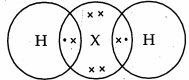
$(b)$ Write the molecular formula of the compound formed when $X$ reacts with hydrogen and draw its electron dot structure.
$(c)$ Name the element $X$ and state whether it is metallic or non-metallic.
$(a)$ Determine the number of valence electrons and the valency of $X$.
$(b)$ Write the molecular formula of the compound formed when $X$ reacts with hydrogen and draw its electron dot structure.
$(c)$ Name the element $X$ and state whether it is metallic or non-metallic.
Solution
(N/A) The electronic configuration of $X$ is $2, 8, 6$.
Number of valence electrons $= 6$.
Valency $= 8 - 6 = 2$.
$(b)$ When $X$ reacts with hydrogen,it forms a compound with the molecular formula $H_2X$. Since $X$ is Sulphur,the formula is $H_2S$. The electron dot structure is shown in the image provided.
$(c)$ The element $X$ is Sulphur $(S)$. It is a non-metal.
Number of valence electrons $= 6$.
Valency $= 8 - 6 = 2$.
$(b)$ When $X$ reacts with hydrogen,it forms a compound with the molecular formula $H_2X$. Since $X$ is Sulphur,the formula is $H_2S$. The electron dot structure is shown in the image provided.
$(c)$ The element $X$ is Sulphur $(S)$. It is a non-metal.
0 likes
View Solution132
Medium
$Li, Be, B$ and $C$ are the elements of the same period of the Modern Periodic Table.
$(a)$ Arrange them in increasing order of their atomic size.
$(b)$ In which shell (number) would the last electron enter for all of them?
$(c)$ Calculate the number of valence electrons in each.
$(d)$ Which element amongst them is most electropositive?
$(a)$ Arrange them in increasing order of their atomic size.
$(b)$ In which shell (number) would the last electron enter for all of them?
$(c)$ Calculate the number of valence electrons in each.
$(d)$ Which element amongst them is most electropositive?
Solution
(A) The atomic size decreases across a period from left to right. Therefore,the increasing order of atomic size is: $C < B < Be < Li$.
$(b)$ These elements belong to the $2nd$ period of the Modern Periodic Table. Therefore,the last electron enters the $L$ shell (the $2nd$ shell).
$(c)$ The number of valence electrons corresponds to the group number for these elements: $Li = 1, Be = 2, B = 3, C = 4$.
$(d)$ Electropositivity decreases across a period from left to right. Thus,$Li$ is the most electropositive element among them.
$(b)$ These elements belong to the $2nd$ period of the Modern Periodic Table. Therefore,the last electron enters the $L$ shell (the $2nd$ shell).
$(c)$ The number of valence electrons corresponds to the group number for these elements: $Li = 1, Be = 2, B = 3, C = 4$.
$(d)$ Electropositivity decreases across a period from left to right. Thus,$Li$ is the most electropositive element among them.
0 likes
View Solution133
Medium
Study the variation in the atomic radii of Group $I$ elements given below and arrange them in an increasing order.
$(i)$ Name the elements which have the smallest and the largest atoms.
$(ii)$ How does the atomic size vary as you go down a group?
$(i)$ Name the elements which have the smallest and the largest atoms.
| Group $I$ elements | $Li: 52\, pm, Na: 61\, pm, K: 231\, pm, Rb: 244\, pm, Cs: 262\, pm$ |
$(ii)$ How does the atomic size vary as you go down a group?
Solution
(A) The increasing order of atomic radii is: $Li (52\, pm) < Na (61\, pm) < K (231\, pm) < Rb (244\, pm) < Cs (262\, pm)$.
$(i)$ The element with the smallest atom is Lithium $(Li)$ with an atomic radius of $52\, pm$, and the element with the largest atom is Caesium $(Cs)$ with an atomic radius of $262\, pm$.
$(ii)$ As we move down a group in the periodic table, the atomic size increases. This happens because a new electron shell is added to the atom at each step, which increases the distance between the outermost electrons and the nucleus, thereby increasing the atomic radius.
$(i)$ The element with the smallest atom is Lithium $(Li)$ with an atomic radius of $52\, pm$, and the element with the largest atom is Caesium $(Cs)$ with an atomic radius of $262\, pm$.
$(ii)$ As we move down a group in the periodic table, the atomic size increases. This happens because a new electron shell is added to the atom at each step, which increases the distance between the outermost electrons and the nucleus, thereby increasing the atomic radius.
0 likes
View Solution134
Medium
Atomic radii of the elements of the second period are given below :
$(i)$ Arrange them in decreasing order of their atomic radii.
$(ii)$ Are the elements now arranged in the pattern of a period in the Periodic Table?
$(iii)$ Which elements have the largest and the smallest atoms?
$(iv)$ How does the atomic radius change as you go from left to right in a period?
| Period $II$ elements | $B$ | $Be$ | $O$ | $N$ | $Li$ | $C$ |
| Atomic radius $(pm)$ | $88$ | $111$ | $66$ | $74$ | $152$ | $77$ |
$(i)$ Arrange them in decreasing order of their atomic radii.
$(ii)$ Are the elements now arranged in the pattern of a period in the Periodic Table?
$(iii)$ Which elements have the largest and the smallest atoms?
$(iv)$ How does the atomic radius change as you go from left to right in a period?
Solution
(A) $(i)$ The elements of the second period in the decreasing order of their atomic radii are:
$(ii)$ Yes,the elements are now arranged in the pattern of a period in the Periodic Table.
$(iii)$ $Li$ has the largest atomic radius $(152\,pm)$ and $O$ has the smallest atomic radius $(66\,pm)$.
$(iv)$ The atomic radius decreases as we move from left to right in a period because the nuclear charge increases,which pulls the electrons closer to the nucleus.
| Element | $Li$ | $Be$ | $B$ | $C$ | $N$ | $O$ |
| Radius $(pm)$ | $152$ | $111$ | $88$ | $77$ | $74$ | $66$ |
$(ii)$ Yes,the elements are now arranged in the pattern of a period in the Periodic Table.
$(iii)$ $Li$ has the largest atomic radius $(152\,pm)$ and $O$ has the smallest atomic radius $(66\,pm)$.
$(iv)$ The atomic radius decreases as we move from left to right in a period because the nuclear charge increases,which pulls the electrons closer to the nucleus.
0 likes
View Solution135
EasyMCQ
Which of the following statements is not correct regarding the trends observed when moving from left to right across the periods of the Periodic Table?
A
The elements become less metallic in nature.
B
The number of valence electrons increases.
C
The atoms lose their electrons more easily.
D
The oxides become more acidic.
Solution
(C) Moving from left to right across a period in the Periodic Table:
$1$. The metallic character of elements decreases because the nuclear charge increases,making it harder to lose electrons.
$2$. The number of valence electrons increases from $1$ to $8$.
$3$. Since the nuclear charge increases and the atomic size decreases,the effective nuclear attraction on valence electrons increases,making it harder for atoms to lose electrons. Thus,the tendency to lose electrons decreases.
$4$. The oxides of elements on the left are basic,while those on the right are acidic.
Therefore,the statement that 'atoms lose their electrons more easily' is incorrect.
$1$. The metallic character of elements decreases because the nuclear charge increases,making it harder to lose electrons.
$2$. The number of valence electrons increases from $1$ to $8$.
$3$. Since the nuclear charge increases and the atomic size decreases,the effective nuclear attraction on valence electrons increases,making it harder for atoms to lose electrons. Thus,the tendency to lose electrons decreases.
$4$. The oxides of elements on the left are basic,while those on the right are acidic.
Therefore,the statement that 'atoms lose their electrons more easily' is incorrect.
0 likes
View Solution136
EasyMCQ
The order of increasing atomic size is:
A
$F < Cl < Br < I$
B
$Cl > Br > F > I$
C
$Br > I > Cl > F$
D
$I > Br > Cl > F$
Solution
(A) Atomic size generally increases down a group in the periodic table because the number of electron shells increases.
Fluorine $(F)$,Chlorine $(Cl)$,Bromine $(Br)$,and Iodine $(I)$ all belong to Group $17$ (Halogens).
The order of these elements down the group is $F, Cl, Br, I$.
Therefore,the atomic size increases in the order: $F < Cl < Br < I$.
Since the question asks for the order of increasing atomic size,the correct sequence is $F < Cl < Br < I$.
Fluorine $(F)$,Chlorine $(Cl)$,Bromine $(Br)$,and Iodine $(I)$ all belong to Group $17$ (Halogens).
The order of these elements down the group is $F, Cl, Br, I$.
Therefore,the atomic size increases in the order: $F < Cl < Br < I$.
Since the question asks for the order of increasing atomic size,the correct sequence is $F < Cl < Br < I$.
0 likes
View Solution137
EasyMCQ
The order of decreasing atomic size is:
A
$Na < Mg < Al < Si$
B
$Na > Mg > Al > Si$
C
$Mg < Na < Al < Si$
D
$Mg > Na > Al > Si$
Solution
(B) In the periodic table,as we move from left to right across a period,the atomic size decreases.
This is because the nuclear charge increases with the addition of protons,which pulls the electrons closer to the nucleus.
$Na$,$Mg$,$Al$,and $Si$ all belong to the $3^{rd}$ period.
Their atomic numbers are $Na (11)$,$Mg (12)$,$Al (13)$,and $Si (14)$.
Therefore,the order of decreasing atomic size is $Na > Mg > Al > Si$.
This is because the nuclear charge increases with the addition of protons,which pulls the electrons closer to the nucleus.
$Na$,$Mg$,$Al$,and $Si$ all belong to the $3^{rd}$ period.
Their atomic numbers are $Na (11)$,$Mg (12)$,$Al (13)$,and $Si (14)$.
Therefore,the order of decreasing atomic size is $Na > Mg > Al > Si$.
0 likes
View Solution138
EasyMCQ
The element with atomic number $18$ belongs to which group?
A
Halogens
B
Noble gases
C
Alkaline earth metals
D
Alkali metals
Solution
(B) The electronic configuration of the element with atomic number $18$ is $2, 8, 8$.
Since the outermost shell contains $8$ electrons,it has a stable octet configuration.
Elements with a stable octet configuration belong to Group $18$ of the periodic table,which are known as Noble gases (or Inert gases).
Since the outermost shell contains $8$ electrons,it has a stable octet configuration.
Elements with a stable octet configuration belong to Group $18$ of the periodic table,which are known as Noble gases (or Inert gases).
0 likes
View Solution139
EasyMCQ
The scientist who showed that the atomic number of an element is a more fundamental property than its atomic mass is:
A
John Newlands
B
Johann Wolfgang Dobereiner
C
Henry Moseley
D
Dmitri Ivanovich Mendeleev
Solution
(C) Henry Moseley,in $1913$,conducted experiments using $X$-ray spectra of elements.
He discovered that the frequency of the $X$-rays emitted by an element is related to its atomic number $(Z)$ rather than its atomic mass.
This led to the formulation of the Modern Periodic Law,which states that the properties of elements are a periodic function of their atomic numbers.
Therefore,he demonstrated that atomic number is a more fundamental property of an element than atomic mass.
He discovered that the frequency of the $X$-rays emitted by an element is related to its atomic number $(Z)$ rather than its atomic mass.
This led to the formulation of the Modern Periodic Law,which states that the properties of elements are a periodic function of their atomic numbers.
Therefore,he demonstrated that atomic number is a more fundamental property of an element than atomic mass.
0 likes
View Solution140
EasyMCQ
When Mendeleev started his work,the number of known elements were:
A
$68$
B
$53$
C
$63$
D
$57$
Solution
(C) When Dmitri Mendeleev started his work on the classification of elements,there were $63$ elements known to science.
He used these $63$ elements to formulate his Periodic Law,which states that the properties of elements are a periodic function of their atomic masses.
He used these $63$ elements to formulate his Periodic Law,which states that the properties of elements are a periodic function of their atomic masses.
0 likes
View Solution141
EasyMCQ
It was assumed by Newlands that only :
A
$56$ elements existed in nature
B
$57$ elements existed in nature
C
$59$ elements existed in nature
D
$63$ elements existed in nature
Solution
(A) John Newlands,an English chemist,proposed the Law of Octaves in $1864$.
He arranged the elements known at that time in increasing order of their atomic masses.
Newlands assumed that only $56$ elements existed in nature and that no more elements would be discovered in the future.
Therefore,the correct option is $A$.
He arranged the elements known at that time in increasing order of their atomic masses.
Newlands assumed that only $56$ elements existed in nature and that no more elements would be discovered in the future.
Therefore,the correct option is $A$.
0 likes
View Solution142
EasyMCQ
$D$öbereiner's system of classification into triads was not found to be useful as he could identify only:
A
Two triads
B
Three triads
C
Four triads
D
Five triads
Solution
(D) Johann Wolfgang $D$öbereiner attempted to arrange elements with similar properties into groups of three,known as triads.
In his system,the atomic mass of the middle element was approximately the arithmetic mean of the atomic masses of the other two elements.
However,this system was not widely applicable because $D$öbereiner could identify only $5$ such triads from the elements known at that time.
Therefore,the correct option is $D$.
In his system,the atomic mass of the middle element was approximately the arithmetic mean of the atomic masses of the other two elements.
However,this system was not widely applicable because $D$öbereiner could identify only $5$ such triads from the elements known at that time.
Therefore,the correct option is $D$.
0 likes
View Solution143
EasyMCQ
It was found that the law of octaves was applicable only up to:
A
Chlorine
B
Potassium
C
Calcium
D
Argon
Solution
(C) John Newlands proposed the Law of Octaves in $1866$.
He arranged the elements in increasing order of their atomic masses and observed that every eighth element had properties similar to the first element.
This law was found to be applicable only up to $Calcium$ $(Ca)$, which is the $20^{th}$ element in the periodic table.
Beyond $Calcium$, the properties of the eighth element did not correspond to the first element.
He arranged the elements in increasing order of their atomic masses and observed that every eighth element had properties similar to the first element.
This law was found to be applicable only up to $Calcium$ $(Ca)$, which is the $20^{th}$ element in the periodic table.
Beyond $Calcium$, the properties of the eighth element did not correspond to the first element.
0 likes
View Solution144
MediumMCQ
The element $X$ has the following electron configuration $2, 8, 8, 2$. It means that it belongs to:
A
Second period and second group
B
Fourth period and fourth group
C
Second period and fourth group
D
Fourth period and second group
Solution
(D) The electronic configuration of element $X$ is $2, 8, 8, 2$.
$1$. The number of shells occupied by electrons determines the period number. Here,there are $4$ shells $(K, L, M, N)$,so the element belongs to the $4^{th}$ period.
$2$. The number of valence electrons (electrons in the outermost shell) determines the group number. Here,there are $2$ valence electrons,so the element belongs to the $2^{nd}$ group.
Therefore,element $X$ belongs to the $4^{th}$ period and $2^{nd}$ group.
$1$. The number of shells occupied by electrons determines the period number. Here,there are $4$ shells $(K, L, M, N)$,so the element belongs to the $4^{th}$ period.
$2$. The number of valence electrons (electrons in the outermost shell) determines the group number. Here,there are $2$ valence electrons,so the element belongs to the $2^{nd}$ group.
Therefore,element $X$ belongs to the $4^{th}$ period and $2^{nd}$ group.
0 likes
View Solution145
MediumMCQ
Arrange the following elements in the order of their decreasing metallic character: $Na, Si, Cl, Mg, Al$.
A
$Na > Mg > Al > Si > Cl$
B
$Cl > Si > Al > Mg > Na$
C
$Na > Al > Mg > Cl > Si$
D
$Al > Na > Si > Cl > Mg$
Solution
(A) Metallic character refers to the tendency of an element to lose electrons.
In the periodic table,metallic character decreases as we move from left to right across a period because the effective nuclear charge increases,making it harder to lose electrons.
All the given elements $(Na, Mg, Al, Si, Cl)$ belong to the $3^{rd}$ period of the periodic table.
Their positions from left to right are: $Na$ (Group $1$),$Mg$ (Group $2$),$Al$ (Group $13$),$Si$ (Group $14$),and $Cl$ (Group $17$).
Therefore,the order of decreasing metallic character is $Na > Mg > Al > Si > Cl$.
In the periodic table,metallic character decreases as we move from left to right across a period because the effective nuclear charge increases,making it harder to lose electrons.
All the given elements $(Na, Mg, Al, Si, Cl)$ belong to the $3^{rd}$ period of the periodic table.
Their positions from left to right are: $Na$ (Group $1$),$Mg$ (Group $2$),$Al$ (Group $13$),$Si$ (Group $14$),and $Cl$ (Group $17$).
Therefore,the order of decreasing metallic character is $Na > Mg > Al > Si > Cl$.
0 likes
View Solution146
MediumMCQ
Arrange the following elements in the order of their increasing non-metallic character: $Li, O, C, Be, F$.
A
$F < O < C < Be < Li$
B
$Li < Be < C < O < F$
C
$Li < Be < C < F < O$
D
$F < O < Be < C < Li$
Solution
(B) Non-metallic character is the tendency of an element to gain electrons.
In the periodic table,non-metallic character increases as we move from left to right across a period.
All the given elements $(Li, Be, C, O, F)$ belong to the second period of the periodic table.
Their positions from left to right are: $Li$ (Group $1$),$Be$ (Group $2$),$C$ (Group $14$),$O$ (Group $16$),$F$ (Group $17$).
Therefore,the order of increasing non-metallic character is $Li < Be < C < O < F$.
In the periodic table,non-metallic character increases as we move from left to right across a period.
All the given elements $(Li, Be, C, O, F)$ belong to the second period of the periodic table.
Their positions from left to right are: $Li$ (Group $1$),$Be$ (Group $2$),$C$ (Group $14$),$O$ (Group $16$),$F$ (Group $17$).
Therefore,the order of increasing non-metallic character is $Li < Be < C < O < F$.
0 likes
View Solution147
MediumMCQ
What type of oxide would Eka-aluminium form?
A
$EO_3$
B
$E_3O_2$
C
$E_2O_3$
D
$EO$
Solution
(C) Eka-aluminium was the name given by Mendeleev to the element Gallium $(Ga)$.
Gallium belongs to Group $13$ of the periodic table,similar to Aluminium $(Al)$.
Elements in Group $13$ have a valency of $3$.
When an element $E$ with a valency of $3$ reacts with Oxygen (which has a valency of $2$),it forms an oxide with the formula $E_2O_3$ according to the criss-cross method of chemical formula writing.
Therefore,Eka-aluminium forms an oxide of the type $E_2O_3$.
Gallium belongs to Group $13$ of the periodic table,similar to Aluminium $(Al)$.
Elements in Group $13$ have a valency of $3$.
When an element $E$ with a valency of $3$ reacts with Oxygen (which has a valency of $2$),it forms an oxide with the formula $E_2O_3$ according to the criss-cross method of chemical formula writing.
Therefore,Eka-aluminium forms an oxide of the type $E_2O_3$.
0 likes
View Solution148
EasyMCQ
Three elements $B, Si$ and $Ge$ are:
A
metals
B
non-metals
C
metal,non-metal and metalloid respectively
D
metalloids
Solution
(D) The elements $B$ (Boron),$Si$ (Silicon),and $Ge$ (Germanium) are all classified as metalloids.
Metalloids are elements that exhibit properties intermediate between those of metals and non-metals.
In the periodic table,these elements are located along the 'zig-zag' line that separates metals from non-metals.
Therefore,all three elements $B, Si$,and $Ge$ are metalloids.
Metalloids are elements that exhibit properties intermediate between those of metals and non-metals.
In the periodic table,these elements are located along the 'zig-zag' line that separates metals from non-metals.
Therefore,all three elements $B, Si$,and $Ge$ are metalloids.
0 likes
View Solution149
MediumMCQ
Which of the following elements will form an acidic oxide?
A
An element with atomic number $7$
B
An element with atomic number $3$
C
An element with atomic number $12$
D
An element with atomic number $19$
Solution
(A) Non-metals generally form acidic oxides,while metals form basic or amphoteric oxides.
$1$. Atomic number $7$ corresponds to Nitrogen $(N)$,which is a non-metal. It forms acidic oxides like $NO_2$ and $N_2O_5$.
$2$. Atomic number $3$ corresponds to Lithium $(Li)$,which is an alkali metal and forms a basic oxide $(Li_2O)$.
$3$. Atomic number $12$ corresponds to Magnesium $(Mg)$,which is an alkaline earth metal and forms a basic oxide $(MgO)$.
$4$. Atomic number $19$ corresponds to Potassium $(K)$,which is an alkali metal and forms a basic oxide $(K_2O)$.
Therefore,the element with atomic number $7$ will form an acidic oxide.
$1$. Atomic number $7$ corresponds to Nitrogen $(N)$,which is a non-metal. It forms acidic oxides like $NO_2$ and $N_2O_5$.
$2$. Atomic number $3$ corresponds to Lithium $(Li)$,which is an alkali metal and forms a basic oxide $(Li_2O)$.
$3$. Atomic number $12$ corresponds to Magnesium $(Mg)$,which is an alkaline earth metal and forms a basic oxide $(MgO)$.
$4$. Atomic number $19$ corresponds to Potassium $(K)$,which is an alkali metal and forms a basic oxide $(K_2O)$.
Therefore,the element with atomic number $7$ will form an acidic oxide.
0 likes
View Solution150
MediumMCQ
The element with atomic number $14$ is hard and forms acidic oxide and a covalent halide. To which of the following categories does the element belong?
A
Metal
B
Metalloid
C
Non-metal
D
Left-hand side element
Solution
(B) The element with atomic number $14$ is Silicon $(Si)$.
Silicon is a member of Group $14$ in the periodic table.
It exhibits properties intermediate between metals and non-metals,making it a metalloid.
Silicon forms an acidic oxide $(SiO_2)$ and covalent halides (e.g.,$SiCl_4$).
Therefore,the correct category is metalloid.
Silicon is a member of Group $14$ in the periodic table.
It exhibits properties intermediate between metals and non-metals,making it a metalloid.
Silicon forms an acidic oxide $(SiO_2)$ and covalent halides (e.g.,$SiCl_4$).
Therefore,the correct category is metalloid.
0 likes
View SolutionPeriodic Classification of Elements — Mix Examples - Periodic Classification of Elements · Frequently Asked Questions
1Are these Periodic Classification of Elements questions useful for JEE and NEET?
Yes. All questions in this section are mapped to JEE Main and NEET exam patterns. Previous year questions from JEE Main, NEET, GUJCET and state-level exams are included with full solutions.
2Can I switch to Hindi or Gujarati for these questions?
Yes. Use the language tabs in the hero section or the sidebar to view the same questions and solutions in English, Hindi or Gujarati.
3How do I generate a question paper from this subtopic?
Use the Vedclass Exam Paper Generator — select the chapter and subtopic, set difficulty, and generate Sets A, B, C, D automatically. First 3 chapters of every subject are free.
Vedclass Products
For Students
Vedclass Test Series
Mock tests in real JEE/NEET style with performance analysis. 5-day free trial.
Start Free TrialFor Teachers
Exam Paper Generator
Generate Set A/B/C/D papers from this chapter in 2 minutes. 3 chapters free.
Try FreeFor Institutes
Online Exam Module
Live online exams with unlimited students, 360° analytics & white-label branding.
See DemoFor Teachers & Institutes
Generate a Periodic Classification of Elements Exam Paper in 2 Minutes
Select subtopic & difficulty — Sets A, B, C, D auto-generated with No Repeat logic.
First 3 chapters of every subject are free — no payment required.