
A English
Mix Examples - How do Organisms Reproduce? Questions in English
Class 10 Science · How do Organisms Reproduce? · Mix Examples - How do Organisms Reproduce?
251+
Questions
English
Language
100%
With Solutions
Showing 50 of 251 questions in English
51
Medium
Distinguish between pollination and fertilisation. Mention the site and product of fertilisation in a flower.
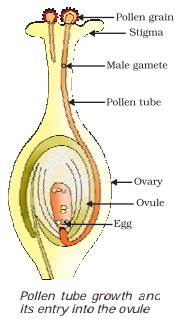
Draw a neat,labelled diagram of a pistil showing pollen tube growth and its entry into the ovule.
Draw a neat,labelled diagram of a pistil showing pollen tube growth and its entry into the ovule.
Solution
(N/A) Pollination is the process of transfer of pollen grains from the anther to the stigma of a flower.
Fertilisation is the process of fusion of the male gamete with the female gamete (egg) to form a zygote.
The site of fertilisation in a flower is the ovule.
The product of fertilisation is the zygote.
Fertilisation is the process of fusion of the male gamete with the female gamete (egg) to form a zygote.
The site of fertilisation in a flower is the ovule.
The product of fertilisation is the zygote.
0 likes
View Solution52
Medium
Distinguish between a gamete and zygote. Explain their roles in sexual reproduction.
Solution
(N/A) $gamete$ is a specialized sex cell or germ cell involved in sexual reproduction. There are two types of gametes: male and female.
$A$ $zygote$ is the diploid cell formed as a result of fertilization, where a male gamete and a female gamete fuse together.
The two fusing gametes carry genetic information from their respective parents in their $DNA$. Fertilization combines the genetic material of both parents into a single $zygote$ cell.
The $zygote$ serves as the first cell of the next generation. It undergoes repeated mitotic divisions to form an embryo, which subsequently develops into a new individual.
$A$ $zygote$ is the diploid cell formed as a result of fertilization, where a male gamete and a female gamete fuse together.
The two fusing gametes carry genetic information from their respective parents in their $DNA$. Fertilization combines the genetic material of both parents into a single $zygote$ cell.
The $zygote$ serves as the first cell of the next generation. It undergoes repeated mitotic divisions to form an embryo, which subsequently develops into a new individual.
0 likes
View Solution53
Medium
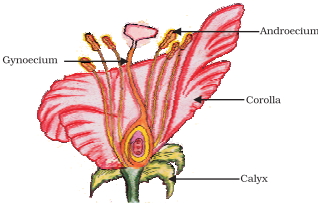
Draw the diagram of a flower and label the four whorls. Write the names of gamete-producing organs in the flower.
Solution
(N/A) The four whorls of a flower are:
$1$. Calyx (Sepals)
$2$. Corolla (Petals)
$3$. Androecium (Stamens)
$4$. Gynoecium (Pistil/Carpel)
Gamete-producing organs:
- Male gamete-producing organ: The stamen (specifically the anther,which produces pollen grains containing male gametes).
- Female gamete-producing organ: The pistil (specifically the ovary,which contains ovules that produce the egg cell/female gamete).
$1$. Calyx (Sepals)
$2$. Corolla (Petals)
$3$. Androecium (Stamens)
$4$. Gynoecium (Pistil/Carpel)
Gamete-producing organs:
- Male gamete-producing organ: The stamen (specifically the anther,which produces pollen grains containing male gametes).
- Female gamete-producing organ: The pistil (specifically the ovary,which contains ovules that produce the egg cell/female gamete).
0 likes
View Solution54
Medium
What is the placenta? Mention its role during pregnancy.
Solution
(N/A) The placenta is a special disc-like tissue embedded in the uterine wall that connects the developing embryo to the mother.
Its roles during pregnancy are:
$1$. It possesses villi on the embryo's side of the tissue,which increases the surface area for glucose and oxygen transfer from the mother to the embryo.
$2$. It facilitates the passage of essential nutrients and oxygen from the mother's blood to the embryo.
$3$. It acts as an excretory organ by removing waste substances and carbon dioxide produced by the embryo into the mother's blood for excretion.
Its roles during pregnancy are:
$1$. It possesses villi on the embryo's side of the tissue,which increases the surface area for glucose and oxygen transfer from the mother to the embryo.
$2$. It facilitates the passage of essential nutrients and oxygen from the mother's blood to the embryo.
$3$. It acts as an excretory organ by removing waste substances and carbon dioxide produced by the embryo into the mother's blood for excretion.
0 likes
View Solution55
Medium
What are various ways to avoid pregnancy? Elaborate any one method.
Solution
(N/A) The various methods to avoid pregnancy (contraception) include:
$(i)$ Barrier methods (e.g.,condoms) to prevent physical contact between sperm and egg.
$(ii)$ Chemical methods (e.g.,oral pills) which change the hormonal balance of the body to prevent the release of an egg (ovulation).
$(iii)$ Intrauterine devices (e.g.,copper $T$ or loop) which are placed in the uterus to prevent implantation.
$(iv)$ Surgical methods (e.g.,vasectomy in males or tubectomy in females) which block the vas deferens or fallopian tubes respectively.
Elaboration of Chemical Method (Oral Pills):
Oral contraceptive pills contain specific hormones that inhibit the release of eggs from the ovaries. By preventing ovulation,the sperm has no egg to fertilize,thereby effectively preventing pregnancy.
$(i)$ Barrier methods (e.g.,condoms) to prevent physical contact between sperm and egg.
$(ii)$ Chemical methods (e.g.,oral pills) which change the hormonal balance of the body to prevent the release of an egg (ovulation).
$(iii)$ Intrauterine devices (e.g.,copper $T$ or loop) which are placed in the uterus to prevent implantation.
$(iv)$ Surgical methods (e.g.,vasectomy in males or tubectomy in females) which block the vas deferens or fallopian tubes respectively.
Elaboration of Chemical Method (Oral Pills):
Oral contraceptive pills contain specific hormones that inhibit the release of eggs from the ovaries. By preventing ovulation,the sperm has no egg to fertilize,thereby effectively preventing pregnancy.
0 likes
View Solution56
Medium
How does fertilization take place? Fertilization occurs once in a month. Comment.
Solution
(N/A) During sexual intercourse,sperm enters through the vaginal passage and moves upwards into the fallopian tube (oviduct).
$(b)$ An egg is released from the ovary and reaches the oviduct.
$(c)$ The sperm encounters the egg in the oviduct,where fusion occurs,resulting in fertilization.
$(d)$ Fertilization occurs once a month because the ovary releases only one egg every month during the menstrual cycle.
$(b)$ An egg is released from the ovary and reaches the oviduct.
$(c)$ The sperm encounters the egg in the oviduct,where fusion occurs,resulting in fertilization.
$(d)$ Fertilization occurs once a month because the ovary releases only one egg every month during the menstrual cycle.
0 likes
View Solution57
Easy
Reproduction is essentially a phenomenon that is not for the survival of an individual but for the stability of a species. Justify.
Solution
(N/A) Organisms require energy for survival,which they obtain through life processes such as nutrition and respiration.
$(b)$ Reproduction is an energy-intensive process that does not contribute to the survival of the individual organism.
$(c)$ The primary purpose of reproduction is the transfer of genetic material from one generation to the next through $DNA$ copying.
$(d)$ $DNA$ copying occurs with high fidelity but also introduces variations,which provide advantages to the species,ensuring its stability and survival in a changing environment.
$(b)$ Reproduction is an energy-intensive process that does not contribute to the survival of the individual organism.
$(c)$ The primary purpose of reproduction is the transfer of genetic material from one generation to the next through $DNA$ copying.
$(d)$ $DNA$ copying occurs with high fidelity but also introduces variations,which provide advantages to the species,ensuring its stability and survival in a changing environment.
0 likes
View Solution58
Medium
Describe sexually transmitted diseases (STDs) and mention the ways to prevent them.
Solution
(N/A) $1$. Sexually Transmitted Diseases (STDs) are infections that are primarily spread through sexual contact with an infected person.
$2$. These diseases can be caused by various pathogens,including bacteria (e.g.,syphilis,gonorrhea),viruses (e.g.,$HIV$,genital herpes),or parasites.
$3$. Prevention methods include:
- Practicing safe sex by using mechanical barriers like condoms,which significantly reduce the risk of transmission.
- Maintaining personal hygiene and avoiding sexual contact with multiple or unknown partners.
- Seeking early medical diagnosis and treatment if symptoms appear to prevent further spread.
$2$. These diseases can be caused by various pathogens,including bacteria (e.g.,syphilis,gonorrhea),viruses (e.g.,$HIV$,genital herpes),or parasites.
$3$. Prevention methods include:
- Practicing safe sex by using mechanical barriers like condoms,which significantly reduce the risk of transmission.
- Maintaining personal hygiene and avoiding sexual contact with multiple or unknown partners.
- Seeking early medical diagnosis and treatment if symptoms appear to prevent further spread.
0 likes
View Solution59
Easy
List two functions of the ovary in the human female reproductive system.
Solution
(N/A) $(i)$ Production of female gametes (ova).
$(ii)$ Secretion of female sex hormones (estrogen and progesterone).
$(ii)$ Secretion of female sex hormones (estrogen and progesterone).
0 likes
View Solution60
Easy
What are those organisms called which bear both the sex organs in the same individual? Give one example of such an organism.
Solution
(N/A) Organisms that possess both male and female sex organs in the same individual are called bisexual or hermaphrodite organisms.
Example: $Hydra$,Earthworm,Mustard,or Hibiscus.
Example: $Hydra$,Earthworm,Mustard,or Hibiscus.
0 likes
View Solution61
EasyMCQ
Name the life process of an organism that helps in the growth of its population.
A
Respiration
B
Nutrition
C
Reproduction
D
Excretion
Solution
(C) Reproduction is the biological process by which an organism produces new individual organisms (offspring). It is essential for the survival of a species and directly contributes to the growth and maintenance of a population over time.
0 likes
View Solution62
EasyMCQ
Where is $DNA$ found in a cell?
A
Cytoplasm
B
Nucleus
C
Cell membrane
D
Ribosomes
Solution
(B) $DNA$ (Deoxyribonucleic acid) is primarily found within the nucleus of a eukaryotic cell,where it is organized into structures called chromosomes. It contains the genetic information necessary for the development and function of living organisms.
0 likes
View Solution63
Easy
Name two simple organisms having the ability of regeneration.
Solution
(N/A) Regeneration is the process by which an organism can regrow lost or damaged body parts. Simple organisms like $Planaria$,$Hydra$,and $Earthworm$ possess the ability to regenerate their entire body from a small fragment or piece. Therefore,any two of these,such as $Planaria$ and $Hydra$,are correct examples.
0 likes
View Solution64
Easy
Give the respective scientific terms used for studying:
$(i)$ The mechanism by which variations are created and inherited,and
$(ii)$ The development of new types of organisms from existing ones.
$(i)$ The mechanism by which variations are created and inherited,and
$(ii)$ The development of new types of organisms from existing ones.
Solution
(N/A) $(i)$ The study of the mechanism by which variations are created and inherited is called $Genetics$.
$(ii)$ The development of new types of organisms from existing ones is called $Evolution$.
$(ii)$ The development of new types of organisms from existing ones is called $Evolution$.
0 likes
View Solution65
EasyMCQ
Give an advantage of vegetative propagation.
A
It produces genetically identical offspring.
B
It allows for faster growth compared to seeds.
C
It can be used to propagate plants that do not produce viable seeds.
D
All of the above.
Solution
(D) Vegetative propagation is an asexual method of reproduction in plants. An important advantage of this method is that it can be used to grow plants that do not produce seeds (e.g.,banana,jasmine) or produce non-viable seeds. Additionally,it ensures the production of genetically identical offspring,which helps in maintaining desirable traits of the parent plant.
0 likes
View Solution66
EasyMCQ
Name the type of cells which undergo regeneration.
A
Specialized cells
B
Stem cells
C
Regenerative cells
D
All of the above
Solution
(C) The cells that undergo regeneration are known as regenerative cells. These are specialized cells that have the ability to proliferate and produce a large number of cells to replace the lost or damaged body parts.
0 likes
View Solution67
EasyMCQ
Organisms have a varied body design. Name the property which gives the basic difference in body design.
A
Cellular respiration
B
$DNA$ copying
C
Photosynthesis
D
Digestion
Solution
(B) The basic difference in the body design of organisms arises due to variations that occur during the process of $DNA$ replication.
When a cell divides,it must copy its $DNA$ to ensure that each daughter cell receives a complete set of genetic information.
This copying process is not perfectly accurate and introduces small errors or changes,known as variations.
These variations accumulate over generations,leading to the diverse body designs observed in living organisms.
When a cell divides,it must copy its $DNA$ to ensure that each daughter cell receives a complete set of genetic information.
This copying process is not perfectly accurate and introduces small errors or changes,known as variations.
These variations accumulate over generations,leading to the diverse body designs observed in living organisms.
0 likes
View Solution68
EasyMCQ
How can the chromosomes be identified?
A
By observing the cell during interphase.
B
By observing the cell during cell division.
C
By staining the cell with iodine.
D
By observing the cell in a dormant state.
Solution
(B) Chromosomes are composed of $DNA$ and proteins. During the interphase of the cell cycle,the genetic material exists as a loose network called chromatin. However,when the cell enters the process of cell division (mitosis or meiosis),the chromatin condenses into highly organized,thread-like structures known as chromosomes. Therefore,chromosomes can be clearly identified and observed under a microscope only during the phase of cell division.
0 likes
View Solution69
EasyMCQ
Why is the temperature of the scrotal sac $2\,^{\circ}C$ less than the body temperature?
A
To protect the testes from injury.
B
To facilitate the process of spermatogenesis.
C
To store sperms at a lower temperature.
D
To prevent the formation of testosterone.
Solution
(B) The testes are located outside the abdominal cavity in the scrotal sac because the process of spermatogenesis (the production of sperms) requires a temperature that is approximately $2\,^{\circ}C$ to $2.5\,^{\circ}C$ lower than the normal internal body temperature. This lower temperature is essential for the survival and maturation of sperm cells.
0 likes
View Solution70
Easy
Differentiate between pollen grain and ovule.
Solution
(N/A) Pollen grains are the male reproductive units in flowering plants that contain the male gametes. They are typically produced in the anther.
Ovules are the female reproductive structures in flowering plants that contain the female gamete (egg cell). They are located within the ovary and develop into seeds after fertilization.
Ovules are the female reproductive structures in flowering plants that contain the female gamete (egg cell). They are located within the ovary and develop into seeds after fertilization.
0 likes
View Solution71
Easy
Differentiate between germination and fertilization.
Solution
(N/A) Germination: It is the process by which an embryo develops into a seedling under favorable conditions. It marks the beginning of the growth of a new plant from a seed.
Fertilization: It is the process of fusion of the male gamete (pollen grain/sperm) with the female gamete (ovum/egg cell) to form a zygote. It is a crucial step in sexual reproduction.
Fertilization: It is the process of fusion of the male gamete (pollen grain/sperm) with the female gamete (ovum/egg cell) to form a zygote. It is a crucial step in sexual reproduction.
0 likes
View Solution72
Easy
What are sexually transmitted diseases? Name an $STD$ which damages the immune system of the human body.
Solution
(N/A) $(i)$ Sexually Transmitted Diseases $(STDs)$ are infections that are primarily transmitted from one person to another through sexual contact.
$(ii)$ $AIDS$ (Acquired Immuno Deficiency Syndrome) is an $STD$ caused by the $HIV$ virus,which specifically targets and damages the immune system of the human body.
$(ii)$ $AIDS$ (Acquired Immuno Deficiency Syndrome) is an $STD$ caused by the $HIV$ virus,which specifically targets and damages the immune system of the human body.
0 likes
View Solution73
Easy
Regeneration is not possible in all types of animals. Why?
Solution
(N/A) Regeneration is a process that relies on the presence of specialized cells known as stem cells or undifferentiated cells.
These cells have the potential to proliferate and differentiate into various cell types to replace lost or damaged tissues.
In complex organisms,the body organization is highly specialized and differentiated,meaning cells have lost their ability to revert to an undifferentiated state.
Therefore,only organisms with a simple body organization and the presence of these specialized regenerative cells can exhibit the phenomenon of regeneration.
These cells have the potential to proliferate and differentiate into various cell types to replace lost or damaged tissues.
In complex organisms,the body organization is highly specialized and differentiated,meaning cells have lost their ability to revert to an undifferentiated state.
Therefore,only organisms with a simple body organization and the presence of these specialized regenerative cells can exhibit the phenomenon of regeneration.
0 likes
View Solution74
EasyMCQ
What is the advantage of reproducing through spores?
A
They provide genetic variation.
B
They allow for survival in adverse conditions and easy dispersal.
C
They require less energy than sexual reproduction.
D
They ensure faster growth rates.
Solution
(B) Spores are protected by a thick,resistant cell wall,which allows them to survive in adverse environmental conditions like extreme heat or lack of water.
Additionally,spores are produced in large numbers and are very light in weight,which facilitates their easy dispersal over long distances by wind,water,or animals.
Additionally,spores are produced in large numbers and are very light in weight,which facilitates their easy dispersal over long distances by wind,water,or animals.
0 likes
View Solution75
EasyMCQ
What happens if the egg is not fertilized?
A
The egg continues to live in the uterus.
B
The uterine lining thickens further.
C
The uterine lining breaks down and is discharged as menstruation.
D
The egg is immediately reabsorbed by the ovary.
Solution
(C) If the egg is not fertilized,the thick and spongy lining of the uterus is no longer needed. Consequently,this lining slowly breaks down and comes out through the vagina as blood and mucus. This process is known as menstruation.
0 likes
View Solution76
Easy
Why does the lining of the uterus become thick and spongy every month?
Solution
(N/A) The lining of the uterus becomes thick and spongy every month to prepare itself to receive and nurture the growing embryo in case fertilization occurs. This rich,vascularized lining provides the necessary blood supply and nutrients to support the development of the zygote.
0 likes
View Solution77
Medium
Give reasons as to why the following processes are different from each other:
$(a)$ Fission in $Amoeba$ and $Plasmodium$.
$(b)$ Binary fission and Fragmentation.
$(a)$ Fission in $Amoeba$ and $Plasmodium$.
$(b)$ Binary fission and Fragmentation.
Solution
(N/A) In $Amoeba$,binary fission occurs,where the parent cell divides into two daughter cells. In $Plasmodium$,multiple fission occurs,where the parent cell divides into many daughter cells simultaneously.
$(b)$ In binary fission,a single-celled organism divides into two daughter cells. In fragmentation,the body of a multicellular organism breaks into two or more pieces,and each piece develops into a new individual.
$(b)$ In binary fission,a single-celled organism divides into two daughter cells. In fragmentation,the body of a multicellular organism breaks into two or more pieces,and each piece develops into a new individual.
0 likes
View Solution78
Medium
$(a)$ What is the location of the following :
$(i)$ $DNA$ in a cell
$(ii)$ Gene
$(b)$ Expand $DNA$.
$(i)$ $DNA$ in a cell
$(ii)$ Gene
$(b)$ Expand $DNA$.
Solution
(N/A) $(i)$ $DNA$ is primarily located within the nucleus of a cell,specifically within the chromosomes.
$(ii)$ Genes are segments of $DNA$ located on the chromosomes.
$(b)$ The expansion of $DNA$ is Deoxyribonucleic Acid.
$(ii)$ Genes are segments of $DNA$ located on the chromosomes.
$(b)$ The expansion of $DNA$ is Deoxyribonucleic Acid.
0 likes
View Solution79
Easy
Explain how organisms create an exact copy of themselves.
Solution
(N/A) To create copies of $DNA$ or genetic material,cells utilize biochemical reactions.
These biochemical processes result in the replication of $DNA$.
Along with the $DNA$ copies,the cell synthesizes additional cellular apparatus to support the new cell.
Finally,the cell divides,resulting in the formation of two almost identical daughter cells.
These biochemical processes result in the replication of $DNA$.
Along with the $DNA$ copies,the cell synthesizes additional cellular apparatus to support the new cell.
Finally,the cell divides,resulting in the formation of two almost identical daughter cells.
0 likes
View Solution80
Medium
''Variations'' are seen in the organisms. State the two main causes of variation.
Solution
(N/A) Variations in organisms are primarily caused by the following factors:
$(1)$ Genetic changes: These occur due to inaccuracies or changes in the $DNA$ copying process during reproduction,leading to new combinations of genes.
$(2)$ Environmental factors: External influences such as light,temperature,nutrition,wind,and water supply can influence the phenotype of an organism.
$(3)$ Mutations: Sudden,permanent changes in the genetic sequence $(DNA)$ can also introduce new variations.
$(1)$ Genetic changes: These occur due to inaccuracies or changes in the $DNA$ copying process during reproduction,leading to new combinations of genes.
$(2)$ Environmental factors: External influences such as light,temperature,nutrition,wind,and water supply can influence the phenotype of an organism.
$(3)$ Mutations: Sudden,permanent changes in the genetic sequence $(DNA)$ can also introduce new variations.
0 likes
View Solution81
Medium
Define the following processes of asexual reproduction:
$(a)$ Spore formation
$(b)$ Regeneration
$(c)$ Multiple fission
$(a)$ Spore formation
$(b)$ Regeneration
$(c)$ Multiple fission
Solution
(N/A) Spore formation: It is a method of asexual reproduction where organisms produce tiny,unicellular,reproductive bodies called spores. These spores are covered by thick walls to withstand unfavorable conditions and develop into new individuals upon germination.
$(b)$ Regeneration: It is the ability of an organism to regrow lost or damaged body parts. In some organisms,if the body is cut into pieces,each piece can grow into a complete new organism.
$(c)$ Multiple fission: It is a type of asexual reproduction in which a single parent cell divides into many daughter cells simultaneously,often occurring under unfavorable conditions.
$(b)$ Regeneration: It is the ability of an organism to regrow lost or damaged body parts. In some organisms,if the body is cut into pieces,each piece can grow into a complete new organism.
$(c)$ Multiple fission: It is a type of asexual reproduction in which a single parent cell divides into many daughter cells simultaneously,often occurring under unfavorable conditions.
0 likes
View Solution82
Medium
What happens when the following situations are initiated:
$(a)$ $A$ $Planaria$ is cut into three different pieces.
$(b)$ $A$ leaf of the $Bryophyllum$ with notches falls on the soil.
$(c)$ Testosterone is released in the male reproductive system.
$(a)$ $A$ $Planaria$ is cut into three different pieces.
$(b)$ $A$ leaf of the $Bryophyllum$ with notches falls on the soil.
$(c)$ Testosterone is released in the male reproductive system.
Solution
(N/A) $Planaria$ exhibits high regenerative capacity; therefore,each cut piece grows into a complete new organism.
$(b)$ The buds present in the notches of the $Bryophyllum$ leaf develop into new plantlets when they come in contact with moist soil.
$(c)$ The release of testosterone triggers the development of secondary sexual characteristics in boys during puberty,such as voice change,growth of facial hair,and increased muscle mass.
$(b)$ The buds present in the notches of the $Bryophyllum$ leaf develop into new plantlets when they come in contact with moist soil.
$(c)$ The release of testosterone triggers the development of secondary sexual characteristics in boys during puberty,such as voice change,growth of facial hair,and increased muscle mass.
0 likes
View Solution83
Medium
What is the main difference between sperms and eggs of humans? Write the importance of this difference.
Solution
(N/A) The primary difference is that sperms are motile,while eggs are non-motile.
The importance of this difference is that the motility of the sperm allows it to travel through the female reproductive tract to reach the egg for fertilization.
Alternatively,another significant difference is in their chromosomal content:
Sperms contain either an $X$ or a $Y$ chromosome.
Eggs contain only an $X$ chromosome.
The importance of this difference is that it determines the sex of the offspring upon fertilization:
If an $X$-bearing sperm fertilizes the egg,the zygote becomes $XX$ (female).
If a $Y$-bearing sperm fertilizes the egg,the zygote becomes $XY$ (male).
The importance of this difference is that the motility of the sperm allows it to travel through the female reproductive tract to reach the egg for fertilization.
Alternatively,another significant difference is in their chromosomal content:
Sperms contain either an $X$ or a $Y$ chromosome.
Eggs contain only an $X$ chromosome.
The importance of this difference is that it determines the sex of the offspring upon fertilization:
If an $X$-bearing sperm fertilizes the egg,the zygote becomes $XX$ (female).
If a $Y$-bearing sperm fertilizes the egg,the zygote becomes $XY$ (male).
0 likes
View Solution84
Medium
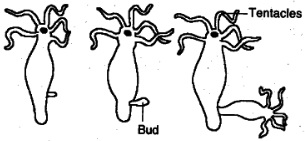
Draw labelled diagrams to illustrate budding in Hydra.
Solution
(N/A) Budding is a form of asexual reproduction in $Hydra$.
$1$. In $Hydra$,a small outgrowth called a bud develops on the body wall due to repeated cell division at a specific site.
$2$. This bud gradually grows and develops into a small,complete $Hydra$ with tentacles and a mouth.
$3$. Once fully developed,the new $Hydra$ detaches from the parent body and begins to live as an independent organism.
(Refer to the provided diagram showing the stages of bud development,the formation of tentacles,and the final detachment of the new individual.)
$1$. In $Hydra$,a small outgrowth called a bud develops on the body wall due to repeated cell division at a specific site.
$2$. This bud gradually grows and develops into a small,complete $Hydra$ with tentacles and a mouth.
$3$. Once fully developed,the new $Hydra$ detaches from the parent body and begins to live as an independent organism.
(Refer to the provided diagram showing the stages of bud development,the formation of tentacles,and the final detachment of the new individual.)
0 likes
View Solution85
Medium
"The chromosomal number of the sexually reproducing parents and their offspring is the same." Justify this statement.
Solution
(N/A) $(i)$ In sexual reproduction, the fusion of male and female gametes takes place. These germ cells/gametes contain half the number of chromosomes compared to the somatic (body) cells.
$(ii)$ When male and female gametes fuse during fertilization, the zygote formed receives one set of chromosomes from each parent, which restores the original diploid number of chromosomes, thereby ensuring the stability of the species.
$(ii)$ When male and female gametes fuse during fertilization, the zygote formed receives one set of chromosomes from each parent, which restores the original diploid number of chromosomes, thereby ensuring the stability of the species.
0 likes
View Solution86
Medium
"The consistency of $DNA$ copying during reproduction is important for the maintenance of body design features." Support this statement with two arguments.
Solution
(N/A) $(i)$ $DNA$ copying is essential for the formation of additional cellular apparatus, ensuring that when $DNA$ copies separate, each daughter cell receives its own complete set of cellular machinery.
$(ii)$ The process of $DNA$ copying is not perfectly accurate and results in minor variations each time. Consequently, while the generated $DNA$ copies are similar to the original, they may not be identical, which allows for evolution and adaptation over generations.
$(ii)$ The process of $DNA$ copying is not perfectly accurate and results in minor variations each time. Consequently, while the generated $DNA$ copies are similar to the original, they may not be identical, which allows for evolution and adaptation over generations.
0 likes
View Solution87
Easy
Define variation in relation to a species. Why is variation beneficial to the species?
Solution
(N/A) Variation refers to the differences in the characteristics or traits among individuals of the same species,which arise primarily due to inaccuracies in $DNA$ copying during sexual reproduction.
Variations are beneficial to a species because they provide a survival advantage. If environmental conditions change drastically,individuals with favorable variations are more likely to survive and reproduce,thereby ensuring the continuity of the species.
Variations are beneficial to a species because they provide a survival advantage. If environmental conditions change drastically,individuals with favorable variations are more likely to survive and reproduce,thereby ensuring the continuity of the species.
0 likes
View Solution88
Medium
List any two differences between pollination and fertilization.
Solution
(N/A)
| < strong>Pollination | < strong>Fertilization |
| $(i)$ It is the transfer of pollen grains from the anther to the stigma of a flower. | $(i)$ It is the fusion of the male gamete with the female gamete (egg). |
| $(ii)$ It is achieved by agents like wind,water,or animals. | $(ii)$ It is achieved by the growth of the pollen tube so that the male gamete reaches the female germ cells. |
| $(iii)$ It leads to fertilization. | $(iii)$ It leads to the formation of seeds. |
| $(iv)$ It is an external process. | $(iv)$ It is an internal process. |
0 likes
View Solution89
Medium
Differentiate between binary fission and multiple fission.
Solution
(N/A)
| Binary Fission | Multiple Fission |
|---|---|
| $(i)$ The nucleus divides into two parts. | $(i)$ The nucleus divides into many parts. |
| $(ii)$ It occurs during normal conditions. | $(ii)$ It takes place during unfavourable conditions (Encysted stage). |
| $(iii)$ It gives rise to two individuals. | $(iii)$ It forms many individuals. |
| $(iv)$ Cytoplasm divides after each nuclear division. Example: $Amoeba$. | $(iv)$ Cytoplasm does not divide after every nuclear division. Example: $Plasmodium$. |
0 likes
View Solution90
Easy
State the importance of chromosomal difference between sperms and eggs of humans.
Solution
(N/A) In humans,the female produces eggs that always contain the $X$ sex chromosome. However,the male produces sperms that contain either an $X$ or a $Y$ sex chromosome.
This chromosomal difference is crucial for sex determination in the offspring.
When a sperm carrying an $X$ chromosome fertilizes an egg (which always has an $X$ chromosome),the resulting zygote has an $XX$ genotype,leading to the birth of a female child.
Conversely,when a sperm carrying a $Y$ chromosome fertilizes an egg,the resulting zygote has an $XY$ genotype,leading to the birth of a male child.
Thus,the sperm determines the sex of the child.
This chromosomal difference is crucial for sex determination in the offspring.
When a sperm carrying an $X$ chromosome fertilizes an egg (which always has an $X$ chromosome),the resulting zygote has an $XX$ genotype,leading to the birth of a female child.
Conversely,when a sperm carrying a $Y$ chromosome fertilizes an egg,the resulting zygote has an $XY$ genotype,leading to the birth of a male child.
Thus,the sperm determines the sex of the child.
0 likes
View Solution91
Medium
$(a)$ What is vegetative propagation?
$(b)$ Write any two advantages of practising this method.
$(b)$ Write any two advantages of practising this method.
Solution
(N/A) Vegetative propagation is a type of asexual reproduction in plants where new plants are produced from vegetative parts such as roots,stems,and leaves,rather than from seeds or spores,under appropriate environmental conditions.
$(b)$ Two advantages of vegetative propagation are:
$(i)$ It allows for the propagation of plants that do not produce viable seeds,such as bananas,oranges,and grapes.
$(ii)$ Plants produced through this method are genetically identical to the parent plant,ensuring that desirable traits are preserved and the offspring reach maturity and bear fruit/flowers faster than those grown from seeds.
$(b)$ Two advantages of vegetative propagation are:
$(i)$ It allows for the propagation of plants that do not produce viable seeds,such as bananas,oranges,and grapes.
$(ii)$ Plants produced through this method are genetically identical to the parent plant,ensuring that desirable traits are preserved and the offspring reach maturity and bear fruit/flowers faster than those grown from seeds.
0 likes
View Solution92
Easy
Differentiate between plumule and radicle.
Solution
(N/A)
| < strong>Plumule | < strong>Radicle |
| $(i)$ The part of the growing embryo which later forms the shoot of the young plant. | $(i)$ The part of the growing embryo which later forms the root of the young plant. |
| $(ii)$ It is positively phototrophic and negatively geotrophic. | $(ii)$ It is positively geotrophic and negatively phototrophic. |
0 likes
View Solution93
Easy
Name the type of asexual reproduction in:
$(a)$ Planaria
$(b)$ Rhizopus
$(c)$ Spirogyra
$(d)$ Hydra
$(a)$ Planaria
$(b)$ Rhizopus
$(c)$ Spirogyra
$(d)$ Hydra
Solution
(A) Planaria reproduces by Regeneration,where the organism can regrow lost body parts or develop into a new individual from a body fragment.
$(b)$ Rhizopus reproduces by Spore formation,where specialized structures called sporangia produce numerous spores that develop into new individuals.
$(c)$ Spirogyra reproduces by Fragmentation,where the filament simply breaks into smaller pieces upon maturation,and each piece grows into a new filament.
$(d)$ Hydra reproduces by Budding,where a small outgrowth or bud develops on the parent body,which eventually detaches to form a new individual.
$(b)$ Rhizopus reproduces by Spore formation,where specialized structures called sporangia produce numerous spores that develop into new individuals.
$(c)$ Spirogyra reproduces by Fragmentation,where the filament simply breaks into smaller pieces upon maturation,and each piece grows into a new filament.
$(d)$ Hydra reproduces by Budding,where a small outgrowth or bud develops on the parent body,which eventually detaches to form a new individual.
0 likes
View Solution94
Easy
What happens to the following parts of a flower after fertilization?
$(i)$ Ovum (Egg cell)
$(ii)$ Ovary
$(iii)$ Ovule
$(iv)$ Sepals and petals
$(i)$ Ovum (Egg cell)
$(ii)$ Ovary
$(iii)$ Ovule
$(iv)$ Sepals and petals
Solution
(N/A) $(i)$ The ovum (egg cell) fuses with the male gamete to form a zygote.
$(ii)$ The ovary ripens and develops into the fruit.
$(iii)$ The ovule develops into the seed.
$(iv)$ The sepals and petals usually wither,shrivel,and fall off.
$(ii)$ The ovary ripens and develops into the fruit.
$(iii)$ The ovule develops into the seed.
$(iv)$ The sepals and petals usually wither,shrivel,and fall off.
0 likes
View Solution95
EasyMCQ
What is the function of Copper-$T$ used by some women? What is its side effect?
A
Prevents fertilization,causes no side effects.
B
Prevents implantation,causes uterine irritation.
C
Promotes ovulation,causes hormonal imbalance.
D
Prevents ovulation,causes weight gain.
Solution
(B) Copper-$T$ is an intrauterine device $(IUD)$ used for contraception.
Its primary function is to prevent pregnancy by inhibiting the implantation of the fertilized egg in the uterus.
It also releases copper ions which are toxic to sperm,thereby reducing their motility and preventing fertilization.
The common side effect of using Copper-$T$ is uterine irritation or discomfort,which may lead to increased bleeding or cramping in some women.
Its primary function is to prevent pregnancy by inhibiting the implantation of the fertilized egg in the uterus.
It also releases copper ions which are toxic to sperm,thereby reducing their motility and preventing fertilization.
The common side effect of using Copper-$T$ is uterine irritation or discomfort,which may lead to increased bleeding or cramping in some women.
0 likes
View Solution96
Medium
Differentiate between self-pollination and cross-pollination.
Solution
(N/A)
| Self-pollination | Cross-pollination |
| $(i)$ It is the transfer of pollen grains from the anther to the stigma of the same flower or another flower on the same plant. | $(i)$ It is the transfer of pollen grains from the anther of one flower to the stigma of another flower on a different plant of the same species. |
| $(ii)$ It does not require external agents like insects, wind, or water. | $(ii)$ It requires external agents like insects, wind, or water for pollination. |
| $(iii)$ It results in less genetic variation in the offspring. | $(iii)$ It results in greater genetic variation in the offspring. |
0 likes
View Solution97
EasyMCQ
Leaves of $Bryophyllum$ fallen on the ground produce new plants. Why?
A
They contain seeds.
B
They have adventitious buds in the notches along the leaf margin.
C
They reproduce by fragmentation.
D
They have specialized roots for reproduction.
Solution
(B) The leaves of $Bryophyllum$ possess adventitious buds in the notches along the leaf margins.
When these leaves fall on moist soil,the adventitious buds develop into new plantlets under favourable conditions.
This is a form of vegetative propagation.
When these leaves fall on moist soil,the adventitious buds develop into new plantlets under favourable conditions.
This is a form of vegetative propagation.
0 likes
View Solution98
MediumMCQ
Why do we need to adopt contraceptive measures?
A
To prevent unwanted pregnancies.
B
To prevent sexually transmitted diseases.
C
To maintain spacing between children.
D
All of the above.
Solution
(D) $(i)$ To prevent unwanted pregnancies.
$(ii)$ To prevent sexually transmitted diseases (STDs).
$(iii)$ To maintain a healthy spacing between children.
$(iv)$ To ensure overall reproductive health and well-being.
$(ii)$ To prevent sexually transmitted diseases (STDs).
$(iii)$ To maintain a healthy spacing between children.
$(iv)$ To ensure overall reproductive health and well-being.
0 likes
View Solution99
Easy
Give two differences between a male and a female gamete.
Solution
(N/A)
| < strong>Male gamete | < strong>Female gamete |
| $(i)$ It is smaller in size compared to the female gamete. | $(i)$ It is larger in size. |
| $(ii)$ It is generally motile. | $(ii)$ It is generally non-motile. |
0 likes
View Solution100
MediumMCQ
Which kind of contraceptive methods prevents $STDs$ and how?
A
Barrier methods
B
Hormonal methods
C
Surgical methods
D
Intrauterine devices
Solution
(A) The contraceptive method that prevents $STDs$ (Sexually Transmitted Diseases) is the $(a)$ Barrier method.
This method is effective because it creates a physical barrier between the genital organs of the male and the female.
By preventing direct contact between the genital fluids and tissues,it effectively blocks the transmission of pathogens that cause $STDs$.
This method is effective because it creates a physical barrier between the genital organs of the male and the female.
By preventing direct contact between the genital fluids and tissues,it effectively blocks the transmission of pathogens that cause $STDs$.
0 likes
View SolutionHow do Organisms Reproduce? — Mix Examples - How do Organisms Reproduce? · Frequently Asked Questions
1Are these How do Organisms Reproduce? questions useful for JEE and NEET?
Yes. All questions in this section are mapped to JEE Main and NEET exam patterns. Previous year questions from JEE Main, NEET, GUJCET and state-level exams are included with full solutions.
2Can I switch to Hindi or Gujarati for these questions?
Yes. Use the language tabs in the hero section or the sidebar to view the same questions and solutions in English, Hindi or Gujarati.
3How do I generate a question paper from this subtopic?
Use the Vedclass Exam Paper Generator — select the chapter and subtopic, set difficulty, and generate Sets A, B, C, D automatically. First 3 chapters of every subject are free.
Vedclass Products
For Students
Vedclass Test Series
Mock tests in real JEE/NEET style with performance analysis. 5-day free trial.
Start Free TrialFor Teachers
Exam Paper Generator
Generate Set A/B/C/D papers from this chapter in 2 minutes. 3 chapters free.
Try FreeFor Institutes
Online Exam Module
Live online exams with unlimited students, 360° analytics & white-label branding.
See DemoFor Teachers & Institutes
Generate a How do Organisms Reproduce? Exam Paper in 2 Minutes
Select subtopic & difficulty — Sets A, B, C, D auto-generated with No Repeat logic.
First 3 chapters of every subject are free — no payment required.