
A English
Textbook - How do Organisms Reproduce? Questions in English
Class 10 Science · How do Organisms Reproduce? · Textbook - How do Organisms Reproduce?
23+
Questions
English
Language
100%
With Solutions
Showing 23 of 23 questions in English
1
Medium
What is the importance of $DNA$ copying in reproduction?
Solution
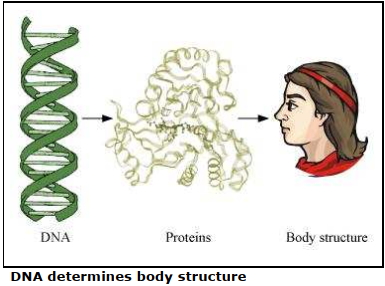
(N/A) $DNA$ (Deoxyribonucleic acid) is the genetic material found in the chromosomes,which are present in the nucleus of a cell.
$DNA$ contains the information necessary for protein synthesis,and each specific type of protein leads to a specific body design.
Therefore,the $DNA$ molecule determines the body design of an individual.
During reproduction,$DNA$ copying ensures that the genetic information is transferred from parents to offspring,which maintains the continuity of species and ensures that offspring resemble their parents.
$DNA$ contains the information necessary for protein synthesis,and each specific type of protein leads to a specific body design.
Therefore,the $DNA$ molecule determines the body design of an individual.
During reproduction,$DNA$ copying ensures that the genetic information is transferred from parents to offspring,which maintains the continuity of species and ensures that offspring resemble their parents.
0 likes
View Solution2
Medium
Why is variation beneficial to the species but not necessarily for the individual?
Solution
(N/A) Variations are more beneficial to the species than to the individual because environmental conditions can change so drastically that the survival of a species becomes difficult. For example,if the temperature of water increases suddenly,most bacteria living in that water would die. Only a few variants that are resistant to heat would be able to survive. If these variants were not present,the entire species of bacteria would be wiped out. Thus,these variations ensure the survival of the species. However,not all variations are necessarily beneficial for the individual organism,as some may be neutral or even harmful.
0 likes
View Solution3
Medium
How does binary fission differ from multiple fission?
Solution
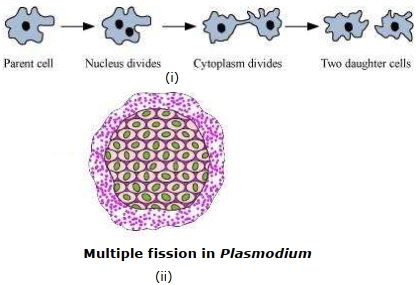
(N/A) In binary fission,a single parent cell divides into two equal daughter cells. Examples include Amoeba and Bacteria. This is shown in image $(i)$.
In multiple fission,a single parent cell divides into many daughter cells simultaneously. An example is Plasmodium. This is shown in image $(ii)$.
In multiple fission,a single parent cell divides into many daughter cells simultaneously. An example is Plasmodium. This is shown in image $(ii)$.
0 likes
View Solution4
MediumMCQ
How will an organism be benefited if it reproduces through spores?
A
It allows for rapid dispersal over long distances.
B
It ensures survival during unfavourable conditions due to thick protective walls.
C
It produces a large number of offspring from a single sporangium.
D
All of the above.
Solution
(D) An organism benefits from spore formation in several ways:
$1$. High Reproductive Output: $A$ large number of spores are produced within a single sporangium,increasing the chances of survival.
$2$. Efficient Dispersal: Spores are lightweight and easily carried by air currents to distant locations,which helps the organism colonize new areas and reduces competition for resources in the parent's habitat.
$3$. Survival in Unfavourable Conditions: Spores are protected by thick,resistant walls that prevent dehydration and damage,allowing the organism to survive harsh environmental conditions until favourable conditions return.
$1$. High Reproductive Output: $A$ large number of spores are produced within a single sporangium,increasing the chances of survival.
$2$. Efficient Dispersal: Spores are lightweight and easily carried by air currents to distant locations,which helps the organism colonize new areas and reduces competition for resources in the parent's habitat.
$3$. Survival in Unfavourable Conditions: Spores are protected by thick,resistant walls that prevent dehydration and damage,allowing the organism to survive harsh environmental conditions until favourable conditions return.
0 likes
View Solution5
Medium
Can you think of reasons why more complex organisms cannot give rise to new individuals through regeneration?
Solution
(N/A) Simple organisms such as $Hydra$ and $Planaria$ are capable of producing new individuals through the process of regeneration.
The process of regeneration involves the formation of new organisms from their body parts.
Simple organisms can utilize this method of reproduction because their entire body is made of similar kinds of cells,where any part of their body can be formed by growth and development.
However,complex organisms have an organ-system level of organization.
All the organ systems of their body work together as an interconnected unit.
While they can regenerate specific lost body parts such as skin,muscles,or blood,they cannot give rise to new individuals through regeneration because their specialized cells are not capable of forming an entire organism from a fragment.
The process of regeneration involves the formation of new organisms from their body parts.
Simple organisms can utilize this method of reproduction because their entire body is made of similar kinds of cells,where any part of their body can be formed by growth and development.
However,complex organisms have an organ-system level of organization.
All the organ systems of their body work together as an interconnected unit.
While they can regenerate specific lost body parts such as skin,muscles,or blood,they cannot give rise to new individuals through regeneration because their specialized cells are not capable of forming an entire organism from a fragment.
0 likes
View Solution6
Easy
Why is vegetative propagation practised for growing some types of plants?
Solution
(N/A) Vegetative propagation is practiced for the following reasons:
$1$. It is a more rapid and easier method of reproduction.
$2$. It allows plants to grow in regions where seed germination might fail.
$3$. It is highly useful for propagating plants that do not produce viable seeds or produce very few seeds.
$4$. It is an efficient method for producing a large number of genetically identical plants in a short period.
$5$. Examples include the tuber of $Potato$ and the rhizome of $Ginger$.
$1$. It is a more rapid and easier method of reproduction.
$2$. It allows plants to grow in regions where seed germination might fail.
$3$. It is highly useful for propagating plants that do not produce viable seeds or produce very few seeds.
$4$. It is an efficient method for producing a large number of genetically identical plants in a short period.
$5$. Examples include the tuber of $Potato$ and the rhizome of $Ginger$.
0 likes
View Solution7
MediumMCQ
Why is $DNA$ copying an essential part of the process of reproduction?
A
It ensures the survival of the parent organism.
B
It is required for the transmission of genetic information from parents to offspring.
C
It helps in the production of energy for the cell.
D
It prevents mutations in the offspring.
Solution
(B) $DNA$ (Deoxyribonucleic acid) copying is an essential part of reproduction because it ensures the transmission of genetic information from parents to offspring.
It determines the body design and functional characteristics of an individual.
During reproduction,cells produce a copy of their $DNA$ through complex chemical reactions,resulting in two copies of $DNA$.
The copying of $DNA$ is always accompanied by the creation of additional cellular apparatus.
Finally,the cell divides to form two daughter cells,each receiving a copy of the $DNA$ and the necessary cellular machinery to function.
It determines the body design and functional characteristics of an individual.
During reproduction,cells produce a copy of their $DNA$ through complex chemical reactions,resulting in two copies of $DNA$.
The copying of $DNA$ is always accompanied by the creation of additional cellular apparatus.
Finally,the cell divides to form two daughter cells,each receiving a copy of the $DNA$ and the necessary cellular machinery to function.
0 likes
View Solution8
Easy
How is the process of pollination different from fertilization?
Solution
(N/A) Pollination is the process of transfer of pollen grains from the anther to the stigma of a flower. It is an external process that occurs with the help of agents like wind,water,birds,or insects.
Fertilization,on the other hand,is the biological process involving the fusion of the male gamete with the female gamete. It occurs internally within the ovule and leads to the formation of a diploid zygote.
Fertilization,on the other hand,is the biological process involving the fusion of the male gamete with the female gamete. It occurs internally within the ovule and leads to the formation of a diploid zygote.
0 likes
View Solution9
EasyMCQ
What is the role of the seminal vesicles and the prostate gland?
A
They produce sperms.
B
They provide nutrition and a fluid medium for sperm transport.
C
They are responsible for the maturation of sperms.
D
They prevent the entry of pathogens into the reproductive tract.
Solution
(B) The secretions from the seminal vesicles and prostate glands serve two primary functions:
$1$. They provide a fluid medium that facilitates the easy transport of sperms.
$2$. They provide essential nutrients to the sperms,including fructose,calcium,and various enzymes,which help in their survival and motility.
$1$. They provide a fluid medium that facilitates the easy transport of sperms.
$2$. They provide essential nutrients to the sperms,including fructose,calcium,and various enzymes,which help in their survival and motility.
0 likes
View Solution10
Medium
What are the changes seen in girls at the time of puberty?
Solution
(N/A) During puberty,girls undergo several physical and physiological changes due to the secretion of hormones like estrogen and progesterone:
$1$. Breast development: There is an increase in breast size and the skin of the nipples becomes darker.
$2$. Hair growth: Appearance of hair in the genital area and other parts of the body such as underarms,face,hands,and legs.
$3$. Reproductive system maturation: Increase in the size of the uterus and ovaries.
$4$. Menstruation: The beginning of the menstrual cycle (menarche).
$5$. Skin changes: Increased secretion of oil from the skin glands,which often leads to the appearance of pimples.
$1$. Breast development: There is an increase in breast size and the skin of the nipples becomes darker.
$2$. Hair growth: Appearance of hair in the genital area and other parts of the body such as underarms,face,hands,and legs.
$3$. Reproductive system maturation: Increase in the size of the uterus and ovaries.
$4$. Menstruation: The beginning of the menstrual cycle (menarche).
$5$. Skin changes: Increased secretion of oil from the skin glands,which often leads to the appearance of pimples.
0 likes
View Solution11
Medium
How does the embryo get nourishment inside the mother's body?
Solution
(N/A) The embryo develops inside the mother's body for about nine months. Inside the uterus,the outer tissue surrounding the embryo develops finger-like projections called villi. These villi are surrounded by uterine tissue and maternal blood. They provide a large surface area for the exchange of oxygen and nutrients. Also,there is a special tissue called the placenta,which is embedded in the uterine wall. The embryo receives oxygen and nutrients from the mother's blood via the placenta. The waste materials produced by the embryo are also removed through the placenta.
0 likes
View Solution12
EasyMCQ
If a woman is using a copper-$T$,will it help in protecting her from sexually transmitted diseases?
A
Yes,it provides a barrier.
B
No,it does not provide protection.
C
Yes,it kills the pathogens.
D
Only if used with a condom.
Solution
(B) No. Using a copper-$T$ will not provide protection from sexually transmitted diseases (STDs),as it does not act as a physical barrier to prevent the exchange of bodily fluids.
It is an intrauterine device $(IUD)$ that primarily works by preventing the implantation of the embryo in the uterus and inhibiting sperm motility.
To prevent STDs,barrier methods like condoms must be used.
It is an intrauterine device $(IUD)$ that primarily works by preventing the implantation of the embryo in the uterus and inhibiting sperm motility.
To prevent STDs,barrier methods like condoms must be used.
0 likes
View Solution13
EasyMCQ
Asexual reproduction takes place through budding in
A
yeast
B
amoeba
C
plasmodium
D
leishmania
Solution
(A) Asexual reproduction is a mode of reproduction where a single parent produces offspring.
In $Yeast$ $(Saccharomyces cerevisiae)$, asexual reproduction occurs through the process of budding.
During this process, a small bud develops as an outgrowth from the parent cell, which eventually detaches to form a new individual.
In contrast, $Amoeba$ reproduces by binary fission, $Plasmodium$ by multiple fission, and $Leishmania$ by binary fission.
In $Yeast$ $(Saccharomyces cerevisiae)$, asexual reproduction occurs through the process of budding.
During this process, a small bud develops as an outgrowth from the parent cell, which eventually detaches to form a new individual.
In contrast, $Amoeba$ reproduces by binary fission, $Plasmodium$ by multiple fission, and $Leishmania$ by binary fission.
0 likes
View Solution14
EasyMCQ
Which of the following is not a part of the female reproductive system in human beings?
A
Ovary
B
Vas deferens
C
Uterus
D
Fallopian tube
Solution
(B) The female reproductive system in humans consists of the ovaries, fallopian tubes, uterus, cervix, and vagina.
Vas deferens is a part of the male reproductive system, which transports sperm from the epididymis to the ejaculatory duct.
Therefore, $Vas \text{ } deferens$ is not a part of the female reproductive system.
Vas deferens is a part of the male reproductive system, which transports sperm from the epididymis to the ejaculatory duct.
Therefore, $Vas \text{ } deferens$ is not a part of the female reproductive system.
0 likes
View Solution15
EasyMCQ
The anther contains
A
ovules
B
sepals
C
pollen grains
D
pistil
Solution
(C) The anther is the part of the stamen (the male reproductive organ of a flower) that produces and contains pollen grains. Pollen grains are the male gametophytes that carry the male gametes necessary for fertilization.
0 likes
View Solution16
MediumMCQ
What are the advantages of sexual reproduction over asexual reproduction?
A
It produces fewer variations.
B
It ensures the survival of species through increased genetic variation.
C
It is faster than asexual reproduction.
D
It requires only one parent.
Solution
(B) Advantages of sexual reproduction:
$1$. In sexual reproduction,more variations are produced due to the combination of $DNA$ from two parents. This genetic diversity ensures the survival of the species in a changing environment.
$2$. The newly formed individual inherits characteristics from both parents,leading to unique combinations of traits.
$3$. Variations are more viable in the sexual mode compared to the asexual mode. In asexual reproduction,the $DNA$ must function within the existing cellular apparatus,limiting the scope for significant evolutionary changes.
$1$. In sexual reproduction,more variations are produced due to the combination of $DNA$ from two parents. This genetic diversity ensures the survival of the species in a changing environment.
$2$. The newly formed individual inherits characteristics from both parents,leading to unique combinations of traits.
$3$. Variations are more viable in the sexual mode compared to the asexual mode. In asexual reproduction,the $DNA$ must function within the existing cellular apparatus,limiting the scope for significant evolutionary changes.
0 likes
View Solution17
Easy
What are the functions performed by the testis in human beings?
Solution
(N/A) The testes are the primary male reproductive organs located outside the abdominal cavity within a pouch called the $scrotum$.
Functions of the testes:
$1$. $Spermatogenesis$: The testes are responsible for the production of male gametes, known as $sperms$.
$2$. Hormone production: The testes secrete the male sex hormone, $testosterone$. This hormone is responsible for the development of secondary sexual characteristics in boys during puberty, such as the deepening of the voice, growth of facial hair, and increased muscle mass.
Functions of the testes:
$1$. $Spermatogenesis$: The testes are responsible for the production of male gametes, known as $sperms$.
$2$. Hormone production: The testes secrete the male sex hormone, $testosterone$. This hormone is responsible for the development of secondary sexual characteristics in boys during puberty, such as the deepening of the voice, growth of facial hair, and increased muscle mass.
0 likes
View Solution18
EasyMCQ
Why does menstruation occur?
A
To release excess hormones.
B
Because the egg is not fertilized and the uterine lining is shed.
C
To prepare the body for menopause.
D
To remove waste products from the blood.
Solution
(B) Menstruation is a process in which blood and mucous flow out every month through the vagina.
This process occurs because one egg is released from the ovary every month,and simultaneously,the uterus (womb) prepares itself to receive a fertilized egg.
The inner lining of the uterus becomes thick and is supplied with blood to nourish the potential embryo.
If the egg is not fertilized,the thickened lining of the uterus is no longer needed,so it breaks down and is released in the form of blood and mucous through the vagina.
This process occurs because one egg is released from the ovary every month,and simultaneously,the uterus (womb) prepares itself to receive a fertilized egg.
The inner lining of the uterus becomes thick and is supplied with blood to nourish the potential embryo.
If the egg is not fertilized,the thickened lining of the uterus is no longer needed,so it breaks down and is released in the form of blood and mucous through the vagina.
0 likes
View Solution19
Easy
Draw a labelled diagram of the longitudinal section of a flower.
Solution
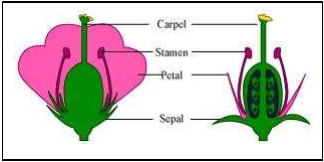
(N/A) The longitudinal section of a flower consists of the following main parts:
$1$. Sepal: The outermost green,leaf-like structures that protect the flower in the bud stage.
$2$. Petal: The brightly colored parts that attract insects for pollination.
$3$. Stamen: The male reproductive part of the flower,consisting of an anther and a filament.
$4$. Carpel (Pistil): The female reproductive part of the flower,consisting of the stigma,style,and ovary.
$1$. Sepal: The outermost green,leaf-like structures that protect the flower in the bud stage.
$2$. Petal: The brightly colored parts that attract insects for pollination.
$3$. Stamen: The male reproductive part of the flower,consisting of an anther and a filament.
$4$. Carpel (Pistil): The female reproductive part of the flower,consisting of the stigma,style,and ovary.
0 likes
View Solution20
Medium
What are the different methods of contraception?
Solution
(N/A) Contraceptive methods are broadly classified into the following types:
$1$. $Natural \ methods$: These involve avoiding the meeting of sperm and ovum. For example, the periodic abstinence method involves avoiding sexual intercourse from day $10$ to $17$ of the menstrual cycle, as ovulation is expected during this period, making the chances of fertilization high.
$2$. $Barrier \ methods$: These prevent the physical meeting of sperm and ovum using barriers. Examples include condoms, which are thin rubber coverings for the penis in males or the vagina in females.
$3$. $Oral \ contraceptives$: These involve taking tablets or drugs orally. They contain small doses of hormones that prevent the release of eggs (ovulation), thereby preventing fertilization.
$4$. $Intrauterine \ devices \ (IUDs)$: Devices like the $Copper-T$ or loops are placed in the uterus to prevent pregnancy.
$5$. $Surgical \ methods$: These are permanent methods used to block gamete transfer. $Vasectomy$ involves blocking the $vas \ deferens$ in males to prevent sperm transfer. $Tubectomy$ involves blocking the $fallopian \ tubes$ in females to prevent the egg from reaching the uterus.
$1$. $Natural \ methods$: These involve avoiding the meeting of sperm and ovum. For example, the periodic abstinence method involves avoiding sexual intercourse from day $10$ to $17$ of the menstrual cycle, as ovulation is expected during this period, making the chances of fertilization high.
$2$. $Barrier \ methods$: These prevent the physical meeting of sperm and ovum using barriers. Examples include condoms, which are thin rubber coverings for the penis in males or the vagina in females.
$3$. $Oral \ contraceptives$: These involve taking tablets or drugs orally. They contain small doses of hormones that prevent the release of eggs (ovulation), thereby preventing fertilization.
$4$. $Intrauterine \ devices \ (IUDs)$: Devices like the $Copper-T$ or loops are placed in the uterus to prevent pregnancy.
$5$. $Surgical \ methods$: These are permanent methods used to block gamete transfer. $Vasectomy$ involves blocking the $vas \ deferens$ in males to prevent sperm transfer. $Tubectomy$ involves blocking the $fallopian \ tubes$ in females to prevent the egg from reaching the uterus.
0 likes
View Solution21
Medium
How are the modes of reproduction different in unicellular and multicellular organisms?
Solution
(N/A) In unicellular organisms,reproduction occurs by the division of the entire cell. The modes of reproduction in unicellular organisms include fission,budding,etc.
In multicellular organisms,specialized reproductive organs are present. Therefore,they can reproduce by complex reproductive methods such as vegetative propagation,spore formation,and sexual reproduction.
In complex multicellular organisms like humans and higher plants,sexual reproduction is the primary mode of reproduction.
In multicellular organisms,specialized reproductive organs are present. Therefore,they can reproduce by complex reproductive methods such as vegetative propagation,spore formation,and sexual reproduction.
In complex multicellular organisms like humans and higher plants,sexual reproduction is the primary mode of reproduction.
0 likes
View Solution22
Easy
How does reproduction help in providing stability to populations of species?
Solution
(N/A) Living organisms reproduce to ensure the continuation of their species.
Reproduction provides stability to the population of a species by producing new individuals that resemble their parents.
This is the reason why cats give birth to only cats and dogs give birth to only dogs.
By maintaining the characteristics of the species through successive generations,reproduction ensures that the population remains stable and continues to exist in its environment.
Reproduction provides stability to the population of a species by producing new individuals that resemble their parents.
This is the reason why cats give birth to only cats and dogs give birth to only dogs.
By maintaining the characteristics of the species through successive generations,reproduction ensures that the population remains stable and continues to exist in its environment.
0 likes
View Solution23
MediumMCQ
What could be the reasons for adopting contraceptive methods?
A
To prevent unwanted pregnancies.
B
To control population growth.
C
To prevent the spread of sexually transmitted diseases.
D
All of the above.
Solution
(D) Contraceptive methods are adopted for the following reasons:
$(i)$ To prevent unwanted pregnancies by avoiding fertilization.
$(ii)$ To control the population growth rate by limiting the number of births.
$(iii)$ To prevent the transmission of sexually transmitted diseases (STDs) such as $HIV$,syphilis,and gonorrhea.
$(i)$ To prevent unwanted pregnancies by avoiding fertilization.
$(ii)$ To control the population growth rate by limiting the number of births.
$(iii)$ To prevent the transmission of sexually transmitted diseases (STDs) such as $HIV$,syphilis,and gonorrhea.
0 likes
View SolutionHow do Organisms Reproduce? — Textbook - How do Organisms Reproduce? · Frequently Asked Questions
1Are these How do Organisms Reproduce? questions useful for JEE and NEET?
Yes. All questions in this section are mapped to JEE Main and NEET exam patterns. Previous year questions from JEE Main, NEET, GUJCET and state-level exams are included with full solutions.
2Can I switch to Hindi or Gujarati for these questions?
Yes. Use the language tabs in the hero section or the sidebar to view the same questions and solutions in English, Hindi or Gujarati.
3How do I generate a question paper from this subtopic?
Use the Vedclass Exam Paper Generator — select the chapter and subtopic, set difficulty, and generate Sets A, B, C, D automatically. First 3 chapters of every subject are free.
Vedclass Products
For Students
Vedclass Test Series
Mock tests in real JEE/NEET style with performance analysis. 5-day free trial.
Start Free TrialFor Teachers
Exam Paper Generator
Generate Set A/B/C/D papers from this chapter in 2 minutes. 3 chapters free.
Try FreeFor Institutes
Online Exam Module
Live online exams with unlimited students, 360° analytics & white-label branding.
See DemoFor Teachers & Institutes
Generate a How do Organisms Reproduce? Exam Paper in 2 Minutes
Select subtopic & difficulty — Sets A, B, C, D auto-generated with No Repeat logic.
First 3 chapters of every subject are free — no payment required.