
A English
Mix Examples - How do Organisms Reproduce? Questions in English
Class 10 Science · How do Organisms Reproduce? · Mix Examples - How do Organisms Reproduce?
251+
Questions
English
Language
100%
With Solutions
Showing 50 of 251 questions in English
151
Medium
Define the term 'double fertilization in plants'. After fertilization,name the part in each case which develops into $(i)$ the fruit,(ii) the seeds.
Solution
(N/A) Double fertilization: It occurs when one male gamete fuses with the egg cell to form a $zygote$ and the other male gamete fuses with two polar nuclei to form the primary endosperm nucleus (triple fusion).
Since these two processes occur simultaneously in the embryo sac,it is known as double fertilization.
After fertilization:
$(i)$ The ovary develops into the fruit.
(ii) The ovules develop into the seeds.
Since these two processes occur simultaneously in the embryo sac,it is known as double fertilization.
After fertilization:
$(i)$ The ovary develops into the fruit.
(ii) The ovules develop into the seeds.
0 likes
View Solution152
MediumMCQ
In human males,the testes lie in the scrotum,because it helps in the
A
process of mating
B
formation of sperm
C
easy transfer of gametes
D
all the above
Solution
(B) In human males,the testes are located outside the abdominal cavity in a pouch called the scrotum.
This is because the process of spermatogenesis (formation of sperm) requires a temperature that is $2-2.5^{\circ}C$ lower than the normal internal body temperature.
The scrotum provides this cooler environment,which is essential for the healthy development and survival of sperm cells.
This is because the process of spermatogenesis (formation of sperm) requires a temperature that is $2-2.5^{\circ}C$ lower than the normal internal body temperature.
The scrotum provides this cooler environment,which is essential for the healthy development and survival of sperm cells.
0 likes
View Solution153
MediumMCQ
Which among the following is not the function of testes at puberty?
$(i)$ formation of germ cells
$(ii)$ secretion of testosterone
$(iii)$ development of placenta
$(iv)$ secretion of estrogen
$(i)$ formation of germ cells
$(ii)$ secretion of testosterone
$(iii)$ development of placenta
$(iv)$ secretion of estrogen
A
$(i)$ and $(ii)$
B
$(ii)$ and $(iii)$
C
$(iii)$ and $(iv)$
D
$(i)$ and $(iv)$
Solution
(C) The testes are the primary male reproductive organs. Their main functions at puberty include:
$1$. The formation of germ cells (sperm) through spermatogenesis.
$2$. The secretion of the male sex hormone,testosterone,which is responsible for the development of secondary sexual characteristics in males.
Conversely,the development of the placenta is a function associated with the female reproductive system during pregnancy,and the secretion of estrogen is primarily a function of the ovaries in females.
Therefore,$(iii)$ and $(iv)$ are not functions of the testes.
$1$. The formation of germ cells (sperm) through spermatogenesis.
$2$. The secretion of the male sex hormone,testosterone,which is responsible for the development of secondary sexual characteristics in males.
Conversely,the development of the placenta is a function associated with the female reproductive system during pregnancy,and the secretion of estrogen is primarily a function of the ovaries in females.
Therefore,$(iii)$ and $(iv)$ are not functions of the testes.
0 likes
View Solution154
EasyMCQ
The correct sequence of organs in the male reproductive system for the transport of sperms is:
A
testis $\rightarrow$ vas deferens $\rightarrow$ ureter
B
testis $\rightarrow$ ureter $\rightarrow$ urethra
C
testis $\rightarrow$ urethra $\rightarrow$ ureter
D
testis $\rightarrow$ vas deferens $\rightarrow$ urethra
Solution
(D) In the human male reproductive system, sperms are produced in the $testis$.
From the $testis$, the sperms are transported through a long tube called the $vas \ deferens$ (also known as the sperm duct).
Finally, the $vas \ deferens$ joins the $urethra$, which acts as a common passage for both sperms and urine to exit the body.
Therefore, the correct sequence is $testis \rightarrow vas \ deferens \rightarrow urethra$.
From the $testis$, the sperms are transported through a long tube called the $vas \ deferens$ (also known as the sperm duct).
Finally, the $vas \ deferens$ joins the $urethra$, which acts as a common passage for both sperms and urine to exit the body.
Therefore, the correct sequence is $testis \rightarrow vas \ deferens \rightarrow urethra$.
0 likes
View Solution155
EasyMCQ
Which among the following diseases is not sexually transmitted?
A
Hepatitis
B
Syphilis
C
$HIV-AIDS$
D
Gonorrhoea
Solution
(A) Sexually Transmitted Diseases $(STDs)$ are infections that are primarily spread through sexual contact.
$Syphilis$, $HIV-AIDS$, and $Gonorrhoea$ are well-known examples of $STDs$.
$Hepatitis$ (specifically $Hepatitis$ $A$) is primarily transmitted through the fecal-oral route (contaminated food or water), not through sexual contact.
Therefore, $Hepatitis$ is the correct answer.
$Syphilis$, $HIV-AIDS$, and $Gonorrhoea$ are well-known examples of $STDs$.
$Hepatitis$ (specifically $Hepatitis$ $A$) is primarily transmitted through the fecal-oral route (contaminated food or water), not through sexual contact.
Therefore, $Hepatitis$ is the correct answer.
0 likes
View Solution156
MediumMCQ
Which among the following statements are true for sexual reproduction in flowering plants?
A
$(i)$ and $(iv)$
B
$(i), (ii)$ and $(iii)$
C
$(i), (ii)$ and $(iv)$
D
$(ii), (iii)$ and $(iv)$
Solution
(B) Sexual reproduction in flowering plants involves the following characteristics:
$(i)$ It requires two types of gametes (male and female gametes),which is true.
$(ii)$ Fertilization (fusion of gametes) is a compulsory event in sexual reproduction,which is true.
$(iii)$ The fusion of gametes always results in the formation of a zygote,which is true.
$(iv)$ Offspring formed through sexual reproduction are not clones because they show genetic variation due to the fusion of gametes from two different parents. Therefore,this statement is false.
Thus,statements $(i), (ii),$ and $(iii)$ are correct.
$(i)$ It requires two types of gametes (male and female gametes),which is true.
$(ii)$ Fertilization (fusion of gametes) is a compulsory event in sexual reproduction,which is true.
$(iii)$ The fusion of gametes always results in the formation of a zygote,which is true.
$(iv)$ Offspring formed through sexual reproduction are not clones because they show genetic variation due to the fusion of gametes from two different parents. Therefore,this statement is false.
Thus,statements $(i), (ii),$ and $(iii)$ are correct.
0 likes
View Solution157
EasyMCQ
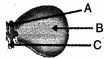
In the figure,the parts $A$,$B$,and $C$ are sequentially:
A
cotyledon,plumule and radicle
B
plumule,radicle and cotyledon
C
plumule,cotyledon and radicle
D
radicle,cotyledon and plumule
Solution
(C) The figure shows the structure of a germinating seed (specifically a dicot seed embryo).
$A$ points to the plumule,which is the part of the embryo that develops into the shoot system.
$B$ points to the cotyledon,which stores food for the developing embryo.
$C$ points to the radicle,which is the part of the embryo that develops into the root system.
Therefore,the parts $A$,$B$,and $C$ are sequentially plumule,cotyledon,and radicle.
$A$ points to the plumule,which is the part of the embryo that develops into the shoot system.
$B$ points to the cotyledon,which stores food for the developing embryo.
$C$ points to the radicle,which is the part of the embryo that develops into the root system.
Therefore,the parts $A$,$B$,and $C$ are sequentially plumule,cotyledon,and radicle.
0 likes
View Solution158
MediumMCQ
Offspring formed as a result of sexual reproduction exhibits more variations because:
A
sexual reproduction is a lengthy process.
B
genetic material comes from many parents.
C
genetic material comes from two parents of different species.
D
genetic material comes from two parents of the same species.
Solution
(D) Sexual reproduction involves the fusion of male and female gametes,which are produced by two parents of the same species.
During the formation of gametes,a process called meiosis occurs,which involves genetic recombination (crossing over).
This recombination leads to the mixing of $DNA$ from both parents,resulting in offspring that are genetically distinct from their parents and siblings.
Therefore,the combination of genetic material from two parents of the same species is the primary reason for increased variation in sexually reproducing organisms.
During the formation of gametes,a process called meiosis occurs,which involves genetic recombination (crossing over).
This recombination leads to the mixing of $DNA$ from both parents,resulting in offspring that are genetically distinct from their parents and siblings.
Therefore,the combination of genetic material from two parents of the same species is the primary reason for increased variation in sexually reproducing organisms.
0 likes
View Solution159
MediumMCQ
Reproduction is essential for living organisms in order to :
A
continue the species generation after generation
B
fulfil their energy requirement
C
maintain growth
D
keep the individual organism alive
Solution
(A) Reproduction is a biological process by which living organisms produce new individuals similar to themselves.
It is not essential for the survival of an individual organism,unlike processes such as respiration,nutrition,or excretion.
However,it is essential for the survival of a species as it ensures the continuity of the species from one generation to the next.
Therefore,the primary purpose of reproduction is to continue the species generation after generation.
It is not essential for the survival of an individual organism,unlike processes such as respiration,nutrition,or excretion.
However,it is essential for the survival of a species as it ensures the continuity of the species from one generation to the next.
Therefore,the primary purpose of reproduction is to continue the species generation after generation.
0 likes
View Solution160
MediumMCQ
During adolescence,several changes occur in the human body. Mark one change associated with sexual maturation in boys:
A
Loss of milk teeth
B
Cracking of voice
C
Increase in height
D
Weight gain
Solution
(B) Adolescence is the period of transition between childhood and adulthood,characterized by significant physical and hormonal changes.
Sexual maturation in boys is driven by the secretion of the hormone $Testosterone$.
Key secondary sexual characteristics in boys include the growth of facial hair,the development of broader shoulders,and the $cracking$ or deepening of the voice due to the enlargement of the larynx (voice box).
While increase in height and weight gain also occur during adolescence,they are general growth patterns and not specific indicators of sexual maturation.
Loss of milk teeth is a developmental change associated with childhood,not adolescence.
Therefore,the correct option is $B$.
Sexual maturation in boys is driven by the secretion of the hormone $Testosterone$.
Key secondary sexual characteristics in boys include the growth of facial hair,the development of broader shoulders,and the $cracking$ or deepening of the voice due to the enlargement of the larynx (voice box).
While increase in height and weight gain also occur during adolescence,they are general growth patterns and not specific indicators of sexual maturation.
Loss of milk teeth is a developmental change associated with childhood,not adolescence.
Therefore,the correct option is $B$.
0 likes
View Solution161
EasyMCQ
In human females,an event that reflects the onset of the reproductive phase is:
A
Growth of body
B
Changes in hair pattern
C
Menstruation
D
Change in voice
Solution
(C) The onset of the reproductive phase in human females is marked by the beginning of the menstrual cycle,known as menarche.
This process involves the periodic shedding of the uterine lining and is a clear biological indicator that the female reproductive system has become functional and capable of reproduction.
While body growth,changes in hair pattern,and voice changes are secondary sexual characteristics that occur during puberty,they are not the primary indicators of the onset of the reproductive phase itself.
This process involves the periodic shedding of the uterine lining and is a clear biological indicator that the female reproductive system has become functional and capable of reproduction.
While body growth,changes in hair pattern,and voice changes are secondary sexual characteristics that occur during puberty,they are not the primary indicators of the onset of the reproductive phase itself.
0 likes
View Solution162
EasyMCQ
In $Rhizopus$,tubular thread-like structures bearing sporangia at their tips are called:
A
filaments
B
roots
C
rhizoids
D
hyphae
Solution
(D) $Rhizopus$ is a type of bread mould that reproduces through spore formation.
It consists of a network of fine,thread-like structures known as $hyphae$.
Some of these $hyphae$ grow upwards and develop knob-like structures at their tips called $sporangia$,which contain spores.
Therefore,the tubular thread-like structures bearing $sporangia$ are called $hyphae$.
It consists of a network of fine,thread-like structures known as $hyphae$.
Some of these $hyphae$ grow upwards and develop knob-like structures at their tips called $sporangia$,which contain spores.
Therefore,the tubular thread-like structures bearing $sporangia$ are called $hyphae$.
0 likes
View Solution163
EasyMCQ
Vegetative propagation refers to the formation of new plants from:
A
stem,roots and leaves
B
stem,roots and flowers
C
stem,flowers and fruits
D
stem,leaves and flowers
Solution
(A) Vegetative propagation is a type of asexual reproduction in plants where new individuals are formed from vegetative parts of the parent plant.
These vegetative parts include the stem,roots,and leaves.
Flowers,fruits,and seeds are involved in sexual reproduction,not vegetative propagation.
Therefore,the correct option is $A$.
These vegetative parts include the stem,roots,and leaves.
Flowers,fruits,and seeds are involved in sexual reproduction,not vegetative propagation.
Therefore,the correct option is $A$.
0 likes
View Solution164
MediumMCQ
Factors responsible for the rapid spread of bread mould on slices of bread are:
$(i)$ Large number of spores
$(ii)$ Availability of moisture and nutrients in bread
$(iii)$ Presence of tubular branched hyphae
$(iv)$ Formation of round-shaped sporangia
$(i)$ Large number of spores
$(ii)$ Availability of moisture and nutrients in bread
$(iii)$ Presence of tubular branched hyphae
$(iv)$ Formation of round-shaped sporangia
A
$(i)$ and $(iii)$
B
$(i)$ and $(ii)$
C
$(ii)$ and $(iv)$
D
$(iii)$ and $(iv)$
Solution
(B) Bread mould (Rhizopus) reproduces through spore formation.
$(i)$ The production of a large number of spores allows for widespread dispersal through the air,increasing the chances of landing on a suitable substrate.
$(ii)$ Bread provides a rich source of nutrients (carbohydrates) and moisture,which are essential for the germination of spores and the rapid growth of the fungal mycelium.
$(iii)$ and $(iv)$ are structural characteristics of the fungus but are not the primary factors responsible for the 'rapid spread' of the mould on the bread surface compared to spore production and environmental conditions.
$(i)$ The production of a large number of spores allows for widespread dispersal through the air,increasing the chances of landing on a suitable substrate.
$(ii)$ Bread provides a rich source of nutrients (carbohydrates) and moisture,which are essential for the germination of spores and the rapid growth of the fungal mycelium.
$(iii)$ and $(iv)$ are structural characteristics of the fungus but are not the primary factors responsible for the 'rapid spread' of the mould on the bread surface compared to spore production and environmental conditions.
0 likes
View Solution165
MediumMCQ
Length of pollen tube depends on the distance between :
A
pollen grain and upper surface of stigma
B
pollen grain in anther and upper surface of stigma
C
pollen grain on upper surface of stigma and ovule
D
upper surface of stigma and lower part of style
Solution
(C) The pollen tube is a tubular structure that develops from the pollen grain after it lands on the stigma of a flower.
Its primary function is to transport the male gametes from the pollen grain to the ovule located within the ovary.
Therefore,the length of the pollen tube must be sufficient to cover the distance from the point of germination (the upper surface of the stigma) to the target (the ovule).
Thus,the length of the pollen tube depends on the distance between the pollen grain on the upper surface of the stigma and the ovule.
Its primary function is to transport the male gametes from the pollen grain to the ovule located within the ovary.
Therefore,the length of the pollen tube must be sufficient to cover the distance from the point of germination (the upper surface of the stigma) to the target (the ovule).
Thus,the length of the pollen tube depends on the distance between the pollen grain on the upper surface of the stigma and the ovule.
0 likes
View Solution166
MediumMCQ
Which of the following statements are true for flowers?
$(i)$ Flowers are always bisexual
$(ii)$ They are the sexual reproductive organs
$(iii)$ They are produced in all groups of plants
$(iv)$ After fertilization they give rise to fruits
$(i)$ Flowers are always bisexual
$(ii)$ They are the sexual reproductive organs
$(iii)$ They are produced in all groups of plants
$(iv)$ After fertilization they give rise to fruits
A
$(i)$ and $(iv)$
B
$(ii)$ and $(iii)$
C
$(i)$ and $(iii)$
D
$(ii)$ and $(iv)$
Solution
(D) Statement $(i)$ is false because flowers can be unisexual (staminate or pistillate) or bisexual.
Statement $(ii)$ is true because flowers contain the reproductive parts (stamens and carpels) of angiosperms.
Statement $(iii)$ is false because flowers are only produced by angiosperms (flowering plants),not by algae,bryophytes,pteridophytes,or gymnosperms.
Statement $(iv)$ is true because after fertilization,the ovary develops into a fruit and the ovules develop into seeds.
Therefore,statements $(ii)$ and $(iv)$ are correct.
Statement $(ii)$ is true because flowers contain the reproductive parts (stamens and carpels) of angiosperms.
Statement $(iii)$ is false because flowers are only produced by angiosperms (flowering plants),not by algae,bryophytes,pteridophytes,or gymnosperms.
Statement $(iv)$ is true because after fertilization,the ovary develops into a fruit and the ovules develop into seeds.
Therefore,statements $(ii)$ and $(iv)$ are correct.
0 likes
View Solution167
MediumMCQ
Which among the following statements are true for unisexual flowers?
$(i)$ They possess both stamen and pistil.
$(ii)$ They possess either stamen or pistil.
$(iii)$ They exhibit cross-pollination.
$(iv)$ Unisexual flowers possessing only stamens cannot produce fruits.
$(i)$ They possess both stamen and pistil.
$(ii)$ They possess either stamen or pistil.
$(iii)$ They exhibit cross-pollination.
$(iv)$ Unisexual flowers possessing only stamens cannot produce fruits.
A
$(ii), (iii)$ and $(iv)$
B
$(i)$ and $(iv)$
C
$(iii)$ and $(iv)$
D
$(i), (iii)$ and $(iv)$
Solution
(A) Unisexual flowers are those that contain either only stamens (male reproductive part) or only pistils (female reproductive part),but not both. Therefore,statement $(ii)$ is true and statement $(i)$ is false.
Because they lack one of the reproductive organs,they typically require cross-pollination to achieve fertilization,making statement $(iii)$ true.
Since fruits develop from the ovary (part of the pistil) after fertilization,flowers that possess only stamens (staminate flowers) lack an ovary and therefore cannot produce fruits. Thus,statement $(iv)$ is true.
Combining these,statements $(ii), (iii),$ and $(iv)$ are correct.
Because they lack one of the reproductive organs,they typically require cross-pollination to achieve fertilization,making statement $(iii)$ true.
Since fruits develop from the ovary (part of the pistil) after fertilization,flowers that possess only stamens (staminate flowers) lack an ovary and therefore cannot produce fruits. Thus,statement $(iv)$ is true.
Combining these,statements $(ii), (iii),$ and $(iv)$ are correct.
0 likes
View Solution168
EasyMCQ
Characters transmitted from parents to offspring are present in
A
cytoplasm
B
genes
C
ribosome
D
golgi bodies
Solution
(B) The characters or traits are transmitted from parents to offspring through the process of inheritance.
These traits are controlled by specific segments of $DNA$ known as $genes$.
$Genes$ are located on chromosomes within the nucleus of the cell and act as the units of heredity, carrying the information necessary for the development and functioning of an organism.
These traits are controlled by specific segments of $DNA$ known as $genes$.
$Genes$ are located on chromosomes within the nucleus of the cell and act as the units of heredity, carrying the information necessary for the development and functioning of an organism.
0 likes
View Solution169
EasyMCQ
The ability of a cell to divide into several cells during reproduction in $Plasmodium$ is called:
A
budding
B
reduction division
C
multiple fission
D
binary fission
Solution
(C) In $Plasmodium$, the organism divides into many daughter cells simultaneously during reproduction.
This process is known as $multiple$ $fission$.
In this method, the parent cell produces many daughter cells at once, which is a characteristic feature of $Plasmodium$ under unfavorable or specific conditions.
This process is known as $multiple$ $fission$.
In this method, the parent cell produces many daughter cells at once, which is a characteristic feature of $Plasmodium$ under unfavorable or specific conditions.
0 likes
View Solution170
EasyMCQ
The correct sequence of reproductive stages seen in flowering plants is
A
gametes,embryo,zygote,seedling
B
zygote,gametes,embryo,seedling
C
seedling,embryo,zygote,gametes
D
gametes,zygote,embryo,seedling
Solution
(D) In flowering plants, the reproductive process follows a specific sequence:
$1$. Gametes: The process begins with the formation of male and female gametes.
$2$. Zygote: Fertilization occurs when the male and female gametes fuse to form a diploid zygote.
$3$. Embryo: The zygote undergoes repeated cell divisions to develop into an embryo within the seed.
$4$. Seedling: Upon germination, the embryo grows into a young plant known as a seedling.
Therefore, the correct sequence is $gametes \rightarrow zygote \rightarrow embryo \rightarrow seedling$.
$1$. Gametes: The process begins with the formation of male and female gametes.
$2$. Zygote: Fertilization occurs when the male and female gametes fuse to form a diploid zygote.
$3$. Embryo: The zygote undergoes repeated cell divisions to develop into an embryo within the seed.
$4$. Seedling: Upon germination, the embryo grows into a young plant known as a seedling.
Therefore, the correct sequence is $gametes \rightarrow zygote \rightarrow embryo \rightarrow seedling$.
0 likes
View Solution171
MediumMCQ
The number of chromosomes in parents and offspring of a particular species remains constant due to
A
halving of chromosomes during gamete formation
B
doubling of chromosomes after zygote formation
C
doubling of chromosomes after gamete formation
D
halving of chromosomes after gamete formation
Solution
(A) In sexually reproducing organisms,the number of chromosomes in the offspring remains constant because of the process of meiosis.
During gamete formation (gametogenesis),the diploid $(2n)$ germ cells undergo meiosis,which results in the formation of haploid $(n)$ gametes.
This process effectively halves the chromosome number in the gametes.
When these haploid gametes fuse during fertilization,they form a diploid $(2n)$ zygote,thereby restoring the original chromosome number of the species.
During gamete formation (gametogenesis),the diploid $(2n)$ germ cells undergo meiosis,which results in the formation of haploid $(n)$ gametes.
This process effectively halves the chromosome number in the gametes.
When these haploid gametes fuse during fertilization,they form a diploid $(2n)$ zygote,thereby restoring the original chromosome number of the species.
0 likes
View Solution172
Easy
Write true or false for the following statement: Menstruation lasts for about ten to fifteen days.
Solution
(FALSE) The statement is False. In a normal human menstrual cycle,the menstrual phase (bleeding) typically lasts for about $3$ to $5$ days,though it can range from $2$ to $7$ days. $A$ duration of $10$ to $15$ days is considered abnormal and is medically referred to as menorrhagia.
0 likes
View Solution173
EasyMCQ
Write true or false for the statement: The ovary releases three eggs every month.
A
True
B
False
Solution
(B) The statement is False. In human females,typically only one mature egg (ovum) is released from one of the ovaries during each menstrual cycle,which occurs approximately every $28$ days.
0 likes
View Solution174
Easy
Write true or false for the statement: The development of the child inside the mother's body takes approximately eleven months.
Solution
(FALSE) The statement is False. In humans,the gestation period,which is the time from conception to birth,is approximately $9$ months or about $280$ days.
0 likes
View Solution175
EasyMCQ
Write true or false for the statement: Along the path of the $vas \ deferens$,glands like the prostate and the seminal vesicles add their secretions for the nutrition and easier transport of the sperms.
A
True
B
False
Solution
(A) The statement is $True$. The $vas \ deferens$ carries sperm from the testes. As the sperm travels through the reproductive tract,secretions from the seminal vesicles and the prostate gland are added to the fluid. These secretions provide nutrition to the sperms and also make their transport easier by providing a fluid medium.
0 likes
View Solution176
Easy
Write true or false for the statement: The female germ cells or eggs are made in the uterus.
Solution
(FALSE) False. The female germ cells or eggs are produced in the ovaries,not in the uterus. The uterus is the site where the embryo develops.
0 likes
View Solution177
EasyMCQ
State whether the following statement is true or false: Fertilization takes place in the ovaries.
A
True
B
False
Solution
(B) The statement is False.
In humans,fertilization occurs in the fallopian tubes (oviducts),not in the ovaries.
The ovaries are responsible for the production of eggs (ova) and the secretion of female sex hormones like estrogen and progesterone.
In humans,fertilization occurs in the fallopian tubes (oviducts),not in the ovaries.
The ovaries are responsible for the production of eggs (ova) and the secretion of female sex hormones like estrogen and progesterone.
0 likes
View Solution178
EasyMCQ
State whether the following statement is true or false: The uterus opens into the vagina through the cervix.
A
True
B
False
Solution
(A) The statement is True. In the female reproductive system,the uterus is a muscular organ that narrows at its lower end to form the cervix. The cervix acts as a passage that connects the uterus to the vagina,allowing for the passage of menstrual flow and the birth of a baby.
0 likes
View Solution179
Easy
Write true or false for the statement: The two oviducts unite into an elastic bag-like structure known as the uterus.
Solution
(TRUE) True. In the human female reproductive system,the two fallopian tubes (oviducts) open into a single,elastic,muscular,bag-like structure called the uterus (or womb),where the development of the embryo takes place.
0 likes
View Solution180
EasyMCQ
Write true or false for the statement: If the egg is not fertilized,it lives for about one day.
A
True
B
False
Solution
(A) The statement is True. In the human female reproductive system,if the ovum (egg) released from the ovary is not fertilized by a sperm within approximately $24$ hours (one day) of its release,it degenerates and is eventually shed along with the uterine lining during menstruation.
0 likes
View Solution181
Easy
State whether the following statement is true or false: $A$ thick and spongy lining of the uterus is required for nourishing the embryo if fertilization has taken place.
Solution
(TRUE) The statement is True.
After fertilization,the zygote develops into an embryo and implants itself into the uterine wall.
The uterus prepares itself every month to receive and nurture a growing embryo by thickening its lining and becoming rich in blood vessels.
This spongy,vascularized lining provides the necessary nutrients and oxygen to the developing embryo through the placenta.
After fertilization,the zygote develops into an embryo and implants itself into the uterine wall.
The uterus prepares itself every month to receive and nurture a growing embryo by thickening its lining and becoming rich in blood vessels.
This spongy,vascularized lining provides the necessary nutrients and oxygen to the developing embryo through the placenta.
0 likes
View Solution182
EasyMCQ
Which of the following is a characteristic of asexual reproduction?
A
Fusion of specialized cells
B
$A$ method used by all types of organisms to reproduce
C
Genetically identical offspring are produced by this method
D
More than one parent is involved in this method
Solution
(C) Asexual reproduction is a mode of reproduction in which a single parent produces offspring without the involvement of gamete fusion.
Since there is only one parent involved,the offspring produced are genetically identical to the parent and to each other,often referred to as clones.
Option $A$ describes sexual reproduction (gamete fusion).
Option $B$ is incorrect as many organisms reproduce sexually.
Option $D$ describes sexual reproduction (biparental).
Since there is only one parent involved,the offspring produced are genetically identical to the parent and to each other,often referred to as clones.
Option $A$ describes sexual reproduction (gamete fusion).
Option $B$ is incorrect as many organisms reproduce sexually.
Option $D$ describes sexual reproduction (biparental).
0 likes
View Solution183
EasyMCQ
Reproduction is essential for living organisms in order to
A
keep the individual organism alive
B
fulfill their energy requirements
C
maintain growth
D
continue the species forever
Solution
(D) Reproduction is a biological process by which living organisms produce new individuals similar to themselves.
Unlike nutrition,respiration,or excretion,reproduction is not necessary for the survival of an individual organism.
However,it is essential for the survival of a species as it ensures the continuity of life by passing on genetic information to the next generation,thereby preventing the extinction of the species.
Unlike nutrition,respiration,or excretion,reproduction is not necessary for the survival of an individual organism.
However,it is essential for the survival of a species as it ensures the continuity of life by passing on genetic information to the next generation,thereby preventing the extinction of the species.
0 likes
View Solution184
EasyMCQ
Which of the following organisms does not reproduce by binary fission?
A
Amoeba
B
Plasmodium
C
Euglena
D
Paramecium
Solution
(B) Binary fission is a method of asexual reproduction where a single parent cell divides into two equal daughter cells.
$Amoeba$,$Euglena$,and $Paramecium$ all reproduce by binary fission.
$Plasmodium$ reproduces by multiple fission,where the parent cell divides into many daughter cells simultaneously.
Therefore,$Plasmodium$ is the correct answer.
$Amoeba$,$Euglena$,and $Paramecium$ all reproduce by binary fission.
$Plasmodium$ reproduces by multiple fission,where the parent cell divides into many daughter cells simultaneously.
Therefore,$Plasmodium$ is the correct answer.
0 likes
View Solution185
EasyMCQ
Which multicellular organism reproduces by the process of budding?
A
Amoeba
B
Plasmodium
C
Hydra
D
Paramecium
Solution
(C) Budding is a form of asexual reproduction where a new organism develops from an outgrowth or bud due to cell division at one particular site.
In $Hydra$,the cells divide rapidly at a specific site and develop as an outgrowth called a bud.
These buds develop into tiny individuals and,when fully mature,detach from the parent body and become new independent individuals.
$Amoeba$ and $Paramecium$ reproduce by binary fission,while $Plasmodium$ reproduces by multiple fission.
In $Hydra$,the cells divide rapidly at a specific site and develop as an outgrowth called a bud.
These buds develop into tiny individuals and,when fully mature,detach from the parent body and become new independent individuals.
$Amoeba$ and $Paramecium$ reproduce by binary fission,while $Plasmodium$ reproduces by multiple fission.
0 likes
View Solution186
EasyMCQ
$A$ simple multicellular animal that has tentacles and lives in freshwater. Which of the following asexual methods of reproduction does it use?
A
Binary fission
B
Spore formation
C
Budding
D
Fragmentation
Solution
(C) The organism described is $Hydra$.
$Hydra$ is a simple multicellular organism that possesses tentacles and inhabits freshwater environments.
It reproduces asexually through a process called $Budding$.
In $Budding$,a small outgrowth called a bud develops on the body of the parent organism due to repeated cell division at a specific site.
This bud eventually grows into a new individual and detaches from the parent body to lead an independent life.
$Hydra$ is a simple multicellular organism that possesses tentacles and inhabits freshwater environments.
It reproduces asexually through a process called $Budding$.
In $Budding$,a small outgrowth called a bud develops on the body of the parent organism due to repeated cell division at a specific site.
This bud eventually grows into a new individual and detaches from the parent body to lead an independent life.
0 likes
View Solution187
EasyMCQ
In which of the following living organisms does spore formation take place?
A
Mucor
B
Planaria
C
Spirogyra
D
Potato
Solution
(A) Spore formation is a method of asexual reproduction commonly observed in fungi and some non-flowering plants.
$Mucor$ is a type of fungus that reproduces by producing spores in specialized structures called sporangia.
$Planaria$ reproduces through regeneration.
$Spirogyra$ reproduces through fragmentation.
$Potato$ reproduces through vegetative propagation using stem tubers.
Therefore,the correct option is $A$.
$Mucor$ is a type of fungus that reproduces by producing spores in specialized structures called sporangia.
$Planaria$ reproduces through regeneration.
$Spirogyra$ reproduces through fragmentation.
$Potato$ reproduces through vegetative propagation using stem tubers.
Therefore,the correct option is $A$.
0 likes
View Solution188
EasyMCQ
Which method of asexual reproduction is observed in $Spirogyra$?
A
Cell division into two cells
B
Fragmentation of filaments into smaller pieces
C
Multiple fission into many cells
D
Formation of a large number of buds
Solution
(B) $Spirogyra$ is a filamentous green alga.
When it matures,its body breaks up into smaller fragments.
Each of these fragments grows into a new individual.
This process is known as fragmentation,which is a common mode of asexual reproduction in simple multicellular organisms with relatively simple body organization.
When it matures,its body breaks up into smaller fragments.
Each of these fragments grows into a new individual.
This process is known as fragmentation,which is a common mode of asexual reproduction in simple multicellular organisms with relatively simple body organization.
0 likes
View Solution189
EasyMCQ
Which of the following organisms reproduces asexually by the method of fragmentation?
A
Rhizopus
B
Salmonella
C
Plasmodium
D
Spirogyra
Solution
(D) Fragmentation is a type of asexual reproduction where an organism breaks into smaller pieces,and each piece develops into a new individual.
$Spirogyra$ is a filamentous green alga that reproduces by fragmentation.
When the $Spirogyra$ filament matures,it breaks into smaller fragments due to mechanical stress or environmental conditions.
Each fragment then grows into a new $Spirogyra$ filament through cell division.
$Rhizopus$ reproduces by spore formation,$Salmonella$ reproduces by binary fission,and $Plasmodium$ reproduces by multiple fission.
$Spirogyra$ is a filamentous green alga that reproduces by fragmentation.
When the $Spirogyra$ filament matures,it breaks into smaller fragments due to mechanical stress or environmental conditions.
Each fragment then grows into a new $Spirogyra$ filament through cell division.
$Rhizopus$ reproduces by spore formation,$Salmonella$ reproduces by binary fission,and $Plasmodium$ reproduces by multiple fission.
0 likes
View Solution190
EasyMCQ
In the process of grafting,what is the term for the rooted plant part that is fixed in the soil?
A
Stock
B
Scion
C
Grafting
D
Bud
Solution
(A) In the technique of grafting,two different plants are joined together to form a single plant.
$1$. The rooted plant part that is fixed in the soil is known as the $Stock$.
$2$. The part of the plant that is grafted onto the stock is known as the $Scion$.
$3$. Therefore,the correct term for the rooted part is $Stock$.
$1$. The rooted plant part that is fixed in the soil is known as the $Stock$.
$2$. The part of the plant that is grafted onto the stock is known as the $Scion$.
$3$. Therefore,the correct term for the rooted part is $Stock$.
0 likes
View Solution191
EasyMCQ
In asexual reproduction,two offsprings having the same genetic material and the same body features are called ......
A
callus
B
twins
C
clones
D
chromosomes
Solution
(C) In asexual reproduction,a single parent produces offspring that are genetically and morphologically identical to the parent and to each other.
These genetically identical individuals are referred to as $clones$.
$Callus$ is an undifferentiated mass of cells.
$Twins$ are two offspring produced in the same pregnancy,which may or may not be genetically identical.
$Chromosomes$ are thread-like structures of nucleic acids and protein found in the nucleus of most living cells.
These genetically identical individuals are referred to as $clones$.
$Callus$ is an undifferentiated mass of cells.
$Twins$ are two offspring produced in the same pregnancy,which may or may not be genetically identical.
$Chromosomes$ are thread-like structures of nucleic acids and protein found in the nucleus of most living cells.
0 likes
View Solution192
EasyMCQ
Every living organism produces another organism like itself. What is this phenomenon called?
A
Growth
B
Reproduction
C
Fertilization
D
Spore formation
Solution
(B) The biological process by which an organism produces new individuals of the same species is known as reproduction.
Growth refers to an increase in size or cell number,while fertilization is the fusion of gametes.
Spore formation is a specific method of asexual reproduction,but the general phenomenon of producing offspring is called reproduction.
Growth refers to an increase in size or cell number,while fertilization is the fusion of gametes.
Spore formation is a specific method of asexual reproduction,but the general phenomenon of producing offspring is called reproduction.
0 likes
View Solution193
EasyMCQ
Which method of asexual reproduction occurs in $Amoeba$?
A
Budding
B
Spore formation
C
Binary fission
D
Fragmentation
Solution
(C) $Amoeba$ is a unicellular organism that reproduces asexually through a process called binary fission.
In this process,the parent cell divides into two equal-sized daughter cells.
The nucleus first divides into two,followed by the division of the cytoplasm,resulting in two independent $Amoeba$ cells.
In this process,the parent cell divides into two equal-sized daughter cells.
The nucleus first divides into two,followed by the division of the cytoplasm,resulting in two independent $Amoeba$ cells.
0 likes
View Solution194
EasyMCQ
Which method of asexual reproduction occurs in $Plasmodium$?
A
Budding
B
Spore formation
C
Fragmentation
D
Multiple fission
Solution
(D) In $Plasmodium$,the method of asexual reproduction is $Multiple \ fission$.
During this process,the parent cell divides into many daughter cells simultaneously.
This allows the organism to produce a large number of offspring in a single event,which is a characteristic feature of $Plasmodium$ during its life cycle.
During this process,the parent cell divides into many daughter cells simultaneously.
This allows the organism to produce a large number of offspring in a single event,which is a characteristic feature of $Plasmodium$ during its life cycle.
0 likes
View Solution195
EasyMCQ
Which method of asexual reproduction is observed in Protozoa?
A
Budding
B
Spore formation
C
Fission
D
Fragmentation
Solution
(C) Protozoa,such as $Amoeba$ and $Paramecium$,primarily reproduce through the process of fission.
In fission,the parent cell divides into two or more daughter cells.
$Amoeba$ undergoes binary fission,where the parent cell splits into two equal daughter cells.
Therefore,the correct method of asexual reproduction in Protozoa is fission.
In fission,the parent cell divides into two or more daughter cells.
$Amoeba$ undergoes binary fission,where the parent cell splits into two equal daughter cells.
Therefore,the correct method of asexual reproduction in Protozoa is fission.
0 likes
View Solution196
EasyMCQ
Which of the following organisms reproduces through regeneration?
A
Planaria
B
Mucor
C
Amoeba
D
Paramecium
Solution
(A) Regeneration is a process where an organism can regrow lost or damaged parts of its body. In some cases,if the organism's body is cut or broken into many pieces,many of these pieces grow into separate individuals. This is known as regenerative reproduction.
Planaria is a classic example of an organism that exhibits high regenerative capacity. When its body is cut into pieces,each piece has the potential to develop into a complete new organism.
Planaria is a classic example of an organism that exhibits high regenerative capacity. When its body is cut into pieces,each piece has the potential to develop into a complete new organism.
0 likes
View Solution197
EasyMCQ
Which unicellular organism reproduces by budding?
A
Amoeba
B
Yeast
C
Paramecium
D
Spirogyra
Solution
(B) Budding is a form of asexual reproduction where a new organism develops from an outgrowth or bud due to cell division at one particular site.
In $Yeast$ ($Saccharomyces$ $cerevisiae$),which is a unicellular fungus,the parent cell produces a small protrusion called a bud.
This bud grows,matures,and eventually detaches from the parent cell to become a new independent organism.
$Amoeba$ and $Paramecium$ reproduce by binary fission,while $Spirogyra$ reproduces by fragmentation.
In $Yeast$ ($Saccharomyces$ $cerevisiae$),which is a unicellular fungus,the parent cell produces a small protrusion called a bud.
This bud grows,matures,and eventually detaches from the parent cell to become a new independent organism.
$Amoeba$ and $Paramecium$ reproduce by binary fission,while $Spirogyra$ reproduces by fragmentation.
0 likes
View Solution198
EasyMCQ
By which method does asexual reproduction occur in fungi like $Mucor$ and $Rhizopus$?
A
Binary fission
B
Budding
C
Regeneration
D
Spore formation
Solution
(D) Fungi like $Mucor$ and $Rhizopus$ reproduce asexually primarily through spore formation.
They develop specialized structures called sporangia,which produce and store numerous spores.
Under favorable conditions,the sporangium bursts,releasing the spores into the air to germinate and form new fungal mycelia.
They develop specialized structures called sporangia,which produce and store numerous spores.
Under favorable conditions,the sporangium bursts,releasing the spores into the air to germinate and form new fungal mycelia.
0 likes
View Solution199
EasyMCQ
Which type of reproduction is fission,budding,and spore formation?
A
Vegetative propagation
B
Fertilization
C
Asexual reproduction
D
Sexual reproduction
Solution
(C) Fission,budding,and spore formation are all methods of asexual reproduction.
In asexual reproduction,a single parent produces offspring without the involvement of gamete fusion.
Fission (e.g.,in Amoeba) involves the splitting of a parent cell into two or more daughter cells.
Budding (e.g.,in Yeast or Hydra) involves the growth of a new organism from a bud on the parent body.
Spore formation (e.g.,in Rhizopus) involves the production of reproductive spores that develop into new individuals.
In asexual reproduction,a single parent produces offspring without the involvement of gamete fusion.
Fission (e.g.,in Amoeba) involves the splitting of a parent cell into two or more daughter cells.
Budding (e.g.,in Yeast or Hydra) involves the growth of a new organism from a bud on the parent body.
Spore formation (e.g.,in Rhizopus) involves the production of reproductive spores that develop into new individuals.
0 likes
View Solution200
EasyMCQ
In which organism does reproduction occur through binary fission?
A
Earthworm
B
Hydra
C
Planaria
D
Paramecium
Solution
(D) Binary fission is a type of asexual reproduction where a single parent cell divides into two equal daughter cells.
Among the given options,$Paramecium$ is a unicellular protozoan that reproduces primarily through binary fission.
$Earthworm$ reproduces sexually.
$Hydra$ reproduces mainly through budding.
$Planaria$ reproduces through regeneration.
Among the given options,$Paramecium$ is a unicellular protozoan that reproduces primarily through binary fission.
$Earthworm$ reproduces sexually.
$Hydra$ reproduces mainly through budding.
$Planaria$ reproduces through regeneration.
0 likes
View SolutionHow do Organisms Reproduce? — Mix Examples - How do Organisms Reproduce? · Frequently Asked Questions
1Are these How do Organisms Reproduce? questions useful for JEE and NEET?
Yes. All questions in this section are mapped to JEE Main and NEET exam patterns. Previous year questions from JEE Main, NEET, GUJCET and state-level exams are included with full solutions.
2Can I switch to Hindi or Gujarati for these questions?
Yes. Use the language tabs in the hero section or the sidebar to view the same questions and solutions in English, Hindi or Gujarati.
3How do I generate a question paper from this subtopic?
Use the Vedclass Exam Paper Generator — select the chapter and subtopic, set difficulty, and generate Sets A, B, C, D automatically. First 3 chapters of every subject are free.
Vedclass Products
For Students
Vedclass Test Series
Mock tests in real JEE/NEET style with performance analysis. 5-day free trial.
Start Free TrialFor Teachers
Exam Paper Generator
Generate Set A/B/C/D papers from this chapter in 2 minutes. 3 chapters free.
Try FreeFor Institutes
Online Exam Module
Live online exams with unlimited students, 360° analytics & white-label branding.
See DemoFor Teachers & Institutes
Generate a How do Organisms Reproduce? Exam Paper in 2 Minutes
Select subtopic & difficulty — Sets A, B, C, D auto-generated with No Repeat logic.
First 3 chapters of every subject are free — no payment required.