
A English
Mix Examples - How do Organisms Reproduce? Questions in English
Class 10 Science · How do Organisms Reproduce? · Mix Examples - How do Organisms Reproduce?
251+
Questions
English
Language
100%
With Solutions
Showing 50 of 251 questions in English
1
MediumMCQ
In the list of organisms given below,those that reproduce by the asexual method are:
$(i)$ banana
$(ii)$ dog
$(iii)$ yeast
$(iv)$ Amoeba
$(i)$ banana
$(ii)$ dog
$(iii)$ yeast
$(iv)$ Amoeba
A
$(i), (iii)$ and $(iv)$
B
$(ii)$ and $(iv)$
C
$(i)$ and $(iv)$
D
$(ii), (iii)$ and $(iv)$
Solution
(A) Asexual reproduction is a mode of reproduction in which a single parent produces offspring without the involvement of gamete fusion.
$(i)$ Banana reproduces vegetatively (a form of asexual reproduction).
$(ii)$ Dog reproduces sexually.
$(iii)$ Yeast reproduces asexually by budding.
$(iv)$ Amoeba reproduces asexually by binary fission.
Therefore,organisms $(i), (iii),$ and $(iv)$ reproduce by the asexual method.
$(i)$ Banana reproduces vegetatively (a form of asexual reproduction).
$(ii)$ Dog reproduces sexually.
$(iii)$ Yeast reproduces asexually by budding.
$(iv)$ Amoeba reproduces asexually by binary fission.
Therefore,organisms $(i), (iii),$ and $(iv)$ reproduce by the asexual method.
0 likes
View Solution2
EasyMCQ
In a flower, the parts that produce male and female gametes (germ cells) are
A
stamen and anther
B
anther and ovary
C
filament and stigma
D
stamen and style
Solution
(B) In a flowering plant, the reproductive parts are located within the flower.
- The male reproductive part is the $stamen$, which consists of an $anther$ and a $filament$. The $anther$ produces pollen grains, which contain the male gametes.
- The female reproductive part is the $pistil$ (or $carpel$), which consists of the $stigma$, $style$, and $ovary$. The $ovary$ contains ovules, which produce the female gametes (egg cells).
- Therefore, the $anther$ produces male gametes and the $ovary$ produces female gametes.
- The male reproductive part is the $stamen$, which consists of an $anther$ and a $filament$. The $anther$ produces pollen grains, which contain the male gametes.
- The female reproductive part is the $pistil$ (or $carpel$), which consists of the $stigma$, $style$, and $ovary$. The $ovary$ contains ovules, which produce the female gametes (egg cells).
- Therefore, the $anther$ produces male gametes and the $ovary$ produces female gametes.
0 likes
View Solution3
EasyMCQ
Which of the following is the correct sequence of events of sexual reproduction in a flower?
A
pollination,fertilisation,seedling,embryo
B
seedling,embryo,fertilisation,pollination
C
pollination,fertilisation,embryo,seedling
D
embryo,seedling,pollination,fertilisation
Solution
(C) The process of sexual reproduction in a flower follows a specific biological order:
$1$. $Pollination$: The transfer of pollen grains from the anther to the stigma of a flower.
$2$. $Fertilisation$: The fusion of the male gamete with the female gamete (egg) to form a zygote.
$3$. $Embryo$: The zygote develops into an embryo within the seed.
$4$. $Seedling$: Upon germination, the seed develops into a new plant or seedling.
Therefore, the correct sequence is $Pollination \rightarrow Fertilisation \rightarrow Embryo \rightarrow Seedling$.
$1$. $Pollination$: The transfer of pollen grains from the anther to the stigma of a flower.
$2$. $Fertilisation$: The fusion of the male gamete with the female gamete (egg) to form a zygote.
$3$. $Embryo$: The zygote develops into an embryo within the seed.
$4$. $Seedling$: Upon germination, the seed develops into a new plant or seedling.
Therefore, the correct sequence is $Pollination \rightarrow Fertilisation \rightarrow Embryo \rightarrow Seedling$.
0 likes
View Solution4
MediumMCQ
Offspring formed by asexual method of reproduction have greater similarity among themselves because
$(i)$ asexual reproduction involves only one parent
$(ii)$ asexual reproduction does not involve gametes
$(iii)$ asexual reproduction occurs before sexual reproduction
$(iv)$ asexual reproduction occurs after sexual reproduction
$(i)$ asexual reproduction involves only one parent
$(ii)$ asexual reproduction does not involve gametes
$(iii)$ asexual reproduction occurs before sexual reproduction
$(iv)$ asexual reproduction occurs after sexual reproduction
A
$(iii)$ and $(iv)$
B
$(i)$ and $(iii)$
C
$(ii)$ and $(iv)$
D
$(i)$ and $(ii)$
Solution
(D) Asexual reproduction involves only a single parent $(i)$.
Since there is only one parent,there is no fusion of gametes $(ii)$,which prevents the mixing of genetic material from two different sources.
As a result,the offspring produced are genetically identical to the parent and to each other,often referred to as clones.
Statements $(iii)$ and $(iv)$ are irrelevant to the genetic similarity of the offspring.
Therefore,the correct combination is $(i)$ and $(ii)$.
Since there is only one parent,there is no fusion of gametes $(ii)$,which prevents the mixing of genetic material from two different sources.
As a result,the offspring produced are genetically identical to the parent and to each other,often referred to as clones.
Statements $(iii)$ and $(iv)$ are irrelevant to the genetic similarity of the offspring.
Therefore,the correct combination is $(i)$ and $(ii)$.
0 likes
View Solution5
EasyMCQ
Characters transmitted from parents to offspring are present in
A
genes
B
ribosome
C
golgi bodies
D
cytoplasm
Solution
(A) The characters or traits are passed from parents to offspring through the process of inheritance.
These traits are controlled by specific segments of $DNA$ known as $genes$.
$Genes$ are located on chromosomes within the nucleus of the cell.
During reproduction, these $genes$ are inherited by the offspring, which determines their physical and biological characteristics.
These traits are controlled by specific segments of $DNA$ known as $genes$.
$Genes$ are located on chromosomes within the nucleus of the cell.
During reproduction, these $genes$ are inherited by the offspring, which determines their physical and biological characteristics.
0 likes
View Solution6
MediumMCQ
Characters that are transmitted from parents to offspring during reproduction show
A
only similarities with parents
B
both similarities and variations with parents
C
only variations with parents
D
neither similarities nor variations
Solution
(B) During reproduction,$DNA$ is copied and passed from parents to offspring.
This process ensures that the offspring inherit the basic body design and fundamental characteristics of the parents,leading to similarities.
However,the process of $DNA$ copying is not perfectly accurate and involves small errors,which leads to variations in the offspring.
Therefore,offspring exhibit both similarities and variations when compared to their parents.
This process ensures that the offspring inherit the basic body design and fundamental characteristics of the parents,leading to similarities.
However,the process of $DNA$ copying is not perfectly accurate and involves small errors,which leads to variations in the offspring.
Therefore,offspring exhibit both similarities and variations when compared to their parents.
0 likes
View Solution7
EasyMCQ
$A$ feature of reproduction that is common to $Amoeba$,$Spirogyra$ and $Yeast$ is that
A
they reproduce only sexually
B
they are all unicellular
C
they reproduce asexually
D
they are all multicellular
Solution
(C) $Amoeba$ reproduces by binary fission,$Spirogyra$ reproduces by fragmentation,and $Yeast$ reproduces by budding. All these methods are types of asexual reproduction. Therefore,the common feature among these organisms is that they all reproduce asexually.
0 likes
View Solution8
EasyMCQ
In $Spirogyra$,asexual reproduction takes place by:
A
Fragmentation
B
Binary fission
C
Multiple fission
D
Budding
Solution
(A) $Spirogyra$ is a filamentous green alga. When it matures,its body breaks into smaller pieces or fragments. Each fragment grows into a new individual. This method of asexual reproduction is known as fragmentation.
0 likes
View Solution9
MediumMCQ
The ability of a cell to divide into several cells during reproduction in $Plasmodium$ is called
A
multiple fission
B
reduction division
C
binary fission
D
budding
Solution
(A) In $Plasmodium$,the organism reproduces by a process known as multiple fission.
During this process,the parent cell divides into many daughter cells simultaneously.
This is an asexual mode of reproduction where the nucleus divides repeatedly,followed by the division of the cytoplasm,resulting in the formation of numerous daughter individuals.
During this process,the parent cell divides into many daughter cells simultaneously.
This is an asexual mode of reproduction where the nucleus divides repeatedly,followed by the division of the cytoplasm,resulting in the formation of numerous daughter individuals.
0 likes
View Solution10
MediumMCQ
The correct sequence of reproductive stages seen in flowering plants is
A
zygote,gametes,embryo,seedling
B
gametes,zygote,embryo,seedling
C
seedling,embryo,zygote,gametes
D
gametes,embryo,zygote,seedling
Solution
(B) In flowering plants, the reproductive process follows a specific sequence:
$1$. Gametes: The process begins with the formation of male and female gametes (pollen grains and egg cells).
$2$. Zygote: Fertilization occurs when the male and female gametes fuse to form a single-celled $zygote$.
$3$. Embryo: The $zygote$ undergoes repeated cell divisions to develop into an $embryo$ within the seed.
$4$. Seedling: Upon germination, the $embryo$ grows into a young plant known as a $seedling$.
Therefore, the correct sequence is: $gametes \rightarrow zygote \rightarrow embryo \rightarrow seedling$.
$1$. Gametes: The process begins with the formation of male and female gametes (pollen grains and egg cells).
$2$. Zygote: Fertilization occurs when the male and female gametes fuse to form a single-celled $zygote$.
$3$. Embryo: The $zygote$ undergoes repeated cell divisions to develop into an $embryo$ within the seed.
$4$. Seedling: Upon germination, the $embryo$ grows into a young plant known as a $seedling$.
Therefore, the correct sequence is: $gametes \rightarrow zygote \rightarrow embryo \rightarrow seedling$.
0 likes
View Solution11
MediumMCQ
The number of chromosomes in parents and offsprings of a particular species remains constant due to
A
doubling of chromosomes after zygote formation
B
doubling of chromosomes after gamete formation
C
halving of chromosomes during gamete formation
D
halving of chromosomes after gamete formation
Solution
(C) In sexually reproducing organisms,the process of meiosis occurs during gamete formation.
Meiosis is a reductional division that reduces the chromosome number to half $(n)$ in the gametes compared to the parent cell $(2n)$.
When the male gamete $(n)$ and female gamete $(n)$ fuse during fertilization,the diploid chromosome number $(2n)$ is restored in the zygote.
This ensures that the chromosome number remains constant across generations in a particular species.
Meiosis is a reductional division that reduces the chromosome number to half $(n)$ in the gametes compared to the parent cell $(2n)$.
When the male gamete $(n)$ and female gamete $(n)$ fuse during fertilization,the diploid chromosome number $(2n)$ is restored in the zygote.
This ensures that the chromosome number remains constant across generations in a particular species.
0 likes
View Solution12
MediumMCQ
In $Rhizopus$,tubular thread-like structures bearing sporangia at their tips are called:
A
filaments
B
roots
C
rhizoids
D
hyphae
Solution
(D) $Rhizopus$ is a common bread mold that reproduces through spore formation.
It consists of a network of fine,thread-like,tubular structures known as $hyphae$.
Some of these $hyphae$ grow vertically and develop swollen,knob-like structures at their tips called $sporangia$.
These $sporangia$ contain spores which,upon release,germinate to form new individuals.
It consists of a network of fine,thread-like,tubular structures known as $hyphae$.
Some of these $hyphae$ grow vertically and develop swollen,knob-like structures at their tips called $sporangia$.
These $sporangia$ contain spores which,upon release,germinate to form new individuals.
0 likes
View Solution13
MediumMCQ
Vegetative propagation refers to the formation of new plants from
A
stem,roots and leaves
B
stem,roots and flowers
C
stem,flowers and fruits
D
stem,leaves and flowers
Solution
(A) Vegetative propagation is a type of asexual reproduction in plants where new individuals are formed from vegetative parts of the parent plant.
These vegetative parts include the stem,roots,and leaves.
Flowers,fruits,and seeds are involved in sexual reproduction,not vegetative propagation.
Therefore,the correct option is $A$.
These vegetative parts include the stem,roots,and leaves.
Flowers,fruits,and seeds are involved in sexual reproduction,not vegetative propagation.
Therefore,the correct option is $A$.
0 likes
View Solution14
MediumMCQ
Factors responsible for the rapid spread of bread mould on slices of bread are:
$(i)$ Large number of spores
$(ii)$ Availability of moisture and nutrients in bread
$(iii)$ Presence of tubular branched hyphae
$(iv)$ Formation of round shaped sporangia
$(i)$ Large number of spores
$(ii)$ Availability of moisture and nutrients in bread
$(iii)$ Presence of tubular branched hyphae
$(iv)$ Formation of round shaped sporangia
A
$(i)$ and $(iii)$
B
$(i)$ and $(ii)$
C
$(ii)$ and $(iv)$
D
$(iii)$ and $(iv)$
Solution
(B) Bread mould (Rhizopus) reproduces through spore formation.
$(i)$ The production of a large number of spores allows the fungus to disperse widely and increase the probability of landing on a suitable substrate.
$(ii)$ Bread provides an ideal environment for the growth of mould because it contains moisture and nutrients (carbohydrates) necessary for the fungus to thrive.
$(iii)$ and $(iv)$ are structural characteristics of the fungus,but they are not the primary factors responsible for the 'rapid spread' across the bread surface compared to the reproductive strategy (spores) and environmental conditions (moisture/nutrients).
Therefore,the correct factors are $(i)$ and $(ii)$.
$(i)$ The production of a large number of spores allows the fungus to disperse widely and increase the probability of landing on a suitable substrate.
$(ii)$ Bread provides an ideal environment for the growth of mould because it contains moisture and nutrients (carbohydrates) necessary for the fungus to thrive.
$(iii)$ and $(iv)$ are structural characteristics of the fungus,but they are not the primary factors responsible for the 'rapid spread' across the bread surface compared to the reproductive strategy (spores) and environmental conditions (moisture/nutrients).
Therefore,the correct factors are $(i)$ and $(ii)$.
0 likes
View Solution15
EasyMCQ
Length of pollen tube depends on the distance between
A
pollen grain and upper surface of stigma
B
pollen grain in anther and upper surface of stigma
C
pollen grain on upper surface of stigma and ovule
D
upper surface of stigma and lower part of style
Solution
(C) The pollen tube is a tubular structure produced by the male gametophyte (pollen grain) after it lands on the stigma of a flower.
Its primary function is to transport the male gametes from the pollen grain to the ovule located within the ovary.
Therefore,the growth of the pollen tube must continue until it reaches the ovule.
Consequently,the total length of the pollen tube is determined by the distance it must travel from the point of germination (the upper surface of the stigma) to the target (the ovule).
Its primary function is to transport the male gametes from the pollen grain to the ovule located within the ovary.
Therefore,the growth of the pollen tube must continue until it reaches the ovule.
Consequently,the total length of the pollen tube is determined by the distance it must travel from the point of germination (the upper surface of the stigma) to the target (the ovule).
0 likes
View Solution16
MediumMCQ
Which of the following statements are true for flowers?
$(i)$ Flowers are always bisexual
$(ii)$ They are the sexual reproductive organs
$(iii)$ They are produced in all groups of plants
$(iv)$ After fertilisation they give rise to fruits
$(i)$ Flowers are always bisexual
$(ii)$ They are the sexual reproductive organs
$(iii)$ They are produced in all groups of plants
$(iv)$ After fertilisation they give rise to fruits
A
$(i)$ and $(iv)$
B
$(ii)$ and $(iii)$
C
$(i)$ and $(iii)$
D
$(ii)$ and $(iv)$
Solution
(D) Statement $(i)$ is false because flowers can be unisexual (staminate or pistillate) or bisexual.
Statement $(ii)$ is true because flowers are the reproductive structures in angiosperms.
Statement $(iii)$ is false because flowers are only produced by angiosperms (flowering plants),not by all plant groups like algae,bryophytes,or pteridophytes.
Statement $(iv)$ is true because after fertilisation,the ovary develops into a fruit and the ovules develop into seeds.
Therefore,statements $(ii)$ and $(iv)$ are correct.
Statement $(ii)$ is true because flowers are the reproductive structures in angiosperms.
Statement $(iii)$ is false because flowers are only produced by angiosperms (flowering plants),not by all plant groups like algae,bryophytes,or pteridophytes.
Statement $(iv)$ is true because after fertilisation,the ovary develops into a fruit and the ovules develop into seeds.
Therefore,statements $(ii)$ and $(iv)$ are correct.
0 likes
View Solution17
MediumMCQ
Which among the following statements are true for unisexual flowers?
$(i)$ They possess both stamen and pistil
$(ii)$ They possess either stamen or pistil
$(iii)$ They exhibit cross pollination
$(iv)$ Unisexual flowers possessing only stamens cannot produce fruits
$(i)$ They possess both stamen and pistil
$(ii)$ They possess either stamen or pistil
$(iii)$ They exhibit cross pollination
$(iv)$ Unisexual flowers possessing only stamens cannot produce fruits
A
$(ii), (iii)$ and $(iv)$
B
$(i)$ and $(iv)$
C
$(iii)$ and $(iv)$
D
$(i), (iii)$ and $(iv)$
Solution
(A) Unisexual flowers are those that contain either only stamens (male reproductive part) or only pistils (female reproductive part),but not both.
Statement $(i)$ is false because unisexual flowers do not possess both stamen and pistil.
Statement $(ii)$ is true as they contain either stamen or pistil.
Statement $(iii)$ is true because unisexual flowers often require cross-pollination to transfer pollen from the male flower to the female flower.
Statement $(iv)$ is true because fruits are formed from the ovary of the pistil. Flowers possessing only stamens (staminate flowers) lack an ovary and therefore cannot produce fruits.
Thus,statements $(ii), (iii),$ and $(iv)$ are correct.
Statement $(i)$ is false because unisexual flowers do not possess both stamen and pistil.
Statement $(ii)$ is true as they contain either stamen or pistil.
Statement $(iii)$ is true because unisexual flowers often require cross-pollination to transfer pollen from the male flower to the female flower.
Statement $(iv)$ is true because fruits are formed from the ovary of the pistil. Flowers possessing only stamens (staminate flowers) lack an ovary and therefore cannot produce fruits.
Thus,statements $(ii), (iii),$ and $(iv)$ are correct.
0 likes
View Solution18
MediumMCQ
Which among the following statements are true for sexual reproduction in flowering plants?
$(i)$ It requires two types of gametes
$(ii)$ Fertilisation is a compulsory event
$(iii)$ It always results in formation of zygote
$(iv)$ Offspring formed are clones
$(i)$ It requires two types of gametes
$(ii)$ Fertilisation is a compulsory event
$(iii)$ It always results in formation of zygote
$(iv)$ Offspring formed are clones
A
$(i)$ and $(iv)$
B
$(i), (ii)$ and $(iii)$
C
$(i), (ii)$ and $(iv)$
D
$(i), (iii)$ and $(iv)$
Solution
(B) Sexual reproduction in flowering plants involves the fusion of male and female gametes,making statement $(i)$ true.
Fertilisation,which is the fusion of these gametes,is a compulsory event in sexual reproduction,making statement $(ii)$ true.
The product of the fusion of male and female gametes is a zygote,making statement $(iii)$ true.
Offspring produced through sexual reproduction are genetically different from their parents due to meiosis and recombination,meaning they are not clones. Clones are produced through asexual reproduction. Thus,statement $(iv)$ is false.
Therefore,statements $(i), (ii),$ and $(iii)$ are correct.
Fertilisation,which is the fusion of these gametes,is a compulsory event in sexual reproduction,making statement $(ii)$ true.
The product of the fusion of male and female gametes is a zygote,making statement $(iii)$ true.
Offspring produced through sexual reproduction are genetically different from their parents due to meiosis and recombination,meaning they are not clones. Clones are produced through asexual reproduction. Thus,statement $(iv)$ is false.
Therefore,statements $(i), (ii),$ and $(iii)$ are correct.
0 likes
View Solution19
MediumMCQ
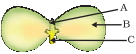
In the given figure,the parts $A, B$,and $C$ are sequentially:
A
cotyledon,plumule and radicle
B
plumule,radicle and cotyledon
C
plumule,cotyledon and radicle
D
radicle,cotyledon and plumule
Solution
(C) The provided figure shows the internal structure of a germinating seed.
$A$ represents the plumule,which is the part of the embryo that develops into the shoot system.
$B$ represents the cotyledon,which is the seed leaf that provides nourishment to the developing embryo.
$C$ represents the radicle,which is the part of the embryo that develops into the root system.
Therefore,the parts $A, B$,and $C$ are sequentially plumule,cotyledon,and radicle.
$A$ represents the plumule,which is the part of the embryo that develops into the shoot system.
$B$ represents the cotyledon,which is the seed leaf that provides nourishment to the developing embryo.
$C$ represents the radicle,which is the part of the embryo that develops into the root system.
Therefore,the parts $A, B$,and $C$ are sequentially plumule,cotyledon,and radicle.
0 likes
View Solution20
MediumMCQ
Offspring formed as a result of sexual reproduction exhibit more variations because
A
sexual reproduction is a lengthy process
B
genetic material comes from many parents
C
genetic material comes from two parents of different species
D
genetic material comes from two parents of the same species
Solution
(D) Sexual reproduction involves the fusion of male and female gametes,which are produced by two parents of the same species.
During the formation of gametes,the process of meiosis occurs,which includes recombination and crossing over of genetic material.
This results in new combinations of genes in the offspring,leading to genetic variation.
Since the genetic material is contributed by two different individuals of the same species,the offspring possess a unique combination of traits,which is different from both parents.
During the formation of gametes,the process of meiosis occurs,which includes recombination and crossing over of genetic material.
This results in new combinations of genes in the offspring,leading to genetic variation.
Since the genetic material is contributed by two different individuals of the same species,the offspring possess a unique combination of traits,which is different from both parents.
0 likes
View Solution21
EasyMCQ
Reproduction is essential for living organisms in order to
A
continue the species generation after generation
B
fulfill their energy requirement
C
maintain growth
D
keep the individual organism alive
Solution
(A) Reproduction is a biological process by which living organisms produce new individuals similar to themselves.
It is not necessary for the survival of an individual organism,unlike processes such as respiration,nutrition,or excretion.
Instead,reproduction is essential for the survival of a species,as it ensures the continuity of life by passing on genetic information from one generation to the next.
Therefore,the primary purpose of reproduction is to continue the species generation after generation.
It is not necessary for the survival of an individual organism,unlike processes such as respiration,nutrition,or excretion.
Instead,reproduction is essential for the survival of a species,as it ensures the continuity of life by passing on genetic information from one generation to the next.
Therefore,the primary purpose of reproduction is to continue the species generation after generation.
0 likes
View Solution22
EasyMCQ
During adolescence,several changes occur in the human body. Mark one change associated with sexual maturation in boys.
A
Loss of milk teeth
B
Cracking of voice
C
Increase in height
D
Weight gain
Solution
(B) During adolescence,the human body undergoes significant physical and hormonal changes.
Sexual maturation in boys is characterized by specific secondary sexual characteristics.
$A$. Loss of milk teeth occurs during childhood,not adolescence.
$B$. Cracking of voice (deepening of the voice) is a primary secondary sexual characteristic in boys caused by the enlargement of the larynx under the influence of testosterone.
$C$. Increase in height occurs in both boys and girls during adolescence,but it is a general growth spurt rather than a specific sign of sexual maturation.
$D$. Weight gain is a general physiological change associated with overall growth and development,not specifically sexual maturation.
Therefore,the correct option is $B$.
Sexual maturation in boys is characterized by specific secondary sexual characteristics.
$A$. Loss of milk teeth occurs during childhood,not adolescence.
$B$. Cracking of voice (deepening of the voice) is a primary secondary sexual characteristic in boys caused by the enlargement of the larynx under the influence of testosterone.
$C$. Increase in height occurs in both boys and girls during adolescence,but it is a general growth spurt rather than a specific sign of sexual maturation.
$D$. Weight gain is a general physiological change associated with overall growth and development,not specifically sexual maturation.
Therefore,the correct option is $B$.
0 likes
View Solution23
EasyMCQ
In human females,an event that reflects the onset of the reproductive phase is
A
growth of body
B
changes in hair pattern
C
menstruation
D
change in voice
Solution
(C) In human females,the onset of the reproductive phase is marked by the beginning of the menstrual cycle,which is known as menarche.
This process involves the periodic shedding of the uterine lining and is a clear indicator that the female reproductive system has become functional.
While body growth,changes in hair pattern,and voice changes are secondary sexual characteristics that occur during puberty,they do not specifically mark the onset of the reproductive phase as clearly as the first menstruation.
This process involves the periodic shedding of the uterine lining and is a clear indicator that the female reproductive system has become functional.
While body growth,changes in hair pattern,and voice changes are secondary sexual characteristics that occur during puberty,they do not specifically mark the onset of the reproductive phase as clearly as the first menstruation.
0 likes
View Solution24
EasyMCQ
In human males,the testes lie in the scrotum,because it helps in the
A
process of mating
B
all the above
C
easy transfer of gametes
D
formation of sperm
Solution
(D) In human males,the testes are located outside the abdominal cavity in a pouch-like structure called the scrotum.
This is because the process of spermatogenesis (formation of sperm) requires a temperature that is $2-2.5^{\circ}C$ lower than the normal body temperature.
The scrotum provides this cooler environment,which is essential for the healthy development and survival of sperm.
This is because the process of spermatogenesis (formation of sperm) requires a temperature that is $2-2.5^{\circ}C$ lower than the normal body temperature.
The scrotum provides this cooler environment,which is essential for the healthy development and survival of sperm.
0 likes
View Solution25
MediumMCQ
Which among the following is not the function of testes at puberty?
$(i)$ formation of germ cells
$(ii)$ secretion of testosterone
$(iii)$ development of placenta
$(iv)$ secretion of estrogen
$(i)$ formation of germ cells
$(ii)$ secretion of testosterone
$(iii)$ development of placenta
$(iv)$ secretion of estrogen
A
$(iii)$ and $(iv)$
B
$(ii)$ and $(iii)$
C
$(i)$ and $(ii)$
D
$(i)$ and $(iv)$
Solution
(A) The testes are the primary male reproductive organs. Their main functions at puberty include:
$1$. Formation of germ cells (spermatozoa),which is the process of spermatogenesis.
$2$. Secretion of the male sex hormone,testosterone,which is responsible for secondary sexual characteristics in males.
Conversely,the development of the placenta is a function associated with the female reproductive system during pregnancy,and the secretion of estrogen is primarily a function of the ovaries in females.
Therefore,$(iii)$ and $(iv)$ are not functions of the testes.
$1$. Formation of germ cells (spermatozoa),which is the process of spermatogenesis.
$2$. Secretion of the male sex hormone,testosterone,which is responsible for secondary sexual characteristics in males.
Conversely,the development of the placenta is a function associated with the female reproductive system during pregnancy,and the secretion of estrogen is primarily a function of the ovaries in females.
Therefore,$(iii)$ and $(iv)$ are not functions of the testes.
0 likes
View Solution26
MediumMCQ
The correct sequence of organs in the male reproductive system for the transport of sperms is:
A
Testis $\to$ Ureter $\to$ Urethra
B
Testis $\to$ Vas deferens $\to$ Urethra
C
Testis $\to$ Urethra $\to$ Ureter
D
Testis $\to$ Vas deferens $\to$ Ureter
Solution
(B) In the male reproductive system,sperms are produced in the $Testis$.
From the $Testis$,sperms are transported through the $Vas$ $deferens$ (also known as the sperm duct).
The $Vas$ $deferens$ then joins the $Urethra$,which acts as a common passage for both urine and sperms.
Therefore,the correct sequence is $Testis \to Vas$ $deferens \to Urethra$.
From the $Testis$,sperms are transported through the $Vas$ $deferens$ (also known as the sperm duct).
The $Vas$ $deferens$ then joins the $Urethra$,which acts as a common passage for both urine and sperms.
Therefore,the correct sequence is $Testis \to Vas$ $deferens \to Urethra$.
0 likes
View Solution27
EasyMCQ
Which among the following diseases is not sexually transmitted?
A
Syphilis
B
$HIV-AIDS$
C
Hepatitis
D
Gonorrhoea
Solution
(C) Sexually Transmitted Diseases $(STDs)$ are infections that are primarily spread through sexual contact.
$Syphilis$,$HIV-AIDS$,and $Gonorrhoea$ are well-known examples of $STDs$.
$Hepatitis$ (specifically $Hepatitis-B$) can be transmitted sexually,but the term '$Hepatitis$' generally refers to inflammation of the liver,which can be caused by various factors including viral infections (like $Hepatitis-A$,which is transmitted through contaminated food or water) or alcohol consumption.
Therefore,among the given options,$Hepatitis$ is the most appropriate answer as it is not exclusively or primarily classified as an $STD$ in the same category as the others.
$Syphilis$,$HIV-AIDS$,and $Gonorrhoea$ are well-known examples of $STDs$.
$Hepatitis$ (specifically $Hepatitis-B$) can be transmitted sexually,but the term '$Hepatitis$' generally refers to inflammation of the liver,which can be caused by various factors including viral infections (like $Hepatitis-A$,which is transmitted through contaminated food or water) or alcohol consumption.
Therefore,among the given options,$Hepatitis$ is the most appropriate answer as it is not exclusively or primarily classified as an $STD$ in the same category as the others.
0 likes
View Solution28
EasyMCQ
The pistil is intact. Cross-pollination has occurred,leading to fertilization and the formation of fruit. In a bisexual flower,despite the young stamens being removed artificially,the flower produces fruit. Provide a suitable explanation for the above situation.
A
Self-pollination occurred.
B
Cross-pollination occurred from another flower.
C
The flower was already pollinated before emasculation.
D
Parthenocarpy occurred.
Solution
(B) The process of removing stamens from a bisexual flower is known as emasculation.
If a flower produces fruit after the removal of its own stamens,it indicates that cross-pollination has occurred.
Cross-pollination is the transfer of pollen grains from the anther of one flower to the stigma of another flower of the same or a different plant.
Since the pistil (stigma,style,and ovary) remains intact,it is capable of receiving pollen grains from an external source (another flower).
Once the pollen grains land on the stigma,they germinate to form a pollen tube,which travels down the style to reach the ovary,resulting in fertilization and subsequent fruit formation.
If a flower produces fruit after the removal of its own stamens,it indicates that cross-pollination has occurred.
Cross-pollination is the transfer of pollen grains from the anther of one flower to the stigma of another flower of the same or a different plant.
Since the pistil (stigma,style,and ovary) remains intact,it is capable of receiving pollen grains from an external source (another flower).
Once the pollen grains land on the stigma,they germinate to form a pollen tube,which travels down the style to reach the ovary,resulting in fertilization and subsequent fruit formation.
0 likes
View Solution29
EasyMCQ
Can you consider cell division as a type of reproduction in unicellular organisms? Give one reason.
A
Yes,because it increases the cell size.
B
Yes,because it results in the formation of two daughter cells,which are new individuals.
C
No,because it only occurs in multicellular organisms.
D
No,because cell division is only for growth and repair.
Solution
(B) Yes,cell division can be considered a type of reproduction in unicellular organisms.
This is because,in unicellular organisms like bacteria or amoeba,cell division (such as binary fission) directly results in the formation of two or more daughter cells.
Since these daughter cells are independent individuals,the process of cell division effectively increases the population of the organism,which is the definition of reproduction.
This is because,in unicellular organisms like bacteria or amoeba,cell division (such as binary fission) directly results in the formation of two or more daughter cells.
Since these daughter cells are independent individuals,the process of cell division effectively increases the population of the organism,which is the definition of reproduction.
0 likes
View Solution30
Easy
What is a clone? Why do offspring formed by asexual reproduction exhibit remarkable similarity?
Solution
(N/A) clone is defined as an individual organism that is genetically and morphologically identical to its parent.
Offspring formed by asexual reproduction exhibit remarkable similarity because they are produced from a single parent without the fusion of gametes.
Since asexual reproduction involves only mitotic cell division,the offspring receive exact copies of the parent's $DNA$,resulting in genetic uniformity.
Offspring formed by asexual reproduction exhibit remarkable similarity because they are produced from a single parent without the fusion of gametes.
Since asexual reproduction involves only mitotic cell division,the offspring receive exact copies of the parent's $DNA$,resulting in genetic uniformity.
0 likes
View Solution31
Medium
Explain how offspring and parents of organisms reproducing sexually have the same number of chromosomes?
Solution
(N/A) During sexual reproduction,the process of meiosis (reduction division) occurs during gamete formation. This process reduces the chromosome number to half in both male and female gametes. When these two haploid gametes fuse during the process of fertilization,the diploid number of chromosomes,which is identical to that of the parents,is restored in the zygote and subsequently in the offspring.
0 likes
View Solution32
Easy
Colonies of yeast fail to multiply in water,but multiply in sugar solution. Give one reason for this.
Solution
(N/A) Yeast is a heterotrophic organism that requires an external source of energy to perform metabolic activities,including reproduction.
Sugar solution provides the necessary carbohydrates (glucose/sucrose) that yeast cells break down through respiration to generate $ATP$ (energy).
In water,there is no source of nutrition or energy available for the yeast cells to sustain their life processes or to undergo cell division,hence they fail to multiply.
Sugar solution provides the necessary carbohydrates (glucose/sucrose) that yeast cells break down through respiration to generate $ATP$ (energy).
In water,there is no source of nutrition or energy available for the yeast cells to sustain their life processes or to undergo cell division,hence they fail to multiply.
0 likes
View Solution33
Easy
Why does bread mould grow profusely on a moist slice of bread rather than on a dry slice of bread?
Solution
(N/A) Moisture is an essential factor for the growth of fungal hyphae. $A$ moist slice of bread provides both the necessary moisture and nutrients required for the bread mould to thrive. In contrast,a dry slice of bread provides nutrients but lacks the moisture needed for the spores to germinate and the hyphae to grow,thus preventing the mould from growing.
0 likes
View Solution34
Medium
Give two reasons for the appearance of variations among the progeny formed by sexual reproduction.
Solution
(N/A) Sexual reproduction involves two parents with different sets of characters.
$(b)$ The process of meiosis during gamete formation leads to genetic recombination,resulting in different gene combinations in gametes.
$(b)$ The process of meiosis during gamete formation leads to genetic recombination,resulting in different gene combinations in gametes.
0 likes
View Solution35
Easy
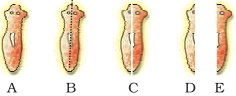
Would a Planaria cut vertically into two halves regenerate into two individuals? Complete Figure $D$ and $E$ by indicating the regenerated regions.
Solution
(N/A) Yes,a Planaria cut vertically into two halves can regenerate into two complete individuals. This is possible due to the presence of specialized cells that proliferate and make large numbers of cells,which then undergo changes to become various cell types and tissues. In the provided figures,the shaded parts in $D$ and $E$ represent the newly regenerated halves that have grown to replace the missing sections.

0 likes
View Solution36
Easy
From the internet,gather information about the chromosome numbers of five animals and five plants. Correlate the number with the size of the organism and answer the following questions.
$(a)$ Do larger organisms have a higher number of chromosomes/cells?
$(b)$ Can organisms with fewer chromosomes reproduce more easily than organisms with a higher number of chromosomes?
$(c)$ Does a higher number of chromosomes/cells imply greater $DNA$ content? Justify.
$(a)$ Do larger organisms have a higher number of chromosomes/cells?
$(b)$ Can organisms with fewer chromosomes reproduce more easily than organisms with a higher number of chromosomes?
$(c)$ Does a higher number of chromosomes/cells imply greater $DNA$ content? Justify.
Solution
(N/A) No,there is no direct correlation between the size of an organism and its chromosome number. For example,some small organisms have more chromosomes than larger ones.
$(b)$ No,the process of reproduction follows a biological pattern specific to the species and is not dependent on the total number of chromosomes.
$(c)$ Yes,since chromosomes are primarily composed of $DNA$ and proteins,an increase in the number of chromosomes typically results in a higher total quantity of $DNA$ within the cell.
$(b)$ No,the process of reproduction follows a biological pattern specific to the species and is not dependent on the total number of chromosomes.
$(c)$ Yes,since chromosomes are primarily composed of $DNA$ and proteins,an increase in the number of chromosomes typically results in a higher total quantity of $DNA$ within the cell.
0 likes
View Solution37
Easy
In a tobacco plant,the male gametes have $24$ chromosomes. What is the number of chromosomes in the female gamete? What is the number of chromosomes in the zygote?
Solution
(N/A) In a tobacco plant,the male gamete is a haploid cell $(n)$ containing $24$ chromosomes.
Since the female gamete is also a haploid cell $(n)$,it will also contain $24$ chromosomes.
The zygote is formed by the fusion of the male and female gametes,making it a diploid cell $(2n)$.
Therefore,the number of chromosomes in the zygote is $24 + 24 = 48$.
Since the female gamete is also a haploid cell $(n)$,it will also contain $24$ chromosomes.
The zygote is formed by the fusion of the male and female gametes,making it a diploid cell $(2n)$.
Therefore,the number of chromosomes in the zygote is $24 + 24 = 48$.
0 likes
View Solution38
Easy
Why cannot fertilisation take place in flowers if pollination does not occur?
Solution
(N/A) Fertilisation is the process of fusion of male and female gametes. In flowering plants,the male gametes are contained within the pollen grains. Pollination is the transfer of pollen grains from the anther to the stigma of a flower. If pollination does not occur,the male gametes cannot reach the female gametes present in the ovary. Therefore,without the presence of male gametes,fertilisation cannot take place.
0 likes
View Solution39
Easy
Is the chromosome number of the zygote,embryonal cells,and adult of a particular organism always constant? How is the constancy maintained in these three stages?
Solution
(N/A) Yes,the chromosome number remains constant in the zygote,embryonal cells,and the adult of a particular organism.
This constancy is maintained because all these cells are formed through mitotic cell division.
In mitosis,the parent cell divides to produce two daughter cells that have the same number of chromosomes as the parent cell,ensuring genetic stability across these developmental stages.
This constancy is maintained because all these cells are formed through mitotic cell division.
In mitosis,the parent cell divides to produce two daughter cells that have the same number of chromosomes as the parent cell,ensuring genetic stability across these developmental stages.
0 likes
View Solution40
EasyMCQ
Where is the zygote located in the flower after fertilization?
A
Inside the ovary
B
Inside the ovule
C
Inside the stigma
D
Inside the style
Solution
(B) After fertilization,the male gamete fuses with the female gamete (egg cell) to form a zygote. This process occurs within the ovule. The ovule is located inside the ovary of the flower. Therefore,the zygote is located inside the ovule.
0 likes
View Solution41
Medium
Reproduction is linked to the stability of the population of a species. Justify the statement.
Solution
(N/A) Reproduction involves the transfer of $DNA$ from one generation to the next. The process of $DNA$ copying occurs with high consistency,ensuring that the fundamental characteristics of the species are maintained. While minor variations occur during this process,the overall consistency in $DNA$ replication allows a species to maintain its population structure and adapt to its environment,thereby ensuring the stability of the species over time.
0 likes
View Solution42
MediumMCQ
How are general growth and sexual maturation different from each other?
A
General growth involves physical changes like height and weight,while sexual maturation involves hormonal changes.
B
General growth occurs throughout life,while sexual maturation is limited to puberty.
C
General growth is related to body size,while sexual maturation is related to reproductive capability.
D
All of the above.
Solution
(D) General growth refers to the overall developmental processes in the body,such as an increase in height,weight gain,and changes in the shape and size of the body.
Sexual maturation is specific to the changes that occur during puberty,such as the cracking of the voice,the appearance of new hair patterns,and the development of breasts in females.
While general growth is a continuous process of physical development,sexual maturation marks the transition toward reproductive maturity.
Sexual maturation is specific to the changes that occur during puberty,such as the cracking of the voice,the appearance of new hair patterns,and the development of breasts in females.
While general growth is a continuous process of physical development,sexual maturation marks the transition toward reproductive maturity.
0 likes
View Solution43
Easy
Trace the path of sperm during ejaculation and mention the glands and their functions associated with the male reproductive system.
Solution
(N/A) The path of sperm during ejaculation is as follows: $Testis \rightarrow Epididymis \rightarrow Vas \ deferens \rightarrow Urethra \rightarrow Penis$.
Associated glands and their functions:
$1$. $Seminal \ vesicles$: They secrete a fluid that provides nutrition to the sperms and makes their transport easier.
$2$. $Prostate \ gland$: It secretes a fluid that nourishes the sperms and helps in their motility.
$3$. $Bulbourethral \ glands$: They secrete a lubricating fluid that neutralizes the acidity of the urethra.
Associated glands and their functions:
$1$. $Seminal \ vesicles$: They secrete a fluid that provides nutrition to the sperms and makes their transport easier.
$2$. $Prostate \ gland$: It secretes a fluid that nourishes the sperms and helps in their motility.
$3$. $Bulbourethral \ glands$: They secrete a lubricating fluid that neutralizes the acidity of the urethra.
0 likes
View Solution44
EasyMCQ
What changes are observed in the uterus if fertilisation does not occur?
A
The uterine lining thickens further.
B
The uterine lining breaks down and is discharged as blood and mucus.
C
The uterus produces more hormones.
D
The uterus prepares for implantation.
Solution
(B) If fertilisation does not occur,the egg dies and the thick,spongy lining of the uterus,which was prepared to nourish the embryo,is no longer needed. Consequently,this lining slowly breaks down and is discharged from the body through the vagina in the form of blood and mucus,a process known as menstruation.
0 likes
View Solution45
MediumMCQ
What changes are observed in the uterus subsequent to implantation of the young embryo?
A
The uterine wall becomes thin and loses blood supply.
B
The uterine wall thickens and becomes richly supplied with blood.
C
The uterus shrinks to accommodate the embryo.
D
No significant changes occur in the uterus.
Solution
(B) Following the implantation of the embryo,the uterine wall undergoes significant changes to support the developing fetus.
$1$. The uterine lining (endometrium) thickens and becomes highly vascularized,meaning it is richly supplied with blood to provide nourishment.
$2$. $A$ specialized tissue called the $placenta$ develops,which acts as a structural and functional connection between the embryo and the mother's uterine wall.
$3$. The $placenta$ facilitates the exchange of nutrients,oxygen,and waste products between the maternal blood and the fetal blood.
$1$. The uterine lining (endometrium) thickens and becomes highly vascularized,meaning it is richly supplied with blood to provide nourishment.
$2$. $A$ specialized tissue called the $placenta$ develops,which acts as a structural and functional connection between the embryo and the mother's uterine wall.
$3$. The $placenta$ facilitates the exchange of nutrients,oxygen,and waste products between the maternal blood and the fetal blood.
0 likes
View Solution46
EasyMCQ
What are the benefits of using mechanical barriers during sexual act?
A
Prevents pregnancy
B
Prevents transmission of STIs
C
Both $A$ and $B$
D
None of the above
Solution
(C) Mechanical barriers,such as condoms,act as a physical shield that prevents sperm from reaching the egg,thereby effectively preventing pregnancy.
Additionally,these barriers provide a protective layer that prevents the transmission of sexually transmitted infections $(STIs)$ during sexual intercourse.
Additionally,these barriers provide a protective layer that prevents the transmission of sexually transmitted infections $(STIs)$ during sexual intercourse.
0 likes
View Solution47
Easy
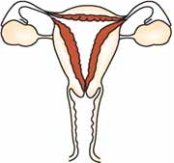
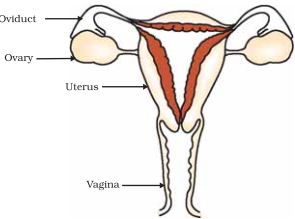
In the given figure,label the parts and mention their functions:
$(a)$ Production of egg
$(b)$ Site of fertilisation
$(c)$ Site of implantation
$(d)$ Entry of the sperms
$(a)$ Production of egg
$(b)$ Site of fertilisation
$(c)$ Site of implantation
$(d)$ Entry of the sperms
Solution
(N/A) Ovary: It is responsible for the production of the egg (ovum).
$(b)$ Oviduct (Fallopian tube): It is the site where fertilisation occurs.
$(c)$ Uterus: It is the site of implantation where the embryo develops.
$(d)$ Vagina: It serves as the passage for the entry of sperms into the female reproductive tract.
$(b)$ Oviduct (Fallopian tube): It is the site where fertilisation occurs.
$(c)$ Uterus: It is the site of implantation where the embryo develops.
$(d)$ Vagina: It serves as the passage for the entry of sperms into the female reproductive tract.
0 likes
View Solution48
EasyMCQ
What would be the ratio of chromosome number between an egg and its zygote? How is the sperm genetically different from the egg?
A
$1$:$2$,Sperm has $X$ or $Y$ chromosome while egg has $X$
B
$2$:$1$,Sperm has $X$ or $Y$ chromosome while egg has $X$
C
$1$:$1$,Sperm has $X$ or $Y$ chromosome while egg has $Y$
D
$1$:$2$,Sperm has $X$ chromosome while egg has $Y$
Solution
(A) The ratio of chromosome number between an egg (haploid,$n$) and its zygote (diploid,$2n$) is $1:2$.
Sperms are genetically different from eggs because sperms contain either an $X$ or a $Y$ chromosome,whereas an egg always contains an $X$ chromosome.
Sperms are genetically different from eggs because sperms contain either an $X$ or a $Y$ chromosome,whereas an egg always contains an $X$ chromosome.
0 likes
View Solution49
Easy
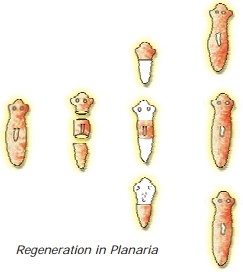
Why are budding,fragmentation,and regeneration all considered as asexual types of reproduction? With neat diagrams,explain the process of regeneration in Planaria.
Solution
(N/A) Budding,fragmentation,and regeneration are considered asexual types of reproduction because they involve only a single parent and do not require the formation or fusion of gametes.
Regeneration in Planaria:
$1$. If a Planaria is accidentally cut into several pieces,each piece contains specialized cells that proliferate and make large numbers of cells.
$2$. From this mass of cells,different cell types undergo changes to become various cell types and tissues.
$3$. These changes take place in an organized sequence referred to as development.
$4$. Eventually,these pieces grow into complete new individuals.
[Image: $1087-$s49]
Regeneration in Planaria:
$1$. If a Planaria is accidentally cut into several pieces,each piece contains specialized cells that proliferate and make large numbers of cells.
$2$. From this mass of cells,different cell types undergo changes to become various cell types and tissues.
$3$. These changes take place in an organized sequence referred to as development.
$4$. Eventually,these pieces grow into complete new individuals.
[Image: $1087-$s49]
0 likes
View Solution50
Medium
Write two points of difference between asexual and sexual types of reproduction. Describe why variations are observed in the offspring formed by sexual reproduction.
Solution
(N/A)
During sexual reproduction,two types of gametes fuse. Although the gametes contain the same number of chromosomes,their $DNA$ is not identical due to the process of recombination during meiosis. This genetic shuffling generates variations among the offspring.
| Asexual reproduction | Sexual reproduction |
|---|---|
| $(a)$ Involves only one parent. | $(i)$ Involves two parents of opposite sex. |
| $(b)$ Gametes are not produced. | $(ii)$ Gametes are produced. |
| $(c)$ No fertilization and zygote formation occurs. | $(iii)$ Fertilization and zygote formation are observed. |
| $(d)$ Meiosis does not occur. | $(iv)$ Meiosis occurs during gamete formation. |
During sexual reproduction,two types of gametes fuse. Although the gametes contain the same number of chromosomes,their $DNA$ is not identical due to the process of recombination during meiosis. This genetic shuffling generates variations among the offspring.
0 likes
View SolutionHow do Organisms Reproduce? — Mix Examples - How do Organisms Reproduce? · Frequently Asked Questions
1Are these How do Organisms Reproduce? questions useful for JEE and NEET?
Yes. All questions in this section are mapped to JEE Main and NEET exam patterns. Previous year questions from JEE Main, NEET, GUJCET and state-level exams are included with full solutions.
2Can I switch to Hindi or Gujarati for these questions?
Yes. Use the language tabs in the hero section or the sidebar to view the same questions and solutions in English, Hindi or Gujarati.
3How do I generate a question paper from this subtopic?
Use the Vedclass Exam Paper Generator — select the chapter and subtopic, set difficulty, and generate Sets A, B, C, D automatically. First 3 chapters of every subject are free.
Vedclass Products
For Students
Vedclass Test Series
Mock tests in real JEE/NEET style with performance analysis. 5-day free trial.
Start Free TrialFor Teachers
Exam Paper Generator
Generate Set A/B/C/D papers from this chapter in 2 minutes. 3 chapters free.
Try FreeFor Institutes
Online Exam Module
Live online exams with unlimited students, 360° analytics & white-label branding.
See DemoFor Teachers & Institutes
Generate a How do Organisms Reproduce? Exam Paper in 2 Minutes
Select subtopic & difficulty — Sets A, B, C, D auto-generated with No Repeat logic.
First 3 chapters of every subject are free — no payment required.