
A English
Mix Examples - How do Organisms Reproduce? Questions in English
Class 10 Science · How do Organisms Reproduce? · Mix Examples - How do Organisms Reproduce?
251+
Questions
English
Language
100%
With Solutions
Showing 50 of 251 questions in English
101
Easy
List any two reasons why the Government has banned prenatal sex determination by law.
Solution
(N/A) $(i)$ To prevent the illegal abortion of female foetuses.
$(ii)$ To curb the practice of female foeticide,which has significantly disturbed the male-female sex ratio in society.
$(ii)$ To curb the practice of female foeticide,which has significantly disturbed the male-female sex ratio in society.
0 likes
View Solution102
Easy
Mention any four ways of asexual reproduction.
Solution
(N/A) The four common methods of asexual reproduction are:
$1$. Fission: The parent cell divides into two or more daughter cells (e.g.,$Amoeba$).
$2$. Regeneration: The ability of an organism to regrow lost or damaged parts (e.g.,$Planaria$).
$3$. Budding: $A$ new organism develops from an outgrowth or bud on the parent body (e.g.,$Hydra$,$Yeast$).
$4$. Vegetative Propagation: New plants are produced from vegetative parts like roots,stems,or leaves (e.g.,$Potato$,$Bryophyllum$).
(Note: Spore formation is also a method of asexual reproduction.)
$1$. Fission: The parent cell divides into two or more daughter cells (e.g.,$Amoeba$).
$2$. Regeneration: The ability of an organism to regrow lost or damaged parts (e.g.,$Planaria$).
$3$. Budding: $A$ new organism develops from an outgrowth or bud on the parent body (e.g.,$Hydra$,$Yeast$).
$4$. Vegetative Propagation: New plants are produced from vegetative parts like roots,stems,or leaves (e.g.,$Potato$,$Bryophyllum$).
(Note: Spore formation is also a method of asexual reproduction.)
0 likes
View Solution103
Easy
$(a)$ List any two methods of asexual reproduction.
$(b)$ Explain how $Spirogyra$ reproduces.
$(b)$ Explain how $Spirogyra$ reproduces.
Solution
(N/A) Two methods of asexual reproduction are:
$(i)$ Budding (e.g.,in $Hydra$ and yeast).
$(ii)$ Spore formation (e.g.,in fungi).
$(b)$ $Spirogyra$ reproduces by a method called fragmentation. Upon maturation,the filamentous body of $Spirogyra$ simply breaks up into smaller pieces or fragments. Each of these fragments then grows and develops into a new individual.
$(i)$ Budding (e.g.,in $Hydra$ and yeast).
$(ii)$ Spore formation (e.g.,in fungi).
$(b)$ $Spirogyra$ reproduces by a method called fragmentation. Upon maturation,the filamentous body of $Spirogyra$ simply breaks up into smaller pieces or fragments. Each of these fragments then grows and develops into a new individual.
0 likes
View Solution104
Medium
Mention the functions of $(a)$ placenta and $(b)$ fallopian tube in the human female reproductive system.
Solution
(N/A) Placenta: $(i)$ It facilitates the transport of glucose,oxygen,and nutrients from the mother to the developing embryo. $(ii)$ It helps in the removal of waste products generated by the embryo by transferring them into the mother's blood.
$(b)$ Fallopian tube: $(i)$ It acts as a pathway for the egg (ovum) to travel from the ovary to the uterus. $(ii)$ It is the site where fertilization of the egg by the sperm typically occurs.
$(b)$ Fallopian tube: $(i)$ It acts as a pathway for the egg (ovum) to travel from the ovary to the uterus. $(ii)$ It is the site where fertilization of the egg by the sperm typically occurs.
0 likes
View Solution105
EasyMCQ
How can pregnancy be prevented surgically?
A
By blocking the vas deferens in males.
B
By blocking the fallopian tubes in females.
C
Both $A$ and $B$.
D
None of the above.
Solution
(C) Surgical methods are used to create blocks in the reproductive pathways to prevent the meeting of gametes.
In males, a surgical procedure called vasectomy involves blocking the $vas deferens$, which prevents the transfer of sperm.
In females, a surgical procedure called tubectomy involves blocking the $fallopian tubes$, which prevents the egg from reaching the uterus and meeting the sperm.
In males, a surgical procedure called vasectomy involves blocking the $vas deferens$, which prevents the transfer of sperm.
In females, a surgical procedure called tubectomy involves blocking the $fallopian tubes$, which prevents the egg from reaching the uterus and meeting the sperm.
0 likes
View Solution106
Medium
'Regeneration is not reproduction'. Justify this statement with reason.
Solution
(N/A) Regeneration is the ability of an organism to regrow lost or damaged body parts from specialized cells.
However,it is not considered a true form of reproduction because:
$1$. Reproduction is a process intended to produce new individuals of the same species,whereas regeneration is primarily a mechanism for repair or replacement of lost tissues.
$2$. Most organisms do not possess the ability to grow into a complete new organism from a small cut piece.
$3$. Only specific organisms like $Hydra$ or $Planaria$ exhibit this,but for the vast majority of complex organisms,regeneration is limited to healing wounds rather than creating offspring.
However,it is not considered a true form of reproduction because:
$1$. Reproduction is a process intended to produce new individuals of the same species,whereas regeneration is primarily a mechanism for repair or replacement of lost tissues.
$2$. Most organisms do not possess the ability to grow into a complete new organism from a small cut piece.
$3$. Only specific organisms like $Hydra$ or $Planaria$ exhibit this,but for the vast majority of complex organisms,regeneration is limited to healing wounds rather than creating offspring.
0 likes
View Solution107
Medium
State one function each performed by the following organs in human beings:
$(a)$ Testes
$(b)$ Prostate gland
$(a)$ Testes
$(b)$ Prostate gland
Solution
(N/A) Testes: They are the primary male reproductive organs responsible for the production of sperms (spermatogenesis) and the secretion of the male sex hormone,testosterone.
$(b)$ Prostate gland: It is an accessory reproductive gland that secretes a milky,alkaline fluid which forms a significant part of the semen,helping to nourish and transport the sperms.
$(b)$ Prostate gland: It is an accessory reproductive gland that secretes a milky,alkaline fluid which forms a significant part of the semen,helping to nourish and transport the sperms.
0 likes
View Solution108
Medium
$(a)$ Trace the path of sperms from where they are produced in the human body to the exterior.
$(b)$ Write the functions of secretions of the prostate gland and seminal vesicles in humans.
$(b)$ Write the functions of secretions of the prostate gland and seminal vesicles in humans.
Solution
(N/A) The path of sperm is as follows: $\text{Testes} \rightarrow \text{Epididymis} \rightarrow \text{Vas deferens} \rightarrow \text{Ejaculatory duct} \rightarrow \text{Urethra} \rightarrow \text{Exterior}$.
$(b)$ The secretions of the prostate gland and seminal vesicles provide a fluid medium for the sperm,which makes their transport easier. Additionally,these secretions provide nutrition to the sperm and contain enzymes that help in the activation and survival of the sperm.
$(b)$ The secretions of the prostate gland and seminal vesicles provide a fluid medium for the sperm,which makes their transport easier. Additionally,these secretions provide nutrition to the sperm and contain enzymes that help in the activation and survival of the sperm.
0 likes
View Solution109
Medium
Give two examples each of the following:
$(a)$ Plants having unisexual flowers
$(b)$ Agents of pollination
$(c)$ Physical changes on puberty that are common to both boys and girls.
$(a)$ Plants having unisexual flowers
$(b)$ Agents of pollination
$(c)$ Physical changes on puberty that are common to both boys and girls.
Solution
(N/A) Papaya,Watermelon
$(b)$ Insects,Wind (Air)
$(c)$ $(i)$ Appearance of pubic hair.
$(ii)$ Skin becomes oily and may develop pimples.
$(b)$ Insects,Wind (Air)
$(c)$ $(i)$ Appearance of pubic hair.
$(ii)$ Skin becomes oily and may develop pimples.
0 likes
View Solution110
Medium
Why are the testes located outside the abdominal cavity? Mention the endocrine and exocrine function of the testes.
Solution
(N/A) The testes are located outside the abdominal cavity within the scrotum because the process of spermatogenesis (sperm formation) requires a temperature that is $1-3\,^{\circ}C$ lower than the normal internal body temperature.
Endocrine function: The testes act as an endocrine gland by secreting the male sex hormone,$testosterone$,directly into the bloodstream.
Exocrine function: The testes act as an exocrine gland by producing and releasing male gametes,known as $sperms$,through the duct system.
Endocrine function: The testes act as an endocrine gland by secreting the male sex hormone,$testosterone$,directly into the bloodstream.
Exocrine function: The testes act as an exocrine gland by producing and releasing male gametes,known as $sperms$,through the duct system.
0 likes
View Solution111
Medium
List six specific characteristics of sexual reproduction.
Solution
(N/A) The characteristics of sexual reproduction are as follows:
$1$. Two parents of opposite sex are involved in the process.
$2$. Two dissimilar gametes (male and female) are formed; the process of gamete formation involves meiosis.
$3$. Genetic variations are produced due to the recombination of genetic material.
$4$. It occurs in most higher organisms and some lower organisms.
$5$. Fertilization,which is the fusion of male and female gametes,leads to the formation of a diploid zygote.
$6$. It is a relatively slow and complex process compared to asexual reproduction.
$1$. Two parents of opposite sex are involved in the process.
$2$. Two dissimilar gametes (male and female) are formed; the process of gamete formation involves meiosis.
$3$. Genetic variations are produced due to the recombination of genetic material.
$4$. It occurs in most higher organisms and some lower organisms.
$5$. Fertilization,which is the fusion of male and female gametes,leads to the formation of a diploid zygote.
$6$. It is a relatively slow and complex process compared to asexual reproduction.
0 likes
View Solution112
Medium
List four points of significance of reproductive health in a society. Name any two areas related to reproductive health which have improved over the past $50$ years in our country.
Solution
(N/A) Significance of reproductive health in a society:
$1$. It helps in preventing the spread of Sexually Transmitted Diseases $(STDs)$.
$2$. It promotes the advantages of having a small family,which leads to better resource allocation.
$3$. It contributes to a reduction in infant mortality rates.
$4$. It helps in reducing maternal mortality rates through better healthcare and awareness.
Two areas related to reproductive health that have improved in our country over the past $50$ years are:
$1$. Increased awareness and implementation of family planning programs.
$2$. Significant decrease in the incidence and spread of $STDs$ due to better medical facilities and education.
$1$. It helps in preventing the spread of Sexually Transmitted Diseases $(STDs)$.
$2$. It promotes the advantages of having a small family,which leads to better resource allocation.
$3$. It contributes to a reduction in infant mortality rates.
$4$. It helps in reducing maternal mortality rates through better healthcare and awareness.
Two areas related to reproductive health that have improved in our country over the past $50$ years are:
$1$. Increased awareness and implementation of family planning programs.
$2$. Significant decrease in the incidence and spread of $STDs$ due to better medical facilities and education.
0 likes
View Solution113
Medium
What are chromosomes? Explain how in sexually reproducing organisms,the number of chromosomes in the progeny is maintained?
Solution
(N/A) Chromosomes are thread-like structures composed of $DNA$ and proteins,found within the nucleus of a cell.
In sexually reproducing organisms,the process of meiosis occurs during gamete formation. This process reduces the number of chromosomes to half $(n)$ in the gametes compared to the parent cell $(2n)$.
When fertilization occurs,the male gamete $(n)$ and the female gamete $(n)$ fuse to form a zygote $(2n)$. This fusion restores the original diploid number of chromosomes in the progeny,ensuring the stability of the species across generations.
In sexually reproducing organisms,the process of meiosis occurs during gamete formation. This process reduces the number of chromosomes to half $(n)$ in the gametes compared to the parent cell $(2n)$.
When fertilization occurs,the male gamete $(n)$ and the female gamete $(n)$ fuse to form a zygote $(2n)$. This fusion restores the original diploid number of chromosomes in the progeny,ensuring the stability of the species across generations.
0 likes
View Solution114
Medium
List four categories of contraceptive methods. State in brief two advantages of adopting such preventive methods.
Solution
(N/A) Four categories of contraceptive methods are as follows:
$1.$ Barrier methods (e.g.,Condoms,Diaphragms).
$2.$ Chemical methods (e.g.,Oral pills,Spermicides).
$3.$ Intrauterine devices (e.g.,$IUCD$,Copper-$T$).
$4.$ Surgical methods (e.g.,Vasectomy in males,Tubectomy in females).
Two advantages of adopting these methods:
$1.$ Population control: They help in regulating the birth rate and managing population growth.
$2.$ Health and safety: They help in maintaining the reproductive health of women and prevent the transmission of Sexually Transmitted Diseases $(STDs)$ such as $AIDS$ and Syphilis.
$1.$ Barrier methods (e.g.,Condoms,Diaphragms).
$2.$ Chemical methods (e.g.,Oral pills,Spermicides).
$3.$ Intrauterine devices (e.g.,$IUCD$,Copper-$T$).
$4.$ Surgical methods (e.g.,Vasectomy in males,Tubectomy in females).
Two advantages of adopting these methods:
$1.$ Population control: They help in regulating the birth rate and managing population growth.
$2.$ Health and safety: They help in maintaining the reproductive health of women and prevent the transmission of Sexually Transmitted Diseases $(STDs)$ such as $AIDS$ and Syphilis.
0 likes
View Solution115
Medium
Explain the process of regeneration in $Planaria$. How is this process different from reproduction?
Solution
(N/A) $Planaria$ possesses the ability to regenerate its lost body parts. If the body of $Planaria$ is cut into several pieces,each piece can grow into a complete new individual. This occurs because specialized cells present in the body proliferate and form a mass of cells. These cells then undergo differentiation to form various tissues and organs,eventually developing into a complete organism.
Regeneration is not the same as reproduction because,in nature,most organisms do not rely on being cut or injured to produce offspring. Regeneration is primarily a mechanism for the repair of damaged tissues or the replacement of lost body parts,whereas reproduction is a biological process for the continuation of the species.
Regeneration is not the same as reproduction because,in nature,most organisms do not rely on being cut or injured to produce offspring. Regeneration is primarily a mechanism for the repair of damaged tissues or the replacement of lost body parts,whereas reproduction is a biological process for the continuation of the species.
0 likes
View Solution116
MediumMCQ
What is the effect of $DNA$ copying,which is not perfectly accurate,on the reproduction process? How does the amount of $DNA$ remain constant though each new generation is a combination of $DNA$ copies of two individuals?
A
It leads to variations; $DNA$ is halved via meiosis.
B
It leads to mutations; $DNA$ is doubled via mitosis.
C
It leads to stability; $DNA$ is constant via cloning.
D
It leads to death; $DNA$ is lost via fertilization.
Solution
(A) $(i)$ $DNA$ copying that is not perfectly accurate leads to variations in the offspring,which is the basis of evolution.
$(ii)$ In sexually reproducing organisms,specialized germ cells (gametes) are produced through meiosis,which contain only half the amount of $DNA$ or half the number of chromosomes compared to the parent cell.
$(iii)$ When these haploid germ cells fuse during fertilization,the resulting zygote restores the original amount of $DNA$ characteristic of the species,ensuring the amount remains constant across generations.
$(ii)$ In sexually reproducing organisms,specialized germ cells (gametes) are produced through meiosis,which contain only half the amount of $DNA$ or half the number of chromosomes compared to the parent cell.
$(iii)$ When these haploid germ cells fuse during fertilization,the resulting zygote restores the original amount of $DNA$ characteristic of the species,ensuring the amount remains constant across generations.
0 likes
View Solution117
Medium
List any two modes of asexual reproduction in animals. Under which mode of reproduction is vegetative propagation placed and why? List two advantages of vegetative propagation.
Solution
(N/A) Two modes of asexual reproduction in animals include $Fission$ and $Budding$ (or $Fragmentation$, $Regeneration$).
Vegetative propagation is classified under asexual reproduction because it involves only a single parent and does not involve the fusion of gametes or the formation of reproductive organs like flowers.
Two advantages of vegetative propagation are:
$(i)$ Plants produced through this method can bear flowers and fruits earlier than those grown from seeds.
$(ii)$ It allows for the propagation of plants that have lost the capacity to produce viable seeds, such as bananas, oranges, and jasmine.
Vegetative propagation is classified under asexual reproduction because it involves only a single parent and does not involve the fusion of gametes or the formation of reproductive organs like flowers.
Two advantages of vegetative propagation are:
$(i)$ Plants produced through this method can bear flowers and fruits earlier than those grown from seeds.
$(ii)$ It allows for the propagation of plants that have lost the capacity to produce viable seeds, such as bananas, oranges, and jasmine.
0 likes
View Solution118
Medium
Differentiate between the following:
$(a)$ Placenta and uterus
$(b)$ Unisexual and bisexual flowers
$(c)$ Fertilization and germination
$(a)$ Placenta and uterus
$(b)$ Unisexual and bisexual flowers
$(c)$ Fertilization and germination
Solution
(N/A)
| $(a)$ Placenta | Uterus |
|---|---|
| The embryo receives nutrition from the mother's blood through a special tissue called the placenta. | The uterus is the organ where the embryo attaches and develops after fertilization. |
| $(b)$ Unisexual flowers | Bisexual flowers |
| Flowers that contain either stamens or carpels,but not both. | Flowers that contain both stamens and carpels. |
| $(c)$ Fertilization | Germination |
| The fusion of a male gamete with a female gamete to form a zygote. | The process by which an embryo in a seed grows into a seedling under suitable conditions. |
0 likes
View Solution119
Medium
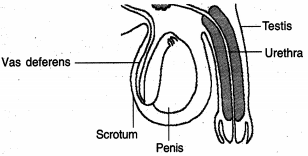
$A$ part of the male reproductive system is shown below. Study the diagram and answer the questions that follow.
$(a)$ Two parts have been incorrectly labelled. Identify them.
$(b)$ Give the function of urethra.
$(c)$ Which hormone is released by testis?
$(a)$ Two parts have been incorrectly labelled. Identify them.
$(b)$ Give the function of urethra.
$(c)$ Which hormone is released by testis?
Solution
(N/A) In the provided diagram,the labels for 'Testis' and 'Penis' are swapped. The structure labeled as 'Testis' is actually the 'Penis',and the structure labeled as 'Penis' is actually the 'Testis' (within the scrotum).
$(b)$ The urethra serves as a common passage for both sperms and urine in the male reproductive system.
$(c)$ The testis releases the hormone 'Testosterone',which is responsible for the development of secondary sexual characteristics in males.
$(b)$ The urethra serves as a common passage for both sperms and urine in the male reproductive system.
$(c)$ The testis releases the hormone 'Testosterone',which is responsible for the development of secondary sexual characteristics in males.
0 likes
View Solution120
Medium
Mention one function each of the following parts with respect to the female reproductive system:
$(a)$ Vagina
$(b)$ Ovary
$(a)$ Vagina
$(b)$ Ovary
Solution
(N/A) Vagina: It serves as the birth canal and the passage for the entry of sperms into the female reproductive tract during sexual intercourse.
$(b)$ Ovary: It is responsible for the production of female gametes (ova or eggs) and the secretion of female sex hormones like estrogen and progesterone.
$(b)$ Ovary: It is responsible for the production of female gametes (ova or eggs) and the secretion of female sex hormones like estrogen and progesterone.
0 likes
View Solution121
Medium
$(a)$ Give the functions of $(i)$ Stigma $(ii)$ Ovary. $(b)$ State in brief the formation of seed in a flower.
Solution
(N/A) $(i)$ The stigma is the sticky terminal part of the carpel that serves as a landing platform for pollen grains.
$(ii)$ The ovary is the swollen basal part of the carpel that contains ovules. It protects the female germ cells and develops into a fruit after fertilization.
$(b)$ After fertilization,the zygote divides several times to form an embryo within the ovule. The ovule develops a tough seed coat and is gradually converted into a seed.
$(ii)$ The ovary is the swollen basal part of the carpel that contains ovules. It protects the female germ cells and develops into a fruit after fertilization.
$(b)$ After fertilization,the zygote divides several times to form an embryo within the ovule. The ovule develops a tough seed coat and is gradually converted into a seed.
0 likes
View Solution122
Medium
$(a)$ Give the functions of the following :
$(i)$ Pollen Tube
$(ii)$ Ovary
$(b)$ List any two changes observed in the body of a female during puberty.
$(i)$ Pollen Tube
$(ii)$ Ovary
$(b)$ List any two changes observed in the body of a female during puberty.
Solution
(N/A) $(i)$ The function of the pollen tube is to provide a pathway for the male gametes to travel from the stigma to the ovule for fertilization.
$(ii)$ The function of the ovary is the production of female gametes (ova) and the secretion of female sex hormones like estrogen and progesterone.
$(b)$ Two changes observed in the body of a female during puberty are:
$(i)$ Development and enlargement of mammary glands (breasts).
$(ii)$ Onset of the menstrual cycle (menarche).
$(ii)$ The function of the ovary is the production of female gametes (ova) and the secretion of female sex hormones like estrogen and progesterone.
$(b)$ Two changes observed in the body of a female during puberty are:
$(i)$ Development and enlargement of mammary glands (breasts).
$(ii)$ Onset of the menstrual cycle (menarche).
0 likes
View Solution123
Medium
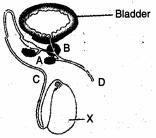
In the diagram of the human male reproductive system given below:
$(a)$ Label parts $A$ and $B$.
$(b)$ Name the hormone produced by organ $X$. What is the role of this hormone in the human male?
$(c)$ Mention the name of substances that are transported by tubes:
$(i)$ $C$ and $(ii)$ $D$.
$(a)$ Label parts $A$ and $B$.
$(b)$ Name the hormone produced by organ $X$. What is the role of this hormone in the human male?
$(c)$ Mention the name of substances that are transported by tubes:
$(i)$ $C$ and $(ii)$ $D$.
Solution
(N/A) is the Seminal vesicle,and $B$ is the Prostate gland.
$(b)$ The hormone produced by organ $X$ (testis) is Testosterone. Its role is to control the formation of gametes (sperms) and regulate the development of secondary sexual characteristics in human males.
$(c)$ $(i)$ Tube $C$ (Vas deferens) transports sperms.
$(ii)$ Tube $D$ (Urethra) transports both sperms (semen) and urine.
$(b)$ The hormone produced by organ $X$ (testis) is Testosterone. Its role is to control the formation of gametes (sperms) and regulate the development of secondary sexual characteristics in human males.
$(c)$ $(i)$ Tube $C$ (Vas deferens) transports sperms.
$(ii)$ Tube $D$ (Urethra) transports both sperms (semen) and urine.
0 likes
View Solution124
Medium
$(a)$ Identify the asexual method of reproduction in each of the following organisms:
$(i)$ Rose
$(ii)$ Yeast
$(iii)$ Planaria
$(b)$ What is fragmentation? Name a multicellular organism which reproduces by this method.
$(i)$ Rose
$(ii)$ Yeast
$(iii)$ Planaria
$(b)$ What is fragmentation? Name a multicellular organism which reproduces by this method.
Solution
(N/A) $(i)$ Rose $\rightarrow$ Cutting (Vegetative propagation)
$(ii)$ Yeast $\rightarrow$ Budding
$(iii)$ Planaria $\rightarrow$ Regeneration
$(b)$ Fragmentation is a type of asexual reproduction in which the body of the parent organism breaks into distinct pieces or fragments,and each fragment develops into a new individual. Spirogyra is a multicellular organism that reproduces by this method.
$(ii)$ Yeast $\rightarrow$ Budding
$(iii)$ Planaria $\rightarrow$ Regeneration
$(b)$ Fragmentation is a type of asexual reproduction in which the body of the parent organism breaks into distinct pieces or fragments,and each fragment develops into a new individual. Spirogyra is a multicellular organism that reproduces by this method.
0 likes
View Solution125
Medium
$(i)$ $(a)$ Write the full form of $DNA$.
$(b)$ State the role of $DNA$ in the cell nucleus.
$(c)$ What will be the after-effect if the information of the $DNA$ is changed?
$(ii)$ Explain the importance of $DNA$ copying in reproduction.
$(b)$ State the role of $DNA$ in the cell nucleus.
$(c)$ What will be the after-effect if the information of the $DNA$ is changed?
$(ii)$ Explain the importance of $DNA$ copying in reproduction.
Solution
(N/A) $(i)$ $(a)$ The full form of $DNA$ is Deoxyribonucleic Acid.
$(b)$ $DNA$ acts as the information source for making proteins in the cell. Different proteins lead to altered body designs.
$(c)$ If the information in the $DNA$ is changed,the proteins synthesized will be different,which may lead to the production of different body designs or non-functional proteins.
$(ii)$ $DNA$ copying is essential in reproduction because it ensures that the offspring receive a blueprint of the parent's body design. It maintains the continuity of species characteristics. If $DNA$ copying does not occur,the new cells or organisms will not have the necessary instructions to function or maintain the specific body design of the species.
$(b)$ $DNA$ acts as the information source for making proteins in the cell. Different proteins lead to altered body designs.
$(c)$ If the information in the $DNA$ is changed,the proteins synthesized will be different,which may lead to the production of different body designs or non-functional proteins.
$(ii)$ $DNA$ copying is essential in reproduction because it ensures that the offspring receive a blueprint of the parent's body design. It maintains the continuity of species characteristics. If $DNA$ copying does not occur,the new cells or organisms will not have the necessary instructions to function or maintain the specific body design of the species.
0 likes
View Solution126
Medium
$(a)$ Name the human male reproductive organ that produces sperms and also secretes a hormone. Write the functions of the secreted hormone.
$(b)$ Name the parts of the human female reproductive system where:
$(i)$ fertilisation takes place.
$(ii)$ implantation of the fertilised egg occurs. Explain how the embryo gets nourishment inside the mother's body?
$(b)$ Name the parts of the human female reproductive system where:
$(i)$ fertilisation takes place.
$(ii)$ implantation of the fertilised egg occurs. Explain how the embryo gets nourishment inside the mother's body?
Solution
(N/A) The human male reproductive organ is the $Testis$. It secretes the hormone $Testosterone$.
Functions of $Testosterone$:
$(i)$ It regulates the production of sperms.
$(ii)$ It brings about the development of secondary sexual characteristics in males during puberty.
$(b)$ $(i)$ Fertilisation takes place in the $Fallopian tube$ (or $Oviduct$).
$(ii)$ Implantation occurs in the $Uterus$.
Nourishment of the embryo: The embryo receives nourishment from the mother's blood through a special tissue called the $Placenta$. The $Placenta$ is a disc-like structure embedded in the uterine wall. It provides a large surface area for the transfer of glucose, oxygen, and other essential nutrients from the mother's blood to the developing embryo, and also facilitates the removal of waste products produced by the embryo.
Functions of $Testosterone$:
$(i)$ It regulates the production of sperms.
$(ii)$ It brings about the development of secondary sexual characteristics in males during puberty.
$(b)$ $(i)$ Fertilisation takes place in the $Fallopian tube$ (or $Oviduct$).
$(ii)$ Implantation occurs in the $Uterus$.
Nourishment of the embryo: The embryo receives nourishment from the mother's blood through a special tissue called the $Placenta$. The $Placenta$ is a disc-like structure embedded in the uterine wall. It provides a large surface area for the transfer of glucose, oxygen, and other essential nutrients from the mother's blood to the developing embryo, and also facilitates the removal of waste products produced by the embryo.
0 likes
View Solution127
Medium
List five distinguishing features between sexual and asexual types of reproduction in tabular form.
Solution
(N/A)
| Sexual Reproduction | Asexual Reproduction |
|---|---|
| $(i)$ Involves two parents - male and female. | $(i)$ Involves only one parent. |
| $(ii)$ Gametes are formed in both males (sperms) and females (ova). | $(ii)$ No gametes are produced. |
| $(iii)$ Fertilization and zygote formation occur. | $(iii)$ No fertilization or zygote formation occurs. |
| $(iv)$ Meiosis occurs during gamete formation. | $(iv)$ Meiosis does not occur at any stage of reproduction. |
| $(v)$ Genetic variation occurs in offspring. | $(v)$ Genetic variation does not occur; offspring are clones. |
0 likes
View Solution128
Medium
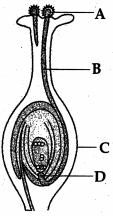
$(a)$ Name the parts labelled as $A, B, C$ and $D$ in the diagram given below:
$(b)$ What is pollination? State its significance.
$(c)$ How does fertilization occur in flowers? Name the parts of the flower that develop into $(i)$ seed,and $(ii)$ fruit after fertilization.
$(b)$ What is pollination? State its significance.
$(c)$ How does fertilization occur in flowers? Name the parts of the flower that develop into $(i)$ seed,and $(ii)$ fruit after fertilization.
Solution
(N/A) The labels are as follows:
$A -$ Pollen grain
$B -$ Pollen tube
$C -$ Ovary
$D -$ Female germ cell (Egg cell)
$(b)$ Pollination is the process of transfer of pollen grains from the anther to the stigma of a flower.
Significance: It is essential for fertilization,as it brings the male gametes to the female reproductive part.
$(c)$ Fertilization in flowers occurs when a pollen grain lands on a suitable stigma and germinates to form a pollen tube. This tube grows through the style,carrying the male germ cell,and reaches the ovary. The male germ cell then fuses with the female germ cell present in the ovule to form a zygote.
$(i)$ Seed develops from the ovule.
$(ii)$ Fruit develops from the ovary.
$A -$ Pollen grain
$B -$ Pollen tube
$C -$ Ovary
$D -$ Female germ cell (Egg cell)
$(b)$ Pollination is the process of transfer of pollen grains from the anther to the stigma of a flower.
Significance: It is essential for fertilization,as it brings the male gametes to the female reproductive part.
$(c)$ Fertilization in flowers occurs when a pollen grain lands on a suitable stigma and germinates to form a pollen tube. This tube grows through the style,carrying the male germ cell,and reaches the ovary. The male germ cell then fuses with the female germ cell present in the ovule to form a zygote.
$(i)$ Seed develops from the ovule.
$(ii)$ Fruit develops from the ovary.
0 likes
View Solution129
Medium
$(a)$ Draw a sectional view of the human female reproductive system and label the parts where:
$(i)$ eggs develop.
$(ii)$ fertilization takes place.
$(iii)$ the fertilized egg gets implanted.
$(b)$ Describe,in brief,the changes the uterus undergoes:
$(i)$ to receive the zygote.
$(ii)$ if the zygote is not formed.
$(i)$ eggs develop.
$(ii)$ fertilization takes place.
$(iii)$ the fertilized egg gets implanted.
$(b)$ Describe,in brief,the changes the uterus undergoes:
$(i)$ to receive the zygote.
$(ii)$ if the zygote is not formed.
Solution
(N/A) Diagram: Refer to the sectional view of the human female reproductive system in the textbook.
Labels:
$(i)$ Ovary: The site where eggs (ova) develop.
$(ii)$ Fallopian tube (Oviduct): The site where fertilization takes place.
$(iii)$ Uterus: The site where the fertilized egg (embryo) gets implanted.
$(b)$ $(i)$ To receive the zygote,the inner lining of the uterus (endometrium) becomes thick,soft,and richly supplied with blood vessels to nourish the developing embryo.
$(ii)$ If the zygote is not formed,the thickened uterine lining is no longer needed. It breaks down and is shed along with blood and mucus through the vagina,a process known as menstruation.
Labels:
$(i)$ Ovary: The site where eggs (ova) develop.
$(ii)$ Fallopian tube (Oviduct): The site where fertilization takes place.
$(iii)$ Uterus: The site where the fertilized egg (embryo) gets implanted.
$(b)$ $(i)$ To receive the zygote,the inner lining of the uterus (endometrium) becomes thick,soft,and richly supplied with blood vessels to nourish the developing embryo.
$(ii)$ If the zygote is not formed,the thickened uterine lining is no longer needed. It breaks down and is shed along with blood and mucus through the vagina,a process known as menstruation.
0 likes
View Solution130
Medium
Explain what happens when:
$(a)$ Testosterone is released in males.
$(b)$ Pollen grain falls on the stigma of the flower.
$(c)$ Egg fuses with sperm cell.
$(d)$ Planaria is cut into many pieces.
$(e)$ Buds are formed on the notches of the Bryophyllum leaf.
$(a)$ Testosterone is released in males.
$(b)$ Pollen grain falls on the stigma of the flower.
$(c)$ Egg fuses with sperm cell.
$(d)$ Planaria is cut into many pieces.
$(e)$ Buds are formed on the notches of the Bryophyllum leaf.
Solution
(N/A) $(i)$ Formation of sperms and changes in physical appearance occur.
$(ii)$ Thick hair growth on the face and voice begin to crack (deepen).
$(b)$ $A$ pollen tube grows out of the pollen grain and travels through the style to reach the ovary for fertilization.
$(c)$ $A$ zygote is formed,which is the process of fertilization.
$(d)$ Each piece grows into a complete new organism through the process of regeneration.
$(e)$ Buds may fall on the soil and develop into new independent plants.
$(ii)$ Thick hair growth on the face and voice begin to crack (deepen).
$(b)$ $A$ pollen tube grows out of the pollen grain and travels through the style to reach the ovary for fertilization.
$(c)$ $A$ zygote is formed,which is the process of fertilization.
$(d)$ Each piece grows into a complete new organism through the process of regeneration.
$(e)$ Buds may fall on the soil and develop into new independent plants.
0 likes
View Solution131
Medium
Define the following processes:
$(a)$ Fertilization
$(b)$ Menstruation
$(c)$ Binary fission
$(d)$ Vegetative propagation
$(e)$ Regeneration
$(a)$ Fertilization
$(b)$ Menstruation
$(c)$ Binary fission
$(d)$ Vegetative propagation
$(e)$ Regeneration
Solution
(N/A) The fusion of a male gamete with a female gamete is known as fertilization.
$(b)$ The cycle that occurs every month when an egg is not fertilized is known as menstruation. It lasts for about $2$ to $8$ days,during which the lining of the uterus slowly breaks down and is discharged through the vagina as blood and mucus.
$(c)$ The splitting of a parent cell into two daughter cells,which can occur in any plane,is known as binary fission. It is observed in organisms like $Amoeba$.
$(d)$ When a vegetative part of a plant,such as the root,stem,or leaves,develops into a new plant under appropriate conditions,it is known as vegetative propagation.
$(e)$ When the body of an organism is cut into any number of pieces and each piece grows into a complete organism,this is known as regeneration. It is observed in $Hydra$ and $Planaria$.
$(b)$ The cycle that occurs every month when an egg is not fertilized is known as menstruation. It lasts for about $2$ to $8$ days,during which the lining of the uterus slowly breaks down and is discharged through the vagina as blood and mucus.
$(c)$ The splitting of a parent cell into two daughter cells,which can occur in any plane,is known as binary fission. It is observed in organisms like $Amoeba$.
$(d)$ When a vegetative part of a plant,such as the root,stem,or leaves,develops into a new plant under appropriate conditions,it is known as vegetative propagation.
$(e)$ When the body of an organism is cut into any number of pieces and each piece grows into a complete organism,this is known as regeneration. It is observed in $Hydra$ and $Planaria$.
0 likes
View Solution132
Medium
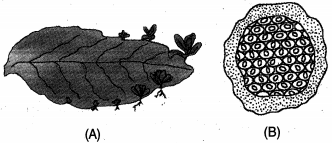
$(a)$ Identify the organisms $A$ and $B$ and the mode of asexual reproduction exhibited by them.
$(b)$ How will an organism be benefitted if it reproduces through spores?
$(c)$ Mention the two asexual methods by which Hydra can reproduce. Explain briefly any one such method.
$(b)$ How will an organism be benefitted if it reproduces through spores?
$(c)$ Mention the two asexual methods by which Hydra can reproduce. Explain briefly any one such method.
Solution
(N/A) $(i)$ Organism $A$ is Bryophyllum,which reproduces by vegetative propagation.
$(ii)$ Organism $B$ is Plasmodium,which reproduces by multiple fission.
$(b)$ Spores are reproductive bodies covered with thick,protective walls. These walls protect the spores from unfavorable environmental conditions (like heat or desiccation) until they come into contact with a moist surface and begin to grow.
$(c)$ The two asexual methods by which Hydra can reproduce are Budding and Regeneration.
Budding: In this process,a bud develops as an outgrowth due to repeated cell division at a specific site on the parent body. These buds develop into tiny individuals,mature,and eventually detach from the parent to become new,independent individuals.
Regeneration: In this process,specialized cells divide to form a large number of cells,which then undergo changes to become various cell types and tissues,eventually forming the complete organism.
$(ii)$ Organism $B$ is Plasmodium,which reproduces by multiple fission.
$(b)$ Spores are reproductive bodies covered with thick,protective walls. These walls protect the spores from unfavorable environmental conditions (like heat or desiccation) until they come into contact with a moist surface and begin to grow.
$(c)$ The two asexual methods by which Hydra can reproduce are Budding and Regeneration.
Budding: In this process,a bud develops as an outgrowth due to repeated cell division at a specific site on the parent body. These buds develop into tiny individuals,mature,and eventually detach from the parent to become new,independent individuals.
Regeneration: In this process,specialized cells divide to form a large number of cells,which then undergo changes to become various cell types and tissues,eventually forming the complete organism.
0 likes
View Solution133
EasyMCQ
What happens when a mature $Spirogyra$ filament attains considerable length?
A
It undergoes binary fission.
B
It breaks up into smaller fragments,each of which grows into a new individual.
C
It produces spores for reproduction.
D
It dies and decomposes.
Solution
(B) When a mature $Spirogyra$ filament attains a considerable length,it undergoes a process called fragmentation.
Its filament breaks up into smaller fragments or pieces due to maturation or mechanical stress.
Each of these fragments then grows into a new $Spirogyra$ filament or individual through cell division.
Its filament breaks up into smaller fragments or pieces due to maturation or mechanical stress.
Each of these fragments then grows into a new $Spirogyra$ filament or individual through cell division.
0 likes
View Solution134
Medium
Differentiate between the following:
$(a)$ Pollen tube and style.
$(b)$ Bud of Hydra and bud of Bryophyllum.
$(a)$ Pollen tube and style.
$(b)$ Bud of Hydra and bud of Bryophyllum.
Solution
(N/A) The style is the elongated,slender stalk that connects the stigma to the ovary in a flower. The pollen tube is a tubular structure that emerges from the pollen grain after pollination and grows through the style to deliver male gametes to the ovary.
$(b)$ In Hydra,a bud is a small outgrowth formed by repeated mitotic cell divisions at a specific site on the parent body,which eventually detaches to form a new individual. In Bryophyllum,buds are adventitious buds that develop in the notches along the leaf margins; when these leaves fall on moist soil,the buds develop into new independent plants.
$(b)$ In Hydra,a bud is a small outgrowth formed by repeated mitotic cell divisions at a specific site on the parent body,which eventually detaches to form a new individual. In Bryophyllum,buds are adventitious buds that develop in the notches along the leaf margins; when these leaves fall on moist soil,the buds develop into new independent plants.
0 likes
View Solution135
Medium
Can these two methods,regeneration and fragmentation,be equated to be the same? Answer with a reason.
Solution
(N/A) No,these two methods are not the same.
In fragmentation,multicellular organisms with simple body organization,upon reaching maturity,break their bodies into small pieces (fragments),which then grow into new individuals,as seen in $Spirogyra$.
In regeneration,organisms possess the specialized ability to regrow lost parts of their body or even an entire body from a small fragment,typically following an injury or accidental damage,as seen in $Hydra$ and $Planaria$.
In fragmentation,multicellular organisms with simple body organization,upon reaching maturity,break their bodies into small pieces (fragments),which then grow into new individuals,as seen in $Spirogyra$.
In regeneration,organisms possess the specialized ability to regrow lost parts of their body or even an entire body from a small fragment,typically following an injury or accidental damage,as seen in $Hydra$ and $Planaria$.
0 likes
View Solution136
Medium
The process of spore formation takes place in many simple multicellular organisms which have certain reproductive parts that can be identified.
$(a)$ Name the organism using this process.
$(b)$ Name the reproductive and non-reproductive parts of such organisms.
$(a)$ Name the organism using this process.
$(b)$ Name the reproductive and non-reproductive parts of such organisms.
Solution
(N/A) The organism that uses this process is Bread mould,scientifically known as $Rhizopus$.
$(b)$ In $Rhizopus$,the thread-like structures that spread on the bread are called hyphae,which are the non-reproductive parts. The small bulb-like structures at the top of the stalks are called sporangia,which contain spores and are the reproductive parts.
$(b)$ In $Rhizopus$,the thread-like structures that spread on the bread are called hyphae,which are the non-reproductive parts. The small bulb-like structures at the top of the stalks are called sporangia,which contain spores and are the reproductive parts.
0 likes
View Solution137
Medium
In the process of reproduction as used in $Spirogyra$,the organism splits itself into small pieces.
$(a)$ What is this process of reproduction called?
$(b)$ Will this type of reproduction be asexual or sexual reproduction? Answer with reason.
$(c)$ Is this process same as regeneration? Give reasons.
$(a)$ What is this process of reproduction called?
$(b)$ Will this type of reproduction be asexual or sexual reproduction? Answer with reason.
$(c)$ Is this process same as regeneration? Give reasons.
Solution
(N/A) This process is called fragmentation.
$(b)$ It is asexual reproduction,because a single parent is capable of giving rise to a new organism without the involvement of gametes.
$(c)$ No,it is not the same as regeneration. In regeneration,an organism can regrow lost parts of its body due to injury or specific biological mechanisms (e.g.,the tail of some lizards). In contrast,in fragmentation,the body of the organism breaks into two or more pieces,and each piece grows into a new individual.
$(b)$ It is asexual reproduction,because a single parent is capable of giving rise to a new organism without the involvement of gametes.
$(c)$ No,it is not the same as regeneration. In regeneration,an organism can regrow lost parts of its body due to injury or specific biological mechanisms (e.g.,the tail of some lizards). In contrast,in fragmentation,the body of the organism breaks into two or more pieces,and each piece grows into a new individual.
0 likes
View Solution138
Medium
Can we find variations in an asexually reproducing organism like bacteria? Write yes or no and give a reason in support of your answer.
Solution
(A) Yes. Although bacteria reproduce asexually,meaning a single parent gives rise to new organisms,the process of $DNA$ copying is not perfectly accurate. During $DNA$ replication,minor errors or mutations can occur. These small changes in the genetic material lead to variations in the offspring. Therefore,even in asexually reproducing organisms like bacteria,variations can occur.
0 likes
View Solution139
Medium
In the context of reproduction of species,state the main difference between fission and fragmentation. Also,give one example of each.
Solution
(N/A) Fission: It is a method of asexual reproduction primarily observed in unicellular organisms. In this process,the parent cell divides into two or more daughter cells.
Example: $Amoeba$ or $Plasmodium$.
Fragmentation: It is a method of asexual reproduction found in multicellular organisms with relatively simple body organizations. In this process,the organism's body breaks into distinct pieces upon maturation,and each piece develops into a new individual.
Example: $Spirogyra$.
Example: $Amoeba$ or $Plasmodium$.
Fragmentation: It is a method of asexual reproduction found in multicellular organisms with relatively simple body organizations. In this process,the organism's body breaks into distinct pieces upon maturation,and each piece develops into a new individual.
Example: $Spirogyra$.
0 likes
View Solution140
Medium
Define reproduction. How does it help in providing stability to the population of species?
Solution
(N/A) Reproduction is a biological process by which living organisms produce new individuals of the same species.
Organisms occupy specific places in the ecosystem,known as niches,by utilizing their ability to reproduce.
Reproduction involves $DNA$ copying,which acts as the source of information for synthesizing proteins,thereby determining and controlling the body design of the organism.
These specific body designs enable organisms to efficiently utilize a particular niche,which ensures the stability of the population of that species.
Furthermore,minor variations that occur during $DNA$ replication may also contribute to the long-term survival and stability of the species in changing environments.
Organisms occupy specific places in the ecosystem,known as niches,by utilizing their ability to reproduce.
Reproduction involves $DNA$ copying,which acts as the source of information for synthesizing proteins,thereby determining and controlling the body design of the organism.
These specific body designs enable organisms to efficiently utilize a particular niche,which ensures the stability of the population of that species.
Furthermore,minor variations that occur during $DNA$ replication may also contribute to the long-term survival and stability of the species in changing environments.
0 likes
View Solution141
Medium
Explain the term "Regeneration" as used in relation to reproduction of organisms. Describe briefly how regeneration is carried out in multicellular organisms like $Hydra$.
Solution
(N/A) Regeneration: It is the ability of an organism to give rise to a new organism or individual from its body parts.
Regeneration in $Hydra$:
$1$. When the body of $Hydra$ is cut into a number of pieces by any means, each piece contains specialized cells.
$2$. These cells proliferate and make a large number of cells.
$3$. From this mass of cells, different cells undergo changes to become various cell types and tissues, finally developing into a new organism.
Regeneration in $Hydra$:
$1$. When the body of $Hydra$ is cut into a number of pieces by any means, each piece contains specialized cells.
$2$. These cells proliferate and make a large number of cells.
$3$. From this mass of cells, different cells undergo changes to become various cell types and tissues, finally developing into a new organism.
0 likes
View Solution142
Medium
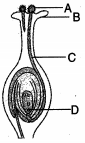
$(a)$ List two reasons for the appearance of variations among the progeny formed by sexual reproduction.
$(b)$ $(i)$ Name the part marked '$A$' in the diagram.
$(ii)$ How does '$A$' reach part '$B$'?
$(iii)$ State the importance of the part '$C$'.
$(iv)$ What happens to the part marked '$D$' after fertilisation is over?
$(b)$ $(i)$ Name the part marked '$A$' in the diagram.
$(ii)$ How does '$A$' reach part '$B$'?
$(iii)$ State the importance of the part '$C$'.
$(iv)$ What happens to the part marked '$D$' after fertilisation is over?
Solution
(N/A) Two reasons for variations in sexual reproduction are:
$(i)$ Involvement of two different individuals (parents) with different genetic makeups.
$(ii)$ Creation of new combinations of gene variants due to the process of meiosis and recombination during gamete formation.
$(b)$ $(i)$ '$A$' represents the Pollen grain.
$(ii)$ '$A$' reaches part '$B$' (stigma) through the process of pollination,which is facilitated by various agents like wind,water,insects,or animals.
$(iii)$ '$C$' is the Pollen tube. Its importance lies in providing a pathway for the male gametes to travel from the stigma to the ovule for fertilisation.
$(iv)$ '$D$' represents the Ovule. After fertilisation,the ovule develops into a seed.
$(i)$ Involvement of two different individuals (parents) with different genetic makeups.
$(ii)$ Creation of new combinations of gene variants due to the process of meiosis and recombination during gamete formation.
$(b)$ $(i)$ '$A$' represents the Pollen grain.
$(ii)$ '$A$' reaches part '$B$' (stigma) through the process of pollination,which is facilitated by various agents like wind,water,insects,or animals.
$(iii)$ '$C$' is the Pollen tube. Its importance lies in providing a pathway for the male gametes to travel from the stigma to the ovule for fertilisation.
$(iv)$ '$D$' represents the Ovule. After fertilisation,the ovule develops into a seed.
0 likes
View Solution143
Medium
Some plants do not produce seeds. For such plants,parts like roots,stem,and leaves are used to develop into new plants.
$(a)$ Identify the process.
$(b)$ Which type of reproduction is it—sexual or asexual? Answer with reason.
$(c)$ Give any two examples of this process.
$(a)$ Identify the process.
$(b)$ Which type of reproduction is it—sexual or asexual? Answer with reason.
$(c)$ Give any two examples of this process.
Solution
(N/A) The process is known as Vegetative Propagation.
$(b)$ This is a type of Asexual reproduction. It is considered asexual because only a single parent is involved in the formation of new plants,and no fusion of gametes occurs.
$(c)$ Two examples of this process are:
$(i)$ Stem cutting in plants like rose,jasmine,or sugarcane.
$(ii)$ Leaf buds in $Bryophyllum$.
$(b)$ This is a type of Asexual reproduction. It is considered asexual because only a single parent is involved in the formation of new plants,and no fusion of gametes occurs.
$(c)$ Two examples of this process are:
$(i)$ Stem cutting in plants like rose,jasmine,or sugarcane.
$(ii)$ Leaf buds in $Bryophyllum$.
0 likes
View Solution144
Medium
$(i)$ Some organisms have the capacity of reproducing by using a single parent. Such organisms have a simple body structure.
$(a)$ What is this method called?
$(b)$ Name any four types of this method.
$(c)$ Give two examples of organisms using this method for reproduction.
$(ii)$ Identify the method of reproduction used by $Spirogyra$ and $Rhizopus$.
$(a)$ What is this method called?
$(b)$ Name any four types of this method.
$(c)$ Give two examples of organisms using this method for reproduction.
$(ii)$ Identify the method of reproduction used by $Spirogyra$ and $Rhizopus$.
Solution
(N/A) $(i)$ $(a)$ This method is called asexual reproduction.
$(b)$ The four types of this method are: $(i)$ Fission,$(ii)$ Budding,$(iii)$ Spore formation,$(iv)$ Fragmentation.
$(c)$ Two examples of organisms using this method are: $(i)$ $Amoeba$,$(ii)$ $Spirogyra$.
$(ii)$ $Spirogyra$ reproduces by the process of fragmentation.
$Rhizopus$ reproduces by the process of spore formation.
$(b)$ The four types of this method are: $(i)$ Fission,$(ii)$ Budding,$(iii)$ Spore formation,$(iv)$ Fragmentation.
$(c)$ Two examples of organisms using this method are: $(i)$ $Amoeba$,$(ii)$ $Spirogyra$.
$(ii)$ $Spirogyra$ reproduces by the process of fragmentation.
$Rhizopus$ reproduces by the process of spore formation.
0 likes
View Solution145
Medium
Differentiate between the following:
$(a)$ Pollen tube and Style
$(b)$ Fission in Amoeba and Plasmodium
$(c)$ Fragmentation and Regeneration
$(d)$ Bud of Hydra and bud of Bryophyllum
$(e)$ Vegetative propagation and Spore formation.
$(a)$ Pollen tube and Style
$(b)$ Fission in Amoeba and Plasmodium
$(c)$ Fragmentation and Regeneration
$(d)$ Bud of Hydra and bud of Bryophyllum
$(e)$ Vegetative propagation and Spore formation.
Solution
(N/A)
$(b)$
$(c)$
$(d)$
$(e)$
| < strong>Pollen tube | < strong>Style |
| It is the structure formed when pollen lands on a suitable stigma. It grows out of the pollen grain and travels through the style to reach the ovary. | It is the middle elongated part of the carpel which provides a path for the pollen tube to reach the ovary after pollination. |
$(b)$
| < strong>Fission in Amoeba | < strong>Fission in Plasmodium |
| $(i)$ It shows binary fission. | $(i)$ It shows multiple fission. |
| $(ii)$ The parent cell divides into two small,nearly identical daughter cells. | $(ii)$ The parent cell divides into several small,nearly equal-sized daughter individuals. |
$(c)$
| < strong>Fragmentation | < strong>Regeneration |
| It is a mode of asexual reproduction where the parent body splits into two or more fragments,and each fragment develops into an organism under favourable conditions,e.g.,$Spirogyra$. | It is the ability to regrow lost body parts; it is used as a mode of reproduction in some organisms like $Hydra$ and $Planaria$. |
$(d)$
| < strong>Bud of Hydra | < strong>Bud of Bryophyllum |
| It is an outgrowth formed on the body by regenerative cells. These buds develop into tiny individuals and detach from the parent body to become independent. | In $Bryophyllum$,buds are produced in the notches along the leaf margin. These buds fall on the soil and develop into new plants. |
$(e)$
| < strong>Vegetative propagation | < strong>Spore formation |
| It is a mode of asexual reproduction in which parts like the root,stem,and leaves develop into new plants under appropriate conditions. | It is a mode of asexual reproduction commonly seen in organisms like fungi. They reproduce through spores,which are minute,single-celled structures protected by thick walls until they find a moist surface to grow. |
0 likes
View Solution146
Medium
What is placenta? Describe its structure. State its functions in case of a pregnant human female.
Solution
(N/A) Placenta: It is a specialized structural and functional unit that connects the developing embryo to the uterine wall of the mother.
Structure: It is a disc-like tissue embedded in the uterine wall. On the embryo's side,it possesses finger-like projections called villi. On the mother's side,there are blood spaces (lacunae) that surround these villi,allowing for the exchange of materials.
Functions:
$1$. It provides a large surface area for the transfer of nutrients like glucose and respiratory gases like oxygen from the mother's blood to the embryo.
$2$. It facilitates the removal of metabolic waste products and carbon dioxide produced by the developing embryo by transferring them into the mother's blood.
Structure: It is a disc-like tissue embedded in the uterine wall. On the embryo's side,it possesses finger-like projections called villi. On the mother's side,there are blood spaces (lacunae) that surround these villi,allowing for the exchange of materials.
Functions:
$1$. It provides a large surface area for the transfer of nutrients like glucose and respiratory gases like oxygen from the mother's blood to the embryo.
$2$. It facilitates the removal of metabolic waste products and carbon dioxide produced by the developing embryo by transferring them into the mother's blood.
0 likes
View Solution147
EasyMCQ
What is the main cause of variations among organisms during sexual reproduction?
A
Accurate $DNA$ copying
B
Errors in $DNA$ copying
C
Asexual reproduction
D
Lack of fertilization
Solution
(B) During sexual reproduction,the $DNA$ copying mechanism is not absolutely accurate.
These small errors or mutations that occur during $DNA$ replication are a primary source of variations in populations of organisms.
Additionally,the process of meiosis and the fusion of gametes from two different parents further contribute to genetic recombination and variation.
These small errors or mutations that occur during $DNA$ replication are a primary source of variations in populations of organisms.
Additionally,the process of meiosis and the fusion of gametes from two different parents further contribute to genetic recombination and variation.
0 likes
View Solution148
EasyMCQ
What is the advantage of reproduction through spores in the case of $Rhizopus$?
A
It allows for rapid sexual reproduction.
B
The spores are covered by thick walls that protect them under unfavorable conditions.
C
It ensures the production of genetically identical offspring only.
D
It requires a large amount of energy compared to other methods.
Solution
(B) $(i)$ The spores are covered by thick walls that protect them until they come into contact with another moist surface and can begin to grow.
$(ii)$ Spores being lighter easily get dispersed to distant places and provide better chances of survival.
$(ii)$ Spores being lighter easily get dispersed to distant places and provide better chances of survival.
0 likes
View Solution149
Easy
'Malarial parasite' divides into many daughter individuals simultaneously through multiple fission. State an advantage that the parasite gets because of this type of reproduction.
Solution
(N/A) Multiple fission allows the 'Malarial parasite' to produce a large number of daughter individuals from a single parent cell simultaneously.
This strategy provides a significant survival advantage: even if a large number of these offspring are eliminated by the host's immune system or other environmental factors,the remaining individuals can multiply rapidly to ensure the continuity and proliferation of the species within the host.
This strategy provides a significant survival advantage: even if a large number of these offspring are eliminated by the host's immune system or other environmental factors,the remaining individuals can multiply rapidly to ensure the continuity and proliferation of the species within the host.
0 likes
View Solution150
Easy
Name the parts of a flower that serve the same function as the following parts in animals:
$(i)$ Testis
$(ii)$ Ovary
$(iii)$ Eggs
$(iv)$ Sperms
$(i)$ Testis
$(ii)$ Ovary
$(iii)$ Eggs
$(iv)$ Sperms
Solution
(N/A) $(i)$ Testis: The $Anther$ produces pollen grains, similar to how the testis produces sperm.
$(ii)$ Ovary: The $Ovary$ in a flower contains ovules, similar to how the ovary in animals produces eggs.
$(iii)$ Eggs: The $Ovule$ (or the egg cell within the embryo sac) serves the same function as the egg in animals.
$(iv)$ Sperms: The $Male \text{ } gametes$ contained within the pollen grains serve the same function as sperms in animals.
$(ii)$ Ovary: The $Ovary$ in a flower contains ovules, similar to how the ovary in animals produces eggs.
$(iii)$ Eggs: The $Ovule$ (or the egg cell within the embryo sac) serves the same function as the egg in animals.
$(iv)$ Sperms: The $Male \text{ } gametes$ contained within the pollen grains serve the same function as sperms in animals.
0 likes
View SolutionHow do Organisms Reproduce? — Mix Examples - How do Organisms Reproduce? · Frequently Asked Questions
1Are these How do Organisms Reproduce? questions useful for JEE and NEET?
Yes. All questions in this section are mapped to JEE Main and NEET exam patterns. Previous year questions from JEE Main, NEET, GUJCET and state-level exams are included with full solutions.
2Can I switch to Hindi or Gujarati for these questions?
Yes. Use the language tabs in the hero section or the sidebar to view the same questions and solutions in English, Hindi or Gujarati.
3How do I generate a question paper from this subtopic?
Use the Vedclass Exam Paper Generator — select the chapter and subtopic, set difficulty, and generate Sets A, B, C, D automatically. First 3 chapters of every subject are free.
Vedclass Products
For Students
Vedclass Test Series
Mock tests in real JEE/NEET style with performance analysis. 5-day free trial.
Start Free TrialFor Teachers
Exam Paper Generator
Generate Set A/B/C/D papers from this chapter in 2 minutes. 3 chapters free.
Try FreeFor Institutes
Online Exam Module
Live online exams with unlimited students, 360° analytics & white-label branding.
See DemoFor Teachers & Institutes
Generate a How do Organisms Reproduce? Exam Paper in 2 Minutes
Select subtopic & difficulty — Sets A, B, C, D auto-generated with No Repeat logic.
First 3 chapters of every subject are free — no payment required.