
A English
Mix Examples - Electricity Questions in English
Class 10 Science · Electricity · Mix Examples - Electricity
449+
Questions
English
Language
100%
With Solutions
Showing 49 of 449 questions in English
401
EasyMCQ
In the formula for Ohm's Law,$\frac{V}{I} = R$,what does $R$ represent?
A
Resistance
B
Electric Current
C
Electric Power
D
Electric Potential
Solution
(A) According to Ohm's Law,the electric current flowing through a metallic conductor is directly proportional to the potential difference $(V)$ applied across its ends,provided its temperature remains constant.
Mathematically,this is expressed as $V \propto I$,which leads to $V = IR$ or $\frac{V}{I} = R$.
Here,$R$ is a constant for the given metallic conductor at a given temperature and is known as its resistance.
Resistance is the property of a conductor to resist the flow of charges through it.
Mathematically,this is expressed as $V \propto I$,which leads to $V = IR$ or $\frac{V}{I} = R$.
Here,$R$ is a constant for the given metallic conductor at a given temperature and is known as its resistance.
Resistance is the property of a conductor to resist the flow of charges through it.
0 likes
View Solution402
EasyMCQ
Which symbol is used for the resistivity of a conductor?
A
$\Omega$
B
$\rho$
C
$R$
D
$\delta$
Solution
(B) The resistivity of a material is a fundamental property that quantifies how strongly a given material opposes the flow of electric current.
It is denoted by the Greek letter $\rho$ (rho).
The $SI$ unit of resistivity is the ohm-meter $(\Omega \cdot m)$.
In contrast,$R$ represents resistance,and $\Omega$ is the symbol for the unit ohm.
It is denoted by the Greek letter $\rho$ (rho).
The $SI$ unit of resistivity is the ohm-meter $(\Omega \cdot m)$.
In contrast,$R$ represents resistance,and $\Omega$ is the symbol for the unit ohm.
0 likes
View Solution403
EasyMCQ
Silicon is $......$
A
a semiconductor
B
an insulator
C
a superconductor
D
a conductor
Solution
(A) Silicon $(Si)$ is a chemical element with atomic number $14$.
It belongs to group $14$ of the periodic table.
Its electrical conductivity lies between that of a conductor and an insulator.
Materials with such properties are classified as semiconductors.
Therefore,silicon is a semiconductor.
It belongs to group $14$ of the periodic table.
Its electrical conductivity lies between that of a conductor and an insulator.
Materials with such properties are classified as semiconductors.
Therefore,silicon is a semiconductor.
0 likes
View Solution404
EasyMCQ
Which of the following is a semiconductor element?
A
Zinc
B
Copper
C
Germanium
D
Silver
Solution
(C) semiconductor is a material that has electrical conductivity between that of a conductor (like copper) and an insulator (like glass).
Germanium $(Ge)$ and Silicon $(Si)$ are the most common examples of semiconductor elements used in electronic devices.
Zinc $(Zn)$,Copper $(Cu)$,and Silver $(Ag)$ are all metals and act as good conductors of electricity.
Therefore,the correct option is $C$.
Germanium $(Ge)$ and Silicon $(Si)$ are the most common examples of semiconductor elements used in electronic devices.
Zinc $(Zn)$,Copper $(Cu)$,and Silver $(Ag)$ are all metals and act as good conductors of electricity.
Therefore,the correct option is $C$.
0 likes
View Solution405
EasyMCQ
The resistivity of semiconductor materials is $..........$.
A
less than that of conductors
B
more than that of insulators
C
less than that of both conductors and insulators
D
more than that of conductors and less than that of insulators
Solution
(D) The resistivity $(\rho)$ of materials is a measure of how strongly a material opposes the flow of electric current.
Materials are classified based on their resistivity as follows:
$1$. Conductors: Have very low resistivity (e.g., metals like copper, silver).
$2$. Insulators: Have very high resistivity (e.g., glass, rubber).
$3$. Semiconductors: Have resistivity values that lie between those of conductors and insulators (e.g., silicon, germanium).
Therefore, the resistivity of semiconductors is greater than that of conductors but less than that of insulators.
Materials are classified based on their resistivity as follows:
$1$. Conductors: Have very low resistivity (e.g., metals like copper, silver).
$2$. Insulators: Have very high resistivity (e.g., glass, rubber).
$3$. Semiconductors: Have resistivity values that lie between those of conductors and insulators (e.g., silicon, germanium).
Therefore, the resistivity of semiconductors is greater than that of conductors but less than that of insulators.
0 likes
View Solution406
EasyMCQ
Three resistors $R_{1}$,$R_{2}$,and $R_{3}$ are connected in parallel between points $A$ and $B$. The equivalent resistance $R$ is given by:
A
$R_{1} + R_{2} + R_{3}$
B
$\frac{1}{R_{1}} + \frac{1}{R_{2}} + \frac{1}{R_{3}}$
C
$\frac{R_{1}R_{2}R_{3}}{R_{1}R_{2} + R_{2}R_{3} + R_{3}R_{1}}$
D
$\frac{R_{1} + R_{2} + R_{3}}{3}$
Solution
(C) When resistors are connected in parallel,the reciprocal of the equivalent resistance is equal to the sum of the reciprocals of the individual resistances.
For three resistors $R_{1}$,$R_{2}$,and $R_{3}$ connected in parallel,the formula is:
$\frac{1}{R} = \frac{1}{R_{1}} + \frac{1}{R_{2}} + \frac{1}{R_{3}}$
To find $R$,we take the reciprocal of the sum:
$R = \frac{1}{\frac{1}{R_{1}} + \frac{1}{R_{2}} + \frac{1}{R_{3}}}$
$R = \frac{R_{1}R_{2}R_{3}}{R_{1}R_{2} + R_{2}R_{3} + R_{3}R_{1}}$
Since the provided options were incomplete or incorrect regarding the final expression for $R$,the correct relationship is defined by the sum of reciprocals.
For three resistors $R_{1}$,$R_{2}$,and $R_{3}$ connected in parallel,the formula is:
$\frac{1}{R} = \frac{1}{R_{1}} + \frac{1}{R_{2}} + \frac{1}{R_{3}}$
To find $R$,we take the reciprocal of the sum:
$R = \frac{1}{\frac{1}{R_{1}} + \frac{1}{R_{2}} + \frac{1}{R_{3}}}$
$R = \frac{R_{1}R_{2}R_{3}}{R_{1}R_{2} + R_{2}R_{3} + R_{3}R_{1}}$
Since the provided options were incomplete or incorrect regarding the final expression for $R$,the correct relationship is defined by the sum of reciprocals.
0 likes
View Solution407
EasyMCQ
If three resistors of $5 \Omega$,$10 \Omega$,and $15 \Omega$ are connected in series,the equivalent resistance $R$ is equal to ........ (in $Omega$)
A
$10$
B
$15$
C
$5$
D
$30$
Solution
(D) When resistors are connected in series,the equivalent resistance $R$ is the sum of the individual resistances.
The formula for equivalent resistance in series is $R = R_1 + R_2 + R_3$.
Given values are $R_1 = 5 \Omega$,$R_2 = 10 \Omega$,and $R_3 = 15 \Omega$.
Substituting these values into the formula: $R = 5 \Omega + 10 \Omega + 15 \Omega = 30 \Omega$.
Therefore,the equivalent resistance is $30 \Omega$.
The formula for equivalent resistance in series is $R = R_1 + R_2 + R_3$.
Given values are $R_1 = 5 \Omega$,$R_2 = 10 \Omega$,and $R_3 = 15 \Omega$.
Substituting these values into the formula: $R = 5 \Omega + 10 \Omega + 15 \Omega = 30 \Omega$.
Therefore,the equivalent resistance is $30 \Omega$.
0 likes
View Solution408
EasyMCQ
What is the equivalent resistance of resistors $R_{1}$ and $R_{2}$ connected in parallel connection?
A
$\frac{1}{R_{1}}+\frac{1}{R_{2}}$
B
$\frac{R_{1}+R_{2}}{R_{1} R_{2}}$
C
$\frac{R_{1} R_{2}}{R_{1}+R_{2}}$
D
$\frac{R_{1}+R_{2}}{2}$
Solution
(C) When resistors $R_{1}$ and $R_{2}$ are connected in parallel,the reciprocal of the equivalent resistance $R_{eq}$ is equal to the sum of the reciprocals of the individual resistances.
The formula is given by: $\frac{1}{R_{eq}} = \frac{1}{R_{1}} + \frac{1}{R_{2}}$.
To simplify this,we find a common denominator,which is $R_{1} R_{2}$.
So,$\frac{1}{R_{eq}} = \frac{R_{2} + R_{1}}{R_{1} R_{2}}$.
Taking the reciprocal of both sides,we get the equivalent resistance: $R_{eq} = \frac{R_{1} R_{2}}{R_{1} + R_{2}}$.
The formula is given by: $\frac{1}{R_{eq}} = \frac{1}{R_{1}} + \frac{1}{R_{2}}$.
To simplify this,we find a common denominator,which is $R_{1} R_{2}$.
So,$\frac{1}{R_{eq}} = \frac{R_{2} + R_{1}}{R_{1} R_{2}}$.
Taking the reciprocal of both sides,we get the equivalent resistance: $R_{eq} = \frac{R_{1} R_{2}}{R_{1} + R_{2}}$.
0 likes
View Solution409
EasyMCQ
Two resistors of $3 \Omega$ and $6 \Omega$ are connected in parallel. The equivalent resistance $R$ is:
A
$9 \Omega$
B
$1/9 \Omega$
C
$2 \Omega$
D
$4.5 \Omega$
Solution
(C) When resistors are connected in parallel,the equivalent resistance $R$ is given by the formula: $\frac{1}{R} = \frac{1}{R_1} + \frac{1}{R_2}$.
Given $R_1 = 3 \Omega$ and $R_2 = 6 \Omega$.
Substituting the values: $\frac{1}{R} = \frac{1}{3} + \frac{1}{6}$.
Finding a common denominator: $\frac{1}{R} = \frac{2}{6} + \frac{1}{6} = \frac{3}{6}$.
Therefore,$\frac{1}{R} = \frac{1}{2}$.
Thus,$R = 2 \Omega$.
Given $R_1 = 3 \Omega$ and $R_2 = 6 \Omega$.
Substituting the values: $\frac{1}{R} = \frac{1}{3} + \frac{1}{6}$.
Finding a common denominator: $\frac{1}{R} = \frac{2}{6} + \frac{1}{6} = \frac{3}{6}$.
Therefore,$\frac{1}{R} = \frac{1}{2}$.
Thus,$R = 2 \Omega$.
0 likes
View Solution410
EasyMCQ
Which of the following is true for a series combination of three resistors?
A
The current flowing through each resistor is the same.
B
The voltage drop across each resistor is the same.
C
The equivalent resistance is smaller than the smallest individual resistor.
D
The equivalent resistance is equal to the average value of the three resistors.
Solution
(A) In a series combination of resistors,the resistors are connected end-to-end such that the same amount of electric current $(I)$ flows through each resistor.
According to Ohm's Law $(V = IR)$,since the current $(I)$ is constant and the resistance $(R)$ of each resistor may differ,the voltage drop $(V)$ across each resistor will be different.
The equivalent resistance $(R_{eq})$ in a series circuit is the sum of individual resistances $(R_{eq} = R_1 + R_2 + R_3)$,which is always greater than the largest individual resistor.
Therefore,the statement that the current flowing through each resistor is the same is correct.
According to Ohm's Law $(V = IR)$,since the current $(I)$ is constant and the resistance $(R)$ of each resistor may differ,the voltage drop $(V)$ across each resistor will be different.
The equivalent resistance $(R_{eq})$ in a series circuit is the sum of individual resistances $(R_{eq} = R_1 + R_2 + R_3)$,which is always greater than the largest individual resistor.
Therefore,the statement that the current flowing through each resistor is the same is correct.
0 likes
View Solution411
EasyMCQ
Which of the following is true for a parallel combination of two resistors?
A
The current flowing through each resistor is the same.
B
The voltage across each resistor is less than the individual resistance.
C
The equivalent resistance is less than the smallest individual resistance.
D
The equivalent resistance is greater than the largest individual resistance.
Solution
(C) In a parallel combination of resistors,the potential difference $(V)$ across each resistor remains the same.
However,the current $(I)$ divides among the resistors based on their resistance values.
The formula for equivalent resistance $(R_{eq})$ in parallel is given by $\frac{1}{R_{eq}} = \frac{1}{R_1} + \frac{1}{R_2} + ... + \frac{1}{R_n}$.
Due to this reciprocal relationship,the equivalent resistance $(R_{eq})$ is always smaller than the smallest individual resistance in the circuit.
Therefore,option $C$ is correct.
However,the current $(I)$ divides among the resistors based on their resistance values.
The formula for equivalent resistance $(R_{eq})$ in parallel is given by $\frac{1}{R_{eq}} = \frac{1}{R_1} + \frac{1}{R_2} + ... + \frac{1}{R_n}$.
Due to this reciprocal relationship,the equivalent resistance $(R_{eq})$ is always smaller than the smallest individual resistance in the circuit.
Therefore,option $C$ is correct.
0 likes
View Solution412
EasyMCQ
Which of the following statements is $NOT$ true for a series combination of two resistors?
A
The total voltage drop across all resistors is equal to the sum of the voltage drops across each individual resistor.
B
The electric current flowing through each resistor is the same.
C
The value of the equivalent resistance is equal to the sum of the values of all individual resistors.
D
The value of the equivalent resistance is smaller than the value of the smallest individual resistor.
Solution
(D) In a series combination of resistors:
$1$. The current $(I)$ flowing through each resistor remains the same.
$2$. The total voltage $(V)$ across the combination is the sum of the individual voltage drops: $V = V_1 + V_2 + ... + V_n$.
$3$. The equivalent resistance $(R_{eq})$ is the sum of the individual resistances: $R_{eq} = R_1 + R_2 + ... + R_n$.
$4$. Because $R_{eq}$ is the sum of all resistances,it is always greater than the value of the largest individual resistor in the series.
Therefore,the statement that the equivalent resistance is smaller than the smallest resistor is false.
$1$. The current $(I)$ flowing through each resistor remains the same.
$2$. The total voltage $(V)$ across the combination is the sum of the individual voltage drops: $V = V_1 + V_2 + ... + V_n$.
$3$. The equivalent resistance $(R_{eq})$ is the sum of the individual resistances: $R_{eq} = R_1 + R_2 + ... + R_n$.
$4$. Because $R_{eq}$ is the sum of all resistances,it is always greater than the value of the largest individual resistor in the series.
Therefore,the statement that the equivalent resistance is smaller than the smallest resistor is false.
0 likes
View Solution413
EasyMCQ
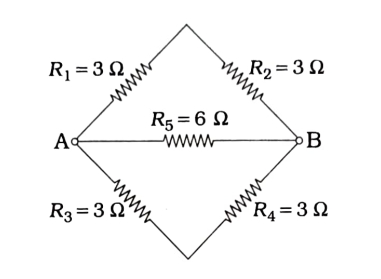
What is the equivalent resistance between points $A$ and $B$ in the given electrical circuit (in $Omega$)?
A
$18$
B
$2$
C
$4$
D
$6$
Solution
(B) The circuit consists of two parallel branches connected between points $A$ and $B$.
Branch $1$ consists of resistors $R_1$ and $R_2$ in series: $R_{s1} = R_1 + R_2 = 3 \ \Omega + 3 \ \Omega = 6 \ \Omega$.
Branch $2$ consists of resistors $R_3$ and $R_4$ in series: $R_{s2} = R_3 + R_4 = 3 \ \Omega + 3 \ \Omega = 6 \ \Omega$.
Branch $3$ consists of resistor $R_5$ connected directly between $A$ and $B$: $R_5 = 6 \ \Omega$.
Now,these three branches ($R_{s1}$,$R_{s2}$,and $R_5$) are connected in parallel.
The equivalent resistance $R_{eq}$ is given by: $\frac{1}{R_{eq}} = \frac{1}{R_{s1}} + \frac{1}{R_{s2}} + \frac{1}{R_5}$.
Substituting the values: $\frac{1}{R_{eq}} = \frac{1}{6} + \frac{1}{6} + \frac{1}{6} = \frac{3}{6} = \frac{1}{2}$.
Therefore,$R_{eq} = 2 \ \Omega$.
Branch $1$ consists of resistors $R_1$ and $R_2$ in series: $R_{s1} = R_1 + R_2 = 3 \ \Omega + 3 \ \Omega = 6 \ \Omega$.
Branch $2$ consists of resistors $R_3$ and $R_4$ in series: $R_{s2} = R_3 + R_4 = 3 \ \Omega + 3 \ \Omega = 6 \ \Omega$.
Branch $3$ consists of resistor $R_5$ connected directly between $A$ and $B$: $R_5 = 6 \ \Omega$.
Now,these three branches ($R_{s1}$,$R_{s2}$,and $R_5$) are connected in parallel.
The equivalent resistance $R_{eq}$ is given by: $\frac{1}{R_{eq}} = \frac{1}{R_{s1}} + \frac{1}{R_{s2}} + \frac{1}{R_5}$.
Substituting the values: $\frac{1}{R_{eq}} = \frac{1}{6} + \frac{1}{6} + \frac{1}{6} = \frac{3}{6} = \frac{1}{2}$.
Therefore,$R_{eq} = 2 \ \Omega$.
0 likes
View Solution414
EasyMCQ
How are electrical appliances connected to the main line in our homes?
A
Parallel
B
Series
C
Series and parallel
D
None of the above
Solution
(A) In domestic electrical circuits,all appliances are connected in parallel to the main line.
This is because,in a parallel connection,each appliance receives the same voltage as the source.
Furthermore,if one appliance stops working or is switched off,it does not affect the operation of other appliances.
Additionally,each appliance can be operated independently with its own switch.
This is because,in a parallel connection,each appliance receives the same voltage as the source.
Furthermore,if one appliance stops working or is switched off,it does not affect the operation of other appliances.
Additionally,each appliance can be operated independently with its own switch.
0 likes
View Solution415
EasyMCQ
Five bulbs are connected in a series circuit. If the third bulb in the middle blows out,what happens?
A
The first and second bulbs remain on.
B
The fourth and fifth bulbs remain on.
C
The remaining four bulbs remain on.
D
All the remaining bulbs turn off.
Solution
(D) In a series circuit,there is only one path for the flow of electric current.
If any one component (like a bulb) in the series circuit blows out or is disconnected,the circuit becomes open (broken).
Because the current cannot flow through an open circuit,the flow of electricity stops completely.
Therefore,if the third bulb blows out,the entire circuit is interrupted,and all the remaining bulbs will turn off.
If any one component (like a bulb) in the series circuit blows out or is disconnected,the circuit becomes open (broken).
Because the current cannot flow through an open circuit,the flow of electricity stops completely.
Therefore,if the third bulb blows out,the entire circuit is interrupted,and all the remaining bulbs will turn off.
0 likes
View Solution416
EasyMCQ
Five bulbs are connected in a parallel circuit. If the second bulb blows out,what happens?
A
The remaining four bulbs remain lit.
B
The first bulb remains lit.
C
The last three bulbs remain lit.
D
None of the bulbs remain lit.
Solution
(A) In a parallel circuit,each electrical appliance (or bulb) is connected across the same potential difference independently.
Since each bulb has its own separate path for the flow of current,the failure or blowing out of one bulb does not affect the operation of the other bulbs.
Therefore,if the second bulb blows out,the remaining four bulbs will continue to receive the same voltage and will remain lit.
Since each bulb has its own separate path for the flow of current,the failure or blowing out of one bulb does not affect the operation of the other bulbs.
Therefore,if the second bulb blows out,the remaining four bulbs will continue to receive the same voltage and will remain lit.
0 likes
View Solution417
EasyMCQ
If an electric current $I$ flows through a resistor $R$ in a circuit for time $t$,then the electrical energy $W$ consumed is given by:
A
$I R^{2} t$
B
$I^{2} R t$
C
$I^{2} R^{2} t$
D
$I R t$
Solution
(B) According to Joule's law of heating,the heat energy $H$ (or electrical energy $W$) produced in a resistor is given by the formula $W = I^{2} R t$.
Here,$I$ is the current in amperes,$R$ is the resistance in ohms,and $t$ is the time in seconds.
Therefore,the correct expression for electrical energy consumed is $I^{2} R t$.
Here,$I$ is the current in amperes,$R$ is the resistance in ohms,and $t$ is the time in seconds.
Therefore,the correct expression for electrical energy consumed is $I^{2} R t$.
0 likes
View Solution418
EasyMCQ
Which of the following equations represents Joule's law of heating?
A
$W = VI$
B
$W = IR$
C
$H = I^2Rt$
D
$R = V/I$
Solution
(C) Joule's law of heating states that the heat produced $(H)$ in a conductor is directly proportional to the square of the current $(I^2)$,the resistance of the conductor $(R)$,and the time $(t)$ for which the current flows.
Mathematically,this is expressed as $H = I^2Rt$.
Here,$H$ is the heat energy,$I$ is the electric current,$R$ is the resistance,and $t$ is the time.
Mathematically,this is expressed as $H = I^2Rt$.
Here,$H$ is the heat energy,$I$ is the electric current,$R$ is the resistance,and $t$ is the time.
0 likes
View Solution419
EasyMCQ
Which device works on the heating effect of electric current?
A
Water heater
B
Electroplating apparatus
C
Electric fan
D
Voltameter
Solution
(A) The heating effect of electric current is described by Joule's Law of Heating,which states that the heat produced $(H)$ in a conductor is given by $H = I^2Rt$.
Devices like water heaters,electric irons,and toasters work on this principle,where electrical energy is converted into heat energy due to the resistance of the heating element.
Electroplating and voltameters work on the chemical effect of electric current,while electric fans work on the magnetic effect of electric current.
Devices like water heaters,electric irons,and toasters work on this principle,where electrical energy is converted into heat energy due to the resistance of the heating element.
Electroplating and voltameters work on the chemical effect of electric current,while electric fans work on the magnetic effect of electric current.
0 likes
View Solution420
EasyMCQ
The $SI$ unit of electric charge is $.........$
A
ampere
B
watt
C
coulomb
D
$kWh$
Solution
(C) The $SI$ unit of electric charge is the coulomb $(C)$.
$1$ coulomb is defined as the quantity of charge that passes through a point in a circuit when a current of $1$ ampere flows for $1$ second.
Therefore,the correct option is $C$.
$1$ coulomb is defined as the quantity of charge that passes through a point in a circuit when a current of $1$ ampere flows for $1$ second.
Therefore,the correct option is $C$.
0 likes
View Solution421
EasyMCQ
What is the unit of $Watt-second$?
A
Power
B
Electric charge
C
Electric current
D
Electric energy
Solution
(D) The formula for electric energy is $Energy = Power \times Time$.
Since the unit of power is $Watt$ $(W)$ and the unit of time is $second$ $(s)$,the unit of energy is $Watt \times second$ $(W \cdot s)$.
$1 \ W \cdot s = 1 \ Joule$ $(J)$.
Therefore,$Watt-second$ is a unit of electric energy.
Since the unit of power is $Watt$ $(W)$ and the unit of time is $second$ $(s)$,the unit of energy is $Watt \times second$ $(W \cdot s)$.
$1 \ W \cdot s = 1 \ Joule$ $(J)$.
Therefore,$Watt-second$ is a unit of electric energy.
0 likes
View Solution422
EasyMCQ
The unit $Joule/second$ $(J/s)$ is the unit of which of the following?
A
Electric energy
B
Electric power
C
Electric charge
D
Electric potential
Solution
(B) The unit of electric power is defined as the rate at which electric energy is consumed or dissipated.
Power $(P)$ is given by the formula $P = W / t$,where $W$ is the work done (or energy consumed) in Joules $(J)$ and $t$ is the time in seconds $(s)$.
Therefore,the unit of power is $Joule/second$ $(J/s)$,which is also known as $Watt$ $(W)$.
Thus,$Joule/second$ is the unit of electric power.
Power $(P)$ is given by the formula $P = W / t$,where $W$ is the work done (or energy consumed) in Joules $(J)$ and $t$ is the time in seconds $(s)$.
Therefore,the unit of power is $Joule/second$ $(J/s)$,which is also known as $Watt$ $(W)$.
Thus,$Joule/second$ is the unit of electric power.
0 likes
View Solution423
EasyMCQ
If $10$ bulbs of $100 \ W$ each are kept on for $1 \ \text{hour}$, how much electrical energy is consumed?
A
$1000 \ \text{units}$
B
$10 \ \text{units}$
C
$100 \ \text{watt-seconds}$
D
$1 \ \text{unit}$
Solution
(D) The total power consumed by $10$ bulbs is calculated as: $P = 10 \times 100 \ W = 1000 \ W = 1 \ kW$.
Energy consumed is given by the formula: $E = P \times t$.
Here, $P = 1 \ kW$ and $t = 1 \ \text{hour}$.
Therefore, $E = 1 \ kW \times 1 \ h = 1 \ kWh$.
Since $1 \ kWh$ is equal to $1 \ \text{unit}$ of electrical energy, the total energy consumed is $1 \ \text{unit}$.
Energy consumed is given by the formula: $E = P \times t$.
Here, $P = 1 \ kW$ and $t = 1 \ \text{hour}$.
Therefore, $E = 1 \ kW \times 1 \ h = 1 \ kWh$.
Since $1 \ kWh$ is equal to $1 \ \text{unit}$ of electrical energy, the total energy consumed is $1 \ \text{unit}$.
0 likes
View Solution424
EasyMCQ
How many watt-seconds are equal to $1$ unit of electrical energy?
A
$1000$
B
$3600$
C
$3.6 \times 10^{5}$
D
$3.6 \times 10^{6}$
Solution
(D) The commercial unit of electrical energy is the kilowatt-hour $(kWh)$,which is commonly referred to as $1$ unit.
$1 \text{ unit} = 1 \text{ kWh}$.
Since $1 \text{ kW} = 1000 \text{ W}$ and $1 \text{ hour} = 3600 \text{ seconds}$,we can calculate the value in watt-seconds as follows:
$1 \text{ kWh} = 1000 \text{ W} \times 3600 \text{ s} = 3.6 \times 10^{6} \text{ watt-seconds}$.
Therefore,$1$ unit is equal to $3.6 \times 10^{6} \text{ watt-seconds}$.
$1 \text{ unit} = 1 \text{ kWh}$.
Since $1 \text{ kW} = 1000 \text{ W}$ and $1 \text{ hour} = 3600 \text{ seconds}$,we can calculate the value in watt-seconds as follows:
$1 \text{ kWh} = 1000 \text{ W} \times 3600 \text{ s} = 3.6 \times 10^{6} \text{ watt-seconds}$.
Therefore,$1$ unit is equal to $3.6 \times 10^{6} \text{ watt-seconds}$.
0 likes
View Solution425
EasyMCQ
$1 \; kWh = \ldots \ldots \ldots \; \text{watt-seconds}$
A
$3.6 \times 10^{5}$
B
$3.6 \times 10^{6}$
C
$1000$
D
$100$
Solution
(B) To convert $1 \; kWh$ into $\text{watt-seconds}$,we follow these steps:
$1 \; kWh = 1 \; kW \times 1 \; h$
Since $1 \; kW = 1000 \; W$ and $1 \; h = 3600 \; s$ (seconds),
$1 \; kWh = 1000 \; W \times 3600 \; s$
$1 \; kWh = 3,600,000 \; \text{watt-seconds}$
$1 \; kWh = 3.6 \times 10^{6} \; \text{watt-seconds}$.
$1 \; kWh = 1 \; kW \times 1 \; h$
Since $1 \; kW = 1000 \; W$ and $1 \; h = 3600 \; s$ (seconds),
$1 \; kWh = 1000 \; W \times 3600 \; s$
$1 \; kWh = 3,600,000 \; \text{watt-seconds}$
$1 \; kWh = 3.6 \times 10^{6} \; \text{watt-seconds}$.
0 likes
View Solution426
EasyMCQ
What is the practical unit used for electrical energy?
A
Kilowatt-hour
B
Joule
C
Volt
D
Volt-ampere
Solution
(A) The $SI$ unit of energy is the Joule $(J)$. However,for commercial and practical purposes,the electrical energy consumed is measured in a larger unit called the Kilowatt-hour $(kWh)$.
$1 \ kWh$ is defined as the amount of electrical energy consumed by an appliance of $1 \ kW$ power rating when used for $1 \ hour$.
Therefore,the practical unit for electrical energy is the Kilowatt-hour $(kWh)$.
$1 \ kWh$ is defined as the amount of electrical energy consumed by an appliance of $1 \ kW$ power rating when used for $1 \ hour$.
Therefore,the practical unit for electrical energy is the Kilowatt-hour $(kWh)$.
0 likes
View Solution427
EasyMCQ
What is the formula to find electric power $P$?
A
$P = VI$
B
$P = V/I$
C
$P = IR$
D
$P = I^2Rt$
Solution
(A) Electric power $P$ is defined as the rate at which electrical energy is dissipated or consumed in an electric circuit.
Mathematically,power is the product of potential difference $V$ and electric current $I$.
Therefore,the formula is $P = V \times I$.
Option $A$ is the correct formula for electric power.
Mathematically,power is the product of potential difference $V$ and electric current $I$.
Therefore,the formula is $P = V \times I$.
Option $A$ is the correct formula for electric power.
0 likes
View Solution428
EasyMCQ
Which of the following is $NOT$ a unit of electrical energy?
A
Watt-second
B
Unit
C
Watt
D
Kilowatt-hour
Solution
(C) Electrical energy is defined as the product of power and time $(E = P \times t)$.
$1$. Watt-second $(W \cdot s)$ is equivalent to Joule $(J)$,which is a unit of energy.
$2$. 'Unit' in common parlance refers to $1 \text{ kWh}$,which is a unit of electrical energy.
$3$. Kilowatt-hour $(kWh)$ is the commercial unit of electrical energy.
$4$. Watt $(W)$ is the $SI$ unit of power,not energy.
Therefore,Watt is not a unit of electrical energy.
$1$. Watt-second $(W \cdot s)$ is equivalent to Joule $(J)$,which is a unit of energy.
$2$. 'Unit' in common parlance refers to $1 \text{ kWh}$,which is a unit of electrical energy.
$3$. Kilowatt-hour $(kWh)$ is the commercial unit of electrical energy.
$4$. Watt $(W)$ is the $SI$ unit of power,not energy.
Therefore,Watt is not a unit of electrical energy.
0 likes
View Solution429
EasyMCQ
What are solutions that conduct electricity called?
A
Electromagnet
B
Electrolyte
C
Electroplating
D
Electrolysis
Solution
(B) Solutions that conduct electricity are known as electrolytes. These substances dissociate into ions when dissolved in water,allowing the flow of electric current through the solution.
0 likes
View Solution430
EasyMCQ
What is the process of depositing a layer of gold on silver called?
A
Electrolysis
B
Electrolyte
C
Electroplating
D
Heating effect of electric current
Solution
(C) The process of depositing a layer of any desired metal on another material by means of electricity is known as $Electroplating$.
In this process,an electric current is passed through an electrolyte solution containing the metal to be deposited (in this case,gold) to coat the base metal (silver).
Therefore,the correct option is $C$.
In this process,an electric current is passed through an electrolyte solution containing the metal to be deposited (in this case,gold) to coat the base metal (silver).
Therefore,the correct option is $C$.
0 likes
View Solution431
EasyMCQ
If a copper layer has to be deposited on a steel spoon by electroplating,where should the copper rod be connected?
A
To the positive terminal.
B
To the negative terminal.
C
With a nickel.
D
With copper rods.
Solution
(A) In the process of electroplating,the object to be coated (in this case,the steel spoon) is connected to the negative terminal (cathode) of the battery.
The metal to be deposited (in this case,the copper rod) is connected to the positive terminal (anode) of the battery.
When the current flows,copper ions from the copper rod dissolve into the electrolyte and get deposited on the steel spoon connected to the negative terminal.
Therefore,the copper rod must be connected to the positive terminal.
The metal to be deposited (in this case,the copper rod) is connected to the positive terminal (anode) of the battery.
When the current flows,copper ions from the copper rod dissolve into the electrolyte and get deposited on the steel spoon connected to the negative terminal.
Therefore,the copper rod must be connected to the positive terminal.
0 likes
View Solution432
EasyMCQ
In the process of electroplating a chromium coating onto an iron spoon,where should the chromium rod be connected?
A
To the positive terminal (anode)
B
To the negative terminal (cathode)
C
To the iron spoon
D
To the battery
Solution
(A) In the process of electroplating,the object to be coated (in this case,the iron spoon) is connected to the negative terminal (cathode) of the battery. The metal to be deposited (in this case,the chromium rod) is connected to the positive terminal (anode). When the current flows,chromium ions from the rod dissolve into the electrolyte and get deposited on the iron spoon.
0 likes
View Solution433
EasyMCQ
Which effect of electric current is used in electroplating?
A
Heating
B
Chemical
C
Magnetic
D
Mechanical
Solution
(B) Electroplating is a process in which a thin layer of a desired metal is deposited onto another material using an electric current.
This process relies on the chemical effect of electric current,where the passage of electricity through an electrolyte causes a chemical reaction (electrolysis),leading to the deposition of metal ions at the cathode.
Therefore,the correct option is $B$.
This process relies on the chemical effect of electric current,where the passage of electricity through an electrolyte causes a chemical reaction (electrolysis),leading to the deposition of metal ions at the cathode.
Therefore,the correct option is $B$.
0 likes
View Solution434
EasyMCQ
From the listed electrical devices,which releases heat energy that is not appreciated?
A
Water heater
B
Electric heater
C
Oven
D
Electric motor
Solution
(D) In electrical devices,the heating effect of electric current is often a desired outcome,such as in a water heater,electric heater,or oven,where the primary function is to produce heat. However,in an electric motor,the primary function is to convert electrical energy into mechanical energy. The heat produced in an electric motor is a byproduct of energy loss (due to resistance in the windings,friction,etc.) and is considered undesirable or 'not appreciated' because it reduces the efficiency of the device.
0 likes
View Solution435
EasyMCQ
If a current of $0.5\;A$ is passed through an electric bulb for $1\;hour$, how much electric charge will pass through the bulb (in $C$)?
A
$0.5$
B
$30$
C
$1800$
D
$1800$
Solution
(C) Given:
Electric current $(I)$ = $0.5\;A$
Time $(t)$ = $1\;hour = 60 \times 60\;seconds = 3600\;s$
Formula:
Electric charge $(Q)$ = $I \times t$
Calculation:
$Q = 0.5\;A \times 3600\;s$
$Q = 1800\;C$
Therefore, the total electric charge passing through the bulb is $1800\;C$.
Electric current $(I)$ = $0.5\;A$
Time $(t)$ = $1\;hour = 60 \times 60\;seconds = 3600\;s$
Formula:
Electric charge $(Q)$ = $I \times t$
Calculation:
$Q = 0.5\;A \times 3600\;s$
$Q = 1800\;C$
Therefore, the total electric charge passing through the bulb is $1800\;C$.
0 likes
View Solution436
EasyMCQ
How much work is to be done in moving a charge of $2 \, C$ through an electric potential difference of $6 \, V$ (in $, J$)?
A
$12$
B
$6$
C
$3$
D
$24$
Solution
(A) The work done $(W)$ in moving a charge $(Q)$ through an electric potential difference $(V)$ is given by the formula: $W = Q \times V$.
Given:
Charge $(Q)$ = $2 \, C$
Potential difference $(V)$ = $6 \, V$
Substituting the values into the formula:
$W = 2 \, C \times 6 \, V = 12 \, J$.
Therefore,the work done is $12 \, J$.
Given:
Charge $(Q)$ = $2 \, C$
Potential difference $(V)$ = $6 \, V$
Substituting the values into the formula:
$W = 2 \, C \times 6 \, V = 12 \, J$.
Therefore,the work done is $12 \, J$.
0 likes
View Solution437
EasyMCQ
An electric bulb should be connected to how much voltage line if it draws an electric current of $0.5\, A$,the resistance of the filament of that bulb being $440\, \Omega$ (in $, V$)?
A
$110$
B
$220$
C
$440$
D
$880$
Solution
(B) According to Ohm's law,the relationship between voltage $(V)$,current $(I)$,and resistance $(R)$ is given by the formula: $V = I \times R$.
Given values are:
Current $(I)$ = $0.5\, A$
Resistance $(R)$ = $440\, \Omega$
Substituting these values into the formula:
$V = 0.5\, A \times 440\, \Omega$
$V = 220\, V$
Therefore,the electric bulb should be connected to a $220\, V$ line.
Given values are:
Current $(I)$ = $0.5\, A$
Resistance $(R)$ = $440\, \Omega$
Substituting these values into the formula:
$V = 0.5\, A \times 440\, \Omega$
$V = 220\, V$
Therefore,the electric bulb should be connected to a $220\, V$ line.
0 likes
View Solution438
EasyMCQ
An electric heater draws a current of $2\;A$ when connected to a voltage source of $120\;V$. What is the resistance of the heater coil?
A
$60\;\Omega$
B
$30\;\Omega$
C
$240\;\Omega$
D
$480\;\Omega$
Solution
(A) According to Ohm's Law,the relationship between voltage $(V)$,current $(I)$,and resistance $(R)$ is given by the formula $V = I \times R$.
Given values are:
Voltage $(V)$ = $120\;V$
Current $(I)$ = $2\;A$
To find the resistance $(R)$,we rearrange the formula: $R = V / I$.
Substituting the values: $R = 120\;V / 2\;A = 60\;\Omega$.
Therefore,the resistance of the heater coil is $60\;\Omega$.
Given values are:
Voltage $(V)$ = $120\;V$
Current $(I)$ = $2\;A$
To find the resistance $(R)$,we rearrange the formula: $R = V / I$.
Substituting the values: $R = 120\;V / 2\;A = 60\;\Omega$.
Therefore,the resistance of the heater coil is $60\;\Omega$.
0 likes
View Solution439
EasyMCQ
If three bulbs of $100 \; W$, $60 \; W$, and $40 \; W$ are used for $2 \; \text{hours}$ daily in a house, how many units of electrical energy are consumed in $30 \; \text{days}$?
A
$200 \; \text{units}$
B
$100 \; \text{units}$
C
$60 \; \text{units}$
D
$12 \; \text{units}$
Solution
(D) $1$. Calculate the total power consumption per hour: $P_{\text{total}} = 100 \; W + 60 \; W + 40 \; W = 200 \; W$.
$2$. Calculate the total energy consumed in $30 \; \text{days}$ in Watt-hours: $E = P_{\text{total}} \times \text{time} \times \text{days} = 200 \; W \times 2 \; \text{hours/day} \times 30 \; \text{days} = 12,000 \; Wh$.
$3$. Convert Watt-hours to units (kilowatt-hours): $1 \; \text{unit} = 1 \; kWh = 1,000 \; Wh$.
$4$. Therefore, $E = 12,000 / 1,000 = 12 \; \text{units}$.
$2$. Calculate the total energy consumed in $30 \; \text{days}$ in Watt-hours: $E = P_{\text{total}} \times \text{time} \times \text{days} = 200 \; W \times 2 \; \text{hours/day} \times 30 \; \text{days} = 12,000 \; Wh$.
$3$. Convert Watt-hours to units (kilowatt-hours): $1 \; \text{unit} = 1 \; kWh = 1,000 \; Wh$.
$4$. Therefore, $E = 12,000 / 1,000 = 12 \; \text{units}$.
0 likes
View Solution440
EasyMCQ
What is the equivalent resistance of a circuit when three resistors of $5 \Omega$,$10 \Omega$,and $30 \Omega$ are connected in parallel (in $Omega$)?
A
$45$
B
$15$
C
$5$
D
$3$
Solution
(D) When resistors are connected in parallel,the equivalent resistance $(R_{eq})$ is given by the formula:
$\frac{1}{R_{eq}} = \frac{1}{R_1} + \frac{1}{R_2} + \frac{1}{R_3}$
Given $R_1 = 5 \Omega$,$R_2 = 10 \Omega$,and $R_3 = 30 \Omega$.
Substituting these values into the formula:
$\frac{1}{R_{eq}} = \frac{1}{5} + \frac{1}{10} + \frac{1}{30}$
To add these fractions,find the least common multiple $(LCM)$ of $5, 10,$ and $30$,which is $30$.
$\frac{1}{R_{eq}} = \frac{6}{30} + \frac{3}{30} + \frac{1}{30} = \frac{10}{30} = \frac{1}{3}$
Therefore,$R_{eq} = 3 \Omega$.
$\frac{1}{R_{eq}} = \frac{1}{R_1} + \frac{1}{R_2} + \frac{1}{R_3}$
Given $R_1 = 5 \Omega$,$R_2 = 10 \Omega$,and $R_3 = 30 \Omega$.
Substituting these values into the formula:
$\frac{1}{R_{eq}} = \frac{1}{5} + \frac{1}{10} + \frac{1}{30}$
To add these fractions,find the least common multiple $(LCM)$ of $5, 10,$ and $30$,which is $30$.
$\frac{1}{R_{eq}} = \frac{6}{30} + \frac{3}{30} + \frac{1}{30} = \frac{10}{30} = \frac{1}{3}$
Therefore,$R_{eq} = 3 \Omega$.
0 likes
View Solution441
EasyMCQ
When an electric iron is connected to a $220\;V$ line and a current of $5\;A$ flows through it,what is the power of the iron?
A
$4.4\;kW$
B
$2.2\;kW$
C
$1.1\;kW$
D
$110\;W$
Solution
(C) The power $(P)$ of an electrical appliance is given by the formula: $P = V \times I$.
Given: Voltage $(V)$ = $220\;V$,Current $(I)$ = $5\;A$.
Substituting the values: $P = 220\;V \times 5\;A = 1100\;W$.
To convert the power into kilowatts $(kW)$,divide by $1000$: $1100\;W / 1000 = 1.1\;kW$.
Therefore,the power of the iron is $1.1\;kW$.
Given: Voltage $(V)$ = $220\;V$,Current $(I)$ = $5\;A$.
Substituting the values: $P = 220\;V \times 5\;A = 1100\;W$.
To convert the power into kilowatts $(kW)$,divide by $1000$: $1100\;W / 1000 = 1.1\;kW$.
Therefore,the power of the iron is $1.1\;kW$.
0 likes
View Solution442
EasyMCQ
An electric geyser is connected to a $220 \; V$ line and consumes $4.4 \; kWh$ of electrical energy in $1 \; hour$. What is the resistance of the geyser?
A
$20 \; \Omega$
B
$5 \; \Omega$
C
$11 \; \Omega$
D
$50 \; \Omega$
Solution
(C) Given: Voltage $(V)$ = $220 \; V$, Energy $(E)$ = $4.4 \; kWh = 4400 \; Wh$, Time $(t)$ = $1 \; hour$.
First, calculate the power $(P)$ of the geyser using the formula $P = E / t$.
$P = 4.4 \; kWh / 1 \; h = 4.4 \; kW = 4400 \; W$.
Next, use the power formula $P = V^2 / R$ to find the resistance $(R)$.
$R = V^2 / P$.
$R = (220 \; V)^2 / 4400 \; W$.
$R = (220 \times 220) / 4400$.
$R = 48400 / 4400 = 11 \; \Omega$.
Therefore, the resistance of the geyser is $11 \; \Omega$.
First, calculate the power $(P)$ of the geyser using the formula $P = E / t$.
$P = 4.4 \; kWh / 1 \; h = 4.4 \; kW = 4400 \; W$.
Next, use the power formula $P = V^2 / R$ to find the resistance $(R)$.
$R = V^2 / P$.
$R = (220 \; V)^2 / 4400 \; W$.
$R = (220 \times 220) / 4400$.
$R = 48400 / 4400 = 11 \; \Omega$.
Therefore, the resistance of the geyser is $11 \; \Omega$.
0 likes
View Solution443
EasyMCQ
Three resistors $R_{1} = 5 \Omega$,$R_{2} = 10 \Omega$,and $R_{3} = 30 \Omega$ are connected in parallel to a $12 \; V$ battery. Which resistor will have the highest current flowing through it?
A
$R_{1}$
B
$R_{2}$
C
$R_{3}$
D
All of them are equal
Solution
(A) In a parallel circuit,the potential difference $(V)$ across each resistor is the same.
According to Ohm's Law,$I = V / R$.
Since $V$ is constant,the current $(I)$ is inversely proportional to the resistance $(R)$: $I \propto 1 / R$.
Therefore,the resistor with the smallest resistance will have the highest current flowing through it.
Given $R_{1} = 5 \Omega$,$R_{2} = 10 \Omega$,and $R_{3} = 30 \Omega$,the smallest resistance is $R_{1} = 5 \Omega$.
Thus,the highest current flows through $R_{1}$.
According to Ohm's Law,$I = V / R$.
Since $V$ is constant,the current $(I)$ is inversely proportional to the resistance $(R)$: $I \propto 1 / R$.
Therefore,the resistor with the smallest resistance will have the highest current flowing through it.
Given $R_{1} = 5 \Omega$,$R_{2} = 10 \Omega$,and $R_{3} = 30 \Omega$,the smallest resistance is $R_{1} = 5 \Omega$.
Thus,the highest current flows through $R_{1}$.
0 likes
View Solution444
EasyMCQ
If $1800\,C$ of charge passes through an electric bulb in $1$ hour, what is the current flowing through the bulb (in $A$)?
A
$1.8$
B
$1$
C
$0.5$
D
$2$
Solution
(C) The formula for electric current $(I)$ is given by $I = \frac{Q}{t}$, where $Q$ is the charge and $t$ is the time in seconds.
Given: Charge $(Q) = 1800\,C$, Time $(t) = 1\,hour = 60 \times 60\,s = 3600\,s$.
Substituting the values into the formula: $I = \frac{1800}{3600} = 0.5\,A$.
Therefore, the current flowing through the bulb is $0.5\,A$.
Given: Charge $(Q) = 1800\,C$, Time $(t) = 1\,hour = 60 \times 60\,s = 3600\,s$.
Substituting the values into the formula: $I = \frac{1800}{3600} = 0.5\,A$.
Therefore, the current flowing through the bulb is $0.5\,A$.
0 likes
View Solution445
EasyMCQ
When three resistors of $5 \Omega$,$10 \Omega$,and $30 \Omega$ are connected in parallel in a circuit,what will be the equivalent resistance?
A
Less than $10 \Omega$ and more than $5 \Omega$
B
Less than $5 \Omega$
C
More than $10 \Omega$ and less than $30 \Omega$
D
More than $30 \Omega$
Solution
(B) In a parallel combination of resistors,the equivalent resistance $(R_{eq})$ is given by the formula: $\frac{1}{R_{eq}} = \frac{1}{R_1} + \frac{1}{R_2} + \frac{1}{R_3}$.
Substituting the given values: $\frac{1}{R_{eq}} = \frac{1}{5} + \frac{1}{10} + \frac{1}{30}$.
Finding the common denominator $(30)$: $\frac{1}{R_{eq}} = \frac{6 + 3 + 1}{30} = \frac{10}{30} = \frac{1}{3}$.
Therefore,$R_{eq} = 3 \Omega$.
In a parallel circuit,the equivalent resistance is always less than the smallest individual resistance present in the circuit. Since the smallest resistance is $5 \Omega$,the equivalent resistance must be less than $5 \Omega$.
Substituting the given values: $\frac{1}{R_{eq}} = \frac{1}{5} + \frac{1}{10} + \frac{1}{30}$.
Finding the common denominator $(30)$: $\frac{1}{R_{eq}} = \frac{6 + 3 + 1}{30} = \frac{10}{30} = \frac{1}{3}$.
Therefore,$R_{eq} = 3 \Omega$.
In a parallel circuit,the equivalent resistance is always less than the smallest individual resistance present in the circuit. Since the smallest resistance is $5 \Omega$,the equivalent resistance must be less than $5 \Omega$.
0 likes
View Solution446
EasyMCQ
Which electrical appliance with the given rating will draw the maximum current from the source?
A
$110 \ V / 40 \ W$
B
$220 \ V / 75 \ W$
C
$110 \ V / 60 \ W$
D
$220 \ V / 100 \ W$
Solution
(C) The current $I$ drawn by an appliance is given by the formula $P = V \times I$,which implies $I = P / V$.
We calculate the current for each option:
$A) I = 40 \ W / 110 \ V \approx 0.36 \ A$
$B) I = 75 \ W / 220 \ V \approx 0.34 \ A$
$C) I = 60 \ W / 110 \ V \approx 0.54 \ A$
$D) I = 100 \ W / 220 \ V \approx 0.45 \ A$
Comparing these values,the appliance with the rating $110 \ V / 60 \ W$ draws the maximum current of approximately $0.54 \ A$.
We calculate the current for each option:
$A) I = 40 \ W / 110 \ V \approx 0.36 \ A$
$B) I = 75 \ W / 220 \ V \approx 0.34 \ A$
$C) I = 60 \ W / 110 \ V \approx 0.54 \ A$
$D) I = 100 \ W / 220 \ V \approx 0.45 \ A$
Comparing these values,the appliance with the rating $110 \ V / 60 \ W$ draws the maximum current of approximately $0.54 \ A$.
0 likes
View Solution447
EasyMCQ
$A$ bulb is rated $220\;V$ and $100\;W$. What is the resistance of this bulb?
A
$22\;\Omega$
B
$110\;\Omega$
C
$220\;\Omega$
D
$484\;\Omega$
Solution
(D) The power rating of the bulb is given by $P = 100\;W$ and the voltage rating is $V = 220\;V$.
We know the relationship between power,voltage,and resistance is given by the formula $P = \frac{V^2}{R}$.
Rearranging the formula to solve for resistance $R$,we get $R = \frac{V^2}{P}$.
Substituting the given values: $R = \frac{(220)^2}{100}$.
$R = \frac{48400}{100}$.
$R = 484\;\Omega$.
Therefore,the resistance of the bulb is $484\;\Omega$.
We know the relationship between power,voltage,and resistance is given by the formula $P = \frac{V^2}{R}$.
Rearranging the formula to solve for resistance $R$,we get $R = \frac{V^2}{P}$.
Substituting the given values: $R = \frac{(220)^2}{100}$.
$R = \frac{48400}{100}$.
$R = 484\;\Omega$.
Therefore,the resistance of the bulb is $484\;\Omega$.
0 likes
View Solution448
EasyMCQ
What is the current flowing through a $60 \ W$ bulb when it is connected to a $240 \ V$ line?
A
$144 \ mA$
B
$250 \ mA$
C
$4 \ A$
D
$0.4 \ A$
Solution
(B) The power $P$ of an electrical appliance is given by the formula $P = V \times I$,where $V$ is the voltage and $I$ is the current.
Given: Power $P = 60 \ W$ and Voltage $V = 240 \ V$.
Rearranging the formula to solve for current: $I = P / V$.
Substituting the values: $I = 60 \ W / 240 \ V = 1 / 4 \ A = 0.25 \ A$.
Converting the current to milliamperes: $0.25 \ A = 0.25 \times 1000 \ mA = 250 \ mA$.
Therefore,the current flowing through the bulb is $250 \ mA$.
Given: Power $P = 60 \ W$ and Voltage $V = 240 \ V$.
Rearranging the formula to solve for current: $I = P / V$.
Substituting the values: $I = 60 \ W / 240 \ V = 1 / 4 \ A = 0.25 \ A$.
Converting the current to milliamperes: $0.25 \ A = 0.25 \times 1000 \ mA = 250 \ mA$.
Therefore,the current flowing through the bulb is $250 \ mA$.
0 likes
View Solution449
EasyMCQ
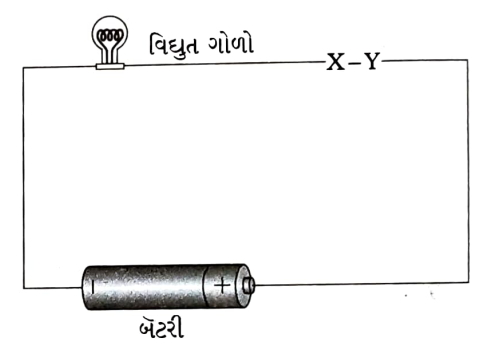
Sonika is working with the circuit shown in the figure. There are two open terminals in the circuit: $X$ and $Y$. She has wires made of five different materials: $I, II, III, IV,$ and $V$. She knows that the electric bulb will glow only when wires made of conducting materials are connected across both open terminals. She records her observations in a table. After the experiment,ink spills on the paper,and she loses the information for the third row.
Based on the remaining information in the table,which materials could be in the third row?
| $S.No.$ | Material at $X$ | Material at $Y$ | Electric Bulb ($ON$/$OFF$) |
| $1$ | $I$ | $II$ | $OFF$ |
| $2$ | $I$ | $IV$ | $ON$ |
| $3$ | - | - | $OFF$ |
| $4$ | $III$ | $V$ | $ON$ |
Based on the remaining information in the table,which materials could be in the third row?
A
$II$ and $III$
B
$III$ and $IV$
C
$IV$ and $V$
D
$I$ and $III$
Solution
(A) $1$. Analyze the observations: The bulb glows $(ON)$ only if both materials connected at $X$ and $Y$ are conductors. If the bulb is $OFF$,it means at least one of the materials is an insulator.
$2$. From observation $2$,$I$ and $IV$ result in $ON$,so both $I$ and $IV$ are conductors.
$3$. From observation $4$,$III$ and $V$ result in $ON$,so both $III$ and $V$ are conductors.
$4$. From observation $1$,$I$ and $II$ result in $OFF$. Since $I$ is a conductor,$II$ must be an insulator.
$5$. For the third row,the bulb is $OFF$. This means at least one of the materials must be an insulator. Since $II$ is the only identified insulator,the pair must contain $II$.
$6$. Looking at the options,option $A$ ($II$ and $III$) contains $II$,which is an insulator. Therefore,the bulb will remain $OFF$.
$2$. From observation $2$,$I$ and $IV$ result in $ON$,so both $I$ and $IV$ are conductors.
$3$. From observation $4$,$III$ and $V$ result in $ON$,so both $III$ and $V$ are conductors.
$4$. From observation $1$,$I$ and $II$ result in $OFF$. Since $I$ is a conductor,$II$ must be an insulator.
$5$. For the third row,the bulb is $OFF$. This means at least one of the materials must be an insulator. Since $II$ is the only identified insulator,the pair must contain $II$.
$6$. Looking at the options,option $A$ ($II$ and $III$) contains $II$,which is an insulator. Therefore,the bulb will remain $OFF$.
0 likes
View SolutionElectricity — Mix Examples - Electricity · Frequently Asked Questions
1Are these Electricity questions useful for JEE and NEET?
Yes. All questions in this section are mapped to JEE Main and NEET exam patterns. Previous year questions from JEE Main, NEET, GUJCET and state-level exams are included with full solutions.
2Can I switch to Hindi or Gujarati for these questions?
Yes. Use the language tabs in the hero section or the sidebar to view the same questions and solutions in English, Hindi or Gujarati.
3How do I generate a question paper from this subtopic?
Use the Vedclass Exam Paper Generator — select the chapter and subtopic, set difficulty, and generate Sets A, B, C, D automatically. First 3 chapters of every subject are free.
Vedclass Products
For Students
Vedclass Test Series
Mock tests in real JEE/NEET style with performance analysis. 5-day free trial.
Start Free TrialFor Teachers
Exam Paper Generator
Generate Set A/B/C/D papers from this chapter in 2 minutes. 3 chapters free.
Try FreeFor Institutes
Online Exam Module
Live online exams with unlimited students, 360° analytics & white-label branding.
See DemoFor Teachers & Institutes
Generate a Electricity Exam Paper in 2 Minutes
Select subtopic & difficulty — Sets A, B, C, D auto-generated with No Repeat logic.
First 3 chapters of every subject are free — no payment required.