
A English
Mix Examples - Pair of Linear Equations in Two Variables Questions in English
Class 10 Mathematics · Pair of Linear Equations in Two Variables · Mix Examples - Pair of Linear Equations in Two Variables
360+
Questions
English
Language
100%
With Solutions
Showing 50 of 360 questions in English
1
EasyMCQ
The pair of equations $5x - 15y = 8$ and $3x - 9y = \frac{24}{5}$ has
A
infinitely many solutions
B
two solutions
C
one solution
D
no solution
Solution
(A) Given equations are:
$5x - 15y = 8$ --- $(1)$
$3x - 9y = \frac{24}{5}$ --- $(2)$
Comparing these with the standard form $a_1x + b_1y = c_1$ and $a_2x + b_2y = c_2$:
$a_1 = 5, b_1 = -15, c_1 = 8$
$a_2 = 3, b_2 = -9, c_2 = \frac{24}{5}$
Now,calculate the ratios:
$\frac{a_1}{a_2} = \frac{5}{3}$
$\frac{b_1}{b_2} = \frac{-15}{-9} = \frac{5}{3}$
$\frac{c_1}{c_2} = \frac{8}{24/5} = \frac{8 \times 5}{24} = \frac{40}{24} = \frac{5}{3}$
Since $\frac{a_1}{a_2} = \frac{b_1}{b_2} = \frac{c_1}{c_2} = \frac{5}{3}$,the lines are coincident.
Therefore,the pair of equations has infinitely many solutions.
$5x - 15y = 8$ --- $(1)$
$3x - 9y = \frac{24}{5}$ --- $(2)$
Comparing these with the standard form $a_1x + b_1y = c_1$ and $a_2x + b_2y = c_2$:
$a_1 = 5, b_1 = -15, c_1 = 8$
$a_2 = 3, b_2 = -9, c_2 = \frac{24}{5}$
Now,calculate the ratios:
$\frac{a_1}{a_2} = \frac{5}{3}$
$\frac{b_1}{b_2} = \frac{-15}{-9} = \frac{5}{3}$
$\frac{c_1}{c_2} = \frac{8}{24/5} = \frac{8 \times 5}{24} = \frac{40}{24} = \frac{5}{3}$
Since $\frac{a_1}{a_2} = \frac{b_1}{b_2} = \frac{c_1}{c_2} = \frac{5}{3}$,the lines are coincident.
Therefore,the pair of equations has infinitely many solutions.
0 likes
View Solution2
MediumMCQ
The sum of the digits of a two-digit number is $9$. If $27$ is added to it,the digits of the number get reversed. The number is
A
$25$
B
$36$
C
$63$
D
$72$
Solution
(B) Let the tens digit be $x$ and the units digit be $y$. The number is $10x + y$.
According to the problem,the sum of the digits is $x + y = 9$ (Equation $1$).
When $27$ is added to the number,the digits are reversed,so the new number is $10y + x$.
Thus,$(10x + y) + 27 = 10y + x$.
Rearranging the terms: $10x - x + y - 10y = -27$,which simplifies to $9x - 9y = -27$.
Dividing by $9$,we get $x - y = -3$ (Equation $2$).
Adding Equation $1$ and Equation $2$: $(x + y) + (x - y) = 9 + (-3)$,which gives $2x = 6$,so $x = 3$.
Substituting $x = 3$ into Equation $1$: $3 + y = 9$,so $y = 6$.
The number is $10(3) + 6 = 36$.
According to the problem,the sum of the digits is $x + y = 9$ (Equation $1$).
When $27$ is added to the number,the digits are reversed,so the new number is $10y + x$.
Thus,$(10x + y) + 27 = 10y + x$.
Rearranging the terms: $10x - x + y - 10y = -27$,which simplifies to $9x - 9y = -27$.
Dividing by $9$,we get $x - y = -3$ (Equation $2$).
Adding Equation $1$ and Equation $2$: $(x + y) + (x - y) = 9 + (-3)$,which gives $2x = 6$,so $x = 3$.
Substituting $x = 3$ into Equation $1$: $3 + y = 9$,so $y = 6$.
The number is $10(3) + 6 = 36$.
0 likes
View Solution3
MediumMCQ
Graphically,the pair of equations $6x - 3y + 10 = 0$ and $2x - y + 9 = 0$ represents two lines which are:
A
intersecting at exactly one point.
B
intersecting at exactly two points.
C
parallel.
D
coincident.
Solution
(C) The given equations are:
$6x - 3y + 10 = 0$ ... $(1)$
$2x - y + 9 = 0$ ... $(2)$
Comparing these with the general form $a_1x + b_1y + c_1 = 0$ and $a_2x + b_2y + c_2 = 0$,we have:
$a_1 = 6, b_1 = -3, c_1 = 10$
$a_2 = 2, b_2 = -1, c_2 = 9$
Now,calculate the ratios:
$\frac{a_1}{a_2} = \frac{6}{2} = 3$
$\frac{b_1}{b_2} = \frac{-3}{-1} = 3$
$\frac{c_1}{c_2} = \frac{10}{9}$
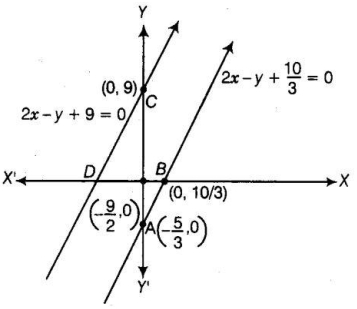
Since $\frac{a_1}{a_2} = \frac{b_1}{b_2} \neq \frac{c_1}{c_2}$,the lines are parallel to each other and do not intersect.
$6x - 3y + 10 = 0$ ... $(1)$
$2x - y + 9 = 0$ ... $(2)$
Comparing these with the general form $a_1x + b_1y + c_1 = 0$ and $a_2x + b_2y + c_2 = 0$,we have:
$a_1 = 6, b_1 = -3, c_1 = 10$
$a_2 = 2, b_2 = -1, c_2 = 9$
Now,calculate the ratios:
$\frac{a_1}{a_2} = \frac{6}{2} = 3$
$\frac{b_1}{b_2} = \frac{-3}{-1} = 3$
$\frac{c_1}{c_2} = \frac{10}{9}$
Since $\frac{a_1}{a_2} = \frac{b_1}{b_2} \neq \frac{c_1}{c_2}$,the lines are parallel to each other and do not intersect.
0 likes
View Solution4
MediumMCQ
The pair of equations $x + 2y + 5 = 0$ and $-3x - 6y + 1 = 0$ have
A
a unique solution
B
exactly two solutions
C
infinitely many solutions
D
no solution
Solution
(D) Given,the equations are $x + 2y + 5 = 0$ and $-3x - 6y + 1 = 0$.
Comparing these with the standard form $a_1x + b_1y + c_1 = 0$ and $a_2x + b_2y + c_2 = 0$,we get:
$a_1 = 1, b_1 = 2, c_1 = 5$
$a_2 = -3, b_2 = -6, c_2 = 1$
Now,calculating the ratios:
$\frac{a_1}{a_2} = \frac{1}{-3} = -\frac{1}{3}$
$\frac{b_1}{b_2} = \frac{2}{-6} = -\frac{1}{3}$
$\frac{c_1}{c_2} = \frac{5}{1} = 5$
Since $\frac{a_1}{a_2} = \frac{b_1}{b_2} \neq \frac{c_1}{c_2}$,the lines represented by these equations are parallel.
Therefore,the pair of equations has no solution.
Comparing these with the standard form $a_1x + b_1y + c_1 = 0$ and $a_2x + b_2y + c_2 = 0$,we get:
$a_1 = 1, b_1 = 2, c_1 = 5$
$a_2 = -3, b_2 = -6, c_2 = 1$
Now,calculating the ratios:
$\frac{a_1}{a_2} = \frac{1}{-3} = -\frac{1}{3}$
$\frac{b_1}{b_2} = \frac{2}{-6} = -\frac{1}{3}$
$\frac{c_1}{c_2} = \frac{5}{1} = 5$
Since $\frac{a_1}{a_2} = \frac{b_1}{b_2} \neq \frac{c_1}{c_2}$,the lines represented by these equations are parallel.
Therefore,the pair of equations has no solution.
0 likes
View Solution5
MediumMCQ
If a pair of linear equations is consistent,then the lines will be
A
intersecting or coincident
B
always coincident
C
always intersecting
D
parallel
Solution
(A) pair of linear equations is said to be consistent if it has at least one solution.
$1$. If the lines intersect at a single point,the system has a unique solution,and the condition is $\frac{a_1}{a_2} \neq \frac{b_1}{b_2}$.
$2$. If the lines are coincident,the system has infinitely many solutions,and the condition is $\frac{a_1}{a_2} = \frac{b_1}{b_2} = \frac{c_1}{c_2}$.
Since both cases provide at least one solution,the lines are either intersecting or coincident.
$1$. If the lines intersect at a single point,the system has a unique solution,and the condition is $\frac{a_1}{a_2} \neq \frac{b_1}{b_2}$.
$2$. If the lines are coincident,the system has infinitely many solutions,and the condition is $\frac{a_1}{a_2} = \frac{b_1}{b_2} = \frac{c_1}{c_2}$.
Since both cases provide at least one solution,the lines are either intersecting or coincident.
0 likes
View Solution6
MediumMCQ
The pair of equations $y=0$ and $y=-7$ has
A
one solution
B
no solution
C
infinitely many solutions
D
two solutions
Solution
(B) The given pair of equations are $y=0$ and $y=-7$.
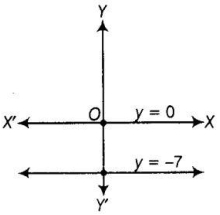
$y=0$ represents the $x$-axis.
$y=-7$ represents a line parallel to the $x$-axis at a distance of $7$ units below it.
Since both lines are parallel to each other,they will never intersect.
Therefore,the pair of equations has no solution.
$y=0$ represents the $x$-axis.
$y=-7$ represents a line parallel to the $x$-axis at a distance of $7$ units below it.
Since both lines are parallel to each other,they will never intersect.
Therefore,the pair of equations has no solution.
1 likes
View Solution7
MediumMCQ
The pair of equations $x=a$ and $y=b$ graphically represents lines which are
A
parallel
B
intersecting at $(b, a)$
C
intersecting at $(a, b)$
D
coincident
Solution
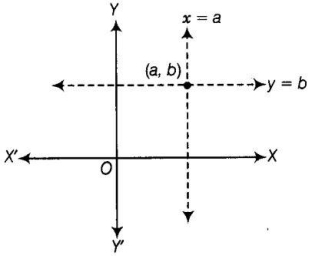
(C) The equation $x=a$ represents a vertical line parallel to the $y$-axis,passing through the point $(a, 0)$ on the $x$-axis.
The equation $y=b$ represents a horizontal line parallel to the $x$-axis,passing through the point $(0, b)$ on the $y$-axis.
When these two lines are plotted on the same Cartesian plane,the vertical line $x=a$ and the horizontal line $y=b$ intersect at exactly one point.
The $x$-coordinate of the intersection point is $a$ and the $y$-coordinate is $b$.
Therefore,the lines intersect at the point $(a, b)$.
The equation $y=b$ represents a horizontal line parallel to the $x$-axis,passing through the point $(0, b)$ on the $y$-axis.
When these two lines are plotted on the same Cartesian plane,the vertical line $x=a$ and the horizontal line $y=b$ intersect at exactly one point.
The $x$-coordinate of the intersection point is $a$ and the $y$-coordinate is $b$.
Therefore,the lines intersect at the point $(a, b)$.
0 likes
View Solution8
MediumMCQ
For what value of $k,$ do the equations $3x - y + 8 = 0$ and $6x - ky = -16$ represent coincident lines?
A
$1/2$
B
$-1/2$
C
$-2$
D
$2$
Solution
(D) The condition for two lines $a_1x + b_1y + c_1 = 0$ and $a_2x + b_2y + c_2 = 0$ to be coincident is $\frac{a_1}{a_2} = \frac{b_1}{b_2} = \frac{c_1}{c_2}$.
Given equations are $3x - y + 8 = 0$ and $6x - ky + 16 = 0$.
Comparing with the standard form,we have $a_1 = 3, b_1 = -1, c_1 = 8$ and $a_2 = 6, b_2 = -k, c_2 = 16$.
Substituting these values into the condition:
$\frac{3}{6} = \frac{-1}{-k} = \frac{8}{16}$.
Simplifying the ratios:
$\frac{1}{2} = \frac{1}{k} = \frac{1}{2}$.
From $\frac{1}{k} = \frac{1}{2}$,we get $k = 2$.
Given equations are $3x - y + 8 = 0$ and $6x - ky + 16 = 0$.
Comparing with the standard form,we have $a_1 = 3, b_1 = -1, c_1 = 8$ and $a_2 = 6, b_2 = -k, c_2 = 16$.
Substituting these values into the condition:
$\frac{3}{6} = \frac{-1}{-k} = \frac{8}{16}$.
Simplifying the ratios:
$\frac{1}{2} = \frac{1}{k} = \frac{1}{2}$.
From $\frac{1}{k} = \frac{1}{2}$,we get $k = 2$.
0 likes
View Solution9
MediumMCQ
If the lines given by $3x + 2ky = 2$ and $2x + 5y + 1 = 0$ are parallel,then the value of $k$ is
A
$\frac{15}{4}$
B
$\frac{3}{2}$
C
$\frac{2}{5}$
D
$\frac{-5}{4}$
Solution
(A) The condition for two lines $a_1x + b_1y + c_1 = 0$ and $a_2x + b_2y + c_2 = 0$ to be parallel is $\frac{a_1}{a_2} = \frac{b_1}{b_2} \neq \frac{c_1}{c_2}$.
Given the equations:
$3x + 2ky - 2 = 0$
$2x + 5y + 1 = 0$
Here,$a_1 = 3, b_1 = 2k, c_1 = -2$ and $a_2 = 2, b_2 = 5, c_2 = 1$.
For the lines to be parallel,we must have $\frac{a_1}{a_2} = \frac{b_1}{b_2}$.
Substituting the values,we get $\frac{3}{2} = \frac{2k}{5}$.
Cross-multiplying,we get $3 \times 5 = 2 \times 2k$,which implies $15 = 4k$.
Therefore,$k = \frac{15}{4}$.
Given the equations:
$3x + 2ky - 2 = 0$
$2x + 5y + 1 = 0$
Here,$a_1 = 3, b_1 = 2k, c_1 = -2$ and $a_2 = 2, b_2 = 5, c_2 = 1$.
For the lines to be parallel,we must have $\frac{a_1}{a_2} = \frac{b_1}{b_2}$.
Substituting the values,we get $\frac{3}{2} = \frac{2k}{5}$.
Cross-multiplying,we get $3 \times 5 = 2 \times 2k$,which implies $15 = 4k$.
Therefore,$k = \frac{15}{4}$.
0 likes
View Solution10
DifficultMCQ
The value of $c$ for which the pair of equations $cx - y = 2$ and $6x - 2y = 3$ will have infinitely many solutions is
A
$3$
B
no value
C
$-3$
D
$-12$
Solution
(B) The condition for a pair of linear equations $a_1x + b_1y + c_1 = 0$ and $a_2x + b_2y + c_2 = 0$ to have infinitely many solutions is $\frac{a_1}{a_2} = \frac{b_1}{b_2} = \frac{c_1}{c_2}$.
The given equations are $cx - y - 2 = 0$ and $6x - 2y - 3 = 0$.
Here,$a_1 = c, b_1 = -1, c_1 = -2$ and $a_2 = 6, b_2 = -2, c_2 = -3$.
Applying the condition: $\frac{c}{6} = \frac{-1}{-2} = \frac{-2}{-3}$.
This simplifies to $\frac{c}{6} = \frac{1}{2} = \frac{2}{3}$.
Since $\frac{1}{2} \neq \frac{2}{3}$,there is no value of $c$ that satisfies both equalities simultaneously.
Therefore,the pair of equations will have no value of $c$ for which they have infinitely many solutions.
The given equations are $cx - y - 2 = 0$ and $6x - 2y - 3 = 0$.
Here,$a_1 = c, b_1 = -1, c_1 = -2$ and $a_2 = 6, b_2 = -2, c_2 = -3$.
Applying the condition: $\frac{c}{6} = \frac{-1}{-2} = \frac{-2}{-3}$.
This simplifies to $\frac{c}{6} = \frac{1}{2} = \frac{2}{3}$.
Since $\frac{1}{2} \neq \frac{2}{3}$,there is no value of $c$ that satisfies both equalities simultaneously.
Therefore,the pair of equations will have no value of $c$ for which they have infinitely many solutions.
0 likes
View Solution11
DifficultMCQ
One equation of a pair of dependent linear equations is $-5x + 7y = 2$. The second equation can be
A
$10x + 14y + 4 = 0$
B
$-10x - 14y + 4 = 0$
C
$10x - 14y = -4$
D
$-10x + 14y + 4 = 0$
Solution
(C) For a pair of linear equations to be dependent,they must represent the same line,meaning their coefficients must be proportional: $\frac{a_1}{a_2} = \frac{b_1}{b_2} = \frac{c_1}{c_2} = k$.
Given equation: $-5x + 7y - 2 = 0$.
Comparing with $a_1x + b_1y + c_1 = 0$,we have $a_1 = -5, b_1 = 7, c_1 = -2$.
For the second equation,we multiply the given equation by a constant $k$. Let $k = 2$:
$2(-5x + 7y - 2) = 2(0)$
$-10x + 14y - 4 = 0$
Rearranging this,we get $10x - 14y + 4 = 0$.
Comparing this with option $(C)$: $10x - 14y = -4$ is equivalent to $10x - 14y + 4 = 0$.
Given equation: $-5x + 7y - 2 = 0$.
Comparing with $a_1x + b_1y + c_1 = 0$,we have $a_1 = -5, b_1 = 7, c_1 = -2$.
For the second equation,we multiply the given equation by a constant $k$. Let $k = 2$:
$2(-5x + 7y - 2) = 2(0)$
$-10x + 14y - 4 = 0$
Rearranging this,we get $10x - 14y + 4 = 0$.
Comparing this with option $(C)$: $10x - 14y = -4$ is equivalent to $10x - 14y + 4 = 0$.
0 likes
View Solution12
MediumMCQ
$A$ pair of linear equations which has a unique solution $x=2, y=-3$ is
A
$x+y=1$ and $2x-3y=-5$
B
$2x-y=1$ and $3x+2y=0$
C
$x-4y-14=0$ and $5x-y-13=0$
D
$2x+5y=-11$ and $4x+10y=-22$
Solution
(C) For a pair of linear equations to have a unique solution $(x=2, y=-3)$,these values must satisfy both equations in the pair.
Let us check the options:
Option $(A): x+y=1 \implies 2+(-3) = -1 \neq 1$. (Incorrect)
Option $(B): 2x-y=1 \implies 2(2)-(-3) = 4+3 = 7 \neq 1$. (Incorrect)
Option $(C): x-4y-14=0 \implies 2-4(-3)-14 = 2+12-14 = 0$. (Satisfied)
$5x-y-13=0 \implies 5(2)-(-3)-13 = 10+3-13 = 0$. (Satisfied)
Since both equations in option $(C)$ are satisfied by $(x=2, y=-3)$ and the lines are not coincident (slopes are $1/4$ and $5$),the solution is unique.
Note: Option $(D)$ represents coincident lines ($4x+10y=-22$ is $2$ times $2x+5y=-11$),which have infinitely many solutions,not a unique one.
Let us check the options:
Option $(A): x+y=1 \implies 2+(-3) = -1 \neq 1$. (Incorrect)
Option $(B): 2x-y=1 \implies 2(2)-(-3) = 4+3 = 7 \neq 1$. (Incorrect)
Option $(C): x-4y-14=0 \implies 2-4(-3)-14 = 2+12-14 = 0$. (Satisfied)
$5x-y-13=0 \implies 5(2)-(-3)-13 = 10+3-13 = 0$. (Satisfied)
Since both equations in option $(C)$ are satisfied by $(x=2, y=-3)$ and the lines are not coincident (slopes are $1/4$ and $5$),the solution is unique.
Note: Option $(D)$ represents coincident lines ($4x+10y=-22$ is $2$ times $2x+5y=-11$),which have infinitely many solutions,not a unique one.
0 likes
View Solution13
MediumMCQ
If $x=a$ and $y=b$ is the solution of the equations $x-y=2$ and $x+y=4,$ then the values of $a$ and $b$ are,respectively:
A
$3$ and $1$
B
$3$ and $5$
C
$5$ and $3$
D
$-1$ and $-3$
Solution
(A) Given that $(x=a, y=b)$ is the solution of the system of linear equations:
$x-y=2$ $\cdots$ $(i)$
$x+y=4$ $\cdots$ $(ii)$
Since $(a, b)$ satisfies both equations,we substitute $x=a$ and $y=b$ into the equations:
$a-b=2$ $\cdots$ $(iii)$
$a+b=4$ $\cdots$ $(iv)$
Adding equations $(iii)$ and $(iv)$:
$(a-b) + (a+b) = 2 + 4$
$2a = 6$
$a = 3$
Substituting $a=3$ into equation $(iv)$:
$3 + b = 4$
$b = 4 - 3$
$b = 1$
Thus,the values of $a$ and $b$ are $3$ and $1$ respectively.
$x-y=2$ $\cdots$ $(i)$
$x+y=4$ $\cdots$ $(ii)$
Since $(a, b)$ satisfies both equations,we substitute $x=a$ and $y=b$ into the equations:
$a-b=2$ $\cdots$ $(iii)$
$a+b=4$ $\cdots$ $(iv)$
Adding equations $(iii)$ and $(iv)$:
$(a-b) + (a+b) = 2 + 4$
$2a = 6$
$a = 3$
Substituting $a=3$ into equation $(iv)$:
$3 + b = 4$
$b = 4 - 3$
$b = 1$
Thus,the values of $a$ and $b$ are $3$ and $1$ respectively.
0 likes
View Solution14
MediumMCQ
Aruna has only $Rs. 1$ and $Rs. 2$ coins with her. If the total number of coins that she has is $50$ and the amount of money with her is $Rs. 75$,then the number of $Rs. 1$ and $Rs. 2$ coins are,respectively
A
$35$ and $15$
B
$25$ and $25$
C
$35$ and $20$
D
$15$ and $35$
Solution
(B) Let the number of $Rs. 1$ coins be $x$ and the number of $Rs. 2$ coins be $y$.
According to the problem,the total number of coins is $50$,so $x + y = 50$ (Equation $i$).
The total value of the money is $Rs. 75$,so $1x + 2y = 75$ (Equation $ii$).
Subtracting Equation $i$ from Equation $ii$:
$(x + 2y) - (x + y) = 75 - 50$
$y = 25$.
Substituting $y = 25$ into Equation $i$:
$x + 25 = 50$
$x = 25$.
Therefore,the number of $Rs. 1$ coins is $25$ and the number of $Rs. 2$ coins is $25$.
According to the problem,the total number of coins is $50$,so $x + y = 50$ (Equation $i$).
The total value of the money is $Rs. 75$,so $1x + 2y = 75$ (Equation $ii$).
Subtracting Equation $i$ from Equation $ii$:
$(x + 2y) - (x + y) = 75 - 50$
$y = 25$.
Substituting $y = 25$ into Equation $i$:
$x + 25 = 50$
$x = 25$.
Therefore,the number of $Rs. 1$ coins is $25$ and the number of $Rs. 2$ coins is $25$.
0 likes
View Solution15
MediumMCQ
The father's age is six times his son's age. Four years hence,the age of the father will be four times his son's age. The present ages,in years,of the son and the father are,respectively
A
$4$ and $24$
B
$5$ and $30$
C
$6$ and $36$
D
$3$ and $24$
Solution
(C) Let $x$ be the present age of the father and $y$ be the present age of the son in years.
According to the first condition,the father's age is six times the son's age:
$x = 6y$ --- $(i)$
According to the second condition,four years hence,the father's age will be four times the son's age:
$(x + 4) = 4(y + 4)$
$x + 4 = 4y + 16$
$x - 4y = 12$ --- $(ii)$
Substituting the value of $x$ from $(i)$ into $(ii)$:
$6y - 4y = 12$
$2y = 12$
$y = 6$
Now,substituting $y = 6$ into $(i)$:
$x = 6(6) = 36$
Therefore,the present age of the son is $6$ years and the present age of the father is $36$ years.
According to the first condition,the father's age is six times the son's age:
$x = 6y$ --- $(i)$
According to the second condition,four years hence,the father's age will be four times the son's age:
$(x + 4) = 4(y + 4)$
$x + 4 = 4y + 16$
$x - 4y = 12$ --- $(ii)$
Substituting the value of $x$ from $(i)$ into $(ii)$:
$6y - 4y = 12$
$2y = 12$
$y = 6$
Now,substituting $y = 6$ into $(i)$:
$x = 6(6) = 36$
Therefore,the present age of the son is $6$ years and the present age of the father is $36$ years.
0 likes
View Solution16
Medium
Is it true to say that the pair of equations $-x + 2y + 2 = 0$ and $\frac{1}{2}x - \frac{1}{4}y - 1 = 0$ has a unique solution? Justify your answer.
Solution
(A) Yes,it is true.
Given equations are:
$1) -x + 2y + 2 = 0$
$2) \frac{1}{2}x - \frac{1}{4}y - 1 = 0$
Comparing these with the standard form $a_1x + b_1y + c_1 = 0$ and $a_2x + b_2y + c_2 = 0$:
$a_1 = -1, b_1 = 2, c_1 = 2$
$a_2 = \frac{1}{2}, b_2 = -\frac{1}{4}, c_2 = -1$
Now,calculate the ratios:
$\frac{a_1}{a_2} = \frac{-1}{1/2} = -2$
$\frac{b_1}{b_2} = \frac{2}{-1/4} = -8$
Since $\frac{a_1}{a_2} \neq \frac{b_1}{b_2}$ (i.e.,$-2 \neq -8$),the pair of linear equations has a unique solution.
Given equations are:
$1) -x + 2y + 2 = 0$
$2) \frac{1}{2}x - \frac{1}{4}y - 1 = 0$
Comparing these with the standard form $a_1x + b_1y + c_1 = 0$ and $a_2x + b_2y + c_2 = 0$:
$a_1 = -1, b_1 = 2, c_1 = 2$
$a_2 = \frac{1}{2}, b_2 = -\frac{1}{4}, c_2 = -1$
Now,calculate the ratios:
$\frac{a_1}{a_2} = \frac{-1}{1/2} = -2$
$\frac{b_1}{b_2} = \frac{2}{-1/4} = -8$
Since $\frac{a_1}{a_2} \neq \frac{b_1}{b_2}$ (i.e.,$-2 \neq -8$),the pair of linear equations has a unique solution.
0 likes
View Solution17
MediumMCQ
Do the equations $4x + 3y - 1 = 5$ and $12x + 9y = 15$ represent a pair of coincident lines? Justify your answer.
A
Yes
B
No
C
Cannot be determined
D
They are parallel lines
Solution
(B) Given equations are:
$4x + 3y - 1 = 5 \implies 4x + 3y = 6$
$12x + 9y = 15$
Comparing these with the standard form $a_1x + b_1y = c_1$ and $a_2x + b_2y = c_2$:
$a_1 = 4, b_1 = 3, c_1 = 6$
$a_2 = 12, b_2 = 9, c_2 = 15$
Calculating the ratios:
$\frac{a_1}{a_2} = \frac{4}{12} = \frac{1}{3}$
$\frac{b_1}{b_2} = \frac{3}{9} = \frac{1}{3}$
$\frac{c_1}{c_2} = \frac{6}{15} = \frac{2}{5}$
Since $\frac{a_1}{a_2} = \frac{b_1}{b_2} \neq \frac{c_1}{c_2}$,the lines are parallel and not coincident. Therefore,the answer is No.
$4x + 3y - 1 = 5 \implies 4x + 3y = 6$
$12x + 9y = 15$
Comparing these with the standard form $a_1x + b_1y = c_1$ and $a_2x + b_2y = c_2$:
$a_1 = 4, b_1 = 3, c_1 = 6$
$a_2 = 12, b_2 = 9, c_2 = 15$
Calculating the ratios:
$\frac{a_1}{a_2} = \frac{4}{12} = \frac{1}{3}$
$\frac{b_1}{b_2} = \frac{3}{9} = \frac{1}{3}$
$\frac{c_1}{c_2} = \frac{6}{15} = \frac{2}{5}$
Since $\frac{a_1}{a_2} = \frac{b_1}{b_2} \neq \frac{c_1}{c_2}$,the lines are parallel and not coincident. Therefore,the answer is No.
0 likes
View Solution18
MediumMCQ
Is the pair of equations $x+2y-3=0$ and $6y+3x-9=0$ consistent? Justify your answer.
A
Yes,they are consistent.
B
No,they are inconsistent.
C
Yes,they are inconsistent.
D
No,they are consistent.
Solution
(A) Given equations are $x+2y-3=0$ and $3x+6y-9=0$.
Comparing these with the standard form $a_1x+b_1y+c_1=0$ and $a_2x+b_2y+c_2=0$,we get:
$a_1=1, b_1=2, c_1=-3$
$a_2=3, b_2=6, c_2=-9$
Now,calculating the ratios:
$\frac{a_1}{a_2} = \frac{1}{3}$
$\frac{b_1}{b_2} = \frac{2}{6} = \frac{1}{3}$
$\frac{c_1}{c_2} = \frac{-3}{-9} = \frac{1}{3}$
Since $\frac{a_1}{a_2} = \frac{b_1}{b_2} = \frac{c_1}{c_2}$,the lines are coincident.
Therefore,the pair of equations has infinitely many solutions and is consistent.
Comparing these with the standard form $a_1x+b_1y+c_1=0$ and $a_2x+b_2y+c_2=0$,we get:
$a_1=1, b_1=2, c_1=-3$
$a_2=3, b_2=6, c_2=-9$
Now,calculating the ratios:
$\frac{a_1}{a_2} = \frac{1}{3}$
$\frac{b_1}{b_2} = \frac{2}{6} = \frac{1}{3}$
$\frac{c_1}{c_2} = \frac{-3}{-9} = \frac{1}{3}$
Since $\frac{a_1}{a_2} = \frac{b_1}{b_2} = \frac{c_1}{c_2}$,the lines are coincident.
Therefore,the pair of equations has infinitely many solutions and is consistent.
0 likes
View Solution19
Medium
Do the following pair of linear equations have no solution? Justify your answer.
$2x + 4y = 3$
$x = 2y$
$2x + 4y = 3$
$x = 2y$
Solution
(B) The condition for a pair of linear equations to have no solution is $\frac{a_1}{a_2} = \frac{b_1}{b_2} \neq \frac{c_1}{c_2}$.
Given equations are:
$2x + 4y - 3 = 0$
$x - 2y = 0$
Here,$a_1 = 2, b_1 = 4, c_1 = -3$ and $a_2 = 1, b_2 = -2, c_2 = 0$.
Calculating the ratios:
$\frac{a_1}{a_2} = \frac{2}{1} = 2$
$\frac{b_1}{b_2} = \frac{4}{-2} = -2$
Since $\frac{a_1}{a_2} \neq \frac{b_1}{b_2}$ $(2 \neq -2)$,the lines intersect at a unique point.
Therefore,the given pair of linear equations has a unique solution,not 'no solution'.
Given equations are:
$2x + 4y - 3 = 0$
$x - 2y = 0$
Here,$a_1 = 2, b_1 = 4, c_1 = -3$ and $a_2 = 1, b_2 = -2, c_2 = 0$.
Calculating the ratios:
$\frac{a_1}{a_2} = \frac{2}{1} = 2$
$\frac{b_1}{b_2} = \frac{4}{-2} = -2$
Since $\frac{a_1}{a_2} \neq \frac{b_1}{b_2}$ $(2 \neq -2)$,the lines intersect at a unique point.
Therefore,the given pair of linear equations has a unique solution,not 'no solution'.
0 likes
View Solution20
Medium
Do the following pair of linear equations have no solution? Justify your answer.
$y + 6x = 6$ and $y = 2x$
$y + 6x = 6$ and $y = 2x$
Solution
(B) The condition for a pair of linear equations $a_1x + b_1y + c_1 = 0$ and $a_2x + b_2y + c_2 = 0$ to have no solution is $\frac{a_1}{a_2} = \frac{b_1}{b_2} \neq \frac{c_1}{c_2}$.
Given equations are:
$6x + y - 6 = 0$ --- $(i)$
$2x - y = 0$ --- $(ii)$
Here,$a_1 = 6, b_1 = 1, c_1 = -6$ and $a_2 = 2, b_2 = -1, c_2 = 0$.
Calculating the ratios:
$\frac{a_1}{a_2} = \frac{6}{2} = 3$
$\frac{b_1}{b_2} = \frac{1}{-1} = -1$
Since $\frac{a_1}{a_2} \neq \frac{b_1}{b_2}$ $(3 \neq -1)$,the lines intersect at a single point.
Therefore,the given pair of linear equations has a unique solution,not 'no solution'.
Given equations are:
$6x + y - 6 = 0$ --- $(i)$
$2x - y = 0$ --- $(ii)$
Here,$a_1 = 6, b_1 = 1, c_1 = -6$ and $a_2 = 2, b_2 = -1, c_2 = 0$.
Calculating the ratios:
$\frac{a_1}{a_2} = \frac{6}{2} = 3$
$\frac{b_1}{b_2} = \frac{1}{-1} = -1$
Since $\frac{a_1}{a_2} \neq \frac{b_1}{b_2}$ $(3 \neq -1)$,the lines intersect at a single point.
Therefore,the given pair of linear equations has a unique solution,not 'no solution'.
0 likes
View Solution21
Medium
Do the following pair of linear equations have no solution? Justify your answer.
$3x + y - 3 = 0$
$2x + \frac{2}{3}y = 2$
$3x + y - 3 = 0$
$2x + \frac{2}{3}y = 2$
Solution
(B) No,the given pair of equations is:
$3x + y - 3 = 0$ and $2x + \frac{2}{3}y - 2 = 0$
Here,the coefficients are:
$a_1 = 3, b_1 = 1, c_1 = -3$
$a_2 = 2, b_2 = \frac{2}{3}, c_2 = -2$
Calculating the ratios:
$\frac{a_1}{a_2} = \frac{3}{2}$
$\frac{b_1}{b_2} = \frac{1}{2/3} = \frac{3}{2}$
$\frac{c_1}{c_2} = \frac{-3}{-2} = \frac{3}{2}$
Since $\frac{a_1}{a_2} = \frac{b_1}{b_2} = \frac{c_1}{c_2} = \frac{3}{2}$,the lines are coincident.
Therefore,the given pair of linear equations has infinitely many solutions,not no solution.
$3x + y - 3 = 0$ and $2x + \frac{2}{3}y - 2 = 0$
Here,the coefficients are:
$a_1 = 3, b_1 = 1, c_1 = -3$
$a_2 = 2, b_2 = \frac{2}{3}, c_2 = -2$
Calculating the ratios:
$\frac{a_1}{a_2} = \frac{3}{2}$
$\frac{b_1}{b_2} = \frac{1}{2/3} = \frac{3}{2}$
$\frac{c_1}{c_2} = \frac{-3}{-2} = \frac{3}{2}$
Since $\frac{a_1}{a_2} = \frac{b_1}{b_2} = \frac{c_1}{c_2} = \frac{3}{2}$,the lines are coincident.
Therefore,the given pair of linear equations has infinitely many solutions,not no solution.
0 likes
View Solution22
Medium
Do the following equations represent a pair of coincident lines? Justify your answer.
$3x + \frac{1}{7}y = 3$
$7x + 3y = 7$
$3x + \frac{1}{7}y = 3$
$7x + 3y = 7$
Solution
(B) The condition for two lines to be coincident is $\frac{a_1}{a_2} = \frac{b_1}{b_2} = \frac{c_1}{c_2}$.
Given the pair of linear equations:
$3x + \frac{1}{7}y - 3 = 0$
$7x + 3y - 7 = 0$
Here,the coefficients are:
$a_1 = 3, b_1 = \frac{1}{7}, c_1 = -3$
$a_2 = 7, b_2 = 3, c_2 = -7$
Calculating the ratios:
$\frac{a_1}{a_2} = \frac{3}{7}$
$\frac{b_1}{b_2} = \frac{1/7}{3} = \frac{1}{21}$
$\frac{c_1}{c_2} = \frac{-3}{-7} = \frac{3}{7}$
Since $\frac{a_1}{a_2} \neq \frac{b_1}{b_2}$,the lines are not coincident. They intersect at a unique point.
Given the pair of linear equations:
$3x + \frac{1}{7}y - 3 = 0$
$7x + 3y - 7 = 0$
Here,the coefficients are:
$a_1 = 3, b_1 = \frac{1}{7}, c_1 = -3$
$a_2 = 7, b_2 = 3, c_2 = -7$
Calculating the ratios:
$\frac{a_1}{a_2} = \frac{3}{7}$
$\frac{b_1}{b_2} = \frac{1/7}{3} = \frac{1}{21}$
$\frac{c_1}{c_2} = \frac{-3}{-7} = \frac{3}{7}$
Since $\frac{a_1}{a_2} \neq \frac{b_1}{b_2}$,the lines are not coincident. They intersect at a unique point.
0 likes
View Solution23
Medium
Do the following equations represent a pair of coincident lines? Justify your answer.
$-2x - 3y = 1$
$6y + 4x = -2$
$-2x - 3y = 1$
$6y + 4x = -2$
Solution
(A) The condition for two lines to be coincident is given by the ratio of their coefficients:
$\frac{a_1}{a_2} = \frac{b_1}{b_2} = \frac{c_1}{c_2}$
First,rewrite the given equations in the standard form $ax + by + c = 0$:
$1) -2x - 3y - 1 = 0$
$2) 4x + 6y + 2 = 0$
Here,the coefficients are:
$a_1 = -2, b_1 = -3, c_1 = -1$
$a_2 = 4, b_2 = 6, c_2 = 2$
Now,calculate the ratios:
$\frac{a_1}{a_2} = \frac{-2}{4} = -\frac{1}{2}$
$\frac{b_1}{b_2} = \frac{-3}{6} = -\frac{1}{2}$
$\frac{c_1}{c_2} = \frac{-1}{2} = -\frac{1}{2}$
Since $\frac{a_1}{a_2} = \frac{b_1}{b_2} = \frac{c_1}{c_2} = -\frac{1}{2}$,the given pair of linear equations represents coincident lines.
$\frac{a_1}{a_2} = \frac{b_1}{b_2} = \frac{c_1}{c_2}$
First,rewrite the given equations in the standard form $ax + by + c = 0$:
$1) -2x - 3y - 1 = 0$
$2) 4x + 6y + 2 = 0$
Here,the coefficients are:
$a_1 = -2, b_1 = -3, c_1 = -1$
$a_2 = 4, b_2 = 6, c_2 = 2$
Now,calculate the ratios:
$\frac{a_1}{a_2} = \frac{-2}{4} = -\frac{1}{2}$
$\frac{b_1}{b_2} = \frac{-3}{6} = -\frac{1}{2}$
$\frac{c_1}{c_2} = \frac{-1}{2} = -\frac{1}{2}$
Since $\frac{a_1}{a_2} = \frac{b_1}{b_2} = \frac{c_1}{c_2} = -\frac{1}{2}$,the given pair of linear equations represents coincident lines.
0 likes
View Solution24
Medium
Do the following equations represent a pair of coincident lines? Justify your answer.
$\frac{x}{2} + y + \frac{2}{5} = 0$
$4x + 8y + \frac{5}{16} = 0$
$\frac{x}{2} + y + \frac{2}{5} = 0$
$4x + 8y + \frac{5}{16} = 0$
Solution
(N/A) The condition for two lines $a_1x + b_1y + c_1 = 0$ and $a_2x + b_2y + c_2 = 0$ to be coincident is $\frac{a_1}{a_2} = \frac{b_1}{b_2} = \frac{c_1}{c_2}$.
Given equations are:
$1) \frac{1}{2}x + 1y + \frac{2}{5} = 0$
$2) 4x + 8y + \frac{5}{16} = 0$
Here,$a_1 = \frac{1}{2}, b_1 = 1, c_1 = \frac{2}{5}$ and $a_2 = 4, b_2 = 8, c_2 = \frac{5}{16}$.
Calculating the ratios:
$\frac{a_1}{a_2} = \frac{1/2}{4} = \frac{1}{8}$
$\frac{b_1}{b_2} = \frac{1}{8}$
$\frac{c_1}{c_2} = \frac{2/5}{5/16} = \frac{2}{5} \times \frac{16}{5} = \frac{32}{25}$
Since $\frac{a_1}{a_2} = \frac{b_1}{b_2} \neq \frac{c_1}{c_2}$,the lines are parallel and not coincident. Therefore,the given equations do not represent a pair of coincident lines.
Given equations are:
$1) \frac{1}{2}x + 1y + \frac{2}{5} = 0$
$2) 4x + 8y + \frac{5}{16} = 0$
Here,$a_1 = \frac{1}{2}, b_1 = 1, c_1 = \frac{2}{5}$ and $a_2 = 4, b_2 = 8, c_2 = \frac{5}{16}$.
Calculating the ratios:
$\frac{a_1}{a_2} = \frac{1/2}{4} = \frac{1}{8}$
$\frac{b_1}{b_2} = \frac{1}{8}$
$\frac{c_1}{c_2} = \frac{2/5}{5/16} = \frac{2}{5} \times \frac{16}{5} = \frac{32}{25}$
Since $\frac{a_1}{a_2} = \frac{b_1}{b_2} \neq \frac{c_1}{c_2}$,the lines are parallel and not coincident. Therefore,the given equations do not represent a pair of coincident lines.
0 likes
View Solution25
MediumMCQ
Are the following pair of linear equations consistent? Justify your answer.
$-3x - 4y = 12$
$3x + 4y = 12$
$-3x - 4y = 12$
$3x + 4y = 12$
A
Yes,they are consistent.
B
No,they are inconsistent.
C
Yes,they have infinitely many solutions.
D
Yes,they have a unique solution.
Solution
(B) pair of linear equations is consistent if it has at least one solution. This occurs when:
$1$. $\frac{a_1}{a_2} \neq \frac{b_1}{b_2}$ (Unique solution)
$2$. $\frac{a_1}{a_2} = \frac{b_1}{b_2} = \frac{c_1}{c_2}$ (Infinitely many solutions)
Given equations:
$-3x - 4y - 12 = 0$
$3x + 4y - 12 = 0$
Here,$a_1 = -3, b_1 = -4, c_1 = -12$ and $a_2 = 3, b_2 = 4, c_2 = -12$.
Calculating the ratios:
$\frac{a_1}{a_2} = \frac{-3}{3} = -1$
$\frac{b_1}{b_2} = \frac{-4}{4} = -1$
$\frac{c_1}{c_2} = \frac{-12}{-12} = 1$
Since $\frac{a_1}{a_2} = \frac{b_1}{b_2} \neq \frac{c_1}{c_2}$,the lines are parallel and do not intersect.
Therefore,the pair of linear equations is inconsistent.
$1$. $\frac{a_1}{a_2} \neq \frac{b_1}{b_2}$ (Unique solution)
$2$. $\frac{a_1}{a_2} = \frac{b_1}{b_2} = \frac{c_1}{c_2}$ (Infinitely many solutions)
Given equations:
$-3x - 4y - 12 = 0$
$3x + 4y - 12 = 0$
Here,$a_1 = -3, b_1 = -4, c_1 = -12$ and $a_2 = 3, b_2 = 4, c_2 = -12$.
Calculating the ratios:
$\frac{a_1}{a_2} = \frac{-3}{3} = -1$
$\frac{b_1}{b_2} = \frac{-4}{4} = -1$
$\frac{c_1}{c_2} = \frac{-12}{-12} = 1$
Since $\frac{a_1}{a_2} = \frac{b_1}{b_2} \neq \frac{c_1}{c_2}$,the lines are parallel and do not intersect.
Therefore,the pair of linear equations is inconsistent.
0 likes
View Solution26
Medium
Are the following pair of linear equations consistent? Justify your answer.
$\frac{3}{5} x - y = \frac{1}{2}$
$\frac{1}{5} x - 3 y = \frac{1}{6}$
$\frac{3}{5} x - y = \frac{1}{2}$
$\frac{1}{5} x - 3 y = \frac{1}{6}$
Solution
(A) pair of linear equations is consistent if it has at least one solution. The conditions are:
$1$. $\frac{a_1}{a_2} \neq \frac{b_1}{b_2}$ (Unique solution)
$2$. $\frac{a_1}{a_2} = \frac{b_1}{b_2} = \frac{c_1}{c_2}$ (Infinitely many solutions)
Given equations:
$Eq_1: \frac{3}{5} x - y - \frac{1}{2} = 0$
$Eq_2: \frac{1}{5} x - 3 y - \frac{1}{6} = 0$
Comparing with $a_1 x + b_1 y + c_1 = 0$ and $a_2 x + b_2 y + c_2 = 0$:
$a_1 = \frac{3}{5}, b_1 = -1, c_1 = -\frac{1}{2}$
$a_2 = \frac{1}{5}, b_2 = -3, c_2 = -\frac{1}{6}$
Calculating ratios:
$\frac{a_1}{a_2} = \frac{3/5}{1/5} = 3$
$\frac{b_1}{b_2} = \frac{-1}{-3} = \frac{1}{3}$
Since $\frac{a_1}{a_2} \neq \frac{b_1}{b_2}$ $(3 \neq \frac{1}{3})$,the system has a unique solution.
Therefore,the given pair of linear equations is consistent.
$1$. $\frac{a_1}{a_2} \neq \frac{b_1}{b_2}$ (Unique solution)
$2$. $\frac{a_1}{a_2} = \frac{b_1}{b_2} = \frac{c_1}{c_2}$ (Infinitely many solutions)
Given equations:
$Eq_1: \frac{3}{5} x - y - \frac{1}{2} = 0$
$Eq_2: \frac{1}{5} x - 3 y - \frac{1}{6} = 0$
Comparing with $a_1 x + b_1 y + c_1 = 0$ and $a_2 x + b_2 y + c_2 = 0$:
$a_1 = \frac{3}{5}, b_1 = -1, c_1 = -\frac{1}{2}$
$a_2 = \frac{1}{5}, b_2 = -3, c_2 = -\frac{1}{6}$
Calculating ratios:
$\frac{a_1}{a_2} = \frac{3/5}{1/5} = 3$
$\frac{b_1}{b_2} = \frac{-1}{-3} = \frac{1}{3}$
Since $\frac{a_1}{a_2} \neq \frac{b_1}{b_2}$ $(3 \neq \frac{1}{3})$,the system has a unique solution.
Therefore,the given pair of linear equations is consistent.
0 likes
View Solution27
Medium
Are the following pair of linear equations consistent? Justify your answer.
$2ax + by = a$
$4ax + 2by - 2a = 0$; $a, b \neq 0$
$2ax + by = a$
$4ax + 2by - 2a = 0$; $a, b \neq 0$
Solution
(A) pair of linear equations is consistent if it has at least one solution. The conditions are:
$1$. $\frac{a_1}{a_2} \neq \frac{b_1}{b_2}$ (Unique solution)
$2$. $\frac{a_1}{a_2} = \frac{b_1}{b_2} = \frac{c_1}{c_2}$ (Infinitely many solutions)
Given equations:
$2ax + by - a = 0$
$4ax + 2by - 2a = 0$
Here,$a_1 = 2a, b_1 = b, c_1 = -a$ and $a_2 = 4a, b_2 = 2b, c_2 = -2a$.
Calculating the ratios:
$\frac{a_1}{a_2} = \frac{2a}{4a} = \frac{1}{2}$
$\frac{b_1}{b_2} = \frac{b}{2b} = \frac{1}{2}$
$\frac{c_1}{c_2} = \frac{-a}{-2a} = \frac{1}{2}$
Since $\frac{a_1}{a_2} = \frac{b_1}{b_2} = \frac{c_1}{c_2} = \frac{1}{2}$,the system has infinitely many solutions. Therefore,the pair of linear equations is consistent.
$1$. $\frac{a_1}{a_2} \neq \frac{b_1}{b_2}$ (Unique solution)
$2$. $\frac{a_1}{a_2} = \frac{b_1}{b_2} = \frac{c_1}{c_2}$ (Infinitely many solutions)
Given equations:
$2ax + by - a = 0$
$4ax + 2by - 2a = 0$
Here,$a_1 = 2a, b_1 = b, c_1 = -a$ and $a_2 = 4a, b_2 = 2b, c_2 = -2a$.
Calculating the ratios:
$\frac{a_1}{a_2} = \frac{2a}{4a} = \frac{1}{2}$
$\frac{b_1}{b_2} = \frac{b}{2b} = \frac{1}{2}$
$\frac{c_1}{c_2} = \frac{-a}{-2a} = \frac{1}{2}$
Since $\frac{a_1}{a_2} = \frac{b_1}{b_2} = \frac{c_1}{c_2} = \frac{1}{2}$,the system has infinitely many solutions. Therefore,the pair of linear equations is consistent.
0 likes
View Solution28
Medium
Are the following pair of linear equations consistent? Justify your answer.
$x + 3y = 11$
$2(2x + 6y) = 22$
$x + 3y = 11$
$2(2x + 6y) = 22$
Solution
(B) pair of linear equations is consistent if it has at least one solution. This occurs when:
$1$. $\frac{a_1}{a_2} \neq \frac{b_1}{b_2}$ (Unique solution)
$2$. $\frac{a_1}{a_2} = \frac{b_1}{b_2} = \frac{c_1}{c_2}$ (Infinitely many solutions)
Given equations:
$x + 3y = 11$ (Equation $1$)
$2(2x + 6y) = 22 \implies 4x + 12y = 22 \implies 2x + 6y = 11$ (Equation $2$)
Comparing with $a_1x + b_1y + c_1 = 0$ and $a_2x + b_2y + c_2 = 0$:
For Equation $1$: $a_1 = 1, b_1 = 3, c_1 = -11$
For Equation $2$: $a_2 = 2, b_2 = 6, c_2 = -11$
Calculating ratios:
$\frac{a_1}{a_2} = \frac{1}{2}$
$\frac{b_1}{b_2} = \frac{3}{6} = \frac{1}{2}$
$\frac{c_1}{c_2} = \frac{-11}{-11} = 1$
Since $\frac{a_1}{a_2} = \frac{b_1}{b_2} \neq \frac{c_1}{c_2}$,the lines are parallel and have no solution.
Therefore,the given pair of linear equations is inconsistent.
$1$. $\frac{a_1}{a_2} \neq \frac{b_1}{b_2}$ (Unique solution)
$2$. $\frac{a_1}{a_2} = \frac{b_1}{b_2} = \frac{c_1}{c_2}$ (Infinitely many solutions)
Given equations:
$x + 3y = 11$ (Equation $1$)
$2(2x + 6y) = 22 \implies 4x + 12y = 22 \implies 2x + 6y = 11$ (Equation $2$)
Comparing with $a_1x + b_1y + c_1 = 0$ and $a_2x + b_2y + c_2 = 0$:
For Equation $1$: $a_1 = 1, b_1 = 3, c_1 = -11$
For Equation $2$: $a_2 = 2, b_2 = 6, c_2 = -11$
Calculating ratios:
$\frac{a_1}{a_2} = \frac{1}{2}$
$\frac{b_1}{b_2} = \frac{3}{6} = \frac{1}{2}$
$\frac{c_1}{c_2} = \frac{-11}{-11} = 1$
Since $\frac{a_1}{a_2} = \frac{b_1}{b_2} \neq \frac{c_1}{c_2}$,the lines are parallel and have no solution.
Therefore,the given pair of linear equations is inconsistent.
0 likes
View Solution29
Difficult
For the pair of equations $\lambda x + 3y = -7$ and $2x + 6y = 14$ to have infinitely many solutions,the value of $\lambda$ should be $1$. Is the statement true? Give reasons.
Solution
(B) The given pair of linear equations is $\lambda x + 3y + 7 = 0$ and $2x + 6y - 14 = 0$.
For a system of linear equations $a_1x + b_1y + c_1 = 0$ and $a_2x + b_2y + c_2 = 0$ to have infinitely many solutions,the condition is $\frac{a_1}{a_2} = \frac{b_1}{b_2} = \frac{c_1}{c_2}$.
Here,$a_1 = \lambda, b_1 = 3, c_1 = 7$ and $a_2 = 2, b_2 = 6, c_2 = -14$.
Substituting these values into the condition,we get $\frac{\lambda}{2} = \frac{3}{6} = \frac{7}{-14}$.
Simplifying the ratios,we get $\frac{\lambda}{2} = \frac{1}{2} = -\frac{1}{2}$.
Since $\frac{1}{2} \neq -\frac{1}{2}$,the condition $\frac{a_1}{a_2} = \frac{b_1}{b_2} = \frac{c_1}{c_2}$ can never be satisfied for any value of $\lambda$.
Therefore,the statement is false.
For a system of linear equations $a_1x + b_1y + c_1 = 0$ and $a_2x + b_2y + c_2 = 0$ to have infinitely many solutions,the condition is $\frac{a_1}{a_2} = \frac{b_1}{b_2} = \frac{c_1}{c_2}$.
Here,$a_1 = \lambda, b_1 = 3, c_1 = 7$ and $a_2 = 2, b_2 = 6, c_2 = -14$.
Substituting these values into the condition,we get $\frac{\lambda}{2} = \frac{3}{6} = \frac{7}{-14}$.
Simplifying the ratios,we get $\frac{\lambda}{2} = \frac{1}{2} = -\frac{1}{2}$.
Since $\frac{1}{2} \neq -\frac{1}{2}$,the condition $\frac{a_1}{a_2} = \frac{b_1}{b_2} = \frac{c_1}{c_2}$ can never be satisfied for any value of $\lambda$.
Therefore,the statement is false.
0 likes
View Solution30
DifficultMCQ
For all real values of $c,$ the pair of equations $x-2y=8$ and $5x-10y=c$ have a unique solution. Justify whether it is true or false.
A
True
B
False
C
Cannot be determined
D
Depends on the value of $x$
Solution
(B) The given pair of linear equations is:
$x - 2y = 8$
$5x - 10y = c$
Comparing these with the standard form $a_1x + b_1y + c_1 = 0$ and $a_2x + b_2y + c_2 = 0$,we get:
$a_1 = 1, b_1 = -2, c_1 = -8$
$a_2 = 5, b_2 = -10, c_2 = -c$
For a system of linear equations to have a unique solution,the condition is $\frac{a_1}{a_2} \neq \frac{b_1}{b_2}$.
Here,$\frac{a_1}{a_2} = \frac{1}{5}$ and $\frac{b_1}{b_2} = \frac{-2}{-10} = \frac{1}{5}$.
Since $\frac{a_1}{a_2} = \frac{b_1}{b_2}$,the system can never have a unique solution regardless of the value of $c$.
If $c = 40$,then $\frac{a_1}{a_2} = \frac{b_1}{b_2} = \frac{c_1}{c_2} = \frac{1}{5}$,which means the system has infinitely many solutions.
If $c \neq 40$,the system has no solution.
Therefore,the statement is False.
$x - 2y = 8$
$5x - 10y = c$
Comparing these with the standard form $a_1x + b_1y + c_1 = 0$ and $a_2x + b_2y + c_2 = 0$,we get:
$a_1 = 1, b_1 = -2, c_1 = -8$
$a_2 = 5, b_2 = -10, c_2 = -c$
For a system of linear equations to have a unique solution,the condition is $\frac{a_1}{a_2} \neq \frac{b_1}{b_2}$.
Here,$\frac{a_1}{a_2} = \frac{1}{5}$ and $\frac{b_1}{b_2} = \frac{-2}{-10} = \frac{1}{5}$.
Since $\frac{a_1}{a_2} = \frac{b_1}{b_2}$,the system can never have a unique solution regardless of the value of $c$.
If $c = 40$,then $\frac{a_1}{a_2} = \frac{b_1}{b_2} = \frac{c_1}{c_2} = \frac{1}{5}$,which means the system has infinitely many solutions.
If $c \neq 40$,the system has no solution.
Therefore,the statement is False.
0 likes
View Solution31
Medium
The line represented by $x=7$ is parallel to the $x$-axis. Justify whether the statement is true or not.
Solution
(N/A) The statement is false.
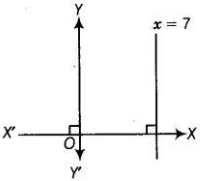
By observing the Cartesian plane,the equation $x=7$ represents a vertical line that passes through the point $(7, 0)$ on the $x$-axis.
Since the line is vertical,it is parallel to the $y$-axis and perpendicular to the $x$-axis.
Therefore,the given statement is incorrect.
By observing the Cartesian plane,the equation $x=7$ represents a vertical line that passes through the point $(7, 0)$ on the $x$-axis.
Since the line is vertical,it is parallel to the $y$-axis and perpendicular to the $x$-axis.
Therefore,the given statement is incorrect.
0 likes
View Solution32
DifficultMCQ
For which values of $p$ and $q$ will the following pair of linear equations have infinitely many solutions?
$4x + 5y = 2$
$(2p + 7q)x + (p + 8q)y = 2q - p + 1$
$4x + 5y = 2$
$(2p + 7q)x + (p + 8q)y = 2q - p + 1$
A
$p = -4, q = 4$
B
$p = -2, q = 3$
C
$p = -3, q = 2$
D
$p = -1, q = 2$
Solution
(D) For a pair of linear equations $a_1x + b_1y = c_1$ and $a_2x + b_2y = c_2$ to have infinitely many solutions,the condition is $\frac{a_1}{a_2} = \frac{b_1}{b_2} = \frac{c_1}{c_2}$.
Given equations are $4x + 5y = 2$ and $(2p + 7q)x + (p + 8q)y = 2q - p + 1$.
Here,$\frac{a_1}{a_2} = \frac{4}{2p + 7q}$,$\frac{b_1}{b_2} = \frac{5}{p + 8q}$,and $\frac{c_1}{c_2} = \frac{2}{2q - p + 1}$.
Equating $\frac{a_1}{a_2} = \frac{b_1}{b_2}$:
$\frac{4}{2p + 7q} = \frac{5}{p + 8q} \implies 4(p + 8q) = 5(2p + 7q) \implies 4p + 32q = 10p + 35q \implies 6p + 3q = 0 \implies q = -2p$ (Equation $1$).
Equating $\frac{a_1}{a_2} = \frac{c_1}{c_2}$:
$\frac{4}{2p + 7q} = \frac{2}{2q - p + 1} \implies 4(2q - p + 1) = 2(2p + 7q) \implies 8q - 4p + 4 = 4p + 14q \implies 8p + 6q = 4 \implies 4p + 3q = 2$ (Equation $2$).
Substituting $q = -2p$ into Equation $2$:
$4p + 3(-2p) = 2 \implies 4p - 6p = 2 \implies -2p = 2 \implies p = -1$.
Now,$q = -2(-1) = 2$.
Thus,for $p = -1$ and $q = 2$,the equations have infinitely many solutions.
Given equations are $4x + 5y = 2$ and $(2p + 7q)x + (p + 8q)y = 2q - p + 1$.
Here,$\frac{a_1}{a_2} = \frac{4}{2p + 7q}$,$\frac{b_1}{b_2} = \frac{5}{p + 8q}$,and $\frac{c_1}{c_2} = \frac{2}{2q - p + 1}$.
Equating $\frac{a_1}{a_2} = \frac{b_1}{b_2}$:
$\frac{4}{2p + 7q} = \frac{5}{p + 8q} \implies 4(p + 8q) = 5(2p + 7q) \implies 4p + 32q = 10p + 35q \implies 6p + 3q = 0 \implies q = -2p$ (Equation $1$).
Equating $\frac{a_1}{a_2} = \frac{c_1}{c_2}$:
$\frac{4}{2p + 7q} = \frac{2}{2q - p + 1} \implies 4(2q - p + 1) = 2(2p + 7q) \implies 8q - 4p + 4 = 4p + 14q \implies 8p + 6q = 4 \implies 4p + 3q = 2$ (Equation $2$).
Substituting $q = -2p$ into Equation $2$:
$4p + 3(-2p) = 2 \implies 4p - 6p = 2 \implies -2p = 2 \implies p = -1$.
Now,$q = -2(-1) = 2$.
Thus,for $p = -1$ and $q = 2$,the equations have infinitely many solutions.
0 likes
View Solution33
MediumMCQ
Solve the following pair of linear equations:
$21x + 47y = 110$
$47x + 21y = 162$
$21x + 47y = 110$
$47x + 21y = 162$
A
$x = 3, y = 1$
B
$x = 3, y = 2$
C
$x = 2, y = 1$
D
$x = 3, y = 3$
Solution
(A) Given equations are:
$21x + 47y = 110$ --- $(1)$
$47x + 21y = 162$ --- $(2)$
Adding $(1)$ and $(2)$:
$(21x + 47x) + (47y + 21y) = 110 + 162$
$68x + 68y = 272$
Dividing by $68$:
$x + y = 4$ --- $(3)$
Subtracting $(1)$ from $(2)$:
$(47x - 21x) + (21y - 47y) = 162 - 110$
$26x - 26y = 52$
Dividing by $26$:
$x - y = 2$ --- $(4)$
Adding $(3)$ and $(4)$:
$(x + y) + (x - y) = 4 + 2$
$2x = 6$
$x = 3$
Substituting $x = 3$ in $(3)$:
$3 + y = 4$
$y = 1$
Thus,the solution is $x = 3, y = 1$.
$21x + 47y = 110$ --- $(1)$
$47x + 21y = 162$ --- $(2)$
Adding $(1)$ and $(2)$:
$(21x + 47x) + (47y + 21y) = 110 + 162$
$68x + 68y = 272$
Dividing by $68$:
$x + y = 4$ --- $(3)$
Subtracting $(1)$ from $(2)$:
$(47x - 21x) + (21y - 47y) = 162 - 110$
$26x - 26y = 52$
Dividing by $26$:
$x - y = 2$ --- $(4)$
Adding $(3)$ and $(4)$:
$(x + y) + (x - y) = 4 + 2$
$2x = 6$
$x = 3$
Substituting $x = 3$ in $(3)$:
$3 + y = 4$
$y = 1$
Thus,the solution is $x = 3, y = 1$.
0 likes
View Solution34
DifficultMCQ
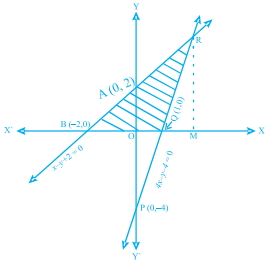
Draw the graphs of the pair of linear equations $x-y+2=0$ and $4x-y-4=0$. Calculate the area of the triangle formed by the lines so drawn and the $x$-axis (in sq. units).
A
$3.6$
B
$6$
C
$36$
D
$3$
Solution
(B) To draw the graphs of the given equations,we find two solutions for each equation:
For $x-y+2=0$:
For $4x-y-4=0$:
Plot the points $A(0, 2)$,$B(-2, 0)$,$P(0, -4)$,and $Q(1, 0)$ on a graph and draw the lines $AB$ and $PQ$. The lines intersect at point $R(2, 4)$.
The triangle formed by these lines and the $x$-axis is $\triangle BQR$,with vertices $B(-2, 0)$,$Q(1, 0)$,and $R(2, 4)$.
Area of triangle $= \frac{1}{2} \times \text{Base} \times \text{Altitude}$.
Here,Base $= BQ = |1 - (-2)| = 3$ units.
Altitude $= \text{Ordinate of } R = 4$ units.
Area $= \frac{1}{2} \times 3 \times 4 = 6$ sq. units.
For $x-y+2=0$:
| $x$ | $0$ | $-2$ |
| $y=x+2$ | $2$ | $0$ |
For $4x-y-4=0$:
| $x$ | $0$ | $1$ |
| $y=4x-4$ | $-4$ | $0$ |
Plot the points $A(0, 2)$,$B(-2, 0)$,$P(0, -4)$,and $Q(1, 0)$ on a graph and draw the lines $AB$ and $PQ$. The lines intersect at point $R(2, 4)$.
The triangle formed by these lines and the $x$-axis is $\triangle BQR$,with vertices $B(-2, 0)$,$Q(1, 0)$,and $R(2, 4)$.
Area of triangle $= \frac{1}{2} \times \text{Base} \times \text{Altitude}$.
Here,Base $= BQ = |1 - (-2)| = 3$ units.
Altitude $= \text{Ordinate of } R = 4$ units.
Area $= \frac{1}{2} \times 3 \times 4 = 6$ sq. units.
0 likes
View Solution35
Difficult
For which value$(s)$ of $\lambda$,do the pair of linear equations $\lambda x + y = \lambda^2$ and $x + \lambda y = 1$ have:
$(i)$ no solution?
$(ii)$ infinitely many solutions?
$(iii)$ a unique solution?
$(i)$ no solution?
$(ii)$ infinitely many solutions?
$(iii)$ a unique solution?
Solution
(A) The given pair of linear equations is $\lambda x + y = \lambda^2$ and $x + \lambda y = 1$.
Comparing with $a_1x + b_1y + c_1 = 0$ and $a_2x + b_2y + c_2 = 0$,we have $a_1 = \lambda, b_1 = 1, c_1 = -\lambda^2$ and $a_2 = 1, b_2 = \lambda, c_2 = -1$.
$(i)$ For no solution,the condition is $\frac{a_1}{a_2} = \frac{b_1}{b_2} \neq \frac{c_1}{c_2}$.
$\frac{\lambda}{1} = \frac{1}{\lambda} \neq \frac{-\lambda^2}{-1} \Rightarrow \lambda^2 = 1$ and $\lambda^2 \neq 1$. This is impossible for $\lambda = 1$. For $\lambda = -1$,$\frac{-1}{1} = \frac{1}{-1} \neq \frac{-(-1)^2}{-1} \Rightarrow -1 = -1 \neq 1$. Thus,for $\lambda = -1$,there is no solution.
$(ii)$ For infinitely many solutions,the condition is $\frac{a_1}{a_2} = \frac{b_1}{b_2} = \frac{c_1}{c_2}$.
$\frac{\lambda}{1} = \frac{1}{\lambda} = \frac{-\lambda^2}{-1} \Rightarrow \lambda^2 = 1$ and $\lambda = \lambda^3$. This holds for $\lambda = 1$.
$(iii)$ For a unique solution,the condition is $\frac{a_1}{a_2} \neq \frac{b_1}{b_2}$.
$\frac{\lambda}{1} \neq \frac{1}{\lambda} \Rightarrow \lambda^2 \neq 1 \Rightarrow \lambda \neq \pm 1$. Thus,all real values of $\lambda$ except $\pm 1$ yield a unique solution.
Comparing with $a_1x + b_1y + c_1 = 0$ and $a_2x + b_2y + c_2 = 0$,we have $a_1 = \lambda, b_1 = 1, c_1 = -\lambda^2$ and $a_2 = 1, b_2 = \lambda, c_2 = -1$.
$(i)$ For no solution,the condition is $\frac{a_1}{a_2} = \frac{b_1}{b_2} \neq \frac{c_1}{c_2}$.
$\frac{\lambda}{1} = \frac{1}{\lambda} \neq \frac{-\lambda^2}{-1} \Rightarrow \lambda^2 = 1$ and $\lambda^2 \neq 1$. This is impossible for $\lambda = 1$. For $\lambda = -1$,$\frac{-1}{1} = \frac{1}{-1} \neq \frac{-(-1)^2}{-1} \Rightarrow -1 = -1 \neq 1$. Thus,for $\lambda = -1$,there is no solution.
$(ii)$ For infinitely many solutions,the condition is $\frac{a_1}{a_2} = \frac{b_1}{b_2} = \frac{c_1}{c_2}$.
$\frac{\lambda}{1} = \frac{1}{\lambda} = \frac{-\lambda^2}{-1} \Rightarrow \lambda^2 = 1$ and $\lambda = \lambda^3$. This holds for $\lambda = 1$.
$(iii)$ For a unique solution,the condition is $\frac{a_1}{a_2} \neq \frac{b_1}{b_2}$.
$\frac{\lambda}{1} \neq \frac{1}{\lambda} \Rightarrow \lambda^2 \neq 1 \Rightarrow \lambda \neq \pm 1$. Thus,all real values of $\lambda$ except $\pm 1$ yield a unique solution.
0 likes
View Solution36
DifficultMCQ
For what value$(s)$ of $k$ does the pair of equations $kx + 3y = k - 3$ and $12x + ky = k$ have no solution?
A
$-3$
B
$3$
C
$6$
D
$-6$
Solution
(D) The given pair of linear equations is:
$kx + 3y = (k - 3)$
$12x + ky = k$
Comparing with $a_1x + b_1y + c_1 = 0$ and $a_2x + b_2y + c_2 = 0$,we get:
$a_1 = k, b_1 = 3, c_1 = -(k - 3)$
$a_2 = 12, b_2 = k, c_2 = -k$
For the pair of linear equations to have no solution,the condition is:
$\frac{a_1}{a_2} = \frac{b_1}{b_2} \neq \frac{c_1}{c_2}$
$\frac{k}{12} = \frac{3}{k} \neq \frac{-(k - 3)}{-k}$
Taking the first two parts:
$\frac{k}{12} = \frac{3}{k} \Rightarrow k^2 = 36 \Rightarrow k = \pm 6$
Now,checking the condition $\frac{b_1}{b_2} \neq \frac{c_1}{c_2}$:
If $k = 6$,then $\frac{3}{6} = \frac{1}{2}$ and $\frac{k-3}{k} = \frac{6-3}{6} = \frac{3}{6} = \frac{1}{2}$. Since $\frac{1}{2} = \frac{1}{2}$,$k = 6$ gives infinitely many solutions.
If $k = -6$,then $\frac{3}{-6} = -\frac{1}{2}$ and $\frac{k-3}{k} = \frac{-6-3}{-6} = \frac{-9}{-6} = \frac{3}{2}$. Since $-\frac{1}{2} \neq \frac{3}{2}$,the condition holds.
Thus,the value of $k$ for which there is no solution is $-6$.
$kx + 3y = (k - 3)$
$12x + ky = k$
Comparing with $a_1x + b_1y + c_1 = 0$ and $a_2x + b_2y + c_2 = 0$,we get:
$a_1 = k, b_1 = 3, c_1 = -(k - 3)$
$a_2 = 12, b_2 = k, c_2 = -k$
For the pair of linear equations to have no solution,the condition is:
$\frac{a_1}{a_2} = \frac{b_1}{b_2} \neq \frac{c_1}{c_2}$
$\frac{k}{12} = \frac{3}{k} \neq \frac{-(k - 3)}{-k}$
Taking the first two parts:
$\frac{k}{12} = \frac{3}{k} \Rightarrow k^2 = 36 \Rightarrow k = \pm 6$
Now,checking the condition $\frac{b_1}{b_2} \neq \frac{c_1}{c_2}$:
If $k = 6$,then $\frac{3}{6} = \frac{1}{2}$ and $\frac{k-3}{k} = \frac{6-3}{6} = \frac{3}{6} = \frac{1}{2}$. Since $\frac{1}{2} = \frac{1}{2}$,$k = 6$ gives infinitely many solutions.
If $k = -6$,then $\frac{3}{-6} = -\frac{1}{2}$ and $\frac{k-3}{k} = \frac{-6-3}{-6} = \frac{-9}{-6} = \frac{3}{2}$. Since $-\frac{1}{2} \neq \frac{3}{2}$,the condition holds.
Thus,the value of $k$ for which there is no solution is $-6$.
0 likes
View Solution37
DifficultMCQ
For which values of $a$ and $b$ does the following pair of linear equations have infinitely many solutions?
$x + 2y = 1$
$(a - b)x + (a + b)y = a + b - 2$
$x + 2y = 1$
$(a - b)x + (a + b)y = a + b - 2$
A
$a = 3, b = 1$
B
$a = 2, b = 1$
C
$a = 3, b = 4$
D
$a = 5, b = 6$
Solution
(A) The given pair of linear equations is:
$x + 2y - 1 = 0$ .....$(i)$
$(a - b)x + (a + b)y - (a + b - 2) = 0$ .....$(ii)$
Comparing with $a_1x + b_1y + c_1 = 0$ and $a_2x + b_2y + c_2 = 0$,we get:
$a_1 = 1, b_1 = 2, c_1 = -1$
$a_2 = (a - b), b_2 = (a + b), c_2 = -(a + b - 2)$
For infinitely many solutions,the condition is:
$\frac{a_1}{a_2} = \frac{b_1}{b_2} = \frac{c_1}{c_2}$
$\frac{1}{a - b} = \frac{2}{a + b} = \frac{-1}{-(a + b - 2)}$
Taking the first two parts:
$\frac{1}{a - b} = \frac{2}{a + b} \Rightarrow a + b = 2a - 2b \Rightarrow a = 3b$ .....$(iii)$
Taking the last two parts:
$\frac{2}{a + b} = \frac{1}{a + b - 2} \Rightarrow 2a + 2b - 4 = a + b \Rightarrow a + b = 4$ .....$(iv)$
Substituting the value of $a$ from $(iii)$ into $(iv)$:
$3b + b = 4 \Rightarrow 4b = 4 \Rightarrow b = 1$
Substituting $b = 1$ into $(iii)$:
$a = 3(1) = 3$
Thus,for $a = 3$ and $b = 1$,the given pair of equations has infinitely many solutions.
$x + 2y - 1 = 0$ .....$(i)$
$(a - b)x + (a + b)y - (a + b - 2) = 0$ .....$(ii)$
Comparing with $a_1x + b_1y + c_1 = 0$ and $a_2x + b_2y + c_2 = 0$,we get:
$a_1 = 1, b_1 = 2, c_1 = -1$
$a_2 = (a - b), b_2 = (a + b), c_2 = -(a + b - 2)$
For infinitely many solutions,the condition is:
$\frac{a_1}{a_2} = \frac{b_1}{b_2} = \frac{c_1}{c_2}$
$\frac{1}{a - b} = \frac{2}{a + b} = \frac{-1}{-(a + b - 2)}$
Taking the first two parts:
$\frac{1}{a - b} = \frac{2}{a + b} \Rightarrow a + b = 2a - 2b \Rightarrow a = 3b$ .....$(iii)$
Taking the last two parts:
$\frac{2}{a + b} = \frac{1}{a + b - 2} \Rightarrow 2a + 2b - 4 = a + b \Rightarrow a + b = 4$ .....$(iv)$
Substituting the value of $a$ from $(iii)$ into $(iv)$:
$3b + b = 4 \Rightarrow 4b = 4 \Rightarrow b = 1$
Substituting $b = 1$ into $(iii)$:
$a = 3(1) = 3$
Thus,for $a = 3$ and $b = 1$,the given pair of equations has infinitely many solutions.
0 likes
View Solution38
DifficultMCQ
Find the value of $p$ if the lines represented by the equations $3x - y - 5 = 0$ and $6x - 2y - p = 0$ are parallel.
A
$p = 10$
B
$p \neq 10$
C
$p = 5$
D
$p \neq 5$
Solution
(B) The given pair of linear equations is:
$3x - y - 5 = 0$ ... $(i)$
$6x - 2y - p = 0$ ... $(ii)$
Comparing these with the general form $ax + by + c = 0$,we get:
$a_1 = 3, b_1 = -1, c_1 = -5$
$a_2 = 6, b_2 = -2, c_2 = -p$
For two lines to be parallel,the condition is $\frac{a_1}{a_2} = \frac{b_1}{b_2} \neq \frac{c_1}{c_2}$.
Substituting the values,we get:
$\frac{3}{6} = \frac{-1}{-2} \neq \frac{-5}{-p}$
$\frac{1}{2} = \frac{1}{2} \neq \frac{5}{p}$
For the lines to be parallel,we must have $\frac{1}{2} \neq \frac{5}{p}$.
Cross-multiplying,we get $p \neq 10$.
Thus,the lines are parallel for all real values of $p$ except $10$.
$3x - y - 5 = 0$ ... $(i)$
$6x - 2y - p = 0$ ... $(ii)$
Comparing these with the general form $ax + by + c = 0$,we get:
$a_1 = 3, b_1 = -1, c_1 = -5$
$a_2 = 6, b_2 = -2, c_2 = -p$
For two lines to be parallel,the condition is $\frac{a_1}{a_2} = \frac{b_1}{b_2} \neq \frac{c_1}{c_2}$.
Substituting the values,we get:
$\frac{3}{6} = \frac{-1}{-2} \neq \frac{-5}{-p}$
$\frac{1}{2} = \frac{1}{2} \neq \frac{5}{p}$
For the lines to be parallel,we must have $\frac{1}{2} \neq \frac{5}{p}$.
Cross-multiplying,we get $p \neq 10$.
Thus,the lines are parallel for all real values of $p$ except $10$.
0 likes
View Solution39
DifficultMCQ
Find the value$(s)$ of $p$ for the pair of equations $-x + py = 1$ and $px - y = 1$ if the system has no solution.
A
$3$
B
$2$
C
$1$
D
$4$
Solution
(C) The given pair of linear equations is:
$-x + py - 1 = 0 \quad ...(i)$
$px - y - 1 = 0 \quad ...(ii)$
Comparing these with the standard form $ax + by + c = 0$,we get:
$a_1 = -1, b_1 = p, c_1 = -1$ (from Eq. $i$)
$a_2 = p, b_2 = -1, c_2 = -1$ (from Eq. $ii$)
For a pair of linear equations to have no solution,the lines must be parallel,which implies:
$\frac{a_1}{a_2} = \frac{b_1}{b_2} \neq \frac{c_1}{c_2}$
Substituting the values:
$\frac{-1}{p} = \frac{p}{-1} \neq \frac{-1}{-1}$
Taking the first two parts:
$\frac{-1}{p} = \frac{p}{-1} \Rightarrow p^2 = 1 \Rightarrow p = \pm 1$
Taking the condition $\frac{p}{-1} \neq \frac{-1}{-1}$:
$\frac{p}{-1} \neq 1 \Rightarrow p \neq -1$
Since $p = \pm 1$ and $p \neq -1$,the only valid value is $p = 1$.
$-x + py - 1 = 0 \quad ...(i)$
$px - y - 1 = 0 \quad ...(ii)$
Comparing these with the standard form $ax + by + c = 0$,we get:
$a_1 = -1, b_1 = p, c_1 = -1$ (from Eq. $i$)
$a_2 = p, b_2 = -1, c_2 = -1$ (from Eq. $ii$)
For a pair of linear equations to have no solution,the lines must be parallel,which implies:
$\frac{a_1}{a_2} = \frac{b_1}{b_2} \neq \frac{c_1}{c_2}$
Substituting the values:
$\frac{-1}{p} = \frac{p}{-1} \neq \frac{-1}{-1}$
Taking the first two parts:
$\frac{-1}{p} = \frac{p}{-1} \Rightarrow p^2 = 1 \Rightarrow p = \pm 1$
Taking the condition $\frac{p}{-1} \neq \frac{-1}{-1}$:
$\frac{p}{-1} \neq 1 \Rightarrow p \neq -1$
Since $p = \pm 1$ and $p \neq -1$,the only valid value is $p = 1$.
0 likes
View Solution40
DifficultMCQ
Find the value$(s)$ of $p$ for the equations $-3x + 5y = 7$ and $2px - 3y = 1$ if the lines represented by these equations intersect at a unique point.
A
$p \neq \frac{7}{10}$
B
$p \neq \frac{3}{10}$
C
$p \neq \frac{11}{10}$
D
$p \neq \frac{9}{10}$
Solution
(D) Given,the pair of linear equations is:
$-3x + 5y - 7 = 0 \dots (i)$
$2px - 3y - 1 = 0 \dots (ii)$
Comparing these with the standard form $ax + by + c = 0$,we get:
$a_1 = -3, b_1 = 5, c_1 = -7$
$a_2 = 2p, b_2 = -3, c_2 = -1$
For the lines to intersect at a unique point,the condition for a unique solution is:
$\frac{a_1}{a_2} \neq \frac{b_1}{b_2}$
Substituting the values:
$\frac{-3}{2p} \neq \frac{5}{-3}$
Cross-multiplying,we get:
$(-3) \times (-3) \neq 5 \times (2p)$
$9 \neq 10p$
$p \neq \frac{9}{10}$
Thus,the lines intersect at a unique point for all real values of $p$ except $\frac{9}{10}$.
$-3x + 5y - 7 = 0 \dots (i)$
$2px - 3y - 1 = 0 \dots (ii)$
Comparing these with the standard form $ax + by + c = 0$,we get:
$a_1 = -3, b_1 = 5, c_1 = -7$
$a_2 = 2p, b_2 = -3, c_2 = -1$
For the lines to intersect at a unique point,the condition for a unique solution is:
$\frac{a_1}{a_2} \neq \frac{b_1}{b_2}$
Substituting the values:
$\frac{-3}{2p} \neq \frac{5}{-3}$
Cross-multiplying,we get:
$(-3) \times (-3) \neq 5 \times (2p)$
$9 \neq 10p$
$p \neq \frac{9}{10}$
Thus,the lines intersect at a unique point for all real values of $p$ except $\frac{9}{10}$.
0 likes
View Solution41
DifficultMCQ
Find the value$(s)$ of $p$ for the pair of equations $2x + 3y - 5 = 0$ and $px - 6y - 8 = 0$ if the system has a unique solution.
A
$p = -4$
B
$p \neq -4$
C
$p = 4$
D
$p \neq 4$
Solution
(B) The given pair of linear equations is:
$2x + 3y - 5 = 0$ ... $(i)$
$px - 6y - 8 = 0$ ... $(ii)$
Comparing these with the standard form $a_1x + b_1y + c_1 = 0$ and $a_2x + b_2y + c_2 = 0$,we get:
$a_1 = 2, b_1 = 3, c_1 = -5$
$a_2 = p, b_2 = -6, c_2 = -8$
For a pair of linear equations to have a unique solution,the condition is:
$\frac{a_1}{a_2} \neq \frac{b_1}{b_2}$
Substituting the values:
$\frac{2}{p} \neq \frac{3}{-6}$
$\frac{2}{p} \neq -\frac{1}{2}$
By cross-multiplying:
$p \neq -4$
Thus,the system has a unique solution for all real values of $p$ except $-4$,i.e.,$p \in \mathbb{R} - \{-4\}$.
$2x + 3y - 5 = 0$ ... $(i)$
$px - 6y - 8 = 0$ ... $(ii)$
Comparing these with the standard form $a_1x + b_1y + c_1 = 0$ and $a_2x + b_2y + c_2 = 0$,we get:
$a_1 = 2, b_1 = 3, c_1 = -5$
$a_2 = p, b_2 = -6, c_2 = -8$
For a pair of linear equations to have a unique solution,the condition is:
$\frac{a_1}{a_2} \neq \frac{b_1}{b_2}$
Substituting the values:
$\frac{2}{p} \neq \frac{3}{-6}$
$\frac{2}{p} \neq -\frac{1}{2}$
By cross-multiplying:
$p \neq -4$
Thus,the system has a unique solution for all real values of $p$ except $-4$,i.e.,$p \in \mathbb{R} - \{-4\}$.
0 likes
View Solution42
DifficultMCQ
Find the value$(s)$ of $p$ and $q$ for the pair of equations $2x + 3y = 7$ and $2px + py = 28 - qy$ if they have infinitely many solutions.
A
$p = 5, q = 8$
B
$p = 4, q = 8$
C
$p = 4, q = 9$
D
$p = 5, q = 11$
Solution
(B) The given pair of linear equations is:
$2x + 3y = 7$ ... $(i)$
$2px + py = 28 - qy$ ... $(ii)$
Rearranging equation $(ii)$,we get:
$2px + (p + q)y = 28$
For a pair of linear equations $a_1x + b_1y + c_1 = 0$ and $a_2x + b_2y + c_2 = 0$ to have infinitely many solutions,the condition is $\frac{a_1}{a_2} = \frac{b_1}{b_2} = \frac{c_1}{c_2}$.
Comparing the given equations with the standard form:
$a_1 = 2, b_1 = 3, c_1 = -7$
$a_2 = 2p, b_2 = (p + q), c_2 = -28$
Applying the condition:
$\frac{2}{2p} = \frac{3}{p + q} = \frac{-7}{-28}$
$\frac{1}{p} = \frac{3}{p + q} = \frac{1}{4}$
Taking the first and third parts:
$\frac{1}{p} = \frac{1}{4} \Rightarrow p = 4$
Taking the second and third parts:
$\frac{3}{p + q} = \frac{1}{4} \Rightarrow p + q = 12$
Substituting $p = 4$ into $p + q = 12$:
$4 + q = 12 \Rightarrow q = 8$
Thus,the values are $p = 4$ and $q = 8$.
$2x + 3y = 7$ ... $(i)$
$2px + py = 28 - qy$ ... $(ii)$
Rearranging equation $(ii)$,we get:
$2px + (p + q)y = 28$
For a pair of linear equations $a_1x + b_1y + c_1 = 0$ and $a_2x + b_2y + c_2 = 0$ to have infinitely many solutions,the condition is $\frac{a_1}{a_2} = \frac{b_1}{b_2} = \frac{c_1}{c_2}$.
Comparing the given equations with the standard form:
$a_1 = 2, b_1 = 3, c_1 = -7$
$a_2 = 2p, b_2 = (p + q), c_2 = -28$
Applying the condition:
$\frac{2}{2p} = \frac{3}{p + q} = \frac{-7}{-28}$
$\frac{1}{p} = \frac{3}{p + q} = \frac{1}{4}$
Taking the first and third parts:
$\frac{1}{p} = \frac{1}{4} \Rightarrow p = 4$
Taking the second and third parts:
$\frac{3}{p + q} = \frac{1}{4} \Rightarrow p + q = 12$
Substituting $p = 4$ into $p + q = 12$:
$4 + q = 12 \Rightarrow q = 8$
Thus,the values are $p = 4$ and $q = 8$.
0 likes
View Solution43
MediumMCQ
Two straight paths are represented by the equations $x-3y=2$ and $-2x+6y=5$. Check whether the paths cross each other or not.
A
Yes,they cross each other.
B
No,they do not cross each other.
C
They are the same line.
D
They intersect at exactly one point.
Solution
(B) The given linear equations are:
$x-3y-2=0$ ..... $(i)$
$-2x+6y-5=0$ ..... $(ii)$
Comparing these equations with the general form $ax+by+c=0$,we get:
For equation $(i)$: $a_1=1, b_1=-3, c_1=-2$
For equation $(ii)$: $a_2=-2, b_2=6, c_2=-5$
Now,calculating the ratios:
$\frac{a_1}{a_2} = \frac{1}{-2} = -\frac{1}{2}$
$\frac{b_1}{b_2} = \frac{-3}{6} = -\frac{1}{2}$
$\frac{c_1}{c_2} = \frac{-2}{-5} = \frac{2}{5}$
Since $\frac{a_1}{a_2} = \frac{b_1}{b_2} \neq \frac{c_1}{c_2}$,the lines are parallel.
Therefore,the two straight paths represented by the given equations never cross each other.
$x-3y-2=0$ ..... $(i)$
$-2x+6y-5=0$ ..... $(ii)$
Comparing these equations with the general form $ax+by+c=0$,we get:
For equation $(i)$: $a_1=1, b_1=-3, c_1=-2$
For equation $(ii)$: $a_2=-2, b_2=6, c_2=-5$
Now,calculating the ratios:
$\frac{a_1}{a_2} = \frac{1}{-2} = -\frac{1}{2}$
$\frac{b_1}{b_2} = \frac{-3}{6} = -\frac{1}{2}$
$\frac{c_1}{c_2} = \frac{-2}{-5} = \frac{2}{5}$
Since $\frac{a_1}{a_2} = \frac{b_1}{b_2} \neq \frac{c_1}{c_2}$,the lines are parallel.
Therefore,the two straight paths represented by the given equations never cross each other.
0 likes
View Solution44
Difficult
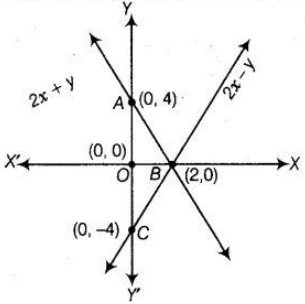
Write a pair of linear equations which has the unique solution $x = -1, y = 3$. How many such pairs can you write?
Solution
(N/A) pair of linear equations in two variables is given by:
$a_1x + b_1y + c_1 = 0$
$a_2x + b_2y + c_2 = 0$
For the system to have a unique solution,the condition is $\frac{a_1}{a_2} \neq \frac{b_1}{b_2}$.
Given the solution $x = -1$ and $y = 3$,these values must satisfy both equations:
$1$) $a_1(-1) + b_1(3) + c_1 = 0 \Rightarrow -a_1 + 3b_1 + c_1 = 0$
$2$) $a_2(-1) + b_2(3) + c_2 = 0 \Rightarrow -a_2 + 3b_2 + c_2 = 0$
We can choose arbitrary values for the coefficients that satisfy these conditions. For example,let $a_1 = 1, b_1 = 1$. Then $-1 + 3(1) + c_1 = 0 \Rightarrow c_1 = -2$. So,$x + y - 2 = 0$.
Let $a_2 = 1, b_2 = 2$. Then $-1 + 3(2) + c_2 = 0 \Rightarrow -1 + 6 + c_2 = 0 \Rightarrow c_2 = -5$. So,$x + 2y - 5 = 0$.
Since there are infinitely many combinations of $a_1, b_1, c_1$ and $a_2, b_2, c_2$ that satisfy the given solution and the condition for a unique solution,we can write infinitely many such pairs.
$a_1x + b_1y + c_1 = 0$
$a_2x + b_2y + c_2 = 0$
For the system to have a unique solution,the condition is $\frac{a_1}{a_2} \neq \frac{b_1}{b_2}$.
Given the solution $x = -1$ and $y = 3$,these values must satisfy both equations:
$1$) $a_1(-1) + b_1(3) + c_1 = 0 \Rightarrow -a_1 + 3b_1 + c_1 = 0$
$2$) $a_2(-1) + b_2(3) + c_2 = 0 \Rightarrow -a_2 + 3b_2 + c_2 = 0$
We can choose arbitrary values for the coefficients that satisfy these conditions. For example,let $a_1 = 1, b_1 = 1$. Then $-1 + 3(1) + c_1 = 0 \Rightarrow c_1 = -2$. So,$x + y - 2 = 0$.
Let $a_2 = 1, b_2 = 2$. Then $-1 + 3(2) + c_2 = 0 \Rightarrow -1 + 6 + c_2 = 0 \Rightarrow c_2 = -5$. So,$x + 2y - 5 = 0$.
Since there are infinitely many combinations of $a_1, b_1, c_1$ and $a_2, b_2, c_2$ that satisfy the given solution and the condition for a unique solution,we can write infinitely many such pairs.
0 likes
View Solution45
DifficultMCQ
If $2x + y = 23$ and $4x - y = 19$,find the values of $5y - 2x$ and $\frac{y}{x} - 2$.
A
$31, -\frac{5}{7}$
B
$33, -\frac{5}{7}$
C
$37, -\frac{5}{3}$
D
$41, -\frac{5}{7}$
Solution
(A) Given equations are:
$2x + y = 23$ $(i)$
$4x - y = 19$ $(ii)$
Adding equation $(i)$ and $(ii)$:
$(2x + y) + (4x - y) = 23 + 19$
$6x = 42$
$x = 7$
Substituting $x = 7$ in equation $(i)$:
$2(7) + y = 23$
$14 + y = 23$
$y = 23 - 14 = 9$
Now,calculating the required values:
$5y - 2x = 5(9) - 2(7) = 45 - 14 = 31$
$\frac{y}{x} - 2 = \frac{9}{7} - 2 = \frac{9 - 14}{7} = -\frac{5}{7}$
Thus,the values are $31$ and $-\frac{5}{7}$.
$2x + y = 23$ $(i)$
$4x - y = 19$ $(ii)$
Adding equation $(i)$ and $(ii)$:
$(2x + y) + (4x - y) = 23 + 19$
$6x = 42$
$x = 7$
Substituting $x = 7$ in equation $(i)$:
$2(7) + y = 23$
$14 + y = 23$
$y = 23 - 14 = 9$
Now,calculating the required values:
$5y - 2x = 5(9) - 2(7) = 45 - 14 = 31$
$\frac{y}{x} - 2 = \frac{9}{7} - 2 = \frac{9 - 14}{7} = -\frac{5}{7}$
Thus,the values are $31$ and $-\frac{5}{7}$.
0 likes
View Solution46
MediumMCQ
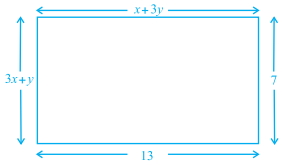
Find the values of $x$ and $y$ in the following rectangle.
A
$1, 3$
B
$1, 4$
C
$2, 1$
D
$1, 8$
Solution
(B) By the property of a rectangle,opposite sides are equal.
For lengths: $x + 3y = 13$ --- $(i)$
For breadths: $3x + y = 7$ --- $(ii)$
To solve this pair of linear equations,multiply equation $(ii)$ by $3$:
$9x + 3y = 21$ --- $(iii)$
Now,subtract equation $(i)$ from equation $(iii)$:
$(9x + 3y) - (x + 3y) = 21 - 13$
$8x = 8$
$x = 1$
Substitute $x = 1$ into equation $(i)$:
$1 + 3y = 13$
$3y = 12$
$y = 4$
Thus,the required values are $x = 1$ and $y = 4$.
For lengths: $x + 3y = 13$ --- $(i)$
For breadths: $3x + y = 7$ --- $(ii)$
To solve this pair of linear equations,multiply equation $(ii)$ by $3$:
$9x + 3y = 21$ --- $(iii)$
Now,subtract equation $(i)$ from equation $(iii)$:
$(9x + 3y) - (x + 3y) = 21 - 13$
$8x = 8$
$x = 1$
Substitute $x = 1$ into equation $(i)$:
$1 + 3y = 13$
$3y = 12$
$y = 4$
Thus,the required values are $x = 1$ and $y = 4$.
0 likes
View Solution47
DifficultMCQ
Solve the following pair of linear equations:
$x + y = 3.3$
$\frac{0.6}{3x - 2y} = -1$,where $3x - 2y \neq 0$
$x + y = 3.3$
$\frac{0.6}{3x - 2y} = -1$,where $3x - 2y \neq 0$
A
$1.5, 3.5$
B
$1.5, 2.5$
C
$1.2, 2.1$
D
$2.2, 2.8$
Solution
(C) Given equations are:
$(i) \ x + y = 3.3$
$(ii) \ \frac{0.6}{3x - 2y} = -1$
From equation $(ii)$:
$0.6 = -1(3x - 2y)$
$0.6 = -3x + 2y$
$3x - 2y = -0.6 \quad (iii)$
To solve the system,multiply equation $(i)$ by $2$:
$2x + 2y = 6.6 \quad (iv)$
Add equation $(iii)$ and $(iv)$:
$(3x - 2y) + (2x + 2y) = -0.6 + 6.6$
$5x = 6$
$x = \frac{6}{5} = 1.2$
Substitute $x = 1.2$ into equation $(i)$:
$1.2 + y = 3.3$
$y = 3.3 - 1.2$
$y = 2.1$
Thus,the solution is $x = 1.2$ and $y = 2.1$.
$(i) \ x + y = 3.3$
$(ii) \ \frac{0.6}{3x - 2y} = -1$
From equation $(ii)$:
$0.6 = -1(3x - 2y)$
$0.6 = -3x + 2y$
$3x - 2y = -0.6 \quad (iii)$
To solve the system,multiply equation $(i)$ by $2$:
$2x + 2y = 6.6 \quad (iv)$
Add equation $(iii)$ and $(iv)$:
$(3x - 2y) + (2x + 2y) = -0.6 + 6.6$
$5x = 6$
$x = \frac{6}{5} = 1.2$
Substitute $x = 1.2$ into equation $(i)$:
$1.2 + y = 3.3$
$y = 3.3 - 1.2$
$y = 2.1$
Thus,the solution is $x = 1.2$ and $y = 2.1$.
0 likes
View Solution48
MediumMCQ
Solve the following pairs of equations:
$\frac{x}{3} + \frac{y}{4} = 4$
$\frac{5x}{6} - \frac{y}{8} = 4$
$\frac{x}{3} + \frac{y}{4} = 4$
$\frac{5x}{6} - \frac{y}{8} = 4$
A
$8, 13$
B
$9, 6$
C
$4, 5$
D
$6, 8$
Solution
(D) Given,the pair of linear equations is:
$\frac{x}{3} + \frac{y}{4} = 4$ $(i)$
Multiplying both sides by the $LCM(3, 4) = 12$,we get:
$4x + 3y = 48$ $(iii)$
And the second equation is:
$\frac{5x}{6} - \frac{y}{8} = 4$ $(ii)$
Multiplying both sides by the $LCM(6, 8) = 24$,we get:
$20x - 3y = 96$ $(iv)$
Now,adding equations $(iii)$ and $(iv)$,we get:
$(4x + 3y) + (20x - 3y) = 48 + 96$
$24x = 144$
$x = \frac{144}{24} = 6$
Now,substitute the value of $x = 6$ in equation $(iii)$:
$4(6) + 3y = 48$
$24 + 3y = 48$
$3y = 48 - 24$
$3y = 24$
$y = 8$
Thus,the solution is $x = 6$ and $y = 8$.
$\frac{x}{3} + \frac{y}{4} = 4$ $(i)$
Multiplying both sides by the $LCM(3, 4) = 12$,we get:
$4x + 3y = 48$ $(iii)$
And the second equation is:
$\frac{5x}{6} - \frac{y}{8} = 4$ $(ii)$
Multiplying both sides by the $LCM(6, 8) = 24$,we get:
$20x - 3y = 96$ $(iv)$
Now,adding equations $(iii)$ and $(iv)$,we get:
$(4x + 3y) + (20x - 3y) = 48 + 96$
$24x = 144$
$x = \frac{144}{24} = 6$
Now,substitute the value of $x = 6$ in equation $(iii)$:
$4(6) + 3y = 48$
$24 + 3y = 48$
$3y = 48 - 24$
$3y = 24$
$y = 8$
Thus,the solution is $x = 6$ and $y = 8$.
0 likes
View Solution49
DifficultMCQ
Solve the following pairs of equations:
$4x + \frac{6}{y} = 15$
$6x - \frac{8}{y} = 14, y \neq 0$
$4x + \frac{6}{y} = 15$
$6x - \frac{8}{y} = 14, y \neq 0$
A
$3, 2$
B
$4, 6$
C
$11, 13$
D
$8, 5$
Solution
(A) Given pair of linear equations are:
$4x + \frac{6}{y} = 15$ ..... $(i)$
$6x - \frac{8}{y} = 14, y \neq 0$ ..... $(ii)$
Let $u = \frac{1}{y}$,then the equations become:
$4x + 6u = 15$ ..... $(iii)$
$6x - 8u = 14$ ..... $(iv)$
To eliminate $u$,multiply equation $(iii)$ by $4$ and equation $(iv)$ by $3$:
$16x + 24u = 60$ ..... $(v)$
$18x - 24u = 42$ ..... $(vi)$
Adding equation $(v)$ and $(vi)$:
$(16x + 18x) + (24u - 24u) = 60 + 42$
$34x = 102$
$x = \frac{102}{34} = 3$
Substitute $x = 3$ in equation $(iii)$:
$4(3) + 6u = 15$
$12 + 6u = 15$
$6u = 15 - 12 = 3$
$u = \frac{3}{6} = \frac{1}{2}$
Since $u = \frac{1}{y}$,we have $\frac{1}{y} = \frac{1}{2}$,which implies $y = 2$.
Thus,the solution is $x = 3$ and $y = 2$.
$4x + \frac{6}{y} = 15$ ..... $(i)$
$6x - \frac{8}{y} = 14, y \neq 0$ ..... $(ii)$
Let $u = \frac{1}{y}$,then the equations become:
$4x + 6u = 15$ ..... $(iii)$
$6x - 8u = 14$ ..... $(iv)$
To eliminate $u$,multiply equation $(iii)$ by $4$ and equation $(iv)$ by $3$:
$16x + 24u = 60$ ..... $(v)$
$18x - 24u = 42$ ..... $(vi)$
Adding equation $(v)$ and $(vi)$:
$(16x + 18x) + (24u - 24u) = 60 + 42$
$34x = 102$
$x = \frac{102}{34} = 3$
Substitute $x = 3$ in equation $(iii)$:
$4(3) + 6u = 15$
$12 + 6u = 15$
$6u = 15 - 12 = 3$
$u = \frac{3}{6} = \frac{1}{2}$
Since $u = \frac{1}{y}$,we have $\frac{1}{y} = \frac{1}{2}$,which implies $y = 2$.
Thus,the solution is $x = 3$ and $y = 2$.
0 likes
View Solution50
DifficultMCQ
Solve the following pairs of equations:
$\frac{1}{2x} - \frac{1}{y} = -1$
$\frac{1}{x} + \frac{1}{2y} = 8, \quad x, y \neq 0$
$\frac{1}{2x} - \frac{1}{y} = -1$
$\frac{1}{x} + \frac{1}{2y} = 8, \quad x, y \neq 0$
A
$\frac{1}{5}, \frac{1}{4}$
B
$\frac{1}{6}, \frac{1}{4}$
C
$\frac{1}{6}, \frac{1}{5}$
D
$\frac{1}{5}, \frac{1}{9}$
Solution
(B) Given pair of linear equations is:
$\frac{1}{2x} - \frac{1}{y} = -1$ ........ $(i)$
$\frac{1}{x} + \frac{1}{2y} = 8$ ........ $(ii)$
Let $u = \frac{1}{x}$ and $v = \frac{1}{y}$. Substituting these in the equations:
$\frac{u}{2} - v = -1 \Rightarrow u - 2v = -2$ ........ $(iii)$
$u + \frac{v}{2} = 8 \Rightarrow 2u + v = 16$ ........ $(iv)$
Multiply equation $(iv)$ by $2$ to eliminate $v$:
$4u + 2v = 32$ ........ $(v)$
Adding $(iii)$ and $(v)$:
$(u - 2v) + (4u + 2v) = -2 + 32$
$5u = 30 \Rightarrow u = 6$
Substitute $u = 6$ in equation $(iv)$:
$2(6) + v = 16 \Rightarrow 12 + v = 16 \Rightarrow v = 4$
Since $u = \frac{1}{x} = 6$,we get $x = \frac{1}{6}$.
Since $v = \frac{1}{y} = 4$,we get $y = \frac{1}{4}$.
Thus,the solution is $x = \frac{1}{6}$ and $y = \frac{1}{4}$.
$\frac{1}{2x} - \frac{1}{y} = -1$ ........ $(i)$
$\frac{1}{x} + \frac{1}{2y} = 8$ ........ $(ii)$
Let $u = \frac{1}{x}$ and $v = \frac{1}{y}$. Substituting these in the equations:
$\frac{u}{2} - v = -1 \Rightarrow u - 2v = -2$ ........ $(iii)$
$u + \frac{v}{2} = 8 \Rightarrow 2u + v = 16$ ........ $(iv)$
Multiply equation $(iv)$ by $2$ to eliminate $v$:
$4u + 2v = 32$ ........ $(v)$
Adding $(iii)$ and $(v)$:
$(u - 2v) + (4u + 2v) = -2 + 32$
$5u = 30 \Rightarrow u = 6$
Substitute $u = 6$ in equation $(iv)$:
$2(6) + v = 16 \Rightarrow 12 + v = 16 \Rightarrow v = 4$
Since $u = \frac{1}{x} = 6$,we get $x = \frac{1}{6}$.
Since $v = \frac{1}{y} = 4$,we get $y = \frac{1}{4}$.
Thus,the solution is $x = \frac{1}{6}$ and $y = \frac{1}{4}$.
0 likes
View SolutionPair of Linear Equations in Two Variables — Mix Examples - Pair of Linear Equations in Two Variables · Frequently Asked Questions
1Are these Pair of Linear Equations in Two Variables questions useful for JEE and NEET?
Yes. All questions in this section are mapped to JEE Main and NEET exam patterns. Previous year questions from JEE Main, NEET, GUJCET and state-level exams are included with full solutions.
2Can I switch to Hindi or Gujarati for these questions?
Yes. Use the language tabs in the hero section or the sidebar to view the same questions and solutions in English, Hindi or Gujarati.
3How do I generate a question paper from this subtopic?
Use the Vedclass Exam Paper Generator — select the chapter and subtopic, set difficulty, and generate Sets A, B, C, D automatically. First 3 chapters of every subject are free.
Vedclass Products
For Students
Vedclass Test Series
Mock tests in real JEE/NEET style with performance analysis. 5-day free trial.
Start Free TrialFor Teachers
Exam Paper Generator
Generate Set A/B/C/D papers from this chapter in 2 minutes. 3 chapters free.
Try FreeFor Institutes
Online Exam Module
Live online exams with unlimited students, 360° analytics & white-label branding.
See DemoFor Teachers & Institutes
Generate a Pair of Linear Equations in Two Variables Exam Paper in 2 Minutes
Select subtopic & difficulty — Sets A, B, C, D auto-generated with No Repeat logic.
First 3 chapters of every subject are free — no payment required.