
A English
Mix Examples - Pair of Linear Equations in Two Variables Questions in English
Class 10 Mathematics · Pair of Linear Equations in Two Variables · Mix Examples - Pair of Linear Equations in Two Variables
360+
Questions
English
Language
100%
With Solutions
Showing 50 of 360 questions in English
101
Medium
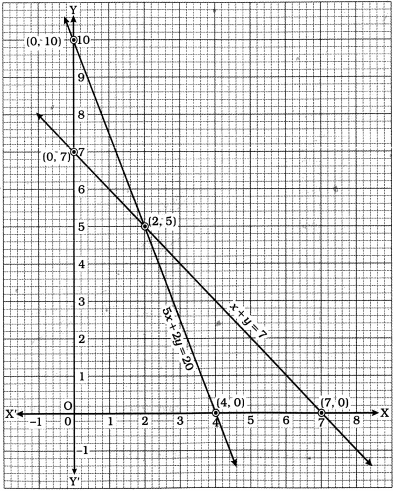
Solve the following pair of linear equations using a graph: $x+y=7$,$5x+2y=20$.
Solution
(A) $x+y=7$
$\therefore y=7-x$
For $x=0, y=7-0=7$
For $x=7, y=7-7=0$
$\therefore$ Plot the ordered pairs $(0, 7)$ and $(7, 0)$ of the solution set of $x+y=7$ on the graph paper and draw the line by joining them.
$5x+2y=20$
$\therefore 2y=20-5x \quad \therefore y=\frac{20-5x}{2}$
For $x=0, y=\frac{20-0}{2}=10$
For $x=4, y=\frac{20-20}{2}=0$
$\therefore$ Plot the ordered pairs $(0, 10)$ and $(4, 0)$ of the solution set of $5x+2y=20$ on the graph paper and draw the line by joining them.
The intersection point (common point) of these two lines is $(2, 5)$,which satisfies both equations.
Thus,the solution of the pair of linear equations is $(2, 5)$.
$\therefore y=7-x$
For $x=0, y=7-0=7$
For $x=7, y=7-7=0$
| $x$ | $0$ | $7$ |
| $y$ | $7$ | $0$ |
$\therefore$ Plot the ordered pairs $(0, 7)$ and $(7, 0)$ of the solution set of $x+y=7$ on the graph paper and draw the line by joining them.
$5x+2y=20$
$\therefore 2y=20-5x \quad \therefore y=\frac{20-5x}{2}$
For $x=0, y=\frac{20-0}{2}=10$
For $x=4, y=\frac{20-20}{2}=0$
| $x$ | $0$ | $4$ |
| $y$ | $10$ | $0$ |
$\therefore$ Plot the ordered pairs $(0, 10)$ and $(4, 0)$ of the solution set of $5x+2y=20$ on the graph paper and draw the line by joining them.
The intersection point (common point) of these two lines is $(2, 5)$,which satisfies both equations.
Thus,the solution of the pair of linear equations is $(2, 5)$.
0 likes
View Solution102
Medium
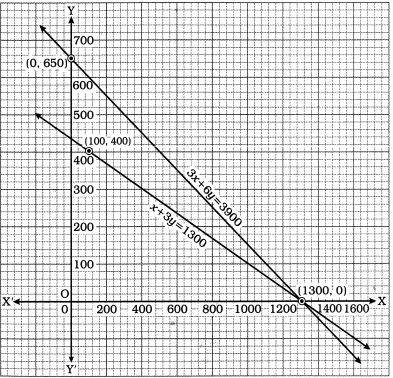
Solve the following pair of linear equations using a graph: $3x + 6y = 3900, x + 3y = 1300$
Solution
(N/A) For the equation $3x + 6y = 3900$:
Dividing by $3$,we get $x + 2y = 1300$,which implies $y = \frac{1300 - x}{2}$.
If $x = 0$,$y = 650$. If $x = 1300$,$y = 0$.
Plot the points $(0, 650)$ and $(1300, 0)$ and join them to draw the line.
For the equation $x + 3y = 1300$:
This implies $y = \frac{1300 - x}{3}$.
If $x = 1300$,$y = 0$. If $x = 100$,$y = 400$.
Plot the points $(1300, 0)$ and $(100, 400)$ and join them to draw the line.
The intersection point of these two lines is $(1300, 0)$,which satisfies both equations.
Thus,the solution is $x = 1300, y = 0$.
Dividing by $3$,we get $x + 2y = 1300$,which implies $y = \frac{1300 - x}{2}$.
If $x = 0$,$y = 650$. If $x = 1300$,$y = 0$.
| $x$ | $0$ | $1300$ |
| $y$ | $650$ | $0$ |
Plot the points $(0, 650)$ and $(1300, 0)$ and join them to draw the line.
For the equation $x + 3y = 1300$:
This implies $y = \frac{1300 - x}{3}$.
If $x = 1300$,$y = 0$. If $x = 100$,$y = 400$.
| $x$ | $1300$ | $100$ |
| $y$ | $0$ | $400$ |
Plot the points $(1300, 0)$ and $(100, 400)$ and join them to draw the line.
The intersection point of these two lines is $(1300, 0)$,which satisfies both equations.
Thus,the solution is $x = 1300, y = 0$.
0 likes
View Solution103
Difficult
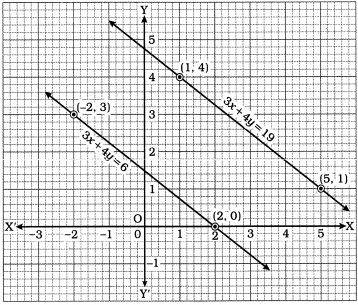
Solve the following pair of linear equations using a graph: $3x + 4y = 6$ and $3x + 4y = 19$.
Solution
(D) For the equation $3x + 4y = 6$:
$4y = 6 - 3x$
$y = \frac{6 - 3x}{4}$
If $x = -2$,$y = \frac{6 - 3(-2)}{4} = \frac{12}{4} = 3$.
If $x = 2$,$y = \frac{6 - 3(2)}{4} = \frac{0}{4} = 0$.
Plot the points $(-2, 3)$ and $(2, 0)$ and join them to draw the line.
For the equation $3x + 4y = 19$:
$4y = 19 - 3x$
$y = \frac{19 - 3x}{4}$
If $x = 5$,$y = \frac{19 - 3(5)}{4} = \frac{4}{4} = 1$.
If $x = 1$,$y = \frac{19 - 3(1)}{4} = \frac{16}{4} = 4$.
Plot the points $(5, 1)$ and $(1, 4)$ and join them to draw the line.
Since the lines are parallel and do not intersect,the system of equations has no solution. The solution set is $\varnothing$.
$4y = 6 - 3x$
$y = \frac{6 - 3x}{4}$
If $x = -2$,$y = \frac{6 - 3(-2)}{4} = \frac{12}{4} = 3$.
If $x = 2$,$y = \frac{6 - 3(2)}{4} = \frac{0}{4} = 0$.
| $x$ | $-2$ | $2$ |
| $y$ | $3$ | $0$ |
Plot the points $(-2, 3)$ and $(2, 0)$ and join them to draw the line.
For the equation $3x + 4y = 19$:
$4y = 19 - 3x$
$y = \frac{19 - 3x}{4}$
If $x = 5$,$y = \frac{19 - 3(5)}{4} = \frac{4}{4} = 1$.
If $x = 1$,$y = \frac{19 - 3(1)}{4} = \frac{16}{4} = 4$.
| $x$ | $5$ | $1$ |
| $y$ | $1$ | $4$ |
Plot the points $(5, 1)$ and $(1, 4)$ and join them to draw the line.
Since the lines are parallel and do not intersect,the system of equations has no solution. The solution set is $\varnothing$.
0 likes
View Solution104
Medium
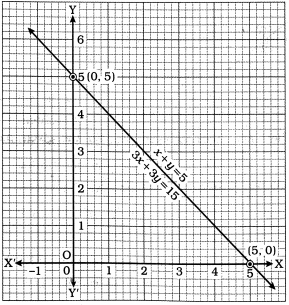
Solve the following pair of linear equations using a graph: $x+y=5$ and $3x+3y=15$.
Solution
(N/A) Here,dividing each term of $3x+3y=15$ by $3$,we get the equation $x+y=5$.
Thus,both the equations of the pair are identical.
Hence,we say that both the lines are the same.
So,they are coincident. It means that there are infinitely many solutions. To draw the graph,we make the following table:
$x+y=5$
$\therefore y=5-x$
For $x=0, y=5-0=5$
For $x=5, y=5-5=0$
and
$3x+3y=15$
$\therefore 3y=15-3x$
$\therefore y=\frac{15-3x}{3}$
$\therefore y=5-x$
$\therefore$ Both the tables are the same.
$\therefore$ Plot the ordered pairs $(0, 5)$ and $(5, 0)$ of the solution set of $x+y=5$ (or $3x+3y=15$,i.e.,$x+y=5$) on the graph paper and draw the line by joining them.
Here,the graphs of both the equations are the same. Also,we can see that there are infinite points on the line,and they all make the solution set. Thus,the solution set of the pair of linear equations is ${(x, y) \mid x+y=5, x, y \in R}$.
Thus,both the equations of the pair are identical.
Hence,we say that both the lines are the same.
So,they are coincident. It means that there are infinitely many solutions. To draw the graph,we make the following table:
$x+y=5$
$\therefore y=5-x$
For $x=0, y=5-0=5$
For $x=5, y=5-5=0$
and
$3x+3y=15$
$\therefore 3y=15-3x$
$\therefore y=\frac{15-3x}{3}$
$\therefore y=5-x$
$\therefore$ Both the tables are the same.
| $x$ | $0$ | $5$ |
| $y$ | $5$ | $0$ |
$\therefore$ Plot the ordered pairs $(0, 5)$ and $(5, 0)$ of the solution set of $x+y=5$ (or $3x+3y=15$,i.e.,$x+y=5$) on the graph paper and draw the line by joining them.
Here,the graphs of both the equations are the same. Also,we can see that there are infinite points on the line,and they all make the solution set. Thus,the solution set of the pair of linear equations is ${(x, y) \mid x+y=5, x, y \in R}$.
0 likes
View Solution105
MediumMCQ
Solve the following pair of linear equations in two variables using the graphical method: $y + x = 5$ and $y - x = 9$.
A
$(-2, 7)$
B
$(-2, 5)$
C
$(7, 0)$
D
$(5, 7)$
Solution
(A) Given equations are:
$1) \, y + x = 5 \implies y = 5 - x$
$2) \, y - x = 9 \implies y = 9 + x$
To plot the graph, we find points for each line:
For $y = 5 - x$: If $x = 0, y = 5$; If $x = 5, y = 0$. Points are $(0, 5)$ and $(5, 0)$.
For $y = 9 + x$: If $x = 0, y = 9$; If $x = -9, y = 0$. Points are $(0, 9)$ and $(-9, 0)$.
Solving algebraically for intersection:
Adding the two equations: $(y + x) + (y - x) = 5 + 9 \implies 2y = 14 \implies y = 7$.
Substituting $y = 7$ in $y + x = 5$: $7 + x = 5 \implies x = -2$.
The point of intersection is $(-2, 7)$.
$1) \, y + x = 5 \implies y = 5 - x$
$2) \, y - x = 9 \implies y = 9 + x$
To plot the graph, we find points for each line:
For $y = 5 - x$: If $x = 0, y = 5$; If $x = 5, y = 0$. Points are $(0, 5)$ and $(5, 0)$.
For $y = 9 + x$: If $x = 0, y = 9$; If $x = -9, y = 0$. Points are $(0, 9)$ and $(-9, 0)$.
Solving algebraically for intersection:
Adding the two equations: $(y + x) + (y - x) = 5 + 9 \implies 2y = 14 \implies y = 7$.
Substituting $y = 7$ in $y + x = 5$: $7 + x = 5 \implies x = -2$.
The point of intersection is $(-2, 7)$.
0 likes
View Solution106
Medium
Solve the following pair of linear equations in two variables using a graph: $3x + 6y = 4$ and $2x + 4y = \frac{8}{3}$.
Solution
(D) Given equations are:
$1) 3x + 6y = 4$
$2) 2x + 4y = \frac{8}{3}$
Multiply equation $(2)$ by $\frac{3}{2}$:
$\frac{3}{2}(2x + 4y) = \frac{3}{2} \times \frac{8}{3}$
$3x + 6y = 4$
Since both equations represent the same line,they are coincident lines.
Therefore,the system has infinitely many solutions. The solution set is $\{(x, y) \mid 3x + 6y = 4; x, y \in R \}$.
$1) 3x + 6y = 4$
$2) 2x + 4y = \frac{8}{3}$
Multiply equation $(2)$ by $\frac{3}{2}$:
$\frac{3}{2}(2x + 4y) = \frac{3}{2} \times \frac{8}{3}$
$3x + 6y = 4$
Since both equations represent the same line,they are coincident lines.
Therefore,the system has infinitely many solutions. The solution set is $\{(x, y) \mid 3x + 6y = 4; x, y \in R \}$.
0 likes
View Solution107
MediumMCQ
Solve the following pair of linear equations in two variables using the graphical method: $2x + y = 7$ and $x - 2y = 6$.
A
$(4, -1)$
B
$(3, 1)$
C
$(2, 3)$
D
$(1, 5)$
Solution
(A) Given equations are:
$1) 2x + y = 7 \implies y = 7 - 2x$
For $x = 0, y = 7$. For $x = 2, y = 3$. For $x = 3, y = 1$.
$2) x - 2y = 6 \implies x = 6 + 2y$
For $y = 0, x = 6$. For $y = -1, x = 4$. For $y = -2, x = 2$.
Plotting these points on a graph,the two lines intersect at the point $(4, -1)$.
Thus,the solution is $x = 4$ and $y = -1$.
$1) 2x + y = 7 \implies y = 7 - 2x$
For $x = 0, y = 7$. For $x = 2, y = 3$. For $x = 3, y = 1$.
$2) x - 2y = 6 \implies x = 6 + 2y$
For $y = 0, x = 6$. For $y = -1, x = 4$. For $y = -2, x = 2$.
Plotting these points on a graph,the two lines intersect at the point $(4, -1)$.
Thus,the solution is $x = 4$ and $y = -1$.
0 likes
View Solution108
MediumMCQ
Solve the following pair of linear equations in two variables using a graph: $y = 2$,$x + 4y = 10$.
A
$(3, -5)$
B
$(1, 4)$
C
$(5, 7)$
D
$(2, 2)$
Solution
(D) Given equations are:
$1) y = 2$
$2) x + 4y = 10$
Step $1$: The first equation $y = 2$ represents a horizontal line passing through all points where the $y$-coordinate is $2$.
Step $2$: For the second equation $x + 4y = 10$,substitute $y = 2$ into the equation:
$x + 4(2) = 10$
$x + 8 = 10$
$x = 10 - 8$
$x = 2$
Step $3$: The point of intersection of the two lines is $(2, 2)$.
Graphically,the line $y = 2$ is a horizontal line,and $x + 4y = 10$ is a line passing through $(10, 0)$ and $(2, 2)$. Both lines intersect at the point $(2, 2)$.
$1) y = 2$
$2) x + 4y = 10$
Step $1$: The first equation $y = 2$ represents a horizontal line passing through all points where the $y$-coordinate is $2$.
Step $2$: For the second equation $x + 4y = 10$,substitute $y = 2$ into the equation:
$x + 4(2) = 10$
$x + 8 = 10$
$x = 10 - 8$
$x = 2$
Step $3$: The point of intersection of the two lines is $(2, 2)$.
Graphically,the line $y = 2$ is a horizontal line,and $x + 4y = 10$ is a line passing through $(10, 0)$ and $(2, 2)$. Both lines intersect at the point $(2, 2)$.
0 likes
View Solution109
MediumMCQ
Solve the following pair of linear equations in two variables using a graph: $x + y = 5$ and $5x - 2y = 4$.
A
$(2, 3)$
B
$(3, 7)$
C
$(-2, 1)$
D
$(7, -5)$
Solution
(A) Given equations are:
$1) x + y = 5$
$2) 5x - 2y = 4$
For equation $(1)$,if $x = 0$,then $y = 5$. If $y = 0$,then $x = 5$. Points are $(0, 5)$ and $(5, 0)$.
For equation $(2)$,if $x = 0$,then $-2y = 4 \implies y = -2$. If $y = 0$,then $5x = 4 \implies x = 0.8$. Points are $(0, -2)$ and $(0.8, 0)$.
By plotting these lines on a graph,the point of intersection is $(2, 3)$.
Verification: $2 + 3 = 5$ (Correct) and $5(2) - 2(3) = 10 - 6 = 4$ (Correct).
Thus,the solution is $(2, 3)$.
$1) x + y = 5$
$2) 5x - 2y = 4$
For equation $(1)$,if $x = 0$,then $y = 5$. If $y = 0$,then $x = 5$. Points are $(0, 5)$ and $(5, 0)$.
For equation $(2)$,if $x = 0$,then $-2y = 4 \implies y = -2$. If $y = 0$,then $5x = 4 \implies x = 0.8$. Points are $(0, -2)$ and $(0.8, 0)$.
By plotting these lines on a graph,the point of intersection is $(2, 3)$.
Verification: $2 + 3 = 5$ (Correct) and $5(2) - 2(3) = 10 - 6 = 4$ (Correct).
Thus,the solution is $(2, 3)$.
0 likes
View Solution110
MediumMCQ
Solve the following pair of linear equations in two variables using a graph: $2x - 3y = 5$ and $4x - 6y = -13$.
A
$(1, 2)$
B
$\text{No solution } (\varnothing)$
C
$(3, 1)$
D
$(7, 5)$
Solution
(B) Given equations are:
$1) \, 2x - 3y = 5$
$2) \, 4x - 6y = -13$
Comparing these with the standard form $a_1x + b_1y + c_1 = 0$ and $a_2x + b_2y + c_2 = 0$:
$a_1 = 2, b_1 = -3, c_1 = -5$
$a_2 = 4, b_2 = -6, c_2 = 13$
Calculating the ratios:
$\frac{a_1}{a_2} = \frac{2}{4} = \frac{1}{2}$
$\frac{b_1}{b_2} = \frac{-3}{-6} = \frac{1}{2}$
$\frac{c_1}{c_2} = \frac{-5}{13}$
Since $\frac{a_1}{a_2} = \frac{b_1}{b_2} \neq \frac{c_1}{c_2}$,the lines represented by these equations are parallel to each other.
Parallel lines do not intersect at any point,which means the system of equations has no solution $(\varnothing)$.
$1) \, 2x - 3y = 5$
$2) \, 4x - 6y = -13$
Comparing these with the standard form $a_1x + b_1y + c_1 = 0$ and $a_2x + b_2y + c_2 = 0$:
$a_1 = 2, b_1 = -3, c_1 = -5$
$a_2 = 4, b_2 = -6, c_2 = 13$
Calculating the ratios:
$\frac{a_1}{a_2} = \frac{2}{4} = \frac{1}{2}$
$\frac{b_1}{b_2} = \frac{-3}{-6} = \frac{1}{2}$
$\frac{c_1}{c_2} = \frac{-5}{13}$
Since $\frac{a_1}{a_2} = \frac{b_1}{b_2} \neq \frac{c_1}{c_2}$,the lines represented by these equations are parallel to each other.
Parallel lines do not intersect at any point,which means the system of equations has no solution $(\varnothing)$.
0 likes
View Solution111
MediumMCQ
Solve the following pair of linear equations in two variables using a graph: $4x + y = 7$ and $16x + 4y = 28$.
A
Unique solution
B
No solution
C
Infinitely many solutions
D
None of these
Solution
(C) Given equations are:
$1) 4x + y = 7$
$2) 16x + 4y = 28$
Divide equation $(2)$ by $4$:
$4x + y = 7$
Since both equations are identical,they represent the same line on the graph.
For any value of $x$,we can find a corresponding value of $y$ such that $y = 7 - 4x$.
Therefore,the system has infinitely many solutions.
The solution set is ${(x, y) \mid 4x + y = 7; x, y \in R}$.
$1) 4x + y = 7$
$2) 16x + 4y = 28$
Divide equation $(2)$ by $4$:
$4x + y = 7$
Since both equations are identical,they represent the same line on the graph.
For any value of $x$,we can find a corresponding value of $y$ such that $y = 7 - 4x$.
Therefore,the system has infinitely many solutions.
The solution set is ${(x, y) \mid 4x + y = 7; x, y \in R}$.
0 likes
View Solution112
MediumMCQ
Solve the following pair of linear equations in two variables using a graph: $x + 2y = -4$ and $3x + 4y = -6$.
A
$(2, 3)$
B
$(-2, -3)$
C
$(-2, 3)$
D
$(2, -3)$
Solution
(D) To solve the system of equations $x + 2y = -4$ and $3x + 4y = -6$ graphically:
$1$. For the first equation $x + 2y = -4$,if $x = 0$,then $y = -2$. If $y = 0$,then $x = -4$. The line passes through $(0, -2)$ and $(-4, 0)$.
$2$. For the second equation $3x + 4y = -6$,if $x = 0$,then $y = -1.5$. If $y = 0$,then $x = -2$. The line passes through $(0, -1.5)$ and $(-2, 0)$.
$3$. Solving the equations algebraically: Multiply the first equation by $2$: $2x + 4y = -8$. Subtract this from the second equation: $(3x + 4y) - (2x + 4y) = -6 - (-8)$,which gives $x = 2$.
$4$. Substitute $x = 2$ into $x + 2y = -4$: $2 + 2y = -4 \implies 2y = -6 \implies y = -3$.
$5$. The intersection point is $(2, -3)$.
$1$. For the first equation $x + 2y = -4$,if $x = 0$,then $y = -2$. If $y = 0$,then $x = -4$. The line passes through $(0, -2)$ and $(-4, 0)$.
$2$. For the second equation $3x + 4y = -6$,if $x = 0$,then $y = -1.5$. If $y = 0$,then $x = -2$. The line passes through $(0, -1.5)$ and $(-2, 0)$.
$3$. Solving the equations algebraically: Multiply the first equation by $2$: $2x + 4y = -8$. Subtract this from the second equation: $(3x + 4y) - (2x + 4y) = -6 - (-8)$,which gives $x = 2$.
$4$. Substitute $x = 2$ into $x + 2y = -4$: $2 + 2y = -4 \implies 2y = -6 \implies y = -3$.
$5$. The intersection point is $(2, -3)$.
0 likes
View Solution113
MediumMCQ
Solve the following pair of linear equations in two variables using a graph: $x + y = 8$ and $x - y = 2$.
A
$(5, 3)$
B
$(-5, 3)$
C
$(5, -3)$
D
$(-5, -3)$
Solution
(A) To solve the system of equations $x + y = 8$ and $x - y = 2$ graphically:
$1$. For the equation $x + y = 8$,we find two points: If $x = 0, y = 8$; if $x = 8, y = 0$. The line passes through $(0, 8)$ and $(8, 0)$.
$2$. For the equation $x - y = 2$,we find two points: If $x = 0, y = -2$; if $x = 2, y = 0$. The line passes through $(0, -2)$ and $(2, 0)$.
$3$. Plotting these two lines on a Cartesian plane,they intersect at the point $(5, 3)$.
$4$. Therefore,the solution is $x = 5$ and $y = 3$.
$1$. For the equation $x + y = 8$,we find two points: If $x = 0, y = 8$; if $x = 8, y = 0$. The line passes through $(0, 8)$ and $(8, 0)$.
$2$. For the equation $x - y = 2$,we find two points: If $x = 0, y = -2$; if $x = 2, y = 0$. The line passes through $(0, -2)$ and $(2, 0)$.
$3$. Plotting these two lines on a Cartesian plane,they intersect at the point $(5, 3)$.
$4$. Therefore,the solution is $x = 5$ and $y = 3$.
0 likes
View Solution114
MediumMCQ
Solve the following pair of linear equations in two variables graphically: $2x + 3y = 12$ and $2x + 3y = 6$.
A
$(5, 3)$
B
$\varnothing$ (No solution)
C
$(7, 1)$
D
$(3, 7)$
Solution
(B) Given the equations:
$1) \ 2x + 3y = 12$
$2) \ 2x + 3y = 6$
Comparing these equations with the standard form $a_1x + b_1y + c_1 = 0$ and $a_2x + b_2y + c_2 = 0$,we have:
$a_1 = 2, b_1 = 3, c_1 = -12$
$a_2 = 2, b_2 = 3, c_2 = -6$
Calculating the ratios:
$\frac{a_1}{a_2} = \frac{2}{2} = 1$
$\frac{b_1}{b_2} = \frac{3}{3} = 1$
$\frac{c_1}{c_2} = \frac{-12}{-6} = 2$
Since $\frac{a_1}{a_2} = \frac{b_1}{b_2} \neq \frac{c_1}{c_2}$,the lines are parallel to each other.
Parallel lines do not intersect at any point,which means the system of equations has no solution.
Therefore,the solution set is $\varnothing$.
$1) \ 2x + 3y = 12$
$2) \ 2x + 3y = 6$
Comparing these equations with the standard form $a_1x + b_1y + c_1 = 0$ and $a_2x + b_2y + c_2 = 0$,we have:
$a_1 = 2, b_1 = 3, c_1 = -12$
$a_2 = 2, b_2 = 3, c_2 = -6$
Calculating the ratios:
$\frac{a_1}{a_2} = \frac{2}{2} = 1$
$\frac{b_1}{b_2} = \frac{3}{3} = 1$
$\frac{c_1}{c_2} = \frac{-12}{-6} = 2$
Since $\frac{a_1}{a_2} = \frac{b_1}{b_2} \neq \frac{c_1}{c_2}$,the lines are parallel to each other.
Parallel lines do not intersect at any point,which means the system of equations has no solution.
Therefore,the solution set is $\varnothing$.
0 likes
View Solution115
MediumMCQ
Draw the graphs of the pair of linear equations $x+y=10$ and $x-y=4$. Determine the coordinates of the vertices of the triangle formed by these linear equations and the $X$-axis.
A
$(-2,3), (12,7), (0,10)$
B
$(0,-3), (2,6), (-7,3)$
C
$(7,3), (4,0), (10,0)$
D
$(2,3), (4,7), (9,0)$
Solution
(C) $1$. For the equation $x+y=10$,if $x=0, y=10$; if $y=0, x=10$. The line passes through $(0,10)$ and $(10,0)$.
$2$. For the equation $x-y=4$,if $x=0, y=-4$; if $y=0, x=4$. The line passes through $(0,-4)$ and $(4,0)$.
$3$. Solving the equations simultaneously: Adding $(x+y=10)$ and $(x-y=4)$ gives $2x=14$,so $x=7$. Substituting $x=7$ into $x+y=10$ gives $y=3$. The intersection point is $(7,3)$.
$4$. The triangle is formed by the intersection of the two lines $(7,3)$ and their respective intersections with the $X$-axis,which are $(4,0)$ and $(10,0)$.
$5$. Thus,the vertices of the triangle are $(7,3), (4,0),$ and $(10,0)$.
$2$. For the equation $x-y=4$,if $x=0, y=-4$; if $y=0, x=4$. The line passes through $(0,-4)$ and $(4,0)$.
$3$. Solving the equations simultaneously: Adding $(x+y=10)$ and $(x-y=4)$ gives $2x=14$,so $x=7$. Substituting $x=7$ into $x+y=10$ gives $y=3$. The intersection point is $(7,3)$.
$4$. The triangle is formed by the intersection of the two lines $(7,3)$ and their respective intersections with the $X$-axis,which are $(4,0)$ and $(10,0)$.
$5$. Thus,the vertices of the triangle are $(7,3), (4,0),$ and $(10,0)$.
0 likes
View Solution116
DifficultMCQ
Draw the graphs of the pair of linear equations $x+3y=6$ and $2x-3y=12$. Determine the coordinates of the vertices of the triangle formed by these linear equations and the $Y$-axis.
A
$(0, -3), (2, 6), (-7, 3)$
B
$(7, 3), (4, 0), (10, 0)$
C
$(2, 3), (4, 7), (9, 0)$
D
$(6, 0), (0, -4), (0, 2)$
Solution
(D) $1$. For the equation $x + 3y = 6$: If $x = 0$,$3y = 6 \implies y = 2$. If $y = 0$,$x = 6$. Points are $(0, 2)$ and $(6, 0)$.
$2$. For the equation $2x - 3y = 12$: If $x = 0$,$-3y = 12 \implies y = -4$. If $y = 0$,$2x = 12 \implies x = 6$. Points are $(0, -4)$ and $(6, 0)$.
$3$. Solving the system: Adding the two equations,$(x + 3y) + (2x - 3y) = 6 + 12 \implies 3x = 18 \implies x = 6$. Substituting $x = 6$ into $x + 3y = 6$,we get $6 + 3y = 6 \implies y = 0$. The intersection point is $(6, 0)$.
$4$. The triangle is formed by the lines and the $Y$-axis. The vertices are the intersection of the two lines $(6, 0)$,the $Y$-intercept of the first line $(0, 2)$,and the $Y$-intercept of the second line $(0, -4)$.
$5$. Thus,the vertices are $(6, 0), (0, 2), (0, -4)$.
$2$. For the equation $2x - 3y = 12$: If $x = 0$,$-3y = 12 \implies y = -4$. If $y = 0$,$2x = 12 \implies x = 6$. Points are $(0, -4)$ and $(6, 0)$.
$3$. Solving the system: Adding the two equations,$(x + 3y) + (2x - 3y) = 6 + 12 \implies 3x = 18 \implies x = 6$. Substituting $x = 6$ into $x + 3y = 6$,we get $6 + 3y = 6 \implies y = 0$. The intersection point is $(6, 0)$.
$4$. The triangle is formed by the lines and the $Y$-axis. The vertices are the intersection of the two lines $(6, 0)$,the $Y$-intercept of the first line $(0, 2)$,and the $Y$-intercept of the second line $(0, -4)$.
$5$. Thus,the vertices are $(6, 0), (0, 2), (0, -4)$.
0 likes
View Solution117
MediumMCQ
$6$ students of class $X$ took part in the Ramanujan Competitive Examination. The number of girl participants is $2$ less than the number of boy participants. Find the number of girls and the number of boys who took part in the examination using a graph.
A
Boys: $4$,Girls: $2$
B
Boys: $7$,Girls: $3$
C
Boys: $8$,Girls: $4$
D
Boys: $6$,Girls: $12$
Solution
$(A)$ Let the number of boys be $x$ and the number of girls be $y$.
According to the problem,the total number of students is $6$,so $x + y = 6$.
The number of girls is $2$ less than the number of boys,so $y = x - 2$,which can be written as $x - y = 2$.
Solving the system of equations:
$1) x + y = 6$
$2) x - y = 2$
Adding the two equations: $(x + y) + (x - y) = 6 + 2 \rightarrow 2x = 8 \rightarrow x = 4$.
Substituting $x = 4$ into the first equation: $4 + y = 6 \rightarrow y = 2$.
Thus,there are $4$ boys and $2$ girls.
According to the problem,the total number of students is $6$,so $x + y = 6$.
The number of girls is $2$ less than the number of boys,so $y = x - 2$,which can be written as $x - y = 2$.
Solving the system of equations:
$1) x + y = 6$
$2) x - y = 2$
Adding the two equations: $(x + y) + (x - y) = 6 + 2 \rightarrow 2x = 8 \rightarrow x = 4$.
Substituting $x = 4$ into the first equation: $4 + y = 6 \rightarrow y = 2$.
Thus,there are $4$ boys and $2$ girls.
0 likes
View Solution118
MediumMCQ
Examine graphically whether the pair of equations $2x + 4y = 9$ and $3x + 6y = \frac{27}{2}$ is consistent.
A
Consistent
B
Inconsistent
C
Dependent
D
None of these
Solution
(A) To check if the pair of equations is consistent,we compare the ratios of the coefficients:
$a_1 = 2, b_1 = 4, c_1 = -9$
$a_2 = 3, b_2 = 6, c_2 = -\frac{27}{2}$
Calculating the ratios:
$\frac{a_1}{a_2} = \frac{2}{3}$
$\frac{b_1}{b_2} = \frac{4}{6} = \frac{2}{3}$
$\frac{c_1}{c_2} = \frac{-9}{-27/2} = \frac{9 \times 2}{27} = \frac{18}{27} = \frac{2}{3}$
Since $\frac{a_1}{a_2} = \frac{b_1}{b_2} = \frac{c_1}{c_2} = \frac{2}{3}$,the lines are coincident.
Coincident lines have infinitely many solutions,therefore the system is consistent.
$a_1 = 2, b_1 = 4, c_1 = -9$
$a_2 = 3, b_2 = 6, c_2 = -\frac{27}{2}$
Calculating the ratios:
$\frac{a_1}{a_2} = \frac{2}{3}$
$\frac{b_1}{b_2} = \frac{4}{6} = \frac{2}{3}$
$\frac{c_1}{c_2} = \frac{-9}{-27/2} = \frac{9 \times 2}{27} = \frac{18}{27} = \frac{2}{3}$
Since $\frac{a_1}{a_2} = \frac{b_1}{b_2} = \frac{c_1}{c_2} = \frac{2}{3}$,the lines are coincident.
Coincident lines have infinitely many solutions,therefore the system is consistent.
0 likes
View Solution119
MediumMCQ
By the method of substitution,solve the following pair of linear equations: $2x + 3y = 11, 2x - y = -1$
A
$(5, 0)$
B
$(7, 4)$
C
$(1, 3)$
D
$(2, 5)$
Solution
(C) Given equations are:
$2x + 3y = 11$ .......... $(i)$
$2x - y = -1$ .......... $(ii)$
From equation $(ii)$,we can express $y$ in terms of $x$:
$y = 2x + 1$ .......... $(iii)$
Substitute the value of $y$ from equation $(iii)$ into equation $(i)$:
$2x + 3(2x + 1) = 11$
$2x + 6x + 3 = 11$
$8x + 3 = 11$
$8x = 8$
$x = 1$
Now,substitute $x = 1$ into equation $(iii)$:
$y = 2(1) + 1$
$y = 2 + 1$
$y = 3$
Thus,the solution is $(x, y) = (1, 3)$.
$2x + 3y = 11$ .......... $(i)$
$2x - y = -1$ .......... $(ii)$
From equation $(ii)$,we can express $y$ in terms of $x$:
$y = 2x + 1$ .......... $(iii)$
Substitute the value of $y$ from equation $(iii)$ into equation $(i)$:
$2x + 3(2x + 1) = 11$
$2x + 6x + 3 = 11$
$8x + 3 = 11$
$8x = 8$
$x = 1$
Now,substitute $x = 1$ into equation $(iii)$:
$y = 2(1) + 1$
$y = 2 + 1$
$y = 3$
Thus,the solution is $(x, y) = (1, 3)$.
0 likes
View Solution120
MediumMCQ
By the method of substitution,solve the following pair of linear equations: $3x - 7y = 18, 6x - 14y = 12$.
A
$(1, 3)$
B
$(2, 5)$
C
$(7, 1)$
D
$\varnothing$
Solution
(D) Given equations are:
$3x - 7y = 18$ ..... $(1)$
$6x - 14y = 12$ ..... $(2)$
Divide equation $(2)$ by $2$:
$3x - 7y = 6$ ..... $(3)$
From equation $(1)$,we have $3x = 18 + 7y$. Substituting this into equation $(3)$:
$(18 + 7y) - 7y = 6$
$18 = 6$
This is a contradiction,as $18$ can never be equal to $6$.
Therefore,the given pair of linear equations has no solution,which means the solution set is $\varnothing$.
$3x - 7y = 18$ ..... $(1)$
$6x - 14y = 12$ ..... $(2)$
Divide equation $(2)$ by $2$:
$3x - 7y = 6$ ..... $(3)$
From equation $(1)$,we have $3x = 18 + 7y$. Substituting this into equation $(3)$:
$(18 + 7y) - 7y = 6$
$18 = 6$
This is a contradiction,as $18$ can never be equal to $6$.
Therefore,the given pair of linear equations has no solution,which means the solution set is $\varnothing$.
0 likes
View Solution121
DifficultMCQ
$A$ fraction becomes $\frac{1}{4}$ if $2$ is subtracted from the numerator and $3$ is added to the denominator. If $6$ is added to the numerator and the denominator is multiplied by $3$,it becomes $\frac{2}{3}$. Find the fraction.
A
$\frac{4}{5}$
B
$\frac{2}{3}$
C
$\frac{1}{6}$
D
$\frac{5}{9}$
Solution
(A) Let the numerator of the fraction be $x$ and the denominator be $y$.
According to the first condition,if $2$ is subtracted from the numerator and $3$ is added to the denominator,the fraction becomes $\frac{1}{4}$.
$\frac{x-2}{y+3} = \frac{1}{4}$
$4(x-2) = y+3$
$4x - 8 = y + 3$
$4x - y = 11$ .......... $(1)$
According to the second condition,if $6$ is added to the numerator and the denominator is multiplied by $3$,the fraction becomes $\frac{2}{3}$.
$\frac{x+6}{3y} = \frac{2}{3}$
$3(x+6) = 2(3y)$
$3x + 18 = 6y$
$3x - 6y = -18$
Dividing by $3$,we get $x - 2y = -6$ .......... $(2)$
From equation $(1)$,$y = 4x - 11$. Substituting this into equation $(2)$:
$x - 2(4x - 11) = -6$
$x - 8x + 22 = -6$
$-7x = -28$
$x = 4$
Now,substitute $x = 4$ into $y = 4x - 11$:
$y = 4(4) - 11 = 16 - 11 = 5$
Therefore,the original fraction is $\frac{x}{y} = \frac{4}{5}$.
According to the first condition,if $2$ is subtracted from the numerator and $3$ is added to the denominator,the fraction becomes $\frac{1}{4}$.
$\frac{x-2}{y+3} = \frac{1}{4}$
$4(x-2) = y+3$
$4x - 8 = y + 3$
$4x - y = 11$ .......... $(1)$
According to the second condition,if $6$ is added to the numerator and the denominator is multiplied by $3$,the fraction becomes $\frac{2}{3}$.
$\frac{x+6}{3y} = \frac{2}{3}$
$3(x+6) = 2(3y)$
$3x + 18 = 6y$
$3x - 6y = -18$
Dividing by $3$,we get $x - 2y = -6$ .......... $(2)$
From equation $(1)$,$y = 4x - 11$. Substituting this into equation $(2)$:
$x - 2(4x - 11) = -6$
$x - 8x + 22 = -6$
$-7x = -28$
$x = 4$
Now,substitute $x = 4$ into $y = 4x - 11$:
$y = 4(4) - 11 = 16 - 11 = 5$
Therefore,the original fraction is $\frac{x}{y} = \frac{4}{5}$.
0 likes
View Solution122
MediumMCQ
The sum of the present age of a father and twice the present age of a son is $70$ years. Also,the sum of twice the present age of father and the present age of son is $95$ years. Find their present ages.
A
Father: $40$ years,Son: $15$ years
B
Father: $45$ years,Son: $10$ years
C
Father: $35$ years,Son: $20$ years
D
Father: $50$ years,Son: $10$ years
Solution
(A) Let the present age of the father be $x$ years and the present age of the son be $y$ years.
According to the first condition: $x + 2y = 70$ --- $(1)$
According to the second condition: $2x + y = 95$ --- $(2)$
From equation $(1)$,we get $x = 70 - 2y$.
Substituting this value of $x$ into equation $(2)$:
$2(70 - 2y) + y = 95$
$140 - 4y + y = 95$
$140 - 3y = 95$
$-3y = 95 - 140$
$-3y = -45$
$y = 15$
Now,substitute $y = 15$ into $x = 70 - 2y$:
$x = 70 - 2(15)$
$x = 70 - 30 = 40$
Therefore,the father's present age is $40$ years and the son's present age is $15$ years.
According to the first condition: $x + 2y = 70$ --- $(1)$
According to the second condition: $2x + y = 95$ --- $(2)$
From equation $(1)$,we get $x = 70 - 2y$.
Substituting this value of $x$ into equation $(2)$:
$2(70 - 2y) + y = 95$
$140 - 4y + y = 95$
$140 - 3y = 95$
$-3y = 95 - 140$
$-3y = -45$
$y = 15$
Now,substitute $y = 15$ into $x = 70 - 2y$:
$x = 70 - 2(15)$
$x = 70 - 30 = 40$
Therefore,the father's present age is $40$ years and the son's present age is $15$ years.
0 likes
View Solution123
MediumMCQ
Solve the following pair of linear equations by the method of substitution: $x + y = 7$ and $5x + 12y = 7$.
A
$(-11, 4)$
B
$(11, 4)$
C
$(11, -4)$
D
$(-11, -4)$
Solution
(C) Given equations are:
$1) x + y = 7$
$2) 5x + 12y = 7$
From equation $(1)$,we can express $x$ in terms of $y$:
$x = 7 - y$ $(3)$
Substitute equation $(3)$ into equation $(2)$:
$5(7 - y) + 12y = 7$
$35 - 5y + 12y = 7$
$35 + 7y = 7$
$7y = 7 - 35$
$7y = -28$
$y = -4$
Now,substitute $y = -4$ back into equation $(3)$:
$x = 7 - (-4)$
$x = 7 + 4$
$x = 11$
Thus,the solution is $(x, y) = (11, -4)$.
$1) x + y = 7$
$2) 5x + 12y = 7$
From equation $(1)$,we can express $x$ in terms of $y$:
$x = 7 - y$ $(3)$
Substitute equation $(3)$ into equation $(2)$:
$5(7 - y) + 12y = 7$
$35 - 5y + 12y = 7$
$35 + 7y = 7$
$7y = 7 - 35$
$7y = -28$
$y = -4$
Now,substitute $y = -4$ back into equation $(3)$:
$x = 7 - (-4)$
$x = 7 + 4$
$x = 11$
Thus,the solution is $(x, y) = (11, -4)$.
0 likes
View Solution124
MediumMCQ
Solve the following pair of linear equations by the method of substitution: $5x - 3y = 1$ and $2x + 5y = 19$.
A
$x = 2, y = 3$
B
$x = 3, y = 2$
C
$x = 4, y = 6$
D
$x = 1, y = 2$
Solution
(A) Given equations are:
$1) 5x - 3y = 1$
$2) 2x + 5y = 19$
From equation $(1)$,we get $5x = 1 + 3y$,so $x = \frac{1 + 3y}{5}$.
Substitute this value of $x$ into equation $(2)$:
$2(\frac{1 + 3y}{5}) + 5y = 19$
Multiply by $5$ to clear the denominator:
$2(1 + 3y) + 25y = 95$
$2 + 6y + 25y = 95$
$31y = 93$
$y = 3$
Now,substitute $y = 3$ back into the expression for $x$:
$x = \frac{1 + 3(3)}{5} = \frac{1 + 9}{5} = \frac{10}{5} = 2$.
Thus,the solution is $(x, y) = (2, 3)$.
$1) 5x - 3y = 1$
$2) 2x + 5y = 19$
From equation $(1)$,we get $5x = 1 + 3y$,so $x = \frac{1 + 3y}{5}$.
Substitute this value of $x$ into equation $(2)$:
$2(\frac{1 + 3y}{5}) + 5y = 19$
Multiply by $5$ to clear the denominator:
$2(1 + 3y) + 25y = 95$
$2 + 6y + 25y = 95$
$31y = 93$
$y = 3$
Now,substitute $y = 3$ back into the expression for $x$:
$x = \frac{1 + 3(3)}{5} = \frac{1 + 9}{5} = \frac{10}{5} = 2$.
Thus,the solution is $(x, y) = (2, 3)$.
0 likes
View Solution125
MediumMCQ
Solve the following pair of linear equations by the method of substitution: $2x - y + 3 = 0$ and $y = 2x - \frac{3}{2}$.
A
$\varnothing$
B
$(10, 2)$
C
$(7, 9)$
D
$(4, 3)$
Solution
(A) Given equations are:
$(1)$ $2x - y + 3 = 0$
$(2)$ $y = 2x - \frac{3}{2}$
Substitute the value of $y$ from equation $(2)$ into equation $(1)$:
$2x - (2x - \frac{3}{2}) + 3 = 0$
$2x - 2x + \frac{3}{2} + 3 = 0$
$\frac{3}{2} + 3 = 0$
$\frac{3 + 6}{2} = 0$
$\frac{9}{2} = 0$
Since $\frac{9}{2} \neq 0$,this statement is a contradiction.
Therefore,the given pair of linear equations has no solution,which means the lines are parallel. The correct option is $A$.
$(1)$ $2x - y + 3 = 0$
$(2)$ $y = 2x - \frac{3}{2}$
Substitute the value of $y$ from equation $(2)$ into equation $(1)$:
$2x - (2x - \frac{3}{2}) + 3 = 0$
$2x - 2x + \frac{3}{2} + 3 = 0$
$\frac{3}{2} + 3 = 0$
$\frac{3 + 6}{2} = 0$
$\frac{9}{2} = 0$
Since $\frac{9}{2} \neq 0$,this statement is a contradiction.
Therefore,the given pair of linear equations has no solution,which means the lines are parallel. The correct option is $A$.
0 likes
View Solution126
Medium
Solve the following pair of linear equations by the method of substitution: $2x - 3y = -11$ and $4x - 6y + 22 = 0$.
Solution
(N/A) Given equations are:
$1) \, 2x - 3y = -11$
$2) \, 4x - 6y + 22 = 0$
From equation $(2)$,we can write $4x - 6y = -22$,which simplifies to $2(2x - 3y) = -22$,or $2x - 3y = -11$.
Since both equations are identical,they represent the same line.
This means the system has infinitely many solutions.
Any pair $(x, y)$ satisfying $2x - 3y = -11$ is a solution.
Thus,the solution set is $\{(x, y) \mid 2x - 3y = -11; \, x, y \in R \}$.
$1) \, 2x - 3y = -11$
$2) \, 4x - 6y + 22 = 0$
From equation $(2)$,we can write $4x - 6y = -22$,which simplifies to $2(2x - 3y) = -22$,or $2x - 3y = -11$.
Since both equations are identical,they represent the same line.
This means the system has infinitely many solutions.
Any pair $(x, y)$ satisfying $2x - 3y = -11$ is a solution.
Thus,the solution set is $\{(x, y) \mid 2x - 3y = -11; \, x, y \in R \}$.
0 likes
View Solution127
EasyMCQ
Solve the following pair of linear equations by the method of substitution: $3x + y + 1 = 0$ and $2x - 3y + 8 = 0$.
A
$(-1, 2)$
B
$(1, -4)$
C
$(0, 3)$
D
$(2, -7)$
Solution
(A) Given equations are:
$(1)$ $3x + y + 1 = 0$
$(2)$ $2x - 3y + 8 = 0$
From equation $(1)$,we can express $y$ in terms of $x$:
$y = -3x - 1$ $(3)$
Substitute the value of $y$ from equation $(3)$ into equation $(2)$:
$2x - 3(-3x - 1) + 8 = 0$
$2x + 9x + 3 + 8 = 0$
$11x + 11 = 0$
$11x = -11$
$x = -1$
Now,substitute $x = -1$ into equation $(3)$:
$y = -3(-1) - 1$
$y = 3 - 1$
$y = 2$
Thus,the solution is $(x, y) = (-1, 2)$.
$(1)$ $3x + y + 1 = 0$
$(2)$ $2x - 3y + 8 = 0$
From equation $(1)$,we can express $y$ in terms of $x$:
$y = -3x - 1$ $(3)$
Substitute the value of $y$ from equation $(3)$ into equation $(2)$:
$2x - 3(-3x - 1) + 8 = 0$
$2x + 9x + 3 + 8 = 0$
$11x + 11 = 0$
$11x = -11$
$x = -1$
Now,substitute $x = -1$ into equation $(3)$:
$y = -3(-1) - 1$
$y = 3 - 1$
$y = 2$
Thus,the solution is $(x, y) = (-1, 2)$.
0 likes
View Solution128
MediumMCQ
Solve the following pair of linear equations by the method of substitution: $8x - 3y = 1$ and $34x - 3y = 14$.
A
$(-7, -1/2)$
B
$(4, 2/5)$
C
$(1/2, 3/2)$
D
$(1/2, 1)$
Solution
(D) Given equations are:
$1) 8x - 3y = 1$
$2) 34x - 3y = 14$
From equation $(1)$,we can express $3y$ as:
$3y = 8x - 1$
$y = (8x - 1) / 3$
Substitute this value of $y$ into equation $(2)$:
$34x - 3((8x - 1) / 3) = 14$
$34x - (8x - 1) = 14$
$34x - 8x + 1 = 14$
$26x = 13$
$x = 13 / 26 = 1/2$
Now,substitute $x = 1/2$ into the expression for $y$:
$y = (8(1/2) - 1) / 3$
$y = (4 - 1) / 3$
$y = 3 / 3 = 1$
Thus,the solution is $(x, y) = (1/2, 1)$.
$1) 8x - 3y = 1$
$2) 34x - 3y = 14$
From equation $(1)$,we can express $3y$ as:
$3y = 8x - 1$
$y = (8x - 1) / 3$
Substitute this value of $y$ into equation $(2)$:
$34x - 3((8x - 1) / 3) = 14$
$34x - (8x - 1) = 14$
$34x - 8x + 1 = 14$
$26x = 13$
$x = 13 / 26 = 1/2$
Now,substitute $x = 1/2$ into the expression for $y$:
$y = (8(1/2) - 1) / 3$
$y = (4 - 1) / 3$
$y = 3 / 3 = 1$
Thus,the solution is $(x, y) = (1/2, 1)$.
0 likes
View Solution129
MediumMCQ
Solve the following pair of linear equations by the method of substitution: $x + 8y = 19$ and $2x + 11y = 28$.
A
$(3, 2)$
B
$(5, 7)$
C
$(4, 1)$
D
$(2, -1)$
Solution
(A) Given equations are:
$(1) x + 8y = 19$
$(2) 2x + 11y = 28$
From equation $(1)$,we can express $x$ in terms of $y$:
$x = 19 - 8y$
Substitute this value of $x$ into equation $(2)$:
$2(19 - 8y) + 11y = 28$
$38 - 16y + 11y = 28$
$38 - 5y = 28$
$-5y = 28 - 38$
$-5y = -10$
$y = 2$
Now,substitute $y = 2$ back into the expression for $x$:
$x = 19 - 8(2)$
$x = 19 - 16$
$x = 3$
Thus,the solution is $(x, y) = (3, 2)$.
$(1) x + 8y = 19$
$(2) 2x + 11y = 28$
From equation $(1)$,we can express $x$ in terms of $y$:
$x = 19 - 8y$
Substitute this value of $x$ into equation $(2)$:
$2(19 - 8y) + 11y = 28$
$38 - 16y + 11y = 28$
$38 - 5y = 28$
$-5y = 28 - 38$
$-5y = -10$
$y = 2$
Now,substitute $y = 2$ back into the expression for $x$:
$x = 19 - 8(2)$
$x = 19 - 16$
$x = 3$
Thus,the solution is $(x, y) = (3, 2)$.
0 likes
View Solution130
MediumMCQ
Solve the following pair of linear equations by the method of substitution: $2x + 3y = 7$ and $6x + 9y = 23$.
A
$(2, 2)$
B
$\text{No solution } (\varnothing)$
C
$(1, 1.5)$
D
$(0, -3)$
Solution
(B) Given equations are:
$1) \, 2x + 3y = 7$
$2) \, 6x + 9y = 23$
Check the ratio of coefficients:
$\frac{a_1}{a_2} = \frac{2}{6} = \frac{1}{3}$
$\frac{b_1}{b_2} = \frac{3}{9} = \frac{1}{3}$
$\frac{c_1}{c_2} = \frac{7}{23}$
Since $\frac{a_1}{a_2} = \frac{b_1}{b_2} \neq \frac{c_1}{c_2}$,the lines are parallel to each other.
Therefore,the system of equations has no solution,denoted by $\varnothing$.
$1) \, 2x + 3y = 7$
$2) \, 6x + 9y = 23$
Check the ratio of coefficients:
$\frac{a_1}{a_2} = \frac{2}{6} = \frac{1}{3}$
$\frac{b_1}{b_2} = \frac{3}{9} = \frac{1}{3}$
$\frac{c_1}{c_2} = \frac{7}{23}$
Since $\frac{a_1}{a_2} = \frac{b_1}{b_2} \neq \frac{c_1}{c_2}$,the lines are parallel to each other.
Therefore,the system of equations has no solution,denoted by $\varnothing$.
0 likes
View Solution131
MediumMCQ
Solve the following pair of linear equations by the method of substitution: $x + 11y = 1$ and $8x + 13y = 2$.
A
$(\frac{4}{20}, \frac{3}{18})$
B
$(\frac{7}{20}, \frac{3}{20})$
C
$(\frac{3}{25}, \frac{2}{25})$
D
$(\frac{2}{25}, \frac{5}{25})$
Solution
(C) Given equations are:
$(1) x + 11y = 1$
$(2) 8x + 13y = 2$
From equation $(1)$,we get $x = 1 - 11y$.
Substitute this value of $x$ into equation $(2)$:
$8(1 - 11y) + 13y = 2$
$8 - 88y + 13y = 2$
$8 - 75y = 2$
$-75y = 2 - 8$
$-75y = -6$
$y = \frac{-6}{-75} = \frac{2}{25}$.
Now,substitute $y = \frac{2}{25}$ into the expression for $x$:
$x = 1 - 11(\frac{2}{25})$
$x = 1 - \frac{22}{25} = \frac{25 - 22}{25} = \frac{3}{25}$.
Thus,the solution is $(x, y) = (\frac{3}{25}, \frac{2}{25})$.
$(1) x + 11y = 1$
$(2) 8x + 13y = 2$
From equation $(1)$,we get $x = 1 - 11y$.
Substitute this value of $x$ into equation $(2)$:
$8(1 - 11y) + 13y = 2$
$8 - 88y + 13y = 2$
$8 - 75y = 2$
$-75y = 2 - 8$
$-75y = -6$
$y = \frac{-6}{-75} = \frac{2}{25}$.
Now,substitute $y = \frac{2}{25}$ into the expression for $x$:
$x = 1 - 11(\frac{2}{25})$
$x = 1 - \frac{22}{25} = \frac{25 - 22}{25} = \frac{3}{25}$.
Thus,the solution is $(x, y) = (\frac{3}{25}, \frac{2}{25})$.
0 likes
View Solution132
MediumMCQ
Solve the following pair of linear equations by the method of substitution: $8x + 5y = 9$ and $3x + 2y = 4$.
A
$(-2, 5)$
B
$(-3, 2)$
C
$(0, -1)$
D
$(7, -5)$
Solution
(A) Given equations are:
$(1)$ $8x + 5y = 9$
$(2)$ $3x + 2y = 4$
From equation $(2)$,we can express $y$ in terms of $x$:
$2y = 4 - 3x$
$y = \frac{4 - 3x}{2}$
Substitute this value of $y$ into equation $(1)$:
$8x + 5(\frac{4 - 3x}{2}) = 9$
Multiply the entire equation by $2$ to eliminate the fraction:
$16x + 5(4 - 3x) = 18$
$16x + 20 - 15x = 18$
$x + 20 = 18$
$x = 18 - 20$
$x = -2$
Now,substitute $x = -2$ back into the expression for $y$:
$y = \frac{4 - 3(-2)}{2}$
$y = \frac{4 + 6}{2}$
$y = \frac{10}{2}$
$y = 5$
Thus,the solution is $(x, y) = (-2, 5)$.
$(1)$ $8x + 5y = 9$
$(2)$ $3x + 2y = 4$
From equation $(2)$,we can express $y$ in terms of $x$:
$2y = 4 - 3x$
$y = \frac{4 - 3x}{2}$
Substitute this value of $y$ into equation $(1)$:
$8x + 5(\frac{4 - 3x}{2}) = 9$
Multiply the entire equation by $2$ to eliminate the fraction:
$16x + 5(4 - 3x) = 18$
$16x + 20 - 15x = 18$
$x + 20 = 18$
$x = 18 - 20$
$x = -2$
Now,substitute $x = -2$ back into the expression for $y$:
$y = \frac{4 - 3(-2)}{2}$
$y = \frac{4 + 6}{2}$
$y = \frac{10}{2}$
$y = 5$
Thus,the solution is $(x, y) = (-2, 5)$.
0 likes
View Solution133
MediumMCQ
Solve the pair of linear equations $2x + y = 40$ and $x + y = 30$. If the solution satisfies the equation $y = mx + 6$,find the value of $m$.
A
$m = 1$
B
$m = 1.4$
C
$m = 2$
D
$m = 0.5$
Solution
(B) Given equations are:
$1) 2x + y = 40$
$2) x + y = 30$
Subtracting equation $(2)$ from equation $(1)$:
$(2x + y) - (x + y) = 40 - 30$
$x = 10$
Substituting $x = 10$ in equation $(2)$:
$10 + y = 30$
$y = 20$
So,the solution is $(x, y) = (10, 20)$.
Now,substitute these values into the equation $y = mx + 6$:
$20 = m(10) + 6$
$20 - 6 = 10m$
$14 = 10m$
$m = \frac{14}{10} = 1.4$.
$1) 2x + y = 40$
$2) x + y = 30$
Subtracting equation $(2)$ from equation $(1)$:
$(2x + y) - (x + y) = 40 - 30$
$x = 10$
Substituting $x = 10$ in equation $(2)$:
$10 + y = 30$
$y = 20$
So,the solution is $(x, y) = (10, 20)$.
Now,substitute these values into the equation $y = mx + 6$:
$20 = m(10) + 6$
$20 - 6 = 10m$
$14 = 10m$
$m = \frac{14}{10} = 1.4$.
0 likes
View Solution134
Medium
In $\Delta ABC$,$m \angle A = x$,$m \angle B = 3x$,and $m \angle C = y$. If $3y - 5x = 30$,show that the triangle is right-angled and find the measures of all three angles.
Solution
(A) The sum of angles in a triangle is $180^{\circ}$. Therefore,$x + 3x + y = 180$,which simplifies to $4x + y = 180$.
From this,we get $y = 180 - 4x$.
Substituting this into the given equation $3y - 5x = 30$:
$3(180 - 4x) - 5x = 30$
$540 - 12x - 5x = 30$
$540 - 17x = 30$
$17x = 510$
$x = 30^{\circ}$.
Now,find $y$:
$y = 180 - 4(30) = 180 - 120 = 60^{\circ}$.
Wait,checking the angles: $m \angle A = 30^{\circ}$,$m \angle B = 3(30) = 90^{\circ}$,and $m \angle C = 60^{\circ}$.
Since one angle is $90^{\circ}$,the triangle is right-angled.
The angles are $30^{\circ}, 90^{\circ}, 60^{\circ}$.
From this,we get $y = 180 - 4x$.
Substituting this into the given equation $3y - 5x = 30$:
$3(180 - 4x) - 5x = 30$
$540 - 12x - 5x = 30$
$540 - 17x = 30$
$17x = 510$
$x = 30^{\circ}$.
Now,find $y$:
$y = 180 - 4(30) = 180 - 120 = 60^{\circ}$.
Wait,checking the angles: $m \angle A = 30^{\circ}$,$m \angle B = 3(30) = 90^{\circ}$,and $m \angle C = 60^{\circ}$.
Since one angle is $90^{\circ}$,the triangle is right-angled.
The angles are $30^{\circ}, 90^{\circ}, 60^{\circ}$.
0 likes
View Solution135
MediumMCQ
$A$ fraction becomes $\frac{4}{5}$ if $1$ is added to both the numerator and the denominator. If $5$ is subtracted from both the numerator and the denominator,it becomes $\frac{1}{2}$. Find the fraction.
A
$\frac{9}{3}$
B
$\frac{7}{5}$
C
$\frac{7}{9}$
D
$\frac{1}{2}$
Solution
(C) Let the fraction be $\frac{x}{y}$.
According to the first condition: $\frac{x+1}{y+1} = \frac{4}{5}$.
Cross-multiplying gives: $5(x+1) = 4(y+1) \implies 5x + 5 = 4y + 4 \implies 5x - 4y = -1$ (Equation $1$).
According to the second condition: $\frac{x-5}{y-5} = \frac{1}{2}$.
Cross-multiplying gives: $2(x-5) = 1(y-5) \implies 2x - 10 = y - 5 \implies 2x - y = 5$ (Equation $2$).
From Equation $2$,$y = 2x - 5$. Substituting this into Equation $1$:
$5x - 4(2x - 5) = -1$
$5x - 8x + 20 = -1$
$-3x = -21 \implies x = 7$.
Now,find $y$: $y = 2(7) - 5 = 14 - 5 = 9$.
Thus,the fraction is $\frac{7}{9}$.
According to the first condition: $\frac{x+1}{y+1} = \frac{4}{5}$.
Cross-multiplying gives: $5(x+1) = 4(y+1) \implies 5x + 5 = 4y + 4 \implies 5x - 4y = -1$ (Equation $1$).
According to the second condition: $\frac{x-5}{y-5} = \frac{1}{2}$.
Cross-multiplying gives: $2(x-5) = 1(y-5) \implies 2x - 10 = y - 5 \implies 2x - y = 5$ (Equation $2$).
From Equation $2$,$y = 2x - 5$. Substituting this into Equation $1$:
$5x - 4(2x - 5) = -1$
$5x - 8x + 20 = -1$
$-3x = -21 \implies x = 7$.
Now,find $y$: $y = 2(7) - 5 = 14 - 5 = 9$.
Thus,the fraction is $\frac{7}{9}$.
0 likes
View Solution136
MediumMCQ
$A$ passenger buys $5$ tickets for Ahmadabad to Nadiad and $10$ tickets for Ahmadabad to Vadodara for Rs. $1050$. The total cost of a ticket for Ahmadabad to Nadiad and a ticket for Ahmadabad to Vadodara is Rs. $130$. Find the cost of a ticket for Ahmadabad to Nadiad as well as the cost of a ticket for Ahmadabad to Vadodara.
A
Cost of ticket for Ahmadabad to Nadiad is Rs. $50$ and for Ahmadabad to Vadodara is Rs. $80$.
B
Cost of ticket for Ahmadabad to Nadiad is Rs. $80$ and for Ahmadabad to Vadodara is Rs. $50$.
C
Cost of ticket for Ahmadabad to Nadiad is Rs. $60$ and for Ahmadabad to Vadodara is Rs. $70$.
D
Cost of ticket for Ahmadabad to Nadiad is Rs. $70$ and for Ahmadabad to Vadodara is Rs. $60$.
Solution
(A) Let the cost of a ticket from Ahmadabad to Nadiad be Rs. $x$ and the cost of a ticket from Ahmadabad to Vadodara be Rs. $y$.
According to the problem,we have two equations:
$1) 5x + 10y = 1050$
Dividing by $5$,we get: $x + 2y = 210$
$2) x + y = 130$
Subtracting equation $(2)$ from equation $(1)$:
$(x + 2y) - (x + y) = 210 - 130$
$y = 80$
Substituting $y = 80$ into equation $(2)$:
$x + 80 = 130$
$x = 130 - 80 = 50$
Therefore,the cost of a ticket from Ahmadabad to Nadiad is Rs. $50$ and the cost of a ticket from Ahmadabad to Vadodara is Rs. $80$.
According to the problem,we have two equations:
$1) 5x + 10y = 1050$
Dividing by $5$,we get: $x + 2y = 210$
$2) x + y = 130$
Subtracting equation $(2)$ from equation $(1)$:
$(x + 2y) - (x + y) = 210 - 130$
$y = 80$
Substituting $y = 80$ into equation $(2)$:
$x + 80 = 130$
$x = 130 - 80 = 50$
Therefore,the cost of a ticket from Ahmadabad to Nadiad is Rs. $50$ and the cost of a ticket from Ahmadabad to Vadodara is Rs. $80$.
0 likes
View Solution137
MediumMCQ
The denominator of a fraction is $6$ more than the numerator. If $1$ is added to the numerator and $3$ is subtracted from the denominator,the fraction becomes $\frac{3}{4}$. Find the fraction.
A
$\frac{5}{11}$
B
$\frac{7}{9}$
C
$\frac{50}{9}$
D
$\frac{7}{10}$
Solution
(A) Let the numerator of the fraction be $x$ and the denominator be $y$.
According to the problem,the denominator is $6$ more than the numerator: $y = x + 6$.
If $1$ is added to the numerator and $3$ is subtracted from the denominator,the fraction becomes $\frac{3}{4}$: $\frac{x + 1}{y - 3} = \frac{3}{4}$.
Substitute $y = x + 6$ into the second equation: $\frac{x + 1}{(x + 6) - 3} = \frac{3}{4}$.
$\frac{x + 1}{x + 3} = \frac{3}{4}$.
Cross-multiply: $4(x + 1) = 3(x + 3)$.
$4x + 4 = 3x + 9$.
$4x - 3x = 9 - 4$.
$x = 5$.
Now,find $y$: $y = x + 6 = 5 + 6 = 11$.
Therefore,the fraction is $\frac{x}{y} = \frac{5}{11}$.
According to the problem,the denominator is $6$ more than the numerator: $y = x + 6$.
If $1$ is added to the numerator and $3$ is subtracted from the denominator,the fraction becomes $\frac{3}{4}$: $\frac{x + 1}{y - 3} = \frac{3}{4}$.
Substitute $y = x + 6$ into the second equation: $\frac{x + 1}{(x + 6) - 3} = \frac{3}{4}$.
$\frac{x + 1}{x + 3} = \frac{3}{4}$.
Cross-multiply: $4(x + 1) = 3(x + 3)$.
$4x + 4 = 3x + 9$.
$4x - 3x = 9 - 4$.
$x = 5$.
Now,find $y$: $y = x + 6 = 5 + 6 = 11$.
Therefore,the fraction is $\frac{x}{y} = \frac{5}{11}$.
0 likes
View Solution138
MediumMCQ
Use the method of elimination to find the solution of the following pair of linear equations: $2x + y = 4$ and $x + 3y = 7$.
A
$(0, 0)$
B
$(1, 2)$
C
$(1, -1)$
D
$(-1, 3)$
Solution
(B) Given equations are:
$2x + y = 4$ --- $(1)$
$x + 3y = 7$ --- $(2)$
To eliminate $x$,multiply equation $(2)$ by $2$:
$2(x + 3y) = 2(7) \implies 2x + 6y = 14$ --- $(3)$
Now,subtract equation $(1)$ from equation $(3)$:
$(2x + 6y) - (2x + y) = 14 - 4$
$5y = 10$
$y = 2$
Substitute $y = 2$ in equation $(1)$:
$2x + 2 = 4$
$2x = 2$
$x = 1$
Thus,the solution is $(x, y) = (1, 2)$.
$2x + y = 4$ --- $(1)$
$x + 3y = 7$ --- $(2)$
To eliminate $x$,multiply equation $(2)$ by $2$:
$2(x + 3y) = 2(7) \implies 2x + 6y = 14$ --- $(3)$
Now,subtract equation $(1)$ from equation $(3)$:
$(2x + 6y) - (2x + y) = 14 - 4$
$5y = 10$
$y = 2$
Substitute $y = 2$ in equation $(1)$:
$2x + 2 = 4$
$2x = 2$
$x = 1$
Thus,the solution is $(x, y) = (1, 2)$.
0 likes
View Solution139
MediumMCQ
Use the method of elimination to find the solution of the following pair of linear equations: $\frac{x}{4} + \frac{y}{3} = 2, 4x + 3y = 25$.
A
$(0, 0)$
B
$(1, 2)$
C
$(4, 3)$
D
$(8, 5)$
Solution
(C) First,we multiply the equation $\frac{x}{4} + \frac{y}{3} = 2$ by $12$ to convert it into an equation with integer coefficients:
$3x + 4y = 24$ .......... $(1)$
$4x + 3y = 25$ .......... $(2)$
To eliminate $x$,multiply equation $(1)$ by $4$ and equation $(2)$ by $3$:
$12x + 16y = 96$ .......... $(3)$
$12x + 9y = 75$ .......... $(4)$
Subtracting equation $(4)$ from equation $(3)$:
$(12x - 12x) + (16y - 9y) = 96 - 75$
$7y = 21$
$y = 3$
Substituting $y = 3$ into equation $(1)$:
$3x + 4(3) = 24$
$3x + 12 = 24$
$3x = 12$
$x = 4$
Thus,the solution is $(x, y) = (4, 3)$.
$3x + 4y = 24$ .......... $(1)$
$4x + 3y = 25$ .......... $(2)$
To eliminate $x$,multiply equation $(1)$ by $4$ and equation $(2)$ by $3$:
$12x + 16y = 96$ .......... $(3)$
$12x + 9y = 75$ .......... $(4)$
Subtracting equation $(4)$ from equation $(3)$:
$(12x - 12x) + (16y - 9y) = 96 - 75$
$7y = 21$
$y = 3$
Substituting $y = 3$ into equation $(1)$:
$3x + 4(3) = 24$
$3x + 12 = 24$
$3x = 12$
$x = 4$
Thus,the solution is $(x, y) = (4, 3)$.
0 likes
View Solution140
MediumMCQ
Use the method of elimination to find the solution of the following pair of linear equations: $5x + 6y = 14$ and $3x - 2y = -14$.
A
$(2, 2)$
B
$(1, 0)$
C
$(1, 3)$
D
$(-2, 4)$
Solution
(D) Given equations are:
$5x + 6y = 14$ ............ $(1)$
$3x - 2y = -14$ ............ $(2)$
To eliminate $y$,multiply equation $(2)$ by $3$:
$3(3x - 2y) = 3(-14) \implies 9x - 6y = -42$ ............ $(3)$
Now,add equation $(1)$ and equation $(3)$:
$(5x + 6y) + (9x - 6y) = 14 + (-42)$
$14x = -28$
$x = \frac{-28}{14} = -2$
Substitute $x = -2$ into equation $(1)$:
$5(-2) + 6y = 14$
$-10 + 6y = 14$
$6y = 14 + 10$
$6y = 24$
$y = \frac{24}{6} = 4$
Thus,the solution is $(x, y) = (-2, 4)$.
$5x + 6y = 14$ ............ $(1)$
$3x - 2y = -14$ ............ $(2)$
To eliminate $y$,multiply equation $(2)$ by $3$:
$3(3x - 2y) = 3(-14) \implies 9x - 6y = -42$ ............ $(3)$
Now,add equation $(1)$ and equation $(3)$:
$(5x + 6y) + (9x - 6y) = 14 + (-42)$
$14x = -28$
$x = \frac{-28}{14} = -2$
Substitute $x = -2$ into equation $(1)$:
$5(-2) + 6y = 14$
$-10 + 6y = 14$
$6y = 14 + 10$
$6y = 24$
$y = \frac{24}{6} = 4$
Thus,the solution is $(x, y) = (-2, 4)$.
0 likes
View Solution141
MediumMCQ
Use the method of elimination to find the solution of the following pair of linear equations: $0.4 x + 0.3 y = 1.7, 0.7 x - 0.2 y = 0.8$
A
$(2, 3)$
B
$(3, 2)$
C
$(-2, -2)$
D
$(-3, 0)$
Solution
(A) Multiplying both equations by $10$ to remove decimals:
$4x + 3y = 17$ ............. $(1)$
$7x - 2y = 8$ ............. $(2)$
To eliminate $y$,multiply equation $(1)$ by $2$ and equation $(2)$ by $3$:
$8x + 6y = 34$
$21x - 6y = 24$
Adding these two equations:
$(8x + 21x) + (6y - 6y) = 34 + 24$
$29x = 58$
$x = \frac{58}{29} = 2$
Substituting $x = 2$ in equation $(1)$:
$4(2) + 3y = 17$
$8 + 3y = 17$
$3y = 17 - 8$
$3y = 9$
$y = 3$
Thus,the solution is $(x, y) = (2, 3)$.
$4x + 3y = 17$ ............. $(1)$
$7x - 2y = 8$ ............. $(2)$
To eliminate $y$,multiply equation $(1)$ by $2$ and equation $(2)$ by $3$:
$8x + 6y = 34$
$21x - 6y = 24$
Adding these two equations:
$(8x + 21x) + (6y - 6y) = 34 + 24$
$29x = 58$
$x = \frac{58}{29} = 2$
Substituting $x = 2$ in equation $(1)$:
$4(2) + 3y = 17$
$8 + 3y = 17$
$3y = 17 - 8$
$3y = 9$
$y = 3$
Thus,the solution is $(x, y) = (2, 3)$.
0 likes
View Solution142
Medium
There are some $25$ paise coins and some $50$ paise coins in a bag. The total number of coins is $150$ and the amount in the bag is Rs. $55$. Find the number of coins of each value in the bag.
Solution
(A) Suppose there are $x$ coins of $50$ paise and $y$ coins of $25$ paise in the bag.
The total number of coins is $x + y = 150$ ....... $(1)$
The value of $x$ coins of $50$ paise is $50x$ paise and the value of $y$ coins of $25$ paise is $25y$ paise.
The total amount is $50x + 25y$ paise.
Since the total amount is Rs. $55$,which is $5500$ paise,we have:
$50x + 25y = 5500$
Dividing the equation by $25$,we get:
$2x + y = 220$ ....... $(2)$
Subtracting equation $(1)$ from equation $(2)$:
$(2x + y) - (x + y) = 220 - 150$
$x = 70$
Substituting $x = 70$ in equation $(1)$:
$70 + y = 150$
$y = 80$
Thus,the number of $50$ paise coins is $70$ and the number of $25$ paise coins is $80$.
The total number of coins is $x + y = 150$ ....... $(1)$
The value of $x$ coins of $50$ paise is $50x$ paise and the value of $y$ coins of $25$ paise is $25y$ paise.
The total amount is $50x + 25y$ paise.
Since the total amount is Rs. $55$,which is $5500$ paise,we have:
$50x + 25y = 5500$
Dividing the equation by $25$,we get:
$2x + y = 220$ ....... $(2)$
Subtracting equation $(1)$ from equation $(2)$:
$(2x + y) - (x + y) = 220 - 150$
$x = 70$
Substituting $x = 70$ in equation $(1)$:
$70 + y = 150$
$y = 80$
Thus,the number of $50$ paise coins is $70$ and the number of $25$ paise coins is $80$.
0 likes
View Solution143
DifficultMCQ
The sum of the digits of a two-digit number is $6$. The number obtained by interchanging the digits is $18$ less than the original number. Find the original number.
A
$35$
B
$21$
C
$42$
D
$63$
Solution
(C) Let the digit at the ten's place be $y$ and the digit at the unit's place be $x$.
The original number is $10y + x$.
According to the problem,the sum of the digits is $6$:
$x + y = 6$ ............ $(1)$
When the digits are interchanged,the new number is $10x + y$.
According to the problem,the new number is $18$ less than the original number:
$(10y + x) - (10x + y) = 18$
$9y - 9x = 18$
Dividing by $9$,we get:
$y - x = 2$ ............ $(2)$
Adding equation $(1)$ and equation $(2)$:
$(x + y) + (y - x) = 6 + 2$
$2y = 8$
$y = 4$
Substituting $y = 4$ into equation $(1)$:
$x + 4 = 6$
$x = 2$
Therefore,the original number is $10(4) + 2 = 42$.
The original number is $10y + x$.
According to the problem,the sum of the digits is $6$:
$x + y = 6$ ............ $(1)$
When the digits are interchanged,the new number is $10x + y$.
According to the problem,the new number is $18$ less than the original number:
$(10y + x) - (10x + y) = 18$
$9y - 9x = 18$
Dividing by $9$,we get:
$y - x = 2$ ............ $(2)$
Adding equation $(1)$ and equation $(2)$:
$(x + y) + (y - x) = 6 + 2$
$2y = 8$
$y = 4$
Substituting $y = 4$ into equation $(1)$:
$x + 4 = 6$
$x = 2$
Therefore,the original number is $10(4) + 2 = 42$.
0 likes
View Solution144
MediumMCQ
Solve the following pairs of equations by the method of elimination:
$x + 3y - 6 = 0$
$2x - y = 5$
$x + 3y - 6 = 0$
$2x - y = 5$
A
$(2, 2)$
B
$(7, 0)$
C
$(0, 0)$
D
$(3, 1)$
Solution
(D) Given equations are:
$(1) x + 3y = 6$
$(2) 2x - y = 5$
To eliminate $y$,multiply equation $(2)$ by $3$:
$3(2x - y) = 3(5) \implies 6x - 3y = 15$ $(3)$
Now,add equation $(1)$ and equation $(3)$:
$(x + 3y) + (6x - 3y) = 6 + 15$
$7x = 21$
$x = 3$
Substitute $x = 3$ into equation $(2)$:
$2(3) - y = 5$
$6 - y = 5$
$y = 1$
Thus,the solution is $(x, y) = (3, 1)$.
$(1) x + 3y = 6$
$(2) 2x - y = 5$
To eliminate $y$,multiply equation $(2)$ by $3$:
$3(2x - y) = 3(5) \implies 6x - 3y = 15$ $(3)$
Now,add equation $(1)$ and equation $(3)$:
$(x + 3y) + (6x - 3y) = 6 + 15$
$7x = 21$
$x = 3$
Substitute $x = 3$ into equation $(2)$:
$2(3) - y = 5$
$6 - y = 5$
$y = 1$
Thus,the solution is $(x, y) = (3, 1)$.
0 likes
View Solution145
EasyMCQ
Solve the following pairs of equations by the method of elimination:
$4x - 3y = 5$
$\frac{5}{2}x - y = 4$
$4x - 3y = 5$
$\frac{5}{2}x - y = 4$
A
$(2, 1)$
B
$(1, 1)$
C
$(1, 0)$
D
$(0, 0)$
Solution
(A) Given equations are:
$(1) \quad 4x - 3y = 5$
$(2) \quad \frac{5}{2}x - y = 4$
Multiply equation $(2)$ by $3$ to eliminate $y$:
$3 \times (\frac{5}{2}x - y) = 3 \times 4$
$\frac{15}{2}x - 3y = 12 \quad (3)$
Subtract equation $(1)$ from equation $(3)$:
$(\frac{15}{2}x - 3y) - (4x - 3y) = 12 - 5$
$\frac{15}{2}x - 4x = 7$
$\frac{15x - 8x}{2} = 7$
$\frac{7x}{2} = 7$
$x = 2$
Substitute $x = 2$ into equation $(2)$:
$\frac{5}{2}(2) - y = 4$
$5 - y = 4$
$y = 1$
Thus,the solution is $(x, y) = (2, 1)$.
$(1) \quad 4x - 3y = 5$
$(2) \quad \frac{5}{2}x - y = 4$
Multiply equation $(2)$ by $3$ to eliminate $y$:
$3 \times (\frac{5}{2}x - y) = 3 \times 4$
$\frac{15}{2}x - 3y = 12 \quad (3)$
Subtract equation $(1)$ from equation $(3)$:
$(\frac{15}{2}x - 3y) - (4x - 3y) = 12 - 5$
$\frac{15}{2}x - 4x = 7$
$\frac{15x - 8x}{2} = 7$
$\frac{7x}{2} = 7$
$x = 2$
Substitute $x = 2$ into equation $(2)$:
$\frac{5}{2}(2) - y = 4$
$5 - y = 4$
$y = 1$
Thus,the solution is $(x, y) = (2, 1)$.
0 likes
View Solution146
EasyMCQ
Solve the following pairs of equations by the method of elimination:
$\frac{x}{2} + \frac{3y}{5} + 1 = 0$
$\frac{x}{2} + \frac{y}{3} - \frac{1}{3} = 0$
$\frac{x}{2} + \frac{3y}{5} + 1 = 0$
$\frac{x}{2} + \frac{y}{3} - \frac{1}{3} = 0$
A
$(1, 1)$
B
$(4, -5)$
C
$(2, 1)$
D
$(3, 5)$
Solution
(B) Given equations are:
$1) \frac{x}{2} + \frac{3y}{5} = -1$
$2) \frac{x}{2} + \frac{y}{3} = \frac{1}{3}$
Subtracting equation $(2)$ from equation $(1)$ to eliminate $x$:
$(\frac{x}{2} + \frac{3y}{5}) - (\frac{x}{2} + \frac{y}{3}) = -1 - \frac{1}{3}$
$\frac{3y}{5} - \frac{y}{3} = -\frac{4}{3}$
$\frac{9y - 5y}{15} = -\frac{4}{3}$
$\frac{4y}{15} = -\frac{4}{3}$
$y = -\frac{4}{3} \times \frac{15}{4} = -5$
Substitute $y = -5$ into equation $(2)$:
$\frac{x}{2} + \frac{-5}{3} = \frac{1}{3}$
$\frac{x}{2} = \frac{1}{3} + \frac{5}{3} = \frac{6}{3} = 2$
$x = 4$
Thus,the solution is $(x, y) = (4, -5)$.
$1) \frac{x}{2} + \frac{3y}{5} = -1$
$2) \frac{x}{2} + \frac{y}{3} = \frac{1}{3}$
Subtracting equation $(2)$ from equation $(1)$ to eliminate $x$:
$(\frac{x}{2} + \frac{3y}{5}) - (\frac{x}{2} + \frac{y}{3}) = -1 - \frac{1}{3}$
$\frac{3y}{5} - \frac{y}{3} = -\frac{4}{3}$
$\frac{9y - 5y}{15} = -\frac{4}{3}$
$\frac{4y}{15} = -\frac{4}{3}$
$y = -\frac{4}{3} \times \frac{15}{4} = -5$
Substitute $y = -5$ into equation $(2)$:
$\frac{x}{2} + \frac{-5}{3} = \frac{1}{3}$
$\frac{x}{2} = \frac{1}{3} + \frac{5}{3} = \frac{6}{3} = 2$
$x = 4$
Thus,the solution is $(x, y) = (4, -5)$.
0 likes
View Solution147
EasyMCQ
Solve the following pairs of equations by the method of elimination:
$9x + 7y = 55$
$7x + 9y = 57$
$9x + 7y = 55$
$7x + 9y = 57$
A
$(9, -3)$
B
$(2, 0)$
C
$(3, 4)$
D
$(1, 3)$
Solution
(C) Given equations are:
$(1) \ 9x + 7y = 55$
$(2) \ 7x + 9y = 57$
Adding equations $(1)$ and $(2)$:
$(9x + 7x) + (7y + 9y) = 55 + 57$
$16x + 16y = 112$
Dividing by $16$:
$x + y = 7 \quad (3)$
Subtracting equation $(2)$ from $(1)$:
$(9x - 7x) + (7y - 9y) = 55 - 57$
$2x - 2y = -2$
Dividing by $2$:
$x - y = -1 \quad (4)$
Adding equations $(3)$ and $(4)$:
$(x + y) + (x - y) = 7 + (-1)$
$2x = 6 \implies x = 3$
Substituting $x = 3$ in equation $(3)$:
$3 + y = 7 \implies y = 4$
Thus,the solution is $(x, y) = (3, 4)$.
$(1) \ 9x + 7y = 55$
$(2) \ 7x + 9y = 57$
Adding equations $(1)$ and $(2)$:
$(9x + 7x) + (7y + 9y) = 55 + 57$
$16x + 16y = 112$
Dividing by $16$:
$x + y = 7 \quad (3)$
Subtracting equation $(2)$ from $(1)$:
$(9x - 7x) + (7y - 9y) = 55 - 57$
$2x - 2y = -2$
Dividing by $2$:
$x - y = -1 \quad (4)$
Adding equations $(3)$ and $(4)$:
$(x + y) + (x - y) = 7 + (-1)$
$2x = 6 \implies x = 3$
Substituting $x = 3$ in equation $(3)$:
$3 + y = 7 \implies y = 4$
Thus,the solution is $(x, y) = (3, 4)$.
0 likes
View Solution148
EasyMCQ
Solve the following pair of equations by the method of elimination:
$11x + 13y = 61$
$13x + 11y = 59$
$11x + 13y = 61$
$13x + 11y = 59$
A
$(3, 4)$
B
$(1, 4)$
C
$(0, 9)$
D
$(2, 3)$
Solution
(D) Given equations are:
$(1) \ 11x + 13y = 61$
$(2) \ 13x + 11y = 59$
Adding equations $(1)$ and $(2)$:
$(11x + 13x) + (13y + 11y) = 61 + 59$
$24x + 24y = 120$
Dividing by $24$:
$x + y = 5$ --- $(3)$
Subtracting equation $(1)$ from $(2)$:
$(13x - 11x) + (11y - 13y) = 59 - 61$
$2x - 2y = -2$
Dividing by $2$:
$x - y = -1$ --- $(4)$
Adding equations $(3)$ and $(4)$:
$(x + y) + (x - y) = 5 + (-1)$
$2x = 4 \implies x = 2$
Substituting $x = 2$ in equation $(3)$:
$2 + y = 5 \implies y = 3$
Thus,the solution is $(x, y) = (2, 3)$.
$(1) \ 11x + 13y = 61$
$(2) \ 13x + 11y = 59$
Adding equations $(1)$ and $(2)$:
$(11x + 13x) + (13y + 11y) = 61 + 59$
$24x + 24y = 120$
Dividing by $24$:
$x + y = 5$ --- $(3)$
Subtracting equation $(1)$ from $(2)$:
$(13x - 11x) + (11y - 13y) = 59 - 61$
$2x - 2y = -2$
Dividing by $2$:
$x - y = -1$ --- $(4)$
Adding equations $(3)$ and $(4)$:
$(x + y) + (x - y) = 5 + (-1)$
$2x = 4 \implies x = 2$
Substituting $x = 2$ in equation $(3)$:
$2 + y = 5 \implies y = 3$
Thus,the solution is $(x, y) = (2, 3)$.
0 likes
View Solution149
EasyMCQ
Solve the following pairs of equations by the method of elimination:
$5(x-2) + 3y = 1$
$3(x+1) + 5(y-3) = 1$
$5(x-2) + 3y = 1$
$3(x+1) + 5(y-3) = 1$
A
$(1, 2)$
B
$(3, 4)$
C
$(1, 4)$
D
$(0, 9)$
Solution
(A) First,simplify the given equations:
$1$) $5(x-2) + 3y = 1 \implies 5x - 10 + 3y = 1 \implies 5x + 3y = 11$ (Equation $1$)
$2$) $3(x+1) + 5(y-3) = 1 \implies 3x + 3 + 5y - 15 = 1 \implies 3x + 5y = 13$ (Equation $2$)
To eliminate $y$,multiply Equation $1$ by $5$ and Equation $2$ by $3$:
$25x + 15y = 55$ (Equation $3$)
$9x + 15y = 39$ (Equation $4$)
Subtract Equation $4$ from Equation $3$:
$(25x - 9x) + (15y - 15y) = 55 - 39$
$16x = 16 \implies x = 1$
Substitute $x = 1$ into Equation $1$:
$5(1) + 3y = 11$
$5 + 3y = 11$
$3y = 6 \implies y = 2$
Thus,the solution is $(x, y) = (1, 2)$.
$1$) $5(x-2) + 3y = 1 \implies 5x - 10 + 3y = 1 \implies 5x + 3y = 11$ (Equation $1$)
$2$) $3(x+1) + 5(y-3) = 1 \implies 3x + 3 + 5y - 15 = 1 \implies 3x + 5y = 13$ (Equation $2$)
To eliminate $y$,multiply Equation $1$ by $5$ and Equation $2$ by $3$:
$25x + 15y = 55$ (Equation $3$)
$9x + 15y = 39$ (Equation $4$)
Subtract Equation $4$ from Equation $3$:
$(25x - 9x) + (15y - 15y) = 55 - 39$
$16x = 16 \implies x = 1$
Substitute $x = 1$ into Equation $1$:
$5(1) + 3y = 11$
$5 + 3y = 11$
$3y = 6 \implies y = 2$
Thus,the solution is $(x, y) = (1, 2)$.
0 likes
View Solution150
EasyMCQ
Solve the following pairs of equations by the method of elimination:
$7(y+3)-2(x+2)=14$
$4(y-2)+3(x-3)=2$
$7(y+3)-2(x+2)=14$
$4(y-2)+3(x-3)=2$
A
$(1, 2)$
B
$(5, 1)$
C
$(3, 4)$
D
$(1, 4)$
Solution
(B) First,simplify the given equations:
Equation $1$: $7y + 21 - 2x - 4 = 14 \implies -2x + 7y = -3$
Equation $2$: $4y - 8 + 3x - 9 = 2 \implies 3x + 4y = 19$
To eliminate $x$,multiply Equation $1$ by $3$ and Equation $2$ by $2$:
$-6x + 21y = -9$
$6x + 8y = 38$
Adding the two equations: $29y = 29 \implies y = 1$
Substitute $y = 1$ into Equation $2$: $3x + 4(1) = 19 \implies 3x = 15 \implies x = 5$
Thus,the solution is $(x, y) = (5, 1)$.
Equation $1$: $7y + 21 - 2x - 4 = 14 \implies -2x + 7y = -3$
Equation $2$: $4y - 8 + 3x - 9 = 2 \implies 3x + 4y = 19$
To eliminate $x$,multiply Equation $1$ by $3$ and Equation $2$ by $2$:
$-6x + 21y = -9$
$6x + 8y = 38$
Adding the two equations: $29y = 29 \implies y = 1$
Substitute $y = 1$ into Equation $2$: $3x + 4(1) = 19 \implies 3x = 15 \implies x = 5$
Thus,the solution is $(x, y) = (5, 1)$.
0 likes
View SolutionPair of Linear Equations in Two Variables — Mix Examples - Pair of Linear Equations in Two Variables · Frequently Asked Questions
1Are these Pair of Linear Equations in Two Variables questions useful for JEE and NEET?
Yes. All questions in this section are mapped to JEE Main and NEET exam patterns. Previous year questions from JEE Main, NEET, GUJCET and state-level exams are included with full solutions.
2Can I switch to Hindi or Gujarati for these questions?
Yes. Use the language tabs in the hero section or the sidebar to view the same questions and solutions in English, Hindi or Gujarati.
3How do I generate a question paper from this subtopic?
Use the Vedclass Exam Paper Generator — select the chapter and subtopic, set difficulty, and generate Sets A, B, C, D automatically. First 3 chapters of every subject are free.
Vedclass Products
For Students
Vedclass Test Series
Mock tests in real JEE/NEET style with performance analysis. 5-day free trial.
Start Free TrialFor Teachers
Exam Paper Generator
Generate Set A/B/C/D papers from this chapter in 2 minutes. 3 chapters free.
Try FreeFor Institutes
Online Exam Module
Live online exams with unlimited students, 360° analytics & white-label branding.
See DemoFor Teachers & Institutes
Generate a Pair of Linear Equations in Two Variables Exam Paper in 2 Minutes
Select subtopic & difficulty — Sets A, B, C, D auto-generated with No Repeat logic.
First 3 chapters of every subject are free — no payment required.