
A English
Mix Examples - Pair of Linear Equations in Two Variables Questions in English
Class 10 Mathematics · Pair of Linear Equations in Two Variables · Mix Examples - Pair of Linear Equations in Two Variables
360+
Questions
English
Language
100%
With Solutions
Showing 50 of 360 questions in English
51
DifficultMCQ
Solve the following pairs of equations:
$43x + 67y = -24$
$67x + 43y = 24$
$43x + 67y = -24$
$67x + 43y = 24$
A
$1, 0$
B
$-1, 1$
C
$1, -1$
D
$2, -3$
Solution
(C) Given pair of linear equations is:
$43x + 67y = -24 .....(i)$
$67x + 43y = 24 .....(ii)$
Adding equations $(i)$ and $(ii)$:
$(43 + 67)x + (67 + 43)y = -24 + 24$
$110x + 110y = 0$
$110(x + y) = 0$
$x + y = 0 \Rightarrow x = -y .....(iii)$
Subtracting equation $(i)$ from equation $(ii)$:
$(67 - 43)x + (43 - 67)y = 24 - (-24)$
$24x - 24y = 48$
$24(x - y) = 48$
$x - y = 2 .....(iv)$
Substituting $x = -y$ from $(iii)$ into $(iv)$:
$-y - y = 2$
$-2y = 2$
$y = -1$
Substituting $y = -1$ into $(iii)$:
$x = -(-1) = 1$
Thus,the solution is $x = 1$ and $y = -1$.
$43x + 67y = -24 .....(i)$
$67x + 43y = 24 .....(ii)$
Adding equations $(i)$ and $(ii)$:
$(43 + 67)x + (67 + 43)y = -24 + 24$
$110x + 110y = 0$
$110(x + y) = 0$
$x + y = 0 \Rightarrow x = -y .....(iii)$
Subtracting equation $(i)$ from equation $(ii)$:
$(67 - 43)x + (43 - 67)y = 24 - (-24)$
$24x - 24y = 48$
$24(x - y) = 48$
$x - y = 2 .....(iv)$
Substituting $x = -y$ from $(iii)$ into $(iv)$:
$-y - y = 2$
$-2y = 2$
$y = -1$
Substituting $y = -1$ into $(iii)$:
$x = -(-1) = 1$
Thus,the solution is $x = 1$ and $y = -1$.
0 likes
View Solution52
DifficultMCQ
Solve the following pair of linear equations:
$\frac{x}{a} + \frac{y}{b} = a + b$
$\frac{x}{a^{2}} + \frac{y}{b^{2}} = 2, \quad a, b \neq 0$
$\frac{x}{a} + \frac{y}{b} = a + b$
$\frac{x}{a^{2}} + \frac{y}{b^{2}} = 2, \quad a, b \neq 0$
A
$a^{2}, b^{2}$
B
$a^{-2}, b^{2}$
C
$a^{3}, b^{3}$
D
$a^{2}, b^{-2}$
Solution
(A) Given pair of linear equations is:
$\frac{x}{a} + \frac{y}{b} = a + b \quad .....(i)$
$\frac{x}{a^{2}} + \frac{y}{b^{2}} = 2, \quad a, b \neq 0 \quad .....(ii)$
Multiply equation $(i)$ by $\frac{1}{a}$:
$\frac{x}{a^{2}} + \frac{y}{ab} = 1 + \frac{b}{a} \quad .....(iii)$
Subtract equation $(iii)$ from equation $(ii)$:
$\left( \frac{x}{a^{2}} + \frac{y}{b^{2}} \right) - \left( \frac{x}{a^{2}} + \frac{y}{ab} \right) = 2 - \left( 1 + \frac{b}{a} \right)$
$\frac{y}{b^{2}} - \frac{y}{ab} = 1 - \frac{b}{a}$
$y \left( \frac{a - b}{ab^{2}} \right) = \frac{a - b}{a}$
Since $a \neq b$ (assuming general case),we can cancel $(a - b)$:
$\frac{y}{ab^{2}} = \frac{1}{a}$
$y = b^{2}$
Substitute $y = b^{2}$ into equation $(ii)$:
$\frac{x}{a^{2}} + \frac{b^{2}}{b^{2}} = 2$
$\frac{x}{a^{2}} + 1 = 2$
$\frac{x}{a^{2}} = 1$
$x = a^{2}$
Thus,the solution is $x = a^{2}$ and $y = b^{2}$.
$\frac{x}{a} + \frac{y}{b} = a + b \quad .....(i)$
$\frac{x}{a^{2}} + \frac{y}{b^{2}} = 2, \quad a, b \neq 0 \quad .....(ii)$
Multiply equation $(i)$ by $\frac{1}{a}$:
$\frac{x}{a^{2}} + \frac{y}{ab} = 1 + \frac{b}{a} \quad .....(iii)$
Subtract equation $(iii)$ from equation $(ii)$:
$\left( \frac{x}{a^{2}} + \frac{y}{b^{2}} \right) - \left( \frac{x}{a^{2}} + \frac{y}{ab} \right) = 2 - \left( 1 + \frac{b}{a} \right)$
$\frac{y}{b^{2}} - \frac{y}{ab} = 1 - \frac{b}{a}$
$y \left( \frac{a - b}{ab^{2}} \right) = \frac{a - b}{a}$
Since $a \neq b$ (assuming general case),we can cancel $(a - b)$:
$\frac{y}{ab^{2}} = \frac{1}{a}$
$y = b^{2}$
Substitute $y = b^{2}$ into equation $(ii)$:
$\frac{x}{a^{2}} + \frac{b^{2}}{b^{2}} = 2$
$\frac{x}{a^{2}} + 1 = 2$
$\frac{x}{a^{2}} = 1$
$x = a^{2}$
Thus,the solution is $x = a^{2}$ and $y = b^{2}$.
0 likes
View Solution53
DifficultMCQ
Solve the following pairs of equations:
$\frac{2xy}{x+y} = \frac{3}{2}$
$\frac{xy}{2x-y} = \frac{-3}{10}, \quad x+y \neq 0, 2x-y \neq 0$
$\frac{2xy}{x+y} = \frac{3}{2}$
$\frac{xy}{2x-y} = \frac{-3}{10}, \quad x+y \neq 0, 2x-y \neq 0$
A
$\frac{1}{2}, \frac{-3}{2}$
B
$\frac{-1}{2}, \frac{-3}{2}$
C
$\frac{-1}{2}, \frac{3}{2}$
D
$\frac{1}{4}, \frac{-3}{4}$
Solution
(A) Given pair of equations is:
$\frac{2xy}{x+y} = \frac{3}{2} \implies \frac{x+y}{2xy} = \frac{2}{3} \implies \frac{1}{y} + \frac{1}{x} = \frac{4}{3} \quad ...(i)$
$\frac{xy}{2x-y} = \frac{-3}{10} \implies \frac{2x-y}{xy} = \frac{-10}{3} \implies \frac{2}{y} - \frac{1}{x} = \frac{-10}{3} \quad ...(ii)$
Let $\frac{1}{x} = u$ and $\frac{1}{y} = v$. Then the equations become:
$v + u = \frac{4}{3} \quad ...(iii)$
$2v - u = \frac{-10}{3} \quad ...(iv)$
Adding $(iii)$ and $(iv)$:
$(v + u) + (2v - u) = \frac{4}{3} - \frac{10}{3}$
$3v = \frac{-6}{3} = -2 \implies v = \frac{-2}{3}$
Substituting $v = \frac{-2}{3}$ in $(iii)$:
$u + (\frac{-2}{3}) = \frac{4}{3} \implies u = \frac{4}{3} + \frac{2}{3} = \frac{6}{3} = 2$
Since $u = \frac{1}{x} = 2$,we get $x = \frac{1}{2}$.
Since $v = \frac{1}{y} = \frac{-2}{3}$,we get $y = \frac{-3}{2}$.
Thus,the solution is $x = \frac{1}{2}, y = \frac{-3}{2}$.
$\frac{2xy}{x+y} = \frac{3}{2} \implies \frac{x+y}{2xy} = \frac{2}{3} \implies \frac{1}{y} + \frac{1}{x} = \frac{4}{3} \quad ...(i)$
$\frac{xy}{2x-y} = \frac{-3}{10} \implies \frac{2x-y}{xy} = \frac{-10}{3} \implies \frac{2}{y} - \frac{1}{x} = \frac{-10}{3} \quad ...(ii)$
Let $\frac{1}{x} = u$ and $\frac{1}{y} = v$. Then the equations become:
$v + u = \frac{4}{3} \quad ...(iii)$
$2v - u = \frac{-10}{3} \quad ...(iv)$
Adding $(iii)$ and $(iv)$:
$(v + u) + (2v - u) = \frac{4}{3} - \frac{10}{3}$
$3v = \frac{-6}{3} = -2 \implies v = \frac{-2}{3}$
Substituting $v = \frac{-2}{3}$ in $(iii)$:
$u + (\frac{-2}{3}) = \frac{4}{3} \implies u = \frac{4}{3} + \frac{2}{3} = \frac{6}{3} = 2$
Since $u = \frac{1}{x} = 2$,we get $x = \frac{1}{2}$.
Since $v = \frac{1}{y} = \frac{-2}{3}$,we get $y = \frac{-3}{2}$.
Thus,the solution is $x = \frac{1}{2}, y = \frac{-3}{2}$.
0 likes
View Solution54
DifficultMCQ
Find the solution of the pair of equations $\frac{x}{10} + \frac{y}{5} - 1 = 0$ and $\frac{x}{8} + \frac{y}{6} = 15$. Hence,find $\lambda$ if $y = \lambda x + 5$.
A
$x = -340, y = -165, \lambda = -\frac{1}{2}$
B
$x = 340, y = -165, \lambda = -\frac{1}{2}$
C
$x = 340, y = 165, \lambda = -\frac{1}{2}$
D
$x = 340, y = -165, \lambda = \frac{1}{2}$
Solution
(B) Given pair of equations is:
$\frac{x}{10} + \frac{y}{5} = 1 \dots (i)$
$\frac{x}{8} + \frac{y}{6} = 15 \dots (ii)$
Multiplying equation $(i)$ by $10$,we get $x + 2y = 10 \dots (iii)$.
Multiplying equation $(ii)$ by $24$,we get $3x + 4y = 360 \dots (iv)$.
To eliminate $y$,multiply equation $(iii)$ by $2$:
$2x + 4y = 20 \dots (v)$
Subtracting equation $(v)$ from equation $(iv)$:
$(3x + 4y) - (2x + 4y) = 360 - 20$
$x = 340$
Substituting $x = 340$ into equation $(iii)$:
$340 + 2y = 10$
$2y = -330$
$y = -165$
Given the relation $y = \lambda x + 5$,substitute $x = 340$ and $y = -165$:
$-165 = \lambda(340) + 5$
$-170 = 340\lambda$
$\lambda = -\frac{170}{340} = -\frac{1}{2}$
Thus,the solution is $x = 340, y = -165$ and $\lambda = -\frac{1}{2}$.
$\frac{x}{10} + \frac{y}{5} = 1 \dots (i)$
$\frac{x}{8} + \frac{y}{6} = 15 \dots (ii)$
Multiplying equation $(i)$ by $10$,we get $x + 2y = 10 \dots (iii)$.
Multiplying equation $(ii)$ by $24$,we get $3x + 4y = 360 \dots (iv)$.
To eliminate $y$,multiply equation $(iii)$ by $2$:
$2x + 4y = 20 \dots (v)$
Subtracting equation $(v)$ from equation $(iv)$:
$(3x + 4y) - (2x + 4y) = 360 - 20$
$x = 340$
Substituting $x = 340$ into equation $(iii)$:
$340 + 2y = 10$
$2y = -330$
$y = -165$
Given the relation $y = \lambda x + 5$,substitute $x = 340$ and $y = -165$:
$-165 = \lambda(340) + 5$
$-170 = 340\lambda$
$\lambda = -\frac{170}{340} = -\frac{1}{2}$
Thus,the solution is $x = 340, y = -165$ and $\lambda = -\frac{1}{2}$.
0 likes
View Solution55
Difficult
By the graphical method,find whether the following pair of equations are consistent or not. If consistent,solve them.
$3x + y + 4 = 0$
$6x - 2y + 4 = 0$
$3x + y + 4 = 0$
$6x - 2y + 4 = 0$
Solution
(A) The given pair of equations is:
$3x + y + 4 = 0 .....(i)$
$6x - 2y + 4 = 0 .....(ii)$
Comparing with $a_1x + b_1y + c_1 = 0$ and $a_2x + b_2y + c_2 = 0$:
$a_1 = 3, b_1 = 1, c_1 = 4$
$a_2 = 6, b_2 = -2, c_2 = 4$
Calculating ratios:
$\frac{a_1}{a_2} = \frac{3}{6} = \frac{1}{2}$
$\frac{b_1}{b_2} = \frac{1}{-2} = -\frac{1}{2}$
Since $\frac{a_1}{a_2} \neq \frac{b_1}{b_2}$,the lines intersect at a unique point. Therefore,the system is consistent.
For equation $(i)$,$y = -3x - 4$:
For equation $(ii)$,$2y = 6x + 4 \Rightarrow y = 3x + 2$:
Plotting these lines on a graph,they intersect at the point $(-1, -1)$. Thus,the solution is $x = -1, y = -1$.
$3x + y + 4 = 0 .....(i)$
$6x - 2y + 4 = 0 .....(ii)$
Comparing with $a_1x + b_1y + c_1 = 0$ and $a_2x + b_2y + c_2 = 0$:
$a_1 = 3, b_1 = 1, c_1 = 4$
$a_2 = 6, b_2 = -2, c_2 = 4$
Calculating ratios:
$\frac{a_1}{a_2} = \frac{3}{6} = \frac{1}{2}$
$\frac{b_1}{b_2} = \frac{1}{-2} = -\frac{1}{2}$
Since $\frac{a_1}{a_2} \neq \frac{b_1}{b_2}$,the lines intersect at a unique point. Therefore,the system is consistent.
For equation $(i)$,$y = -3x - 4$:
| $x$ | $0$ | $-1$ | $-2$ |
| $y$ | $-4$ | $-1$ | $2$ |
For equation $(ii)$,$2y = 6x + 4 \Rightarrow y = 3x + 2$:
| $x$ | $-1$ | $0$ | $1$ |
| $y$ | $-1$ | $2$ | $5$ |
Plotting these lines on a graph,they intersect at the point $(-1, -1)$. Thus,the solution is $x = -1, y = -1$.
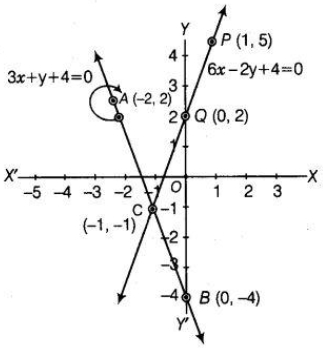
0 likes
View Solution56
Medium
By the graphical method,find whether the following pair of equations are consistent or not. If consistent,solve them.
$x - 2y = 6$
$3x - 6y = 0$
$x - 2y = 6$
$3x - 6y = 0$
Solution
(D) The given pair of equations is:
$x - 2y = 6$ ..... $(i)$
$3x - 6y = 0$ ..... $(ii)$
Comparing these with the standard form $a_1x + b_1y + c_1 = 0$ and $a_2x + b_2y + c_2 = 0$,we get:
$a_1 = 1, b_1 = -2, c_1 = -6$
$a_2 = 3, b_2 = -6, c_2 = 0$
Now,calculating the ratios:
$\frac{a_1}{a_2} = \frac{1}{3}$
$\frac{b_1}{b_2} = \frac{-2}{-6} = \frac{1}{3}$
$\frac{c_1}{c_2} = \frac{-6}{0}$ (which is undefined)
Since $\frac{a_1}{a_2} = \frac{b_1}{b_2} \neq \frac{c_1}{c_2}$,the lines represented by these equations are parallel to each other.
Because the lines are parallel,they do not intersect at any point.
Therefore,the given pair of linear equations is inconsistent and has no solution.
$x - 2y = 6$ ..... $(i)$
$3x - 6y = 0$ ..... $(ii)$
Comparing these with the standard form $a_1x + b_1y + c_1 = 0$ and $a_2x + b_2y + c_2 = 0$,we get:
$a_1 = 1, b_1 = -2, c_1 = -6$
$a_2 = 3, b_2 = -6, c_2 = 0$
Now,calculating the ratios:
$\frac{a_1}{a_2} = \frac{1}{3}$
$\frac{b_1}{b_2} = \frac{-2}{-6} = \frac{1}{3}$
$\frac{c_1}{c_2} = \frac{-6}{0}$ (which is undefined)
Since $\frac{a_1}{a_2} = \frac{b_1}{b_2} \neq \frac{c_1}{c_2}$,the lines represented by these equations are parallel to each other.
Because the lines are parallel,they do not intersect at any point.
Therefore,the given pair of linear equations is inconsistent and has no solution.
0 likes
View Solution57
Difficult
By the graphical method,find whether the following pair of equations are consistent or not. If consistent,solve them:
$x+y=3$
$3x+3y=9$
$x+y=3$
$3x+3y=9$
Solution
(CONSISTENT) Given pair of equations is:
$x+y=3 .....(i)$
$3x+3y=9 .....(ii)$
On comparing with $ax+by+c=0$,we get:
$a_1=1, b_1=1, c_1=-3$ [from Eq. $(i)$]
$a_2=3, b_2=3, c_2=-9$ [from Eq. $(ii)$]
$\frac{a_1}{a_2} = \frac{1}{3}, \frac{b_1}{b_2} = \frac{1}{3}, \frac{c_1}{c_2} = \frac{-3}{-9} = \frac{1}{3}$
Since $\frac{a_1}{a_2} = \frac{b_1}{b_2} = \frac{c_1}{c_2}$,the given pair of lines is coincident. Therefore,these lines have infinitely many solutions. Hence,the given pair of linear equations is consistent.
Now,for $x+y=3 \Rightarrow y=3-x$:
For $3x+3y=9 \Rightarrow y = \frac{9-3x}{3} = 3-x$:
Plotting the points $A(0,3)$ and $B(3,0)$,we get the line $AB$. Similarly,plotting the points $C(0,3), D(1,2)$,and $E(3,0)$,we get the same line. We observe that the lines represented by Eqs. $(i)$ and $(ii)$ are coincident.
$x+y=3 .....(i)$
$3x+3y=9 .....(ii)$
On comparing with $ax+by+c=0$,we get:
$a_1=1, b_1=1, c_1=-3$ [from Eq. $(i)$]
$a_2=3, b_2=3, c_2=-9$ [from Eq. $(ii)$]
$\frac{a_1}{a_2} = \frac{1}{3}, \frac{b_1}{b_2} = \frac{1}{3}, \frac{c_1}{c_2} = \frac{-3}{-9} = \frac{1}{3}$
Since $\frac{a_1}{a_2} = \frac{b_1}{b_2} = \frac{c_1}{c_2}$,the given pair of lines is coincident. Therefore,these lines have infinitely many solutions. Hence,the given pair of linear equations is consistent.
Now,for $x+y=3 \Rightarrow y=3-x$:
| $x$ | $0$ | $3$ |
| $y$ | $3$ | $0$ |
| Points | $A$ | $B$ |
For $3x+3y=9 \Rightarrow y = \frac{9-3x}{3} = 3-x$:
| $x$ | $0$ | $1$ | $3$ |
| $y$ | $3$ | $2$ | $0$ |
| Points | $C$ | $D$ | $E$ |
Plotting the points $A(0,3)$ and $B(3,0)$,we get the line $AB$. Similarly,plotting the points $C(0,3), D(1,2)$,and $E(3,0)$,we get the same line. We observe that the lines represented by Eqs. $(i)$ and $(ii)$ are coincident.
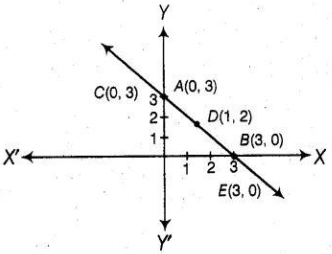
0 likes
View Solution58
Difficult
Draw the graph of the pair of equations $2x + y = 4$ and $2x - y = 4$. Write the vertices of the triangle formed by these lines and the $y$-axis. Also,find the area of this triangle.
Solution
(A) The given pair of linear equations are $2x + y = 4$ and $2x - y = 4$.
Table for line $2x + y = 4$:
Table for line $2x - y = 4$:
By plotting these points on a graph,we observe that the two lines intersect at point $B(2, 0)$ and intersect the $y$-axis at points $A(0, 4)$ and $C(0, -4)$.
The triangle formed by these lines and the $y$-axis is $\triangle ABC$.
The vertices of the triangle are $A(0, 4)$,$B(2, 0)$,and $C(0, -4)$.
The base of the triangle lies on the $y$-axis,with length $AC = |4 - (-4)| = 8$ units.
The height of the triangle is the perpendicular distance from point $B(2, 0)$ to the $y$-axis,which is $2$ units.
Area of $\triangle ABC = \frac{1}{2} \times \text{base} \times \text{height} = \frac{1}{2} \times 8 \times 2 = 8$ sq units.
Thus,the vertices are $(0, 4), (2, 0), (0, -4)$ and the area is $8$ sq units.
Table for line $2x + y = 4$:
| $x$ | $0$ | $2$ |
| $y = 4 - 2x$ | $4$ | $0$ |
| Points | $A(0, 4)$ | $B(2, 0)$ |
Table for line $2x - y = 4$:
| $x$ | $0$ | $2$ |
| $y = 2x - 4$ | $-4$ | $0$ |
| Points | $C(0, -4)$ | $B(2, 0)$ |
By plotting these points on a graph,we observe that the two lines intersect at point $B(2, 0)$ and intersect the $y$-axis at points $A(0, 4)$ and $C(0, -4)$.
The triangle formed by these lines and the $y$-axis is $\triangle ABC$.
The vertices of the triangle are $A(0, 4)$,$B(2, 0)$,and $C(0, -4)$.
The base of the triangle lies on the $y$-axis,with length $AC = |4 - (-4)| = 8$ units.
The height of the triangle is the perpendicular distance from point $B(2, 0)$ to the $y$-axis,which is $2$ units.
Area of $\triangle ABC = \frac{1}{2} \times \text{base} \times \text{height} = \frac{1}{2} \times 8 \times 2 = 8$ sq units.
Thus,the vertices are $(0, 4), (2, 0), (0, -4)$ and the area is $8$ sq units.
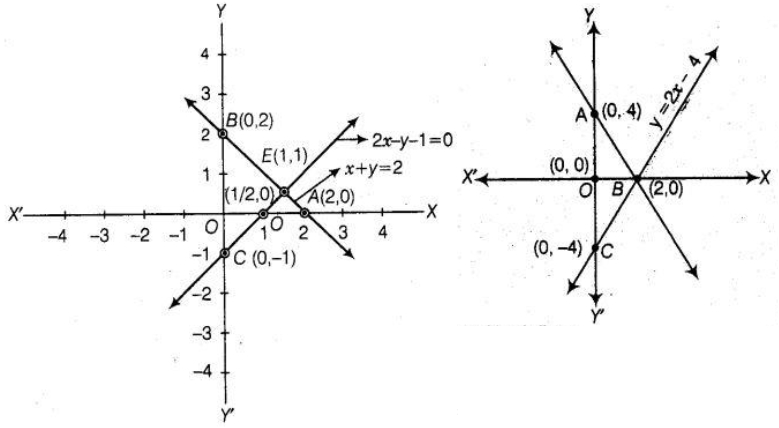
0 likes
View Solution59
Easy
Write an equation of a line passing through the point representing the solution of the pair of linear equations $x+y=2$ and $2x-y=1$. How many such lines can we find?
Solution
(D) First,we solve the pair of linear equations:
$x + y = 2$ --- $(i)$
$2x - y = 1$ --- $(ii)$
Adding equations $(i)$ and $(ii)$,we get:
$(x + y) + (2x - y) = 2 + 1$
$3x = 3$
$x = 1$
Substituting $x = 1$ in equation $(i)$:
$1 + y = 2$
$y = 1$
The solution point is $(1, 1)$.
Any line passing through $(1, 1)$ can be written in the form $y - 1 = m(x - 1)$,where $m$ is the slope. For example,if $m = 1$,the equation is $y - 1 = x - 1$,which simplifies to $y = x$.
Since there are infinitely many possible values for the slope $m$,there are infinitely many such lines that can pass through the point $(1, 1)$.
$x + y = 2$ --- $(i)$
$2x - y = 1$ --- $(ii)$
Adding equations $(i)$ and $(ii)$,we get:
$(x + y) + (2x - y) = 2 + 1$
$3x = 3$
$x = 1$
Substituting $x = 1$ in equation $(i)$:
$1 + y = 2$
$y = 1$
The solution point is $(1, 1)$.
Any line passing through $(1, 1)$ can be written in the form $y - 1 = m(x - 1)$,where $m$ is the slope. For example,if $m = 1$,the equation is $y - 1 = x - 1$,which simplifies to $y = x$.
Since there are infinitely many possible values for the slope $m$,there are infinitely many such lines that can pass through the point $(1, 1)$.
0 likes
View Solution60
DifficultMCQ
If $x+1$ is a factor of $2x^{3}+ax^{2}+2bx+1$,then find the values of $a$ and $b$ given that $2a-3b=4$.
A
$2, 9$
B
$10, 19$
C
$6, 7$
D
$5, 2$
Solution
(D) Given that $(x+1)$ is a factor of $f(x) = 2x^{3} + ax^{2} + 2bx + 1$,by the Factor Theorem,$f(-1) = 0$.
Substituting $x = -1$ into the polynomial:
$2(-1)^{3} + a(-1)^{2} + 2b(-1) + 1 = 0$
$-2 + a - 2b + 1 = 0$
$a - 2b = 1$ ... $(i)$
We are also given the equation $2a - 3b = 4$ ... $(ii)$.
From equation $(i)$,we have $a = 2b + 1$.
Substituting this into equation $(ii)$:
$2(2b + 1) - 3b = 4$
$4b + 2 - 3b = 4$
$b + 2 = 4$
$b = 2$
Now,substitute $b = 2$ into $a = 2b + 1$:
$a = 2(2) + 1 = 5$.
Thus,the values are $a = 5$ and $b = 2$.
Substituting $x = -1$ into the polynomial:
$2(-1)^{3} + a(-1)^{2} + 2b(-1) + 1 = 0$
$-2 + a - 2b + 1 = 0$
$a - 2b = 1$ ... $(i)$
We are also given the equation $2a - 3b = 4$ ... $(ii)$.
From equation $(i)$,we have $a = 2b + 1$.
Substituting this into equation $(ii)$:
$2(2b + 1) - 3b = 4$
$4b + 2 - 3b = 4$
$b + 2 = 4$
$b = 2$
Now,substitute $b = 2$ into $a = 2b + 1$:
$a = 2(2) + 1 = 5$.
Thus,the values are $a = 5$ and $b = 2$.
0 likes
View Solution61
MediumMCQ
The angles of a triangle are $x, y$ and $40^{\circ}$. The difference between the two angles $x$ and $y$ is $30^{\circ}$. Find $x$ and $y$.
A
$85^{\circ}$ and $55^{\circ}$
B
$80^{\circ}$ and $55^{\circ}$
C
$85^{\circ}$ and $50^{\circ}$
D
$80^{\circ}$ and $50^{\circ}$
Solution
(A) Given that $x, y$ and $40^{\circ}$ are the angles of a triangle.
Since the sum of all angles of a triangle is $180^{\circ}$,we have:
$x + y + 40^{\circ} = 180^{\circ}$
$\Rightarrow x + y = 140^{\circ} \quad \dots(i)$
Also,the difference between the two angles is given as:
$x - y = 30^{\circ} \quad \dots(ii)$
Adding equations $(i)$ and $(ii)$:
$(x + y) + (x - y) = 140^{\circ} + 30^{\circ}$
$2x = 170^{\circ}$
$x = 85^{\circ}$
Substituting $x = 85^{\circ}$ in equation $(i)$:
$85^{\circ} + y = 140^{\circ}$
$y = 140^{\circ} - 85^{\circ} = 55^{\circ}$
Thus,the values of $x$ and $y$ are $85^{\circ}$ and $55^{\circ}$ respectively.
Since the sum of all angles of a triangle is $180^{\circ}$,we have:
$x + y + 40^{\circ} = 180^{\circ}$
$\Rightarrow x + y = 140^{\circ} \quad \dots(i)$
Also,the difference between the two angles is given as:
$x - y = 30^{\circ} \quad \dots(ii)$
Adding equations $(i)$ and $(ii)$:
$(x + y) + (x - y) = 140^{\circ} + 30^{\circ}$
$2x = 170^{\circ}$
$x = 85^{\circ}$
Substituting $x = 85^{\circ}$ in equation $(i)$:
$85^{\circ} + y = 140^{\circ}$
$y = 140^{\circ} - 85^{\circ} = 55^{\circ}$
Thus,the values of $x$ and $y$ are $85^{\circ}$ and $55^{\circ}$ respectively.
0 likes
View Solution62
DifficultMCQ
Two years ago,Salim was thrice as old as his daughter and six years later,he will be four years older than twice her age. How old are they now? (in $year$)
A
$36, 14$
B
$38, 14$
C
$38, 18$
D
$30, 10$
Solution
(B) Let Salim's current age be $x$ years and his daughter's current age be $y$ years.
According to the first condition,two years ago:
$x - 2 = 3(y - 2)$
$x - 2 = 3y - 6$
$x - 3y = -4$ --- $(i)$
According to the second condition,six years later:
$x + 6 = 2(y + 6) + 4$
$x + 6 = 2y + 12 + 4$
$x - 2y = 10$ --- $(ii)$
Subtracting equation $(i)$ from equation $(ii)$:
$(x - 2y) - (x - 3y) = 10 - (-4)$
$x - 2y - x + 3y = 10 + 4$
$y = 14$
Substituting $y = 14$ into equation $(ii)$:
$x - 2(14) = 10$
$x - 28 = 10$
$x = 38$
Therefore,Salim's current age is $38$ years and his daughter's current age is $14$ years.
According to the first condition,two years ago:
$x - 2 = 3(y - 2)$
$x - 2 = 3y - 6$
$x - 3y = -4$ --- $(i)$
According to the second condition,six years later:
$x + 6 = 2(y + 6) + 4$
$x + 6 = 2y + 12 + 4$
$x - 2y = 10$ --- $(ii)$
Subtracting equation $(i)$ from equation $(ii)$:
$(x - 2y) - (x - 3y) = 10 - (-4)$
$x - 2y - x + 3y = 10 + 4$
$y = 14$
Substituting $y = 14$ into equation $(ii)$:
$x - 2(14) = 10$
$x - 28 = 10$
$x = 38$
Therefore,Salim's current age is $38$ years and his daughter's current age is $14$ years.
0 likes
View Solution63
MediumMCQ
The age of the father is twice the sum of the ages of his two children. After $20$ years,his age will be equal to the sum of the ages of his children. Find the age of the father (in years).
A
$10$
B
$20$
C
$40$
D
$30$
Solution
(C) Let the present age of the father be $x$ years and the sum of the present ages of his two children be $S$ years.
According to the first condition: $x = 2S$ ... $(i)$
After $20$ years,the father's age will be $(x + 20)$ years.
After $20$ years,each child's age increases by $20$ years,so the sum of their ages will be $(S + 20 + 20) = (S + 40)$ years.
According to the second condition: $x + 20 = S + 40$
Substituting $S = x/2$ from equation $(i)$ into the second condition:
$x + 20 = x/2 + 40$
$x - x/2 = 40 - 20$
$x/2 = 20$
$x = 40$
Thus,the father's present age is $40$ years.
According to the first condition: $x = 2S$ ... $(i)$
After $20$ years,the father's age will be $(x + 20)$ years.
After $20$ years,each child's age increases by $20$ years,so the sum of their ages will be $(S + 20 + 20) = (S + 40)$ years.
According to the second condition: $x + 20 = S + 40$
Substituting $S = x/2$ from equation $(i)$ into the second condition:
$x + 20 = x/2 + 40$
$x - x/2 = 40 - 20$
$x/2 = 20$
$x = 40$
Thus,the father's present age is $40$ years.
0 likes
View Solution64
DifficultMCQ
Two numbers are in the ratio $5:6$. If $8$ is subtracted from each of the numbers,the ratio becomes $4:5$. Find the numbers.
A
$60$ and $68$
B
$40$ and $58$
C
$50$ and $48$
D
$40$ and $48$
Solution
(D) Let the two numbers be $5x$ and $6x$ based on the given ratio $5:6$.
According to the second condition,if $8$ is subtracted from each number,the ratio becomes $4:5$.
So,$\frac{5x - 8}{6x - 8} = \frac{4}{5}$.
Cross-multiplying,we get $5(5x - 8) = 4(6x - 8)$.
$25x - 40 = 24x - 32$.
$25x - 24x = 40 - 32$.
$x = 8$.
Therefore,the first number is $5x = 5 \times 8 = 40$.
The second number is $6x = 6 \times 8 = 48$.
Thus,the required numbers are $40$ and $48$.
According to the second condition,if $8$ is subtracted from each number,the ratio becomes $4:5$.
So,$\frac{5x - 8}{6x - 8} = \frac{4}{5}$.
Cross-multiplying,we get $5(5x - 8) = 4(6x - 8)$.
$25x - 40 = 24x - 32$.
$25x - 24x = 40 - 32$.
$x = 8$.
Therefore,the first number is $5x = 5 \times 8 = 40$.
The second number is $6x = 6 \times 8 = 48$.
Thus,the required numbers are $40$ and $48$.
0 likes
View Solution65
MediumMCQ
There are some students in the two examination halls $A$ and $B$. To make the number of students equal in each hall,$10$ students are sent from $A$ to $B$. But if $20$ students are sent from $B$ to $A$,the number of students in $A$ becomes double the number of students in $B$. Find the number of students in the two halls.
A
Hall $A = 100$,Hall $B = 80$
B
Hall $A = 80$,Hall $B = 100$
C
Hall $A = 120$,Hall $B = 100$
D
Hall $A = 100$,Hall $B = 120$
Solution
(A) Let the number of students in halls $A$ and $B$ be $x$ and $y$,respectively.
According to the first condition,if $10$ students are sent from $A$ to $B$,the number of students becomes equal:
$x - 10 = y + 10$
$\Rightarrow x - y = 20$ ---$(i)$
According to the second condition,if $20$ students are sent from $B$ to $A$,the number of students in $A$ becomes double the number of students in $B$:
$x + 20 = 2(y - 20)$
$x + 20 = 2y - 40$
$\Rightarrow x - 2y = -60$ ---(ii)
Subtracting equation (ii) from equation $(i)$:
$(x - y) - (x - 2y) = 20 - (-60)$
$x - y - x + 2y = 80$
$y = 80$
Substituting $y = 80$ in equation $(i)$:
$x - 80 = 20$
$x = 100$
Thus,there are $100$ students in hall $A$ and $80$ students in hall $B$.
According to the first condition,if $10$ students are sent from $A$ to $B$,the number of students becomes equal:
$x - 10 = y + 10$
$\Rightarrow x - y = 20$ ---$(i)$
According to the second condition,if $20$ students are sent from $B$ to $A$,the number of students in $A$ becomes double the number of students in $B$:
$x + 20 = 2(y - 20)$
$x + 20 = 2y - 40$
$\Rightarrow x - 2y = -60$ ---(ii)
Subtracting equation (ii) from equation $(i)$:
$(x - y) - (x - 2y) = 20 - (-60)$
$x - y - x + 2y = 80$
$y = 80$
Substituting $y = 80$ in equation $(i)$:
$x - 80 = 20$
$x = 100$
Thus,there are $100$ students in hall $A$ and $80$ students in hall $B$.
0 likes
View Solution66
MediumMCQ
$A$ shopkeeper gives books on rent for reading. She takes a fixed charge for the first two days,and an additional charge for each day thereafter. Latika paid $Rs. 22$ for a book kept for six days,while Anand paid $Rs. 16$ for the book kept for four days. Find the fixed charges and the charge for each extra day (in $Rs.$).
A
$11, 5$
B
$10, 3$
C
$14, 1$
D
$19, 8$
Solution
(B) Let the fixed charge for the first two days be $Rs. x$ and the additional charge for each day thereafter be $Rs. y$.
According to the first condition,Latika paid $Rs. 22$ for a book kept for six days (first $2$ days + $4$ extra days):
$x + 4y = 22$ --- $(i)$
According to the second condition,Anand paid $Rs. 16$ for a book kept for four days (first $2$ days + $2$ extra days):
$x + 2y = 16$ --- $(ii)$
Subtracting equation $(ii)$ from equation $(i)$:
$(x + 4y) - (x + 2y) = 22 - 16$
$2y = 6$
$y = 3$
Substituting $y = 3$ in equation $(ii)$:
$x + 2(3) = 16$
$x + 6 = 16$
$x = 10$
Thus,the fixed charge is $Rs. 10$ and the charge for each extra day is $Rs. 3$.
According to the first condition,Latika paid $Rs. 22$ for a book kept for six days (first $2$ days + $4$ extra days):
$x + 4y = 22$ --- $(i)$
According to the second condition,Anand paid $Rs. 16$ for a book kept for four days (first $2$ days + $2$ extra days):
$x + 2y = 16$ --- $(ii)$
Subtracting equation $(ii)$ from equation $(i)$:
$(x + 4y) - (x + 2y) = 22 - 16$
$2y = 6$
$y = 3$
Substituting $y = 3$ in equation $(ii)$:
$x + 2(3) = 16$
$x + 6 = 16$
$x = 10$
Thus,the fixed charge is $Rs. 10$ and the charge for each extra day is $Rs. 3$.
0 likes
View Solution67
MediumMCQ
In a competitive examination,one mark is awarded for each correct answer while $\frac{1}{2}$ mark is deducted for every wrong answer. Jayanti answered $120$ questions and got $90$ marks. How many questions did she answer correctly?
A
$50$
B
$75$
C
$100$
D
$155$
Solution
(C) Let $x$ be the number of correct answers and $(120-x)$ be the number of wrong answers.
According to the problem,the total marks obtained is $90$.
The equation is: $x \times 1 - (120 - x) \times \frac{1}{2} = 90$.
Expanding the equation: $x - 60 + \frac{x}{2} = 90$.
Adding $60$ to both sides: $x + \frac{x}{2} = 150$.
Combining terms: $\frac{3x}{2} = 150$.
Solving for $x$: $x = \frac{150 \times 2}{3} = 100$.
Therefore,Jayanti answered $100$ questions correctly.
According to the problem,the total marks obtained is $90$.
The equation is: $x \times 1 - (120 - x) \times \frac{1}{2} = 90$.
Expanding the equation: $x - 60 + \frac{x}{2} = 90$.
Adding $60$ to both sides: $x + \frac{x}{2} = 150$.
Combining terms: $\frac{3x}{2} = 150$.
Solving for $x$: $x = \frac{150 \times 2}{3} = 100$.
Therefore,Jayanti answered $100$ questions correctly.
0 likes
View Solution68
Difficult
The angles of a cyclic quadrilateral $ABCD$ are $\angle A = (6x + 10)^{\circ}$,$\angle B = (5x)^{\circ}$,$\angle C = (x + y)^{\circ}$,and $\angle D = (3y - 10)^{\circ}$. Find $x$ and $y$,and hence the values of the four angles.
Solution
(A) We know that,by the property of a cyclic quadrilateral,the sum of opposite angles is $180^{\circ}$.
$\angle A + \angle C = (6x + 10)^{\circ} + (x + y)^{\circ} = 180^{\circ}$
$\Rightarrow 7x + y = 170 \quad \dots(i)$
Similarly,$\angle B + \angle D = (5x)^{\circ} + (3y - 10)^{\circ} = 180^{\circ}$
$\Rightarrow 5x + 3y = 190 \quad \dots(ii)$
Multiplying equation $(i)$ by $3$,we get $21x + 3y = 510 \quad \dots(iii)$
Subtracting equation $(ii)$ from $(iii)$:
$(21x + 3y) - (5x + 3y) = 510 - 190$
$16x = 320 \Rightarrow x = 20$
Substituting $x = 20$ in equation $(i)$:
$7(20) + y = 170 \Rightarrow 140 + y = 170 \Rightarrow y = 30$
Now,calculating the angles:
$\angle A = 6(20) + 10 = 130^{\circ}$
$\angle B = 5(20) = 100^{\circ}$
$\angle C = 20 + 30 = 50^{\circ}$
$\angle D = 3(30) - 10 = 80^{\circ}$
Thus,$x = 20$,$y = 30$,and the angles are $130^{\circ}, 100^{\circ}, 50^{\circ}, 80^{\circ}$.
$\angle A + \angle C = (6x + 10)^{\circ} + (x + y)^{\circ} = 180^{\circ}$
$\Rightarrow 7x + y = 170 \quad \dots(i)$
Similarly,$\angle B + \angle D = (5x)^{\circ} + (3y - 10)^{\circ} = 180^{\circ}$
$\Rightarrow 5x + 3y = 190 \quad \dots(ii)$
Multiplying equation $(i)$ by $3$,we get $21x + 3y = 510 \quad \dots(iii)$
Subtracting equation $(ii)$ from $(iii)$:
$(21x + 3y) - (5x + 3y) = 510 - 190$
$16x = 320 \Rightarrow x = 20$
Substituting $x = 20$ in equation $(i)$:
$7(20) + y = 170 \Rightarrow 140 + y = 170 \Rightarrow y = 30$
Now,calculating the angles:
$\angle A = 6(20) + 10 = 130^{\circ}$
$\angle B = 5(20) = 100^{\circ}$
$\angle C = 20 + 30 = 50^{\circ}$
$\angle D = 3(30) - 10 = 80^{\circ}$
Thus,$x = 20$,$y = 30$,and the angles are $130^{\circ}, 100^{\circ}, 50^{\circ}, 80^{\circ}$.
0 likes
View Solution69
Medium
Draw the graphs of the lines $x=-2$ and $y=3$. Write the vertices of the figure formed by these lines,the $x$-axis and the $y$-axis. Also,find the area of the figure.
Solution
(N/A) We know that the graph of $x=-2$ is a line parallel to the $y$-axis at a distance of $2$ units to the left of it.
The graph of $y=3$ is a line parallel to the $x$-axis at a distance of $3$ units above it.
The figure enclosed by the lines $x=-2$,$y=3$,the $x$-axis,and the $y$-axis is $OABC$,which is a rectangle.
$A$ is a point on the $y$-axis at a distance of $3$ units above the $x$-axis. So,the coordinates of $A$ are $(0, 3)$.
$C$ is a point on the $x$-axis at a distance of $2$ units to the left of the $y$-axis. So,the coordinates of $C$ are $(-2, 0)$.
$B$ is the intersection point of the lines $x=-2$ and $y=3$. So,the coordinates of $B$ are $(-2, 3)$.
The origin $O$ is $(0, 0)$.
Thus,the vertices of the rectangle $OABC$ are $O(0, 0)$,$A(0, 3)$,$B(-2, 3)$,and $C(-2, 0)$.
The length and breadth of this rectangle are $2$ units and $3$ units,respectively.
Since the area of a rectangle $=$ length $\times$ breadth,
the area of rectangle $OABC = 2 \times 3 = 6 \text{ sq. units}$.
The graph of $y=3$ is a line parallel to the $x$-axis at a distance of $3$ units above it.
The figure enclosed by the lines $x=-2$,$y=3$,the $x$-axis,and the $y$-axis is $OABC$,which is a rectangle.
$A$ is a point on the $y$-axis at a distance of $3$ units above the $x$-axis. So,the coordinates of $A$ are $(0, 3)$.
$C$ is a point on the $x$-axis at a distance of $2$ units to the left of the $y$-axis. So,the coordinates of $C$ are $(-2, 0)$.
$B$ is the intersection point of the lines $x=-2$ and $y=3$. So,the coordinates of $B$ are $(-2, 3)$.
The origin $O$ is $(0, 0)$.
Thus,the vertices of the rectangle $OABC$ are $O(0, 0)$,$A(0, 3)$,$B(-2, 3)$,and $C(-2, 0)$.
The length and breadth of this rectangle are $2$ units and $3$ units,respectively.
Since the area of a rectangle $=$ length $\times$ breadth,
the area of rectangle $OABC = 2 \times 3 = 6 \text{ sq. units}$.
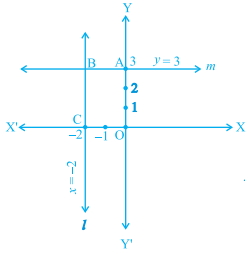
0 likes
View Solution70
DifficultMCQ
Determine,algebraically,the vertices of the triangle formed by the lines $5x - y = 5$,$x + 2y = 1$,and $6x + y = 17$.
A
$(-1, 0), (3, 1), (2, -5)$
B
$(1, 0), (3, -1), (2, 5)$
C
$(1, 0), (-3, -1), (2, -5)$
D
$(-1, 0), (-3, 1), (-2, 5)$
Solution
(B) The vertices of a triangle are the intersection points of the lines forming its sides. We solve the equations in pairs to find these points.
Pair $1$: $5x - y = 5$ and $x + 2y = 1$.
From the first equation,$y = 5x - 5$. Substituting into the second: $x + 2(5x - 5) = 1 \implies x + 10x - 10 = 1 \implies 11x = 11 \implies x = 1$. Then $y = 5(1) - 5 = 0$. Vertex: $(1, 0)$.
Pair $2$: $x + 2y = 1$ and $6x + y = 17$.
From the second equation,$y = 17 - 6x$. Substituting into the first: $x + 2(17 - 6x) = 1 \implies x + 34 - 12x = 1 \implies -11x = -33 \implies x = 3$. Then $y = 17 - 6(3) = -1$. Vertex: $(3, -1)$.
Pair $3$: $5x - y = 5$ and $6x + y = 17$.
Adding the two equations: $(5x - y) + (6x + y) = 5 + 17 \implies 11x = 22 \implies x = 2$. Substituting $x = 2$ into $5x - y = 5$: $5(2) - y = 5 \implies 10 - y = 5 \implies y = 5$. Vertex: $(2, 5)$.
The vertices are $(1, 0), (3, -1)$,and $(2, 5)$.
Pair $1$: $5x - y = 5$ and $x + 2y = 1$.
From the first equation,$y = 5x - 5$. Substituting into the second: $x + 2(5x - 5) = 1 \implies x + 10x - 10 = 1 \implies 11x = 11 \implies x = 1$. Then $y = 5(1) - 5 = 0$. Vertex: $(1, 0)$.
Pair $2$: $x + 2y = 1$ and $6x + y = 17$.
From the second equation,$y = 17 - 6x$. Substituting into the first: $x + 2(17 - 6x) = 1 \implies x + 34 - 12x = 1 \implies -11x = -33 \implies x = 3$. Then $y = 17 - 6(3) = -1$. Vertex: $(3, -1)$.
Pair $3$: $5x - y = 5$ and $6x + y = 17$.
Adding the two equations: $(5x - y) + (6x + y) = 5 + 17 \implies 11x = 22 \implies x = 2$. Substituting $x = 2$ into $5x - y = 5$: $5(2) - y = 5 \implies 10 - y = 5 \implies y = 5$. Vertex: $(2, 5)$.
The vertices are $(1, 0), (3, -1)$,and $(2, 5)$.
0 likes
View Solution71
DifficultMCQ
Jamila sold a table and a chair for $Rs.\, 1050,$ thereby making a profit of $10\%$ on the table and $25\%$ on the chair. If she had taken a profit of $25\%$ on the table and $10\%$ on the chair,she would have got $Rs.\, 1065.$ Find the cost price of each (in $Rs.$).
A
$100, 900$
B
$100, 300$
C
$500, 400$
D
$600, 800$
Solution
(C) Let the cost price of the table be $Rs.\, x$ and the cost price of the chair be $Rs.\, y$.
The selling price of the table at $10\%$ profit is $x + 0.10x = 1.10x$.
The selling price of the chair at $25\%$ profit is $y + 0.25y = 1.25y$.
Given,$1.10x + 1.25y = 1050$. Multiplying by $100$,we get $110x + 125y = 105000$ ....$(1)$
If the table is sold at $25\%$ profit and the chair at $10\%$ profit,the selling price is $1.25x + 1.10y = 1065$.
Multiplying by $100$,we get $125x + 110y = 106500$ ....$(2)$
Adding $(1)$ and $(2)$:
$235x + 235y = 211500 \implies x + y = 900$ ....$(3)$
Subtracting $(2)$ from $(1)$:
$-15x + 15y = -1500 \implies x - y = 100$ ....$(4)$
Adding $(3)$ and $(4)$:
$2x = 1000 \implies x = 500$.
Substituting $x = 500$ in $(3)$:
$500 + y = 900 \implies y = 400$.
Thus,the cost price of the table is $Rs.\, 500$ and the cost price of the chair is $Rs.\, 400$.
The selling price of the table at $10\%$ profit is $x + 0.10x = 1.10x$.
The selling price of the chair at $25\%$ profit is $y + 0.25y = 1.25y$.
Given,$1.10x + 1.25y = 1050$. Multiplying by $100$,we get $110x + 125y = 105000$ ....$(1)$
If the table is sold at $25\%$ profit and the chair at $10\%$ profit,the selling price is $1.25x + 1.10y = 1065$.
Multiplying by $100$,we get $125x + 110y = 106500$ ....$(2)$
Adding $(1)$ and $(2)$:
$235x + 235y = 211500 \implies x + y = 900$ ....$(3)$
Subtracting $(2)$ from $(1)$:
$-15x + 15y = -1500 \implies x - y = 100$ ....$(4)$
Adding $(3)$ and $(4)$:
$2x = 1000 \implies x = 500$.
Substituting $x = 500$ in $(3)$:
$500 + y = 900 \implies y = 400$.
Thus,the cost price of the table is $Rs.\, 500$ and the cost price of the chair is $Rs.\, 400$.
0 likes
View Solution72
Difficult
It can take $12$ hours to fill a swimming pool using two pipes. If the pipe of larger diameter is used for $4$ hours and the pipe of smaller diameter for $9$ hours,only half the pool can be filled. How long would it take for each pipe to fill the pool separately?
Solution
(D) Let the time taken by the larger pipe to fill the pool be $x$ hours and the time taken by the smaller pipe be $y$ hours.
In $1$ hour,the larger pipe fills $1/x$ part of the pool and the smaller pipe fills $1/y$ part of the pool.
According to the first condition,if both pipes are used,they fill the pool in $12$ hours:
$1/x + 1/y = 1/12$ --- (Equation $1$)
According to the second condition,the larger pipe works for $4$ hours and the smaller pipe for $9$ hours to fill half the pool:
$4/x + 9/y = 1/2$ --- (Equation $2$)
Let $u = 1/x$ and $v = 1/y$. The equations become:
$u + v = 1/12$ --- (Equation $3$)
$4u + 9v = 1/2$ --- (Equation $4$)
Multiply Equation $3$ by $4$: $4u + 4v = 4/12 = 1/3$.
Subtract this from Equation $4$: $(4u + 9v) - (4u + 4v) = 1/2 - 1/3$.
$5v = 1/6$,so $v = 1/30$.
Substitute $v = 1/30$ into Equation $3$: $u + 1/30 = 1/12$.
$u = 1/12 - 1/30 = (5 - 2)/60 = 3/60 = 1/20$.
Since $u = 1/x = 1/20$,$x = 20$ hours.
Since $v = 1/y = 1/30$,$y = 30$ hours.
Thus,the larger pipe takes $20$ hours and the smaller pipe takes $30$ hours to fill the pool separately.
In $1$ hour,the larger pipe fills $1/x$ part of the pool and the smaller pipe fills $1/y$ part of the pool.
According to the first condition,if both pipes are used,they fill the pool in $12$ hours:
$1/x + 1/y = 1/12$ --- (Equation $1$)
According to the second condition,the larger pipe works for $4$ hours and the smaller pipe for $9$ hours to fill half the pool:
$4/x + 9/y = 1/2$ --- (Equation $2$)
Let $u = 1/x$ and $v = 1/y$. The equations become:
$u + v = 1/12$ --- (Equation $3$)
$4u + 9v = 1/2$ --- (Equation $4$)
Multiply Equation $3$ by $4$: $4u + 4v = 4/12 = 1/3$.
Subtract this from Equation $4$: $(4u + 9v) - (4u + 4v) = 1/2 - 1/3$.
$5v = 1/6$,so $v = 1/30$.
Substitute $v = 1/30$ into Equation $3$: $u + 1/30 = 1/12$.
$u = 1/12 - 1/30 = (5 - 2)/60 = 3/60 = 1/20$.
Since $u = 1/x = 1/20$,$x = 20$ hours.
Since $v = 1/y = 1/30$,$y = 30$ hours.
Thus,the larger pipe takes $20$ hours and the smaller pipe takes $30$ hours to fill the pool separately.
0 likes
View Solution73
Difficult
Graphically,solve the following pair of equations:
$2x + y = 6$
$2x - y + 2 = 0$
Find the ratio of the areas of the two triangles formed by the lines representing these equations with the $x$-axis and the lines with the $y$-axis.
$2x + y = 6$
$2x - y + 2 = 0$
Find the ratio of the areas of the two triangles formed by the lines representing these equations with the $x$-axis and the lines with the $y$-axis.
Solution
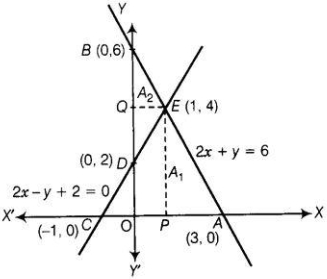
(4:1) Given equations are $2x + y = 6$ and $2x - y + 2 = 0$.
Table for equation $2x + y = 6$:
Table for equation $2x - y + 2 = 0$:
Let $A_1$ and $A_2$ represent the areas of $\triangle ACE$ and $\triangle BDE$,respectively.
Now,$A_1 = \text{Area of } \triangle ACE = \frac{1}{2} \times AC \times PE = \frac{1}{2} \times 4 \times 4 = 8$.
And $A_2 = \text{Area of } \triangle BDE = \frac{1}{2} \times BD \times QE = \frac{1}{2} \times 4 \times 1 = 2$.
Therefore,$A_1 : A_2 = 8 : 2 = 4 : 1$.
Hence,the pair of equations intersect graphically at point $E(1, 4)$,i.e.,$x = 1$ and $y = 4$.
Table for equation $2x + y = 6$:
| $x$ | $0$ | $3$ |
| $y$ | $6$ | $0$ |
| Points | $B$ | $A$ |
Table for equation $2x - y + 2 = 0$:
| $x$ | $0$ | $-1$ |
| $y$ | $2$ | $0$ |
| Points | $D$ | $C$ |
Let $A_1$ and $A_2$ represent the areas of $\triangle ACE$ and $\triangle BDE$,respectively.
Now,$A_1 = \text{Area of } \triangle ACE = \frac{1}{2} \times AC \times PE = \frac{1}{2} \times 4 \times 4 = 8$.
And $A_2 = \text{Area of } \triangle BDE = \frac{1}{2} \times BD \times QE = \frac{1}{2} \times 4 \times 1 = 2$.
Therefore,$A_1 : A_2 = 8 : 2 = 4 : 1$.
Hence,the pair of equations intersect graphically at point $E(1, 4)$,i.e.,$x = 1$ and $y = 4$.
0 likes
View Solution74
Difficult
Determine,graphically,the vertices of the triangle formed by the lines $y=x$,$3y=x$,and $x+y=8$.
Solution
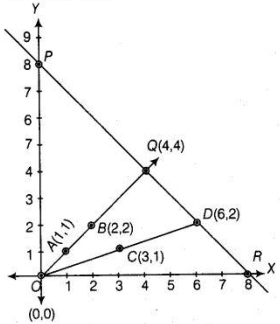
(O(0,0), Q(4,4), D(6,2)) The given linear equations are:
$y=x \quad (i)$
$3y=x \quad (ii)$
$x+y=8 \quad (iii)$
To find the vertices,we determine the intersection points of these lines taken in pairs.
$1$. Intersection of $(i)$ and $(ii)$:
Substituting $y=x$ into $3y=x$,we get $3x=x$,which implies $2x=0$,so $x=0$. Thus,$y=0$. The intersection point is $O(0,0)$.
$2$. Intersection of $(i)$ and $(iii)$:
Substituting $y=x$ into $x+y=8$,we get $x+x=8$,so $2x=8$,which means $x=4$. Thus,$y=4$. The intersection point is $Q(4,4)$.
$3$. Intersection of $(ii)$ and $(iii)$:
From $(ii)$,$x=3y$. Substituting this into $(iii)$,we get $3y+y=8$,so $4y=8$,which means $y=2$. Then $x=3(2)=6$. The intersection point is $D(6,2)$.
Thus,the vertices of the triangle formed by the lines are $O(0,0)$,$Q(4,4)$,and $D(6,2)$.
$y=x \quad (i)$
$3y=x \quad (ii)$
$x+y=8 \quad (iii)$
To find the vertices,we determine the intersection points of these lines taken in pairs.
$1$. Intersection of $(i)$ and $(ii)$:
Substituting $y=x$ into $3y=x$,we get $3x=x$,which implies $2x=0$,so $x=0$. Thus,$y=0$. The intersection point is $O(0,0)$.
$2$. Intersection of $(i)$ and $(iii)$:
Substituting $y=x$ into $x+y=8$,we get $x+x=8$,so $2x=8$,which means $x=4$. Thus,$y=4$. The intersection point is $Q(4,4)$.
$3$. Intersection of $(ii)$ and $(iii)$:
From $(ii)$,$x=3y$. Substituting this into $(iii)$,we get $3y+y=8$,so $4y=8$,which means $y=2$. Then $x=3(2)=6$. The intersection point is $D(6,2)$.
Thus,the vertices of the triangle formed by the lines are $O(0,0)$,$Q(4,4)$,and $D(6,2)$.
0 likes
View Solution75
Difficult
Draw the graphs of the equations $x=3, x=5$ and $2x-y-4=0$. Also,find the area of the quadrilateral formed by these lines and the $x$-axis.
Solution
(8) Given equations of lines are $2x-y-4=0$,$x=3$,and $x=5$.
For the line $2x-y-4=0$,we find two points:
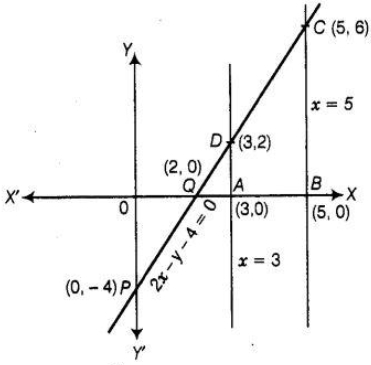
Plot the points $P(0, -4)$ and $Q(2, 0)$ and draw the line passing through them. Also,draw the vertical lines $x=3$ and $x=5$.
The quadrilateral formed by the lines $x=3$,$x=5$,the $x$-axis,and the line $2x-y-4=0$ is a trapezium with parallel sides at $x=3$ and $x=5$.
At $x=3$,$y = 2(3)-4 = 2$. So,point $D$ is $(3, 2)$.
At $x=5$,$y = 2(5)-4 = 6$. So,point $C$ is $(5, 6)$.
The parallel sides of the trapezium are $AD = 2$ units and $BC = 6$ units. The distance between them is $AB = 5-3 = 2$ units.
Area of trapezium $= \frac{1}{2} \times (\text{sum of parallel sides}) \times (\text{height})$
$= \frac{1}{2} \times (AD + BC) \times AB$
$= \frac{1}{2} \times (2 + 6) \times 2$
$= 8 \text{ sq units}$.
Thus,the area of the quadrilateral is $8 \text{ sq units}$.
For the line $2x-y-4=0$,we find two points:
| $x$ | $0$ | $2$ |
| $y=2x-4$ | $-4$ | $0$ |
Plot the points $P(0, -4)$ and $Q(2, 0)$ and draw the line passing through them. Also,draw the vertical lines $x=3$ and $x=5$.
The quadrilateral formed by the lines $x=3$,$x=5$,the $x$-axis,and the line $2x-y-4=0$ is a trapezium with parallel sides at $x=3$ and $x=5$.
At $x=3$,$y = 2(3)-4 = 2$. So,point $D$ is $(3, 2)$.
At $x=5$,$y = 2(5)-4 = 6$. So,point $C$ is $(5, 6)$.
The parallel sides of the trapezium are $AD = 2$ units and $BC = 6$ units. The distance between them is $AB = 5-3 = 2$ units.
Area of trapezium $= \frac{1}{2} \times (\text{sum of parallel sides}) \times (\text{height})$
$= \frac{1}{2} \times (AD + BC) \times AB$
$= \frac{1}{2} \times (2 + 6) \times 2$
$= 8 \text{ sq units}$.
Thus,the area of the quadrilateral is $8 \text{ sq units}$.
0 likes
View Solution76
MediumMCQ
The cost of $4$ pens and $4$ pencil boxes is $Rs.\, 100$. Three times the cost of a pen is $Rs.\, 15$ more than the cost of a pencil box. Form the pair of linear equations for the above situation. Find the cost of a pen and a pencil box (in $Rs.$).
A
$5, 12$
B
$12, 5$
C
$15, 10$
D
$10, 15$
Solution
(D) Let the cost of a pen be $Rs.\, x$ and the cost of a pencil box be $Rs.\, y$.
According to the first condition,$4x + 4y = 100$,which simplifies to $x + y = 25$ (Equation $i$).
According to the second condition,$3x = y + 15$,which can be written as $3x - y = 15$ (Equation $ii$).
Adding Equation $(i)$ and Equation $(ii)$:
$(x + y) + (3x - y) = 25 + 15$
$4x = 40$
$x = 10$
Substituting $x = 10$ into Equation $(i)$:
$10 + y = 25$
$y = 15$
Therefore,the cost of a pen is $Rs.\, 10$ and the cost of a pencil box is $Rs.\, 15$.
According to the first condition,$4x + 4y = 100$,which simplifies to $x + y = 25$ (Equation $i$).
According to the second condition,$3x = y + 15$,which can be written as $3x - y = 15$ (Equation $ii$).
Adding Equation $(i)$ and Equation $(ii)$:
$(x + y) + (3x - y) = 25 + 15$
$4x = 40$
$x = 10$
Substituting $x = 10$ into Equation $(i)$:
$10 + y = 25$
$y = 15$
Therefore,the cost of a pen is $Rs.\, 10$ and the cost of a pencil box is $Rs.\, 15$.
0 likes
View Solution77
Difficult
Determine,algebraically,the vertices of the triangle formed by the lines:
$3x - y = 3$
$2x - 3y = 2$
$x + 2y = 8$
$3x - y = 3$
$2x - 3y = 2$
$x + 2y = 8$
Solution
(A) The given equations of the lines are:
$3x - y = 3 \quad ...(i)$
$2x - 3y = 2 \quad ...(ii)$
$x + 2y = 8 \quad ...(iii)$
Let the lines $(i), (ii),$ and $(iii)$ represent the sides $AB, BC,$ and $CA$ of $\triangle ABC$ respectively.
$1$. To find vertex $B$,solve lines $(i)$ and $(ii)$:
Multiply Eq. $(i)$ by $3$: $9x - 3y = 9$
Subtract Eq. $(ii)$ from this: $(9x - 3y) - (2x - 3y) = 9 - 2 \Rightarrow 7x = 7 \Rightarrow x = 1$.
Substitute $x = 1$ in Eq. $(i)$: $3(1) - y = 3 \Rightarrow y = 0$.
So,vertex $B$ is $(1, 0)$.
$2$. To find vertex $C$,solve lines $(ii)$ and $(iii)$:
Multiply Eq. $(iii)$ by $2$: $2x + 4y = 16$.
Subtract Eq. $(ii)$ from this: $(2x + 4y) - (2x - 3y) = 16 - 2 \Rightarrow 7y = 14 \Rightarrow y = 2$.
Substitute $y = 2$ in Eq. $(iii)$: $x + 2(2) = 8 \Rightarrow x = 4$.
So,vertex $C$ is $(4, 2)$.
$3$. To find vertex $A$,solve lines $(iii)$ and $(i)$:
Multiply Eq. $(i)$ by $2$: $6x - 2y = 6$.
Add Eq. $(iii)$: $(6x - 2y) + (x + 2y) = 6 + 8 \Rightarrow 7x = 14 \Rightarrow x = 2$.
Substitute $x = 2$ in Eq. $(i)$: $3(2) - y = 3 \Rightarrow 6 - y = 3 \Rightarrow y = 3$.
So,vertex $A$ is $(2, 3)$.
Thus,the vertices of the triangle are $A(2, 3), B(1, 0),$ and $C(4, 2)$.
$3x - y = 3 \quad ...(i)$
$2x - 3y = 2 \quad ...(ii)$
$x + 2y = 8 \quad ...(iii)$
Let the lines $(i), (ii),$ and $(iii)$ represent the sides $AB, BC,$ and $CA$ of $\triangle ABC$ respectively.
$1$. To find vertex $B$,solve lines $(i)$ and $(ii)$:
Multiply Eq. $(i)$ by $3$: $9x - 3y = 9$
Subtract Eq. $(ii)$ from this: $(9x - 3y) - (2x - 3y) = 9 - 2 \Rightarrow 7x = 7 \Rightarrow x = 1$.
Substitute $x = 1$ in Eq. $(i)$: $3(1) - y = 3 \Rightarrow y = 0$.
So,vertex $B$ is $(1, 0)$.
$2$. To find vertex $C$,solve lines $(ii)$ and $(iii)$:
Multiply Eq. $(iii)$ by $2$: $2x + 4y = 16$.
Subtract Eq. $(ii)$ from this: $(2x + 4y) - (2x - 3y) = 16 - 2 \Rightarrow 7y = 14 \Rightarrow y = 2$.
Substitute $y = 2$ in Eq. $(iii)$: $x + 2(2) = 8 \Rightarrow x = 4$.
So,vertex $C$ is $(4, 2)$.
$3$. To find vertex $A$,solve lines $(iii)$ and $(i)$:
Multiply Eq. $(i)$ by $2$: $6x - 2y = 6$.
Add Eq. $(iii)$: $(6x - 2y) + (x + 2y) = 6 + 8 \Rightarrow 7x = 14 \Rightarrow x = 2$.
Substitute $x = 2$ in Eq. $(i)$: $3(2) - y = 3 \Rightarrow 6 - y = 3 \Rightarrow y = 3$.
So,vertex $A$ is $(2, 3)$.
Thus,the vertices of the triangle are $A(2, 3), B(1, 0),$ and $C(4, 2)$.
0 likes
View Solution78
DifficultMCQ
Ankita travels $14 \,km$ to her home partly by rickshaw and partly by bus. She takes half an $hour$ if she travels $2 \,km$ by rickshaw and the remaining distance by bus. On the other hand,if she travels $4 \,km$ by rickshaw and the remaining distance by bus,she takes $9 \,minutes$ longer. Find the speed of the rickshaw and of the bus (in $km/h$).
A
$20, 30$
B
$10, 40$
C
$50, 60$
D
$70, 90$
Solution
(B) Let the speed of the rickshaw be $x \,km/h$ and the speed of the bus be $y \,km/h$.
Time taken to travel $2 \,km$ by rickshaw is $t_1 = \frac{2}{x} \,h$.
Time taken to travel the remaining distance $(14 - 2) = 12 \,km$ by bus is $t_2 = \frac{12}{y} \,h$.
According to the first condition: $\frac{2}{x} + \frac{12}{y} = \frac{1}{2} \quad ...(i)$
Time taken to travel $4 \,km$ by rickshaw is $t_3 = \frac{4}{x} \,h$.
Time taken to travel the remaining distance $(14 - 4) = 10 \,km$ by bus is $t_4 = \frac{10}{y} \,h$.
Since she takes $9 \,minutes$ longer,the total time is $\frac{1}{2} + \frac{9}{60} = \frac{1}{2} + \frac{3}{20} = \frac{13}{20} \,h$.
According to the second condition: $\frac{4}{x} + \frac{10}{y} = \frac{13}{20} \quad ...(ii)$
Let $u = \frac{1}{x}$ and $v = \frac{1}{y}$. The equations become:
$2u + 12v = \frac{1}{2} \quad ...(iii)$
$4u + 10v = \frac{13}{20} \quad ...(iv)$
Multiply equation $(iii)$ by $2$: $4u + 24v = 1 \quad ...(v)$
Subtract $(iv)$ from $(v)$:
$(4u + 24v) - (4u + 10v) = 1 - \frac{13}{20}$
$14v = \frac{7}{20} \Rightarrow v = \frac{7}{20 \times 14} = \frac{1}{40}$.
Thus,$y = 40 \,km/h$.
Substitute $v = \frac{1}{40}$ into $(iii)$:
$2u + 12(\frac{1}{40}) = \frac{1}{2} \Rightarrow 2u + \frac{3}{10} = \frac{1}{2}$
$2u = \frac{1}{2} - \frac{3}{10} = \frac{5-3}{10} = \frac{2}{10} = \frac{1}{5}$
$u = \frac{1}{10}$. Thus,$x = 10 \,km/h$.
The speed of the rickshaw is $10 \,km/h$ and the speed of the bus is $40 \,km/h$.
Time taken to travel $2 \,km$ by rickshaw is $t_1 = \frac{2}{x} \,h$.
Time taken to travel the remaining distance $(14 - 2) = 12 \,km$ by bus is $t_2 = \frac{12}{y} \,h$.
According to the first condition: $\frac{2}{x} + \frac{12}{y} = \frac{1}{2} \quad ...(i)$
Time taken to travel $4 \,km$ by rickshaw is $t_3 = \frac{4}{x} \,h$.
Time taken to travel the remaining distance $(14 - 4) = 10 \,km$ by bus is $t_4 = \frac{10}{y} \,h$.
Since she takes $9 \,minutes$ longer,the total time is $\frac{1}{2} + \frac{9}{60} = \frac{1}{2} + \frac{3}{20} = \frac{13}{20} \,h$.
According to the second condition: $\frac{4}{x} + \frac{10}{y} = \frac{13}{20} \quad ...(ii)$
Let $u = \frac{1}{x}$ and $v = \frac{1}{y}$. The equations become:
$2u + 12v = \frac{1}{2} \quad ...(iii)$
$4u + 10v = \frac{13}{20} \quad ...(iv)$
Multiply equation $(iii)$ by $2$: $4u + 24v = 1 \quad ...(v)$
Subtract $(iv)$ from $(v)$:
$(4u + 24v) - (4u + 10v) = 1 - \frac{13}{20}$
$14v = \frac{7}{20} \Rightarrow v = \frac{7}{20 \times 14} = \frac{1}{40}$.
Thus,$y = 40 \,km/h$.
Substitute $v = \frac{1}{40}$ into $(iii)$:
$2u + 12(\frac{1}{40}) = \frac{1}{2} \Rightarrow 2u + \frac{3}{10} = \frac{1}{2}$
$2u = \frac{1}{2} - \frac{3}{10} = \frac{5-3}{10} = \frac{2}{10} = \frac{1}{5}$
$u = \frac{1}{10}$. Thus,$x = 10 \,km/h$.
The speed of the rickshaw is $10 \,km/h$ and the speed of the bus is $40 \,km/h$.
0 likes
View Solution79
DifficultMCQ
$A$ person,rowing at the rate of $5 \, km/h$ in still water,takes thrice as much time in going $40 \, km$ upstream as in going $40 \, km$ downstream. Find the speed of the stream in $km/h$.
A
$1.5$
B
$3.5$
C
$2.5$
D
$4$
Solution
(C) Let the speed of the stream be $v \, km/h$.
Given that,the speed of the person in still water is $5 \, km/h$.
The speed of the person downstream is $(5 + v) \, km/h$.
The speed of the person upstream is $(5 - v) \, km/h$.
Time taken to cover $40 \, km$ downstream is $t_1 = \frac{40}{5 + v} \, h$.
Time taken to cover $40 \, km$ upstream is $t_2 = \frac{40}{5 - v} \, h$.
According to the problem,the time taken upstream is thrice the time taken downstream,so $t_2 = 3 \times t_1$.
Substituting the values: $\frac{40}{5 - v} = 3 \times \frac{40}{5 + v}$.
Dividing both sides by $40$: $\frac{1}{5 - v} = \frac{3}{5 + v}$.
Cross-multiplying: $5 + v = 3(5 - v)$.
$5 + v = 15 - 3v$.
$4v = 10$.
$v = 2.5 \, km/h$.
Thus,the speed of the stream is $2.5 \, km/h$.
Given that,the speed of the person in still water is $5 \, km/h$.
The speed of the person downstream is $(5 + v) \, km/h$.
The speed of the person upstream is $(5 - v) \, km/h$.
Time taken to cover $40 \, km$ downstream is $t_1 = \frac{40}{5 + v} \, h$.
Time taken to cover $40 \, km$ upstream is $t_2 = \frac{40}{5 - v} \, h$.
According to the problem,the time taken upstream is thrice the time taken downstream,so $t_2 = 3 \times t_1$.
Substituting the values: $\frac{40}{5 - v} = 3 \times \frac{40}{5 + v}$.
Dividing both sides by $40$: $\frac{1}{5 - v} = \frac{3}{5 + v}$.
Cross-multiplying: $5 + v = 3(5 - v)$.
$5 + v = 15 - 3v$.
$4v = 10$.
$v = 2.5 \, km/h$.
Thus,the speed of the stream is $2.5 \, km/h$.
0 likes
View Solution80
DifficultMCQ
$A$ motor boat can travel $30 \, km$ upstream and $28 \, km$ downstream in $7 \, hours$. It can travel $21 \, km$ upstream and return in $5 \, hours$. Find the speed of the boat in still water and the speed of the stream (in $km/h$).
A
$5, 6$
B
$11, 19$
C
$21, 32$
D
$10, 4$
Solution
(D) Let the speed of the motorboat in still water be $u \, km/h$ and the speed of the stream be $v \, km/h$.
Then,the speed of the motorboat downstream is $(u+v) \, km/h$ and the speed of the motorboat upstream is $(u-v) \, km/h$.
According to the first condition,the time taken to travel $30 \, km$ upstream and $28 \, km$ downstream is $7 \, hours$:
$\frac{30}{u-v} + \frac{28}{u+v} = 7 \quad ...(i)$
According to the second condition,the time taken to travel $21 \, km$ upstream and return $21 \, km$ downstream is $5 \, hours$:
$\frac{21}{u-v} + \frac{21}{u+v} = 5 \quad ...(ii)$
Let $x = \frac{1}{u+v}$ and $y = \frac{1}{u-v}$.
Substituting these into equations $(i)$ and $(ii)$:
$30y + 28x = 7 \quad ...(iii)$
$21y + 21x = 5 \Rightarrow x + y = \frac{5}{21} \quad ...(iv)$
From $(iv)$,$x = \frac{5}{21} - y$. Substituting this into $(iii)$:
$30y + 28(\frac{5}{21} - y) = 7$
$30y + \frac{20}{3} - 28y = 7$
$2y = 7 - \frac{20}{3} = \frac{1}{3} \Rightarrow y = \frac{1}{6}$
Now,$x = \frac{5}{21} - \frac{1}{6} = \frac{10-7}{42} = \frac{3}{42} = \frac{1}{14}$.
Since $y = \frac{1}{u-v} = \frac{1}{6}$,we have $u-v = 6 \quad ...(v)$
Since $x = \frac{1}{u+v} = \frac{1}{14}$,we have $u+v = 14 \quad ...(vi)$
Adding $(v)$ and $(vi)$:
$2u = 20 \Rightarrow u = 10 \, km/h$.
Substituting $u=10$ in $(vi)$:
$10 + v = 14 \Rightarrow v = 4 \, km/h$.
Thus,the speed of the boat in still water is $10 \, km/h$ and the speed of the stream is $4 \, km/h$.
Then,the speed of the motorboat downstream is $(u+v) \, km/h$ and the speed of the motorboat upstream is $(u-v) \, km/h$.
According to the first condition,the time taken to travel $30 \, km$ upstream and $28 \, km$ downstream is $7 \, hours$:
$\frac{30}{u-v} + \frac{28}{u+v} = 7 \quad ...(i)$
According to the second condition,the time taken to travel $21 \, km$ upstream and return $21 \, km$ downstream is $5 \, hours$:
$\frac{21}{u-v} + \frac{21}{u+v} = 5 \quad ...(ii)$
Let $x = \frac{1}{u+v}$ and $y = \frac{1}{u-v}$.
Substituting these into equations $(i)$ and $(ii)$:
$30y + 28x = 7 \quad ...(iii)$
$21y + 21x = 5 \Rightarrow x + y = \frac{5}{21} \quad ...(iv)$
From $(iv)$,$x = \frac{5}{21} - y$. Substituting this into $(iii)$:
$30y + 28(\frac{5}{21} - y) = 7$
$30y + \frac{20}{3} - 28y = 7$
$2y = 7 - \frac{20}{3} = \frac{1}{3} \Rightarrow y = \frac{1}{6}$
Now,$x = \frac{5}{21} - \frac{1}{6} = \frac{10-7}{42} = \frac{3}{42} = \frac{1}{14}$.
Since $y = \frac{1}{u-v} = \frac{1}{6}$,we have $u-v = 6 \quad ...(v)$
Since $x = \frac{1}{u+v} = \frac{1}{14}$,we have $u+v = 14 \quad ...(vi)$
Adding $(v)$ and $(vi)$:
$2u = 20 \Rightarrow u = 10 \, km/h$.
Substituting $u=10$ in $(vi)$:
$10 + v = 14 \Rightarrow v = 4 \, km/h$.
Thus,the speed of the boat in still water is $10 \, km/h$ and the speed of the stream is $4 \, km/h$.
0 likes
View Solution81
DifficultMCQ
$A$ two-digit number is obtained by either multiplying the sum of the digits by $8$ and then subtracting $5$,or by multiplying the difference of the digits by $16$ and then adding $3$. Find the number.
A
$83$
B
$87$
C
$92$
D
$105$
Solution
(A) Let the two-digit number be $10x + y$,where $x$ is the tens digit and $y$ is the units digit.
Case $I$: Multiplying the sum of the digits by $8$ and then subtracting $5$ gives the number:
$8(x + y) - 5 = 10x + y$
$8x + 8y - 5 = 10x + y$
$2x - 7y = -5$ ... $(i)$
Case $II$: Multiplying the difference of the digits by $16$ and then adding $3$ gives the number:
$16(x - y) + 3 = 10x + y$
$16x - 16y + 3 = 10x + y$
$6x - 17y = -3$ ... $(ii)$
To solve the system,multiply equation $(i)$ by $3$:
$6x - 21y = -15$ ... $(iii)$
Subtract equation $(iii)$ from equation $(ii)$:
$(6x - 17y) - (6x - 21y) = -3 - (-15)$
$4y = 12$
$y = 3$
Substitute $y = 3$ into equation $(i)$:
$2x - 7(3) = -5$
$2x - 21 = -5$
$2x = 16$
$x = 8$
The number is $10x + y = 10(8) + 3 = 83$.
Case $I$: Multiplying the sum of the digits by $8$ and then subtracting $5$ gives the number:
$8(x + y) - 5 = 10x + y$
$8x + 8y - 5 = 10x + y$
$2x - 7y = -5$ ... $(i)$
Case $II$: Multiplying the difference of the digits by $16$ and then adding $3$ gives the number:
$16(x - y) + 3 = 10x + y$
$16x - 16y + 3 = 10x + y$
$6x - 17y = -3$ ... $(ii)$
To solve the system,multiply equation $(i)$ by $3$:
$6x - 21y = -15$ ... $(iii)$
Subtract equation $(iii)$ from equation $(ii)$:
$(6x - 17y) - (6x - 21y) = -3 - (-15)$
$4y = 12$
$y = 3$
Substitute $y = 3$ into equation $(i)$:
$2x - 7(3) = -5$
$2x - 21 = -5$
$2x = 16$
$x = 8$
The number is $10x + y = 10(8) + 3 = 83$.
0 likes
View Solution82
DifficultMCQ
$A$ railway half ticket costs half the full fare,but the reservation charges are the same on a half ticket as on a full ticket. One reserved first class ticket from station $A$ to $B$ costs $Rs. 2530$. Also,one reserved first class ticket and one reserved first class half ticket from $A$ to $B$ costs $Rs. 3810$. Find the full first class fare from station $A$ to $B$,and also the reservation charges for a ticket (in $Rs.$).
A
$30, 2500$
B
$2500, 30$
C
$2600, 45$
D
$50, 80$
Solution
(B) Let the full first class fare be $x$ and the reservation charges per ticket be $y$.
Case $I$: The cost of one reserved first class ticket from station $A$ to $B$ is $Rs. 2530$.
$x + y = 2530$ ... $(i)$
Case $II$: The cost of one reserved first class ticket and one reserved first class half ticket from station $A$ to $B$ is $Rs. 3810$.
The cost of a half ticket is $\frac{x}{2} + y$.
So,$(x + y) + (\frac{x}{2} + y) = 3810$
$\frac{3x}{2} + 2y = 3810$
$3x + 4y = 7620$ ... $(ii)$
Multiply equation $(i)$ by $4$:
$4x + 4y = 10120$ ... $(iii)$
Subtract equation $(ii)$ from equation $(iii)$:
$(4x + 4y) - (3x + 4y) = 10120 - 7620$
$x = 2500$
Substitute $x = 2500$ into equation $(i)$:
$2500 + y = 2530$
$y = 30$
Thus,the full first class fare is $Rs. 2500$ and the reservation charge is $Rs. 30$.
Case $I$: The cost of one reserved first class ticket from station $A$ to $B$ is $Rs. 2530$.
$x + y = 2530$ ... $(i)$
Case $II$: The cost of one reserved first class ticket and one reserved first class half ticket from station $A$ to $B$ is $Rs. 3810$.
The cost of a half ticket is $\frac{x}{2} + y$.
So,$(x + y) + (\frac{x}{2} + y) = 3810$
$\frac{3x}{2} + 2y = 3810$
$3x + 4y = 7620$ ... $(ii)$
Multiply equation $(i)$ by $4$:
$4x + 4y = 10120$ ... $(iii)$
Subtract equation $(ii)$ from equation $(iii)$:
$(4x + 4y) - (3x + 4y) = 10120 - 7620$
$x = 2500$
Substitute $x = 2500$ into equation $(i)$:
$2500 + y = 2530$
$y = 30$
Thus,the full first class fare is $Rs. 2500$ and the reservation charge is $Rs. 30$.
0 likes
View Solution83
DifficultMCQ
$A$ shopkeeper sells a saree at $8 \%$ profit and a sweater at $10 \%$ discount,thereby,getting a sum of $Rs. 1008$. If she had sold the saree at $10 \%$ profit and the sweater at $8 \%$ discount,she would have got $Rs. 1028$. Find the cost price of the saree and the list price (price before discount) of the sweater (in $Rs.$).
A
$200, 300$
B
$300, 400$
C
$600, 400$
D
$400, 600$
Solution
(C) Let the cost price of the saree be $Rs. x$ and the list price of the sweater be $Rs. y$.
Case $I$: Sells a saree at $8 \%$ profit and a sweater at $10 \%$ discount,total sum $= Rs. 1008$.
$1.08x + 0.90y = 1008$ --- $(i)$
Case $II$: Sells a saree at $10 \%$ profit and a sweater at $8 \%$ discount,total sum $= Rs. 1028$.
$1.10x + 0.92y = 1028$ --- $(ii)$
Multiply $(i)$ by $92$ and $(ii)$ by $90$ to eliminate $y$:
$99.36x + 82.8y = 92736$ --- $(iii)$
$99x + 82.8y = 92520$ --- $(iv)$
Subtract $(iv)$ from $(iii)$:
$0.36x = 216$
$x = 600$
Substitute $x = 600$ into $(i)$:
$1.08(600) + 0.9y = 1008$
$648 + 0.9y = 1008$
$0.9y = 360$
$y = 400$
Thus,the cost price of the saree is $Rs. 600$ and the list price of the sweater is $Rs. 400$.
Case $I$: Sells a saree at $8 \%$ profit and a sweater at $10 \%$ discount,total sum $= Rs. 1008$.
$1.08x + 0.90y = 1008$ --- $(i)$
Case $II$: Sells a saree at $10 \%$ profit and a sweater at $8 \%$ discount,total sum $= Rs. 1028$.
$1.10x + 0.92y = 1028$ --- $(ii)$
Multiply $(i)$ by $92$ and $(ii)$ by $90$ to eliminate $y$:
$99.36x + 82.8y = 92736$ --- $(iii)$
$99x + 82.8y = 92520$ --- $(iv)$
Subtract $(iv)$ from $(iii)$:
$0.36x = 216$
$x = 600$
Substitute $x = 600$ into $(i)$:
$1.08(600) + 0.9y = 1008$
$648 + 0.9y = 1008$
$0.9y = 360$
$y = 400$
Thus,the cost price of the saree is $Rs. 600$ and the list price of the sweater is $Rs. 400$.
0 likes
View Solution84
Difficult
Susan invested a certain amount of money in two schemes $A$ and $B,$ which offer interest at the rate of $8 \%$ per annum and $9 \%$ per annum,respectively. She received $Rs.\, 1860$ as annual interest. However,had she interchanged the amount of investments in the two schemes,she would have received $Rs.\, 20$ more as annual interest. How much money did she invest in each scheme?
Solution
(A) Let the amount invested in schemes $A$ and $B$ be $Rs.\, x$ and $Rs.\, y,$ respectively.
$Case \, I$: Interest at $8 \%$ per annum on scheme $A$ + Interest at $9 \%$ per annum on scheme $B = 1860$.
$\Rightarrow \frac{8x}{100} + \frac{9y}{100} = 1860 \Rightarrow 8x + 9y = 186000 \quad \dots(i)$
$Case \, II$: If amounts are interchanged,interest is $1860 + 20 = 1880$.
$\Rightarrow \frac{9x}{100} + \frac{8y}{100} = 1880 \Rightarrow 9x + 8y = 188000 \quad \dots(ii)$
Multiply $(i)$ by $8$ and $(ii)$ by $9$:
$64x + 72y = 1488000 \quad \dots(iii)$
$81x + 72y = 1692000 \quad \dots(iv)$
Subtract $(iii)$ from $(iv)$:
$(81x - 64x) = 1692000 - 1488000$
$17x = 204000 \Rightarrow x = 12000$
Substitute $x = 12000$ in $(i)$:
$8(12000) + 9y = 186000$
$96000 + 9y = 186000$
$9y = 90000 \Rightarrow y = 10000$
Thus,she invested $Rs.\, 12000$ in scheme $A$ and $Rs.\, 10000$ in scheme $B$.
$Case \, I$: Interest at $8 \%$ per annum on scheme $A$ + Interest at $9 \%$ per annum on scheme $B = 1860$.
$\Rightarrow \frac{8x}{100} + \frac{9y}{100} = 1860 \Rightarrow 8x + 9y = 186000 \quad \dots(i)$
$Case \, II$: If amounts are interchanged,interest is $1860 + 20 = 1880$.
$\Rightarrow \frac{9x}{100} + \frac{8y}{100} = 1880 \Rightarrow 9x + 8y = 188000 \quad \dots(ii)$
Multiply $(i)$ by $8$ and $(ii)$ by $9$:
$64x + 72y = 1488000 \quad \dots(iii)$
$81x + 72y = 1692000 \quad \dots(iv)$
Subtract $(iii)$ from $(iv)$:
$(81x - 64x) = 1692000 - 1488000$
$17x = 204000 \Rightarrow x = 12000$
Substitute $x = 12000$ in $(i)$:
$8(12000) + 9y = 186000$
$96000 + 9y = 186000$
$9y = 90000 \Rightarrow y = 10000$
Thus,she invested $Rs.\, 12000$ in scheme $A$ and $Rs.\, 10000$ in scheme $B$.
0 likes
View Solution85
DifficultMCQ
Vijay had some bananas,and he divided them into two lots $A$ and $B$. He sold the first lot at the rate of $Rs. 2$ for $3$ bananas and the second lot at the rate of $Rs. 1$ per banana,and got a total of $Rs. 400$. If he had sold the first lot at the rate of $Rs. 1$ per banana,and the second lot at the rate of $Rs. 4$ for $5$ bananas,his total collection would have been $Rs. 460$. Find the total number of bananas he had.
A
$500$
B
$550$
C
$575$
D
$475$
Solution
(A) Let the number of bananas in lots $A$ and $B$ be $x$ and $y$,respectively.
Case $I$: Cost of the first lot at the rate of $Rs. 2$ for $3$ bananas $+$ cost of the second lot at the rate of $Rs. 1$ per banana $=$ amount received.
$\frac{2}{3}x + y = 400$
$2x + 3y = 1200 \dots (i)$
Case $II$: Cost of the first lot at the rate of $Rs. 1$ per banana $+$ cost of the second lot at the rate of $Rs. 4$ for $5$ bananas $=$ amount received.
$x + \frac{4}{5}y = 460$
$5x + 4y = 2300 \dots (ii)$
On multiplying Eq. $(i)$ by $4$ and Eq. $(ii)$ by $3$,we get:
$8x + 12y = 4800$
$15x + 12y = 6900$
Subtracting the first from the second:
$(15x - 8x) + (12y - 12y) = 6900 - 4800$
$7x = 2100$
$x = 300$
Now,substitute the value of $x$ in Eq. $(i)$:
$2(300) + 3y = 1200$
$600 + 3y = 1200$
$3y = 600$
$y = 200$
Total number of bananas $= x + y = 300 + 200 = 500$.
Case $I$: Cost of the first lot at the rate of $Rs. 2$ for $3$ bananas $+$ cost of the second lot at the rate of $Rs. 1$ per banana $=$ amount received.
$\frac{2}{3}x + y = 400$
$2x + 3y = 1200 \dots (i)$
Case $II$: Cost of the first lot at the rate of $Rs. 1$ per banana $+$ cost of the second lot at the rate of $Rs. 4$ for $5$ bananas $=$ amount received.
$x + \frac{4}{5}y = 460$
$5x + 4y = 2300 \dots (ii)$
On multiplying Eq. $(i)$ by $4$ and Eq. $(ii)$ by $3$,we get:
$8x + 12y = 4800$
$15x + 12y = 6900$
Subtracting the first from the second:
$(15x - 8x) + (12y - 12y) = 6900 - 4800$
$7x = 2100$
$x = 300$
Now,substitute the value of $x$ in Eq. $(i)$:
$2(300) + 3y = 1200$
$600 + 3y = 1200$
$3y = 600$
$y = 200$
Total number of bananas $= x + y = 300 + 200 = 500$.
0 likes
View Solution86
Medium
The cost of $2\,kg$ of apples and $1\,kg$ of grapes on a day was found to be Rs. $160$. After a month,the cost of $4\,kg$ of apples and $2\,kg$ of grapes is Rs. $300$. Represent this situation as a pair of linear equations in two variables.
Solution
(N/A) Let the cost of $1\,kg$ of apples be Rs. $x$ and the cost of $1\,kg$ of grapes be Rs. $y$.
According to the first condition,the total cost of $2\,kg$ of apples and $1\,kg$ of grapes is Rs. $160$.
Therefore,the equation is: $2x + y = 160$ $... (1)$
According to the second condition,the total cost of $4\,kg$ of apples and $2\,kg$ of grapes is Rs. $300$.
Therefore,the equation is: $4x + 2y = 300$ $... (2)$
Thus,the pair of linear equations in two variables representing the given situation is $2x + y = 160$ and $4x + 2y = 300$.
According to the first condition,the total cost of $2\,kg$ of apples and $1\,kg$ of grapes is Rs. $160$.
Therefore,the equation is: $2x + y = 160$ $... (1)$
According to the second condition,the total cost of $4\,kg$ of apples and $2\,kg$ of grapes is Rs. $300$.
Therefore,the equation is: $4x + 2y = 300$ $... (2)$
Thus,the pair of linear equations in two variables representing the given situation is $2x + y = 160$ and $4x + 2y = 300$.
0 likes
View Solution87
Medium
Kushan went to a bookseller's shop and purchased $2$ textbooks of Mathematics $IX$ and $3$ textbooks of Mathematics $X$ for Rs. $250$. His friend Rajan also bought $4$ textbooks of Mathematics $IX$ and $6$ textbooks of Mathematics $X$ of the same kind for Rs. $500$. Represent this situation as a pair of linear equations in two variables.
Solution
Let the cost of one textbook of Mathematics $IX$ be Rs. $x$ and the cost of one textbook of Mathematics $X$ be Rs. $y$.
Kushan purchased $2$ textbooks of Mathematics $IX$ and $3$ textbooks of Mathematics $X$. The total cost is represented by the expression $(2x + 3y)$.
Given that the total cost is Rs. $250$,we have:
$2x + 3y = 250$ ........ $(1)$
Rajan purchased $4$ textbooks of Mathematics $IX$ and $6$ textbooks of Mathematics $X$. The total cost is represented by the expression $(4x + 6y)$.
Given that the total cost is Rs. $500$,we have:
$4x + 6y = 500$ ........ $(2)$
Thus,the equations $(1)$ and $(2)$ represent the given situation as a pair of linear equations in two variables.
Kushan purchased $2$ textbooks of Mathematics $IX$ and $3$ textbooks of Mathematics $X$. The total cost is represented by the expression $(2x + 3y)$.
Given that the total cost is Rs. $250$,we have:
$2x + 3y = 250$ ........ $(1)$
Rajan purchased $4$ textbooks of Mathematics $IX$ and $6$ textbooks of Mathematics $X$. The total cost is represented by the expression $(4x + 6y)$.
Given that the total cost is Rs. $500$,we have:
$4x + 6y = 500$ ........ $(2)$
Thus,the equations $(1)$ and $(2)$ represent the given situation as a pair of linear equations in two variables.
0 likes
View Solution88
Medium
Devarshi got thrice the marks as obtained by Maharshi in the annual examination of mathematics of standard $10$. The sum of the marks obtained by them was $150$. Represent this situation as a pair of linear equations in two variables.
Solution
(N/A) Let Devarshi's marks be $x$ and Maharshi's marks be $y$ in the annual mathematics examination of standard $10$.
According to the problem,Devarshi got thrice the marks obtained by Maharshi:
$x = 3y$
$\therefore x - 3y = 0$ .......... $(1)$
The sum of the marks obtained by Devarshi and Maharshi is $150$:
$x + y = 150$ .......... $(2)$
Thus,the pair of linear equations in two variables representing the given situation is:
$x - 3y = 0$
$x + y = 150$
According to the problem,Devarshi got thrice the marks obtained by Maharshi:
$x = 3y$
$\therefore x - 3y = 0$ .......... $(1)$
The sum of the marks obtained by Devarshi and Maharshi is $150$:
$x + y = 150$ .......... $(2)$
Thus,the pair of linear equations in two variables representing the given situation is:
$x - 3y = 0$
$x + y = 150$
0 likes
View Solution89
Medium
The ages of two girls are in the ratio $5:7$. Eight years ago,their ages were in the ratio $7:13$. Represent this situation as a pair of linear equations in two variables.
Solution
(N/A) Suppose the present age of the first girl is $x$ years and the present age of the second girl is $y$ years.
The ratio of their present ages is $x:y = 5:7$.
This implies $\frac{x}{y} = \frac{5}{7}$,which simplifies to $7x = 5y$ or $7x - 5y = 0$ ......... $(1)$
Eight years ago,the age of the first girl was $(x - 8)$ years and the age of the second girl was $(y - 8)$ years.
The ratio of their ages eight years ago was $(x - 8) : (y - 8) = 7 : 13$.
This implies $\frac{x - 8}{y - 8} = \frac{7}{13}$.
Cross-multiplying gives $13(x - 8) = 7(y - 8)$.
$13x - 104 = 7y - 56$.
$13x - 7y = 104 - 56$.
$13x - 7y = 48$ ......... $(2)$
Thus,the pair of linear equations representing the situation is $7x - 5y = 0$ and $13x - 7y = 48$.
The ratio of their present ages is $x:y = 5:7$.
This implies $\frac{x}{y} = \frac{5}{7}$,which simplifies to $7x = 5y$ or $7x - 5y = 0$ ......... $(1)$
Eight years ago,the age of the first girl was $(x - 8)$ years and the age of the second girl was $(y - 8)$ years.
The ratio of their ages eight years ago was $(x - 8) : (y - 8) = 7 : 13$.
This implies $\frac{x - 8}{y - 8} = \frac{7}{13}$.
Cross-multiplying gives $13(x - 8) = 7(y - 8)$.
$13x - 104 = 7y - 56$.
$13x - 7y = 104 - 56$.
$13x - 7y = 48$ ......... $(2)$
Thus,the pair of linear equations representing the situation is $7x - 5y = 0$ and $13x - 7y = 48$.
0 likes
View Solution90
Medium
Half the perimeter of a rectangular garden,whose length is $4 \, m$ more than its width,is $36 \, m$. Represent this as a pair of linear equations in two variables.
Solution
(N/A) Let the length of the rectangular garden be $x \, m$ and the width be $y \, m$.
According to the problem,the length is $4 \, m$ more than its width:
$x = y + 4$
$x - y = 4$ ...... $(1)$
The perimeter of a rectangle is $2(x + y)$.
Therefore,half the perimeter is $\frac{2(x + y)}{2} = x + y$.
Given that the half perimeter is $36 \, m$:
$x + y = 36$ ...... $(2)$
Thus,the pair of linear equations in two variables representing the given situation is:
$x - y = 4$
$x + y = 36$
According to the problem,the length is $4 \, m$ more than its width:
$x = y + 4$
$x - y = 4$ ...... $(1)$
The perimeter of a rectangle is $2(x + y)$.
Therefore,half the perimeter is $\frac{2(x + y)}{2} = x + y$.
Given that the half perimeter is $36 \, m$:
$x + y = 36$ ...... $(2)$
Thus,the pair of linear equations in two variables representing the given situation is:
$x - y = 4$
$x + y = 36$
0 likes
View Solution91
Medium
$A$ shopkeeper sells $4$ pants and $3$ shirts for Rs. $5000$. The cost of a pair of a pant and a shirt is Rs. $750$. Represent this situation as a pair of linear equations in two variables.
Solution
(N/A) Let the cost of one pant be $x$ and the cost of one shirt be $y$.
According to the first condition,the total cost of $4$ pants and $3$ shirts is Rs. $5000$,which can be represented as $4x + 3y = 5000$.
According to the second condition,the cost of one pant and one shirt is Rs. $750$,which can be represented as $x + y = 750$.
Thus,the pair of linear equations is $4x + 3y = 5000$ and $x + y = 750$.
According to the first condition,the total cost of $4$ pants and $3$ shirts is Rs. $5000$,which can be represented as $4x + 3y = 5000$.
According to the second condition,the cost of one pant and one shirt is Rs. $750$,which can be represented as $x + y = 750$.
Thus,the pair of linear equations is $4x + 3y = 5000$ and $x + y = 750$.
0 likes
View Solution92
MediumMCQ
The total weight of a father and his son is $70 \, kg$. The weight of the son is one-sixth of the weight of his father. Find the weight of the father and the son.
A
Father: $60 \, kg$,Son: $10 \, kg$
B
Father: $50 \, kg$,Son: $20 \, kg$
C
Father: $55 \, kg$,Son: $15 \, kg$
D
Father: $65 \, kg$,Son: $5 \, kg$
Solution
(A) Let the weight of the father be $x \, kg$ and the weight of the son be $y \, kg$.
According to the problem,the total weight is $x + y = 70$ (Equation $1$).
The weight of the son is one-sixth of the father's weight,so $y = \frac{1}{6}x$,which implies $x = 6y$ or $x - 6y = 0$ (Equation $2$).
Substitute $x = 6y$ into Equation $1$:
$6y + y = 70$
$7y = 70$
$y = 10 \, kg$.
Now,substitute $y = 10$ into $x = 6y$:
$x = 6 \times 10 = 60 \, kg$.
Therefore,the father's weight is $60 \, kg$ and the son's weight is $10 \, kg$.
According to the problem,the total weight is $x + y = 70$ (Equation $1$).
The weight of the son is one-sixth of the father's weight,so $y = \frac{1}{6}x$,which implies $x = 6y$ or $x - 6y = 0$ (Equation $2$).
Substitute $x = 6y$ into Equation $1$:
$6y + y = 70$
$7y = 70$
$y = 10 \, kg$.
Now,substitute $y = 10$ into $x = 6y$:
$x = 6 \times 10 = 60 \, kg$.
Therefore,the father's weight is $60 \, kg$ and the son's weight is $10 \, kg$.
0 likes
View Solution93
MediumMCQ
The sum of two positive numbers is $25$. Five times the smaller number is $5$ more than three times the larger number. Represent this as a pair of linear equations in two variables.
A
Let the larger number be $x$ and the smaller number be $y$. The equations are $x+y=25$ and $5y=3x+5$.
B
Let the larger number be $x$ and the smaller number be $y$. The equations are $x+y=25$ and $3x-5y=5$.
C
Let the larger number be $x$ and the smaller number be $y$. The equations are $x+y=25$ and $5y-3x=5$.
D
Let the larger number be $x$ and the smaller number be $y$. The equations are $x+y=25$ and $3x+5y=5$.
Solution
(B) Let the larger number be $x$ and the smaller number be $y$.
According to the first condition,the sum of the two numbers is $25$,so:
$x+y=25$ --- $(1)$
According to the second condition,five times the smaller number $(5y)$ is $5$ more than three times the larger number $(3x)$:
$5y = 3x + 5$
Rearranging the terms to standard form $(ax+by+c=0)$:
$3x - 5y + 5 = 0$ --- $(2)$
Thus,the pair of linear equations is $x+y=25$ and $3x-5y+5=0$.
According to the first condition,the sum of the two numbers is $25$,so:
$x+y=25$ --- $(1)$
According to the second condition,five times the smaller number $(5y)$ is $5$ more than three times the larger number $(3x)$:
$5y = 3x + 5$
Rearranging the terms to standard form $(ax+by+c=0)$:
$3x - 5y + 5 = 0$ --- $(2)$
Thus,the pair of linear equations is $x+y=25$ and $3x-5y+5=0$.
0 likes
View Solution94
MediumMCQ
The sum and difference of the reciprocals of the ages of a son and father are respectively $\frac{5}{40}$ and $\frac{3}{40}$. Represent this as a pair of linear equations in two variables,where $x$ is the age of the son and $y$ is the age of the father.
A
$\frac{1}{x} + \frac{1}{y} = \frac{5}{40}, \frac{1}{x} - \frac{1}{y} = \frac{3}{40}$
B
$\frac{1}{x} + \frac{1}{y} = \frac{3}{40}, \frac{1}{x} - \frac{1}{y} = \frac{5}{40}$
C
$x + y = \frac{5}{40}, x - y = \frac{3}{40}$
D
$\frac{1}{x} + \frac{1}{y} = \frac{40}{5}, \frac{1}{x} - \frac{1}{y} = \frac{40}{3}$
Solution
(A) Let the age of the son be $x$ and the age of the father be $y$.
According to the problem,the reciprocals of their ages are $\frac{1}{x}$ and $\frac{1}{y}$.
The sum of the reciprocals is given as $\frac{1}{x} + \frac{1}{y} = \frac{5}{40}$.
The difference of the reciprocals is given as $\frac{1}{x} - \frac{1}{y} = \frac{3}{40}$.
Thus,the pair of linear equations in two variables is $\frac{1}{x} + \frac{1}{y} = \frac{5}{40}$ and $\frac{1}{x} - \frac{1}{y} = \frac{3}{40}$.
According to the problem,the reciprocals of their ages are $\frac{1}{x}$ and $\frac{1}{y}$.
The sum of the reciprocals is given as $\frac{1}{x} + \frac{1}{y} = \frac{5}{40}$.
The difference of the reciprocals is given as $\frac{1}{x} - \frac{1}{y} = \frac{3}{40}$.
Thus,the pair of linear equations in two variables is $\frac{1}{x} + \frac{1}{y} = \frac{5}{40}$ and $\frac{1}{x} - \frac{1}{y} = \frac{3}{40}$.
0 likes
View Solution95
MediumMCQ
In a rectangle,the length is $3$ less than twice its width. The perimeter of the rectangle is $100$. Represent this situation as a pair of linear equations in two variables.
A
$x - 2y + 3 = 0, x + y = 50$
B
$x - 2y - 3 = 0, x + y = 50$
C
$x + 2y - 3 = 0, x + y = 100$
D
$x - 2y + 3 = 0, x + y = 100$
Solution
(A) Let the length of the rectangle be $x$ and the width be $y$.
According to the problem,the length is $3$ less than twice the width,so $x = 2y - 3$,which can be written as $x - 2y + 3 = 0$.
The perimeter of a rectangle is given by $2(x + y) = 100$.
Dividing both sides by $2$,we get $x + y = 50$.
Thus,the pair of linear equations is $x - 2y + 3 = 0$ and $x + y = 50$.
According to the problem,the length is $3$ less than twice the width,so $x = 2y - 3$,which can be written as $x - 2y + 3 = 0$.
The perimeter of a rectangle is given by $2(x + y) = 100$.
Dividing both sides by $2$,we get $x + y = 50$.
Thus,the pair of linear equations is $x - 2y + 3 = 0$ and $x + y = 50$.
0 likes
View Solution96
MediumMCQ
$A$ mother tells her son,"Five years ago,$I$ was five times as old as you were. After ten years,$I$ will be two times as old as you will be." Represent this situation as a pair of linear equations in two variables.
A
$x - 5y + 20 = 0$ and $x - 2y - 30 = 0$
B
$x - 5y + 28 = 0$ and $x - 2y - 30 = 0$
C
$x - 5y + 20 = 0$ and $x - 2y - 10 = 0$
D
$x - 5y + 28 = 0$ and $x - 2y - 3 = 0$
Solution
(C) Let the present age of the mother be $x$ years and the present age of the son be $y$ years.
Case $1$: Five years ago,the mother's age was $(x - 5)$ and the son's age was $(y - 5)$.
According to the problem: $(x - 5) = 5(y - 5)$
$x - 5 = 5y - 25$
$x - 5y + 20 = 0$
Case $2$: After ten years,the mother's age will be $(x + 10)$ and the son's age will be $(y + 10)$.
According to the problem: $(x + 10) = 2(y + 10)$
$x + 10 = 2y + 20$
$x - 2y - 10 = 0$
Thus,the pair of linear equations is $x - 5y + 20 = 0$ and $x - 2y - 10 = 0$.
Case $1$: Five years ago,the mother's age was $(x - 5)$ and the son's age was $(y - 5)$.
According to the problem: $(x - 5) = 5(y - 5)$
$x - 5 = 5y - 25$
$x - 5y + 20 = 0$
Case $2$: After ten years,the mother's age will be $(x + 10)$ and the son's age will be $(y + 10)$.
According to the problem: $(x + 10) = 2(y + 10)$
$x + 10 = 2y + 20$
$x - 2y - 10 = 0$
Thus,the pair of linear equations is $x - 5y + 20 = 0$ and $x - 2y - 10 = 0$.
0 likes
View Solution97
MediumMCQ
Prashant purchases $2$ mobiles and $3$ memory cards for Rs. $6500$. The cost of one mobile and one memory card is Rs. $2950$. Represent this as a pair of linear equations in two variables.
A
$2x + 3y = 6500, x + y = 2950$
B
$3x + 2y = 6500, x + y = 2950$
C
$2x + 3y = 2950, x + y = 6500$
D
$x + y = 6500, 2x + 3y = 2950$
Solution
(A) Let the cost of one mobile be $x$ and the cost of one memory card be $y$.
According to the first condition,the cost of $2$ mobiles and $3$ memory cards is Rs. $6500$,which can be written as: $2x + 3y = 6500$.
According to the second condition,the cost of one mobile and one memory card is Rs. $2950$,which can be written as: $x + y = 2950$.
Thus,the pair of linear equations is: $2x + 3y = 6500$ and $x + y = 2950$.
According to the first condition,the cost of $2$ mobiles and $3$ memory cards is Rs. $6500$,which can be written as: $2x + 3y = 6500$.
According to the second condition,the cost of one mobile and one memory card is Rs. $2950$,which can be written as: $x + y = 2950$.
Thus,the pair of linear equations is: $2x + 3y = 6500$ and $x + y = 2950$.
0 likes
View Solution98
MediumMCQ
Raj got $\frac{3}{4}$ times the marks as obtained by Nil in the annual examination of Mathematics. The sum of their marks is $140$. Represent this as a pair of linear equations in two variables.
A
Let $x$ be the marks of Raj and $y$ be the marks of Nil.
B
The equations are $x = \frac{3}{4}y$ and $x + y = 140$.
C
The equations are $3x - 4y = 0$ and $x + y = 140$.
D
The equations are $4x - 3y = 0$ and $x + y = 140$.
Solution
(D) Let the marks obtained by Raj be $x$ and the marks obtained by Nil be $y$.
According to the first condition,Raj got $\frac{3}{4}$ times the marks of Nil,so $x = \frac{3}{4}y$,which simplifies to $4x = 3y$ or $4x - 3y = 0$.
According to the second condition,the sum of their marks is $140$,so $x + y = 140$.
Thus,the pair of linear equations is $4x - 3y = 0$ and $x + y = 140$.
According to the first condition,Raj got $\frac{3}{4}$ times the marks of Nil,so $x = \frac{3}{4}y$,which simplifies to $4x = 3y$ or $4x - 3y = 0$.
According to the second condition,the sum of their marks is $140$,so $x + y = 140$.
Thus,the pair of linear equations is $4x - 3y = 0$ and $x + y = 140$.
1 likes
View Solution99
Medium
The total cost of $3 \,kg$ of mangoes and $1 \,kg$ of pomegranate is Rs. $200$,and the total cost of $1 \,kg$ of mango and $1 \,kg$ of pomegranate is Rs. $80$. Represent this situation as a pair of linear equations in two variables.
Solution
(N/A) Let the cost of $1 \,kg$ of mangoes be $x$ and the cost of $1 \,kg$ of pomegranate be $y$.
According to the first condition: $3x + y = 200$.
According to the second condition: $x + y = 80$.
Thus,the pair of linear equations is $3x + y = 200$ and $x + y = 80$.
According to the first condition: $3x + y = 200$.
According to the second condition: $x + y = 80$.
Thus,the pair of linear equations is $3x + y = 200$ and $x + y = 80$.
0 likes
View Solution100
Medium
The total cost of $7$ pens and $5$ pencils is Rs. $50$,and the total cost of $5$ pens and $7$ pencils is Rs. $46$. Represent this as a pair of linear equations in two variables.
Solution
(A) Let the cost of one pen be $x$ and the cost of one pencil be $y$.
According to the first condition,the total cost of $7$ pens and $5$ pencils is Rs. $50$,which can be written as: $7x + 5y = 50$.
According to the second condition,the total cost of $5$ pens and $7$ pencils is Rs. $46$,which can be written as: $5x + 7y = 46$.
Thus,the pair of linear equations is:
$7x + 5y = 50$
$5x + 7y = 46$
According to the first condition,the total cost of $7$ pens and $5$ pencils is Rs. $50$,which can be written as: $7x + 5y = 50$.
According to the second condition,the total cost of $5$ pens and $7$ pencils is Rs. $46$,which can be written as: $5x + 7y = 46$.
Thus,the pair of linear equations is:
$7x + 5y = 50$
$5x + 7y = 46$
0 likes
View SolutionPair of Linear Equations in Two Variables — Mix Examples - Pair of Linear Equations in Two Variables · Frequently Asked Questions
1Are these Pair of Linear Equations in Two Variables questions useful for JEE and NEET?
Yes. All questions in this section are mapped to JEE Main and NEET exam patterns. Previous year questions from JEE Main, NEET, GUJCET and state-level exams are included with full solutions.
2Can I switch to Hindi or Gujarati for these questions?
Yes. Use the language tabs in the hero section or the sidebar to view the same questions and solutions in English, Hindi or Gujarati.
3How do I generate a question paper from this subtopic?
Use the Vedclass Exam Paper Generator — select the chapter and subtopic, set difficulty, and generate Sets A, B, C, D automatically. First 3 chapters of every subject are free.
Vedclass Products
For Students
Vedclass Test Series
Mock tests in real JEE/NEET style with performance analysis. 5-day free trial.
Start Free TrialFor Teachers
Exam Paper Generator
Generate Set A/B/C/D papers from this chapter in 2 minutes. 3 chapters free.
Try FreeFor Institutes
Online Exam Module
Live online exams with unlimited students, 360° analytics & white-label branding.
See DemoFor Teachers & Institutes
Generate a Pair of Linear Equations in Two Variables Exam Paper in 2 Minutes
Select subtopic & difficulty — Sets A, B, C, D auto-generated with No Repeat logic.
First 3 chapters of every subject are free — no payment required.