
MathematicsQ201–250 of 479 questions
Page 5 of 6 · English
201
MathematicsDifficultMCQTS EAMCET · 2022
If the line $2x - 3y + 4 = 0$ cuts the ellipse $x = 3 \cos \theta, y = 5 \sin \theta$ at points $A$ and $B$,and $(\alpha, \beta)$ is the midpoint of $\overline{AB}$,then $3\beta - 2\alpha =$
A
$-4$
B
$4$
C
$-5$
D
$5$
Solution
(B) The equation of the ellipse is $\frac{x^2}{9} + \frac{y^2}{25} = 1$.
Given the line $2x - 3y + 4 = 0$,we can write $y = \frac{2x + 4}{3}$.
Substituting this into the ellipse equation: $25x^2 + 9(\frac{2x + 4}{3})^2 = 225$.
$25x^2 + (2x + 4)^2 = 225$ $\Rightarrow 25x^2 + 4x^2 + 16x + 16 = 225$ $\Rightarrow 29x^2 + 16x - 209 = 0$.
The midpoint $\alpha$ of the $x$-coordinates is $\frac{x_1 + x_2}{2} = \frac{-16/29}{2} = -\frac{8}{29}$.
Similarly,for $y$,$x = \frac{3y - 4}{2}$. Substituting into the ellipse equation: $25(\frac{3y - 4}{2})^2 + 9y^2 = 225$.
$\frac{25}{4}(9y^2 - 24y + 16) + 9y^2 = 225$ $\Rightarrow 225y^2 - 600y + 400 + 36y^2 = 900$ $\Rightarrow 261y^2 - 600y - 500 = 0$.
The midpoint $\beta$ of the $y$-coordinates is $\frac{y_1 + y_2}{2} = \frac{600/261}{2} = \frac{300}{261} = \frac{100}{87}$.
Now,$3\beta - 2\alpha = 3(\frac{100}{87}) - 2(-\frac{8}{29}) = \frac{100}{29} + \frac{16}{29} = \frac{116}{29} = 4$.
Given the line $2x - 3y + 4 = 0$,we can write $y = \frac{2x + 4}{3}$.
Substituting this into the ellipse equation: $25x^2 + 9(\frac{2x + 4}{3})^2 = 225$.
$25x^2 + (2x + 4)^2 = 225$ $\Rightarrow 25x^2 + 4x^2 + 16x + 16 = 225$ $\Rightarrow 29x^2 + 16x - 209 = 0$.
The midpoint $\alpha$ of the $x$-coordinates is $\frac{x_1 + x_2}{2} = \frac{-16/29}{2} = -\frac{8}{29}$.
Similarly,for $y$,$x = \frac{3y - 4}{2}$. Substituting into the ellipse equation: $25(\frac{3y - 4}{2})^2 + 9y^2 = 225$.
$\frac{25}{4}(9y^2 - 24y + 16) + 9y^2 = 225$ $\Rightarrow 225y^2 - 600y + 400 + 36y^2 = 900$ $\Rightarrow 261y^2 - 600y - 500 = 0$.
The midpoint $\beta$ of the $y$-coordinates is $\frac{y_1 + y_2}{2} = \frac{600/261}{2} = \frac{300}{261} = \frac{100}{87}$.
Now,$3\beta - 2\alpha = 3(\frac{100}{87}) - 2(-\frac{8}{29}) = \frac{100}{29} + \frac{16}{29} = \frac{116}{29} = 4$.
0 likesView Solution
202
MathematicsDifficultMCQTS EAMCET · 2022
If $P(\theta)$ and $Q\left(\frac{\pi}{2}+\theta\right)$ are two points on the ellipse $\frac{x^2}{a^2}+\frac{y^2}{b^2}=1$ and the locus of the midpoint of $PQ$ is $\frac{x^2}{\alpha^2}+\frac{y^2}{\beta^2}=1$,then $\frac{a+b}{\alpha+\beta}=$
A
$\frac{1}{\sqrt{2}}$
B
$\sqrt{3}$
C
$\frac{1}{\sqrt{3}}$
D
$\sqrt{2}$
Solution
(D) The coordinates of points $P$ and $Q$ on the ellipse $\frac{x^2}{a^2}+\frac{y^2}{b^2}=1$ are $P = (a \cos \theta, b \sin \theta)$ and $Q = (a \cos(\frac{\pi}{2}+\theta), b \sin(\frac{\pi}{2}+\theta)) = (-a \sin \theta, b \cos \theta)$.
Let the midpoint of $PQ$ be $(x, y)$. Then,
$x = \frac{a(\cos \theta - \sin \theta)}{2} \Rightarrow \frac{2x}{a} = \cos \theta - \sin \theta$
$y = \frac{b(\sin \theta + \cos \theta)}{2} \Rightarrow \frac{2y}{b} = \sin \theta + \cos \theta$
Squaring and adding these equations:
$(\frac{2x}{a})^2 + (\frac{2y}{b})^2 = (\cos \theta - \sin \theta)^2 + (\sin \theta + \cos \theta)^2$
$\frac{4x^2}{a^2} + \frac{4y^2}{b^2} = (\cos^2 \theta + \sin^2 \theta - 2 \sin \theta \cos \theta) + (\sin^2 \theta + \cos^2 \theta + 2 \sin \theta \cos \theta) = 2$
$\frac{x^2}{a^2/2} + \frac{y^2}{b^2/2} = 1$
Comparing this with $\frac{x^2}{\alpha^2} + \frac{y^2}{\beta^2} = 1$,we get $\alpha = \frac{a}{\sqrt{2}}$ and $\beta = \frac{b}{\sqrt{2}}$.
Therefore,$\frac{a+b}{\alpha+\beta} = \frac{a+b}{\frac{a}{\sqrt{2}} + \frac{b}{\sqrt{2}}} = \frac{a+b}{\frac{1}{\sqrt{2}}(a+b)} = \sqrt{2}$.
Let the midpoint of $PQ$ be $(x, y)$. Then,
$x = \frac{a(\cos \theta - \sin \theta)}{2} \Rightarrow \frac{2x}{a} = \cos \theta - \sin \theta$
$y = \frac{b(\sin \theta + \cos \theta)}{2} \Rightarrow \frac{2y}{b} = \sin \theta + \cos \theta$
Squaring and adding these equations:
$(\frac{2x}{a})^2 + (\frac{2y}{b})^2 = (\cos \theta - \sin \theta)^2 + (\sin \theta + \cos \theta)^2$
$\frac{4x^2}{a^2} + \frac{4y^2}{b^2} = (\cos^2 \theta + \sin^2 \theta - 2 \sin \theta \cos \theta) + (\sin^2 \theta + \cos^2 \theta + 2 \sin \theta \cos \theta) = 2$
$\frac{x^2}{a^2/2} + \frac{y^2}{b^2/2} = 1$
Comparing this with $\frac{x^2}{\alpha^2} + \frac{y^2}{\beta^2} = 1$,we get $\alpha = \frac{a}{\sqrt{2}}$ and $\beta = \frac{b}{\sqrt{2}}$.
Therefore,$\frac{a+b}{\alpha+\beta} = \frac{a+b}{\frac{a}{\sqrt{2}} + \frac{b}{\sqrt{2}}} = \frac{a+b}{\frac{1}{\sqrt{2}}(a+b)} = \sqrt{2}$.
0 likesView Solution
203
MathematicsEasyMCQTS EAMCET · 2022
If $\frac{x^2}{k-\frac{5}{2}}+\frac{y^2}{\frac{7}{3}-k}= 1$ ($k$ is a real number) represents a hyperbola,then the set of all values of $k$ is
A
$\left(\frac{5}{2}, \infty\right)$
B
$\left(\frac{7}{3}, \frac{5}{2}\right)$
C
$\left(-\infty, \frac{7}{3}\right) \cup \left(\frac{5}{2}, \infty\right)$
D
$R - \left[\frac{7}{3}, \frac{5}{2}\right]$
Solution
(C) The given equation is $\frac{x^2}{k-\frac{5}{2}} + \frac{y^2}{\frac{7}{3}-k} = 1$.
For this to represent a hyperbola,the denominators must have opposite signs,i.e.,their product must be negative:
$(k - \frac{5}{2})(\frac{7}{3} - k) < 0$.
Multiplying by $-1$,we get $(k - \frac{5}{2})(k - \frac{7}{3}) > 0$.
Since $\frac{7}{3} \approx 2.33$ and $\frac{5}{2} = 2.5$,we have $\frac{7}{3} < \frac{5}{2}$.
The inequality $(k - \frac{7}{3})(k - \frac{5}{2}) > 0$ holds when $k < \frac{7}{3}$ or $k > \frac{5}{2}$.
Thus,the set of all values of $k$ is $\left(-\infty, \frac{7}{3}\right) \cup \left(\frac{5}{2}, \infty\right)$.
For this to represent a hyperbola,the denominators must have opposite signs,i.e.,their product must be negative:
$(k - \frac{5}{2})(\frac{7}{3} - k) < 0$.
Multiplying by $-1$,we get $(k - \frac{5}{2})(k - \frac{7}{3}) > 0$.
Since $\frac{7}{3} \approx 2.33$ and $\frac{5}{2} = 2.5$,we have $\frac{7}{3} < \frac{5}{2}$.
The inequality $(k - \frac{7}{3})(k - \frac{5}{2}) > 0$ holds when $k < \frac{7}{3}$ or $k > \frac{5}{2}$.
Thus,the set of all values of $k$ is $\left(-\infty, \frac{7}{3}\right) \cup \left(\frac{5}{2}, \infty\right)$.
0 likesView Solution
204
MathematicsEasyMCQTS EAMCET · 2022
If $P(\theta) = (x_1, \frac{3 \sqrt{5}}{2})$,$0 < \theta < \frac{\pi}{2}$ is a point on the hyperbola $\frac{x^2}{25} - \frac{y^2}{9} = 1$,where $\theta$ is the parameter in its parametric form,then $2 x_1 + 9 \sin^2 \theta = $
A
$8$
B
$10$
C
$20$
D
$34$
Solution
(C) The given hyperbola is $\frac{x^2}{25} - \frac{y^2}{9} = 1$.
Any point on this hyperbola is given by $(5 \sec \theta, 3 \tan \theta)$.
Given $P(\theta) = (x_1, \frac{3 \sqrt{5}}{2})$,we equate the $y$-coordinates: $3 \tan \theta = \frac{3 \sqrt{5}}{2} \implies \tan \theta = \frac{\sqrt{5}}{2}$.
Since $1 + \tan^2 \theta = \sec^2 \theta$,we have $\sec^2 \theta = 1 + \frac{5}{4} = \frac{9}{4}$,so $\sec \theta = \frac{3}{2}$ (as $0 < \theta < \frac{\pi}{2}$).
Thus,$x_1 = 5 \sec \theta = 5 \times \frac{3}{2} = \frac{15}{2}$.
Also,$\sin^2 \theta = 1 - \cos^2 \theta = 1 - \frac{1}{\sec^2 \theta} = 1 - \frac{4}{9} = \frac{5}{9}$.
Finally,$2 x_1 + 9 \sin^2 \theta = 2(\frac{15}{2}) + 9(\frac{5}{9}) = 15 + 5 = 20$.
Any point on this hyperbola is given by $(5 \sec \theta, 3 \tan \theta)$.
Given $P(\theta) = (x_1, \frac{3 \sqrt{5}}{2})$,we equate the $y$-coordinates: $3 \tan \theta = \frac{3 \sqrt{5}}{2} \implies \tan \theta = \frac{\sqrt{5}}{2}$.
Since $1 + \tan^2 \theta = \sec^2 \theta$,we have $\sec^2 \theta = 1 + \frac{5}{4} = \frac{9}{4}$,so $\sec \theta = \frac{3}{2}$ (as $0 < \theta < \frac{\pi}{2}$).
Thus,$x_1 = 5 \sec \theta = 5 \times \frac{3}{2} = \frac{15}{2}$.
Also,$\sin^2 \theta = 1 - \cos^2 \theta = 1 - \frac{1}{\sec^2 \theta} = 1 - \frac{4}{9} = \frac{5}{9}$.
Finally,$2 x_1 + 9 \sin^2 \theta = 2(\frac{15}{2}) + 9(\frac{5}{9}) = 15 + 5 = 20$.
0 likesView Solution
205
MathematicsEasyMCQTS EAMCET · 2022
Let $S$ be the focus of the hyperbola $\frac{x^2}{16}-\frac{y^2}{9}=1$ lying on the positive $X$-axis and $P(5, y_1)$ be a point on the hyperbola. Then $SP =$
A
$\frac{1}{4}$
B
$\frac{3}{4}$
C
$\frac{9}{4}$
D
$\frac{5}{4}$
Solution
(C) Given the hyperbola equation $\frac{x^2}{16}-\frac{y^2}{9}=1$,we have $a^2=16$ and $b^2=9$.
Since point $P(5, y_1)$ lies on the hyperbola,we substitute $x=5$:
$\frac{25}{16}-\frac{y_1^2}{9}=1$
$\Rightarrow \frac{y_1^2}{9}=\frac{25}{16}-1 = \frac{9}{16}$
$\Rightarrow y_1^2 = \frac{81}{16}$ $\Rightarrow y_1 = \pm \frac{9}{4}$.
Thus,$P = (5, \pm \frac{9}{4})$.
The eccentricity $e$ is given by $e = \sqrt{1+\frac{b^2}{a^2}} = \sqrt{1+\frac{9}{16}} = \frac{5}{4}$.
The focus $S$ on the positive $X$-axis is $(ae, 0) = (4 \times \frac{5}{4}, 0) = (5, 0)$.
Now,the distance $SP$ is:
$SP = \sqrt{(5-5)^2 + (0 - (\pm \frac{9}{4}))^2} = \sqrt{0 + \frac{81}{16}} = \frac{9}{4}$.
Since point $P(5, y_1)$ lies on the hyperbola,we substitute $x=5$:
$\frac{25}{16}-\frac{y_1^2}{9}=1$
$\Rightarrow \frac{y_1^2}{9}=\frac{25}{16}-1 = \frac{9}{16}$
$\Rightarrow y_1^2 = \frac{81}{16}$ $\Rightarrow y_1 = \pm \frac{9}{4}$.
Thus,$P = (5, \pm \frac{9}{4})$.
The eccentricity $e$ is given by $e = \sqrt{1+\frac{b^2}{a^2}} = \sqrt{1+\frac{9}{16}} = \frac{5}{4}$.
The focus $S$ on the positive $X$-axis is $(ae, 0) = (4 \times \frac{5}{4}, 0) = (5, 0)$.
Now,the distance $SP$ is:
$SP = \sqrt{(5-5)^2 + (0 - (\pm \frac{9}{4}))^2} = \sqrt{0 + \frac{81}{16}} = \frac{9}{4}$.
0 likesView Solution
206
MathematicsDifficultMCQTS EAMCET · 2022
If $e_1$ is the eccentricity of the hyperbola $x = \sec \theta, y = \sqrt{2} \tan \theta$ and $e_2$ is the eccentricity of the hyperbola $x = \sqrt{2} \sec \theta, y = \tan \theta$,then $\frac{e_2^2}{e_1^2} = $
A
$1$
B
$2$
C
$\frac{1}{2}$
D
$\frac{1}{4}$
Solution
(C) The given equations are in parametric form $x = a \sec \theta, y = b \tan \theta$,which represents the hyperbola $\frac{x^2}{a^2} - \frac{y^2}{b^2} = 1$.
The eccentricity $e$ is given by $e^2 = 1 + \frac{b^2}{a^2} = \frac{a^2 + b^2}{a^2}$.
For the first hyperbola,$a = 1$ and $b = \sqrt{2}$,so $e_1^2 = 1 + \frac{(\sqrt{2})^2}{1^2} = 1 + 2 = 3$.
For the second hyperbola,$a = \sqrt{2}$ and $b = 1$,so $e_2^2 = 1 + \frac{1^2}{(\sqrt{2})^2} = 1 + \frac{1}{2} = \frac{3}{2}$.
Therefore,$\frac{e_2^2}{e_1^2} = \frac{3/2}{3} = \frac{1}{2}$.
The eccentricity $e$ is given by $e^2 = 1 + \frac{b^2}{a^2} = \frac{a^2 + b^2}{a^2}$.
For the first hyperbola,$a = 1$ and $b = \sqrt{2}$,so $e_1^2 = 1 + \frac{(\sqrt{2})^2}{1^2} = 1 + 2 = 3$.
For the second hyperbola,$a = \sqrt{2}$ and $b = 1$,so $e_2^2 = 1 + \frac{1^2}{(\sqrt{2})^2} = 1 + \frac{1}{2} = \frac{3}{2}$.
Therefore,$\frac{e_2^2}{e_1^2} = \frac{3/2}{3} = \frac{1}{2}$.
0 likesView Solution
207
MathematicsMediumMCQTS EAMCET · 2022
$A$ hyperbola having its centre at the origin passes through the point $(5, 2)$ and has a transverse axis of length $8$ along the $X$-axis. What is the eccentricity of its conjugate hyperbola?
A
$\frac{\sqrt{13}}{3}$
B
$\sqrt{\frac{13}{3}}$
C
$\frac{\sqrt{13}}{2}$
D
$\sqrt{\frac{13}{2}}$
Solution
(C) The equation of the hyperbola with centre at the origin and transverse axis along the $X$-axis is $\frac{x^2}{a^2} - \frac{y^2}{b^2} = 1$.
Given the length of the transverse axis $2a = 8$,we have $a = 4$,so $a^2 = 16$.
The hyperbola passes through $(5, 2)$,so $\frac{25}{16} - \frac{4}{b^2} = 1$.
$\frac{4}{b^2} = \frac{25}{16} - 1 = \frac{9}{16}$,which gives $b^2 = \frac{64}{9}$.
The conjugate hyperbola is $\frac{y^2}{b^2} - \frac{x^2}{a^2} = 1$.
The eccentricity $e'$ of the conjugate hyperbola is given by $e' = \sqrt{1 + \frac{a^2}{b^2}}$.
$e' = \sqrt{1 + \frac{16}{64/9}} = \sqrt{1 + \frac{16 \times 9}{64}} = \sqrt{1 + \frac{9}{4}} = \sqrt{\frac{13}{4}} = \frac{\sqrt{13}}{2}$.
Given the length of the transverse axis $2a = 8$,we have $a = 4$,so $a^2 = 16$.
The hyperbola passes through $(5, 2)$,so $\frac{25}{16} - \frac{4}{b^2} = 1$.
$\frac{4}{b^2} = \frac{25}{16} - 1 = \frac{9}{16}$,which gives $b^2 = \frac{64}{9}$.
The conjugate hyperbola is $\frac{y^2}{b^2} - \frac{x^2}{a^2} = 1$.
The eccentricity $e'$ of the conjugate hyperbola is given by $e' = \sqrt{1 + \frac{a^2}{b^2}}$.
$e' = \sqrt{1 + \frac{16}{64/9}} = \sqrt{1 + \frac{16 \times 9}{64}} = \sqrt{1 + \frac{9}{4}} = \sqrt{\frac{13}{4}} = \frac{\sqrt{13}}{2}$.
0 likesView Solution
208
MathematicsMediumMCQTS EAMCET · 2022
If $S$ is the focus of the ellipse $\frac{x^2}{9}+\frac{y^2}{4}=1$ lying on the positive $X$-axis and $P(\theta)$ is a point on the ellipse such that $SP=1$,then $\cos \theta=$
A
$\frac{1}{\sqrt{5}}$
B
$\frac{2}{\sqrt{5}}$
C
$\frac{1}{2}$
D
$\frac{1}{3}$
Solution
(B) For the ellipse $\frac{x^2}{9}+\frac{y^2}{4}=1$,we have $a^2=9$ and $b^2=4$.
Thus,$a=3$ and $b=2$.
The eccentricity $e$ is given by $e = \sqrt{1 - \frac{b^2}{a^2}} = \sqrt{1 - \frac{4}{9}} = \sqrt{\frac{5}{9}} = \frac{\sqrt{5}}{3}$.
The focus $S$ on the positive $X$-axis is $(ae, 0) = (3 \times \frac{\sqrt{5}}{3}, 0) = (\sqrt{5}, 0)$.
$A$ point $P$ on the ellipse is $(3 \cos \theta, 2 \sin \theta)$.
The distance $SP$ is given by the focal distance formula $SP = a - ex$ for a focus on the positive $X$-axis,where $x = 3 \cos \theta$.
So,$SP = 3 - (\frac{\sqrt{5}}{3})(3 \cos \theta) = 3 - \sqrt{5} \cos \theta$.
Given $SP = 1$,we have $1 = 3 - \sqrt{5} \cos \theta$.
$\sqrt{5} \cos \theta = 2$.
$\cos \theta = \frac{2}{\sqrt{5}}$.
Thus,$a=3$ and $b=2$.
The eccentricity $e$ is given by $e = \sqrt{1 - \frac{b^2}{a^2}} = \sqrt{1 - \frac{4}{9}} = \sqrt{\frac{5}{9}} = \frac{\sqrt{5}}{3}$.
The focus $S$ on the positive $X$-axis is $(ae, 0) = (3 \times \frac{\sqrt{5}}{3}, 0) = (\sqrt{5}, 0)$.
$A$ point $P$ on the ellipse is $(3 \cos \theta, 2 \sin \theta)$.
The distance $SP$ is given by the focal distance formula $SP = a - ex$ for a focus on the positive $X$-axis,where $x = 3 \cos \theta$.
So,$SP = 3 - (\frac{\sqrt{5}}{3})(3 \cos \theta) = 3 - \sqrt{5} \cos \theta$.
Given $SP = 1$,we have $1 = 3 - \sqrt{5} \cos \theta$.
$\sqrt{5} \cos \theta = 2$.
$\cos \theta = \frac{2}{\sqrt{5}}$.
0 likesView Solution
209
MathematicsMediumMCQTS EAMCET · 2022
Let $e_1$ be the eccentricity of a hyperbola for which the distance between its foci is $2$ times the distance between its directrices,and $e_2$ be the eccentricity of another hyperbola for which the length of its transverse axis is twice the length of its conjugate axis. Then $e_1 e_2 =$
A
$1$
B
$\frac{\sqrt{10}}{2}$
C
$\sqrt{5}$
D
$\frac{\sqrt{5}}{2}$
Solution
(B) For the first hyperbola,the distance between foci is $2ae_1$ and the distance between directrices is $\frac{2a}{e_1}$.
Given $2ae_1 = 2 \times \frac{2a}{e_1}$,which simplifies to $e_1^2 = 2$. Since $e_1 > 1$,we have $e_1 = \sqrt{2}$.
For the second hyperbola,the length of the transverse axis is $2a_2$ and the length of the conjugate axis is $2b_2$.
Given $2a_2 = 2(2b_2)$,so $a_2 = 2b_2$ or $b_2 = \frac{a_2}{2}$.
The eccentricity $e_2$ is given by $e_2 = \sqrt{1 + \frac{b_2^2}{a_2^2}} = \sqrt{1 + \frac{(a_2/2)^2}{a_2^2}} = \sqrt{1 + \frac{1}{4}} = \sqrt{\frac{5}{4}} = \frac{\sqrt{5}}{2}$.
Therefore,$e_1 e_2 = \sqrt{2} \times \frac{\sqrt{5}}{2} = \frac{\sqrt{10}}{2}$.
Thus,option $B$ is correct.
Given $2ae_1 = 2 \times \frac{2a}{e_1}$,which simplifies to $e_1^2 = 2$. Since $e_1 > 1$,we have $e_1 = \sqrt{2}$.
For the second hyperbola,the length of the transverse axis is $2a_2$ and the length of the conjugate axis is $2b_2$.
Given $2a_2 = 2(2b_2)$,so $a_2 = 2b_2$ or $b_2 = \frac{a_2}{2}$.
The eccentricity $e_2$ is given by $e_2 = \sqrt{1 + \frac{b_2^2}{a_2^2}} = \sqrt{1 + \frac{(a_2/2)^2}{a_2^2}} = \sqrt{1 + \frac{1}{4}} = \sqrt{\frac{5}{4}} = \frac{\sqrt{5}}{2}$.
Therefore,$e_1 e_2 = \sqrt{2} \times \frac{\sqrt{5}}{2} = \frac{\sqrt{10}}{2}$.
Thus,option $B$ is correct.
0 likesView Solution
210
MathematicsMediumMCQTS EAMCET · 2022
If $P(\frac{\pi}{6})$ is a point on the hyperbola $\frac{x^2}{a^2}-\frac{y^2}{b^2}=1$,$S$ and $S^{\prime}$ are its foci,and $SP + S^{\prime}P - 2|SP - S^{\prime}P| = 0$,then the eccentricity $e$ is:
A
$\sqrt{2}$
B
$2$
C
$\sqrt{3}$
D
$3$
Solution
(C) For a point $P$ on the hyperbola $\frac{x^2}{a^2} - \frac{y^2}{b^2} = 1$,the focal distances are $SP = |ex - a|$ and $S^{\prime}P = |ex + a|$.
Given the condition $SP + S^{\prime}P - 2|SP - S^{\prime}P| = 0$,we know that $|SP - S^{\prime}P| = 2a$.
Substituting this into the equation: $SP + S^{\prime}P = 2(2a) = 4a$.
For a hyperbola,the sum of focal distances is $SP + S^{\prime}P = 2ex$ (assuming $x > 0$).
Thus,$2ex = 4a$,which implies $ex = 2a$,or $x = \frac{2a}{e}$.
The point $P$ is given as $P(\frac{\pi}{6})$,which in parametric form is $(a \sec \theta, b \tan \theta)$.
Here,$x = a \sec(\frac{\pi}{6}) = a \cdot \frac{2}{\sqrt{3}}$.
Equating the two expressions for $x$: $\frac{2a}{e} = \frac{2a}{\sqrt{3}}$.
Therefore,$e = \sqrt{3}$.
Given the condition $SP + S^{\prime}P - 2|SP - S^{\prime}P| = 0$,we know that $|SP - S^{\prime}P| = 2a$.
Substituting this into the equation: $SP + S^{\prime}P = 2(2a) = 4a$.
For a hyperbola,the sum of focal distances is $SP + S^{\prime}P = 2ex$ (assuming $x > 0$).
Thus,$2ex = 4a$,which implies $ex = 2a$,or $x = \frac{2a}{e}$.
The point $P$ is given as $P(\frac{\pi}{6})$,which in parametric form is $(a \sec \theta, b \tan \theta)$.
Here,$x = a \sec(\frac{\pi}{6}) = a \cdot \frac{2}{\sqrt{3}}$.
Equating the two expressions for $x$: $\frac{2a}{e} = \frac{2a}{\sqrt{3}}$.
Therefore,$e = \sqrt{3}$.
0 likesView Solution
211
MathematicsMediumMCQTS EAMCET · 2022
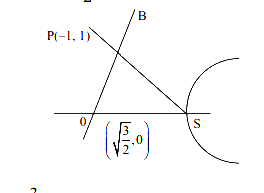
Let $S$ be the focus of the hyperbola $x^2 - 2y^2 = 1$ lying on the positive $X$-axis. Let $P(-1, 1)$ be a given point. Then the area of the triangle formed by the line $PS$ with the coordinate axes is (in sq. units)
A
$\frac{\sqrt{2}}{2(\sqrt{2}+3)}$
B
$\frac{\sqrt{6}}{2(2+\sqrt{6})}$
C
$\frac{3}{2(2+\sqrt{6})}$
D
$\frac{\sqrt{3}}{2(\sqrt{2}+\sqrt{3})}$
Solution
(C) The equation of the hyperbola is $x^2 - 2y^2 = 1$. Comparing with $\frac{x^2}{a^2} - \frac{y^2}{b^2} = 1$,we get $a^2 = 1$ and $b^2 = \frac{1}{2}$.
The eccentricity $e = \sqrt{1 + \frac{b^2}{a^2}} = \sqrt{1 + \frac{1/2}{1}} = \sqrt{\frac{3}{2}}$.
The focus $S$ is $(ae, 0) = (\sqrt{\frac{3}{2}}, 0)$.
The line passing through $P(-1, 1)$ and $S(\sqrt{\frac{3}{2}}, 0)$ has slope $m = \frac{0 - 1}{\sqrt{\frac{3}{2}} - (-1)} = \frac{-1}{\sqrt{\frac{3}{2}} + 1} = \frac{-\sqrt{2}}{\sqrt{3} + \sqrt{2}}$.
The equation of line $PS$ is $y - 0 = m(x - \sqrt{\frac{3}{2}})$,which is $y = \frac{-\sqrt{2}}{\sqrt{3} + \sqrt{2}}(x - \sqrt{\frac{3}{2}})$.
To find the $Y$-intercept $(B)$,set $x = 0$: $y = \frac{-\sqrt{2}}{\sqrt{3} + \sqrt{2}}(-\sqrt{\frac{3}{2}}) = \frac{\sqrt{3}}{\sqrt{3} + \sqrt{2}}$.
The area of the triangle formed by the line with coordinate axes is $\frac{1}{2} \times |OS| \times |OB| = \frac{1}{2} \times \sqrt{\frac{3}{2}} \times \frac{\sqrt{3}}{\sqrt{3} + \sqrt{2}} = \frac{1}{2} \times \frac{3}{\sqrt{2}(\sqrt{3} + \sqrt{2})} = \frac{3}{2(\sqrt{6} + 2)}$.
Thus,the correct option is $C$.
The eccentricity $e = \sqrt{1 + \frac{b^2}{a^2}} = \sqrt{1 + \frac{1/2}{1}} = \sqrt{\frac{3}{2}}$.
The focus $S$ is $(ae, 0) = (\sqrt{\frac{3}{2}}, 0)$.
The line passing through $P(-1, 1)$ and $S(\sqrt{\frac{3}{2}}, 0)$ has slope $m = \frac{0 - 1}{\sqrt{\frac{3}{2}} - (-1)} = \frac{-1}{\sqrt{\frac{3}{2}} + 1} = \frac{-\sqrt{2}}{\sqrt{3} + \sqrt{2}}$.
The equation of line $PS$ is $y - 0 = m(x - \sqrt{\frac{3}{2}})$,which is $y = \frac{-\sqrt{2}}{\sqrt{3} + \sqrt{2}}(x - \sqrt{\frac{3}{2}})$.
To find the $Y$-intercept $(B)$,set $x = 0$: $y = \frac{-\sqrt{2}}{\sqrt{3} + \sqrt{2}}(-\sqrt{\frac{3}{2}}) = \frac{\sqrt{3}}{\sqrt{3} + \sqrt{2}}$.
The area of the triangle formed by the line with coordinate axes is $\frac{1}{2} \times |OS| \times |OB| = \frac{1}{2} \times \sqrt{\frac{3}{2}} \times \frac{\sqrt{3}}{\sqrt{3} + \sqrt{2}} = \frac{1}{2} \times \frac{3}{\sqrt{2}(\sqrt{3} + \sqrt{2})} = \frac{3}{2(\sqrt{6} + 2)}$.
Thus,the correct option is $C$.
0 likesView Solution
212
MathematicsMediumMCQTS EAMCET · 2022
Assertion: The distance between the points $P(\frac{\pi}{4})$ and $P(\frac{\pi}{3})$ on the hyperbola $9x^2 - 16y^2 = 9$ is $\frac{1}{4} \sqrt{66 - 32\sqrt{2} - 18\sqrt{3}}$.
Reason: $x = a \cosh t, y = b \sinh t$ are the parametric equations of the hyperbola $\frac{x^2}{a^2} - \frac{y^2}{b^2} = 1$.
Reason: $x = a \cosh t, y = b \sinh t$ are the parametric equations of the hyperbola $\frac{x^2}{a^2} - \frac{y^2}{b^2} = 1$.
A
$(A)$ is true,$(R)$ is true and $(R)$ is the correct explanation for $(A)$
B
$(A)$ is true,$(R)$ is true but $(R)$ is not the correct explanation for $(A)$
C
$(A)$ is true but $(R)$ is false
D
$(A)$ is false but $(R)$ is true
Solution
(C) The given equation $9x^2 - 16y^2 = 9$ can be written as $\frac{x^2}{1^2} - \frac{y^2}{(3/4)^2} = 1$. Here $a=1, b=3/4$.
The parametric points on a hyperbola are $(a \sec \theta, b \tan \theta)$.
For $\theta = \frac{\pi}{4}$,$P_1 = (1 \cdot \sqrt{2}, \frac{3}{4} \cdot 1) = (\sqrt{2}, \frac{3}{4})$.
For $\theta = \frac{\pi}{3}$,$P_2 = (1 \cdot 2, \frac{3}{4} \cdot \sqrt{3}) = (2, \frac{3\sqrt{3}}{4})$.
The distance $D = \sqrt{(2 - \sqrt{2})^2 + (\frac{3\sqrt{3}}{4} - \frac{3}{4})^2} = \sqrt{(4 + 2 - 4\sqrt{2}) + \frac{9}{16}(3 + 1 - 2\sqrt{3})} = \sqrt{6 - 4\sqrt{2} + \frac{9}{4} - \frac{9\sqrt{3}}{8}} = \sqrt{\frac{48 - 32\sqrt{2} + 18 - 9\sqrt{3}}{8}} = \sqrt{\frac{66 - 32\sqrt{2} - 9\sqrt{3}}{8}} = \frac{1}{2\sqrt{2}} \sqrt{66 - 32\sqrt{2} - 9\sqrt{3}}$.
The Assertion is true.
The Reason states $x = a \cosh t, y = b \sinh t$ are parametric equations for $\frac{x^2}{a^2} - \frac{y^2}{b^2} = 1$,which is incorrect; the correct parametric equations are $x = a \sec \theta, y = b \tan \theta$.
Thus,$(A)$ is true but $(R)$ is false.
The parametric points on a hyperbola are $(a \sec \theta, b \tan \theta)$.
For $\theta = \frac{\pi}{4}$,$P_1 = (1 \cdot \sqrt{2}, \frac{3}{4} \cdot 1) = (\sqrt{2}, \frac{3}{4})$.
For $\theta = \frac{\pi}{3}$,$P_2 = (1 \cdot 2, \frac{3}{4} \cdot \sqrt{3}) = (2, \frac{3\sqrt{3}}{4})$.
The distance $D = \sqrt{(2 - \sqrt{2})^2 + (\frac{3\sqrt{3}}{4} - \frac{3}{4})^2} = \sqrt{(4 + 2 - 4\sqrt{2}) + \frac{9}{16}(3 + 1 - 2\sqrt{3})} = \sqrt{6 - 4\sqrt{2} + \frac{9}{4} - \frac{9\sqrt{3}}{8}} = \sqrt{\frac{48 - 32\sqrt{2} + 18 - 9\sqrt{3}}{8}} = \sqrt{\frac{66 - 32\sqrt{2} - 9\sqrt{3}}{8}} = \frac{1}{2\sqrt{2}} \sqrt{66 - 32\sqrt{2} - 9\sqrt{3}}$.
The Assertion is true.
The Reason states $x = a \cosh t, y = b \sinh t$ are parametric equations for $\frac{x^2}{a^2} - \frac{y^2}{b^2} = 1$,which is incorrect; the correct parametric equations are $x = a \sec \theta, y = b \tan \theta$.
Thus,$(A)$ is true but $(R)$ is false.
0 likesView Solution
213
MathematicsEasyMCQTS EAMCET · 2022
If the latus rectum of a hyperbola subtends an angle of $120^{\circ}$ at its centre,then its eccentricity is
A
$\sqrt{3}$
B
$\sqrt{2}$
C
$\frac{\sqrt{3}+1}{2}$
D
$\sqrt{3}+1$
Solution
(D) Let the hyperbola be $\frac{x^2}{a^2} - \frac{y^2}{b^2} = 1$. The centre is $(0, 0)$.
The endpoints of the latus rectum are $(ae, \frac{b^2}{a})$ and $(ae, -\frac{b^2}{a})$.
The angle subtended by the latus rectum at the centre is $120^{\circ}$.
Thus,the angle made by the line joining the centre to one endpoint $(ae, \frac{b^2}{a})$ with the $x$-axis is $60^{\circ}$.
Therefore,$\tan(60^{\circ}) = \frac{b^2/a}{ae} = \frac{b^2}{a^2e}$.
Since $\sqrt{3} = \frac{b^2}{a^2e}$ and $b^2 = a^2(e^2 - 1)$,we have $\sqrt{3} = \frac{a^2(e^2 - 1)}{a^2e} = \frac{e^2 - 1}{e}$.
This gives $e^2 - \sqrt{3}e - 1 = 0$.
Using the quadratic formula,$e = \frac{\sqrt{3} \pm \sqrt{3 - 4(1)(-1)}}{2} = \frac{\sqrt{3} \pm \sqrt{7}}{2}$.
Since $e > 1$,we take $e = \frac{\sqrt{3} + \sqrt{7}}{2}$.
The endpoints of the latus rectum are $(ae, \frac{b^2}{a})$ and $(ae, -\frac{b^2}{a})$.
The angle subtended by the latus rectum at the centre is $120^{\circ}$.
Thus,the angle made by the line joining the centre to one endpoint $(ae, \frac{b^2}{a})$ with the $x$-axis is $60^{\circ}$.
Therefore,$\tan(60^{\circ}) = \frac{b^2/a}{ae} = \frac{b^2}{a^2e}$.
Since $\sqrt{3} = \frac{b^2}{a^2e}$ and $b^2 = a^2(e^2 - 1)$,we have $\sqrt{3} = \frac{a^2(e^2 - 1)}{a^2e} = \frac{e^2 - 1}{e}$.
This gives $e^2 - \sqrt{3}e - 1 = 0$.
Using the quadratic formula,$e = \frac{\sqrt{3} \pm \sqrt{3 - 4(1)(-1)}}{2} = \frac{\sqrt{3} \pm \sqrt{7}}{2}$.
Since $e > 1$,we take $e = \frac{\sqrt{3} + \sqrt{7}}{2}$.
0 likesView Solution
214
MathematicsMediumMCQTS EAMCET · 2022
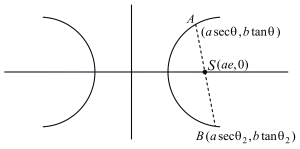
Let $A(\theta_1)$ and $B(\theta_2)$ be two points on the hyperbola $\frac{x^2}{a^2}-\frac{y^2}{b^2}=1$ and $S$ be the focus of the hyperbola. If $A, S, B$ are collinear and $a \cos \left(\frac{\theta_1+\theta_2}{2}\right)=k \cos \left(\frac{\theta_1-\theta_2}{2}\right)$ then $k=$
A
$a^2+b^2$
B
$\sqrt{a^2+b^2}$
C
$a^2-b^2$
D
$a+b$
Solution
(B) The equation of the chord joining points $A(\theta_1)$ and $B(\theta_2)$ on the hyperbola $\frac{x^2}{a^2}-\frac{y^2}{b^2}=1$ is given by:
$\frac{x}{a} \cos \left(\frac{\theta_1-\theta_2}{2}\right)-\frac{y}{b} \sin \left(\frac{\theta_1+\theta_2}{2}\right)=\cos \left(\frac{\theta_1+\theta_2}{2}\right)$
Since the chord passes through the focus $S(ae, 0)$,we substitute $x=ae$ and $y=0$ into the equation:
$\frac{ae}{a} \cos \left(\frac{\theta_1-\theta_2}{2}\right) = \cos \left(\frac{\theta_1+\theta_2}{2}\right)$
$e \cos \left(\frac{\theta_1-\theta_2}{2}\right) = \cos \left(\frac{\theta_1+\theta_2}{2}\right)$
Using the relation $e = \frac{\sqrt{a^2+b^2}}{a}$,we get:
$\frac{\sqrt{a^2+b^2}}{a} \cos \left(\frac{\theta_1-\theta_2}{2}\right) = \cos \left(\frac{\theta_1+\theta_2}{2}\right)$
$\sqrt{a^2+b^2} \cos \left(\frac{\theta_1-\theta_2}{2}\right) = a \cos \left(\frac{\theta_1+\theta_2}{2}\right)$
Comparing this with the given equation $a \cos \left(\frac{\theta_1+\theta_2}{2}\right) = k \cos \left(\frac{\theta_1-\theta_2}{2}\right)$,we find:
$k = \sqrt{a^2+b^2}$
$\frac{x}{a} \cos \left(\frac{\theta_1-\theta_2}{2}\right)-\frac{y}{b} \sin \left(\frac{\theta_1+\theta_2}{2}\right)=\cos \left(\frac{\theta_1+\theta_2}{2}\right)$
Since the chord passes through the focus $S(ae, 0)$,we substitute $x=ae$ and $y=0$ into the equation:
$\frac{ae}{a} \cos \left(\frac{\theta_1-\theta_2}{2}\right) = \cos \left(\frac{\theta_1+\theta_2}{2}\right)$
$e \cos \left(\frac{\theta_1-\theta_2}{2}\right) = \cos \left(\frac{\theta_1+\theta_2}{2}\right)$
Using the relation $e = \frac{\sqrt{a^2+b^2}}{a}$,we get:
$\frac{\sqrt{a^2+b^2}}{a} \cos \left(\frac{\theta_1-\theta_2}{2}\right) = \cos \left(\frac{\theta_1+\theta_2}{2}\right)$
$\sqrt{a^2+b^2} \cos \left(\frac{\theta_1-\theta_2}{2}\right) = a \cos \left(\frac{\theta_1+\theta_2}{2}\right)$
Comparing this with the given equation $a \cos \left(\frac{\theta_1+\theta_2}{2}\right) = k \cos \left(\frac{\theta_1-\theta_2}{2}\right)$,we find:
$k = \sqrt{a^2+b^2}$
0 likesView Solution
215
MathematicsMediumMCQTS EAMCET · 2022
Let $P(\frac{\pi}{4}), Q(\frac{5 \pi}{4}), R(\frac{3 \pi}{4}), T(\frac{7 \pi}{4})$ be the points on the hyperbola $x^2-4y^2-4=0$ in the parametric form. Then the area of the quadrilateral $PQRT$ is (in square units) (in $\sqrt{2}$)
A
$4$
B
$16$
C
$32$
D
$8$
Solution
(D) The equation of the hyperbola is $x^2 - 4y^2 = 4$, which can be written as $\frac{x^2}{4} - \frac{y^2}{1} = 1$.
Here, $a = 2$ and $b = 1$.
The parametric coordinates are given by $(a \sec \theta, b \tan \theta) = (2 \sec \theta, \tan \theta)$.
Calculating the points:
$P(\frac{\pi}{4}) = (2 \sec \frac{\pi}{4}, \tan \frac{\pi}{4}) = (2 \sqrt{2}, 1)$
$Q(\frac{5 \pi}{4}) = (2 \sec \frac{5 \pi}{4}, \tan \frac{5 \pi}{4}) = (-2 \sqrt{2}, 1)$
$R(\frac{3 \pi}{4}) = (2 \sec \frac{3 \pi}{4}, \tan \frac{3 \pi}{4}) = (-2 \sqrt{2}, -1)$
$T(\frac{7 \pi}{4}) = (2 \sec \frac{7 \pi}{4}, \tan \frac{7 \pi}{4}) = (2 \sqrt{2}, -1)$
These points form a rectangle with vertices $(2 \sqrt{2}, 1), (-2 \sqrt{2}, 1), (-2 \sqrt{2}, -1),$ and $(2 \sqrt{2}, -1)$.
The length of the sides are:
Width $= |2 \sqrt{2} - (-2 \sqrt{2})| = 4 \sqrt{2}$
Height $= |1 - (-1)| = 2$
Area $= \text{width} \times \text{height} = 4 \sqrt{2} \times 2 = 8 \sqrt{2}$ square units.
Thus, option $D$ is correct.
Here, $a = 2$ and $b = 1$.
The parametric coordinates are given by $(a \sec \theta, b \tan \theta) = (2 \sec \theta, \tan \theta)$.
Calculating the points:
$P(\frac{\pi}{4}) = (2 \sec \frac{\pi}{4}, \tan \frac{\pi}{4}) = (2 \sqrt{2}, 1)$
$Q(\frac{5 \pi}{4}) = (2 \sec \frac{5 \pi}{4}, \tan \frac{5 \pi}{4}) = (-2 \sqrt{2}, 1)$
$R(\frac{3 \pi}{4}) = (2 \sec \frac{3 \pi}{4}, \tan \frac{3 \pi}{4}) = (-2 \sqrt{2}, -1)$
$T(\frac{7 \pi}{4}) = (2 \sec \frac{7 \pi}{4}, \tan \frac{7 \pi}{4}) = (2 \sqrt{2}, -1)$
These points form a rectangle with vertices $(2 \sqrt{2}, 1), (-2 \sqrt{2}, 1), (-2 \sqrt{2}, -1),$ and $(2 \sqrt{2}, -1)$.
The length of the sides are:
Width $= |2 \sqrt{2} - (-2 \sqrt{2})| = 4 \sqrt{2}$
Height $= |1 - (-1)| = 2$
Area $= \text{width} \times \text{height} = 4 \sqrt{2} \times 2 = 8 \sqrt{2}$ square units.
Thus, option $D$ is correct.
0 likesView Solution
216
MathematicsEasyMCQTS EAMCET · 2022
$\lim _{x \rightarrow 0} \frac{\tan 2x - 2\tan x}{(1 - \cos x)(2^x - 1)} = $
A
$\frac{2}{\ln 2}$
B
$\frac{1}{\ln 4}$
C
$4 \ln 2$
D
$\frac{4}{\ln 2}$
Solution
(D) Let $L = \lim _{x \rightarrow 0} \frac{\tan 2x - 2\tan x}{(1 - \cos x)(2^x - 1)}$.
Using the expansion $\tan x = x + \frac{x^3}{3} + O(x^5)$:
$\tan 2x = 2x + \frac{(2x)^3}{3} + O(x^5) = 2x + \frac{8x^3}{3} + O(x^5)$.
$2\tan x = 2(x + \frac{x^3}{3} + O(x^5)) = 2x + \frac{2x^3}{3} + O(x^5)$.
Numerator: $\tan 2x - 2\tan x = (2x + \frac{8x^3}{3}) - (2x + \frac{2x^3}{3}) = \frac{6x^3}{3} = 2x^3$.
Denominator: $(1 - \cos x)(2^x - 1) \approx (\frac{x^2}{2})(x \ln 2) = \frac{x^3 \ln 2}{2}$.
$L = \lim _{x \rightarrow 0} \frac{2x^3}{\frac{x^3 \ln 2}{2}} = \frac{2 \times 2}{\ln 2} = \frac{4}{\ln 2}$.
Using the expansion $\tan x = x + \frac{x^3}{3} + O(x^5)$:
$\tan 2x = 2x + \frac{(2x)^3}{3} + O(x^5) = 2x + \frac{8x^3}{3} + O(x^5)$.
$2\tan x = 2(x + \frac{x^3}{3} + O(x^5)) = 2x + \frac{2x^3}{3} + O(x^5)$.
Numerator: $\tan 2x - 2\tan x = (2x + \frac{8x^3}{3}) - (2x + \frac{2x^3}{3}) = \frac{6x^3}{3} = 2x^3$.
Denominator: $(1 - \cos x)(2^x - 1) \approx (\frac{x^2}{2})(x \ln 2) = \frac{x^3 \ln 2}{2}$.
$L = \lim _{x \rightarrow 0} \frac{2x^3}{\frac{x^3 \ln 2}{2}} = \frac{2 \times 2}{\ln 2} = \frac{4}{\ln 2}$.
0 likesView Solution
217
MathematicsMediumMCQTS EAMCET · 2022
$\lim _{x \rightarrow 2}\left[\left(x^2-4 x+4\right) \cos \left(\frac{2}{x-2}\right)+\frac{x^2-4}{x^3-2 x-4}\right]=$
A
$0$
B
$\infty$
C
$1$
D
$\frac{2}{5}$
Solution
(D) We evaluate the limit by splitting it into two parts:
$\lim _{x \rightarrow 2} \left[ (x-2)^2 \cos \left(\frac{2}{x-2}\right) \right] + \lim _{x \rightarrow 2} \left[ \frac{x^2-4}{x^3-2 x-4} \right]$
For the first part,$\lim _{x \rightarrow 2} (x-2)^2 \cos \left(\frac{2}{x-2}\right)$. Since $(x-2)^2 \rightarrow 0$ and $\cos \left(\frac{2}{x-2}\right)$ is bounded in $[-1, 1]$,by the Squeeze Theorem,the limit is $0 \times [-1, 1] = 0$.
For the second part,$\lim _{x \rightarrow 2} \frac{(x-2)(x+2)}{(x-2)(x^2+2x+2)} = \lim _{x \rightarrow 2} \frac{x+2}{x^2+2x+2}$.
Substituting $x=2$,we get $\frac{2+2}{2^2+2(2)+2} = \frac{4}{4+4+2} = \frac{4}{10} = \frac{2}{5}$.
Thus,the total limit is $0 + \frac{2}{5} = \frac{2}{5}$.
$\lim _{x \rightarrow 2} \left[ (x-2)^2 \cos \left(\frac{2}{x-2}\right) \right] + \lim _{x \rightarrow 2} \left[ \frac{x^2-4}{x^3-2 x-4} \right]$
For the first part,$\lim _{x \rightarrow 2} (x-2)^2 \cos \left(\frac{2}{x-2}\right)$. Since $(x-2)^2 \rightarrow 0$ and $\cos \left(\frac{2}{x-2}\right)$ is bounded in $[-1, 1]$,by the Squeeze Theorem,the limit is $0 \times [-1, 1] = 0$.
For the second part,$\lim _{x \rightarrow 2} \frac{(x-2)(x+2)}{(x-2)(x^2+2x+2)} = \lim _{x \rightarrow 2} \frac{x+2}{x^2+2x+2}$.
Substituting $x=2$,we get $\frac{2+2}{2^2+2(2)+2} = \frac{4}{4+4+2} = \frac{4}{10} = \frac{2}{5}$.
Thus,the total limit is $0 + \frac{2}{5} = \frac{2}{5}$.
0 likesView Solution
218
MathematicsMediumMCQTS EAMCET · 2022
Let $[x]$ denote the greatest integer less than or equal to $x$ and $f(x) = 2x - [2x]$. If $\lim_{x \rightarrow 2^{-}} f(x) = l_1$ and $\lim_{x \rightarrow 2^{+}} f(x) = l_2$,then $l_1 + l_2 =$
A
$1$
B
$2$
C
$0$
D
$4$
Solution
(A) Given $f(x) = 2x - [2x]$.
To find $l_1 = \lim_{x \rightarrow 2^{-}} f(x)$:
Let $x = 2 - h$,where $h \rightarrow 0$ and $h > 0$.
$l_1 = \lim_{h \rightarrow 0} (2(2 - h) - [2(2 - h)]) = \lim_{h \rightarrow 0} (4 - 2h - [4 - 2h])$.
Since $h$ is a very small positive number,$4 - 2h$ is slightly less than $4$,so $[4 - 2h] = 3$.
Thus,$l_1 = 4 - 3 = 1$.
To find $l_2 = \lim_{x \rightarrow 2^{+}} f(x)$:
Let $x = 2 + h$,where $h \rightarrow 0$ and $h > 0$.
$l_2 = \lim_{h \rightarrow 0} (2(2 + h) - [2(2 + h)]) = \lim_{h \rightarrow 0} (4 + 2h - [4 + 2h])$.
Since $h$ is a very small positive number,$4 + 2h$ is slightly greater than $4$,so $[4 + 2h] = 4$.
Thus,$l_2 = 4 - 4 = 0$.
Therefore,$l_1 + l_2 = 1 + 0 = 1$.
To find $l_1 = \lim_{x \rightarrow 2^{-}} f(x)$:
Let $x = 2 - h$,where $h \rightarrow 0$ and $h > 0$.
$l_1 = \lim_{h \rightarrow 0} (2(2 - h) - [2(2 - h)]) = \lim_{h \rightarrow 0} (4 - 2h - [4 - 2h])$.
Since $h$ is a very small positive number,$4 - 2h$ is slightly less than $4$,so $[4 - 2h] = 3$.
Thus,$l_1 = 4 - 3 = 1$.
To find $l_2 = \lim_{x \rightarrow 2^{+}} f(x)$:
Let $x = 2 + h$,where $h \rightarrow 0$ and $h > 0$.
$l_2 = \lim_{h \rightarrow 0} (2(2 + h) - [2(2 + h)]) = \lim_{h \rightarrow 0} (4 + 2h - [4 + 2h])$.
Since $h$ is a very small positive number,$4 + 2h$ is slightly greater than $4$,so $[4 + 2h] = 4$.
Thus,$l_2 = 4 - 4 = 0$.
Therefore,$l_1 + l_2 = 1 + 0 = 1$.
0 likesView Solution
219
MathematicsEasyMCQTS EAMCET · 2022
$\lim _{x \rightarrow 0} \frac{2^{2 x}-2^{x+1}+2-\cos 2 x}{x^2} = $
A
$2+(\log _e 2)$
B
$2+(\log _e 2)^2$
C
$2+(\log _e 4)^2$
D
$2+\log _e 4$
Solution
(B) Given,$\lim _{x \rightarrow 0} \frac{2^{2 x}-2^{x+1}+2-\cos 2 x}{x^2}$
$= \lim _{x \rightarrow 0} \frac{(2^x)^2 - 2 \cdot 2^x + 1 + 1 - \cos 2x}{x^2}$
$= \lim _{x \rightarrow 0} \frac{(2^x - 1)^2 + (1 - \cos 2x)}{x^2}$
$= \lim _{x \rightarrow 0} \left( \frac{2^x - 1}{x} \right)^2 + \lim _{x \rightarrow 0} \frac{1 - \cos 2x}{x^2}$
Using the standard limits $\lim _{x \rightarrow 0} \frac{a^x - 1}{x} = \log _e a$ and $\lim _{x \rightarrow 0} \frac{1 - \cos kx}{x^2} = \frac{k^2}{2}$:
$= (\log _e 2)^2 + \frac{2^2}{2}$
$= (\log _e 2)^2 + 2$
$= \lim _{x \rightarrow 0} \frac{(2^x)^2 - 2 \cdot 2^x + 1 + 1 - \cos 2x}{x^2}$
$= \lim _{x \rightarrow 0} \frac{(2^x - 1)^2 + (1 - \cos 2x)}{x^2}$
$= \lim _{x \rightarrow 0} \left( \frac{2^x - 1}{x} \right)^2 + \lim _{x \rightarrow 0} \frac{1 - \cos 2x}{x^2}$
Using the standard limits $\lim _{x \rightarrow 0} \frac{a^x - 1}{x} = \log _e a$ and $\lim _{x \rightarrow 0} \frac{1 - \cos kx}{x^2} = \frac{k^2}{2}$:
$= (\log _e 2)^2 + \frac{2^2}{2}$
$= (\log _e 2)^2 + 2$
0 likesView Solution
220
MathematicsEasyMCQTS EAMCET · 2022
$\lim _{x \rightarrow 3^{-}} \frac{x^3-3 x^2-4 x+12}{2 x^3-7 x^2+2 x+3} = $
A
$0$
B
$\infty$
C
$\frac{5}{14}$
D
$\frac{6}{13}$
Solution
(C) Given,$L = \lim _{x \rightarrow 3^{-}} \frac{x^3-3 x^2-4 x+12}{2 x^3-7 x^2+2 x+3}$.
Checking the form at $x = 3$,we get $\frac{3^3 - 3(3^2) - 4(3) + 12}{2(3^3) - 7(3^2) + 2(3) + 3} = \frac{27 - 27 - 12 + 12}{54 - 63 + 6 + 3} = \frac{0}{0}$ form.
Applying $L'H\hat{o}pital's$ rule,we differentiate the numerator and denominator with respect to $x$:
$L = \lim _{x \rightarrow 3^{-}} \frac{\frac{d}{dx}(x^3-3 x^2-4 x+12)}{\frac{d}{dx}(2 x^3-7 x^2+2 x+3)} = \lim _{x \rightarrow 3^{-}} \frac{3 x^2-6 x-4}{6 x^2-14 x+2}$.
Now,substitute $x = 3$:
$L = \frac{3(3^2) - 6(3) - 4}{6(3^2) - 14(3) + 2} = \frac{27 - 18 - 4}{54 - 42 + 2} = \frac{5}{14}$.
Checking the form at $x = 3$,we get $\frac{3^3 - 3(3^2) - 4(3) + 12}{2(3^3) - 7(3^2) + 2(3) + 3} = \frac{27 - 27 - 12 + 12}{54 - 63 + 6 + 3} = \frac{0}{0}$ form.
Applying $L'H\hat{o}pital's$ rule,we differentiate the numerator and denominator with respect to $x$:
$L = \lim _{x \rightarrow 3^{-}} \frac{\frac{d}{dx}(x^3-3 x^2-4 x+12)}{\frac{d}{dx}(2 x^3-7 x^2+2 x+3)} = \lim _{x \rightarrow 3^{-}} \frac{3 x^2-6 x-4}{6 x^2-14 x+2}$.
Now,substitute $x = 3$:
$L = \frac{3(3^2) - 6(3) - 4}{6(3^2) - 14(3) + 2} = \frac{27 - 18 - 4}{54 - 42 + 2} = \frac{5}{14}$.
0 likesView Solution
221
MathematicsEasyMCQTS EAMCET · 2022
$\lim _{x \rightarrow \infty} x^3 \left[ \sqrt{x^2 + \sqrt{x^4 + 1}} - \sqrt{2} x \right] = $
A
$0$
B
$1$
C
$\frac{1}{4 \sqrt{2}}$
D
$\frac{3}{2 \sqrt{2}}$
Solution
(C) Let $L = \lim _{x \rightarrow \infty} x^3 \left[ \sqrt{x^2 + \sqrt{x^4 + 1}} - \sqrt{2} x \right]$.
Rationalizing the expression:
$L = \lim _{x \rightarrow \infty} x^3 \left[ \sqrt{x^2 + \sqrt{x^4 + 1}} - \sqrt{2} x \right] \times \frac{\sqrt{x^2 + \sqrt{x^4 + 1}} + \sqrt{2} x}{\sqrt{x^2 + \sqrt{x^4 + 1}} + \sqrt{2} x}$
$= \lim _{x \rightarrow \infty} x^3 \frac{x^2 + \sqrt{x^4 + 1} - 2x^2}{\sqrt{x^2 + \sqrt{x^4 + 1}} + \sqrt{2} x} = \lim _{x \rightarrow \infty} x^3 \frac{\sqrt{x^4 + 1} - x^2}{\sqrt{x^2 + \sqrt{x^4 + 1}} + \sqrt{2} x}$.
Rationalizing again:
$= \lim _{x \rightarrow \infty} x^3 \frac{(\sqrt{x^4 + 1} - x^2)(\sqrt{x^4 + 1} + x^2)}{(\sqrt{x^2 + \sqrt{x^4 + 1}} + \sqrt{2} x)(\sqrt{x^4 + 1} + x^2)} = \lim _{x \rightarrow \infty} x^3 \frac{x^4 + 1 - x^4}{(\sqrt{x^2 + \sqrt{x^4 + 1}} + \sqrt{2} x)(\sqrt{x^4 + 1} + x^2)}$
$= \lim _{x \rightarrow \infty} \frac{x^3}{(\sqrt{x^2 + \sqrt{x^4 + 1}} + \sqrt{2} x)(\sqrt{x^4 + 1} + x^2)}$.
Dividing numerator and denominator by $x^3$ (specifically $x$ in the first bracket and $x^2$ in the second):
$= \lim _{x \rightarrow \infty} \frac{1}{(\sqrt{1 + \sqrt{1 + \frac{1}{x^4}}} + \sqrt{2})(\sqrt{1 + \frac{1}{x^4}} + 1)} = \frac{1}{(\sqrt{1 + 1} + \sqrt{2})(1 + 1)} = \frac{1}{(2\sqrt{2})(2)} = \frac{1}{4\sqrt{2}}$.
Rationalizing the expression:
$L = \lim _{x \rightarrow \infty} x^3 \left[ \sqrt{x^2 + \sqrt{x^4 + 1}} - \sqrt{2} x \right] \times \frac{\sqrt{x^2 + \sqrt{x^4 + 1}} + \sqrt{2} x}{\sqrt{x^2 + \sqrt{x^4 + 1}} + \sqrt{2} x}$
$= \lim _{x \rightarrow \infty} x^3 \frac{x^2 + \sqrt{x^4 + 1} - 2x^2}{\sqrt{x^2 + \sqrt{x^4 + 1}} + \sqrt{2} x} = \lim _{x \rightarrow \infty} x^3 \frac{\sqrt{x^4 + 1} - x^2}{\sqrt{x^2 + \sqrt{x^4 + 1}} + \sqrt{2} x}$.
Rationalizing again:
$= \lim _{x \rightarrow \infty} x^3 \frac{(\sqrt{x^4 + 1} - x^2)(\sqrt{x^4 + 1} + x^2)}{(\sqrt{x^2 + \sqrt{x^4 + 1}} + \sqrt{2} x)(\sqrt{x^4 + 1} + x^2)} = \lim _{x \rightarrow \infty} x^3 \frac{x^4 + 1 - x^4}{(\sqrt{x^2 + \sqrt{x^4 + 1}} + \sqrt{2} x)(\sqrt{x^4 + 1} + x^2)}$
$= \lim _{x \rightarrow \infty} \frac{x^3}{(\sqrt{x^2 + \sqrt{x^4 + 1}} + \sqrt{2} x)(\sqrt{x^4 + 1} + x^2)}$.
Dividing numerator and denominator by $x^3$ (specifically $x$ in the first bracket and $x^2$ in the second):
$= \lim _{x \rightarrow \infty} \frac{1}{(\sqrt{1 + \sqrt{1 + \frac{1}{x^4}}} + \sqrt{2})(\sqrt{1 + \frac{1}{x^4}} + 1)} = \frac{1}{(\sqrt{1 + 1} + \sqrt{2})(1 + 1)} = \frac{1}{(2\sqrt{2})(2)} = \frac{1}{4\sqrt{2}}$.
0 likesView Solution
222
MathematicsEasyMCQTS EAMCET · 2022
Evaluate the limit: $\lim _{x \rightarrow 0} \frac{\tan ^2(\pi \sec ^4 x)}{\pi^2 x^4}$
A
$0$
B
$4$
C
$1$
D
$16$
Solution
(B) Let $L = \lim _{x \rightarrow 0} \frac{\tan ^2(\pi \sec ^4 x)}{\pi^2 x^4}$.
Since $\sec(0) = 1$,the expression takes the form $\frac{\tan^2(\pi)}{0} = \frac{0}{0}$.
We use the property $\tan(\pi \sec^4 x) = \tan(\pi \sec^4 x - \pi) = \tan(\pi(\sec^4 x - 1))$.
Recall that $\sec^4 x - 1 = (\sec^2 x - 1)(\sec^2 x + 1) = \tan^2 x (\sec^2 x + 1)$.
As $x \rightarrow 0$,$\tan x \approx x$ and $\sec^2 x \approx 1$,so $\sec^4 x - 1 \approx x^2(1+1) = 2x^2$.
Thus,$\tan(\pi \sec^4 x) \approx \tan(2\pi x^2) \approx 2\pi x^2$.
Substituting this into the limit:
$L = \lim _{x \rightarrow 0} \frac{(2\pi x^2)^2}{\pi^2 x^4} = \lim _{x \rightarrow 0} \frac{4\pi^2 x^4}{\pi^2 x^4} = 4$.
Since $\sec(0) = 1$,the expression takes the form $\frac{\tan^2(\pi)}{0} = \frac{0}{0}$.
We use the property $\tan(\pi \sec^4 x) = \tan(\pi \sec^4 x - \pi) = \tan(\pi(\sec^4 x - 1))$.
Recall that $\sec^4 x - 1 = (\sec^2 x - 1)(\sec^2 x + 1) = \tan^2 x (\sec^2 x + 1)$.
As $x \rightarrow 0$,$\tan x \approx x$ and $\sec^2 x \approx 1$,so $\sec^4 x - 1 \approx x^2(1+1) = 2x^2$.
Thus,$\tan(\pi \sec^4 x) \approx \tan(2\pi x^2) \approx 2\pi x^2$.
Substituting this into the limit:
$L = \lim _{x \rightarrow 0} \frac{(2\pi x^2)^2}{\pi^2 x^4} = \lim _{x \rightarrow 0} \frac{4\pi^2 x^4}{\pi^2 x^4} = 4$.
0 likesView Solution
223
MathematicsMediumMCQTS EAMCET · 2022
Let $f(x)$ be a differentiable function such that $f(0)=0$ and $f^{\prime}(0)=20$. For $x \in \left(0, \frac{\pi}{2}\right]$,if $A(x)=2 f(x) \operatorname{cosec} 4 x+4 f(x)\left(\cos ^2 x+1\right)-4 \cos ^2 x$,then $\lim _{x \rightarrow 0} A(x)=$
A
$0$
B
$4$
C
$6$
D
$8$
Solution
(C) Given that $f(x)$ is a differentiable function with $f(0)=0$ and $f^{\prime}(0)=20$.
We need to find $\lim _{x \rightarrow 0} A(x) = \lim _{x \rightarrow 0} [2 f(x) \operatorname{cosec} 4 x + 4 f(x)(\cos ^2 x + 1) - 4 \cos ^2 x]$.
Rewrite the expression as:
$\lim _{x \rightarrow 0} A(x) = \lim _{x \rightarrow 0} \left[ \frac{2 f(x)}{\sin 4x} + 4 f(x)(\cos ^2 x + 1) - 4 \cos ^2 x \right]$.
Since $f(0)=0$,the first term is an indeterminate form of type $\frac{0}{0}$.
Using the limit $\lim _{x \rightarrow 0} \frac{f(x)}{\sin 4x} = \lim _{x \rightarrow 0} \frac{f(x)}{x} \cdot \frac{4x}{\sin 4x} \cdot \frac{1}{4} = f^{\prime}(0) \cdot 1 \cdot \frac{1}{4} = \frac{20}{4} = 5$.
Now,evaluate the limit:
$\lim _{x \rightarrow 0} A(x) = 2 \left( \lim _{x \rightarrow 0} \frac{f(x)}{\sin 4x} \right) + 4 \lim _{x \rightarrow 0} f(x)(\cos ^2 x + 1) - 4 \lim _{x \rightarrow 0} \cos ^2 x$.
$= 2(5) + 4(0)(1+1) - 4(1)^2$.
$= 10 + 0 - 4 = 6$.
Therefore,the correct option is $C$.
We need to find $\lim _{x \rightarrow 0} A(x) = \lim _{x \rightarrow 0} [2 f(x) \operatorname{cosec} 4 x + 4 f(x)(\cos ^2 x + 1) - 4 \cos ^2 x]$.
Rewrite the expression as:
$\lim _{x \rightarrow 0} A(x) = \lim _{x \rightarrow 0} \left[ \frac{2 f(x)}{\sin 4x} + 4 f(x)(\cos ^2 x + 1) - 4 \cos ^2 x \right]$.
Since $f(0)=0$,the first term is an indeterminate form of type $\frac{0}{0}$.
Using the limit $\lim _{x \rightarrow 0} \frac{f(x)}{\sin 4x} = \lim _{x \rightarrow 0} \frac{f(x)}{x} \cdot \frac{4x}{\sin 4x} \cdot \frac{1}{4} = f^{\prime}(0) \cdot 1 \cdot \frac{1}{4} = \frac{20}{4} = 5$.
Now,evaluate the limit:
$\lim _{x \rightarrow 0} A(x) = 2 \left( \lim _{x \rightarrow 0} \frac{f(x)}{\sin 4x} \right) + 4 \lim _{x \rightarrow 0} f(x)(\cos ^2 x + 1) - 4 \lim _{x \rightarrow 0} \cos ^2 x$.
$= 2(5) + 4(0)(1+1) - 4(1)^2$.
$= 10 + 0 - 4 = 6$.
Therefore,the correct option is $C$.
0 likesView Solution
224
MathematicsMediumMCQTS EAMCET · 2022
$\lim _{x \rightarrow 0} \frac{\left(2^x-1\right)(1+\sin x)^{\frac{2}{\sin x}}}{\log (1+2 x)} = $
A
$e^2 \log 4$
B
$e \log \sqrt{2}$
C
$e^2 \log 2$
D
$e^2 \log \sqrt{2}$
Solution
(D) We need to evaluate the limit $L = \lim _{x \rightarrow 0} \frac{\left(2^x-1\right)(1+\sin x)^{\frac{2}{\sin x}}}{\log (1+2 x)}$.
First,consider the term $(1+\sin x)^{\frac{2}{\sin x}}$. As $x \rightarrow 0$,$\sin x \rightarrow 0$,so this is of the form $(1+u)^{2/u}$ where $u = \sin x$. We know that $\lim _{u \rightarrow 0} (1+u)^{1/u} = e$,so $\lim _{x \rightarrow 0} (1+\sin x)^{\frac{2}{\sin x}} = e^2$.
Now,rewrite the limit as:
$L = \lim _{x \rightarrow 0} \left( \frac{2^x-1}{\log(1+2x)} \right) \times \lim _{x \rightarrow 0} (1+\sin x)^{\frac{2}{\sin x}}$.
Using the standard limits $\lim _{x \rightarrow 0} \frac{a^x-1}{x} = \log a$ and $\lim _{x \rightarrow 0} \frac{\log(1+x)}{x} = 1$:
$\lim _{x \rightarrow 0} \frac{2^x-1}{\log(1+2x)} = \lim _{x \rightarrow 0} \left( \frac{2^x-1}{x} \cdot \frac{2x}{\log(1+2x)} \cdot \frac{1}{2} \right) = \log 2 \cdot 1 \cdot \frac{1}{2} = \frac{\log 2}{2} = \log \sqrt{2}$.
Thus,$L = \log \sqrt{2} \cdot e^2 = e^2 \log \sqrt{2}$.
Therefore,option $(D)$ is correct.
First,consider the term $(1+\sin x)^{\frac{2}{\sin x}}$. As $x \rightarrow 0$,$\sin x \rightarrow 0$,so this is of the form $(1+u)^{2/u}$ where $u = \sin x$. We know that $\lim _{u \rightarrow 0} (1+u)^{1/u} = e$,so $\lim _{x \rightarrow 0} (1+\sin x)^{\frac{2}{\sin x}} = e^2$.
Now,rewrite the limit as:
$L = \lim _{x \rightarrow 0} \left( \frac{2^x-1}{\log(1+2x)} \right) \times \lim _{x \rightarrow 0} (1+\sin x)^{\frac{2}{\sin x}}$.
Using the standard limits $\lim _{x \rightarrow 0} \frac{a^x-1}{x} = \log a$ and $\lim _{x \rightarrow 0} \frac{\log(1+x)}{x} = 1$:
$\lim _{x \rightarrow 0} \frac{2^x-1}{\log(1+2x)} = \lim _{x \rightarrow 0} \left( \frac{2^x-1}{x} \cdot \frac{2x}{\log(1+2x)} \cdot \frac{1}{2} \right) = \log 2 \cdot 1 \cdot \frac{1}{2} = \frac{\log 2}{2} = \log \sqrt{2}$.
Thus,$L = \log \sqrt{2} \cdot e^2 = e^2 \log \sqrt{2}$.
Therefore,option $(D)$ is correct.
0 likesView Solution
225
MathematicsEasyMCQTS EAMCET · 2022
Evaluate the limit: $\lim _{x \rightarrow 2} \frac{x^3-x^2-x-2}{2 x^3-3 x^2-3 x+2}$
A
$0$
B
$\infty$
C
$\frac{5}{7}$
D
$\frac{7}{9}$
Solution
(D) Given the limit: $\lim _{x \rightarrow 2} \frac{x^3-x^2-x-2}{2 x^3-3 x^2-3 x+2}$
Substituting $x = 2$,we get $\frac{2^3 - 2^2 - 2 - 2}{2(2^3) - 3(2^2) - 3(2) + 2} = \frac{8-4-2-2}{16-12-6+2} = \frac{0}{0}$ form.
Applying $L$'$H$ôpital's rule by differentiating the numerator and denominator with respect to $x$:
Numerator derivative: $\frac{d}{dx}(x^3-x^2-x-2) = 3x^2-2x-1$
Denominator derivative: $\frac{d}{dx}(2x^3-3x^2-3x+2) = 6x^2-6x-3$
Now,evaluate the limit: $\lim _{x \rightarrow 2} \frac{3x^2-2x-1}{6x^2-6x-3}$
$= \frac{3(2)^2 - 2(2) - 1}{6(2)^2 - 6(2) - 3} = \frac{12-4-1}{24-12-3} = \frac{7}{9}$
Substituting $x = 2$,we get $\frac{2^3 - 2^2 - 2 - 2}{2(2^3) - 3(2^2) - 3(2) + 2} = \frac{8-4-2-2}{16-12-6+2} = \frac{0}{0}$ form.
Applying $L$'$H$ôpital's rule by differentiating the numerator and denominator with respect to $x$:
Numerator derivative: $\frac{d}{dx}(x^3-x^2-x-2) = 3x^2-2x-1$
Denominator derivative: $\frac{d}{dx}(2x^3-3x^2-3x+2) = 6x^2-6x-3$
Now,evaluate the limit: $\lim _{x \rightarrow 2} \frac{3x^2-2x-1}{6x^2-6x-3}$
$= \frac{3(2)^2 - 2(2) - 1}{6(2)^2 - 6(2) - 3} = \frac{12-4-1}{24-12-3} = \frac{7}{9}$
0 likesView Solution
226
MathematicsMediumMCQTS EAMCET · 2022
Evaluate the limit: $\lim _{x \rightarrow 0} \frac{4[\sin (2022 x)-\sin (2020 x)]}{x[\cos (2022 x)+2 \cos (2021 x)+\cos (2020 x)]}$
A
$1$
B
$2$
C
$2020$
D
$2021$
Solution
(B) Using the trigonometric identities $\sin C - \sin D = 2 \cos \left(\frac{C+D}{2}\right) \sin \left(\frac{C-D}{2}\right)$ and $\cos C + \cos D = 2 \cos \left(\frac{C+D}{2}\right) \cos \left(\frac{C-D}{2}\right)$:
Numerator: $4[\sin (2022 x) - \sin (2020 x)] = 4 \times 2 \cos(2021 x) \sin(x) = 8 \cos(2021 x) \sin(x)$.
Denominator: $x[\cos (2022 x) + \cos (2020 x) + 2 \cos (2021 x)] = x[2 \cos(2021 x) \cos(x) + 2 \cos(2021 x)] = 2x \cos(2021 x) [\cos(x) + 1]$.
Substituting these into the limit:
$\lim _{x \rightarrow 0} \frac{8 \cos(2021 x) \sin(x)}{2x \cos(2021 x) [\cos(x) + 1]} = \lim _{x \rightarrow 0} \frac{4 \sin(x)}{x [\cos(x) + 1]}$.
Since $\lim _{x \rightarrow 0} \frac{\sin x}{x} = 1$ and $\cos(0) = 1$:
$= \frac{4(1)}{1 + 1} = \frac{4}{2} = 2$.
Numerator: $4[\sin (2022 x) - \sin (2020 x)] = 4 \times 2 \cos(2021 x) \sin(x) = 8 \cos(2021 x) \sin(x)$.
Denominator: $x[\cos (2022 x) + \cos (2020 x) + 2 \cos (2021 x)] = x[2 \cos(2021 x) \cos(x) + 2 \cos(2021 x)] = 2x \cos(2021 x) [\cos(x) + 1]$.
Substituting these into the limit:
$\lim _{x \rightarrow 0} \frac{8 \cos(2021 x) \sin(x)}{2x \cos(2021 x) [\cos(x) + 1]} = \lim _{x \rightarrow 0} \frac{4 \sin(x)}{x [\cos(x) + 1]}$.
Since $\lim _{x \rightarrow 0} \frac{\sin x}{x} = 1$ and $\cos(0) = 1$:
$= \frac{4(1)}{1 + 1} = \frac{4}{2} = 2$.
0 likesView Solution
227
MathematicsEasyMCQTS EAMCET · 2022
Evaluate the limit: $\lim _{x}$ ${\rightarrow 0}\left(\frac{4 !}{x^8}\left(1-\cos \frac{x^2}{3}-\cos \frac{x^2}{4}+\cos \frac{x^2}{3} \cos \frac{x^2}{4}\right)\right)$
A
$8$
B
$\frac{1}{6}$
C
$\frac{1}{24}$
D
$\frac{2}{3}$
Solution
(C) Let the given expression be $L = \lim _{x}$ ${\rightarrow 0}\left(\frac{4 !}{x^8}\left(1-\cos \frac{x^2}{3}-\cos \frac{x^2}{4}+\cos \frac{x^2}{3} \cos \frac{x^2}{4}\right)\right)$.
We can factor the expression inside the limit as:
$L = \lim _{x \rightarrow 0} \frac{4!}{x^8} (1 - \cos \frac{x^2}{3})(1 - \cos \frac{x^2}{4})$.
Using the identity $1 - \cos \theta = 2 \sin^2(\frac{\theta}{2})$,we get:
$1 - \cos \frac{x^2}{3} = 2 \sin^2(\frac{x^2}{6})$ and $1 - \cos \frac{x^2}{4} = 2 \sin^2(\frac{x^2}{8})$.
Substituting these into the limit:
$L = 24 \times \lim _{x \rightarrow 0} \frac{1}{x^8} \times 2 \sin^2(\frac{x^2}{6}) \times 2 \sin^2(\frac{x^2}{8})$.
$L = 24 \times 4 \times \lim _{x}$ ${\rightarrow 0} \left(\frac{\sin(\frac{x^2}{6})}{\frac{x^2}{6}}\right)^2 \times (\frac{x^2}{6})^2 \times \left(\frac{\sin(\frac{x^2}{8})}{\frac{x^2}{8}}\right)^2 \times (\frac{x^2}{8})^2 \times \frac{1}{x^8}$.
Since $\lim_{\theta \rightarrow 0} \frac{\sin \theta}{\theta} = 1$,we have:
$L = 96 \times 1^2 \times \frac{x^4}{36} \times 1^2 \times \frac{x^4}{64} \times \frac{1}{x^8}$.
$L = 96 \times \frac{1}{36 \times 64} = \frac{96}{2304} = \frac{1}{24}$.
We can factor the expression inside the limit as:
$L = \lim _{x \rightarrow 0} \frac{4!}{x^8} (1 - \cos \frac{x^2}{3})(1 - \cos \frac{x^2}{4})$.
Using the identity $1 - \cos \theta = 2 \sin^2(\frac{\theta}{2})$,we get:
$1 - \cos \frac{x^2}{3} = 2 \sin^2(\frac{x^2}{6})$ and $1 - \cos \frac{x^2}{4} = 2 \sin^2(\frac{x^2}{8})$.
Substituting these into the limit:
$L = 24 \times \lim _{x \rightarrow 0} \frac{1}{x^8} \times 2 \sin^2(\frac{x^2}{6}) \times 2 \sin^2(\frac{x^2}{8})$.
$L = 24 \times 4 \times \lim _{x}$ ${\rightarrow 0} \left(\frac{\sin(\frac{x^2}{6})}{\frac{x^2}{6}}\right)^2 \times (\frac{x^2}{6})^2 \times \left(\frac{\sin(\frac{x^2}{8})}{\frac{x^2}{8}}\right)^2 \times (\frac{x^2}{8})^2 \times \frac{1}{x^8}$.
Since $\lim_{\theta \rightarrow 0} \frac{\sin \theta}{\theta} = 1$,we have:
$L = 96 \times 1^2 \times \frac{x^4}{36} \times 1^2 \times \frac{x^4}{64} \times \frac{1}{x^8}$.
$L = 96 \times \frac{1}{36 \times 64} = \frac{96}{2304} = \frac{1}{24}$.
0 likesView Solution
228
MathematicsMediumMCQTS EAMCET · 2022
If $x = \log_e \left( \cot \left( \frac{\pi}{4} + \theta \right) \right)$,then $\lim_{\theta \rightarrow 0} \frac{\theta}{(\sinh x)(\cosh x)} = $
A
$0$
B
$-\frac{1}{2}$
C
$-2$
D
$1$
Solution
(B) Given $x = \log_e \left( \cot \left( \frac{\pi}{4} + \theta \right) \right)$.
We know that $(\sinh x)(\cosh x) = \frac{1}{2} \sinh(2x)$.
Since $e^x = \cot \left( \frac{\pi}{4} + \theta \right) = \frac{1 - \tan \theta}{1 + \tan \theta}$,we have $e^{2x} = \left( \frac{1 - \tan \theta}{1 + \tan \theta} \right)^2$ and $e^{-2x} = \left( \frac{1 + \tan \theta}{1 - \tan \theta} \right)^2$.
Then $\sinh(2x) = \frac{e^{2x} - e^{-2x}}{2} = \frac{1}{2} \left[ \left( \frac{1 - \tan \theta}{1 + \tan \theta} \right)^2 - \left( \frac{1 + \tan \theta}{1 - \tan \theta} \right)^2 \right]$.
Simplifying the expression inside the bracket: $\frac{(1 - \tan \theta)^4 - (1 + \tan \theta)^4}{(1 - \tan^2 \theta)^2} = \frac{-8 \tan \theta - 8 \tan^3 \theta}{(1 - \tan^2 \theta)^2} = \frac{-8 \tan \theta (1 + \tan^2 \theta)}{(1 - \tan^2 \theta)^2}$.
Thus,$(\sinh x)(\cosh x) = \frac{1}{2} \sinh(2x) = \frac{-4 \tan \theta (1 + \tan^2 \theta)}{(1 - \tan^2 \theta)^2}$.
Now,the limit is $\lim_{\theta \rightarrow 0} \frac{\theta}{(\sinh x)(\cosh x)} = \lim_{\theta \rightarrow 0} \frac{\theta (1 - \tan^2 \theta)^2}{-4 \tan \theta (1 + \tan^2 \theta)}$.
Since $\lim_{\theta \rightarrow 0} \frac{\theta}{\tan \theta} = 1$,we have $\lim_{\theta \rightarrow 0} \frac{1 \cdot (1 - 0)^2}{-4(1 + 0)} = -\frac{1}{4}$.
Wait,re-checking the identity: $\sinh(2x) = \frac{e^{2x} - e^{-2x}}{2}$. With $e^x = \frac{1-\tan \theta}{1+\tan \theta}$,$e^{2x} = \frac{1-\sin 2\theta}{1+\sin 2\theta}$.
Actually,$\sinh x = \frac{e^x - e^{-x}}{2} = \frac{\cot(\pi/4+\theta) - \tan(\pi/4+\theta)}{2} = -\tan(2\theta)/2$ and $\cosh x = \frac{\cot(\pi/4+\theta) + \tan(\pi/4+\theta)}{2} = \frac{1}{\sin(2\theta)}$.
So $(\sinh x)(\cosh x) = -\frac{\tan(2\theta)}{2 \sin(2\theta)} = -\frac{1}{2 \cos(2\theta)}$.
Then $\lim_{\theta \rightarrow 0} \frac{\theta}{-1/(2 \cos(2\theta))} = \lim_{\theta \rightarrow 0} -2\theta \cos(2\theta) = 0$.
Re-evaluating: $x = \log_e(\cot(\pi/4+\theta))$. $\sinh x = \frac{e^x - e^{-x}}{2} = \frac{\cot(\pi/4+\theta) - \tan(\pi/4+\theta)}{2} = \frac{\cos^2(\pi/4+\theta) - \sin^2(\pi/4+\theta)}{2 \sin(\pi/4+\theta)\cos(\pi/4+\theta)} = \frac{\cos(\pi/2+2\theta)}{\sin(\pi/2+2\theta)} = -\tan(2\theta)$.
$\cosh x = \frac{\cot(\pi/4+\theta) + \tan(\pi/4+\theta)}{2} = \frac{1}{\sin(\pi/2+2\theta)} = \sec(2\theta)$.
$(\sinh x)(\cosh x) = -\tan(2\theta) \sec(2\theta) = -\frac{\sin(2\theta)}{\cos^2(2\theta)}$.
Limit $\lim_{\theta \rightarrow 0} \frac{\theta}{-\sin(2\theta)/\cos^2(2\theta)} = \lim_{\theta \rightarrow 0} -\frac{\theta}{\sin(2\theta)} \cdot \cos^2(2\theta) = -\frac{1}{2} \cdot 1 = -\frac{1}{2}$.
We know that $(\sinh x)(\cosh x) = \frac{1}{2} \sinh(2x)$.
Since $e^x = \cot \left( \frac{\pi}{4} + \theta \right) = \frac{1 - \tan \theta}{1 + \tan \theta}$,we have $e^{2x} = \left( \frac{1 - \tan \theta}{1 + \tan \theta} \right)^2$ and $e^{-2x} = \left( \frac{1 + \tan \theta}{1 - \tan \theta} \right)^2$.
Then $\sinh(2x) = \frac{e^{2x} - e^{-2x}}{2} = \frac{1}{2} \left[ \left( \frac{1 - \tan \theta}{1 + \tan \theta} \right)^2 - \left( \frac{1 + \tan \theta}{1 - \tan \theta} \right)^2 \right]$.
Simplifying the expression inside the bracket: $\frac{(1 - \tan \theta)^4 - (1 + \tan \theta)^4}{(1 - \tan^2 \theta)^2} = \frac{-8 \tan \theta - 8 \tan^3 \theta}{(1 - \tan^2 \theta)^2} = \frac{-8 \tan \theta (1 + \tan^2 \theta)}{(1 - \tan^2 \theta)^2}$.
Thus,$(\sinh x)(\cosh x) = \frac{1}{2} \sinh(2x) = \frac{-4 \tan \theta (1 + \tan^2 \theta)}{(1 - \tan^2 \theta)^2}$.
Now,the limit is $\lim_{\theta \rightarrow 0} \frac{\theta}{(\sinh x)(\cosh x)} = \lim_{\theta \rightarrow 0} \frac{\theta (1 - \tan^2 \theta)^2}{-4 \tan \theta (1 + \tan^2 \theta)}$.
Since $\lim_{\theta \rightarrow 0} \frac{\theta}{\tan \theta} = 1$,we have $\lim_{\theta \rightarrow 0} \frac{1 \cdot (1 - 0)^2}{-4(1 + 0)} = -\frac{1}{4}$.
Wait,re-checking the identity: $\sinh(2x) = \frac{e^{2x} - e^{-2x}}{2}$. With $e^x = \frac{1-\tan \theta}{1+\tan \theta}$,$e^{2x} = \frac{1-\sin 2\theta}{1+\sin 2\theta}$.
Actually,$\sinh x = \frac{e^x - e^{-x}}{2} = \frac{\cot(\pi/4+\theta) - \tan(\pi/4+\theta)}{2} = -\tan(2\theta)/2$ and $\cosh x = \frac{\cot(\pi/4+\theta) + \tan(\pi/4+\theta)}{2} = \frac{1}{\sin(2\theta)}$.
So $(\sinh x)(\cosh x) = -\frac{\tan(2\theta)}{2 \sin(2\theta)} = -\frac{1}{2 \cos(2\theta)}$.
Then $\lim_{\theta \rightarrow 0} \frac{\theta}{-1/(2 \cos(2\theta))} = \lim_{\theta \rightarrow 0} -2\theta \cos(2\theta) = 0$.
Re-evaluating: $x = \log_e(\cot(\pi/4+\theta))$. $\sinh x = \frac{e^x - e^{-x}}{2} = \frac{\cot(\pi/4+\theta) - \tan(\pi/4+\theta)}{2} = \frac{\cos^2(\pi/4+\theta) - \sin^2(\pi/4+\theta)}{2 \sin(\pi/4+\theta)\cos(\pi/4+\theta)} = \frac{\cos(\pi/2+2\theta)}{\sin(\pi/2+2\theta)} = -\tan(2\theta)$.
$\cosh x = \frac{\cot(\pi/4+\theta) + \tan(\pi/4+\theta)}{2} = \frac{1}{\sin(\pi/2+2\theta)} = \sec(2\theta)$.
$(\sinh x)(\cosh x) = -\tan(2\theta) \sec(2\theta) = -\frac{\sin(2\theta)}{\cos^2(2\theta)}$.
Limit $\lim_{\theta \rightarrow 0} \frac{\theta}{-\sin(2\theta)/\cos^2(2\theta)} = \lim_{\theta \rightarrow 0} -\frac{\theta}{\sin(2\theta)} \cdot \cos^2(2\theta) = -\frac{1}{2} \cdot 1 = -\frac{1}{2}$.
0 likesView Solution
229
MathematicsEasyMCQTS EAMCET · 2022
The mean deviation from the mean of the discrete data $1, 3, 4, 7, 11, 18, 29, 47, 78$ is
A
$22$
B
$24$
C
$\frac{176}{9}$
D
$\frac{182}{9}$
Solution
(C) The mean of the observations is given by the ratio of the sum of observations to the number of observations.
Sum $= 1 + 3 + 4 + 7 + 11 + 18 + 29 + 47 + 78 = 198$.
Mean $(\bar{x}) = \frac{198}{9} = 22$.
Now,the mean deviation from the mean is calculated as $M.D. = \frac{\sum |x_i - \bar{x}|}{n}$.
$M.D. = \frac{|1-22| + |3-22| + |4-22| + |7-22| + |11-22| + |18-22| + |29-22| + |47-22| + |78-22|}{9}$.
$M.D. = \frac{21 + 19 + 18 + 15 + 11 + 4 + 7 + 25 + 56}{9}$.
$M.D. = \frac{176}{9}$.
Sum $= 1 + 3 + 4 + 7 + 11 + 18 + 29 + 47 + 78 = 198$.
Mean $(\bar{x}) = \frac{198}{9} = 22$.
Now,the mean deviation from the mean is calculated as $M.D. = \frac{\sum |x_i - \bar{x}|}{n}$.
$M.D. = \frac{|1-22| + |3-22| + |4-22| + |7-22| + |11-22| + |18-22| + |29-22| + |47-22| + |78-22|}{9}$.
$M.D. = \frac{21 + 19 + 18 + 15 + 11 + 4 + 7 + 25 + 56}{9}$.
$M.D. = \frac{176}{9}$.
0 likesView Solution
230
MathematicsMediumMCQTS EAMCET · 2022
There are $n$ observations and all of them are negative numbers. The ascending order of these observations is $x_1, x_2, \ldots, x_n$. If the signs of the first term and last term in that order are changed,then the range of the data is
A
$|x_1| - |x_n|$
B
$|x_n - x_1|$
C
$|x_1| - x_2$
D
$|x_1| - |x_2|$
Solution
(C) Given that $x_1, x_2, \ldots, x_n$ are negative numbers in ascending order. Since they are negative,we can write them as $-|x_1|, -|x_2|, \ldots, -|x_n|$.
Because the order is ascending,we have $-|x_1| < -|x_2| < \ldots < -|x_n|$,which implies $|x_1| > |x_2| > \ldots > |x_n|$.
After changing the signs of the first term $(x_1)$ and the last term $(x_n)$,the new set of observations becomes $|x_1|, -|x_2|, -|x_3|, \ldots, -|x_{n-1}|, |x_n|$.
In this new set,the largest value is $|x_1|$ and the smallest value is $-|x_2|$ (since $|x_1| > |x_2| > \ldots > |x_n|$).
The range is defined as $\text{Maximum} - \text{Minimum}$.
Range $= |x_1| - (-|x_2|) = |x_1| + |x_2|$.
Wait,re-evaluating the sequence: The original sequence is $x_1 < x_2 < \ldots < x_n < 0$. After changing signs,the new sequence is $-x_1, x_2, x_3, \ldots, x_{n-1}, -x_n$. Since $x_1$ is the most negative,$-x_1$ is the largest positive. The smallest value is $x_2$. Thus,the range is $-x_1 - x_2 = |x_1| - x_2$.
Because the order is ascending,we have $-|x_1| < -|x_2| < \ldots < -|x_n|$,which implies $|x_1| > |x_2| > \ldots > |x_n|$.
After changing the signs of the first term $(x_1)$ and the last term $(x_n)$,the new set of observations becomes $|x_1|, -|x_2|, -|x_3|, \ldots, -|x_{n-1}|, |x_n|$.
In this new set,the largest value is $|x_1|$ and the smallest value is $-|x_2|$ (since $|x_1| > |x_2| > \ldots > |x_n|$).
The range is defined as $\text{Maximum} - \text{Minimum}$.
Range $= |x_1| - (-|x_2|) = |x_1| + |x_2|$.
Wait,re-evaluating the sequence: The original sequence is $x_1 < x_2 < \ldots < x_n < 0$. After changing signs,the new sequence is $-x_1, x_2, x_3, \ldots, x_{n-1}, -x_n$. Since $x_1$ is the most negative,$-x_1$ is the largest positive. The smallest value is $x_2$. Thus,the range is $-x_1 - x_2 = |x_1| - x_2$.
0 likesView Solution
231
MathematicsEasyMCQTS EAMCET · 2022
If $10$ is the mean deviation of $n$ observations $x_1, x_2, x_3, \ldots, x_n$,then the mean deviation of the observations $\frac{2x_1+5}{3}, \frac{2x_2+5}{3}, \frac{2x_3+5}{3}, \ldots, \frac{2x_n+5}{3}$ is
A
$\frac{25}{3}$
B
$\frac{40}{9}$
C
$\frac{20}{3}$
D
$15$
Solution
(C) Let the mean of the observations $x_1, x_2, \ldots, x_n$ be $\bar{x}$.
Given that the mean deviation ($M$.$D$.) of $x_i$ is $\frac{1}{n} \sum_{i=1}^{n} |x_i - \bar{x}| = 10$.
Let the new observations be $y_i = \frac{2x_i + 5}{3}$.
The mean of the new observations is $\bar{y} = \frac{2\bar{x} + 5}{3}$.
The mean deviation of the new observations is given by:
$\text{New M.D.} = \frac{1}{n} \sum_{i=1}^{n} |y_i - \bar{y}|$
$= \frac{1}{n} \sum_{i=1}^{n} |\frac{2x_i + 5}{3} - \frac{2\bar{x} + 5}{3}|$
$= \frac{1}{n} \sum_{i=1}^{n} |\frac{2(x_i - \bar{x})}{3}|$
$= \frac{2}{3} \times (\frac{1}{n} \sum_{i=1}^{n} |x_i - \bar{x}|)$
$= \frac{2}{3} \times 10 = \frac{20}{3}$.
Thus,the correct option is $C$.
Given that the mean deviation ($M$.$D$.) of $x_i$ is $\frac{1}{n} \sum_{i=1}^{n} |x_i - \bar{x}| = 10$.
Let the new observations be $y_i = \frac{2x_i + 5}{3}$.
The mean of the new observations is $\bar{y} = \frac{2\bar{x} + 5}{3}$.
The mean deviation of the new observations is given by:
$\text{New M.D.} = \frac{1}{n} \sum_{i=1}^{n} |y_i - \bar{y}|$
$= \frac{1}{n} \sum_{i=1}^{n} |\frac{2x_i + 5}{3} - \frac{2\bar{x} + 5}{3}|$
$= \frac{1}{n} \sum_{i=1}^{n} |\frac{2(x_i - \bar{x})}{3}|$
$= \frac{2}{3} \times (\frac{1}{n} \sum_{i=1}^{n} |x_i - \bar{x}|)$
$= \frac{2}{3} \times 10 = \frac{20}{3}$.
Thus,the correct option is $C$.
0 likesView Solution
232
MathematicsMediumMCQTS EAMCET · 2022
Statement $(I)$: The range of the ungrouped data does not change even if certain intermediate observations are removed.
Statement $(II)$: The value of the mean deviation of an ungrouped data about the median is always less than or equal to the value of the mean deviation computed about any other measure of central tendency.
Statement $(III)$: For a grouped data,range is approximated as the difference between the lower limit of the largest class and the upper limit of the smallest class.
Statement $(II)$: The value of the mean deviation of an ungrouped data about the median is always less than or equal to the value of the mean deviation computed about any other measure of central tendency.
Statement $(III)$: For a grouped data,range is approximated as the difference between the lower limit of the largest class and the upper limit of the smallest class.
A
Statements $I$ and $II$ are true but statement $III$ is false
B
Statements $II$ and $III$ are true but statement $I$ is false
C
Statements $III$ and $I$ are true but statement $II$ is false
D
Statements $I$,$II$ and $III$ are true
Solution
(A) Statement $(I)$: The range is defined as the difference between the maximum and minimum observations. Since intermediate observations do not affect the maximum or minimum values,the range remains unchanged. Thus,Statement $(I)$ is true.
Statement $(II)$: $A$ well-known property of mean deviation is that it is minimized when calculated about the median. Thus,Statement $(II)$ is true.
Statement $(III)$: For grouped data,the range is defined as the difference between the upper limit of the largest class and the lower limit of the smallest class. The statement provided swaps these,making it false.
Therefore,Statements $I$ and $II$ are true but statement $III$ is false.
Statement $(II)$: $A$ well-known property of mean deviation is that it is minimized when calculated about the median. Thus,Statement $(II)$ is true.
Statement $(III)$: For grouped data,the range is defined as the difference between the upper limit of the largest class and the lower limit of the smallest class. The statement provided swaps these,making it false.
Therefore,Statements $I$ and $II$ are true but statement $III$ is false.
0 likesView Solution
233
MathematicsEasyMCQTS EAMCET · 2022
If $\bar{x}$ is the mean of $n$ observations $x_1, x_2, \ldots, x_n$,then the mean of the absolute deviations of these observations from $\bar{x}$ is
A
the variance of the data
B
the mean proportion of the data
C
the standard deviation of the data
D
the mean deviation of the data
Solution
(D) The mean of the absolute deviations of observations $x_1, x_2, \ldots, x_n$ from their mean $\bar{x}$ is defined as the mean deviation about the mean.
Mathematically,it is given by:
$\text{Mean Deviation} = \frac{\sum_{i=1}^{n} |x_i - \bar{x}|}{n}$
where $\bar{x} = \frac{\sum_{i=1}^{n} x_i}{n}$.
Mathematically,it is given by:
$\text{Mean Deviation} = \frac{\sum_{i=1}^{n} |x_i - \bar{x}|}{n}$
where $\bar{x} = \frac{\sum_{i=1}^{n} x_i}{n}$.
0 likesView Solution
234
MathematicsEasyMCQTS EAMCET · 2022
The mean deviation from the mean for the observations $1, 3, 5, 7, 11, 13, 17, 19, 23$ is
A
$6$
B
$11 \frac{4}{9}$
C
$11$
D
$6 \frac{2}{9}$
Solution
(D) The given observations are $1, 3, 5, 7, 11, 13, 17, 19, 23$.
First,we calculate the mean $(\bar{x})$:
$\bar{x} = \frac{1+3+5+7+11+13+17+19+23}{9} = \frac{99}{9} = 11$.
The mean deviation about the mean is given by $\frac{1}{n} \sum_{i=1}^{n} |x_i - \bar{x}|$.
Mean deviation $= \frac{1}{9} [|1-11| + |3-11| + |5-11| + |7-11| + |11-11| + |13-11| + |17-11| + |19-11| + |23-11|]$.
Mean deviation $= \frac{1}{9} [10 + 8 + 6 + 4 + 0 + 2 + 6 + 8 + 12]$.
Mean deviation $= \frac{56}{9} = 6 \frac{2}{9}$.
First,we calculate the mean $(\bar{x})$:
$\bar{x} = \frac{1+3+5+7+11+13+17+19+23}{9} = \frac{99}{9} = 11$.
The mean deviation about the mean is given by $\frac{1}{n} \sum_{i=1}^{n} |x_i - \bar{x}|$.
Mean deviation $= \frac{1}{9} [|1-11| + |3-11| + |5-11| + |7-11| + |11-11| + |13-11| + |17-11| + |19-11| + |23-11|]$.
Mean deviation $= \frac{1}{9} [10 + 8 + 6 + 4 + 0 + 2 + 6 + 8 + 12]$.
Mean deviation $= \frac{56}{9} = 6 \frac{2}{9}$.
0 likesView Solution
235
MathematicsMediumMCQTS EAMCET · 2022
In a triangle $ABC$,if $b=7, c=4\sqrt{3}$ and $A=\frac{\pi}{6}$,then $a \sin B \sin C =$
A
$\frac{\sqrt{13}}{12}$
B
$\frac{\sqrt{13}}{7\sqrt{3}}$
C
$\frac{12}{\sqrt{13}}$
D
$\frac{7\sqrt{3}}{\sqrt{13}}$
Solution
(D) Given: $A=\frac{\pi}{6}, b=7, c=4\sqrt{3}$.
By the cosine rule,$a^2 = b^2 + c^2 - 2bc \cos A$.
$a^2 = 7^2 + (4\sqrt{3})^2 - 2(7)(4\sqrt{3}) \cos(\frac{\pi}{6})$.
$a^2 = 49 + 48 - 56\sqrt{3} \times \frac{\sqrt{3}}{2} = 97 - 84 = 13$.
So,$a = \sqrt{13}$.
By the sine rule,$\frac{a}{\sin A} = \frac{b}{\sin B} = \frac{c}{\sin C} = 2R$.
Thus,$\sin B = \frac{b \sin A}{a} = \frac{7 \sin(\pi/6)}{\sqrt{13}} = \frac{7}{2\sqrt{13}}$.
And $\sin C = \frac{c \sin A}{a} = \frac{4\sqrt{3} \sin(\pi/6)}{\sqrt{13}} = \frac{2\sqrt{3}}{\sqrt{13}}$.
Therefore,$a \sin B \sin C = \sqrt{13} \times \frac{7}{2\sqrt{13}} \times \frac{2\sqrt{3}}{\sqrt{13}} = \frac{7\sqrt{3}}{\sqrt{13}}$.
By the cosine rule,$a^2 = b^2 + c^2 - 2bc \cos A$.
$a^2 = 7^2 + (4\sqrt{3})^2 - 2(7)(4\sqrt{3}) \cos(\frac{\pi}{6})$.
$a^2 = 49 + 48 - 56\sqrt{3} \times \frac{\sqrt{3}}{2} = 97 - 84 = 13$.
So,$a = \sqrt{13}$.
By the sine rule,$\frac{a}{\sin A} = \frac{b}{\sin B} = \frac{c}{\sin C} = 2R$.
Thus,$\sin B = \frac{b \sin A}{a} = \frac{7 \sin(\pi/6)}{\sqrt{13}} = \frac{7}{2\sqrt{13}}$.
And $\sin C = \frac{c \sin A}{a} = \frac{4\sqrt{3} \sin(\pi/6)}{\sqrt{13}} = \frac{2\sqrt{3}}{\sqrt{13}}$.
Therefore,$a \sin B \sin C = \sqrt{13} \times \frac{7}{2\sqrt{13}} \times \frac{2\sqrt{3}}{\sqrt{13}} = \frac{7\sqrt{3}}{\sqrt{13}}$.
0 likesView Solution
236
MathematicsEasyMCQTS EAMCET · 2022
In a triangle $ABC$,if $(b+c)^2 \sin^2\left(\frac{A}{2}\right) + (b-c)^2 \cos^2\left(\frac{A}{2}\right) = K(1 - \cos 2A)$,then $K =$
A
$R^2$
B
$2R^2$
C
$R$
D
$2R$
Solution
(B) $L.H.S. = (b+c)^2 \sin^2\left(\frac{A}{2}\right) + (b-c)^2 \cos^2\left(\frac{A}{2}\right)$
$= (b^2 + c^2 + 2bc) \sin^2\left(\frac{A}{2}\right) + (b^2 + c^2 - 2bc) \cos^2\left(\frac{A}{2}\right)$
$= (b^2 + c^2) \left[\sin^2\left(\frac{A}{2}\right) + \cos^2\left(\frac{A}{2}\right)\right] - 2bc \left[\cos^2\left(\frac{A}{2}\right) - \sin^2\left(\frac{A}{2}\right)\right]$
$= b^2 + c^2 - 2bc \cos A$
$= a^2$ (Using the Law of Cosines: $a^2 = b^2 + c^2 - 2bc \cos A$)
Since $a = 2R \sin A$,we have $a^2 = 4R^2 \sin^2 A$
$= 4R^2 \left(\frac{1 - \cos 2A}{2}\right)$
$= 2R^2 (1 - \cos 2A)$
Comparing with $K(1 - \cos 2A)$,we get $K = 2R^2$.
$= (b^2 + c^2 + 2bc) \sin^2\left(\frac{A}{2}\right) + (b^2 + c^2 - 2bc) \cos^2\left(\frac{A}{2}\right)$
$= (b^2 + c^2) \left[\sin^2\left(\frac{A}{2}\right) + \cos^2\left(\frac{A}{2}\right)\right] - 2bc \left[\cos^2\left(\frac{A}{2}\right) - \sin^2\left(\frac{A}{2}\right)\right]$
$= b^2 + c^2 - 2bc \cos A$
$= a^2$ (Using the Law of Cosines: $a^2 = b^2 + c^2 - 2bc \cos A$)
Since $a = 2R \sin A$,we have $a^2 = 4R^2 \sin^2 A$
$= 4R^2 \left(\frac{1 - \cos 2A}{2}\right)$
$= 2R^2 (1 - \cos 2A)$
Comparing with $K(1 - \cos 2A)$,we get $K = 2R^2$.
0 likesView Solution
237
MathematicsMediumMCQTS EAMCET · 2022
If the sides of a triangle $ABC$ whose perimeter is $42$ are in arithmetic progression,its circum-radius is $\frac{65}{8}$ and $B < A < C$,then $\sin A=$
A
$\frac{4}{13}$
B
$\frac{28}{65}$
C
$\frac{56}{65}$
D
$\frac{14}{65}$
Solution
(C) Let the sides of the triangle be $a-d, a, a+d$. The perimeter is $(a-d) + a + (a+d) = 42$,which gives $3a = 42$,so $a = 14$.
Since $B < A < C$,the sides follow $b < a < c$. Thus,the sides are $14-d, 14, 14+d$.
The circum-radius $R$ is given by $R = \frac{abc}{4\Delta}$.
Using Heron's formula,the area $\Delta = \sqrt{s(s-a)(s-b)(s-c)}$,where $s = \frac{42}{2} = 21$.
$\Delta = \sqrt{21(21-14)(21-(14-d))(21-14)(21-(14+d))} = \sqrt{21 \times 7 \times (7+d) \times 7 \times (7-d)} = \sqrt{21 \times 49 \times (49-d^2)} = 7 \sqrt{21(49-d^2)}$.
Given $R = \frac{65}{8}$,we have $\frac{(14-d)(14)(14+d)}{4 \times 7 \sqrt{21(49-d^2)}} = \frac{65}{8}$.
$\frac{14(196-d^2)}{28 \sqrt{21(49-d^2)}} = \frac{65}{8} \implies \frac{196-d^2}{2 \sqrt{21(49-d^2)}} = \frac{65}{8}$.
Let $x = 49-d^2$. Then $196-d^2 = 147+x$. The equation becomes $\frac{147+x}{2 \sqrt{21x}} = \frac{65}{8} \implies \frac{147+x}{\sqrt{x}} = \frac{65\sqrt{21}}{4}$.
Squaring both sides leads to $x = 12$ or $x = 1764/21 = 84$. Testing $x=12$,$49-d^2=12 \implies d^2=37$. Testing $x=84$,$49-d^2=84$ (impossible).
Using the sine rule,$\sin A = \frac{a}{2R} = \frac{14}{2 \times (65/8)} = \frac{14 \times 8}{130} = \frac{112}{130} = \frac{56}{65}$.
Since $B < A < C$,the sides follow $b < a < c$. Thus,the sides are $14-d, 14, 14+d$.
The circum-radius $R$ is given by $R = \frac{abc}{4\Delta}$.
Using Heron's formula,the area $\Delta = \sqrt{s(s-a)(s-b)(s-c)}$,where $s = \frac{42}{2} = 21$.
$\Delta = \sqrt{21(21-14)(21-(14-d))(21-14)(21-(14+d))} = \sqrt{21 \times 7 \times (7+d) \times 7 \times (7-d)} = \sqrt{21 \times 49 \times (49-d^2)} = 7 \sqrt{21(49-d^2)}$.
Given $R = \frac{65}{8}$,we have $\frac{(14-d)(14)(14+d)}{4 \times 7 \sqrt{21(49-d^2)}} = \frac{65}{8}$.
$\frac{14(196-d^2)}{28 \sqrt{21(49-d^2)}} = \frac{65}{8} \implies \frac{196-d^2}{2 \sqrt{21(49-d^2)}} = \frac{65}{8}$.
Let $x = 49-d^2$. Then $196-d^2 = 147+x$. The equation becomes $\frac{147+x}{2 \sqrt{21x}} = \frac{65}{8} \implies \frac{147+x}{\sqrt{x}} = \frac{65\sqrt{21}}{4}$.
Squaring both sides leads to $x = 12$ or $x = 1764/21 = 84$. Testing $x=12$,$49-d^2=12 \implies d^2=37$. Testing $x=84$,$49-d^2=84$ (impossible).
Using the sine rule,$\sin A = \frac{a}{2R} = \frac{14}{2 \times (65/8)} = \frac{14 \times 8}{130} = \frac{112}{130} = \frac{56}{65}$.
0 likesView Solution
238
MathematicsMediumMCQTS EAMCET · 2022
In triangle $ABC$,if $A=\frac{\pi}{3}$ and $B=\frac{\pi}{4}$,then $\frac{a^2-b^2}{c^2}=$
A
$2-\sqrt{3}$
B
$2+\sqrt{3}$
C
$\sqrt{2}-1$
D
$\sqrt{2}+1$
Solution
(A) Given $A=\frac{\pi}{3}$ and $B=\frac{\pi}{4}$. In $\triangle ABC$,$\angle C = \pi - (A+B) = \pi - (\frac{\pi}{3} + \frac{\pi}{4}) = \pi - \frac{7\pi}{12} = \frac{5\pi}{12}$.
Using the sine rule,$\frac{a}{\sin A} = \frac{b}{\sin B} = \frac{c}{\sin C} = k$.
Thus,$a = k \sin(\frac{\pi}{3}) = k \frac{\sqrt{3}}{2}$,$b = k \sin(\frac{\pi}{4}) = k \frac{1}{\sqrt{2}}$,and $c = k \sin(\frac{5\pi}{12}) = k \sin(\frac{\pi}{4} + \frac{\pi}{6}) = k (\frac{1}{\sqrt{2}} \cdot \frac{\sqrt{3}}{2} + \frac{1}{\sqrt{2}} \cdot \frac{1}{2}) = k \frac{\sqrt{3}+1}{2\sqrt{2}}$.
Now,$\frac{a^2-b^2}{c^2} = \frac{k^2(\frac{3}{4} - \frac{1}{2})}{k^2(\frac{(\sqrt{3}+1)^2}{8})} = \frac{1/4}{(\frac{3+1+2\sqrt{3}}{8})} = \frac{1/4}{(\frac{4+2\sqrt{3}}{8})} = \frac{1/4}{(\frac{2+\sqrt{3}}{4})} = \frac{1}{2+\sqrt{3}}$.
Rationalizing the denominator: $\frac{1}{2+\sqrt{3}} \times \frac{2-\sqrt{3}}{2-\sqrt{3}} = 2-\sqrt{3}$.
Thus,the correct option is $A$.
Using the sine rule,$\frac{a}{\sin A} = \frac{b}{\sin B} = \frac{c}{\sin C} = k$.
Thus,$a = k \sin(\frac{\pi}{3}) = k \frac{\sqrt{3}}{2}$,$b = k \sin(\frac{\pi}{4}) = k \frac{1}{\sqrt{2}}$,and $c = k \sin(\frac{5\pi}{12}) = k \sin(\frac{\pi}{4} + \frac{\pi}{6}) = k (\frac{1}{\sqrt{2}} \cdot \frac{\sqrt{3}}{2} + \frac{1}{\sqrt{2}} \cdot \frac{1}{2}) = k \frac{\sqrt{3}+1}{2\sqrt{2}}$.
Now,$\frac{a^2-b^2}{c^2} = \frac{k^2(\frac{3}{4} - \frac{1}{2})}{k^2(\frac{(\sqrt{3}+1)^2}{8})} = \frac{1/4}{(\frac{3+1+2\sqrt{3}}{8})} = \frac{1/4}{(\frac{4+2\sqrt{3}}{8})} = \frac{1/4}{(\frac{2+\sqrt{3}}{4})} = \frac{1}{2+\sqrt{3}}$.
Rationalizing the denominator: $\frac{1}{2+\sqrt{3}} \times \frac{2-\sqrt{3}}{2-\sqrt{3}} = 2-\sqrt{3}$.
Thus,the correct option is $A$.
0 likesView Solution
239
MathematicsMediumMCQTS EAMCET · 2022
In a triangle $ABC$,if $\frac{a}{\tan A}=\frac{b}{\tan B}=\frac{c}{\tan C}$,then $\cos^2 A + \cos^2 B + \cos^2 C =$
A
$\sqrt{2}$
B
$\frac{3}{4}$
C
$\frac{\sqrt{3}+1}{2}$
D
$\frac{2\sqrt{3}-1}{2}$
Solution
(B) Given $\frac{a}{\tan A} = \frac{b}{\tan B} = \frac{c}{\tan C}$.
Since $\tan A = \frac{\sin A}{\cos A}$,we have $\frac{a \cos A}{\sin A} = \frac{b \cos B}{\sin B} = \frac{c \cos C}{\sin C}$.
By the Sine Rule,$\frac{a}{\sin A} = \frac{b}{\sin B} = \frac{c}{\sin C} = 2R$.
Substituting this into the given equation,we get $2R \cos A = 2R \cos B = 2R \cos C$.
This implies $\cos A = \cos B = \cos C$.
Since $A, B, C$ are angles of a triangle,$A = B = C = 60^{\circ}$.
Therefore,$\cos^2 60^{\circ} + \cos^2 60^{\circ} + \cos^2 60^{\circ} = (\frac{1}{2})^2 + (\frac{1}{2})^2 + (\frac{1}{2})^2 = \frac{1}{4} + \frac{1}{4} + \frac{1}{4} = \frac{3}{4}$.
Since $\tan A = \frac{\sin A}{\cos A}$,we have $\frac{a \cos A}{\sin A} = \frac{b \cos B}{\sin B} = \frac{c \cos C}{\sin C}$.
By the Sine Rule,$\frac{a}{\sin A} = \frac{b}{\sin B} = \frac{c}{\sin C} = 2R$.
Substituting this into the given equation,we get $2R \cos A = 2R \cos B = 2R \cos C$.
This implies $\cos A = \cos B = \cos C$.
Since $A, B, C$ are angles of a triangle,$A = B = C = 60^{\circ}$.
Therefore,$\cos^2 60^{\circ} + \cos^2 60^{\circ} + \cos^2 60^{\circ} = (\frac{1}{2})^2 + (\frac{1}{2})^2 + (\frac{1}{2})^2 = \frac{1}{4} + \frac{1}{4} + \frac{1}{4} = \frac{3}{4}$.
0 likesView Solution
240
MathematicsMediumMCQTS EAMCET · 2022
In triangle $ABC$,if $A$ is acute,$C$ is obtuse,$\sin A = \frac{3\sqrt{3}}{14}$,$a = 3$,and $b = 5$,then $c =$
A
$\frac{16}{7}$
B
$7$
C
$\frac{14}{3}$
D
$6$
Solution
(B) Given,in $\triangle ABC$,$A$ is acute,$C$ is obtuse,$\sin A = \frac{3\sqrt{3}}{14}$,$a = 3$,and $b = 5$.
First,calculate $\cos A = \sqrt{1 - \sin^2 A} = \sqrt{1 - \left(\frac{3\sqrt{3}}{14}\right)^2} = \sqrt{1 - \frac{27}{196}} = \sqrt{\frac{169}{196}} = \frac{13}{14}$.
Using the Law of Cosines: $\cos A = \frac{b^2 + c^2 - a^2}{2bc}$.
Substituting the values: $\frac{13}{14} = \frac{5^2 + c^2 - 3^2}{2 \times 5 \times c} = \frac{25 + c^2 - 9}{10c} = \frac{16 + c^2}{10c}$.
Cross-multiplying: $130c = 14(16 + c^2) \Rightarrow 130c = 224 + 14c^2$.
Rearranging: $14c^2 - 130c + 224 = 0 \Rightarrow 7c^2 - 65c + 112 = 0$.
Factoring: $7c^2 - 49c - 16c + 112 = 0$ $\Rightarrow 7c(c - 7) - 16(c - 7) = 0$ $\Rightarrow (7c - 16)(c - 7) = 0$.
So,$c = \frac{16}{7}$ or $c = 7$.
Since $C$ is obtuse,the side $c$ must be the longest side.
Checking the conditions: If $c = \frac{16}{7} \approx 2.28$,then $a=3, b=5, c=2.28$. Here $b$ is the longest side,so $B$ would be obtuse.
If $c = 7$,then $a=3, b=5, c=7$. Here $c$ is the longest side,so $C$ is obtuse.
Therefore,$c = 7$.
First,calculate $\cos A = \sqrt{1 - \sin^2 A} = \sqrt{1 - \left(\frac{3\sqrt{3}}{14}\right)^2} = \sqrt{1 - \frac{27}{196}} = \sqrt{\frac{169}{196}} = \frac{13}{14}$.
Using the Law of Cosines: $\cos A = \frac{b^2 + c^2 - a^2}{2bc}$.
Substituting the values: $\frac{13}{14} = \frac{5^2 + c^2 - 3^2}{2 \times 5 \times c} = \frac{25 + c^2 - 9}{10c} = \frac{16 + c^2}{10c}$.
Cross-multiplying: $130c = 14(16 + c^2) \Rightarrow 130c = 224 + 14c^2$.
Rearranging: $14c^2 - 130c + 224 = 0 \Rightarrow 7c^2 - 65c + 112 = 0$.
Factoring: $7c^2 - 49c - 16c + 112 = 0$ $\Rightarrow 7c(c - 7) - 16(c - 7) = 0$ $\Rightarrow (7c - 16)(c - 7) = 0$.
So,$c = \frac{16}{7}$ or $c = 7$.
Since $C$ is obtuse,the side $c$ must be the longest side.
Checking the conditions: If $c = \frac{16}{7} \approx 2.28$,then $a=3, b=5, c=2.28$. Here $b$ is the longest side,so $B$ would be obtuse.
If $c = 7$,then $a=3, b=5, c=7$. Here $c$ is the longest side,so $C$ is obtuse.
Therefore,$c = 7$.
0 likesView Solution
241
MathematicsDifficultMCQTS EAMCET · 2022
In a triangle $ABC$,if $\frac{r}{r_1} = \frac{1}{2}$,then $4 \tan \frac{A}{2} \left( \tan \frac{B}{2} + \tan \frac{C}{2} \right) = $
A
$1$
B
$2$
C
$3$
D
$4$
Solution
(B) We know that $r = (s-a) \tan \frac{A}{2} = (s-b) \tan \frac{B}{2} = (s-c) \tan \frac{C}{2}$ and $r_1 = s \tan \frac{A}{2}$.
Given $\frac{r}{r_1} = \frac{1}{2}$,we have $\frac{(s-a) \tan \frac{A}{2}}{s \tan \frac{A}{2}} = \frac{1}{2}$,which implies $\frac{s-a}{s} = \frac{1}{2}$,so $2s - 2a = s$,or $s = 2a$.
Since $2s = a+b+c$,we have $a+b+c = 4a$,which means $b+c = 3a$.
We use the identity $\tan \frac{B}{2} \tan \frac{C}{2} + \tan \frac{C}{2} \tan \frac{A}{2} + \tan \frac{A}{2} \tan \frac{B}{2} = 1$.
This can be written as $\tan \frac{A}{2} (\tan \frac{B}{2} + \tan \frac{C}{2}) = 1 - \tan \frac{B}{2} \tan \frac{C}{2}$.
Using the formula $\tan \frac{B}{2} = \sqrt{\frac{(s-a)(s-c)}{s(s-b)}}$ and $\tan \frac{C}{2} = \sqrt{\frac{(s-a)(s-b)}{s(s-c)}}$,we get $\tan \frac{B}{2} \tan \frac{C}{2} = \frac{s-a}{s}$.
Since $s = 2a$,$\frac{s-a}{s} = \frac{2a-a}{2a} = \frac{1}{2}$.
Thus,$\tan \frac{A}{2} (\tan \frac{B}{2} + \tan \frac{C}{2}) = 1 - \frac{1}{2} = \frac{1}{2}$.
Therefore,$4 \tan \frac{A}{2} (\tan \frac{B}{2} + \tan \frac{C}{2}) = 4 \times \frac{1}{2} = 2$.
Given $\frac{r}{r_1} = \frac{1}{2}$,we have $\frac{(s-a) \tan \frac{A}{2}}{s \tan \frac{A}{2}} = \frac{1}{2}$,which implies $\frac{s-a}{s} = \frac{1}{2}$,so $2s - 2a = s$,or $s = 2a$.
Since $2s = a+b+c$,we have $a+b+c = 4a$,which means $b+c = 3a$.
We use the identity $\tan \frac{B}{2} \tan \frac{C}{2} + \tan \frac{C}{2} \tan \frac{A}{2} + \tan \frac{A}{2} \tan \frac{B}{2} = 1$.
This can be written as $\tan \frac{A}{2} (\tan \frac{B}{2} + \tan \frac{C}{2}) = 1 - \tan \frac{B}{2} \tan \frac{C}{2}$.
Using the formula $\tan \frac{B}{2} = \sqrt{\frac{(s-a)(s-c)}{s(s-b)}}$ and $\tan \frac{C}{2} = \sqrt{\frac{(s-a)(s-b)}{s(s-c)}}$,we get $\tan \frac{B}{2} \tan \frac{C}{2} = \frac{s-a}{s}$.
Since $s = 2a$,$\frac{s-a}{s} = \frac{2a-a}{2a} = \frac{1}{2}$.
Thus,$\tan \frac{A}{2} (\tan \frac{B}{2} + \tan \frac{C}{2}) = 1 - \frac{1}{2} = \frac{1}{2}$.
Therefore,$4 \tan \frac{A}{2} (\tan \frac{B}{2} + \tan \frac{C}{2}) = 4 \times \frac{1}{2} = 2$.
0 likesView Solution
242
MathematicsMediumMCQTS EAMCET · 2022
In triangle $ABC$,if $a=7, b=8, \cos C=\frac{2}{7}$ and $C$ is an acute angle,then $c=$
A
$\sqrt{145}$
B
$5$
C
$11$
D
$9$
Solution
(D) Given that $a=7, b=8$ and $\cos C=\frac{2}{7}$.
Using the Law of Cosines: $\cos C = \frac{a^2+b^2-c^2}{2ab}$.
Substituting the values: $\frac{2}{7} = \frac{7^2+8^2-c^2}{2 \times 7 \times 8}$.
$\frac{2}{7} = \frac{49+64-c^2}{112}$.
Multiply both sides by $112$: $\frac{2 \times 112}{7} = 113 - c^2$.
$2 \times 16 = 113 - c^2$.
$32 = 113 - c^2$.
$c^2 = 113 - 32 = 81$.
Therefore,$c = \sqrt{81} = 9$.
Using the Law of Cosines: $\cos C = \frac{a^2+b^2-c^2}{2ab}$.
Substituting the values: $\frac{2}{7} = \frac{7^2+8^2-c^2}{2 \times 7 \times 8}$.
$\frac{2}{7} = \frac{49+64-c^2}{112}$.
Multiply both sides by $112$: $\frac{2 \times 112}{7} = 113 - c^2$.
$2 \times 16 = 113 - c^2$.
$32 = 113 - c^2$.
$c^2 = 113 - 32 = 81$.
Therefore,$c = \sqrt{81} = 9$.
0 likesView Solution
243
MathematicsEasyMCQTS EAMCET · 2022
In triangle $ABC$,if $BC$ is the hypotenuse,then $r_2 + r_3 =$
A
$r_1 + r$
B
$a$
C
$r - r_1$
D
$2(R + r)$
Solution
(B) Since $BC$ is the hypotenuse,the triangle is right-angled at $A$,therefore $\angle A = \frac{\pi}{2}$.
We know that $r_2 = \frac{\Delta}{s-b}$ and $r_3 = \frac{\Delta}{s-c}$.
Thus,$r_2 + r_3 = \Delta \left( \frac{1}{s-b} + \frac{1}{s-c} \right) = \Delta \left( \frac{s-c+s-b}{(s-b)(s-c)} \right) = \Delta \left( \frac{2s-b-c}{(s-b)(s-c)} \right)$.
Since $2s = a+b+c$,we have $2s-b-c = a$.
Also,$\Delta^2 = s(s-a)(s-b)(s-c)$,so $(s-b)(s-c) = \frac{\Delta^2}{s(s-a)}$.
Substituting these,$r_2 + r_3 = \Delta \left( \frac{a}{\Delta^2 / s(s-a)} \right) = \frac{as(s-a)}{\Delta}$.
Since $\Delta = \sqrt{s(s-a)(s-b)(s-c)}$,we have $\frac{s(s-a)}{\Delta} = \cot \frac{A}{2}$.
Therefore,$r_2 + r_3 = a \cot \frac{A}{2} = a \cot \frac{\pi}{4} = a(1) = a$.
We know that $r_2 = \frac{\Delta}{s-b}$ and $r_3 = \frac{\Delta}{s-c}$.
Thus,$r_2 + r_3 = \Delta \left( \frac{1}{s-b} + \frac{1}{s-c} \right) = \Delta \left( \frac{s-c+s-b}{(s-b)(s-c)} \right) = \Delta \left( \frac{2s-b-c}{(s-b)(s-c)} \right)$.
Since $2s = a+b+c$,we have $2s-b-c = a$.
Also,$\Delta^2 = s(s-a)(s-b)(s-c)$,so $(s-b)(s-c) = \frac{\Delta^2}{s(s-a)}$.
Substituting these,$r_2 + r_3 = \Delta \left( \frac{a}{\Delta^2 / s(s-a)} \right) = \frac{as(s-a)}{\Delta}$.
Since $\Delta = \sqrt{s(s-a)(s-b)(s-c)}$,we have $\frac{s(s-a)}{\Delta} = \cot \frac{A}{2}$.
Therefore,$r_2 + r_3 = a \cot \frac{A}{2} = a \cot \frac{\pi}{4} = a(1) = a$.
0 likesView Solution
244
MathematicsEasyMCQTS EAMCET · 2022
If $\Delta$ denotes the area of triangle $ABC$,then $(b \sin C + c \sin B)(b \cos C + c \cos B) =$
A
$ab \cos C$
B
$2 \Delta$
C
$bc \cos A$
D
$4 \Delta$
Solution
(D) Given that $\Delta$ is the area of triangle $ABC$.
Using the projection rule,we have $b \cos C + c \cos B = a$.
Using the sine rule,we have $\sin C = \frac{c}{2R}$ and $\sin B = \frac{b}{2R}$,where $R$ is the circumradius.
Thus,$b \sin C + c \sin B = b(\frac{c}{2R}) + c(\frac{b}{2R}) = \frac{bc}{2R} + \frac{cb}{2R} = \frac{2bc}{2R} = \frac{bc}{R}$.
Now,the expression becomes:
$(b \sin C + c \sin B)(b \cos C + c \cos B) = (\frac{bc}{R})(a) = \frac{abc}{R}$.
Since the area of a triangle is given by $\Delta = \frac{abc}{4R}$,we have $\frac{abc}{R} = 4 \Delta$.
Therefore,the correct option is $4 \Delta$.
Using the projection rule,we have $b \cos C + c \cos B = a$.
Using the sine rule,we have $\sin C = \frac{c}{2R}$ and $\sin B = \frac{b}{2R}$,where $R$ is the circumradius.
Thus,$b \sin C + c \sin B = b(\frac{c}{2R}) + c(\frac{b}{2R}) = \frac{bc}{2R} + \frac{cb}{2R} = \frac{2bc}{2R} = \frac{bc}{R}$.
Now,the expression becomes:
$(b \sin C + c \sin B)(b \cos C + c \cos B) = (\frac{bc}{R})(a) = \frac{abc}{R}$.
Since the area of a triangle is given by $\Delta = \frac{abc}{4R}$,we have $\frac{abc}{R} = 4 \Delta$.
Therefore,the correct option is $4 \Delta$.
0 likesView Solution
245
MathematicsEasyMCQTS EAMCET · 2022
If $\sinh x = -\frac{1}{2}$,then $\tanh 2x = $
A
$-\frac{\sqrt{5}}{2}$
B
$-\sqrt{3}$
C
$-\frac{\sqrt{5}}{3}$
D
$-\frac{\sqrt{3}}{2}$
Solution
(C) Given $\sinh x = -\frac{1}{2}$.
We know the identity $\cosh^2 x - \sinh^2 x = 1$.
Substituting the value: $\cosh^2 x = 1 + (-\frac{1}{2})^2 = 1 + \frac{1}{4} = \frac{5}{4}$.
Since $\cosh x > 0$,we have $\cosh x = \frac{\sqrt{5}}{2}$.
Now,$\tanh x = \frac{\sinh x}{\cosh x} = \frac{-1/2}{\sqrt{5}/2} = -\frac{1}{\sqrt{5}}$.
Using the double angle formula $\tanh 2x = \frac{2 \tanh x}{1 + \tanh^2 x}$:
$\tanh 2x = \frac{2(-1/\sqrt{5})}{1 + (-1/\sqrt{5})^2} = \frac{-2/\sqrt{5}}{1 + 1/5} = \frac{-2/\sqrt{5}}{6/5} = -\frac{2}{\sqrt{5}} \times \frac{5}{6} = -\frac{\sqrt{5}}{3}$.
We know the identity $\cosh^2 x - \sinh^2 x = 1$.
Substituting the value: $\cosh^2 x = 1 + (-\frac{1}{2})^2 = 1 + \frac{1}{4} = \frac{5}{4}$.
Since $\cosh x > 0$,we have $\cosh x = \frac{\sqrt{5}}{2}$.
Now,$\tanh x = \frac{\sinh x}{\cosh x} = \frac{-1/2}{\sqrt{5}/2} = -\frac{1}{\sqrt{5}}$.
Using the double angle formula $\tanh 2x = \frac{2 \tanh x}{1 + \tanh^2 x}$:
$\tanh 2x = \frac{2(-1/\sqrt{5})}{1 + (-1/\sqrt{5})^2} = \frac{-2/\sqrt{5}}{1 + 1/5} = \frac{-2/\sqrt{5}}{6/5} = -\frac{2}{\sqrt{5}} \times \frac{5}{6} = -\frac{\sqrt{5}}{3}$.
0 likesView Solution
246
MathematicsEasyMCQTS EAMCET · 2022
In a triangle $ABC$,$AD$ and $BE$ are medians. If $AD=4$,$\angle DAB = \frac{\pi}{6}$ and $\angle ABE = \frac{\pi}{3}$,then the area of $\triangle ABC$ is
A
$\frac{14}{3 \sqrt{3}}$
B
$\frac{28}{3 \sqrt{3}}$
C
$\frac{11}{3 \sqrt{3}}$
D
$\frac{32}{3 \sqrt{3}}$
Solution
(D) Let $G$ be the centroid of $\triangle ABC$. Since $AD$ and $BE$ are medians,$G$ divides $AD$ and $BE$ in the ratio $2:1$.
Thus,$AG = \frac{2}{3} AD = \frac{2}{3} \times 4 = \frac{8}{3}$ and $BG = \frac{2}{3} BE$.
In $\triangle ABG$,by the Sine Rule: $\frac{AG}{\sin(\angle ABG)} = \frac{BG}{\sin(\angle BAG)}$.
Given $\angle BAG = \frac{\pi}{6}$ and $\angle ABG = \frac{\pi}{3}$,we have $\frac{8/3}{\sin(\pi/3)} = \frac{BG}{\sin(\pi/6)}$.
$BG = \frac{8}{3} \times \frac{\sin(\pi/6)}{\sin(\pi/3)} = \frac{8}{3} \times \frac{1/2}{\sqrt{3}/2} = \frac{8}{3 \sqrt{3}}$.
Area of $\triangle ABG = \frac{1}{2} \times AG \times BG \times \sin(\angle AGB)$.
Since $\angle AGB = \pi - (\pi/6 + \pi/3) = \pi/2$,$\sin(\angle AGB) = 1$.
Area of $\triangle ABG = \frac{1}{2} \times \frac{8}{3} \times \frac{8}{3 \sqrt{3}} = \frac{32}{9 \sqrt{3}}$.
Since the centroid divides the triangle into three triangles of equal area,Area of $\triangle ABC = 3 \times \text{Area of } \triangle ABG = 3 \times \frac{32}{9 \sqrt{3}} = \frac{32}{3 \sqrt{3}}$.
Thus,$AG = \frac{2}{3} AD = \frac{2}{3} \times 4 = \frac{8}{3}$ and $BG = \frac{2}{3} BE$.
In $\triangle ABG$,by the Sine Rule: $\frac{AG}{\sin(\angle ABG)} = \frac{BG}{\sin(\angle BAG)}$.
Given $\angle BAG = \frac{\pi}{6}$ and $\angle ABG = \frac{\pi}{3}$,we have $\frac{8/3}{\sin(\pi/3)} = \frac{BG}{\sin(\pi/6)}$.
$BG = \frac{8}{3} \times \frac{\sin(\pi/6)}{\sin(\pi/3)} = \frac{8}{3} \times \frac{1/2}{\sqrt{3}/2} = \frac{8}{3 \sqrt{3}}$.
Area of $\triangle ABG = \frac{1}{2} \times AG \times BG \times \sin(\angle AGB)$.
Since $\angle AGB = \pi - (\pi/6 + \pi/3) = \pi/2$,$\sin(\angle AGB) = 1$.
Area of $\triangle ABG = \frac{1}{2} \times \frac{8}{3} \times \frac{8}{3 \sqrt{3}} = \frac{32}{9 \sqrt{3}}$.
Since the centroid divides the triangle into three triangles of equal area,Area of $\triangle ABC = 3 \times \text{Area of } \triangle ABG = 3 \times \frac{32}{9 \sqrt{3}} = \frac{32}{3 \sqrt{3}}$.
0 likesView Solution
247
MathematicsMediumMCQTS EAMCET · 2022
In a triangle $ABC$,if $a=3, b=7, c=8$,then $\sin \frac{B}{2} \tan \frac{C-A}{2} =$
A
$\frac{15 \sqrt{3}}{22 \sqrt{7}}$
B
$\frac{5 \sqrt{2}}{11 \sqrt{7}}$
C
$\frac{5 \sqrt{3}}{11}$
D
$\frac{5 \sqrt{3}}{22}$
Solution
(D) Given $a=3, b=7, c=8$.
Using the Law of Tangents,$\tan \frac{C-A}{2} = \frac{c-a}{c+a} \cot \frac{B}{2}$.
Substituting this into the expression:
$\sin \frac{B}{2} \tan \frac{C-A}{2} = \sin \frac{B}{2} \left( \frac{c-a}{c+a} \right) \cot \frac{B}{2} = \sin \frac{B}{2} \left( \frac{c-a}{c+a} \right) \frac{\cos \frac{B}{2}}{\sin \frac{B}{2}} = \left( \frac{c-a}{c+a} \right) \cos \frac{B}{2}$.
Now,calculate $\cos B$ using the Law of Cosines:
$\cos B = \frac{a^2+c^2-b^2}{2ac} = \frac{3^2+8^2-7^2}{2 \times 3 \times 8} = \frac{9+64-49}{48} = \frac{24}{48} = \frac{1}{2}$.
Using the half-angle formula $\cos \frac{B}{2} = \sqrt{\frac{1+\cos B}{2}}$:
$\cos \frac{B}{2} = \sqrt{\frac{1+1/2}{2}} = \sqrt{\frac{3/2}{2}} = \sqrt{\frac{3}{4}} = \frac{\sqrt{3}}{2}$.
Finally,substitute the values:
$\left( \frac{8-3}{8+3} \right) \cos \frac{B}{2} = \frac{5}{11} \times \frac{\sqrt{3}}{2} = \frac{5 \sqrt{3}}{22}$.
Thus,option $(d)$ is correct.
Using the Law of Tangents,$\tan \frac{C-A}{2} = \frac{c-a}{c+a} \cot \frac{B}{2}$.
Substituting this into the expression:
$\sin \frac{B}{2} \tan \frac{C-A}{2} = \sin \frac{B}{2} \left( \frac{c-a}{c+a} \right) \cot \frac{B}{2} = \sin \frac{B}{2} \left( \frac{c-a}{c+a} \right) \frac{\cos \frac{B}{2}}{\sin \frac{B}{2}} = \left( \frac{c-a}{c+a} \right) \cos \frac{B}{2}$.
Now,calculate $\cos B$ using the Law of Cosines:
$\cos B = \frac{a^2+c^2-b^2}{2ac} = \frac{3^2+8^2-7^2}{2 \times 3 \times 8} = \frac{9+64-49}{48} = \frac{24}{48} = \frac{1}{2}$.
Using the half-angle formula $\cos \frac{B}{2} = \sqrt{\frac{1+\cos B}{2}}$:
$\cos \frac{B}{2} = \sqrt{\frac{1+1/2}{2}} = \sqrt{\frac{3/2}{2}} = \sqrt{\frac{3}{4}} = \frac{\sqrt{3}}{2}$.
Finally,substitute the values:
$\left( \frac{8-3}{8+3} \right) \cos \frac{B}{2} = \frac{5}{11} \times \frac{\sqrt{3}}{2} = \frac{5 \sqrt{3}}{22}$.
Thus,option $(d)$ is correct.
0 likesView Solution
248
MathematicsMediumMCQTS EAMCET · 2022
Let $A$ be the area of the in-circle and $A_1, A_2, A_3$ be the areas of the ex-circles of a triangle. If $A_1=4, A_2=9, A_3=16$,then $A=$
A
$81$
B
$\frac{61}{169}$
C
$\frac{144}{61}$
D
$\frac{144}{169}$
Solution
(D) The area of a circle is given by $\pi r^2$. Given the areas of the ex-circles $A_1, A_2, A_3$ as $4, 9, 16$ respectively,we have:
$\pi r_1^2 = 4 \Rightarrow r_1 = \frac{2}{\sqrt{\pi}}$
$\pi r_2^2 = 9 \Rightarrow r_2 = \frac{3}{\sqrt{\pi}}$
$\pi r_3^2 = 16 \Rightarrow r_3 = \frac{4}{\sqrt{\pi}}$
The relationship between the inradius $r$ and the exradii $r_1, r_2, r_3$ is given by $\frac{1}{r} = \frac{1}{r_1} + \frac{1}{r_2} + \frac{1}{r_3}$.
Substituting the values:
$\frac{1}{r} = \frac{\sqrt{\pi}}{2} + \frac{\sqrt{\pi}}{3} + \frac{\sqrt{\pi}}{4} = \sqrt{\pi} \left( \frac{6+4+3}{12} \right) = \frac{13\sqrt{\pi}}{12}$.
Thus,$r = \frac{12}{13\sqrt{\pi}}$.
The area of the in-circle $A$ is $\pi r^2 = \pi \left( \frac{12}{13\sqrt{\pi}} \right)^2 = \pi \left( \frac{144}{169\pi} \right) = \frac{144}{169}$.
$\pi r_1^2 = 4 \Rightarrow r_1 = \frac{2}{\sqrt{\pi}}$
$\pi r_2^2 = 9 \Rightarrow r_2 = \frac{3}{\sqrt{\pi}}$
$\pi r_3^2 = 16 \Rightarrow r_3 = \frac{4}{\sqrt{\pi}}$
The relationship between the inradius $r$ and the exradii $r_1, r_2, r_3$ is given by $\frac{1}{r} = \frac{1}{r_1} + \frac{1}{r_2} + \frac{1}{r_3}$.
Substituting the values:
$\frac{1}{r} = \frac{\sqrt{\pi}}{2} + \frac{\sqrt{\pi}}{3} + \frac{\sqrt{\pi}}{4} = \sqrt{\pi} \left( \frac{6+4+3}{12} \right) = \frac{13\sqrt{\pi}}{12}$.
Thus,$r = \frac{12}{13\sqrt{\pi}}$.
The area of the in-circle $A$ is $\pi r^2 = \pi \left( \frac{12}{13\sqrt{\pi}} \right)^2 = \pi \left( \frac{144}{169\pi} \right) = \frac{144}{169}$.
0 likesView Solution
249
MathematicsEasyMCQTS EAMCET · 2022
In any triangle $ABC$,$r^2 \cot \frac{A}{2} \cot \frac{B}{2} \cot \frac{C}{2} =$
A
$\Delta$
B
$2 \Delta$
C
$\Delta^2$
D
$5 \Delta$
Solution
(A) We know that in a triangle $ABC$,the cotangent half-angle formulas are $\cot \frac{A}{2} = \frac{s-a}{r}$,$\cot \frac{B}{2} = \frac{s-b}{r}$,and $\cot \frac{C}{2} = \frac{s-c}{r}$.
Substituting these into the expression $r^2 \cot \frac{A}{2} \cot \frac{B}{2} \cot \frac{C}{2}$:
$= r^2 \left( \frac{s-a}{r} \right) \left( \frac{s-b}{r} \right) \left( \frac{s-c}{r} \right)$
$= r^2 \cdot \frac{(s-a)(s-b)(s-c)}{r^3}$
$= \frac{(s-a)(s-b)(s-c)}{r}$
Since the area of the triangle $\Delta = rs$,we have $r = \frac{\Delta}{s}$.
Also,by Heron's formula,$\Delta = \sqrt{s(s-a)(s-b)(s-c)}$,so $\Delta^2 = s(s-a)(s-b)(s-c)$,which implies $(s-a)(s-b)(s-c) = \frac{\Delta^2}{s}$.
Substituting these values:
$= \frac{\Delta^2 / s}{\Delta / s} = \frac{\Delta^2}{s} \cdot \frac{s}{\Delta} = \Delta$.
Thus,the correct option is $A$.
Substituting these into the expression $r^2 \cot \frac{A}{2} \cot \frac{B}{2} \cot \frac{C}{2}$:
$= r^2 \left( \frac{s-a}{r} \right) \left( \frac{s-b}{r} \right) \left( \frac{s-c}{r} \right)$
$= r^2 \cdot \frac{(s-a)(s-b)(s-c)}{r^3}$
$= \frac{(s-a)(s-b)(s-c)}{r}$
Since the area of the triangle $\Delta = rs$,we have $r = \frac{\Delta}{s}$.
Also,by Heron's formula,$\Delta = \sqrt{s(s-a)(s-b)(s-c)}$,so $\Delta^2 = s(s-a)(s-b)(s-c)$,which implies $(s-a)(s-b)(s-c) = \frac{\Delta^2}{s}$.
Substituting these values:
$= \frac{\Delta^2 / s}{\Delta / s} = \frac{\Delta^2}{s} \cdot \frac{s}{\Delta} = \Delta$.
Thus,the correct option is $A$.
0 likesView Solution
250
MathematicsMediumMCQTS EAMCET · 2022
In a triangle $ABC$,if $a=7, c=11, \cos A=\frac{17}{22}, \cos C=\frac{1}{14}$,then $b \tan \frac{B}{2} \tan \frac{C-A}{2} =$
A
$18$
B
$14$
C
$2$
D
$9$
Solution
(C) Given $a=7, c=11, \cos A=\frac{17}{22}, \cos C=\frac{1}{14}$.
Using the law of tangents:
$\tan \left(\frac{C-A}{2}\right) = \left(\frac{c-a}{c+a}\right) \cot \left(\frac{B}{2}\right)$.
Using the cosine rule,$\cos A = \frac{b^2+c^2-a^2}{2bc}$:
$\frac{17}{22} = \frac{b^2+121-49}{2b(11)} \implies \frac{17}{22} = \frac{b^2+72}{22b} \implies 17b = b^2+72 \implies b^2-17b+72=0$.
Solving the quadratic equation: $(b-8)(b-9)=0$,so $b=8$ or $b=9$.
For $b=9$,the expression becomes:
$b \tan \frac{B}{2} \tan \frac{C-A}{2} = b \tan \frac{B}{2} \left(\frac{c-a}{c+a}\right) \cot \frac{B}{2} = b \left(\frac{c-a}{c+a}\right) = 9 \left(\frac{11-7}{11+7}\right) = 9 \left(\frac{4}{18}\right) = 2$.
Thus,the correct option is $C$.
Using the law of tangents:
$\tan \left(\frac{C-A}{2}\right) = \left(\frac{c-a}{c+a}\right) \cot \left(\frac{B}{2}\right)$.
Using the cosine rule,$\cos A = \frac{b^2+c^2-a^2}{2bc}$:
$\frac{17}{22} = \frac{b^2+121-49}{2b(11)} \implies \frac{17}{22} = \frac{b^2+72}{22b} \implies 17b = b^2+72 \implies b^2-17b+72=0$.
Solving the quadratic equation: $(b-8)(b-9)=0$,so $b=8$ or $b=9$.
For $b=9$,the expression becomes:
$b \tan \frac{B}{2} \tan \frac{C-A}{2} = b \tan \frac{B}{2} \left(\frac{c-a}{c+a}\right) \cot \frac{B}{2} = b \left(\frac{c-a}{c+a}\right) = 9 \left(\frac{11-7}{11+7}\right) = 9 \left(\frac{4}{18}\right) = 2$.
Thus,the correct option is $C$.
0 likesView Solution
Vedclass Products
For Students
Vedclass Test Series
Mock tests in real TS EAMCET style covering Mathematics with performance analysis. 5-day free trial.
Start Free TrialFor Teachers
Exam Paper Generator
Generate Set A/B/C/D Mathematics papers from 7.5L+ questions in 2 minutes. 3 chapters free.
Try FreeFor Institutes
Online Exam Module
Run live TS EAMCET mock exams with unlimited students, 360° analytics & white-label branding.
See DemoFrequently Asked Questions
How many Mathematics questions are in TS EAMCET 2022?
There are 479 Mathematics questions from the TS EAMCET 2022 paper on Vedclass, each with a detailed step-by-step solution in English.
Are TS EAMCET 2022 Mathematics solutions available in English?
Yes. All solutions on this page are in English. You can also switch to English or Hindi using the language buttons above the questions.
Can I practice TS EAMCET 2022 Mathematics as a timed test?
Yes. Use the Vedclass Test Series to attempt a full TS EAMCET mock test covering Mathematics with time limits and instant score analysis.
Can teachers create Mathematics papers from TS EAMCET previous year questions?
Yes. The Vedclass Exam Paper Generator lets teachers mix TS EAMCET Mathematics questions and generate Set A/B/C/D papers in minutes.
For Teachers & Institutes
Build a Custom Mathematics Paper
Pick TS EAMCET 2022 Mathematics questions, set difficulty, and generate Set A/B/C/D in 2 minutes.