
PhysicsQ151–170 of 320 questions
Page 4 of 4 · English
151
PhysicsMediumMCQTS EAMCET · 2020
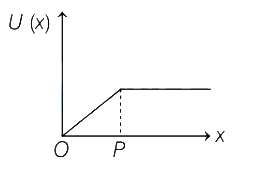
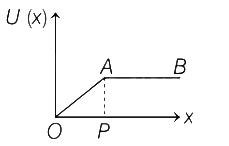
The graph of potential energy $U(x)$ versus distance $x$ is shown in the following figure. The force $F$ versus distance $x$ graph will be represented by (assume that the force is conservative):
A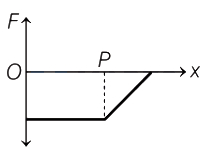
B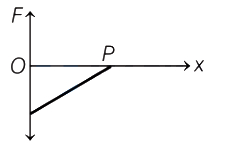
C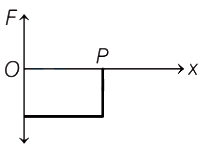
D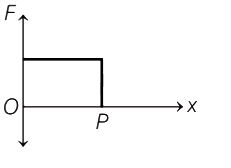
Solution
(A) The relationship between conservative force $F$ and potential energy $U(x)$ is given by $F = -\frac{dU}{dx}$.
This means the force is equal to the negative of the slope of the $U(x)$ versus $x$ graph.
For the region $OA$ (from $x=0$ to $x=P$),the graph is a straight line with a positive constant slope. Let the slope be $k > 0$. Thus,$F = -k$,which is a negative constant.
For the region $AB$ (for $x > P$),the graph is a horizontal straight line. The slope of this line is $0$. Thus,$F = -(0) = 0$.
Comparing this with the given options,the graph that shows a negative constant force for $x < P$ and zero force for $x > P$ is represented by option $A$.
This means the force is equal to the negative of the slope of the $U(x)$ versus $x$ graph.
For the region $OA$ (from $x=0$ to $x=P$),the graph is a straight line with a positive constant slope. Let the slope be $k > 0$. Thus,$F = -k$,which is a negative constant.
For the region $AB$ (for $x > P$),the graph is a horizontal straight line. The slope of this line is $0$. Thus,$F = -(0) = 0$.
Comparing this with the given options,the graph that shows a negative constant force for $x < P$ and zero force for $x > P$ is represented by option $A$.
0 likesView Solution
152
PhysicsDifficultMCQTS EAMCET · 2020
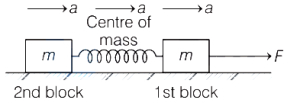
Two blocks of equal masses are connected with a massless spring of spring constant $k = 2500 \,N/m$ and natural length $10 \,cm$,resting on a frictionless horizontal plane. If a constant horizontal force $F = 10 \,N$ is applied as shown in the figure,find the maximum distance between the blocks. (in $cm$)

A
$10.8$
B
$10.4$
C
$10.6$
D
$10.0$
Solution
(B) Let the mass of each block be $m$. The system moves with a common acceleration $a = \frac{F}{2m}$.
In the frame of the centre of mass,the blocks are at rest at the moment of maximum extension. The pseudo force acting on each mass is $F_p = ma = \frac{F}{2}$.
Let $x_1$ and $x_2$ be the displacements of the two blocks from their initial positions in the centre of mass frame. The total extension of the spring is $x = x_1 + x_2$.
The work done by the external force and pseudo forces in the centre of mass frame is equal to the change in potential energy of the spring:
$W = \frac{1}{2} k x^2$
In the centre of mass frame,the work done by the effective forces is:
$(F - ma)x_1 + (ma)x_2 = \frac{1}{2} k (x_1 + x_2)^2$
Substituting $a = \frac{F}{2m}$:
$(F - \frac{F}{2})x_1 + (\frac{F}{2})x_2 = \frac{1}{2} k (x_1 + x_2)^2$
$\frac{F}{2}(x_1 + x_2) = \frac{1}{2} k (x_1 + x_2)^2$
$x_1 + x_2 = \frac{F}{k}$
Given $F = 10 \,N$ and $k = 2500 \,N/m$,the maximum extension is:
$x_{max} = \frac{10}{2500} \,m = 0.004 \,m = 0.4 \,cm$
The maximum distance between the blocks is the sum of the natural length and the maximum extension:
$d_{max} = 10 \,cm + 0.4 \,cm = 10.4 \,cm$.
In the frame of the centre of mass,the blocks are at rest at the moment of maximum extension. The pseudo force acting on each mass is $F_p = ma = \frac{F}{2}$.
Let $x_1$ and $x_2$ be the displacements of the two blocks from their initial positions in the centre of mass frame. The total extension of the spring is $x = x_1 + x_2$.
The work done by the external force and pseudo forces in the centre of mass frame is equal to the change in potential energy of the spring:
$W = \frac{1}{2} k x^2$
In the centre of mass frame,the work done by the effective forces is:
$(F - ma)x_1 + (ma)x_2 = \frac{1}{2} k (x_1 + x_2)^2$
Substituting $a = \frac{F}{2m}$:
$(F - \frac{F}{2})x_1 + (\frac{F}{2})x_2 = \frac{1}{2} k (x_1 + x_2)^2$
$\frac{F}{2}(x_1 + x_2) = \frac{1}{2} k (x_1 + x_2)^2$
$x_1 + x_2 = \frac{F}{k}$
Given $F = 10 \,N$ and $k = 2500 \,N/m$,the maximum extension is:
$x_{max} = \frac{10}{2500} \,m = 0.004 \,m = 0.4 \,cm$
The maximum distance between the blocks is the sum of the natural length and the maximum extension:
$d_{max} = 10 \,cm + 0.4 \,cm = 10.4 \,cm$.
0 likesView Solution
153
PhysicsEasyMCQTS EAMCET · 2020
Identify the incorrect statement.
A
All conserved quantities are not necessarily scalars.
B
The law of conservation of energy is valid only in macroscopic domain.
C
Weak nuclear force operates in the range of $\sim 10^{-16} \,m$.
D
Laws of nature do not change with time.
Solution
(B) The law of conservation of energy is valid in both macroscopic and microscopic domains. Therefore, the statement that it is valid only in the macroscopic domain is incorrect.
All conserved quantities are not necessarily scalars. For example, the conservation of linear momentum and angular momentum involve vector quantities, whereas the conservation of energy involves a scalar quantity.
All conserved quantities are not necessarily scalars. For example, the conservation of linear momentum and angular momentum involve vector quantities, whereas the conservation of energy involves a scalar quantity.
0 likesView Solution
154
PhysicsMediumMCQTS EAMCET · 2020
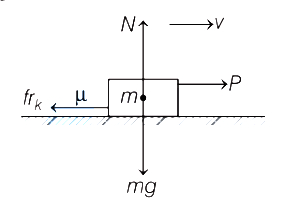
$A$ block of mass $m$ placed on a rough horizontal plane is pulled by a constant power $P$. The coefficient of friction between the block and the surface is $\mu$. The maximum velocity of the block will be
A
$\frac{\mu P}{m g}$
B
$\frac{\mu m g}{P}$
C
$\mu m g P$
D
$\frac{P}{\mu m g}$
Solution
(D) The block is moving on a rough horizontal surface. The forces acting on the block are the normal force $N$,gravitational force $mg$,the pulling force $F$,and the kinetic frictional force $fr_k$.
For vertical equilibrium,the normal force is $N = mg$.
The kinetic frictional force is given by $fr_k = \mu N = \mu mg$.
Power $P$ is defined as the product of the applied force $F$ and the velocity $v$ in the direction of motion: $P = F v$.
For the block to move at a constant velocity (which is its maximum velocity),the net force on the block must be zero.
Therefore,the pulling force $F$ must be equal to the kinetic frictional force $fr_k$:
$F = fr_k = \mu mg$.
Substituting this into the power equation:
$P = F v_{\max} = (\mu mg) v_{\max}$.
Solving for $v_{\max}$:
$v_{\max} = \frac{P}{\mu mg}$.
For vertical equilibrium,the normal force is $N = mg$.
The kinetic frictional force is given by $fr_k = \mu N = \mu mg$.
Power $P$ is defined as the product of the applied force $F$ and the velocity $v$ in the direction of motion: $P = F v$.
For the block to move at a constant velocity (which is its maximum velocity),the net force on the block must be zero.
Therefore,the pulling force $F$ must be equal to the kinetic frictional force $fr_k$:
$F = fr_k = \mu mg$.
Substituting this into the power equation:
$P = F v_{\max} = (\mu mg) v_{\max}$.
Solving for $v_{\max}$:
$v_{\max} = \frac{P}{\mu mg}$.
0 likesView Solution
155
PhysicsDifficultMCQTS EAMCET · 2020
$A$ force acts on a body of mass $10 \ kg$,resulting in its displacement given as $x = \left(\frac{t^3}{25}\right) \ m$,where $t$ is the time in seconds. The work done by the force in the first $2 \ s$ is (in $J$)
A
$0.12$
B
$0.24$
C
$0.48$
D
$1.152$
Solution
(D) Given,mass $m = 10 \ kg$ and displacement $x = \frac{t^3}{25} \ m$.
Velocity $v = \frac{dx}{dt} = \frac{3t^2}{25} \ m/s$.
Acceleration $a = \frac{dv}{dt} = \frac{6t}{25} \ m/s^2$.
Force $F = m \cdot a = 10 \cdot \left(\frac{6t}{25}\right) = \frac{12t}{5} \ N$.
Work done $dW = F \cdot dx = F \cdot \left(\frac{dx}{dt}\right) dt = \left(\frac{12t}{5}\right) \cdot \left(\frac{3t^2}{25}\right) dt = \frac{36t^3}{125} dt$.
Total work done in the first $2 \ s$ is $W = \int_{0}^{2} \frac{36t^3}{125} dt = \frac{36}{125} \left[\frac{t^4}{4}\right]_{0}^{2} = \frac{36}{125} \cdot \frac{16}{4} = \frac{36 \cdot 4}{125} = \frac{144}{125} = 1.152 \ J$.
Velocity $v = \frac{dx}{dt} = \frac{3t^2}{25} \ m/s$.
Acceleration $a = \frac{dv}{dt} = \frac{6t}{25} \ m/s^2$.
Force $F = m \cdot a = 10 \cdot \left(\frac{6t}{25}\right) = \frac{12t}{5} \ N$.
Work done $dW = F \cdot dx = F \cdot \left(\frac{dx}{dt}\right) dt = \left(\frac{12t}{5}\right) \cdot \left(\frac{3t^2}{25}\right) dt = \frac{36t^3}{125} dt$.
Total work done in the first $2 \ s$ is $W = \int_{0}^{2} \frac{36t^3}{125} dt = \frac{36}{125} \left[\frac{t^4}{4}\right]_{0}^{2} = \frac{36}{125} \cdot \frac{16}{4} = \frac{36 \cdot 4}{125} = \frac{144}{125} = 1.152 \ J$.
0 likesView Solution
156
PhysicsEasyMCQTS EAMCET · 2020
When a body is acted upon by a resultant force,then the work done by the resultant force is equal to
A
its initial kinetic energy
B
its initial potential energy
C
change in the kinetic energy
D
change in the potential energy
Solution
(C) According to the Work-Energy Theorem,the work done by the net (resultant) force acting on a body is equal to the change in its kinetic energy.
Mathematically,$W_{net} = \Delta KE = KE_f - KE_i$.
Therefore,the correct option is $C$.
Mathematically,$W_{net} = \Delta KE = KE_f - KE_i$.
Therefore,the correct option is $C$.
0 likesView Solution
157
PhysicsEasyMCQTS EAMCET · 2020
$A$ force $F = (2 \hat{i} + 4 \hat{j}) \text{ N}$ is applied on an object of mass $M$. What is the work done by this force in moving the object horizontally along the $X$-axis by $3 \text{ m}$ (in $\text{ J}$)?
A
$2$
B
$4$
C
$6$
D
$8$
Solution
(C) The displacement of the object is along the $X$-axis by $3 \text{ m}$, so the displacement vector is $\vec{d} = 3 \hat{i} \text{ m}$.
Given the force vector is $\vec{F} = (2 \hat{i} + 4 \hat{j}) \text{ N}$.
The work done $W$ by a constant force is given by the dot product of the force vector and the displacement vector:
$W = \vec{F} \cdot \vec{d}$
$W = (2 \hat{i} + 4 \hat{j}) \cdot (3 \hat{i})$
$W = (2 \times 3)(\hat{i} \cdot \hat{i}) + (4 \times 0)(\hat{j} \cdot \hat{i})$
Since $\hat{i} \cdot \hat{i} = 1$ and $\hat{j} \cdot \hat{i} = 0$, we get:
$W = 6 \times 1 + 0 = 6 \text{ J}$.
Given the force vector is $\vec{F} = (2 \hat{i} + 4 \hat{j}) \text{ N}$.
The work done $W$ by a constant force is given by the dot product of the force vector and the displacement vector:
$W = \vec{F} \cdot \vec{d}$
$W = (2 \hat{i} + 4 \hat{j}) \cdot (3 \hat{i})$
$W = (2 \times 3)(\hat{i} \cdot \hat{i}) + (4 \times 0)(\hat{j} \cdot \hat{i})$
Since $\hat{i} \cdot \hat{i} = 1$ and $\hat{j} \cdot \hat{i} = 0$, we get:
$W = 6 \times 1 + 0 = 6 \text{ J}$.
0 likesView Solution
158
PhysicsEasyMCQTS EAMCET · 2020
An elevator of mass $500 \,kg$ is ascending upwards with a constant acceleration $a=2 \,m/s^2$. What is the work done by the tension in the elevator cable during its climb by $12 \,m$ (in $\,kJ$)? (Take $g=10 \,m/s^2$)
A
$36$
B
$48$
C
$72$
D
$100$
Solution
(C) Mass of the elevator,$m = 500 \,kg$.
Acceleration of the elevator,$a = 2 \,m/s^2$ (upward).
When the elevator is moving upward,the tension $T$ in the cable is given by the equation of motion: $T - mg = ma$.
Therefore,$T = m(g + a) = 500(10 + 2) = 500(12) = 6000 \,N$.
The work done by the tension force $W$ is given by $W = T \times s$,where $s = 12 \,m$ is the displacement.
$W = 6000 \,N \times 12 \,m = 72000 \,J$.
Converting to kilojoules,$W = 72 \,kJ$.
Acceleration of the elevator,$a = 2 \,m/s^2$ (upward).
When the elevator is moving upward,the tension $T$ in the cable is given by the equation of motion: $T - mg = ma$.
Therefore,$T = m(g + a) = 500(10 + 2) = 500(12) = 6000 \,N$.
The work done by the tension force $W$ is given by $W = T \times s$,where $s = 12 \,m$ is the displacement.
$W = 6000 \,N \times 12 \,m = 72000 \,J$.
Converting to kilojoules,$W = 72 \,kJ$.
0 likesView Solution
159
PhysicsMediumMCQTS EAMCET · 2020
$A$ force of $4 \,N$ acts on a $10 \,kg$ body initially at rest. Let $W_1$ be the work done by the force during $0 \leq t \leq 1 \,s$. Likewise, $W_2$ is the work done by the force during $1 \,s \leq t \leq 2 \,s$, where $t$ is time in seconds. The ratio $\frac{W_2}{W_1}$ is
A
$1$
B
$2$
C
$\frac{1}{2}$
D
$3$
Solution
(D) Mass of the body, $m = 10 \,kg$. Force, $F = 4 \,N$. Acceleration produced in the body due to the applied force is $a = \frac{F}{m} = \frac{4}{10} = 0.4 \,m/s^2$.
For the interval $0 \leq t \leq 1 \,s$, the distance traveled $s_1$ is $s_1 = u t + \frac{1}{2} a t^2 = 0 + \frac{1}{2} \times 0.4 \times (1)^2 = 0.2 \,m$.
Work done $W_1 = F \times s_1 = 4 \times 0.2 = 0.8 \,J$.
For the interval $1 \,s \leq t \leq 2 \,s$, the initial velocity $v_i$ at $t = 1 \,s$ is $v_i = u + a t = 0 + 0.4 \times 1 = 0.4 \,m/s$.
The distance traveled $s_2$ during this interval $(t = 1 \,s)$ is $s_2 = v_i t + \frac{1}{2} a t^2 = 0.4 \times 1 + \frac{1}{2} \times 0.4 \times (1)^2 = 0.4 + 0.2 = 0.6 \,m$.
Work done $W_2 = F \times s_2 = 4 \times 0.6 = 2.4 \,J$.
The ratio $\frac{W_2}{W_1} = \frac{2.4}{0.8} = 3$.
For the interval $0 \leq t \leq 1 \,s$, the distance traveled $s_1$ is $s_1 = u t + \frac{1}{2} a t^2 = 0 + \frac{1}{2} \times 0.4 \times (1)^2 = 0.2 \,m$.
Work done $W_1 = F \times s_1 = 4 \times 0.2 = 0.8 \,J$.
For the interval $1 \,s \leq t \leq 2 \,s$, the initial velocity $v_i$ at $t = 1 \,s$ is $v_i = u + a t = 0 + 0.4 \times 1 = 0.4 \,m/s$.
The distance traveled $s_2$ during this interval $(t = 1 \,s)$ is $s_2 = v_i t + \frac{1}{2} a t^2 = 0.4 \times 1 + \frac{1}{2} \times 0.4 \times (1)^2 = 0.4 + 0.2 = 0.6 \,m$.
Work done $W_2 = F \times s_2 = 4 \times 0.6 = 2.4 \,J$.
The ratio $\frac{W_2}{W_1} = \frac{2.4}{0.8} = 3$.
0 likesView Solution
160
PhysicsEasyMCQTS EAMCET · 2020
Under the action of a force, a $2 \,kg$ body moves such that its position $x$ as a function of time $t$ is given by $x = \alpha t^2 / 2$, where $x$ is in meters, $t$ is in seconds, and $\alpha = 1 \,m/s^2$. The work done by the force in the first two seconds is: (in $\,J$)
A
$4$
B
$16$
C
$40$
D
$2$
Solution
(A) Given: $m = 2 \,kg$, $x = \frac{\alpha t^2}{2}$, and $\alpha = 1 \,m/s^2$.
First, we find the velocity $v$ by differentiating the position $x$ with respect to time $t$:
$v = \frac{dx}{dt} = \frac{d}{dt} \left( \frac{\alpha t^2}{2} \right) = \alpha t$.
At $t = 2 \,s$, the velocity $v$ is:
$v = 1 \times 2 = 2 \,m/s$.
According to the work-energy theorem, the work done $W$ is equal to the change in kinetic energy:
$W = \Delta K = \frac{1}{2} m v_f^2 - \frac{1}{2} m v_i^2$.
At $t = 0$, $v_i = \alpha(0) = 0$.
At $t = 2 \,s$, $v_f = 2 \,m/s$.
Therefore, $W = \frac{1}{2} \times 2 \,kg \times (2 \,m/s)^2 - 0 = 4 \,J$.
First, we find the velocity $v$ by differentiating the position $x$ with respect to time $t$:
$v = \frac{dx}{dt} = \frac{d}{dt} \left( \frac{\alpha t^2}{2} \right) = \alpha t$.
At $t = 2 \,s$, the velocity $v$ is:
$v = 1 \times 2 = 2 \,m/s$.
According to the work-energy theorem, the work done $W$ is equal to the change in kinetic energy:
$W = \Delta K = \frac{1}{2} m v_f^2 - \frac{1}{2} m v_i^2$.
At $t = 0$, $v_i = \alpha(0) = 0$.
At $t = 2 \,s$, $v_f = 2 \,m/s$.
Therefore, $W = \frac{1}{2} \times 2 \,kg \times (2 \,m/s)^2 - 0 = 4 \,J$.
0 likesView Solution
161
PhysicsEasyMCQTS EAMCET · 2020
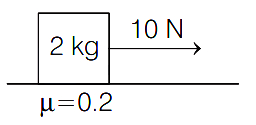
The block starts from rest as shown in the figure. Find the work done by the force of $10 \,N$ and friction in the time $0$ to $4 \,s$. [Take,$g=10 \,m/s^2$]
A
$240 \,J, -96 \,J$
B
$250 \,J, 96 \,J$
C
$240 \,J, 96 \,J$
D
$250 \,J, -96 \,J$
Solution
(A) Given,applied force,$F=10 \,N$.
Mass of the block,$m=2 \,kg$.
Coefficient of kinetic friction,$\mu=0.2$.
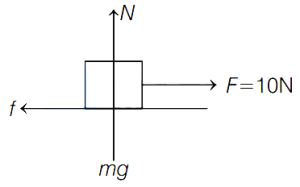
Normal force,$N=mg=2 \times 10=20 \,N$.
Friction force,$f=\mu N=0.2 \times 20=4 \,N$.
Net force,$F_{\text{net}}=F-f=10-4=6 \,N$.
Acceleration,$a=\frac{F_{\text{net}}}{m}=\frac{6}{2}=3 \,m/s^2$.
Distance covered in $t=4 \,s$ starting from rest $(u=0)$:
$s=ut+\frac{1}{2}at^2=0+\frac{1}{2} \times 3 \times (4)^2=24 \,m$.
Work done by the applied force of $10 \,N$ $(W_1)$:
$W_1=F \times s=10 \times 24=240 \,J$.
Work done by the friction force of $4 \,N$ $(W_2)$:
$W_2=f \times s \times \cos(180^{\circ})=-4 \times 24=-96 \,J$.
Mass of the block,$m=2 \,kg$.
Coefficient of kinetic friction,$\mu=0.2$.
Normal force,$N=mg=2 \times 10=20 \,N$.
Friction force,$f=\mu N=0.2 \times 20=4 \,N$.
Net force,$F_{\text{net}}=F-f=10-4=6 \,N$.
Acceleration,$a=\frac{F_{\text{net}}}{m}=\frac{6}{2}=3 \,m/s^2$.
Distance covered in $t=4 \,s$ starting from rest $(u=0)$:
$s=ut+\frac{1}{2}at^2=0+\frac{1}{2} \times 3 \times (4)^2=24 \,m$.
Work done by the applied force of $10 \,N$ $(W_1)$:
$W_1=F \times s=10 \times 24=240 \,J$.
Work done by the friction force of $4 \,N$ $(W_2)$:
$W_2=f \times s \times \cos(180^{\circ})=-4 \times 24=-96 \,J$.
0 likesView Solution
162
PhysicsEasyMCQTS EAMCET · 2020
$A$ force acts on a $30 \,g$ particle in such a way that the position of the particle as a function of time is given by $x = \alpha t^2$,where $x$ is in metre,$t$ is in seconds and $\alpha = 1 \,m/s^2$. The work done during the first $4 \,s$ is (in $J$)
A
$0.96$
B
$0.45$
C
$0.49$
D
$0.53$
Solution
(A) Given,mass of particle,$m = 30 \,g = 3 \times 10^{-2} \,kg$.
The position of the particle is $x = \alpha t^2$.
Velocity $v = \frac{dx}{dt} = 2\alpha t$.
Acceleration $a = \frac{dv}{dt} = 2\alpha$.
Force $F = ma = (3 \times 10^{-2} \,kg) \times (2 \times 1 \,m/s^2) = 6 \times 10^{-2} \,N$.
Work done $W = \int F dx$. Since $x = \alpha t^2$,$dx = 2\alpha t dt$.
At $t = 0, x = 0$. At $t = 4, x = 1 \times (4)^2 = 16 \,m$.
$W = \int_{0}^{16} (6 \times 10^{-2}) dx = 6 \times 10^{-2} \times [x]_{0}^{16} = 6 \times 10^{-2} \times 16 = 0.96 \,J$.
The position of the particle is $x = \alpha t^2$.
Velocity $v = \frac{dx}{dt} = 2\alpha t$.
Acceleration $a = \frac{dv}{dt} = 2\alpha$.
Force $F = ma = (3 \times 10^{-2} \,kg) \times (2 \times 1 \,m/s^2) = 6 \times 10^{-2} \,N$.
Work done $W = \int F dx$. Since $x = \alpha t^2$,$dx = 2\alpha t dt$.
At $t = 0, x = 0$. At $t = 4, x = 1 \times (4)^2 = 16 \,m$.
$W = \int_{0}^{16} (6 \times 10^{-2}) dx = 6 \times 10^{-2} \times [x]_{0}^{16} = 6 \times 10^{-2} \times 16 = 0.96 \,J$.
0 likesView Solution
163
PhysicsEasyMCQTS EAMCET · 2020
Which of the following phenomena produces the colour in a soap bubble?
A
Diffraction
B
Interference
C
Polarisation
D
Refraction
Solution
(B) The colours observed in a soap bubble are produced due to the phenomenon of interference.
When light falls on the thin film of the soap bubble,it reflects from both the outer and inner surfaces.
These reflected waves undergo superposition,leading to constructive or destructive interference depending on the thickness of the film and the wavelength of the light.
This interference pattern results in the appearance of various colours.
When light falls on the thin film of the soap bubble,it reflects from both the outer and inner surfaces.
These reflected waves undergo superposition,leading to constructive or destructive interference depending on the thickness of the film and the wavelength of the light.
This interference pattern results in the appearance of various colours.
0 likesView Solution
164
PhysicsEasyMCQTS EAMCET · 2020
What is the shape of the wavefront of light diverging from a point source?
A
spherical
B
planar
C
cylindrical
D
circular
Solution
(A) point source emits light waves in all possible directions in a three-dimensional space. Since the speed of light is constant in a homogeneous medium,the locus of all points vibrating in the same phase at a given time forms a sphere centered at the source. Therefore,the wavefront originating from a point source is spherical.
0 likesView Solution
165
PhysicsMediumMCQTS EAMCET · 2020
Choose the incorrect statement.
A
The fringe width in a Young's double slit experiment reduces when the width between the two slits increases.
B
The central fringe observed in a single slit diffraction experiment is a bright fringe.
C
The resolving power of the microscope is reciprocal to the maximum separation of two points seen as distinct.
D
Polarisation phenomenon is observed only for transverse waves.
Solution
(C) In Young's double slit experiment,the fringe width is given by $\beta = \frac{\lambda D}{d} \Rightarrow \beta \propto \frac{1}{d}$. So,if the distance between the two slits $(d)$ increases,the fringe width reduces. This statement is correct.
$(b)$ In diffraction due to a single slit,the path difference between rays reaching the center of the screen is zero,so its intensity at the center is maximum,i.e.,a bright fringe is observed at the center. This statement is correct.
$(c)$ The resolving power of a microscope is defined as $\frac{1}{d_{\min }} = \frac{2 n \sin \theta}{1.22 \lambda}$. It is the reciprocal of the minimum separation $(d_{\min })$ of two points seen as distinct,not the maximum separation. Thus,this statement is incorrect.
$(d)$ Polarisation is possible only in those waves that have vibrations in different directions,which is the case for transverse waves. This statement is correct.
Therefore,the incorrect statement is $(c)$.
$(b)$ In diffraction due to a single slit,the path difference between rays reaching the center of the screen is zero,so its intensity at the center is maximum,i.e.,a bright fringe is observed at the center. This statement is correct.
$(c)$ The resolving power of a microscope is defined as $\frac{1}{d_{\min }} = \frac{2 n \sin \theta}{1.22 \lambda}$. It is the reciprocal of the minimum separation $(d_{\min })$ of two points seen as distinct,not the maximum separation. Thus,this statement is incorrect.
$(d)$ Polarisation is possible only in those waves that have vibrations in different directions,which is the case for transverse waves. This statement is correct.
Therefore,the incorrect statement is $(c)$.
0 likesView Solution
166
PhysicsEasyMCQTS EAMCET · 2020
Young's double slit experiment is carried out by using green,red,and blue light,one color at a time. The fringe widths recorded are $\beta_G$,$\beta_R$,and $\beta_B$ respectively. Which of the following relations is correct?
A
$\beta_G > \beta_B > \beta_R$
B
$\beta_B > \beta_G > \beta_R$
C
$\beta_R > \beta_B > \beta_G$
D
$\beta_R > \beta_G > \beta_B$
Solution
(D) In Young's double slit experiment $(YDSE)$,the fringe width $\beta$ is given by the formula: $\beta = \frac{\lambda D}{d}$.
Here,$\lambda$ is the wavelength of light,$D$ is the distance between the screen and the slits,and $d$ is the distance between the two slits.
Since $D$ and $d$ are constant,the fringe width is directly proportional to the wavelength: $\beta \propto \lambda$.
The wavelengths of the given colors follow the order: $\lambda_R > \lambda_G > \lambda_B$.
Therefore,the fringe widths will follow the same order: $\beta_R > \beta_G > \beta_B$.
Here,$\lambda$ is the wavelength of light,$D$ is the distance between the screen and the slits,and $d$ is the distance between the two slits.
Since $D$ and $d$ are constant,the fringe width is directly proportional to the wavelength: $\beta \propto \lambda$.
The wavelengths of the given colors follow the order: $\lambda_R > \lambda_G > \lambda_B$.
Therefore,the fringe widths will follow the same order: $\beta_R > \beta_G > \beta_B$.
0 likesView Solution
167
PhysicsMediumMCQTS EAMCET · 2020
On using red light $(\lambda = 6600 \ \text{Å})$ in Young's double slit experiment,$60$ fringes are observed in the field of view. If violet light $(\lambda = 4400 \ \text{Å})$ is used,the number of fringes observed will be
A
$30$
B
$120$
C
$60$
D
$90$
Solution
(D) Given: $\lambda_1 = 6600 \ \text{Å}$,$\lambda_2 = 4400 \ \text{Å}$,$n_1 = 60$.
In Young's double slit experiment,the angular width of the field of view is constant.
The number of fringes $n$ is inversely proportional to the fringe width $\beta$,where $\beta = \frac{\lambda D}{d}$.
Thus,$n \propto \frac{1}{\lambda}$,which implies $n_1 \lambda_1 = n_2 \lambda_2$.
Substituting the given values:
$60 \times 6600 = n_2 \times 4400$
$n_2 = \frac{60 \times 6600}{4400}$
$n_2 = 60 \times \frac{66}{44} = 60 \times 1.5 = 90$.
Therefore,$90$ fringes will be observed.
In Young's double slit experiment,the angular width of the field of view is constant.
The number of fringes $n$ is inversely proportional to the fringe width $\beta$,where $\beta = \frac{\lambda D}{d}$.
Thus,$n \propto \frac{1}{\lambda}$,which implies $n_1 \lambda_1 = n_2 \lambda_2$.
Substituting the given values:
$60 \times 6600 = n_2 \times 4400$
$n_2 = \frac{60 \times 6600}{4400}$
$n_2 = 60 \times \frac{66}{44} = 60 \times 1.5 = 90$.
Therefore,$90$ fringes will be observed.
0 likesView Solution
168
PhysicsEasyMCQTS EAMCET · 2020
If in a Young's double slit experiment the slit separation is doubled and the distance of the screen from the slits is reduced to half,then the fringe widths become how many times their original value?
A
$\frac{1}{2}$
B
$2$
C
$\frac{1}{4}$
D
$4$
Solution
(C) The fringe width $\beta$ in Young's double slit experiment is given by the formula:
$\beta = \frac{D \lambda}{d}$
where $D$ is the distance between the slits and the screen,$\lambda$ is the wavelength of light,and $d$ is the slit separation.
Given that the new slit separation $d_2 = 2d_1$ and the new distance $D_2 = \frac{D_1}{2}$.
The new fringe width $\beta_2$ is:
$\beta_2 = \frac{D_2 \lambda}{d_2} = \frac{(D_1 / 2) \lambda}{2 d_1} = \frac{1}{4} \left( \frac{D_1 \lambda}{d_1} \right)$
$\beta_2 = \frac{1}{4} \beta_1$
Therefore,the fringe width becomes $\frac{1}{4}$ times its original value.
$\beta = \frac{D \lambda}{d}$
where $D$ is the distance between the slits and the screen,$\lambda$ is the wavelength of light,and $d$ is the slit separation.
Given that the new slit separation $d_2 = 2d_1$ and the new distance $D_2 = \frac{D_1}{2}$.
The new fringe width $\beta_2$ is:
$\beta_2 = \frac{D_2 \lambda}{d_2} = \frac{(D_1 / 2) \lambda}{2 d_1} = \frac{1}{4} \left( \frac{D_1 \lambda}{d_1} \right)$
$\beta_2 = \frac{1}{4} \beta_1$
Therefore,the fringe width becomes $\frac{1}{4}$ times its original value.
0 likesView Solution
169
PhysicsEasyMCQTS EAMCET · 2020
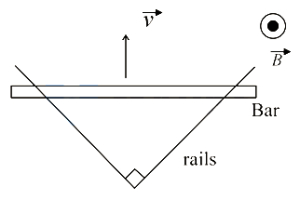
Two straight conducting rails form a right angle as shown below. $A$ conducting bar in contact with the rails starts at the vertex at time $t=0$ and moves with a constant velocity of $v=5 \ m \ s^{-1}$ along them. $A$ magnetic field with $B=0.1 \ T$ is directed out of the page. The absolute value of the emf induced in the circuit at time $t=4 \ s$ will be (in $V$)?
A
$10$
B
$15$
C
$20$
D
$30$
Solution
(C) Given: Velocity of the conducting bar $v=5 \ m \ s^{-1}$,Magnetic field $B=0.1 \ T$.
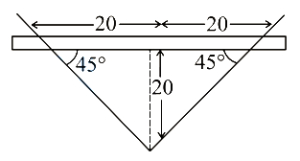
At time $t=4 \ s$,the distance of the bar from the vertex is $x = v \times t = 5 \times 4 = 20 \ m$.
Since the rails form a right angle $(90^{\circ})$,the triangle formed by the rails and the bar is an isosceles right-angled triangle.
The length of the bar $l$ in contact with the rails is $l = 2 \times x \tan(45^{\circ}) = 2 \times 20 \times 1 = 40 \ m$.
The induced emf is given by $e = B \times v \times l$.
Substituting the values: $e = 0.1 \times 5 \times 40 = 20 \ V$.
At time $t=4 \ s$,the distance of the bar from the vertex is $x = v \times t = 5 \times 4 = 20 \ m$.
Since the rails form a right angle $(90^{\circ})$,the triangle formed by the rails and the bar is an isosceles right-angled triangle.
The length of the bar $l$ in contact with the rails is $l = 2 \times x \tan(45^{\circ}) = 2 \times 20 \times 1 = 40 \ m$.
The induced emf is given by $e = B \times v \times l$.
Substituting the values: $e = 0.1 \times 5 \times 40 = 20 \ V$.
0 likesView Solution
170
PhysicsDifficultMCQTS EAMCET · 2020
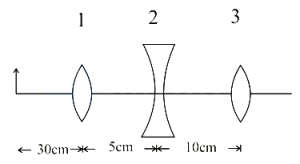
The position of the final image formed by the given lens combination from the third lens will be at a distance of $(f_1 = +10 \ cm, f_2 = -10 \ cm, f_3 = +30 \ cm)$.
A
$15 \ cm$
B
Infinity
C
$45 \ cm$
D
$30 \ cm$
Solution
(D) For the first lens:
$f_1 = +10 \ cm, u_1 = -30 \ cm$.
Applying the lens formula $\frac{1}{f} = \frac{1}{v} - \frac{1}{u}$:
$\frac{1}{v_1} = \frac{1}{f_1} + \frac{1}{u_1} = \frac{1}{10} - \frac{1}{30} = \frac{3-1}{30} = \frac{2}{30} = \frac{1}{15}$.
So,$v_1 = +15 \ cm$.
This image acts as an object for the second lens. The distance between the first and second lens is $5 \ cm$,so the object distance for the second lens is $u_2 = +(15 - 5) = +10 \ cm$.
For the second lens $(f_2 = -10 \ cm)$:
$\frac{1}{v_2} = \frac{1}{f_2} + \frac{1}{u_2} = \frac{1}{-10} + \frac{1}{10} = 0$.
So,$v_2 = \infty$.
The rays emerging from the second lens are parallel to the principal axis.
These parallel rays fall on the third lens $(f_3 = +30 \ cm)$. Parallel rays incident on a convex lens converge at its focus.
Therefore,the final image is formed at a distance of $30 \ cm$ from the third lens.
$f_1 = +10 \ cm, u_1 = -30 \ cm$.
Applying the lens formula $\frac{1}{f} = \frac{1}{v} - \frac{1}{u}$:
$\frac{1}{v_1} = \frac{1}{f_1} + \frac{1}{u_1} = \frac{1}{10} - \frac{1}{30} = \frac{3-1}{30} = \frac{2}{30} = \frac{1}{15}$.
So,$v_1 = +15 \ cm$.
This image acts as an object for the second lens. The distance between the first and second lens is $5 \ cm$,so the object distance for the second lens is $u_2 = +(15 - 5) = +10 \ cm$.
For the second lens $(f_2 = -10 \ cm)$:
$\frac{1}{v_2} = \frac{1}{f_2} + \frac{1}{u_2} = \frac{1}{-10} + \frac{1}{10} = 0$.
So,$v_2 = \infty$.
The rays emerging from the second lens are parallel to the principal axis.
These parallel rays fall on the third lens $(f_3 = +30 \ cm)$. Parallel rays incident on a convex lens converge at its focus.
Therefore,the final image is formed at a distance of $30 \ cm$ from the third lens.
0 likesView Solution
Vedclass Products
For Students
Vedclass Test Series
Mock tests in real TS EAMCET style covering Physics with performance analysis. 5-day free trial.
Start Free TrialFor Teachers
Exam Paper Generator
Generate Set A/B/C/D Physics papers from 7.5L+ questions in 2 minutes. 3 chapters free.
Try FreeFor Institutes
Online Exam Module
Run live TS EAMCET mock exams with unlimited students, 360° analytics & white-label branding.
See DemoFrequently Asked Questions
How many Physics questions are in TS EAMCET 2020?
There are 320 Physics questions from the TS EAMCET 2020 paper on Vedclass, each with a detailed step-by-step solution in English.
Are TS EAMCET 2020 Physics solutions available in English?
Yes. All solutions on this page are in English. You can also switch to English or Hindi using the language buttons above the questions.
Can I practice TS EAMCET 2020 Physics as a timed test?
Yes. Use the Vedclass Test Series to attempt a full TS EAMCET mock test covering Physics with time limits and instant score analysis.
Can teachers create Physics papers from TS EAMCET previous year questions?
Yes. The Vedclass Exam Paper Generator lets teachers mix TS EAMCET Physics questions and generate Set A/B/C/D papers in minutes.
For Teachers & Institutes
Build a Custom Physics Paper
Pick TS EAMCET 2020 Physics questions, set difficulty, and generate Set A/B/C/D in 2 minutes.