
PhysicsQ101–108 of 201 questions
Page 3 of 3 · English
101
PhysicsEasyMCQTS EAMCET · 2019
$A$ ball of mass $2 \,kg$ is thrown from a tall building with velocity $v = (20 \,m/s) \hat{i} + (24 \,m/s) \hat{j}$ at time $t = 0 \,s$. The change in the potential energy of the ball after $t = 8 \,s$ is (The ball is assumed to be in air during its motion between $0 \,s$ and $8 \,s$, $\hat{i}$ is along the horizontal and $\hat{j}$ is along the vertical direction. Take $g = 10 \,m/s^2$). (in $\,kJ$)
A
$-2.56$
B
$0.52$
C
$1.76$
D
$-2.44$
Solution
(A) Given: mass $m = 2 \,kg$, initial velocity $\vec{u} = (20 \hat{i} + 24 \hat{j}) \,m/s$.
The vertical component of velocity at time $t$ is given by $v_y = u_y - gt$.
At $t = 8 \,s$, $v_y = 24 - (10 \times 8) = 24 - 80 = -56 \,m/s$.
The horizontal component remains constant: $v_x = 20 \,m/s$.
So, final velocity $\vec{v} = (20 \hat{i} - 56 \hat{j}) \,m/s$.
By the Work-Energy Theorem, the change in potential energy $\Delta PE$ is equal to the negative of the change in kinetic energy $\Delta KE$.
$\Delta PE = -\Delta KE = -(KE_f - KE_i) = KE_i - KE_f$.
$\Delta PE = \frac{1}{2} m (u^2 - v^2) = \frac{1}{2} \times 2 \times [(20^2 + 24^2) - (20^2 + (-56)^2)]$.
$\Delta PE = (400 + 576) - (400 + 3136) = 976 - 3536 = -2560 \,J$.
Converting to kilojoules, $\Delta PE = -2.56 \,kJ$.
The vertical component of velocity at time $t$ is given by $v_y = u_y - gt$.
At $t = 8 \,s$, $v_y = 24 - (10 \times 8) = 24 - 80 = -56 \,m/s$.
The horizontal component remains constant: $v_x = 20 \,m/s$.
So, final velocity $\vec{v} = (20 \hat{i} - 56 \hat{j}) \,m/s$.
By the Work-Energy Theorem, the change in potential energy $\Delta PE$ is equal to the negative of the change in kinetic energy $\Delta KE$.
$\Delta PE = -\Delta KE = -(KE_f - KE_i) = KE_i - KE_f$.
$\Delta PE = \frac{1}{2} m (u^2 - v^2) = \frac{1}{2} \times 2 \times [(20^2 + 24^2) - (20^2 + (-56)^2)]$.
$\Delta PE = (400 + 576) - (400 + 3136) = 976 - 3536 = -2560 \,J$.
Converting to kilojoules, $\Delta PE = -2.56 \,kJ$.
0 likesView Solution
102
PhysicsMediumMCQTS EAMCET · 2019
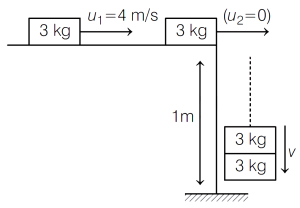
$A$ box of mass $3 \,kg$ moves on a horizontal frictionless table and collides with another box of mass $3 \,kg$ initially at rest on the edge of the table at height $1 \,m$. The speed of the moving box just before the collision is $4 \,m/s$. The two boxes stick together and fall from the table. The kinetic energy just before the boxes strike the floor is (Assume, acceleration due to gravity, $g=10 \,m/s^2$) (in $\,J$)
A
$40$
B
$80$
C
$96$
D
$72$
Solution
(D) According to the law of conservation of momentum, the total momentum before the collision is equal to the total momentum after the collision.
$m_1 u_1 + m_2 u_2 = (m_1 + m_2) v$
Given, mass of boxes $m_1 = m_2 = 3 \,kg$, speed of the moving box $u_1 = 4 \,m/s$, and initial speed of the second box $u_2 = 0$.
Substituting the values:
$3 \times 4 + 3 \times 0 = (3 + 3) v$
$12 = 6v \Rightarrow v = 2 \,m/s$
Thus, the two bodies move together with a velocity of $2 \,m/s$ just after the collision.
Now, applying the law of conservation of energy from the edge of the table to the floor:
$Total Energy_{initial} = Total Energy_{final}$
$KE_{initial} + PE_{initial} = KE_{final} + PE_{final}$
Taking the floor as the reference level $(h=0)$:
$\frac{1}{2} (m_1 + m_2) v^2 + (m_1 + m_2) g h = KE_{final} + 0$
$\frac{1}{2} \times (3 + 3) \times (2)^2 + (3 + 3) \times 10 \times 1 = KE_{final}$
$\frac{1}{2} \times 6 \times 4 + 6 \times 10 = KE_{final}$
$12 + 60 = 72 \,J$
Hence, the kinetic energy just before the boxes strike the floor is $72 \,J$.
$m_1 u_1 + m_2 u_2 = (m_1 + m_2) v$
Given, mass of boxes $m_1 = m_2 = 3 \,kg$, speed of the moving box $u_1 = 4 \,m/s$, and initial speed of the second box $u_2 = 0$.
Substituting the values:
$3 \times 4 + 3 \times 0 = (3 + 3) v$
$12 = 6v \Rightarrow v = 2 \,m/s$
Thus, the two bodies move together with a velocity of $2 \,m/s$ just after the collision.
Now, applying the law of conservation of energy from the edge of the table to the floor:
$Total Energy_{initial} = Total Energy_{final}$
$KE_{initial} + PE_{initial} = KE_{final} + PE_{final}$
Taking the floor as the reference level $(h=0)$:
$\frac{1}{2} (m_1 + m_2) v^2 + (m_1 + m_2) g h = KE_{final} + 0$
$\frac{1}{2} \times (3 + 3) \times (2)^2 + (3 + 3) \times 10 \times 1 = KE_{final}$
$\frac{1}{2} \times 6 \times 4 + 6 \times 10 = KE_{final}$
$12 + 60 = 72 \,J$
Hence, the kinetic energy just before the boxes strike the floor is $72 \,J$.
0 likesView Solution
103
PhysicsMediumMCQTS EAMCET · 2019
$A$ bullet of mass $1 \ kg$ fired with a speed $2 \ m \ s^{-1}$ from $x = 0$ passes through a block of wood whose centre is kept at a distance of $10 \ m$ from the origin as shown in figure. The retarding force $F_r$ on the bullet within the wooden block is $-0.5/x$. The minimum length of the block (up to $1$ decimal digit) required to completely stop the bullet is (Assume $e^4 = 55$). (in $m$)
A
$10.1$
B
$9.2$
C
$9.7$
D
$19.3$
Solution
(D) Given:
Mass of bullet $m = 1 \ kg$
Initial velocity $u = 2 \ m \ s^{-1}$
Retarding force $F = -0.5/x$
According to the work-energy theorem,the work done by the force equals the change in kinetic energy:
$W = \Delta KE = K_f - K_i$
Since the bullet stops,$K_f = 0$,so $W = -K_i = -\frac{1}{2} m u^2$
$W = -\frac{1}{2} \times 1 \times (2)^2 = -2 \ J$
Also,$W = \int_{x_1}^{x_2} F \ dx = \int_{10-L/2}^{10+L/2} -\frac{0.5}{x} \ dx$
$-0.5 [\ln(x)]_{10-L/2}^{10+L/2} = -2$
$\ln \left( \frac{10+L/2}{10-L/2} \right) = \frac{-2}{-0.5} = 4$
$\frac{10+L/2}{10-L/2} = e^4 = 55$
$10 + L/2 = 55(10 - L/2)$
$10 + L/2 = 550 - 27.5L$
$28L = 540$
$L = 540 / 28 \approx 19.28 \ m$
Rounding to $1$ decimal digit,$L = 19.3 \ m$.
Mass of bullet $m = 1 \ kg$
Initial velocity $u = 2 \ m \ s^{-1}$
Retarding force $F = -0.5/x$
According to the work-energy theorem,the work done by the force equals the change in kinetic energy:
$W = \Delta KE = K_f - K_i$
Since the bullet stops,$K_f = 0$,so $W = -K_i = -\frac{1}{2} m u^2$
$W = -\frac{1}{2} \times 1 \times (2)^2 = -2 \ J$
Also,$W = \int_{x_1}^{x_2} F \ dx = \int_{10-L/2}^{10+L/2} -\frac{0.5}{x} \ dx$
$-0.5 [\ln(x)]_{10-L/2}^{10+L/2} = -2$
$\ln \left( \frac{10+L/2}{10-L/2} \right) = \frac{-2}{-0.5} = 4$
$\frac{10+L/2}{10-L/2} = e^4 = 55$
$10 + L/2 = 55(10 - L/2)$
$10 + L/2 = 550 - 27.5L$
$28L = 540$
$L = 540 / 28 \approx 19.28 \ m$
Rounding to $1$ decimal digit,$L = 19.3 \ m$.
0 likesView Solution
104
PhysicsDifficultMCQTS EAMCET · 2019
$A$ mass of $2 \ kg$,initially at a height of $1.2 \ m$ above an uncompressed spring with spring constant $2 \times 10^4 \ N/m$,is released from rest to fall on the spring. Taking the acceleration due to gravity as $10 \ m/s^2$ and neglecting air resistance,the compression of the spring in $mm$ is:
A
$20$
B
$40$
C
$50$
D
$60$
Solution
(C) Let the compression of the spring be $x$ (in meters).
According to the law of conservation of mechanical energy,the total potential energy lost by the mass equals the potential energy gained by the spring.
The total height fallen by the mass is $(h + x)$,where $h = 1.2 \ m$.
So,$mg(h + x) = \frac{1}{2} kx^2$.
Substituting the given values: $2 \times 10 \times (1.2 + x) = \frac{1}{2} \times (2 \times 10^4) \times x^2$.
$20(1.2 + x) = 10^4 x^2$.
$24 + 20x = 10000x^2$.
$10000x^2 - 20x - 24 = 0$.
Dividing by $4$: $2500x^2 - 5x - 6 = 0$.
Using the quadratic formula $x = \frac{-b \pm \sqrt{b^2 - 4ac}}{2a}$:
$x = \frac{5 \pm \sqrt{(-5)^2 - 4(2500)(-6)}}{2(2500)} = \frac{5 \pm \sqrt{25 + 60000}}{5000} = \frac{5 \pm \sqrt{60025}}{5000} = \frac{5 \pm 245}{5000}$.
Since $x > 0$,$x = \frac{250}{5000} = 0.05 \ m$.
Converting to $mm$: $0.05 \ m = 50 \ mm$.
According to the law of conservation of mechanical energy,the total potential energy lost by the mass equals the potential energy gained by the spring.
The total height fallen by the mass is $(h + x)$,where $h = 1.2 \ m$.
So,$mg(h + x) = \frac{1}{2} kx^2$.
Substituting the given values: $2 \times 10 \times (1.2 + x) = \frac{1}{2} \times (2 \times 10^4) \times x^2$.
$20(1.2 + x) = 10^4 x^2$.
$24 + 20x = 10000x^2$.
$10000x^2 - 20x - 24 = 0$.
Dividing by $4$: $2500x^2 - 5x - 6 = 0$.
Using the quadratic formula $x = \frac{-b \pm \sqrt{b^2 - 4ac}}{2a}$:
$x = \frac{5 \pm \sqrt{(-5)^2 - 4(2500)(-6)}}{2(2500)} = \frac{5 \pm \sqrt{25 + 60000}}{5000} = \frac{5 \pm \sqrt{60025}}{5000} = \frac{5 \pm 245}{5000}$.
Since $x > 0$,$x = \frac{250}{5000} = 0.05 \ m$.
Converting to $mm$: $0.05 \ m = 50 \ mm$.
0 likesView Solution
105
PhysicsMediumMCQTS EAMCET · 2019
$A$ particle of mass $m$ is moving along a circle of radius $R$ such that its tangential acceleration $a_t$ varies with distance covered $x$ as $a_t = \alpha x^2$,where $\alpha$ is a constant. The kinetic energy $K$ of the particle varies with the distance as $K = \beta x^c$,where $\beta$ and $c$ are constants. The values of $\beta$ and $c$ are:
A
$\beta = \frac{m\alpha}{3}, c = 3$
B
$\beta = \frac{m\alpha}{4}, c = 4$
C
$\beta = \frac{m\alpha}{2}, c = 4$
D
$\beta = \frac{m\alpha}{2}, c = 3$
Solution
(A) Given,tangential acceleration $a_t = \alpha x^2$.
Tangential force $F = m a_t = m \alpha x^2$.
According to the work-energy theorem,the work done by the tangential force is equal to the change in kinetic energy: $W = \Delta K$.
Assuming the particle starts from rest at $x = 0$,$K = \int_0^x F dx$.
$K = \int_0^x (m \alpha x^2) dx$.
$K = m \alpha \left[ \frac{x^3}{3} \right]_0^x = \frac{m \alpha}{3} x^3$.
Comparing this with the given expression $K = \beta x^c$,we get $\beta = \frac{m \alpha}{3}$ and $c = 3$.
Tangential force $F = m a_t = m \alpha x^2$.
According to the work-energy theorem,the work done by the tangential force is equal to the change in kinetic energy: $W = \Delta K$.
Assuming the particle starts from rest at $x = 0$,$K = \int_0^x F dx$.
$K = \int_0^x (m \alpha x^2) dx$.
$K = m \alpha \left[ \frac{x^3}{3} \right]_0^x = \frac{m \alpha}{3} x^3$.
Comparing this with the given expression $K = \beta x^c$,we get $\beta = \frac{m \alpha}{3}$ and $c = 3$.
0 likesView Solution
106
PhysicsDifficultMCQTS EAMCET · 2019
$A$ ball is projected vertically up from the ground. Boy $A$,standing at the window of the first floor of a nearby building,observes that the time interval between the ball crossing him while going up and the ball crossing him while going down is $2 \ s$. Another boy $B$,standing on the second floor,notices the time interval between the ball passing him twice,during up and down motion,is $1 \ s$. Calculate the difference between the vertical positions of boy $B$ and boy $A$. (Assume $g = 10 \ m \ s^{-2}$) (in $m$)
A
$8.45$
B
$3.75$
C
$4.25$
D
$2.50$
Solution
(B) Let $t_A = 2 \ s$ be the time interval for boy $A$ and $t_B = 1 \ s$ be the time interval for boy $B$.
For a ball projected vertically,the time taken to reach the maximum height from a point at height $h$ is $t/2$.
Using $v = u + at$,at the highest point $v = 0$,so $u = g(t/2)$.
The height $h$ of the point from the ground is given by $h = u(t/2) - 1/2 g(t/2)^2 = g(t/2)^2 - 1/2 g(t/2)^2 = 1/2 g(t/2)^2 = 1/8 g t^2$.
For boy $A$: $h_A = 1/8 \times 10 \times (2)^2 = 5 \ m$.
For boy $B$: $h_B = 1/8 \times 10 \times (1)^2 = 1.25 \ m$.
The difference in vertical positions is $h_A - h_B = 5 \ m - 1.25 \ m = 3.75 \ m$.
For a ball projected vertically,the time taken to reach the maximum height from a point at height $h$ is $t/2$.
Using $v = u + at$,at the highest point $v = 0$,so $u = g(t/2)$.
The height $h$ of the point from the ground is given by $h = u(t/2) - 1/2 g(t/2)^2 = g(t/2)^2 - 1/2 g(t/2)^2 = 1/2 g(t/2)^2 = 1/8 g t^2$.
For boy $A$: $h_A = 1/8 \times 10 \times (2)^2 = 5 \ m$.
For boy $B$: $h_B = 1/8 \times 10 \times (1)^2 = 1.25 \ m$.
The difference in vertical positions is $h_A - h_B = 5 \ m - 1.25 \ m = 3.75 \ m$.
0 likesView Solution
107
PhysicsEasyMCQTS EAMCET · 2019
Conservative forces are defined as the force for which,
A
work done depends only on the initial and final positions.
B
work done depends on the initial and final positions and also on the path taken.
C
work done depends only on the path taken.
D
work done depends only on the initial position.
Solution
(A) conservative force is defined as a force where the total work done in moving a particle between two points is independent of the path taken.
It depends solely on the initial and final positions of the particle.
Mathematically,the work done by a conservative force around any closed path is zero.
Therefore,the correct option is $A$.
It depends solely on the initial and final positions of the particle.
Mathematically,the work done by a conservative force around any closed path is zero.
Therefore,the correct option is $A$.
0 likesView Solution
108
PhysicsEasyMCQTS EAMCET · 2019
$A$ metal chain of mass $2 \,kg$ and length $90 \,cm$ hangs over a table with $60 \,cm$ on the table. How much work needs to be done to pull the hanging part of the chain back onto the table (in $\,J$)? (Let $g=10 \,m/s^2$)
A
$2$
B
$10$
C
$1$
D
$3$
Solution
(C) Given: Mass of the metal chain $m = 2 \,kg$, total length $l = 90 \,cm = 0.9 \,m$.
Length of the hanging part $l' = (90 - 60) \,cm = 30 \,cm = 0.3 \,m$.
The mass of the hanging part $m'$ is proportional to its length: $m' = (l'/l) \times m = (0.3 / 0.9) \times 2 = 2/3 \,kg$.
The center of gravity of the hanging part is at a distance $l_c = l'/2 = 0.3 / 2 = 0.15 \,m$ below the table surface.
The work done to pull the hanging part onto the table is equal to the change in potential energy: $W = m' g l_c$.
Substituting the values: $W = (2/3) \times 10 \times 0.15 = 1 \,J$.
Length of the hanging part $l' = (90 - 60) \,cm = 30 \,cm = 0.3 \,m$.
The mass of the hanging part $m'$ is proportional to its length: $m' = (l'/l) \times m = (0.3 / 0.9) \times 2 = 2/3 \,kg$.
The center of gravity of the hanging part is at a distance $l_c = l'/2 = 0.3 / 2 = 0.15 \,m$ below the table surface.
The work done to pull the hanging part onto the table is equal to the change in potential energy: $W = m' g l_c$.
Substituting the values: $W = (2/3) \times 10 \times 0.15 = 1 \,J$.
0 likesView Solution
Vedclass Products
For Students
Vedclass Test Series
Mock tests in real TS EAMCET style covering Physics with performance analysis. 5-day free trial.
Start Free TrialFor Teachers
Exam Paper Generator
Generate Set A/B/C/D Physics papers from 7.5L+ questions in 2 minutes. 3 chapters free.
Try FreeFor Institutes
Online Exam Module
Run live TS EAMCET mock exams with unlimited students, 360° analytics & white-label branding.
See DemoFrequently Asked Questions
How many Physics questions are in TS EAMCET 2019?
There are 201 Physics questions from the TS EAMCET 2019 paper on Vedclass, each with a detailed step-by-step solution in English.
Are TS EAMCET 2019 Physics solutions available in English?
Yes. All solutions on this page are in English. You can also switch to English or Hindi using the language buttons above the questions.
Can I practice TS EAMCET 2019 Physics as a timed test?
Yes. Use the Vedclass Test Series to attempt a full TS EAMCET mock test covering Physics with time limits and instant score analysis.
Can teachers create Physics papers from TS EAMCET previous year questions?
Yes. The Vedclass Exam Paper Generator lets teachers mix TS EAMCET Physics questions and generate Set A/B/C/D papers in minutes.
For Teachers & Institutes
Build a Custom Physics Paper
Pick TS EAMCET 2019 Physics questions, set difficulty, and generate Set A/B/C/D in 2 minutes.