
ChemistryQ101–150 of 191 questions
Page 3 of 4 · English
101
ChemistryMCQTS EAMCET · 2006
Which of the following is not correct?
A
Nuclei of atoms participate in nuclear reactions
B
$_{20}Ca^{40}$ and $_{18}Ar^{40}$ are isotones
C
$1 \ amu$ of mass defect is approximately equal to $931.5 \ MeV$
D
Uranium $(U^{238})$ series is known as $(4n+2)$ series
Solution
(B) Isotones are species having the same number of neutrons.
In $_{20}Ca^{40}$,the number of neutrons is $40 - 20 = 20$.
In $_{18}Ar^{40}$,the number of neutrons is $40 - 18 = 22$.
Since the number of neutrons is different,$_{20}Ca^{40}$ and $_{18}Ar^{40}$ are not isotones.
Therefore,option $B$ is incorrect.
In $_{20}Ca^{40}$,the number of neutrons is $40 - 20 = 20$.
In $_{18}Ar^{40}$,the number of neutrons is $40 - 18 = 22$.
Since the number of neutrons is different,$_{20}Ca^{40}$ and $_{18}Ar^{40}$ are not isotones.
Therefore,option $B$ is incorrect.
0 likesView Solution
102
ChemistryMCQTS EAMCET · 2006
The energy of a photon is $3 \times 10^{-12} \ erg$. What is its wavelength in $nm$?
$(h = 6.62 \times 10^{-27} \ erg \cdot s; c = 3 \times 10^{10} \ cm/s)$
$(h = 6.62 \times 10^{-27} \ erg \cdot s; c = 3 \times 10^{10} \ cm/s)$
A
$662$
B
$1324$
C
$66.2$
D
$6.62$
Solution
(A) Given:
$E = 3 \times 10^{-12} \ erg$
$h = 6.62 \times 10^{-27} \ erg \cdot s$
$c = 3 \times 10^{10} \ cm/s$
Using the formula $E = \frac{hc}{\lambda}$,we have:
$\lambda = \frac{hc}{E}$
$\lambda = \frac{6.62 \times 10^{-27} \times 3 \times 10^{10}}{3 \times 10^{-12}} \ cm$
$\lambda = 6.62 \times 10^{-5} \ cm$
Since $1 \ cm = 10^7 \ nm$,
$\lambda = 6.62 \times 10^{-5} \times 10^7 \ nm$
$\lambda = 6.62 \times 10^2 \ nm = 662 \ nm$.
$E = 3 \times 10^{-12} \ erg$
$h = 6.62 \times 10^{-27} \ erg \cdot s$
$c = 3 \times 10^{10} \ cm/s$
Using the formula $E = \frac{hc}{\lambda}$,we have:
$\lambda = \frac{hc}{E}$
$\lambda = \frac{6.62 \times 10^{-27} \times 3 \times 10^{10}}{3 \times 10^{-12}} \ cm$
$\lambda = 6.62 \times 10^{-5} \ cm$
Since $1 \ cm = 10^7 \ nm$,
$\lambda = 6.62 \times 10^{-5} \times 10^7 \ nm$
$\lambda = 6.62 \times 10^2 \ nm = 662 \ nm$.
0 likesView Solution
103
ChemistryMCQTS EAMCET · 2006
The uncertainties in the velocities of two particles $A$ and $B$ are $0.05 \ m/s$ and $0.02 \ m/s$ respectively. The mass of $B$ is five times that of mass $A$. What is the ratio of uncertainties $\left(\frac{\Delta x_A}{\Delta x_B}\right)$ in their positions?
A
$2$
B
$0.25$
C
$4$
D
$1$
Solution
(A) According to Heisenberg's uncertainty principle: $\Delta x \cdot m \cdot \Delta v = \frac{h}{4 \pi}$.
For particle $A$: $\Delta x_A \cdot m_A \cdot \Delta v_A = \frac{h}{4 \pi}$.
For particle $B$: $\Delta x_B \cdot m_B \cdot \Delta v_B = \frac{h}{4 \pi}$.
Given: $\Delta v_A = 0.05 \ m/s$,$\Delta v_B = 0.02 \ m/s$,and $m_B = 5 m_A$.
Equating the two expressions: $\Delta x_A \cdot m_A \cdot 0.05 = \Delta x_B \cdot (5 m_A) \cdot 0.02$.
$\Delta x_A \cdot m_A \cdot 0.05 = \Delta x_B \cdot m_A \cdot 0.10$.
$\frac{\Delta x_A}{\Delta x_B} = \frac{0.10}{0.05} = 2$.
For particle $A$: $\Delta x_A \cdot m_A \cdot \Delta v_A = \frac{h}{4 \pi}$.
For particle $B$: $\Delta x_B \cdot m_B \cdot \Delta v_B = \frac{h}{4 \pi}$.
Given: $\Delta v_A = 0.05 \ m/s$,$\Delta v_B = 0.02 \ m/s$,and $m_B = 5 m_A$.
Equating the two expressions: $\Delta x_A \cdot m_A \cdot 0.05 = \Delta x_B \cdot (5 m_A) \cdot 0.02$.
$\Delta x_A \cdot m_A \cdot 0.05 = \Delta x_B \cdot m_A \cdot 0.10$.
$\frac{\Delta x_A}{\Delta x_B} = \frac{0.10}{0.05} = 2$.
0 likesView Solution
104
ChemistryMCQTS EAMCET · 2006
The disperse phase,dispersion medium and nature of colloidal solution (lyophilic or lyophobic) of 'gold sol' respectively are :
A
solid,solid,lyophobic
B
liquid,liquid,lyophobic
C
solid,liquid,lyophobic
D
solid,liquid,lyophilic
Solution
(C) colloidal solution of gold is formed when the dispersed phase is a $solid$ and the dispersion medium is a $liquid$.
Metals like gold cannot form a colloidal state simply by mixing with water,requiring special preparation methods.
Therefore,they are classified as $lyophobic$ (solvent-fearing) colloids.
Metals like gold cannot form a colloidal state simply by mixing with water,requiring special preparation methods.
Therefore,they are classified as $lyophobic$ (solvent-fearing) colloids.
0 likesView Solution
105
ChemistryMCQTS EAMCET · 2006
If the cold junction is held at $0^{\circ} C$,the thermo emf $V$ of a thermocouple varies as $V = 10 \times 10^{-6} t - \frac{1}{40} \times 10^{-6} t^2$,where $t$ is the temperature of the hot junction in $^{\circ} C$. The neutral temperature and the maximum value of thermo emf are respectively:
A
$200^{\circ} C ; 2 \text{ mV}$
B
$400^{\circ} C ; 2 \text{ mV}$
C
$100^{\circ} C ; 1 \text{ mV}$
D
$200^{\circ} C ; 1 \text{ mV}$
Solution
(D) Given the thermo emf equation: $V = 10 \times 10^{-6} t - \frac{1}{40} \times 10^{-6} t^2$.
The neutral temperature $(t_n)$ occurs when the thermo emf is maximum,which implies $\frac{dV}{dt} = 0$.
Differentiating $V$ with respect to $t$: $\frac{dV}{dt} = 10 \times 10^{-6} - \frac{2}{40} \times 10^{-6} t = 10 \times 10^{-6} - \frac{1}{20} \times 10^{-6} t$.
Setting $\frac{dV}{dt} = 0$: $10 \times 10^{-6} = \frac{1}{20} \times 10^{-6} t_n \implies t_n = 200^{\circ} C$.
Now,substitute $t_n = 200^{\circ} C$ into the equation for $V$ to find $V_{\max}$:
$V_{\max} = 10 \times 10^{-6} (200) - \frac{1}{40} \times 10^{-6} (200)^2$.
$V_{\max} = 2000 \times 10^{-6} - \frac{40000}{40} \times 10^{-6} = 2 \times 10^{-3} - 1 \times 10^{-3} = 1 \times 10^{-3} \text{ V} = 1 \text{ mV}$.
The neutral temperature $(t_n)$ occurs when the thermo emf is maximum,which implies $\frac{dV}{dt} = 0$.
Differentiating $V$ with respect to $t$: $\frac{dV}{dt} = 10 \times 10^{-6} - \frac{2}{40} \times 10^{-6} t = 10 \times 10^{-6} - \frac{1}{20} \times 10^{-6} t$.
Setting $\frac{dV}{dt} = 0$: $10 \times 10^{-6} = \frac{1}{20} \times 10^{-6} t_n \implies t_n = 200^{\circ} C$.
Now,substitute $t_n = 200^{\circ} C$ into the equation for $V$ to find $V_{\max}$:
$V_{\max} = 10 \times 10^{-6} (200) - \frac{1}{40} \times 10^{-6} (200)^2$.
$V_{\max} = 2000 \times 10^{-6} - \frac{40000}{40} \times 10^{-6} = 2 \times 10^{-3} - 1 \times 10^{-3} = 1 \times 10^{-3} \text{ V} = 1 \text{ mV}$.
0 likesView Solution
106
ChemistryMCQTS EAMCET · 2006
Two solid spheres $A$ and $B$ made of the same material have radii $r_A$ and $r_B$ respectively. Both the spheres are cooled from the same temperature under the conditions valid for Newton's law of cooling. The ratio of the rate of change of temperature of $A$ and $B$ is :
A
$r_A/r_B$
B
$r_B/r_A$
C
$r_A^2/r_B^2$
D
$r_B^2/r_A^2$
Solution
(B) According to the Stefan-Boltzmann law,the rate of heat loss $dQ/dt$ is given by $dQ/dt = e \sigma A (T^4 - T_0^4)$.
For a sphere,$A = 4 \pi r^2$ and $dQ = mc(dT) = (\rho V c) dT = \rho (4/3 \pi r^3) c dT$.
Thus,the rate of change of temperature is given by: $\rho (4/3 \pi r^3) c (-dT/dt) = \sigma (4 \pi r^2) (T^4 - T_0^4)$.
Simplifying this,we get: $(-dT/dt) = [3 \sigma / (\rho c r)] (T^4 - T_0^4)$.
Since the material is the same,$\rho$ and $c$ are constant. For the same temperature difference,$(-dT/dt) \propto 1/r$.
Therefore,the ratio of the rate of change of temperature of $A$ and $B$ is: $(dT/dt)_A / (dT/dt)_B = r_B / r_A$.
For a sphere,$A = 4 \pi r^2$ and $dQ = mc(dT) = (\rho V c) dT = \rho (4/3 \pi r^3) c dT$.
Thus,the rate of change of temperature is given by: $\rho (4/3 \pi r^3) c (-dT/dt) = \sigma (4 \pi r^2) (T^4 - T_0^4)$.
Simplifying this,we get: $(-dT/dt) = [3 \sigma / (\rho c r)] (T^4 - T_0^4)$.
Since the material is the same,$\rho$ and $c$ are constant. For the same temperature difference,$(-dT/dt) \propto 1/r$.
Therefore,the ratio of the rate of change of temperature of $A$ and $B$ is: $(dT/dt)_A / (dT/dt)_B = r_B / r_A$.
0 likesView Solution
107
ChemistryMCQTS EAMCET · 2006
$A$ given mass of a gas is compressed isothermally until its pressure is doubled. It is then allowed to expand adiabatically until its original volume is restored and its pressure is then found to be $0.75$ of its initial pressure. The ratio of the specific heats of the gas is approximately :
A
$1.2$
B
$1.41$
C
$1.67$
D
$1.83$
Solution
(B) For an isothermal process,the temperature of the gas remains constant,so the gas obeys Boyle's law: $P_1 V_1 = P_2 V_2$.
Given that the pressure is doubled,$P_2 = 2 P_1$.
Thus,$P_1 V_1 = (2 P_1) V_2$,which gives $\frac{V_1}{V_2} = 2$.
Now,the gas expands adiabatically until its original volume is restored,so $V_3 = V_1$.
The adiabatic process follows $P V^\gamma = \text{constant}$,so $P_2 V_2^\gamma = P_3 V_3^\gamma$.
Given $P_3 = 0.75 P_1$ and $P_2 = 2 P_1$,we have:
$(2 P_1) V_2^\gamma = (0.75 P_1) V_1^\gamma$.
Dividing both sides by $P_1$,we get $2 V_2^\gamma = 0.75 V_1^\gamma$.
$\left(\frac{V_1}{V_2}\right)^\gamma = \frac{2}{0.75} = \frac{2}{3/4} = \frac{8}{3}$.
Since $\frac{V_1}{V_2} = 2$,we have $2^\gamma = \frac{8}{3} = 2.667$.
Taking the logarithm on both sides: $\gamma \log 2 = \log 2.667$.
$\gamma = \frac{\log 2.667}{\log 2} \approx \frac{0.426}{0.301} \approx 1.41$.
Given that the pressure is doubled,$P_2 = 2 P_1$.
Thus,$P_1 V_1 = (2 P_1) V_2$,which gives $\frac{V_1}{V_2} = 2$.
Now,the gas expands adiabatically until its original volume is restored,so $V_3 = V_1$.
The adiabatic process follows $P V^\gamma = \text{constant}$,so $P_2 V_2^\gamma = P_3 V_3^\gamma$.
Given $P_3 = 0.75 P_1$ and $P_2 = 2 P_1$,we have:
$(2 P_1) V_2^\gamma = (0.75 P_1) V_1^\gamma$.
Dividing both sides by $P_1$,we get $2 V_2^\gamma = 0.75 V_1^\gamma$.
$\left(\frac{V_1}{V_2}\right)^\gamma = \frac{2}{0.75} = \frac{2}{3/4} = \frac{8}{3}$.
Since $\frac{V_1}{V_2} = 2$,we have $2^\gamma = \frac{8}{3} = 2.667$.
Taking the logarithm on both sides: $\gamma \log 2 = \log 2.667$.
$\gamma = \frac{\log 2.667}{\log 2} \approx \frac{0.426}{0.301} \approx 1.41$.
0 likesView Solution
108
ChemistryMCQTS EAMCET · 2006
Identify the reaction for which $\Delta H \neq \Delta E$ :
A
$S_{(rhombic)} + O_{2(g)} \longrightarrow SO_{2(g)}$
B
$N_{2(g)} + O_{2(g)} \longrightarrow 2 NO_{(g)}$
C
$H_{2(g)} + Cl_{2(g)} \longrightarrow 2 HCl_{(g)}$
D
$CO_{(g)} + \frac{1}{2} O_{2(g)} \longrightarrow CO_{2(g)}$
Solution
(D) The relationship between enthalpy change $(\Delta H)$ and internal energy change $(\Delta E)$ is given by the equation: $\Delta H = \Delta E + \Delta n_g RT$,where $\Delta n_g$ is the change in the number of moles of gaseous species.
For $\Delta H \neq \Delta E$,the condition $\Delta n_g \neq 0$ must be satisfied.
$(A)$ $\Delta n_g = 1 - 1 = 0$.
$(B)$ $\Delta n_g = 2 - (1 + 1) = 0$.
$(C)$ $\Delta n_g = 2 - (1 + 1) = 0$.
$(D)$ $\Delta n_g = 1 - (1 + 0.5) = -0.5$.
Since $\Delta n_g \neq 0$ for option $(D)$,$\Delta H \neq \Delta E$ for this reaction.
For $\Delta H \neq \Delta E$,the condition $\Delta n_g \neq 0$ must be satisfied.
$(A)$ $\Delta n_g = 1 - 1 = 0$.
$(B)$ $\Delta n_g = 2 - (1 + 1) = 0$.
$(C)$ $\Delta n_g = 2 - (1 + 1) = 0$.
$(D)$ $\Delta n_g = 1 - (1 + 0.5) = -0.5$.
Since $\Delta n_g \neq 0$ for option $(D)$,$\Delta H \neq \Delta E$ for this reaction.
0 likesView Solution
109
ChemistryMCQTS EAMCET · 2006
$AB$ is an ionic solid. The ionic radii of $A^{+}$ and $B^{-}$ are respectively $r_c$ and $r_a$. Lattice energy of $AB$ is proportional to :
A
$\frac{r_c}{r_a}$
B
$(r_c+r_a)$
C
$\frac{r_a}{r_c}$
D
$\frac{1}{(r_c+r_a)}$
Solution
(D) The lattice energy $(U)$ of an ionic solid is defined as the energy released when gaseous ions combine to form one mole of the crystalline solid.
According to the Born-Landé equation,the lattice energy is inversely proportional to the inter-ionic distance $(r_0)$.
For an ionic solid $AB$,the inter-ionic distance $r_0$ is the sum of the ionic radii of the cation $(r_c)$ and the anion $(r_a)$,i.e.,$r_0 = r_c + r_a$.
Therefore,the lattice energy $U$ is proportional to $\frac{1}{(r_c+r_a)}$.
According to the Born-Landé equation,the lattice energy is inversely proportional to the inter-ionic distance $(r_0)$.
For an ionic solid $AB$,the inter-ionic distance $r_0$ is the sum of the ionic radii of the cation $(r_c)$ and the anion $(r_a)$,i.e.,$r_0 = r_c + r_a$.
Therefore,the lattice energy $U$ is proportional to $\frac{1}{(r_c+r_a)}$.
0 likesView Solution
110
ChemistryMCQTS EAMCET · 2006
If $C, R, L$ and $I$ denote capacity,resistance,inductance and electric current respectively,the quantities having the same dimensions of time are :
$(1)$ $C R$
$(2)$ $\frac{L}{R}$
$(3)$ $\sqrt{L C}$
$(4)$ $L I^2$
$(1)$ $C R$
$(2)$ $\frac{L}{R}$
$(3)$ $\sqrt{L C}$
$(4)$ $L I^2$
A
$(1)$ and $(2)$ only
B
$(1)$ and $(3)$ only
C
$(1)$ and $(4)$ only
D
$(1)$,$(2)$ and $(3)$ only
Solution
(D) The dimensional formulas are:
$[C] = [M^{-1} L^{-2} T^4 A^2]$
$[R] = [M L^2 T^{-3} A^{-2}]$
$[L] = [M L^2 T^{-2} A^{-2}]$
$[I] = [A]$
$(1)$ $[CR] = [M^{-1} L^{-2} T^4 A^2] \times [M L^2 T^{-3} A^{-2}] = [T^1]$
$(2)$ $[L/R] = [M L^2 T^{-2} A^{-2}] / [M L^2 T^{-3} A^{-2}] = [T^1]$
$(3)$ $[\sqrt{LC}] = ([M L^2 T^{-2} A^{-2}] \times [M^{-1} L^{-2} T^4 A^2])^{1/2} = [T^2]^{1/2} = [T^1]$
$(4)$ $[LI^2] = [M L^2 T^{-2} A^{-2}] \times [A^2] = [M L^2 T^{-2}]$ (This is energy,not time).
Thus,quantities $(1)$,$(2)$,and $(3)$ have the dimensions of time. Hence,option $(d)$ is correct.
$[C] = [M^{-1} L^{-2} T^4 A^2]$
$[R] = [M L^2 T^{-3} A^{-2}]$
$[L] = [M L^2 T^{-2} A^{-2}]$
$[I] = [A]$
$(1)$ $[CR] = [M^{-1} L^{-2} T^4 A^2] \times [M L^2 T^{-3} A^{-2}] = [T^1]$
$(2)$ $[L/R] = [M L^2 T^{-2} A^{-2}] / [M L^2 T^{-3} A^{-2}] = [T^1]$
$(3)$ $[\sqrt{LC}] = ([M L^2 T^{-2} A^{-2}] \times [M^{-1} L^{-2} T^4 A^2])^{1/2} = [T^2]^{1/2} = [T^1]$
$(4)$ $[LI^2] = [M L^2 T^{-2} A^{-2}] \times [A^2] = [M L^2 T^{-2}]$ (This is energy,not time).
Thus,quantities $(1)$,$(2)$,and $(3)$ have the dimensions of time. Hence,option $(d)$ is correct.
0 likesView Solution
111
ChemistryMCQTS EAMCET · 2006
In Young's double slit experiment,the first slit has a width four times the width of the second slit. The ratio of the maximum intensity to the minimum intensity in the interference fringe system is: (in $: 1$)
A
$2$
B
$4$
C
$9$
D
$8$
Solution
(C) The intensity of light $I$ is directly proportional to the width of the slit $w$,i.e.,$I \propto w$.
Given that the width of the first slit $w_1 = 4 w_2$,the intensities are $I_1 = 4 I_2$.
Let $I_2 = I$,then $I_1 = 4 I$.
The ratio of maximum intensity to minimum intensity is given by the formula:
$\frac{I_{\max}}{I_{\min}} = \frac{(\sqrt{I_1} + \sqrt{I_2})^2}{(\sqrt{I_1} - \sqrt{I_2})^2}$
Substituting the values:
$\frac{I_{\max}}{I_{\min}} = \frac{(\sqrt{4I} + \sqrt{I})^2}{(\sqrt{4I} - \sqrt{I})^2} = \frac{(2\sqrt{I} + \sqrt{I})^2}{(2\sqrt{I} - \sqrt{I})^2} = \frac{(3\sqrt{I})^2}{(\sqrt{I})^2} = \frac{9I}{I} = \frac{9}{1}$.
Thus,the ratio is $9: 1$.
Given that the width of the first slit $w_1 = 4 w_2$,the intensities are $I_1 = 4 I_2$.
Let $I_2 = I$,then $I_1 = 4 I$.
The ratio of maximum intensity to minimum intensity is given by the formula:
$\frac{I_{\max}}{I_{\min}} = \frac{(\sqrt{I_1} + \sqrt{I_2})^2}{(\sqrt{I_1} - \sqrt{I_2})^2}$
Substituting the values:
$\frac{I_{\max}}{I_{\min}} = \frac{(\sqrt{4I} + \sqrt{I})^2}{(\sqrt{4I} - \sqrt{I})^2} = \frac{(2\sqrt{I} + \sqrt{I})^2}{(2\sqrt{I} - \sqrt{I})^2} = \frac{(3\sqrt{I})^2}{(\sqrt{I})^2} = \frac{9I}{I} = \frac{9}{1}$.
Thus,the ratio is $9: 1$.
0 likesView Solution
112
ChemistryMCQTS EAMCET · 2006
An observer is standing $500 ~m$ away from a vertical hill. Starting between the observer and the hill,a police van sounding a siren of frequency $1000 ~Hz$ moves towards the hill with a uniform speed. If the frequency of the sound heard directly from the siren is $970 ~Hz$,the frequency of the sound heard after reflection from the hill (in $Hz$) is about,(velocity of sound $= 330 ~m/s$):
A
$1042$
B
$1032$
C
$1022$
D
$1012$
Solution
(B) The frequency of the sound heard directly by the observer from the moving source is given by the Doppler effect formula: $f_1 = f_0 \left( \frac{v}{v + v_s} \right)$,where $f_0 = 1000 ~Hz$,$v = 330 ~m/s$,and $f_1 = 970 ~Hz$.
Substituting the values: $970 = 1000 \left( \frac{330}{330 + v_s} \right)$.
Solving for $v_s$: $330 + v_s = \frac{330000}{970} \approx 340.2 ~m/s$,so $v_s \approx 10.2 ~m/s$.
The sound reflected from the hill acts as if it is coming from a stationary source (the hill) towards the observer,but the source (van) is moving towards the hill. The hill receives the sound at a frequency $f' = f_0 \left( \frac{v}{v - v_s} \right)$.
Since the hill is stationary,it reflects this frequency back to the observer: $f_2 = f' = 1000 \left( \frac{330}{330 - 10.2} \right)$.
$f_2 = \frac{330000}{319.8} \approx 1031.89 ~Hz$.
Rounding to the nearest integer,the frequency is approximately $1032 ~Hz$.
Substituting the values: $970 = 1000 \left( \frac{330}{330 + v_s} \right)$.
Solving for $v_s$: $330 + v_s = \frac{330000}{970} \approx 340.2 ~m/s$,so $v_s \approx 10.2 ~m/s$.
The sound reflected from the hill acts as if it is coming from a stationary source (the hill) towards the observer,but the source (van) is moving towards the hill. The hill receives the sound at a frequency $f' = f_0 \left( \frac{v}{v - v_s} \right)$.
Since the hill is stationary,it reflects this frequency back to the observer: $f_2 = f' = 1000 \left( \frac{330}{330 - 10.2} \right)$.
$f_2 = \frac{330000}{319.8} \approx 1031.89 ~Hz$.
Rounding to the nearest integer,the frequency is approximately $1032 ~Hz$.
0 likesView Solution
113
ChemistryMCQTS EAMCET · 2006
Two strings $A$ and $B$ of lengths $L_A = 80 \ cm$ and $L_B = x \ cm$ respectively are used separately in a sonometer. The ratio of their densities $(d_A / d_B)$ is $0.81$. The diameter of $B$ is one-half that of $A$. If the strings have the same tension and fundamental frequency,the value of $x$ is:
A
$33$
B
$102$
C
$144$
D
$130$
Solution
(C) Given: $T_A = T_B$,$f_A = f_B$,$L_A = 80 \ cm$,$L_B = x \ cm$,$d_A / d_B = 0.81$,and $D_B = D_A / 2$.
Linear mass density $\mu$ is given by $\mu = \text{Area} \times \text{density} = \pi (D/2)^2 \times d = \frac{\pi D^2 d}{4}$.
Therefore,the ratio of linear densities is $\frac{\mu_A}{\mu_B} = \left(\frac{D_A}{D_B}\right)^2 \times \frac{d_A}{d_B} = (2)^2 \times 0.81 = 4 \times 0.81 = 3.24$.
The fundamental frequency of a string is $f = \frac{1}{2L} \sqrt{\frac{T}{\mu}}$.
Since $f_A = f_B$ and $T_A = T_B$,we have $\frac{1}{L_A \sqrt{\mu_A}} = \frac{1}{L_B \sqrt{\mu_B}}$,which implies $\frac{L_B}{L_A} = \sqrt{\frac{\mu_B}{\mu_A}}$.
Substituting the values: $\frac{x}{80} = \sqrt{\frac{1}{3.24}} = \frac{1}{1.8}$.
$x = \frac{80}{1.8} = \frac{800}{18} \approx 44.44 \ cm$. Wait,re-evaluating the ratio: $\frac{L_B}{L_A} = \sqrt{\frac{\mu_B}{\mu_A}} \implies \frac{x}{80} = \sqrt{\frac{1}{3.24}} = \frac{1}{1.8}$.
Actually,$f = \frac{1}{2L} \sqrt{\frac{T}{\mu}} \implies L \propto \frac{1}{\sqrt{\mu}}$. So $\frac{L_B}{L_A} = \sqrt{\frac{\mu_A}{\mu_B}} = \sqrt{3.24} = 1.8$.
$x = 80 \times 1.8 = 144 \ cm$.
Linear mass density $\mu$ is given by $\mu = \text{Area} \times \text{density} = \pi (D/2)^2 \times d = \frac{\pi D^2 d}{4}$.
Therefore,the ratio of linear densities is $\frac{\mu_A}{\mu_B} = \left(\frac{D_A}{D_B}\right)^2 \times \frac{d_A}{d_B} = (2)^2 \times 0.81 = 4 \times 0.81 = 3.24$.
The fundamental frequency of a string is $f = \frac{1}{2L} \sqrt{\frac{T}{\mu}}$.
Since $f_A = f_B$ and $T_A = T_B$,we have $\frac{1}{L_A \sqrt{\mu_A}} = \frac{1}{L_B \sqrt{\mu_B}}$,which implies $\frac{L_B}{L_A} = \sqrt{\frac{\mu_B}{\mu_A}}$.
Substituting the values: $\frac{x}{80} = \sqrt{\frac{1}{3.24}} = \frac{1}{1.8}$.
$x = \frac{80}{1.8} = \frac{800}{18} \approx 44.44 \ cm$. Wait,re-evaluating the ratio: $\frac{L_B}{L_A} = \sqrt{\frac{\mu_B}{\mu_A}} \implies \frac{x}{80} = \sqrt{\frac{1}{3.24}} = \frac{1}{1.8}$.
Actually,$f = \frac{1}{2L} \sqrt{\frac{T}{\mu}} \implies L \propto \frac{1}{\sqrt{\mu}}$. So $\frac{L_B}{L_A} = \sqrt{\frac{\mu_A}{\mu_B}} = \sqrt{3.24} = 1.8$.
$x = 80 \times 1.8 = 144 \ cm$.
0 likesView Solution
114
ChemistryMCQTS EAMCET · 2006
$A$ motor is used to deliver water at a certain rate through a given horizontal pipe. To deliver $n$-times the water through the same pipe in the same time,the power of the motor must be increased as follows:
A
$n$-times
B
$n^2$-times
C
$n^3$-times
D
$n^4$-times
Solution
(C) Let the density of water be $\rho$,the cross-sectional area of the pipe be $A$,and the velocity of water be $v$.
The mass of water flowing out per second is given by $m = A v \rho$.
The kinetic energy imparted to the water per second is the power $P$ required by the motor:
$P = \frac{1}{2} m v^2 = \frac{1}{2} (A v \rho) v^2 = \frac{1}{2} A \rho v^3$.
This implies that $P \propto v^3$.
If we want to deliver $n$-times the mass of water in the same time,the mass flow rate $m' = n m$.
Since $m = A v \rho$,we have $m' = A v' \rho = n (A v \rho)$,which implies $v' = n v$.
The new power $P'$ required is $P' = \frac{1}{2} A \rho (v')^3$.
Taking the ratio of the new power to the original power:
$\frac{P'}{P} = \frac{\frac{1}{2} A \rho (n v)^3}{\frac{1}{2} A \rho v^3} = n^3$.
Therefore,the power must be increased $n^3$-times.
The mass of water flowing out per second is given by $m = A v \rho$.
The kinetic energy imparted to the water per second is the power $P$ required by the motor:
$P = \frac{1}{2} m v^2 = \frac{1}{2} (A v \rho) v^2 = \frac{1}{2} A \rho v^3$.
This implies that $P \propto v^3$.
If we want to deliver $n$-times the mass of water in the same time,the mass flow rate $m' = n m$.
Since $m = A v \rho$,we have $m' = A v' \rho = n (A v \rho)$,which implies $v' = n v$.
The new power $P'$ required is $P' = \frac{1}{2} A \rho (v')^3$.
Taking the ratio of the new power to the original power:
$\frac{P'}{P} = \frac{\frac{1}{2} A \rho (n v)^3}{\frac{1}{2} A \rho v^3} = n^3$.
Therefore,the power must be increased $n^3$-times.
0 likesView Solution
115
ChemistryMCQTS EAMCET · 2006
$A$ bullet of mass $10 ~g$ is fired horizontally with a velocity $1000 ~ms^{-1}$ from a rifle situated at a height $50 ~m$ above the ground. If the bullet reaches the ground with a velocity $500 ~ms^{-1}$,the work done against air resistance in the trajectory of the bullet is : $(g=10 ~ms^{-2})$ (in $~J$)
A
$5005$
B
$3755$
C
$3750$
D
$17.5$
Solution
(B) The work-energy theorem states that the work done by all forces equals the change in kinetic energy.
$W_{total} = \Delta K = K_f - K_i$
Here,the total work done is the sum of work done by gravity $(W_g)$ and work done against air resistance $(W_{air})$.
$W_g + W_{air} = \frac{1}{2} m v_f^2 - \frac{1}{2} m v_i^2$
Given:
Mass $m = 10 ~g = 0.01 ~kg$
Initial velocity $u = 1000 ~ms^{-1}$
Final velocity $v = 500 ~ms^{-1}$
Height $h = 50 ~m$
Gravity $g = 10 ~ms^{-2}$
Work done by gravity $W_g = mgh = 0.01 \times 10 \times 50 = 5 ~J$
Change in kinetic energy $\Delta K = \frac{1}{2} \times 0.01 \times (500^2 - 1000^2)$
$\Delta K = 0.005 \times (250000 - 1000000) = 0.005 \times (-750000) = -3750 ~J$
Now,$W_g + W_{air} = \Delta K$
$5 + W_{air} = -3750$
$W_{air} = -3750 - 5 = -3755 ~J$
The work done against air resistance is the magnitude of the work done by air resistance,which is $3755 ~J$.
$W_{total} = \Delta K = K_f - K_i$
Here,the total work done is the sum of work done by gravity $(W_g)$ and work done against air resistance $(W_{air})$.
$W_g + W_{air} = \frac{1}{2} m v_f^2 - \frac{1}{2} m v_i^2$
Given:
Mass $m = 10 ~g = 0.01 ~kg$
Initial velocity $u = 1000 ~ms^{-1}$
Final velocity $v = 500 ~ms^{-1}$
Height $h = 50 ~m$
Gravity $g = 10 ~ms^{-2}$
Work done by gravity $W_g = mgh = 0.01 \times 10 \times 50 = 5 ~J$
Change in kinetic energy $\Delta K = \frac{1}{2} \times 0.01 \times (500^2 - 1000^2)$
$\Delta K = 0.005 \times (250000 - 1000000) = 0.005 \times (-750000) = -3750 ~J$
Now,$W_g + W_{air} = \Delta K$
$5 + W_{air} = -3750$
$W_{air} = -3750 - 5 = -3755 ~J$
The work done against air resistance is the magnitude of the work done by air resistance,which is $3755 ~J$.
0 likesView Solution
116
ChemistryMediumMCQTS EAMCET · 2006
The number of sigma $(\sigma)$ and pi $(\pi)$ bonds present in benzene respectively are:
A
$12, 6$
B
$6, 6$
C
$6, 12$
D
$12, 3$
Solution
(D) The molecular formula of benzene is $C_6H_6$.
In the structure of benzene,there are $6$ $C-C$ bonds and $6$ $C-H$ bonds.
Each $C-C$ bond consists of one $\sigma$ bond,and three of these bonds are double bonds,each containing one $\pi$ bond.
Thus,there are $6$ $\sigma$ bonds between carbon atoms and $6$ $\sigma$ bonds between carbon and hydrogen atoms,totaling $12$ $\sigma$ bonds.
There are $3$ $\pi$ bonds present in the ring.
Therefore,the number of $\sigma$ and $\pi$ bonds are $12$ and $3$ respectively.
In the structure of benzene,there are $6$ $C-C$ bonds and $6$ $C-H$ bonds.
Each $C-C$ bond consists of one $\sigma$ bond,and three of these bonds are double bonds,each containing one $\pi$ bond.
Thus,there are $6$ $\sigma$ bonds between carbon atoms and $6$ $\sigma$ bonds between carbon and hydrogen atoms,totaling $12$ $\sigma$ bonds.
There are $3$ $\pi$ bonds present in the ring.
Therefore,the number of $\sigma$ and $\pi$ bonds are $12$ and $3$ respectively.
0 likesView Solution
117
ChemistryMediumMCQTS EAMCET · 2006
$A$ molecule $(X)$ has $(i)$ four sigma bonds formed by the overlap of $sp^2$ and $s$ orbitals,(ii) one sigma bond formed by $sp^2$ and $sp^2$ orbitals,and (iii) one $\pi$ bond formed by $p_z$ and $p_z$ orbitals. Which of the following is $X$?
A
$C_2H_6$
B
$C_2H_3Cl$
C
$C_2H_2Cl_2$
D
$C_2H_4$
Solution
(D) In ethene $(C_2H_4)$,each carbon atom is $sp^2$ hybridized.
Each carbon atom forms two $\sigma$ bonds with hydrogen atoms by the overlap of $sp^2$ and $s$ orbitals. Since there are two carbon atoms,there are $2 \times 2 = 4$ such $\sigma$ bonds.
The two carbon atoms are bonded to each other by a $\sigma$ bond formed by the overlap of $sp^2$ and $sp^2$ orbitals.
Additionally,the unhybridized $p_z$ orbitals of the two carbon atoms overlap laterally to form one $\pi$ bond.
Thus,the molecule $(X)$ is $C_2H_4$.
Each carbon atom forms two $\sigma$ bonds with hydrogen atoms by the overlap of $sp^2$ and $s$ orbitals. Since there are two carbon atoms,there are $2 \times 2 = 4$ such $\sigma$ bonds.
The two carbon atoms are bonded to each other by a $\sigma$ bond formed by the overlap of $sp^2$ and $sp^2$ orbitals.
Additionally,the unhybridized $p_z$ orbitals of the two carbon atoms overlap laterally to form one $\pi$ bond.
Thus,the molecule $(X)$ is $C_2H_4$.
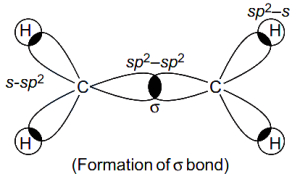
0 likesView Solution
118
ChemistryMediumMCQTS EAMCET · 2006
Which of the following is not a characteristic property of chemical equilibrium?
A
Rate of forward reaction is equal to rate of backward reaction at equilibrium.
B
After reaching the chemical equilibrium,the concentrations of reactants and products remain unchanged with time.
C
For $A_{(g)} \rightleftharpoons B_{(g)}$,$K_c$ is $10^{-2}$. If this reaction is carried out in the presence of a catalyst,the value of $K_c$ decreases.
D
After reaching the equilibrium,both forward and backward reactions continue to take place.
Solution
(C) catalyst increases the rate of both forward and backward reactions equally by lowering the activation energy.
It does not affect the position of equilibrium or the equilibrium constant $(K_c)$.
Therefore,the statement that the value of $K_c$ decreases in the presence of a catalyst is incorrect.
It does not affect the position of equilibrium or the equilibrium constant $(K_c)$.
Therefore,the statement that the value of $K_c$ decreases in the presence of a catalyst is incorrect.
0 likesView Solution
119
ChemistryMediumMCQTS EAMCET · 2006
Observe the following statements:
$I$. The physical and chemical properties of elements are periodic functions of their electronic configuration.
$II$. Electronegativity of fluorine is less than the electronegativity of chlorine.
$III$. Electropositive nature decreases from top to bottom in a group.
The correct answer is:
$I$. The physical and chemical properties of elements are periodic functions of their electronic configuration.
$II$. Electronegativity of fluorine is less than the electronegativity of chlorine.
$III$. Electropositive nature decreases from top to bottom in a group.
The correct answer is:
A
$I, II$ and $III$ are correct
B
only $I$ is correct
C
only $I$ and $II$ are correct
D
only $II$ and $III$ are correct
Solution
(B) Statement $I$ is correct because the modern periodic law states that physical and chemical properties of elements are periodic functions of their atomic numbers,which is equivalent to their electronic configuration.
Statement $II$ is incorrect because fluorine $(F)$ has the highest electronegativity $(4.0)$ in the periodic table,which is greater than that of chlorine ($Cl$,$3.0$).
Statement $III$ is incorrect because electropositive nature (metallic character) increases from top to bottom in a group as the ionization energy decreases.
Therefore,only statement $I$ is correct.
Statement $II$ is incorrect because fluorine $(F)$ has the highest electronegativity $(4.0)$ in the periodic table,which is greater than that of chlorine ($Cl$,$3.0$).
Statement $III$ is incorrect because electropositive nature (metallic character) increases from top to bottom in a group as the ionization energy decreases.
Therefore,only statement $I$ is correct.
0 likesView Solution
120
ChemistryMCQTS EAMCET · 2006
If $\sqrt{9 x^2+6 x+1} < (2-x)$,then:
A
$x \in \left(-\frac{3}{2}, \frac{1}{4}\right)$
B
$x \in \left(-\frac{3}{2}, \frac{1}{4}\right]$
C
$x \in \left[-\frac{3}{2}, \frac{1}{4}\right)$
D
$x < \frac{1}{4}$
Solution
(A) Given the inequality: $\sqrt{9 x^2+6 x+1} < (2-x)$
Since $\sqrt{(3x+1)^2} = |3x+1|$,the inequality becomes $|3x+1| < 2-x$.
For the square root to be defined,we must have $9x^2+6x+1 \ge 0$,which is always true as $(3x+1)^2 \ge 0$.
Also,for the inequality to hold,the right side must be positive: $2-x > 0 \implies x < 2$.
Now,solve $|3x+1| < 2-x$:
This is equivalent to $-(2-x) < 3x+1 < 2-x$.
Case $1$: $3x+1 < 2-x \implies 4x < 1 \implies x < \frac{1}{4}$.
Case $2$: $3x+1 > -(2-x) \implies 3x+1 > -2+x \implies 2x > -3 \implies x > -\frac{3}{2}$.
Combining these,we get $-\frac{3}{2} < x < \frac{1}{4}$.
Thus,$x \in \left(-\frac{3}{2}, \frac{1}{4}\right)$.
Since $\sqrt{(3x+1)^2} = |3x+1|$,the inequality becomes $|3x+1| < 2-x$.
For the square root to be defined,we must have $9x^2+6x+1 \ge 0$,which is always true as $(3x+1)^2 \ge 0$.
Also,for the inequality to hold,the right side must be positive: $2-x > 0 \implies x < 2$.
Now,solve $|3x+1| < 2-x$:
This is equivalent to $-(2-x) < 3x+1 < 2-x$.
Case $1$: $3x+1 < 2-x \implies 4x < 1 \implies x < \frac{1}{4}$.
Case $2$: $3x+1 > -(2-x) \implies 3x+1 > -2+x \implies 2x > -3 \implies x > -\frac{3}{2}$.
Combining these,we get $-\frac{3}{2} < x < \frac{1}{4}$.
Thus,$x \in \left(-\frac{3}{2}, \frac{1}{4}\right)$.
0 likesView Solution
121
ChemistryMCQTS EAMCET · 2006
If $x = \sqrt{\frac{2+\sqrt{3}}{2-\sqrt{3}}}$,then $x^2(x-4)^2$ is equal to:
A
$7$
B
$4$
C
$2$
D
$1$
Solution
(D) Given $x = \sqrt{\frac{2+\sqrt{3}}{2-\sqrt{3}}}$.
Rationalizing the denominator inside the square root:
$x = \sqrt{\frac{(2+\sqrt{3})(2+\sqrt{3})}{(2-\sqrt{3})(2+\sqrt{3})}} = \sqrt{\frac{(2+\sqrt{3})^2}{4-3}} = 2+\sqrt{3}$.
Now,we need to evaluate $x^2(x-4)^2 = [x(x-4)]^2$.
Substitute $x = 2+\sqrt{3}$:
$x(x-4) = (2+\sqrt{3})(2+\sqrt{3}-4) = (2+\sqrt{3})(\sqrt{3}-2)$.
Using the identity $(a+b)(a-b) = a^2-b^2$:
$x(x-4) = (\sqrt{3}+2)(\sqrt{3}-2) = (\sqrt{3})^2 - (2)^2 = 3 - 4 = -1$.
Therefore,$x^2(x-4)^2 = (-1)^2 = 1$.
Rationalizing the denominator inside the square root:
$x = \sqrt{\frac{(2+\sqrt{3})(2+\sqrt{3})}{(2-\sqrt{3})(2+\sqrt{3})}} = \sqrt{\frac{(2+\sqrt{3})^2}{4-3}} = 2+\sqrt{3}$.
Now,we need to evaluate $x^2(x-4)^2 = [x(x-4)]^2$.
Substitute $x = 2+\sqrt{3}$:
$x(x-4) = (2+\sqrt{3})(2+\sqrt{3}-4) = (2+\sqrt{3})(\sqrt{3}-2)$.
Using the identity $(a+b)(a-b) = a^2-b^2$:
$x(x-4) = (\sqrt{3}+2)(\sqrt{3}-2) = (\sqrt{3})^2 - (2)^2 = 3 - 4 = -1$.
Therefore,$x^2(x-4)^2 = (-1)^2 = 1$.
0 likesView Solution
122
ChemistryMCQTS EAMCET · 2006
The locus of the point $z = x + iy$ satisfying the equation $\left|\frac{z-1}{z+1}\right| = 1$ is given by:
A
$x = 0$
B
$y = 0$
C
$x = y$
D
$x + y = 0$
Solution
(A) Given the equation $\left|\frac{z-1}{z+1}\right| = 1$.
Substitute $z = x + iy$:
$\left|\frac{(x-1) + iy}{(x+1) + iy}\right| = 1$
Taking the modulus on both sides:
$|(x-1) + iy| = |(x+1) + iy|$
Squaring both sides:
$(x-1)^2 + y^2 = (x+1)^2 + y^2$
Expanding the squares:
$x^2 - 2x + 1 + y^2 = x^2 + 2x + 1 + y^2$
Simplifying the equation:
$-2x = 2x$
$4x = 0$
$x = 0$
Thus,the locus is the imaginary axis,represented by $x = 0$.
Substitute $z = x + iy$:
$\left|\frac{(x-1) + iy}{(x+1) + iy}\right| = 1$
Taking the modulus on both sides:
$|(x-1) + iy| = |(x+1) + iy|$
Squaring both sides:
$(x-1)^2 + y^2 = (x+1)^2 + y^2$
Expanding the squares:
$x^2 - 2x + 1 + y^2 = x^2 + 2x + 1 + y^2$
Simplifying the equation:
$-2x = 2x$
$4x = 0$
$x = 0$
Thus,the locus is the imaginary axis,represented by $x = 0$.
0 likesView Solution
123
ChemistryMCQTS EAMCET · 2006
The equation of the locus of $z$ such that $\left|\frac{z-i}{z+i}\right|=2$,where $z=x+iy$ is a complex number,is
A
$3x^2+3y^2+10y-3=0$
B
$3x^2+3y^2+10y+3=0$
C
$3x^2-3y^2-10y-3=0$
D
$x^2+y^2-5y+3=0$
Solution
(B) Given $\left|\frac{z-i}{z i}\right|=2$.
Since $z=x iy$,we have $\left|\frac{x i(y-1)}{x i(y 1)}\right|=2$.
Squaring both sides,we get $\frac{x^2 (y-1)^2}{x^2 (y 1)^2}=4$.
$x^2 (y-1)^2=4(x^2 (y 1)^2)$.
$x^2 y^2-2y 1=4(x^2 y^2 2y 1)$.
$x^2 y^2-2y 1=4x^2 4y^2 8y 4$.
Rearranging the terms,we get $3x^2 3y^2 10y 3=0$.
Since $z=x iy$,we have $\left|\frac{x i(y-1)}{x i(y 1)}\right|=2$.
Squaring both sides,we get $\frac{x^2 (y-1)^2}{x^2 (y 1)^2}=4$.
$x^2 (y-1)^2=4(x^2 (y 1)^2)$.
$x^2 y^2-2y 1=4(x^2 y^2 2y 1)$.
$x^2 y^2-2y 1=4x^2 4y^2 8y 4$.
Rearranging the terms,we get $3x^2 3y^2 10y 3=0$.
0 likesView Solution
124
ChemistryMCQTS EAMCET · 2006
The number of natural numbers less than $1000$,in which no two digits are repeated,is:
A
$738$
B
$792$
C
$837$
D
$720$
Solution
(A) Natural numbers less than $1000$ can be $1$-digit,$2$-digit,or $3$-digit numbers.
Case $1$: $1$-digit numbers. The digits can be ${1, 2, 3, 4, 5, 6, 7, 8, 9}$. Total $= 9$.
Case $2$: $2$-digit numbers. The first digit can be chosen in $9$ ways (excluding $0$) and the second digit in $9$ ways (including $0$ but excluding the first digit). Total $= 9 \times 9 = 81$.
Case $3$: $3$-digit numbers. The first digit can be chosen in $9$ ways (excluding $0$),the second in $9$ ways (including $0$ but excluding the first digit),and the third in $8$ ways (excluding the first two digits). Total $= 9 \times 9 \times 8 = 648$.
Total number of natural numbers $= 9 + 81 + 648 = 738$.
Case $1$: $1$-digit numbers. The digits can be ${1, 2, 3, 4, 5, 6, 7, 8, 9}$. Total $= 9$.
Case $2$: $2$-digit numbers. The first digit can be chosen in $9$ ways (excluding $0$) and the second digit in $9$ ways (including $0$ but excluding the first digit). Total $= 9 \times 9 = 81$.
Case $3$: $3$-digit numbers. The first digit can be chosen in $9$ ways (excluding $0$),the second in $9$ ways (including $0$ but excluding the first digit),and the third in $8$ ways (excluding the first two digits). Total $= 9 \times 9 \times 8 = 648$.
Total number of natural numbers $= 9 + 81 + 648 = 738$.
0 likesView Solution
125
ChemistryMCQTS EAMCET · 2006
Eight different letters of an alphabet are given. Words of four letters from these are formed. The number of such words with at least one letter repeated is :
A
$\binom{8}{4} - {}^{8}P_{4}$
B
$8^{4} + \binom{8}{4}$
C
$8^{4} - {}^{8}P_{4}$
D
$8^{4} - \binom{8}{4}$
Solution
(C) The total number of words of length $4$ that can be formed using $8$ different letters with repetition allowed is $8 \times 8 \times 8 \times 8 = 8^{4}$.
The number of words of length $4$ that can be formed using $8$ different letters without any repetition is given by the permutation formula ${}^{n}P_{r} = {}^{8}P_{4}$.
The number of words with at least one letter repeated is the total number of words minus the number of words with no letters repeated.
Therefore,the required number of words is $8^{4} - {}^{8}P_{4}$.
The number of words of length $4$ that can be formed using $8$ different letters without any repetition is given by the permutation formula ${}^{n}P_{r} = {}^{8}P_{4}$.
The number of words with at least one letter repeated is the total number of words minus the number of words with no letters repeated.
Therefore,the required number of words is $8^{4} - {}^{8}P_{4}$.
0 likesView Solution
126
ChemistryMCQTS EAMCET · 2006
$1+\frac{2}{4}+\frac{2 \cdot 5}{4 \cdot 8}+\frac{2 \cdot 5 \cdot 8}{4 \cdot 8 \cdot 12}+\frac{2 \cdot 5 \cdot 8 \cdot 11}{4 \cdot 8 \cdot 12 \cdot 16}+\ldots \ldots$ is equal to :
A
$4^{-2 / 3}$
B
$\sqrt[3]{16}$
C
$\sqrt[3]{4}$
D
$4^{3 / 2}$
Solution
(B) Let $S=1+\frac{2}{4}+\frac{2 \cdot 5}{4 \cdot 8}+\frac{2 \cdot 5 \cdot 8}{4 \cdot 8 \cdot 12}+\ldots$
Comparing this with the binomial expansion $(1-x)^n = 1 + n(-x) + \frac{n(n-1)}{2!}(-x)^2 + \ldots$
We have $nx = \frac{2}{4} = \frac{1}{2}$ $(i)$
And $\frac{n(n-1)}{2!}x^2 = \frac{2 \cdot 5}{4 \cdot 8} = \frac{10}{32} = \frac{5}{16}$ (ii)
Dividing (ii) by the square of $(i)$: $\frac{\frac{n(n-1)}{2}x^2}{n^2x^2} = \frac{5/16}{1/4} \Rightarrow \frac{n-1}{2n} = \frac{5}{4}$
$4n - 4 = 10n$ $\Rightarrow -6n = 4$ $\Rightarrow n = -2/3$
Substituting $n$ into $(i)$: $(-2/3)x = 1/2 \Rightarrow x = -3/4$
Thus,$S = (1 - x)^n = (1 - (-3/4))^{-2/3} = (7/4)^{-2/3}$ is incorrect. Re-evaluating: The series is $(1-x)^n$ where $nx = 1/2$ and $x = 1/2$ is not correct. Using $(1-x)^{-n} = 1 + nx + \frac{n(n+1)}{2!}x^2 + \ldots$
Here $nx = 1/2$ and $\frac{n(n+1)}{2}x^2 = 5/16$. Solving gives $n=2/3$ and $x=3/4$.
$S = (1-3/4)^{-2/3} = (1/4)^{-2/3} = 4^{2/3} = \sqrt[3]{16}$.
Comparing this with the binomial expansion $(1-x)^n = 1 + n(-x) + \frac{n(n-1)}{2!}(-x)^2 + \ldots$
We have $nx = \frac{2}{4} = \frac{1}{2}$ $(i)$
And $\frac{n(n-1)}{2!}x^2 = \frac{2 \cdot 5}{4 \cdot 8} = \frac{10}{32} = \frac{5}{16}$ (ii)
Dividing (ii) by the square of $(i)$: $\frac{\frac{n(n-1)}{2}x^2}{n^2x^2} = \frac{5/16}{1/4} \Rightarrow \frac{n-1}{2n} = \frac{5}{4}$
$4n - 4 = 10n$ $\Rightarrow -6n = 4$ $\Rightarrow n = -2/3$
Substituting $n$ into $(i)$: $(-2/3)x = 1/2 \Rightarrow x = -3/4$
Thus,$S = (1 - x)^n = (1 - (-3/4))^{-2/3} = (7/4)^{-2/3}$ is incorrect. Re-evaluating: The series is $(1-x)^n$ where $nx = 1/2$ and $x = 1/2$ is not correct. Using $(1-x)^{-n} = 1 + nx + \frac{n(n+1)}{2!}x^2 + \ldots$
Here $nx = 1/2$ and $\frac{n(n+1)}{2}x^2 = 5/16$. Solving gives $n=2/3$ and $x=3/4$.
$S = (1-3/4)^{-2/3} = (1/4)^{-2/3} = 4^{2/3} = \sqrt[3]{16}$.
0 likesView Solution
127
ChemistryMediumMCQTS EAMCET · 2006
$CFCl_3$ is responsible for the decomposition of ozone to oxygen. Which of the following reacts with ozone to form oxygen?
A
$Cl_2$
B
$Cl^-$
C
$F^-$
D
$Cl^{\bullet}$
Solution
(D) Chlorofluorocarbons $(CFCs)$ are responsible for the depletion of ozone in the stratosphere.
$CFCl_3$ decomposes in the presence of ultraviolet radiation to produce chlorine free radicals $(Cl^{\bullet})$.
These chlorine free radicals react with ozone $(O_3)$ molecules to form oxygen $(O_2)$ and chlorine monoxide $(ClO^{\bullet})$.
The reaction is: $Cl^{\bullet} + O_3 \rightarrow ClO^{\bullet} + O_2$.
$CFCl_3$ decomposes in the presence of ultraviolet radiation to produce chlorine free radicals $(Cl^{\bullet})$.
These chlorine free radicals react with ozone $(O_3)$ molecules to form oxygen $(O_2)$ and chlorine monoxide $(ClO^{\bullet})$.
The reaction is: $Cl^{\bullet} + O_3 \rightarrow ClO^{\bullet} + O_2$.
0 likesView Solution
128
ChemistryMCQTS EAMCET · 2006
If $x = \tan 15^{\circ}$,$y = \operatorname{cosec} 75^{\circ}$ and $z = 4 \sin 18^{\circ}$,then :
A
$x < y < z$
B
$y < z < x$
C
$z < x < y$
D
$x < z < y$
Solution
(A) First,calculate the value of $x$:
$x = \tan 15^{\circ} = \tan(45^{\circ} - 30^{\circ}) = \frac{\tan 45^{\circ} - \tan 30^{\circ}}{1 + \tan 45^{\circ} \tan 30^{\circ}} = \frac{1 - \frac{1}{\sqrt{3}}}{1 + \frac{1}{\sqrt{3}}} = \frac{\sqrt{3} - 1}{\sqrt{3} + 1} = \frac{(\sqrt{3} - 1)^2}{3 - 1} = \frac{4 - 2\sqrt{3}}{2} = 2 - \sqrt{3} \approx 2 - 1.732 = 0.268$.
Next,calculate the value of $y$:
$y = \operatorname{cosec} 75^{\circ} = \frac{1}{\sin(45^{\circ} + 30^{\circ})} = \frac{1}{\sin 45^{\circ} \cos 30^{\circ} + \cos 45^{\circ} \sin 30^{\circ}} = \frac{1}{\frac{\sqrt{3}}{2\sqrt{2}} + \frac{1}{2\sqrt{2}}} = \frac{2\sqrt{2}}{\sqrt{3} + 1} = \sqrt{2}(\sqrt{3} - 1) = \sqrt{6} - \sqrt{2} \approx 2.449 - 1.414 = 1.035$.
Finally,calculate the value of $z$:
$z = 4 \sin 18^{\circ} = 4 \left( \frac{\sqrt{5} - 1}{4} \right) = \sqrt{5} - 1 \approx 2.236 - 1 = 1.236$.
Comparing the values: $0.268 < 1.035 < 1.236$,which implies $x < y < z$.
$x = \tan 15^{\circ} = \tan(45^{\circ} - 30^{\circ}) = \frac{\tan 45^{\circ} - \tan 30^{\circ}}{1 + \tan 45^{\circ} \tan 30^{\circ}} = \frac{1 - \frac{1}{\sqrt{3}}}{1 + \frac{1}{\sqrt{3}}} = \frac{\sqrt{3} - 1}{\sqrt{3} + 1} = \frac{(\sqrt{3} - 1)^2}{3 - 1} = \frac{4 - 2\sqrt{3}}{2} = 2 - \sqrt{3} \approx 2 - 1.732 = 0.268$.
Next,calculate the value of $y$:
$y = \operatorname{cosec} 75^{\circ} = \frac{1}{\sin(45^{\circ} + 30^{\circ})} = \frac{1}{\sin 45^{\circ} \cos 30^{\circ} + \cos 45^{\circ} \sin 30^{\circ}} = \frac{1}{\frac{\sqrt{3}}{2\sqrt{2}} + \frac{1}{2\sqrt{2}}} = \frac{2\sqrt{2}}{\sqrt{3} + 1} = \sqrt{2}(\sqrt{3} - 1) = \sqrt{6} - \sqrt{2} \approx 2.449 - 1.414 = 1.035$.
Finally,calculate the value of $z$:
$z = 4 \sin 18^{\circ} = 4 \left( \frac{\sqrt{5} - 1}{4} \right) = \sqrt{5} - 1 \approx 2.236 - 1 = 1.236$.
Comparing the values: $0.268 < 1.035 < 1.236$,which implies $x < y < z$.
0 likesView Solution
129
ChemistryMCQTS EAMCET · 2006
$\operatorname{cosec} 15^{\circ} + \sec 15^{\circ}$ is equal to :
A
$2 \sqrt{2}$
B
$\sqrt{6}$
C
$2 \sqrt{6}$
D
$\sqrt{6} + \sqrt{2}$
Solution
(C) We have $\operatorname{cosec} 15^{\circ} + \sec 15^{\circ} = \frac{1}{\sin 15^{\circ}} + \frac{1}{\cos 15^{\circ}}$
$= \frac{\cos 15^{\circ} + \sin 15^{\circ}}{\sin 15^{\circ} \cos 15^{\circ}}$
Multiply numerator and denominator by $2$:
$= \frac{2(\cos 15^{\circ} + \sin 15^{\circ})}{2 \sin 15^{\circ} \cos 15^{\circ}} = \frac{2(\cos 15^{\circ} + \sin 15^{\circ})}{\sin 30^{\circ}}$
Since $\sin 30^{\circ} = \frac{1}{2}$,we have:
$= 4(\cos 15^{\circ} + \sin 15^{\circ})$
Using $\sin 15^{\circ} = \frac{\sqrt{6} - \sqrt{2}}{4}$ and $\cos 15^{\circ} = \frac{\sqrt{6} + \sqrt{2}}{4}$:
$= 4 \left( \frac{\sqrt{6} + \sqrt{2}}{4} + \frac{\sqrt{6} - \sqrt{2}}{4} \right)$
$= 4 \left( \frac{2 \sqrt{6}}{4} \right) = 2 \sqrt{6}$
$= \frac{\cos 15^{\circ} + \sin 15^{\circ}}{\sin 15^{\circ} \cos 15^{\circ}}$
Multiply numerator and denominator by $2$:
$= \frac{2(\cos 15^{\circ} + \sin 15^{\circ})}{2 \sin 15^{\circ} \cos 15^{\circ}} = \frac{2(\cos 15^{\circ} + \sin 15^{\circ})}{\sin 30^{\circ}}$
Since $\sin 30^{\circ} = \frac{1}{2}$,we have:
$= 4(\cos 15^{\circ} + \sin 15^{\circ})$
Using $\sin 15^{\circ} = \frac{\sqrt{6} - \sqrt{2}}{4}$ and $\cos 15^{\circ} = \frac{\sqrt{6} + \sqrt{2}}{4}$:
$= 4 \left( \frac{\sqrt{6} + \sqrt{2}}{4} + \frac{\sqrt{6} - \sqrt{2}}{4} \right)$
$= 4 \left( \frac{2 \sqrt{6}}{4} \right) = 2 \sqrt{6}$
0 likesView Solution
130
ChemistryMCQTS EAMCET · 2006
$\sin 120^{\circ} \cos 150^{\circ} - \cos 240^{\circ} \sin 330^{\circ}$ is equal to :
A
$1$
B
$-1$
C
$\frac{2}{3}$
D
$-\left(\frac{\sqrt{3}+1}{4}\right)$
Solution
(B) We use the values of trigonometric functions for allied angles:
$\sin 120^{\circ} = \sin(180^{\circ} - 60^{\circ}) = \sin 60^{\circ} = \frac{\sqrt{3}}{2}$
$\cos 150^{\circ} = \cos(180^{\circ} - 30^{\circ}) = -\cos 30^{\circ} = -\frac{\sqrt{3}}{2}$
$\cos 240^{\circ} = \cos(180^{\circ} + 60^{\circ}) = -\cos 60^{\circ} = -\frac{1}{2}$
$\sin 330^{\circ} = \sin(360^{\circ} - 30^{\circ}) = -\sin 30^{\circ} = -\frac{1}{2}$
Substituting these values into the expression:
$\left(\frac{\sqrt{3}}{2}\right) \left(-\frac{\sqrt{3}}{2}\right) - \left(-\frac{1}{2}\right) \left(-\frac{1}{2}\right)$
$= -\frac{3}{4} - \frac{1}{4}$
$= -\frac{4}{4} = -1$
$\sin 120^{\circ} = \sin(180^{\circ} - 60^{\circ}) = \sin 60^{\circ} = \frac{\sqrt{3}}{2}$
$\cos 150^{\circ} = \cos(180^{\circ} - 30^{\circ}) = -\cos 30^{\circ} = -\frac{\sqrt{3}}{2}$
$\cos 240^{\circ} = \cos(180^{\circ} + 60^{\circ}) = -\cos 60^{\circ} = -\frac{1}{2}$
$\sin 330^{\circ} = \sin(360^{\circ} - 30^{\circ}) = -\sin 30^{\circ} = -\frac{1}{2}$
Substituting these values into the expression:
$\left(\frac{\sqrt{3}}{2}\right) \left(-\frac{\sqrt{3}}{2}\right) - \left(-\frac{1}{2}\right) \left(-\frac{1}{2}\right)$
$= -\frac{3}{4} - \frac{1}{4}$
$= -\frac{4}{4} = -1$
0 likesView Solution
131
ChemistryMCQTS EAMCET · 2006
The equation of the line passing through the point of intersection of the lines $x-3y+2=0$ and $2x+5y-7=0$ and perpendicular to the line $3x+2y+5=0$ is:
A
$2x-3y+1=0$
B
$6x-9y+11=0$
C
$2x-3y+5=0$
D
$3x-2y+1=0$
Solution
(A) The equations of the lines are $x-3y+2=0$ $(i)$ and $2x+5y-7=0$ $(ii)$.
Solving equations $(i)$ and $(ii)$ by multiplying $(i)$ by $2$: $2x-6y+4=0$ $(iii)$.
Subtracting $(iii)$ from $(ii)$: $(2x+5y-7) - (2x-6y+4) = 0$ $\Rightarrow 11y - 11 = 0$ $\Rightarrow y=1$.
Substituting $y=1$ in $(i)$: $x-3(1)+2=0$ $\Rightarrow x-1=0$ $\Rightarrow x=1$.
The point of intersection is $(1, 1)$.
The equation of a line perpendicular to $3x+2y+5=0$ is of the form $2x-3y+\lambda=0$.
Since this line passes through $(1, 1)$,we have $2(1)-3(1)+\lambda=0$ $\Rightarrow 2-3+\lambda=0$ $\Rightarrow \lambda=1$.
Thus,the required equation is $2x-3y+1=0$.
Solving equations $(i)$ and $(ii)$ by multiplying $(i)$ by $2$: $2x-6y+4=0$ $(iii)$.
Subtracting $(iii)$ from $(ii)$: $(2x+5y-7) - (2x-6y+4) = 0$ $\Rightarrow 11y - 11 = 0$ $\Rightarrow y=1$.
Substituting $y=1$ in $(i)$: $x-3(1)+2=0$ $\Rightarrow x-1=0$ $\Rightarrow x=1$.
The point of intersection is $(1, 1)$.
The equation of a line perpendicular to $3x+2y+5=0$ is of the form $2x-3y+\lambda=0$.
Since this line passes through $(1, 1)$,we have $2(1)-3(1)+\lambda=0$ $\Rightarrow 2-3+\lambda=0$ $\Rightarrow \lambda=1$.
Thus,the required equation is $2x-3y+1=0$.
0 likesView Solution
132
ChemistryMCQTS EAMCET · 2006
The lines represented by the equation $x^2-y^2-x+3y-2=0$ are :
A
$x+y-1=0, x-y+2=0$
B
$x-y-2=0, x+y+1=0$
C
$x+y+2=0, x-y-1=0$
D
$x-y+1=0, x+y-2=0$
Solution
(D) The given equation is $x^2-y^2-x+3y-2=0$.
We can factorize this expression by grouping terms:
$x^2 - (y^2 - 3y + 2) = 0$
$x^2 - (y-1)(y-2) = 0$
This does not immediately factor into linear factors. Let us rewrite the equation as $x^2 - x - (y^2 - 3y + 2) = 0$.
Using the quadratic formula for $x$ in terms of $y$:
$x = \frac{1 \pm \sqrt{1 + 4(y^2 - 3y + 2)}}{2} = \frac{1 \pm \sqrt{4y^2 - 12y + 9}}{2} = \frac{1 \pm \sqrt{(2y-3)^2}}{2} = \frac{1 \pm (2y-3)}{2}$.
Case $1$: $x = \frac{1 + 2y - 3}{2} = \frac{2y-2}{2} = y-1 \implies x-y+1=0$.
Case $2$: $x = \frac{1 - 2y + 3}{2} = \frac{4-2y}{2} = 2-y \implies x+y-2=0$.
Thus,the lines are $x-y+1=0$ and $x+y-2=0$.
We can factorize this expression by grouping terms:
$x^2 - (y^2 - 3y + 2) = 0$
$x^2 - (y-1)(y-2) = 0$
This does not immediately factor into linear factors. Let us rewrite the equation as $x^2 - x - (y^2 - 3y + 2) = 0$.
Using the quadratic formula for $x$ in terms of $y$:
$x = \frac{1 \pm \sqrt{1 + 4(y^2 - 3y + 2)}}{2} = \frac{1 \pm \sqrt{4y^2 - 12y + 9}}{2} = \frac{1 \pm \sqrt{(2y-3)^2}}{2} = \frac{1 \pm (2y-3)}{2}$.
Case $1$: $x = \frac{1 + 2y - 3}{2} = \frac{2y-2}{2} = y-1 \implies x-y+1=0$.
Case $2$: $x = \frac{1 - 2y + 3}{2} = \frac{4-2y}{2} = 2-y \implies x+y-2=0$.
Thus,the lines are $x-y+1=0$ and $x+y-2=0$.
0 likesView Solution
133
ChemistryMCQTS EAMCET · 2006
The centroid of the triangle formed by the pair of straight lines $12x^2 - 20xy + 7y^2 = 0$ and the line $2x - 3y + 4 = 0$ is:
A
$\left(-\frac{7}{3}, \frac{7}{3}\right)$
B
$\left(-\frac{8}{3}, \frac{8}{3}\right)$
C
$\left(\frac{8}{3}, \frac{8}{3}\right)$
D
$\left(\frac{4}{3}, \frac{4}{3}\right)$
Solution
(C) The given pair of straight lines is $12x^2 - 20xy + 7y^2 = 0$.
Factoring the quadratic expression: $12x^2 - 6xy - 14xy + 7y^2 = 0 \implies 6x(2x - y) - 7y(2x - y) = 0 \implies (6x - 7y)(2x - y) = 0$.
The equations of the sides of the triangle are:
$L_1: 6x - 7y = 0$
$L_2: 2x - y = 0$
$L_3: 2x - 3y + 4 = 0$
Solving for the vertices:
Intersection of $L_1$ and $L_2$: $(0, 0)$.
Intersection of $L_1$ and $L_3$: $6x - 7y = 0 \implies x = \frac{7y}{6}$. Substituting into $L_3$: $2(\frac{7y}{6}) - 3y + 4 = 0 \implies \frac{7y}{3} - 3y = -4 \implies -\frac{2y}{3} = -4 \implies y = 6, x = 7$. Vertex is $(7, 6)$.
Intersection of $L_2$ and $L_3$: $2x - y = 0 \implies y = 2x$. Substituting into $L_3$: $2x - 3(2x) + 4 = 0 \implies -4x = -4 \implies x = 1, y = 2$. Vertex is $(1, 2)$.
The vertices are $(0, 0), (7, 6), (1, 2)$.
The centroid is $\left(\frac{0+7+1}{3}, \frac{0+6+2}{3}\right) = \left(\frac{8}{3}, \frac{8}{3}\right)$.
Factoring the quadratic expression: $12x^2 - 6xy - 14xy + 7y^2 = 0 \implies 6x(2x - y) - 7y(2x - y) = 0 \implies (6x - 7y)(2x - y) = 0$.
The equations of the sides of the triangle are:
$L_1: 6x - 7y = 0$
$L_2: 2x - y = 0$
$L_3: 2x - 3y + 4 = 0$
Solving for the vertices:
Intersection of $L_1$ and $L_2$: $(0, 0)$.
Intersection of $L_1$ and $L_3$: $6x - 7y = 0 \implies x = \frac{7y}{6}$. Substituting into $L_3$: $2(\frac{7y}{6}) - 3y + 4 = 0 \implies \frac{7y}{3} - 3y = -4 \implies -\frac{2y}{3} = -4 \implies y = 6, x = 7$. Vertex is $(7, 6)$.
Intersection of $L_2$ and $L_3$: $2x - y = 0 \implies y = 2x$. Substituting into $L_3$: $2x - 3(2x) + 4 = 0 \implies -4x = -4 \implies x = 1, y = 2$. Vertex is $(1, 2)$.
The vertices are $(0, 0), (7, 6), (1, 2)$.
The centroid is $\left(\frac{0+7+1}{3}, \frac{0+6+2}{3}\right) = \left(\frac{8}{3}, \frac{8}{3}\right)$.
0 likesView Solution
134
ChemistryEasyMCQTS EAMCET · 2006
What are the metal ions present in carnallite?
A
$Mg^{2+}, K^+$
B
$Al^{3+}, Na^+$
C
$Na^+, Mg^{2+}$
D
$Zn^{2+}, Mg^{2+}$
Solution
(A) The chemical formula of carnallite is $KCl \cdot MgCl_2 \cdot 6H_2O$.
It is a double salt consisting of potassium chloride and magnesium chloride.
Therefore,the metal ions present in carnallite are $K^+$ and $Mg^{2+}$.
It is a double salt consisting of potassium chloride and magnesium chloride.
Therefore,the metal ions present in carnallite are $K^+$ and $Mg^{2+}$.
0 likesView Solution
135
ChemistryMCQTS EAMCET · 2006
Assertion $(A)$: $A$ particle of mass $m$ dropped into a hole made along the diameter of the Earth from one end to the other executes simple harmonic motion.
Reason $(R)$: Gravitational force between any two particles is inversely proportional to the square of the distance between them.
Reason $(R)$: Gravitational force between any two particles is inversely proportional to the square of the distance between them.
A
Both $(A)$ and $(R)$ are true and $(R)$ is the correct explanation of $(A)$
B
Both $(A)$ and $(R)$ are true but $(R)$ is not the correct explanation of $(A)$
C
$(A)$ is true but $(R)$ is false
D
$(A)$ is false but $(R)$ is true
Solution
(B) For a particle of mass $m$ inside the Earth at a distance $r$ from the center,the gravitational force is given by $F = -\frac{GMmr}{R^3}$,where $M$ is the mass of the Earth and $R$ is its radius.
This force is proportional to the displacement $r$ and directed towards the center,which is the condition for simple harmonic motion $(SHM)$. Thus,Assertion $(A)$ is true.
The Reason $(R)$ states that the gravitational force is inversely proportional to the square of the distance $(F \propto 1/r^2)$. This is Newton's Law of Gravitation,which is true for particles outside the Earth or at the surface. However,inside the Earth,the effective force depends on the mass enclosed within the sphere of radius $r$,leading to a linear dependence on $r$.
While $(R)$ is a true statement about universal gravitation,it does not explain why the motion inside the Earth is simple harmonic (which depends on the linear force law inside the Earth). Therefore,$(R)$ is not the correct explanation of $(A)$.
This force is proportional to the displacement $r$ and directed towards the center,which is the condition for simple harmonic motion $(SHM)$. Thus,Assertion $(A)$ is true.
The Reason $(R)$ states that the gravitational force is inversely proportional to the square of the distance $(F \propto 1/r^2)$. This is Newton's Law of Gravitation,which is true for particles outside the Earth or at the surface. However,inside the Earth,the effective force depends on the mass enclosed within the sphere of radius $r$,leading to a linear dependence on $r$.
While $(R)$ is a true statement about universal gravitation,it does not explain why the motion inside the Earth is simple harmonic (which depends on the linear force law inside the Earth). Therefore,$(R)$ is not the correct explanation of $(A)$.
0 likesView Solution
136
ChemistryMediumMCQTS EAMCET · 2006
Which of the following reacts with benzene in the presence of anhydrous aluminum chloride to form acetophenone?
A
$CH_3Cl$
B
$CH_3COOH$
C
$CH_3CHO$
D
$CH_3COCl$
Solution
(D) Friedel-Crafts Acylation: This reaction involves the treatment of benzene with an acylating agent such as acetyl chloride $(CH_3COCl)$ or acetic anhydride in the presence of a Lewis acid catalyst like anhydrous aluminum chloride $(AlCl_3)$.
The reaction is as follows:
$C_6H_6 + CH_3COCl \xrightarrow{anhydrous \ AlCl_3} C_6H_5COCH_3 + HCl$
Thus,benzene reacts with acetyl chloride $(CH_3COCl)$ to form acetophenone.
The reaction is as follows:
$C_6H_6 + CH_3COCl \xrightarrow{anhydrous \ AlCl_3} C_6H_5COCH_3 + HCl$
Thus,benzene reacts with acetyl chloride $(CH_3COCl)$ to form acetophenone.
0 likesView Solution
137
ChemistryMediumMCQTS EAMCET · 2006
Electrolysis of $X$ gives $Y$ at anode. Vacuum distillation of $Y$ gives $H_2O_2$. The number of peroxy $(O-O)$ bonds present in $X$ and $Y$ respectively are :
A
$1, 1$
B
$1, 2$
C
$0, 1$
D
$0, 0$
Solution
(C) $30\%$ solution of hydrogen peroxide can be obtained by the electrolysis of $50\%$ sulphuric acid followed by vacuum distillation.
The first product of electrolysis is perdisulphuric acid $(H_2S_2O_8)$,which reacts with water during distillation to form $H_2O_2$.
$2H_2SO_4 \longrightarrow 2H^+ + 2HSO_4^-$
$2HSO_4^- \longrightarrow H_2S_2O_8 + 2e^-$ (At anode)
$H_2S_2O_8 + 2H_2O \longrightarrow 2H_2SO_4 + H_2O_2$
Here,$X$ is $H_2SO_4$ and $Y$ is $H_2S_2O_8$.
$H_2SO_4$ has $0$ peroxy bonds,while $H_2S_2O_8$ (Marshall's acid) has $1$ peroxy bond $(HO_3S-O-O-SO_3H)$.
The first product of electrolysis is perdisulphuric acid $(H_2S_2O_8)$,which reacts with water during distillation to form $H_2O_2$.
$2H_2SO_4 \longrightarrow 2H^+ + 2HSO_4^-$
$2HSO_4^- \longrightarrow H_2S_2O_8 + 2e^-$ (At anode)
$H_2S_2O_8 + 2H_2O \longrightarrow 2H_2SO_4 + H_2O_2$
Here,$X$ is $H_2SO_4$ and $Y$ is $H_2S_2O_8$.
$H_2SO_4$ has $0$ peroxy bonds,while $H_2S_2O_8$ (Marshall's acid) has $1$ peroxy bond $(HO_3S-O-O-SO_3H)$.
0 likesView Solution
138
ChemistryMCQTS EAMCET · 2006
The perimeter of a sector is a constant. If its area is to be maximum,the sectorial angle is:
A
$ \frac{\pi^c}{6} $
B
$ \frac{\pi^c}{4} $
C
$ 4^c $
D
$ 2^c $
Solution
(D) Let the radius of the sector be $r$ and the sectorial angle be $\theta$ (in radians). The arc length is $l = r\theta$.
Perimeter $P = 2r + r\theta = r(2 + \theta)$.
Thus,$r = \frac{P}{2 + \theta}$.
The area of the sector is $A = \frac{1}{2} r^2 \theta$.
Substituting $r$,we get $A = \frac{1}{2} \left( \frac{P}{2 + \theta} \right)^2 \theta = \frac{P^2}{2} \cdot \frac{\theta}{(2 + \theta)^2}$.
To maximize $A$,we differentiate with respect to $\theta$ and set it to $0$:
$\frac{dA}{d\theta} = \frac{P^2}{2} \left[ \frac{(2 + \theta)^2 - \theta \cdot 2(2 + \theta)}{(2 + \theta)^4} \right] = 0$.
$(2 + \theta)^2 - 2\theta(2 + \theta) = 0$.
Since $2 + \theta \neq 0$,we have $2 + \theta - 2\theta = 0$,which gives $\theta = 2$.
Therefore,the area is maximum when the sectorial angle is $2^c$.
Perimeter $P = 2r + r\theta = r(2 + \theta)$.
Thus,$r = \frac{P}{2 + \theta}$.
The area of the sector is $A = \frac{1}{2} r^2 \theta$.
Substituting $r$,we get $A = \frac{1}{2} \left( \frac{P}{2 + \theta} \right)^2 \theta = \frac{P^2}{2} \cdot \frac{\theta}{(2 + \theta)^2}$.
To maximize $A$,we differentiate with respect to $\theta$ and set it to $0$:
$\frac{dA}{d\theta} = \frac{P^2}{2} \left[ \frac{(2 + \theta)^2 - \theta \cdot 2(2 + \theta)}{(2 + \theta)^4} \right] = 0$.
$(2 + \theta)^2 - 2\theta(2 + \theta) = 0$.
Since $2 + \theta \neq 0$,we have $2 + \theta - 2\theta = 0$,which gives $\theta = 2$.
Therefore,the area is maximum when the sectorial angle is $2^c$.
0 likesView Solution
139
ChemistryMCQTS EAMCET · 2006
$f(x) = e^x \sin x$,then $f^{(6)}(x)$ is equal to :
A
$e^{6x} \sin 6x$
B
$-8 e^x \cos x$
C
$8 e^x \sin x$
D
$8 e^x \cos x$
Solution
(B) Given $f(x) = e^x \sin x$.
First derivative: $f'(x) = e^x \sin x + e^x \cos x = e^x(\sin x + \cos x)$.
Second derivative: $f''(x) = e^x(\sin x + \cos x) + e^x(\cos x - \sin x) = 2e^x \cos x$.
Third derivative: $f'''(x) = 2e^x \cos x - 2e^x \sin x = 2e^x(\cos x - \sin x)$.
Fourth derivative: $f^{(4)}(x) = 2e^x(\cos x - \sin x) + 2e^x(-\sin x - \cos x) = -4e^x \sin x$.
Fifth derivative: $f^{(5)}(x) = -4e^x \sin x - 4e^x \cos x = -4e^x(\sin x + \cos x)$.
Sixth derivative: $f^{(6)}(x) = -4e^x(\sin x + \cos x) - 4e^x(\cos x - \sin x) = -4e^x \sin x - 4e^x \cos x - 4e^x \cos x + 4e^x \sin x = -8e^x \cos x$.
First derivative: $f'(x) = e^x \sin x + e^x \cos x = e^x(\sin x + \cos x)$.
Second derivative: $f''(x) = e^x(\sin x + \cos x) + e^x(\cos x - \sin x) = 2e^x \cos x$.
Third derivative: $f'''(x) = 2e^x \cos x - 2e^x \sin x = 2e^x(\cos x - \sin x)$.
Fourth derivative: $f^{(4)}(x) = 2e^x(\cos x - \sin x) + 2e^x(-\sin x - \cos x) = -4e^x \sin x$.
Fifth derivative: $f^{(5)}(x) = -4e^x \sin x - 4e^x \cos x = -4e^x(\sin x + \cos x)$.
Sixth derivative: $f^{(6)}(x) = -4e^x(\sin x + \cos x) - 4e^x(\cos x - \sin x) = -4e^x \sin x - 4e^x \cos x - 4e^x \cos x + 4e^x \sin x = -8e^x \cos x$.
0 likesView Solution
140
ChemistryMCQTS EAMCET · 2006
If $\frac{3x+2}{(x+1)(2x^2+3)} = \frac{A}{x+1} + \frac{Bx+C}{2x^2+3}$,then $A+C-B$ is equal to :
A
$0$
B
$2$
C
$3$
D
$5$
Solution
(B) Given the partial fraction decomposition: $\frac{3x+2}{(x+1)(2x^2+3)} = \frac{A}{x+1} + \frac{Bx+C}{2x^2+3}$
Multiplying both sides by $(x+1)(2x^2+3)$,we get: $3x+2 = A(2x^2+3) + (Bx+C)(x+1)$
Setting $x = -1$: $3(-1)+2 = A(2(-1)^2+3) + 0 \Rightarrow -1 = A(5) \Rightarrow A = -\frac{1}{5}$
Expanding the right side: $3x+2 = 2Ax^2 + 3A + Bx^2 + Bx + Cx + C = (2A+B)x^2 + (B+C)x + (3A+C)$
Comparing coefficients:
For $x^2$: $2A+B = 0 \Rightarrow B = -2A = -2(-\frac{1}{5}) = \frac{2}{5}$
For $x$: $B+C = 3 \Rightarrow C = 3 - B = 3 - \frac{2}{5} = \frac{13}{5}$
Calculating $A+C-B$: $-\frac{1}{5} + \frac{13}{5} - \frac{2}{5} = \frac{13-2-1}{5} = \frac{10}{5} = 2$
Multiplying both sides by $(x+1)(2x^2+3)$,we get: $3x+2 = A(2x^2+3) + (Bx+C)(x+1)$
Setting $x = -1$: $3(-1)+2 = A(2(-1)^2+3) + 0 \Rightarrow -1 = A(5) \Rightarrow A = -\frac{1}{5}$
Expanding the right side: $3x+2 = 2Ax^2 + 3A + Bx^2 + Bx + Cx + C = (2A+B)x^2 + (B+C)x + (3A+C)$
Comparing coefficients:
For $x^2$: $2A+B = 0 \Rightarrow B = -2A = -2(-\frac{1}{5}) = \frac{2}{5}$
For $x$: $B+C = 3 \Rightarrow C = 3 - B = 3 - \frac{2}{5} = \frac{13}{5}$
Calculating $A+C-B$: $-\frac{1}{5} + \frac{13}{5} - \frac{2}{5} = \frac{13-2-1}{5} = \frac{10}{5} = 2$
0 likesView Solution
141
ChemistryMCQTS EAMCET · 2006
If $f(x) = \begin{cases} \frac{1-\sqrt{2} \sin x}{\pi-4x} & \text{if } x \neq \frac{\pi}{4} \\ a & \text{if } x = \frac{\pi}{4} \end{cases}$ is continuous at $x = \frac{\pi}{4}$,then $a$ is equal to
A
$4$
B
$2$
C
$1$
D
$1/4$
Solution
(D) For $f(x)$ to be continuous at $x = \frac{\pi}{4}$,we must have $\lim_{x \to \frac{\pi}{4}} f(x) = f\left(\frac{\pi}{4}\right)$.
Given $f\left(\frac{\pi}{4}\right) = a$.
Now,$\lim_{x \to \frac{\pi}{4}} f(x) = \lim_{x \to \frac{\pi}{4}} \frac{1-\sqrt{2} \sin x}{\pi-4x}$.
This is a $\frac{0}{0}$ form,so we apply $L$'Hospital's rule:
$\lim_{x \to \frac{\pi}{4}} \frac{\frac{d}{dx}(1-\sqrt{2} \sin x)}{\frac{d}{dx}(\pi-4x)} = \lim_{x \to \frac{\pi}{4}} \frac{-\sqrt{2} \cos x}{-4}$.
Substituting $x = \frac{\pi}{4}$:
$= \frac{-\sqrt{2} \cdot \frac{1}{\sqrt{2}}}{-4} = \frac{-1}{-4} = \frac{1}{4}$.
Since the function is continuous,$a = \frac{1}{4}$.
Given $f\left(\frac{\pi}{4}\right) = a$.
Now,$\lim_{x \to \frac{\pi}{4}} f(x) = \lim_{x \to \frac{\pi}{4}} \frac{1-\sqrt{2} \sin x}{\pi-4x}$.
This is a $\frac{0}{0}$ form,so we apply $L$'Hospital's rule:
$\lim_{x \to \frac{\pi}{4}} \frac{\frac{d}{dx}(1-\sqrt{2} \sin x)}{\frac{d}{dx}(\pi-4x)} = \lim_{x \to \frac{\pi}{4}} \frac{-\sqrt{2} \cos x}{-4}$.
Substituting $x = \frac{\pi}{4}$:
$= \frac{-\sqrt{2} \cdot \frac{1}{\sqrt{2}}}{-4} = \frac{-1}{-4} = \frac{1}{4}$.
Since the function is continuous,$a = \frac{1}{4}$.
0 likesView Solution
142
ChemistryMCQTS EAMCET · 2006
When the angle of inclination of an inclined plane is $\theta$,an object slides down with uniform velocity. If the same object is pushed up with an initial velocity $u$ on the same inclined plane,it goes up the plane and stops at a certain distance on the plane. Thereafter,the body:
A
slides down the inclined plane and reaches the ground with velocity $u$.
B
slides down the inclined plane and reaches the ground with velocity less than $u$.
C
slides down the inclined plane and reaches the ground with velocity greater than $u$.
D
stays at rest on the inclined plane and will not slide down.
Solution
(D) $1$. When the object slides down with uniform velocity,the net force is zero. Thus,the component of gravity $mg \sin \theta$ is balanced by the kinetic friction $f_k = \mu_k N = \mu_k mg \cos \theta$. Therefore,$mg \sin \theta = \mu_k mg \cos \theta$,which implies $\mu_k = \tan \theta$.
$2$. When the object is pushed up with initial velocity $u$,it moves against both gravity and friction. The retardation is $a = g \sin \theta + \mu_k g \cos \theta = g \sin \theta + (\tan \theta) g \cos \theta = 2g \sin \theta$.
$3$. After stopping at the top,the object slides down. The acceleration while sliding down is $a' = g \sin \theta - \mu_k g \cos \theta = g \sin \theta - (\tan \theta) g \cos \theta = 0$. Wait,this implies the object would remain at rest if the static friction equals kinetic friction. However,since it was already sliding,the net force down the plane is $mg \sin \theta - f_k = 0$. Thus,the object will remain at rest at the point where it stops.
$2$. When the object is pushed up with initial velocity $u$,it moves against both gravity and friction. The retardation is $a = g \sin \theta + \mu_k g \cos \theta = g \sin \theta + (\tan \theta) g \cos \theta = 2g \sin \theta$.
$3$. After stopping at the top,the object slides down. The acceleration while sliding down is $a' = g \sin \theta - \mu_k g \cos \theta = g \sin \theta - (\tan \theta) g \cos \theta = 0$. Wait,this implies the object would remain at rest if the static friction equals kinetic friction. However,since it was already sliding,the net force down the plane is $mg \sin \theta - f_k = 0$. Thus,the object will remain at rest at the point where it stops.
0 likesView Solution
143
ChemistryMCQTS EAMCET · 2006
If $\theta$ is the angle between the curves $xy=2$ and $x^2+4y=0$,then $\tan \theta$ is equal to:
A
$1$
B
$-1$
C
$2$
D
$3$
Solution
(D) The equations of the curves are:
$xy=2$ $\ldots$ $(i)$
$x^2+4y=0$ $\ldots$ $(ii)$
From $(i)$,$y = \frac{2}{x}$. Substituting this into $(ii)$:
$x^2 + 4(\frac{2}{x}) = 0 \Rightarrow x^2 + \frac{8}{x} = 0 \Rightarrow x^3 + 8 = 0 \Rightarrow x^3 = -8 \Rightarrow x = -2$.
For $x = -2$,$y = \frac{2}{-2} = -1$. So,the point of intersection is $(-2, -1)$.
Differentiating $(i)$ with respect to $x$:
$x \frac{dy}{dx} + y = 0 \Rightarrow \frac{dy}{dx} = -\frac{y}{x}$.
At $(-2, -1)$,$m_1 = -(\frac{-1}{-2}) = -\frac{1}{2}$.
Differentiating $(ii)$ with respect to $x$:
$2x + 4 \frac{dy}{dx} = 0 \Rightarrow \frac{dy}{dx} = -\frac{2x}{4} = -\frac{x}{2}$.
At $(-2, -1)$,$m_2 = -(\frac{-2}{2}) = 1$.
The angle $\theta$ between the curves is given by:
$\tan \theta = \left| \frac{m_1 - m_2}{1 + m_1 m_2} \right| = \left| \frac{-\frac{1}{2} - 1}{1 + (-\frac{1}{2})(1)} \right| = \left| \frac{-\frac{3}{2}}{1 - \frac{1}{2}} \right| = \left| \frac{-\frac{3}{2}}{\frac{1}{2}} \right| = |-3| = 3$.
Therefore,$\tan \theta = 3$.
$xy=2$ $\ldots$ $(i)$
$x^2+4y=0$ $\ldots$ $(ii)$
From $(i)$,$y = \frac{2}{x}$. Substituting this into $(ii)$:
$x^2 + 4(\frac{2}{x}) = 0 \Rightarrow x^2 + \frac{8}{x} = 0 \Rightarrow x^3 + 8 = 0 \Rightarrow x^3 = -8 \Rightarrow x = -2$.
For $x = -2$,$y = \frac{2}{-2} = -1$. So,the point of intersection is $(-2, -1)$.
Differentiating $(i)$ with respect to $x$:
$x \frac{dy}{dx} + y = 0 \Rightarrow \frac{dy}{dx} = -\frac{y}{x}$.
At $(-2, -1)$,$m_1 = -(\frac{-1}{-2}) = -\frac{1}{2}$.
Differentiating $(ii)$ with respect to $x$:
$2x + 4 \frac{dy}{dx} = 0 \Rightarrow \frac{dy}{dx} = -\frac{2x}{4} = -\frac{x}{2}$.
At $(-2, -1)$,$m_2 = -(\frac{-2}{2}) = 1$.
The angle $\theta$ between the curves is given by:
$\tan \theta = \left| \frac{m_1 - m_2}{1 + m_1 m_2} \right| = \left| \frac{-\frac{1}{2} - 1}{1 + (-\frac{1}{2})(1)} \right| = \left| \frac{-\frac{3}{2}}{1 - \frac{1}{2}} \right| = \left| \frac{-\frac{3}{2}}{\frac{1}{2}} \right| = |-3| = 3$.
Therefore,$\tan \theta = 3$.
0 likesView Solution
144
ChemistryMCQTS EAMCET · 2006
In the interval $(-3, 3)$,the function $f(x) = \frac{x}{3} + \frac{3}{x}, x \neq 0$ is :
A
increasing
B
decreasing
C
neither increasing nor decreasing
D
partly increasing and partly decreasing
Solution
(B) Given the function $f(x) = \frac{x}{3} + \frac{3}{x}$.
First,we find the derivative $f'(x)$ with respect to $x$:
$f'(x) = \frac{d}{dx}(\frac{x}{3} + \frac{3}{x}) = \frac{1}{3} - \frac{3}{x^2}$.
To determine the nature of the function in the interval $(-3, 3)$,we analyze the sign of $f'(x)$:
$f'(x) = \frac{x^2 - 9}{3x^2}$.
Since $x^2 < 9$ for all $x \in (-3, 3)$ and $x \neq 0$,the numerator $x^2 - 9$ is always negative.
Since $3x^2$ is always positive for $x \neq 0$,the derivative $f'(x) < 0$ for all $x \in (-3, 3) \setminus \{0\}$.
Therefore,the function $f(x)$ is decreasing in the interval $(-3, 3)$.
First,we find the derivative $f'(x)$ with respect to $x$:
$f'(x) = \frac{d}{dx}(\frac{x}{3} + \frac{3}{x}) = \frac{1}{3} - \frac{3}{x^2}$.
To determine the nature of the function in the interval $(-3, 3)$,we analyze the sign of $f'(x)$:
$f'(x) = \frac{x^2 - 9}{3x^2}$.
Since $x^2 < 9$ for all $x \in (-3, 3)$ and $x \neq 0$,the numerator $x^2 - 9$ is always negative.
Since $3x^2$ is always positive for $x \neq 0$,the derivative $f'(x) < 0$ for all $x \in (-3, 3) \setminus \{0\}$.
Therefore,the function $f(x)$ is decreasing in the interval $(-3, 3)$.
0 likesView Solution
145
ChemistryMCQTS EAMCET · 2006
If $\int \frac{dx}{x^2+2x+2} = f(x) + c$,then $f(x)$ is equal to :
A
$\tan^{-1}(x+1)$
B
$2 \tan^{-1}(x+1)$
C
$-\tan^{-1}(x+1)$
D
$3 \tan^{-1}(x+1)$
Solution
(A) Let $I = \int \frac{dx}{x^2+2x+2}$.
We can rewrite the denominator by completing the square:
$x^2 + 2x + 2 = (x^2 + 2x + 1) + 1 = (x+1)^2 + 1$.
Substituting this into the integral,we get:
$I = \int \frac{dx}{(x+1)^2 + 1}$.
Using the standard integral formula $\int \frac{du}{u^2 + a^2} = \frac{1}{a} \tan^{-1}(\frac{u}{a}) + c$,where $u = x+1$ and $a = 1$:
$I = \tan^{-1}(x+1) + c$.
Given that $I = f(x) + c$,we conclude that $f(x) = \tan^{-1}(x+1)$.
We can rewrite the denominator by completing the square:
$x^2 + 2x + 2 = (x^2 + 2x + 1) + 1 = (x+1)^2 + 1$.
Substituting this into the integral,we get:
$I = \int \frac{dx}{(x+1)^2 + 1}$.
Using the standard integral formula $\int \frac{du}{u^2 + a^2} = \frac{1}{a} \tan^{-1}(\frac{u}{a}) + c$,where $u = x+1$ and $a = 1$:
$I = \tan^{-1}(x+1) + c$.
Given that $I = f(x) + c$,we conclude that $f(x) = \tan^{-1}(x+1)$.
0 likesView Solution
146
ChemistryMCQTS EAMCET · 2006
If $\int \sqrt{\frac{x}{a^3-x^3}} \, dx = g(x) + c$,then $g(x)$ is equal to:
A
$\frac{2}{3} \cos^{-1} x$
B
$\frac{2}{3} \sin^{-1}\left(\frac{x^3}{a^3}\right)$
C
$\frac{2}{3} \sin^{-1}\left(\sqrt{\frac{x^3}{a^3}}\right)$
D
$\frac{2}{3} \cos^{-1}\left(\frac{x}{a}\right)$
Solution
(C) Let $I = \int \sqrt{\frac{x}{a^3-x^3}} \, dx$.
To solve this,we rewrite the integrand:
$I = \int \sqrt{\frac{x}{a^3(1 - (x/a)^{3})}} \, dx = \int \frac{\sqrt{x}}{\sqrt{a^3} \sqrt{1 - (x^{3/2}/a^{3/2})^2}} \, dx$.
Let $u = \left(\frac{x}{a}\right)^{3/2} = \sqrt{\frac{x^3}{a^3}}$.
Then $du = \frac{3}{2} \sqrt{\frac{x}{a^3}} \, dx$,which implies $\sqrt{\frac{x}{a^3}} \, dx = \frac{2}{3} \, du$.
Substituting these into the integral:
$I = \int \frac{1}{\sqrt{1 - u^2}} \cdot \frac{2}{3} \, du = \frac{2}{3} \sin^{-1}(u) + c$.
Substituting back $u = \sqrt{\frac{x^3}{a^3}}$,we get $I = \frac{2}{3} \sin^{-1}\left(\sqrt{\frac{x^3}{a^3}}\right) + c$.
Comparing this with $g(x) + c$,we find $g(x) = \frac{2}{3} \sin^{-1}\left(\sqrt{\frac{x^3}{a^3}}\right)$.
To solve this,we rewrite the integrand:
$I = \int \sqrt{\frac{x}{a^3(1 - (x/a)^{3})}} \, dx = \int \frac{\sqrt{x}}{\sqrt{a^3} \sqrt{1 - (x^{3/2}/a^{3/2})^2}} \, dx$.
Let $u = \left(\frac{x}{a}\right)^{3/2} = \sqrt{\frac{x^3}{a^3}}$.
Then $du = \frac{3}{2} \sqrt{\frac{x}{a^3}} \, dx$,which implies $\sqrt{\frac{x}{a^3}} \, dx = \frac{2}{3} \, du$.
Substituting these into the integral:
$I = \int \frac{1}{\sqrt{1 - u^2}} \cdot \frac{2}{3} \, du = \frac{2}{3} \sin^{-1}(u) + c$.
Substituting back $u = \sqrt{\frac{x^3}{a^3}}$,we get $I = \frac{2}{3} \sin^{-1}\left(\sqrt{\frac{x^3}{a^3}}\right) + c$.
Comparing this with $g(x) + c$,we find $g(x) = \frac{2}{3} \sin^{-1}\left(\sqrt{\frac{x^3}{a^3}}\right)$.
0 likesView Solution
147
ChemistryMCQTS EAMCET · 2006
$\int_{-1}^1 \frac{\cosh x}{1+e^{2 x}} d x$ is equal to :
A
$0$
B
$1$
C
$\frac{e^2-1}{2 e}$
D
$\frac{e^2+2}{2 e}$
Solution
(C) Let $I = \int_{-1}^1 \frac{\cosh x}{1+e^{2 x}} d x$.
Since $\cosh x = \frac{e^x + e^{-x}}{2}$,we substitute this into the integral:
$I = \int_{-1}^1 \frac{e^x + e^{-x}}{2(1 + e^{2x})} d x$.
We can rewrite the numerator as $\frac{e^x(1 + e^{-2x})}{2(1 + e^{2x})} = \frac{e^x(1 + \frac{1}{e^{2x}})}{2(1 + e^{2x})} = \frac{e^x(\frac{e^{2x} + 1}{e^{2x}})}{2(1 + e^{2x})} = \frac{e^x}{2e^{2x}} = \frac{1}{2e^x} = \frac{1}{2}e^{-x}$.
Thus,$I = \int_{-1}^1 \frac{1}{2}e^{-x} d x$.
$I = \frac{1}{2} \left[ -e^{-x} \right]_{-1}^1$.
$I = -\frac{1}{2} (e^{-1} - e^1) = \frac{1}{2} (e^1 - e^{-1}) = \frac{e - \frac{1}{e}}{2} = \frac{e^2 - 1}{2e}$.
Since $\cosh x = \frac{e^x + e^{-x}}{2}$,we substitute this into the integral:
$I = \int_{-1}^1 \frac{e^x + e^{-x}}{2(1 + e^{2x})} d x$.
We can rewrite the numerator as $\frac{e^x(1 + e^{-2x})}{2(1 + e^{2x})} = \frac{e^x(1 + \frac{1}{e^{2x}})}{2(1 + e^{2x})} = \frac{e^x(\frac{e^{2x} + 1}{e^{2x}})}{2(1 + e^{2x})} = \frac{e^x}{2e^{2x}} = \frac{1}{2e^x} = \frac{1}{2}e^{-x}$.
Thus,$I = \int_{-1}^1 \frac{1}{2}e^{-x} d x$.
$I = \frac{1}{2} \left[ -e^{-x} \right]_{-1}^1$.
$I = -\frac{1}{2} (e^{-1} - e^1) = \frac{1}{2} (e^1 - e^{-1}) = \frac{e - \frac{1}{e}}{2} = \frac{e^2 - 1}{2e}$.
0 likesView Solution
148
ChemistryMCQTS EAMCET · 2006
$\int_0^{\pi / 2} \frac{d x}{1+\tan ^3 x}$ is equal to :
A
$\pi$
B
$\frac{\pi}{2}$
C
$\frac{\pi}{4}$
D
$\frac{3 \pi}{2}$
Solution
(C) Let $I = \int_0^{\pi / 2} \frac{d x}{1+\tan ^3 x}$.
We know that $\tan x = \frac{\sin x}{\cos x}$,so $I = \int_0^{\pi / 2} \frac{\cos ^3 x}{\sin ^3 x+\cos ^3 x} d x$ ...$(i)$
Using the property $\int_0^a f(x) d x = \int_0^a f(a-x) d x$,we get:
$I = \int_0^{\pi / 2} \frac{\cos ^3(\pi/2 - x)}{\sin ^3(\pi/2 - x) + \cos ^3(\pi/2 - x)} d x$
$I = \int_0^{\pi / 2} \frac{\sin ^3 x}{\cos ^3 x + \sin ^3 x} d x$ ...(ii)
Adding equations $(i)$ and (ii):
$2I = \int_0^{\pi / 2} \frac{\cos ^3 x + \sin ^3 x}{\sin ^3 x + \cos ^3 x} d x$
$2I = \int_0^{\pi / 2} 1 d x = [x]_0^{\pi / 2} = \frac{\pi}{2}$
Therefore,$I = \frac{\pi}{4}$.
We know that $\tan x = \frac{\sin x}{\cos x}$,so $I = \int_0^{\pi / 2} \frac{\cos ^3 x}{\sin ^3 x+\cos ^3 x} d x$ ...$(i)$
Using the property $\int_0^a f(x) d x = \int_0^a f(a-x) d x$,we get:
$I = \int_0^{\pi / 2} \frac{\cos ^3(\pi/2 - x)}{\sin ^3(\pi/2 - x) + \cos ^3(\pi/2 - x)} d x$
$I = \int_0^{\pi / 2} \frac{\sin ^3 x}{\cos ^3 x + \sin ^3 x} d x$ ...(ii)
Adding equations $(i)$ and (ii):
$2I = \int_0^{\pi / 2} \frac{\cos ^3 x + \sin ^3 x}{\sin ^3 x + \cos ^3 x} d x$
$2I = \int_0^{\pi / 2} 1 d x = [x]_0^{\pi / 2} = \frac{\pi}{2}$
Therefore,$I = \frac{\pi}{4}$.
0 likesView Solution
149
ChemistryMCQTS EAMCET · 2006
Dividing the interval $[0,6]$ into $6$ equal parts and by using the trapezoidal rule,the value of $\int_0^6 x^3 dx$ is approximately:
A
$330$
B
$331$
C
$332$
D
$333$
Solution
(D) Given the interval $[0, 6]$ is divided into $n = 6$ equal parts.
The width of each sub-interval is $h = \frac{b-a}{n} = \frac{6-0}{6} = 1$.
The values of $f(x) = x^3$ at $x = 0, 1, 2, 3, 4, 5, 6$ are:
$y_0 = f(0) = 0^3 = 0$
$y_1 = f(1) = 1^3 = 1$
$y_2 = f(2) = 2^3 = 8$
$y_3 = f(3) = 3^3 = 27$
$y_4 = f(4) = 4^3 = 64$
$y_5 = f(5) = 5^3 = 125$
$y_6 = f(6) = 6^3 = 216$
By the trapezoidal rule:
$\int_0^6 x^3 dx \approx \frac{h}{2} \{y_0 + y_6 + 2(y_1 + y_2 + y_3 + y_4 + y_5)\}$
$= \frac{1}{2} \{0 + 216 + 2(1 + 8 + 27 + 64 + 125)\}$
$= \frac{1}{2} \{216 + 2(225)\}$
$= \frac{1}{2} \{216 + 450\}$
$= \frac{666}{2} = 333$.
The width of each sub-interval is $h = \frac{b-a}{n} = \frac{6-0}{6} = 1$.
The values of $f(x) = x^3$ at $x = 0, 1, 2, 3, 4, 5, 6$ are:
$y_0 = f(0) = 0^3 = 0$
$y_1 = f(1) = 1^3 = 1$
$y_2 = f(2) = 2^3 = 8$
$y_3 = f(3) = 3^3 = 27$
$y_4 = f(4) = 4^3 = 64$
$y_5 = f(5) = 5^3 = 125$
$y_6 = f(6) = 6^3 = 216$
By the trapezoidal rule:
$\int_0^6 x^3 dx \approx \frac{h}{2} \{y_0 + y_6 + 2(y_1 + y_2 + y_3 + y_4 + y_5)\}$
$= \frac{1}{2} \{0 + 216 + 2(1 + 8 + 27 + 64 + 125)\}$
$= \frac{1}{2} \{216 + 2(225)\}$
$= \frac{1}{2} \{216 + 450\}$
$= \frac{666}{2} = 333$.
0 likesView Solution
150
ChemistryMCQTS EAMCET · 2006
If $x^y=y^x$,then $x(x-y \log x) \frac{d y}{d x}$ is equal to :
A
$y(y-x \log y)$
B
$y(y+x \log y)$
C
$x(x+y \log x)$
D
$x(y-x \log y)$
Solution
(A) Given equation is $x^y = y^x$.
Taking natural logarithm on both sides,we get $y \log x = x \log y$.
Differentiating both sides with respect to $x$ using the product rule:
$y \cdot \frac{1}{x} + \log x \cdot \frac{dy}{dx} = x \cdot \frac{1}{y} \cdot \frac{dy}{dx} + \log y$.
Rearranging the terms to isolate $\frac{dy}{dx}$:
$\frac{dy}{dx} \left( \log x - \frac{x}{y} \right) = \log y - \frac{y}{x}$.
$\frac{dy}{dx} \left( \frac{y \log x - x}{y} \right) = \frac{x \log y - y}{x}$.
Multiplying both sides by $x$ and rearranging:
$x \left( \frac{y \log x - x}{y} \right) \frac{dy}{dx} = x \log y - y$.
Multiplying by $-1$ to match the required form:
$x \left( \frac{x - y \log x}{y} \right) \frac{dy}{dx} = y - x \log y$.
Therefore,$x(x - y \log x) \frac{dy}{dx} = y(y - x \log y)$.
Taking natural logarithm on both sides,we get $y \log x = x \log y$.
Differentiating both sides with respect to $x$ using the product rule:
$y \cdot \frac{1}{x} + \log x \cdot \frac{dy}{dx} = x \cdot \frac{1}{y} \cdot \frac{dy}{dx} + \log y$.
Rearranging the terms to isolate $\frac{dy}{dx}$:
$\frac{dy}{dx} \left( \log x - \frac{x}{y} \right) = \log y - \frac{y}{x}$.
$\frac{dy}{dx} \left( \frac{y \log x - x}{y} \right) = \frac{x \log y - y}{x}$.
Multiplying both sides by $x$ and rearranging:
$x \left( \frac{y \log x - x}{y} \right) \frac{dy}{dx} = x \log y - y$.
Multiplying by $-1$ to match the required form:
$x \left( \frac{x - y \log x}{y} \right) \frac{dy}{dx} = y - x \log y$.
Therefore,$x(x - y \log x) \frac{dy}{dx} = y(y - x \log y)$.
0 likesView Solution
Vedclass Products
For Students
Vedclass Test Series
Mock tests in real TS EAMCET style covering Chemistry with performance analysis. 5-day free trial.
Start Free TrialFor Teachers
Exam Paper Generator
Generate Set A/B/C/D Chemistry papers from 7.5L+ questions in 2 minutes. 3 chapters free.
Try FreeFor Institutes
Online Exam Module
Run live TS EAMCET mock exams with unlimited students, 360° analytics & white-label branding.
See DemoFrequently Asked Questions
How many Chemistry questions are in TS EAMCET 2006?
There are 191 Chemistry questions from the TS EAMCET 2006 paper on Vedclass, each with a detailed step-by-step solution in English.
Are TS EAMCET 2006 Chemistry solutions available in English?
Yes. All solutions on this page are in English. You can also switch to English or Hindi using the language buttons above the questions.
Can I practice TS EAMCET 2006 Chemistry as a timed test?
Yes. Use the Vedclass Test Series to attempt a full TS EAMCET mock test covering Chemistry with time limits and instant score analysis.
Can teachers create Chemistry papers from TS EAMCET previous year questions?
Yes. The Vedclass Exam Paper Generator lets teachers mix TS EAMCET Chemistry questions and generate Set A/B/C/D papers in minutes.
For Teachers & Institutes
Build a Custom Chemistry Paper
Pick TS EAMCET 2006 Chemistry questions, set difficulty, and generate Set A/B/C/D in 2 minutes.