
MathematicsQ51–74 of 100 questions
Page 2 of 2 · English
51
MathematicsAdvancedMCQKVPY · 2017
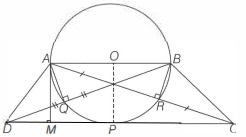
Let $ABCD$ be a trapezium with parallel sides $AB$ and $CD$ such that the circle $S$ with $AB$ as its diameter touches $CD$. Further,the circle $S$ passes through the mid-points of the diagonals $AC$ and $BD$ of the trapezium. The smallest angle of the trapezium is
A
$\frac{\pi}{3}$
B
$\frac{\pi}{4}$
C
$\frac{\pi}{5}$
D
$\frac{\pi}{6}$
Solution
(D) Let $O$ be the center of the circle $S$ with diameter $AB$. Let $P$ be the point of tangency on $CD$. Since $AB \parallel CD$,the radius $OP$ is perpendicular to $CD$. Let $R$ be the mid-point of $AC$. Since $R$ lies on the circle with diameter $AB$,$\angle ARB = 90^{\circ}$. In $\triangle ABC$,$BR$ is the median to $AC$ and $BR \perp AC$,so $\triangle ABC$ is isosceles with $AB = BC$. Similarly,if $Q$ is the mid-point of $BD$,$\angle AQB = 90^{\circ}$,implying $\triangle ABD$ is isosceles with $AB = AD$. Thus,$AB = BC = AD$. Let $AB = 2r$,so the radius of the circle is $r$. The height of the trapezium is $r$. In the right-angled triangle formed by dropping a perpendicular from $A$ to $CD$ at $M$,we have $AM = r$ and $AD = AB = 2r$. Thus,$\sin(\angle ADM) = \frac{AM}{AD} = \frac{r}{2r} = \frac{1}{2}$. Therefore,$\angle ADM = 30^{\circ} = \frac{\pi}{6}$. The angles of the trapezium are $\frac{\pi}{6}, \frac{\pi}{6}, \frac{5\pi}{6}, \frac{5\pi}{6}$. The smallest angle is $\frac{\pi}{6}$.
0 likesView Solution
52
MathematicsAdvancedMCQKVPY · 2017
Let $S$ be the set of all points $\left(\frac{a}{b}, \frac{c}{d}\right)$ on the circle with radius $1$ centered at $(0,0)$,where $a$ and $b$ are relatively prime integers,$c$ and $d$ are relatively prime integers (that is,$\operatorname{HCF}(a, b) = \operatorname{HCF}(c, d) = 1$),and the integers $b$ and $d$ are even. Then,the set $S$ is:
A
is empty
B
has four elements
C
has eight elements
D
is infinite
Solution
(A) The equation of the circle is $x^2 + y^2 = 1$. Since the point $\left(\frac{a}{b}, \frac{c}{d}\right)$ lies on the circle,we have $\frac{a^2}{b^2} + \frac{c^2}{d^2} = 1$,which implies $a^2 d^2 + c^2 b^2 = b^2 d^2$.
Given that $b$ and $d$ are even,let $b = 2k$ and $d = 2m$ for some integers $k, m$. Since $\operatorname{HCF}(a, b) = 1$,$a$ must be odd. Similarly,since $\operatorname{HCF}(c, d) = 1$,$c$ must be odd.
Substituting these into the equation: $a^2 (2m)^2 + c^2 (2k)^2 = (2k)^2 (2m)^2$,which simplifies to $4 a^2 m^2 + 4 c^2 k^2 = 16 k^2 m^2$.
Dividing by $4$,we get $a^2 m^2 + c^2 k^2 = 4 k^2 m^2$.
Since $a$ and $c$ are odd,$a^2$ and $c^2$ are odd. Thus,$a^2 m^2 + c^2 k^2$ is the sum of two terms. If $m$ and $k$ are both even,the equation is divisible by $4$,but the parity of the terms leads to a contradiction. If $m$ or $k$ are odd,the left side will be odd or have a different parity than the right side (which is a multiple of $4$).
Specifically,$a^2 m^2 + c^2 k^2 \equiv m^2 + k^2 \pmod{4}$ (since odd squares are $\equiv 1 \pmod{4}$). For the sum to be $0 \pmod{4}$,both $m$ and $k$ would have to be even,which contradicts the condition that $b$ and $d$ are in simplest form with $a, c$ odd. Thus,no such integers exist.
Therefore,the set $S$ is empty.
Given that $b$ and $d$ are even,let $b = 2k$ and $d = 2m$ for some integers $k, m$. Since $\operatorname{HCF}(a, b) = 1$,$a$ must be odd. Similarly,since $\operatorname{HCF}(c, d) = 1$,$c$ must be odd.
Substituting these into the equation: $a^2 (2m)^2 + c^2 (2k)^2 = (2k)^2 (2m)^2$,which simplifies to $4 a^2 m^2 + 4 c^2 k^2 = 16 k^2 m^2$.
Dividing by $4$,we get $a^2 m^2 + c^2 k^2 = 4 k^2 m^2$.
Since $a$ and $c$ are odd,$a^2$ and $c^2$ are odd. Thus,$a^2 m^2 + c^2 k^2$ is the sum of two terms. If $m$ and $k$ are both even,the equation is divisible by $4$,but the parity of the terms leads to a contradiction. If $m$ or $k$ are odd,the left side will be odd or have a different parity than the right side (which is a multiple of $4$).
Specifically,$a^2 m^2 + c^2 k^2 \equiv m^2 + k^2 \pmod{4}$ (since odd squares are $\equiv 1 \pmod{4}$). For the sum to be $0 \pmod{4}$,both $m$ and $k$ would have to be even,which contradicts the condition that $b$ and $d$ are in simplest form with $a, c$ odd. Thus,no such integers exist.
Therefore,the set $S$ is empty.
0 likesView Solution
53
MathematicsAdvancedMCQKVPY · 2017
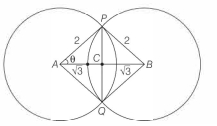
Suppose we have two circles of radius $2$ each in the plane such that the distance between their centers is $2 \sqrt{3}$. The area of the region common to both circles lies between
A
$0.5$ and $0.6$
B
$0.65$ and $0.7$
C
$0.7$ and $0.75$
D
$0.8$ and $0.9$
Solution
(C) Let the centers of the two circles be $A$ and $B$. The radius of each circle is $r = 2$. The distance between the centers is $AB = 2 \sqrt{3}$.
Let the circles intersect at points $P$ and $Q$. Let $C$ be the intersection of $AB$ and $PQ$. Since the circles are identical,$C$ is the midpoint of $AB$,so $AC = \frac{1}{2} AB = \sqrt{3}$.
In $\triangle APC$,$\cos \theta = \frac{AC}{AP} = \frac{\sqrt{3}}{2}$,which implies $\theta = 30^{\circ}$.
The angle subtended by the chord $PQ$ at the center $A$ is $2\theta = 60^{\circ} = \frac{\pi}{3}$ radians.
The area of the common region is twice the area of the circular segment of one circle cut by the chord $PQ$.
Area of one segment = (Area of sector $APQ$ - Area of $\triangle APQ$)
$= \frac{1}{2} r^2 (2\theta - \sin(2\theta)) = \frac{1}{2} (2)^2 (\frac{\pi}{3} - \sin 60^{\circ}) = 2 (\frac{\pi}{3} - \frac{\sqrt{3}}{2}) = \frac{2\pi}{3} - \sqrt{3}$.
Total common area $= 2 \times (\frac{2\pi}{3} - \sqrt{3}) = \frac{4\pi}{3} - 2\sqrt{3}$.
Using $\pi \approx 3.14159$ and $\sqrt{3} \approx 1.732$:
Area $\approx \frac{4 \times 3.14159}{3} - 2 \times 1.732 = 4.18879 - 3.464 = 0.72479$.
Thus,the area lies between $0.7$ and $0.75$.
Let the circles intersect at points $P$ and $Q$. Let $C$ be the intersection of $AB$ and $PQ$. Since the circles are identical,$C$ is the midpoint of $AB$,so $AC = \frac{1}{2} AB = \sqrt{3}$.
In $\triangle APC$,$\cos \theta = \frac{AC}{AP} = \frac{\sqrt{3}}{2}$,which implies $\theta = 30^{\circ}$.
The angle subtended by the chord $PQ$ at the center $A$ is $2\theta = 60^{\circ} = \frac{\pi}{3}$ radians.
The area of the common region is twice the area of the circular segment of one circle cut by the chord $PQ$.
Area of one segment = (Area of sector $APQ$ - Area of $\triangle APQ$)
$= \frac{1}{2} r^2 (2\theta - \sin(2\theta)) = \frac{1}{2} (2)^2 (\frac{\pi}{3} - \sin 60^{\circ}) = 2 (\frac{\pi}{3} - \frac{\sqrt{3}}{2}) = \frac{2\pi}{3} - \sqrt{3}$.
Total common area $= 2 \times (\frac{2\pi}{3} - \sqrt{3}) = \frac{4\pi}{3} - 2\sqrt{3}$.
Using $\pi \approx 3.14159$ and $\sqrt{3} \approx 1.732$:
Area $\approx \frac{4 \times 3.14159}{3} - 2 \times 1.732 = 4.18879 - 3.464 = 0.72479$.
Thus,the area lies between $0.7$ and $0.75$.
0 likesView Solution
54
MathematicsAdvancedMCQKVPY · 2017
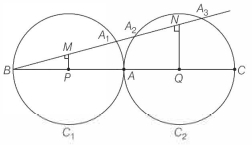
Let $C_1$ and $C_2$ be two circles touching each other externally at point $A$. Let $AB$ be the diameter of circle $C_1$. Draw a secant $BA_3$ to circle $C_2$,intersecting circle $C_1$ at point $A_1$ (where $A_1 \neq A$) and circle $C_2$ at points $A_2$ and $A_3$. If $BA_1 = 2$,$BA_2 = 3$,and $BA_3 = 4$,then the radii of circles $C_1$ and $C_2$ are respectively:
A
$\frac{\sqrt{30}}{5}, \frac{3 \sqrt{30}}{10}$
B
$\frac{\sqrt{5}}{2}, \frac{7 \sqrt{5}}{10}$
C
$\frac{\sqrt{6}}{2}, \frac{\sqrt{6}}{2}$
D
$\frac{\sqrt{10}}{3}, \frac{17 \sqrt{10}}{30}$
Solution
(A) Let $r_1$ and $r_2$ be the radii of circles $C_1$ and $C_2$ respectively. Since $AB$ is the diameter of $C_1$,$AB = 2r_1$. Since $C_1$ and $C_2$ touch externally at $A$,the line segment $BC$ passing through $A$ is the diameter of $C_2$,so $AC = 2r_2$.
By the Power of a Point theorem for point $B$ with respect to circle $C_2$:
$BA_2 \times BA_3 = BA \times BC = (2r_1) \times (2r_1 + 2r_2) = 4r_1(r_1 + r_2)$.
Given $BA_2 = 3$ and $BA_3 = 4$,we have $3 \times 4 = 4r_1(r_1 + r_2)$,which simplifies to $r_1^2 + r_1r_2 = 3$ (Equation $i$).
Let $M$ be the midpoint of chord $BA_1$ in $C_1$,so $BM = \frac{1}{2}BA_1 = 1$. Let $N$ be the midpoint of chord $A_2A_3$ in $C_2$,so $BN = BA_2 + \frac{1}{2}A_2A_3 = 3 + \frac{1}{2}(4-3) = 3.5 = \frac{7}{2}$.
Considering the perpendiculars from centers $P$ and $Q$ to the secant line,we have similar triangles $\triangle BMP \sim \triangle BNQ$.
Thus,$\frac{BM}{BN} = \frac{BP}{BQ} = \frac{r_1}{2r_1 + r_2}$.
Substituting values: $\frac{1}{7/2} = \frac{r_1}{2r_1 + r_2} \Rightarrow \frac{2}{7} = \frac{r_1}{2r_1 + r_2} \Rightarrow 4r_1 + 2r_2 = 7r_1 \Rightarrow 2r_2 = 3r_1$ (Equation $ii$).
Substituting $r_2 = 1.5r_1$ into Equation $i$: $r_1^2 + r_1(1.5r_1) = 3 \Rightarrow 2.5r_1^2 = 3 \Rightarrow r_1^2 = \frac{3}{2.5} = \frac{6}{5} \Rightarrow r_1 = \sqrt{\frac{6}{5}} = \frac{\sqrt{30}}{5}$.
Then $r_2 = 1.5 \times \frac{\sqrt{30}}{5} = \frac{3}{2} \times \frac{\sqrt{30}}{5} = \frac{3\sqrt{30}}{10}$.
Thus,the radii are $\frac{\sqrt{30}}{5}$ and $\frac{3\sqrt{30}}{10}$.
By the Power of a Point theorem for point $B$ with respect to circle $C_2$:
$BA_2 \times BA_3 = BA \times BC = (2r_1) \times (2r_1 + 2r_2) = 4r_1(r_1 + r_2)$.
Given $BA_2 = 3$ and $BA_3 = 4$,we have $3 \times 4 = 4r_1(r_1 + r_2)$,which simplifies to $r_1^2 + r_1r_2 = 3$ (Equation $i$).
Let $M$ be the midpoint of chord $BA_1$ in $C_1$,so $BM = \frac{1}{2}BA_1 = 1$. Let $N$ be the midpoint of chord $A_2A_3$ in $C_2$,so $BN = BA_2 + \frac{1}{2}A_2A_3 = 3 + \frac{1}{2}(4-3) = 3.5 = \frac{7}{2}$.
Considering the perpendiculars from centers $P$ and $Q$ to the secant line,we have similar triangles $\triangle BMP \sim \triangle BNQ$.
Thus,$\frac{BM}{BN} = \frac{BP}{BQ} = \frac{r_1}{2r_1 + r_2}$.
Substituting values: $\frac{1}{7/2} = \frac{r_1}{2r_1 + r_2} \Rightarrow \frac{2}{7} = \frac{r_1}{2r_1 + r_2} \Rightarrow 4r_1 + 2r_2 = 7r_1 \Rightarrow 2r_2 = 3r_1$ (Equation $ii$).
Substituting $r_2 = 1.5r_1$ into Equation $i$: $r_1^2 + r_1(1.5r_1) = 3 \Rightarrow 2.5r_1^2 = 3 \Rightarrow r_1^2 = \frac{3}{2.5} = \frac{6}{5} \Rightarrow r_1 = \sqrt{\frac{6}{5}} = \frac{\sqrt{30}}{5}$.
Then $r_2 = 1.5 \times \frac{\sqrt{30}}{5} = \frac{3}{2} \times \frac{\sqrt{30}}{5} = \frac{3\sqrt{30}}{10}$.
Thus,the radii are $\frac{\sqrt{30}}{5}$ and $\frac{3\sqrt{30}}{10}$.
0 likesView Solution
55
MathematicsAdvancedMCQKVPY · 2017
Let $a, b, c, d$ be real numbers between $-5$ and $5$ such that $|a|=\sqrt{4-\sqrt{5-a}}$,$|b|=\sqrt{4+\sqrt{5-b}}$,$|c|=\sqrt{4-\sqrt{5+c}}$,and $|d|=\sqrt{4+\sqrt{5+d}}$. Then,the product $abcd$ is
A
$11$
B
$-11$
C
$121$
D
$-121$
Solution
(A) Given equations are:
$|a|=\sqrt{4-\sqrt{5-a}}$
$|b|=\sqrt{4+\sqrt{5-b}}$
$|c|=\sqrt{4-\sqrt{5+c}}$
$|d|=\sqrt{4+\sqrt{5+d}}$
Squaring the first equation: $a^2 = 4 - \sqrt{5-a} \implies a^2 - 4 = -\sqrt{5-a}$.
Squaring again: $(a^2 - 4)^2 = 5 - a \implies a^4 - 8a^2 + 16 = 5 - a \implies a^4 - 8a^2 + a + 11 = 0$.
Similarly,for $b, c, d$,we observe that $a, b, -c, -d$ are the roots of the polynomial equation $x^4 - 8x^2 + x + 11 = 0$.
By Vieta's formulas,the product of the roots of $x^4 + 0x^3 - 8x^2 + x + 11 = 0$ is given by the constant term,which is $11$.
Thus,$a \cdot b \cdot (-c) \cdot (-d) = 11 \implies abcd = 11$.
$|a|=\sqrt{4-\sqrt{5-a}}$
$|b|=\sqrt{4+\sqrt{5-b}}$
$|c|=\sqrt{4-\sqrt{5+c}}$
$|d|=\sqrt{4+\sqrt{5+d}}$
Squaring the first equation: $a^2 = 4 - \sqrt{5-a} \implies a^2 - 4 = -\sqrt{5-a}$.
Squaring again: $(a^2 - 4)^2 = 5 - a \implies a^4 - 8a^2 + 16 = 5 - a \implies a^4 - 8a^2 + a + 11 = 0$.
Similarly,for $b, c, d$,we observe that $a, b, -c, -d$ are the roots of the polynomial equation $x^4 - 8x^2 + x + 11 = 0$.
By Vieta's formulas,the product of the roots of $x^4 + 0x^3 - 8x^2 + x + 11 = 0$ is given by the constant term,which is $11$.
Thus,$a \cdot b \cdot (-c) \cdot (-d) = 11 \implies abcd = 11$.
0 likesView Solution
56
MathematicsAdvancedMCQKVPY · 2017
$A$ quadrilateral has distinct integer side lengths. If the second-largest side has length $10$,then the maximum possible length of the largest side is
A
$25$
B
$26$
C
$27$
D
$28$
Solution
(B) Let the four distinct integer side lengths of the quadrilateral be $a, b, c,$ and $d$,where $a < b < c < d$.
Given that the second-largest side $c = 10$,we have $a < b < 10 < d$.
For the sides to be distinct integers,the largest possible values for $a$ and $b$ are $a = 8$ and $b = 9$.
According to the polygon inequality theorem,the sum of any three sides of a quadrilateral must be greater than the fourth side.
Thus,$a + b + c > d$.
Substituting the values,we get $8 + 9 + 10 > d$,which simplifies to $27 > d$.
Since $d$ must be an integer,the maximum possible value for $d$ is $26$.
Given that the second-largest side $c = 10$,we have $a < b < 10 < d$.
For the sides to be distinct integers,the largest possible values for $a$ and $b$ are $a = 8$ and $b = 9$.
According to the polygon inequality theorem,the sum of any three sides of a quadrilateral must be greater than the fourth side.
Thus,$a + b + c > d$.
Substituting the values,we get $8 + 9 + 10 > d$,which simplifies to $27 > d$.
Since $d$ must be an integer,the maximum possible value for $d$ is $26$.
0 likesView Solution
57
MathematicsAdvancedMCQKVPY · 2017
The largest power of $2$ that divides $\frac{200!}{100!}$ is
A
$98$
B
$99$
C
$100$
D
$101$
Solution
(C) To find the largest power of $2$ that divides $\frac{200!}{100!}$,we use Legendre's Formula,which states that the exponent of a prime $p$ in $n!$ is given by $E_p(n!) = \sum_{k=1}^{\infty} \lfloor \frac{n}{p^k} \rfloor$.
First,calculate the exponent of $2$ in $200!$:
$E_2(200!) = \lfloor \frac{200}{2} \rfloor + \lfloor \frac{200}{4} \rfloor + \lfloor \frac{200}{8} \rfloor + \lfloor \frac{200}{16} \rfloor + \lfloor \frac{200}{32} \rfloor + \lfloor \frac{200}{64} \rfloor + \lfloor \frac{200}{128} \rfloor$
$= 100 + 50 + 25 + 12 + 6 + 3 + 1 = 197$.
Next,calculate the exponent of $2$ in $100!$:
$E_2(100!) = \lfloor \frac{100}{2} \rfloor + \lfloor \frac{100}{4} \rfloor + \lfloor \frac{100}{8} \rfloor + \lfloor \frac{100}{16} \rfloor + \lfloor \frac{100}{32} \rfloor + \lfloor \frac{100}{64} \rfloor$
$= 50 + 25 + 12 + 6 + 3 + 1 = 97$.
The exponent of $2$ in $\frac{200!}{100!}$ is $E_2(200!) - E_2(100!) = 197 - 97 = 100$.
Therefore,the largest power of $2$ is $100$.
First,calculate the exponent of $2$ in $200!$:
$E_2(200!) = \lfloor \frac{200}{2} \rfloor + \lfloor \frac{200}{4} \rfloor + \lfloor \frac{200}{8} \rfloor + \lfloor \frac{200}{16} \rfloor + \lfloor \frac{200}{32} \rfloor + \lfloor \frac{200}{64} \rfloor + \lfloor \frac{200}{128} \rfloor$
$= 100 + 50 + 25 + 12 + 6 + 3 + 1 = 197$.
Next,calculate the exponent of $2$ in $100!$:
$E_2(100!) = \lfloor \frac{100}{2} \rfloor + \lfloor \frac{100}{4} \rfloor + \lfloor \frac{100}{8} \rfloor + \lfloor \frac{100}{16} \rfloor + \lfloor \frac{100}{32} \rfloor + \lfloor \frac{100}{64} \rfloor$
$= 50 + 25 + 12 + 6 + 3 + 1 = 97$.
The exponent of $2$ in $\frac{200!}{100!}$ is $E_2(200!) - E_2(100!) = 197 - 97 = 100$.
Therefore,the largest power of $2$ is $100$.
0 likesView Solution
58
MathematicsAdvancedMCQKVPY · 2017
Let $a_1, a_2, a_3, a_4$ be real numbers such that $a_1+a_2+a_3+a_4=0$ and $a_1^2+a_2^2+a_3^2+a_4^2=1$. Then,the smallest possible value of the expression $(a_1-a_2)^2+(a_2-a_3)^2+(a_3-a_4)^2+(a_4-a_1)^2$ lies in the interval
A
$(0, 1.5)$
B
$(1.5, 2.5)$
C
$(2.5, 3)$
D
$(3, 3.5)$
Solution
(B) Let $S = (a_1-a_2)^2+(a_2-a_3)^2+(a_3-a_4)^2+(a_4-a_1)^2$.
Expanding the squares,we get $S = 2(a_1^2+a_2^2+a_3^2+a_4^2) - 2(a_1a_2+a_2a_3+a_3a_4+a_4a_1)$.
Given $a_1^2+a_2^2+a_3^2+a_4^2=1$,so $S = 2 - 2(a_1+a_3)(a_2+a_4)$.
Since $a_1+a_2+a_3+a_4=0$,we have $a_2+a_4 = -(a_1+a_3)$.
Let $x = a_1+a_3$,then $a_2+a_4 = -x$.
Thus,$S = 2 - 2(x)(-x) = 2 + 2x^2$.
To minimize $S$,we need to minimize $x^2$.
Since $a_1^2+a_2^2+a_3^2+a_4^2=1$,by Cauchy-Schwarz inequality,$(a_1+a_3)^2 \leq 2(a_1^2+a_3^2)$ and $(a_2+a_4)^2 \leq 2(a_2^2+a_4^2)$.
Summing these,$x^2 + (-x)^2 \leq 2(a_1^2+a_2^2+a_3^2+a_4^2) = 2$,so $2x^2 \leq 2$,which means $x^2 \leq 1$.
The minimum value of $x^2$ is $0$ (when $a_1+a_3=0$ and $a_2+a_4=0$).
If $x=0$,$S = 2 + 2(0) = 2$.
Since $2$ lies in the interval $(1.5, 2.5)$,the correct option is $B$.
Expanding the squares,we get $S = 2(a_1^2+a_2^2+a_3^2+a_4^2) - 2(a_1a_2+a_2a_3+a_3a_4+a_4a_1)$.
Given $a_1^2+a_2^2+a_3^2+a_4^2=1$,so $S = 2 - 2(a_1+a_3)(a_2+a_4)$.
Since $a_1+a_2+a_3+a_4=0$,we have $a_2+a_4 = -(a_1+a_3)$.
Let $x = a_1+a_3$,then $a_2+a_4 = -x$.
Thus,$S = 2 - 2(x)(-x) = 2 + 2x^2$.
To minimize $S$,we need to minimize $x^2$.
Since $a_1^2+a_2^2+a_3^2+a_4^2=1$,by Cauchy-Schwarz inequality,$(a_1+a_3)^2 \leq 2(a_1^2+a_3^2)$ and $(a_2+a_4)^2 \leq 2(a_2^2+a_4^2)$.
Summing these,$x^2 + (-x)^2 \leq 2(a_1^2+a_2^2+a_3^2+a_4^2) = 2$,so $2x^2 \leq 2$,which means $x^2 \leq 1$.
The minimum value of $x^2$ is $0$ (when $a_1+a_3=0$ and $a_2+a_4=0$).
If $x=0$,$S = 2 + 2(0) = 2$.
Since $2$ lies in the interval $(1.5, 2.5)$,the correct option is $B$.
0 likesView Solution
59
MathematicsAdvancedMCQKVPY · 2017
Let $S$ be the set of all ordered pairs $(x, y)$ of positive integers satisfying the condition $x^2 - y^2 = 12345678$. Then,
A
$S$ is an infinite set
B
$S$ is the empty set
C
$S$ has exactly one element
D
$S$ is a finite set and has at least two elements.
Solution
(B) Given the equation $x^2 - y^2 = 12345678$,where $x, y \in \mathbb{Z}^+$.
This can be factored as $(x - y)(x + y) = 12345678$.
Note that $(x - y)$ and $(x + y)$ must have the same parity because their sum $(x - y) + (x + y) = 2x$ is even.
If both $(x - y)$ and $(x + y)$ are even,then their product $(x - y)(x + y)$ must be divisible by $4$.
Checking the divisibility of $12345678$ by $4$: $78$ is not divisible by $4$,so $12345678$ is not divisible by $4$.
Since the product is not divisible by $4$,there are no integer solutions for $x$ and $y$.
Therefore,$S$ is the empty set.
This can be factored as $(x - y)(x + y) = 12345678$.
Note that $(x - y)$ and $(x + y)$ must have the same parity because their sum $(x - y) + (x + y) = 2x$ is even.
If both $(x - y)$ and $(x + y)$ are even,then their product $(x - y)(x + y)$ must be divisible by $4$.
Checking the divisibility of $12345678$ by $4$: $78$ is not divisible by $4$,so $12345678$ is not divisible by $4$.
Since the product is not divisible by $4$,there are no integer solutions for $x$ and $y$.
Therefore,$S$ is the empty set.
0 likesView Solution
60
MathematicsAdvancedMCQKVPY · 2017
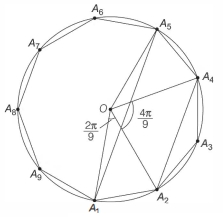
Let $A_1 A_2 A_3 \ldots A_9$ be a nine-sided regular polygon with side length $2$ units. The difference between the lengths of the diagonals $A_1 A_5$ and $A_2 A_4$ equals
A
$2+\sqrt{12}$
B
$\sqrt{12}-2$
C
$6$
D
$2$
Solution
(D) Let $O$ be the center of the circumcircle of the regular nonagon $A_1 A_2 \ldots A_9$. The side length is $s = 2$.
The central angle subtended by each side is $\theta = \frac{2\pi}{9}$.
Let $r$ be the circumradius. In $\triangle O A_1 A_2$,by the law of cosines:
$s^2 = r^2 + r^2 - 2r^2 \cos(\frac{2\pi}{9}) = 2r^2(1 - \cos(\frac{2\pi}{9})) = 4r^2 \sin^2(\frac{\pi}{9})$.
Since $s = 2$,we have $4 = 4r^2 \sin^2(\frac{\pi}{9})$,so $r = \frac{1}{\sin(\frac{\pi}{9})}$.
The length of a chord $A_i A_j$ subtending a central angle $\phi$ is $2r \sin(\frac{\phi}{2})$.
For $A_1 A_5$,the central angle is $4 \times \frac{2\pi}{9} = \frac{8\pi}{9}$,so $A_1 A_5 = 2r \sin(\frac{4\pi}{9})$.
For $A_2 A_4$,the central angle is $2 \times \frac{2\pi}{9} = \frac{4\pi}{9}$,so $A_2 A_4 = 2r \sin(\frac{2\pi}{9})$.
The difference is $A_1 A_5 - A_2 A_4 = 2r(\sin(\frac{4\pi}{9}) - \sin(\frac{2\pi}{9}))$.
Using the identity $\sin C - \sin D = 2 \sin(\frac{C-D}{2}) \cos(\frac{C+D}{2})$:
$A_1 A_5 - A_2 A_4 = 2r \cdot 2 \sin(\frac{\pi}{9}) \cos(\frac{3\pi}{9}) = 4r \sin(\frac{\pi}{9}) \cos(\frac{\pi}{3})$.
Substituting $r = \frac{1}{\sin(\frac{\pi}{9})}$ and $\cos(\frac{\pi}{3}) = \frac{1}{2}$:
$A_1 A_5 - A_2 A_4 = 4 \cdot \frac{1}{\sin(\frac{\pi}{9})} \cdot \sin(\frac{\pi}{9}) \cdot \frac{1}{2} = 2$.
The central angle subtended by each side is $\theta = \frac{2\pi}{9}$.
Let $r$ be the circumradius. In $\triangle O A_1 A_2$,by the law of cosines:
$s^2 = r^2 + r^2 - 2r^2 \cos(\frac{2\pi}{9}) = 2r^2(1 - \cos(\frac{2\pi}{9})) = 4r^2 \sin^2(\frac{\pi}{9})$.
Since $s = 2$,we have $4 = 4r^2 \sin^2(\frac{\pi}{9})$,so $r = \frac{1}{\sin(\frac{\pi}{9})}$.
The length of a chord $A_i A_j$ subtending a central angle $\phi$ is $2r \sin(\frac{\phi}{2})$.
For $A_1 A_5$,the central angle is $4 \times \frac{2\pi}{9} = \frac{8\pi}{9}$,so $A_1 A_5 = 2r \sin(\frac{4\pi}{9})$.
For $A_2 A_4$,the central angle is $2 \times \frac{2\pi}{9} = \frac{4\pi}{9}$,so $A_2 A_4 = 2r \sin(\frac{2\pi}{9})$.
The difference is $A_1 A_5 - A_2 A_4 = 2r(\sin(\frac{4\pi}{9}) - \sin(\frac{2\pi}{9}))$.
Using the identity $\sin C - \sin D = 2 \sin(\frac{C-D}{2}) \cos(\frac{C+D}{2})$:
$A_1 A_5 - A_2 A_4 = 2r \cdot 2 \sin(\frac{\pi}{9}) \cos(\frac{3\pi}{9}) = 4r \sin(\frac{\pi}{9}) \cos(\frac{\pi}{3})$.
Substituting $r = \frac{1}{\sin(\frac{\pi}{9})}$ and $\cos(\frac{\pi}{3}) = \frac{1}{2}$:
$A_1 A_5 - A_2 A_4 = 4 \cdot \frac{1}{\sin(\frac{\pi}{9})} \cdot \sin(\frac{\pi}{9}) \cdot \frac{1}{2} = 2$.
0 likesView Solution
61
MathematicsAdvancedMCQKVPY · 2017
Let $a_1, a_2, \ldots, a_n$ be $n$ non-zero real numbers,of which $p$ are positive and the remaining are negative. The number of ordered pairs $(j, k)$ with $j < k$ for which $a_j a_k$ is positive is $55$. Similarly,the number of ordered pairs $(j, k)$ with $j < k$ for which $a_j a_k$ is negative is $50$. Then,the value of $p^2 + (n-p)^2$ is
A
$629$
B
$325$
C
$125$
D
$221$
Solution
(C) Let $p$ be the number of positive real numbers and $(n-p)$ be the number of negative real numbers.
The product $a_j a_k$ is positive if both $a_j$ and $a_k$ have the same sign (both positive or both negative).
Thus,the number of pairs with a positive product is $\binom{p}{2} + \binom{n-p}{2} = 55$.
The product $a_j a_k$ is negative if one is positive and the other is negative.
Thus,the number of pairs with a negative product is $\binom{p}{1} \times \binom{n-p}{1} = p(n-p) = 50$.
Expanding the first equation:
$\frac{p(p-1)}{2} + \frac{(n-p)(n-p-1)}{2} = 55$
$p^2 - p + (n-p)^2 - (n-p) = 110$
$p^2 + (n-p)^2 - (p + n - p) = 110$
$p^2 + (n-p)^2 - n = 110$
We know that $(p + (n-p))^2 = p^2 + (n-p)^2 + 2p(n-p) = n^2$.
So,$p^2 + (n-p)^2 = n^2 - 2p(n-p) = n^2 - 2(50) = n^2 - 100$.
Substituting this into the expanded equation:
$(n^2 - 100) - n = 110$
$n^2 - n - 210 = 0$
$(n - 15)(n + 14) = 0$.
Since $n > 0$,we have $n = 15$.
Now,$p(15 - p) = 50$ $\Rightarrow p^2 - 15p + 50 = 0$ $\Rightarrow (p - 10)(p - 5) = 0$.
Thus,$p = 5$ or $p = 10$.
In either case,$p^2 + (n-p)^2 = 5^2 + 10^2 = 25 + 100 = 125$.
The product $a_j a_k$ is positive if both $a_j$ and $a_k$ have the same sign (both positive or both negative).
Thus,the number of pairs with a positive product is $\binom{p}{2} + \binom{n-p}{2} = 55$.
The product $a_j a_k$ is negative if one is positive and the other is negative.
Thus,the number of pairs with a negative product is $\binom{p}{1} \times \binom{n-p}{1} = p(n-p) = 50$.
Expanding the first equation:
$\frac{p(p-1)}{2} + \frac{(n-p)(n-p-1)}{2} = 55$
$p^2 - p + (n-p)^2 - (n-p) = 110$
$p^2 + (n-p)^2 - (p + n - p) = 110$
$p^2 + (n-p)^2 - n = 110$
We know that $(p + (n-p))^2 = p^2 + (n-p)^2 + 2p(n-p) = n^2$.
So,$p^2 + (n-p)^2 = n^2 - 2p(n-p) = n^2 - 2(50) = n^2 - 100$.
Substituting this into the expanded equation:
$(n^2 - 100) - n = 110$
$n^2 - n - 210 = 0$
$(n - 15)(n + 14) = 0$.
Since $n > 0$,we have $n = 15$.
Now,$p(15 - p) = 50$ $\Rightarrow p^2 - 15p + 50 = 0$ $\Rightarrow (p - 10)(p - 5) = 0$.
Thus,$p = 5$ or $p = 10$.
In either case,$p^2 + (n-p)^2 = 5^2 + 10^2 = 25 + 100 = 125$.
0 likesView Solution
62
MathematicsAdvancedMCQKVPY · 2017
If $a, b, c, d$ are four distinct numbers chosen from the set $\{1, 2, 3, \ldots, 9\}$,then the minimum value of $\frac{a}{b} + \frac{c}{d}$ is
A
$\frac{3}{8}$
B
$\frac{1}{3}$
C
$\frac{13}{36}$
D
$\frac{25}{72}$
Solution
(D) To minimize the sum $\frac{a}{b} + \frac{c}{d}$ where $a, b, c, d$ are distinct elements from $\{1, 2, 3, \ldots, 9\}$,we should choose the smallest possible values for the numerators $a$ and $c$ and the largest possible values for the denominators $b$ and $d$.
Let the set of values be $S = \{1, 2, 3, 4, 5, 6, 7, 8, 9\}$.
We choose $a=1, c=2$ (or vice versa) and $b=9, d=8$ (or vice versa).
Then,the sum is $\frac{1}{9} + \frac{2}{8} = \frac{1}{9} + \frac{1}{4} = \frac{4+9}{36} = \frac{13}{36}$.
Alternatively,if we choose $a=2, c=1$ and $b=9, d=8$,we get $\frac{2}{9} + \frac{1}{8} = \frac{16+9}{72} = \frac{25}{72}$.
Comparing the values,$\frac{13}{36} = \frac{26}{72}$,which is greater than $\frac{25}{72}$.
Thus,the minimum value is $\frac{25}{72}$.
Let the set of values be $S = \{1, 2, 3, 4, 5, 6, 7, 8, 9\}$.
We choose $a=1, c=2$ (or vice versa) and $b=9, d=8$ (or vice versa).
Then,the sum is $\frac{1}{9} + \frac{2}{8} = \frac{1}{9} + \frac{1}{4} = \frac{4+9}{36} = \frac{13}{36}$.
Alternatively,if we choose $a=2, c=1$ and $b=9, d=8$,we get $\frac{2}{9} + \frac{1}{8} = \frac{16+9}{72} = \frac{25}{72}$.
Comparing the values,$\frac{13}{36} = \frac{26}{72}$,which is greater than $\frac{25}{72}$.
Thus,the minimum value is $\frac{25}{72}$.
0 likesView Solution
63
MathematicsAdvancedMCQKVPY · 2017
If $72^x \cdot 48^y = 6^{xy}$,where $x$ and $y$ are non-zero rational numbers,then $x+y$ equals
A
$3$
B
$\frac{10}{3}$
C
$-3$
D
$-\frac{10}{3}$
Solution
(D) Given,$72^x \cdot 48^y = 6^{xy}$.
Expressing the bases as powers of $2$ and $3$:
$(2^3 \cdot 3^2)^x \cdot (2^4 \cdot 3^1)^y = 2^{xy} \cdot 3^{xy}$.
$2^{3x+4y} \cdot 3^{2x+y} = 2^{xy} \cdot 3^{xy}$.
Equating the exponents of $2$ and $3$ on both sides:
$3x + 4y = xy$ $(1)$
$2x + y = xy$ $(2)$
From $(1)$ and $(2)$,we have $3x + 4y = 2x + y$,which simplifies to $x = -3y$.
Substitute $x = -3y$ into equation $(2)$:
$2(-3y) + y = (-3y)y$
$-6y + y = -3y^2$
$-5y = -3y^2$.
Since $y \neq 0$,we can divide by $y$:
$-5 = -3y \implies y = \frac{5}{3}$.
Now,find $x$:
$x = -3 \left(\frac{5}{3}\right) = -5$.
Therefore,$x + y = -5 + \frac{5}{3} = \frac{-15 + 5}{3} = -\frac{10}{3}$.
Expressing the bases as powers of $2$ and $3$:
$(2^3 \cdot 3^2)^x \cdot (2^4 \cdot 3^1)^y = 2^{xy} \cdot 3^{xy}$.
$2^{3x+4y} \cdot 3^{2x+y} = 2^{xy} \cdot 3^{xy}$.
Equating the exponents of $2$ and $3$ on both sides:
$3x + 4y = xy$ $(1)$
$2x + y = xy$ $(2)$
From $(1)$ and $(2)$,we have $3x + 4y = 2x + y$,which simplifies to $x = -3y$.
Substitute $x = -3y$ into equation $(2)$:
$2(-3y) + y = (-3y)y$
$-6y + y = -3y^2$
$-5y = -3y^2$.
Since $y \neq 0$,we can divide by $y$:
$-5 = -3y \implies y = \frac{5}{3}$.
Now,find $x$:
$x = -3 \left(\frac{5}{3}\right) = -5$.
Therefore,$x + y = -5 + \frac{5}{3} = \frac{-15 + 5}{3} = -\frac{10}{3}$.
0 likesView Solution
64
MathematicsAdvancedMCQKVPY · 2017
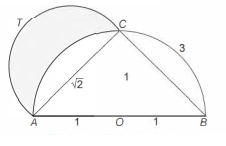
Let $AB$ be a line segment of length $2$. Construct a semicircle $S$ with $AB$ as diameter. Let $C$ be the mid-point of the arc $AB$. Construct another semicircle $T$ external to the $\triangle ABC$ with chord $AC$ as diameter. The area of the region inside the semicircle $T$ but outside $S$ is
A
$\frac{\pi}{2}$
B
$\frac{1}{2}$
C
$\frac{\pi}{\sqrt{2}}$
D
$\frac{1}{\sqrt{2}}$
Solution
(B) Let $O$ be the center of the semicircle $S$ with diameter $AB = 2$. Thus,the radius of $S$ is $r_S = 1$.
Since $C$ is the mid-point of the arc $AB$,$\triangle AOC$ is a right-angled isosceles triangle with $OA = OC = 1$ and $\angle AOC = 90^\circ$.
The length of the chord $AC$ is $\sqrt{OA^2 + OC^2} = \sqrt{1^2 + 1^2} = \sqrt{2}$.
Semicircle $T$ is constructed with $AC$ as diameter,so its radius is $r_T = \frac{\sqrt{2}}{2} = \frac{1}{\sqrt{2}}$.
The area of the region inside $T$ but outside $S$ is the area of the semicircle $T$ minus the area of the segment of $S$ cut off by chord $AC$.
Area of semicircle $T = \frac{1}{2} \pi r_T^2 = \frac{1}{2} \pi \left(\frac{1}{\sqrt{2}}\right)^2 = \frac{\pi}{4}$.
The area of the segment of $S$ cut off by chord $AC$ is (Area of sector $OAC$) - (Area of $\triangle OAC$).
Area of sector $OAC = \frac{90^\circ}{360^\circ} \pi (1)^2 = \frac{\pi}{4}$.
Area of $\triangle OAC = \frac{1}{2} \times 1 \times 1 = \frac{1}{2}$.
Area of segment = $\frac{\pi}{4} - \frac{1}{2}$.
Required Area = (Area of semicircle $T$) - (Area of segment) = $\frac{\pi}{4} - (\frac{\pi}{4} - \frac{1}{2}) = \frac{1}{2}$.
Since $C$ is the mid-point of the arc $AB$,$\triangle AOC$ is a right-angled isosceles triangle with $OA = OC = 1$ and $\angle AOC = 90^\circ$.
The length of the chord $AC$ is $\sqrt{OA^2 + OC^2} = \sqrt{1^2 + 1^2} = \sqrt{2}$.
Semicircle $T$ is constructed with $AC$ as diameter,so its radius is $r_T = \frac{\sqrt{2}}{2} = \frac{1}{\sqrt{2}}$.
The area of the region inside $T$ but outside $S$ is the area of the semicircle $T$ minus the area of the segment of $S$ cut off by chord $AC$.
Area of semicircle $T = \frac{1}{2} \pi r_T^2 = \frac{1}{2} \pi \left(\frac{1}{\sqrt{2}}\right)^2 = \frac{\pi}{4}$.
The area of the segment of $S$ cut off by chord $AC$ is (Area of sector $OAC$) - (Area of $\triangle OAC$).
Area of sector $OAC = \frac{90^\circ}{360^\circ} \pi (1)^2 = \frac{\pi}{4}$.
Area of $\triangle OAC = \frac{1}{2} \times 1 \times 1 = \frac{1}{2}$.
Area of segment = $\frac{\pi}{4} - \frac{1}{2}$.
Required Area = (Area of semicircle $T$) - (Area of segment) = $\frac{\pi}{4} - (\frac{\pi}{4} - \frac{1}{2}) = \frac{1}{2}$.
0 likesView Solution
65
MathematicsAdvancedMCQKVPY · 2017
Let $r(x)$ be the remainder when the polynomial $x^{135}+x^{125}-x^{115}+x^5+1$ is divided by $x^3-x$. Then,
A
$r(x)$ is the zero polynomial
B
$r(x)$ is a non-zero constant
C
degree of $r(x)$ is one
D
degree of $r(x)$ is two
Solution
(C) Let $p(x) = x^{135}+x^{125}-x^{115}+x^5+1$ and $q(x) = x^3-x = x(x-1)(x+1)$.
Since the divisor $q(x)$ is of degree $3$,the remainder $r(x)$ will be of the form $ax^2+bx+c$.
Thus,$p(x) = (x^3-x)k(x) + ax^2+bx+c$.
For $x=0$: $p(0) = 0+0-0+0+1 = 1$. So,$c = 1$.
For $x=1$: $p(1) = 1+1-1+1+1 = 3$. So,$a+b+c = 3 \Rightarrow a+b = 2$.
For $x=-1$: $p(-1) = (-1)^{135}+(-1)^{125}-(-1)^{115}+(-1)^5+1 = -1-1+1-1+1 = -1$. So,$a-b+c = -1 \Rightarrow a-b = -2$.
Adding the two equations: $2a = 0 \Rightarrow a = 0$.
Subtracting the two equations: $2b = 4 \Rightarrow b = 2$.
Therefore,$r(x) = 0x^2 + 2x + 1 = 2x+1$.
The degree of $r(x) = 2x+1$ is $1$.
Since the divisor $q(x)$ is of degree $3$,the remainder $r(x)$ will be of the form $ax^2+bx+c$.
Thus,$p(x) = (x^3-x)k(x) + ax^2+bx+c$.
For $x=0$: $p(0) = 0+0-0+0+1 = 1$. So,$c = 1$.
For $x=1$: $p(1) = 1+1-1+1+1 = 3$. So,$a+b+c = 3 \Rightarrow a+b = 2$.
For $x=-1$: $p(-1) = (-1)^{135}+(-1)^{125}-(-1)^{115}+(-1)^5+1 = -1-1+1-1+1 = -1$. So,$a-b+c = -1 \Rightarrow a-b = -2$.
Adding the two equations: $2a = 0 \Rightarrow a = 0$.
Subtracting the two equations: $2b = 4 \Rightarrow b = 2$.
Therefore,$r(x) = 0x^2 + 2x + 1 = 2x+1$.
The degree of $r(x) = 2x+1$ is $1$.
0 likesView Solution
66
MathematicsAdvancedMCQKVPY · 2017
It is given that the number $43361$ can be written as a product of $two$ distinct prime numbers $p_1$ and $p_2$. Further,assume that there are $42900$ numbers which are less than $43361$ and are coprime to it. Then,the value of $p_1+p_2$ is
A
$462$
B
$464$
C
$400$
D
$402$
Solution
(A) The number of integers less than $n$ and coprime to $n$ is given by Euler's totient function $\phi(n)$.
Given $n = p_1 \times p_2$,where $p_1$ and $p_2$ are distinct primes,the formula for $\phi(n)$ is $\phi(n) = (p_1-1)(p_2-1)$.
We are given $\phi(43361) = 42900$.
So,$(p_1-1)(p_2-1) = 42900$.
Expanding this,$p_1 p_2 - p_1 - p_2 + 1 = 42900$.
Since $p_1 p_2 = 43361$,we have $43361 - (p_1+p_2) + 1 = 42900$.
$43362 - (p_1+p_2) = 42900$.
$p_1+p_2 = 43362 - 42900 = 462$.
Thus,the sum of the two prime factors is $462$.
Given $n = p_1 \times p_2$,where $p_1$ and $p_2$ are distinct primes,the formula for $\phi(n)$ is $\phi(n) = (p_1-1)(p_2-1)$.
We are given $\phi(43361) = 42900$.
So,$(p_1-1)(p_2-1) = 42900$.
Expanding this,$p_1 p_2 - p_1 - p_2 + 1 = 42900$.
Since $p_1 p_2 = 43361$,we have $43361 - (p_1+p_2) + 1 = 42900$.
$43362 - (p_1+p_2) = 42900$.
$p_1+p_2 = 43362 - 42900 = 462$.
Thus,the sum of the two prime factors is $462$.
0 likesView Solution
67
MathematicsAdvancedMCQKVPY · 2017
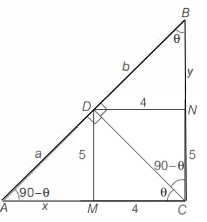
Let $ABC$ be a triangle with $\angle C=90^{\circ}$. Draw $CD$ perpendicular to $AB$. Choose points $M$ and $N$ on sides $AC$ and $BC$ respectively such that $DM$ is parallel to $BC$ and $DN$ is parallel to $AC$. If $DM=5$ and $DN=4$,then $AC$ and $BC$ are respectively equal to:
A
$\frac{41}{4}, \frac{41}{5}$
B
$\frac{39}{4}, \frac{39}{5}$
C
$\frac{38}{4}, \frac{38}{5}$
D
$\frac{37}{4}, \frac{37}{5}$
Solution
(A) Given,$ABC$ is a right-angled triangle with $\angle C=90^{\circ}$.
$CD \perp AB$,$DM \parallel BC$,and $DN \parallel AC$.
Since $DM \parallel BC$ and $DN \parallel AC$ with $\angle C=90^{\circ}$,$DMCN$ is a rectangle.
Thus,$MC = DN = 4$ and $NC = DM = 5$.
In $\triangle ADC$,$DM \perp AC$ is not true,but $DM \parallel BC$ implies $\triangle ADM \sim \triangle ACB$.
Thus,$\frac{DM}{BC} = \frac{AM}{AC} = \frac{AD}{AB}$.
Also,$\triangle CDN \sim \triangle ACB$ is not correct; rather $\triangle DNC \sim \triangle ABC$ is not correct,but $\triangle DNC \sim \triangle ACB$ is not correct. Let $\angle A = \alpha$,then $\angle B = 90^{\circ} - \alpha$.
In $\triangle ADM$,$\tan \alpha = \frac{DM}{AM} = \frac{5}{AM} \Rightarrow AM = 5 \cot \alpha$.
In $\triangle DNB$,$\tan B = \tan(90^{\circ}-\alpha) = \cot \alpha = \frac{DN}{NB} = \frac{4}{NB} \Rightarrow NB = 4 \tan \alpha$.
In $\triangle ABC$,$\tan \alpha = \frac{BC}{AC} = \frac{NC+NB}{AM+MC} = \frac{5+4 \tan \alpha}{5 \cot \alpha + 4}$.
Let $\tan \alpha = t$. Then $t = \frac{5+4t}{5/t + 4} = \frac{t(5+4t)}{5+4t} = t$. This is an identity.
Using $\triangle ADM \sim \triangle CDB$,$\frac{AM}{DM} = \frac{CD}{DB}$ and $\triangle DNC \sim \triangle ADC$,$\frac{NC}{DN} = \frac{AC}{CD}$.
Actually,$AC = AM + MC = AM + 4$ and $BC = BN + NC = BN + 5$.
From $\triangle ADM \sim \triangle CDB$,$\frac{AM}{5} = \frac{5}{BN} \Rightarrow AM \cdot BN = 25$.
Also $\frac{AM}{5} = \frac{5}{BN} \Rightarrow AM = \frac{25}{BN}$.
Since $\triangle ABC$ is right angled,$AC^2 + BC^2 = AB^2$. Using similar triangles,$AC = \frac{41}{4}$ and $BC = \frac{41}{5}$.
$CD \perp AB$,$DM \parallel BC$,and $DN \parallel AC$.
Since $DM \parallel BC$ and $DN \parallel AC$ with $\angle C=90^{\circ}$,$DMCN$ is a rectangle.
Thus,$MC = DN = 4$ and $NC = DM = 5$.
In $\triangle ADC$,$DM \perp AC$ is not true,but $DM \parallel BC$ implies $\triangle ADM \sim \triangle ACB$.
Thus,$\frac{DM}{BC} = \frac{AM}{AC} = \frac{AD}{AB}$.
Also,$\triangle CDN \sim \triangle ACB$ is not correct; rather $\triangle DNC \sim \triangle ABC$ is not correct,but $\triangle DNC \sim \triangle ACB$ is not correct. Let $\angle A = \alpha$,then $\angle B = 90^{\circ} - \alpha$.
In $\triangle ADM$,$\tan \alpha = \frac{DM}{AM} = \frac{5}{AM} \Rightarrow AM = 5 \cot \alpha$.
In $\triangle DNB$,$\tan B = \tan(90^{\circ}-\alpha) = \cot \alpha = \frac{DN}{NB} = \frac{4}{NB} \Rightarrow NB = 4 \tan \alpha$.
In $\triangle ABC$,$\tan \alpha = \frac{BC}{AC} = \frac{NC+NB}{AM+MC} = \frac{5+4 \tan \alpha}{5 \cot \alpha + 4}$.
Let $\tan \alpha = t$. Then $t = \frac{5+4t}{5/t + 4} = \frac{t(5+4t)}{5+4t} = t$. This is an identity.
Using $\triangle ADM \sim \triangle CDB$,$\frac{AM}{DM} = \frac{CD}{DB}$ and $\triangle DNC \sim \triangle ADC$,$\frac{NC}{DN} = \frac{AC}{CD}$.
Actually,$AC = AM + MC = AM + 4$ and $BC = BN + NC = BN + 5$.
From $\triangle ADM \sim \triangle CDB$,$\frac{AM}{5} = \frac{5}{BN} \Rightarrow AM \cdot BN = 25$.
Also $\frac{AM}{5} = \frac{5}{BN} \Rightarrow AM = \frac{25}{BN}$.
Since $\triangle ABC$ is right angled,$AC^2 + BC^2 = AB^2$. Using similar triangles,$AC = \frac{41}{4}$ and $BC = \frac{41}{5}$.
0 likesView Solution
68
MathematicsDifficultMCQKVPY · 2017
Let $A, G$ and $H$ be the arithmetic mean,geometric mean and harmonic mean,respectively,of two distinct positive real numbers. If $\alpha$ is the smallest of the two roots of the equation $A(G-H) x^2 + G(H-A) x + H(A-G) = 0$,then:
A
$-2 < \alpha < -1$
B
$0 < \alpha < 1$
C
$-1 < \alpha < 0$
D
$1 < \alpha < 2$
Solution
(B) Given that $A, G, H$ are the arithmetic,geometric,and harmonic means of two distinct positive real numbers,we know that $A > G > H > 0$ and $AH = G^2$.
The given quadratic equation is $A(G-H) x^2 + G(H-A) x + H(A-G) = 0$.
Let $f(x) = A(G-H) x^2 + G(H-A) x + H(A-G)$.
Evaluating $f(1) = A(G-H) + G(H-A) + H(A-G) = AG - AH + GH - GA + HA - HG = 0$.
Since $f(1) = 0$,$x = 1$ is one root of the equation.
Let the roots be $\alpha$ and $\beta = 1$. The product of the roots is given by $\alpha \cdot \beta = \frac{H(A-G)}{A(G-H)}$.
Since $\beta = 1$,we have $\alpha = \frac{H(A-G)}{A(G-H)}$.
Using $AH = G^2$,we substitute $H = \frac{G^2}{A}$:
$\alpha = \frac{\frac{G^2}{A}(A-G)}{A(G-\frac{G^2}{A})} = \frac{\frac{G^2}{A}(A-G)}{A(\frac{AG-G^2}{A})} = \frac{G^2(A-G)}{A(AG-G^2)} = \frac{G^2(A-G)}{AG(A-G)} = \frac{G}{A}$.
Since $A > G > 0$,it follows that $0 < \frac{G}{A} < 1$. Thus,$0 < \alpha < 1$.
The given quadratic equation is $A(G-H) x^2 + G(H-A) x + H(A-G) = 0$.
Let $f(x) = A(G-H) x^2 + G(H-A) x + H(A-G)$.
Evaluating $f(1) = A(G-H) + G(H-A) + H(A-G) = AG - AH + GH - GA + HA - HG = 0$.
Since $f(1) = 0$,$x = 1$ is one root of the equation.
Let the roots be $\alpha$ and $\beta = 1$. The product of the roots is given by $\alpha \cdot \beta = \frac{H(A-G)}{A(G-H)}$.
Since $\beta = 1$,we have $\alpha = \frac{H(A-G)}{A(G-H)}$.
Using $AH = G^2$,we substitute $H = \frac{G^2}{A}$:
$\alpha = \frac{\frac{G^2}{A}(A-G)}{A(G-\frac{G^2}{A})} = \frac{\frac{G^2}{A}(A-G)}{A(\frac{AG-G^2}{A})} = \frac{G^2(A-G)}{A(AG-G^2)} = \frac{G^2(A-G)}{AG(A-G)} = \frac{G}{A}$.
Since $A > G > 0$,it follows that $0 < \frac{G}{A} < 1$. Thus,$0 < \alpha < 1$.
0 likesView Solution
69
MathematicsAdvancedMCQKVPY · 2017
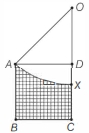
In the figure,$ABCD$ is a unit square. $A$ circle is drawn with centre $O$ on the extended line $CD$ and passing through $A$. If the diagonal $AC$ is tangent to the circle,then the area of the shaded region is
A
$\frac{9-\pi}{6}$
B
$\frac{8-\pi}{6}$
C
$\frac{7-\pi}{4}$
D
$\frac{6-\pi}{4}$
Solution
(D) Let the side of the square $ABCD$ be $1$. Thus,$AB = BC = CD = DA = 1$.
Since $O$ lies on the extension of $CD$,let $OD = x$. Then $OC = x + 1$.
In $\triangle OAC$,$AC$ is tangent to the circle at $A$,so $\angle OAC = 90^{\circ}$.
In $\triangle ADC$,$\angle DAC = 45^{\circ}$. Since $\angle OAC = 90^{\circ}$,$\angle OAD = 90^{\circ} - 45^{\circ} = 45^{\circ}$.
In $\triangle OAD$,$\tan(45^{\circ}) = \frac{OD}{AD} \implies 1 = \frac{x}{1} \implies x = 1$.
Thus,$OD = 1$ and the radius $R = OA = \sqrt{AD^2 + OD^2} = \sqrt{1^2 + 1^2} = \sqrt{2}$.
The shaded region consists of the square $ABCD$ minus the area of the circular sector $AXD$ (where $X$ is the intersection of the circle with $CD$).
Area of square $ABCD = 1^2 = 1$.
The sector $OAX$ has radius $R = \sqrt{2}$ and central angle $\angle AOX = 90^{\circ} - 45^{\circ} = 45^{\circ}$.
Area of sector $OAX = \frac{45}{360} \times \pi \times R^2 = \frac{1}{8} \times \pi \times 2 = \frac{\pi}{4}$.
Area of $\triangle OAD = \frac{1}{2} \times AD \times OD = \frac{1}{2} \times 1 \times 1 = 0.5$.
Area of shaded region = Area of square $ABCD$ - (Area of sector $OAX$ - Area of $\triangle OAD$) = $1 - (\frac{\pi}{4} - 0.5) = 1.5 - \frac{\pi}{4} = \frac{6-\pi}{4}$.
Since $O$ lies on the extension of $CD$,let $OD = x$. Then $OC = x + 1$.
In $\triangle OAC$,$AC$ is tangent to the circle at $A$,so $\angle OAC = 90^{\circ}$.
In $\triangle ADC$,$\angle DAC = 45^{\circ}$. Since $\angle OAC = 90^{\circ}$,$\angle OAD = 90^{\circ} - 45^{\circ} = 45^{\circ}$.
In $\triangle OAD$,$\tan(45^{\circ}) = \frac{OD}{AD} \implies 1 = \frac{x}{1} \implies x = 1$.
Thus,$OD = 1$ and the radius $R = OA = \sqrt{AD^2 + OD^2} = \sqrt{1^2 + 1^2} = \sqrt{2}$.
The shaded region consists of the square $ABCD$ minus the area of the circular sector $AXD$ (where $X$ is the intersection of the circle with $CD$).
Area of square $ABCD = 1^2 = 1$.
The sector $OAX$ has radius $R = \sqrt{2}$ and central angle $\angle AOX = 90^{\circ} - 45^{\circ} = 45^{\circ}$.
Area of sector $OAX = \frac{45}{360} \times \pi \times R^2 = \frac{1}{8} \times \pi \times 2 = \frac{\pi}{4}$.
Area of $\triangle OAD = \frac{1}{2} \times AD \times OD = \frac{1}{2} \times 1 \times 1 = 0.5$.
Area of shaded region = Area of square $ABCD$ - (Area of sector $OAX$ - Area of $\triangle OAD$) = $1 - (\frac{\pi}{4} - 0.5) = 1.5 - \frac{\pi}{4} = \frac{6-\pi}{4}$.
0 likesView Solution
70
MathematicsAdvancedMCQKVPY · 2017
The sum of all non-integer roots of the equation $x^5-6x^4+11x^3-5x^2-3x+2=0$ is
A
$6$
B
$-11$
C
$-5$
D
$3$
Solution
(D) Given the equation: $x^5-6x^4+11x^3-5x^2-3x+2=0$.
By testing integer roots using the Rational Root Theorem,we find that $x=1$ and $x=2$ are roots.
Dividing the polynomial by $(x-1)(x-2) = x^2-3x+2$,we get:
$(x-1)(x-2)(x^3-3x^2+1)=0$.
The non-integer roots are the roots of the cubic equation $x^3-3x^2+1=0$.
Let the roots of this cubic equation be $\alpha, \beta, \gamma$.
By Vieta's formulas,the sum of the roots is given by $-\frac{b}{a} = -\frac{-3}{1} = 3$.
Thus,the sum of all non-integer roots is $3$.
By testing integer roots using the Rational Root Theorem,we find that $x=1$ and $x=2$ are roots.
Dividing the polynomial by $(x-1)(x-2) = x^2-3x+2$,we get:
$(x-1)(x-2)(x^3-3x^2+1)=0$.
The non-integer roots are the roots of the cubic equation $x^3-3x^2+1=0$.
Let the roots of this cubic equation be $\alpha, \beta, \gamma$.
By Vieta's formulas,the sum of the roots is given by $-\frac{b}{a} = -\frac{-3}{1} = 3$.
Thus,the sum of all non-integer roots is $3$.
0 likesView Solution
71
MathematicsAdvancedMCQKVPY · 2017
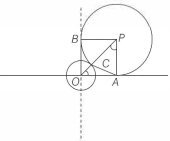
Let $S$ be the circle in the $XY$-plane which touches the $X$-axis at point $A$,the $Y$-axis at point $B$,and the unit circle $x^2+y^2=1$ at point $C$ externally. If $O$ denotes the origin,then the angle $\angle OCA$ equals:
A
$\frac{5\pi}{8}$
B
$\frac{\pi}{2}$
C
$\frac{3\pi}{4}$
D
$\frac{2\pi}{3}$
Solution
(A) Let $P$ be the center of circle $S$ and $r$ be its radius. Since it touches the $X$-axis at $A$ and $Y$-axis at $B$,the coordinates of $P$ are $(r, r)$.
The distance from the origin $O(0,0)$ to $P(r,r)$ is $OP = \sqrt{r^2+r^2} = r\sqrt{2}$.
Since the circle $S$ touches the unit circle $x^2+y^2=1$ externally at $C$,the distance between their centers is the sum of their radii: $OP = 1 + r$.
Equating the two expressions for $OP$: $r\sqrt{2} = 1 + r \Rightarrow r(\sqrt{2}-1) = 1 \Rightarrow r = \frac{1}{\sqrt{2}-1} = \sqrt{2}+1$.
In $\triangle OAP$,$OA = r$,$AP = r$,and $\angle OAP = 90^{\circ}$. Thus,$\triangle OAP$ is an isosceles right triangle,so $\angle AOP = \angle APO = 45^{\circ}$.
In $\triangle PCA$,$PC = r$ and $AC = r$ (radii of circle $S$). Thus,$\triangle PCA$ is an isosceles triangle with $\angle PCA = \angle PAC$.
The angle $\angle CPA = 180^{\circ} - 45^{\circ} = 135^{\circ}$ (since $O, C, P$ are collinear).
In $\triangle PCA$,$2\angle PCA + 135^{\circ} = 180^{\circ} \Rightarrow 2\angle PCA = 45^{\circ} \Rightarrow \angle PCA = 22.5^{\circ} = \frac{\pi}{8}$.
Finally,$\angle OCA = 180^{\circ} - \angle PCA = 180^{\circ} - 22.5^{\circ} = 157.5^{\circ} = \frac{5\pi}{8}$.
The distance from the origin $O(0,0)$ to $P(r,r)$ is $OP = \sqrt{r^2+r^2} = r\sqrt{2}$.
Since the circle $S$ touches the unit circle $x^2+y^2=1$ externally at $C$,the distance between their centers is the sum of their radii: $OP = 1 + r$.
Equating the two expressions for $OP$: $r\sqrt{2} = 1 + r \Rightarrow r(\sqrt{2}-1) = 1 \Rightarrow r = \frac{1}{\sqrt{2}-1} = \sqrt{2}+1$.
In $\triangle OAP$,$OA = r$,$AP = r$,and $\angle OAP = 90^{\circ}$. Thus,$\triangle OAP$ is an isosceles right triangle,so $\angle AOP = \angle APO = 45^{\circ}$.
In $\triangle PCA$,$PC = r$ and $AC = r$ (radii of circle $S$). Thus,$\triangle PCA$ is an isosceles triangle with $\angle PCA = \angle PAC$.
The angle $\angle CPA = 180^{\circ} - 45^{\circ} = 135^{\circ}$ (since $O, C, P$ are collinear).
In $\triangle PCA$,$2\angle PCA + 135^{\circ} = 180^{\circ} \Rightarrow 2\angle PCA = 45^{\circ} \Rightarrow \angle PCA = 22.5^{\circ} = \frac{\pi}{8}$.
Finally,$\angle OCA = 180^{\circ} - \angle PCA = 180^{\circ} - 22.5^{\circ} = 157.5^{\circ} = \frac{5\pi}{8}$.
0 likesView Solution
72
MathematicsAdvancedMCQKVPY · 2017
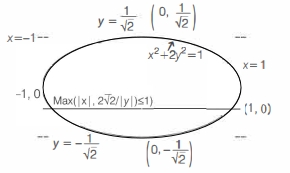
Let $A_1, A_2, A_3$ be regions in the $XY$-plane defined by:
$A_1 = \{(x, y) : x^2 + 2y^2 \leq 1\}$
$A_2 = \{(x, y) : |x|^3 + 2\sqrt{2}|y|^3 \leq 1\}$
$A_3 = \{(x, y) : \max(|x|, \sqrt{2}|y|) \leq 1\}$
Then,
$A_1 = \{(x, y) : x^2 + 2y^2 \leq 1\}$
$A_2 = \{(x, y) : |x|^3 + 2\sqrt{2}|y|^3 \leq 1\}$
$A_3 = \{(x, y) : \max(|x|, \sqrt{2}|y|) \leq 1\}$
Then,
A
$A_1 \supset A_2 \supset A_3$
B
$A_3 \supset A_1 \supset A_2$
C
$A_2 \supset A_3 \supset A_1$
D
$A_3 \supset A_2 \supset A_1$
Solution
(D) The regions are defined as:
$A_1: x^2 + 2y^2 \leq 1$ (an ellipse)
$A_2: |x|^3 + 2\sqrt{2}|y|^3 \leq 1$
$A_3: \max(|x|, \sqrt{2}|y|) \leq 1$ (a rectangle with vertices at $(\pm 1, \pm 1/\sqrt{2})$)
Let us test a point $(x, y)$ such that $|x| \leq 1$ and $\sqrt{2}|y| \leq 1$.
If $(x, y) \in A_3$,then $|x| \leq 1$ and $|y| \leq 1/\sqrt{2}$.
For $A_1$,we have $x^2 + 2y^2 \leq 1^2 + 2(1/\sqrt{2})^2 = 1 + 1 = 2$. This does not guarantee $A_3 \subset A_1$.
However,consider the boundary curves. The region $A_3$ is the rectangle $|x| \leq 1, |y| \leq 1/\sqrt{2}$.
The region $A_1$ is the ellipse $x^2 + 2y^2 \leq 1$.
The region $A_2$ is $|x|^3 + 2\sqrt{2}|y|^3 \leq 1$.
By comparing the growth of the powers,for $0 < |x|, |y| < 1$,we have $|x|^3 < |x|^2$ and $|y|^3 < |y|^2$.
Thus,$x^2 + 2y^2 \leq 1 \implies |x|^3 + 2\sqrt{2}|y|^3 \leq 1$ is not necessarily true,but checking the containment:
$A_1 \subset A_2 \subset A_3$ is the correct inclusion order,which means $A_3 \supset A_2 \supset A_1$.
Therefore,the correct option is $(d)$.
$A_1: x^2 + 2y^2 \leq 1$ (an ellipse)
$A_2: |x|^3 + 2\sqrt{2}|y|^3 \leq 1$
$A_3: \max(|x|, \sqrt{2}|y|) \leq 1$ (a rectangle with vertices at $(\pm 1, \pm 1/\sqrt{2})$)
Let us test a point $(x, y)$ such that $|x| \leq 1$ and $\sqrt{2}|y| \leq 1$.
If $(x, y) \in A_3$,then $|x| \leq 1$ and $|y| \leq 1/\sqrt{2}$.
For $A_1$,we have $x^2 + 2y^2 \leq 1^2 + 2(1/\sqrt{2})^2 = 1 + 1 = 2$. This does not guarantee $A_3 \subset A_1$.
However,consider the boundary curves. The region $A_3$ is the rectangle $|x| \leq 1, |y| \leq 1/\sqrt{2}$.
The region $A_1$ is the ellipse $x^2 + 2y^2 \leq 1$.
The region $A_2$ is $|x|^3 + 2\sqrt{2}|y|^3 \leq 1$.
By comparing the growth of the powers,for $0 < |x|, |y| < 1$,we have $|x|^3 < |x|^2$ and $|y|^3 < |y|^2$.
Thus,$x^2 + 2y^2 \leq 1 \implies |x|^3 + 2\sqrt{2}|y|^3 \leq 1$ is not necessarily true,but checking the containment:
$A_1 \subset A_2 \subset A_3$ is the correct inclusion order,which means $A_3 \supset A_2 \supset A_1$.
Therefore,the correct option is $(d)$.
0 likesView Solution
73
MathematicsAdvancedMCQKVPY · 2017
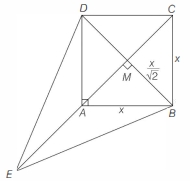
Let $ABCD$ be a square and $E$ be a point outside $ABCD$ such that $E, A, C$ are collinear in that order. Suppose $EB = ED = \sqrt{130}$ and the areas of $\triangle EAB$ and square $ABCD$ are equal. Then,the area of square $ABCD$ is
A
$8$
B
$10$
C
$\sqrt{120}$
D
$\sqrt{125}$
Solution
(B) Let the side length of the square $ABCD$ be $x$. The area of the square is $x^2$.
Let $M$ be the intersection of the diagonals $AC$ and $BD$. Since $ABCD$ is a square,the diagonals bisect each other at right angles,so $AM = MC = BM = MD = \frac{x}{\sqrt{2}}$.
Since $E, A, C$ are collinear,$EA$ lies on the diagonal $AC$. In $\triangle EBD$,$EB = ED = \sqrt{130}$ and $BD$ is the base. The altitude from $E$ to $BD$ is $EM$. Since $\triangle EBD$ is isosceles,$EM \perp BD$.
In $\triangle EBM$,by the Pythagorean theorem,$EM^2 + BM^2 = EB^2$.
$EM^2 + (\frac{x}{\sqrt{2}})^2 = 130$ $\Rightarrow EM^2 = 130 - \frac{x^2}{2}$ $\Rightarrow EM = \sqrt{130 - \frac{x^2}{2}}$.
The area of $\triangle EAB = \frac{1}{2} \times \text{base} \times \text{height} = \frac{1}{2} \times AB \times EA \times \sin(\angle EAB)$. Since $E, A, C$ are collinear,$\angle EAB = 135^\circ$. Thus,$\text{Area} = \frac{1}{2} x \cdot EA \cdot \sin(135^\circ) = \frac{1}{2} x \cdot EA \cdot \frac{1}{\sqrt{2}}$.
Alternatively,using the coordinates with $A$ at $(0,0)$,$B$ at $(x,0)$,$D$ at $(0,x)$,and $C$ at $(x,x)$,the line $AC$ is $y=x$. Point $E$ lies on $y=x$ with $x_E < 0$,so $E = (-a, -a)$.
$EB^2 = (x+a)^2 + a^2 = 130$ and $ED^2 = a^2 + (x+a)^2 = 130$. Area of $\triangle EAB = \frac{1}{2} |x_A(y_B-y_E) + x_B(y_E-y_A) + x_E(y_A-y_B)| = \frac{1}{2} |0 + x(-a-0) + (-a)(0-0)| = \frac{ax}{2}$.
Given $\frac{ax}{2} = x^2 \Rightarrow a = 2x$.
Substitute $a=2x$ into $EB^2 = (x+2x)^2 + (2x)^2 = 130$ $\Rightarrow 9x^2 + 4x^2 = 130$ $\Rightarrow 13x^2 = 130$ $\Rightarrow x^2 = 10$.
The area of the square is $x^2 = 10$.
Let $M$ be the intersection of the diagonals $AC$ and $BD$. Since $ABCD$ is a square,the diagonals bisect each other at right angles,so $AM = MC = BM = MD = \frac{x}{\sqrt{2}}$.
Since $E, A, C$ are collinear,$EA$ lies on the diagonal $AC$. In $\triangle EBD$,$EB = ED = \sqrt{130}$ and $BD$ is the base. The altitude from $E$ to $BD$ is $EM$. Since $\triangle EBD$ is isosceles,$EM \perp BD$.
In $\triangle EBM$,by the Pythagorean theorem,$EM^2 + BM^2 = EB^2$.
$EM^2 + (\frac{x}{\sqrt{2}})^2 = 130$ $\Rightarrow EM^2 = 130 - \frac{x^2}{2}$ $\Rightarrow EM = \sqrt{130 - \frac{x^2}{2}}$.
The area of $\triangle EAB = \frac{1}{2} \times \text{base} \times \text{height} = \frac{1}{2} \times AB \times EA \times \sin(\angle EAB)$. Since $E, A, C$ are collinear,$\angle EAB = 135^\circ$. Thus,$\text{Area} = \frac{1}{2} x \cdot EA \cdot \sin(135^\circ) = \frac{1}{2} x \cdot EA \cdot \frac{1}{\sqrt{2}}$.
Alternatively,using the coordinates with $A$ at $(0,0)$,$B$ at $(x,0)$,$D$ at $(0,x)$,and $C$ at $(x,x)$,the line $AC$ is $y=x$. Point $E$ lies on $y=x$ with $x_E < 0$,so $E = (-a, -a)$.
$EB^2 = (x+a)^2 + a^2 = 130$ and $ED^2 = a^2 + (x+a)^2 = 130$. Area of $\triangle EAB = \frac{1}{2} |x_A(y_B-y_E) + x_B(y_E-y_A) + x_E(y_A-y_B)| = \frac{1}{2} |0 + x(-a-0) + (-a)(0-0)| = \frac{ax}{2}$.
Given $\frac{ax}{2} = x^2 \Rightarrow a = 2x$.
Substitute $a=2x$ into $EB^2 = (x+2x)^2 + (2x)^2 = 130$ $\Rightarrow 9x^2 + 4x^2 = 130$ $\Rightarrow 13x^2 = 130$ $\Rightarrow x^2 = 10$.
The area of the square is $x^2 = 10$.
0 likesView Solution
74
MathematicsAdvancedMCQKVPY · 2017
Consider the set $A = \{1, 2, 3, \ldots, 30\}$. The number of ways in which one can choose three distinct numbers from $A$ such that the product of the chosen numbers is divisible by $9$ is:
A
$1590$
B
$1505$
C
$1110$
D
$1025$
Solution
(A) The set $A = \{1, 2, 3, \ldots, 30\}$ contains $30$ elements.
Multiples of $3$ in $A$ are $\{3, 6, 9, 12, 15, 18, 21, 24, 27, 30\}$ (total $10$ numbers).
Multiples of $9$ in $A$ are $\{9, 18, 27\}$ (total $3$ numbers).
Numbers in $A$ that are not multiples of $3$ are $30 - 10 = 20$ numbers.
Numbers in $A$ that are multiples of $3$ but not multiples of $9$ are $10 - 3 = 7$ numbers.
To make the product divisible by $9$,we consider the following cases:
Case $I$: All three numbers are multiples of $3$.
The number of ways is $^{10}C_3 = \frac{10 \times 9 \times 8}{3 \times 2 \times 1} = 120$.
Case $II$: Exactly two numbers are multiples of $3$ and one is not.
However,if we pick two multiples of $3$,their product is divisible by $9$ only if at least one of them is a multiple of $9$ $OR$ if both are multiples of $3$ (since $3 \times 3 = 9$).
Let $M_3$ be the set of multiples of $3$ $(|M_3|=10)$ and $N$ be the set of non-multiples of $3$ $(|N|=20)$.
Total ways to choose $3$ numbers such that the product is divisible by $9$ is (Total ways) - (Ways where product is $NOT$ divisible by $9$).
Product is $NOT$ divisible by $9$ if:
$1$. No number is a multiple of $3$: $^{20}C_3 = \frac{20 \times 19 \times 18}{6} = 1140$.
$2$. Exactly one number is a multiple of $3$ (but not $9$): $^{7}C_1 \times ^{20}C_2 = 7 \times 190 = 1330$.
Total ways to choose $3$ numbers = $^{30}C_3 = \frac{30 \times 29 \times 28}{6} = 4060$.
Ways divisible by $9 = 4060 - (1140 + 1330) = 4060 - 2470 = 1590$.
Multiples of $3$ in $A$ are $\{3, 6, 9, 12, 15, 18, 21, 24, 27, 30\}$ (total $10$ numbers).
Multiples of $9$ in $A$ are $\{9, 18, 27\}$ (total $3$ numbers).
Numbers in $A$ that are not multiples of $3$ are $30 - 10 = 20$ numbers.
Numbers in $A$ that are multiples of $3$ but not multiples of $9$ are $10 - 3 = 7$ numbers.
To make the product divisible by $9$,we consider the following cases:
Case $I$: All three numbers are multiples of $3$.
The number of ways is $^{10}C_3 = \frac{10 \times 9 \times 8}{3 \times 2 \times 1} = 120$.
Case $II$: Exactly two numbers are multiples of $3$ and one is not.
However,if we pick two multiples of $3$,their product is divisible by $9$ only if at least one of them is a multiple of $9$ $OR$ if both are multiples of $3$ (since $3 \times 3 = 9$).
Let $M_3$ be the set of multiples of $3$ $(|M_3|=10)$ and $N$ be the set of non-multiples of $3$ $(|N|=20)$.
Total ways to choose $3$ numbers such that the product is divisible by $9$ is (Total ways) - (Ways where product is $NOT$ divisible by $9$).
Product is $NOT$ divisible by $9$ if:
$1$. No number is a multiple of $3$: $^{20}C_3 = \frac{20 \times 19 \times 18}{6} = 1140$.
$2$. Exactly one number is a multiple of $3$ (but not $9$): $^{7}C_1 \times ^{20}C_2 = 7 \times 190 = 1330$.
Total ways to choose $3$ numbers = $^{30}C_3 = \frac{30 \times 29 \times 28}{6} = 4060$.
Ways divisible by $9 = 4060 - (1140 + 1330) = 4060 - 2470 = 1590$.
0 likesView Solution
Vedclass Products
For Students
Vedclass Test Series
Mock tests in real KVPY style covering Mathematics with performance analysis. 5-day free trial.
Start Free TrialFor Teachers
Exam Paper Generator
Generate Set A/B/C/D Mathematics papers from 7.5L+ questions in 2 minutes. 3 chapters free.
Try FreeFor Institutes
Online Exam Module
Run live KVPY mock exams with unlimited students, 360° analytics & white-label branding.
See DemoFrequently Asked Questions
How many Mathematics questions are in KVPY 2017?
There are 100 Mathematics questions from the KVPY 2017 paper on Vedclass, each with a detailed step-by-step solution in English.
Are KVPY 2017 Mathematics solutions available in English?
Yes. All solutions on this page are in English. You can also switch to English or Hindi using the language buttons above the questions.
Can I practice KVPY 2017 Mathematics as a timed test?
Yes. Use the Vedclass Test Series to attempt a full KVPY mock test covering Mathematics with time limits and instant score analysis.
Can teachers create Mathematics papers from KVPY previous year questions?
Yes. The Vedclass Exam Paper Generator lets teachers mix KVPY Mathematics questions and generate Set A/B/C/D papers in minutes.
For Teachers & Institutes
Build a Custom Mathematics Paper
Pick KVPY 2017 Mathematics questions, set difficulty, and generate Set A/B/C/D in 2 minutes.