
MathematicsQ1–37 of 37 questions
Page 1 of 1 · English
1
MathematicsDifficultMCQIIT JEE · 2014
$A$ circle $S$ passes through the point $(0,1)$ and is orthogonal to the circles $(x-1)^2+y^2=16$ and $x^2+y^2=1$. Then
$(A)$ radius of $S$ is $8$
$(B)$ radius of $S$ is $7$
$(C)$ centre of $S$ is $(-7,1)$
$(D)$ centre of $S$ is $(-8,1)$
$(A)$ radius of $S$ is $8$
$(B)$ radius of $S$ is $7$
$(C)$ centre of $S$ is $(-7,1)$
$(D)$ centre of $S$ is $(-8,1)$
A
$(B,D)$
B
$(B,C)$
C
$(A,C)$
D
$(A,D)$
Solution
(B) Let the circle be $x^2+y^2+2gx+2fy+c=0$ $\quad\quad(1)$
The given circles are:
$C_1: x^2+y^2-2x-15=0$ $\quad\quad(2)$
$C_2: x^2+y^2-1=0$ $\quad\quad(3)$
Since $(1)$ is orthogonal to $(2)$,we have $2g_1g_2 + 2f_1f_2 = c_1+c_2$. Here $g_1=g, f_1=f, c_1=c$ and for $(2)$,$g_2=-1, f_2=0, c_2=-15$:
$2(g)(-1) + 2(f)(0) = c-15 \Rightarrow -2g = c-15$ $\quad\quad(4)$
Since $(1)$ is orthogonal to $(3)$,where $g_3=0, f_3=0, c_3=-1$:
$2(g)(0) + 2(f)(0) = c-1 \Rightarrow c=1$
Substituting $c=1$ into $(4)$:
$-2g = 1-15 = -14 \Rightarrow g=7$
Since the circle passes through $(0,1)$:
$0^2+1^2+2g(0)+2f(1)+c=0$ $\Rightarrow 1+2f+1=0$ $\Rightarrow 2f=-2$ $\Rightarrow f=-1$
The circle equation is $x^2+y^2+14x-2y+1=0$.
Centre is $(-g, -f) = (-7, 1)$.
Radius is $\sqrt{g^2+f^2-c} = \sqrt{7^2+(-1)^2-1} = \sqrt{49+1-1} = \sqrt{49} = 7$.
Thus,$(B)$ and $(C)$ are correct.
The given circles are:
$C_1: x^2+y^2-2x-15=0$ $\quad\quad(2)$
$C_2: x^2+y^2-1=0$ $\quad\quad(3)$
Since $(1)$ is orthogonal to $(2)$,we have $2g_1g_2 + 2f_1f_2 = c_1+c_2$. Here $g_1=g, f_1=f, c_1=c$ and for $(2)$,$g_2=-1, f_2=0, c_2=-15$:
$2(g)(-1) + 2(f)(0) = c-15 \Rightarrow -2g = c-15$ $\quad\quad(4)$
Since $(1)$ is orthogonal to $(3)$,where $g_3=0, f_3=0, c_3=-1$:
$2(g)(0) + 2(f)(0) = c-1 \Rightarrow c=1$
Substituting $c=1$ into $(4)$:
$-2g = 1-15 = -14 \Rightarrow g=7$
Since the circle passes through $(0,1)$:
$0^2+1^2+2g(0)+2f(1)+c=0$ $\Rightarrow 1+2f+1=0$ $\Rightarrow 2f=-2$ $\Rightarrow f=-1$
The circle equation is $x^2+y^2+14x-2y+1=0$.
Centre is $(-g, -f) = (-7, 1)$.
Radius is $\sqrt{g^2+f^2-c} = \sqrt{7^2+(-1)^2-1} = \sqrt{49+1-1} = \sqrt{49} = 7$.
Thus,$(B)$ and $(C)$ are correct.
0 likesView Solution
2
MathematicsAdvancedMCQIIT JEE · 2014
The largest value of the non-negative integer $a$ for which $\lim _{x \rightarrow 1}\left\{\frac{-a x+\sin (x-1)+a}{x+\sin (x-1)-1}\right\}^{\frac{1-x}{1-\sqrt{x}}}=\frac{1}{4}$ is
A
$0$
B
$1$
C
$2$
D
$3$
Solution
(A) Let $L = \lim _{x \rightarrow 1}\left\{\frac{-a x+\sin (x-1)+a}{x+\sin (x-1)-1}\right\}^{\frac{1-x}{1-\sqrt{x}}}$.
Since $\frac{1-x}{1-\sqrt{x}} = \frac{(1-\sqrt{x})(1+\sqrt{x})}{1-\sqrt{x}} = 1+\sqrt{x}$,the limit becomes $\lim _{x \rightarrow 1}\left\{\frac{-a(x-1)+\sin(x-1)}{(x-1)+\sin(x-1)}\right\}^{1+\sqrt{x}} = \frac{1}{4}$.
Let $x-1 = h$. As $x \rightarrow 1$,$h \rightarrow 0$. The expression becomes $\lim _{h \rightarrow 0}\left\{\frac{-ah+\sin h}{h+\sin h}\right\}^{1+\sqrt{1+h}} = \frac{1}{4}$.
Dividing numerator and denominator by $h$,we get $\lim _{h \rightarrow 0}\left\{\frac{-a+\frac{\sin h}{h}}{1+\frac{\sin h}{h}}\right\}^{1+\sqrt{1+h}} = \frac{1}{4}$.
Substituting $h=0$,we get $\left(\frac{-a+1}{1+1}\right)^{1+1} = \frac{1}{4}$,which simplifies to $\left(\frac{1-a}{2}\right)^2 = \frac{1}{4}$.
This implies $\frac{1-a}{2} = \frac{1}{2}$ or $\frac{1-a}{2} = -\frac{1}{2}$.
If $\frac{1-a}{2} = \frac{1}{2}$,then $1-a = 1$,so $a=0$.
If $\frac{1-a}{2} = -\frac{1}{2}$,then $1-a = -1$,so $a=2$.
For $a=2$,the base $\frac{-2h+\sin h}{h+\sin h} \approx \frac{-h}{2h} = -\frac{1}{2}$ as $h \rightarrow 0$. Since the base is negative,the power $1+\sqrt{1+h} \approx 2$ makes the result positive,but the limit of the base itself is negative,which is generally undefined in real-valued limits of the form $f(x)^{g(x)}$. Thus,$a=0$ is the valid non-negative integer.
Since $\frac{1-x}{1-\sqrt{x}} = \frac{(1-\sqrt{x})(1+\sqrt{x})}{1-\sqrt{x}} = 1+\sqrt{x}$,the limit becomes $\lim _{x \rightarrow 1}\left\{\frac{-a(x-1)+\sin(x-1)}{(x-1)+\sin(x-1)}\right\}^{1+\sqrt{x}} = \frac{1}{4}$.
Let $x-1 = h$. As $x \rightarrow 1$,$h \rightarrow 0$. The expression becomes $\lim _{h \rightarrow 0}\left\{\frac{-ah+\sin h}{h+\sin h}\right\}^{1+\sqrt{1+h}} = \frac{1}{4}$.
Dividing numerator and denominator by $h$,we get $\lim _{h \rightarrow 0}\left\{\frac{-a+\frac{\sin h}{h}}{1+\frac{\sin h}{h}}\right\}^{1+\sqrt{1+h}} = \frac{1}{4}$.
Substituting $h=0$,we get $\left(\frac{-a+1}{1+1}\right)^{1+1} = \frac{1}{4}$,which simplifies to $\left(\frac{1-a}{2}\right)^2 = \frac{1}{4}$.
This implies $\frac{1-a}{2} = \frac{1}{2}$ or $\frac{1-a}{2} = -\frac{1}{2}$.
If $\frac{1-a}{2} = \frac{1}{2}$,then $1-a = 1$,so $a=0$.
If $\frac{1-a}{2} = -\frac{1}{2}$,then $1-a = -1$,so $a=2$.
For $a=2$,the base $\frac{-2h+\sin h}{h+\sin h} \approx \frac{-h}{2h} = -\frac{1}{2}$ as $h \rightarrow 0$. Since the base is negative,the power $1+\sqrt{1+h} \approx 2$ makes the result positive,but the limit of the base itself is negative,which is generally undefined in real-valued limits of the form $f(x)^{g(x)}$. Thus,$a=0$ is the valid non-negative integer.
0 likesView Solution
3
MathematicsAdvancedMCQIIT JEE · 2014
For a point $P(x, y)$ in the plane,let $d_1(P)$ and $d_2(P)$ be the distances of the point $P$ from the lines $x-y=0$ and $x+y=0$ respectively. The area of the region $R$ consisting of all points $P$ lying in the first quadrant of the plane and satisfying $2 \leq d_1(P)+d_2(P) \leq 4$ is:
A
$4$
B
$5$
C
$6$
D
$7$
Solution
(C) Let $P(x, y)$ be a point in the first quadrant,so $x > 0$ and $y > 0$.
The distances are $d_1(P) = \frac{|x-y|}{\sqrt{2}}$ and $d_2(P) = \frac{|x+y|}{\sqrt{2}}$.
The given condition is $2 \leq \frac{|x-y|}{\sqrt{2}} + \frac{|x+y|}{\sqrt{2}} \leq 4$,which simplifies to $2\sqrt{2} \leq |x-y| + |x+y| \leq 4\sqrt{2}$.
Case $1$: $x \geq y$. Then $|x-y| + |x+y| = (x-y) + (x+y) = 2x$.
So,$2\sqrt{2} \leq 2x \leq 4\sqrt{2} \implies \sqrt{2} \leq x \leq 2\sqrt{2}$. Since $x \geq y > 0$,this region is a rectangle in the first quadrant.
Case $2$: $y > x$. Then $|x-y| + |x+y| = (y-x) + (x+y) = 2y$.
So,$2\sqrt{2} \leq 2y \leq 4\sqrt{2} \implies \sqrt{2} \leq y \leq 2\sqrt{2}$. Since $y > x > 0$,this region is also a rectangle.
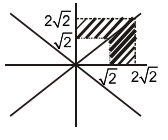
The region $R$ is the union of these two rectangles,which forms an $L$-shaped region.
The area is the difference between the area of a large square of side $2\sqrt{2}$ and a small square of side $\sqrt{2}$.
Area $= (2\sqrt{2})^2 - (\sqrt{2})^2 = 8 - 2 = 6$.
The distances are $d_1(P) = \frac{|x-y|}{\sqrt{2}}$ and $d_2(P) = \frac{|x+y|}{\sqrt{2}}$.
The given condition is $2 \leq \frac{|x-y|}{\sqrt{2}} + \frac{|x+y|}{\sqrt{2}} \leq 4$,which simplifies to $2\sqrt{2} \leq |x-y| + |x+y| \leq 4\sqrt{2}$.
Case $1$: $x \geq y$. Then $|x-y| + |x+y| = (x-y) + (x+y) = 2x$.
So,$2\sqrt{2} \leq 2x \leq 4\sqrt{2} \implies \sqrt{2} \leq x \leq 2\sqrt{2}$. Since $x \geq y > 0$,this region is a rectangle in the first quadrant.
Case $2$: $y > x$. Then $|x-y| + |x+y| = (y-x) + (x+y) = 2y$.
So,$2\sqrt{2} \leq 2y \leq 4\sqrt{2} \implies \sqrt{2} \leq y \leq 2\sqrt{2}$. Since $y > x > 0$,this region is also a rectangle.
The region $R$ is the union of these two rectangles,which forms an $L$-shaped region.
The area is the difference between the area of a large square of side $2\sqrt{2}$ and a small square of side $\sqrt{2}$.
Area $= (2\sqrt{2})^2 - (\sqrt{2})^2 = 8 - 2 = 6$.
0 likesView Solution
4
MathematicsAdvancedMCQIIT JEE · 2014
Let $n_1 < n_2 < n_3 < n_4 < n_5$ be positive integers such that $n_1+n_2+n_3+n_4+n_5=20$. Then the number of such distinct arrangements $(n_1, n_2, n_3, n_4, n_5)$ is
A
$4$
B
$5$
C
$6$
D
$7$
Solution
(D) We are given $n_1 < n_2 < n_3 < n_4 < n_5$ where $n_i \in \mathbb{Z}^+$ and $\sum_{i=1}^5 n_i = 20$.
Let $n_1 = a_1$,$n_2 = a_1 + a_2 + 1$,$n_3 = a_1 + a_2 + a_3 + 2$,$n_4 = a_1 + a_2 + a_3 + a_4 + 3$,$n_5 = a_1 + a_2 + a_3 + a_4 + a_5 + 4$,where $a_1 \geq 1$ and $a_2, a_3, a_4, a_5 \geq 0$.
Substituting these into the sum:
$5a_1 + 4a_2 + 3a_3 + 2a_4 + a_5 + 10 = 20 \implies 5a_1 + 4a_2 + 3a_3 + 2a_4 + a_5 = 10$.
Since $a_1 \geq 1$,let $a_1 = 1 + k$ where $k \geq 0$. Then $5(1+k) + 4a_2 + 3a_3 + 2a_4 + a_5 = 10 \implies 5k + 4a_2 + 3a_3 + 2a_4 + a_5 = 5$.
If $k=1$,then $a_2=a_3=a_4=a_5=0$,which gives $(n_1, n_2, n_3, n_4, n_5) = (2, 3, 4, 5, 6)$.
If $k=0$,then $4a_2 + 3a_3 + 2a_4 + a_5 = 5$. The possible non-negative integer solutions $(a_2, a_3, a_4, a_5)$ are:
$1$) $(1, 0, 0, 1) \implies (1, 3, 4, 5, 7)$
$2$) $(1, 0, 1, -1)$ (Invalid)
$3$) $(0, 1, 1, 0) \implies (1, 2, 4, 6, 7)$
$4$) $(0, 1, 0, 2) \implies (1, 2, 3, 6, 8)$
$5$) $(0, 0, 2, 1) \implies (1, 2, 3, 5, 9)$
$6$) $(0, 0, 1, 3) \implies (1, 2, 3, 4, 10)$
$7$) $(0, 0, 0, 5) \implies (1, 2, 3, 4, 10)$ (Wait,checking manually: $(1, 2, 4, 5, 8)$ is another solution).
Listing all valid partitions of $20$ into $5$ distinct parts: $(1, 2, 3, 4, 10), (1, 2, 3, 5, 9), (1, 2, 3, 6, 8), (1, 2, 4, 5, 8), (1, 2, 4, 6, 7), (1, 3, 4, 5, 7), (2, 3, 4, 5, 6)$.
There are exactly $7$ such arrangements.
Let $n_1 = a_1$,$n_2 = a_1 + a_2 + 1$,$n_3 = a_1 + a_2 + a_3 + 2$,$n_4 = a_1 + a_2 + a_3 + a_4 + 3$,$n_5 = a_1 + a_2 + a_3 + a_4 + a_5 + 4$,where $a_1 \geq 1$ and $a_2, a_3, a_4, a_5 \geq 0$.
Substituting these into the sum:
$5a_1 + 4a_2 + 3a_3 + 2a_4 + a_5 + 10 = 20 \implies 5a_1 + 4a_2 + 3a_3 + 2a_4 + a_5 = 10$.
Since $a_1 \geq 1$,let $a_1 = 1 + k$ where $k \geq 0$. Then $5(1+k) + 4a_2 + 3a_3 + 2a_4 + a_5 = 10 \implies 5k + 4a_2 + 3a_3 + 2a_4 + a_5 = 5$.
If $k=1$,then $a_2=a_3=a_4=a_5=0$,which gives $(n_1, n_2, n_3, n_4, n_5) = (2, 3, 4, 5, 6)$.
If $k=0$,then $4a_2 + 3a_3 + 2a_4 + a_5 = 5$. The possible non-negative integer solutions $(a_2, a_3, a_4, a_5)$ are:
$1$) $(1, 0, 0, 1) \implies (1, 3, 4, 5, 7)$
$2$) $(1, 0, 1, -1)$ (Invalid)
$3$) $(0, 1, 1, 0) \implies (1, 2, 4, 6, 7)$
$4$) $(0, 1, 0, 2) \implies (1, 2, 3, 6, 8)$
$5$) $(0, 0, 2, 1) \implies (1, 2, 3, 5, 9)$
$6$) $(0, 0, 1, 3) \implies (1, 2, 3, 4, 10)$
$7$) $(0, 0, 0, 5) \implies (1, 2, 3, 4, 10)$ (Wait,checking manually: $(1, 2, 4, 5, 8)$ is another solution).
Listing all valid partitions of $20$ into $5$ distinct parts: $(1, 2, 3, 4, 10), (1, 2, 3, 5, 9), (1, 2, 3, 6, 8), (1, 2, 4, 5, 8), (1, 2, 4, 6, 7), (1, 3, 4, 5, 7), (2, 3, 4, 5, 6)$.
There are exactly $7$ such arrangements.
0 likesView Solution
5
MathematicsMediumMCQIIT JEE · 2014
Let $a, b, c$ be positive integers such that $\frac{b}{a}$ is an integer. If $a, b, c$ are in geometric progression and the arithmetic mean of $a, b, c$ is $b+2$,then the value of $\frac{a^2+a-14}{a+1}$ is
A
$1$
B
$2$
C
$3$
D
$4$
Solution
(D) Given that $a, b, c$ are in geometric progression,let $b = ar$ and $c = ar^2$,where $r$ is an integer since $\frac{b}{a} = r$ is an integer.
The arithmetic mean of $a, b, c$ is given by $\frac{a+b+c}{3} = b+2$.
Substituting $b = ar$ and $c = ar^2$,we get $\frac{a + ar + ar^2}{3} = ar + 2$.
Multiplying by $3$,we have $a + ar + ar^2 = 3ar + 6$,which simplifies to $a + ar^2 = 2ar + 6$.
Rearranging the terms,we get $a(1 - 2r + r^2) = 6$,or $a(r-1)^2 = 6$.
Since $a$ and $r$ are integers,$(r-1)^2$ must be a factor of $6$. The perfect square factors of $6$ are $1$. Thus,$(r-1)^2 = 1$,which implies $r-1 = 1$ (since $r$ must be positive for $a, b, c$ to be positive integers),so $r = 2$.
Substituting $r = 2$ into $a(r-1)^2 = 6$,we get $a(1)^2 = 6$,so $a = 6$.
Now,we calculate the value of $\frac{a^2+a-14}{a+1}$ for $a = 6$:
$\frac{6^2 + 6 - 14}{6 + 1} = \frac{36 + 6 - 14}{7} = \frac{28}{7} = 4$.
The arithmetic mean of $a, b, c$ is given by $\frac{a+b+c}{3} = b+2$.
Substituting $b = ar$ and $c = ar^2$,we get $\frac{a + ar + ar^2}{3} = ar + 2$.
Multiplying by $3$,we have $a + ar + ar^2 = 3ar + 6$,which simplifies to $a + ar^2 = 2ar + 6$.
Rearranging the terms,we get $a(1 - 2r + r^2) = 6$,or $a(r-1)^2 = 6$.
Since $a$ and $r$ are integers,$(r-1)^2$ must be a factor of $6$. The perfect square factors of $6$ are $1$. Thus,$(r-1)^2 = 1$,which implies $r-1 = 1$ (since $r$ must be positive for $a, b, c$ to be positive integers),so $r = 2$.
Substituting $r = 2$ into $a(r-1)^2 = 6$,we get $a(1)^2 = 6$,so $a = 6$.
Now,we calculate the value of $\frac{a^2+a-14}{a+1}$ for $a = 6$:
$\frac{6^2 + 6 - 14}{6 + 1} = \frac{36 + 6 - 14}{7} = \frac{28}{7} = 4$.
0 likesView Solution
6
MathematicsAdvancedMCQIIT JEE · 2014
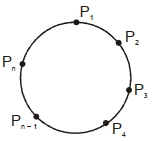
Let $n \geq 2$ be an integer. Take $n$ distinct points on a circle and join each pair of points by a line segment. Colour the line segment joining every pair of adjacent points blue and the rest red. If the number of red and blue line segments are equal,then the value of $n$ is
A
$3$
B
$4$
C
$5$
D
$6$
Solution
(C) The total number of line segments formed by joining $n$ points is given by $\binom{n}{2} = \frac{n(n-1)}{2}$.
The number of line segments joining adjacent points (which form the sides of an $n$-sided polygon) is $n$.
The number of line segments joining non-adjacent points (which are the diagonals of the polygon) is $\binom{n}{2} - n$.
According to the problem,the number of blue segments (adjacent) equals the number of red segments (non-adjacent):
$n = \binom{n}{2} - n$
$2n = \frac{n(n-1)}{2}$
$4n = n^2 - n$
$n^2 - 5n = 0$
$n(n - 5) = 0$
Since $n \geq 2$,we have $n = 5$.
The number of line segments joining adjacent points (which form the sides of an $n$-sided polygon) is $n$.
The number of line segments joining non-adjacent points (which are the diagonals of the polygon) is $\binom{n}{2} - n$.
According to the problem,the number of blue segments (adjacent) equals the number of red segments (non-adjacent):
$n = \binom{n}{2} - n$
$2n = \frac{n(n-1)}{2}$
$4n = n^2 - n$
$n^2 - 5n = 0$
$n(n - 5) = 0$
Since $n \geq 2$,we have $n = 5$.
0 likesView Solution
7
MathematicsDifficultMCQIIT JEE · 2014
The quadratic equation $p(x) = 0$ with real coefficients has purely imaginary roots. Then the equation $p(p(x)) = 0$ has
A
only purely imaginary roots
B
all real roots
C
two real and two purely imaginary roots
D
neither real nor purely imaginary roots
Solution
(D) Let $p(x) = ax^2 + c$ where $a, c \in \mathbb{R}$. Since the roots are purely imaginary,let them be $\pm i k$ $(k \neq 0)$.
Then $p(ik) = a(ik)^2 + c = -ak^2 + c = 0$,which implies $c = ak^2$.
Thus,$p(x) = a(x^2 + k^2)$.
Now,consider $p(p(x)) = 0$,which implies $p(x) = \pm ik$.
$a(x^2 + k^2) = ik$ or $a(x^2 + k^2) = -ik$.
$x^2 + k^2 = \pm \frac{ik}{a}$.
$x^2 = -k^2 \pm \frac{ik}{a}$.
Since $k^2$ is real and $\pm \frac{ik}{a}$ is purely imaginary,$x^2$ is a complex number with a non-zero imaginary part.
Therefore,$x$ cannot be purely real (as $x^2$ would be real) and $x$ cannot be purely imaginary (as $x^2$ would be real).
Thus,the roots are neither real nor purely imaginary. The correct option is $(D)$.
Then $p(ik) = a(ik)^2 + c = -ak^2 + c = 0$,which implies $c = ak^2$.
Thus,$p(x) = a(x^2 + k^2)$.
Now,consider $p(p(x)) = 0$,which implies $p(x) = \pm ik$.
$a(x^2 + k^2) = ik$ or $a(x^2 + k^2) = -ik$.
$x^2 + k^2 = \pm \frac{ik}{a}$.
$x^2 = -k^2 \pm \frac{ik}{a}$.
Since $k^2$ is real and $\pm \frac{ik}{a}$ is purely imaginary,$x^2$ is a complex number with a non-zero imaginary part.
Therefore,$x$ cannot be purely real (as $x^2$ would be real) and $x$ cannot be purely imaginary (as $x^2$ would be real).
Thus,the roots are neither real nor purely imaginary. The correct option is $(D)$.
0 likesView Solution
8
MathematicsAdvancedMCQIIT JEE · 2014
Three boys and two girls stand in a queue. The probability that the number of boys ahead of every girl is at least one more than the number of girls ahead of her is:
A
$\frac{1}{2}$
B
$\frac{1}{3}$
C
$\frac{2}{3}$
D
$\frac{3}{4}$
Solution
(A) Let $B$ represent a boy and $G$ represent a girl. There are $3$ boys and $2$ girls. The total number of ways to arrange $5$ people is $5! = 120$.
Let $b_i$ be the number of boys ahead of the $i$-th girl and $g_i$ be the number of girls ahead of the $i$-th girl. The condition is $b_i \ge g_i + 1$ for both girls.
Let the positions of the girls be $x_1$ and $x_2$ where $1 \le x_1 < x_2 \le 5$.
For the first girl at $x_1$,the number of boys ahead is $x_1 - 1$ and girls ahead is $0$. So,$x_1 - 1 \ge 0 + 1 \implies x_1 \ge 2$.
For the second girl at $x_2$,the number of boys ahead is $x_2 - 2$ and girls ahead is $1$. So,$x_2 - 2 \ge 1 + 1 \implies x_2 \ge 4$.
Possible positions $(x_1, x_2)$ are $(2, 4), (2, 5), (3, 4), (3, 5), (4, 5)$.
Checking the condition $b_i \ge g_i + 1$:
$1$. $(2, 4): b_1=1, g_1=0 (1 \ge 1); b_2=2, g_2=1 (2 \ge 2)$. Valid.
$2$. $(2, 5): b_1=1, g_1=0 (1 \ge 1); b_2=3, g_2=1 (3 \ge 2)$. Valid.
$3$. $(3, 4): b_1=2, g_1=0 (2 \ge 1); b_2=2, g_2=1 (2 \ge 2)$. Valid.
$4$. $(3, 5): b_1=2, g_1=0 (2 \ge 1); b_2=3, g_2=1 (3 \ge 2)$. Valid.
$5$. $(4, 5): b_1=3, g_1=0 (3 \ge 1); b_2=3, g_2=1 (3 \ge 2)$. Valid.
Total valid arrangements = $5 \times (3! \times 2!) = 5 \times 12 = 60$.
Probability = $\frac{60}{120} = \frac{1}{2}$.
Let $b_i$ be the number of boys ahead of the $i$-th girl and $g_i$ be the number of girls ahead of the $i$-th girl. The condition is $b_i \ge g_i + 1$ for both girls.
Let the positions of the girls be $x_1$ and $x_2$ where $1 \le x_1 < x_2 \le 5$.
For the first girl at $x_1$,the number of boys ahead is $x_1 - 1$ and girls ahead is $0$. So,$x_1 - 1 \ge 0 + 1 \implies x_1 \ge 2$.
For the second girl at $x_2$,the number of boys ahead is $x_2 - 2$ and girls ahead is $1$. So,$x_2 - 2 \ge 1 + 1 \implies x_2 \ge 4$.
Possible positions $(x_1, x_2)$ are $(2, 4), (2, 5), (3, 4), (3, 5), (4, 5)$.
Checking the condition $b_i \ge g_i + 1$:
$1$. $(2, 4): b_1=1, g_1=0 (1 \ge 1); b_2=2, g_2=1 (2 \ge 2)$. Valid.
$2$. $(2, 5): b_1=1, g_1=0 (1 \ge 1); b_2=3, g_2=1 (3 \ge 2)$. Valid.
$3$. $(3, 4): b_1=2, g_1=0 (2 \ge 1); b_2=2, g_2=1 (2 \ge 2)$. Valid.
$4$. $(3, 5): b_1=2, g_1=0 (2 \ge 1); b_2=3, g_2=1 (3 \ge 2)$. Valid.
$5$. $(4, 5): b_1=3, g_1=0 (3 \ge 1); b_2=3, g_2=1 (3 \ge 2)$. Valid.
Total valid arrangements = $5 \times (3! \times 2!) = 5 \times 12 = 60$.
Probability = $\frac{60}{120} = \frac{1}{2}$.
0 likesView Solution
9
MathematicsDifficultMCQIIT JEE · 2014
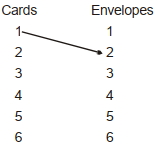
Six cards and six envelopes are numbered $1, 2, 3, 4, 5, 6$. Cards are to be placed in envelopes such that each envelope contains exactly one card,no card is placed in the envelope bearing the same number,and the card numbered $1$ is always placed in the envelope numbered $2$. The number of ways this can be done is:
A
$264$
B
$265$
C
$53$
D
$67$
Solution
(C) Let the cards be $C_1, C_2, C_3, C_4, C_5, C_6$ and envelopes be $E_1, E_2, E_3, E_4, E_5, E_6$.
Given $C_1$ is in $E_2$.
We need to place $C_2, C_3, C_4, C_5, C_6$ in $E_1, E_3, E_4, E_5, E_6$ such that $C_i$ is not in $E_i$ for $i \in \{2, 3, 4, 5, 6\}$.
Case $1$: $C_2$ is in $E_1$.
Then we need to place $C_3, C_4, C_5, C_6$ in $E_3, E_4, E_5, E_6$ such that no card $C_i$ is in $E_i$. This is a derangement of $4$ objects,$D_4 = 4!(\frac{1}{2!} - \frac{1}{3!} + \frac{1}{4!}) = 24(\frac{1}{2} - \frac{1}{6} + \frac{1}{24}) = 12 - 4 + 1 = 9$.
Case $2$: $C_2$ is not in $E_1$.
We have $5$ cards $C_2, C_3, C_4, C_5, C_6$ to be placed in $E_1, E_3, E_4, E_5, E_6$ such that $C_2 \neq E_1, C_3 \neq E_3, C_4 \neq E_4, C_5 \neq E_5, C_6 \neq E_6$. This is a derangement of $5$ objects,$D_5 = 5!(\frac{1}{2!} - \frac{1}{3!} + \frac{1}{4!} - \frac{1}{5!}) = 120(\frac{60-20+5-1}{120}) = 44$.
Total ways = $9 + 44 = 53$.
Given $C_1$ is in $E_2$.
We need to place $C_2, C_3, C_4, C_5, C_6$ in $E_1, E_3, E_4, E_5, E_6$ such that $C_i$ is not in $E_i$ for $i \in \{2, 3, 4, 5, 6\}$.
Case $1$: $C_2$ is in $E_1$.
Then we need to place $C_3, C_4, C_5, C_6$ in $E_3, E_4, E_5, E_6$ such that no card $C_i$ is in $E_i$. This is a derangement of $4$ objects,$D_4 = 4!(\frac{1}{2!} - \frac{1}{3!} + \frac{1}{4!}) = 24(\frac{1}{2} - \frac{1}{6} + \frac{1}{24}) = 12 - 4 + 1 = 9$.
Case $2$: $C_2$ is not in $E_1$.
We have $5$ cards $C_2, C_3, C_4, C_5, C_6$ to be placed in $E_1, E_3, E_4, E_5, E_6$ such that $C_2 \neq E_1, C_3 \neq E_3, C_4 \neq E_4, C_5 \neq E_5, C_6 \neq E_6$. This is a derangement of $5$ objects,$D_5 = 5!(\frac{1}{2!} - \frac{1}{3!} + \frac{1}{4!} - \frac{1}{5!}) = 120(\frac{60-20+5-1}{120}) = 44$.
Total ways = $9 + 44 = 53$.
0 likesView Solution
10
MathematicsAdvancedMCQIIT JEE · 2014
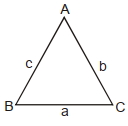
In a triangle,the sum of two sides is $x$ and the product of the same two sides is $y$. If $x^2 - c^2 = y$,where $c$ is the third side of the triangle,then the ratio of the in-radius to the circum-radius of the triangle is
A
$\frac{3 y}{2 x(x+c)}$
B
$\frac{3 y}{2 c(x+c)}$
C
$\frac{3 y}{4 x(x+c)}$
D
$\frac{3 y}{4 c(x+c)}$
Solution
(B) Let the two sides be $a$ and $b$. Given $a+b=x$ and $ab=y$.
Given $x^2-c^2=y$,substituting $x=a+b$ and $y=ab$,we get $(a+b)^2-c^2=ab$.
$a^2+b^2+2ab-c^2=ab \implies a^2+b^2-c^2=-ab$.
Using the cosine rule,$\cos C = \frac{a^2+b^2-c^2}{2ab} = \frac{-ab}{2ab} = -\frac{1}{2}$.
Thus,$C = 120^\circ$ or $\frac{2\pi}{3}$.
The ratio of in-radius $r$ to circum-radius $R$ is given by $\frac{r}{R} = 4 \sin\frac{A}{2} \sin\frac{B}{2} \sin\frac{C}{2}$.
Alternatively,$\frac{r}{R} = \frac{\Delta/s}{abc/4\Delta} = \frac{4\Delta^2}{sabc} = \frac{4 \cdot (\frac{1}{2}ab \sin C)^2}{(\frac{a+b+c}{2})abc} = \frac{a^2b^2 \sin^2(120^\circ)}{(\frac{x+c}{2})abc} = \frac{y^2 \cdot (\frac{\sqrt{3}}{2})^2}{(\frac{x+c}{2})abc} = \frac{3y^2}{2(x+c)abc}$.
Since $ab=y$,this simplifies to $\frac{3y}{2c(x+c)}$.
Wait,re-evaluating: $\frac{r}{R} = \frac{4\Delta^2}{sabc} = \frac{a^2b^2 \sin^2 C}{sabc} = \frac{y^2 \cdot (3/4)}{(\frac{x+c}{2})abc} = \frac{3y^2}{2(x+c)abc} = \frac{3y^2}{2(x+c)yc} = \frac{3y}{2c(x+c)}$.
Given $x^2-c^2=y$,substituting $x=a+b$ and $y=ab$,we get $(a+b)^2-c^2=ab$.
$a^2+b^2+2ab-c^2=ab \implies a^2+b^2-c^2=-ab$.
Using the cosine rule,$\cos C = \frac{a^2+b^2-c^2}{2ab} = \frac{-ab}{2ab} = -\frac{1}{2}$.
Thus,$C = 120^\circ$ or $\frac{2\pi}{3}$.
The ratio of in-radius $r$ to circum-radius $R$ is given by $\frac{r}{R} = 4 \sin\frac{A}{2} \sin\frac{B}{2} \sin\frac{C}{2}$.
Alternatively,$\frac{r}{R} = \frac{\Delta/s}{abc/4\Delta} = \frac{4\Delta^2}{sabc} = \frac{4 \cdot (\frac{1}{2}ab \sin C)^2}{(\frac{a+b+c}{2})abc} = \frac{a^2b^2 \sin^2(120^\circ)}{(\frac{x+c}{2})abc} = \frac{y^2 \cdot (\frac{\sqrt{3}}{2})^2}{(\frac{x+c}{2})abc} = \frac{3y^2}{2(x+c)abc}$.
Since $ab=y$,this simplifies to $\frac{3y}{2c(x+c)}$.
Wait,re-evaluating: $\frac{r}{R} = \frac{4\Delta^2}{sabc} = \frac{a^2b^2 \sin^2 C}{sabc} = \frac{y^2 \cdot (3/4)}{(\frac{x+c}{2})abc} = \frac{3y^2}{2(x+c)abc} = \frac{3y^2}{2(x+c)yc} = \frac{3y}{2c(x+c)}$.
0 likesView Solution
11
MathematicsMediumMCQIIT JEE · 2014
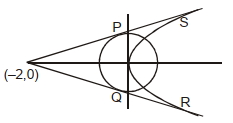
The common tangents to the circle $x^2+y^2=2$ and the parabola $y^2=8x$ touch the circle at the points $P, Q$ and the parabola at the points $R, S$. Then the area of the quadrilateral $PQRS$ is
A
$3$
B
$6$
C
$9$
D
$15$
Solution
(D) The equation of a tangent to the parabola $y^2=8x$ is $y=mx+\frac{2}{m}$.
For this to be a tangent to the circle $x^2+y^2=2$,the perpendicular distance from the center $(0,0)$ to the line $mx-y+\frac{2}{m}=0$ must be equal to the radius $\sqrt{2}$.
$\left|\frac{2/m}{\sqrt{m^2+1}}\right|=\sqrt{2}$ $\Rightarrow \frac{4}{m^2(m^2+1)}=2$ $\Rightarrow m^4+m^2-2=0$.
Let $m^2=t$,then $t^2+t-2=0 \Rightarrow (t+2)(t-1)=0$. Since $t=m^2 > 0$,we have $m^2=1$,so $m=\pm 1$.
The common tangents are $y=x+2$ and $y=-x-2$.
The points of contact $P, Q$ on the circle $x^2+y^2=2$ are found by the chord of contact formula $xx_1+yy_1=r^2$. For the tangent $x-y+2=0$,the point of contact is $(-1, 1)$. For $x+y+2=0$,it is $(-1, -1)$. Thus $P=(-1, 1)$ and $Q=(-1, -1)$.
The points of contact $R, S$ on the parabola $y^2=8x$ are found using $yy_1=4(x+x_1)$. For $y=x+2$,$y_1y=4(x+x_1)$ $\Rightarrow 1(y)=4(x+1)$ $\Rightarrow y=4x+4$. Comparing with $y=x+2$,we get $x=2, y=4$. For $y=-x-2$,we get $x=2, y=-4$. Thus $R=(2, 4)$ and $S=(2, -4)$.
The quadrilateral $PQRS$ is a trapezium with parallel sides $PQ$ and $RS$.
Length $PQ = |1 - (-1)| = 2$.
Length $RS = |4 - (-4)| = 8$.
Height $h = |2 - (-1)| = 3$.
Area $= \frac{1}{2}(PQ+RS) \times h = \frac{1}{2}(2+8) \times 3 = \frac{1}{2}(10) \times 3 = 15$.
For this to be a tangent to the circle $x^2+y^2=2$,the perpendicular distance from the center $(0,0)$ to the line $mx-y+\frac{2}{m}=0$ must be equal to the radius $\sqrt{2}$.
$\left|\frac{2/m}{\sqrt{m^2+1}}\right|=\sqrt{2}$ $\Rightarrow \frac{4}{m^2(m^2+1)}=2$ $\Rightarrow m^4+m^2-2=0$.
Let $m^2=t$,then $t^2+t-2=0 \Rightarrow (t+2)(t-1)=0$. Since $t=m^2 > 0$,we have $m^2=1$,so $m=\pm 1$.
The common tangents are $y=x+2$ and $y=-x-2$.
The points of contact $P, Q$ on the circle $x^2+y^2=2$ are found by the chord of contact formula $xx_1+yy_1=r^2$. For the tangent $x-y+2=0$,the point of contact is $(-1, 1)$. For $x+y+2=0$,it is $(-1, -1)$. Thus $P=(-1, 1)$ and $Q=(-1, -1)$.
The points of contact $R, S$ on the parabola $y^2=8x$ are found using $yy_1=4(x+x_1)$. For $y=x+2$,$y_1y=4(x+x_1)$ $\Rightarrow 1(y)=4(x+1)$ $\Rightarrow y=4x+4$. Comparing with $y=x+2$,we get $x=2, y=4$. For $y=-x-2$,we get $x=2, y=-4$. Thus $R=(2, 4)$ and $S=(2, -4)$.
The quadrilateral $PQRS$ is a trapezium with parallel sides $PQ$ and $RS$.
Length $PQ = |1 - (-1)| = 2$.
Length $RS = |4 - (-4)| = 8$.
Height $h = |2 - (-1)| = 3$.
Area $= \frac{1}{2}(PQ+RS) \times h = \frac{1}{2}(2+8) \times 3 = \frac{1}{2}(10) \times 3 = 15$.
0 likesView Solution
12
MathematicsAdvancedMCQIIT JEE · 2014
The coefficient of $x^{11}$ in the expansion of $(1+x^2)^4(1+x^3)^7(1+x^4)^{12}$ is:
A
$1051$
B
$1106$
C
$1113$
D
$1120$
Solution
(C) We need to find the coefficient of $x^{11}$ in the expansion of $(1+x^2)^4(1+x^3)^7(1+x^4)^{12}$.
This is equivalent to finding the number of non-negative integer solutions to $2a + 3b + 4c = 11$,where $0 \le a \le 4$,$0 \le b \le 7$,and $0 \le c \le 12$.
We list the possible combinations of $(a, b, c)$:
$1$. If $b=1$,then $2a + 4c = 11 - 3 = 8 \implies a + 2c = 4$. Possible $(a, c)$ are $(4, 0), (2, 1), (0, 2)$.
$2$. If $b=3$,then $2a + 4c = 11 - 9 = 2 \implies a + 2c = 1$. Possible $(a, c)$ is $(1, 0)$.
Now calculate the coefficients using the binomial theorem $\binom{n}{r}$:
- For $(a, b, c) = (4, 1, 0)$: $\binom{4}{4} \times \binom{7}{1} \times \binom{12}{0} = 1 \times 7 \times 1 = 7$.
- For $(a, b, c) = (2, 1, 1)$: $\binom{4}{2} \times \binom{7}{1} \times \binom{12}{1} = 6 \times 7 \times 12 = 504$.
- For $(a, b, c) = (0, 1, 2)$: $\binom{4}{0} \times \binom{7}{1} \times \binom{12}{2} = 1 \times 7 \times 66 = 462$.
- For $(a, b, c) = (1, 3, 0)$: $\binom{4}{1} \times \binom{7}{3} \times \binom{12}{0} = 4 \times 35 \times 1 = 140$.
Summing these values: $7 + 504 + 462 + 140 = 1113$.
This is equivalent to finding the number of non-negative integer solutions to $2a + 3b + 4c = 11$,where $0 \le a \le 4$,$0 \le b \le 7$,and $0 \le c \le 12$.
We list the possible combinations of $(a, b, c)$:
$1$. If $b=1$,then $2a + 4c = 11 - 3 = 8 \implies a + 2c = 4$. Possible $(a, c)$ are $(4, 0), (2, 1), (0, 2)$.
$2$. If $b=3$,then $2a + 4c = 11 - 9 = 2 \implies a + 2c = 1$. Possible $(a, c)$ is $(1, 0)$.
Now calculate the coefficients using the binomial theorem $\binom{n}{r}$:
- For $(a, b, c) = (4, 1, 0)$: $\binom{4}{4} \times \binom{7}{1} \times \binom{12}{0} = 1 \times 7 \times 1 = 7$.
- For $(a, b, c) = (2, 1, 1)$: $\binom{4}{2} \times \binom{7}{1} \times \binom{12}{1} = 6 \times 7 \times 12 = 504$.
- For $(a, b, c) = (0, 1, 2)$: $\binom{4}{0} \times \binom{7}{1} \times \binom{12}{2} = 1 \times 7 \times 66 = 462$.
- For $(a, b, c) = (1, 3, 0)$: $\binom{4}{1} \times \binom{7}{3} \times \binom{12}{0} = 4 \times 35 \times 1 = 140$.
Summing these values: $7 + 504 + 462 + 140 = 1113$.
0 likesView Solution
13
MathematicsDifficultMCQIIT JEE · 2014
For $x \in (0, \pi)$,the equation $\sin x + 2 \sin 2x - \sin 3x = 3$ has
A
infinitely many solutions
B
three solutions
C
one solution
D
no solution
Solution
(D) Given the equation: $\sin x + 2 \sin 2x - \sin 3x = 3$.
Using the identity $\sin 3x = 3 \sin x - 4 \sin^3 x$,we substitute:
$\sin x + 2(2 \sin x \cos x) - (3 \sin x - 4 \sin^3 x) = 3$.
$-2 \sin x + 4 \sin x \cos x + 4 \sin^3 x = 3$.
Since $\sin x \in (0, 1]$ for $x \in (0, \pi)$,we analyze the maximum value of the expression $f(x) = \sin x + 2 \sin 2x - \sin 3x$.
We know that $\sin x \leq 1$,$\sin 2x \leq 1$,and $-\sin 3x \leq 1$.
However,these cannot all be $1$ simultaneously for the same $x$.
Alternatively,consider the range of $f(x) = \sin x + 4 \sin x \cos x - 3 \sin x + 4 \sin^3 x = 4 \sin x \cos x + 4 \sin^3 x - 2 \sin x$.
$f(x) = 2 \sin x (2 \cos x + 2 \sin^2 x - 1) = 2 \sin x (2 \cos x + 2(1 - \cos^2 x) - 1) = 2 \sin x (-2 \cos^2 x + 2 \cos x + 1)$.
Let $u = \cos x$,where $u \in (-1, 1)$. The function $g(u) = 2 \sqrt{1-u^2} (-2u^2 + 2u + 1)$.
By checking the maximum value,it is found that $f(x) < 3$ for all $x \in (0, \pi)$.
Thus,there is no solution.
Using the identity $\sin 3x = 3 \sin x - 4 \sin^3 x$,we substitute:
$\sin x + 2(2 \sin x \cos x) - (3 \sin x - 4 \sin^3 x) = 3$.
$-2 \sin x + 4 \sin x \cos x + 4 \sin^3 x = 3$.
Since $\sin x \in (0, 1]$ for $x \in (0, \pi)$,we analyze the maximum value of the expression $f(x) = \sin x + 2 \sin 2x - \sin 3x$.
We know that $\sin x \leq 1$,$\sin 2x \leq 1$,and $-\sin 3x \leq 1$.
However,these cannot all be $1$ simultaneously for the same $x$.
Alternatively,consider the range of $f(x) = \sin x + 4 \sin x \cos x - 3 \sin x + 4 \sin^3 x = 4 \sin x \cos x + 4 \sin^3 x - 2 \sin x$.
$f(x) = 2 \sin x (2 \cos x + 2 \sin^2 x - 1) = 2 \sin x (2 \cos x + 2(1 - \cos^2 x) - 1) = 2 \sin x (-2 \cos^2 x + 2 \cos x + 1)$.
Let $u = \cos x$,where $u \in (-1, 1)$. The function $g(u) = 2 \sqrt{1-u^2} (-2u^2 + 2u + 1)$.
By checking the maximum value,it is found that $f(x) < 3$ for all $x \in (0, \pi)$.
Thus,there is no solution.
0 likesView Solution
14
MathematicsAdvancedMCQIIT JEE · 2014
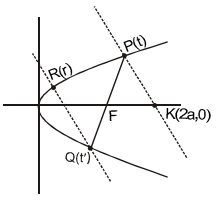
Let $a, r, s, t$ be nonzero real numbers. Let $P(at^2, 2at)$,$Q(at'^2, 2at')$,$R(ar^2, 2ar)$,and $S(as^2, 2as)$ be distinct points on the parabola $y^2=4ax$. Suppose that $PQ$ is the focal chord and lines $QR$ and $PK$ are parallel,where $K$ is the point $(2a, 0)$.
$1.$ The value of $r$ is
$(A) -\frac{1}{t}$ $(B) \frac{t^2+1}{t}$ $(C) \frac{1}{t}$ $(D) \frac{t^2-1}{t}$
$2.$ If $st=1$,then the tangent at $P$ and the normal at $S$ to the parabola meet at a point whose ordinate is
$(A) \frac{(t^2+1)^2}{2t^3}$ $(B) \frac{a(t^2+1)^2}{2t^3}$ $(C) \frac{a(t^2+1)^2}{t^3}$ $(D) \frac{a(t^2+2)^2}{t^3}$
Give the answer for question $1$ and $2$.
$1.$ The value of $r$ is
$(A) -\frac{1}{t}$ $(B) \frac{t^2+1}{t}$ $(C) \frac{1}{t}$ $(D) \frac{t^2-1}{t}$
$2.$ If $st=1$,then the tangent at $P$ and the normal at $S$ to the parabola meet at a point whose ordinate is
$(A) \frac{(t^2+1)^2}{2t^3}$ $(B) \frac{a(t^2+1)^2}{2t^3}$ $(C) \frac{a(t^2+1)^2}{t^3}$ $(D) \frac{a(t^2+2)^2}{t^3}$
Give the answer for question $1$ and $2$.
A
$(D, B)$
B
$(A, D)$
C
$(B, D)$
D
$(B, C)$
Solution
(D,B) $1.$ Since $PQ$ is a focal chord,$t \cdot t' = -1$,so $t' = -\frac{1}{t}$.
The slope of $PK$ is $m_{PK} = \frac{2at - 0}{at^2 - 2a} = \frac{2at}{a(t^2-2)} = \frac{2t}{t^2-2}$.
The slope of $QR$ is $m_{QR} = \frac{2ar - 2at'}{ar^2 - at'^2} = \frac{2a(r-t')}{a(r-t')(r+t')} = \frac{2}{r+t'}$.
Since $QR \parallel PK$,$m_{QR} = m_{PK} \implies \frac{2}{r+t'} = \frac{2t}{t^2-2}$.
$r+t' = \frac{t^2-2}{t} = t - \frac{2}{t}$.
Substituting $t' = -\frac{1}{t}$,we get $r - \frac{1}{t} = t - \frac{2}{t} \implies r = t - \frac{1}{t} = \frac{t^2-1}{t}$.
Thus,the correct option for $1$ is $(D)$.
$2.$ The tangent at $P(at^2, 2at)$ is $ty = x + at^2$.
The normal at $S(as^2, 2as)$ is $y = -sx + 2as + as^3$,or $y + sx = 2as + as^3$.
Given $st = 1$,so $s = \frac{1}{t}$.
The normal equation becomes $y + \frac{1}{t}x = 2a(\frac{1}{t}) + a(\frac{1}{t^3}) = \frac{2at^2+a}{t^3}$.
$ty + x = \frac{2at^2+a}{t^2}$.
We have the system:
$ty - x = at^2$
$ty + x = \frac{2at^2+a}{t^2}$
Adding the two equations: $2ty = at^2 + \frac{2at^2+a}{t^2} = \frac{at^4 + 2at^2 + a}{t^2} = \frac{a(t^2+1)^2}{t^2}$.
$y = \frac{a(t^2+1)^2}{2t^3}$.
Thus,the correct option for $2$ is $(B)$.
The slope of $PK$ is $m_{PK} = \frac{2at - 0}{at^2 - 2a} = \frac{2at}{a(t^2-2)} = \frac{2t}{t^2-2}$.
The slope of $QR$ is $m_{QR} = \frac{2ar - 2at'}{ar^2 - at'^2} = \frac{2a(r-t')}{a(r-t')(r+t')} = \frac{2}{r+t'}$.
Since $QR \parallel PK$,$m_{QR} = m_{PK} \implies \frac{2}{r+t'} = \frac{2t}{t^2-2}$.
$r+t' = \frac{t^2-2}{t} = t - \frac{2}{t}$.
Substituting $t' = -\frac{1}{t}$,we get $r - \frac{1}{t} = t - \frac{2}{t} \implies r = t - \frac{1}{t} = \frac{t^2-1}{t}$.
Thus,the correct option for $1$ is $(D)$.
$2.$ The tangent at $P(at^2, 2at)$ is $ty = x + at^2$.
The normal at $S(as^2, 2as)$ is $y = -sx + 2as + as^3$,or $y + sx = 2as + as^3$.
Given $st = 1$,so $s = \frac{1}{t}$.
The normal equation becomes $y + \frac{1}{t}x = 2a(\frac{1}{t}) + a(\frac{1}{t^3}) = \frac{2at^2+a}{t^3}$.
$ty + x = \frac{2at^2+a}{t^2}$.
We have the system:
$ty - x = at^2$
$ty + x = \frac{2at^2+a}{t^2}$
Adding the two equations: $2ty = at^2 + \frac{2at^2+a}{t^2} = \frac{at^4 + 2at^2 + a}{t^2} = \frac{a(t^2+1)^2}{t^2}$.
$y = \frac{a(t^2+1)^2}{2t^3}$.
Thus,the correct option for $2$ is $(B)$.
0 likesView Solution
15
MathematicsAdvancedMCQIIT JEE · 2014
Let $z_k = \cos \left(\frac{2k\pi}{10}\right) + i \sin \left(\frac{2k\pi}{10}\right); k = 1, 2, \ldots, 9$.
Codes: $P \quad Q \quad R \quad S$
| List-$I$ | List-$II$ |
| $P.$ For each $z_k$ there exists a $z_j$ such that $z_k \cdot z_j = 1$ | $1.$ True |
| $Q.$ There exists a $k \in \{1, 2, \ldots, 9\}$ such that $z_1 \cdot z = z_k$ has no solution $z$ in the set of complex numbers. | $2.$ False |
| $R.$ $\frac{|1-z_1||1-z_2| \ldots |1-z_9|}{10}$ equals | $3.$ $1$ |
| $S.$ $1 - \sum_{k=1}^9 \cos \left(\frac{2k\pi}{10}\right)$ equals | $4.$ $2$ |
Codes: $P \quad Q \quad R \quad S$
A
$1 \quad 2 \quad 4 \quad 3$
B
$2 \quad 1 \quad 3 \quad 4$
C
$1 \quad 2 \quad 3 \quad 4$
D
$2 \quad 1 \quad 4 \quad 3$
Solution
(C) $(P)$ Since $z_k = e^{i(2k\pi/10)}$,we have $z_k \cdot z_j = e^{i(2(k+j)\pi/10)} = 1$ if $k+j = 10$. For any $k \in \{1, \ldots, 9\}$,we can choose $j = 10-k \in \{1, \ldots, 9\}$. Thus,the statement is True $(1)$.
$(Q)$ The equation $z_1 \cdot z = z_k$ is a linear equation in complex numbers,which always has a solution $z = z_k / z_1$. Thus,the statement is False $(2)$.
$(R)$ The values $z_1, z_2, \ldots, z_9$ are the roots of $\frac{z^{10}-1}{z-1} = 0$. Thus,$z^{10}-1 = (z-1)(z-z_1)(z-z_2)\ldots(z-z_9)$. Dividing by $(z-1)$,we get $1+z+z^2+\ldots+z^9 = (z-z_1)(z-z_2)\ldots(z-z_9)$. Setting $z=1$,we get $10 = (1-z_1)(1-z_2)\ldots(1-z_9)$. Taking the modulus,$|1-z_1||1-z_2|\ldots|1-z_9| = 10$. Thus,the expression equals $10/10 = 1$ $(3)$.
$(S)$ The sum of all roots of $z^{10}-1=0$ is $1 + z_1 + z_2 + \ldots + z_9 = 0$. Thus,$\sum_{k=1}^9 z_k = -1$. Taking the real part,$\sum_{k=1}^9 \cos(2k\pi/10) = -1$. Then $1 - (-1) = 2$ $(4)$.
Therefore,the correct matching is $P-1, Q-2, R-3, S-4$.
$(Q)$ The equation $z_1 \cdot z = z_k$ is a linear equation in complex numbers,which always has a solution $z = z_k / z_1$. Thus,the statement is False $(2)$.
$(R)$ The values $z_1, z_2, \ldots, z_9$ are the roots of $\frac{z^{10}-1}{z-1} = 0$. Thus,$z^{10}-1 = (z-1)(z-z_1)(z-z_2)\ldots(z-z_9)$. Dividing by $(z-1)$,we get $1+z+z^2+\ldots+z^9 = (z-z_1)(z-z_2)\ldots(z-z_9)$. Setting $z=1$,we get $10 = (1-z_1)(1-z_2)\ldots(1-z_9)$. Taking the modulus,$|1-z_1||1-z_2|\ldots|1-z_9| = 10$. Thus,the expression equals $10/10 = 1$ $(3)$.
$(S)$ The sum of all roots of $z^{10}-1=0$ is $1 + z_1 + z_2 + \ldots + z_9 = 0$. Thus,$\sum_{k=1}^9 z_k = -1$. Taking the real part,$\sum_{k=1}^9 \cos(2k\pi/10) = -1$. Then $1 - (-1) = 2$ $(4)$.
Therefore,the correct matching is $P-1, Q-2, R-3, S-4$.
0 likesView Solution
16
MathematicsAdvancedMCQIIT JEE · 2014
Let $f : [a, b] \rightarrow [1, \infty)$ be a continuous function and let $g : \mathbb{R} \rightarrow \mathbb{R}$ be defined as $g(x) = \begin{cases} 0 & \text{if } x < a \\ \int_a^x f(t) dt & \text{if } a \leq x \leq b \\ \int_a^b f(t) dt & \text{if } x > b \end{cases}$. Then:
A
$g(x)$ is continuous but not differentiable at $a$
B
$g(x)$ is differentiable on $\mathbb{R}$
C
$g(x)$ is continuous but not differentiable at $b$
D
$g(x)$ is continuous and differentiable at either $a$ or $b$ but not both
Solution
(C) First,we check the continuity of $g(x)$ at $x = a$ and $x = b$.
At $x = a$: $\lim_{x \rightarrow a^-} g(x) = 0$ and $\lim_{x \rightarrow a^+} g(x) = \int_a^a f(t) dt = 0$. Since $g(a) = 0$,$g(x)$ is continuous at $x = a$.
At $x = b$: $\lim_{x \rightarrow b^-} g(x) = \int_a^b f(t) dt$ and $\lim_{x \rightarrow b^+} g(x) = \int_a^b f(t) dt$. Since $g(b) = \int_a^b f(t) dt$,$g(x)$ is continuous at $x = b$.
Thus,$g(x)$ is continuous for all $x \in \mathbb{R}$.
Next,we check differentiability using $g'(x) = \begin{cases} 0 & x < a \\ f(x) & a < x < b \\ 0 & x > b \end{cases}$.
At $x = a$: $g'(a^-) = 0$ and $g'(a^+) = f(a)$. Since $f(a) \in [1, \infty)$,$f(a) \neq 0$,so $g'(a^-) \neq g'(a^+)$. Thus,$g(x)$ is not differentiable at $x = a$.
At $x = b$: $g'(b^-) = f(b)$ and $g'(b^+) = 0$. Since $f(b) \in [1, \infty)$,$f(b) \neq 0$,so $g'(b^-) \neq g'(b^+)$. Thus,$g(x)$ is not differentiable at $x = b$.
Therefore,$g(x)$ is continuous but not differentiable at $a$ and $b$.
At $x = a$: $\lim_{x \rightarrow a^-} g(x) = 0$ and $\lim_{x \rightarrow a^+} g(x) = \int_a^a f(t) dt = 0$. Since $g(a) = 0$,$g(x)$ is continuous at $x = a$.
At $x = b$: $\lim_{x \rightarrow b^-} g(x) = \int_a^b f(t) dt$ and $\lim_{x \rightarrow b^+} g(x) = \int_a^b f(t) dt$. Since $g(b) = \int_a^b f(t) dt$,$g(x)$ is continuous at $x = b$.
Thus,$g(x)$ is continuous for all $x \in \mathbb{R}$.
Next,we check differentiability using $g'(x) = \begin{cases} 0 & x < a \\ f(x) & a < x < b \\ 0 & x > b \end{cases}$.
At $x = a$: $g'(a^-) = 0$ and $g'(a^+) = f(a)$. Since $f(a) \in [1, \infty)$,$f(a) \neq 0$,so $g'(a^-) \neq g'(a^+)$. Thus,$g(x)$ is not differentiable at $x = a$.
At $x = b$: $g'(b^-) = f(b)$ and $g'(b^+) = 0$. Since $f(b) \in [1, \infty)$,$f(b) \neq 0$,so $g'(b^-) \neq g'(b^+)$. Thus,$g(x)$ is not differentiable at $x = b$.
Therefore,$g(x)$ is continuous but not differentiable at $a$ and $b$.
0 likesView Solution
17
MathematicsAdvancedMCQIIT JEE · 2014
For every pair of continuous functions $f, g: [0, 1] \rightarrow \mathbb{R}$ such that $\max \{f(x): x \in [0, 1] \} = \max \{g(x): x \in [0, 1] \} = \lambda$,the correct statement$(s)$ is (are):
A
$(B, D)$
B
$(B, C)$
C
$(A, C)$
D
$(A, D)$
Solution
(D) Let $\max \{f(x): x \in [0, 1] \} = \max \{g(x): x \in [0, 1] \} = \lambda$.
Since $f$ and $g$ are continuous on $[0, 1]$,there exist $a, b \in [0, 1]$ such that $f(a) = \lambda$ and $g(b) = \lambda$.
Define $h(x) = f(x) - g(x)$.
Then $h(a) = f(a) - g(a) = \lambda - g(a) \ge 0$ and $h(b) = f(b) - g(b) = f(b) - \lambda \le 0$.
By the Intermediate Value Theorem,there exists $c \in [0, 1]$ such that $h(c) = 0$,which implies $f(c) = g(c)$.
For option $(A)$: $(f(c))^2 + 3f(c) = (g(c))^2 + 3g(c)$. Since $f(c) = g(c)$,this holds true.
For option $(D)$: $(f(c))^2 = (g(c))^2$. Since $f(c) = g(c)$,this holds true.
For options $(B)$ and $(C)$,consider $f(x) = g(x) = \lambda$ where $\lambda \neq 0$. Then $(B)$ becomes $\lambda^2 + \lambda = \lambda^2 + 3\lambda$,which implies $\lambda = 3\lambda$,or $\lambda = 0$,which contradicts $\lambda \neq 0$. Similarly for $(C)$.
Thus,$(A)$ and $(D)$ are correct.
Since $f$ and $g$ are continuous on $[0, 1]$,there exist $a, b \in [0, 1]$ such that $f(a) = \lambda$ and $g(b) = \lambda$.
Define $h(x) = f(x) - g(x)$.
Then $h(a) = f(a) - g(a) = \lambda - g(a) \ge 0$ and $h(b) = f(b) - g(b) = f(b) - \lambda \le 0$.
By the Intermediate Value Theorem,there exists $c \in [0, 1]$ such that $h(c) = 0$,which implies $f(c) = g(c)$.
For option $(A)$: $(f(c))^2 + 3f(c) = (g(c))^2 + 3g(c)$. Since $f(c) = g(c)$,this holds true.
For option $(D)$: $(f(c))^2 = (g(c))^2$. Since $f(c) = g(c)$,this holds true.
For options $(B)$ and $(C)$,consider $f(x) = g(x) = \lambda$ where $\lambda \neq 0$. Then $(B)$ becomes $\lambda^2 + \lambda = \lambda^2 + 3\lambda$,which implies $\lambda = 3\lambda$,or $\lambda = 0$,which contradicts $\lambda \neq 0$. Similarly for $(C)$.
Thus,$(A)$ and $(D)$ are correct.
0 likesView Solution
18
MathematicsMediumMCQIIT JEE · 2014
Let $M$ be a $2 \times 2$ symmetric matrix with integer entries. Then $M$ is invertible if
A
$(A, D)$
B
$(C, D)$
C
$(B, D)$
D
$(B, C)$
Solution
(B) Let $M = \begin{bmatrix} a & b \\ b & c \end{bmatrix}$ where $a, b, c \in \mathbb{Z}$.
$(A)$ The first column is $\begin{bmatrix} a \\ b \end{bmatrix}$ and the transpose of the second row is $\begin{bmatrix} b \\ c \end{bmatrix}$. If they are equal,then $a=b$ and $b=c$,so $a=b=c$. Then $M = \begin{bmatrix} a & a \\ a & a \end{bmatrix}$,which has determinant $|M| = a^2 - a^2 = 0$. Thus,$M$ is not invertible. $(A)$ is incorrect.
$(B)$ The second row is $[b, c]$ and the transpose of the first column is $\begin{bmatrix} a \\ b \end{bmatrix}$. If they are equal,then $b=a$ and $c=b$,so $a=b=c$. This leads to the same matrix as $(A)$,which is not invertible. $(B)$ is incorrect.
$(C)$ If $M$ is a diagonal matrix,$M = \begin{bmatrix} a & 0 \\ 0 & c \end{bmatrix}$. The determinant is $|M| = ac$. Since $a, c \neq 0$,$|M| \neq 0$. Thus,$M$ is invertible. $(C)$ is correct.
$(D)$ The determinant of $M$ is $|M| = ac - b^2$. For $M$ to be invertible,$|M| \neq 0$,which means $ac - b^2 \neq 0$,or $ac \neq b^2$. Since $b$ is an integer,$b^2$ is a perfect square. Thus,if $ac$ is not a perfect square of an integer,then $ac \neq b^2$ is guaranteed. $(D)$ is correct.
Therefore,$(C, D)$ are correct.
$(A)$ The first column is $\begin{bmatrix} a \\ b \end{bmatrix}$ and the transpose of the second row is $\begin{bmatrix} b \\ c \end{bmatrix}$. If they are equal,then $a=b$ and $b=c$,so $a=b=c$. Then $M = \begin{bmatrix} a & a \\ a & a \end{bmatrix}$,which has determinant $|M| = a^2 - a^2 = 0$. Thus,$M$ is not invertible. $(A)$ is incorrect.
$(B)$ The second row is $[b, c]$ and the transpose of the first column is $\begin{bmatrix} a \\ b \end{bmatrix}$. If they are equal,then $b=a$ and $c=b$,so $a=b=c$. This leads to the same matrix as $(A)$,which is not invertible. $(B)$ is incorrect.
$(C)$ If $M$ is a diagonal matrix,$M = \begin{bmatrix} a & 0 \\ 0 & c \end{bmatrix}$. The determinant is $|M| = ac$. Since $a, c \neq 0$,$|M| \neq 0$. Thus,$M$ is invertible. $(C)$ is correct.
$(D)$ The determinant of $M$ is $|M| = ac - b^2$. For $M$ to be invertible,$|M| \neq 0$,which means $ac - b^2 \neq 0$,or $ac \neq b^2$. Since $b$ is an integer,$b^2$ is a perfect square. Thus,if $ac$ is not a perfect square of an integer,then $ac \neq b^2$ is guaranteed. $(D)$ is correct.
Therefore,$(C, D)$ are correct.
0 likesView Solution
19
MathematicsAdvancedMCQIIT JEE · 2014
Let $\vec{x}, \vec{y}$ and $\vec{z}$ be three vectors each of magnitude $\sqrt{2}$ and the angle between each pair of them is $\frac{\pi}{3}$. If $\vec{a}$ is a nonzero vector perpendicular to $\vec{x}$ and $\vec{y} \times \vec{z}$ and $\vec{b}$ is a nonzero vector perpendicular to $\vec{y}$ and $\vec{z} \times \vec{x}$,then
$(A)$ $\vec{b}=(\vec{b} \cdot \vec{z})(\vec{z}-\vec{x})$
$(B)$ $\vec{a}=(\vec{a} \cdot \vec{y})(\vec{y}-\vec{z})$
$(C)$ $\vec{a} \cdot \vec{b}=-(\vec{a} \cdot \vec{y})(\vec{b} \cdot \vec{z})$
$(D)$ $\vec{a}=(\vec{a} \cdot \vec{y})(\vec{z}-\vec{y})$
$(A)$ $\vec{b}=(\vec{b} \cdot \vec{z})(\vec{z}-\vec{x})$
$(B)$ $\vec{a}=(\vec{a} \cdot \vec{y})(\vec{y}-\vec{z})$
$(C)$ $\vec{a} \cdot \vec{b}=-(\vec{a} \cdot \vec{y})(\vec{b} \cdot \vec{z})$
$(D)$ $\vec{a}=(\vec{a} \cdot \vec{y})(\vec{z}-\vec{y})$
A
$(A, B, C)$
B
$(A, B, D)$
C
$(A, C, D)$
D
$(B, C, D)$
Solution
(A, B, C) Given $|\vec{x}| = |\vec{y}| = |\vec{z}| = \sqrt{2}$ and the angle between each pair is $\frac{\pi}{3}$.
Thus,$\vec{x} \cdot \vec{y} = \vec{y} \cdot \vec{z} = \vec{z} \cdot \vec{x} = |\vec{x}||\vec{y}| \cos(\frac{\pi}{3}) = \sqrt{2} \cdot \sqrt{2} \cdot \frac{1}{2} = 1$.
Since $\vec{a}$ is perpendicular to $\vec{x}$ and $\vec{y} \times \vec{z}$,$\vec{a}$ is parallel to $\vec{x} \times (\vec{y} \times \vec{z})$.
Using the vector triple product formula,$\vec{x} \times (\vec{y} \times \vec{z}) = (\vec{x} \cdot \vec{z})\vec{y} - (\vec{x} \cdot \vec{y})\vec{z} = 1\vec{y} - 1\vec{z} = \vec{y} - \vec{z}$.
So,$\vec{a} = \lambda(\vec{y} - \vec{z})$.
Then $\vec{a} \cdot \vec{y} = \lambda(\vec{y} \cdot \vec{y} - \vec{z} \cdot \vec{y}) = \lambda(2 - 1) = \lambda$. Thus,$\vec{a} = (\vec{a} \cdot \vec{y})(\vec{y} - \vec{z})$,which is $(B)$.
Similarly,$\vec{b}$ is perpendicular to $\vec{y}$ and $\vec{z} \times \vec{x}$,so $\vec{b}$ is parallel to $\vec{y} \times (\vec{z} \times \vec{x}) = (\vec{y} \cdot \vec{x})\vec{z} - (\vec{y} \cdot \vec{z})\vec{x} = 1\vec{z} - 1\vec{x} = \vec{z} - \vec{x}$.
So,$\vec{b} = \mu(\vec{z} - \vec{x})$.
Then $\vec{b} \cdot \vec{z} = \mu(\vec{z} \cdot \vec{z} - \vec{x} \cdot \vec{z}) = \mu(2 - 1) = \mu$. Thus,$\vec{b} = (\vec{b} \cdot \vec{z})(\vec{z} - \vec{x})$,which is $(A)$.
Now,$\vec{a} \cdot \vec{b} = \lambda \mu (\vec{y} - \vec{z}) \cdot (\vec{z} - \vec{x}) = \lambda \mu (\vec{y} \cdot \vec{z} - \vec{y} \cdot \vec{x} - \vec{z} \cdot \vec{z} + \vec{z} \cdot \vec{x}) = \lambda \mu (1 - 1 - 2 + 1) = -\lambda \mu = -(\vec{a} \cdot \vec{y})(\vec{b} \cdot \vec{z})$,which is $(C)$.
Thus,$\vec{x} \cdot \vec{y} = \vec{y} \cdot \vec{z} = \vec{z} \cdot \vec{x} = |\vec{x}||\vec{y}| \cos(\frac{\pi}{3}) = \sqrt{2} \cdot \sqrt{2} \cdot \frac{1}{2} = 1$.
Since $\vec{a}$ is perpendicular to $\vec{x}$ and $\vec{y} \times \vec{z}$,$\vec{a}$ is parallel to $\vec{x} \times (\vec{y} \times \vec{z})$.
Using the vector triple product formula,$\vec{x} \times (\vec{y} \times \vec{z}) = (\vec{x} \cdot \vec{z})\vec{y} - (\vec{x} \cdot \vec{y})\vec{z} = 1\vec{y} - 1\vec{z} = \vec{y} - \vec{z}$.
So,$\vec{a} = \lambda(\vec{y} - \vec{z})$.
Then $\vec{a} \cdot \vec{y} = \lambda(\vec{y} \cdot \vec{y} - \vec{z} \cdot \vec{y}) = \lambda(2 - 1) = \lambda$. Thus,$\vec{a} = (\vec{a} \cdot \vec{y})(\vec{y} - \vec{z})$,which is $(B)$.
Similarly,$\vec{b}$ is perpendicular to $\vec{y}$ and $\vec{z} \times \vec{x}$,so $\vec{b}$ is parallel to $\vec{y} \times (\vec{z} \times \vec{x}) = (\vec{y} \cdot \vec{x})\vec{z} - (\vec{y} \cdot \vec{z})\vec{x} = 1\vec{z} - 1\vec{x} = \vec{z} - \vec{x}$.
So,$\vec{b} = \mu(\vec{z} - \vec{x})$.
Then $\vec{b} \cdot \vec{z} = \mu(\vec{z} \cdot \vec{z} - \vec{x} \cdot \vec{z}) = \mu(2 - 1) = \mu$. Thus,$\vec{b} = (\vec{b} \cdot \vec{z})(\vec{z} - \vec{x})$,which is $(A)$.
Now,$\vec{a} \cdot \vec{b} = \lambda \mu (\vec{y} - \vec{z}) \cdot (\vec{z} - \vec{x}) = \lambda \mu (\vec{y} \cdot \vec{z} - \vec{y} \cdot \vec{x} - \vec{z} \cdot \vec{z} + \vec{z} \cdot \vec{x}) = \lambda \mu (1 - 1 - 2 + 1) = -\lambda \mu = -(\vec{a} \cdot \vec{y})(\vec{b} \cdot \vec{z})$,which is $(C)$.
0 likesView Solution
20
MathematicsDifficultMCQIIT JEE · 2014
From a point $P(\lambda, \lambda, \lambda)$,perpendiculars $PQ$ and $PR$ are drawn respectively on the lines $y=x, z=1$ and $y=-x, z=-1$. If $P$ is such that $\angle QPR$ is a right angle,then the possible value$(s)$ of $\lambda$ is(are)
A
$\sqrt{2}$
B
$1$
C
$-1$
D
$-\sqrt{2}$
Solution
(C) The first line is $L_1: \frac{x}{1} = \frac{y}{1}, z=1$. Let any point $Q$ on $L_1$ be $(\alpha, \alpha, 1)$.
Direction ratios of $PQ$ are $(\alpha-\lambda, \alpha-\lambda, 1-\lambda)$.
Since $PQ$ is perpendicular to $L_1$ (direction vector $(1, 1, 0)$),we have $(\alpha-\lambda)(1) + (\alpha-\lambda)(1) + (1-\lambda)(0) = 0$,which gives $2(\alpha-\lambda) = 0$,so $\alpha = \lambda$.
Thus,$Q = (\lambda, \lambda, 1)$ and the vector $\vec{PQ} = (0, 0, 1-\lambda)$.
The second line is $L_2: \frac{x}{-1} = \frac{y}{1}, z=-1$. Let any point $R$ on $L_2$ be $(-\beta, \beta, -1)$.
Direction ratios of $PR$ are $(-\beta-\lambda, \beta-\lambda, -1-\lambda)$.
Since $PR$ is perpendicular to $L_2$ (direction vector $(-1, 1, 0)$),we have $(-\beta-\lambda)(-1) + (\beta-\lambda)(1) + (-1-\lambda)(0) = 0$,which gives $\beta+\lambda+\beta-\lambda = 0$,so $2\beta = 0$,hence $\beta = 0$.
Thus,$R = (0, 0, -1)$ and the vector $\vec{PR} = (-\lambda, -\lambda, -1-\lambda)$.
Given $\angle QPR = 90^\circ$,so $\vec{PQ} \cdot \vec{PR} = 0$.
$(0)(-\lambda) + (0)(-\lambda) + (1-\lambda)(-1-\lambda) = 0$.
$-(1-\lambda)(1+\lambda) = 0 \Rightarrow \lambda^2 - 1 = 0 \Rightarrow \lambda = \pm 1$.
If $\lambda = 1$,$P = (1, 1, 1)$,which lies on $L_1$,so $PQ$ is not uniquely defined. Thus,$\lambda = -1$ is the only solution.
Direction ratios of $PQ$ are $(\alpha-\lambda, \alpha-\lambda, 1-\lambda)$.
Since $PQ$ is perpendicular to $L_1$ (direction vector $(1, 1, 0)$),we have $(\alpha-\lambda)(1) + (\alpha-\lambda)(1) + (1-\lambda)(0) = 0$,which gives $2(\alpha-\lambda) = 0$,so $\alpha = \lambda$.
Thus,$Q = (\lambda, \lambda, 1)$ and the vector $\vec{PQ} = (0, 0, 1-\lambda)$.
The second line is $L_2: \frac{x}{-1} = \frac{y}{1}, z=-1$. Let any point $R$ on $L_2$ be $(-\beta, \beta, -1)$.
Direction ratios of $PR$ are $(-\beta-\lambda, \beta-\lambda, -1-\lambda)$.
Since $PR$ is perpendicular to $L_2$ (direction vector $(-1, 1, 0)$),we have $(-\beta-\lambda)(-1) + (\beta-\lambda)(1) + (-1-\lambda)(0) = 0$,which gives $\beta+\lambda+\beta-\lambda = 0$,so $2\beta = 0$,hence $\beta = 0$.
Thus,$R = (0, 0, -1)$ and the vector $\vec{PR} = (-\lambda, -\lambda, -1-\lambda)$.
Given $\angle QPR = 90^\circ$,so $\vec{PQ} \cdot \vec{PR} = 0$.
$(0)(-\lambda) + (0)(-\lambda) + (1-\lambda)(-1-\lambda) = 0$.
$-(1-\lambda)(1+\lambda) = 0 \Rightarrow \lambda^2 - 1 = 0 \Rightarrow \lambda = \pm 1$.
If $\lambda = 1$,$P = (1, 1, 1)$,which lies on $L_1$,so $PQ$ is not uniquely defined. Thus,$\lambda = -1$ is the only solution.
0 likesView Solution
21
MathematicsAdvancedMCQIIT JEE · 2014
Let $M$ and $N$ be two $3 \times 3$ matrices such that $MN = NM$. Further,if $M \neq N^2$ and $M^2 = N^4$,then:
$(A)$ determinant of $(M^2 + MN^2)$ is $0$
$(B)$ there is a $3 \times 3$ non-zero matrix $U$ such that $(M^2 + MN^2)U$ is the zero matrix
$(C)$ determinant of $(M^2 + MN^2) \geq 1$
$(D)$ for a $3 \times 3$ matrix $U$,if $(M^2 + MN^2)U$ equals the zero matrix then $U$ is the zero matrix
$(A)$ determinant of $(M^2 + MN^2)$ is $0$
$(B)$ there is a $3 \times 3$ non-zero matrix $U$ such that $(M^2 + MN^2)U$ is the zero matrix
$(C)$ determinant of $(M^2 + MN^2) \geq 1$
$(D)$ for a $3 \times 3$ matrix $U$,if $(M^2 + MN^2)U$ equals the zero matrix then $U$ is the zero matrix
A
$(B, D)$
B
$(B, C)$
C
$(A, B)$
D
$(A, D)$
Solution
(C) Given $MN = NM$ and $M^2 = N^4$.
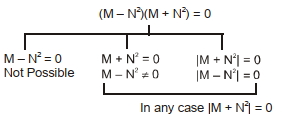
This implies $M^2 - N^4 = 0$,which can be factored as $(M - N^2)(M + N^2) = 0$ because $M$ and $N$ commute.
Since $M \neq N^2$,the matrix $(M - N^2)$ is not necessarily the zero matrix,but the product $(M - N^2)(M + N^2) = 0$ implies that the determinant of the product is zero:
$|M - N^2| \cdot |M + N^2| = 0$.
From the provided logic,in any case,$|M + N^2| = 0$.
Now,consider the expression $M^2 + MN^2 = M(M + N^2)$.
The determinant is $|M^2 + MN^2| = |M| \cdot |M + N^2| = |M| \cdot 0 = 0$.
Thus,$(A)$ is correct.
Since the determinant of $(M^2 + MN^2)$ is $0$,the matrix $(M^2 + MN^2)$ is singular.
Therefore,there exists a non-zero matrix $U$ such that $(M^2 + MN^2)U = 0$ (as the system of linear equations $AX = 0$ with $|A| = 0$ has non-trivial solutions).
Thus,$(B)$ is correct.
$(C)$ is incorrect because the determinant is $0$.
$(D)$ is incorrect because for a singular matrix $A$,$AU = 0$ does not imply $U = 0$ (non-trivial solutions exist).
Therefore,the correct options are $(A)$ and $(B)$.
This implies $M^2 - N^4 = 0$,which can be factored as $(M - N^2)(M + N^2) = 0$ because $M$ and $N$ commute.
Since $M \neq N^2$,the matrix $(M - N^2)$ is not necessarily the zero matrix,but the product $(M - N^2)(M + N^2) = 0$ implies that the determinant of the product is zero:
$|M - N^2| \cdot |M + N^2| = 0$.
From the provided logic,in any case,$|M + N^2| = 0$.
Now,consider the expression $M^2 + MN^2 = M(M + N^2)$.
The determinant is $|M^2 + MN^2| = |M| \cdot |M + N^2| = |M| \cdot 0 = 0$.
Thus,$(A)$ is correct.
Since the determinant of $(M^2 + MN^2)$ is $0$,the matrix $(M^2 + MN^2)$ is singular.
Therefore,there exists a non-zero matrix $U$ such that $(M^2 + MN^2)U = 0$ (as the system of linear equations $AX = 0$ with $|A| = 0$ has non-trivial solutions).
Thus,$(B)$ is correct.
$(C)$ is incorrect because the determinant is $0$.
$(D)$ is incorrect because for a singular matrix $A$,$AU = 0$ does not imply $U = 0$ (non-trivial solutions exist).
Therefore,the correct options are $(A)$ and $(B)$.
0 likesView Solution
22
MathematicsDifficultMCQIIT JEE · 2014
Let $f:(0, \infty) \rightarrow \mathbb{R}$ be given by $f(x)=\int_{\frac{1}{x}}^x e^{-\left(t+\frac{1}{t}\right)} \frac{d t}{t}$. Then
$(A)$ $f(x)$ is monotonically increasing on $[1, \infty)$
$(B)$ $f(x)$ is monotonically decreasing on $(0,1)$
$(C)$ $f(x)+f\left(\frac{1}{x}\right)=0$,for all $x \in(0, \infty)$
$(D)$ $f\left(2^x\right)$ is an odd function of $x$ on $\mathbb{R}$
$(A)$ $f(x)$ is monotonically increasing on $[1, \infty)$
$(B)$ $f(x)$ is monotonically decreasing on $(0,1)$
$(C)$ $f(x)+f\left(\frac{1}{x}\right)=0$,for all $x \in(0, \infty)$
$(D)$ $f\left(2^x\right)$ is an odd function of $x$ on $\mathbb{R}$
A
$(A, C, D)$
B
$(A, B, D)$
C
$(A, B, C)$
D
$(B, C, D)$
Solution
(A) Given $f(x)=\int_{1 / x}^x e^{-\left(t+\frac{1}{t}\right)} \frac{d t}{t}$.
Using Leibniz's rule for differentiation under the integral sign:
$f^{\prime}(x) = e^{-\left(x+\frac{1}{x}\right)} \cdot \frac{1}{x} - e^{-\left(\frac{1}{x}+x\right)} \cdot \left(-\frac{1}{x^2}\right) = \frac{e^{-\left(x+\frac{1}{x}\right)}}{x} + \frac{e^{-\left(x+\frac{1}{x}\right)}}{x} = \frac{2 e^{-\left(x+\frac{1}{x}\right)}}{x}$.
$(A)$ For $x \in [1, \infty)$,$f^{\prime}(x) > 0$,so $f(x)$ is monotonically increasing. Thus,$(A)$ is correct.
$(B)$ For $x \in (0, 1)$,$f^{\prime}(x) > 0$,so $f(x)$ is monotonically increasing on $(0, 1)$. Thus,$(B)$ is incorrect.
$(C)$ $f(1/x) = \int_{x}^{1/x} e^{-\left(t+\frac{1}{t}\right)} \frac{dt}{t}$. Let $t = 1/u$,then $dt = -1/u^2 du$.
$f(1/x) = \int_{1/x}^{x} e^{-\left(1/u+u\right)} \cdot u \cdot (-1/u^2) du = -\int_{1/x}^{x} e^{-\left(u+\frac{1}{u}\right)} \frac{du}{u} = -f(x)$.
Therefore,$f(x) + f(1/x) = 0$. Thus,$(C)$ is correct.
$(D)$ Let $g(x) = f(2^x)$. Then $g(-x) = f(2^{-x}) = f(1/2^x) = -f(2^x) = -g(x)$.
Thus,$f(2^x)$ is an odd function. Thus,$(D)$ is correct.
The correct options are $(A, C, D)$.
Using Leibniz's rule for differentiation under the integral sign:
$f^{\prime}(x) = e^{-\left(x+\frac{1}{x}\right)} \cdot \frac{1}{x} - e^{-\left(\frac{1}{x}+x\right)} \cdot \left(-\frac{1}{x^2}\right) = \frac{e^{-\left(x+\frac{1}{x}\right)}}{x} + \frac{e^{-\left(x+\frac{1}{x}\right)}}{x} = \frac{2 e^{-\left(x+\frac{1}{x}\right)}}{x}$.
$(A)$ For $x \in [1, \infty)$,$f^{\prime}(x) > 0$,so $f(x)$ is monotonically increasing. Thus,$(A)$ is correct.
$(B)$ For $x \in (0, 1)$,$f^{\prime}(x) > 0$,so $f(x)$ is monotonically increasing on $(0, 1)$. Thus,$(B)$ is incorrect.
$(C)$ $f(1/x) = \int_{x}^{1/x} e^{-\left(t+\frac{1}{t}\right)} \frac{dt}{t}$. Let $t = 1/u$,then $dt = -1/u^2 du$.
$f(1/x) = \int_{1/x}^{x} e^{-\left(1/u+u\right)} \cdot u \cdot (-1/u^2) du = -\int_{1/x}^{x} e^{-\left(u+\frac{1}{u}\right)} \frac{du}{u} = -f(x)$.
Therefore,$f(x) + f(1/x) = 0$. Thus,$(C)$ is correct.
$(D)$ Let $g(x) = f(2^x)$. Then $g(-x) = f(2^{-x}) = f(1/2^x) = -f(2^x) = -g(x)$.
Thus,$f(2^x)$ is an odd function. Thus,$(D)$ is correct.
The correct options are $(A, C, D)$.
0 likesView Solution
23
MathematicsDifficultMCQIIT JEE · 2014
Let $f : \left(-\frac{\pi}{2}, \frac{\pi}{2}\right) \rightarrow \mathbb{R}$ be defined by $f(x) = (\log(\sec x + \tan x))^3$. Then:
A
$f(x)$ is an odd function
B
$f(x)$ is a non-one-one function
C
$f(x)$ is an onto function
D
$f(x)$ is an even function
Solution
(A, C) Step $1$: Check for odd/even function.
$f(-x) = (\log(\sec(-x) + \tan(-x)))^3 = (\log(\sec x - \tan x))^3$.
Since $\sec x - \tan x = \frac{1}{\sec x + \tan x}$,we have $\log(\sec x - \tan x) = \log((\sec x + \tan x)^{-1}) = -\log(\sec x + \tan x)$.
Thus,$f(-x) = (-\log(\sec x + \tan x))^3 = -(\log(\sec x + \tan x))^3 = -f(x)$.
Therefore,$f(x)$ is an odd function.
Step $2$: Check for one-one function.
$f'(x) = 3(\log(\sec x + \tan x))^2 \cdot \frac{1}{\sec x + \tan x} \cdot (\sec x \tan x + \sec^2 x) = 3(\log(\sec x + \tan x))^2 \cdot \sec x$.
Since $\sec x > 0$ for $x \in \left(-\frac{\pi}{2}, \frac{\pi}{2}\right)$ and $(\log(\sec x + \tan x))^2 \ge 0$,$f'(x) \ge 0$. The function is strictly increasing,so it is a one-one function.
Step $3$: Check for onto function.
As $x \rightarrow \frac{\pi}{2}^-$,$\sec x + \tan x \rightarrow \infty$,so $f(x) \rightarrow \infty$.
As $x \rightarrow -\frac{\pi}{2}^+$,$\sec x + \tan x \rightarrow 0^+$,so $\log(\sec x + \tan x) \rightarrow -\infty$,and $f(x) \rightarrow -\infty$.
Since the range is $(-\infty, \infty) = \mathbb{R}$,the function is onto.
Conclusion: $f(x)$ is an odd function and an onto function.
$f(-x) = (\log(\sec(-x) + \tan(-x)))^3 = (\log(\sec x - \tan x))^3$.
Since $\sec x - \tan x = \frac{1}{\sec x + \tan x}$,we have $\log(\sec x - \tan x) = \log((\sec x + \tan x)^{-1}) = -\log(\sec x + \tan x)$.
Thus,$f(-x) = (-\log(\sec x + \tan x))^3 = -(\log(\sec x + \tan x))^3 = -f(x)$.
Therefore,$f(x)$ is an odd function.
Step $2$: Check for one-one function.
$f'(x) = 3(\log(\sec x + \tan x))^2 \cdot \frac{1}{\sec x + \tan x} \cdot (\sec x \tan x + \sec^2 x) = 3(\log(\sec x + \tan x))^2 \cdot \sec x$.
Since $\sec x > 0$ for $x \in \left(-\frac{\pi}{2}, \frac{\pi}{2}\right)$ and $(\log(\sec x + \tan x))^2 \ge 0$,$f'(x) \ge 0$. The function is strictly increasing,so it is a one-one function.
Step $3$: Check for onto function.
As $x \rightarrow \frac{\pi}{2}^-$,$\sec x + \tan x \rightarrow \infty$,so $f(x) \rightarrow \infty$.
As $x \rightarrow -\frac{\pi}{2}^+$,$\sec x + \tan x \rightarrow 0^+$,so $\log(\sec x + \tan x) \rightarrow -\infty$,and $f(x) \rightarrow -\infty$.
Since the range is $(-\infty, \infty) = \mathbb{R}$,the function is onto.
Conclusion: $f(x)$ is an odd function and an onto function.
0 likesView Solution
24
MathematicsAdvancedMCQIIT JEE · 2014
Let $a \in R$ and let $f: R \rightarrow R$ be given by $f(x)=x^5-5x+a$. Then
$(A)$ $f(x)$ has three real roots if $a > 4$
$(B)$ $f(x)$ has only one real root if $a > 4$
$(C)$ $f(x)$ has three real roots if $a < -4$
$(D)$ $f(x)$ has three real roots if $-4 < a < 4$
$(A)$ $f(x)$ has three real roots if $a > 4$
$(B)$ $f(x)$ has only one real root if $a > 4$
$(C)$ $f(x)$ has three real roots if $a < -4$
$(D)$ $f(x)$ has three real roots if $-4 < a < 4$
A
$(B, D)$
B
$(B, C)$
C
$(A, C)$
D
$(A, D)$
Solution
(A) Given $f(x) = x^5 - 5x + a$.
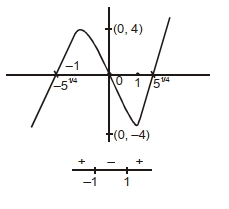
To find the number of real roots,we analyze the function $g(x) = x^5 - 5x$,where $f(x) = g(x) + a = 0$,which implies $g(x) = -a$.
First,find the critical points of $g(x)$ by setting $g'(x) = 0$:
$g'(x) = 5x^4 - 5 = 5(x^4 - 1) = 5(x^2 - 1)(x^2 + 1) = 5(x - 1)(x + 1)(x^2 + 1) = 0$.
The critical points are $x = 1$ and $x = -1$.
The local maximum value is $g(-1) = (-1)^5 - 5(-1) = -1 + 5 = 4$.
The local minimum value is $g(1) = (1)^5 - 5(1) = 1 - 5 = -4$.
For $f(x) = 0$,we need $g(x) = -a$.
$1$. If $-a > 4$ (i.e.,$a < -4$),the line $y = -a$ is above the local maximum,so there is only $1$ real root.
$2$. If $-a < -4$ (i.e.,$a > 4$),the line $y = -a$ is below the local minimum,so there is only $1$ real root.
$3$. If $-4 < -a < 4$ (i.e.,$-4 < a < 4$),the line $y = -a$ intersects the graph at $3$ points,so there are $3$ real roots.
Thus,$(B)$ is correct ($a > 4$ implies $1$ root) and $(D)$ is correct ($-4 < a < 4$ implies $3$ roots).
To find the number of real roots,we analyze the function $g(x) = x^5 - 5x$,where $f(x) = g(x) + a = 0$,which implies $g(x) = -a$.
First,find the critical points of $g(x)$ by setting $g'(x) = 0$:
$g'(x) = 5x^4 - 5 = 5(x^4 - 1) = 5(x^2 - 1)(x^2 + 1) = 5(x - 1)(x + 1)(x^2 + 1) = 0$.
The critical points are $x = 1$ and $x = -1$.
The local maximum value is $g(-1) = (-1)^5 - 5(-1) = -1 + 5 = 4$.
The local minimum value is $g(1) = (1)^5 - 5(1) = 1 - 5 = -4$.
For $f(x) = 0$,we need $g(x) = -a$.
$1$. If $-a > 4$ (i.e.,$a < -4$),the line $y = -a$ is above the local maximum,so there is only $1$ real root.
$2$. If $-a < -4$ (i.e.,$a > 4$),the line $y = -a$ is below the local minimum,so there is only $1$ real root.
$3$. If $-4 < -a < 4$ (i.e.,$-4 < a < 4$),the line $y = -a$ intersects the graph at $3$ points,so there are $3$ real roots.
Thus,$(B)$ is correct ($a > 4$ implies $1$ root) and $(D)$ is correct ($-4 < a < 4$ implies $3$ roots).
0 likesView Solution
25
MathematicsAdvancedMCQIIT JEE · 2014
The slope of the tangent to the curve $(y-x^5)^2=x(1+x^2)^2$ at the point $(1,3)$ is
A
$5$
B
$6$
C
$7$
D
$8$
Solution
(D) Given the curve equation: $(y-x^5)^2=x(1+x^2)^2$
Differentiating both sides with respect to $x$:
$2(y-x^5)(\frac{dy}{dx}-5x^4) = (1+x^2)^2 + x \cdot 2(1+x^2)(2x)$
$2(y-x^5)(\frac{dy}{dx}-5x^4) = (1+x^2)^2 + 4x^2(1+x^2)$
Substitute the point $(1,3)$ into the equation:
$2(3-1^5)(\frac{dy}{dx}-5(1)^4) = (1+1^2)^2 + 4(1)^2(1+1^2)$
$2(3-1)(\frac{dy}{dx}-5) = (2)^2 + 4(2)$
$2(2)(\frac{dy}{dx}-5) = 4 + 8$
$4(\frac{dy}{dx}-5) = 12$
$\frac{dy}{dx}-5 = 3$
$\frac{dy}{dx} = 8$
Thus,the slope of the tangent at $(1,3)$ is $8$.
Differentiating both sides with respect to $x$:
$2(y-x^5)(\frac{dy}{dx}-5x^4) = (1+x^2)^2 + x \cdot 2(1+x^2)(2x)$
$2(y-x^5)(\frac{dy}{dx}-5x^4) = (1+x^2)^2 + 4x^2(1+x^2)$
Substitute the point $(1,3)$ into the equation:
$2(3-1^5)(\frac{dy}{dx}-5(1)^4) = (1+1^2)^2 + 4(1)^2(1+1^2)$
$2(3-1)(\frac{dy}{dx}-5) = (2)^2 + 4(2)$
$2(2)(\frac{dy}{dx}-5) = 4 + 8$
$4(\frac{dy}{dx}-5) = 12$
$\frac{dy}{dx}-5 = 3$
$\frac{dy}{dx} = 8$
Thus,the slope of the tangent at $(1,3)$ is $8$.
0 likesView Solution
26
MathematicsAdvancedMCQIIT JEE · 2014
Let $f:[0, 4\pi] \rightarrow [0, \pi]$ be defined by $f(x) = \cos^{-1}(\cos x)$. The number of points $x \in [0, 4\pi]$ satisfying the equation $f(x) = \frac{10-x}{10}$ is
A
$2$
B
$3$
C
$4$
D
$5$
Solution
(B) The function $f(x) = \cos^{-1}(\cos x)$ is a periodic function with period $2\pi$.
In the interval $[0, 4\pi]$,the graph of $f(x)$ consists of two triangular waves.
Specifically,$f(x) = x$ for $x \in [0, \pi]$,$f(x) = 2\pi - x$ for $x \in [\pi, 2\pi]$,$f(x) = x - 2\pi$ for $x \in [2\pi, 3\pi]$,and $f(x) = 4\pi - x$ for $x \in [3\pi, 4\pi]$.
We need to find the number of intersection points of $f(x)$ and the line $y = 1 - \frac{x}{10}$.
At $x = 0$,$f(0) = 0$ and $y = 1$.
At $x = \pi \approx 3.14$,$f(\pi) = \pi \approx 3.14$ and $y = 1 - 0.314 = 0.686$.
At $x = 2\pi \approx 6.28$,$f(2\pi) = 0$ and $y = 1 - 0.628 = 0.372$.
At $x = 3\pi \approx 9.42$,$f(3\pi) = \pi \approx 3.14$ and $y = 1 - 0.942 = 0.058$.
At $x = 4\pi \approx 12.56$,$f(4\pi) = 0$ and $y = 1 - 1.256 = -0.256$.
By observing the graph,the line $y = 1 - \frac{x}{10}$ intersects the graph of $f(x)$ at $3$ distinct points in the interval $[0, 4\pi]$.
Thus,the number of points is $3$.
In the interval $[0, 4\pi]$,the graph of $f(x)$ consists of two triangular waves.
Specifically,$f(x) = x$ for $x \in [0, \pi]$,$f(x) = 2\pi - x$ for $x \in [\pi, 2\pi]$,$f(x) = x - 2\pi$ for $x \in [2\pi, 3\pi]$,and $f(x) = 4\pi - x$ for $x \in [3\pi, 4\pi]$.
We need to find the number of intersection points of $f(x)$ and the line $y = 1 - \frac{x}{10}$.
At $x = 0$,$f(0) = 0$ and $y = 1$.
At $x = \pi \approx 3.14$,$f(\pi) = \pi \approx 3.14$ and $y = 1 - 0.314 = 0.686$.
At $x = 2\pi \approx 6.28$,$f(2\pi) = 0$ and $y = 1 - 0.628 = 0.372$.
At $x = 3\pi \approx 9.42$,$f(3\pi) = \pi \approx 3.14$ and $y = 1 - 0.942 = 0.058$.
At $x = 4\pi \approx 12.56$,$f(4\pi) = 0$ and $y = 1 - 1.256 = -0.256$.
By observing the graph,the line $y = 1 - \frac{x}{10}$ intersects the graph of $f(x)$ at $3$ distinct points in the interval $[0, 4\pi]$.
Thus,the number of points is $3$.
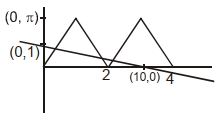
0 likesView Solution
27
MathematicsAdvancedMCQIIT JEE · 2014
Let $f: R \rightarrow R$ and $g: R \rightarrow R$ be respectively given by $f(x)=|x|+1$ and $g(x)=x^2+1$. Define $h: R \rightarrow R$ by $h(x)=\begin{cases} \max \{f(x), g(x)\} & \text{if } x \leq 0 \\ \min \{f(x), g(x)\} & \text{if } x > 0 \end{cases}$. The number of points at which $h(x)$ is not differentiable is
A
$1$
B
$2$
C
$3$
D
$4$
Solution
(B) Given $f(x) = |x| + 1$ and $g(x) = x^2 + 1$.
For $x \leq 0$,$f(x) = -x + 1$ and $g(x) = x^2 + 1$. We define $h(x) = \max\{-x+1, x^2+1\}$.
Since $x^2+1 \geq -x+1$ for $x \in [-1, 0]$ (as $x^2+x \geq 0$),$h(x) = x^2+1$ for $x \in [-1, 0]$ and $h(x) = -x+1$ for $x < -1$.
For $x > 0$,$f(x) = x + 1$ and $g(x) = x^2 + 1$. We define $h(x) = \min\{x+1, x^2+1\}$.
Since $x^2+1 \leq x+1$ for $x \in [0, 1]$ (as $x^2-x \leq 0$),$h(x) = x^2+1$ for $x \in [0, 1]$ and $h(x) = x+1$ for $x > 1$.
Thus,$h(x) = \begin{cases} -x+1 & x < -1 \\ x^2+1 & -1 \leq x \leq 1 \\ x+1 & x > 1 \end{cases}$.
Checking differentiability:
At $x = -1$: $h(-1) = 2$. Left derivative is $-1$,right derivative is $2(-1) = -2$. Not differentiable.
At $x = 1$: $h(1) = 2$. Left derivative is $2(1) = 2$,right derivative is $1$. Not differentiable.
At $x = 0$: $h(0) = 1$. Left derivative is $2(0) = 0$,right derivative is $2(0) = 0$. Differentiable.
There are $2$ points of non-differentiability.
For $x \leq 0$,$f(x) = -x + 1$ and $g(x) = x^2 + 1$. We define $h(x) = \max\{-x+1, x^2+1\}$.
Since $x^2+1 \geq -x+1$ for $x \in [-1, 0]$ (as $x^2+x \geq 0$),$h(x) = x^2+1$ for $x \in [-1, 0]$ and $h(x) = -x+1$ for $x < -1$.
For $x > 0$,$f(x) = x + 1$ and $g(x) = x^2 + 1$. We define $h(x) = \min\{x+1, x^2+1\}$.
Since $x^2+1 \leq x+1$ for $x \in [0, 1]$ (as $x^2-x \leq 0$),$h(x) = x^2+1$ for $x \in [0, 1]$ and $h(x) = x+1$ for $x > 1$.
Thus,$h(x) = \begin{cases} -x+1 & x < -1 \\ x^2+1 & -1 \leq x \leq 1 \\ x+1 & x > 1 \end{cases}$.
Checking differentiability:
At $x = -1$: $h(-1) = 2$. Left derivative is $-1$,right derivative is $2(-1) = -2$. Not differentiable.
At $x = 1$: $h(1) = 2$. Left derivative is $2(1) = 2$,right derivative is $1$. Not differentiable.
At $x = 0$: $h(0) = 1$. Left derivative is $2(0) = 0$,right derivative is $2(0) = 0$. Differentiable.
There are $2$ points of non-differentiability.
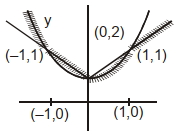
0 likesView Solution
28
MathematicsAdvancedMCQIIT JEE · 2014
The value of $\int_0^1 4 x^3 \left\{ \frac{d^2}{d x^2} (1-x^2)^5 \right\} d x$ is
A
$1$
B
$2$
C
$3$
D
$4$
Solution
(B) Let $I = \int_0^1 4 x^3 \frac{d^2}{d x^2} (1-x^2)^5 d x$.
Using integration by parts,let $u = 4x^3$ and $dv = \frac{d^2}{dx^2}(1-x^2)^5 dx$.
Then $du = 12x^2 dx$ and $v = \frac{d}{dx}(1-x^2)^5 = 5(1-x^2)^4(-2x) = -10x(1-x^2)^4$.
$I = [4x^3 \cdot (-10x(1-x^2)^4)]_0^1 - \int_0^1 (-10x(1-x^2)^4) \cdot 12x^2 dx$.
The boundary term $[ -40x^4(1-x^2)^4 ]_0^1 = 0 - 0 = 0$.
So,$I = 120 \int_0^1 x^3(1-x^2)^4 dx$.
Let $t = 1-x^2$,then $dt = -2x dx$,so $x^2 = 1-t$ and $x dx = -\frac{1}{2} dt$.
$I = 120 \int_1^0 (1-t) t^4 (-\frac{1}{2} dt) = 60 \int_0^1 (t^4 - t^5) dt$.
$I = 60 [\frac{t^5}{5} - \frac{t^6}{6}]_0^1 = 60 (\frac{1}{5} - \frac{1}{6}) = 60 (\frac{6-5}{30}) = 60 (\frac{1}{30}) = 2$.
Using integration by parts,let $u = 4x^3$ and $dv = \frac{d^2}{dx^2}(1-x^2)^5 dx$.
Then $du = 12x^2 dx$ and $v = \frac{d}{dx}(1-x^2)^5 = 5(1-x^2)^4(-2x) = -10x(1-x^2)^4$.
$I = [4x^3 \cdot (-10x(1-x^2)^4)]_0^1 - \int_0^1 (-10x(1-x^2)^4) \cdot 12x^2 dx$.
The boundary term $[ -40x^4(1-x^2)^4 ]_0^1 = 0 - 0 = 0$.
So,$I = 120 \int_0^1 x^3(1-x^2)^4 dx$.
Let $t = 1-x^2$,then $dt = -2x dx$,so $x^2 = 1-t$ and $x dx = -\frac{1}{2} dt$.
$I = 120 \int_1^0 (1-t) t^4 (-\frac{1}{2} dt) = 60 \int_0^1 (t^4 - t^5) dt$.
$I = 60 [\frac{t^5}{5} - \frac{t^6}{6}]_0^1 = 60 (\frac{1}{5} - \frac{1}{6}) = 60 (\frac{6-5}{30}) = 60 (\frac{1}{30}) = 2$.
0 likesView Solution
29
MathematicsAdvancedMCQIIT JEE · 2014
Let $\vec{a}, \vec{b}$ and $\vec{c}$ be three non-coplanar unit vectors such that the angle between every pair of them is $\frac{\pi}{3}$. If $\vec{a} \times \vec{b} + \vec{b} \times \vec{c} = p \vec{a} + q \vec{b} + r \vec{c}$,where $p, q$ and $r$ are scalars,then the value of $\frac{p^2 + 2q^2 + r^2}{q^2}$ is
A
$1$
B
$2$
C
$3$
D
$4$
Solution
(D) Given $\vec{a}, \vec{b}, \vec{c}$ are unit vectors with angle $\frac{\pi}{3}$ between any pair,so $\vec{a} \cdot \vec{b} = \vec{b} \cdot \vec{c} = \vec{c} \cdot \vec{a} = \cos(\frac{\pi}{3}) = \frac{1}{2}$.
Given $p \vec{a} + q \vec{b} + r \vec{c} = \vec{a} \times \vec{b} + \vec{b} \times \vec{c}$.
Taking the dot product with $\vec{a}, \vec{b}, \vec{c}$ respectively:
$1$) $\vec{a} \cdot (p \vec{a} + q \vec{b} + r \vec{c}) = \vec{a} \cdot (\vec{a} \times \vec{b} + \vec{b} \times \vec{c}) \Rightarrow p + \frac{q}{2} + \frac{r}{2} = [\vec{a} \vec{b} \vec{c}]$.
$2$) $\vec{b} \cdot (p \vec{a} + q \vec{b} + r \vec{c}) = \vec{b} \cdot (\vec{a} \times \vec{b} + \vec{b} \times \vec{c}) \Rightarrow \frac{p}{2} + q + \frac{r}{2} = 0$.
$3$) $\vec{c} \cdot (p \vec{a} + q \vec{b} + r \vec{c}) = \vec{c} \cdot (\vec{a} \times \vec{b} + \vec{b} \times \vec{c}) \Rightarrow \frac{p}{2} + \frac{q}{2} + r = [\vec{a} \vec{b} \vec{c}]$.
From $(1)$ and $(3)$,$p + \frac{q}{2} + \frac{r}{2} = \frac{p}{2} + \frac{q}{2} + r \Rightarrow p = r$.
Substituting $r = p$ into $(2)$: $\frac{p}{2} + q + \frac{p}{2} = 0 \Rightarrow p + q = 0 \Rightarrow q = -p$.
Now,$\frac{p^2 + 2q^2 + r^2}{q^2} = \frac{p^2 + 2(-p)^2 + p^2}{(-p)^2} = \frac{p^2 + 2p^2 + p^2}{p^2} = \frac{4p^2}{p^2} = 4$.
Given $p \vec{a} + q \vec{b} + r \vec{c} = \vec{a} \times \vec{b} + \vec{b} \times \vec{c}$.
Taking the dot product with $\vec{a}, \vec{b}, \vec{c}$ respectively:
$1$) $\vec{a} \cdot (p \vec{a} + q \vec{b} + r \vec{c}) = \vec{a} \cdot (\vec{a} \times \vec{b} + \vec{b} \times \vec{c}) \Rightarrow p + \frac{q}{2} + \frac{r}{2} = [\vec{a} \vec{b} \vec{c}]$.
$2$) $\vec{b} \cdot (p \vec{a} + q \vec{b} + r \vec{c}) = \vec{b} \cdot (\vec{a} \times \vec{b} + \vec{b} \times \vec{c}) \Rightarrow \frac{p}{2} + q + \frac{r}{2} = 0$.
$3$) $\vec{c} \cdot (p \vec{a} + q \vec{b} + r \vec{c}) = \vec{c} \cdot (\vec{a} \times \vec{b} + \vec{b} \times \vec{c}) \Rightarrow \frac{p}{2} + \frac{q}{2} + r = [\vec{a} \vec{b} \vec{c}]$.
From $(1)$ and $(3)$,$p + \frac{q}{2} + \frac{r}{2} = \frac{p}{2} + \frac{q}{2} + r \Rightarrow p = r$.
Substituting $r = p$ into $(2)$: $\frac{p}{2} + q + \frac{p}{2} = 0 \Rightarrow p + q = 0 \Rightarrow q = -p$.
Now,$\frac{p^2 + 2q^2 + r^2}{q^2} = \frac{p^2 + 2(-p)^2 + p^2}{(-p)^2} = \frac{p^2 + 2p^2 + p^2}{p^2} = \frac{4p^2}{p^2} = 4$.
0 likesView Solution
30
MathematicsDifficultMCQIIT JEE · 2014
The function $y=f(x)$ is the solution of the differential equation $\frac{dy}{dx}+\frac{xy}{x^2-1}=\frac{x^4+2x}{\sqrt{1-x^2}}$ in $(-1,1)$ satisfying $f(0)=0$. Then $\int_{-\frac{\sqrt{3}}{2}}^{\frac{\sqrt{3}}{2}} f(x) dx$ is
A
$\frac{\pi}{3}-\frac{\sqrt{3}}{2}$
B
$\frac{\pi}{3}-\frac{\sqrt{3}}{4}$
C
$\frac{\pi}{6}-\frac{\sqrt{3}}{4}$
D
$\frac{\pi}{6}-\frac{\sqrt{3}}{2}$
Solution
(B) The given differential equation is a linear differential equation of the form $\frac{dy}{dx} + P(x)y = Q(x)$,where $P(x) = \frac{x}{x^2-1}$ and $Q(x) = \frac{x^4+2x}{\sqrt{1-x^2}}$.
Integrating factor ($I$.$F$.) $= e^{\int \frac{x}{x^2-1} dx} = e^{\frac{1}{2} \ln|x^2-1|} = e^{\frac{1}{2} \ln(1-x^2)} = \sqrt{1-x^2}$.
The general solution is $y \cdot \sqrt{1-x^2} = \int \frac{x^4+2x}{\sqrt{1-x^2}} \cdot \sqrt{1-x^2} dx + c = \int (x^4+2x) dx + c = \frac{x^5}{5} + x^2 + c$.
Given $f(0)=0$,we have $0 \cdot 1 = 0 + 0 + c$,so $c=0$.
Thus,$f(x) = \frac{x^5/5 + x^2}{\sqrt{1-x^2}}$.
We need to evaluate $I = \int_{-\frac{\sqrt{3}}{2}}^{\frac{\sqrt{3}}{2}} f(x) dx$. Since $f(x) = \frac{x^5/5}{\sqrt{1-x^2}} + \frac{x^2}{\sqrt{1-x^2}}$,the first part is an odd function,so its integral over the symmetric interval is $0$.
Thus,$I = 2 \int_{0}^{\frac{\sqrt{3}}{2}} \frac{x^2}{\sqrt{1-x^2}} dx$.
Let $x = \sin \theta$,then $dx = \cos \theta d\theta$. When $x=0, \theta=0$; when $x=\frac{\sqrt{3}}{2}, \theta=\frac{\pi}{3}$.
$I = 2 \int_{0}^{\frac{\pi}{3}} \frac{\sin^2 \theta}{\cos \theta} \cos \theta d\theta = 2 \int_{0}^{\frac{\pi}{3}} \sin^2 \theta d\theta = \int_{0}^{\frac{\pi}{3}} (1 - \cos 2\theta) d\theta$.
$I = [\theta - \frac{1}{2} \sin 2\theta]_{0}^{\frac{\pi}{3}} = \frac{\pi}{3} - \frac{1}{2} \sin(\frac{2\pi}{3}) = \frac{\pi}{3} - \frac{1}{2} \cdot \frac{\sqrt{3}}{2} = \frac{\pi}{3} - \frac{\sqrt{3}}{4}$.
Integrating factor ($I$.$F$.) $= e^{\int \frac{x}{x^2-1} dx} = e^{\frac{1}{2} \ln|x^2-1|} = e^{\frac{1}{2} \ln(1-x^2)} = \sqrt{1-x^2}$.
The general solution is $y \cdot \sqrt{1-x^2} = \int \frac{x^4+2x}{\sqrt{1-x^2}} \cdot \sqrt{1-x^2} dx + c = \int (x^4+2x) dx + c = \frac{x^5}{5} + x^2 + c$.
Given $f(0)=0$,we have $0 \cdot 1 = 0 + 0 + c$,so $c=0$.
Thus,$f(x) = \frac{x^5/5 + x^2}{\sqrt{1-x^2}}$.
We need to evaluate $I = \int_{-\frac{\sqrt{3}}{2}}^{\frac{\sqrt{3}}{2}} f(x) dx$. Since $f(x) = \frac{x^5/5}{\sqrt{1-x^2}} + \frac{x^2}{\sqrt{1-x^2}}$,the first part is an odd function,so its integral over the symmetric interval is $0$.
Thus,$I = 2 \int_{0}^{\frac{\sqrt{3}}{2}} \frac{x^2}{\sqrt{1-x^2}} dx$.
Let $x = \sin \theta$,then $dx = \cos \theta d\theta$. When $x=0, \theta=0$; when $x=\frac{\sqrt{3}}{2}, \theta=\frac{\pi}{3}$.
$I = 2 \int_{0}^{\frac{\pi}{3}} \frac{\sin^2 \theta}{\cos \theta} \cos \theta d\theta = 2 \int_{0}^{\frac{\pi}{3}} \sin^2 \theta d\theta = \int_{0}^{\frac{\pi}{3}} (1 - \cos 2\theta) d\theta$.
$I = [\theta - \frac{1}{2} \sin 2\theta]_{0}^{\frac{\pi}{3}} = \frac{\pi}{3} - \frac{1}{2} \sin(\frac{2\pi}{3}) = \frac{\pi}{3} - \frac{1}{2} \cdot \frac{\sqrt{3}}{2} = \frac{\pi}{3} - \frac{\sqrt{3}}{4}$.
0 likesView Solution
31
MathematicsDifficultMCQIIT JEE · 2014
Let $f:[0,2] \rightarrow R$ be a function which is continuous on $[0,2]$ and is differentiable on $(0,2)$ with $f(0)=1$. Let $F(x)=\int_0^{x^2} f(\sqrt{t}) dt$ for $x \in [0,2]$. If $F'(x)=f'(x)$ for all $x \in (0,2)$,then $F(2)$ equals
A
$e^2-1$
B
$e^4-1$
C
$e-1$
D
$e^4$
Solution
(B) Given $F(x) = \int_0^{x^2} f(\sqrt{t}) dt$. Using the Leibniz rule for differentiation under the integral sign,we get $F'(x) = f(\sqrt{x^2}) \cdot \frac{d}{dx}(x^2) = f(x) \cdot 2x$.
Given $F'(x) = f'(x)$,we have $f'(x) = 2x f(x)$.
This is a first-order linear differential equation: $\frac{f'(x)}{f(x)} = 2x$.
Integrating both sides with respect to $x$,we get $\ln|f(x)| = x^2 + C$.
Since $f(0) = 1$,we have $\ln(1) = 0^2 + C$,which implies $C = 0$.
Thus,$\ln(f(x)) = x^2$,which gives $f(x) = e^{x^2}$.
Now,$F(x) = \int_0^{x^2} e^{(\sqrt{t})^2} dt = \int_0^{x^2} e^t dt = [e^t]_0^{x^2} = e^{x^2} - e^0 = e^{x^2} - 1$.
Therefore,$F(2) = e^{2^2} - 1 = e^4 - 1$.
Given $F'(x) = f'(x)$,we have $f'(x) = 2x f(x)$.
This is a first-order linear differential equation: $\frac{f'(x)}{f(x)} = 2x$.
Integrating both sides with respect to $x$,we get $\ln|f(x)| = x^2 + C$.
Since $f(0) = 1$,we have $\ln(1) = 0^2 + C$,which implies $C = 0$.
Thus,$\ln(f(x)) = x^2$,which gives $f(x) = e^{x^2}$.
Now,$F(x) = \int_0^{x^2} e^{(\sqrt{t})^2} dt = \int_0^{x^2} e^t dt = [e^t]_0^{x^2} = e^{x^2} - e^0 = e^{x^2} - 1$.
Therefore,$F(2) = e^{2^2} - 1 = e^4 - 1$.
0 likesView Solution
32
MathematicsAdvancedMCQIIT JEE · 2014
The following integral $\int_{\frac{\pi}{4}}^{\frac{\pi}{2}}(2 \operatorname{cosec} x)^{17} d x$ is equal to
A
$\int_0^{\log (1+\sqrt{2})} 2(e^u+e^{-u})^{16} du$
B
$\int_0^{\log (1+\sqrt{2})}(e^u+e^{-u})^{17} du$
C
$\int_0^{\log (1+\sqrt{2})}(e^u-e^{-u})^{17} du$
D
$\int_0^{\log (1+\sqrt{2})} 2(e^u-e^{-u})^{16} du$
Solution
(A) Let $I = \int_{\frac{\pi}{4}}^{\frac{\pi}{2}} (2 \operatorname{cosec} x)^{17} dx$.
Substitute $\tan(\frac{x}{2}) = e^u$,then $\frac{1}{2} \sec^2(\frac{x}{2}) dx = e^u du$,so $dx = \frac{2 e^u}{1+e^{2u}} du$.
Also,$\operatorname{cosec} x = \frac{1}{\sin x} = \frac{1+e^{2u}}{2e^u} = \frac{e^u + e^{-u}}{2}$.
When $x = \frac{\pi}{4}$,$e^u = \tan(\frac{\pi}{8}) = \sqrt{2}-1$,so $u = \ln(\sqrt{2}-1) = -\ln(\sqrt{2}+1)$.
When $x = \frac{\pi}{2}$,$e^u = \tan(\frac{\pi}{4}) = 1$,so $u = 0$.
Substituting these into the integral:
$I = \int_{-\ln(\sqrt{2}+1)}^{0} (e^u + e^{-u})^{17} \cdot \frac{2}{e^u + e^{-u}} du = \int_{-\ln(\sqrt{2}+1)}^{0} 2(e^u + e^{-u})^{16} du$.
Since $f(u) = (e^u + e^{-u})^{16}$ is an even function,$\int_{-a}^{0} f(u) du = \int_{0}^{a} f(u) du$.
Thus,$I = \int_{0}^{\ln(1+\sqrt{2})} 2(e^u + e^{-u})^{16} du$.
Substitute $\tan(\frac{x}{2}) = e^u$,then $\frac{1}{2} \sec^2(\frac{x}{2}) dx = e^u du$,so $dx = \frac{2 e^u}{1+e^{2u}} du$.
Also,$\operatorname{cosec} x = \frac{1}{\sin x} = \frac{1+e^{2u}}{2e^u} = \frac{e^u + e^{-u}}{2}$.
When $x = \frac{\pi}{4}$,$e^u = \tan(\frac{\pi}{8}) = \sqrt{2}-1$,so $u = \ln(\sqrt{2}-1) = -\ln(\sqrt{2}+1)$.
When $x = \frac{\pi}{2}$,$e^u = \tan(\frac{\pi}{4}) = 1$,so $u = 0$.
Substituting these into the integral:
$I = \int_{-\ln(\sqrt{2}+1)}^{0} (e^u + e^{-u})^{17} \cdot \frac{2}{e^u + e^{-u}} du = \int_{-\ln(\sqrt{2}+1)}^{0} 2(e^u + e^{-u})^{16} du$.
Since $f(u) = (e^u + e^{-u})^{16}$ is an even function,$\int_{-a}^{0} f(u) du = \int_{0}^{a} f(u) du$.
Thus,$I = \int_{0}^{\ln(1+\sqrt{2})} 2(e^u + e^{-u})^{16} du$.
0 likesView Solution
33
MathematicsAdvancedMCQIIT JEE · 2014
Box $1$ contains three cards bearing numbers $1, 2, 3$; box $2$ contains five cards bearing numbers $1, 2, 3, 4, 5$; and box $3$ contains seven cards bearing numbers $1, 2, 3, 4, 5, 6, 7$. $A$ card is drawn from each of the boxes. Let $x_i$ be the number on the card drawn from the $i^{\text{th}}$ box,$i = 1, 2, 3$.
$1.$ The probability that $x_1 + x_2 + x_3$ is odd is:
$(A) \frac{29}{105}$ $(B) \frac{53}{105}$ $(C) \frac{57}{105}$ $(D) \frac{1}{2}$
$2.$ The probability that $x_1, x_2, x_3$ are in an arithmetic progression is:
$(A) \frac{9}{105}$ $(B) \frac{10}{105}$ $(C) \frac{11}{105}$ $(D) \frac{7}{105}$
Give the answers for question $1$ and $2$.
$1.$ The probability that $x_1 + x_2 + x_3$ is odd is:
$(A) \frac{29}{105}$ $(B) \frac{53}{105}$ $(C) \frac{57}{105}$ $(D) \frac{1}{2}$
$2.$ The probability that $x_1, x_2, x_3$ are in an arithmetic progression is:
$(A) \frac{9}{105}$ $(B) \frac{10}{105}$ $(C) \frac{11}{105}$ $(D) \frac{7}{105}$
Give the answers for question $1$ and $2$.
A
$(B, D)$
B
$(B, C)$
C
$(A, C)$
D
$(A, D)$
Solution
(A-D) $1.$ The sum $x_1 + x_2 + x_3$ is odd if all three are odd or two are even and one is odd.
Case $1$: $(O, O, O) \rightarrow P = \frac{2}{3} \times \frac{3}{5} \times \frac{4}{7} = \frac{24}{105}$
Case $2$: $(O, E, E) \rightarrow P = \frac{2}{3} \times \frac{2}{5} \times \frac{3}{7} = \frac{12}{105}$
Case $3$: $(E, O, E) \rightarrow P = \frac{1}{3} \times \frac{3}{5} \times \frac{3}{7} = \frac{9}{105}$
Case $4$: $(E, E, O) \rightarrow P = \frac{1}{3} \times \frac{2}{5} \times \frac{4}{7} = \frac{8}{105}$
Total probability $= \frac{24+12+9+8}{105} = \frac{53}{105}$.
$2.$ For $x_1, x_2, x_3$ to be in arithmetic progression,$2x_2 = x_1 + x_3$.
This implies $x_1 + x_3$ must be even,meaning $x_1$ and $x_3$ must have the same parity.
If $x_1, x_3$ are both odd: $(1,1), (1,3), (1,5), (1,7), (3,1), (3,3), (3,5), (3,7)$ (Total $8$ pairs).
If $x_1, x_3$ are both even: $(2,2), (2,4), (2,6)$ (Total $3$ pairs).
Total favorable outcomes $= 8 + 3 = 11$.
Total possible outcomes $= 3 \times 5 \times 7 = 105$.
Probability $= \frac{11}{105}$.
Case $1$: $(O, O, O) \rightarrow P = \frac{2}{3} \times \frac{3}{5} \times \frac{4}{7} = \frac{24}{105}$
Case $2$: $(O, E, E) \rightarrow P = \frac{2}{3} \times \frac{2}{5} \times \frac{3}{7} = \frac{12}{105}$
Case $3$: $(E, O, E) \rightarrow P = \frac{1}{3} \times \frac{3}{5} \times \frac{3}{7} = \frac{9}{105}$
Case $4$: $(E, E, O) \rightarrow P = \frac{1}{3} \times \frac{2}{5} \times \frac{4}{7} = \frac{8}{105}$
Total probability $= \frac{24+12+9+8}{105} = \frac{53}{105}$.
$2.$ For $x_1, x_2, x_3$ to be in arithmetic progression,$2x_2 = x_1 + x_3$.
This implies $x_1 + x_3$ must be even,meaning $x_1$ and $x_3$ must have the same parity.
If $x_1, x_3$ are both odd: $(1,1), (1,3), (1,5), (1,7), (3,1), (3,3), (3,5), (3,7)$ (Total $8$ pairs).
If $x_1, x_3$ are both even: $(2,2), (2,4), (2,6)$ (Total $3$ pairs).
Total favorable outcomes $= 8 + 3 = 11$.
Total possible outcomes $= 3 \times 5 \times 7 = 105$.
Probability $= \frac{11}{105}$.
0 likesView Solution
34
MathematicsAdvancedMCQIIT JEE · 2014
Given that for each $a \in (0,1)$,the limit $g(a) = \lim_{n \rightarrow 0^{+}} \int_n^{1-n} t^{-a}(1-t)^{a-1} dt$ exists. In addition,it is given that the function $g(a)$ is differentiable on $(0,1)$.
$1.$ The value of $g\left(\frac{1}{2}\right)$ is
$(A) \pi$ $(B) 2\pi$ $(C) \frac{\pi}{2}$ $(D) \frac{\pi}{4}$
$2.$ The value of $g'\left(\frac{1}{2}\right)$ is
$(A) \frac{\pi}{2}$ $(B) \pi$ $(C) -\frac{\pi}{2}$ $(D) 0$
Select the correct pair of answers for $1$ and $2$.
$1.$ The value of $g\left(\frac{1}{2}\right)$ is
$(A) \pi$ $(B) 2\pi$ $(C) \frac{\pi}{2}$ $(D) \frac{\pi}{4}$
$2.$ The value of $g'\left(\frac{1}{2}\right)$ is
$(A) \frac{\pi}{2}$ $(B) \pi$ $(C) -\frac{\pi}{2}$ $(D) 0$
Select the correct pair of answers for $1$ and $2$.
A
$(B, C)$
B
$(A, C)$
C
$(A, D)$
D
$(C, D)$
Solution
(C) $1.$ To find $g(a)$,we evaluate the integral $g(a) = \lim_{n \rightarrow 0^{+}} \int_n^{1-n} t^{-a}(1-t)^{a-1} dt$.
For $a = \frac{1}{2}$,$g\left(\frac{1}{2}\right) = \int_0^1 t^{-1/2}(1-t)^{-1/2} dt = \int_0^1 \frac{dt}{\sqrt{t(1-t)}}$.
Using the substitution $t = \sin^2 \theta$,$dt = 2 \sin \theta \cos \theta d\theta$,the integral becomes $\int_0^{\pi/2} \frac{2 \sin \theta \cos \theta}{\sin \theta \cos \theta} d\theta = \int_0^{\pi/2} 2 d\theta = \pi$.
Thus,$g\left(\frac{1}{2}\right) = \pi$.
$2.$ We observe that $g(1-a) = \lim_{n \rightarrow 0^{+}} \int_n^{1-n} t^{-(1-a)}(1-t)^{(1-a)-1} dt = \lim_{n \rightarrow 0^{+}} \int_n^{1-n} t^{a-1}(1-t)^{-a} dt$.
Using the property $\int_n^{1-n} f(t) dt = \int_n^{1-n} f(1-t) dt$,we get $g(1-a) = \lim_{n \rightarrow 0^{+}} \int_n^{1-n} (1-t)^{a-1} t^{-a} dt = g(a)$.
Since $g(1-a) = g(a)$,differentiating both sides with respect to $a$ using the chain rule gives $-g'(1-a) = g'(a)$.
At $a = \frac{1}{2}$,$-g'\left(\frac{1}{2}\right) = g'\left(\frac{1}{2}\right)$,which implies $2g'\left(\frac{1}{2}\right) = 0$,so $g'\left(\frac{1}{2}\right) = 0$.
Therefore,the correct pair is $(A, D)$.
For $a = \frac{1}{2}$,$g\left(\frac{1}{2}\right) = \int_0^1 t^{-1/2}(1-t)^{-1/2} dt = \int_0^1 \frac{dt}{\sqrt{t(1-t)}}$.
Using the substitution $t = \sin^2 \theta$,$dt = 2 \sin \theta \cos \theta d\theta$,the integral becomes $\int_0^{\pi/2} \frac{2 \sin \theta \cos \theta}{\sin \theta \cos \theta} d\theta = \int_0^{\pi/2} 2 d\theta = \pi$.
Thus,$g\left(\frac{1}{2}\right) = \pi$.
$2.$ We observe that $g(1-a) = \lim_{n \rightarrow 0^{+}} \int_n^{1-n} t^{-(1-a)}(1-t)^{(1-a)-1} dt = \lim_{n \rightarrow 0^{+}} \int_n^{1-n} t^{a-1}(1-t)^{-a} dt$.
Using the property $\int_n^{1-n} f(t) dt = \int_n^{1-n} f(1-t) dt$,we get $g(1-a) = \lim_{n \rightarrow 0^{+}} \int_n^{1-n} (1-t)^{a-1} t^{-a} dt = g(a)$.
Since $g(1-a) = g(a)$,differentiating both sides with respect to $a$ using the chain rule gives $-g'(1-a) = g'(a)$.
At $a = \frac{1}{2}$,$-g'\left(\frac{1}{2}\right) = g'\left(\frac{1}{2}\right)$,which implies $2g'\left(\frac{1}{2}\right) = 0$,so $g'\left(\frac{1}{2}\right) = 0$.
Therefore,the correct pair is $(A, D)$.
0 likesView Solution
35
MathematicsAdvancedMCQIIT JEE · 2014
| List $I$ | List $II$ |
| $P.$ The number of polynomials $f(x)$ with non-negative integer coefficients of degree $\leq 2$,satisfying $f(0)=0$ and $\int_0^1 f(x) dx=1$,is | $1.$ $8$ |
| $Q.$ The number of points in the interval $(-\sqrt{13}, \sqrt{13})$ at which $f(x)=\sin(x^2)+\cos(x^2)$ attains its maximum value,is | $2.$ $2$ |
| $R.$ $\int_{-2}^2 \frac{3x^2}{1+e^x} dx$ equals | $3.$ $4$ |
| $S.$ $\frac{\int_{-1/2}^{1/2} \cos 2x \log(\frac{1+x}{1-x}) dx}{\int_0^{1/2} \cos 2x \log(\frac{1+x}{1-x}) dx}$ equals | $4.$ $0$ |
A
$3 \quad 2 \quad 4 \quad 1$
B
$2 \quad 3 \quad 4 \quad 1$
C
$3 \quad 2 \quad 1 \quad 4$
D
$2 \quad 3 \quad 1 \quad 4$
Solution
(D) $(P)$ Let $f(x) = ax^2 + bx$,where $a, b \in \mathbb{W}$ (since $f(0)=0$).
$\int_0^1 (ax^2 + bx) dx = \frac{a}{3} + \frac{b}{2} = 1 \implies 2a + 3b = 6$.
Possible non-negative integer solutions $(a, b)$ are $(3, 0)$ and $(0, 2)$.
Thus,the number of such polynomials is $2$.
$(Q)$ $f(x) = \sqrt{2} \sin(x^2 + \frac{\pi}{4})$.
$f(x)$ is maximum when $x^2 + \frac{\pi}{4} = 2n\pi + \frac{\pi}{2} \implies x^2 = 2n\pi + \frac{\pi}{4}$.
For $n=0$,$x^2 = \frac{\pi}{4} \approx 0.785 \in [0, 13)$.
For $n=1$,$x^2 = 2\pi + \frac{\pi}{4} = \frac{9\pi}{4} \approx 7.068 \in [0, 13)$.
For $n=2$,$x^2 = 4\pi + \frac{\pi}{4} = \frac{17\pi}{4} \approx 13.35 \notin [0, 13)$.
Since $x^2$ can take $2$ values for each $n$,and $x$ can be $\pm \sqrt{x^2}$,we check the interval $(-\sqrt{13}, \sqrt{13})$.
For $n=0$,$x = \pm \sqrt{\pi/4} = \pm \sqrt{\pi}/2$ ($2$ points).
For $n=1$,$x = \pm \sqrt{9\pi/4} = \pm 3\sqrt{\pi}/2$ ($2$ points).
Total points $= 4$. Wait,checking the options,$Q$ matches $3$ ($4$ points).
$(R)$ $\int_{-2}^2 \frac{3x^2}{1+e^x} dx = \int_0^2 3x^2 (\frac{1}{1+e^x} + \frac{1}{1+e^{-x}}) dx = \int_0^2 3x^2 (\frac{1+e^x}{1+e^x}) dx = \int_0^2 3x^2 dx = [x^3]_0^2 = 8$.
$(S)$ The numerator is $\int_{-1/2}^{1/2} \cos 2x \log(\frac{1+x}{1-x}) dx$. Since $\cos 2x$ is even and $\log(\frac{1+x}{1-x})$ is odd,the product is odd. Thus,the integral is $0$.
$\int_0^1 (ax^2 + bx) dx = \frac{a}{3} + \frac{b}{2} = 1 \implies 2a + 3b = 6$.
Possible non-negative integer solutions $(a, b)$ are $(3, 0)$ and $(0, 2)$.
Thus,the number of such polynomials is $2$.
$(Q)$ $f(x) = \sqrt{2} \sin(x^2 + \frac{\pi}{4})$.
$f(x)$ is maximum when $x^2 + \frac{\pi}{4} = 2n\pi + \frac{\pi}{2} \implies x^2 = 2n\pi + \frac{\pi}{4}$.
For $n=0$,$x^2 = \frac{\pi}{4} \approx 0.785 \in [0, 13)$.
For $n=1$,$x^2 = 2\pi + \frac{\pi}{4} = \frac{9\pi}{4} \approx 7.068 \in [0, 13)$.
For $n=2$,$x^2 = 4\pi + \frac{\pi}{4} = \frac{17\pi}{4} \approx 13.35 \notin [0, 13)$.
Since $x^2$ can take $2$ values for each $n$,and $x$ can be $\pm \sqrt{x^2}$,we check the interval $(-\sqrt{13}, \sqrt{13})$.
For $n=0$,$x = \pm \sqrt{\pi/4} = \pm \sqrt{\pi}/2$ ($2$ points).
For $n=1$,$x = \pm \sqrt{9\pi/4} = \pm 3\sqrt{\pi}/2$ ($2$ points).
Total points $= 4$. Wait,checking the options,$Q$ matches $3$ ($4$ points).
$(R)$ $\int_{-2}^2 \frac{3x^2}{1+e^x} dx = \int_0^2 3x^2 (\frac{1}{1+e^x} + \frac{1}{1+e^{-x}}) dx = \int_0^2 3x^2 (\frac{1+e^x}{1+e^x}) dx = \int_0^2 3x^2 dx = [x^3]_0^2 = 8$.
$(S)$ The numerator is $\int_{-1/2}^{1/2} \cos 2x \log(\frac{1+x}{1-x}) dx$. Since $\cos 2x$ is even and $\log(\frac{1+x}{1-x})$ is odd,the product is odd. Thus,the integral is $0$.
0 likesView Solution
36
MathematicsAdvancedMCQIIT JEE · 2014
| List $I$ | List $II$ |
| $P.$ Let $y(x)=\cos \left(3 \cos ^{-1} x\right), x \in[-1,1], x \neq \pm \frac{\sqrt{3}}{2}$. Then $\frac{1}{y(x)}\left\{\left(x^2-1\right) \frac{d^2 y(x)}{d x^2}+x \frac{d y(x)}{d x}\right\}$ equals | $1. \ 1$ |
| $Q.$ Let $A_1, A_2, \ldots, A_n(n>2)$ be the vertices of a regular polygon of $n$ sides with its centre at the origin. Let $\vec{a}_k$ be the position vector of the point $A_k, k=1,2, \ldots, n$. If $\left|\sum_{k=1}^{n-1}\left(\vec{a}_k \times \vec{a}_{k+1}\right)\right|=\left|\sum_{k=1}^{n-1}\left(\vec{a}_k \cdot \vec{a}_{k+1}\right)\right|$,then the minimum value of $n$ is | $2. \ 2$ |
| $R.$ If the normal from the point $P(h, 1)$ on the ellipse $\frac{x^2}{6}+\frac{y^2}{3}=1$ is perpendicular to the line $x+y=8$,then the value of $h$ is | $3. \ 8$ |
| $S.$ Number of positive solutions satisfying the equation $\tan ^{-1}\left(\frac{1}{2 x+1}\right)+\tan ^{-1}\left(\frac{1}{4 x+1}\right)=\tan ^{-1}\left(\frac{2}{x^2}\right)$ is | $4. \ 9$ |
A
$4 \quad 3 \quad 2 \quad 1$
B
$2 \quad 4 \quad 3 \quad 1$
C
$4 \quad 3 \quad 1 \quad 2$
D
$2 \quad 4 \quad 1 \quad 3$
Solution
(C) $(P)$ Given $y(x) = \cos(3 \cos^{-1} x) = 4x^3 - 3x$.
Differentiating with respect to $x$,we get $\frac{dy}{dx} = 12x^2 - 3$ and $\frac{d^2y}{dx^2} = 24x$.
Substituting these into the expression: $(x^2-1)(24x) + x(12x^2-3) = 24x^3 - 24x + 12x^3 - 3x = 36x^3 - 27x = 9(4x^3 - 3x) = 9y$.
Thus,$\frac{1}{y} \{9y\} = 9$. So $P \to 4$.
$(Q)$ The magnitude of the cross product is $\sum |\vec{a}_k| |\vec{a}_{k+1}| \sin(\frac{2\pi}{n}) = (n-1) \lambda^2 \sin(\frac{2\pi}{n})$.
The magnitude of the dot product is $\sum |\vec{a}_k| |\vec{a}_{k+1}| \cos(\frac{2\pi}{n}) = (n-1) \lambda^2 \cos(\frac{2\pi}{n})$.
Equating them gives $\tan(\frac{2\pi}{n}) = 1$,so $\frac{2\pi}{n} = \frac{\pi}{4}$,which implies $n = 8$. So $Q \to 3$.
$(R)$ The normal to $\frac{x^2}{6} + \frac{y^2}{3} = 1$ at $(x_1, y_1)$ is $\frac{6x}{x_1} - \frac{3y}{y_1} = 3$. Given $P(h, 1)$ lies on the ellipse,$\frac{h^2}{6} + \frac{1}{3} = 1 \implies h^2 = 4 \implies h = 2$ (for positive $h$). The slope of the normal is $\frac{6/x_1}{3/y_1} = \frac{2y_1}{x_1}$. Since it is perpendicular to $x+y=8$ (slope $-1$),the normal slope is $1$. Thus $2y_1 = x_1$. Substituting into the ellipse equation: $\frac{(2y_1)^2}{6} + \frac{y_1^2}{3} = 1 \implies \frac{4y_1^2}{6} + \frac{2y_1^2}{6} = 1 \implies y_1^2 = 1 \implies y_1 = 1$. Then $x_1 = 2$. The normal equation is $\frac{6x}{2} - \frac{3y}{1} = 3 \implies 3x - 3y = 3 \implies x - y = 1$. Since $P(h, 1)$ is on the normal,$h - 1 = 1 \implies h = 2$. So $R \to 2$.
$(S)$ Using $\tan^{-1} A + \tan^{-1} B = \tan^{-1}(\frac{A+B}{1-AB})$,we get $\frac{\frac{1}{2x+1} + \frac{1}{4x+1}}{1 - \frac{1}{(2x+1)(4x+1)}} = \frac{2}{x^2} \implies \frac{6x+2}{8x^2+6x} = \frac{2}{x^2} \implies \frac{3x+1}{4x^2+3x} = \frac{2}{x^2} \implies 3x^3 + x^2 = 8x^2 + 6x \implies 3x^3 - 7x^2 - 6x = 0$. Since $x > 0$,$3x^2 - 7x - 6 = 0 \implies (3x+2)(x-3) = 0$. Only $x=3$ is a positive solution. Thus,there is $1$ positive solution. So $S \to 1$.
Differentiating with respect to $x$,we get $\frac{dy}{dx} = 12x^2 - 3$ and $\frac{d^2y}{dx^2} = 24x$.
Substituting these into the expression: $(x^2-1)(24x) + x(12x^2-3) = 24x^3 - 24x + 12x^3 - 3x = 36x^3 - 27x = 9(4x^3 - 3x) = 9y$.
Thus,$\frac{1}{y} \{9y\} = 9$. So $P \to 4$.
$(Q)$ The magnitude of the cross product is $\sum |\vec{a}_k| |\vec{a}_{k+1}| \sin(\frac{2\pi}{n}) = (n-1) \lambda^2 \sin(\frac{2\pi}{n})$.
The magnitude of the dot product is $\sum |\vec{a}_k| |\vec{a}_{k+1}| \cos(\frac{2\pi}{n}) = (n-1) \lambda^2 \cos(\frac{2\pi}{n})$.
Equating them gives $\tan(\frac{2\pi}{n}) = 1$,so $\frac{2\pi}{n} = \frac{\pi}{4}$,which implies $n = 8$. So $Q \to 3$.
$(R)$ The normal to $\frac{x^2}{6} + \frac{y^2}{3} = 1$ at $(x_1, y_1)$ is $\frac{6x}{x_1} - \frac{3y}{y_1} = 3$. Given $P(h, 1)$ lies on the ellipse,$\frac{h^2}{6} + \frac{1}{3} = 1 \implies h^2 = 4 \implies h = 2$ (for positive $h$). The slope of the normal is $\frac{6/x_1}{3/y_1} = \frac{2y_1}{x_1}$. Since it is perpendicular to $x+y=8$ (slope $-1$),the normal slope is $1$. Thus $2y_1 = x_1$. Substituting into the ellipse equation: $\frac{(2y_1)^2}{6} + \frac{y_1^2}{3} = 1 \implies \frac{4y_1^2}{6} + \frac{2y_1^2}{6} = 1 \implies y_1^2 = 1 \implies y_1 = 1$. Then $x_1 = 2$. The normal equation is $\frac{6x}{2} - \frac{3y}{1} = 3 \implies 3x - 3y = 3 \implies x - y = 1$. Since $P(h, 1)$ is on the normal,$h - 1 = 1 \implies h = 2$. So $R \to 2$.
$(S)$ Using $\tan^{-1} A + \tan^{-1} B = \tan^{-1}(\frac{A+B}{1-AB})$,we get $\frac{\frac{1}{2x+1} + \frac{1}{4x+1}}{1 - \frac{1}{(2x+1)(4x+1)}} = \frac{2}{x^2} \implies \frac{6x+2}{8x^2+6x} = \frac{2}{x^2} \implies \frac{3x+1}{4x^2+3x} = \frac{2}{x^2} \implies 3x^3 + x^2 = 8x^2 + 6x \implies 3x^3 - 7x^2 - 6x = 0$. Since $x > 0$,$3x^2 - 7x - 6 = 0 \implies (3x+2)(x-3) = 0$. Only $x=3$ is a positive solution. Thus,there is $1$ positive solution. So $S \to 1$.
0 likesView Solution
37
MathematicsAdvancedMCQIIT JEE · 2014
Let $f_1: R \rightarrow R$,$f_2:[0, \infty) \rightarrow R$,$f_3: R \rightarrow R$ and $f_4: R \rightarrow [0, \infty)$ be defined by:
$f_1(x) = \begin{cases} |x| & \text{if } x < 0 \\ e^x & \text{if } x \geq 0 \end{cases}$
$f_2(x) = x^2$
$f_3(x) = \begin{cases} \sin x & \text{if } x < 0 \\ x & \text{if } x \geq 0 \end{cases}$ and
$f_4(x) = \begin{cases} f_2(f_1(x)) & \text{if } x < 0 \\ f_2(f_1(x)) - 1 & \text{if } x \geq 0 \end{cases}$
Codes: $P \quad Q \quad R \quad S$
$f_1(x) = \begin{cases} |x| & \text{if } x < 0 \\ e^x & \text{if } x \geq 0 \end{cases}$
$f_2(x) = x^2$
$f_3(x) = \begin{cases} \sin x & \text{if } x < 0 \\ x & \text{if } x \geq 0 \end{cases}$ and
$f_4(x) = \begin{cases} f_2(f_1(x)) & \text{if } x < 0 \\ f_2(f_1(x)) - 1 & \text{if } x \geq 0 \end{cases}$
| List $I$ | List $II$ |
| $P. f_4$ is | $1. \text{onto but not one-one}$ |
| $Q. f_3$ is | $2. \text{neither continuous nor one-one}$ |
| $R. f_2 \circ f_1$ is | $3. \text{differentiable but not one-one}$ |
| $S. f_2$ is | $4. \text{continuous and one-one}$ |
Codes: $P \quad Q \quad R \quad S$
A
$3 \quad 1 \quad 4 \quad 2$
B
$1 \quad 3 \quad 4 \quad 2$
C
$3 \quad 1 \quad 2 \quad 4$
D
$1 \quad 3 \quad 2 \quad 4$
Solution
(D) $1$. Analyze $f_4(x)$:
$f_2(f_1(x)) = (f_1(x))^2 = \begin{cases} x^2 & x < 0 \\ e^{2x} & x \geq 0 \end{cases}$
$f_4(x) = \begin{cases} x^2 & x < 0 \\ e^{2x} - 1 & x \geq 0 \end{cases}$
At $x=0$,$f_4(0) = e^0 - 1 = 0$. $\lim_{x \to 0^-} f_4(x) = 0$. So $f_4$ is continuous. It is many-one (e.g.,$f_4(-1) = 1, f_4(\frac{1}{2}\ln 2) = 1$). Range is $[0, \infty)$,so it is onto. Thus $P \to 1$.
$2$. Analyze $f_3(x)$:
$f_3(x) = \begin{cases} \sin x & x < 0 \\ x & x \geq 0 \end{cases}$
At $x=0$,$f_3(0) = 0$. $\lim_{x \to 0^-} \sin x = 0$. Continuous. $f_3'(0^-) = \cos(0) = 1$,$f_3'(0^+) = 1$. Differentiable. It is many-one (e.g.,$f_3(-\pi) = 0, f_3(0) = 0$). Thus $Q \to 3$.
$3$. Analyze $f_2 \circ f_1(x)$:
$(f_2 \circ f_1)(x) = \begin{cases} x^2 & x < 0 \\ e^{2x} & x \geq 0 \end{cases}$
At $x=0$,$LHL = 0, RHL = 1$. Discontinuous. Thus $R \to 2$.
$4$. Analyze $f_2(x) = x^2$ on $[0, \infty)$:
It is strictly increasing,so one-one. Continuous. Thus $S \to 4$.
Matching: $P-1, Q-3, R-2, S-4$. Correct option is $(D)$.
$f_2(f_1(x)) = (f_1(x))^2 = \begin{cases} x^2 & x < 0 \\ e^{2x} & x \geq 0 \end{cases}$
$f_4(x) = \begin{cases} x^2 & x < 0 \\ e^{2x} - 1 & x \geq 0 \end{cases}$
At $x=0$,$f_4(0) = e^0 - 1 = 0$. $\lim_{x \to 0^-} f_4(x) = 0$. So $f_4$ is continuous. It is many-one (e.g.,$f_4(-1) = 1, f_4(\frac{1}{2}\ln 2) = 1$). Range is $[0, \infty)$,so it is onto. Thus $P \to 1$.
$2$. Analyze $f_3(x)$:
$f_3(x) = \begin{cases} \sin x & x < 0 \\ x & x \geq 0 \end{cases}$
At $x=0$,$f_3(0) = 0$. $\lim_{x \to 0^-} \sin x = 0$. Continuous. $f_3'(0^-) = \cos(0) = 1$,$f_3'(0^+) = 1$. Differentiable. It is many-one (e.g.,$f_3(-\pi) = 0, f_3(0) = 0$). Thus $Q \to 3$.
$3$. Analyze $f_2 \circ f_1(x)$:
$(f_2 \circ f_1)(x) = \begin{cases} x^2 & x < 0 \\ e^{2x} & x \geq 0 \end{cases}$
At $x=0$,$LHL = 0, RHL = 1$. Discontinuous. Thus $R \to 2$.
$4$. Analyze $f_2(x) = x^2$ on $[0, \infty)$:
It is strictly increasing,so one-one. Continuous. Thus $S \to 4$.
Matching: $P-1, Q-3, R-2, S-4$. Correct option is $(D)$.
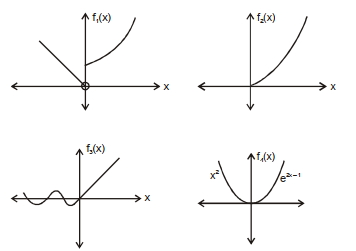
0 likesView Solution
Vedclass Products
For Students
Vedclass Test Series
Mock tests in real IIT JEE style covering Mathematics with performance analysis. 5-day free trial.
Start Free TrialFor Teachers
Exam Paper Generator
Generate Set A/B/C/D Mathematics papers from 7.5L+ questions in 2 minutes. 3 chapters free.
Try FreeFor Institutes
Online Exam Module
Run live IIT JEE mock exams with unlimited students, 360° analytics & white-label branding.
See DemoFrequently Asked Questions
How many Mathematics questions are in IIT JEE 2014?
There are 37 Mathematics questions from the IIT JEE 2014 paper on Vedclass, each with a detailed step-by-step solution in English.
Are IIT JEE 2014 Mathematics solutions available in English?
Yes. All solutions on this page are in English. You can also switch to English or Hindi using the language buttons above the questions.
Can I practice IIT JEE 2014 Mathematics as a timed test?
Yes. Use the Vedclass Test Series to attempt a full IIT JEE mock test covering Mathematics with time limits and instant score analysis.
Can teachers create Mathematics papers from IIT JEE previous year questions?
Yes. The Vedclass Exam Paper Generator lets teachers mix IIT JEE Mathematics questions and generate Set A/B/C/D papers in minutes.
For Teachers & Institutes
Build a Custom Mathematics Paper
Pick IIT JEE 2014 Mathematics questions, set difficulty, and generate Set A/B/C/D in 2 minutes.