
MathematicsQ1–35 of 35 questions
Page 1 of 1 · English
1
MathematicsAdvancedMCQIIT JEE · 2008
Let $a$ and $b$ be non-zero real numbers. Then,the equation $(a x^2+b y^2+c)(x^2-5 x y+6 y^2)=0$ represents
A
four straight lines,when $c=0$ and $a, b$ are of the same sign
B
two straight lines and a circle,when $a=b$,and $c$ is of sign opposite to that of $a$
C
two straight lines and a hyperbola,when $a$ and $b$ are of the same sign and $c$ is of sign opposite to that of $a$
D
a circle and an ellipse,when $a$ and $b$ are of the same sign and $c$ is of sign opposite to that of $a$
Solution
(B) The given equation is $(a x^2+b y^2+c)(x^2-5 x y+6 y^2)=0$.
This implies $a x^2+b y^2+c=0$ or $x^2-5 x y+6 y^2=0$.
The second part $x^2-5 x y+6 y^2=0$ can be factored as $(x-2 y)(x-3 y)=0$,which represents two straight lines passing through the origin.
For the first part $a x^2+b y^2+c=0$,if $a=b$ and $c$ has the opposite sign to $a$,then $x^2+y^2 = -c/a$,which represents a circle.
Thus,the equation represents two straight lines and a circle when $a=b$ and $c$ is of sign opposite to that of $a$.
This implies $a x^2+b y^2+c=0$ or $x^2-5 x y+6 y^2=0$.
The second part $x^2-5 x y+6 y^2=0$ can be factored as $(x-2 y)(x-3 y)=0$,which represents two straight lines passing through the origin.
For the first part $a x^2+b y^2+c=0$,if $a=b$ and $c$ has the opposite sign to $a$,then $x^2+y^2 = -c/a$,which represents a circle.
Thus,the equation represents two straight lines and a circle when $a=b$ and $c$ is of sign opposite to that of $a$.
0 likesView Solution
2
MathematicsAdvancedMCQIIT JEE · 2008
Let $g(x) = \frac{(x-1)^n}{\log \cos^m(x-1)}$ for $x \neq 1$,and let $p$ be the left-hand derivative of $|x-1|$ at $x=1$. If $\lim_{x \rightarrow 1^{+}} g(x) = p$,then:
A
$n=1, m=1$
B
$n=1, m=-1$
C
$n=2, m=2$
D
$n>2, m=n$
Solution
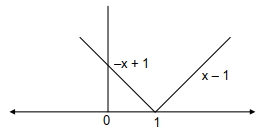
(C) The function is $f(x) = |x-1|$. For $x < 1$,$f(x) = -(x-1) = -x+1$. The left-hand derivative at $x=1$ is $p = \frac{d}{dx}(-x+1) = -1$.
Given $\lim_{x \rightarrow 1^{+}} g(x) = p$,we have $\lim_{x \rightarrow 1^{+}} \frac{(x-1)^n}{\log \cos^m(x-1)} = -1$.
Let $h = x-1$. As $x \rightarrow 1^{+}$,$h \rightarrow 0^{+}$. The limit becomes $\lim_{h \rightarrow 0^{+}} \frac{h^n}{\log \cos^m h} = -1$.
Using the property $\log \cos^m h = m \log \cos h$,we have $\lim_{h \rightarrow 0^{+}} \frac{h^n}{m \log \cos h} = -1$.
Using $L$'$H$ôpital's rule,$\lim_{h \rightarrow 0^{+}} \frac{n h^{n-1}}{m (\frac{-\sin h}{\cos h})} = \lim_{h \rightarrow 0^{+}} \frac{n h^{n-1}}{-m \tan h} = -\frac{n}{m} \lim_{h \rightarrow 0^{+}} \frac{h^{n-1}}{\tan h} = -1$.
For this limit to be a non-zero constant,we must have $n-1 = 1$,so $n=2$. Then the limit is $-\frac{2}{m} \lim_{h \rightarrow 0^{+}} \frac{h}{\tan h} = -\frac{2}{m} (1) = -1$,which implies $m=2$.
Thus,$n=2$ and $m=2$.
Given $\lim_{x \rightarrow 1^{+}} g(x) = p$,we have $\lim_{x \rightarrow 1^{+}} \frac{(x-1)^n}{\log \cos^m(x-1)} = -1$.
Let $h = x-1$. As $x \rightarrow 1^{+}$,$h \rightarrow 0^{+}$. The limit becomes $\lim_{h \rightarrow 0^{+}} \frac{h^n}{\log \cos^m h} = -1$.
Using the property $\log \cos^m h = m \log \cos h$,we have $\lim_{h \rightarrow 0^{+}} \frac{h^n}{m \log \cos h} = -1$.
Using $L$'$H$ôpital's rule,$\lim_{h \rightarrow 0^{+}} \frac{n h^{n-1}}{m (\frac{-\sin h}{\cos h})} = \lim_{h \rightarrow 0^{+}} \frac{n h^{n-1}}{-m \tan h} = -\frac{n}{m} \lim_{h \rightarrow 0^{+}} \frac{h^{n-1}}{\tan h} = -1$.
For this limit to be a non-zero constant,we must have $n-1 = 1$,so $n=2$. Then the limit is $-\frac{2}{m} \lim_{h \rightarrow 0^{+}} \frac{h}{\tan h} = -\frac{2}{m} (1) = -1$,which implies $m=2$.
Thus,$n=2$ and $m=2$.
0 likesView Solution
3
MathematicsAdvancedMCQIIT JEE · 2008
Consider the two curves $C_1: y^2=4x$ and $C_2: x^2+y^2-6x+1=0$. Then,
A
$C_1$ and $C_2$ touch each other only at one point.
B
$C_1$ and $C_2$ touch each other exactly at two points.
C
$C_1$ and $C_2$ intersect (but do not touch) at exactly two points.
D
$C_1$ and $C_2$ neither intersect nor touch each other.
Solution
(B) To find the points of intersection,substitute $y^2 = 4x$ into the equation of the circle $x^2 + y^2 - 6x + 1 = 0$.
This gives $x^2 + 4x - 6x + 1 = 0$,which simplifies to $x^2 - 2x + 1 = 0$.
This is $(x - 1)^2 = 0$,so $x = 1$.
Substituting $x = 1$ into $y^2 = 4x$,we get $y^2 = 4$,which means $y = 2$ or $y = -2$.
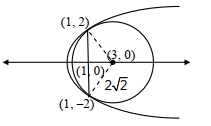
Thus,the curves intersect at the points $(1, 2)$ and $(1, -2)$.
To check if they touch,we compare the slopes of the tangents at these points.
For the parabola $y^2 = 4x$,differentiating gives $2y \frac{dy}{dx} = 4$,so $\frac{dy}{dx} = \frac{2}{y}$. At $(1, 2)$,slope $m_1 = 1$. At $(1, -2)$,slope $m_1 = -1$.
For the circle $x^2 + y^2 - 6x + 1 = 0$,differentiating gives $2x + 2y \frac{dy}{dx} - 6 = 0$,so $\frac{dy}{dx} = \frac{3 - x}{y}$. At $(1, 2)$,slope $m_2 = \frac{3 - 1}{2} = 1$. At $(1, -2)$,slope $m_2 = \frac{3 - 1}{-2} = -1$.
Since the slopes are equal at both points,the curves touch each other at exactly two points.
This gives $x^2 + 4x - 6x + 1 = 0$,which simplifies to $x^2 - 2x + 1 = 0$.
This is $(x - 1)^2 = 0$,so $x = 1$.
Substituting $x = 1$ into $y^2 = 4x$,we get $y^2 = 4$,which means $y = 2$ or $y = -2$.
Thus,the curves intersect at the points $(1, 2)$ and $(1, -2)$.
To check if they touch,we compare the slopes of the tangents at these points.
For the parabola $y^2 = 4x$,differentiating gives $2y \frac{dy}{dx} = 4$,so $\frac{dy}{dx} = \frac{2}{y}$. At $(1, 2)$,slope $m_1 = 1$. At $(1, -2)$,slope $m_1 = -1$.
For the circle $x^2 + y^2 - 6x + 1 = 0$,differentiating gives $2x + 2y \frac{dy}{dx} - 6 = 0$,so $\frac{dy}{dx} = \frac{3 - x}{y}$. At $(1, 2)$,slope $m_2 = \frac{3 - 1}{2} = 1$. At $(1, -2)$,slope $m_2 = \frac{3 - 1}{-2} = -1$.
Since the slopes are equal at both points,the curves touch each other at exactly two points.
0 likesView Solution
4
MathematicsAdvancedMCQIIT JEE · 2008
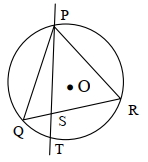
$A$ straight line through the vertex $P$ of a triangle $PQR$ intersects the side $QR$ at the point $S$ and the circumcircle of the triangle $PQR$ at the point $T$. If $S$ is not the centre of the circumcircle,then:
$(A) \frac{1}{PS}+\frac{1}{ST}<\frac{2}{\sqrt{QS \times SR}}$
$(B) \frac{1}{PS}+\frac{1}{ST}>\frac{2}{\sqrt{QS \times SR}}$
$(C) \frac{1}{PS}+\frac{1}{ST}<\frac{4}{QR}$
$(D) \frac{1}{PS}+\frac{1}{ST}>\frac{4}{QR}$
$(A) \frac{1}{PS}+\frac{1}{ST}<\frac{2}{\sqrt{QS \times SR}}$
$(B) \frac{1}{PS}+\frac{1}{ST}>\frac{2}{\sqrt{QS \times SR}}$
$(C) \frac{1}{PS}+\frac{1}{ST}<\frac{4}{QR}$
$(D) \frac{1}{PS}+\frac{1}{ST}>\frac{4}{QR}$
A
$B, D$
B
$B, A$
C
$C, D$
D
$C, A$
Solution
(A) By the power of a point theorem for the circle,we have $PS \times ST = QS \times SR$.
Using the Arithmetic Mean-Geometric Mean ($AM$-$GM$) inequality for the terms $\frac{1}{PS}$ and $\frac{1}{ST}$,we have:
$\frac{\frac{1}{PS}+\frac{1}{ST}}{2} > \sqrt{\frac{1}{PS} \times \frac{1}{ST}}$
$\Rightarrow \frac{1}{PS}+\frac{1}{ST} > \frac{2}{\sqrt{PS \times ST}} = \frac{2}{\sqrt{QS \times SR}}$.
This proves that option $(B)$ is correct.
Next,by the $AM$-$GM$ inequality for $QS$ and $SR$,we have:
$\frac{QS+SR}{2} > \sqrt{QS \times SR}$
$\Rightarrow \frac{QR}{2} > \sqrt{QS \times SR}$
$\Rightarrow \frac{1}{\sqrt{QS \times SR}} > \frac{2}{QR}$.
Substituting this into the previous inequality:
$\frac{1}{PS}+\frac{1}{ST} > \frac{2}{\sqrt{QS \times SR}} > \frac{2 \times 2}{QR} = \frac{4}{QR}$.
This proves that option $(D)$ is correct.
Thus,the correct options are $(B)$ and $(D)$.
Using the Arithmetic Mean-Geometric Mean ($AM$-$GM$) inequality for the terms $\frac{1}{PS}$ and $\frac{1}{ST}$,we have:
$\frac{\frac{1}{PS}+\frac{1}{ST}}{2} > \sqrt{\frac{1}{PS} \times \frac{1}{ST}}$
$\Rightarrow \frac{1}{PS}+\frac{1}{ST} > \frac{2}{\sqrt{PS \times ST}} = \frac{2}{\sqrt{QS \times SR}}$.
This proves that option $(B)$ is correct.
Next,by the $AM$-$GM$ inequality for $QS$ and $SR$,we have:
$\frac{QS+SR}{2} > \sqrt{QS \times SR}$
$\Rightarrow \frac{QR}{2} > \sqrt{QS \times SR}$
$\Rightarrow \frac{1}{\sqrt{QS \times SR}} > \frac{2}{QR}$.
Substituting this into the previous inequality:
$\frac{1}{PS}+\frac{1}{ST} > \frac{2}{\sqrt{QS \times SR}} > \frac{2 \times 2}{QR} = \frac{4}{QR}$.
This proves that option $(D)$ is correct.
Thus,the correct options are $(B)$ and $(D)$.
0 likesView Solution
5
MathematicsAdvancedMCQIIT JEE · 2008
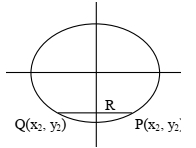
Let $P(x_1, y_1)$ and $Q(x_2, y_2)$,with $y_1 < 0$ and $y_2 < 0$,be the endpoints of the latus rectum of the ellipse $x^2 + 4y^2 = 4$. The equations of the parabolas with latus rectum $PQ$ are:
$(A) x^2 + 2\sqrt{3}y = 3 + \sqrt{3}$
$(B) x^2 - 2\sqrt{3}y = 3 + \sqrt{3}$
$(C) x^2 + 2\sqrt{3}y = 3 - \sqrt{3}$
$(D) x^2 - 2\sqrt{3}y = 3 - \sqrt{3}$
$(A) x^2 + 2\sqrt{3}y = 3 + \sqrt{3}$
$(B) x^2 - 2\sqrt{3}y = 3 + \sqrt{3}$
$(C) x^2 + 2\sqrt{3}y = 3 - \sqrt{3}$
$(D) x^2 - 2\sqrt{3}y = 3 - \sqrt{3}$
A
$B, D$
B
$C, A$
C
$B, C$
D
$B, C$
Solution
(C) The given ellipse is $\frac{x^2}{4} + \frac{y^2}{1} = 1$. Here $a^2 = 4$ and $b^2 = 1$.
The eccentricity $e$ is given by $b^2 = a^2(1 - e^2)$ $\Rightarrow 1 = 4(1 - e^2)$ $\Rightarrow 1 - e^2 = \frac{1}{4}$ $\Rightarrow e = \frac{\sqrt{3}}{2}$.
The coordinates of the foci are $(\pm ae, 0) = (\pm \sqrt{3}, 0)$.
Since $P$ and $Q$ are endpoints of the latus rectum with $y < 0$,we have $x = \pm \sqrt{3}$. Substituting into the ellipse equation: $3 + 4y^2 = 4$ $\Rightarrow 4y^2 = 1$ $\Rightarrow y = -\frac{1}{2}$ (as $y < 0$).
Thus,$P = (\sqrt{3}, -\frac{1}{2})$ and $Q = (-\sqrt{3}, -\frac{1}{2})$.
The length of the latus rectum $PQ = 2\sqrt{3}$.
For a parabola with latus rectum $PQ$,the length of the latus rectum $4a' = 2\sqrt{3} \Rightarrow a' = \frac{\sqrt{3}}{2}$.
The midpoint of $PQ$ is $R = (0, -\frac{1}{2})$. The axis of the parabola is the $y$-axis.
The vertex of the parabola is $(0, y_v)$,where $y_v = -\frac{1}{2} \pm a' = -\frac{1}{2} \pm \frac{\sqrt{3}}{2}$.
Case $1$: Vertex $(0, -\frac{1}{2} - \frac{\sqrt{3}}{2})$. The equation is $x^2 = 4a'(y - y_v)$ $\Rightarrow x^2 = 2\sqrt{3}(y + \frac{1}{2} + \frac{\sqrt{3}}{2})$ $\Rightarrow x^2 = 2\sqrt{3}y + \sqrt{3} + 3$ $\Rightarrow x^2 - 2\sqrt{3}y = 3 + \sqrt{3}$.
Case $2$: Vertex $(0, -\frac{1}{2} + \frac{\sqrt{3}}{2})$. The equation is $x^2 = -4a'(y - y_v)$ $\Rightarrow x^2 = -2\sqrt{3}(y + \frac{1}{2} - \frac{\sqrt{3}}{2})$ $\Rightarrow x^2 = -2\sqrt{3}y - \sqrt{3} + 3$ $\Rightarrow x^2 + 2\sqrt{3}y = 3 - \sqrt{3}$.
Thus,the equations are $x^2 - 2\sqrt{3}y = 3 + \sqrt{3}$ and $x^2 + 2\sqrt{3}y = 3 - \sqrt{3}$,which correspond to options $B$ and $C$.
The eccentricity $e$ is given by $b^2 = a^2(1 - e^2)$ $\Rightarrow 1 = 4(1 - e^2)$ $\Rightarrow 1 - e^2 = \frac{1}{4}$ $\Rightarrow e = \frac{\sqrt{3}}{2}$.
The coordinates of the foci are $(\pm ae, 0) = (\pm \sqrt{3}, 0)$.
Since $P$ and $Q$ are endpoints of the latus rectum with $y < 0$,we have $x = \pm \sqrt{3}$. Substituting into the ellipse equation: $3 + 4y^2 = 4$ $\Rightarrow 4y^2 = 1$ $\Rightarrow y = -\frac{1}{2}$ (as $y < 0$).
Thus,$P = (\sqrt{3}, -\frac{1}{2})$ and $Q = (-\sqrt{3}, -\frac{1}{2})$.
The length of the latus rectum $PQ = 2\sqrt{3}$.
For a parabola with latus rectum $PQ$,the length of the latus rectum $4a' = 2\sqrt{3} \Rightarrow a' = \frac{\sqrt{3}}{2}$.
The midpoint of $PQ$ is $R = (0, -\frac{1}{2})$. The axis of the parabola is the $y$-axis.
The vertex of the parabola is $(0, y_v)$,where $y_v = -\frac{1}{2} \pm a' = -\frac{1}{2} \pm \frac{\sqrt{3}}{2}$.
Case $1$: Vertex $(0, -\frac{1}{2} - \frac{\sqrt{3}}{2})$. The equation is $x^2 = 4a'(y - y_v)$ $\Rightarrow x^2 = 2\sqrt{3}(y + \frac{1}{2} + \frac{\sqrt{3}}{2})$ $\Rightarrow x^2 = 2\sqrt{3}y + \sqrt{3} + 3$ $\Rightarrow x^2 - 2\sqrt{3}y = 3 + \sqrt{3}$.
Case $2$: Vertex $(0, -\frac{1}{2} + \frac{\sqrt{3}}{2})$. The equation is $x^2 = -4a'(y - y_v)$ $\Rightarrow x^2 = -2\sqrt{3}(y + \frac{1}{2} - \frac{\sqrt{3}}{2})$ $\Rightarrow x^2 = -2\sqrt{3}y - \sqrt{3} + 3$ $\Rightarrow x^2 + 2\sqrt{3}y = 3 - \sqrt{3}$.
Thus,the equations are $x^2 - 2\sqrt{3}y = 3 + \sqrt{3}$ and $x^2 + 2\sqrt{3}y = 3 - \sqrt{3}$,which correspond to options $B$ and $C$.
0 likesView Solution
6
MathematicsDifficultMCQIIT JEE · 2008
$A$ circle $C$ of radius $1$ is inscribed in an equilateral triangle $PQR$. The points of contact of $C$ with the sides $PQ, QR, RP$ are $D, E, F$,respectively. The line $PQ$ is given by the equation $\sqrt{3}x + y - 6 = 0$ and the point $D$ is $\left(\frac{3\sqrt{3}}{2}, \frac{3}{2}\right)$. Further,it is given that the origin and the centre of $C$ are on the same side of the line $PQ$.
$1.$ The equation of circle $C$ is
$(A) (x - 2\sqrt{3})^2 + (y - 1)^2 = 1$
$(B) (x - 2\sqrt{3})^2 + (y + \frac{1}{2})^2 = 1$
$(C) (x - \sqrt{3})^2 + (y + 1)^2 = 1$
$(D) (x - \sqrt{3})^2 + (y - 1)^2 = 1$
$2.$ Points $E$ and $F$ are given by
$(A) \left(\frac{\sqrt{3}}{2}, \frac{3}{2}\right), (\sqrt{3}, 0)$
$(B) \left(\frac{\sqrt{3}}{2}, \frac{1}{2}\right), (\sqrt{3}, 0)$
$(C) \left(\frac{\sqrt{3}}{2}, \frac{3}{2}\right), \left(\frac{\sqrt{3}}{2}, \frac{1}{2}\right)$
$(D) \left(\frac{3}{2}, \frac{\sqrt{3}}{2}\right), \left(\frac{\sqrt{3}}{2}, \frac{1}{2}\right)$
$3.$ Equation of the sides $QR, RP$ are
$(A) y = \frac{2}{\sqrt{3}}x + 1, y = -\frac{2}{\sqrt{3}}x - 1$
$(B) y = \frac{1}{\sqrt{3}}x, y = 0$
$(C) y = \frac{\sqrt{3}}{2}x + 1, y = -\frac{\sqrt{3}}{2}x - 1$
$(D) y = \sqrt{3}x, y = 0$
Give the answer for questions $1, 2$ and $3$.
$1.$ The equation of circle $C$ is
$(A) (x - 2\sqrt{3})^2 + (y - 1)^2 = 1$
$(B) (x - 2\sqrt{3})^2 + (y + \frac{1}{2})^2 = 1$
$(C) (x - \sqrt{3})^2 + (y + 1)^2 = 1$
$(D) (x - \sqrt{3})^2 + (y - 1)^2 = 1$
$2.$ Points $E$ and $F$ are given by
$(A) \left(\frac{\sqrt{3}}{2}, \frac{3}{2}\right), (\sqrt{3}, 0)$
$(B) \left(\frac{\sqrt{3}}{2}, \frac{1}{2}\right), (\sqrt{3}, 0)$
$(C) \left(\frac{\sqrt{3}}{2}, \frac{3}{2}\right), \left(\frac{\sqrt{3}}{2}, \frac{1}{2}\right)$
$(D) \left(\frac{3}{2}, \frac{\sqrt{3}}{2}\right), \left(\frac{\sqrt{3}}{2}, \frac{1}{2}\right)$
$3.$ Equation of the sides $QR, RP$ are
$(A) y = \frac{2}{\sqrt{3}}x + 1, y = -\frac{2}{\sqrt{3}}x - 1$
$(B) y = \frac{1}{\sqrt{3}}x, y = 0$
$(C) y = \frac{\sqrt{3}}{2}x + 1, y = -\frac{\sqrt{3}}{2}x - 1$
$(D) y = \sqrt{3}x, y = 0$
Give the answer for questions $1, 2$ and $3$.
A
$D, C, B$
B
$D, A, D$
C
$D, A, D$
D
$B, C, A$
Solution
(B) $1.$ The normal to the line $PQ: \sqrt{3}x + y - 6 = 0$ at $D\left(\frac{3\sqrt{3}}{2}, \frac{3}{2}\right)$ has slope $\frac{1}{\sqrt{3}}$.
The equation of the normal line $CD$ is $y - \frac{3}{2} = \frac{1}{\sqrt{3}}\left(x - \frac{3\sqrt{3}}{2}\right) \Rightarrow x - \sqrt{3}y = 0$.
Since the radius is $1$ and the centre $C(h, k)$ is at distance $1$ from $PQ$ and lies on $x - \sqrt{3}y = 0$,we find $C = (\sqrt{3}, 1)$.
Thus,the equation of circle $C$ is $(x - \sqrt{3})^2 + (y - 1)^2 = 1$. Correct option is $(D)$.
$2.$ The angle between the sides of an equilateral triangle is $60^\circ$. The lines $CE$ and $CF$ make angles of $120^\circ$ and $240^\circ$ with $CD$ respectively.
Using rotation or geometry,$F = (\sqrt{3}, 0)$ and $E = \left(\frac{\sqrt{3}}{2}, \frac{3}{2}\right)$. Correct option is $(A)$.
$3.$ The side $QR$ passes through $E\left(\frac{\sqrt{3}}{2}, \frac{3}{2}\right)$ with slope $\sqrt{3}$,so $y - \frac{3}{2} = \sqrt{3}\left(x - \frac{\sqrt{3}}{2}\right) \Rightarrow y = \sqrt{3}x$. The side $RP$ passes through $F(\sqrt{3}, 0)$ with slope $0$,so $y = 0$. Correct option is $(D)$.
The equation of the normal line $CD$ is $y - \frac{3}{2} = \frac{1}{\sqrt{3}}\left(x - \frac{3\sqrt{3}}{2}\right) \Rightarrow x - \sqrt{3}y = 0$.
Since the radius is $1$ and the centre $C(h, k)$ is at distance $1$ from $PQ$ and lies on $x - \sqrt{3}y = 0$,we find $C = (\sqrt{3}, 1)$.
Thus,the equation of circle $C$ is $(x - \sqrt{3})^2 + (y - 1)^2 = 1$. Correct option is $(D)$.
$2.$ The angle between the sides of an equilateral triangle is $60^\circ$. The lines $CE$ and $CF$ make angles of $120^\circ$ and $240^\circ$ with $CD$ respectively.
Using rotation or geometry,$F = (\sqrt{3}, 0)$ and $E = \left(\frac{\sqrt{3}}{2}, \frac{3}{2}\right)$. Correct option is $(A)$.
$3.$ The side $QR$ passes through $E\left(\frac{\sqrt{3}}{2}, \frac{3}{2}\right)$ with slope $\sqrt{3}$,so $y - \frac{3}{2} = \sqrt{3}\left(x - \frac{\sqrt{3}}{2}\right) \Rightarrow y = \sqrt{3}x$. The side $RP$ passes through $F(\sqrt{3}, 0)$ with slope $0$,so $y = 0$. Correct option is $(D)$.
0 likesView Solution
7
MathematicsAdvancedIIT JEE · 2008
Let $A, B, C$ be three sets of complex numbers as defined below:
$A = \{z : \operatorname{Im}(z) \geq 1\}$
$B = \{z : |z - 2 - i| = 3\}$
$C = \{z : \operatorname{Re}((1 - i)z) = \sqrt{2}\}$
$1.$ The number of elements in the set $A \cap B \cap C$ is:
$(A) 0, (B) 1, (C) 2, (D) \infty$
$2.$ Let $z$ be any point in $A \cap B \cap C$. Then,$|z + 1 - i|^2 + |z - 5 - i|^2$ lies between:
$(A) 25 \text{ and } 29, (B) 30 \text{ and } 34, (C) 35 \text{ and } 39, (D) 40 \text{ and } 44$
$3.$ Let $z$ be any point in $A \cap B \cap C$ and let $w$ be any point satisfying $|w - 2 - i| < 3$. Then,$|z| - |w| + 3$ lies between:
$(A) -6 \text{ and } 3, (B) -3 \text{ and } 6, (C) -6 \text{ and } 6, (D) -3 \text{ and } 9$
$A = \{z : \operatorname{Im}(z) \geq 1\}$
$B = \{z : |z - 2 - i| = 3\}$
$C = \{z : \operatorname{Re}((1 - i)z) = \sqrt{2}\}$
$1.$ The number of elements in the set $A \cap B \cap C$ is:
$(A) 0, (B) 1, (C) 2, (D) \infty$
$2.$ Let $z$ be any point in $A \cap B \cap C$. Then,$|z + 1 - i|^2 + |z - 5 - i|^2$ lies between:
$(A) 25 \text{ and } 29, (B) 30 \text{ and } 34, (C) 35 \text{ and } 39, (D) 40 \text{ and } 44$
$3.$ Let $z$ be any point in $A \cap B \cap C$ and let $w$ be any point satisfying $|w - 2 - i| < 3$. Then,$|z| - |w| + 3$ lies between:
$(A) -6 \text{ and } 3, (B) -3 \text{ and } 6, (C) -6 \text{ and } 6, (D) -3 \text{ and } 9$
Solution
(B, C, D) $1.$ $A$ represents the region $y \geq 1$. $B$ is a circle with center $(2, 1)$ and radius $3$. $C$ is the line $\operatorname{Re}((1-i)(x+iy)) = x+y = \sqrt{2}$.
Substituting $y = \sqrt{2}-x$ into the circle equation $(x-2)^2 + (y-1)^2 = 9$ gives $(x-2)^2 + (\sqrt{2}-x-1)^2 = 9$.
Expanding this: $(x^2 - 4x + 4) + (x^2 + 2x(1-\sqrt{2}) + (1-\sqrt{2})^2) = 9$.
$2x^2 + x(2-2\sqrt{2}-4) + 4 + 1 - 2\sqrt{2} + 2 = 9 \implies 2x^2 - (2+2\sqrt{2})x - 2 - 2\sqrt{2} = 0$.
Solving this quadratic,we find one point with $y \geq 1$. Thus,the number of elements is $1$.
$2.$ Let $z = x+iy$. The expression is $|(x+1)+i(y-1)|^2 + |(x-5)+i(y-1)|^2 = (x+1)^2 + (y-1)^2 + (x-5)^2 + (y-1)^2$.
Since $z$ is on the circle $(x-2)^2 + (y-1)^2 = 9$,we have $(y-1)^2 = 9 - (x-2)^2$.
Substituting this,the expression becomes $(x+1)^2 + (x-5)^2 + 2(9 - (x-2)^2) = x^2+2x+1 + x^2-10x+25 + 18 - 2(x^2-4x+4) = 2x^2-8x+26 + 18 - 2x^2+8x-8 = 36$.
Since $36$ is between $35$ and $39$,the answer is $(C)$.
$3.$ Since $|z-2-i|=3$ and $|w-2-i| < 3$,by the triangle inequality $|z-w| < |z-(2+i)| + |w-(2+i)| < 3+3 = 6$.
Also $|z-w| > ||z-(2+i)| - |w-(2+i)|| = |3 - |w-(2+i)|| > 0$.
Thus $0 < |z-w| < 6$. Using $||z|-|w|| \leq |z-w|$,we have $-6 < |z|-|w| < 6$.
Adding $3$,we get $-3 < |z|-|w|+3 < 9$.
Substituting $y = \sqrt{2}-x$ into the circle equation $(x-2)^2 + (y-1)^2 = 9$ gives $(x-2)^2 + (\sqrt{2}-x-1)^2 = 9$.
Expanding this: $(x^2 - 4x + 4) + (x^2 + 2x(1-\sqrt{2}) + (1-\sqrt{2})^2) = 9$.
$2x^2 + x(2-2\sqrt{2}-4) + 4 + 1 - 2\sqrt{2} + 2 = 9 \implies 2x^2 - (2+2\sqrt{2})x - 2 - 2\sqrt{2} = 0$.
Solving this quadratic,we find one point with $y \geq 1$. Thus,the number of elements is $1$.
$2.$ Let $z = x+iy$. The expression is $|(x+1)+i(y-1)|^2 + |(x-5)+i(y-1)|^2 = (x+1)^2 + (y-1)^2 + (x-5)^2 + (y-1)^2$.
Since $z$ is on the circle $(x-2)^2 + (y-1)^2 = 9$,we have $(y-1)^2 = 9 - (x-2)^2$.
Substituting this,the expression becomes $(x+1)^2 + (x-5)^2 + 2(9 - (x-2)^2) = x^2+2x+1 + x^2-10x+25 + 18 - 2(x^2-4x+4) = 2x^2-8x+26 + 18 - 2x^2+8x-8 = 36$.
Since $36$ is between $35$ and $39$,the answer is $(C)$.
$3.$ Since $|z-2-i|=3$ and $|w-2-i| < 3$,by the triangle inequality $|z-w| < |z-(2+i)| + |w-(2+i)| < 3+3 = 6$.
Also $|z-w| > ||z-(2+i)| - |w-(2+i)|| = |3 - |w-(2+i)|| > 0$.
Thus $0 < |z-w| < 6$. Using $||z|-|w|| \leq |z-w|$,we have $-6 < |z|-|w| < 6$.
Adding $3$,we get $-3 < |z|-|w|+3 < 9$.
0 likesView Solution
8
MathematicsDifficultMCQIIT JEE · 2008
Consider three points $P = (-\sin(\beta - \alpha), -\cos \beta)$,$Q = (\cos(\beta - \alpha), \sin \beta)$,and $R = (\cos(\beta - \alpha + \theta), \sin(\beta - \theta))$,where $0 < \alpha, \beta, \theta < \frac{\pi}{4}$. Then:
A
$P$ lies on the line segment $RQ$
B
$Q$ lies on the line segment $PR$
C
$R$ lies on the line segment $QP$
D
$P, Q, R$ are non-collinear
Solution
(C) Let $P = (x_1, y_1) = (-\sin(\beta - \alpha), -\cos \beta)$ and $Q = (x_2, y_2) = (\cos(\beta - \alpha), \sin \beta)$.
We observe that $R = (\cos(\beta - \alpha + \theta), \sin(\beta - \theta))$.
Using trigonometric identities,$\cos(\beta - \alpha + \theta) = \cos(\beta - \alpha)\cos \theta - \sin(\beta - \alpha)\sin \theta = x_2 \cos \theta + x_1 \sin \theta$.
Similarly,$\sin(\beta - \theta) = \sin \beta \cos \theta - \cos \beta \sin \theta = y_2 \cos \theta + y_1 \sin \theta$.
Thus,$R = (x_2 \cos \theta + x_1 \sin \theta, y_2 \cos \theta + y_1 \sin \theta)$.
This shows that $R$ divides the line segment $PQ$ internally in the ratio $\sin \theta : \cos \theta$.
Since $0 < \theta < \frac{\pi}{4}$,both $\sin \theta$ and $\cos \theta$ are positive,so $R$ lies on the line segment $PQ$ (or $QP$).
We observe that $R = (\cos(\beta - \alpha + \theta), \sin(\beta - \theta))$.
Using trigonometric identities,$\cos(\beta - \alpha + \theta) = \cos(\beta - \alpha)\cos \theta - \sin(\beta - \alpha)\sin \theta = x_2 \cos \theta + x_1 \sin \theta$.
Similarly,$\sin(\beta - \theta) = \sin \beta \cos \theta - \cos \beta \sin \theta = y_2 \cos \theta + y_1 \sin \theta$.
Thus,$R = (x_2 \cos \theta + x_1 \sin \theta, y_2 \cos \theta + y_1 \sin \theta)$.
This shows that $R$ divides the line segment $PQ$ internally in the ratio $\sin \theta : \cos \theta$.
Since $0 < \theta < \frac{\pi}{4}$,both $\sin \theta$ and $\cos \theta$ are positive,so $R$ lies on the line segment $PQ$ (or $QP$).
0 likesView Solution
9
MathematicsAdvancedMCQIIT JEE · 2008
Consider a branch of the hyperbola $x^2 - 2y^2 - 2\sqrt{2}x - 4\sqrt{2}y - 6 = 0$ with vertex at the point $A$. Let $B$ be one of the end points of its latus rectum. If $C$ is the focus of the hyperbola nearest to the point $A$,then the area of the triangle $ABC$ is
A
$1 - \sqrt{\frac{2}{3}}$
B
$\sqrt{\frac{3}{2}} - 1$
C
$1 + \sqrt{\frac{2}{3}}$
D
$\sqrt{\frac{3}{2}} + 1$
Solution
(B) The given equation is $x^2 - 2y^2 - 2\sqrt{2}x - 4\sqrt{2}y - 6 = 0$.
Completing the square,we get $(x^2 - 2\sqrt{2}x + 2) - 2(y^2 + 2\sqrt{2}y + 2) = 6 + 2 - 4$,which simplifies to $(x - \sqrt{2})^2 - 2(y + \sqrt{2})^2 = 4$.
Dividing by $4$,we obtain the standard form: $\frac{(x - \sqrt{2})^2}{4} - \frac{(y + \sqrt{2})^2}{2} = 1$.
Here,$a^2 = 4 \Rightarrow a = 2$ and $b^2 = 2 \Rightarrow b = \sqrt{2}$.
The eccentricity $e = \sqrt{1 + \frac{b^2}{a^2}} = \sqrt{1 + \frac{2}{4}} = \sqrt{\frac{3}{2}}$.
The vertex $A$ is $(\sqrt{2} + a, -\sqrt{2}) = (2 + \sqrt{2}, -\sqrt{2})$.
The focus $C$ nearest to $A$ is $(\sqrt{2} + ae, -\sqrt{2}) = (\sqrt{2} + 2\sqrt{\frac{3}{2}}, -\sqrt{2}) = (\sqrt{2} + \sqrt{6}, -\sqrt{2})$.
The distance $AC = ae - a = a(e - 1) = 2(\sqrt{\frac{3}{2}} - 1) = \sqrt{6} - 2$.
The length of the semi-latus rectum is $\frac{b^2}{a} = \frac{2}{2} = 1$.
The point $B$ is $(ae + \sqrt{2}, \frac{b^2}{a} - \sqrt{2}) = (\sqrt{6} + \sqrt{2}, 1 - \sqrt{2})$.
The area of the triangle $ABC$ with base $AC$ and height $BC$ is $\frac{1}{2} \times AC \times \frac{b^2}{a} = \frac{1}{2} \times (\sqrt{6} - 2) \times 1 = \frac{\sqrt{6}}{2} - 1 = \sqrt{\frac{6}{4}} - 1 = \sqrt{\frac{3}{2}} - 1$.
Completing the square,we get $(x^2 - 2\sqrt{2}x + 2) - 2(y^2 + 2\sqrt{2}y + 2) = 6 + 2 - 4$,which simplifies to $(x - \sqrt{2})^2 - 2(y + \sqrt{2})^2 = 4$.
Dividing by $4$,we obtain the standard form: $\frac{(x - \sqrt{2})^2}{4} - \frac{(y + \sqrt{2})^2}{2} = 1$.
Here,$a^2 = 4 \Rightarrow a = 2$ and $b^2 = 2 \Rightarrow b = \sqrt{2}$.
The eccentricity $e = \sqrt{1 + \frac{b^2}{a^2}} = \sqrt{1 + \frac{2}{4}} = \sqrt{\frac{3}{2}}$.
The vertex $A$ is $(\sqrt{2} + a, -\sqrt{2}) = (2 + \sqrt{2}, -\sqrt{2})$.
The focus $C$ nearest to $A$ is $(\sqrt{2} + ae, -\sqrt{2}) = (\sqrt{2} + 2\sqrt{\frac{3}{2}}, -\sqrt{2}) = (\sqrt{2} + \sqrt{6}, -\sqrt{2})$.
The distance $AC = ae - a = a(e - 1) = 2(\sqrt{\frac{3}{2}} - 1) = \sqrt{6} - 2$.
The length of the semi-latus rectum is $\frac{b^2}{a} = \frac{2}{2} = 1$.
The point $B$ is $(ae + \sqrt{2}, \frac{b^2}{a} - \sqrt{2}) = (\sqrt{6} + \sqrt{2}, 1 - \sqrt{2})$.
The area of the triangle $ABC$ with base $AC$ and height $BC$ is $\frac{1}{2} \times AC \times \frac{b^2}{a} = \frac{1}{2} \times (\sqrt{6} - 2) \times 1 = \frac{\sqrt{6}}{2} - 1 = \sqrt{\frac{6}{4}} - 1 = \sqrt{\frac{3}{2}} - 1$.
0 likesView Solution
10
MathematicsDifficultMCQIIT JEE · 2008
$A$ particle $P$ starts from the point $z_0 = 1 + 2i$,where $i = \sqrt{-1}$. It moves first horizontally away from the origin by $5$ units and then vertically away from the origin by $3$ units to reach a point $z_1$. From $z_1$,the particle moves $\sqrt{2}$ units in the direction of the vector $\hat{i} + \hat{j}$ and then it moves through an angle $\frac{\pi}{2}$ in the anticlockwise direction on a circle with the center at the origin,to reach a point $z_2$. The point $z_2$ is given by:
A
$6 + 7i$
B
$-7 + 6i$
C
$7 + 6i$
D
$-6 + 7i$
Solution
(D) The initial position is $z_0 = 1 + 2i$.
Moving horizontally by $5$ units: $z = (1 + 5) + 2i = 6 + 2i$.
Moving vertically by $3$ units: $z_1 = 6 + (2 + 3)i = 6 + 5i$.
From $z_1$,moving $\sqrt{2}$ units in the direction of $\hat{i} + \hat{j}$ (which is the direction of $1+i$): The unit vector is $\frac{1+i}{\sqrt{2}}$. The displacement is $\sqrt{2} \times \frac{1+i}{\sqrt{2}} = 1 + i$.
So,the position becomes $z' = (6 + 5i) + (1 + i) = 7 + 6i$.
Finally,rotating $z'$ by $\frac{\pi}{2}$ anticlockwise about the origin is equivalent to multiplying by $e^{i\pi/2} = i$.
$z_2 = (7 + 6i) \times i = 7i + 6i^2 = 7i - 6 = -6 + 7i$.
Moving horizontally by $5$ units: $z = (1 + 5) + 2i = 6 + 2i$.
Moving vertically by $3$ units: $z_1 = 6 + (2 + 3)i = 6 + 5i$.
From $z_1$,moving $\sqrt{2}$ units in the direction of $\hat{i} + \hat{j}$ (which is the direction of $1+i$): The unit vector is $\frac{1+i}{\sqrt{2}}$. The displacement is $\sqrt{2} \times \frac{1+i}{\sqrt{2}} = 1 + i$.
So,the position becomes $z' = (6 + 5i) + (1 + i) = 7 + 6i$.
Finally,rotating $z'$ by $\frac{\pi}{2}$ anticlockwise about the origin is equivalent to multiplying by $e^{i\pi/2} = i$.
$z_2 = (7 + 6i) \times i = 7i + 6i^2 = 7i - 6 = -6 + 7i$.
0 likesView Solution
11
MathematicsAdvancedMCQIIT JEE · 2008
Consider $L_1: 2x + 3y + p - 3 = 0$; $L_2: 2x + 3y + p + 3 = 0$,where $p$ is a real number,and $C: x^2 + y^2 + 6x - 10y + 30 = 0$.
$STATEMENT-1$: If line $L_1$ is a chord of circle $C$,then line $L_2$ is not always a diameter of circle $C$.
$STATEMENT-2$: If line $L_1$ is a diameter of circle $C$,then line $L_2$ is not a chord of circle $C$.
$STATEMENT-1$: If line $L_1$ is a chord of circle $C$,then line $L_2$ is not always a diameter of circle $C$.
$STATEMENT-2$: If line $L_1$ is a diameter of circle $C$,then line $L_2$ is not a chord of circle $C$.
A
$STATEMENT-1$ is True,$STATEMENT-2$ is True; $STATEMENT-2$ is a correct explanation for $STATEMENT-1$.
B
$STATEMENT-1$ is True,$STATEMENT-2$ is True; $STATEMENT-2$ is $NOT$ a correct explanation for $STATEMENT-1$.
C
$STATEMENT-1$ is True,$STATEMENT-2$ is False.
D
$STATEMENT-1$ is False,$STATEMENT-2$ is True.
Solution
(C) The equation of the circle $C$ is $x^2 + 6x + 9 + y^2 - 10y + 25 = -30 + 9 + 25$,which simplifies to $(x + 3)^2 + (y - 5)^2 = 4$.
The center of the circle is $(-3, 5)$ and the radius $r = 2$.
For $L_1: 2x + 3y + p - 3 = 0$ to be a chord,the distance from the center $(-3, 5)$ to $L_1$ must be less than the radius $r=2$.
Distance $d_1 = \frac{|2(-3) + 3(5) + p - 3|}{\sqrt{2^2 + 3^2}} = \frac{|p + 6|}{\sqrt{13}} < 2 \Rightarrow |p + 6| < 2\sqrt{13}$.
For $L_2: 2x + 3y + p + 3 = 0$ to be a diameter,it must pass through the center $(-3, 5)$,so $2(-3) + 3(5) + p + 3 = 0 \Rightarrow p = -12$.
If $p = -12$,$L_1$ becomes $2x + 3y - 15 = 0$. The distance $d_1 = \frac{|-12 + 6|}{\sqrt{13}} = \frac{6}{\sqrt{13}} \approx 1.66 < 2$,so $L_1$ is a chord. Thus,$L_2$ can be a diameter,but it is not always one. So $STATEMENT-1$ is True.
For $STATEMENT-2$: If $L_1$ is a diameter,$2(-3) + 3(5) + p - 3 = 0 \Rightarrow p = -6$. Then $L_2$ is $2x + 3y - 3 = 0$. The distance from the center to $L_2$ is $d_2 = \frac{|2(-3) + 3(5) - 3|}{\sqrt{13}} = \frac{6}{\sqrt{13}} \approx 1.66 < 2$. Since $d_2 < r$,$L_2$ is a chord. Thus,$STATEMENT-2$ is False.
The center of the circle is $(-3, 5)$ and the radius $r = 2$.
For $L_1: 2x + 3y + p - 3 = 0$ to be a chord,the distance from the center $(-3, 5)$ to $L_1$ must be less than the radius $r=2$.
Distance $d_1 = \frac{|2(-3) + 3(5) + p - 3|}{\sqrt{2^2 + 3^2}} = \frac{|p + 6|}{\sqrt{13}} < 2 \Rightarrow |p + 6| < 2\sqrt{13}$.
For $L_2: 2x + 3y + p + 3 = 0$ to be a diameter,it must pass through the center $(-3, 5)$,so $2(-3) + 3(5) + p + 3 = 0 \Rightarrow p = -12$.
If $p = -12$,$L_1$ becomes $2x + 3y - 15 = 0$. The distance $d_1 = \frac{|-12 + 6|}{\sqrt{13}} = \frac{6}{\sqrt{13}} \approx 1.66 < 2$,so $L_1$ is a chord. Thus,$L_2$ can be a diameter,but it is not always one. So $STATEMENT-1$ is True.
For $STATEMENT-2$: If $L_1$ is a diameter,$2(-3) + 3(5) + p - 3 = 0 \Rightarrow p = -6$. Then $L_2$ is $2x + 3y - 3 = 0$. The distance from the center to $L_2$ is $d_2 = \frac{|2(-3) + 3(5) - 3|}{\sqrt{13}} = \frac{6}{\sqrt{13}} \approx 1.66 < 2$. Since $d_2 < r$,$L_2$ is a chord. Thus,$STATEMENT-2$ is False.
0 likesView Solution
12
MathematicsAdvancedMCQIIT JEE · 2008
Let $a, b, c, p, q$ be real numbers. Suppose $\alpha, \beta$ are the roots of the equation $x^2+2px+q=0$ and $\alpha, \frac{1}{\beta}$ are the roots of the equation $ax^2+2bx+c=0$,where $\beta^2 \notin \{-1, 0, 1\}$.
$STATEMENT-1$: $(p^2-q)(b^2-ac) \geq 0$ and
$STATEMENT-2$: $b \neq pa$ or $c \neq qa$.
$STATEMENT-1$: $(p^2-q)(b^2-ac) \geq 0$ and
$STATEMENT-2$: $b \neq pa$ or $c \neq qa$.
A
$STATEMENT-1$ is True,$STATEMENT-2$ is True; $STATEMENT-2$ is a correct explanation for $STATEMENT-1$.
B
$STATEMENT-1$ is True,$STATEMENT-2$ is True; $STATEMENT-2$ is $NOT$ a correct explanation for $STATEMENT-1$.
C
$STATEMENT-1$ is True,$STATEMENT-2$ is False.
D
$STATEMENT-1$ is False,$STATEMENT-2$ is True.
Solution
(B) For the first equation $x^2+2px+q=0$,the roots are $\alpha, \beta$. Thus,$\alpha+\beta = -2p$ and $\alpha\beta = q$. The discriminant is $D_1 = 4p^2-4q = 4(p^2-q)$.
For the second equation $ax^2+2bx+c=0$,the roots are $\alpha, \frac{1}{\beta}$. Thus,$\alpha+\frac{1}{\beta} = -\frac{2b}{a}$ and $\alpha\cdot\frac{1}{\beta} = \frac{c}{a}$. The discriminant is $D_2 = 4b^2-4ac = 4(b^2-ac)$.
Since $\alpha$ is a common root,we have $\alpha^2+2p\alpha+q=0$ and $a\alpha^2+2b\alpha+c=0$. Eliminating $\alpha^2$,we get $(2ap-2b)\alpha + (aq-c) = 0$. If $b=ap$ and $c=aq$,then the equations are identical,which contradicts $\beta^2 \neq 1$. Thus $b \neq ap$ or $c \neq aq$.
Since $\alpha$ is real,$p^2-q \geq 0$ and $b^2-ac \geq 0$ (as $\alpha$ is a root of both),their product is $\geq 0$. Thus $STATEMENT-1$ is True.
$STATEMENT-2$ is also True as shown by the contradiction of identical equations,but it is not the direct explanation for the inequality product. Hence,option $B$ is correct.
For the second equation $ax^2+2bx+c=0$,the roots are $\alpha, \frac{1}{\beta}$. Thus,$\alpha+\frac{1}{\beta} = -\frac{2b}{a}$ and $\alpha\cdot\frac{1}{\beta} = \frac{c}{a}$. The discriminant is $D_2 = 4b^2-4ac = 4(b^2-ac)$.
Since $\alpha$ is a common root,we have $\alpha^2+2p\alpha+q=0$ and $a\alpha^2+2b\alpha+c=0$. Eliminating $\alpha^2$,we get $(2ap-2b)\alpha + (aq-c) = 0$. If $b=ap$ and $c=aq$,then the equations are identical,which contradicts $\beta^2 \neq 1$. Thus $b \neq ap$ or $c \neq aq$.
Since $\alpha$ is real,$p^2-q \geq 0$ and $b^2-ac \geq 0$ (as $\alpha$ is a root of both),their product is $\geq 0$. Thus $STATEMENT-1$ is True.
$STATEMENT-2$ is also True as shown by the contradiction of identical equations,but it is not the direct explanation for the inequality product. Hence,option $B$ is correct.
0 likesView Solution
13
MathematicsAdvancedMCQIIT JEE · 2008
Suppose four distinct positive numbers $a_1, a_2, a_3, a_4$ are in $G.P.$ Let $b_1=a_1, b_2=b_1+a_2, b_3=b_2+a_3$ and $b_4=b_3+a_4$.
$STATEMENT-1$ : The numbers $b_1, b_2, b_3, b_4$ are neither in $A.P.$ nor in $G.P.$
$STATEMENT-2$ : The numbers $b_1, b_2, b_3, b_4$ are in $H.P.$
$STATEMENT-1$ : The numbers $b_1, b_2, b_3, b_4$ are neither in $A.P.$ nor in $G.P.$
$STATEMENT-2$ : The numbers $b_1, b_2, b_3, b_4$ are in $H.P.$
A
$STATEMENT-1$ is True,$STATEMENT-2$ is True; $STATEMENT-2$ is a correct explanation for $STATEMENT-1$
B
$STATEMENT-1$ is True,$STATEMENT-2$ is True; $STATEMENT-2$ is $NOT$ a correct explanation for $STATEMENT-1$
C
$STATEMENT-1$ is True,$STATEMENT-2$ is False
D
$STATEMENT-1$ is False,$STATEMENT-2$ is True
Solution
(C) Let the $G.P.$ be $a, ar, ar^2, ar^3$ where $r \neq 1$ and $r > 0$.
Then $b_1 = a, b_2 = a(1+r), b_3 = a(1+r+r^2), b_4 = a(1+r+r^2+r^3)$.
For $b_1, b_2, b_3, b_4$ to be in $A.P.$,$b_2-b_1 = b_3-b_2 = b_4-b_3$ must hold.
$b_2-b_1 = ar$,$b_3-b_2 = ar^2$,$b_4-b_3 = ar^3$.
Since $r \neq 1$ and $r > 0$,$ar \neq ar^2 \neq ar^3$,so they are not in $A.P.$
For $G.P.$,$\frac{b_2}{b_1} = 1+r$ and $\frac{b_3}{b_2} = \frac{1+r+r^2}{1+r}$. These are not equal for $r \neq 0, 1$.
For $H.P.$,the reciprocals must be in $A.P.$,which is clearly not true.
Thus,$STATEMENT-1$ is True and $STATEMENT-2$ is False.
Then $b_1 = a, b_2 = a(1+r), b_3 = a(1+r+r^2), b_4 = a(1+r+r^2+r^3)$.
For $b_1, b_2, b_3, b_4$ to be in $A.P.$,$b_2-b_1 = b_3-b_2 = b_4-b_3$ must hold.
$b_2-b_1 = ar$,$b_3-b_2 = ar^2$,$b_4-b_3 = ar^3$.
Since $r \neq 1$ and $r > 0$,$ar \neq ar^2 \neq ar^3$,so they are not in $A.P.$
For $G.P.$,$\frac{b_2}{b_1} = 1+r$ and $\frac{b_3}{b_2} = \frac{1+r+r^2}{1+r}$. These are not equal for $r \neq 0, 1$.
For $H.P.$,the reciprocals must be in $A.P.$,which is clearly not true.
Thus,$STATEMENT-1$ is True and $STATEMENT-2$ is False.
0 likesView Solution
14
MathematicsDifficultMCQIIT JEE · 2008
Consider the lines given by $L_1: x+3y-5=0$,$L_2: 3x-ky-1=0$,and $L_3: 5x+2y-12=0$. Match the statements in Column $I$ with the statements in Column $II$.
| Column $I$ | Column $II$ |
| $(A)$ $L_1, L_2, L_3$ are concurrent,if | $(p)$ $k=-9$ |
| $(B)$ One of $L_1, L_2, L_3$ is parallel to at least one of the other two,if | $(q)$ $k=-\frac{6}{5}$ |
| $(C)$ $L_1, L_2, L_3$ form a triangle,if | $(r)$ $k=\frac{5}{6}$ |
| $(D)$ $L_1, L_2, L_3$ do not form a triangle,if | $(s)$ $k=5$ |
A
$(A) \rightarrow (q); (B) \rightarrow (r, s); (C) \rightarrow (r); (D) \rightarrow (r, p, s)$
B
$(A) \rightarrow (s); (B) \rightarrow (p, q); (C) \rightarrow (r); (D) \rightarrow (p, q, s)$
C
$(A) \rightarrow (s); (B) \rightarrow (p, q); (C) \rightarrow (r); (D) \rightarrow (p, q, s)$
D
$(A) \rightarrow (s); (B) \rightarrow (p, q); (C) \rightarrow (r); (D) \rightarrow (p, q, s)$
Solution
(B) The lines are $L_1: x+3y-5=0$,$L_2: 3x-ky-1=0$,and $L_3: 5x+2y-12=0$.
$(A)$ For concurrency,the lines must intersect at a single point. Solving $L_1$ and $L_3$: $x+3y=5$ and $5x+2y=12$. Multiplying $L_1$ by $5$: $5x+15y=25$. Subtracting $L_3$: $13y=13 \Rightarrow y=1$. Then $x=2$. The point of intersection is $(2, 1)$. Substituting into $L_2$: $3(2)-k(1)-1=0 \Rightarrow 6-k-1=0 \Rightarrow k=5$. Thus,$(A) \rightarrow (s)$.
$(B)$ For lines to be parallel:
$L_1 \parallel L_2: \frac{1}{3} = \frac{3}{-k} \Rightarrow k=-9$.
$L_2 \parallel L_3: \frac{3}{5} = \frac{-k}{2} \Rightarrow k=-\frac{6}{5}$.
$L_1 \parallel L_3$ is not possible as slopes are $-1/3$ and $-5/2$. Thus,$(B) \rightarrow (p, q)$.
$(C)$ Lines form a triangle if they are not concurrent and no two lines are parallel. This happens when $k \neq 5, -9, -\frac{6}{5}$. Among the options,only $k=\frac{5}{6}$ satisfies this. Thus,$(C) \rightarrow (r)$.
$(D)$ Lines do not form a triangle if they are concurrent or parallel. This happens when $k=5, -9, -\frac{6}{5}$. Thus,$(D) \rightarrow (p, q, s)$.
$(A)$ For concurrency,the lines must intersect at a single point. Solving $L_1$ and $L_3$: $x+3y=5$ and $5x+2y=12$. Multiplying $L_1$ by $5$: $5x+15y=25$. Subtracting $L_3$: $13y=13 \Rightarrow y=1$. Then $x=2$. The point of intersection is $(2, 1)$. Substituting into $L_2$: $3(2)-k(1)-1=0 \Rightarrow 6-k-1=0 \Rightarrow k=5$. Thus,$(A) \rightarrow (s)$.
$(B)$ For lines to be parallel:
$L_1 \parallel L_2: \frac{1}{3} = \frac{3}{-k} \Rightarrow k=-9$.
$L_2 \parallel L_3: \frac{3}{5} = \frac{-k}{2} \Rightarrow k=-\frac{6}{5}$.
$L_1 \parallel L_3$ is not possible as slopes are $-1/3$ and $-5/2$. Thus,$(B) \rightarrow (p, q)$.
$(C)$ Lines form a triangle if they are not concurrent and no two lines are parallel. This happens when $k \neq 5, -9, -\frac{6}{5}$. Among the options,only $k=\frac{5}{6}$ satisfies this. Thus,$(C) \rightarrow (r)$.
$(D)$ Lines do not form a triangle if they are concurrent or parallel. This happens when $k=5, -9, -\frac{6}{5}$. Thus,$(D) \rightarrow (p, q, s)$.
0 likesView Solution
15
MathematicsAdvancedMCQIIT JEE · 2008
Consider all possible permutations of the letters of the word $ENDEANOEL$. Match the Statements / Expressions in $Column I$ with the Statements / Expressions in $Column II$.
| $Column I$ | $Column II$ |
| $(A)$ The number of permutations containing the word $ENDEA$ is | $(p)$ $5!$ |
| $(B)$ The number of permutations in which the letter $E$ occurs in the first and the last positions is | $(q)$ $2 \times 5!$ |
| $(C)$ The number of permutations in which none of the letters $D, L, N$ occurs in the last five positions is | $(r)$ $7 \times 5!$ |
| $(D)$ The number of permutations in which the letters $A, E, O$ occur only in odd positions is | $(s)$ $21 \times 5!$ |
A
$(A) \rightarrow (s); (B) \rightarrow (r); (C) \rightarrow (p); (D) \rightarrow (q)$
B
$(A) \rightarrow (s); (B) \rightarrow (r); (C) \rightarrow (p); (D) \rightarrow (q)$
C
$(A) \rightarrow (p); (B) \rightarrow (s); (C) \rightarrow (q); (D) \rightarrow (q)$
D
$(A) \rightarrow (r); (B) \rightarrow (q); (C) \rightarrow (q); (D) \rightarrow (p)$
Solution
(A) The word $ENDEANOEL$ has $9$ letters: $E, E, E, N, N, D, A, O, L$.
$(A)$ Treating $ENDEA$ as a single block,we have the block $(ENDEA)$ and the remaining letters $N, O, E, L$. Total items $= 5$. The number of permutations is $5! = 120$. This matches $(p)$.
$(B)$ Total letters $= 9$. $E$ occurs $3$ times. If $E$ is at the first and last position,we have $7$ positions left to fill with $E, N, N, D, A, O, L$. The number of ways is $\frac{7!}{2!} = \frac{5040}{2} = 2520 = 21 \times 120 = 21 \times 5!$. This matches $(s)$.
$(C)$ None of $D, L, N$ in the last $5$ positions means $D, L, N$ must be in the first $4$ positions. The letters are $E, E, E, N, N, D, A, O, L$. The first $4$ positions must contain $D, L, N$ and one $E$. Ways $= \frac{4!}{2!} = 12$. The last $5$ positions must contain the remaining $E, E, A, O$. Ways $= \frac{5!}{3!} = 20$. Total $= 12 \times 20 = 240 = 2 \times 120 = 2 \times 5!$. This matches $(q)$.
$(D)$ $A, E, O$ occur only in odd positions $(1, 3, 5, 7, 9)$. There are $5$ odd positions. We have $3$ $E$'s,$1$ $A$,$1$ $O$. Total $5$ letters. Ways to arrange these in $5$ odd positions $= \frac{5!}{3!} = 20$. The remaining $4$ letters $(N, N, D, L)$ in $4$ even positions $= \frac{4!}{2!} = 12$. Total $= 20 \times 12 = 240 = 2 \times 5!$. This matches $(q)$.
$(A)$ Treating $ENDEA$ as a single block,we have the block $(ENDEA)$ and the remaining letters $N, O, E, L$. Total items $= 5$. The number of permutations is $5! = 120$. This matches $(p)$.
$(B)$ Total letters $= 9$. $E$ occurs $3$ times. If $E$ is at the first and last position,we have $7$ positions left to fill with $E, N, N, D, A, O, L$. The number of ways is $\frac{7!}{2!} = \frac{5040}{2} = 2520 = 21 \times 120 = 21 \times 5!$. This matches $(s)$.
$(C)$ None of $D, L, N$ in the last $5$ positions means $D, L, N$ must be in the first $4$ positions. The letters are $E, E, E, N, N, D, A, O, L$. The first $4$ positions must contain $D, L, N$ and one $E$. Ways $= \frac{4!}{2!} = 12$. The last $5$ positions must contain the remaining $E, E, A, O$. Ways $= \frac{5!}{3!} = 20$. Total $= 12 \times 20 = 240 = 2 \times 120 = 2 \times 5!$. This matches $(q)$.
$(D)$ $A, E, O$ occur only in odd positions $(1, 3, 5, 7, 9)$. There are $5$ odd positions. We have $3$ $E$'s,$1$ $A$,$1$ $O$. Total $5$ letters. Ways to arrange these in $5$ odd positions $= \frac{5!}{3!} = 20$. The remaining $4$ letters $(N, N, D, L)$ in $4$ even positions $= \frac{4!}{2!} = 12$. Total $= 20 \times 12 = 240 = 2 \times 5!$. This matches $(q)$.
0 likesView Solution
16
MathematicsAdvancedMCQIIT JEE · 2008
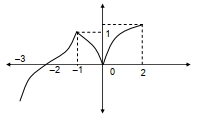
Find the total number of local maxima and local minima of the function $f(x) = \begin{cases} (2+x)^3, & -3 < x \leq -1 \\ x^{2/3}, & -1 < x < 2 \end{cases}$
A
$0$
B
$1$
C
$2$
D
$3$
Solution
(C) To find the local maxima and local minima,we analyze the function $f(x)$ in its given intervals:
$1$. For $-3 < x \leq -1$,$f(x) = (2+x)^3$. The derivative is $f'(x) = 3(2+x)^2$. Since $f'(x) \geq 0$,the function is increasing on $(-3, -1]$. At $x = -1$,$f(-1) = (2-1)^3 = 1$. Since the function is increasing up to $x = -1$,this point acts as a local maximum.
$2$. For $-1 < x < 2$,$f(x) = x^{2/3}$. The derivative is $f'(x) = \frac{2}{3}x^{-1/3} = \frac{2}{3\sqrt[3]{x}}$.
$3$. At $x = 0$,$f'(x)$ is undefined. For $x < 0$,$f'(x) < 0$ (decreasing),and for $x > 0$,$f'(x) > 0$ (increasing). Thus,$x = 0$ is a local minimum with $f(0) = 0$.
$4$. Comparing the values,we have a local maximum at $x = -1$ and a local minimum at $x = 0$.
Therefore,the total number of local maxima and local minima is $2$.
$1$. For $-3 < x \leq -1$,$f(x) = (2+x)^3$. The derivative is $f'(x) = 3(2+x)^2$. Since $f'(x) \geq 0$,the function is increasing on $(-3, -1]$. At $x = -1$,$f(-1) = (2-1)^3 = 1$. Since the function is increasing up to $x = -1$,this point acts as a local maximum.
$2$. For $-1 < x < 2$,$f(x) = x^{2/3}$. The derivative is $f'(x) = \frac{2}{3}x^{-1/3} = \frac{2}{3\sqrt[3]{x}}$.
$3$. At $x = 0$,$f'(x)$ is undefined. For $x < 0$,$f'(x) < 0$ (decreasing),and for $x > 0$,$f'(x) > 0$ (increasing). Thus,$x = 0$ is a local minimum with $f(0) = 0$.
$4$. Comparing the values,we have a local maximum at $x = -1$ and a local minimum at $x = 0$.
Therefore,the total number of local maxima and local minima is $2$.
0 likesView Solution
17
MathematicsDifficultMCQIIT JEE · 2008
The edges of a parallelepiped are of unit length and are parallel to non-coplanar unit vectors $\hat{a}, \hat{b}, \hat{c}$ such that $\hat{a} \cdot \hat{b} = \hat{b} \cdot \hat{c} = \hat{c} \cdot \hat{a} = 1/2$. Then the volume of the parallelepiped is
A
$\frac{1}{\sqrt{2}}$
B
$\frac{1}{2\sqrt{2}}$
C
$\frac{\sqrt{3}}{2}$
D
$\frac{1}{\sqrt{3}}$
Solution
(A) The volume of a parallelepiped defined by vectors $\hat{a}, \hat{b}, \hat{c}$ is given by the scalar triple product $|\hat{a} \cdot (\hat{b} \times \hat{c})|$.
This is equal to the square root of the determinant of the Gram matrix:
Volume $= \sqrt{\det \begin{bmatrix} \hat{a} \cdot \hat{a} & \hat{a} \cdot \hat{b} & \hat{a} \cdot \hat{c} \\ \hat{b} \cdot \hat{a} & \hat{b} \cdot \hat{b} & \hat{b} \cdot \hat{c} \\ \hat{c} \cdot \hat{a} & \hat{c} \cdot \hat{b} & \hat{c} \cdot \hat{c} \end{bmatrix}}$.
Given $\hat{a} \cdot \hat{a} = \hat{b} \cdot \hat{b} = \hat{c} \cdot \hat{c} = 1$ and $\hat{a} \cdot \hat{b} = \hat{b} \cdot \hat{c} = \hat{c} \cdot \hat{a} = 1/2$,we have:
Volume $= \sqrt{\det \begin{bmatrix} 1 & 1/2 & 1/2 \\ 1/2 & 1 & 1/2 \\ 1/2 & 1/2 & 1 \end{bmatrix}}$.
Calculating the determinant: $1(1 - 1/4) - 1/2(1/2 - 1/4) + 1/2(1/4 - 1/2) = 1(3/4) - 1/2(1/4) + 1/2(-1/4) = 3/4 - 1/8 - 1/8 = 3/4 - 2/8 = 3/4 - 1/4 = 1/2$.
Thus,the volume is $\sqrt{1/2} = \frac{1}{\sqrt{2}}$.
This is equal to the square root of the determinant of the Gram matrix:
Volume $= \sqrt{\det \begin{bmatrix} \hat{a} \cdot \hat{a} & \hat{a} \cdot \hat{b} & \hat{a} \cdot \hat{c} \\ \hat{b} \cdot \hat{a} & \hat{b} \cdot \hat{b} & \hat{b} \cdot \hat{c} \\ \hat{c} \cdot \hat{a} & \hat{c} \cdot \hat{b} & \hat{c} \cdot \hat{c} \end{bmatrix}}$.
Given $\hat{a} \cdot \hat{a} = \hat{b} \cdot \hat{b} = \hat{c} \cdot \hat{c} = 1$ and $\hat{a} \cdot \hat{b} = \hat{b} \cdot \hat{c} = \hat{c} \cdot \hat{a} = 1/2$,we have:
Volume $= \sqrt{\det \begin{bmatrix} 1 & 1/2 & 1/2 \\ 1/2 & 1 & 1/2 \\ 1/2 & 1/2 & 1 \end{bmatrix}}$.
Calculating the determinant: $1(1 - 1/4) - 1/2(1/2 - 1/4) + 1/2(1/4 - 1/2) = 1(3/4) - 1/2(1/4) + 1/2(-1/4) = 3/4 - 1/8 - 1/8 = 3/4 - 2/8 = 3/4 - 1/4 = 1/2$.
Thus,the volume is $\sqrt{1/2} = \frac{1}{\sqrt{2}}$.
0 likesView Solution
18
MathematicsAdvancedIIT JEE · 2008
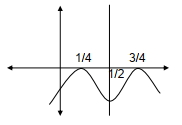
Let $f(x)$ be a non-constant twice differentiable function defined on $(-\infty, \infty)$ such that $f(x)=f(1-x)$ and $f^{\prime}\left(\frac{1}{4}\right)=0$. Then
$(A)$ $f^{\prime \prime}(x)$ vanishes at least twice on $[0,1]$
$(B)$ $f^{\prime}\left(\frac{1}{2}\right)=0$
$(C)$ $\int_{-1 / 2}^{1 / 2} f\left(x+\frac{1}{2}\right) \sin x d x=0$
$(D)$ $\int_0^{1 / 2} f(t) e^{\sin \pi t} d t=\int_{1 / 2}^1 f(1-t) e^{\sin \pi t} d t$
$(A)$ $f^{\prime \prime}(x)$ vanishes at least twice on $[0,1]$
$(B)$ $f^{\prime}\left(\frac{1}{2}\right)=0$
$(C)$ $\int_{-1 / 2}^{1 / 2} f\left(x+\frac{1}{2}\right) \sin x d x=0$
$(D)$ $\int_0^{1 / 2} f(t) e^{\sin \pi t} d t=\int_{1 / 2}^1 f(1-t) e^{\sin \pi t} d t$
Solution
(B) Given $f(x) = f(1-x)$. Differentiating with respect to $x$,we get $f^{\prime}(x) = -f^{\prime}(1-x)$.
At $x = 1/2$,$f^{\prime}(1/2) = -f^{\prime}(1-1/2) = -f^{\prime}(1/2)$,which implies $2f^{\prime}(1/2) = 0$,so $f^{\prime}(1/2) = 0$. Thus,$(B)$ is correct.
Since $f(x) = f(1-x)$,the graph of $f(x)$ is symmetric about $x = 1/2$. Let $x = 1/2 + t$,then $f(1/2 + t) = f(1/2 - t)$,so $g(t) = f(1/2 + t)$ is an even function.
For $(C)$,$\int_{-1/2}^{1/2} f(x+1/2) \sin x dx$. Since $f(x+1/2)$ is even and $\sin x$ is odd,their product is an odd function. The integral of an odd function over a symmetric interval $[-a, a]$ is $0$. Thus,$(C)$ is correct.
For $(A)$,we have $f^{\prime}(1/4) = 0$. Since $f^{\prime}(x) = -f^{\prime}(1-x)$,$f^{\prime}(3/4) = -f^{\prime}(1/4) = 0$. Also $f^{\prime}(1/2) = 0$. By Rolle's Theorem,$f^{\prime\prime}(x)$ vanishes at least once in $(1/4, 1/2)$ and at least once in $(1/2, 3/4)$. Thus,$f^{\prime\prime}(x)$ vanishes at least twice in $[0, 1]$. Thus,$(A)$ is correct.
For $(D)$,let $I = \int_{1/2}^1 f(1-t) e^{\sin \pi t} dt$. Let $1-t = u$,then $dt = -du$. When $t=1/2, u=1/2$; when $t=1, u=0$. $I = \int_{1/2}^0 f(u) e^{\sin \pi (1-u)} (-du) = \int_0^{1/2} f(u) e^{\sin \pi u} du$. Thus,$(D)$ is correct.
At $x = 1/2$,$f^{\prime}(1/2) = -f^{\prime}(1-1/2) = -f^{\prime}(1/2)$,which implies $2f^{\prime}(1/2) = 0$,so $f^{\prime}(1/2) = 0$. Thus,$(B)$ is correct.
Since $f(x) = f(1-x)$,the graph of $f(x)$ is symmetric about $x = 1/2$. Let $x = 1/2 + t$,then $f(1/2 + t) = f(1/2 - t)$,so $g(t) = f(1/2 + t)$ is an even function.
For $(C)$,$\int_{-1/2}^{1/2} f(x+1/2) \sin x dx$. Since $f(x+1/2)$ is even and $\sin x$ is odd,their product is an odd function. The integral of an odd function over a symmetric interval $[-a, a]$ is $0$. Thus,$(C)$ is correct.
For $(A)$,we have $f^{\prime}(1/4) = 0$. Since $f^{\prime}(x) = -f^{\prime}(1-x)$,$f^{\prime}(3/4) = -f^{\prime}(1/4) = 0$. Also $f^{\prime}(1/2) = 0$. By Rolle's Theorem,$f^{\prime\prime}(x)$ vanishes at least once in $(1/4, 1/2)$ and at least once in $(1/2, 3/4)$. Thus,$f^{\prime\prime}(x)$ vanishes at least twice in $[0, 1]$. Thus,$(A)$ is correct.
For $(D)$,let $I = \int_{1/2}^1 f(1-t) e^{\sin \pi t} dt$. Let $1-t = u$,then $dt = -du$. When $t=1/2, u=1/2$; when $t=1, u=0$. $I = \int_{1/2}^0 f(u) e^{\sin \pi (1-u)} (-du) = \int_0^{1/2} f(u) e^{\sin \pi u} du$. Thus,$(D)$ is correct.
0 likesView Solution
19
MathematicsAdvancedMCQIIT JEE · 2008
Let $S_n = \sum_{k=1}^n \frac{n}{n^2+kn+k^2}$ and $T_n = \sum_{k=0}^{n-1} \frac{n}{n^2+kn+k^2}$ for $n=1, 2, 3, \ldots$. Then,
A
$S_n < \frac{\pi}{3\sqrt{3}}$
B
$S_n > \frac{\pi}{3\sqrt{3}}$
C
$T_n < \frac{\pi}{3\sqrt{3}}$
D
$T_n > \frac{\pi}{3\sqrt{3}}$
Solution
(A,D) We can rewrite the sums as Riemann sums:
$S_n = \sum_{k=1}^n \frac{1}{n} \cdot \frac{1}{1 + (k/n) + (k/n)^2}$
$T_n = \sum_{k=0}^{n-1} \frac{1}{n} \cdot \frac{1}{1 + (k/n) + (k/n)^2}$
Let $f(x) = \frac{1}{1+x+x^2}$. Since $f(x)$ is a strictly decreasing function on $[0, 1]$,the right Riemann sum $S_n$ is an underestimate of the integral,and the left Riemann sum $T_n$ is an overestimate.
Thus,$S_n < \int_0^1 \frac{dx}{1+x+x^2} < T_n$.
Evaluating the integral: $\int_0^1 \frac{dx}{(x+1/2)^2 + 3/4} = \left[ \frac{2}{\sqrt{3}} \tan^{-1} \left( \frac{2x+1}{\sqrt{3}} \right) \right]_0^1 = \frac{2}{\sqrt{3}} (\tan^{-1}(\sqrt{3}) - \tan^{-1}(1/\sqrt{3})) = \frac{2}{\sqrt{3}} (\pi/3 - \pi/6) = \frac{2}{\sqrt{3}} \cdot \frac{\pi}{6} = \frac{\pi}{3\sqrt{3}}$.
Therefore,$S_n < \frac{\pi}{3\sqrt{3}}$ and $T_n > \frac{\pi}{3\sqrt{3}}$.
$S_n = \sum_{k=1}^n \frac{1}{n} \cdot \frac{1}{1 + (k/n) + (k/n)^2}$
$T_n = \sum_{k=0}^{n-1} \frac{1}{n} \cdot \frac{1}{1 + (k/n) + (k/n)^2}$
Let $f(x) = \frac{1}{1+x+x^2}$. Since $f(x)$ is a strictly decreasing function on $[0, 1]$,the right Riemann sum $S_n$ is an underestimate of the integral,and the left Riemann sum $T_n$ is an overestimate.
Thus,$S_n < \int_0^1 \frac{dx}{1+x+x^2} < T_n$.
Evaluating the integral: $\int_0^1 \frac{dx}{(x+1/2)^2 + 3/4} = \left[ \frac{2}{\sqrt{3}} \tan^{-1} \left( \frac{2x+1}{\sqrt{3}} \right) \right]_0^1 = \frac{2}{\sqrt{3}} (\tan^{-1}(\sqrt{3}) - \tan^{-1}(1/\sqrt{3})) = \frac{2}{\sqrt{3}} (\pi/3 - \pi/6) = \frac{2}{\sqrt{3}} \cdot \frac{\pi}{6} = \frac{\pi}{3\sqrt{3}}$.
Therefore,$S_n < \frac{\pi}{3\sqrt{3}}$ and $T_n > \frac{\pi}{3\sqrt{3}}$.
0 likesView Solution
20
MathematicsAdvancedMCQIIT JEE · 2008
Consider the system of equations $ax+by=0, cx+dy=0$,where $a, b, c, d \in \{0, 1\}$.
$STATEMENT-1$: The probability that the system of equations has a unique solution is $3/8$.
$STATEMENT-2$: The probability that the system of equations has a solution is $1$.
$STATEMENT-1$: The probability that the system of equations has a unique solution is $3/8$.
$STATEMENT-2$: The probability that the system of equations has a solution is $1$.
A
$Statement-1$ is True,$Statement-2$ is True; $Statement-2$ is a correct explanation for $Statement-1$.
B
$Statement-1$ is True,$Statement-2$ is True; $Statement-2$ is $NOT$ a correct explanation for $Statement-1$.
C
$Statement-1$ is True,$Statement-2$ is False.
D
$Statement-1$ is False,$Statement-2$ is True.
Solution
(B) The system of equations is homogeneous: $ax+by=0$ and $cx+dy=0$.
$A$ homogeneous system always has the trivial solution $(x=0, y=0)$.
Therefore,the probability that the system has a solution is $1$,which makes $Statement-2$ True.
For a unique solution,the determinant of the coefficient matrix must be non-zero: $\left|\begin{array}{ll}a & b \\ c & d\end{array}\right| \neq 0$,which implies $ad - bc \neq 0$.
Since $a, b, c, d \in \{0, 1\}$,the total number of possible outcomes is $2^4 = 16$.
The condition $ad - bc \neq 0$ implies $ad \neq bc$.
Possible cases for $(ad, bc)$ are $(1, 0)$ or $(0, 1)$.
If $ad=1$,then $a=1$ and $d=1$. $bc$ must be $0$. $bc=0$ occurs if $(b,c) \in \{(0,0), (0,1), (1,0)\}$. This gives $3$ cases.
If $ad=0$,then $bc$ must be $1$,so $b=1$ and $c=1$. $ad=0$ occurs if $(a,d) \in \{(0,0), (0,1), (1,0)\}$. This gives $3$ cases.
Total favorable cases $= 3 + 3 = 6$.
Probability $= 6/16 = 3/8$. Thus,$Statement-1$ is True.
Since $Statement-2$ states that the system always has a solution (which is true for any homogeneous system),it does not explain why the probability of a unique solution is $3/8$. Therefore,$Statement-2$ is not the correct explanation for $Statement-1$.
$A$ homogeneous system always has the trivial solution $(x=0, y=0)$.
Therefore,the probability that the system has a solution is $1$,which makes $Statement-2$ True.
For a unique solution,the determinant of the coefficient matrix must be non-zero: $\left|\begin{array}{ll}a & b \\ c & d\end{array}\right| \neq 0$,which implies $ad - bc \neq 0$.
Since $a, b, c, d \in \{0, 1\}$,the total number of possible outcomes is $2^4 = 16$.
The condition $ad - bc \neq 0$ implies $ad \neq bc$.
Possible cases for $(ad, bc)$ are $(1, 0)$ or $(0, 1)$.
If $ad=1$,then $a=1$ and $d=1$. $bc$ must be $0$. $bc=0$ occurs if $(b,c) \in \{(0,0), (0,1), (1,0)\}$. This gives $3$ cases.
If $ad=0$,then $bc$ must be $1$,so $b=1$ and $c=1$. $ad=0$ occurs if $(a,d) \in \{(0,0), (0,1), (1,0)\}$. This gives $3$ cases.
Total favorable cases $= 3 + 3 = 6$.
Probability $= 6/16 = 3/8$. Thus,$Statement-1$ is True.
Since $Statement-2$ states that the system always has a solution (which is true for any homogeneous system),it does not explain why the probability of a unique solution is $3/8$. Therefore,$Statement-2$ is not the correct explanation for $Statement-1$.
0 likesView Solution
21
MathematicsAdvancedMCQIIT JEE · 2008
Consider the system of equations:
$x - 2y + 3z = -1$; $-x + y - 2z = k$; $x - 3y + 4z = 1$
$STATEMENT-1$: The system of equations has no solution for $k \neq 3$.
$STATEMENT-2$: The determinant $\left|\begin{array}{ccc}1 & -2 & 3 \\ -1 & 1 & -2 \\ 1 & -3 & 4\end{array}\right| = 0$.
$x - 2y + 3z = -1$; $-x + y - 2z = k$; $x - 3y + 4z = 1$
$STATEMENT-1$: The system of equations has no solution for $k \neq 3$.
$STATEMENT-2$: The determinant $\left|\begin{array}{ccc}1 & -2 & 3 \\ -1 & 1 & -2 \\ 1 & -3 & 4\end{array}\right| = 0$.
A
Statement-$1$ is True,Statement-$2$ is True; Statement-$2$ is a correct explanation for Statement-$1$.
B
Statement-$1$ is True,Statement-$2$ is True; Statement-$2$ is $NOT$ a correct explanation for Statement-$1$.
C
Statement-$1$ is True,Statement-$2$ is False.
D
Statement-$1$ is False,Statement-$2$ is True.
Solution
(A) The system of equations is given by $AX = B$,where $A = \begin{bmatrix} 1 & -2 & 3 \\ -1 & 1 & -2 \\ 1 & -3 & 4 \end{bmatrix}$.
First,calculate the determinant of the coefficient matrix $D = |A| = 1(4-6) + 2(-4+2) + 3(3-1) = 1(-2) + 2(-2) + 3(2) = -2 - 4 + 6 = 0$.
Since $D = 0$,the system either has no solution or infinitely many solutions.
Now,calculate $D_1 = \left|\begin{array}{ccc}-1 & -2 & 3 \\ k & 1 & -2 \\ 1 & -3 & 4\end{array}\right| = -1(4-6) + 2(4k+2) + 3(3k-1) = 2 + 8k + 4 + 9k - 3 = 17k + 3$.
Wait,let's re-evaluate $D_1$: $D_1 = -1(4-6) + 2(4k+2) + 3(3k-1) = 2 + 8k + 4 + 9k - 3 = 17k + 3$. Actually,let's use row operations: $R_3 \to R_3 - R_1$ and $R_2 \to R_2 + R_1$: $\left|\begin{array}{ccc}1 & -2 & 3 \\ 0 & -1 & 1 \\ 0 & -1 & 1\end{array}\right| = 0$.
For the system to have no solution,at least one of $D_1, D_2, D_3$ must be non-zero.
$D_1 = \left|\begin{array}{ccc}-1 & -2 & 3 \\ k & 1 & -2 \\ 1 & -3 & 4\end{array}\right| = -1(4-6) + 2(4k+2) + 3(-3k-1) = 2 + 8k + 4 - 9k - 3 = 3 - k$.
$D_1 = 0$ only if $k = 3$. If $k \neq 3$,$D_1 \neq 0$,so the system has no solution.
Thus,Statement-$1$ is True. Statement-$2$ is True as it correctly identifies $D=0$ which is the condition for the system to have no solution or infinite solutions.
First,calculate the determinant of the coefficient matrix $D = |A| = 1(4-6) + 2(-4+2) + 3(3-1) = 1(-2) + 2(-2) + 3(2) = -2 - 4 + 6 = 0$.
Since $D = 0$,the system either has no solution or infinitely many solutions.
Now,calculate $D_1 = \left|\begin{array}{ccc}-1 & -2 & 3 \\ k & 1 & -2 \\ 1 & -3 & 4\end{array}\right| = -1(4-6) + 2(4k+2) + 3(3k-1) = 2 + 8k + 4 + 9k - 3 = 17k + 3$.
Wait,let's re-evaluate $D_1$: $D_1 = -1(4-6) + 2(4k+2) + 3(3k-1) = 2 + 8k + 4 + 9k - 3 = 17k + 3$. Actually,let's use row operations: $R_3 \to R_3 - R_1$ and $R_2 \to R_2 + R_1$: $\left|\begin{array}{ccc}1 & -2 & 3 \\ 0 & -1 & 1 \\ 0 & -1 & 1\end{array}\right| = 0$.
For the system to have no solution,at least one of $D_1, D_2, D_3$ must be non-zero.
$D_1 = \left|\begin{array}{ccc}-1 & -2 & 3 \\ k & 1 & -2 \\ 1 & -3 & 4\end{array}\right| = -1(4-6) + 2(4k+2) + 3(-3k-1) = 2 + 8k + 4 - 9k - 3 = 3 - k$.
$D_1 = 0$ only if $k = 3$. If $k \neq 3$,$D_1 \neq 0$,so the system has no solution.
Thus,Statement-$1$ is True. Statement-$2$ is True as it correctly identifies $D=0$ which is the condition for the system to have no solution or infinite solutions.
0 likesView Solution
22
MathematicsAdvancedMCQIIT JEE · 2008
Let $f$ and $g$ be real-valued functions defined on the interval $(-1, 1)$ such that $g^{\prime \prime}(x)$ is continuous,$g(0) \neq 0$,$g^{\prime}(0) = 0$,$g^{\prime \prime}(0) \neq 0$,and $f(x) = g(x) \sin x$.
$STATEMENT-1$: $\lim_{x \rightarrow 0} [g(x) \cot x - g(0) \operatorname{cosec} x] = f^{\prime \prime}(0)$.
$STATEMENT-2$: $f^{\prime}(0) = g(0)$.
$STATEMENT-1$: $\lim_{x \rightarrow 0} [g(x) \cot x - g(0) \operatorname{cosec} x] = f^{\prime \prime}(0)$.
$STATEMENT-2$: $f^{\prime}(0) = g(0)$.
A
$Statement-1$ is True,$Statement-2$ is True; $Statement-2$ is a correct explanation for $Statement-1$.
B
$Statement-1$ is True,$Statement-2$ is True; $Statement-2$ is $NOT$ a correct explanation for $Statement-1$.
C
$Statement-1$ is True,$Statement-2$ is False.
D
$Statement-1$ is False,$Statement-2$ is True.
Solution
(B) Given $f(x) = g(x) \sin x$.
First,find $f^{\prime}(x)$ using the product rule:
$f^{\prime}(x) = g^{\prime}(x) \sin x + g(x) \cos x$.
At $x = 0$,$f^{\prime}(0) = g^{\prime}(0) \sin(0) + g(0) \cos(0) = 0 + g(0) \cdot 1 = g(0)$.
Thus,$Statement-2$ is True.
Next,find $f^{\prime \prime}(x)$:
$f^{\prime \prime}(x) = g^{\prime \prime}(x) \sin x + g^{\prime}(x) \cos x + g^{\prime}(x) \cos x - g(x) \sin x = g^{\prime \prime}(x) \sin x + 2g^{\prime}(x) \cos x - g(x) \sin x$.
At $x = 0$,$f^{\prime \prime}(0) = g^{\prime \prime}(0) \cdot 0 + 2g^{\prime}(0) \cdot 1 - g(0) \cdot 0 = 2g^{\prime}(0) = 0$ (since $g^{\prime}(0) = 0$).
Now,evaluate the limit in $Statement-1$:
$L = \lim_{x \rightarrow 0} [g(x) \cot x - g(0) \operatorname{cosec} x] = \lim_{x \rightarrow 0} \frac{g(x) \cos x - g(0)}{\sin x}$.
Using $L$'$H$ôpital's rule (since it is a $0/0$ form):
$L = \lim_{x \rightarrow 0} \frac{g^{\prime}(x) \cos x - g(x) \sin x}{\cos x} = \frac{g^{\prime}(0) \cdot 1 - g(0) \cdot 0}{1} = g^{\prime}(0) = 0$.
Since $f^{\prime \prime}(0) = 0$ and $L = 0$,$Statement-1$ is True.
However,$Statement-2$ $(f^{\prime}(0) = g(0))$ is not used to derive the limit in $Statement-1$. Thus,$Statement-2$ is not the correct explanation for $Statement-1$.
First,find $f^{\prime}(x)$ using the product rule:
$f^{\prime}(x) = g^{\prime}(x) \sin x + g(x) \cos x$.
At $x = 0$,$f^{\prime}(0) = g^{\prime}(0) \sin(0) + g(0) \cos(0) = 0 + g(0) \cdot 1 = g(0)$.
Thus,$Statement-2$ is True.
Next,find $f^{\prime \prime}(x)$:
$f^{\prime \prime}(x) = g^{\prime \prime}(x) \sin x + g^{\prime}(x) \cos x + g^{\prime}(x) \cos x - g(x) \sin x = g^{\prime \prime}(x) \sin x + 2g^{\prime}(x) \cos x - g(x) \sin x$.
At $x = 0$,$f^{\prime \prime}(0) = g^{\prime \prime}(0) \cdot 0 + 2g^{\prime}(0) \cdot 1 - g(0) \cdot 0 = 2g^{\prime}(0) = 0$ (since $g^{\prime}(0) = 0$).
Now,evaluate the limit in $Statement-1$:
$L = \lim_{x \rightarrow 0} [g(x) \cot x - g(0) \operatorname{cosec} x] = \lim_{x \rightarrow 0} \frac{g(x) \cos x - g(0)}{\sin x}$.
Using $L$'$H$ôpital's rule (since it is a $0/0$ form):
$L = \lim_{x \rightarrow 0} \frac{g^{\prime}(x) \cos x - g(x) \sin x}{\cos x} = \frac{g^{\prime}(0) \cdot 1 - g(0) \cdot 0}{1} = g^{\prime}(0) = 0$.
Since $f^{\prime \prime}(0) = 0$ and $L = 0$,$Statement-1$ is True.
However,$Statement-2$ $(f^{\prime}(0) = g(0))$ is not used to derive the limit in $Statement-1$. Thus,$Statement-2$ is not the correct explanation for $Statement-1$.
0 likesView Solution
23
MathematicsAdvancedMCQIIT JEE · 2008
Consider three planes:
$P_1: x-y+z=1$
$P_2: x+y-z=-1$
$P_3: x-3y+3z=2$
Let $L_1, L_2, L_3$ be the lines of intersection of the planes $P_2$ and $P_3$,$P_3$ and $P_1$,and $P_1$ and $P_2$,respectively.
$STATEMENT-1$: At least two of the lines $L_1, L_2$ and $L_3$ are non-parallel.
$STATEMENT-2$: The three planes do not have a common point.
$P_1: x-y+z=1$
$P_2: x+y-z=-1$
$P_3: x-3y+3z=2$
Let $L_1, L_2, L_3$ be the lines of intersection of the planes $P_2$ and $P_3$,$P_3$ and $P_1$,and $P_1$ and $P_2$,respectively.
$STATEMENT-1$: At least two of the lines $L_1, L_2$ and $L_3$ are non-parallel.
$STATEMENT-2$: The three planes do not have a common point.
A
Statement-$1$ is True,Statement-$2$ is True; Statement-$2$ is a correct explanation for Statement-$1$
B
Statement-$1$ is True,Statement-$2$ is True; Statement-$2$ is $NOT$ a correct explanation for Statement-$1$
C
Statement-$1$ is True,Statement-$2$ is False
D
Statement-$1$ is False,Statement-$2$ is True
Solution
(D) The normal vectors to the planes are $\vec{n}_1 = (1, -1, 1)$,$\vec{n}_2 = (1, 1, -1)$,and $\vec{n}_3 = (1, -3, 3)$.
The direction vector of line $L_1$ (intersection of $P_2$ and $P_3$) is $\vec{v}_1 = \vec{n}_2 \times \vec{n}_3 = \begin{vmatrix} \hat{i} & \hat{j} & \hat{k} \\ 1 & 1 & -1 \\ 1 & -3 & 3 \end{vmatrix} = (0, -4, -4)$,which is parallel to $(0, 1, 1)$.
The direction vector of line $L_2$ (intersection of $P_3$ and $P_1$) is $\vec{v}_2 = \vec{n}_3 \times \vec{n}_1 = \begin{vmatrix} \hat{i} & \hat{j} & \hat{k} \\ 1 & -3 & 3 \\ 1 & -1 & 1 \end{vmatrix} = (0, 2, 2)$,which is parallel to $(0, 1, 1)$.
The direction vector of line $L_3$ (intersection of $P_1$ and $P_2$) is $\vec{v}_3 = \vec{n}_1 \times \vec{n}_2 = \begin{vmatrix} \hat{i} & \hat{j} & \hat{k} \\ 1 & -1 & 1 \\ 1 & 1 & -1 \end{vmatrix} = (0, 2, 2)$,which is parallel to $(0, 1, 1)$.
Since all lines $L_1, L_2, L_3$ have the same direction vector $(0, 1, 1)$,they are all parallel to each other. Thus,$STATEMENT-1$ is False.
For $STATEMENT-2$,we check if the system has a common point by solving the equations. Adding $P_1$ and $P_2$ gives $2x = 0$,so $x = 0$. Substituting $x=0$ into $P_1$ and $P_2$ gives $-y+z=1$ and $y-z=-1$,which are identical. Substituting $x=0$ into $P_3$ gives $-3y+3z=2$,or $-y+z=2/3$. Since $1 \neq 2/3$,the system has no common point. Thus,$STATEMENT-2$ is True.
The direction vector of line $L_1$ (intersection of $P_2$ and $P_3$) is $\vec{v}_1 = \vec{n}_2 \times \vec{n}_3 = \begin{vmatrix} \hat{i} & \hat{j} & \hat{k} \\ 1 & 1 & -1 \\ 1 & -3 & 3 \end{vmatrix} = (0, -4, -4)$,which is parallel to $(0, 1, 1)$.
The direction vector of line $L_2$ (intersection of $P_3$ and $P_1$) is $\vec{v}_2 = \vec{n}_3 \times \vec{n}_1 = \begin{vmatrix} \hat{i} & \hat{j} & \hat{k} \\ 1 & -3 & 3 \\ 1 & -1 & 1 \end{vmatrix} = (0, 2, 2)$,which is parallel to $(0, 1, 1)$.
The direction vector of line $L_3$ (intersection of $P_1$ and $P_2$) is $\vec{v}_3 = \vec{n}_1 \times \vec{n}_2 = \begin{vmatrix} \hat{i} & \hat{j} & \hat{k} \\ 1 & -1 & 1 \\ 1 & 1 & -1 \end{vmatrix} = (0, 2, 2)$,which is parallel to $(0, 1, 1)$.
Since all lines $L_1, L_2, L_3$ have the same direction vector $(0, 1, 1)$,they are all parallel to each other. Thus,$STATEMENT-1$ is False.
For $STATEMENT-2$,we check if the system has a common point by solving the equations. Adding $P_1$ and $P_2$ gives $2x = 0$,so $x = 0$. Substituting $x=0$ into $P_1$ and $P_2$ gives $-y+z=1$ and $y-z=-1$,which are identical. Substituting $x=0$ into $P_3$ gives $-3y+3z=2$,or $-y+z=2/3$. Since $1 \neq 2/3$,the system has no common point. Thus,$STATEMENT-2$ is True.
0 likesView Solution
24
MathematicsAdvancedMCQIIT JEE · 2008
Consider the functions defined implicitly by the equation $y^3-3y+x=0$ on various intervals in the real line. If $x \in(-\infty,-2) \cup(2, \infty)$,the equation implicitly defines a unique real valued differentiable function $y=f(x)$. If $x \in(-2,2)$,the equation implicitly defines a unique real valued differentiable function $y=g(x)$ satisfying $g(0)=0$.
$1.$ If $f(-10 \sqrt{2})=2 \sqrt{2}$,then $f^{\prime \prime}(-10 \sqrt{2})=$
$(A)$ $\frac{4 \sqrt{2}}{7^3 3^2}$ $(B)$ $-\frac{4 \sqrt{2}}{7^3 3^2}$ $(C)$ $\frac{4 \sqrt{2}}{7^3 3}$ $(D)$ $-\frac{4 \sqrt{2}}{7^3 3}$
$2.$ The area of the region bounded by the curves $y=f(x)$,the $x$-axis,and the lines $x=a$ and $x=b$,where $-\infty < a < b < -2$,is
$(A)$ $\int_a^b \frac{x}{3\left((f(x))^2-1\right)} dx+bf(b)-af(a)$
$(B)$ $-\int_a^b \frac{x}{3\left((f(x))^2-1\right)} dx+bf(b)-af(a)$
$(C)$ $\int_a^b \frac{x}{3\left((f(x))^2-1\right)} dx-bf(b)+af(a)$
$(D)$ $-\int_a^b \frac{x}{3\left((f(x))^2-1\right)} dx-bf(b)+af(a)$
$3.$ $\int_{-1}^1 g^{\prime}(x) dx=$
$(A)$ $2g(-1)$ $(B)$ $0$ $(C)$ $-2g(1)$ $(D)$ $2g(1)$
Give the answer for questions $1, 2$ and $3.$
$1.$ If $f(-10 \sqrt{2})=2 \sqrt{2}$,then $f^{\prime \prime}(-10 \sqrt{2})=$
$(A)$ $\frac{4 \sqrt{2}}{7^3 3^2}$ $(B)$ $-\frac{4 \sqrt{2}}{7^3 3^2}$ $(C)$ $\frac{4 \sqrt{2}}{7^3 3}$ $(D)$ $-\frac{4 \sqrt{2}}{7^3 3}$
$2.$ The area of the region bounded by the curves $y=f(x)$,the $x$-axis,and the lines $x=a$ and $x=b$,where $-\infty < a < b < -2$,is
$(A)$ $\int_a^b \frac{x}{3\left((f(x))^2-1\right)} dx+bf(b)-af(a)$
$(B)$ $-\int_a^b \frac{x}{3\left((f(x))^2-1\right)} dx+bf(b)-af(a)$
$(C)$ $\int_a^b \frac{x}{3\left((f(x))^2-1\right)} dx-bf(b)+af(a)$
$(D)$ $-\int_a^b \frac{x}{3\left((f(x))^2-1\right)} dx-bf(b)+af(a)$
$3.$ $\int_{-1}^1 g^{\prime}(x) dx=$
$(A)$ $2g(-1)$ $(B)$ $0$ $(C)$ $-2g(1)$ $(D)$ $2g(1)$
Give the answer for questions $1, 2$ and $3.$
A
$B, A, D$
B
$B, C, B$
C
$A, D, B$
D
$A, D, B$
Solution
(A, D, B) $1.$ Differentiating $y^3-3y+x=0$ with respect to $x$,we get $3y^2y^{\prime}-3y^{\prime}+1=0$,which implies $y^{\prime} = \frac{-1}{3(y^2-1)}$.
At $x = -10\sqrt{2}$,$y = 2\sqrt{2}$,so $y^{\prime} = \frac{-1}{3((2\sqrt{2})^2-1)} = \frac{-1}{3(8-1)} = -\frac{1}{21}$.
Differentiating $3y^2y^{\prime}-3y^{\prime}+1=0$ again,we get $6yy^{\prime 2} + 3y^2y^{\prime\prime} - 3y^{\prime\prime} = 0$.
$y^{\prime\prime}(3y^2-3) = -6yy^{\prime 2} \Rightarrow y^{\prime\prime} = \frac{-2yy^{\prime 2}}{y^2-1}$.
Substituting $y=2\sqrt{2}$ and $y^{\prime}=-\frac{1}{21}$,we get $f^{\prime\prime}(-10\sqrt{2}) = \frac{-2(2\sqrt{2})(-1/21)^2}{8-1} = \frac{-4\sqrt{2}}{7 \times 441} = -\frac{4\sqrt{2}}{7^3 \times 3^2}$.
$2.$ The area is $\int_a^b |f(x)| dx$. Since $f(x) < -2$ for $x < -2$,the area is $-\int_a^b f(x) dx$.
Using integration by parts: $\int f(x) dx = xf(x) - \int xf^{\prime}(x) dx$.
Since $f^{\prime}(x) = \frac{-1}{3(f(x)^2-1)}$,the integral is $bf(b)-af(a) - \int_a^b x \left(\frac{-1}{3(f(x)^2-1)}\right) dx = bf(b)-af(a) + \int_a^b \frac{x}{3(f(x)^2-1)} dx$.
The area is $-\int_a^b f(x) dx = -bf(b)+af(a) - \int_a^b \frac{x}{3(f(x)^2-1)} dx$.
$3.$ $\int_{-1}^1 g^{\prime}(x) dx = g(1) - g(-1)$.
Since $g(x)^3 - 3g(x) + x = 0$,$g(-x)^3 - 3g(-x) - x = 0$. Let $h(x) = -g(-x)$,then $(-h(x))^3 - 3(-h(x)) - x = 0 \Rightarrow -h(x)^3 + 3h(x) - x = 0 \Rightarrow h(x)^3 - 3h(x) + x = 0$.
Thus $g(x) = -g(-x)$,so $g$ is an odd function. $g(-1) = -g(1)$.
Therefore,$g(1) - g(-1) = g(1) - (-g(1)) = 2g(1)$.
At $x = -10\sqrt{2}$,$y = 2\sqrt{2}$,so $y^{\prime} = \frac{-1}{3((2\sqrt{2})^2-1)} = \frac{-1}{3(8-1)} = -\frac{1}{21}$.
Differentiating $3y^2y^{\prime}-3y^{\prime}+1=0$ again,we get $6yy^{\prime 2} + 3y^2y^{\prime\prime} - 3y^{\prime\prime} = 0$.
$y^{\prime\prime}(3y^2-3) = -6yy^{\prime 2} \Rightarrow y^{\prime\prime} = \frac{-2yy^{\prime 2}}{y^2-1}$.
Substituting $y=2\sqrt{2}$ and $y^{\prime}=-\frac{1}{21}$,we get $f^{\prime\prime}(-10\sqrt{2}) = \frac{-2(2\sqrt{2})(-1/21)^2}{8-1} = \frac{-4\sqrt{2}}{7 \times 441} = -\frac{4\sqrt{2}}{7^3 \times 3^2}$.
$2.$ The area is $\int_a^b |f(x)| dx$. Since $f(x) < -2$ for $x < -2$,the area is $-\int_a^b f(x) dx$.
Using integration by parts: $\int f(x) dx = xf(x) - \int xf^{\prime}(x) dx$.
Since $f^{\prime}(x) = \frac{-1}{3(f(x)^2-1)}$,the integral is $bf(b)-af(a) - \int_a^b x \left(\frac{-1}{3(f(x)^2-1)}\right) dx = bf(b)-af(a) + \int_a^b \frac{x}{3(f(x)^2-1)} dx$.
The area is $-\int_a^b f(x) dx = -bf(b)+af(a) - \int_a^b \frac{x}{3(f(x)^2-1)} dx$.
$3.$ $\int_{-1}^1 g^{\prime}(x) dx = g(1) - g(-1)$.
Since $g(x)^3 - 3g(x) + x = 0$,$g(-x)^3 - 3g(-x) - x = 0$. Let $h(x) = -g(-x)$,then $(-h(x))^3 - 3(-h(x)) - x = 0 \Rightarrow -h(x)^3 + 3h(x) - x = 0 \Rightarrow h(x)^3 - 3h(x) + x = 0$.
Thus $g(x) = -g(-x)$,so $g$ is an odd function. $g(-1) = -g(1)$.
Therefore,$g(1) - g(-1) = g(1) - (-g(1)) = 2g(1)$.
0 likesView Solution
25
MathematicsMediumMCQIIT JEE · 2008
An experiment has $10$ equally likely outcomes. Let $A$ and $B$ be two non-empty events of the experiment. If $A$ consists of $4$ outcomes,the number of outcomes that $B$ must have so that $A$ and $B$ are independent,is
A
$2, 4$ or $8$
B
$3, 6$ or $9$
C
$4$ or $8$
D
$5$ or $10$
Solution
(D) Let $n(S) = 10$ be the total number of outcomes. Given $n(A) = 4$,so $P(A) = \frac{4}{10} = \frac{2}{5}$.
Let $n(B) = p$,so $P(B) = \frac{p}{10}$.
For $A$ and $B$ to be independent,$P(A \cap B) = P(A) \times P(B) = \frac{2}{5} \times \frac{p}{10} = \frac{2p}{50} = \frac{p}{25}$.
Since $P(A \cap B) = \frac{n(A \cap B)}{10}$,we have $\frac{n(A \cap B)}{10} = \frac{p}{25}$,which implies $n(A \cap B) = \frac{10p}{25} = \frac{2p}{5}$.
Since $n(A \cap B)$ must be an integer,$2p$ must be divisible by $5$. Since $2$ and $5$ are coprime,$p$ must be a multiple of $5$.
Given $B$ is non-empty,$p \in \{5, 10\}$.
Let $n(B) = p$,so $P(B) = \frac{p}{10}$.
For $A$ and $B$ to be independent,$P(A \cap B) = P(A) \times P(B) = \frac{2}{5} \times \frac{p}{10} = \frac{2p}{50} = \frac{p}{25}$.
Since $P(A \cap B) = \frac{n(A \cap B)}{10}$,we have $\frac{n(A \cap B)}{10} = \frac{p}{25}$,which implies $n(A \cap B) = \frac{10p}{25} = \frac{2p}{5}$.
Since $n(A \cap B)$ must be an integer,$2p$ must be divisible by $5$. Since $2$ and $5$ are coprime,$p$ must be a multiple of $5$.
Given $B$ is non-empty,$p \in \{5, 10\}$.
0 likesView Solution
26
MathematicsAdvancedMCQIIT JEE · 2008
The area of the region between the curves $y=\sqrt{\frac{1+\sin x}{\cos x}}$ and $y=\sqrt{\frac{1-\sin x}{\cos x}}$ bounded by the lines $x=0$ and $x=\frac{\pi}{4}$ is
A
$\int_0^{\sqrt{2}-1} \frac{t}{(1+t^2) \sqrt{1-t^2}} dt$
B
$\int_0^{\sqrt{2}-1} \frac{4t}{(1+t^2) \sqrt{1-t^2}} dt$
C
$\int_0^{\sqrt{2}+1} \frac{4t}{(1+t^2) \sqrt{1-t^2}} dt$
D
$\int_0^{\sqrt{2}+1} \frac{t}{(1+t^2) \sqrt{1-t^2}} dt$
Solution
(B) The area $A$ is given by $\int_0^{\pi/4} \left( \sqrt{\frac{1+\sin x}{\cos x}} - \sqrt{\frac{1-\sin x}{\cos x}} \right) dx$.
Using the half-angle identities $\sin x = \frac{2\tan(x/2)}{1+\tan^2(x/2)}$ and $\cos x = \frac{1-\tan^2(x/2)}{1+\tan^2(x/2)}$,we simplify the integrand.
Let $t = \tan(x/2)$,then $dt = \frac{1}{2} \sec^2(x/2) dx = \frac{1}{2}(1+t^2) dx$,so $dx = \frac{2}{1+t^2} dt$.
At $x=0$,$t=0$. At $x=\pi/4$,$t=\tan(\pi/8) = \sqrt{2}-1$.
The expression becomes $\int_0^{\sqrt{2}-1} \left( \sqrt{\frac{1+\frac{2t}{1+t^2}}{\frac{1-t^2}{1+t^2}}} - \sqrt{\frac{1-\frac{2t}{1+t^2}}{\frac{1-t^2}{1+t^2}}} \right) \frac{2}{1+t^2} dt$.
This simplifies to $\int_0^{\sqrt{2}-1} \left( \sqrt{\frac{(1+t)^2}{1-t^2}} - \sqrt{\frac{(1-t)^2}{1-t^2}} \right) \frac{2}{1+t^2} dt = \int_0^{\sqrt{2}-1} \frac{2(1+t - (1-t))}{\sqrt{1-t^2}} \frac{1}{1+t^2} dt = \int_0^{\sqrt{2}-1} \frac{4t}{(1+t^2)\sqrt{1-t^2}} dt$.
Using the half-angle identities $\sin x = \frac{2\tan(x/2)}{1+\tan^2(x/2)}$ and $\cos x = \frac{1-\tan^2(x/2)}{1+\tan^2(x/2)}$,we simplify the integrand.
Let $t = \tan(x/2)$,then $dt = \frac{1}{2} \sec^2(x/2) dx = \frac{1}{2}(1+t^2) dx$,so $dx = \frac{2}{1+t^2} dt$.
At $x=0$,$t=0$. At $x=\pi/4$,$t=\tan(\pi/8) = \sqrt{2}-1$.
The expression becomes $\int_0^{\sqrt{2}-1} \left( \sqrt{\frac{1+\frac{2t}{1+t^2}}{\frac{1-t^2}{1+t^2}}} - \sqrt{\frac{1-\frac{2t}{1+t^2}}{\frac{1-t^2}{1+t^2}}} \right) \frac{2}{1+t^2} dt$.
This simplifies to $\int_0^{\sqrt{2}-1} \left( \sqrt{\frac{(1+t)^2}{1-t^2}} - \sqrt{\frac{(1-t)^2}{1-t^2}} \right) \frac{2}{1+t^2} dt = \int_0^{\sqrt{2}-1} \frac{2(1+t - (1-t))}{\sqrt{1-t^2}} \frac{1}{1+t^2} dt = \int_0^{\sqrt{2}-1} \frac{4t}{(1+t^2)\sqrt{1-t^2}} dt$.
0 likesView Solution
27
MathematicsAdvancedMCQIIT JEE · 2008
Let $I=\int \frac{e^x}{e^{4 x}+e^{2 x}+1} d x$ and $J=\int \frac{e^{-x}}{e^{-4 x}+e^{-2 x}+1} d x$. Then,for an arbitrary constant $C$,the value of $J-I$ equals
A
$\frac{1}{2} \log \left(\frac{e^{4 x}-e^{2 x}+1}{e^{4 x}+e^{2 x}+1}\right)+C$
B
$\frac{1}{2} \log \left(\frac{e^{2 x}+e^{x}+1}{e^{2 x}-e^{x}+1}\right)+C$
C
$\frac{1}{2} \log \left(\frac{e^{2 x}-e^x+1}{e^{2 x}+e^x+1}\right)+C$
D
$\frac{1}{2} \log \left(\frac{e^{4 x}+e^{2 x}+1}{e^{4 x}-e^{2 x}+1}\right)+C$
Solution
(C) Given $J = \int \frac{e^{-x}}{e^{-4x} + e^{-2x} + 1} dx$. Multiplying numerator and denominator by $e^{4x}$,we get $J = \int \frac{e^{3x}}{1 + e^{2x} + e^{4x}} dx$.
Now,$J - I = \int \frac{e^{3x} - e^x}{e^{4x} + e^{2x} + 1} dx = \int \frac{e^x(e^{2x} - 1)}{e^{4x} + e^{2x} + 1} dx$.
Let $z = e^x$,then $dz = e^x dx$. The integral becomes $\int \frac{z^2 - 1}{z^4 + z^2 + 1} dz$.
Divide numerator and denominator by $z^2$: $\int \frac{1 - 1/z^2}{z^2 + 1 + 1/z^2} dz = \int \frac{1 - 1/z^2}{(z + 1/z)^2 - 1} dz$.
Let $u = z + 1/z$,then $du = (1 - 1/z^2) dz$. The integral becomes $\int \frac{du}{u^2 - 1} = \frac{1}{2} \ln \left| \frac{u - 1}{u + 1} \right| + C$.
Substituting $u = e^x + e^{-x}$ back: $\frac{1}{2} \ln \left| \frac{e^x + e^{-x} - 1}{e^x + e^{-x} + 1} \right| + C = \frac{1}{2} \ln \left( \frac{e^{2x} - e^x + 1}{e^{2x} + e^x + 1} \right) + C$.
Now,$J - I = \int \frac{e^{3x} - e^x}{e^{4x} + e^{2x} + 1} dx = \int \frac{e^x(e^{2x} - 1)}{e^{4x} + e^{2x} + 1} dx$.
Let $z = e^x$,then $dz = e^x dx$. The integral becomes $\int \frac{z^2 - 1}{z^4 + z^2 + 1} dz$.
Divide numerator and denominator by $z^2$: $\int \frac{1 - 1/z^2}{z^2 + 1 + 1/z^2} dz = \int \frac{1 - 1/z^2}{(z + 1/z)^2 - 1} dz$.
Let $u = z + 1/z$,then $du = (1 - 1/z^2) dz$. The integral becomes $\int \frac{du}{u^2 - 1} = \frac{1}{2} \ln \left| \frac{u - 1}{u + 1} \right| + C$.
Substituting $u = e^x + e^{-x}$ back: $\frac{1}{2} \ln \left| \frac{e^x + e^{-x} - 1}{e^x + e^{-x} + 1} \right| + C = \frac{1}{2} \ln \left( \frac{e^{2x} - e^x + 1}{e^{2x} + e^x + 1} \right) + C$.
0 likesView Solution
28
MathematicsAdvancedMCQIIT JEE · 2008
Let $g(x) = \log(f(x))$ where $f(x)$ is a twice differentiable positive function on $(0, \infty)$ such that $f(x+1) = x f(x)$. Then,for $N = 1, 2, 3, \ldots$,$g^{\prime \prime}\left(N+\frac{1}{2}\right) - g^{\prime \prime}\left(\frac{1}{2}\right) = $
A
$-4\left\{1+\frac{1}{9}+\frac{1}{25}+\ldots+\frac{1}{(2N-1)^2}\right\}$
B
$4\left\{1+\frac{1}{9}+\frac{1}{25}+\ldots+\frac{1}{(2N-1)^2}\right\}$
C
$-4\left\{1+\frac{1}{9}+\frac{1}{25}+\ldots+\frac{1}{(2N+1)^2}\right\}$
D
$4\left\{1+\frac{1}{9}+\frac{1}{25}+\ldots+\frac{1}{(2N+1)^2}\right\}$
Solution
(A) Given $g(x) = \log(f(x))$ and $f(x+1) = x f(x)$.
Taking logarithm on both sides,$\log(f(x+1)) = \log(x) + \log(f(x))$.
This implies $g(x+1) = g(x) + \log(x)$,or $g(x+1) - g(x) = \log(x)$.
Differentiating twice with respect to $x$,we get $g^{\prime \prime}(x+1) - g^{\prime \prime}(x) = -\frac{1}{x^2}$.
We want to find $g^{\prime \prime}\left(N+\frac{1}{2}\right) - g^{\prime \prime}\left(\frac{1}{2}\right)$.
We can write this as a telescoping sum:
$g^{\prime \prime}\left(N+\frac{1}{2}\right) - g^{\prime \prime}\left(\frac{1}{2}\right) = \sum_{k=1}^{N} \left[ g^{\prime \prime}\left(k+\frac{1}{2}\right) - g^{\prime \prime}\left(k-\frac{1}{2}\right) \right]$.
Using the relation $g^{\prime \prime}(x+1) - g^{\prime \prime}(x) = -\frac{1}{x^2}$,we substitute $x = k - \frac{1}{2}$:
$g^{\prime \prime}\left(k+\frac{1}{2}\right) - g^{\prime \prime}\left(k-\frac{1}{2}\right) = -\frac{1}{(k-\frac{1}{2})^2} = -\frac{1}{(\frac{2k-1}{2})^2} = -\frac{4}{(2k-1)^2}$.
Summing from $k=1$ to $N$:
$\sum_{k=1}^{N} -\frac{4}{(2k-1)^2} = -4 \left[ \frac{1}{1^2} + \frac{1}{3^2} + \frac{1}{5^2} + \ldots + \frac{1}{(2N-1)^2} \right]$.
This simplifies to $-4 \left\{ 1 + \frac{1}{9} + \frac{1}{25} + \ldots + \frac{1}{(2N-1)^2} \right\}$.
Taking logarithm on both sides,$\log(f(x+1)) = \log(x) + \log(f(x))$.
This implies $g(x+1) = g(x) + \log(x)$,or $g(x+1) - g(x) = \log(x)$.
Differentiating twice with respect to $x$,we get $g^{\prime \prime}(x+1) - g^{\prime \prime}(x) = -\frac{1}{x^2}$.
We want to find $g^{\prime \prime}\left(N+\frac{1}{2}\right) - g^{\prime \prime}\left(\frac{1}{2}\right)$.
We can write this as a telescoping sum:
$g^{\prime \prime}\left(N+\frac{1}{2}\right) - g^{\prime \prime}\left(\frac{1}{2}\right) = \sum_{k=1}^{N} \left[ g^{\prime \prime}\left(k+\frac{1}{2}\right) - g^{\prime \prime}\left(k-\frac{1}{2}\right) \right]$.
Using the relation $g^{\prime \prime}(x+1) - g^{\prime \prime}(x) = -\frac{1}{x^2}$,we substitute $x = k - \frac{1}{2}$:
$g^{\prime \prime}\left(k+\frac{1}{2}\right) - g^{\prime \prime}\left(k-\frac{1}{2}\right) = -\frac{1}{(k-\frac{1}{2})^2} = -\frac{1}{(\frac{2k-1}{2})^2} = -\frac{4}{(2k-1)^2}$.
Summing from $k=1$ to $N$:
$\sum_{k=1}^{N} -\frac{4}{(2k-1)^2} = -4 \left[ \frac{1}{1^2} + \frac{1}{3^2} + \frac{1}{5^2} + \ldots + \frac{1}{(2N-1)^2} \right]$.
This simplifies to $-4 \left\{ 1 + \frac{1}{9} + \frac{1}{25} + \ldots + \frac{1}{(2N-1)^2} \right\}$.
0 likesView Solution
29
MathematicsAdvancedMCQIIT JEE · 2008
Let two non-collinear unit vectors $\hat{a}$ and $\hat{b}$ form an acute angle. $A$ point $P$ moves so that at any time $t$ the position vector $\overline{OP}$ (where $O$ is the origin) is given by $\hat{a} \cos t + \hat{b} \sin t$. When $P$ is farthest from origin $O$,let $M$ be the length of $\overline{OP}$ and $\hat{u}$ be the unit vector along $\overline{OP}$. Then,
A
$\hat{u}=\frac{\hat{a}+\hat{b}}{|\hat{a}+\hat{b}|}$ and $M=(1+\hat{a} \cdot \hat{b})^{1/2}$
B
$\hat{u}=\frac{\hat{a}-\hat{b}}{|\hat{a}-\hat{b}|}$ and $M=(1+\hat{a} \cdot \hat{b})^{1/2}$
C
$\hat{u}=\frac{\hat{a}+\hat{b}}{|\hat{a}+\hat{b}|}$ and $M=(1+2 \hat{a} \cdot \hat{b})^{1/2}$
D
$\hat{u}=\frac{\hat{a}-\hat{b}}{|\hat{a}-\hat{b}|}$ and $M=(1+2 \hat{a} \cdot \hat{b})^{1/2}$
Solution
(A) The position vector is $\overline{OP} = \hat{a} \cos t + \hat{b} \sin t$.
The square of the length is $|\overline{OP}|^2 = (\hat{a} \cos t + \hat{b} \sin t) \cdot (\hat{a} \cos t + \hat{b} \sin t) = \cos^2 t + \sin^2 t + 2 \sin t \cos t (\hat{a} \cdot \hat{b}) = 1 + \sin(2t) (\hat{a} \cdot \hat{b})$.
Since $\hat{a}$ and $\hat{b}$ form an acute angle,$\hat{a} \cdot \hat{b} > 0$. Thus,$|\overline{OP}|$ is maximum when $\sin(2t) = 1$,i.e.,$2t = \frac{\pi}{2} \Rightarrow t = \frac{\pi}{4}$.
At $t = \frac{\pi}{4}$,$M = |\overline{OP}| = (1 + \hat{a} \cdot \hat{b})^{1/2}$.
The vector $\overline{OP}$ at $t = \frac{\pi}{4}$ is $\frac{1}{\sqrt{2}}(\hat{a} + \hat{b})$.
The unit vector $\hat{u}$ is $\frac{\overline{OP}}{|\overline{OP}|} = \frac{\frac{1}{\sqrt{2}}(\hat{a} + \hat{b})}{\frac{1}{\sqrt{2}}|\hat{a} + \hat{b}|} = \frac{\hat{a} + \hat{b}}{|\hat{a} + \hat{b}|}$.
The square of the length is $|\overline{OP}|^2 = (\hat{a} \cos t + \hat{b} \sin t) \cdot (\hat{a} \cos t + \hat{b} \sin t) = \cos^2 t + \sin^2 t + 2 \sin t \cos t (\hat{a} \cdot \hat{b}) = 1 + \sin(2t) (\hat{a} \cdot \hat{b})$.
Since $\hat{a}$ and $\hat{b}$ form an acute angle,$\hat{a} \cdot \hat{b} > 0$. Thus,$|\overline{OP}|$ is maximum when $\sin(2t) = 1$,i.e.,$2t = \frac{\pi}{2} \Rightarrow t = \frac{\pi}{4}$.
At $t = \frac{\pi}{4}$,$M = |\overline{OP}| = (1 + \hat{a} \cdot \hat{b})^{1/2}$.
The vector $\overline{OP}$ at $t = \frac{\pi}{4}$ is $\frac{1}{\sqrt{2}}(\hat{a} + \hat{b})$.
The unit vector $\hat{u}$ is $\frac{\overline{OP}}{|\overline{OP}|} = \frac{\frac{1}{\sqrt{2}}(\hat{a} + \hat{b})}{\frac{1}{\sqrt{2}}|\hat{a} + \hat{b}|} = \frac{\hat{a} + \hat{b}}{|\hat{a} + \hat{b}|}$.
0 likesView Solution
30
MathematicsAdvancedMCQIIT JEE · 2008
Let the function $g: (-\infty, \infty) \rightarrow \left(-\frac{\pi}{2}, \frac{\pi}{2}\right)$ be given by $g(u) = 2 \tan^{-1}(e^u) - \frac{\pi}{2}$. Then,$g$ is
A
even and is strictly increasing in $(0, \infty)$
B
odd and is strictly decreasing in $(-\infty, \infty)$
C
odd and is strictly increasing in $(-\infty, \infty)$
D
neither even nor odd,but is strictly increasing in $(-\infty, \infty)$
Solution
(C) Given the function $g(u) = 2 \tan^{-1}(e^u) - \frac{\pi}{2}$.
To check for odd/even,we evaluate $g(-u)$:
$g(-u) = 2 \tan^{-1}(e^{-u}) - \frac{\pi}{2}$.
Using the identity $\tan^{-1}(x) + \cot^{-1}(x) = \frac{\pi}{2}$,we know $\tan^{-1}(e^{-u}) = \frac{\pi}{2} - \tan^{-1}(e^u)$.
Substituting this into $g(-u)$:
$g(-u) = 2 \left( \frac{\pi}{2} - \tan^{-1}(e^u) \right) - \frac{\pi}{2} = \pi - 2 \tan^{-1}(e^u) - \frac{\pi}{2} = \frac{\pi}{2} - 2 \tan^{-1}(e^u) = -g(u)$.
Since $g(-u) = -g(u)$,the function is odd.
To check for monotonicity,we find the derivative $g'(u)$:
$g'(u) = \frac{d}{du} (2 \tan^{-1}(e^u) - \frac{\pi}{2}) = 2 \cdot \frac{1}{1 + (e^u)^2} \cdot e^u = \frac{2e^u}{1 + e^{2u}}$.
Since $e^u > 0$ for all $u \in (-\infty, \infty)$,$g'(u) > 0$ for all $u$.
Therefore,$g$ is strictly increasing in $(-\infty, \infty)$.
To check for odd/even,we evaluate $g(-u)$:
$g(-u) = 2 \tan^{-1}(e^{-u}) - \frac{\pi}{2}$.
Using the identity $\tan^{-1}(x) + \cot^{-1}(x) = \frac{\pi}{2}$,we know $\tan^{-1}(e^{-u}) = \frac{\pi}{2} - \tan^{-1}(e^u)$.
Substituting this into $g(-u)$:
$g(-u) = 2 \left( \frac{\pi}{2} - \tan^{-1}(e^u) \right) - \frac{\pi}{2} = \pi - 2 \tan^{-1}(e^u) - \frac{\pi}{2} = \frac{\pi}{2} - 2 \tan^{-1}(e^u) = -g(u)$.
Since $g(-u) = -g(u)$,the function is odd.
To check for monotonicity,we find the derivative $g'(u)$:
$g'(u) = \frac{d}{du} (2 \tan^{-1}(e^u) - \frac{\pi}{2}) = 2 \cdot \frac{1}{1 + (e^u)^2} \cdot e^u = \frac{2e^u}{1 + e^{2u}}$.
Since $e^u > 0$ for all $u \in (-\infty, \infty)$,$g'(u) > 0$ for all $u$.
Therefore,$g$ is strictly increasing in $(-\infty, \infty)$.
0 likesView Solution
31
MathematicsMediumMCQIIT JEE · 2008
Let a solution $y=y(x)$ of the differential equation $x \sqrt{x^2-1} dy - y \sqrt{y^2-1} dx = 0$ satisfy $y(2) = \frac{2}{\sqrt{3}}$.
$STATEMENT-1$: $y(x) = \sec \left(\sec^{-1} x - \frac{\pi}{6}\right)$
$STATEMENT-2$: $y(x)$ is given by $\frac{1}{y} = \frac{2\sqrt{3}}{x} - \sqrt{1 - \frac{1}{x^2}}$
$STATEMENT-1$: $y(x) = \sec \left(\sec^{-1} x - \frac{\pi}{6}\right)$
$STATEMENT-2$: $y(x)$ is given by $\frac{1}{y} = \frac{2\sqrt{3}}{x} - \sqrt{1 - \frac{1}{x^2}}$
A
$STATEMENT-1$ is True,$STATEMENT-2$ is True; $STATEMENT-2$ is a correct explanation for $STATEMENT-1$
B
$STATEMENT-1$ is True,$STATEMENT-2$ is True; $STATEMENT-2$ is $NOT$ a correct explanation for $STATEMENT-1$
C
$STATEMENT-1$ is True,$STATEMENT-2$ is False
D
$STATEMENT-1$ is False,$STATEMENT-2$ is True
Solution
(C) Given differential equation: $x \sqrt{x^2-1} dy = y \sqrt{y^2-1} dx$.
Separating variables: $\int \frac{dy}{y \sqrt{y^2-1}} = \int \frac{dx}{x \sqrt{x^2-1}}$.
Integrating both sides: $\sec^{-1} y = \sec^{-1} x + C$.
Using the condition $y(2) = \frac{2}{\sqrt{3}}$: $\sec^{-1} \left(\frac{2}{\sqrt{3}}\right) = \sec^{-1} (2) + C$.
$\frac{\pi}{6} = \frac{\pi}{3} + C \implies C = -\frac{\pi}{6}$.
Thus,$\sec^{-1} y = \sec^{-1} x - \frac{\pi}{6}$,which gives $y(x) = \sec \left(\sec^{-1} x - \frac{\pi}{6}\right)$. So,$STATEMENT-1$ is True.
Now,$\cos^{-1} \left(\frac{1}{y}\right) = \cos^{-1} \left(\frac{1}{x}\right) - \frac{\pi}{6}$.
Taking $\cos$ on both sides: $\frac{1}{y} = \cos \left(\cos^{-1} \frac{1}{x} - \frac{\pi}{6}\right) = \cos \left(\cos^{-1} \frac{1}{x}\right) \cos \left(\frac{\pi}{6}\right) + \sin \left(\cos^{-1} \frac{1}{x}\right) \sin \left(\frac{\pi}{6}\right)$.
$\frac{1}{y} = \frac{1}{x} \cdot \frac{\sqrt{3}}{2} + \sqrt{1 - \frac{1}{x^2}} \cdot \frac{1}{2} = \frac{\sqrt{3}}{2x} + \frac{1}{2} \sqrt{1 - \frac{1}{x^2}}$.
Comparing this with $STATEMENT-2$,we see $STATEMENT-2$ is False.
Separating variables: $\int \frac{dy}{y \sqrt{y^2-1}} = \int \frac{dx}{x \sqrt{x^2-1}}$.
Integrating both sides: $\sec^{-1} y = \sec^{-1} x + C$.
Using the condition $y(2) = \frac{2}{\sqrt{3}}$: $\sec^{-1} \left(\frac{2}{\sqrt{3}}\right) = \sec^{-1} (2) + C$.
$\frac{\pi}{6} = \frac{\pi}{3} + C \implies C = -\frac{\pi}{6}$.
Thus,$\sec^{-1} y = \sec^{-1} x - \frac{\pi}{6}$,which gives $y(x) = \sec \left(\sec^{-1} x - \frac{\pi}{6}\right)$. So,$STATEMENT-1$ is True.
Now,$\cos^{-1} \left(\frac{1}{y}\right) = \cos^{-1} \left(\frac{1}{x}\right) - \frac{\pi}{6}$.
Taking $\cos$ on both sides: $\frac{1}{y} = \cos \left(\cos^{-1} \frac{1}{x} - \frac{\pi}{6}\right) = \cos \left(\cos^{-1} \frac{1}{x}\right) \cos \left(\frac{\pi}{6}\right) + \sin \left(\cos^{-1} \frac{1}{x}\right) \sin \left(\frac{\pi}{6}\right)$.
$\frac{1}{y} = \frac{1}{x} \cdot \frac{\sqrt{3}}{2} + \sqrt{1 - \frac{1}{x^2}} \cdot \frac{1}{2} = \frac{\sqrt{3}}{2x} + \frac{1}{2} \sqrt{1 - \frac{1}{x^2}}$.
Comparing this with $STATEMENT-2$,we see $STATEMENT-2$ is False.
0 likesView Solution
32
MathematicsAdvancedMCQIIT JEE · 2008
Consider the function $f:(-\infty, \infty) \rightarrow(-\infty, \infty)$ defined by $f(x)=\frac{x^2-a x+1}{x^2+a x+1}, 0 < a < 2 .$
$1.$ Which of the following is true?
$(A)$ $(2+a)^2 f^{\prime \prime}(1)+(2-a)^2 f^{\prime \prime}(-1)=0$
$(B)$ $(2-a)^2 f^{\prime}(1)-(2+a)^2 f^{\prime \prime}(-1)=0$
$(C)$ $f^{\prime}(1) f^{\prime}(-1)=(2-a)^2$
$(D)$ $f^{\prime}(1) f^{\prime}(-1)=-(2+a)^2$
$2.$ Which of the following is true?
$(A)$ $f(x)$ is decreasing on $(-1,1)$ and has a local minimum at $x=1$
$(B)$ $f(x)$ is increasing on $(-1,1)$ and has a local maximum at $x=1$
$(C)$ $f(x)$ is increasing on $(-1,1)$ but has neither a local maximum nor a local minimum at $x=1$
$(D)$ $f(x)$ is decreasing on $(-1,1)$ but has neither a local maximum nor a local minimum at $x=1$
$3.$ Let $g(x)=\int_0^{e^x} \frac{f^{\prime}(t)}{1+t^2} d t$. Which of the following is true?
$(A)$ $g^{\prime}(x)$ is positive on $(-\infty, 0)$ and negative on $(0, \infty)$
$(B)$ $g^{\prime}(x)$ is negative on $(-\infty, 0)$ and positive on $(0, \infty)$
$(C)$ $g^{\prime}(x)$ changes sign on both $(-\infty, 0)$ and $(0, \infty)$
$(D)$ $g^{\prime}(x)$ does not change sign on $(-\infty, \infty)$
Give the answer for questions $1, 2$ and $3.$
$1.$ Which of the following is true?
$(A)$ $(2+a)^2 f^{\prime \prime}(1)+(2-a)^2 f^{\prime \prime}(-1)=0$
$(B)$ $(2-a)^2 f^{\prime}(1)-(2+a)^2 f^{\prime \prime}(-1)=0$
$(C)$ $f^{\prime}(1) f^{\prime}(-1)=(2-a)^2$
$(D)$ $f^{\prime}(1) f^{\prime}(-1)=-(2+a)^2$
$2.$ Which of the following is true?
$(A)$ $f(x)$ is decreasing on $(-1,1)$ and has a local minimum at $x=1$
$(B)$ $f(x)$ is increasing on $(-1,1)$ and has a local maximum at $x=1$
$(C)$ $f(x)$ is increasing on $(-1,1)$ but has neither a local maximum nor a local minimum at $x=1$
$(D)$ $f(x)$ is decreasing on $(-1,1)$ but has neither a local maximum nor a local minimum at $x=1$
$3.$ Let $g(x)=\int_0^{e^x} \frac{f^{\prime}(t)}{1+t^2} d t$. Which of the following is true?
$(A)$ $g^{\prime}(x)$ is positive on $(-\infty, 0)$ and negative on $(0, \infty)$
$(B)$ $g^{\prime}(x)$ is negative on $(-\infty, 0)$ and positive on $(0, \infty)$
$(C)$ $g^{\prime}(x)$ changes sign on both $(-\infty, 0)$ and $(0, \infty)$
$(D)$ $g^{\prime}(x)$ does not change sign on $(-\infty, \infty)$
Give the answer for questions $1, 2$ and $3.$
A
$(A, A, B)$
B
$(C, D, B)$
C
$(A, D, C)$
D
$(C, B, B)$
Solution
(A) $1.$ Given $f(x) = \frac{x^2-ax+1}{x^2+ax+1}$. Using quotient rule,$f^{\prime}(x) = \frac{(2x-a)(x^2+ax+1) - (x^2-ax+1)(2x+a)}{(x^2+ax+1)^2} = \frac{2ax^2-2a}{(x^2+ax+1)^2} = \frac{2a(x^2-1)}{(x^2+ax+1)^2}$.
Calculating $f^{\prime \prime}(x)$,we find $f^{\prime \prime}(1) = \frac{4a}{(2+a)^2}$ and $f^{\prime \prime}(-1) = \frac{-4a}{(2-a)^2}$.
Thus,$(2+a)^2 f^{\prime \prime}(1) + (2-a)^2 f^{\prime \prime}(-1) = 4a - 4a = 0$. So,$(A)$ is true.
$2.$ $f^{\prime}(x) = \frac{2a(x^2-1)}{(x^2+ax+1)^2}$. For $x \in (-1, 1)$,$x^2-1 < 0$,so $f^{\prime}(x) < 0$. Thus $f(x)$ is decreasing on $(-1, 1)$.
At $x=1$,$f^{\prime}(x)$ changes from negative to positive,so $f(x)$ has a local minimum at $x=1$. So,$(A)$ is true.
$3.$ $g(x) = \int_0^{e^x} \frac{f^{\prime}(t)}{1+t^2} dt$. By Leibniz rule,$g^{\prime}(x) = \frac{f^{\prime}(e^x)}{1+(e^x)^2} \cdot e^x = \frac{2a(e^{2x}-1)}{(e^{2x}+ae^x+1)^2} \cdot \frac{e^x}{1+e^{2x}}$.
For $x < 0$,$e^x < 1$,so $e^{2x}-1 < 0$,hence $g^{\prime}(x) < 0$.
For $x > 0$,$e^x > 1$,so $e^{2x}-1 > 0$,hence $g^{\prime}(x) > 0$.
Thus,$g^{\prime}(x)$ is negative on $(-\infty, 0)$ and positive on $(0, \infty)$. So,$(B)$ is true.
Calculating $f^{\prime \prime}(x)$,we find $f^{\prime \prime}(1) = \frac{4a}{(2+a)^2}$ and $f^{\prime \prime}(-1) = \frac{-4a}{(2-a)^2}$.
Thus,$(2+a)^2 f^{\prime \prime}(1) + (2-a)^2 f^{\prime \prime}(-1) = 4a - 4a = 0$. So,$(A)$ is true.
$2.$ $f^{\prime}(x) = \frac{2a(x^2-1)}{(x^2+ax+1)^2}$. For $x \in (-1, 1)$,$x^2-1 < 0$,so $f^{\prime}(x) < 0$. Thus $f(x)$ is decreasing on $(-1, 1)$.
At $x=1$,$f^{\prime}(x)$ changes from negative to positive,so $f(x)$ has a local minimum at $x=1$. So,$(A)$ is true.
$3.$ $g(x) = \int_0^{e^x} \frac{f^{\prime}(t)}{1+t^2} dt$. By Leibniz rule,$g^{\prime}(x) = \frac{f^{\prime}(e^x)}{1+(e^x)^2} \cdot e^x = \frac{2a(e^{2x}-1)}{(e^{2x}+ae^x+1)^2} \cdot \frac{e^x}{1+e^{2x}}$.
For $x < 0$,$e^x < 1$,so $e^{2x}-1 < 0$,hence $g^{\prime}(x) < 0$.
For $x > 0$,$e^x > 1$,so $e^{2x}-1 > 0$,hence $g^{\prime}(x) > 0$.
Thus,$g^{\prime}(x)$ is negative on $(-\infty, 0)$ and positive on $(0, \infty)$. So,$(B)$ is true.
0 likesView Solution
33
MathematicsMediumMCQIIT JEE · 2008
Consider the lines $L_1: \frac{x+1}{3}=\frac{y+2}{1}=\frac{z+1}{2}$ and $L_2: \frac{x-2}{1}=\frac{y+2}{2}=\frac{z-3}{3}$.
$1.$ The unit vector perpendicular to both $L_1$ and $L_2$ is
$(A) \frac{-\hat{i}+7 \hat{j}+7 \hat{k}}{\sqrt{99}}$ $(B) \frac{-\hat{i}-7 \hat{j}+5 \hat{k}}{5 \sqrt{3}}$ $(C) \frac{-\hat{i}+7 \hat{j}+5 \hat{k}}{5 \sqrt{3}}$ $(D) \frac{7 \hat{i}-7 \hat{j}-\hat{k}}{\sqrt{99}}$
$2.$ The shortest distance between $L_1$ and $L_2$ is
$(A) 0$ $(B) \frac{17}{\sqrt{3}}$ $(C) \frac{41}{5 \sqrt{3}}$ $(D) \frac{17}{5 \sqrt{3}}$
$3.$ The distance of the point $(1,1,1)$ from the plane passing through the point $(-1,-2,-1)$ and whose normal is perpendicular to both the lines $L_1$ and $L_2$ is
$(A) \frac{2}{\sqrt{75}}$ $(B) \frac{7}{\sqrt{75}}$ $(C) \frac{13}{\sqrt{75}}$ $(D) \frac{23}{\sqrt{75}}$
$1.$ The unit vector perpendicular to both $L_1$ and $L_2$ is
$(A) \frac{-\hat{i}+7 \hat{j}+7 \hat{k}}{\sqrt{99}}$ $(B) \frac{-\hat{i}-7 \hat{j}+5 \hat{k}}{5 \sqrt{3}}$ $(C) \frac{-\hat{i}+7 \hat{j}+5 \hat{k}}{5 \sqrt{3}}$ $(D) \frac{7 \hat{i}-7 \hat{j}-\hat{k}}{\sqrt{99}}$
$2.$ The shortest distance between $L_1$ and $L_2$ is
$(A) 0$ $(B) \frac{17}{\sqrt{3}}$ $(C) \frac{41}{5 \sqrt{3}}$ $(D) \frac{17}{5 \sqrt{3}}$
$3.$ The distance of the point $(1,1,1)$ from the plane passing through the point $(-1,-2,-1)$ and whose normal is perpendicular to both the lines $L_1$ and $L_2$ is
$(A) \frac{2}{\sqrt{75}}$ $(B) \frac{7}{\sqrt{75}}$ $(C) \frac{13}{\sqrt{75}}$ $(D) \frac{23}{\sqrt{75}}$
A
$(B, D, C)$
B
$(B, D, C)$
C
$(A, D, B)$
D
$(A, B, C)$
Solution
(B, D, C) $1.$ The direction vectors of $L_1$ and $L_2$ are $\vec{v_1} = 3\hat{i} + \hat{j} + 2\hat{k}$ and $\vec{v_2} = \hat{i} + 2\hat{j} + 3\hat{k}$.
The vector perpendicular to both is $\vec{n} = \vec{v_1} \times \vec{v_2} = \begin{vmatrix} \hat{i} & \hat{j} & \hat{k} \\ 3 & 1 & 2 \\ 1 & 2 & 3 \end{vmatrix} = \hat{i}(3-4) - \hat{j}(9-2) + \hat{k}(6-1) = -\hat{i} - 7\hat{j} + 5\hat{k}$.
The magnitude is $|\vec{n}| = \sqrt{(-1)^2 + (-7)^2 + 5^2} = \sqrt{1 + 49 + 25} = \sqrt{75} = 5\sqrt{3}$.
The unit vector is $\frac{-\hat{i} - 7\hat{j} + 5\hat{k}}{5\sqrt{3}}$. Thus,option $(B)$ is correct.
$2.$ The shortest distance between lines passing through $A(-1, -2, -1)$ and $B(2, -2, 3)$ with directions $\vec{v_1}, \vec{v_2}$ is $d = \frac{|(\vec{AB}) \cdot (\vec{v_1} \times \vec{v_2})|}{|\vec{v_1} \times \vec{v_2}|}$.
$\vec{AB} = (2 - (-1))\hat{i} + (-2 - (-2))\hat{j} + (3 - (-1))\hat{k} = 3\hat{i} + 0\hat{j} + 4\hat{k}$.
$d = \frac{|(3\hat{i} + 0\hat{j} + 4\hat{k}) \cdot (-\hat{i} - 7\hat{j} + 5\hat{k})|}{5\sqrt{3}} = \frac{|-3 + 0 + 20|}{5\sqrt{3}} = \frac{17}{5\sqrt{3}}$. Thus,option $(D)$ is correct.
$3.$ The plane passes through $(-1, -2, -1)$ with normal $\vec{n} = -\hat{i} - 7\hat{j} + 5\hat{k}$.
Equation: $-1(x+1) - 7(y+2) + 5(z+1) = 0 \Rightarrow -x - 1 - 7y - 14 + 5z + 5 = 0 \Rightarrow x + 7y - 5z + 10 = 0$.
The distance from $(1, 1, 1)$ is $d = \frac{|1 + 7(1) - 5(1) + 10|}{\sqrt{1^2 + 7^2 + (-5)^2}} = \frac{|1 + 7 - 5 + 10|}{\sqrt{1 + 49 + 25}} = \frac{13}{\sqrt{75}}$. Thus,option $(C)$ is correct.
The vector perpendicular to both is $\vec{n} = \vec{v_1} \times \vec{v_2} = \begin{vmatrix} \hat{i} & \hat{j} & \hat{k} \\ 3 & 1 & 2 \\ 1 & 2 & 3 \end{vmatrix} = \hat{i}(3-4) - \hat{j}(9-2) + \hat{k}(6-1) = -\hat{i} - 7\hat{j} + 5\hat{k}$.
The magnitude is $|\vec{n}| = \sqrt{(-1)^2 + (-7)^2 + 5^2} = \sqrt{1 + 49 + 25} = \sqrt{75} = 5\sqrt{3}$.
The unit vector is $\frac{-\hat{i} - 7\hat{j} + 5\hat{k}}{5\sqrt{3}}$. Thus,option $(B)$ is correct.
$2.$ The shortest distance between lines passing through $A(-1, -2, -1)$ and $B(2, -2, 3)$ with directions $\vec{v_1}, \vec{v_2}$ is $d = \frac{|(\vec{AB}) \cdot (\vec{v_1} \times \vec{v_2})|}{|\vec{v_1} \times \vec{v_2}|}$.
$\vec{AB} = (2 - (-1))\hat{i} + (-2 - (-2))\hat{j} + (3 - (-1))\hat{k} = 3\hat{i} + 0\hat{j} + 4\hat{k}$.
$d = \frac{|(3\hat{i} + 0\hat{j} + 4\hat{k}) \cdot (-\hat{i} - 7\hat{j} + 5\hat{k})|}{5\sqrt{3}} = \frac{|-3 + 0 + 20|}{5\sqrt{3}} = \frac{17}{5\sqrt{3}}$. Thus,option $(D)$ is correct.
$3.$ The plane passes through $(-1, -2, -1)$ with normal $\vec{n} = -\hat{i} - 7\hat{j} + 5\hat{k}$.
Equation: $-1(x+1) - 7(y+2) + 5(z+1) = 0 \Rightarrow -x - 1 - 7y - 14 + 5z + 5 = 0 \Rightarrow x + 7y - 5z + 10 = 0$.
The distance from $(1, 1, 1)$ is $d = \frac{|1 + 7(1) - 5(1) + 10|}{\sqrt{1^2 + 7^2 + (-5)^2}} = \frac{|1 + 7 - 5 + 10|}{\sqrt{1 + 49 + 25}} = \frac{13}{\sqrt{75}}$. Thus,option $(C)$ is correct.
0 likesView Solution
34
MathematicsDifficultMCQIIT JEE · 2008
Match the Statements / Expressions in Column $I$ with the Statements / Expressions in Column $II$.
| Column $I$ | Column $II$ |
| $(A)$ The minimum value of $\frac{x^2+2x+4}{x+2}$ for $x > -2$ is | $(p)$ $0$ |
| $(B)$ Let $A$ and $B$ be $3 \times 3$ matrices of real numbers,where $A$ is symmetric,$B$ is skew-symmetric,and $(A+B)(A-B)=(A-B)(A+B)$. If $(AB)^t=(-1)^k AB$,where $(AB)^t$ is the transpose of the matrix $AB$,then the possible values of $k$ are | $(q)$ $1$ |
| $(C)$ Let $a=\log_3 \log_3 2$. An integer $k$ satisfying $1 < 2^{(-k+3^{-a})} < 2$,must be less than | $(r)$ $2$ |
| $(D)$ If $\sin \theta = \cos \phi$,then the possible values of $\frac{1}{\pi}(\theta \pm \phi - \frac{\pi}{2})$ are | $(s)$ $3$ |
A
$(A) \rightarrow (r); (B) \rightarrow (q, s); (C) \rightarrow (r, s); (D) \rightarrow (p, r)$
B
$(A) \rightarrow (r); (B) \rightarrow (p, q); (C) \rightarrow (r, p); (D) \rightarrow (p, s)$
C
$(A) \rightarrow (r); (B) \rightarrow (q, s); (C) \rightarrow (r, s); (D) \rightarrow (p, s)$
D
$(A) \rightarrow (q); (B) \rightarrow (q, r); (C) \rightarrow (r, s); (D) \rightarrow (s, q)$
Solution
(C) Let $y = \frac{x^2+2x+4}{x+2} = \frac{x(x+2)+4}{x+2} = x + \frac{4}{x+2} = (x+2) + \frac{4}{x+2} - 2$. By $AM$-$GM$ inequality,for $x > -2$,$(x+2) + \frac{4}{x+2} \geq 2\sqrt{(x+2) \cdot \frac{4}{x+2}} = 4$. Thus,$y \geq 4 - 2 = 2$. The minimum value is $2$ (Option $r$).
$(B)$ Given $(A+B)(A-B) = (A-B)(A+B) \Rightarrow A^2 - AB + BA - B^2 = A^2 + AB - BA - B^2 \Rightarrow 2BA = 2AB \Rightarrow AB = BA$. Since $A^t = A$ and $B^t = -B$,$(AB)^t = B^t A^t = -BA = -AB$. Thus,$(-1)^k AB = -AB$,which implies $(-1)^k = -1$. This holds for odd integers $k$. In the set ${1, 2, 3}$,$k$ can be $1$ or $3$ (Options $q, s$).
$(C)$ $a = \log_3 \log_3 2$. Note $3^{-a} = 3^{-\log_3 \log_3 2} = (\log_3 2)^{-1} = \log_2 3$. The inequality is $1 < 2^{-k + \log_2 3} < 2 \Rightarrow 1 < 2^{-k} \cdot 3 < 2 \Rightarrow \frac{1}{3} < 2^{-k} < \frac{2}{3} \Rightarrow \log_2(1/3) < -k < \log_2(2/3) \Rightarrow -\log_2 3 < -k < 1 - \log_2 3 \Rightarrow \log_2 3 - 1 < k < \log_2 3$. Since $1 < \log_2 3 < 2$,we have $0.58 < k < 1.58$. The integer $k=1$. $1$ is less than $2$ and $3$ (Options $r, s$).
$(D)$ $\sin \theta = \cos \phi \Rightarrow \cos(\frac{\pi}{2} - \theta) = \cos \phi \Rightarrow \frac{\pi}{2} - \theta = 2n\pi \pm \phi \Rightarrow \theta \pm \phi - \frac{\pi}{2} = -2n\pi$. Thus,$\frac{1}{\pi}(\theta \pm \phi - \frac{\pi}{2}) = -2n$,which are even integers. Among options,$0$ is even (Option $p$).
$(B)$ Given $(A+B)(A-B) = (A-B)(A+B) \Rightarrow A^2 - AB + BA - B^2 = A^2 + AB - BA - B^2 \Rightarrow 2BA = 2AB \Rightarrow AB = BA$. Since $A^t = A$ and $B^t = -B$,$(AB)^t = B^t A^t = -BA = -AB$. Thus,$(-1)^k AB = -AB$,which implies $(-1)^k = -1$. This holds for odd integers $k$. In the set ${1, 2, 3}$,$k$ can be $1$ or $3$ (Options $q, s$).
$(C)$ $a = \log_3 \log_3 2$. Note $3^{-a} = 3^{-\log_3 \log_3 2} = (\log_3 2)^{-1} = \log_2 3$. The inequality is $1 < 2^{-k + \log_2 3} < 2 \Rightarrow 1 < 2^{-k} \cdot 3 < 2 \Rightarrow \frac{1}{3} < 2^{-k} < \frac{2}{3} \Rightarrow \log_2(1/3) < -k < \log_2(2/3) \Rightarrow -\log_2 3 < -k < 1 - \log_2 3 \Rightarrow \log_2 3 - 1 < k < \log_2 3$. Since $1 < \log_2 3 < 2$,we have $0.58 < k < 1.58$. The integer $k=1$. $1$ is less than $2$ and $3$ (Options $r, s$).
$(D)$ $\sin \theta = \cos \phi \Rightarrow \cos(\frac{\pi}{2} - \theta) = \cos \phi \Rightarrow \frac{\pi}{2} - \theta = 2n\pi \pm \phi \Rightarrow \theta \pm \phi - \frac{\pi}{2} = -2n\pi$. Thus,$\frac{1}{\pi}(\theta \pm \phi - \frac{\pi}{2}) = -2n$,which are even integers. Among options,$0$ is even (Option $p$).
0 likesView Solution
35
MathematicsDifficultMCQIIT JEE · 2008
If $0 < x < 1$,then $\sqrt{1+x^2} [\{x \cos (\cot ^{-1} x)+\sin (\cot ^{-1} x)\}^2-1]^{\frac{1}{2}}$ is equal to
A
$x^2 \sqrt{1+x^2}$
B
$x$
C
$x \sqrt{1+x^2}$
D
$\sqrt{1+x^2}$
Solution
(C) Let $\cot ^{-1} x = \theta$,then $x = \cot \theta$.
Since $0 < x < 1$,we have $\frac{\pi}{4} < \theta < \frac{\pi}{2}$.
The expression is $\sqrt{1+x^2} [\{x \cos \theta + \sin \theta\}^2 - 1]^{\frac{1}{2}}$.
Substituting $x = \cot \theta = \frac{\cos \theta}{\sin \theta}$,we get:
$\sqrt{1+\cot^2 \theta} [\{\frac{\cos^2 \theta}{\sin \theta} + \sin \theta\}^2 - 1]^{\frac{1}{2}}$
$= \sqrt{\operatorname{cosec}^2 \theta} [\{\frac{\cos^2 \theta + \sin^2 \theta}{\sin \theta}\}^2 - 1]^{\frac{1}{2}}$
$= \operatorname{cosec} \theta [\{\frac{1}{\sin \theta}\}^2 - 1]^{\frac{1}{2}}$
$= \operatorname{cosec} \theta \sqrt{\operatorname{cosec}^2 \theta - 1}$
$= \operatorname{cosec} \theta \sqrt{\cot^2 \theta}$
$= \operatorname{cosec} \theta \cdot \cot \theta$ (since $\cot \theta > 0$ for $0 < \theta < \frac{\pi}{2}$)
$= \frac{1}{\sin \theta} \cdot \frac{\cos \theta}{\sin \theta} = \frac{\cos \theta}{\sin^2 \theta} = \frac{\cos \theta}{1 - \cos^2 \theta}$.
Alternatively,using $\sqrt{1+x^2} = \sqrt{1+\cot^2 \theta} = \operatorname{cosec} \theta$:
Expression $= \operatorname{cosec} \theta \sqrt{(\cot \theta \cos \theta + \sin \theta)^2 - 1}$
$= \operatorname{cosec} \theta \sqrt{(\frac{\cos^2 \theta}{\sin \theta} + \sin \theta)^2 - 1}$
$= \operatorname{cosec} \theta \sqrt{(\frac{1}{\sin \theta})^2 - 1} = \operatorname{cosec} \theta \sqrt{\operatorname{cosec}^2 \theta - 1} = \operatorname{cosec} \theta \cot \theta$.
Since $\operatorname{cosec} \theta = \sqrt{1+x^2}$ and $\cot \theta = x$,the result is $x \sqrt{1+x^2}$.
Since $0 < x < 1$,we have $\frac{\pi}{4} < \theta < \frac{\pi}{2}$.
The expression is $\sqrt{1+x^2} [\{x \cos \theta + \sin \theta\}^2 - 1]^{\frac{1}{2}}$.
Substituting $x = \cot \theta = \frac{\cos \theta}{\sin \theta}$,we get:
$\sqrt{1+\cot^2 \theta} [\{\frac{\cos^2 \theta}{\sin \theta} + \sin \theta\}^2 - 1]^{\frac{1}{2}}$
$= \sqrt{\operatorname{cosec}^2 \theta} [\{\frac{\cos^2 \theta + \sin^2 \theta}{\sin \theta}\}^2 - 1]^{\frac{1}{2}}$
$= \operatorname{cosec} \theta [\{\frac{1}{\sin \theta}\}^2 - 1]^{\frac{1}{2}}$
$= \operatorname{cosec} \theta \sqrt{\operatorname{cosec}^2 \theta - 1}$
$= \operatorname{cosec} \theta \sqrt{\cot^2 \theta}$
$= \operatorname{cosec} \theta \cdot \cot \theta$ (since $\cot \theta > 0$ for $0 < \theta < \frac{\pi}{2}$)
$= \frac{1}{\sin \theta} \cdot \frac{\cos \theta}{\sin \theta} = \frac{\cos \theta}{\sin^2 \theta} = \frac{\cos \theta}{1 - \cos^2 \theta}$.
Alternatively,using $\sqrt{1+x^2} = \sqrt{1+\cot^2 \theta} = \operatorname{cosec} \theta$:
Expression $= \operatorname{cosec} \theta \sqrt{(\cot \theta \cos \theta + \sin \theta)^2 - 1}$
$= \operatorname{cosec} \theta \sqrt{(\frac{\cos^2 \theta}{\sin \theta} + \sin \theta)^2 - 1}$
$= \operatorname{cosec} \theta \sqrt{(\frac{1}{\sin \theta})^2 - 1} = \operatorname{cosec} \theta \sqrt{\operatorname{cosec}^2 \theta - 1} = \operatorname{cosec} \theta \cot \theta$.
Since $\operatorname{cosec} \theta = \sqrt{1+x^2}$ and $\cot \theta = x$,the result is $x \sqrt{1+x^2}$.
0 likesView Solution
Vedclass Products
For Students
Vedclass Test Series
Mock tests in real IIT JEE style covering Mathematics with performance analysis. 5-day free trial.
Start Free TrialFor Teachers
Exam Paper Generator
Generate Set A/B/C/D Mathematics papers from 7.5L+ questions in 2 minutes. 3 chapters free.
Try FreeFor Institutes
Online Exam Module
Run live IIT JEE mock exams with unlimited students, 360° analytics & white-label branding.
See DemoFrequently Asked Questions
How many Mathematics questions are in IIT JEE 2008?
There are 35 Mathematics questions from the IIT JEE 2008 paper on Vedclass, each with a detailed step-by-step solution in English.
Are IIT JEE 2008 Mathematics solutions available in English?
Yes. All solutions on this page are in English. You can also switch to English or Hindi using the language buttons above the questions.
Can I practice IIT JEE 2008 Mathematics as a timed test?
Yes. Use the Vedclass Test Series to attempt a full IIT JEE mock test covering Mathematics with time limits and instant score analysis.
Can teachers create Mathematics papers from IIT JEE previous year questions?
Yes. The Vedclass Exam Paper Generator lets teachers mix IIT JEE Mathematics questions and generate Set A/B/C/D papers in minutes.
For Teachers & Institutes
Build a Custom Mathematics Paper
Pick IIT JEE 2008 Mathematics questions, set difficulty, and generate Set A/B/C/D in 2 minutes.