
PhysicsQ1–9 of 9 questions
Page 1 of 1 · English
1
PhysicsDifficultMCQIIT JEE · 1993
$A$ particle of mass $m$ moves on the $x$-axis as follows: it starts from rest at $t = 0$ from the point $x = 0$ and comes to rest at $t = 1$ at the point $x = 1$. No other information is available about its motion at intermediate time $(0 < t < 1)$. If $\alpha$ denotes the instantaneous acceleration of the particle,then
A
$\alpha$ cannot remain positive for all $t$ in the interval $0 \le t \le 1$
B
$|\alpha|$ cannot exceed $2$ at any point in its path
C
$\alpha$ must change sign during the motion but no other assertion can be made with the information given
D
Both $(a)$ and $(c)$
Solution
(D) The particle starts from rest at $x = 0$ ($v = 0$ at $t = 0$) and comes to rest at $x = 1$ ($v = 0$ at $t = 1$).
Since the particle moves from $x = 0$ to $x = 1$,its average velocity is positive. For the particle to start from rest and end at rest,it must accelerate initially to gain velocity and decelerate later to come to a stop.
If $\alpha$ remained positive for the entire interval $0 \le t \le 1$,the velocity would be strictly increasing,meaning the particle could not return to rest at $t = 1$.
Therefore,$\alpha$ cannot remain positive for all $t$ in the interval $0 \le t \le 1$,which implies $\alpha$ must change sign during the motion.
Thus,both statements $(a)$ and $(c)$ are correct.
Since the particle moves from $x = 0$ to $x = 1$,its average velocity is positive. For the particle to start from rest and end at rest,it must accelerate initially to gain velocity and decelerate later to come to a stop.
If $\alpha$ remained positive for the entire interval $0 \le t \le 1$,the velocity would be strictly increasing,meaning the particle could not return to rest at $t = 1$.
Therefore,$\alpha$ cannot remain positive for all $t$ in the interval $0 \le t \le 1$,which implies $\alpha$ must change sign during the motion.
Thus,both statements $(a)$ and $(c)$ are correct.
0 likesView Solution
2
PhysicsMediumMCQIIT JEE · 1993
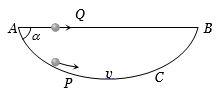
$A$ particle $P$ is sliding down a frictionless hemispherical bowl. It passes the point $A$ at $t = 0$. At this instant of time, the horizontal component of its velocity is $v$. $A$ bead $Q$ of the same mass as $P$ is ejected from $A$ at $t = 0$ along the horizontal string $AB$ (see figure) with the speed $v$. Friction between the bead and the string may be neglected. Let ${t_P}$ and ${t_Q}$ be the respective time taken by $P$ and $Q$ to reach the point $B$. Then
A
${t_P} < {t_Q}$
B
${t_P} = {t_Q}$
C
${t_P} > {t_Q}$
D
All of these
Solution
(A) For particle $Q$, the velocity is constant at $v$ along the horizontal direction, so the time taken to cover the horizontal distance $AB$ is ${t_Q} = \frac{AB}{v}$.
For particle $P$, the horizontal component of velocity $v_x$ is given by $v_x = v \cos \theta$, where $\theta$ is the angle the velocity vector makes with the horizontal. As the particle slides down the bowl, it gains speed due to gravity. The horizontal component of its velocity $v_x$ at any point is greater than or equal to the initial horizontal component $v$ because the particle accelerates as it moves towards the lowest point $C$ and then decelerates, but its speed remains higher than the initial speed $v$ throughout the path until it reaches $B$. Since the horizontal component of velocity for $P$ is always greater than or equal to $v$ throughout the motion, the average horizontal velocity of $P$ is greater than $v$. Therefore, the time taken by $P$ to cover the same horizontal distance $AB$ is less than the time taken by $Q$. Thus, ${t_P} < {t_Q}$.
For particle $P$, the horizontal component of velocity $v_x$ is given by $v_x = v \cos \theta$, where $\theta$ is the angle the velocity vector makes with the horizontal. As the particle slides down the bowl, it gains speed due to gravity. The horizontal component of its velocity $v_x$ at any point is greater than or equal to the initial horizontal component $v$ because the particle accelerates as it moves towards the lowest point $C$ and then decelerates, but its speed remains higher than the initial speed $v$ throughout the path until it reaches $B$. Since the horizontal component of velocity for $P$ is always greater than or equal to $v$ throughout the motion, the average horizontal velocity of $P$ is greater than $v$. Therefore, the time taken by $P$ to cover the same horizontal distance $AB$ is less than the time taken by $Q$. Thus, ${t_P} < {t_Q}$.
0 likesView Solution
3
PhysicsDifficultMCQIIT JEE · 1993
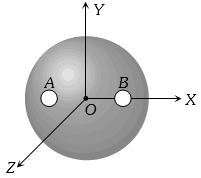
$A$ solid sphere of uniform density and radius $4$ units is located with its centre at the origin $O$ of coordinates. Two spheres of equal radii $1$ unit with their centres at $A(-2, 0, 0)$ and $B(2, 0, 0)$ respectively are taken out of the solid leaving behind spherical cavities as shown in the figure.
A
The gravitational force due to this object at the origin is zero.
B
The gravitational potential is the same at all points on the circle ${y^2} + {z^2} = 4$.
C
The gravitational potential is the same at all points of the circle ${y^2} + {z^2} = 36$.
D
All of the above.
Solution
(D) The gravitational potential $V$ at any point $P$ due to the solid sphere with cavities is given by the principle of superposition: $V = V_{\text{large sphere}} - V_{\text{cavity A}} - V_{\text{cavity B}}$.
$1$. At the origin $O(0, 0, 0)$,the gravitational field $\vec{E}$ due to the large sphere is zero. The fields due to the two cavities are equal in magnitude and opposite in direction $(\vec{E}_A = -\vec{E}_B)$,so the net field at the origin is zero. Thus,option $(A)$ is correct.
$2$. The gravitational potential at any point $(x, y, z)$ due to a sphere with a cavity is symmetric about the axis passing through the centres of the cavities. For the circle ${y^2} + {z^2} = R^2$ in the plane $x = 0$,the distance from any point on the circle to the centres $A(-2, 0, 0)$ and $B(2, 0, 0)$ is the same. Specifically,for any point $(0, y, z)$ on the circle,the distance to $A$ is $\sqrt{(-2-0)^2 + y^2 + z^2} = \sqrt{4 + R^2}$ and the distance to $B$ is $\sqrt{(2-0)^2 + y^2 + z^2} = \sqrt{4 + R^2}$. Since the distances are equal,the potentials due to the cavities are equal,and the potential due to the large sphere is constant on this circle. Thus,the total potential is constant on the circles ${y^2} + {z^2} = 4$ and ${y^2} + {z^2} = 36$. Options $(B)$ and $(C)$ are also correct.
Therefore,the correct option is $(D)$.
$1$. At the origin $O(0, 0, 0)$,the gravitational field $\vec{E}$ due to the large sphere is zero. The fields due to the two cavities are equal in magnitude and opposite in direction $(\vec{E}_A = -\vec{E}_B)$,so the net field at the origin is zero. Thus,option $(A)$ is correct.
$2$. The gravitational potential at any point $(x, y, z)$ due to a sphere with a cavity is symmetric about the axis passing through the centres of the cavities. For the circle ${y^2} + {z^2} = R^2$ in the plane $x = 0$,the distance from any point on the circle to the centres $A(-2, 0, 0)$ and $B(2, 0, 0)$ is the same. Specifically,for any point $(0, y, z)$ on the circle,the distance to $A$ is $\sqrt{(-2-0)^2 + y^2 + z^2} = \sqrt{4 + R^2}$ and the distance to $B$ is $\sqrt{(2-0)^2 + y^2 + z^2} = \sqrt{4 + R^2}$. Since the distances are equal,the potentials due to the cavities are equal,and the potential due to the large sphere is constant on this circle. Thus,the total potential is constant on the circles ${y^2} + {z^2} = 4$ and ${y^2} + {z^2} = 36$. Options $(B)$ and $(C)$ are also correct.
Therefore,the correct option is $(D)$.
0 likesView Solution
4
PhysicsDifficultMCQIIT JEE · 1993
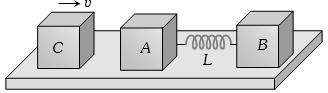
Two blocks $A$ and $B$,each of mass $m$,are connected by a massless spring of natural length $L$ and spring constant $K$. The blocks are initially resting on a smooth horizontal floor with the spring at its natural length as shown in the figure. $A$ third identical block $C$,also of mass $m$,moves on the floor with a speed $v$ along the line joining $A$ and $B$ and collides with $A$. Then:
A
The kinetic energy of the $A-B$ system at maximum compression of the spring is zero.
B
The kinetic energy of the $A-B$ system at maximum compression of the spring is $\frac{mv^2}{4}$.
C
The maximum compression of the spring is $v\sqrt{\frac{m}{2K}}$.
D
Both $(b)$ and $(c)$.
Solution
(D) When block $C$ collides with block $A$,they stick together (assuming perfectly inelastic collision) or transfer momentum. Since $C$ and $A$ have equal mass $m$,after the collision,$C$ stops and $A$ moves with velocity $v$.
Now,consider the system of blocks $A$ and $B$ connected by the spring. The initial momentum of the system is $mv$.
Let $V$ be the common velocity of blocks $A$ and $B$ at the moment of maximum compression. By conservation of linear momentum:
$mv = (m + m)V \Rightarrow V = \frac{v}{2}$.
At maximum compression $x$,the kinetic energy of the system is converted into potential energy of the spring and the remaining kinetic energy of the center of mass.
Using conservation of energy:
$\frac{1}{2}mv^2 = \frac{1}{2}(m+m)V^2 + \frac{1}{2}Kx^2$
$\frac{1}{2}mv^2 = \frac{1}{2}(2m)(\frac{v}{2})^2 + \frac{1}{2}Kx^2$
$\frac{1}{2}mv^2 = \frac{1}{4}mv^2 + \frac{1}{2}Kx^2$
$\frac{1}{4}mv^2 = \frac{1}{2}Kx^2 \Rightarrow x^2 = \frac{mv^2}{2K} \Rightarrow x = v\sqrt{\frac{m}{2K}}$.
At maximum compression,the kinetic energy of the $A-B$ system is:
$K.E. = \frac{1}{2}(2m)V^2 = m(\frac{v}{2})^2 = \frac{mv^2}{4}$.
Thus,both statements $(b)$ and $(c)$ are correct.
Now,consider the system of blocks $A$ and $B$ connected by the spring. The initial momentum of the system is $mv$.
Let $V$ be the common velocity of blocks $A$ and $B$ at the moment of maximum compression. By conservation of linear momentum:
$mv = (m + m)V \Rightarrow V = \frac{v}{2}$.
At maximum compression $x$,the kinetic energy of the system is converted into potential energy of the spring and the remaining kinetic energy of the center of mass.
Using conservation of energy:
$\frac{1}{2}mv^2 = \frac{1}{2}(m+m)V^2 + \frac{1}{2}Kx^2$
$\frac{1}{2}mv^2 = \frac{1}{2}(2m)(\frac{v}{2})^2 + \frac{1}{2}Kx^2$
$\frac{1}{2}mv^2 = \frac{1}{4}mv^2 + \frac{1}{2}Kx^2$
$\frac{1}{4}mv^2 = \frac{1}{2}Kx^2 \Rightarrow x^2 = \frac{mv^2}{2K} \Rightarrow x = v\sqrt{\frac{m}{2K}}$.
At maximum compression,the kinetic energy of the $A-B$ system is:
$K.E. = \frac{1}{2}(2m)V^2 = m(\frac{v}{2})^2 = \frac{mv^2}{4}$.
Thus,both statements $(b)$ and $(c)$ are correct.
0 likesView Solution
5
PhysicsDifficultMCQIIT JEE · 1993
One end of a long metallic wire of length $L$ is tied to the ceiling. The other end is tied to a massless spring of spring constant $K$. $A$ mass $m$ hangs freely from the free end of the spring. The area of cross-section and Young's modulus of the wire are $A$ and $Y$ respectively. If the mass is slightly pulled down and released,it will oscillate with a time period $T$ equal to
A
$2\pi \sqrt{\frac{m}{K}}$
B
$2\pi \sqrt{\frac{(YA + KL)m}{YAK}}$
C
$2\pi \frac{mYA}{KL}$
D
$2\pi \frac{mL}{YA}$
Solution
(B) The wire acts as a spring with a force constant $k_1$. From the definition of Young's modulus $Y = \frac{F/A}{\Delta L/L}$,we get $k_1 = \frac{F}{\Delta L} = \frac{YA}{L}$.
The spring constant of the given spring is $k_2 = K$.
Since the wire and the spring are in series,the equivalent spring constant $k_{eq}$ is given by $\frac{1}{k_{eq}} = \frac{1}{k_1} + \frac{1}{k_2}$.
$\frac{1}{k_{eq}} = \frac{L}{YA} + \frac{1}{K} = \frac{KL + YA}{YAK}$.
Therefore,$k_{eq} = \frac{YAK}{YA + KL}$.
The time period of oscillation is $T = 2\pi \sqrt{\frac{m}{k_{eq}}} = 2\pi \sqrt{\frac{m(YA + KL)}{YAK}}$.
The spring constant of the given spring is $k_2 = K$.
Since the wire and the spring are in series,the equivalent spring constant $k_{eq}$ is given by $\frac{1}{k_{eq}} = \frac{1}{k_1} + \frac{1}{k_2}$.
$\frac{1}{k_{eq}} = \frac{L}{YA} + \frac{1}{K} = \frac{KL + YA}{YAK}$.
Therefore,$k_{eq} = \frac{YAK}{YA + KL}$.
The time period of oscillation is $T = 2\pi \sqrt{\frac{m}{k_{eq}}} = 2\pi \sqrt{\frac{m(YA + KL)}{YAK}}$.
0 likesView Solution
6
PhysicsEasyMCQIIT JEE · 1993
$A$ current $I$ flows along the length of an infinitely long,straight and thin-walled pipe. Then
A
The magnetic field at all points inside the pipe is the same but not zero
B
The magnetic field at any point inside the pipe is zero
C
The magnetic field is zero only on the axis of the pipe
D
The magnetic field is different at different points inside the pipe
Solution
(B) According to Ampere's circuital law,the line integral of the magnetic field $\vec{B}$ around any closed loop is equal to $\mu_0$ times the total current $I_{\text{enclosed}}$ passing through the surface bounded by the loop: $\oint \vec{B} \cdot d\vec{l} = \mu_0 I_{\text{enclosed}}$.
For an infinitely long,thin-walled pipe carrying current $I$ along its length,any closed loop chosen inside the pipe encloses zero current $(I_{\text{enclosed}} = 0)$.
Therefore,$\oint \vec{B} \cdot d\vec{l} = 0$,which implies that the magnetic field $\vec{B}$ at any point inside the pipe is zero.
For an infinitely long,thin-walled pipe carrying current $I$ along its length,any closed loop chosen inside the pipe encloses zero current $(I_{\text{enclosed}} = 0)$.
Therefore,$\oint \vec{B} \cdot d\vec{l} = 0$,which implies that the magnetic field $\vec{B}$ at any point inside the pipe is zero.
0 likesView Solution
7
PhysicsDifficultMCQIIT JEE · 1993
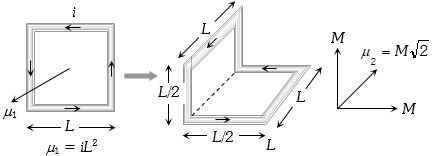
$A$ steady current $i$ flows in a small square loop of wire of side $L$ in a horizontal plane. The loop is now folded about its middle such that half of it lies in a vertical plane. Let $\overrightarrow {{\mu _1}} $ and $\overrightarrow {{\mu _2}} $ respectively denote the magnetic moments due to the current loop before and after folding. Then
A
$\overrightarrow {{\mu _2}} = 0$
B
$\overrightarrow {{\mu _1}} $ and $\overrightarrow {{\mu _2}} $ are in the same direction
C
$\frac{{|\overrightarrow {{\mu _1}} |}}{{|\overrightarrow {{\mu _2}} |}} = \sqrt 2 $
D
$\frac{{|\overrightarrow {{\mu _1}} |}}{{|\overrightarrow {{\mu _2}} |}} = \frac{1}{{\sqrt 2 }}$
Solution
(C) The initial magnetic moment of the square loop is $\mu_1 = iA = iL^2$,where the direction is perpendicular to the plane of the loop.
When the loop is folded at the middle,it forms two smaller rectangular loops,each of area $A' = L \times (L/2) = L^2/2$.
The magnetic moment of each half is $M = iA' = iL^2/2 = \mu_1/2$.
These two halves lie in perpendicular planes. Let the magnetic moment of the horizontal half be $\overrightarrow{M_h}$ and the vertical half be $\overrightarrow{M_v}$.
Both have magnitude $M = \mu_1/2$. The resultant magnetic moment $\overrightarrow{\mu_2}$ is the vector sum of these two: $\mu_2 = \sqrt{M^2 + M^2} = M\sqrt{2}$.
Substituting $M = \mu_1/2$,we get $\mu_2 = (\mu_1/2) \times \sqrt{2} = \mu_1/\sqrt{2}$.
Therefore,the ratio $\frac{|\overrightarrow{\mu_1}|}{|\overrightarrow{\mu_2}|} = \frac{\mu_1}{\mu_1/\sqrt{2}} = \sqrt{2}$.
When the loop is folded at the middle,it forms two smaller rectangular loops,each of area $A' = L \times (L/2) = L^2/2$.
The magnetic moment of each half is $M = iA' = iL^2/2 = \mu_1/2$.
These two halves lie in perpendicular planes. Let the magnetic moment of the horizontal half be $\overrightarrow{M_h}$ and the vertical half be $\overrightarrow{M_v}$.
Both have magnitude $M = \mu_1/2$. The resultant magnetic moment $\overrightarrow{\mu_2}$ is the vector sum of these two: $\mu_2 = \sqrt{M^2 + M^2} = M\sqrt{2}$.
Substituting $M = \mu_1/2$,we get $\mu_2 = (\mu_1/2) \times \sqrt{2} = \mu_1/\sqrt{2}$.
Therefore,the ratio $\frac{|\overrightarrow{\mu_1}|}{|\overrightarrow{\mu_2}|} = \frac{\mu_1}{\mu_1/\sqrt{2}} = \sqrt{2}$.
0 likesView Solution
8
PhysicsDifficultMCQIIT JEE · 1993
$A$ star initially has $10^{40}$ deuterons. It produces energy via the processes:
$_1H^2 + _1H^2 \to _1H^3 + p$
$_1H^2 + _1H^3 \to _2He^4 + n$
The masses of the nuclei are as follows:
$M(H^2) = 2.014 \, amu; \, M(p) = 1.007 \, amu;$
$M(n) = 1.008 \, amu; \, M(He^4) = 4.001 \, amu$
If the average power radiated by the star is $10^{16} \, W$, the deuteron supply of the star is exhausted in a time of the order of:
$_1H^2 + _1H^2 \to _1H^3 + p$
$_1H^2 + _1H^3 \to _2He^4 + n$
The masses of the nuclei are as follows:
$M(H^2) = 2.014 \, amu; \, M(p) = 1.007 \, amu;$
$M(n) = 1.008 \, amu; \, M(He^4) = 4.001 \, amu$
If the average power radiated by the star is $10^{16} \, W$, the deuteron supply of the star is exhausted in a time of the order of:
A
$10^6 \, sec$
B
$10^8 \, sec$
C
$10^{12} \, sec$
D
$10^{16} \, sec$
Solution
(C) The net reaction is: $3(_1H^2) \to _2He^4 + p + n$.
Mass defect $\Delta m = 3 \times M(H^2) - [M(He^4) + M(p) + M(n)]$
$\Delta m = 3(2.014) - [4.001 + 1.007 + 1.008] = 6.042 - 6.016 = 0.026 \, amu$.
Energy released per reaction $Q = 0.026 \times 931.5 \, MeV \approx 24.22 \, MeV$.
$Q = 24.22 \times 10^6 \times 1.6 \times 10^{-19} \, J \approx 3.875 \times 10^{-12} \, J$.
Since $3$ deuterons are used to produce $Q$ energy, energy per deuteron is $E_d = Q/3 = 1.29 \times 10^{-12} \, J$.
Total energy available $E_{total} = N \times E_d = 10^{40} \times 1.29 \times 10^{-12} = 1.29 \times 10^{28} \, J$.
Time taken $t = E_{total} / P = (1.29 \times 10^{28}) / 10^{16} = 1.29 \times 10^{12} \, s$.
Thus, the time is of the order of $10^{12} \, s$.
Mass defect $\Delta m = 3 \times M(H^2) - [M(He^4) + M(p) + M(n)]$
$\Delta m = 3(2.014) - [4.001 + 1.007 + 1.008] = 6.042 - 6.016 = 0.026 \, amu$.
Energy released per reaction $Q = 0.026 \times 931.5 \, MeV \approx 24.22 \, MeV$.
$Q = 24.22 \times 10^6 \times 1.6 \times 10^{-19} \, J \approx 3.875 \times 10^{-12} \, J$.
Since $3$ deuterons are used to produce $Q$ energy, energy per deuteron is $E_d = Q/3 = 1.29 \times 10^{-12} \, J$.
Total energy available $E_{total} = N \times E_d = 10^{40} \times 1.29 \times 10^{-12} = 1.29 \times 10^{28} \, J$.
Time taken $t = E_{total} / P = (1.29 \times 10^{28}) / 10^{16} = 1.29 \times 10^{12} \, s$.
Thus, the time is of the order of $10^{12} \, s$.
0 likesView Solution
9
PhysicsMediumMCQIIT JEE · 1993
In the circuit given below, $V(t)$ is the sinusoidal voltage source. The voltage drop $V_{AB}(t)$ across the resistance $R$ is:
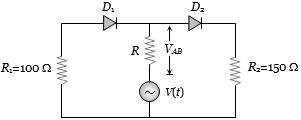
A
Is half-wave rectified
B
Is full-wave rectified
C
Has the same peak value in the positive and negative half-cycles
D
Has different peak values during positive and negative half-cycles
Solution
(D) In the positive half-cycle of the input $V(t)$, diode $D_1$ is forward-biased and $D_2$ is reverse-biased. The current flows through $R_1$ and $R$. The voltage drop across $R$ is determined by the voltage divider rule: $V_{AB, pos} = V(t) \cdot \frac{R}{R + R_1}$.
In the negative half-cycle of the input $V(t)$, diode $D_2$ is forward-biased and $D_1$ is reverse-biased. The current flows through $R_2$ and $R$. The voltage drop across $R$ is: $V_{AB, neg} = |V(t)| \cdot \frac{R}{R + R_2}$.
Since $R_1 = 100 \ \Omega$ and $R_2 = 150 \ \Omega$ are different, the peak voltage values across $R$ during the positive and negative half-cycles will be different.
Therefore, the output is not rectified, and it has different peak values during the positive and negative half-cycles.
In the negative half-cycle of the input $V(t)$, diode $D_2$ is forward-biased and $D_1$ is reverse-biased. The current flows through $R_2$ and $R$. The voltage drop across $R$ is: $V_{AB, neg} = |V(t)| \cdot \frac{R}{R + R_2}$.
Since $R_1 = 100 \ \Omega$ and $R_2 = 150 \ \Omega$ are different, the peak voltage values across $R$ during the positive and negative half-cycles will be different.
Therefore, the output is not rectified, and it has different peak values during the positive and negative half-cycles.
0 likesView Solution
Vedclass Products
For Students
Vedclass Test Series
Mock tests in real IIT JEE style covering Physics with performance analysis. 5-day free trial.
Start Free TrialFor Teachers
Exam Paper Generator
Generate Set A/B/C/D Physics papers from 7.5L+ questions in 2 minutes. 3 chapters free.
Try FreeFor Institutes
Online Exam Module
Run live IIT JEE mock exams with unlimited students, 360° analytics & white-label branding.
See DemoFrequently Asked Questions
How many Physics questions are in IIT JEE 1993?
There are 9 Physics questions from the IIT JEE 1993 paper on Vedclass, each with a detailed step-by-step solution in English.
Are IIT JEE 1993 Physics solutions available in English?
Yes. All solutions on this page are in English. You can also switch to English or Hindi using the language buttons above the questions.
Can I practice IIT JEE 1993 Physics as a timed test?
Yes. Use the Vedclass Test Series to attempt a full IIT JEE mock test covering Physics with time limits and instant score analysis.
Can teachers create Physics papers from IIT JEE previous year questions?
Yes. The Vedclass Exam Paper Generator lets teachers mix IIT JEE Physics questions and generate Set A/B/C/D papers in minutes.
For Teachers & Institutes
Build a Custom Physics Paper
Pick IIT JEE 1993 Physics questions, set difficulty, and generate Set A/B/C/D in 2 minutes.