
PhysicsQ1–6 of 6 questions
Page 1 of 1 · English
1
PhysicsMediumMCQIIT JEE · 1987
$A$ particle is acted upon by a force of constant magnitude which is always perpendicular to the velocity of the particle. The motion of the particle takes place in a plane. It follows that:
A
It moves in a circular path
B
Acceleration is constant
C
Kinetic energy is constant
D
Both $(a)$ and $(c)$
Solution
(D) When a force acts perpendicular to the velocity of a particle,it does not change the magnitude of the velocity (speed),only its direction. This results in uniform circular motion.
Since the speed $v$ remains constant,the kinetic energy $K = \frac{1}{2}mv^2$ remains constant.
Because the force is always perpendicular to the velocity and the magnitude of the force is constant,the particle moves in a circular path.
Therefore,both statements $(a)$ and $(c)$ are correct.
Since the speed $v$ remains constant,the kinetic energy $K = \frac{1}{2}mv^2$ remains constant.
Because the force is always perpendicular to the velocity and the magnitude of the force is constant,the particle moves in a circular path.
Therefore,both statements $(a)$ and $(c)$ are correct.
0 likesView Solution
2
PhysicsMediumMCQIIT JEE · 1987
The displacement of a particle in a string stretched in the $X$ direction is represented by $y$. Among the following expressions for $y$,which ones describe wave motion?
A
$\cos kx \sin \omega t$
B
$k^2 x^2 - \omega^2 t^2$
C
$\cos (kx + \omega t)$
D
Both $(a)$ and $(c)$
Solution
(D) function $y(x, t)$ represents a wave motion if it satisfies the general wave equation $\frac{\partial^2 y}{\partial t^2} = v^2 \frac{\partial^2 y}{\partial x^2}$.
$1$. For $y = \cos(kx + \omega t)$,this is a standard traveling wave equation of the form $f(kx \pm \omega t)$,which satisfies the wave equation.
$2$. For $y = \cos kx \sin \omega t$,this can be written as $\frac{1}{2} [\sin(kx + \omega t) - \sin(kx - \omega t)]$. This represents a standing wave,which is formed by the superposition of two traveling waves moving in opposite directions. Standing waves are also a form of wave motion.
Therefore,both expressions describe wave motion.
$1$. For $y = \cos(kx + \omega t)$,this is a standard traveling wave equation of the form $f(kx \pm \omega t)$,which satisfies the wave equation.
$2$. For $y = \cos kx \sin \omega t$,this can be written as $\frac{1}{2} [\sin(kx + \omega t) - \sin(kx - \omega t)]$. This represents a standing wave,which is formed by the superposition of two traveling waves moving in opposite directions. Standing waves are also a form of wave motion.
Therefore,both expressions describe wave motion.
0 likesView Solution
3
PhysicsMediumMCQIIT JEE · 1987
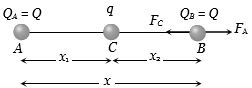
$A$ charge $q$ is placed at the centre of the line joining two equal charges $Q$. The system of the three charges will be in equilibrium if $q$ is equal to:
A
$ - \frac{Q}{2} $
B
$ - \frac{Q}{4} $
C
$ + \frac{Q}{4} $
D
$ + \frac{Q}{2} $
Solution
(B) For the system of three charges to be in equilibrium,the net force on each charge must be zero.
Let the two charges $Q$ be placed at points $A$ and $B$ separated by a distance $x$. The charge $q$ is placed at the midpoint $C$ (distance $x/2$ from both $A$ and $B$).
Consider the equilibrium of charge $Q$ at point $B$. The force exerted by charge $Q$ at $A$ on charge $Q$ at $B$ must be balanced by the force exerted by charge $q$ at $C$ on charge $Q$ at $B$.
$F_{AB} + F_{CB} = 0$
$\frac{1}{4\pi\varepsilon_0} \frac{Q^2}{x^2} + \frac{1}{4\pi\varepsilon_0} \frac{qQ}{(x/2)^2} = 0$
$\frac{Q^2}{x^2} + \frac{4qQ}{x^2} = 0$
$Q^2 + 4qQ = 0$
$4qQ = -Q^2$
$q = -\frac{Q}{4}$
Let the two charges $Q$ be placed at points $A$ and $B$ separated by a distance $x$. The charge $q$ is placed at the midpoint $C$ (distance $x/2$ from both $A$ and $B$).
Consider the equilibrium of charge $Q$ at point $B$. The force exerted by charge $Q$ at $A$ on charge $Q$ at $B$ must be balanced by the force exerted by charge $q$ at $C$ on charge $Q$ at $B$.
$F_{AB} + F_{CB} = 0$
$\frac{1}{4\pi\varepsilon_0} \frac{Q^2}{x^2} + \frac{1}{4\pi\varepsilon_0} \frac{qQ}{(x/2)^2} = 0$
$\frac{Q^2}{x^2} + \frac{4qQ}{x^2} = 0$
$Q^2 + 4qQ = 0$
$4qQ = -Q^2$
$q = -\frac{Q}{4}$
0 likesView Solution
4
PhysicsEasyMCQIIT JEE · 1987
$A$ parallel plate capacitor is charged and the charging battery is then disconnected. If the plates of the capacitor are moved further apart by means of insulating handles,then
A
The charge on the capacitor increases
B
The voltage across the plates decreases
C
The capacitance increases
D
The electrostatic energy stored in the capacitor increases
Solution
(D) When the battery is disconnected,the charge $q$ on the capacitor remains constant because there is no path for the charge to flow.
The capacitance of a parallel plate capacitor is given by $C = \frac{\varepsilon_0 A}{d}$.
When the distance $d$ between the plates is increased,the capacitance $C$ decreases.
Since $q = CV$,the voltage $V = \frac{q}{C}$ must increase as $C$ decreases.
The electrostatic energy stored in the capacitor is given by $U = \frac{q^2}{2C}$.
Since $q$ is constant and $C$ decreases,the energy $U$ increases.
The capacitance of a parallel plate capacitor is given by $C = \frac{\varepsilon_0 A}{d}$.
When the distance $d$ between the plates is increased,the capacitance $C$ decreases.
Since $q = CV$,the voltage $V = \frac{q}{C}$ must increase as $C$ decreases.
The electrostatic energy stored in the capacitor is given by $U = \frac{q^2}{2C}$.
Since $q$ is constant and $C$ decreases,the energy $U$ increases.
0 likesView Solution
5
PhysicsDifficultMCQIIT JEE · 1987
During the nuclear fusion reaction,
A
$A$ heavy nucleus breaks into two fragments by itself.
B
$A$ light nucleus bombarded by thermal neutrons breaks up.
C
$A$ heavy nucleus bombarded by thermal neutrons breaks up.
D
Two light nuclei combine to give a heavier nucleus and possibly other products.
Solution
(D) Nuclear fusion is a process in which two light atomic nuclei combine to form a single,heavier nucleus. This process is accompanied by the release of a large amount of energy due to the mass defect between the reactants and the product.
0 likesView Solution
6
PhysicsEasyMCQIIT JEE · 1987
During a negative beta decay,
A
An atomic electron is ejected.
B
An electron which is already present within the nucleus is ejected.
C
$A$ neutron in the nucleus decays emitting an electron.
D
$A$ part of the binding energy is converted into an electron.
Solution
(C) In negative $\beta$-decay,a neutron inside the nucleus transforms into a proton,an electron,and an antineutrino.
This process is represented by the equation:
$n \rightarrow p + e^- + \bar{\nu}_e$
Since the electron is created during the decay process of the neutron,option $C$ is correct.
This process is represented by the equation:
$n \rightarrow p + e^- + \bar{\nu}_e$
Since the electron is created during the decay process of the neutron,option $C$ is correct.
0 likesView Solution
Vedclass Products
For Students
Vedclass Test Series
Mock tests in real IIT JEE style covering Physics with performance analysis. 5-day free trial.
Start Free TrialFor Teachers
Exam Paper Generator
Generate Set A/B/C/D Physics papers from 7.5L+ questions in 2 minutes. 3 chapters free.
Try FreeFor Institutes
Online Exam Module
Run live IIT JEE mock exams with unlimited students, 360° analytics & white-label branding.
See DemoFrequently Asked Questions
How many Physics questions are in IIT JEE 1987?
There are 6 Physics questions from the IIT JEE 1987 paper on Vedclass, each with a detailed step-by-step solution in English.
Are IIT JEE 1987 Physics solutions available in English?
Yes. All solutions on this page are in English. You can also switch to English or Hindi using the language buttons above the questions.
Can I practice IIT JEE 1987 Physics as a timed test?
Yes. Use the Vedclass Test Series to attempt a full IIT JEE mock test covering Physics with time limits and instant score analysis.
Can teachers create Physics papers from IIT JEE previous year questions?
Yes. The Vedclass Exam Paper Generator lets teachers mix IIT JEE Physics questions and generate Set A/B/C/D papers in minutes.
For Teachers & Institutes
Build a Custom Physics Paper
Pick IIT JEE 1987 Physics questions, set difficulty, and generate Set A/B/C/D in 2 minutes.