
ChemistryQ1–7 of 7 questions
Page 1 of 1 · English
1
ChemistryMediumMCQIIT JEE · 1979
The total number of neutrons in dipositive zinc ions with mass number $70$ is
A
$34$
B
$40$
C
$36$
D
$38$
Solution
(B) The atomic number of zinc $(Zn)$ is $30$.
For the isotope with mass number $A = 70$,the number of neutrons is calculated as $N = A - Z$.
$N = 70 - 30 = 40$.
The formation of a dipositive ion $(Zn^{2+})$ involves the loss of electrons from the valence shell,which does not affect the number of protons or neutrons in the nucleus.
Therefore,the number of neutrons remains $40$.
For the isotope with mass number $A = 70$,the number of neutrons is calculated as $N = A - Z$.
$N = 70 - 30 = 40$.
The formation of a dipositive ion $(Zn^{2+})$ involves the loss of electrons from the valence shell,which does not affect the number of protons or neutrons in the nucleus.
Therefore,the number of neutrons remains $40$.
0 likesView Solution
2
ChemistryEasyMCQIIT JEE · 1979
The number of electrons in one molecule of $CO_2$ is:
A
$22$
B
$44$
C
$66$
D
$88$
Solution
(A) The atomic number of $C$ is $6$ and the atomic number of $O$ is $8$.
In one molecule of $CO_2$,there is $1$ atom of $C$ and $2$ atoms of $O$.
Total number of electrons = $(1 \times 6) + (2 \times 8) = 6 + 16 = 22$ electrons.
Therefore,the correct option is $A$.
In one molecule of $CO_2$,there is $1$ atom of $C$ and $2$ atoms of $O$.
Total number of electrons = $(1 \times 6) + (2 \times 8) = 6 + 16 = 22$ electrons.
Therefore,the correct option is $A$.
0 likesView Solution
3
ChemistryEasyMCQIIT JEE · 1979
The octet rule is not valid for which of the following molecules?
A
$CO_2$
B
$NO$
C
$H_2O$
D
$O_2$
Solution
(B) The octet rule states that atoms tend to gain,lose,or share electrons to achieve a stable configuration of $8$ valence electrons.
In $CO_2$,$H_2O$,and $O_2$,all atoms (except $H$ in $H_2O$) achieve an octet.
In $NO$ (Nitric oxide),the nitrogen atom has $5$ valence electrons and the oxygen atom has $6$ valence electrons,totaling $11$ valence electrons.
Since the total number of valence electrons is odd,it is impossible for all atoms to satisfy the octet rule,making $NO$ an odd-electron molecule.
In $CO_2$,$H_2O$,and $O_2$,all atoms (except $H$ in $H_2O$) achieve an octet.
In $NO$ (Nitric oxide),the nitrogen atom has $5$ valence electrons and the oxygen atom has $6$ valence electrons,totaling $11$ valence electrons.
Since the total number of valence electrons is odd,it is impossible for all atoms to satisfy the octet rule,making $NO$ an odd-electron molecule.
0 likesView Solution
4
ChemistryEasyMCQIIT JEE · 1979
In a reaction,the rate of reaction is proportional to its active mass. This statement is known as:
A
Law of mass action
B
Le Chatelier principle
C
Faraday law of electrolysis
D
Law of constant proportion
Solution
(A) The $Law \ of \ mass \ action$ states that the rate of a chemical reaction is directly proportional to the product of the active masses (molar concentrations) of the reacting substances.
Active mass is defined as the molar concentration of the substance,i.e.,$Active \ mass = [Concentration]$.
Active mass is defined as the molar concentration of the substance,i.e.,$Active \ mass = [Concentration]$.
0 likesView Solution
5
ChemistryMediumMCQIIT JEE · 1979
Which of the following contains both ionic and covalent bonds?
A
$CH_4$
B
$H_2$
C
$KCN$
D
$KCl$
Solution
(C) In $KCN$,the bond between $K^+$ and $CN^-$ is ionic.
Within the cyanide ion $(CN^-)$,there is a triple covalent bond between the carbon and nitrogen atoms $(C \equiv N)$.
Therefore,$KCN$ contains both ionic and covalent bonds.
Within the cyanide ion $(CN^-)$,there is a triple covalent bond between the carbon and nitrogen atoms $(C \equiv N)$.
Therefore,$KCN$ contains both ionic and covalent bonds.
0 likesView Solution
6
ChemistryMCQIIT JEE · 1979
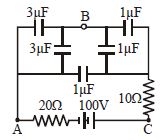
In the figure below, what is the potential difference between the points $A$ and $B$ and between $B$ and $C$ respectively in steady state?
A
$V_{AB} = V_{BC} = 100\, V$
B
$V_{AB} = 75\, V$, $V_{BC} = 25\, V$
C
$V_{AB} = 25\, V$, $V_{BC} = 75\, V$
D
$V_{AB} = V_{BC} = 50\, V$
Solution
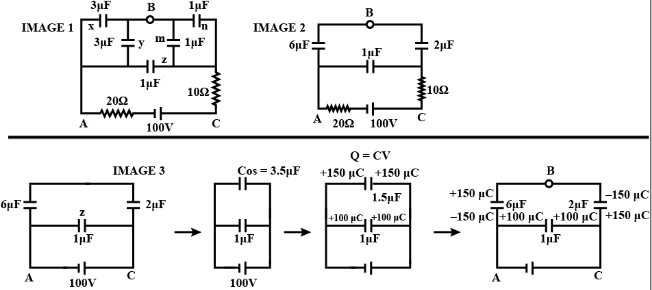
(C) In steady state, capacitors act as open circuits. The current flows only through the resistors. The total resistance in the circuit is $R_{eq} = 20\, \Omega + 10\, \Omega = 30\, \Omega$. The current in the circuit is $I = \frac{V}{R_{eq}} = \frac{100\, V}{30\, \Omega} = \frac{10}{3}\, A$.
The potential at point $A$ is $V_A$ and at point $C$ is $V_C$. The potential difference $V_{AC} = V_A - V_C = 100\, V$.
Let the potential at point $B$ be $V_B$. The capacitors form a bridge-like structure. The equivalent capacitance between $A$ and $B$ is $C_{AB} = 3\, \mu F + 3\, \mu F = 6\, \mu F$ (parallel combination). The equivalent capacitance between $B$ and $C$ is $C_{BC} = 1\, \mu F + 1\, \mu F = 2\, \mu F$ (parallel combination).
Using the principle of voltage division for capacitors in series (since the charge $Q$ on the branches $AB$ and $BC$ must be equal in steady state), we have $V_{AB} = V_{total} \cdot \frac{C_{BC}}{C_{AB} + C_{BC}} = 100 \cdot \frac{2}{6+2} = 100 \cdot \frac{2}{8} = 25\, V$.
Similarly, $V_{BC} = V_{total} \cdot \frac{C_{AB}}{C_{AB} + C_{BC}} = 100 \cdot \frac{6}{6+2} = 100 \cdot \frac{6}{8} = 75\, V$.
Thus, $V_{AB} = 25\, V$ and $V_{BC} = 75\, V$.
The potential at point $A$ is $V_A$ and at point $C$ is $V_C$. The potential difference $V_{AC} = V_A - V_C = 100\, V$.
Let the potential at point $B$ be $V_B$. The capacitors form a bridge-like structure. The equivalent capacitance between $A$ and $B$ is $C_{AB} = 3\, \mu F + 3\, \mu F = 6\, \mu F$ (parallel combination). The equivalent capacitance between $B$ and $C$ is $C_{BC} = 1\, \mu F + 1\, \mu F = 2\, \mu F$ (parallel combination).
Using the principle of voltage division for capacitors in series (since the charge $Q$ on the branches $AB$ and $BC$ must be equal in steady state), we have $V_{AB} = V_{total} \cdot \frac{C_{BC}}{C_{AB} + C_{BC}} = 100 \cdot \frac{2}{6+2} = 100 \cdot \frac{2}{8} = 25\, V$.
Similarly, $V_{BC} = V_{total} \cdot \frac{C_{AB}}{C_{AB} + C_{BC}} = 100 \cdot \frac{6}{6+2} = 100 \cdot \frac{6}{8} = 75\, V$.
Thus, $V_{AB} = 25\, V$ and $V_{BC} = 75\, V$.
0 likesView Solution
7
ChemistryMediumMCQIIT JEE · 1979
The reddish-brown coloured gas formed when nitric oxide is oxidised by air is
A
$N_2O_5$
B
$N_2O_4$
C
$NO_2$
D
$N_2O_3$
Solution
(C) Nitric oxide $(NO)$ reacts with atmospheric oxygen to form nitrogen dioxide $(NO_2)$.
The chemical equation is:
$2 NO(g) + O_2(g) \rightarrow 2 NO_2(g)$
Nitrogen dioxide $(NO_2)$ is a reddish-brown coloured gas.
The chemical equation is:
$2 NO(g) + O_2(g) \rightarrow 2 NO_2(g)$
Nitrogen dioxide $(NO_2)$ is a reddish-brown coloured gas.
0 likesView Solution
Vedclass Products
For Students
Vedclass Test Series
Mock tests in real IIT JEE style covering Chemistry with performance analysis. 5-day free trial.
Start Free TrialFor Teachers
Exam Paper Generator
Generate Set A/B/C/D Chemistry papers from 7.5L+ questions in 2 minutes. 3 chapters free.
Try FreeFor Institutes
Online Exam Module
Run live IIT JEE mock exams with unlimited students, 360° analytics & white-label branding.
See DemoFrequently Asked Questions
How many Chemistry questions are in IIT JEE 1979?
There are 7 Chemistry questions from the IIT JEE 1979 paper on Vedclass, each with a detailed step-by-step solution in English.
Are IIT JEE 1979 Chemistry solutions available in English?
Yes. All solutions on this page are in English. You can also switch to English or Hindi using the language buttons above the questions.
Can I practice IIT JEE 1979 Chemistry as a timed test?
Yes. Use the Vedclass Test Series to attempt a full IIT JEE mock test covering Chemistry with time limits and instant score analysis.
Can teachers create Chemistry papers from IIT JEE previous year questions?
Yes. The Vedclass Exam Paper Generator lets teachers mix IIT JEE Chemistry questions and generate Set A/B/C/D papers in minutes.
For Teachers & Institutes
Build a Custom Chemistry Paper
Pick IIT JEE 1979 Chemistry questions, set difficulty, and generate Set A/B/C/D in 2 minutes.